1. Introduction
Over the past two decades, the frequency of natural hazard events such as earthquakes, tsunamis, and volcanic eruptions has steadily increased, resulting in significant human casualties, infrastructure damage, and social and economic disruption [
1]. Crises, in addition to causing a significant number of casualties, lead to substantial economic losses. Economic losses from natural disasters from 1998 to 2017 amounted to approximately
$2.908 trillion. Every year, earthquakes destroy vital infrastructure such as roads and endanger the lives of thousands of people [
2].
Decisions in humanitarian logistics can be divided into four key stages: mitigation, preparedness, response, and recovery [
3]. Mitigation involves actions to reduce vulnerability to the impact of a disaster, such as injuries and loss of life and property, while preparedness involves training communities on how a disaster will affect them so they can take a preventive approach. The post-disaster phase includes the response and recovery stages. The response stage addresses immediate threats to minimize economic and human losses, while the recovery stage focuses on rebuilding all damage caused by the disaster. In response to a crisis, infrastructure networks play a crucial role in delivering humanitarian assistance to demand nodes such as affected areas, shelters, warehouses, centers, and distribution points [
4]. These networks help governmental and non-governmental organizations establish proper connectivity to enable the movement of assets and access to critical facilities and resources when needed. Emergency management and response to natural disasters are crucial for public safety and security, helping to reduce their impacts, save lives, and minimize financial losses [
5]. Effective coordination among organizations such as the police, fire departments, medical services, and, most importantly, governments is essential for the efficient deployment of resources in large-scale emergencies [
6]. In fact, effective emergency management reduces the long-term impacts of disasters by minimizing economic and social effects, facilitating rapid recovery, and ensuring that appropriate plans and procedures are in place within communities. Disaster relief requires efforts in various areas: providing rescue services, health and medical assistance, water, food, shelter, and long-term recovery efforts. A major part of successful and rapid relief depends on the logistical operations of delivering supplies [
7]. In 2005, the United Nations established the Logistics Cluster as one of nine inter-agency coordination efforts in humanitarian aid, recognizing the key importance of logistics in relief operations. During the emergency response phase following a crisis, humanitarian operations such as search and rescue missions and aid delivery focus on providing a rapid and efficient response due to limited resources. The primary goal of rescue officers who arrive immediately after an earthquake is to search for survivors and assist the injured. They must search for survivors inside damaged buildings and also ensure that medical assistance reaches them in the shortest possible time [
8].
For an effective and immediate emergency response, information on the number and location of victims, damages, and logistical capabilities must be available. Therefore, a post-disaster assessment is essential to provide the accurate and timely information required. The assessment should be conducted as soon as possible. The faster the rescue operation is carried out, the higher the chances of saving the victims. This also applies to providing aid. The sooner the demand for assistance is identified, the quicker the necessary aid is delivered, thereby increasing the likelihood of saving lives [
9]. Therefore, routing is one of the most important relief actions in the cycle of any crisis.
Although post-earthquake environments are inherently uncertain and dynamic, this study adopts a deterministic representation of demand nodes, damage levels, and road accessibility to maintain a tractable routing optimization framework. In practice, such information can be obtained from rapid post-disaster assessments, satellite imagery, drone observations, or preliminary reports from emergency management agencies. Accordingly, the predefined demand points and the set of inaccessible nodes in the model represent an initial operational snapshot derived from early post-disaster information, supporting immediate relief planning and evaluation of routing strategies under disrupted infrastructure conditions. While road accessibility may be updated continuously during real disaster response operations, incorporating dynamically evolving road failures and real-time route reconstruction remains an important direction for future research.
Humanitarian operations are characterized by high uncertainty, dynamics, and the goal of saving human lives, indicating that time is a critical factor [
10]. The choice of transportation mode for disaster response depends on the type of disaster, the characteristics of the geographic area, infrastructure conditions (including road networks and transportation terminals), and the duration of the event [
11]. Another challenge faced by post-disaster assessment is the vast areas that require thorough evaluation. Some regions may be inaccessible due to difficult terrain, debris blockage, damaged infrastructure, or other hazards. Traditional methods of responding to crises, such as using ground transportation, often face challenges like damaged infrastructure and inaccessible areas, which hinder the timely delivery of aid. In contrast, Unmanned Aerial Vehicles (UAVs) equipped with high-resolution cameras and Global Positioning System (GPS) modules have emerged as a promising solution due to their ability to navigate difficult routes, bypass damaged roads, and deliver resources directly to isolated populations. These UAV reduce delivery times and greatly assist rescue and relief worker. Also, recent studies show that employing intelligent approaches and advanced algorithms, such as NSGA-II, can significantly enhance UAVs efficiency in dynamic delivery operations and critical environments [
12]. Real-time images from drones, along with GPS coordinates, provide rescuers with valuable information about the condition and location of the victim as well as the terrain. They also greatly assist in planning and appropriately allocating resources and rescue personnel along different routes [
13].
Most importantly, drones are more efficient than conventional diesel trucks in terms of energy consumption and greenhouse gas emissions per unit distance, thereby supporting sustainability in humanitarian operations [
14]. Consistent with research highlighting the importance of integrating sustainability into humanitarian operations to achieve long-term solutions, unmanned aerial vehicles contribute to more sustainable post-disaster assessment practices. The natural crisis addressed in the present study is an earthquake. In the event of an earthquake, a network that can be deployed rapidly is the highest priority for conducting rescue operations. Relief efforts relying solely on ground logistics will entail problems and will not fully cover all areas. Therefore, this article employs a ground–air hybrid system that combines the complementary strengths of both approaches. Trucks provide high payload capacity and long-range transport, and unmanned aerial vehicles are essential when access to damaged areas by land is unavailable. UAV with limited battery life and payload, have an advantage in last-mile delivery, especially for survivors who are unable to travel. The synergy between these vehicles creates a more flexible and adaptive distribution network than either could achieve alone. Further details of the research are described in the problem statement section.
The main objective of this study is to develop a multi-objective routing framework for post-earthquake relief operations using a hybrid ground–air transportation system. Specifically, the proposed model integrates trucks and unmanned aerial vehicles (UAVs) to efficiently serve both accessible and inaccessible demand points while simultaneously minimizing total travel distance, delivery time, operational cost, and fuel consumption. The main contribution of this research lies in the development of an integrated optimization framework that combines the ε-constraint exact method for small-scale validation with a heuristic NSGA-II–Nearest Neighbor approach for large-scale scenarios, enabling effective routing decisions under disrupted infrastructure conditions.
In practical post-earthquake relief operations, the proposed methodology can be implemented using information obtained from rapid damage assessments and emergency response systems. Demand nodes may represent affected locations such as shelters, hospitals, or communities requiring urgent assistance, while the demand quantity can reflect the required relief supplies or priority medical deliveries. Inaccessible nodes can be identified through field reports, satellite imagery, or UAV reconnaissance indicating damaged roads or blocked routes. These inputs allow the model to generate coordinated truck–UAV routing plans that prioritize urgent deliveries and efficiently serve both accessible and isolated areas in real disaster environments.
In the following section of the paper,
Section 2, a literature review on humanitarian logistics and the routing of ground and air vehicles is presented.
Section 3 examines the problem statement and the modeling of the mathematical model. The problem-solving method is specified in
Section 4. In
Section 4.1 and
Section 4.2, the ε-constraint method and heuristic approach are explained as the problem-solving approaches. In the remaining subsections, the numerical results obtained from these methods are examined. Finally,
Section 6 and
Section 7 provide the discussion and conclusion of the paper, respectively.
2. Literature Review
In this section, an overview of the research context in humanitarian logistics in disaster management and vehicle routing issues is provided. Given the increase in natural disasters over the past two decades, numerous studies have examined this topic under various conditions.
In recent years, research on humanitarian logistics has expanded significantly due to the growing frequency and severity of natural disasters. Existing studies mainly focus on three interrelated streams: (i) the design and optimization of humanitarian logistics networks, (ii) routing and allocation of relief vehicles under disrupted infrastructure conditions, and (iii) the application of advanced optimization and metaheuristic methods to solve large-scale humanitarian routing problems. Although these studies provide valuable insights into improving relief efficiency, they often address these aspects separately. In particular, many works focus either on ground-based logistics networks or UAV-based operations, while fewer studies investigate integrated ground–air systems within a unified optimization framework. Moreover, the simultaneous consideration of multiple objectives such as time, cost, distance, and fuel consumption under post-earthquake accessibility constraints remains relatively limited. Therefore, a structured review of these research streams is necessary to identify the main methodological trends and research gaps that motivate the proposed model.
2.1. Humanitarian Logistics
The main objectives of humanitarian logistics in the context of an earthquake response are to minimize delivery time and associated costs, ensure equitable distribution, and achieve a balance between operational effective-ness and responsiveness to the needs of the affected populations. Reducing delivery time is strongly linked to life-saving requirements, as post-crisis delays may increase mortality and morbidity rates [
15]. The increasing frequency and intensity of natural disasters have led to higher economic and social costs, highlighting the urgent need to improve disaster relief logistics. Humanitarian logistics has established itself as one of the emerging topics in the field of logistics [
16]. Although natural disasters are occurring more frequently worldwide, numerous studies have pointed out that there are logistical weaknesses in humanitarian and emergency relief organizations and in organizations tasked with preventing and responding to these incidents [
17].
To optimize humanitarian logistics in crisis management [
18] proposed a model for vehicle routing with aggregate capacity and time-dependent factors. This framework involves nonlinear mixed-integer programming and considers variables such as traffic and service times. The proposed model can manage vehicle capacity constraints and generate routes between 20 and 35 km in length, helping to improve disaster logistics and provide an effective tool for humanitarian aid. Ref. [
19] examined humanitarian logistics challenges in crisis scenarios, focusing on a case study of Assam, India. They showed that using the Delphi and DEMATEL gray models leads to the identification of obstacles such as outdated information technology, irregular quality monitoring, complex geographic conditions, ineffective alert systems, delivery problems, and poor coordination among stakeholders. Ref. [
20] addressed the importance of humanitarian logistics in disaster management and the existing challenges in this field. Through a qualitative analysis, they identified challenges related to health literacy in crisis management. The results of their research indicate that effective management of logistical operations in disaster relief is vital and can mitigate the negative impacts of disasters through proper preparedness and response. Ref. [
21] examined the theoretical planning and framework of humanitarian aid and disaster relief in Turkey, focusing on a case study of the Disaster and Emergency Management Authority (AFAD) during the February 2023 earthquakes. The study shows that the practical implementation of this framework has been flawed due to interpersonal issues, dependencies, and centralized bureaucratic reforms. Ref. [
22] proposed a robust model focusing on the humanitarian relief chain network after an earthquake. The model was designed to minimize total costs and maximize resilience levels. This model uses a hybrid approach that combines the LP-metric method and the genetic algorithm for optimization. Ref. [
23] used a fuzzy-probabilistic framework to optimize resource allocation and minimize response delays in humanitarian logistics. The model aims to increase the goods delivered to meet demand, reduce deprivation costs, but incur higher product transfer costs.
Ref. [
24] proposed a robust optimization model for designing a four-tier humanitarian logistics network for post-crisis relief. The model takes into account casualty prioritization, deprivation cost, and casualty prioritization. It minimizes casualty costs and social costs. Ref. [
25] focused on the design of flexible humanitarian supply chains to mitigate the effects of natural disasters and prevent humanitarian crises. They developed and compared three approaches: GA with stochastic constraints, which introduces risk aversion into a genetic algorithm, and GACRFI and GACRFNI, which integrate the random forest algorithm with GAC. Computational analysis shows that integrating machine learning into GA yields better results across all risk levels. Ref. [
26] in their review study examined the distribution of aid in humanitarian logistics and the increase in research over the past two decades. They identified distribution sites, health centers, and shelters, as well as resource allocation. They then examined transportation routes for delivering relief supplies and managing transportation challenges involving victim evacuation and inventory management. Despite extensive research in humanitarian logistics, there is a significant gap in the literature regarding the simultaneous integration of ground and air routing under dynamic post-earthquake conditions. Most studies have adopted unidirectional approaches, and the combined application of the ε-constraint method and NSGA-II within a realistic framework has received little attention.
Overall, the existing literature highlights the importance of efficient logistics planning in disaster response; however, most studies primarily focus on network design, resource allocation, or supply chain coordination rather than detailed vehicle routing decisions. While several works incorporate uncertainty, deprivation costs, or resilience considerations, relatively limited attention has been given to operational routing strategies that explicitly consider disrupted infrastructure conditions immediately after an earthquake. Furthermore, many of these models assume that all demand points remain accessible by ground transportation. This assumption may not hold in real post-earthquake environments where debris, road damage, or terrain constraints restrict vehicle access. These limitations suggest the need for models that integrate alternative transportation technologies capable of overcoming accessibility constraints.
2.2. Routing of Ground, Air and Hybrid Vehicles
Routing is a key challenge in humanitarian logistics, especially in disaster response, where the rapid and efficient deployment of resources is critical [
27]. Earthquakes typically lead to widespread destruction of infrastructure, including roads, bridges, and communication networks, which complicates access and the timely delivery of aid. Demand for relief supplies is often highly uncertain and dynamic immediately after an incident. These complexities require robust, adaptable logistical frameworks capable of responding to rapidly changing conditions in disaster-affected areas [
28]. Ref. [
29] introduce a two-objective mixed-integer linear programming model that addresses the integrated location-allocation-routing problems with uncertain parameters. The model addresses relief facilities, demand points, perishable and non-perishable goods, transportation, and time constraints, and includes a game theory approach for purchasing goods and assessing the importance of demand points. Ref. [
30] proposed a configurable robust optimization approach for managing humanitarian logistics operations after disasters. This approach generates routes and service times for relief logistics teams while accounting for travel time uncertainty. The model has demonstrated its effectiveness in a case study using the 2011 earthquake dataset. The aim of the article [
31] is to review the relevant literature in order to identify trends and suggest some possible directions for future research within the framework of humanitarian aid distribution logistics with access constraints. Despite the import role of UAV in humanitarian efforts, few studies have been conducted on this topic. Compared to UAV, ground vehicles have greater capabilities and longer operational durations. However, ground vehicles move more slowly and, due to road network and traffic constraints, limit access to affected areas. On the other hand, since the road network is not an obstacle, UAV can travel faster than ground vehicles. Due to their lightweight design, UAV do not encounter traffic and require less energy. However, the unmanned aircraft’s battery life limits its operational duration. The use of both vehicles is essentially the concept behind the hybrid system. On the other hand, since the road network is not an obstacle, UAV can travel faster than ground vehicles. Due to their lightweight design, unmanned aircraft do not encounter traffic and require less energy. However, the UAV’s battery life limits its operational duration. The use of both vehicles is essentially the concept behind the hybrid system [
32]. Also, recent research indicates that the use of hybrid fleets and energy optimization strategies can increase the efficiency of delivery operations under such conditions [
33].
UAV have become increasingly popular in emergency management and response due to their ability to provide situational awareness, damage assessment, and deliver critical supplies to inaccessible areas [
34]. According to empirical research, the use of drones alongside traditional transport fleets greatly improves delivery stability and reduces delays caused by infrastructure disruptions [
35]. Emerging technologies like drones can help reach trapped populations, but the demand for them is affected by communication disruptions. To address this problem, [
36] proposed a two-stage computational framework for vehicle routing that incorporates demand optimization. This involves generating worst-case scenarios to optimize routes and service times for affected communities. Reference [
37] used mathematical optimization techniques and a two-cell network to create a hybrid decentralized humanitarian relief chain with simultaneous utilization of trucks and drones (Hybrid Decentralized Humanitarian Relief Chain with simultaneous utilization of Trucks and Drones: HDHRC-TD). This strategy reduces facility expansion, deployment costs, and response time, while the delivery strategy, aided by unmanned aerial vehicles, improves road access and reduces waiting time. Reference [
38] developed a two-objective mathematical model for optimizing the allocation of essential facilities, such as drone stations, shelters, and medical facilities, based on mission life cycles. They developed and tested a modified ε-constraint algorithm for efficiently extracting Pareto solutions in a disaster simulation using HAZUS 4.0. This approach, emphasizing the importance of connectivity between facilities for resilience and preparedness in the recovery phase of crisis management, is designed to improve operational plans for decision-makers. Ref. [
34] proposed a new approach to the humanitarian logistics system planning problem with support from unmanned aerial vehicles. The problem involves decision-making for the pre- and post-crisis phases, taking into account drone-based delivery operations and uncertain demands. They developed a multi-stage stochastic programming model and employed the Benders decomposition algorithm to obtain exact solutions. Ref. [
39] introduced a time-dependent multi-truck–drone routing problem aimed at route reduction, which considers traffic variations as time-dependent travel times for trucks while drones maintain their own time-independent travel times. They then developed a branch-and-cut algorithm to solve the model. While previous studies have highlighted the benefits of using ground and air fleets in disaster relief, there remains a clear shortage of efficient multi-objective models that optimize combined routing while accounting for uncertainties and post-earthquake operational constraints. This gap underscores the need for the development of more advanced approaches.
The reviewed studies demonstrate that integrating UAVs with traditional ground fleets can significantly enhance accessibility and operational flexibility in disaster relief. However, most existing models either focus on truck–drone coordination in commercial logistics contexts or consider simplified humanitarian routing scenarios. In many cases, the models emphasize either facility location or routing efficiency without simultaneously addressing the operational constraints of post-disaster environments, such as infrastructure disruption, limited flight ranges, and heterogeneous fleet structures. In addition, only a limited number of studies investigate hybrid routing systems that explicitly differentiate between accessible and inaccessible demand points following a disaster. Consequently, there remains a clear research opportunity to develop integrated ground–air routing models that better capture these operational realities in post-earthquake relief operations.
2.3. Metaheuristic Methods in Humanitarian Routing Problems
Since humanitarian routing problems are NP-hard, metaheuristic algorithms have emerged as essential tools for finding practical solutions within reasonable computational times [
15]. Ref. [
40] proposed a novel method for generating approximate Pareto fronts in a hybrid truck-drone system. The proposed approach, aimed at providing decision-makers with optimal routing solutions, seeks to balance service time and environmental impacts. To solve the model, they used a modified simulated annealing algorithm and a greedy search algorithm. Ref. [
41] in their research introduced a deep reinforcement learning approach for the efficient routing of trucks that deliver drones to consumers. They minimized delivery costs while taking energy constraints into account. The proposed algorithm shows a 42% reduction in vehicle energy consumption in large-scale scenarios, enhancing logistical delivery performance and adaptability in complex urban environments. Ref. [
42] in their study introduced a drone-enabled vehicle routing problem model focused on minimizing delivery time and carbon emissions. After formulating the problem, they used the NSGA-II to solve it. The results have shown significant improvements in delivery performance and environmental impacts when integrating drones into delivery operations. Ref. [
43] introduced a model that addressed the vehicle routing and distribution scheduling problem, focusing on three objectives: minimizing operational costs with a heterogeneous fleet, and evaluating unmet and late demand using fuzzy inference systems. This model integrates fuzzy systems with the NSGA-II and the Non-dominated Ranking Genetic Algorithm (NRGA), demonstrating comparable performance on small-scale problems, while NSGA-II performs better in larger scenarios. The objective of the paper [
44] is to maximize demand coverage during the preparedness and response phase through additive manufacturing and distribution centers, while optimizing the weight allocated to drones in humanitarian supply chains (HSCs). The results from the model solved with the genetic and COCO algorithms show that the genetic algorithm yields superior results, outperforming GAMS 47.1.0 by 1.6% and COA by 24.1%. NSGA-II was superior among the methods used in discovering optimal solutions.
Ref. [
36] proposed a two-stage robust optimization model for the vehicle routing problem that uses drones for emergency deliveries amid demand uncertainty. Additionally, they developed a decomposition scheme for the exploratory generation of drone routes. The hybrid approach determines reliable routes for trucks (first level) and drones (second level), effectively serving the affected communities. Ref. [
45] in his research proposes a pre-planned automated mapping and transportation system and highlights the efficiency of drones in distributing urban aid and conducting rapid damage assessment. He introduces a two-objective integer linear programming model to optimize relief distribution by minimizing waiting time and missed demand. The mathematical models were implemented in GAMS and solved using the CPLEX solver, and then with metaheuristics developed for large-scale problems. Ref. [
46] proposed the adaptive crossover and mutation multi-objective genetic optimization model (ACM-NSGA-II), which is an improvement on classic multi-objective genetic algorithms such as NSGA-II. The model aims for a dynamic path repair strategy that avoids obstacles while optimizing safety cost, flight time, and energy consumption. Tests in a simulated mountainous environment showed that ACM-NSGA-II performs significantly better than other algorithms, reducing flight time by 24.26%. Ref. [
47] proposed a model to assess the number of damaged points in the Turkey earthquake using a drone. They identified 230 candidate grid points. Then, for each, they calculated composite weight values of earthquake hazard and population density. Their goal was to maximize the weights. They proposed a problem specific genetic algorithm and a developed simulated annealing algorithm. Optimal solutions for 2 out of 15 scenarios were obtained using ILOG, while the genetic algorithm provided superior solutions in acceptable CPU times for the remaining cases. Ref. [
48] analyzed the use of genetic algorithms for optimizing message routing in electric vehicles and highlighted their ability to solve complex optimization problems with multiple objectives such as energy efficiency and travel time.
Ref. [
49] introduced a multi-objective optimization model for the vehicle routing problem that includes drone delivery in their study. Its goal was to increase delivery efficiency while minimizing environmental impacts by integrating drones with traditional trucks. They used a developed non-dominated sorting genetic algorithm to optimize the solution. The empirical results showed that this algorithm effectively provides high-quality, non-dominated solutions compared to three baseline algorithms. Ref. [
50] investigated a collaborative routing problem in a truck-drone delivery system. The goal of this model is to minimize distribution costs and maximize customer satisfaction. They proposed a hybrid genetic optimization approach that combines the Pareto local search algorithm, initial solutions generated via a greedy exploration method, and six neighborhood strategies. Ref. [
51] developed a collaborative distribution model integrating trucks and drones to address the low efficiency of logistical distribution and the challenges posed by constrained areas. They formulated a mathematical model alongside a multi-stage exploratory optimization algorithm that employs ant colony and simulated annealing algorithms. Case studies showed that the algorithm is significantly more efficient, reducing traditional truck delivery time by an average of 22.3%. Ref. [
52] investigated a vehicle routing problem with time windows and simultaneous drones, which uses a multi-objective optimization model to minimize travel costs while maximizing customer service levels. They introduced a new cooperative Pareto ant colony optimization algorithm to solve the model and confirmed its effectiveness compared to the non-dominated sorting genetic algorithm. A summary of the literature review is provided in
Table 1.
From a methodological perspective, metaheuristic algorithms have become essential tools for solving complex humanitarian routing problems due to their NP-hard nature. Algorithms such as genetic algorithms, simulated annealing, ant colony optimization, and reinforcement learning have been successfully applied to generate high-quality solutions within reasonable computational times. Nevertheless, most studies apply a single metaheuristic method or focus on specific operational objectives such as minimizing travel time or delivery cost. Comparatively fewer studies combine exact multi-objective optimization methods with evolutionary algorithms to exploit the advantages of both approaches. In particular, the integration of exact approaches for small-scale validation with metaheuristic algorithms for large-scale scenarios has received limited attention in the humanitarian logistics literature. This gap motivates the hybrid solution framework proposed in this study, which combines the ε-constraint method with a modified NSGA-II algorithm enhanced by a nearest-neighbor search mechanism.
3. Problem Statement and Modeling
During earthquakes crises, infrastructures are destroyed due to widespread damage and the resulting loss of services. This disrupts relief operations for affected individuals. Therefore, a rapid relief network is necessary, which can include aerial vehicles like airplanes in the sky and first responders on the ground, including trucks. The proposed model in this study considers regions where a sudden earthquake crisis has occurred. The target area has a set of crisis management centers that, immediately after the earthquake, make the necessary relief supplies available through a combination of aerial and ground vehicles, including UAV and trucks. In this system, trucks are assigned to accessible damaged points, and UAV carried by the trucks cover the points that cannot be reached. A group of injured, referred to as the initial population or earthquake survivors, has a specific demand that varies among urban areas based on their coordinates.
The assumptions used in the model are as follows:
A specific time threshold for serving the affected population is considered.
Ground vehicles (trucks) are divided into three categories: light, medium, and heavy.
The servicing of demand points and their number are predetermined based on the affected population, incident severity, and pre-existing weakened infrastructure.
The number and location of points that are difficult to access by ground transport and must be served by air transport vary depending on the severity of the incident.
UAV taking off from and landing on trucks.
The flight range of the UAV is predetermined based on their size.
Service priority for demand points is given to trucks first, but UAV is used exactly from the point where a truck can no longer reach the destination.
A single relief hub is considered, from which all trucks are dispatched to serve the accessible locations demanded.
Since the aim of this study is methodological evaluation under post-earthquake access disruption, the numerical instances were generated as hypothetical but structured test scenarios rather than extracted from a single real dataset. The problem instances were designed to represent a range of operational conditions that relief planners may face immediately after an earthquake. In particular, the proportions of inaccessible nodes were set at 30%, 35%, and 40% to reflect moderate, high, and severe levels of infrastructure disruption, respectively. These values were selected to conduct a controlled sensitivity analysis on the performance of the proposed hybrid ground–air system as accessibility deteriorates. They also provide a balanced range that is large enough to stress the routing system while still allowing meaningful comparison across problem scales.
In addition, the truck fleet was divided into light, medium, and heavy vehicles to reflect the operational heterogeneity typically observed in relief logistics. These categories represent different trade-offs between payload capacity and mobility: light trucks are faster and more maneuverable and are therefore suitable for short-distance and lower-volume deliveries; medium trucks provide a compromise between speed and capacity; and heavy trucks offer the highest carrying capacity but lower speed and higher fuel consumption. This categorization was adopted to capture realistic differences in fleet performance and to allow the optimization model to select the most appropriate vehicle type under varying demand and accessibility conditions.
3.1. Indices, Parameters, and Decision Variables
In this sub-section, the sets and indices are provided in
Table 2.
Table 3 presents the used parameters in the offered model. In addition, the decision variables in the proposed mathematical modeling are stated in
Table 4.
3.2. Mathematical Model
The objective of this model is to optimize the vehicle routing for the distribution of emergency supplies from distribution centers to demand points.
Indices i and j denote nodes in the complete network set N, regardless of whether they are accessible or inaccessible. The parameter dij therefore represents the distance between any pair of nodes i and j. The distinction between nodes that can be served by trucks and those that require UAV service is determined by the subset of inaccessible nodes N_i ⊆ N. Consequently, truck routes are defined only over accessible nodes (, while UAV missions connect accessible nodes to inaccessible nodes according to the corresponding constraints.
Total vehicle distance () Total vehicle cost () Total fuel consumption () Total air transportation mission cost The goal is to minimize relief costs, total delivery time, reduce distance, and reduce vehicle fuel consumption.
Constraints: Routing Constraints:
Vehicle Capacity Constraints Air Transportation Capacity and Range Constraints Subtour Elimination Constraints The objective function (1) shows that the total distance traveled by all vehicles () is calculated by summing up the distances covered on all possible routes. The objective function (2) shows that the total time spent on all transportation operations () consists of two main parts: (a)Travel time by road: This is calculated by dividing the total distance travelled by the entire fleet () by the speed of each vehicle () and summing these values for all vehicles. (b) Air Mission Times: By summing the round-trip times for air missions for each vehicle k, which includes the distance from the starting node i (accessible) to the destination node j (inaccessible) and back to node r (accessible). This time is obtained by dividing the total distance by 60 (unit conversion) and multiplying by the binary variable , which represents the assignment of mission to vehicle k. In objective function (2), the total travel time of the ground fleet is obtained by dividing the traveled distance by the corresponding vehicle speed. The formulation provides an aggregated representation of fleet travel time, where the distance component reflects the cumulative routing decisions across all vehicles. This simplified representation is adopted to maintain computational tractability in the multi-objective formulation. The second component of the objective captures the time associated with UAV missions, which includes the round-trip flight time from the launch node to the inaccessible node and the return node.
The objective function (3) shows that the total operating costs of the ground fleet () are calculated by summing the distances traveled by each vehicle. This equation obtains the total direct costs resulting from fuel consumption, depreciation, and other variable expenses related to vehicle movement by multiplying the cost per kilometer of vehicle k, i.e., , by the total distance travelled by the entire fleet () and then summing these values for all vehicles. The objective function (4) shows that the total fleet fuel consumption () is calculated by summing the product of the fuel consumption rate of each vehicle k, i.e., , and the total distance travelled by the entire fleet (). This equation calculates the total fuel consumption, assuming all vehicles benefit from the total distance travelled (). However, please note that this calculation may need to be revised if there are differences in vehicle fuel consumption rates.
In Objectives (3) and (4), the operational cost and fuel consumption are estimated using the total fleet distance together with vehicle-specific parameters such as cost per kilometer and fuel consumption per kilometer. These objectives provide an aggregated representation of operational expenditure and fuel usage across the fleet. The formulation captures the relative differences among vehicle types through their parameter values while maintaining a tractable multi-objective structure for the routing problem.
The objective function (5) shows that the total cost of air transport missions () is calculated by summing up the costs of each possible air mission in the network. In this equation, the cost of each air mission performed by vehicle k from accessible node i to inaccessible node j and back to accessible node r is taken as half the sum of the round-trip distances multiplied by the binary variable (which indicates the execution of this mission). These costs are summed up for all vehicles and all possible air missions to obtain the total air transportation cost. The 0.5 coefficient ensures that the total mission cost is equal to the cost of the one-way trip (or return trip), not the sum of both.
Constraint (6) ensures that each accessible customer node (other than the depot) is visited exactly once by a vehicle, since the sum of the incoming edges from all other accessible nodes and all vehicles for each customer j equals 1. It also guarantees that no accessible customer remains unserved. Furthermore, it prevents multiple vehicles from visiting the same customer repeatedly. In addition, the routing structure imposes route continuity for ground vehicles, meaning that if a vehicle visits an accessible node, it must also leave that node as part of a feasible route. Together with the subtour elimination constraint, this ensures that the truck routes remain connected and consistent with the standard vehicle routing problem structure.
Constraint (7) ensures that each inaccessible node j is served exactly by one air transport mission, since the sum of all binary variables indicating the start of a mission from an accessible node i, serving j, and returning to another accessible node r by vehicle k is equal to 1 for each inaccessible node j. Equation (8) ensures that the total demand served by each vehicle k which includes the demand of customers accessible by ground transport with binary variables and the demand of customers inaccessible by air missions with binary variables does not exceed the vehicle’s carrying capacity . In Constraint (8), the indexing structure explicitly reflects the two service modes considered in the model. In the first part, the indices and are restricted to the set of accessible nodes , representing demand served directly by ground vehicles. In the second part, the indices , , and correspond to UAV missions, where a UAV is launched from an accessible node , serves an inaccessible node , and returns to an accessible node . This distinction ensures consistency between the indexing structure and the predefined node subsets. The constraint aggregates the demand served through both ground routing and UAV missions to guarantee that the total load assigned to each vehicle does not exceed its carrying capacity.
Equation (9) ensures that the total inaccessible customer demand served by vehicle k through air missions (using binary variables does not exceed that vehicle’s dedicated air transport capacity. This complementary constraint is in addition to the overall vehicle capacity constraint (Equation (8)). Equation (10) enforces the operational range constraint for UAV missions. Specifically, for each vehicle k, a UAV mission is defined as a trip that starts from an accessible node i ∈ N_a, visits an inaccessible node j ∈ N_i, and returns to an accessible node r ∈ N_a. The constraint ensures that the total round-trip distance, calculated as d_ij + d_jr, does not exceed the maximum allowable UAV range r_k. The binary variable indicates whether such a mission is executed. If , the constraint becomes active and enforces the range limitation; otherwise, it remains inactive.
Indices and denote nodes in the complete network set , regardless of whether they are accessible or inaccessible. The parameter represents the distance between nodes and . The subset denotes the set of accessible nodes that can be served by ground vehicles, while inaccessible nodes are served by UAVs. The binary variable equals 1 if a UAV mission associated with vehicle starts from accessible node , serves inaccessible node , and returns to accessible node ; otherwise, it is 0.
Constrain (11) shows that vehicle routes do not include any cycles (sub-routes) that are separate from the depot. This is achieved by using the position variables and , which indicate the order of visiting nodes. For every accessible pair of nodes i and j (except the depot) and for each vehicle k, if the vehicle travels from i to j ( = 1), then the position of j must be at least one unit greater than the position of i, which prevents the creation of closed cycles without the depot. Constrain (12) shows that for each vehicle k, the total ground travel time calculated by dividing the total distance traveled by the entire fleet () by the speed of vehicle k and the time for air missions calculated by summing the round-trip times of air missions assigned to vehicle k) does not exceed the maximum allowed time . The number 60 in this equation is the standard air speed used to convert distance to time in aerial missions. This assumption suggests that the model priorities simplicity over accuracy, or that the actual data confirms this speed. Constrain (13) shows that the total service time () does not exceed the maximum permissible time () set by the system. In fact, this limitation ensures that the entire distribution process is completed within the predetermined timeframe. It also prevents violations of operational limits (such as drivers’ working hours or the battery life of drones). Additionally, by adjusting , the balance between delivery speed and costs can be managed.
4. Proposed Solution Method
In multi-objective optimization problems, the main goal is to identify a diverse set of Pareto-optimal solutions. In this research, two solution approaches have been applied to solve the model. First, the exact ε-constraint method is employed to solve small-scale problems to obtain the exact optimal pareto solutions; then, to solve large-scale problems a heuristic approach combined the NSGA-II and nearest neighbors’ concept is designed to solve the problem to generate a comprehensive and efficient set of Pareto solutions. The designed evolutionary algorithm is highly efficient due to its strong ability to search for large solution spaces so quickly.
4.1. The ε-Constraint Method
The ε-constraint method is a classical exact approach for solving multi-objective optimization problems and has been extensively applied in operations research and decision sciences. The central idea of this method is to optimize one objective function while transforming the remaining objectives into constraints bounded by predefined threshold values.
Let the following general multi-objective optimization problems be considered:
where
denotes the decision vector,
for
are the objective functions,
is the total number of objectives, and
represents the feasible solution space.
To apply the ε-constraint method, one objective function, say
, is selected as the primary objective to be optimized, while the remaining objectives are converted into constraints. The resulting single-objective optimization problem can be expressed as:
where
are the system constraints and
represents the minimum acceptable value for objective function
.
It should be noted that Equations (14) and (15) are presented in a general maximization form of the ε-constraint method, which is commonly used in literature. In the proposed model, however, the objective functions are defined as minimization problems (e.g., minimizing time, cost, and distance). Therefore, the use of the “Maximize” operator in this formulation does not affect the validity of the method but serves as a generic representation of the ε-constraint approach. The formulation remains fully consistent with the minimization nature of the objectives defined in the model.
The procedure for generating Pareto-optimal solutions using this method can be summarized as follows:
Each objective function is optimized individually to construct the payoff matrix.
The minimum and maximum attainable values of each objective function are extracted from the payoff matrix.
One objective function is chosen as the main objective, while the others are treated as constraints.
For each constrained objective , a feasible range is defined between its minimum and maximum values.
Different values of are systematically selected within this range, and the resulting single-objective problem is solved repeatedly.
The ε levels are generated as follows [
53]:
In Equation (16), t denotes the iteration index used to generate different ε levels, while represents the total number of ε divisions (the number of grid points) within the feasible range of the objective function.
4.2. Heuristic Approach
Exploratory algorithms are prone to becoming trapped in local optima, whereas non-exploratory algorithms tend to improve solution quality and are more suitable for multi-objective problems [
54] and [
55]. In this study, a heuristic algorithm is developed by combining NSGA-II with the nearest neighbor concept (NSGAII–NN). The procedure is described as follows:
Solving the multi-routing problem using NSGA-II for all accessible points, including: (1.1) Determining the optimal number and type of ground vehicles (light, medium, and heavy); (1.2) Determining the routing of each ground vehicle to serve all accessible points.
Identifying UAV launch points for inaccessible locations. For each inaccessible point, the algorithm searches the routes of all ground vehicles to identify a potential UAV launch point. This launch point is defined as the nearest location on a ground vehicle’s route, which may be either the hub (the starting point of the route) or any accessible point visited by the ground vehicle.
Determining UAV return points. The UAV landing (return) point is defined as the next nearest location on the same ground vehicle’s route following the selected launch point. The distance is calculated using Equation (17).
Equation (17) is used to evaluate the distance associated with potential UAV return points along the ground vehicle route. For each inaccessible node, the algorithm identifies candidate return nodes among the subsequent accessible nodes on the same truck route and computes the corresponding travel distance. The return point is then selected based on the minimum feasible distance. In this formulation, distances are represented using predefined parameters.
- 4.
Then it becomes a brush if:
And if this distance is the shortest distance found, the optimal course is selected.
- 5.
The mission is added to the list of UAV and vehicle missions, which includes the following:
Starting point, destination (inaccessible point), return point.
Mission distance, demand level, and estimated time.
Chromosome Representation and Modeling of Ground and Air Vehicles
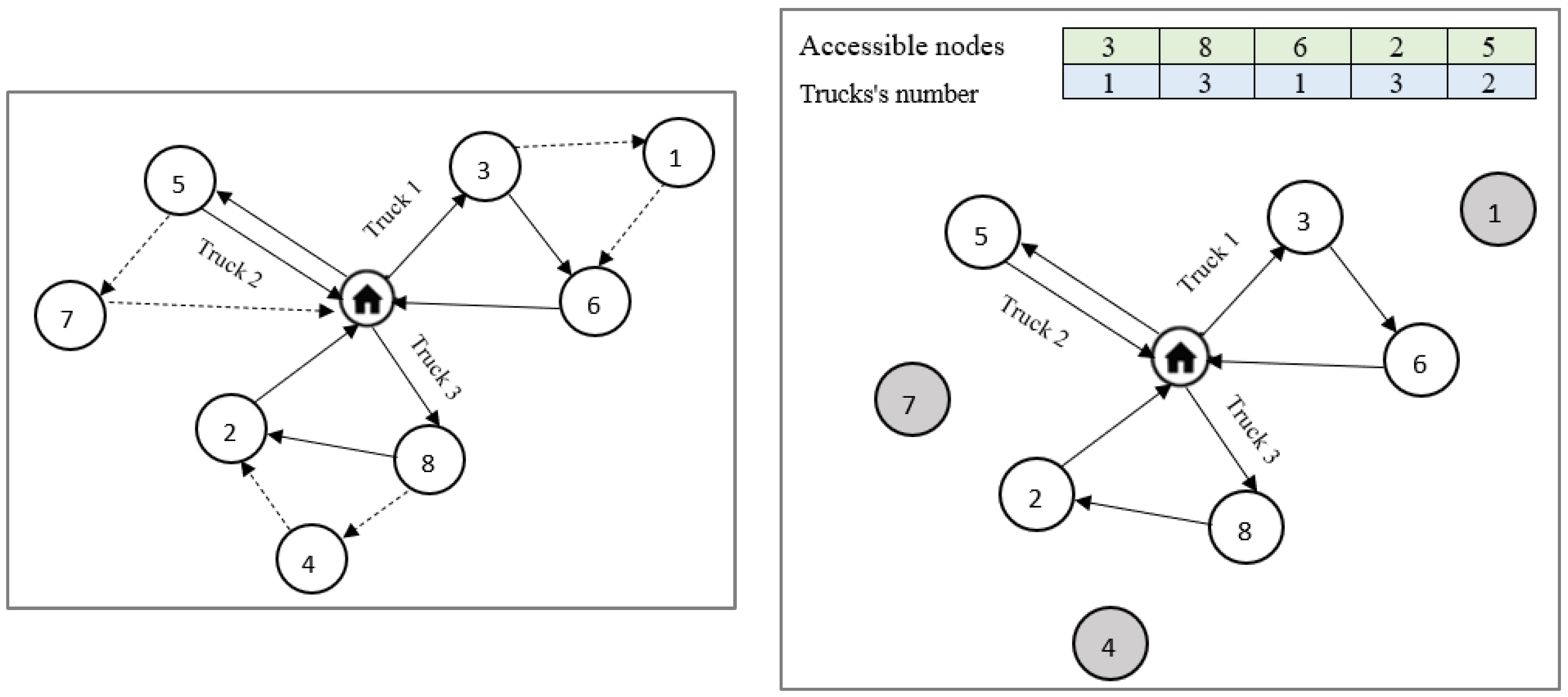
In this model, each chromosome is represented as an integer vector, where each gene corresponds to an accessible damage point. The value of each gene indicates the identifier of the ground vehicle assigned to serve that point. Inaccessible points are not encoded directly within the chromosome; instead, they are handled separately during the decoding phase through UAV assignment.
Figure 1 illustrates the chromosome representation of vehicles and accessible points. The gray circles denote points that are inaccessible to ground vehicles due to earthquake conditions, while the dashed lines represent UAV routes used to serve these inaccessible points.
Row 1 (accessible nodes) shows the sequence of locations visited by the trucks, while Row 2 indicates the corresponding truck numbers. For example, truck 1 (shown in the second row) first visits accessible damaged location 3, then location 6, and finally returns to the initial location (the depot). Inaccessible locations (nodes 1, 4, and 7) are assigned to the nearest ground vehicle route after the truck routes have been determined, using an iterative procedure. For instance, in
Figure 1, the UAV is launched from point 3 (the nearest accessible point to location 1), detaches from the truck, visits the inaccessible location 1, and then reattaches (lands) on the truck at point 6, which is the next nearest accessible point to location 1 along the truck’s route. In this problem, a single relief hub is considered, from which all trucks are dispatched to serve the demanded accessible locations.
- ▪
Crossover Operator
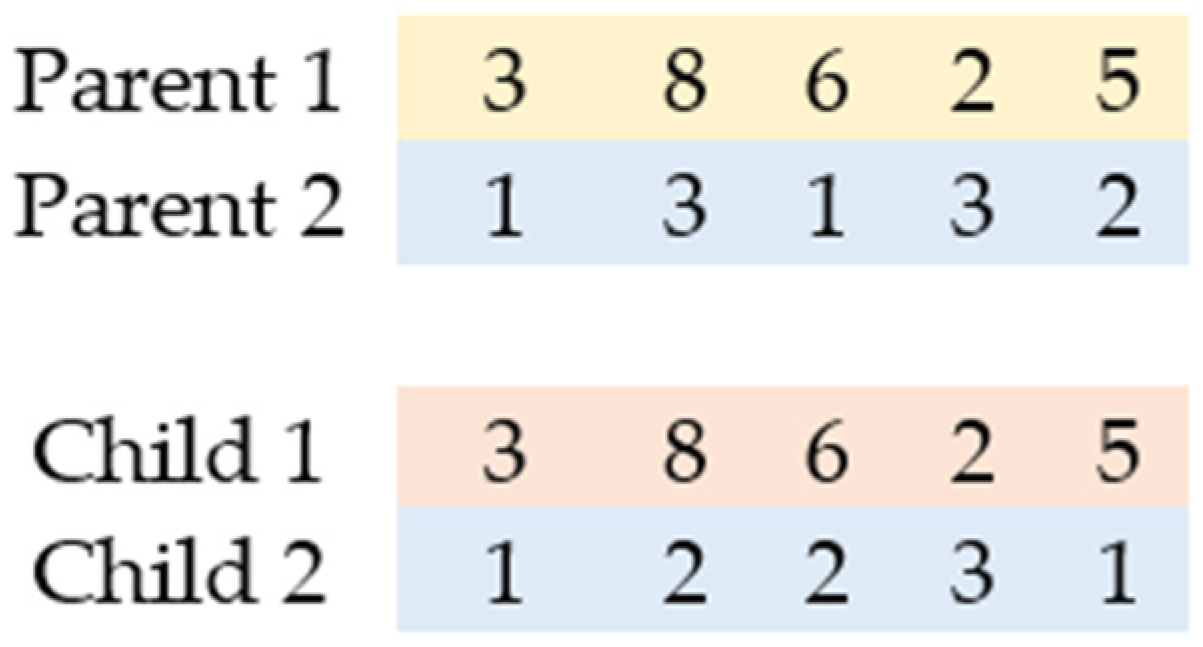
A two-point crossover operator designed to produce offspring using chromosomes.
Figure 2 shows a schematic view of the proposed crossover operator. For example, the parental chromosomes in
Figure 3 are broken at the second and fourth genes, the genes between them are swapped, and the segments before and after this crossover remain fixed.
The first row of the chromosome, which represents the reference sequence of accessible damaged points, is fixed. In contrast, the second row, which indicates the allocation of ground vehicles, varies during the crossover and mutation operations.
- ▪
Mutation Operator
As shown in
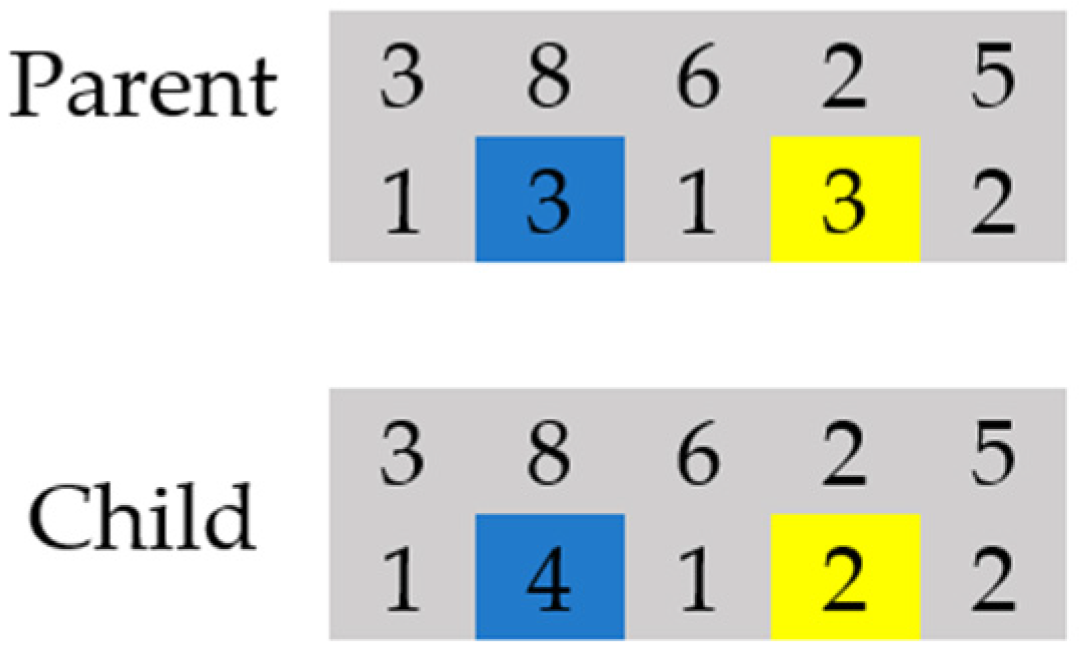
Figure 3, the mutation operator performs its function based on the mutation rate. The mutation applied in this problem is polynomial. The main goal of this type of mutation is to introduce diversity into the population of chromosomes to prevent becoming stuck in local optima. Since this method provides a non-uniform distribution, the probability of small changes near the current value is greater than that of large changes. Thus, two genes in the designed chromosome are selected at random. The mutation rate is tuned to an optimal value.
For example, cells 2 and 4 in
Figure 3 are selected as genes to be changed in Parent 1, and their values are changed from 3 to 4 and 2, respectively.
- ▪
Stopping criterion
The algorithm stops if either of the following two conditions is met:
5. Numerical Experiments and Analysis Results
Given that the problem is NP-hard, the ε-constraint approach is not capable of solving the proposed problem at a large scale. To address this challenge, heuristic approaches are typically used. Therefore, in this study, NSGAII–Nearest Neighbors (NSGAII-NN) is proposed as a solution method for this large-scale problem. According to
Table 5, the sample problems are classified into small and large groups. The small-sized problems were coded using the exact solution ε-constraint method and the large-sized problems were coded using the NSGAII–NN algorithm in Python 3.13.3. The software was run on a 1.30 GHz laptop with 8 GB of RAM and a 64-bit Windows 10 operating system.
The numerical experiments are based on synthetic post-earthquake test instances designed to evaluate the model under different scales of demand and different levels of road inaccessibility. The scenarios were not intended to reproduce one specific historical earthquake; rather, they were constructed to provide a controlled environment for comparing routing performance across small- and large-scale conditions. Accordingly, the number of demanded nodes varied from 6 to 8 in the small-scale set and from 30 to 40 in the large-scale set, while the proportion of inaccessible nodes varied at 30%, 35%, and 40% to represent increasing disruption severity. This design enables analysis of how the proposed model reacts to progressively more difficult access conditions.
To ensure transparency in the design of the numerical experiments, the test instances were generated by varying two main factors: the number of demand nodes and the proportion of nodes that become inaccessible after the earthquake. The proportion of inaccessible nodes determines how many demand points must be served by UAV instead of ground vehicles. For each problem instance, the number of inaccessible nodes is calculated by multiplying the total number of demand nodes by the predefined disruption percentage (30%, 35%, or 40%) and rounding to the nearest integer. This structure allows the experiments to represent different levels of infrastructure damage while maintaining comparable network sizes across scenarios.
Table 5 summarizes the structure of the experimental scenarios. The table shows how each problem instance is defined by a combination of network size (number of demand nodes) and inaccessibility level. As the percentage of inaccessible nodes increases, a larger portion of the demand must be served through UAV missions rather than truck routes. This allows us to evaluate how the hybrid routing system adapts to progressively more restrictive accessibility conditions.
5.1. Small Scale Results: ε-Constraint
To evaluate the model at a small scale using the ε-constraint method, nine test scenarios were generated by combining three network sizes (6, 7, and 8 demand points) with three disruption levels. To represent increasing post-earthquake access loss, the proportion of inaccessible locations was set at 30%, 35%, and 40%, corresponding to moderate, high, and severe disruption conditions, respectively. These percentages were selected to test the sensitivity of the hybrid routing model to worsen accessibility while keeping the scenarios comparable across different problem sizes. The number of trucks available at the hub for the small-sized problem instances, along with the service threshold, truck capacities, and speeds, are presented in
Table 6.
In particular, Problems No. 1, 2, and 3 correspond to the same network size (6 demand nodes) but different accessibility conditions. These three scenarios allow us to analyze how increasing infrastructure disruption affects routing decisions, fleet utilization, and UAV deployment while keeping the overall network size constant. The same experimental structure is repeated for networks with 7 demand nodes (Problems 4–6) and 8 demand nodes (Problems 7–9), allowing the analysis to separately evaluate the effects of problem size and accessibility level on the performance of the proposed model.
The parameter values in
Table 6 were selected to preserve a realistic monotonic relationship among vehicle classes. Specifically, light trucks were assigned the highest speed and lowest capacity/fuel consumption, medium trucks were assigned intermediate values, and heavy trucks were assigned the largest capacity but lowest speed and highest fuel consumption. This structure reflects the practical trade-off between agility and carrying ability in relief operations and allows the optimization model to evaluate whether rapid smaller deliveries or fewer high-capacity deliveries are preferable under different accessibility conditions.
It should be noted that in this study the payload of each truck corresponds to the vehicle capacity reported in
Table 6. Fuel consumption is therefore modeled as a constant rate per kilometer for each vehicle class, representing an average operational consumption under typical loading conditions. Although fuel consumption in reality may vary with payload and road conditions, this simplification is commonly adopted in routing studies to maintain model tractability while still capturing the relative efficiency differences among light, medium, and heavy trucks.
The solutions for the nine scenarios are shown in
Table 7. As we have a multi objectives problem and using the exact ε-Constraint approach, sometimes we have a pareto solution (multi optimum solution) for one problem. For example, for Problem No. 1 we have two optimum solutions. It can also be said that there is a trade-off when comparing the objective functions of these two solutions. Because solution number 1 is more optimal in terms of time (
), cost (
), and fuel (
), but solution number 2 has a shorter distance. The choice of the best solution depends on the decision-maker’s priorities (for example, if cost reduction is more important, solution 1 is better).
The response values (decision variables) for each scenario are presented in detail in
Table 8. For Problem No. 1, two Pareto-optimal solutions were obtained, as shown in
Table 7.
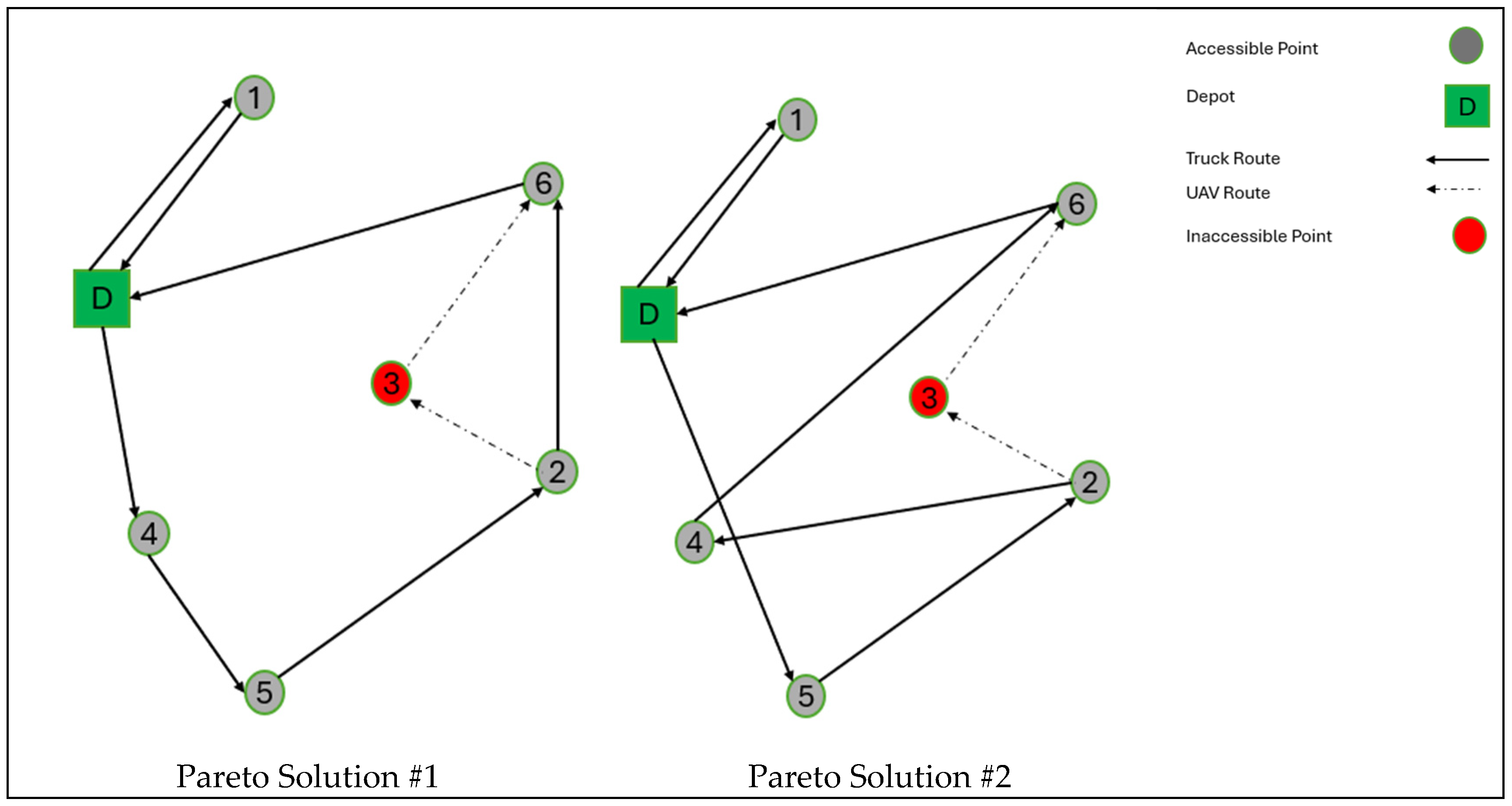
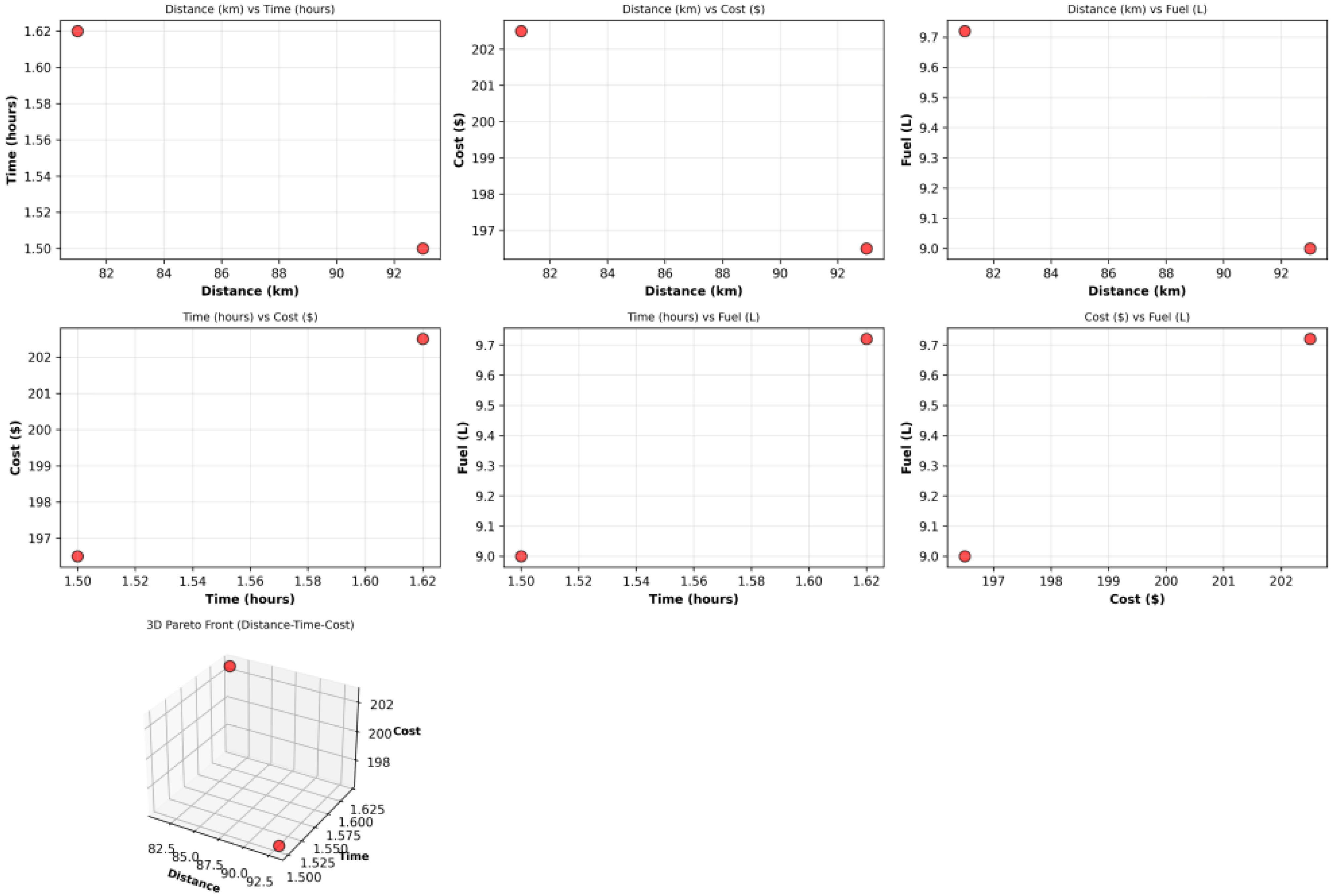
Figure 4 illustrates the routing configuration for the selected solution of Problem No. 1, while
Figure 5 presents the corresponding Pareto-front representation. In this scenario, six demand points require service, and 30% of them are inaccessible to ground vehicles and therefore must be served through UAV-assisted operations. The optimal fleet composition consists of two light trucks. To avoid ambiguity, the route description below refers specifically to the solution illustrated in
Figure 4 and reported consistently in
Table 8.
For Pareto Solution #1, the routing sequence and UAV mission shown in
Figure 4 are consistent with those reported in
Table 8. One light truck serves the accessible node 1 directly from the depot and then returns to the depot. The second light truck serves the remaining accessible nodes following the route D → 4 → 5 → 2 → 6 → D and supports the UAV mission (2 → 3 → 6) for the inaccessible node 3. The UAV is launched from the truck at node 2, serves the inaccessible node 3, and then rejoins the truck at the return point node 6.
For Pareto Solution #2, the routing structure differs slightly in the sequence of the ground vehicle route, which explains the trade-off observed in
Table 7. In this solution, the first light truck again serves node 1 directly from the depot and returns to the depot, similar to Pareto Solution #1. The second light truck serves the remaining accessible nodes following the route D → 5 → 2 → 4 → 6 → D and supports the same UAV mission (2 → 3 → 6) for the inaccessible node 3. The UAV is launched from the truck at node 2, serves the inaccessible node 3, and rejoins the truck at node 6.
No UAV is utilized on this route. The remaining affected points (2, 3, 4, 5, and 6) are served by the second light vehicle. This vehicle departs from the depot, visits point 4 and 5, then continues to points 2 and 6, before returning to the depot. The inaccessible point 3 is served by a UAV launched from point 2. After completing the delivery, the UAV lands and reattaches to the truck at point 6. This UAV-assisted operation shortens the overall route and consequently reduces both the total travel time and operational cost. In the second solution, all accessible affected points are served exclusively by ground vehicles, and no UAV is deployed to serve the inaccessible point due to UAV endurance (flight range) limitations.
Figure 5 two-dimensional representations of the Pareto front for problem No. 1, which help examine the relationship between the two objectives separately and with greater clarity. In each chart, the horizontal and vertical axes represent different objectives, and the points are the possible optimal solution in all these charts, there is a trade-off between objectives. In general, these charts help the decision-maker understand what will happen if they want to focus on a specific objective (e.g., “time”). focus, how much they must sacrifice other objectives (e.g., “cost”), and what the possible limits of this trade-off are.
Figure 5 illustrates the Pareto front obtained for Problem No. 1, where each point represents a non-dominated solution generated by the ε-constraint method. These points reflect different trade-offs between the objective functions, particularly between total travel distance and total service time. Solutions located toward the lower-left region of the plot represent more efficient routing configurations with lower travel distance and shorter service time. The Pareto front therefore highlights the set of optimal alternatives available to decision-makers, allowing relief planners to select a routing strategy that best balances operational efficiency and response time under the given disaster conditions.
5.2. Analysis of Numerical Example with NSGAII-Nearest Neighbor
This section has been dedicated to examining how the problem is solved on a large scale. The NSGAII-NN heuristic is an exploratory optimization algorithm that operates randomly on its solutions. Each solution is a local optimum, which makes it prone to encountering local optima. The selection of appropriate parameters for evolutionary algorithms is crucial to achieving effective performance. In this study, the population size is set to 100, while the crossover probability (Pc) and mutation probability (Pm) are set to 0.9 and 0.1, respectively. The number of iterations is set to 200. The termination condition is based on a predefined number of iterations, after which the non-dominated solutions are obtained. The Pareto solutions for the first large-scale problem (Problem No. 10) are presented in
Table 9.
Table 9 presents the Pareto-optimal solutions obtained for Problem No. 10 using the NSGAII–Nearest Neighbor approach. All solutions should achieve a similar maximum service time within of 2 h, indicating that the operational time constraint is satisfied across different routing configurations. However, the solutions differ in terms of fleet composition, total travel distance, and UAV utilization. For instance, increasing the number of light trucks generally reduces total vehicle distance (e.g., Solution #2), while alternative configurations reduce drone travel distance (e.g., Solution #4). These variations illustrate the trade-offs between ground and aerial operations, where different allocations of trucks and UAV missions can achieve comparable service times but with different operational efficiencies. This provides decision-makers with flexible routing alternatives depending on priorities such as minimizing distance or balancing fleet usage.
Since different trucks have different operating speeds (as shown in
Table 6), the resulting travel time is calculated using the speed of the selected vehicle rather than assuming a fixed average speed. Therefore, the travel time values may differ from simple distance–speed calculations based on a specific truck type.
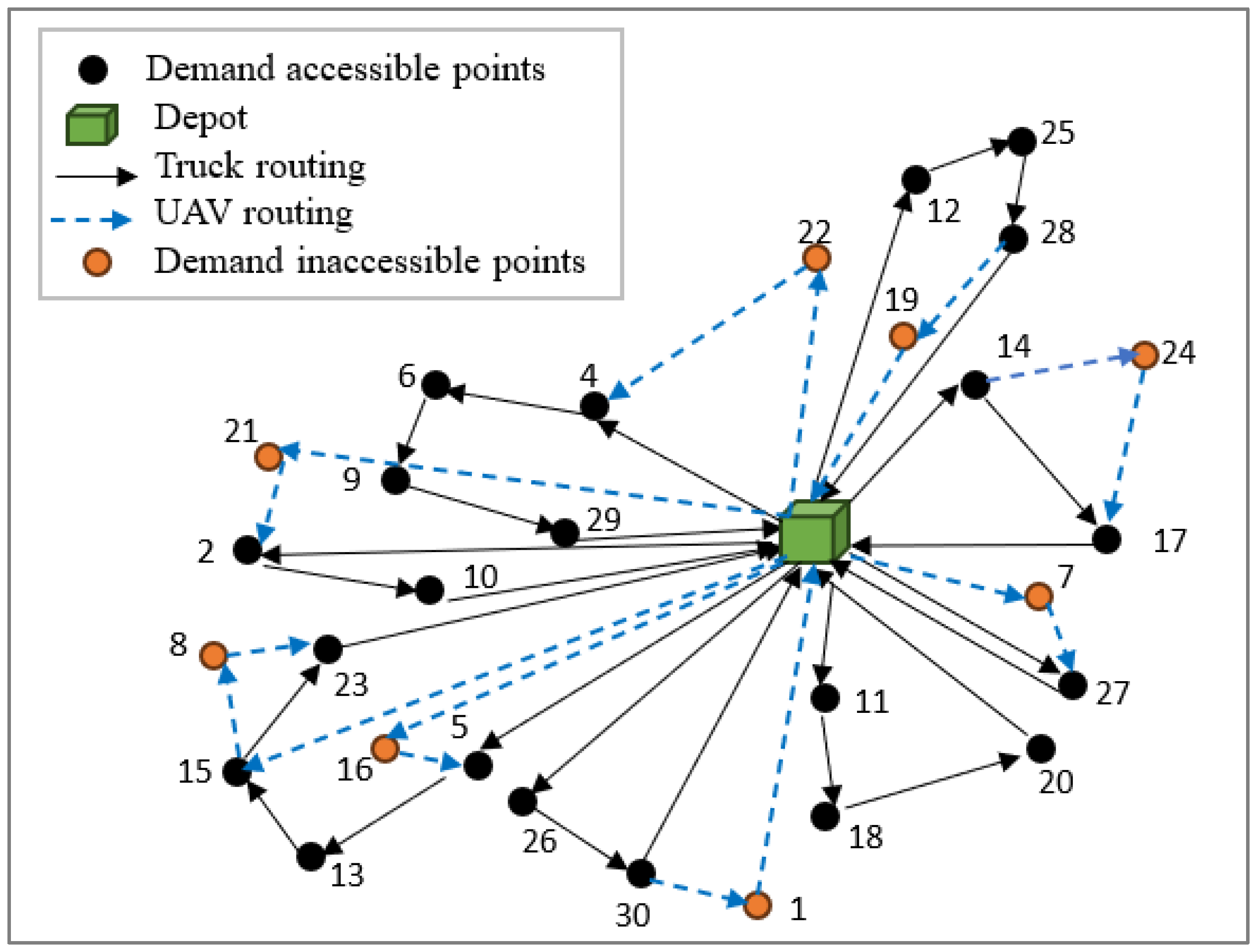
Table 10 presents the detailed solutions for Problem No. 10 corresponding to Pareto solutions #1 and #2 obtained using the NSGAII-NN algorithm for managing a complex relief scenario in which 30% of the demand points require aerial service due to the lack of ground access. An algorithm has deployed a hybrid fleet of 8 light trucks, 3 medium trucks, and 1 UAV to cover all 30 points; the trucks are responsible for carrying the main cargo on optimal ground routes, while the UAV is strategically deployed to assist inaccessible points such as (24, 22, 8, 19, 7, 21, 1) are launched from the depot points and, after delivering the cargo, rejoin the ground operations at the return points. This solution provides a flexible and efficient operational model that, by dividing tasks between the ground and air fleets, not only overcomes all access constraints but also optimally assigns routes to each vehicle (such as shorter routes for truck #14 and longer routes for # 6, achieving a good balance between the total time (around 6 h) and the distance traveled (around 320 km), and proving the ability of the NSGAII-NN algorithm to find feasible and optimal solutions for realistic, multi-objective problems. The geographical locations of depot and demand points for Problem No. 10 and solution #1 are shown in
Figure 6.
Table 11 shows the results of the NSGAII-NN algorithm for the large-scale problem. As the problem complexity increases due to the addition of more demand points, the values of all objective functions rise significantly. There is a notable jump in the values between problems 12 and 13, which marks the boundary between the two categories. If we divide the large size problem into two groups, the analysis for each group is as follows:
Problems (10, 11, 12): These scenarios represent simpler problems with fewer demand points. The NSGAII-NN algorithm performs exceptionally well in these scenarios. The best costs in this category fluctuate between 800 and 830 units. These values are very close to each other, indicating the algorithm’s intense competition to find optimal solutions. In these scenarios, the algorithm has succeeded in finding a set of solutions (the Pareto front) that allows the decision-maker to choose based on different priorities. For example, in scenario 11, one could choose between a low-cost solution and a low-time solution.
Problems (13, 14, 15, 16, 17, 18): These scenarios are the most challenging part of the analysis. The results in this category are unpredictable and highly dependent on each scenario’s input parameters. Unlike category 1, here we see significant fluctuations in the optimal costs (from 940 to 1215) and optimal times (from 6.2 to 8.0). This shows that merely being large does not guarantee that a problem is bad. Problem 15, despite being on a large scale, managed to achieve a cost of 941.5 and a time of 6.26. This performance is even better than some of the scenarios in category 1. This shows that the problem formulation in problem 15 was exceptionally optimal, allowing the algorithm to find excellent solutions. Problems 16 and 17 have the worst performance in terms of cost (over 1130) and time (over 7.5). This indicates that these scenarios likely had the worst combination of parameters (e.g., poor point distribution, strict constraints, or an inefficient fleet). In contrast, problem 18 is another large-scale success. This problem managed to break the increasing trend of time and distance seen in scenarios 16 and 17, achieving a time of 6.60 and a distance of 501. This proves that with optimal parameters, one can achieve excellent results even in the most complex problems. In problem 18, the exchanges are much more intense and clearer. The choice between a fast solution (cost 1214) and a low-cost solution (cost 1129) represents an 85-unit difference, requiring a strategic decision from the decision-maker. Overall, looking at the general trend across all nine problems, the following conclusions can be drawn:
Complexity growth trend: The time and distance metrics show an overall increasing trend. As the problem grows, travel time and distance travel are also expected to increase.
Uncertainty about cost and fuel: Cost and fuel indicators do not follow an upward trend. These indicators are heavily influenced by fleet efficiency, the number of vehicles used, and route optimization. A well-designed approach (such as problem 15) can keep costs under control even on a scale.
It should be noted that in Problem No. 11, Solutions #1 and #2 have identical objective function values. This occurs because different routing and fleet allocation configurations can lead to the same aggregated performance in terms of total time, distance, and cost. Such cases are common in multi-objective optimization problems, where multiple Pareto-optimal solutions may exist with equivalent objective values but different structural characteristics. These alternative solutions provide flexibility for decision-makers to select a preferred operational plan based on practical considerations not explicitly captured in the model.
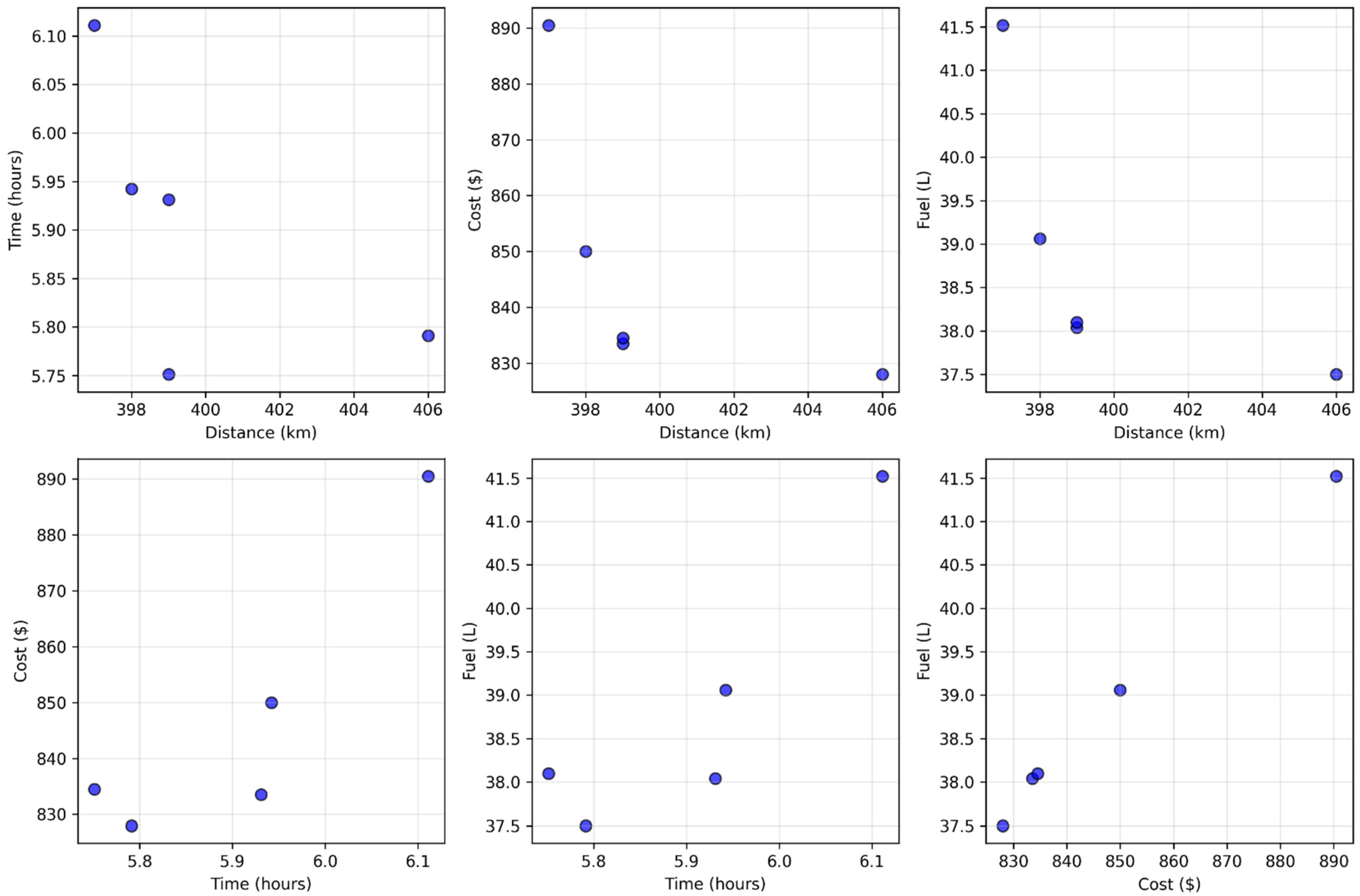
As shown in
Figure 7, the Distance, Fuel, Distance and Time relationships are highly correlated, confirming that the fleet structure and the vehicles’ constant speed have been correctly modeled. Cost is affected by both distance and fuel, but its dependence is nonlinear and multifactorial, meaning that the cost is a composite of ground routes, UAV missions, stops, and cargo carried. The charts show the natural trade-off between the objectives. This means that none of the objectives is minimized in isolation. The solutions also lie on the Pareto front, and indeed the model has effectively captured the multi-objective behavior.
6. Discussion
Natural disasters, especially earthquakes, cause widespread damage every year, and post-crisis infrastructural disruption makes relief logistics one of the most critical challenges. In such circumstances, the timely delivery of essential goods requires systems that can adapt to access limitations, blocked routes, and rapidly changing on-the-ground conditions. The results of this study indicate that using a combined ground-and-air transportation system can significantly increase the efficiency of rescue operations. The combination of trucks and drones speeds up response time and enables coverage of inaccessible areas without causing delays a factor that plays a decisive role in the critical hours following an earthquake. Analysis of small-scale scenarios showed that the ε-constraint method was able to produce a set of exact solutions at a very low cost and time (800–830 cost units and about 5.3–5.8 h). These solutions showed that even a single drone mission can make a significant change in the truck’s route, reduce ground distance, and improve network efficiency. These findings indicate that the intelligent allocation of drones based on the locations of inaccessible points, flight range, and the need for rapid return is one of the key factors in the optimal performance of the rescue system. As the problem’s complexity increased and conditions approached more realistic scenarios, the NSGA-II algorithm became increasingly important. This algorithm was able to provide a set of Pareto-optimal solutions in large-scale scenarios with 30 demand points and 30 percent inaccessibility, effectively illustrating the trade-offs among time, cost, distance, and fuel consumption. For example, in the well-designed scenarios (scenarios 15 and 18), the algorithm was able to produce solutions with 940–1129 cost units and 6.2–6.6 h of time, whereas in the poorly designed instances the results showed a significant drop. This indicates that the quality of the inputs and the structure of the problem play a more important role than scale in optimization. One of the key points of this research is that as the percentage of inaccessible points increases, the importance of drones increases exponentially. About one-third of the areas in large-scale scenarios could only be covered by drones, and relying solely on the ground fleet caused serious delays. The hybrid system, with an optimal distribution of operational workload, was able to reduce service time while also keeping costs and fuel consumption under control. From a modeling perspective, this research also demonstrated that multi-objective problems with nonlinear structures and extensive constraints require hybrid approaches. The simultaneous use of the exact ε-constraint method and the NSGAII-NN meta-heuristic proved that combining classical and evolutionary methods can be an effective solution for complex crisis management problems. ε -constraint provided accurate solutions on small scales, and NSGAII-NN successfully generalized the discovered patterns to large scales. Overall, the findings of this study indicate that the use of hybrid truck–drone systems can provide a practical and reliable framework for relief operations during crises. This system not only increases response speed and geographic coverage but also facilitates strategic decision-making in emergency situations by providing a set of optimal solutions. The results also offer avenues for future research, including the optimization of design parameters, the modeling of uncertainties, and the development of more advanced hybrid algorithms.
To quantify the performance improvement of the proposed hybrid delivery system, the results obtained with the integrated truck–UAV framework were compared with those from a ground-only truck configuration. Based on the average results across the tested scenarios, the hybrid system achieved approximately 15% reduction in operational cost, 12% reduction in total service time, and nearly 10% reduction in fuel consumption.
7. Conclusions
Natural disasters like earthquakes, by causing widespread damage and infrastructure destruction, present serious challenges to the relief process. With the goal of improving the speed and efficiency of aid distribution, this research proposes an optimization model for combined truck and drone routing to deliver essential goods to affected areas in the shortest possible time and at the lowest cost. To solve the problem, the ε-constraint method was applied on a small scale and the NSGAII-NN algorithm on a large scale. The results showed that ε-constraint delivers highly accurate, low-cost performance under small-scale conditions, while NSGAII-NN, despite its high complexity, was able to produce optimal and balanced solutions in large-scale scenarios. Analysis of scenarios with 30 demand points and 30% inaccessible areas showed that the quality of the input design plays a more significant role than the problem’s scale, and the algorithm is capable of producing reliable Pareto fronts. Overall, the findings indicate that a combined ground–air system can significantly enhance crisis response efficiency and provide a suitable framework for developing more advanced methods in relief logistics.
Future studies can build upon the foundation laid by this research through different methods, such as examining uncertainties in different parameters using robustness or simulation. Another promising direction for future research is the integration of dynamic accessibility updates into the routing framework. In real post-earthquake environments, road conditions may change over time due to aftershocks, debris clearance, or secondary hazards.
Also, in large dimensions, other meta-inference and heuristic algorithms can be used and finally the convergence and optimality of the algorithms can be compared.