


Highlights
Please indicate how your work links to systems science via your contributions to systems practice, theory, and/or methodology.
- The overall work utilizes the community-based system dynamics approach to build systems thinking capacity and develop strategies for community action.
- This article showcases how a causal loop diagram can be overlaid with the social ecological model for identifying potential levers for change.
What are the main findings and/or the implications of the main findings?
- A causal loop diagram showing feedback relationships between intrapersonal, interpersonal, organizational, community, and public policy factors.
- The community-generated CLD identifies feedback structures and potential leverage points for collective action.
Abstract
Background: Nutrition security is the ability to access, afford, prepare, and incorporate nutritious foods into daily life. Washington, DC’s Wards 7 and 8 have long experienced inequitable investment in food infrastructure, which is part of a complex place-based system, resulting in disparities in nutrition security and subsequent diet-related health outcomes. Methods: We worked with a Community Advisory Board composed of Wards 7 and 8 residents and practitioners across different sectors to map the complex system driving nutrition security in their community. Through a series of group model building activities, a causal loop diagram was synthesized by university researchers and presented back to the Community Advisory Board for feedback and edits. Results: The causal loop diagram (CLD) includes 26 variables and 11 highlighted feedback loops. The CLD spans individual healthy eating behavior, community norms, community ownership of food operations, and public policy. Discussion: The diagram provides a shared systems representation of the factors shaping nutrition security and identifies feedback structures and potential leverage points for collective action. We applied the social ecological model to analyze potential strategies for strengthening each level of feedback loops to promote healthy eating and achieve nutrition security.
Received date: 30 July 2026; Revised date: 9 October 2026; Accepted date: 19 October 2026
1. Introduction
Nutrition security is associated with nutritional and health outcomes and is influenced by a myriad of interdependent political, social, and structural factors operating within a complex adaptive system [1,2,3,4,5]. These interconnected factors shape individuals’ access to, availability of, and ability to utilize nutritious foods, contributing to persistent disparities in food and nutrition security [6].
Washington, DC’s Wards 7 and 8 have long experienced inequitable investment in housing, transportation, healthcare, and food infrastructure [7]. Although these communities have received increased philanthropic and governmental attention in recent years, persistent disparities in food access and diet-related health outcomes remain [8]. For example, Wards 7 and 8 have substantially fewer full-service grocery stores than other areas of the District, contributing to ongoing challenges in accessing affordable, nutritious food [9]. As of 2025, Wards 7 and 8 have about one full-service grocery store for every 30,000 residents. The rest of Washington has an average ratio of one full-service grocery store for every 7000 residents. Community-based efforts such as DC Central Kitchen’s Healthy Corners initiative and the Marion Barry Avenue Market & Café illustrate ongoing attempts to address food access, community connection, and other structural barriers to nutrition security [10,11].
Systems mapping can deepen understanding of the complexities of nutrition security in Wards 7 and 8 and support innovative solutions through long-term planning. The resulting systems map diagram is a causal loop diagram that visually represents feedback relationships influencing how systems behave over time [12]. When developed through participatory methods such as group model building, these diagrams also create opportunities for community members to build a shared understanding of local challenges, identify leverage points for change, and develop coordinated strategies across sectors [13].
Systems approaches have been used to examine the complex interactions shaping food environments and dietary behaviors [14]. Systems mapping of food environments among low-income populations has identified interconnected influences related to food access, household resources, individual behavior, and social and cultural factors [15]. Participatory group model-building studies have similarly shown the value of incorporating community perspectives to understand healthy food access and nutrition-related behaviors [16,17]. However, these studies have largely focused on food access or specific dietary behaviors. Less is known about how community members understand the feedback relationships connecting individual healthy eating behaviors with community, organizational, and policy-level factors within historically disinvested urban communities to improve nutrition security.
The present study builds on existing literature by examining how healthy eating interacts with community ownership, resource allocation, trusted messengers, structural barriers, and policy influence within a historically disinvested urban food system.
Researchers at the George Washington University worked with a Community Advisory Board of ten residents and public service leaders in Wards 7 and 8 to map the complex systems in Wards 7 and 8. Together, the group developed a community-generated causal loop diagram representing the system shaping nutrition security in Wards 7 and 8. In this paper, we describe the causal loop diagram with emphasis on how individual, community, organizational, and policy-level factors interact to influence nutrition security. We also examine key feedback dynamics as well as potential leverage points for collective action.
2. Materials and Methods
The George Washington University (GW) Institutional Review Board reviewed the research activities and deemed them exempt (IRB number: NCR256479).
2.1. Participants
We convened a community advisory board (CAB) as part of this study. CAB members and the university research team’s community engagement lead were invited to participate in group model building. The community engagement lead spent 14 years working on food-related issues as a grassroots community leader in Wards 7 and 8. CAB members were recruited through a selection process that began with three in-person and two virtual community listening sessions, where community members and leaders learned about the project and provided input on perspectives to incorporate into the CAB. The listening sessions were followed by an application process in which individuals submitted a written response explaining their interest in joining the CAB and provided a resume. The goal of the CAB selection was to bring together a group of leaders who can work together to gain a new understanding of the system through support from university researchers, apply that understanding to plan action, and continue implementing and sustaining the work beyond the initial project funding cycle. The community engagement lead and the project manager at GW led the selection process. Areas of expertise (e.g., criminal justice and food, workforce development and food), neighborhood of residence, age group (i.e., youth, elderly, or working age), and gender of the CAB members were considered to maximize the range of diversity of experiences and perspectives that can reflect different sectors touching upon the underlying drivers of food and nutrition security. Ten individuals were ultimately asked to serve on the CAB for this project.
2.2. Group Model Building Design
The GW research team conducted Group Model Building (GMB) across 6 live, in-person sessions with CAB members between December 2025 and March 2026 (Table 1). The GW research team led each session, which lasted two hours, with the first half hour focused on sharing individual and community updates and building relationships among CAB members. GMB activities followed standard GMB scripts [18].
Table 1.
Group model building activities and resulting artifacts and products.
GMB began with Hopes and Fears, in which CAB members individually wrote at least one hope and fear regarding the project or nutrition security in Wards 7 & 8. CAB members placed each hope and fear on the wall, and the facilitator read them aloud and summarized themes. The CAB considered these hopes and fears when developing their mission statement.
In the next session, CAB members agreed on five important factors to focus on as they initiate GMB activities: families make informed and healthier food choices, physical access to healthy food, food affordability, community control of the local food system, and community ownership of the local food system. These initial factors were identified from the CAB’s mission statement and informed the boundaries of the causal loop diagram. CAB members then drew Graphs Over Time for each factor in small groups to visualize their perceived historical trend for each factor and their desired future trajectory.
Between sessions 2 and 3, the research team drafted a problem statement based on the variables elicited in the Graphs Over Time activity. In session 3, the facilitator reviewed the variables discussed in the previous session and presented a draft problem statement to the CAB. As a full group, the CAB iteratively proposed edits, discussed them, and revised the statement until no one had additional edits. In session 4, CAB members used key variables from the problem statement to build connection circles. The facilitator explained the purpose of connection circles, demonstrated the activity, and then split the CAB into three breakout groups to create their own connection circles. Each breakout group included at least one research team member to guide the group and answer questions. The facilitator then instructed all breakout groups on moving from connection circles to causal mapping. In the same breakout groups, CAB members created feedback loops based on their connection circles. Research team members in each group emphasized that each feedback loop should express a key story about how the food system in Wards 7 & 8 operates. Each breakout group presented their feedback loops to the other groups.
2.3. Artifacts, Data, Synthesis, and Model Review
Through GMB activities, CAB members created three sets of artifacts: connection circles, behavior-over-time graphs, and causal loop diagrams. GMB discussions were audio-recorded and transcribed to support the iterative synthesis process described below.
Between sessions 4 and 5, the research team used transcripts of the recorded connection circle and causal mapping breakouts to synthesize each group’s feedback loops into one causal loop diagram (CLD). First, the researchers immersed themselves in the data by reviewing transcripts from GMB activities. Second, the researchers held three two-hour synthesis sessions, referencing transcripts and the breakout group causal loop diagrams to collectively identify key themes, variables and definitions, causal relationships, and system boundaries. During the first synthesis session, researchers identified overlapping factors and connections across the three groups. During subsequent sessions, the team noted connections and subsystems with no overlap across groups and included them in the initial CLD. In between synthesis sessions, researchers revisited transcripts to clarify any questions that arose during discussion. Where there were points of disagreement or lack of clarity among research team members, they noted them so they could present them to CAB members for feedback in session 5.
In session 5, the facilitator presented the synthesized CLD to the CAB and elicited feedback by asking, “What did we get right? What did we miss? What is confusing?” CAB members began by asking clarifying questions to understand the CLD better. As a full group, they iteratively proposed edits and revised aspects of the CLD, including variable names, missing variables or causal connections, and loops, until the group reached consensus that the map was complete for the purposes for which they wanted to use it. Two CAB members did not attend session 5. They provided feedback (one via email and one via a virtual call with the research team), further raising dialogue about the purposes for which this map could or would be used, and whether it was sufficiently explicit and explanatory for those purposes.
Between sessions 5 and 6, the research team edited the CLD to reflect additional feedback. Based on in-person feedback in session 5, two variables within existing loops were added to emphasize the importance of establishing community-owned mechanisms for resource allocation. Based on the virtual feedback provided by a CAB member who did not attend session 5, knowledge about family health history was added as a variable that would increase through greater knowledge sharing and, in turn, influence individual healthy eating practices.
In session 6, the full group discussed the additional proposed edits until they reached consensus to include the additional two variables in existing loops. The CAB rejected the suggestion of adding knowledge about family health history as a variable, concluding that neither the addition of the variable nor the new feedback loop it would create would add substantial value to the existing CLD. The feedback sessions were semi-structured to encourage open dialogue.
Although they could have continued refining the CLD by renaming or adding variables and causal connections, in session 6 the CAB members agreed that the existing CLD sufficiently represented their collective understanding of the system and provided a strong enough foundation to move forward with their goal of connecting and collaborating across system actors. A revised causal loop diagram is now available on Kumu.io (version 2) to be accessible for CAB members to provide any further feedback [19].
2.4. Future Iterations
The CAB and the researchers consider the CLD a living document. As the CAB works to translate theory to action and communicate with other community leaders and residents, the causal loop diagram can be further modified to reflect the collective understanding of how the system works and what the leverage points may be to improve nutrition security in Wards 7 and 8.
3. Results
At least seven CAB members and the community engagement lead attended each group model-building session with the university research team. CAB members brought lived experience from both Wards 7 and 8, as well as expertise in early childhood education, youth development, criminal justice, workforce development, food production, faith-based community, green infrastructure, and research and evaluation to the group model-building process.
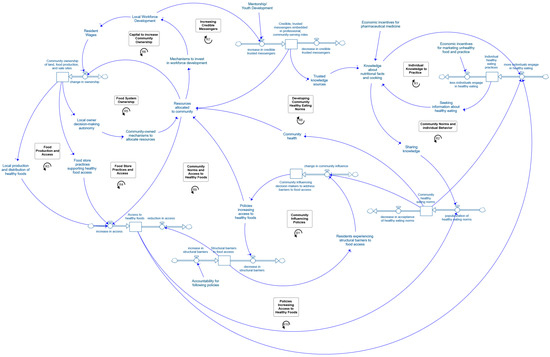
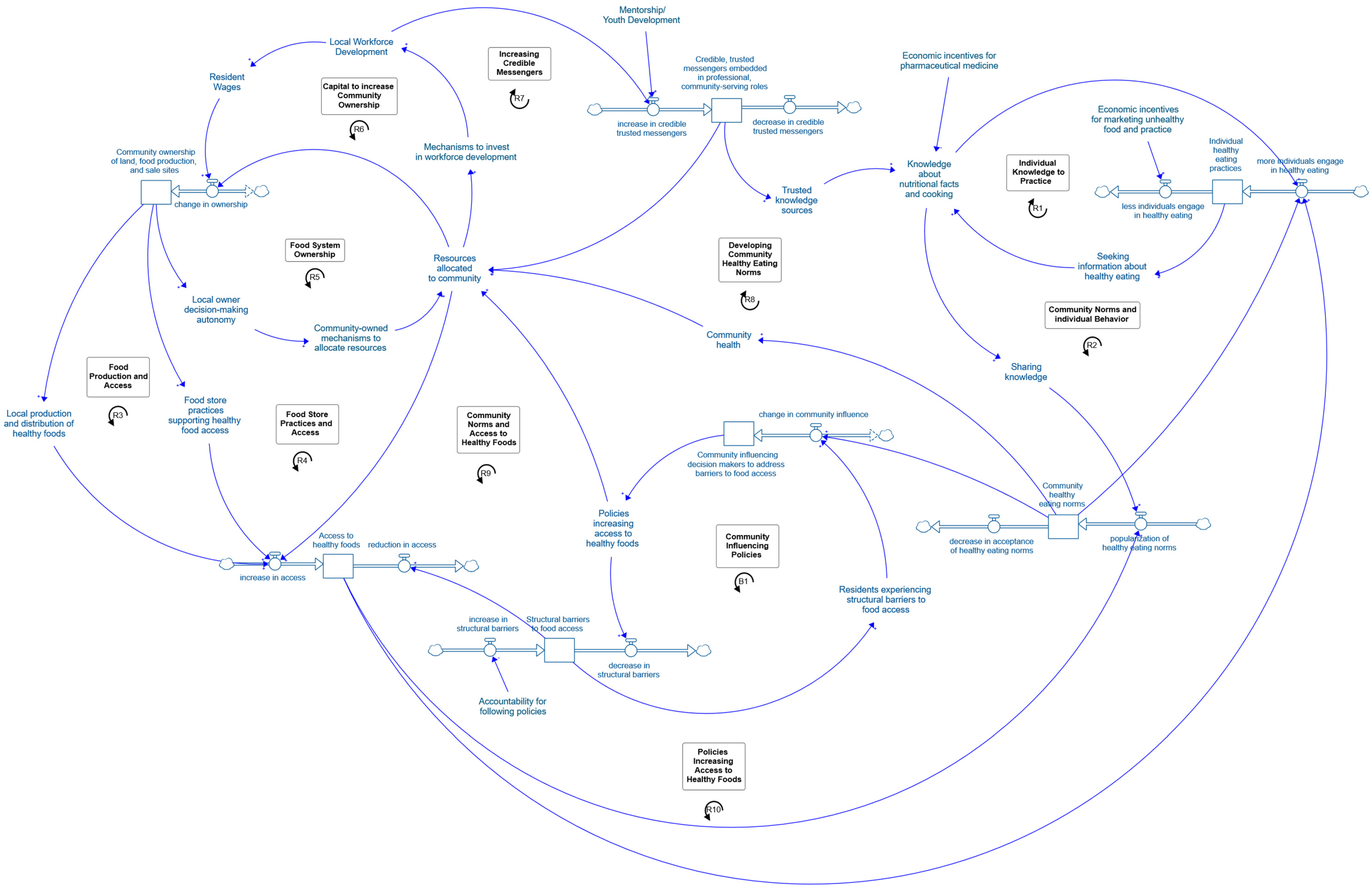
The CLD presented in this article is the April 2026 version, shown in Figure 1. It includes 26 variables and 11 highlighted feedback loops (10 reinforcing loops and 1 balancing loop). CAB members highlighted these 11 loops because they represented the core stories they wanted to tell during causal mapping.
Figure 1.
Causal loop diagram developed by the community advisory board to map the system around the problem of nutrition security in Washington, DC’s Wards 7 & 8. Key stocks were added by the research team to highlight variables whose behaviors over time are of interest.
3.1. Dynamic Problem Statement
Through the Graphs Over Time activity, CAB members explored trends in variables they perceived to be related to nutrition security, the system we were seeking to understand and influence. They noted that although physical access to healthy food in Wards 7 and 8 remains inadequate, it has consistently increased since the turn of the century. Despite the continued increase in physical access to healthy food, the number of families making informed, healthier food choices has remained relatively stagnant after an initial increase in the early 2000s, especially since the COVID-19 pandemic. These patterns highlighted that the broader conditions that shape people’s ability to access and consume nutritious foods is not sufficient. The conditions must also lead to behavior change within individuals. CAB members hope to see physical access to healthy food continue to increase steadily and, importantly, for more families to make informed, healthier food choices. A steady increase in healthy eating, or the behaviors of individuals to purchase, prepare, and eat healthy foods, is how the CAB suggests that we know nutrition security has been achieved.
3.2. Reinforcing Individual Healthy Eating Behaviors
On the right side of the CLD are loops related to changing individual behavior and community norms around healthy eating (R1, R2, R8, R9). In R1, we see that more knowledge about healthy eating leads to more healthy eating practices. The more individuals practice healthy eating, the more frequently they seek information about healthy eating. This, in turn, increases knowledge about healthy eating. As the CLD shows, both knowledge about healthy eating and access to healthy foods converge to activate individual healthy eating practices. At the same time, economic incentives drive the marketing of unhealthy foods and practices, and the promotion of pharmaceuticals, which could reduce healthy eating practices. If knowledge about healthy eating and access to healthy foods can outweigh the effects of economic incentives, individuals would practice more healthy eating behaviors over time. Conversely, when knowledge or access to healthy foods remains limited, the few who practice healthy eating may gradually disengage and decrease healthy eating practice in the community over time.
3.3. From Individual Behavior to Community Norms and Impact
In R2, R8, and R9, individual healthy eating practices, sharing healthy eating knowledge within communities, and access to healthy foods contribute to promoting community healthy eating norms. These community norms improve community health and spur more resources allocated within the Wards 7 and 8 communities. R9 illustrates that strong community healthy eating norms strengthen and sustain access to healthy foods through policy changes. At the same time, resources can be reallocated to invest in people, building a stronger economic future and social cohesion by cultivating a strong workforce and credible messengers within the community (R6 and R7).
3.4. Community Ownership Is Linked to Resident Autonomy
R5 emphasizes the importance of Wards 7 and 8 community residents having ownership and local control of the food system. As residents gain ownership of land, food production, and sale sites, they gain more decision-making autonomy. Greater autonomy strengthens community-owned mechanisms to allocate resources, improving allocation according to community priorities. As this is a reinforcing loop, gains in community ownership and resource allocation may build upon one another over time, further strengthening resident ownership and autonomy. On the other hand, lack of resources for residents decreases resident ownership of land and food operations, which leads to less decision-making autonomy. Consequently, fewer community-owned mechanisms for allocating resources mean resources are not being allocated to community-driven priorities, further reducing resident ownership of food operations. Without a sizable influx of resources allocated to community-driven priorities or reassignment of ownership to residents, R5’s reinforcing behavior may sustain or deepen existing patterns of disinvestment over time. Increased resident ownership of food operations not only helps direct resource allocation, but also shapes food production and sales practices, as shown with R3 and R4. What to grow, how to process and distribute, and what and where to sell are important decisions that would better reflect residents’ priorities and needs if residents own the operations. When food operation practices and community priorities align, residents’ access to healthy foods improves.
3.5. Feedback Loops for Influencing Policies
R10 and B1 emphasize how residents influence policies, whether legislative, regulatory, or even institutional. In R10, stronger community healthy eating norms lead more residents to advocate for and influence decision-makers, changing policies to address structural barriers and, as a result, increase access to healthy food. One specific pathway to increase access is to allocate resources effectively to communities that need healthy food access. As access to healthy foods increases, it helps further popularize community healthy eating norms, which then drives residents to influence decision makers to support healthy-eating policies. Because R10 is a reinforcing loop, stronger community norms, policy influence, and healthy food access may build upon one another over time, allowing policy-driven improvements in food access to become increasingly self-reinforcing.
B1 is the only balancing loop in the CLD. It shows how structural barriers to food access lead to more frequent adverse experiences, which in turn drives more efforts to influence decision makers to increase food access. As policies are implemented, structural barriers decrease, leading to fewer residents experiencing them and less effort to shape policies. As a result, policies aimed at improving healthy food access may fall away or be undermined by policies supporting other priorities, leading to more structural barriers returning to neighborhoods and causing more adverse experiences. This balancing dynamic suggests that improvements in access to healthy foods may reduce the pressure that initially motivated policy change, making sustained resident influence important for preventing structural barriers from re-emerging over time.
3.6. Factors Exogenous to the CLD Boundary
CAB members identified four important variables exogenous to the causal loops that should be considered. One is mentorship and youth development efforts in Wards 7 and 8 that would help cultivate credible and trusted messengers in professional and community-service roles. Second, economic incentives for pharmaceutical medicine negatively affect knowledge about healthy eating by overpowering information about food-as-medicine. Third, economic incentives for marketing unhealthy food and practices decrease individual healthy eating practices. Finally, CAB members identified accountability for following policies as a factor exogenous to the current CLD but necessary to ensure policies aimed to increase access to healthy foods truly remove structural barriers.
3.7. Key Leverage Points
CAB members identified two key leverage points to translate into action. One is increased community ownership of land, food production, and sale sites, which will shape food operation practices to support greater access to healthy foods, a key element in improving nutrition security. Increasing it will also activate the R5 reinforcing loop to increase community ownership, creating a self-sustaining shift toward greater and greater community ownership. CAB members see increased community ownership as a lever to increase resident autonomy over resource allocation decisions, aligning with the Self-Organization leverage point presented by Meadows, which is likely to yield deep impact over time [20]. The second leverage point is the credible, trusted messengers embedded in professional, community-serving roles. CAB members emphasize that they aim to strengthen the infrastructure to better share information and resources. This support will help credible, trusted messengers disseminate knowledge more effectively and help residents overcome barriers.
3.8. Relevant Stocks and Overall Feedback Dynamics
There are several key stock variables relevant to the eleven highlighted feedback loops, as shown in Figure 1. Healthy eating practices, which can be quantified as the number of individuals practicing healthy eating, is the overall outcome of interest. It is directly relevant to both R1 and R2. Its behavior over time is in part determined by the dynamics of access to health foods and community healthy eating norms. Community healthy eating norms, a shared understanding of healthy eating among residents, is a desired downstream outcome of both the increase in individual healthy eating behavior and the effectiveness of credible, trusted messengers. It is a stock relevant to R2 and R8 and is likely to first build slowly and then accelerate growth once reaching a tipping point with a critical mass actively sharing knowledge before eventually reaching a plateau when most members of the community have accepted the healthy eating norm. Access to healthy foods is a product of gradual practice change in food production, food sales, and policy changes. It is a stock directly relevant to R3, R4, and R9. The rate at which community gains ownership of land, food production, and sale sites is affected by resource allocation and community wealth building through resident income. We present this stock with a bi-flow because the combined effect of the causal factors has the potential to increase or decrease ownership depending on whether it surpasses the threshold for countering the “vicious cycle” effects described in the next paragraph. Community ownership of land, food production, and sale sites is a stock relevant to R5 and R6. Credible, trusted messengers embedded in professional, community-serving roles can accumulate or diminish as a result of resource availability for workforce development and mentorship/youth development efforts. It is most directly relevant to R7. For R10 and B1, there are two shared relevant stocks. The first is community influencing decision makers to address barriers to food access, which needs to accumulate before triggering policy changes. The second is the structural barriers to food access, which may require multiple policy changes to lead to sizable progress. Together, these patterns of accumulation and change provide a basis for future simulation modeling to test how changes in key stocks may shape system behavior over time.
Ten of the eleven highlighted feedback loops are reinforcing, suggesting an overall reinforcing feedback behavior in the system. In plain language, the system as a whole engages in either “vicious cycles” or “virtuous cycles”. Historical disinvestments in Wards 7 and 8 put the system in vicious cycles and resulted in the current condition of low community ownership, trusted credible messengers lacking resources and support, and residents slow to adopt healthy eating despite a steady increase in physical access to healthy food. Improving community health in Wards 7 and 8 sustainably and advancing health equity requires working against the current and demands tremendous collective effort. It will require a combination of solutions to shift the system from vicious cycles to virtuous cycles. Potential solutions to act on the two leverage points chosen by CAB members, as well as additional examples presented below in Discussion, can either add balancing feedback loops into the system or help increase stocks of positive outcomes to move towards virtuous cycles gradually. A future system dynamics simulation model could build on this CLD by incorporating empirical data, testing the behavior generated by these feedback structures, and examining the level and combination of interventions needed to shift the system from reinforcing adversity toward reinforcing positive change.
4. Discussion
The causal loop diagram in its current iteration parallels the levels of the social ecological model (SEM) [21]. From right to left, the CLD mirrors the journey from Intrapersonal to Public Policy levels. R1 focuses on the Intrapersonal level, emphasizing individual agency in adopting healthy eating behaviors. R2 and R8 focus on Interpersonal relationships that facilitate knowledge sharing from credible, trusted messengers to individuals and then spread among community residents. Knowledge sharing combined with adequate access to healthy foods supports new and expanded healthy eating norms at the Community level. Loops R3, R4, R5, R6, and R7 demonstrated how organization-level decisions greatly affect the cultivation of credible messengers (R7) and food production and sales (R3, R4). Whether residents have the autonomy and the authority to make these important organization-level decisions depends on resident ownership of organizations (R5, R6). B1 focuses on the Public Policy level, showing how residents influence public policy based on community norms and lived experiences. We overlay the CLD with the SEM to zoom in on each level and discuss opportunities to activate change.
Our findings are consistent with recent participatory systems studies of nutrition security. In Philadelphia, community land control and community power emerged as important upstream factors shaping food access and diet disparities [22], similar to the role of resident ownership and decision-making autonomy in our CLD. A study in Puerto Rico also identified governance, local food production, food culture, and social cohesion as interconnected drivers of nutrition security [23]. More recently, group model building in Los Angeles showed that stakeholders shifted from emphasizing individual factors to recognizing community and structural drivers of nutrition insecurity [24]. Together, these findings support the importance of addressing nutrition security across multiple levels of the system.
4.1. Enhancing Intrapersonal Agency and Strengthening Community Norms
Intrapersonal agency for healthy eating behavior requires increased access to healthy foods, the normalization of healthy eating behavior, and continued investment in credible messengers trusted by residents. Access to healthy foods, including physical access and affordability, is a limiting factor. Without access to healthy foods, residents cannot eat healthily. Investing in credible messengers for food and nutrition information is just as important. Community norms can shift an individual’s attitude towards specific health behaviors. Therefore, if community norms support preparing and eating healthy foods, individuals in the community are likely to shift their practices after observing their peers. The CLD suggests that interventions using the Social Norm Approach (SNA) could strengthen the reinforcing relationship between individual healthy eating practices and community healthy eating norms in R2 and R8. As healthy eating practices become more common and visible, stronger community norms may further encourage healthy eating behavior and knowledge sharing [25]. Finally, the perceived trustworthiness of health information is an important factor for shifting dietary practices [26]. Ensuring trusted messengers have accurate information and the support they need is critical to improving intrapersonal agency for healthy eating.
4.2. Facilitating Interpersonal Knowledge Sharing
At the interpersonal level, the CLD highlights that knowledge about healthy eating—from where to obtain food to how to cook and consume it—is shared and spread through social connections [27]. Strengthening social connections could therefore facilitate knowledge sharing. Creating informal spaces for fostering relationships and providing structured opportunities to help residents form new relationships are both important for strengthening connections [28].
4.3. Increasing Ownership for Organization Decision-Making Autonomy
Ownership allows residents in the community to have control over organizations’ decisions and practices. One pathway to increasing community ownership is through workforce development and wealth building over time (R6). Another pathway is to allocate resources directly to the community in ways that support residents gaining ownership. Participatory budgeting may strengthen this pathway by increasing community influence over resource allocation [29]. Within R5, directing more resources toward community priorities could support greater resident ownership, increase decision-making autonomy, and strengthen community-controlled mechanisms for allocating resources. Resource allocation could also shift through community-owned mechanisms, such as a Community Land Trust [30].
4.4. Pathways for Public Policy Change
The CLD highlights three pathways to influence public policy and address structural barriers that residents could not directly control through ownership of organizations or individual agency. B1 is a balancing loop that reacts to the gap between the ideal level of food access and the level of food access residents experience. When residents experience adversity, they push back and can influence decision-makers. The reactionary loop matters because it lets the system respond to challenges as they arise. However, it is not sufficient to build continuously toward a flourishing community. R9 and R10, by contrast, are driven by community healthy-eating norms and support policy changes based on visions of positive community environments rather than adverse, reactionary experiences. For R9 and R10 to support successful policy changes that promote healthy eating, R1, R2, and R8 must support individual healthy eating behavior and community healthy eating norms.
Depending on R9 and R10, changing public policy may require a lengthy delay between when new information becomes available and when norms change, which can slow policy efforts. In addition to more intentional interventions to influence community norms, efforts to change public policy should consider creating pathways between residents and policy change that do not currently exist in the CLD. For example, building platforms that bring credible messengers and decision makers together can create a directly connected causal path between “Credible, trusted messengers embedded in professional, community-serving roles” and “Community influencing decision makers to address barriers to food access.”
The CLD also highlights important considerations for how these strategies may work in practice. Increasing community ownership and investing in trusted messengers could strengthen several reinforcing loops by improving local decision-making, resource allocation, knowledge sharing, and healthy eating practices. At the same time, these effects may be difficult to achieve in communities where resources and capacity are already limited. The model also suggests that policy change may take time and that advocacy efforts could decline as conditions improve, allowing some structural barriers to return. This highlights the need for sustained investment and continued attention even after initial progress.
Innovative solutions recognizing community context and structural barriers are already being implemented. For example, DC Central Kitchen’s Healthy Corners initiative is partnering with neighborhood corner stores to offer fresh and frozen fruits and vegetables [10]. As part of the initiative, DC Central Kitchen provides technical assistance and marketing support to help store owners overcome barriers and increase sales of healthy food items. Another example is the Marion Barry Avenue Market & Café, designed to create a space for nurturing community connections, enhance healthy food access and job opportunities for residents of Ward 8, and provide food-related health education through its demo kitchen [11].
4.5. Limitations
The CLD provides a representation of the feedback structures shaping nutrition security in Wards 7 and 8 and identifies potential leverage points for collective action. However, the CLD is limited in its generalizability. It is synthesized based on a single Group Model Building process with the ten members of the CAB. Much of the Group Model Building session also relied on participants’ individual understanding of the issues to map the system around the problem. Therefore, although meaningful to the CAB and its purpose, the CLD is not meant to be generalizable. The CLD should be treated as a living document that the CAB can continue to revise as it communicates its vision with residents and receives feedback. This study also did not evaluate whether developing or using the CLD led to subsequent community actions or policy changes. Future work should examine how identified leverage points are translated into action and whether those actions lead to measurable changes in the system over time. The current study does not quantify the relationships in the CLD or test their behavior through simulation. Future work could translate the CLD into a system dynamics simulation model to test the proposed feedback mechanisms, explore time delays, and compare potential intervention scenarios.
4.6. Transferability of the Approach
The specific structure and relationships represented in this CLD are not assumed to apply to other communities. However, the participatory process used to develop the model may be useful in other settings facing similar issues of historical disinvestment and structural inequity. Rather than transferring the CLD itself, other communities could use a similar group model-building process to identify the variables, feedback relationships, and leverage points most relevant to their local context.
4.7. Systems Contribution
This work illustrates how community-based system dynamics (CBSD), causal loop diagramming, and SEM can be integrated to connect community-defined priorities with opportunities for coordinated action. CBSD provides a participatory process through which residents and other stakeholders develop a shared understanding of the relationships and feedback processes shaping a complex issue. The resulting CLD makes these relationships visible, offering a representation of system dynamics grounded in community knowledge. Integrating this systems map with the SEM provides a complementary perspective by organizing relevant factors and opportunities for action across multiple levels of influence. Together, these approaches help make systems insights more accessible to stakeholders, enabling them to identify their own roles within the system, recognize opportunities for coordinated action across levels, and situate their contributions within a broader effort to achieve systems change.
5. Conclusions
This study developed a causal loop diagram showing how individual behavior, community norms, organizational decision-making, resource allocation, and policy interact to shape nutrition security in Washington, DC’s Wards 7 and 8. The predominance of reinforcing loops suggests that both disadvantage and positive change may build over time. Community ownership and credible, trusted messengers emerged as important leverage points for shifting these dynamics.
The findings point to several areas for action, including sustained investment in community ownership, support for trusted messengers, and stronger pathways for residents to influence resource allocation and policy decisions. Because this study did not assess whether using the CLD led to subsequent community action or policy change, future research should examine how identified leverage points are implemented and whether they produce measurable changes over time. The CLD is specific to Wards 7 and 8, but the participatory modeling approach may be useful for other communities seeking to understand locally specific drivers of nutrition security.
Author Contributions
Conceptualization, K.-L.D.C.; methodology and facilitations, K.H., U.C.-R. and K.-L.D.C.; CLD synthesis, K.H., U.C.-R. and K.-L.D.C.; CLD analysis, K.-L.D.C.; writing—original draft preparation, K.-L.D.C. and F.W.; writing—review and editing, K.H. and K.-L.D.C.; visualization, K.H. and K.-L.D.C.; supervision, K.-L.D.C. and U.C.-R.; funding acquisition, K.-L.D.C. All authors have read and agreed to the published version of the manuscript.
Funding
This research was funded by Novo Nordisk, grant number 96465017.
Institutional Review Board Statement
The study was conducted in accordance with the Declaration of Helsinki, and approved by the Institutional Review Board of The George Washington University (protocol NCR256479, 14 July 2025)
Informed Consent Statement
Informed consent was obtained from all subjects involved in the study.
Data Availability Statement
Please visit https://kumu.io/ccr/wards-7-8-food-access-and-health-equity (accessed on 18 October 2026) to access the Wards 7 & 8 Food Access and Health Equity causal loop diagram (living document version). Each variable has a stated definition, and each causal arrow is supported with qualitative quotes based on transcripts from the group model building sessions.
Acknowledgments
The authors wish to acknowledge our amazing community advisory board who dedicated their time and shared their knowledge to engage in the group model building sessions, provide feedback, and translate findings from the CLD into action. The authors also wish to acknowledge colleagues at the George Washington University Global Food Institute (GFI) and Institute for Socioeconomic Opportunities (ISEO) who contributed to the ongoing work in Washington, DC.
Conflicts of Interest
The authors declare no conflicts of interest.
References
- USDA Announces Actions on Nutrition Security|USDA. Available online: https://www.usda.gov/about-usda/news/press-releases/2022/03/17/usda-announces-actions-nutrition-security (accessed on 1 September 2026).
- Willett, W.; Rockström, J.; Loken, B.; Springmann, M.; Lang, T.; Vermeulen, S.; Garnett, T.; Tilman, D.; DeClerck, F.; Wood, A.; et al. Food in the Anthropocene: The EAT–Lancet Commission on Healthy Diets from Sustainable Food Systems. Lancet 2019, 393, 447–492. [Google Scholar] [CrossRef] [Scilit] [PubMed]
- Garrity, K.; Krzyzanowski Guerra, K.; Hart, H.; Al-Muhanna, K.; Kunkler, E.C.; Braun, A.; Poppe, K.I.; Johnson, K.; Lazor, E.; Liu, Y.; et al. Local Food System Approaches to Address Food and Nutrition Security among Low-Income Populations: A Systematic Review. Adv. Nutr. 2024, 15, 100156. [Google Scholar] [CrossRef] [Scilit] [PubMed]
- Baker, P.; Lacy-Nichols, J.; Williams, O.; Labonté, R. The Political Economy of Healthy and Sustainable Food Systems: An Introduction to a Special Issue. Int. J. Health Policy Manag. 2021, 10, 734–744. [Google Scholar] [CrossRef] [Scilit] [PubMed]
- Mozaffarian, D.; Fleischhacker, S.; Andrés, J.R. Prioritizing Nutrition Security in the US. JAMA 2021, 325, 1605. [Google Scholar] [CrossRef] [Scilit] [PubMed]
- Odoms-Young, A.; Brown, A.G.M.; Agurs-Collins, T.; Glanz, K. Food Insecurity, Neighborhood Food Environment, and Health Disparities: State of the Science, Research Gaps and Opportunities. Am. J. Clin. Nutr. 2024, 119, 850–861. [Google Scholar] [CrossRef] [Scilit] [PubMed]
- Food Access in D.C Is Deeply Connected to Poverty and Transportation. D.C. Policy Center. 2021. Available online: https://www.dcpolicycenter.org/publications/food-access-dc-deeply-connected-poverty-transportation/ (accessed on 18 October 2026).
- Ending Hunger in the Nation’s Capital. DC Hunger Solutions. 2026. Available online: https://www.dchunger.org/ (accessed on 6 October 2026).
- Small, Nomi. Residents in Wards 7 and 8 Still Have Limited Access to Grocery Stores, D.C. Hunger Solutions Report Finds. DC Hunger Solutions. 2025. Available online: https://www.dchunger.org/uncategorized/residents-in-wards-7-and-8-still-have-limited-access-to-grocery-stores-d-c-hunger-solutions-report-finds/ (accessed on 18 October 2026).
- Home. DC Central Kitchen. 2026. Available online: https://dccentralkitchen.org/ (accessed on 18 October 2026).
- Order Groceries and Have Them Delivered to Your Door. Dreaming Out Loud. Available online: https://dreamingoutloud.org/ (accessed on 1 October 2026).
- Tobin, R.; Crawford, G.; Hallett, J.; Maycock, B.; Lobo, R. Utilizing Causal Loop Diagramming to Explore a Research and Evaluation Capacity Building Partnership. Front. Public Health 2022, 10, 857918. [Google Scholar] [CrossRef] [Scilit] [PubMed]
- Estrada-Magbanua, W.M.; Huang, T.T.-K.; Lounsbury, D.W.; Zito, P.; Iftikhar, P.; El-Bassel, N.; Gilbert, L.; Wu, E.; Lee, B.Y.; Mateu-Gelabert, P.; et al. Application of Group Model Building in Implementation Research: A Systematic Review of the Public Health and Healthcare Literature. PLoS ONE 2023, 18, e0284765. [Google Scholar] [CrossRef] [Scilit] [PubMed]
- Winkler, M.R.; Mui, Y.; Hunt, S.L.; Laska, M.N.; Gittelsohn, J.; Tracy, M. Applications of Complex Systems Models to Improve Retail Food Environments for Population Health: A Scoping Review. Adv. Nutr. 2022, 13, 1028–1043. [Google Scholar] [CrossRef] [Scilit] [PubMed]
- Sawyer, A.D.M.; Van Lenthe, F.; Kamphuis, C.B.M.; Terragni, L.; Roos, G.; Poelman, M.P.; Nicolaou, M.; Waterlander, W.; Djojosoeparto, S.K.; Scheidmeir, M.; et al. Dynamics of the Complex Food Environment Underlying Dietary Intake in Low-Income Groups: A Systems Map of Associations Extracted from a Systematic Umbrella Literature Review. Int. J. Behav. Nutr. Phys. Act. 2021, 18, 96. [Google Scholar] [CrossRef] [Scilit] [PubMed]
- Gerritsen, S.; Harré, S.; Rees, D.; Renker-Darby, A.; Bartos, A.E.; Waterlander, W.E.; Swinburn, B. Community Group Model Building as a Method for Engaging Participants and Mobilising Action in Public Health. Int. J. Environ. Res. Public Health 2020, 17, 3457. [Google Scholar] [CrossRef] [Scilit] [PubMed]
- Mui, Y.; Ballard, E.; Lopatin, E.; Thornton, R.L.J.; Pollack Porter, K.M.; Gittelsohn, J. A Community-Based System Dynamics Approach Suggests Solutions for Improving Healthy Food Access in a Low-Income Urban Environment. PLoS ONE 2019, 14, e0216985. [Google Scholar] [CrossRef] [Scilit] [PubMed]
- Scriptapedia—Wikibooks, Open Books for an Open World. Available online: https://en.wikibooks.org/wiki/Scriptapedia (accessed on 1 September 2026).
- Kumu. Available online: https://kumu.io/ccr/wards-7-8-food-access-and-health-equity (accessed on 1 September 2026).
- Meadows, D.H. Leverage Points: Places to Intervene in a System; Sustainability Institute: Hartland, VT, USA, 1999. [Google Scholar]
- McLeroy, K.R.; Bibeau, D.; Steckler, A.; Glanz, K. An Ecological Perspective on Health Promotion Programs. Health Educ. Q. 1988, 15, 351–377. [Google Scholar] [CrossRef] [Scilit] [PubMed]
- Langellier, B.A.; Argibay, S.; Henson, R.M.; Kravitz, C.; Eastus, A.; Stankov, I.; Headen, I. Participatory Systems Thinking to Elucidate Drivers of Food Access and Diet Disparities among Minoritized Urban Populations. J. Urban Health 2024, 101, 1235–1247. [Google Scholar] [CrossRef] [Scilit] [PubMed]
- Colón-Ramos, U.; Guerra Uccelli, N.; Meléndez-Colón, O.; García Blanco, A.M.; Ostolaza Santiago, C.; Rosas Pérez, C.; Gomez Andújar, N.; Tavárez, H.; Poirier, L.; Gittelsohn, J.; et al. Structures and Systems That Promote Nutrition Security and Climate Adaptation in Puerto Rico: Results from Community-Based System Dynamics. Public Health Nutr. 2025, 28, e162. [Google Scholar] [CrossRef] [Scilit] [PubMed]
- Wasim, N.; Martinez, M.F.; Heneghan, J.; Lee, B.Y.; Zhang, A.; Scott, J.; Haye, K.D.L. Systems Thinking Tools to Shift Stakeholder Engagement in Food and Nutrition Insecurity. J. Hum. Nutr. Diet. 2026, 39, e70270. [Google Scholar] [CrossRef] [Scilit] [PubMed]
- Dempsey, R.C.; McAlaney, J.; Bewick, B.M. A Critical Appraisal of the Social Norms Approach as an Interventional Strategy for Health-Related Behavior and Attitude Change. Front. Psychol. 2018, 9, 2180. [Google Scholar] [CrossRef] [Scilit] [PubMed]
- Ruani, M.A.; Reiss, M.J.; Kalea, A.Z. Diet-Nutrition Information Seeking, Source Trustworthiness, and Eating Behavior Changes: An International Web-Based Survey. Nutrients 2023, 15, 4515. [Google Scholar] [CrossRef] [Scilit] [PubMed]
- Asamane, E.A.; Greig, C.A.; Thompson, J.L. Social Networks and Their Influences on Nutrient Intake, Nutritional Status and Physical Function in Community-Dwelling Ethnically Diverse Older Adults: A Mixed-Methods Longitudinal Study. BMC Public Health 2020, 20, 1011. [Google Scholar] [CrossRef] [Scilit] [PubMed]
- Lauer, S.; Wong, K.L.Y.; Yan, M.C. Social Infrastructure, Community Organizations, and Friendship Formation: A Scoping Review. Community Dev. J. 2025, 60, 267–285. [Google Scholar] [CrossRef] [Scilit]
- Hagelskamp, C.; Silliman, R.; Godfrey, E.B.; Schleifer, D. Shifting Priorities: Participatory Budgeting in New York City Is Associated with Increased Investments in Schools, Street and Traffic Improvements, and Public Housing. New Political Sci. 2020, 42, 171–196. [Google Scholar] [CrossRef] [Scilit]
- Rose, J.; Arikat, L.; Gusoff, G.; Pollack, C.E. Mechanisms to Improve Health Through Community Land Trusts. J. Urban Health 2023, 100, 389–397. [Google Scholar] [CrossRef] [Scilit] [PubMed]

Disclaimer/Publisher’s Note: The statements, opinions and data contained in all publications are solely those of the individual author(s) and contributor(s) and not of MDPI and/or the editor(s). MDPI and/or the editor(s) disclaim responsibility for any injury to people or property resulting from any ideas, methods, instructions or products referred to in the content. |
© 2026 by the authors. Licensee MDPI, Basel, Switzerland. This article is an open access article distributed under the terms and conditions of the Creative Commons Attribution (CC BY) license.