

Safety Evaluation and Management Optimization Strategies for Building Operations Under the Integrated Metro Station–Commercial Development Model: A Case Study


Abstract
1. Introduction
2. Literature Review
3. Methodology
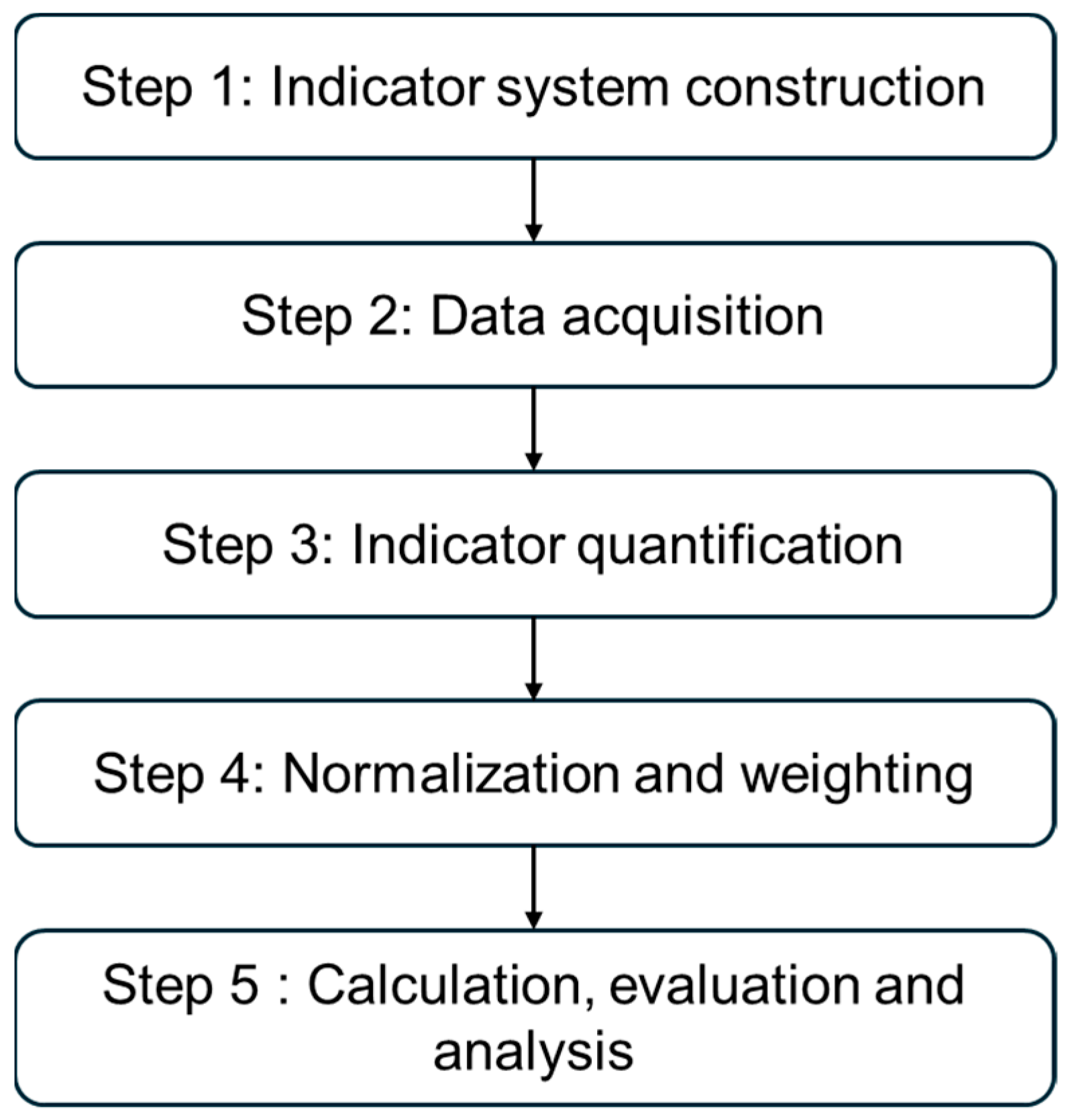
3.1. Research Framework
- Indicator system construction: establishment of a multi-level and multi-dimensional indicator framework that defines the safety dimensions and measurement criteria for subsequent data acquisition and quantitative analysis.
- Data acquisition: collection of multi-source data, including historical records, IoT sensor data, CCTV monitoring, and operational logs after the indicator system is established.
- Indicator quantification: calculation of secondary indicators based on raw data through predefined formulas.
- Normalization and weighting: standardization of indicators and aggregation into primary indicators and total safety values.
- Evaluation and analysis: Real-time update of indicators and decision support for safety management optimization.
3.2. Evaluation Indicator System
- Risk Management (NM). Earthquake, flood, and extreme weather risks, as well as man-made risks, are incorporated into building resilience.
- Human Safety Management (HSM). Employee safety training, emergency response capacity, and organizational safety culture.
- Facility and Equipment Safety (FES). Operational status, maintenance timeliness, and evacuation infrastructure performance.
- Intelligent Information Management (IIM). Monitoring coverage, data acquisition integrity, risk warning accuracy, and decision-support effectiveness.
- Integrated Crowd & Operational Risk (ICOR). Passenger flow management, congestion risk control, evacuation efficiency, and operational continuity under peak loads.
3.3. Expert Panel and Indicator Development Procedure
3.4. Data Acquisition
- Historical data: Includes historical seismic events, flood records, extreme weather data, maintenance logs, and past emergency events.
- Real-time sensor data: IoT devices on critical equipment, water-level and rainfall sensors, temperature and humidity sensors.
- Intelligent monitoring systems: CCTV-based human flow detection, alarm system logs, and decision-support platform usage logs.
- Management records: Employee training databases, inspection reports, and emergency drill logs.
3.5. Indicator Quantification and Calculation
3.5.1. Risk Management (NM)
3.5.2. Human Safety Management (HSM)
3.5.3. Facility and Equipment Safety (FES)
3.5.4. Intelligent and Information-Based Management (IIM)
3.5.5. Integrated Crowd & Operational Risk (ICOR)
3.6. Normalization and Weighting
3.6.1. Normalization of Indicators
- x is the raw value of a Level-3 indicator, which can be obtained by using the methods proposed in Section 3.4.
- and are the 5th and 95th percentile values of historical or continuously monitored data.
- Values below are set to 0, and values above are set to 1.
3.6.2. Weight Determination
3.6.3. Calculation of Level-2 Indicator Values
3.6.4. Calculation of Total Safety Value
3.6.5. Operational Safety Grading Framework
4. Case Study
4.1. Raw Data
4.2. Calculations
4.3. Before–After Comparison of Key Indicators
5. Conclusions
Author Contributions
Funding
Institutional Review Board Statement
Informed Consent Statement
Data Availability Statement
Conflicts of Interest
References
- Lin, D.; Zhou, Z.; Weng, M.; Broere, W.; Cui, J. Metro Systems: Construction, Operation and Impacts. Tunn. Undergr. Space Technol. 2024, 143, 105373. [Google Scholar] [CrossRef]
- Yang, H.; Cui, N.; Xia, H. The Evolution of the Interaction Between Urban Rail Transit and Land Use: A CiteSpace-Based Knowledge Mapping Approach. Land 2025, 14, 1386. [Google Scholar] [CrossRef]
- Alhassan, J.A.K.; Anciaes, P. Public Transport Investments as Generators of Economic and Social Activity. J. Transp. Health 2025, 41, 101989. [Google Scholar] [CrossRef]
- Yang, X.; Zhang, G.; Cao, S.; Li, Y. Adaptive Safety Management of Bidirectional Crowd in Metro Stations Considering Robustness: From Data-Driven Identification to Prediction Control. Phys. A Stat. Mech. Its Appl. 2025, 672, 130662. [Google Scholar] [CrossRef]
- Liu, J.; Wan, L.; Wang, W.; Yang, G.; Ma, Q.; Zhou, H.; Zhao, H.; Lu, F. Integrated Fuzzy DEMATEL-ISM-NK for Metro Operation Safety Risk Factor Analysis and Multi-Factor Risk Coupling Study. Sustainability 2023, 15, 5898. [Google Scholar] [CrossRef]
- Lu, Y.; Zhang, Y.; Jiang, X.; Wang, Y. Risk Assessment of Passenger Behaviors That Influence Accident Type and Severity in Metro Operation. Psychol. Res. Behav. Manag. 2023, 16, 3697–3715. [Google Scholar] [CrossRef] [PubMed]
- Su, S.; Li, S.; Ding, Y.; Mao, P.; Chong, D. Health Damage Assessment of Commuters and Staff in the Metro System Based on Field Monitoring—A Case Study of Nanjing. Front. Public Health 2024, 11, 1305829. [Google Scholar] [CrossRef] [PubMed]
- Li, X.; Liao, F.; Wang, C.; Alashwal, A. Managing Safety Hazards in Metro Subway Projects under Complex Environmental Conditions. ASCE-ASME J. Risk Uncertain. Eng. Syst. Part A Civ. Eng. 2022, 8, 04021079. [Google Scholar] [CrossRef]
- Li, Y.; Dang, X.; Yu, M.; Feng, T. Research on Safety Risk Assessment of Xi’an Metro Operation Based on Structural Equation Model (SEM)-Matter-Element Extension Model (MEA). Transp. Res. Rec. 2024, 2679, 1558–1568. [Google Scholar] [CrossRef]
- Liu, J.; Qi, Y.; Wang, W. Emergency Management Capacity Assessment for Urban Rail Transit—An Example of Beijing Metro Line 13. Transp. Saf. Environ. 2023, 6, tdad015. [Google Scholar] [CrossRef]
- Shi, T.; Wan, H.; Ma, W.; Gan, L. Rail Transit Operational Safety Risk Assessment Based on Improved AHP and Cloud Model; Atlantis Press: Dordrecht, The Netherlands, 2023; pp. 474–486. [Google Scholar]
- Santos-Reyes, J.; Padilla-Perez, D.; Beard, A.N. Transport Infrastructure Interdependency: Metro’s Failure Propagation in the Road Transport System in Mexico City. Sustainability 2019, 11, 4757. [Google Scholar] [CrossRef]
- Zhu, Y.; Jiao, L.; Zhang, Y.; Wu, Y.; Huo, X. Sustainable Development of Urban Metro System: Perspective of Coordination between Supply and Demand. Int. J. Environ. Res. Public Health 2021, 18, 10349. [Google Scholar] [CrossRef] [PubMed]
- Tang, Y.; Bi, W.; Varga, L.; Dolan, T.; Li, Q. An Integrated Framework for Managing Fire Resilience of Metro Station System: Identification, Assessment, and Optimization. Int. J. Disaster Risk Reduct. 2022, 77, 103037. [Google Scholar] [CrossRef]
- Lu, K.; Zhang, L.; Li, S.; Huang, Y.; Ding, X.; Hao, J.; Huang, S.; Li, X.; Lu, F.; Zhang, H. Urban Rail Transit in China: Progress Report and Analysis (2015–2023). Urban Rail Transit 2025, 11, 1–27. [Google Scholar] [CrossRef]
- Li, C.; Aveline-Dubach, N. The Limits of a Success Story: Rethinking the Shenzhen Metro “Rail Plus Property” Model for Planning Sustainable Urban Transit in China. Land 2025, 14, 1508. [Google Scholar] [CrossRef]
- Li, X.K.; Wang, X.M.; Lei, L. The Application of an ANP-Fuzzy Comprehensive Evaluation Model to Assess Lean Construction Management Performance. Eng. Constr. Archit. Manag. 2020, 27, 356–384. [Google Scholar] [CrossRef]
- Zhang, G.; Wang, L.; Duffy, A.P.; Di Febo, D.; Orlandi, A.; Sasse, H. Applying the Analytic Hierarchy Process (AHP) to an FSV-Based Comparison of Multiple Datasets. IEEE Trans. Electromagn. Compat. 2015, 57, 477–483. [Google Scholar] [CrossRef]
- Himeur, Y.; Elnour, M.; Fadli, F.; Meskin, N.; Petri, I.; Rezgui, Y.; Bensaali, F.; Amira, A. AI-Big Data Analytics for Building Automation and Management Systems: A Survey, Actual Challenges and Future Perspectives. Artif. Intell. Rev. 2023, 56, 4929–5021. [Google Scholar] [CrossRef] [PubMed]
- Sun, X.; Wu, L.; Wu, D. Risk Evaluation of Metro Tunnel Shield Construction Based on Game Variable Weight Extension Cloud Theory. Sci. Rep. 2025, 15, 18961. [Google Scholar] [CrossRef]
- Li, X.; Wang, C.; Kassem, M.A.; Zhang, Z.; Xiao, Y.; Lin, M. Safety Risk Assessment in Urban Public Space Using Structural Equation Modelling. Appl. Sci. 2022, 12, 12318. [Google Scholar] [CrossRef]
- GB50011-2010; Code for Seismic Design of Buildings. China Architecture & Building Press: Beijing, China, 2010.
- Bozorg-Haddad, O.; Zolghadr-Asli, B.; Loáiciga, H. Analytic Hierarchy Process (AHP). In A Handbook on Multi-Attribute Decision-Making Methods; John Wiley & Sons, Ltd.: Hoboken, NJ, USA, 2021; pp. 25–42. ISBN 978-1-119-56350-1. [Google Scholar]


| Level-1 Indicator | Level-2 Indicators | Level-3 Indicators |
|---|---|---|
| Integrated Metro Station-Commercial Building Safety Performance (IMSCBSP) | Risk Management (NM) | Fire Risk |
| Earthquake Risk | ||
| Heavy Rain and Flood Risk | ||
| Emergency Plan and Drill | ||
| Human Safety Management (HSM) | Operational Process Compliance | |
| Employee Training and Safety Awareness | ||
| Emergency Response Capability | ||
| Safety Culture | ||
| Facility and Equipment Safety (FES) | Fire Equipment Integrity | |
| Critical Equipment Status | ||
| Evacuation Routes and Signage | ||
| Equipment Maintenance Timeliness | ||
| Intelligent and Information-based Management (IIM) | Disaster Dynamic Monitoring Capability | |
| Data Analysis and Early Warning Capability | ||
| Decision Support Capability | ||
| Integrated Crowd & Operational Risk (ICOR) | Passenger Density | |
| Evacuation Flow Efficiency | ||
| Catering Fire Risk | ||
| Transfer Congestion |
| Safety Level | Description |
|---|---|
| 5—Excellent | Very high operational safety level; risks are well controlled; emergency preparedness and facility management are comprehensive |
| 4—Good | Relatively high operational safety level, with minor areas requiring improvement |
| 3—Moderate | Average operational safety level, with some risk factors requiring attention |
| 2—Poor | Low operational safety level, multiple weaknesses exist, improvement required |
| 1—Very Poor | Critically insufficient safety level, high risk, urgent corrective actions needed |
| Dimension | Raw Data | Value | Unit/Note |
|---|---|---|---|
| Risk Management (NM) | Fire incidents last year | 2 | events |
| Smoke detectors installed | 120 | units | |
| Smoke detectors operational | 114 | units | |
| Seismic design grade | 8 | scale 1–12 | |
| Peak structural acceleration | 0.04 | g | |
| 50-year extreme rainfall | 95 | mm/h | |
| Current heavy-rain sensor reading | 85 | mm/h | |
| Pumps installed (basement drainage) | 10 | units | |
| Pumps operational | 9 | units | |
| Emergency plan scenarios covered | 6 | scenarios | |
| Total required plan scenarios | 7 | scenarios | |
| Drill participation | 90 | % | |
| Average drill response time | 120 | s | |
| Human Safety Management (HSM) | Daily operational steps | 800 | steps |
| Compliant steps observed | 760 | steps | |
| Total employees | 300 | persons | |
| Employees trained | 270 | persons | |
| Average training exam score | 0.85 | 0–1 scale | |
| Average response time to alarms | 90 | s | |
| Number of reported incidents (year) | 50 | events | |
| Actively self-reported incidents | 40 | events | |
| Safety culture survey score | 0.8 | 0–1 scale | |
| Facility & Equipment Safety (FES) | Fire equipment units deployed | 500 | units |
| Fire equipment normally functioning | 470 | units | |
| Elevators/escalators total | 65 | units | |
| Fault events this month | 3 | events | |
| Evacuation corridor width | 2.6 | m | |
| Exit signs deployed | 300 | units | |
| Exit signs intact | 270 | units | |
| Planned maintenance tasks/year | 120 | tasks | |
| Completed maintenance tasks/year | 100 | tasks | |
| Intelligent & Info Management (IIM) | CCTV cameras installed | 200 | units |
| CCTV cameras working | 180 | units | |
| Water-level sensors installed | 20 | units | |
| Water sensors working | 19 | units | |
| Alerts issued (year) | 420 | alerts | |
| Correct alerts (true alarms) | 375 | alerts | |
| False alerts | 25 | alerts | |
| Decision-support platform score | 0.85 | 0–1 scale | |
| Decisions assisted by the platform | 45 | decisions | |
| Total major operational decisions | 60 | decisions | |
| Integrated Crowd & Operational Risk (ICOR) | Peak passenger number | 8000 | persons |
| Usable area in peak zone | 5000 | m2 | |
| Evacuation drill participants | 1200 | persons | |
| Median evacuation completion time | 6 | min | |
| Benchmark evacuation time | 7 | min | |
| Catering units | 35 | units | |
| Kitchens (catering) | 28 | units | |
| Kitchen-related alarms | 10 | events | |
| Observed transfer corridor flow | 6500 | pax/h | |
| Design capacity (pax/h) | 7500 | pax/h |
| Level-3 Indicators | Calculated Value | 5th Percentile | 95th Percentile | Normalized Values | Weights |
|---|---|---|---|---|---|
| 0.89 | 0.70 | 0.95 | 0.76 | 0.30 | |
| 0.80 | 0.65 | 0.90 | 0.72 | 0.25 | |
| 0.03 | 0.02 | 0.10 | 0.10 | 0.20 | |
| 0.62 | 0.5 | 0.80 | 0.59 | 0.25 | |
| 0.95 | 0.80 | 1.00 | 0.75 | 0.30 | |
| 0.88 | 0.75 | 0.95 | 0.65 | 0.30 | |
| 1.00 | 0.80 | 1.00 | 1.00 | 0.25 | |
| 0.80 | 0.70 | 0.90 | 0.50 | 0.15 | |
| 0.94 | 0.90 | 1.00 | 0.80 | 0.30 | |
| 0.95 | 0.9 | 1.0 | 0.54 | 0.25 | |
| 0.88 | 0.80 | 0.95 | 0.51 | 0.25 | |
| 0.93 | 0.80 | 0.90 | 0.33 | 0.20 | |
| 0.90 | 0.80 | 1.00 | 0.52 | 0.40 | |
| 0.91 | 0.85 | 0.95 | 0.57 | 0.35 | |
| 0.80 | 0.70 | 0.90 | 0.50 | 0.25 | |
| 1.60 | 1.00 | 2.00 | 0.60 | 0.35 | |
| 0.95 | 0.9 | 1.00 | 0.52 | 0.25 | |
| 0.35 | 0.30 | 0.50 | 0.24 | 0.20 | |
| 0.87 | 0.80 | 0.90 | 0.67 | 0.20 |
| Level-2 Indicators | Level-3 Indicators | Normalized Values | Weights of Level-3 Indicators | Values of Level-2 Indicators |
|---|---|---|---|---|
| Risk Management (NM) | 0.76 | 0.30 | 0.58 | |
| 0.72 | 0.25 | |||
| 0.10 | 0.20 | |||
| 0.59 | 0.25 | |||
| Human Safety Management (HSM) | 0.75 | 0.30 | 0.75 | |
| 0.65 | 0.30 | |||
| 1.00 | 0.25 | |||
| 0.50 | 0.15 | |||
| Facility and Equipment Safety (FES) | 0.80 | 0.30 | 0.57 | |
| 0.54 | 0.25 | |||
| 0.51 | 0.25 | |||
| 0.33 | 0.20 | |||
| Intelligent and Information-based Management (IIM) | 0.52 | 0.40 | 0.53 | |
| 0.57 | 0.35 | |||
| 0.50 | 0.25 | |||
| Integrated Crowd & Operational Risk (ICOR) | 0.60 | 0.35 | 0.52 | |
| 0.52 | 0.25 | |||
| 0.24 | 0.20 | |||
| 0.67 | 0.20 |
| Level-1 indicator | Level-2 indicators | Value of Level-1 Indicators | ||
| Names | Weights | Values | ||
| Risk Management (NM) | 0.25 | 0.58 | 0.604 | |
| Human Safety Management HSM) | 0.25 | 0.75 | ||
| Facility and Equipment Safety (FES) | 0.2 | 0.57 | ||
| Intelligent and Information-based Management (IIM) | 0.15 | 0.53 | ||
| Integrated Crowd & Operational Risk (ICOR) | 0.15 | 0.52 | ||
| Indicator | Before | After | Improvement |
|---|---|---|---|
| Basement pump operability | 90% | 100% | +10% |
| Exit sign integrity | 90% | 100% | +10% |
| CCTV and sensor uptime | 90% | 98% | +8% |
| False alarm rate | 6% | 3% | −50% |
| Peak passenger density | 1.6 pax/m2 | 1.4 pax/m2 | −12% |
| Catering-related fire alarms | 10 events/year | 5 events/year | −50% |
| Composite safety index | 0.601 | ~0.78 | +0.179 |
Disclaimer/Publisher’s Note: The statements, opinions and data contained in all publications are solely those of the individual author(s) and contributor(s) and not of MDPI and/or the editor(s). MDPI and/or the editor(s) disclaim responsibility for any injury to people or property resulting from any ideas, methods, instructions or products referred to in the content. |
© 2025 by the authors. Licensee MDPI, Basel, Switzerland. This article is an open access article distributed under the terms and conditions of the Creative Commons Attribution (CC BY) license (https://creativecommons.org/licenses/by/4.0/).
Share and Cite
Huang, Y.; Yu, H.; Ju, X.; Pan, X. Safety Evaluation and Management Optimization Strategies for Building Operations Under the Integrated Metro Station–Commercial Development Model: A Case Study. Systems 2025, 13, 1081. https://doi.org/10.3390/systems13121081
Huang Y, Yu H, Ju X, Pan X. Safety Evaluation and Management Optimization Strategies for Building Operations Under the Integrated Metro Station–Commercial Development Model: A Case Study. Systems. 2025; 13(12):1081. https://doi.org/10.3390/systems13121081
Chicago/Turabian StyleHuang, Yijing, Heng Yu, Xiaoyu Ju, and Xiulin Pan. 2025. "Safety Evaluation and Management Optimization Strategies for Building Operations Under the Integrated Metro Station–Commercial Development Model: A Case Study" Systems 13, no. 12: 1081. https://doi.org/10.3390/systems13121081
APA StyleHuang, Y., Yu, H., Ju, X., & Pan, X. (2025). Safety Evaluation and Management Optimization Strategies for Building Operations Under the Integrated Metro Station–Commercial Development Model: A Case Study. Systems, 13(12), 1081. https://doi.org/10.3390/systems13121081