Article

Genome-Wide Identification and Expression Analysis of the CesA/Csl Superfamily in Madhuca pasquieri

College of Forestry and Landscape Architectures, South China Agricultural University, Guangzhou 510642, China
*
Author to whom correspondence should be addressed.
Biology 2026, 15(12), 895; https://doi.org/10.3390/biology15120895
Submission received: 17 May 2026 / Revised: 2 June 2026 / Accepted: 4 June 2026 / Published: 6 June 2026
(This article belongs to the Special Issue Advances in Plant Genomics and Genome Editing)

Simple Summary

Cellulose synthase genes are essential for plant cell wall formation and plant growth. For the rare and valuable timber tree Madhuca pasquieri, the CesA/Csl gene family has not been studied before. In this research, a total of 47 CesA/Csl genes were identified in M. pasquieri and divided into seven subfamilies. Cis-acting elements suggested extensive involvement in biotic and abiotic stress regulation. Transcriptome analysis across five growth stages revealed different expression patterns of these genes in primary and secondary cell wall regulation. Several core genes were screened out via phylogenetic analysis and protein interaction analysis. Furthermore, a cellulose synthase complex model was built, suggesting that specific proteins may form complexes on the cell membrane to synthesize cellulose. This study systematically analyzes the CesA/Csl gene family in M. pasquieri, offering valuable references for its cell wall research and genetic improvement.

Abstract

The cellulose synthase gene superfamily encompasses two major groups, CesA and Csl, which are vital for synthesizing cellulose and hemicellulose in plant cell walls and fundamental to plant growth and developmental regulation. Madhuca pasquieri is a rare tree with high timber value. Currently, there is no relevant report on the identification and characterization of the CesA/Csl gene family in M. pasquieri. In this study, based on the high-quality genome of M. pasquieri, 47 members of the CesA/Csl superfamily were identified and classified into seven subfamilies, including CesA, CslA, CslB, CslC, CslD, CslE and CslG. Cis-acting elements were identified via analysis of the 2000 bp upstream sequences of MpCesA, suggesting extensive involvement in biotic and abiotic stress regulation. Based on the transcriptome data of five growth periods, the expression of the CesA/Csl family was analyzed. Combined with phylogenetic information, it is inferred that MpCesA4/7b/7a/8b may regulate the secondary wall, while MpCesA1/3b/6b may regulate the primary wall. Protein–protein interaction showed that MpCesA4/7b/8a were in the core site. Finally, we constructed the cellulose synthase complex (MpCesA4/7b/8b) model using AlphaFold3, which suggests that MpCesA4/7b/8b may form a complex on the plasma membrane to carry out cellulose synthesis. This study has a limitation in that the complex and its expression lack experimental validation, and only data analysis is provided as a reference, offering some directions for future research. In summary, the systematic characterization of the MpCesA/Csl gene family provides important insights into cell wall formation, genetic enhancement, and future biotechnological applications of this species.

1. Introduction

The plant cell wall determines plant morphogenesis and plays an essential role in plant growth and development [1]. Its main components consist of cellulose, hemicellulose, pectin [2], and lignin [3]. Plant cell walls, classified as primary and secondary, respectively, enclose growing and differentiating cells and provide structural support for xylem and plant tissues [4,5]. The secondary cell wall is deposited between the plasma membrane and the primary cell wall after cell expansion ceases, and is predominantly composed of cellulose [6]. As one of the most abundant renewable resources on Earth, plant cellulose provides valuable raw materials for industry, textile production and other fields [4]. Accordingly, research on the plant cell wall and its biosynthesis has become a core research hotspot in plant science.
The CesA/Csl superfamily belongs to the Glycosyltransferase 2 (GT2) family. It could be divided into the CesA and Csl subfamilies. It is widely acknowledged that CesA genes encode enzymes responsible for cellulose synthesis, while Csl genes mediate the biosynthesis of hemicellulosic polysaccharides. With the progress of research, numerous CesA/Csl genes have been successively identified in a wide range of plant species. They were initially reported in plants such as Gossypium hirsutum [7,8], Arabidopsis thaliana [9], Oryza sativa [10], and Populus trichocarpa [11]. These genes have now also been characterized in Medicago sativa [12], Nicotiana tabacum [13], Solanum Lycopersicum [14], Vitis vinifera [15], and Eucalyptus grandis [16].
CesA genes have been extensively characterized in higher plants [17]. A. thaliana contains 10 CesA members, whereas poplar harbors 17 CesA genes [18]. In A. thaliana, AtCesA1, AtCesA3 and AtCesA6 are indispensable for primary cell wall formation, while AtCesA4, AtCesA7 and AtCesA8 are critical for secondary cell wall biosynthesis [19,20,21,22]. CesA2, CesA5 and CesA9 exhibit partial functional redundancy with CesA6 [23]. In addition, the transcription of AtCesA4/7/8 is regulated by the AtMYB46 transcription factor [24].
Before catalyzing cellulose synthesis, cellulose synthases must first assemble into the cellulose synthase complex (CSC) [25]. CSC is plasma membrane-localized, dynamic high-order oligomers with hexagonal symmetry, presenting a rosette-like structure [26]. This rosette architecture was first observed on the plasma membrane of Zea mays and Pinus taeda using freeze-fracture electron microscopy [27]. To date, the plant CSC has been confirmed as a hexameric rosette structure, although the exact number of CesA subunits remains controversial.
The Csl family comprises nine subfamilies: CslA, CslB, CslC, CslD, CslE, CslF, CslG, CslH and CslJ [28,29]. Studies have shown that the CslA gene participates in the biosynthesis of mannose and glucomannan backbones [30,31]. The CslC gene is responsible for the biosynthesis of the β-1,4-glucan backbone required for xyloglucan synthesis [32]. The CslD gene may be involved in the synthesis of cellulose or mannose and functions in tip-growing cells [33]. In contrast, the CslF, CslH and CslJ subfamilies catalyze the formation of (1,3;1,4)-β-glucan [34,35]. The specific functions of the other four Csl subfamily members, including CslB, CslE, CslG and CslM, remain unclear. In A. thaliana, the Csl family contains 30 members categorized into six subfamilies: CslA, CslB, CslC, CslD, CslE and CslG [36].
As a member of the Sapotaceae family, Madhuca pasquieri is a rare tree species with important ecological value. Classified as Vulnerable (VU) on the IUCN Red List, it is also designated as a national Class II key protected wild plant and a species with extremely small populations in China and was added to China’s National Protected Forest List in 2025. This species naturally occurs in Guangdong, Guangxi and Yunnan of China, as well as northern Vietnam. It also boasts high economic value: its seeds have an oil content of around 30%. Its dense, hard and wear-resistant wood makes it a prized timber, widely used to produce furniture, equipment and veneers. At present, M. pasquieri faces multiple threats, including slow seedling growth, continuous population decline, and severe conflicts between conservation and rational utilization. Existing studies mainly focus on its morphological characteristics, artificial cultivation, transcriptomics and metabolomics analysis [37,38]. However, in-depth research on the molecular mechanism underlying its growth remains insufficient.
With the advent of next-generation sequencing technology, the availability of high-quality genome assembly for M. pasquieri has laid a solid foundation for in-depth research on gene families. However, the MpCesA gene family in M. pasquieri has not yet been comprehensively identified and characterized. Using the M. pasquieri genome as a reference, we performed a genome-wide analysis of the MpCesA gene family via bioinformatic tools. The objectives of this study were as follows: (1) phylogenetic analysis, chromosomal localization and collinearity analysis of MpCesA genes in M. pasquieri; (2) gene structure characterization and prediction of protein tertiary structures; (3) transcriptional expression profiles across different growth stages. The absence of qRT-PCR validation is a limitation of this study.

2. Materials and Methods

2.1. Identification and Physicochemical Prediction of MpCesA/Csl Superfamily

The genome of M. pasquieri used in this study has been deposited in the Genome Warehouse of the National Genomics Data Center (https://ngdc.cncb.ac.cn), China National Center for Bioinformation. Its corresponding accession number is GWHHIXU00000000.1. CesA/Csl protein sequences of A. thaliana were retrieved from the NCBI database (https://static.pubmed.gov/portal/portal.fcgi/, accessed on 14 April 2026) (Table S1). BLAST screening was conducted on the longest protein isoforms of all M. pasquieri genes with AtCesA/Csl sequences as queries using TBtools-II software (v2.467) [39]. The E-value threshold was set to 1 × 10⁻⁵ to screen candidate MpCesA/Csl members. Conserved domains of all candidate sequences were examined via the NCBI Conserved Domain Database (https://www.ncbi.nlm.nih.gov/Structure/cdd/, accessed on 14 April 2026), and sequences without complete conserved domains were eliminated to determine the final MpCesA/Csl family members. Physicochemical characteristics of MpCesA/Csl proteins were predicted using the ExPASy online server (https://web.expasy.org/protparam/, accessed on 14 April 2026) [40]. Subcellular localization patterns were analyzed through the WoLF PSORT online platform (https://wolfpsort.hgc.jp/, accessed on 14 April 2026) [41].

2.2. The Phylogenetic Tree Construction of the MpCesA/Csl Family

To explore the phylogenetic relationships of the CesA/Csl gene family, CesA/Csl amino acid sequences from A. thaliana, P. trichocarpa and V. vinifera were collected for phylogenetic tree construction (Table S1). Sequence alignment and similarity analysis were conducted using MEGA 11. The phylogenetic tree was constructed in FastTree 2.2 with the maximum likelihood method and 1000 bootstrap replicates, and all remaining parameters kept default settings [42]. The resulting phylogenetic tree was further visualized and optimized on the Chiplot online platform (https://www.chiplot.online/) [43].

2.3. Gene Structure, Conserved Motif and Conserved Structural Domains Analysis

Conserved motifs of all MpCesA/Csl family members were predicted using the MEME online tool (http://meme-suite.org, accessed on 14 April 2026) [44]. The number of predicted motifs was set to 10, and all other parameters were kept at default values. The gene structure information and conserved motif data of MpCesA/Csl were integrated for subsequent analysis. Combined results of gene structure and conserved motifs of M. pasquieri gene family were visualized with TBtools-II software.

2.4. Chromosomal Distribution and Synteny Analysis of MpCesA/Csl Family

Chromosomal localization of 47 MpCesA/Csl genes was performed in TBtools-II based on genomic annotation information. In the “gene density” module of TBtools-II, gene density was calculated with the bin size set to 100,000, and all other parameters remained as default. The gene density files were further applied to optimize the chromosomal localization map. Gene sequences and annotation files of M. pasquieri, A. thaliana and P. trichocarpa were imported into the “One Step MCScanX” module of TBtools-II for collinearity analysis. The interspecific collinearity relationships were visualized by the Dual Synteny Plot. Intraspecific collinearity within the M. pasquieri genome was analyzed via “One Step MCScanX”, and intraspecific synteny was displayed using “Advanced Circos”. During the analysis, the BlastP CPU value was set to 2, and the E-value threshold was set to 1 × 10⁻¹⁰.

2.5. Cis-Acting Element Analysis of MpCesA/Csl Family

The 2000 bp upstream sequences of each MpCesA/Csl gene were extracted from the M. pasquieri genome as promoter regions. The online tool PlantCARE (https://bioinformatics.psb.ugent.be/webtools/plantcare/html/, accessed on 16 April 2026) was used to predict cis-acting elements in these promoter regions [45]. The results were visualized using TBtools-II software.

2.6. Expression Analysis of MpCesA/Csl Family

Transcriptome sequencing data were obtained from our previously published research [38], specifically as follows. M. pasquieri was cultivated in an artificial climate chamber at South China Agricultural University. The controlled growth conditions included a constant temperature of 25 °C, relative humidity ranging from 60% to 80%, a 14 h light and 10 h dark photoperiod, and a light intensity of 17,600 lx. Uniform seedlings cultivated with the same substrate were collected at five key developmental stages after germination, namely seed germination, hypocotyl elongation, epicotyl elongation, two-leaf stage and nine-leaf stage. Three independent biological replicates were prepared for each stage. All whole-plant samples were immediately frozen in liquid nitrogen and preserved at −80 °C for subsequent experiments. In the present study, we extracted the FPKM expression values of the MpCesA/Csl gene family (Table S2). All expression data were standardized with the calculation of log2(expression value + 1), and the resulting data were visualized using the online Chiplot platform (https://www.chiplot.online/index.html, accessed on 20 April 2026).

2.7. Protein–Protein Interaction Network of the MpCesA/Csl Family

To construct the protein–protein interaction (PPI) network of MpCesA/Csl family proteins, all MpCesA/Csl protein sequences were submitted to the STRING 12.0 database (https://string-db.org/) [46]. Homology mapping was performed using A. thaliana as the reference organism, with the interaction confidence score set to 0.4 and other parameters kept as default. The resulting interaction data were downloaded and imported into Cytoscape 3.9.1 software for visualization and esthetic refinement [47].

2.8. 3D Structure Analysis of Proteins of the MpCesA/Csl Family

Representative protein structural models were predicted using AlphaFold3 (https://alphafoldserver.com) [48]. AlphaFold3 was also applied to predict the structural conformation of protein complexes formed by MpCesA4, MpCesA7b and MpCesA8b. All predicted structural results were refined and visualized with PyMOL 3.0 software.

3. Results

3.1. Identification of CesA/Csl Genes and Property Prediction in M. pasquieri

In this study, a total of 47 CesA/Csl proteins were successfully identified in M. pasquieri through sequence alignment and manual domain verification. Following the nomenclature system for this gene family in the model plant A. thaliana, we assigned corresponding names to these genes in M. pasquieri. Among them, 14 CesA genes were designated as MpCesA1a, MpCesA1b, MpCesA3a, MpCesA3b, MpCesA4, MpCesA6a6e, MpCesA7a, MpCesA7b, MpCesA8a, and MpCesA8b. The other 33 genes belonged to the Csl subfamily and were named MpCslA1–7, MpCslB1–2, MpCslC1–7, MpCslD1–8, MpCslE1–4, and MpCslG1–5 (Table 1). Analysis of the physicochemical properties of the MpCesA/Csl proteins revealed that the number of amino acids ranged from 404 (MpCslA7) to 1173 (MpCslD7). Isoelectric point (pI) analysis showed that 15 genes had a pI below 7, while 32 genes had a pI above 7, indicating that the MpCesA/Csl gene family mainly consists of basic proteins. The aliphatic index varied from 76.61 (MpCslD6) to 105.18 (MpCslA6), reflecting substantial differences in the thermal stability of proteins within this family. In terms of hydrophilicity analysis, 30 MpCesA/Csl genes exhibited negative values, indicating their hydrophilic nature (Table 1), with approximately two-thirds of the CesA/Csl proteins being hydrophilic. Subcellular localization prediction indicated that these proteins are most likely located on the plasma membrane.

3.2. Phylogenetic Analysis and Classification of MpCesA/Csl Family

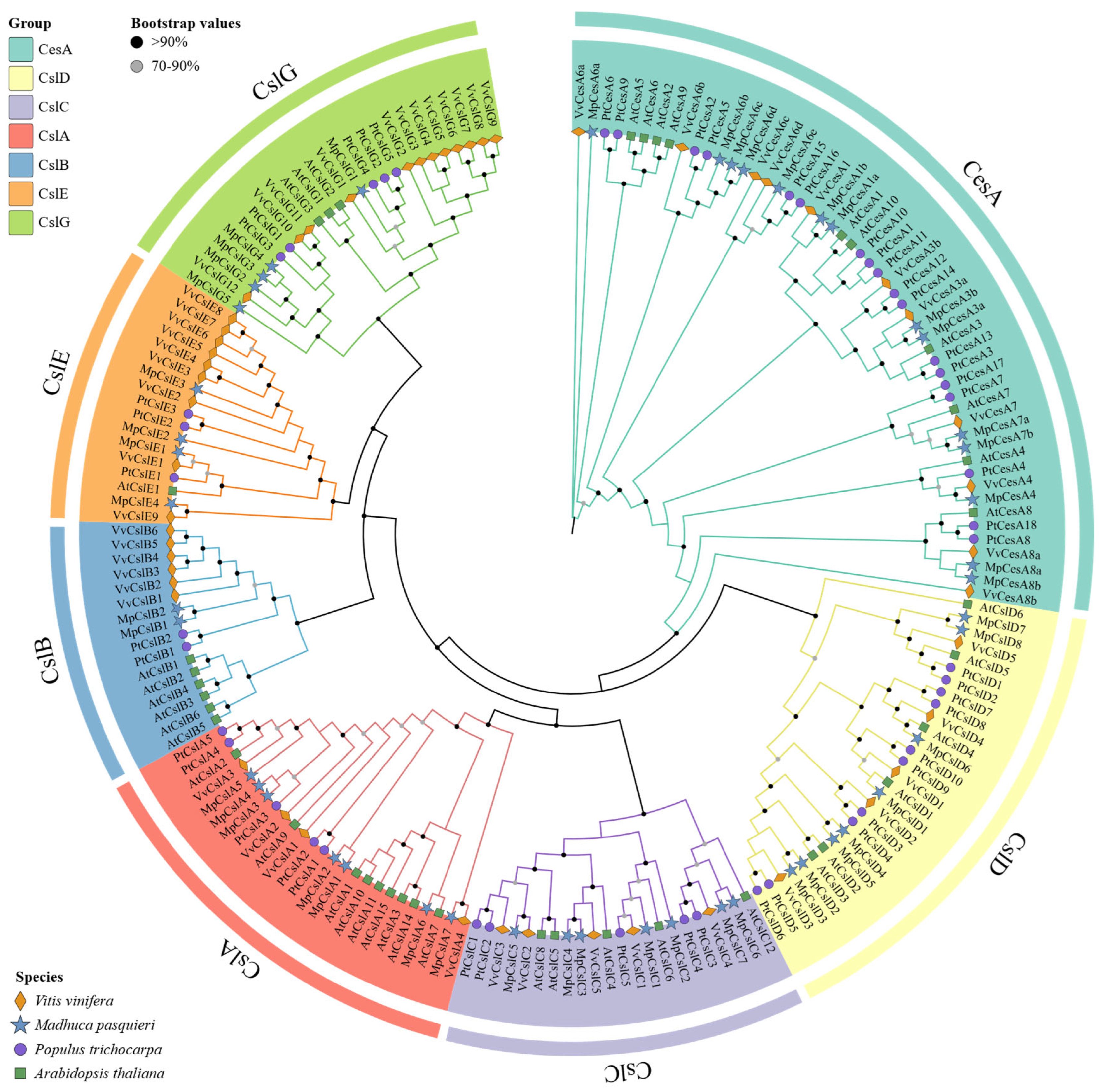
To investigate the functions of MpCesA/Csl proteins, a phylogenetic tree was constructed using TBtools-II based on 187 protein sequences from M. pasquieri, A. thaliana, P. trichocarpa, and V. vinifera (Figure 1). The results showed that all CesA/Csl proteins could be divided into seven subfamilies, including one CesA subfamily and six Csl subfamilies (CslA, CslB, CslC, CslD, CslE, and CslG). The MpCesA subfamily contained 14 members, while the MpCslA subfamily had seven members, the MpCslB had two, MpCslC had seven, MpCslD had eight, MpCslE had four, and MpCslG had five.

3.3. Analysis of Gene Structure and Conserved Domains of the MpCesA/Csl Family

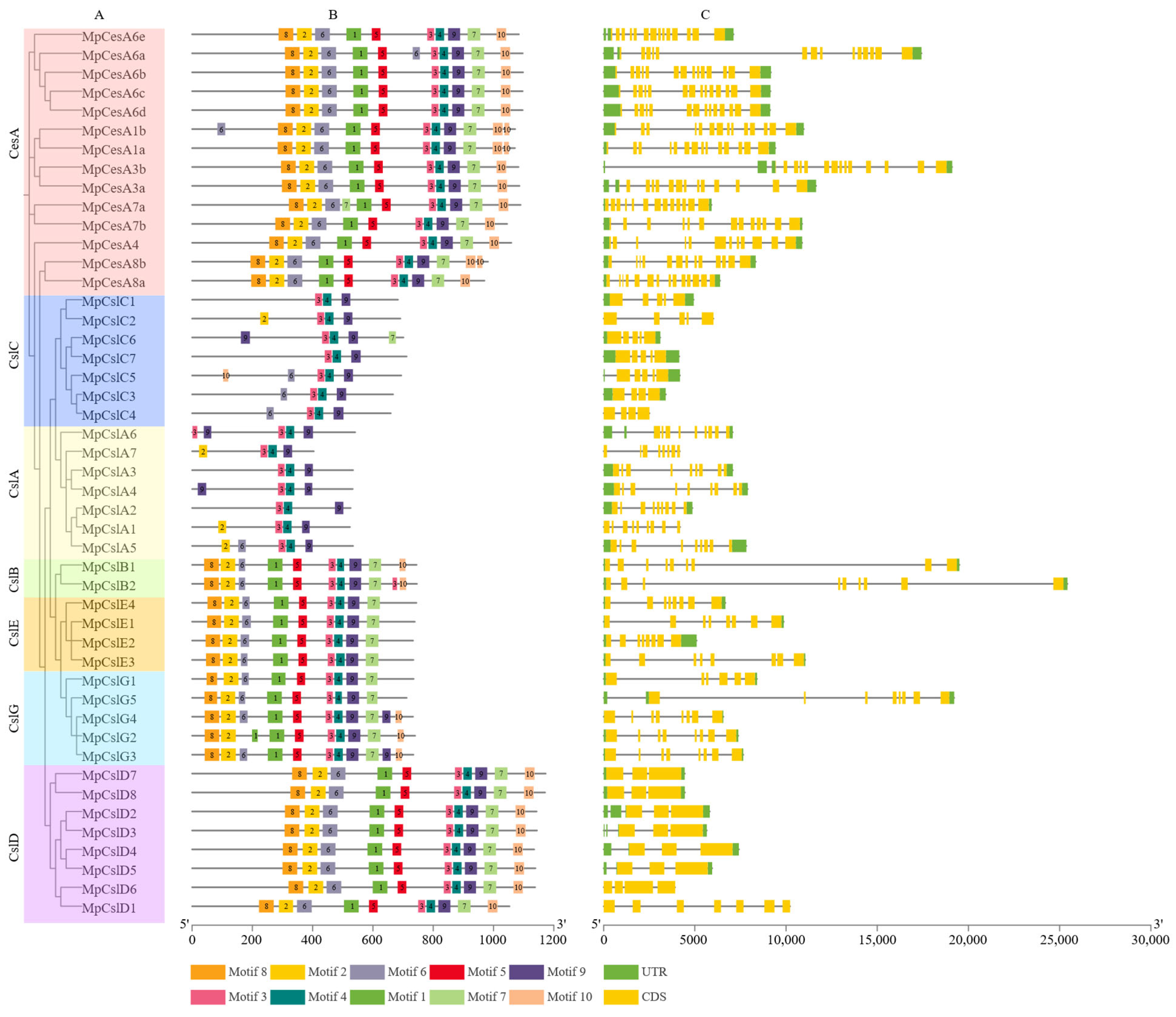
Forty-seven MpCesA/Csl proteins were divided into seven categories in the phylogenetic tree (Figure 2A). The conserved motifs of these 47 MpCesA/Csl proteins were identified using the online MEME website (Figure 2B). We set the motif identification parameter to 10, and a total of 10 conserved motifs were identified accordingly. Conserved motif analysis showed that almost all CesA/Csl proteins contain motif 3, motif 4, and motif 9, suggesting their conservation and functional similarity as members of the same family. Most proteins in the CesA, CslB, CslE, CslG, and CslD subfamilies contain motif 8, motif 2, motif 6, and motif 1. In contrast, the CslA and CslC subfamilies do not have these motifs; the difference in conserved motifs may indicate functional divergence among their subfamilies. In addition, the exon–intron distribution pattern of MpCesA/Csl genes was investigated. As shown in Figure 2C, we found that the number of exons varies among different subfamilies. For example, most members of the MpCslD subfamily have only three exons, while most members of MpCesA have more than ten exons.

3.4. Chromosomal Localization and Collinearity Analysis of the MpCesA/Csl Family

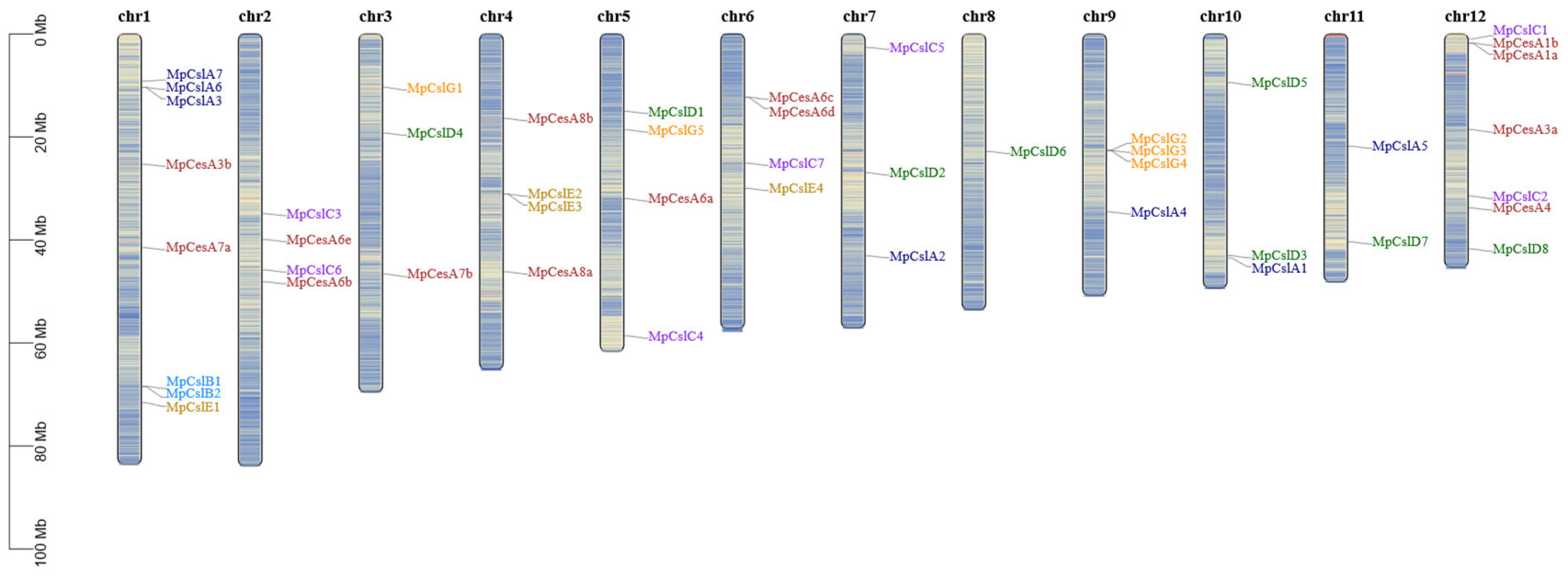
According to annotations, 47 genes are distributed across 12 chromosomes (Figure 3). The number of CesA/Csl genes on each chromosome ranges from 1 to 8. Among them, chromosome 1 contains the largest number (eight genes), while chromosome 8 contains the smallest number (one gene). These 47 genes exhibit diverse distribution patterns, including clustered and isolated distributions. Among them, MpCslA3/MpCslA6, MpCslE2/MpCslE3, MpCesA6c/MpCesA6d, MpCslG3/MpCslG4, and MpCesA1a/MpCesA1b are described as tandem duplicate gene pairs.
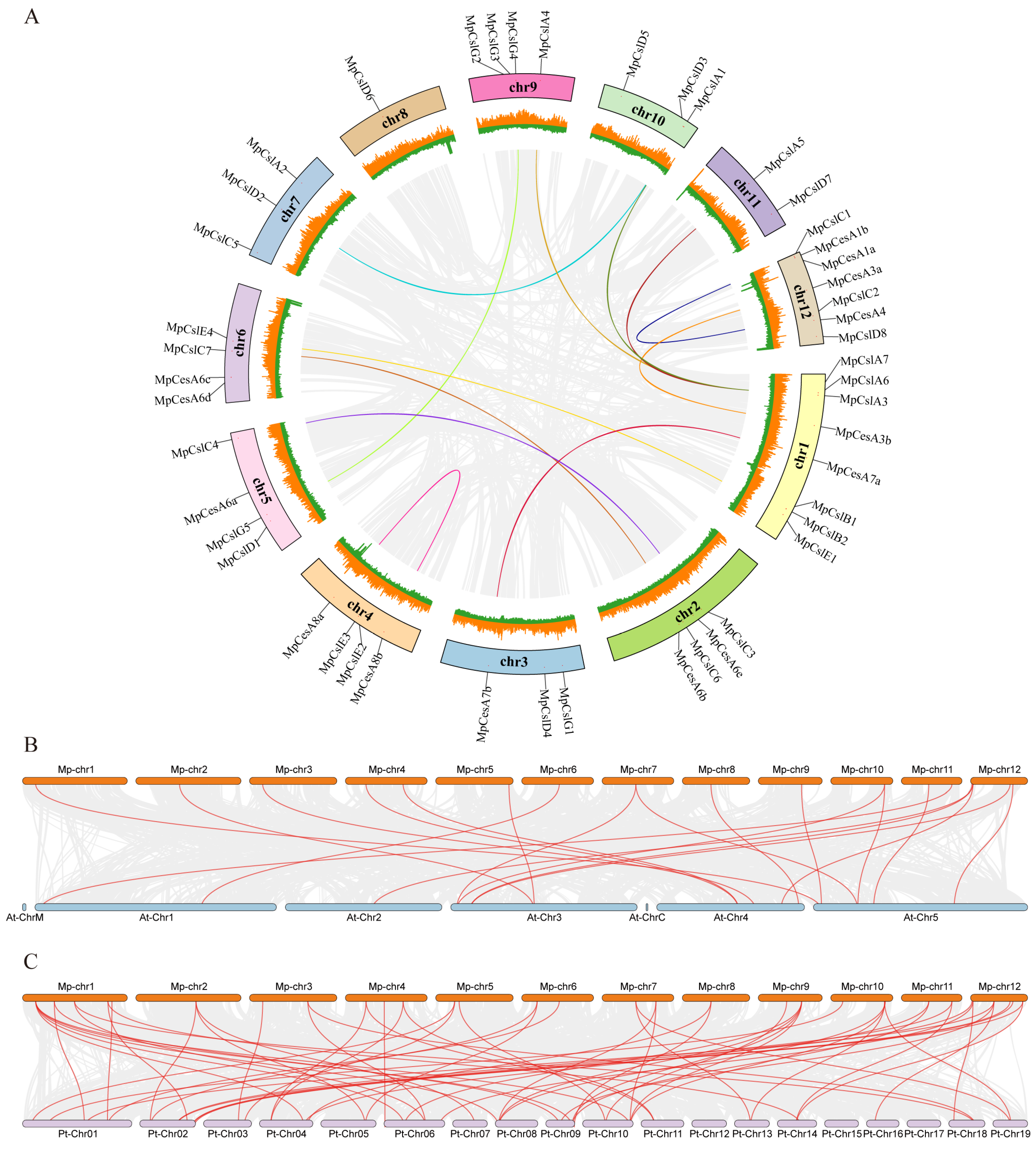
In addition to five tandem duplication pairs, we also investigated segmental duplication events within the MpCesA/Csl gene family (Figure 4A). Intraspecific collinearity analysis identified 12 segmentally duplicated gene pairs in this gene family. Comprehensive analysis revealed that segmental duplication acts as the primary driving force for the expansion of the MpCesA/Csl gene family. Furthermore, we calculated the Ka/Ks values of tandem and segmental duplicated gene pairs to determine the selective pressure underlying duplication events (Table 2). All gene pairs presented Ka/Ks ratios lower than 1, indicating that these genes have experienced purifying selection and possess functionally conserved characteristics.
To further clarify the phylogenetic relationships of the MpCesA/Csl gene family, comparative collinearity maps were constructed by integrating M. pasquieri with two representative species, A. thaliana and P. trichocarpa (Figure 4B,C). The results identified 20 pairs of CesA/Csl homologous genes between M. pasquieri and A. thaliana. In addition, a total of 59 collinear gene pairs were detected between M. pasquieri and P. trichocarpa. These findings indicated that the CesA/Csl gene families of the two species have undergone frequent chromosomal fragment rearrangement, gene duplication, and gene loss during evolution. Accordingly, it is speculated that P. trichocarpa shares a closer phylogenetic relationship with M. pasquieri.

3.5. Analysis of Cis-Acting Elements in the MpCesA/Csl Family

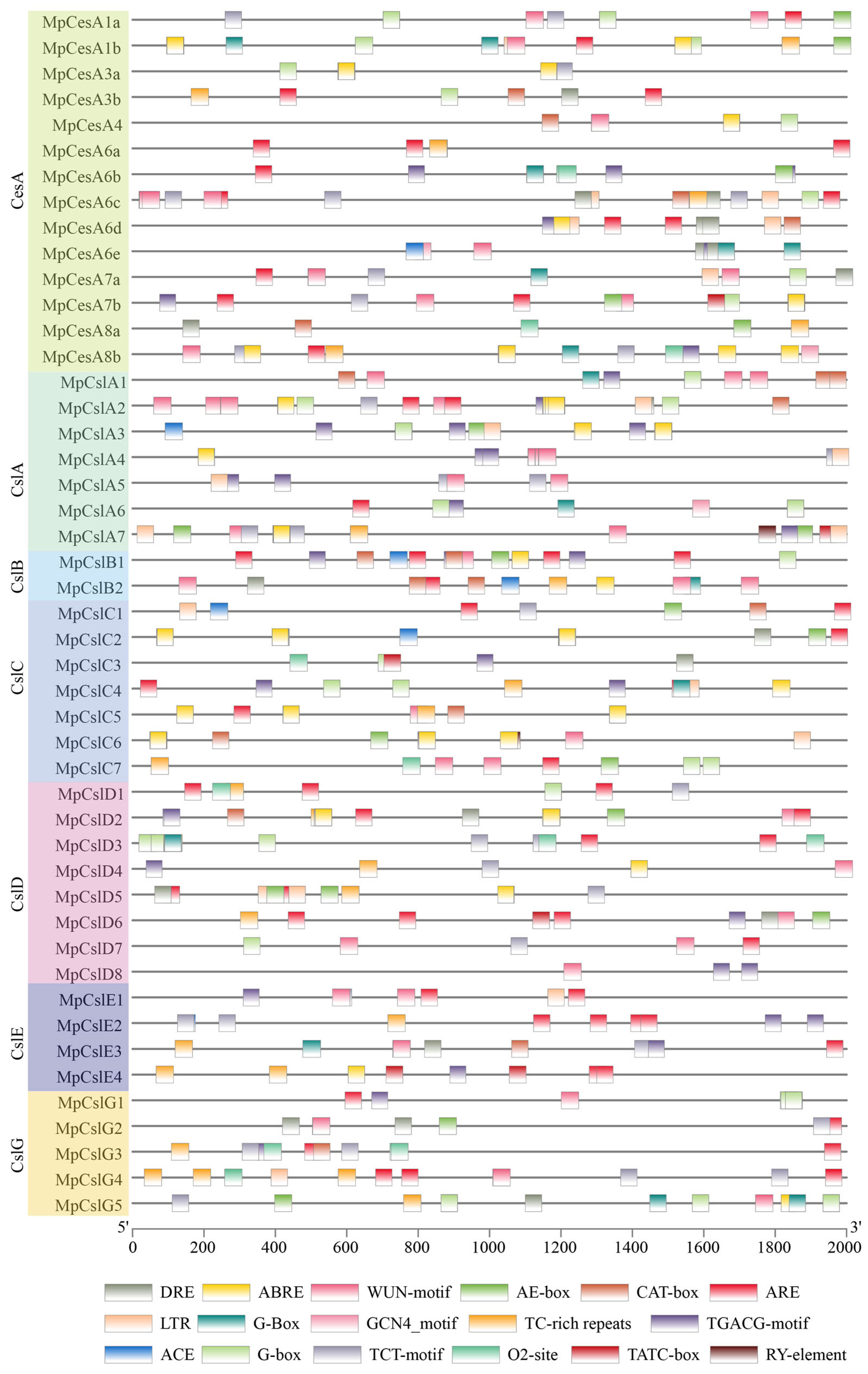
The 2000 bp upstream sequences of MpCesA/Csl genes were extracted for cis-acting element analysis, and the distribution of these elements in the upstream regions was visualized (Figure 5). A large number of cis-acting regulatory elements were identified, which are associated with plant hormone responses, light responses, stress responses and plant development. For example, MpCesA4, MpCesA7a, MpCesA7b and MpCesA8b harbor the ABA-responsive element ABRE, indicating that these genes are likely involved in drought tolerance. Given the canonical function of CesA4/7/8 in secondary cell wall biosynthesis, they may enhance drought resistance by modulating cell wall thickness. Genes such as MpCesA1b, MpCesA3b, and MpCesA6b possess TC-rich repeats in their promoter regions, implying that these genes may participate in defense and stress responses by regulating cell wall remodeling. In addition, light-responsive elements such as AE-box and TCT-motif were abundant among the MpCesA/Csl gene family. Collectively, this suggests that MpCesA/Csl genes are involved in the responses of Madhuca pasquieri to diverse abiotic and biotic stresses.

3.6. Expression of MpCesA/Csl Family in Five Stages of Growth

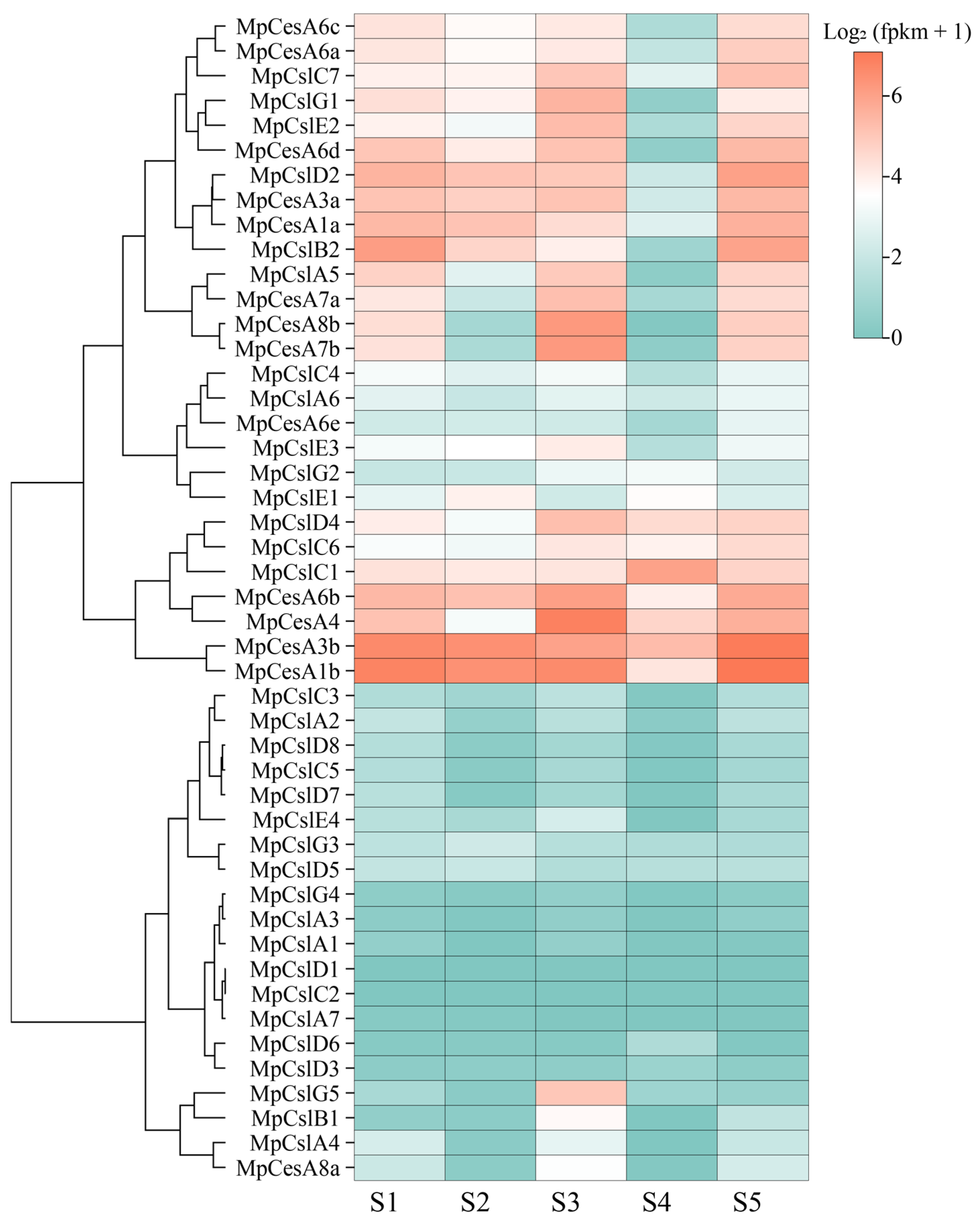
We extracted the transcript expression data of MpCesA and MpCsl genes based on previously obtained transcriptome datasets covering five successive growth stages of Madhuca pasquieri (Table S2). Expression profiling of the MpCesA/Csl gene family revealed distinct expression patterns across the five samples (Figure 6). A subset of genes, including MpCesA1b, MpCesA3b and MpCesA6b, exhibited constitutively high expression across all samples, suggesting their housekeeping roles in maintaining basic cell wall biosynthesis. In contrast, several genes showed preferential expression in specific samples: for example, MpCesA7b/7a and MpCesA8b were strongly induced in S3, while they were downregulated in S4. In addition, MpCslA5 showed significant expression levels. Based on its subfamily classification, it is inferred to be involved in the biosynthesis of mannose and glucomannan. MpCslC1, MpCslC6 and MpCslC7 may participate in the biosynthesis of the required β-1,4-glucan backbone chain. MpCslD2 and MpCslD4 may be involved in the synthesis of cellulose or mannose. MpCslB2 and MpCslE2 also exhibited notable expression levels. However, due to the limited understanding of their subfamily functions, no further inferences are made here. Notably, a large proportion of genes, particularly those from the CslA, CslD, and CslG subfamilies, displayed low or negligible expression across all samples, implying they may function in specific developmental stages or under specialized conditions not captured in this experiment.

3.7. Protein–Protein Interaction Network Analysis of the MpCesA/Csl Family

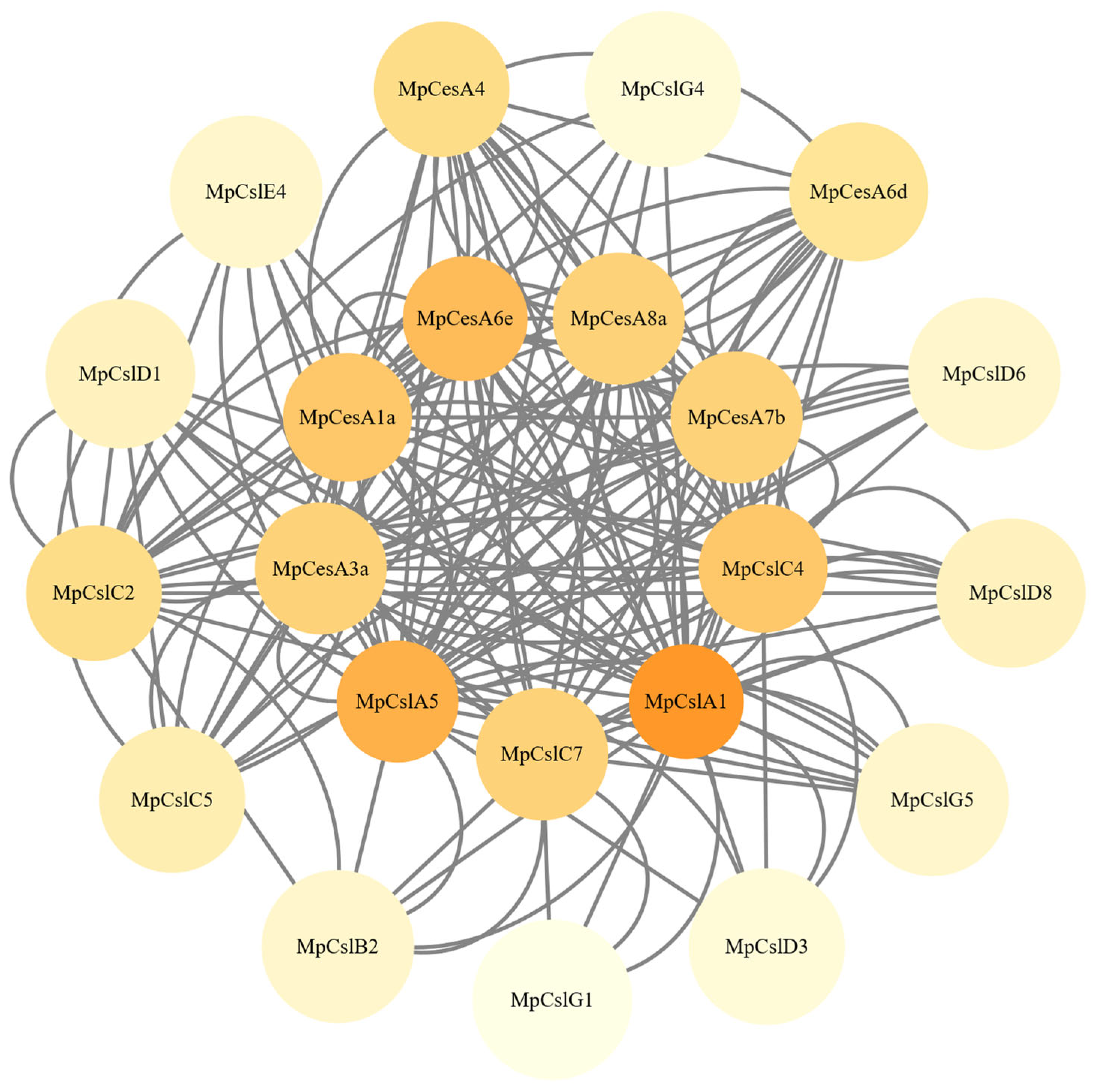
In this study, protein–protein interaction (PPI) network analysis was performed to systematically characterize the interaction patterns among members of the CesA/Csl gene family in M. pasquieri (Figure 7). MpCslA1 was identified as the core hub gene of the network, exhibiting a significantly higher degree of connectivity than other family members and serving as a key mediator of interactions among cell wall biosynthesis-related proteins. Core nodes, including MpCslA4, MpCesA7b, MpCesA8a, MpCslA1 and so on, formed the central module of the network, potentially playing a central regulatory role in the synthesis of cellulose and hemicellulose. Although members of the CslD, CslE, and CslG subfamilies showed relatively low connectivity, they participated in the overall network regulation through interactions with core nodes. These results reveal the synergistic regulatory mechanism of the CesA/Csl gene family in the cell wall biosynthesis network of M. pasquieri.

3.8. 3D Structure Analysis of MpCesA/Csl Gene Family Members

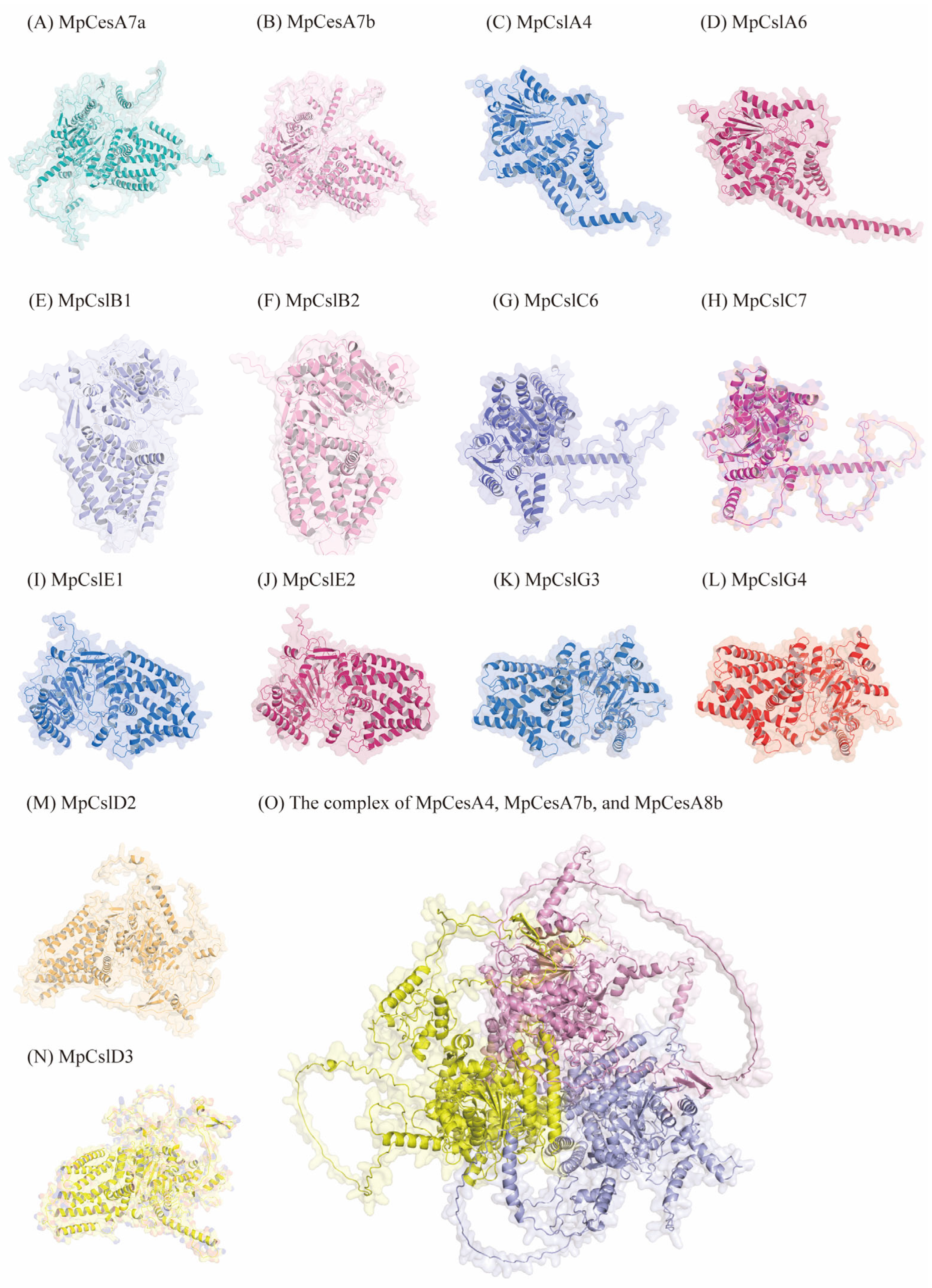
Homology modeling was performed using AlphaFold3, and the three-dimensional structures of multiple representative MpCesA/Csl proteins were successfully obtained (Figure 8). Two genes from each subfamily were selected for in-depth structural analysis, and the results revealed high structural similarity with minimal variation within the same subfamily. Based on transcriptomic data, MpCesA7b and MpCesA8b had a similar expression pattern, and CesA proteins usually perform their function by forming a complex. Therefore, AlphaFold3 was used to resolve the structure of the complex formed by MpCesA4, MpCesA7b, and MpCesA8b, which may be involved in secondary cell wall formation. The analysis yielded an ipTM score of 0.60 and a pTM score of 0.65, indicating high confidence in the interaction among these three proteins (Figure 8O). However, these are only predictions and inferences; whether the complex exists remains questionable.

4. Discussion

M. pasquieri is a member of the Madhuca genus, and relevant studies have been carried out on M. pasquieri, Madhuca longifolia and Madhuca hainanensis [49]. They share several common features and distinct interspecific differences. M. longifolia suffers from cold injury [50], whereas the other two species do not, and slow growth is a unique characteristic of M. pasquieri that is absent in its two congeners. Although M. pasquieri is slow-growing and rare, it has superior wood properties. Plant growth and morphogenesis rely to a certain extent on cell wall expansion, and the CesA/Csl gene family, as key enzymes, regulates the synthesis rate of cellulose and hemicellulose in plant cell walls. Therefore, genome-wide identification of the MpCesA/Csl superfamily will not only contribute to the future improvement of wood quality in M. pasquieri but also help explore the causes of its slow growth from the perspective of cell wall development. At present, a stable genetic transformation system for M. pasquieri has not yet been established, yet our team has made certain progress in tissue culture and is actively exploring feasible transformation systems, which could support the conservation of this endangered tree species through molecular biological strategies.
To construct the phylogenetic tree, CesA/Csl protein sequences from four species, namely A. thaliana, P. trichocarpa, V. vinifera, and M. pasquieri, were used. Among them, A. thaliana and P. trichocarpa are model plants with well-studied CesA/Csl families, providing references for gene nomenclature and functional prediction in this study. V. vinifera, a liana species, was included to improve the topological stability and analytical reliability of the phylogenetic tree. Phylogenetic analysis showed that the CesA subfamily was clearly divided into two distinct clades: the CesA4/7/8 clade responsible for secondary cell wall biosynthesis, and the CesA1/3/6 clade mainly regulating primary cell wall formation. The potential functions of genes can be inferred from their sequence similarity and phylogenetic relationships in the evolutionary tree. Taking the CslD subfamily as an example, previous studies have confirmed that proteins of the CslD family participate in cellulose synthesis during root hair and stem growth [51,52,53,54]. Based on phylogenetic clustering, it is speculated that MpCslD genes in M. pasquieri may also be involved in the growth of root hairs and stems. These enzyme-related genes can be regarded as key candidates for improving the growth rate of the M. pasquieri stem. In addition, AtCslD5 of A. thaliana plays a critical role in osmotic stress tolerance by regulating ROS homeostasis under stress conditions [55]. Its homologous gene OsCslD4 in O. sativa enhances osmotic tolerance by mediating abscisic acid (ABA) levels and participates in the salt stress response of rice [56]. Phylogenetic results indicated that PtCslD1, PtCslD2, MpCslD7 and MpCslD8 were clustered together with AtCslD5. As woody species, both P. trichocarpa and M. pasquieri contain two CslD copies in this small clade, which is different from A. thaliana and V. vinifera. These duplicated genes may include non-functional pseudogenes or work together to achieve synergistic effects. Returning to the main topic, it could be inferred that MpCslD7 and MpCslD8 may exert vital functions in the osmotic stress response of M. pasquieri.
Comparative analysis revealed that the number of CesA members varied among species, with 10 in A. thaliana, 18 in P. trichocarpa, and 14 in M. pasquieri. Unlike the herbaceous plant A. thaliana, the woody plants P. trichocarpa and M. pasquieri showed obvious expansion of the CesA gene family. Notably, M. pasquieri has two duplicated copies of CesA7 and CesA8, named MpCesA7a/7b and MpCesA8a/8b, which is highly consistent with P. trichocarpa. It is preliminarily inferred that M. pasquieri and P. trichocarpa may have undergone similar gene duplication events during evolution, leading to the expansion of CesA genes, although the underlying molecular mechanism remains to be further explored. Combined with gene duplication characteristics and phylogenetic relationships, we suggest that M. pasquieri and P. trichocarpa share high conservation in the regulatory mechanism of secondary cell wall formation.
In this study, the expression patterns of MpCesA/Csl genes were analyzed across five growth periods. A subset of genes, including MpCesA1b, MpCesA3b and MpCesA6b, showed constitutively high expression throughout all stages, suggesting their conserved roles in basic primary cell wall synthesis. In contrast, MpCesA4, MpCesA7b/7a, and MpCesA8b were significantly induced during specific stages, indicating their key functions in secondary cell wall thickening. Promoter cis-element analysis revealed that a large number of cis-acting regulatory elements were identified, associated with plant hormone responses, light responses, stress responses and plant development, indicating that the transcription of MpCesA/Csl genes may be coordinately regulated by developmental and environmental signals.
Transcriptomic analysis in this study has two major limitations. First, the available expression profiles are insufficient, lacking tissue-specific expression patterns and transcriptional data under various treatment conditions. Second, the expression patterns of growth-related genes were not validated by qRT-PCR. Herein, we elaborate on the rationale for the absence of qRT-PCR verification. We have generated single-nucleus transcriptome data from M. pasquieri leaves under both control and salicylic acid (SA) treatments and characterized the expression levels of CesA/Csl genes across distinct cell types. Notably, SA spraying significantly elevated the transcript abundance of MYB46 and CesA4/7/8 in nearly all cell populations. Previous studies have demonstrated that MYB46 acts as a dual-function regulator: it modulates the expression of secondary cellulose synthase genes CesA4/7/8 and regulates wax biosynthesis-related genes [57,58]. Therefore, we propose that SA treatment activates MYB46 as a central regulatory hub, which subsequently upregulates CesA4/7/8 in most cell types to promote secondary cell wall thickening. Although the promoter regulation of wax-related genes by MYB46 has been verified in our work, its transcriptional regulation on CesA4/7/8 remains uncharacterized in the present study. Due to the pending publication of our single-nucleus transcriptome dataset, the raw single-cell expression data cannot be displayed here. We still include this evidence to reasonably explain why qRT-PCR validation was not performed. The single-nucleus transcriptomic figures and expression matrix have been submitted as Supplementary Materials and are not presented in the main results, which substantiates the above statements in the Section 4 (Figures S1 and S2, Tables S3 and S4).
Protein–protein interaction (PPI) network analysis showed that MpCslA1 was the core hub gene with the highest connectivity and, together with MpCslA4, MpCesA7b, and MpCesA8a, formed the central regulatory module. Members of the CslD, CslE, and CslG subfamilies had relatively low connectivity but participated in the overall regulatory network through interactions with core nodes, reflecting synergistic cooperation among family members during cell wall polysaccharide synthesis. Three-dimensional structure modeling based on AlphaFold3 showed that proteins from the same subfamily shared high structural similarity. Importantly, the complex model composed of MpCesA4, MpCesA7b, and MpCesA8b obtained high confidence scores, supporting that these three proteins may form a functional cellulose synthase complex (CSC) on the plasma membrane to catalyze cellulose biosynthesis. Nevertheless, the real structure and assembly mode of CSC need to be further verified by cryo-electron microscopy.
Despite these findings, this study has several limitations. First, all analyses were based on bioinformatics prediction and transcriptome data, lacking in vitro or in vivo functional verification. Second, the PPI network was constructed by homologous mapping to A. thaliana, which may not fully reflect the species-specific interaction patterns of M. pasquieri. Third, the biological functions of many low-expressed Csl genes remain unclear, and their roles in hemicellulose synthesis and stress adaptation need further study. Fourthly, numerous highly homologous gene copies exist in M. pasquieri, such as MpCesA7a/7b and MpCesA8a/8b. Functional differentiation commonly occurs among these paralogs, and experimental validation is therefore indispensable to identify the exact gene copies that exert essential biological functions.
Future research will focus on functional verification of core hub genes such as MpCslA1 and secondary wall synthesis genes including MpCesA4/7b/7a/8a/8b through transgenic or gene-editing methods. We will also conduct supplementary transcriptome sequencing to obtain tissue-specific transcriptomic data and transcriptional profiles under various stress treatments, which can further enrich the gene expression information of M. pasquieri. In addition, we will verify the assembly of the cellulose synthase complex (CSC) via biochemical and cytological experiments. These follow-up studies will help systematically clarify the molecular mechanism of cell wall formation and lay a solid foundation for the genetic improvement and resource protection of M. pasquieri.

5. Conclusions

In this study, based on the high-quality genome of M. pasquieri, a total of 47 MpCesA/Csl genes harboring complete cellulose synthase domains were identified and classified into seven subfamilies, including CesA, CslA, CslC, CslB, CslD, CslE, and CslG. Based on the transcriptome data of five growth periods, the expression of CesA/Csl family was analyzed. Combined with phylogenetic information, it is inferred that MpCesA4/7a/7b/8b may regulate the secondary wall, while MpCesA1/3b/6b may regulate the primary wall. Protein–protein interaction showed that MpCesA4/7b/8a were in the core site. Finally, we constructed the cellulose synthase complex (MpCesA4/7b/8b) model using AlphaFold3. It is speculated that MpCesA4/7b/8b may form a complex on the plasma membrane to carry out cellulose synthesis. This study provides a theoretical basis for elucidating the molecular mechanisms by which CesA/Csl modulate growth and development in M. pasquieri, as well as for forest wood quality improvement and biomass utilization.

Supplementary Materials

The following supporting information can be downloaded at: https://www.mdpi.com/article/10.3390/biology15120895/s1. Figure S1. The expression of CesA/Csl in different leaf cells. C1–C24 represent distinct cell clusters. The cell type of each cluster is marked as follows: (A) Mesophyll cell, (B) Epidermal cell, (C) Guard cell, (D) Xylem cell, (E) Phloem cell, (F) Xylem parenchymal cell, (G) Bundle sheath cell, (H) Proliferating cell, (I) Procambium cell, (J) Mesophyll and xylem cell, (K) Mesophyll and bundle sheath cell, (L) Unknown cell. Figure S2. Heatmap of differential CesA/Csl gene expression in distinct leaf cells under SA treatment. (A) Epidermal Cell, (B) Mesophyll Cell, (C) Guard Cell, (D) Proliferating cell, (E) Phloem cell, (F) Procambium cell, (G) Bundle Sheath cell, (H) Xylem Parenchymal cell, (I) Xylem cell. Table S1. Protein sequences used in this study. Table S2. Expression data of MpCesA/Csl genes. Table S3. Expression data of MpCesA/Csl genes in different clustered cells. Table S4. Expression data of differentially expressed genes across different cell types.

Author Contributions

Y.C.: Writing—original draft, Data curation, Conceptualization, Methodology, Visualization, Software. J.Q.: Investigation, Formal Analysis. J.L.: Investigation, Visualization, H.L.: Formal Analysis. L.K.: Formal Analysis. Y.Z.: Investigation. J.W.: Investigation. L.Z.: Project administration, Resources, Writing—review and editing, Supervision. All authors have read and agreed to the published version of the manuscript.

Funding

This work was funded by the National Natural Science Foundation of China (32371742), Investment Plan within Central Budget for Forestry Special Project in 2025 and the Wildlife Conservation and Management Projects of the Guangdong Forestry Bureau in 2026.

Institutional Review Board Statement

Not applicable. Collection Permit for National Key Protected Wild Plants (No. 0046013) issued by the Forestry Administration of Guangdong Province for the collection of Madhuca pasquieri.

Informed Consent Statement

Not applicable.

Data Availability Statement

The genome assembly data of M. pasquieri generated in this study have been deposited in the Genome Warehouse of the National Genomics Data Center (https://ngdc.cncb.ac.cn), China National Center for Bioinformation. The accession numbers are GWHHIXU00000000.1.

Acknowledgments

We are also grateful to Fumin Wang for his intellectual guidance on the overall research framework.

Conflicts of Interest

The authors declare that the research was conducted in the absence of any commercial or financial relationships that could be construed as potential conflicts of interest.

Abbreviations

The following abbreviations are used in this manuscript:
CesAcellulose synthase
Cslcellulose synthase-like
SAsalicylic acid
CSCcellulose synthase complex
CDDConserved Domain Database
GT2the Glycosyltransferase 2
PPIprotein–protein interaction
Kanon-synonymous substitution rate
Kssynonymous substitution rate
ABAAbscisic Acid

References

  1. Cosgrove, D.J. Structure and Growth of Plant Cell Walls. Nat. Rev. Mol. Cell Biol. 2024, 25, 340–358. [Google Scholar] [CrossRef]
  2. Daher, F.B.; Braybrook, S.A. How to Let Go: Pectin and Plant Cell Adhesion. Front. Plant Sci. 2015, 6, 523. [Google Scholar] [CrossRef] [PubMed]
  3. Somerville, C.; Bauer, S.; Brininstool, G.; Facette, M.; Hamann, T.; Milne, J.; Osborne, E.; Paredez, A.; Persson, S.; Raab, T.; et al. Toward a Systems Approach to Understanding Plant Cell Walls. Science 2004, 306, 2206–2211. [Google Scholar] [CrossRef]
  4. Carroll, A.; Somerville, C. Cellulosic Biofuels. Annu. Rev. Plant Biol. 2009, 60, 165–182. [Google Scholar] [CrossRef]
  5. Zhong, R.; Ye, Z.-H. Secondary Cell Walls: Biosynthesis, Patterned Deposition and Transcriptional Regulation. Plant Cell Physiol. 2015, 56, 195–214. [Google Scholar] [CrossRef] [PubMed]
  6. Meents, M.J.; Watanabe, Y.; Samuels, A.L. The Cell Biology of Secondary Cell Wall Biosynthesis. Ann. Bot. 2018, 121, 1107–1125. [Google Scholar] [CrossRef]
  7. Pear, J.R.; Kawagoe, Y.; Schreckengost, W.E.; Delmer, D.P.; Stalker, D.M. Higher Plants Contain Homologs of the Bacterial celA Genes Encoding the Catalytic Subunit of Cellulose Synthase. Proc. Natl. Acad. Sci. USA 1996, 93, 12637–12642. [Google Scholar] [CrossRef] [PubMed]
  8. Zhang, S.; Jiang, Z.; Chen, J.; Han, Z.; Chi, J.; Li, X.; Yu, J.; Xing, C.; Song, M.; Wu, J.; et al. The Cellulose Synthase (CesA) Gene Family in Four Gossypium Species: Phylogenetics, Sequence Variation and Gene Expression in Relation to Fiber Quality in Upland Cotton. Mol. Genet. Genom. 2021, 296, 355–368. [Google Scholar] [CrossRef]
  9. Arioli, T.; Peng, L.; Betzner, A.S.; Burn, J.; Wittke, W.; Herth, W.; Camilleri, C.; Höfte, H.; Plazinski, J.; Birch, R.; et al. Molecular Analysis of Cellulose Biosynthesis in Arabidopsis. Science 1998, 279, 717–720. [Google Scholar] [CrossRef]
  10. Wang, L.; Guo, K.; Li, Y.; Tu, Y.; Hu, H.; Wang, B.; Cui, X.; Peng, L. Expression Profiling and Integrative Analysis of the CESA/CSL Superfamily in Rice. BMC Plant Biol. 2010, 10, 282. [Google Scholar] [CrossRef]
  11. Xu, W.; Cheng, H.; Zhu, S.; Cheng, J.; Ji, H.; Zhang, B.; Cao, S.; Wang, C.; Tong, G.; Zhen, C.; et al. Functional Understanding of Secondary Cell Wall Cellulose Synthases in Populus trichocarpa via the Cas9/gRNA-induced Gene Knockouts. New Phytol. 2021, 231, 1478–1495. [Google Scholar] [CrossRef]
  12. Sod, B.; Xu, L.; Liu, Y.; He, F.; Xu, Y.; Li, M.; Yang, T.; Gao, T.; Kang, J.; Yang, Q.; et al. Genome-Wide Identification and Expression Analysis of the CesA/Csl Gene Superfamily in Alfalfa (Medicago sativa L.). Agriculture 2023, 13, 1658. [Google Scholar] [CrossRef]
  13. De Caroli, M.; Rampino, P.; Pecatelli, G.; Girelli, C.R.; Fanizzi, F.P.; Piro, G.; Lenucci, M.S. Expression of Exogenous GFP-CesA6 in Tobacco Enhances Cell Wall Biosynthesis and Biomass Production. Biology 2022, 11, 1139. [Google Scholar] [CrossRef]
  14. Song, X.; Xu, L.; Yu, J.; Tian, P.; Hu, X.; Wang, Q.; Pan, Y. Genome-Wide Characterization of the Cellulose Synthase Gene Superfamily in Solanum lycopersicum. Gene 2019, 688, 71–83. [Google Scholar] [CrossRef]
  15. Hu, L.; Xu, T.; Cai, Y.; Qin, Y.; Zheng, Q.; Chen, T.; Gong, L.; Yang, J.; Zhao, Y.; Chen, J.; et al. Identifying Candidate Genes for Grape (Vitis vinifera L.) Fruit Firmness through Genome-Wide Association Studies. J. Agric. Food Chem. 2025, 73, 8413–8425. [Google Scholar] [CrossRef]
  16. An, R.; Huang, Y.; Lei, C.; Wu, A.-M.; Fan, C.; Long, J. Genome-Wide Identification and Expression Analysis of the CesA/Csls Gene Family in Eucalyptus grandis. Front. Plant Sci. 2025, 16, 1624134. [Google Scholar] [CrossRef] [PubMed]
  17. Pancaldi, F.; Van Loo, E.N.; Schranz, M.E.; Trindade, L.M. Genomic Architecture and Evolution of the Cellulose Synthase Gene Superfamily as Revealed by Phylogenomic Analysis. Front. Plant Sci. 2022, 13, 870818. [Google Scholar] [CrossRef]
  18. Maleki, S.S.; Mohammadi, K.; Movahedi, A.; Wu, F.; Ji, K.S. Increase in Cell Wall Thickening and Biomass Production by Overexpression of PmCesA2 in Poplar. Front. Plant Sci. 2020, 11, 110. [Google Scholar] [CrossRef] [PubMed]
  19. Taylor, N.G.; Scheible, W.-R.; Cutler, S.; Somerville, C.R.; Turner, S.R. The Irregular Xylem3 Locus of Arabidopsis Encodes a Cellulose Synthase Required for Secondary Cell Wall Synthesis. Plant Cell 1999, 11, 769–779. [Google Scholar] [CrossRef]
  20. Taylor, N.G.; Laurie, S.; Turner, S.R. Multiple Cellulose Synthase Catalytic Subunits Are Required for Cellulose Synthesis in Arabidopsis. Plant Cell 2000, 12, 2529–2539. [Google Scholar] [CrossRef]
  21. Taylor, N.G.; Howells, R.M.; Huttly, A.K.; Vickers, K.; Turner, S.R. Interactions among Three Distinct CesA Proteins Essential for Cellulose Synthesis. Proc. Natl. Acad. Sci. USA 2003, 100, 1450–1455. [Google Scholar] [CrossRef]
  22. Gardiner, J.C.; Taylor, N.G.; Turner, S.R. Control of Cellulose Synthase Complex Localization in Developing Xylem. Plant Cell 2003, 15, 1740–1748. [Google Scholar] [CrossRef]
  23. Persson, S.; Paredez, A.; Carroll, A.; Palsdottir, H.; Doblin, M.; Poindexter, P.; Khitrov, N.; Auer, M.; Somerville, C.R. Genetic Evidence for Three Unique Components in Primary Cell-Wall Cellulose Synthase Complexes in Arabidopsis. Proc. Natl. Acad. Sci. USA 2007, 104, 15566–15571. [Google Scholar] [CrossRef]
  24. Kim, W.; Ko, J.; Kim, J.; Kim, J.; Bae, H.; Han, K. MYB 46 Directly Regulates the Gene Expression of Secondary Wall-associated Cellulose Synthases in A Rabidopsis. Plant J. 2013, 73, 26–36. [Google Scholar] [CrossRef] [PubMed]
  25. Nixon, B.T.; Mansouri, K.; Singh, A.; Du, J.; Davis, J.K.; Lee, J.-G.; Slabaugh, E.; Vandavasi, V.G.; O’Neill, H.; Roberts, E.M.; et al. Comparative Structural and Computational Analysis Supports Eighteen Cellulose Synthases in the Plant Cellulose Synthesis Complex. Sci. Rep. 2016, 6, 28696. [Google Scholar] [CrossRef]
  26. Gutierrez, R.; Lindeboom, J.J.; Paredez, A.R.; Emons, A.M.C.; Ehrhardt, D.W. Arabidopsis Cortical Microtubules Position Cellulose Synthase Delivery to the Plasma Membrane and Interact with Cellulose Synthase Trafficking Compartments. Nat. Cell Biol. 2009, 11, 797–806. [Google Scholar] [CrossRef]
  27. Clarke, A.E.; Anderson, M.A.; Bacic, T.; Harris, P.J.; Mau, S.-L. Molecular Basis of Cell Recognition during Fertilization in Higher Plants. J. Cell Sci. 1985, 2, 261–285. [Google Scholar] [CrossRef]
  28. Yin, Y.; Johns, M.A.; Cao, H.; Rupani, M. A Survey of Plant and Algal Genomes and Transcriptomes Reveals New Insights into the Evolution and Function of the Cellulose Synthase Superfamily. BMC Genom. 2014, 15, 260. [Google Scholar] [CrossRef] [PubMed]
  29. Little, A.; Schwerdt, J.G.; Shirley, N.J.; Khor, S.F.; Neumann, K.; O’Donovan, L.A.; Lahnstein, J.; Collins, H.M.; Henderson, M.; Fincher, G.B.; et al. Revised Phylogeny of the Cellulose Synthase Gene Superfamily: Insights into Cell Wall Evolution. Plant Physiol. 2018, 177, 1124–1141. [Google Scholar] [CrossRef] [PubMed]
  30. Liepman, A.H.; Wilkerson, C.G.; Keegstra, K. Expression of Cellulose Synthase-like (Csl) Genes in Insect Cells Reveals That CslA Family Members Encode Mannan Synthases. Proc. Natl. Acad. Sci. USA 2005, 102, 2221–2226. [Google Scholar] [CrossRef]
  31. Goubet, F.; Barton, C.J.; Mortimer, J.C.; Yu, X.; Zhang, Z.; Miles, G.P.; Richens, J.; Liepman, A.H.; Seffen, K.; Dupree, P. Cell Wall Glucomannan in Arabidopsis Is Synthesised by CSLA Glycosyltransferases, and Influences the Progression of Embryogenesis. Plant J. 2009, 60, 527–538. [Google Scholar] [CrossRef]
  32. Cocuron, J.-C.; Lerouxel, O.; Drakakaki, G.; Alonso, A.P.; Liepman, A.H.; Keegstra, K.; Raikhel, N.; Wilkerson, C.G. A Gene from the Cellulose Synthase-like C Family Encodes a β-1,4 Glucan Synthase. Proc. Natl. Acad. Sci. USA 2007, 104, 8550–8555. [Google Scholar] [CrossRef]
  33. Yang, J.; Bak, G.; Burgin, T.; Barnes, W.J.; Mayes, H.B.; Peña, M.J.; Urbanowicz, B.R.; Nielsen, E. Biochemical and Genetic Analysis Identify CSLD3 as a Beta-1,4-Glucan Synthase That Functions during Plant Cell Wall Synthesis. Plant Cell 2020, 32, 1749–1767. [Google Scholar] [CrossRef]
  34. Little, A.; Lahnstein, J.; Jeffery, D.W.; Khor, S.F.; Schwerdt, J.G.; Shirley, N.J.; Hooi, M.; Xing, X.; Burton, R.A.; Bulone, V. A Novel (1,4)-β-Linked Glucoxylan Is Synthesized by Members of the Cellulose Synthase-like F Gene Family in Land Plants. ACS Cent. Sci. 2019, 5, 73–84. [Google Scholar] [CrossRef]
  35. Lou, H.; Tucker, M.R.; Shirley, N.J.; Lahnstein, J.; Yang, X.; Ma, C.; Schwerdt, J.; Fusi, R.; Burton, R.A.; Band, L.R.; et al. The Cellulose Synthase-like F3 (CslF3) Gene Mediates Cell Wall Polysaccharide Synthesis and Affects Root Growth and Differentiation in Barley. Plant J. 2022, 110, 1681–1699. [Google Scholar] [CrossRef] [PubMed]
  36. Richmond, T.A.; Somerville, C.R. The Cellulose Synthase Superfamily. Plant Physiol. 2000, 124, 495–498. [Google Scholar] [CrossRef]
  37. Kan, L.; Liao, Q.; Su, Z.; Tan, Y.; Wang, S.; Zhang, L. Single-Molecule Real-Time Sequencing of the Madhuca pasquieri (Dubard) Lam. Transcriptome Reveals the Diversity of Full-Length Transcripts. Forests 2020, 11, 866. [Google Scholar] [CrossRef]
  38. Kan, L.; Liao, Q.; Chen, Z.; Wang, S.; Ma, Y.; Su, Z.; Zhang, L. Dynamic Transcriptomic and Metabolomic Analyses of Madhuca pasquieri (Dubard) H. J. Lam During the Post-Germination Stages. Front. Plant Sci. 2021, 12, 731203. [Google Scholar] [CrossRef]
  39. Chen, C.; Wu, Y.; Li, J.; Wang, X.; Zeng, Z.; Xu, J.; Liu, Y.; Feng, J.; Chen, H.; He, Y.; et al. TBtools-II: A “One for All, All for One” Bioinformatics Platform for Biological Big-Data Mining. Mol. Plant 2023, 16, 1733–1742. [Google Scholar] [CrossRef] [PubMed]
  40. Duvaud, S.; Gabella, C.; Lisacek, F.; Stockinger, H.; Ioannidis, V.; Durinx, C. Expasy, the Swiss Bioinformatics Resource Portal, as Designed by Its Users. Nucleic Acids Res. 2021, 49, W216–W227. [Google Scholar] [CrossRef] [PubMed]
  41. Horton, P.; Park, K.-J.; Obayashi, T.; Fujita, N.; Harada, H.; Adams-Collier, C.J.; Nakai, K. WoLF PSORT: Protein Localization Predictor. Nucleic Acids Res. 2007, 35, W585–W587. [Google Scholar] [CrossRef]
  42. Price, M.N.; Dehal, P.S.; Arkin, A.P. FastTree: Computing Large Minimum Evolution Trees with Profiles Instead of a Distance Matrix. Mol. Biol. Evol. 2009, 26, 1641–1650. [Google Scholar] [CrossRef]
  43. Xie, J.; Chen, Y.; Cai, G.; Cai, R.; Hu, Z.; Wang, H. Tree Visualization By One Table (tvBOT): A Web Application for Visualizing, Modifying and Annotating Phylogenetic Trees. Nucleic Acids Res. 2023, 51, W587–W592. [Google Scholar] [CrossRef] [PubMed]
  44. Bailey, T.L.; Johnson, J.; Grant, C.E.; Noble, W.S. The MEME Suite. Nucleic Acids Res. 2015, 43, W39–W49. [Google Scholar] [CrossRef]
  45. Lescot, M. PlantCARE, a Database of Plant Cis-Acting Regulatory Elements and a Portal to Tools for in Silico Analysis of Promoter Sequences. Nucleic Acids Res. 2002, 30, 325–327. [Google Scholar] [CrossRef] [PubMed]
  46. Szklarczyk, D.; Kirsch, R.; Koutrouli, M.; Nastou, K.; Mehryary, F.; Hachilif, R.; Gable, A.L.; Fang, T.; Doncheva, N.T.; Pyysalo, S.; et al. The STRING Database in 2023: Protein–Protein Association Networks and Functional Enrichment Analyses for Any Sequenced Genome of Interest. Nucleic Acids Res. 2023, 51, D638–D646. [Google Scholar] [CrossRef]
  47. Shannon, P.; Markiel, A.; Ozier, O.; Baliga, N.S.; Wang, J.T.; Ramage, D.; Amin, N.; Schwikowski, B.; Ideker, T. Cytoscape: A Software Environment for Integrated Models of Biomolecular Interaction Networks. Genome Res. 2003, 13, 2498–2504. [Google Scholar] [CrossRef] [PubMed]
  48. Abramson, J.; Adler, J.; Dunger, J.; Evans, R.; Green, T.; Pritzel, A.; Ronneberger, O.; Willmore, L.; Ballard, A.J.; Bambrick, J.; et al. Accurate Structure Prediction of Biomolecular Interactions with AlphaFold 3. Nature 2024, 630, 493–500. [Google Scholar] [CrossRef]
  49. Ma, Y.; Wang, Z.; Qiu, J.; Ye, S.; Chen, G.; Qin, J.; Zhang, L. Chromosome-Level Genome of Madhuca Hainanensis Reveals Genomic Evolution and Floral Divergence in Madhuca. iScience 2026, 29, 115480. [Google Scholar] [CrossRef]
  50. Chen, Y.; Qin, J.; Wang, Z.; Lin, H.; Ye, S.; Wei, J.; Wang, S.; Zhang, L. Genome-Wide Identification of 109 NAC Genes and Dynamic Expression Profiles Under Cold Stress in Madhuca longifolia. Int. J. Mol. Sci. 2025, 26, 4713. [Google Scholar] [CrossRef]
  51. Favery, B.; Ryan, E.; Foreman, J.; Linstead, P.; Boudonck, K.; Steer, M.; Shaw, P.; Dolan, L. KOJAK Encodes a Cellulose Synthase-like Protein Required for Root Hair Cell Morphogenesis in Arabidopsis. Genes Dev. 2001, 15, 79–89. [Google Scholar] [CrossRef]
  52. Wang, X.; Cnops, G.; Vanderhaeghen, R.; De Block, S.; Van Montagu, M.; Van Lijsebettens, M. AtCSLD3, A Cellulose Synthase-Like Gene Important for Root Hair Growth in Arabidopsis. Plant Physiol. 2001, 126, 575–586. [Google Scholar] [CrossRef]
  53. Bernal, A.J.; Jensen, J.K.; Harholt, J.; Sørensen, S.; Moller, I.; Blaukopf, C.; Johansen, B.; De Lotto, R.; Pauly, M.; Scheller, H.V.; et al. Disruption of ATCSLD5 Results in Reduced Growth, Reduced Xylan and Homogalacturonan Synthase Activity and Altered Xylan Occurrence in Arabidopsis. Plant J. 2007, 52, 791–802. [Google Scholar] [CrossRef] [PubMed]
  54. Kim, C.M.; Park, S.H.; Je, B.I.; Park, S.H.; Park, S.J.; Piao, H.L.; Eun, M.Y.; Dolan, L.; Han, C. OsCSLD1, a Cellulose Synthase-Like D1 Gene, Is Required for Root Hair Morphogenesis in Rice. Plant Physiol. 2007, 143, 1220–1230. [Google Scholar] [CrossRef]
  55. Zhu, J.; Lee, B.-H.; Dellinger, M.; Cui, X.; Zhang, C.; Wu, S.; Nothnagel, E.A.; Zhu, J.-K. A Cellulose Synthase-like Protein Is Required for Osmotic Stress Tolerance in Arabidopsis: SOS6 Is Important for Osmotic Stress Tolerance in Plants. Plant J. 2010, 63, 128–140. [Google Scholar] [CrossRef] [PubMed]
  56. Zhao, H.; Li, Z.; Wang, Y.; Wang, J.; Xiao, M.; Liu, H.; Quan, R.; Zhang, H.; Huang, R.; Zhu, L.; et al. Cellulose Synthase-like Protein OsCSLD4 Plays an Important Role in the Response of Rice to Salt Stress by Mediating Abscisic Acid Biosynthesis to Regulate Osmotic Stress Tolerance. Plant Biotechnol. J. 2022, 20, 468–484. [Google Scholar] [CrossRef]
  57. Jin, S.; Wang, Y.; Song, Y.; Fan, S.; Luo, N.; Gan, Q.; Fan, Y.; Guo, Y.; Ni, Y. Dual Regulation of Cuticle and Cell Wall Biosynthesis by BnaC9.MYB46 Confers Drought Tolerance in Brassica napus. Plant Biotechnol. J. 2025, 23, 5335–5350. [Google Scholar] [CrossRef]
  58. Jin, S.; Song, Y.; Wang, Y.; Guo, Y.; Fan, S.; Gan, Q.; Luo, N.; Fan, Y.; Ni, Y. MYB46 Integrates Cuticle and Cell Wall Remodeling to Coordinate Drought Tolerance and Pathogen Resistance in Arabidopsis. New Phytol. 2025, 248, 2764–2780. [Google Scholar] [CrossRef] [PubMed]
Figure 1. A phylogenetic tree was constructed for CesA/Csl genes from M. pasquieri, A. thaliana, P. trichocarpa, and V. vinifera. Genes from different species are represented by distinct symbols: blue pentagrams for M. pasquieri, green squares for A. thaliana, purple circles for P. trichocarpa, and orange diamonds for V. vinifera.
Biology 15 00895 g001
Figure 2. The phylogenetic tree, conserved amino acid motifs and gene structure of MpCesA/Csl proteins. (A) Phylogenetic tree of MpCesA/Csl proteins, where seven different colors represent seven subfamilies. (B) Conserved amino acid motifs of MpCesA/Csl proteins, with ten different color blocks representing different motifs. (C) Gene structure of MpCesA/Csl proteins, in which the yellow regions represent coding sequences (CDS) and the green regions represent untranslated regions (UTR).
Biology 15 00895 g002
Figure 3. Chromosomal locations of MpCesA/Csl genes. Chromosome numbers are displayed above each chromosome. The scale bar represents the length in megabases (Mb). The red regions on each chromosome indicate high gene density, while the blue regions indicate low gene density.
Biology 15 00895 g003
Figure 4. Intraspecific and interspecific collinearity analysis of M. pasquieri. (A) Intraspecific collinearity analysis. Colored lines indicate segmental duplication events of the MpCesA/Csl gene family, and gray lines represent genome-wide collinear blocks. The outer orange peaks show gene density, and the inner green peaks represent GC content distribution. (B) Interspecific collinearity between M. pasquieri and A. thaliana. Gray lines indicate genomic collinear blocks, and red lines mark the homologous genes of the MpCesA/Csl family. (C) Interspecific collinearity between M. pasquieri and P. trichocarpa. The meanings of gray and red lines are consistent with the above.
Biology 15 00895 g004
Figure 5. Distribution of cis-acting elements in the promoters of MpCesA/Csl genes. The gene names are shown on the left, and the annotation information of cis-acting elements is displayed at the bottom.
Biology 15 00895 g005
Figure 6. Expression of MpCesA/Csl Family in five stages. S1: seed germination. S2: hypocotyl elongation. S3: epicotyl elongation. S4: two-leaf stage. S5: nine-leaf stage. Based on the RNA-seq data, gene expression values were visualized in the form of a heatmap, with the color gradient from green to red representing low to high expression levels.
Biology 15 00895 g006
Figure 7. Protein–protein interaction network of the MpCesA/Csl family. The darker the color and the smaller the circle, the higher the gene connectivity. Genes in the inner circle with higher connectivity are regarded as core nodes.
Biology 15 00895 g007
Figure 8. 3D structure diagrams of representative proteins in the MpCesA/Csl family. (A) MpCesA7a, (B) MpCesA7b, (C) MpCslA4, (D) MpCslA6, (E) MpCslB1, (F) MpCslB2, (G) MpCslC6, (H) MpCslC7, (I) MpCslE1, (J) MpCslE2, (K) MpCslG3, (L) MpCslG4, (M) MpCslD2, (N) MpCslD3, (O) the complex of MpCesA4, MpCesA7b, and MpCesA8b.
Biology 15 00895 g008
Table 1. Physicochemical Properties and Subcellular Localization Prediction of MpCesA/Csl Genes.
NameSequence IDNumber of Amino AcidMolecular WeightTheoretical pIInstability IndexAliphatic IndexGrand Average of Hydropathicity
MpCesA1amikado.chr12G164.11071120,748.56.843.3487.01−0.239
MpCesA1bmikado.chr12G163.11072120,759.56.8242.3587.2−0.232
MpCesA3amikado.chr12G1025.11086121,450.17.238.1485.24−0.194
MpCesA3bmikado.chr1G1910.11083121,159.96.9939.1784.76−0.198
MpCesA4mikado.chr12G2243.31059120,014.18.0239.2380.42−0.242
MpCesA6amikado.chr5G1795.11097123,928.76.8938.3486.77−0.182
MpCesA6bmikado.chr2G3135.11098123,735.36.6637.2485.04−0.206
MpCesA6cmikado.chr6G425.21097123,785.46.5538.8385.99−0.21
MpCesA6dmikado.chr6G426.21097123,592.16.4839.6884.92−0.207
MpCesA6emikado.chr2G2445.11084122,111.26.5443.8386.71−0.194
MpCesA7amikado.chr1G3062.21090123,237.66.2342.582.17−0.223
MpCesA7bmikado.chr3G2851.11045118,447.26.1641.7582.35−0.212
MpCesA8amikado.chr4G2750.1970109,072.45.8439.586.72−0.112
MpCesA8bmikado.chr4G727.1982110,671.36.4237.7286.15−0.086
MpCslA1mikado.chr10G2503.152460,182.619.139.594.830.114
MpCslA2mikado.chr7G2905.152660,190.039.1438.1196.880.155
MpCslA3mikado.chr1G942.153461,084.688.9634.04100.920.175
MpCslA4mikado.chr9G2209.153360,896.629.0436.98102.550.188
MpCslA5mikado.chr11G990.153461,425.279.1833.43101.650.17
MpCslA6mikado.chr1G941.354162,014.637.4841.64105.180.221
MpCslA7mikado.chr1G837.140446,556.449.1438.41101.730.129
MpCslB1mikado.chr1G4603.274584,155.088.1235.8586.93−0.019
MpCslB2mikado.chr1G4606.174684,207.238.3833.8887.98−0.005
MpCslC1mikado.chr12G102.168378,603.578.8942.92100.880.054
MpCslC2mikado.chr12G2088.169179,039.697.5146.7698.890.102
MpCslC3mikado.chr2G2095.166776,921.428.7540.53103.610.129
MpCslC4mikado.chr5G3558.165976,255.478.9544.35100.020.081
MpCslC5mikado.chr7G209.469479,077.47.5435.84103.260.12
MpCslC6mikado.chr2G2974.170180,210.268.2443.9897.22−0.008
MpCslC7mikado.chr6G1382.171280,915.878.3438.3195.87−0.03
MpCslD1mikado.chr5G576.11053118,153.28.6740.3282.13−0.243
MpCslD2mikado.chr7G1673.11143128,189.86.8940.0382.84−0.219
MpCslD3mikado.chr10G2460.11144128,661.56.7241.5681.64−0.222
MpCslD4mikado.chr3G1394.11135126,932.57.0142.2883.42−0.18
MpCslD5mikado.chr10G685.41139127,396.96.5441.2884.07−0.197
MpCslD6mikado.chr8G1904.11138126,891.46.2841.1376.61−0.28
MpCslD7mikado.chr11G2353.11173131,683.68.4544.7880.47−0.214
MpCslD8mikado.chr12G2602.11171131,325.28.4942.479.94−0.218
MpCslE1mikado.chr1G4753.173984,122.137.9544.4789.04−0.053
MpCslE2mikado.chr4G1639.173383,928.937.1846.1288.08−0.092
MpCslE3mikado.chr4G1640.173484,198.28.8339.3782.33−0.143
MpCslE4mikado.chr6G1778.174484,558.577.4740.8789.83−0.027
MpCslG1mikado.chr3G713.173583,052.048.0138.9390.070.041
MpCslG2mikado.chr9G1225.274083,440.958.6842.0996.430.129
MpCslG3mikado.chr9G1227.173482,872.38.6443.4597.590.129
MpCslG4mikado.chr9G1228.173382,751.38.6241.1597.740.147
MpCslG5mikado.chr5G745.171280,371.468.8840.5492.470.01
Table 2. Calculation of Ka/Ks ratios for duplicated gene pairs.
Sequence 1Sequence 2KaKsKa/KsEffective Length
MpCslA6MpCslA30.25481.09050.23361602
MpCslE2MpCslE30.24731.06540.23212175
MpCesA6cMpCesA6d0.00930.09030.10343291
MpCslG3MpCslG40.03260.05890.55342199
MpCesA1bMpCesA1a0.00570.03820.14933213
MpCesA7aMpCesA7b0.04430.67100.06603123
MpCesA8bMpCesA8a0.11410.55850.20432883
MpCslC3MpCslC40.06220.55000.11311968
MpCslC6MpCslC70.06410.52900.12122103
MpCslE1MpCslE40.34021.55860.21832199
MpCslD3MpCslD20.05080.54580.09323426
MpCslG5MpCslG20.38861.53470.25322100
MpCslA6MpCslA40.22701.06180.21371572
MpCslA6MpCslA10.26561.47870.17961557
MpCslA3MpCslA50.16891.69320.09981590
MpCesA3bMpCesA3a0.02880.43890.06553246
MpCslC1MpCslC20.09000.70390.12792040
Disclaimer/Publisher’s Note: The statements, opinions and data contained in all publications are solely those of the individual author(s) and contributor(s) and not of MDPI and/or the editor(s). MDPI and/or the editor(s) disclaim responsibility for any injury to people or property resulting from any ideas, methods, instructions or products referred to in the content.