Article

Effect of Nutrient Enrichment on Alpha and Beta Diversity of Macroinvertebrate Community in a Boreal River of Northern China

1
Liaoning Provincial Key Laboratory for Hydrobiology, College of Fisheries and Life Science, Dalian Ocean University, Dalian 116023, China
2
Liaoning Dalian Ecology and Environment Monitoring Center, Dalian 116007, China
*
Author to whom correspondence should be addressed.
These authors contributed equally to this work.
Biology 2026, 15(10), 816; https://doi.org/10.3390/biology15100816 (registering DOI)
Submission received: 26 April 2026 / Revised: 15 May 2026 / Accepted: 18 May 2026 / Published: 21 May 2026
(This article belongs to the Special Issue Wetland Ecosystems (2nd Edition))

Simple Summary

Nutrient pollution is a serious problem in rivers worldwide. In this study, we investigated how extra nutrients, especially nitrogen and phosphorus, affect the tiny animals living at the bottom of the Taizi River in northern China. We found that too much phosphorus causes these animal communities to become more similar to each other, losing the uniqueness of the species that makes each part of the river special. Phosphorus also reduces the variety of roles these animals play in the ecosystem, making the river less healthy and resilient. In contrast, nitrogen had weaker effects. Our results show that controlling phosphorus pollution should be a top priority for protecting river life. By focusing on phosphorus, water managers can help preserve a wider range of species and the important jobs they do, which benefits water quality and the overall health of the river for people and nature.

Abstract

Nutrient enrichment poses a major threat to freshwater ecosystems, yet integrated assessments of its effects on multiple dimensions of biodiversity remain limited. In this study, we investigated the responses of taxonomic, functional, and phylogenetic diversity (alpha and beta) of macroinvertebrate communities along a nutrient gradient in the Taizi River, a boreal river in northern China. The results revealed that macroinvertebrate abundance was 4.51 ind./m2, belonging to three phyla and 68 species. Total phosphorus (TP) was the primary environmental driver, reducing functional evenness and dispersion at the alpha level, thereby promoting functional homogenization. At the beta level, TP increased nestedness and decreased turnover, leading to the loss of endemic species and a community dominated by species with broad ecological tolerance. Structural equation modeling showed that TP exerted stronger effects on functional and phylogenetic diversity than on taxonomic diversity. These findings provide multidimensional insights into nutrient-driven biodiversity loss and suggest that TP should be prioritized in water quality management to prevent functional homogenization and maintain beta diversity turnover. Collectively, these findings inform targeted conservation strategies for nutrient-enriched river ecosystems.

1. Introduction

River ecosystems are characterized by high spatial and temporal heterogeneity, which supports diverse biological communities [1,2]. Nutrients concentration in water-bodies serve as key environment filters, influencing community structure through direct and indirect pathways. For example, phytoplankton respond rapidly to nutrient enrichment, often exhibiting increased biomass and dominance of a few taxa [3,4,5]. Such shifts alter physicochemical conditions [6,7] and exert bottom-up effects on higher trophic levels [8,9,10], ultimately driving biodiversity loss and biotic homogenization [11,12,13].
Macroinvertebrate assemblages have long been recognized as valuable bioindicators of aquatic ecosystem health, with sensitive taxa such as Ephemeroptera, Plecoptera, and Trichoptera (EPT) exhibiting rapid responses to changes in water quality [14,15,16]. Furthermore, their intermediate position in food webs enables them to link isolated water bodies spatially and serve as a crucial food source for higher trophic levels in both aquatic and adjacent riparian habitats [17,18]. Therefore, understanding how macroinvertebrate biodiversity responds to nutrient enrichment is essential for maintaining river ecosystem integrity.
Recent biodiversity research has emphasized the limitations of focusing on a single facet of diversity [19,20,21]. Integrative analyses of alpha and beta diversity provide complementary insights into community dynamics across spatial scales [22,23,24]. Moreover, decomposing beta diversity into turnover and nestedness components can reveal the underlying mechanisms structuring biodiversity patterns [25,26].
In addition to taxonomic diversity, functional and phylogenetic diversity offer complementary information by capturing species’ ecological roles and evolutionary distinctiveness, which are often overlooked by traditional taxonomic approaches [27,28,29]. Several studies have demonstrated that functional and phylogenetic metrics can provide greater sensitivity to environmental change [30,31,32], and partly complement information on taxonomic diversity [33,34].
Nitrogen (N) and phosphorus (P) often exert contrasting effects on aquatic communities due to their distinct roles in limiting primary production and their differential associations with anthropogenic sources [35,36,37]. In many temperate rivers, P is considered the primary limiting nutrient, whereas N enrichment may favor certain pollution-tolerant taxa [38,39,40]. While several studies have examined the effects of nutrient enrichment on individual facets of biodiversity, integrated assessments combining taxonomic, functional, and phylogenetic dimensions across both alpha and beta levels remain limited, particularly in the boreal rivers of northern China.
While recent studies have investigated the effects of nutrient enrichment on biodiversity, comprehensive analytical studies combining taxonomic, functional, and phylogenetic diversity at alpha and beta levels remain scarce. In addition, further research is warranted to explore the variation and interrelationships among these diversity dimensions across different spatial scales. To address this gap, we collected macroinvertebrate and environmental data from 41 sites along the Taizi River—a typical watershed with a wide trophic gradient in northern China. We tested three hypotheses: (1) total phosphorus (TP) exerts a stronger influence on macroinvertebrate community structure than total nitrogen (TN); (2) increasing TP concentrations drive functional homogenization of macroinvertebrate assemblages; and (3) TP has a more pronounced effect on functional and phylogenetic diversity than on taxonomic diversity.

2. Materials and Methods

2.1. Study Area

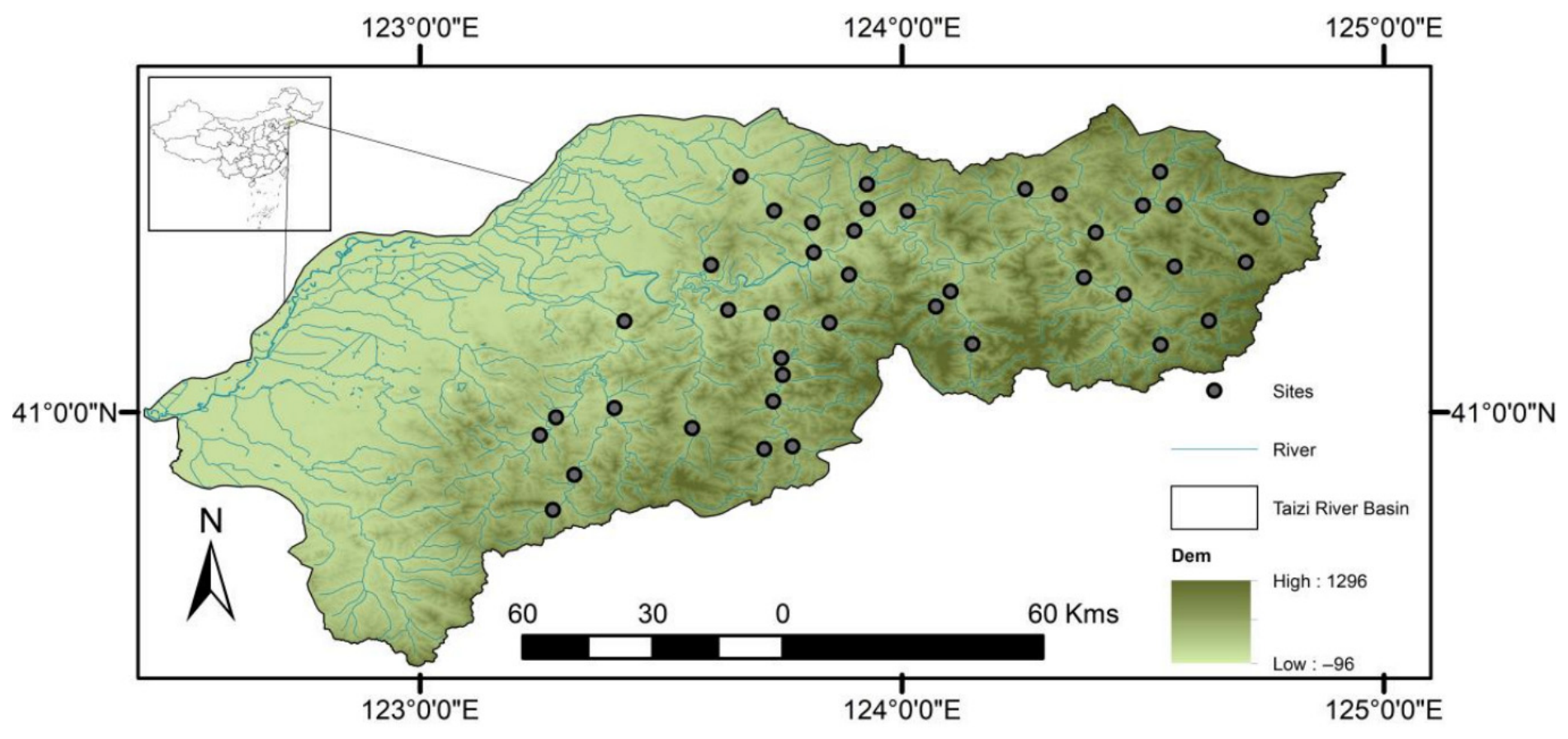
Taizi River is located in Northeast China, with an east–west orientation. Its geographical location is 122°26′–124°53′ E and 40°29′–41°39′ N, with a total length of 413 km and average depth 0.24 m (Figure 1). Its drainage area is 1.39 × 10⁴ m2, with a flow rate of 106 m3/s. Roughly 70% of the drainage area is mountainous, with a vegetation coverage of 70% and a forest coverage of approximately 50%. The basin is located in the temperate semi-humid monsoon climate zone, characterized by alternating cold and warm temperatures, as well as dry and wet seasons. With the rapid socioeconomic development of the region, the concentrations of nutrients in the basin have significantly increased, which directly affects aquatic biodiversity [41]. While concerns regarding the ecological health of the watershed have been raised, the impact of nutrient enrichment on aquatic biodiversity in the watershed remains elusive [42].

2.2. Field Sampling

In April 2018, macroinvertebrate samples were collected from 41 sites across the Taizi River Basin. At each site, five replicate samples were taken within a 100 m reach using a Surber net (0.09 m2, 500 µm mesh, Beijing Haifuda Technology Co., Ltd., Beijing, China), covering different habitat types (e.g., riffles, pools, and runs). Samples were washed through a 500 µm sieve, sorted manually in white enamel trays, and preserved in 70% ethanol. In the laboratory, specimens were identified to the genus or species level using standard taxonomic keys [43,44,45,46]. Water samples were collected at a depth of 20 cm below the surface and analyzed for total nitrogen (TN), total phosphorus (TP), ammonia-N (NH4+-N), dissolved oxygen (DO), pH, conductivity (COND), chemical oxygen demand (CODMn), and water temperature (WT) following standard methods [47].

2.3. Data Analyses

2.3.1. Alpha and Beta Diversity

Taxonomic α-diversity was quantified using species richness (SR), Shannon index (H), Simpson index (GS), and evenness (J) via the ‘vegan’ package in R. Functional α-diversity indices—functional richness (FRic), functional evenness (FEve), functional divergence (FDiv), functional dispersion (FDis), and Rao’s quadratic entropy (RaoQ)—were calculated using the ‘FD’ package, based on nine species traits (Table 1). Phylogenetic α-diversity was estimated as Faith’s phylogenetic diversity (PD) using the ‘picante’ package, based on a phylogenetic tree constructed from the macroinvertebrate taxonomic backbone. Likewise, taxonomic, functional, and phylogenetic β-diversity were each partitioned into total β-diversity, turnover, and nestedness components using the ‘beta’ function in the ‘BAT’ package. Macroinvertebrate functional groups are divided in Table 1.

2.3.2. Statistical Analyses

To reflect the degree of eutrophication and organic pollution of the water body, as well as to infer external pollution inputs and self-purification capacity, the environmental physical and chemical factors included the following: total phosphorus (TP), total nitrogen (TN), ammonia nitrogen (NH4+-N), dissolved oxygen (DO), pH value (pH), conductivity (COND), potassium permanganate (CODMn), and water temperature (WT) (Table 2).
Principal component analysis (PCA) was performed to identify key environmental variables structuring macroinvertebrate communities. Environmental variables were log-transformed where necessary to meet normality assumptions. The relationships between nutrients (TN, TP) and diversity indices were assessed using Mantel tests and linear regression models. Variation partitioning (VPA) was conducted using the ‘varpart’ function to quantify the unique and shared contributions of TN and TP to diversity variation.
To characterize the biodiversity patterns and their responses to environmental gradients, multiple ecological indices were calculated across taxonomic, functional, and phylogenetic dimensions, including both α-diversity (within-community diversity) and β-diversity (among-community diversity) metrics (Table 3).
Structural equation modeling (SEM) was constructed using the “lavaan” package to test the direct and indirect effects of TN and TP on taxonomic, functional, and phylogenetic diversity. Model fit was evaluated using χ2/df, comparative fit index (CFI), and root mean square error of approximation (RMSEA). Acceptable fit was defined as χ2/df < 3, CFI > 0.90, and RMSEA < 0.08. All analyses were performed in R version 4.3.

3. Results

3.1. Macroinvertebrate Community Composition

Macroinvertebrates species were collected with average abundance 4.51 ind./m2, belonging to three phyla and 68 species (Table 4), among which Arthropoda comprised the highest number of species (53 species), followed by Mollusca (10 species) and Annelida (5 species).

3.2. Analysis of Environmental, Physical, and Chemical Factors

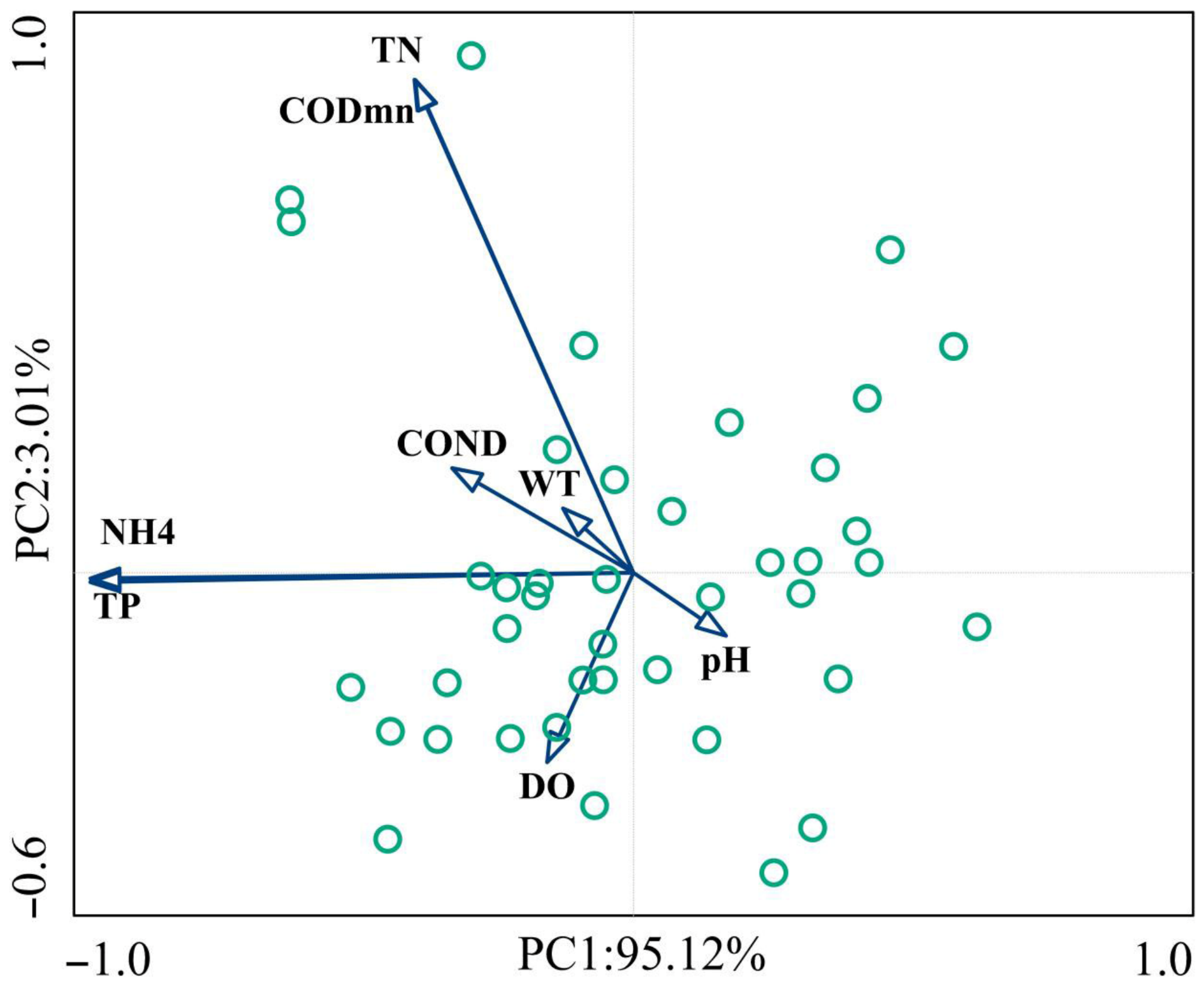
Principal component analysis (PCA) was performed to identify key environmental factors influencing the composition and structure of macrobenthic invertebrates using eight physical and chemical factors, namely total phosphorus content (TP) content, total nitrogen content (TN), ammonia nitrogen content (NH4+-N), dissolved oxygen (DO), pH, conductivity (Cond), chemical oxygen demand (CODMn), and water temperature (WT). The results revealed that the first two principal components explained 92.07% of the total variance (PC1: 70.52%, PC2: 21.55%). TP, TN, and NH4+-N were the primary contributors to PC1, while DO and WT contributed most to PC2 (Figure 2).
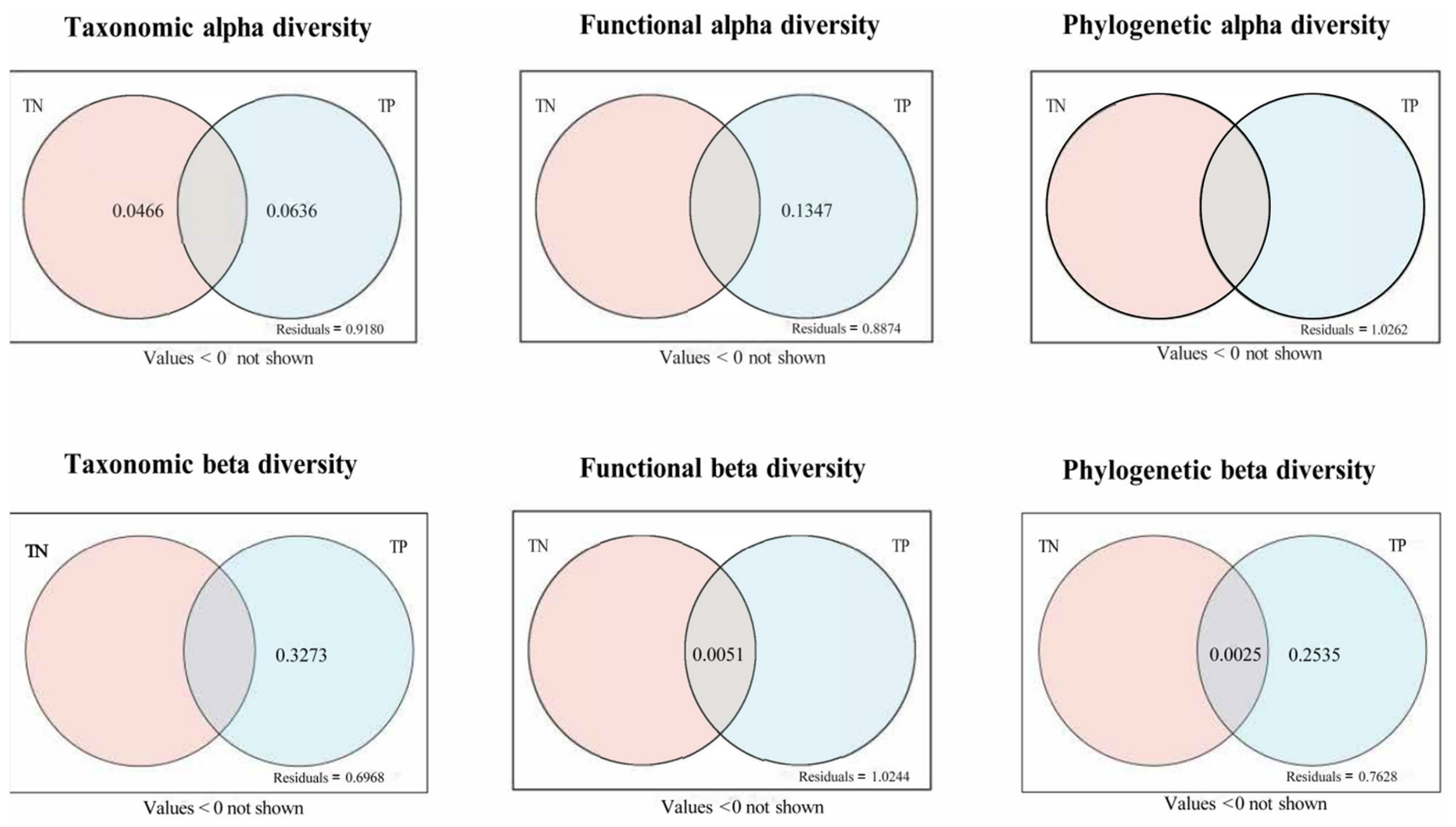
According to the results of variance partitioning analysis, concerning alpha diversity, TN accounted for 6.57% of taxonomic variation and 5.76% of functional variation, whilst TP accounted for 0.69% and 8.46% of taxonomic and functional variation, respectively. The combined explanatory power of TN and TP for taxonomic, functional, and phylogenetic variation was 2.14%, 3.56%, and 0.49%, respectively (residuals = 0.9180, 0.8874, 1.0262). Moreover, regarding beta diversity, TP accounted for 30.73%, 0.81%, and 27.66% of taxonomic, functional, and phylogenetic variation, respectively. The combined explanatory power of TN and TP for taxonomic variation was 1.83%, with residuals of 0.6968, 1.0244, and 0.7628, respectively (Figure 3).

3.3. Relationship Between Biodiversity and Environmental Factors

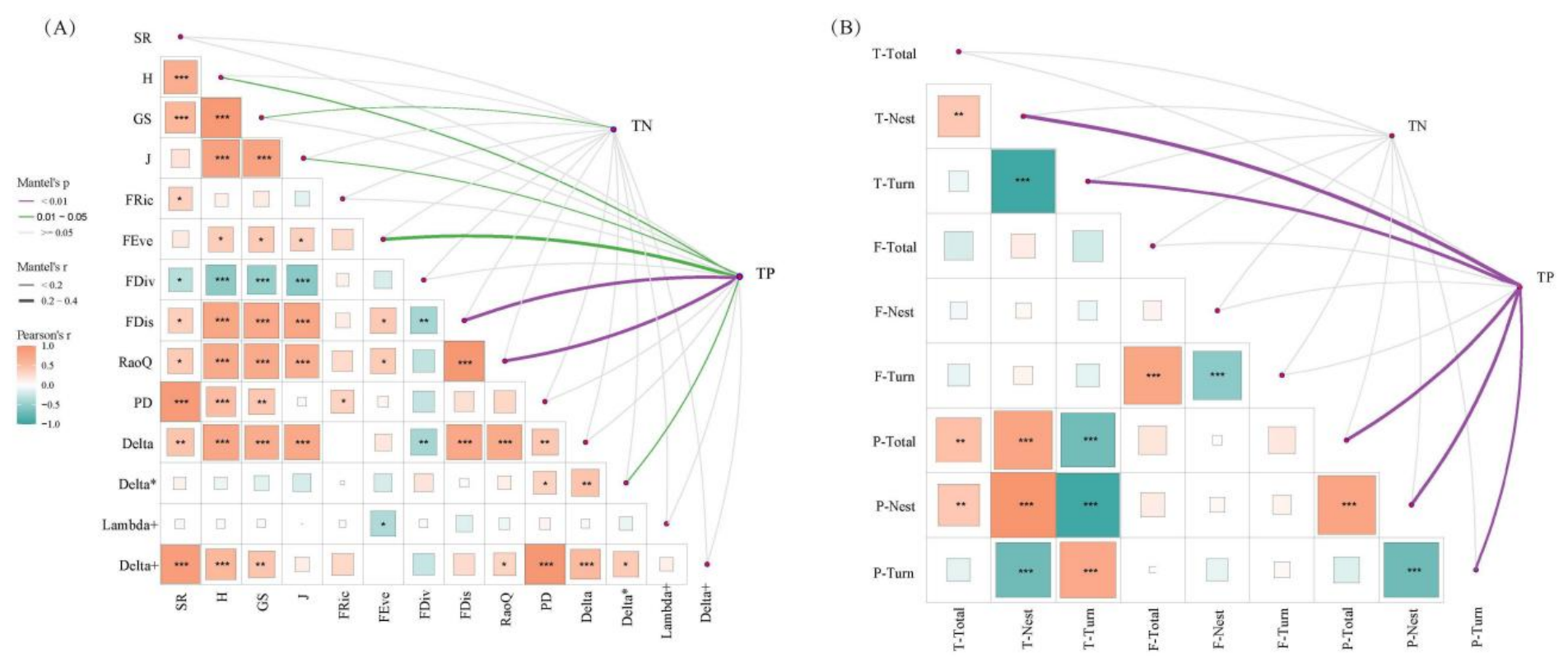
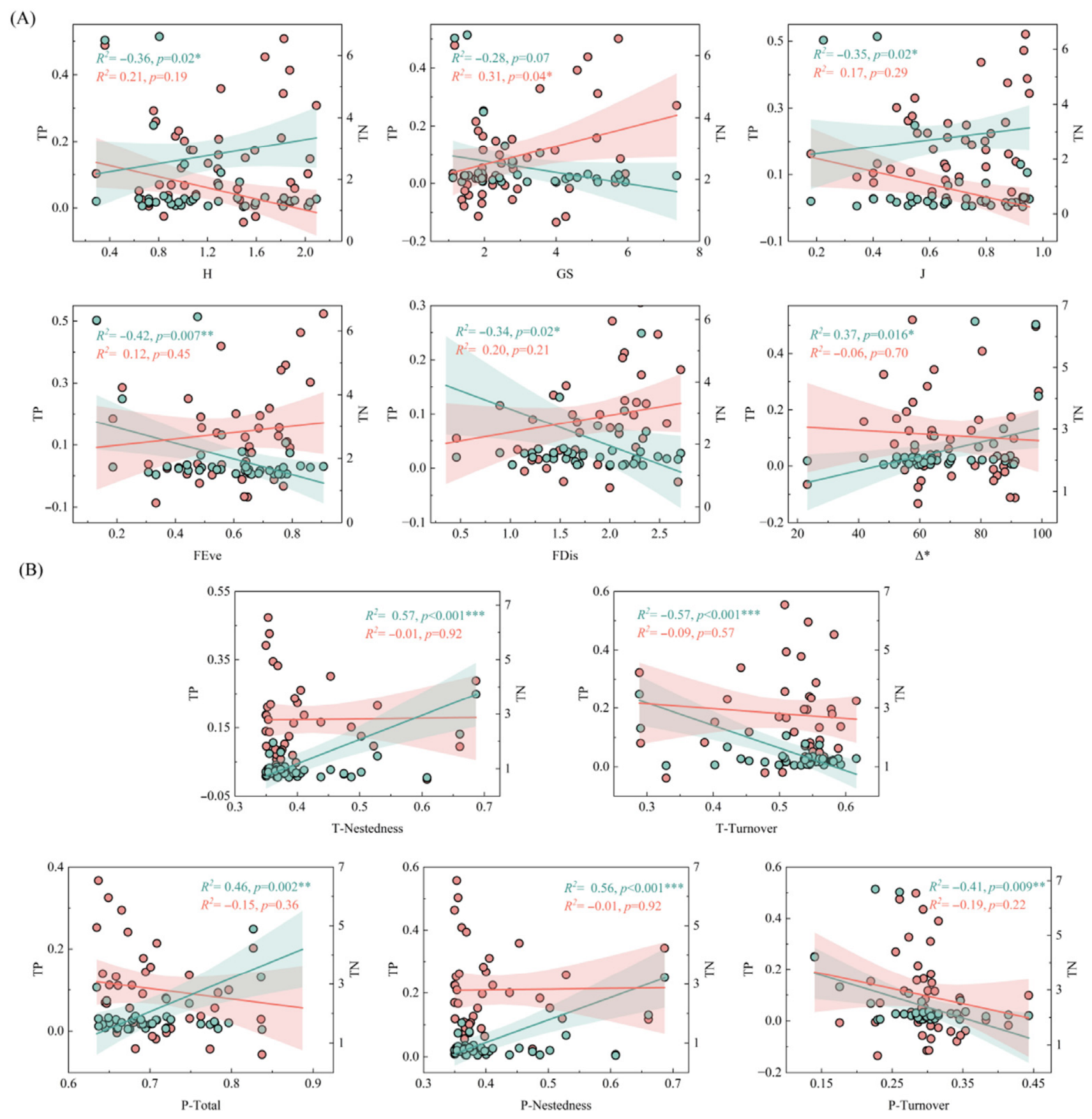
Mantel tests and linear regression analyses revealed that TP was significantly negatively correlated with functional evenness (FEve, p = 0.007) and functional dispersion (FDis, p = 0.02), supporting the hypothesis of TP-induced functional homogenization (Figure 4A and Figure 5A). In contrast, TN was positively correlated with Shannon index (p = 0.005) and evenness (p = 0.004), suggesting a shift toward pollution-tolerant taxa under high TN conditions (Figure 5A). At the β-diversity level, TP was significantly positively correlated with taxonomic and phylogenetic nestedness (p < 0.001) and negatively correlated with turnover components (p < 0.001), indicating a shift from species replacement to species loss along the TP gradient (Figure 4B and Figure 5B). TN showed no significant correlation with β-diversity components (p > 0.05).

3.4. Impact of Nutrients on Macroinvertebrate

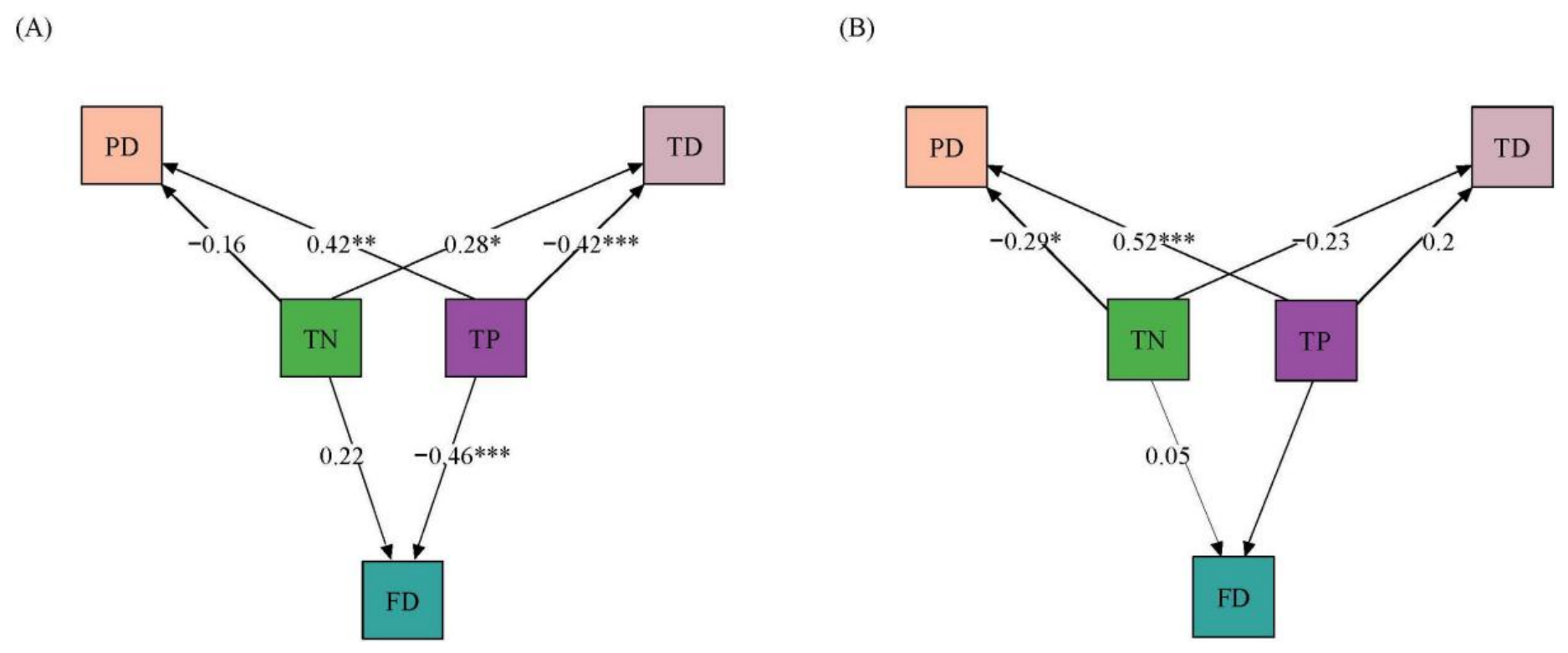
The results of SEM (Figure 6) unveiled that nutrients affected different aspects of macroinvertebrate diversity in various ways. At the alpha diversity level, TN significantly positively affected TD (R = 0.28, p < 0.05 *), while TP exerted a highly significant positive effect on PD (R = 0.42, p < 0.01 **) and a highly significant negative effect on TD and FD (R = −0.42, p < 0.001 ***; R = −0.46, p < 0.001 ***). At the beta diversity level, TN significantly negatively affected PD (R= −0.29, p < 0.05 *), whereas TP demonstrated an extremely significant positive effect on PD (R = 0.52, p < 0.001 ***).

4. Discussion

This study provides a comprehensive assessment of how nutrient enrichment (using two factors: total nitrogen and total phosphorus content) affects multiple dimensions of macroinvertebrates diversity in the Taizi River Basin. Our results demonstrate that TP is the dominant driver of community change, leading to functional homogenization at the α-diversity level and increased nestedness at the β-diversity level. These findings align with the growing recognition that phosphorus, rather than nitrogen, often limits primary production in freshwater ecosystems, and its enrichment can trigger cascading effects on higher trophic levels [5]. Specifically, PCA and variance decomposition analysis identified TP and TN as the primary trophic factors affecting macroinvertebrate diversity. Overall, total phosphorus largely accounted for the variation in macroinvertebrate diversity at the alpha and beta levels, while the interaction between total nitrogen and total phosphorus accounted for some of the variation in phylogenetic beta diversity. Our study indicated that as the most important environmental factor, the increase in total phosphorus level might aggravate the homogenization of the benthic community in this area, hallmarked by a significant decrease in the functional diversity index (FEve, FDis) of the community. Moreover, the nested component was enhanced at the beta diversity level, accompanied by a reduced turnover component. Although the community structure was generally stable, this stability may come at the expense of species diversity. Indeed, simplification of species composition may reduce community resistance to environmental changes [48,49].
Given the large spatial variation in total phosphorus and total nitrogen concentrations in the study area, we hypothesized that macroinvertebrate diversity decreased with nutrient enrichment, potentially leading to functional homogenization [50,51]. Herein, the results of regression analysis demonstrated that elevated total nitrogen levels increased the taxonomic diversity of macroinvertebrates, especially for those species that could use additional nitrogen sources [52]. For example, the Shaker family, the most abundant taxon in the study area, was followed by the Trematode family, which comprises predominantly nitrogen-loving species [53]. The increase in taxonomic diversity with TN likely reflects the proliferation of pollution-tolerant taxa (e.g., Chironomidae and Tubificidae), which may artificially inflate species richness without enhancing functional diversity. However, this increase may not be evenly distributed across all species. An increase in species richness does not reflect an increase in functional diversity, given that functional diversity is largely determined by the distribution and abundance of functional traits, which was also validated in subsequent analyses [54,55].
The observed decline in functional evenness (FEve) and functional dispersion (FDis) with increasing TP suggests that only a subset of functional traits persists under high nutrient conditions. This functional homogenization is consistent with previous studies in eutrophic systems and implies a loss of ecological redundancy, potentially reducing community resilience to future disturbances [7]. Notably, total phosphorus levels exerted a more significant influence on functional diversity and beta diversity. According to the results of regression analysis, increasing total phosphorus concentrations were correlated with decreased macroinvertebrate functional evenness and turnover components and increased nested components of taxonomic and phylogenetic beta diversity.
At the β-diversity level, the shift from turnover to nestedness along the TP gradient indicates that sites with high phosphorus levels support only a subset of the species pool, predominantly generalist taxa. This pattern is typical of environmental filtering, where harsh conditions exclude sensitive species, leading to biotic homogenization across sites [8,12]. Furthermore, the absence of a significant correlation between TN and β-diversity further underscores the primary role of TP in shaping regional community structure in this system. In this study, the analysis of Mantel’s results uncovered a strong correlation between taxonomic and phylogenetic beta diversity [56], implying the emergence of specific phylogenetic patterns as nutrients are enriched within the community [57]. Nevertheless, the simultaneous increase in species’ taxonomic and phylogenetic diversity does not necessarily correspond to an increase in the number of species performing different functions [58,59]. At the same time, the decline in functional evenness corroborated the rapid dominance of certain functional traits in the community, such as the increase in direct collectors and the increase in the number of collectors, likely ascribed to the accumulation of organic matter such as plankton or detritus caused by slow regional flow rates [18,60]. Consequently, species performing specific functions appear to have been lost or replaced [61,62], resulting in functional redundancy. This homogenization may compromise the stability of communities and their ability to cope with environmental changes, potentially affecting the level of ecosystem functioning [7,63].
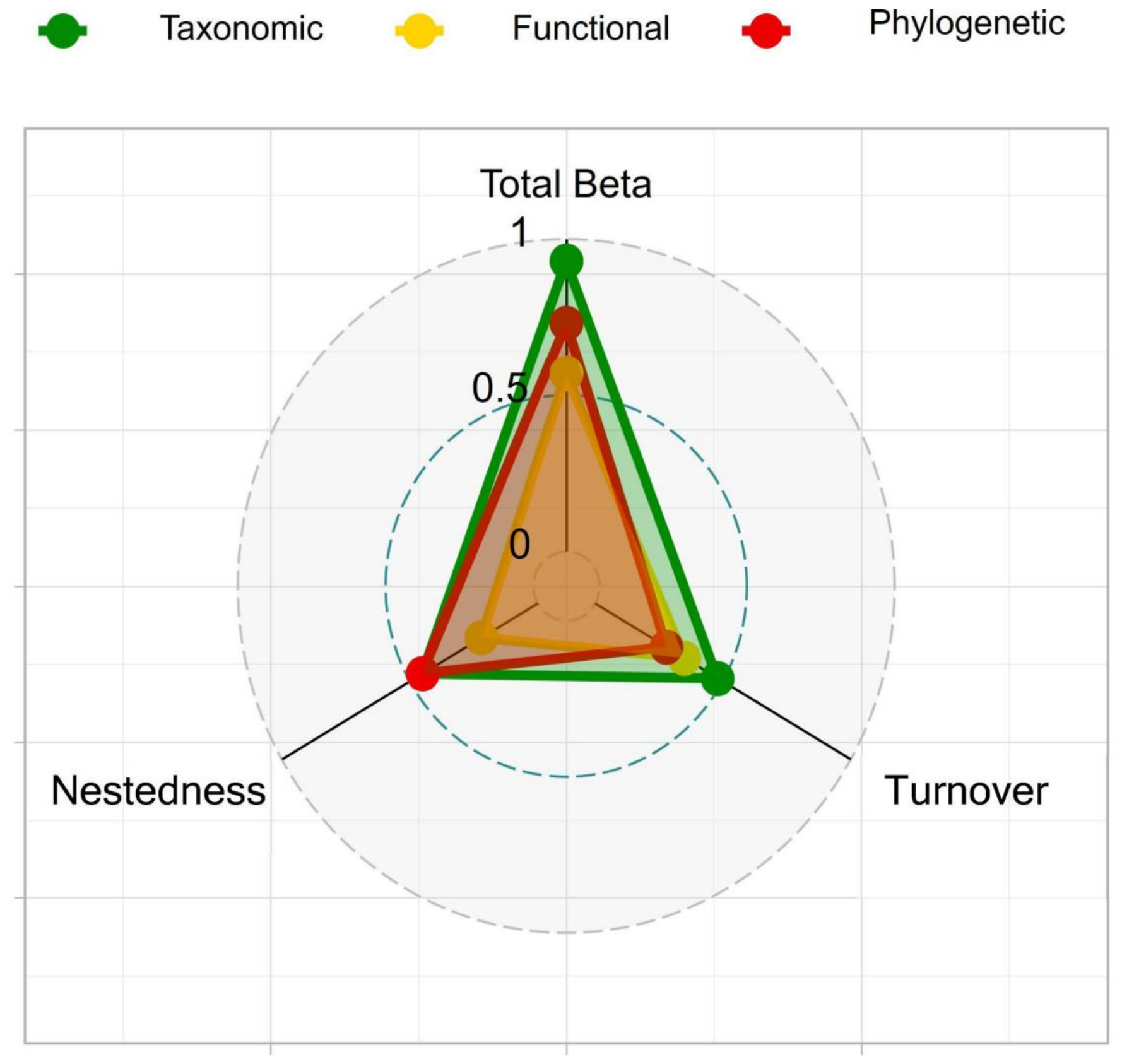
More importantly, the radar map illustrated that the taxonomic beta diversity was the highest (0.93), followed by the phylogenetic beta diversity (0.73) and the functional beta diversity (0.57) (Figure 7). The proximity of taxonomic diversity was close to 1, suggesting that each site harbored a unique species composition when species abundance was not considered. Interestingly, the turnover component of phylogenetic beta diversity was lower than that of functional beta diversity, indicating that the evolutionary convergence of species was weaker than their functional convergence [64]. While these species may originate from different evolutionary branches, they exhibit convergence in functional traits as a result of adaptation to similar environments [65]. Conversely, the turnover component of functional beta diversity was more dominant than the nested component. In other words, paired species substitutions led to a shift in most functional traits, resulting in differences in functional beta [66]. Overall, the variability noted across different aspects of beta diversity was consistent with the findings of previous studies and emphasizes the importance of considering functional and phylogenetic in beta diversity research [25,27,67].
In line with our third hypothesis, elevated total phosphorus levels exhibited a significantly stronger influence on the functional and phylogenetic diversity of macroinvertebrates compared to taxonomic diversity [37,68]. This pattern is supported by our analytical findings, as evidenced by the data presented in Figure 6. From the perspective of the structural equation model, there was a more significant correlation between functional diversity and nutrients, followed by taxonomy and phylogenetic diversity. This further reinforces the hypothesis that environmental factors filter traits rather than species [67,69]. However, the results were reversed upon considering when beta diversity. The correlations between taxonomic and phylogenetic beta diversity and nutrients were high, whereas those between functional beta diversity and nutrients were low and non-significant. At the same time, the results of Mantel analysis demonstrated a high correlation in the same aspect of diversity, such as between GS and H, whereas the correlation between different aspects of diversity was low, signaling that they all individually characterize the unique information of diversity [70]. Thus, accounting for functional and phylogenetic diversity can provide complementary information beyond taxonomic diversity, such as evolutionary relationships between ecosystem functions and species [27]. Of note, alpha diversity does not account for differences in species composition between sites, making direct comparisons challenging. In contrast, beta diversity accurately addresses this shortcoming by identifying differences between sites, thereby effectively capturing temporal and spatial differences in community responses [71,72]. Based on the different results revealed by different diversity indexes, we speculate that considering multiple dimensions of diversity can expand our understanding of community dynamics [73,74]. Overall, this study explored the role of environmental filtering driven by nutrient enrichment, and future long-term studies in the region are warranted to validate our results and provide insights for environmental management.
TP serves as a bulk proxy for the overall nutrient pool, and its correlation with biological responses in our study likely reflects the strong covariance between TP and bioavailable phosphorus fractions under the local hydrological and biogeochemical conditions. This distinction is important because the use of TP as a causal indicator can sometimes obscure the underlying mechanisms of nutrient–biota interactions [75]. Large-scale trait databases have facilitated the widespread application of functional diversity metrics in freshwater bioassessment, and our study benefited from such trait-based approaches to detect community-level functional responses along the TP gradient [76]. We caution that TP itself does not directly influence phytoplankton or macroinvertebrates; rather, it serves as a composite metric of trophic state [77]. The actual bioavailable phosphorus fraction (dissolved reactive phosphorus) is the key driver of algal production, but its measurement was not available in our dataset. Hence, our interpretations of TP effects should be understood as reflecting the overall nutrient enrichment gradient, within which the dissolved phosphorus fraction covaries strongly with TP. In addition, our findings further reveal that the apparent effect of total phosphorus on macroinvertebrate functional diversity is primarily indirect, mediated by reduced dissolved oxygen. Low dissolved oxygen directly stresses aquatic macroinvertebrates, particularly taxa with high respiratory demands (EPT), and favors tolerant taxa with specific functional traits. The loss of oxygen-sensitive species reduces functional evenness and dispersion, as the community becomes dominated by a few tolerant groups that occupy a narrower range of functional niches—a process of functional homogenization. Thus, while TP serves as a useful integrative indicator of nutrient pressure, it is the cascading effect on oxygen availability that more directly drives the observed biodiversity patterns. Future studies should incorporate high-frequency DO measurements alongside nutrient data to better disentangle these interacting drivers.

5. Conclusions

This study investigated the effects of nutrients enrichment on macroinvertebrate diversity across taxonomic, functional, and phylogenetic dimensions in a boreal river of northern China. Our results demonstrate that TP is the primary driver of biodiversity change, promoting functional homogenization at the alpha level and increasing nestedness at the beta level. Functional and phylogenetic diversity were more sensitive to nutrient enrichment than taxonomic diversity, underscoring the importance of incorporating multiple diversity facets in ecological assessments.
From a management perspective for Taizi River Basin,, we recommend that firstly, given the dominant role of TP in driving functional homogenization and nestedness, phosphorus control should be prioritized over nitrogen management to preserve macroinvertebrate biodiversity. Secondly, we recommend the protection of high-turnover and low TP levels sites, as these sites contribute disproportionately to regional β-diversity and may serve as refugia for sensitive species. Finally, future monitoring efforts should incorporate functional and phylogenetic metrics alongside traditional taxonomic indices to provide a more comprehensive assessment of ecosystem health. These strategies can help safeguard macroinvertebrate diversity and ecosystem function in nutrient-impacted river systems. In the future, studies should include direct measurements of DO dynamics along the eutrophication gradient to better resolve causal pathways.

Author Contributions

Conceptualization, X.S. and G.L.; methodology, Y.G. and X.W.; software, W.L.; validation, C.L. and Y.L.; formal analysis, S.C., Z.W. and Z.L.; investigation, Y.G. and X.W.; resources, G.L.; data curation, W.L., C.L. and Y.L.; writing—original draft preparation, Y.G. and X.W.; writing—review and editing, X.S.; visualization, C.L. and Y.L.; supervision, G.L.; project administration, S.C. and Z.W.; funding acquisition, G.L. All authors have read and agreed to the published version of the manuscript.

Funding

This research was funded by the National Natural Science Foundation of China, grant number 41977193.

Institutional Review Board Statement

Not applicable.

Informed Consent Statement

Not applicable.

Data Availability Statement

Data will be made available upon request.

Acknowledgments

The authors are grateful to the people that helped with all aspects of the fieldwork. All authors have consented to the acknowledgement.

Conflicts of Interest

The authors declare no conflicts of interest.

References

  1. DeBoer, J.A.; Thoms, M.C.; Delong, M.D.; Parsons, M.E.; Casper, A.F. Heterogeneity of ecosystem function in an “Anthropocene” river system. Anthropocene 2020, 31, 100252. [Google Scholar] [CrossRef]
  2. Schletterer, M.; Füreder, L.; Kuzovlev, V.V.; Zhenikov, Y.N.; Grigorieva, I.L. Lowland river reference condition: Spatial and temporal patterns of the zoobenthos community in the Volga headwaters (2006–2010). Hydrobiologia 2014, 729, 175–189. [Google Scholar] [CrossRef]
  3. Ahmad, F.; Ali, A.A. Eutrophication: An Ecological Vision. Bot. Rev. 2005, 71, 449–482. [Google Scholar] [CrossRef]
  4. Smith, V.H.; Schindler, D.W. Eutrophication science: Where do we go from here? Trends Ecol. Evol. 2009, 24, 201–207. [Google Scholar] [CrossRef] [PubMed]
  5. Wurtsbaugh, W.A.; Paerl, H.W.; Dodds, W.K. Nutrients, eutrophication and harmful algal blooms along the freshwater to marine continuum. WIREs Water 2019, 6, e1373. [Google Scholar] [CrossRef]
  6. Carpenter, S.R. Eutrophication of aquatic ecosystems: Bistability and soil phosphorus. Proc. Natl. Acad. Sci. USA 2005, 102, 10002–10005. [Google Scholar] [CrossRef]
  7. Sattler, C.; Gianuca, A.T.; Schweiger, O.; Franzén, M.; Settele, J. Pesticides and land cover heterogeneity affect functional group and taxonomic diversity of arthropods in rice agroecosystems. Agric. Ecosyst. Environ. 2020, 297, 106927. [Google Scholar] [CrossRef]
  8. Donohue, I.; Jackson, A.L.; Pusch, M.T.; Irvine, K. Nutrient enrichment homogenizes lake benthic assemblages at local and regional scales. Ecology 2009, 90, 3470–3477. [Google Scholar] [CrossRef] [PubMed]
  9. Ger, K.A.; Urrutia-Cordero, P.; Frost, P.C.; Hansson, L.-A.; Sarnelle, O.; Wilson, A.E.; Lürling, M. The interaction between cyanobacteria and zooplankton in a more eutrophic world. Harmful Algae 2016, 54, 128–144. [Google Scholar] [CrossRef]
  10. Li, Z.; Gao, Y.; Wang, S.; Jia, J.; Ha, X.; Lu, Y. Floodplain lake response to climate-nutrient-hydrological pressure revealed through phytoplankton community succession over the past century. J. Hydrol. 2023, 623, 129838. [Google Scholar] [CrossRef]
  11. Menezes, R.F.; Borchsenius, F.; Svenning, J.-C.; Davidson, T.A.; Søndergaard, M.; Lauridsen, T.L.; Landkildehus, F.; Jeppesen, E. Homogenization of fish assemblages in different lake depth strata at local and regional scales. Fresh. Biol. 2015, 60, 745–757. [Google Scholar] [CrossRef]
  12. Zorzal-Almeida, S.; Bartozek, E.C.R.; Bicudo, D.C. Homogenization of diatom assemblages is driven by eutrophication in tropical reservoirs. Environ. Pollut. 2021, 288, 117778. [Google Scholar] [CrossRef]
  13. Zuo, J.; Xiao, P.; Heino, J.; Tan, F.; Soininen, J.; Chen, H.; Yang, J. Eutrophication increases the similarity of cyanobacterial community features in lakes and reservoirs. Water Res. 2024, 250, 120977. [Google Scholar] [CrossRef] [PubMed]
  14. Bonada, N.; Prat, N.; Resh, V.H.; Statzner, B. Developments in aquatic insect biomonitoring: A comparative analysis of recent approaches. Annu. Rev. Entomol. 2006, 51, 495–523. [Google Scholar] [CrossRef]
  15. Liu, W.; Tian, S.; Yang, H.; Wang, S.; Li, Z.; Yin, X. Dam-induced connectivity loss shapes benthic communities through water quality alterations in the Yangtze River Basin. Water Biol. Secur. 2026, 5, 100500. [Google Scholar] [CrossRef]
  16. Liu, Y.; Zhang, J.; Wang, W.; Wang, H.; Li, J.; Yin, X. Stochastic processes determine community assembly of benthic macroinvertebrates in a boreal river basin of northern China. Water Biol. Secur. 2026; in press.
  17. Glibert, P.M.; Burford, M.A. Globally Changing Nutrient Loads and Harmful Algal Blooms: Recent Advances, New Paradigms, and Continuing Challenges. Oceanography 2017, 30, 58–69. [Google Scholar] [CrossRef]
  18. van der Wal, D.; Lambert, G.I.; Ysebaert, T.; Plancke, Y.M.G.; Herman, P.M.J. Hydrodynamic conditioning of diversity and functional traits in subtidal estuarine macrozoobenthic communities. Estuar. Coast. Shelf Sci. 2017, 197, 80–92. [Google Scholar] [CrossRef]
  19. Coccia, C.; Almeida, B.A.; Green, A.J.; Gutiérrez, A.B.; Carbonell, J.A. Functional diversity of macroinvertebrates as a tool to evaluate wetland restoration. J. Appl. Ecol. 2021, 58, 2999–3011. [Google Scholar] [CrossRef]
  20. Jiang, X.; Pan, B.; Jiang, W.; Hou, Y.; Yang, H.; Zhu, P.; Heino, J. The role of environmental conditions, climatic factors and spatial processes in driving multiple facets of stream macroinvertebrate beta diversity in a climatically heterogeneous mountain region. Ecol. Indic. 2021, 124, 107407. [Google Scholar] [CrossRef]
  21. Chen, Q.; Zhang, J.; Liu, Y.; Jiang, H.; Liu, G.; Yin, X. Nutrient-driven shifts in zooplankton structural-functional dynamics across different freshwaters. Water Biol. Secur. 2026, 5, 100449. [Google Scholar] [CrossRef]
  22. Chase, J.M.; Jeliazkov, A.; Ladouceur, E.; Viana, D.S. Biodiversity conservation through the lens of metacommunity ecology. Ann. N. Y. Acad. Sci. 2020, 1469, 86–104. [Google Scholar] [CrossRef]
  23. Xu, Q.; Yang, X.; Song, J.; Ru, J.; Xia, J.; Wang, S.; Wan, S.; Jiang, L. Nitrogen enrichment alters multiple dimensions of grassland functional stability via changing compositional stability. Ecol. Lett. 2022, 25, 2713–2725. [Google Scholar] [CrossRef] [PubMed]
  24. Zhu, P.; Ma, M.; Jin, Y.; Yin, X.; Zhu, Z.; Wang, S.; Shang, S. Nutrient enrichment modulates phytoplankton biodiversity-resource use efficiency relationships in temperate lentic ecosystems of Northern China. Hydrobiologia 2026, 853, 1937–1950. [Google Scholar] [CrossRef]
  25. Cardoso, P.; Rigal, F.; Carvalho, J.; Fortelius, M.; Borges, P.; Podani, J.; Schmera, D. Partitioning taxon, phylogenetic and functional beta diversity into replacement and richness difference components. J. Biogeogr. 2014, 41, 749–761. [Google Scholar] [CrossRef]
  26. Moog, O.; Hartmann, A. (Eds.) Fauna Aquatica Austriaca, 3rd ed.; BMLFUW: Wien, Austria, 2017. Available online: https://www.ecoprof.at/index.php/faunaaquaticaaustriaca.html (accessed on 18 June 2019).
  27. Heino, J.; Tolonen, K.T. Ecological drivers of multiple facets of beta diversity in a lentic macroinvertebrate metacommunity. Limnol. Oceanogr. 2017, 62, 2431–2444. [Google Scholar] [CrossRef]
  28. Li, Z.; Heino, J.; Zhang, J.; Ge, Y.; Liu, Z.; Xie, Z. Unravelling the factors affecting multiple facets of macroinvertebrate beta diversity in the World’s Third Pole. J. Biogeogr. 2023, 50, 792–804. [Google Scholar] [CrossRef]
  29. Liu, Y.; Mao, F.; Zhang, S.; Song, Y.; Jiang, M.; Wang, H.; Yin, X. Effects of ice cover on diversity and community assembly of benthic algae in a stream system of northern China. Aquat. Ecol. 2026, 60, 24. [Google Scholar] [CrossRef]
  30. Liu, Y.; Zhang, M.; Peng, W.; Qu, X.; Zhang, Y.; Du, L.; Wu, N. Phylogenetic and functional diversity could be better indicators of macroinvertebrate community stability. Ecol. Indic. 2021, 129, 107892. [Google Scholar] [CrossRef]
  31. Victor, S.S.; Tadeu, S.; Alaíde, A.F.-G. Should phylogenetic and functional diversity metrics compose macroinvertebrate multimetric indices for stream biomonitoring? Hydrobiologia 2014, 745, 167–179. [Google Scholar] [CrossRef]
  32. Zhang, J.; Liu, Y.; Chen, Q.; Yin, X. Biodiversity and functional redundancy of fish assemblages in relation to nutrient enrichment: A case study in a boreal river of China. Hydrobiologia 2025, 852, 2993–3004. [Google Scholar] [CrossRef]
  33. Camille, D.; Frédéric, J.; Muriel, T. Concave trade-off curves between crop production and taxonomic, functional and phylogenetic diversity of birds. Ecol. Indic. 2017, 79, 83–90. [Google Scholar] [CrossRef]
  34. Qin, H.; Wang, Y.; Zhang, F.; Chen, J.; Zhang, G.; Dong, G. Application of species, phylogenetic and functional diversity to the evaluation on the effects of ecological restoration on biodiversity. Ecol. Inform. 2016, 32, 53–62. [Google Scholar] [CrossRef]
  35. Lin, Z.; Liu, G.; Guo, K.; Wang, K.; Wijewardene, L.; Wu, N. Scales matter: Regional environment factors affect α diversity but local factors affect β diversity of macroinvertebrates in Thousand Islands Lake catchment area. Ecol. Indic. 2024, 158, 111561. [Google Scholar] [CrossRef]
  36. Tian, S.; Yin, X. Intermediate disturbance hypothesis explains eutrophication and biodiversity pattern in a boreal river basin, China. Hydrobiologia 2022, 849, 3389–3399. [Google Scholar] [CrossRef]
  37. Li, J.; Ma, M.; Wang, L.; Jin, Y.; Liu, Y.; Yin, X.; Liu, G.; Song, J. Ecological drivers of taxonomic, functional, and phylogenetic beta diversity of macroinvertebrates in Wei River Basin of northwest China. Front. Ecol. Evol. 2024, 12, 1410915. [Google Scholar] [CrossRef]
  38. Liang, S.; Song, B.; Chong, X.; Zheng, W.; Nie, H.; Yin, X. Phylogenetic position and genetic diversity of masu salmon Oncorhynchus masou in the Mijiang River, China. Ichthyol. Res. 2023, 70, 402–405. [Google Scholar] [CrossRef]
  39. Zhang, J.; Yang, H.; Ma, M.; Pu, T.; Yin, X. Predator-mediated diversity of stream fish assemblages in a boreal river basin, China. Sci. Rep. 2023, 13, 561. [Google Scholar] [CrossRef]
  40. Zheng, B.; Yin, X. Assembly mechanism of macroinvertebrate metacommunities and ecological factors of multiple aspects of beta diversity in a boreal river basin, China. Front. Ecol. Evol. 2023, 11, 1131403. [Google Scholar] [CrossRef]
  41. Zhang, Y.; Ding, S.; Bentsen, C.N.; Ma, S.; Jia, X.; Meng, W. Differences in stream fish assemblages subjected to different levels of anthropogenic pressure in the Taizi River catchment, China. Ichthyoll. Res. 2015, 62, 450–462. [Google Scholar] [CrossRef]
  42. Zhang, Y.; Wang, X.-N.; Ding, H.-Y.; Dai, Y.; Ding, S.; Gao, X. Threshold Responses in the Taxonomic and Functional Structure of Fish Assemblages to Land Use and Water Quality: A Case Study from the Taizi River. Water 2019, 11, 661. [Google Scholar] [CrossRef]
  43. Dudgeon, D. The Ecology of Tropical Asian Rivers and Streams in Relation to Biodiversity Conservation. Annu. Rev. Ecol. Evol. Syst. 2000, 31, 239–263. [Google Scholar] [CrossRef]
  44. John, C.M.; Limin, Y.; Tian, L. Aquatic Insects of China Useful for Monitoring Water Quality; Hohai University Press: Nanjing, China, 1994. [Google Scholar]
  45. Robert, A.M. An Introduction to the Aquatic Insects of North America. J. N. Am. Benthol. Soc. 1996, 15, 401–403. [Google Scholar] [CrossRef]
  46. Zhou, C.; Gui, H.; Zhou, K. Larval Key to Families of Ephemeroptera from China (Insecta). Nanjing Shi Da Xue Bao 2003, 26, 65–68. [Google Scholar]
  47. Wei, F.S. Water and Wastewater Monitoring Method, 4th ed.; China Environmental Science Press: Beijing, China, 2002. (In Chinese) [Google Scholar]
  48. Shi, M.; Lou, M.; Wu, J.; Liu, G.; Gao, H.; Guo, M. Characteristics and Driving Factors of Benthic Animal Communities in Different Water Functional Zones of the Jiangsu Section of the Yangtze River. Water 2024, 16, 2778. [Google Scholar] [CrossRef]
  49. Pedelacq, M.E.; Garaffo, G.; Llanos, E.; Venturini, N.; Muniz, P. Pollution has negative effects on macrozoobenthic trait diversity in a large subtropical estuary. Mar. Pollut. Bull. 2022, 184, 114101. [Google Scholar] [CrossRef]
  50. Piano, E.; Doretto, A.; Mammola, S.; Falasco, E.; Fenoglio, S.; Bona, F. Taxonomic and functional homogenisation of macroinvertebrate communities in recently intermittent Alpine watercourses. Freshw. Biol. 2020, 65, 2096–2107. [Google Scholar] [CrossRef]
  51. Piña, A.E.; Lougheed, V.L. Macroinvertebrate Community Composition in Wetlands of the Desert Southwest is Driven by wastewater-associated Nutrient Loading Despite Differences in Salinity. Wetlands 2022, 42, 128. [Google Scholar] [CrossRef]
  52. Kafouris, S.; Smeti, E.; Spatharis, S.; Tsirtsis, G.; Economou-Amilli, A.; Danielidis, D.B. Nitrogen as the main driver of benthic diatom composition and diversity in oligotrophic coastal systems. Sci. Total Environ. 2019, 694, 133773. [Google Scholar] [CrossRef]
  53. Foshtomi, M.Y.; Braeckman, U.; Derycke, S.; Sapp, M.; Van Gansbeke, D.; Sabbe, K.; Willems, A.; Vincx, M.; Vanaverbeke, J. The Link between Microbial Diversity and Nitrogen Cycling in Marine Sediments Is Modulated by Macrofaunal Bioturbation. PLoS ONE 2015, 10, e0130116. [Google Scholar] [CrossRef]
  54. Rivadeneira, M.M.; Nielsen, S.N. Diversification dynamics, species sorting, and changes in the functional diversity of marine benthic gastropods during the Pliocene-Quaternary at temperate western South America. PLoS ONE 2017, 12, e0187140. [Google Scholar] [CrossRef] [PubMed]
  55. Duan, Y.; Al-Jubury, A.; Kania, P.W.; Buchmann, K. Trematode diversity reflecting the community structure of Danish freshwater systems: Molecular clues. Parasites Vectors 2021, 14, 43. [Google Scholar] [CrossRef] [PubMed]
  56. Branco, C.C.Z.; Bispo, P.C.; Peres, C.K.; Tonetto, A.F.; Krupek, R.A.; Barfield, M.; Holt, R.D. Partitioning multiple facets of beta diversity in a tropical stream macroalgal metacommunity. J. Biogeogr. 2020, 47, 1765–1780. [Google Scholar] [CrossRef]
  57. Serrana, J.M.; Li, B.; Watanabe, K. Cross-taxa assessment of species diversity and phylogenetic structure of benthic communities in a dam-impacted river undergoing habitat restoration. Sci. Total Environ. 2025, 958, 177886. [Google Scholar] [CrossRef] [PubMed]
  58. García-Girón, J.; Fernández-Aláez, C.; Fernández-Aláez, M.; Alahuhta, J. Untangling the assembly of macrophyte metacommunities by means of taxonomic, functional and phylogenetic beta diversity patterns. Sci. Total Environ. 2019, 693, 133616. [Google Scholar] [CrossRef]
  59. Le Bagousse-Pinguet, Y.; Soliveres, S.; Gross, N.; Torices, R.; Berdugo, M.; Maestre, F.T. Phylogenetic, functional, and taxonomic richness have both positive and negative effects on ecosystem multifunctionality. Proc. Natl. Acad. Sci. USA 2019, 116, 8419–8424. [Google Scholar] [CrossRef]
  60. Ball, E.E.; Smith, D.E.; Anderson, E.J.; Skufca, J.D.; Twiss, M.R. Water velocity modeling can delineate nearshore and main channel plankton environments in a large river. Hydrobiologia 2018, 815, 125–140. [Google Scholar] [CrossRef]
  61. Barnes, R.S.K.; Hendy, I.W. Seagrass-associated macrobenthic functional diversity and functional structure along an estuarine gradient. Estuar. Coast. Shelf Sci. 2015, 164, 233–243. [Google Scholar] [CrossRef]
  62. Le Marchand, M.; Hattab, T.; Niquil, N.; Albouy, C.; Le Loc’h, F.; Lasram, F. Climate change in the Bay of Biscay: Changes in spatial biodiversity patterns could be driven by the arrivals of southern species. Mar. Ecol. Progr. Ser. 2020, 647, 17–31. [Google Scholar] [CrossRef]
  63. Sardiña, P.; Chaves, E.; Marchese, M. Benthic community responses to invasion by the golden mussel, Limnoperna fortuneiDunker: Biotic homogenization vs environmental driving forces. J. N. Am. Benthol. Soc. 2011, 30, 1009–1023. [Google Scholar] [CrossRef]
  64. Rocha, M.P.; Bini, L.M.; Grönroos, M.; Hjort, J.; Lindholm, M.; Karjalainen, S.-M.; Tolonen, K.E.; Heino, J. Correlates of different facets and components of beta diversity in stream organisms. Oecologia 2019, 191, 919–929. [Google Scholar] [CrossRef]
  65. Veríssimo, H.; Verdelhos, T.; Baeta, A.; van der Linden, P.; Garcia, A.C.; Marques, J.C. Comparison of thermodynamic-oriented indicators and trait-based indices ability to track environmental changes: Response of benthic macroinvertebrates to management in a temperate estuary. Ecol. Indic. 2017, 73, 809–824. [Google Scholar] [CrossRef]
  66. Santos, F.; Lima, M.G.M.; Espinosa, S.; Ahumada, J.A.; Jansen, P.A.; Spironello, W.R.; Hurtado, J.; Juen, L.; Peres, C.A. Site and species contribution to β-diversity in terrestrial mammal communities: Evidence from multiple Neotropical forest sites. Sci. Total Environ. 2021, 789, 147946. [Google Scholar] [CrossRef] [PubMed]
  67. Li, Z.; Heino, J.; Liu, Z.; Meng, X.; Chen, X.; Ge, Y.; Xie, Z. The drivers of multiple dimensions of stream macroinvertebrate beta diversity across a large montane landscape. Limnol. Oceanogr. 2021, 66, 226–236. [Google Scholar] [CrossRef]
  68. Wang, L.; Han, B.-P. Non-random species loss under human disturbance increases the nestedness component of macroinvertebrate beta diversity in tropical streams. Ecol. Indic. 2023, 154, 110918. [Google Scholar] [CrossRef]
  69. Poff, N.L. Landscape Filters and Species Traits: Towards Mechanistic Understanding and Prediction in Stream Ecology. J. N. Am. Benthol. Soc. 1997, 16, 391–409. [Google Scholar] [CrossRef]
  70. Koperski, P. Linear and nonlinear effects of nutrient enrichments on the diversity of macrobenthos in lowland watercourses. Aquat. Ecol. 2021, 55, 1011–1031. [Google Scholar] [CrossRef]
  71. Hering, D.; Buffagni, A.; Moog, O.; Sandin, L.; Sommerhäuser, M.; Stubauer, I.; Feld, C.; Johnson, R.; Pinto, P.; Skoulikidis, N.; et al. The development of a system to assess the ecological quality of streams based on macroinvertebrates—Design of the sampling programme within the AQEM Project. Int. Rev. Hydrobiol. 2003, 88, 345–361. [Google Scholar] [CrossRef]
  72. Whittaker, R.H. Vegetation of the Siskiyou Mountains, Oregon and California. Ecol. Monog. 1960, 30, 279–338. [Google Scholar] [CrossRef]
  73. Schletterer, M.; Füreder, L.; Kuzovlev, V.V.; Beketov, M.A. Testing the coherence of several macroinvertebrate indices and environmental factors in a large lowland river system (Volga River, Russia). Ecol. Indic. 2010, 10, 1083–1092. [Google Scholar] [CrossRef]
  74. Jia, K.; Liao, Y.; Tang, Y.; Zhang, R.; Li, Y.; Shou, L. Revealing the influence of physicochemical parameters on the taxonomic and functional diversity of macrobenthos in hangzhou bay, China. Estuar. Coast. Shelf Sci. 2025, 316, 109204. [Google Scholar] [CrossRef]
  75. Bakker, A.M.; van der Meer, T.V.; Kraak, M.H.S.; Verdonschot, P.F.M. Macroinvertebrates a forgotten player in the nutrient dynamics of riparian buffer zones. Oecologia 2025, 207, 190. [Google Scholar] [CrossRef] [PubMed]
  76. Welti, E.A.R.; Bowler, D.E.; Sinclair, J.S.; Altermatt, F.; Álvarez-Cabria, M.; Amatulli, G.; Angeler, D.G.; Archambaud, G.; Jorrín, I.A.; Aspin, T.; et al. Time series of freshwater macroinvertebrate abundances and site characteristics of European streams and rivers. Sci. Data 2024, 11, 601. [Google Scholar] [CrossRef]
  77. Friberg, N.; Skriver, J.; Larsen, S.E.; Pedersen, M.L.; Buffagni, A. Stream macroinvertebrate occurrence along gradients in organic pollution and eutrophication. Freshw. Biol. 2010, 55, 1405–1419. [Google Scholar] [CrossRef]
Figure 1. Distribution of sampling points in the study area. Map was created using ArcGIS software by Esri (Environmental Systems Resource Institute, ArcGIS 10.8; https://www.esri.com/en-us/home (accessed on 15 May 2018).
Biology 15 00816 g001
Figure 2. Principal component analysis results. Physical and chemical factors of water: TP, TN, ammonia nitrogen (NH4+-N), dissolved oxygen (DO), pH, conductivity (COND), potassium permanganate (CODMn), and water temperature (WT). Note: the circle means sampling sites, the arrow means physical and chemical fators.
Biology 15 00816 g002
Figure 3. Decomposition analysis of variance of total nitrogen and total phosphorus on taxonomic, functional, and phylogenetic diversity of macroinvertebrates. Values less than 0 will not be displayed.
Biology 15 00816 g003
Figure 4. Mantel analysis of total nitrogen and total phosphorus on the alpha, beta diversity of macroinvertebrates. (A) Alpha diversity. (B) Beta diversity. Note: Delta: taxonomic diversity, Delta*: taxonomic distinctness, Lambda+: variation in taxonomic distinctness, Delta+: weighted taxonomic diversity. Note: *** p < 0.001, ** p < 0.01, * p < 0.05.
Biology 15 00816 g004
Figure 5. Linear regression model of total nitrogen and total phosphorus with taxonomic, functional, and phylogenetic diversity of macroinvertebrates. (A): Alpha diversity; (B): beta diversity; red and green represent the trends of total nitrogen and total phosphorus, respectively. Note: *** p < 0.001, ** p < 0.01, * p < 0.05.
Biology 15 00816 g005
Figure 6. SEM analysis of macroinvertebrates based on total nitrogen and total phosphorus. (A): Alpha diversity; (B): beta diversity. Note: *** p < 0.001, ** p < 0.01, * p < 0.05.
Biology 15 00816 g006
Figure 7. Macroinvertebrate total beta diversity and its turnover, nestedness components.
Biology 15 00816 g007
Table 1. Functional groups of macroinvertebrate divided by nine species traits [26].
Trait GroupTraitTrait State (Modality)Code
HabiHabitBurrowHabi1
ClimbHabi2
SprawlHabi3
ClingHabi4
SwimHabi5
SkateHabi6
RespRespirationTegumentResp1
GillsResp2
Plastron, spiracle (aerial)Resp3
DrftOccurrence in driftRare (catastrophic only)Drft1
Common (typically observed)Drft2
Abundant (dominant in drift samples)Drft3
RheoRheophilyDepositional onlyRheo1
Depositional and erosionalRheo2
ErosionalRheo3
TherThermal preferenceCold stenothermal or cool eurythermalTher1
Cool/warm eurythermalTher2
TropTrophic habitCollector-gathererTrop1
Collector-filtererTrop2
Herbivore (scraper, piercer, and shedder)Trop3
Predator (piercer and engulfer)Trop4
Shredder (detritivore)Trop5
DispFemale dispersalLow (<1 km flight before laying eggs)Disp1
High(>1 km flight before laying eggs)Disp2
SizeSize at maturitySmall (<9 mm)Size1
Medium (9–16 mm)Size2
Large (>16 mm)Size3
VlotVoltinismSemivoltine (<1 generation/y)Vlot1
Univoltine (1 generation/y)Vlot2
Bi- or multivoltine (>1 generation/y)Vlot3
Table 2. Environmental physical and chemical factors in Taizi River.
FactorsAbbreviationDescription
Total phosphorusTPEutrophication of water bodies
Total nitrogenTN
Ammonia nitrogenNH4+-N
Dissolved oxygenDOOrganic pollution consumes oxygen
Potassium permanganateCODMn
pH valuepHPollution source and process indication
ConductivityCOND
Water temperatureWT
Table 3. Alpha and beta diversity index across taxonomic, functional, and phylogenetic dimensions.
IndexAbbreviationDescription
Taxonomic alpha diversitySpecies RichnessSRTotal number of species within a community
Shannon–Wiener indexH′Reflects species richness and evenness; sensitive to rare species
Simpson IndexGSReflects community dominance and diversity; sensitive to dominant species
Pielou IndexJMeasures the distribution evenness of individual abundance among species
Functional alpha diversityFunctional RichnessFRicThe magnitude of functional trait space occupied by species in the community
Functional EvennessFEveDistribution evenness of functional traits in trait space
Functional DivergenceFDivDifferentiation and dispersion degree of functional traits among community species
Functional DispersionFDisAverage dispersion of species away from the community centroid in trait space
Rao’s Quadratic EntropyRaoQIntegrates species abundance and trait dissimilarity to quantify functional diversity
Phylogenetic alpha diversityPhylogenetic DiversityPDTotal branch length of phylogenetic lineages; reflects evolutionary historical diversity
Taxonomic beta diversityTotal Taxonomic β-diversityT-TotalOverall compositional dissimilarity among communities
Taxonomic NestednessT-NestCompositional difference derived from species loss/gain (nestedness process)
Taxonomic TurnoverT-TurnCompositional difference derived from species replacement (turnover process)
Functional beta diversityTotal Functional β-diversityF-TotalOverall functional trait dissimilarity among communities
Functional NestednessF-NestFunctional difference derived from trait loss/gain (nestedness process)
Functional TurnoverF-TurnFunctional difference derived from trait replacement (turnover process)
Phylogenetic beta diversityTotal Phylogenetic β-diversityP-TotalOverall phylogenetic compositional dissimilarity among communities
Phylogenetic NestednessP-NestPhylogenetic difference derived from lineage loss/gain (nestedness process)
Phylogenetic TurnoverP-TurnPhylogenetic difference derived from lineage replacement (turnover process)
Table 4. List of macroinvertebrates in Taizi River.
PhylaSpeciesAbundance (ind./m2)
ArthropodaEphemera orientalis37.60
Hepyageniidea sp.4.13
Baetis sp.9.20
Epeorus herklotsi2.53
Cinygmina yixingensis10.93
Leptophlebiidae sp.2.00
Caenis nigropunctata2.27
Siphlonurus sp.0.67
Drunella sp.0.53
Serratella rufa0.40
Prosopistoma sinense0.13
Perla sp.0.67
Nemoura sp.3.47
Hydropsyche sp.6.80
Stenopsychida sp.1.33
Parakiefferiella torutata4.00
Procladius choreus1.07
Eukiefferiella brehmi10.13
Cricotopus albiforceps0.80
Paracricotopus tamabrevis2.13
Parametrionemus stylatus4.40
Cricotopus annulator12.13
Cricotopus bicinctus2.67
Sympotthastia takatensis1.60
Orthocladius wetterensis8.67
Orthocladius mixtus12.80
Rheocricotopus fuscipes1.47
Hydrobaenus kondoi8.53
Paracladius conversus1.87
Diamesa insignipes0.27
Cricotopus vierriensis0.67
Potthastia montium9.87
Tipula sp.1.60
Tabanus sp.2.80
Ceratopogonidae sp.0.40
Psychoda sp.1.07
Simulidae sp.0.40
Tipulidae sp.0.27
Eubrianax sp.0.13
Cybister sp.0.13
Ischnura asiatica0.13
Lestes sp.0.53
Macromia clio0.40
Aeschna sieboldii0.40
Aeschna sp.3.33
Sympetrum infuscotum0.67
Aphelochirus sp.0.40
Naucoridae sp.15.60
Notonecta sp.0.13
E.modestus5.60
Palaemonetes sinensis7.87
Mysis sp.17.07
Gammarus17.47
MolluscaRadix auricularia2.67
Radix tagotis3.20
Radix clessini1.20
Radix ovata0.27
Hippeutis umibilicalis1.60
Bellamya purificata0.13
Assimineidae sp.0.13
Bithynia sp.0.67
Corbicula fluminea0.27
Anodonta arcaeformis0.13
AnnelidaLimnodrilus hoffmeisteri24.53
Limnodrilus claparedianus21.73
Whitmania pigra0.40
Barbronia weberi3.33
Glossiphonia complanata4.27
Average4.51
Disclaimer/Publisher’s Note: The statements, opinions and data contained in all publications are solely those of the individual author(s) and contributor(s) and not of MDPI and/or the editor(s). MDPI and/or the editor(s) disclaim responsibility for any injury to people or property resulting from any ideas, methods, instructions or products referred to in the content.