Immune Evasion in Prostate Cancer: Resolving the Cold Tumour Paradox via a Hybrid Discrete–Continuum Computational Framework



Simple Summary
Abstract
1. Introduction
1.1. The Global Burden of Prostate Cancer and the Immunotherapy Challenge
1.2. The Immunological “Cold” Tumour Paradox
- Clinical reality: PCa effectively evades the immune system, and patients rarely respond to PD-1/PD-L1 blockade.
- Genomic reality: Bulk transcriptomic analyses from large cohorts, including The Cancer Genome Atlas (TCGA) and the Stand Up To Cancer–Prostate Cancer Foundation (SU2C-PCF), consistently demonstrate that CD274 (PD-L1) mRNA expression is low in primary PCa and lacks any significant association with biochemical recurrence, metastasis-free survival, or overall survival [12,13,14].
1.3. Two Missing Dimensions: Outliers and Adaptive Dynamics
1.4. Study Objectives
1.5. Prostate Cancer Tumour Microenvironment and Immune Evasion
1.6. The Clinical Paradox of PD-L1 in Prostate Cancer
1.7. Agent-Based and Multi-Scale Modelling in Computational Oncology
1.8. Positioning This Study: Empirical Parameterisation and Mechanistic Validation
2. Materials and Methods
2.1. Data Acquisition and Preprocessing
2.2. Statistical and Survival Analysis
- Statistical test selection criteria:
2.3. Agent-Based Model: Conceptual Framework and Parameterisation
- Scope and TME simplification:
- Time-step calibration:
- Grid occupancy and conflict resolution:
2.3.1. Justification of 2D Dimensionality and Spatial Scale
- Toroidal Boundary Conditions:
2.3.2. Tumour-Cell Agent
- Basal PD-L1 Expression ():
- Immune Evasion Probability:
- Proliferation:
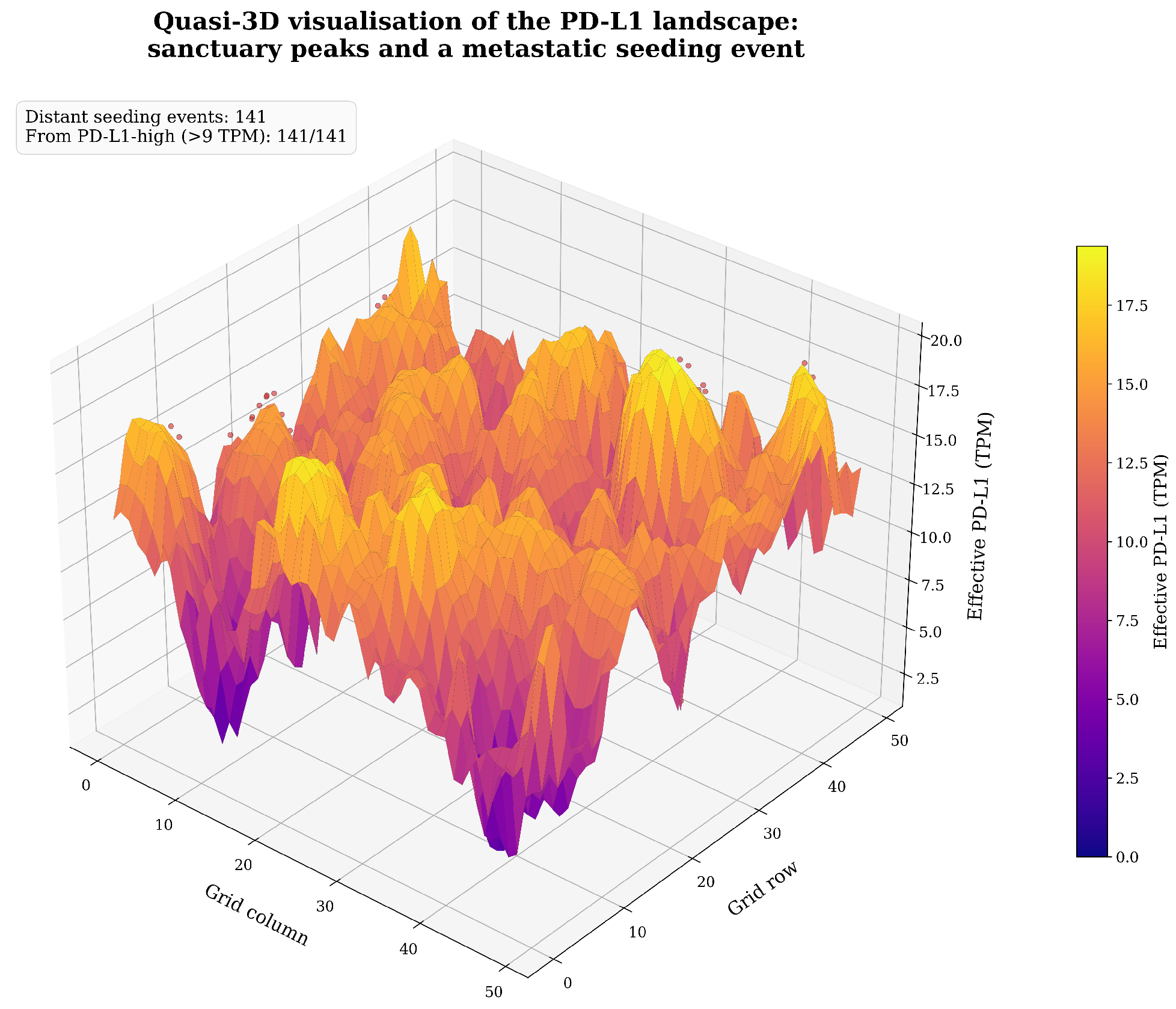
- Distant Seeding:
2.3.3. Immune-Cell Agent
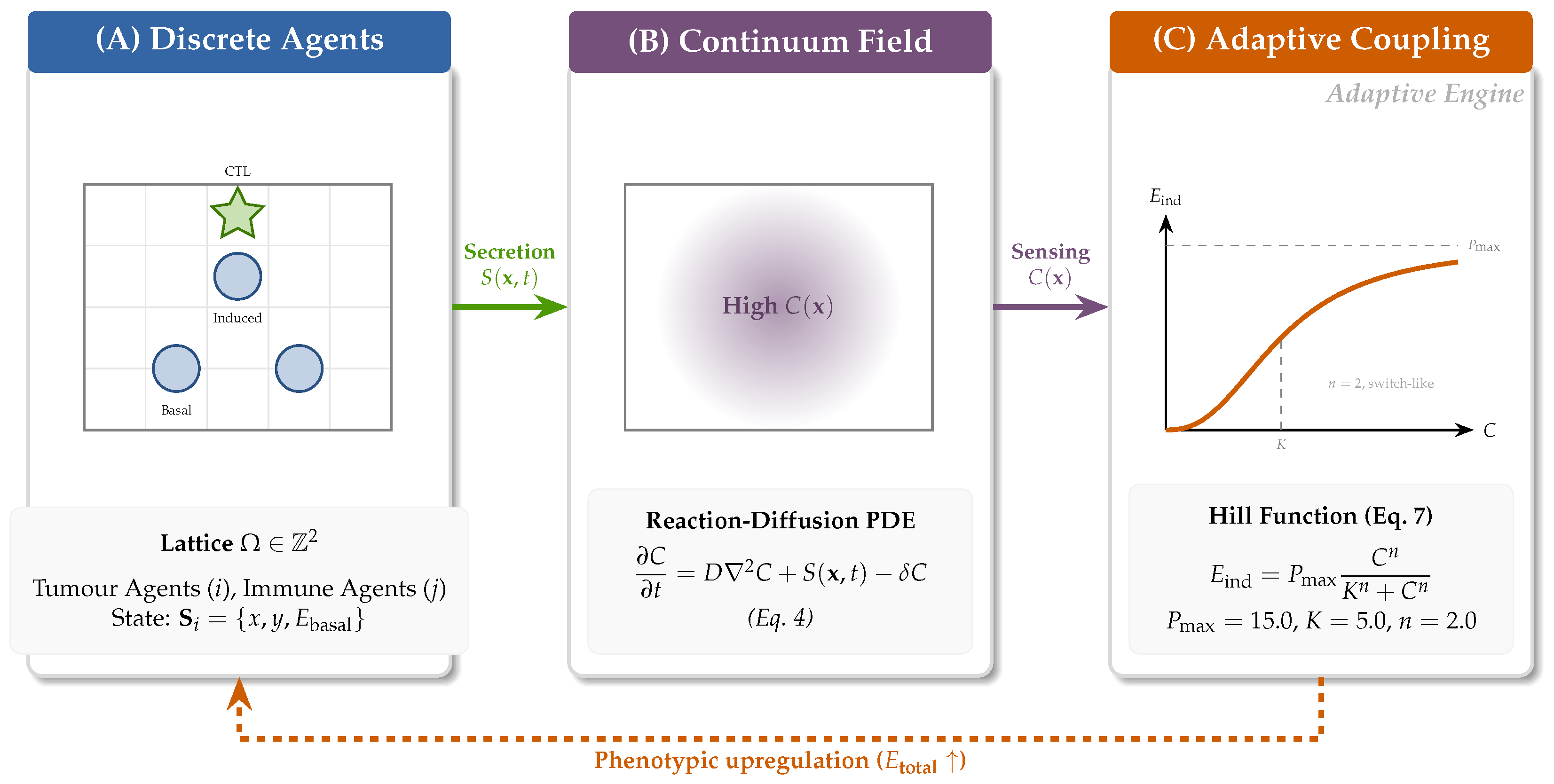
2.4. Hybrid Discrete–Continuum Extension: Modelling Adaptive Resistance
2.4.1. Continuum Component: Reaction–Diffusion PDE
- Concentration Normalisation:
2.4.2. Numerical Solution: FTCS Scheme
- Diffusion CFL:
- Decay Term Stability:
- Combined Diffusion–Decay Stability:
- Source-Term Boundedness:
2.4.3. Coupling Mechanism: Hill Function Dynamics
2.5. Model Parameterisation and Calibration
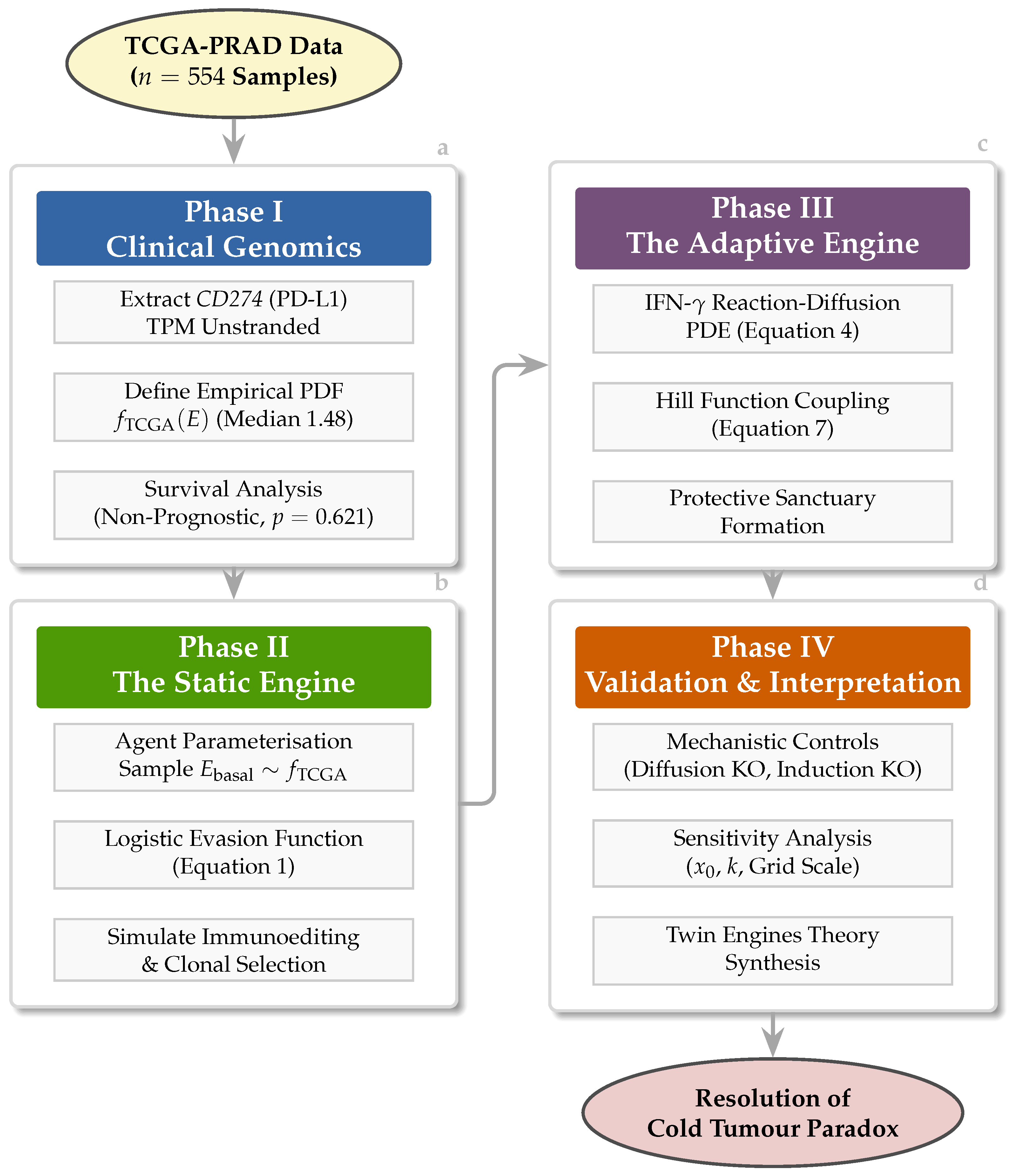
2.6. Experimental Design for Model Validation
2.6.1. Phase II: Four-Arm Framework
- Positive control (uniform high evasion): All cells assigned an arbitrarily high CD274 expression (28.4 TPM), a ceiling chosen to exceed the observed TCGA-PRAD maximum (18.50 TPM) by ∼50% to establish the theoretical upper bound of PD-L1-mediated immune escape; demonstrates the limit case in which the entire population behaves as if drawn from the extreme right tail of the evasion-probability curve [12,19].
2.6.2. Phase III: Mechanistic Knockout Controls
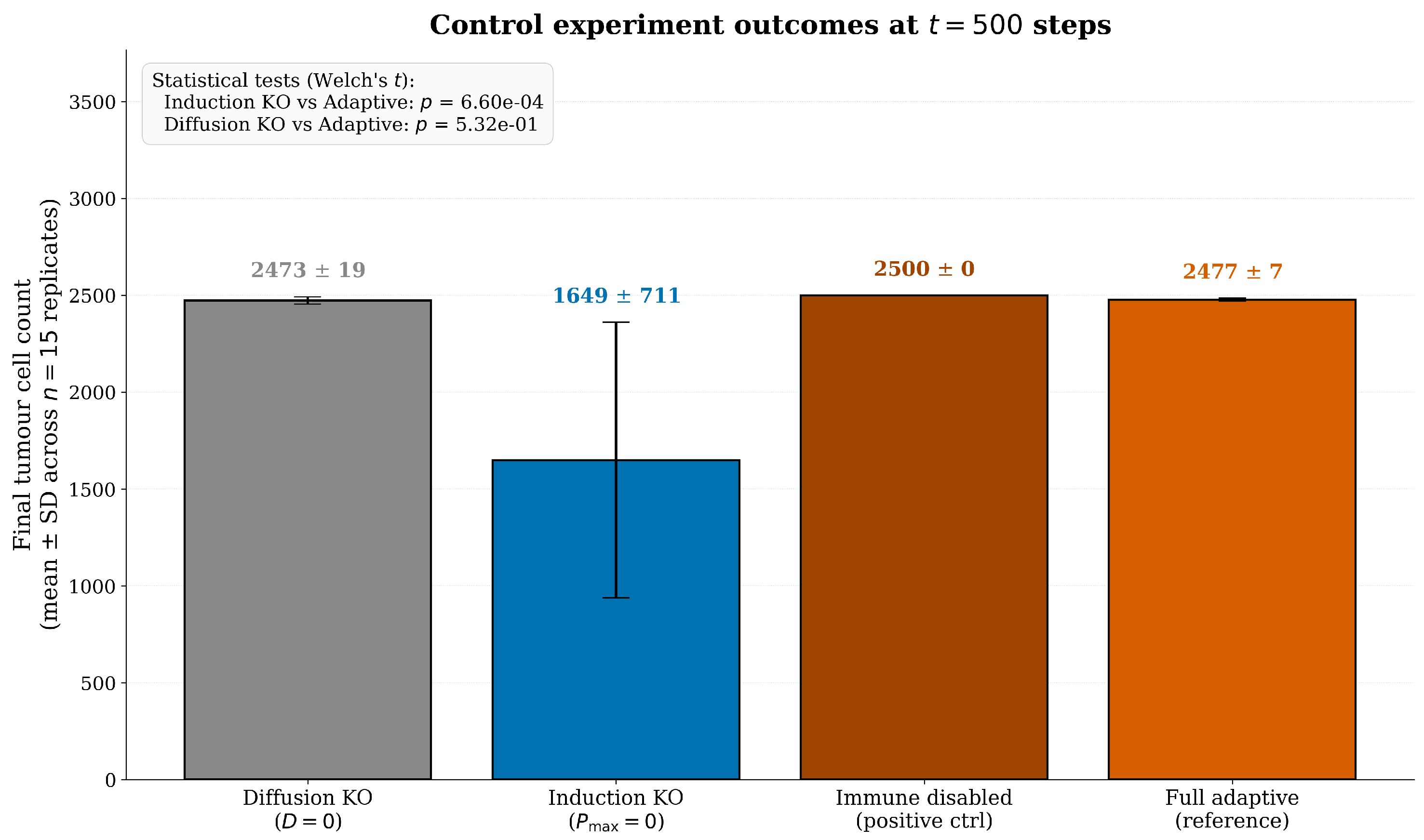
- Induction knockout (): PD-L1 induction disabled; confirms adaptive upregulation, not merely cytokine presence, drives survival advantage [9].
- Immune disabled (positive control): Immune cells present but functionally disabled; establishes maximum tumour growth rate [27].
2.7. Terminology
- Static engine: The static layer of the resistance architecture, TCGA-PRAD inter-patient PD-L1 heterogeneity, sampled at simulation initialisation, governing per-cell evasion via the logistic dose-response function (Equation (1)). The static engine operates without IFN- feedback and corresponds to the static ABM arm in Phase II.
- Adaptive engine: The adaptive layer: the IFN-/JAK–STAT/PD-L1 feedback loop, in which CTL-secreted IFN- diffuses through the tissue patch, induces transcriptional upregulation of CD274 via a Hill function (Equation (7)) and generates spatially organised resistance. The adaptive engine corresponds to the hybrid discrete–continuum framework in Phase III.
- Twin engine: The combined static + adaptive architecture posited in this work. We reframe the twin engine as hierarchical: the static engine is permissive (necessary for initial persistence), and the adaptive engine is dominant (responsible for the enrichment of resistant clones).
- Protective sanctuary: A localised region of the tumour–immune interface in which IFN--induced PD-L1 upregulation produces sustained high resistance and confers a survival advantage. The formal quantitative definition—based on local PD-L1 density, CTL exclusion, and survival fraction—is given in Section 4.3.3. The terms “adaptive niche,” “protective microenvironment,” and “IFN--protected zone” have been standardised to “protective sanctuary” throughout.
- Dynamic mirage: The discordance between bulk PD-L1 IHC (a static snapshot) and the adaptive PD-L1 phenotype (transient, IFN--induced). A tumour appearing PD-L1-cold at biopsy may possess a fully intact IFN- signalling axis that activates upon immune challenge. The dynamic mirage is the diagnostic phenomenon explained by the adaptive engine.
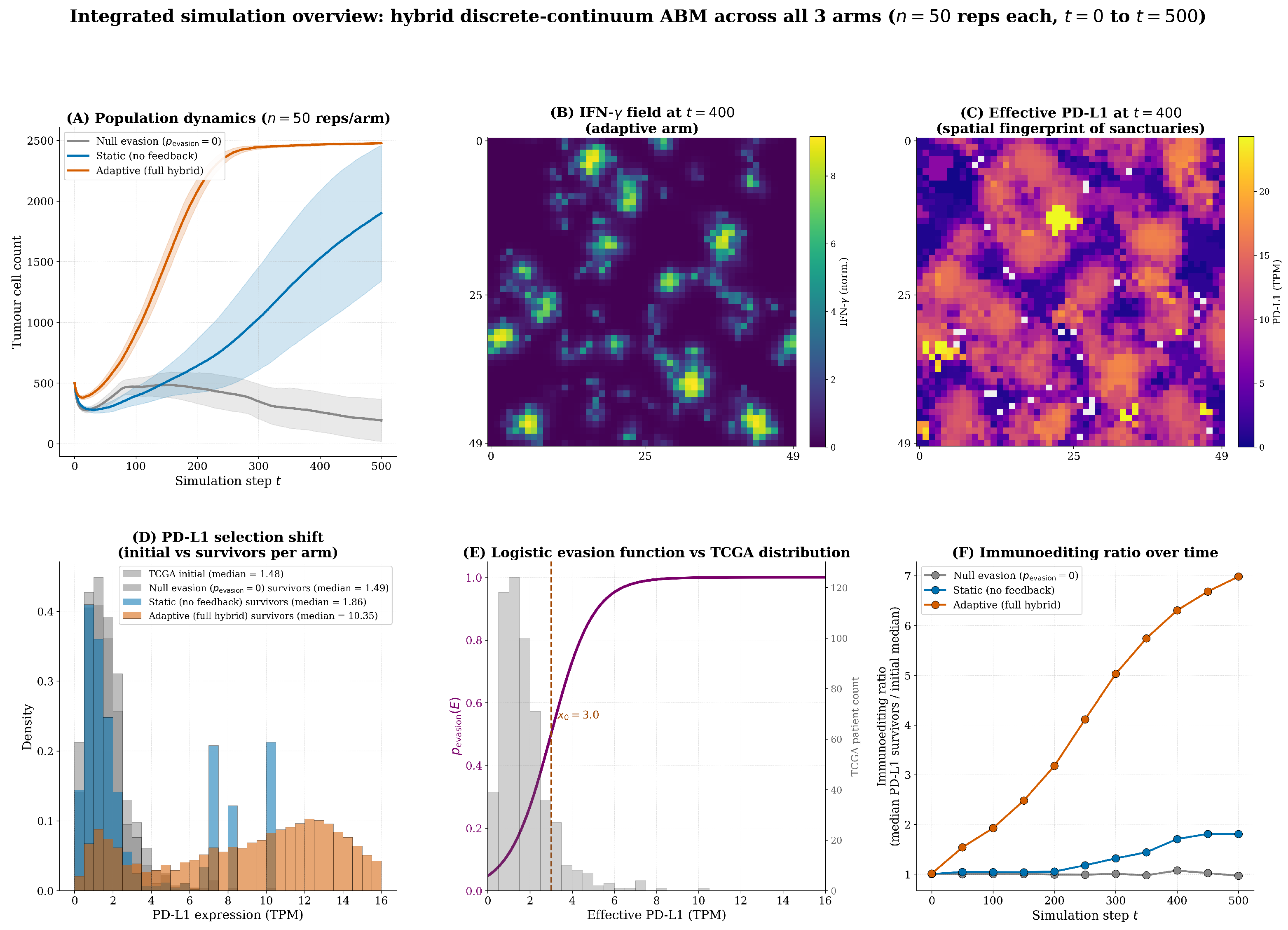
- Immunoediting ratio: The fold-enrichment of high-PD-L1 clones (defined as cells with effective PD-L1 expression above the cohort initial median) in the surviving tumour population at simulation end, relative to the initial population distribution.
- Induction knockout: A mechanistic control experiment with in the Hill function (Equation (7)), disabling adaptive upregulation while preserving static TCGA heterogeneity. Tests the necessity of the adaptive engine.
- Diffusion knockout: A mechanistic control experiment with in the reaction-diffusion PDE, disabling paracrine IFN- signalling while preserving local CTL-tumour engagement. Tests the necessity of spatial coupling for sanctuary formation.
2.8. Simulation Procedures and Reproducibility
- Simulation length and termination criteria:
- Stochastic replicates and reproducibility:
- Algorithmic conventions for the main simulation loop:
3. Results
3.1. Phase I: Characterisation and Prognostic Value of Bulk CD274 Expression
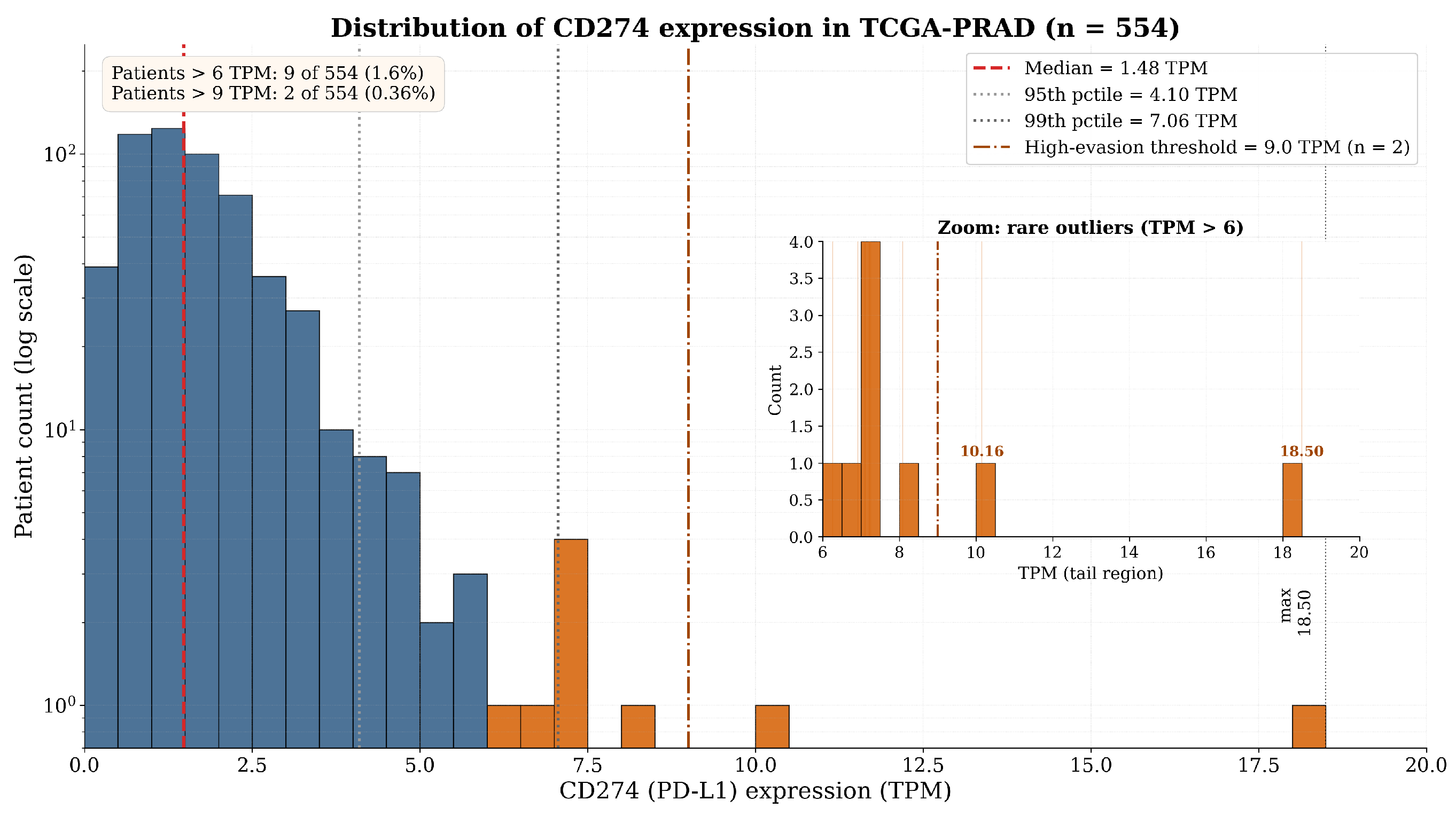
3.1.1. Distribution Analysis
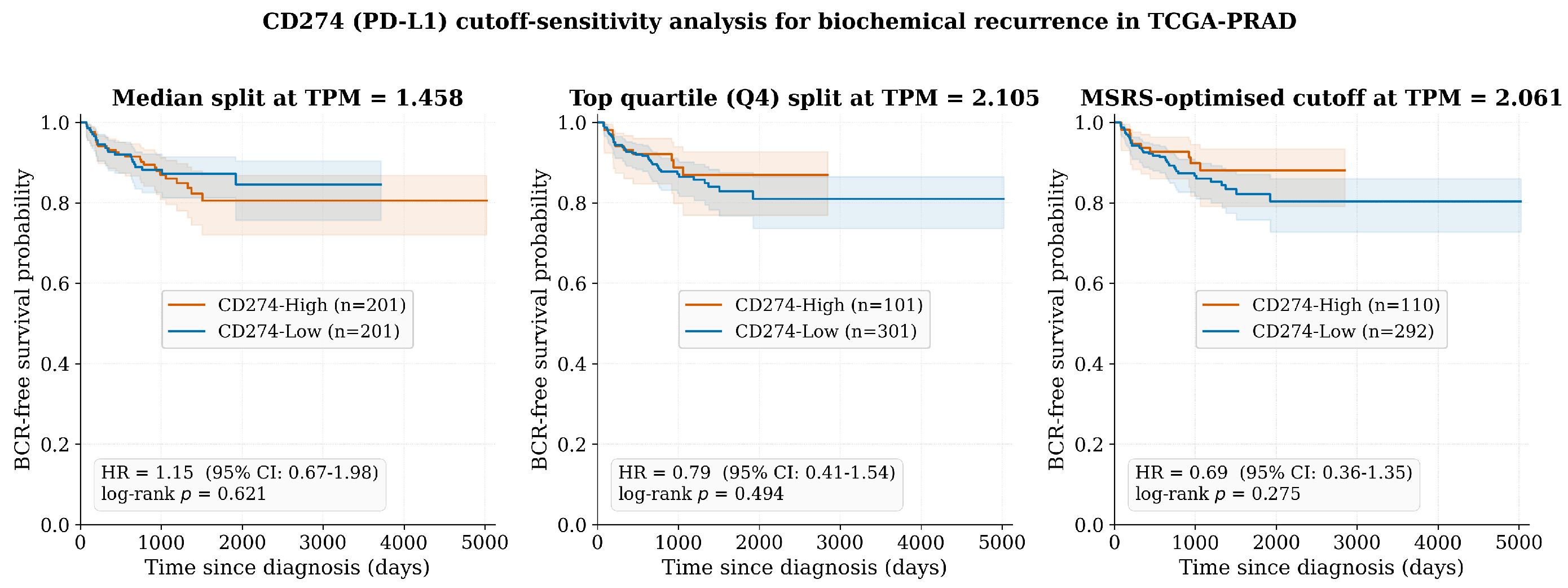
3.1.2. Survival Analysis
3.2. Phase II: The Static Resistance Engine—Clonal Selection and Immunoediting
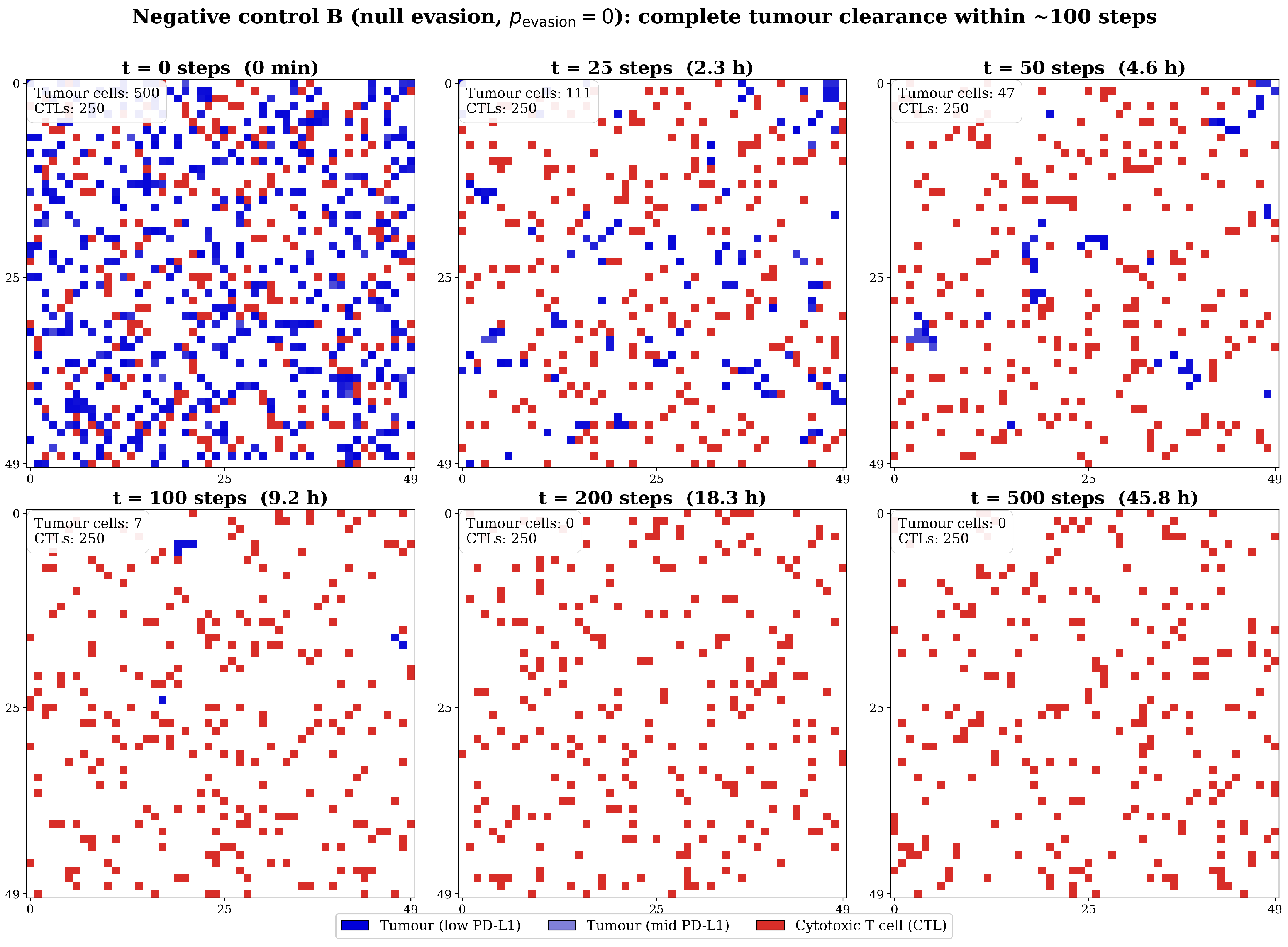
3.2.1. Validation of Control Arms
3.2.2. Tumour Persistence Driven by Heterogeneous PD-L1 Evasion
3.2.3. Immunoediting and Selection of a Resistant Population
3.3. Phase III: The Adaptive Resistance Engine—Phenotypic Plasticity and Sanctuary Formation
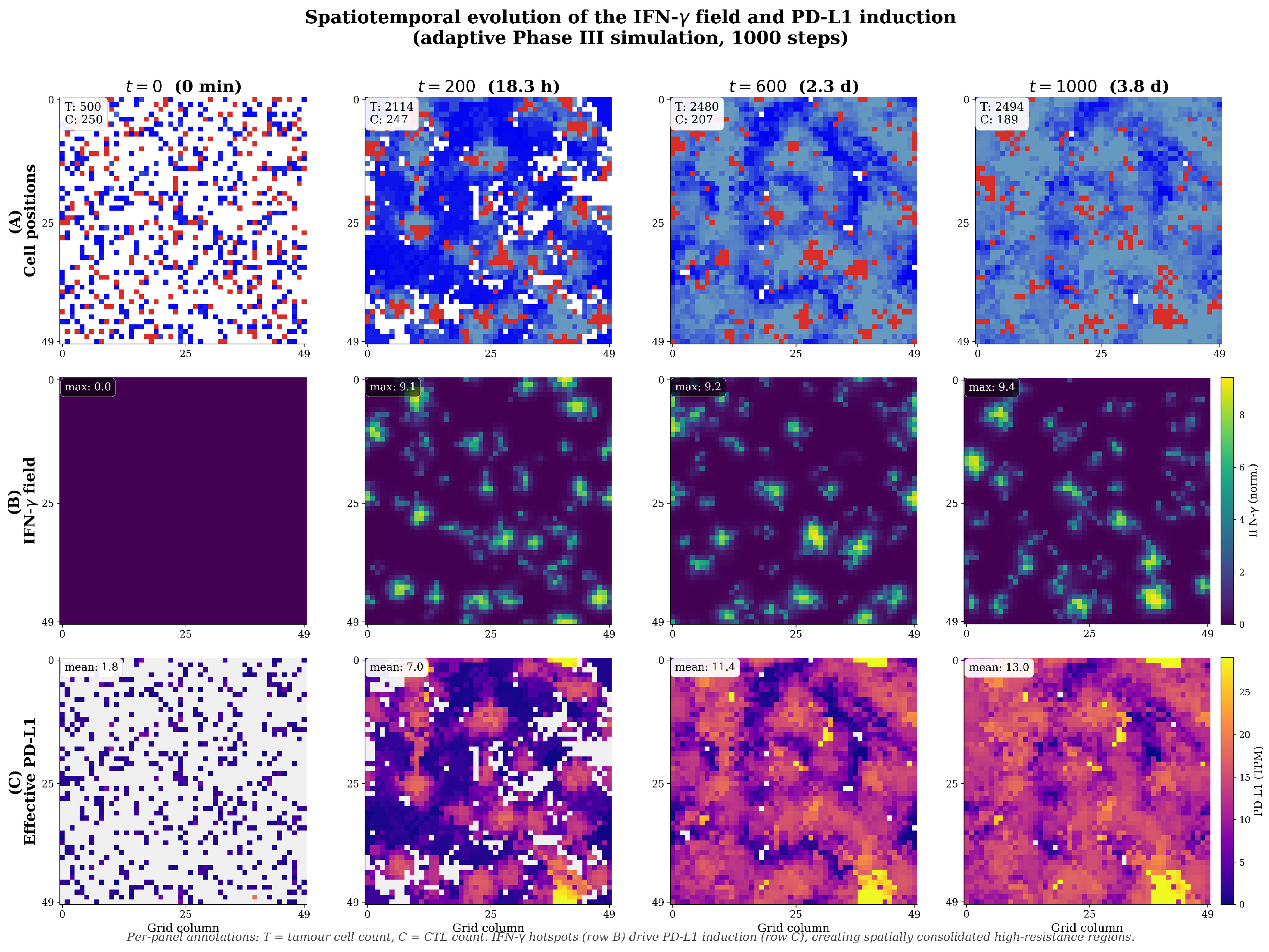
3.3.1. IFN- Field Dynamics Reveal Localised Immune Activity
3.3.2. Adaptive Survival Advantage and Phenotypic Plasticity
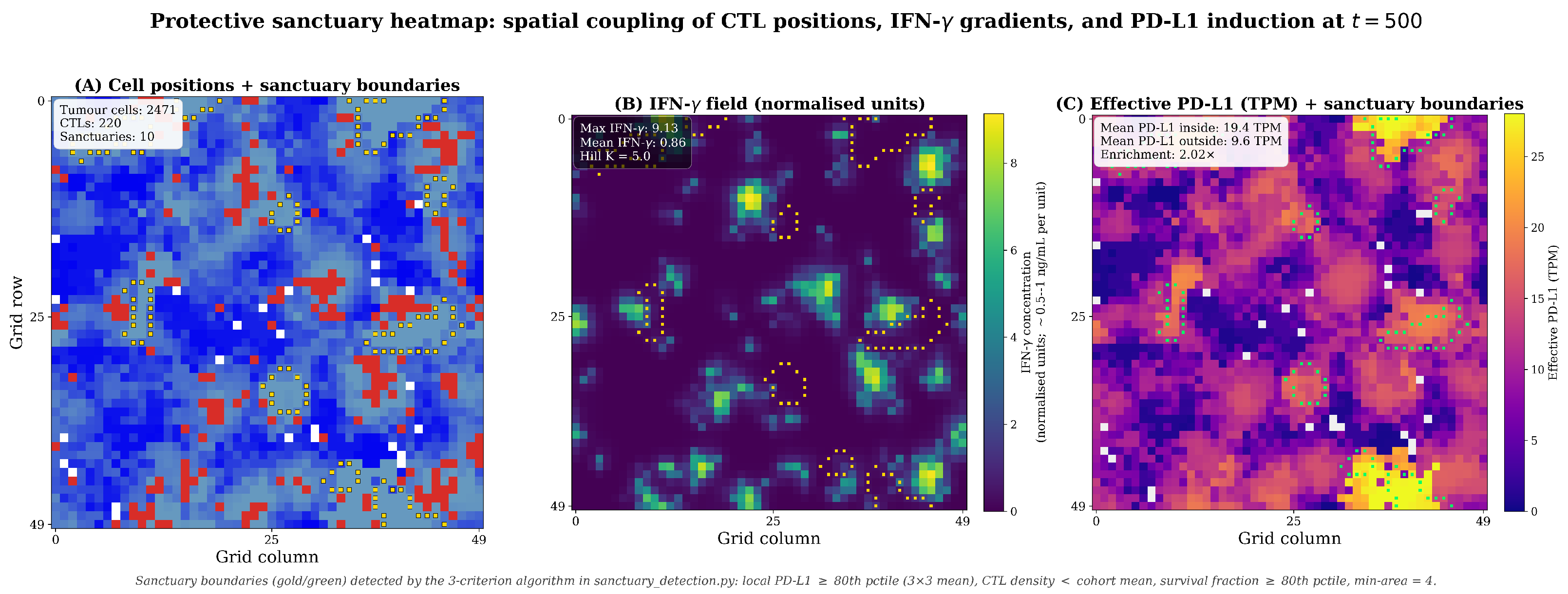
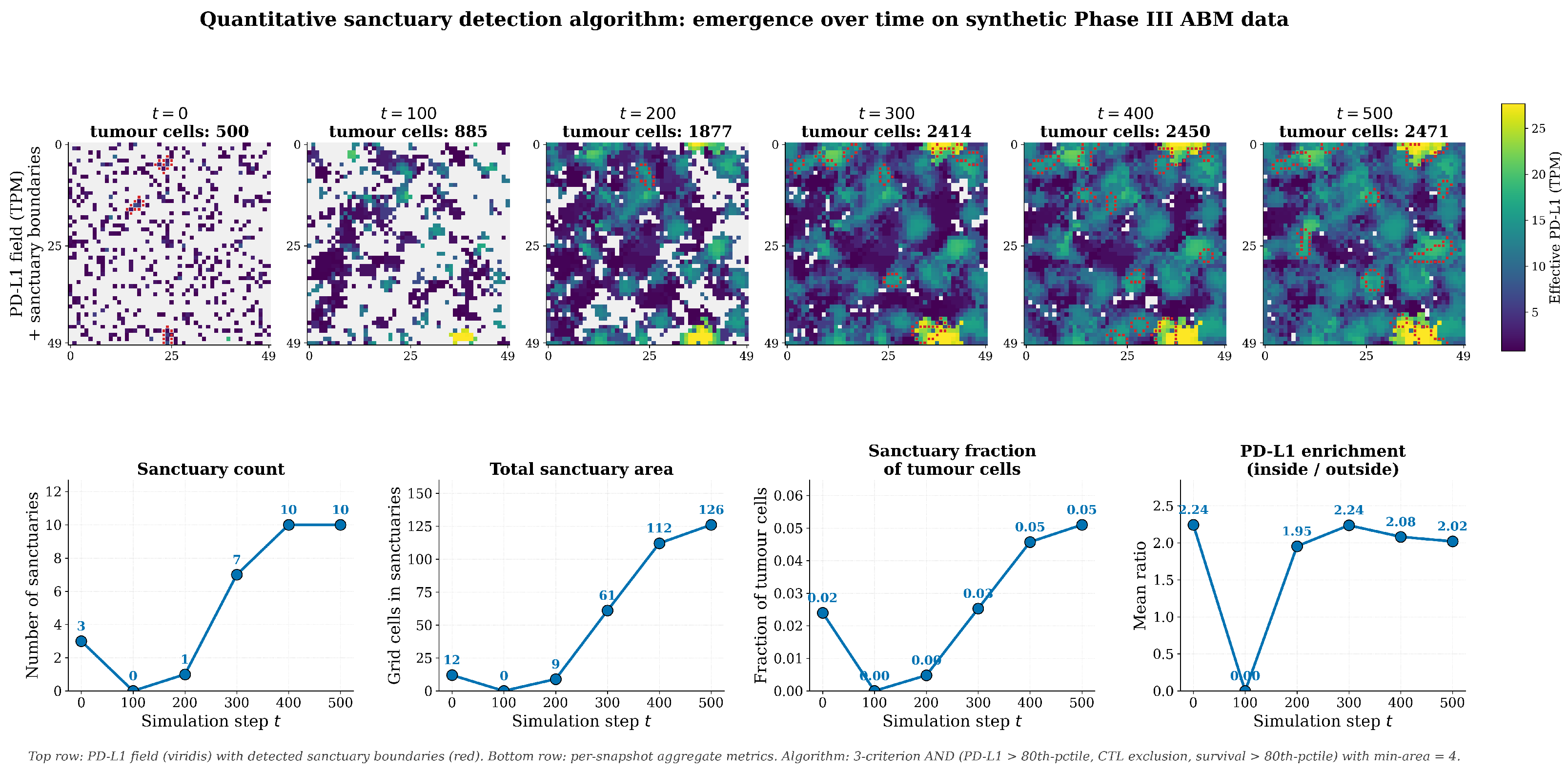
3.3.3. Emergence of Protective Sanctuaries
- Formal Quantitative Definition:
- High PD-L1 expression: local effective PD-L1 (mean over a Moore neighbourhood) at or above the cohort 80th percentile in that snapshot.
- CTL exclusion: local CTL density below the snapshot cohort-mean CTL density.
- High survival: local mean survival fraction (over the preceding 50 simulation steps) at or above the cohort 80th percentile.
- Demonstration on Simulated Dynamics:
3.4. Phase IV: Mechanistic Validation via Control Experiments
3.4.1. Induction Knockout ()
3.4.2. Diffusion Knockout ()
3.4.3. Immune Disabled (Positive Control)
3.5. Spatial Invasion and Metastatic Seeding
3.6. Sensitivity and Robustness Analyses
3.6.1. Grid Scale Sensitivity Analysis
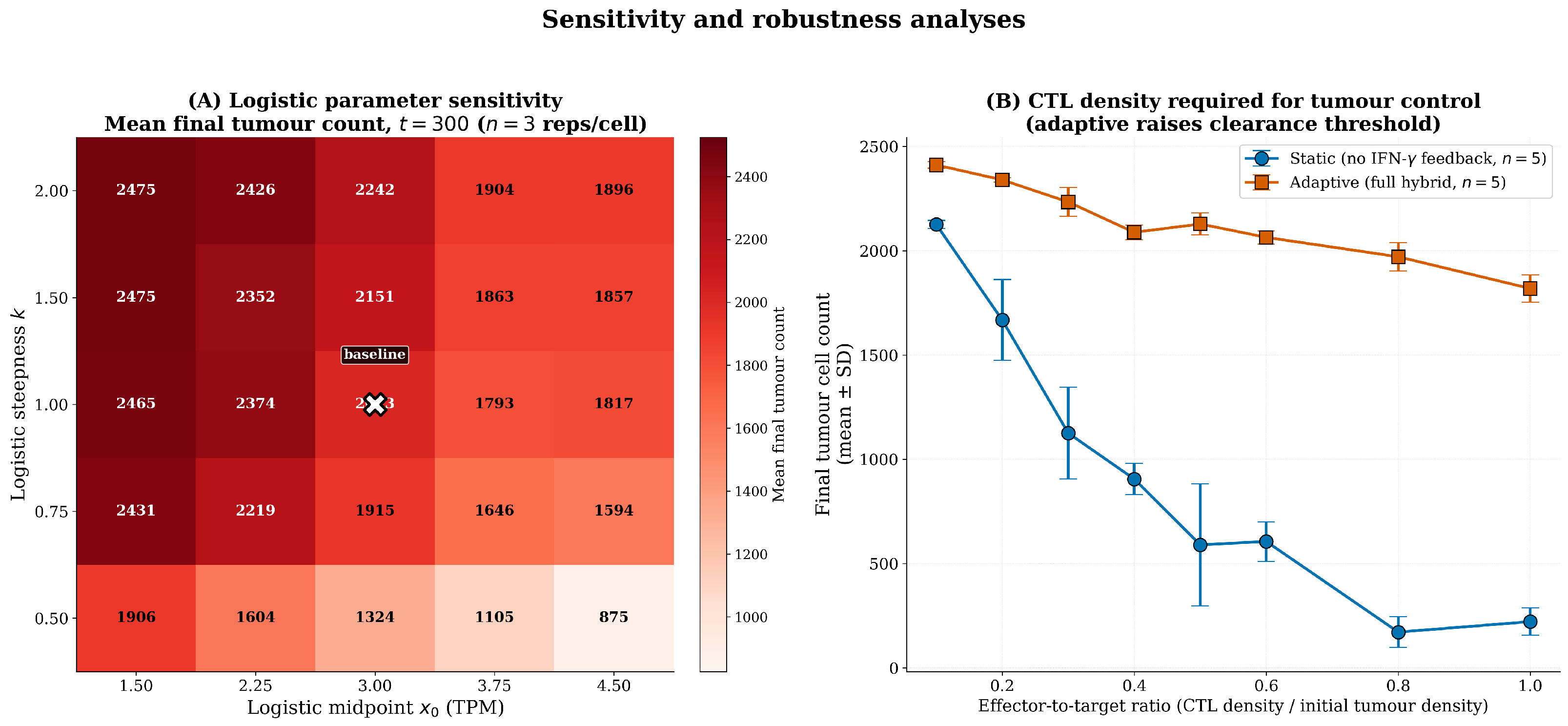
3.6.2. Sensitivity to Evasion Function Parameters
3.6.3. Functional-Form Robustness: Theoretical Considerations
3.6.4. Dependence on Effector-to-Target Ratio
4. Discussion
4.1. Synthesis of Simulation Findings
4.2. Principal Findings: A Hierarchical Two-Layer Theory of Immune Evasion
4.3. The Dynamic Mirage: Why Static Biomarkers Fail in Prostate Cancer
4.3.1. The Snapshot Fallacy
4.3.2. Spatial Misalignment of Resistance
4.3.3. Beyond PD-L1: The Case for Signalling Competence
4.4. Therapeutic Implications: Synchronised Disruption
- Target the static engine: Anti-PD-L1/PD-1 antibodies block the ligand–receptor interaction, eliminating the survival advantage of pre-existing high-expressing clones.
- Target the adaptive engine: JAK/STAT inhibitors prevent IFN--mediated PD-L1 upregulation, crippling sanctuary formation [23]. Our control experiments show that induction knockout () significantly reduces tumour burden compared to the full adaptive model (), confirming that the induction capacity is a major driver of the survival advantage.
4.5. Model Limitations and Future Directions
- Intra-tumoural heterogeneity proxy and rare-outlier interpretation: We use inter-patient TCGA-PRAD variance as a proxy for intra-tumoural cell-level heterogeneity (see Section 3.3.2 for the methodological justification). The qualitative finding of this work—that rare high-expressing outliers drive tumour persistence and seed the static engine—is robust under either interpretation of the source distribution, since the long-tail structure is preserved. The quantitative finding (a specific frequency of >9 TPM cells, ∼0.5% in TCGA-PRAD) reflects inter-patient frequency and may differ from true intra-tumoural frequency in any specific clinical PCa specimen. Single-cell profiling of primary PCa has confirmed heterogeneous epithelial cell states within individual tumours [38], and a Prostate Cancer Cell Atlas integrating ∼710,000 single cells confirms rare high-expressing subpopulations consistent with our outlier-seed hypothesis [39]. Implementing matched single-cell data (e.g., GSE141445) directly into the static engine parameterisation [55,56] would sharpen the quantitative outlier frequency, but is not expected to change the qualitative two-engine architecture.
- Dose–response function calibration: The logistic parameters (, k) and Hill function parameters (, K, n) reflect plausible threshold-dependent mechanisms and were calibrated to produce biologically plausible dynamics given the TCGA-PRAD CD274 distribution, but they lack direct experimental validation in PCa. The sensitivity analysis in Section 3.6 quantifies how the model’s emergent behaviour depends on these parameters and establishes the regions of parameter space over which the twin-engines conclusion is robust; however, direct in vitro calibration remains the priority next step. Specifically, PCa cell lines (e.g., LNCaP, PC-3, 22Rv1) co-cultured with activated CTLs across a gradient of engineered PD-L1 expression levels would permit direct measurement of , allowing to be fitted rather than calibrated. Similarly, time-course measurements of PD-L1 upregulation under titrated IFN- exposure would constrain . Fluorescence lifetime imaging techniques for in vivo PD-L1 quantification [57] and structural studies of PD-L1-targeting compounds [58] provide the experimental infrastructure for such calibration. A complementary computational task—a full factorial 5-parameter sweep across with parameter configurations and 50 stochastic replicates each (∼12,150 simulations), accompanied by direct empirical comparison of model behaviour under alternative functional forms (e.g., a Hill-function substitute for the logistic with re-calibrated half-saturation point)—would empirically confirm the theoretical robustness arguments in Section 3.6.3 and quantify the regions of parameter space over which the twin-engines conclusion is preserved. We position this sweep as the principal piece of computational future work for this model.
- mRNA-to-functional-evasion mapping is phenomenological: The logistic function in Equation (1) maps CD274 mRNA abundance (TPM) directly to a per-cell evasion probability, abstracting over the multi-step biological cascade of mRNA → cytoplasmic PD-L1 protein → surface-presented PD-L1 → PD-1 receptor engagement → effector inhibition. Each step in this chain is partially independent: mRNA-protein correlations for PD-L1 in solid tumours are typically – [42], surface presentation depends on glycosylation status [59], and receptor engagement is further modulated by competing immune checkpoint molecules and effector exhaustion state. Direct calibration of the model would require co-measured mRNA, protein, and PD-1-receptor-engagement readings on PCa-derived cell lines under titrated immune challenge—an experiment not yet, to our knowledge, reported in PCa. The implication is that our quantitative claims (specific evasion fractions at specific TPM values) should be interpreted as cohort-level operational stratifiers, similar to clinical IHC TPS thresholds, rather than as mechanistic predictions of single-step biology.
- Immune model simplification (omitted TME components and CTL state dynamics): Two simplifications are particularly noteworthy. (a) Omitted TME components. We model a tumour-CTL system coupled through the IFN-/PD-L1 axis, omitting Tregs, MDSCs, M2 macrophages, TGF-, adenosine, and stromal components (CAFs, ECM remodelling) that are also implicated in PCa cold-tumour resistance [2,10,28]. The directional effect of this omission is well-defined: including these populations would primarily amplify the static-engine contribution to immunosuppression (because they operate as additional baseline-resistance mechanisms independent of IFN- signalling), shifting the static/adaptive balance toward the static side. The qualitative two-engine architecture and the principal mechanistic claim (sanctuary formation via IFN-/PD-L1 feedback) would be preserved but the quantitative ratio would change. (b) CTL state dynamics. We model a static, non-exhausted CTL population without dynamic recruitment, terminal differentiation, or exhaustion kinetics (LAG3, TIM3, TIGIT). Including exhaustion would add a parallel resistance mechanism that operates independently of PD-L1: tumours would acquire immune protection both through PD-L1 induction (the modelled mechanism) and through exhaustion of infiltrating CTLs (an unmodelled mechanism). This means the absolute level of resistance attributable to PD-L1-mediated evasion is likely overestimated in the current model relative to a more complete model that included exhaustion. The relative ranking of static-versus-adaptive contributions is preserved as long as exhaustion operates similarly across PD-L1-high and PD-L1-low subpopulations, which is biologically plausible [2,10,28]. Important note: Our control experiments show that induction knockout () significantly reduced tumour burden compared to the full adaptive model () but did not revert to the static baseline. This indicates that even without inducible PD-L1, the hybrid model retains some survival advantage—possibly due to residual IFN- effects on CTL recruitment or other unmodelled feedbacks.
- 2D dimensionality and boundary conditions: Two methodological choices in the spatial framework warrant explicit discussion. (a) 2D dimensionality. A 2D toroidal grid was selected for computational tractability across the large stochastic-replicate budget required for statistical validation. A 3D extension would alter three specific phenomena that are central to our findings: (i) IFN- diffusion field—in 3D, concentration from a point source decays as ∼ rather than the scaling of 2D, producing steeper gradients and smaller IFN--protected volumes at fixed source strength; (ii) CTL-tumour contact probability—at fixed cell densities (cells per unit volume vs. unit area), 3D contact probability scales as rather than , making CTL-tumour encounters approximately an order of magnitude rarer at the same volumetric density and thus easier for tumour cells to evade; (iii) sanctuary formation—the combination of (i) and (ii) is ambiguous in direction: smaller IFN--protected zones in 3D would disfavour sanctuary formation, but lower CTL-tumour contact probability would favour it. The qualitative two-engine architecture and the rare-outlier seeding mechanism are not expected to depend on dimensionality, but the quantitative ratio of static-versus-adaptive contributions would shift; rigorous quantification would require a 3D extension which we name as future computational work [26]. (b) Toroidal boundary conditions. As discussed in Section 3.3 (Justification of 2D dimensionality and spatial scale), toroidal BCs were chosen to suppress edge artefacts in our representative microenvironmental patch model. We expect interior sanctuary dynamics to be essentially BC-independent, with boundary-influenced halos confined to ∼3–4 grid cells from the wrapped edges; a direct comparison of toroidal versus zero-flux Neumann versus absorbing Dirichlet BCs is positioned as future computational work for the next revision and is consistent with the proposed parameter-sweep program in Section 3.6.
- Simulation-to-clinical timescale gap: Our model timescale (1 step ≈ 5–6 min; 500 steps ≈ 50 h; see Section 2.3) is calibrated to IFN- diffusion and CTL migration dynamics, not to clinical disease progression. Tumour proliferation in our model is correspondingly faster (∼one order of magnitude) than biological PCa cell-cycle durations. The simulated 15% metastatic-seeding rate over 50 h therefore cannot be directly interpreted as a clinical metastasis-onset probability, and the immunoediting dynamics observed at simulation end (500 steps) should be understood as the rapidly reached quasi-equilibrium of the immune-tumour feedback rather than the slow clinical evolution toward biochemical recurrence. Bridging from this fast (hours) timescale to the clinical (months-to-years) timescale would require either a multi-step coarse-graining scheme or a slower proliferation rate matched to PCa cell-cycle data, which we leave to future work.
- IFN- concentration in dimensionless normalised units: IFN- concentrations in our model are reported in dimensionless normalised units rather than absolute physical concentrations (ng/mL); see Section 3.4.1 for the operational definition. While the qualitative dynamics of the model (sanctuary formation, knockout outcomes, sensitivity ordering) are independent of this choice, direct comparison of our IFN- field magnitudes to in vivo IFN- measurements requires an additional calibration step against in vitro CTL secretion-rate measurements and tumour-cell PD-L1 induction dose-response curves. Such calibration would convert our normalised units to ng/mL and permit comparison to ELISA-based IFN- measurements from the tumour microenvironment.
- Spatial transcriptomics validation: Our model generates testable spatial hypotheses: PD-L1 expression should be highest at the tumour–immune interface, spatially correlated with IFN- signatures, with the correlation radius corresponding to the ∼30–40 μm IFN- diffusion length [24]. Applying the wPCF [28] to matched PCa spatial transcriptomics data would directly validate the predicted sanctuary architecture [16].
- Necessity versus sufficiency of the static engine: Our control experiments establish that the adaptive engine is the dominant driver of tumour survival, but they also show that disabling adaptive induction () does not fully revert to the static baseline (mean vs. static ). This suggests that either (i) the residual survival advantage in induction KO arises from other IFN--mediated effects (e.g., enhanced CTL recruitment), or (ii) the static heterogeneity alone, when combined with the preserved IFN- field (even without PD-L1 upregulation), provides an intermediate level of protection. We have not directly tested whether static heterogeneity is strictly necessary for the adaptive engine. A confirmatory experiment in which basal CD274 expression is set to a uniform low value (e.g., the TCGA median of 1.48 TPM) with the adaptive machinery intact would distinguish between static heterogeneity functioning as a necessary substrate for adaptive amplification versus a permissive but redundant layer. If such an arm produced survival comparable to the full adaptive model, static heterogeneity would be permissive only; if it produced near-null outcomes, static heterogeneity would be a necessary precursor. This experiment is a natural next step and would sharpen the quantitative contribution of each layer to the observed phenotype.
5. Conclusions
Supplementary Materials
Author Contributions
Funding
Institutional Review Board Statement
Informed Consent Statement
Data Availability Statement
Acknowledgments
Conflicts of Interest
Abbreviations
| PCa | Prostate cancer |
| PD-L1 | Programmed Death-Ligand 1 |
| ICB | Immune checkpoint blockade |
| IFN- | Interferon-gamma |
| TCGA | The Cancer Genome Atlas |
| PRAD | Prostate Adenocarcinoma |
| TPM | Transcripts per million |
| ABM | Agent-based model |
| PDE | Partial differential equation |
| CTL | Cytotoxic T lymphocyte |
| TME | Tumour microenvironment |
| JAK | Janus kinase |
| STAT | Signal transducer and activator of transcription |
| MDSC | Myeloid-derived suppressor cell |
| Treg | Regulatory T cell |
| TAM | Tumour-associated macrophage |
| BCR | Biochemical recurrence |
| GDC | Genomic Data Commons |
| FTCS | Forward-Time Centered-Space |
| CFL | Courant–Friedrichs–Lewy |
| IRF1 | Interferon regulatory factor 1 |
| IHC | Immunohistochemistry |
| TPS | Tumour proportion score |
Appendix A

| Feature | Prior ABM Approaches | This Study |
|---|---|---|
| PD-L1 status | Binary in Gong et al. [29]; continuous but not TCGA-calibrated in Storey & Jackson [33]; abstracted concentration in PhysiCell-based models [26] | Continuous variable sampled from empirical patient data distribution (TCGA-PRAD, ) |
| Evasion/killing rule | Fixed probabilities or rule-based parameters in Gong et al. [29] and Storey & Jackson [33] | Evasion probability dynamically calculated via logistic dose-response function of each cell’s CD274 expression |
| Primary objective | General dynamics of checkpoint inhibition (Gong et al. [29]) or combination therapy response (Storey & Jackson [33]) | Resolution of a specific clinical paradox (low bulk PD-L1, poor ICB response) via cellular heterogeneity and spatial dynamics |
| Tumour type | Generic solid tumour (Gong et al. [29]); glioblastoma (Storey & Jackson [33]); general multicellular platform (PhysiCell [26]) | Explicitly parameterised for prostate cancer, a ‘cold’ tumour with a defined paradox |
| IFN- dynamics | Not explicitly modelled in Gong et al. [29] or Storey & Jackson [33]; abstracted as generic diffusible species in PhysiCell [26] | Explicit reaction-diffusion PDE with bidirectional coupling; validated via knockout controls |
References
- Sung, H.; Ferlay, J.; Siegel, R.L.; Laversanne, M.; Soerjomataram, I.; Jemal, A.; Bray, F. Global Cancer Statistics 2020: GLOBOCAN estimates of incidence and mortality worldwide for 36 cancers in 185 countries. CA Cancer J. Clin. 2021, 71, 209–249. [Google Scholar] [CrossRef] [PubMed]
- Novysedlak, R.; Guney, M.; Al Khouri, M.; Bartolini, R.; Koumbas Foley, L.; Benesova, I.; Ozaniak, A.; Novak, V.; Vesely, S.; Pacas, P.; et al. The immune microenvironment in prostate cancer: A comprehensive review. Oncology 2025, 103, 521–545. [Google Scholar] [CrossRef]
- Ribas, A.; Wolchok, J.D. Cancer immunotherapy using checkpoint blockade. Science 2018, 359, 1350–1355. [Google Scholar] [CrossRef]
- Topalian, S.L.; Taube, J.M.; Anders, R.A.; Pardoll, D.M. Mechanism-driven biomarkers to guide immune checkpoint blockade in cancer therapy. Nat. Rev. Cancer 2016, 16, 275–287. [Google Scholar] [CrossRef]
- Antonarakis, E.S.; Piulats, J.M.; Gross-Goupil, M.; Goh, J.; Ojamaa, K.; Hoimes, C.J.; Vaishampayan, U.; Berger, R.; Sezer, A.; Alanko, T.; et al. Pembrolizumab for treatment-refractory metastatic castration-resistant prostate cancer: KEYNOTE-199 study. J. Clin. Oncol. 2020, 38, 395–405. [Google Scholar] [CrossRef]
- Sharma, P.; Pachynski, R.K.; Narayan, V.; Fléchon, A.; Gravis, G.; Galsky, M.D.; Mahammedi, H.; Patnaik, A.; Subudhi, S.K.; Ciprotti, M.; et al. Nivolumab plus ipilimumab for metastatic castration-resistant prostate cancer: CheckMate 650. Cancer Cell. 2020, 38, 489–499.e3. [Google Scholar] [CrossRef]
- O’Donnell, J.S.; Long, G.V.; Scolyer, R.A.; Teng, M.W.L.; Smyth, M.J. Resistance to PD1/PDL1 checkpoint inhibition. Cancer Treat. Rev. 2017, 52, 71–81. [Google Scholar] [CrossRef] [PubMed]
- Wu, W.; Wang, X.; Le, W.; Lu, C.; Li, H.; Zhu, Y.; Chen, X.; An, W.; Xu, C.; Wu, Q.; et al. Immune microenvironment infiltration landscape and immune-related subtypes in prostate cancer. Front. Immunol. 2023, 13, 1001297. [Google Scholar] [CrossRef] [PubMed]
- Gajewski, T.F.; Schreiber, H.; Fu, Y.X. Innate and adaptive immune cells in the tumour microenvironment. Nat. Immunol. 2013, 14, 1014–1022. [Google Scholar] [CrossRef]
- Wherry, E.J.; Kurachi, M. Molecular and cellular insights into T cell exhaustion. Nat. Rev. Immunol. 2015, 15, 486–499. [Google Scholar] [CrossRef]
- Juneja, V.R.; McGuire, K.A.; Manguso, R.T.; LaFleur, M.W.; Collins, N.; Haining, W.N.; Freeman, G.J.; Sharpe, A.H. PD-L1 on tumour cells is sufficient for immune evasion and inhibits CD8+ T cell cytotoxicity. J. Exp. Med. 2017, 214, 895–904. [Google Scholar] [CrossRef]
- Chandrashekar, D.S.; Bashel, B.; Balasubramanya, S.A.H.; Creighton, C.J.; Ponce-Rodriguez, I.; Chakravarthi, B.V.S.K.; Varambally, S. UALCAN: A portal for facilitating tumour subgroup gene expression and survival analyses. Neoplasia 2017, 19, 649–658. [Google Scholar] [CrossRef]
- Wang, J.; Wu, W.; Yuan, T.; Wang, L.; Zang, L.; Liu, Q.; Wang, L.; Huo, X.; Huo, B.; Tang, Y.; et al. Tumour-associated macrophages and PD-L1 in prostate cancer. Aging 2024, 16, 445–496. [Google Scholar]
- Zheng, H.; Yang, R.; Dai, X.; Zhou, R.; Han, Y.; Dai, C.; Chen, X. The CD274/TIGIT- and immune microenvironment-combined multiCox risk model for predicting overall survival of metastatic PRAD patients. Res. Sq. 2022. [Google Scholar] [CrossRef]
- Patel, S.P.; Kurzrock, R. PD-L1 expression as a predictive biomarker in cancer immunotherapy. Mol. Cancer Ther. 2015, 14, 847–856. [Google Scholar] [CrossRef]
- Brady, L.; Kriner, M.; Coleman, I.; Morrissey, C.; Roudier, M.; True, L.D.; Gulati, R.; Plymate, S.R.; Zhou, Z.; Birditt, B.; et al. Inter- and intra-tumor heterogeneity of metastatic prostate cancer determined by digital spatial gene expression profiling. Nat. Commun. 2021, 12, 1426. [Google Scholar] [CrossRef]
- Swanton, C. Intratumor Heterogeneity: Evolution through Space and Time. Cancer Res. 2012, 72, 4875–4882. [Google Scholar] [CrossRef] [PubMed]
- McGranahan, N.; Swanton, C. Clonal heterogeneity and tumour evolution: Past, present, and the future. Cell 2017, 168, 613–628. [Google Scholar] [CrossRef] [PubMed]
- Schreiber, R.D.; Old, L.J.; Smyth, M.J. Cancer immunoediting: Integrating immunity’s roles in cancer suppression and promotion. Science 2011, 331, 1565–1570. [Google Scholar] [CrossRef] [PubMed]
- Taube, J.M.; Anders, R.A.; Young, G.D.; Xu, H.; Sharma, R.; McMiller, T.L.; Chen, S.; Klein, A.P.; Pardoll, D.M.; Topalian, S.L.; et al. Colocalization of inflammatory response with B7-H1 expression in human melanocytic lesions supports an adaptive resistance mechanism of immune escape. Sci. Transl. Med. 2012, 4, 127ra37. [Google Scholar] [CrossRef]
- Garcia-Diaz, A.; Shin, D.S.; Moreno, B.H.; Saco, J.; Escuin-Ordinas, H.; Rodriguez, G.A.; Zaretsky, J.M.; Sun, L.; Hugo, W.; Wang, X.; et al. Interferon receptor signalling pathways regulating PD-L1 and PD-L2 expression. Cell Rep. 2017, 19, 1189–1201. [Google Scholar] [CrossRef]
- Han, J.; Wu, M.; Liu, Z. Dysregulation in IFN-γ signaling and response: The barricade to tumor immunotherapy. Front. Immunol. 2023, 14, 1190333. [Google Scholar] [CrossRef]
- Sharma, P.; Hu-Lieskovan, S.; Wargo, J.A.; Ribas, A. Primary, adaptive, and acquired resistance to cancer immunotherapy. Cell 2017, 168, 707–723. [Google Scholar] [CrossRef]
- Centofanti, E.; Wang, C.; Iyer, S.; Krichevsky, O.; Oyler-Yaniv, A.; Oyler-Yaniv, J. The spread of interferon-γ in melanomas is highly spatially confined, driving nongenetic variability in tumor cells. Proc. Natl. Acad. Sci. USA 2023, 120, e2304190120. [Google Scholar] [CrossRef] [PubMed]
- Trucu, D.; Domschke, P.; Gerisch, A.; Chaplain, M.A.J. Multiscale computational modelling and analysis of cancer invasion. In Mathematical Models and Methods for Living Systems; Preziosi, L., Chaplain, M., Pugliese, A., Eds.; Springer: Berlin/Heidelberg, Germany, 2016; pp. 275–321. [Google Scholar]
- Ghaffarizadeh, A.; Heiland, R.; Friedman, S.H.; Mumenthaler, S.M.; Macklin, P. PhysiCell: An open source physics-based cell simulator for 3-D multicellular systems. PLoS Comput. Biol. 2018, 14, e1005991. [Google Scholar] [CrossRef]
- Macklin, P.; Mumenthaler, S.; Lowengrub, J. Modeling multiscale necrotic and calcified tissue biomechanics in cancer patients. In Multiscale Computer Modeling in Biomechanics and Biomedical Engineering; Springer: Berlin/Heidelberg, Germany, 2012; pp. 349–380. [Google Scholar]
- Bull, J.A.; Byrne, H.M. Quantification of spatial and phenotypic heterogeneity in an agent-based model of tumour-macrophage interactions. PLoS Comput. Biol. 2023, 19, e1010994. [Google Scholar] [CrossRef] [PubMed]
- Gong, C.; Milberg, O.; Wang, B.; Vicini, P.; Narwal, R.; Roskos, L.; Popel, A.S. A computational multiscale agent-based model for simulating spatio-temporal tumour immune response to PD1 and PDL1 inhibition. J. R. Soc. Interface 2017, 14, 20170320. [Google Scholar] [CrossRef]
- Shinde, S.B.; Kurhekar, M.P. Review of the systems biology of the immune system using agent-based models. IET Syst. Biol. 2018, 12, 83–92. [Google Scholar] [CrossRef]
- Wang, Y.; Bergman, D.R.; Trujillo, E.; Fernald, A.A.; Li, L.; Pearson, A.T.; Sweis, R.F.; Jackson, T.L. Agent-Based Modeling of Virtual Tumors Reveals the Critical Influence of Microenvironmental Complexity on Immunotherapy Efficacy. Cancers 2024, 16, 2942. [Google Scholar] [CrossRef]
- Zhang, Y.; Li, C.; Wang, B.; Lei, J. A stochastic agent-based model for simulating tumor-immune dynamics and evaluating therapeutic strategies. arXiv 2025, arXiv:2508.12297. [Google Scholar] [CrossRef] [PubMed]
- Storey, K.M.; Jackson, T.L. An agent-based model of combination oncolytic viral therapy and anti-PD-1 immunotherapy reveals the importance of spatial location when treating glioblastoma. Cancers 2021, 13, 5314. [Google Scholar] [CrossRef]
- Colaprico, A.; Silva, T.C.; Olsen, C.; Garofano, L.; Cava, C.; Garolini, D.; Sabedot, T.S.; Malta, T.M.; Pagnotta, S.M.; Castiglioni, I.; et al. TCGAbiolinks: An R/Bioconductor package for integrative analysis of TCGA data. Nucleic Acids Res. 2016, 44, e71. [Google Scholar] [PubMed]
- Wagner, G.P.; Kin, K.; Lynch, V.J. Measurement of mRNA abundance using RNA-seq data: RPKM measure is inconsistent among samples. Theory Biosci. 2012, 131, 281–285. [Google Scholar] [PubMed]
- Kazil, J.; Masad, I.; Collier, N. Utilizing Python for Agent-Based Modeling: The Mesa Framework. In Social, Cultural, and Behavioral Modeling; Springer: Berlin/Heidelberg, Germany, 2020; pp. 308–317. [Google Scholar]
- Dlugosz, M.; Trylska, J. Diffusion in crowded biological environments: Applications of Brownian dynamics. BMC Biophys. 2011, 4, 3. [Google Scholar] [CrossRef][Green Version]
- Song, H.; Weinstein, H.N.W.; Allegakoen, P.; Wadsworth, M.H.; Xie, J.; Yang, H.; Castro, E.A.; Lu, K.L.; Stohr, B.A.; Feng, F.Y.; et al. Single-cell analysis of human primary prostate cancer reveals the heterogeneity of tumor-associated epithelial cell states. Nat. Commun. 2022, 13, 141. [Google Scholar] [CrossRef] [PubMed]
- Zhao, F.; Zeng, J.; Chen, C.; Mitra, S.; Yang, X.; Zhang, H.; Li, X.; Chen, Z.; Lu, W.; Zheng, Y.; et al. Deciphering single-cell heterogeneity and cellular ecosystem dynamics during prostate cancer progression. bioRxiv 2024. [Google Scholar] [CrossRef]
- Perelson, A.S.; Weisbuch, G. Immunology for physicists. Rev. Mod. Phys. 1997, 69, 1219–1267. [Google Scholar] [CrossRef]
- Guram, K.; Kim, S.S.; Wu, V.; Sanders, P.D.; Patel, S.; Schoenberger, S.P.; Cohen, E.E.W.; Chen, S.Y.; Sharabi, A.B. A threshold model for T-cell activation in the era of checkpoint blockade immunotherapy. Front. Immunol. 2019, 10, 491. [Google Scholar] [CrossRef]
- Vogel, C.; Marcotte, E.M. Insights into the regulation of protein abundance from proteomic and transcriptomic analyses. Nat. Rev. Genet. 2012, 13, 227–232. [Google Scholar] [CrossRef]
- Wodarz, D.; Komarova, N.L. Dynamics of Cancer: Mathematical Foundations of Oncology; World Scientific: Singapore, 2014. [Google Scholar]
- Bubendorf, L.; Schöpfer, A.; Wagner, U.; Sauter, G.; Moch, H.; Willi, N.; Gasser, T.C.; Mihatsch, M.J. Metastatic patterns of prostate cancer: An autopsy study of 1,589 patients. Hum. Pathol. 2000, 31, 578–583. [Google Scholar]
- Pound, C.R.; Partin, A.W.; Eisenberger, M.A.; Chan, D.W.; Pearson, J.D.; Walsh, P.C. Natural history of progression after PSA elevation following radical prostatectomy. JAMA 1999, 281, 1591–1597. [Google Scholar] [CrossRef] [PubMed]
- Beltman, J.B.; Marée, A.F.M.; de Boer, R.J. Analysing immune cell migration. Nat. Rev. Immunol. 2009, 9, 789–798. [Google Scholar] [CrossRef] [PubMed]
- Gocher, A.M.; Workman, C.J.; Vignali, D.A.A. Interferon-γ: Teammate or opponent in the tumour microenvironment? Nat. Rev. Immunol. 2022, 22, 158–172. [Google Scholar] [PubMed]
- Benvenuti, F. The dendritic cell synapse: A life dedicated to T cell activation. Front. Immunol. 2016, 7, 70. [Google Scholar] [CrossRef]
- Strikwerda, J.C. Finite Difference Schemes and Partial Differential Equations, 2nd ed.; SIAM: Philadelphia, PA, USA, 2004. [Google Scholar]
- Gonze, D.; Abou-Jaoudé, W. The Goodwin model: Behind the Hill function. PLoS ONE 2013, 8, e69573. [Google Scholar]
- Elahi, F.E.; Hasan, A. A method for estimating Hill function-based dynamic models of gene regulatory networks. R. Soc. Open Sci. 2018, 5, 171226. [Google Scholar] [CrossRef]
- Conover, W.J. Practical Nonparametric Statistics, 3rd ed.; Wiley: New York, NY, USA, 1999. [Google Scholar]
- Zak, J.; Pratumchai, I.; Marro, B.S.; Marquardt, K.L.; Beheshti Zavareh, R.; Lairson, L.L.; Oldstone, M.B.A.; Varner, J.A.; Hegerova, L.; Cao, Q.; et al. JAK inhibition enhances checkpoint blockade immunotherapy in patients with Hodgkin lymphoma. Science 2024, 384, eade8520. [Google Scholar] [CrossRef]
- Mathew, D.; Marmarelis, M.E.; Foley, C.; Bauml, J.M.; Ye, D.; Ghinnagow, R.; Ngiow, S.F.; Klapholz, M.; Jun, S.; Zhang, Z.; et al. Combined JAK inhibition and PD-1 immunotherapy for non-small cell lung cancer patients. Science 2024, 384, eadf1329. [Google Scholar] [CrossRef]
- Wolf, F.A.; Angerer, P.; Theis, F.J. SCANPY: Large-scale single-cell gene expression data analysis. Genome Biol. 2018, 19, 15. [Google Scholar]
- Hao, Y.; Hao, S.; Andersen-Nissen, E.; Mauck, W.M.; Zheng, S.; Butler, A.; Lee, M.J.; Wilk, A.J.; Darby, C.; Zagar, M.; et al. Integrated analysis of multimodal single-cell data. Cell 2021, 184, 3573–3587.e29. [Google Scholar] [CrossRef]
- Pal, R.; Krishnamoorthy, M.; Matsui, A.; Kang, H.; Morita, S.; Taniguchi, H.; Kobayashi, T.; Morita, A.; Choi, H.S.; Duda, D.G.; et al. Fluorescence Lifetime Imaging Enables In Vivo Quantification of PD-L1 Expression and Intertumoral Heterogeneity. Cancer Res. 2025, 85, 618–632. [Google Scholar] [CrossRef] [PubMed]
- Zak, K.M.; Grudnik, P.; Guzik, K.; Zieba, B.J.; Musielak, B.; Dömling, A.; Dubin, G.; Holak, T.A. Structural basis for small molecule targeting of the programmed death ligand 1 (PD-L1). Oncotarget 2016, 7, 30323–30335. [Google Scholar] [CrossRef] [PubMed]
- Li, C.W.; Lim, S.O.; Xia, W.; Lee, H.H.; Chan, L.C.; Kuo, C.W.; Khoo, K.H.; Chang, S.S.; Cha, J.H.; Kim, T.; et al. Glycosylation and stabilization of programmed death ligand-1 suppresses T-cell activity. Nat. Commun. 2016, 7, 12632. [Google Scholar] [CrossRef] [PubMed]


| Parameter | Baseline | Range Tested | Description |
|---|---|---|---|
| grid_size | – | Representative 2D cross-section of TME | |
| initial_tumour_cells | 500 | fixed, discrete | Density 0.20 on baseline grid (=500 cells); seed for measurable initial tumour population |
| initial_immune_cells | 250 | 50–500 | Density 0.10 on baseline grid (=250 cells); moderate CTL infiltration consistent with cold tumour |
| 0.02 | fixed, discrete | Calibrated for net growth without immunity | |
| 0.001 | 0.0001–0.01 | Lumped metastatic seeding probability | |
| 3.0 TPM | 1.0–5.0 | Evasion function midpoint | |
| k | 1.0 | 0.5–2.0 | Evasion function steepness |
| Parameter | Symbol | Baseline (Units) | Provenance | Justification |
|---|---|---|---|---|
| Diffusion coefficient | D | 0.05 grid2/step ≡ 5 μm2/step at 10 μm grid spacing | Literature | Constrained to reproduce the ∼30–40 μm IFN- spread measured by Centofanti et al. [24] in melanoma; value lies well below the CFL stability limit [37,49]. |
| Decay rate | 0.1 step−1 (implies half-life steps) | Literature | Combined proteolytic degradation and cellular uptake of IFN- in tissue, consistent with reported cytokine half-lives in solid tumours [37,47]. | |
| Secretion rate | 10.0 arbitrary units per immune-tumour interaction per step | Calibrated | Scaled so that a single sustained CTL-tumour engagement produces local IFN- concentrations sufficient to trigger Hill-function induction within the characteristic ∼30–40 μm diffusion niche [24]; units are arbitrary (dimensionless within the model’s internal scale). | |
| Maximum inducible PD-L1 expression | 15.0 TPM | Calibrated from TCGA | Chosen as an upper induction ceiling near the observed TCGA-PRAD maximum (18.50 TPM), representing the biologically plausible saturation level for IFN--driven PD-L1 upregulation. Exceeded by only 1 of 554 TCGA patients (the single 18.50 TPM outlier), so represents an effective ceiling on induced expression. | |
| Half-maximal IFN- concentration | K | 5.0 units (in -scale) | Calibrated | Set to the concentration regime produced by a small cluster (2–3) of sustained CTL-tumour engagements, consistent with the switch-like induction response characterised in melanoma [21,24]. |
| Hill coefficient | n | 2.0 (dimensionless) | Literature | Reflects cooperativity in JAK–STAT1–IRF1 transcriptional activation of CD274, consistent with the switch-like response reported for interferon-driven gene induction [21,50,51]. |
| Statistic | Value (TPM) | Notes |
|---|---|---|
| Central tendency and dispersion | ||
| Sample size (n) | 554 | Primary tumour samples (sample type code 01) |
| Minimum | 0.07 | Lowest detected expression |
| Maximum | 18.50 | Single high-expressing outlier |
| Median | 1.48 | Used as cutoff in survival analysis |
| Mean | 1.77 | Higher than median, reflecting right skew |
| Standard deviation | 1.43 | |
| Interquartile range (Q1–Q3) | 0.91–2.14 | 50% of cohort within ∼2-fold range |
| Distributional shape | ||
| Skewness (Fisher-adjusted) | 4.29 | Strong right skew confirms long-tail structure |
| 90th percentile | 3.21 | |
| 95th percentile | 4.10 | Approximate inflection of evasion logistic () |
| 99th percentile | 7.06 | Below the high-evasion threshold (9.0 TPM) |
| Rare-outlier counts | ||
| Samples with TPM | 9/554 (1.6%) | Above the 95th-percentile region |
| Samples with TPM | 2/554 (0.36%) | Pre-adapted resistant reservoir, seeds static engine |
| Variable | HR | 95% CI | z | p |
|---|---|---|---|---|
| CD274 (High vs. Low) | 1.152 | 0.674–1.981 | 0.518 | 0.621 |
| Metric | Null Evasion | Static | Adaptive |
|---|---|---|---|
| Mean tumour count (±SD) | |||
| Immunoediting ratio * | ∼1.01 | ∼1.10 | ∼2.95 |
| Evasion basis | Fixed () | Basal PD-L1 heterogeneity | IFN--induced feedback |
| Persistence mode | None | Basal escape | Protective sanctuaries |
| Metric (TPM) | Initial | Adaptive Survivors | Fold Change | Biological Significance |
|---|---|---|---|---|
| Median | 1.48 | 4.37 | 2.95 | Strong enrichment of resistant clones |
| Mean | 1.77 | 5.16 | 2.92 | Selective elimination of low-evasion cells |
| Q3 | 2.14 | 8.52 | 3.98 | Survivors shifted into the outlier tail |
| Outcome Metric | |||
|---|---|---|---|
| Initial cell density (cells/area) | 0.040 | 0.040 | 0.040 |
| Final tumour burden (cells) | |||
| Carrying-capacity fraction (%) | |||
| Immunoediting ratio (×) | |||
| Time to equilibrium (steps) |
Disclaimer/Publisher’s Note: The statements, opinions and data contained in all publications are solely those of the individual author(s) and contributor(s) and not of MDPI and/or the editor(s). MDPI and/or the editor(s) disclaim responsibility for any injury to people or property resulting from any ideas, methods, instructions or products referred to in the content. |
© 2026 by the authors. Licensee MDPI, Basel, Switzerland. This article is an open access article distributed under the terms and conditions of the Creative Commons Attribution (CC BY) license.
Share and Cite
Ntlokwana, A.K.; Mudimu, E.; Ntwasa, M.M. Immune Evasion in Prostate Cancer: Resolving the Cold Tumour Paradox via a Hybrid Discrete–Continuum Computational Framework. Biology 2026, 15, 806. https://doi.org/10.3390/biology15100806
Ntlokwana AK, Mudimu E, Ntwasa MM. Immune Evasion in Prostate Cancer: Resolving the Cold Tumour Paradox via a Hybrid Discrete–Continuum Computational Framework. Biology. 2026; 15(10):806. https://doi.org/10.3390/biology15100806
Chicago/Turabian StyleNtlokwana, Andile Kenneth, Edinah Mudimu, and Monde McMillan Ntwasa. 2026. "Immune Evasion in Prostate Cancer: Resolving the Cold Tumour Paradox via a Hybrid Discrete–Continuum Computational Framework" Biology 15, no. 10: 806. https://doi.org/10.3390/biology15100806
APA StyleNtlokwana, A. K., Mudimu, E., & Ntwasa, M. M. (2026). Immune Evasion in Prostate Cancer: Resolving the Cold Tumour Paradox via a Hybrid Discrete–Continuum Computational Framework. Biology, 15(10), 806. https://doi.org/10.3390/biology15100806