


Highlights
What are the main findings?
- Solvent-free phosphorylation increased fiber charge from 92 to 4676 mmol/kg and char residue from 6.9% to 31.1%.
- Handsheets with ≥60 wt.% phosphorylated fibers resisted 30 s of flame exposure, while hot-drying enhanced mechanical performance.
What are the implications of these findings?
- A 60 wt.% loading balances fire resistance, mechanical performance, and reagent use without halogens or flocculants.
- Conventional papermaking enables scalable production of halogen-free, fire-resistant cellulose products.
Abstract
Cellulose fibers are abundant, renewable biopolymers with significant potential to replace petroleum-based materials, yet their high flammability limits their use in fire-sensitive applications such as protective packaging, electrical insulation, and interior building materials. In this study, softwood kraft fibers were phosphorylated without solvent or chemical pre-treatment using a molten urea/phosphoric acid system at 160 °C for 3 h (molar ratio of 6:3:1 for urea, H3PO4, and cellulose anhydroglucose units). After water quenching, disintegration, and washing, the modified fibers were blended with unmodified kraft fibers at various ratios (0, 20, 40, 60, 80, and 100 wt.%) to prepare standard paper handsheets (85–90 g/m2) dried at 120 °C. Fiber characterization confirmed successful phosphate ester grafting, yielding a phosphorus content of 5.9%, a nitrogen content of 8.7%, and a total charge increase from 92 to 4676 mmol/kg, while preserving fiber length (decreasing slightly from 2.04 to 1.93 mm). Thermogravimetric analysis revealed enhanced thermal stability, generating a residual char mass of 31.12 wt.% at 900 °C compared to 6.9 wt.% for untreated fibers. Handsheet apparent density varied from 0.260 g/cm3 for KFP60 to 0.316 g/cm3 for KFP100. Inter-fiber phosphate crosslinking during hot drying significantly improved mechanical performance, increasing maximum load from 10.27 N to 42.29 N and Young’s modulus from 39.77 to 99.78 MPa. Vertical flammability tests demonstrated that handsheets containing ≥60 wt.% phosphorylated fibers preserved their structural integrity after 30 s of flame exposure, whereas untreated handsheets burned completely. These results highlight phosphorylation as a scalable, halogen-free, and effective strategy for producing mechanically robust, fire-resistant cellulose materials.
1. Introduction
Kraft fibers predominantly composed of cellulose are widely used in the production of paper-based materials and provide a versatile basis for the development of materials with additional functionality. Their ability to form interconnected networks through fiber–fiber bonding is essential for the development of paper strength [1]. Beyond this structural role, the abundance of hydroxyl groups on the cellulose surface provides numerous sites for chemical modification, making kraft fibers a versatile and renewable platform for engineering materials with tailored functionality [2]. However, the thermal degradation and inherent flammability of cellulose remain important limitations when such materials are considered for applications involving elevated temperatures or fire-safety requirements [3]. Improved flame resistance is particularly relevant to paper-based materials used in protective packaging, electrical insulation, wallpaper and other interior materials, and automotive applications, where ignition or flame propagation may create additional safety risks [4,5]. Modification strategies that impart flame-retardant functionality without compromising the structural and mechanical performance—and, ideally, without requiring energy- or reagent-intensive treatment of the entire fiber furnish—are therefore of particular practical interest.
Several approaches have been developed to reduce the flammability of cellulose-based materials, including the incorporation of flame-retardant additives, application of protective coatings, and chemical modification of cellulose [3,6]. Although halogen-containing flame retardants have been widely used due to their high efficiency, concerns regarding smoke and toxic gas generation and their associated health and environmental impacts have stimulated the development of halogen-free alternatives [7,8]. Among these, phosphorus-containing compounds represent an important class of flame retardants for cellulosic materials. Their action involves both condensed- and gas-phase mechanisms. In the condensed phase, phosphorus-containing species promote cellulose dehydration and char formation, creating a protective layer that limits heat and oxygen transfer [9].
Chemical phosphorylation provides a direct route to impart flame-retardant functionality to cellulose through modification of its hydroxyl groups. A variety of phosphorylation systems have been explored, including phosphoric acid and phosphate salts, most commonly applied together with urea, which acts as both a catalyst and a fiber-swelling agent to improve reagent accessibility [10,11]. In kraft fiber-based paper sheets specifically, phosphorylation has been reported to improve both fire resistance and tensile properties [8], indicating that phosphate functionalization is compatible with conventional papermaking processes and does not require a fundamental change in fiber network architecture. At the nanoscale, phosphate functionalization has similarly been shown to substantially improve flame-retardant behavior: phosphorylated cellulose nanofibrils prepared from wood pulp exhibited self-extinguishing behavior when formed into nanopaper sheets [12], and phosphorylated cellulose microfibrils produced from softwood kraft pulp showed markedly improved flame retardancy alongside enhanced sheet formation and mechanical integrity [13]. More recently, phosphorylation using a reactive deep eutectic solvent substantially reduced heat release and increased the limiting oxygen index of cellulose nanofibrils [14], illustrating that the choice of reaction medium can further tune the efficiency and environmental footprint of the process. Importantly, the effects of phosphorylation are not limited to flame retardancy: the modification and subsequent processing of phosphorylated microfibrils have also been shown to influence the structural and mechanical properties of the resulting materials [11].
Tavakoli et al. [15] investigated how the concentration of kraft pulp during phosphorylation affected phosphorus incorporation, mechanical properties, and fire performance of paper produced entirely from phosphorylated fibers; however, these results do not establish how much of the kraft fiber network needs to be phosphorylated to achieve effective flame resistance. Other studies have focused on nano- and microfibrillated systems obtained by mechanically or chemically disintegrating phosphorylated fibers into nanofibrils, evaluating film- or nanopaper-level properties rather than conventional fiber networks [14]. Studies at the level of macroscale fiber networks have generally varied the degree of phosphorylation or the concentration of a co-applied flame-retardant agent [16,17]. Similarly, work on internally added flame-retardant additives in pulp has shown that fire performance and mechanical properties depend strongly on additive loading, underscoring the importance of dose-dependent effects, but without extending this logic to blends of chemically modified and unmodified fiber types within the same sheet [18]. Complete phosphorylation of the fiber furnish is, moreover, more reagent- and energy-intensive than partial substitution, making the question of whether comparable performance can be achieved at lower substitution levels directly relevant to the industrial scalability of this approach. Systematic variation of the phosphorylated fiber content can therefore reveal the substitution threshold for effective flame resistance and the associated trade-offs in physical, mechanical, and thermal properties.
To address this gap, the present study investigates the preparation and characterization of flame-retardant paper handsheets produced from kraft cellulose fibers phosphorylated via a phosphoric acid/urea system. The lab-papermaking process proposed in this study is simple and fully reproduces the steps of paper manufacturing on industrial machines, for future integration and scale-up. The specific objectives of this work were to: (i) confirm the successful introduction of phosphate groups onto kraft fibers and assess their effect on fiber surface charge and morphology; (ii) determine how the proportion of phosphorylated fibers influences the physical, surface, and mechanical properties of the resulting handsheets; and (iii) evaluate the thermal stability and flame resistance of the fiber networks as a function of phosphorylated fiber content. By systematically varying the substitution level, this study aims to identify whether effective flame retardancy can be achieved through partial substitution of untreated kraft fibers with phosphorylated fibers, offering a more resource-efficient route toward mechanically robust, flame-retardant cellulose-based materials.
2. Materials and Methods
2.1. Materials and Synthesis
Bleached softwood kraft pulp (KF) used in this study was obtained from a paper mill in Northeastern Canada. All chemicals were used as received, without further purification. Phosphoric acid (85 wt.%, ACS reagent grade), sulfuric acid (ACS reagent grade, ≥95%), sodium hydroxide (ACS reagent grade, ≥97%), sodium chloride (ACS reagent grade, ≥99%), and hydrochloric acid (ACS reagent grade, 37 wt.%) were purchased from Sigma-Aldrich (St. Louis, MO, USA). Urea (ACS reagent grade, ≥99%) was purchased from Alfa Aesar (Ward Hill, MA, USA).
Phosphorylation of Kraft Fibers
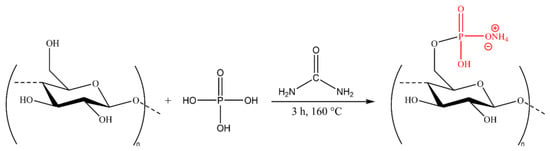
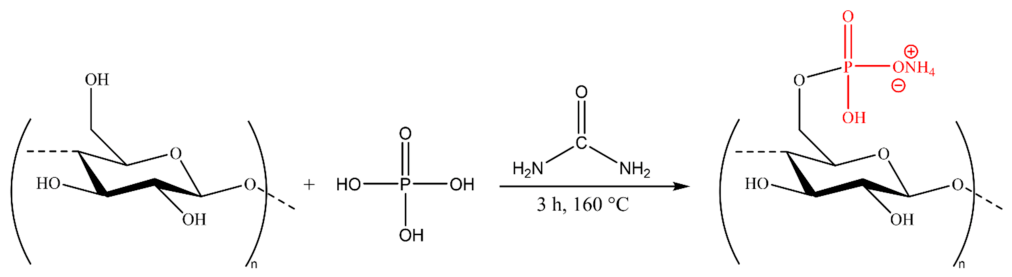
The phosphorylation of kraft fibers was carried out according to the method reported by Inagaki et al. [19], with modifications, using a solvent-free molten urea/phosphoric acid system where urea acts simultaneously as the reaction medium, catalyst, and fiber-swelling agent (Figure 1). Notably, no chemical pre-treatment step (such as alkaline swelling or solvent exchange) was required prior to modification. At 160 °C, molten urea directly swells the cellulose fiber walls, facilitating efficient reagent accessibility and deep penetration of phosphoric acid into the fiber structure without necessitating an extra alkaline pre-treatment.
Figure 1.
Phosphorylation of kraft fibers using phosphoric acid and urea.
The reaction employed a molar ratio of 6:3:1 corresponding to urea, phosphoric acid, and cellulose anhydroglucose units (AGU). Crucially, no water was added during the reagent preparation or modification stages. Solid urea (222 g) was first heated and completely melted at 160 °C under atmospheric pressure. Concentrated phosphoric acid (181 g) was then incorporated directly into the molten urea and stirred to yield a homogeneous, water-free liquid mixture. Dry defibrated kraft pulp (100 g, dry basis) was subsequently added directly into the molten reagent mixture.
The reaction mixture was maintained at 160 °C for 3 h in an oven equipped with a gas evacuation system. To promote uniform reagent distribution and heat transfer throughout the fiber mass, the mixture was manually stirred every 20 min. Upon completion, the reaction was quenched by adding 1 L of room-temperature demineralized water. The resulting phosphorylated fibers were thoroughly disintegrated and washed four times with fresh demineralized water to completely remove unreacted reagents, residual acid, and reaction by-products. Although the process involves water quenching and washing steps, the wash waters generated during purification can be recirculated in closed-loop paper mill circuits to minimize fresh water consumption. Furthermore, the absence of volatile organic solvents (such as DMAc or DMF) simplifies chemical recovery. The purified phosphorylated kraft fibers (KFP) were collected and stored at 4 °C as a thickened pulp at a 15% consistency until further use.
2.2. Characterization
2.2.1. Characterization of Phosphorylated Kraft Fiber
Fiber Length Distribution
Fiber dimensions before and after the phosphorylation reaction were characterized using a Lorentzen & Wettre (Stockholm, Sweden) Fiber Tester Plus Fiber Quality Analyzer (FQA). Dried fiber samples (0.1 g) were dispersed in 500 mL of deionized water using a high-shear homogenizer (Silverson Mixer L4, East Longmeadow, MA, USA) at 4000 rpm for 10 min. The reported fiber length represents the length-weighted average fiber length. Fines were defined as cellulosic particles or fragments with a length below 0.20 mm (200 µm) on a length-weighted basis. Average fiber width and the length-weighted percentage of fines were determined for each sample. Five replicate measurements were performed to ensure statistical precision. Differences were considered statistically significant when p < 0.05.
Weight Percentage Gain
The weight percentage gain (WPG) of the phosphorylated fibers was calculated based on the difference between the initial weight of the fiber sample used in the phosphorylation reaction (mi) and the estimated weight of the phosphorylated fibers obtained after the final washing step (mf), according to the equation:
Zeta Potential
The zeta potential was measured to assess the surface charge of the phosphorylated kraft fibers and indirectly evaluate the density of phosphate groups introduced onto the kraft fibers. Fiber suspensions (12–20 g, dry basis) were prepared in 1000 mL of deionized water, and the conductivity was adjusted to 0.1–8 mS/cm using a 1 N sodium chloride solution. Measurements were performed with a Mutek SZP-06 analyzer (BTG Americas, Norcross, GA, USA). Three replicate measurements were carried out for each sample to ensure the reliability of the results. Differences were considered statistically significant when p < 0.05.
Surface Charge
Surface charge was determined by polyelectrolyte titration using poly-DADMAC (cationic) and PVSK (anionic) according to Lamoudan et al. and Shi et al. [9,20]. Briefly, 0.2–0.4 g of fibers was dispersed in 50 mL of deionized water and mixed with 10 mL of poly-DADMAC for 30 min at room temperature. After filtration through grade 202 filter paper, the excess poly-DADMAC in 10 mL of filtrate was titrated with PVSK using a Mutek PCD03 analyzer (BTG Americas, Norcross, GA, USA). The surface charge was calculated from the amount of poly-DADMAC consumed per gram of dried fibers. Three replicate measurements were carried out for each sample to ensure the reliability of the results. Differences were considered statistically significant when p < 0.05.
Total Charge
The total charge of kraft fibers before and after phosphorylation was determined according to the methods described by L. Abenghal et al. and Shi et al. [9,21]. The fibers were first acid-treated with 0.1 N HCl solution for 30 min and then dried in an oven at 40 °C overnight. Dried fibers (1.5–2 g) were dispersed in 500 mL of deionized water, and 1 mL of 0.5 N sodium chloride solution was added to maintain constant conductivity. The suspensions were titrated with 0.1 N NaOH using an automatic titrator (Dosimat 765; Metrohm Brinkmann, Camden, NJ, USA) coupled with a Thermo Orion conductivity meter (Model 150; Thermo Fisher Scientific, Waltham, MA, USA). Five replicate measurements were performed for each sample. Differences were considered statistically significant when p < 0.05.
FT-IR Spectroscopy
FTIR spectroscopy is used to identify and analyze chemical changes in various regions of the kraft fiber spectra before and after the phosphorylation reaction. The analysis was performed using a Thermo Scientific iS10 FTIR spectrometer (Thermo Fisher Scientific, Waltham, MA, USA), with a spectral range of 4000 to 400 cm−1. The bands were expressed in cm−1.
Scanning Electron Microscopy with Energy-Dispersive X-Ray Analysis (SEM-EDX)
The surface morphology of kraft fibers before and after phosphorylation was examined using scanning electron microscopy (SEM) with a Hitachi SU1510 SEM operated at an accelerating voltage of 15 kV. Prior to imaging, the samples were sputter-coated with a thin gold layer under vacuum to ensure electrical conductivity. Energy-dispersive X-ray analysis (EDX) was performed using an Oxford X-max 20 mm2 EDX detector (Oxfordshire, UK) coupled to the SEM to evaluate the elemental composition and distribution of carbon, oxygen, phosphorus, and nitrogen on the fiber surface. Elemental compositions obtained from EDX spectra are reported as weight percentages (wt.%).
Thermogravimetric Analyses (TGA)
Thermogravimetric analyses (TGA) were performed in accordance with ASTM E1131-25 using a Perkin-Elmer (Waltham, MA, USA) Diamond TG/DTA analyzer. For TGA measurements, specimens of approximately 10 mg were cut from the samples and placed in platinum pans. The samples were heated at a rate of 5 °C/min from room temperature to 575 °C under a nitrogen atmosphere. This low heating rate was chosen to minimize temperature gradients between the surface and the interior of the fiber samples. Subsequently, the heating rate was increased to 10 °C/min until the temperature reached 900 °C. In addition to the thermogravimetric curve, the derivative thermogravimetric (DTG) curve was also calculated.
2.2.2. Preparation and Characterization of Sheets
Handsheets Production
Handsheets with a target basis weight of 90 g/m2 were prepared according to a slightly modified TAPPI/ANSI T 205 sp-18 (2018) standard method. Handsheets containing different proportions of kraft fibers (KF) and phosphorylated kraft fibers (KFP) were produced. First, 24 g (dry basis) of each fiber type was soaked overnight in deionized water to prepare two separate fiber suspensions. The suspensions were then disintegrated in a standard pulp disintegrator at 3000 rpm for 15 min to obtain a uniform fiber suspension. The consistency of each suspension was adjusted to 0.15%.
The resulting suspensions were used to prepare handsheets using a laboratory handsheet former equipped with a 150-mesh forming screen (Model 200-1, Labtech Instruments Inc., Laval, QC, Canada). Standard handsheets were produced with a grammage of 1.7–1.8 g per sheet (corresponding to a target basis weight of 85–90 g/m2). Six handsheet formulations containing different KF/KFP ratios were prepared (Table 1). For each formulation, ten handsheets were produced. After formation, the wet handsheets were pressed and dried on a hot plate at 120 °C until reaching a constant dry weight. The dried handsheets were then conditioned at 23 ± 1 °C and 50 ± 1% relative humidity in accordance with TAPPI/ANSI T 402 sp-21 (2021) prior to characterization. The sample designations are listed in Table 1.
Table 1.
Sample designations and corresponding KF/KFP ratios of the handsheets.
Grammage
The handsheet’s grammage was determined using the TAPPI T 410 om-02 standard method. The average grammage was calculated using five samples for each measurement.
Thickness
The thickness of the handsheets was measured according to the ISO 534:2011 standard method using a T.M.I Model 549 E thickness tester (Testing Machines Inc. (TMI), New Castle, DE, USA), with an accuracy of 1/10,000 m. For each measurement, five samples were analyzed, with three replicates performed per sample.
Mechanical Properties
The mechanical properties of the handsheets, including maximum load, extension at maximum load, and Young’s modulus, were determined according to the TAPPI/ANSI T 494 om-22 (2022) standard using a universal testing machine (Instron 4201, Instron Corporation, Canton, MA, USA). For each measurement, five samples were analyzed, with five replicates performed per sample.
Optical Properties
The brightness and opacity of the handsheets were measured using a Color Touch PC spectrophotometer (Technidyne Corporation, New Albany, IN, USA). Measurements were performed in accordance with ISO 2470 for ISO brightness and ISO 2471 for opacity. For each measurement, five samples were analyzed, with five replicates performed per sample.
Flammability Test
The vertical flammability test (EN ISO 11952-2) was simulated using laboratory-scale equipment to evaluate the fire behavior of the handsheets. A propane gas flame with a height of 20 mm was applied to the lower surface of the vertically positioned handsheet at an angle of 45° for 30 s. After flame exposure, the ignition behavior, flame propagation, and self-extinguishing characteristics of the samples were visually monitored and recorded.
3. Results and Discussion
3.1. Characterisation of Fibres
3.1.1. Chemical Properties and Elemental Composition
The softwood kraft fibers used in this study were obtained through a chemical pulping process (kraft process), in which alkaline chemicals are used to dissolve lignin, partially remove hemicelluloses, and extract other wood components. The producer indicates a kraft pulp composed mainly of cellulose (80–85%), hemicelluloses (15–20%), with traces of lignin and inorganic salts [22].
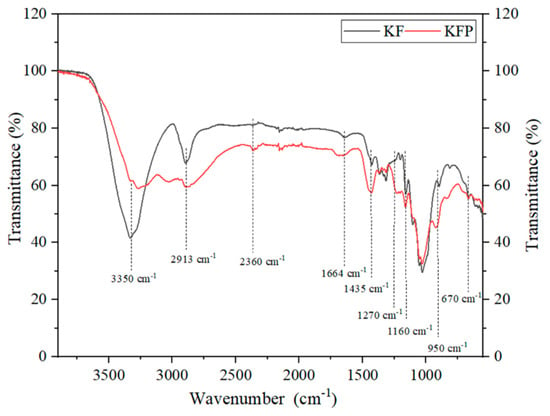
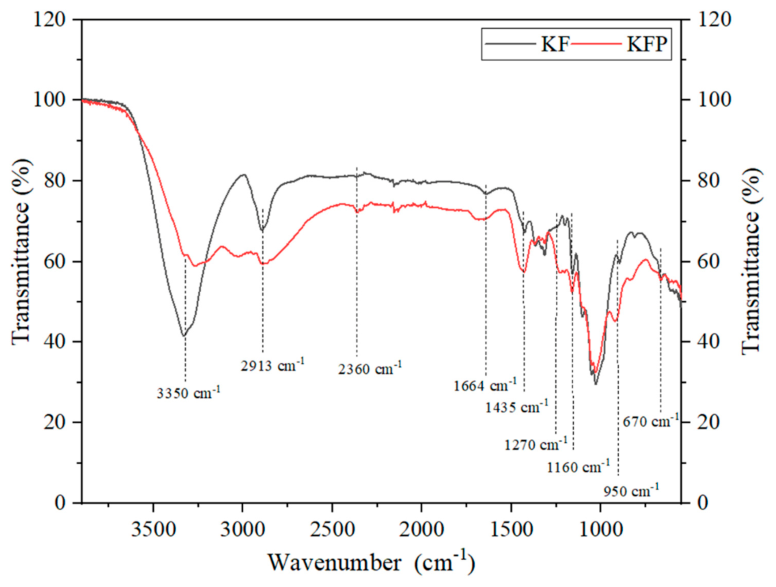
The FTIR spectrum of the kraft fibers (Figure 2) exhibited the characteristic absorption bands of cellulose, including the O–H stretching vibration at approximately 3350 cm−1, the C–H stretching vibration at 2913 cm−1, the asymmetric C–O–C stretching vibration at 1160 cm−1, and the C–O stretching vibration in the 1060–1100 cm−1 region. The band observed at 898 cm−1 is assigned to the C–H deformation vibration associated with the amorphous regions of cellulose. Additionally, the band at 1664 cm−1 is attributed to the bending vibration of absorbed water molecules or water bound to cellulose. Similar FTIR assignments have been reported in previous studies, including those by Belosinschi et al., Abidi et al., and Olsson et al. [23,24,25].
Figure 2.
FTIR analysis of kraft fibers before (gray curve) and after (red curve) phosphorylation treatment.
After the phosphorylation reaction, significant changes were observed in the FTIR spectra, as shown in Figure 2. The noticeable decrease in intensity and broadening of the O–H stretching band at around 3320 cm−1 indicate the partial substitution of hydroxyl groups, which is consistent with previous reports on phosphorylated kraft fiber systems. The appearance of two peaks in the 2913–2950 cm−1 region, compared with a single peak at approximately 2913 cm−1 for kraft fibers, confirms the modification of the chemical environment of C–H stretching vibrations following phosphorylation. Furthermore, the emergence of new absorption bands at 1270 cm−1 and 950 cm−1 confirms the formation of phosphate ester groups, assigned to asymmetric P–O stretching and symmetric C–O–P vibrations, respectively. The band observed at 1060 cm−1 can also be associated with P–O/P=O-related vibrations, further supporting the successful incorporation of phosphate groups into the cellulose structure. Moreover, the high-intensity band at 1435 cm−1 is attributed to the presence of ammonium phosphate residues formed during the phosphorylation reaction. Similar FTIR peaks associated with phosphorylated fibers have been reported by Abenghal et al., Shi et al., and Ablouh et al. [26,27,28].
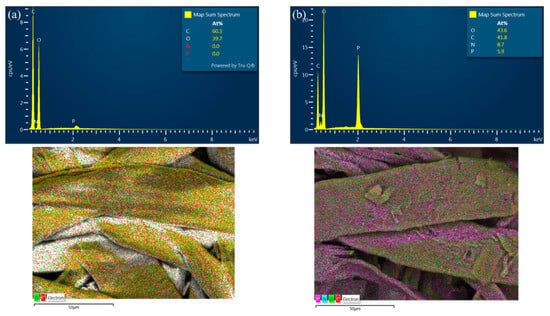
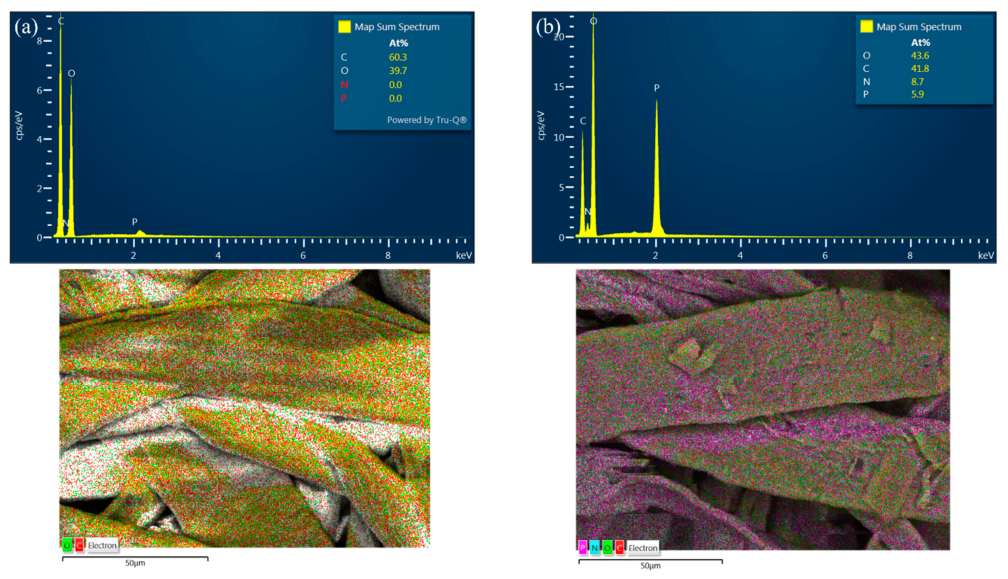
The presence of phosphate moieties was further confirmed by EDX analysis. As shown in Figure 3, the EDX results revealed that the phosphorylated fibers contained approximately 5.9 wt.% phosphorus and 8.7 wt.% nitrogen after the phosphorylation reaction. The slightly higher nitrogen content compared with phosphorus is attributed to the formation of carbamate groups on the cellulose fibers during the reaction. This carbamation reaction can be considered a side reaction of the phosphorylation process, particularly when urea is used as a phosphorylation solvent and activating agent. During the thermal treatment, urea can decompose to generate isocyanic acid (HNCO), which reacts with the hydroxyl groups of cellulose chains to form carbamate functionalities (–O–CO–NH2). The formation of carbamate groups has been reported in several previous studies, particularly those conducted by Zhang et al. and Wei et al. [29,30]. The phosphorus content strongly depends on the reaction conditions, including reagent molar ratios, reaction temperature, reaction time, and the type of cellulose substrate used. In general, the phosphorus content reported for phosphorylated kraft fibers in the literature ranges from approximately 1 to 10%, depending on the phosphorylation conditions [9].
Figure 3.
Elemental composition (in wt.%) of (a) kraft fibers and (b) phosphorylated kraft fibers determined by EDX analysis.
The incorporation of phosphate groups into the cellulose fibers resulted in a 32% increase in weight (WPG), providing evidence of the successful phosphorylation of the cellulose fibers.
3.1.2. Physical, Morphological, and Surface Properties
Softwood kraft fibers typically exhibit a fiber length ranging from 1.5 to 3.5 mm and a diameter ranging from 26 to 38 µm, depending on the processing conditions and fiber source [9]. In the present study, the fibers used had an average length of 2.04 ± 0.2 mm, an average fiber diameter of 27.1 ± 0.3 µm, and a low fines content (<0.20 mm) of 0.6 ± 0.1% (Table 2). After the phosphorylation reaction, the fiber dimensions were affected by the treatment conditions, particularly the temperature and the acidity of the phosphoric acid used as the phosphorylation agent. The results showed that the average fiber length slightly decreased to 1.93 ± 0.2 mm, whereas the fiber diameter increased to 33.4 ± 0.3 µm after phosphorylation. The decrease in fiber length can be attributed to partial hydrolysis and chain cleavage during the reaction, caused by the relatively strong acidity of phosphoric acid (pKa = 2.14), which acts both as a phosphorylation reagent and as an acidic medium capable of inducing slight degradation of the cellulose fibers. In contrast, the increase in fiber diameter can be attributed to fiber swelling following the grafting of phosphate moieties onto the cellulose backbone. The introduced phosphate groups are highly hydrophilic and promote water uptake (moisture content increased from 8 ± 1% to 12 ± 2%), reducing inter-fiber hydrogen bonding and increasing the distance between fibrillar structures. A similar trend was reported for the phosphorylation of kraft fibers using phosphate esters, where the fiber diameter increased by 23%, from 26 to 32 µm [9]. Belosinschi et al. reported that the introduction of hydrophilic functional groups onto fiber structures increases fiber diameter, regardless of the fiber source or type. They observed increases in fiber diameter of 33% for old corrugated container pulp, 25% for thermomechanical pulp, 34% for sulfite pulp, and 42% for kraft fiber pulp after sulfation treatment due to the introduction of sulfate moieties [23].
Table 2.
Physical and surface properties of kraft fibers before and after phosphorylation.
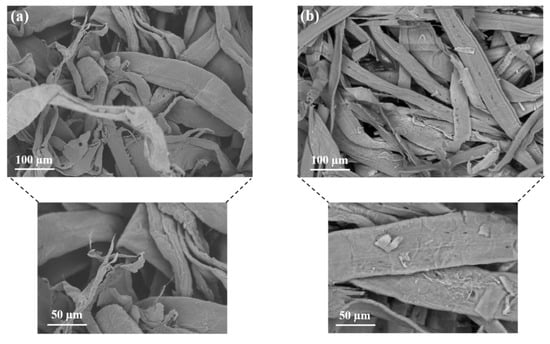
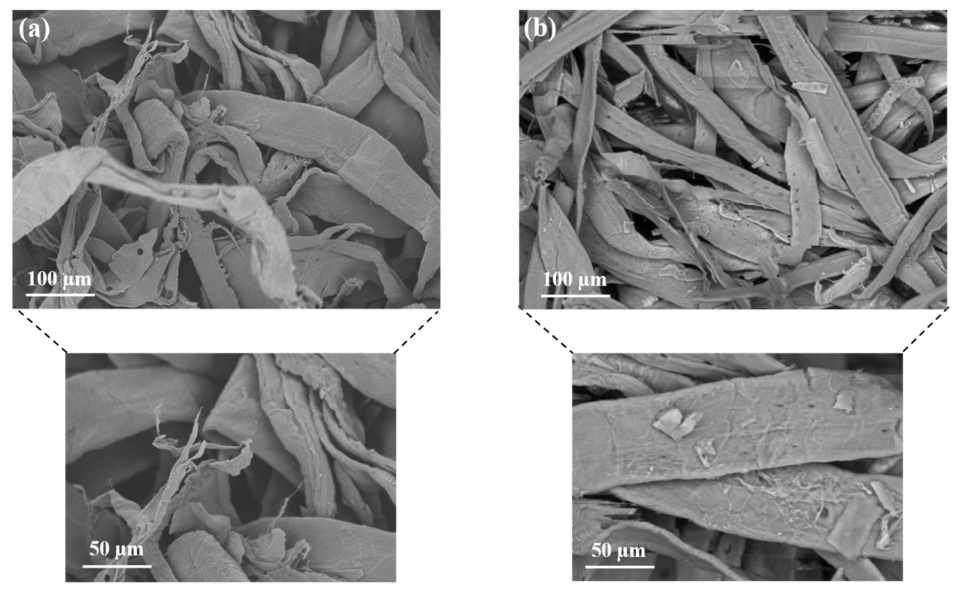
The morphology of untreated kraft fibers analysed by SEM (Figure 4) exhibited a relatively smooth and compact surface morphology. After phosphorylation, the fiber surface appeared rougher and more heterogeneous, with the presence of irregular deposits or granular structures. These morphological modifications can be attributed to the grafting of phosphate groups onto the cellulose chains and the formation of phosphorus-containing species on the fiber surface. The introduction of phosphate moieties may disrupt the original hydrogen-bonding network between cellulose chains, resulting in surface swelling, increased fibrillation, and greater accessibility of the cellulose structure.
Figure 4.
SEM images of kraft fibers (a) before and (b) after phosphorylation treatment.
The phosphorylation reaction enables the introduction of highly charged groups, which can significantly modify the electrostatic properties of kraft fibers. As shown in Table 2, the surface charge increased significantly from 32 to 511 µeq/g due to the presence of negatively charged phosphate moieties grafted onto the fiber surface, with NH4+ ions acting as counterions. The total charge also increased significantly from 92 to 4676 mmol/kg, representing the total amount of charge contained within the entire fiber mass, in contrast to the surface charge measurement, which reflects only the charge accessible at the fiber surface.
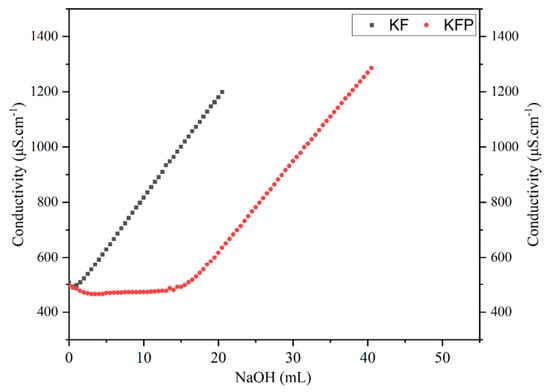
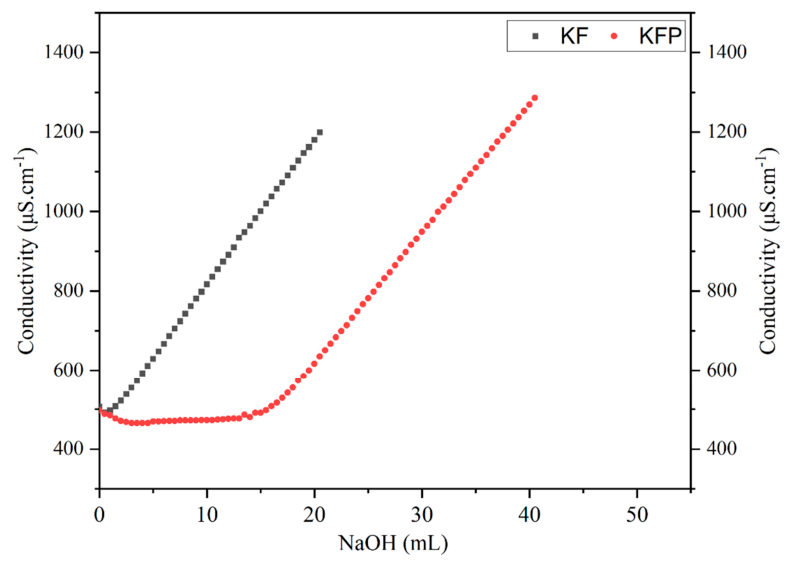
As shown in Figure 5, the total charge of the fibers was determined by titration with 0.1 N NaOH. For untreated kraft fibers, NaOH neutralizes the carboxylic groups (–COOH) present on the fiber surface, resulting in a single equivalence point. In the case of phosphorylated fibers, phosphate groups contain two acidic protons with different dissociation constants. Vice-versa, the first is associated with a stronger acidity—lower pKa, the second with a weaker acidity, higher pKa. This behavior explains the presence of two equivalence points in the titration curve.
Figure 5.
Effect of phosphorylation treatment on the total charge of kraft fibers.
The increased charge density also explains the changes observed in the zeta potential values of the phosphorylated fibers, which ranged from −25 to −9 mV, compared with −57 to −18 mV for the untreated kraft fibers, depending on the conductivity of the medium. These results confirm that phosphorylated kraft fibers possess a higher charge density, mainly associated with the Stern compact layer, whereas untreated kraft fibers exhibit a lower total charge that is predominantly distributed within the diffuse electrical double layer.
3.1.3. Thermal Degradation Behavior
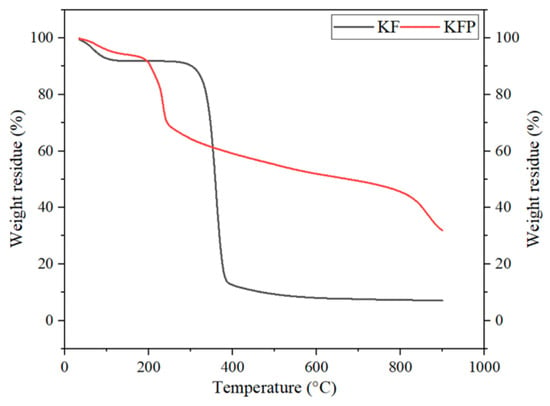
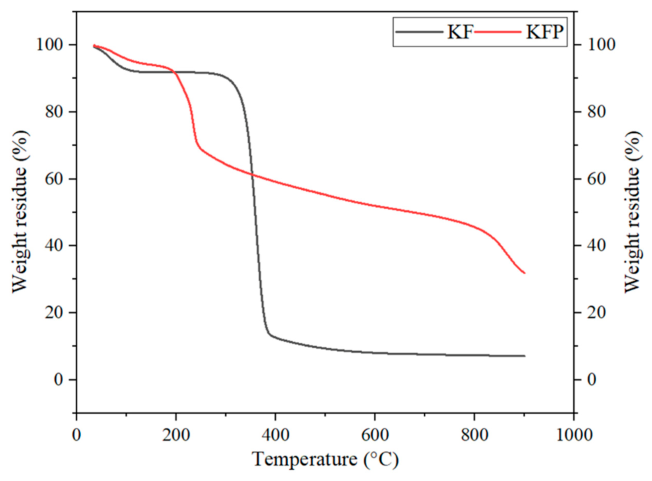
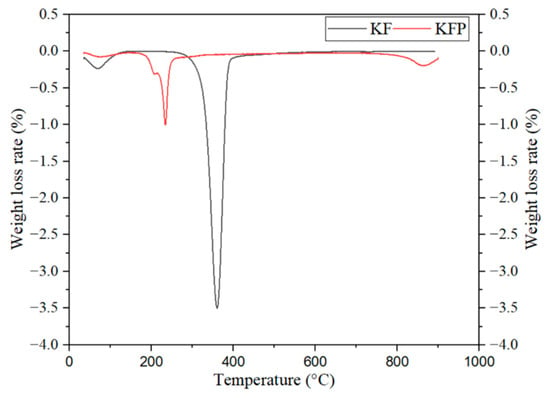
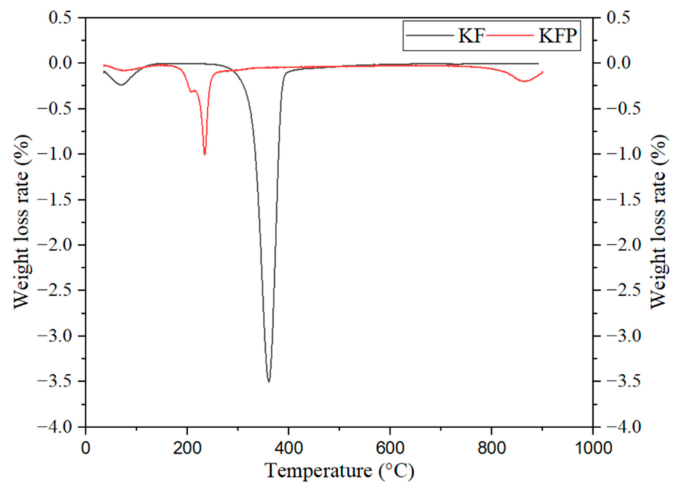
The phosphorylation reaction modifies not only the electrostatic and hydrophilic properties of kraft fibers but also their thermal behavior. Thermogravimetric analysis (TGA) under a nitrogen atmosphere was performed to evaluate the thermal stability of kraft fibers before and after phosphorylation using phosphoric acid and urea. The weight-loss (TGA) and derivative weight-loss (DTG) curves are presented in Figure 6 and Figure 7. The thermogram of the unmodified kraft fibers exhibited an initial weight loss between 38 and 129 °C, corresponding to the evaporation of physically adsorbed water (moisture). The main thermal degradation occurred between 274 and 398 °C, with a maximum degradation temperature (Tmax) of 356 °C (Table 3). During this stage, the β-1,4-glycosidic bonds of the cellulose chains were cleaved, producing volatile degradation products such as levoglucosan. At the end of the analysis (900 °C), the total weight loss reached approximately 93.1%. A similar behavior was reported by Lerdkanchanaporn et al. and Abenghal et al. [31,32].
Figure 6.
TGA curves of unmodified and phosphorylated kraft fibers under a nitrogen atmosphere.
Figure 7.
DTG curves of unmodified and phosphorylated kraft fibers under a nitrogen atmosphere.
Table 3.
Thermal degradation characteristics of unmodified and phosphorylated kraft fibers as assessed by TGA.
After phosphorylation, the TGA and DTG curves differed significantly from those of the unmodified fibers, indicating that the thermal degradation behavior of the fibers was markedly altered. As shown in Figure 6 and Figure 7, the onset of thermal decomposition of the phosphorylated kraft fibers occurred at approximately 192 °C, which is lower than that of the unmodified fibers. This decrease in thermal stability is attributed to the acidic phosphate groups grafted onto the cellulose surface, which promote acid-catalyzed dehydration reactions and facilitate the elimination of water from the cellulose chains, thereby shifting the onset of thermal degradation to lower temperatures [9,32]. The DTG curves of the phosphorylated fibers exhibited two distinct degradation peaks at approximately 200 and 229 °C, which are attributed to the cleavage of cellulose phosphate ester bonds, followed by the condensation and dehydration of phosphate species. It is worth noting that the intensity of these peaks is considerably lower than that recorded in the case of pristine kraft fibers. The phosphoric acid species generated during dephosphorylation promote char formation by catalyzing dehydration reactions, resulting in the formation of a protective carbonaceous layer. This char layer acts as a thermal barrier, limiting heat transfer and shielding the underlying material from further degradation, thereby preventing complete decomposition even at elevated temperatures. The enhanced char formation, attributed to the development of C–P cross-linked structures on the fiber surface, resulted in a significantly higher residual mass at 900 °C for the phosphorylated fibers (31.12%) compared with the unmodified fibers (6.9%).
3.2. Handsheets Characterization
3.2.1. Physical, Optical, and Structural Properties
The phosphorylated fibers are characterized by their high charge density and less negative zeta potential but higher fiber-fiber repulsion. This increases their stability in aqueous suspension compared with unmodified fibers, which tend to flocculate and sediment. However, their wet strength is lower due to the disruption and reduction of the hydrogen-bonding network after the grafting of phosphate moieties. Therefore, a mixture of phosphorylated and unmodified fibers was used to produce different handsheets with a target basis weight of 85–90 g/m2. The addition of unmodified fibers improves the wet strength and enables the production of high-quality defect-free handsheets. Furthermore, this approach can be easily scaled up to an industrial level because it uses papermaking conditions without requiring additional chemicals, such as coagulation or flocculation agents. As shown in Table 4, six samples were prepared using different fiber mixtures to determine which formulation provided the best mechanical and flame-resistance performance, while the sample composed of 100% kraft fibers was considered as a reference for comparison.
Table 4.
Physical and optical properties of kraft fibers and phosphorylated kraft fiber handsheets.
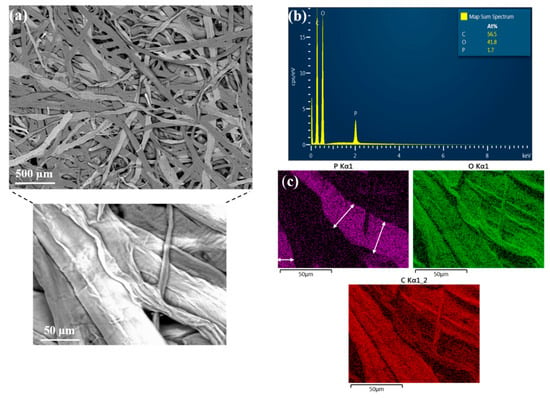
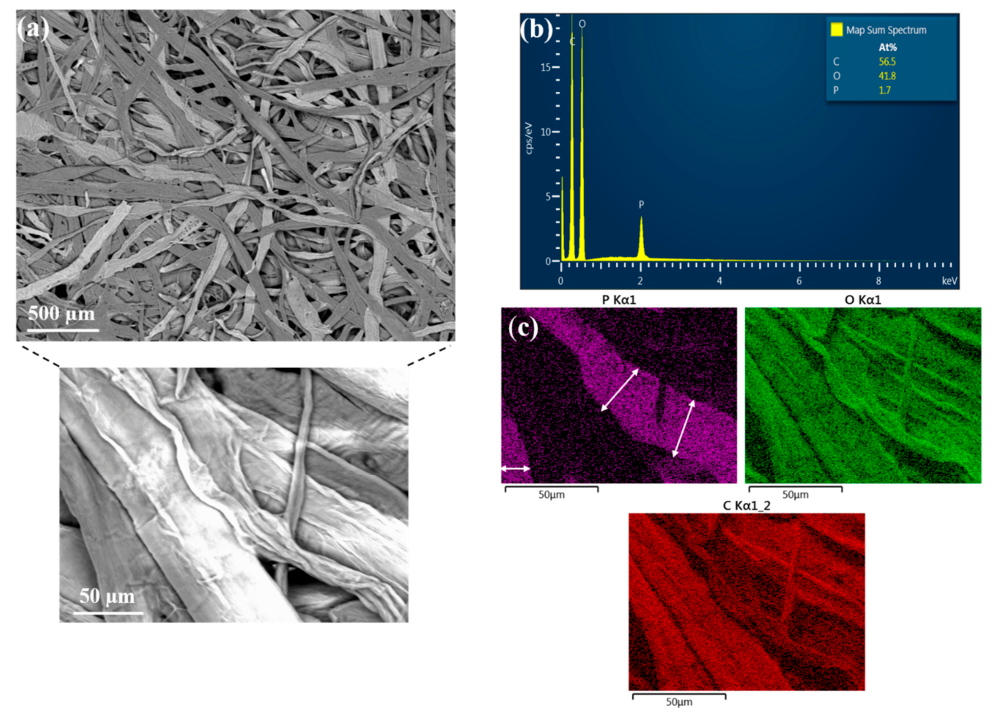
The basis weight ranged from 85.9 to 91.8 g/m2, confirming that the sheet grammage remained relatively constant. The slight variations are attributed to the precision of the preparation procedure and the characteristics of the phosphorylated fibers, which promote improved handsheet formation and retention. This explains the slight increase in basis weight observed for samples containing phosphorylated fibers. In contrast, the thickness exhibited greater variation among the samples. The unmodified kraft fiber handsheet exhibited a thickness of 285 µm, whereas phosphorylation generally increased the sheet thickness, reaching a maximum of 355 µm for KFP60. This increase suggests that phosphorylation affected fiber packing within the paper structure (as shown in Figure 8b, KFP40 contained 1.7% phosphorus). The introduction of negatively charged phosphate groups likely enhanced electrostatic repulsion between fibers, resulting in a bulkier and less compact network. The increased swelling capacity of phosphorylated fibers may also have contributed to the higher sheet volume.
Figure 8.
(a) SEM images and (b,c) EDX mapping of the handsheets prepared from a mixture of 60% kraft fibers and 40% phosphorylated kraft fibers.
Interestingly, the thickness decreased to 295 µm for KFP80 and returned to 285 µm for KFP100, indicating a crosslinking behavior in the sheet that takes place at higher phosphorylated fiber content. Indeed, phosphates are recognized as moieties having a crosslinking power once the water is eliminated, as happens during the paper drying process. From a papermaking standpoint, these changes that occur with increasing phosphorylated fiber content may be seen as a reduction in paper sheet flexibility and hornification during drying, allowing fibers to rearrange into a denser structure. These variations in thickness are reflected in the apparent density values. The density decreased from 0.302 g/cm3 for KF to 0.291, 0.288, and 0.260 g/cm3 for KFP20, KFP40, and KFP60, respectively, confirming the formation of a more porous and less consolidated fiber network as sheet bulk increased. The lowest density obtained for KFP60 is consistent with its highest thickness, indicating reduced fiber packing and a greater void volume within the sheet. In contrast, the apparent density increased to 0.306 g/cm3 for KFP80 and further to 0.316 g/cm3 for KFP100, reflecting the decrease in thickness and suggesting the fiber-fiber crosslinking through phosphate condensation, which improves paper sheet consolidation.
The optical properties of the handsheets were also greatly affected by the addition of phosphorylated fibers. The brightness of the handsheets decreased from 84.9% for the unmodified kraft fiber handsheet to 43.9% for the sample prepared solely from phosphorylated fibers. This decrease is attributed to the thermal treatment and the chemical grafting of phosphate groups onto the cellulose structure. In general, the presence of conjugated unsaturated groups, such as carbonyl (C=O) or other oxygen-containing functional groups, can impart a yellow coloration to fibers. In addition, the incorporation of phosphate groups and the resulting changes in fiber surface morphology can alter light scattering and reflectance properties [33,34]. Consequently, the phosphorylated handsheets exhibited lower brightness values compared with the untreated kraft fiber handsheets. In contrast, the opacity of the handsheets increased from 84.9% for the unmodified fibers to 96.3% for KFP60. The incorporation of yellow phosphorylated fibers into paper leads to an increase in the amount of light absorbed and therefore automatically to an increase in the opacity of the sheet. On the other hand, we observe a two-percent reduction in opacity for papers made with 80% and 100% phosphorylated fibers. These papers show a thinner and a denser handsheet structure with lower void volume. These voids create numerous air–fiber interfaces, enhancing light scattering throughout the sheet and consequently increasing opacity. The maximum opacity observed for KFP60 is consistent with its highest thickness and lowest apparent density, indicating that the more porous fiber network promoted greater diffuse light scattering.
As shown in Figure 8a, the SEM images of the handsheet prepared from a mixture of 40 wt.% phosphorylated kraft fibers and 60 wt.% kraft fibers revealed a well-formed fibrous network with numerous contact points between adjacent fibers and no visible phase separation or fiber damage. The EDX elemental maps (Figure 8c) confirmed the elemental composition of the handsheet, showing a homogeneous distribution of carbon and oxygen throughout the fiber network, as expected for cellulose-based materials. More importantly, the phosphorus map clearly demonstrated the presence of phosphorus only along those phosphorylated fiber surfaces, confirming the successful incorporation of phosphorylated fibers into the paper structure. The phosphorus signal is uniform and follows the morphology of the phosphorylated fibers. They are distributed throughout the handsheet without noticeable agglomeration, indicating that the phosphorylated fibers were well dispersed within the matrix of unmodified fibers.
3.2.2. Mechanical Properties
The evaluation of the mechanical properties of the prepared handsheets is crucial before scaling up the process for industrial production. These properties determine whether the material can withstand the stresses encountered during manufacturing, handling, converting, and end-use applications. In general, the mechanical properties of paper depend on the type of fibers and the additives (strength agents) used during the papermaking. Mechanical pulping processes, such as thermomechanical pulping (TMP) or mechanical pulping (MP), produce fibers with relatively poor mechanical properties because of their high lignin content, which makes the fibers more rigid [35,36]. In contrast, chemical pulping processes, such as kraft or sulfite pulping, produce fibers with a high cellulose content and low lignin content, resulting in more flexible papers with superior mechanical properties [23]. In addition, the refining process can further improve these properties by increasing fiber fibrillation and enhancing the hydrogen-bonding network between fibers [37].
In the present study, unbeaten kraft fibers and phosphorylated kraft fibers were blended at different ratios to prepare the handsheets. It is well known that the introduction of phosphate moieties onto the cellulose backbone reduces the hydrogen-bonding network, while the increased surface charge enhances electrostatic repulsion between fibers in wet state. Therefore, theoretically, handsheets containing a higher proportion of phosphorylated kraft fibers would be expected to exhibit lower mechanical properties. However, as shown in Table 5, the untreated KF handsheet exhibited the lowest extension at maximum load (1.31 mm) and the lowest maximum load (10.27 N) among all the samples. Following the addition of phosphorylated fibers, the extension at maximum load increased to 2.03, 2.00, 2.36, 2.33, and 2.16 mm for KFP20, KFP40, KFP60, KFP80, and KFP100, respectively. Similarly, the maximum load increased to 18.06 N for KFP20, 28.04 N for KFP40, 29.11 N for KFP60, 41.41 N for KFP80, and 42.29 N for KFP100. Compared with the unbeaten KF handsheets, all paper samples containing phosphorylated fibers exhibited substantially higher maximum load values.
Table 5.
Mechanical properties of handsheets prepared from kraft and phosphorylated kraft fibers.
This improvement can be attributed to the phosphate moieties introduced into the cellulose structure, which undergo condensation reactions during drying at 120 °C, leading to the formation of covalent cross-links between adjacent fibers through P–O–P linkages and, possibly, P–O–C [38]. This new type of inter-fiber bonds are much stronger than typical H-bonds in regular papers, therefore, reinforcing the fiber network and significantly enhancing the mechanical properties of the resulting handsheets.
Simultaneously, Young’s modulus significantly increased with the proportion of phosphorylated fibers in the handsheets, from 39.77 MPa for KF to 99.78 MPa for KFP100. This increase indicates that the incorporation of phosphorylated fiber into fiber furnish leads to stiffer handsheets, confirming phosphate condensation and cross-linking during paper drying.
3.2.3. Flame Resistance of Handsheets
Phosphorylated kraft fibers are well known for their enhanced thermal stability, as demonstrated by the TGA and DTG analyses presented in the previous section. Their intrinsic flame resistance was demonstrated in a dedicated study by Ying et al., who showed that these fibers can lead to LOI (limiting oxygen index) values as high as 57% [9]. Consequently, incorporating these fibers into handsheets is expected to improve the flame-retardant performance of papers. Numerous studies have reported that the flame resistance of cellulose strongly depends on its surface chemistry, and that the introduction of phosphate groups onto the cellulose surface significantly enhances fire resistance by promoting char formation and inhibiting flame propagation [9,39]. A study by Orzan et al. demonstrated that a phosphorus content below 0.05 wt.% was sufficient to impart effective flame-retardant properties to cellulose-based materials [40].
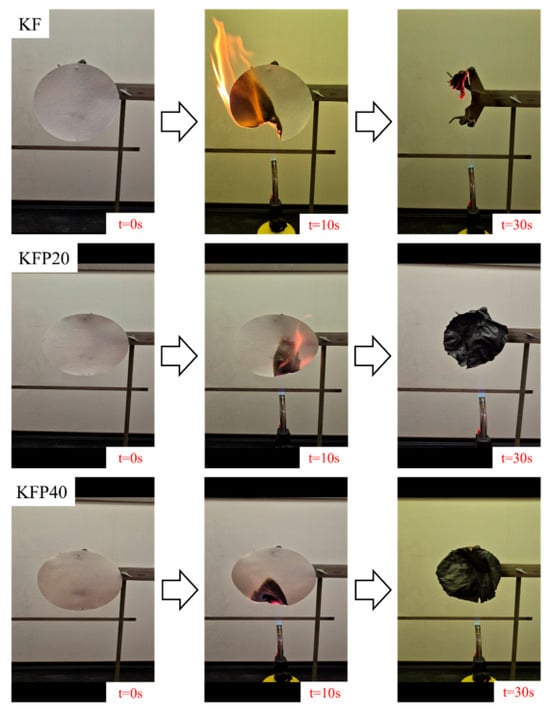
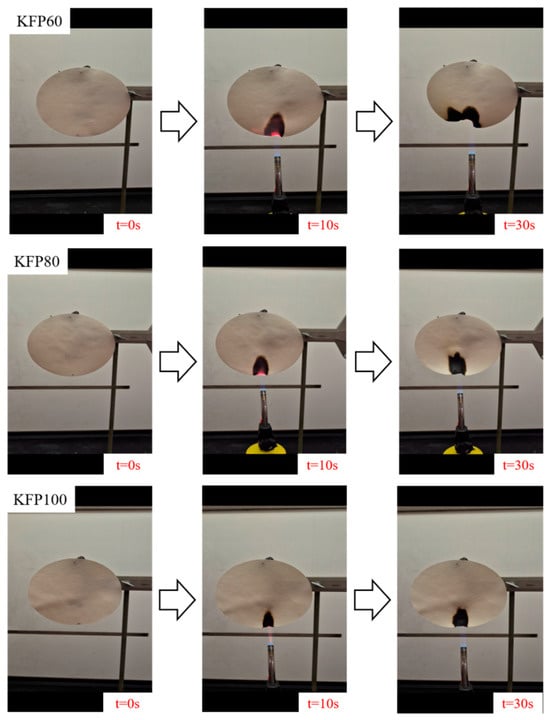
In this study, a vertical flammability test was performed to evaluate the flame-retardant performance of handsheets prepared with different proportions of unmodified kraft fibers and phosphorylated kraft fibers. As shown in Figure 9, the handsheets prepared from KF, KFP20, and KFP40 ignited readily, and the flame propagated rapidly throughout the samples. After 30 s of flame exposure, all three handsheets were severely affected. However, unlike the KF handsheet, which was almost completely consumed by the fire, the KFP20 and KFP40 samples retained part of their original structures after burning, indicating that the presence of phosphorylated fibers even in a small proportion promoted char formation and reduced the extent of combustion. Moreover, the KF20 and KF40 samples do not smolder and do not project incandescent particles into the air after or during the flame exposure, as happens in the case of the KF sample. In contrast, handsheets containing 60 wt.% or more phosphorylated fibers (KFP60, KFP80, and KFP100) exhibited excellent flame resistance (Figure 10). These samples maintained their structural integrity after 30 s of flame exposure and showed limited flame propagation over a small, charred area. The flame-retardant mechanism can be attributed to the formation of a stable and protective phosphorus-carbon char layer that insulated efficiently the underlying fiber-structure from heat and oxygen.
Figure 9.
Flame propagation behavior of KF, KFP20, and KFP40 handsheets during vertical flammability testing at different exposure times (0, 10, and 30 s).
Figure 10.
Flame propagation behavior of KFP60, KFP80, and KFP100 handsheets during vertical flammability testing at different exposure times (0, 10, and 30 s).
Overall, the handsheet containing 60 wt.% phosphorylated fibers (KFP60) exhibited the best balance between production cost and, mechanical, thermal, and flame-retardant properties. These results suggest that incorporating 60 wt.% phosphorylated fibers provides sufficient fire resistance while maintaining satisfactory mechanical performance, making this composition a promising candidate for the development of flame-retardant cellulose-based materials for future applications.
4. Conclusions
This study demonstrates that phosphorylation of kraft fibers using a phosphoric acid/urea system is an effective and scalable strategy for producing cellulose-based materials with enhanced surface functionality, mechanical performance, thermal stability, and flame resistance. The incorporation of phosphorylated fibers into handsheets resulted in homogeneous structures with good physical properties that can easily withstand the papermaking process in an industrial paper machine. Increasing the phosphorylated fiber content progressively reduced the apparent density from 0.302 g/cm3 for KF to 0.26 g/cm3 for KFP60, while enhancing opacity from 84.9% to 96.3%, which is beneficial for applications requiring improved light shielding and high opacity. The mechanical performance of the handsheets significantly improves with increasing phosphorylated fiber content. The maximum load increased from 10.27 N for unmodified kraft fiber handsheets to 42.29 N for fully phosphorylated fiber handsheets, while Young’s modulus increased from 39.77 to 99.78 MPa, indicating enhanced fiber network reinforcement through new and stronger intermolecular interactions, most likely P-O-P and P-O-C bonds due to the phosphate crosslinking, than the hydrogen bonds typical in ordinary papers. Furthermore, thermogravimetric analysis demonstrated improved thermal resistance and char formation, with a residual mass of 31.12 wt.% after exposure to 900 °C, confirming the protective role of phosphate groups during cellulose degradation.
The improved flame-retardant behavior was particularly remarkable, as handsheets containing ≥60 wt.% phosphorylated fibers preserved their structural integrity after 30 s of direct flame exposure, whereas unmodified kraft fiber handsheets were completely consumed by the fire. Overall, phosphorylation provides a multifunctional and halogen-free approach to overcome the intrinsic limitations of cellulose by combining enhanced mechanical strength, improved thermal stability, controlled optical properties, and effective flame retardancy. These solvent-free phosphorylated cellulose-based materials show strong potential for advanced applications in fire-safe construction, insulation, and functional packaging.
Author Contributions
Conceptualization, L.A., A.M. and H.L.; Methodology, D.B. and H.L.; Software, L.A.; Validation, H.L.; Formal analysis, L.A.; Investigation, L.A. and A.M.; Resources, A.M.; Data curation, L.A. and H.L.; Writing – original draft, L.A.; Writing – review & editing, D.B., A.M. and H.L.; Visualization, D.B., L.A., A.M. and H.L.; Supervision, D.B. and A.M.; Project administration, D.B. and A.M.; Funding acquisition, D.B. All authors have read and agreed to the published version of the manuscript.
Funding
This work was financially supported by the Lecturers Research Scholarship Award (SCCUQTR-Fond-2122-002), granted to Dan Belosinschi by the Fondation de l’Université du Québec à Trois-Rivières and the UQTR Union of Lecturers (3351, boul. des Forges, C.P. 500, Trois-Rivières, QC, G9A 5H7, Canada; Foundation registration number: 119001725 RR0002).
Data Availability Statement
The original contributions presented in this study are included in the article. Further inquiries can be directed to the corresponding authors.
Acknowledgments
The authors would like to express their sincere gratitude to the members of I2E3-UQTR for their valuable guidance, constructive discussions, and continuous support throughout this research. Their expertise, contributions, and encouragement have played an important role in the successful completion of this work. During the preparation of this manuscript, the authors used DeepL and ChatGPT-5.2 to improve the quality and clarity of the English language. Following the use of these tools, the authors carefully reviewed and edited the content as necessary and take full responsibility for the accuracy, integrity, and originality of the published article.
Conflicts of Interest
Author Dan Belosinschi was employed by the company Technologie Fiborizon. Author Aleksandra Mikhailidi was employed by the company CTT Group. The remaining authors declare that the research was conducted in the absence of any commercial or financial relationships that could be construed as a potential conflict of interest.
References
- Hubbe, M.A.; Sjöstrand, B.; Lestelius, M.; Håkansson, H.; Swerin, A.; Henriksson, G. Swelling of Cellulosic Fibers in Aqueous Systems: A Review of Chemical and Mechanistic Factors. BioResources 2024, 19, 6859–6945. [Google Scholar] [CrossRef] [Scilit]
- Liu, K.; Du, H.; Xu, T.; Xiang, H.; Si, C. Cellulosic Fibers for Sustainable Functional Textiles and Devices. Adv. Fiber Mater. 2026, 8, 843–879. [Google Scholar] [CrossRef] [Scilit]
- Azman Mohammad Taib, M.N.; Hamidon, T.S.; Garba, Z.N.; Trache, D.; Uyama, H.; Hussin, M.H. Recent Progress in Cellulose-Based Composites towards Flame Retardancy Applications. Polymer 2022, 244, 124677. [Google Scholar] [CrossRef] [Scilit]
- Wen, P.; Ren, J.; Zhang, Q.; Ling, S. Flame-Retardant and Fire-Sensing Packaging Papers Enabled by Diffusion-Driven Self-Assembly of Graphene Oxide and Branched Polyethyleneimine Coatings. Coatings 2023, 13, 1047. [Google Scholar] [CrossRef] [Scilit]
- Yao, X.; Chen, G.; Yao, Z.; Zheng, L. Flame-Retardant and Heat Insulation Paper-Based Functional Materials. In Paper-Based Functional Materials; John Wiley & Sons, Ltd.: Hoboken, NJ, USA, 2026; pp. 199–219. [Google Scholar]
- Liu, H.; Zhu, Y.; Ye, Y.; Therrien, I.; Wiesner, F.; Jiang, F. Flame-Retardant Strategies for Lignocellulose: Recent Progress and Prospect. Prog. Mater. Sci. 2026, 155, 101529. [Google Scholar] [CrossRef] [Scilit]
- Sharma, V.; Agarwal, S.; Mathur, A.; Singhal, S.; Wadhwa, S. Advancements in Nanomaterial Based Flame-Retardants for Polymers: A Comprehensive Overview. J. Ind. Eng. Chem. 2024, 133, 38–52. [Google Scholar] [CrossRef] [Scilit]
- Tavakoli, M.; Ghasemian, A.; Dehghani-Firouzabadi, M.R.; Mazela, B. Cellulose and Its Nano-Derivatives as a Water-Repellent and Fire-Resistant Surface: A Review. Materials 2022, 15, 82. [Google Scholar] [CrossRef] [Scilit] [PubMed]
- Shi, Y.; Belosinschi, D.; Brouillette, F.; Belfkira, A.; Chabot, B. Phosphorylation of Kraft Fibers with Phosphate Esters. Carbohydr. Polym. 2014, 106, 121–127. [Google Scholar] [CrossRef] [Scilit] [PubMed]
- Patoary, M.K.; Islam, S.R.; Farooq, A.; Rashid, M.A.; Sarker, S.; Hossain, M.Y.; Rakib, M.A.N.; Al-Amin, M.; Liu, L. Phosphorylation of Nanocellulose: State of the Art and Prospects. Ind. Crops Prod. 2023, 201, 116965. [Google Scholar] [CrossRef] [Scilit]
- Abenghal, L.; Belosinschi, D.; Lamoudan, H.; Mikhailidi, A.; Brouillette, F. Review of the Phosphorylation of Lignocellulosic Fibers: Reaction Products, Characterization, and Potential Applications. Fibers 2026, 14, 50. [Google Scholar] [CrossRef] [Scilit]
- Ghanadpour, M.; Carosio, F.; Larsson, P.T.; Wågberg, L. Phosphorylated Cellulose Nanofibrils: A Renewable Nanomaterial for the Preparation of Intrinsically Flame-Retardant Materials. Biomacromolecules 2015, 16, 3399–3410. [Google Scholar] [CrossRef] [Scilit] [PubMed]
- Khakalo, A.; Jaiswal, A.K.; Kumar, V.; Gestranius, M.; Kangas, H.; Tammelin, T. Production of High-Solid-Content Fire-Retardant Phosphorylated Cellulose Microfibrils. ACS Sustain. Chem. Eng. 2021, 9, 12365–12375. [Google Scholar] [CrossRef] [Scilit]
- Zhang, Y.; Zhao, L.; Liu, Y.; Dong, C.; Zhang, K. Production of Flame-Retardant Phosphorylated Cellulose Nanofibrils by Choline Chloride Based Reactive Deep Eutectic Solvent. Carbohydr. Polym. 2025, 348, 122931. [Google Scholar] [CrossRef] [Scilit] [PubMed]
- Tavakoli, M.; Mazela, B.; Grześkowiak, W.; Proch, J.; Mleczek, M.; Perdoch, W. The Strength and Fire Properties of Paper Sheets Made of Phosphorylated Cellulose Fibers. Molecules 2024, 29, 133. [Google Scholar] [CrossRef] [Scilit] [PubMed]
- Hou, G.; Zhao, S.; Peng, L.; Fang, Z.; Isogai, A. A Systematic Study for the Structures and Properties of Phosphorylated Pulp Fibers Prepared under Various Conditions. Cellulose 2022, 29, 7365–7376. [Google Scholar] [CrossRef] [Scilit]
- Xu, F.; Zhong, L.; Xu, Y.; Feng, S.; Zhang, C.; Zhang, F.; Zhang, G. Highly Efficient Flame-Retardant Kraft Paper. J. Mater. Sci. 2019, 54, 1884–1897. [Google Scholar] [CrossRef] [Scilit]
- Liu, X.; Zhang, J.; Geng, C.; Qiao, C.; Xue, Z. Enhancing the Flame Retardancy of Paper by Incorporating Al3+-Crosslinked Carrageenan via Internal Pulp Addition. Polym. Degrad. Stab. 2025, 234, 111179. [Google Scholar] [CrossRef] [Scilit]
- Inagaki, N.; Nakamura, S.; Asai, H.; Katsuura, K. Phosphorylation of cellulose with phosphorous acid and thermal degradation of the product. J. Appl. Polym. Sci. 1976, 20, 2829–2836. [Google Scholar] [CrossRef] [Scilit]
- Lamoudan, H.; Abenghal, L.; Brouillette, F. Improving the Mechanical Strength of Paper Sheets Made from Phosphorylated Fibers Through the Use of Forming Agents. J. Nat. Fibers 2024, 21, 2332705. [Google Scholar] [CrossRef] [Scilit]
- Abenghal, L.; Lamoudan, H.; Brouillette, F. Alkylated phosphorylated fibers: A new substitute for silicone in release paper manufacturing. BioResources 2023, 18, 2172–2186. [Google Scholar] [CrossRef] [Scilit]
- Bouchard, J.; Douek, M. Structural and Concentration Effects on the Diffuse Reflectance FTIR Spectra of Cellulose, Lignin and Pulp. J. Wood Chem. Technol. 1993, 13, 481–499. [Google Scholar] [CrossRef] [Scilit]
- Belosinschi, D.; Abenghal, L.; Mikhailidi, A.; Lamoudan, H.; Brouillette, F. Chemical sulfation of lignocellulosic pulps from commercial sources: Reactivity and properties evaluation. Int. J. Biol. Macromol. 2026, 365, 152447. [Google Scholar] [CrossRef] [Scilit] [PubMed]
- Abidi, N.; Cabrales, L.; Haigler, C.H. Changes in the cell wall and cellulose content of developing cotton fibers investigated by FTIR spectroscopy. Carbohydr. Polym. 2014, 100, 9–16. [Google Scholar] [CrossRef] [Scilit] [PubMed]
- Olsson, A.-M.; Salmén, L. The association of water to cellulose and hemicellulose in paper examined by FTIR spectroscopy. Carbohydr. Res. 2004, 339, 813–818. [Google Scholar] [CrossRef] [Scilit] [PubMed]
- Abenghal, L.; Ratier, A.; Lamoudan, H.; Belosinschi, D.; Brouillette, F. Thermodynamic Aspects of Ion Exchange Properties of Bio-Resins from Phosphorylated Cellulose Fibers. Polymers 2025, 17, 2022. [Google Scholar] [CrossRef] [Scilit] [PubMed]
- Shi, Y.; Belosinschi, D.; Brouillette, F.; Belfkira, A.; Chabot, B. The Properties of Phosphorylated Kraft Fibers. BioResources 2015, 10, 4375–4390. [Google Scholar] [CrossRef] [Scilit]
- Ablouh, E.-H.; Brouillette, F.; Taourirte, M.; Sehaqui, H.; El Achaby, M.; Belfkira, A. A highly efficient chemical approach to producing green phosphorylated cellulosic macromolecules. RSC Adv. 2021, 11, 24206–24216. [Google Scholar] [CrossRef] [Scilit] [PubMed]
- Zhang, N.; Li, J.; Tian, B.; Zhang, J.; Li, T.; Li, Z.; Wang, Y.; Liu, Z.; Zhao, H.; Ma, F. Phosphorylated cellulose carbamate for highly effective capture of U(VI). J. Radioanal. Nucl. Chem. 2023, 332, 173–183. [Google Scholar] [CrossRef] [Scilit]
- Wei, Y.; Zhou, M.; Yao, A.; Zhu, P. Preparation of Microfibrillated Cellulose from Wood Pulp through Carbamate Modification and Colloid Milling. Appl. Sci. 2020, 10, 1977. [Google Scholar] [CrossRef] [Scilit]
- Lerdkanchanaporn, S.; Dollimore, D.; Alexander, K.S. A simultaneous TG-DTA study of the degradation in nitrogen of cellulose to carbon, alone and in the presence of other pharmaceutical excipients. Thermochim. Acta 1998, 324, 25–32. [Google Scholar] [CrossRef] [Scilit]
- Abenghal, L.; Lamoudan, H.; Belosinschi, D.; Brouillette, F. Reaction mechanism for the urea-free phosphorylation of cellulose with phosphate esters in the presence of N,N-dimethylacetamide. Ind. Crops Prod. 2026, 245, 123332. [Google Scholar] [CrossRef] [Scilit]
- Duarte, M.C.S.; Souza, J.L.; Souza, C.F.; Faez, R. Phosphorylated cellulose films as biodegradable nutrient-delivery platforms for plant propagation. Polym. Bull. 2026, 83, 326. [Google Scholar] [CrossRef] [Scilit]
- Ahn, K.; Zaccaron, S.; Zwirchmayr, N.S.; Hettegger, H.; Hofinger, A.; Bacher, M.; Henniges, U.; Hosoya, T.; Potthast, A.; Rosenau, T. Yellowing and brightness reversion of celluloses: CO or COOH, who is the culprit? Cellulose 2019, 26, 261–274. [Google Scholar] [CrossRef] [Scilit]
- Li, B.; Li, H.; Zha, Q.; Bandekar, R.; Alsaggaf, A.; Ni, Y. Review: Effects of wood quality and refining process on TMP pulp and paper quality. BioResources 2011, 6, 3569–3584. [Google Scholar] [CrossRef] [Scilit]
- Bajpai, P. Biermann’s Handbook of Pulp and Paper: Vol. 1: Raw Material and Pulp Making, 3rd ed.; Elsevier: Amsterdam, The Netherlands, 2018. [Google Scholar] [CrossRef] [Scilit]
- Abenghal, L.; Bley, J.; Tolnai, B.; Njamen, G.; Chabot, B. Development of a new sustainable packaging paper based on cellulose filaments and refined kraft pulp. Future Foods 2025, 11, 100540. [Google Scholar] [CrossRef] [Scilit]
- Noguchi, Y.; Homma, I.; Matsubara, Y. Complete nanofibrillation of cellulose prepared by phosphorylation. Cellulose 2017, 24, 1295–1304. [Google Scholar] [CrossRef] [Scilit]
- Alongi, J.; Carosio, F.; Malucelli, G. Current emerging techniques to impart flame retardancy to fabrics: An overview. Polym. Degrad. Stab. 2014, 106, 138–149. [Google Scholar] [CrossRef] [Scilit]
- Orzan, E.; Barrio, A.; Spirk, S.; Nypelö, T. Elucidation of cellulose phosphorylation with phytic acid. Ind. Crops Prod. 2024, 218, 118858. [Google Scholar] [CrossRef] [Scilit]

Disclaimer/Publisher’s Note: The statements, opinions and data contained in all publications are solely those of the individual author(s) and contributor(s) and not of MDPI and/or the editor(s). MDPI and/or the editor(s) disclaim responsibility for any injury to people or property resulting from any ideas, methods, instructions or products referred to in the content. |
© 2026 by the authors. Licensee MDPI, Basel, Switzerland. This article is an open access article distributed under the terms and conditions of the Creative Commons Attribution (CC BY) license.