Article

Time-Dependent Corrosion Behaviors of Al-Si Coated Steel Sheet Under a Chlorine-Containing Wet–Dry Cycling Environment


1
Anhui Key Laboratory of Low-Carbon Metallurgy and Solid Waste Resource Utilization, Anhui University of Technology, Ma’anshan 243002, China
2
School of Metallurgical Engineering, Anhui University of Technology, Ma’anshan 243032, China
3
School of Materials Science and Engineering, Anhui University of Technology, Ma’anshan 243032, China
4
Technical Center, Maanshan Iron & Steel Co., Ltd., Ma’anshan 243000, China
*
Authors to whom correspondence should be addressed.
Coatings 2026, 16(6), 631; https://doi.org/10.3390/coatings16060631
Submission received: 30 March 2026 / Revised: 15 May 2026 / Accepted: 19 May 2026 / Published: 22 May 2026
(This article belongs to the Special Issue Advances in Protective Coatings for Metallic Surfaces)

Abstract

The corrosion behavior and time-dependent mechanism of 22MnB5 steel featuring a thinned Al-Si coating (60 g/m2) were systematically investigated in a chloride ion wet–dry cyclic environment, motivated by the demand for thinning and toughening development of aluminum-silicon coatings. A periodic immersion accelerated corrosion test using 3.5% NaCl solution was conducted, together with macro/microscopic morphology observation (SEM/EDS), phase analysis (XRD, FTIR), and electrochemical measurements (polarization curves, EIS). The Al-Si coated steel was studied over corrosion periods of 1, 8, 10, and 20 days to elucidate its corrosion behavior, interfacial evolution, and failure mechanism. The results indicated that the corrosion process exhibited a three-stage evolution: stable protection, rapid failure, and dynamic equilibrium. At the initial stage (1 day), a dense Al2O3 passive film formed on the coating surface, providing excellent substrate protection, with a corrosion current density of only 1.77 µA/cm2 and a maximum charge-transfer resistance (R2) of 652 Ω·cm2. In the middle stage (8 days), Cl permeated through the cracked film, triggering selective dissolution of Al, while Si was enriched in situ to form a porous residual layer; the corrosion current density (Icorr) sharply increased to 13.25 µA/cm2, and R2 dropped to its minimum of 156.6 Ω·cm2. Corrosion products at this stage were mainly Al2O3 and SiO2, accompanied by small amounts of iron oxyhydroxides and hydroxides, and local coating failure began to appear. During the later stage (10–20 days), the corrosion products evolved into γ-FeOOH, α-FeOOH, and Fe2O3, which, together with an amorphous SiO2 gel network enriched at the interface, formed a dual-layer composite rust layer. R2 consequently recovered from 156.6 Ω·cm2 at 8 days to 424 Ω·cm2 at 20 days, indicating a reduced corrosion rate and entry into a stable inhibition stage. The critical failure mechanism is that Cl preferentially penetrates the surface of the Al2O3 passive film, disrupting the metastable state of the coating and thereby creating pathways for corrosive media intrusion. The findings of this study can provide technical support for the safe application of such as-received coatings in non-load-bearing components with heat and corrosion resistance requirements.

1. Introduction

Driven by the development demands for equipment lightweighting, long-term service performance and green manufacturing, surface protective coatings with superior temperature resistance, corrosion resistance and environmental adaptability have attracted extensive research attention. Possessing a dense passive film structure, excellent thermal stability and outstanding corrosion resistance [1,2], Al-Si coated steel sheets have evolved into essential structural materials in multiple engineering fields. These materials not only provide high-temperature protection for hot-stamped automotive components, but also achieve large-scale engineering applications in thermally resistant industrial parts dominated by cold working, coastal buildings, photovoltaic supports, highway guardrails, offshore wind power facilities and household electrical appliances [3,4]. Higher requirements are imposed on the long-term corrosion resistance of coatings in most coastal and industrial scenarios compared with hot stamping service conditions. Such a trend motivates the functional evolution of Al-Si coatings from initial high-temperature protection toward multi-scenario and full life-cycle service performance.
Extensive investigations have been conducted in existing domestic and international studies targeting conventional Al-Si coatings with a standard areal density of 120–150 g/m2 [5]. Relevant research has verified that coatings at this thickness can effectively restrain oxidation and decarburization of steel substrates during high-temperature heating, and mitigate material corrosion for coastal infrastructures and industrial equipment [6,7,8,9]. Obvious intrinsic brittleness defects exist in traditional thick Al-Si coatings applied to Al-Si coated hot stamping steel. Brittle fracture tends to occur inside the coating under high-strain-rate dynamic loads such as automobile collision, which even induces crack initiation in steel substrates and further weakens the energy absorption capacity and toughness of structural parts [10,11]. Additional technical challenges also remain for thick coatings during welding pretreatment and painting processes [12,13]. To resolve the above contradictions, both industrial and academic communities are devoted to developing toughening technologies for hot stamping steel, and coating thickness reduction stands out as a dominant development direction [14]. Thinning of Al-Si coatings has also become an inevitable trend to meet industrial demands for carbon emission reduction and cost control, particularly in cold working fields without high humidity and high salinity service environments. Approximately 12 to 16 tons of carbon dioxide will be emitted during the electrolysis of one ton of metallic aluminum [15]. For this reason, the optimization and development of thin coatings with an areal density reduced to 60–80 g/m2 or even lower have become a mainstream research focus. Thinner coatings can optimize the interfacial bonding state, suppress the formation of brittle phases, and improve the welding and collision performance of components; meanwhile, material costs and carbon emissions can be greatly reduced [16].
While coating thinning addresses the deficiencies in structural toughness, cost control and carbon emission reduction, it inevitably decreases the barrier thickness of the protective layer. Long-term corrosion risks are accordingly intensified, which brings new challenges to the corrosion protection performance of thin coatings. Severe surface rusting problems occur on thin coatings whether during long-term maritime transportation and coastal warehouse storage of Al-Si coated hot stamping steel or under ambient service conditions in cold working fields without hot stamping procedures. In typical dry–wet cycling environments such as marine atmosphere, areas covered with deicing salt in winter and industrial salt splash zones, chloride ions can penetrate local microdefects of coatings and trigger corrosion of underlying steel substrates [17,18,19]. Current research efforts mainly focus on the corrosion behavior and high-temperature phase transformation mechanism of traditional thick Al-Si coatings. Zhang [20] et al. confirmed that the deposition of an iron-rich layer on Al–Si coatings can accelerate the phase transformation toward intermetallic compounds and thereby endow substrates with long-term corrosion protection. Chen [21] revealed that the corrosion resistance of Al-Si coated hot stamping steel declines remarkably after hot stamping, owing to the generation of microcracks and increased iron content within the coating. In terms of alloying modification research, Jin [22] found that the addition of magnesium into Al-Si coatings facilitates the formation of fine eutectic intermetallic phases, and magnesium content exerts a decisive effect on the coating corrosion rate. Essential differences in microscopic structures exist between commercial 60 g/m2 thin coatings and traditional thick coatings, and the distribution characteristics of silicon elements differ completely for the two coating types. Such discrepancies lead to distinct corrosion evolution behaviors and underlying mechanisms. Systematic understanding remains insufficient regarding the time-dependent corrosion evolution rule, kinetic characteristics and failure mechanism of 60 g/m2 thin coatings during long-term service.
Increasingly stringent toughness requirements for hot-stamped components in the automotive industry, together with the expanding application of cold-processed materials and growing demands for low-carbon manufacturing, have rendered the long-term corrosion behavior of thin Al-Si coatings a critical constraint limiting their engineering application. Sufficient research is currently available on the corrosion performance of conventional 150 g/m2 coatings [5,23,24]. Although the commercial 60 g/m2 thin coating has entered the stage of industrial exploration, its time-dependent corrosion evolution, corrosion product transformation and underlying protection mechanism remain poorly understood. Therefore, exploring the time-evolving corrosion behavior and intrinsic mechanism of commercially available 60 g/m2 thin Al-Si coated steel sheets holds profound theoretical significance and practical engineering value. It enables the clarification of failure evolution laws for thin coatings, the prediction of service life for coated components, and the achievement of low-carbon production, cost control, as well as safe and reliable engineering applications.

2. Materials and Methods

2.1. Materials

A typical and representative commercial hot-dip Al-Si coated 22MnB5 steel sheet, with a coating weight of 60 g/m2, was adopted in this study to investigate its corrosion behavior under wet–dry cyclic conditions.

2.2. Methods

Prior to wet–dry alternate immersion tests, three types of Al-Si coated steel specimens were prepared with dimensions of 40 × 60 × 1.2 mm, 10 × 10 × 1.2 mm and 15 × 15 × 1.2 mm. The dimension of 40 × 60 mm followed the specification of TB/T 2375-1993 [25]. Specimens sized 10 × 10 mm served for electrochemical analysis, while 15 × 15 mm counterparts were applied to cross-sectional characterization. All the samples were cleaned with alcohol in an ultrasonic cleaner for 5 min. For electrochemical samples, a copper wire was welded to the non-working surface of the sample through tin soldering, and then sealed with epoxy resin, leaving an exposed working area of 10 × 10 mm2.
The alternating wetting–drying corrosion tests were performed in a YZJ-1 cyclic corrosion test chamber(Jiangsu huaian Gaoke Enviormental Equipment Co., Ltd., Huaian, China). This device is fitted with a hydraulic rod to regulate the lifting height of test samples. According to Chinese Standards GB/T 19746-2005 [26] and TB/T 2375-1993 [25], the wet–dry cyclic regime and experimental parameters were guided in this research, Corrosion evolves at a very low rate in natural service environments, so the evolutionary characteristics of coating corrosion cannot be fully reflected in a short period. Accelerated wet–dry cyclic corrosion testing, a well-established approach in corrosion research, was adopted herein to efficiently obtain characteristic data of the coating. This methodology possesses outstanding merits and allows for the credible assessment of long-term corrosion performance for Al-Si coated steel under actual service scenarios. A 20-day pre-corrosion test was conducted before the formal long-term experiment, and four key observation time points were defined according to the pre-test results. Table 1 presents all detailed experimental parameters. The constructed accelerated test system strikes an optimal balance between environmental similarity and experimental efficiency, with superior applicability compared with natural atmospheric service conditions.
Once the cycle test finished, surface macroscopic morphologies were captured using a SONY α6000 digital camera (Sony Corporation, Tokyo, Japan). For surface and cross-section samples embedded in epoxy resin, microscopic observations were conducted via a Nova Nano SEM 430 field-emission scanning electron microscope (Thermo Fisher Scientific, Eindhoven, The Netherlands), which was coupled with an Oxford Instruments X-Max 20 energy dispersive spectrometer (EDS) (Oxford Instruments plc, Oxford, UK). Phases compositions of corrosion products were analyzed using a Rigaku Ultima IVe X-ray diffractometer (XRD) (Rigaku Corporation, Tokyo, Japan). Monochromatic Cu-Kα radiation (λ = 1.5406 Å) was applied, with the scanning 2θ ranging from 10° to 90°, and a scanning rate of 5°/min. To clarify the characteristics of corrosion products generated at different wet–dry cyclic stages, surface deposits were gently scraped from the specimens for subsequent testing. A Thermo NICOLET 6700 spectrometer (Thermo Fisher Scientific, Waltham, MA, USA) was utilized for Fourier transform infrared (FTIR) analysis of the collected corrosion products. The spectra were recorded within the wavenumber range of 500-4000 cm−1 at a resolution of 2 cm−1. Polarization plots and electrochemical impedance of Al-Si coated steel sheets were measured via CS350M electrochemical workstation (Wuhan Corrtest Instruments Corp., Ltd., Wuhan, China) at different wet–dry alternating corrosion durations. A standard three-electrode system was adopted, in which saturated calomel electrodes (SCE) served as the reference electrode, platinum plat as the counter electrode, and corroded specimens as the working electrode. Prior to electrochemical tests, all samples were immersed in a 3.5 wt% NaCl solution for 1 h to achieve a stable open circuit potential (OCP), with an exposed testing area fixed at 1 cm2. After OCP stabilization, electrochemical impedance spectroscopy (EIS) and polarization tests were conducted in sequence. EIS data were collected under a 10 mV AC perturbation voltage, and the testing frequency ranged between 105 Hz and 10−2 Hz. Zview software (Zview3.3.Ink) was used for impedance data fitting, through which the equivalent circuit structure and relevant electrochemical parameters were analyzed. Potentiodynamic polarization tests were conducted at a scanning rate of 1.667 mV/s, with the scanning range between −1 V and 0.6 V. Based on the polarization plots, corrosion current density (Icorr), the corrosion potential (Ecorr), anodic Tafel slope (βa), and cathodic Tafel slope (βc) of the samples could be determined through the Tafel extrapolation method. All electrochemical measurements were implemented at room temperature, and each test was repeated no less than three times to guarantee reliable experimental reproducibility.

3. Results and Analysis

3.1. Surface Macroscopic Morphology Characterization

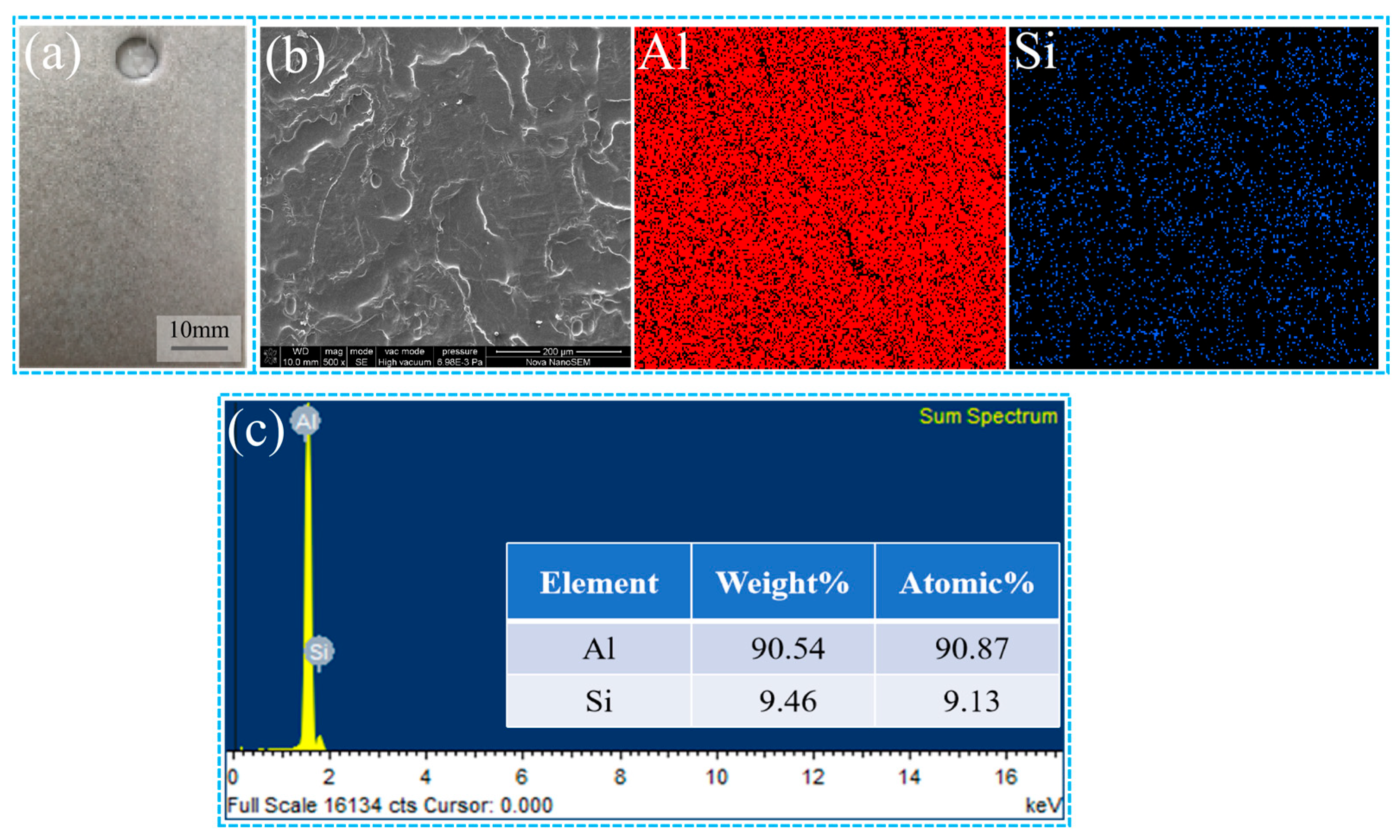
Figure 1 presents the initial macroscopic morphology, microscopic features and elemental distribution of the hot-dip Al-Si coated specimens. Macroscopic observation in Figure 1a shows that the coating surface displays a uniform silvery-white metallic luster. The obtained coating is compact and continuous without obvious color deviation, oxide spots or incomplete coverage. The surface is visually smooth and fine in texture, with no macroscopic defects such as cracks, peeling, flaking, wrinkles or scratches, nor obvious streaks or uneven undulations. Microscopically, the surface consists of a series of tiny peaks and valleys, as illustrated in Figure 1b. The grains exhibit a slightly elongated morphology without obvious coarsening or fracturing, and the coating layer is dense and uniform overall with no observable pores or cracks. EDS elemental analysis indicates that the surface is mainly composed of Al and Si elements, accompanied by trace amounts of Fe and O. Aluminum is distributed relatively uniformly across the surface, while silicon, iron and oxygen appear comparatively concentrated, primarily in the vicinity of grain boundaries. Quantitative composition analysis in Figure 1c indicates that the weight ratio of Al to Si in the original coating is approximately 9.57:1.
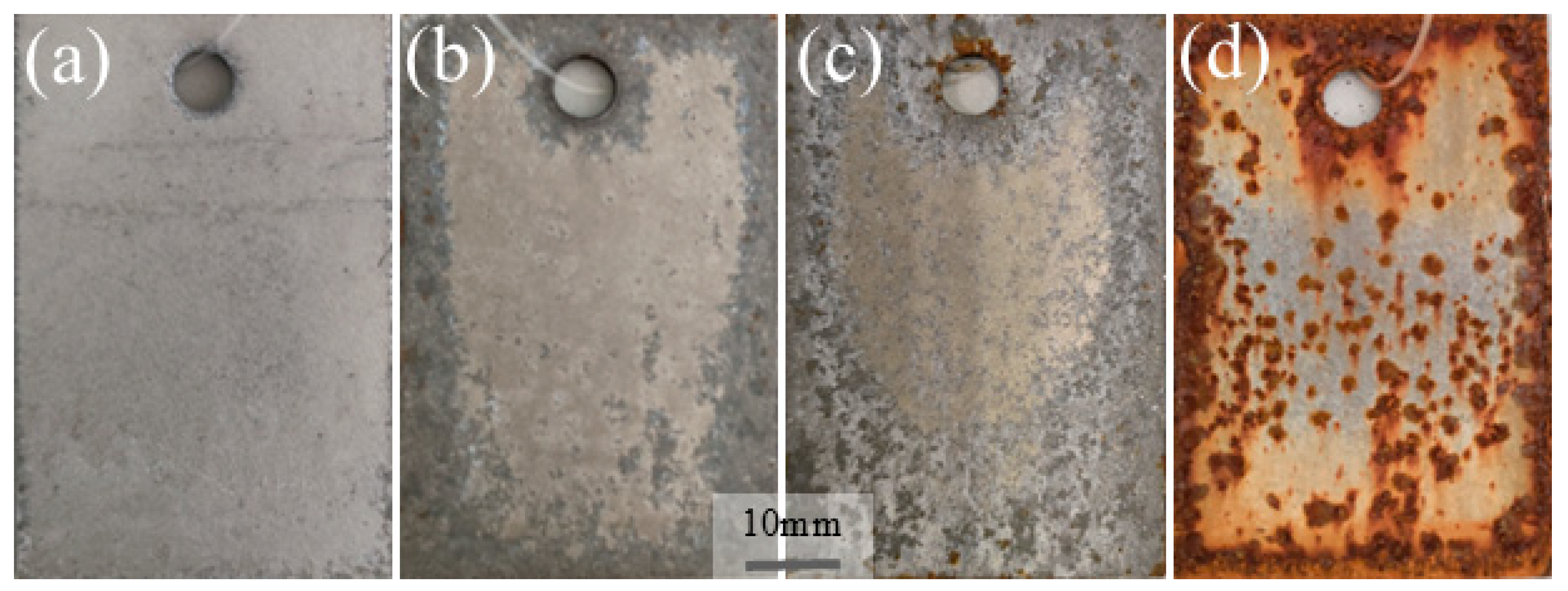
The macroscopic surface morphologies of the Al-Si coated experimental steels subjected to periodic immersion in a 3.5 wt% NaCl solution for varied time intervals are presented in Figure 2. One day of cyclic immersion results in a distinct color change on the coating surface that is visible to the naked eye. The original uniform silvery-white metallic luster fades away, and the coating surface turns pale gray with a significant decrease in surface gloss. Scattered dark gray rust spots emerge the sample surface, with a relatively higher distribution density near specimen edges, but no obvious corrosion defects are detected and the overall surface integrity remains favorable in the absence of peeling or delamination, as observed in Figure 2a. Eight days of exposure lead to the development of pronounced corrosion characteristics across the coating and a complete loss of metallic luster. Approximately 31.71% of the specimen surface has turned dark gray, accompanied by slight surface unevenness, while no obvious coating detachment is observed. Rust spots near the edges expand and merge into grayish-black patches that signify thorough corrosion damage to the coating, accompanied by the generation of brown corrosion products from the steel substrate, as clearly shown in Figure 2b. A further increase in exposure time to 10 days brings about nearly full consumption of the entire coating by corrosion. The surface turns severely rough, with extensive coating blistering and spalling observed. Only small areas in the middle area retain minor remnants of the original dark gray coating, while the remainder of the surface is covered by grayish-black corrosion products with prominent raised rust nodules. Corrosion of the steel substrate initiates at locations where the coating is damaged, and scattered reddish-brown rust spots emerge in localized zones, as illustrated in Figure 2c. Further prolonged corrosion for 20 days leads to complete failure of the coating, exposing the steel substrate directly to the corrosive environment. The entire steel surface is covered by dark red or reddish-brown corrosion products, accounting for approximately 47.6% of the specimen area. The rust layer thickens, loosens and stratifies, which renders the surface extremely rough and even induces flaking of rust scales, as depicted in Figure 2d.

3.2. Micro-Morphology Characterization

3.2.1. Surface Micro-Morphology Characterization

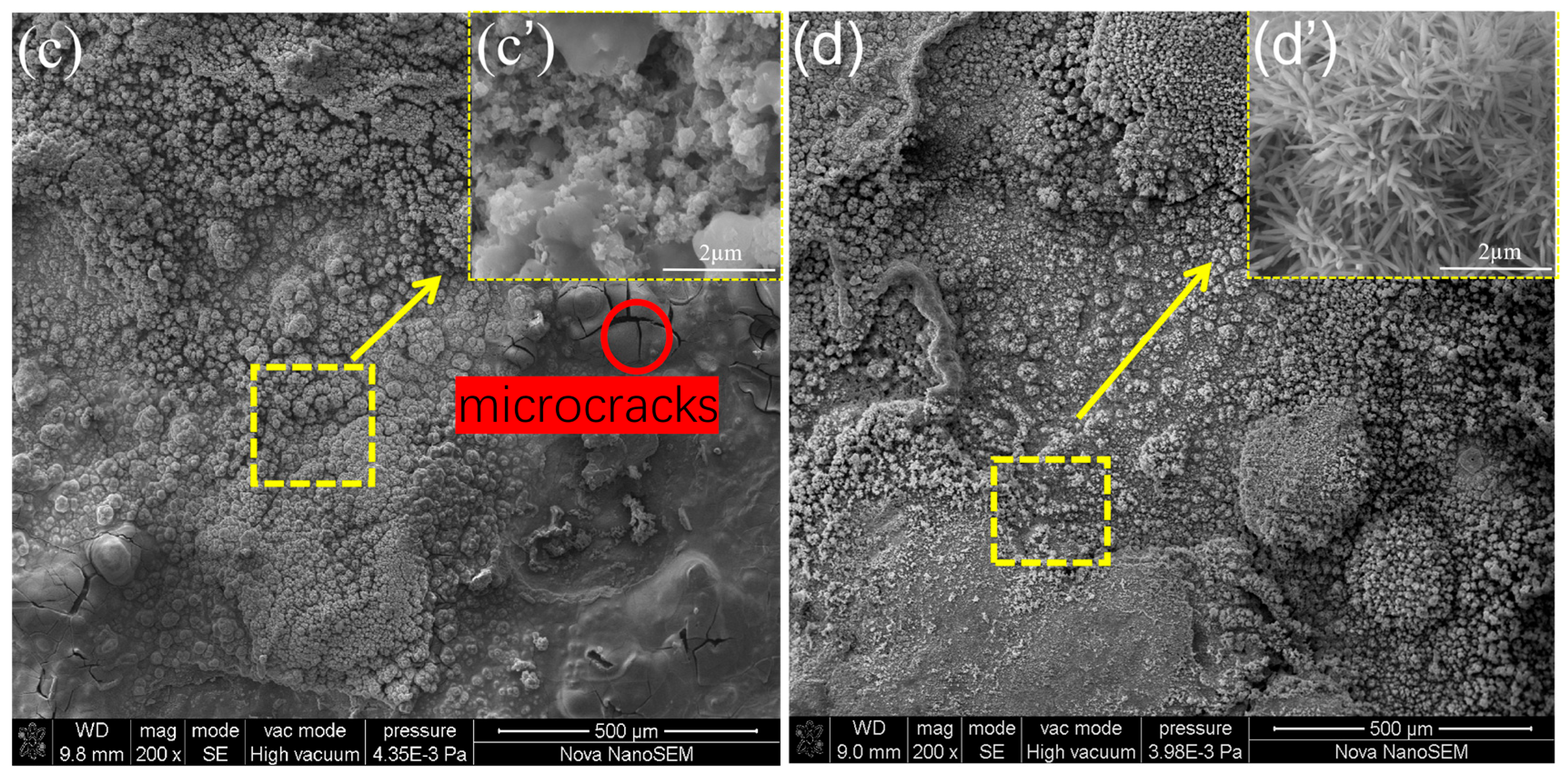
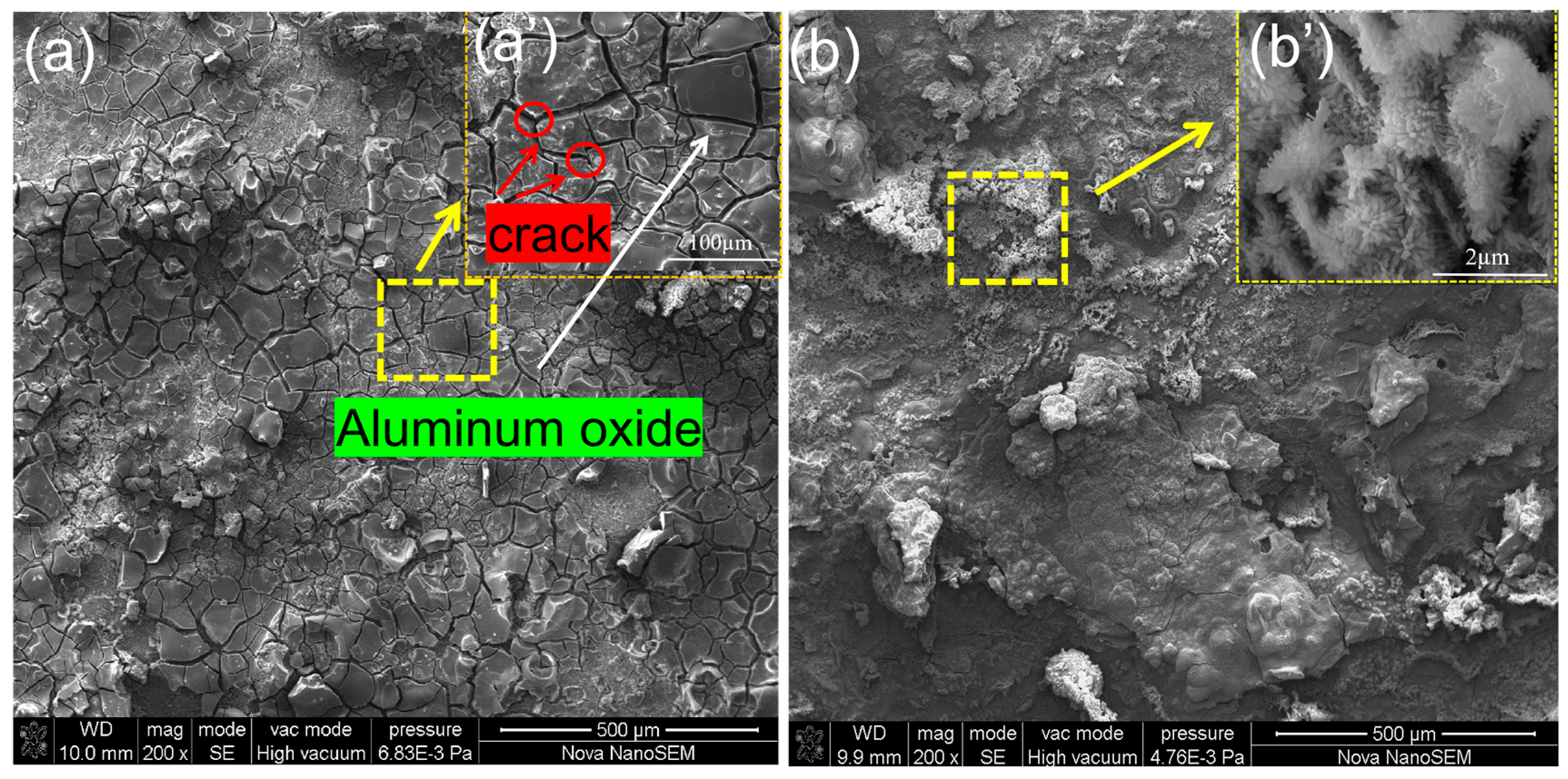
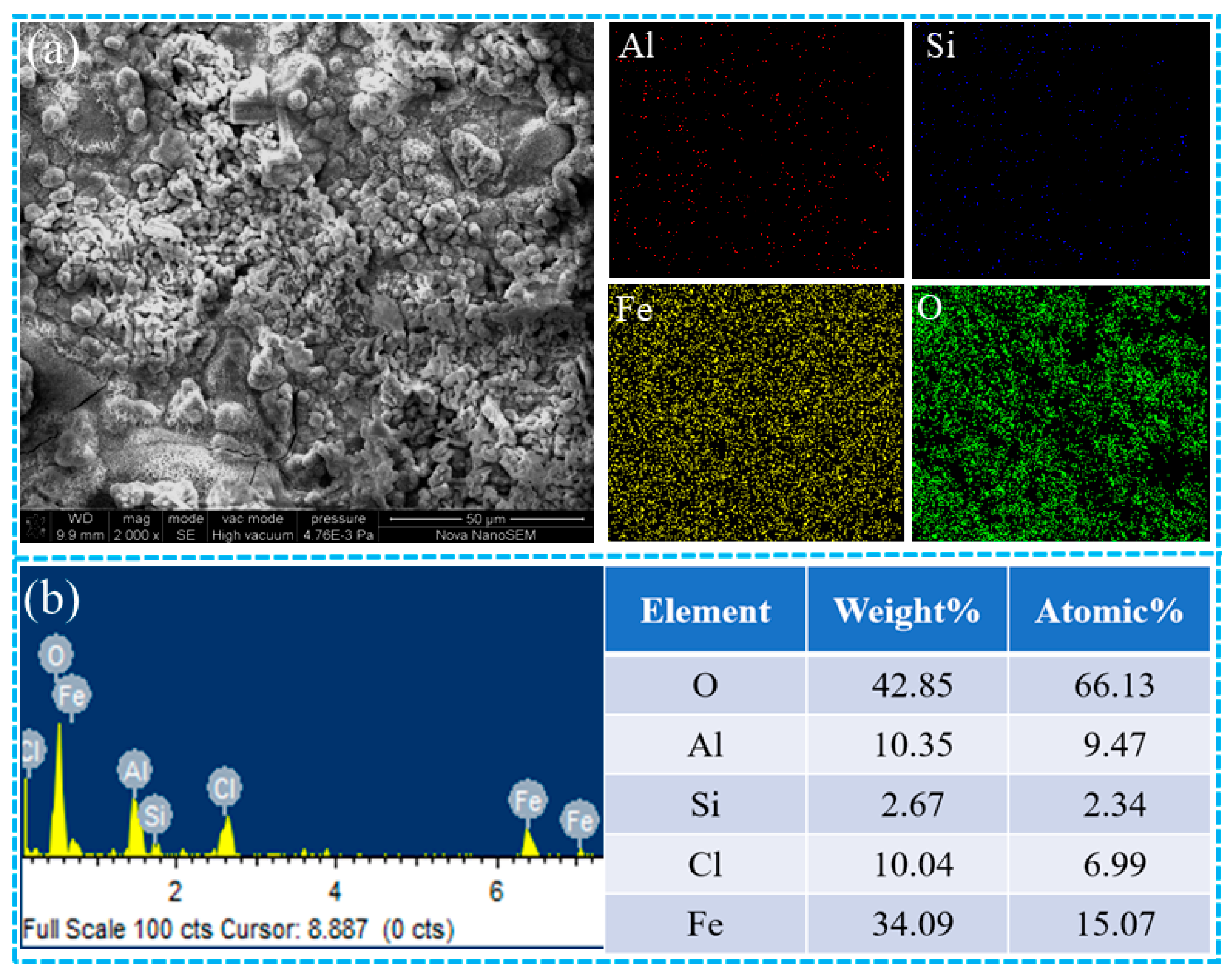
To further observe the micromorphological evolution of corrosion products formed on the samples under cyclic immersion conditions, SEM was employed to characterize the surface corrosion morphology of samples after different corrosion periods, as shown in Figure 3. Significant variations can be identified in the corrosion products formed on the specimen surface over different corrosion cycles. Numerous cracks with a blocky distribution and a width of approximately 7.61 μm appear on the specimen surface after 1 day of corrosion, as illustrated in Figure 3a. Higher magnification demonstrates that these cracks exhibit a typical mud crack network morphology. The loose structure of corrosion products generated from Al-Si coating corrosion leads to volume expansion on the coating surface. Continuous deposition of corrosion products promotes considerable expansive stress, which further induces coating cracking and spalling [19,27]. Cracks formed in the early corrosion stage are covered by newly formed corrosion products after 8 days of exposure, as depicted in Figure 3b. The microstructure exhibits typical features of localized corrosion. Corrosion products display a loose, porous, flocculent or flower-cluster morphology under high magnification in Figure 3b′. The high initial corrosion rate and elevated corrosive ion concentration in the solution facilitate synchronous and isotropic precipitation growth at numerous nucleation sites, which leads to the formation of fractal-like structures. The resulting rust layer exhibits high porosity and provides insufficient barrier protection against the penetration of corrosive media [28]. The EDS spectrum of the specimen after 8 days of corrosion is presented in Figure 4a, which confirms the presence of iron on the surface. This observation verifies the local failure of the coating and the subsequent exposure and electrochemical reaction of the steel substrate in corrosive environments, with iron distributed uniformly across the surface. Figure 4b shows the quantitative elemental chemical composition results obtained at this stage. Relevant test data demonstrate that the surface corrosion products formed on a partial specimen at this stage are mainly iron oxides. The specimen surface is fully covered by granular corrosion products after 10 days of corrosion, as shown in Figure 3c. These corrosion products exhibit a flaky morphology under local magnification in Figure 3c′, which represents the typical structural characteristic of lepidocrocite γ-FeOOH [29]. Crystals preferentially grow along low-energy crystallographic planes during slow phase transformation and crystal growth, which contributes to the formation of flaky structures. Such lamellar assemblies commonly feature high porosity or interlayer gaps thereby exhibiting low compactness at the macroscopic scale. The appearance of a small quantity of macroscopic red rust marks the onset of this stage, which directly reflects the generation and accumulation of iron oxides and indicates the initiation of steel substrate corrosion. The crystalline nature of the flaky products is more pronounced than that of the initially formed amorphous products, yet the protective performance remains relatively poor. These results confirm that corrosive species, including chloride ions, water and oxygen, have penetrated the Al-Si coating and reached the coating/substrate interface, hereby triggering substrate corrosion. A combination of widespread fine granular products and local raised structures is observed on the specimen surface after 20 days of corrosion, as displayed in Figure 3d. Local corrosion products further evolve into an acicular structure. The needle-like morphology shown in Figure 3d′ corresponds to the typical crystalline feature of goethite α-FeOOH. This morphology originates from the significantly faster crystal growth rate along one preferential direction compared with other orientations. The acicular structure exhibits higher regularity, closer interparticle contact and greater stability in comparison with granular structures, thereby offering a certain protective effect for the underlying steel substrate.

3.2.2. Cross-Sectional Micro-Morphology Characterization

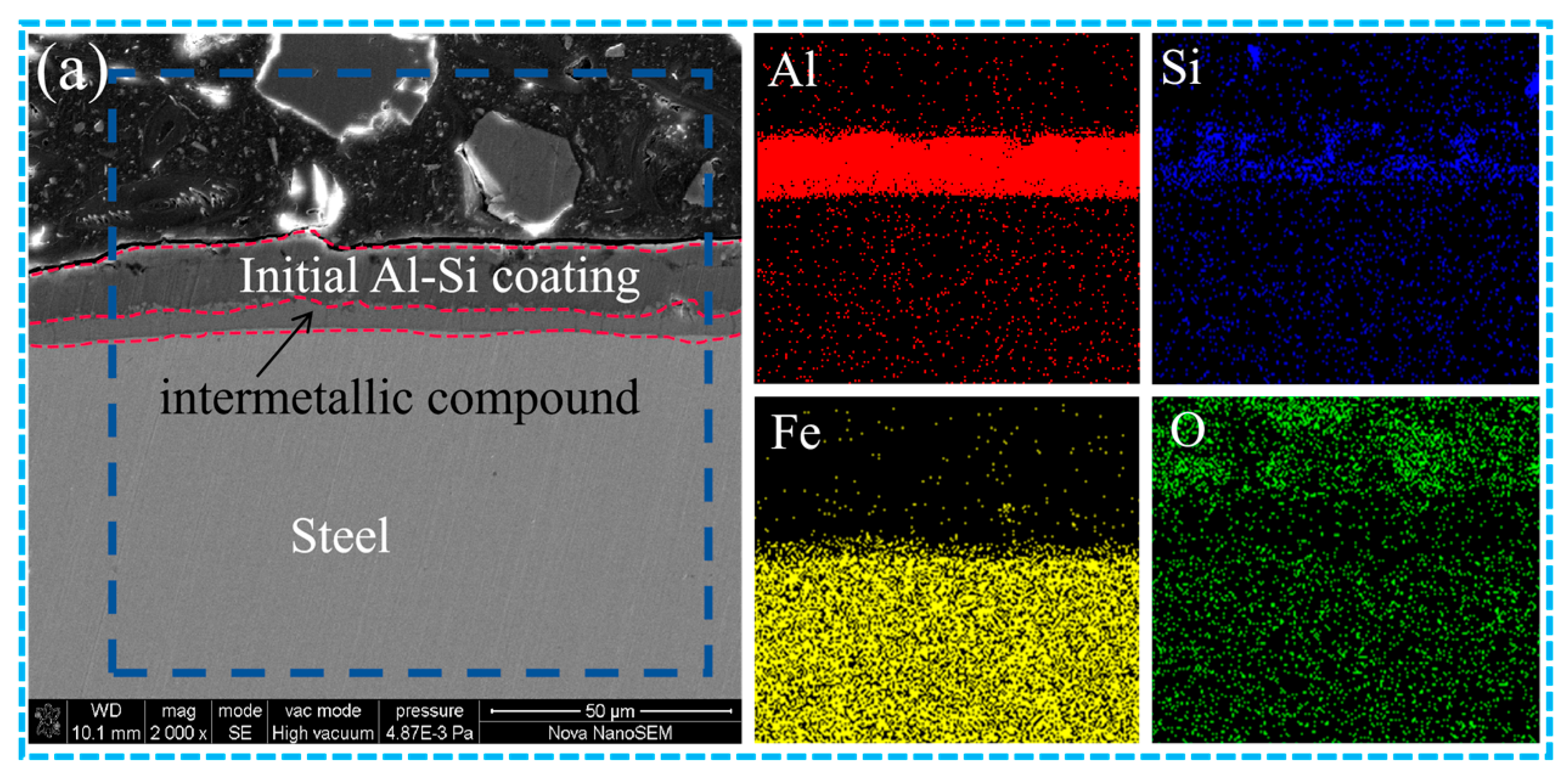
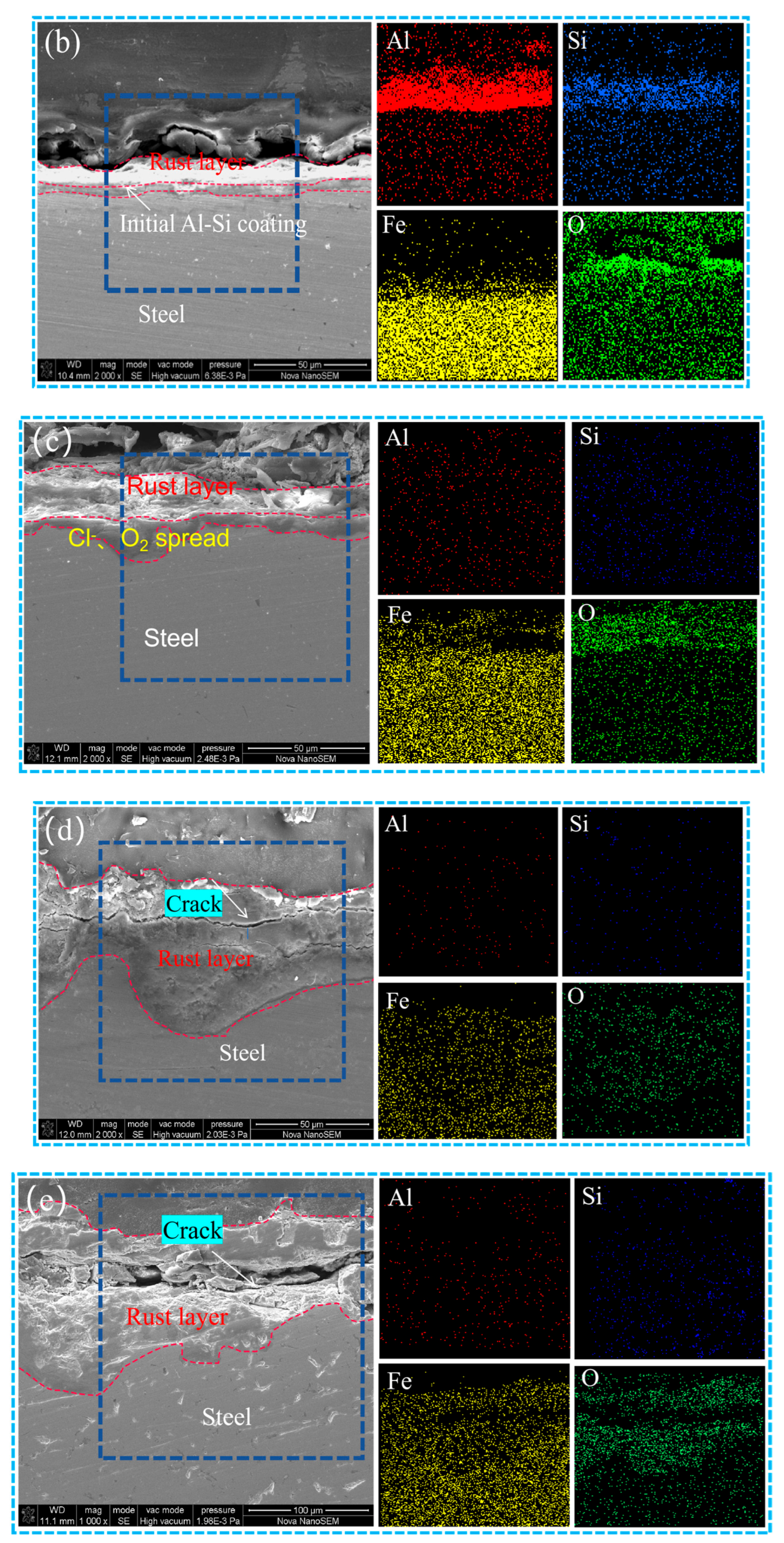
Cross-sectional morphologies and elemental distribution characteristics of the rust layers formed after various corrosion cycles are presented in Figure 5. The left side of each image corresponds to the corrosion morphology, and the right side shows the distribution of elements in the blue box of the corrosion morphology image. Figure 5a shows the original cross-sectional morphology of the specimen, where the coating exhibits a typical bilayer structure: the outer layer consists of a pure Al-Si alloy layer formed by solidification, while the inner layer corresponds to an Fe-Al-Si intermetallic compound layer generated through interdiffusion and reaction between Fe and Al/Si during the hot-dip process. The total thickness of this initial coating measures 14.28 µm. From Figure 5b, EDS analysis after 1 day of corrosion reveals that aluminum and silicon are mainly concentrated in the outer surface layer, which is consistent with the distribution of the original Al-Si coating. Only a small amount of corrosion products form on the specimen surface at this stage, and the Al-Si coating remains intact to provide an effective barrier against corrosive media and protect the underlying substrate. The coating thickness decreased by 8.92 µm to a remaining value of 5.35 µm, whereas the rust layer attained a maximum thickness of 8.93 µm. Iron is mainly distributed in the steel substrate at the bottom, which indicates that no corrosion occurs in the base material. The results obtained after eight days of corrosion are shown in Figure 5c. Local coating failure takes place as a result of continuous consumption, which leads to substrate exposure without the formation of a thick rust layer on the steel surface. The maximum thickness of the rust layer on the coating at this stage measures 21.43 µm. Certain regions on the cross-section appear darker than the iron substrate, which can be attributed to the loose and porous nature of surface corrosion products that allow Cl and O2 to diffuse inward through internal pores, yielding a corrosion penetration depth of 19.43 µm. EDS results demonstrate a remarkable reduction in the characteristic signal intensity of aluminum, which no longer exhibits the obvious aggregation observed after 1 day of corrosion. Oxygen signals appear in the original aluminum-rich zone, confirming that this region has been covered and replaced by corrosion products. As corrosion proceeds for 10 days, the corrosion penetration depth reaches 51.78 µm, and distinct cracks gradually form between the corrosion product layer and the metal substrate, as clearly observed in Figure 5d. The corrosion products beneath these cracks possess a denser structure than those above the cracks, and uneven corrosion pits emerge on the substrate surface. EDS detection shows that the characteristic signals of aluminum and silicon decrease to extremely low levels, and oxygen penetrates deeply into the interior of the substrate. A significant increase in crack width and propagation range can be observed when the corrosion period extends to twenty days, as illustrated in Figure 5e. The crack width at this stage attains 17.85 µm, whereas the corrosion depth increases by 34.23 μm relative to that at 10 days.

3.3. Corrosion Product Analysis

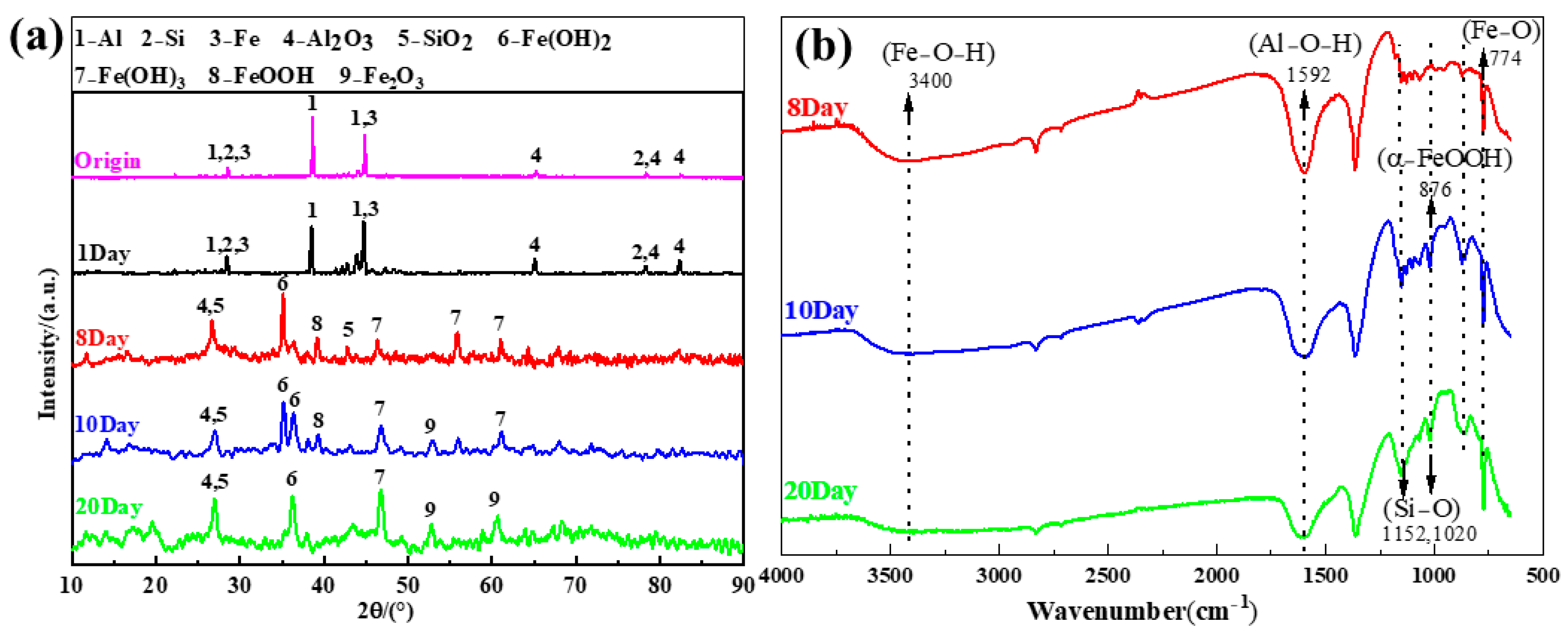
The XRD patterns and FTIR spectra of the hot-dipping Al-Si coating experimental steels after alternating cyclic corrosion for different periods were recorded and are shown in Figure 6. As illustrated in Figure 6a, dominant phases within the pristine specimen are identified as Al, with Si and Fe as secondary components. Trace Al2O3 is also present from the natural oxidation of aluminum. The XRD pattern recorded after 1 day of corrosion is still dominated by the characteristic peak of Al; the characteristic peaks of Al2O3 increase significantly. Al, serving as the primary component of the coating, provides sacrificial anode protection to delay corrosion of the steel substrate [30], whereas the presence of Si impedes continuous anodic dissolution of Al grains [31]. The core function of the Al2O3 phase is to act as a physical barrier that blocks the inward diffusion of Cl, H2O, and O2 toward the coating interior [32]. After 8 days of corrosion, distinct alterations in the surface phases are revealed by XRD analysis. The characteristic diffraction peak of elemental Al vanishes completely, while the mass fraction of Al2O3 increased by 33.1%. Concurrently, several characteristic peaks assigned to iron oxyhydroxides and hydroxides emerge. Upon extending the corrosion duration to 10 days, quantitative XRD phase analysis manifests a remarkable enhancement in the diffraction peaks of iron oxyhydroxides and hydroxides, accompanied by the emergence of the Fe2O3 diffraction peaks, which constitute the primary corrosion product of iron. This signifies that the steel substrate has been exposed to the corrosive medium. Furthermore, sufficient contact between the rust layer surface, air, and corrosive solution promotes the formation of Fe2O3 in the oxygen-rich surface region. Nevertheless, the Al2O3 and SiO2 peaks remain detectable, attributable to the residual coating corrosion products in the intermediate regions of the specimen. After 20 days of corrosion, the characteristic peaks of the corrosion products become relatively concentrated and sharp, which presumably suggests the gradual stabilization of corrosion products. These products mainly correspond to several characteristic peaks originating from the oxidation of the iron substrate, as well as Al and Si in the coating. The presence of SiO2 is attributed to its high chemical stability and water insolubility. As substantial amounts of alumina undergo complexation and dissolution with chloride ions in the corrosive medium and are subsequently removed, SiO2 gradually precipitates and accumulates at the rust layer interface, forming a SiO2-enriched zone [27].
To further clarify the chemical composition of corrosion products, FTIR was employed to characterize the specimens, and the results are presented in Figure 6b. No distinct corrosion products formed on the specimen surface after 1 day of corrosion, which failed to meet the test requirements. Thus, the corresponding spectrum is not presented. It can be observed from the spectra that throughout the corrosion process, a broad and intense absorption peak ascribed to amorphous Fe-O-H stretching appears near 3400 cm−1, indicating the formation of abundant amorphous multiphase iron oxyhydroxides after 8 days of corrosion. Meanwhile, a relatively sharp absorption peak corresponding to crystalline goethite (α-FeOOH) emerges at 876 cm−1, and a sharp, strong peak associated with Fe-O stretching of iron oxides is detected at 774 cm−1. With the extension of corrosion time, the intensity of the amorphous Fe-O-H absorption peak gradually diminishes, whereas those of crystalline goethite and iron oxides increase progressively. Additionally, a relatively sharp and intense Al-O-H absorption peak of aluminum appears at 1592 cm−1, whose intensity gradually decreases with increasing corrosion time. The antisymmetric stretching vibration peak of Si-O-Si is observed at 1152 cm−1, the intensity of which exhibits a gradual increasing trend with prolonged corrosion. This phenomenon may arise from the selective corrosion of the Al-Si coating, in which highly reactive aluminum dissolves preferentially while the chemically stable silicon continuously accumulates on the surface. Once the surface aluminum is nearly depleted, silicon is ultimately oxidized to form SiO2 in the aggressive Cl-containing corrosion environment [33].

3.4. Electrochemical Characterization Analysis

Combined with the EIS variation characteristics obtained from preliminary tests, four typical evolutionary stages, including initial, abrupt, transitional and stable periods, have been identified for the cyclic immersion corrosion of Al-Si coated steel. Key test durations of 1, 8, 10, and 20 days are therefore determined in this work. This sampling strategy effectively eliminates interface interference and redundant data. It also enables a comprehensive description of the staged corrosion evolution with limited testing points.

3.4.1. Polarization Curve Analysis

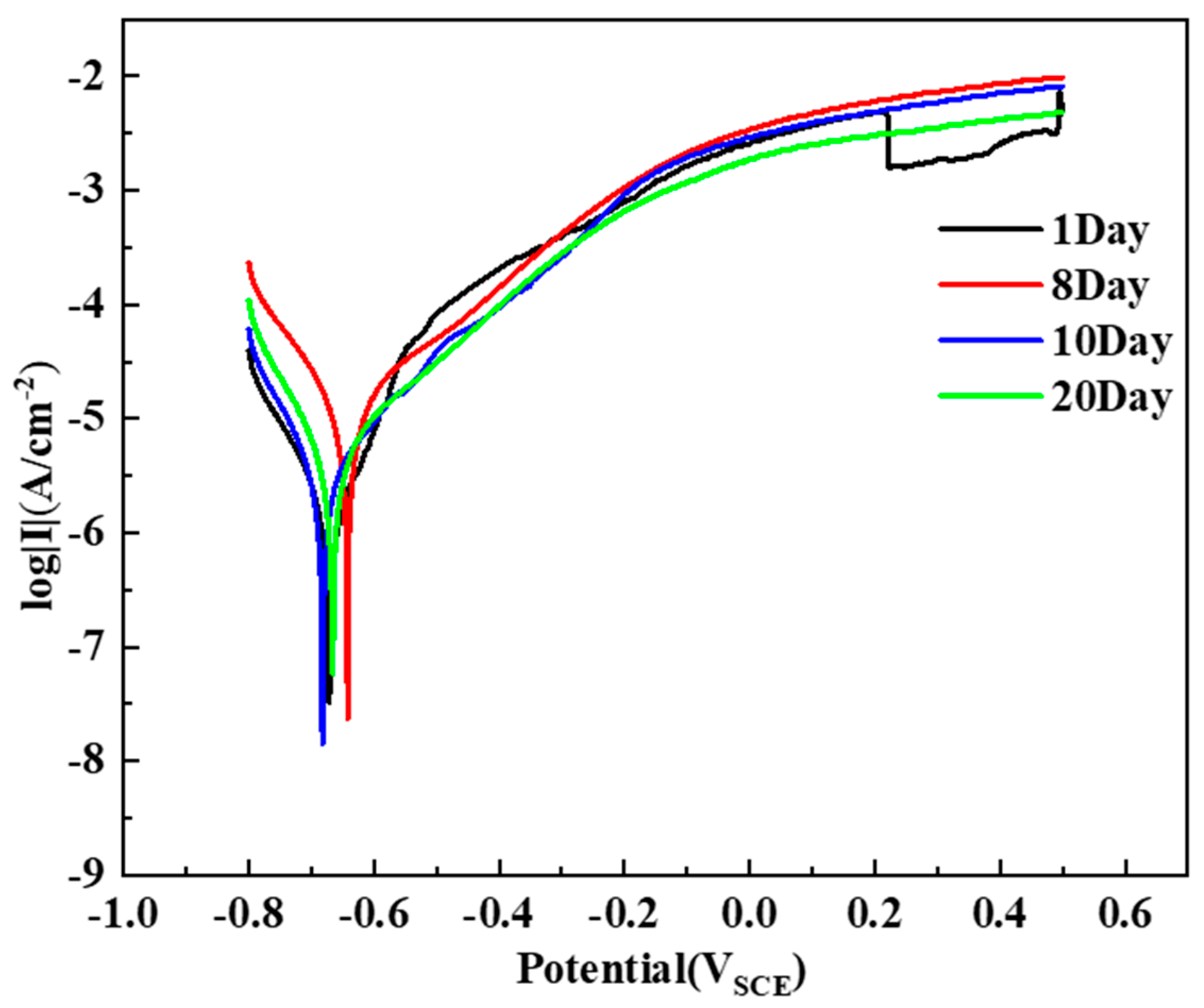
Owing to the harsh service conditions of wet–dry cyclic corrosion, in situ characterization cannot be implemented throughout the experiment. Despite its inability to directly reveal the dynamic evolution of corrosion kinetics, this testing method enables an effective comparison of surface morphology and structural differences among various corrosion stages. The dynamic polarization curves of specimens with different corrosion cycles are presented in Figure 7. A distinct passivation plateau can be observed in the anodic polarization curve of the specimen corroded for one day. This feature indicates the formation of a stable, protective passive film on the Al-Si coating, which effectively restrains anodic dissolution and impedes corrosion reactions. The corrosion current increases with rising corrosion potential as the cyclic immersion period extends to 8, 10 and 20 days. Such a tendency confirms the occurrence of active dissolution on the specimen surface and the loss of protective performance of the surface coating.
The fitting results derived from the polarization curves are summarized in Table 2. While Icorr indicates the corrosion rate and Ecorr reveals thermodynamic tendency, the Tafel slopes (βa, βc) characterize the reaction mechanisms and the resistance of the interfacial kinetics. The corrosion current density reaches a minimum value of 1.772 µA/cm2 after 1 day of cyclic immersion, indicating a mild corrosion degree of the material. As the cyclic immersion time was prolonged to 8 days, Icorr increased sharply to 13.25 µA/cm2, reaching the maximum value, with a distinct enhancement in corrosion activity. The corrosion current density drops sharply to 3.046 µA/cm2 after 10 days of corrosion and rises slightly to 4.443 µA/cm2 at the 20 day stage. The overall corrosion rate presents a trend of initial increase, subsequent decrease and minor fluctuation in the later stage. The dynamic variation in Icorr is closely related to the surface condition of specimens, and long-term corrosion continuously changes the surface covering state, thereby causing obvious fluctuations in the corrosion rate. In corresponding trends, the anodic Tafel slope βa declines first and then rises slightly, while the cathodic Tafel slope βc decreases initially before increasing and eventually reaching a stable state. Strong correlations can be observed between the variations in these two parameters and the evolution of Icorr throughout the corrosion process.
The Ecorr value suggests a greater corrosion susceptibility. Within 1 to 8 days, Ecorr shifts positively from around −671 mV to −642 mV. The initial aluminum-related reaction brings a high corrosion tendency, and the generated protective surface layer weakens the corrosion susceptibility and promotes the positive movement of corrosion potential [34]. From 8 to 10 days, Ecorr shifts negatively and reaches the most negative value throughout the whole corrosion process, representing the strongest corrosion tendency at this stage. This evolution indicates the highest corrosion susceptibility during this stage. Prolonged corrosion causes severe damage and extensive dissolution of the coating, which triggers the onset of substrate corrosion and generates numerous active corrosion sites on the surface. The accumulation of these active sites drives the overall potential of the specimen toward more negative values. During the period of 10 to 20 days, Ecorr moves positively to −666 mV, which is closely associated with the protective rust layer formed by surface corrosion products and the resultant reduction in corrosion tendency.

3.4.2. Electrochemical Impedance Spectroscopy Analysis

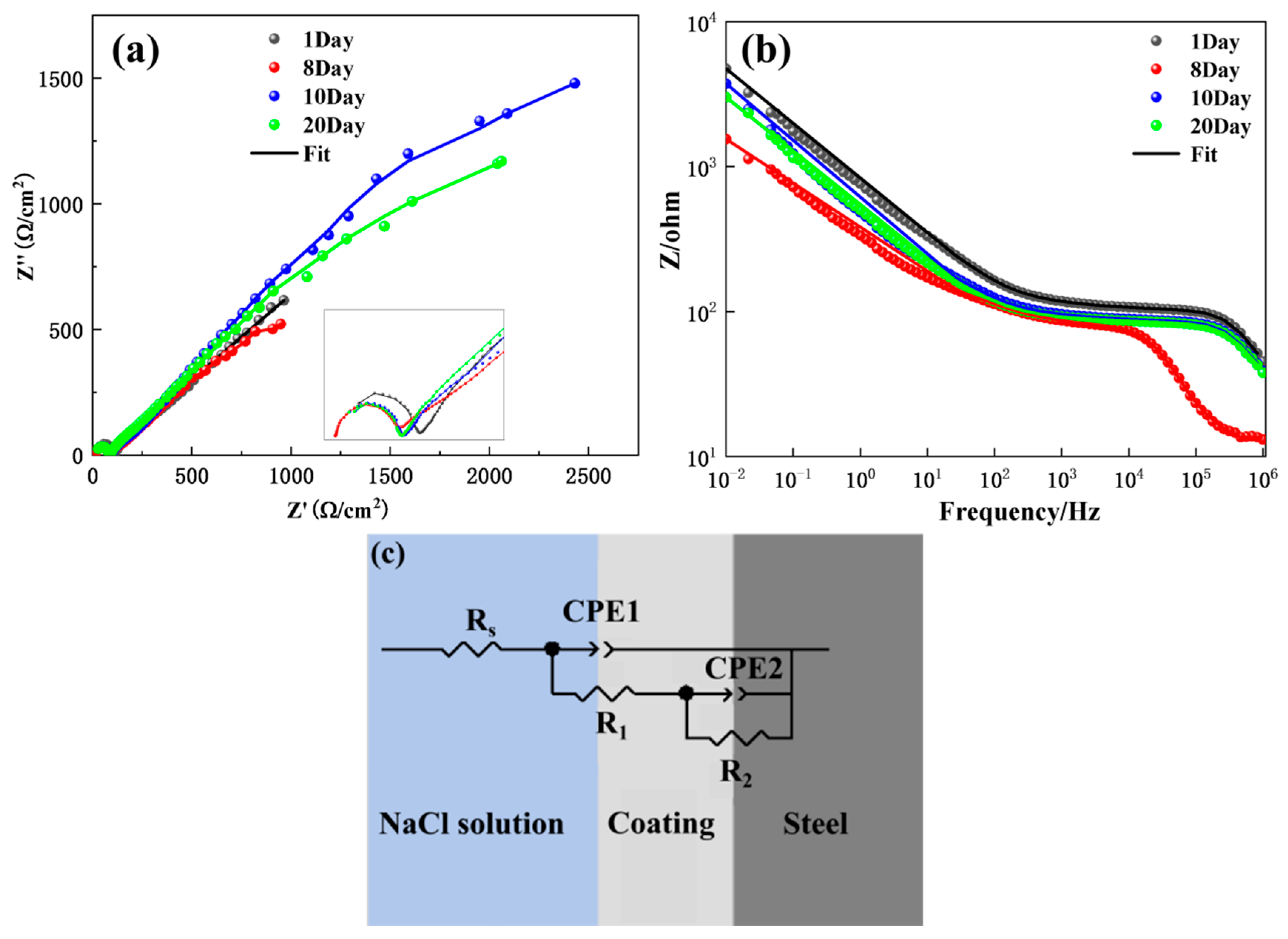
The Nyquist and Bode plots for the specimens after different corrosion cycles are presented in Figure 8a and Figure 8b, respectively. Two capacitive arcs can be identified in all Nyquist plots. The high-frequency arc corresponds to the interfacial characteristics between the coating and the corrosive solution, while the low-frequency arc reflects the features of the coating–substrate interface and the interaction between corrosive ions and internal interfaces. The radius of the capacitive arc reaches its maximum value after 1 day of corrosion, which suggests that a compact and intact oxide film has formed on the Al-Si coating surface and provides excellent protection for the substrate. A remarkable reduction in the capacitive arc radius occurs at the 8 days stage, indicating severe degradation and local breakdown of the passive film under chloride ion attack. Such degradation leads to a sharp decline in protective performance and allows corrosive media to react with the steel substrate. The capacitive arc radius recovers slightly and tends to stabilize as corrosion proceeds to 10 and 20 days. This phenomenon implies that corrosion products continuously deposit at the defective sites of the coating layer, establishing a dynamic retardation equilibrium and driving the corrosion system into a relatively stable stage. The variation in low-frequency impedance modulus in Bode plots is highly consistent with the evolution of capacitive arc radii in the Nyquist plots. The maximum low-frequency impedance is observed at 1 day, followed by an obvious decrease at 8 days and a gradual recovery with stable maintenance from 10 to 20 days. Impedance curves in the high-frequency region almost overlap for all specimens. The phase angle plateau in the medium-frequency range decreases first and then rises with increasing corrosion time.
Figure 8c presents the equivalent circuit adopted for spectrum fitting. Electrochemical impedance spectra obtained at different corrosion stages were analyzed by Zview software, and all relevant fitting parameters are summarized in Table 3. The circuit can be expressed as Rs(CPE1(R1(CPE2R2))), in which Rs represents the solution resistance, R1 corresponds to the resistance of the outer barrier layer, which represents the resistance of the Al-Si coating during the intact stage and transforms into the resistance of the corrosion product film after coating breakdown. CPE1 is associated with the capacitive behavior of the outer barrier layer, acting as the coating capacitance in the intact stage and as the corrosion product film capacitance in the rusting stage. R2 denotes the charge-transfer resistance at the steel substrate interface, reflecting the kinetic characteristics of the substrate corrosion reaction, whereas CPE2 represents the double-layer capacitance at the interface between the steel substrate and the solution. A unified equivalent circuit is valid for the entire corrosion process. Stable dual interfacial structures, including the solution, outer layer and steel substrate, can be well maintained on the specimen without fundamental structural variation. Only the outer dense Al-Si coating gradually transforms into a corrosion product layer over the corrosion duration. Low chi-squared values are acquired after impedance fitting, and the relative error of all relevant parameters is controlled within 10%. Consistency between experimental and simulated results remains satisfactory, which further confirms the excellent fitting performance of the proposed equivalent circuit.
Table 3 shows that Rs maintains a relatively stable value ranging from 10 to 20 Ω throughout the test in 3.5 wt% NaCl solution. This result suggests no significant variation in electrolyte concentration or conductivity, which confirms the stability of the corrosive environment. The p value of CPE1 is close to unity, which indicates that the interface between the solution and the passive film approximates ideal capacitive behavior with uniform charge distribution and weak interfacial dispersion effects. R1 exhibits a declining trend with prolonged corrosion duration, which demonstrates degradation of the coating during corrosion and the consequent deterioration of protective performance. The p value of CPE2 is approximately 0.6, which implies strong dispersion effects at the interface between the passive film and the metallic substrate. This feature reflects a rough, porous or compositionally inhomogeneous interfacial structure. Meanwhile, the n value of CPE2 is notably higher than that of CPE1, which suggests an enlarged effective double-layer capacitance at the inner interface and indirectly verifies the enhanced electrochemical activity caused by coating damage. R2 exhibits a nonmonotonic trend characterized by a pronounced initial decrease followed by a gradual recovery, with values changing from 652.4 to 156.6, then to 323.5, and finally to 424 Ω·cm2. Underlying this variation is the combined effect of coating damage and localized galvanic corrosion at the early stage, which causes a sharp drop in the charge-transfer resistance. Subsequently, the progressive accumulation of corrosion products gradually restores the barrier to charge transfer.

4. Discussion

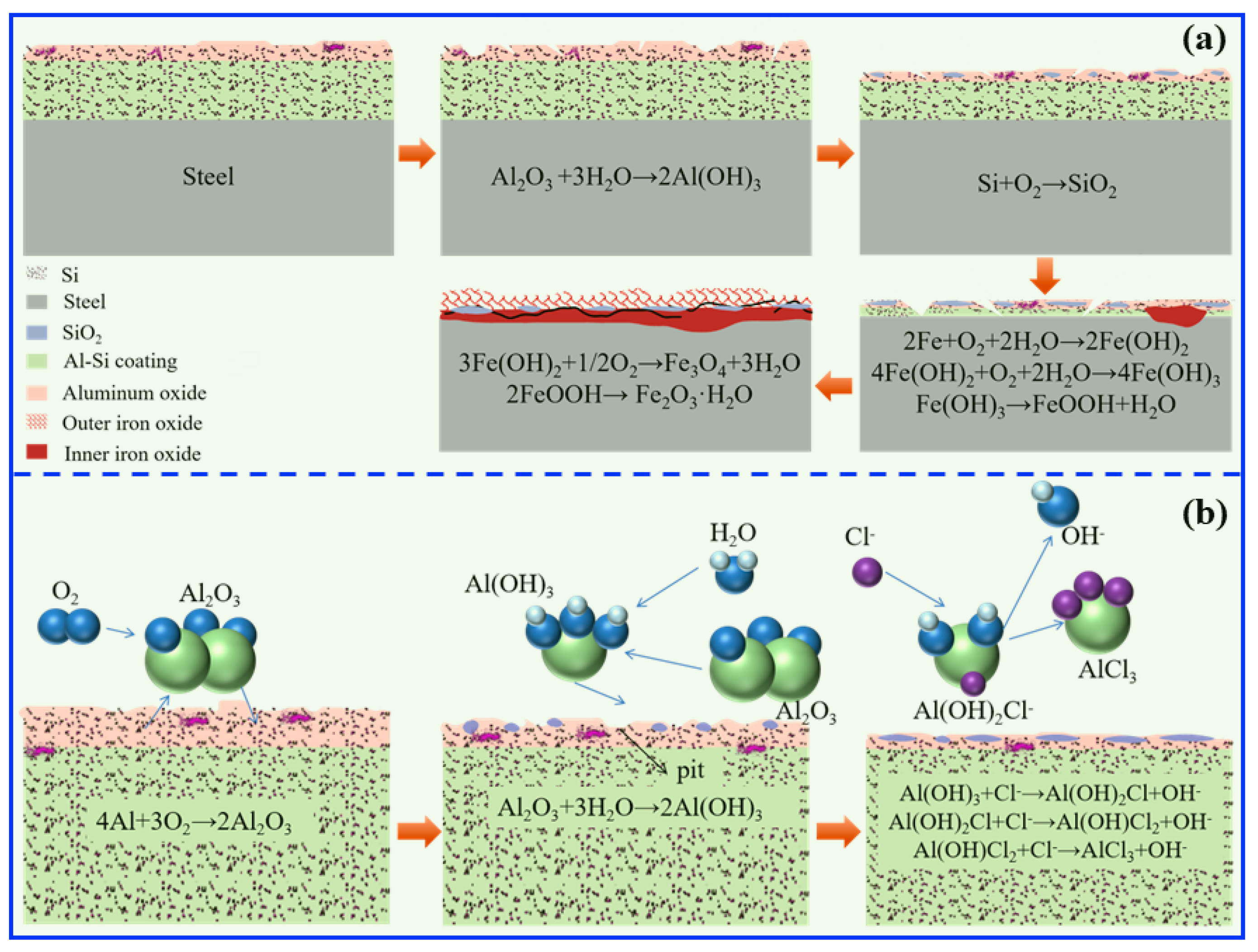
When exposed to dry–wet cyclic immersion in 3.5 wt% NaCl solution, Al-Si coated steel exhibits a distinct stepwise evolution during the overall corrosion process. The complete corrosion pathway proceeds sequentially through passive film formation, film breakdown and dissolution, compositional evolution, substrate corrosion, and subsequent corrosion stabilization. Each stage is accompanied by well-defined electrochemical reactions, phase transformations, and microstructural variations. The entire evolution and its underlying mechanism are clearly illustrated in Figure 9 and the relevant characterization results, and are further fully corroborated by the XRD patterns and FTIR spectra presented in Figure 6, as well as the electrochemical impedance spectroscopy measurements shown in Figure 8.
The silicon content in the Al-Si coating is 10 wt%. In the as-received state, silicon is primarily dissolved and dispersed within the aluminum lattice in the forms of solid solution, eutectic silicon, or free silicon [35]. At the initial corrosion stage, aluminum, whose electrode potential is considerably lower than that of silicon, preferentially undergoes oxidation reactions with oxygen and water molecules in the environment. A continuous and dense aluminum oxide passive film is rapidly formed in situ, with the dominant electrochemical reaction being Al → Al3+ + 3e. Silicon, acting as the cathodic phase, remains stable at its original position, a characteristic that lays the foundation for the subsequent enrichment of silicon-rich phases [36]. This initial passive film effectively blocks the invasion of corrosive ions and external media, and delivers preliminary protection to the coating and internal steel substrate. This passive system fails to maintain long-term stability under wet–dry cyclic conditions, which becomes the key reason for coating failure. The passive film undergoes repeated expansion and contraction with ambient humidity variation, and continuous accumulation of the resulting internal stress gradually induces film cracking, which eventually forms a typical mud cracked structure [37], consistent with the microstructural characterization results shown in Figure 9a and Figure 4a. These cracks serve as the initial pathways for corrosive media to invade, thus destroying the initial passive protection system of the coating. Simultaneously, chloride ions with strong permeability continuously permeate along passive film cracks and may undergo complexation reactions with aluminum oxide to form soluble Al-Cl complexes [38]. This process directly compromises the structural integrity of the aluminum oxide passive film, accelerates its dissolution, and further promotes the continuous release of Al3+. During this process, aluminum hydroxide, the corrosion product of aluminum, can hardly adhere stably to the coating surface and is prone to damage or secondary dissolution, failing to form a dense protective layer [39], as demonstrated in Figure 9b and Figure 5.
As the aluminum component is continuously dissolved and consumed, silicon particles originally dispersed within the coating are gradually exposed and continuously enriched at the coating surface and interface, eventually forming a porous silicon-rich residual layer that prevents prolonged physical coverage by dense aluminum oxides [40]. Once the aluminum in the surface layer of the coating is nearly depleted, the enriched elemental silicon is directly exposed to the electrolyte film containing dissolved oxygen. Under the mild conditions of the cyclic immersion environment, elemental silicon undergoes slow chemical or electrochemical oxidation, with the primary reaction being Si + O2 + 2H2O → SiO2·2H2O. Given that the reaction occurs in a near-neutral NaCl solution, the oxidation process is far less vigorous than that in a high-temperature pure oxygen atmosphere, favoring the formation of amorphous hydrated silica (SiO2·nH2O) that deposits at the rust/coating and rust/substrate interfaces [41], as evidenced by the characterization results in Figure 9a and Figure 6. With further progression of corrosion, the steel substrate beneath the coating is gradually exposed, and galvanic corrosion may initiate at the coating–substrate interface. Under these circumstances, the oxygen reduction reaction proceeds within the system: O2 + 2H2O + 4e → 4OH [42]. Concurrently, the dissolved Al3+ undergoes hydrolysis: Al3+ + 3H2O → Al(OH)3 + 3H+. Water evaporation during dry–wet cycles induces local acidification and subsequently might decrease in pH [43]. The solubility of amorphous silica in a slightly acidic environment exceeds that in pure water, leading to partial dissolution of the silicon-rich layer, which may dissolve slightly into soluble silicic acid (H4SiO4 or H2SiO3) [44,45]. Upon subsequent rewetting of the environment or fluctuations in pH, the soluble silicic acid may undergo polycondensation and reprecipitates into a more stable silica gel network [46].
Following continuous inward penetration of Cl through-thickness cracks and coating defects, direct contact and subsequent attack of the steel substrate are initiated, which subsequently induces electrochemical corrosion of the iron matrix. The iron substrate is gradually oxidized and dissolved to form a series of iron-based oxyhydroxides and oxides, following the sequence Fe → Fe2+ → Fe(OH)2 → Fe(OH)3 → γ-FeOOH → α-FeOOH → Fe3O4 → Fe2O3. With continuous accumulation and stratification of corrosion products, a dual-layered rust structure is ultimately formed, consisting of a loose and porous outer layer and a compact inner layer, as presented in Figure 5d. In the later corrosion stage, silica deposited at the interface, residual aluminum oxides, and iron oxides become intimately mixed, giving rise to a composite layer with both semiconducting characteristics and high chemical stability. This porous yet insulating silicon-oxygen network, together with the compact inner rust layer, acts as a synergistic physical barrier that substantially impedes the transport and diffusion of corrosive ions, thereby markedly reducing the penetration rate of chloride ions toward the substrate interface [47,48]. Although the composite protective layer cannot completely arrest the corrosion process owing to its porous structure and microcracks, it effectively restrains the corrosion reaction rate and drives the corrosion process from the accelerated intermediate stage into an extremely slow and stable corrosion-inhibition plateau. Such a behavior demonstrates a distinct corrosion self-inhibition effect, which is supported by the electrochemical impedance spectroscopy results in Figure 8 and the experimental data listed in Table 2. Moreover, the stably formed silica phase is hardly consumed during the subsequent corrosion evolution, which constitutes the primary reason for the clear detection of this phase in the later characterizations.
In summary, initial protection of the Al-Si coating originates from the dense Al2O3 passive film, which blocks the penetration of corrosive media. Increases in film thickness together with dry–wet alternating environments induce the generation of cracks within the passive film. Chloride ions further penetrate through these cracks and establish a corrosion system with large cathode and small anode characteristics, thereby accelerating the dissolution of aluminum inside the coating. Subsequent deposition of silicon and formation of stable rust products gradually reduce the overall corrosion rate.

5. Conclusions

Under the experimental conditions employed in this work, the corrosion evolution of Al-Si coated steel in a 3.5 wt% NaCl solution under cyclic wet–dry immersion was systematically investigated via macroscopic morphology observation, microstructural characterization, phase analysis, and electrochemical measurements. The failure mechanism of the coating, the evolution behavior of corrosion products, and the dynamic variations in electrochemical performance were identified and elucidated. The main conclusions drawn are as follows:
(1)
The corrosion evolution of the experimental steel exposed to a 3.5% NaCl wet–dry cyclic environment exhibited distinctly phased characteristics, which could be categorized into three main stages: the intact coating protection stage, the rapid film breakdown stage, and the dynamic equilibrium stage of corrosion products. At the early corrosion stage (1 day), the coating remained intact, and the dense Al2O3 passive film formed on its surface provided an effective physical barrier, with a corrosion current density as low as 1.77 µA/cm2 and a charge-transfer resistance as high as 652 Ω·cm2, indicating a low corrosion rate and excellent protective performance. During the middle stage (8 days), chloride ions rapidly penetrated along micro-defects in the coating and cracks in the passive film, inducing localized galvanic corrosion that led to partial failure of the coating; the corrosion current density therefore surged to 13.25 µA/cm2, while the charge-transfer resistance dropped to 156.6 Ω·cm2. In the later stage (10–20 days), the underlying iron became exposed and generated stable rust layers consisting of α-FeOOH and Fe2O3, accompanied by the formation of a silica gel network from the silicon-enriched layer; as a result, the charge-transfer resistance recovered from 156.6 Ω·cm2 to 424 Ω·cm2, marking the transition of corrosion into a slow, stable phase.
(2)
Significant phase evolution and morphological iteration of the corrosion products on the experimental steel were observed over the corrosion time. At the early stage, elemental Al and a small amount of Al2O3 were mainly present, with no detectable iron-based corrosion products. During the middle stage, the coating began to fail, and amorphous iron oxyhydroxides along with lepidocrocite (γ-FeOOH) were successively generated; the rust layer exhibited a loose, porous, flocculent structure, reflecting poor protective capability. In the later stage, the corrosion products gradually transformed into stable crystalline phases such as goethite (α-FeOOH) and Fe2O3, accompanied by a marked increase in crystallinity. Concurrently, the characteristic Al-O-H peak attenuated, whereas the Si-O-Si vibrational peak intensified continuously.
(3)
The failure critical point of the experimental steel was observed at approximately 8 to 10 days of wet–dry cyclic corrosion, manifested primarily by the complete disappearance of the characteristic Al diffraction peak, localized coating damage, and the first appearance of corrosion products derived from the underlying iron. Internal stresses induced by the wet–dry cycling caused a mud cracking structure within the coating corrosion products, thereby providing diffusion pathways for Cl. More electrochemically active than the Si phase, the Al phase preferentially underwent sacrificial anodic dissolution, which accelerated film breakdown. After aluminum was consumed by corrosion, the inert Si component became enriched at the surface and interface and gradually oxidized to form SiO2. This silicon-rich layer subsequently intermixed with iron-based oxyhydroxides generated during the later stage, yielding a dense and chemically stable composite physical barrier that significantly impeded further Cl diffusion toward the substrate.

Author Contributions

Conceptualization, W.L., H.P. and X.S.; methodology, C.L., W.L., H.W. (Hailian Wei), H.G. and Y.Z.; formal analysis, C.L., W.L., H.P. and X.S.; visualization, H.W. (Hailian Wei), Y.Z. and H.W. (Huiting Wang); validation and supervision, W.L., H.P. and X.S.; writing—original draft, C.L. and Y.Z.; writing—review and editing, W.L., H.P. and X.S.; investigation, C.L., H.G., L.C. and Y.X.; data curation, C.L., H.W. (Hailian Wei), Y.Z., H.W. (Huiting Wang) and Y.L.; resources, L.C., H.P., Y.L. and Y.X.; project administration, H.G., L.C., Y.L. and Y.X.; funding acquisition, H.W. (Hailian Wei), H.G., H.P. and Y.L.; software, W.L., H.W. (Huiting Wang) and Y.Z. All authors have read and agreed to the published version of the manuscript.

Funding

This study was financially supported by the National Natural Science Foundation of China (Grant No. U1860105, 52404334), the Major Project of Natural Science Foundation for Anhui Provincial Education Department (2024AH040025), and the Key Research and Development Plan Project of Anhui Province (202304a05020026).

Institutional Review Board Statement

Not applicable.

Informed Consent Statement

Not applicable.

Data Availability Statement

The original contributions presented in this study are included in the article. Further inquiries can be directed to the corresponding author.

Conflicts of Interest

The authors declare no conflicts of interest. Authors Hairong Gu, Lei Cui, Yonggang Liu and Yangyang Xiao were employed by Technical Center, Maanshan Iron & Steel Co., Ltd., Ma’anshan, China during the conduct of this study. The funders had no role in the design of the study, the collection, analysis, or interpretation of data, the writing of the manuscript, or the decision to publish the results.

References

  1. Deng, Y.; Qin, F.; Zhao, Y.; Yu, J.; Wei, X.; Wei, F. Research on the high-temperature oxidation properties of high-Mn and low-Ni austenitic stainless steel containing an aluminizing layer. J. Mater. Res. Technol. 2024, 33, 8746–8757. [Google Scholar] [CrossRef]
  2. De Graeve, I.; Schoukens, I.; Lanzutti, A.; Andreatta, F.; Alvarez-Pamliega, A.; Strycker, J.; Fedrizzi, L.; Terryn, H. Mechanism of corrosion protection of hot-dip aluminium-silicon coatings on steel studied by electrochemical depth profiling. Corros. Sci. 2013, 76, 325–336. [Google Scholar] [CrossRef]
  3. Park, G.; Yang, J.; Lee, K.; Kim, H.; Lee, S.; Kang, J.; Yun, Y.; Lee, M. Ultra-high corrosion resistance of Al-Mg-Si film on steel sheet formed by PVD Mg coating and heat treatment. Corros. Sci. 2021, 192, 109829. [Google Scholar] [CrossRef]
  4. Na, Y.; Pradhan, S.K.; Park, J.; Oh, M. Corrosion behavior of Zn, Zn-Mg-Al, and Al-Si alloy coated steel sheet in a simulated marine environment. J. Adv. Mar. Eng. Technol. 2024, 48, 302–309. [Google Scholar] [CrossRef]
  5. Zhou, S.; Ye, S.; Deng, L.; Deng, Z.; Lu, Q.; Zheng, X. Coating Structure Transformation Law of Al-Si Coating with Different Coating Weight during Heating. Heat Treat. Met. 2022, 47, 238–245. [Google Scholar] [CrossRef]
  6. Wu, S.; Bardelcik, A.; Chiriac, C.; Elsayed, A.; Shi, C. The effect of heating rate and coating weight on the intermetallic growth of AlSi coated hot stamping steel. Surf. Coat. Technol. 2023, 471, 129913. [Google Scholar] [CrossRef]
  7. Chen, L.; Chen, W.; Cao, M.; Li, X. Performance Comparison of Zn-Based and Al-Si Based Coating on Boron Steel in Hot Stamping. Materials 2021, 14, 7043. [Google Scholar] [CrossRef] [PubMed]
  8. Lee, J.; Song, J.; Bae, G. Study on Surface Quality Analysis of an Uncoated Boron Steel and Its Oxide Layer Suppression Method for Hot Stamping. Materials 2024, 17, 5563. [Google Scholar] [CrossRef]
  9. Yoon, S.C.; Kong, J.Y.; Park, J.M.; Park, K.J.; Hyun, J.S. Analysis of characteristic prediction of aluminized boron steel after the hot stamping process using an image color-based neural network. Int. J. Adv. Manuf. Technol. 2024, 130, 239–251. [Google Scholar] [CrossRef]
  10. Zaman, S.B.; Hazrati, J.; de Rooij, M.; van den Boogaard, T. Cracking Behavior of Coating during Hot Tensile Tests of AlSi-Coated Press Hardening Steel. Procedia Manuf. 2020, 47, 602–607. [Google Scholar] [CrossRef]
  11. Wang, Z.; Cao, Z.H.; Wang, J.F.; Huang, M.X. Improving the bending toughness of Al-Si coated press-hardened steel by tailoring coating thickness. Scr. Mater. 2021, 192, 19–25. [Google Scholar] [CrossRef]
  12. Chen, R.; Zhang, C.; Lou, M.; Li, Y.; Carlson, B.E. Effect of Al-Si Coating on Weldability of Press-Hardened Steels. J. Mater. Eng. Perform. 2020, 29, 626–636. [Google Scholar] [CrossRef]
  13. Paćko, M.; Krawczyk, J.; Śleboda, T.; Rumiński, M.; Lypchanskyi, O.; Tokarski, T.; Piasecki, P. State of Strain and development of microStructure of 22mnB5 Steel and Al-Si coating during deep drawing of automotive B pillar. Arch. Metall. Mater. 2021, 66, 601–608. [Google Scholar] [CrossRef]
  14. Chen, J.; Liu, Y.; Zhou, Z.; Cao, W.; Qi, X.; Li, E.; Xu, M.; Qi, X. Mechanical Properties and Anti-Corrosion Properties of Thin Aluminum-Silicon Coated 2000 MPa Press Hardening Steel. In Proceedings of the 7th International Conference on Advanced High Strength Steel and Press Hardening (ICHSU 2024); Atlantis Press: Dordrecht, The Netherlands, 2024. [Google Scholar] [CrossRef]
  15. Ge, C.; Liu, S.; Jiang, K.; Yang, S.; Liu, C.; Huang, M.; Bao, S. Strategic decarbonization of aluminium value chains: A life cycle assessment review for sustainable transition pathway. Renew. Sustain. Energy Rev. 2026, 226, 116478. [Google Scholar] [CrossRef]
  16. Feng, X.; Hu, X.; Liu, X. Effects of Cold Rolling Reduction on Microstructure, Thickness, Adhesive Force of Al-Si Coating and on Bending Toughness of Al-Si Coated Press-Hardened Steel. Materials 2023, 16, 4. [Google Scholar] [CrossRef] [PubMed]
  17. Couto, C.; Baert, K.; Costa, I.; Panossian, Z.; De Graeve, I.; Terryn, H.; Rossi, J.; Revilla, R. The Hot-Stamping Effect on the Corrosion Properties of the 22MnB5 Steel Coated with Hot-Dip Aluminum-Silicon Assessed by a Salt Spray Test and Raman Spectroscopy. Corrosion 2022, 78, 339–349. [Google Scholar] [CrossRef] [PubMed]
  18. Kang, M.; Kwon, H.; Byon, E.; Lee, E. Anti-corrosion and wear performance of Al-Si coating deposited by wire arc spray for marine applications. J. Adv. Mar. Eng. Technol. 2023, 47, 175–186. [Google Scholar] [CrossRef]
  19. Macháčková, N.; Rudomilova, D.; Prošek, T.; Sturel, T.; Brossard, M. Corrosion Mechanism of Press-Hardened Steel with Aluminum-Silicon Coating in Controlled Atmospheric Conditions. Metals 2025, 15, 97. [Google Scholar] [CrossRef]
  20. Zhang, J.; Taylor, A.; Bhattacharya, A.; Guarin, F.; Duan, K.; Smith, R. Iron Overlayers Facilitate Conversion of Al-Si Coatings to Intermetallics during Hot Stamping. ACS Appl. Mater. Interfaces 2025, 17, 61540–61549. [Google Scholar] [CrossRef]
  21. Chen, H.; An, J.; Li, D. Corrosion Resistance of 22MnB5 Hot-Stamped and Quenched Parts. Corros. Prot. 2021, 42, 61–67+99. [Google Scholar]
  22. Jin, K.; Oh, M. Effects of the Mg Content on Microstructural and Corrosion Characteristics of Hot-Dip Al-Si-Mg Alloy-Coated Steel Sheets. Materials 2023, 16, 5827. [Google Scholar] [CrossRef]
  23. Onyishi, H.; Okafor, A.; Sohmshetty, R. Effect of Ai-Si coating weights on corrosion of ultra-high-strength steel Usibor R 1500 used in automotive structures. Corros. Eng. Sci. Technol. 2023, 58, 659–666. [Google Scholar] [CrossRef]
  24. Couto, C.; Revilla, R.; Colosio, M.; Costa, I.; Panossian, Z.; Graeve, I.; Terryn, H.; Rossi, J. Electrochemical behaviour of 22MnB5 steel coated with hot-dip Al-Si before and after hot-stamping process investigated by means of scanning Kelvin probe microscopy. Corros. Sci. 2020, 174, 108811. [Google Scholar] [CrossRef]
  25. TB/T 2375-1993; Wet-Dry Alternating Immersion Corrosion Test Method for Weather-Resistant Steel Used in Railway. Ministry of Railways of the People’s Republic of China: Beijing, China, 1993.
  26. GB/T 19746-2005; Corrosion of Metals and Alloys, Alternate Immersion Test in Salt Solution. General Administration of Quality Supervision, Inspection and Quarantine of the People’s Republic of China. Standardization Administration of the People’s Republic of China: Beijing, China, 2005.
  27. Kim, S.; Song, S.; Kim, S.; Kim, S.; Oh, J.; Lee, B.; Lee, S.; Kim, N.; Zargaran, A.; Sohn, S. Improvement of hydrogen embrittlement by void formation at coating layers of Sb-added Al-Si-coated hot-press-forming steels. Corros. Sci. 2023, 221, 111358. [Google Scholar] [CrossRef]
  28. Wang, Y.; Xiao, H.; Liu, B.; Chen, S.; Jiao, X.; Song, S.; Zhang, W.; Jin, Y. Investigation of Corrosion Resistance of 60Si2MnA Spring Steel Coated with Zn-Al in Atmospheric Environments. Materials 2025, 18, 3215. [Google Scholar] [CrossRef] [PubMed]
  29. Sofiyyah, E.; Engku, H.; Amiruddin, O.; Othman, N.; Zulkafli, R.; Izionworu, V.; Nik, W. The Effects of Temperature on CO2 Corrosion of Mild Steel in 3.5 wt.% NaCl: Corrosion Rate, Surface Morphology, and Phase Characterisation. Int. J. Nanoelectron. Mater. IJNeaM 2025, 18, 211–226. [Google Scholar] [CrossRef]
  30. Kim, S.O.; Yang, W.S.; Kim, S.J. Effects of the Combined Addition of Zn and Mg on Corrosion Behaviors of Electropainted AlSi-Based Metallic Coatings Used for Hot-Stamping Steel Sheets. Materials 2020, 13, 3379. [Google Scholar] [CrossRef] [PubMed]
  31. Al Nur, M.; Khan, A.A.; Sharma, S.D.; Kaiser, M.S. Electrochemical corrosion performance of Si-doped Al-based automotive alloy in 0.1 M NaCl solution. J. Electrochem. Sci. Eng. 2022, 12, 565–576. [Google Scholar] [CrossRef]
  32. Xu, Y.-X.; Chen, H.; Li, W.-Y.; Liao, H.-L.; Planche, M.-P. Formation of Al2O3 diffusion barrier in cold-sprayed NiCoCrAlY/Ni multi-layered coatings on 304SS substrate. Surf. Coat. Technol. 2016, 307, 603–609. [Google Scholar] [CrossRef]
  33. Guo, L.; Wang, W.; Yang, H.; Liu, W. Research progress on corrosion behavior and microstructure of Al-Si alloys produced by selective laser melting. Rare Met. Mater. Eng. 2024, 53, 870–881. [Google Scholar] [CrossRef]
  34. Matijosius, T.; Bakute, N.; Padgurskas, J.; Selskiene, A.; Zarkov, A.; Griguceviciene, A.; Kavaliauskaite, J.; Stirke, A.; Asadauskas, S.J. Corrosion and Biocompatibility Studies of Bioceramic Alumina Coatings on Aluminum Alloy 6082. ACS Appl. Mater. Interfaces 2025, 17, 24901–24917. [Google Scholar] [CrossRef]
  35. Ebrahimi, Z. Modeling of Eutectic Formation in Al-Si Alloy Using A Phase-Field Method. Arch. Metall. Mater. 2017, 62, 1969–1981. [Google Scholar] [CrossRef]
  36. Razzouk, E.; Koncz-Horváth, D.; Török, T.I. Critical Challenges in the Anodizing Process of Aluminium-Silicon Cast Alloys-A Review. Crystals 2024, 14, 617. [Google Scholar] [CrossRef]
  37. Salminen, J.; Sairanen, H.; Grahn, P.; Högström, R.; Lakka, A.; Heinonen, M. Characterization of the Humidity Calibration Chamber by Numerical Simulations. Int. J. Thermophys. 2017, 38, 2295–2307. [Google Scholar] [CrossRef]
  38. Peng, C.; Liu, Y.; Guo, M.; Gu, T.; Wang, C.; Wang, Z.; Sun, C. Corrosion and pitting behavior of pure aluminum 1060 exposed to Nansha Islands tropical marine atmosphere. Trans. Nonferrous Met. Soc. China 2022, 32, 448–460. [Google Scholar] [CrossRef]
  39. Li, Z.; Visser, P.; Hughes, A.E.; Homborg, A.; Gonzalez-Garcia, Y.; Mol, A. Review of the state of art of Li-based inhibitors and coating technology for the corrosion protection of aluminium alloys. Surf. Coat. Technol. 2024, 478, 130441. [Google Scholar] [CrossRef]
  40. Scampone, G.; Timelli, G. Anodizing Al-Si foundry alloys: A critical review. Adv. Eng. Mater. 2022, 24, 2101480. [Google Scholar] [CrossRef]
  41. Liu, H.; Huang, F.; Yuan, W.; Hu, Q.; Liu, J.; Cheng, Y. Essential role of element Si in corrosion resistance of a bridge steel in chloride atmosphere. Corros. Sci. 2020, 173, 108758. [Google Scholar] [CrossRef]
  42. Zade, G.; Patil, K. A State-of-the-Art Review of Graphene-Based Corrosion Resistant Coatings for Metal Protection. Corros. Sci. Technol. 2022, 21, 390–411. [Google Scholar] [CrossRef]
  43. Liu, Y.; Deng, Z.; Zhang, Q.; Hu, X.; Yue, H.; Tang, H.; Li, G. Study on the Effect of Dry and Wet Cycle Time Ratio on the Corrosion Behavior of 2198 Aluminum-Lithium Alloy. Mater. Corros. 2025, 76, 446–458. [Google Scholar] [CrossRef]
  44. Stamm, F.; Zambardi, T.; Chmeleff, J.; Schott, J.; Blanckenburg, F.; Oelkers, E. The experimental determination of equilibrium Si isotope fractionation factors among H4SiO4o, H3SiO4 and amorphous silica (SiO2·0.32H2O) at 25 and 75 °C using the three-isotope method. Geochim. Cosmochim. Acta 2019, 255, 49–68. [Google Scholar] [CrossRef]
  45. Yu, Y.; Li, Y. New insight into the negative difference effect in aluminium corrosion using in-situ electrochemical ICP-OES. Corros. Sci. 2020, 168, 108568. [Google Scholar] [CrossRef]
  46. Hellmann, R.; Cotte, S.; Cadel, E.; Malladi, S.; Karlsson, L.; Lozano-Perez, S.; Cabié, M.; Seyeux, A. Nanometre-scale evidence for interfacial dissolution-reprecipitation control of silicate glass corrosion. Nat. Mater. 2015, 1, 307–311. [Google Scholar] [CrossRef]
  47. Li, W.; Liu, L.; Yang, Y.; Zhu, S.; Wang, F. Hot Corrosion Behavior of SiO2-Al2O3-Glass Composite Coating on Ti-47Al-2Cr-2Nb Alloy: Diffusion Barrier for S and Cl. Acta Metall. Sin. (Engl. Lett.) 2019, 32, 599–606. [Google Scholar] [CrossRef]
  48. Kaseem, M.; Safira, A.R.; Aadil, M.; Choe, H.-C. Chemical incorporation of SiO2 into TiO2 layer by green plasma enhancer and quencher agents for synchronized improvements in the protective and bioactive properties. Nano Mater. Sci. 2024, 6, 596–610. [Google Scholar] [CrossRef]
Figure 1. Initial Surface Morphology of the Specimen. (a) Macroscopic morphology, (b) Microscopic morphology, (c) The quantitative chemical composition contents of Al and Si elements.
Coatings 16 00631 g001
Figure 2. Macroscopic surface morphologies of specimens at varying corrosion intervals (a) 1 D, (b) 8 D, (c) 10 D, and (d) 20 D.
Coatings 16 00631 g002
Figure 3. Surface corrosion morphologies of the samples at different corrosion cycles (a) 1 D, (b) 8 D, (c) 10 D, and (d) 20 D; (a′d′) respectively represent the magnified images in the corresponding yellow boxes in (ad).
Coatings 16 00631 g003aCoatings 16 00631 g003b
Figure 4. (a) Surface morphology and element distribution of the sample corroded for 8 days, (b) Results of quantitative elemental chemical composition test.
Coatings 16 00631 g004
Figure 5. Cross-sectional morphologies and elemental distributions of samples at different corrosion cycles. (a) Initial specimen, (b) 1 D, (c) 8 D, (d) 10 D, and (e) 20 D.
Coatings 16 00631 g005aCoatings 16 00631 g005b
Figure 6. XRD patterns (a) and Fourier transform infrared (FTIR) spectra, (b) of the hot-dipping Al-Si coating experimental steels after alternating cyclic corrosion for different periods.
Coatings 16 00631 g006
Figure 7. Electrochemical polarization curves of specimens after different corrosion periods.
Coatings 16 00631 g007
Figure 8. Electrochemical impedance spectra and equivalent circuit of specimens at different corrosion periods. (a) Nyquist plot,(b) Bode plot, (c) equivalent circuit diagram.
Coatings 16 00631 g008
Figure 9. Schematic diagram of corrosion process (a) and corrosion mechanism of Al-Si coating (b).
Coatings 16 00631 g009
Table 1. Parameters of wet–dry cyclic alternation accelerated corrosion test.
ParametersSpecific Numerical Value
Salt solutionA neutral NaCl solution with a concentration of 3.5%
Chamber temperature(45 ± 2) °C
Chamber humidity70 ± 5% RH
Periodic cycleEach cycle lasts for 60 min, with an immersion duration of 12 min
Test duration1, 8, 10, and 20 days, respectively
Table 2. Electrochemical parameters obtained from the results of the potentiodynamic polarization tests.
Corrosion
Period
Icorr (μA/cm2)Ecorr (mV)βa (mV/dec)βc (mV/dec)
1 Day1.772−67111.2419.374
8 Day13.25−6425.3197.459
10 Day3.046−6828.29010.936
20 Day4.443−6667.1439.925
Table 3. Electrochemical corrosion parameters obtained by fitting EIS spectra.
Corrosion PeriodRs/(Ω·cm2)CPE1
−T(Y0)
CPE1
−P(n)
R1/(Ω·cm2)CPE2
−T(Y0)
CPE2
−P(n)
R2/(Ω·cm2)χ2
1 Day19.435.527 × 10−90.9853784.760.000240230.60998652.40.00023841
8 Day12.51.713 × 10−70.9498968.550.00045350.60481156.60.00017496
10 Day20.775.866 × 10−90.9995665.840.000404880.59536323.50.00023383
20 Day18.966.860 × 10−90.9880665.510.00042410.609064240.00018605
Combined with the results of electrochemical impedance spectroscopy and dynamic polarization tests, the Al-Si coated steel exhibits a three-stage evolutionary trend in interfacial structure and corrosion behavior during cyclic immersion in 3.5 wt% NaCl solution.
Disclaimer/Publisher’s Note: The statements, opinions and data contained in all publications are solely those of the individual author(s) and contributor(s) and not of MDPI and/or the editor(s). MDPI and/or the editor(s) disclaim responsibility for any injury to people or property resulting from any ideas, methods, instructions or products referred to in the content.