Article

Structure and Properties of C/N-Containing Fe3O4 Oxide Films Prepared by Oxynitriding Treatment

1
College of Material Science and Technology, Shandong University of Science and Technology, Qingdao 266510, China
2
Yujie Bearing Manufacturing Co., Ltd., Liaocheng 252000, China
3
Shandong Shenggong Inspecting Technology Co., Ltd., Dongying 257029, China
*
Authors to whom correspondence should be addressed.
These authors contributed equally to this work.
Coatings 2026, 16(5), 628; https://doi.org/10.3390/coatings16050628
Submission received: 28 April 2026 / Revised: 15 May 2026 / Accepted: 19 May 2026 / Published: 21 May 2026

Abstract

In this study, C/N-containing Fe3O4 oxide films over an inner nitride layer were fabricated on 45# steel by oxynitriding to improve corrosion resistance in chloride-containing environments. The films exhibited a dense polyhedral structure, with nanoscale Fe3O4 precipitates at grain boundaries. Nitrogen and carbon were uniformly distributed within the oxide grains, inducing lattice expansion and modifying the Fe-O bonding environment. First-principles calculations based on C/N substitution models suggested that C/N incorporation may increase the unit cell volume, strengthen lattice bonding, and enhance the theoretical hardness of Fe3O4. The optimally doped films exhibited outstanding corrosion resistance, with a corrosion potential of 0.115 VSCE, a corrosion current density of 3.16 × 10⁻¹⁰ A/cm2 in 3.5 wt.% NaCl solution, and a corrosion-free lifetime of up to 3600 h in neutral salt spray testing. This superior performance is attributed to the synergistic effects of the compact single-phase magnetite layer, grain boundary precipitates, and modified electronic structure, which collectively inhibit chloride ingress and convert localized electrochemical attack into uniform corrosion. The experimental results are consistent with first-principles predictions, which clarified the mechanism of nitrogen doping in material corrosion protection from a mechanistic perspective.

1. Introduction

Corrosion remains a critical challenge for metal components operating in harsh environments, such as marine, salt mining, and industrial settings [1]. Corrosion-induced degradation not only shortens the service lifetime of metallic materials but also leads to substantial economic losses and potential safety risks [2]. In particular, steel components exposed to high salinity, humidity, and elevated temperatures are highly susceptible to accelerated corrosion processes, including pitting corrosion, crevice corrosion, and stress corrosion cracking [1,3,4,5,6]. To address these challenges, the development of highly corrosion-resistant surface modification layers has become essential. A variety of surface treatment methods have been proposed to mitigate corrosion in steels, including chromium plating, nickel plating, hot dip galvanizing, cadmium plating, zinc–nickel alloy plating, salt bath nitriding, and gas nitriding. However, the corrosion resistance achieved by these conventional methods is often limited by the integrity of the protective layers. Deposited coatings frequently contain pores, pinholes, microcracks, and thickness non-uniformity, which provide rapid pathways for Cl ingress and readily trigger under-film or localized corrosion once defects are formed.
In addition to conventional metallic coatings, oxide layers formed on steel surfaces via oxidation treatments have been demonstrated to effectively reduce corrosion current density and improve wear resistance. During oxynitriding, the formation of the surface oxide layer is governed by the coupled effects of nitriding and oxidation reactions. Ammonia decomposition provides active nitrogen species, which adsorb on the steel surface and diffuse inward to form an inner nitride-containing layer. Meanwhile, oxygen-containing species react with the iron-rich surface, leading to the nucleation and growth of iron oxides. Under suitable oxygen potential, Fe3O4 can form as the dominant oxide phase through the outward diffusion of Fe species and inward diffusion of oxygen across the developing oxide scale. The growth, compactness, and phase constitution of the oxide layer are, therefore, strongly affected by oxygen activity, nitriding potential, and diffusion behavior during the oxynitriding process. Tomasz [7] reported that thermal oxidation of steel at 400 °C significantly reduced the wear rate from 61.3 to 1.4 × 105 mm3·N−1·m−1, accompanied by an approximately fivefold decrease in corrosion current density compared with untreated samples. Similarly, Liu [8] showed that adjusting the oxidation temperature during the thermal treatment of 50 steel led to an optimized oxide film structure and a significant enhancement in corrosion resistance, as evidenced by an approximately 40% reduction in corrosion current density at 400 °C and an increased corrosion potential relative to the untreated condition. Furthermore, Lęcka [9] demonstrated that laser-induced oxidation of AISI 304 stainless steel produced a more stable and compact oxide layer, resulting in improved corrosion resistance, with corrosion current densities decreasing by approximately 40% in both acidic and neutral chloride-containing environments.
Building on recent advances in surface oxidation, the incorporation of nonmetallic dopants into oxide layers has emerged as an effective strategy to further enhance their protective performance. Such dopant incorporation can refine the microstructure of oxide films, reduce defect density, and thereby improve both corrosion resistance and wear behavior. For example, Du [10] demonstrated that the introduction of oxygen into CrN coatings to form Cr(N,O) resulted in a denser and less porous microstructure, leading to an approximately 40% reduction in corrosion current density and an increased polarization resistance compared with undoped CrN coatings while simultaneously enhancing wear resistance. Similarly, Mao [11] reported that C-doped TiO2 coatings deposited on 316L stainless steel reduced the corrosion current density by nearly one order of magnitude relative to untreated samples, accompanied by an increase in electrical conductivity. Moreover, N-doped TiO2 coatings were shown to effectively suppress pitting and crevice corrosion in chloride-containing environments, providing additional corrosion protection.
To investigate the lattice properties of Fe3O4, first-principles calculations were performed to evaluate how varying C and N contents affect the structure. A large number of transition elements, such as W, Ti, Si, Cr, and Mn, can be incorporated into the crystal structure of Fe3O4 [12], which allows the Fe3O4 lattice to form complete solid solutions [13]. However, most previous studies focus on the behavior of transition elements replacing the different sites of Fe in the Fe3O4 lattice [14]; the influencing mechanism of C and N doping on Fe3O4 remains unclear.
Despite considerable progress in improving the corrosion resistance of steels through oxide layer formation and elemental incorporation, the protective mechanism of C/N-incorporated Fe3O4 oxide layers formed by combined thermochemical treatments remains insufficiently understood. The objective of this study is to develop nitrogen- and carbon-incorporated Fe3O4 oxide films on 45# steel by oxynitriding and to clarify their role in improving corrosion resistance in chloride-containing environments.
To achieve this objective, Fe3O4-based composite surface layers were prepared under different oxygen flow rates during oxynitriding. The resulting oxide layers were systematically characterized in terms of cross-sectional morphology, surface microstructure, phase composition, chemical states, and nanoscale structural features using OM, SEM, XRD, Raman spectroscopy, XPS, TEM, and HRTEM. Their micromechanical properties and corrosion resistance were evaluated by nanoindentation, electrochemical measurements, and neutral salt spray tests. In addition, first-principles calculations based on density functional theory were performed to analyze the possible effects of low-level C/N incorporation on the lattice parameters, bonding characteristics, electronic structure, and theoretical hardness of Fe3O4. Through these experimental and theoretical analyses, this work aims to clarify the corrosion protection mechanism of the developed Fe3O4-based oxide films and provide a basis for improving the durability of steel components in chloride-containing service environments.

2. Materials and Experimental Procedures

2.1. Materials and Oxynitriding Treatment

The experimental material was a 45# steel rod with a diameter of 16 mm. The 45# steel was subjected to quenching at 850 °C for 1 h and high-temperature tempering at 620 °C for 3 h, resulting in a tempered sorbite microstructure with minor ferrite constituents. The chemical composition of the steel was as follows (wt.%), 0.45 C, 0.20 Si, 0.60 Mn, 0.02 P, 0.02 S, 0.20 Cr, and 0.20 Ni, with Fe as the balance.
Gaseous oxynitriding was carried out in a quartz tube gas nitriding furnace. During the isothermal holding stage of the oxynitriding treatment, the flow rates of NH3 and O2 were adjusted, as summarized in Table 1. The samples were denoted as NO-20 and NO-40 according to the oxygen flow rate used during oxynitriding. For each oxynitriding condition, three independent samples were prepared to ensure experimental repeatability.

2.2. Microstructural and Phase Characterization

The cross-sectional microstructure of the oxynitrided samples was examined using an optical microscope (MoPao200DE-, Laizhou Weiyi Experimental Machinery Manufacture Co., Ltd., Laizhou, China). The surface morphology of the oxide layers was characterized using a scanning electron microscope (SEM, SIGMA500, Carl Zeiss Microscopy GmbH, Jena, Germany). The pore morphology, surface compactness, and grain morphology of the oxide layers were analyzed from SEM images. The pore size and distribution were quantitatively evaluated using ImageJ software, version 1.53k. The chemical composition and elemental distribution of the oxynitrided layer were analyzed using an electron probe microanalyzer equipped with energy-dispersive spectroscopy (EPMA/EDS, JXA-8530F Plus, JEOL Ltd., Akishima, Japan). Elemental line scanning was performed to analyze the distribution of elements across the modified layer. During the electron probe analysis, the accelerating voltage was in the range of 0–30 kV, the secondary electron resolution was 6 nm, the working distance was 11 mm, the magnification range was 40–300,000×, and the spatial resolution was approximately 1 μm. Phase identification was performed using an X-ray diffractometer (XRD, D/Max 2500PC, Rigaku Corporation, Akishima, Japan). During the XRD measurements, the working voltage and current were 40 kV and 100 mA, respectively. The diffraction patterns were collected over a 2θ range of 20–90° at a scanning rate of 7° min−1. Raman spectroscopy was carried out using a Raman spectrometer (Thermo Scientific DXR2, Thermo Fisher Scientific, Waltham, MA, USA) to further identify the oxide phases on the sample surfaces. The excitation laser wavelength was 532 nm, the probing depth was approximately 10 nm, and the Raman spectra were recorded over the range of 200–2000 cm−1.

2.3. XPS Analysis

Chemical state analysis was conducted using X-ray photoelectron spectroscopy (XPS, Thermo Scientific K-Alpha, Thermo Scientific K-Alpha, Thermo Fisher Scientific, Waltham, MA, USA). The XPS measurements were carried out using an Al Kα X-ray source (hν = 1486.6 eV) with a working voltage of 15 kV and a power of 300 W. In situ surface cleaning was performed by Ar-ion sputtering at a sputtering rate of approximately 1.2 nm min−1. Dual-beam neutralization was applied to ensure surface charge compensation. The electron emission angle was 45°, and the ion beam energy was 4 keV. The base pressure during analysis was maintained at 2–3 × 10⁻⁶ Pa.

2.4. TEM, HRTEM, and SAED Characterization

The nanoscale structure of the oxide layer was further examined using transmission electron microscopy (TEM, Tecnai F20, FEI Company, Hillsboro, OR, USA). TEM and high-resolution TEM (HRTEM) were used to observe the morphology, lattice fringes, and grain boundary features of the oxide layer. Selected-area electron diffraction (SAED) was used to identify the local crystal structure. Elemental line scans and elemental mappings were also performed to qualitatively analyze the distribution of Fe, O, C, and N in the oxide layer.

2.5. SPM and Nanoindentation Measurements

Surface topography of the oxide layer and the residual indentation morphology after nanoindentation were characterized using the scanning probe microscopy (SPM) module integrated in the Bruker HYSITRON TI 980 nanoindenter. The SPM scans were performed with a contact force of 4 μN and a scanning frequency of 1 Hz. The scanning area was 10 μm × 10 μm.
Nanoindentation tests were conducted using the same Bruker HYSITRON TI 980 system equipped with a Berkovich diamond indenter. The peak load was approximately 996 μN. Six independent indents were performed on the oxide layer of the NO-40 sample at different positions. The hardness and elastic modulus were calculated from the load–displacement curves and reported as mean ± standard deviation.

2.6. Electrochemical Measurements

Electrochemical measurements were performed using a PARSTAT 2273 electrochemical workstation (Princeton Applied Research, AMETEK Scientific Instruments, Oak Ridge, TN, USA) in 3.5 wt.% NaCl solution at room temperature. A conventional three-electrode system was used, in which the oxynitrided sample served as the working electrode, a saturated calomel electrode (SCE) was used as the reference electrode, and a platinum sheet was used as the counter electrode. The effective exposed area of the working electrode was 1 cm2.
Before electrochemical testing, all samples were immersed in the electrolyte for 1800 s to obtain a stable open-circuit potential (OCP). Electrochemical impedance spectroscopy (EIS) measurements were performed at OCP using a sinusoidal AC voltage with an amplitude of 10 mV over a frequency range from 100 kHz to 10 mHz. Potentiodynamic polarization tests were conducted at a scan rate of 1 mV s−1 over a potential range from −1.0 V to +0.5 V versus OCP. To ensure reliability and repeatability, at least three independent electrochemical measurements were performed for each sample type. The reported corrosion parameters were obtained from the averaged results, and the polarization and EIS curves shown in the figures are representative curves.

2.7. Neutral Salt Spray Test

Neutral salt spray (NSS) tests were conducted using an LRHS-270-RY corrosion test chamber (Shanghai Linpin Instrument Stock Co., Ltd., Shanghai, China) to evaluate the long-term corrosion resistance of the oxynitrided samples. The salt spray medium was a 5% NaCl solution. During the test, the relative humidity inside the chamber was maintained at 85%–98%, and the temperature was controlled at 35.0 ± 2 °C. After exposure, the surface morphologies of the samples were examined to evaluate corrosion product formation and surface degradation.

2.8. First-Principles Calculations

The first-principles calculations in the present study were performed using the Cambridge Serial Total Energy Package (CASTEP) code, version 19.11, within the framework of density functional theory (DFT). The generalized gradient approximation (GGA) with the forms of Vanderbilt ultrasoft pseudopotential and HSE hybrid functional are adopted to describe the exchange and correlation terms [15]. The valence states of atoms are determined as Fe (3d64s2), O (2s22p4), C (2s22p2), N (2s22p3).
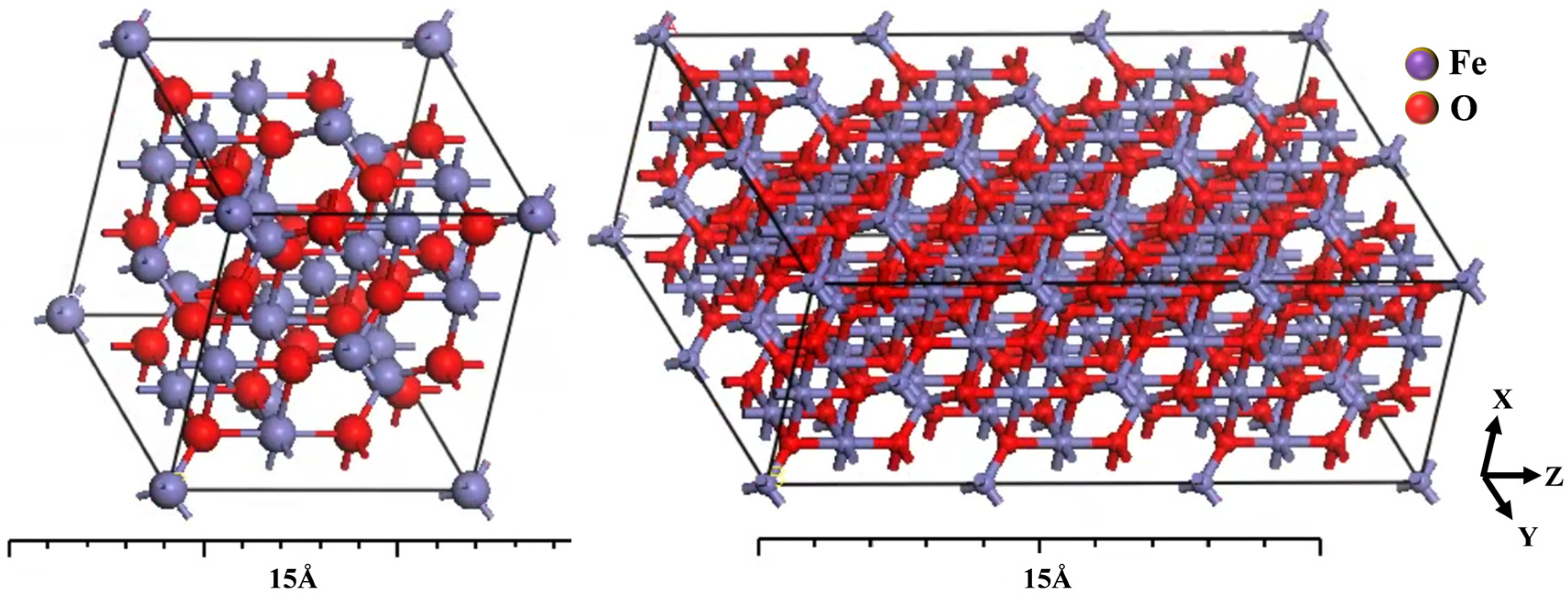
The inverse spinel structure of Fe3O4 is collected from ICSD (ICSD collection code 20596) with space group No. 227 Fd-3m in periodic boundary conditions, which contains 32 O atoms, 8 divalent Fe atoms, and 16 trivalent Fe atoms. The lattice constants are a = 8.384 Å, b = 8.384 Å, and c = 8.384 Å. The Wyckoff positions of O, A-Fe, and B-Fe are (0.375, 0.375, 0.375), (0, 0, 0), and (0.625, 0.125, 0.125). Distinguishing between Fe atoms at the A and B sites is essential because the A-site and B-site Fe atoms are antiferromagnetically coupled, requiring separate treatment in subsequent calculations. Based on the evaluation of N and O doping content, the original cell and supercell are built based on the structure of Fe3O4 [16]. In the experiment, the analysis of the samples indicates that the doping content of C and N is slight. As a result, the O atoms are replaced by different numbers of C and N in a 1 × 2 × 3 Fe3O4 supercell, and the chemical formulae of doped structures are expressed as Fe144XnO192−n (X = C, N; n = 0, 1, 2, 3, 4, 5) and Fe144XnYmO192−n−m (X = C; Y = N; n, m = 0, 1, 2, 3, 4, 5), which are shown in Figure 1.
The k-point grid of the inverse spinel structure of Fe3O4 is set as 2 × 2 × 3, and the cutoff energy of a plane-wave is set as 500eV to calculate the electron wave function. The original cell and supercell of Fe3O4 have been fully relaxed with minimum total energy by Broyden–Fletcher–Goldfarb–Shanno (BFGS) geometry optimization [17]. The convergence conditions were set as the self-consistent convergence of the total energy below 5 × 10⁻⁶ eV/atom; the maximum displacement between cycles below 5 × 10⁻⁴ Å; the maximum force on the atom below 0.01 eV/Å; and the maximum stress below 0.01 GPa. The reliability of the DFT model was first evaluated using undoped Fe3O4. The calculated lattice parameter of undoped Fe3O4 was 8.384 Å, which is close to the reported experimental value of bulk magnetite (~8.390 Å) and previously calculated values of approximately 8.390–8.398 Å [18]. In addition, the calculated DOS of undoped Fe3O4 shows that the electronic states near the Fermi level are mainly dominated by Fe 3d states, accompanied by Fe 3d-O 2p hybridization, which is consistent with previous theoretical reports [19]. Therefore, the present model is considered suitable for evaluating the relative structural and electronic changes associated with C/N incorporation.

3. Results and Discussion

3.1. Metallographic and Microstructure Analysis

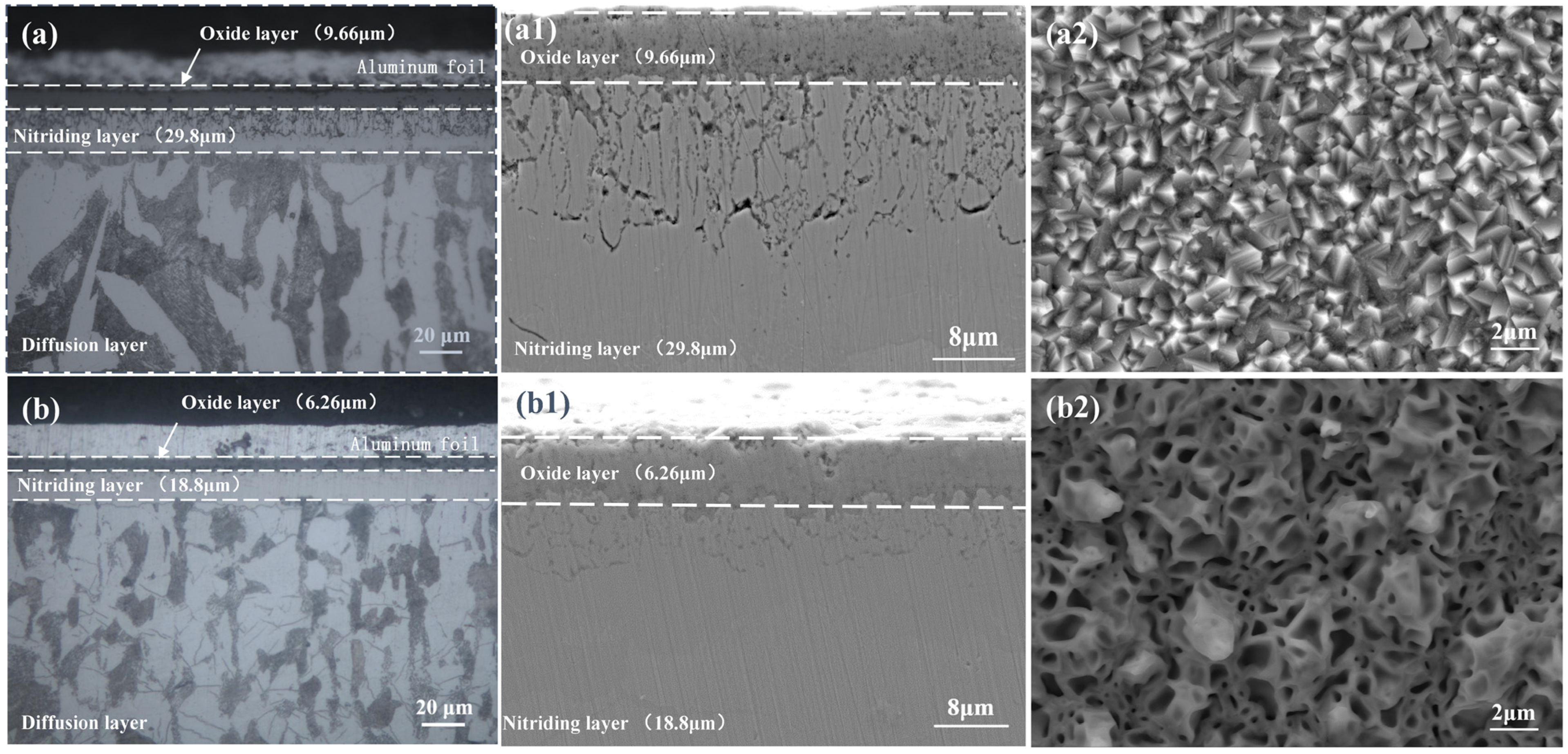
Figure 2 shows the microstructures and surface morphologies of 45# steel specimens subjected to oxynitriding under different conditions. Both the NO-40 and NO-20 specimens exhibit a composite architecture comprising an outer oxide layer overlying a nitrided layer. With increasing oxygen flow rate from 20 to 40 mL·min−1, the oxide layer thickness increased from 6.26 to 9.66 μm, while the compound layer increased from 18.8 to 29.8 μm (Figure 2a,b). In addition, quantitative image analysis showed that the surface porosity decreased markedly from 42.935% for NO-20 to 1.171% for NO-40, indicating that the higher oxygen flow rate significantly improved the compactness of the oxide layer. The corresponding microstructural parameters are summarized in Table 2. An increased oxygen content not only elevates the surface oxidation potential, thereby promoting the growth of the outer oxide film, but also reduces the effective H2 partial pressure by forming oxygen-containing products; this shift increases the nitriding potential (commonly expressed as (KN = p N H 3 / p H 2 1.5 ), enhances nitrogen adsorption and inward diffusion, and consequently leads to thickening of the compound layer [20,21]. Higher oxygen content increases both the oxygen potential and surface oxygen availability, thereby promoting diffusion-controlled oxide film growth and increasing the oxide layer thickness [22]. Increasing the oxygen flow rate from 20 to 40 mL·min−1 markedly improves the compactness of the surface oxide layer and induces a pronounced morphological transition. As shown in Figure 2(b2), the NO-20 surface exhibits a loose, sponge-like, interconnected porous structure, indicating incomplete oxide growth and the presence of abundant open channels; by contrast, under the higher-oxygen NO-40 condition (Figure 2(a2)), the surface is covered by numerous well-faceted polyhedral grains with octahedral characteristics, resulting in a more tightly packed structure and markedly reduced porosity. This morphological evolution indicates that increased oxygen availability intensifies oxidation and promotes preferential crystal growth, transforming the oxide layer from a “loose and porous” state to a “crystallized and dense” one, which is expected to enhance the corrosion resistance of the oxide film.

3.2. Phase Composition

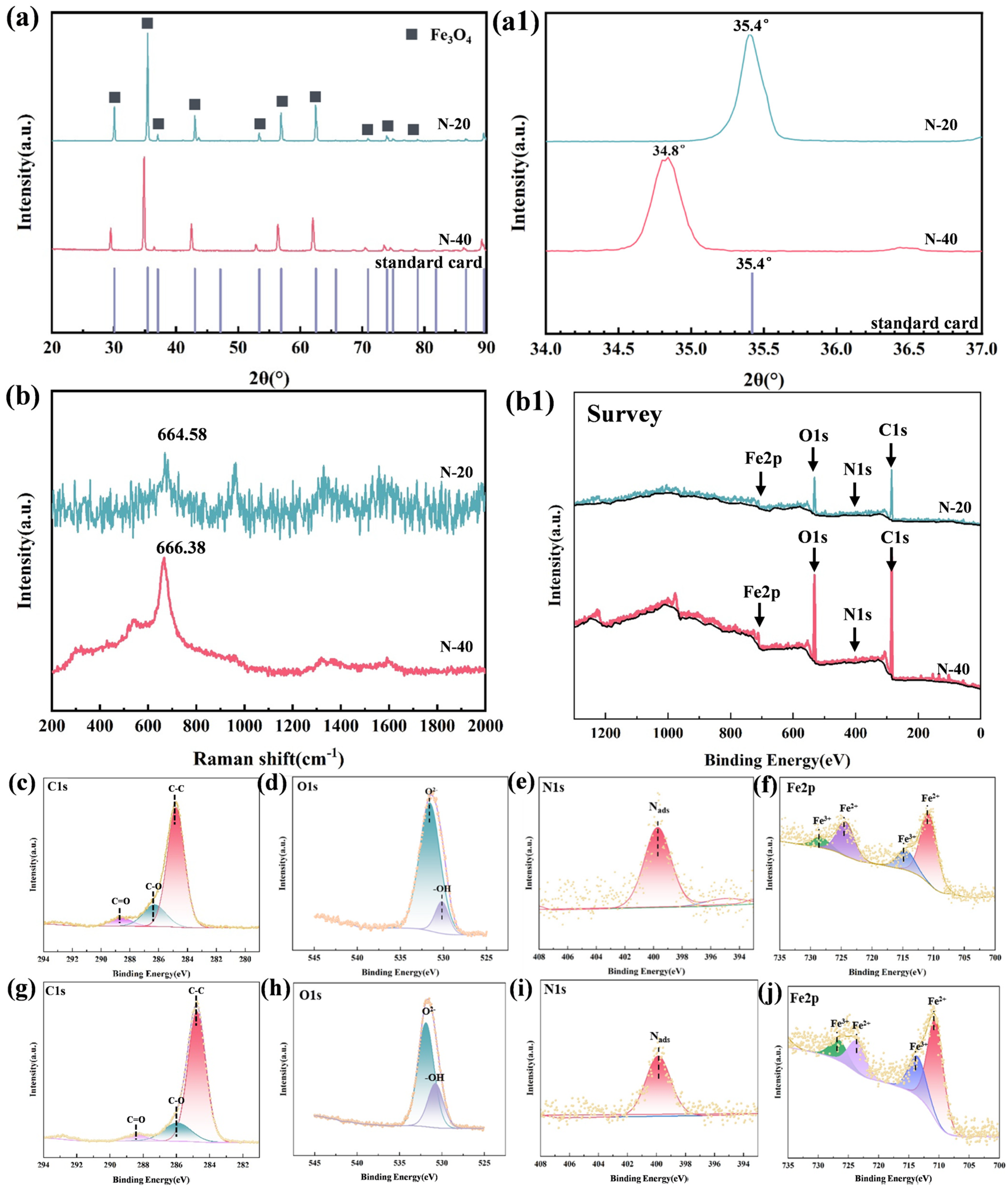
XRD analysis indicates that the oxide scales formed on both NO-20 and NO-40 are dominated by Fe3O4 (Figure 3a) [23]. To provide a clearer comparison of the diffraction peaks, Figure 3(a1) presents an enlarged view of the 34–37° region in Figure 3a. In Figure 3(a,a1), the green curve represents the NO-20 sample, the red curve represents the NO-40 sample, and the bottom pattern corresponds to the standard diffraction card of Fe3O4. A clear peak position shift is observed for the Fe3O4 (311) reflection, with the 2θ value decreasing from 35.40° for NO-20 to 34.80°for NO-40 (Figure 3(a1)). According to Bragg’s law, the low-angle shift observed in the enlarged XRD pattern suggests a possible increase in the interplanar spacing of the Fe3O4 phase in the NO-40 sample. Raman spectra were further used to support the phase identification of the oxide layers. As shown in Figure 3b, both NO-20 and NO-40 exhibit the characteristic A1g vibration band of Fe3O4 at approximately 665–670 cm−1, confirming that magnetite is the dominant oxide phase in both samples [24].
Although the XPS and EDS results confirm the presence of C/N-containing species in the oxide layer, they cannot quantitatively determine the C/N concentration within the Fe3O4 lattice; accordingly, the XRD peak shift should be interpreted as being consistent with possible lattice expansion rather than as definitive evidence of substitutional C/N incorporation.
XPS results reveal distinct Fe and O signals on both samples, with additional nitrogen-related signals detected at the surface (Figure 3c–h). The O 1s spectra can be deconvoluted into contributions from lattice oxygen (O2−) and surface hydroxyl/adsorbed oxygen species. A N 1s feature centered at approximately ~400.00 eV is observed, consistent with nitrogen-related surface or near-surface species. In the Fe2p region, both NO-20 and NO-40 exhibit mixed-valence features attributable to Fe2+ and Fe3+ states characteristic of Fe3O4. Importantly, NO-40 exhibits a systematic positive shift relative to NO-20 (Figure 3e–h), with the Fe2+ 2p3/2 peak shifting from 710.75 eV to 710.90 eV and the Fe3+ 2p3/2 peak shifting from 714.45 eV to 714.65 eV. These shifts indicate a measurable modification of the local electronic environment and/or polarization around Fe in NO-40. Taken together, Figure 3 demonstrates that both samples form Fe3O4-dominated oxide scales, whereas NO-40 additionally exhibits lattice expansion (from XRD) and a modified bonding and electronic environment.
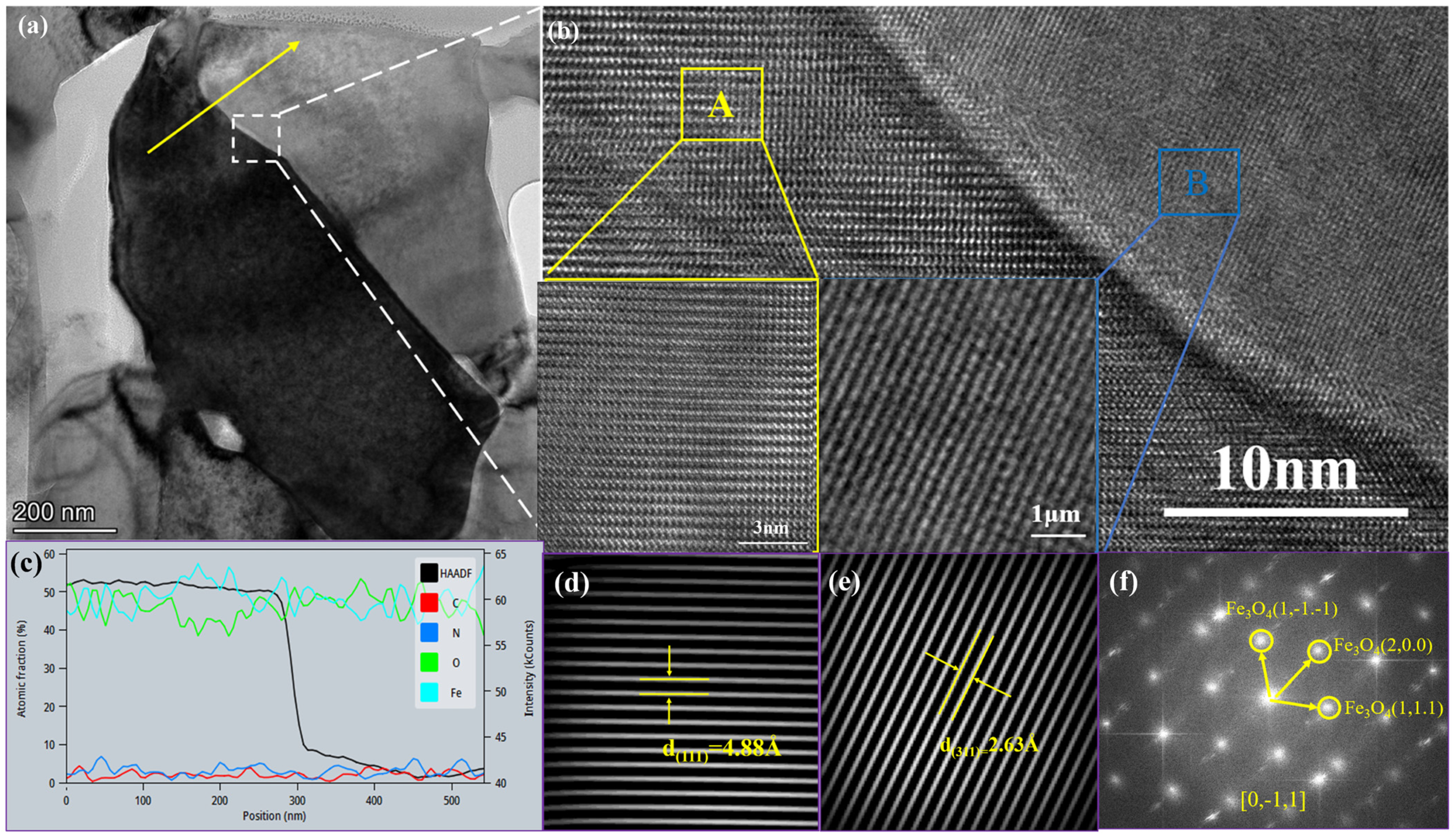
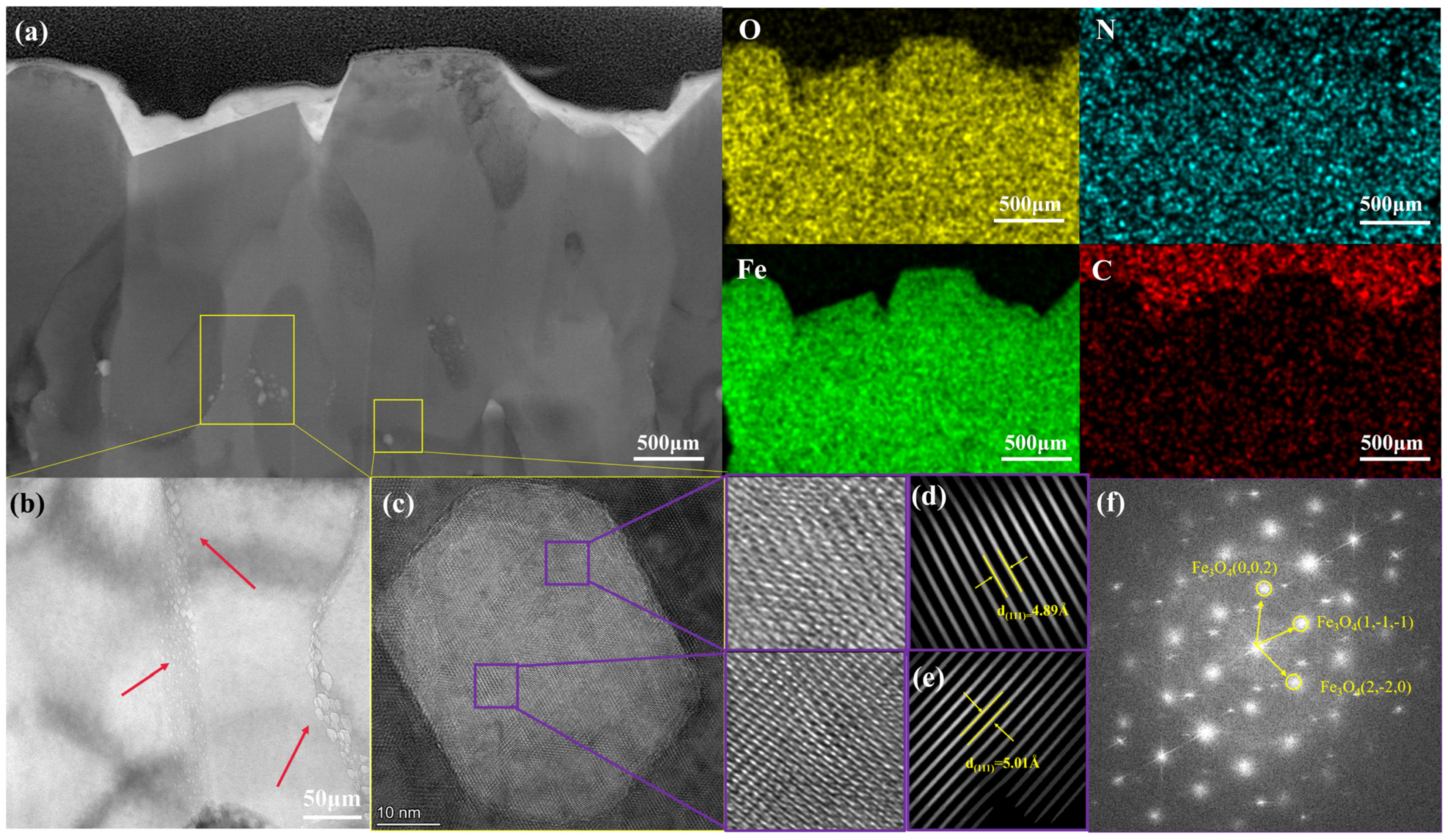
To further characterize the nanoscale morphology, crystallinity, and phase characteristics of the oxide scale on NO-40, as well as to elucidate the spatial distribution of nitrogen-related species, TEM/HRTEM and SAED analyses were performed. The cross-sectional TEM image in Figure 4a reveals a continuous oxide layer with undulating thickness, indicating spatially non-uniform growth. HRTEM images in Figure 4b show well-resolved lattice fringes in two representative regions of the oxide scale (regions A and B). The measured interplanar spacings are 0.488 ± 0.005 nm and 0.268 ± 0.005 nm (Figure 4d,e), respectively. The corresponding SAED pattern in Figure 4f exhibits discrete diffraction spots rather than continuous rings, and the indexed reflections are consistent with Fe3O4, confirming that the probed region is predominantly a magnetite-type spinel phase. Notably, the locally measured d-spacings deviate measurably from the standard Fe3O4 values; this deviation is consistent with the low-angle shift of the (311) peak shown in Figure 3(a1), thereby supporting the presence of nanoscale lattice distortion or strain within the NO-40 oxide scale to investigate the corresponding structural evolution.
Elemental analysis was further performed to examine the chemical distribution within the oxide scale. The HAADF image and corresponding EDS line profile in Figure 4c confirm that Fe and O are the dominant constituents across the oxide scale, while weak C and N signals can also be detected along the scan path. To further examine the microstructural heterogeneity of the oxide layer, grain boundary regions were characterized in detail, as shown in Figure 5. Discrete nanoscale precipitates are preferentially located along oxide grain boundaries, as observed in Figure 5a,b. STEM-EDS mapping in Figure 5a shows that these precipitates are mainly Fe/O-rich. Weak C and N signals are detected within the oxide layer; however, due to the low content of nitrogen and the limited sensitivity of EDS for light elements, the N map does not provide conclusive evidence for nitrogen enrichment or clear spatial variation between the oxide- and carbon-related regions. Therefore, the EDS results are used only as qualitative evidence for the presence of light elements in the oxide layer, rather than as direct proof of their spatial enrichment or lattice substitution.
HRTEM analysis of the grain boundary precipitates in Figure 5c–e yields interplanar spacings of approximately 0.489 ± 0.005 nm and 0.501 ± 0.005 nm. The corresponding SAED pattern in Figure 5f displays diffraction rings together with discrete spots, indicating a microstructure consisting of polycrystalline domains with locally oriented crystallites. Overall, the indexed reflections remain consistent with Fe3O4.
The TEM-EDS results indicate the presence of C/N-containing species within the oxide layer; however, their exact lattice positions and quantitative concentrations in Fe3O4 cannot be determined from EDS or XPS alone. Therefore, first-principles calculations were performed using simplified supercell models to evaluate the possible influence of C/N incorporation on the structural and electronic properties of Fe3O4. Fe3O4 has a complex inverse-spinel structure containing tetrahedral and octahedral Fe sites with different local environments and mixed Fe2+/Fe3+ valence states. Therefore, the structural influence of C/N-containing species cannot be fully interpreted only on the basis of atomic-size differences. In this work, the C/N substitution configurations were used as simplified first-principles models to evaluate possible changes in lattice structure, bonding characteristics, and electronic structure associated with C/N incorporation. These models should be regarded as comparative theoretical models rather than direct experimental proof of substitutional C/N incorporation in the Fe3O4 lattice.
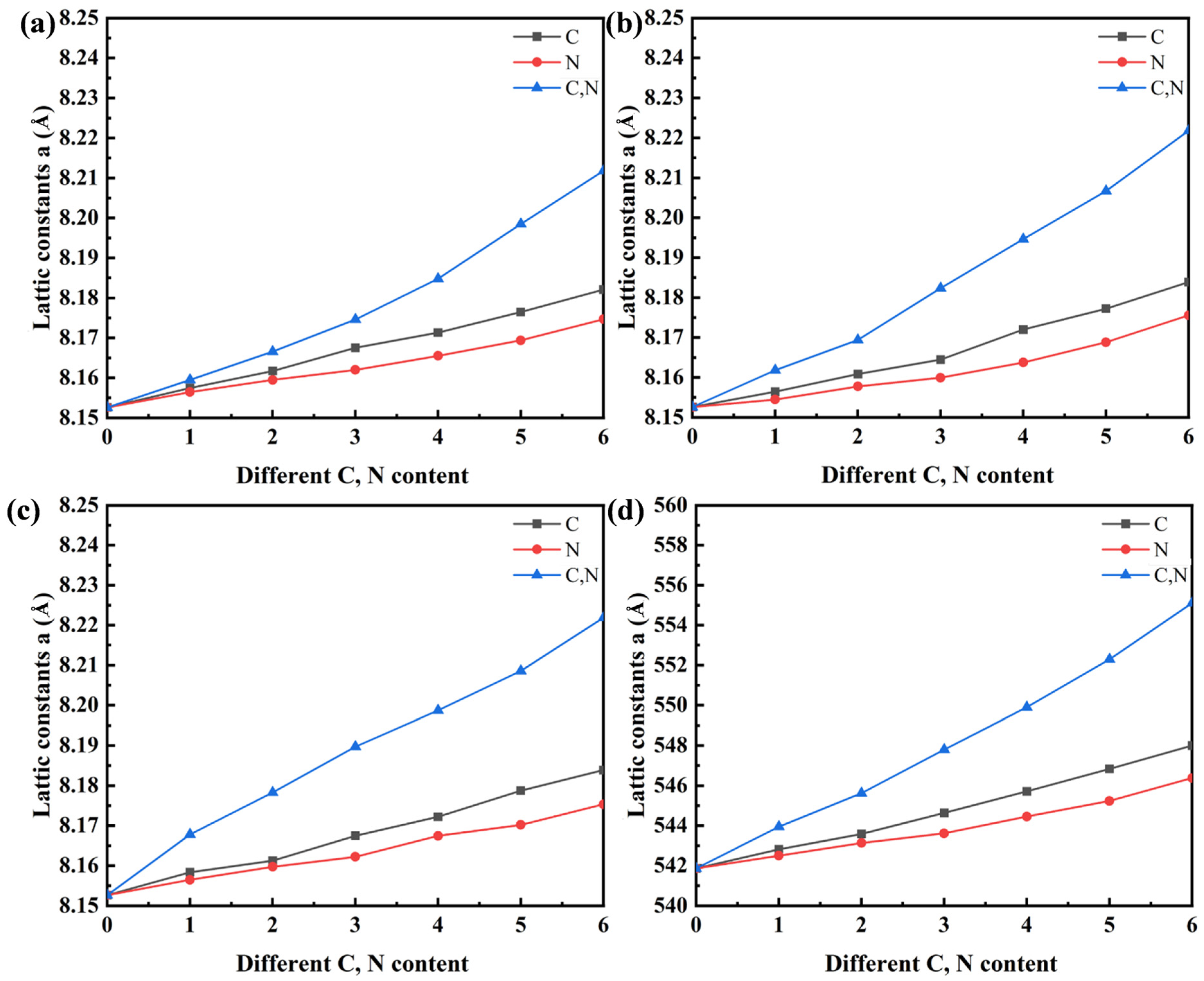
The lattice parameters and crystal volume of the original cell of Fe3O4 are shown in Figure 6.
According to the results of first-principles calculations, the lattice parameters and crystal volume of C and N atoms doped in Fe3O4 are shown in Figure 6a–d. The atom radius of C and N atoms is 67 pm and 56 pm, which are obviously higher than the atom radius of O (48 pm). With the increasing C and N doping content, the lattice parameters and crystal volume are significantly increased. This phenomenon is consistent with the variation in the analysis of XRD.

3.3. Mechanical and Corrosion Resistance Properties

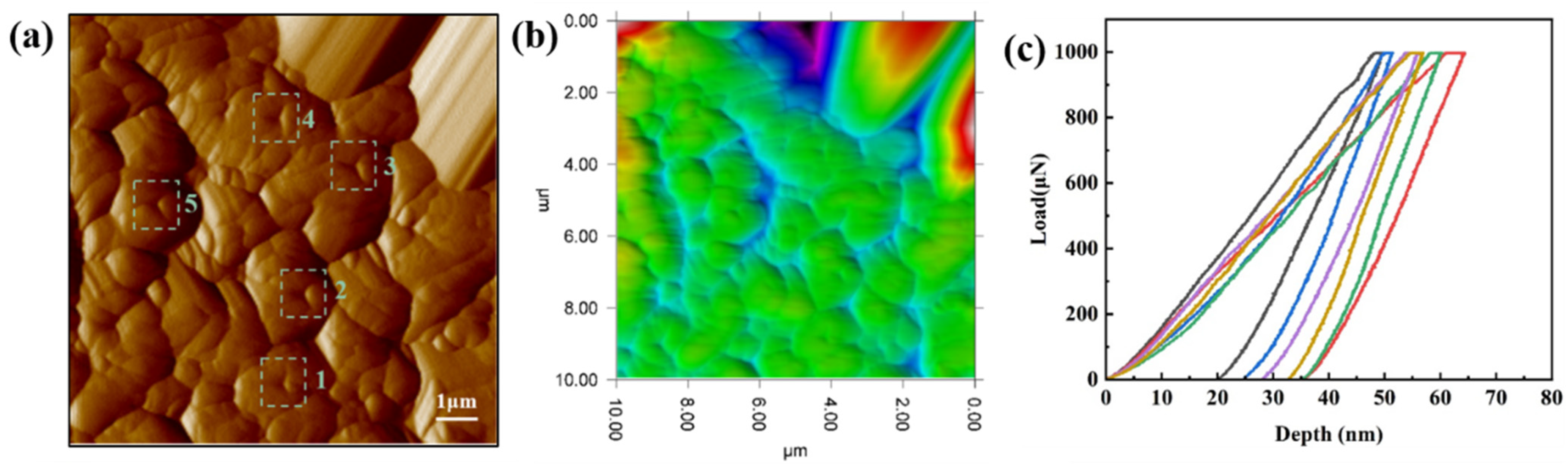
Figure 7a,b summarizes the surface morphology and nanoindentation response of the Fe3O4 oxide film on the NO-40 sample. The SPM surface morphology and corresponding height map show a continuous granular surface with limited height variation, indicating relatively good surface uniformity at the microscale. As shown in Figure 7c, the load–displacement curves obtained from six independent indents exhibit similar curve shapes under a peak load of approximately 996 μN. The maximum penetration depths are in the range of approximately 50–65 nm, suggesting a relatively uniform micromechanical response of the oxide layer.
It should be noted that the average oxide layer thickness of the NO-40 sample is approximately 9.66 μm. Therefore, the maximum indentation depth of 65 nm corresponds to only about 0.67% of the oxide layer thickness, which is far below the commonly used 10% thickness criterion for avoiding substrate effects in coating indentation measurements. This indicates that the measured hardness and elastic modulus mainly reflect the intrinsic mechanical response of the oxide layer, and the influence of the steel substrate can be considered negligible.
Based on six independent nanoindentation measurements, the nanohardness and elastic modulus of the oxide layer were calculated to be 7.22 GPa and 104.10 GPa, respectively, where the error values represent the standard deviations. The individual hardness and elastic modulus values ranged from 5.47 to 8.97 GPa and from 86.16 to 121.99 GPa, respectively. The slight scatter among the indentation results can be attributed to local microstructural heterogeneity within the oxide film, such as differences between grain interiors, grain boundary regions, and surface protrusions. Overall, the nanoindentation results demonstrate that the NO-40 oxide layer possesses relatively uniform micromechanical properties and good structural integrity.
The theoretical hardness affects the performance of iron materials in the corrosion environment, which is related to the properties of chemical bonds. The overlap population is adopted to characterize the bonding strength between different atoms, which is related to the hardness. Usually, the covalent bonds indicate a higher value of overlap population than ionic bonds. And the negative value of overlap population represents the anti-bonding between different atoms.
The overlap population is adopted to characterize the bond strength, which is closely related to the theoretical hardness. A common theoretical hardness model is proposed by Pugh with the formula of HV = 0.151 G [25].
The strength of chemical bonds affects the hardness of materials, which can be characterized by the overlap population. Gao [26] proposed the hardness models based on the overlap population and bond length, which can be shown as follows:
H γ μ G P a = A P μ γ b μ 5 3
γ b μ = ( d μ ) 3 μ ( d μ ) 3 N b μ
where A is constant and set as 740. dμ represents the length of μ-type bond; Pμ represents the Mulliken’s overlap population of μ-type bond; N b μ represents the number of μ-type bonds per unit volume; and γ b μ represents μ-type bond volume. The hardness of materials can be evaluated by the geometric average of all bond hardness, which is expressed as follows:
H γ μ G P a = [ ( H γ μ 1 ) m 1 ( H γ μ 2 ) m 2 ( H γ μ n ) m n ] 1 m 1 + m 2 + m 3
where H v μ n represents the hardness of μn-type and mn is the number of μn-type bonds.
Nevertheless, the number of valence electrons in a chemical bond is set as 2 in Gao’s model, which is not suitable for the Fe3O4 cells. Zhou [27] adjusts the number of valence electrons in the model and verifies Gao’s model to establish a new hardness model, which is shown as follows:
n μ = Z A μ / N C A + Z B μ / N C B
where ZAμ is the valence electron number of the A atom and NCA is the coordination number of the A atom in a μ-type bond. And ZBμ and NCB are analogous to ZAμ and NCA.
γ b μ = ( d μ ) 3 n μ Ω / μ ( d μ ) 3 n v N b μ
H γ μ G P a = A P μ γ b μ 5 3 , A = 700
H γ μ G P a = ( ( H μ ) n μ N μ ) 1 n μ N μ
Based on the previous equations, the valence electrons nμ of a bond are taken into account in the expression of bond hardness and hardness of the materials.
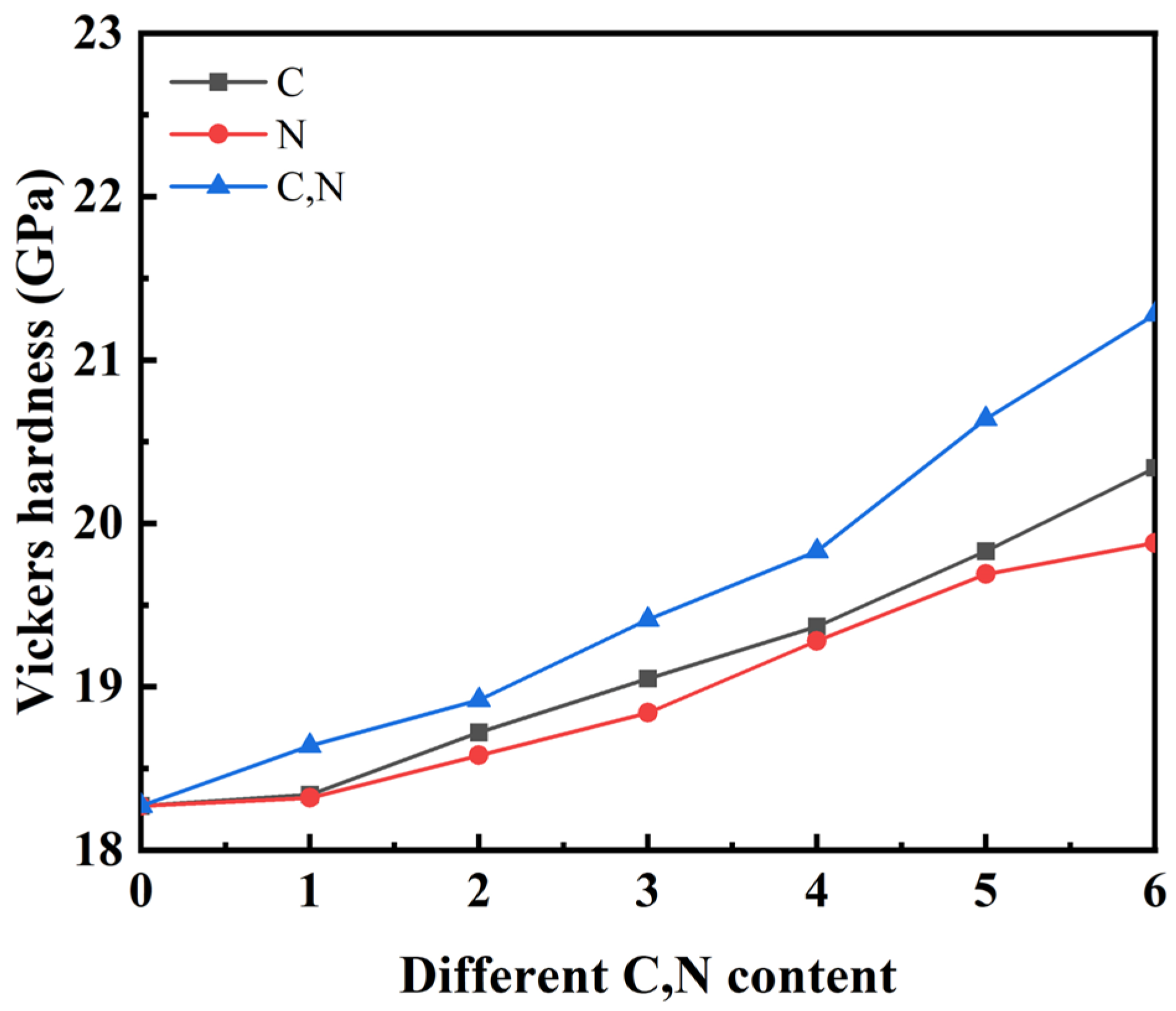
As shown in Figure 8, the theoretical Vickers hardness can be adopted to explain the results of the friction and wear. C (1s22s22p2) and N (1s22s22p3) replace the sites of O (1s22s22p4), which leads to the variation of valence electrons. The increasing C and N content leads to an increase in hardness, which indicates higher wear and corrosion resistance. At the same time, the increasing hardness implies an increase in Mulliken population of chemical bonds, which indicates higher bond strength and higher covalency of crystals. The Fe3O4 crystal with C and N atoms contains stronger chemical bonds and is less susceptible to corrosion.
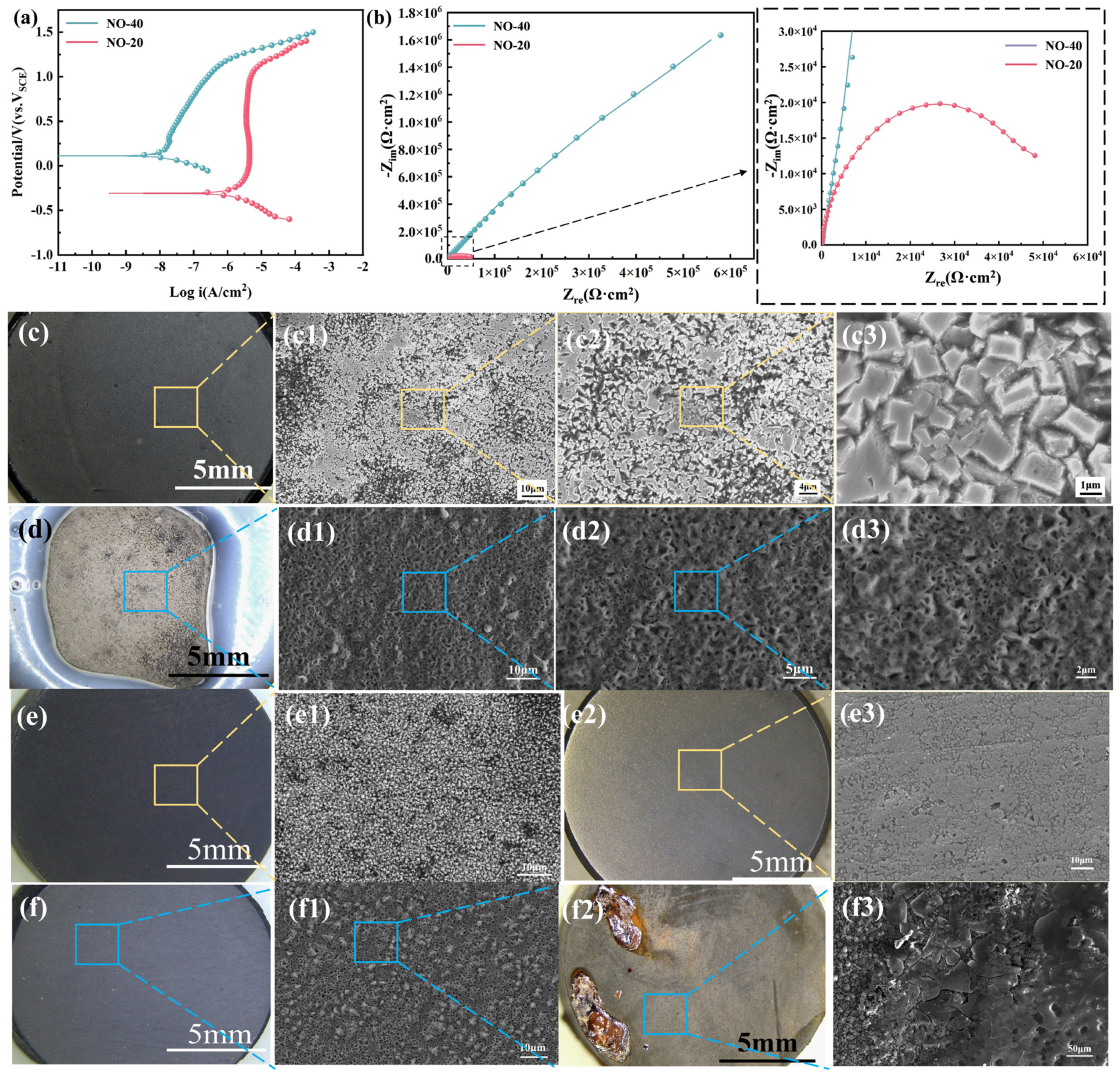
Figure 9 compares the corrosion performance of the doped-oxide sample NO-40 with the undoped sample NO-20 after nitrogen–oxygen co-diffusion based on polarization, EIS, and post-test surface morphologies. To verify the reliability of the extremely low corrosion current density of the NO-40 sample, at least three independent electrochemical measurements were performed under the same conditions. Figure 9a shows that NO-40 exhibits a more noble corrosion potential of 0.115 VSCE and a markedly lower corrosion current density of 3.16 × 10⁻¹⁰ A·cm−2 compared with NO-20, which has an Ecorr of −0.308 VSCE and an Icorr of 4.02 × 10⁻⁷ A·cm−2. Consistent with these results, Table 3 shows an extremely low corrosion rate of 3.68 × 10⁻³ μm·a−1 for NO-40 compared with 4.68 μm·a−1 for NO-20. The EIS response in Figure 9b further reveals substantially higher impedance for NO-40 across the entire frequency range, particularly at low frequencies, indicating a more effective barrier against ionic transport and charge transfer. The fitted resistance R2 reaches 1.8393 × 10⁷ Ω·cm2 for NO-40, orders of magnitude higher than 1.7658 × 10⁴ Ω·cm2 for NO-20, supporting the formation of a highly resistive protective layer due to oxide layer doping. In agreement with the electrochemical trends, the post-test corrosion morphologies in Figure 9(c–c3) show that NO-40 remains comparatively compact and intact after testing, whereas Figure 9(d–d3) exhibits pronounced surface roughening with porous and localized attack features on NO-20, indicating earlier degradation of the undoped surface layer. Neutral salt spray tests provide further validation of long-term protection. Figure 9(e2,e3) shows that NO-40 remains essentially rust-free even after 3600 h, whereas Figure 9(f2,f3) indicates visible rusting on NO-20 after only 120 h, accompanied by corrosion product accumulation and cracking or spallation.
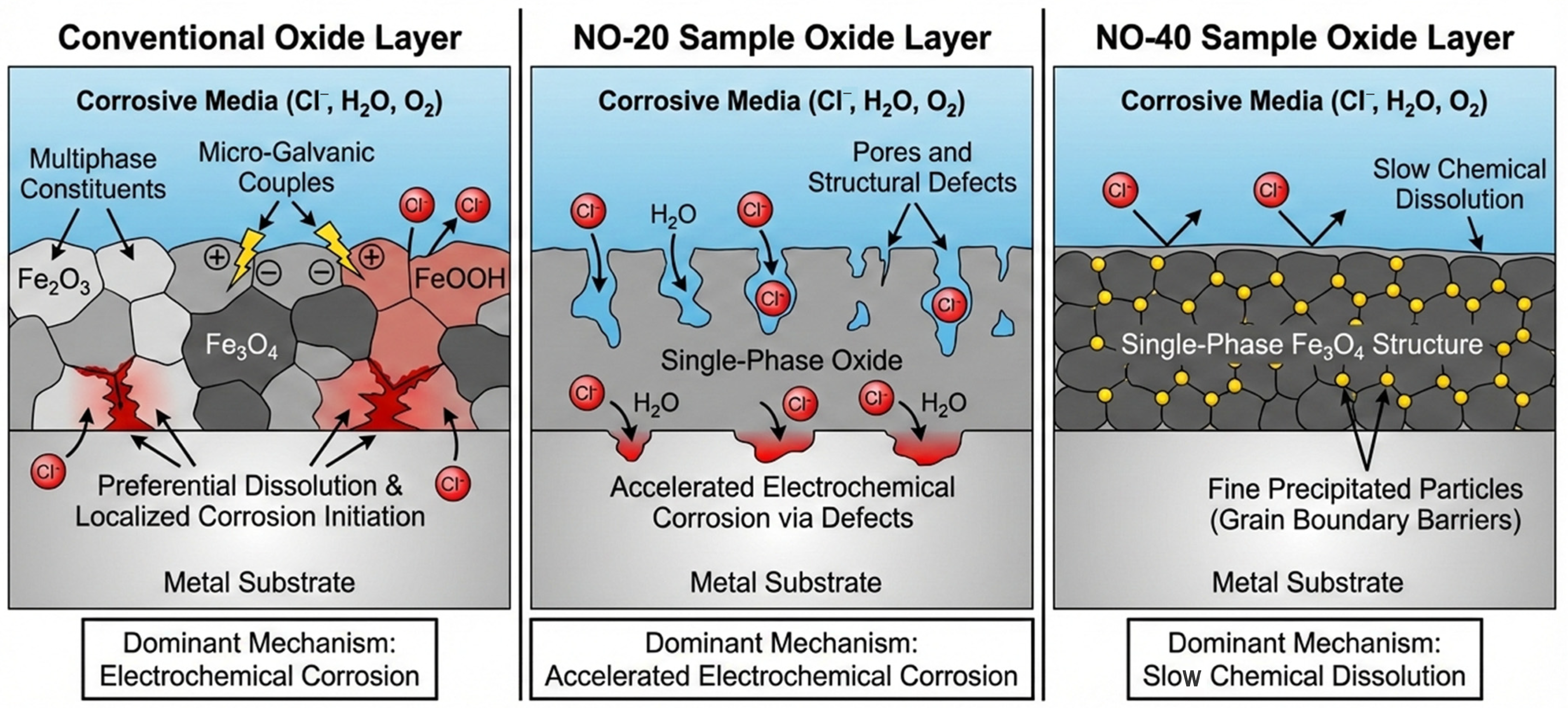
Based on the combined results of microstructural characterization, phase analysis, electrochemical testing, neutral salt spray testing, and post-corrosion surface observations, a proposed schematic corrosion protection mechanism is illustrated in Figure 10. It should be noted that this schematic model is not a direct reconstruction from post-corrosion cross-sectional images but an interpretation of the corrosion protection behavior inferred from the experimental results. Since the NO-40 sample did not show obvious corrosion damage after the corrosion tests, the corrosion protection mechanism was mainly discussed on the basis of the structural integrity of the oxide layer and its electrochemical response. The corrosion behavior of the investigated samples is strongly determined by the phase composition and microstructural integrity of the oxide layer. In conventional oxide layers, which typically consist of multiphase constituents, electrochemical corrosion can be readily activated due to micro-galvanic coupling between dissimilar phases [28]. Such local electrochemical heterogeneities promote preferential dissolution along phase boundaries, thereby accelerating the initiation and propagation of localized corrosion [29]. The mechanistic differences among conventional multiphase oxide, the undoped NO-20 oxide, and the doped NO-40 oxide are schematically illustrated in Figure 10, where the dominant ionic transport and electrochemical reaction pathways are highlighted.
In contrast, the doped oxide layer in the NO-40 sample is characterized by a predominantly single-phase Fe3O4 structure with high compactness and structural coherence. Surface morphology analyses reveal that the oxide layer is dense and continuous, effectively restricting the penetration of corrosive species [30]. In addition, fine precipitated particles are preferentially distributed along grain boundaries, acting as physical barriers that impede the diffusion of corrosive species along fast transport pathways [31]. Consequently, corrosion in NO-40 is primarily governed by the chemical dissolution of Fe3O4 rather than electrochemically driven localized attack, resulting in a significantly reduced corrosion rate and delayed initiation of corrosion.
Although the NO-20 sample also exhibits a single-phase oxide composition, its oxide layer displays inferior compactness, containing pores and structural defects. These defects provide pathways for aggressive species to penetrate the substrate, thereby facilitating localized electrochemical reactions [32]. Consequently, despite the absence of multiphase-induced galvanic effects, the porous nature of the NO-20 oxide layer leads to accelerated electrochemical corrosion and premature film breakdown [33].
Overall, the superior corrosion resistance of NO-40 originates from the synergistic effects of its single-phase oxide composition, high film compactness, and grain boundary precipitates, which collectively suppress the transport of corrosive species and redirect the corrosion mechanism from electrochemically driven attack toward slow chemical dissolution, as schematically illustrated in Figure 10.
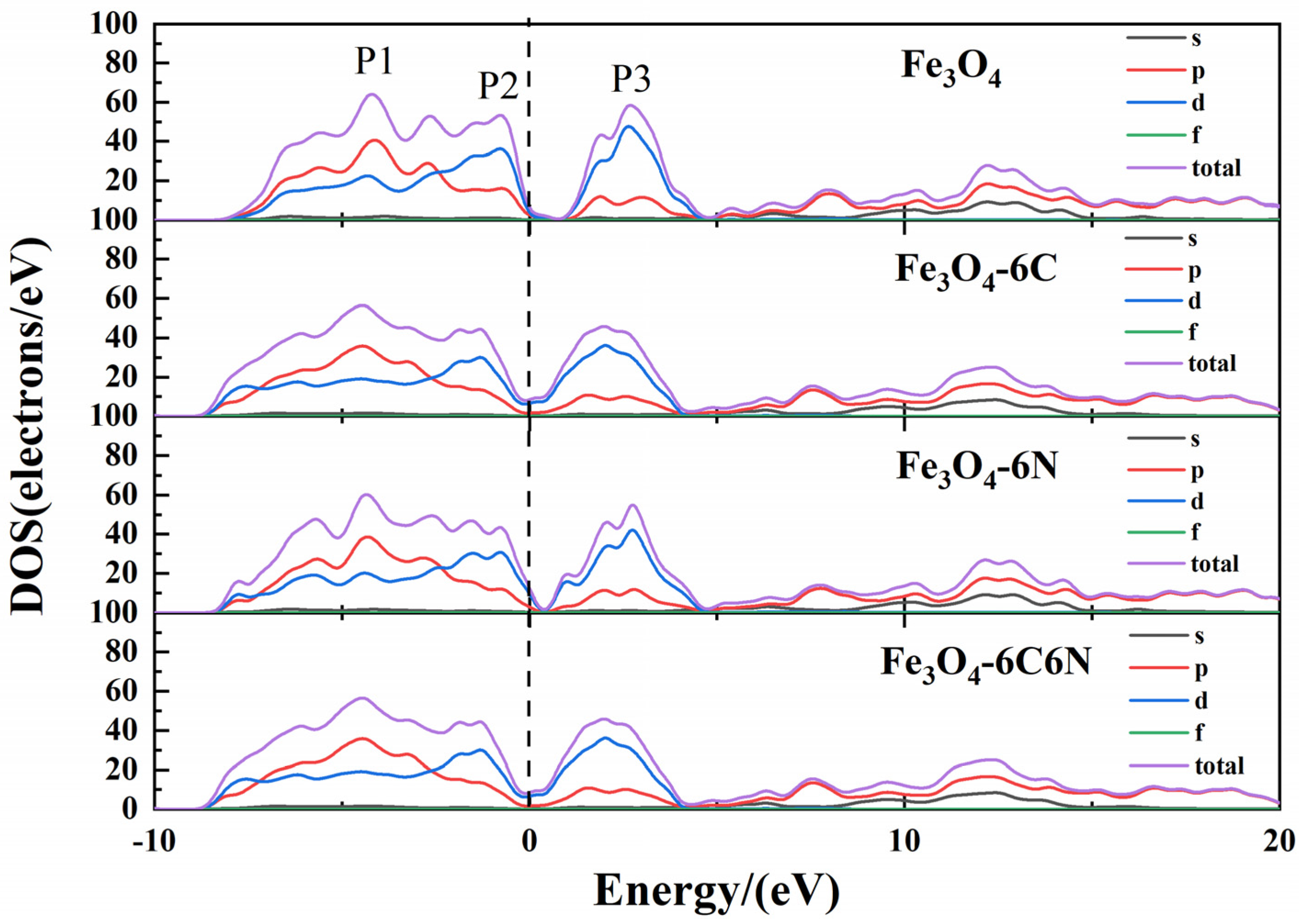
The electronic structures and chemical bonds are also adopted to explain the variation of corrosion resistance of C and N atoms doped in Fe3O4 crystals. The calculated partial density of states (PDOS) and density of states (DOS) of Fe3O4 are shown in Figure 11. The vertical dashed lines represent the Fermi level, and the d-d orbitals generate the pseudo-gap around the Fermi level, which confirms the metallic character of chemical bonds.
There are several typical peaks located at −5.5 eV, −1.2 eV, and 2.1 eV and named P1, P2, and P3. P1 is composed of C-2p, N-2p, O-2p, and Fe-3d orbitals, indicating typical Fe-O, Fe-C, and Fe-N covalent bonds. The variation of P1 is slight, indicating that the effect of C and N atoms on covalent bonds is negligible. The pseudo-gap between P2 and P3 exhibits a distinct change, which can be attributed to the increasing 2p orbitals of C and N atoms. The higher 2p orbitals also lead to an increase in Fe-5p orbitals, which contributes to the higher metallic characteristics and stronger metallic bonds. The variation of the Fermi level indicates the reduction in the driving force for corrosion reactions. This phenomenon verifies the increasing corrosion resistance in samples, which is conducive to long-term operation in corrosive environments.

4. Conclusions

The oxynitrided treatment successfully produced a composite structure on 45 steel consisting of an outer Fe3O4 oxide film and an inner nitride layer. A higher oxygen flow rate during the co-diffusion process led to a thicker and more compact oxide film with a polyhedral grain morphology. The NO-40 sample exhibited lattice expansion, as evidenced by XRD peak shifts and changes in Raman and XPS spectra, which indicate lattice expansion and electronic structure modulation associated with C/N incorporation in the oxide film. TEM and EDS analyses further revealed the presence of C/N signals within the oxide layer, accompanied by fine precipitates, which effectively impede transport pathways for corrosion products and aggressive species. First-principles calculations based on C/N substitution models further suggested that C/N incorporation may expand the Fe3O4 unit cell volume, strengthen lattice bonding, and increase the theoretical hardness. First-principles simulations using Materials Studio (MS) based on density functional theory (DFT) showed that low-level C/N substitution at oxygen lattice sites in Fe3O4 expands the unit cell volume, strengthens lattice bonding, increases theoretical hardness, and modifies the electronic structure, consistent with experimental observations and providing mechanistic insight into the enhanced corrosion and wear resistance.
Electrochemical tests showed that the NO-40 sample had a significantly higher corrosion potential (0.115 VSCE) and an ultra-low corrosion current density (3.16 × 10⁻¹⁰ A·cm−2), along with an impedance modulus reaching 1.83 × 10⁷ Ω·cm2. Furthermore, after 3600 h of neutral salt spray (NSS) exposure, the NO-40-treated steel remained entirely rust-free. Overall, the outstanding corrosion resistance of NO-40 is attributed to the synergistic combination of its C/N-containing single-phase Fe3O4 oxide layer, dense microstructure, and grain boundary precipitates, which collectively suppress chloride-ion penetration and shift the corrosion mechanism from electrochemical attack to a much slower chemical dissolution process.

Author Contributions

Conceptualization, Y.Y., D.M. and J.S.; Software, D.M., T.Z. and P.L.; Validation, T.Z., Y.W. (Yufei Wang), Y.W. (Yupeng Wei), M.S. and M.C.; Investigation, Y.W. (Yupeng Wei); Resources, D.M., Y.W. (Yufei Wang), Y.W. (Yupeng Wei), Y.C., P.L. and Y.X.; Data curation, Y.Y., D.M., T.Z., Y.W. (Yufei Wang), M.S., Y.C. and Y.X.; Writing-original draft, Y.Y., D.M. and J.S.; Writing-review & editing, Y.Y., D.M., T.Z. and J.S.; Visualization, T.Z., M.C., Y.X. and J.S.; Supervision, Y.Y., D.M., M.S. and J.S. All authors have read and agreed to the published version of the manuscript.

Funding

This research received no external funding.

Data Availability Statement

The data presented in this study are not publicly available due to privacy and confidentiality restrictions. The raw data supporting the conclusions of this article are available from the corresponding author upon reasonable request.

Conflicts of Interest

Author Yuquan Cai and Meigui Cai were employed by the company Yujie Bearing Manufacturing Co., Ltd. Peisheng Li and Yongfeng Xin were employed by the company Shandong Shenggong Inspecting Technology Co., Ltd. The remaining authors declare that the research was conducted in the absence of any commercial or financial relationships that could be construed as a potential conflict of interest.

References

  1. Alcántara, J.; Fuente, D.D.L.; Chico, B.; Simancas, J.; Díaz, I.; Morcillo, M. Marine Atmospheric Corrosion of Carbon Steel: A Review. Materials 2017, 10, 406. [Google Scholar] [CrossRef]
  2. Wang, M.; Yang, L.; Wu, S.; Liu, H.; Xu, W.; Wang, X.; Gao, H.; Lin, C. Research on marine atmospheric corrosion behavior of carbon steel during Western Pacific voyage. J. Mater. Res. Technol. 2025, 36, 9678–9691. [Google Scholar] [CrossRef]
  3. Xu, Y.; Zhang, Q.; Zhou, Q.; Gao, S.; Wang, B.; Wang, X.; Huang, Y. Flow accelerated corrosion and erosion-corrosion behavior of marine carbon steel in natural seawater. npj Mater. Degrad. 2021, 5, 56. [Google Scholar] [CrossRef]
  4. Qin, H.; Liu, J.; Shao, Q.; Zhang, X.; Teng, Y.; Chen, S.; Zhang, D.; Bao, S. Corrosion behavior and cellular automata simulation of carbon steel in salt-spray environment. npj Mater. Degrad. 2024, 8, 29. [Google Scholar] [CrossRef]
  5. Ozturk, M.C.; Coghlan, L.; Zimina, M.; Akid, R.; Martin, T.L.; Larrosa, N.O. Corrosion behaviour of 316L stainless steel under stress in artificial seawater droplet exposure at elevated temperature and humidity. Corros. Sci. 2025, 254, 113039. [Google Scholar] [CrossRef]
  6. Yeh, C.-P.; Tsai, K.-C.; Huang, J.-Y. Environmental Factors Influencing Stress Corrosion Cracking Behavior of Austenitic Stainless Steels in Simulated Seawater. Materials 2025, 18, 4317. [Google Scholar] [CrossRef] [PubMed]
  7. Borowski, T.; Wójcik, H.; Spychalski, M.; Adamczyk-Cieślak, B. Wear and Corrosion Resistance of Thermally Formed Decorative Oxide Layers on Austenitic Steel. Metals 2025, 15, 707. [Google Scholar] [CrossRef]
  8. Liu, G.; Liang, B.; Ding, Z. Effect of oxidation temperature on surface oxide film structure and corrosion resistance of 50 steel. Heliyon 2024, 10, e40499. [Google Scholar] [CrossRef]
  9. Łęcka, K.M.; Antończak, A.J.; Szubzda, B.; Wójcik, M.R.; Stępak, B.D.; Szymczyk, P.; Trzciński, M.; Ozimek, M.; Abramski, K.M. Effects of laser-induced oxidation on the corrosion resistance of AISI 304 stainless steel. J. Laser Appl. 2016, 28, 032009. [Google Scholar] [CrossRef]
  10. Du, J.W.; Yan, X.Y.; Chen, L.; Yue, J.; Du, Y. Enhancing corrosion behavior of CrN coating through oxygen incorporation: Experimental and theoretical analyses. Ceram. Int. 2024, 50, 27380–27388. [Google Scholar] [CrossRef]
  11. Mao, C.; Shuai, X.; Wang, H.; Jiao, Z.; Li, W.; Mi, B. High potential corrosion resistance and conductivity performance of C-doped TiO2 coatings used in bipolar plates. Int. J. Hydrogen Energy 2025, 106, 366–376. [Google Scholar] [CrossRef]
  12. ZhenHua, Z.; Shuang, Y. Key Laboratory of Mineralogy and Metallogeny, Guangzhou Institute of Geochemistry, Chinese Academy of Sciences, Guangzhou 510640, China Minerals and relevant metallogeny and exploration. Acta Petrol. Sin. 2019, 35, 31–68. [Google Scholar] [CrossRef]
  13. Ahghari, M.R.; Amiri-khamakani, Z.; Maleki, A. Synthesis and characterization of Se doped Fe3O4 nanoparticles for catalytic and biological properties. Sci. Rep. 2023, 13, 1007. [Google Scholar] [CrossRef]
  14. Qi, Z.; Joshi, T.P.; Liu, R.; Liu, H.; Qu, J. Synthesis of Ce(III)-doped Fe3O4 magnetic particles for efficient removal of antimony from aqueous solution. J. Hazard. Mater. 2017, 329, 193–204. [Google Scholar] [CrossRef]
  15. Liu, H.; Di Valentin, C. Band Gap in Magnetite above Verwey Temperature Induced by Symmetry Breaking. J. Phys. Chem. C 2017, 121, 25736–25742. [Google Scholar] [CrossRef]
  16. Liu, H.; Di Valentin, C. Bulk-terminated or reconstructed Fe3O4 (001) surface: Water makes a difference. Nanoscale 2018, 10, 11021–11027. [Google Scholar] [CrossRef] [PubMed]
  17. Monkhorst, H.J.; Pack, J.D. Special points for Brillouin-zone integrations. Phys. Rev. B 1976, 13, 5188–5192. [Google Scholar] [CrossRef]
  18. Santos-Carballal, D.; Roldan, A.; Grau-Crespo, R.; De Leeuw, N.H. A DFT study of the structures, stabilities and redox behaviour of the major surfaces of magnetite Fe3O4. Phys. Chem. Chem. Phys. 2014, 16, 21082–21097. [Google Scholar] [CrossRef] [PubMed]
  19. Rowan, A.D.; Patterson, C.H.; Gasparov, L.V. Hybrid density functional theory applied to magnetite: Crystal structure, charge order, and phonons. Phys. Rev. B 2009, 79, 205103. [Google Scholar] [CrossRef]
  20. Böcker, J.; Dalke, A.; Puth, A.; Schimpf, C.; Röpcke, J.; Van Helden, J.-P.H.; Biermann, H. Influence of Oxygen Admixture on Plasma Nitrocarburizing Process and Monitoring of an Active Screen Plasma Treatment. Appl. Sci. 2021, 11, 9918. [Google Scholar] [CrossRef]
  21. Liu, H.; Li, J.; Chai, Y.; Wei, W.; Hu, J. A novel plasma oxynitriding by using plain air for AISI 1045 steel. Vacuum 2015, 121, 18–21. [Google Scholar] [CrossRef]
  22. Mandkarian, N.; Mahboubi, F. Effect of gas mixture of plasma post-oxidation on corrosion properties of plasma nitrocarburised AISI 4130 steel. Vacuum 2009, 83, 1036–1042. [Google Scholar] [CrossRef]
  23. Alzaidy, A.H.; Ganduh, S.H.; Abed, M.J.; Dawi, E.A.; Jasim, L.S.; Ashoub, M.H. Microwave assisted solvothermal green synthesis of Fe3O4 nanoparticles using sea buckthorn for multiple myeloma and monocytic leukemia treatment. Sci. Rep. 2025, 15, 25743. [Google Scholar] [CrossRef]
  24. Lin, J.-F.; Wu, J.; Zhu, J.; Mao, Z.; Said, A.H.; Leu, B.M.; Cheng, J.; Uwatoko, Y.; Jin, C.; Zhou, J. Abnormal Elastic and Vibrational Behaviors of Magnetite at High Pressures. Sci. Rep. 2014, 4, 6282. [Google Scholar] [CrossRef]
  25. Pugh, S.F. XCII. Relations between the elastic moduli and the plastic properties of polycrystalline pure metals. Lond. Edinb. Dublin Philos. Mag. J. Sci. 1954, 45, 823–843. [Google Scholar] [CrossRef]
  26. Gao, F.; He, J.; Wu, E.; Liu, S.; Yu, D.; Li, D.; Zhang, S.; Tian, Y. Hardness of Covalent Crystals. Phys. Rev. Lett. 2003, 91, 015502. [Google Scholar] [CrossRef]
  27. Dai, F.-Z.; Zhou, Y. A Modified Theoretical Model of Intrinsic Hardness of Crystalline Solids. Sci. Rep. 2016, 6, 33085. [Google Scholar] [CrossRef]
  28. Zhang, B.; Wang, J.; Wu, B.; Oguzie, E.E.; Luo, K.; Ma, X.L. Direct observation of atomic-scale origins of local dissolution in Al-Cu-Mg alloys. Sci. Rep. 2016, 6, 39525. [Google Scholar] [CrossRef] [PubMed]
  29. Laleh, M.; Jurak, T.; Gusieva, K.; Williams, J.; Renshaw, W.; Correnti, S.; Hodges, J.; Gazder, A.A. New insights into corrosion initiation and propagation in a hot-dip Al-Zn-Mg-Si alloy coating via multiscale analytical microscopy. Corros. Sci. 2025, 245, 112695. [Google Scholar] [CrossRef]
  30. Choi, Y.; Kim, J.; Jeong, C. Optimization of the barrier oxide layer to enhance long-term corrosion resistance of SUS 316L stainless steel in 3.5 wt% NaCl solution. J. Mater. Sci. 2025, 60, 8148–8169. [Google Scholar] [CrossRef]
  31. Zhang, D.; Zhang, J.; Ren, H.; Zeng, X.; Liang, Z.; Zhang, X.; Yan, Q. Barrier effect of intergranular precipitation in alumina-forming austenitic steel against dissolution corrosion exposed to lead-bismuth eutectic. Corros. Sci. 2025, 244, 112643. [Google Scholar] [CrossRef]
  32. Zhuoxuan, L.; Xiaomei, D.; Yuhao, W.; Qiubo, L.; Xingyue, Y.; Shaogang, W. Mechanistic insight into the environmental stress-induced formation and evolution of the micro-defects in deteriorating organic coatings. Corros. Sci. 2025, 249, 112815. [Google Scholar] [CrossRef]
  33. Odhiambo, J.G.; Li, W.; Zhao, Y.; Li, C. Porosity and Its Significance in Plasma-Sprayed Coatings. Coatings 2019, 9, 460. [Google Scholar] [CrossRef]
Figure 1. Inverse spinel structure of Fe3O4 (Fe24O32) and the supercell (1 × 2 × 3).
Coatings 16 00628 g001
Figure 2. Cross-sectional metallographic microstructures and SEM surface morphology of 45 steel oxynitrided. (aa2) NO-40, (bb2) NO-20.
Coatings 16 00628 g002
Figure 3. (a,a1) XRD patterns of the NO-40 and NO-20 samples. (b) Raman spectra of the NO-40 and NO-20 samples. (b1) XPS survey spectra of the NO-40 and NO-20 samples. (ce) High-resolution XPS spectra of the NO-40 sample, (c) C 1s, (d) O 1s, (e) Fe 2p, and (f) Fe 2p. (gj) High-resolution XPS spectra of the NO-20 sample, (g) C 1s, (h) O 1s, (i) N1s, and (j) Fe 2p.
Coatings 16 00628 g003
Figure 4. TEM characterization of the surface oxide layer on the NO-40 sample. (a) Bright-field TEM image, (b) HRTEM image, (c) EDS line scan profile, (d) lattice fringes from area A, (e) lattice fringes from area B, (f) corresponding selected area electron diffraction (SAED) pattern.
Coatings 16 00628 g004
Figure 5. TEM characterization of the surface oxide layer on the NO-40 sample. (a) TEM image and corresponding EDS elemental maps of O, N, Fe, and C, (b) enlarged TEM image, (c) HRTEM image of the selected region, (d,e) lattice fringe images taken from the marked areas in (c) with the measured interplanar spacings, (f) corresponding selected area electron diffraction (SAED) pattern.
Coatings 16 00628 g005
Figure 6. Lattice parameters and crystal volume of C and N atoms doped in Fe3O4. (a) Lattice constant a, (b) lattice constant b, (c) lattice constant c, (d) crystal volume V.
Coatings 16 00628 g006
Figure 7. Nanoindentation of the oxide layer on the NO-40 specimen. (a) SPM surface topography, (b) SPM height map of the indentation, (c) load–displacement (P–H) curves. The hardness and elastic modulus values are reported as mean ± standard deviation based on seven independent indents.
Coatings 16 00628 g007
Figure 8. Theoretical hardness of Fe3O4 with different C and N content.
Coatings 16 00628 g008
Figure 9. Electrochemical corrosion behavior and neutral salt spray (NSS) corrosion performance of oxynitrided samples. (a) Potentiodynamic polarization curves, (b) Nyquist plots and the corresponding equivalent electrical circuit, (cc3) surface morphologies of the NO-40 sample after electrochemical corrosion tests at different magnifications, (dd3) surface morphologies of the NO-20 sample after electrochemical corrosion tests at different magnifications, (e,e1) surface morphologies of the NO-40 sample before NSS exposure, (e2,e3) surface morphologies of the NO-40 sample after 3600 h NSS exposure, (f,f1) surface morphologies of the NO-20 sample before NSS exposure, and (f2,f3) surface morphologies of the NO-20 sample after 120 h NSS exposure.
Coatings 16 00628 g009
Figure 10. Corrosion mechanism of the oxide layer.
Coatings 16 00628 g010
Figure 11. Total and partial density of states of the Fe3O4 cell with C and N atom orbitals C (1s22s22p2), N (1s22s22p3), O (1s22s22p4), and Fe (1s2 2s2 2p6 3s2 3p6 3d6 4s2).
Coatings 16 00628 g011
Table 1. Process parameters of oxynitrided treatment.
Sample
Type
SampleAmmonia Flow Rate (mL/min)Oxygen Flow Rate (mL/min)Ammonia Dissociation Rate (%)
DopedNO-4060 ± 540 ± 532
Weakly dopedNO-2060 ± 520 ± 540
Table 2. Microstructural parameters of the oxynitrided samples.
SampleOxide Layer Thickness (μm)Compound Layer Thickness (μm)Surface Porosity (%)
NO-409.6629.81.171
NO-206.2618.842.935
Table 3. Potentiodynamic polarization parameters and fitted electrochemical impedance spectroscopy (EIS) parameters of oxynitrided samples.
SamplesEcorr (VSCE)Icorr (A/cm−2)Vcorr (μm·a−1)Rs(Ω·cm2)Q1 (S sn∙cm−2)R1 (Ω·cm2)n1(-)Q2 (S sn∙cm−2)R2 (Ω·cm2)n2 (-)
NO-400.1153.16 × 10−103.68 × 10−351.075.15 × 10−619,9340.8483.49 × 10−71.83 × 1070.784
NO-20−0.3084.02 × 10−74.6814.784.56 × 10−536,3740.8911.33 × 10−41.76 × 1040.765
Disclaimer/Publisher’s Note: The statements, opinions and data contained in all publications are solely those of the individual author(s) and contributor(s) and not of MDPI and/or the editor(s). MDPI and/or the editor(s) disclaim responsibility for any injury to people or property resulting from any ideas, methods, instructions or products referred to in the content.