Article

Failure Mechanisms of EB-PVD Thermal Barrier Coating in Simulated Aero-Engine Erosion Environment

1
Surface Engineering Institution, AECC Beijing Institute of Aeronautical Materials, Beijing 100095, China
2
AECC Key Laboratory of Advanced Corrosion and Protection on Aviation Materials, AECC Beijing Institute of Aeronautical Materials, Beijing 100095, China
3
Fundamental Science Laboratory on Aerospace Protective Coatings, AECC Beijing Institute of Aeronautical Materials, Beijing 100095, China
4
School of Materials Science and Engineering, Shanghai Jiao Tong University, Shanghai 200240, China
*
Author to whom correspondence should be addressed.
Coatings 2026, 16(5), 574; https://doi.org/10.3390/coatings16050574
Submission received: 17 April 2026 / Revised: 4 May 2026 / Accepted: 6 May 2026 / Published: 9 May 2026

Abstract

To simulate the erosion damage behavior of thermal barrier coatings (TBCs) under actual service conditions in an aircraft engine environment, this study developed a multi-factor coupled test setup capable of simulating combined loading under high-temperature (1150 °C), high-speed (0.4 Mach), and solid-particle erosion conditions. Yttria-stabilized zirconia (YSZ) TBCs were prepared using electron beam physical vapor deposition (EB-PVD). For different erosion durations (2 h, 5 h, 8 h, 12 h), the evolution of macroscopic and microscopic morphologies as well as the development of residual stresses in the thermally grown oxide (TGO) layer were systematically investigated. The results indicate that the erosion process of the YSZ coating can be divided into three stages. During the initial high-erosion-rate stage (8.17 g/kg), erosion damage was confined to the grain tips of the columnar crystals, primarily caused by brittle fracture at the grain tips, and the TGO stress was relatively low (−0.6 GPa). During the intermediate stage, the erosion rate was lower (2.74 g/kg). Impact stresses induced microcracks within the columnar grains, which gradually connected to form intergranular fractures. This led to the expansion of localized spalling pits. The interface began to wrinkle, and the stress rose to −2.2 GPa. In the final accelerated failure stage (5.88 g/kg), horizontal cracks fully propagated, leading to large-scale peeling of the coating. The stress was released to −0.9 GPa. The coating failure mechanism evolves from surface damage to interfacial peeling, which is closely related to the coating structure, stress evolution, and interfacial state.

1. Introduction

As aerospace engines evolve toward higher efficiency and thrust-to-weight ratios, their operating temperatures continue to rise, approaching the limits of advanced superalloy materials [1,2]. TBCs, as heat-resistant functional coatings, are widely used on the surfaces of aircraft turbine engine blades. They reduce the surface temperature of the substrate alloy, thereby increasing the operating temperature of the blades and significantly improving engine efficiency and service life [3,4,5,6]. TBCs typically consist of a multilayer system, including a metal bond coat (BC) and a ceramic top coat (TC). The bond coat serves as an intermediate transition layer; at high temperatures, a dense thermally grown oxide (TGO) layer forms on its surface. This layer blocks further oxygen penetration, thereby enhancing the substrate alloy’s high-temperature oxidation resistance. As the primary component of TBCs, the ceramic top coat is in direct contact with the environment, providing thermal insulation and protecting the substrate alloy [7,8,9,10].
However, TBCs inevitably fail after prolonged service. Studies have shown that the spalling of TBCs primarily occurs under the following three operating conditions [11,12,13,14,15]: (1) high-temperature oxidation, (2) erosion damage, and (3) CMAS (calcium-magnesium-aluminum-silicate) corrosion. Under these critical conditions, erosion damage refers to the inevitable erosion and damage caused by solid particles in air or gas impacting the thermal barrier coating during operation under severe conditions. Erosion damage is one of the primary factors leading to thermal barrier coating failure. Researchers [16,17,18,19,20,21,22,23,24,25] have conducted extensive studies on erosion damage in TBCs. Nicholls, Wellman, et al. [26,27,28,29,30,31,32] investigated particle erosion behavior in EB-PVD YSZ TBCs and doped YSZ TBCs. The results indicate that the erosion failure mode of EB-PVD coatings depends not only on particle characteristics (particle size, density), temperature, velocity, and impact angle, but also on the intrinsic properties of the coating itself (such as fracture toughness and elastic modulus). They also proposed several potential failure mechanisms.
Although extensive research has been conducted on particle erosion of TBCs, technical limitations of erosion testing equipment have resulted in significant discrepancies between simulated test environments and actual engine operating conditions. Key shortcomings include [33,34,35]: (1) Inability to reach a gas temperature higher than 1100 °C with large transient temperature gradients between TBCs; (2) Inability to achieve higher gas velocities, precluding evaluation of coating gas impact resistance or erosion resistance; (3) Difficulty in achieving uniform heating due to high heat concentration at the flame center and extremely small effective evaluation area; (4) Limitation of single-factor testing, while the actual operating conditions of the engine are coupled with thermal, mechanical and chemical factors. In recent years, with the increasing understanding of aero-engine service conditions, the development of experimental systems simulating multi-field coupled environments has become a major research focus. Beake et al. [36] employed nano-/micro-impact testing to simulate particle erosion processes, investigating key damage mechanisms and performance differences in coatings, and demonstrated the feasibility of this method as a rapid screening tool. Chen et al. [17] developed a high-temperature, high-speed rotating apparatus to simulate aero-engine service environments and proposed the failure mechanisms of TBCs under high-speed rotational conditions. Liu et al. [33] utilized a multi-factor coupled experimental system to study the thermal shock failure behavior of YSZ TBCs under conditions close to real service environments. Wang et al. [37,38] investigated the erosion behavior of novel La2(Zr0.7Ce0.3)2O7 (LZC) coatings and LZC/YSZ double-layer TBCs under gas flow conditions at both room and high temperature, revealing the influence of coating composition and layered structure on erosion resistance.
Although these studies provide valuable insights into the erosion failure mechanisms and performance optimization of TBCs under simulated service conditions, several limitations remain. Most studies fail to simultaneously consider the multi-field coupled effects of high temperature, thermal cycling, and solid particle erosion encountered during aero-engine service, leading to discrepancies from real operating environments. Systematic investigations on the erosion damage evolution under simulated service conditions of EB-PVD YSZ coatings, which are the most widely used in engineering applications, are still lacking. At present, the accurate simulation of multi-field coupled conditions (high temperature, thermal cycling, and particle erosion) in real aero-engine environments remains challenging. Consequently, the erosion behavior, damage evolution, and failure mechanisms of YSZ TBCs under such realistic conditions have not yet been fully understood. Therefore, further in-depth investigations in this area are of significant theoretical and engineering importance.
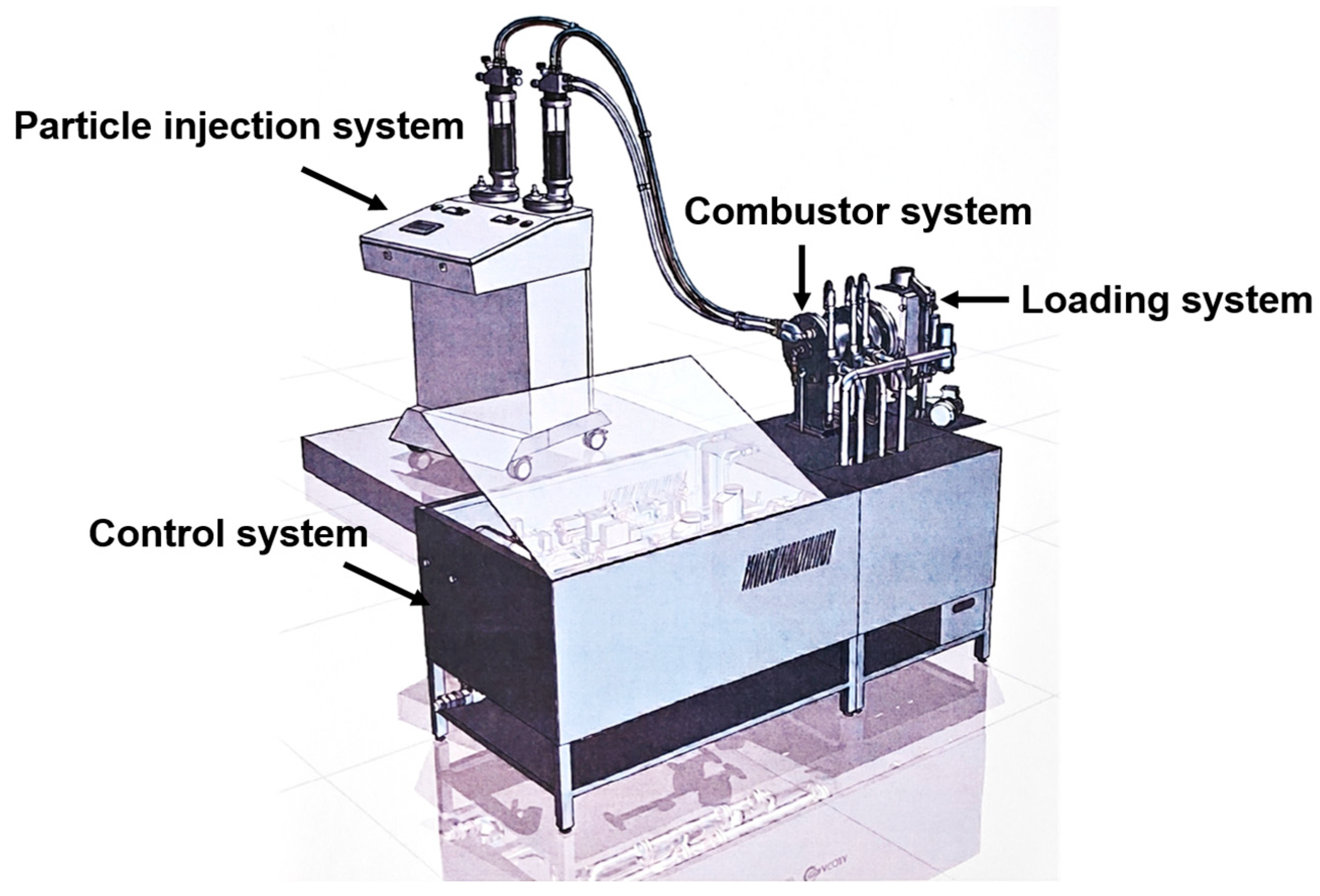
To investigate the performance and service life of TBCs under erosion conditions, this study developed a multi-factor coupled test setup. Its installation layout is shown in Figure 1. A kerosene-fueled combustion chamber system was designed to maintain the gas temperature and Mach number within the exhaust jet within specified ranges. To simulate engine erosion conditions, the setup incorporates a solid particle injection system. The specimen is placed within the heat flux generated by the combustion system and secured by a loading mechanism. A linear actuator enables the loading system and specimen to rapidly alternate between the heat flux and the cold airflow delivered by a cold nozzle, thereby achieving thermal cycling during the erosion test. The YSZ thermal barrier coating was prepared using an electron beam physical vapor deposition (EB-PVD) process. The microstructure and erosion evolution of this thermal barrier coating were investigated using scanning electron microscopy (SEM), confocal Raman spectroscopy (CRS), and white-light scanning interferometry (WLSI), and the erosion rates were calculated. The erosion morphology at each stage of the thermal barrier coating erosion process was analyzed in detail, and a potential erosion failure model under near-operating conditions was proposed.

2. Materials and Methods

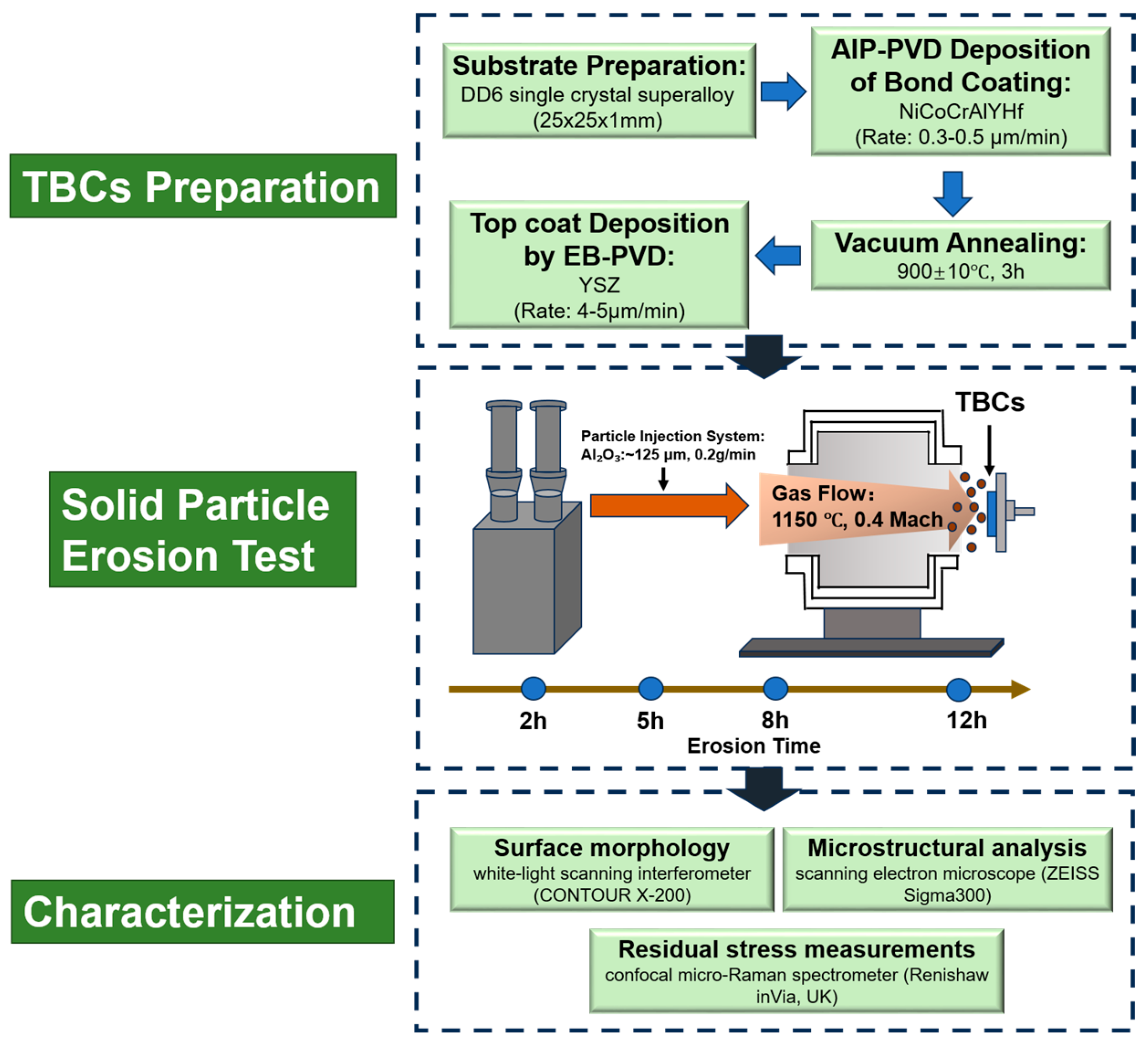
To provide a clear overview of the experimental procedure, a flowchart illustrating the research methodology is presented in Figure 2.

2.1. Coating Preparation

The substrate for TBCs was selected as single-crystal superalloy DD6 (10.0 mm × 20.0 mm × 1.0 mm), with a bond coat material of NiCoCrAlYHf. DD6 was selected as the substrate material due to its widespread use in aircraft engine turbine blades and its excellent high-temperature strength and creep resistance. NiCoCrAlYHf was chosen as the bond coat material because of its superior resistance to high-temperature oxidation and its widespread use as a bond coat material for TBCs. In addition, the DD6, NiCoCrAlYHf, and YSZ exhibit good thermal compatibility. The coefficients of thermal expansion (CTE) of these three components are relatively close, which helps reduce thermal mismatch stresses during high-temperature service and prolongs the coating’s service life. Therefore, the material system selected in this study is well-founded. The DD6 single-crystal substrate was supplied by AECC Beijing Institute of Aeronautical Materials (Beijing, China), with a crystallographic orientation of <001>, and was subjected to standard solution and aging heat treatments. The bond coat material was provided by the Central Iron and Steel Research Institute (Beijing, China).
The determination of specimen size is primarily based on compatibility with the equipment and the requirement for effective coverage of the test area. The selected size ensures that the specimen is fully covered within the effective operating area of the nozzle, thereby guaranteeing uniformity of temperature, gas flow velocity, and particle erosion conditions across the specimen surface and minimizing the impact of edge effects on the experimental results. Additionally, a specimen thickness of 1 mm provides sufficient mechanical stability under high-temperature, high-velocity gas flow conditions, preventing warping or localized deformation.
The chemical compositions of DD6 and NiCoCrAlYHf coating are shown in Table 1. The NiCoCrAlYHf bond coat was deposited by arc ion plating (AIP-PVD, A-1000, BIAM, Beijing, China) technology. Before deposition, the vacuum chamber was evacuated to a vacuum level below 5 × 10⁻³ Pa. The arc power was set to 80–100 A. A bias voltage of −50 to −100 V was applied to enhance ion bombardment, thereby improving interfacial bonding strength. During deposition, the substrate temperature was maintained at 400–500 °C. The distance between the target and the substrate was approximately 200 mm. The deposition rate was 0.3–0.5 μm/min. The deposition time was 100 min. The sample was then annealed for 3 h under vacuum at 900 ± 10 °C to promote diffusion and improve the bonding strength. Finally, the YSZ top coat was prepared by EB-PVD (UE-207 S, ICEBT, Kyiv, Ukraine). During deposition, the substrate temperature was controlled at 900–1000 °C to promote the formation of a columnar crystal structure. The electron beam power was maintained within the range of 20–30 kW. To ensure coating thickness uniformity, the substrate rotated at a speed of 10–20 rpm. The deposition rate was maintained at 4–5 μm/min. The deposition time was 25 min.

2.2. Solid Particle Erosion Test

Solid particle erosion tests were conducted using the multi-factor coupling apparatus shown in Figure 1 (MK Technology GmbH, BTR-MK, Grafschaft, Germany). The objective of this test is to simulate the impact, cutting, and material loss processes caused by solid particles on high-temperature, high-velocity gas flow environments during service conditions. Compared to conventional equipment, this apparatus can simultaneously apply high-temperature gas flows, dynamic thermal cycling, and erosion particles. It resulted in particle erosion behavior that more closely aligns with actual operating conditions and is suitable for the experimental requirements of this study.
Based on the design principles and operating point data of this apparatus, a correlation exists between gas temperature and jet velocity. The main erosion parameters are listed in Table 2. Solid particle erosion tests were conducted at 1150 °C/0.4 Mach, with erosion particles injected onto the coating surface at a flow rate of 0.2 g/min. Al2O3 particles (Imerys Sisa Taishan Abrasives Co., Ltd., Zibo, China) with a diameter of approximately 125 μm were selected as erosion particles, impacting at a 90° angle. To investigate damage evolution, a series of tests was conducted at multiple erosion time points: 2 h, 5 h, 8 h, and 12 h. After each time point, specimens were characterized and analyzed to systematically track the entire process from initial damage to final failure.
To ensure the reliability and reproducibility of the experimental results, the erosion tests were repeated three times under the same operating conditions. The erosion rates and residual stress results presented in this paper are the averages of these three independent experiments. The erosion rates of the specimens were calculated using Equation (1). Calculating the erosion rate based on the mass loss of the TBCs is the most commonly used method for evaluating the rate of coating erosion damage [23]. This method provides a reliable and widely accepted assessment of the rate at which coating material is lost due to erosion, thereby evaluating the level of TBC degradation. The mass of all samples was measured using an analytical balance before and after the erosion tests.
E r o s i o n   r a t e g k g = m a s s   l o s s   o f   t h e   s a m p l e m a s s   o f   e r o d e n t

2.3. Characterization

Surface topography was characterized using a white-light scanning interferometer (CONTOUR X-200, Bruker, Billerica, MA, USA). Microstructural analysis was performed with a scanning electron microscope (ZEISS Sigma300, Carl Zeiss AG, Oberkochen, Germany). Non-destructive quantitative residual stress measurements of TGO were conducted on specimens at different erosion time points using a confocal micro-Raman spectrometer (Renishaw inVia, Wotton-under-Edge, UK) in photoluminescence piezoelectric spectroscopy (PLPS) mode.

3. Results

3.1. Macro Surface Morphology of Coatings

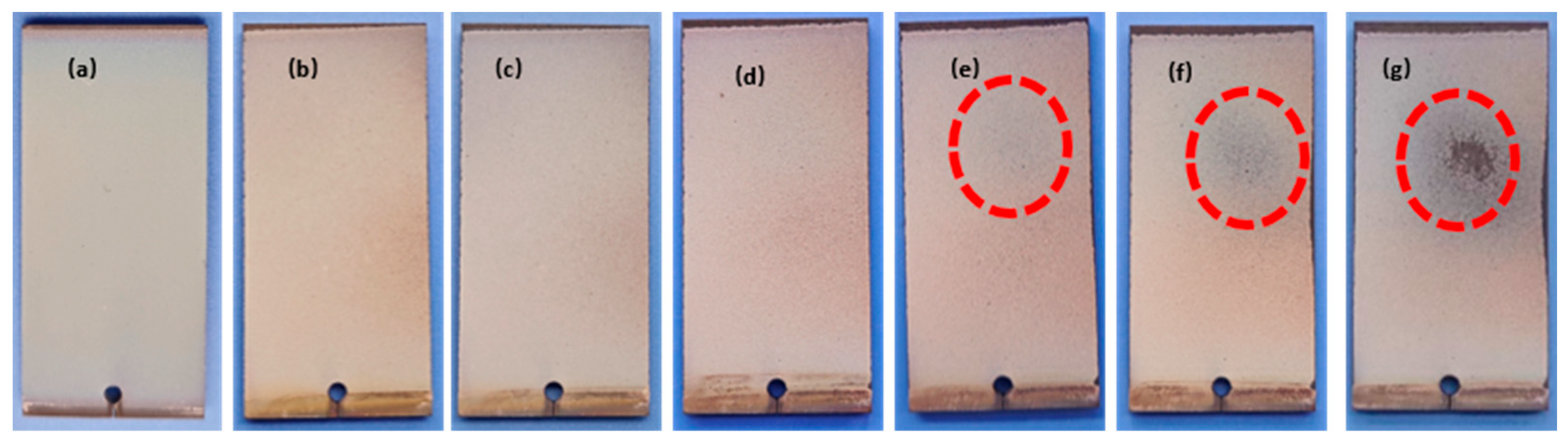
The evolution of the macro-morphology of the thermal barrier coating specimens during the 12 h erosion test is shown in Figure 3. As can be seen in Figure 3, the as-deposited thermal barrier coating prepared by the EB-PVD method exhibits an intact surface with no obvious defects. After 8 h of erosion testing, coating spalling appeared in the central regions of the erosion area on the specimen surface. By 10 h of erosion, numerous punctate erosion pits formed. The number of erosion pits gradually increased. As these pits coalesced, the underlying black bond coat progressively exposed. After 12 h of erosion, extensive spalling of the TBCs occurred on the specimen surface, and the diameter of the damaged area was approximately 1.5 mm, resulting in coating failure.
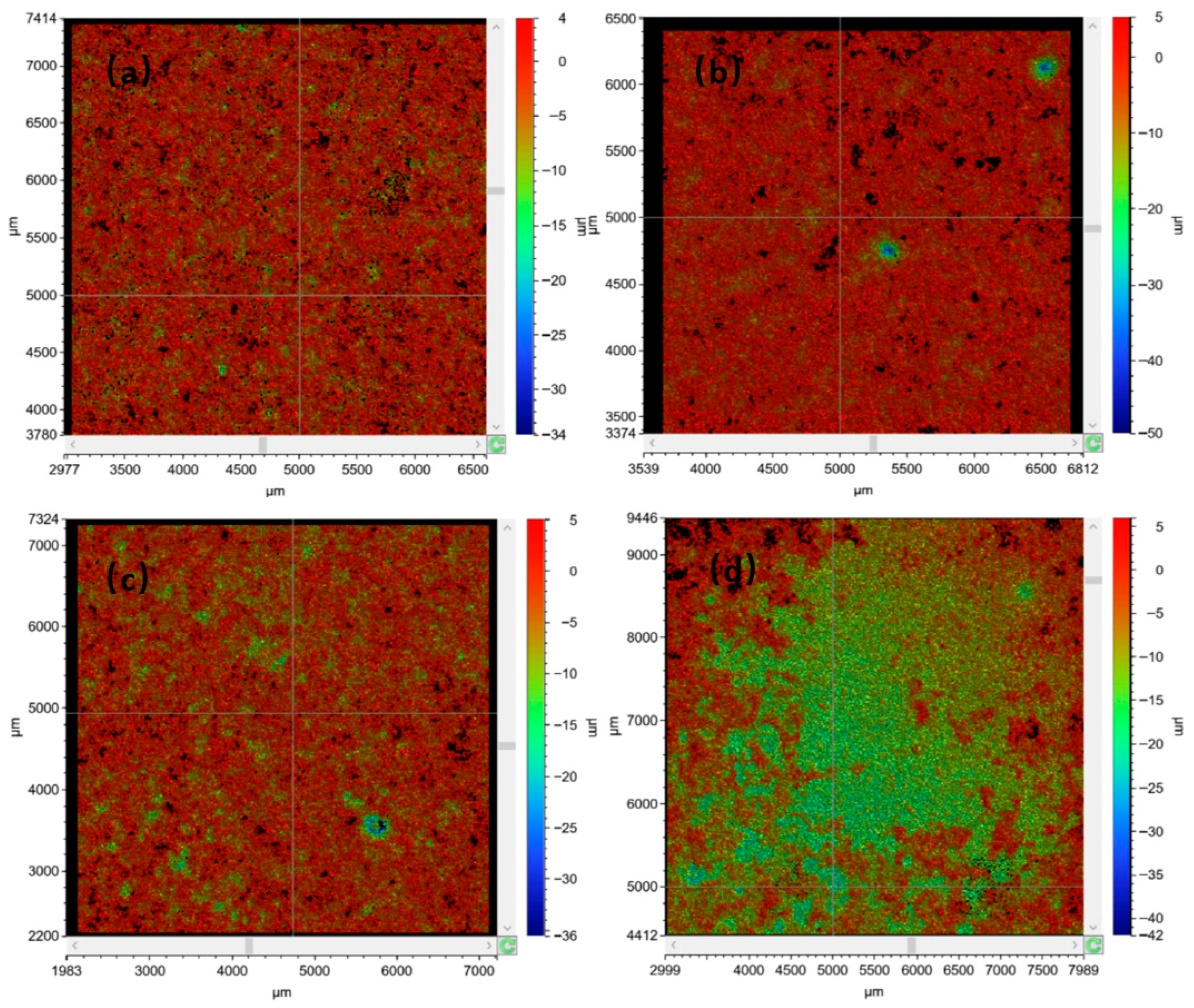
The surface morphology of the eroded YSZ thermal barrier coating was characterized using WLSI, as shown in Figure 4. After erosion for varying durations, pits of varying sizes and depths were observed on the YSZ coating surface. After 2 h of erosion, discrete pits appeared on the coating surface. This indicates that high-speed particles caused significant impact damage to the coating surface, leading to YSZ coating loss due to micro-cutting. After 5 h of erosion, the diameter of the erosion pits increased compared to the 2 h stage, and surface damage intensified. The micro-pits formed earlier expanded and connected with one another, forming larger and deeper erosion pits. A prominent pit with a diameter of approximately 145 μm appeared within the eroded area. As the erosion time was extended to 8 h, the number of large-diameter pits increased. After 12 h of erosion, extensive, continuous deep delamination was observed on the coating surface, exposing the bond coat or alloy substrate. At this point, the structural integrity of the coating had been compromised, and its protective function had been lost.
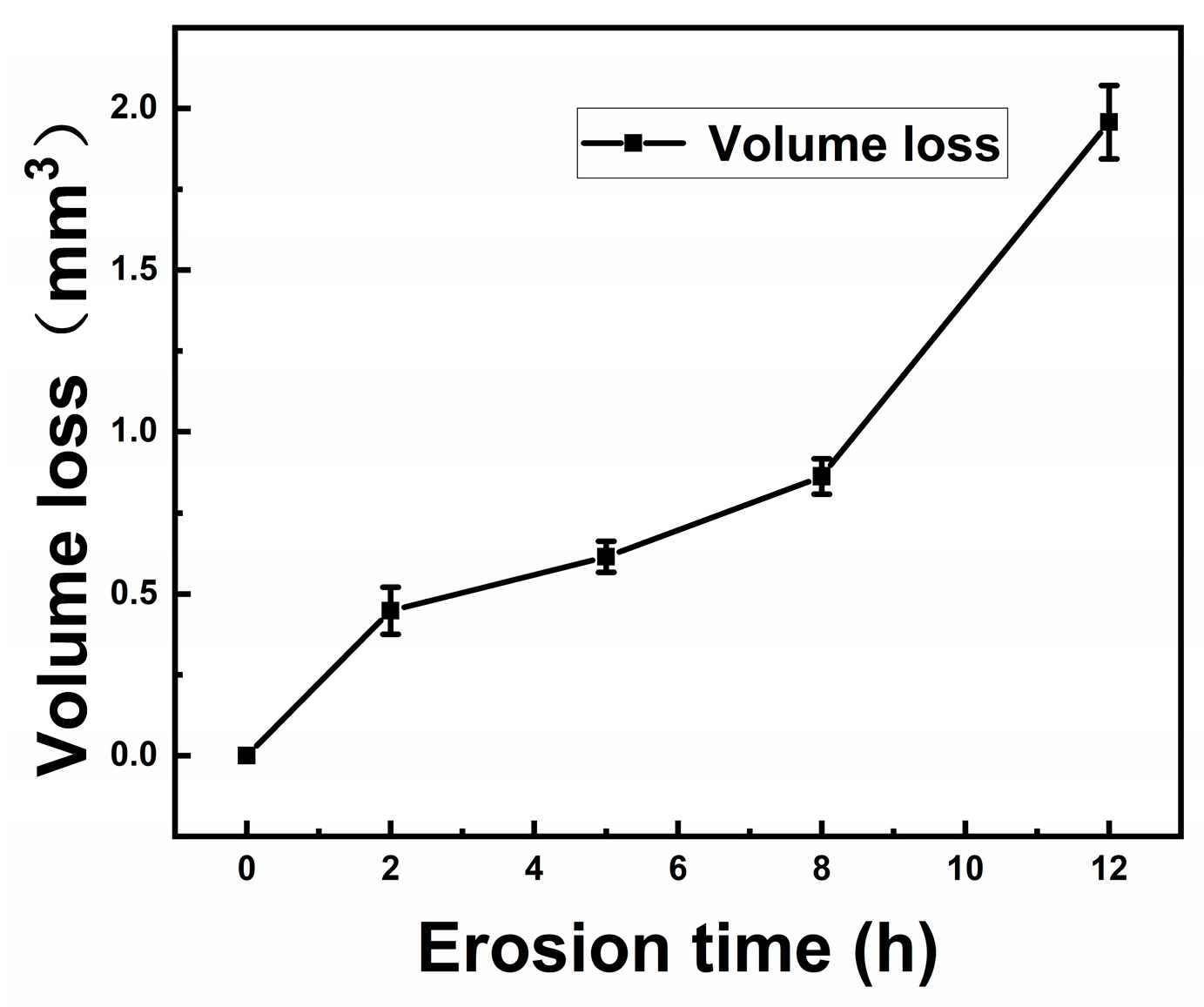
Figure 5 shows the variation in volume loss of the specimens over time after different erosion cycles between 0 and 12 h. The volume losses at 2 h, 5 h, 8 h, and 12 h were 0.477 mm3, 0.561 mm3, 0.803 mm3, and 1.860 mm3. It can be observed that the volume loss of the YSZ coating during the erosion process exhibits distinct phasic characteristics and can be divided into three typical stages. In the first stage (0–2 h), the YSZ coating undergoes rapid volume loss. This rapid material loss is likely primarily attributed to the rapid removal of the “cauliflower-like” structure on the coating surface. These regions have a loose structure and low bond strength, making them prone to brittle fracture and spalling under high-speed particle impact, thereby leading to rapid volume loss. In the second stage (2–8 h), as the surface “cauliflower-like” structure is gradually removed, the denser columnar crystal matrix is exposed, enhancing the coating’s overall erosion resistance. Additionally, under continuous particle impact, the surface undergoes a certain degree of compaction and localized densification, which helps disperse the impact energy and thereby suppresses further material spalling. In the third stage (8–12 h), rapid volume loss of the coating reoccurs. At this point, due to the significant thinning of the coating, impact loads are more easily transmitted to the interface, causing severe interface damage. As microcracks continue to propagate and interconnect, the interface bond strength decreases significantly, ultimately leading to large-scale spalling that exposes the bond coat or alloy substrate, rendering the coating’s protective function largely ineffective.
The macroscopic morphological evolution of the coating during the erosion process exhibits a significant transition from localized damage to large-scale spalling. Previous studies have shown [22,37,39] that erosion typically acts first on the surface and gradually propagates inward. The results of this study are consistent with this trend. However, under prolonged erosion conditions in this work, earlier and more severe spalling occurred. This discrepancy primarily stems from the influence of a multi-factor coupled environment, which accelerates damage accumulation and propagation, indicating that multi-field coupling erosion environment has a decisive impact on TBCs life.

3.2. Microscopic Surface Topography of the Coating

3.2.1. As-Deposited Surface Microstructure

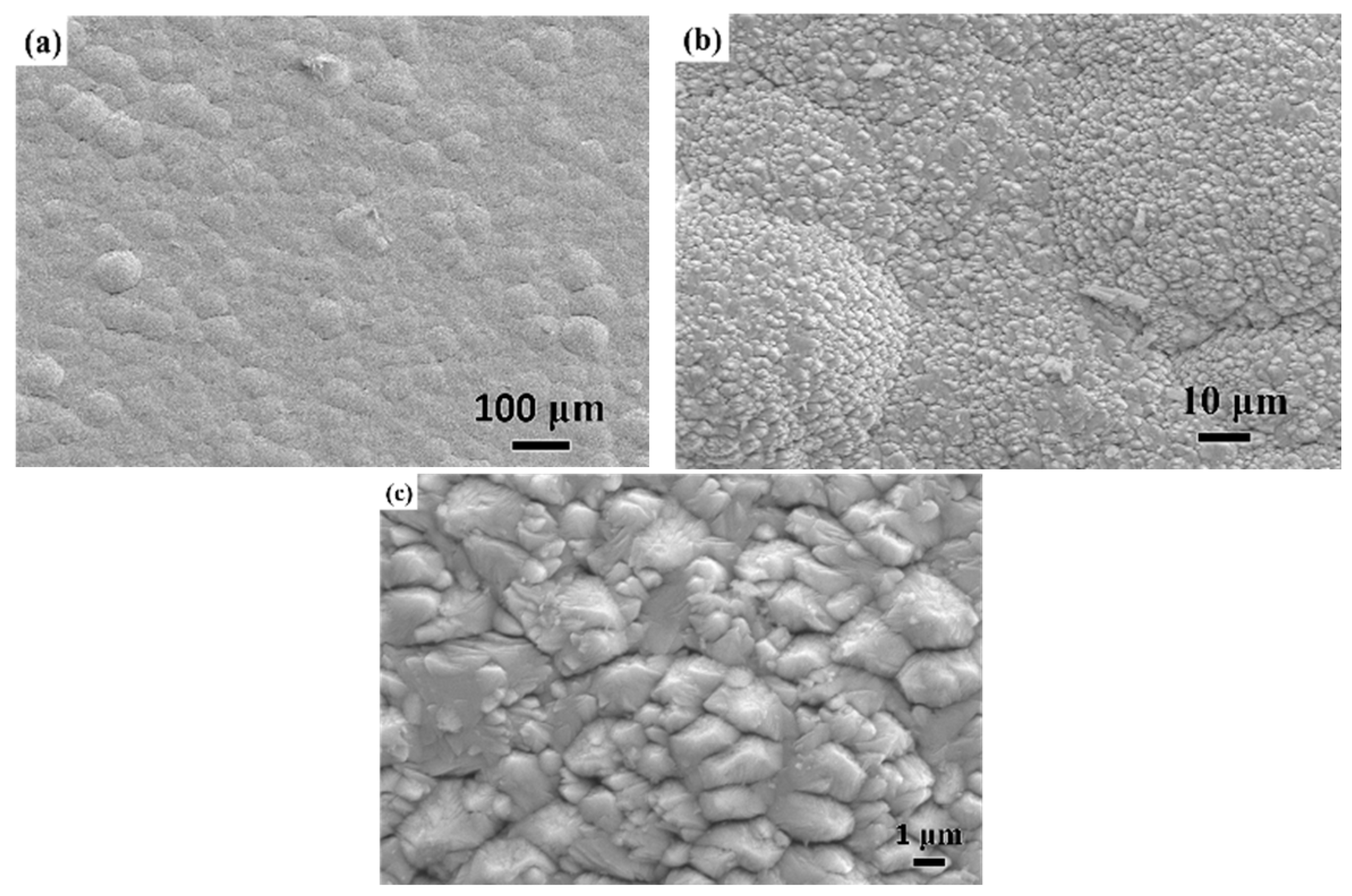
Figure 6a–c show the surface morphology of the deposited YSZ thermal barrier coating at different magnifications. The coating surface exhibits a characteristic cauliflower-like morphology, with the tops of the columnar crystals forming pyramids; this is a typical microstructural feature of EB-PVD TBCs. Studies have shown that during the EB-PVD process, atoms tend to grow along the inclined direction of the columns rather than strictly vertically. This inclined and divergent growth pattern results in the cauliflower-like structure. Due to internal porosity and structural divergence, this cauliflower-like structure exhibits low bond strength and brittleness. Under the erosion of high-speed gas flows and particles, this brittle cauliflower-like structure is prone to fracture and peeling from the top, thereby forming pits on the coating surface.

3.2.2. Micro-Surface Morphology During Erosion

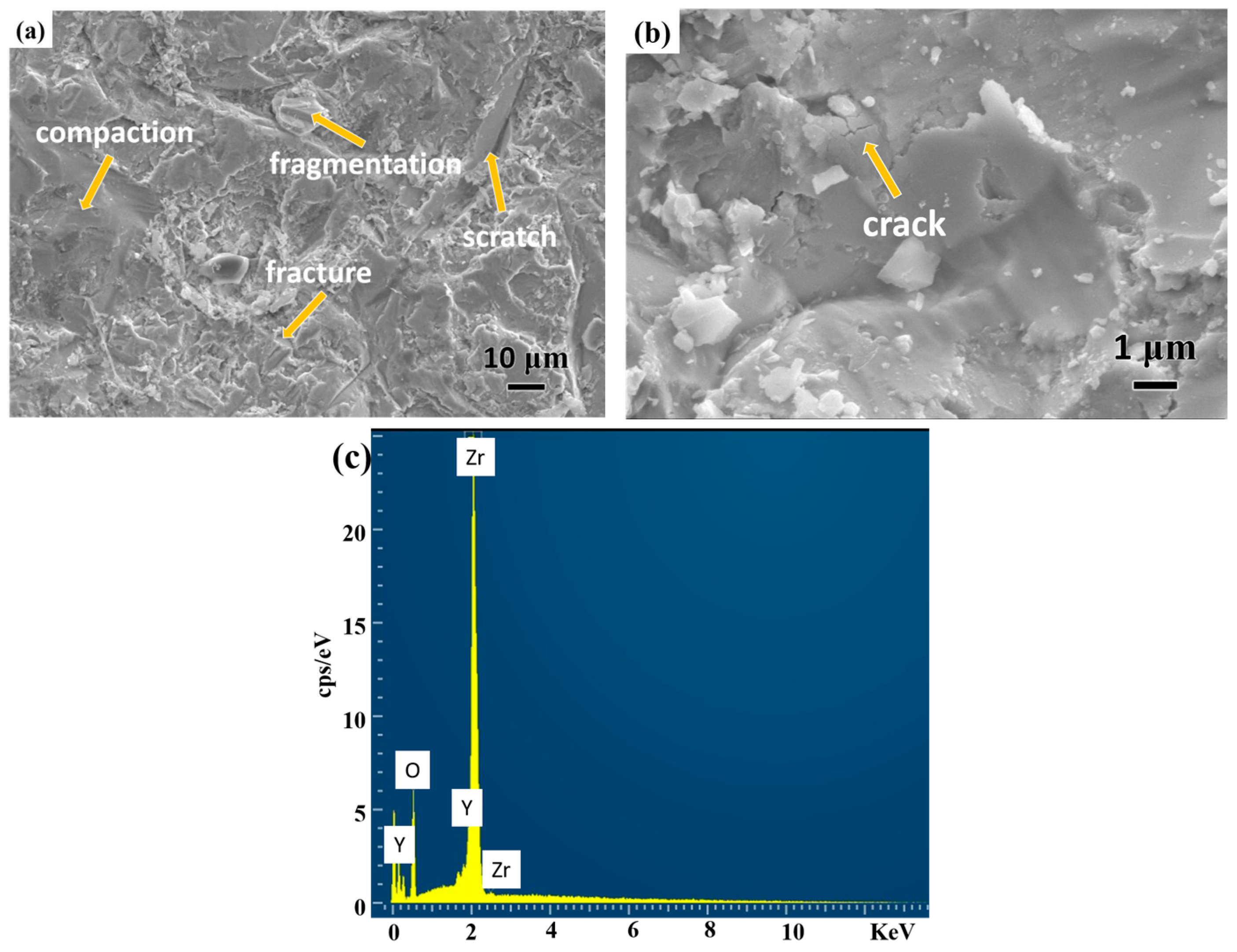
Figure 7 shows the surface morphology at the erosion center of the YSZ coating after a 2 h erosion test. After 2 h of erosion, the surface morphology of the EB-PVD TBCs has changed significantly compared to its state immediately after deposition, and initial damage has already appeared in the coating structure. The cauliflower-like structure on the coating surface is no longer visible. Instead, extensive compaction of the top coat was observed, along with the formation of cracks, accompanied by significant ceramic fragmentation and fracture. Surface scratches were visible. Erosion particles cut into the surface material like knife blades, forming numerous elongated, superficial spalling marks. Post-erosion energy-dispersive spectroscopy (EDS) results showed spectral peaks corresponding to Zr, O, and Y elements, indicating that the erosion damage had not yet extended to the bond coat.
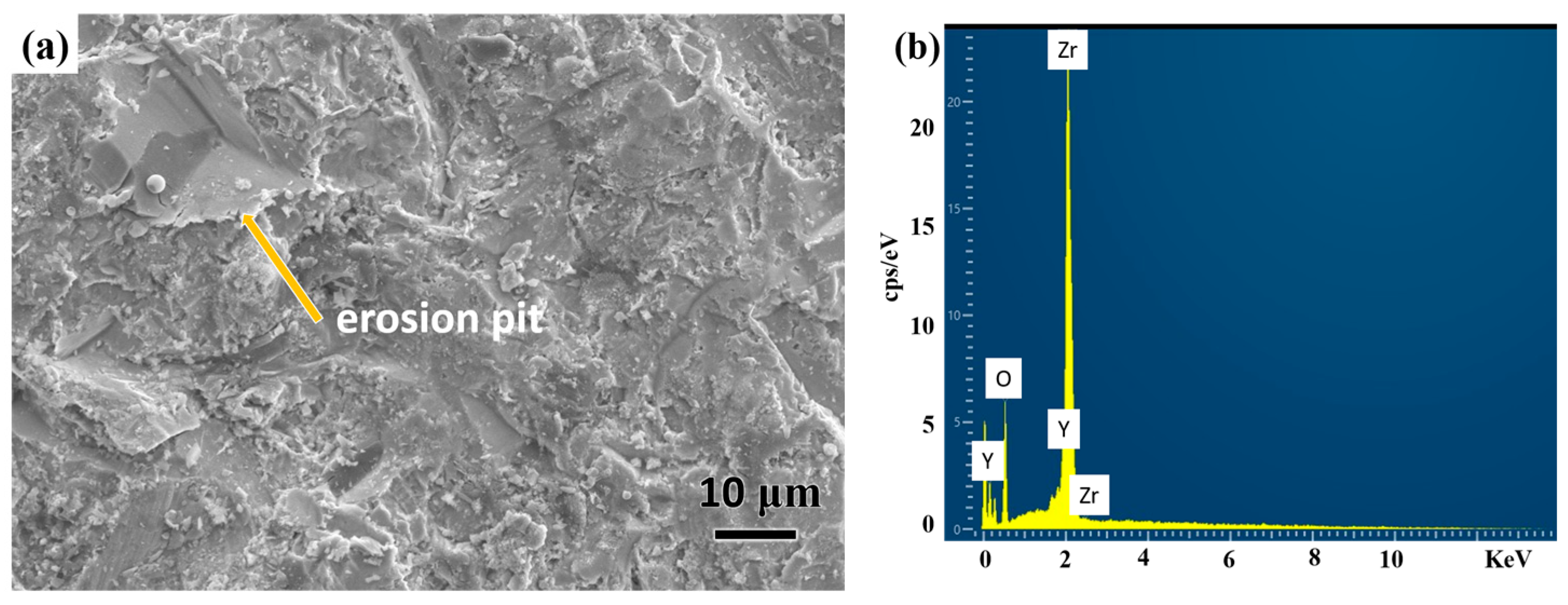
Figure 8 shows SEM observations and EDS elemental analysis of the specimen surface after 5 h of erosion. Due to particle erosion, the cauliflower-like structure on the top coat surface was largely destroyed. The ceramic surface is flattened and compacted, and the pyramidal structure is no longer visible. Compared to the 2 h erosion, large spalling pits were visible on the coating surface. Previous studies have shown [40] that under particle erosion, columnar grains are prone to intergranular fracture due to repeated impact and localized shear, leading to localized spalling of the material and the formation of pitting structures. Therefore, the pitting observed in Figure 7a may be related to the aforementioned intergranular fracture mechanism. The EDS spectra correspond to Zr, O, and Y elements. This result is consistent with the 2 h erosion, indicating that the erosion damage did not reach the bond coat.
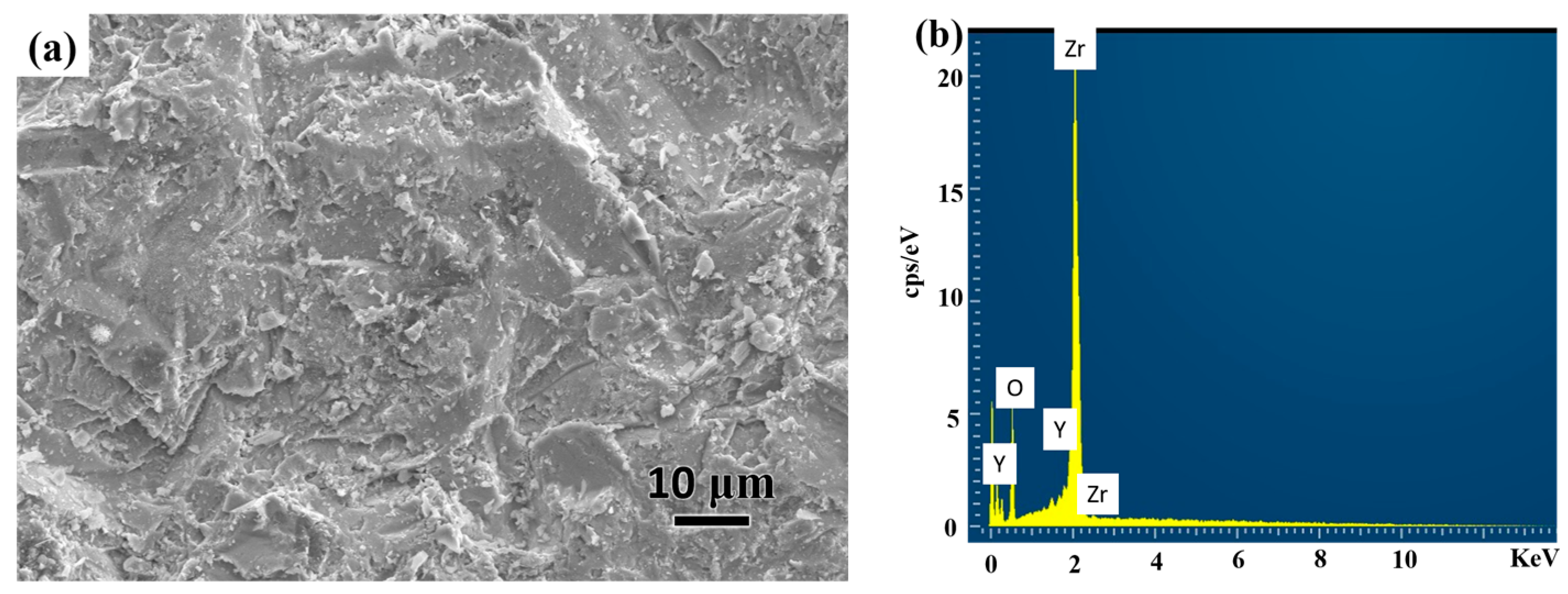
Figure 9 shows SEM observations and EDS elemental analysis of the specimen surface after 8 h of erosion. It can be observed that the morphology of the coating surface at this stage is similar to that after 5 h. The top coat surface appears flattened and densified, accompanied by fractures and scratches. The EDS spectrum shows the elements Zr, O, and Y. This result is consistent with the EDS analysis from the early erosion stages, indicating that erosion damage has not yet extended to the bond coat.
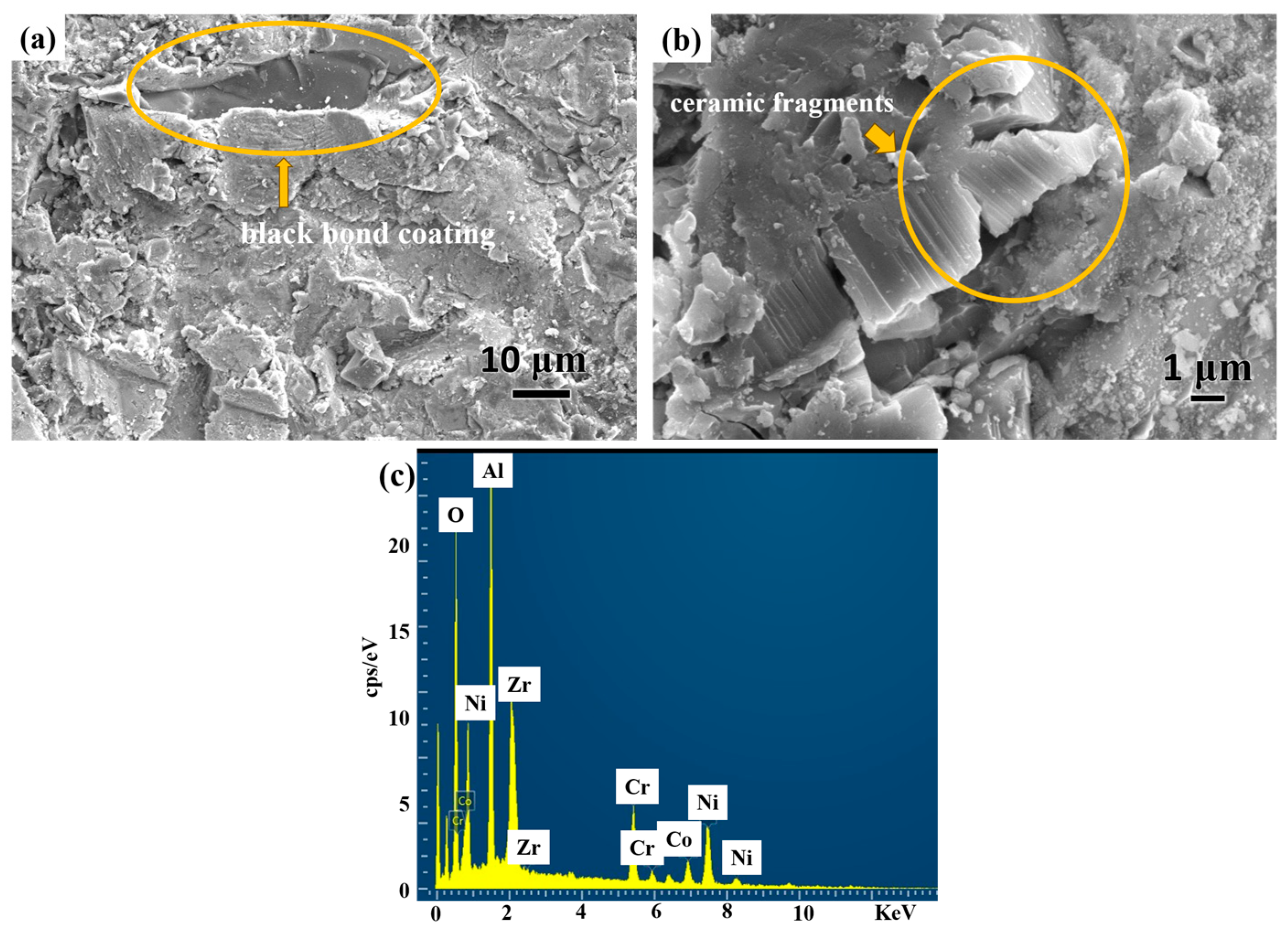
After 12 h of erosion, the specimen surface morphology is shown in Figure 10. The coating was severely damaged, essentially losing its protective function. At this stage, severe spalling occurred, leaving only a small amount of top coat material on the specimen surface. Extensive spalling exposed the underlying dark material. Based on the thermal barrier coating system structure, this dark material is inferred to be the bond coat (HY5, primarily NiCoCrAlYHf) or the substrate. The EDS spectra in Figure 10c correspond to elements such as Ni, Co, Cr, O, and Zr, indicating that the bonding layer is now exposed at the surface. In areas where the coating had not yet completely delaminated, the coating is distributed on the surface in a fragmented form, reaching a critical state on the verge of peeling off. At this point, erosion damage enters an accelerated stage.
Microscopic Surface Topography: Changes in the microstructure during the erosion process reveal the evolution of coating damage mechanisms. Studies [40] have shown that surface topographical damage to EB-PVD TBCs during particle erosion primarily manifests as cutting grooves and pits. Similar phenomena were observed in this study. However, under the influence of multiple factors, the evolution of the surface structure becomes more complex. The damage mechanism involves the synergistic interaction of various processes, including surface compaction, fracturing, pits and cutting.

3.3. Cross-Sectional Microstructure of the Coating

3.3.1. As-Deposited Cross-Sectional Microstructure

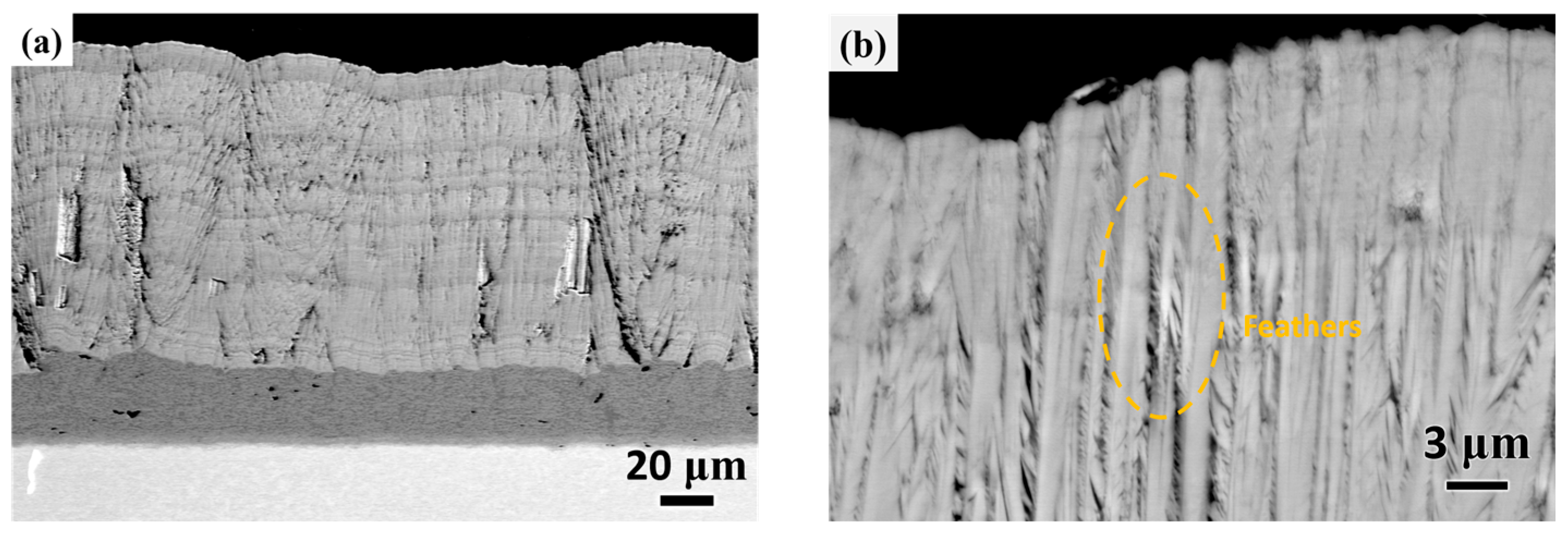
The cross-sectional micrograph of the deposited YSZ thermal barrier coating is shown in Figure 11. The YSZ coating thickness is ~120 μm. As shown in the figure, the YSZ thermal barrier coating exhibits a columnar crystal structure, with the growth direction of the columnar crystals perpendicular to the substrate surface. This is a characteristic feature of coatings prepared by the EB-PVD process. Small longitudinal gaps exist between neighboring columnar crystals. This structure confers excellent thermal cycling resistance to the coating and significantly increases the thermal cycling life [41]. Inspection at higher magnification, as shown in Figure 8b, reveals many finer feathery microstructures inside the individual columnar crystals. These feather-like substructures effectively scatter phonons, reducing the thermal conductivity of the coating [42,43].

3.3.2. Cross-Sectional Morphology During Erosion

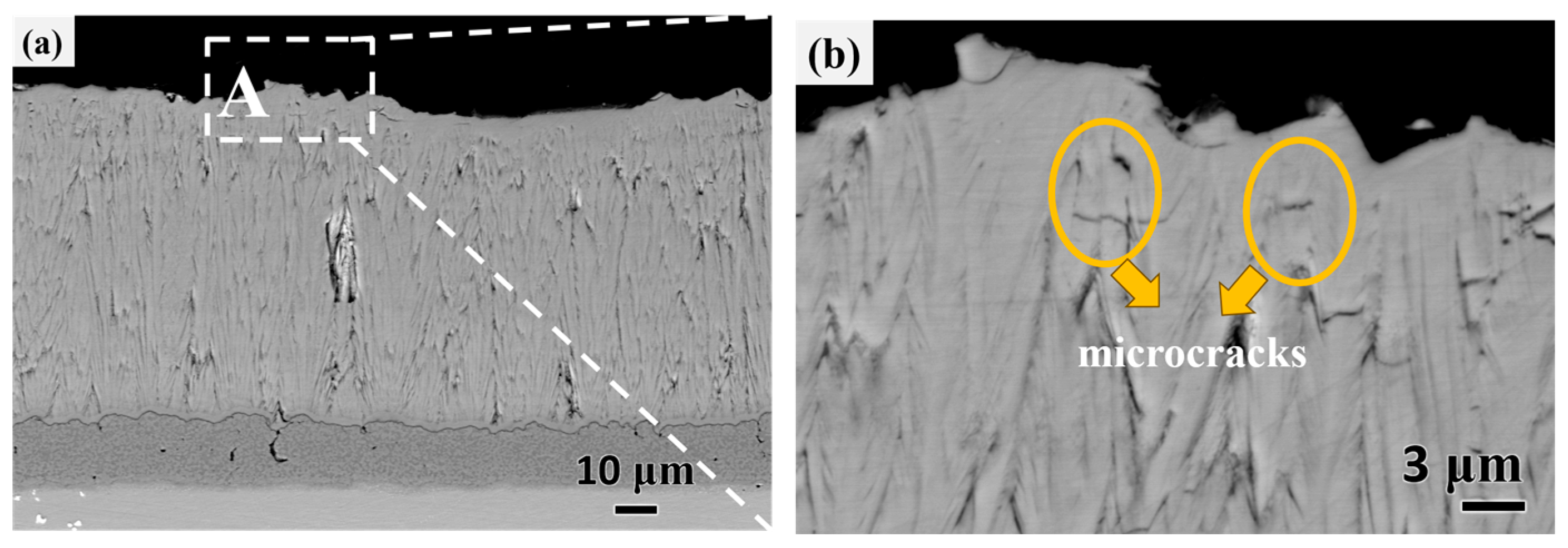
Figure 12 shows the cross-section of a YSZ thermal barrier coating specimen after a 2 h erosion test. It can be seen that, following 2 h of erosion, a large number of randomly distributed, discontinuous microcracks have appeared in the near-surface region of the coating. Most of these microcracks are confined within individual columnar grains and tend to propagate along fine, feather-like grain boundaries within the columnar grains. This likely represents the initial stage of coating damage caused by the impact force of eroding particles. These cracks typically originate from inherent microscopic defects in the coating. When these locations are struck by solid particles, stress concentrations are generated. When local stresses exceed the fracture strength of the YSZ material, brittle fracture is induced, resulting in the formation of microcracks. As particle erosion continues, these microcracks propagate along grain boundaries, leading to brittle fracture and spalling at the cauliflower-like protrusions. Ultimately, V-shaped grooves appear on the surface. At this stage, cross-sectional analysis of the YSZ coating indicates that no significant macroscopic spalling has occurred on the coating surface. The interface between the top layer and the bond coat remained intact. This indicates that the eroding particles were currently acting only on the near-surface region of the coating and had not significantly affected the interface.
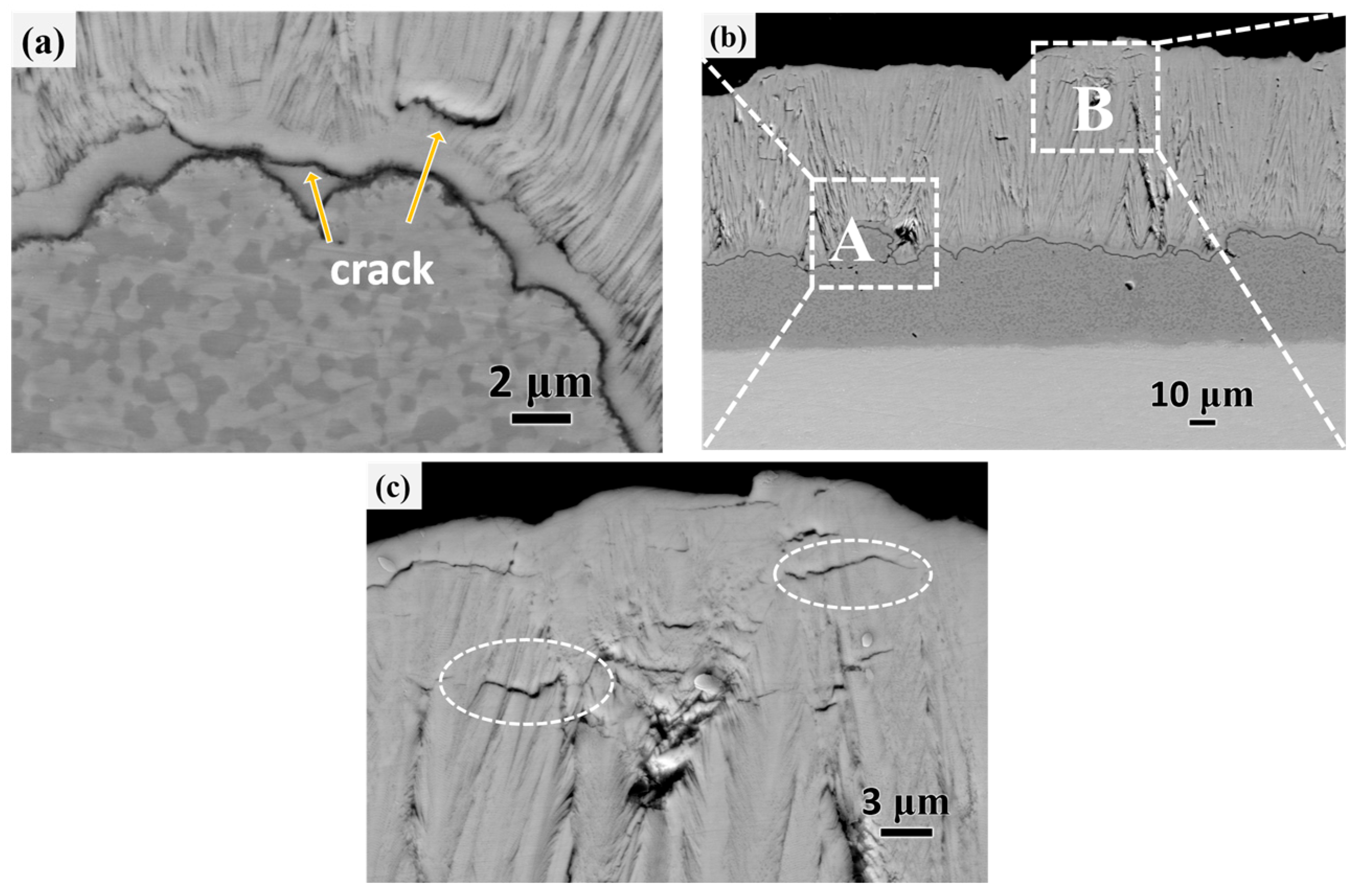
As the erosion time was extended to 5 h, as shown in Figure 13, the cross-sectional morphology of the coating revealed more severe damage. The number of cracks near the coating surface increased. These cracks extended significantly and penetrated multiple columnar crystals. Notably, as the coating thinned, the bond coat at the interface began to wrinkle under the combined effects of high temperature and eroding particles. Simultaneously, localized cracks appeared at the raised portions of the interface. This indicates that erosion has gradually affected the top coat/bond coat interface. The erosion mechanism has shifted from surface abrasion to deeper structural damage.
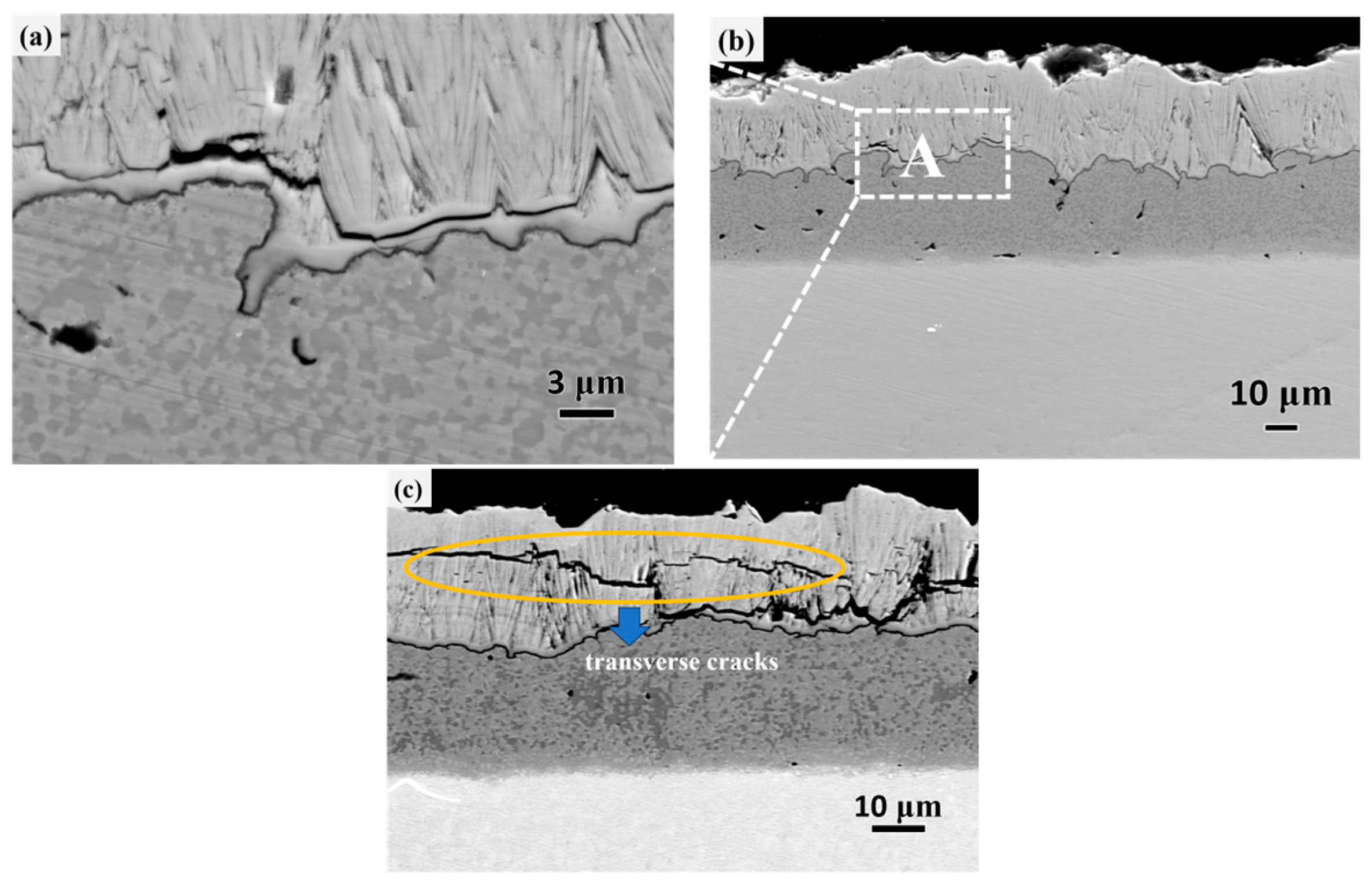
The cross-sectional morphology of the YSZ thermal barrier coating specimen after 8 h of erosion is shown in Figure 14. The coating cross-section has further deteriorated, and the coating thickness has significantly decreased. Cracks extend from the surface into deeper regions, causing the columnar crystals in the deep YSZ layer to fracture. As shown in Figure 14c, transverse cracks have formed in the deep regions, leading to the wholesale detachment of large YSZ ceramic fragments. Concurrently, as shown in Figure 14a, transverse cracks appeared on the convex surface of the top coat/bond coat interface, causing a severe decline in the bond strength between the top coat and the bond coat. The extensive fracture of the columnar crystal structure and the weakened interfacial bond strength accelerated the loss of the YSZ material.
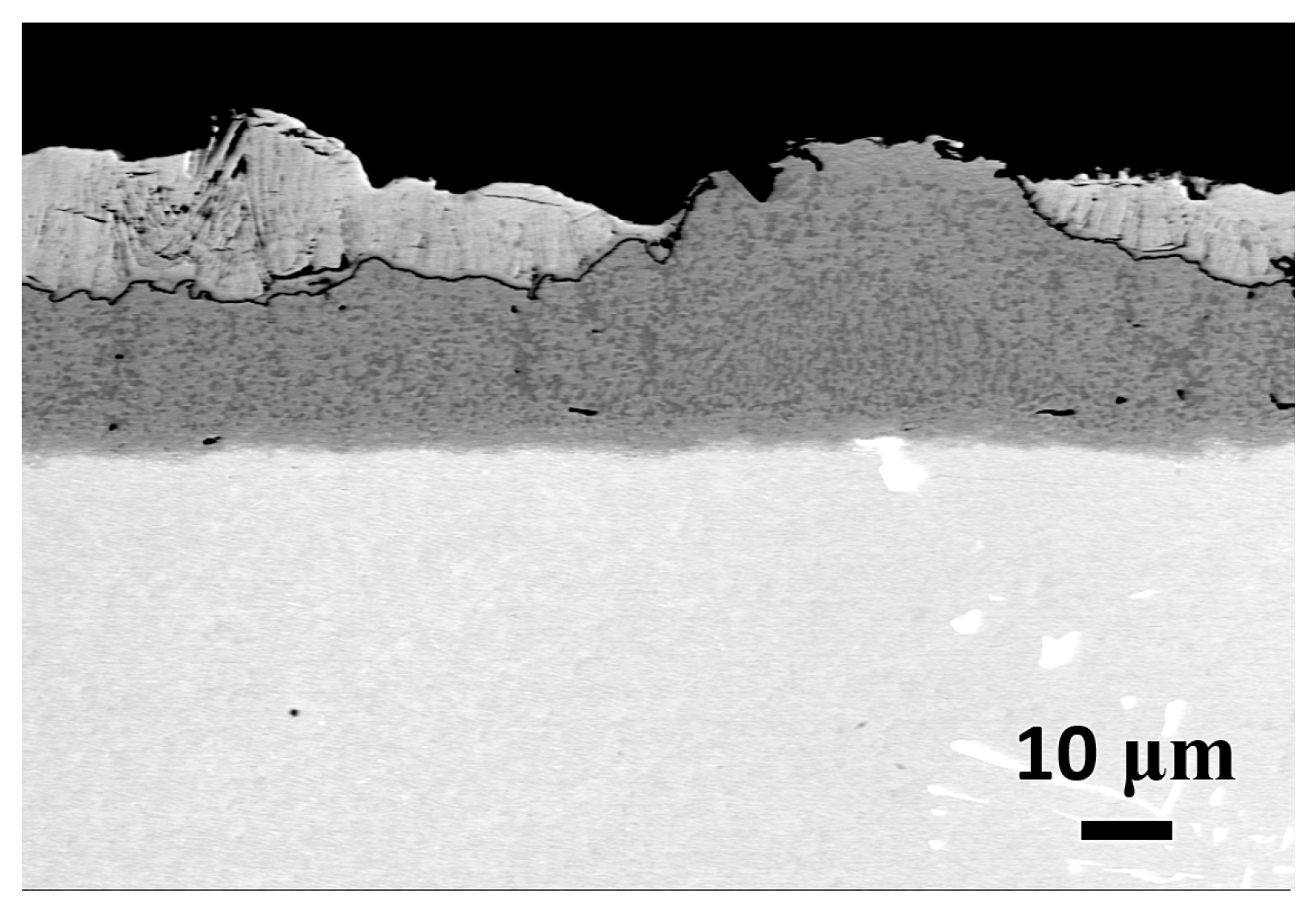
After 12 h of erosion, the YSZ coating had almost completely failed. Figure 15 shows the cross-sectional morphology of the YSZ thermal barrier coating specimen. The cross-section reveals that the bond coat has been exposed. The bond coat was first exposed at the interface protrusions. Numerous transverse cracks are visible at the base of the remaining YSZ coating, making it highly susceptible to delamination during subsequent impacts. At this stage, the failure mode of the coating primarily manifests as global peeling and interfacial delamination.
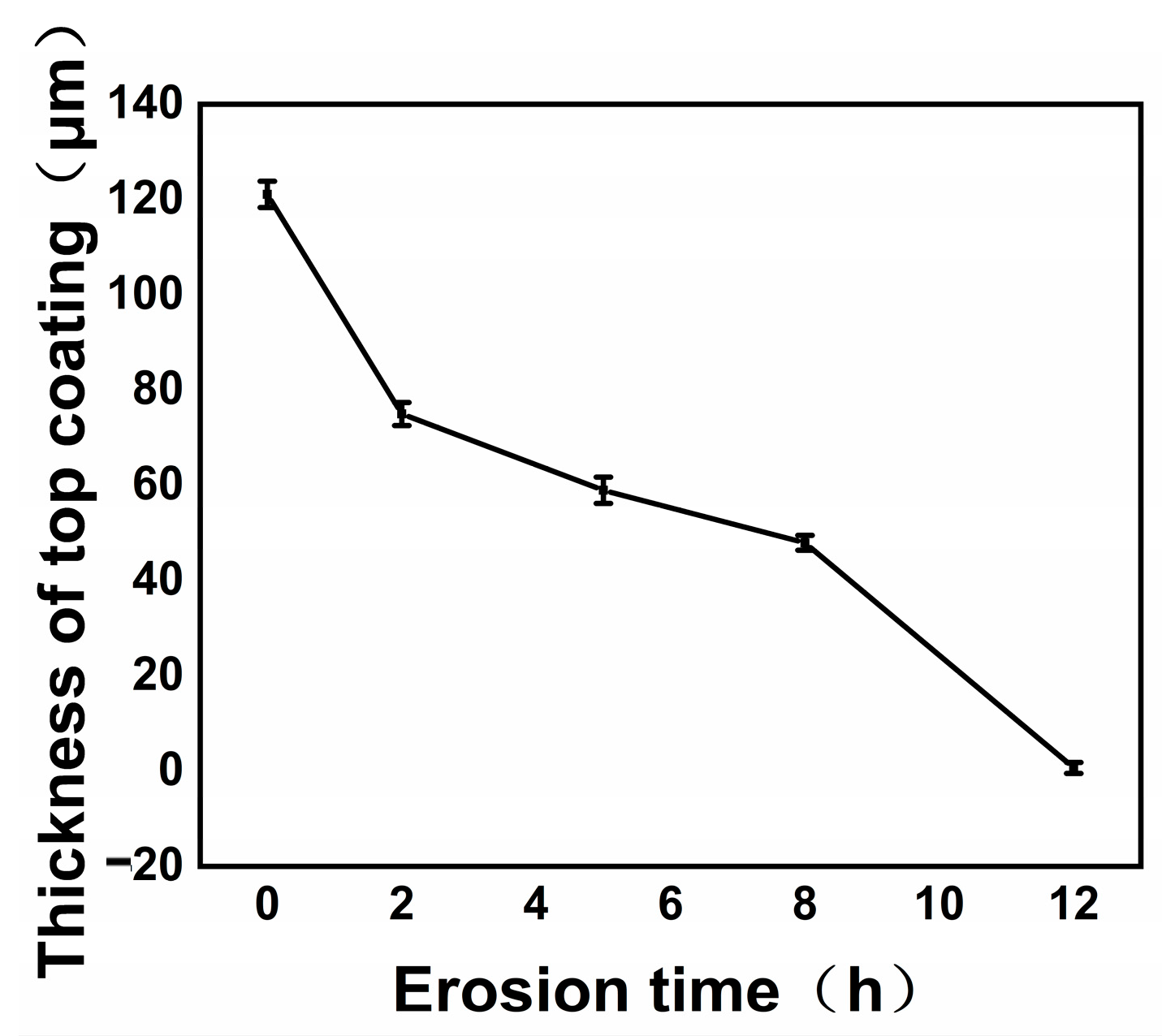
Figure 16 shows the variation in the remaining thickness of the YSZ top coat over time during erosion. The initial coating thickness was approximately 120 μm. After 2 h of erosion, it rapidly decreased to about 75 μm, then further decreased to approximately 60 μm and 48 μm at 5 h and 8 h, respectively, and had almost completely failed by 12 h. It can be observed that, similar to the mechanism of coating volume loss, the thinning of the coating during the erosion process exhibits distinct stage-like characteristics.
Cross-sectional analysis further reveals the evolution of internal damage within the coating. Previous studies [20] have shown that cracks typically originate at the surface and propagate inward. This trend was also observed in the present study, but interfacial damage was more pronounced. Initial damage was primarily dominated by the removal of the surface cauliflower structure, whereas in the later stages, the failure process shifted to being controlled by interfacial damage. The appearance of interfacial wrinkling indicates that local instability and plastic deformation have occurred at the interface. Interfacial wrinkling leads to stress concentration and accelerates the formation and propagation of interfacial cracks, resulting in delamination. This phenomenon is rarely reported in traditional single-factor experiments.

3.4. Residual Stress Evolution in the TGO Layer

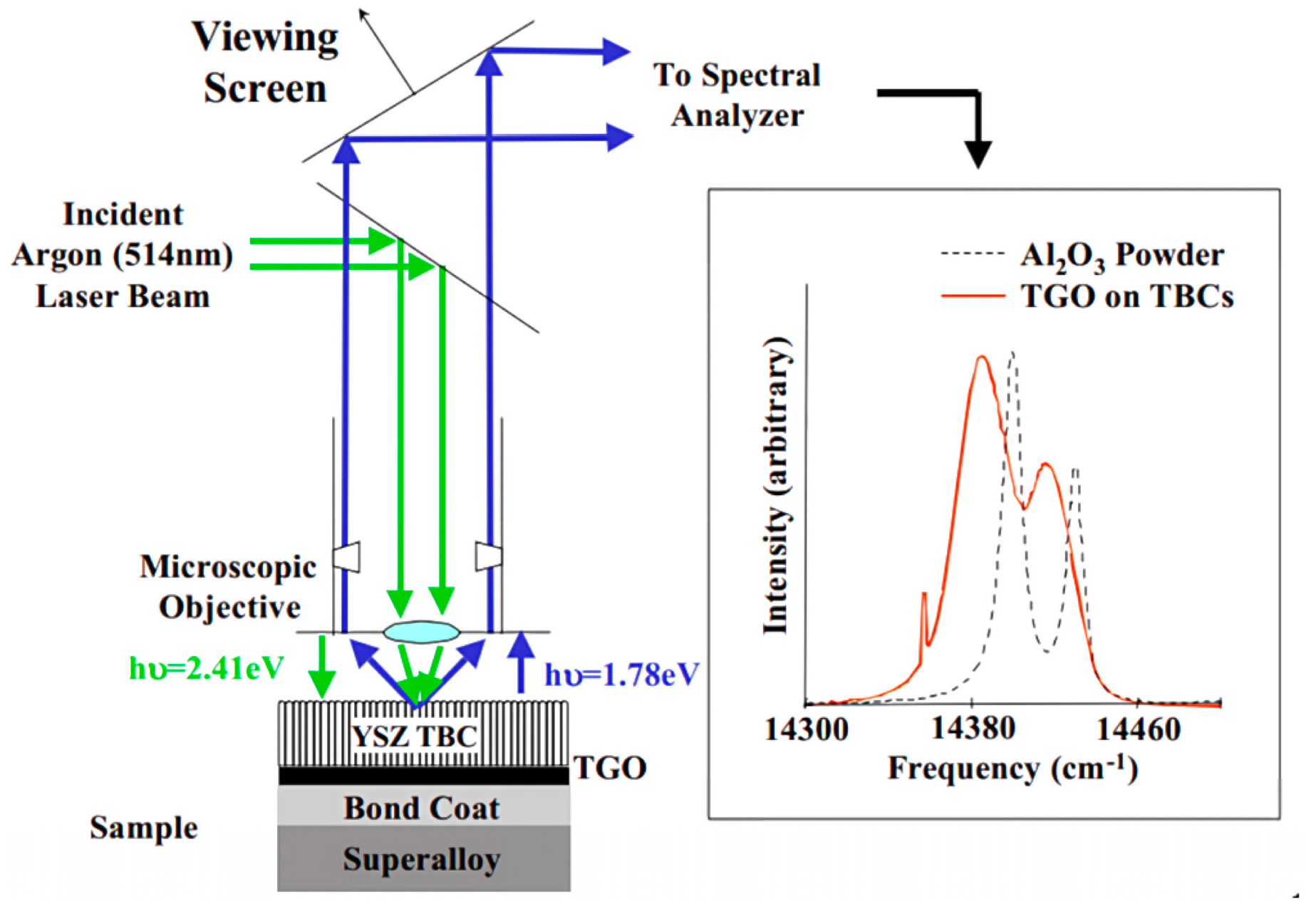
The TGO layer in TBCs consists primarily of α-Al2O3. Cr3+ ions in the bond coat and substrate typically diffuse into the α-Al2O3 matrix as impurities; simultaneously, because the ionic radii of Cr3+ and Al3+ are very similar, a solid solution is formed. The stress in the TGO layer can be determined by measuring the frequency shift in the fluorescence spectral lines caused by Cr3+. The basic principle of using the PLPS method to measure stress within the TGO layer of a sample is shown in Figure 17. The spectral bandgap width of YSZ is 12 eV, which is significantly higher than the energy of the Ar+ laser source (514 nm, 2.41 eV) and the characteristic Cr3+ fluorescence of PLPS (693 nm, 1.78 eV). Aside from defects such as pores within the top coat and laser scattering at grain boundaries, the top coat is partially transparent to the incident Ar+ laser and the emitted fluorescence. Therefore, by selecting an appropriate laser to irradiate the surface of the YSZ coating, the re-excited characteristic Cr3+ fluorescence can be detected. This fluorescence is generated by the oxide layer formed due to high-temperature oxidation of the bond coat under laser excitation; it shifts and deforms in response to changes in internal stress within the object, and the frequency shift in the peak is proportional to the TGO stress. It is a doublet spectrum, with the two peaks designated as R1 and R2, and the main spectral lines occurring at 14,300 cm−1 to 14,500 cm−1. The shift in the wavenumber of the R2 peak exhibits a good linear relationship with the internal stress of the TGO, as shown in Equation (2) [44].
Δ υ T G O = Π T G O · σ T G O
where Π T G O is the constant piezoelectric coefficient (5.07 cm−1·GPa−1).
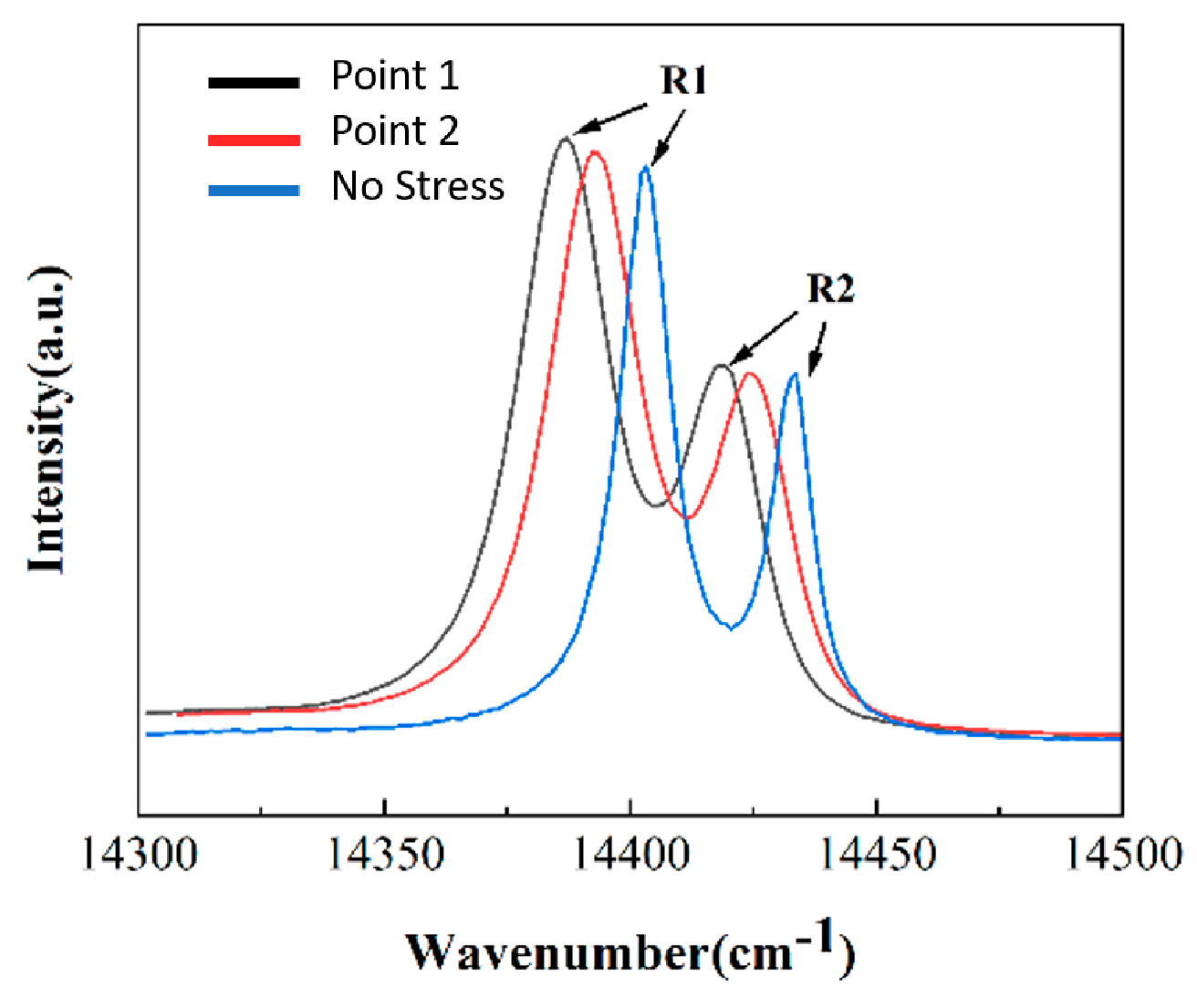
Figure 18 shows the fluorescence spectra at two randomly selected points on the coating surface. Under stress-free conditions, the characteristic peak is essentially at the reference position (R2 ≈ 14,432 cm−1). Compared to the spectrum corresponding to the stress-free state, at position 1, the characteristic peak shows a significant shift, with the fluorescence signal shifting toward a lower position. This indicates that compressive stress has accumulated within the coating. This stress causes lattice distortion, altering the local crystal field environment of Cr3+ ions, thereby leading to a change in w-value [45]. At the same time, the change in peak intensity may be related to local structural inhomogeneities [46]. At position 2, the characteristic peak exhibits a different shift trend. At this location, stress may have been partially released, accompanied by structural damage such as microcrack propagation and interface degradation. These changes influence the fluorescence response by altering defect density and scattering behavior. However, relying solely on random-point detection makes it difficult to accurately assess the true stress levels at different locations within the coating. However, it is difficult to accurately assess the true level of stress at different locations in the TGO using only random point testing [33].
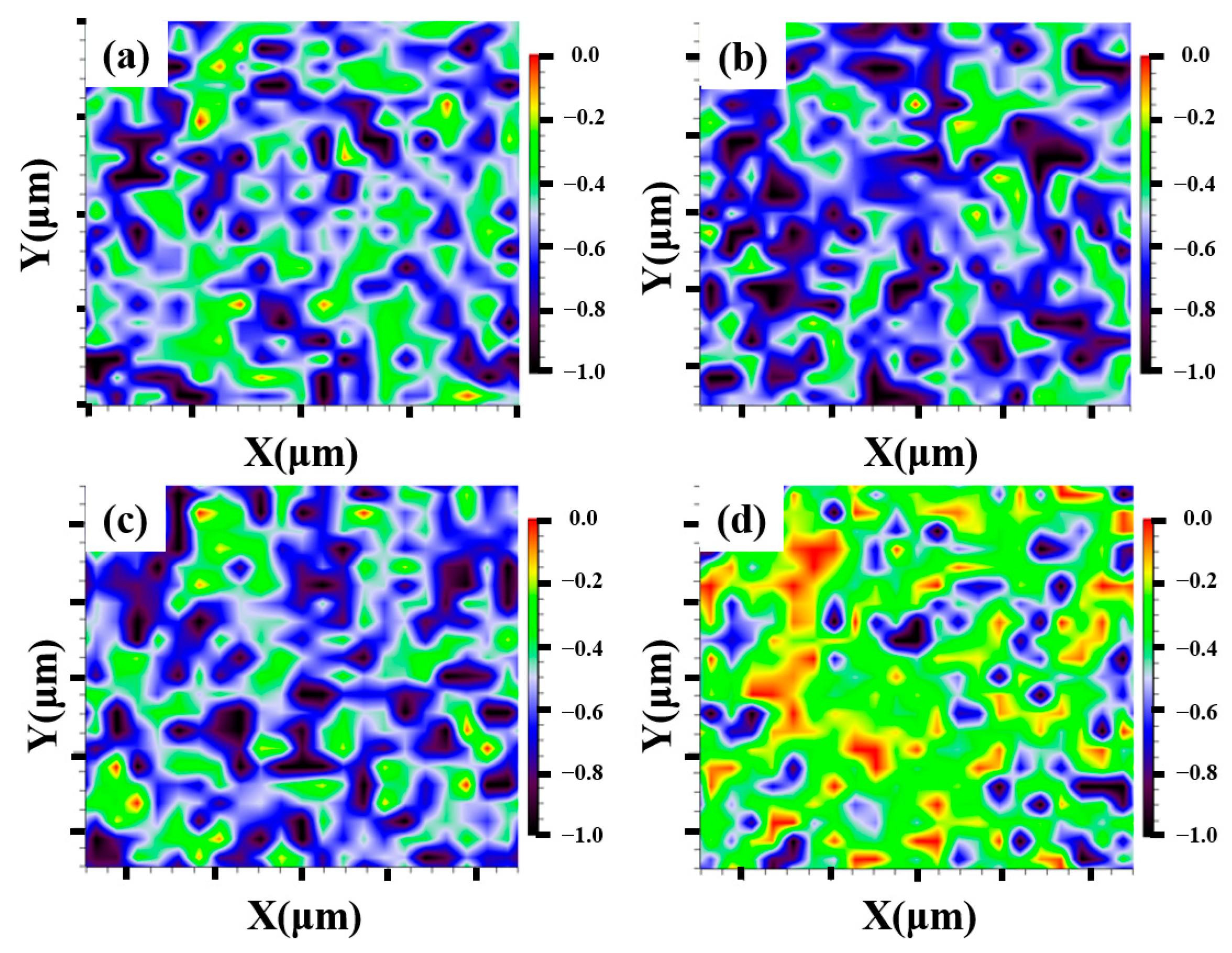
Residual stress distribution in EB-PVD YSZ-coated TGO can be collected more accurately by surface scanning methods (map scanning). Figure 19 presents the stress distribution cloud map within a 1 mm × 1 mm area. The distance between measurement spots by the surface scan is 50 μm × 50 μm, resulting in a total of 441 points in the region of interest for residual stress statistical analysis.
The data reveal that residual stresses in the TGO are uniformly compressive (“-”). Redder colors indicate lower compressive stress, while bluer colors indicate higher compressive stress. The color change in the stress cloud map reflects differences in measured residual stresses of the TGO at different locations.
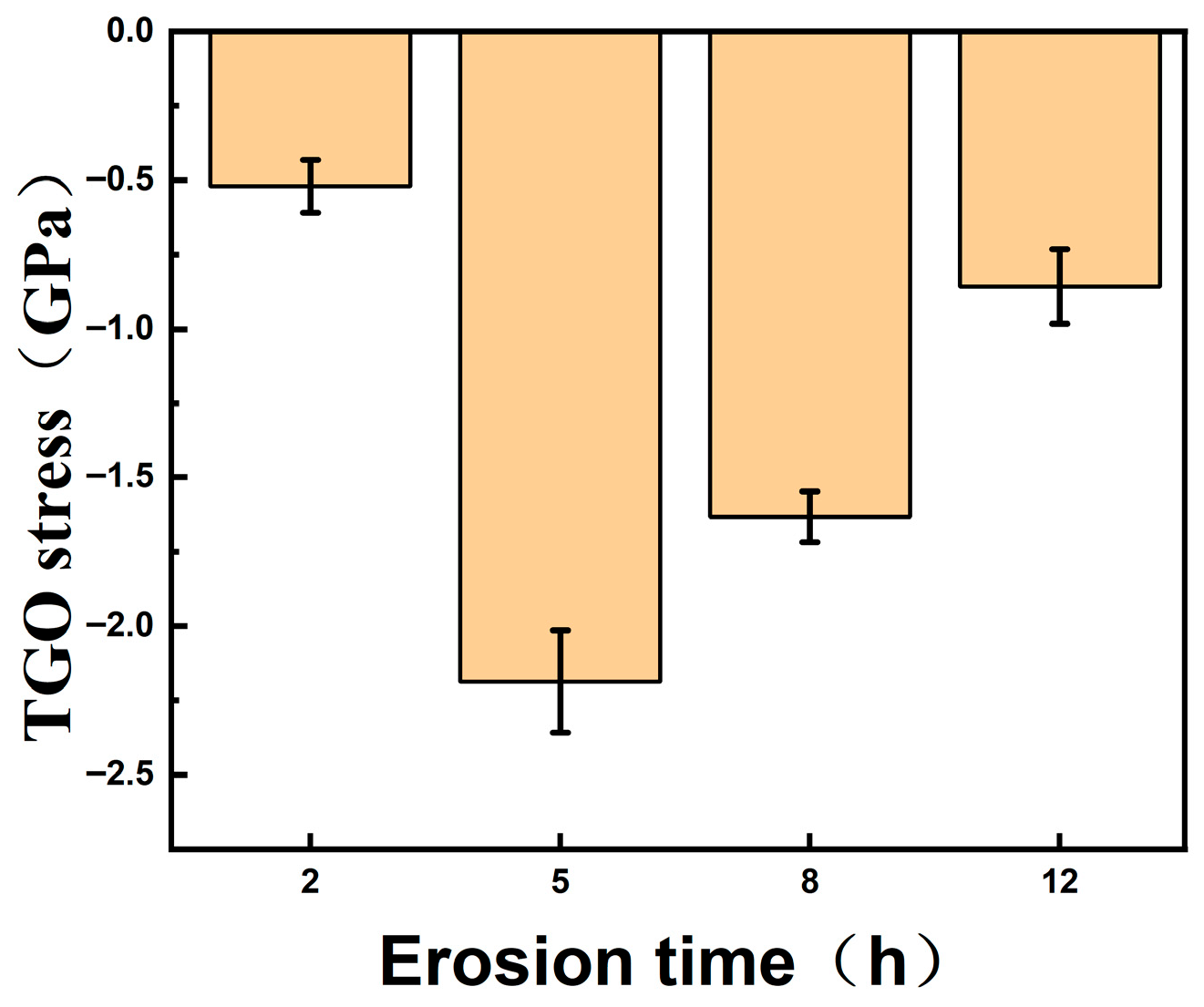
Figure 20 shows the variation in TGO residual stress in the eroded region after different erosion times. After 2 h of erosion, TGO stress was minimal at −0.6 GPa. As erosion time increased, stress rose to −2.2 GPa after 5 h and remained at this high level. As the erosion time was further increased to 12 h, the TGO stress decreased and dropped to −0.9 GPa near the eroded spalling zone.
To quantitatively analyze the relationship between stress evolution and crack propagation, Equation (3) from the literature [47] is introduced. According to this equation, the driving force for interfacial crack propagation is closely related to the interfacial displacement mismatch (Δx). Combined with the results of this study, it can be seen that stress gradually accumulates within the TGO during high-temperature erosion. The combined action of stress and erosion loads causes a displacement mismatch (Δx) at the interface. As the stress level increases, Δx gradually grows, leading to the continuous accumulation of elastic energy in the interface region. When the accumulated elastic energy reaches or exceeds the interface fracture toughness GIC, the interface becomes unstable, initiating crack formation and propagation. This process essentially represents an interface failure mechanism driven by stress, mediated by displacement mismatch, and determined by energy release. In the late stages of erosion, as residual stresses increase significantly, the degree of interface mismatch intensifies, thereby promoting the transition of cracks from local initiation to through-penetration propagation, leading to coating failure. Therefore, this model establishes a semi-quantitative relationship between stress evolution and crack propagation.
G I C = 1 2 K Δ x 2
where K is the stiffness factor of the spring vibrator, and Δx is the maximum elongation.
The evolution of residual stress in the TGO layer plays a significant role during coating service. Existing studies have primarily focused on stress evolution during thermal shock processes, while research on stress evolution during erosion is limited. During erosion, the coating interface morphology is closely related to stress levels. Low stress levels in the initial stage, while subsequent increases in stress are closely related to changes in interface topography. Interface wrinkling aggravates stress concentration and promotes crack initiation. Under the combined effects of high temperatures and high-velocity gas flows, the interaction between TGO stress and particle impact accelerates the accumulation and propagation of damage.

4. Discussion

Failure Process and Mechanisms of EB-PVD Thermal Barrier Coating in Simulated Aero-Engine Erosion Environment

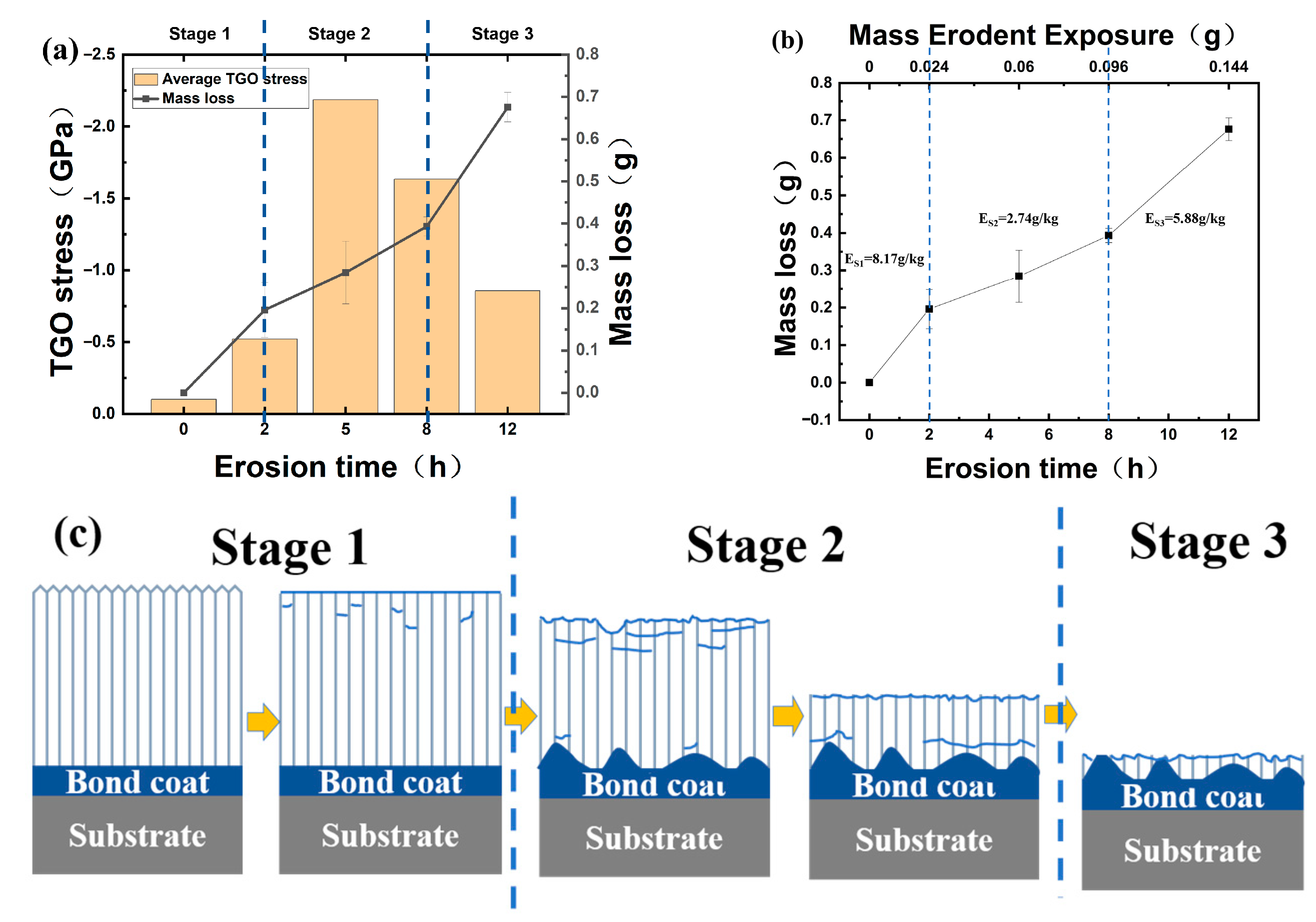
Based on the erosion morphology and stress evolution of the specimens, the erosion behavior of the YSZ coating can be divided into three stages as shown in Figure 21.
The specific erosion mechanisms are as follows:
  • The first stage is the initial high erosion rate stage, during which the erosion rate can reach 8.17 g/kg. The high erosion rate in this stage is attributed to the columnar crystal structure of the EB-PVD coating, in which the tops of the columnar crystals form protruding pyramid shapes, and the structure is porous. During the fabrication process, these crystal tops are inherently the weakest and most unstable parts. When eroding particles strike at a specific angle and velocity, they first impact these protruding crystal tips. Due to the brittleness of the ceramic material, the impact causes brittle fracture and spalling at the crystal tips. This process is highly efficient, and material is rapidly removed in the form of fine fragments. Consequently, the material loss rate during this stage is extremely high. At this stage, the stress levels within the TGO layer remain relatively low. Stresses within the TGO layer primarily originate from: (1) thermal stresses resulting from mismatched coefficients of thermal expansion (CTE) between the coating and the substrate; (2) elastic stresses caused by particle and gas impacts; (3) TGO growth stresses; and (4) stresses generated by phase transformations within the coating. During the initial erosion stage, which is primarily a high-temperature oxidation process, the TGO layer grows uniformly and increases in thickness. The combined effect of growth stress and thermal stress leads to a gradual increase in the average compressive stress level within the TGO. During this stage, eroding particles primarily impact the YSZ surface, creating microcracks at the tips of the columnar crystals. The YSZ top coat experiences only minor wear, which has a negligible effect on the stress level of the TGO layer.
  • The second stage is a low-rate phase, with the erosion rate decreasing to 2.74 g/kg. Following the initial rapid loss, the erosion rate significantly decreases and tends to stabilize. After the first stage concludes, the protruding, loose tips of the columnar crystals on the coating surface are removed, exposing the denser columnar crystal regions beneath. At the same time, continuous 90° erosion induces compressive stress on the coating surface, causing densification and leading to localized plastic deformation and densification at the tops of the columnar crystals. This densified surface layer can more effectively disperse and absorb the kinetic energy of the eroding particles. Consequently, the spalling rate in this stage is slower than in the first stage, and the erosion rate decreases and stabilizes at a lower level. This stage is a critical part of the erosion process. At this point, the top coat has been damaged and thinned. The stresses generated by the erosion load are transmitted through the remaining top coat and TGO layer to the underlying bond coat. This lowers the critical conditions for interfacial wrinkling, making the bond coat more susceptible to creep and plastic flow. Interfacial bulging leads to severe geometric changes, creating intense stress concentrations at the crests of the interface and causing a sharp rise in stress levels within the TGO layer. Microcracks initially form at the crests of the TGO/ceramic interface. As erosion progresses, these microcracks propagate to form transverse cracks, accelerating failure at the coating interface.
  • The third stage is the final high-rate erosion phase, during which the erosion rate increases to 5.88 g/kg. Following a period of low-rate erosion, the erosion rate rises sharply once again. Following continuous erosion during the first two stages, the thickness of the top coat is significantly reduced. When the coating thins to a certain extent, the erosion load and stress are more effectively transmitted to the interface between the thermally grown oxide (TGO) layer and the bonding coating (BC). The TGO layer (primarily composed of Al2O3) is inherently brittle, and the interface is the weakest link in this system. At this point, erosion not only continues to wear away the remaining top coat but, more critically, generates a large number of interconnected transverse cracks at the interface, forming a fragmented structure. The energy generated by particle impact directly causes delamination at the interface, which is already under high stress. Extensive spalling of the top coat leads to coating failure and a sudden release of stress. It should be noted that a reduction in coating thickness does not, in itself, directly lead to a decrease in residual stress. During the erosion process, as the coating thickness gradually decreases, damage accumulates within the material and at the interface, including microcrack propagation and localized spalling. These damage mechanisms promote stress release and redistribution, resulting in a downward trend in the measured stress. Therefore, the reduction in thickness reflects the gradual failure process of the material, while the decrease in residual stress is a macroscopic manifestation of the damage accumulation during this process.
In simulated erosion service environments for aircraft engines, thermal effects, together with impact loads, are the primary drivers of degradation and failure in EB-PVD YSZ TBCs. Thermal effects primarily result from the high-temperature sintering and densification of the top coat and the stress evolution of the TGO layer. These factors exhibit a strong coupled synergistic relationship with particle erosion damage.
There is a significant mismatch in thermal expansion coefficients between the YSZ ceramic top layer, the TGO layer, and the NiCoCrAlYHf bond coat. During repeated thermal cycling, the coating continuously experiences substantial thermal stress, causing plastic flow in the bond coat and interfacial wrinkling. This instability in the interfacial geometry significantly amplifies local stress concentrations at the peaks, further accelerating crack initiation and propagation at the interface, ultimately leading to coating failure. Under high-temperature conditions, the TGO layer is dominated by compressive stress. The complex stress field preferentially induces cracks at microdefects and weak interface locations, particularly in the interface protrusion regions [48]. This evolutionary pattern is fully consistent with the characteristics of interfacial crack initiation and propagation observed in experiments. Furthermore, as the oxidation reaction continues, the thickness of the Al2O3 oxide layer increases, thereby generating growth stress. Under the combined effect of thermal stress and TGO growth stress, compressive stress continues to accumulate within the TGO, consistent with the experimental trend showing a rise in compressive stress from −0.6 GPa to −2.2 GPa.
While stress continues to accumulate within the TGO layer, significant microstructural evolution also occurs in the ceramic surface layer. The high-temperature environment at 1150 °C significantly accelerates atomic diffusion. As shown in Figure 11, after 2 h of high-temperature erosion, the feather-like structure has sintered and fused. The feather-like structure possesses excellent stress buffering, whereas the structure after high-temperature sintering tends to become dense, significantly reducing the strain tolerance. The columnar crystal structure is more prone to brittle fracture under particle impact.
More importantly, these various thermal effects do not act in isolation but are deeply coupled with the mechanical loads generated by particle erosion. In the early stages of erosion, particle impacts act only on the tips of the columnar crystals, exerting a limited influence on the overall stress field of the coating; as erosion progresses into the middle stage, the top coat is continuously eroded and thinned. Mechanical impact loads and thermal stresses are directly transmitted to the interface, causing rapid stress accumulation in the TGO layer and inducing structural instability. In the late stage of erosion, high residual stresses couple with particle impacts to form a network of through-penetrating transverse cracks, ultimately leading to extensive coating spalling. This is accompanied by a rapid release of residual stresses, with stress values dropping to approximately −0.9 GPa.
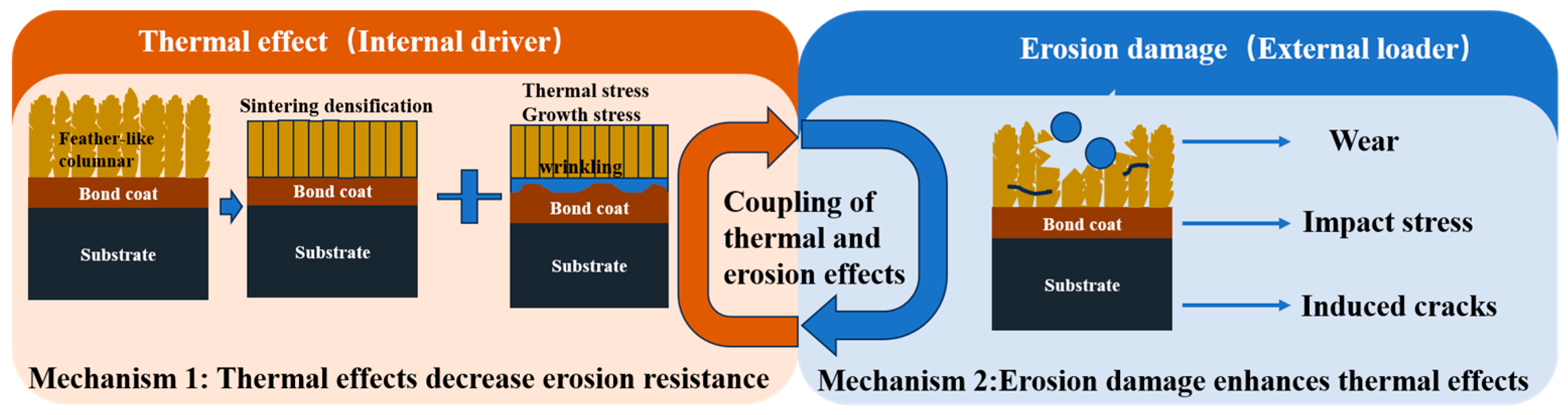
In summary, the failure of TBCs is essentially a typical thermal-mechanical coupling damage process as shown in Figure 22: thermal effects provide the driving force for stress evolution and interfacial instability, while solid particle erosion further accelerates damage accumulation and crack propagation. The coupling effect between thermal effects and particle erosion is the core mechanism determining the transition of the coating from localized surface damage to deep-layer failure.

5. Conclusions

Based on a multi-factor coupled test setup, this study systematically investigated the erosion behavior and failure mechanisms of EB-PVD YSZ TBCs under simulated aeroengine operating conditions (1150 °C, 0.4 Mach, and particulate erosion). The coating degradation process exhibited a gradual evolution from surface damage to interfacial failure and can be divided into an initial high-erosion-rate stage, a mid-stage with low erosion rates, and a final accelerated failure stage. In the initial stage, brittle fracture at the tops of columnar grains predominated. During the intermediate stage, the combined effects of TGO stress and high-temperature sintering densification led to continuous stress accumulation, inducing interfacial wrinkling and crack propagation. In the final stage, under the coupled action of thermal effects and erosion loads, cracks penetrated the coating, resulting in extensive delamination accompanied by the release of residual stresses. Coating failure is primarily driven by the synergistic interaction of thermal effects and erosion damage, with the coupling relationship among microstructural evolution, stress development, and interface stability being the key factors determining coating reliability and service life.
This study contributes to a deeper understanding of the erosion-induced failure mechanisms of TBCs under conditions close to real aero-engine service environments. By clarifying the three-stage evolution of coating erosion and elucidating its intrinsic relationship with internal stress evolution and interfacial damage initiation and propagation, this work provides further insight into the failure behavior of TBCs under complex operating conditions.
From an engineering perspective, the results offer useful implications for the optimized design of coating compositions, the improvement of erosion resistance, and the extension of the service life of aero-engine hot-section components. In addition, the multi-factor coupled erosion test platform developed in this study enables a more realistic simulation of service conditions, providing a valuable approach for evaluating the performance and reliability of advanced protective coating systems.

Author Contributions

Conceptualization, W.Y. and R.M.; methodology, L.H.; software, S.L.; validation, H.C., D.L. and W.Y.; formal analysis, H.C.; data curation, W.Y.; writing—original draft preparation, W.Y. and D.L.; writing—review and editing, W.Y. and H.C.; supervision, R.M.; project administration, D.L. All authors have read and agreed to the published version of the manuscript.

Funding

This work was supported by AECC Beijing Institute of Aeronautical Materials under Grant No. KJSJ220543.

Institutional Review Board Statement

Not applicable.

Informed Consent Statement

Not applicable.

Data Availability Statement

The data presented in this study are available on request from the corresponding author.

Conflicts of Interest

The authors declare no conflicts of interest.

References

  1. Zhang, X.; Chen, Y.; Hu, J. Recent advances in the development of aerospace materials. Prog. Aerosp. Sci. 2018, 97, 22–34. [Google Scholar] [CrossRef]
  2. Xie, F.; Yang, Y.; Ping, Z.; Gong, X.; Dong, Z.; Xu, W.; Yu, J.; Yao, W.; Dong, Y. Progress and strategies in advanced aerospace materials for extreme environments: A review. Acta Astronaut. 2026, 238, 184–196. [Google Scholar] [CrossRef]
  3. Kumar, V.; Balasubramanian, K. Progress update on failure mechanisms of advanced thermal barrier coatings: A review. Prog. Org. Coat. 2016, 90, 54–82. [Google Scholar] [CrossRef]
  4. Mu, R.; Ding, N.; Liu, G.; Luo, Y.; Dai, J. Microstructure evolution, thermal cycling life and failure behavior analysis of YSZ thermal barrier coatings prepared by EB-PVD with different electron beam currents. J. Mater. Eng. 2024, 52, 44–52. [Google Scholar]
  5. Liu, D.; Cai, H.; Mu, R.; Yang, W.; Dong, J. Effect of grit-blasting on the recrystallization behavior of DD6 single-crystal superalloy coated with NiCoCrAlYHf. J. Alloys Compd. 2024, 983, 173861. [Google Scholar] [CrossRef]
  6. Luo, Y.; Li, Z.; Zhu, S.; He, L.; Yu, B.; Wang, Y.F. Preparation and failure mechanism of LaZrCeO thermal barrier coatings by EB-PVD. J. Mater. Eng. 2024, 52, 53–60. [Google Scholar]
  7. Song, J.-B.; Wang, L.-S.; Dong, H.; Yao, J.-T. Long lifespan thermal barrier coatings overview: Materials, manufacturing, failure mechanisms, and multiscale structural design. Ceram. Int. 2023, 49, 1–23. [Google Scholar] [CrossRef]
  8. Bogdan, M.; Peter, I. A Comprehensive Understanding of Thermal Barrier Coatings (TBCs): Applications, Materials, Coating Design and Failure Mechanisms. Metals 2024, 14, 575. [Google Scholar] [CrossRef]
  9. Hu, X.; Xie, Y.; Li, F.; Yin, F. Research progress on environmental corrosion resistance of thermal barrier coatings: A review. Coatings 2024, 14, 1341. [Google Scholar] [CrossRef]
  10. Sezavar, A.; Sajjadi, S.A. A review on the performance and lifetime improvement of thermal barrier coatings. J. Eur. Ceram. Soc. 2025, 45, 117274. [Google Scholar] [CrossRef]
  11. Xu, W.; Shi, J.; Zhao, Z.; Yang, K.; Chen, X.; Ling, H.; Shi, J.; Zhang, X. YGYSZ/YSZ double ceramic layer thermal barrier coatings: Coating design and failure mechanism during thermal shock test. Surf. Coat. Technol. 2025, 516, 132650. [Google Scholar] [CrossRef]
  12. Fan, J.; Wang, Q.; Ning, X.; Li, L.; Sun, Z. Microstructural evolution and failure mechanisms of thermal barrier coatings under extreme environmental conditions. J. Eur. Ceram. Soc. 2025, 45, 117089. [Google Scholar] [CrossRef]
  13. Wang, L.; Wang, W.; Wan, J.; Wang, J. Failure analysis and life prediction of thermal barrier coatings on turbine blades under localized cyclic thermal loading. J. Mater. Res. Technol. 2025, 39, 8230–8242. [Google Scholar] [CrossRef]
  14. Bie, Y.; Ding, K.; Ren, H.; Bui, T.Q.; Rabczuk, T.; Wei, Y. Simulation of foreign particle erosion-induced failure in thermal barrier coatings: A novel coupling plastic damage model of dual-horizon peridynamics and FEM. Int. J. Impact Eng. 2025, 200, 105255. [Google Scholar] [CrossRef]
  15. Xie, Y.; Liu, J.; Liu, W.; Li, Q.; Feng, W.; Yang, L.; Zhou, Y. Performance and failure modes of thermal barrier coatings deposited by EB-PVD on blades under real service conditions in gas turbine. J. Alloys Compd. 2024, 1008, 176889. [Google Scholar] [CrossRef]
  16. Cernuschi, F.; Lorenzoni, L.; Capelli, S.; Guardamagna, C.; Karger, M.; Vaßen, R.; Giolli, C. Solid particle erosion of thermal spray and physical vapour deposition thermal barrier coatings. Wear 2011, 271, 2909–2918. [Google Scholar] [CrossRef]
  17. Chen, H.Y.; Yan, J.J.; Cao, K.; Liu, Z.Y.; Wu, X.; Yang, L.; Zhou, Y.C. Friction delamination mechanism of EB-PVD thermal barrier coatings in high-temperature and high-speed rotating service environment. J. Eur. Ceram. Soc. 2023, 43, 3637–3646. [Google Scholar] [CrossRef]
  18. Evans, A.G.; Fleck, N.A.; Faulhaber, S.; Vermaak, N.; Maloney, M.; Darolia, R. Scaling laws governing the erosion and impact resistance of thermal barrier coatings. Wear 2006, 260, 886–894. [Google Scholar] [CrossRef]
  19. Hu, X.; Liu, Q.; Xie, Z.; Liu, S.; Wen, Q.; Guo, J.; Zhu, W. Effect of bond coating surface roughness on high-temperature performance of EB-PVD thermal barrier coatings. Ceram. Int. 2025, 51, 14307–14318. [Google Scholar] [CrossRef]
  20. Lima, R.S.; Guerreiro, B.M.H.; Aghasibeig, M. Microstructural characterization and room-temperature erosion behavior of as-deposited SPS, EB-PVD and APS YSZ-based TBCs. J. Therm. Spray Technol. 2018, 28, 223–232. [Google Scholar] [CrossRef]
  21. Schmitt, M.P.; Schreiber, J.M.; Rai, A.K.; Eden, T.J.; Wolfe, D.E. Development and optimization of tailored composite TBC design architectures for improved erosion durability. J. Therm. Spray Technol. 2017, 26, 1062–1075. [Google Scholar] [CrossRef]
  22. Steenbakker, R.J.L.; Wellman, R.G.; Nicholls, J.R. Erosion of gadolinia-doped EB-PVD TBCs. Surf. Coat. Technol. 2006, 201, 2140–2146. [Google Scholar] [CrossRef]
  23. Steinberg, L.; Naraparaju, R.; Heckert, M.; Mikulla, C.; Schulz, U.; Leyens, C. Erosion behavior of EB-PVD 7YSZ coatings under corrosion/erosion regime: Effect of TBC microstructure and CMAS chemistry. J. Eur. Ceram. Soc. 2018, 38, 5101–5112. [Google Scholar] [CrossRef]
  24. Zhang, X.; Li, M.; Zhang, A.; Guo, S.; Mao, J.; Deng, C.; Liu, M. Al modification for PS-PVD 7YSZ TBCs to improve particle erosion and thermal cycle performance. J. Adv. Ceram. 2022, 11, 1093–1103. [Google Scholar] [CrossRef]
  25. Zhao, X.; Liu, W.; Li, C.; Yan, G.; Wang, Q.; Yang, L.; Zhou, Y. Solid particle erosion behavior of La2Ce2O7/YSZ double ceramic layer and traditional YSZ thermal barrier coatings at high temperature. Coatings 2022, 12, 1638. [Google Scholar] [CrossRef]
  26. Wellman, R.G.; Tourmente, H.; Impey, S.; Nicholls, J.R. Nano and microhardness testing of aged EB-PVD TBCs. Surf. Coat. Technol. 2004, 188–189, 79–84. [Google Scholar] [CrossRef]
  27. Wellman, R.G.; Nicholls, J.R. A review of the erosion of thermal barrier coatings. J. Phys. D Appl. Phys. 2007, 40, R293–R305. [Google Scholar] [CrossRef]
  28. Wellman, R.G.; Deakin, M.J.; Nicholls, J.R. The effect of TBC morphology on the erosion rate of EB-PVD TBCs. Wear 2005, 258, 349–356. [Google Scholar] [CrossRef]
  29. Wellman, R.G.; Dyer, A.; Nicholls, J.R. Nano and micro-indentation studies of bulk zirconia and EB-PVD TBCs. Surf. Coat. Technol. 2004, 176, 253–260. [Google Scholar] [CrossRef]
  30. Wellman, R.G.; Deakin, M.J.; Nicholls, J.R. The effect of TBC morphology and aging on the erosion rate of EB-PVD TBCs. Tribol. Int. 2005, 38, 798–804. [Google Scholar] [CrossRef]
  31. Wellman, R.G.; Nicholls, J.R. A Monte Carlo model for predicting the erosion rate of EB-PVD TBCs. Wear 2004, 256, 889–899. [Google Scholar] [CrossRef]
  32. Wellman, R.G.; Nicholls, J.R. On the effect of ageing on the erosion of EB-PVD TBCs. Surf. Coat. Technol. 2004, 177–178, 80–88. [Google Scholar] [CrossRef]
  33. Liu, D.; Mu, R.; He, L.; Li, S.; Yang, W. Failure behaviour of EB-PVD YSZ thermal barrier coatings under simulated aero-engine operating conditions. Surf. Coat. Technol. 2023, 474, 130027. [Google Scholar] [CrossRef]
  34. Bartsch, M.; Baufeld, B.; Dalkiliç, S.; Chernova, L.; Heinzelmann, M. Fatigue cracks in a thermal barrier coating system on a superalloy in multiaxial thermomechanical testing. Int. J. Fatigue 2008, 30, 211–218. [Google Scholar] [CrossRef]
  35. Baufeld, B.; Bartsch, M.; Heinzelmann, M. Advanced thermal gradient mechanical fatigue testing of CMSX-4 with an oxidation protection coating. Int. J. Fatigue 2008, 30, 219–225. [Google Scholar] [CrossRef]
  36. Beake, B.D.; Isern, L.; Zhang, H.; Chalk, C.; Goodes, S.R.; Johnson, D.; Forcen, K.; Nicholls, J.R.; Gee, M.G. Damage mechanisms in solid particle impact and erosion testing of thermal barrier coatings. Surf. Coat. Technol. 2025, 517, 132844. [Google Scholar] [CrossRef]
  37. Wang, L.; He, L.; Xu, Z.; Zhang, R.; Mu, R. Erosion behavior of YSZ, LZC, and LZC/YSZ double ceramic layer thermal barrier coatings by EB-PVD under high-temperature gas streams with entrained solid particles. Surf. Interfaces 2026, 87, 109073. [Google Scholar] [CrossRef]
  38. Wang, L.; He, L.; Zhang, R.; Xu, Z.; Mu, R. Particle erosion behavior of La2(ZrxCe1−x)2O7/YSZ double ceramic layer TBCs deposited by electron beam physical vapor deposition. Wear 2025, 566–567, 205763. [CrossRef]
  39. Wellman, R.G.; Nicholls, J.R.; Murphy, K. Effect of microstructure and temperature on the erosion rates and mechanisms of modified EB-PVD TBCs. Wear 2009, 267, 1927–1934. [Google Scholar] [CrossRef]
  40. Chen, W.L.; Wu, H.J.; Liu, M.; Xiao, X.L. Erosion behavior of PS-PVD thermal barrier coatings and the effect of composite coating thickness. Mater. Sci. Forum 2020, 993, 1095–1103. [Google Scholar] [CrossRef]
  41. Walter, M.E.; Eigenmann, B. The mechanical response of three EB-PVD thermal barrier coating microstructures. Mater. Sci. Eng. A 2000, 282, 49–58. [Google Scholar] [CrossRef]
  42. Shen, Z.; He, L.; Xu, Z.; Mu, R.; Huang, G. LZC/YSZ DCL TBCs by EB-PVD: Microstructure, low thermal conductivity and high thermal cycling life. J. Eur. Ceram. Soc. 2019, 39, 1443–1450. [Google Scholar] [CrossRef]
  43. Yang, J.S.; Wang, L.; Li, D.C.; Zhong, X.H.; Zhao, H.Y.; Tao, S.Y. Stress analysis and failure mechanisms of plasma-sprayed thermal barrier coatings. J. Therm. Spray Technol. 2017, 26, 890–901. [Google Scholar] [CrossRef]
  44. Christensen, R.J.; Lipkin, D.M.; Clarke, D.R.; Murphy, K. Nondestructive evaluation of oxidation stress in thermal barrier coatings using Cr3+ piezospectroscopy. Appl. Phys. Lett. 1996, 69, 3754–3756. [Google Scholar] [CrossRef]
  45. Tanaka, M.; Hasegawa, M.; Dericioglu, A.F.; Kawawa, Y. Measurement of residual stress in air plasma-sprayed Y2O3–ZrO2 thermal barrier coating system using micro-Raman spectroscopy. Mater. Sci. Eng. A 2006, 419, 262–268. [Google Scholar] [CrossRef]
  46. Liu, D.; Seraffon, M.; Flewitt, P.E.J.; Simms, N.J.; Nicholls, J.R.; Richerby, D.S. Effect of substrate curvature on residual stresses and failure modes of an air plasma-sprayed thermal coating system. J. Eur. Ceram. Soc. 2013, 33, 3345–3357. [Google Scholar] [CrossRef]
  47. Wang, L.; Yang, J.S.; Ni, J.X.; Liu, C.G.; Zhong, X.H.; Shao, F.; Zhao, H.Y.; Tao, S.Y.; Wang, Y. Influence of cracks in APS TBCs on stress around TGO during thermal cycling: A numerical simulation study. Surf. Coat. Technol. 2016, 285, 98–112. [Google Scholar] [CrossRef]
  48. Wang, L.; Yu, J.; Zhang, T.; Wang, Z.; Ding, K. Effect of interface curvature on local growth behavior and stress of thermal barrier coatings. Coatings 2023, 13, 1618. [Google Scholar] [CrossRef]
Figure 1. Multi-factor coupled test equipment.
Coatings 16 00574 g001
Figure 2. The flowchart of the research methodology.
Coatings 16 00574 g002
Figure 3. Surface morphology of the thermal barrier coating during erosion: (a) as-deposited; (b) 2 h; (c) 4 h; (d) 6 h; (e) 8 h; (f) 10 h; (g) 12 h. The red dashed circles indicate the localized erosion-damaged regions on the coating surface.
Coatings 16 00574 g003
Figure 4. Surface morphology of YSZ thermal barrier coating at different erosion times: (a) 2 h; (b) 5 h; (c) 8 h; (d) 12 h.
Coatings 16 00574 g004
Figure 5. Variation in volume loss in the erosion damage zone with erosion time after different erosion cycles.
Coatings 16 00574 g005
Figure 6. Surface morphology of deposited YSZ thermal barrier coating with different magnifications. (a) overview morphology at 100×; (b) cauliflower-like surface morphology at 1000×; (c) pyramidal tops of columnar crystals at 6000×.
Coatings 16 00574 g006
Figure 7. Surface morphology and EDS spectrum after 2 h of erosion on the YSZ coating: (a) lower magnification; (b) higher magnification; (c) EDS spectra of surface.
Coatings 16 00574 g007
Figure 8. (a) Surface morphology of the YSZ coating after 5 h of erosion; (b) EDS spectrum.
Coatings 16 00574 g008
Figure 9. (a) Surface morphology of the YSZ coating after 8 h of erosion; (b) EDS spectrum.
Coatings 16 00574 g009
Figure 10. Surface morphology and EDS spectrum of the YSZ coating after 12 h of erosion: (a) lower magnification; (b) higher magnification; (c) EDS spectra of surface.
Coatings 16 00574 g010
Figure 11. Cross-sectional morphology of deposited YSZ thermal barrier coating with different magnifications. (a) overview morphology at 400×; (b) feathery microstructures of columnar crystals at 3000×.
Coatings 16 00574 g011
Figure 12. Cross-sectional morphology after 2h erosion test (a) YSZ thermal barrier coating specimen; (b) area “A” of specimen.
Coatings 16 00574 g012
Figure 13. Cross-sectional morphology after 5 h of erosion testing (a) area “A” of specimen; (b) YSZ thermal barrier coating specimen; (c) area “B” of specimen, showing near-surface cracks penetrating across multiple columnar grains (highlighted by white dashed circles).
Coatings 16 00574 g013
Figure 14. Cross-sectional morphology after 8 h of erosion testing (a) area “A” of specimen; (b) YSZ thermal barrier coating specimen; (c) transverse cracks of the specimen.
Coatings 16 00574 g014
Figure 15. Cross-sectional morphology of YSZ thermal barrier coating specimens after 12 h erosion testing.
Coatings 16 00574 g015
Figure 16. Remaining thickness of the YSZ coating during erosion testing.
Coatings 16 00574 g016
Figure 17. Fluorescence spectra at two randomly selected points on the coating surface [33].
Coatings 16 00574 g017
Figure 18. Fluorescence spectra at two randomly selected points on the coating surface.
Coatings 16 00574 g018
Figure 19. Stress distribution contour maps on the TBCs surface at four different 1 mm × 1 mm areas: (a) Area 1; (b) Area 2; (c) Area 3; (d) Area 4.
Coatings 16 00574 g019
Figure 20. The variation in TGO stress in the eroded region after different erosion times.
Coatings 16 00574 g020
Figure 21. The typical erosion process for three erosion stages: (a) TGO stress; (b) The patterns of erosion mass loss with erosion time and mass erodent exposure; (c) A model of TBCs erosion process.
Coatings 16 00574 g021
Figure 22. Schematic of the coupling failure mechanism under aero-engine erosion environment.
Coatings 16 00574 g022
Table 1. The chemical compositions of DD6 and NiCoCrAlYHf (mass fraction/%).
SampleNiCoCrAlYHfWTaRe
DD6Bal.8.5–9.53.8–4.85.2–6.2--7.0–9.06.0–8.51.6–2.4
NiCoCrAlYHf coatingBal.10.0–15.018.0–23.08.0–12.00.1–0.50.2–0.6---
Table 2. The main erosion parameters.
Test ParametersTest Conditions
Test temperature1150 °C
Gas velocity0.4 Mach
Particle feeding rate0.2 g/min
Erodent materialAl2O3 particles
Particle diameterApproximately 125 μm
Impact angle90°
Disclaimer/Publisher’s Note: The statements, opinions and data contained in all publications are solely those of the individual author(s) and contributor(s) and not of MDPI and/or the editor(s). MDPI and/or the editor(s) disclaim responsibility for any injury to people or property resulting from any ideas, methods, instructions or products referred to in the content.