Article

An Additive-Free and Self-Supported MoS2/TiO2 Nanotube Array Composite for Enhancing the Li-Ion Storage Stability

Shaanxi Key Laboratory of Nanomaterials and Nanotechnology, Xi’an Key Laboratory of Clean Energy, School of Mechanical & Electrical Engineering, Xi’an University of Architecture and Technology, Xi’an 710055, China
*
Author to whom correspondence should be addressed.
Coatings 2026, 16(5), 559; https://doi.org/10.3390/coatings16050559
Submission received: 31 March 2026 / Revised: 22 April 2026 / Accepted: 6 May 2026 / Published: 7 May 2026

Highlights

What are the main findings?
TiO2 nanotube arrays were in situ assembled on Ti paper via the anodization method.
MoS2 coating was deposited on the TiO2 nanotubes and Ti substrates, respectively.
The additive-free, self-supported composite anode and interfacial interaction were studied.
What are the implications of the main findings?
The binding between MoS2-TiO2 was favorable for maintaining interfacial stability.
The MoS2-TiO2 hierarchical structure was beneficial for reducing the transfer resistance.
The mass loading and microstructure of MoS2 were tunable without destroying the surface morphology.

Abstract

Over the next decade, advanced lithium-based secondary batteries will require high-performance anodes to achieve superior energy density and cycling stability. In this work, anatase titanium dioxide nanotube arrays (TiO2 NTs) are fabricated on ultrathin Ti paper through anodization and subsequently thermal annealing. An urchin-like 2H-MoS2 coating is subsequently deposited onto the TiO2 NTs substrate through magnetic sputtering, constructing a self-supported hierarchical architecture without any additives. Electrochemical characterizations demonstrate that the MoS2/TiO2 NTs/Ti composite exhibits lower charge transfer resistance, enhanced rate capability, and improved cycling stability compared with bare TiO2 NTs/Ti and worm-like MoS2/Ti control groups. Structural analysis and density functional theory calculations further confirm that the strong interfacial interaction between MoS2 and TiO2 effectively stabilizes interfacial integrity during repeated cycling. Upon leveraging tunable geometric structure and mass loadings, this study offers a facile route for developing various types of advanced lithium-based secondary batteries.

1. Introduction

Renewable electricity serves as a low-carbon energy foundation for mitigating global climate change and sustaining the long-term development of human society [1,2,3,4]. Over the next decade, high-energy-density Li-ion batteries and all-solid-state Li batteries (LIBs, ASSLBs, >500 Wh·kg−1) are expected to serve as core energy storage technologies for hybrid electric vehicles and portable electronic devices. This trend highlights the urgent need to further advance conventional cathode and anode materials [5,6,7,8]. For anode systems, commercial graphite delivers a maximum energy density of only 270~300 Wh·kg−1, reaching merely one-half to two-thirds of the targeted performance [9,10,11,12]. Meanwhile, the limited internal space of batteries requires high energy density to be achieved through both high mass loading and high theoretical capacity of anodes. This, in turn, necessitates minimizing the content and volume fraction of inactive components, such as additives and current collectors [13,14,15]. Consequently, the rational selection of materials and structural design of high-capacity anodes has become a critical challenge, particularly under the constraints of ultra-low additive content and ultrathin current collectors [16,17,18,19,20].
In additive-free electrodes, interfacial adhesion between the anode material and current collectors plays a decisive role in structural stability, while internal stress and strain must be effectively accommodated through robust architectural design [21,22,23]. Under these conditions, self-assembled titanium dioxide nanotube arrays (TiO2 NTs) grown on Ti paper have emerged as a promising candidate and functional substrate, owing to their low volume expansion, excellent (electro-) chemical stability, and environmental benignity. Notably, TiO2 exhibits a relatively safe lithiation–delithiation potential, which suppresses Li dendrite formation while providing a moderate reversible capacity of 335 mAh·g−1 [24,25,26,27]. As a high-capacity component, molybdenum disulfide (MoS2), prepared via physical vapor deposition (e.g., magnetic sputtering), features a two-dimensional layered structure and delivers a high practical capacity exceeding 1000 mAh·g−1 through combined intercalation, conversion, and pseudocapacitive mechanisms [28,29,30]. Given these advantages, the TiO2 NTs-MoS2 composite offers a viable pathway to achieve both high reversible capacity and superior structural integrity while maintaining the controllable thickness of the residual Ti paper after anodization. Therefore, precise structural engineering of the TiO2 NTs-MoS2 system is essential to ensure durable and stable bonding under additive-free operating conditions [31,32,33].
Against this background, this study fabricated an additive-free and self-supported MoS2/TiO2 NTs/Ti composite anode via combined anodization and magnetic sputtering methods. Morphological characterizations confirmed that highly ordered hollow TiO2 nanotubes served as a mechanically stable scaffold and capacity-supporting framework, while 2H-MoS2 coating uniformly decorated the nanotube surfaces to form a hierarchical nanostructure as the primary high-capacity contributor. Conversely, bare Ti substrates facilitated the growth of worm-like MoS2 coatings with poor interfacial contact and pronounced structural defects. Electrochemical evaluations demonstrated that the MoS2/TiO2 NTs/Ti composite exhibited lower charge transfer resistance, higher reversible capacity, and improved rate capability compared with single-component anodes. Furthermore, structural analysis and density functional theory (DFT) calculations confirmed that strong interfacial interactions between MoS2 and TiO2 effectively preserved electrode integrity upon repeated lithiation–delithiation. Overall, this study simplified anode fabrication while enhancing interfacial stability, providing a reliable structural design strategy for next-generation high-performance lithium-based secondary batteries.

2. Materials and Methods

2.1. Preparation of TiO2 NTs

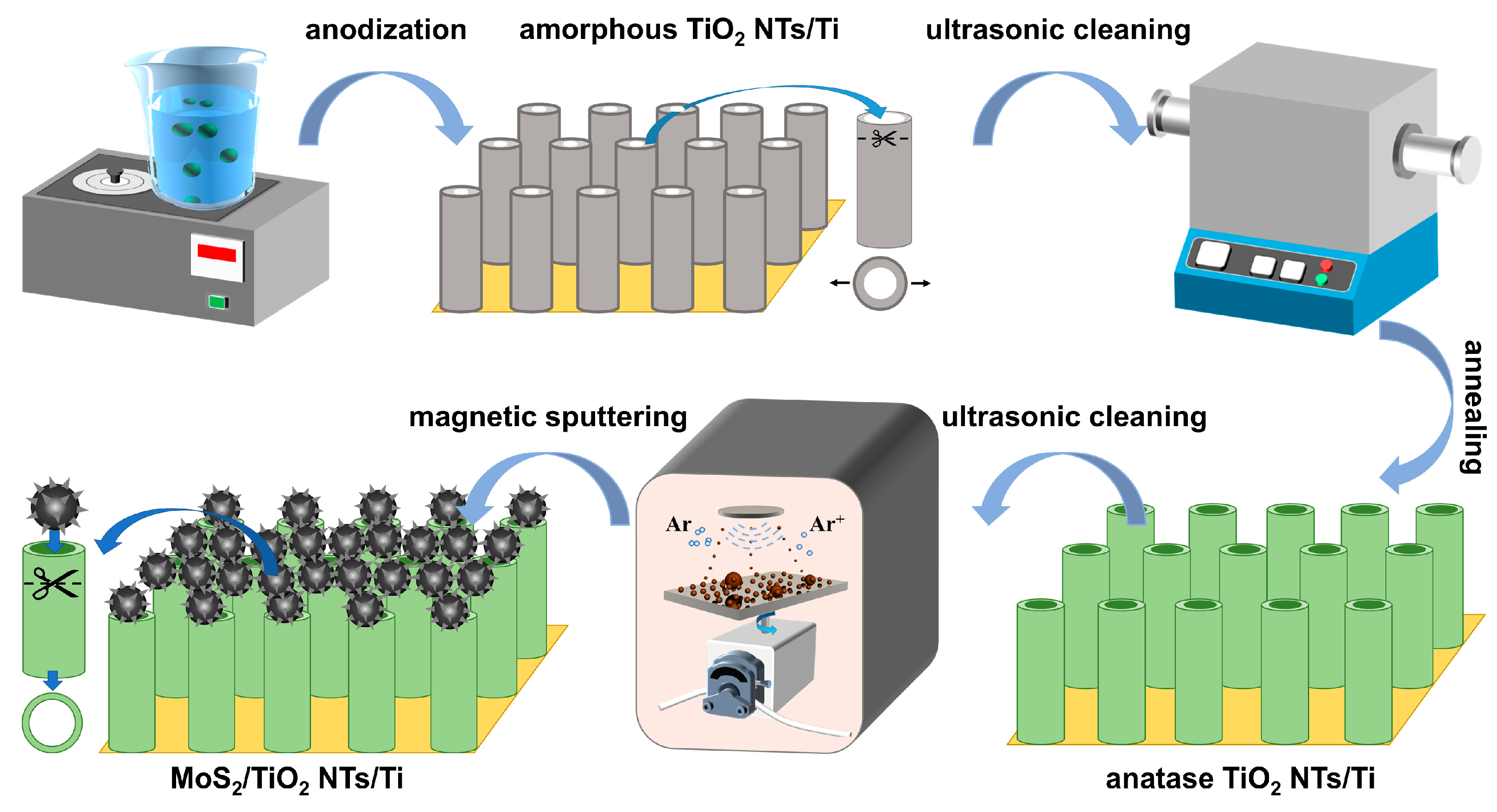
Ti paper (0.01 mm, 99.5%, Shengshida Metal Materials Co., Ltd., Dezhou, China) was used as the substrate for anodization. Prior to anodization, Ti paper was ultrasonically cleaned sequentially in acetone, ethanol, and deionized water for 10 min each to remove surface organic contaminants. The Ti paper was then chemically polished in a mixed solution of HF, HNO3, and H2O (1:3:6, volume ratio, Fuchen (Tianjin) Chemical Reagent Co., Ltd., Tianjin, China) to eliminate the surface dense TiO2 layer. Anodization was performed in a two-electrode configuration with Ti paper as the working electrode and carbon paper serving as both counter and reference electrodes. The process was carried out at a constant potential of 20 V for 4 h in an electrolyte containing 3 g NH4HF2, 0.5 mol NH4H2PO4 (Fuchen (Tianjin) Chemical Reagent Co., Ltd., Tianjin, China), and 1 L deionized water. Finally, the as-anodized TiO2 NTs/Ti paper was annealed at 450 °C for 2 h in air (Figure 1).

2.2. Preparation of the MoS2 Coating on TiO2 NTs/Ti and Ti Substrates

TiO2 NTs/Ti and bare Ti paper (Φ19 mm) were used as the experimental and control substrates, respectively. After the chamber was evacuated to 5 × 10⁻⁴ Pa, MoS2 coatings (ZhongNuo Advanced Material (Beijing) Technology Co., Ltd., Beijing, China) were deposited onto TiO2 NTs/Ti and bare Ti via radio-frequency (RF) magnetic sputtering under a chamber pressure of 1 Pa maintained by high-purity argon flow, with a sputtering power of 100 W and a temperature of 450 °C. The coating morphology of MoS2 was tailored by adjusting sputtering power, time, and temperature. Upon cooling to room temperature, urchin-like and worm-like MoS2 were obtained, denoted as MoS2/TiO2 NTs/Ti and MoS2/Ti, respectively (Figure 1).
TiO2 NTs/Ti, MoS2/TiO2 NTs/Ti, and MoS2/Ti were directly assembled into CR2032 coin cells without additional processing in an argon-filled glove box, where H2O and O2 levels were maintained below 0.5 ppm. Li metal foil (Φ16 × 0.4 mm) served as the counter and reference electrode, and a polypropylene membrane (Φ20 mm, Celgard-2400, Celgard LLC, Charlotte, NC, USA) was used as the separator. The electrolyte consisted of 1 M LiPF6 dissolved in a mixture of ethylene carbonate and diethyl carbonate (EC:DEC= 1:1 by volume, Guangdong Canrd New Energy Technology Co., Ltd., Dongguan, China). All assembled cells were aged at room temperature for 12 h to achieve a stable open circuit voltage (Voc). The mass loadings of TiO2 NTs and MoS2 were quantified using the ICP-weighing method reported in our previous work [34]. The mass loadings of TiO2 NTs and MoS2 were quantified using the ICP weighing and weighing methods reported in our previous work, respectively [34]. The mass loadings of TiO2 NTs and MoS2 are 0.47, 0.91, and 0.44 mg‧cm−2, respectively. The volume was calculated based on the geometric data and was 4.8 × 10⁻⁴, 7.2 × 10⁻⁴, and 2.4 × 10⁻⁴ cm3, respectively.

2.3. Characterization

An ultrathin section was carried out on an Ultramicrotome Leica EM UC7 equipment (Wetzlar, Germany). The morphology and structure were observed by field emission scanning electron microscopy (FESEM, S4800, Hitachi, Tokyo, Japan) and high-resolution transmission electron microscopy (TEM, FEI G2 F30, Hillsboro, OR, USA) equipped with an energy dispersive spectroscopy detector (EDS, Horiba 7593-H, Kyoto, Japan). The crystal structure was characterized by X-ray diffraction using a SHIMADZU XRD-7000 with filtered Cu Kα radiation (XRD, Kyoto, Japan). The X-ray photoelectron spectroscopy characterization was carried out on a ESCALAB 250Xi (XPS, Thermo Fisher, Waltham, MA, USA).

2.4. Electrochemical Measurements

The electrochemical measurements were carried out at room temperature in a thermostatic box (GDW-50, Nanjing Taisite Testing Equipment Co., Ltd., Tianjin, China) to avoid the uncontrolled influence of temperature changes. Cycling performance was evaluated at 10.0 A∙cm−3 with the window of 0.1~3 V (Li+/Li). Rate performance was evaluated at a current density ranging from 1.0 to 20.0 A∙cm−3 with a window of 0.1~3 V (Li+/Li). Cyclic voltammogram (CV) measurements were tested on a CHI600E electrochemical working station (Shanghai Chenhua Co., Ltd., Shanghai, China) with a sweep window of 0~3 V (Li+/Li). Electrochemical impedance spectroscopy (EIS) was performed at Voc with a frequency range of 10−2~106 Hz and an amplitude of 5 mV.

2.5. Computational Methodology

All the theoretical calculations were carried out through DFT calculations, as implemented in the Vienna ab initio package (VASP Software GmbH, Vienna, Austria) [35,36,37,38,39,40]. The exchange–correlation interactions were described by the generalized gradient approximation (GGA) with the Perdew–Burke–Ernzerhof (PBE) function. The Kohn–Sham equation was solved using the self-consistent field (SCF) method. The convergence value of the self-consistent field energy was 1.0 × 10⁻⁶ eV/atom. The total energy error of the system was less than 1.0 × 10⁻⁷ eV/atom, with a stress deviation less than 0.02 GPa. The convergence criterion for atomic forces was 0.01 eV/Å. The Brillouin-zone integrations were performed using k-point grids with the 1 × 2 × 2 mesh. The electron wave functions were expanded by a plane wave with the cut-off kinetic energy of 440 eV. The ultrasoft pseudopotential was used to describe the interaction between ionic cores and valence electrons. The above calculation process, model construction, and optimization methods were also referred to our previous works [41,42,43].

3. Results and Discussion

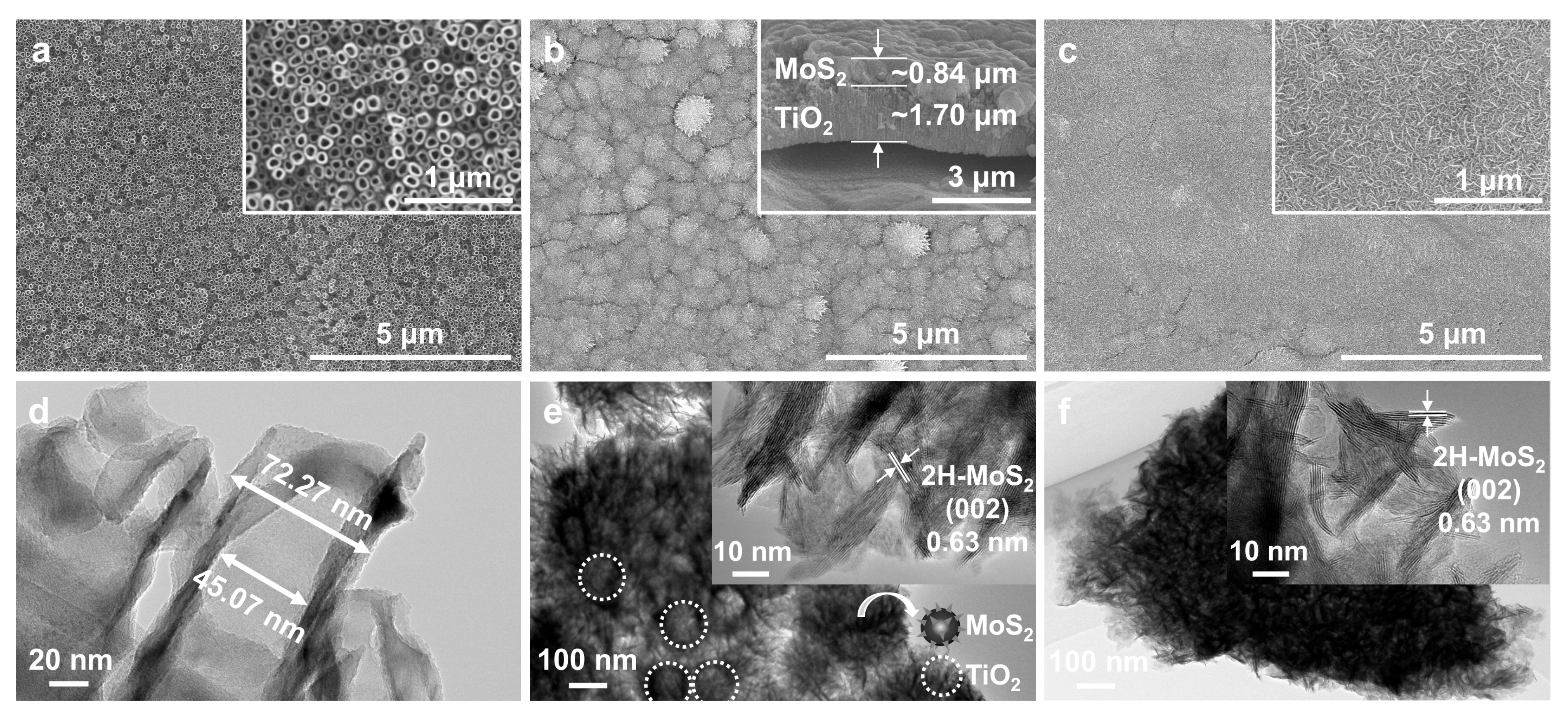
The morphology and microstructure of TiO2 NTs/Ti, MoS2/TiO2 NTs/Ti, and MoS2/Ti are shown in Figure 2. Figure 2a and its inset present anodized and annealed TiO2 NTs grown on Ti paper, exhibiting uniformly aligned TiO2 NTs with a well-defined hollow morphology. In Figure 2b, the MoS2/TiO2 NTs/Ti composite exhibits a distinct hierarchical structure. The top coating layer (~0.84 μm in thickness) is composed of closely connected urchin-like MoS2 microspheres with an average diameter of ~1 μm, and each microsphere is assembled from numerous tiny MoS2 nanobranches. The underlying TiO2 NTs layer, which is tightly bonded to the MoS2 coating, has a thickness of ~1.70 μm. For the control group (MoS2/Ti), a twisted worm-like MoS2 coating is uniformly deposited on the Ti paper, with an average length of 100~150 nm (Figure 2c).
TEM specimens were prepared by peeling off the surface layer, followed by ultrasonic dispersion in ethanol for 15 min. Figure 2d shows the TEM image of TiO2 NTs/Ti, where the hollow TiO2 nanotubes show an inner diameter of 45.07 nm and an outer diameter of 72.27 nm, with distinct and well-defined tube walls. Figure 2e shows the TEM images of MoS2/TiO2 NTs/Ti. The circular TiO2 NTs at the bottom are highlighted by white dashed circles, whereas the overlying urchin-like MoS2 microspheres are composed of thin 2H-MoS2 nanoscale branches. Each branch comprises dozens of nanosheets, with an interplanar spacing of 0.63 nm corresponding to the (002) plane of 2H-MoS2. As shown in Figure 2f, the worm-like MoS2 is also stacked from multiple-layered MoS2 nanosheets, with the (002) plane of 2H-MoS2 clearly identified. Overall, two distinct MoS2 morphologies are formed on TiO2 NTs and Ti substrates, while the intrinsic microstructure of the MoS2 nanosheets remains consistent.
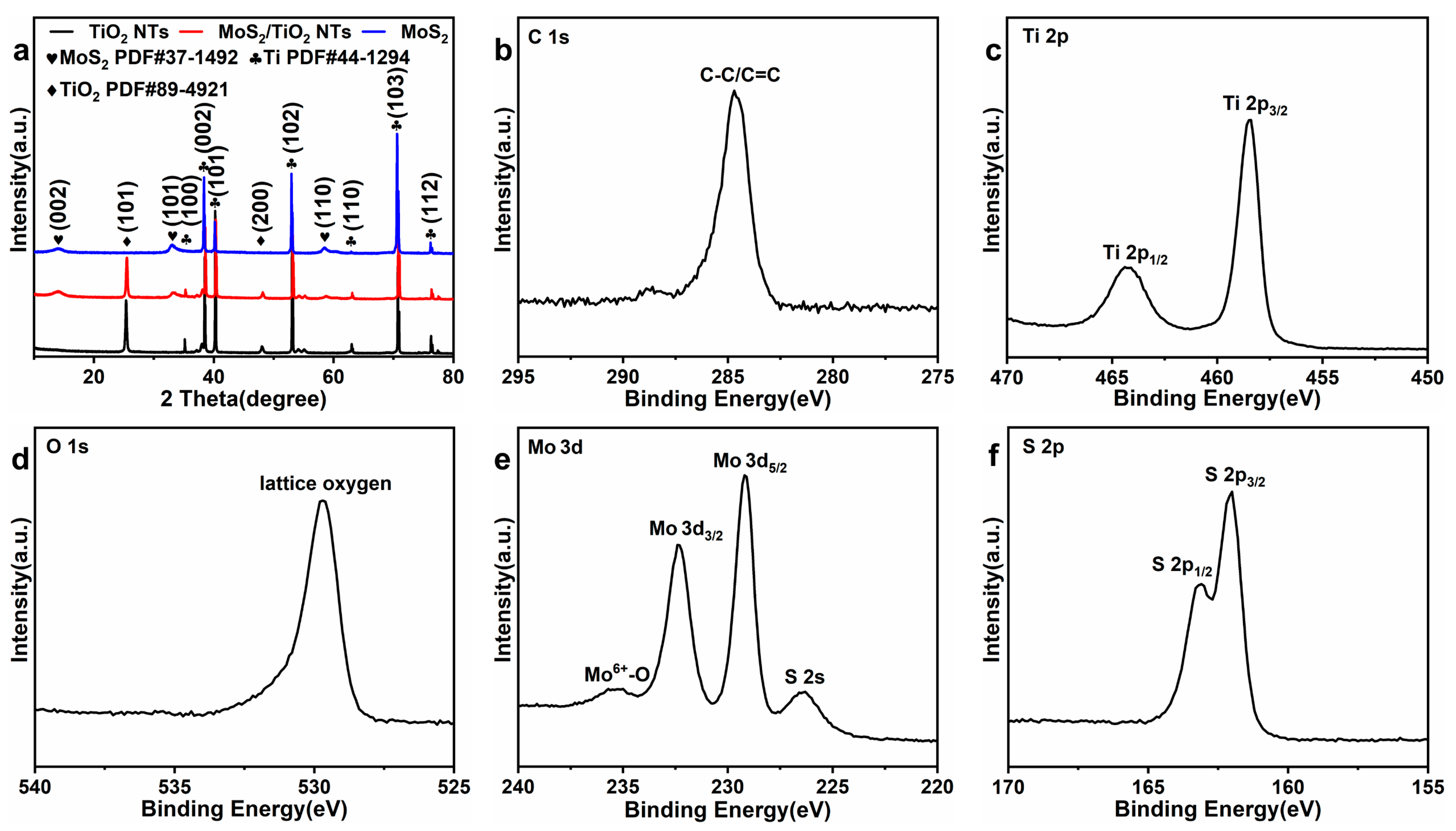
Figure 3 shows the crystalline phase composition and chemical valence states. As shown in Figure 3a, diffraction peaks at 2θ = 14.38°, 33.51°, and 58.33° correspond to the (002), (101), and (110) planes of hexagonal 2H-MoS2 [44], respectively. Peaks at 25.36° and 53.97° are assigned to the (101) and (200) planes of tetragonal anatase TiO2 [45]. The remaining characteristic peaks originate from the (100), (002), (101), (102), and (103) planes of the Ti substrate [46]. In the C 1s spectrum of MoS2/TiO2 NTs/Ti (Figure 3b), the peak centered at 284.8 eV is indexed to C-C/C=C bonds, which is from the inevitable air contamination [47]. The Ti 2p spectrum (Figure 3c) exhibits two peaks at 464.3 eV and 458.5 eV, corresponding to Ti 2p1/2 and Ti 2p3/2, respectively [48]. In the O 1s spectrum (Figure 3d), the peak at 529.7 eV is attributable to the lattice oxygen (Ti-O and/or Mo-O bonds) [49]. For the Mo 3d spectrum (Figure 3e), a weak peak at 235.3 eV is assigned to Mo6+-O bonding because of trace surface oxidation during sample processing after sputtering, whereas two intense peaks at 232.4 eV and 229.2 eV correspond to Mo 3d3/2 and Mo 3d5/2, respectively. A weak peak at 226.4 eV is identified as the S 2s orbital [50]. In the S 2p spectrum (Figure 3f), two strong peaks at 163.1 eV and 162.1 eV are ascribed to S 2p1/2 and S 2p3/2, respectively [51].
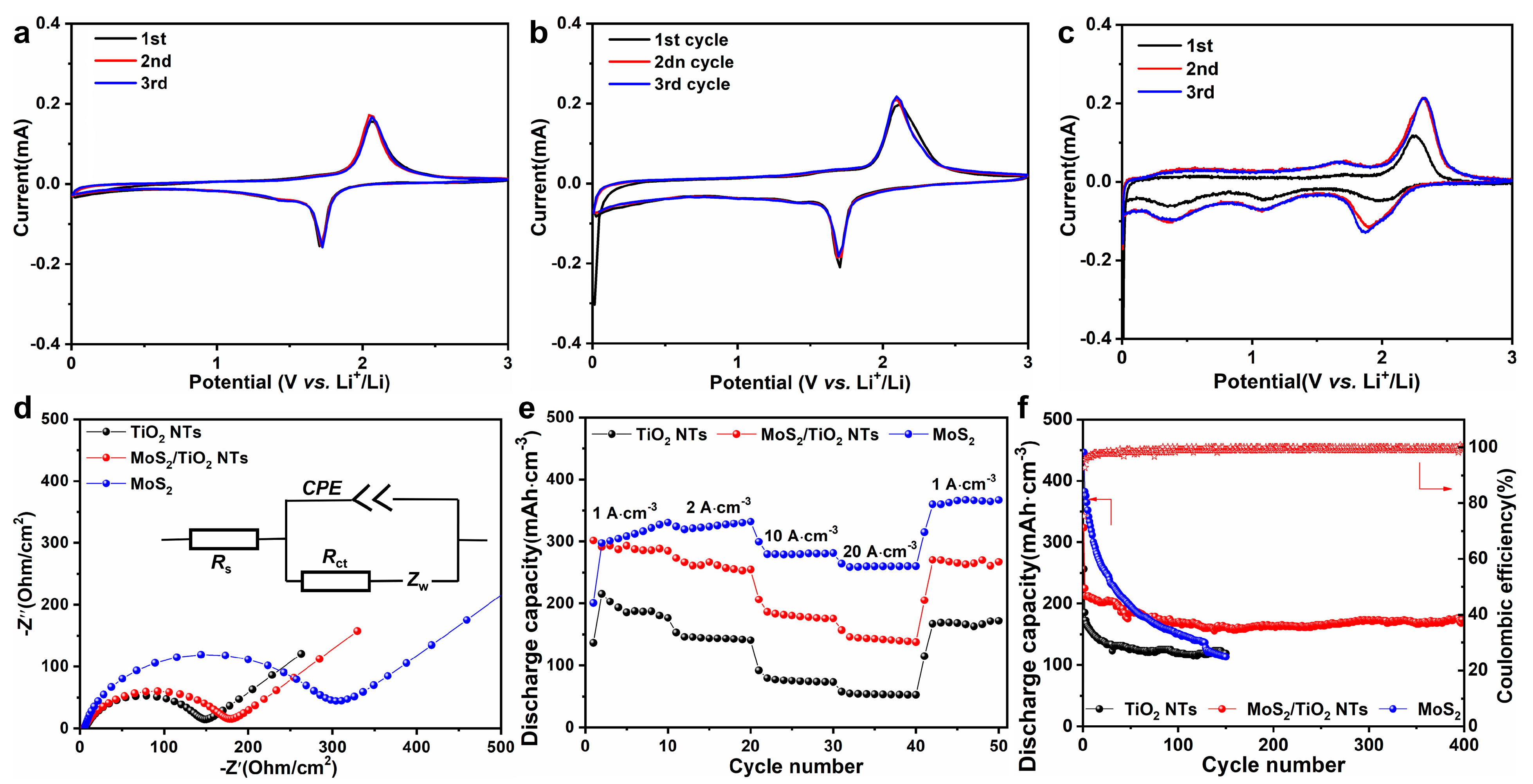
Subsequently, the electrochemical properties of TiO2 NTs/Ti, MoS2/TiO2 NTs/Ti, and MoS2/Ti are evaluated, as shown in Figure 4. Figure 4a shows three-cycle CV curves recorded over a potential range of 0~3 V (vs. Li+/Li) at a scan rate of 0.1 mV·s−1. The cathodic and anodic peaks centered at ~1.72 V and 2.07 V, respectively, are indexed to the lithiation–delithiation between TiO2 and LixTiO2 (Equation (1)). Under the same test conditions, the CV curves of MoS2/TiO2 NTs/Ti are measured (Figure 4b). Overall, the peak intensity of the composite CV curve exceeds that of TiO2 NTs, while the peak positions are nearly identical, indicating a low utilization of MoS2 upon TiO2 NTs at initial scans. For the MoS2/Ti control group, the CV scan exhibits three reduction peaks at 2.00 V, 1.11 V, and 0.36 V, which are attributable to the formation of LixMoS2, Li2S/Mo, and the solid electrolyte interface, respectively (Equations (2) and (3)). In the reverse scan, two anodic peaks at 1.69 V and 2.25 V correspond to the conversion of Mo to MoS2 and MoxSy, respectively. Notably, the cathodic and anodic peak positions of MoS2 shift to the left and right with increasing cycles, respectively, confirming a continuous change in its chemical state.
TiO2 + xLi+ + xe ↔ LixTiO2
MoS2 + xLi+ + xe → LixMoS2
LixMoS2 + (4 − x)Li+ + (4 − x)e → Mo + 2Li2S
Before cycling, EIS plots of all three samples are recorded (Figure 4d). Despite its wide band gap, the charge transfer resistance (Rct) of TiO2 NTs/Ti is significantly lower than that of the MoS2/Ti group owing to the well-aligned conductive network. The benefit of this is that the Rct of MoS2/TiO2 NTs/Ti ranks between the other two samples after compositing MoS2 with TiO2. This also exerts an influence on the rate and cycling performances (Figure 4e,f). During the rate capability evaluation at the current densities ranging from 1.0 to 20.0 A·cm−3, the discharge capacities of MoS2/Ti fluctuate within the range of 270–370 mAh·cm−3. In contrast, TiO2 NTs/Ti delivers a substantially lower capacity of merely 50–100 mAh·cm−3. For the MoS2/TiO2 NTs/Ti composite, the discharge capacities are measured as ~287, 262, 179, and 142 mAh·cm−3 at current densities of 1.0, 2.0, 10.0, and 20.0 A·cm−3, respectively. Impressively, when the current density is reverted to 1.0 A·cm−3, a high discharge capacity of 264 mAh·cm−3 is still well retained. Collectively, all three samples exhibit outstanding high current density tolerance. Nevertheless, in the long-term cycling test performed at 10.0 A·cm−3, the MoS2/TiO2 NTs/Ti composite delivers a discharge capacity of ~190 mAh·cm−3, nearly twice that of TiO2 NTs/Ti. Although MoS2/Ti manifests a high initial volumetric capacity, its rapid fading highlights the indispensability of constructing a composite structure. Consequently, the TiO2-MoS2 architecture demonstrates a distinct synergistic effect in boosting the capacity utilization and electrochemical performance.
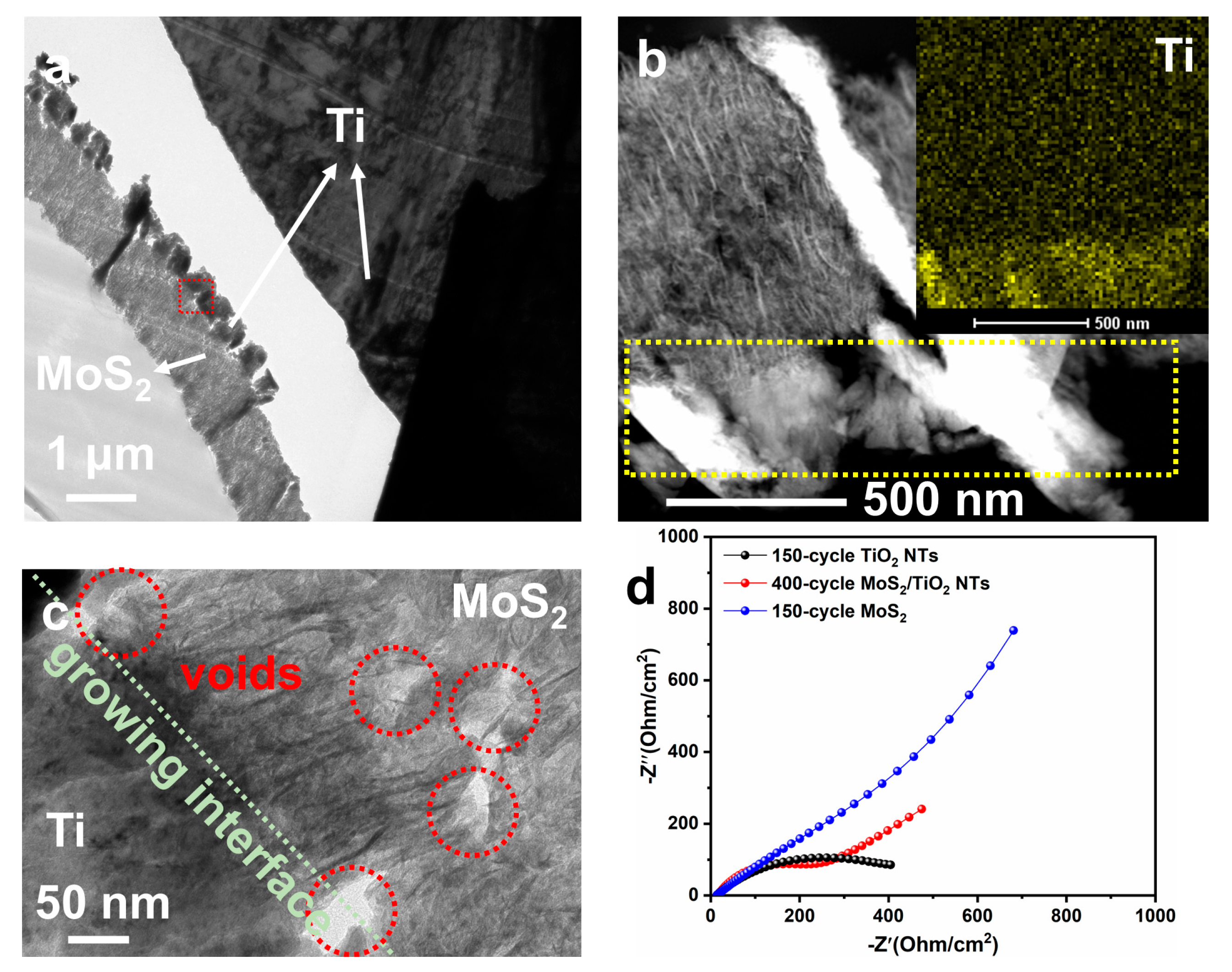
Generally, differences in electrochemical performance are closely related to variations in microstructures. The hollow nanotube architecture, MoS2, and TiO2 interact primarily through the tube walls, whereas the theoretical interfacial contact area between MoS2 and flat Ti paper is comparatively larger. Therefore, the interfacial bonding strength and stability of the MoS2-TiO2 NTs system are weaker than those of the MoS2-Ti system, correlating with the observed electrochemical performance. To elucidate this discrepancy, TEM was employed to examine the cross-sectional structure of MoS2/Ti (Figure 5). As shown in Figure 5a, a well-aligned MoS2 layer is observed, with some adherent substances present at the bottom of the MoS2 layer. High-angle annular dark-field (HAADF) image and elemental mapping confirm that these adherent substances are Ti. This indicates that during magnetron sputtering, when high-energy MoS2 nanoclusters bombard the Ti paper, a trace amount of chemically polished active Ti bonds tightly to MoS2. Hence, MoS2/Ti was detached from the Ti paper during the ultrathin sectioning process. Additionally, in the high-temperature environment during sputtering, active Ti diffuses into the MoS2 layer, leading to the weak but uniform Ti signal observed. At the MoS2-Ti growth interface, MoS2 grows in close contact with Ti in most regions; however, obvious voids or low-consistency areas (marked by red dashed circles) are present. This confirms that the bonding between MoS2 and Ti is not sufficiently strong under additive-free conditions. Also, the post-cycling EIS plots were measured and simulated with the same circuit, as shown in Figure 4d (inset). The Rct of 150-cycle TiO2 NTs/Ti, 400-cycle MoS2/TiO2 NTs/Ti, and 150-cycle MoS2/Ti are 171.2, 116.6, and 430.3 Ω·cm−2, respectively (Figure 5d). The notable increase in Rct relative to the pristine state can be ascribed to electrolyte decomposition and the formation of SEI. Among the three samples, the hierarchical structure after cycling exhibits the lowest Rct value, indicative of the most efficient charge transfer kinetics. This interpretation is consistent with the pronounced capacity changes observed in Figure 4f.
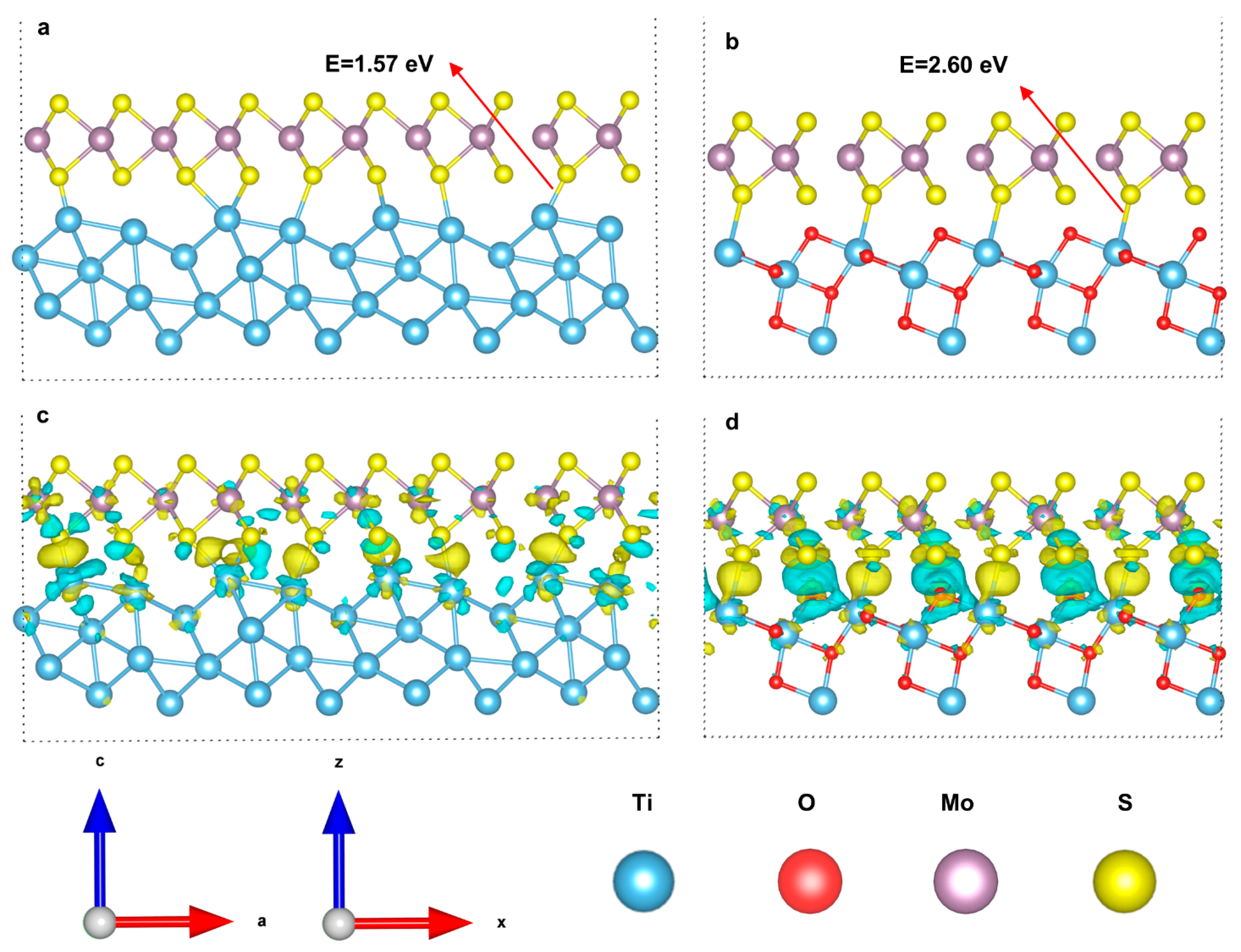
To elucidate the enhanced electrochemical properties of MoS2/TiO2 NTs/Ti compared to the control groups, DFT calculations were performed (Figure 6). After constructing and optimizing the MoS2(002)-Ti(101) and MoS2(002)-TiO2(101) slabs, their binding energies are 1.57 eV and 2.60 eV, respectively. Additionally, differential charge density distributions were also analyzed. Yellow regions denote charge accumulation (e gain), while blue regions represent charge depletion (e loss). In the MoS2-Ti model (Figure 6c), charge accumulation is primarily localized beneath the bottom atoms of the layered MoS2 at the interface, indicating e-transfer from the metallic Ti to the semiconductor MoS2. Charge depletion mainly occurs at the top surface of the underlying Ti metal. The relatively dispersed charge distribution suggests a weak interfacial interaction, corresponding to the high Rct presented in Figure 4d. Conversely, the MoS2-TiO2 model exhibits charge density isosurfaces with a larger volume and deeper coloration, implying more intense interfacial charge transfer and corresponding to the low Rct. Thus, it demonstrates a stronger chemical interaction at the interface. The strong binding force, stable interfacial structure, and improved local charge accumulation between MoS2 and TiO2 account for the enhanced electrochemical performance of MoS2/TiO2 NTs/Ti.
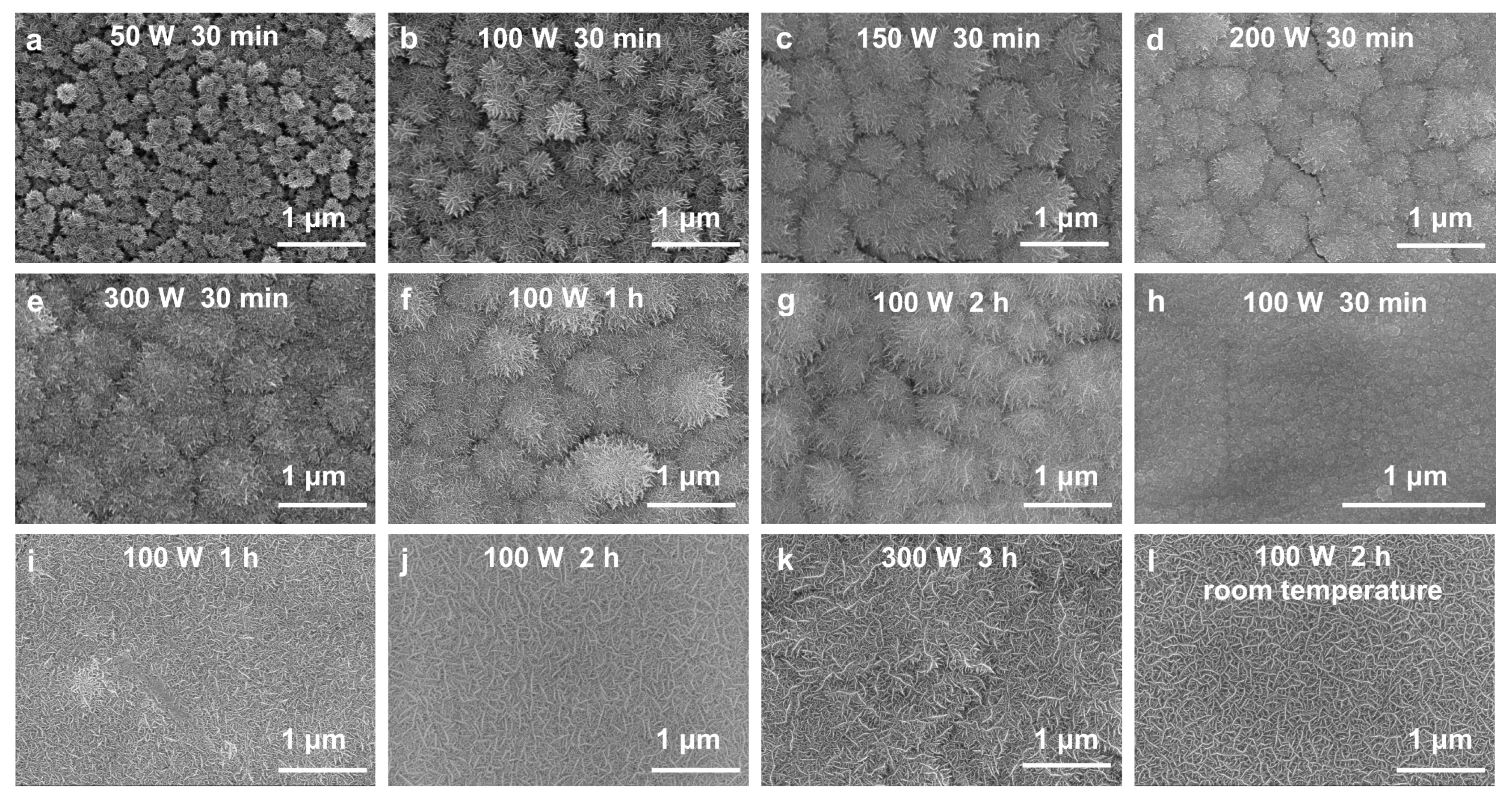
The aforementioned study demonstrates that urchin-like MoS2 microspheres grown on TiO2 NTs outperform worm-like MoS2 formed on Ti, owing to stronger MoS2-TiO2 interfacial bonding. Subsequently, additional MoS2/TiO2 NTs/Ti and MoS2/Ti samples are prepared with varying sputtering power (50~300 W), deposition time (30 min~3 h), and temperature (450 °C or room temperature), as shown in Figure 7. Overall, when the sputtering time is 30 min at the power of 50~300 W, the MoS2 layers grown on the surface of TiO2 NTs all exhibit an urchin-like microspherical structure (Figure 7a–g). The samples differ morphologically only in their thickness and diameter.
Similarly, when the sputtering power is fixed at 100 W and the deposition time varies from 30 min to 2 h, the MoS2 layers on the Ti paper surface consistently exhibit a worm-like morphology, with variations observed only in the roughness and size of these “worms” (Figure 7h–j). Furthermore, MoS2 consistently forms a uniform worm-like morphology, irrespective of whether the sputtering conditions involve increased power and duration (300 W/3 h/450 °C, Figure 7k) or extended duration at reduced temperature (100 W/2 h/room temperature, Figure 7l). This invariance unambiguously indicates that the superior electrochemical properties of MoS2/TiO2 NTs/Ti originate from its stable interfacial structure rather than from variations in processing parameters. Future efforts will focus on systematic optimization of TiO2 NTs architecture, MoS2 deposition conditions, and Ti paper thickness to further maximize specific areal and volumetric capacities.

4. Conclusions

To address the urgent demand for high energy density anode materials, this study fabricated an additive-free urchin-like MoS2/TiO2 NTs anode for advanced secondary batteries. The hierarchical structure integrated the structural stability of TiO2 NTs with the high capacity of 2H-MoS2. The electrochemical results demonstrated that the MoS2/TiO2 NTs/Ti anode delivered excellent reversible areal capacity and rate capability, exhibiting a distinct synergistic enhancement compared with the single-component TiO2 NTs/Ti and MoS2/Ti control groups. Structural characterizations and DFT calculations further revealed that strong interfacial bonding between MoS2 and TiO2 NTs reduced charge transfer resistance and suppressed the formation of interfacial voids. Notably, the urchin-like morphology formed consistently on the TiO2 NTs surface regardless of variations in sputtering parameters. Overall, this study offered a scalable and efficient strategy for the fabrication of high-performance anodes.

Author Contributions

Conceptualization and methodology, H.W.; investigation, data curation, and writing—original draft, S.X. and Y.L. (Yilong Li); formal analysis and validation, Y.L. (Yong Li); writing—review and editing and supervision, G.Z. All authors have read and agreed to the published version of the manuscript.

Funding

This work received financial support from the Key industrial chains of Shaanxi Province (2024GX-ZDCYL-04-07) and the Key Research and Development Program of Shaanxi Province (2024GX-YBXM-337).

Institutional Review Board Statement

Not applicable.

Informed Consent Statement

Not applicable.

Data Availability Statement

Data is contained within the article.

Conflicts of Interest

The authors declare that they have no conflicts of interest.

References

  1. Chavan, D.V.; Patil, D.P.; Patil, S.C.; Patil, R.S.; Katkar, K.P.; Sheikh, A.Z.; Ustad, E.R.; Kim, H.; Kadam, D.K.; Patil, S.H.; et al. Advanced functional materials and their coordinated composites for next-generation Li-S batteries: A brief review. J. Energy Storage 2024, 88, 111572. [Google Scholar] [CrossRef]
  2. Arabzadeh, V.; Frank, R. Creating A Renewable Energy-Powered Energy System: Extreme Scenarios and Novel Solutions for Large-Scale Renewable Power Integration. Appl. Energy 2024, 374, 124088. [Google Scholar] [CrossRef]
  3. Wang, Y.; He, Y.; Gao, X. Synergizing Renewable Energy and Circular Economy Strategies: Pioneering Pathways to Environmental Sustainability. Sustainability 2025, 17, 1801. [Google Scholar] [CrossRef]
  4. Bąk, I.; Wawrzyniak, K.; Barej-Kaczmarek, E.; Oesterreich, M. Renewable Energy for Sustainable Development in EU Countries: Status, Prospects, and Challenges. Energies 2025, 18, 1333. [Google Scholar] [CrossRef]
  5. Liu, L.; Xiang, Y.; Wang, J. From Cell to Atomic Level: Understanding the Degradation in 99% Coulombic Efficiency and 450 Wh kg−1 Anode-Free Pouch Cells. J. Am. Chem. Soc. 2025, 147, 41342–41354. [Google Scholar] [CrossRef]
  6. Xu, N.; Song, X.; Sun, G.; Zhang, J.; Quan, Z.; Lou, G.; Li, A.; Li, C.; Zhang, H.; Chen, Y. Over 500 Wh kg−1 Solid-State Lithium Metal Batteries with Long Cycling Stability Using In Situ Polymerized Electrolyte. J. Am. Chem. Soc. 2026, 148, 2471–2480. [Google Scholar] [CrossRef]
  7. Zhao, L.; Lakraychi, A.E.; Chen, Z.; Liang, Y.; Yao, Y. Roadmap of Solid-State Lithium-Organic Batteries toward 500 Wh kg−1. ACS Energy Lett. 2021, 6, 3287–3306. [Google Scholar] [CrossRef]
  8. Wang, Z.W.; Xiang, S.; Luo, J.-D.; Shi, Z.; Wu, Y.C.; Tan, H.Y.; Cheng, X.; Zhou, M.Y.; Hao, X.D.; Luo, C.P.; et al. Achieving 766.5 Wh kg−1 Electrode-Level Energy Density via Solid-State Cathode Integrating Ultrahigh Nickel Oxide and Lithium Iron Chloride. Nano Lett. 2025, 25, 12930–12937. [Google Scholar] [CrossRef] [PubMed]
  9. Bera, B.; Aaron, D.S.; Mench, M.M. Factors Controlling the Performance of Lithium-Metal Solid-State Batteries with Polyethylene Oxide-Based Composite Polymer Electrolytes. Energy Adv. 2026, 5, 119–129. [Google Scholar] [CrossRef]
  10. He, Y.; He, Z.; Ouyang, B. Design Principle of Disordered Rocksalt Type Overlithiated Anode for High Energy Density Batteries. Mater. Horiz. 2024, 11, 6049–6056. [Google Scholar] [CrossRef]
  11. Wang, C.; Yang, C.; Zheng, Z. Toward Practical High-Energy and High-Power Lithium Battery Anodes: Present and Future. Adv. Sci. 2022, 9, e2105213. [Google Scholar] [CrossRef] [PubMed]
  12. Lauro, N.S.; Broekhuis, G.B.; Papa, E.P.; Rastogi, A.; Burrow, N.J.; Ellison, J.C.; Mullins, B.C. A Balancing Act: Experimental Insights into the Volume Fraction of Conductive Additive in Lithium-Ion Battery Electrodes. J. Electrochem. Soc. 2024, 171, 060525. [Google Scholar] [CrossRef]
  13. Arnot, D.J.; Mayilvahanan, K.S.; Hui, Z.; Takeuchi, K.J.; Marschilok, A.C.; Bock, D.C.; Wang, L.; West, A.C.; Takeuchi, E.S. Thick Electrode Design for Facile Electron and Ion Transport: Architectures, Advanced Characterization, and Modeling. Acc. Mater. Res. 2022, 3, 472–483. [Google Scholar] [CrossRef]
  14. Du, M.; Hao, Z.L.; Liu, Y.; Ma, M.Y.; Yang, J.L.; Huang, Z.X.; Gu, Z.Y.; Zhang, K.Y.; Guo, J.Z.; Wu, X.L. Architecture Engineering for Thick Electrodes in High-Energy Batteries: Challenges and Strategies. ACS Appl. Mater. Interfaces 2025, 17, 19230–19246. [Google Scholar] [CrossRef]
  15. Li, S.; Luo, Y.; Wang, K.; Zhang, L.; Yan, P.; Sui, M. Opportunities and Challenges for Next-Generation Thick Cathodes in Lithium-Ion Batteries. Materials 2025, 18, 3464. [Google Scholar] [CrossRef]
  16. Li, F.; Wu, H.; Wen, H.; Wang, C.; Shen, C.; Su, L.; Liu, S.; Chen, Y.; Wang, L. Constructing a Stable Integrated Silicon Electrode with Efficient Lithium Storage Performance through Multidimensional Structural Design. ACS Appl. Mater. Interfaces 2024, 16, 8802–8812. [Google Scholar] [CrossRef] [PubMed]
  17. Wang, K.; Luo, Y.; Zhan, H.; Liu, X.X.; Sun, X. Electrolyte Additive Molecule Disassembly to Reveal the Roles of Individual Groups in Zn Electrode Stabilities in Aqueous Batteries. ACS Nano 2024, 18, 27672–27682. [Google Scholar] [CrossRef]
  18. Weindl, C.L.; Fajman, C.E.; Xu, Z.; Zheng, T.; Mohl, G.E.; Chaulagain, N.; Shankar, K.; Gilles, R.; Fassler, T.F.; Muller-Buschbaum, P. Dendritic Copper Current Collectors as a Capacity Boosting Material for Polymer-Templated Si/Ge/C Anodes in Li-Ion Batteries. ACS Appl. Mater. Interfaces 2024, 16, 2309–2318. [Google Scholar] [CrossRef]
  19. You, X.; Feng, Y.; Ning, D.; Yao, H.; Wang, M.; Wang, J.; Chen, B.; Zhong, G.H.; Yang, C.; Wu, W. Phosphorized 3D Current Collector for High-Energy Anode-Free Lithium Metal Batteries. Nano Lett. 2024, 24, 11367–11375. [Google Scholar] [CrossRef] [PubMed]
  20. Shan, X.X.; Liu, S.Y.; Xiao, Q.Z.; Xie, W.H.; Zhuang, Y.; Guan, M.Y. The novel current collectors of cathode and anode using the ultrathin, flexible and light-weight graphene papers in lithium-ion batteries. Diam. Relat. Mater. 2026, 163, 113419. [Google Scholar] [CrossRef]
  21. Kim, M.; Lee, Y.; Kim, M.W.; Lee, S.H.; Kim, W.B. Free-Standing Architecture of Spatially Branched Nanowire Electrodes for Boosting Interfacial Stability in Solid-State Lithium-Ion Batteries. Nano Lett. 2026, 26, 4103–4110. [Google Scholar] [CrossRef]
  22. Matsumoto, F.; Fukunishi, M. Review of Current Collector-, Binder-, Conductive Additive-Free, and Freestanding Electrodes in Lithium and Related Batteries. Batteries 2024, 10, 330. [Google Scholar] [CrossRef]
  23. Singh, A.P.; Dutta, B.; Chattopadhyay, S. Tin-Oxide-Based Binder-Free Lightweight Nanostructured Anode with High Reversible Capacity and Cyclability for Lithium-Ion Batteries, Manifesting the Interfacial Effect. RSC Appl. Interfaces 2025, 2, 1877–1888. [Google Scholar] [CrossRef]
  24. Dasarathan, S.; Sung, J.; Hong, J.W.; Jo, Y.S.; Kim, B.G.; Lee, Y.J.; Choi, H.Y.; Park, J.W.; Kim, D. Free-Standing TiO2 Nanograssy Tubular Hybrid Membrane for Polysulfide Trapping in Li-S Battery. RSC Adv. 2023, 13, 8299–8306. [Google Scholar] [CrossRef]
  25. Nemaga, A.W.; Michel, J.; Morcrette, M.; Mallet, J. Facile Synthesis of Ge@TiO2 Nanotube Hybrid Nanostructure Anode Materials for Li-Ion Batteries. ACS Appl. Mater. Interfaces 2023, 15, 45790–45798. [Google Scholar] [CrossRef]
  26. Wu, Q.L.; Li, J.; Deshpande, R.D.; Subramanian, N.; Rankin, S.E.; Yang, F.; Cheng, Y.-T. Aligned TiO2 Nanotube Arrays As Durable Lithium-Ion Battery Negative Electrodes. J. Phys. Chem. C 2012, 116, 18669–18677. [Google Scholar] [CrossRef]
  27. Zhu, B.; Li, W.; Tang, W.; Tang, H. TiO2 Coated with Carbon via Chemical Vapor Deposition as Li-Ion Batteries Anode. Coatings 2024, 14, 1473. [Google Scholar] [CrossRef]
  28. Pan, J.; Liu, Z.; Zhang, B.; Qi, M.; Feng, Y. Embedment of Molybdenum Disulfide in Electrospun Fibers as an Integrated Cathode for Lithium-Ion Batteries. Coatings 2024, 14, 1465. [Google Scholar] [CrossRef]
  29. Teng, Y.; Zhao, H.; Zhang, Z.; Li, Z.; Xia, Q.; Zhang, Y.; Zhao, L.; Du, X.; Du, Z.; Lv, P.; et al. MoS2 Nanosheets Vertically Grown on Graphene Sheets for Lithium-Ion Battery Anodes. ACS Nano 2016, 10, 8526–8535. [Google Scholar] [CrossRef]
  30. Wang, J.; Yang, X.; Tong, P.; Zhang, M.; Liu, L.; Zhang, Y. Superior Electrochemical Performance of the MoS2 Nanosheets Prepared by Magnetron Sputtering. J. Energy Storage 2025, 132, 117718. [Google Scholar] [CrossRef]
  31. Anwar, T.; Wang, L.; Sagar, R.U.R.; Nosheen, F.; Shehzad, K.; Hussain, N.; Tongxiang, L. Molybdenum Disulfide Grafted Titania Nanotube Arrays as High Capacity Retention Anode Material for Lithium Ion Batteries. Appl. Nanosci. 2016, 7, 67–73. [Google Scholar] [CrossRef]
  32. Wang, P.; Norimatsu, H.; Chen, X.; Matsuhira, K.; Liu, J.; Lin, E.; Zhang, M.; Fang, S.; Sakurai, Y.; Matsubara, T.; et al. Low-Cost, Scalable-Fabrication, Binder-Free TiO2/TiO2-TiN/MoS2 Nanostructured Composite Anode for High-Areal-Capacity Lithium-Ion Batteries. J. Energy Storage 2026, 142, 119540. [Google Scholar] [CrossRef]
  33. Wu, H.; Jia, Z.; Hu, K.; Liu, D.; Sun, S.; Jin, G.; Chen, J. Multifunctional Carbon Layer Bridging TiO2 Nanotubes and MoS2 Nanosheets for Enhanced Lithium Storage. ACS Appl. Nano Mater. 2024, 7, 21735–21746. [Google Scholar] [CrossRef]
  34. Zu, G.; Li, H.; Liu, S.; Li, D.; Wang, J.; Zhao, J. Highly efficient Mass Determination of TiO2 Nanotube Arrays and Its Application in Lithium-Ion Batteries. Sustain. Mater. Technol. 2018, 18, e00079. [Google Scholar] [CrossRef]
  35. Kresse, G.; Furthmüller, J. Efficiency of Ab-Initio Total Energy Calculations for Metals and Semiconductors Using a Plane-Wave Basis Set. Comput. Mater. Sci. 1996, 6, 15–50. [Google Scholar] [CrossRef]
  36. Kresse, G.; Joubert, D. From Ultrasoft Pseudopotentials to the Projector Augmented-Wave Method. Phys. Rev. B 1999, 59, 1758–1775. [Google Scholar] [CrossRef]
  37. Kresse, G.; Furthmüller, J. Efficient Iterative Schemes for Ab Initio Total-Energy Calculations Using a Plane-Wave Basis Set. Phys. Rev. B 1996, 54, 11169–11186. [Google Scholar] [CrossRef]
  38. Perdew, J.P.; Burke, K.; Ernzerhof, M. Generalized Gradient Approximation Made Simple. Phys. Rev. Lett. 1996, 77, 3865–3868. [Google Scholar] [CrossRef]
  39. Perdew, J.P.; Burke, K.; Wang, Y. Generalized Gradient Approximation for the Exchange-Correlation Hole of a Many-Electron System. Phys. Rev. B 1996, 54, 16533–16539, Erratum in Phys. Rev. B 1998, 57, 14999. https://doi.org/10.1103/PhysRevB.57.14999. [Google Scholar] [CrossRef]
  40. Blochl, P.E. Projector Augmented-Wave Method. Phys. Rev. B 1994, 50, 17953–17979. [Google Scholar] [CrossRef] [PubMed]
  41. Zu, G.N.; Li, Y.L.; Liu, H.X.; Zhang, M.C.; Yang, Y.F.; Wang, J.; Fu, Y.H.; Chen, L.P.; Li, Y.; Li, S.Y.; et al. Al2O3-induced phase conversion regulation from hexagonal FeS to orthorhombic FeS for enhancing the Li-ion accommodation ability. Mater. Charact. 2024, 217, 114343. [Google Scholar] [CrossRef]
  42. Zu, G.N.; Li, Y.L.; Zhang, M.C.; Wang, J.; Li, J.; Guo, G.C.; Chen, L.P.; Li, Y.; Wang, G.M.; Fu, Y.H.; et al. Revealing the intrinsic size-controlled failure mechanism and enhanced capacity repairing effect of MoS2-based anodes in long-term cycled lithium-ion batteries. J. Alloys Compd. 2025, 10, 185221. [Google Scholar] [CrossRef]
  43. Yun, H.; Wang, G.M.; Li, Y.L.; Zu, G.N.; Qi, N.; Fu, Y.H.; Li, Y.; Chen, L.P.; Li, S.Y.; Wang, J. Enhancement of energy storage stability of LiNi0.8Co0.1Mn0.1O2 cathode material in Li-ion batteries by associated LiYbO2 phase generated from trace Yb3+ doping: From experiment to theoretical analysis. J. Rare Earths 2026, 44, 1203–1212. [Google Scholar] [CrossRef]
  44. Zhang, L.; Zhang, Q.; Chen, T.; Wang, C.; Xiao, C.; Guo, J.; Pang, X.; Liu, S. Magnetic MoS2/Fe3O4 Composite as An Effective Activator of Persulfate for the Degradation of Tetracycline: Performance, Activation Mechanisms and Degradation Pathways. Water Sci. Technol. 2024, 89, 1860–1878. [Google Scholar] [CrossRef]
  45. Amelia, P.; Gunlazuardi, J. Development of BiOBr/TiO2 Nanotubes Electrode for Conversion of Nitrogen to Ammonia in A Tandem Photoelectrochemical Cell under Visible Light. Int. J. Renew. Energy Dev. 2023, 12, 702–710. [Google Scholar] [CrossRef]
  46. Wang, T.; Wang, Y.; Gao, S.; Fan, J.; Dai, S. Titanium Surface Nitriding by Sodium Amide in Molten Salts. Chem. Commun. 2025, 61, 12976–12979. [Google Scholar] [CrossRef]
  47. Zhang, F.G.; Chen, Y.; Ma, C.; Tang, J.P.; Wang, Z.Y.; Zhao, Z.Y.; Bao, L.; Yuan, Y.J. Accelerated Charge Transfer through Interface Chemical Bonds in MoS2/TiO2 for Photocatalytic Conversion of Lignocellulosic Biomass to H2. Inorg. Chem. 2024, 63, 13766–13774. [Google Scholar] [CrossRef]
  48. Malannata, E.M.; Auditore, A.; Fiorenza, R.; Armeli Iapichino, M.T.; Lo Presti, F.; Tuccitto, N.; Licciardello, A. Simultaneous H2 Production and Water Purification with Surface-Modified Nanostructured TiO2 Photoelectrodes. RSC Adv. 2025, 15, 14273–14281. [Google Scholar] [CrossRef]
  49. Sun, P.; Han, S.; Liu, J.; Zhang, J.; Yang, S.; Wang, F.; Liu, W.; Yin, S.; Ning, Z.; Cao, W. Introducing Oxygen Vacancies in TiO2 Lattice through Trivalent Iron to Enhance the Photocatalytic Removal of Indoor NO. Int. J. Min. Met. Mater. 2023, 30, 2025–2035. [Google Scholar] [CrossRef]
  50. Amin, R.; Hossain, M.A.; Zakaria, Y. Interfacial Kinetics and Ionic Diffusivity of the Electrodeposited MoS2 Film. ACS Appl. Mater. Interfaces 2018, 10, 13509–13518. [Google Scholar] [CrossRef] [PubMed]
  51. Pan, H.; Huang, Y.; Cen, X.; Zhang, M.; Hou, J.; Wu, C.; Dou, Y.; Sun, B.; Wang, Y.; Zhang, B.; et al. Hollow Carbon and MXene Dual-Reinforced MoS2 with Enlarged Interlayers for High-Rate and High-Capacity Sodium Storage Systems. Adv. Sci. 2024, 11, e2400364. [Google Scholar] [CrossRef]
Figure 1. Scheme of the preparation process of the urchin-like MoS2/TiO2 NTs/Ti anode.
Coatings 16 00559 g001
Figure 2. SEM and TEM images of (a,d) TiO2 NTs/Ti, (b,e) urchin-like MoS2/TiO2 NTs/Ti, and (c,f) worm-like MoS2/Ti. The inset figures are the corresponding partial enlarged or HRTEM images.
Coatings 16 00559 g002
Figure 3. (a) XRD patterns of TiO2 NTs/Ti, MoS2/TiO2 NTs/Ti, and MoS2/Ti; XPS spectra of MoS2/TiO2 NTs/Ti, (b) C 1s, (c) Ti 2p, (d) O 1s, (e) Mo 3d, and (f) S 2p.
Coatings 16 00559 g003
Figure 4. CV curves of (a) TiO2 NTs/Ti, (b) MoS2/TiO2 NTs/Ti, and (c) MoS2/Ti at a scan rate of 0.1 mV‧s−1; (d) EIS plots, (e) rate performance, and (f) cycling performance.
Coatings 16 00559 g004
Figure 5. Cross-section view of MoS2/Ti: (a) low-magnitude TEM image, (b) HAADF and elemental mapping of Ti, (c) HRTEM image of the growing interface section, (d) post-cycling EIS plots.
Coatings 16 00559 g005
Figure 6. DFT calculations. Binding energy of (a) MoS2-Ti slab and (b) MoS2-TiO2 NTs slab; differential charge density distribution of (c) MoS2-Ti slab and (d) MoS2-TiO2 NTs slab.
Coatings 16 00559 g006
Figure 7. SEM images of MoS2/TiO2 NTs/Ti obtained at a temperature of 450 °C; a power and time of (a) 50 W/30 min, (b) 100 W/30 min, (c) 150 W/30 min, (d) 200 W/30 min, (e) 300 W/30 min, (f) 100 W/1 h, and (g) 100 W/2 h. SEM images of MoS2/Ti obtained at a temperature of 450 °C; a power and time of (h) 100 W/30 min, (i) 100 W/1 h, (j) 100 W/2 h, and (k) 300 W/3 h; SEM image of MoS2/Ti obtained at (l) 100 W/2 h/room temperature.
Coatings 16 00559 g007
Disclaimer/Publisher’s Note: The statements, opinions and data contained in all publications are solely those of the individual author(s) and contributor(s) and not of MDPI and/or the editor(s). MDPI and/or the editor(s) disclaim responsibility for any injury to people or property resulting from any ideas, methods, instructions or products referred to in the content.