Article

Effect of Metal Elements (Ta, Nb, V and Co) on the Mechanical Properties of Ti-Based Amorphous Composites

1
School of Material, Electricity and Intelligent Manufacturing, Huaihua University, Huaihua 418000, China
2
Hunan Renewable Aluminum Innovation Research Center, Huaihua University, Huaihua 418000, China
3
Key Laboratory of Intelligent Control Technology for Wuling-Mountain Ecological Agriculture in Hunan Province, Huaihua University, Huaihua 418000, China
*
Authors to whom correspondence should be addressed.
Coatings 2026, 16(5), 552; https://doi.org/10.3390/coatings16050552
Submission received: 31 March 2026 / Revised: 21 April 2026 / Accepted: 1 May 2026 / Published: 4 May 2026

Abstract

Four groups of Ti-based amorphous composites with a nominal composition of Ti48Zr27Cu6Be14TM5 (at.%, TM = Ta, Nb, V and Co) were prepared and investigated. They were studied to explore the effect of transition metal elements on the microstructure and mechanical properties of Ti-based amorphous composites. The results reveal that V and Nb are predominantly distributed within the crystalline phase, while Ta exhibits no obvious elemental segregation behavior. In contrast, Co is predominantly concentrated within the amorphous matrix. These alloying elements exert a remarkable influence on the mechanical properties, including strength, plasticity and hardness. The Co-doped specimen achieved the highest yield strength and compressive strength, reaching 1942 MPa and 1977 MPa, respectively. Meanwhile, its crystalline and amorphous phases achieved maximum hardness of 566.9 HV0.005 and 451.8 HV0.005, respectively. However, it delivered the lowest plasticity, with the plastic strain nearly approaching zero. The Nb-containing specimen achieved the highest plasticity, with a percent elongation of 6.3%. Furthermore, the strength of amorphous composites is strongly correlated with the characteristics of both the crystalline phase and the amorphous matrix. Their plasticity is predominantly governed by the stress concentration factor of the crystalline phase. This study demonstrates that synergistic regulation of characteristics pertaining to the crystalline phase and amorphous matrix serves as a promising strategy to simultaneously enhance the strength and plasticity of amorphous composites.

1. Introduction

Amorphous alloys are regarded as promising structural material candidates due to their superior comprehensive properties, such as ultra-high strength, high hardness, a large elastic limit, and excellent corrosion resistance [1,2]. Amorphous alloys are widely applied in power electronics, new energy, biomedical and other fields [3]. Nevertheless, under loading, amorphous alloys are prone to highly localized shear behavior and inhomogeneous shear deformation [4], which induce catastrophic brittle fracture and strain softening, thereby severely restricting their applications in the engineering field [5]. Various strategies have been developed to improve the ductility of amorphous alloys. Reasonable composition optimization can effectively increase the Poisson’s ratio of alloy systems [6]. In addition, amorphous composites with co-existing amorphous and crystalline phases can be fabricated by ex situ addition of crystalline particles through technical processing [7]. This can also be achieved through the in situ formation of crystalline phases during fabrication [8]. Among these strategies, in situ synthesized amorphous composites combine the high strength of the amorphous phase with the superior ductility of the crystalline phase [9]. This unique coupling endows the composites with outstanding comprehensive mechanical properties.
Although the plasticity of the composites has been significantly improved compared with monolithic amorphous alloys, it still remains at a relatively low level. Thus, determining how to further enhance the properties of the composites continues to be a key research focus. To date, most studies have focused on improving the performance of in situ amorphous composites by tailoring microstructural parameters such as the morphology, content and size of the ductile crystalline phase [10,11]. A general negative correlation usually exists between strength and plasticity, implying that the improvement of plasticity is accompanied at the expense of strength. This makes difficult to achieve enhanced comprehensive properties of amorphous composites [12,13]. Regulating the properties of the amorphous matrix to improve the comprehensive performance of amorphous composites represents a novel strategy, with few relevant research reports available [14,15]. For example, the strength reduction degradation induced by introducing crystalline phases into the amorphous matrix can be balanced by increasing the strength of the amorphous phase. The overall strength of amorphous composites is predominantly governed by that of the amorphous matrix.
Ti-based amorphous composites derived from the Ti–Zr–Be system exhibit significant advantages over other amorphous composites, primarily attributed to their low cost and low density [16,17]. For example, the single-phase amorphous Ti45Zr20Be35 alloy exhibits a critical size of 6 mm and a fracture strength of 1860 MPa [18]. It is generally observed that the addition of Nb or V to the monolithic amorphous alloys promotes the in situ formation of β-Ti crystalline phases within the amorphous matrix [19]. In contrast, the incorporation of other metallic elements (e.g., Cu, Ni, Co, and Ta) can effectively improve the glass-forming ability (GFA) of the amorphous phase [20]. Since the mixing enthalpies of Cu, Ni, Co, and Ta with Ti are −9, −35, −28, and −17 kJ/mol, respectively, these elements tend to enrich in the residual liquid phase, thereby facilitating the formation of the amorphous structure [21,22,23]. Furthermore, metallic elements such as Cu, Ni, Co and Ta exhibit different elastic modulus and hardness values [24], and they also exert a significant influence on the properties of the amorphous phase. It can be seen that these elements not only promote the formation of the amorphous phase but also affect its properties.
Current studies primarily focus on optimizing crystalline microstructures, yet they struggle to achieve an effective balance between strength and plasticity. This work tailors the properties of amorphous matrix and crystalline phases via transition metal doping, thereby realizing the synergistic performance optimization of Ti-based amorphous composites. In this study, four groups of Ti48Zr27Cu6Be14TM5 (at.%, TM = Ta, Nb, V and Co) amorphous composites were designed based on the Ti–Zr–Cu–Be system, with the aim of tailoring the properties of the amorphous phase through the substitution of additive elements. It has been proven that the substitution of metallic elements can effectively regulate the elastic modulus and hardness of the amorphous phase. This modification enables the strength of Ti-based amorphous composites to be optimized, while their excellent plasticity is well maintained. The yield strength of the amorphous composites is correlated with the hardness of the amorphous matrix, whereas their plasticity is highly correlated with the stress concentration factor of the crystalline phase. This work compares multiple elements and provides theoretical support for strength–ductility synergy optimization of Ti-based composites.

2. Experimental

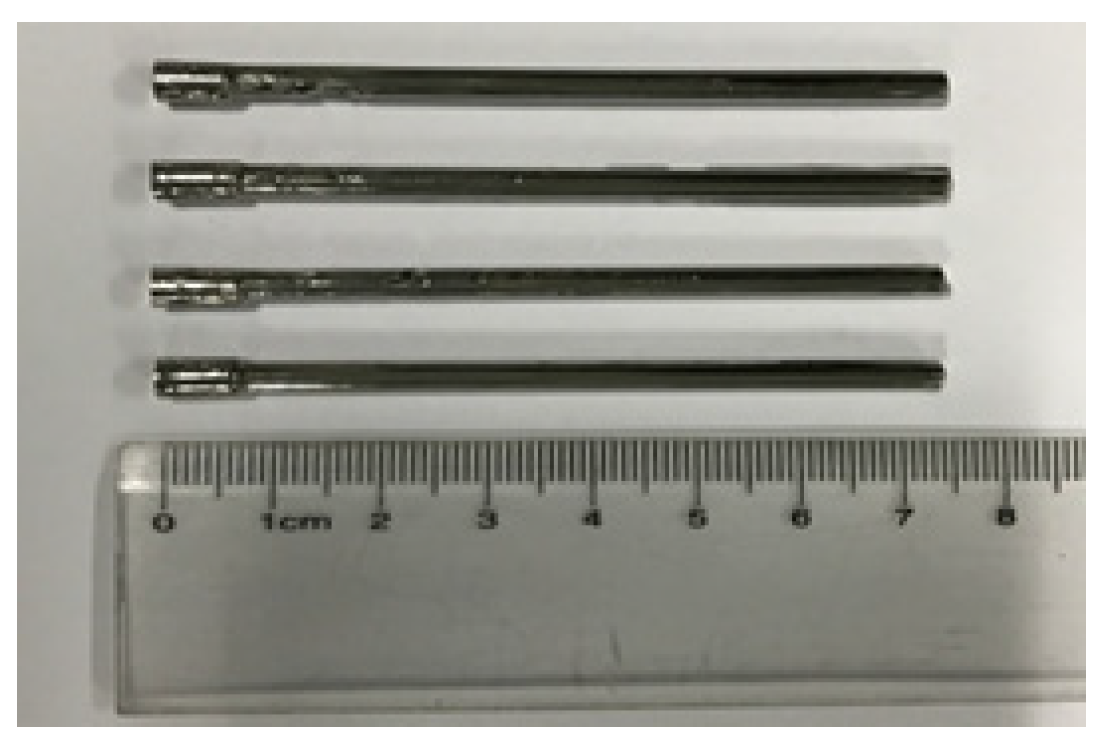
Four mixtures with a nominal composition of Ti48Zr27Cu6Be14TM5 (at.%, TM = Ta, Nb, V and Co, denoted as Ta5, Nb5, V5 and Co5 amorphous composites, respectively) were prepared using constituent elements with a purity higher than 99.95%. Then the four alloy ingots were fabricated via arc melting in a high-vacuum (10−4 Pa) electric furnace (model: YFFG40/13G-YC, manufactured by Shanghai Yifeng Electric Furnace Co., Ltd., Shanghai, China) under a protective atmosphere of high-purity argon (Ar). To ensure a homogeneous chemical composition, the alloy ingots were subjected to 4–5 remelting cycles. Subsequently, the molten ingots were cast into cylindrical specimens with a diameter of 4 mm and a length of 70 mm using a water-cooled copper mold. Thus, the four groups of as-cast Ti48Zr27Cu6Be14TM5 amorphous composites were fabricated, as shown in Figure 1.
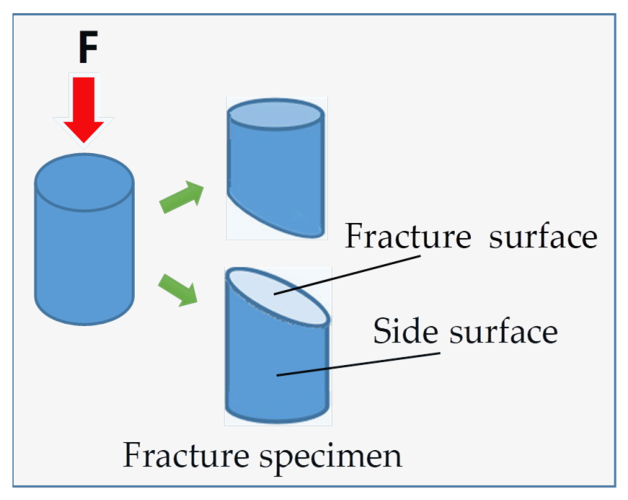
Subsequently, the phase compositions of the specimens were examined by X-ray diffraction (XRD, Bruker D8, Co Kα radiation, manufactured by Bruker Corporation, Billerica, Germany), and the microstructures were observed using scanning electron microscopy (SEM, model: JSM6701, manufactured by Japan Electron Optics Laboratory Co. Ltd., Tokyo, Japan). The compositions of the crystalline phase and amorphous matrix were analyzed by energy dispersive spectroscopy (EDS). Additionally, the side-surface deformation morphologies and fracture morphologies of fractured compression specimens were observed via SEM, as shown in Figure 2 [25].
Specimens for compression testing, with a diameter of 4 mm and a length of 8 mm, were subjected to precision polishing to ensure their end faces were mutually parallel and perpendicular to the direction of compressive loading. Quasi-static room temperature compression tests were performed at a strain rate of 5 × 10⁻⁴ s−1 on a universal testing machine (Model: E45.105, manufactured by MTS Systems (China) Co., Ltd., Shanghai, China), to evaluate critical mechanical properties including plasticity, yield strength and ductility. Prior to testing, the specimens were mechanically polished and rinsed with high-purity ethanol. Then the elastic modulus and hardness of both the crystalline phase and amorphous matrix were measured via nano-indentation (model: Nano Indenter G200, manufactured by Agilent Technologies (China) Co., Ltd., Beijing, China) at a peak load of 50 mN and a strain rate of 0.1 s−1.
Based on the microstructure images, statistical analysis was performed using Image-Pro Plus 6.0 (IPP 6.0) software, and the crystalline volume fraction (Vf) was quantitatively analyzed and calculated with reference to Equation (1) [26,27].
V f = i = 1 N A i A
where Ai is the area of the i-th grain, A is the field area, and N is the number of grains measured.

3. Results

3.1. Microstructure Characterization

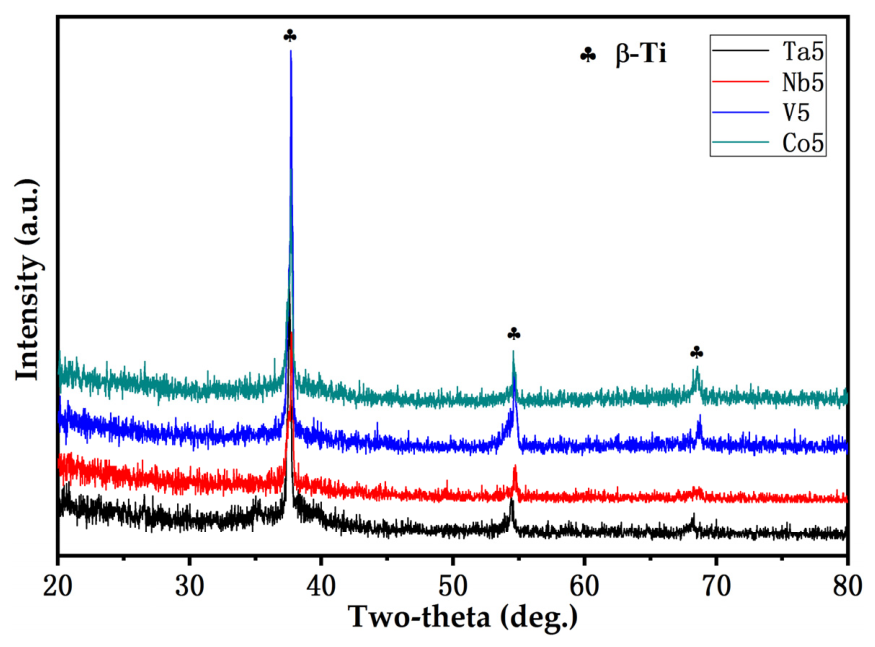
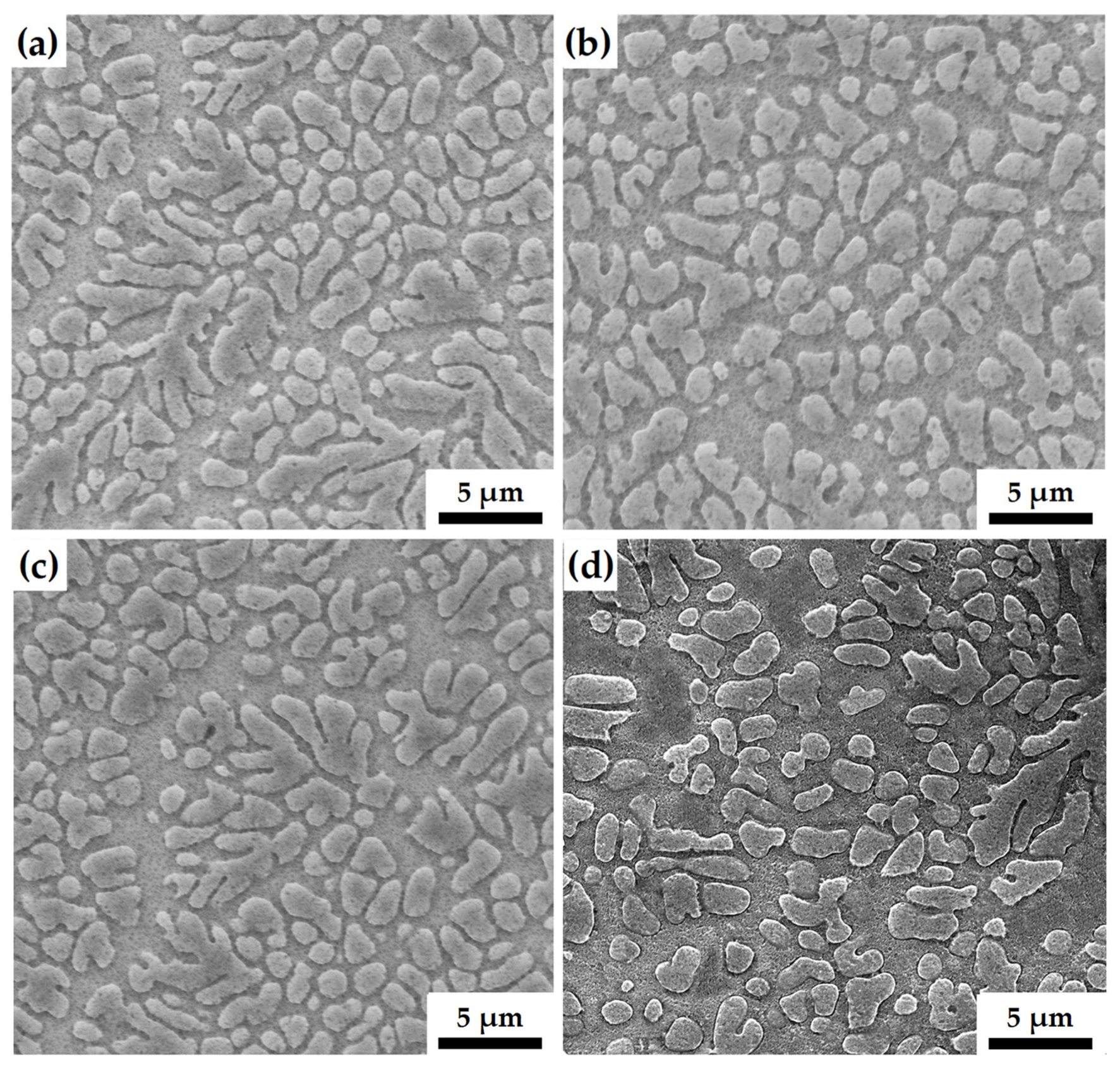
The phase compositions of the four as-cast cylindrical specimens were characterized by X-ray diffraction (XRD), and their corresponding XRD patterns are presented in Figure 3. It can be observed that the patterns consist of sharp Bragg diffraction peaks of crystalline phase and broad diffuse scattering peaks. According to Jade (6.0) software analysis, the distinct diffraction and diffuse scattering peaks correspond to the body-centered cubic (bcc) β-Ti crystals and amorphous matrix, respectively. The β-Ti crystalline phase precipitated in the amorphous matrix is consistent with previous findings for Ti-based amorphous composites [28]. Figure 4 presents the SEM micrographs of as-cast Ta5, Nb5, V5 and Co5 amorphous composites. Evidently, the β-Ti crystals are uniformly distributed throughout the amorphous matrix, demonstrating that these composites possess a dual-phase microstructure consisting of amorphous and crystalline phases. The volume fractions (Vf) of β-Ti crystals were analyzed using IPP6.0 software. The Vf values of Ta5, Nb5, V5 and Co5 specimens were 63.4%, 65.2%, 64.7% and 41.6%, respectively. Morphologically, the Ta5, Nb5 and V5 specimens exhibited similar crystalline volume fractions, while Vf of the Co5 specimen was low, and it revealed that Co inhibited crystallization and facilitated amorphous phase formation.

3.2. Composition Analysis

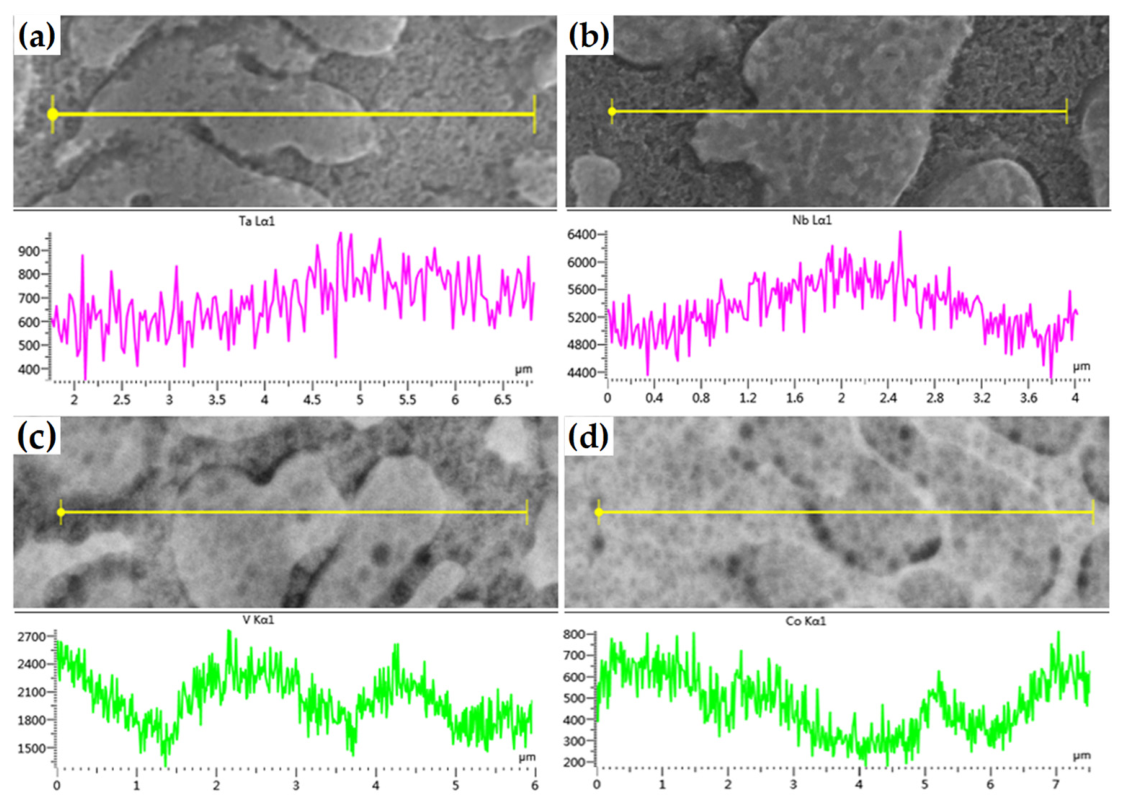
EDS line scanning was adopted to characterize the elemental concentrations, and the corresponding distribution profiles are shown in Figure 5. Figure 5a–d present the scanning results of Ta, Nb, V, and Co for the Ta5, Nb5, V5, and Co5 specimens, respectively. The contents of Nb and V in the crystalline phase are significantly higher than those in the amorphous phase, revealing that the two elements preferentially segregate within crystalline phases. There is nearly no difference in Ta content between the amorphous and crystalline phases. In contrast, the Co concentration is higher in the amorphous phase, where Co atoms preferentially accumulate within amorphous regions. This confirms that Nb and V act as crystal-forming promoting elements, whereas Co benefits amorphous phase formation. Compared with other alloying elements, Co exhibits a larger electronegativity difference, which effectively suppresses crystallization and stabilizes the amorphous structure. Consequently, the Co5 specimen delivers the lowest crystalline fraction among all composites.

3.3. Hardness and Elastic Modulus

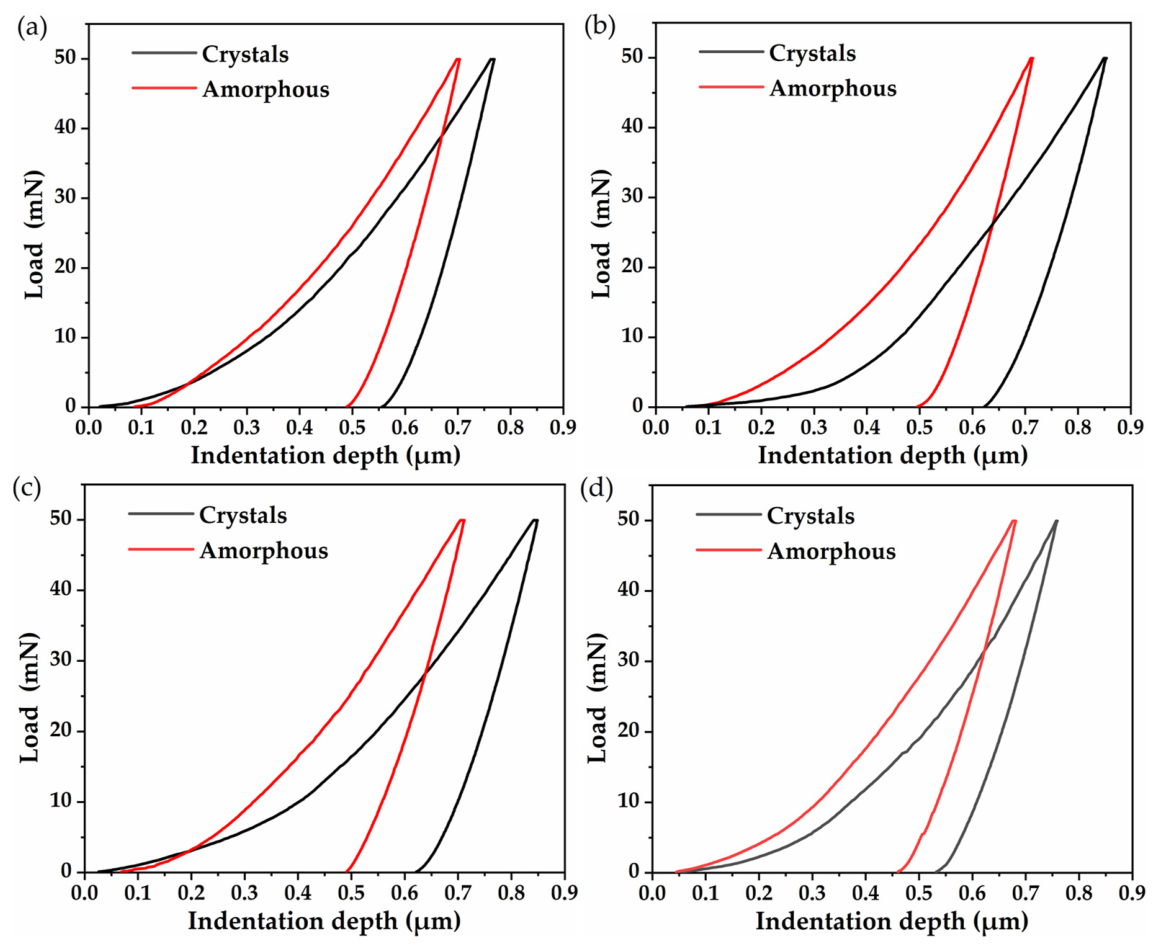
Nano-indentation was utilized to characterize the intrinsic properties of the crystalline and amorphous phases in the four groups of amorphous matrix composites, in accordance with ISO 6507-1:2023 [29]. Multiple specimens of each material group were measured to obtain the average values and standard deviations. The load–displacement curves obtained from nano-indentation tests are illustrated in Figure 6, where curves (a), (b), (c) and (d) correspond to the Ta5, Nb5, V5 and Co5 specimens, respectively. Based on the test results, the hardness and elastic modulus of the crystalline and amorphous phases were derived and summarized in Table 1. It is observed that, for all four groups of specimens, the amorphous phase exhibits higher hardness than the crystalline phase. Meanwhile, both the crystalline and amorphous phases of the Co5 composite achieve the maximum hardness values, reaching 451.8 HV0.005 and 566.9 HV0.005, respectively. The Nb5 specimen exhibits the minimum hardness for both phases, with values of 342.2 HV0.005 and 455.3 HV0.005, respectively. The amorphous hardness of the V5 and Ta5 specimens is comparable, while the crystalline hardness of V5 is higher than that of Ta5. In terms of the hardness of pure metals, the overall descending order follows: V > Co > Ta > Nb [30,31,32]. In the Co5 specimen, the high-hardness Co element is mainly distributed in the amorphous region, which increases the hardness of the amorphous phase. Since Nb and V are predominantly enriched in the crystalline phase, their influence on amorphous hardness is limited. Consequently, the amorphous hardness of the Nb5 and V5 specimens is similar. This explains why the amorphous hardness of Co5 exceeds that of Nb5 and V5. Ta exhibits no obvious distribution preference and is randomly distributed in both crystalline and amorphous regions. Nevertheless, Ta can improve amorphous hardness. Accordingly, the amorphous hardness of the Ta5 specimen is higher than that of Nb5 and V5, but lower than that of Co5.
In terms of the crystalline phase, its hardness is related to the crystal structure; alloying elements enhance the toughness of the β-Ti crystal. For instance, β-Ti crystals enriched in Nb, V, and Ta possess superior toughness and plasticity along with lower hardness. Therefore, the crystalline hardness of the Nb5, V5, and Ta5 specimens is lower than that of the Co5 specimen, since Co is predominantly distributed within the amorphous phase.
Furthermore, the elastic modulus of the crystalline and amorphous phases for the four groups of specimens was also obtained via nano-indentation testing, as presented in Table 1. The results indicate that, within each individual specimen, the elastic modulus of the amorphous phase is higher than that of the crystalline phase. The crystalline elastic modulus values of the four specimens are close to one another, and their amorphous elastic modulus values are also similar, showing no significant differences.

3.4. Mechanical Properties

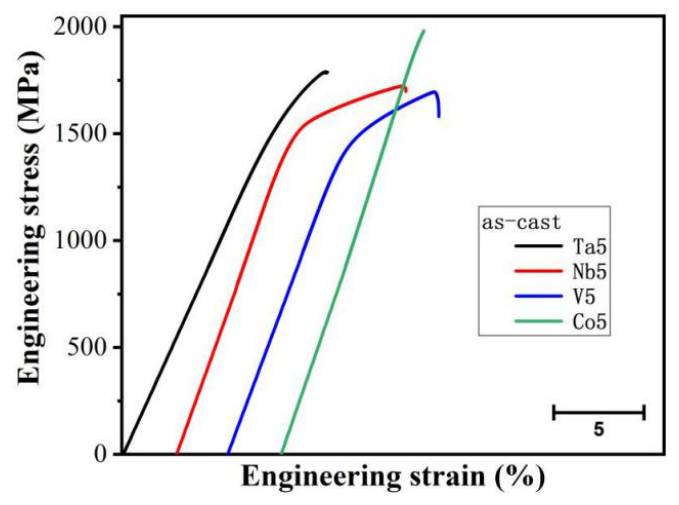
The mechanical properties of the four groups of amorphous composites were evaluated via quasi-static compression tests at a strain rate of 5 × 10⁻⁴ s−1. Several identical specimens of each amorphous composite were tested to acquire reliable average values and standard deviations. Their engineering stress–strain curves are presented in Figure 7. The yielding strength (σy), compressive strength (σc) and percent elongation (ε) of these amorphous composites with different metal element (V, Ta, Nb and Co) are summarized in Table 2. Thus, all the amorphous composites exhibit high fracture strength and excellent plasticity. Moreover, the distinct stress enhancement after yielding demonstrates obvious strain hardening behavior.
For the Ta5 specimen, its yield strength (σy), compressive strength (σc) and percent elongation (ε) are 1475.5 MPa, 1785.3 MPa and 1.5%, respectively. Upon substituting Ta with Nb, σy remains nearly unchanged, σc decreases by 62 MPa, while ε increases by 4.8%. Upon replacing V with Nb, σy exhibits no obvious variation, σc declines slightly, and ε decreases by 1.1%. When Nb is substituted by Co, σy and σc rise by 522.0 MPa and 280.8 MPa, respectively, whereas, ε drops markedly by approximately 5.0%. Among the four composite groups, the Co5 specimen delivers the highest strength and the lowest plasticity. This phenomenon originates from its low crystalline fraction of only 43.6%, where the microstructure is dominated by the amorphous phase. Accordingly, the mechanical properties are primarily governed by the amorphous phase. Given the high strength and intrinsic brittleness of the amorphous structure, the Co5 specimen achieves superior strength accompanied by limited plastic deformation capacity.
The Nb5 and V5 specimens exhibit comparable strength and plasticity. First, their crystalline and amorphous phase fractions are highly similar. Second, both Nb and V can effectively improve the toughness and plasticity of the β-Ti crystalline phase. Therefore, the β-Ti crystals enriched in Nb and V deliver favorable ductility, endowing the Nb5 and V5 specimens with good overall plasticity. Compression test results confirm that element substitution serves as an effective strategy to tailor their mechanical properties.

3.5. Side Surface Morphology

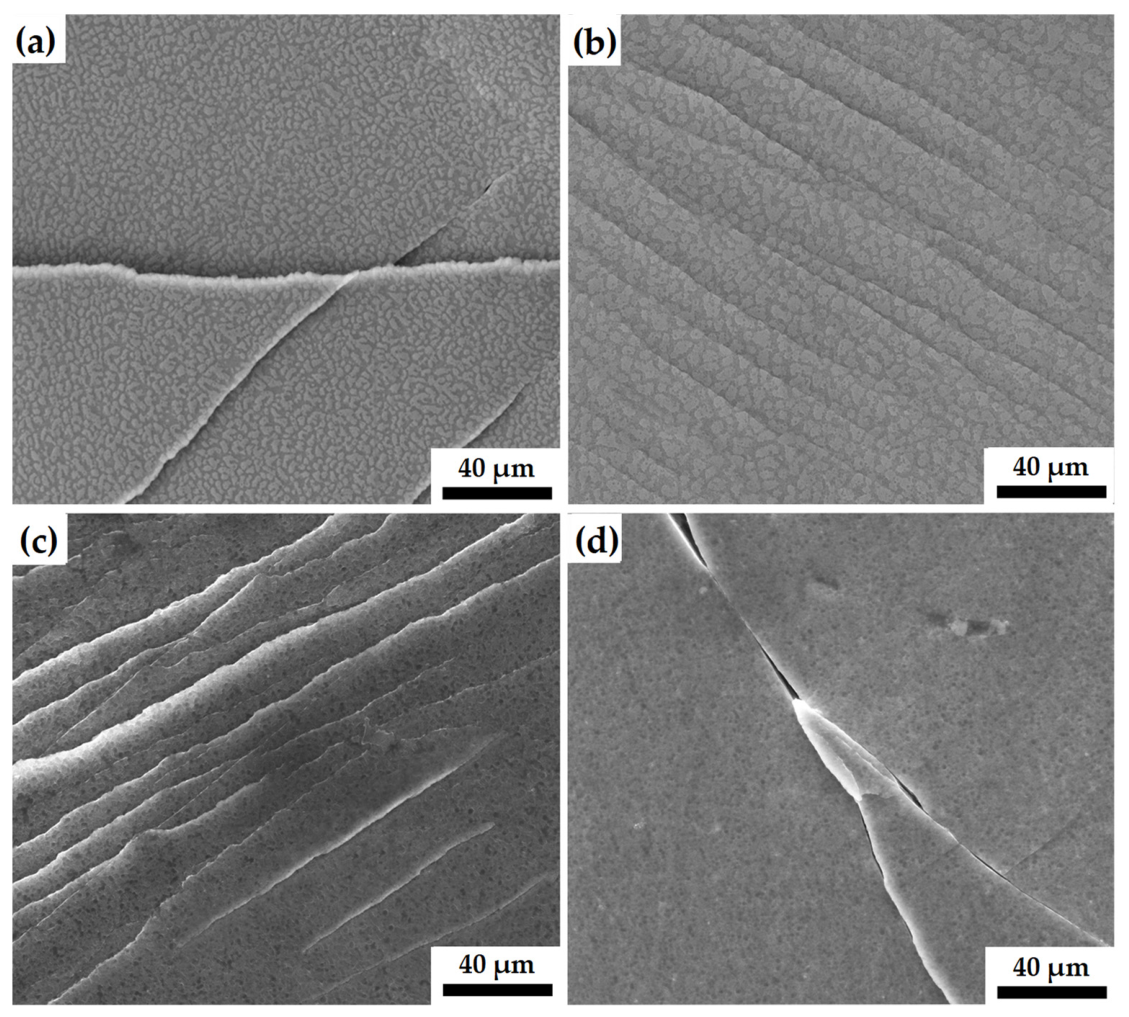
Under external loading, the formation and evolution of shear bands on the side surface of compressed fractured specimens dominate the plastic deformation mechanism of amorphous matrix composites [33,34]. In general, the surface morphological characteristics of fractured samples can directly reflect the plastic deformation capacity of such alloys [35,36]. To further clarify the deformation behavior of the amorphous composites, the morphologies of the side surfaces of the compressive fracture specimens were characterized via SEM, as shown in Figure 8. For the Ta5 amorphous composites, a few shear bands can be found on the side surface, showing parallel and intersecting characteristics (Figure 8a). Parallel shear bands are also detected in the Nb5 specimen (Figure 8b). Compared with Ta5, the Nb5 amorphous composites presents a larger quantity of shear bands with narrower spacing and a denser distribution. Similarly, the V5 specimen (Figure 8c) exhibits wider shear band spacing and fewer shear bands relative to Nb5, resulting in a slightly reduced plastic capacity. Therefore, its plasticity is slightly lower than that of the Nb5 specimen. By contrast, no shear bands are observed on the side surface of the Co5 specimen, as shown in Figure 8d. Instead, intersecting cracks penetrating the specimen are clearly visible. This reveals that crack initiation precedes plastic deformation in the Co5 specimen. Under continuous loading, unrestricted crack propagation eventually induces brittle fracture under compression. Accordingly, the Co5 specimen displays nearly no plastic strain.
It can be seen from Section 3.1 that the four groups of specimens have the same phase composition but distinct crystalline contents. Plasticity differences mainly depend on crystalline content and the number of formed shear bands; as a result, the Nb5 and V5 specimens exhibit comparable plasticity. Ta5 shows poor plasticity with few shear bands, while Co5 is amorphous-dominated with nearly no shear bands, resulting in extremely low plasticity.

3.6. Fracture Surface Morphology

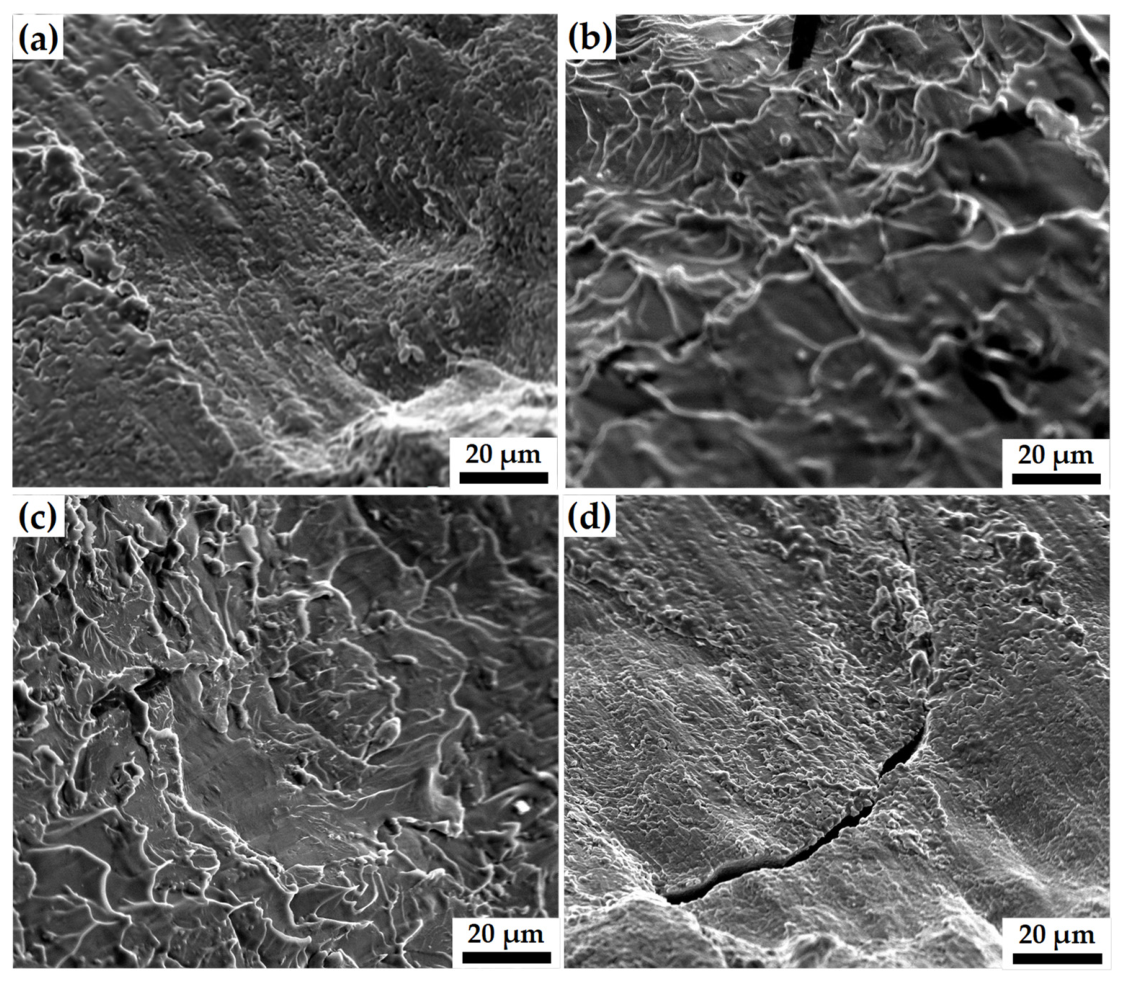
Fracture morphology is widely analyzed to distinguish between brittle and ductile fracture behaviors of materials [37,38]. Ductile fracture surfaces are primarily characterized by typical vein-like patterns, whereas brittle fracture generally exhibits river-like patterns and smooth flat regions on the fracture surfaces [39,40]. The cross-sectional fracture morphologies of compression-fractured specimens were examined by SEM, and the results are shown in Figure 9. The fracture surface of the Ta5 amorphous composites is dominated by river-like patterns and smooth regions, implying a brittle fracture mode with low plasticity, as shown in Figure 9a. In comparison, the Nb5 specimen (Figure 9b) displays abundant vein-like patterns on its fracture surface, confirming obvious plastic deformation before final failure. Similarly, the V5 specimen (Figure 9c) also contains abundant vein-like patterns, which further verify its favorable plasticity. Nevertheless, a small number of smooth regions remain visible on its fracture surface, revealing slightly inferior plasticity relative to the Nb5 composite. For the Co5 specimen (Figure 9d), distinct cracks are clearly observed alongside river-like patterns and smooth zones. This evidence indicates that catastrophic brittle fracture occurred due to rapid, unconstrained crack propagation. The above morphological observations are in good agreement with the results presented in Section 3.5.

4. Discussion

It can be concluded that elemental substitution in Ti-based amorphous composites exerts a remarkable influence on their strength, plasticity and hardness, as the hardness of the amorphous matrix ranged from 455.3 HV0.005 to 566.9 HV0.005, and the yield strength ranged monotonically from 1420.9 MPa to 1942.9 MPa. This is attributed to the preferential partitioning of certain metallic elements into the crystalline phase, while others tend to segregate within the amorphous matrix. For amorphous composites with a crystalline volume fraction exceeding 50%, the yield strength can be evaluated according to Equation (2) [41].
σ y = σ d 1 + 0.5 V a
where Va (Va = 1 − Vf) represents the volume fraction of the amorphous matrix, and σy and σd denote the yield strengths of the composite and the dendritic phase, respectively. This indicates that the yield strength of the composite is primarily governed by σd and Va. The crystalline volume fractions of the Ta5, Nb5 and V5 specimens all exceed 50%. According to the equation, their yield strengths should be solely dependent on the yield strength of the crystalline phase. Nevertheless, this theoretical inference contradicts the experimental results.
In view of the insignificant changes in the hardness and volume fraction of the crystals, metallic element substitution exerts limited effects on crystalline yield strength. Similarly, such substitution barely alters the volume fraction of the amorphous matrix in amorphous composites. Accordingly, based on Equation (2), the yield strength of the composite is expected to change slightly. Nevertheless, the yield strength increases by 36.7% via the substitution of V with Co. This result indicates that the yield strength relies not only on the crystalline phase, but also exhibits a strong correlation with the strength of the amorphous matrix.
Since the metallic elements are predominantly distributed with the amorphous matrix, their substitution primarily modulates the hardness of the amorphous matrix. The experimental results demonstrate that the yield strength of amorphous composites is not only closely associated with the yield strength of the crystalline phase but also significantly dependent on that of the amorphous matrix.
It was found that the stress transfer efficiency across the crystal–amorphous matrix interface is related to the stress concentration at the interface. Stress concentration exerts a significant influence on mechanical properties of materials. The average stress concentration factor Cd is generally used to characterize the degree of stress concentration. A higher Cd value can be obtained by matching the elastic modulus between the crystals and the amorphous matrix. It facilitates efficient stress transfer from crystals to the amorphous matrix, thereby promoting homogeneous deformation [42]. According to previous studies [43,44], Cd can be expressed as:
C d = 1 V f + 1 V f η + E a E c 1 V f 1 η
η = 8 10 ν 15 1 ν
where Vf is the volume fraction of the crystalline phase, η is a material constant, v is the Poisson’s ratio of the amorphous composites, and Ec and Ea are the Young’s modulus of the crystalline phase and the amorphous matrix, respectively.
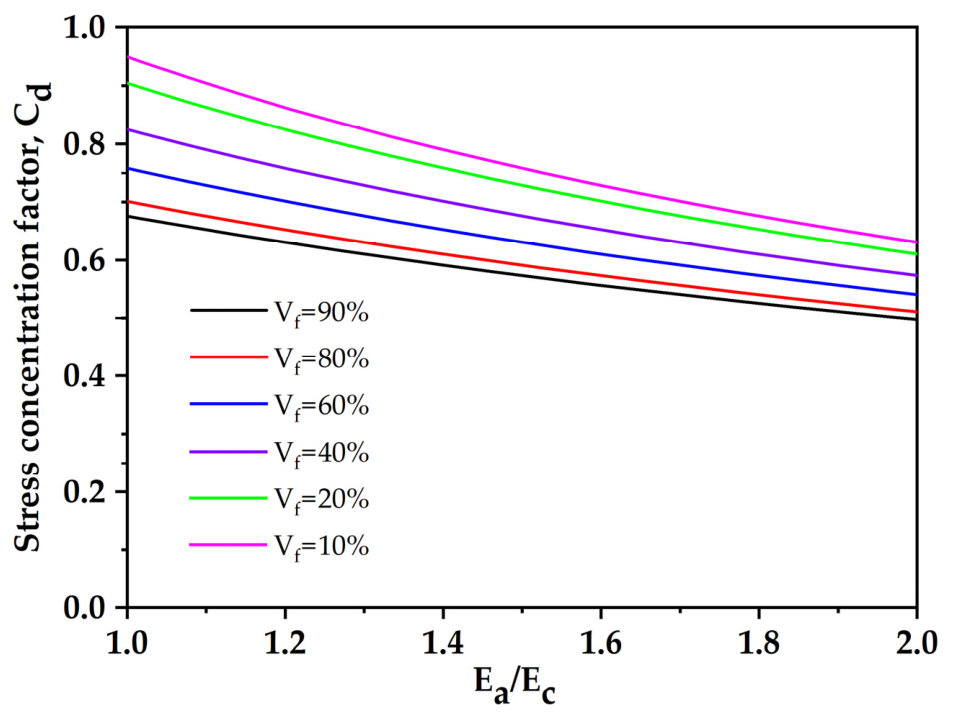
According to Equation (3), the average stress concentration coefficient Cd is jointly determined by the Poisson’s ratio ν of the composite, the crystalline volume fraction Vf, and the elastic modulus ratio of the crystalline phase to the amorphous matrix (Ea/Ec). First, in the present Ti-based amorphous composites, Vf is approximately 56%, and ν ranges from 0.30 to 0.38 (typical values for such alloys). The variation of Cd with Ea/Ec is illustrated in Figure 8. It can be observed that, on the one hand, Cd decreases gradually with increasing Ea/Ec. On the other hand, ν exerts no significant influence on Cd, indicating that Cd is insensitive to the Poisson’s ratio of the composite. Furthermore, with the Poisson’s ratio of the Ti-based amorphous composite fixed at ν = 0.33, the relationships between Cd and Ea/Ec under different Vf values (0.1, 0.2, 0.4, 0.6, 0.8 and 0.9) are plotted in Figure 10. The results reveal that Cd declines as Ea/Ec increases, and Vf exerts a remarkable effect on the evolution of Ea/Ec. Specifically, the average stress concentration coefficient is sensitive to the crystalline volume fraction. In summary, the average stress concentration coefficient is highly correlated with the modulus ratio of the amorphous matrix to the crystalline phase and the volume fraction of the dendritic phase.
In the amorphous composites investigated in this study, Ta5, Nb5 and V5 specimens exhibit similar volume fractions of the β-Ti crystalline phase, ranging from 63% to 66%. Therefore, the crystalline volume fraction is not the dominant factor contributing to the mechanical property differences among the four specimens. It follows that Cd is primarily determined by Ea/Ec. With ν = 0.33 fixed, the elastic modulus of the crystalline and amorphous phases of the four specimens were substituted into Equation (3). The results reveal that both the percent elongation ε and the average stress concentration coefficient Cd decrease gradually with an increase in Ea/Ec. This indicates that a higher average stress concentration coefficient can more effectively transfer stress from the crystalline phase to the amorphous matrix, thereby promoting the evolution of shear bands, including multiplication, bending, branching, propagation and proliferation, and consequently improving the plastic deformation capability of amorphous composites [45,46].
In addition, when Ec = Ea, Cd reaches its maximum value of 1, which corresponds to optimal plastic deformation capacity. In other words, a higher Cd is associated with superior plasticity. Previous studies have indicated that the average stress concentration coefficient is an effective parameter for revealing the correlation between the elastic modulus and plasticity [47]. The plasticity of amorphous composites is highly correlated with the average stress concentration coefficient Cd. Therefore, increasing the crystalline volume fraction and the elastic modulus of the amorphous matrix, while reducing the elastic modulus of the crystalline phase, can serve as an important guideline for the compositional design of such amorphous composites.

5. Conclusions

(1) The Co-containing specimen has the highest yield strength of 1942.9 MPa, compressive strength of 1977 MPa and maximum hardness with nearly zero plasticity. This is mainly attributed to the preferential segregation of Co within the amorphous phase, which promotes amorphous formation.
(2) When the crystalline volume fraction exceeds 50%, the yield strength of the amorphous composites is dominated by the strength of the amorphous matrix, while their plasticity is strongly related to the average stress concentration coefficient of the crystalline phase.
(3) The plasticity of the amorphous composites is boosted by a higher average stress concentration coefficient, and the strength exhibits a significant correlation with the hardness and content of the amorphous phase.

6. Outlook

In future work, combined addition of two or three selected elements (Co, Nb, Ta and V) will be introduced into amorphous composites to explore their synergistic influences on microstructures and mechanical performances. It is essential to clarify whether composite properties change monotonically with transition metal content, or if threshold effects dominate the phase formation behavior. Moreover, supplementary tensile data can optimize mechanical evaluation and support practical engineering application. Meanwhile, thermal stability tests should be conducted, and DSC measurement can quantitatively clarify the promoting effect of Co on the glass-forming ability of the prepared alloys.

Author Contributions

Conceptualization, X.H., H.Y. and Y.O.; Methodology, X.H. and Y.O.; Software, X.H., B.C., J.Z. and B.L.; Validation, B.C., C.W. and B.L.; Formal analysis, C.W. and J.Z.; Investigation, X.H., B.C., C.W., J.Z. and B.L.; Resources, B.L. and Y.O.; Data curation, B.C., C.W. and J.Z.; Writing—original draft, X.H.; Writing—review and editing, X.H.; Project administration, B.L. and Y.O.; Funding acquisition, X.H., B.L. and Y.O. All authors have read and agreed to the published version of the manuscript.

Funding

Science Research Excellent Youth Project of Hunan Educational Department (Grant No. 24B0709, 25B0727), Key Program of Hunan Provincial Natural Science Foundation (Grant No. 2026JJ30136), and Huaihua University Double First Class initiative Applied Characteristic Discipline of Control Science and Engineering (Grant No. ZNKZD2023-1), Social Science Foundation of Hunan Province (Grant No. 23ZDB033).

Institutional Review Board Statement

Not applicable.

Informed Consent Statement

Not applicable.

Data Availability Statement

The original contributions presented in this study are included in the article. Further inquiries can be directed to the corresponding authors.

Conflicts of Interest

The authors declare no financial or commercial conflicts of interest.

References

  1. Jiang, H.Y.; Shang, T.T.; Xian, H.J.; Sun, B.A.; Zhang, Q.H.; Yu, Q.; Bai, H.Y.; Gu, L.; Wang, W.H. Structures and functional properties of amorphous alloys. Small Struct. 2021, 2, 2000057. [Google Scholar] [CrossRef]
  2. Feng, Z.Y.; Geng, H.S.; Zhuang, Y.Z.; Li, P.W. Progress, applications, and challenges of amorphous alloys: A critical review. Inorganics 2024, 12, 232. [Google Scholar] [CrossRef]
  3. Kou, H.G.; Lu, J.; Li, Y. High-strength and high-ductility nanostructured and amorphous metallic materials. Adv. Mater. 2014, 26, 5518–5524. [Google Scholar] [CrossRef] [PubMed]
  4. Wu, G.; Liu, S.D.; Wang, Q.; Rao, J.; Xia, W.Z.; Yan, Y.Q.; Eckert, J.; Liu, C.; Ma, E.; Shan, Z.W. Substantially enhanced homogeneous plastic flow in hierarchically nanodomained amorphous alloys. Nat. Commun. 2023, 14, 3670. [Google Scholar] [CrossRef]
  5. Liu, Y.F.; Lu, D.L.; Wu, G.Q.; Zhang, Z.M.; Huang, H.G.; Li, L.L.; Feng, Y.; Yu, J.M. Deformation mechanism and hardening behavior of gradient heterostructured magnesium alloys prepared by severe shear deformation. J. Alloys Compd. 2024, 985, 174099. [Google Scholar] [CrossRef]
  6. Li, J.H.; Yang, Q.S.; Wei, Y.L.; Huang, N.; Tao, R. A synergistic design of composite metamaterial with drastically tailorable thermal expansion and Poisson’s ratio. Compos. Struct. 2021, 275, 114446. [Google Scholar] [CrossRef]
  7. Chen, B.; Zhou, X.Y.; Zhang, B.; Kondoh, K.; Li, J.S.; Qian, M. Microstructure, tensile properties and deformation behaviors of aluminium metal matrix composites co-reinforced by ex-situ carbon nanotubes and in-situ alumina nanoparticles. Mater. Sci. Eng. A 2020, 795, 139930. [Google Scholar] [CrossRef]
  8. Suryanarayana, C. In situ mechanical crystallization of amorphous alloys. J. Alloys Compd. 2023, 961, 171032. [Google Scholar] [CrossRef]
  9. Lan, H.; Wang, J.W.; Cheng, L.W.; Yu, D.D.; Wang, H.; Guo, L. The synthesis and application of crystalline-amorphous hybrid materials. Chem. Soc. Rev. 2024, 53, 684–713. [Google Scholar] [CrossRef]
  10. Guo, Q.Y.; Gu, Y.C.; Barr, C.M.; Koenig, T.; Hattar, K.; Li, L.; Thompson, G.B. In situ indentation and high cycle tapping deformation responses in a nanolaminate crystalline/amorphous metal composite. Mater. Sci. Eng. A 2020, 798, 140074. [Google Scholar] [CrossRef]
  11. Yan, Y.F.; Qiu, Y.L.; Zhang, X.; Wang, B.; Li, R.; Wu, H.R.; Wei, Z.; Tong, W.Y.; Zhang, G.S.; Zhu, Z.Y.; et al. Tailoring the strength-conductivity combination in Cu matrix composites via in-situ TiB2 synthesis. J. Mater. Res. Technol. 2025, 38, 62–74. [Google Scholar] [CrossRef]
  12. Cao, S.; Liang, J.; Zhou, J.; Wang, L. Microstructure evolution and wear resistance of in-situ nanoparticles reinforcing Fe-based amorphous composite coatings. Surf. Interfaces 2020, 21, 100652. [Google Scholar] [CrossRef]
  13. Yang, W.B.; Zhan, L.; Liu, L.; Meng, F.X.; Zhang, R.; Tuerxun, K.; Zhao, X.R.; Dong, B.X.; Shu, S.L.; Jiang, Q.C. The Microstructure Regulation Mechanism and Future Application of Aluminum Alloys Manipulated by Nanocrystalline Structures Formed by In Situ Amorphous Crystallization. Materials 2025, 18, 4206. [Google Scholar] [CrossRef]
  14. Zhao, H.W.; Li, F.S.; Wang, S.X.; Guo, L. Wet chemical synthesis of amorphous nanomaterials with well-defined morphologies. Acc. Mater. Res. 2021, 2, 804–815. [Google Scholar] [CrossRef]
  15. Jia, B.B.; Liu, G.; Zhang, B.H.; Zheng, J.L.; Yin, K.X.; Lin, J.; Han, C.Q.; Fan, X.Y.; Xu, M.Y.; Ye, L.Q. General modification strategy on amorphous materials to boost catalytic performance. Adv. Func. Mater. 2024, 34, 2405867. [Google Scholar] [CrossRef]
  16. Liu, L.H.; Yang, C.; Kang, L.M.; Long, Y.; Xiao, Z.Y.; Li, P.J.; Zhang, L.C. Equiaxed Ti-based composites with high strength and large plasticity prepared by sintering and crystallizing amorphous powder. Mater. Sci. Eng. A 2016, 650, 171–182. [Google Scholar] [CrossRef]
  17. Pascu, C.I.; Gheorghe, Ş.; Rotaru, A.; Nicolicescu, C.; Cioateră, N.; Roșca, A.S.; Rotaru, P. Ti-based composite materials with enhanced thermal and mechanical properties. Ceram. Int. 2020, 46, 29358–29372. [Google Scholar] [CrossRef]
  18. Zhang, Y.; Zhang, W.G.; Lin, J.P.; Hao, G.J.; Chen, G.L.; Liaw, P.K. Glass-forming ability and competitive crystalline phases for lightweight TieBe-Based alloys. Metall. Mater. Trans. A 2010, 41, 1670–1676. [Google Scholar] [CrossRef]
  19. Niessen, F.; Pereloma, E. A review of in situ observations of deformation-induced β↔α ″martensite transformations in metastable β Ti alloys. Adv. Eng. Mater. 2022, 24, 2200281. [Google Scholar] [CrossRef]
  20. Jeon, C.; Kim, C.P.; Joo, S.H.; Kim, H.S.; Lee, S. High tensile ductility of Ti-based amorphous matrix composites modified from conventional Ti-6Al-4V titanium alloy. Acta Mater. 2013, 61, 3012–3026. [Google Scholar] [CrossRef]
  21. Turchanin, M.A.; Abdulov, A.R.; Agraval, P.G.; Dreval, L.A. Enthalpy of mixing of liquid Cu-Ni-Ti alloys at 1873 K. Russ. Metall. 2006, 2006, 500–504. [Google Scholar]
  22. Turchanin, M.A.; Agraval, P.G.; Vodopyanova, G.O.; Korsun, V.A. Thermodynamic properties of the glass-forming ternary (Fe, Co, Ni, Cu)–Ti–Zr liquid alloys I. mixing enthalpies of liquid alloys. Powder Metall. Met. Ceram. 2024, 62, 621–631. [Google Scholar] [CrossRef]
  23. Dreval, L.A.; Agraval, P.G.; Turchanin, M.A. Calorimetric investigation of the mixing enthalpy of liquid Co–Cu–Ti alloys at 1873 K. Phys. Chem. Liq. 2018, 56, 674–684. [Google Scholar] [CrossRef]
  24. Zhai, H.M.; Xu, Y.H.; Zhang, F.; Ren, Y.; Wang, H.F.; Feng, L. Effect of transition metal elements (Cu, Ni, Co and Fe) on the mechanical properties of Ti-based bulk metallic glass composites. J. Alloys Compd. 2017, 694, 1–9. [Google Scholar] [CrossRef]
  25. Huang, X.H.; Wang, G.; Chen, B.; Wei, C.H.; Zhao, J.T.; Wu, L.G.; Ouyang, Y.J. Analysis of the regulatory effect of semi-solid isothermal treatment time on crystallization and plasticity of amorphous composites. Metals 2025, 15, 1363. [Google Scholar] [CrossRef]
  26. Wang, J.Q.; Song, L.J.; Huo, J.T.; Gao, M.; Zhang, Y. Designing advanced amorphous/nanocrystalline alloys by controlling the energy state. Adv. Mater. 2024, 36, 2311406. [Google Scholar] [CrossRef]
  27. Hofmann, D.C.; Suh, J.Y.; Wiest, A.; Lind, M.L.; Demetriou, M.D.; Johnson, W.L. Development of tough, low-density titanium based bulk metallic glass matrix composites with tensile ductility. Proc. Natl. Acad. Sci. USA 2008, 105, 20136. [Google Scholar] [CrossRef]
  28. Liu, D.M.; Li, Y.F.; Deng, H.X.; Liu, Y.; Zhang, W.T.; Li, L.; Ge, X.J.; Zheng, H.Y.; Liu, W.F.; Zhu, Z.W.; et al. A strategy for designing Ti-based in-situ bulk metallic glass composites with tailored structural metastability using conventional titanium alloys. J. Mater. Res. Technol. 2024, 32, 3727–3736. [Google Scholar] [CrossRef]
  29. ISO 6507-1:2023; Metallic Materials—Vickers Hardness Test—Part 1: Test Method. ISO: Geneva, Switzerland, 2023.
  30. Edalati, K.; Horita, Z. Correlations between hardness and atomic bond parameters of pure metals and semi-metals after processing by high-pressure torsion. Scr. Mater. 2011, 64, 161–164. [Google Scholar] [CrossRef]
  31. Liang, J.C.; Li, X.W.; Wu, J.C.; Wei, Z.X.; Wang, X.L. First-principles study on structural stability, electronic structure and mechanical properties of VB group transition metal tungsten alloys W-TM (TM = V, Nb, Ta). Mater. Today Commun. 2024, 38, 107920. [Google Scholar] [CrossRef]
  32. Daoush, W.M.; Park, H.S.; Lee, K.H.; Moustafa, S.F.; Hong, S.H. Effect of binder compositions on microstructure, hardness and magnetic properties of (Ta, Nb) C–Co and (Ta, Nb) C–Ni cemented carbides. Int. J. Refract. Met. Hard Mater. 2009, 27, 669–675. [Google Scholar] [CrossRef]
  33. Ma, Y.; Gong, P.; Yang, X.; Hu, H.; Chi, J.; Xu, X.; Wang, X. Microstructure and mechanical properties of Zr-based metallic glass composites with size-variable tungsten reinforcements. J. Alloys Compd. 2025, 1010, 177721. [Google Scholar] [CrossRef]
  34. Tian, L.; Narayan, R.L.; Zhou, K.; Babicheva, R.; Ramamurty, U.; Shan, Z.W. A real-time TEM study of the deformation mechanisms in β-Ti reinforced bulk metallic glass composites. Mater. Sci. Eng. A 2021, 818, 141427. [Google Scholar] [CrossRef]
  35. Lund, E.T.; Sohn, S.A.; Curtarolo, S.; Hofmann, D.; Schroers, J. Tension-compression asymmetry of shear band stability in bulk metallic glasses. Materialia 2025, 40, 102408. [Google Scholar] [CrossRef]
  36. Huang, X.H.; Pu, J.W.; Luo, Y.X.; Ouyang, Y.J. Microstructure evolution of Ti48Zr27Cu6Nb5Be14 amorphous alloy after semi-solid isothermal treatment. China Foundry 2024, 21, 287–294. [Google Scholar] [CrossRef]
  37. Wu, W.P.; Peng, Z.; Şopu, D.; Eckert, J. Molecular dynamics study of fracture and plastic deformation of Cu/Cu64Zr36 crystalline/amorphous composites with a pre-existing void. J. Non-Cryst. Solids 2022, 586, 121556. [Google Scholar] [CrossRef]
  38. Li, Y.L.; Wu, W.P.; Şopu, D.; Eckert, J. Effects of void shape and location on the fracture and plastic deformation of Cu (crystalline)/Cu64Zr36 (amorphous) composites. J. Mater. Res. Technol. 2023, 24, 4177–4189. [Google Scholar] [CrossRef]
  39. Zhou, D.; Hou, B.; Lin, Y.; Li, B.; Liu, T.; Qiao, H.; Li, Y. The roles of loading rate and temperature during shear-band-to-crack transition (SCT) in bulk metallic glasses: A study of quasi-static and dynamic shearing performances at ambient and cryogenic temperatures. Intermetallics 2024, 175, 108467. [Google Scholar] [CrossRef]
  40. Ge, Y.Q.; Yin, Y.; Chang, Z.X.; Xu, H.J.; Bi, W.H. Microstructure and mechanical properties of Nb-reinforced bulk metallic glass composites prepared by laser powder bed fusion. Strength Mater. 2025, 57, 168–177. [Google Scholar] [CrossRef]
  41. Pauly, S.; Liu, G.; Wang, G.; Kühn, U.; Mattern, N.; Eckert, J. Microstructural het-erogeneities governing the deformation of Cu47.5Zr47.5Al5 bulk metallic glass composites. Acta Mater. 2009, 57, 5445–5453. [Google Scholar] [CrossRef]
  42. Hays, C.C.; Kim, C.P.; Johnson, W.L. Microstructure controlled shear band pattern formation and enhanced plasticity of bulk metallic glasses containing in situ formed ductile phase dendrite dispersions. Phys. Rev. Lett. 2000, 84, 2901–2904. [Google Scholar] [CrossRef]
  43. Xia, S.H.; Wang, J.T. A micromechanical model of toughening behavior in the dual phase composite. Int. J. Plast. 2010, 26, 1442. [Google Scholar] [CrossRef]
  44. Sun, X.H.; Wang, Y.S.; Fan, J.; Yang, H.J.; Ma, S.G.; Wang, Z.H.; Qiao, J.W. Plasticity improvement for dendrite/metallic glass matrix composites by pre-deformation. Mater. Des. 2015, 86, 266–271. [Google Scholar] [CrossRef]
  45. Chi, J.; Hu, H.; Lin, Y.; Ma, Y.; Du, Y. Effect of tungsten-particle size on the room temperature compressive deformation behaviour of Zr55Cu30Al10Ni5 amorphous alloy. J. Alloys Compd. 2024, 1008, 176730. [Google Scholar] [CrossRef]
  46. Liu, C.; Kong, F.; Wang, H.; Zhu, S.; Liu, G.; Inoue, A. High mechanical strength and good plasticity of ZrAlNiCu bulk glassy alloys containing icosahedral or bcc β-Zr plus hexagonal ω-Zr phases prepared by annealing. Mater. Sci. Eng. A 2025, 931, 148217. [Google Scholar] [CrossRef]
  47. Park, J.M.; Lim, K.R.; Park, E.S.; Hong, S.; Park, K.H.; Eckert, J.; Kim, D.H. Internal structural evolution and enhanced tensile plasticity of Ti-based bulk metallic glass and composite via cold rolling. J. Alloys Compd. 2014, 615, S113–S117. [Google Scholar] [CrossRef]
Figure 1. Photographs of four groups of as-cast amorphous composite specimens.
Coatings 16 00552 g001
Figure 2. Schematic diagram of the fracture surface and side surface of a compressed test fracture specimen.
Coatings 16 00552 g002
Figure 3. XRD patterns of the as-cast Ti48Zr27Cu6Be14TM5 (TM = V, Ta, Co and Nb) amorphous composites.
Coatings 16 00552 g003
Figure 4. The SEM microstructural observation of as-cast Ti48Zr27Cu6Be14TM5 amorphous composites: (a) Ta5, (b) Nb5, (c) V5, (d) Co5.
Coatings 16 00552 g004
Figure 5. EDS mapping of the as-cast Ti48Zr27Cu6Be14TM5 amorphous composites: (a) Ta5, (b) Nb5, (c) V5, (d) Co5.
Coatings 16 00552 g005
Figure 6. Load–displacement curves of nano-indentation tests for four groups of specimens: (a) Ta5, (b) Nb5, (c) V5, (d) Co5.
Coatings 16 00552 g006
Figure 7. Compressive engineering stress–strain curve of the as-cast Ti48Zr27Cu6Be14TM5 (TM = Ta, Nb, V and Co) amorphous composites.
Coatings 16 00552 g007
Figure 8. SEM observation of side surface morphologies of four groups of fractured specimens: (a) Nb5, (b) Ta5, (c) V5, (d) Co5.
Coatings 16 00552 g008
Figure 9. SEM observations of fracture morphologies of four groups of compression-fractured specimens: (a) Nb5, (b) Ta5, (c) V5, (d) Co5.
Coatings 16 00552 g009
Figure 10. Evolution law of the average stress concentration factor (Cd) with the elastic modulus ratio of the amorphous phase to the crystalline phase (Ea/Ec) when the crystalline volume fraction ranges from 0.1 to 0.9.
Coatings 16 00552 g010
Table 1. The hardness and elastic modulus parameters of crystalline and amorphous phases for four groups of specimens.
Specimen CodeHardness/HV0.005Young’s Modulus/GPa
AmorphousCrystalsAmorphousCrystals
Ta5493.5 ± 4.2361.2 ± 4.0111.7 ± 5.084.8 ± 4.4
Nb5455.3 ± 4.2342.2 ± 4.0108.6 ± 5.083.7 ± 4.4
V5479.5 ± 4.2370.6 ± 4.0109.1 ± 5.083.9 ± 4.4
Co5566.9 ± 4.2451.8 ± 4.0112.3 ± 5.085.4 ± 4.4
Table 2. Yield strength, compressive strength, plasticity of four groups of specimens.
Specimen Codeσy/MPaσc/MPaε/%
Ta51475.5 ± 5.21785.3 ± 5.01.5 ± 0.1
Nb51470.1 ± 5.21723.3 ± 5.06.3 ± 0.1
V51420.9 ± 5.21696.2 ± 5.05.2 ± 0.1
Co51942.9 ± 5.21977.0 ± 5.00.2 ± 0.1
Disclaimer/Publisher’s Note: The statements, opinions and data contained in all publications are solely those of the individual author(s) and contributor(s) and not of MDPI and/or the editor(s). MDPI and/or the editor(s) disclaim responsibility for any injury to people or property resulting from any ideas, methods, instructions or products referred to in the content.