Article

Lotus (Nelumbo nucifera Gaertn.) Leaf Extract as a Green Corrosion Inhibitor for Copper in Sulfuric Acid Media


1
School of Chemistry and Chemical Engineering, Zhoukou Normal University, Zhoukou 466001, China
2
School of Civil and Hydraulic Engineering, Chongqing University of Science and Technology, Chongqing 401331, China
3
School of Chemistry and Chemical Engineering, Chongqing University, Chongqing 400044, China
4
School of Mechanical and Intelligent Manufacturing, Chongqing University of Science and Technology, Chongqing 401331, China
*
Author to whom correspondence should be addressed.
Coatings 2026, 16(4), 501; https://doi.org/10.3390/coatings16040501
Submission received: 25 March 2026 / Revised: 13 April 2026 / Accepted: 17 April 2026 / Published: 20 April 2026

Highlights

  • Lotus leaf extract-based green corrosion inhibitor was developed for copper.
  • The inhibitor effectively suppressed both cathodic and anodic corrosion processes.
  • The inhibitor adsorption followed the Langmuir adsorption isotherm.

Abstract

The objective of this study is to develop and assess the feasibility of utilizing lotus (Nelumbo nucifera Gaertn.) leaf extract as a green corrosion inhibitor for copper in a sulfuric acid environment. The inhibitory efficacy was comprehensively evaluated using a multi-technique approach, incorporating electrochemical measurements, weight loss analysis, theoretical analysis, and surface morphological characterization. The experimental results demonstrate that the lotus leaf extract functions as an efficient corrosion inhibitor for copper, achieving an inhibition efficiency of 88.07% at 700 mg/L by effectively suppressing both cathodic and anodic corrosion processes. Scanning electron microscopy (SEM) and atomic force microscopy (AFM) confirmed the protective effect, whereas X-ray photoelectron spectroscopy (XPS) and Fourier-transform infrared spectroscopy (FTIR) identified functional groups and surface interaction between metal and inhibitor. Theoretical calculations further confirmed the involvement of nitrogen (N) and oxygen (O) as the key active sites. Adsorption behavior adheres to the Langmuir isotherm model, involving both physical and chemical adsorption processes that inhibit the Cu+→Cu2+ oxidation reaction. This study demonstrates acid-resistant protection of copper using lotus leaf extract.

1. Introduction

Superior electrical performance, thermal conductivity, and resistance to corrosion of copper make it a valuable strategic non-ferrous metal in the electronics, defense, and civil infrastructure industries [1,2,3]. In air and neutral environments, copper rapidly forms a thin, adherent Cu2O/CuO oxide layer that acts as a protective film and significantly reduces the corrosion rate over time; however, this protective behavior is lost in acidic media, where copper corrosion is markedly accelerated [2,4]. The pickling process is extensively employed in various industrial applications to eliminate corrosion products and to reinstate the surface functionality of materials, ensuring their optimal performance and extended service life. Among them, sulfuric acid has emerged as the preferred medium for copper pickling due to its low volatility, absence of halogen ions, and ease of waste liquid treatment. However, the pickling process inherently produces extra dissolving of the matrix copper, thus an efficient corrosion inhibitor must be added to the pickling solution to reduce material loss. Although traditional corrosion inhibitors such as benzotriazole and mercaptobenzothiazole have high efficiency, they have problems such as high biological toxicity and difficult degradation, making it difficult to meet the requirements of green manufacturing in the “dual carbon” background.
Recent studies have increasingly focused on the use of natural plant-based compounds as innovative copper anti-corrosion agents [5,6,7]. Recent studies have demonstrated the effectiveness of plant extracts as eco-friendly corrosion inhibitors in acidic media. Song et al. [8] found that lotus leaf extract greatly inhibited carbon steel rusting in a modeled cement pore solution. A higher concentration of lotus leaf extract promotes the production of passive film in a chloride-alkaline system. Abeng et al. [9] studied Millettia aboensis leaves extract, which significantly reduced mild steel corrosion by forming a protective adsorbed layer. Obike et al. [10] reported that the methanolic extract of Corynocarpus laevigatus achieved ~88%–89% inhibition for mild steel in H2SO4 and HCl, following Langmuir adsorption behavior. Emereole et al. studied corn leaf extract (CLE) for aluminum corrosion in acidic media [10]. The experimentally obtained inhibition efficiency (85.61%) was in close agreement with the value predicted by the theoretical RSM technique (84.89%). Jha et al. [11] studied the effectiveness of lotus leaf chloroform extract layers for copper corrosion in 0.5 M NaCl using the floating film transfer method. Extract from Fleurya aestuans was tested as a corrosion inhibitor for mild steel in 2 M HCl and 1 M H2SO4 solution [12]. The extracts showed maximum inhibition efficiency of 78.57% in the HCl system and 73.33% in the H2SO4 system. Adel et al. [13] studied the extract from rice straw, an agricultural residue, demonstrated high corrosion inhibition efficiency (~91% at low concentration) for copper in 0.5 M H2SO4, with SEM confirming protective film formation and adsorption behavior consistent with effective surface coverage. Zhu et el., studied [14] cactus mucilage as an inhibitor for copper in 0.5 M sulfuric acid, showing inhibition efficiency up to ~94.5% and a strong adsorption equilibrium following Langmuir behavior. In another study, papaya leaf extract [15] achieved ~93% inhibition in 0.5 M H2SO4, indicating that plant extracts can strongly adsorb and form dense protective layers on copper surfaces under acidic conditions. These green bio-based corrosion inhibitors are obtained from plants, making them inexpensive, non-toxic, and biocompatible. Plant-derived extracts (rich in flavonoids, alkaloids, etc.) contain O, N, S heteroatoms and conjugated π-electrons. These functional groups facilitate robust chemical adsorption onto metallic surfaces, forming compact protective films that effectively shield the substrate from corrosive media, thereby demonstrating significant corrosion inhibition efficacy [16,17,18,19,20,21,22,23]. While many plant extracts have been tested, lotus leaf extract has not been studied as a corrosion inhibitor for copper in sulfuric acid.
Lotus (Nelumbo nucifera Gaertn.) is a perennial aquatic plant that has a broad distribution and has medicinal and culinary uses. The extract contains active components such as nuciferine and quercetin-3-O-β-D-glucopyranoside, as well as polar functional groups in abundance. It can readily coordinate with and adsorb onto the metal surface, forming a compact protective layer.
In this work, lotus leaf extract is introduced as an eco-friendly and effective corrosion inhibitor for copper in acidic media. Unlike conventional synthetic inhibitors, the extract contains naturally occurring bioactive compounds that interact strongly with the copper surface. Firstly, the lotus leaf extract was prepared via a hot water extraction method. Its anti-corrosion performance in protecting copper against sulfuric acid corrosion was systematically evaluated. The corrosion inhibition efficiency was evaluated via weight loss, EIS, and potentiodynamic polarization. Surface morphology and film chemistry were analyzed using SEM, AFM, and XPS analysis. FTIR analysis characterized the extract functional groups. Quantum chemical calculations and MD simulations elucidated adsorption configurations, energies, and electron transfer mechanisms on Cu (111). This study provides new insights into the adsorption mechanism and surface coverage behavior of lotus leaf constituents at the copper/acid interface. The results demonstrate enhanced inhibition efficiency and improved interfacial stability, thereby advancing the understanding of green inhibitor–metal interactions and offering a sustainable strategy for corrosion protection in acidic environments.

2. Materials and Methods

2.1. Preparation of Materials and Samples

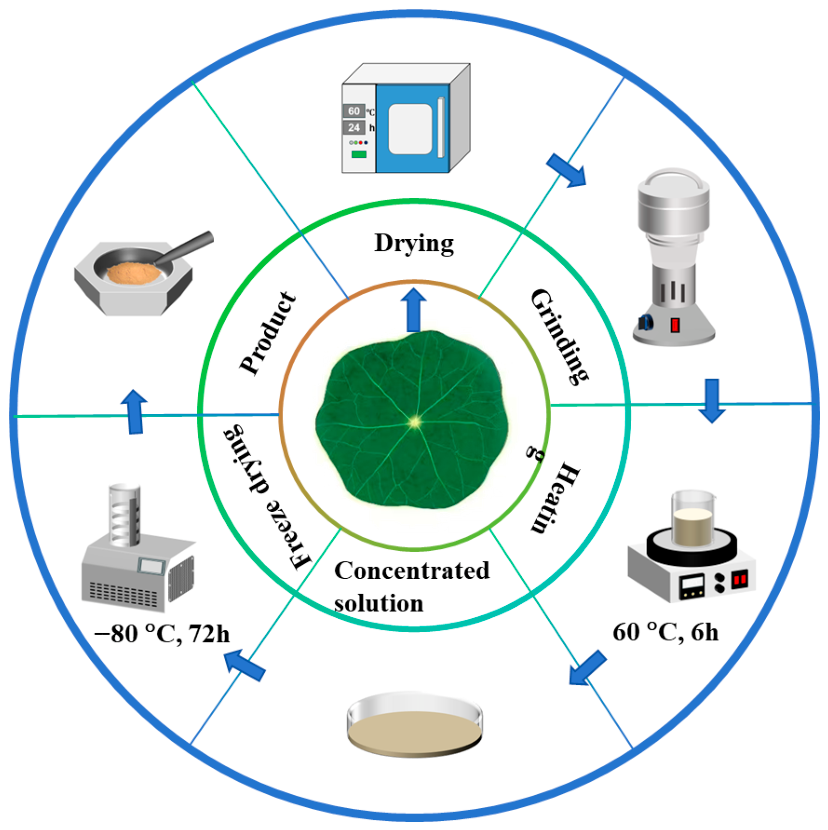
The leaves of Nelumbo nucifera Gaertn. (lotus) were harvested from Longhu Lake in Huaiyang. Fresh lotus leaves were thoroughly rinsed with deionized water and subsequently dried at 333 K for 24 h. The dried leaves were mechanically powdered using a high-speed grinder to obtain a homogeneous powder. Then, 50 g of the lotus leaf powder was homogeneously dispersed in 500 mL of deionized water, followed by heating at 333 K for 6 h. The resulting mixture was filtered, and the filtrate was concentrated under reduced pressure to a final volume of 30 mL. The concentrated solution was then subjected to vacuum freeze-drying at 193 K for 72 h, yielding a brownish-yellow solid powder, which was stored in a desiccator until further use. A schematic representation of the extraction process is shown in Figure 1. The composition of extract was analyzed by FTIR (Nicolet 5700, Thermo Fisher Scientific, Madison, WI, USA).
Copper specimens (purity ≥ 99.9%, Huiji Metal Materials Co., Ltd., Xingtai, China) were used in this study. The specimens were polished with 220–8000 grit papers, cleaned with deionized water and ethanol, then dried with cold air. A 0.5 M sulfuric acid solution was prepared by diluting analytical-grade concentrated sulfuric acid (98%, Sinopharm Chemical Reagent Co., Ltd., Shanghai, China) with deionized water, and test solutions with varying lotus leaf extract concentrations were prepared.

2.2. Surface Characterizations of Copper Specimens

The copper samples were cut into small pieces of 1.0 cm × 1.0 cm × 0.1 cm and immersed in different sulfuric acid solutions for 24 h. The corrosion inhibition performance of lotus leaf extract on the surface of copper sheet was characterized by SEM (Quanta 200, FEI Company, Hillsboro, OR, USA), AFM (MFP-3D-BIO, Asylum Research, Santa Barbara, CA, USA), and XPS (Escalab 250 Xi, Thermo Fisher Scientific, Waltham, MA, USA) analysis.

2.3. Weight Loss Experiment

The 0.8 cm × 2.0 cm × 3.0 cm copper specimen was polished to achieve a mirror-like finish, followed by ultrasonic cleaning with deionized water and anhydrous ethanol. The subsequent drying process was conducted using a cold air blast system. Specimens were immersed in 0~700 mg/L lotus leaf extract in 0.5 M H2SO4 at 298 to 313 K for 24 h. After removal from the solution, the copper samples underwent repeated rinsing with deionized water and ethanol, followed by drying prior to reweighing. The corrosion rate (υ) is the mass loss per unit time and surface area due to corrosion. The corrosion inhibition efficiency (ηL) is quantitatively evaluated using Equation (1):
η L = υ 0 υ i υ 0   ×   100 %
where υ0 and υi represent the corrosion rate of copper measured in the uninhibited (blank) and inhibited system [24].

2.4. Electrochemical Test

Electrochemical measurements were performed on a CHI660 workstation (Shanghai Chenhua Instrument Co., Ltd., Shanghai, China) using a copper working electrode, platinum counter electrode, and saturated calomel reference electrode (Hg|Hg2Cl2(s)|KCl (Saturation)). After OCP stabilization, EIS (10 mV AC, 100 kHz–0.01 Hz) and Tafel polarization (Eocp ± 250 mV, 1.00 mV/s) were conducted sequentially. Impedance data were analyzed with ZSimpWin using an optimized equivalent circuit. All electrochemical experiments were conducted in triplicate, and the corresponding standard deviations are reported in the respective tables.

2.5. Theoretical Calculations

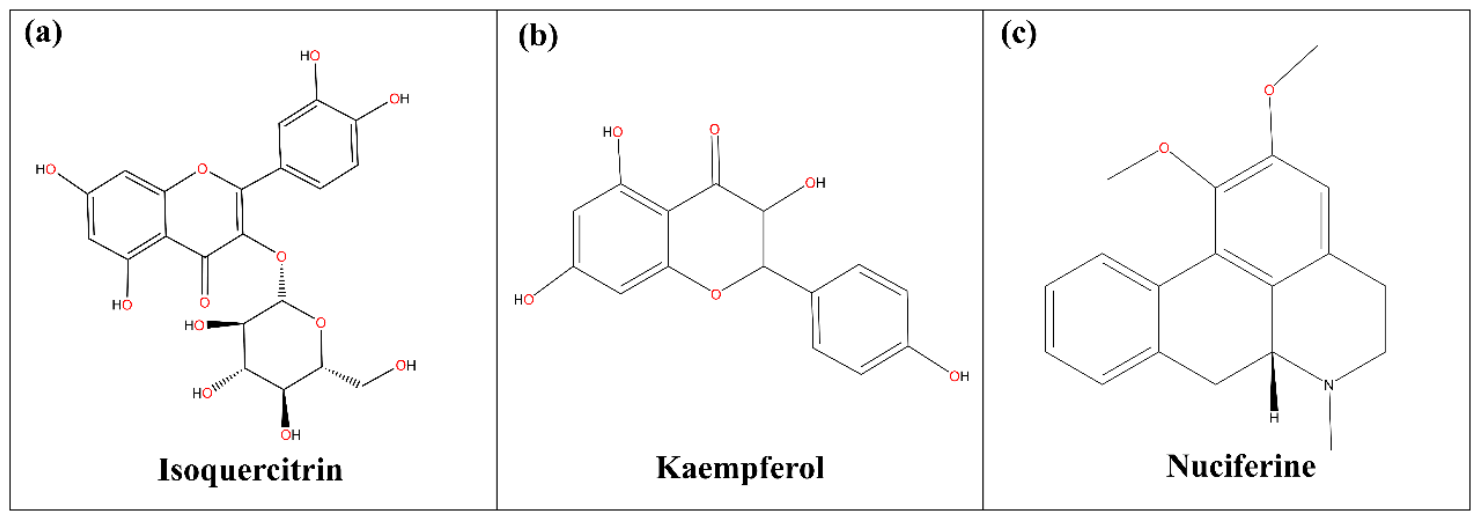
The electronic cloud distribution of the main components of the lotus leaf extract was quantified by Materials Studio software. References [25,26] pointed out that the core active components of lotus leaf extract are isoquercetin, kaempferol, and nuciferine (Figure 2). The initial configuration was built in Materials Studio 2023. After molecular dynamics pre-optimization, the geometric optimization was completed at the GGA-PBE/DNP level to obtain the front-line orbital electron cloud distribution, and key parameters such as EHUMO, ELUMO, and dipole moment μ were extracted. The energy gap (ΔE) was further calculated by Equation (2) to evaluate the adsorption strength of isoquercetin, kaempferol, and nuciferine molecules on copper [27,28]:
Δ E = E L U M O E H O M O
The molecular dynamics simulation uses the Amorphous Cell module to construct the three-dimensional periodic structure of the solvent molecular model. The solution contains two SO42−, four H3O+, and 300 H2O molecules. The copper crystal model and the solution layer model are superimposed from bottom to top to form the interface system model. The most stable crystal plane (111) in the Cu unit cell is selected as the adsorption surface to construct a three-dimensional supercell of 2.55 nm × 2.55 nm × 1.24 nm. The adsorption behavior of a selected inhibitor molecule at the Cu (111) interface was investigated through molecular dynamics simulations employing a canonical ensemble (NVT) approach. The simulation parameters were configured as follows: a time step of 1 femtosecond (fs), a total simulation duration of 200 picoseconds (ps), the COMPASS III force field, and a controlled temperature of 298 Kelvin (K) [4,24,29,30,31].

3. Results and Discussion

3.1. FTIR

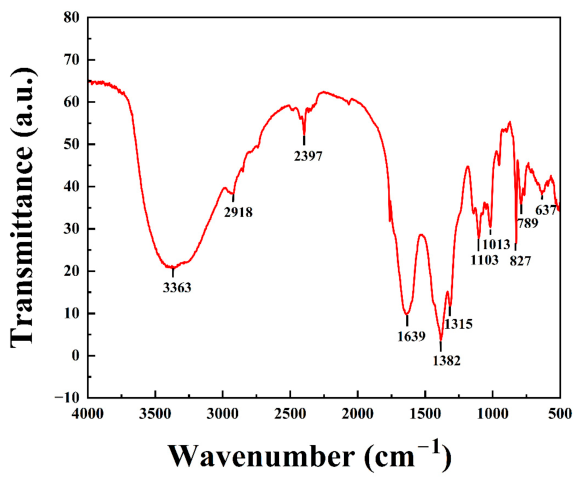
The FTIR spectrum of the lotus leaf extract is presented in Figure 3. The broad absorption band at 3363 cm−1 is attributed to the overlapping O–H and N–H stretching vibrations, while the C–H stretching vibration is observed at 2918 cm−1. The absorption peak at 2397 cm−1 is attributed to the stretching vibration of the C=C bond within the benzene ring structure [20]. The absorption peak at 1639 cm−1 is assigned to the combined stretching vibrations of C=C and C=N double bonds. The 1382 cm−1 band is assigned to C–H bending, and the 1315 cm−1 absorption to C–O or C–N stretching. The 1103 cm−1 peak likely corresponds to C–O–C stretching, and the 1013 cm−1 band to C–N stretching [16]. Weak peaks <1000 cm−1 relate to aromatic C–H bending. The absorption at 637 cm−1, located in the fingerprint region, is generally not assignable to a single functional group as it results from the complex vibrational modes of the entire molecular framework. These characteristic FTIR peaks collectively indicate the material’s potential anti-corrosion properties [18,24].

3.2. Weight Loss Analysis

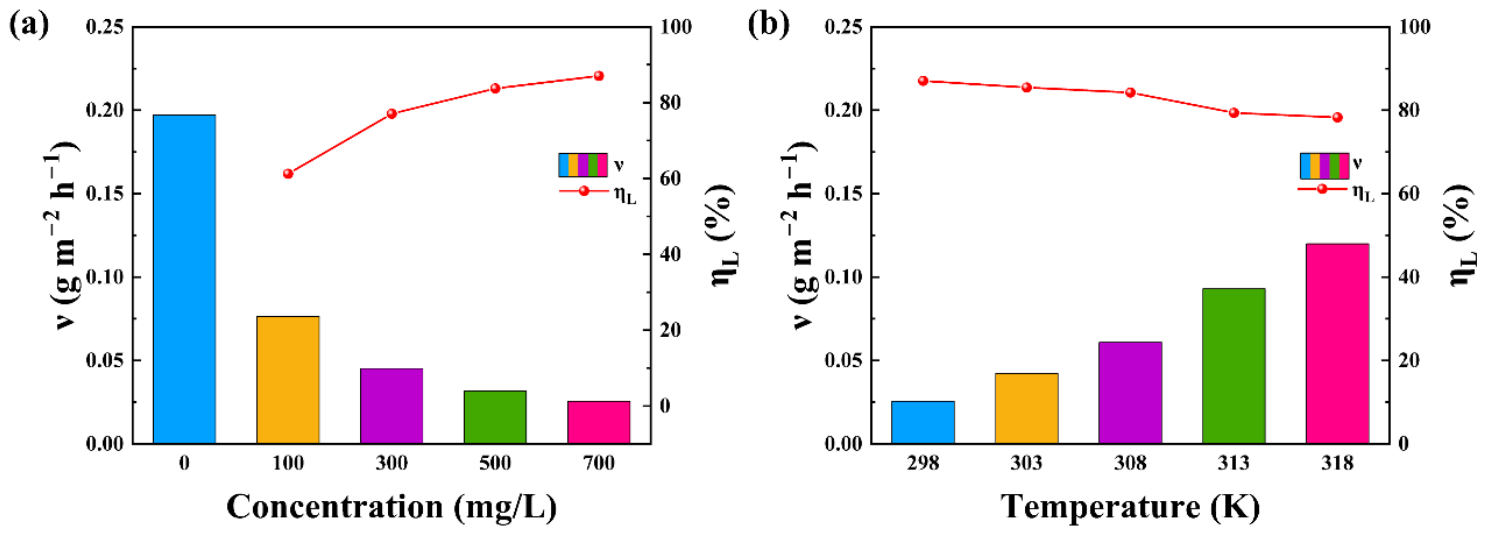
Figure 4 displays the υ and ηL values of copper in sulfuric acid with varying lotus leaf extract concentrations after 24 h. With increasing lotus leaf extract concentration, the υ value of copper continued to decrease, whereas the ηL value increased. Table 1 shows that at 298 K, the ηL of 700 mg/L lotus leaf extract reached 87.06%. Conversely, upon increasing the temperature to 318 K, the ηL of the same concentration (700 mg/L) lotus leaf extract diminished to 78.28%. These results show that both the concentration and temperature of lotus leaf extract significantly affect its corrosion inhibition of copper in sulfuric acid.

3.3. Electrochemical Impedance Studies

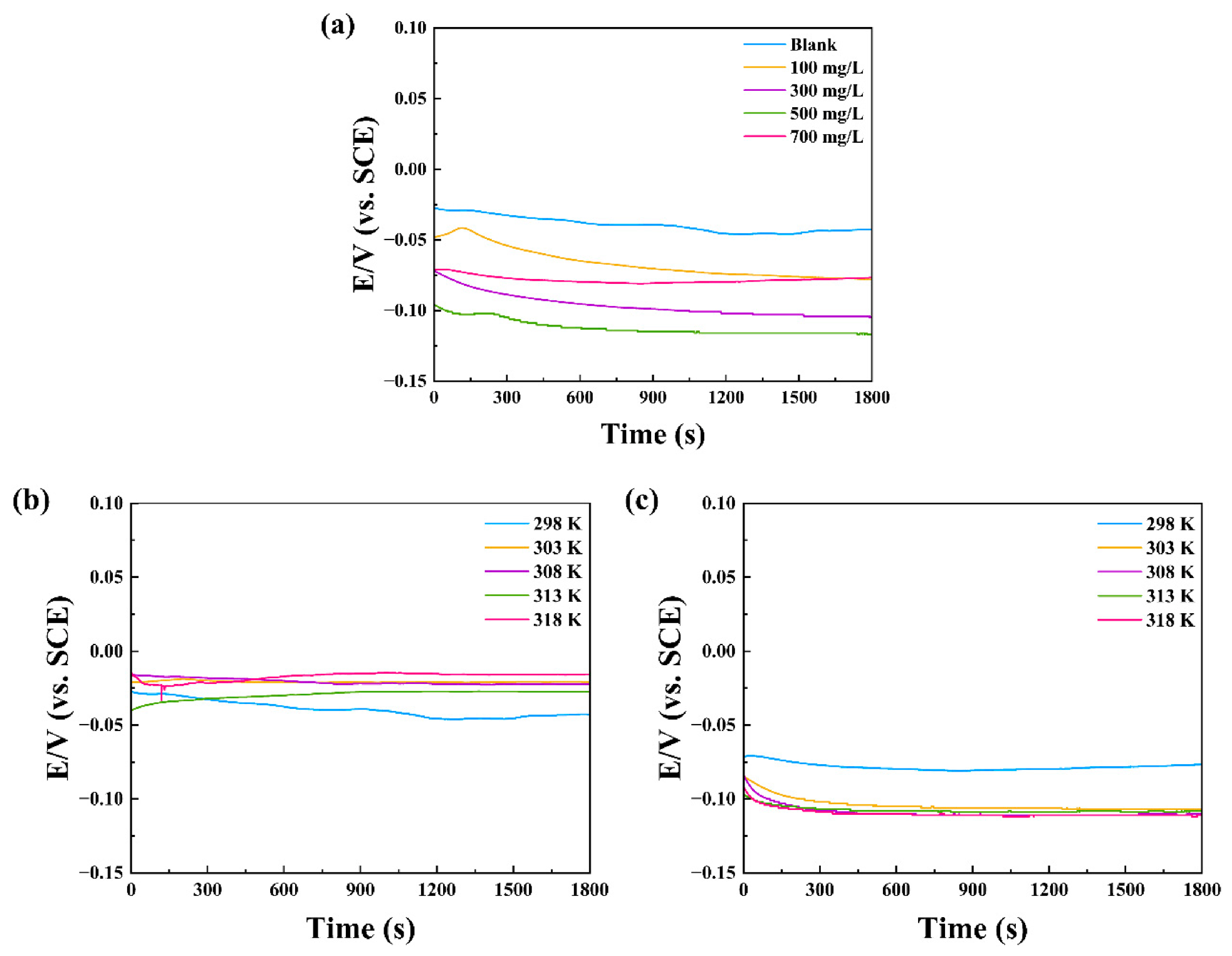
Figure 5 shows the OCP curves of the copper electrode in sulfuric acid solution: (a) varied concentrations of lotus leaf extract at 298 K, (b) blank at 298 to 318 K, and (c) 700 mg/L lotus leaf extract at 298 to 318 K. As shown in Figure 5, when the copper electrodes were immersed in sulfuric acid solution for 1800 s, the OCP curve tends to be steady, indicating that the copper surface is in a stable state.
Furthermore, the incorporation of lotus leaf extract induced a notable cathodic shift in the OCP curve, which can be attributed to the adsorption of corrosion inhibitors onto the copper surface. This adsorption effect led to a substantial reduction in the cathodic reduction of dissolved oxygen. It can be seen from Figure 5a,c that the effect of temperature on OCP is relatively small compared with the concentration of additives.
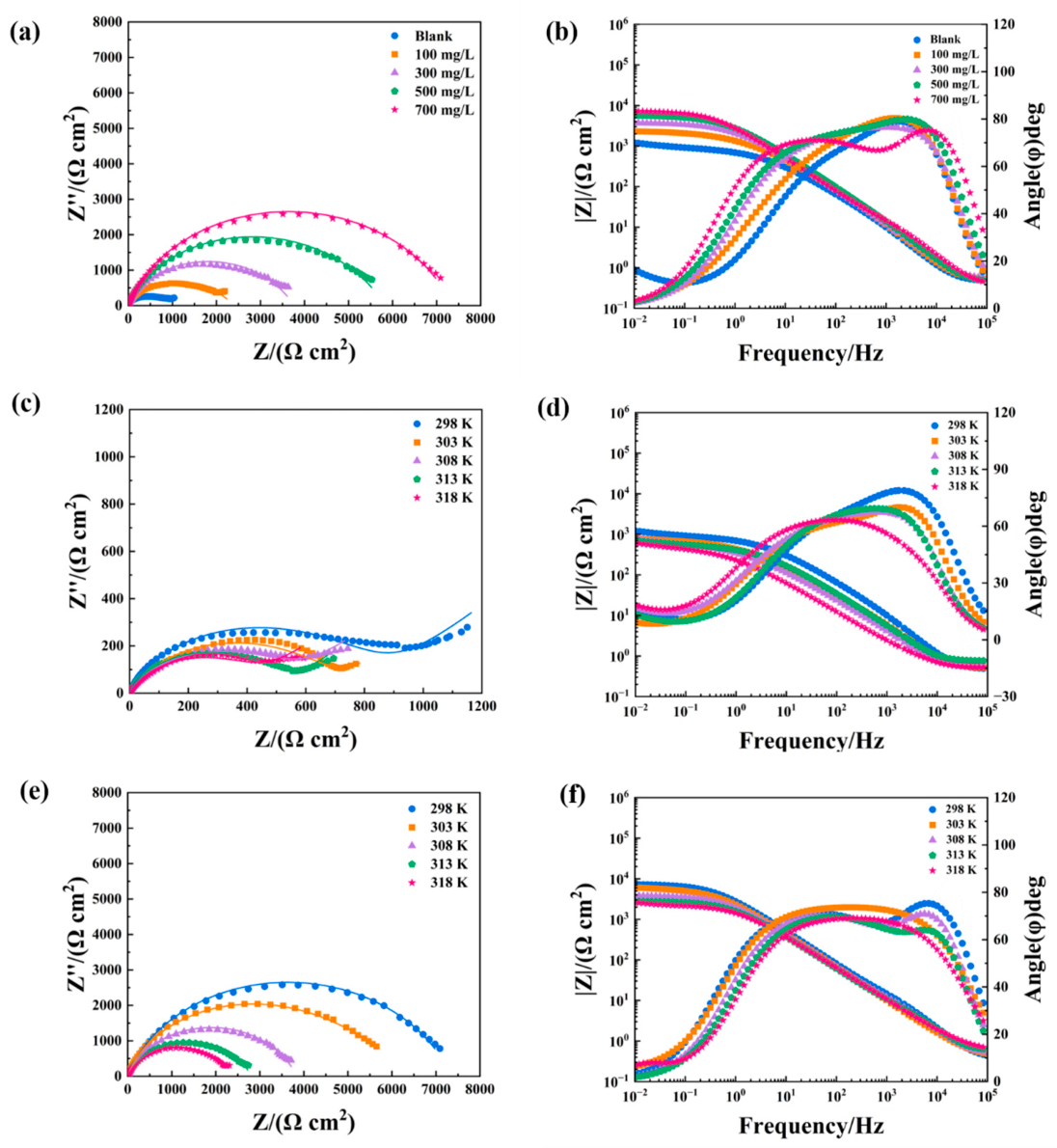
Figure 6 presents the Nyquist and Bode plots of a copper electrode immersed in sulfuric acid solution. As illustrated in Figure 6a, at 298 K, the capacitive arc radius demonstrates a significant increase with increasing concentrations of lotus leaf extract, which is accompanied by a corresponding enhancement in the charge transfer resistance at the copper/solution interface. Concurrently, the Warburg impedance component becomes negligible. These results confirm that the lotus leaf extract forms a dense barrier on the copper surface, effectively inhibiting anodic dissolution of copper [32]. As shown in Figure 6c,e, the capacitive arc radius decreased as temperature increased in both the blank and lotus leaf extract-containing systems, indicating a decrease in charge transfer resistance. The blank solution exhibits Warburg impedance in the low frequency domain due to corrosion product diffusion into the solution. At 318 K, the extract-containing system exhibits Warburg features, which are due to elevated temperatures amplifying inhibitor thermal motion, promoting partial desorption and subsequent rediffusion of products. The Bode plot (Figure 6b) shows that the |Z| value significantly increases with extract addition and rises further with increasing concentration, reflecting a denser adsorption film and greater charge transfer resistance. Concentration increases lead to a bimodal phase angle curve. The high-frequency peak is attributed to the double-layer capacitance, while the low-frequency peak originates from the extraction-adsorption film capacitance, thereby providing conclusive evidence of enhanced corrosion inhibition performance. Figure 6d further indicates that without inhibitor addition, |Z| and phase angle continuously decrease with increasing temperature, indicating accelerated corrosion. This trend persists after extract addition, demonstrating that elevated temperatures compromise protective film integrity and limit corrosion inhibition performance under high-temperature conditions [33].
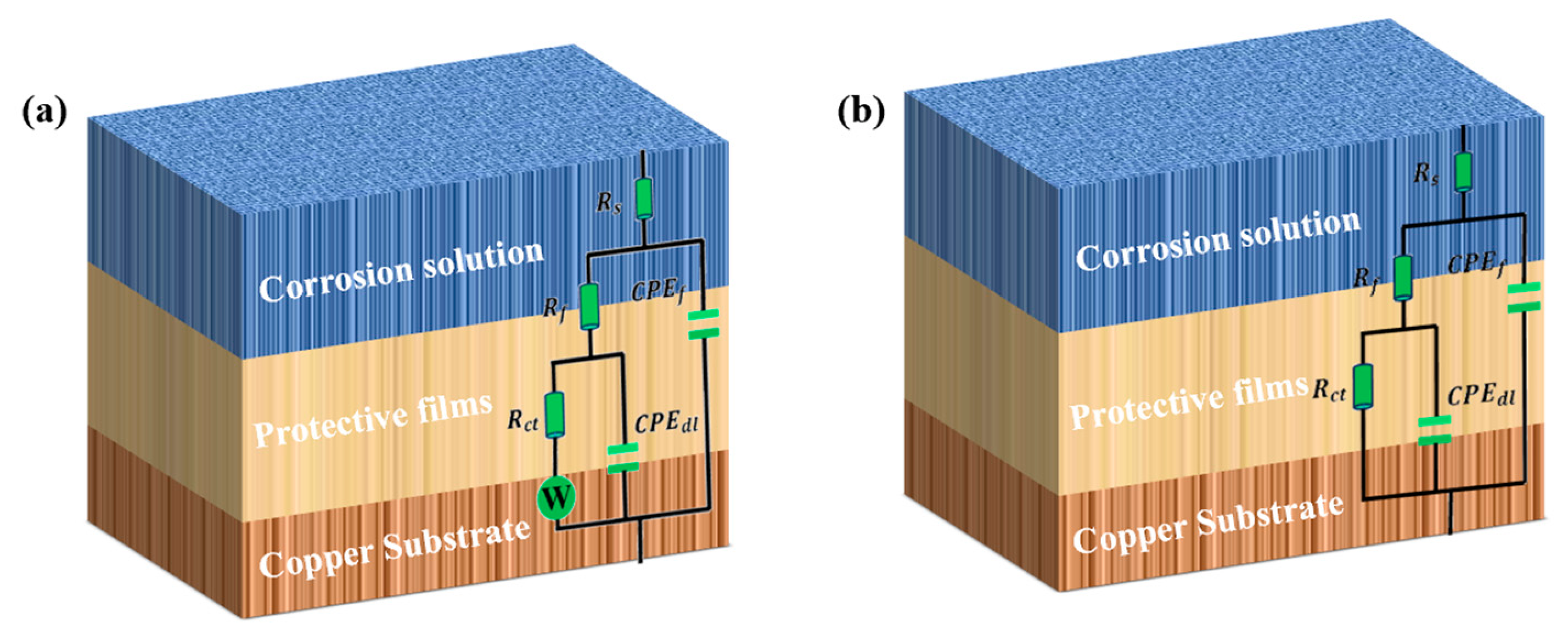
To gain a more comprehensive understanding of the anti-corrosion mechanism of lotus leaf extract, the EIS data were meticulously fitted to the equivalent circuit model illustrated in Figure 7. Table 2 shows the specific fitting findings. Cdl is a double-layer capacitor, Cf is a thin film capacitor, n is the deviation index factor, and Rp, Rf, and Rct are polarization resistance, film resistance, and charge transfer resistance, respectively. The ηEIS value is calculated using the following formula [34]:
η E I S ( % ) = R P R P , 0 R P   ×   100 %
Here, Rp and Rp,0 are resistances of copper in acidic solution in the presence and absence of inhibitor.
As shown in Table 2, the inhibition efficiency (ηEIS) exhibits a positive correlation with the concentration of lotus leaf extract under constant temperature conditions (298 K). At 700 mg/L, the lotus leaf extract achieved a corrosion inhibition efficiency of 88.07%, effectively mitigating copper corrosion in sulfuric acid. A substantial rise in Rct signifies improved adsorption layer coverage, inhibited charge transfer, and decreased corrosion rate. The probability of lotus leaf extract molecules replacing water molecules at the interface increases as the concentration of the extract increases. This results in an enlarged coverage area on the metal surface, thickening of the electrical double layer, and a reduction in the dielectric constant. Consequently, both Cdl and Cf exhibit a progressive decline. n approaches 1, signifying the establishment of a compact and well-ordered corrosion inhibition film on the electrode surface [5,35]. Rp and ηEIS, however, dropped as the temperature rose when the lotus leaf extract concentration was set at 700 mg/L. This suggests that the lotus leaf extract’s adsorption stability on copper surfaces is weakened by temperature increases, and that high temperatures are detrimental to the long-term integrity of protective films.

3.4. Tafel Analysis

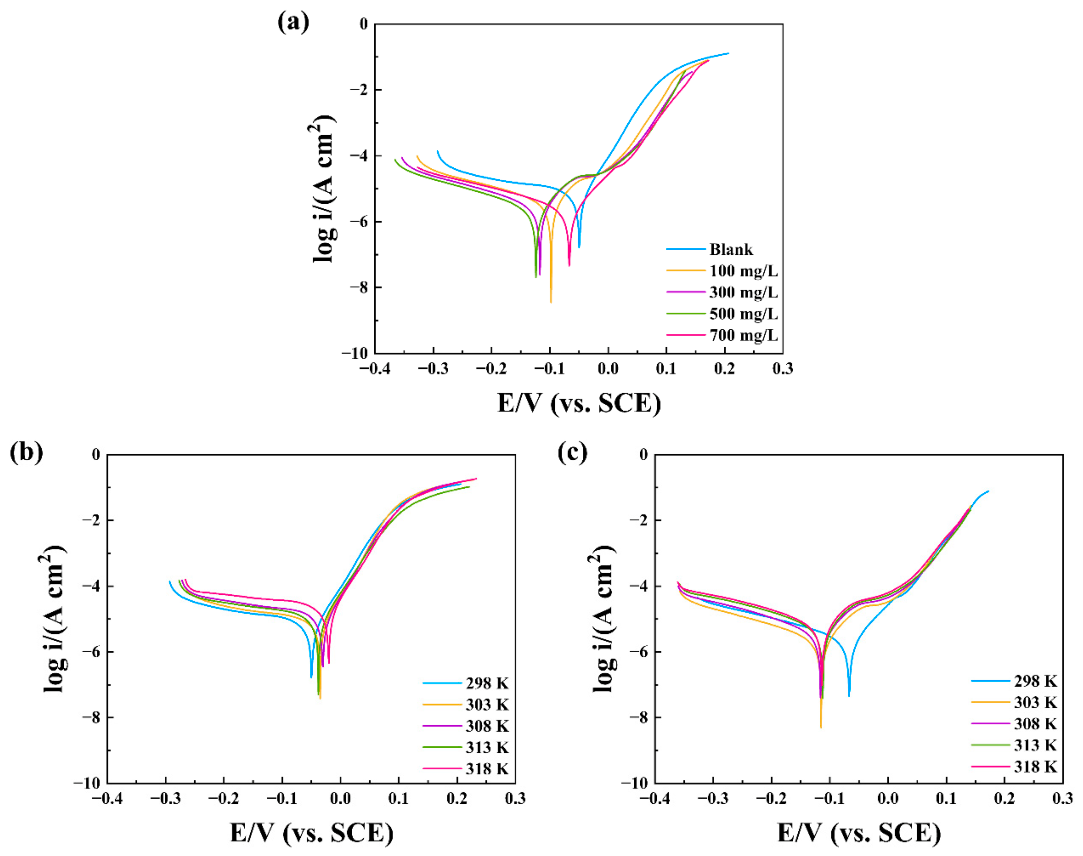
The Tafel polarization curves are presented in Figure 8. As illustrated in Figure 8a, the polarization curves exhibit a leftward shift (toward lower current densities) with increasing extract concentrations, indicating the extract’s effective inhibition of copper corrosion. Notably, the cathode branch of the polarization curve is consistent with the shape of the blank, indicating that the addition of lotus leaf extract does not change the potential cathode corrosion mechanism. Furthermore, the corrosion potential (Ecorr) demonstrates a cathodic shift with increasing extract concentration, with the shift magnitude remaining within an 85 mV range, which is indicative of the extract acting as a mixed-type corrosion inhibitor [35,36].
As summarized in Table 3, the corrosion current density (icorr) decreases systematically with rising lotus leaf extract concentration, while the corresponding Tafel corrosion inhibition efficiency (ηTafer) increases accordingly. At 298 K, the 700 mg/L lotus leaf extract treatment yields an icorr of 0.67 μA/cm2, corresponding to an impressive corrosion inhibition efficiency of 88.87%.
Figure 8b,c show the Tafel curves of the blank and the solution containing the lotus leaf extract from 298 to 318 K. As illustrated in Figure 8b, the polarization curve shifts toward higher current densities with increasing temperature. Notably, the branching morphology of copper in sulfuric acid remains morphologically consistent under elevated temperature conditions, suggesting that the underlying corrosion mechanism remains fundamentally unaltered [32]. In Figure 8c, the cathodic branches exhibit near-parallel characteristics, and the anodic branch morphologies show minimal variation. As presented in Table 3, the icorr in the blank solution increases substantially from 6.00 μA/cm2 to 18.68 μA/cm2, demonstrating that elevated temperatures intensify copper corrosion. However, upon the addition of lotus leaf extract at all tested temperatures, a significant reduction in icorr is observed. When 700 mg/L lotus leaf extract was added, icorr increased from 0.67 μA/cm2 to 3.57 μA/cm2, indicating that lotus leaf extract can still maintain good stability at high temperatures. The relevant corrosion inhibition effectiveness was estimated using the method (4) [37].
η T a f e l ( % ) = i c o r r , 0 i c o r r i c o r r   ×   100 %
The corrosion current densities of a copper electrode in 0.5 M sulfuric acid solution are denoted as icorr,0 (without lotus leaf extract) and icorr (with lotus leaf extract), respectively.

3.5. Adsorption Analysis

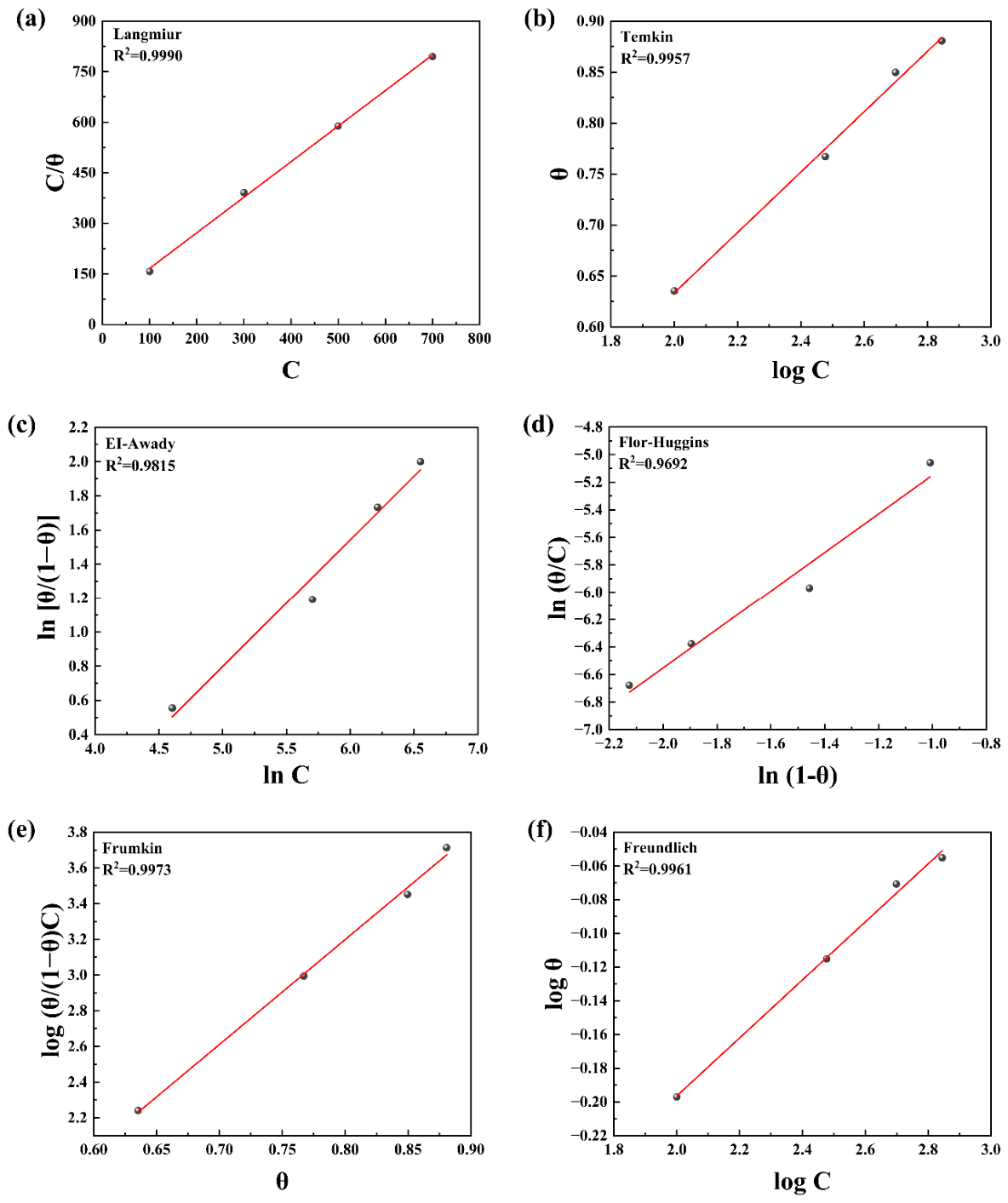
The adsorption model serves as an effective analytical tool for characterizing the adsorption behavior of corrosion inhibitor molecules on metallic surfaces. Figure 9 presents the adsorption isotherms of lotus leaf extract on copper substrates in sulfuric acid environments. The corresponding adsorption isotherm model is mathematically expressed as follows [38,39]:
Langmuir :   C i n h θ = 1 K a d s + C i n h
Temkin :   e x p ( 2 α θ ) = K C
El Awady :   l n θ 1 θ = y l n C + l n K
Flory Huggins :   l n θ C = x l n ( 1 θ ) + l n ( x K a d s )
Frumkin :   l n [ θ ( 1 θ ) C ] = l n K + 2 α θ
Freundlich :   l o g θ = n l o g C i n h + l o g K a d s
where θ represents the coverage area, C denotes concentration, and Kads is the equilibrium constant. Comparing the linear regression coefficients of the six fitted adsorption models, the Langmuir model exhibits an R2 value closest to unity, indicating the best fit to the experimental data. However, other models such as Freundlich, Temkin, and Frumkin also exhibited high correlation coefficients. This suggests that the adsorption process cannot be adequately described by a single idealized model. Instead, the system likely involves a combination of surface heterogeneity, competitive adsorption, and lateral interactions between adsorbed species [40]. The adsorption equation’s Gibbs free energy ( G a d s 0 ) can be calculated as follows [19,41]:
G a d s 0 = R T l n ( 1000 K a d s )
In this equation, T represents the thermodynamic temperature, R denotes the universal gas constant, and 1000 corresponds to the water concentration expressed in grams per liter (g/L). In general, when G a d s 0 > −20 kJ/mol, the adsorption mode between the inhibitor molecule and the metal is physical adsorption. When G a d s 0 < −40 kJ/mol, the adsorption mode between the inhibitor molecule and the metal is chemical adsorption through chemical bonding. If −40 kJ/mol < G a d s 0 < −20 kJ/mol, it is the result of physical adsorption and chemical adsorption. At 298, the G a d s 0 values of lotus leaf extract are −24.06 kJ/mol. These values are in the range of −20 kJ/mol to −40 kJ/mol, which is inferred to be mixed adsorption.

3.6. Corrosion Kinetic Analysis

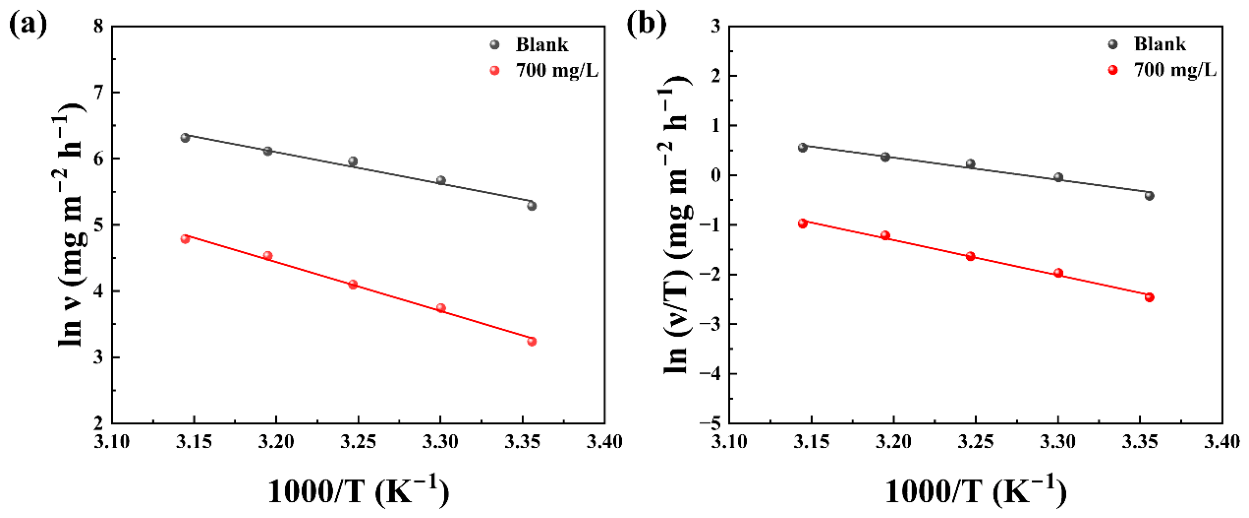
Figure 10 presents the Arrhenius plot and transition state equation diagram for a copper sheet immersed in a sulfuric acid system with and without lotus leaf extract, tested across a temperature range of 298 to 318 K. The apparent activation energy ( E a ), activation enthalpy ( H a ), and activation entropy ( S a ) were obtained from the slope or intercept of the linear regression curves of l n   ν and T 1 . Table 4 shows the final calculation results. The specific formula is as follows [42]:
ln ν = ln A E a R T
ln ( ν T ) = ln ( R N h ) + Δ S a R Δ H a R T
Table 4 shows that after the addition of lotus leaf extract, the ∆Ea, ∆Ha, and activation entropy (∆Sa) increased. The apparent activation energy of the copper sheet in 0.5 M sulfuric acid without the lotus leaf extract was 39.53 kJ/mol, and after the addition of the lotus leaf extract, the apparent activation energy was 61.35 kJ/mol. The increase in energy activation indicates that lotus leaf extract raises the energy barrier for corrosion, requiring corrosive ions to overcome a higher threshold to sustain the process. When ∆Ha is positive, the process is endothermic, and an elevated temperature promotes copper corrosion. Upon the incorporation of lotus leaf extract, the ∆Ha value increases, signifying a higher energy requirement for the corrosion reaction. The ∆Sa rises from −76.29 to −20.29 J∙mol−1∙K−1, signifying increased disorder and competition for active sites. Consequently, the adsorption of the corrosion inhibitor forms a compact protective film on the copper surface, thereby increasing the kinetic barrier for corrosion and improving the overall inhibition efficiency.

3.7. Comparative Analysis

Table 5 compares the corrosion inhibition performance of various plant extract-based inhibitors reported for copper in acid media [43,44,45,46,47,48,49,50]. The inhibition efficiency of Nelumbo nucifera leaf extract (88.87% at 700 mg/L) is comparable to many reported green inhibitors, confirming its effectiveness and potential applicability.

3.8. Surface Analysis

3.8.1. SEM

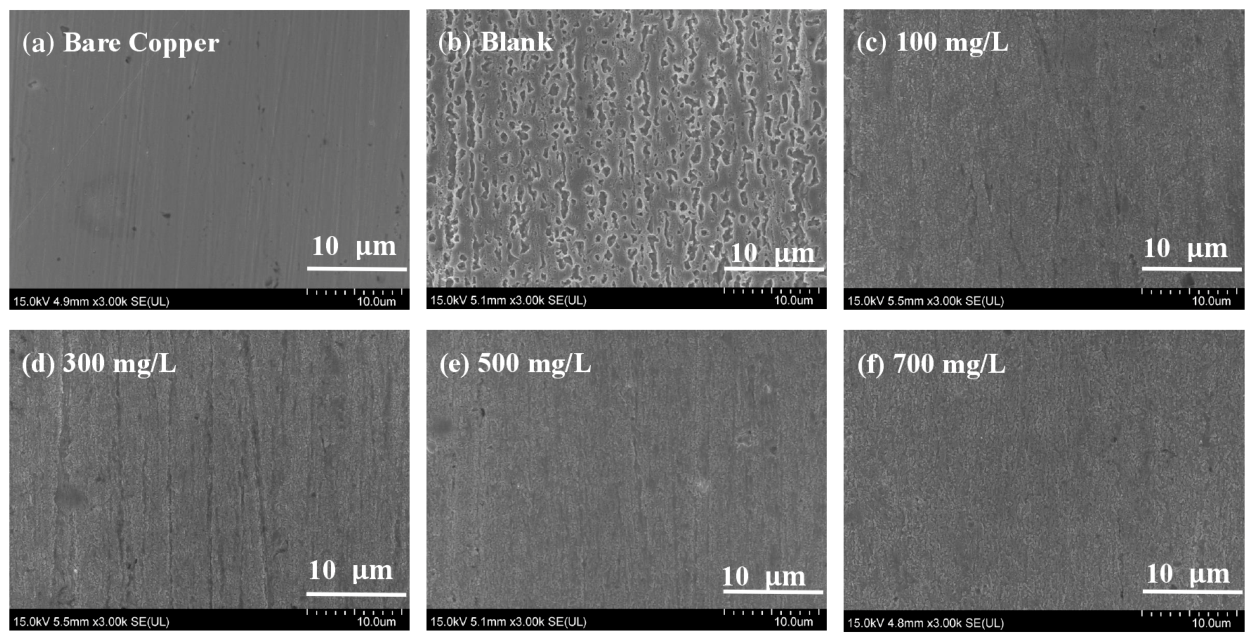
Figure 11 presents SEM images of copper sheets subjected to various immersion environments at a controlled temperature of 298 K. Figure 11a presents the newly polished copper sheet, while Figure 11b shows the copper sheet after immersion in sulfuric acid solution. A comparative analysis of Figure 11a,b reveals that the surface of the sulfuric acid-immersed copper specimen exhibits extensive corrosion, characterized by irregular cracks and corrosion pits. The SEM images presented in Figure 11c–f correspond to copper sheets immersed in sulfuric acid solutions containing lotus leaf extract at concentrations of 100, 300, 500, and 700 mg/L, respectively. The results indicate that as the concentration of lotus leaf extract increases, the copper surfaces exhibit predominantly minor polishing scratches, accompanied by a significant reduction in the occurrence of pits and cracks. The introduction of lotus leaf extract effectively inhibits copper corrosion in sulfuric acid. This progressive reduction in surface damage with increasing extract concentration suggests enhanced surface coverage by adsorbed inhibitor molecules, which likely increases the barrier to charge transfer and is consistent with the improved electrochemical inhibition efficiency observed.
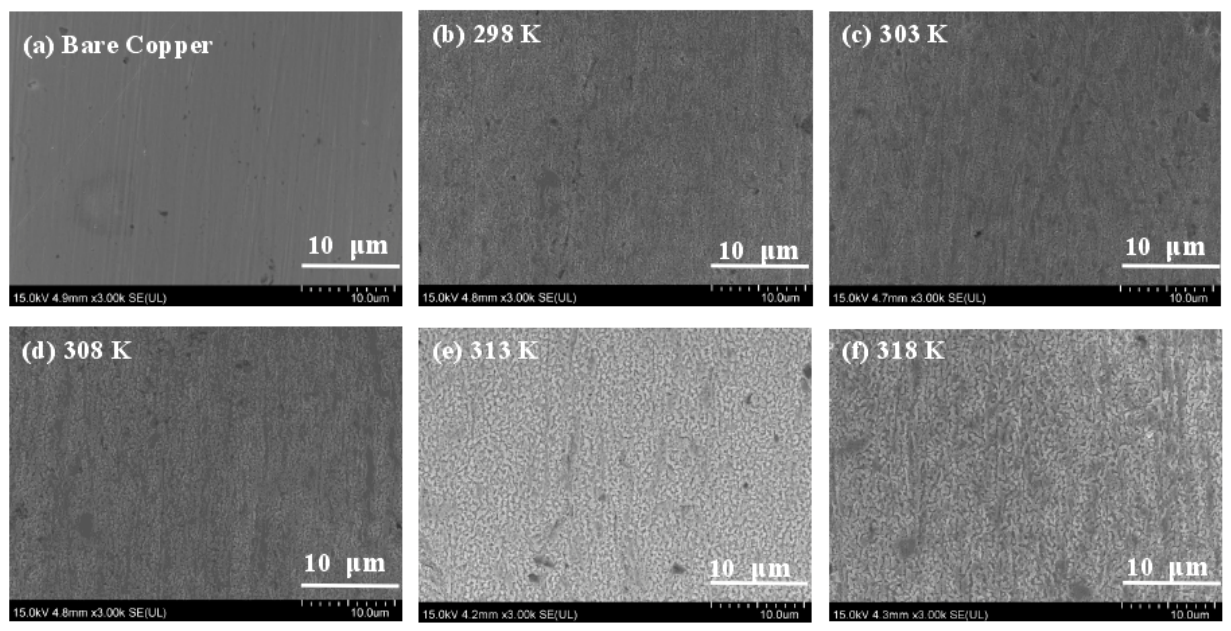
Figure 12 shows SEM images of copper sheets at 700 mg/L extract concentration under varying soaking temperatures, revealing increased surface corrosion with rising temperature. It should be noted that at 313 K, the surface of the copper sheet exhibits a significant increase in both the quantity and density of corrosion pits and cracks, suggesting that the corrosion inhibitor demonstrates markedly reduced efficacy in mitigating copper corrosion within the aggressive medium under elevated temperature conditions. The deterioration of surface morphology at elevated temperature indicates desorption of inhibitor molecules and/or destabilization of the protective film, which corresponds to the reduced charge-transfer resistance (Table 2), high corrosion current density (Table 3), and lower inhibition efficiency (Table 2 and Table 3) at higher temperatures.

3.8.2. AFM and XPS Analysis

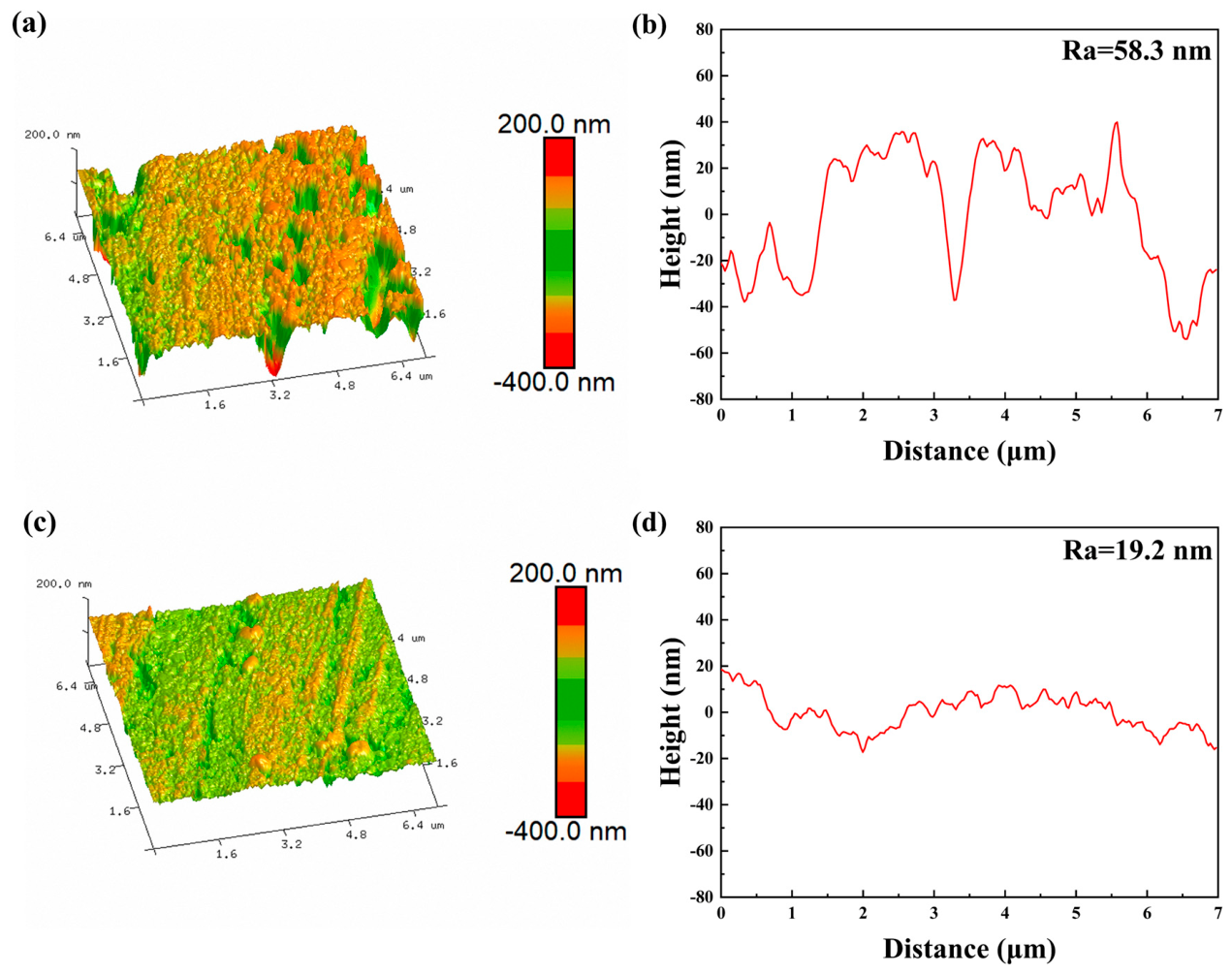
Copper specimens were immersed in 0.5 M H2SO4 with 700 mg/L lotus leaf extract for 24 h, and then analyzed by AFM to study corrosion inhibition. The 3D morphology and height distribution of the copper surface following immersion are presented in Figure 13. As depicted in Figure 11b and Figure 13a, the copper specimen exhibits numerous large depressions and deep pits on its surface in the absence of extractive inhibition and protection, resulting in significant surface roughening. The height distribution line fluctuates greatly, and the fluctuation range is close to 120 nm. At this time, Ra was 58.3 nm, indicating that copper was severely corroded in sulfuric acid. The significant decrease in surface roughness indicates the formation of a compact and uniform adsorbed inhibitor layer, which reduces the number of exposed electroactive sites available for anodic dissolution. This surface smoothing is consistent with the increase in charge-transfer resistance and inhibition efficiency obtained from electrochemical measurements, suggesting that the inhibitor acts by forming a protective barrier that limits electrolyte access to the copper surface.
Figure 13c,d show 3D images and height distribution maps of the copper surface after adding lotus leaf extract. Compared to the former sample, the copper surface exhibits a comparatively flatter and more uniform morphology, with a significant reduction in the number of corrosion pits. Additionally, the fluctuation amplitude of the height distribution profile is markedly diminished. The fluctuation range is less than 30 nm, and Ra is also reduced to 19.2 nm. The lotus leaf extract effectively inhibits copper corrosion in sulfuric acid, consistent with SEM findings [50]. AFM-based nanomechanical techniques such as force spectroscopy could provide further insight into the adhesion, stability, and molecular organization of the inhibitor film on the copper surface [51] and may serve as a useful direction for future work.
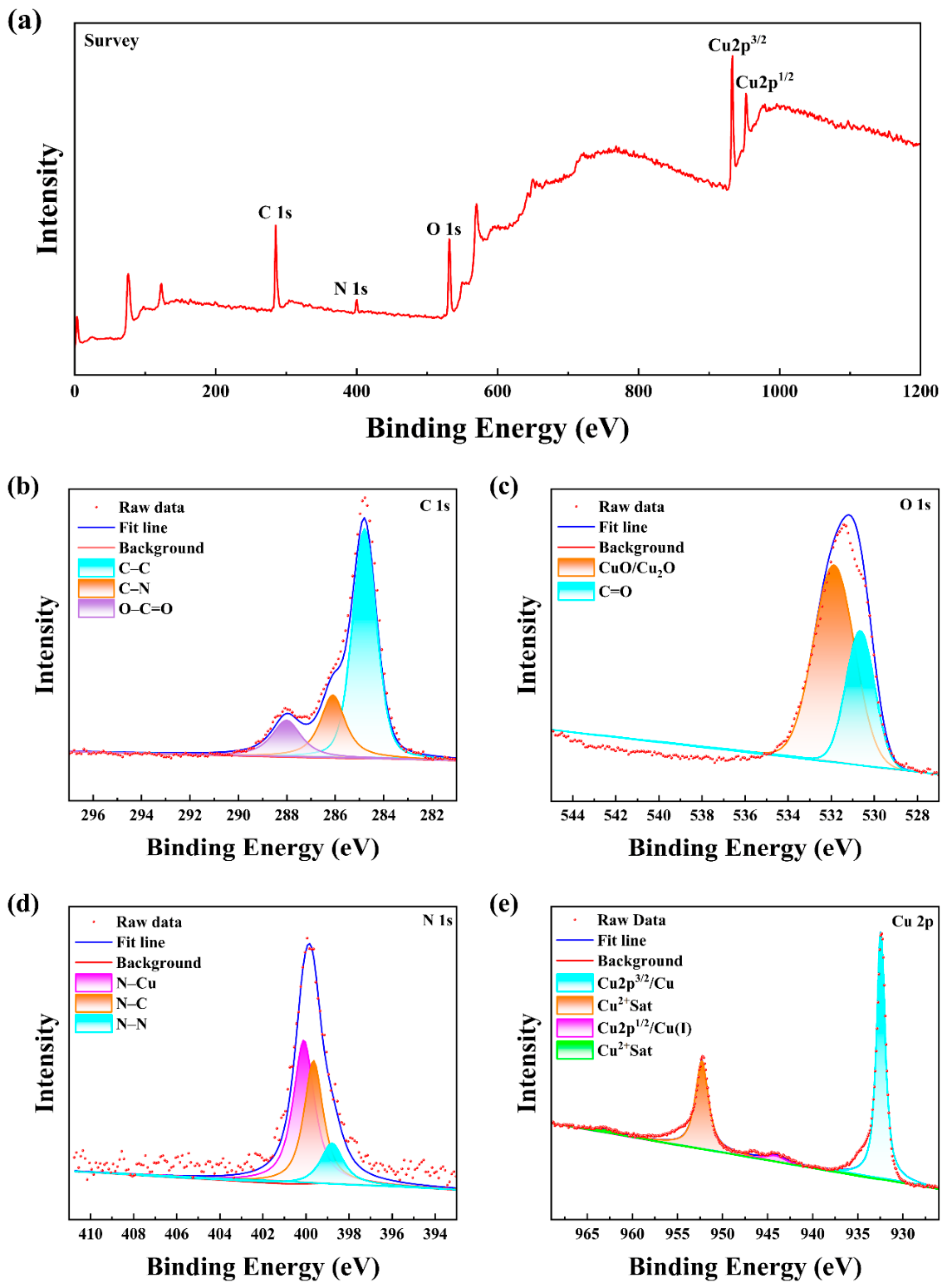
Figure 14 presents the XPS spectra of copper substrates immersed in sulfuric acid solution containing 700 mg/L lotus leaf extract. The full-spectrum analysis presented in Figure 14a reveals that carbon (C), oxygen (O), nitrogen (N), and copper (Cu) elements are predominantly distributed on the copper surface following the immersion process. As demonstrated in Figure 14b, the high-resolution C 1 s spectrum exhibits three distinct peaks at 284.8 eV, 286.1 eV, and 288.0 eV, assigned to C–C, C–N and O–C=O bond, respectively [52]. Meanwhile, Figure 14c shows the deconvoluted O 1 s spectrum with two main peaks at 531.88 eV and 539.68 eV, representing CuO/Cu2O species and C=O functional groups, respectively [17]. As shown in Figure 14d, the N 1s spectrum exhibits three distinct fitting peaks: the 400.13 eV peak corresponds to N–Cu bonding, 399.63 eV to N–C, and 398.83 eV to N–N bonding. Here, the emergence of the N–Cu peak indicates the formation of a chemical bond between the nitrogen atom in the lotus leaf extract and copper. This chemisorbed layer effectively blocks active corrosion sites and hinders electron transfer reactions, thereby improving corrosion resistance. Figure 14e presents the XPS spectrum of Cu 2p, which includes two weak peaks corresponding to Cu2+ at 944.28 eV and 963.08 eV, as well as two peaks at 952.28 eV and 932.48 eV attributable to Cu 2p1/2/Cu(I) and Cu 2p3/2/Cu(I), respectively [32]. The presence of Cu(I) here further indicates that the lotus leaf extract significantly inhibits the oxidation of Cu+ to Cu2+.

3.9. Theoretical Analysis

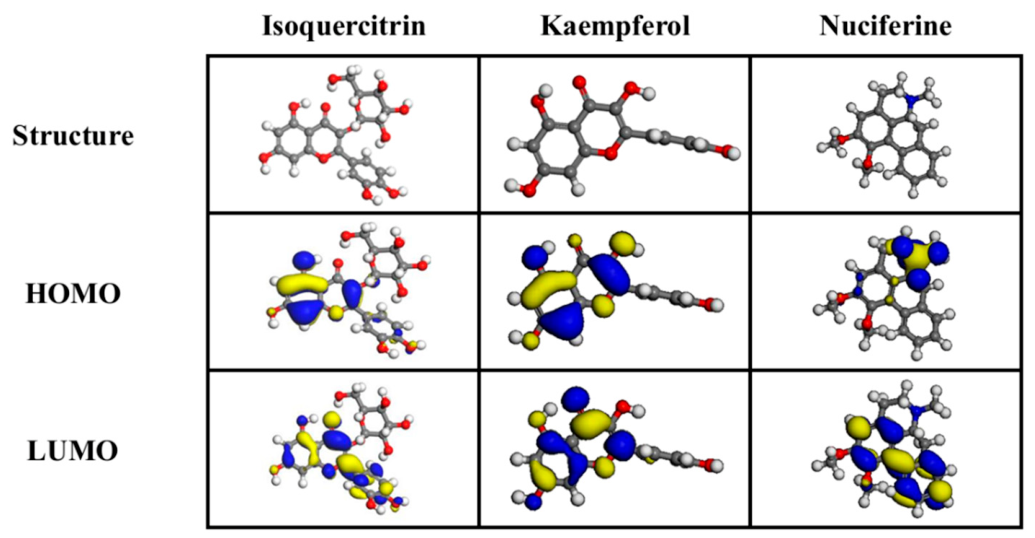
Figure 15 shows the optimized structures of the three components (isoquercitrin, kaempferol, and nuciferine) considered and their corresponding FMO electron distributions (HOMO and LUMO). These compounds were selected as representative constituents of lotus leaf extract based on reported phytochemical studies [26,53], although their exact relative abundance in the present system was not experimentally quantified. Table 6 shows the computed values for the highest occupancy molecule orbital ( E H O M O ), the lowest empty molecule orbital ( E L U M O ), the width of the energy gap ( Δ E ), and dipole moment (μ). According to frontier orbital theory, the HOMO and LUMO orbitals correspond to the electron–donating ability and electron–accepting ability, respectively. As illustrated in Figure 16, the HOMOs and LUMOs of isoquercitrin and kaempferol are predominantly localized on the carbon-carbon double bonds, carbonyl groups, and the entire heterocyclic ring system. In contrast, the HOMOs and LUMOs of nuciferine are primarily distributed over the ether linkage and the nitrogen-containing heterocycle. It is generally accepted that the E L U M O value serves as an indicator of a molecule’s electron-accepting capability. A lower E L U M O value signifies a stronger propensity for the molecule to accept electrons. Conversely, the E H O M O value reflects the molecule’s electron-donating ability, where a higher value corresponds to greater electron-donating capacity.
The size of E reflects the molecule’s adsorption stability [33]. Lower E values facilitate molecule adsorption on metal surfaces, leading to increased corrosion-inhibiting efficacy. As presented in Table 6, the calculated bandgap energies (∆E) for isorhamnetin, kaempferol, and nuciferine were determined to be 2.725 eV, 2.763 eV, and 3.178 eV, respectively. Among them, E value of isoquercitrin was the smallest, suggesting that isoquercitrin plays a dominant role in corrosion protection. In addition, the adsorption capacity of molecules on a metal surface is closely related to the dipole moment [54]. Moreover, the global reactivity descriptors, including electron affinity (A), ionization potential (I), electronegativity (χ), chemical hardness (η), and fraction of electron transfer (ΔN), were calculated using Koopmans’ approximation based on the frontier molecular orbital energies using the equations reported in the literature [55,56]. As per the data reported in Table 6, isoquercetin and kaempferol showed lower η and χ than nuciferine, suggesting greater molecular reactivity and a stronger ability to interact with the copper surface. These findings support the electrochemical results and confirm that electron donation is a key factor in adsorption. Their higher positive ΔN values further suggest more effective electron donation, promoting stronger chemisorption [57]. The larger the dipole moment, the easier it is for molecules to create an adsorption layer on the surface of the metal. The order of μ is nuciferine < isoquercitrin < kaempferol, indicating that kaempferol may effectively promote the adsorption of lotus leaf extract on the copper surface.
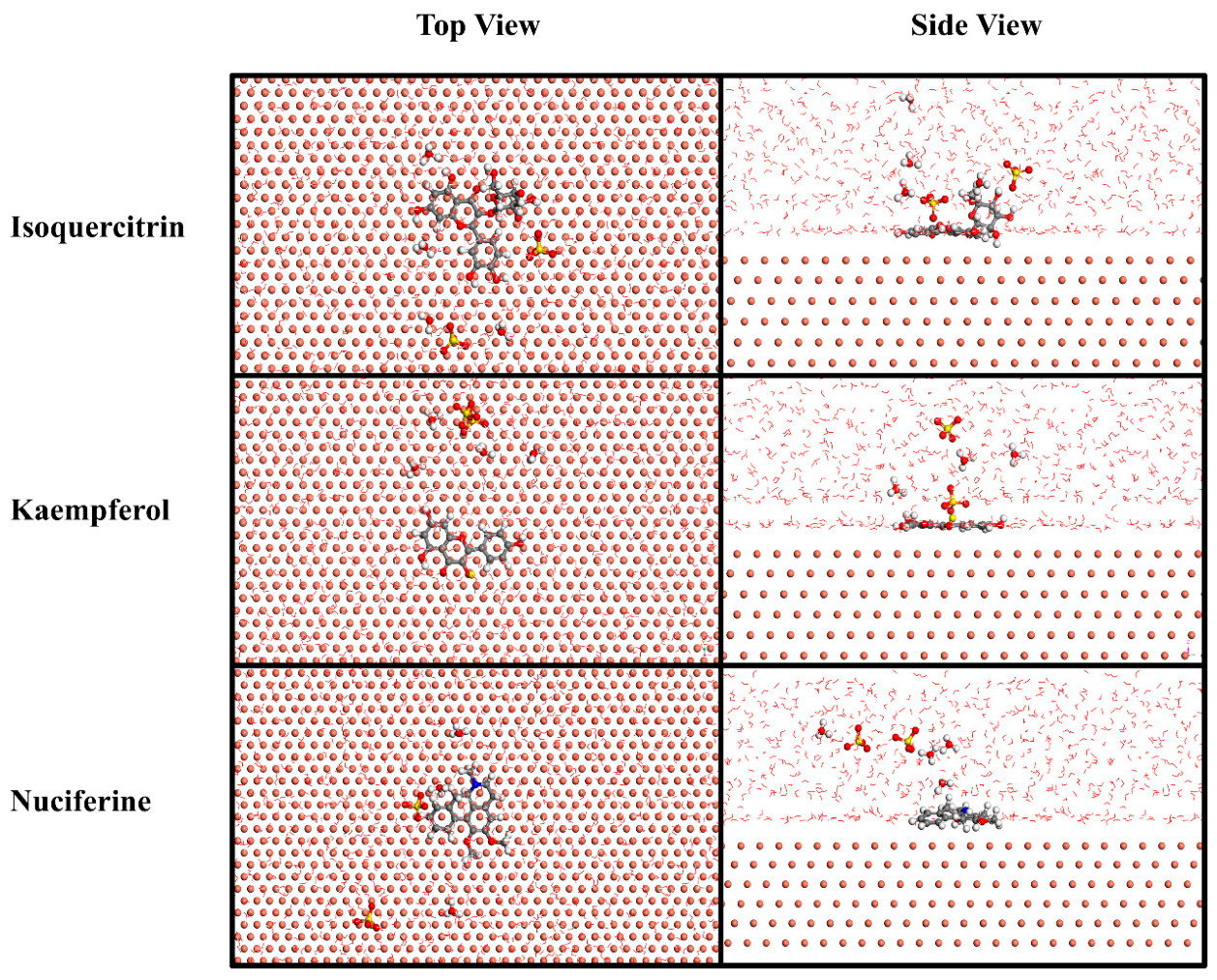
To gain a deeper understanding of the interaction between lotus leaf extract and the copper matrix, molecular dynamics simulations were employed to investigate the adsorption configurations of the lotus leaf extract on the copper surface and the corresponding adsorption strengths. Figure 16 presents the top and side views of isoquercitrin, kaempferol, and nuciferine. The figure demonstrates that the molecular conformations of these three compounds exhibit an essentially parallel orientation relative to the copper surface. This parallel adsorption configuration maximizes the effective interfacial contact between the molecules and the copper substrate, thereby enhancing the protective effect against corrosion induced by aggressive media.
The greater the binding energy value, the stronger the adsorption affinity of the corrosion inhibitor molecule for copper. Molecules exhibiting higher binding energy values can effectively adsorb onto the copper surface under mild temperature conditions. The binding energies of the Cu (111) surface with lotus leaf extract molecules are 944.23 kJ/mol for isoquercitrin, 593.58 kJ/mol for kaempferol, and 521.95 kJ/mol for nuciferine. The binding energy of isoquercitrin is the highest, indicating that it is easier to adsorb on the copper surface, which is consistent with the results of quantum chemical calculations.

3.10. Corrosion Inhibition Mechanisms

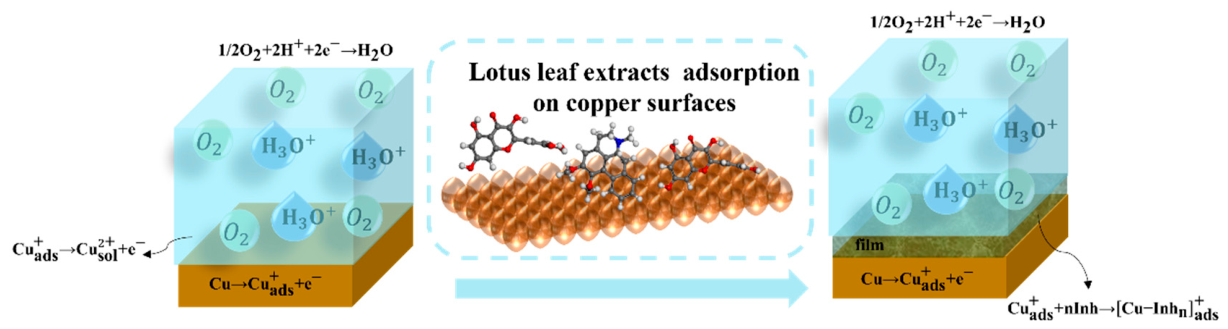
From an electrochemical point of view, copper corrosion is a coupled reaction of metal dissolution in the anode region and dissolved oxygen reduction in the cathode region. The possible reaction mechanism is as follows [2,17,33]:
Cathode :   O 2 + 4 H + + 4 e 2 H 2 O
Anode :   C u C u a d s + + e   ( f a s t )
C u a d s + C u s o l 2 + + e   ( s l o w )
In the anodic reaction, the conversion of Cu+ into Cu2+ is a slow reaction process, which is a key step in determining the oxidation rate of Cu. The adsorption mechanism is shown in Figure 17, and the adsorption reaction equation of corrosion inhibitor molecules on the Cu surface is expressed as follows:
C u a d s + + n   I n h [ C u I n h ] a d s +
After the addition of lotus leaf extract, the corrosion rate of copper is significantly reduced, indicating the formation of an inhibitive surface layer. Based on the phytochemical constituents identified in lotus leaf extract, compounds such as isoquercitrin, kaempferol, and nuciferine may contribute to the inhibition performance. These molecules contain functional groups (e.g., hydroxyl, carbonyl) and π-electron-rich aromatic systems, which could facilitate adsorption on the copper surface through electrostatic interactions, van der Waals forces, and possible coordination with surface Cu species [52,58,59]. This adsorption process is consistent with the formation of a protective barrier layer, as supported by surface analysis (SEM, FTIR, and XPS), which reduces the contact between the metal surface and the corrosive medium. In addition, interaction between inhibitor molecules and copper ions may lead to the formation of a stable adsorbed complex at the interface, which can hinder further oxidation of Cu+ to Cu2+. However, due to the complexity of plant extracts, the exact contribution of individual compounds cannot be definitively distinguished based on the present experimental results.

4. Conclusions

The bio-based corrosion inhibitor developed in this work shows excellent efficacy in decreasing copper corrosion in acidic environments. The electrochemical measurements reveal that lotus leaf extract simultaneously suppresses both cathodic and anodic electrochemical reactions, exhibiting good corrosion inhibition efficacy. The corrosion inhibition efficiency demonstrates a linear correlation with increasing concentration, attaining a remarkable value of 88.07% at a concentration of 700 mg/L. SEM images and AFM spectra reveal that the lotus leaf extract has excellent corrosion inhibitory capabilities. FTIR and XPS analyses suggest that heteroatom-containing functional groups and aromatic structures present in the lotus leaf extract may participate in the adsorption on the copper surface, which is likely related to the observed corrosion inhibition behavior. Theoretical calculations suggest that N and O atoms may act as active sites, and that isoquercitrin and kaempferol are likely important constituents contributing to the corrosion inhibition performance of the lotus leaf extract. However, these theoretical interpretations are based on selected representative molecules and should be considered as qualitative support for the proposed mechanism rather than a direct quantitative description of the system.
This study is limited to short-term tests on copper in sulfuric acid and laboratory-scale experiments, so long-term stability, performance in other corrosive environments, and industrial scalability remain to be explored. Although the lotus leaf extract shows high inhibition efficiency at lower temperatures, its performance decreases with increasing temperature, indicating that the adsorption process is partially reversible and temperature-dependent. This highlights a limitation of the system for high-temperature corrosion protection applications, which is commonly observed in plant-extract-based corrosion inhibitors. Future work could investigate synergistic green inhibitors, other metals and alloys, and long-term durability. To upscale this work in the practical application, it would be valuable to further optimize the extraction for a larger scale and assessment of inhibitor performance under industrial conditions, and explore the use of different plant sources or formulations, aiming to improve efficiency and reduce costs.

Author Contributions

Y.X.: Conceptualization, Methodology, Writing—original draft, Formal analysis. Y.G.: Methodology, Validation, Formal Analysis, Investigation. J.W.: Visualization, Formal analysis. K.Z.: Investigation. Y.Z.: Conceptualization, Data curation. W.Y.: Conceptualization, Resources. R.A.: Writing—review and editing. Q.W.: Writing—review and editing, Supervision, Resources, Funding acquisition. All authors have read and agreed to the published version of the manuscript.

Funding

This work was supported by Science and Technology Research in Zhoukou city (No. ZKSKJGG2000126), Natural Science Foundation of Chongqing (No. CSTB2024NSCQ–MSX1178), The Young Backbone Teacher Cultivation Project of Zhoukou Normal University, Henan College Students’ Innovative Training Program Project (No. S202510478009), 2025 Henan Science and Technology R&D Plan Joint Fund (Discipline) Project (No. 252103810197).

Institutional Review Board Statement

Not applicable.

Informed Consent Statement

Not applicable.

Data Availability Statement

Data will be made available on reasonable request.

Conflicts of Interest

The authors declare no conflicts of interest.

References

  1. Issam, S.; Dahmani, K.; Kharbouch, O.; Galai, M.; Hsissou, R.; Alobaid, A.A.; Almaswari, B.M.; El-Serehy, H.; Ebntouhami, M.; Elyoubi, M. Novel eco-friendly glass synthesis as corrosion inhibitors for copper in sulfuric acid medium. Anti-Corros. Methods Mater. 2025, 72, 320–330. [Google Scholar] [CrossRef]
  2. Huang, M.; Wang, R.; Xiong, J.; Liu, C.; Wang, J.; Wang, Q. Inhibition effect and adsorption behavior of Michelia alba leaf extract as corrosion inhibitors for Cu in 0.5 M H2SO4. J. Dispers. Sci. Technol. 2025, 1–18. [Google Scholar] [CrossRef]
  3. Shinato, K.W.; Zewde, A.A.; Jin, Y. Corrosion protection of copper and copper alloys in different corrosive medium using environmentally friendly corrosion inhibitors. Corros. Rev. 2020, 38, 101–109. [Google Scholar] [CrossRef]
  4. Gao, L.; Peng, S.; Huang, X.; Gong, Z. A combined experimental and theoretical study of papain as a biological eco-friendly inhibitor for copper corrosion in H2SO4 medium. Appl. Surf. Sci. 2020, 511, 145446. [Google Scholar] [CrossRef]
  5. Liu, Z.; Fan, B.; Zhao, J.; Yang, B.; Zheng, X. Benzothiazole derivatives-based supramolecular assemblies as efficient corrosion inhibitors for copper in artificial seawater: Formation, interfacial release and protective mechanisms. Corros. Sci. 2023, 212, 110957. [Google Scholar] [CrossRef]
  6. Li, Y.; Chen, Y.; Wang, C.; Li, Y.; Wu, Y. Exploring the potential of plant extracts as corrosion inhibitors: A comprehensive review. Prog. Org. Coat. 2025, 198, 108915. [Google Scholar] [CrossRef]
  7. Zehra, S.; Aslam, R.; Aslam, J.; Verma, C.; Yan, Z.; Wang, Q.; Mobin, M.; AlFantazi, A. Chemically functionalized polymers as corrosion inhibitors: Effect of solubility, adsorption and coordination bonding. Coord. Chem. Rev. 2025, 535, 216637. [Google Scholar] [CrossRef]
  8. Song, D.; Wang, J.; Guan, H.; Zhang, S.; Zhou, Z.; Zhang, S. Enhanced Corrosion Resistance of Carbon Steel Rebar in Chloride-Containing Water Solutions: The Role of Lotus Extract in Corrosion Inhibition. Metals 2025, 15, 510. [Google Scholar] [CrossRef]
  9. Abeng, F.E.; Ita, B.I.; Ikpi, M.E.; Chukwuike, V.I.; Ikeuba, A.I.; Edim, M.M.; Chidiebere, M.A.; Thakur, A.; Anadebe, V.C. Millettia aboensis leaves extract as eco-friendly corrosion inhibitor for mild steel in acidizing solution: From experimental to molecular level prediction. Results Eng. 2024, 24, 102950. [Google Scholar] [CrossRef]
  10. Obike, A.I.; Eze, K.S.; Abdel-Rahman, I.; Ikeuba, A.I.; Nwokolo, I.K.; Aghalibe, C. Evaluation of Corynocarpus laevigatus extract as a green corrosion retardant for mild steel in acidic media: A combined gravimetric, gasometric and electrochemical methods. Curr. Res. Green Sustain. Chem. 2025, 10, 100447. [Google Scholar] [CrossRef]
  11. Jha, V.K.; Jana, S.; Pal, S.; Ji, G.; Prakash, R. Thin-Film Coating of the Hydrophobic Lotus Leaf on Copper by the Floating Film Transfer Method and Investigation on the Corrosion Behavior of Coated Copper in Saline Water. Ind. Eng. Chem. Res. 2022, 62, 85–95. [Google Scholar] [CrossRef]
  12. Obike, A.I.; Udorji, F.I.; Ekerenam, O.O.; Emori, W.; Onyeije, U.C.; Onyedinma, U.P.; Okonkwo, P.C.; Ikeuba, A.I. Efficacy of Fleurya aestuans on Mild Steel Protection in Acidic Systems: Combined Gravimetry, Gasometry, and Electrochemical Evaluations. J. Bio- Tribo-Corros. 2024, 10, 39. [Google Scholar] [CrossRef]
  13. Adel, O.; Mohamed, M.E.; Khamis, E. Thermodynamic, electrochemical and surface characterization of copper corrosion inhibition in acidic solution using rice straw extract. Sci. Rep. 2025, 15, 27753. [Google Scholar] [CrossRef]
  14. Zhu, X.; Huang, L. Evaluation of cactus mucilage as a green corrosion inhibitor for copper in sulfuric acid environment. J. Prof. Assoc. Cactus Dev. 2024, 26, 162–178. [Google Scholar] [CrossRef]
  15. Tan, B.; Xiang, B.; Zhang, S.; Qiang, Y.; Xu, L.; Chen, S.; He, J. Papaya leaves extract as a novel eco-friendly corrosion inhibitor for Cu in H2SO4 medium. J. Colloid Interface Sci. 2021, 582, 918–931. [Google Scholar] [CrossRef]
  16. Huang, H.; Xie, L.; Chen, X.; Li, W.; Al-Sadoon, M.K. Insight into anti-corrosion mechanism of Zingiber officinale Roscoe leaf extract as inhibitor. Mater. Today Commun. 2025, 43, 111702. [Google Scholar] [CrossRef]
  17. Ren, H.; Liu, Y.; Gong, Z.; Tan, B.; Deng, H.; Xiong, J.; Shao, P.; Dai, Q.; Cao, J.; Marzouki, R. Pumpkin Leaf Extract Crop Waste as a New Degradable and Environmentally Friendly Corrosion Inhibitor. Langmuir 2024, 40, 5738–5752. [Google Scholar] [CrossRef] [PubMed]
  18. Mamudu, U.; Santos, J.H.; Umoren, S.A.; Alnarabiji, M.S.; Lim, R.C. Investigations of corrosion inhibition of ethanolic extract of Dillenia suffruticosa leaves as a green corrosion inhibitor of mild steel in hydrochloric acid medium. Corros. Commun. 2024, 15, 52–62. [Google Scholar] [CrossRef]
  19. Altunbaş Şahin, E.; Aydın Dursun, Y.; Halil Geçibesler, İ.; Solmaz, R. Adsorption and corrosion inhibition ability of avocado seed (Persea americana) extract for copper corrosion in 0.5 M H2SO4 solution. Inorg. Chem. Commun. 2024, 167, 112751. [Google Scholar] [CrossRef]
  20. Fu, S.; Lei, Y.; Li, M.; Peng, Y.; Sang, T.; Sun, Q.; Ma, H.; Dai, J.; Liang, Z.; Li, J. Investigating the effect of pyridine substituent position on the corrosion inhibition performance of novel benzophenone derivatives: Experimental and theoretical study. J. Environ. Chem. Eng. 2025, 13, 116909. [Google Scholar] [CrossRef]
  21. Arifa Farzana, B.; Mujafarkani, N.; Thakur, A.; Kumar, A.; Mushira Banu, A.; Shifana, M. Evaluating (p-Semidine-Guanidine-Formaldehyde) terpolymer resin efficiency as anti-corrosive agent for mild steel in 1 M H2SO4: An experimental and computational approach. Inorg. Chem. Commun. 2023, 158, 111572. [Google Scholar] [CrossRef]
  22. Holla, B.R.; Mahesh, R.; Manjunath, H.R.; Anjanapura, V.R. Plant extracts as green corrosion inhibitors for different kinds of steel: A review. Heliyon 2024, 10, e33748. [Google Scholar] [CrossRef]
  23. Sheydaei, M. The Use of Plant Extracts as Green Corrosion Inhibitors: A Review. Surfaces 2024, 7, 380–403. [Google Scholar] [CrossRef]
  24. Wang, Q.; Zhou, X.; Sun, X.; Zhang, Q.; Wang, R.; Zhao, J.; Aslam, R.; Sun, Y.; Yan, Z.; Li, X. Seaweed extract as green corrosion inhibitor for carbon steel in hydrochloric acid solution. Colloids Surf. A Physicochem. Eng. Asp. 2024, 700, 134751. [Google Scholar] [CrossRef]
  25. Xu, Q.; Zou, W.; Li, H.; Wang, Z.; Li, M. Discovery of hemostatic component combination from Nelumbinis Receptaculum using dual machine learning spectrum-effect analysis. J. Ethnopharmacol. 2026, 358, 120995. [Google Scholar] [CrossRef] [PubMed]
  26. Nguyen, S.T.; Nguyen, H.T.T.; Nguyen, D.C.T.; Lu, P.T.; Dang, T.H.; Ma, T.T.H.; Huynh, T.A.H.; Do, T.V.M.C. Advancing UPLC-MS/MS for mapping the chemical fingerprint of bioactive compounds in lotus leaves (Folium nelumbinis). J. Pharm. Biomed. Anal. 2025, 261, 116840. [Google Scholar] [CrossRef]
  27. Chen, Q.-H.; Zhou, Z.-Y.; Feng, M.-T.; He, J.-H.; Xu, Y.-Q.; Liao, B.-K. Unraveling the inhibitive performance and adsorption behavior of expired compound glycyrrhizin tablets as an eco-friendly corrosion inhibitor for copper in acidic medium. J. Taiwan Inst. Chem. Eng. 2025, 168, 105913. [Google Scholar] [CrossRef]
  28. Zhou, L.; Zhao, T.; Li, Z. Theoretical and Experimental Investigation of Indazole Derivatives as Corrosion Inhibitors for Copper in Acidic Medium. Langmuir 2024, 40, 27511–27522. [Google Scholar] [CrossRef]
  29. Kumar, D.; Jain, N.; Jain, V.; Rai, B. Amino acids as copper corrosion inhibitors: A density functional theory approach. Appl. Surf. Sci. 2020, 514, 145905. [Google Scholar] [CrossRef]
  30. Ben Seddik, N.; Achache, M.; Zarki, Y.; Chraka, A.; Bouchta, D.; Raissouni, I. Computational, theoretical and experimental studies of four amino acids as corrosion inhibitors for brass in 3% NaCl medium. J. Mol. Liq. 2024, 397, 124113. [Google Scholar] [CrossRef]
  31. Elsayed, S.A.; Barghout, N.A.; Ragab, S.; Abdel-Latif, E.; Etman, H.A.; Hamed, M.A.; Eddy, N.O.; El Nemr, A. Condensed Fukui function and experimental evaluation of the corrosion inhibition properties of some antipyrinyl-imidazotriazole and their derivatives for copper in an acidic environment. J. Chin. Chem. Soc. 2024, 71, 420–434. [Google Scholar] [CrossRef]
  32. Wang, J.; Cui, L.; Chen, B.; Chen, X.; Lv, Z.; Chen, D.; Qiang, Y.; Xiang, T. Corrosion inhibition effect of sycamore leaf extract on copper in H2SO4 solution. J. Mater. Res. Technol. 2023, 26, 6689–6702. [Google Scholar] [CrossRef]
  33. Dahmani, K.; Galai, M.; Ech-Chebab, A.; Al-Zaqri, N.; Ouakki, M.; Elgendy, A.; Ez-Zriouli, R.; Kim, S.C.; Touhami, M.E.; Cherkaoui, M. Investigating the Inhibitory Properties of Cupressus sempervirens Extract against Copper Corrosion in 0.5 M H2SO4: Combining Quantum (Density Functional Theory Calculation-Monte Carlo Simulation) and Electrochemical-Surface Studies. ACS Omega 2023, 8, 24218–24232. [Google Scholar] [CrossRef] [PubMed]
  34. Tan, B.; Ren, H.; Liu, Y.; Li, X.; Wang, R.; Sun, J.; Cao, X.; Dai, Q.; Guo, L.; Liu, H.; et al. Insight into the anti-corrosion performance of crop waste as a degradable corrosion inhibitor for copper in sulfuric acid medium. Ind. Crops Prod. 2024, 222, 119654. [Google Scholar] [CrossRef]
  35. Jiang, M.; Liu, X.; Xu, Y.; Li, S.; Liu, X.; Niu, X.; Lu, L.; Sun, X.; Xie, Z.; Wang, Z.; et al. Corrosion Inhibition Effect and Mechanism of Eco-Friendly Corrosion Inhibitors on Mild Steel in Simulated Concrete Pore Solution: Experimental and Theoretical Studies. ACS Sustain. Chem. Eng. 2025, 13, 2411–2428. [Google Scholar] [CrossRef]
  36. Zhou, Z.-Y.; Liao, B.-K.; Qi, K.; Qiu, Y.-B.; Chen, Z.-Y.; Guo, X.-P. Effect of heat flux on pitting and passive film of 304SS in 3.5 wt.% NaCl solution. npj Mater. Degrad. 2025, 9, 35. [Google Scholar] [CrossRef]
  37. El Harrari, S.; Ayoub, S.; Takky, D.; Naimi, Y. Corrosion inhibition effect of expired ibuprofen drug on copper in sulfuric acid solution. J. Electrochem. Sci. Eng. 2023, 13, 1005–1013. [Google Scholar] [CrossRef]
  38. Yang, K.; Feng, H.; Chen, N.; Hou, J.; Modwi, M.M.Y.; Zhao, J.; Wang, J.; Qiu, J. Green synthesis of polydopamine-modified attapulgite: A sustainable solution for mitigating carbon steel corrosion in amino-sulfonic acid-laden environments. New J. Chem. 2025, 49, 9256–9266. [Google Scholar] [CrossRef]
  39. Almi, S.; Rais, Z.; Seridi, S.; Benakcha, R.; Almi, K.; Hadjeb, R.; Menasra, H.; Adjal, F. Synthesis and corrosion inhibition efficiency of Schiff bases derived from salicylideneaniline—A review. New J. Chem. 2025, 49, 5639–5664. [Google Scholar] [CrossRef]
  40. Foo, K.Y.; Hameed, B.H. Insights into the modeling of adsorption isotherm systems. Chem. Eng. J. 2010, 156, 2–10. [Google Scholar] [CrossRef]
  41. Aldahiri, R.H.; Hussein, M.A.; Al-Bukhari, S.M.A.; Alamry, K.A.; Khan, A.; Aslam, R. Synergistic effect of Canarium strictum leaves extract and KI on the corrosion protection of mild steel in 15% HCl solution. Sci. Rep. 2025, 15, 3576. [Google Scholar] [CrossRef]
  42. Bahir, A.A. Estimation of the performances of creatine and creatinine as eco-friendly corrosion inhibitors for copper in sodium hydroxide solution. Int. J. Electrochem. Sci. 2023, 18, 100040. [Google Scholar] [CrossRef]
  43. Sun, Y.; Zhang, Y.; Xu, C.; Tan, B.; Li, W.; Zheng, X.; Brahmia, A. Honeysuckle extract as an environment-friendly corrosion inhibitor for copper in sulfuric acid medium. Ind. Crops Prod. 2023, 197, 116551. [Google Scholar] [CrossRef]
  44. Ragab, M.A.; Abdelwahab, O.; Amin, N.K.; Fouad, Y.O.; El-Ashtoukhy, E.S.Z.; Abdel-Aziz, M.H. Fig and olive leaf extracts as eco-friendly corrosion inhibitors for copper in hydrochloric acid solutions. Sci. Rep. 2025, 15, 33749. [Google Scholar] [CrossRef] [PubMed]
  45. Ahmed, R.K.; Zhang, S. Alchemilla Vulgaris Extract as Green Inhibitor of Copper Corrosion in Hydrochloric Acid. Int. J. Electrochem. Sci. 2019, 14, 10657–10669. [Google Scholar] [CrossRef]
  46. Deng, S.; Li, X. Inhibition by Ginkgo leaves extract of the corrosion of steel in HCl and H2SO4 solutions. Corros. Sci. 2012, 55, 407–415. [Google Scholar] [CrossRef]
  47. Zhou, Z.-Y.; Li, S.-Y.; Cao, J.-J.; Hao, L.; Liao, B.-K.; Guo, X.-P. Waste licorice leaf extract as a sustainable corrosion inhibitor for copper in 0.5 M H2SO4: Intermolecular synergism effect and long-term protection performance. Ind. Crops Prod. 2025, 232, 121230. [Google Scholar] [CrossRef]
  48. Tan, B.; Ren, H.; Yin, C.; Li, X.; Li, X.; Wang, R.; Guo, L.; Zhang, Y.; Al-Sadoon, M.K. Nepeta cataria L. leaf extracts as eco-conscious corrosion inhibitor for copper in H2SO4 medium. Colloids Surf. A Physicochem. Eng. Asp. 2025, 711, 136399. [Google Scholar] [CrossRef]
  49. Salem, A.M.; Al-Sharif, M.S. Corrosion Prevention of Copper in 2.0 M Sulfamic Acid Using Novel Plant Extract: Chemical, Electrochemical, and Theoretical Studies. ACS Omega 2023, 8, 49432–49443. [Google Scholar] [CrossRef] [PubMed]
  50. Luo, Z.-G.; Zhang, Y.; Wang, H.; Wan, S.; Song, L.-F.; Liao, B.-K.; Guo, X.-P. Modified nano-lignin as a novel biomass-derived corrosion inhibitor for enhanced corrosion resistance of carbon steel. Corros. Sci. 2024, 227, 111705. [Google Scholar] [CrossRef]
  51. Neupane, S.; Losada-Pérez, P.; Tiringer, U.; Taheri, P.; Desta, D.; Xie, C.; Crespo, D.; Mol, A.; Milošev, I.; Kokalj, A.; et al. Study Of Mercaptobenzimidazoles As Inhibitors For Copper Corrosion: Down to the Molecular Scale. J. Electrochem. Soc. 2021, 168, 051504. [Google Scholar] [CrossRef]
  52. Wang, Q.; Zhao, C.; Wang, R.; Aslam, R.; Zhou, X.; Zhang, Q.; Yan, Z.; Sun, Y.; Li, X.; Zheng, H. Rhododendron simsii leaf extract as a corrosion inhibitor for Cu in 0.5 M H2SO4: Experimental and theoretical studies. Colloids Surf. A Physicochem. Eng. Asp. 2024, 682, 132904. [Google Scholar] [CrossRef]
  53. Kashiwada, Y.; Aoshima, A.; Ikeshiro, Y.; Chen, Y.-P.; Furukawa, H.; Itoigawa, M.; Fujioka, T.; Mihashi, K.; Cosentino, L.M.; Morris-Natschke, S.L.; et al. Anti-HIV benzylisoquinoline alkaloids and flavonoids from the leaves of Nelumbo nucifera, and structure-activity correlations with related alkaloids. Bioorganic Med. Chem. 2005, 13, 443–448. [Google Scholar] [CrossRef] [PubMed]
  54. Verma, C.; Al-Moubaraki, A.H.; Alfantazi, A.; Rhee, K.Y. Heterocyclic amino acids-based green and sustainable corrosion inhibitors: Adsorption, bonding and corrosion control. J. Clean. Prod. 2024, 446, 141186. [Google Scholar] [CrossRef]
  55. Ikeuba, A.I.; Faithpraise, F.O.; Nwokolo, K.I.; Umo, F.E.; Echem, O.C.; Ibrahim, A.T.; Edet, H.O.; Ita, B.I.; Okafor, P.C.; Asogwa, F.C.; et al. A combined electrochemical and DFT investigation of ornidazole as a benign anti-corrosion agent for carbon steel materials in acidizing environments. Results Mater. 2024, 21, 100542. [Google Scholar] [CrossRef]
  56. Williams, M.O.; Kevrekidis, I.G.; Rowley, C.W. A Data–Driven Approximation of the Koopman Operator: Extending Dynamic Mode Decomposition. J. Nonlinear Sci. 2015, 25, 1307–1346. [Google Scholar] [CrossRef]
  57. Abeng, F.E.; Ikpi, M.E.; Okafor, P.C.; Anadebe, V.C.; Chukwuike, V.I.; Uwakwe, K.J.; Ikeuba, A.I.; Okafor, N.A.; Anaekwe, N.O. Corrosion inhibition of API 5L X-52 pipeline steel in oilfield acidizing solution by gentamicin and sulfamethoxazole: Experimental, plane-wave density functional theory (PWDFT) and the generalized-gradient approximation (GGA) simulations. J. Adhes. Sci. Technol. 2022, 36, 2438–2461. [Google Scholar] [CrossRef]
  58. Farghaly, T.A.; Fawzy, A.; Alsharief, H.H.; Alqarni, N.; Al Bahir, A.; Riyadh, S.M.; Khalil, K.D. Investigation of inhibition efficiencies of Novel bis-oxindole and bis (spiro(triazole-oxindole)) for the corrosion of copper in sulfuric acid medium. Polycycl. Aromat. Compd. 2023, 44, 1258–1272. [Google Scholar] [CrossRef]
  59. Fawzy, A.; Toghan, A.; Alduaij, O.K.; Alqarni, N.; Eldesoky, A.M.; Farag, A.A. Electrochemical, spectroscopic, kinetic and surface analysis of the inhibitory performance of Alcian blue dye for copper corrosion in sulfuric acid solution. Int. J. Electrochem. Sci. 2024, 19, 100429. [Google Scholar] [CrossRef]
Figure 1. The preparation process of lotus leaf extracts.
Coatings 16 00501 g001
Figure 2. Structural formulas of (a) isoquercitrin, (b) kaempferol and (c) nuciferine.
Coatings 16 00501 g002
Figure 3. Infrared spectra of lotus leaf extracts.
Coatings 16 00501 g003
Figure 4. Corrosion rate (ν) and inhibition efficiencies (ηL) of copper (a) in the presence of different concentrations of lotus leaf extract and (b) temperatures after 24 h of immersion in sulfuric acid solutions.
Coatings 16 00501 g004
Figure 5. OCP curves of copper in sulfuric acid: (a) 0~700 mg/L lotus leaf extract at 298 K; (b) blank at 298~318 K; (c) 700 mg/L lotus leaf extract at 298 K~318 K.
Coatings 16 00501 g005
Figure 6. Nyquist plots and Bode plots of copper electrode in a 0.5 M sulfuric acid environment under different conditions: (a,b) 0~700 mg/L lotus leaf extract, 298 K; (c,d) blank, 298~318 K; (e,f) 700 mg/L lotus leaf extract, 298~318 K.
Coatings 16 00501 g006
Figure 7. Equivalent circuit model for EIS fitting: (a) blank solution, (b) inhibited solution.
Coatings 16 00501 g007
Figure 8. Tafel curves of copper in sulfuric acid solution with: (a) 0~700 mg/L lotus leaf extract at 298 K; (b) blank at 298 to 318 K; (c) 700 mg/L lotus leaf extract at 298 to 318 K.
Coatings 16 00501 g008
Figure 9. Fitting of several isothermal adsorption equations. Different isothermal adsorption curves (a) Langmuir, (b) Temkin, (c) EI–Awady, (d) Flory–Huggins, (e) Frumkin, and (f) Freundlich.
Coatings 16 00501 g009
Figure 10. Kinetics of copper in a 0.5 M sulfuric acid solution containing 700 mg/L lotus leaf extract and a blank: (a) Arrhenius plot and (b) transition state equation plot.
Coatings 16 00501 g010
Figure 11. SEM images of copper after 24 h immersion in sulfuric acid solution: (a) polished copper, (bf) blank, with 100, 300, 500 and 700 mg/L lotus leaf extract at 298 K.
Coatings 16 00501 g011
Figure 12. SEM images of copper after 24 h immersion in sulfuric acid solution: (a) polished copper, (bf) 700 mg/L lotus leaf extract at 298~318 K.
Coatings 16 00501 g012
Figure 13. AFM spectra of copper after 24 h immersion in sulfuric acid solution at 298 K: (a,b) blank, (c,d) 700 mg/L lotus leaf extract.
Coatings 16 00501 g013
Figure 14. XPS spectra of copper after 24 h soaking in sulfuric acid solution with 700 mg/L lotus leaf extract at 298 K: (a) survey, (b) C for 1 s, (c) O for 1 s, (d) N for 1 s, and (e) Cu for 2p.
Coatings 16 00501 g014
Figure 15. Geometry-optimized structure, HOMO, and LUMO structures of isoquercitrin, kaempferol, and nuciferine.
Coatings 16 00501 g015
Figure 16. The stable adsorption configurations of isoquercitrin, kaempferol, and nuciferine on the Cu (111) surface.
Coatings 16 00501 g016
Figure 17. Corrosion inhibition mechanism of the lotus leaves extract on the inhibition of copper corrosion in acidic solution.
Coatings 16 00501 g017
Table 1. Weight loss data of copper immersed in sulfuric acid solution without and with lotus leaf extracts at different concentrations and temperatures after 24 h.
T C S W 0 W ν η L
( K ) ( mg / L ) ( c m 2 ) ( g ) ( g ) ( g   m 2   h 1 ) (%)
298014.8015.534415.52740.1971
10014.7315.484115.48140.076461.24
30014.7615.498615.49700.045277.08
50014.4615.744215.74310.031783.92
70014.7115.162215.16130.025587.06
303014.6415.336015.32580.2901
70014.8115.612215.61070.042285.45
308014.6515.248315.23470.3868
70014.3715.703215.70110.060984.26
313014.7015.388115.37220.4507
70014.7915.484715.48140.093079.37
318014.7915.534415.51480.5522
70014.5915.009915.00570.119978.28
Table 2. EIS fitting parameters of copper in a sulfuric acid medium under different conditions of the lotus leaves extract.
T C R f R ct R p C f n 1 C dl n 2 W χ 2 η E I S SD
( K ) ( mg / L ) ( Ω   cm 2 ) ( Ω   cm 2 ) ( Ω   cm 2 ) ( μ F   cm 2 ) ( μ F   cm 2 ) × 10 2 (Ω·cm2·s12) × 10 3 (%)
298Blank36.10840.50876.6014.81157.40.630.8716.1
10040.352362.002403.3512.71131.90.5832.263.530.07
30014.433749.003763.4310.9173.50.684.876.710.16
50040.985793.005833.9810.2159.00.6942.084.970.91
70020.257330.007350.257.6128.30.8531.388.070.59
303Blank10.83704.30715.1322.61370.70.642.8526.9
70014.765824.005838.7610.6169.40.7715.087.750.40
308Blank4.92575.80580.7231.31485.40.631.4135.0
70014.413823.003837.418.7179.20.766.984.870.77
313Blank9.46526.90536.3624.01262.30.651.813.4
7007.982797.002804.988.6193.90.751.680.890.04
318Blank1.15449.10450.2538.01685.80.691.6511.4
7007.432346.002353.4310.2190.70.752.080.870.02
Table 3. Tafel fitting parameters of copper in a sulfuric acid medium without and with lotus leaf extracted under different temperatures.
T C E corr i corr β c β a η T a f e l SD
( K ) ( mg / L ) ( mV   vs .   SCE ) ( μ A   cm 2 ) ( mV   dec 1 ) ( mV   dec 1 ) (%)
298Blank−506.00520.8335.47
100−982.14201.3389.0364.360.24
300−1171.36190.15219.8777.331.25
500−1240.92186.08301.5784.731.59
700−670.67199.7269.2988.870.48
303Blank−357.28499.0032.28
700−1150.86187.58238.6188.240.29
308Blank−3011.12489.9637.52
700−1161.52176.09237.1986.290.83
313Blank−3811.86458.9340.22
700−1122.14182.38209.5681.950.25
318Blank−2018.68751.3136.40
700−1143.57184.02194.7480.892.00
Table 4. Kinetic parameters of a copper immersed in a sulfuric acid system containing 700 mg/L lotus leaf extract and blank.
Medium E a   ( kJ · mol 1 ) Δ H a   ( kJ · mol 1 ) Δ S a   ( J · mol 1 · K 1 )
Blank39.5336.97−76.29
Lotus leaf extract61.3558.79−20.29
Table 5. Comparative analysis of lotus leaf extract with previous literature.
No.Plant Extract (Part Used)Acid MediumConcentration Range (mg/L)Reported Inhibition Efficiency (%)Techniques UsedAdsorption IsothermReference
1.Honey
suckle extract (HE)
0.5 M H2SO440090.0WL, ElectrochemicalLangmuir[43]
2.Rice straw extract0.5 M H2SO450091WL, ElectrochemicalLangmuir
and Flory–Huggin
[13]
3.Fig leaf extract (leaf)0.5-2 M HCl100069WL, electrochemicalLangmuir[44]
4.Olive leaf extract (leaf)0.5-2 M HCl100047WL, electrochemicalLangmuir[44]
5.Alchemilla vulgaris extract (leaf)1 M HCl50088WL, electrochemicalLangmuir[45]
6.Ginkgo extract (leaves)1 M H2SO410080.6WL, electrochemicalLangmuir[46]
7.licorice (leaves)0.5 M H2SO420088.9WL, electrochemical-[47]
8.Nepeta cataria L. (leaf)0.5 M H2SO480080.24WL, electrochemicalFlory-Huggin[48]
9.Lupinus sp. L.) (seed)2 M H2NSO3H50084.2WL, ElectrochemicalLangmuir[49]
10Nelumbo nucifera (Lotus leaf)0.5 M H2SO470088.87WL, ElectrochemicalLangmuirPresent work
Scientific names (genus and below) are italicized in accordance with international biological nomenclature.
Table 6. Quantum chemical calculation parameters for the lotus leaf extract.
Substance E H O M O (eV) E L U M O (eV) Δ E (eV)IAηχΔN M (Debye)
Isoquercitrin−5.51−2.792.725.512.791.364.154.096.98
Kaempferol−5.43−2.672.765.432.671.384.053.997.57
Nuciferine−5.17−2.003.175.172.001.583.593.331.65
Disclaimer/Publisher’s Note: The statements, opinions and data contained in all publications are solely those of the individual author(s) and contributor(s) and not of MDPI and/or the editor(s). MDPI and/or the editor(s) disclaim responsibility for any injury to people or property resulting from any ideas, methods, instructions or products referred to in the content.