Article

Microstructure and Mechanical Properties of CVD TiN/TiB2 Multilayer Coatings

1
Department of Materials Science, Montanuniversität Leoben, Franz Josef-Straße 18, 8700 Leoben, Austria
2
Christian Doppler Laboratory for Advanced Coated Cutting Tools, Department of Materials Science, Montanuniversität Leoben, Franz Josef-Straße 18, 8700 Leoben, Austria
3
Christian Doppler Laboratory for Sustainable Hard Coatings, Department of Materials Science, Montanuniversität Leoben, Franz Josef-Straße 18, 8700 Leoben, Austria
4
Materials Center Leoben Forschung GmbH, Vordernberger Straße 12, 8700 Leoben, Austria
5
The European Synchrotron (ESRF), 71 Avenue des Martyrs, CS40220, CEDEX 9, 38043 Grenoble, France
6
CERATIZIT Austria GmbH, Metallwerk-Plansee-Straße 71, 6600 Reutte, Austria
*
Author to whom correspondence should be addressed.
Coatings 2026, 16(4), 394; https://doi.org/10.3390/coatings16040394
Submission received: 25 February 2026 / Revised: 19 March 2026 / Accepted: 20 March 2026 / Published: 24 March 2026
(This article belongs to the Special Issue Chemical Vapor Deposition (CVD): Technology and Applications)

Highlights

What are the main findings:
  • TiN grain size correlates with layer thickness, while TiB2 grain size is not affected by layer thickness.
  • Compressive residual stress difference between TiN and TiB2 layers independent of layer thickness.
  • Residual stress gradient in TiB2 shifts to lower compressive stress for multilayer vs. bilayer.
  • Fracture properties of multilayers range between values for single layers.
What are the implications of the main findings:
  • Lower TiN grain size in multilayers results in higher hardness compared to single TiN layers.
  • Compressive stress can be partially alleviated by softer TiN.

Abstract
Chemical vapor deposited (CVD) TiN and TiB2 are both commonly used as wear-resistant hard coatings. The two materials exhibit pronounced differences in their properties, which can be exploited by combining them in a multilayer architecture. Thus, two multilayer coatings with different bilayer periodicities of ~80 and ~220 nm were synthesized. The multilayer architecture constrains the TiN grain size to dimensions comparable to the individual sublayer thickness, which are substantially smaller than those observed in the single-layer TiN reference coating. This grain refinement leads to significantly higher hardness of the TiN sublayers within the multilayer system compared to the single-layer coating. In contrast, the low grain size of the TiB2 coating appears unaffected, and the hardness of the TiB2 layers in the multilayer and corresponding bilayer reference coating is also comparable. The compressive residual stress in the TiB2 layers decreases with decreasing layer thickness, while the tensile residual stress in the TiN layers increases, resulting in a roughly constant stress difference between the sublayers, which is also comparable to the conventional TiN/TiB2 bilayer reference coating. However, while the tensile stress in the TiN sublayers is constant over coating thickness, TiB2 exhibits a pronounced gradient with only low compressive stress at the interface to the substrate, which increases significantly with increasing coating thickness. The fracture properties of the multilayers range between the values obtained for the corresponding reference coatings. Complementary finite element method simulations revealed that, for the multilayer coatings, the common assumption of a stress-free state of micro-cantilevers used for bending tests is not valid.

Graphical Abstract

1. Introduction

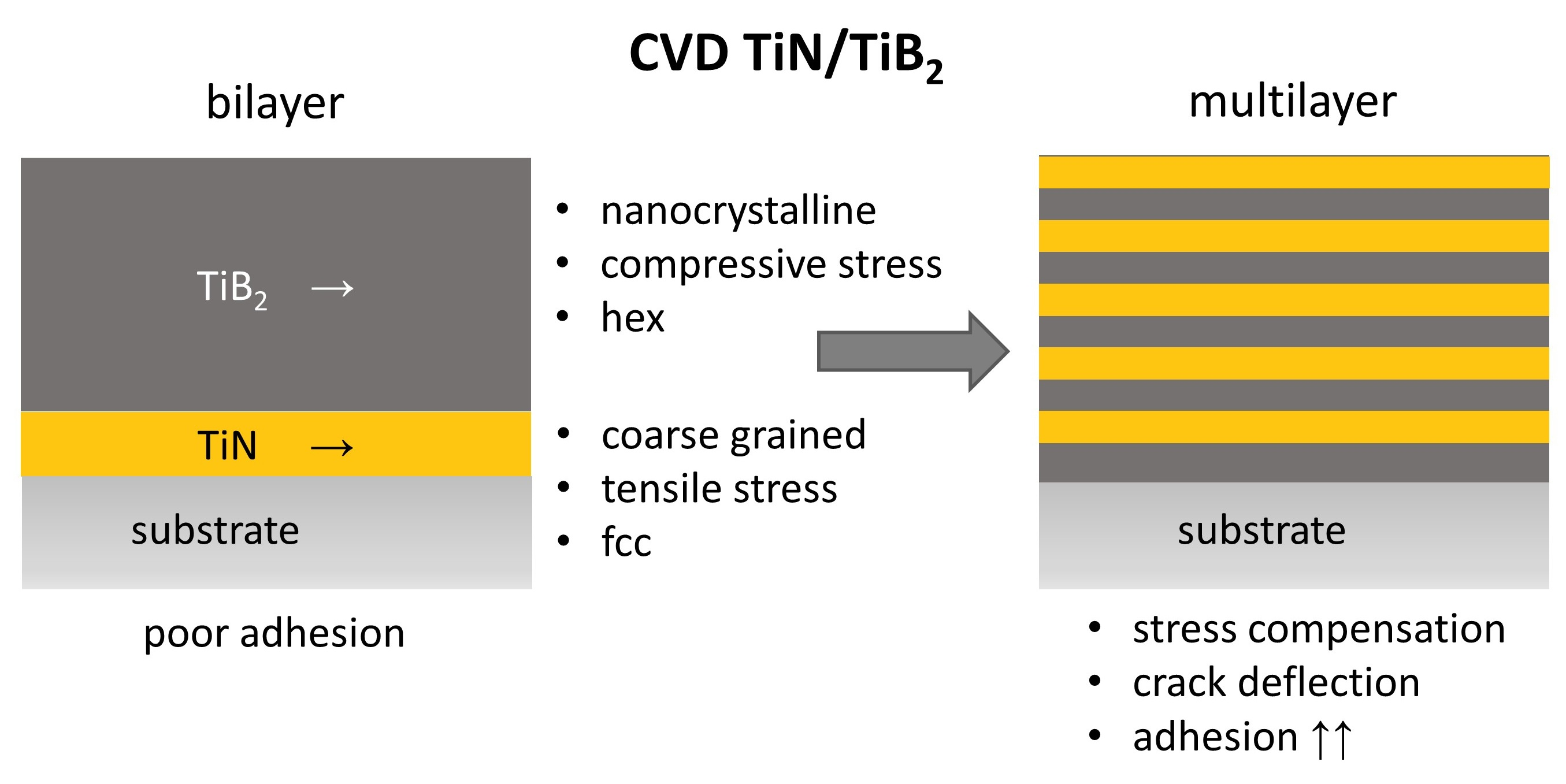
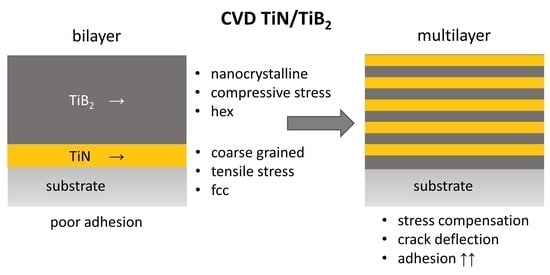
Chemical vapor deposited (CVD) TiB2 coatings are commonly applied in machining of Ti and Ti alloys [1,2,3]. Typically, a TiN diffusion barrier layer is deposited below the TiB2 to prevent B diffusion into the substrate [2,4,5]. TiN and TiB2 are quite different in terms of microstructure and properties. While the face-centered cubic (fcc) TiN exhibits grain sizes in the µm range, the hexagonal (hex) TiB2 is typically nanocrystalline. In contrast to the moderate tensile residual stress of CVD TiN, which is common for these coatings, CVD TiB2 coatings show high compressive residual stress, and while TiN exhibits only a moderate hardness of ~18 GPa, TiB2 yields hardness values of ~45 GPa [2,6,7,8]. The different structure and properties of TiN and TiB2 are reported to result in insufficient adhesion between the TiN diffusion barrier and the main TiB2 layer [7,8]. In a previous work, Tkadletz et al. [7] proposed the implementation of a graded transition from TiN to TiB2 via TiBN to improve adhesion. An alternative approach would be to make use of the different properties and especially the different stress states of the two materials to alleviate the high compressive stress of TiB2 by combining it with TiN in a multilayer architecture. This approach would come with another advantage, since the combination of two materials with such different structures and properties in a multilayer architecture offers the possibility to simultaneously improve hardness and fracture toughness [6,9,10]. Physical vapor deposited multilayer architectures have been extensively investigated [11,12,13,14,15]. There, precise control of nm-scale layer thicknesses is comparatively straightforward. In contrast, comparable multilayer systems produced by thermally activated CVD remain much less explored [6,16,17] due to the higher deposition temperatures and the more complex reaction chemistry, which make the controlled formation of alternating thin layers considerably more challenging. Lim et al. [18] investigated the microstructure, hardness and wear resistance of TiN/TiB2 multilayer coatings with layer thicknesses between 6 and 18 nm deposited by plasma-enhanced CVD. They observed an increasing TiN grain size with increasing TiN layer thickness, while the TiB2 grain size was not affected by layer thickness. As a result, the hardness increased with decreasing TiN layer thickness. However, they studied neither the residual stresses nor the fracture behavior.
The aim of the present study is to investigate the influence of the layer thickness on microstructural and residual stress evolution in TiN/TiB2 coatings grown by thermally activated CVD, and to establish the relationships between coating architecture, microstructure and mechanical properties. Thus, within this work, two TiN/TiB2 multilayer coatings with different bilayer thicknesses λ of ~100 and ~200 nm were synthesized by CVD and the effect of the layer thickness on microstructure, stress state and mechanical properties was studied in detail by X-ray diffraction (XRD), cross-sectional synchrotron X-ray nanodiffraction, scanning transmission electron microscopy (STEM), atom probe tomography (APT), cross-sectional hardness mappings and micromechanical tests. In addition, finite element method (FEM) simulations were performed to verify the assumed stress-free state of the cantilevers for micromechanical testing.

2. Experimental Methods and Simulation Details

Two TiN/TiB2 multilayer coatings were synthesized in an industrial-scale SuCoTec SCT600 TH (SuCoTec, Langenthal, Switzerland) CVD plant. The multilayers were deposited using a cyclic process consisting of TiN deposition, purging, and TiB2 deposition steps. This sequence was repeated 10 times for the coating with a targeted bilayer thickness of ~200 nm (in the following labelled TiN/TiB2 10x) and 30 times for the coating with a targeted bilayer thickness of ~100 nm (labelled TiN/TiB2 30x). Roughly comparable individual layer thicknesses were intended. For the TiN layers, the gas phase composition was controlled using the following flow ratios: TiCl4 (2.2%), N2 (73.8%), and H2 (24%). For the TiB2 layers, a gas mixture consisting of TiCl4 (0.6%), BCl3 (1.2%), H2 (2.4%), HCl (0.2%) and Ar (95.6%) was used. The deposition temperature was ~800 °C and the pressure ~900 mbar. The deposition times for the TiN layers were 15 and 5 min and for the TiB2 layers 7 min and 2 min 30 s, for TiN/TiB2 10x and TiN/TiB2 30, respectively. The purging step lasted 2 min using a gas mixture of Ar (75%) and N2 (25%) at 800 °C. Cemented carbide inserts in SNUN 120412 geometry (according to ISO 1832 [19]) served as substrates.
The phase composition of the coatings was investigated by XRD using a Bruker D8 Advance diffractometer (Bruker, Billerica, MA, USA) in detector scan mode with an incidence angle of 2°, in a 2θ range between 20 and 80° using a step size of 0.02° and a measurement time of 1 s per step. For the determination of average in-plane residual stress in the respective layers, a Rigaku SmartLab 5-axis diffractometer (Rigaku Corporation, Tokyo, Japan) was used and the sin2ψ method was applied. Both diffractometers were equipped with Cu Kα radiation. The 101 peak was measured and 10 inclinations between 0 and 0.8 sin2ψ were recorded. The X-ray elastic constants for fcc-TiN and hex-TiB2 were determined from their single crystal elastic constants according to the Hill model [20,21,22], allowing the estimation of residual stresses from the measured strains. For microstructural investigation, half-grid type samples were prepared by fs-laser machining utilizing a 3D-Micromac microPREP PRO FEMTO laser micromachining system (3D-Micromac AG, Chemnitz, Germany) and the approach described in ref. [23]. Subsequently, the pre-thinned windows on the half-grids were further thinned using a Zeiss Auriga SEM/FIB workstation (Carl Zeiss Microscopy GmbH, Oberkochen, Germany) until electron transparency was achieved. A detailed investigation of the cross-sectional microstructure was performed by STEM and transmission Kikuchi diffraction (TKD) utilizing a Zeiss Gemini 450 scanning electron microscope (SEM) (Carl Zeiss Microscopy GmbH, Oberkochen, Germany) and an Oxford Symmetry S2 EBSD camera/detector. The SEM was equipped with an energy dispersive X-ray spectroscopy (EDS) Oxford Ultim Extreme windowless detector (Oxford Instruments NanoAnalysis, High Wycombe, UK), which was used for elemental mapping of the coating cross-sections. For a detailed study of the elemental distribution, the TiN/TiB2 30x coating was investigated by APT using a CAMECA LEAP 3000X HR (CAMECA, Madison, WI, USA) operated at 60 K in laser-assisted mode, at a laser pulse energy of 0.6 nJ per pulse, a pulse rate of 250 kHz and a detection rate of 1%. The APT specimens were also prepared using a 3D-Micromac microPREP PRO FEMTO laser micromachining system and finalized by subsequent annular FIB milling using a dual-beam SEM/FIB FEI Dual Beam Versa 3D (FEI Company, Hillsboro, OR, USA), according to ref. [23]. The obtained data was evaluated using CAMECA IVAS 3.6.14 software. In addition, lamellas of both coatings with thicknesses of ~10 µm were prepared using a Struers Accutom 50 (Struers, Ballerup, Denmark), equipped with a diamond cutting wheel, and subsequently thinned using a Hitachi IM 4000+ broad Ar+ ion milling system (Hitachi High-Tech Corporation, Tokyo, Japan) to enable a depth-resolved analysis of the residual stress utilizing synchrotron X-ray nanodiffraction [24]. The lamellas were scanned with a monochromatic X-ray beam with a photon energy of 15.65 keV and a beam diameter of <50 nm in steps of 50 nm across the coating thickness. The obtained Debye–Scherrer rings were integrated using pyFAI (version 2025.1.0) [25] and the strain was determined from the distortion of the rings according to previously established methods [24,26]. The same X-ray elastic constants described for lab XRD above were used to obtain the residual stresses.
Cross-sections of both multilayer coatings were prepared for hardness mappings using a Hitachi IM5000 ion milling system (Hitachi High-Tech Corporation, Tokyo, Japan), with a subsequent polishing step applying the above-mentioned Zeiss Auriga FIB milling system (Carl Zeiss Microscopy GmbH, Oberkochen, Germany). Hardness indentation mapping was performed utilizing a Hysitron TriboIndenter TI950 equipped with a cube corner indenter (provided by Synton-MDP Ltd., Nidau, Switzerland) in displacement-controlled mode at a maximum displacement of 10 nm. The scan area was 2 × 2 µm with an array of 10 × 20 indents with a spacing of 50 nm. Before and after measurement, the scan area was inspected using scanning probe microscopy (SPM). In addition, two sets, notched and un-notched, of micro-cantilevers of both coatings were prepared by FIB milling, using the above-mentioned FEI Dual Beam Versa 3D, to allow the determination of fracture toughness and fracture stress, respectively. The cantilevers were loaded using the same Hysitron Intender as was employed for hardness mapping and a cono-spherical diamond tip with a radius of 750 nm (provided by Synton-MDP Ltd.) until fracture occurred. A displacement rate of 50 nm/s was applied. The fracture stress and toughness were determined considering the cantilever geometry and the load-displacement curves, according to the method proposed by Matoy et al. [27]. Three notched and three un-notched cantilevers were tested to obtain reliable statistics. Post-mortem, the depth of the notch and the fracture cross-sections were investigated using SEM.
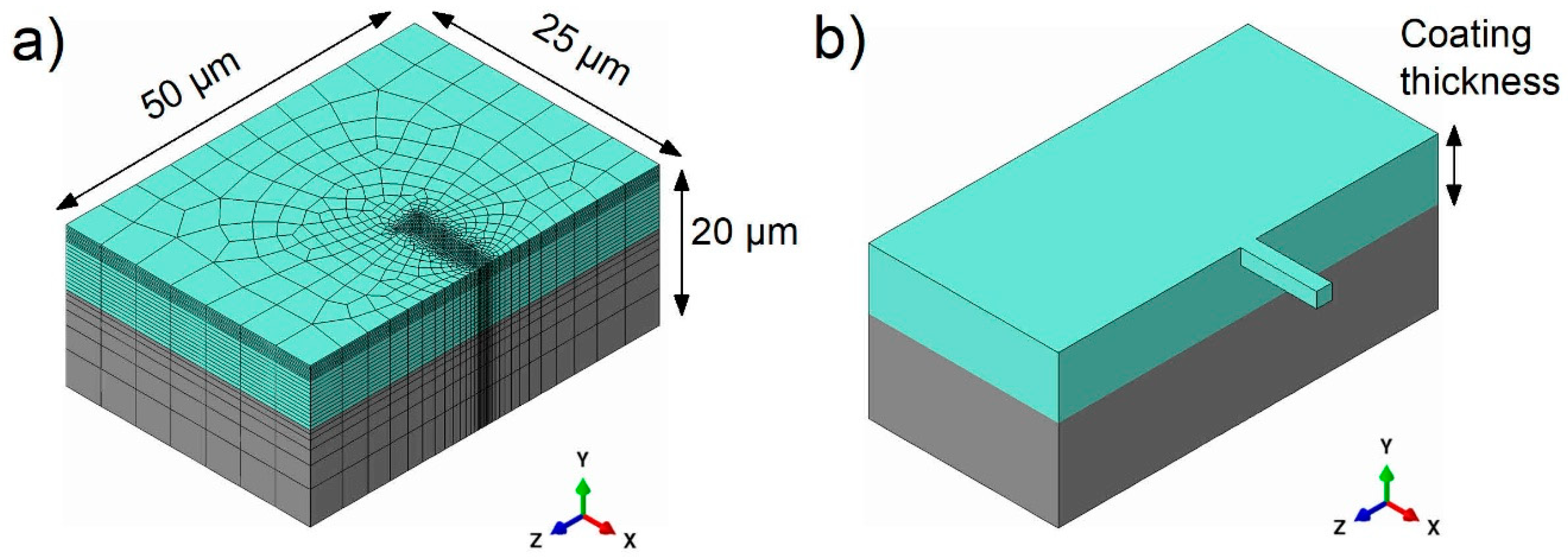
Complementary to this, FEM simulations were performed to determine if the generally acknowledged assumption that the residual stress in free-standing micro-cantilevers is relaxed is also valid for such multilayer architectures. Thus, a FE model to simulate the process of free-cutting a micro-cantilever out of different coating materials on the same cemented carbide substrate was developed using the commercial software package Abaqus (https://www.3ds.com/, accessed on 19 January 2026) [28]. The simulation model consisted of a brick-shaped box where residual stresses were applied. Then, the micro-cantilever was cut free by deleting the surrounding elements, meeting the modelling approach from Konstantiniuk et al. [29], as shown in Figure 1.
The outer areas of the box were constrained in the perpendicular direction, representing infinite material bulk, except for the surface area and the front x-plane in Figure 1b. The FE mesh consisted of roughly 80,000 brick elements with quadratic shape functions and element sizes ranging from 0.1 to 3.0 µm. Linear elastic material behavior was defined for all investigated materials and layer thicknesses, and equi-biaxial residual stresses were applied as experimentally determined. A static mechanical step was calculated to investigate the deflections of the micro-cantilever due to cutting it free, depending on the layer materials and residual stresses. The elastic material definitions for all investigated materials are given in Table 1.

3. Results and Discussion

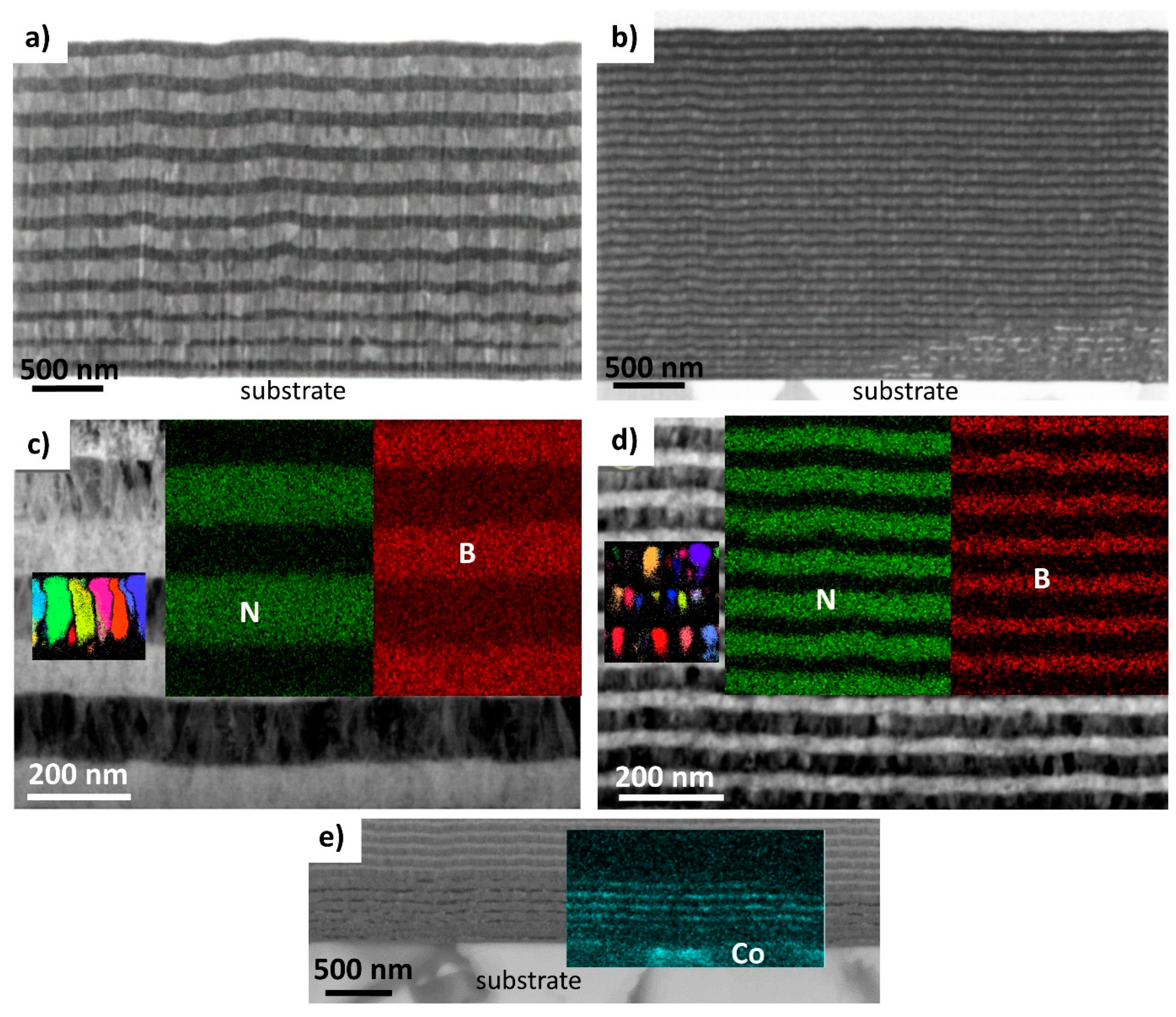
In Figure 2a,b, STEM images of the cross-sections, showing overviews of both coatings, TiN/TiB2 10x and TiN/TiB2 30x, are presented. The respective TiN and TiB2 layers can be clearly distinguished, where TiN layers show a bright and TiB2 layers a darker contrast. For both multilayers, the layer thicknesses seem to slightly increase with increasing coating thickness. In the micrograph of TiN/TiB2 30x in Figure 2b, there is a brighter region visible in the bottom right region close to the interface with the substrate. To clarify the origin of the different contrast, this region was investigated in more detail. The EDS map of this region in Figure 2e shows significant enrichment in Co, especially in the TiN layers, emphasizing the importance of an effective diffusion barrier between substrate and coating. Figure 2c,d show a higher magnification of the coatings, superimposed with EDS maps of N and B and TKD images. For both coatings, the TiB2 layers could not be indexed by TKD due to the low grain size. Grain sizes in the nm range are commonly reported for B-containing CVD coatings [5,33,34,35,36]. However, the TKD images of the TiN layers show that, for both coatings, the TiN grain size correlates with the layer thickness. The determined individual layer thicknesses in the region shown in Figure 2c are ~130 nm for TiN and ~90 nm for TiB2, corresponding to a bilayer thickness of ~220 nm in the TiN/TiB2 10x coating. For TiN/TiB2 30x (Figure 2d), the layer thicknesses are ~45 and ~35 nm for the TiN and TiB2 layers, respectively, corresponding to a bilayer thickness of ~80 nm. According to the EDS maps, there seems to be some B present in the TiN layer and, to a lesser extent, also some N in the TiB2 layer; however, considering the resolution of EDS and the vicinity of Ti-Lα and N-Kα in the EDS spectrum, these might be artefacts.
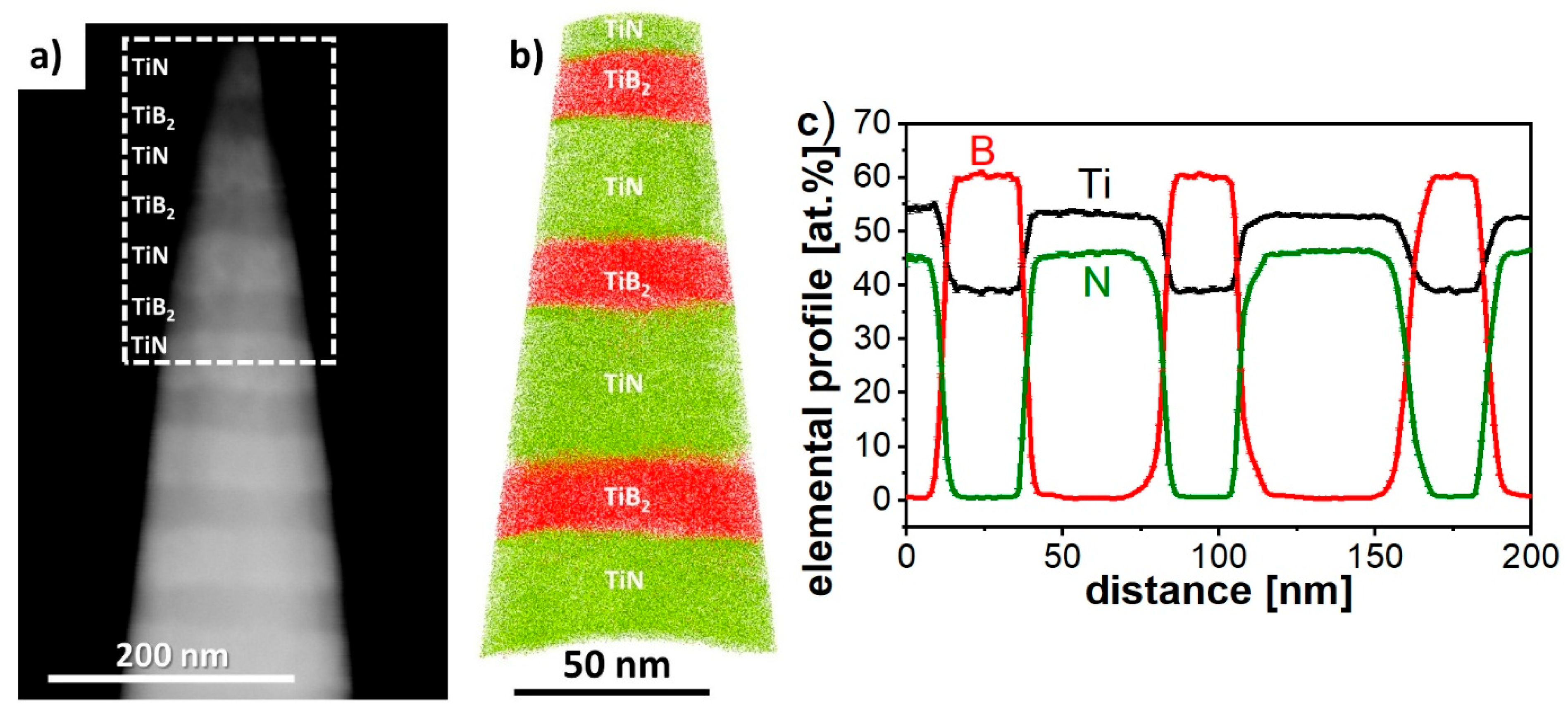
Thus, APT of TiN/TiB2 30x was performed to evaluate potential B diffusion into the TiN layers. In Figure 3a, a STEM image of the APT specimen can be seen, where the TiN (brighter) and TiB2 (darker) layers can be clearly distinguished. The 3D reconstruction of the measured APT data is shown in Figure 3b, encompassing several layers. It seems that the layers are rather well separated, which is corroborated by the corresponding elemental profile shown in Figure 3c. There, it is visible that no pronounced B diffusion occurs during deposition, despite the high deposition temperature and that the multilayer is indeed composed of TiN and TiB2 layers. The understoichiometry with respect to N can be attributed to the dissociation of N-containing molecular ions and multiple detection events [37,38]. While this effect has been extensively investigated for TiN, no systematic studies are available for TiB2. Nevertheless, it is reasonable to assume that a similar mechanism is responsible for the underestimation of B in TiB2.
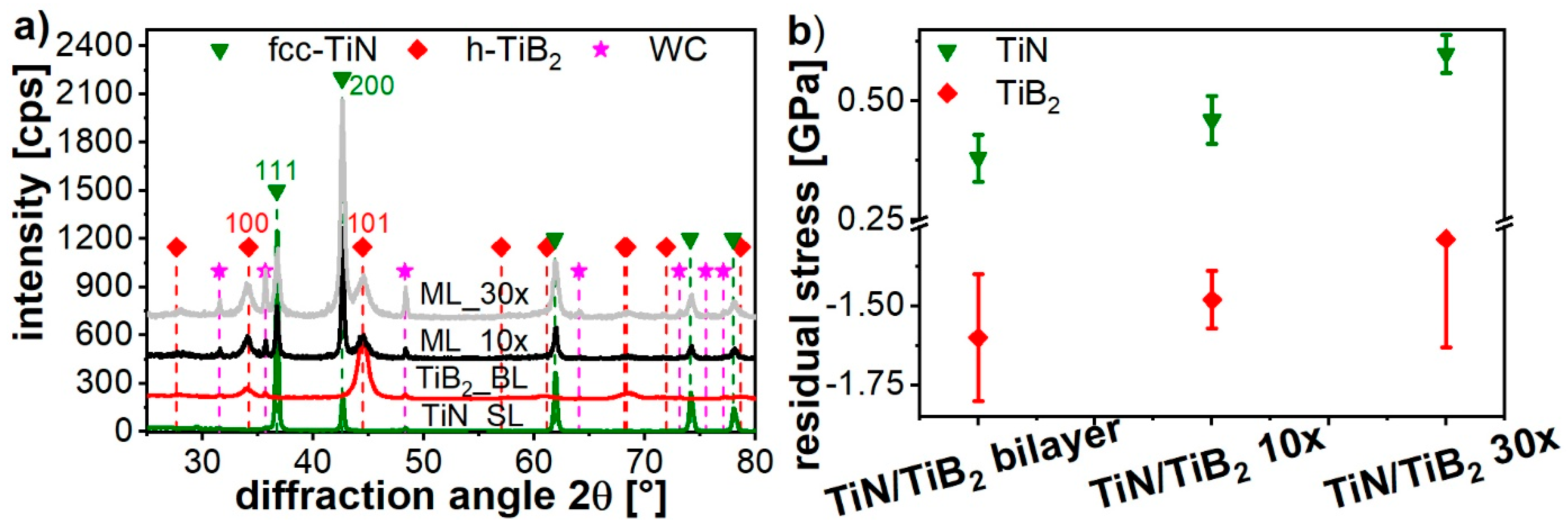
In Figure 4a, X-ray diffractograms of the two multilayer coatings are compared to a corresponding TiN single-layer and a conventional TiN/TiB2 bilayer reference coating, which are discussed in detail in ref. [8]. The X-ray diffractograms of the two multilayer coatings confirm the presence of fcc-TiN and hex-TiB2. Apart from WC peaks, stemming from the substrate, no further phases can be detected. The diffractograms of the two multilayers are comparable. In both cases, the fcc-TiN 200 peak at a 2θ angle of ~42.6° is the most pronounced one. This is not the case for the TiN single-layer coating, where the 111 peak at ~36.7° is the most pronounced one. For the TiB2 reference coating, the 101 peak at ~44.4° is the dominating one, while the TiB2 layers within the multilayers show distinct 100 and 101 peaks. Since TiN in the multilayer exhibits a dominant 200 peak, while the TiB2 shows a mixed 100/101 orientation, an epitaxial relationship between the layers is unlikely. However, local epitaxy [39] cannot be completely ruled out, and the different texture in the multilayers compared to the corresponding single- and bilayers suggest interface effects affecting the growth [40]. On closer inspection, it can be seen that, in particular, the TiN peaks in TiN/TiB2 30x are slightly broader than the ones in TiN/TiB2 10x, indicating a smaller domain (grain) size and/or increased micro-strain [41], which is in good agreement with the TKD images in Figure 2c,d. In Figure 4b, the average residual stresses determined in the TiN and TiB2 layers of both multilayer coatings are compared to stresses of the conventional bilayer reference coating. It can be seen that the compressive residual stress in the TiB2 layer of the bilayer coating is highest and decreases when increasing the bilayer number from 10x to 30x, and thus is related to the layer thickness. The presence of high compressive stress in CVD TiB2 layers is frequently reported in the literature [2,3,7,42]. In contrast to TiB2, the TiN layers exhibit tensile residual stress, which is also reported in the literature [2] and is more common in CVD coatings, due to their high deposition temperatures and the different thermal expansion coefficients of cemented carbide substrates and coating materials [43]. However, while the compressive stresses in the TiB2 layers decrease with decreasing layer thickness, the opposite is the case for TiN, where the tensile stress increases with decreasing layer thickness. Thus, the stress difference between the layers stays roughly constant. Despite the rather pronounced difference in stresses between TiN and TiB2 layers, all three coatings showed no obvious adhesion problems between the layers.
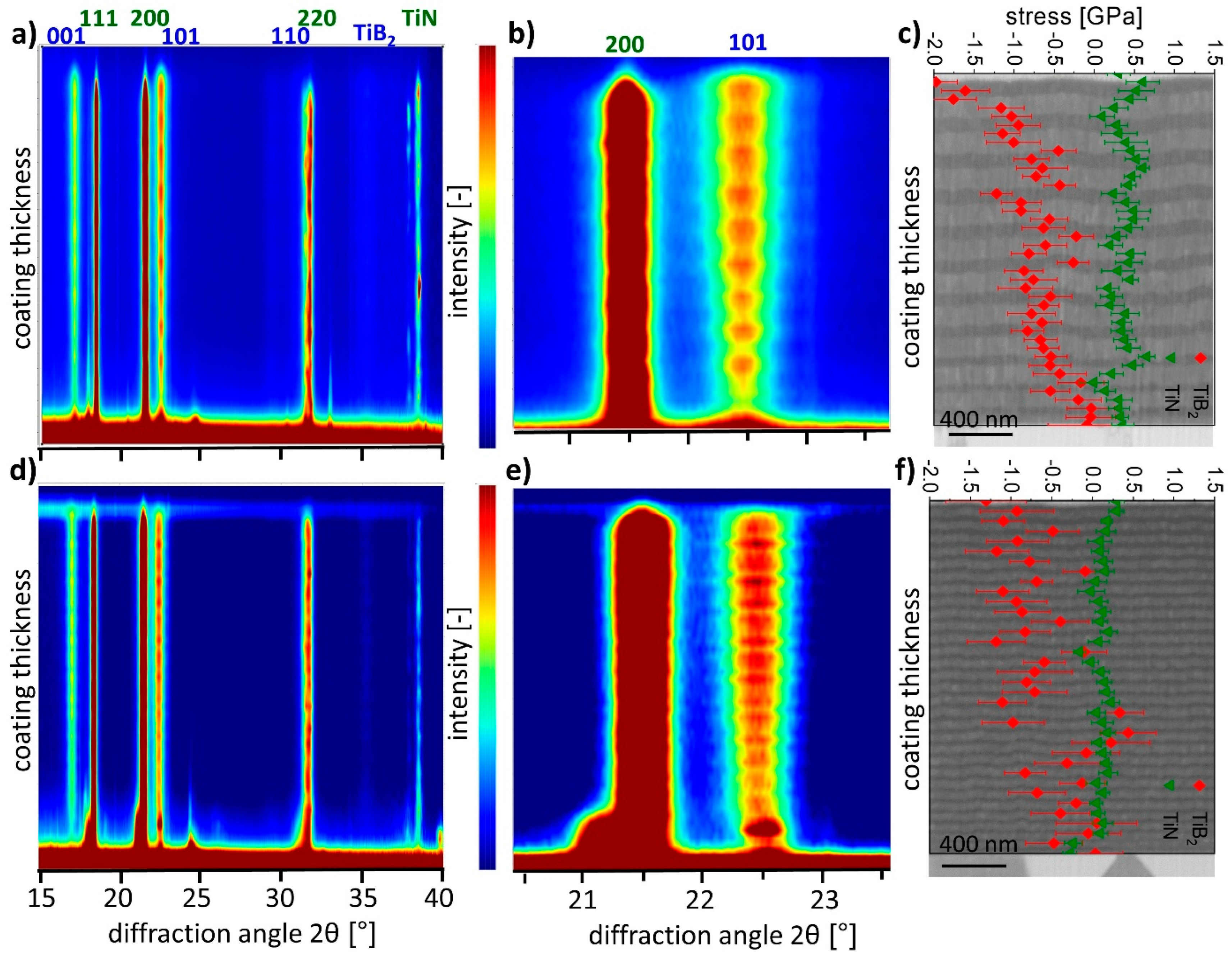
Since sin2ψ evaluation gives only the average residual stresses of the respective layers, the evolution of residual stresses across the coating thickness was studied in detail using synchrotron X-ray nanodiffraction. In Figure 5a,d, the phase evolution across the coating thickness is shown for the TiN/TiB2 10x and TiN/TiB2 30x coatings, respectively. Analogously to laboratory X-ray diffraction, fcc-TiN and hex-TiB2 can be observed. On a closer look, the layer structure is visible, especially when considering the 101 TiB2 peak. Thus, this peak and the neighboring 200 TiN peak are shown in more detail in Figure 5b,e, again for the TiN/TiB2 10x and TiN/TiB2 30x coatings, respectively, where even for the TiN/TiB2 30x coating the layered structure is evident. Furthermore, it seems that the 101 TiB2 peak broadens with increasing coating thickness, which indicates a decreasing grain size and/or increasing micro-strain due to an increased amount of point defects [41]. This is in excellent agreement with the observed slight decrease in the grain size and increasing defect density with increasing TiB2 thickness in the TiN/TiB2 bilayer coating in ref. [2]. In Figure 5c,f, the residual stress gradients for both coatings are shown. The low tensile stress of the TiN layers stays roughly constant over the thickness for both coatings. The average value of ~0.5 GPa for TiN/TiB2 10x is in excellent agreement with the value obtained from lab XRD (Figure 4b). However, for TiN/TiB2 30x there is a discrepancy, since using lab XRD higher tensile stress as for the TiN/TiB2 10x was determined in TiN, while the opposite is the case in the synchrotron evaluation. This can be related to the small size of the X-ray beam probe (<50 nm) compared to the TiN grain sizes (Figure 2c,d), which may result in sampling of an insufficient number of grains to determine the true grain-average residual stress, yielding unreliable results. In contrast to TiN, which does not show a gradient, the compressive stress of TiB2 in the TiN/TiB2 10x coating significantly increases with increasing coating thickness. A stress gradient with increasing compressive stress towards the surface is also observed within TiB2 in the TiN/TiB2 bilayer coating, indicating that this feature is at least partially intrinsic to the growth behavior of TiB2, driven by microstructural and defect evolution [2]. Since the grain size of the TiB2 is not governed by the layer thickness and, according to Figure 5b, the grain size decreases and/or the defect density increases with increasing coating thickness, which is in excellent agreement with the bilayer coating [2], it seems reasonable to assume that the fundamental mechanism causing the stress gradient is the same. However, in the multilayer, this gradient is altered and shifted to lower stress values, suggesting that softer TiN layers can partially accommodate the stress generated in the strong covalently bonded TiB2 layers during the early stages of multilayer growth. As more TiB2 layers are added, the individual layer thickness slightly increases and the stack thickens, the TiB2 layers become dominant, while the influence of TiN is limited, resulting in the observed compressive stress gradient in TiB2, while the stress state of TiN remains essentially unchanged. The average magnitude of the stress is comparable with the value obtained from lab XRD (Figure 4b). For TiN/TiB2 30x, a pronounced scattering of the values is visible, which can again be attributed to the very small X-ray beam diameter.
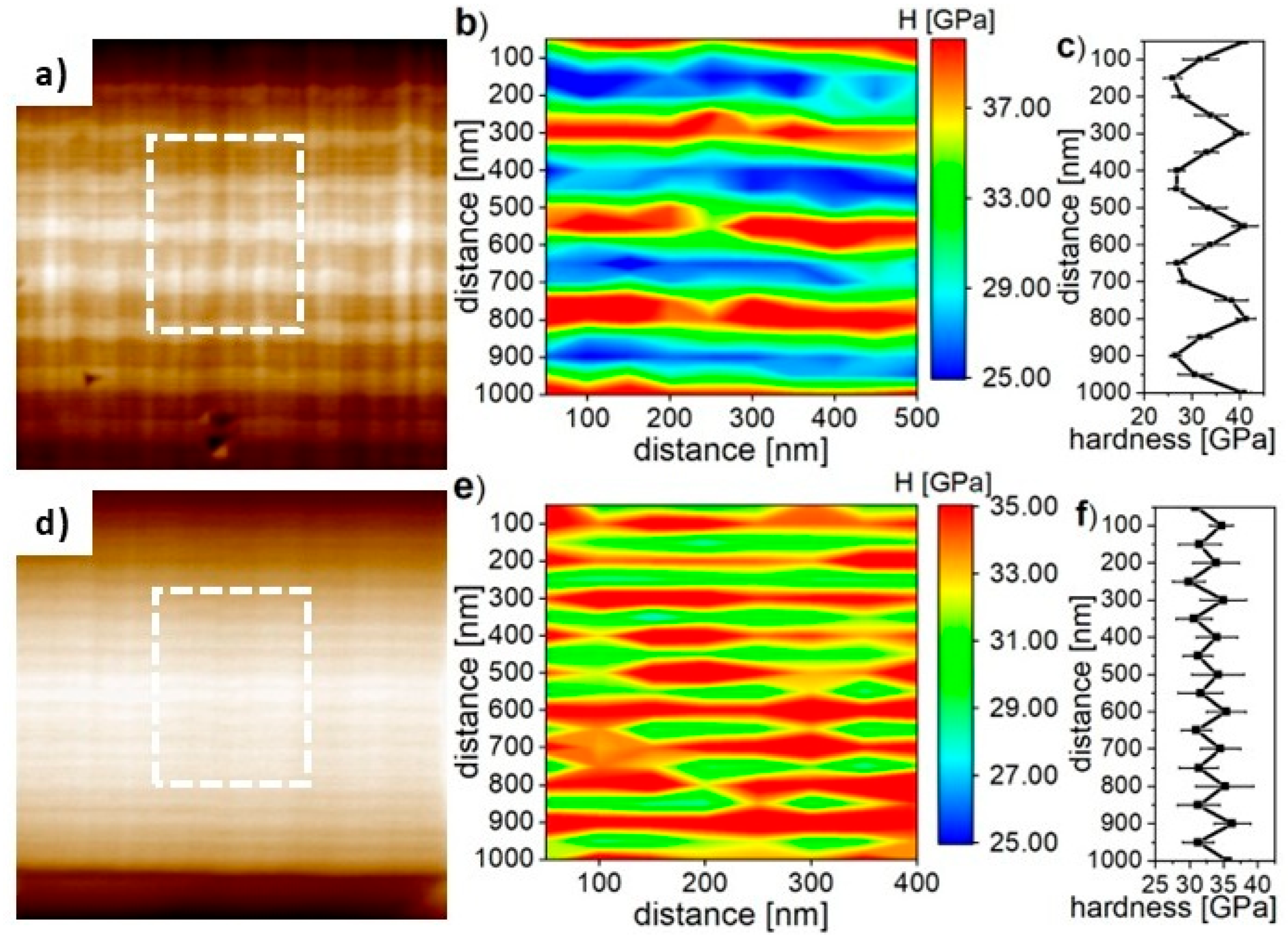
In the SPM gradient image of the TiN/TiB2 10x coating in Figure 6a, the individual layers can clearly be distinguished. The hardness mapping in Figure 6b, corresponding to the region marked in Figure 6a, also clearly reflects the layered structure. The hardness values range from ~25 to ~40 GPa, which is even more visible in the hardness evolution in Figure 6c. Typical hardness values for CVD TiN are around or even below 20 GPa [6,7,8,44]. The corresponding TiN single-layer reference coating exhibits a hardness of ~18 GPa [8]. Thus, the hardness value of the TiN layers is significantly higher at ~25 GPa, which can be related to the much finer-grained structure of TiN in the multilayer compared to thicker TiN in single layers [8]. The hardness of the TiB2 layer is ~41 GPa, which is in excellent agreement with the literature [2,5,7] and the corresponding bilayer reference coating which exhibits also a hardness of ~41 GPa [8]. The excellent agreement can be attributed to the comparable grain size of TiB2 in the multilayer and single-layer reference coatings [8]. Also, for the TiN/TiB2 30x coating, the individual layers can still be distinguished in the SPM gradient image (Figure 6d). However, the hardness values for this coating range between ~30 and ~35 GPa (Figure 6e,f) and thus reach neither the expected values for TiN nor for TiB2, which can be related to an averaging effect caused by the measurement step size being larger than the layer thickness.
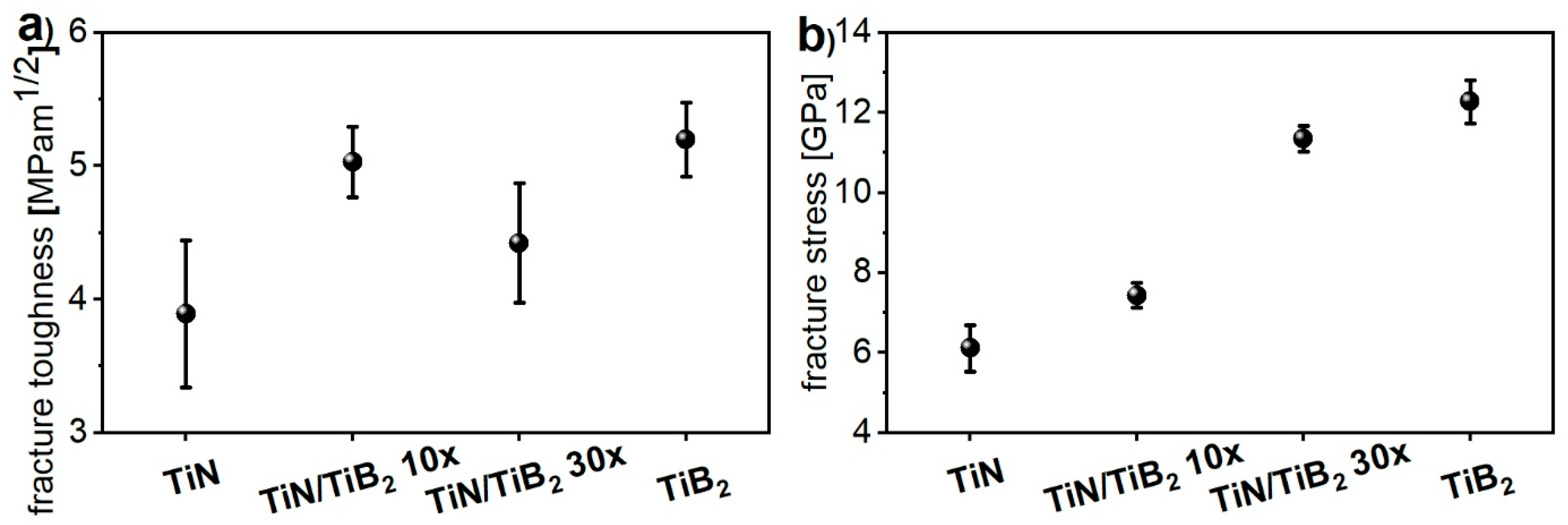
The fracture toughness of TiN/TiB2 30x lies between the values of the TiN and TiB2 reference coatings (Figure 7a) [8], while that of TiN/TiB2 10x approaches that of the TiB2 single layer. Also, the fracture stress of the multilayers does not exceed the values of the single layers (Figure 7b), where, in contrast to the fracture toughness, TiN/TiB2 30x shows a higher value, which is close to that of the TiB2 single layer. The higher fracture stress observed for TiN/TiB2 30x might be attributed to the increased number of interfaces, which can deflect cracks. For the obtained fracture toughness, the exact position of the notch is assumed to influence the result: cracks originating in the strong covalently bonded and brittle TiB2 layers are more likely to propagate rapidly than those initiating in the more ductile TiN. However, the fracture properties of the multilayers lie between the values of the corresponding reference coatings, indicating on the one hand excellent adhesion between the layers and on the other hand a composite-type load sharing rather than an interface-dominated mechanism [9].
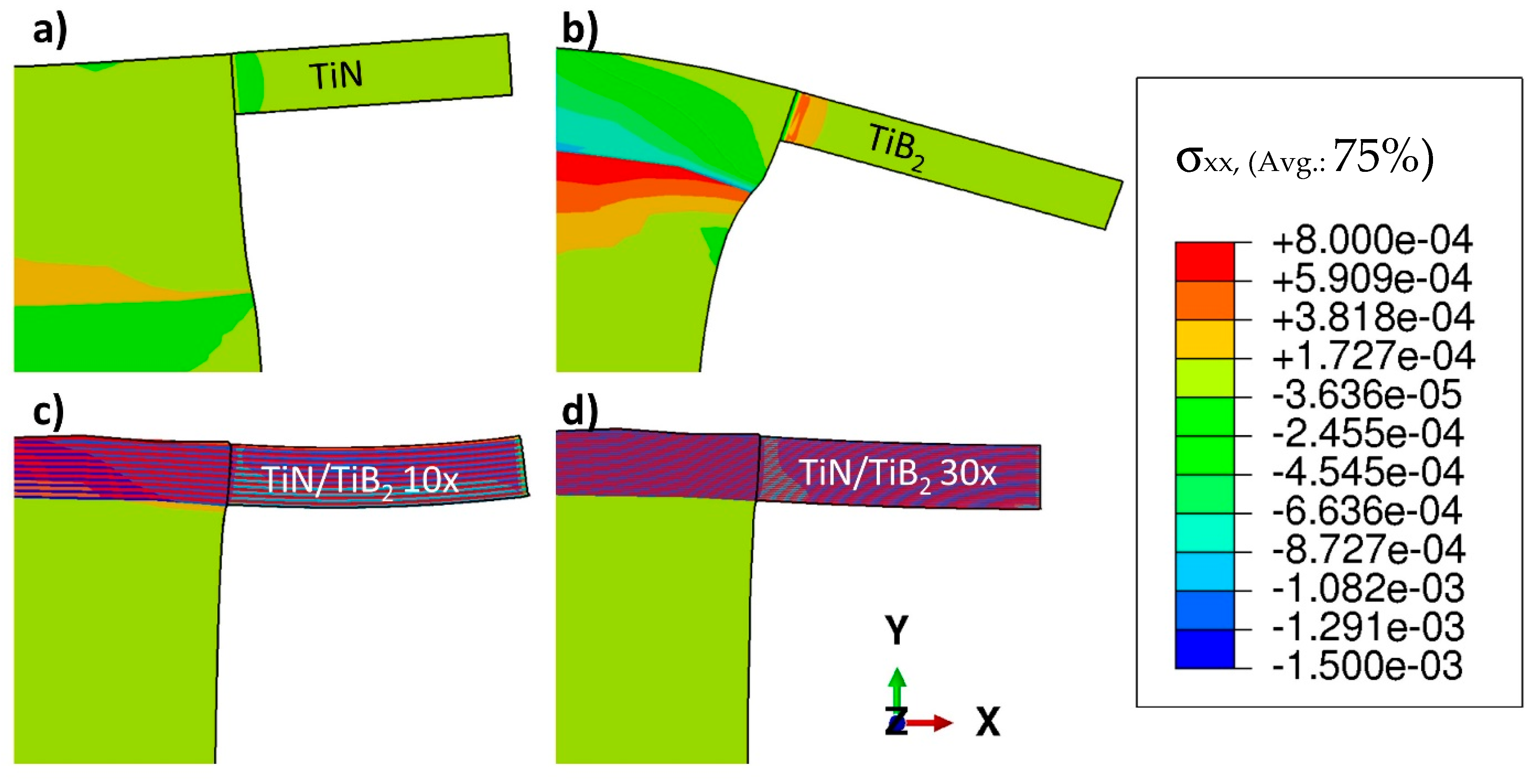
In general, it is assumed that the residual stresses are relaxed in free-standing coating cantilevers [26]. This assumption was reviewed using FEM simulations. As the initial stress state before free-cutting of the cantilevers, the residual stresses summarized in Figure 4b were considered. Figure 8a,b show that, for the single-layer TiN and TiB2 coatings the stresses are indeed almost completely relaxed, with the exception of the region close to the cantilever support, which is accompanied by deformation of the system (please note that the deformation in Figure 8 is exaggerated 100 times for better visibility). For the two multilayer coatings, the picture is completely different; there, only minor stress relaxation due to free-cutting of the cantilever can be observed, as visible in Figure 8c,d. Retained residual stress can locally modify the stress intensity at the crack tip and thereby affect the apparent fracture properties. However, in the present case, alternating tensile and compressive residual stresses act in opposite directions, partially compensating each other, which is in agreement with the measured fracture properties of the multilayer which lie in between those of the reference coatings (Figure 7).

4. Conclusions

Two TiN/TiB2 multilayer coatings with bilayer periods of ~80 and ~220 nm were synthesized by chemical vapor deposition. Their microstructure and properties were investigated in detail with special focus on cross-sectional characterization, and were compared to corresponding single- (TiN) or bilayer (TiN/TiB2) reference coatings. Transmission Kikuchi diffraction showed that the grain size of TiN layers correlates with the layer thickness, while the TiB2 grain size is significantly lower. This is also in agreement with the broader fcc-TiN diffraction peaks observed for the coating with lower bilayer thickness compared to the one with higher bilayer thickness and the single-layer reference coating, while the hex-TiB2 peaks appear unaffected. Atom probe tomography evidenced that the layers are well separated and that no pronounced interdiffusion occurs. Hardness measurements on cross-sections within the individual layers of the coating with the bilayer period of ~200 nm revealed a significantly higher hardness (~25 GPa) of the TiN layers compared to the corresponding single-layer reference coating (~18 GPa), which could be related to the much finer grain size of TiN in the multilayer compared to the single layer. In contrast, the hardness of the TiB2 layers (~41 GPa) was in excellent agreement with that of TiB2 of the corresponding bilayer, which can be attributed to the comparable grain size. In the multilayer coating with the lower bilayer period of ~80 nm, the cross-sectional hardness values of ~30–35 GPa result from an averaging effect due to the indentation step size (50 nm) being larger than the individual layer thickness. The compressive residual stress in the TiB2 layers decreases with decreasing layer thickness, while the tensile residual stress in the TiN layers increases, resulting in a roughly constant stress difference between the layers, which is also comparable to the conventional TiN/TiB2 bilayer reference coating. The stress gradients obtained by synchrotron X-ray nanodiffraction for the multilayer with the higher bilayer period of ~200 nm show that the low tensile stress in the TiN layers is roughly constant across the thickness and is in agreement with the value obtained from lab XRD. In contrast, the compressive stress of TiB2 significantly increases with increasing coating thickness, indicating that compressive stress can be partially alleviated by the softer TiN, but with increasing coating thickness the strong covalently bonded TiB2 increasingly governs the behavior of the stack. For the multilayer coating with the lower bilayer thickness, the small beam diameter yielded unreliable results. The fracture properties of both multilayers, obtained by micro-cantilever bending tests, range between the values of the corresponding reference coatings. Complementary finite element method simulations revealed that, for multilayer coatings, the common assumption of a stress-free state of micro-cantilevers used for bending tests is not valid. To conclude, the layer thickness was, even for the coating with the lower bilayer period, too large for pronounced interface effects on the properties. Nevertheless, unlike conventional bilayers, the multilayers exhibited excellent adhesion.

Author Contributions

Conceptualization, N.S. and M.T.; methodology, N.S., M.T., M.K., J.K. and J.T.; software, M.K.; validation, N.S. and M.T.; formal analysis, N.S., M.T., A.L. and B.S.; investigation, M.T., A.L., M.K. and B.S.; resources, C.C., W.E. and M.B.; data curation, N.S. and M.T.; writing—original draft preparation, N.S.; writing—review and editing, M.T., J.K., J.T. and W.E.; visualization, N.S. and M.T.; project administration, N.S. and M.T.; funding acquisition, N.S. and M.T. All authors have read and agreed to the published version of the manuscript.

Funding

Financial support from the Austrian Federal Ministry of Labor and Economy, the National Foundation for Research, Technology and Development and the Christian Doppler Research Association is gratefully acknowledged. The authors gratefully acknowledge financial support under the scope of the COMET programme within the K2 Center “Integrated Computational Material, Process and Product Engineering” (IC-MPPE) (Project No. 886385). This programme is supported by the Austrian Federal Ministries for Economy, Energy and Tourism (BMWET) and for Innovation, Mobility and Infrastructure (BMIMI), represented by the Austrian Research Promotion Agency (FFG) and the federal states of Styria, Upper Austria and Tyrol. We acknowledge the European Synchrotron Radiation Facility (ESRF) for provision of synchrotron radiation facilities under proposal MI1216 and on beamline ID13.

Institutional Review Board Statement

Not applicable.

Informed Consent Statement

Not applicable.

Data Availability Statement

The data presented in this study are available on request from the corresponding author.

Acknowledgments

Christina Kainz is acknowledged for her experimental support in the determination of the fracture properties. We thank Martin Rosenthal for assistance and support during the beam time. The authors used ChatGPT (www.openai.com, GPT-5.3) for language editing to improve the clarity and grammar of the manuscript. The authors take full responsibility for the content of the publication.

Conflicts of Interest

Authors Martin Krobath, Bernhard Sartory, and Werner Ecker were employed by the company Materials Center Leoben Forschung GmbH. Author Christoph Czettl was employed by the company CERATIZIT Austria GmbH. The remaining authors declare that the research was conducted in the absence of any commercial or financial relationships that could be construed as a potential conflict of interest.

References

  1. Schleinkofer, U.; Czettl, C.; Michotte, C. Coating Applications for Cutting Tools. In Comprehensive Hard Materials; Sarin, V.K., Llanes, L., Mari, D., Nebel, C.E., Eds.; Elsevier: London, UK, 2014; pp. 453–469. [Google Scholar]
  2. Schalk, N.; Keckes, J.; Czettl, C.; Burghammer, M.; Penoy, M.; Michotte, C.; Mitterer, C. Investigation of the Origin of Compressive Residual Stress in CVD TiB2 Hard Coatings Using Synchrotron X-Ray Nanodiffraction. Surf. Coat. Technol. 2014, 258, 121–126. [Google Scholar] [CrossRef]
  3. Czettl, C.; Thurner, J.; Schleinkofer, U. Knowledge Based Coating Design of CVD TiN-TiBN-TiB2 architecture. Int. J. Refract. Met. Hard Mater. 2018, 71, 330–334. [Google Scholar] [CrossRef]
  4. Holzschuh, H. Chemical-Vapor Deposition of Wear Resistant Hard Coatings in the Ti–B–C–N System: Properties and Metal-Cutting Tests. Int. J. Refract. Met. Hard Mater. 2002, 20, 143–149. [Google Scholar] [CrossRef]
  5. Holzschuh, H. Deposition of Ti–B–N (Single and Multilayer) and Zr–B–N Coatings by Chemical Vapor Deposition Techniques on Cutting Tools. Thin Solid Films 2004, 469–470, 92–98. [Google Scholar] [CrossRef]
  6. Kainz, C.; Schalk, N.; Tkadletz, M.; Mitterer, C.; Czettl, C. Microstructure and Mechanical Properties of CVD TiN/TiBN Multilayer Coatings. Surf. Coat. Technol. 2019, 370, 311–319. [Google Scholar] [CrossRef]
  7. Tkadletz, M.; Schalk, N.; Mitterer, C.; Keckes, J.; Pohler, M.; Czettl, C. Cross-Sectional Characterization Techniques as the Basis for Knowledge-Based Design of Graded CVD TiN-TiB2 coatings. Int. J. Refract. Met. Hard Mater. 2018, 71, 280–284. [Google Scholar] [CrossRef]
  8. Tkadletz, M.; Schalk, N.; Lechner, A.; Hatzenbichler, L.; Holec, D.; Hofer, C.; Deluca, M.; Sartory, B.; Lyapin, A.; Julin, J.; et al. Influence of B Content on Microstructure, Phase Composition and Mechanical Properties of CVD Ti(B,N) Coatings. Materialia 2022, 21, 101323. [Google Scholar] [CrossRef]
  9. Wang, Y.X.; Zhang, S. Toward Hard yet Tough Ceramic Coatings. Surf. Coat. Technol. 2014, 258, 1–16. [Google Scholar] [CrossRef]
  10. Kolednik, O.; Predan, J.; Fischer, F.D.; Fratzl, P. ScienceDirect Improvements of Strength and Fracture Resistance by Spatial Material Property Variations. Acta Mater. 2014, 68, 279–294. [Google Scholar] [CrossRef]
  11. Berger, M.; Larsson, M. Mechanical Properties of Multilayer PVD Ti/TiB2 Coatings. Surf. Eng. 2000, 16, 122–126. [Google Scholar] [CrossRef]
  12. PalDey, S.; Deevi, S.C. Single Layer and Multilayer Wear Resistant Coatings of (Ti, Al)N: A Review. Mater. Sci. Eng. A 2003, 342, 58–79. [Google Scholar] [CrossRef]
  13. Ulrich, S.; Ziebert, C.; Stüber, M.; Nold, E.; Holleck, H.; Göken, M.; Schweitzer, E.; Schlooßmacher, P. Correlation between Constitution, Properties and Machining Performance of TiN/ZrN Multilayers. Surf. Coat. Technol. 2004, 188–189, 331–337. [Google Scholar] [CrossRef]
  14. Pei, F.; Liu, H.J.; Chen, L.; Xu, Y.X.; Du, Y. Improved Properties of TiAlN Coating by Combined Si-Addition and Multilayer Architecture. J. Alloys Compd. 2019, 790, 909–916. [Google Scholar] [CrossRef]
  15. Yalamanchili, K.; Schramm, I.C.; Jiménez-Piqué, E.; Rogström, L.; Mücklich, F.; Odén, M.; Ghafoor, N. Tuning Hardness and Fracture Resistance of ZrN/Zr0.63Al0.37N Nanoscale Multilayers by Stress-Induced Transformation Toughening. Acta Mater. 2015, 89, 22–31. [Google Scholar] [CrossRef]
  16. Kainz, C.; Tkadletz, M.; Maier-Kiener, V.; Völker, B.; Burtscher, M.; Waldl, H.; Schiester, M.; Thurner, J.; Czettl, C.; Schalk, N. Chemical Vapor Deposited TiCN/TiC Multilayer Coatings: On the Interplay between Coating Architecture and Mechanical Properties. Int. J. Refract. Met. Hard Mater. 2024, 125, 1–6. [Google Scholar] [CrossRef]
  17. Deng, J.; Jiang, F.; Zha, X.; Zhang, T.; Yao, H.; Zhu, D.; Zhu, H. Impact Resistance of CVD Multi-Coatings with Designed Layers. Coatings 2023, 13, 815. [Google Scholar] [CrossRef]
  18. Lim, J.; Lee, J.; Ahn, H.; Rie, K. Mechanical Properties of TiN/TiB2 Multilayers Deposited by Plasma Enhanced Chemical Vapor Deposition. Surf. Coat. Technol. 2003, 174–175, 720–724. [Google Scholar] [CrossRef]
  19. ISO 1832:2017; Indexable Inserts for Cutting Tools. International Organization for Standardization: Geneva, Switzerland, 2017.
  20. Hill, R. The Elastic Behavior of a Crystalline Aggregate. Proc. Phys. Soc. Sect. A 1952, 65, 349–354. [Google Scholar] [CrossRef]
  21. Kim, J.O.; Achenbach, J.D.; Mirkarimi, P.B.; Shin, M.; Barnett, S.A. Elastic Constants of Single-Crystal Transition-Metal Nitride Films Measured by Line-Focus Acoustic Microscopy. J. Appl. Phys. 1992, 72, 1805–1811. [Google Scholar] [CrossRef]
  22. Ledbetter, H.; Tanaka, T. Elastic-Stiffness Coefficients of Titanium Diboride. J. Res. Nat. Inst. Stand. Technol. 2009, 114, 333–339. [Google Scholar] [CrossRef] [PubMed]
  23. Tkadletz, M.; Schiester, M.; Waldl, H.; Schusser, G.; Krause, M.; Schalk, N. Fs-Laser Preparation of Half Grid Specimens for Atom Probe Tomography and Transmission Electron Microscopy. Mater. Today Commun. 2024, 39, 108672. [Google Scholar] [CrossRef]
  24. Keckes, J.; Bartosik, M.; Daniel, R.; Mitterer, C.; Maier, G.; Ecker, W.; Vila-Comamala, J.; David, C.; Schoeder, S.; Burghammer, M. X-Ray Nanodiffraction Reveals Strain and Microstructure Evolution in Nanocrystalline Thin Films. Scr. Mater. 2012, 67, 748–751. [Google Scholar] [CrossRef]
  25. Ashiotis, G.; Deschildre, A.; Nawaz, Z.; Wright, J.P.; Karkoulis, D.; Picca, F.E.; Kieffer, J. The Fast Azimuthal Integration Phyton Library: PyFAI. J. Appl. Crystallogr. 2015, 48, 510–519. [Google Scholar] [CrossRef]
  26. Stefenelli, M.; Todt, J.; Riedl, A.; Ecker, W.; Müller, T.; Daniel, R.; Burghammer, M.; Keckes, J. X-Ray Analysis of Residual Stress Gradients in TiN Coatings by a Laplace Space Approach and Cross-Sectional Nanodiffraction: A Critical Comparison. J. Appl. Crystallogr. 2013, 46, 1378–1385. [Google Scholar] [CrossRef]
  27. Matoy, K.; Schönherr, H.; Detzel, T.; Schöberl, T.; Pippan, R.; Motz, C.; Dehm, G. A Comparative Micro-Cantilever Study of the Mechanical Behavior of Silicon Based Passivation Films. Thin Solid Films 2009, 518, 247–256. [Google Scholar] [CrossRef]
  28. Abaqus 2023, Dassault Systemes Simulia Corp. 2023. Available online: https://www.3ds.com/ (accessed on 19 January 2026).
  29. Konstantiniuk, F.; Krobath, M.; Ecker, W.; Czettl, C.; Schalk, N.; Tkadletz, M. Influence of the Aspect Ratio of the Micro-Cantilever on the Determined Young’s Modulus Using the Euler-Bernoulli Equation. Mater. Today Commun. 2023, 35, 106225. [Google Scholar] [CrossRef]
  30. Teppernegg, T.; Klünsner, T.; Kremsner, C.; Tritremmel, C.; Czettl, C.; Puchegger, S. High Temperature Mechanical Properties of WC–Co Hard Metals. Int. J. Refract. Met. Hard Mater. 2016, 56, 139–144. [Google Scholar] [CrossRef]
  31. Pierson, H.O. Handbook of Refractory Carbides and Nitrides: Properties and Characteristics, Processing and Applications; Noyes Publications: Park Ridge, NJ, USA, 1996. [Google Scholar]
  32. Munro, R. Material Properties of Titanium Diboride. J. Res. Natl. Inst. Stand. Technol. 2000, 105, 709–720. [Google Scholar] [CrossRef] [PubMed]
  33. Jayaraman, S.; Klein, E.; Yang, Y. Chromium Diboride Thin Films by Low Temperature Chemical Vapor Deposition. J. Vac. Sci. Technol. A Vac. Surf. Film. 2005, 23, 631–633. [Google Scholar] [CrossRef][Green Version]
  34. Jayaraman, S.; Yang, Y.; Kim, D.Y.; Girolami, G.S. Hafnium Diboride Thin Films by Chemical Vapor Deposition from a Single. J. Vac. Sci. Technol. A Vac. Surf. Film. 2005, 23, 1619–1625. [Google Scholar] [CrossRef]
  35. Chatterjee, A.; Jayaraman, S.; Gerbi, J. Tribological Behavior of Hafnium Diboride Thin Films. Surf. Coat. Technol. 2006, 201, 4317–4322. [Google Scholar] [CrossRef]
  36. Huang, X.; Sun, S.; Tu, G.; Lu, S.; Li, K.; Zhu, X. The Microstructure of Nanocrystalline TiB2 Films Prepared by Chemical Vapor Deposition. Materials 2017, 10, 1425. [Google Scholar] [CrossRef]
  37. Schiester, M.; Waldl, H.; Hans, M.; Thuvander, M.; Primetzhofer, D.; Schalk, N.; Tkadletz, M. Influence of Multiple Detection Events on Compositional Accuracy of TiN Coatings in Atom Probe Tomography. Surf. Coat. Technol. 2024, 477, 130318. [Google Scholar] [CrossRef]
  38. Schiester, M.; Waldl, H.; Rice, K.P.; Hans, M.; Primetzhofer, D.; Schalk, N.; Tkadletz, M. Ultramicroscopy Effects of Laser Wavelength and Pulse Energy on the Evaporation Behavior of TiN Coatings in Atom Probe Tomography: A Multi-Instrument Study. Ultramicroscopy 2025, 270, 114105. [Google Scholar] [CrossRef]
  39. Mei, F.; Shao, N.; Wei, L.; Dong, Y.; Li, G. Coherent Epitaxial Growth and Superhardness Effects of C-TiN/h-TiB2 Nanomultilayers. Appl. Phys. Lett. 2005, 87, 011906. [Google Scholar] [CrossRef]
  40. Huang, J.; Ma, C.; Chen, H. Effect of Ti Interlayer on the Residual Stress and Texture Development of TiN Thin Films. Surf. Coat. Technol. 2006, 200, 5937–5945. [Google Scholar] [CrossRef]
  41. Williamson, G.K.; Hall, W.H. X-Ray Line Broadening from Filed Aluminium and Wolfram. Acta Metall. 1953, 1, 22–31. [Google Scholar] [CrossRef]
  42. Schalk, N.; Tkadletz, M.; Mitterer, C. Hard Coatings for Cutting Applications: Physical vs. Chemical Vapor Deposition and Future Challenges for the Coatings Community. Surf. Coat. Technol. 2022, 429, 127949. [Google Scholar] [CrossRef]
  43. Stylianou, R.; Velic, D.; Daves, W.; Ecker, W.; Stark, A.; Schell, N.; Tkadletz, M.; Schalk, N.; Czettl, C.; Mitterer, C. Stress Relaxation through Thermal Crack Formation in CVD TiCN Coatings Grown on WC-Co with Different Co Contents. Int. J. Refract. Met. Hard Mater. 2020, 86, 105102. [Google Scholar] [CrossRef]
  44. Kainz, C.; Schalk, N.; Tkadletz, M.; Winkler, M.; Czettl, C. Microstructure, Mechanical and Thermo-Physical Properties of CVD TiCxN1-x Coatings on Cemented Carbide Substrates Grown with C2H6 as C Feeding Precursor. Surf. Coat. Technol. 2020, 394, 125868. [Google Scholar] [CrossRef]
Figure 1. FE simulation model: (a) Geometric definitions, including finite element mesh of the material box prior to cutting free the micro-cantilever and (b) final geometry after cutting free the micro-cantilever.
Coatings 16 00394 g001
Figure 2. Scanning transmission electron microscopy (STEM) bright field images showing overviews of (a) TiN/TiB2 10x and (b) TiN/TiB2 30x coatings. STEM details, superimposed with N and B elemental maps and transmission Kikuchi diffraction images, of (c) TiN/TiB2 10x and (d) TiN/TiB2 30x. (e) STEM image of interface near region of TiN/TiB2 30x, superimposed with a Co elemental map.
Coatings 16 00394 g002
Figure 3. (a) STEM image of the APT specimen of the TiN/TiB2 30x coating. (b) 3D reconstruction of TiN/TiB2 30x and (c) corresponding elemental profile.
Coatings 16 00394 g003
Figure 4. (a) X-ray diffractograms of the TiN/TiB2 10x and TiN/TiB2 30x multilayer (ML_10x and ML_30x, respectively) coatings and the corresponding TiN single-layer (TiN_SL) and conventional TiN/TiB2 bilayer (TiB2_BL) reference coatings. (b) Residual stresses determined in the TiN and TiB2 layers of both multilayer coatings and in the conventional TiN/TiB2 bilayer reference coating.
Coatings 16 00394 g004
Figure 5. (a) Phase evolution across coating thickness as derived from synchrotron X-ray nanodiffraction for the TiN/TiB2 10x coating. (b) Detail of the 200 TiN and 101 TiB2 reflections and (c) residual stress gradient of the TiN/TiB2 10x coating. (d) Phase evolution across coating thickness for the TiN/TiB2 30x coating. (e) Detail of the 200 TiN and 101 TiB2 reflections and (f) residual stress gradient of the TiN/TiB2 30x coating.
Coatings 16 00394 g005
Figure 6. (a) Scanning probe microscopy gradient image of the TiN/TiB2 10x coating and (b) corresponding hardness mapping of the region marked by the white rectangle in (a). (c) Corresponding averaged hardness profile across the layers. (d) Scanning probe microscopy gradient image of the TiN/TiB2 30x coating and (e) corresponding hardness mapping of the region marked in (d). (f) Corresponding averaged hardness profile across the layers.
Coatings 16 00394 g006
Figure 7. (a) Fracture toughness and (b) fracture stress of the two multilayer coatings and the corresponding TiN single layer and TiB2 of the TiN/TiB2 bilayer reference coatings.
Coatings 16 00394 g007
Figure 8. Results of FEM simulations of residual stress relaxation due to free-cutting of cantilevers. (a) TiN and (b) TiB2 single layers and (c) TiN/TiB2 10x and (d) TiN/TiB2 30x multilayers. Note: deformation of cantilevers exaggerated 100 times for better visibility!
Coatings 16 00394 g008
Table 1. Elastic material definitions.
MaterialTiNTiB2Cemented Carbide Substrate
Young’s modulus [GPa]525 [8]550 [8]624 [30]
Poisson ratio [-]0.25 [31]0.11 [32]0.22 [30]
Disclaimer/Publisher’s Note: The statements, opinions and data contained in all publications are solely those of the individual author(s) and contributor(s) and not of MDPI and/or the editor(s). MDPI and/or the editor(s) disclaim responsibility for any injury to people or property resulting from any ideas, methods, instructions or products referred to in the content.