Article

Modification of taC:H Films via λ = 266 nm Picosecond Pulsed Laser Irradiation

1
Acad. E. Djakov Institute of Electronics, Bulgarian Academy of Sciences, 72 Tsarigradsko Chaussee Blvd., 1784 Sofia, Bulgaria
2
Institute of General and Inorganic Chemistry, Bulgarian Academy of Sciences, Acad. G. Bonchev Street, Bl. 11, 1113 Sofia, Bulgaria
3
Department of Solid, State Physics and Microelectronics, Faculty of Physics, St. Kliment Ohridski University of Sofia, 5 James Bourchier Blvd., 1164 Sofia, Bulgaria
*
Author to whom correspondence should be addressed.
Coatings 2026, 16(1), 67; https://doi.org/10.3390/coatings16010067
Submission received: 23 November 2025 / Revised: 17 December 2025 / Accepted: 4 January 2026 / Published: 7 January 2026
(This article belongs to the Section High-Energy Beam Surface Engineering and Coatings)

Abstract

Hydrogenated tetrahedral amorphous carbon (ta-C:H) thin films were modified using 266 nm picosecond laser pulses to investigate structural transformations at low and moderate fluences. Nitrogen-doped hydrogenated tetrahedral amorphous carbon layers 20–40 nm thick were deposited on silicon (Si) and silicon dioxide on silicon (SiO2/Si) substrates and irradiated with picosecond pulses at 0.5–1.6 J cm−2 using a raster-scanned beam. Structural changes in morphology, composition, and bonding were evaluated via optical microscopy, atomic force microscopy (AFM), scanning electron microscopy (SEM), X-ray photoelectron spectroscopy (XPS), and Raman spectroscopy. Even below 1.0 J cm−2, localized color shifts and slight swelling indicated early structural rearrangements without significant material removal. Above 1.0–1.2 J cm−2, the films were largely ablated, although a persistent 3–6 nm carbon layer remained on both substrate types. XPS showed an increase in sp2-bonded carbon by roughly 15%–20% in optimally modified regions, and Raman spectroscopy revealed defect-activated D-bands and the formation of multilayer defective graphene or reduced-graphene-oxide-like flakes at ablation boundaries. These results indicate that picosecond ultraviolet irradiation enables controllable graphitization and thinning of ta-C:H films while maintaining uniform processing over centimeter-scale areas, providing a route to thin, conductive, partially graphitized carbon coatings for optical and electronic applications.

1. Introduction

Amorphous carbon (a-C) and hydrogenated amorphous carbon (a-C:H) consist of carbon atoms in mixed hybridization states—primarily sp3 and sp2, with small fractions of sp bonds. In a-C:H, unsaturated bonds are typically hydrogen-terminated. According to the widely used classification of Ferrari and Robertson [1], films containing more than ~30 at.% sp3-hybridized carbon are designated as tetrahedral amorphous carbon (ta-C), whereas those with lower sp3 fractions are generally referred to as amorphous carbon (a-C).
Amorphous and hydrogenated amorphous carbon thin films are employed in a broad range of industrial technologies. Their favorable combination of high hardness, chemical inertness, and low friction makes them suitable as protective coatings for components such as forming tools [2]. Beyond tribological applications, these materials have gained importance in biomedical engineering [3], data storage technologies [4], photovoltaic absorbers [5], and other functional devices. A variety of deposition techniques: hot-filament ion beam deposition, ion-assisted and magnetron sputtering, pulsed laser deposition, cathodic vacuum arc, and plasma-enhanced chemical vapor deposition—allow precise tailoring of film composition and microstructure [6]. In particular, magnetron sputtering and PECVD have become prominent for industrial-scale fabrication over the past decade, for example, for the synthesis of hierarchical carbon nanocone–silica metamaterials with implications for white-light photoluminescence, and for fast PECVD-grown vertical carbon nanosheets for composite SiOx–C anode materials [7,8].
The physical properties of a-C/a-C:H and ta-C/ta-C:H materials depend strongly on the ratio of sp2 to sp3 bonding. For instance, the optical band gap can exceed 2.5–3 eV at sp3 fractions above 60 at.%, but may fall below 1 eV when the sp3 concentration decreases to approximately 15 at.% [1]. Notably, this hybridization ratio is highly tunable during synthesis through adjustments in deposition parameters such as substrate bias voltage [5].
The surge of interest in graphene and related two-dimensional carbon phases during 2007–2012 intensified efforts to convert amorphous and graphene-like materials into more ordered graphitic structures. Numerous studies have shown that carbon films can undergo significant structural modification under irradiation. For example, plasma thinning combined with thermal annealing enables the formation of defective or few-layer graphene from multilayer graphite or graphene stacks [9,10]. Thermal recrystallization of a-C films deposited by means of filtered cathodic vacuum arc on Ni/SiO2/Si substrates can also yield few-layer graphene at temperatures of 650–850 °C [11,12,13,14]. These approaches, however, rely on relatively high-energy inputs—either high-temperature annealing [10,11,12,13,14] or ion-plasma processing [9]. Recent work further indicates that ultrathin a-C layers deposited on catalytic metal sublayers may transform into graphene upon annealing at 450–550 °C [15].
In parallel, the use of UV and UV-C irradiation has been explored as a low-temperature route for modifying carbon films and graphene-based materials [16,17,18,19,20]. For a-C/a-C:H and ta-C/ta-C:H films, UV-C exposure alone generally preserves the amorphous structure unless additional thermal effects are involved [19]. Even prolonged irradiation—up to 600 min under a 40 W mercury lamp—removes only small quantities of polyynes, while some cumulene species remain detectable in a-C:H [20]. These experimental results align with theoretical predictions from ab initio molecular dynamics simulations, which suggest that surface reactions on reduced graphene oxide can proceed through H-atom transfer mechanisms requiring substantially lower energies than typical sp2 C–C bond breaking [21].
Laser processing has emerged as a powerful, highly versatile platform for modifying carbon materials. The interaction mechanisms strongly depend on pulse duration. Nanosecond (ns) pulses predominantly induce photothermal effects—melting, graphitization, and recrystallization—allowing controlled micro-scale patterning and surface texturing [22,23,24]. Picosecond and femtosecond pulses, however, deposit energy into the electronic subsystem before significant heat diffusion can occur, enabling non-equilibrium structural transformations, bond rearrangements, and precision ablation with minimal thermal damage [25,26,26,27,28,29,30,31,32]. The interaction mechanisms strongly depend on pulse duration. Nanosecond (ns) pulses predominantly induce photothermal effects—melting, graphitization, and recrystallization—allowing controlled micro-scale patterning and surface texturing [20,21,22]. Picosecond and femtosecond pulses, however, deposit energy into the electronic subsystem before significant heat diffusion can occur, enabling non-equilibrium structural transformations, bond rearrangements, and precision ablation with minimal thermal damage [23,24,25,26,26,27,28,29,30]. There is also clear evidence in the literature that femtosecond laser pulses can convert multilayer graphene into single-layer graphene [29], as well as precisely pattern single-layer graphene films deposited on SiO2/Si substrates [30], which is associated with the use of ultrashort laser pulses.
Our recent results using nanosecond laser irradiation of a-C:H/ta-C:H films demonstrated that the carbon layer was almost completely ablated from Si substrates, leaving only narrow regions near the ablation sites transformed into defective multilayer graphene—an effect attributed to the relatively long pulse duration [33]. Another important issue associated with applying this type of laser radiation for modification is the pronounced non-uniformity of the laser beam fluence over the laser beam cross-section. When a SiO2 interlayer (~320–350 nm) was present, no such modified regions were observed.
These findings motivate the present study, which focuses on picosecond laser modification of ta-C:H thin films using a wavelength of 266 nm, with the goal of obtaining thin films with high conductivity and high transmittance in the visible region. Here, the influence of UV (266 nm wavelength) picosecond laser pulses with different fluences on films deposited on both bare Si substrates and Si/SiO2 substrates is studied. Using a precision automated X–Y translation stage, we achieve uniform irradiation over areas up to 0.5 cm2, enabling systematic evaluation of microstructural and compositional changes induced by picosecond pulses.

2. Materials and Methods

The hydrogenated tetrahedral amorphous carbon (ta-C:H) films were synthesized using a DC-plasma chemical vapor deposition system. The Si (SiO2/Si) substrates were placed on the cathode, while the grounded metal chamber served as the anode. Benzene (99.8%, Merck KGaA, Darmstadt, Germany) was used as a carbon precursor, and pure argon (99.99% purity, Linde Gas Bulgaria, Stara Zagora, Bulgaria) served as the main process gas. Benzene was evaporated in a temperature-controlled reservoir maintained at approximately 26–27 °C. Additional information regarding the preparation of a-C:H and ta-C:H coatings is available in our earlier publications (see, for example, Refs. [5,34]).
For the subsequent treatments, nitrogen-doped ta-C:H thin films containing approximately 0.9–1.0 at.% N (see Ref. [34] for details) and with nominal thicknesses of 45–60 nm (experiments A and B) and 20–21 nm (experiment C) were deposited on Si(001) wafers with an outer diameter (OD) of 3 inches (Wacker Chemie, Munich, Germany). Thin films deposited on Si wafers coated with thermally grown SiO2 (320–350 nm thickness) had thicknesses of 40–50 nm and 12–14 nm for experiments A and B and experiment C, respectively. In all deposited films, the sp2/sp3 carbon hybridization ratio and the thickness—determined by X-ray photoelectron spectroscopy (XPS) and atomic force microscopy (AFM) at four diametrically opposite positions on each wafer—remained nearly constant, with deviations below 10% of the baseline values. For subsequent laser-processing experiments, pieces of approximately 10 × 10 mm2 were carefully cleaved from the Si substrates using an ultra-high-strength steel (UHSS) blade.
Surface modification of the carbon layers was performed in ambient air using a focused ultraviolet laser beam. The irradiation experiments employed 10-picosecond pulses from a picosecond Nd:YAG laser system with laser power stability of 0.444% at the fundamental wavelength (λ = 1064 nm) (PICOSECOND-A1-1064, CNL Laser, Changchun, China). The fourth harmonic at 266 nm, operated at a repetition rate of 1 kHz, was directed onto the samples. Laser fluence on the film surface ranged from 0.5 to 1.6 J cm−2. The beam was raster-scanned across the samples following a meander-type trajectory: the scan length along the X-direction was about 6–7 mm, while the spacing in the Y-direction was adjusted between 75 µm and 120 µm to either ensure partial overlap or maintain clearly separated scan lines, depending on the experimental goal. The translation stage velocity was set to 8, 10, 12, or 14 mm/s. A summary of the irradiation parameters and initial film thicknesses for each sample is provided in Table 1.
The surface morphology of the samples was investigated by scanning electron microscopy (SEM) using both secondary-electron and backscattered-electron modes on a LYRA TESCAN system (TESCAN GROUP a.s., Brno, Czech Republic). Elemental analysis by energy-dispersive X-ray spectroscopy (EDX) was not conducted because the film thicknesses (<60 nm) are below the level at which reliable compositional information can be obtained.
AFM was performed using an MFP-3D Origin instrument (Oxford instruments, Abingdon, UK, Asylum Research, Santa Barbara, CA, USA) operated in tapping mode. Images were collected with a scan size increment of 20 μm, a line rate of 1.0 Hz, and a resolution of 256 × 256 pixels. Silicon cantilevers (AC160TS-R3, Olympus, Tokyo, Japan) with a length of 160 μm and an aluminum backside coating were used; they feature a nominal resonance frequency of 300 kHz, a spring constant of about 26 N/m, and a tip radius of approximately 7 nm. Prior to data evaluation, images were flattened without applying any additional filtering. Subsequent analysis was performed using Gwyddion 2.56 software package (http://gwyddion.net).
XPS was carried out on a Kratos AXIS Supra spectrometer (Kratos Analytical Ltd., Shimadzu Corporation, Kyoto, Japan) equipped with an achromatic Al Kα radiation source. Measurements were conducted under ultrahigh-vacuum conditions (<10−8 Pa) at a photoelectron take-off angle of 90°. Each dataset acquisition started with a wide energy survey from 0 to 1200 eV at a pass energy of 160 eV, 0.5 eV steps, and a single sweep. High-resolution spectra were collected at 20 eV pass energy with 100 meV steps and multiple sweeps. Binding energies were referenced to the C 1s peak at 285 eV. The C 1s, O 1s, N 1s, and Si 2p regions were recorded for each specimen, and the C 1s envelopes were subsequently deconvoluted using XPS 4.1.
Raman spectra were obtained in backscattering geometry with a LabRAM HR 800 (HORIBA Jobin Yvon, Longjumeau, France) micro-Raman system equipped with a Peltier-cooled CCD detector. A He–Ne laser (633 nm, 0.5 mW) was used for excitation. The laser spot on the sample was approximately 1 μm in diameter, and the spectral resolution was ~1 cm−1 or better.

3. Results

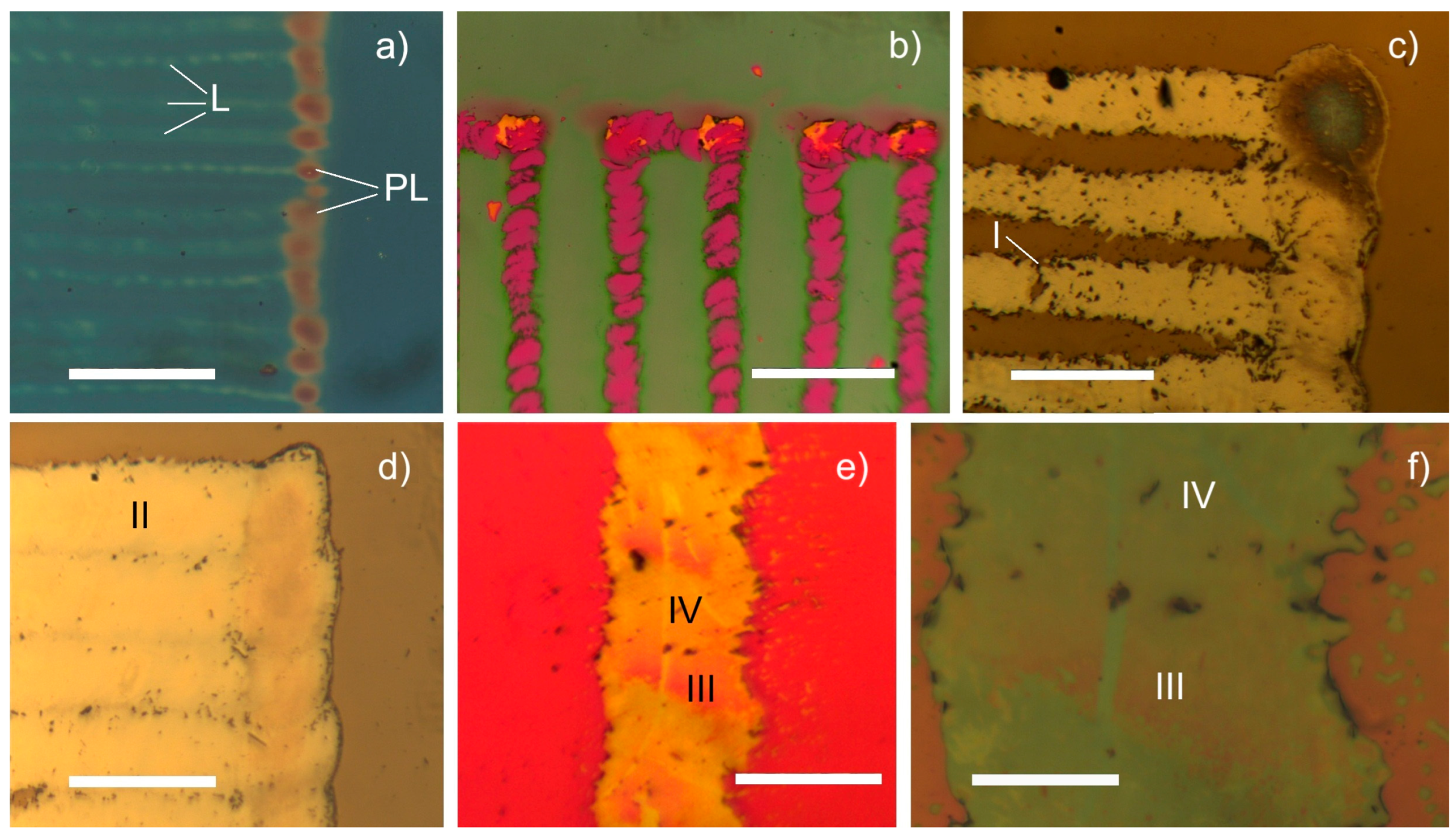
Optical microscopy revealed that even at the lowest applied laser fluences, the irradiated regions of the films exhibited clear visual alterations. These modifications were evident from the localized color changes along the irregular tracks labeled “L” in Figure 1a, as well as along the scan-direction traces indicated by the arrow in the same panel. Notably, the zones situated between the L-marked paths also displayed a shifted hue, suggesting that phase transformations may occur even in areas subjected only to indirect or partial irradiation. In contrast, regions exposed repeatedly to the laser irradiation, visible as a sequence of brownish features approximately 60–70 µm wide and annotated “PL” in Figure 1a—showed more pronounced optical changes, consistent with higher cumulative energy deposition.
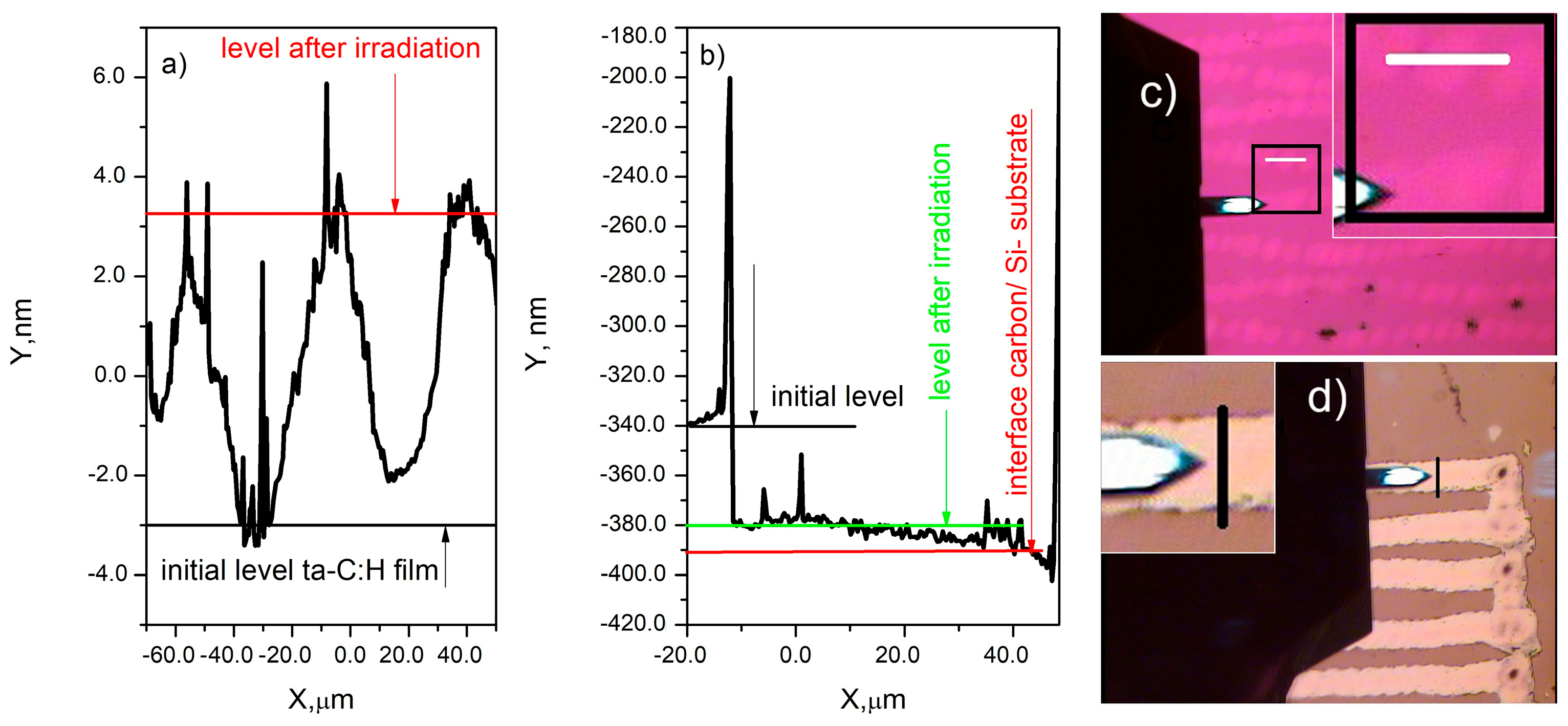
The thickness and surface topography of both the irradiated and boundary regions of the a-C:H films were examined by AFM. Film thicknesses were determined in micrometer-scale areas where the thin film was accidentally detached and the substrate surface was clearly visible. The uncertainty in thickness determination does not exceed ±5%. The thickness and surface topography measurements performed on samples processed at lower fluences (0.5–0.8 J cm−2)—corresponding to the areas shown in Figure 1a—revealed no evidence of material removal, as illustrated in Figure 2a. Instead, the bright contrast regions visible in Figure 1a and Figure 2c correspond to slight surface elevations of approximately 6 nm (Figure 2a). AFM characterization of the untreated reference samples yielded thicknesses of 60–65 nm for those classified as type A (Figure 2a), with the scanned area outlined by a black rectangle and the X-scan direction indicated by a white line. The pristine film thicknesses summarized in Table 1 are 60–65 nm, 40–44 nm, and 12–22 nm for samples A, B, and C, respectively. It should also be noted that for thinner films (<30 nm), the films deposited on SiO2/Si substrates are thinner than those deposited under identical conditions on Si wafers. For example, films with a thickness of ~20 nm on Si are ~12 nm thick on SiO2/Si, i.e., approximately 40%–45% thinner. This effect is attributed to the insulating nature of the intermediate SiO2 layer and the resulting reduction in ion flux to the cathode.
AFM measurements further revealed that laser-induced ablation of the a-C:H coatings does not expose the bare substrate directly. Instead, within the ablated tracks of samples A, B, and C, a thin residual carbon layer persists on the underlying Si or Si/SiO2 surface. This modified layer typically exhibits a thickness of about 4–6 nm- Figure 2b.
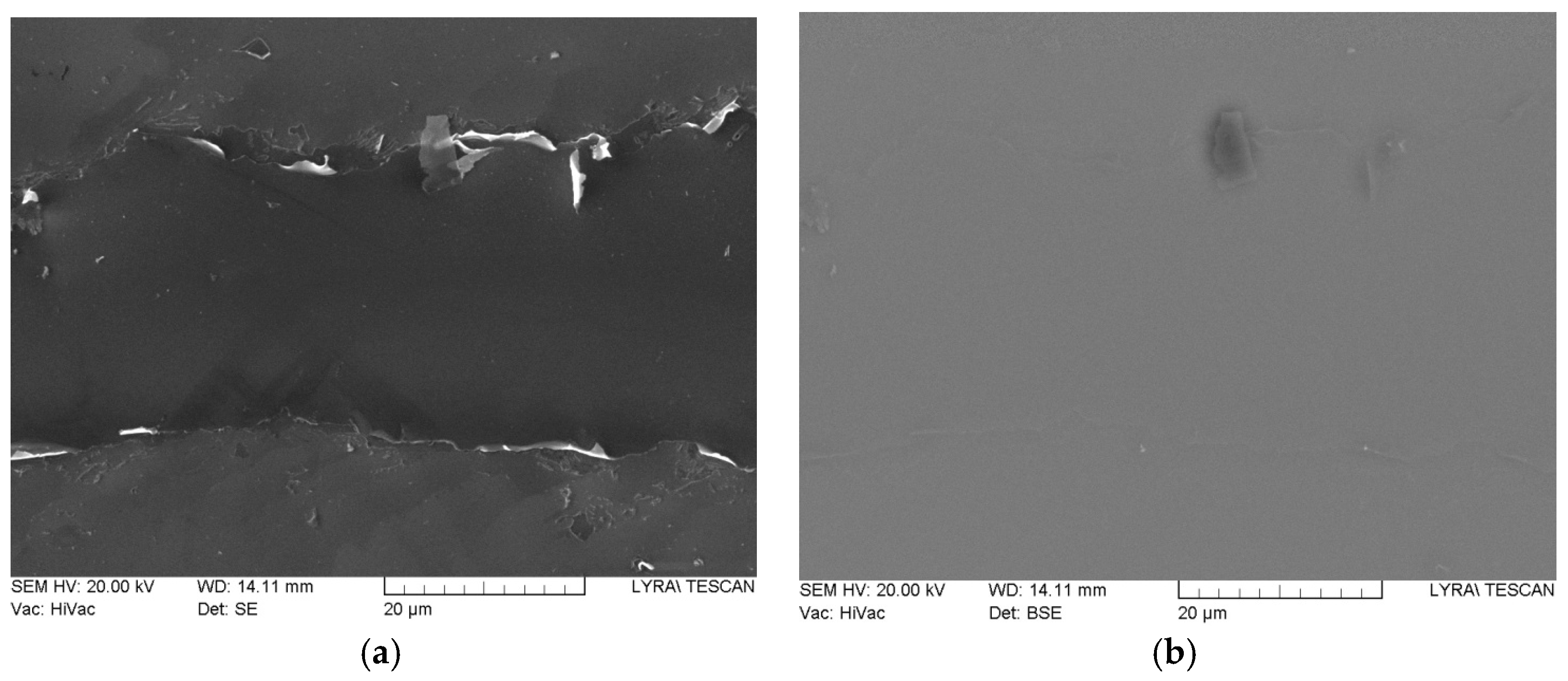
The results of the SEM studies, both in secondary electron image (SE) as well as in backscattered electron image (BSE) modes, are shown in Figure 3, Figure 4 and Figure 5. It should be emphasized that SEM, particularly in the BSE mode, is well-suited for detecting local variations in chemical composition. In contrast, energy-dispersive X-ray spectroscopy (EDX) is less sensitive in this context, as it probes a significantly greater depth (on the order of micrometers) than the thickness of the deposited films, which ranges from approximately 12 to approximately 60 nm.
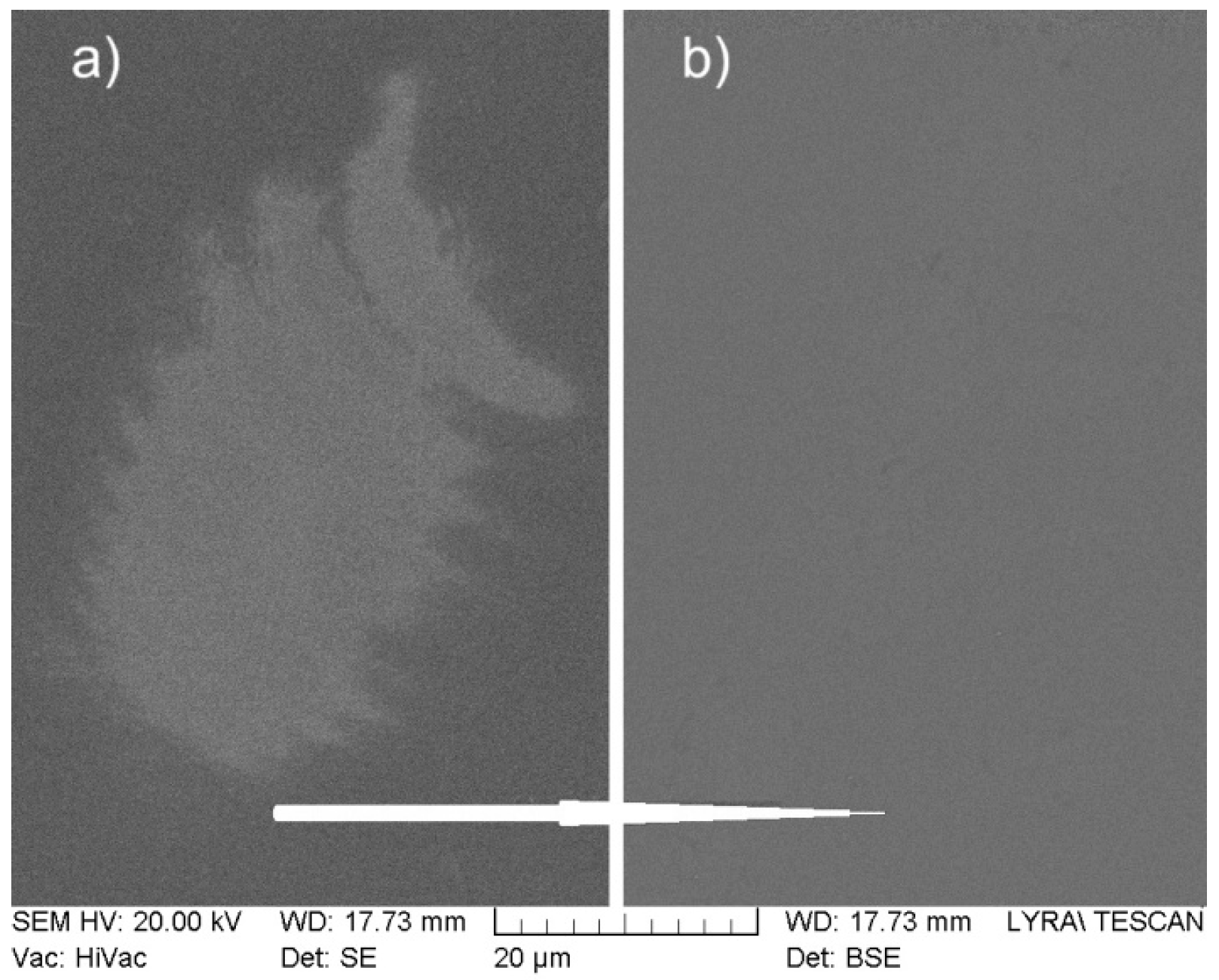
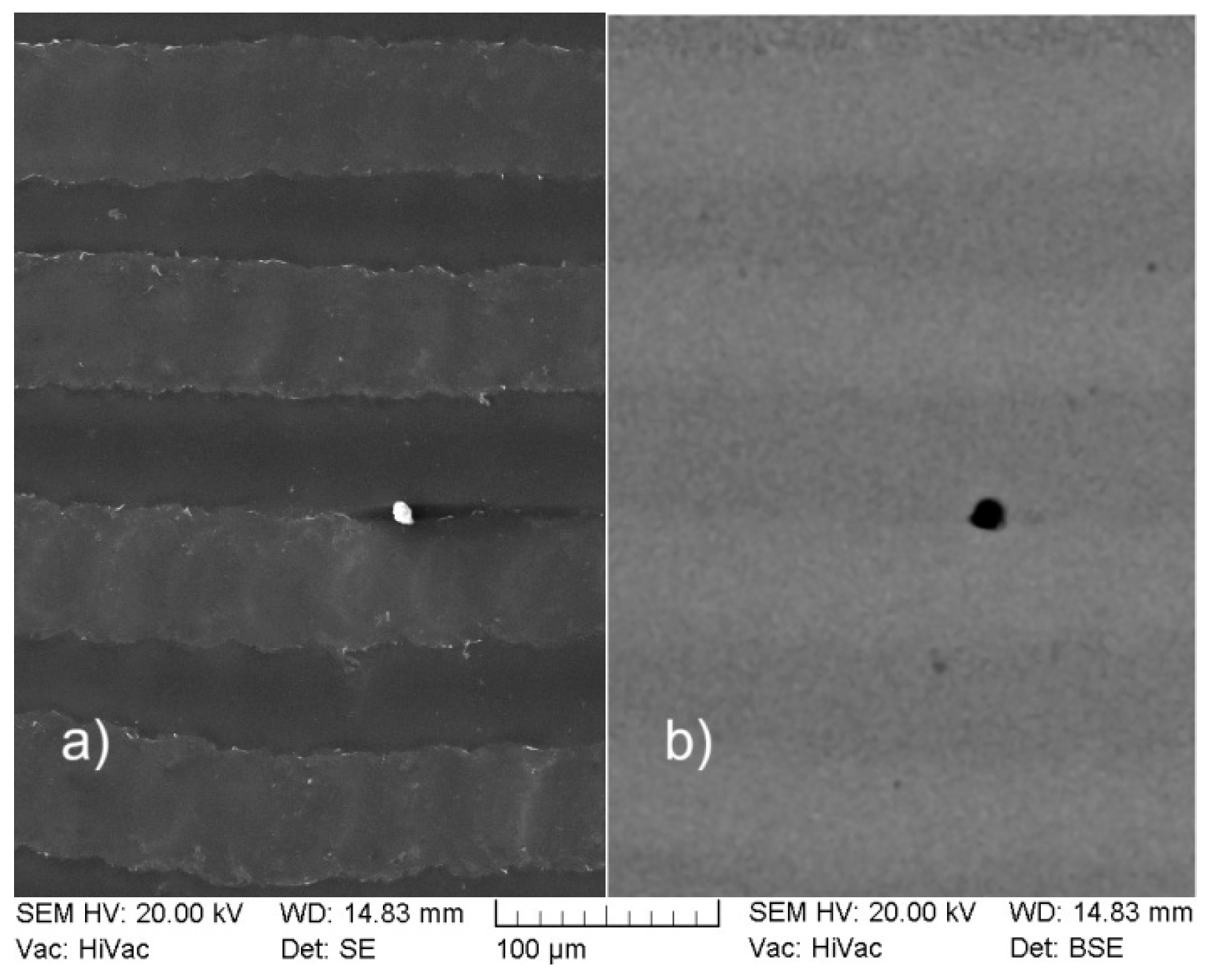
It is important to note that regions irradiated at low laser fluences, where the surface of the thin films appears slightly elevated compared to the unmodified areas (see Figure 1a, Figure 2a,c and Figure 3a), exhibit distinct contrast in these higher zones. However, this contrast difference is not apparent in the corresponding backscattered-electron (BSE) images of the same regions (Figure 3b). This discrepancy is likely related to the film thickness: in samples exhibiting the meander scan pattern (Figure 4a), regions from which the ta-C:H layer has been nearly fully ablated—leaving only a residual carbon layer of approximately 3–6 nm (Figure 2a)—appear brighter in BSE imaging (Figure 4b). This enhanced BSE signal is most likely due to increased contribution from the underlying Si substrate, which becomes more prominent when the carbon layer is extremely thin.
Then, the further notable finding from the SEM analysis is that, in nearly all samples where substantial portions of the ta-C:H film were removed, extremely thin flakes with lateral dimensions on the micrometer scale were observed. These flakes exhibit features reminiscent of graphene-like structures. Moreover, such flakes were frequently found along the edges of the remaining non-ablated ta-C:H regions.
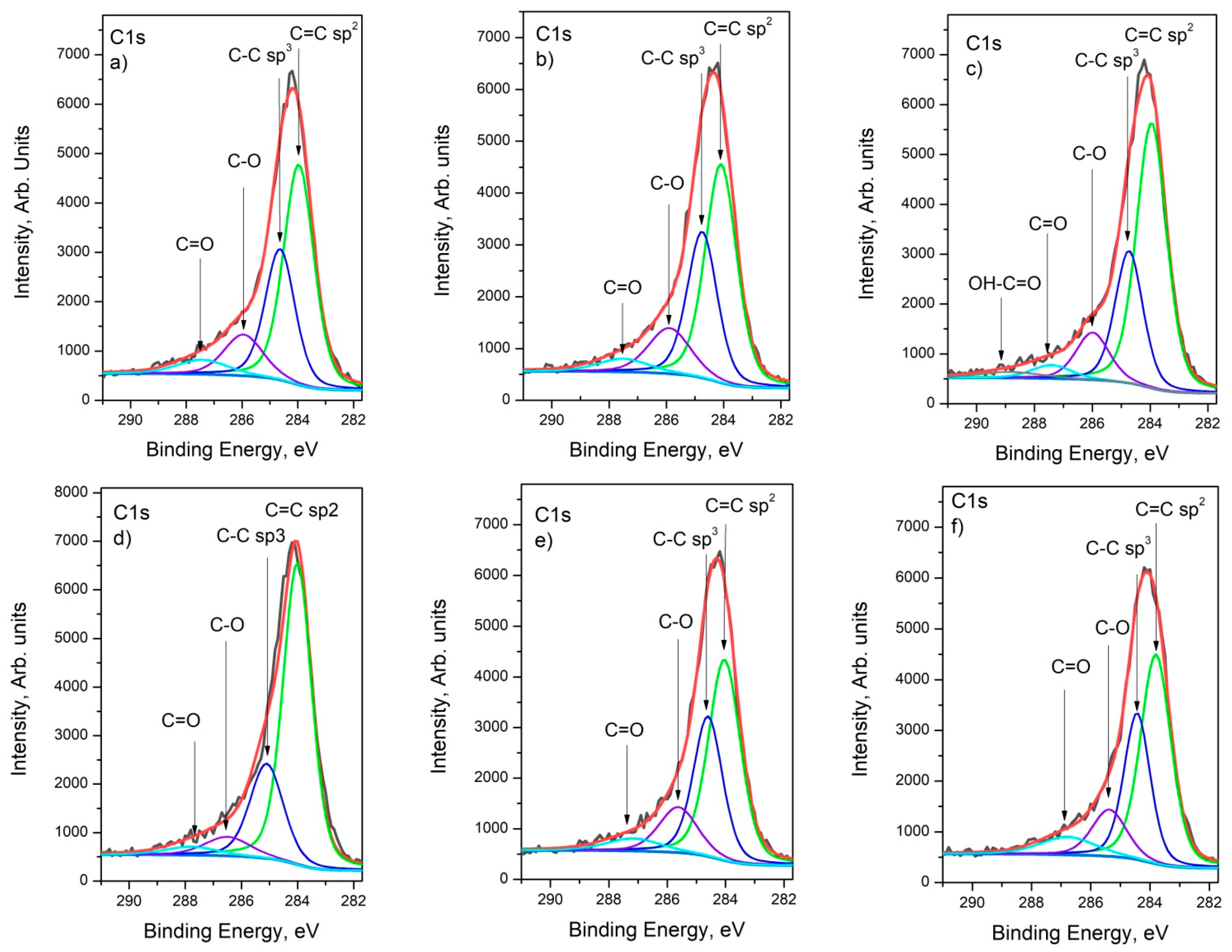
X-ray photoelectron spectroscopy (XPS) was employed to characterize the surfaces of both the unmodified and treated materials, as it is a widely established technique for quantifying surface elemental compositions and identifying their chemical states. The resulting elemental concentrations are summarized in Table 2 and Table 3. Figure 6a–f present the deconvoluted C 1s regions of the spectra. Analysis of the C 1s lines revealed four principal components, corresponding to contributions from C=C (sp2-hybridized carbon), C–C (sp3- or sp2-hybridized carbon), C–O species (e.g., C–O or C–OH), and higher-binding-energy oxidized carbon groups. These features typically appear near 284.2 eV, 285.0 eV, 286–287 eV, and >288 eV, respectively, consistent with previous reports [35,36,37,38].
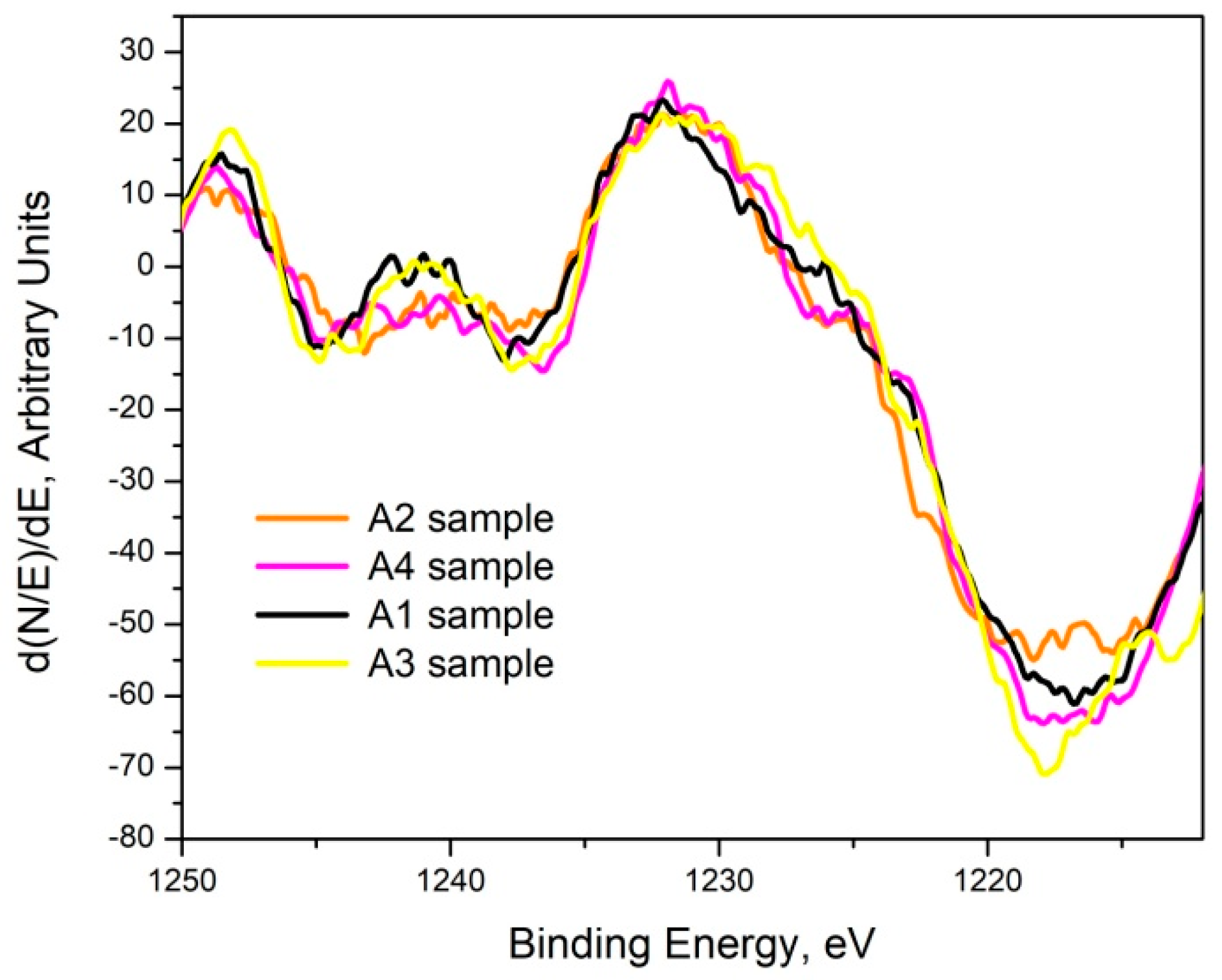
In addition, we employed the so-called D parameter, introduced by Lascovich et al. [39,40,41,42], to differentiate between sp2- and sp3-hybridized carbon. Their work demonstrated that a linear correlation exists between the characteristic limits of pure sp2 and sp3 carbon when analyzing the first derivative of the C KLL Auger line. The distance between the derivative maximum and minimum—defined as the D parameter—varies systematically with the relative proportions of these hybridization states. Following the same methodology, we determined the D parameter for our samples; the corresponding values are reported in Table 2. Subsequent spectroscopic investigations of major carbon allotropes, such as those by S. Kaciulis et al. [43], noted that graphene yields a diamond-like Auger profile under X-ray excitation, whereas electron-beam excitation produces a spectrum resembling graphite (Figure 7). Consequently, the D value measured for sample A4 (≈14–14.3 eV), being close to that of diamond (D = 13.0 eV), may indicate the presence of graphene-like structures [44,45]. Higher D values observed in other samples fall within the range between diamond and hydrogenated carbon, aligning more closely with ion-deposited amorphous carbon materials [39,40,41,42].
Raman spectroscopy is a widely utilized tool for distinguishing carbon allotropes and probing their structural organization [46,47,48]. It produces characteristic spectral fingerprints for graphene [46] and is effective for identifying mixed-phase carbon materials, including diamond-like carbon, glassy carbon, a-C/a-C:H, and ta-C/ta-C:H [1,6]. The technique is also valuable for analyzing chemically modified two-dimensional carbons, such as graphene oxide (GO) and reduced graphene oxide (rGO) [47]. In sp2-hybridized carbon systems, the Raman spectrum is typically dominated by the G-band, which appears around 1575 cm−1 in graphite and 1583 cm−1 in graphene, representing the principal one-phonon feature in defect-free samples [46,47]. The introduction of structural defects activates additional Raman features through a double-resonance mechanism, including the D″, D, and D′ bands at roughly 1165 cm−1, 1330 cm−1, and 1620 cm−1, respectively, along with overtones (2D) and combination modes such as D + D″ and D + D′ [41]. Partially amorphized carbon contributes a broad band in the 1460–1500 cm−1 region [47].
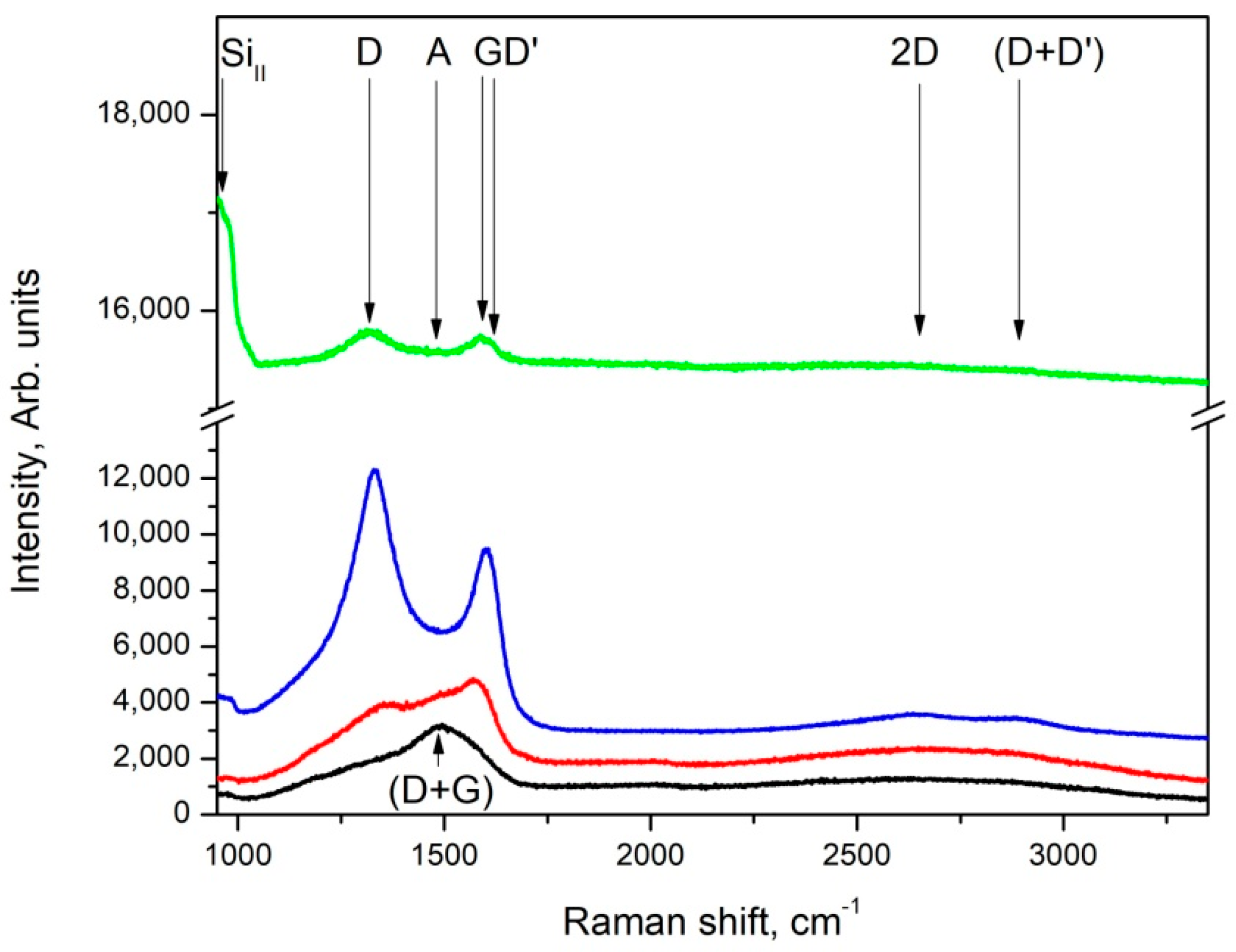
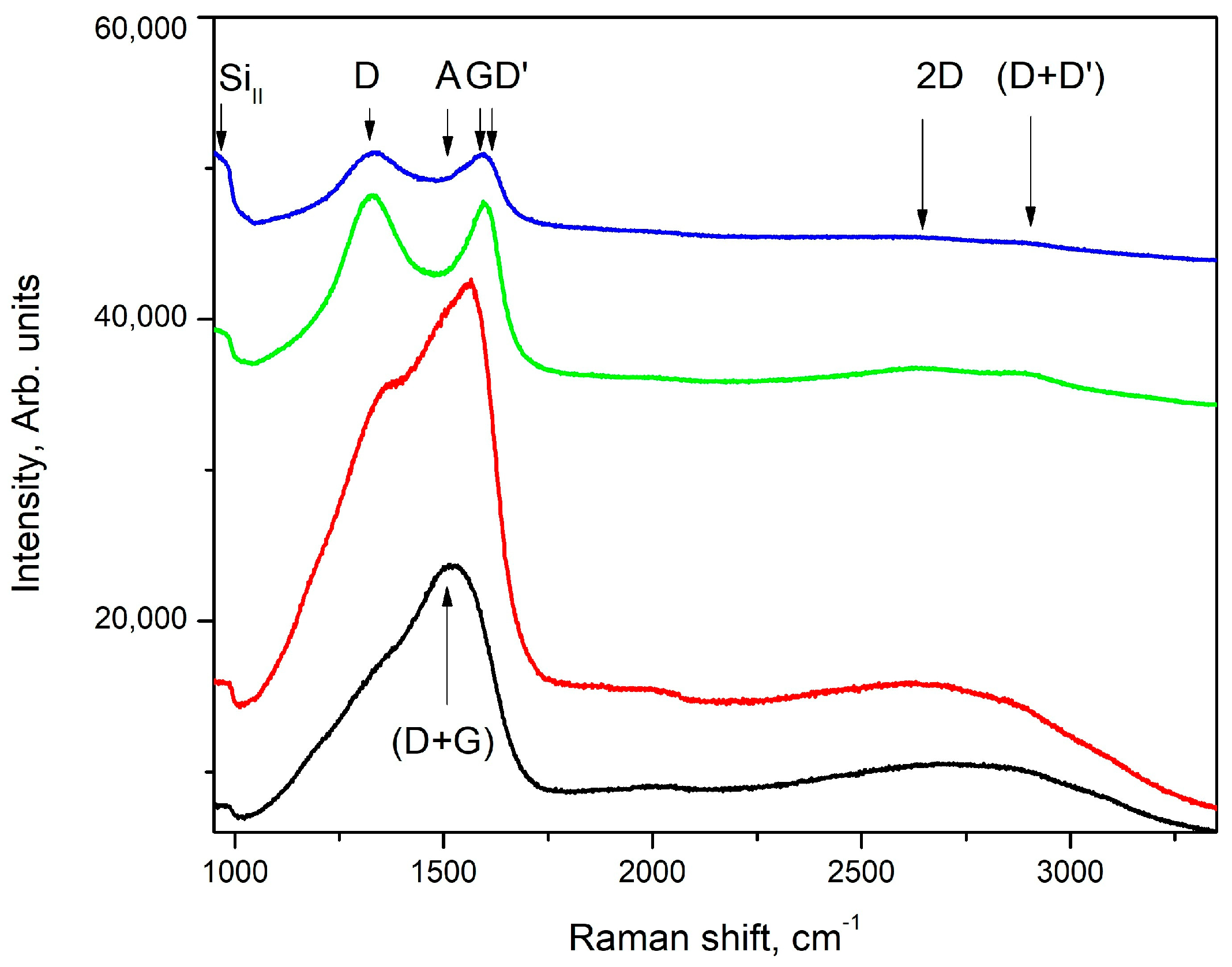
Raman spectra of the untreated samples (A1, B1, C1, and C3) collected over the 900–3350 cm−1 range reveal two main features: a peak near 960 cm−1, associated with two-phonon silicon scattering and labeled SiII in Figure 8 and Figure 9, and a broad carbon-related band around 1500 cm−1, referred to as the (D + G) band (black traces in Figure 8 and Figure 9). The relative intensities of these peaks differ across samples. With increasing laser exposure and progressive removal of thin-film material, the SiII signal becomes increasingly prominent relative to the (D + G) band. Concurrently, structural changes occur in the carbon phase: even at moderate laser fluences (0.6–1.0 J/cm2) and a relatively low number of pulses, the initially broad (D + G) band begins to resolve, with a nascent D band appearing near 1335 cm−1 (red traces in Figure 8 and Figure 9).
When laser fluences exceed 1 J/cm2, a well-defined D-band emerges, as shown by the blue and green traces in Figure 8 and Figure 9. Additionally, in very thin flakes located at the interface between ablated and non-ablated regions of all samples, the Raman spectra indicate the likely presence of multilayer defective graphene or reduced graphene oxide (blue trace in Figure 8).

4. Discussion

Optical microscopy observations (Figure 1a) indicate that even at very low laser fluences (~0.6 J/cm2) and high scanning speeds, structural changes occur in the ta-C:H thin films. The film color changes not only in the regions directly exposed to the laser but also in surrounding areas. In the irradiated zones, either the film thickness increases by approximately 5–7 nm (Figure 2b,c and Figure 3a,b) or the thin film volume expands due to ongoing carbon ablation reactions and the removal of the so-called “good leaving groups” (CO2, OH, etc.) via the H-atom transfer mechanism [21].
During partial ablation of the ta-C:H films, very thin flakes consistently remain at the boundaries of the ablated regions, and occasionally within them. Raman spectra of these flakes correspond to multilayer defective graphene or reduced graphene oxide (Figure 5a and Figure 8). XPS analysis reveals that when the laser fluence exceeds 1.0–1.2 J/cm2, the residual layer on the substrate becomes increasingly graphitized, with the sp2 carbon content rising by 15%–20% under optimal modification conditions. In contrast, at lower fluences (0.6–0.9 J/cm2), changes in the sp2/sp3 ratio are often negligible, and in some cases, the sp3 content may even increase. Nevertheless, optical microscopy shows a color change across the entire irradiated area, not limited to the direct laser impact points.
AFM and SEM analyses further indicate an increase in film volume at the laser-irradiated sites (Figure 2a,c and Figure 5a), suggesting that complex restructuring reactions occur. Raman measurements clearly show the initiation of aromatic ring formation, as evidenced by the appearance of the D-band, which is associated with the breathing modes of these rings and appears only in the presence of structural defects. Higher laser fluences result in ablation of a significant portion of the ta-C:H films; however, under suitable experimental conditions, a very thin carbon layer (3–7 nm) consistently remains on both Si (001) and SiO2/Si (001) substrates.
By tracking the amplitude of the A-band, typically associated with amorphous carbon and functionalized 2D carbon phases [47], in the Raman spectra (Figure 8 and Figure 9), we can further confirm the above conclusions. In pristine samples, the D and G bands merge with the A band to form a combined (D + G) feature, as shown by the black traces in Figure 8 and Figure 9, with the A-band being dominant. Treatment with picosecond UV laser radiation induces the separation of the D, A, and G bands. In the thinnest films (green trace in Figure 8; green and blue traces in Figure 9), the amplitude of the A band reaches only 60%–65% of the G-band amplitude. These changes indicate a structural transformation of the thin films from amorphous carbon to nanocrystalline ultra-thin graphite or defective multilayer graphene.
Importantly, the laser processing method allows for automated treatment of large areas. Areas spanning several square centimeters can be scanned efficiently. When combined with well-established deposition techniques for ta-C:H and a-C:H thin films, this approach has potential industrial applications. For instance, the formation of thin, transparent, and highly graphitized amorphous carbon films suggests possible use as electrodes with low visible-light absorption.

5. Conclusions

Nitrogen-doped ta-C:H thin films with thicknesses of about 20, 40 and 60 nm were deposited on Si (001) and SiO2/Si (001) substrates using CVD decomposition in a DC plasma of benzene vapor at room temperature. The films demonstrated good adhesion to the substrates, with only occasional microscopic peeling observed. A series of modifications using picosecond UV laser radiation under various parameters was performed. Characterization with optical microscopy, AFM, XPS, and Raman spectroscopy shows that, for laser fluences above 1.0–1.2 J/cm2 and scanning speeds providing overlap of 2–3 pulses, the majority of the 20–60 nm thick films is ablated. Nevertheless, a graphitized residual layer with a thickness of 3–6 nm remains reliably on the substrate surface. Although the experiments were conducted on 1 × 1 cm2 samples, this size is not a limitation: the use of an automated X-Y stage allows precise and fully controlled scanning of areas spanning multiple square centimeters.

Author Contributions

Conceptualization, T.I.M.; Methodology, T.I.M. and A.D.; Validation, T.I.M., I.A. and K.M.K.; Formal analysis, D.K., A.D., D.A.D., K.M.K. and S.K.K.; Investigation, D.K., A.D., D.A.D., I.A., K.M.K., K.G. and S.K.K.; Writing—original draft, T.I.M., D.K., A.D. and I.A.; Writing—review & editing, T.I.M.; Visualization, D.A.D. and I.A.; Supervision, T.I.M.; Project administration, T.I.M.; Funding acquisition, T.I.M. All authors have read and agreed to the published version of the manuscript.

Funding

This research was funded by National Science Fund of Bulgaria (KP-06-H58/2—16 November 2021) and European Regional Development Fund “Research Innovation and Digitization for Smart Transformation” program 2021–2027 under the Project BG16RFPR002-1.014-0006 “National Centre of Excellence Mechatronics and Clean Technologies”.

Data Availability Statement

The original contributions presented in this study are included in the article. Further inquiries can be directed to the corresponding author.

Conflicts of Interest

The authors declare no conflict of interest.

Abbreviations

The following abbreviations are used in this manuscript:
AFMAtomic force microscope
SEMScanning electron microscopy
XPSX-ray photoelectron spectroscopy
GOGraphene oxide
rGOReduced graphene oxide
UVUltra violet
SESecondary electron image
BSEBackscattered electron image

References

  1. Ferrari, A.C.; Robertson, J. Raman spectroscopy of amorphous, nanostructured, diamond–like carbon, and nanodiamond. Philos. Trans. R. Soc. Lond. A 2004, 362, 2477–2512. [Google Scholar] [CrossRef]
  2. Martinatti, J.F.; Santos, L.V.; Cruz, N.C.; Rangel, E.C. Hydrogenated amorphous carbon as protective coating for a forming tool. Eur. Phys. J. Appl. Phys. 2011, 56, 24014. [Google Scholar] [CrossRef]
  3. Yáñez-Hernández, L.A.; Bonilla-Gameros, L.; Chevallier, P.; Sarkissian, A.; Mantovani, D. Plasma-Based Amorphous Carbon Coatings on Polymeric Substrates for Biomedical Applications: A Critical Review Focused on Adhesion. Appl. Sci. 2025, 15, 9968. [Google Scholar] [CrossRef]
  4. Wang, L.; Gong, S.; Yang, C.; Wen, J. Towards low energy consumption data storage era using phase-change probe memory with TiN bottom electrode. Nanotechnol. Rev. 2016, 5, 455–460. [Google Scholar] [CrossRef]
  5. Tinchev, S.S.; Nikolova, P.I.; Dyulgerska, J.T.; Danev, G.; Babeva, T. a-C:H absorber layer for solar cells matched to solar spectrum. Sol. Energy Mater. Sol. Cells 2005, 86, 421–426. [Google Scholar] [CrossRef]
  6. Robertson, J. Diamond-like amorphous carbon. Mater. Sci. Eng. R 2002, 37, 129–281. [Google Scholar] [CrossRef]
  7. Ma, Y.; Qian, J.; Zhu, P.; Ding, J.; Sun, K.; Gou, H.; Abirov, R.; Zhang, Q. Carbon Nanosheets Grown via RF-PECVD on Graphite Films and Thermal Properties of Graphite Film/Aluminum Composites. Nanomaterials 2025, 15, 773. [Google Scholar] [CrossRef]
  8. Carra, C.; Medvids, A.; Litvinas, D.; Ščajev, P.; Malinauskas, T.; Selskis, A.; Roman, H.E.; Bazaka, K.; Levchenko, I.; Riccardi, C. Hierarchical Carbon Nanocone-Silica Metamaterials: Implications for White Light Photoluminescence. ACS Appl. Nano Mater. 2022, 5, 4787–4800. [Google Scholar] [CrossRef]
  9. Milenov, T.; Avramova, I.; Valcheva, E.; Tinchev, S.; Avdeev, G. Low energy Ar+ plasma thinning and thermal annealing of carbon films to few-layered graphene. Opt. Quantum Electron. 2015, 47, 923–935. [Google Scholar] [CrossRef]
  10. Zhang, L.; Feng, S.; Xiao, S.; Shen, G.; Zhang, X.; Nan, H.; Gu, X.; Ostrikov, K. Layer-controllable graphene by plasma thinning and post-annealing. Appl. Surf. Sci. 2018, 441, 639–646. [Google Scholar] [CrossRef]
  11. Panwar, O.S.; Kesarwani, A.K.; Dhakate, S.R.; Singh, B.P.; Rakshit, R.K.; Bisht, A.; Chockalingam, S. Few layer graphene synthesized by filtered cathodic vacuum arc technique. J. Vac. Sci. Technol. B 2013, 31, 040602. [Google Scholar] [CrossRef]
  12. Panwar, O.S.; Kesarwani, A.K.; Dhakate, S.R.; Satyanarayana, B.S. Graphene synthesized using filtered cathodic vacuum arc technique and its applications. Vacuum 2018, 153, 262–266. [Google Scholar] [CrossRef]
  13. Kesarwani, A.K.; Panwar, O.S.; Dhakate, S.R.; Rakshit, R.K.; Singh, V.N.; Bisht, A.; Kumar, A. Growth of single and bilayer graphene by filtered cathodic vacuum arc technique. J. Vac. Sci. Technol. A 2016, 34, 021504. [Google Scholar] [CrossRef]
  14. Kesarwani, A.K.; Panwar, O.S.; Dhakate, S.R.; Singh, V.N.; Rakshit, R.K.; Bisht, A.; Kumar, A. Determining the number of layers in graphene films synthesized by filtered cathodic vacuum arc technique. Fuller. Nanotub. Carbon Nanostructures 2016, 24, 725–731. [Google Scholar] [CrossRef]
  15. Baboukani, B.S.; Ye, Z.; Komvopoulos, K. Enhancing Graphene Growth in Carbon Ultrathin Films by Tuning the Ion Kinetic Energy During Film Deposition onto a Catalyst Sublayer. J. Phys. Chem. C 2024, 128, 15141–15150. [Google Scholar] [CrossRef]
  16. Zhang, H.; Fonseca, A.F.; Cho, K. Tailoring Thermal Transport Property of Graphene through Oxygen Functionalization. J. Phys. Chem. C 2014, 118, 1436. [Google Scholar] [CrossRef]
  17. Mulyana, Y.; Uenuma, M.; Ishikawa, Y.; Uraoka, Y. Reversible Oxidation of Graphene Through Ultraviolet/Ozone Treatment and Its Nonthermal Reduction through Ultraviolet Irradiation. J. Phys. Chem. C 2014, 118, 27372–27381. [Google Scholar] [CrossRef]
  18. Imamura, G.; Saiki, K. Modification of Graphene/SiO2 Interface by UV-Irradiation: Effect on Electrical Characteristics. ACS Appl. Mater. Interfaces 2015, 7, 2439. [Google Scholar] [CrossRef]
  19. Milenov, T.I.; Avramova, I.; Dikovska, A.; Karaivanova, D.; Terziyska, P.; Kolev, S.; Karashanova, D.; Georgieva, B.; Dimov, D.; Atanasov, V.; et al. Modification of graphene-like, hydrogenated amorphous, hydrogenated tetrahedral amorphous carbon and amorphous carbon thin films by UV-C light. Surf. Interfaces 2021, 24, 101073. [Google Scholar] [CrossRef]
  20. Milenov, T.; Karaivanova, D.; Stankova, N.; Dimov, D.; Trifonov, D.; Kalchevski, D.; Kolev, S.; Kirilov, K.; Valcheva, E. Some initial results on modification of a-C:H films by UV-C irradiation. J. Phys. Conf. Ser. 2025, 2994, 012027. [Google Scholar] [CrossRef]
  21. Kolev, S.K.; Aleksandrov, H.A.; Atanasov, V.A.; Popov, V.N.; Milenov, T.I. Surface Chemistry of Reduced Graphene Oxide: H-Atom Transfer Reactions. Appl. Surf. Sci. 2021, 567, 150815. [Google Scholar] [CrossRef]
  22. Grigonis, A.; Marcinauskas, L.; Vinciunaite, V.; Raciukaitis, G. Modification of the amorphous carbon films by the ns-laser irradiation. Cent. Eur. J. Phys. 2011, 9, 1344–1350. [Google Scholar] [CrossRef]
  23. Cui, X.; Zhang, C.; Li, G.; Song, C.; Qin, W.; Wang, T. Mechanisms Behind Graphitization Modification in Polycrystalline Diamond by Nanosecond Pulsed Laser. Materials 2024, 17, 6200. [Google Scholar] [CrossRef]
  24. Rivera, A.D.; Hershkovitz, E.; Panoutsopoulos, P.; de Jesus Lopez, M.X.; Simpson, B.; Kim, H.; Narayanan, R.; Johnson, J.; Jones, K.S. Pulsed Laser Annealing of Deposited Amorphous Carbon Films. C 2025, 11, 60. [Google Scholar] [CrossRef]
  25. Panagiotopoulos, N.T.; Karras, G.; Lidorikis, E.; Koutsogeorgis, D.C.; Kosmidis, C.; Patsalas, P. Photosensitivity and optical performance of hydrogenated amorphous carbon films processed by picosecond laser beams. Surf. Coat. Technol. 2011, 206, 734–741. [Google Scholar] [CrossRef]
  26. Marcinauskas, L.; Grigonis, A.; Račiukaitis, G.; Gedvilas, M.; Vinciūnaitė, V. Irradiation of amorphous carbon films by picosecond laser pulses. Thin Solid Films 2015, 593, 116–123. [Google Scholar] [CrossRef]
  27. Popescu, C.; Dorcioman, G.; Bita, B.; Besleaga, C.; Zgura, I.; Himcinschi, C.; Popescu, A. Fabrication of Periodical Surface Structures by Picosecond Laser on Thin Carbon Films. Appl. Surf. Sci. 2016, 390, 236–243. [Google Scholar] [CrossRef]
  28. Ali, B.; Xu, H.; Sang, R.T.; Litvinyuk, I.V.; Rybachuk, M. Bonded Carbon Chain Formation under an Ultra-Short (30 fs) Laser Irradiation. Carbon 2023, 204, 575–586. [Google Scholar] [CrossRef]
  29. Wei, C.; Ma, Y.; Han, Y.; Zhang, Y.; Yang, L.; Chen, X. Study on Femtosecond Laser Processing Characteristics of Nano-Crystalline CVD Diamond Coating. Appl. Sci. 2019, 9, 4273. [Google Scholar] [CrossRef]
  30. Müller, F.A.; Kunz, C.; Gräf, S. Bio-Inspired Functional Surfaces Based on Laser-Induced Periodic Surface Structures. Materials 2016, 9, 476. [Google Scholar] [CrossRef]
  31. Kalita, G.; Qi, L.; Namba, Y.; Wakita, K.; Umeno, M. Femtosecond laser induced micropatterning of graphene film. Mater. Lett. 2011, 65, 1569. [Google Scholar] [CrossRef]
  32. Mortazavi, S.; Mollabashi, M.; Barri, R.; Pescador, J.N.; Gundlach, L.; Smith, J.P.; Booksh, K.S.; Shah, S.I. Evaluating Single Layer Graphene Micropatterns Induced by Ti:Sa Laser Irradiation. Phys. Status Solidi A 2018, 215, 1800334. [Google Scholar] [CrossRef]
  33. Milenov, T.; Karaivanova, D.; Dikovska, A.; Kirilov, K.; Valcheva, E. Some Initial Results on Modification of a-C:H Films by Pulsed Laser Irradiation. J. Phys. Conf. Ser. 2023, 2487, 012009. [Google Scholar] [CrossRef]
  34. Balchev, I.; Tzvetkova, K.; Kolev, S.; Terziiska, P.; Szekeres, A.; Miloushev, I.; Tenev, T.; Antonova, K.; Peyeva, R.; Ivanova, T.; et al. Synthesis and characterization of thin amorphous carbon films doped with nitrogen on (001) Si substrates. J. Phys. Conf. Ser. 2016, 764, 012013. [Google Scholar] [CrossRef]
  35. Gorham, J.M.; Osborn, W.A.; Woodcock, J.W.; Scott, K.C.; Heddleston, J.M.; Walker, A.R.H.; Gilman, J.W. Detecting carbon in carbon: Exploiting differential charging to obtain information on the chemical identity and spatial location of carbon nanotube aggregates in composites by imaging X-ray photoelectron spectroscopy. Carbon 2016, 96, 1208–1216. [Google Scholar] [CrossRef]
  36. Lascovich, J.C.; Giorgi, R.; Scaglione, S. Evaluation of the sp2/sp3 ratio in amorphous carbon structure by XPS and XAES. Appl. Surf. Sci. 1991, 47, 17–21. [Google Scholar] [CrossRef]
  37. Chen, X.; Wang, X.; Fang, D. A review on C1s XPS spectra for some kinds of carbon materials. Fuller. Nanotub. Carbon Nanostructures 2020, 28, 1048–1058. [Google Scholar] [CrossRef]
  38. Lascovich, J.C.; Scaglione, S. Comparison among XAES, PELS and XPS techniques for evaluation of sp2 percentage in a-C:H. Appl. Surf. Sci. 1994, 78, 17–23. [Google Scholar] [CrossRef]
  39. Lascovich, J.C.; Santoni, A. Study of the occupied electronic density of states of carbon samples by using second derivative carbon KVV Auger spectra. Appl. Surf. Sci. 1996, 103, 245–253. [Google Scholar] [CrossRef]
  40. Lascovich, J.C.; Rosato, V. Analysis of the electronic structure of hydrogenated amorphous carbon via Auger spectroscopy. Appl. Surf. Sci. 1999, 152, 10–18. [Google Scholar] [CrossRef]
  41. Barlow, A.J.; Scott, O.; Sano, N.; Cumpson, P.J. Multivariate auger feature imaging (MAFI): A new approach towards chemical state identification of novel carbons in XPS imaging. Surf. Interface Anal. 2015, 47, 173–175. [Google Scholar] [CrossRef]
  42. Barlow, A.J.; Popescu, S.; Artyushkova, K.; Scott, O.; Sano, N.; Hedley, J.; Cumpson, P.J. Chemically specific identification of carbon in XPS imaging using Multivariate Auger Feature Imaging (MAFI). Carbon 2016, 107, 190–197. [Google Scholar] [CrossRef]
  43. Kaciulis, S. Spectroscopy of carbon: From diamond to nitride films. Surf. Interface Anal. 2012, 44, 1155–1161. [Google Scholar] [CrossRef]
  44. Mezzi, A.; Kaciulis, S. Surface investigation of carbon films: From diamond to graphite. Surf. Interface Anal. 2010, 42, 1082–1084. [Google Scholar] [CrossRef]
  45. Kaciulis, S.; Mezzi, A.; Calvani, P.; Trucchi, D.M. Electron spectroscopy of the main allotropes of carbon. Surf. Interface Anal. 2014, 46, 966–969. [Google Scholar] [CrossRef]
  46. Ferrari, A.C.; Basko, D.M. Raman spectroscopy as a versatile tool for studying the properties of graphene. Nat. Nanotechnol. 2013, 8, 235–246. [Google Scholar] [CrossRef] [PubMed]
  47. Claramunt, S.; Varea, A.; López-Díaz, D.; Velázquez, M.M.; Cornet, A.; Cirera, A. The importance of interbands on the interpretation of the Raman spectrum of graphene oxide. J. Phys. Chem. C 2015, 119, 10123–10129. [Google Scholar] [CrossRef]
  48. Tuinstra, F.; Koenig, J.L. Raman spectrum of graphite. J. Chem. Phys. 1970, 53, 1126–1130. [Google Scholar] [CrossRef]
Figure 1. Optical microscopy image taken from the samples: A2, A3, A5, C2 and C4, respectively. The image in (f) is a three-fold enlarged portion of the image in (e). The markers in (af) indicate: 200 μm, 100 μm, 50 μm, 50 μm, 30 μm and 10 μm, respectively. The remaining panels of (bf) present results obtained using the automated X–Y translation stage. These illustrate the characteristic meander patterns produced at a fluence of ~1 J cm−2 (b) and the progressively stronger modifications observed at higher fluence levels (cf).
Coatings 16 00067 g001
Figure 2. (a) The surface profile (A2 sample) measured with AFM along the white line in the black square shown in panel (c) of the present figure. (b) The surface profile (A5 sample) measured with AFM along the white line shown in panel (d) of the present figure. (c) Optical microscopy image taken with the microscope of the AFM apparatus and showing the scanning area from which the profile in panel (a) of the present figure was visualized. (d) Optical microscopy image taken with microscope of the AFM apparatus and showing the scanning area from which the profile in panel (b) of the present figure was visualized. The insets in panels (c,d) present threefold magnification of the corresponding images in the areas scanned with AFM along the white and black lines, respectively.
Coatings 16 00067 g002
Figure 3. (a) SEM image in SE mode of the single spot from laser irradiation in experiment A2. (b) SEM image in BSE mode of the same single spot from laser irradiation in experiment A2 from panel (a). The white arrow indicated the scanning direction along X-axis.
Coatings 16 00067 g003
Figure 4. (a) SEM image in SE mode of the paths obtained by laser irradiation in experiment A5. (b) SEM image in BSE mode of the same area from panel (a).
Coatings 16 00067 g004
Figure 5. (a) SEM image in SE mode of the single spot from laser irradiation in experiment A5. (b) SEM image in BSE mode of the same area from panel (a).
Coatings 16 00067 g005
Figure 6. (ac) Deconvolution of the C 1s line of samples A1 (a), A2 (b), and A3 (c): the green trace corresponds to C=C (sp2-hybridized carbon), the black trace—C-C (sp3-hybridized carbon), while the violet, cyan and dark grey ones to C-O, C=O and HO-C=O, respectively. (df) Deconvolution of the C 1s line of samples A4 (d), C1 (e), and C2 (f): the green trace corresponds to C=C (sp2-hybridized carbon), the black trace corresponds to C-C (sp3-hybridized carbon), while the violet, cyan and dark grey ones correspond to C-O, and C=O, respectively.
Coatings 16 00067 g006
Figure 7. Differentiated CKLL spectra after applying the Savitzky–Golay algorithm excited by the X-ray source for all specimens. The determined D-parameter is between 14.3 eV (A4 sample) and 15.8 eV (A2 sample).
Coatings 16 00067 g007
Figure 8. Raman spectra measured at different points in pristine ta-C:H deposited on Si (001) substrate of sample A1 (black trace) as well as in points denoted by I (Figure 1a) and the slightly elevated area of appr. 6 nm- the light brown regions denoted by L in Figure 1a, Figure 2a,c and Figure 3a,b (red trace) observed in sample A2, and a flake from the boundary region of sample A5 (blue trace) and point II (sample C2)—green trace in which the remaining film on Si—substrate after partial ablation of ta-C:H is 3–6 nm thin (see Figure 2b) and is indistinguishable with an optical microscope.
Coatings 16 00067 g008
Figure 9. Raman spectra measured at different points in pristine ta-C:H deposited on SiO2/Si (001) substrate of the pristine sample C3 (black trace) and the red- brown meanders observed in sample A3- Figure 1b (red trace), as well as in points denoted by III (sample A3), and points IV (sample C4)—green trace, and V (sample C4)—blue trace in which the remaining film on the substrate after partial ablation of ta-C:H is 3–6 nm thin (see Figure 2b) and can be distinguished with an optical microscope only due to the presence of an intermediate film of 320–350 nm SiO2.
Coatings 16 00067 g009
Table 1. Summarized data on the conditions of processing with picosecond laser radiation with λ = 266 nm of the thin films, as well as their initial thickness. Samples A1, C1 and C3 are pristine samples and have not been treated with laser irradiation.
SampleFilm Thickness,
nm
SubstrateLaser Beam
Fluence, J/cm2
Scanning Speed, mm/hOverlapping,
Pulses
A160–65SiO2/Si (001)---
A260–65Si (001)0.6143.2
A360–65SiO2/Si (001)1.6142.3
A460–65Si (001)1.6142.5
A560–65SiO2/Si (001)1.6142.5
B140–45Si (001)0.6143
B240–45SiO2/Si (001)0.6105.5
C118–20Si (001)---
C218–20Si (001)1.2123
C312–14SiO2/Si (001)---
C412–14SiO2/Si (001)1.0123.3
Table 2. Summarized data of the obtained results for the surface composition obtained by the XPS measurements of different samples. The results for the series B experiments are in the same trend as those from series A.
SpecimenC, at. %O, at. %N at. %Si, at. %D Parameter
A186.3113.44-0.2515.4
A284.4213.280.621.6816.8
A386.5212.410.820.2514.4
A485.4112.860.960.7814.3
C187.639.951.520.9115.9
C289.049.980.660.3215.2
C385.1612.182.080.5914.7
C485.8311.881.360.9317.3
Table 3. Summarized data from the deconvolution of the C 1s line, obtained by the XPS measurements of different samples. The results for the series B experiments are in the same trend as those from series A.
Specimensp2 (C=C)sp3 (C-C)C-OC=OO=C-OH
A10.520.300.120.6-
A20.500.310.140.05-
A30.570.260.110.040.03
A40.660.240.070.03-
C10.500.320.130.05-
C20.500.300.130.08-
C30.530.280.110.08-
C40.510.310.130.04-
Disclaimer/Publisher’s Note: The statements, opinions and data contained in all publications are solely those of the individual author(s) and contributor(s) and not of MDPI and/or the editor(s). MDPI and/or the editor(s) disclaim responsibility for any injury to people or property resulting from any ideas, methods, instructions or products referred to in the content.