

Thin-Layer Dust Accumulation Effects on Photovoltaic Modules and Design Optimization for the Module Structure
 ,
,
Abstract
1. Introduction
2. Experiment
2.1. Experimental Method
2.2. Experimental Design
3. Experimental Results and Discussion
3.1. Vertical Shading Configuration
3.2. Horizontal Shading Configuration
4. Exploration of Structural Optimization of PV Modules
4.1. Asymmetric Structure of Full-Cell Module Is Worth Promoting
4.2. Development of Novel Quad-Cell Module
5. Conclusions
- (1)
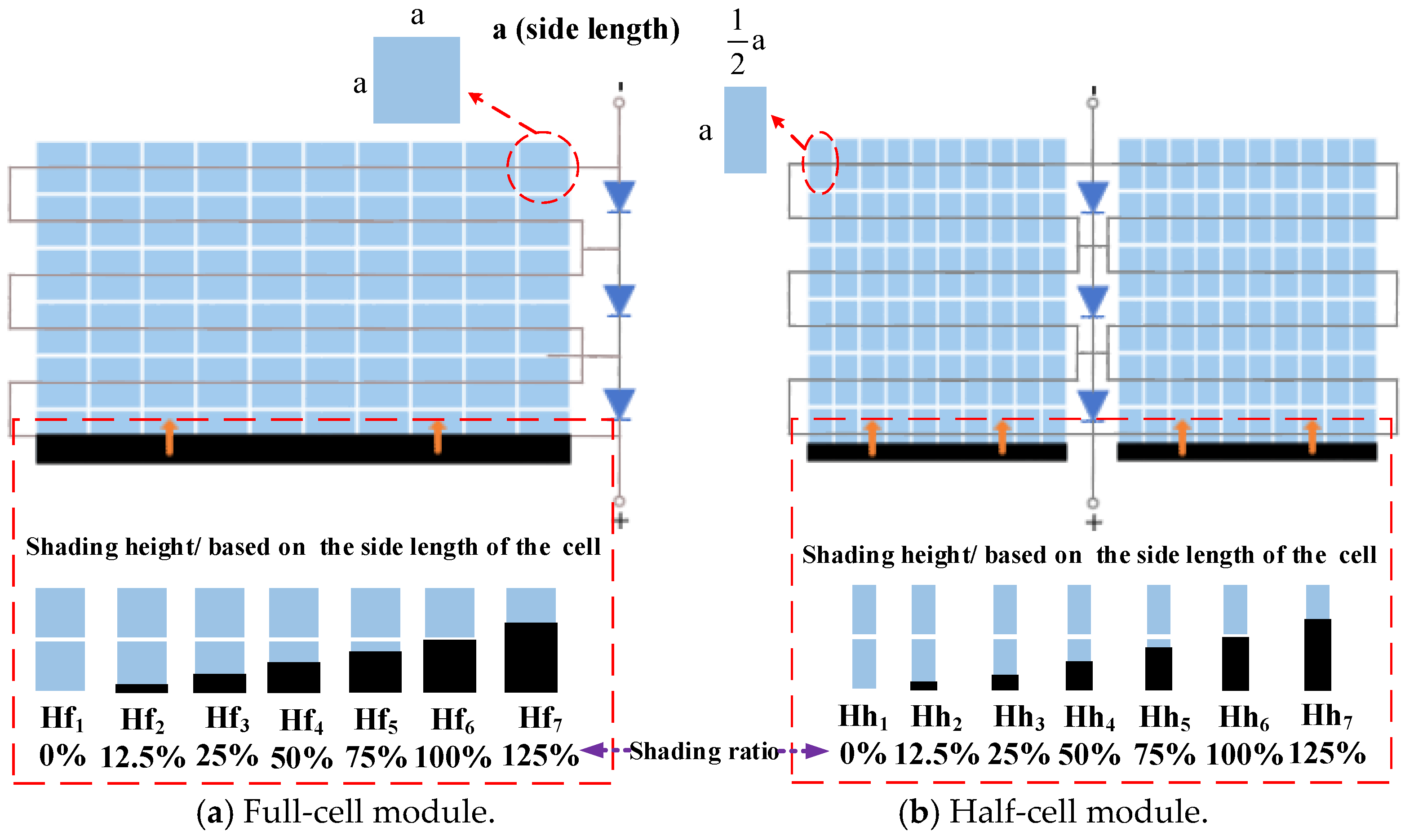
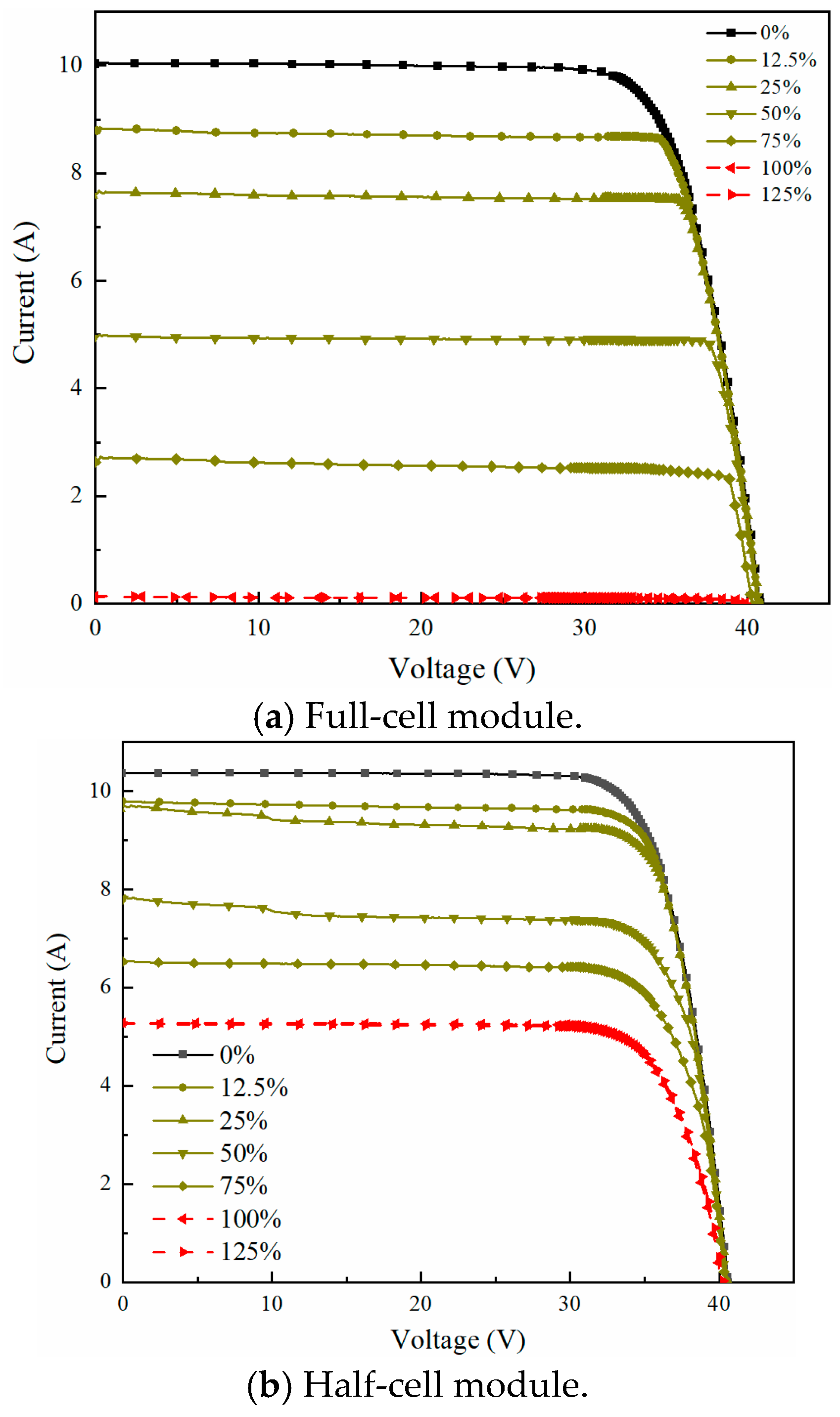
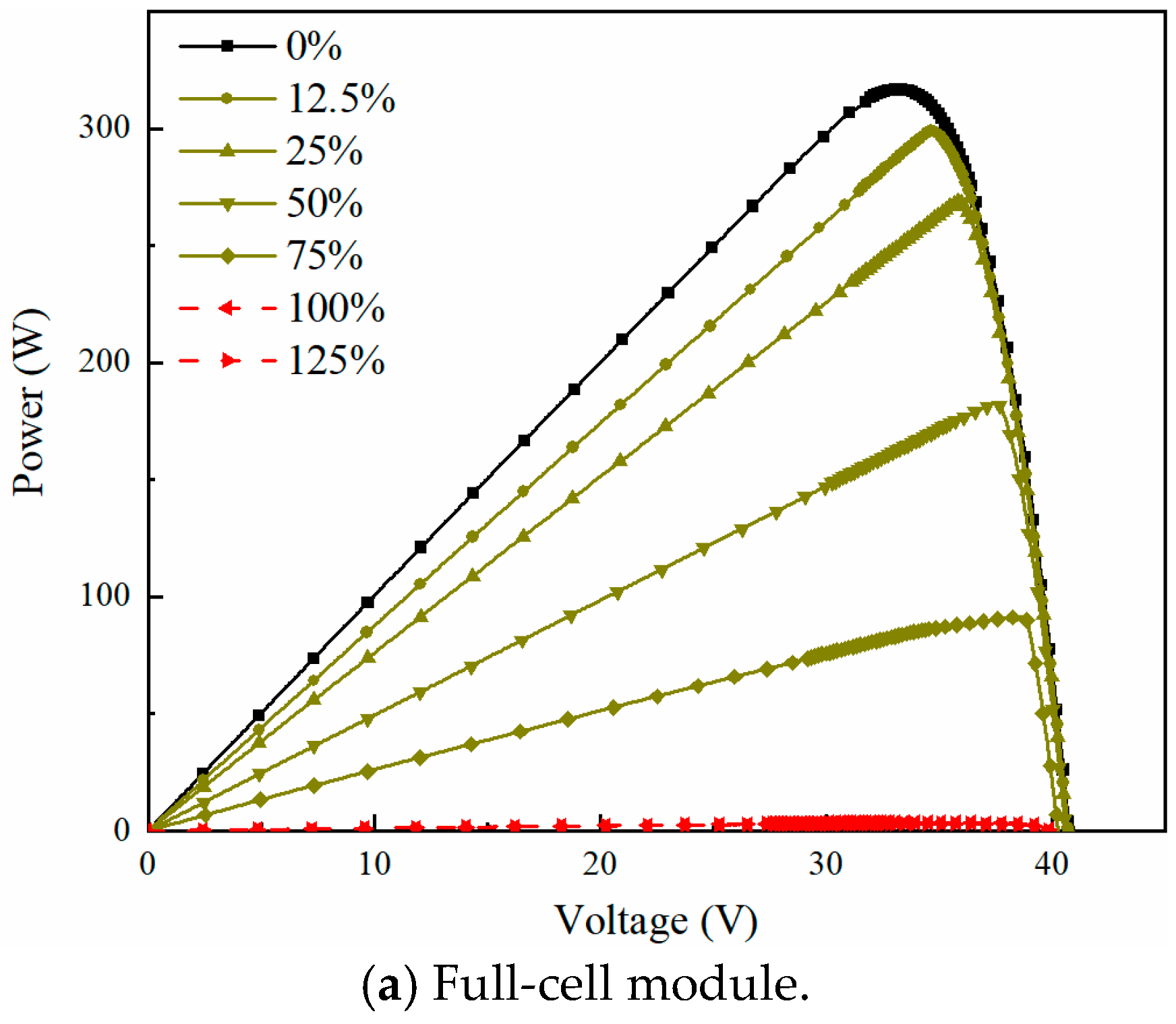
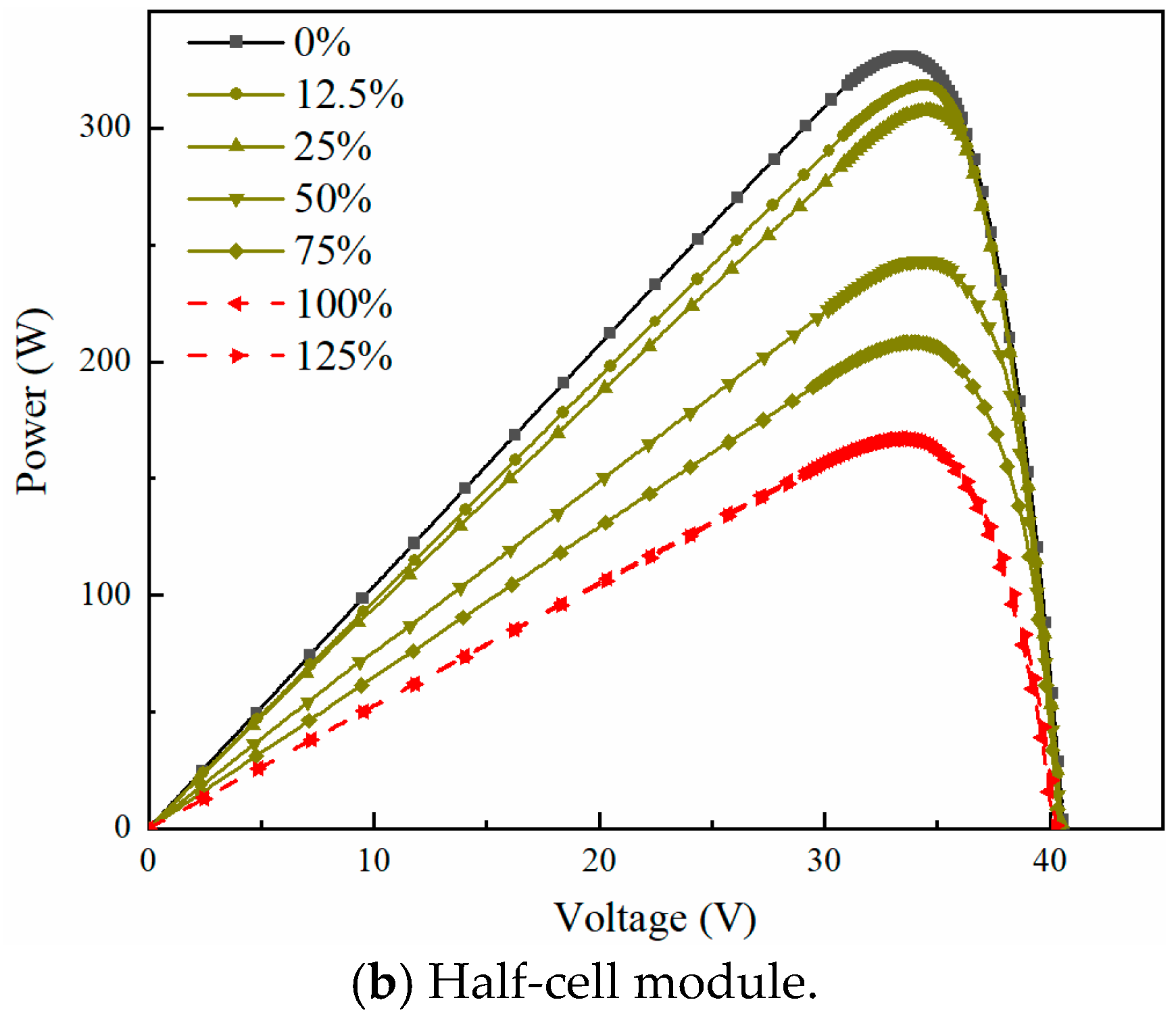
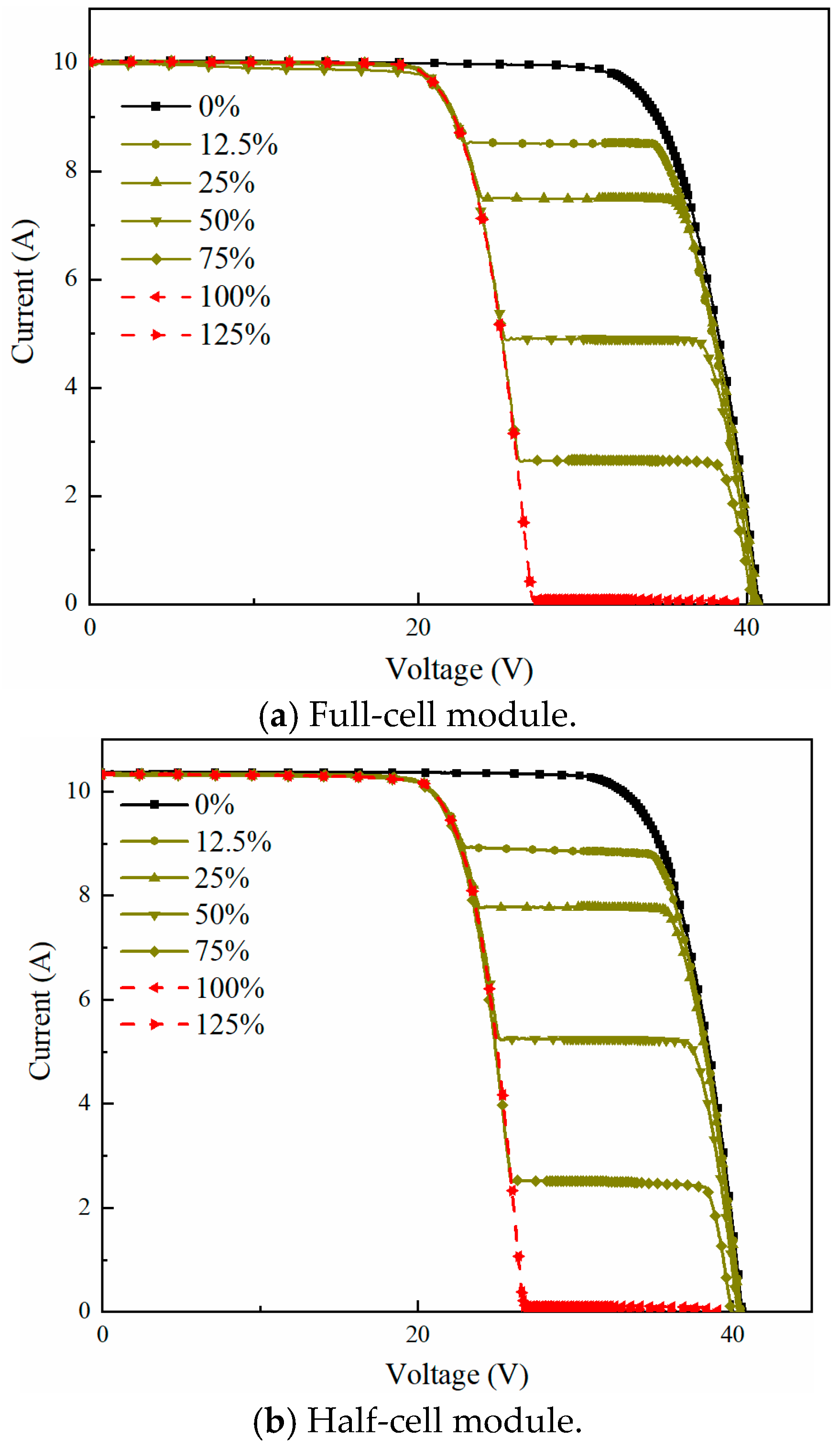
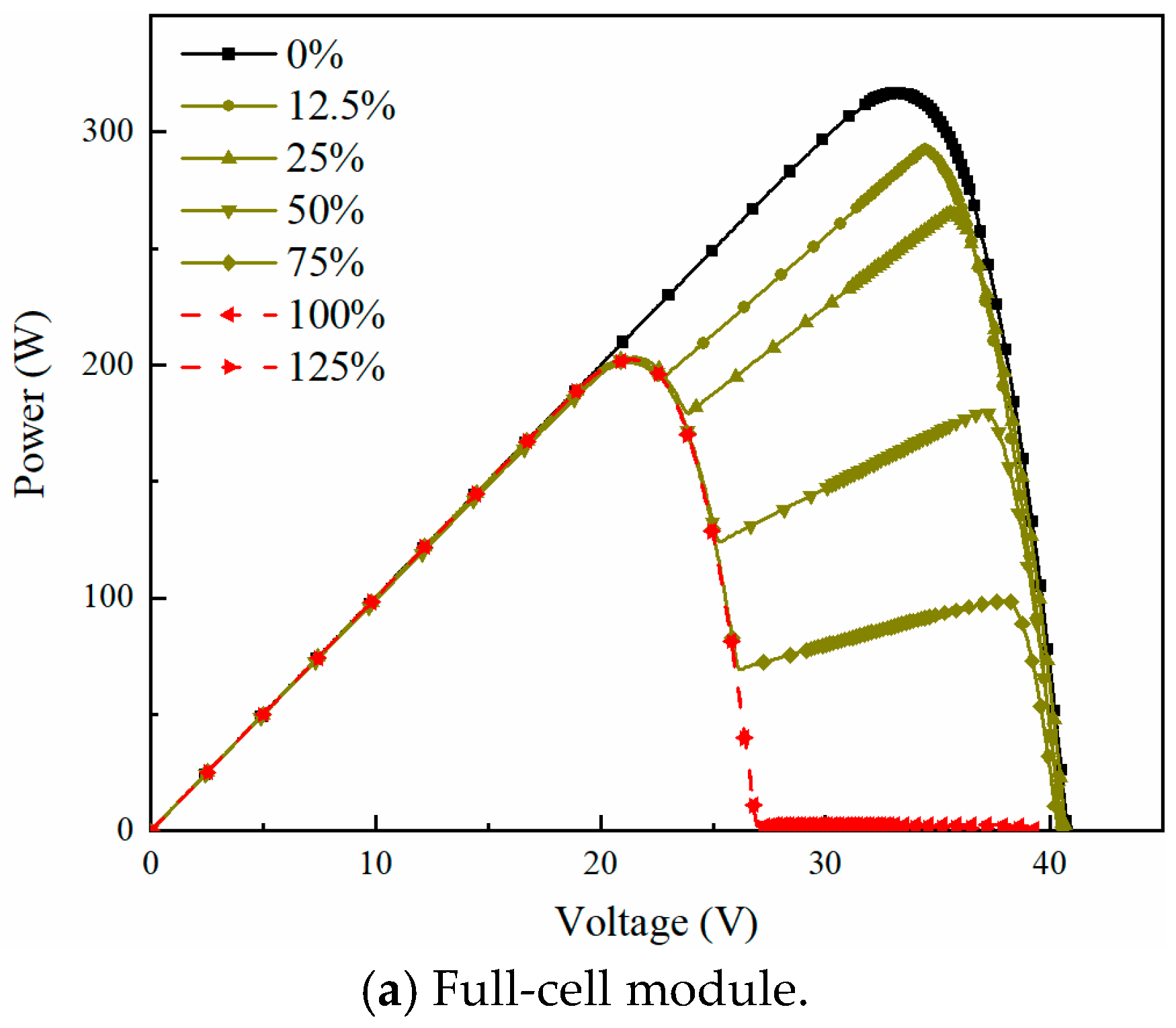
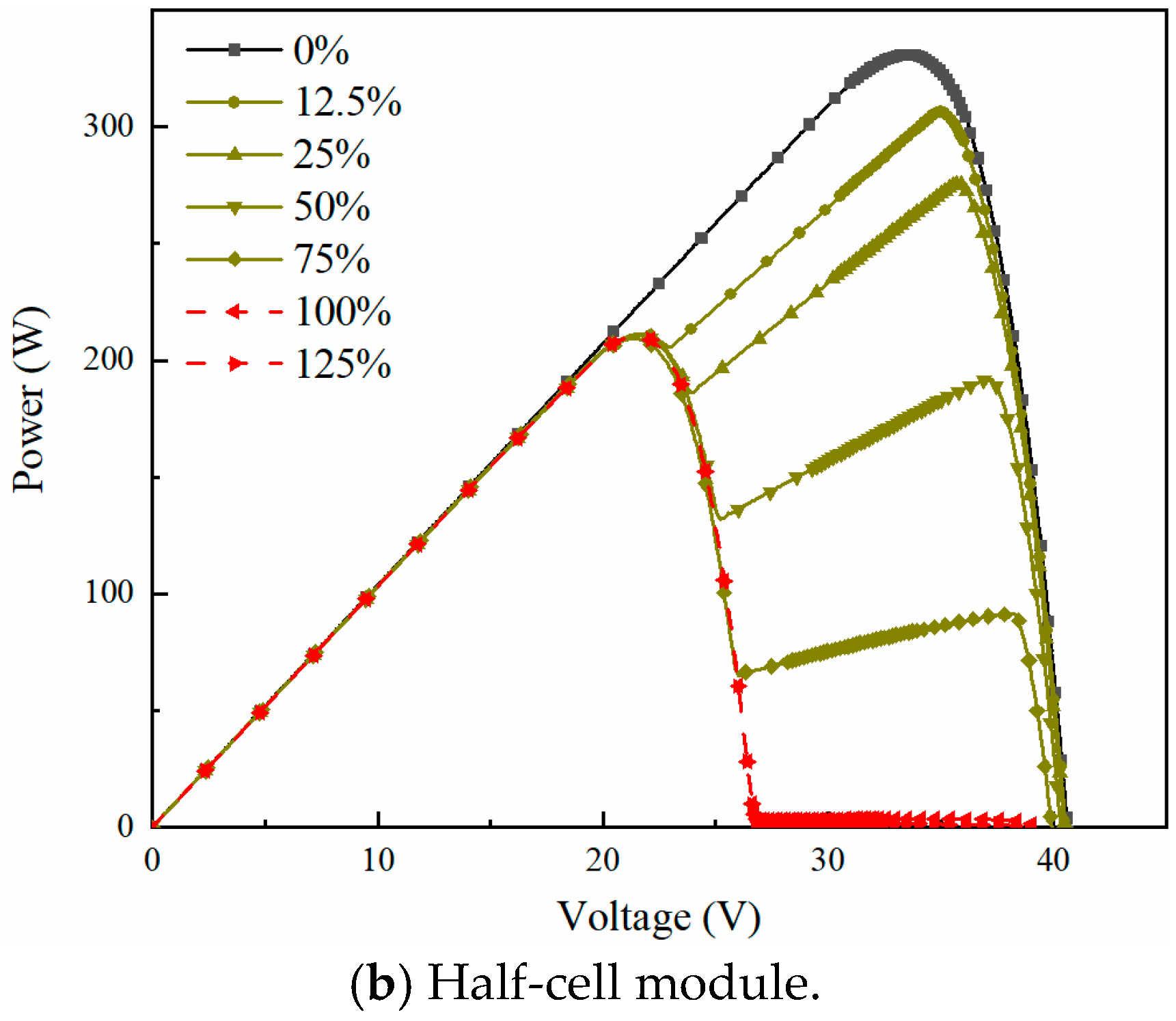
- When shading strips are vertically placed on the modules and the shading height reaches 50% of the solar cell side length, the power of full-cell modules decreases by approximately 42%, while that of half-cell modules only drops by 27%. When the shading ratio reaches 100%, the output power of full-cell modules declines by about 99%, almost losing their power generation capacity, whereas half-cell modules can still maintain nearly 50% of their rated power. These results demonstrate that the dust accumulation resistance of half-cell modules is significantly superior to that of full-cell modules.
- (2)
- When shading strips are horizontally placed on the modules, the power attenuation trends of full-cell and half-cell modules are similar. At shading ratios of 25% and 50%, the power attenuation is approximately 16% and 36%, respectively.
- (3)
- When PV modules are installed horizontally, their output power exhibits multi-peak characteristics. This poses a dilemma for PV inverters, as they may become trapped in local maxima, which significantly degrades system performance and operational stability. Therefore, horizontal installation is not recommended for PV arrays.
- (4)
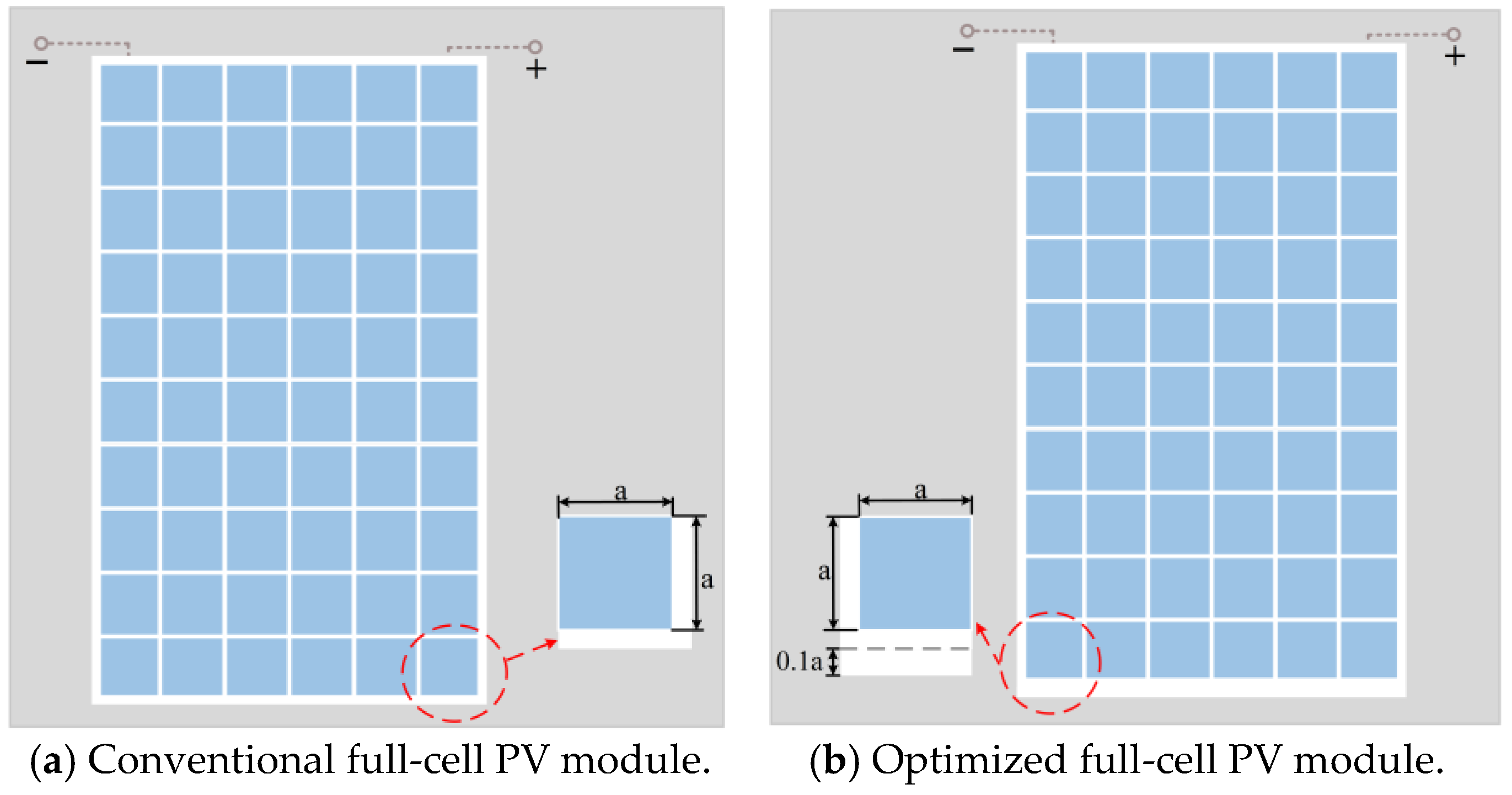
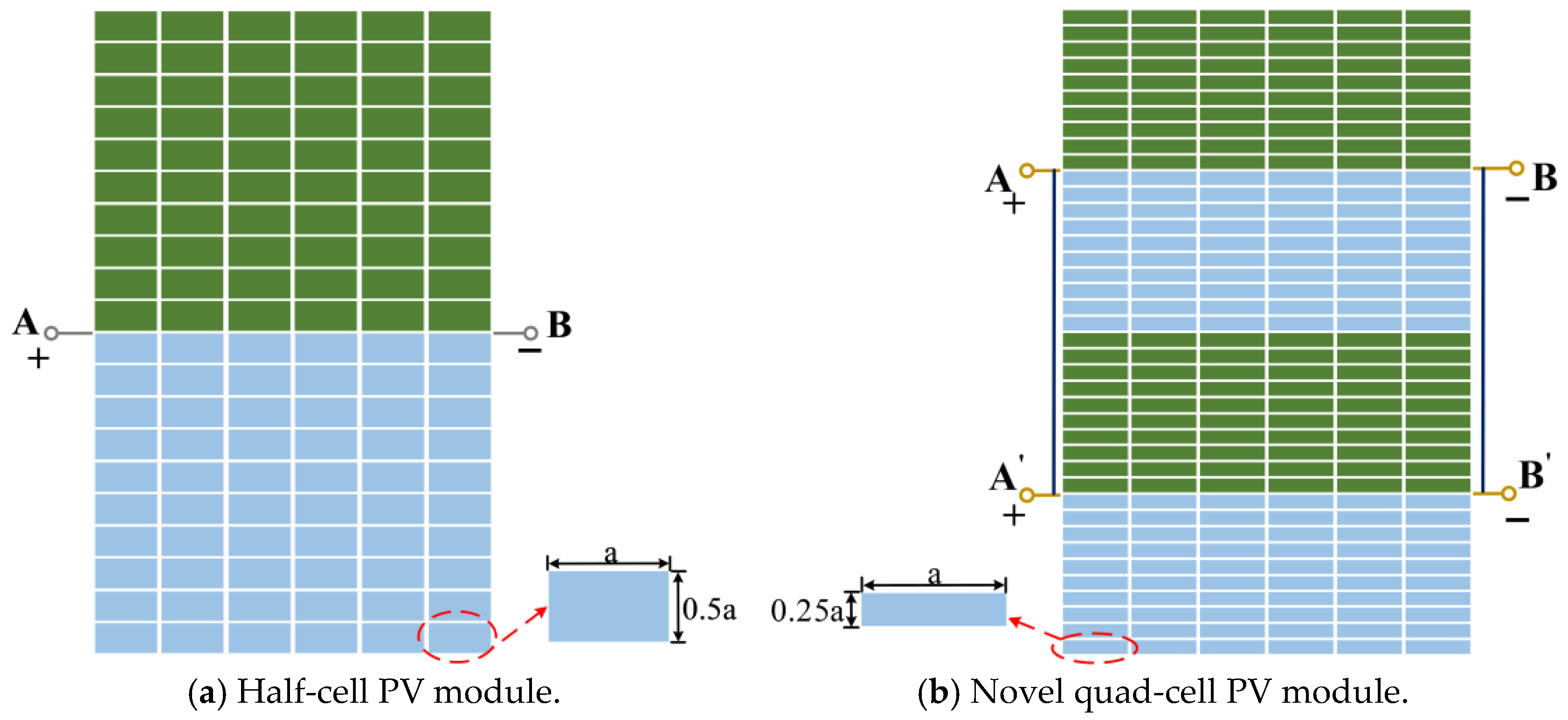
- Based on experimental results and theoretical analysis, two novel module designs are proposed: asymmetric full-cell modules and quad-cell PV modules. These designs can effectively reduce power losses caused by edge dust accumulation, improve the annual power generation of PV modules, and provide theoretical and technical support for the stable operation of PV systems.
Author Contributions
Funding
Institutional Review Board Statement
Informed Consent Statement
Data Availability Statement
Conflicts of Interest
References
- Baumgartner, F.; Allenspach, C.; Özkalay, E.; Berwind, M.; Heimsath, A.; Bucher, C.; Joss, D.; Golroodbari, S.M.; van Sark, W.; Granlund, A.; et al. Performance of Partially Shaded PV Generators Operated by Optimized Power Electronics; International Energy Agency: Paris, France, 2024. [Google Scholar]
- Ge, H.; Li, X.; Guo, C.; Luo, W.; Jia, R. The Mechanism of Hot Spots Caused by Avalanche Breakdown in Gallium-Doped PERC Solar Cells. Energies 2023, 16, 2699. [Google Scholar] [CrossRef]
- Appelbaum, J.; Peled, A.; Aronescu, A. Wall Shading Losses of Photovoltaic Systems. Energies 2024, 17, 5089. [Google Scholar] [CrossRef]
- Ge, Q.; Li, Z.; Sun, Z.; Xu, J.; Long, H.; Sun, T. Low Resistance Hot-Spot Diagnosis and Suppression of Photovoltaic Module Based on IU Characteristic Analysis. Energies 2022, 15, 3950. [Google Scholar]
- Craciunescu, D.; Fara, L. Investigation of the partial shading effect of photovoltaic panels and optimization of their performance based on high-efficiency FLC algorithm. Energies 2023, 16, 1169. [Google Scholar] [CrossRef]
- El Iysaouy, L.; Lahbabi, M.; Bhagat, K.; Azeroual, M.; Boujoudar, Y.; El Imanni, H.S.; Aljarbouh, A.; Pupkov, A.; Rele, M.; Ness, S. Performance enhancements and modelling of photovoltaic panel configurations during partial shading conditions. Energy Syst. 2023, 16, 1143–1164. [Google Scholar]
- Kumari, N.; Singh, S.K.; Kumar, S.; Jadoun, V.K. Performance analysis of partially shaded high-efficiency mono PERC/mono crystalline PV module under indoor and environmental conditions. Sci. Rep. 2024, 14, 21587. [Google Scholar]
- Alabdali, Q.A.; Bajawi, A.M.; Nahhas, A.M. Review of recent advances of shading effect on PV solar cells generation. Sustain. Energy 2020, 8, 1–5. [Google Scholar]
- Pareek, S.; Ansari, F.; Khurana, N.; Nezami, M.; Alharbi, S.S.; Alharbi, S.S.; Krishan, G.; Dahiya, R.; Khan, M.J. Performance comparison of interconnection schemes for mitigating partial shading losses in solar photovoltaic arrays. Sci. Rep. 2025, 15, 27787. [Google Scholar] [CrossRef]
- Ramezani, F.; Mirhosseini, M. Shading impact modeling on photovoltaic panel performance. Renew. Sustain. Energy Rev. 2025, 212, 115432. [Google Scholar] [CrossRef]
- Sezgin-Ugranlı, H.G. Photovoltaic System Performance Under Partial Shading Conditions: Insight into the Roles of Bypass Diode Numbers and Inverter Efficiency Curve. Sustainability 2025, 17, 4626. [Google Scholar] [CrossRef]
- Özkalay, E.; Valoti, F.; Caccivio, M.; Virtuani, A.; Friesen, G.; Ballif, C. The effect of partial shading on the reliability of photovoltaic modules in the built-environment. Epj Photovolt. 2024, 15, 7. [Google Scholar]
- Al Mahdi, H.; Leahy, P.G.; Alghoul, M.; Morrison, A.P. A review of photovoltaic module failure and degradation mechanisms: Causes and detection techniques. Solar 2024, 4, 43–82. [Google Scholar] [CrossRef]
- Tummalieh, A.; Mittag, M.; Reichel, C.; Protti, A.; Neuhaus, H. Holistic Analysis for Mismatch Losses in Photovoltaic Modules: Assessing the Impact of Inhomogeneity from Operational Conditions and Degradation Mechanisms on Power and Yield. Prog. Photovolt. Res. Appl. 2025, 0, 1–21, in press. [Google Scholar] [CrossRef]
- Zhou, J.C. Principles of Photovoltaic Cells; Chemical Industry Press: Beijing, China, 2021; Volume 7, p. 193. [Google Scholar]
- Hwang, S.; Kang, Y. Reliability study on the half-cutting PERC solar cell and module. Energy Rep. 2023, 10, 678–685. [Google Scholar] [CrossRef]
- Cabrera-Tobar, A.; Dolara, A.; Leva, S.; Mazzeo, D.; Ogliari, E. Comparative analysis of half-cell and full-cell PV commercial modules for sustainable mobility applications: Outdoor performance evaluation under partial shading conditions. Sustain. Energy Technol. Assess. 2024, 71, 103981. [Google Scholar]
- Siow, C.H.; Tan, R.H.G.; Babu, T.S. Modeling and comparative study of half-cut cell and standard cell photovoltaic modules under partial shading conditions. In Performance Enhancement and Control of Photovoltaic Systems; Elsevier: Amsterdam, The Netherlands, 2024; pp. 161–180. [Google Scholar]
- Pratama, B.A.; Hiendro, A.; Marpaung, J.; Yusuf, M.I.; Imansyah, F. Effect of Shading on Half-Cut Solar Panels Power Output. Telecommun. Comput. Electr. Eng. J. 2023, 1, 73. [Google Scholar] [CrossRef]
- Merodio, P.; Martínez-Moreno, F.; Lorenzo, E. Experimental determination of the structure shading factor and mismatch losses for bifacial photovoltaic modules on variable-geometry, single-axis trackers. Sol. Energy 2025, 291, 113400. [Google Scholar]
- Zafar, M.H.; Khan, N.M.; Mirza, A.F.; Mansoor, M.; Akhtar, N.; Qadir, M.U.; Khan, N.A.; Moosavi, S.K.R. A new meta-heuristic optimization algorithm based MPPT control technique for PV systems under complex partial shading condition. Sustain. Energy Technol. Assess. 2021, 47, 101367. [Google Scholar]
- Javed, M.Y.; Murtaza, A.F.; Ling, Q.; Qamar, S.; Gulzar, M.M. A new MPPT design using generalized pattern search for partial shading. Energy Build. 2016, 133, 59–69. [Google Scholar]
- Chai, L.G.K.; Gopal, L.; Juwono, F.H.; Chiong, C.W.; Ling, H.-C.; Basuki, T.A. A new global MPPT technique using improved PS-FW algorithm for PV system under partial shading conditions. Energy Convers. Manag. 2021, 246, 114639. [Google Scholar]
- Sarwar, S.; Javed, M.Y.; Jaffery, M.H.; Arshad, J.; Rehman, A.U.; Shafiq, M.; Choi, J.-G. A new hybrid MPPT technique to maximize power harvesting from PV system under partial and complex partial shading. Appl. Sci. 2022, 12, 587. [Google Scholar]
- Youssef, A.R.; Hefny, M.M.; Ali, A.I.M. Investigation of single and multiple MPPT structures of solar PV-system under partial shading conditions considering direct duty-cycle controller. Sci. Rep. 2023, 13, 19051. [Google Scholar]
- Almutairi, A.; Abo-Khalil, A.G.; Sayed, K.; Albagami, N. MPPT for a PV grid-connected system to improve efficiency under partial shading conditions. Sustainability 2020, 12, 10310. [Google Scholar] [CrossRef]
- Worku, M.Y.; Hassan, M.A.; Maraaba, L.S.; Shafiullah; Elkadeem, M.R.; Hossain, I.; Abido, M.A. A comprehensive review of recent maximum power point tracking techniques for photovoltaic systems under partial shading. Sustainability 2023, 15, 11132. [Google Scholar] [CrossRef]
- Zhang, Y.; Yu, Y.; Meng, F.; Liu, Z. Experimental investigation of the shading and mismatch effects on the performance of bifacial photovoltaic modules. IEEE J. Photovolt. 2019, 10, 296–305. [Google Scholar]
- Kuznetsov, P.N.; Abd, A.L.M.; Kuvshinov, V.V.; Issa, H.A.; Mohammed, H.J.; Al-Bairmani, A.G. Investigation of the losses of photovoltaic solar systems during operation under partial shading. J. Appl. Eng. Sci. 2020, 18, 313–320. [Google Scholar] [CrossRef]
- Klasen, N.; Weisser, D.; Rößler, T.; Neuhaus, D.H.; Kraft, A. Performance of shingled solar modules under partial shading. Prog. Photovolt. Res. Appl. 2022, 30, 325–338. [Google Scholar]
- Afridi, M.Z.U.A. Module Level Power Electronics and Photovoltaic Modules: Thermal Reliability Evaluation. Ph.D. Thesis, Arizona State University, Tempe, AZ, USA, 2023. [Google Scholar]
- Ma, J.; Song, Y.; Qiao, S.; Liu, D.; Ding, Z.; Kopecek, R.; Chen, J.; Zhang, C.; Chen, M. Design, realization and loss analysis of efficient low-cost large-area bifacial interdigitated-back-contact solar cells with front floating emitter. Sol. Energy Mater. Sol. Cells 2022, 235, 111466. [Google Scholar]
- Bhuiyan, M.A.S. Modeling Half-Cut Photovoltaic Modules with Bypass Diodes Under Various Shading Conditions. Master’s Thesis, Purdue University, West Lafayette, IN, USA, 2024. [Google Scholar]
- Sarwar, S.; Javed, M.Y.; Jaffery, M.H.; Ashraf, M.S.; Naveed, M.T.; Hafeez, M.A. Modular level power electronics (MLPE) based distributed PV system for partial shaded conditions. Energies 2022, 15, 4797. [Google Scholar] [CrossRef]
- Dhakshinamoorthy, M.; Sundaram, K.; Murugesan, P.; David, P.W. Bypass diode and photovoltaic module failure analysis of 1.5 kW solar PV array. Energy Sources Part A Recovery Util. Environ. Eff. 2022, 44, 4000–4015. [Google Scholar]
- Olalla, C.; Hasan, N.; Deline, C.; Maksimović, D. Mitigation of hot-spots in photovoltaic systems using distributed power electronics. Energies 2018, 11, 726. [Google Scholar] [CrossRef]
- Eum, J.; Park, S.; Choi, H.J. Effects of power optimizer application in a building-integrated photovoltaic system according to shade conditions. Buildings 2023, 14, 53. [Google Scholar] [CrossRef]
- Sinapis, K.; Tzikas, C.; Litjens, G.B.M.A.; van den Donker, M.; Folkert, W.; van Sark, W.G.J.H.M.; Smets, A. Yield modelling for micro inverter, power optimizer and string inverter under clear and partially shading shaded conditions. In Proceedings of the 31st European Photovoltaic Solar Energy Conference, Hamburg, Germany, 14–18 September 2015; pp. 1587–1591. [Google Scholar]
- GB2760-2014; Standard Tables for Reference Solar Spectral Irradiances: Direct Normal and Hemispherical on 37° Tilted Surface. ASTM International: West Conshohocken, PA, USA, 2020.



| Parameters | Full-Cell PV Module | Half-Cell PV Module |
|---|---|---|
| Open-circuit voltage, Voc (V) | 40.72 | 41.12 |
| Short-circuit current, Isc (A) | 10.03 | 10.39 |
| Voltage at MPP, Vmp (V) | 33.13 | 34.36 |
| Current at MPP, Imp (A) | 9.56 | 9.75 |
| MPP, Pmp (W) | 316.8 | 335.1 |
| Fill factor, FF (%) | 77.4 | 78.47 |
| Shading Ratio | Vertical Shading Height | Horizontal Shading Height | ||
|---|---|---|---|---|
| Full-Cell Module | Half-Cell Module | Full-Cell Module | Half-Cell Module | |
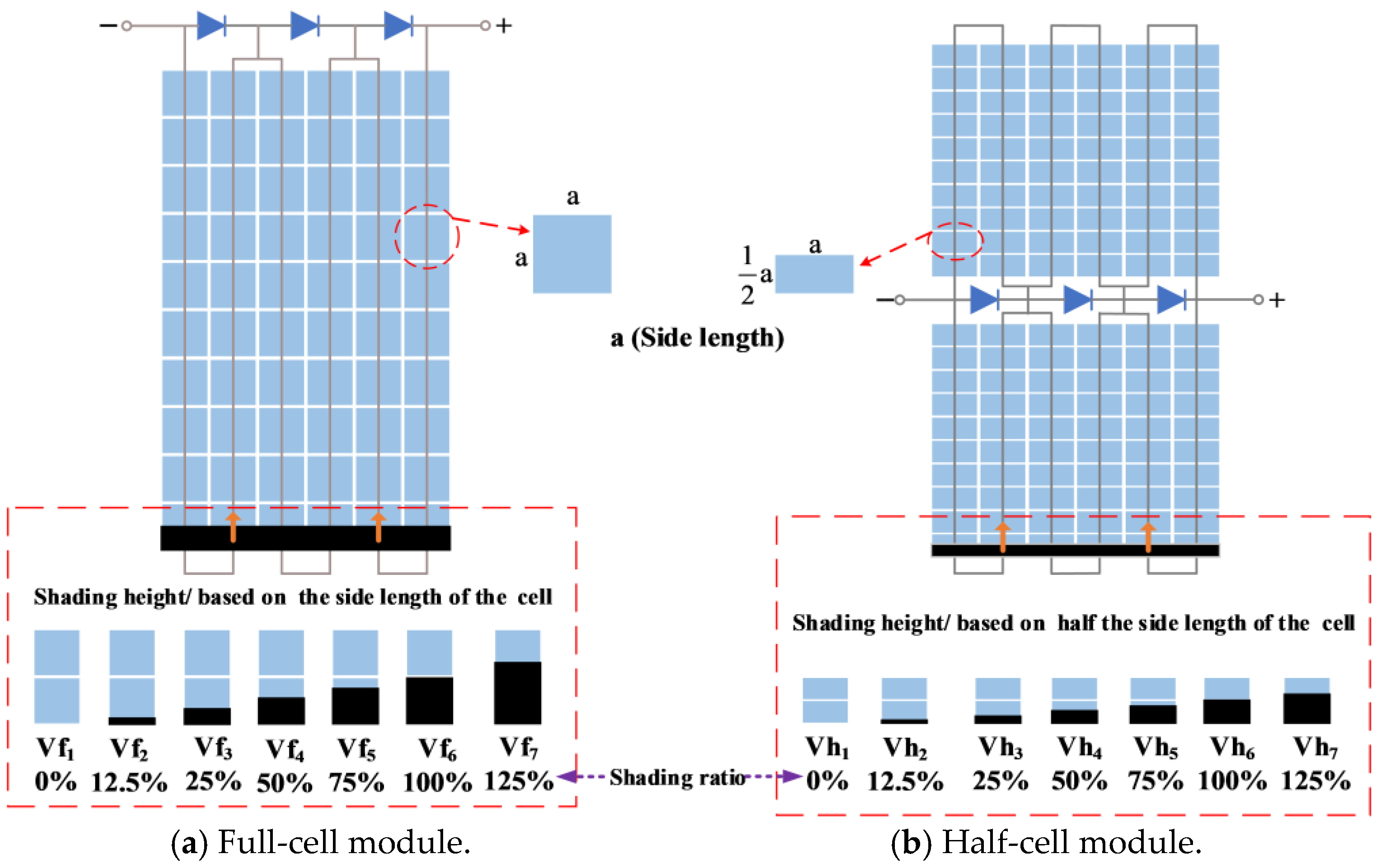
| Base: Full Side a | Base: Half Side a/2 | Base: Full Side a | Base: Full Side a | |
| 0% | 0 | 0 | 0 | 0 |
| 12.5% | 0.125 a | 0.0625 a | 0.125 a | 0.125 a |
| 25% | 0.25 a | 0.125 a | 0.25 a | 0.25 a |
| 50% | 0.50 a | 0.25 a | 0.50 a | 0.50 a |
| 75% | 0.75 a | 0.375 a | 0.75 a | 0.75 a |
| 100% | 1.00 a | 0.50 a | 1.00 a | 1.00 a |
| 125% | 1.25 a | 0.625 a | 1.25 a | 1.25 a |
| Shading Ratio | Full-Cell Module | Half-Cell Module | ||||
|---|---|---|---|---|---|---|
| Voltage (V) | Current (A) | Pmax (W) | Voltage (V) | Current (A) | Pmax (W) | |
| 0% | 33.21 | 9.54 | 316.75 | 33.48 | 9.88 | 330.88 |
| 12.5% | 34.66 | 8.63 | 299.07 | 34.38 | 9.26 | 318.39 |
| 25% | 35.81 | 7.51 | 268.84 | 34.50 | 8.91 | 307.49 |
| 50% | 37.51 | 4.87 | 182.61 | 34.41 | 7.07 | 243.35 |
| 75% | 38.57 | 2.37 | 91.40 | 34.01 | 6.13 | 208.35 |
| 100% | 32.79 | 0.11 | 3.65 | 33.47 | 4.99 | 166.96 |
| 125% | 32.24 | 0.10 | 3.29 | 33.62 | 4.97 | 166.97 |
| Shading Ratio | Full-Cell Module | Half-Cell Module | ||||
|---|---|---|---|---|---|---|
| Voltage (V) | Current (A) | Pmax (W) | Voltage (V) | Current (A) | Pmax (W) | |
| 0% | - | - | - | - | - | - |
| 12.5% | 21.26 | 9.46 | 201.02 | 21.64 | 9.77 | 211.35 |
| 25% | 21.44 | 9.49 | 203.42 | 21.69 | 9.73 | 210.99 |
| 50% | 20.89 | 9.68 | 202.28 | 21.63 | 9.74 | 210.71 |
| 75% | 21.37 | 9.46 | 202.21 | 21.40 | 9.78 | 209.27 |
| 100% | - | - | - | - | - | - |
| 125% | - | - | - | - | - | - |
| Shading Ratio | Full-Cell Module | Half-Cell Module | ||||
|---|---|---|---|---|---|---|
| Voltage (V) | Current (A) | Pmax (W) | Voltage (V) | Current (A) | Pmax (W) | |
| 0% | 33.21 | 9.54 | 316.75 | 33.48 | 9.88 | 330.88 |
| 12.5% | 34.44 | 8.49 | 292.48 | 35.04 | 8.74 | 306.33 |
| 25% | 35.55 | 7.46 | 265.07 | 35.73 | 7.72 | 275.76 |
| 50% | 37.05 | 4.86 | 180.02 | 37.17 | 5.17 | 192.15 |
| 75% | 37.97 | 2.60 | 98.90 | 38.20 | 2.40 | 91.53 |
| 100% | 21.48 | 9.42 | 202.34 | 21.51 | 9.78 | 210.31 |
| 125% | 21.43 | 9.44 | 202.21 | 21.57 | 9.75 | 210.30 |
Disclaimer/Publisher’s Note: The statements, opinions and data contained in all publications are solely those of the individual author(s) and contributor(s) and not of MDPI and/or the editor(s). MDPI and/or the editor(s) disclaim responsibility for any injury to people or property resulting from any ideas, methods, instructions or products referred to in the content. |
© 2025 by the authors. Licensee MDPI, Basel, Switzerland. This article is an open access article distributed under the terms and conditions of the Creative Commons Attribution (CC BY) license (https://creativecommons.org/licenses/by/4.0/).
Share and Cite
Hao, L.; Zhu, X.; Yuetikuer, A.; Zhan, J.; Ye, X.; Zhong, G.; Zhou, J. Thin-Layer Dust Accumulation Effects on Photovoltaic Modules and Design Optimization for the Module Structure. Coatings 2025, 15, 1442. https://doi.org/10.3390/coatings15121442
Hao L, Zhu X, Yuetikuer A, Zhan J, Ye X, Zhong G, Zhou J. Thin-Layer Dust Accumulation Effects on Photovoltaic Modules and Design Optimization for the Module Structure. Coatings. 2025; 15(12):1442. https://doi.org/10.3390/coatings15121442
Chicago/Turabian StyleHao, Linzhao, Xingrong Zhu, Ayipaiyili Yuetikuer, Jianyong Zhan, Xingyun Ye, Genxiang Zhong, and Jicheng Zhou. 2025. "Thin-Layer Dust Accumulation Effects on Photovoltaic Modules and Design Optimization for the Module Structure" Coatings 15, no. 12: 1442. https://doi.org/10.3390/coatings15121442
APA StyleHao, L., Zhu, X., Yuetikuer, A., Zhan, J., Ye, X., Zhong, G., & Zhou, J. (2025). Thin-Layer Dust Accumulation Effects on Photovoltaic Modules and Design Optimization for the Module Structure. Coatings, 15(12), 1442. https://doi.org/10.3390/coatings15121442