1. Introduction
For more than five decades, the continuous miniaturization of semiconductor devices—described by Moore’s Law—has driven the exponential growth of modern electronics. Gordon Moore originally postulated that the number of transistors that can be integrated onto a silicon chip doubles approximately every two years, resulting in a steady reduction in device dimensions and a corresponding increase in computational performance [
1]. This empirical trend, valid from the 1970s through the 2010s, enabled the transition from micrometer-scale transistors to gate lengths below 10 nm, reaching integration levels exceeding ten billion transistors per chip [
2]. However, as the physical limits imposed by quantum tunneling, leakage currents, and heat dissipation are approached, most experts—including Moore himself—have anticipated that geometric scaling will reach its practical end around 2025 [
3].
The post-Moore era therefore demands new paradigms for performance enhancement that extend beyond simple dimensional scaling. These include the exploration of novel materials, engineered heterostructures, and emergent functionalities such as ferroelectricity, negative capacitance, and two-dimensional (2D) channel confinement [
4,
5]. At the same time, the materials palette of semiconductor technology has expanded dramatically—from about a dozen elements used in the 1970s to more than sixty in current integrated circuits—reflecting an increasing reliance on complex oxides and engineered interfaces [
6]. Within this evolving landscape, hafnium oxide (HfO
2) and related compounds have emerged as materials of strategic importance due to their high dielectric constant, thermodynamic stability, and full compatibility with complementary metal–oxide–semiconductor (CMOS) fabrication processes [
7].
The discovery of ferroelectricity in HfO
2-based thin films in 2011 marked a turning point for both the ferroelectric and semiconductor communities [
8]. Unlike conventional perovskite ferroelectrics such as Pb(Zr,Ti)O
3 (PZT) and BaTiO
3—which lose their polarization below approximately 100 nm and require high crystallization temperatures—HfO
2-based films exhibit robust switchable polarization, low leakage current, and CMOS-compatible processing temperatures (<450 °C) even at thicknesses of only a few nanometers [
9,
10]. These remarkable properties arise from the stabilization of a non-centrosymmetric orthorhombic phase (Pca2
1), which is metastable in bulk but stabilized in thin films through strain, interface energy, chemical doping, and electrode-induced stress [
11].
The polymorphism of HfO
2 is central to its ferroelectric behavior. The monoclinic phase (P2
1/c) is thermodynamically stable and nonpolar, whereas the tetragonal (P4
2/nmc) and cubic (
) phases are paraelectric at elevated temperatures. The orthorhombic Pca2
1 phase lies energetically between these structures and can be stabilized under specific growth conditions and dopant chemistries. In this context, atomic layer deposition (ALD) offers unique advantages for achieving precise control over composition and thickness, enabling uniform films in the sub-10 nm regime with atomically sharp interfaces [
12].
Among the various stabilization mechanisms, chemical doping has proven particularly effective in promoting ferroelectric phase formation and tuning polarization behavior. Dopants such as Zr
4+, Al
3+, and Y
3+ modify the local potential landscape of HfO
2 by introducing lattice distortions, oxygen vacancies, and internal electric fields. Zr substitution (Hf
1−xZr
xO
2) fosters a morphotropic phase boundary between the monoclinic and orthorhombic phases, enhancing switchable polarization and endurance [
13]. Al
3+ incorporation increases the concentration of oxygen vacancies, thereby facilitating lattice distortion and promoting the orthorhombic phase in ultrathin ALD films [
14]. Y
3+ doping introduces internal bias fields through charge-compensation effects, improving retention and suppressing back-switching phenomena [
15]. The synergistic control of strain, defect chemistry, and dopant type therefore enables tunable stabilization of the ferroelectric phase in HfO
2, offering a promising route toward scalable, lead-free ferroelectric materials.
In addition to valence effects and defect-mediated lattice distortions, the ionic radius of the dopant relative to Hf4+ plays a decisive role in stabilizing the polar orthorhombic phase. Dopants with a larger ionic radius, such as Y3+, La3+ or Gd3+, generate local tensile strain and internal distortion fields that promote the formation of the non-centrosymmetric Pca21 phase. In contrast, smaller dopants such as Al3+ or Si4+ tend to stabilize narrower ferroelectric windows and may even induce antiferroelectric-like behavior, although Si has also been shown to weaken the orthorhombic–monoclinic phase boundary through a distinct local bonding mechanism. Moreover, due to the well-known lanthanide contraction, Hf4+ and Zr4+ possess nearly identical ionic radii (≈0.71–0.72 Å, CN = 7), which explains the excellent structural compatibility of Zr substitution and its ability to stabilize a morphotropic o/t boundary. The dopant set selected in this work—Y3+ (larger than Hf4+), Al3+ (smaller), and Zr4+ (similar)—thus provides a representative framework for evaluating how ionic-radius contrast influences ferroelectric phase stability in HfO2-based thin films.
Another crucial parameter influencing ferroelectricity is film thickness. Ultrathin layers (≈5–10 nm) experience strong interfacial confinement and stress from electrodes and substrates, which hinder relaxation into the nonpolar monoclinic phase and favor orthorhombic or tetragonal configurations. In contrast, as the thickness increases, strain relaxation allows monoclinic domains to grow, typically reducing the remanent polarization. The interplay between dopant chemistry and film thickness is therefore a key factor determining phase stability, domain dynamics, and dielectric response.
In this study, we systematically investigate HfO2-based thin films doped with Zr, Al, and Y, deposited by ALD on n-type Si(100) substrates with thicknesses of 7 nm and 100 nm. Through AFM, GIXRD, P–E, I–V, and C–V measurements, we establish comprehensive correlations among film morphology, crystalline structure, and electrical behavior. The results provide new insights into the structure–morphology–ferroelectricity interplay in doped HfO2 systems, elucidating how dopant type and layer thickness govern the stabilization of the polar orthorhombic phase. These findings advance the understanding and optimization of scalable, energy-efficient ferroelectric oxides for next-generation nonvolatile memories, logic devices, and tunable dielectric applications.
2. Materials and Methods
2.1. Film Deposition
HfO
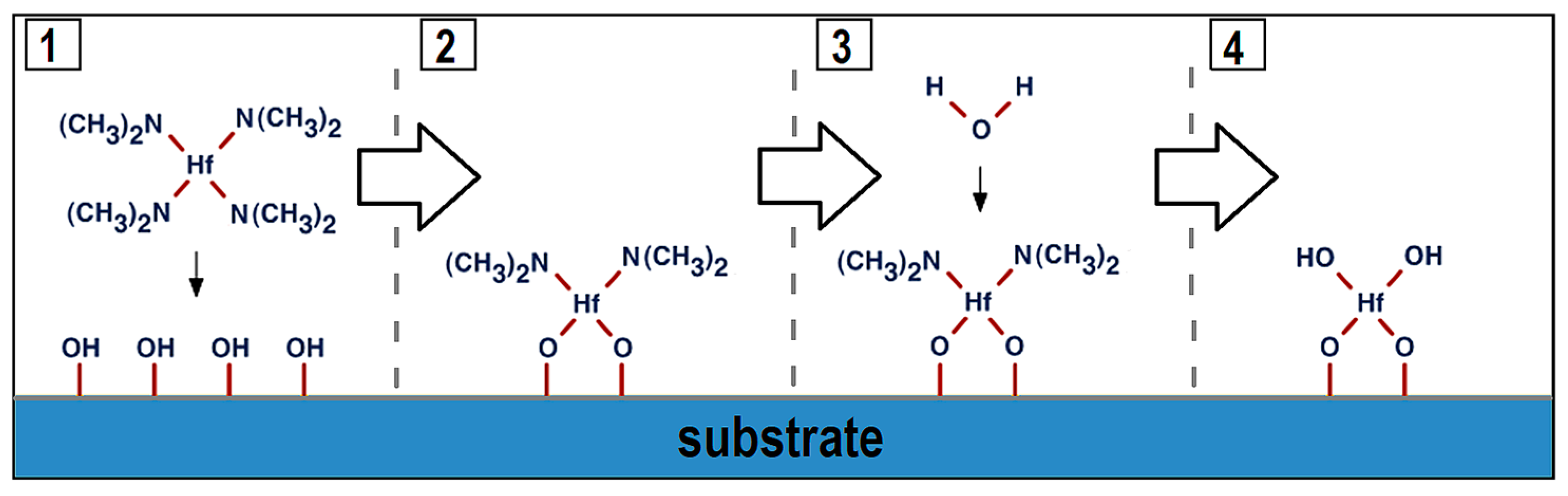
2-based thin films were deposited by atomic layer deposition (ALD) using an OpAL reactor (Oxford Instruments Plasma Technology, Bristol, UK). The ALD technique relies on alternating, self-limiting surface reactions between a volatile organometallic precursor and an oxidant, enabling precise atomic-scale control over film growth, composition, and uniformity. A schematic representation of the surface chemistry during the ALD process of HfO
2, using tetrakis(dimethylamino)hafnium (TDMAH) and H
2O as precursors, is shown in
Figure 1.
In the first half-reaction, the hafnium precursor—tetrakis(dimethylamino)hafnium (TDMAH)—chemisorbs onto hydroxyl (–OH) groups at the substrate surface, forming Hf–O bonds and releasing dimethylamine [HN(CH3)2] as a volatile by-product. After saturation of all active sites, the process self-terminates, and the chamber is purged to remove unreacted species. During the subsequent oxidation step, ultra-pure H2O reacts with the remaining ligands, forming a monolayer of HfO2 and regenerating the –OH groups for the next cycle. This self-limiting sequence ensures conformal, dense, and stoichiometric film growth with sub-nanometer thickness control.
The ferroelectric phase of HfO2 is obtained by doping with Zr, Al, or Y, which stabilizes the non-centrosymmetric orthorhombic phase responsible for ferroelectric behavior.
The selection of Zr, Al, and Y dopants in this work is intentional and grounded in the strong dependence of ferroelectric phase stability on the ionic radius contrast between the dopant and the host Hf4+ cation. Y3+ has a significantly larger ionic radius than Hf4+, generating local tensile strain and distortion fields that promote stabilization of the orthorhombic Pca21 phase. Al3+, in contrast, is appreciably smaller than Hf4+ and can therefore modify the local bonding environment in a way that favors narrower ferroelectric windows or competition with antiferroelectric ordering. Zr4+ possesses an ionic radius nearly identical to that of Hf4+ due to the lanthanide contraction, making it structurally compatible and allowing the formation of a highly homogeneous solid solution near the o/t morphotropic phase boundary. This dopant set—larger (Y), smaller (Al), and radius-matched (Zr)—provides a controlled framework to systematically investigate how ionic size influences polar phase stabilization in ALD-grown HfO2 thin films.
The following precursors were used during the ALD growth process:
Hf precursor: Tetrakis(dimethylamino)hafnium (TDMAH, 99.99+% Hf, <0.2% Zr, Puratrem, Strem Chemicals, Inc., Newburyport, MA, USA);
Zr precursor: Tetrakis(dimethylamino)zirconium(IV) (TDMAZ, 99.99% Zr, Puratrem, Strem Chemicals, Inc., Newburyport, MA, USA);
Al precursor: Trimethylaluminum (TMA, electronic grade, 99.999+% Al, Puratrem, Strem Chemicals, Inc., Newburyport, MA, USA);
Y precursor: Tris(N,N′-diisopropylformamidinato)yttrium(III) (97%, Puratrem, Strem Chemicals, Inc., Newburyport, MA, USA).
Ultra-pure deionized water (H2O) served as the oxidant, while high-purity nitrogen (N2, 6.0, 99.9999 vol.%) supplied by Linde Gaz România, Bucharest, Romania, was used both as the purge and carrier gas throughout the ALD process.
2.2. Substrate Preparation
The films were deposited on 4-inch n-type Si(100) wafers (resistivity: 1–10 Ω·cm, thickness: 525 µm). For planar electrical measurements, a 20 nm Al2O3 barrier layer was first deposited by ALD on the silicon substrate to ensure a well-controlled dielectric interface. The functional HfO2-based films were then deposited directly on top of the Al2O3 layer without removing the samples from the reactor. Prior to deposition, all Si(100) wafers were cleaned and treated by UV–ozone exposure for 15 min at 75 °C using a UV–ozone cleaner (Novascan Technologies, Ames, IA, USA) to remove organic contaminants and enhance surface hydrophilicity.
2.3. ALD Growth Process
Ferroelectric HfO2-based thin films were deposited by atomic layer deposition (ALD) using two distinct growth schemes, depending on the chemical compatibility of the metal precursors. In the first scheme, where precursor chemistry allowed co-integration, the two metal precursors were sequentially pulsed onto the substrate in a 2:1 cycle ratio, followed by an oxidation step. This process yielded Zr-doped HfO2, hereafter referred to as HfZrO.
In the second scheme, laminated oxide stacks were formed by alternating ALD cycles of HfO2 and Al2O3 or Y2O3 in a 4:1 sequence. This multilayer growth approach produced Al- and Y-doped HfO2, hereafter referred to as HfAlO and HfYO, respectively. All ALD depositions were carried out at a substrate temperature of 200 °C.
2.4. Film Thickness
Two sets of films were deposited for comparative analysis, with nominal thicknesses of approximately 7 nm and 100 nm. Both film series were used for structural, morphological, and electrical investigations. The film thickness was controlled by the number of ALD cycles and verified by X-ray reflectivity (XRR), where the Kiessig fringe periodicity was used to determine the precise layer thickness.
2.5. Surface Morphology
The surface morphology and roughness of the ultrathin ALD-deposited layers were examined by atomic force microscopy (AFM) using an NTEGRA Aura scanning probe microscope (NT-MDT Spectrum Instruments, NT-MDT BV, Apeldoorn, The Netherlands). All AFM images were recorded in intermittent-contact mode using high-accuracy noncontact (HA_NC) silicon probes (NT-MDT) with a nominal tip radius of less than 10 nm. Surface roughness analysis was performed using the Nova™ software package version 1.0 (NT-MDT). For quantitative evaluation, 2 × 2 µm2 scan areas were analyzed for each film.
2.6. EDS Analysis
Energy-dispersive X-ray spectroscopy (EDS) analyses were performed using a FEI Quanta 250 scanning electron microscope (SEM) operated in high-vacuum mode and equipped with an EDS detector. Measurements were carried out at an accelerating voltage of 15–20 kV, with an acquisition time of 60–120 s for each elemental map. EDS maps were collected over representative surface areas (10 μm scale) for the characteristic signals O–K, Hf–M, Al–K, Zr–L, and Y–L, in order to evaluate the spatial distribution of elements within the ALD-deposited films.
2.7. Structural Characterization
The crystallographic structure, thickness, and density of the deposited films were characterized using a high-resolution X-ray diffractometer (Rigaku SmartLabTokyo, Japan). Structural analysis of both the ultrathin (~7 nm) and thick (~100 nm) films was performed by grazing-incidence X-ray diffraction (GIXRD) at a fixed incidence angle of 0.35°, employing Cu Kα1 radiation (λ = 1.54059 Å) in parallel-beam geometry. This configuration enhances the diffracted signal from the film while minimizing the substrate contribution.
The thickness and mass density of the ALD-grown layers on Si(100) substrates were determined by X-ray reflectivity (XRR). The values were obtained by fitting the experimental reflectivity curves, where the Kiessig fringe periodicity provided the thickness and the critical angle of total reflection was used to calculate the density.
2.8. Device Fabrication and Electrical Measurement Configurations
Metal–ferroelectric–semiconductor (MFS) capacitors and planar test structures were fabricated for the electrical characterization of HfO2-based thin films. In both configurations, gold (Au) electrodes were patterned by electron-beam lithography (EBL) and deposited by electron-beam evaporation, ensuring high precision and reproducibility across all devices.
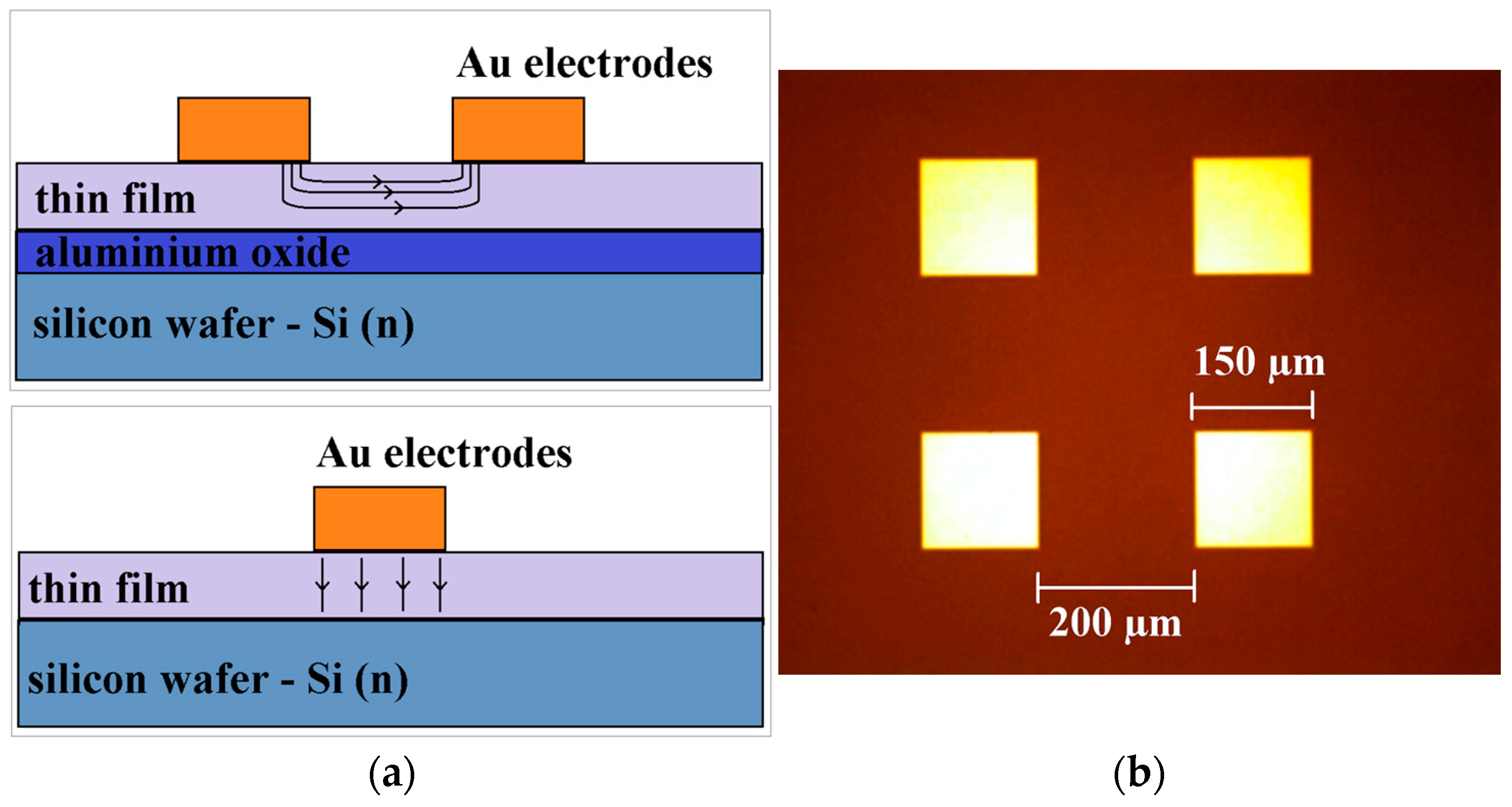
For the in-plane geometry, coplanar Au electrodes were defined on the film surface, with lateral dimensions of 150 µm × 150 µm and an inter-electrode spacing of 200 µm (
Figure 2a,b). These structures were used for I–V and C–V measurements, where the current flowed laterally between the coplanar electrodes along the film surface. The measured current was normalized by the electrode width (I/W) to obtain the sheet current density, a standard approach for analyzing lateral charge transport in thin-film systems [
16]. This normalization eliminates geometric effects and enables direct comparison between samples with different electrode dimensions.
For the through-plane geometry, used in polarization–electric field (P–E) characterization, the top Au electrodes were deposited directly onto the HfO2-based films, forming metal–ferroelectric–semiconductor (MFS) capacitor structures. In this configuration, the current flowed vertically through the oxide layer between the top Au electrodes and the n-type Si substrate, allowing evaluation of the polarization-switching behavior under an applied electric field.
2.9. Electrical Characterization
The electrical characterization of all fabricated devices was performed using a Keithley SCS 4200 Semiconductor Characterization System (Keithley Instruments, Solon, OH, USA), following full instrument calibration. All measurements were carried out at room temperature using a high-precision probe station (EP6, SUSS MicroTec, Garching, Germany) placed inside a Faraday cage to minimize external electromagnetic interference. All acquisition channels were equipped with low-noise amplifiers and connected to the measurement unit via shielded triaxial cables, ensuring stable and reproducible electrical contact during on-wafer testing.
The polarization–electric field (P–E) characteristics of the ferroelectric capacitors were measured using a Radiant Technologies Precision LC II Ferroelectric Tester. The instrument was calibrated prior to use with the standard ferroelectric calibration kit supplied by Radiant Technologies. The P–E hysteresis loops were recorded at room temperature under ambient conditions, providing a reliable assessment of the ferroelectric switching behavior of the doped HfO2-based films.
3. Results
3.1. Surface Morphology (AFM)
The surface morphology of the undoped and doped HfO
2 thin films was investigated by atomic force microscopy (AFM) in intermittent-contact mode over 2 × 2 µm
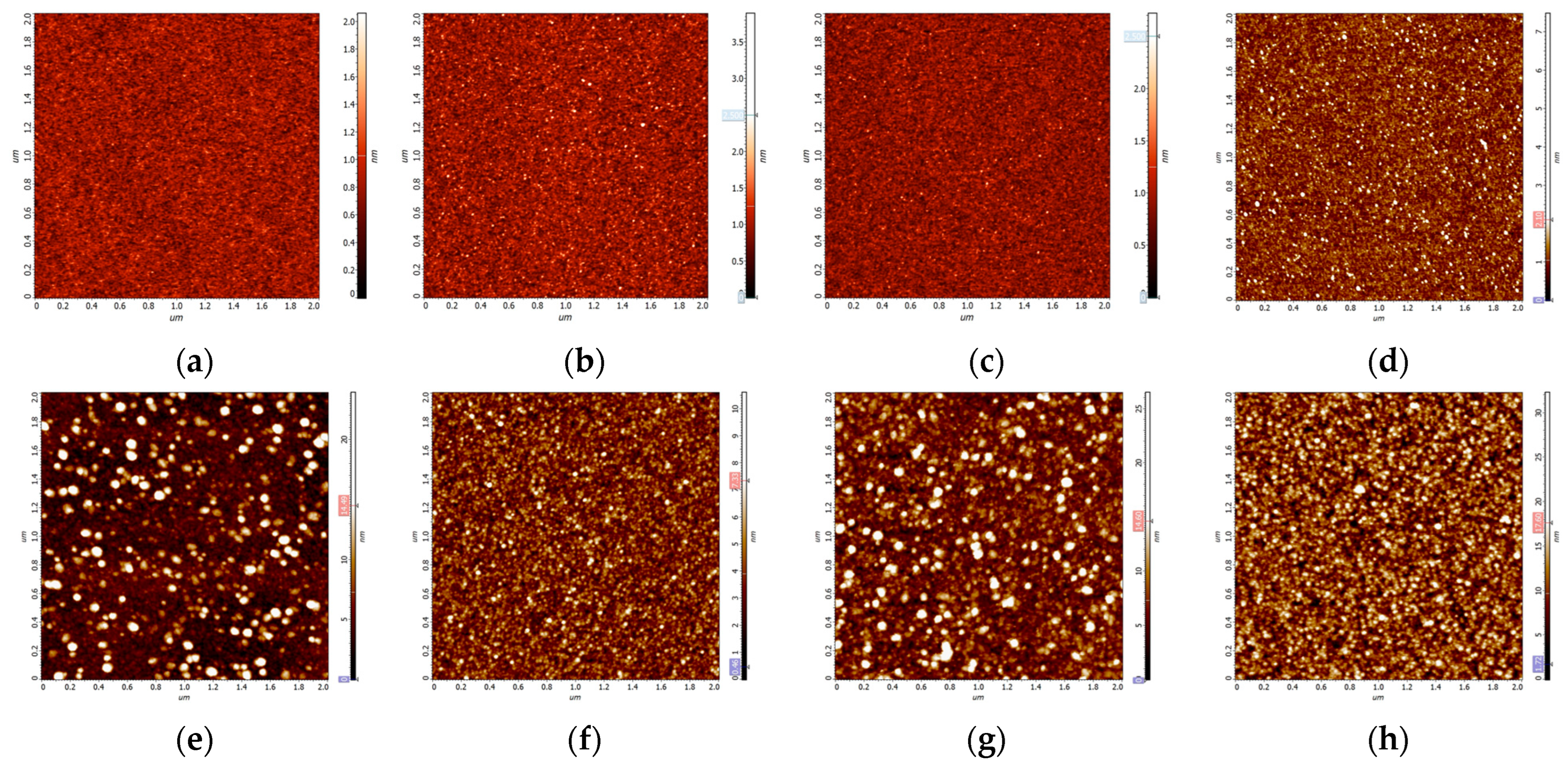
2 scan areas. Representative AFM images for the 7 nm thick HfO
2, HfAlO, HfZrO, and HfYO films deposited on Si(100) substrates are shown in
Figure 3a–d, while the corresponding quantitative roughness and density data for both 7 nm and 100 nm thick films are summarized in
Table 1. All films exhibit smooth, compact, and uniform surfaces, consistent with the layer-by-layer growth mechanism characteristic of the atomic layer deposition (ALD) process [
7,
17].
The undoped HfO
2 film (
Figure 3a) exhibits a finely grained and homogeneous surface with an average root-mean-square (RMS, R_q) roughness of 0.19 nm, indicative of excellent surface uniformity and well-controlled nucleation on Si(100) [
18]. The HfAlO film (
Figure 3b) shows a slightly increased topographical contrast, with occasional bright nanometric protrusions distributed across the surface and an RMS roughness of 0.20 nm. This marginal increase in roughness may arise from local compositional inhomogeneity or partial segregation of Hf–Al–O domains. Nevertheless, the film remains continuous and pinhole-free, confirming the outstanding conformality typical of ALD coatings [
7].
The HfZrO film (
Figure 3c) displays a compact morphology with slightly finer surface features and the lowest RMS roughness value of 0.18 nm, suggesting that Zr incorporation enhances precursor chemisorption and surface mobility during the ALD cycles, thereby promoting smoother film growth [
18,
19]. The HfYO film (
Figure 3d) exhibits a higher RMS roughness of 0.40 nm, correlated with the appearance of slightly larger grains and discrete height variations. The incorporation of yttrium, known as a structural stabilizer for HfO
2-based oxides, modifies the surface energy and promotes nanoscale clustering without compromising overall continuity [
19].
To enable a direct comparison with the ultrathin layers,
Figure 3 also includes the AFM surface topography of the 100 nm thick HfO
2-based films (
Figure 3e–h). In contrast to the conformal, nanometrically smooth 7 nm layers, the 100 nm films exhibit a markedly different morphological signature driven by thickness-induced strain relaxation and grain growth.
The undoped HfO
2 film at 100 nm (
Figure 3e) shows a significant increase in surface roughness (RMS = 3.4 nm), with the appearance of larger granular features characteristic of the onset of bulk-like monoclinic crystallization. The HfAlO film (
Figure 3f) retains a comparatively smoother surface (RMS = 1.1 nm), consistent with the known suppressive effect of Al on grain coarsening and its ability to retard monoclinic phase formation at intermediate thicknesses.
The HfZrO film (
Figure 3g) exhibits a pronounced granular texture with RMS = 3.2 nm, in agreement with the enhanced crystallinity and grain enlargement typically observed in Zr-stabilized hafnia at increased thickness. The HfYO film (
Figure 3h), with RMS = 2.9 nm, presents densely packed rounded grains, reflecting the strong impact of Y
3+ dopants on surface energy and oxygen vacancy-mediated grain boundary mobility.
These morphological differences between the ultrathin and thick layers correlate strongly with the structural and electrical trends reported in later sections, particularly the relaxation-driven suppression of the orthorhombic phase and the concomitant increase in leakage pathways.
Overall, the 7 nm thick films grown on Si(100) exhibit nanometric smoothness and excellent morphological uniformity, with RMS values below 0.5 nm, confirming the high precision of the ALD process in controlling both topography and thickness at the nanoscale. In contrast, the 100 nm thick films demonstrate substantially higher surface roughness (1.1–3.4 nm), broader height distributions, and enhanced grain coarsening, consistent with the transition from interface-dominated growth to strain-relaxed microstructures. These AFM results provide essential context for understanding the thickness-dependent structural evolution of HfO2-based films and help explain the ferroelectric and electrical trends discussed in subsequent sections.
3.2. Distribution of Dopants in ALD-Deposited HfO2 Films (100 nm)
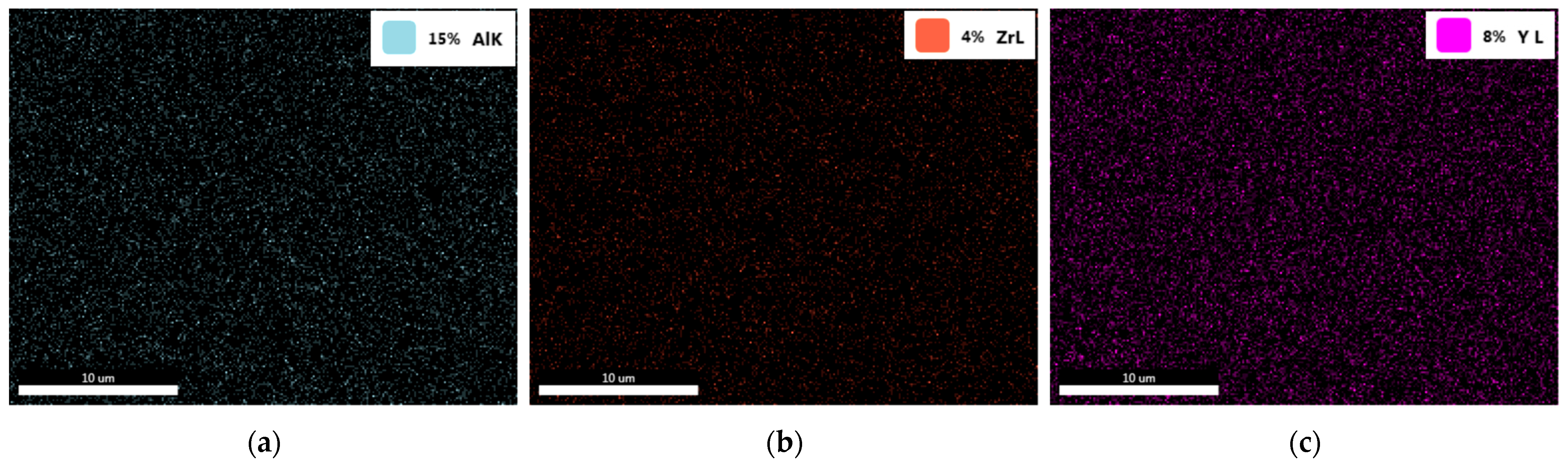
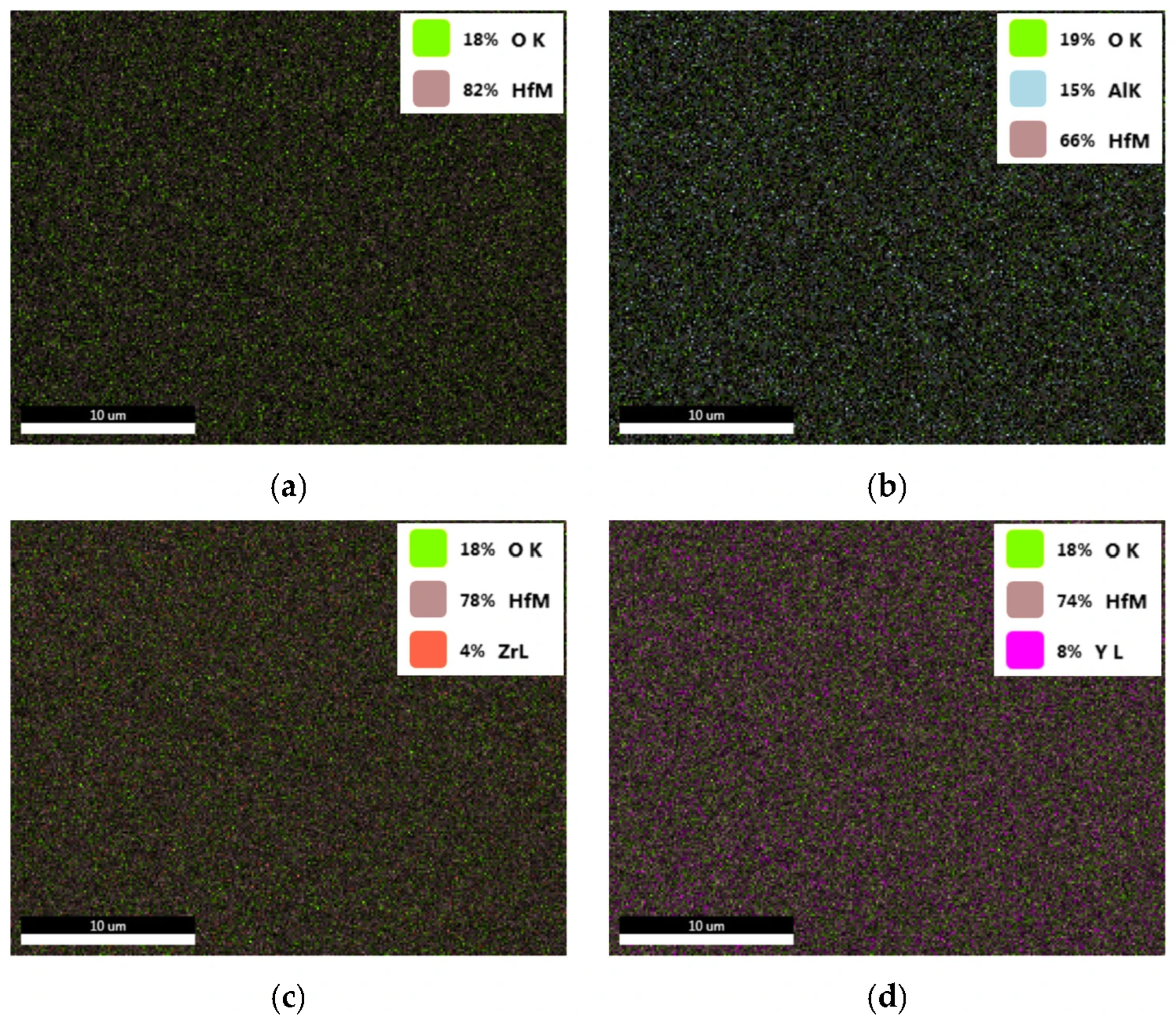
For the 100 nm thick films, energy-dispersive X-ray spectroscopy (EDS) was employed to investigate the spatial distribution of dopants and the compositional homogeneity within the HfO
2 matrix. The elemental distribution maps presented in
Figure 4 and
Figure 5 reveal a uniform composition for all analyzed samples: undoped HfO
2, HfAlO, HfZrO, and HfYO, with no evidence of dopant segregation or local accumulation. The homogeneous distribution of dopant-related signals (Al-K, Zr-L, Y-L) confirms their uniform incorporation into the hafnium oxide lattice.
The obtained results can be directly correlated with the growth schemes employed in the ALD process. In the case of HfZrO films, the organometallic precursors of hafnium and zirconium were pulsed sequentially in a 2:1 ratio, followed by an oxidation step, leading to atomic-scale co-deposition and uniform substitution of Zr within the HfO2 lattice. The lower zirconium atomic concentration determined by EDS (≈4%), compared to the nominal deposition ratio, can be attributed to chemical competition for the active chemisorption sites. At 200 °C, the hafnium precursor (tetrakis(dimethylamino)hafnium, TDMAH) exhibits a higher affinity toward surface terminal hydroxyl groups, forming more stable Hf–O bonds and occupying a larger fraction of reactive sites. The zirconium precursor (tetrakis(dimethylamino)zirconium, TDMAZ), although structurally similar, has slightly higher adsorption energy and a lower reaction rate constant, which limits its effective incorporation. Therefore, the actual Hf:Zr atomic ratio is primarily determined by surface chemistry and chemisorption mechanisms governed by the intrinsic properties of each precursor, rather than by the nominal pulse sequence ratio imposed during the ALD process.
For the HfAlO and HfYO films, obtained by alternating HfO2 and Al2O3 or Y2O3 cycles in a 4:1 ratio, EDS analysis indicated a higher aluminum concentration (≈15%) compared to yttrium (≈8%), although both series were deposited using a similar sequencing scheme. This difference is explained by the significantly higher reactivity of the aluminum precursor (trimethylaluminum, TMA), characterized by a lower activation energy and a higher probability of chemisorption on metal oxide surfaces. In contrast, the yttrium precursor [tris(N,N′-diisopropylformamidinato)yttrium] is bulkier, more thermally stable, and reacts more slowly, which reduces adsorption efficiency at the same deposition temperature of 200 °C. Thus, the compositional differences between HfAlO and HfYO films do not reflect variations in the deposition process but rather the intrinsic surface chemistry and ALD reaction mechanisms specific to each precursor system.
EDS analysis further reveals excellent chemical homogeneity across all investigated HfO2-based films, with no evidence of dopant segregation or secondary phase formation. The uniform distribution of dopant elements confirms their complete incorporation into the oxide lattice and the compositional stability of the ALD-grown films, demonstrating the high quality and precise control of the atomic layer deposition process.
3.3. Structural Analysis (GIXRD)
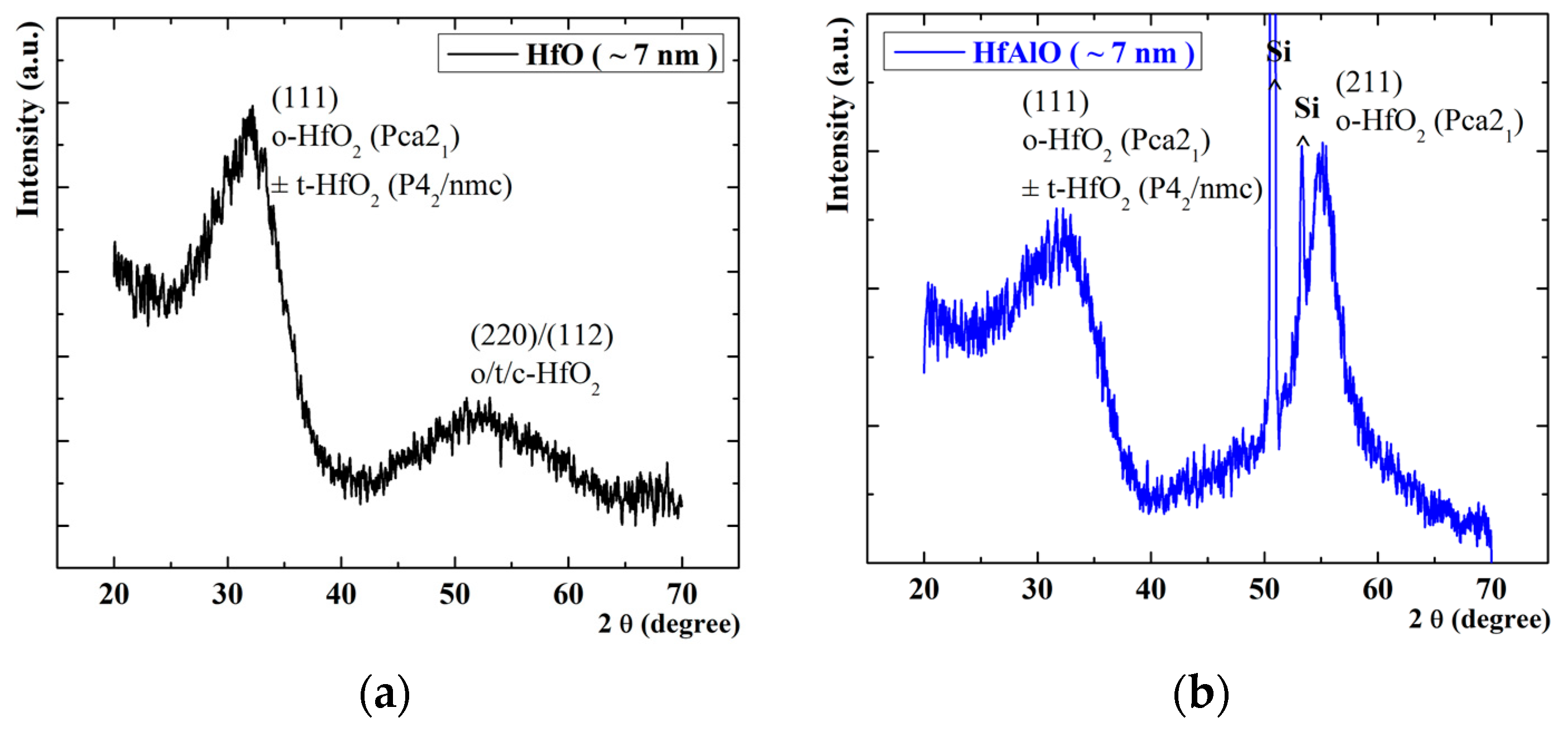
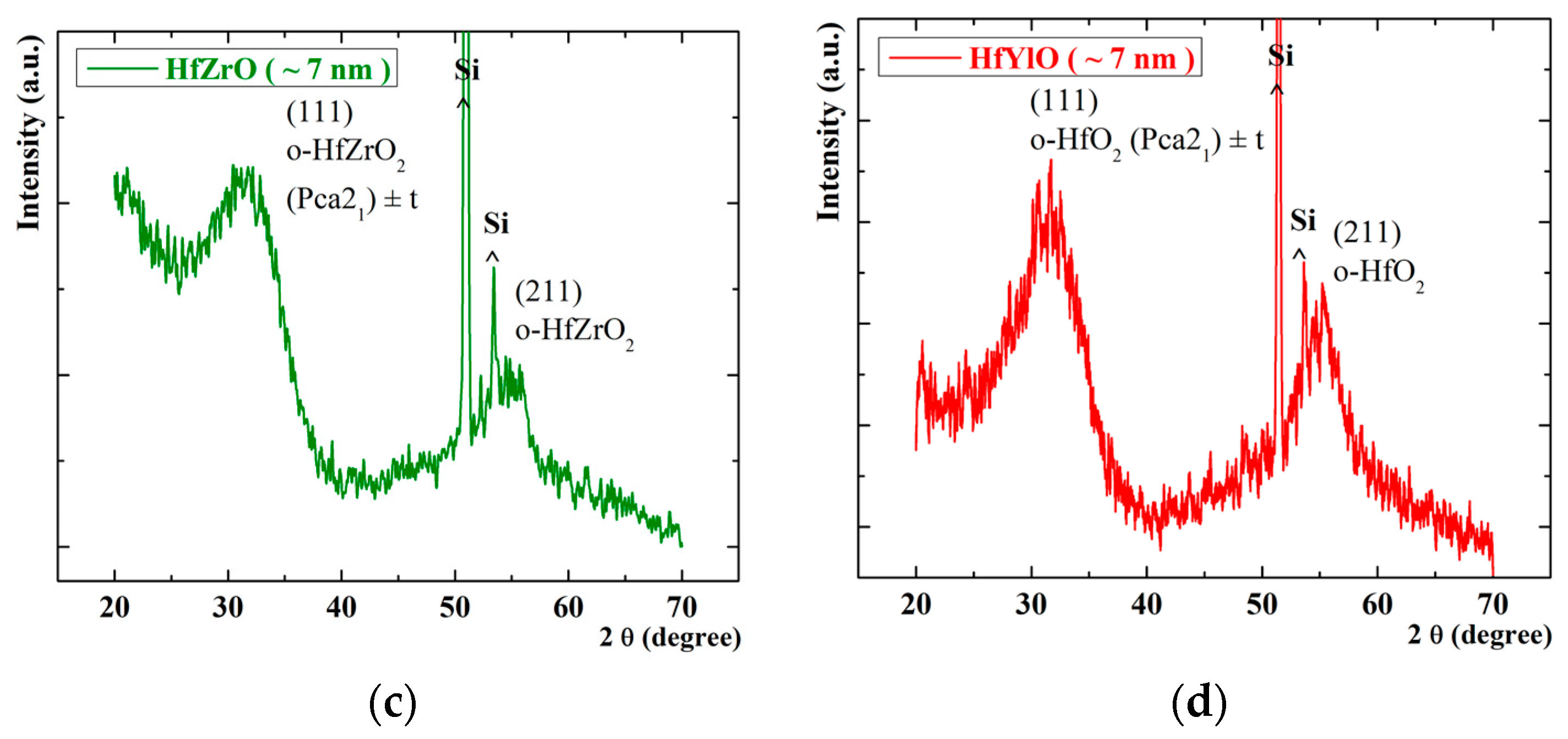
The crystallographic structure of the undoped and doped HfO
2 films was investigated by grazing-incidence X-ray diffraction (GIXRD) at a fixed incidence angle of 0.35°, using Cu Kα
1 radiation (λ = 1.54059 Å). Representative diffraction patterns for the four compositions—HfO
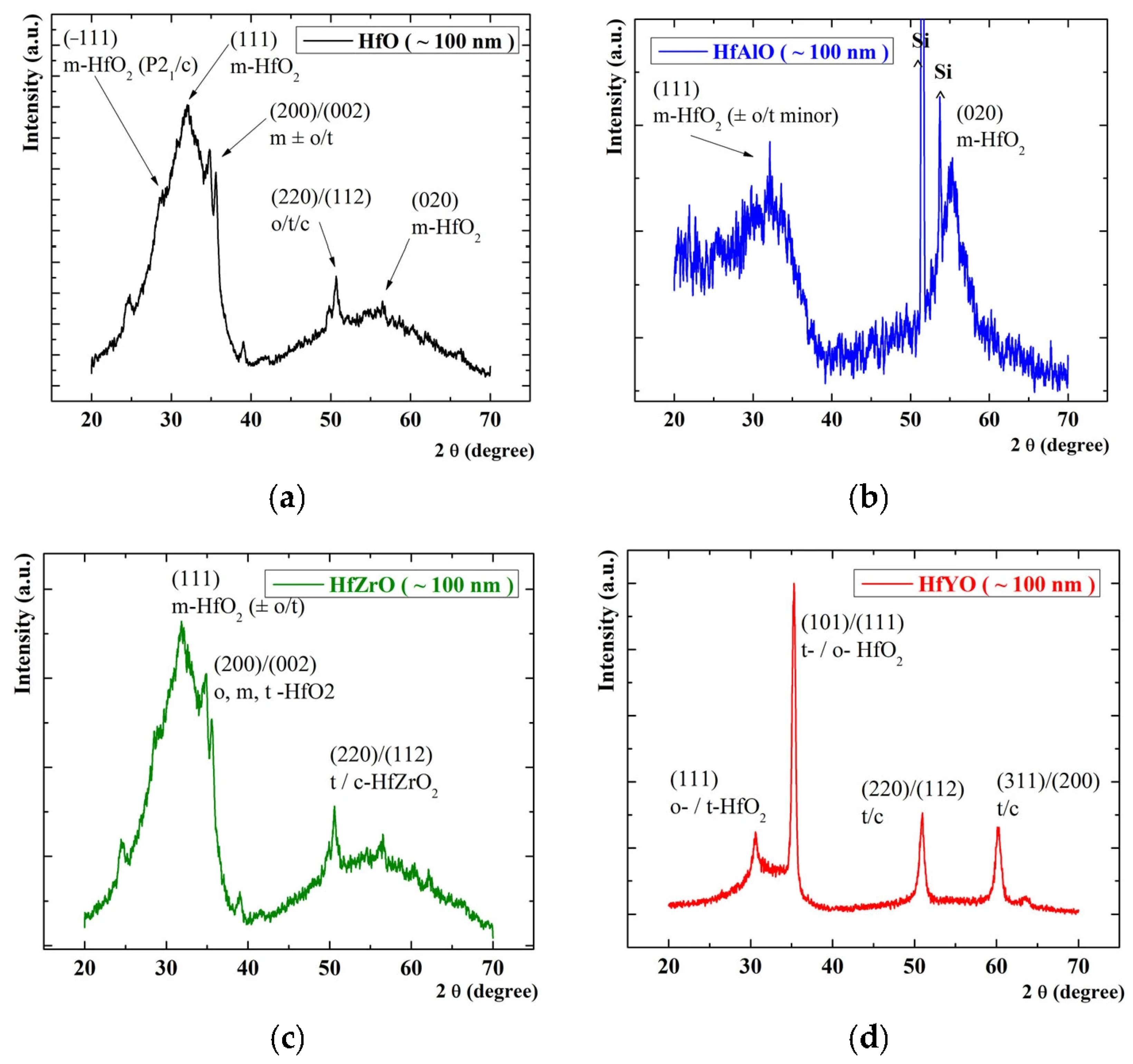
2, HfAlO, HfZrO, and HfYO—are shown in
Figure 6 and
Figure 7, corresponding to films with thicknesses of approximately 7 nm and 100 nm, respectively.
3.3.1. GIXRD of Undoped HfO2
The undoped hafnium oxide (HfO
2) films (
Figure 6a and
Figure 7a) exhibit a pronounced thickness-dependent structural evolution, as revealed by grazing-incidence X-ray diffraction (GIXRD). For the 7 nm film, broad diffraction maxima are observed at 2θ ≈ 30.5° and 50–55°, corresponding to the (111) and (220)/(112) reflections, respectively. These features can be indexed to a coexistence of orthorhombic (Pca2
1) and tetragonal (P4
2/nmc) polymorphs. Such metastable phases are widely recognized as the structural origin of ferroelectric-like polarization in nanoscale hafnia thin films, stabilized by surface energy, strain, and oxygen vacancy effects [
8,
11,
20].
In contrast, the 100 nm film displays sharper and more intense peaks at 2θ ≈ 28.3°, 31.7°, and 50.1°, characteristic of the monoclinic m-HfO
2 (P2
1/c) phase—the thermodynamically stable, nonpolar structure of hafnia under ambient conditions [
9]. Minor orthorhombic/tetragonal contributions remain detectable, yet the monoclinic phase clearly dominates, indicating a thickness-driven relaxation toward the equilibrium structure as the film grows thicker. This structural transition from metastable polar to stable monoclinic phase with increasing thickness is consistent with previously reported size-dependent stabilization phenomena in undoped HfO
2 [
9,
11,
20].
3.3.2. GIXRD of Al-Doped HfO2 (HfAlO)
The Al-doped HfO
2 (HfAlO) films (
Figure 6b and
Figure 7b) exhibit a strong influence of aluminum on phase stability and a distinct thickness-dependent structural evolution. For the 7 nm HfAlO film, diffraction peaks at 2θ ≈ 30.5° and 50.3° correspond to the (111) and (220)/(112) reflections of the orthorhombic o-HfO
2 (Pca2
1) phase, accompanied by faint traces of a tetragonal component. This indicates that aluminum incorporation favors the stabilization of the polar orthorhombic phase even at ultrathin thicknesses.
Such stabilization is attributed to local lattice strain, charge compensation, and modulation of oxygen vacancy concentration, which collectively lower the free energy of the orthorhombic polymorph relative to the monoclinic phase [
12]. At increased thickness (~100 nm), the diffraction pattern is dominated by reflections at 2θ ≈ 31.7° and 50.1°, assigned to the monoclinic m-HfO
2 (P2
1/c) phase. The orthorhombic and tetragonal features nearly vanish, indicating strain relaxation and a reduced dopant influence in thicker layers, where surface and interface effects become less pronounced.
This thickness-driven o/t → m transition agrees with previous reports on Al-doped hafnia, in which the ferroelectric orthorhombic phase remains stable only within a narrow thickness (≈5–15 nm) and aluminum concentration window (≈1–3 at.%) [
12]. These findings emphasize the key role of Al doping in tuning the structural and ferroelectric behavior of HfO
2-based thin films.
3.3.3. GIXRD of Zr-Doped HfO2 (HfZrO)
The HfZrO films exhibit the most stable ferroelectric behavior among all investigated compositions. The 7 nm film (
Figure 6c) shows distinct diffraction peaks at 2θ ≈ 30.5° and 50.3°, corresponding to the (111) and (220)/(112) planes of orthorhombic o-HfZrO
2 (Pca2
1), with only minor tetragonal contributions. The high phase purity and pronounced intensity of the (111) reflection indicate the formation of a well-developed polar orthorhombic phase.
As the film thickness increases to 100 nm (
Figure 7c), the diffraction pattern becomes more complex, revealing the coexistence of monoclinic, orthorhombic, and tetragonal reflections—(−111)/(111)/(002) for m-HfO
2 and (200)/(002), (220)/(112) for o/t—suggesting a partial reversion toward the monoclinic phase while retaining residual ferroelectric order [
12]. This structural coexistence is characteristic of Zr-doped HfO
2 compositions near the morphotropic phase boundary (MPB), where the near-degeneracy of the orthorhombic and tetragonal phases promotes optimal ferroelectric switching behavior [
14,
21].
3.3.4. GIXRD of Y-Doped HfO2 (HfYO)
The HfYO films (
Figure 6d and
Figure 7d) exhibit a structural evolution similar to that of the Al-doped series but with enhanced phase coexistence. For the 7 nm film, diffraction peaks located at 2θ ≈ 30.5° and 50.3° correspond to the (111) and (220)/(112) reflections of the orthorhombic o-HfO
2 (Pca2
1) phase, with minor traces of the tetragonal component. This confirms the stabilization of the polar orthorhombic phase at the nanoscale, driven by Y incorporation, which introduces local lattice strain and charge-compensating defects that favor ferroelectric ordering [
15].
As the film thickness increases to 100 nm, the diffraction pattern reveals three intense peaks at ≈30°, 50°, and 60°, indexed to the (111), (220)/(112), and (311)/(200) reflections of tetragonal/fluorite-like structures. The emergence of this t/c mixture indicates a transformation toward higher-symmetry, nonpolar structures with increasing thickness, consistent with strain relaxation and dopant redistribution effects [
13,
15]. This transition highlights the tendency of Y-doped hafnia to stabilize the ferroelectric orthorhombic phase only within a limited thickness/defect–strain window, beyond which high-symmetry paraelectric phases become energetically favored [
15].
3.3.5. Structural Trends
The GIXRD analysis across all compositions reveals a consistent thickness- and dopant-dependent phase evolution in hafnium oxide–based films. At ultrathin dimensions (~7 nm), the diffraction patterns are dominated by features of the orthorhombic (Pca2
1) and tetragonal (P4
2/nmc) polymorphs, which are metastable but stabilized through dopant incorporation, interface-induced strain, and oxygen vacancy effects [
8,
11,
20]. These metastable polar phases are responsible for the emergence of ferroelectric-like behavior in nanoscale HfO
2 films [
8,
9].
As the film thickness increases to approximately 100 nm, all compositions tend to relax into the monoclinic m-HfO
2 (P2
1/c) phase—the thermodynamically stable, centrosymmetric structure of hafnia. This thickness-driven o/t → m transformation reflects the progressive reduction in interfacial strain and the weakening of dopant-induced lattice distortions, consistent with prior studies on ferroelectric hafnia [
11,
12,
14].
Among the examined dopants, Zr proves to be the most effective in stabilizing the orthorhombic ferroelectric phase, followed by Y and Al, which generally produce mixed orthorhombic–tetragonal (o/t) morphologies depending on film thickness, local stoichiometry, and processing conditions [
12,
15,
21]. The coexistence of multiple crystalline phases—especially near the o/t/m transition region—is crucial for sustaining nanoscale polarization via internal strain gradients and dipole coupling between neighboring domains [
9,
13,
14]. These structural characteristics are in full agreement with the ferroelectric responses reported in doped HfO
2 systems, confirming that phase competition and interfacial strain are the key drivers of switchable polarization in these materials [
8,
9,
13].
3.4. Polarization–Electric Field (P–E) Characteristics
The polarization–electric field (P–E) hysteresis behavior of the HfO2-based thin films was evaluated in the through-plane metal–ferroelectric–semiconductor (MFS) configuration, using Au top electrodes deposited on the film surface and the n-type Si substrate as the bottom contact. These measurements directly probe the switchable polarization and its dependence on film thickness and dopant chemistry. The excellent surface uniformity and sub-nanometric roughness evidenced by AFM ensured homogeneous electric-field distribution and minimized extrinsic leakage during polarization switching.
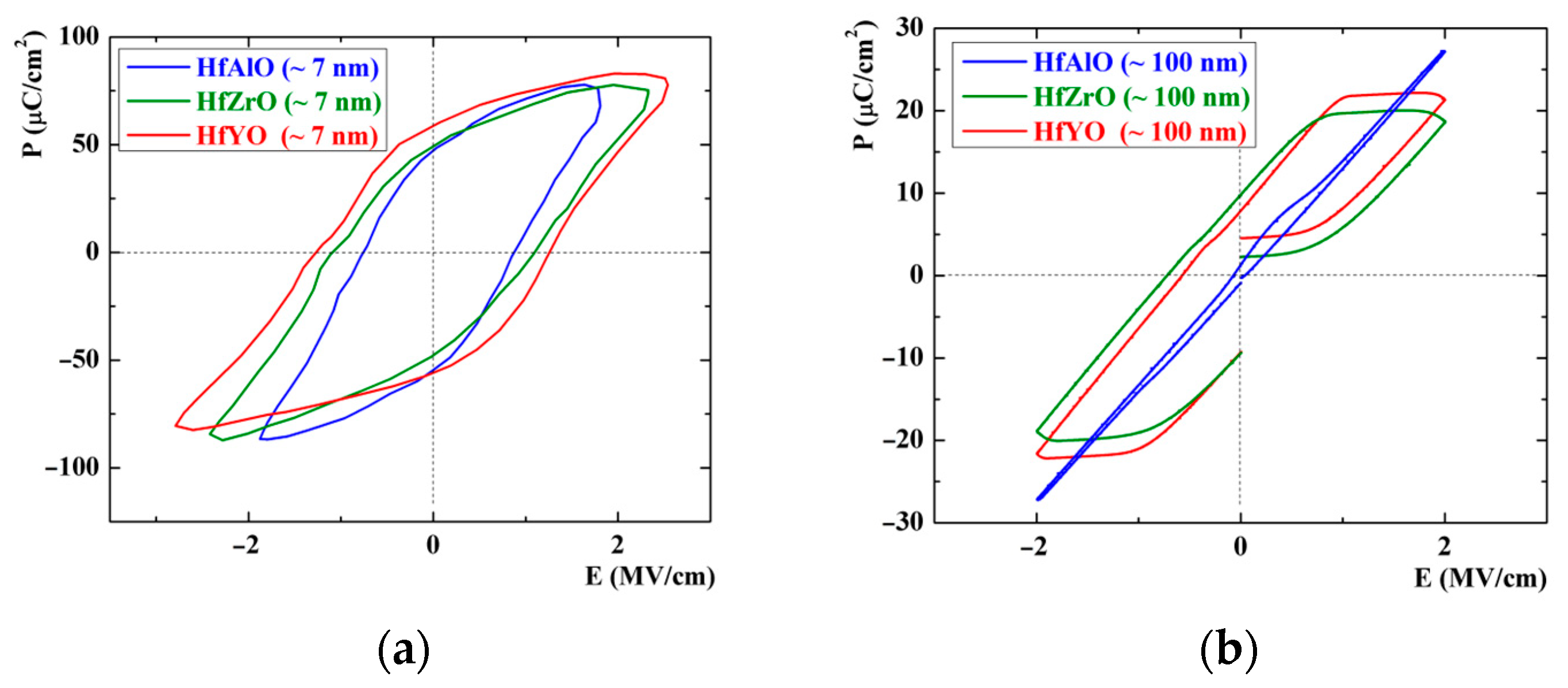
The quantitative ferroelectric parameters extracted from the P–E hysteresis loops—namely, the remanent polarization (Pr) and coercive field (Ec)—are summarized in
Table 2. These results allow a direct comparison between compositions and thicknesses, confirming the strong thickness dependence of the ferroelectric response: Zr- and Y-doped HfO
2 films exhibit the most robust and symmetric polarization at 7 nm, while all doped systems show reduced switching and partial phase relaxation at 100 nm, consistent with the structural evolution revealed by GIXRD.
3.4.1. P–E Characteristics of 7 nm Films
The P–E hysteresis loops recorded for the 7 nm films (
Figure 8a) confirm that ferroelectricity in HfO
2 emerges only upon suitable chemical doping, consistent with the phase composition revealed by GIXRD. The undoped HfO
2 sample exhibited no measurable hysteresis and is therefore excluded from the figure, in line with its monoclinic nonpolar phase [
8].
The HfZrO film displays a well-saturated, symmetric hysteresis loop with a remanent polarization (P
r) of approximately 50–60 µC·cm
−2 and a coercive field (E_c) of about 1.0 MV·cm
−1. These values agree with optimized ALD-grown Hf
0.5Zr
0.5O
2 capacitors reported in the literature [
9,
11]. The nearly rectangular loop indicates uniform switching kinetics and balanced injection barriers at both interfaces. The strong polarization is fully consistent with stabilization of the orthorhombic Pca2
1 phase identified by GIXRD, confirming Zr
4+ as the most effective dopant for ferroelectric phase formation.
The HfYO film shows a slightly higher P
r ≈ 60–65 µC·cm
−2, but with a distorted and imprinted loop shifted toward negative bias. This asymmetry originates from oxygen vacancy accumulation and built-in fields caused by aliovalent Y
3+ substitution and interface asymmetry [
15,
22]. Despite moderate leakage, the large P
r demonstrates robust stabilization of the orthorhombic phase, although accompanied by defect-assisted conduction.
The HfAlO film exhibits a narrower loop (P
r ≈ 30–40 µC·cm
−2, E_c ≈ 0.8 MV·cm
−1), reflecting partial stabilization of the ferroelectric orthorhombic phase. Al
3+ doping promotes local strain and oxygen vacancy formation but also introduces trap states that hinder complete domain alignment [
23]. The coexistence of orthorhombic and tetragonal reflections observed by GIXRD supports this interpretation.
Overall, the 7 nm films demonstrate the hierarchy HfZrO > HfYO > HfAlO ≫ HfO2, showing that ferroelectric switching strength and loop symmetry are governed by the combined effects of dopant-induced lattice distortion and oxygen vacancy modulation.
3.4.2. P–E Characteristics of 100 nm Films
The 100 nm films (
Figure 8b) display markedly weaker polarization and narrower loops than the 7 nm series, consistent with the thickness-dependent structural relaxation from the orthorhombic to the monoclinic phase revealed by GIXRD. As the thickness increases, interfacial strain relaxes and the nonpolar monoclinic phase becomes dominant, reducing switchable polarization [
9,
11,
21].
The HfZrO film preserves a distinguishable yet slender hysteresis loop with P
r ≈ 20–25 µC·cm
−2 and E_c ≈ 0.9 MV·cm
−1, indicating partial retention of the ferroelectric orthorhombic phase embedded in a monoclinic/tetragonal matrix [
9,
15]. The reduced P
r confirms that the ferroelectric order is confined to ultrathin layers under strong interfacial constraint.
The HfYO film exhibits P
r ≈ 20–22 µC·cm
−2, with a more symmetric loop than its 7 nm counterpart, implying that Y
3+ continues to stabilize orthorhombic domains but with a reduced volume fraction. This behavior aligns with GIXRD evidence of mixed tetragonal/fluorite structures at higher thickness [
22].
For HfAlO, the hysteresis loop becomes nearly linear (P
r < 15 µC·cm
−2), demonstrating that the orthorhombic fraction is strongly suppressed. The predominance of monoclinic peaks in the XRD pattern and diminished interfacial stress explain this near-dielectric behavior [
23]. Al-doped films thus maintain ferroelectricity only within a narrow thickness window (≈5–15 nm).
Collectively, the 100 nm results confirm that ferroelectricity in HfO
2-based oxides is a size-dependent phenomenon. As the film thickens, strain and dopant effects become insufficient to stabilize the non-centrosymmetric orthorhombic phase, leading to reduced P
r and partial reversion to the monoclinic structure [
8,
9,
11,
21,
22]. These observations emphasize the interplay between dopant chemistry, mechanical confinement, and phase stability in determining ferroelectric functionality.
3.5. Sheet Current Density (I/W)–Electric Field (E) Characteristics and Charge-Transport Mechanisms
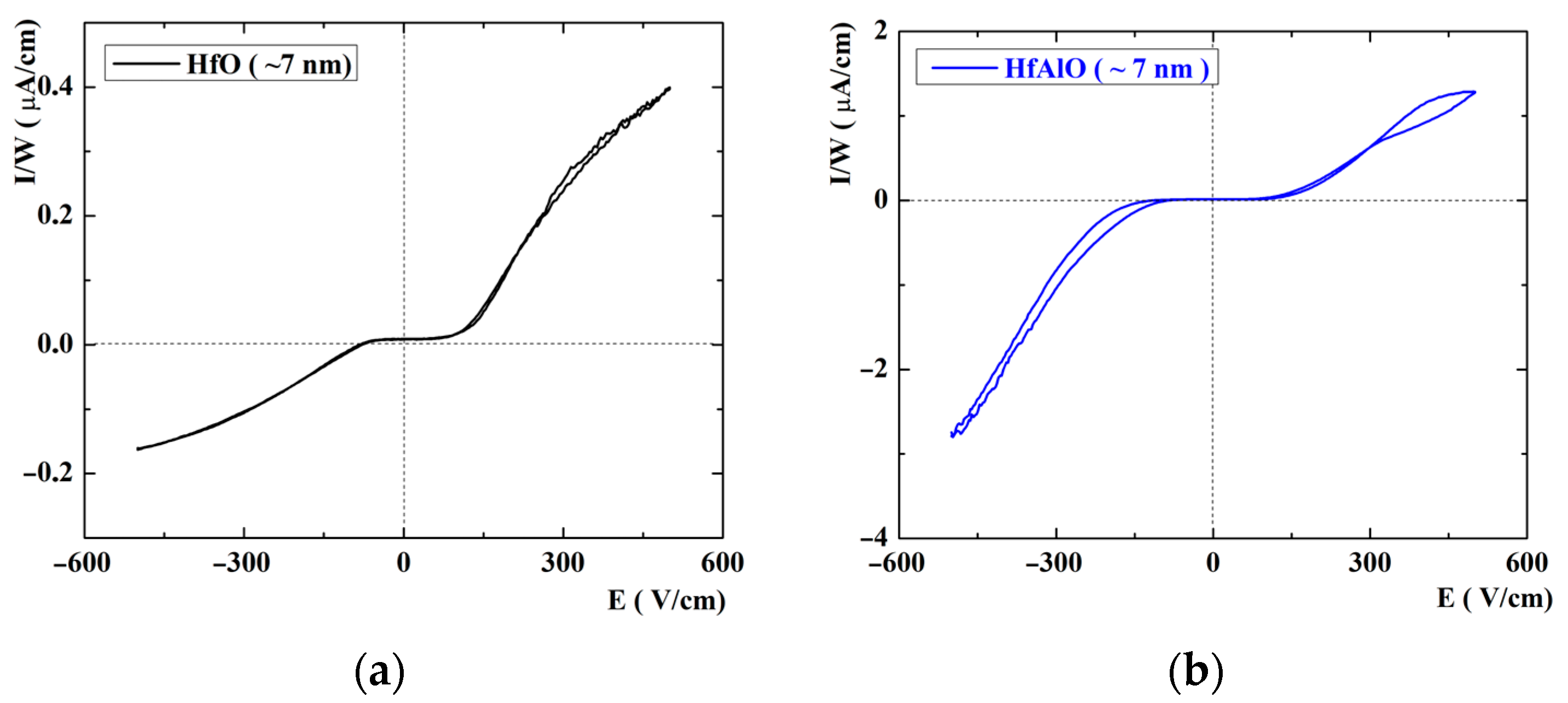
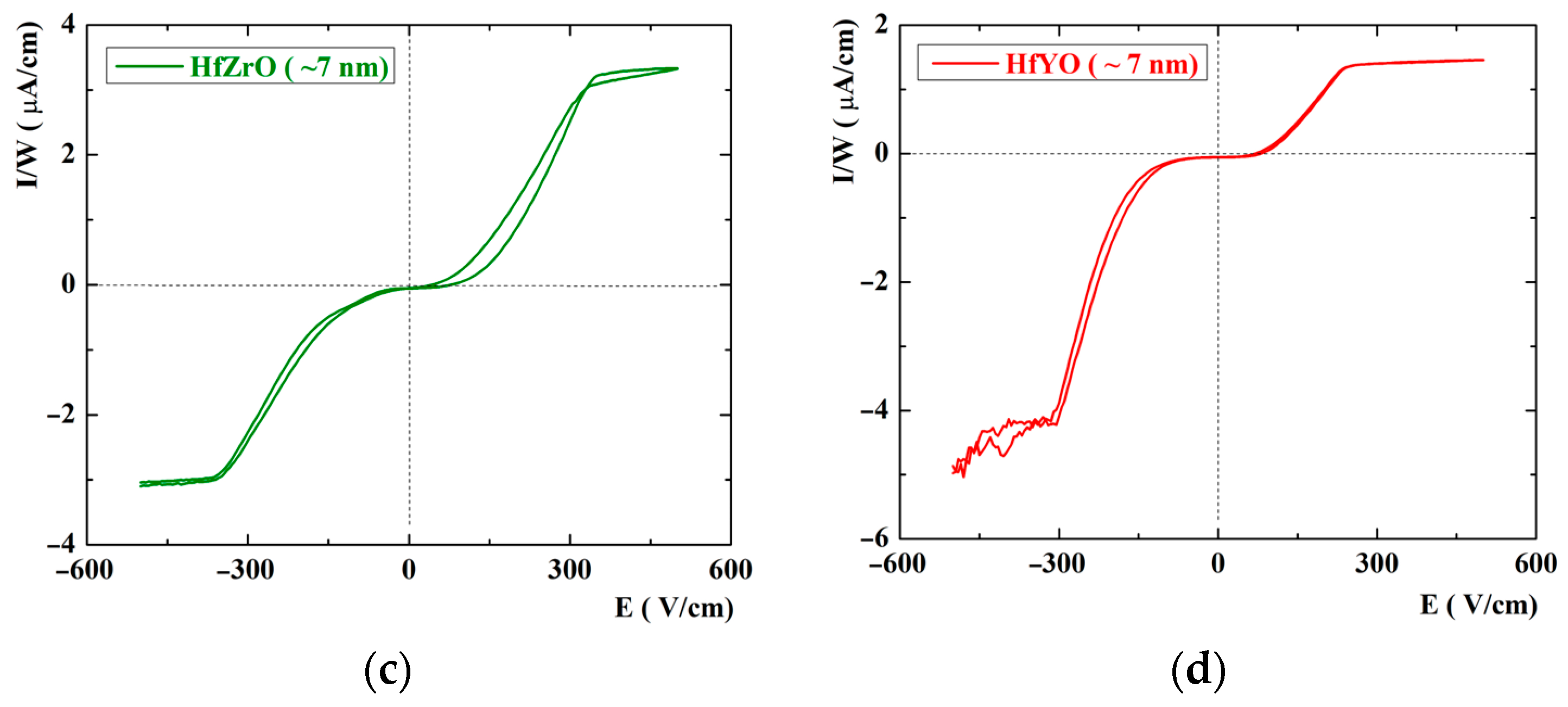
The in-plane electrical behavior of the 7 nm HfO
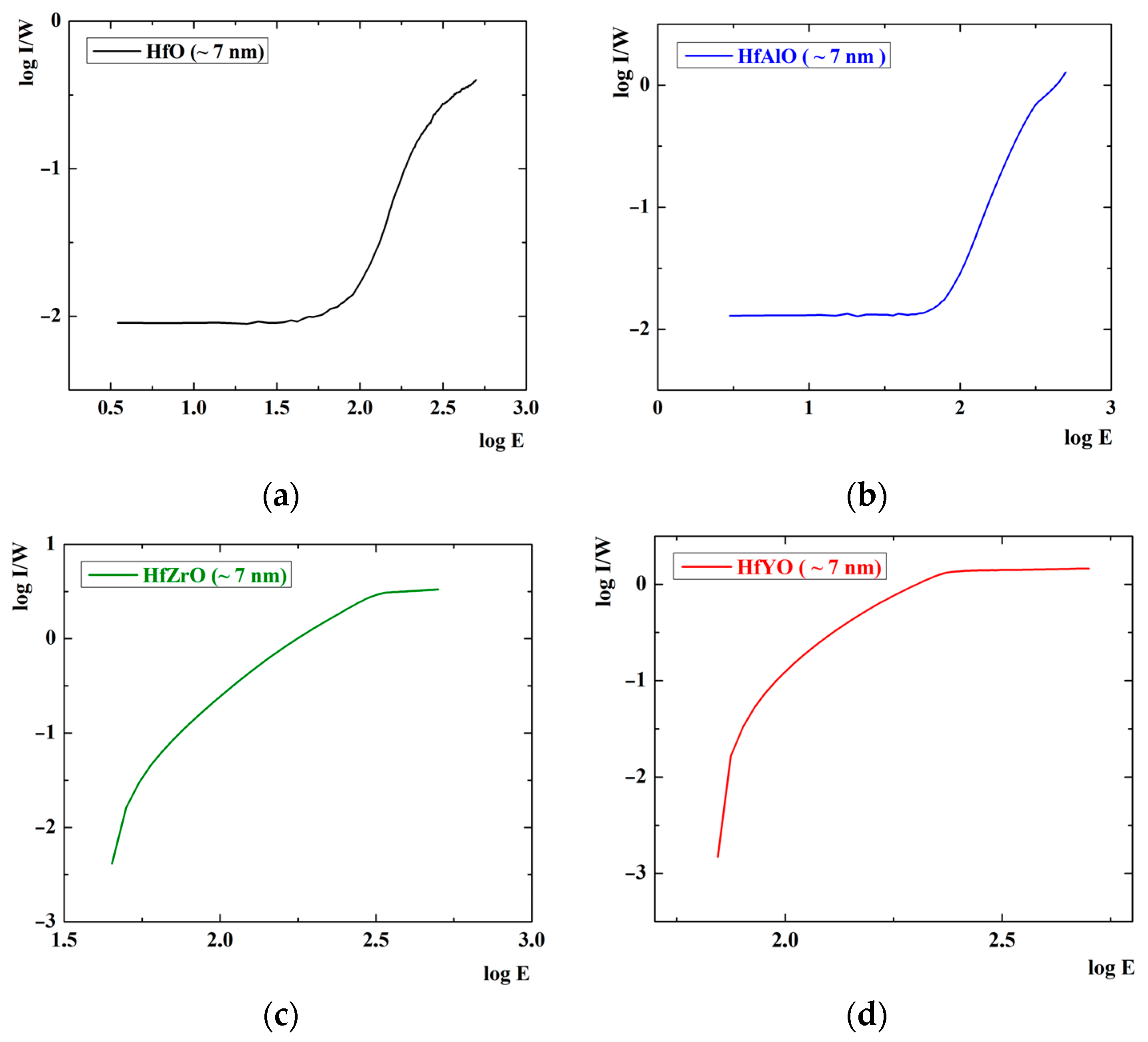
2-based films was examined by analyzing the sheet current density (I/W) as a function of the applied electric field (E), together with the corresponding log(I/W)–log(E) dependencies (
Figure 9 and
Figure 10). These measurements provide insight into the dominant charge-transport mechanisms and their relation to the microstructure (AFM), crystal phase composition (GIXRD), and ferroelectric switching behavior (P–E). The use of I/W normalization eliminates geometrical effects associated with electrode width and enables direct comparison across samples [
16].
3.5.1. Charge-Transport Mechanisms in Undoped HfO2
The undoped HfO
2 film exhibits the lowest sheet current density among all compositions, confirming its high dielectric integrity. In the low-field region (E < 2 × 10
2 V·cm
−1), the I/W–E curve is nearly linear, indicating ohmic conduction dominated by intrinsic carriers and limited electrode injection. At higher fields (> 3 × 10
2 V·cm
−1), the current increases exponentially, and the log(I/W)–log(E) slope approaches ≈2, characteristic of Poole–Frenkel (PF) or trap-assisted conduction through bulk defects and oxygen vacancies [
24].
The low leakage current and absence of any hysteretic peaks in the I–E characteristics confirm the non-ferroelectric, purely dielectric nature of the film, consistent with the monoclinic phase identified by GIXRD and the lack of P–E switching behavior.
3.5.2. Charge-Transport Mechanisms in Zr-Doped HfO2 (HfZrO)
The HfZrO film displays the most pronounced ferroelectric coupling between current and field. The I/W–E curve reveals two symmetric current maxima near ±3 × 10
2 V·cm
−1, corresponding to polarization-reversal events typical of ferroelectric HfO
2-based systems [
4,
9]. The overall leakage current remains moderate (~10
−5–10
−4 A·cm
−2), indicating good interface quality and minimal barrier asymmetry.
In the log(I/W)–log(E) representation, three conduction regimes can be distinguished: (i) low-field (slope ≈ 1), corresponding to ohmic conduction; (ii) intermediate-field (slope ≈ 1.8–2.0), characteristic of Poole–Frenkel (PF) emission; and (iii) high-field, showing current saturation indicative of injection-limited transport rather than full space-charge-limited conduction (SCLC).
The correlation between the switching peaks in I/W–E, the robust P–E hysteresis, and the dominant orthorhombic Pca2
1 phase observed by GIXRD confirms that Zr incorporation optimizes ferroelectricity and charge transport by balancing trap density and phase purity [
9,
15].
The quantitative analysis of the I/W–E and log(I/W)–log(E) characteristics for all compositions is summarized in
Table 3. This comparison highlights the evolution of charge-transport mechanisms as a function of dopant chemistry and structural phase composition. In particular, the HfZrO and HfYO films exhibit clear current peaks associated with ferroelectric switching, whereas the Al-doped and undoped HfO
2 films display conduction dominated by defect-assisted and purely dielectric processes.
The extracted conduction regimes—ranging from ohmic and Poole–Frenkel (PF) to injection-limited and trap-assisted tunneling (TAT)—correlate closely with the microstructural and phase information obtained from AFM and GIXRD measurements.
3.5.3. Charge-Transport Mechanisms in Al-Doped HfO2 (HfAlO)
The HfAlO film exhibits slightly higher leakage than HfZrO but maintains distinct current peaks at ±3.5 × 10
2 V·cm
−1, confirming the presence of switching-related current maxima. The log(I/W)–log(E) slope evolves from ≈1 at low fields to ≈2.2 at high fields, indicating mixed Poole–Frenkel (PF) and injection-limited conduction governed by trap-assisted carrier transport. The enhanced leakage can be attributed to local compositional fluctuations or oxygen vacancy accumulation associated with Al incorporation [
25].
These defects facilitate charge injection while partially disrupting domain coherence, leading to a slightly distorted P–E loop compared to HfZrO. The correlation with GIXRD, which shows a mixed orthorhombic–tetragonal structure, supports the interpretation of incomplete phase stabilization combined with moderate trap-assisted conduction.
3.5.4. Charge-Transport Mechanisms in Y-Doped HfO2 (HfYO)
The HfYO film exhibits the highest sheet current density among the doped series but also well-defined switching peaks near ±3 × 10² V·cm−1. The I/W–E curve is asymmetric, with slightly higher current under negative bias, indicating built-in fields and asymmetric contact injection. The log(I/W)–log(E) slope transitions from ≈1 at low fields to 2.4–2.6 at higher fields, revealing a mixed Poole–Frenkel (PF) and defect-assisted injection mechanism rather than pure tunneling.
The enhanced leakage is consistent with the higher oxygen vacancy concentration and local lattice distortion introduced by Y
3+ dopants, which strengthen orthorhombic phase stability while facilitating charge transport through defect-mediated pathways [
5]. Despite the increased leakage, the symmetric I/W–E switching peaks and well-defined P–E loops confirm that HfYO maintains robust ferroelectric functionality.
The results indicate that Zr doping provides the most balanced electrical performance, combining low leakage with strong ferroelectric switching, whereas Y and Al dopants promote additional defect-assisted injection and Poole–Frenkel (PF) conduction. The dependence of conduction type on microstructure—ranging from dielectric HfO2 (monoclinic) to fully ferroelectric HfZrO (orthorhombic)—mirrors the phase evolution observed by GIXRD and the polarization behavior revealed in the P–E loops.
Moreover, the sub-nanometric surface roughness observed by AFM (<0.5 nm) confirms that the conduction variations originate from intrinsic electronic mechanisms rather than morphological irregularities [
4,
16,
24]. Overall, these findings demonstrate that dopant-induced trap modulation, defect chemistry, and phase stabilization collectively govern ferroelectric switching and leakage behavior in ultrathin HfO
2-based films [
4,
5,
9,
15,
24,
25].
While more elaborate quantitative fitting of the I/W–E characteristics to Poole–Frenkel or Schottky emission laws could in principle be used to extract parameters such as trap depth or barrier lowering, such fits require assuming a single dominant mechanism over a broad field range and neglecting the contribution of polarization-switching currents. In the present ultrathin ferroelectric films, the conduction behavior results from the coexistence of multiple overlapping processes—ohmic conduction at low fields, Poole–Frenkel and trap-assisted tunneling in the intermediate regime, injection-limited transport at high fields, and vacancy-mediated phonon-assisted tunneling—together with sharp current maxima associated with ferroelectric switching near the coercive fields. Because these mechanisms are active over partially overlapping field intervals, enforcing a single PF or Schottky model would lead to a multi-parameter fit with limited physical reliability. For this reason, the identification of the dominant mechanisms relies on the experimentally extracted log(I/W)–log(E) slopes and field-dependent scaling behavior, which represents the standard and most robust approach for ultrathin ferroelectric HfO2-based films.
Taken together, these film-specific conduction regimes point to a common physical origin related to vacancy-mediated transport. In addition to the Poole–Frenkel, trap-assisted tunneling (TAT), and injection-limited regimes identified from the I/W–E and log(I/W)–log(E) characteristics, the overall leakage behavior of doped HfO2 is consistent with phonon-assisted tunneling between traps (PATT), a model widely applied to vacancy-mediated transport in oxygen-deficient hafnia. In this model, oxygen vacancies (V0) act as deep electron trap states within the bandgap, and charge transport proceeds through field-enhanced tunneling between these localized states assisted by lattice vibrations. The higher leakage observed in Y- and Al-doped films is therefore consistent with the increased V0 concentration induced by aliovalent substitution, whereas isovalent Zr4+ incorporation preserves the lattice stoichiometry and limits the formation of vacancy-related trap states. These trends confirm that the conduction behavior is governed by a combination of PF-type emission, injection-limited transport, and vacancy-mediated PATT tunneling, whose relative contributions are strongly modulated by dopant chemistry and defect structure.
3.6. Capacitance–Voltage (C–V) Characteristics
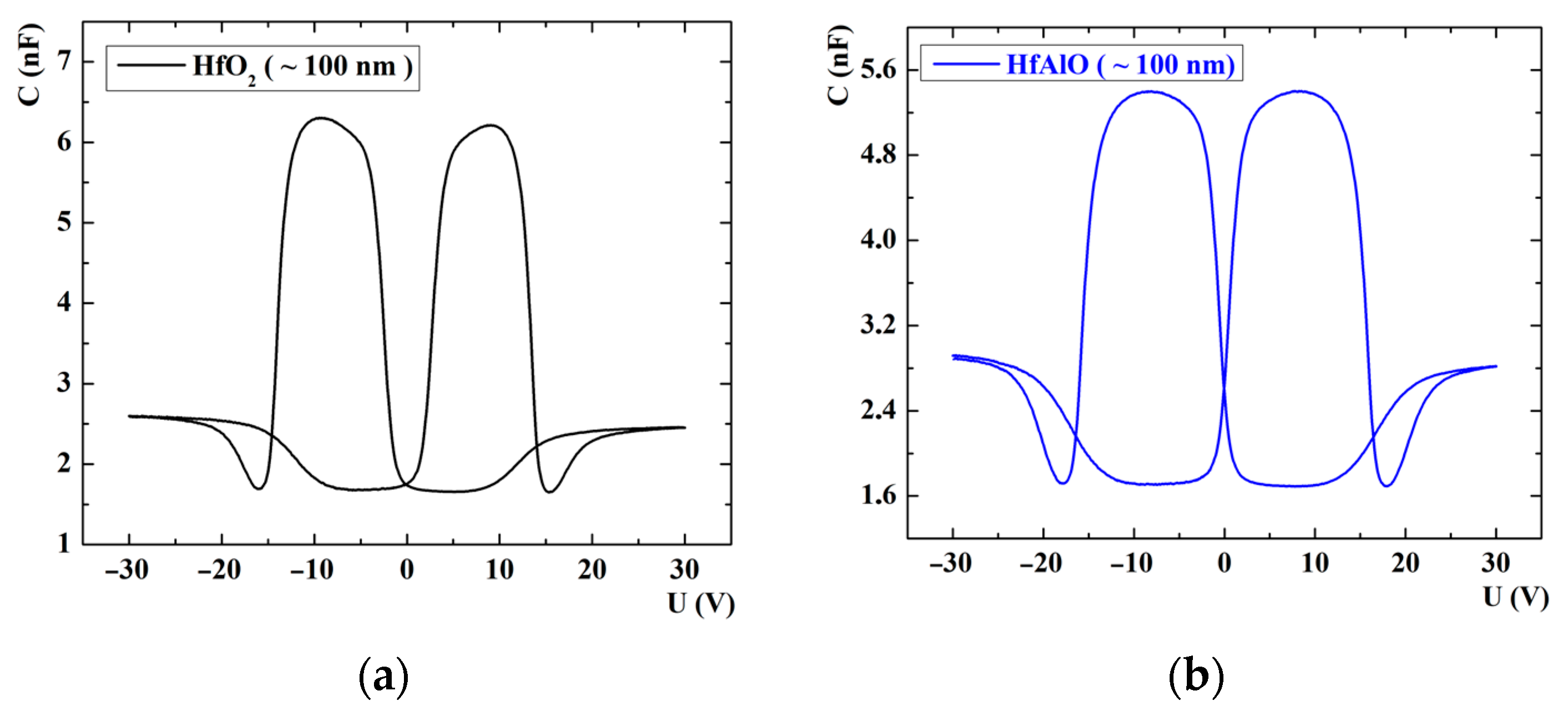
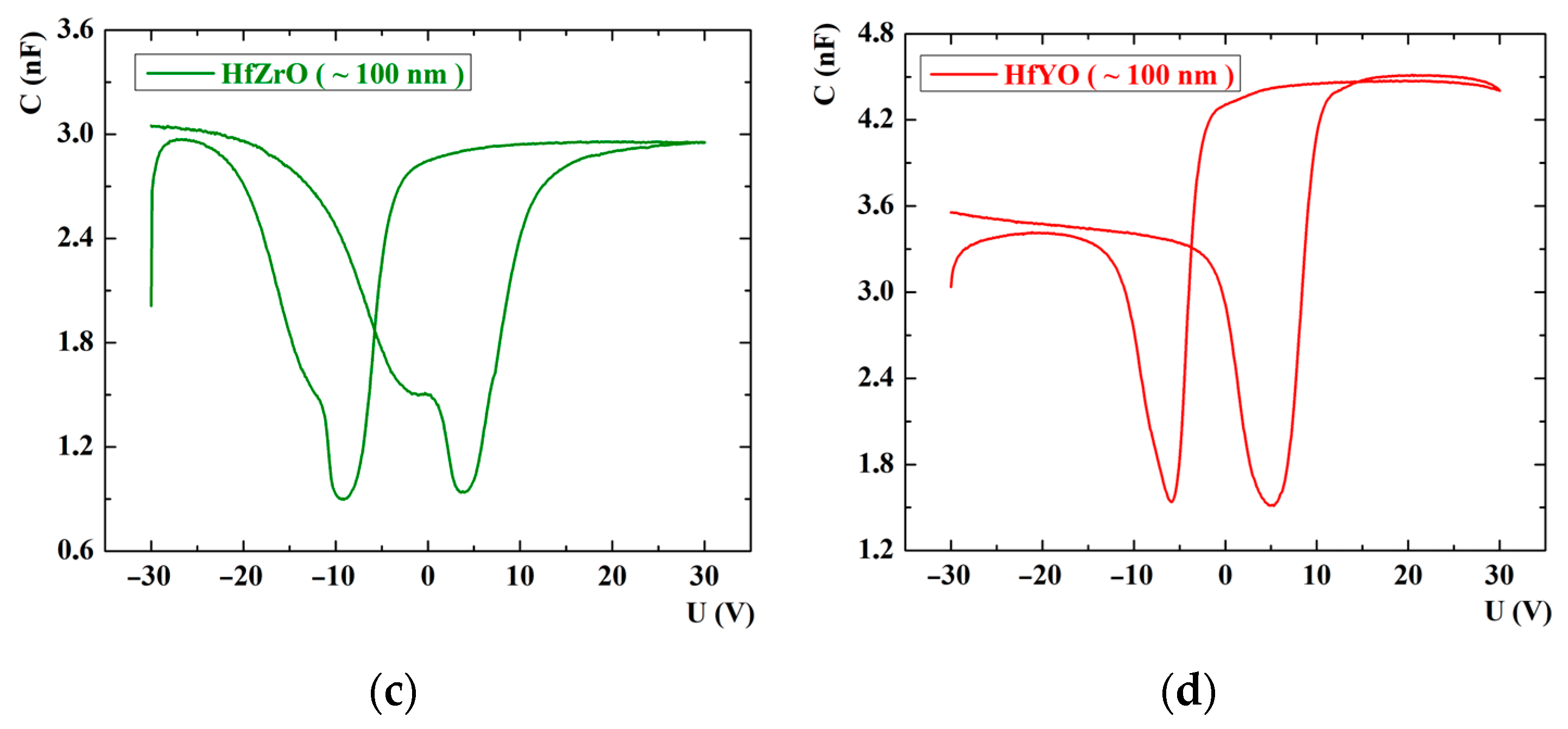
The C–V curves provide complementary information to the through-plane P–E loops, revealing the interplay between ferroelectric switching, interface traps, and dielectric nonlinearity. The in-plane C–V characteristics, measured using coplanar Au electrodes (150 µm × 150 µm, 200 µm gap), exhibit field-dependent nonlinearity for all compositions (
Figure 11).
In this lateral configuration, 10 kHz measurements are influenced by lateral resistance and dielectric losses, leading to the appearance of both butterfly-type (capacitance maxima) and inverted-butterfly (capacitance minima near the switching fields) profiles. These variations arise because dielectric loss peaks near the coercive field reduce the apparent small-signal capacitance when displacement currents become significant. Similar frequency-dependent inversions have been previously reported for HfO
2-based ferroelectric varactors [
26].
3.6.1. C–V Characteristics of Undoped HfO2
The symmetric butterfly curve, showing two capacitance maxima and a minimum near 0 V, exhibits negligible hysteresis. This behavior is characteristic of a nonlinear paraelectric dielectric, in which the permittivity increases with the applied field due to defect-related and Maxwell–Wagner polarization rather than ferroelectric (FE) switching. Such non-hysteretic behavior is consistent with the monoclinic phase and the absence of a P–E loop [
12].
3.6.2. C–V Characteristics of Al-Doped HfO2 (HfAlO)
A butterfly-type curve persists but exhibits mild asymmetry between the forward and reverse branches. The signal indicates incipient ferroelectricity combined with dielectric nonlinearity, while Al-related trap states and internal bias distort the overall profile. These features are consistent with the weakly hysteretic C–V responses previously reported for Al-doped HfO
2 [
25].
3.6.3. C–V Characteristics of Zr-Doped HfO2 (HfZrO)
A clear hysteresis is observed, with pronounced extrema near the switching fields—recorded here as capacitance dips at 10 kHz due to loss and RC effects. The positions of these extrema correspond to coercive fields of Ec ≈ 0.8–1.0 MV·cm
−1, in good agreement with the P–E characteristics. The reduced switching observed at approximately 100 nm correlates with the increased monoclinic/tetragonal phase fraction reported for HZO films [
12].
3.6.4. C–V Characteristics of Y-Doped HfO2 (HfYO)Nova™ Software
The strongly asymmetric butterfly-type hysteretic curve (imprint) exhibits a deeper extremum at positive bias, indicating internal fields and asymmetric injection barriers associated with Y
3+ substitution and oxygen vacancies. Despite the large capacitance tunability, the ferroelectric (FE) switching amplitude remains weaker than in thinner films. Similar asymmetric C–V hysteresis and imprint effects have been previously demonstrated in Y-doped HfO
2 [
15].
Overall, for HfO2 and partially for HfAlO, the butterfly-type C–V curves originate primarily from paraelectric nonlinearity and interface- or defect-related polarization rather than ferroelectric switching. In contrast, HfZrO and HfYO exhibit C–V hysteresis consistent with ferroelectric (FE) switching, although the amplitude is reduced at 100 nm—consistent with the weaker P–E loops and relaxation toward monoclinic/tetragonal (m/t) phases.
The observed “peak–dip” inversion near the coercive fields is attributed to dielectric losses and lateral RC effects at 10 kHz [
26]. These findings, together with the P–E and GIXRD results, confirm that the lateral capacitance response reflects the transition from ferroelectric to dielectric behavior with increasing thickness, governed by dopant chemistry and phase composition.
4. Overall Discussion—Integrated Interpretation of Results
The integrated correlation of structural, morphological, and electrical data provides a coherent framework for understanding how dopant chemistry and film thickness jointly govern the emergence and suppression of ferroelectricity in HfO2-based thin films. Evidence from GIXRD, AFM, P–E, I/W–E, and C–V measurements support a unified interpretation in which nanoscale strain, defect dipoles, and local symmetry breaking control the stability of the polar orthorhombic phase and the resulting polarization dynamics.
At the ultrathin limit (≈7 nm), all doped films exhibit the characteristic signatures of ferroelectricity—orthorhombic (Pca21) reflections in GIXRD, well-saturated P–E loops, and distinct switching peaks in the I/W–E curves. This convergence across independent probes confirms that nanoscale confinement and chemical doping act cooperatively to stabilize the metastable orthorhombic phase, which is otherwise absent in bulk hafnia. The physical origin lies in three interrelated effects:
Epitaxial-like strain imposed by the substrate and electrodes, preventing relaxation into the monoclinic phase;
Lattice distortions introduced by aliovalent dopants; and
Compensating oxygen vacancies, which lower the local coordination symmetry of Hf4+ sites.
These factors collectively reduce the free-energy barrier separating the nonpolar and polar configurations, thereby stabilizing ferroelectric order.
Each dopant modifies this energy landscape differently. Zr4+ substitution (ionic radius ≈0.84 Å, close to that of Hf4+) maintains structural compatibility, enabling a homogeneous solid solution and a morphotropic phase boundary (MPB) between tetragonal and orthorhombic polymorphs. This configuration yields strong, symmetric polarization and moderate leakage due to the controlled defect density. Y3+ incorporation, through aliovalent substitution, generates charge-compensating oxygen vacancies that form defect dipoles and internal bias fields, enhancing switchability but inducing imprint and asymmetry. Al3+ doping, with its smaller ionic radius (≈0.54 Å), creates stronger local distortions and a higher vacancy concentration, which favors orthorhombic phase formation at ultrathin scales but increases trap-assisted leakage and domain pinning. The resulting hierarchy—HfZrO > HfYO > HfAlO ≫ HfO2—reflects a fundamental balance between defect-mediated phase stabilization and electronic transport integrity.
These observations are fully consistent with the expected influence of ionic radius contrast on phase stability in doped HfO2. Y3+, being larger than Hf4+, introduces tensile lattice strain and enhances the stabilization of polar nanoregions, resulting in large remanent polarization but also increased vacancy-mediated leakage. Zr4+, whose ionic radius is nearly identical to Hf4+ due to the lanthanide contraction, forms a highly compatible mixed-oxide system in which orthorhombic and tetragonal polymorphs coexist near a morphotropic phase boundary, yielding the most balanced combination of polarization strength and leakage control. Al3+, smaller than Hf4+, induces local compressive distortion and increases the density of compensating oxygen vacancies, stabilizing the orthorhombic phase only within a narrow thickness window and leading to reduced ferroelectric stability at larger thicknesses. The hierarchy observed experimentally Zr > Y > Al in terms of orthorhombic phase stabilization—is therefore directly linked to the ionic-size-driven modulation of lattice strain and defect chemistry.
In addition to their structural influence, these dopant-dependent variations in vacancy concentration and local distortion also manifest directly in the electronic transport properties. The leakage characteristics observed in all 7 nm films are fully consistent with a phonon-assisted tunneling between traps (PATT) mechanism, widely recognized as the dominant conduction process in oxygen-deficient ferroelectric hafnia. In this model, oxygen vacancies act as deep-level electron traps (V00/•/••) within the bandgap, and charge carriers move via field-enhanced tunneling between these localized states assisted by lattice vibrations. Aliovalent dopants such as Y3+ and Al3+ increase the equilibrium concentration of oxygen vacancies formed for charge compensation, thereby strengthening PATT-driven leakage and amplifying defect-assisted injection. In contrast, isovalent Zr4+ preserves the stoichiometry of the Hf–O lattice and limits additional trap formation, consistent with its more symmetric I/W–E response and lower leakage. These trends align with prior experimental and computational studies showing that dopant valence, ionic-radius contrast, and processing conditions collectively determine vacancy distribution and, consequently, the balance between ferroelectric stability and conduction in HfO2-based thin films.
As the thickness increases to 100 nm, interfacial strain relaxes and dopants redistribute toward equilibrium sites, promoting the formation of the thermodynamically stable monoclinic phase. EDS compositional mapping of the 100 nm films confirmed uniform dopant incorporation without segregation, consistent with chemically homogeneous films even after partial structural relaxation. Consequently, remanent polarization decreases drastically, and the P–E loops evolve toward dielectric-like responses. Residual orthorhombic order persists only in Zr- and Y-doped films, where localized strain fields and defect dipoles sustain small polar nanodomains, though insufficient to generate macroscopic ferroelectricity. The concurrent evolution of I/W–E characteristics—from mixed Poole–Frenkel and injection-limited conduction to predominantly dielectric leakage—confirms that charge transport is directly coupled to the underlying crystal symmetry and defect distribution.
Cross-comparison between P–E, I/W–E, and C–V data further underscores the coupled nature of polarization and transport phenomena in doped hafnia. In Zr-doped films, the coincidence of current maxima with coercive fields indicates field-driven charge redistribution synchronized with domain switching, while Y- and Al-doped layers display asymmetric peaks consistent with defect-assisted conduction and internal field effects. The butterfly-shaped and imprinted C–V loops mirror these dynamics, reflecting dielectric nonlinearity governed by defect–dipole alignment and Maxwell–Wagner-type interfacial polarization.
From a broader perspective, these results reconcile two previously distinct views of ferroelectricity in hafnia:
The strain-driven structural stabilization model, where interfacial stress and confinement lower the energy of the orthorhombic phase; and
The defect-chemistry model, in which dopant-induced vacancies and charge imbalance generate local dipoles that break inversion symmetry.
The present study demonstrates that both mechanisms act cooperatively, and their relative contributions can be tailored through dopant selection, film thickness, and deposition sequence.
Ultimately, this integrated interpretation establishes a quantitative structure–property relationship spanning from atomic-scale defect chemistry to macroscopic polarization switching. Ferroelectricity in HfO2 thus emerges as a defect–strain–confinement phenomenon, stabilized through nanoscale mechanical and electronic interactions and suppressed once these constraints are relaxed. These insights provide a fundamental basis for optimizing doped hafnia ferroelectrics in CMOS-compatible memory, logic, and tunable dielectric devices, where balancing phase stability, leakage control, and scalability is crucial for practical integration.
5. Conclusions
This work systematically investigated the structural, morphological, and electrical properties of doped HfO2 thin films (HfZrO, HfAlO, HfYO) grown by atomic layer deposition (ALD) on Si(100) at two representative thicknesses, 7 nm and 100 nm. The combined AFM, GIXRD, P–E, I/W–E, C–V, and EDS analyses established a coherent structure–property relationship governed by dopant chemistry, defect-mediated strain, and thickness-dependent phase stability.
AFM and GIXRD showed that all 7 nm films are atomically smooth (R_q < 0.5 nm) and dominated by the orthorhombic ferroelectric Pca21 phase, whereas 100 nm films exhibit increased roughness and a predominance of the monoclinic nonpolar phase as interfacial strain relaxes and dopant-induced distortions decrease. At 7 nm, doped films display well-defined ferroelectric hysteresis with remanent polarization up to ~60 µC·cm−2 (HfYO) and ~55 µC·cm−2 (HfZrO), while increasing thickness to 100 nm leads to a drastic reduction in switchable polarization (<25 µC·cm−2) and a transition toward dielectric-like responses. Overall, the ferroelectric stability hierarchy is HfZrO > HfYO > HfAlO ≫ HfO2.
For ultrathin films, the lateral I/W–E characteristics reveal mixed conduction dominated by Poole–Frenkel emission and defect-assisted injection, with leakage levels controlled by dopant valence and the associated oxygen vacancy concentration. The coexistence of leakage and switching currents in the same field range reflects the strong coupling between ferroelectric domain reversal and defect-mediated transport. In-plane C–V measurements further support this picture, showing a progression from essentially paraelectric behavior (HfO2, HfAlO) to partially ferroelectric, butterfly-shaped and imprinted loops in Zr- and Y-doped films, consistent with an increasing orthorhombic phase fraction and internal bias fields.
Taken together, these results demonstrate that ferroelectricity in HfO2-based oxides arises from the interplay of chemical doping, local strain, and interfacial confinement, which cooperate to stabilize the metastable polar phase at the nanoscale but weaken as thickness increases, favoring the monoclinic dielectric phase. Among the dopants studied, Zr provides the most balanced and stable ferroelectric response, Y enhances polarization at the cost of stronger internal bias and leakage, and Al assists orthorhombic stabilization only within a narrow ultrathin regime. The intrinsic coupling between structure, morphology, and electronic behavior established here provides a solid foundation for the design of scalable, CMOS-compatible ferroelectric HfO2-based devices for non-volatile memories, logic, and tunable dielectric applications.
Author Contributions
Conceptualization, F.N., L.M.V.; methodology, F.N., L.M.V.; validation, F.N., S.V., C.R., R.G.; formal analysis, F.N., N.V., S.V., C.R., R.G., O.B., L.M.V., M.A.D.; investigation, F.N., N.V., S.V., C.R., R.G., O.B., M.A.D.; resources, F.N.; data curation, F.N., N.V., S.V., C.R., R.G., O.B., M.A.D.; writing—original draft preparation, F.N., L.M.V.; writing—review and editing, F.N., L.M.V.; visualization, F.N., N.V., S.V., C.R., R.G., O.B., L.M.V., M.A.D.; project administration, F.N.; funding acquisition, F.N. All authors have read and agreed to the published version of the manuscript.
Funding
This work was supported by a grant of the Ministry of Research, Innovation and Digitization, CCCDI—UEFISCDI, project number PN-IV-P7-7.1-PED-2024-0788, within PNCDI IV.
Institutional Review Board Statement
Not applicable.
Informed Consent Statement
Not applicable.
Data Availability Statement
Data are contained within the article.
Conflicts of Interest
The authors declare no conflicts of interest.
Abbreviations
The following abbreviations are used in this manuscript:
| ALD | Atomic layer deposition |
| TDMAH | Tetrakis(dimethylamino)hafnium |
| TDMAZ | Tetrakis(dimethylamino)zirconium |
| TMA | Trimethylaluminum |
| XRR | X-ray reflectivity |
| AFM | Atomic force microscopy |
| GIXRD | Grazing-incidence X-ray diffraction |
| MFS | Metal–ferroelectric–semiconductor |
| EBL | Electron-beam lithography |
| R_q, RMS | Root mean square roughness |
| Pr | Remanent polarization |
| Ec | Coercive field |
| I/W | Sheet current density |
| E | Electric field |
| PF | Poole–Frenkel emission |
| TAT | Trap-assisted tunneling |
| PATT | Phonon-assisted tunneling between traps |
| FE | Ferroelectric |
| O | orthorhombic |
| M | monoclinic |
| T | tetragonal |
References
- Moore, G.E. Cramming More Components onto Integrated Circuits. Electronics 1965, 38, 114–117. [Google Scholar]
- Waldrop, M.M. The Chips Are Down for Moore’s Law. Nature 2016, 530, 144–147. [Google Scholar] [CrossRef]
- Theis, T.N.; Wong, H.-S.P. The End of Moore’s Law: A New Beginning for Information Technology. Comput. Sci. Eng. 2017, 19, 41–50. [Google Scholar] [CrossRef]
- Müller, J.; Böscke, T.S.; Schröder, U.; Mueller, S.; Bräuhaus, D.; Böttger, U.; Frey, L.; Mikolajick, T. Ferroelectricity in Simple Binary ZrO2 and HfO2. Nano Lett. 2012, 12, 4318–4323. [Google Scholar] [CrossRef] [PubMed]
- Yang, W.; Yu, C.; Li, H.; Fan, M.; Song, X.; Ma, H.; Zhou, Z.; Chang, P.; Huang, P.; Liu, F.; et al. Ferroelectricity of Hafnium Oxide-Based Materials: Current Status and Future Prospects from Physical Mechanisms to Device Applications. J. Semicond. 2023, 44, 053101. [Google Scholar] [CrossRef]
- Cheema, S.S.; Kwon, D.; Shanker, N.; dos Reis, R.; Hsu, S.-L.; Xiao, J.; Zhang, H.; Wagner, R.; Datar, A.; McCarter, M.R.; et al. Enhanced Ferroelectricity in Ultrathin Films Grown Directly on Silicon. Nature 2020, 580, 478–482. [Google Scholar] [CrossRef] [PubMed]
- George, S.M. Atomic Layer Deposition: An Overview. Chem. Rev. 2010, 110, 111–131. [Google Scholar] [CrossRef]
- Böscke, T.S.; Müller, J.; Bräuhaus, D.; Schröder, U.; Böttger, U. Ferroelectricity in Hafnium Oxide Thin Films. Appl. Phys. Lett. 2011, 99, 102903. [Google Scholar] [CrossRef]
- Park, M.H.; Lee, Y.H.; Kim, H.J.; Kim, Y.J.; Moon, T.; Kim, K.D.; Müller, J.; Kersch, A.; Schroeder, U.; Mikolajick, T.; et al. Ferroelectricity and Antiferroelectricity in ZrO2–HfO2 Thin Films. Adv. Mater. 2015, 27, 1811–1831. [Google Scholar] [CrossRef]
- Song, C.-M.; Kwon, H.-J. Ferroelectrics Based on HfO2 Film. Electronics 2021, 10, 2759. [Google Scholar] [CrossRef]
- Hoffmann, M.; Schroeder, U.; Schenk, T.; Shimizu, T.; Funakubo, H.; Sakata, O.; Pohl, D.; Drescher, M.; Adelmann, C.; Materlik, R.; et al. Stabilizing the Ferroelectric Phase in Doped Hafnium Oxide. J. Appl. Phys. 2015, 118, 072006. [Google Scholar] [CrossRef]
- Park, M.H.; Kim, H.J.; Kim, Y.J.; Lee, W.; Moon, T.; Hwang, C.S. Evolution of Phases and Ferroelectric Properties of Thin Hf0.5Zr0.5O2 Films According to the Thickness and Annealing Temperature. Appl. Phys. Lett. 2013, 102, 242905. [Google Scholar] [CrossRef]
- Park, M.H.; Lee, Y.H.; Mikolajick, T.; Schroeder, U.; Hwang, C.S. Review and Perspective on Ferroelectric HfO2-Based Thin Films for Memory Applications. MRS Commun. 2018, 8, 795–808. [Google Scholar] [CrossRef]
- Silva, J.P.B.; Alcalá, R.; Avci, U.E.; Barrett, N.; Bégon-Lours, L.; Borg, M.; Byun, S.; Chang, S.-C.; Cheong, S.-W.; Choe, D.-H.; et al. Roadmap on Ferroelectric Hafnia- and Zirconia-Based Materials and Devices. APL Mater. 2023, 11, 089201. [Google Scholar] [CrossRef]
- Yun, Y.; Buragohain, P.; Li, M.; Ahmadi, Z.; Zhang, Y.; Li, X.; Wang, H.; Li, J.; Lu, P.; Tao, L.; et al. Intrinsic Ferroelectricity in Y-Doped HfO2 Thin Films. Nat. Mater. 2022, 21, 903–909. [Google Scholar] [CrossRef] [PubMed]
- Köroğlu, C.; Daus, A.; Wahid, S.; Muñoz Rojo, M.; Pop, E. Fringe Current Correction for Unpatterned-Channel Thin-Film Transistors Including Contact Resistance and Velocity Saturation Effects. J. Appl. Phys. 2025, 137, 224504. [Google Scholar] [CrossRef]
- Leskelä, M.; Ritala, M. Atomic Layer Deposition (ALD): From Precursors to Thin Film Structures. Thin Solid Film. 2002, 409, 138–146. [Google Scholar] [CrossRef]
- Rammula, R.; Sammelselg, V.; Aarik, J.; Kikas, A.; Kooser, K.; Käämbre, T. XPS and AFM Investigation of Hafnium Dioxide Thin Films Prepared by Atomic Layer Deposition on Silicon. J. Electron Spectrosc. Relat. Phenom. 2007, 156–158, 200–205. [Google Scholar] [CrossRef]
- Kim, K.-M.; Jang, J.S.; Yoon, S.-G.; Yun, J.-Y.; Chung, N.-K. Structural, Optical and Electrical Properties of HfO2 Thin Films Deposited at Low Temperature by PEALD. Materials 2020, 13, 2008. [Google Scholar] [CrossRef]
- Mikolajick, T.; Slesazeck, S.; Park, M.H.; Schroeder, U. The Fundamentals and Applications of Ferroelectric HfO2. Nat. Rev. Mater. 2022, 7, 653–669. [Google Scholar] [CrossRef]
- Kim, S.J.; Mohan, J.; Summerfelt, S.R.; Kim, J. Ferroelectric Hf0.5Zr0.5O2 Thin Films: A Review of Recent Advances. JOM 2019, 71, 246–255. [Google Scholar] [CrossRef]
- Lian, H.; Xu, J.; Zhou, D.; Ren, S. Phase Transformation and Dielectric Properties of Y-Doped HfO2 Thin Films. J. Alloys Compd. 2021, 861, 158241. [Google Scholar] [CrossRef]
- Lee, J.; Eom, D.; Lee, C.; Lee, W.; Oh, J.; Park, C.; Kim, J.; Lee, H.; Lee, S.; Lee, E.; et al. Sublayer Thickness Dependence of Nanolaminated HfO2–Al2O3 Films for Ferroelectric Phase Stabilization. Appl. Phys. Lett. 2022, 120, 222902. [Google Scholar] [CrossRef]
- Jeong, D.S.; Hwang, C.S. Tunneling-Assisted Poole–Frenkel Conduction Mechanism in HfO2 Thin Films. J. Appl. Phys. 2005, 98, 113701. [Google Scholar] [CrossRef]
- Müller, S.; Müller, J.; Singh, A.; Riedel, S.; Sundqvist, J.; Schröder, U.; Mikolajick, T. Incipient Ferroelectricity in Al-Doped HfO2 Thin Films. Adv. Funct. Mater. 2012, 22, 2412–2417. [Google Scholar] [CrossRef]
- Costa, J.; Pérez, E.; Martín-Martínez, J.; García-Hernansanz, R.; Ferrer, P.; del Campo, A. RF Characterization of HZO Thin-Film Varactors. Crystals 2021, 11, 980. [Google Scholar] [CrossRef]
Figure 1.
Schematic illustration of the atomic layer deposition (ALD) surface reaction sequence for HfO2 using tetrakis(dimethylamino)hafnium (TDMAH) and H2O as precursors. The cyclic, self-limiting process consists of four steps: (1) chemisorption of TDMAH molecules onto hydroxylated surface sites; (2) surface saturation followed by an N2 purge; (3) oxidation by H2O with removal of –N(CH3)2 ligands as volatile by-products; and (4) regeneration of surface –OH groups for the next ALD cycle.
Figure 1.
Schematic illustration of the atomic layer deposition (ALD) surface reaction sequence for HfO2 using tetrakis(dimethylamino)hafnium (TDMAH) and H2O as precursors. The cyclic, self-limiting process consists of four steps: (1) chemisorption of TDMAH molecules onto hydroxylated surface sites; (2) surface saturation followed by an N2 purge; (3) oxidation by H2O with removal of –N(CH3)2 ligands as volatile by-products; and (4) regeneration of surface –OH groups for the next ALD cycle.
Figure 2.
(a) Schematic illustration of the in-plane and through-plane measurement geometries used for the electrical characterization of HfO2-based thin films. In the in-plane configuration (top), the current flows laterally between coplanar Au electrodes on the film surface, and the measured current is normalized by the electrode width (I/W), representing the sheet current density. In the through-plane configuration (bottom), the current flows vertically through the film between the top Au electrode and the n-type Si substrate, allowing the evaluation of polarization-switching behavior under an applied electric field. (b) Optical micrograph of the top Au electrodes fabricated on the film surface, with lateral dimensions of 150 µm × 150 µm and an interelectrode spacing of 200 µm.
Figure 2.
(a) Schematic illustration of the in-plane and through-plane measurement geometries used for the electrical characterization of HfO2-based thin films. In the in-plane configuration (top), the current flows laterally between coplanar Au electrodes on the film surface, and the measured current is normalized by the electrode width (I/W), representing the sheet current density. In the through-plane configuration (bottom), the current flows vertically through the film between the top Au electrode and the n-type Si substrate, allowing the evaluation of polarization-switching behavior under an applied electric field. (b) Optical micrograph of the top Au electrodes fabricated on the film surface, with lateral dimensions of 150 µm × 150 µm and an interelectrode spacing of 200 µm.
Figure 3.
AFM topography of HfO2-based thin films deposited by ALD. Panels (a–d): 7 nm thick films (HfO2, HfAlO, HfZrO, HfYO). Panels (e–h): 100 nm thick films of the same compositions.
Figure 3.
AFM topography of HfO2-based thin films deposited by ALD. Panels (a–d): 7 nm thick films (HfO2, HfAlO, HfZrO, HfYO). Panels (e–h): 100 nm thick films of the same compositions.
Figure 4.
EDS elemental distribution maps for 100 nm films deposited by atomic layer deposition (ALD): (a) undoped HfO2; (b) Al-doped HfO2 (HfAlO); (c) Zr-doped HfO2 (HfZrO); (d) Y-doped HfO2 (HfYO).
Figure 4.
EDS elemental distribution maps for 100 nm films deposited by atomic layer deposition (ALD): (a) undoped HfO2; (b) Al-doped HfO2 (HfAlO); (c) Zr-doped HfO2 (HfZrO); (d) Y-doped HfO2 (HfYO).
Figure 5.
EDS maps showing the spatial distribution of dopants in 100 nm HfO2 films deposited by ALD: (a) Al-K signal for HfAlO; (b) Zr-L signal for HfZrO; (c) Y-L signal for HfYO.
Figure 5.
EDS maps showing the spatial distribution of dopants in 100 nm HfO2 films deposited by ALD: (a) Al-K signal for HfAlO; (b) Zr-L signal for HfZrO; (c) Y-L signal for HfYO.
Figure 6.
Grazing-incidence X-ray diffraction (GIXRD) patterns of 7 nm thick HfO2-based thin films deposited by atomic layer deposition (ALD): (a) undoped HfO2, (b) HfAlO, (c) HfZrO, and (d) HfYO.
Figure 6.
Grazing-incidence X-ray diffraction (GIXRD) patterns of 7 nm thick HfO2-based thin films deposited by atomic layer deposition (ALD): (a) undoped HfO2, (b) HfAlO, (c) HfZrO, and (d) HfYO.
Figure 7.
Grazing-incidence X-ray diffraction (GIXRD) patterns of 100 nm thick HfO2-based thin films deposited by atomic layer deposition (ALD): (a) undoped HfO2, (b) HfAlO, (c) HfZrO, and (d) HfYO.
Figure 7.
Grazing-incidence X-ray diffraction (GIXRD) patterns of 100 nm thick HfO2-based thin films deposited by atomic layer deposition (ALD): (a) undoped HfO2, (b) HfAlO, (c) HfZrO, and (d) HfYO.
Figure 8.
Polarization–electric field (P–E) hysteresis loops measured in the through-plane metal–ferroelectric–semiconductor (MFS) configuration using Au top electrodes and the n-type Si substrate as the bottom contact for (a) 7 nm and (b) 100 nm HfO2-based thin films.
Figure 8.
Polarization–electric field (P–E) hysteresis loops measured in the through-plane metal–ferroelectric–semiconductor (MFS) configuration using Au top electrodes and the n-type Si substrate as the bottom contact for (a) 7 nm and (b) 100 nm HfO2-based thin films.
Figure 9.
In-plane sheet current density (I/W)–electric field (E) characteristics measured for 7 nm HfO2-based thin films: (a) HfO2, (b) HfAlO, (c) HfZrO, and (d) HfYO.
Figure 9.
In-plane sheet current density (I/W)–electric field (E) characteristics measured for 7 nm HfO2-based thin films: (a) HfO2, (b) HfAlO, (c) HfZrO, and (d) HfYO.
Figure 10.
Corresponding log(I/W)–log(E) plots for the 7 nm HfO2-based thin films: (a) HfO2, (b) HfAlO, (c) HfZrO, and (d) HfYO.
Figure 10.
Corresponding log(I/W)–log(E) plots for the 7 nm HfO2-based thin films: (a) HfO2, (b) HfAlO, (c) HfZrO, and (d) HfYO.
Figure 11.
In-plane capacitance–voltage (C–V) characteristics measured at 10 kHz for 100 nm HfO2-based thin films with coplanar Au electrodes (150 µm × 150 µm, 200 µm gap): (a) undoped HfO2, (b) HfAlO, (c) HfZrO, and (d) HfYO.
Figure 11.
In-plane capacitance–voltage (C–V) characteristics measured at 10 kHz for 100 nm HfO2-based thin films with coplanar Au electrodes (150 µm × 150 µm, 200 µm gap): (a) undoped HfO2, (b) HfAlO, (c) HfZrO, and (d) HfYO.
Table 1.
AFM-derived RMS roughness and XRR-measured density of 7 nm and 100 nm thick HfO2-based thin films deposited by atomic layer deposition (ALD).
Table 1.
AFM-derived RMS roughness and XRR-measured density of 7 nm and 100 nm thick HfO2-based thin films deposited by atomic layer deposition (ALD).
| Sample | HfO2 | HfAlO | HfZrO | HfYO |
|---|
| RMS Roughness (nm)/7 nm | 0.19 | 0.20 | 0.18 | 0.40 |
| RMS Roughness (nm)/100 nm | 3.4 | 1.1 | 3.2 | 2.9 |
| Measured Density (g·cm−3)/7 nm | 9.23 | 8.34 | 9.1 | 8.5 |
| Measured Density (g·cm−3)/100 nm | 9.7 | 8.8 | 9.6 | 9.0 |
| Bulk Standard Density (g·cm−3) | 9.68 | - | - | - |
Table 2.
Ferroelectric parameters extracted from polarization–electric field (P–E) hysteresis loops for HfO2-based thin films.
Table 2.
Ferroelectric parameters extracted from polarization–electric field (P–E) hysteresis loops for HfO2-based thin films.
| Film | Thickness (nm) | Remanent
Polarization, Pr (µC·cm−2) | Coercive Field, Ec (MV·cm−1) | Dominant Phases (GIXRD) | Ferroelectric Stability |
|---|
| HfAlO | 7 | 30–40 | 0.8–1.0 | o (Pca21) ± t | Moderate |
| HfZrO | 7 | 50–60 | 1.0 | o-dominant ± t | Strong |
| HfYO | 7 | 60–65 | 1.0 | o ± t | Strong |
| HfAlO | 100 | <15 | 0.7–0.9 | m (dominant) | Weak |
| HfZrO | 100 | 20–25 | 0.9 | m + o + t | Partial |
| HfYO | 100 | 20–22 | 0.9 | t/c ± o | Partial |
Table 3.
Comparative analysis of the I/W–E and log(I/W)–log(E) characteristics for 7 nm HfO2-based thin films, summarizing the dominant conduction regimes and their correlation with structural phase composition and ferroelectric response.
Table 3.
Comparative analysis of the I/W–E and log(I/W)–log(E) characteristics for 7 nm HfO2-based thin films, summarizing the dominant conduction regimes and their correlation with structural phase composition and ferroelectric response.
| Film | Dominant Conduction at Low E * | High-Field Mechanism * | I/W Switching Peaks | Relation to Structure |
|---|
| HfO2 | Ohmic
(intrinsic carrier drift) | Poole–Frenkel
(PF, slope ≈ 2) | Absent | Monoclinic, dielectric |
| HfAlO | Ohmic → PF | PF (trap-controlled, slope ≈ 2.2) | Present | Mixed orthorhombic/tetragonal, partial FE |
| HfZrO | Ohmic → PF | Injection-/series-resistance-limited (slope ↓ to ~0.5–0.7) | Strong,
symmetric | Orthorhombic, full FE |
| HfYO | Ohmic → PF/TAT | Barrier-/series-resistance-limited (slope ≈ 0–0.3) | Strong,
asymmetric | Orthorhombic/tetragonal, FE with imprint |
| Disclaimer/Publisher’s Note: The statements, opinions and data contained in all publications are solely those of the individual author(s) and contributor(s) and not of MDPI and/or the editor(s). MDPI and/or the editor(s) disclaim responsibility for any injury to people or property resulting from any ideas, methods, instructions or products referred to in the content. |
© 2025 by the authors. Licensee MDPI, Basel, Switzerland. This article is an open access article distributed under the terms and conditions of the Creative Commons Attribution (CC BY) license (https://creativecommons.org/licenses/by/4.0/).




 ,
,