

Fluorescence as a Quantitative Indicator of Cariogenic Bacteria During Chemo-Mechanical Caries Excavation with BRIX 3000 in Primary Teeth

Abstract
1. Introduction
2. Materials and Methods
2.1. Study Population
- Clinically healthy children with at least one approximal or occlusal carious lesion on a primary first or second molar, corresponding to ICDAS II code 05 or 06.
- Absence of spontaneous pain.
- Absence of nocturnal pain.
- Absence of periapical alterations.
- At least one year remaining until physiological exfoliation of the tooth.
2.2. Chemo-Mechanical Excavation Procedure
2.3. Dentin Evaluation
- Infected dentin: intense red or dark red fluorescence encompassing the entire lesion.
- Partially infected dentin: pink fluorescence with localized red areas in the near-pulp dentin.
- Affected dentin: pale pink fluorescence in isolated areas of the cavity floor, with the remaining areas showing no fluorescence.
- Sound dentin: absence of fluorescence.
2.4. Microbiological Sampling and Analysis
- 42 samples from infected dentin (pre-excavation).
- 22 samples from partially infected dentin (post-excavation).
- 10 samples from affected dentin (post-excavation).
- 10 samples from sound dentin (post-excavation).
2.5. Statistical Analysis
- Descriptive analysis—frequency distribution of studied variables presented in tables.
- Pearson Chi-Square test (χ2)—to assess associations between categorical variables.
- Spearman’s rank correlation coefficient (Spearman’s rho)—used to evaluate relationships between variables with non-normal distribution or ordinal data. Correlation coefficients of 0.1–0.3 were considered weak, 0.3–0.5 moderate, and >0.5 strong.
- Graphical representation of statistical results was generated to facilitate interpretation.
3. Results
3.1. Microbial Distribution Before Chemo-Mechanical Excavation
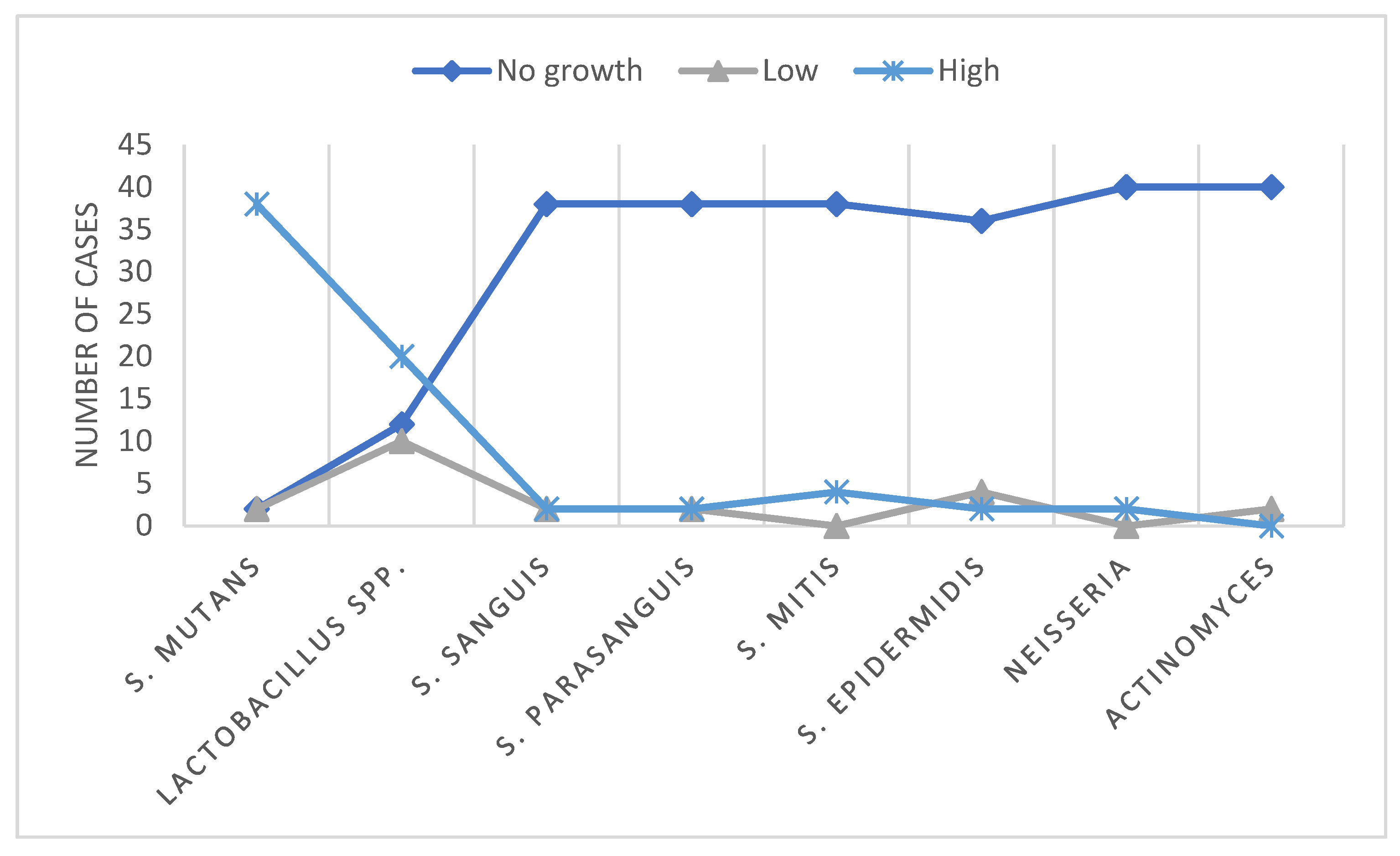
- S. mutans—predominates in quantity, highlighting its key role in caries development (90.48%).
- Lactobacillus spp.—present in lower amounts, contributing to lesion progression (47.62%).
- Other species:
- S. sanguis (4.76%)
- S. parasanguis (4.76%)
- S. mitis (9.52%)
- S. epidermidis (4.76%)
- Neisseria spp. (4.76%)
- Actinomyces spp. (0%)
3.2. Microbial Distribution After Chemo-Mechanical Excavation
3.3. Relative Proportion of S. mutans
3.4. Correlation Between S. mutans Quantity and Fluorescence Intensity
4. Discussion
5. Conclusions
Author Contributions
Funding
Institutional Review Board Statement
Informed Consent Statement
Data Availability Statement
Acknowledgments
Conflicts of Interest
Abbreviations
| CME | Chemo-mechanical caries excavation |
| FACE | Fluorescence-aided caries excavation |
| ICDAS II | International Caries Detection and Assessment System II |
References
- Galván Cortés, I.G.; Sánchez Nájera, R.I.; Roesch Ramos, L.; Moreno Marín, F.; Olivas Velázquez, A.K.; Rocha López, A.; Viezca Villarreal, A.; Solís Soto, J.M. Minimally invasive pediatric dentistry: Management of carious lesions. A review. Int. J. Appl. Dent. Sci. 2025, 11, 43–46. [Google Scholar] [CrossRef]
- Mello, B.; Stafuzza, T.C.; Vitor, L.; Rios, D.; Silva, T.; Machado, M.; Oliveira, T.M. Evaluation of dentin–pulp complex response after conservative clinical procedures in primary teeth. Int. J. Clin. Pediatr. Dent. 2018, 11, 188. [Google Scholar] [CrossRef] [PubMed]
- Widbiller, M.; Schuller, C.; Buchalla, W. Biology of selective caries removal: A systematic scoping review. BMJ Open 2022, 12, e061119. [Google Scholar] [CrossRef]
- Elhennawy, K.; Finke, C.; Paris, S.; Reda, S.; Jost-Brinkmann, P.G.; Schwendicke, F. Selective vs stepwise removal of deep carious lesions in primary molars: 24-month results of a randomized controlled trial. Clin. Oral Investig. 2021, 25, 731–740. [Google Scholar] [CrossRef]
- Asturini, P.G.; Fauziah, E. Clinical dilemma of selective caries removal in primary teeth: A scoping review. Pediatr. Dent. Oral Health 2023, 76, 279–286. [Google Scholar] [CrossRef]
- Maashi, M.S.; Elkhodary, H.M.; Alamoudi, N.M.; Bamashmous, N.O. Chemomechanical caries removal methods: A literature review. Saudi Dent. J. 2023, 35, 233–243. [Google Scholar] [CrossRef]
- Kitsahawong, K.; Kaewpitak, A.; Rattanarangsima, K.; Leethongdee, S. Efficacy of chemo-mechanical caries removal: A 24-month follow-up systematic review and meta-analysis. Front. Oral Health 2024, 5, 1458530. [Google Scholar] [CrossRef]
- Bsereni, L.; Torresi, F.V. Research on the Efficacy of Brix3000® Papain Gel. Available online: https://498109fef4.clvaw-cdnwnd.com/beaece74c762680422bae427e21c72d5/200000017-6b6436b645/Brix3000-Research-on-papain-gel.pdf?ph=498109fef4 (accessed on 15 November 2025).
- Ismail, M.M.; Haidar, A.H. Evaluation of the Efficacy of Caries Removal Using Papain Gel (Brix 3000) and Smart Preparation Bur (in vivo Comparative Study). J. Pharm. Sci. Res. 2019, 11, 444–449. [Google Scholar]
- Lennon, A.M.; Attin, T.; Martens, S.; Buchalla, W. Fluorescence-aided caries excavation (FACE), caries detector, and conventional caries excavation in primary teeth. Pediatr. Dent. 2009, 31, 316–319. [Google Scholar]
- Peskersoy, C.; Turkun, M.; Onal, B. Comparative clinical evaluation of the efficacy of a new method for caries diagnosis and excavation. J. Conserv. Dent. Endod. 2015, 18, 364–368. [Google Scholar] [CrossRef] [PubMed]
- Vural, U.K.; Kütük, Z.B.; Ergin, E.; Çakır, F.Y.; Gürgan, S. Comparison of two different methods of detecting residual caries: Fluorescence-aided caries excavation (FACE) device vs visual inspection. Restor. Dent. Endod. 2017, 42, 48–55. [Google Scholar] [CrossRef] [PubMed]
- Bjørndal, L.; Larsen, T.; Thylstrup, A. Management of deep caries and the exposed pulp. Int. Endod. J. 2019, 52, 949–973. [Google Scholar] [CrossRef] [PubMed]
- Innes, N.P.; Frencken, J.E.; Bjørndal, L.; Maltz, M.; Manton, D.J.; Ricketts, D.; Van Landuyt, K.; Banerjee, A.; Campus, G.; Doméjean, S.; et al. Managing Carious Lesions: Consensus Recommendations on Terminology. Adv. Dent. Res. 2016, 28, 49–57. [Google Scholar] [CrossRef] [PubMed]
- Goyal, P.A.; Kumari, R.; Kannan, V.P.; Madhu, S. Efficacy and tolerance of papain gel with conventional drilling method: A clinico-microbiological study. J. Clin. Pediatr. Dent. 2015, 39, 109–112. [Google Scholar] [CrossRef]
- Lima, G.Q.T.; Oliveira, E.G.; de Souza, J.I.; Monteiro Neto, V. Comparison of the efficacy of chemomechanical and mechanical methods of caries removal in the reduction of S. mutans and Lactobacillus spp. in carious dentine of primary teeth. J. Appl. Oral Sci. 2005, 13, 399–405. [Google Scholar] [CrossRef]
- Modimibe, K.V.; Yengopal, V.; Rudolph, M.J.; Bhayat, A. Microbiological assessment of carious dentine using Papacarie Duo™ and hand excavation in primary and permanent molars. Int. J. Clin. Pediatr. Dent. 2016, 9, 301–308. [Google Scholar] [CrossRef]
- Peters, M.C.; Flamenbaum, M.H. Chemomechanical caries removal in children: Efficacy and efficiency. J. Am. Dent. Assoc. 2006, 137, 1658–1666. [Google Scholar] [CrossRef]
- Abushanan, A.; Sharanesha, R.B.; Alazmah, A.; Algahtani, M. Complimentary Staining of Caries Detector Dyes in Primary Teeth with or without the Application of a Dentine Bonding Agent. Appl. Sci. 2023, 13, 12124. [Google Scholar] [CrossRef]
- Kanar, Ö.; Tağtekin, D.; Korkut, B.; Yanıkoğlu, F.; Kargül, B. Accuracy of laser fluorescence in assessment of various caries removal techniques: An in vitro validation. BMC Oral Health 2024, 24, 1529. [Google Scholar] [CrossRef]
- Fusayama, T. Clinical guide for removing caries using a caries-detecting solution. Quintessence Int. 1988, 19, 397–401. [Google Scholar]
- Fusayama, T.; Terachima, S. Differentiation of two layers of carious dentin by staining. J. Dent. Res. 1972, 51, 866. [Google Scholar] [CrossRef]
- Yip, H.K.; Stevenson, A.G.; Beeley, J.A. The specificity of caries detector dyes in cavity preparation. Br. Dent. J. 1994, 176, 417–421. [Google Scholar] [CrossRef]
- Pontes, L.R.A.; Novaes, T.F.; Moro, B.L.P.; Braga, M.M.; Mendes, F.M. Clinical performance of fluorescence-based methods for detection of occlusal caries lesions in primary teeth. Braz. Oral Res. 2017, 31, e91. [Google Scholar] [CrossRef]
- Gimenez, T.; Braga, M.M.; Raggio, D.P.; Deery, C.; Ricketts, D.N.; Mendes, F.M. Fluorescence-based methods for detecting caries lesions: Systematic review, meta-analysis and sources of heterogeneity. PLoS ONE 2013, 8, e60421. [Google Scholar] [CrossRef] [PubMed]
- Terrer, E.; Slimani, A.; Giraudeau, N.; Levallois, B.; Tramini, P.; Bonte, E.; Hua, C.; Lucchini, M.; Seux, D.; Thivichon, B.; et al. Performance of Fluorescence-based Systems in Early Caries Detection: A Public Health Issue. J. Contemp. Dent. Pract. 2019, 20, 1126–1132. [Google Scholar] [PubMed]
- Macey, R.; Walsh, T.; Riley, P.; Glenny, A.M.; Worthington, H.V.; Fee, P.A.; Clarkson, J.E.; Ricketts, D. Fluorescence devices for the detection of dental caries. Cochrane Database Syst. Rev. 2020, 12, CD013811. [Google Scholar] [CrossRef]
- Abba, H.M.; Idon, P.I.; Udoye, C.I.; Ikusika, O.F. Evaluation of residual carious dentin detection methods after cavity preparation: A randomized clinical trial. BMC Oral Health 2024, 24, 1452. [Google Scholar] [CrossRef] [PubMed]
- Ntovas, P.; Loubrinis, N.; Maniatakos, P.; Rahiotis, C. Evaluation of dental explorer and visual inspection for the caries excavation end-point: A cross-sectional diagnostic study. J. Conserv. Dent. 2018, 21, 311–318. [Google Scholar] [CrossRef]
- Ganter, P.; Al-Ahmad, A.; Wrbas, K.T.; Hellwig, E.; Altenburger, M.J. The use of computer-assisted FACE for minimal-invasive caries excavation. Clin. Oral Investig. 2014, 18, 745–751. [Google Scholar] [CrossRef]
- Kanar, Ö.; Korkut, B.; Tağtekin, D. Assessment of the correlation between fluorescence-featured intraoral scanner, laser fluorescence and spectrophotometric analyses in caries-affected dentin: An in-vitro diagnostic accuracy study. Lasers Med. Sci. 2025, 40, 140. [Google Scholar] [CrossRef]

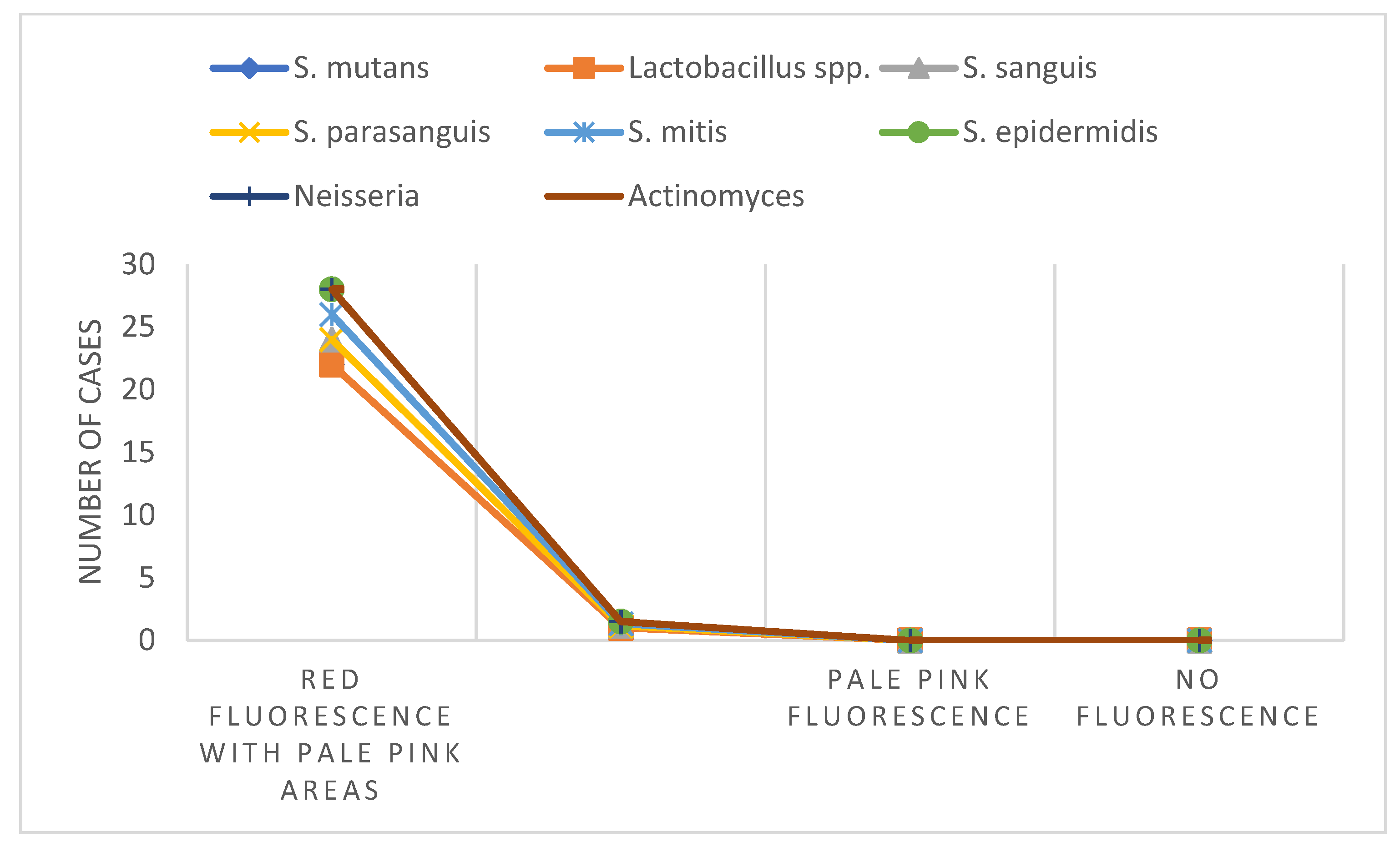

| Quantity S. mutans | No Fluorescence | Pale-Pink Fluorescence | Red with Pale-Pin | Red Fluorescence | Total | |||||
|---|---|---|---|---|---|---|---|---|---|---|
| n | % | n | % | n | % | n | % | n | % | |
| No growth | 10 | 11.9% | 10 | 11.9% | 0 | 0% | 2 | 2.4% | 22 | 26.2% |
| 1.103–4 | 0 | 0% | 0 | 0% | 22 | 26.2% | 2 | 2.4% | 24 | 28.6% |
| 1.105–7 | 0 | 0% | 0 | 0% | 0 | 0% | 38 | 45.2% | 38 | 45.2% |
| Total | 10 | 11.9% | 10 | 11.9% | 22 | 26.2% | 42 | 50% | 84 | 100% |
| χ2 (6) = 146.061 a p < 0.001 | ||||||||||
| S. mutans Quantity | Type of Fluorescence | |
|---|---|---|
| S. mutans quantity | 1.000 | ρ = 0.945 ** |
| Type of fluorescence | 1.000 |
Disclaimer/Publisher’s Note: The statements, opinions and data contained in all publications are solely those of the individual author(s) and contributor(s) and not of MDPI and/or the editor(s). MDPI and/or the editor(s) disclaim responsibility for any injury to people or property resulting from any ideas, methods, instructions or products referred to in the content. |
© 2025 by the authors. Licensee MDPI, Basel, Switzerland. This article is an open access article distributed under the terms and conditions of the Creative Commons Attribution (CC BY) license (https://creativecommons.org/licenses/by/4.0/).
Share and Cite
Lazarova, Z.; Gergova, R.; Mitova, N. Fluorescence as a Quantitative Indicator of Cariogenic Bacteria During Chemo-Mechanical Caries Excavation with BRIX 3000 in Primary Teeth. J. Funct. Biomater. 2025, 16, 453. https://doi.org/10.3390/jfb16120453
Lazarova Z, Gergova R, Mitova N. Fluorescence as a Quantitative Indicator of Cariogenic Bacteria During Chemo-Mechanical Caries Excavation with BRIX 3000 in Primary Teeth. Journal of Functional Biomaterials. 2025; 16(12):453. https://doi.org/10.3390/jfb16120453
Chicago/Turabian StyleLazarova, Zornitsa, Raina Gergova, and Nadezhda Mitova. 2025. "Fluorescence as a Quantitative Indicator of Cariogenic Bacteria During Chemo-Mechanical Caries Excavation with BRIX 3000 in Primary Teeth" Journal of Functional Biomaterials 16, no. 12: 453. https://doi.org/10.3390/jfb16120453
APA StyleLazarova, Z., Gergova, R., & Mitova, N. (2025). Fluorescence as a Quantitative Indicator of Cariogenic Bacteria During Chemo-Mechanical Caries Excavation with BRIX 3000 in Primary Teeth. Journal of Functional Biomaterials, 16(12), 453. https://doi.org/10.3390/jfb16120453