Does Physical Interaction with Insight Problems Really Affect the Solution Rate?

Abstract
1. Introduction
1.1. The Ecological Perspective on Insight Problem Solving
[…] solutions depend on neither artefacts themselves nor what we see. While environmental factors contribute to solutions, external representations are less important than monitoring the possible effects of actions. Where events in a problem space set off insights, solutions arise from perceiving possibilities and noting the effects of current actions. We depend on experience.(Fioratou & Cowley, 2009, p. 563)
[…] problem solving in the world proceeds on the basis of changes in the world: People and researchers alike act on the world, manipulate artefacts and models and rearrange physical features of a problem. This is problem solving. The evidence of successful problem solving can be found in changes in the world. Whether a mental representation was restructured or not is secondary to the behavioural and physical evidence: How interactivity exploits and modifies external resources should first be documented.(Vallée-Tourangeau, 2014, pp. 40–41)
1.2. Misunderstanding Theory
2. Experiment 1. The Pencil Problem: Does Interactivity Improve Performance in Spatial Insight Problems?
2.1. Methods
2.1.1. Materials and Procedure
2.1.2. Participants
2.2. Results
2.3. Discussion
3. Experiment 2. The Matchstick Arithmetic Problem: Overcoming Misunderstanding Without Interaction
3.1. Methods
3.1.1. Materials and Procedure
3.1.2. Participants
3.2. Results
3.3. Discussion
4. General Conclusions
Author Contributions
Funding
Institutional Review Board Statement
Informed Consent Statement
Data Availability Statement
Conflicts of Interest
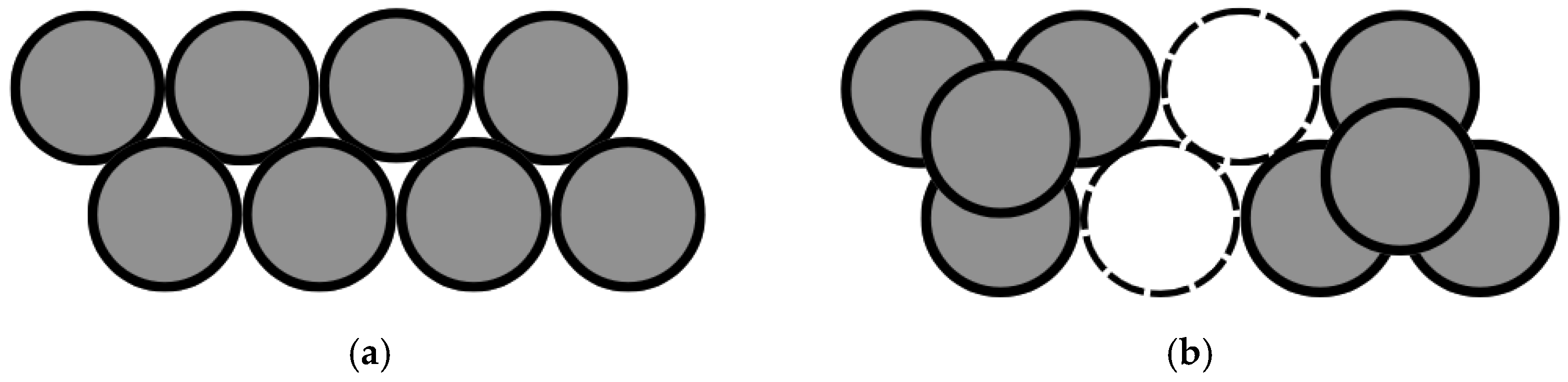
| 1 | The problem asks the participant to connect four chains, each made up of three rings, with the aim of building a necklace, respecting some constraints on the number of rings that can be opened and closed. |
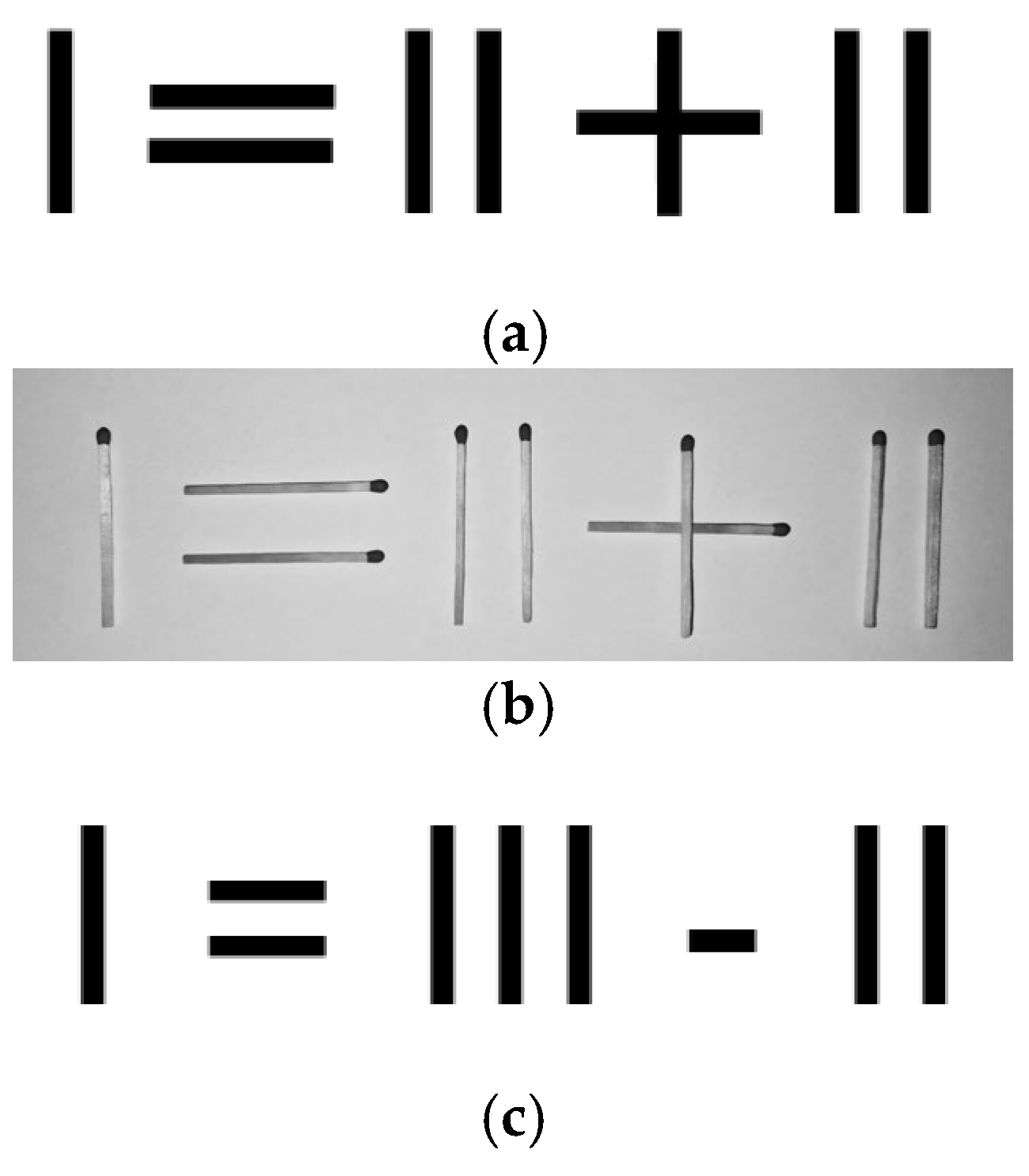
| 2 | These problems require the participant to correct arithmetically incorrect mathematical operations, written in Roman numerals. Both the numbers and the arithmetic signs are made up of stylised matches to correct the operation; the participant can move only one match. |
| 3 | We refer to embodied cognition as an umbrella label for a broader family of approaches. As Shapiro and Spaulding (2025) note, “despite the distinctions between the four “Es”—embodied, embedded, enactive, and extended—it is not uncommon to use the label “embodied” to include any or all of these “Es”. The E-fields share the view, after all, that the brain-centrism of traditional cognitive science […] stands in the way of a correct understanding of cognition” (para. 2). |
| 4 | The problem requires the participant to find a way to tie two strings hanging on opposite sides of a room, using only their arms and some available objects. The strings are long enough to be tied together, but not long enough for the participant to pick up one and reach the other on the opposite side. To solve the problem, it is necessary to tie an object to a string and use it as a weight to make it swing, so that, after having grabbed the stationary string, the participant can also grab the other during its swings. |
| 5 | The problem requires the participant to change the spatial orientation of a triangle made up of ten coins, with the constraint of being able to move only three of them. |
| 6 | The “Bacteria in the Pan problem”, the “Socks problem”, the “Flashlight and Battery problem”, the “Sheep Pen problem”, the “Matchstick Arithmetic problems”, the “Eight Coins problem”, the “Nine-Dot problem”, the “Card problem” and the “Ten-Dot problem”. |
| 7 | STEM is an acronym that refers to degree courses in which scientific–technological disciplines (science, technology, engineering, mathematics) are studied. |
| 8 | Neither the cognitive offloading hypothesis, which involves movement and surrounding physical objects to simplify information processing (Dunn & Risko, 2016; Loginov & Spiridonov, 2023), can explain our results. |
References
- Bagassi, M., & Macchi, L. (2016). The interpretative function and the emergence of unconscious analytic thought. In L. Macchi, M. Bagassi, & R. Viale (Eds.), Cognitive unconscious and human rationality (pp. 43–76). MIT Press. [Google Scholar] [CrossRef]
- Chu, Y., Dewald, A. D., & Chronicle, E. P. (2007). Theory driven hints in the cheap necklace problem: A preliminary investigation. The Journal of Problem Solving, 1(2), 4. [Google Scholar] [CrossRef][Green Version]
- Chuderski, A., & Jastrzębski, J. (2018). Much ado about aha!: Insight problem solving is strongly related to working memory capacity and reasoning ability. Journal of Experimental Psychology: General, 147(2), 257–281. [Google Scholar] [CrossRef]
- Chuderski, A., Jastrzębski, J., & Kucwaj, H. (2021). How physical interaction with insight problems affects solution rates, hint use, and cognitive load. British Journal of Psychology, 112(1), 120–143. [Google Scholar] [CrossRef] [PubMed]
- Cox, D. R., & Oakes, D. (1984). Analysis of survival data (1st ed., Vol. 21). CRC Press. [Google Scholar] [CrossRef]
- Duncker, K. (1945). On problem-solving (L. S. Lees, Trans.). Psychological Monographs, 58(5), i–113. [Google Scholar] [CrossRef]
- Dunn, T. L., & Risko, E. F. (2016). Toward a metacognitive account of cognitive offloading. Cognitive Science, 40(5), 1080–1127. [Google Scholar] [CrossRef]
- Engel, A. K., Maye, A., Kurthen, M., & König, P. (2013). Where’s the action? The pragmatic turn in cognitive science. Trends in Cognitive Sciences, 17(5), 202–209. [Google Scholar] [CrossRef]
- Fioratou, E., & Cowley, S. J. (2009). Insightful thinking: Cognitive dynamics and material artifacts. Pragmatics & Cognition, 17(3), 549–572. [Google Scholar] [CrossRef]
- Giang, N. T. C., Anh, N. T. Q., Dao, T. T., Tuan, P. A., Linh, C. T. H., & Chau, P. T. H. (2024). A systematic review of problem-solving skill development for students in STEM education. International Journal of Learning Teaching and Educational Research, 23(5), 1–20. [Google Scholar] [CrossRef]
- Gilhooly, K. J., Ball, L. J., & Macchi, L. (Eds.). (2018). Insight and creativity in problem solving. Routledge. [Google Scholar]
- Gilhooly, K. J., Georgiou, G. J., Sirota, M., & Paphiti-Galeano, A. (2015). Incubation and suppression processes in creative problem solving. Thinking & Reasoning, 21(1), 130–146. [Google Scholar]
- Goldinger, S. D., Papesh, M. H., Barnhart, A. S., Hansen, W. A., & Hout, M. C. (2016). The poverty of embodied cognition. Psychonomic Bulletin & Review, 23, 959–978. [Google Scholar] [CrossRef] [PubMed]
- Henok, N., Vallée-Tourangeau, F., & Vallée-Tourangeau, G. (2020). Incubation and interactivity in insight problem solving. Psychological Research, 84(1), 128–139. [Google Scholar] [CrossRef]
- Kanizsa, G. (1978). Il “problem-solving”nella psicologia della Gestalt. In G. Mosconi, & V. D’Urso (Eds.), La soluzione di problemi. Giunti-Barbera. [Google Scholar]
- Knoblich, G., Ohlsson, S., Haider, H., & Rhenius, D. (1999). Constraint relaxation and chunk decomposition in insight problem solving. Journal of Experimental Psychology: Learning, Memory, and Cognition, 25(6), 1534–1555. [Google Scholar] [CrossRef]
- Loginov, N. I., & Spiridonov, V. F. (2023). Embodied problem solving: A review of experimental paradigms. Психoлoгия. Журнал Высшей Шкoлы Экoнoмики, 20(3), 418–427. [Google Scholar] [CrossRef]
- Macchi, L. (2026). Psychorhetoric and the psychology of thought. Routledge Psychology. [Google Scholar]
- Macchi, L., & Bagassi, M. (2012). Intuitive and analytical processes in insight problem solving: A psycho-rhetorical approach to the study of reasoning. Mind & Society, 11(1), 53–67. [Google Scholar] [CrossRef]
- Macchi, L., & Bagassi, M. (2015). When analytic thought is challenged by a misunderstanding. Thinking & Reasoning, 21(1), 147–164. [Google Scholar] [CrossRef]
- Macchi, L., Poli, F., & Caravona, L. (2025). Dissociable effects of verbalization on solving insight and non-insight problems. Journal of Intelligence, 13(3), 36. [Google Scholar] [CrossRef]
- Mosconi, G. (1990). Sui problemi. In G. Mosconi (Ed.), Discorso e pensiero. Il Mulino. [Google Scholar]
- Mosconi, G. (2016). Closing thoughts. In L. Macchi, M. Bagassi, & R. Viale (Eds.), Cognitive unconscious and human rationality (pp. 355–363). MIT Press. [Google Scholar]
- Nęcka, E., Żak, P., & Gruszka, A. (2016). Insightful imagery is related to working memory updating. Frontiers in Psychology, 7, 137. [Google Scholar] [CrossRef] [PubMed]
- Öllinger, M., Jones, G., & Knoblich, G. (2008). Investigating the effect of mental set on insight problem solving. Experimental Psychology, 55(4), 269–282. [Google Scholar] [CrossRef]
- Reid, J. W. (1951). An experimental study of “analysis of the goal” in problem-solving. The Journal of General Psychology, 44(1), 51–69. [Google Scholar] [CrossRef]
- Salvi, C., Wiley, J., & Smith, S. M. (Eds.). (2024). The Emergence of insight. Cambridge University Press. [Google Scholar]
- Schooler, J. W., Ohlsson, S., & Brooks, K. (1993). Thoughts beyond words: When language overshadows insight. Journal of Experimental Psychology: General, 122(2), 166. [Google Scholar] [CrossRef]
- Shapiro, L., & Spaulding, S. (2025). Embodied cognition. In E. N. Zalta, & U. Nodelman (Eds.), The Stanford encyclopedia of philosophy (Summer 2025 ed.). Metaphysics Research Lab, Stanford University. [Google Scholar]
- Simon, H. A. (1979). Models of thought (Vol. 352). Yale University Press. [Google Scholar]
- Spiridonov, V., Erofeeva, M., Klowait, N., Morozov, M., & Ardislamov, V. (2026). The modulating role of sources of difficulty in interactive matchstick algebra. Frontiers in Psychology, 16, 1691864. [Google Scholar] [CrossRef]
- Steffensen, S. V., & Vallée-Tourangeau, F. (2018). An ecological perspective on insight problem solving. In Insight (pp. 169–190). Routledge. [Google Scholar]
- Thomas, L. E., & Lleras, A. (2009). Swinging into thought: Directed movement guides insight in problem solving. Psychonomic Bulletin & Review, 16(4), 719–723. [Google Scholar] [CrossRef]
- Vallée-Tourangeau, F. (2014). Insight, interactivity and materiality. Pragmatics & Cognition, 22(1), 27–44. [Google Scholar] [CrossRef][Green Version]
- Vallée-Tourangeau, F. (2017). Interactivity and ego depletion in insight problem solving. In Proceedings of the annual meeting of the cognitive science society (Vol. 39). UC Merced. [Google Scholar]
- Vallée-Tourangeau, F. (2025). Outsight: Restoring the role of objects in creative problem solving. Cambridge University Press. [Google Scholar] [CrossRef]
- Vallée-Tourangeau, F. (2026). The praxis of insight: Interactivity and prototyping in creative problem solving. Springer Nature. [Google Scholar]
- Vallée-Tourangeau, F., Euden, G., & Hearn, V. (2011). Einstellung defused: Interactivity and mental set. Quarterly Journal of Experimental Psychology, 64(10), 1889–1895. [Google Scholar] [CrossRef] [PubMed]
- Vallée-Tourangeau, F., Green, A., March, P. L., & Steffensen, S. V. (2024). Objects as knowledge: A case study of outsight. Possibility Studies & Society, 3(3), 410–430. [Google Scholar] [CrossRef]
- Vallée-Tourangeau, F., Ross, W., Ruffatto Rech, R., & Vallée-Tourangeau, G. (2020). Insight as discovery. Journal of Cognitive Psychology, 33(6–7), 718–737. [Google Scholar] [CrossRef]
- Vallée-Tourangeau, F., Steffensen, S. V., Vallée-Tourangeau, G., & Sirota, M. (2016). Insight with hands and things. Acta Psychologica, 170, 195–205. [Google Scholar] [CrossRef] [PubMed]
- Weller, A., Villejoubert, G., & Vallée-Tourangeau, F. (2011). Interactive insight problem solving. Thinking & Reasoning, 17(4), 424–439. [Google Scholar] [CrossRef]
- Wertheimer, M. (1959). Productive thinking. Harper & Row. [Google Scholar]



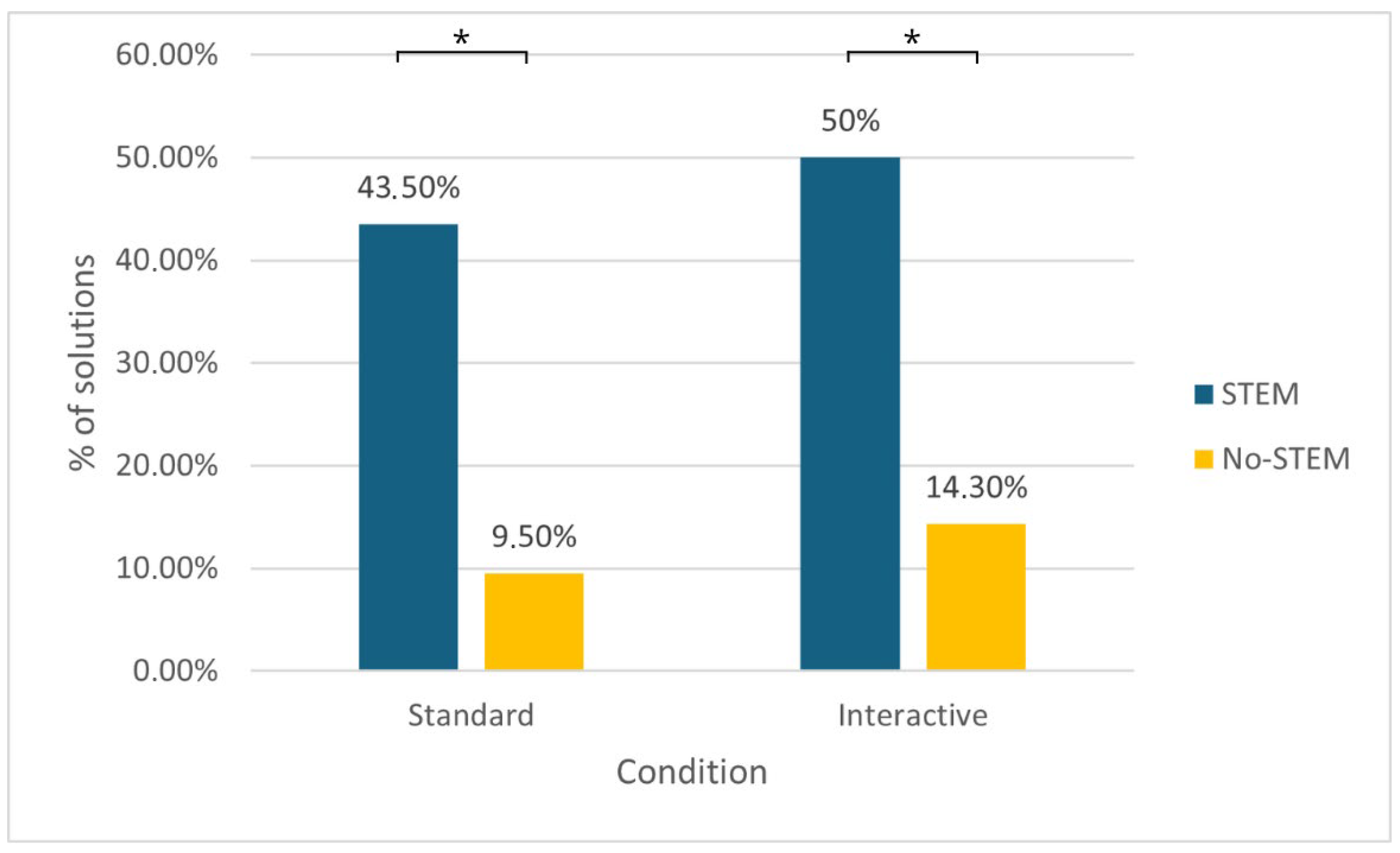
| Standard | Interactive | TOT | |
|---|---|---|---|
| STEM | 43.5% (N = 23) | 50% (N = 22) | 46.7% (N = 45) |
| Non-STEM | 9.5% (N = 21) | 14.3% (N = 21) | 11.9% (N = 42) |
| TOT | 27.3% (N = 44) | 32.6% (N = 43) |
| Example | Solution | |
|---|---|---|
| Value constraint | ||
| The numbers cannot be decomposed. | IV = III + III | VI = III + III |
| Operator constraint | ||
| The operators cannot be decomposed. | III = V + III | III = VI − III |
| Tautology constraint | ||
| The operation cannot be transformed into a tautology. | III = III + III | III = III = III |
Disclaimer/Publisher’s Note: The statements, opinions and data contained in all publications are solely those of the individual author(s) and contributor(s) and not of MDPI and/or the editor(s). MDPI and/or the editor(s) disclaim responsibility for any injury to people or property resulting from any ideas, methods, instructions or products referred to in the content. |
© 2026 by the authors. Licensee MDPI, Basel, Switzerland. This article is an open access article distributed under the terms and conditions of the Creative Commons Attribution (CC BY) license.
Share and Cite
Macchi, L.; Inglese, D.; Caravona, L. Does Physical Interaction with Insight Problems Really Affect the Solution Rate? J. Intell. 2026, 14, 82. https://doi.org/10.3390/jintelligence14050082
Macchi L, Inglese D, Caravona L. Does Physical Interaction with Insight Problems Really Affect the Solution Rate? Journal of Intelligence. 2026; 14(5):82. https://doi.org/10.3390/jintelligence14050082
Chicago/Turabian StyleMacchi, Laura, Daniele Inglese, and Laura Caravona. 2026. "Does Physical Interaction with Insight Problems Really Affect the Solution Rate?" Journal of Intelligence 14, no. 5: 82. https://doi.org/10.3390/jintelligence14050082
APA StyleMacchi, L., Inglese, D., & Caravona, L. (2026). Does Physical Interaction with Insight Problems Really Affect the Solution Rate? Journal of Intelligence, 14(5), 82. https://doi.org/10.3390/jintelligence14050082