
Signal Statistical Mechanics

Blue Ridge Scientific LLC, Front Royal, VA 22630, USA
Computation 2026, 14(6), 128; https://doi.org/10.3390/computation14060128
Submission received: 21 March 2026
/
Revised: 21 May 2026
/
Accepted: 27 May 2026
/
Published: 2 June 2026
(This article belongs to the Section Computational Engineering)
Abstract
We are interested in determining the physics bound for the detection of signals in modern digital radio frequency (RF) hardware. Classical signal theory (Kalman filters) requires that the signal-to-noise power ratio (SNR) , but this is not the physics bound. Instead, the physics bound is much more complicated. Because an important application is radar, we ask whether, in a time interval of 1 s, a signal is present within the noise of the receiver baseband. For radar, this would be the pulse return reflection. For our analysis, we use the Keysight Technologies UXR_25 oscilloscope as the RF receiver that has an analogue-to-digital converter (ADC) chip of 256 billion samples per second. In 1 s, then, 256 thousand voltage samples are taken. We want to determine if a signal is present using the 256 thousand voltage samples using random matrix theory (RMT). The answer for this particular ADC is that we can detect any signals with SNR >−20 dB, a thousand-fold increase from SNR > 10. This paper gives the physics bound of signal detection.
1. Introduction
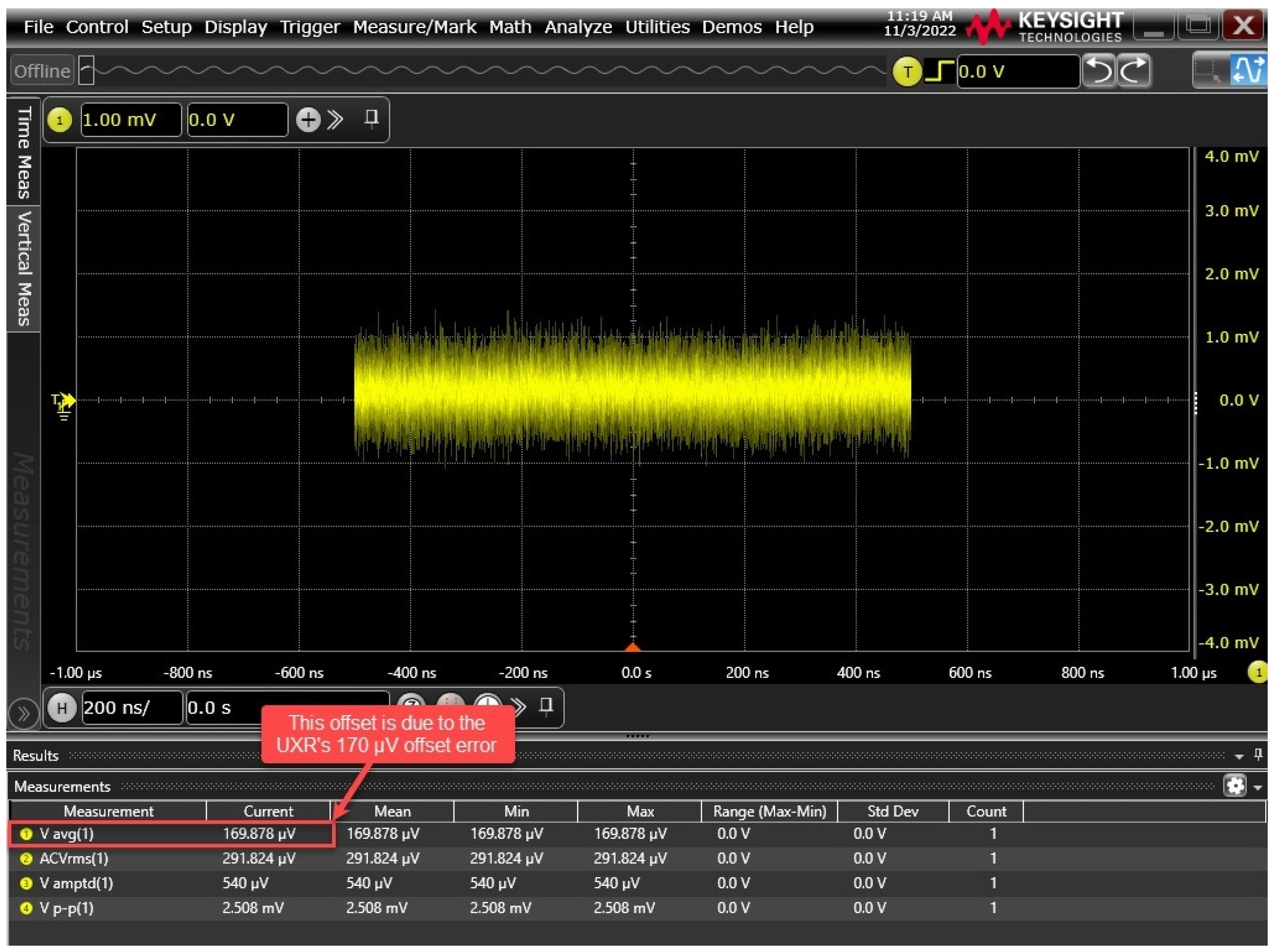
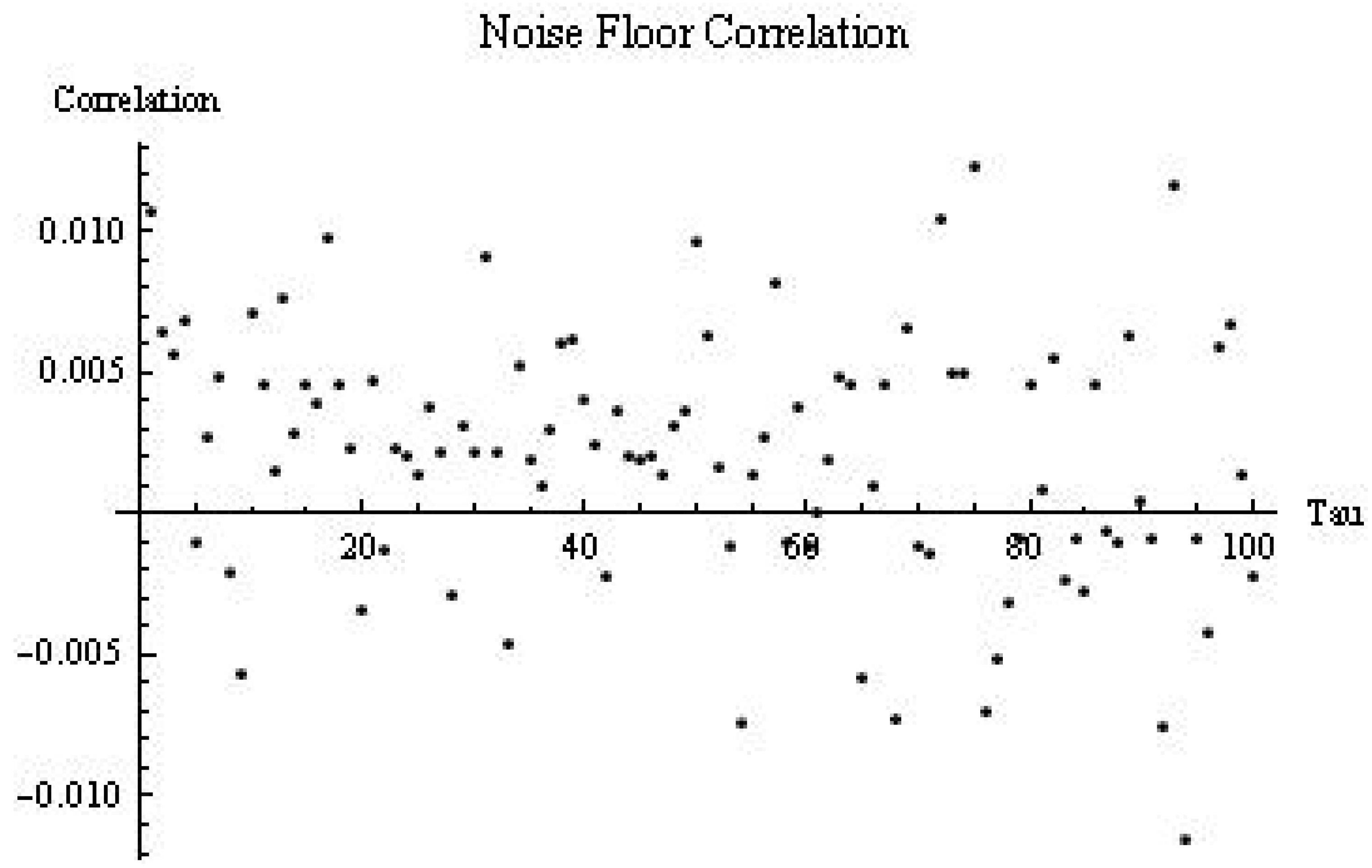
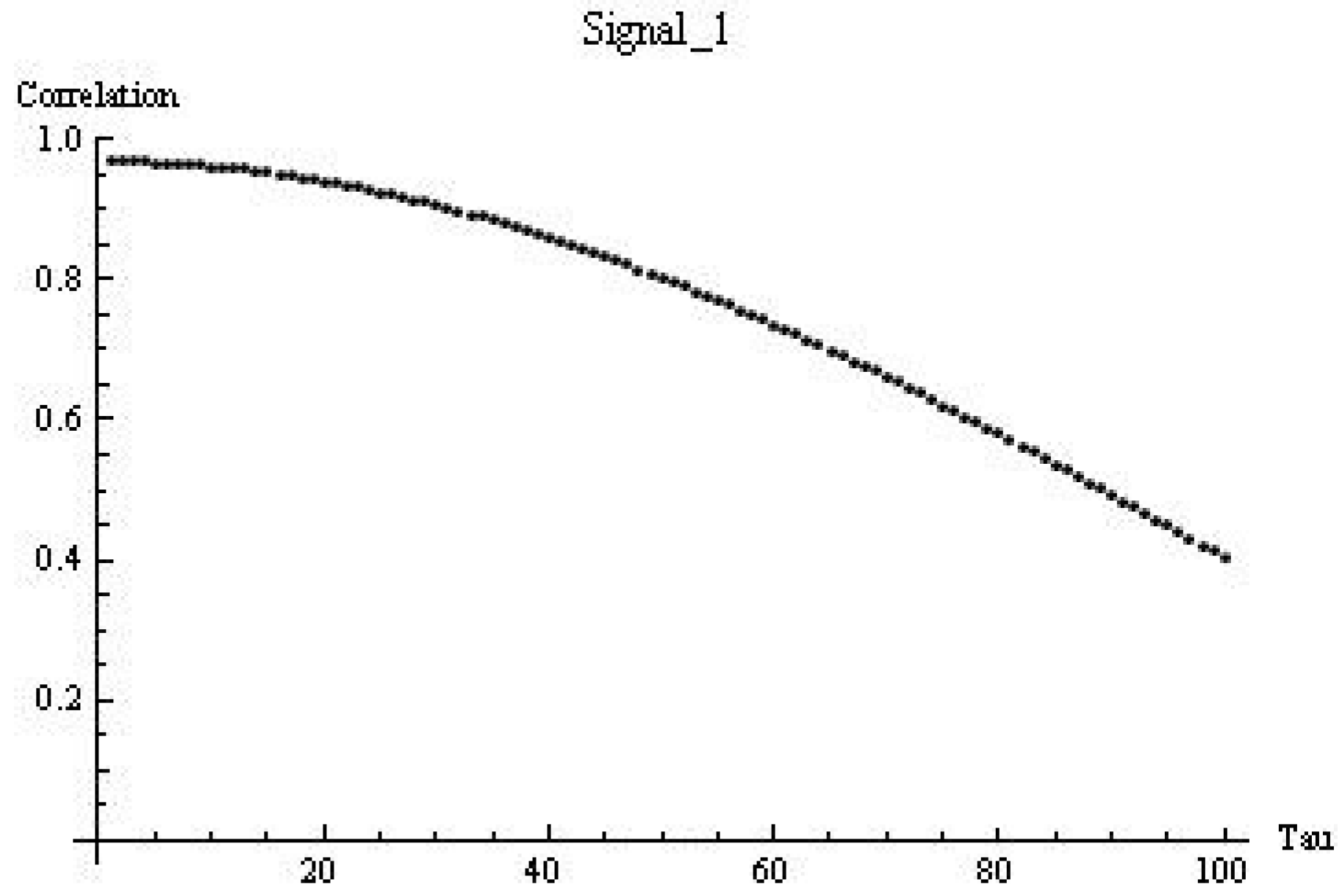
To determine the actual physics bound of signal detection, we consider a modern digital radio receiver that uses an analogue-to-digital converter (ADC) chip, taking the output of a de-multiplexed, de-modulated radio-frequency receiver (RF). This means we are discretizing each channel’s baseband analogue signal (meaning the carrier wave frequency, phase and amplitude have been demodulated to the baseband). We demonstrate in the paper that these ADC voltage samples constitute statistical mechanics, with fluctuations and correlations. The mathematics employed is random matrix theory (RMT). Thus it should not be surprising that associated with this statistical mechanics of signals is the occurrence of critical phenomena. If no signal is present, the voltage samples are the famous Johnson–Nyquist noise [1,2] (Figure 1). We show, using RMT, that the presence of a signal is a liquid–liquid phase separation, ending in a liquid–liquid critical point. The RF receiver in the signal phase has broken symmetry, and in the noise phase, the symmetry is restored. In Equation (20), the time correlation function is given. In Figure 4, the noise floor correlation average is zero (, where <......> denotes the average), whereas in the signal phase (Figure 5), . Now has an algebraic sign. The transformation is a symmetry of and not a symmetry of .
We show that physics of signals has an order parameter that delineates the coexistence curve for phase separation: signal above and noise below. Associated with this order parameter is a critical exponent that we calculate to be , in a linear regression log–log plot. Finally, we show that this discovery of a signal phase transition greatly improves the operational efficiency of radars.
Shannon established the modern engineering aspects of signals with the Shannon–Hartley theorem [3] giving the channel capacity of analog communications with assumed Gaussian noise and the Nyquist–Shannon sampling theorem [4], which specifies the requirements to avoid aliasing. However, the physics of signals was not discovered. Basically, what is a radio-frequency (RF) signal? Physics-wise, it can be defined in power terms whereby an RF receiver (sensor) has increased power during a time interval , when compared to a known no-signal receiver state. This increased power level is embodied in a signal-to-noise power ratio (), and conventional signal processing (Kalman filter) requires (>10 dB), in order to identify the presence of a signal in noise. Signal detection theory has not changed much in years. An early review is [5] and a recent 21st-century review is [6]. The paucity of new radar patents reflects this.
Here, we take a different approach and look at the correlation of the voltage samples created by the ADC in the digital RF receiver baseband, within the time interval . We use Random Matrix Theory (RMT) [7] for analysis, because it determines the properties of the sample covariance matrix, the statistical tool for communications [8]. These voltage samples constitute statistical mechanics, which has both fluctuations and correlations.
The statistical mechanics comprises two independent networks whose external driving parameters are causality and randomness. Causality voltages are the signals and the random voltages are the noise. Looking at the voltage samples determined by the analogue-to-digital chip, we ask what is the relation of the voltage measured at time = now, compared to the previous measured voltage measured at previous = now − 1? If the voltages are white noise, then each voltage sample is drawn from some probability distribution (e.g., Gaussian) and so and are uncorrelated. Colored noise, in contradistinction to white noise, has a finite time correlation, meaning that the voltages and have a probability of being causally related. As the time sequence unfolds, colored noise voltages that are separated from each other by more than the colored time correlation length have reduced probability of being causally related. Synthetic colored noise simulations can be found in [9,10].
A (pure) signal, however, has its time correlation infinite because causality is creating the voltage samples by the presence of the RF wave; we do not need to know the exact signal waveform to determine its causality. This discretizing of the analogue RF signal and measuring the correlation of the samples mean that fluctuations and correlation lengths are statistical variables that are quantifiable in terms of critical phase transitions. In quantum field theory, a Wick rotation from Minkowski Space to Euclidean Space converts the generating functional of correlations into the partition function of statistical mechanics. That is, the Wick rotation on quantum fluctuations produces thermal flucuations from correlations. The set of voltages produced by the ADC creates statistical mechanics, where the voltages have some correlation with each other. A signal means the voltage samples are correlated with each other, but noise means the voltage samples are random fluctuations. We show by Monte Carlo simulation [11] that the RF receiver in the signal phase has broken symmetry (correlation function ) and in the noise phase, the symmetry is restored. This is a symmetry that has nothing to do with a spatial symmetry; instead, it is a multiplicative symmetry associated with the correlations themselves. The two competing networks form a liquid–liquid phase separation transition, which ends in a liquid–liquid critical point (LLCP), with a critical exponent which we measure. The LLCP is that where the correlation length of the voltages is the same correlation length of the noise, designated . It also is the where the order parameter changes value. The LLCP define a coexistence phase line separating signals above and noise below. The payoff of the LLCP discovery is a new radar processing algorithm.
2. Materials and Methods
In order to apply the mathematical analysis of random matrix theory, we need to list the various types of noise in a radio-frequency receiver. As mentioned above, a radio-frequency receiver, disconnected from the antenna (meaning no signal is present), and interrogated by an analogue-to-digital (ADC) hardware chip, will produce random positive and negative voltage samples . If the noise has a correlation among these samples, we call it ’colored noise’. If the random voltages are not correlated, we call it ’white noise’. White noise means that each voltage sample is drawn from some probability distribution, which may be Gaussian or not, but it has a variance . How do we tell whether the noise is white noise or not?
2.1. White Noise
We form the sample covariant matrix from the voltage samples and measure its condition number (condition number ≡ maximum eigenvalue/minimum eigenvalue). By forming the sample covariance matrix, we use all the information available to determine if a signal is present. Random Matrix Theory (RMT) is the mathematics of the sample covariance matrix , whether the entries are all random or random + signal. A fundamental theorem of RMT is the famous Marchenko & Pastur eigenvalue distribution [12] which states that if only has white noise (with K rows and N columns), then the eigenvalues of are given by the famous Marchenko & Pastur distribution. The largest and smallest of the eigenvalues from this distribution are
where is the variance of the white noise random distribution and
The condition number is the ratio of largest to smallest eigenvalue and for white noise
If the noise floor of the radio-receiver has a condition number different from Equation (4), then that receiver has colored noise, not white noise. It turns out that different covariant metrics will give the same results in the asymptotic limit
which is the physics limit of infinite volume for critical phenomena.
2.2. Colored Noise
Colored noise was discussed in reference [11], where synthetic colored noise was used. Here, we use actual experimental data using the Keysight Technologies UXR_25GHz oscilloscope, which has an ADC of 256 billion samples per second. In one micro-second (s), 256,000 voltage samples are captured, {}. In Figure 1, a snapshot of the noise floor is shown, across a 25 GHz passband.
This is the Johnson–Nyquist noise. There is a 170 V = DC offset, so the corrected noise floor voltage samples {} are
The standard deviation of this Johnson–Nyquist noise is
This experimental data has noise power :
where the 50 in Equation (9) is from the standard 50 input/output impedance of the oscilloscope.
2.3. Condition Number
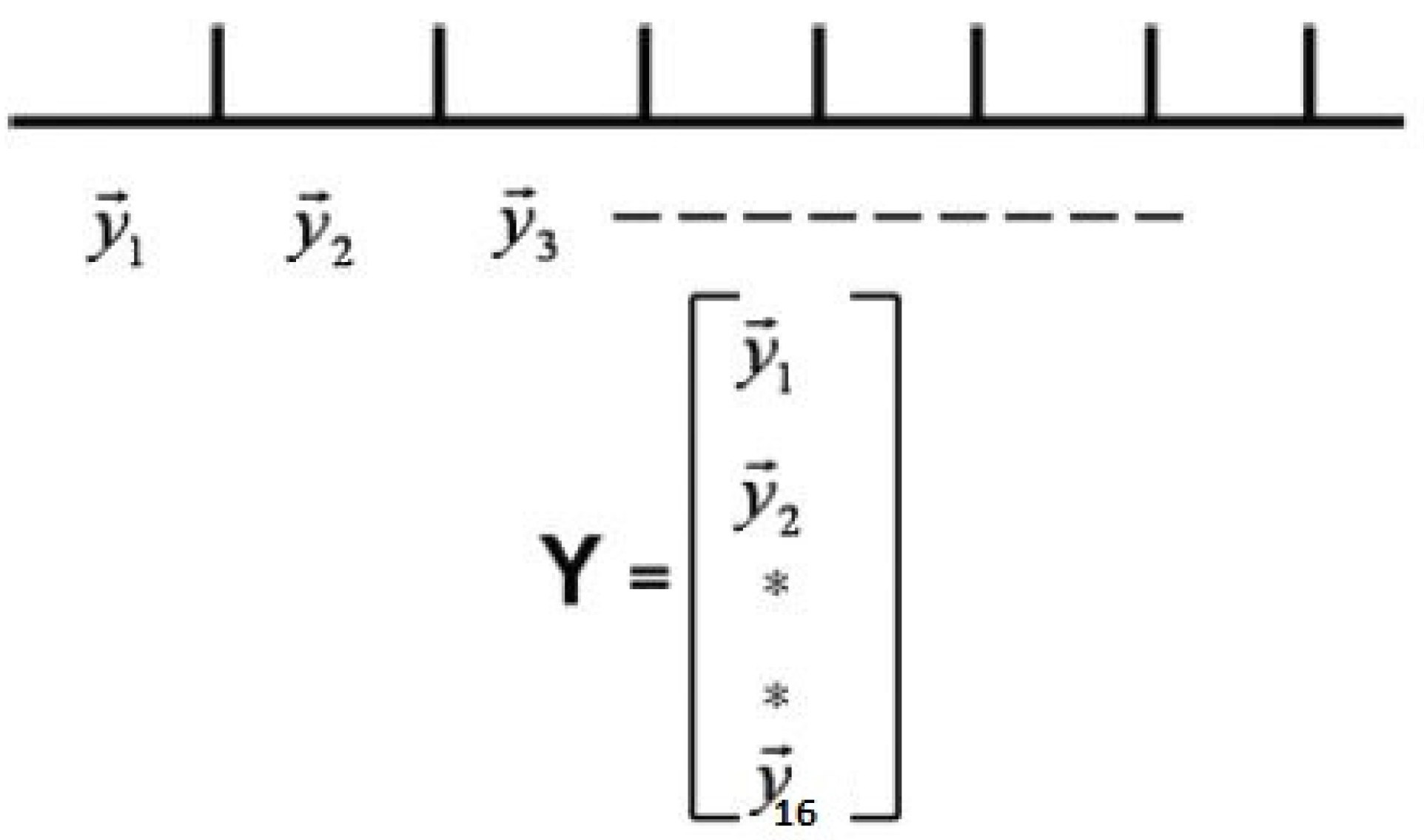
To check whether the Keysight Technologies UXR_25GHz oscilloscope noise floor is colored noise or white noise, we form the sample covariance matrix from these 256,000 voltage samples, by dividing it into 16 rows, with 16,000 columns. From the set {}, we form a column matrix Y as shown in Figure 2.
The sample covariance matrix is then
where ′ denotes transpose. For our case, this is a 16 × 16 symmetric matrix, which is a normal matrix. The condition number for a normal matrix is
Using Equation (4) for the 16 × 16 sample covariant matrix, we get
Using the experimental Keysight Technologies UXR_25GHz oscilloscope noise floor, we have
which proves that the oscilloscope has a colored noise floor.
2.4. Signal Model
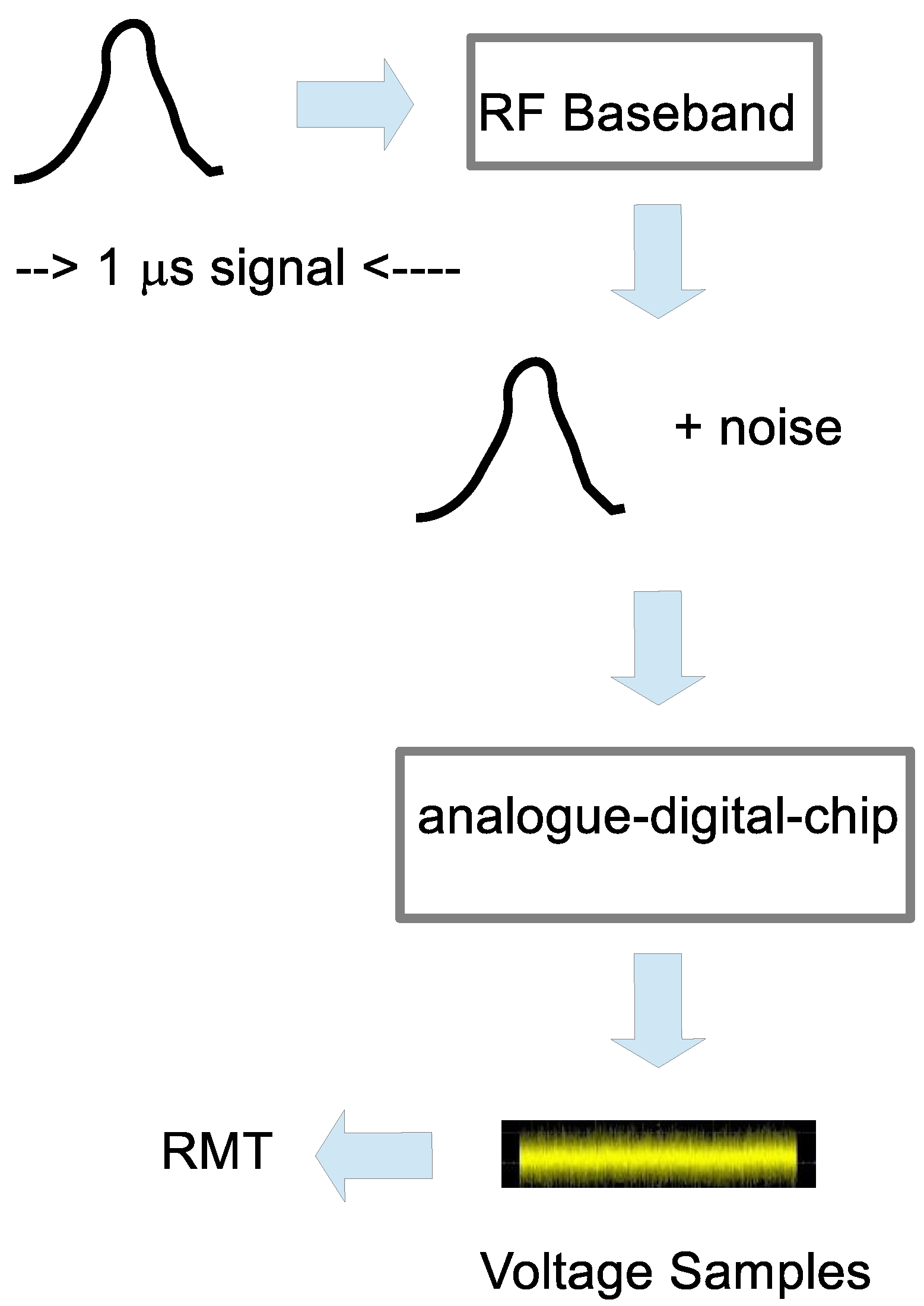
The physics has a simple mathematics model, as given in the following Figure 3. The voltages have additive (incoherent) noise (which may be either white noise or colored noise) and multiplicative (coherent) noise . Physicists call these terms statistical error and systematic error, while engineers call them incoherent noise and coherent noise associated with a signal
For computational physics purposes, we use the Keysight Technologies noise floor and the 16 × 16,000 sample covariance matrix . Numbering the {} with respect to the time interval of creation i, where here = sec/(256 ) = 3.90625 pico-seconds and i goes from 1 to 256,000, we have the statistical ensemble, which has fluctuations and correlations in it. Added to this noise will be various 1 s signals giving a wide to explore. When the system noise is added to the signal voltage, the infinite signal correlation length is reduced for low signal-to-noise power ratios () and for small enough , the differentiation of a signal voltage from a noise voltage becomes impossible, at the critical point, the LLCP . In this paper, we quantify these statements and show it is associated with a liquid–liquid phase separation and the phase space is a coexistence curve of signal and noise.
By taking enough data samples, the incoherent noise goes to zero (, but in practical terms is sufficient), but the coherent noise never drops out. However, we will see that the order parameter () involves the condition number () of a normal matrix, so from Equation (11), systemic error does not play a role as long as is a constant.
The statistical ensemble has a mathematical symmetry transformation [where is the correlation function Equation (20)] called a transformation. If no signal is present, the average correlation is unchanged by the transformation and the symmetry is intact. If a signal is present, the coherence length of the voltages is bigger than the noise floor coherence length and the average correlation : the symmetry is broken. At , the statistical ensemble {} has the noise coherence length and the two networks, signal and noise, become indistinguishable.
2.5. Condition Number for a Signal
If a signal is present, has voltages which have some embedded coherence among the statistical ensemble {}. If a signal is present in the voltage fluctuations, then RMT predicts [11,13] that the condition number for the covariant matrix in white noise becomes
where the signal-to noise power ratio
where is the variance of the signal and is the variance of the white noise. Examination of Equations (4) and (16) shows a ‘jump’ (discontinuity) in for a signal in white noise, since is not continuous. The RMT solution Equation (16) is only true for white noise; if colored noise is present, no RMT analytical solution is possible and the condition number must be calculated numerically.
2.6. Order Parameter for Radio Receivers
Let us pretend that the RF receiver is a network of K-number of cell phone towers, each cell tower getting a representative set of N number of voltage samples from that cell phone tower’s passband [8]. From the set of voltage samples {}, we form the RF sample covariance matrix using the pretended cell phone tower network. We thus divide up the 256,000 voltage samples we measured above for the UXR_25GHz oscilloscope (for 1 s duration) into K vectors (say ), each having voltages. The question is whether the pretended cell phone tower voltage samples are coherent with each other (and therefore a signal is present from a cell phone customer). If this were a real cell phone tower network and a real mobile phone was communicating with each tower with a variable strength and time delay, the network of cell phone tower voltage samples would be different from each other. However, the central question is whether this network is servicing a caller by having a signal present, even though the individual cell phone tower voltages are different from each other. The signal presence (minimum coherence of the voltages) or signal absence (random coherence of the voltages) is determined by the sample covariance matrix properties of the cell-phone network (K towers having N samples each). If the voltages were noise (no caller signal present), then just has random number entries for voltages.
If an RF receiver has a signal during a interrogation of an ADC, then that creates coherency among the voltages of its bandpass , and the condition number of the associated sample covariance matrix will be different than its noise condition number. In our computational results, we actually compute the condition number numerically and do not rely on asymptotic RMT.
For a given (a given ADC), the external control parameter is the (equivalent to magnetic field of traditional statistical mechanics of a metal–insulator transition) and an LLCP . is the reduced control parameter (thinking of as the reduced magnetic field, for example); the corresponding here is
So the disordered phase (noise with intact symmetry) has and the ordered phase (signal present with broken symmetry) has .
Thus there exists a universal signal order parameter which is positive for a signal and can be made zero whenever a signal cannot be measured:
where is the measured condition number of the sample covariance matrix and is the condition number of the noise floor. To determine , we first must compute the noise sample covariance matrix (no signal present) and determine its , before any signal measurement is made. This is the calibration of the RF detection apparatus.
3. Computational Results
We insert a 1 s signal using Equation (14) ( set to 1) and determine the condition number as a function of the inputted , using the Keysight Technologies UXR_25GHz oscilloscope noise floor. The results are in Table 1.
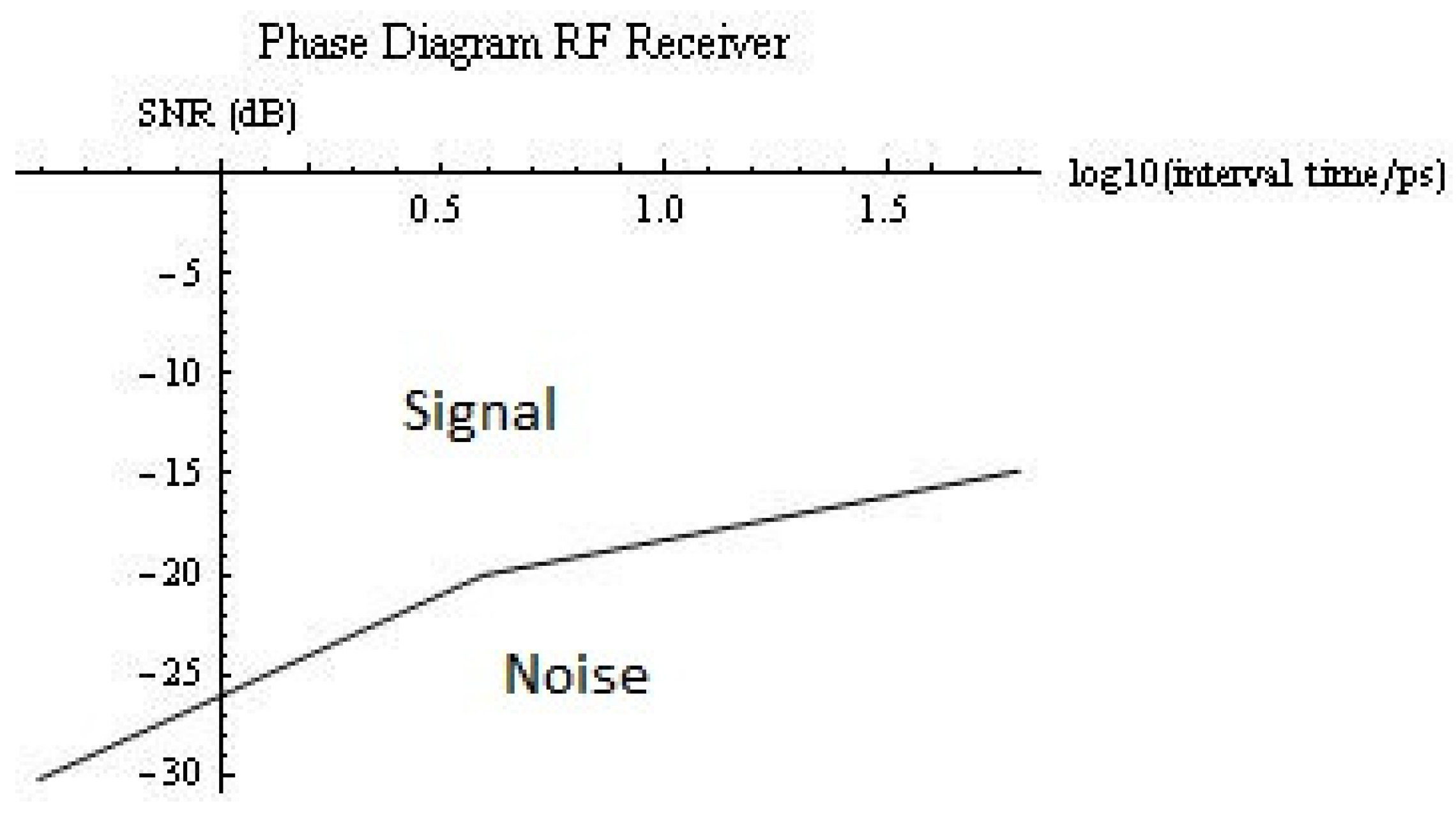
From Table 1, we see that beyond around = −20 dB (see below critical exponent), a signal is indistinguishable from noise because is approximately zero, and thus an ADC of 256 billion samples per second has a liquid–liquid critical point (LLCP) around = −20 dB (see below for a more exact ). Different ADC values give different end point liquid–liquid critical points and the joining of these LLCPs is the signal and noise phase diagram or more precisely the coexistence boundary.
To fully grasp intuitively why signals have this liquid–liquid phase separation, we need the correlation of the voltages, since it is these voltage correlations that determine a signal from noise. We use the time correlation function
where
There are 256,000 voltage samples, so we plot in units of 500 time-samples. In Figure 4, we have the noise floor correlation function.
Perusal of Figure 4 shows no important correlation in the noise floor as expected. The noise ‘fluid’ has no significant correlation and the symmetry transformation has no effect on the correlation average ; the symmetry is present. We now plot the correlation function for the = 14.948 signal in Figure 5.
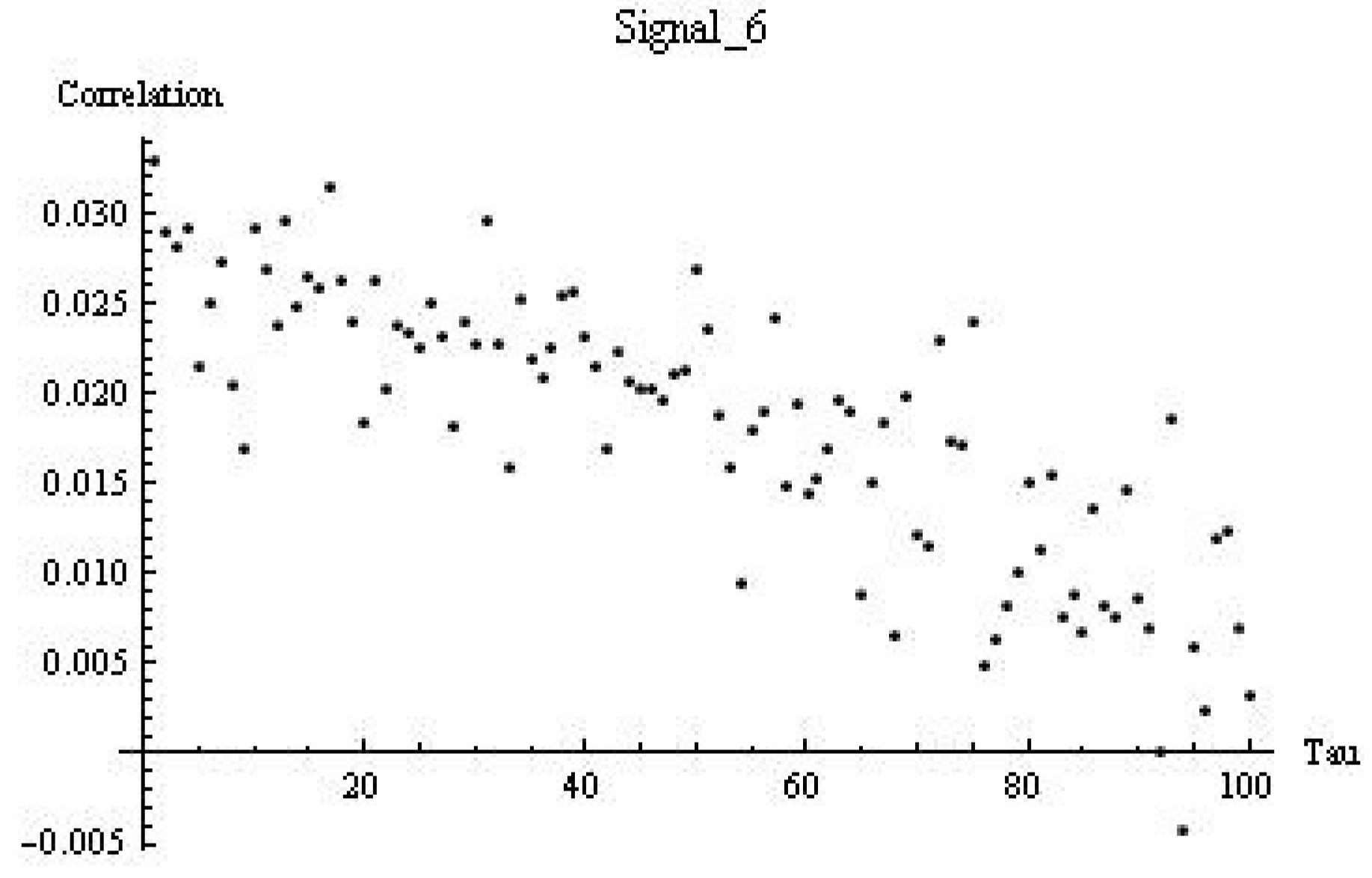
The signal ‘fluid’ has a dramatic difference in its correlation function, compared to the noise ‘fluid’. As the signal becomes smaller, the noise voltage samples become more important in the correlation function. For (Figure 6), the correlation among the voltage samples is falling apart.
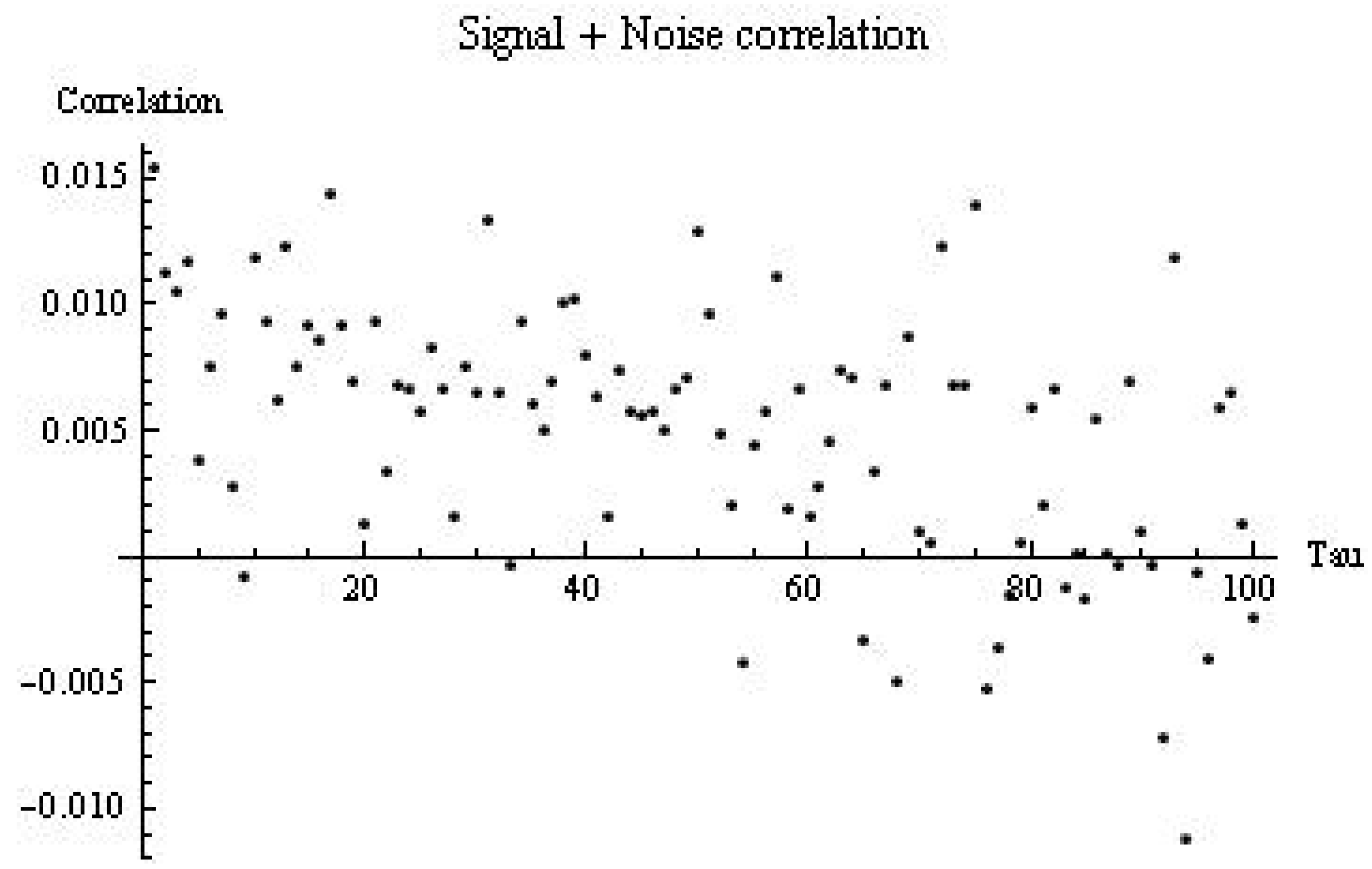
At the liquid–liquid critical point, the signal power is so small that the correlation function is almost the same as the noise function (Figure 7), and the two ‘fluids’ are indistinguishable. The liquid–liquid critical point (LLCP) is a unique value of the ADC used.
3.1. Signal Phase Separation
In the radio receiver statistical mechanics, there are no temperature–pressure external variables that cause a voltage ensemble to be differentiated into a signal or noise. Instead, the external variables are the and the time interval (that comes from the ADC discretizing the RF radio receiver passband). For a given ADC, the is decreased to a small level () where the statistical ensemble has the correlations of the receiver noise floor. The two ‘liquids’, noise and signal, then become totally undifferentiable. This physics is due to the presence of two competing networks, causality and random, whose phases are determined by a intrinsic symmetry. The order parameter ends in a liquid–liquid critical point (LLCP). The difference between the two networks, noise (random voltage) and signal (causal voltage), is in the coherence property: signal voltage samples are totally coherent with each other, while the ubiquitous noise is not. It is this grouping that makes voltage samples behave like a liquid. When the LLCP, the signal coherence length becomes the noise coherence length, the order parameter vanishes and signal and noise merge. At that critical , if we make smaller (a new ), we are again above a new order parameter and can say a signal is present. Going down to a smaller for the same new , we again hit a new liquid–liquid critical point where we no longer have a positive value order parameter. In this manner, we delineate the phase transition curve of an RF radio receiver by mapping the individual LLCP for each ADC. As for the symmetry, the transformation does not effect the coherence length in the random phase, but destroys the coherence length in the signal phase (broken). In summary, for a given ADC we have a line of positive order parameters that end in an LLCP. The phase diagram (noise on one side, signal on the other) for an RF radio receiver is the line of different ADCs, each of which has a unique order parameter LLCP: the phase transition line (coexistence line) is this line of LLCPs.
3.2. Phase Coexistence Line
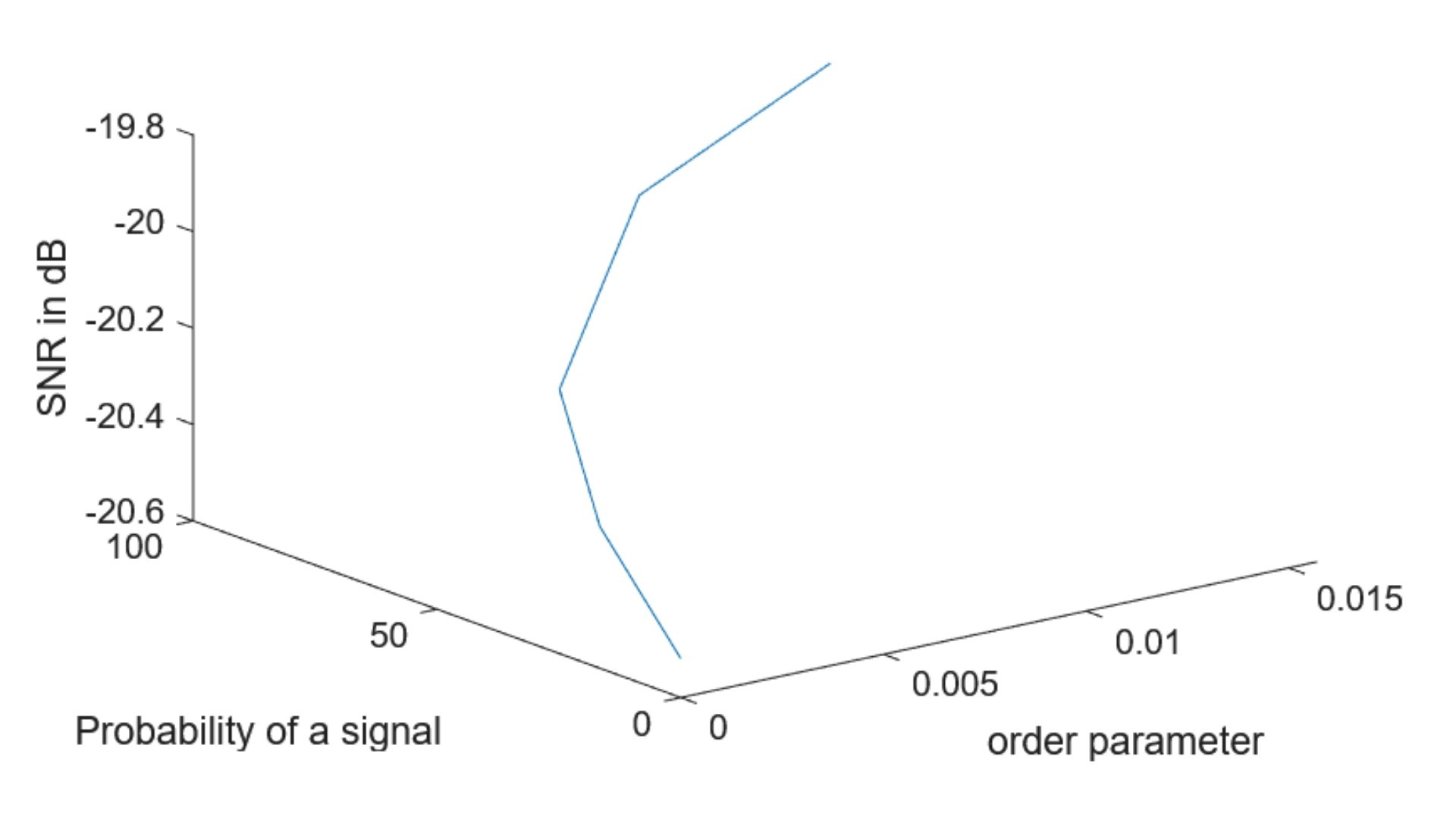
We map the phase line by taking different ADC values. If we use a smaller ADC giving 16 billion samples per second, then in 1 -second there will be 16,000 samples. Using a 16 × 16 sample covariant matrix gave an LLCP at a smaller (Table 2). If we use a very fast ADC of 2560 billion samples per second, the goes to the very low value of −30 dB (Table 2). The actual phase line separating noise from signal is the line of LLCPs determined at each (, ) pair. Each point on the phase line has a unique . In other words, a given ADC has a unique LLCP and the phase line is the function of ADC. Figure 8 gives the RF receiver phase diagram.
3.3. Critical Exponent
As the signal gets weaker and approaches the LLCP on the signal side, there exists the critical exponent which gives the power law behavior of the order parameter near the critical point :
where c is a possible constant. In physics, the exponent is the slope of the log–log plot of the signal order parameter (Equation (19)) versus the reduced control parameter (Equation (18)).
In order to calculate we need an accurate from which we can use Equation (22). This is given in Table 3.
Using the values in Table 4, in a log–log plot with a linear regression analysis,
3.4. Signal Statistical Mechanics Criticality
There are four possibilities governing the critical phenomena of signals:
- It is a liquid–liquid phase transition.The liquid–liquid phase transition is ruled out because the value derived here does not correspond to the Ising model exponent [14]. Furthermore, the correlation length does not go singular at the critical point.
- It is a percolation phase transition.Once the critical density is reached, the percolation extends across the community [15], which is not the case here, since the correlation length does not become infinite. Percolation is not correct.
- It is a liquid–glass transition.It is not a liquid–glass transition since this type of phase change is not abrupt, but extends over a range of external drivers (conventionally temperature, which here would be SNR) [16].
- It is a liquid–liquid phase separation.This is the critical phenomenon. The phase separation critical exponent is not universal: reference [17] in the experiment ‘Binary-liquid phase separation of lens protein solutions’ finds , while reference [18] in the experiment ‘Binary liquid phase separation and critical phenomena in a protein/water solution’ measures . In reference [19] for different kinds of hemoglobins, ranged from 0.708 to 0.4253. Also, the existence of the two phases coexisting together for a given external value of the driving parameter is not a singular correlation length.
In Table 5, we list the RF statistical mechanics, with : ().
4. Radar Processing
The physics result that RF signals being detected by an RF receiver (sensor) is a liquid–liquid phase separation transition has an immediate effect in radar. United States Patent 10,175,341 [20] shows that an enormous improvement in radar detection is achievable using the radar’s ADC with detection near the LLCP of the apparatus. The patent takes a Russian P37 Bar Lock search radar [21] illuminating a 10 m2 third-generation fighter plane (centimetric radiation). The nominal detection range for dB is 220 km. With a special ADC of 160 giga-samples per second, the patent shows that detection near the LLCP is at 1200 km. Radar processing now depends on the available hardware chips.
5. Conclusions
A single voltage measurement carries little information; a collection of voltages can reveal the presence of a signal, which is a collective coherence created by causality. The RF receiver is an example of statistical mechanics having a phase transition, due to fluctuations and coherence properties. There is an order parameter that delineates which phase the RF receiver is in. The ‘liquids’ are the voltage samples’ coherent properties or lack thereof. For a given ADC, there exists an LLCP (whose order parameter vanishes) where noise and signal are indistinguishable. The line of ADC LLCP gives the coexistence phase line between noise and signals in an RF receiver. There exist numerous other examples in Nature where the fluctuations and coherence properties constitute statistical mechanics having deep physics implications. For the radio receiver, causality and randomness are the underlying statistical mechanical network drivers.
Funding
This research received no external funding.
Data Availability Statement
The original contributions presented in this study are included in the article. Further inquiries can be directed to the corresponding author.
Conflicts of Interest
The author was employed by Blue Ridge Scientific LLC, Front Royal. The author declares that the research was conducted in the absence of any commercial or financial relationships that could be construed as a potential conflict of interest.
References
- Sen, P.N. A brief pedagogic review of frequency-dependent Johnson Nyquist. J. Appl. Phys. 2026, 139, 190701. [Google Scholar] [CrossRef]
- White, D.R.; Galleano, R.; Actis, A.; Brixy, H.; De Groot, M.; Dubbeldam, J.; Reesink, A.L.; Edler, F.; Sakurai, H.; Shepard, R.L.; et al. The status of Johnson noise thermometry. Metrologia 1996, 33, 325–335. [Google Scholar] [CrossRef]
- Ritchie, D. Shannon and Weaver: Unraveling the paradox of information. Commun. Res. 1986, 13, 278–298. [Google Scholar] [CrossRef]
- Jumarie, G. A critical review of Shannon information theory. In Relative Information: Theories and Applications; Springer: Berlin/Heidelberg, Germany, 1990. [Google Scholar] [CrossRef]
- Pastore, R.E.; Scheirer, C.J. Signal detection theory: Considerations for general application. Psychol. Bull. 1974, 81, 945. [Google Scholar] [CrossRef]
- Twalukov, V.P. Signal Detection Theory; Springer Science & Business Media: Berlin/Heidelberg, Germany, 2013. [Google Scholar]
- Izenman, A.J. Random matrix theory and its applications. Stat. Sci. 2021, 36, 421–442. [Google Scholar] [CrossRef]
- Couillet, R.; Debbah, M. Random Matrix Methods for Wireless Communications; Cambridge University Press: London, UK, 2011; ISBN 978-1-107-01163-2. [Google Scholar]
- Bartosch, L. Generation of colored noise. Int. J. Mod. Phys. C 2001, 12, 851. [Google Scholar] [CrossRef]
- Fox, R.F.; Gatland, I.R.; Roy, R.; Vemuri, G. Fast, accurate algorithm for numerical simulation of exponentially correlated colored noise. Phys. Rev. A 1988, 39, 5938. [Google Scholar] [CrossRef] [PubMed]
- Morley, P.D.; Brown, J.W. Detecting Coherent Energy. Int. J. Mod. Phys. C 2012, 23, 1250006. [Google Scholar] [CrossRef]
- Marchenko, V.A.; Pastur, L.A. Distribution of eigenvalues for some sets of random matrices. Math. USSR-Sb. 1967, 1, 457–483. [Google Scholar] [CrossRef]
- Cardoso, L.S.; Debbah, M.; Bianchi, P.; Najim, J. Cooperative spectrum sensing using random matrix theory. In Proceedings of the ISWPC IEEE Pervasive Computing (ISWPC’08), Santorini, Greece, 7–9 May 2008; IEEE: Piscataway, NJ, USA, 2008; pp. 334–338. [Google Scholar]
- Pelissetto, A.; Vicati, E. Critical phenomena and renormalization group theory. Phys. Rep. 2002, 368, 549–727. [Google Scholar] [CrossRef]
- Morley, P.D.; Chang, J. Critical behavior in cellular automata animal disease transmission model. Int. J. Mod. Phys. C 2004, 15, 149–162. [Google Scholar] [CrossRef]
- Angell, C.A.; Ngai, K.L.; McKenna, G.B.; McMillan, P.F.; Martin, S.W. Relaxation in glassforming liquids and amorphous solids. J. Appl. Phys. 2000, 88, 3113–3157. [Google Scholar] [CrossRef]
- Broide, M.L.; Berland, C.R.; Pande, J.; Ogun, O.O.; Benedek, G.B. Binary-liquid phase separation of lens protein solutions. Proc. Nati. Acad. Sci. USA 1991, 88, 5660–5664. [Google Scholar] [CrossRef] [PubMed]
- Thomson, J.A.; Schurtenberger, P.; Thurston, G.M.; Benedek, G.B. Binary liquid phase separation and critical phenomena in a protein/water solution. Proc. Natl. Acad. Sci. USA 1987, 84, 7079–7083. [Google Scholar] [CrossRef] [PubMed]
- Chen, Q.; Vekilov, P.G.; Nagel, R.L.; Hirsch, R.E. Liquid-liquid phase separation in hemoglobins: Distinct aggregation mechanics of the β6 mutants. Biophys. J. 2004, 86, 1702–1712. [Google Scholar] [CrossRef] [PubMed]
- Morley, P.D. Method for Search Radar Processing Using Random Matrix Theory. U.S. Patent 9,568,591, 14 February 2017. [Google Scholar]
- RadarTutorial.eu. Radar Tutorial. Available online: https://www.radartutorial.eu (accessed on 21 December 2021).
Figure 1.
Snapshot of the Keysight Technologies UXR_25GHz oscilloscope noise floor with 256,000 voltage samples, showing the famous Johnson–Nyquist noise of an RF receiver. No signal was sent to the oscilloscope and the snapshot is for a 1 s time duration.
Figure 1.
Snapshot of the Keysight Technologies UXR_25GHz oscilloscope noise floor with 256,000 voltage samples, showing the famous Johnson–Nyquist noise of an RF receiver. No signal was sent to the oscilloscope and the snapshot is for a 1 s time duration.

Figure 2.
Dividing up the voltage sample {} into K = 16 effective receivers.

Figure 3.
Hardware model.

Figure 4.
Noise floor correlation function using the 256 thousand voltage samples of the Keysight Technologies UXR_25GHz oscilloscope.
Figure 4.
Noise floor correlation function using the 256 thousand voltage samples of the Keysight Technologies UXR_25GHz oscilloscope.

Figure 5.
dB correlation function.

Figure 6.
dB correlation function.

Figure 7.
Correlation function at the liquid–liquid critical point, around dB (see Table 3 for a more accurate determination), for an ADC at 256 billion samples per second.
Figure 7.
Correlation function at the liquid–liquid critical point, around dB (see Table 3 for a more accurate determination), for an ADC at 256 billion samples per second.

Figure 8.
Phase diagram (coexistence phases) for RF receivers.


Table 1.
Condition number as a function of . Each unique ADC (here in this table, 256 billion samples per second) has an order parameter (Equation (19)) that ends in a liquid–liquid critical point, here close to dB, because an = −20 dB gives a condition number close to noise (Equation (13)).
| SNR in dB | Signal+Noise Condition Number (16 × 16) |
|---|---|
| 1.494850 × 101 | 5.439931 × 10² |
| 8.927898 × 100 | 1.358643 × 10² |
| 2.907298 × 100 | 3.434518 × 101 |
| −3.113302 × 100 | 9.217845 × 100 |
| −9.133902 × 100 | 3.057018 × 100 |
| −1.515450 × 101 | 1.575736 × 100 |
| −2.003700 × 101 | 1.278857 × 100 |
Table 2.
LLCP as a function of the signal external variables. The phase line is the line of LLCPs and this table gives three points on the line.
Table 2.
LLCP as a function of the signal external variables. The phase line is the line of LLCPs and this table gives three points on the line.
| Noise Condition Number | SNRdB | in Pico-Seconds |
|---|---|---|
| 0.1036167 × 101 | −0.3023894 × 10² | 0.390625 |
| 0.1266554 × 101 | −2.003700 × 101 | 3.90625 |
| 0.2824512 × 101 | −0.1484210 × 10² | 62.5 |
Table 3.
Determination of for the pico-s LLCP.
| Quantity | Value |
|---|---|
| signal power | 1.51328 × 10⁻¹¹ Watt |
| in dB | −20.54677 |
| noise + signal | 1.266722 |
Table 4.
Determination of the critical exponent in Equation (22) using three values near .
Table 4.
Determination of the critical exponent in Equation (22) using three values near .
| Quantity | Value |
|---|---|
| in dB | condition number |
| −20.52837 | 1.267117 |
| −20.53756 | 1.266919 |
| −20.51918 | 1.267315 |
Table 5.
Table of RF statistical mechanics.
| External Variables | Control parameters {} |
| Order parameter value | = 0, noise; , signal |
| Critical Point | signal coherence length = noise coherence |
| Intrinsic symmetry | broken signal phase, restored random phase |
| Critical phenomena | liquid–liquid phase separation |
Disclaimer/Publisher’s Note: The statements, opinions and data contained in all publications are solely those of the individual author(s) and contributor(s) and not of MDPI and/or the editor(s). MDPI and/or the editor(s) disclaim responsibility for any injury to people or property resulting from any ideas, methods, instructions or products referred to in the content. |
© 2026 by the author. Licensee MDPI, Basel, Switzerland. This article is an open access article distributed under the terms and conditions of the Creative Commons Attribution (CC BY) license.
Share and Cite
MDPI and ACS Style
Morley, P.D. Signal Statistical Mechanics. Computation 2026, 14, 128. https://doi.org/10.3390/computation14060128
AMA Style
Morley PD. Signal Statistical Mechanics. Computation. 2026; 14(6):128. https://doi.org/10.3390/computation14060128
Chicago/Turabian StyleMorley, Peter D. 2026. "Signal Statistical Mechanics" Computation 14, no. 6: 128. https://doi.org/10.3390/computation14060128
APA StyleMorley, P. D. (2026). Signal Statistical Mechanics. Computation, 14(6), 128. https://doi.org/10.3390/computation14060128
Note that from the first issue of 2016, this journal uses article numbers instead of page numbers. See further details here.