
Micro-Macro Modeling of Inherent Cognitive Biases in 5-Point Likert Scales: Uncovering the Non-Linearity of Critical Sample Sizes for Capturing Identical Statistical Populations


Abstract
1. Introduction
1.1. The Challenge of Simultaneous Aging of Social Infrastructure and Assessor Bias
1.2. Statistical Misinterpretations and the Lack of “Homogeneity”
1.3. Inherent Errors Regardless of Evaluation Scale and Limits in Capturing Homogeneity
- Errors in subjective evaluations are not mere “clerical mistakes” but inevitable products strongly reflecting the environment (peer pressure, information overload) in which the evaluator is placed.
- Nevertheless, conventional aggregation methods fail to theoretically distinguish the “homogeneity” behind this error, roughly grouping responses that have undergone different cognitive processes as the “same population” [12].
- This constitutes a structural limitation that risks absorbing evaluation results whole and inadvertently rendering minority signals invisible.
1.4. A Warning Against Blind Faith in Evaluation Results and the “Question” of Re-Verification
- Uncritical reliance on evaluation results as absolute facts carries significant risks. Data can easily mislead decision-makers unless the noise structure behind the results (such as the non-linearity of Softmax) is understood.
1.5. Approach and Contributions of This Paper
- Simulation Engine: Non-linear transformations via the Softmax function are introduced, and macro population distributions are allowed to emerge through large-scale Monte Carlo trials () [2,6]. This addresses the class imbalance problem where rare degradation paths are statistically underestimated in empirical data [1].
2. Materials and Methods: Mathematical Modeling of the Micro-Macro Link
2.1. Setting Evaluation Criteria and the AHP Distance-Decay Model
2.2. Conversion to Probability Vectors via the Softmax Function
2.3. Introduction of Large-Scale Monte Carlo Simulation and Multinomial Distribution
2.4. Capture Criterion for Identical Statistical Populations (Kullback-Leibler Divergence)
3. Results
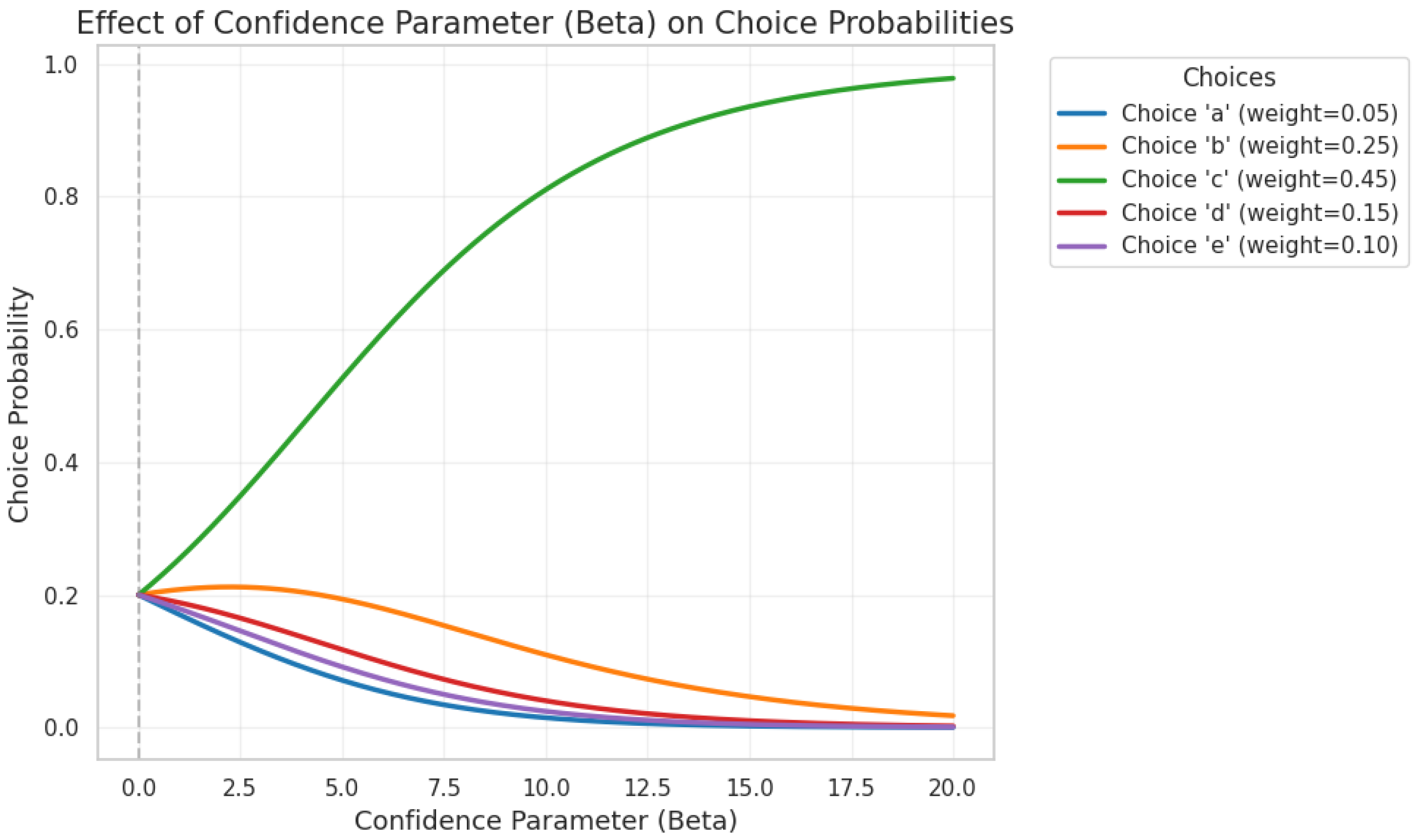
3.1. Behavior of Confidence Parameter () as the Reciprocal of Error Variance
- In practices where assessor bias intervenes, variance in evaluator judgment (fluctuations in ) must be explicitly incorporated into the model to extract true signals [1].
- In long-tail distributions, a high suppresses minority signals as an over-adaptation to peer pressure, while a low causes burial in noise [2].

3.2. Cognitive Processes as Finite Mixture Models and the Discovery of “Intra-Individual Mixture Distributions”
4. Computational Experiments: 3 Patterns of Experiments and Mathematical Considerations
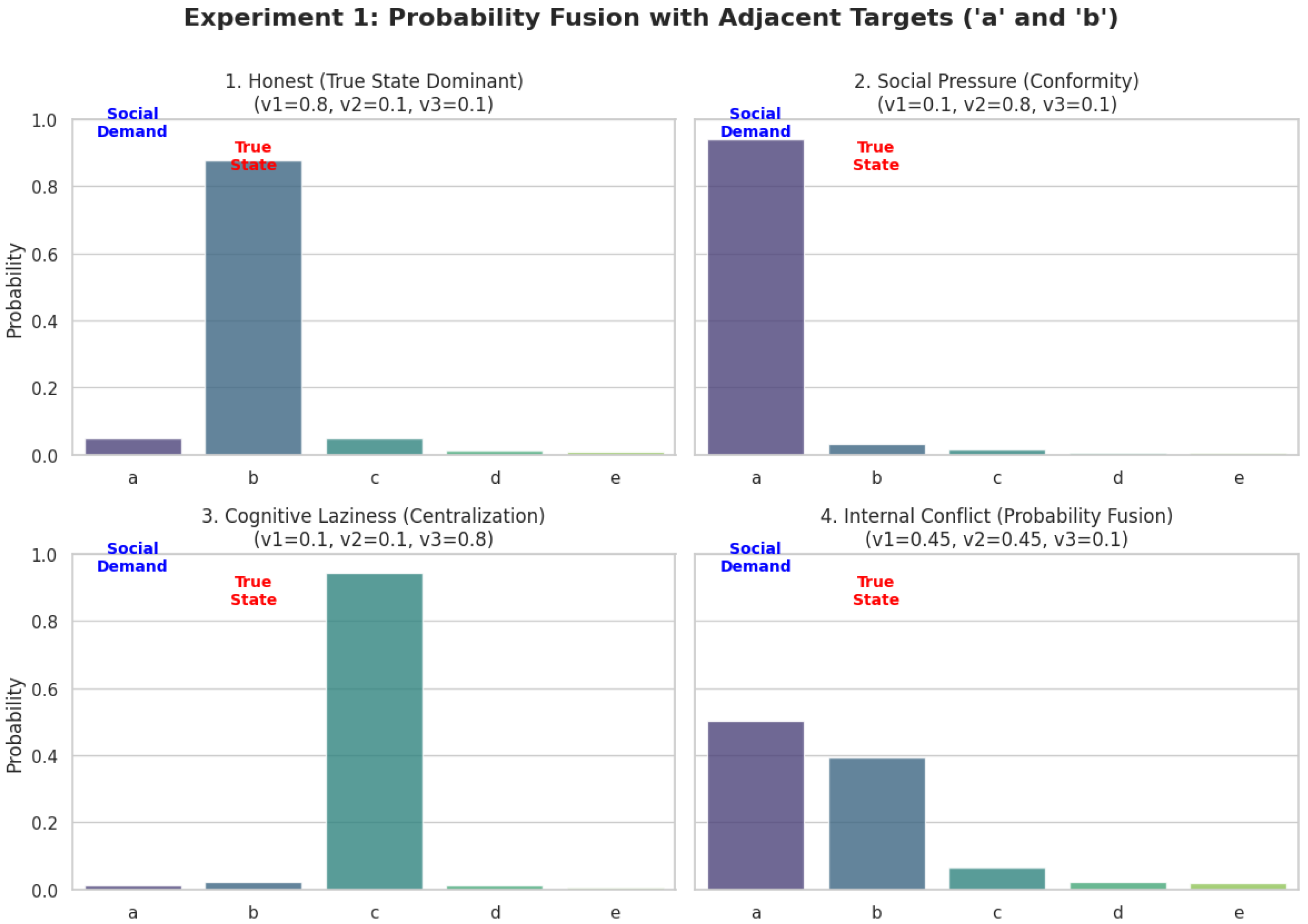
4.1. Experiment 1: Probability Fusion at Target Proximity and Opinion Dynamics
- Dynamical System Analysis of Non-linear Transformation: When targets are adjacent (), the weight difference is minute, and the exponential nature of the Softmax function forms a smooth gradient where probability mass is distributed to both.

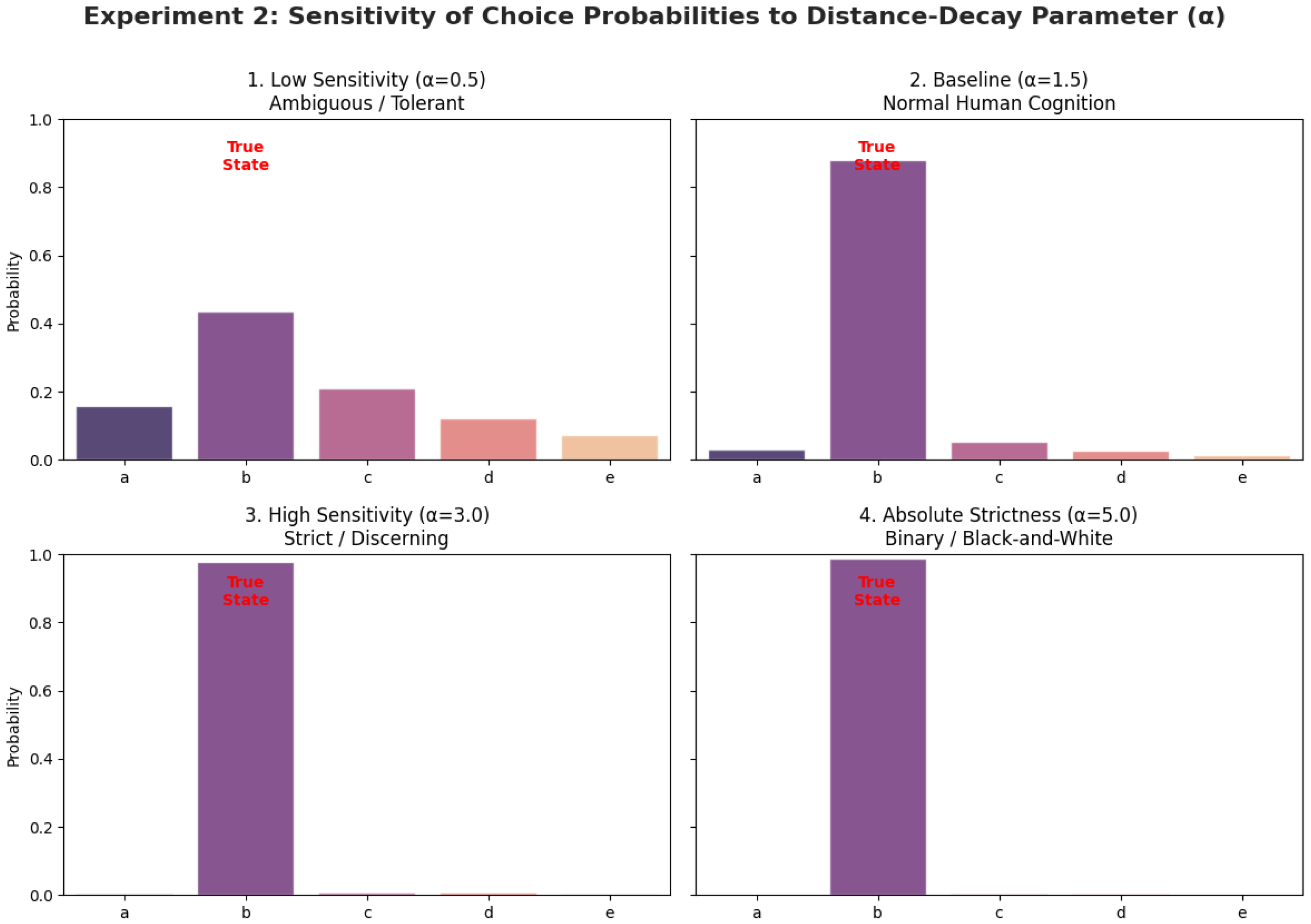
4.2. Experiment 2: Kernel Smoothing and Asymptotics to the Dirac Delta Function
- Mathematical Consideration of Limits: In the limit of , the entire evaluation vector converges to a discrete Kronecker delta, degenerating to a single choice. In a model using L1 norm distance, an increase in functions as a powerful sparsification operator that artificially reduces non-zero elements of the probability vector [23].
- Rigidification of Social Systems: determines the “information entropy” of the entire system. An extremely large state evaluates minute distances between choices as infinite differences, serving as a signal of a rigid information environment [24].
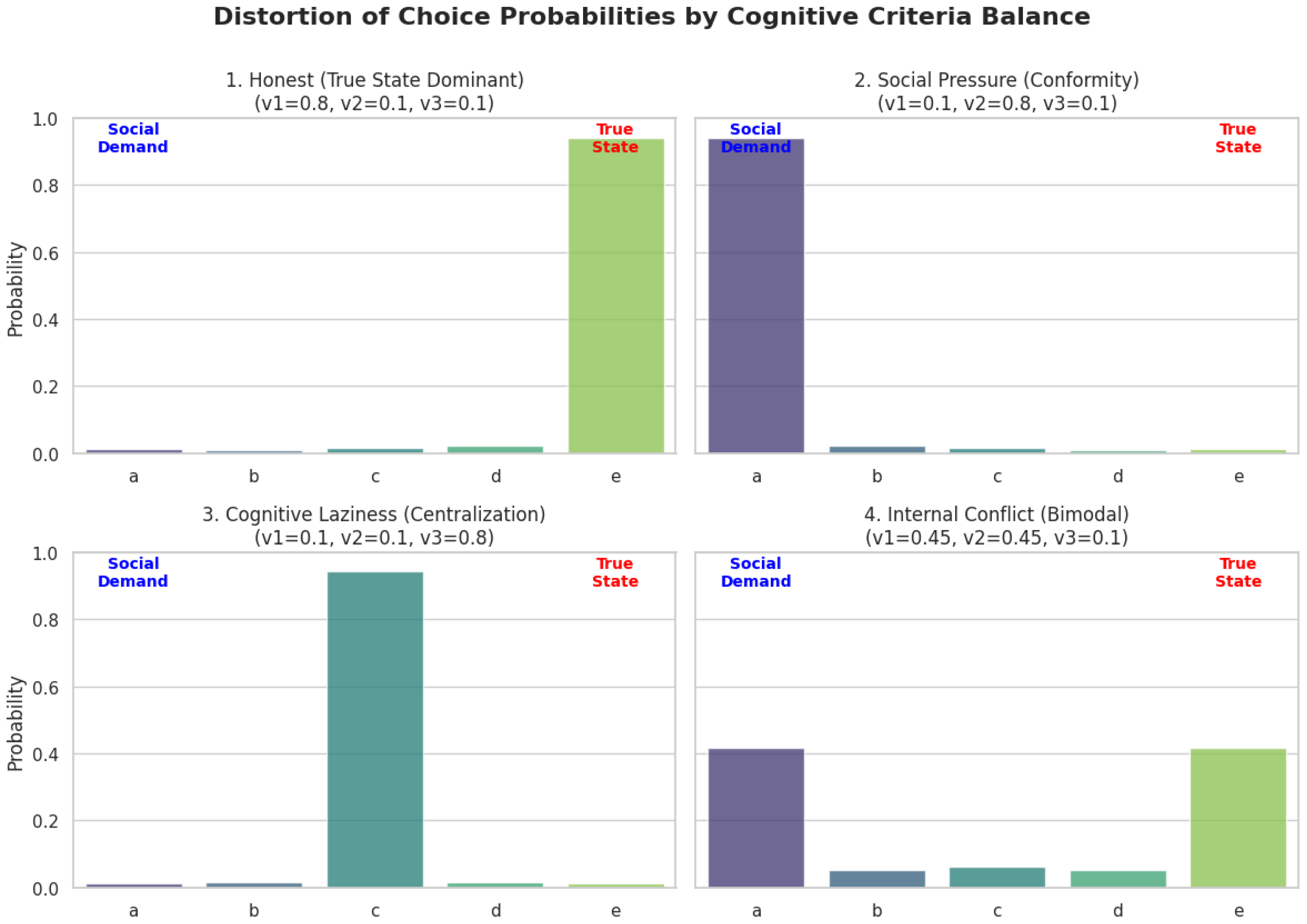
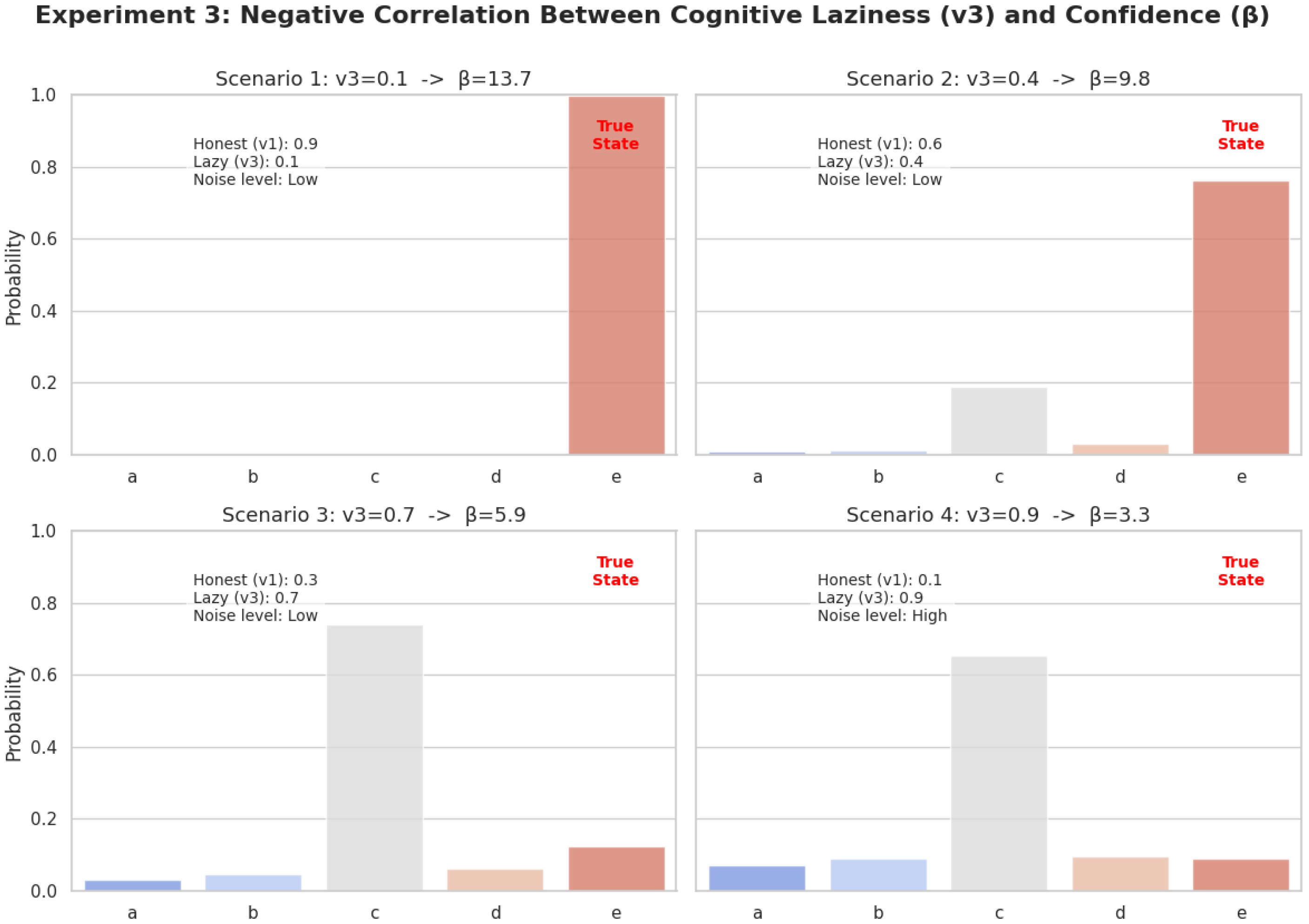
4.3. Experiment 3: Heteroscedasticity of Error Terms and Statistical Mechanical Inverse Temperature
- Mathematical Consideration of Inverse Temperature: The Softmax function is theoretically analogous to a canonical distribution with energy states and inverse temperature. The more an agent attempts to avoid cognitive load, the more the system’s physical temperature rises, causing thermal excitation to peripheral states [6].
- Deterioration of Informational Health and “Cognitive Fog”: The concentration of probability in the center forms a cognitive baseline for agents who have reduced decision-making effort. The phenomenon of probability leaking to the periphery mathematically visualizes the process where random errors (Cognitive Fog) obscure the true signal [1,26].

4.4. Comparative Analysis with Baseline Aggregation Methods
5. Discussion
5.1. Non-Linearity of Critical Sample Sizes and Observation Costs
5.2. Practical Implications: The Pitfalls of Statistical Misinterpretations Across Survey Scales
5.2.1. Pitfalls in Small-Scale Surveys (Dozens to Hundreds of Samples)
- Blind Faith in the Mean and Centralization: As identified in recent critical reviews, the midpoint of a Likert scale often functions as a “default option” for respondents who are unwilling or unable to exert the cognitive effort required for a precise evaluation [17]. This phenomenon, documented as “central tendency bias,” directly corroborates the “Cognitive Fog” observed in our Experiment 3 (Figure 5) [27]. In small samples, this state constitutes background noise, rendering the calculated mean uninformative.
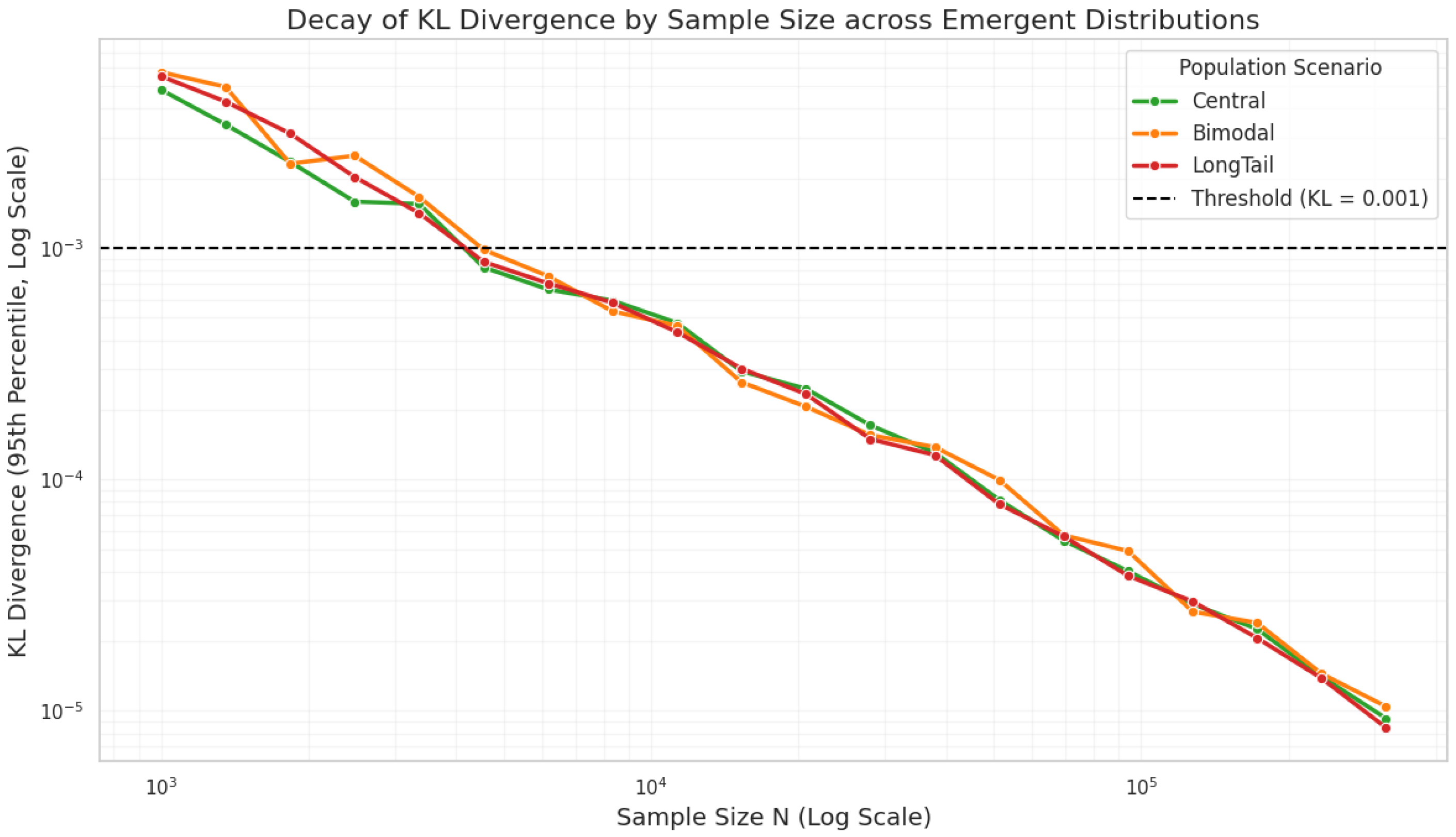
- Marginalization of Minority Opinions: Under environments with strong peer pressure, extreme opinions are pushed to the very end of the long tail. Capturing a 1% minority signal requires a sample size of . Therefore, interpreting the absence of extreme scores in small surveys as “the absence of dissatisfaction” is a statistical fallacy.
- The Misinterpretation of Consensus (Probability Fusion): Even when responses are concentrated at “4”, one must be cautious. As shown in Experiment 1 (Figure 3), when “true feelings” and “social demand” are close, probabilities fuse without visible conflict. Observing a 1D aggregate graph makes it difficult to distinguish whether the peak represents genuine satisfaction or a compromised “Assimilation Trap.”
5.2.2. Pitfalls in Large-Scale Surveys (Thousands to Millions of Samples)
- Over-reliance on the Law of Large Numbers: Biases such as peer pressure and cognitive laziness are not random white noise; they are gravitational forces directing probabilities toward specific answers. Increasing N merely mathematically crystallizes the erroneous distribution into a fixed systematic error.
- Structural Suppression of Minorities by Macro Indicators: When macro statistical indicators like KL divergence are employed to measure overall fitness, they can issue a false “OK signal” around N = 5000. Because macro indicators are dragged by the majority, the 1% true minority signal is suppressed and rendered invisible.
- Macroscopic Degeneracy via Low-Resolution Sensors: A bimodal graph cannot mathematically distinguish between “a society truly divided into two factions” and “homogeneous individuals hesitating internally.” Segmenting populations based solely on these 1D superficial shapes leads to spurious correlations and severe overfitting [14].
5.3. Post-Hoc Mathematical Remedies for Legacy Likert Data
- Separating “Individual Hesitation” and “Group Division” via Hierarchical Bayesian Models: By applying latent variable models, one can statistically separate whether variance is due to differences between respondents (Between-variance) or internal cognitive conflicts (Within-variance).
- Reverse-Estimating Confidence () Assuming Heteroscedasticity: Rather than calculating simple means, one should apply multinomial logit models to reverse-estimate the “magnitude of error variance” for response patterns. Data groups with abnormally large variance should be down-weighted.
- Pitfalls in Large-Scale Surveys: Thousands to Millions of Samples. Standard data cleaning practices—such as automatically rejecting extreme answers using 3 rules—should be critically reassessed. These rare answers may be “true signals with high confidence.”
- Re-verification of Generative Processes via Simulation (Dry Run): By utilizing our AHP distance-decay and Softmax link model, researchers can run Monte Carlo reverse-explorations to expose underlying mechanisms, such as probability fusion.
5.4. Breaking Macroscopic Degeneracy via NLP-Assisted Re-Evaluation
- Data Decomposition: The 1D discrete scores and their corresponding open-ended text responses are separated.
- NLP-Based Confidence Scoring: Natural Language Processing (NLP) measures the respondent’s cognitive effort. A “Text Confidence Weight” is calculated, applying penalties to computationally detected “lazy responses”.
- Score Re-evaluation and Reintegration: The original 1D score is multiplied by the Text Confidence Weight. Extreme scores mathematically vulnerable to peer pressure are given a baseline protection weight.
5.5. Limitations and Future Directions: Mathematical Re-Evaluation for Pure Likert Scales
- Straight-Lining Penalty: Respondents selecting the same option across all questions exhibit zero variance, identifiable as “Cognitive Fog” rather than a genuine neutral stance.
- Entropy-Based Noise Filtering: Responses with excessively high Shannon entropy can be penalized as thermodynamic noise.
- Minority Signal Protection: An algorithm can automatically boost the baseline weight of extreme choices to prevent them from being suppressed.
6. Conclusions
- Elucidation of the Non-linear Relationship between Distribution Shape and Critical Sample Size: Through the attenuation curves of KL divergence, we demonstrated that the critical sample size required to capture identical statistical populations leaps non-linearly depending on the distribution bias [8].
- Presentation of the Danger of “Overlooked Errors” and Minority Invisibility: In long-tail distributions, macro statistical indicators suppress minority true signals, causing the misinterpretation that “the error is within an acceptable range.”
- Transition to Survey Design using Multi-Criteria Decision Making Models (AHP): Since collecting the sample sizes necessary to capture minority opinions in a long tail is practically demanding, an approach that returns to the generation mechanism is required. We advocated the indispensability of incorporating AHP, which separates criteria and measures confidence () [5].
Redefining the Data-Reading Paradigm: Moving Beyond Superficial Aggregation
- Avoiding Overly Assertive Interpretations: Researchers must be cautious when making deterministic claims such as “X% of users are satisfied,” acknowledging that superficial distributions cannot exclude the possibilities of probability fusion.
- Reconsidering Careless Anomaly Truncation: Extreme minority opinions should not be automatically erased through routine data cleaning as “noise.”
- Fundamental Redesign of Survey Methodologies: For critical decision-making, relying solely on simple 5-point scales should be critically re-evaluated. It is indispensable to multi-dimensionalize the survey design itself [5].
Funding
Institutional Review Board Statement
Informed Consent Statement
Data Availability Statement
Acknowledgments
Conflicts of Interest
Abbreviations
| AHP | Analytic Hierarchy Process |
| KL | Kullback-Leibler |
| NLP | Natural Language Processing |
Appendix A. Computational Environment and Reproducibility
Appendix A.1. Hardware Architecture and System Specifications

| Item | Specification |
|---|---|
| Architecture | x86_64 (Little Endian) |
| CPU | Intel(R) Xeon(R) CPU @ 2.20 GHz |
| Core Count | 2 vCPUs (1 Socket, 2 Threads per core) |
| L3 Cache | 55 MiB |
| BogoMIPS | 4399.99 |
| OS | Linux (64-bit support) |
Appendix A.2. Implementation Details and Computational Efficiency
- Random Seed Specification: To ensure exact reproducibility across all stochastic processes, the pseudo-random number generator seed was explicitly fixed (e.g., numpy.random.seed(42)) prior to execution.
- Algorithmic Optimization: The proposed framework avoids the looping structures typically found in standard Agent-Based Models (ABM). Instead, it generates the choice counts simultaneously by sampling from a statistical Multinomial Distribution.
- Computational Complexity: This optimization effectively reduces the time complexity to relative to the number of agents, enabling extremely fast processing even for astronomical sample sizes.
- Execution Metrics: The total execution time for all processes—including the sample generation, parameter sweeps across three experiments, and the calculation of Kullback-Leibler divergence attenuation curves—was approximately 3.5 min on the specified 2-core architecture.
Appendix A.3. Scalability for Field Applications
- Hardware Accessibility: The framework does not require expensive High-Performance Computing (HPC) clusters or GPU servers. It can be executed efficiently on standard commercial PCs or low-cost cloud instances.
- Real-time Analysis: Field engineers can practically perform “Dry Runs” on-site to dynamically evaluate the structural bias and statistical uncertainty of freshly collected inspection data.
- Parameter Robustness: Using the environment detailed in Appendix A and the identical parameters (), independent researchers can perfectly reproduce the mathematical results and figures presented in this paper.
Appendix A.4. Software Dependencies and Data Availability
| Tool | Version/Location |
|---|---|
| Language | Python 3.8+ |
| Library | NumPy (v1.23.5), SciPy (v1.9.3), Matplotlib (v3.6.2) |
| Code Base | https://github.com/RUDATAScience/Micro-Macro-Modeling-of-5-Point-Likert-Scales (accessed on 24 March 2026) |
| Additional Exp | https://github.com/RUDATAScience/Additional-Experiments (accessed on 24 March 2026) |
References
- Kawahata, Y.; Maeda, N.; Hatadani, S. Robustness and Convergence of a Stochastic Deterioration Prediction Model for Tunnel Lighting Facilities: A Japanese Case Study Based on Systematized Expert Knowledge and Large-Scale Monte Carlo Simulation. Appl. Sci. 2026, 16, 1994. [Google Scholar] [CrossRef]
- Gentle, J.E. Random Number Generation and Monte Carlo Methods; Springer: New York, NY, USA, 2003. [Google Scholar]
- McFadden, D. Conditional logit analysis of qualitative choice behavior. In Frontiers in Econometrics; Zarembka, P., Ed.; Academic Press: New York, NY, USA, 1974; pp. 105–142. [Google Scholar]
- Albert, A.; Anderson, J.A. On the existence of maximum likelihood estimates in logistic regression models. Biometrika 1984, 71, 1–10. [Google Scholar] [CrossRef]
- Saaty, T.L. The Analytic Hierarchy Process: Planning, Priority Setting, Resource Allocation; RWS Publications: Pittsburgh, PA, USA, 1990. [Google Scholar]
- Gao, B.; Pavel, L. On the properties of the softmax function with application in game theory and reinforcement learning. arXiv 2017, arXiv:1704.00805. [Google Scholar]
- McCullagh, P.; Nelder, J.A. Generalized Linear Models, 2nd ed.; Chapman and Hall/CRC: Boca Raton, FL, USA, 1989. [Google Scholar]
- Kullback, S.; Leibler, R.A. On information and sufficiency. Ann. Math. Stat. 1951, 22, 79–86. [Google Scholar] [CrossRef]
- Heo, C.Y.; Kim, B.; Park, K.; Back, R.M. A comparison of Best-Worst Scaling and Likert Scale methods on peer-to-peer accommodation attributes. J. Bus. Res. 2022, 148, 368–377. [Google Scholar] [CrossRef]
- Kurtuluş, K.; Basfirinci, C.; Cilingir Uk, Z. Beyond the middle: Rethinking midpoint and “no idea” options in Likert scale for consumer sensitive issues. Humanit. Soc. Sci. Commun. 2026. [Google Scholar] [CrossRef]
- Grimmond, J.; Brown, S.D.; Hawkins, G.E. A solution to the pervasive problem of response bias in self-reports. Proc. Natl. Acad. Sci. USA 2025, 122, e2412807122. [Google Scholar] [CrossRef] [PubMed]
- Nagaya, M. Statistical Mass and Homogeneity: The Homogeneity Controversy in German Social Statistics (1). Econ. Rev. (Keizai Ronso) 1989, 143, 344–372. [Google Scholar]
- Galam, S. Sociophysics: A Physicist’s Modeling of Psycho-Political Phenomena; Springer: Berlin/Heidelberg, Germany, 2012. [Google Scholar]
- McLachlan, G.J.; Peel, D. Finite Mixture Models; John Wiley & Sons: New York, NY, USA, 2000. [Google Scholar]
- Amari, S.I. Information Geometry and Its Applications; Springer: Tokyo, Japan, 2016. [Google Scholar]
- Koo, M.; Yang, S.-W. Likert-Type Scale. Encyclopedia 2025, 5, 18. [Google Scholar] [CrossRef]
- Darnton, A. The Likert Scale: A Review of its Use and Misuse. In Proceedings of the European Conference on Research Methodology for Business and Management Studies, Aveiro, Portugal, 2–3 June 2022. [Google Scholar]
- Kawahata, Y. Micro-Macro-Modeling-of-5-Point-Likert-Scales. GitHub Repository. Available online: https://github.com/RUDATAScience/Micro-Macro-Modeling-of-5-Point-Likert-Scales (accessed on 25 March 2026).
- Titterington, A.W.; Smith, A.F.M.; Makov, U.E. Statistical Analysis of Finite Mixture Distributions; Wiley: New York, NY, USA, 1985. [Google Scholar]
- Kawahata, Y. Additional-Experiments. GitHub Repository. Available online: https://github.com/RUDATAScience/Additional-Experiments (accessed on 25 March 2026).
- Cinelli, M.; Morales, G.D.F.; Galeazzi, A.; Quattrociocchi, W.; Starnini, M. The echo chamber effect on social media. Proc. Natl. Acad. Sci. USA 2021, 118, e2023301118. [Google Scholar] [CrossRef] [PubMed]
- Silverman, B.W. Density Estimation for Statistics and Data Analysis; Chapman and Hall/CRC: Boca Raton, FL, USA, 1986. [Google Scholar]
- Tibshirani, R. Regression shrinkage and selection via the lasso. J. R. Stat. Soc. Ser. B (Methodol.) 1996, 58, 267–288. [Google Scholar] [CrossRef]
- Jaynes, E.T. Information theory and statistical mechanics. Phys. Rev. 1957, 106, 620. [Google Scholar] [CrossRef]
- Maddala, G.S. Limited-Dependent and Qualitative Variables in Econometrics; Cambridge University Press: Cambridge, UK, 1983. [Google Scholar]
- Bailey, K.D. Social Entropy Theory; State University of New York Press: Albany, NY, USA, 1990. [Google Scholar]
- Kawahata, Y. Likert-NLP-Reevaluation-Pipeline. GitHub Repository. Available online: https://github.com/RUDATAScience/Likert-NLP-Reevaluation-Pipeline (accessed on 26 March 2026).
- Kawahata, Y. Pure-Likert-Reevaluation-Pipeline. GitHub Repository. Available online: https://github.com/RUDATAScience/5-10-pure_likert_pipeline (accessed on 26 March 2026).
| Locus of Problem | Limitations and Risks in Conventional Systems |
|---|---|
| Scale Independence | Bias caused by cognitive conflict occurs universally. Increasing sample size alone does not resolve the error. |
| Anomaly Misidentification | By neglecting to accurately define homogeneous populations, true signals (critical deterioration) are marginalized as outliers. |
| Analog Constraints | Evaluations relying on 1D simple aggregations fail to measure the “invisible multidimensional structure of cognition” [1]. |
| Verification Approach | Advancement of Decision-Making |
|---|---|
| Eliminating Blind Faith | We scrutinize superficial aggregate results (1D outputs) and visualize the underlying “divergence between true feelings and public stance” or “cognitive fatigue.” |
| Introducing Re-verification | We re-verify via stochastic simulations whether the observed distribution is a “healthy aggregation of opinions” or the “suppression of minorities by peer pressure” [6]. |
| Accurate Decision-Making | We micro-segment true “homogeneous statistical populations” from data previously discarded as anomalies [5,15], realizing data-driven, ethical decision-making. |
| Analysis Dimension | Statistical Fallacies Regarding Bimodality |
|---|---|
| Conventional Approach | Macro bimodality is considered “inter-group heterogeneity (conflict of opinions),” attempting to cluster the population into two distributions. |
| Reality Shown by Model | Macro bimodality can also occur through the accumulation of “intra-individual mixture distributions (inner conflicts).” The entire population may be statistically perfectly homogeneous. |
| Statistical Consequence | Population segmentation (Micro-segmentation) based solely on superficial macro distribution shapes has a high risk of causing spurious correlations and overfitting [14]. |
| Phase State | Physical Meaning of Error |
|---|---|
| Centralization | Error mainly due to thermal fluctuations around the peak (c). Low impact on macro decision-making. |
| Bimodal | Measurement error of valley depth. Affects the estimation of societal polarization strength. |
| Long Tail | Observation omission of minority states (e). A critical error that overlooks rare but significant degradation paths. |
| Distribution Shape | Differences in Critical Sample Size |
|---|---|
| Uniform/Central | Because there is variance across choices or a single peak, the overall distribution shape stabilizes with relatively few samples (∼). |
| Bimodal | To prove the “depth of the valley” in the middle layer, a slightly larger sample size ( 5000∼10,000) is required. |
| Long Tail | To prove the existence of a minority with <1% probability, substantially larger sample sizes (∼) are required. |
Disclaimer/Publisher’s Note: The statements, opinions and data contained in all publications are solely those of the individual author(s) and contributor(s) and not of MDPI and/or the editor(s). MDPI and/or the editor(s) disclaim responsibility for any injury to people or property resulting from any ideas, methods, instructions or products referred to in the content. |
© 2026 by the author. Licensee MDPI, Basel, Switzerland. This article is an open access article distributed under the terms and conditions of the Creative Commons Attribution (CC BY) license.
Share and Cite
Kawahata, Y. Micro-Macro Modeling of Inherent Cognitive Biases in 5-Point Likert Scales: Uncovering the Non-Linearity of Critical Sample Sizes for Capturing Identical Statistical Populations. Computation 2026, 14, 100. https://doi.org/10.3390/computation14050100
Kawahata Y. Micro-Macro Modeling of Inherent Cognitive Biases in 5-Point Likert Scales: Uncovering the Non-Linearity of Critical Sample Sizes for Capturing Identical Statistical Populations. Computation. 2026; 14(5):100. https://doi.org/10.3390/computation14050100
Chicago/Turabian StyleKawahata, Yasuko. 2026. "Micro-Macro Modeling of Inherent Cognitive Biases in 5-Point Likert Scales: Uncovering the Non-Linearity of Critical Sample Sizes for Capturing Identical Statistical Populations" Computation 14, no. 5: 100. https://doi.org/10.3390/computation14050100
APA StyleKawahata, Y. (2026). Micro-Macro Modeling of Inherent Cognitive Biases in 5-Point Likert Scales: Uncovering the Non-Linearity of Critical Sample Sizes for Capturing Identical Statistical Populations. Computation, 14(5), 100. https://doi.org/10.3390/computation14050100