Analysis of a Modified Hyperledger Fabric Blockchain Architecture for GDPR-Compliant Identity and Access Management




Abstract
1. Introduction
- 1.
- IAM-specific chaincode integration with erasure-aware Role-Based Access Control (RBAC)/Attribute-Based Access Control (ABAC). Role layering distinguishes manager-level logical deletion (preserves audit evidence) from Data Protection Officer (DPO)-level cryptographic erasure (triggers matrix rehashing). The ABAC layer performs single-pass RBAC + ABAC evaluation over the caller’s bindings with a deny-overrides conflict resolver and a formally defined five-factor risk score (Section 3). The chaincode and the audit namespace are linked so that audit records are non-deletable by two independent code paths, specifically the chaincode-level protectAuditNamespace guard and the block-storage-level isNonErasable predicate; this provides defense-in-depth against the compromise of a single layer.
- 2.
- Fabric-core patches required for DBM-compatible operation under sustained load. Eight targeted patches across common/ledger/blkstorage, common/ledger/kvledger, internal/pkg/gateway/commit, discovery/endorsement, common/channelconfig, and core/peer (Section 3.5) resolve three concurrency bugs that surface only under multi-organization load (iterator send-on-closed-channel, commit-notifier race, and status-listener notify-before-remove) and add four performance optimizations (endorsement-plan LRU cache, MSP identity cache, validator-pool size, and gateway concurrency limit) that are necessary for the DBM backend to deliver the workloads reported in Section 4.
- 3.
- Formal verification of the deletion-protocol safety invariants. A TLA+ specification of the two-phase deletion state machine (Appendix B) is exhaustively model-checked at 4-organization/3-asset/quorum = 3 scope, searching 274,625 distinct states with zero counterexamples to three safety invariants: quorum enforcement, erase-implies-audit, and audit monotonicity.
- 4.
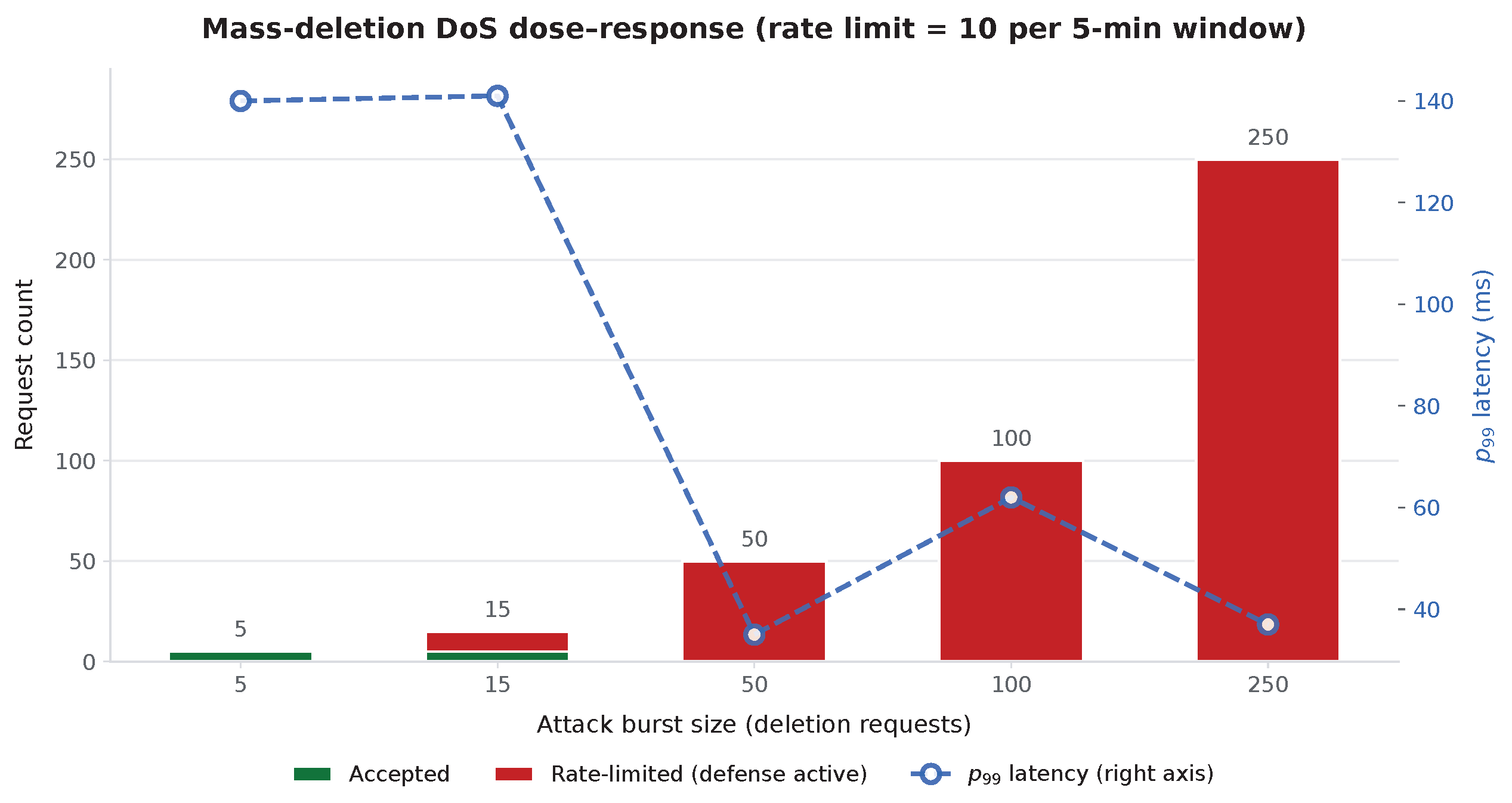
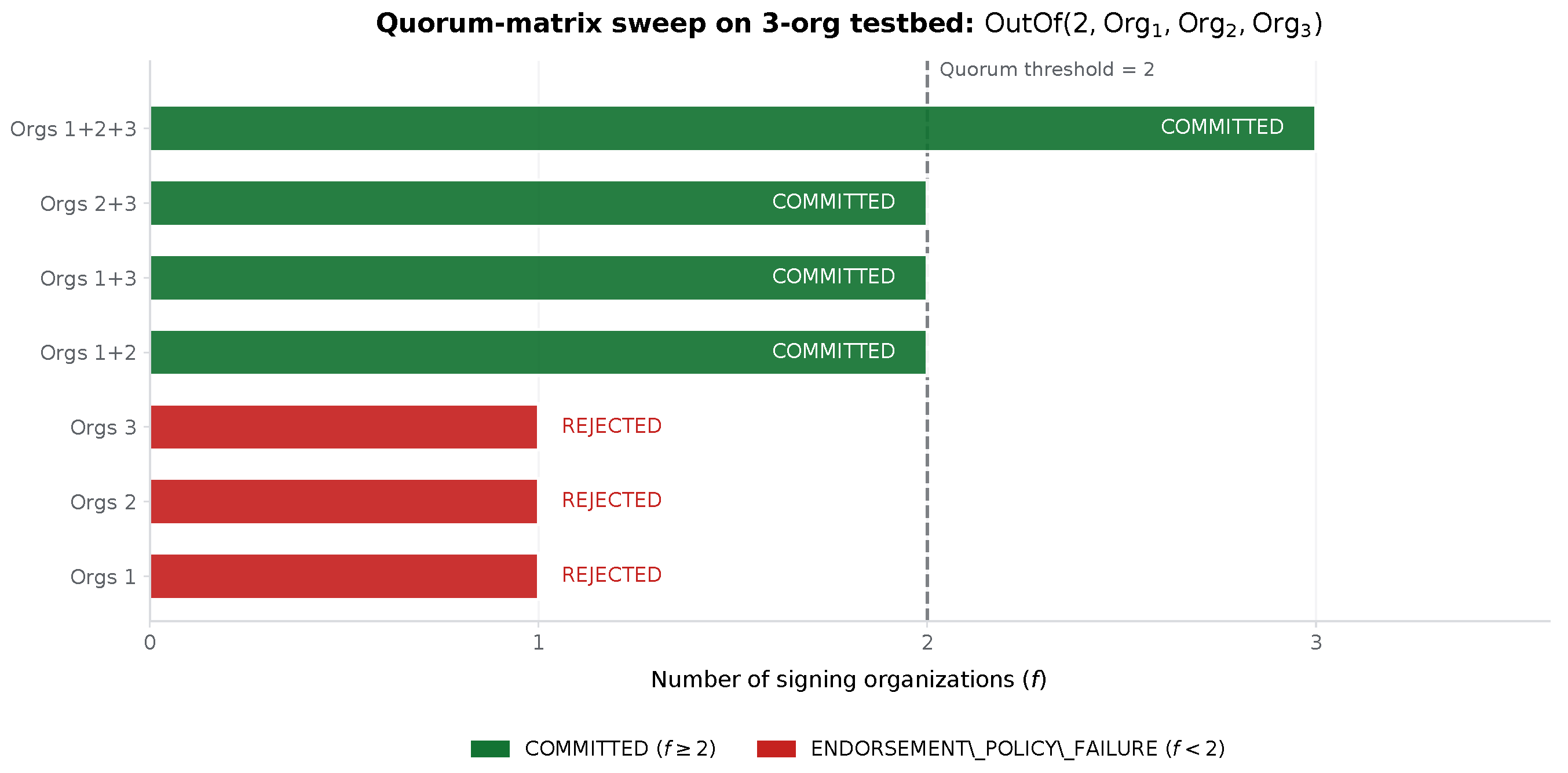
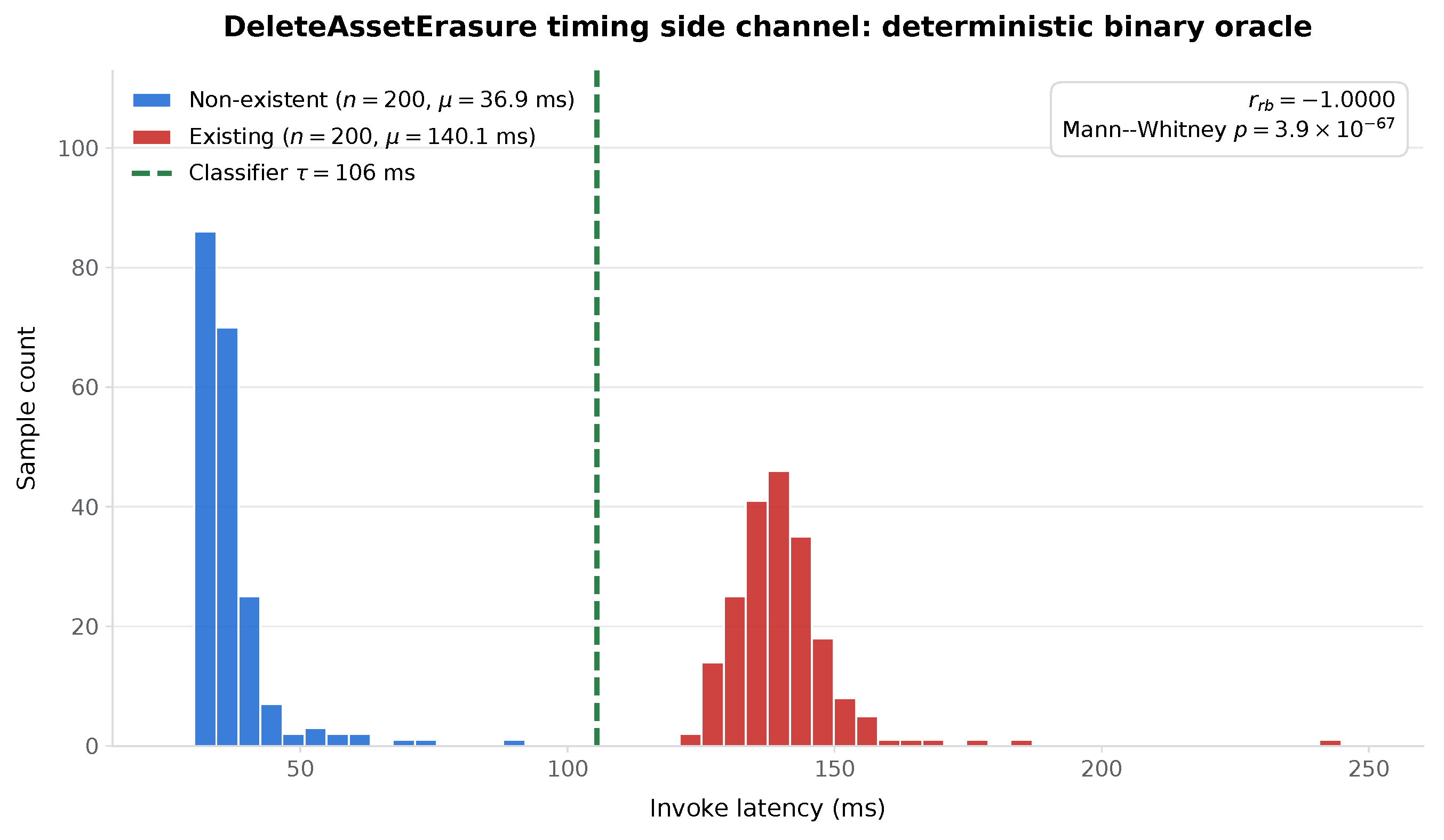
- Empirical security framework. Seven attack vectors (selective history rewriting, mass-deletion Denial of Service (DoS) dose–response, collusion with a quorum matrix, role escalation, compromised-DPO under varying endorsement policies, rogue-Certificate Authority (CA)-minted identity and a latency side-channel probe) were executed as reproducible experiments against a three-organization testbed and are summarized in Section 3.3. Auxiliary sweeps (fuzz testing over 330 malformed-JSON variants and 200-variant probing of the audit namespace) characterize the robustness of the input-validation and namespace-isolation surfaces. Outcomes include a deterministic binary oracle for the timing side channel (rank-biserial , ) and a quorum-matrix outcome that matches the theoretical Byzantine bound (Section 3.3).
- 5.
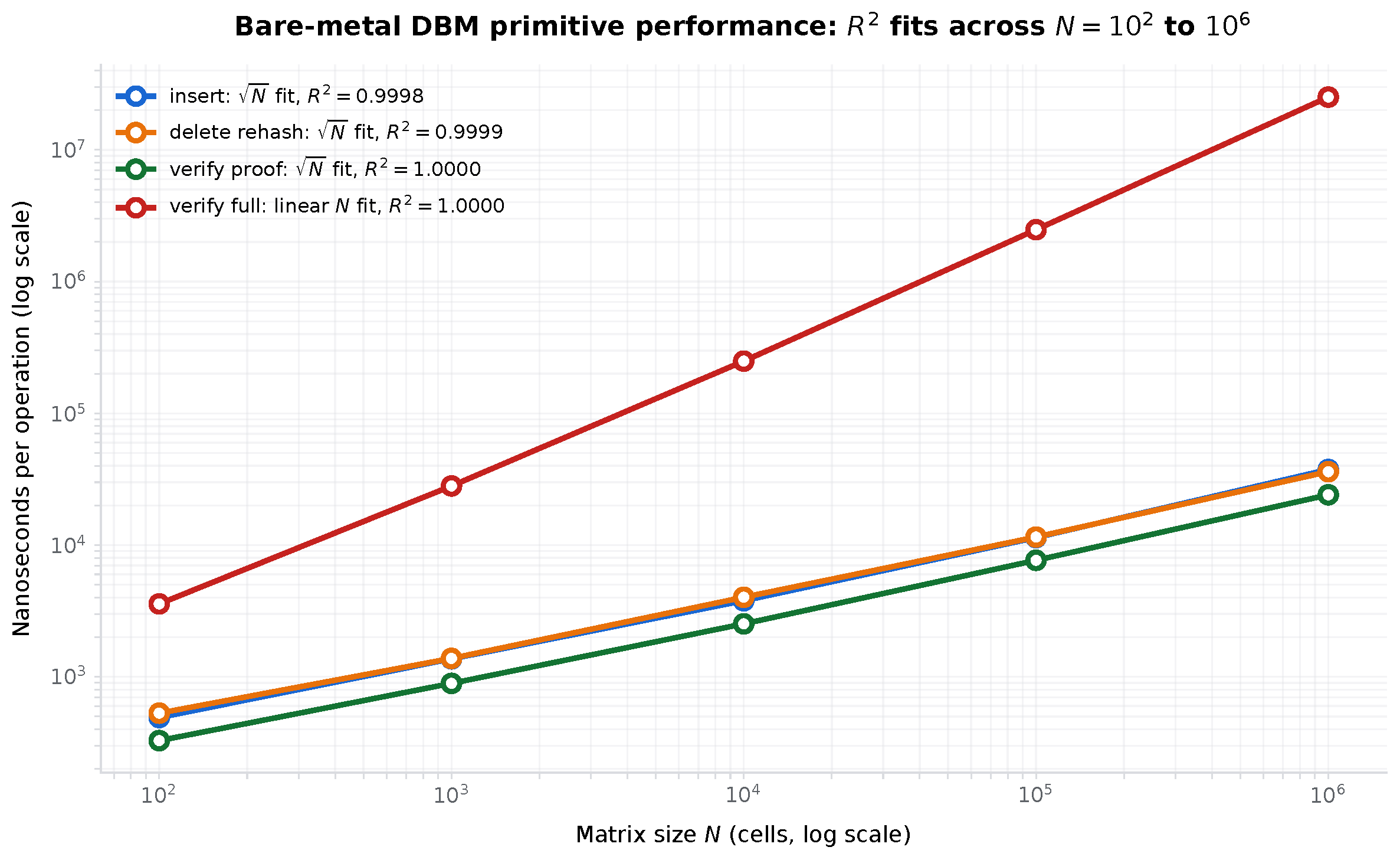
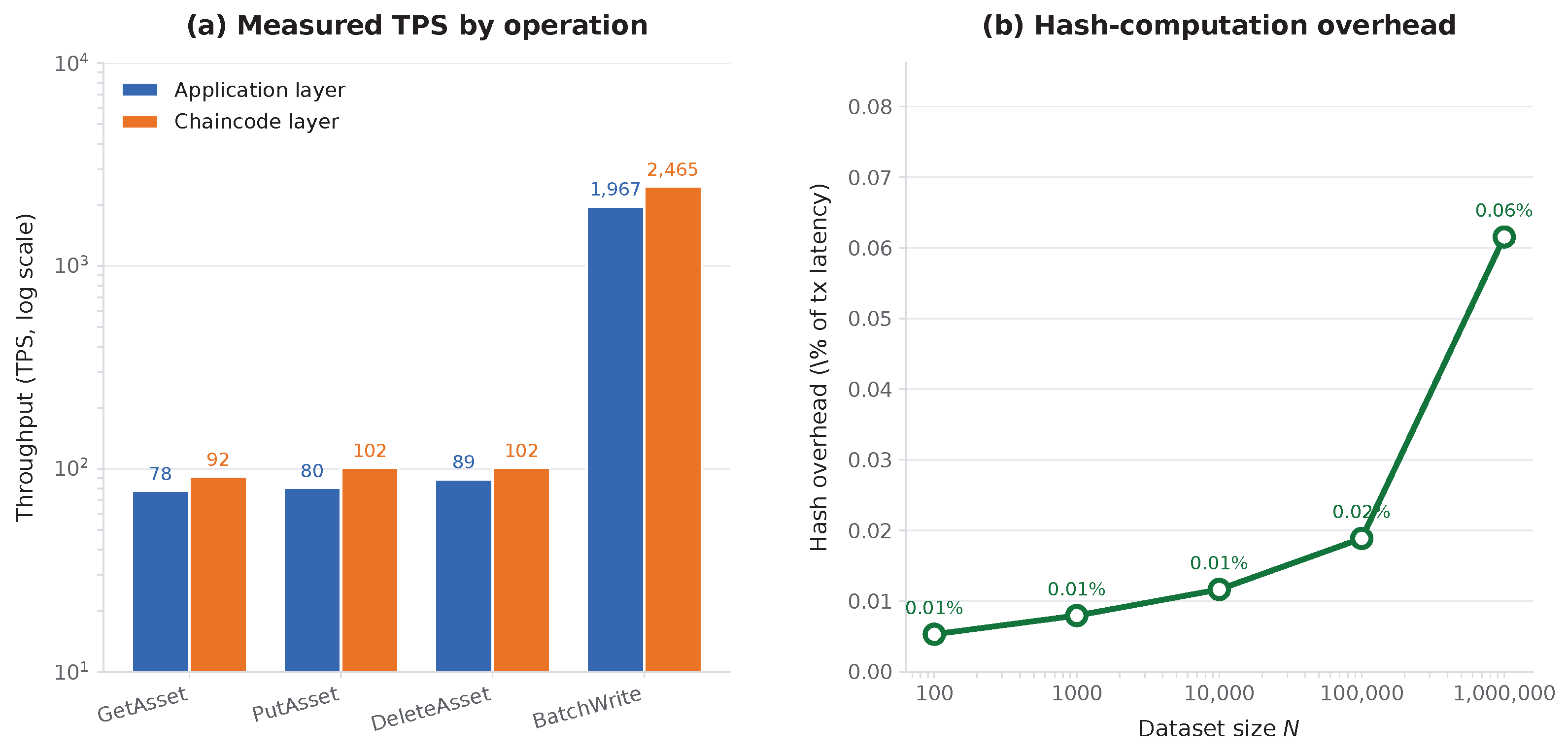
- Primitive-level and in-Fabric performance characterization. A benchmark of the DBM matrix primitive across – cells yields – for the insert, delete and proof operations, and for the full verification; these results are consistent with the theoretical complexity claim at the resolution of the measurement and are reported separately from the transaction-level 78–102 Transactions Per Second (TPS) characterization inside Fabric. A microbenchmark comparison against a chameleon-hash construction [23] indicates that the DBM primitive is faster at the operation level; the comparison is reported as context rather than as a precise performance ratio.
- 6.
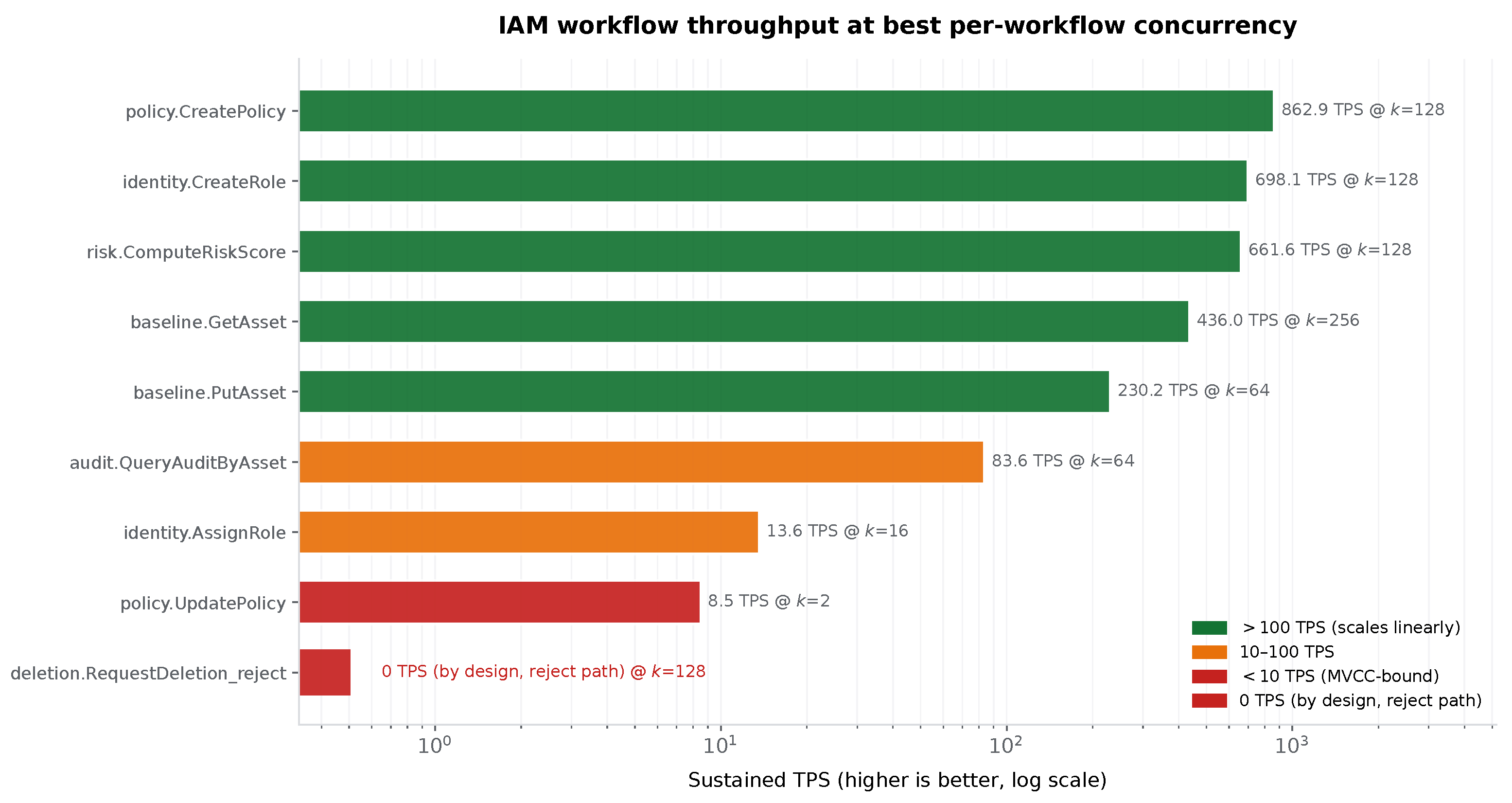
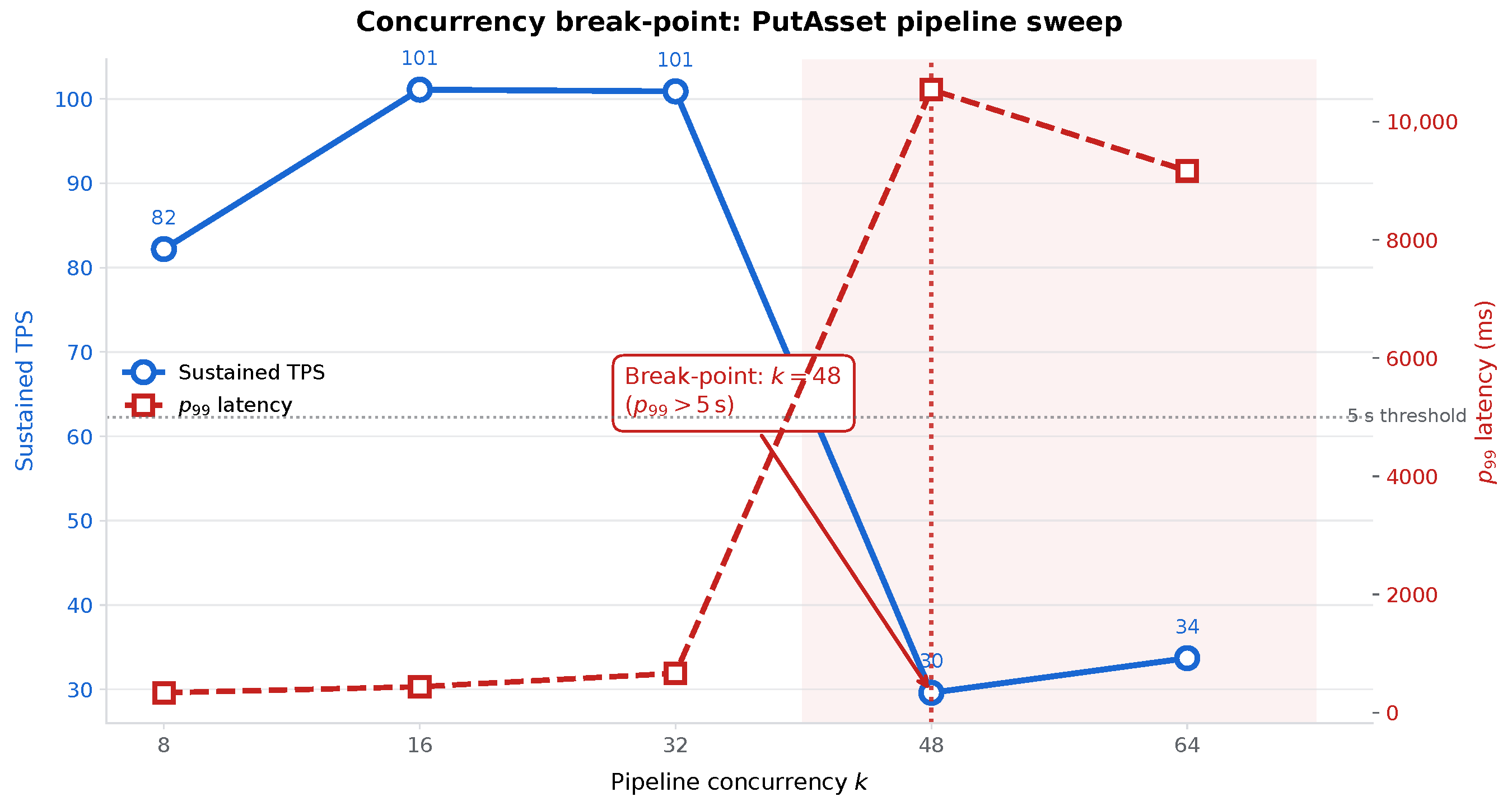
- Realistic IAM workflow evaluation and concurrency break-point analysis. Transaction-level benchmarks for identity registration, policy update, audit query, deletion request, and risk scoring workflows are reported in Section 4.3.4, along with a concurrency break-point sweep (Section 4.3.5) showing sustained TPS and latency up to the pipeline saturation point. Network-scale validation was performed against a 20-organization cross-region Hyperledger Fabric deployment (Section 4.3.6).
Research Questions
- RQ1. Can a SHA-256 DBM be coupled with a multi-organization Hyperledger Fabric to support GDPR Article 17 erasure on the on-chain layer without consensus modification? (Section 3 and Section 4.3.6).
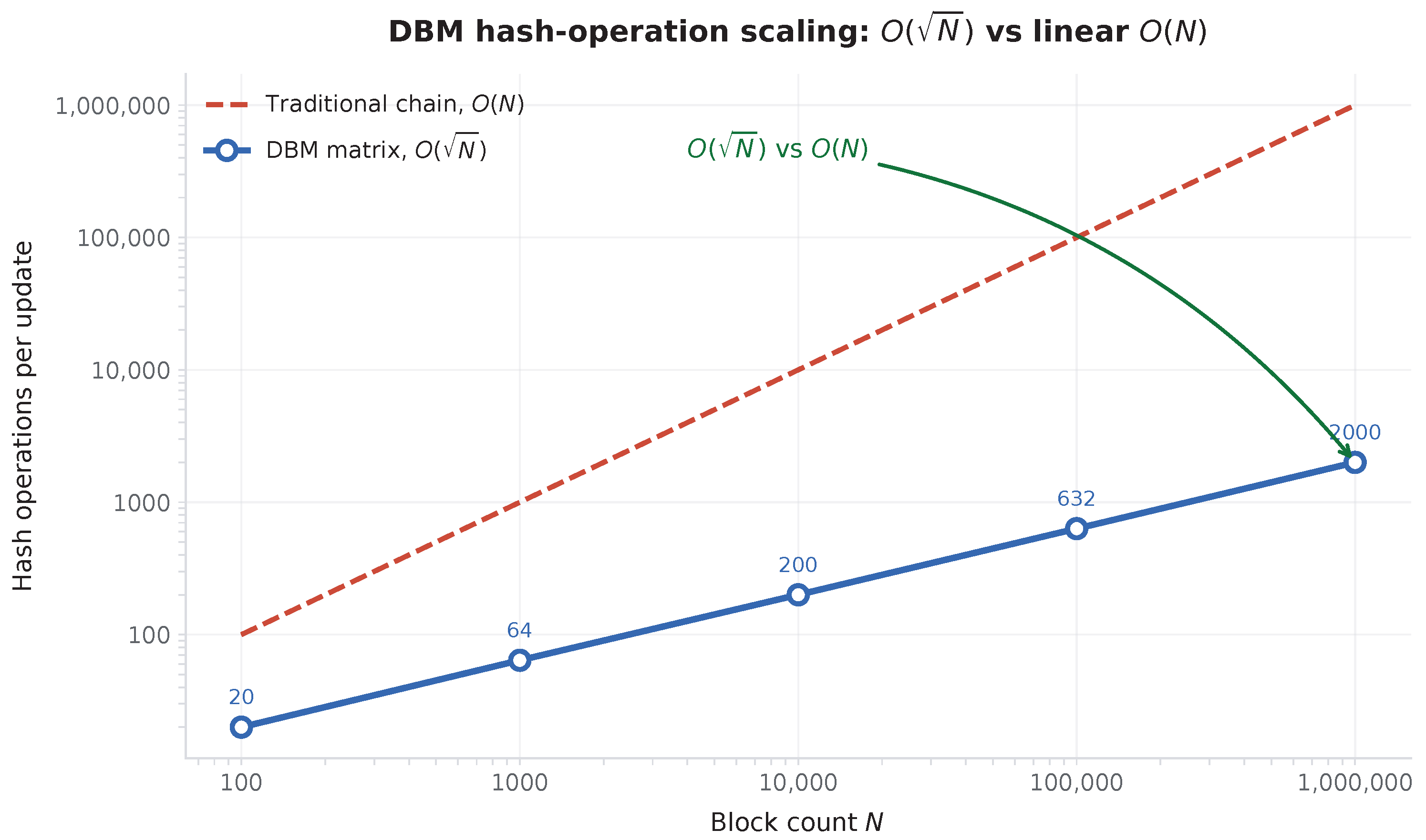
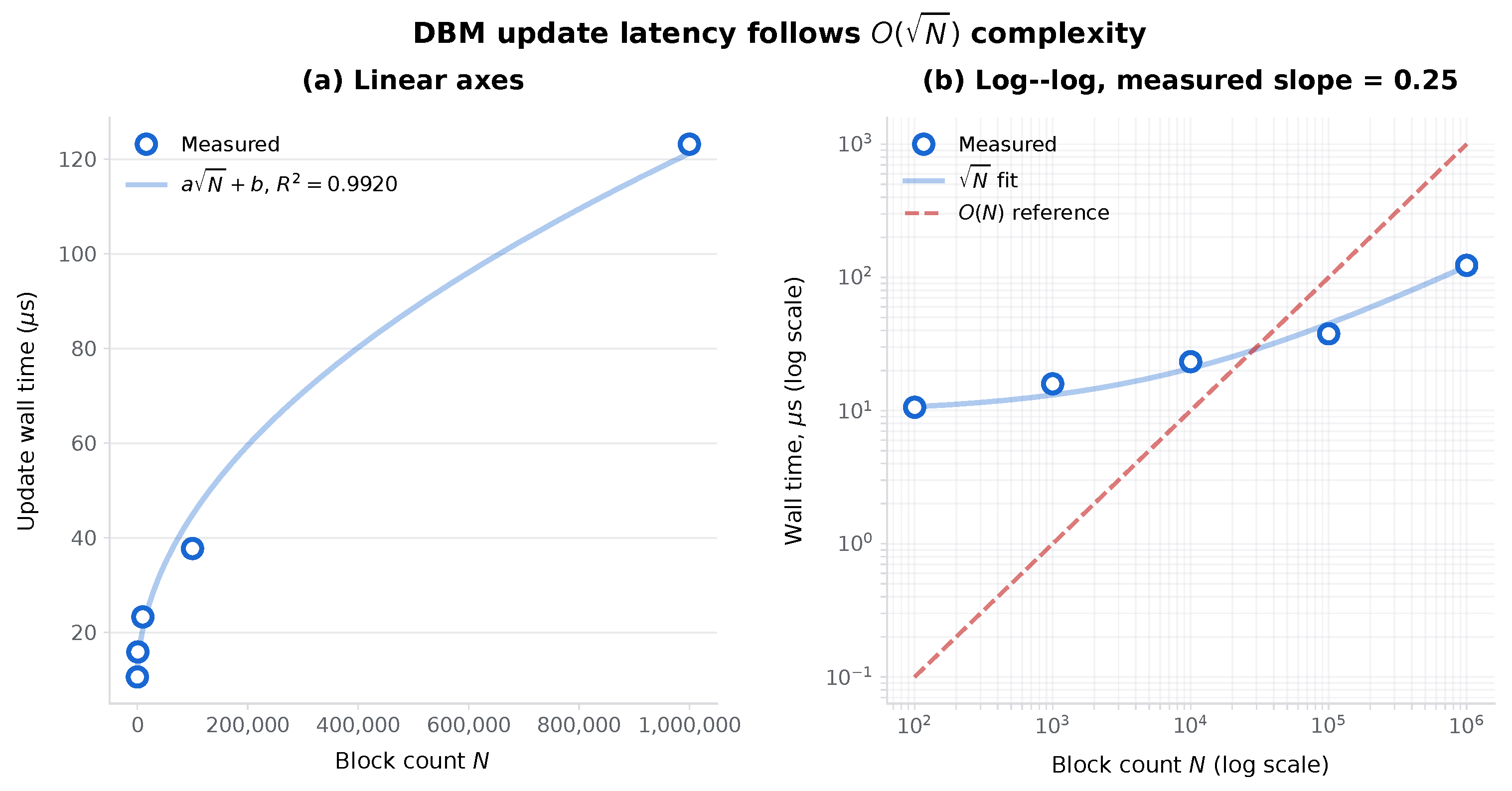
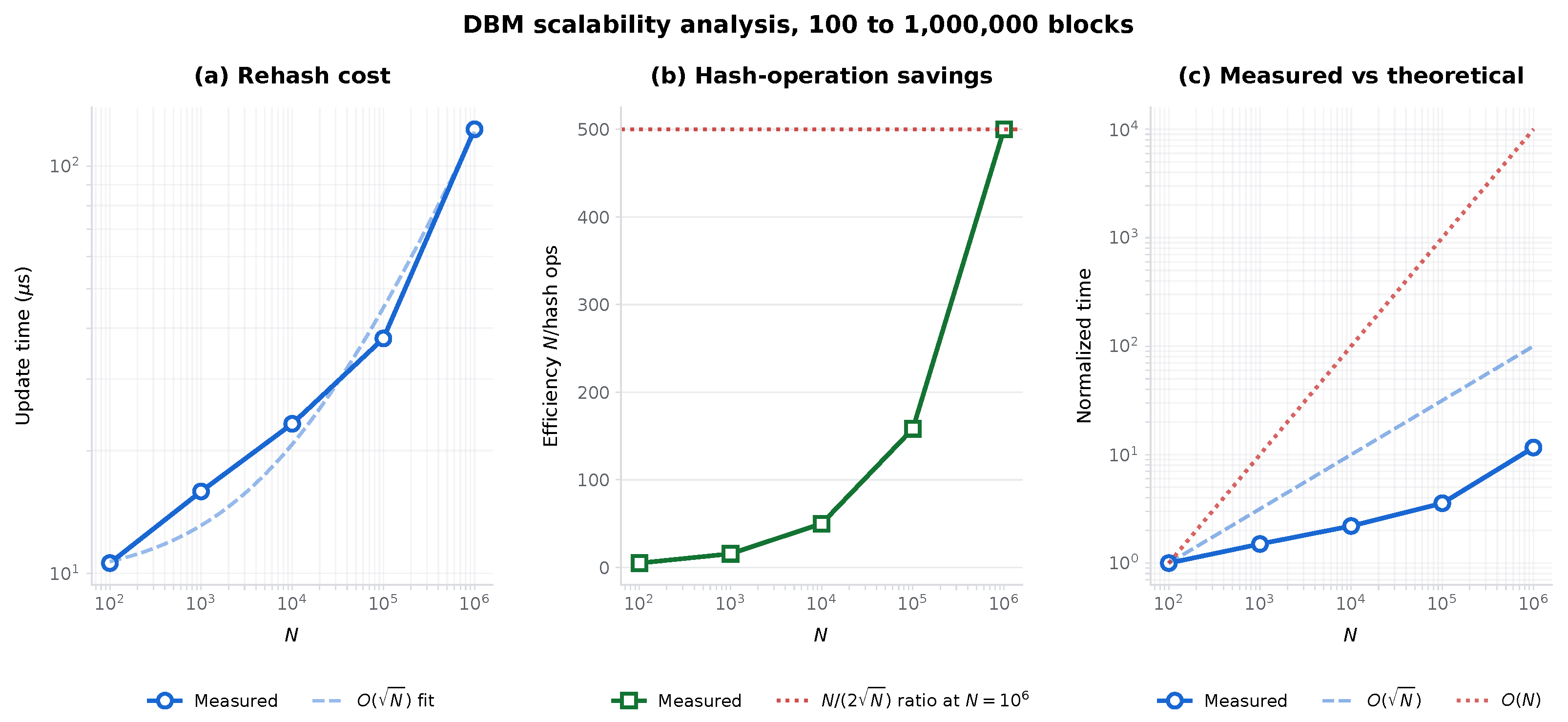
- RQ2. How closely does the DBM rehash overhead track the theoretical bound on commodity hardware? (Section 4.3.8 and Section 4.4.1).
- RQ3. Under realistic IAM workflows, what is the throughput and tail-latency cost of the DBM backend, and how does the deployment behave at the concurrency break-point? (Section 4.3.4 and Section 4.3.5).
- RQ4. Within a documented threat model, which adversary classes does the design defeat, which does it admit, and at what residual cost? (Section 3.3.3, Section 5.1 and Section 5.5).
2. Background and Related Work
2.1. GDPR Compliance Challenges in Blockchain Systems
2.2. European Blockchain Services Infrastructure
2.3. NIST Data Block Matrix Architecture
2.3.1. Mathematical Foundation
2.3.2. Hash Computation
2.4. Related Work in Blockchain Privacy
2.4.1. GDPR Compliance Approaches
2.4.2. Redactable Blockchain Mechanisms
2.4.3. Blockchain-Based Access Control
3. Proposed DBM-Hyperledger Fabric Integration
3.1. Integration Architecture
3.2. Custom Chaincode Implementation for IAM Systems
- (i) Erasure-aware role layering.
- (ii) Two-layer non-deletable audit namespace.
- (iii) Formally defined five-factor risk score.
- (iv) Deny-overrides conflict resolution with explicit priority.
{“id”:“pol-phi-eu-hr”,“resource”:“asset:phi”,“action”:“read”,
“effect”:“ALLOW”,“priority”:10,
“conditions”:[{“attribute”:“department”,“operator”:“eq”,“value”:“hr”},
“conditions”:[{“attribute”:“geo”,“operator”:“in”,“value”:“EU”}]}
- (v) Single-pass RBAC+ABAC evaluation.
- (vi) Integrated rate-limited erasure.
Risk-Score Parameter Sensitivity and Cross-Industry Validation
3.3. Security Analysis
3.3.1. Deletion Authorization Security
- Regular users cannot delete data to hide malicious activities.
- Managers can only perform logical deletions that preserve audit metadata.
- Complete erasure requires documented justification and request tickets.
- All deletion attempts are logged in tamper-evident audit trails.
3.3.2. Audit Integrity Preservation
- Separation of audit and data layers: Audit metadata (timestamps, actor identities, operation types) is stored separately from personal data and is not subject to deletion, following the pattern established by Harpocrates for sensitive data operations [37].
- Hash chain continuity: Even after block deletion, the row and column hash chains maintain cryptographic proof of the deletion event.
- Multi-party verification: Deletion operations require endorsement from multiple peers before execution, consistent with EDPB guidance on blockchain processing [9].
3.3.3. Threat Model and Attack Vector Analysis
3.4. Performance Optimization Strategies
3.5. Fabric Core Patches for DBM Compatibility
4. Experimental Evaluation
4.1. Experimental Setup and Methodology
4.1.1. Hardware and Software Configuration
- Compute nodes: 3 virtual machines, each with 4 vCPUs (Intel Xeon at 2.4 GHz) and 16 GB of RAM.
- Storage: SSD-backed storage with a guaranteed 500 IOPS.
- Network: 1 Gbps internal network connectivity.
- Hyperledger Fabric version: 2.4.0 with DBM modifications; Phase 2 (Section 4.3.6) used 2.5.9 peer and orderer images with the equivalent DBM patches applied and deployed through the Hyperledger Bevel operator for Fabric.
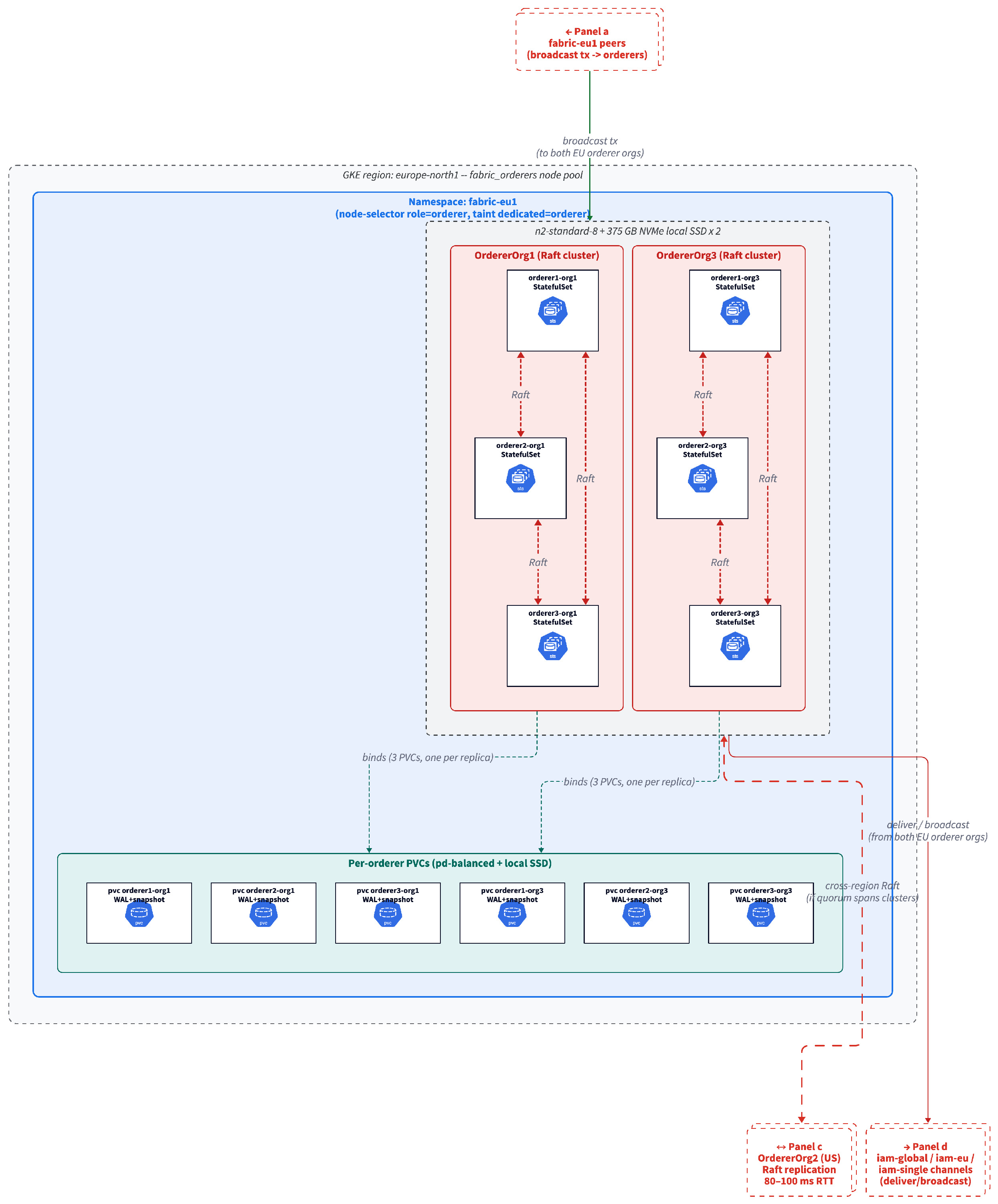
- Consensus: Raft ordering service with 3 orderer nodes.
- Peer deployment: 4 peer processes distributed across the 3 virtual machines, with two peers co-located on a single virtual machine to match the endorsement redundancy of a small consortium channel while remaining within the Phase 1 hardware envelope.
- Channel configurations used on the same hardware: (i) A single-organization channel used for the core read/write/delete benchmark, the IAM workflow benchmark (Section 4.3.4), the concurrency break-point sweep (Section 4.3.5) and the data-volume scalability sweep; and (ii) a 3-organization channel carrying an OutOf(2, Org1MSP.member, Org2MSP.member, Org3MSP.member) endorsement policy, used for the attack-simulation sweeps discussed in Section 3.3. The two channels share peers and orderers; they differ only in MSP membership and endorsement policy.


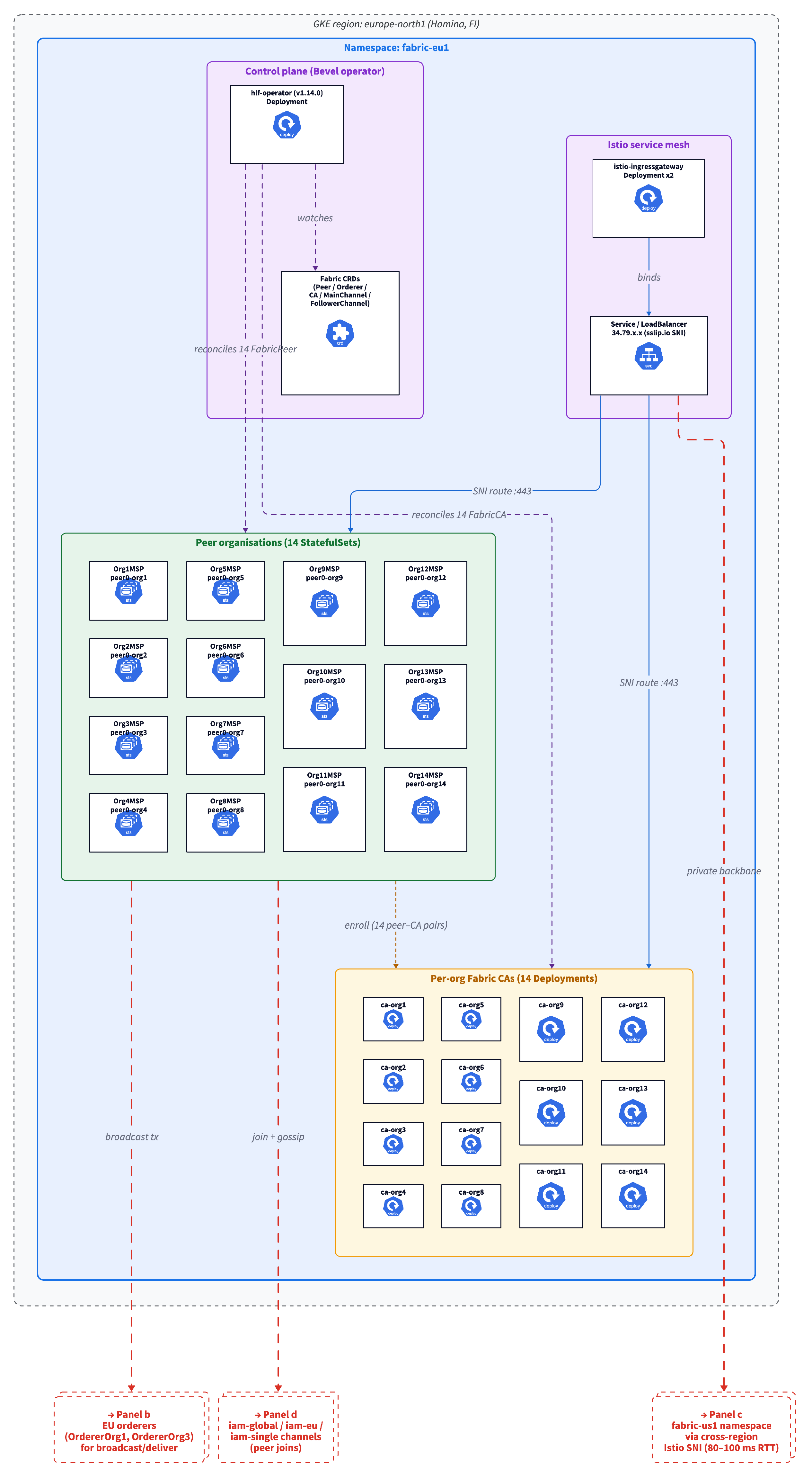
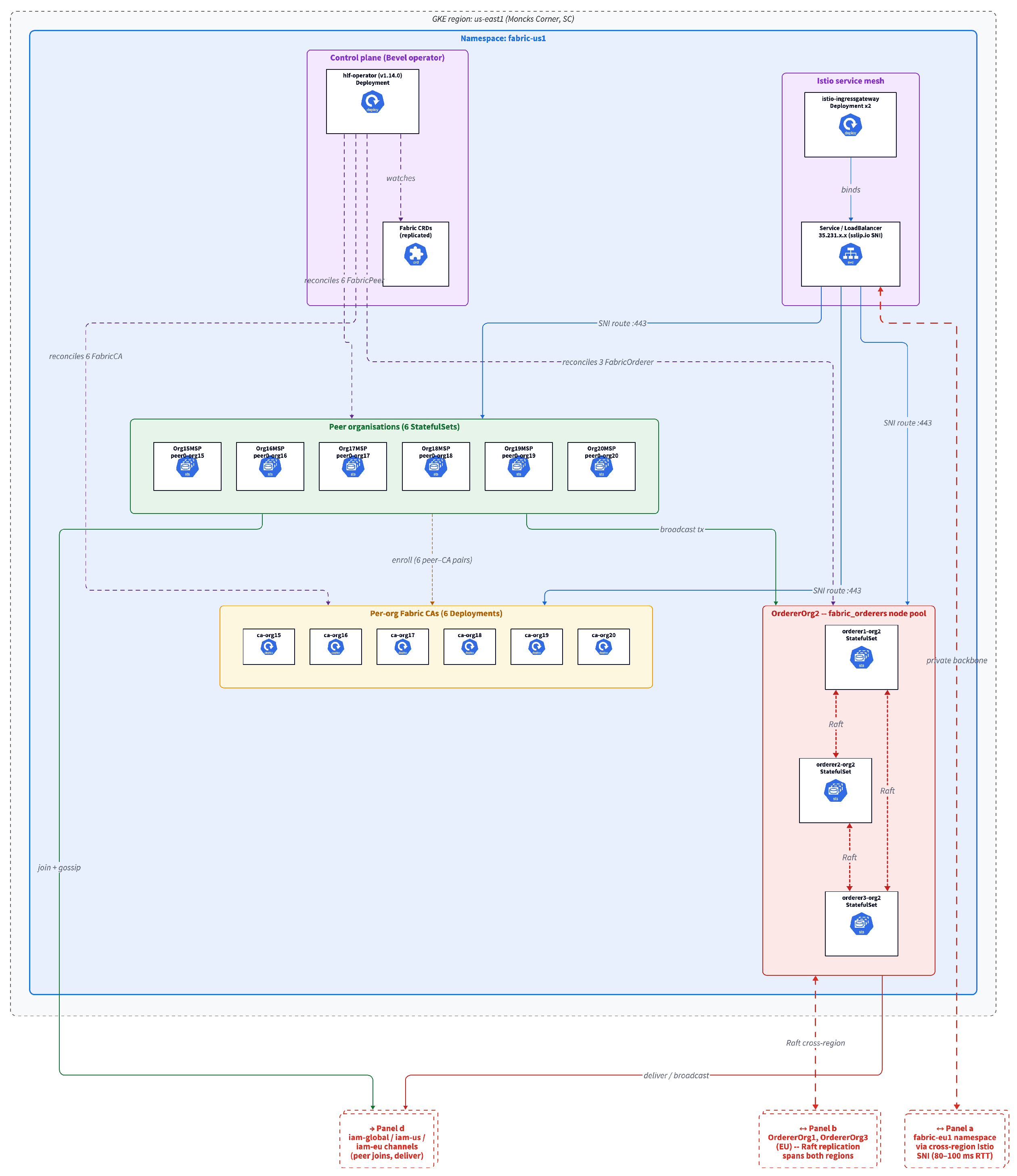
- Infrastructure: 2 regional Google Kubernetes Engine (GKE) clusters provisioned via Terraform [47]: fabric-eu1 in europe-north1 (Hamina, Finland) and fabric-us1 in us-east1 (Moncks Corner, SC, USA).
- Cluster sizing: Per-cluster regional control plane (GKE-managed, 3 zonal replicas); 5 n2-standard-8 agent nodes per cluster (8 vCPU, 32 GiB RAM, 100 GB pd-balanced boot disk); a dedicated fabric_orderers node pool (2 n2-standard-8 with 375 GB NVMe local SSD, role=orderer label, dedicated=orderer taint) per cluster for orderer low-latency write isolation.
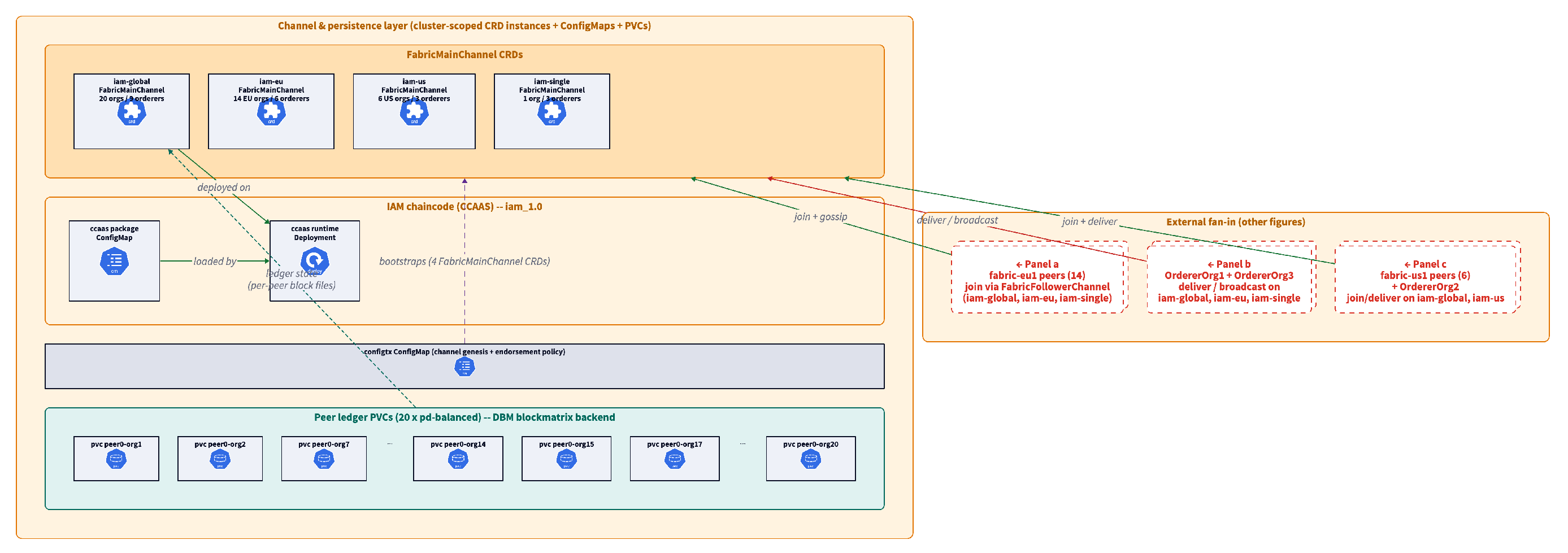
- Fabric network: 20 peer organizations (Org1MSP–Org20MSP) distributed across the two clusters (14 in fabric-eu1, 6 in fabric-us1), 3 orderer organizations with 9 Raft orderer nodes (distributed across both clusters), 20 Certificate Authorities issued from per-org Fabric CAs.
- Network topology: GKE native VPC-scoped pod networking (Google Cloud CNI) within clusters; Istio service mesh for inter-cluster communication via SNI gateway routing between GKE clusters over Google’s private backbone.
- Cross-region latency: europe-north1 (Hamina)–us-east1 (Moncks Corner) measured ∼80–100 ms RTT.
- Channels: iam-global (all 20 orgs, all 9 orderers), iam-eu (14 EU orgs, 6 orderers), iam-us (6 US orgs, 3 orderers), iam-single (1 org, 3 colocated orderers).
- Orderer tuning: maxMessageCount=200, preferredMaxBytes=2 MB, batchTimeout=500 ms.
- State DB: LevelDB (chosen over CouchDB for write throughput).
- Chaincode deployment: External chaincode as a service (ccaas), deployed via an internally modified fork of the Hyperledger Bevel operator for Fabric [46]; modifications include (i) extending the FabricMainChannel Custom Resource Definition (CRD) to map anchor-peer declarations into the configtx.Organization specification (controllers/mainchannel/mainchannel_controller.go), (ii) relaxing FabricIdentity minLength validation on affiliation and enrollment fields, and (iii) copying four missing chaincode-lifecycle CRD manifests into the Helm chart to fix an operator crash loop observed at deployment time.
- Fabric operator: Hyperledger Bevel Operator for Fabric v1.14.0 (forked and modified, see above) [46].
4.1.2. Performance Metrics
4.2. Performance Benchmark Results
4.3. Performance Analysis
4.3.1. Read Operations
4.3.2. Write Operations
- Dual hash computation: Each write operation requires updating both row and column hash chains, effectively doubling the cryptographic computation.
- Matrix positioning: The block location algorithm adds computational overhead for determining optimal matrix placement.
- Integrity verification: Additional verification steps ensure matrix consistency after each write.
4.3.3. Delete Operations
4.3.4. IAM Workflow-Level Performance
4.3.5. Concurrency Break-Point Analysis
4.3.6. Multi-Organization Cross-Region Throughput
4.3.7. Production Deployment Cost Envelope
4.3.8. DBM Primitive Cost Decomposition
4.4. Scalability Analysis
4.4.1. Hash Operation Complexity
4.4.2. Verification Time Scaling
4.4.3. Comprehensive Scalability Analysis
4.4.4. Practical Throughput Performance
4.5. Summary of Benchmark Results
5. Discussion
- User registration and credential updates occur infrequently compared to authentication queries. Large-scale enterprise IAM providers report workload asymmetries that reflect this pattern: Okta’s 2024 Businesses at Work survey of over 18,800 customer organizations [51] documents an average of 93 applications integrated per organization with authentication traffic concentrated in a narrow daily peak, and Microsoft’s Digital Defense Report 2024 [52] reports that Microsoft Entra ID processes billions of authentications and blocks approximately 600 million identity attacks per day across its tenant base. In both cases, the read path (authentication, session validation, policy evaluation) dominates by several orders of magnitude over the write path (user provisioning, credential rotation, role assignment).
- Access control policy modifications are administrative operations with lower frequency requirements, typically under 10 updates per second even in large organizations; NIST SP 800-63B authentication assurance guidelines [12] assume peak concurrent sessions in the range of – per enterprise deployment, and stochastic performance models of Hyperledger Fabric under varying transaction workloads [17,18] characterize block-size and arrival-rate sensitivities that directly bound the sustainable write TPS for IAM-style workload mixes.
- Audit logging can be batched to amortize write overhead (batch writes achieved 1967–2465 TPS).
- The measured throughput of 78–102 TPS at assets provides meaningful headroom over peak demand; for a deployment managing users with an average of 10 authentication events per user per day, peak demand (assuming that 80% of activity occurs in an 8 h window) is on the order of 28 TPS, which is within the measured capacity.
5.1. Disclosed Limitation: Deterministic Existence Oracle on the Deletion Reject Path
5.2. Disclosed Limitation: Rate-Limiter Gaps on the Deletion Request Path
5.3. Illustrative Deployment Scenario: Healthcare Identity Management
5.4. GDPR Compliance Scope and Residual Obligations
5.5. Scope of the Performance Evaluation and Open Measurements
- Higher-load and longer-run stress. Per-worker load was capped at 200 TPS with 2–8 workers, and the longest cross-region run was 30,000 transactions at 305 TPS, s; clusters were not held under load beyond about two minutes per run. The constraint is cost (each regional GKE cluster runs at ∼$1.10/h at the sizing used); sustained one-hour and 24 h runs and Okta/Microsoft-style mixed read/write/delete workloads [51,52] are open.
- Long-run ledger growth and storage footprint. On-disk cost of the DBM backend versus the linear chain at – blocks was not measured. The result here is a compute-cost claim, not a storage-cost claim.
- Crash and consistency recovery. Failure-injection experiments (orderer/peer pod kill, mid-deletion crash, partial-quorum failure) and the time to recover a consistent DBM state were not measured; the formal verification covers the protocol at a bounded scope but not deployment recovery.
5.6. Practical Implications and Future Research Directions
- Structural mitigation of the existence oracle (Section 5.1). Two paths queued for future work: always-commit semantics for deletion requests (encoding the outcome in the return value or audit record rather than in an error; a breaking API change), or a challenge–response deletion protocol that decouples the existence check from the erasure request.
- Counter-bearing RequestDeletion or atomic rate-limit primitive (Section 5.2). Moving the counter increment into RequestDeletion or exposing an atomic counter primitive in the chaincode runtime so the increment is robust to MVCC read-set contention under burst conditions.
- DBM compaction and ledger garbage collection at ≥106 blocks (Section 5.5). A compaction policy that reclaims storage from rows or columns whose cells have all been erased, combined with long-run ledger-growth measurement, would close the storage-cost question.
- ABAC policy Domain-Specific Language (DSL) with formal conflict-resolution semantics (Section 3.2). The broader ABAC layer still uses an imperative deny-overrides resolver; a declarative DSL (XACML-style or a custom calculus) would make the policy layer auditable and verifiable alongside the existing formal verification.
- Cross-region orderer pool sizing and Raft quorum placement (Section 4.3.6). The 305 TPS sustained result used an asymmetric placement (two EU and one US). A systematic study of pool sizing and quorum placement across two and three regions, with the resulting commit-latency/throughput trade-off, forms the operational guidance that a deploying consortium needs.
6. Conclusions
Data and Code Availability
Author Contributions
Funding
Institutional Review Board Statement
Informed Consent Statement
Data Availability Statement
Acknowledgments
Conflicts of Interest
Appendix A. Detailed Algorithmic Implementations
| Algorithm A1: RBAC implementation for DBM IAM chaincode |
| Require: Asset ID, Operation Type, Caller Identity Ensure: Access decision based on role-based permissions
|
| Algorithm A2: ABAC implementation for DBM IAM chaincode |
| Require: Asset Data, Caller Identity, Operation Context Ensure: Access decision based on attribute-based policies
|
| Algorithm A3: ABAC helpers: risk-score computation and per-operation thresholds |
|
| Algorithm A4: Advanced IAM smart contract for DBM ledger |
| Require: Context, Asset ID, Asset Data, Operation Type, Additional Parameters Ensure: Secure asset management with comprehensive IAM controls
|
Appendix B. Formal Verification of Deletion Invariants
- INV_QuorumEnforced: for every asset a, .
- INV_EraseImpliesAudit: for every asset a, .
- INV_AuditMonotonic: for every transition from state s to state , ; equivalently, the audit set is non-shrinking across every reachable step.

| Configuration | Orgs | Assets | Distinct States | Counterexamples |
|---|---|---|---|---|
| MC | 3 | 2 | 484 | 0 |
| MC4×3 | 4 | 3 | 274,625 | 0 |
References
- Yaga, D.; Mell, P.; Roby, N.; Scarfone, K. Blockchain technology overview. NIST Interag. Rep. 2018, 8202, 1–66. [Google Scholar] [CrossRef]
- Liang, T.; Kohli, R.; Huang, H.; Li, Z. What drives the adoption of the blockchain technology? A fit-viability perspective. J. Manag. Inf. Syst. 2021, 38, 314–337. [Google Scholar] [CrossRef]
- Janssen, M.; Weerakkody, V.; Ismagilova, E.; Sivarajah, U.; Irani, Z. A framework for analysing blockchain technology adoption: Integrating institutional, market and technical factors. Int. J. Inf. Manag. 2020, 50, 302–309. [Google Scholar] [CrossRef]
- Bulzan, A.; Botez, R.; Dobrota, V. Permissioned blockchain-as-a-service: Architecting secure and efficient private blockchain networks. In Proceedings of the 16th International Symposium on Electronics and Telecommunications (ISETC), Timisoara, Romania, 7–8 November 2024; pp. 1–4. [Google Scholar] [CrossRef]
- Zhang, S.; Lee, J. Analysis of the main consensus protocols of blockchain. ICT Express 2020, 6, 93–97. [Google Scholar] [CrossRef]
- Murthy, C.; Shri, M.; Kadry, S.; Lim, S. Blockchain-based cloud computing: Architecture and research challenges. IEEE Access 2020, 8, 205190–205205. [Google Scholar] [CrossRef]
- Guo, H.; Yu, X. A survey on blockchain technology and its security. Blockchain Res. Appl. 2022, 3, 100067. [Google Scholar] [CrossRef]
- European Union. Regulation (EU) 2016/679 of the European Parliament and of the Council of 27 April 2016 on the protection of natural persons with regard to the processing of personal data and on the free movement of such data (General Data Protection Regulation). Off. J. Eur. Union 2016, L 119, 1–88. [Google Scholar]
- European Data Protection Board. Guidelines 02/2025 on Processing of Personal Data Through Blockchain Technologies, Version 1.1. Available online: https://www.edpb.europa.eu/ (accessed on 22 March 2026).
- Akanfe, O.; Lawong, D.; Rao, H. Blockchain technology and privacy regulation: Reviewing frictions and synthesizing opportunities. Int. J. Inf. Manag. 2024, 76, 102753. [Google Scholar] [CrossRef]
- Li, W.; Wu, J.; Cao, J.; Chen, N.; Zhang, Q.; Buyya, R. Blockchain-based trust management in cloud computing systems: A taxonomy, review and future directions. J. Cloud Comput. 2021, 10, 35. [Google Scholar] [CrossRef]
- Hu, V.C. Blockchain for access control systems. NIST Interag. Rep. 2022, 8403, 1–49. [Google Scholar] [CrossRef]
- Ghadge, N. Analyzing the role of blockchain in identity and access management systems. Int. J. Sci. Res. Arch. 2024, 12, 1019–1028. [Google Scholar] [CrossRef]
- Subramaniyan, S.; Prabhu, S. The impact of adopting blockchain-based identity access management: Current applications and potential directions. In Proceedings of the International Conference on Applied Artificial Intelligence and Computing (ICAAIC), Salem, India, 4–6 May 2023; pp. 1240–1245. [Google Scholar]
- Androulaki, E.; Barger, A.; Bortnikov, V.; Cachin, C.; Christidis, K.; De Caro, A.; Enyeart, D.; Ferris, C.; Laventman, G.; Manevich, Y.; et al. Hyperledger Fabric: A distributed operating system for permissioned blockchains. In Proceedings of the 13th EuroSys Conference, Porto, Portugal, 23–26 April 2018; pp. 1–15. [Google Scholar] [CrossRef]
- Thakkar, P.; Nathan, S.; Viswanathan, B. Performance benchmarking and optimizing Hyperledger Fabric blockchain platform. In Proceedings of the 26th IEEE International Symposium on Modeling, Analysis, and Simulation of Computer and Telecommunication Systems (MASCOTS), Milwaukee, WI, USA, 25–28 September 2018; pp. 264–276. [Google Scholar] [CrossRef]
- Melo, C.; Gonçalves, G.D.; Silva, F.A.; Fé, I.; Moura, E.; Soares, A.; Choi, E.; Min, D.; Lee, J.-W.; Nguyen, T.A. Transactional dynamics in Hyperledger Fabric: A stochastic modeling and performance evaluation of permissioned blockchains. ICT Express 2025, 11, 87–92. [Google Scholar] [CrossRef]
- Melo, C.; Gonçalves, G.; Silva, F.A.; Soares, A. Performance modeling and evaluation of Hyperledger Fabric: An analysis based on transaction flow and endorsement policies. arXiv 2025, arXiv:2502.08755. [Google Scholar] [CrossRef]
- Pongnumkul, S.; Siripanpornchana, C.; Thajchayapong, S. Performance analysis of private blockchain platforms in varying workloads. In Proceedings of the 26th International Conference on Computer Communication and Networks (ICCCN), Vancouver, BC, Canada, 31 July–3 August 2017; pp. 1–6. [Google Scholar] [CrossRef]
- Dreyer, J.; Fischer, M.; Tönjes, R. Performance analysis of Hyperledger Fabric 2.0 blockchain platform. In Proceedings of the Workshop on Cloud Continuum Services for Smart IoT Systems (CCIoT), Delft, The Netherlands, 16–19 December 2020; pp. 32–38. [Google Scholar] [CrossRef]
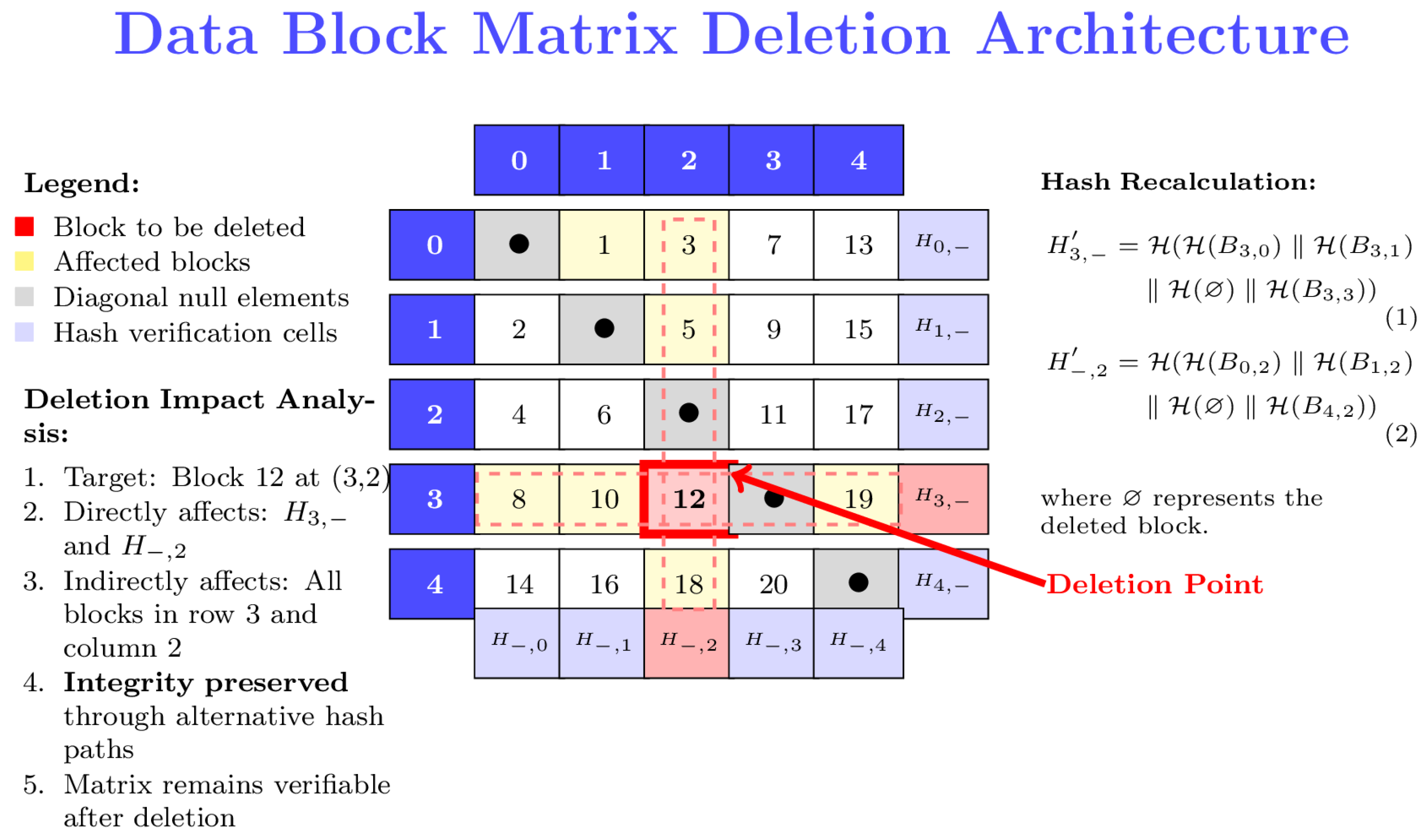
- Kuhn, D.R. A data structure for integrity protection with erasure capability. NIST Cybersecur. White Pap. 2022, NIST CSWP 25, 1–19. [Google Scholar] [CrossRef]
- Roberts, J.D.; DeFranco, J.F.; Kuhn, D.R. Data block matrix and Hyperledger implementation: Extending distributed ledger technology for privacy requirements. ACM Distrib. Ledger Technol. Res. Pract. 2023, 2, 1–11. [Google Scholar] [CrossRef]
- Krawczyk, H.; Rabin, T. Chameleon signatures. In Proceedings of the Network and Distributed System Security Symposium (NDSS), San Diego, CA, USA, 2–4 February 2000; pp. 143–154. [Google Scholar]
- Politou, E.; Casino, F.; Alepis, E.; Patsakis, C. Blockchain mutability: Challenges and proposed solutions. IEEE Trans. Emerg. Top. Comput. 2021, 9, 1972–1986. [Google Scholar] [CrossRef]
- Bernabe, J.B.; Cánovas, J.L.; Hernández-Ramos, J.L.; Moreno, R.T.; Skarmeta, A. Privacy-preserving solutions for blockchain: Review and challenges. IEEE Access 2019, 7, 164908–164940. [Google Scholar] [CrossRef]
- Tan, E.; Lerouge, E.; Du Caju, J.; Du Seuil, D. Verification of education credentials on European Blockchain Services Infrastructure (EBSI): Action research in a cross-border use case between Belgium and Italy. Big Data Cogn. Comput. 2023, 7, 79. [Google Scholar] [CrossRef]
- Jacobino, S.; Pouwelse, J. TrustVault: A privacy-first data wallet for the European Blockchain Services Infrastructure. arXiv 2022, arXiv:2210.02987. [Google Scholar] [CrossRef]
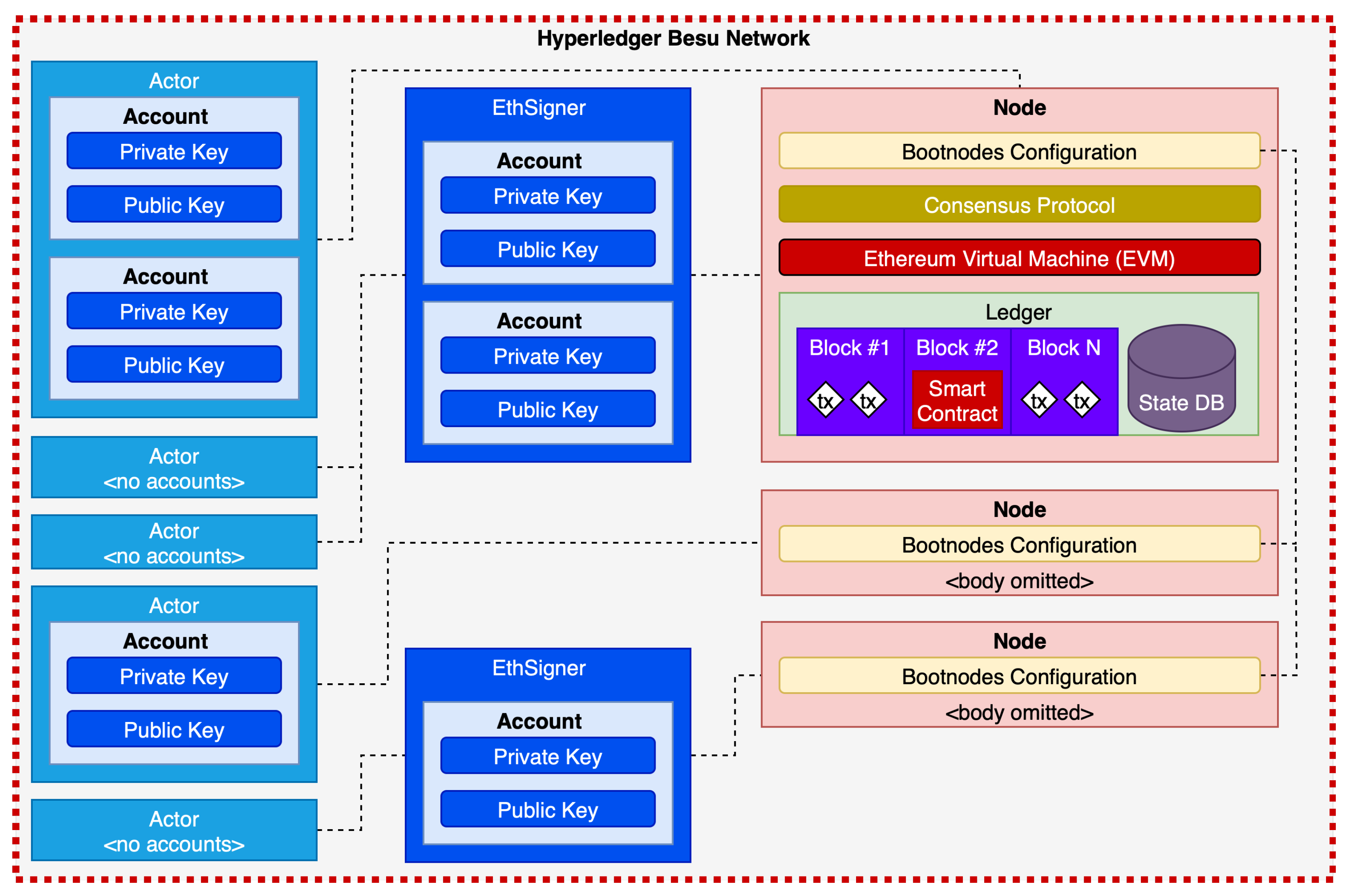
- ConsenSys. QBFT Consensus Protocol Specification. Hyperledger Besu Documentation. 2023. Available online: https://besu.hyperledger.org/private-networks/how-to/configure/consensus/qbft (accessed on 18 May 2026).
- European Commission. Understanding EBSI’s Blockchain Ecosystem. EBSI Hub. 2024. Available online: https://hub.ebsi.eu/blockchain (accessed on 22 March 2026).
- Kuperberg, M. Towards enabling deletion in append-only blockchains to support data growth management and GDPR compliance. In Proceedings of the 2020 IEEE International Conference on Blockchain (Blockchain), Rhodes Island, Greece, 2–6 November 2020; pp. 393–400. [Google Scholar] [CrossRef]
- Godyn, M.; Kedziora, M.; Ren, Y.; Liu, Y.; Song, H.H. Analysis of solutions for a blockchain compliance with GDPR. Sci. Rep. 2022, 12, 15052. [Google Scholar] [CrossRef]
- Gonçalves, R.M.; da Silva, M.M.; da Cunha, P.R. Olympus: A GDPR compliant blockchain system. Int. J. Inf. Secur. 2024, 23, 1021–1036. [Google Scholar] [CrossRef]
- Abd Ali, S.M.; Yusoff, M.N.; Hasan, H.F. Redactable blockchain: Comprehensive review, mechanisms, challenges, open issues and future research directions. Future Internet 2023, 15, 35. [Google Scholar] [CrossRef]
- Zhang, D.; Le, J.; Lei, X.; Xiang, T.; Liao, X. Secure redactable blockchain with dynamic support. IEEE Trans. Dependable Secur. Comput. 2024, 21, 717–731. [Google Scholar] [CrossRef]
- Cruz, J.P.; Kaji, Y.; Yanai, N. RBAC-SC: Role-based access control using smart contract. IEEE Access 2018, 6, 12240–12251. [Google Scholar] [CrossRef]
- Pava-Díaz, R.A.; Gil-Ruiz, J.; López-Sarmiento, D.A. Self-sovereign identity on the blockchain: Contextual analysis and quantification of SSI principles implementation. Front. Blockchain 2024, 7, 1443362. [Google Scholar] [CrossRef]
- Thazhath, M.B.; Michalak, J.; Hoang, T. Harpocrates: Privacy-preserving and immutable audit log for sensitive data operations. arXiv 2022, arXiv:2211.04741. [Google Scholar] [CrossRef]
- Hong, Y.; Yang, L.; Xiong, Z.; Kanhere, S.S.; Jiang, H. OCHJRNChain: A blockchain-based security data sharing framework for online car-hailing journey. IEEE Trans. Intell. Transp. Syst. 2024, 25, 5299–5311. [Google Scholar]
- Hong, Y.; Yang, L.; Liang, W.; Xie, A. Secure access control for electronic health records in blockchain-enabled consumer Internet of Medical Things. IEEE Trans. Consum. Electron. 2024, 70, 4574–4584. [Google Scholar] [CrossRef]
- Xu, R.; Nikouei, S.Y.; Chen, Y.; Polunchenko, A.; Song, S.; Deng, C.; Fang, Q. BlockTrail: A service for secure and transparent blockchain-driven audit trails. IEEE Internet Things J. 2021, 8, 6531–6541. [Google Scholar]
- Hyperledger Foundation. Hyperledger Caliper. 2019. Available online: https://hyperledger.github.io/caliper/ (accessed on 22 March 2026).
- Kaushal, R.K.; Kumar, N. Exploring Hyperledger Caliper benchmarking tool to measure the performance of blockchain-based solutions. In Proceedings of the International Conference on Recent Trends in Information Technology (ICRITO), Noida, India, 25–26 April 2024; pp. 1–6. [Google Scholar]
- Hyperledger Performance and Scale Working Group. Hyperledger Blockchain Performance Metrics, White Paper, Version 1.01. 2018. Available online: https://www.lfdecentralizedtrust.org/learn/publications/blockchain-performance-metrics (accessed on 18 May 2026).
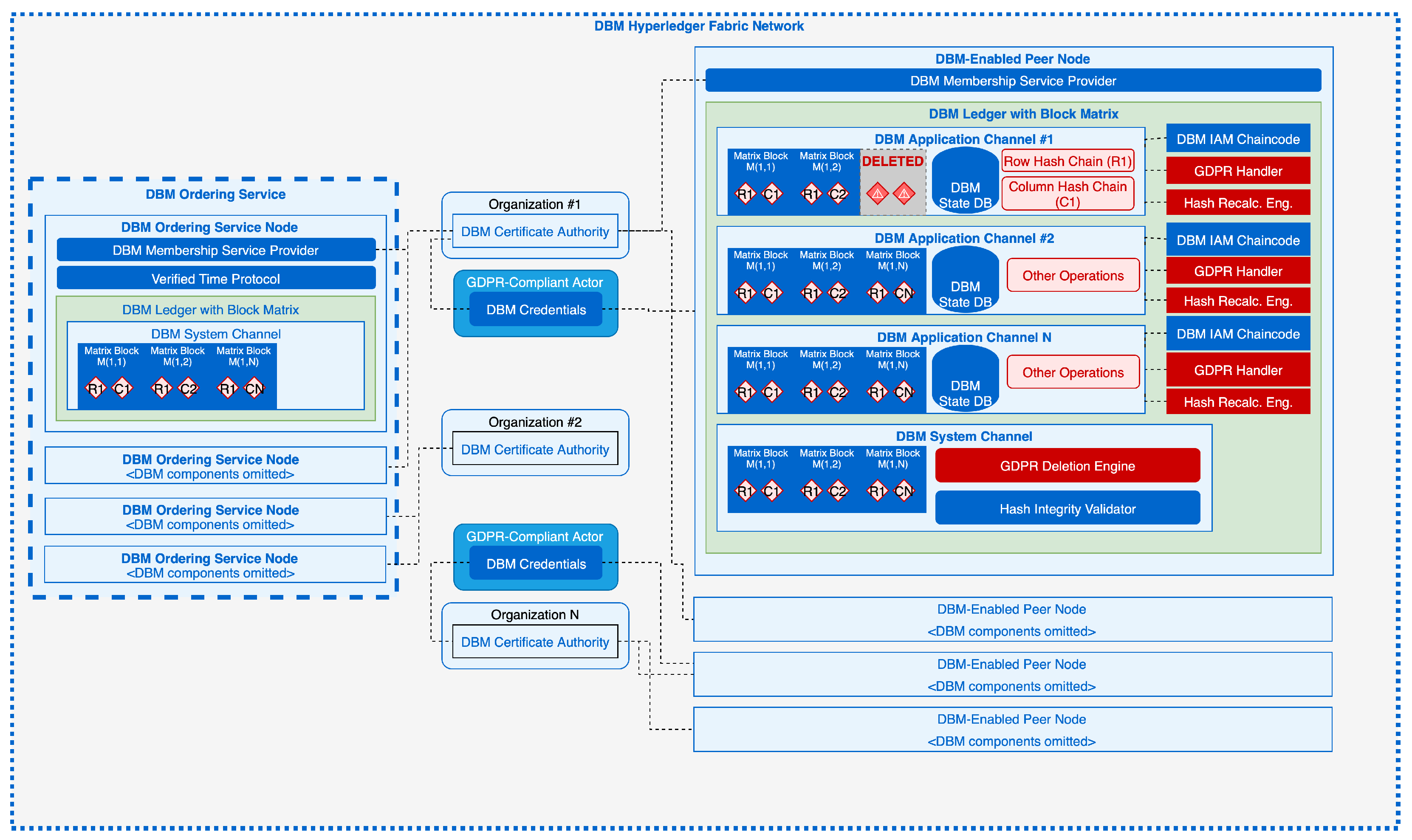
- Terrastruct Inc. D2: A Modern Diagram Scripting Language that Turns Text into Diagrams. The Four Panels of Figure 7 in this Work are RENDERED from fig_topo_{a..d}.d2 sources with the ELK Layout Engine. 2025. Available online: https://d2lang.com/ (accessed on 25 April 2026).
- Cloud Native Computing Foundation. Kubernetes Resource Icons (Community/Icons), Used as in-Figure Node Icons for StatefulSet, Deployment, Service, ConfigMap, PersistentVolumeClaim and CustomResourceDefinition Resources in the Phase 2 Topology Panels. 2025. Available online: https://github.com/kubernetes/community/tree/master/icons (accessed on 25 April 2026).
- Hyperledger Bevel. Bevel Operator Fabric: Hyperledger Fabric Kubernetes Operator (v2.3–v3.1), Version 1.14.0, The Phase 2 Deployment of this Work Uses an Internally-Modified Fork of the Operator with Extensions to the FabricMainChannel Anchor-Peer Mapping, Relaxed FabricIdentity Field-Length Validation, and a Completed Chaincode-Lifecycle CRD Manifest set in the Helm Chart. 2026. Available online: https://github.com/hyperledger-bevel/bevel-operator-fabric (accessed on 19 April 2026).
- HashiCorp. Terraform: Infrastructure as Code, Version 1.7. 2024. Available online: https://www.terraform.io/ (accessed on 19 April 2026).
- Google Cloud. Google Kubernetes Engine (GKE) Pricing. 2026. Available online: https://cloud.google.com/kubernetes-engine/pricing (accessed on 19 April 2026).
- Google Cloud. Compute Engine Pricing. 2026. Available online: https://cloud.google.com/compute/all-pricing (accessed on 19 April 2026).
- Androulaki, E.; Barger, A.; Bortnikov, V.; Cachin, C.; Caro, A.D.; Enyeart, D.; Muralidharan, S.; Murthy, C.; Smith, K.; Sorniotti, A.; et al. Fabric-X: Scaling Hyperledger Fabric for asset exchange. Cryptology ePrint Archive, Paper 2023/1717, 2023. Available online: https://eprint.iacr.org/2023/1717 (accessed on 18 May 2026).
- Okta Inc. Businesses at Work 2024 Report. April 2024. Available online: https://www.okta.com/resources/whitepaper-businesses-at-work-2024/ (accessed on 19 April 2026).
- Microsoft. Microsoft Digital Defense Report 2024. October 2024. Available online: https://www.microsoft.com/en-us/security/security-insider/threat-landscape/microsoft-digital-defense-report-2024 (accessed on 19 April 2026).
- Kocher, P.C. Timing attacks on implementations of Diffie–Hellman, RSA, DSS, and other systems. In Proceedings of the 16th Annual International Cryptology Conference (CRYPTO ’96), Santa Barbara, CA, USA, 18–22 August 1996; Lecture Notes in Computer Science 1109; Springer: Berlin/Heidelberg, Germany, 1996; pp. 104–113. [Google Scholar] [CrossRef]


| Characteristic | DBM Approach | EBSI Approach |
|---|---|---|
| Data Location | On-chain (matrix) | Off-chain + hashes |
| True Deletion | Yes | Partial (off-chain only) |
| Verification | Single system | Multiple systems |
| Complexity | lookup, audit | |
| Write TPS | 80.5–101.6 (1 M) | ∼125 (estimated) |
| GDPR Compliance | Architectural (on-chain deletion) | Architectural (off-chain) |
| Coefficient (Default) | ||||
|---|---|---|---|---|
| a (failed auth, 0.25) | 8.43% | 2.88% | 2.50% | 5.61% |
| b (unusual access, 0.20) | 3.84% | 1.52% | 1.50% | 3.29% |
| c (recency sigmoid, 0.15) | 3.99% | 1.50% | 1.51% | 3.68% |
| d (geo, 0.25) | 1.80% | 0.52% | 0.34% | 0.77% |
| e (sessions, 0.15) | 5.09% | 2.00% | 1.92% | 4.39% |
| Threshold | ALLOW Rate | DENY Rate | False-Allow | False-Deny |
|---|---|---|---|---|
| 4.8% | 95.2% | 0.00% | 65.21% | |
| 21.1% | 78.9% | 0.00% | 48.93% | |
| 50.6% | 49.4% | 0.00% | 19.36% | |
| 77.7% | 22.3% | 7.69% | 0.00% |
| Industry Preset | Q1 Score | Median | Q3 Score | DENY at |
|---|---|---|---|---|
| Healthcare (ALLOW-by-default) | 0.105 | 0.145 | 0.197 | 0.4% |
| Financial (DENY-by-default) | 0.405 | 0.494 | 0.606 | 48.4% |
| Government (tiered) | 0.121 | 0.396 | 0.653 | 43.9% |
| Attack | Preconditions | Cost | Countermeasure (Summary) | Validation Outcome |
|---|---|---|---|---|
| Selective history rewriting | Compromised DPO credentials | High | Non-deletable audit namespace; GDPR ticket validation; multi-peer endorsement | Audit persistence + hash-chain integrity verified |
| Mass deletion DoS | Authenticated user with delete permission | Low | RBAC DPO-only erasure; 10/5 min sliding-window rate limiter on execute path; endorsement policy. Gap: counter is incremented inexecuteDeletiononly, not inRequestDeletion; with default DeletionQuorum and high-concurrency MVCC contention, short bursts may transiently bypass the limit until the first counter-bearing transaction commits (see Section 5.2). | Dose–response sweep: 5 accepted at B = 5; 5 accepted + 10 blocked at B = 15; 0 accepted at B ≥ 50 (on the execute path) |
| Collusion attack | Multiple compromised orgs | Very high | Cross-org endorsement policy; TLS mutual auth | Quorum matrix: → ENDORSEMENT_POLICY_FAILURE; → commit |
| Role escalation | Lower-privilege valid credentials | Low | Attribute-based identity via Fabric MSP; role in X.509 cert | All non-DPO erasure attempts rejected by chaincode RBAC |
| Compromised DPO (A4) | Stolen DPO signing key (1 org) | Medium | Multi-org endorsement policy required | Under OR(...): commits. Under OutOf(2,...): rejected |
| Rogue CA (A5) | CA root compromise (1 org) | Very high | Chaincode RBAC binding in state DB required beyond MSP acceptance | Rogue cert: MSP-accepted, RBAC-rejected (“lacks asset:write”) |
| Timing side channel | Unauthorized invoke + latency observation | Low | Chaincode-level constant-time padding applied; structurally insufficient | Pre-/post-patch: , ; deterministic binary oracle |
| File (Package) | Change and Rationale |
|---|---|
| common/ledger/blkstorage/blockmatrix_mgr.go | DBM block manager implementing matrix-indexed block storage with row/column hash maintenance. Extends the upstream block manager interface rather than replacing it, so non-DBM channels on the same peer remain unaffected. |
| common/ledger/blkstorage/blockmatrix_itr.go | DBM-aware block iterator. Under concurrent reader/writer load the original implementation could send on a closed channel during shutdown; the fix loops on retrieveBlockByNumber with a micro-sleep so the iterator yields cleanly when the underlying store is transitioning. |
| common/ledger/kvledger/kv_ledger.go | Commit-notification subsystem: data channel buffer raised to 1024, and sendCommitNotification releases its lock before the select and installs a defer recover() to survive the send-on-closed-channel race that occurs when a channel is closed concurrently with a commit. |
| internal/pkg/gateway/commit/statusnotifier.go | Commit-status listener ordering fix: pending listeners now receive their event before they are removed from the map (the removal closes their channel), eliminating the race where a notify on a just-removed listener panicked. |
| discovery/endorsement/endorsement_cache.go | New LRU cache keyed on (channelID, chaincode-interest hash, membership fingerprint) with a 2 s TTL and 256 entries. Accelerates endorsement-plan lookup for repeated discovery requests from a bursting client, which is characteristic of IAM workloads. Cache is invalidated automatically by a change in the membership fingerprint. Aligned with the aggressive-caching strategy recommended by Thakkar et al. [16]. |
| common/channelconfig/msp_identity_cache.go | New channel-level LRU for deserialized MSP identities. CreateMSPManager now wraps the base MSPManager with a caching manager so repeated submissions from the same identity avoid re-parsing the X.509 material. |
| core/peer/config.go | Default ValidatorPoolSize raised to runtime.NumCPU() × 4, removing the single-threaded validation bottleneck observed on modern multi-core peers during Phase 2 benchmarks. |
| sampleconfig/core.yaml | Gateway-service concurrency limit raised to 5000 (peer.limits.concurrency.gatewayService), matching the pipeline concurrency the Phase 2 driver actually drives. The prior default (500) saturated before the commit pipeline and was the first limit encountered under any realistic burst workload. |
| Parameter | Range | Description |
|---|---|---|
| Transaction Load | 2–200 TPS | Transactions per second accepted |
| Assets | 100–1,000,000 | Number of data blocks |
| Workers | 2–8 | Concurrent worker threads |
| Test Duration | 30–300 s | Duration of each run |
| Operation | App.-Layer | Chaincode-Layer | ||
|---|---|---|---|---|
| TPS | Lat. | TPS | Lat. | |
| GetAsset (Read) | 77.9 | 0.25 s | 91.9 | 0.21 s |
| PutAsset (Write) | 80.5 | 0.24 s | 101.6 | 0.19 s |
| DeleteAsset (DBM) | 88.9 | 0.21 s | 101.6 | 0.19 s |
| BatchWrite (100/bat.) | 1967 | 0.05 s | 2465 | 0.04 s |
| Workflow | Concur. | TPS | p99 (ms) | Note |
|---|---|---|---|---|
| Identity registration (CreateRole) | k = 128 | 698.1 | 450 | unique IDs per call, scales |
| Identity registration (AssignRole) | w = 4 | 10.7 | 191 | bounded by RBAC range-query read-set |
| Policy creation (CreatePolicy) | k = 128 | 862.9 | 398 | unique policy IDs |
| Policy update (UpdatePolicy, 1 admin) | w = 1 | 8.3 | 138 | hot-key on single policy state entry |
| Risk scoring (ComputeRiskScore) | k = 128 | 661.6 | 652 | unique userID per call |
| Audit query (QueryAuditByAsset) | w = 16 | 73.9 | 300 | range scan over audit: namespace |
| Deletion request (reject path) | k = 128 | 0 (by design) | 1655 | DoS-defense latency for invalid erasure |
| k | TPS | p50 (ms) | p95 (ms) | p99 (ms) |
|---|---|---|---|---|
| 8 | 82.2 | 139 | 266 | 337 |
| 16 | 101.1 | 210 | 344 | 439 |
| 32 | 100.9 | 374 | 582 | 665 |
| 48 | 29.6 | 561 | 9106 | 10,542 |
| 64 | 33.7 | 732 | 8869 | 9167 |
| Component | Quantity | On-Demand (USD) | 1-Year CUD (USD) | 3-Year CUD (USD) |
|---|---|---|---|---|
| GKE Standard cluster-management fee | 2 regional control planes | 146 | 146 | 146 |
| n2-standard-8 compute, EU cluster | 7 nodes × 730 h | 2410 | 1518 | 1085 |
| n2-standard-8 compute, US cluster | 7 nodes × 730 h | 1985 | 1251 | 894 |
| Local SSD, orderer node pools | 4 nodes × 375 GB × $0.080/GB-mo | 120 | 76 | 54 |
| pd-balanced peer/orderer PVCs | ∼200 GiB across clusters | 24 | 24 | 24 |
| Cross-region egress (EU↔US) | ∼8 GiB/mo at $0.08/GiB | 1 | 1 | 1 |
| Monthly total | ∼4686 | ∼3016 | ∼2204 | |
| Annual total | ∼56,232 | ∼36,192 | ∼26,448 |
| N | Insert | Delete + Rehash | Verify (Full, ) | Verify (Proof, ) |
|---|---|---|---|---|
| 100 | 491 | 530 | 3577 | 328 |
| 1000 | 1369 | 1380 | 28,100 | 892 |
| 10,000 | 3781 | 4018 | 249,114 | 2525 |
| 100,000 | 11,396 | 11,510 | 2,477,812 | 7663 |
| 1,000,000 | 37,464 | 36,075 | 25,152,931 | 24,069 |
| Assets | Application Layer | Chaincode Layer | ||
|---|---|---|---|---|
| TPS | Lat. (ms) | TPS | Lat. (ms) | |
| 1000 | 21.1 | 47.3 | 54.7 | 18.3 |
| 10,000 | 23.1 | 43.4 | 54.0 | 18.5 |
| 50,000 | 22.7 | 44.1 | 58.6 | 17.1 |
| 100,000 | 22.6 | 44.2 | 58.6 | 17.1 |
| 250,000 | 22.8 | 43.8 | 58.2 | 17.2 |
| 500,000 | 22.9 | 43.6 | 58.2 | 17.2 |
| 1,000,000 | 22.8 | 43.9 | 57.5 | 17.4 |
| N (Blocks) | Matrix Side | DBM Hash Ops | DBM Update () | Linear-Chain Hash Ops | Ratio (Linear / DBM) |
|---|---|---|---|---|---|
| 100 | 11 | 20 | 10.59 | 100 | ≈5 |
| 1000 | 33 | 64 | 15.88 | 1000 | ≈16 |
| 10,000 | 101 | 200 | 23.28 | 10,000 | ≈50 |
| 100,000 | 317 | 632 | 37.73 | 100,000 | ≈158 |
| 1,000,000 | 1001 | 2000 | 123.17 | 1,000,000 | ≈500 |
Disclaimer/Publisher’s Note: The statements, opinions and data contained in all publications are solely those of the individual author(s) and contributor(s) and not of MDPI and/or the editor(s). MDPI and/or the editor(s) disclaim responsibility for any injury to people or property resulting from any ideas, methods, instructions or products referred to in the content. |
© 2026 by the authors. Licensee MDPI, Basel, Switzerland. This article is an open access article distributed under the terms and conditions of the Creative Commons Attribution (CC BY) license.
Share and Cite
Bulzan, A.; Botez, R.; Dobrota, V. Analysis of a Modified Hyperledger Fabric Blockchain Architecture for GDPR-Compliant Identity and Access Management. Information 2026, 17, 525. https://doi.org/10.3390/info17060525
Bulzan A, Botez R, Dobrota V. Analysis of a Modified Hyperledger Fabric Blockchain Architecture for GDPR-Compliant Identity and Access Management. Information. 2026; 17(6):525. https://doi.org/10.3390/info17060525
Chicago/Turabian StyleBulzan, Alex, Robert Botez, and Virgil Dobrota. 2026. "Analysis of a Modified Hyperledger Fabric Blockchain Architecture for GDPR-Compliant Identity and Access Management" Information 17, no. 6: 525. https://doi.org/10.3390/info17060525
APA StyleBulzan, A., Botez, R., & Dobrota, V. (2026). Analysis of a Modified Hyperledger Fabric Blockchain Architecture for GDPR-Compliant Identity and Access Management. Information, 17(6), 525. https://doi.org/10.3390/info17060525