Preference-Guided Debiasing and Denoising Social Recommendation


Abstract
1. Introduction
- (1)
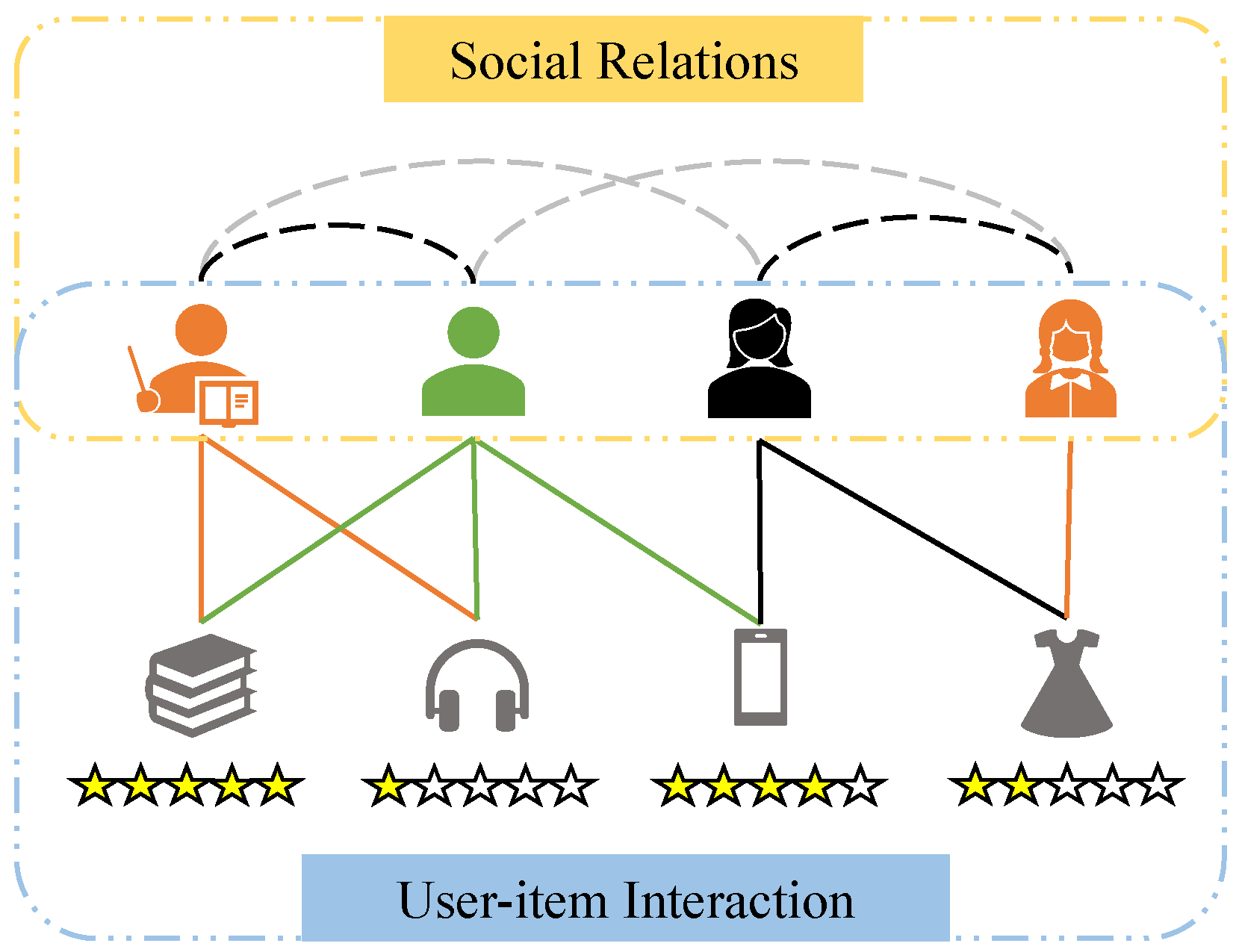
- Social view: The black dashed lines represent social connections with co-interactions (i.e., users interacting with the same items), whereas gray dashed lines indicate connections lacking such shared behaviors. Real-world social ties are complex and do not necessarily imply shared preferences. Consequently, social connections without co-interactions often fail to provide effective signals, introducing noise that hinders learning, which makes pruning noisy edges to retain highly informative social ties critical for improving recommendation performance.
- (2)
- Interaction view: Orange, green, and black nodes represent strict, lenient, and unbiased raters, respectively. User ratings are highly subjective; identical scores may carry distinct semantic meanings across users. For instance, strict raters may assign low scores even to items they favor. Furthermore, item popularity skews rating interpretation. For example, if a widely acclaimed blockbuster (which typically receives five stars) is given a mathematically ‘moderate’ three-star rating, it actually reflects relatively negative feedback compared to the crowd’s consensus. Consequently, failing to rectify these user and item biases prevents the accurate capture of preferences, severely compromising recommendation accuracy.
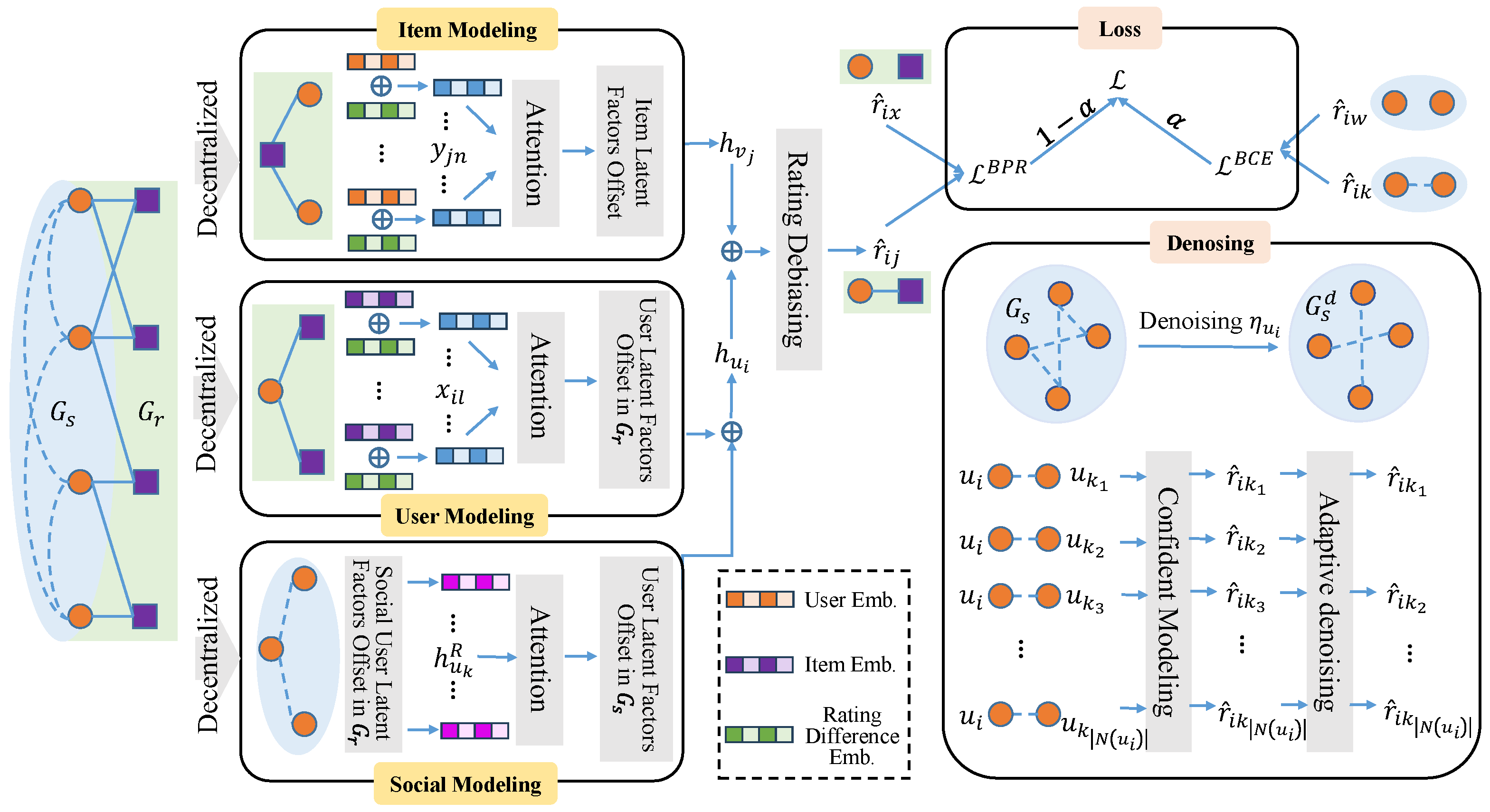
- Overall Framework Extension: We propose PDDSR, which extends the prevailing GNN-based social recommendation paradigm by systematically integrating explicit bias calibration and structural denoising into a unified joint-learning framework.
- Explicit Debiasing Architecture: Unlike existing methods that rely on implicit regularization, we introduce an explicit bias mitigation architecture. This module isolates user-specific rating habits and item popularity as learnable vector offsets, preventing bias drift at the foundational embedding level.
- Adaptive Denoising Mechanism: Moving beyond standard static graph pruning, we design a preference-guided adaptive graph denoising mechanism. It calculates social relation confidence based on actual interaction consistency and adaptively scales the denoising ratio according to individual social network sizes, effectively filtering structural noise without exacerbating data sparsity.
- Empirical Validation: Extensive experiments on two benchmark datasets demonstrate PDDSR’s superiority over state-of-the-art methods, firmly validating the effectiveness of our dual-mechanism design in complex real-world scenarios.
2. Related Work
2.1. Social Recommendation
2.2. GNN-Based Social Recommendation
2.3. Graph Denoising for Social Recommendation
3. Problem Formulation
4. Framework
4.1. User Modeling
4.2. Item Modeling
4.3. Social Modeling
4.4. Rating Prediction
4.5. Model Training
| Algorithm 1: PDDSR |
 |
5. Experiments
5.1. Experiment Settings
5.1.1. Dataset
5.1.2. Evaluation Metrics
5.1.3. Baselines
- Traditional Recommendation Methods
- Traditional Social Recommendation Method
- DNN-Based Recommendation Methods
- GNN-Based Recommendation Methods
- Graph Denoising-Based Recommendation Methods
5.1.4. Parameter Settings
5.2. Performance Comparison (RQ1)
5.3. Ablation Study (RQ2)
- (1)
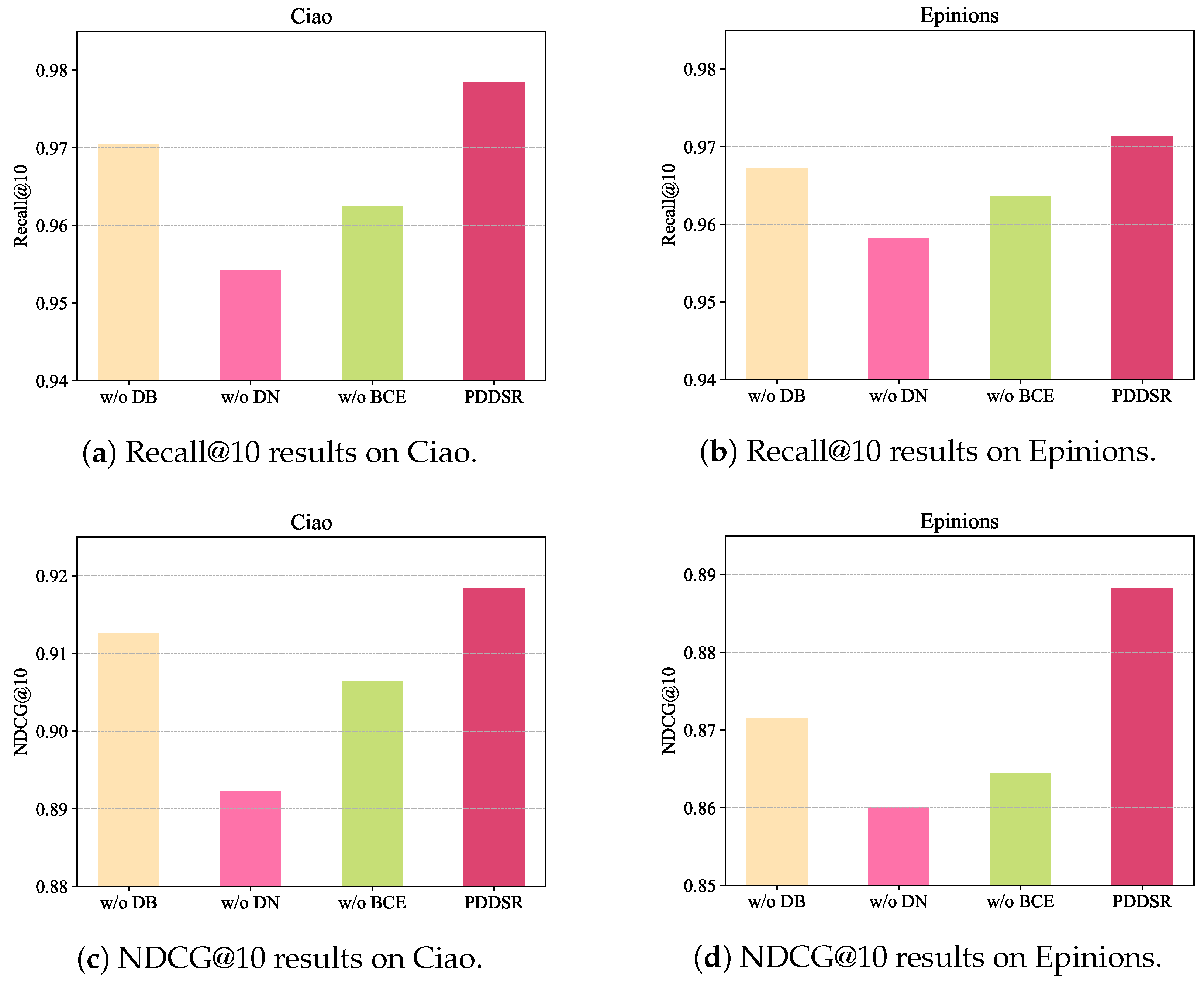
- The w/o DB variant utilizes raw ratings to learn latent factor offsets instead of using bias-corrected score differences. As shown in the results, it consistently yields inferior Recall@10 and NDCG@10 scores across both datasets compared to the full PDDSR model. This indicates that relying directly on raw ratings leaves the model susceptible to inherent user and item biases. In contrast, the debiasing mechanism enables the model to learn more discriminative and robust latent representations, thereby enhancing recommendation performance. Furthermore, we acknowledge the pipeline interdependence in this variant: removing the debiasing module inevitably distorts the user-item preference signals used downstream for social denoising. This actually reinforces our core design philosophy—explicit debiasing is a crucial prerequisite. Without clean, bias-free representations, even an advanced denoising mechanism would operate on flawed confidence scores, leading to inaccurate graph pruning.
- (2)
- Removing the social graph denoising process (w/o DN) leads to significant performance degradation on both datasets. This drop occurs because real-world social networks often contain numerous redundant or noisy relationships, rendering models vulnerable to irrelevant social connections. It is important to clarify the exact mechanics of this variant: while the link prediction loss () is retained as an auxiliary regularization task to train confidence scores, these scores are not actively used to prune the graph. The significant performance drop observed here confirms that merely learning tie confidence as a representation regularizer is insufficient; to prevent the indiscriminate aggregation of irrelevant ties, actively executing the graph pruning strategy based on these learned scores is strictly essential.
- (3)
- The w/o BCE variant retains only the recommendation task, eliminating the social link prediction objective from the joint optimization framework. Its performance lags significantly behind PDDSR, demonstrating that relying solely on user–item preference modeling is insufficient. The social link prediction task provides essential supervision for both the denoising process and social relation modeling, enabling the model to utilize social information more effectively.
5.4. Runtime and Storage Analysis of Models (RQ3)
5.5. Parameter Sensitivity (RQ4)
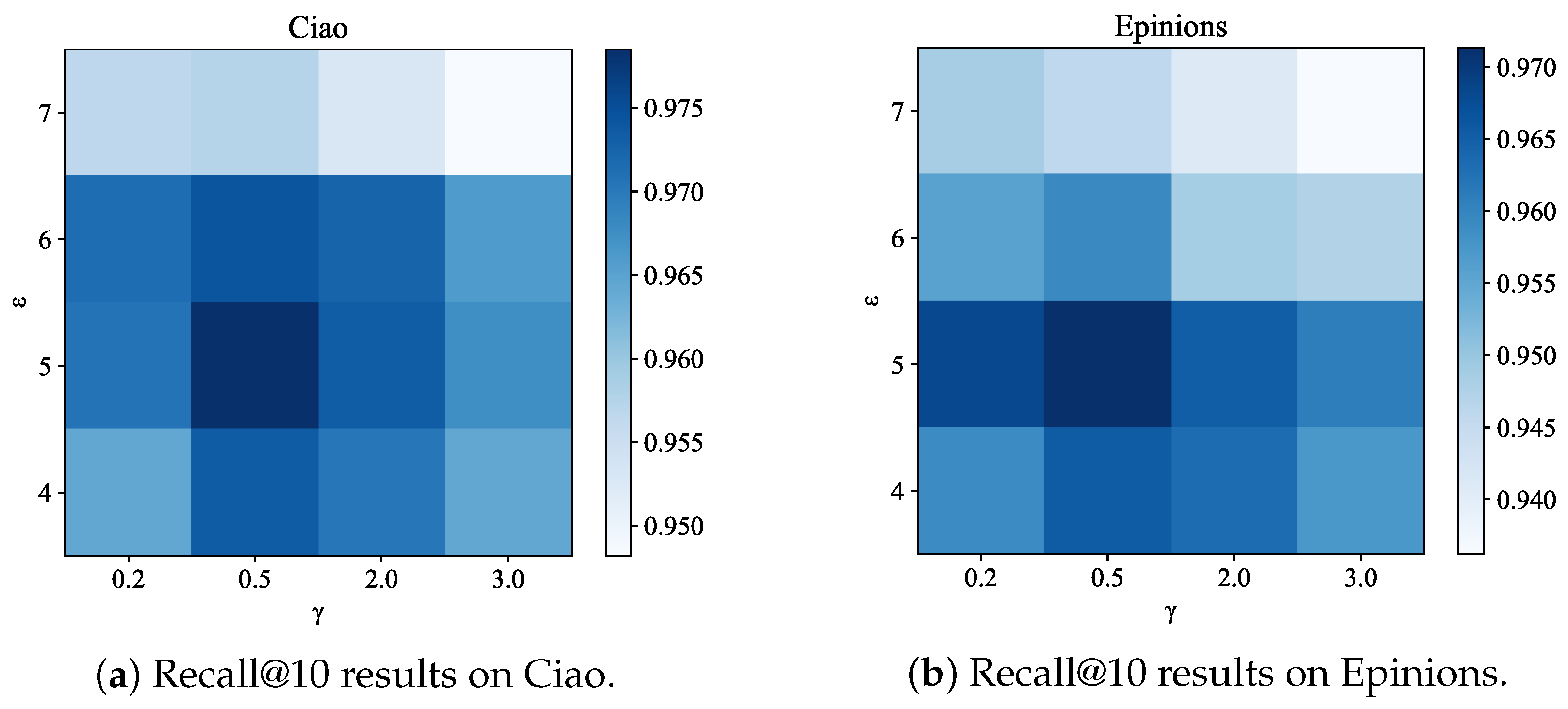
5.5.1. Effect of Different Social Network Size Thresholds and Denoising Ratios
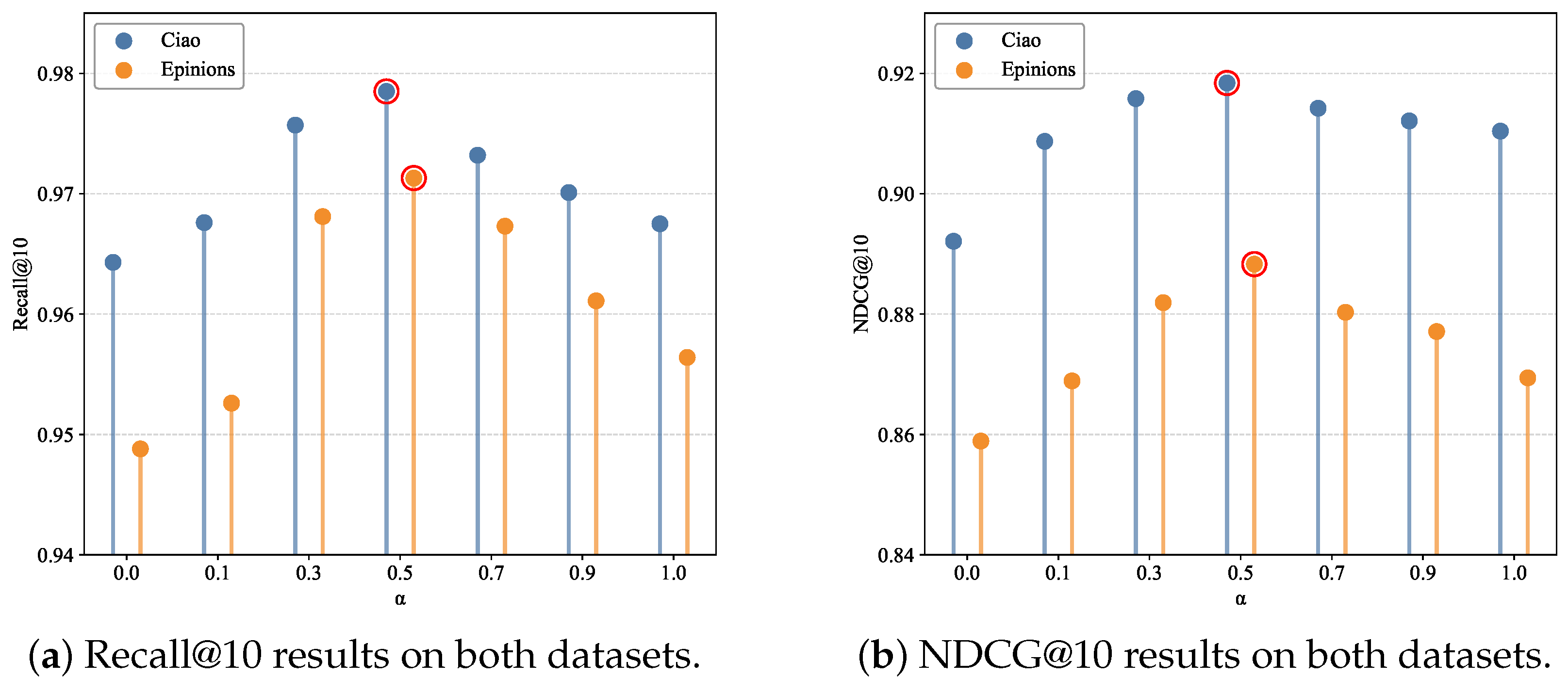
5.5.2. Effect of Co-Optimization Under Different Weights
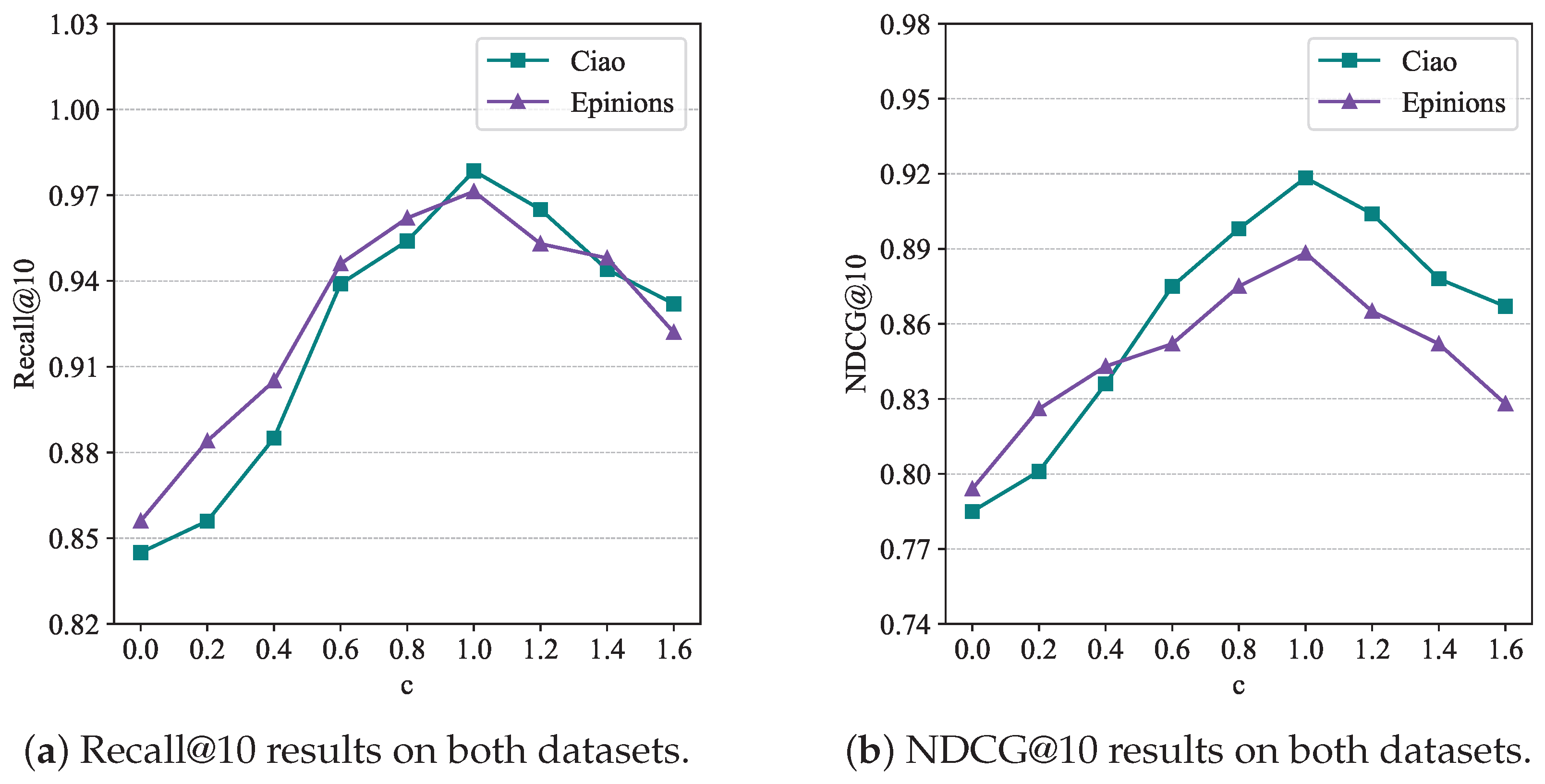
5.5.3. Effect of Different Average Rating Weights
6. Conclusions
Author Contributions
Funding
Institutional Review Board Statement
Informed Consent Statement
Data Availability Statement
Conflicts of Interest
References
- Raza, S.; Rahman, M.; Kamawal, S.; Toroghi, A.; Raval, A.; Navah, F.; Kazemeini, A. A comprehensive review of recommender systems: Transitioning from theory to practice. Comput. Sci. Rev. 2026, 59, 100849. [Google Scholar] [CrossRef]
- Yoo, H.; Qiu, R.; Xu, C.; Wang, F.; Tong, H. Generalizable recommender system during temporal popularity distribution shifts. In Proceedings of the 31st ACM SIGKDD Conference on Knowledge Discovery and Data Mining, Toronto, ON, Canada, 3–7 August 2025; Association for Computing Machinery: New York, NY, USA, 2025. [Google Scholar]
- Deldjoo, Y.; He, Z.; McAuley, J.; Korikov, A.; Sanner, S.; Ramisa, A.; Vidal, R.; Sathiamoorthy, M.; Kasirzadeh, A.; Milano, S. A review of modern recommender systems using generative models (gen-recsys). In Proceedings of the 30th ACM SIGKDD conference on Knowledge Discovery and Data Mining, Barcelona, Spain, 25–29 August 2024; Association for Computing Machinery: New York, NY, USA, 2024; pp. 6448–6458. [Google Scholar]
- Roy, D.; Dutta, M. A systematic review and research perspective on recommender systems. J. Big Data 2022, 9, 59. [Google Scholar] [CrossRef]
- Mnih, A.; Salakhutdinov, R.R. Probabilistic matrix factorization. In Proceedings of the Advances in Neural Information Processing Systems 20 (NIPS 2007), Vancouver, BC, Canada, 3–9 December 2007. [Google Scholar]
- Yang, B.; Lei, Y.; Liu, J.; Li, W. Social collaborative filtering by trust. IEEE Trans. Pattern Anal. Mach. Intell. 2016, 39, 1633–1647. [Google Scholar] [CrossRef] [PubMed]
- Rajput, S.; Mehta, N.; Singh, A.; Hulikal Keshavan, R.; Vu, T.; Heldt, L.; Hong, L.; Tay, Y.; Tran, V.; Samost, J.; et al. Recommender systems with generative retrieval. Adv. Neural Inf. Process. Syst. 2023, 36, 10299–10315. [Google Scholar]
- Zhu, J.; Dai, Q.; Su, L.; Ma, R.; Liu, J.; Cai, G.; Xiao, X.; Zhang, R. Bars: Towards open benchmarking for recommender systems. In Proceedings of the 45th International ACM SIGIR Conference on Research and Development in Information Retrieval, Madrid, Spain, 11–15 July 2022; Association for Computing Machinery: New York, NY, USA, 2022; pp. 2912–2923. [Google Scholar]
- Yu, J.; Yin, H.; Gao, M.; Xia, X.; Zhang, X.; Viet Hung, N.Q. Socially-aware self-supervised tri-training for recommendation. In Proceedings of the 27th ACM SIGKDD Conference on Knowledge Discovery & Data Mining, Virtual, 14–18 August 2021; Association for Computing Machinery: New York, NY, USA, 2021; pp. 2084–2092. [Google Scholar]
- Guo, G.; Zhang, J.; Yorke-Smith, N. Trustsvd: Collaborative filtering with both the explicit and implicit influence of user trust and of item ratings. In Proceedings of the AAAI Conference on Artificial Intelligence, Austin, TX, USA, 25–30 January 2015; AAAI Press: Washington, DC, USA, 2015; Volume 29. [Google Scholar]
- Song, L.; Bi, Y.; Yao, M.; Wu, Z.; Wang, J.; Xiao, J. Dream: A dynamic relation-aware model for social recommendation. In Proceedings of the 29th ACM international Conference on Information & Knowledge Management, Virtual, 19–23 October 2020; Association for Computing Machinery: New York, NY, USA, 2020; pp. 2225–2228. [Google Scholar]
- Fan, W.; Ma, Y.; Li, Q.; He, Y.; Zhao, E.; Tang, J.; Yin, D. Graph neural networks for social recommendation. In Proceedings of the The World Wide Web Conference, San Francisco, CA, USA, 13–17 May 2019; Association for Computing Machinery: New York, NY, USA, 2019; pp. 417–426. [Google Scholar]
- Wu, L.; Li, J.; Sun, P.; Hong, R.; Ge, Y.; Wang, M. Diffnet++: A neural influence and interest diffusion network for social recommendation. IEEE Trans. Knowl. Data Eng. 2020, 34, 4753–4766. [Google Scholar] [CrossRef]
- Xiong, F.; Sun, H.; Luo, G.; Pan, S.; Qiu, M.; Wang, L. Graph attention network with high-order neighbor information propagation for social recommendation. In Proceedings of the IJCAI-24: Thirty-Third International Joint Conference on Artificial Intelligence. International Joint Conferences on Artificial Intelligence, Jeju, Republic of Korea, 3–9 August 2024. [Google Scholar]
- Yang, L.; Liu, Z.; Dou, Y.; Ma, J.; Yu, P.S. Consisrec: Enhancing gnn for social recommendation via consistent neighbor aggregation. In Proceedings of the 44th International ACM SIGIR Conference on Research and Development in Information Retrieval, Virtual, 11–15 July 2021; Association for Computing Machinery: New York, NY, USA, 2021; pp. 2141–2145. [Google Scholar]
- Dai, E.; Jin, W.; Liu, H.; Wang, S. Towards robust graph neural networks for noisy graphs with sparse labels. In Proceedings of the Fifteenth ACM International Conference on Web Search and Data Mining, Virtual, 21–25 February 2022; Association for Computing Machinery: New York, NY, USA, 2022; pp. 181–191. [Google Scholar]
- Wang, W.; Feng, F.; He, X.; Nie, L.; Chua, T.S. Denoising implicit feedback for recommendation. In Proceedings of the 14th ACM International Conference on Web Search and Data Mining, Virtual, 8–12 March 2021; Association for Computing Machinery: New York, NY, USA, 2021; pp. 373–381. [Google Scholar]
- Li, Z.; Xia, L.; Huang, C. Recdiff: Diffusion model for social recommendation. In Proceedings of the 33rd ACM International Conference on Information and Knowledge Management, Boise, ID, USA, 21–25 October 2024; Association for Computing Machinery: New York, NY, USA, 2024; pp. 1346–1355. [Google Scholar]
- Koren, Y. Factorization meets the neighborhood: A multifaceted collaborative filtering model. In Proceedings of the 14th ACM SIGKDD International Conference on Knowledge Discovery and Data Mining, Las Vegas, NV, USA, 24–27 August 2008; Association for Computing Machinery: New York, NY, USA, 2008; pp. 426–434. [Google Scholar]
- He, X.; Liao, L.; Zhang, H.; Nie, L.; Hu, X.; Chua, T.S. Neural collaborative filtering. In Proceedings of the 26th International Conference on World Wide Web, Perth, Australia, 3–7 April 2017; Association for Computing Machinery: New York, NY, USA, 2017; pp. 173–182. [Google Scholar]
- Fan, W.; Li, Q.; Cheng, M. Deep modeling of social relations for recommendation. In Proceedings of the AAAI Conference on Artificial Intelligence, New Orleans, LA, USA, 2–7 February 2018; AAAI Press: Washington, DC, USA, 2018; Volume 32. [Google Scholar]
- Wu, L.; Sun, P.; Fu, Y.; Hong, R.; Wang, X.; Wang, M. A neural influence diffusion model for social recommendation. In Proceedings of the 42nd International ACM SIGIR Conference on Research and Development in Information Retrieval, Paris, France, 21–25 July 2019; Association for Computing Machinery: New York, NY, USA, 2019; pp. 235–244. [Google Scholar]
- Chen, X.; Lei, P.I.; Sheng, Y.; Liu, Y.; Gong, Z. Social influence learning for recommendation systems. In Proceedings of the 33rd ACM International Conference on Information and Knowledge Management, Boise, ID, USA, 21–25 October 2024; Association for Computing Machinery: New York, NY, USA, 2024; pp. 312–322. [Google Scholar]
- He, X.; Deng, K.; Wang, X.; Li, Y.; Zhang, Y.; Wang, M. Lightgcn: Simplifying and powering graph convolution network for recommendation. In Proceedings of the 43rd International ACM SIGIR Conference on Research and Development in Information Retrieval, Virtual, 25–30 July 2020; Association for Computing Machinery: New York, NY, USA, 2020; pp. 639–648. [Google Scholar]
- Fu, B.; Zhang, W.; Hu, G.; Dai, X.; Huang, S.; Chen, J. Dual side deep context-aware modulation for social recommendation. In Proceedings of the Web Conference 2021, Ljubljana, Slovenia, 19–23 April 2021; Association for Computing Machinery: New York, NY, USA, 2021; pp. 2524–2534. [Google Scholar]
- Liao, J.; Zhou, W.; Luo, F.; Wen, J.; Gao, M.; Li, X.; Zeng, J. SocialLGN: Light graph convolution network for social recommendation. Inf. Sci. 2022, 589, 595–607. [Google Scholar] [CrossRef]
- Xia, L.; Shao, Y.; Huang, C.; Xu, Y.; Xu, H.; Pei, J. Disentangled graph social recommendation. In Proceedings of the 2023 IEEE 39th International Conference on Data Engineering (ICDE), Anaheim, CA, USA, 3–7 April 2023; IEEE: Piscataway, NJ, USA, 2023; pp. 2332–2344. [Google Scholar]
- Zhang, M.; Liao, X.; Wang, X.; Wang, X.; Jin, L. Multi-neighbor social recommendation with attentional graph convolutional network. Data Min. Knowl. Discov. 2025, 39, 21. [Google Scholar] [CrossRef]
- Yang, Y.; Wu, L.; Wang, Z.; He, Z.; Hong, R.; Wang, M. Graph bottlenecked social recommendation. In Proceedings of the 30th ACM SIGKDD Conference on Knowledge Discovery and Data Mining, Barcelona, Spain, 25–29 August 2024; Association for Computing Machinery: New York, NY, USA, 2024; pp. 3853–3862. [Google Scholar]
- Wang, Y.; Xin, X.; Meng, Z.; Jose, J.M.; Feng, F.; He, X. Learning robust recommenders through cross-model agreement. In Proceedings of the ACM Web Conference 2022, Lyon, France, 25–29 April 2022; Association for Computing Machinery: New York, NY, USA, 2022; pp. 2015–2025. [Google Scholar]
- Wang, J.; Li, H.; Mo, T.; Li, W. Adversarial Learning Enhanced Social Interest Diffusion Model for Recommendation. In Proceedings of the International Conference on Database Systems for Advanced Applications, Tianjin, China, 17–20 April 2023; Springer: Berlin/Heidelberg, Germany, 2023; pp. 357–372. [Google Scholar]
- Li, J.; Wang, H. Graph diffusive self-supervised learning for social recommendation. In Proceedings of the 47th International ACM SIGIR Conference on Research and Development in Information Retrieval, Washington, DC, USA, 14–18 July 2024; Association for Computing Machinery: New York, NY, USA, 2024; pp. 2442–2446. [Google Scholar]
- Khan, B.; Wu, J.; Yang, J.; Ma, X. Heterogeneous hypergraph neural network for social recommendation using attention network. ACM Trans. Recomm. Syst. 2025, 3, 30. [Google Scholar] [CrossRef]
- Wang, W.; Zhang, W.; Liu, S.; Liu, Q.; Zhang, B.; Lin, L.; Zha, H. Incorporating link prediction into multi-relational item graph modeling for session-based recommendation. IEEE Trans. Knowl. Data Eng. 2021, 35, 2683–2696. [Google Scholar] [CrossRef]
- Han, K.; Xiao, A.; Wu, E.; Guo, J.; Xu, C.; Wang, Y. Transformer in transformer. Adv. Neural Inf. Process. Syst. 2021, 34, 15908–15919. [Google Scholar]
- Lindenfors, P.; Wartel, A.; Lind, J. Dunbar’s number deconstructed. Biol. Lett. 2021, 17, 20210158. [Google Scholar] [CrossRef] [PubMed]
- Chen, P.; Ye, J.; Chen, G.; Zhao, J.; Heng, P.A. Beyond class-conditional assumption: A primary attempt to combat instance-dependent label noise. In Proceedings of the AAAI Conference on Artificial Intelligence, Virtual, 2–9 February 2021; AAAI Press: Washington, DC, USA, 2021; Volume 35, pp. 11442–11450. [Google Scholar]
- Hu, Y.; Xiong, F.; Pan, S.; Xiong, X.; Wang, L.; Chen, H. Bayesian personalized ranking based on multiple-layer neighborhoods. Inf. Sci. 2021, 542, 156–176. [Google Scholar] [CrossRef]
- Ga, S.; Cho, P.H.; Moon, G.E.; Jung, S. Efficient GNN-based social recommender systems through social graph refinement. J. Supercomput. 2025, 81, 215. [Google Scholar] [CrossRef]
- Yang, L.; Wang, S.; Tao, Y.; Sun, J.; Liu, X.; Yu, P.S.; Wang, T. Dgrec: Graph neural network for recommendation with diversified embedding generation. In Proceedings of the Sixteenth ACM International Conference on Web Search and Data Mining, Singapore, 27 February–3 March 2023; Association for Computing Machinery: New York, NY, USA, 2023; pp. 661–669. [Google Scholar]
- Yang, Y.; Wu, L.; Zhang, K.; Hong, R.; Zhou, H.; Zhang, Z.; Zhou, J.; Wang, M. Hyperbolic graph learning for social recommendation. IEEE Trans. Knowl. Data Eng. 2023, 36, 8488–8501. [Google Scholar] [CrossRef]
- Zhang, B.; Tian, Y.; Li, C.; Liang, J.; Ye, Y. EGCL: An Effective and Efficient Graph Contrastive Learning Framework for Social Recommendation. ACM Trans. Inf. Syst. 2026, 44, 58. [Google Scholar] [CrossRef]
- Bellogin, A.; Castells, P.; Cantador, I. Precision-oriented evaluation of recommender systems: An algorithmic comparison. In Proceedings of the Fifth ACM Conference on Recommender Systems, Chicago, IL, USA, 23–27 October 2011; Association for Computing Machinery: New York, NY, USA, 2011; pp. 333–336. [Google Scholar]



| Method | Paradigm | Explicit Bias Modeling | Structural Denoising | Preference-Guided Confidence |
|---|---|---|---|---|
| GraphRec [12] | GNN | × | × | × |
| DiffNet++ [13] | GNN | × | × | × |
| ConsisRec [15] | Denoising | × | ✓ | Partial |
| SI-GAN [31] | Denoising | × | ✓ | × |
| RecDiff [18] | Diffusion | × | ✓ | × |
| PDDSR | GNN + Denoising | ✓ | ✓ | ✓ |
| Dataset | Ciao | Epinions |
|---|---|---|
| Users | 7317 | 18,088 |
| Items | 104,975 | 261,649 |
| Ratings | 283,319 | 764,352 |
| Social Relations | 111,781 | 355,813 |
| Model | Ciao | Epinions | ||
|---|---|---|---|---|
| MAE | RMSE | MAE | RMSE | |
| PMF | 0.9520 | 1.1967 | 1.0211 | 1.2739 |
| FunkSVD | 0.8462 | 1.0513 | 0.9036 | 1.1431 |
| TrustMF | 0.7681 | 1.0543 | 0.8550 | 1.1505 |
| NeuMF | 0.8251 | 1.0824 | 0.9097 | 1.1645 |
| DeepSoR | 0.7739 | 1.0316 | 0.8383 | 1.0972 |
| LightGCN | 0.7715 | 1.0203 | 0.8717 | 1.1103 |
| GraphRec | 0.7540 | 1.0093 | 0.8441 | 1.0878 |
| DiffNet++ | 0.7459 | 0.9987 | 0.8435 | 1.0795 |
| SI-GAN | 0.6810 | 0.9507 | 0.7709 | 0.9827 |
| RecDiff | 0.6921 | 0.9498 | 0.7782 | 0.9806 |
| PDDSR | 0.6683 | 0.9324 | 0.7554 | 0.9647 |
| Model | Ciao | Epinions | ||
|---|---|---|---|---|
| Recall@10 | Recall@20 | Recall@10 | Recall@20 | |
| PMF | 0.9685 | 0.9693 | 0.9645 | 0.9648 |
| FunkSVD | 0.9663 | 0.9674 | 0.9651 | 0.9659 |
| TrustMF | 0.9672 | 0.9678 | 0.9676 | 0.9682 |
| NeuMF | 0.9687 | 0.9695 | 0.9672 | 0.9677 |
| DeepSoR | 0.9676 | 0.9679 | 0.9669 | 0.9686 |
| LightGCN | 0.9674 | 0.9682 | 0.9677 | 0.9682 |
| GraphRec | 0.9718 | 0.9736 | 0.9682 | 0.9689 |
| DiffNet++ | 0.9736 | 0.9752 | 0.9687 | 0.9694 |
| SI-GAN | 0.9732 | 0.9745 | 0.9695 | 0.9712 |
| RecDiff | 0.9741 | 0.9756 | 0.9692 | 0.9723 |
| PDDSR | 0.9785 | 0.9823 | 0.9713 | 0.9772 |
| Model | Ciao | Epinions | ||
|---|---|---|---|---|
| NDCG@10 | NDCG@20 | NDCG@10 | NDCG@20 | |
| PMF | 0.8745 | 0.8762 | 0.8273 | 0.8296 |
| FunkSVD | 0.8782 | 0.8794 | 0.8367 | 0.8381 |
| TrustMF | 0.8706 | 0.8742 | 0.8472 | 0.8489 |
| NeuMF | 0.8781 | 0.8792 | 0.8301 | 0.8342 |
| DeepSoR | 0.8732 | 0.8756 | 0.8496 | 0.8523 |
| LightGCN | 0.9094 | 0.9128 | 0.8754 | 0.8782 |
| GraphRec | 0.9146 | 0.9182 | 0.8814 | 0.8847 |
| DiffNet++ | 0.9149 | 0.9185 | 0.8851 | 0.8872 |
| SI-GAN | 0.9167 | 0.9196 | 0.8869 | 0.8892 |
| RecDiff | 0.9158 | 0.9202 | 0.8867 | 0.8906 |
| PDDSR | 0.9184 | 0.9274 | 0.8883 | 0.8965 |
| Model | Ciao | Epinions | ||
|---|---|---|---|---|
| Precision@20 | MAP@20 | Precision@20 | MAP@20 | |
| PMF | 0.0485 | 0.8251 | 0.0482 | 0.7764 |
| FunkSVD | 0.0483 | 0.8282 | 0.0483 | 0.7855 |
| TrustMF | 0.0484 | 0.8236 | 0.0484 | 0.7981 |
| NeuMF | 0.0485 | 0.8286 | 0.0483 | 0.7821 |
| DeepSoR | 0.0484 | 0.8248 | 0.0484 | 0.8037 |
| LightGCN | 0.0486 | 0.8654 | 0.0485 | 0.8295 |
| GraphRec | 0.0487 | 0.8715 | 0.0484 | 0.8369 |
| DiffNet++ | 0.0486 | 0.8722 | 0.0485 | 0.8398 |
| SI-GAN | 0.0487 | 0.8735 | 0.0486 | 0.8421 |
| RecDiff | 0.0488 | 0.8743 | 0.0485 | 0.8436 |
| PDDSR | 0.0491 | 0.8831 | 0.0489 | 0.8512 |
Disclaimer/Publisher’s Note: The statements, opinions and data contained in all publications are solely those of the individual author(s) and contributor(s) and not of MDPI and/or the editor(s). MDPI and/or the editor(s) disclaim responsibility for any injury to people or property resulting from any ideas, methods, instructions or products referred to in the content. |
© 2026 by the authors. Licensee MDPI, Basel, Switzerland. This article is an open access article distributed under the terms and conditions of the Creative Commons Attribution (CC BY) license.
Share and Cite
Li, J.; Li, S.; Zeng, H.; Zhuo, S. Preference-Guided Debiasing and Denoising Social Recommendation. Information 2026, 17, 473. https://doi.org/10.3390/info17050473
Li J, Li S, Zeng H, Zhuo S. Preference-Guided Debiasing and Denoising Social Recommendation. Information. 2026; 17(5):473. https://doi.org/10.3390/info17050473
Chicago/Turabian StyleLi, Jun, Shenghan Li, Huachang Zeng, and Shengda Zhuo. 2026. "Preference-Guided Debiasing and Denoising Social Recommendation" Information 17, no. 5: 473. https://doi.org/10.3390/info17050473
APA StyleLi, J., Li, S., Zeng, H., & Zhuo, S. (2026). Preference-Guided Debiasing and Denoising Social Recommendation. Information, 17(5), 473. https://doi.org/10.3390/info17050473