Review

Deep Learning for Credit Risk Prediction: A Survey of Methods, Applications, and Challenges

by
Ibomoiye Domor Mienye
,
Ebenezer Esenogho
* and
Cameron Modisane
Centre for Artificial Intelligence and Multidisciplinary Innovations, Department of Auditing, College of Accounting Sciences, University of South Africa, Pretoria 0002, South Africa
*
Author to whom correspondence should be addressed.
Information 2026, 17(4), 395; https://doi.org/10.3390/info17040395
Submission received: 6 December 2025 / Revised: 25 February 2026 / Accepted: 27 February 2026 / Published: 21 April 2026
(This article belongs to the Special Issue Predictive Analytics and Data Science, 3rd Edition)

Abstract

Credit risk prediction is central to financial stability and regulatory compliance, guiding lending decisions and portfolio risk management. While traditional approaches such as logistic regression and tree-based models have long been the industry standard, recent advances in deep learning (DL) have introduced architectures capable of capturing complex nonlinearities, temporal dynamics, and relational dependencies in borrower data. This study provides a comprehensive review of DL methods applied to credit risk prediction, covering multi-layer perceptron, recurrent and convolutional neural networks, transformer, and graph neural networks. We examine benchmark and large-scale datasets, highlight peer-reviewed applications across corporate, consumer, and peer-to-peer lending, and evaluate the benefits of DL relative to classical machine learning. In addition, we critically assess key challenges and identify emerging opportunities. By synthesising methods, applications, and open challenges, this paper offers a roadmap for advancing trustworthy deep learning in credit risk modelling and bridging the gap between academic research and industry deployment.

1. Introduction

Credit risk prediction is a fundamental component of financial risk management, enabling institutions to evaluate the likelihood of borrower default and to make informed lending decisions [1,2,3]. Accurate modelling of credit risk supports financial stability, reduces loan losses, and contributes to regulatory compliance. Traditionally, logistic regression (LR) has been the dominant model in credit scoring due to its simplicity, interpretability, and ease of deployment in regulated environments [4]. However, as financial datasets have grown in size and complexity, conventional LR models have struggled to capture nonlinear relationships and interactions among features. This limitation has motivated the adoption of more advanced machine learning (ML) methods such as random forests, support vector machines (SVMs), and gradient boosting, which often achieve higher predictive accuracy but at the expense of interpretability [5,6,7].
Deep learning has broadened credit risk modelling by enabling representation learning on borrower data that is nonlinear, time-dependent, and sometimes networked. Recent work explores feed-forward tabular networks, sequence models, attention-based transformers, and graph neural networks to capture signals that are difficult to express in conventional scorecards [8,9,10].
Alongside these methodological developments, a growing body of survey work has reviewed credit risk models and related financial risk applications, as summarised in Table 1. Early systematic reviews by Bhatore et al. [11], Shi et al. [12], Noriega et al. [13], and Montevechi et al. [14] focus on ML-based credit scoring, synthesising algorithms, datasets, and evaluation metrics but treating deep neural networks largely as one model family among many. Other reviews concentrate on specific perspectives: Kim et al. [15] and Çallı and Coşkun [16] examine corporate default prediction and long-run default predictors, while Mhlanga [17] discusses ML- and AI-enabled credit assessment in the context of financial inclusion. Deep learning-centred surveys, such as Hayashi [18], Peng and Yan [19], Hoyos et al. [20], and Demma et al. [21], identify emerging DL techniques for credit scoring and broader financial risk, but mainly emphasise tabular models and do not systematically cover sequential, transformer, and graph-based architectures for borrower-level credit risk. Meanwhile, Mienye et al. [22] provided a broad overview of DL in financial services, yet its treatment of credit risk was at a high-level. In short, much of the review literature either prioritises broad ML coverage, narrows deep learning discussion to tabular scorecard-style settings, or treats responsible AI topics without a model-family-level synthesis tailored to borrower-level credit risk.
This study addresses that gap by organising modern deep learning methods for borrower-level credit risk prediction, cataloguing recent peer-reviewed applications, and synthesising deployment-relevant challenges and research opportunities. We focus on borrower-, facility-, and firm-level settings where the objective is to estimate default-related outcomes over a specified prediction horizon using application, behavioural, bureau, transactional, textual, or relational data. The primary target is probability of default (PD) and closely related delinquency outcomes. The reviewed evidence covers consumer lending, SME lending, corporate credit, and peer-to-peer lending using both public benchmarks and institution-scale datasets reported in peer-reviewed studies. We exclude work that focuses on market or liquidity risk, portfolio optimisation without borrower-level labelling, or purely methodological contributions that do not evaluate on an empirical credit-risk task. The main contributions of this paper are as follows:
  • We present a unified overview of credit risk prediction tasks and benchmark datasets, and trace the evolution from logistic regression to deep architectures, including MLPs, CNNs, RNNs, transformers, and GNNs, highlighting how each class aligns with different credit-risk objectives and data modalities.
  • We provide a modality-aware synthesis of recent deep learning applications in credit risk, organising studies by tabular, sequential, transformer-based, and graph-based models, and collating their datasets, architectures, and reported performance.
  • We critically analyse methodological and operational challenges for deploying DL-based credit risk models and derive concrete research directions for developing trustworthy, regulation-ready deep learning solutions.
The remainder of this paper is organised as follows. Section 2 presents the review methodology. Section 3 provides an overview of credit risk prediction tasks and commonly used datasets. Section 4 traces the evolution from statistical to deep learning models, detailing key architectures. Section 5 reviews peer-reviewed DL applications in credit risk across data modalities. Section 6 presents a synthesis of major challenges and future research directions. Section 7 concludes the paper.

2. Review Methodology

We conducted a structured literature search and screening exercise to assemble recent peer-reviewed work on deep learning for borrower-level credit risk prediction. The goal is a comprehensive and transparent narrative synthesis of the field rather than a formal systematic review or meta-analysis.
To cover both computing and finance outlets, we searched IEEE Xplore, Scopus, ACM Digital Library, ScienceDirect, SpringerLink, Web of Science, and Google Scholar. Web of Science was included to broaden coverage of finance and operations research venues that are not always well represented in engineering-focused indexes. Queries paired credit-risk terms (e.g., credit scoring, default prediction, probability of default) with deep learning terms (e.g., CNN, RNN, LSTM, GRU, Transformer, graph neural network). Where supported, we restricted searches to title/abstract/keywords and refined query variants iteratively using highly cited seed papers to limit irrelevant returns. We targeted journal articles and full conference papers from 2015 to 2025, and added foundational earlier studies via backward/forward citation tracking.

Search Strategy and Screening Protocol

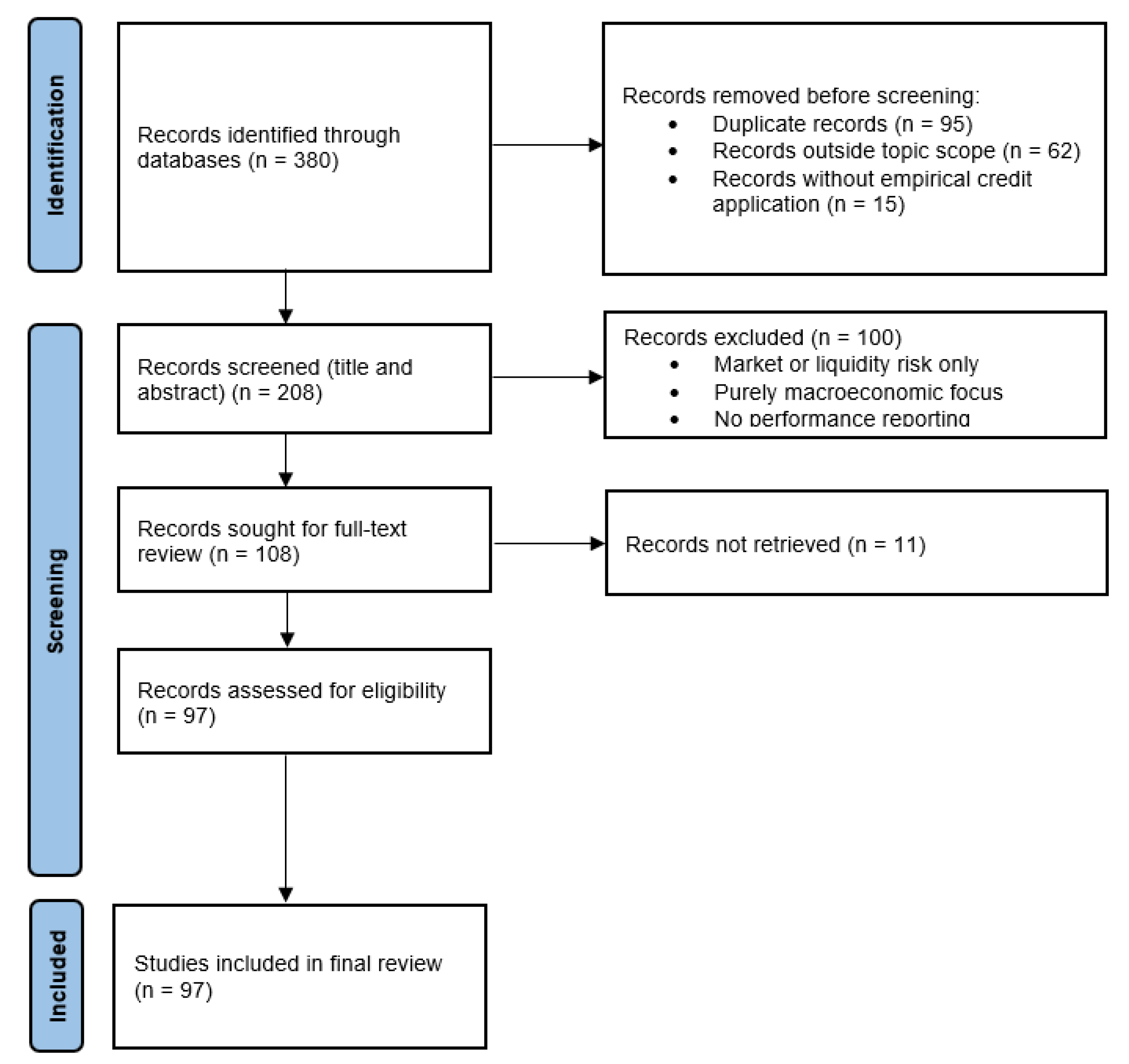
The initial search identified approximately 380 records across all databases after merging results. Duplicate records were removed using title, author, venue, and year matching. Following de-duplication and removal of clearly out-of-scope records, 208 studies were retained for title and abstract screening, as summarised in Figure 1. The remaining studies were screened in two stages: (i) title and abstract screening, followed by (ii) full-text assessment. During title and abstract screening, studies were excluded if they focused exclusively on market or liquidity risk, macroeconomic default modelling without borrower-level prediction, or methodological deep learning contributions without an empirical credit risk application. Full-text screening was then used to confirm relevance, extract methodological details, and verify that the study addressed borrower-, facility-, or entity-level credit risk.
Studies were included if they satisfied at least one of the following criteria: (i) proposed or empirically evaluated a deep learning architecture for credit risk prediction; (ii) provided a survey or structured review of machine learning or deep learning methods for credit risk; or (iii) addressed interpretability, fairness, robustness, or governance explicitly in a credit risk context. Meanwhile, studies were excluded if they lacked quantitative evaluation, provided insufficient methodological detail to assess the learning architecture, or focused solely on regulatory or policy discussion without a modelling component. Unlike systematic reviews, no strict performance-improvement threshold was imposed; however, studies were required to report at least one standard evaluation metric to support empirical comparison.
The final corpus comprises 140 deep learning application studies and 18 survey or guideline papers. For each included study, we recorded the data modality (tabular, sequential, textual, or relational), model architecture (MLP, CNN, RNN/LSTM/GRU, Transformer, GNN, or hybrid), credit product segment (consumer, SME, corporate, interbank, or mixed), prediction target, and reported evaluation metrics. We did not apply a formal risk-of-bias scoring protocol (given the non-systematic scope and heterogeneous study designs), but we extracted reporting attributes relevant to interpretability, validation design (e.g., out-of-time vs random splits), and deployment considerations where available. These attributes underpin the taxonomy used in Section 4 and Section 5, and the related survey literature is summarised in Table 1.

3. Overview of Credit Risk Prediction and Datasets

Credit risk refers to the potential loss that a lender or investor faces when a borrower fails to meet contractual financial obligations [17]. Accurate credit risk prediction is fundamental to financial stability, guiding capital allocation, pricing, and provisioning decisions under regulatory frameworks such as Basel III. Traditionally, credit risk has been assessed through statistical scorecards and expert judgment; however, the rise of data-driven lending and digital credit platforms has produced large-scale, high-dimensional borrower data that demand more advanced modelling approaches. This section provides an overview of the key predictive tasks in credit risk management and summarises benchmark datasets commonly employed in empirical studies.

3.1. Credit Risk Prediction Tasks

Credit risk prediction aims to estimate the likelihood and magnitude of potential losses associated with lending activities. In regulatory and research practice, three main quantitative tasks are typically addressed:
  • Probability of Default: The likelihood that a borrower will fail to meet contractual repayment obligations within a specified horizon. PD modelling forms the foundation of most credit scoring systems and risk-based pricing frameworks [28].
  • Loss Given Default (LGD): The proportion of the exposure that is not recovered in the event of default, reflecting collateral values, recovery processes, and legal costs [29].
  • Exposure at Default (EAD): The total outstanding amount a lender is exposed to when default occurs, which is particularly important for revolving facilities such as credit cards and overdrafts [30].
Across the reviewed literature, PD-style targets (default or closely related delinquency outcomes) dominate, and they form the primary basis for comparing deep learning model families in this survey. Prediction horizons and label definitions vary across studies and products; where reported, we capture these details in the study summaries to support consistent interpretation. LGD and EAD are discussed only in studies that explicitly model them using deep architectures, reflecting their comparatively limited coverage in the deep learning credit-risk literature. These quantities determine the Expected Loss (EL), a cornerstone of risk-weighted asset (RWA) calculation in Basel frameworks, defined as:
E L = P D × L G D × E A D .
Though EL is crucial in credit risk, it is inconsistently reported and is not comparable across heterogeneous datasets and horizons in the surveyed studies. Accordingly, the synthesis in Section 5 focuses on the evaluation metrics most commonly reported for PD-style prediction.

3.2. Benchmark Datasets

Empirical research on credit risk frequently relies on benchmark datasets to evaluate and compare modelling approaches. The most widely used public datasets include the German Credit, Australian Credit, and Taiwan Credit Card Default datasets, which have become standard baselines for ML algorithms. The German Credit dataset, compiled by the UCI ML Repository, contains 1000 loan applicants with 20 demographic and financial attributes labeled as good or bad credit risk [31]. The Australian Credit dataset is smaller, comprising 690 records with mixed categorical and numerical features for binary creditworthiness classification. The Taiwan Credit Card Default dataset is substantially larger, featuring 30,000 clients with detailed billing, repayment, and demographic information, and is widely used in deep learning benchmarks [32].
While these datasets facilitate reproducibility and algorithmic comparison, their limited sample sizes, static structures, and lack of temporal or behavioural features constrain generalisability to real-world portfolios [33]. Small benchmarks also create high-variance evaluation regimes in which apparent performance differences are unstable and can be driven by a few influential cases rather than a durable risk signal. For example, with only 1000 observations, the German Credit dataset can yield materially different estimates across random splits, and high-capacity models may overfit idiosyncratic correlations that do not transfer to new borrower cohorts. This effect is compounded by sample-selection mechanisms that are absent or unobserved in public benchmarks (e.g., lender acceptance policies and underwriting rules), meaning the observed labels may reflect a filtered subpopulation rather than the full applicant pool. Consequently, models trained and reported on such datasets often overestimate out-of-sample performance and understate uncertainty in comparative claims.
To address these shortcomings, contemporary studies increasingly adopt larger and more heterogeneous datasets. For example, the Home Credit Default Risk dataset [34] includes over 300,000 loan applications enriched with demographic, behavioural, and bureau records, representing a closer approximation to industrial settings. Similarly, the Lending Club peer-to-peer lending dataset contains millions of transactions and repayment records, enabling large-scale evaluations of ensemble and deep learning models [35].
Despite these advances, much of the academic literature continues to rely on small, static benchmarks that fail to capture macroeconomic shifts and dynamic borrower behaviour. Bridging this gap requires longitudinal, multimodal datasets with explicit time structure and stable label definitions, so that models can be evaluated under out-of-time validation and assessed for drift, calibration decay, and subgroup performance. Such datasets are essential for benchmarking emerging deep learning architectures under realistic and regulatory-compliant conditions (Table 2).

4. Evolution of Models for Credit Risk

Credit risk modelling has progressed from interpretable linear methods to deep architectures that capture nonlinear interactions, sequential behaviour, and relational dependencies among borrowers. This section reviews the methodological evolution across the main model families.

4.1. Logistic Regression and Classical Machine Learning

Logistic regression (LR) remains the cornerstone of credit scoring due to its transparency and regulatory acceptance [36,37]. Given input features x R d and parameters ( w , b ) , LR models the probability of default as:
P ( y = 1 x ) = σ ( w x + b ) = 1 1 + exp ( w x b ) ,
where σ ( · ) is the logistic sigmoid and y { 0 , 1 } denotes default status. Despite its simplicity, LR assumes a linear log-odds relationship, limiting its ability to capture nonlinear feature effects and interactions in high-dimensional data. Subsequent classical ML models, such as support vector machines, random forests, and gradient boosting, enhanced flexibility by learning nonlinear decision boundaries. These methods typically outperform LR in accuracy but at the cost of interpretability, motivating subsequent research into models that balance both properties [5].

4.2. Early Deep Learning for Tabular Credit Risk

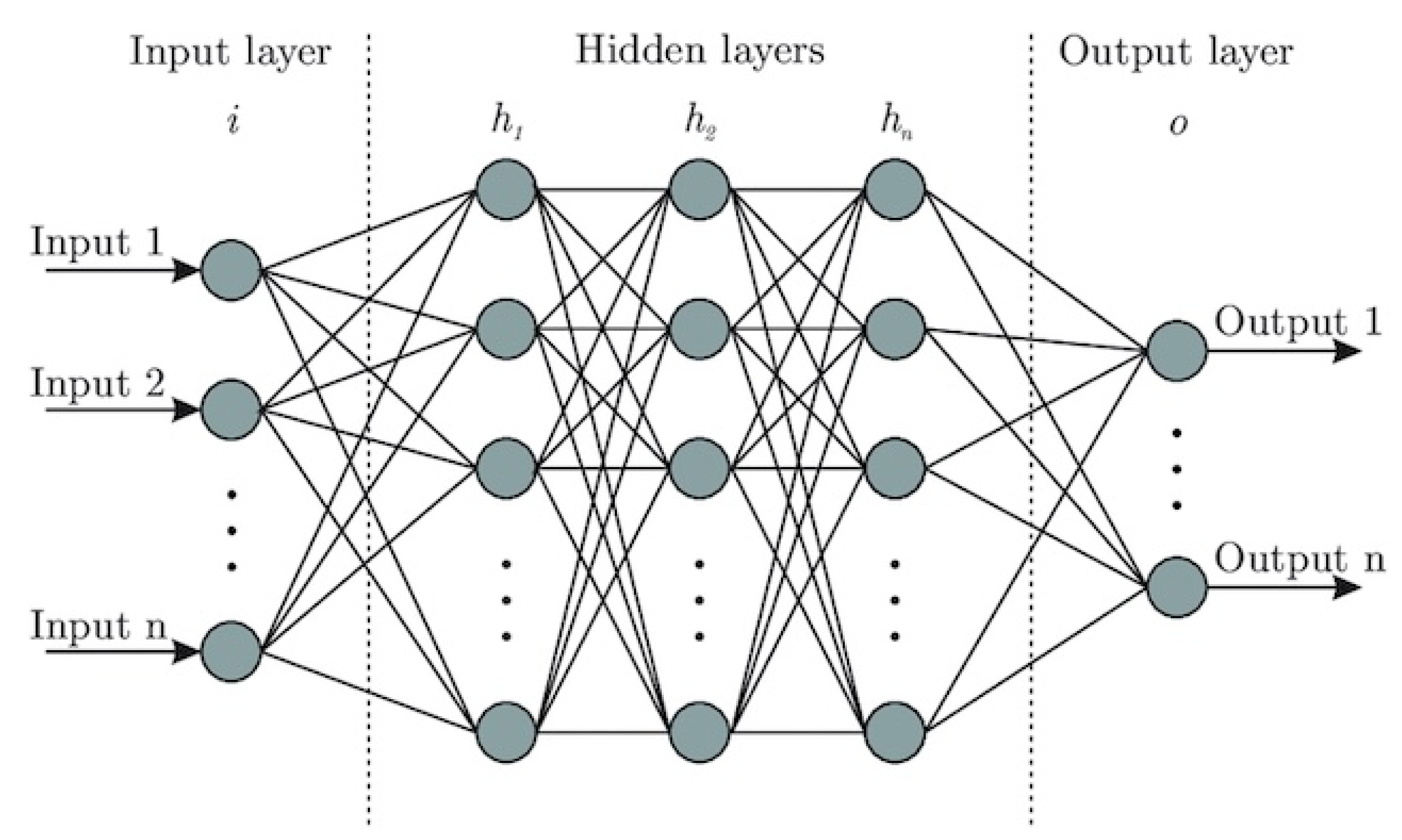
The introduction of deep learning brought neural architectures capable of learning complex, nonlinear transformations directly from tabular credit data. Unlike traditional logistic regression (LR), which models linear relationships, deep neural networks can capture hierarchical feature interactions through multiple hidden layers. A multi-layer perceptron (MLP), illustrated in Figure 2, extends LR by stacking hidden layers with nonlinear activations that enable the automatic extraction of latent feature representations. Mathematically, the forward propagation in an MLP is given by:
h ( l ) = ϕ ( W ( l ) h ( l 1 ) + b ( l ) ) ,
where ϕ ( · ) denotes a nonlinear activation function such as ReLU. This hierarchical structure allows MLPs to approximate complex functions on large datasets, thereby uncovering nonlinear relationships between borrower characteristics and default probabilities [38].

4.3. Sequential and Temporal Behaviour Modelling

Creditworthiness evolves over time as borrowers make repayments, accumulate balances, adjust spending behaviour, or experience income fluctuations. Sequential neural networks explicitly model these behavioural trajectories by capturing temporal dependencies that static models cannot. These architectures process credit-related sequences—such as monthly repayment histories, rolling utilisation rates, or delinquency transitions—in a step-wise manner, enabling the extraction of long-range behavioural patterns. Recurrent neural networks (RNNs) form the foundation for sequential modelling. At each time step t, an RNN updates its hidden state according to
h t = tanh ( W h h t 1 + W x x t + b ) ,
where x t is the input vector at time t, h t is the hidden state, W h and W x are learnable weight matrices, and b is a bias term. Although RNNs can capture short-term temporal structure, they struggle with long-range dependencies due to vanishing gradients [39].

4.3.1. Long Short-Term Memory Networks

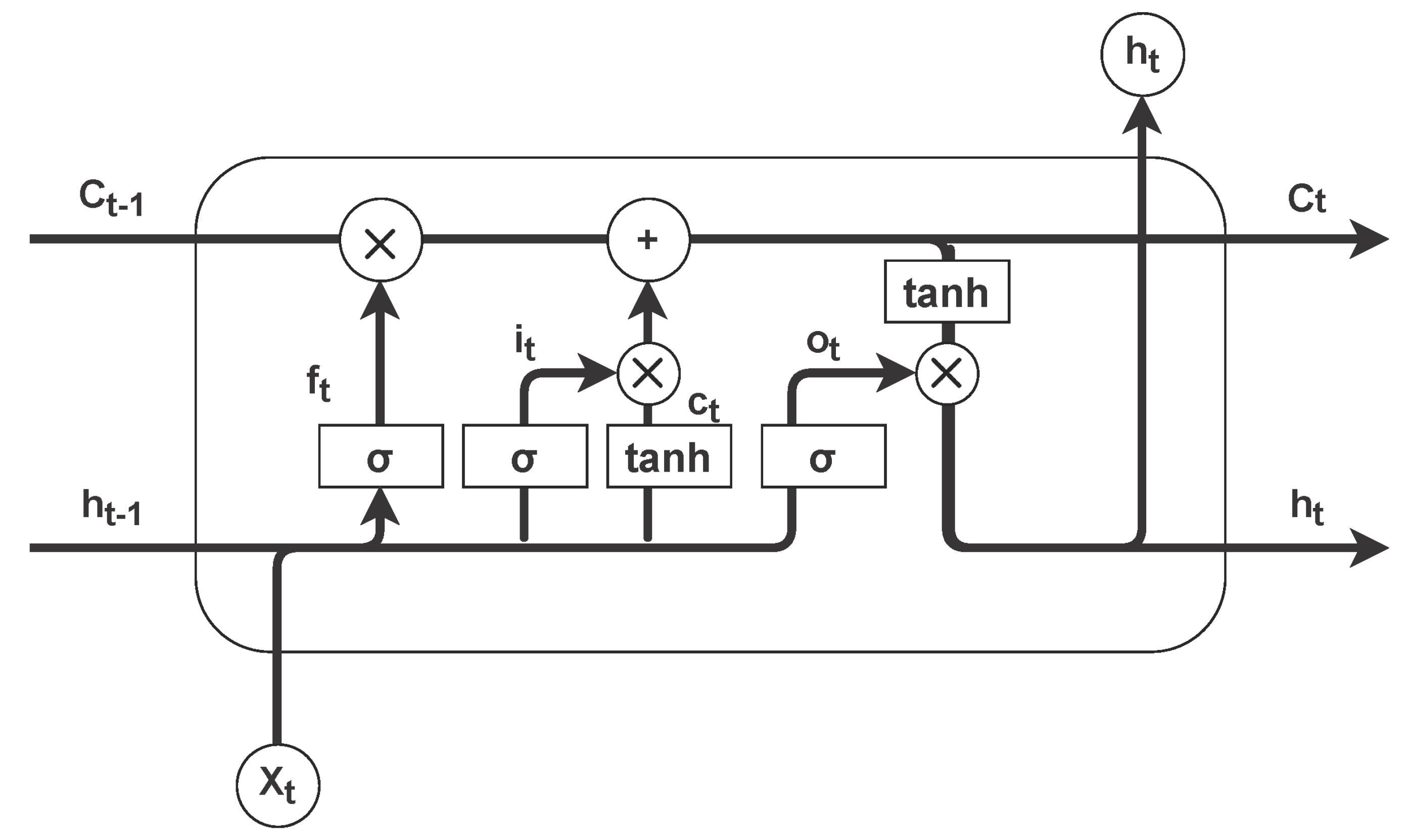
To address the limitations of standard RNNs, long short-term memory (LSTM) networks introduce gating mechanisms that regulate information flow and preserve long-term temporal patterns. The LSTM architecture (Figure 3) uses three gates—forget, input, and output—to update an internal memory cell C t :
f t = σ ( W f [ h t 1 , x t ] + b f ) ,
i t = σ ( W i [ h t 1 , x t ] + b i ) ,
C ˜ t = tanh ( W c [ h t 1 , x t ] + b c ) ,
C t = f t C t 1 + i t C ˜ t ,
o t = σ ( W o [ h t 1 , x t ] + b o ) , h t = o t tanh ( C t ) ,
Here, the hidden state and cell state are denoted by h t and C t , respectively, and x t is the input vector at time step t. The gates f t , i t , and o t control forgetting, updating, and output, while C ˜ t denotes the candidate cell update. σ ( · ) is the sigmoid activation function and ⊙ denotes elementwise multiplication [40].

4.3.2. Gated Recurrent Unit Networks

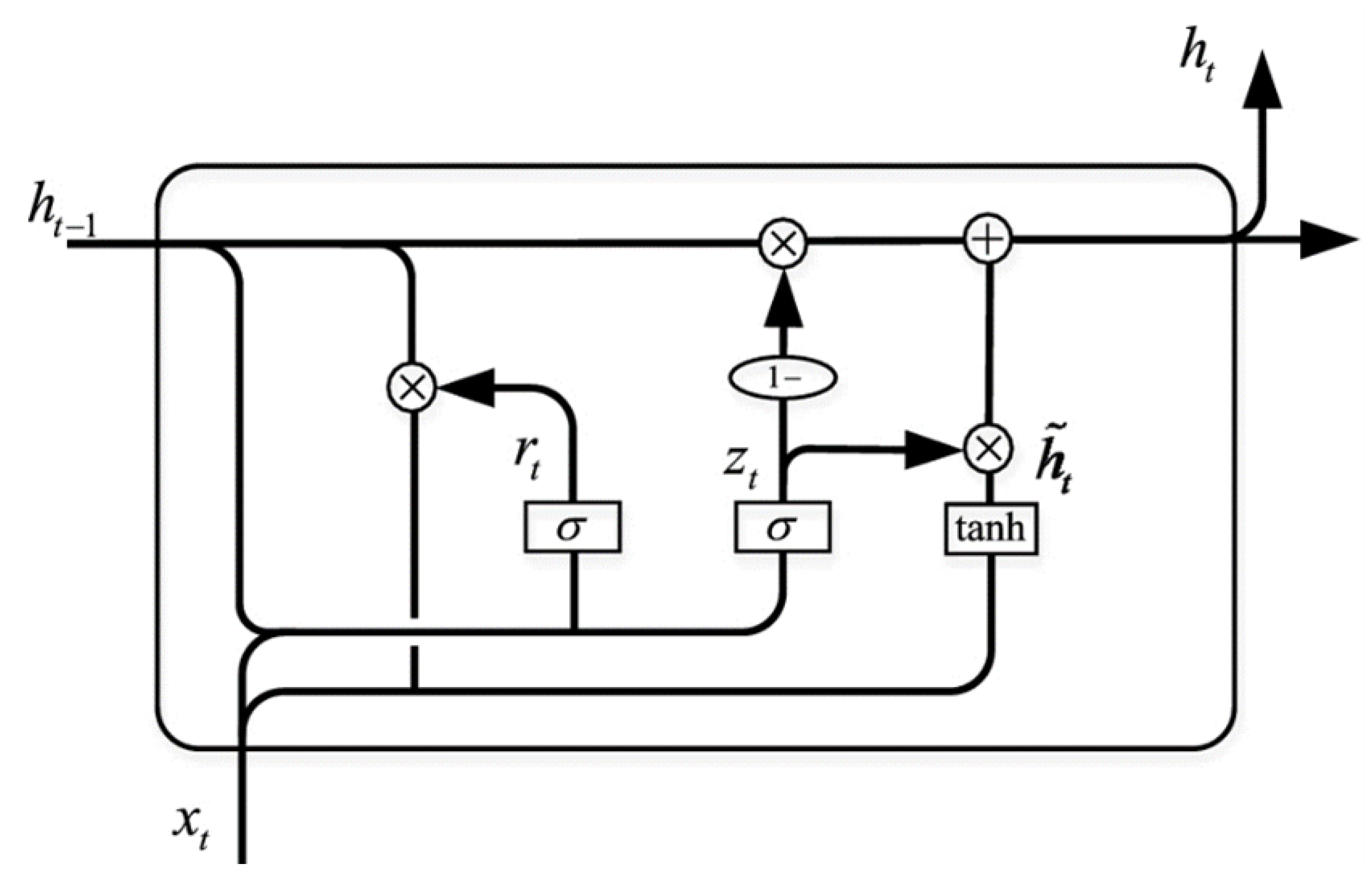
The gated recurrent unit (GRU), illustrated in Figure 4, simplifies the LSTM architecture by using a single state variable and two gates. GRUs compute their hidden state using:
z t = σ ( W z [ h t 1 , x t ] + b z ) ,
r t = σ ( W r [ h t 1 , x t ] + b r ) ,
h ˜ t = tanh ( W h [ r t h t 1 , x t ] + b h ) ,
h t = ( 1 z t ) h t 1 + z t h ˜ t ,
where x t is the input vector at time step t and h t is the GRU hidden state. The vectors z t and r t denote the update and reset gates, respectively, and h ˜ t is the candidate hidden state [39].

4.3.3. Temporal Convolutional Networks

Temporal convolutional networks (TCNs) offer an alternative to recurrent architectures by applying one-dimensional dilated convolutions to capture long-range dependencies without recursion:
h t = k = 0 K 1 W k x t d · k ,
where d denotes the dilation factor and K the kernel size [41]. Unlike RNNs and LSTMs, TCNs process sequences in parallel, preserving causality through zero-padding while enabling efficient training on long temporal windows [42,43]. This property makes TCNs particularly valuable for high-frequency repayment data and real-time transaction streams where parallel computation and long-horizon forecasting are advantageous.

4.4. Convolutional and Hybrid Architectures

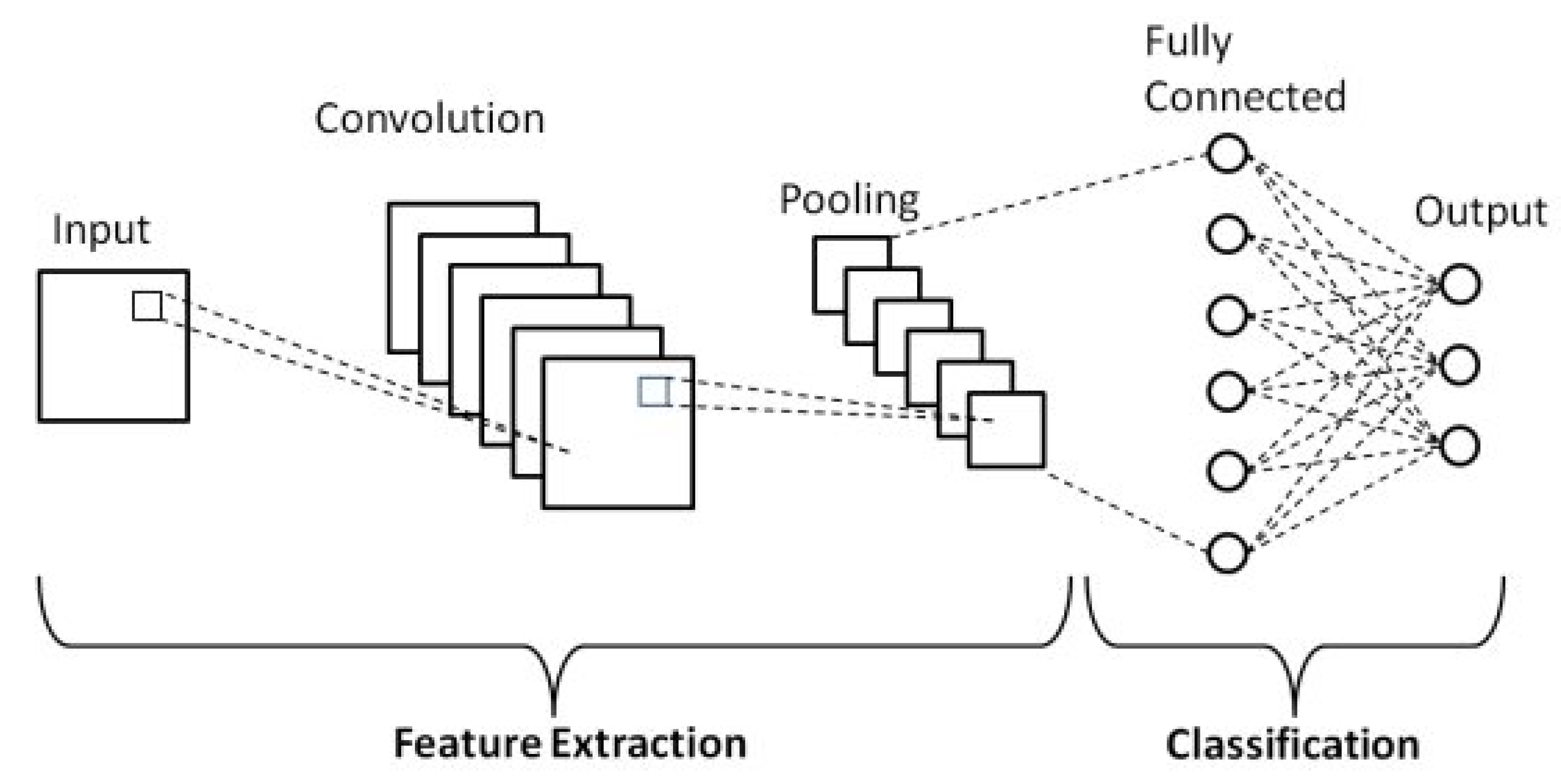
CNNs, though historically associated with image processing, have become effective tools for modelling structured financial sequences [44]. In credit risk, one-dimensional convolutions slide learnable filters over borrower histories—capturing local temporal patterns such as consecutive delinquencies, abrupt utilisation jumps, or irregular repayment intervals. These filters extract short-range behavioural motifs while sharing parameters across time steps, yielding models that are both computationally efficient and less prone to overfitting than dense architectures. Figure 5 illustrates this structure, where convolutional and pooling layers form hierarchical representations of borrower behaviour before classification.
Several studies report that CNN-based sequence encoders are competitive with recurrent architectures in credit-risk sequence modelling when local behavioural patterns dominate the signal, while offering faster training due to parallelism [44,45]. Their parallelism offers significant speed advantages for large portfolios, and their stable training dynamics make them well suited for industrial settings where rapid retraining and consistent convergence are required. This has motivated hybrid credit-risk models that integrate CNN modules with other deep architectures. Wide–deep networks combine a linear branch—reflecting scorecard-style interpretability—with nonlinear deep components that capture higher-order interactions. Other hybrids, such as CNN–LSTM and CNN–Transformer models, leverage convolutions to encode short-term behaviour before passing features to recurrent or attention-based layers to capture long-range dependencies. These designs offer a practical balance between interpretability, expressive capacity, and computational scalability, making them increasingly relevant in modern credit risk pipelines.

4.5. Transformer

Transformer architectures introduce a fundamentally different approach to modelling sequence and tabular credit data by replacing recurrence with self-attention, enabling the capture of global dependencies in parallel rather than stepwise [46]. Instead of processing borrower histories chronologically, as RNNs do, the transformer computes pairwise interactions across all feature dimensions or time steps simultaneously. The core self-attention mechanism is defined as:
Attention ( Q , K , V ) = softmax Q K d k V ,
where Q, K, and V denote the query, key, and value matrices representing latent projections of input features or time steps, and d k is a scaling constant to stabilise gradients. This formulation enables the model to assign adaptive relevance weights across the entire behavioural sequence, allowing it to capture long-range delinquency signatures, cyclical utilisation trends, and cross-feature interactions that traditional recurrent networks struggle to retain.
Recent adaptations demonstrate how transformers can be repurposed from natural language processing to structured financial learning. TabTransformer [47] contextualises categorical embeddings, improving discrimination on tabular credit datasets with high-cardinality socio-economic attributes.

4.6. Graph Neural Networks

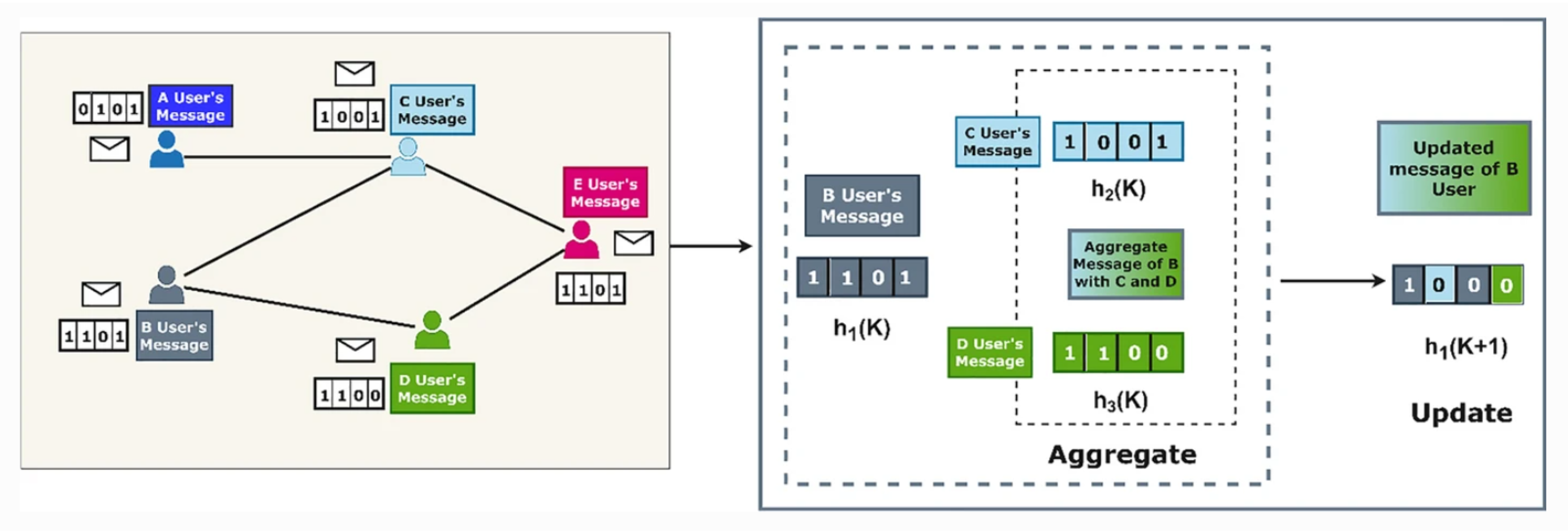
Borrowers often participate in interdependent financial ecosystems through co-applicant ties, shared employers, guarantor structures, fund-flow relationships, or supply-chain linkages. These relational patterns give rise to correlated credit exposures and potential contagion pathways that cannot be represented in i.i.d. tabular data. Graph neural networks (GNNs) model such relational dependencies via iterative message passing, where each node updates its representation by aggregating transformed messages from neighbouring nodes. The generic update rule for a message-passing layer is expressed as
h v ( l + 1 ) = σ u N ( v ) 1 c v u W ( l ) h u ( l ) ,
where h v ( l ) is the embedding of borrower v at layer l, N ( v ) denotes neighbouring nodes (e.g., borrowers, firms, accounts, or counterparties connected through ownership, transactions, or contractual ties), c v u is a normalisation coefficient (e.g., node degree), W ( l ) is a learnable weight transform, and σ ( · ) is a nonlinear activation. Figure 6 visualises this pipeline: neighbours send learned messages, the messages are pooled, and the central borrower embedding is updated to reflect relational credit risk factors.
Table 3 summarises the various DL architectures for credit risk modelling.

5. Notable DL Applications in Peer-Reviewed Credit Risk Studies

This section synthesises peer-reviewed applications of deep learning to credit risk. We map empirical studies to the same three axes: modality, architecture, and objective, and report the evaluation metrics they used and the quantitative performance obtained.

5.1. Tabular Deep Networks for Credit Risk

Deep learning for tabular borrower data has evolved from simple multilayer perceptrons (MLPs) to specialised architectures that leverage regularisation, attention, embeddings, and hybrid ensembling. This subsection reviews representative studies that apply deep tabular models to corporate, retail, and institutional lending data, highlighting methodological contributions, empirical findings, and comparative performance relative to conventional ML models.
Yang et al. [48] proposed a high-dimensional deep neural network (HDNN) for corporate credit risk using supply-chain augmented financial data. Their model incorporated combined L1–L2 penalties to address feature sparsity and batch-normalisation effects, achieving an accuracy of 80.12%, outperforming logistic regression (area under the receiver operating characteristic curve (AUC) = 0.717), support vector machines (AUC = 0.738), and a standard neural network baseline (AUC = 0.692). Lin et al. [49] introduced a penalised deep neural network (PDNN) based on survival modelling, embedding a one-to-one penalisation layer that supported variable selection alongside time-to-default estimation on peer-to-peer lending data, consistently outperforming non-penalised deep variants.
Recent studies have further examined interpretability and profit-aware optimisation within deep tabular learning. Asencios et al. [50] compared MLP, XGBoost, and TabNet on 36,402 Peruvian cooperative-lending applications using regression-based profit scoring. XGBoost achieved the best results ( R 2 = 0.7906 ), although TabNet ( R 2 = 0.7465 ) offered more transparent feature-level interpretability through attentive embeddings. In large-scale settings, Wang and Zhang [51] proposed a TabNet-Stacking ensemble that integrated TabNet, XGBoost, LightGBM, CatBoost, SVM, and KNN, reaching accuracy = 0.979, recall = 0.856, F1 = 0.817, and AUC = 0.941 on the Tianchi dataset (≈800,000 cases), substantially outperforming single-model baselines.
Beyond architecture design, explainability has become central to tabular deep learning deployment. Hjelkrem and de Lange [52] trained an MLP using open banking transaction data and compared it with a bidirectional encoder representations from transformers (BERT)-based model, reporting that the MLP achieved superior predictive performance while maintaining practical explainability using SHAP attribution visualisations. Their results showed that SHAP detected intuitive behavioural risk factors, supporting suitability for regulated financial settings. Li et al. [53] introduced an incremental DNN (I-DNN) for borrower credit scoring on agricultural microloan records (22,475 examples), demonstrating AUC improvements ranging between 1.4% and 7.8% compared with standard DNN, XGBoost, and random forest baselines under concept drift scenarios.
Advances in deep tabular modelling have also explored ensemble-driven generalisation. Popov et al. [54] introduced Neural Oblivious Decision Ensembles (NODE), replacing discrete tree splits with differentiable soft-gating, producing competitive performance with gradient boosting while enhancing differentiability and calibration under stochastic optimisation. Building on ensemble reasoning, Shan and Gao [55] proposed an enhanced TabNet stacking model for SME supply-chain financial risk prediction using multi-stage optimisation, achieving AUC = 0.9616 and Accuracy = 0.9277, outperforming standard TabNet, LightGBM, and CatBoost baselines.
These works demonstrate that tabular DL has advanced from simple feed-forward networks toward architectures that integrate regularization, attention, and ensemble learning. Overall, these studies suggest that deep tabular models are often competitive with strong tree-based ensembles on larger datasets, particularly when the feature space includes high-cardinality categorical variables, complex interactions, or multimodal extensions that benefit from representation learning. On smaller benchmarks, reported gains are frequently modest and can be sensitive to split design and tuning, meaning gradient boosting remains a strong and frequently hard-to-beat baseline. Deep networks therefore complement rather than replace classical methods, with their main advantage arising when data scale, heterogeneity, or unified multimodal pipelines justify the added modelling and operational complexity.

5.2. Sequential Models and Event–Time Targets

Sequential deep learning approaches model the evolution of borrower or portfolio behaviour over time, offering substantial advantages over static classifiers that ignore risk trajectories. These models capture temporal patterns linked to repayment behaviour, behavioural drifts, cyclical spending, macroeconomic shocks, and post-origination delinquency paths. Compared with conventional panel regression and tree-based models, sequential architectures integrate information across ordered observations and enable dynamic probability-of-default estimation rather than static, single-point predictions.
Liang and Cai [56] applied long short-term memory (LSTM) networks to forecast monthly default rates on the Lending Club peer-to-peer platform. The LSTM consistently outperformed ARIMA, SVM, and ANN across multiple cross-validation schemes, reducing MAE from 0.095 to 0.072 and RMSE from 0.119 to 0.093 . Further support for recurrent credit modelling appears in Ala’raj et al. [57], who developed two behavioural LSTM variants (MP–LSTM and PE–LSTM) for real retail banking credit card customers. Their models surpassed SVM, RF, MLP, and LR baselines across predictive and calibration metrics, demonstrating that temporal representation learning enhances behavioural default scoring in operational settings.
Beyond standard LSTMs, hybrid deep temporal architectures have gained prominence. Zhang [58] proposed a CNN–LSTM attention model for enterprise credit risk, achieving AUC = 0.92 and F1 = 0.91 , outperforming CNN- and LSTM-only baselines. Li et al. [59] extended this approach for listed corporate risk and reported that CNN layers effectively extract short-term temporal motifs, while LSTM components encode longer behavioural transitions, confirming that hierarchical temporal modelling improves enterprise credit discrimination.
Survival-driven architectures further generalise temporal credit modelling by estimating hazard rather than static outcomes. Wang et al. [60] implemented a deep discrete-time survival model that decomposes credit outcomes into age, period, and cohort dimensions, generating interpretable hazard curves with a smoother temporal structure than classical econometric approaches. Chen and Long [61] similarly advanced temporal modelling through a self-attention-based end-to-end corporate credit rating framework, which removed the need for manual feature aggregation and improved rating classification stability relative to traditional ML competitors.
More recent developments incorporate fusion and cross-feature interaction within sequential networks. Han et al. [62] introduced a default-prediction framework combining self-attention with a cross-network mechanism, demonstrating that modelling interactive temporal dependencies yields higher accuracy, precision, recall, and F1-score relative to standard deep learning architectures. Shi et al. [63] also benchmarked CNN, RNN, and DNN models in financial-sector credit scoring and observed that recurrent architectures maintained superior temporal sensitivity, while CNNs provided parameter efficiency benefits.
Bidirectional and residual-enhanced architectures have been explored to stabilise recurrent training and preserve long-range gradients. Yang et al. [64] introduced a residual-enhanced bidirectional long short-term memory (BiLSTM) framework incorporating multi-head attention, achieving AUC = 0.982 and F1 = 0.958 on the Freddie Mac Single-Family dataset, outperforming BiLSTM, GRU, CNN, and RNN baselines. Complementary research explores coupling sequential encoders with probabilistic reasoning: Zhang [65] integrated LSTM encoders with Bayesian calibration modules, achieving AUC = 0.981 and reducing uncertainty miscalibration relative to RF and LR baselines.
These results indicate that sequential architectures are most valuable when lenders possess rich post-origination histories or portfolio-level time series and care about how risk evolves, not just whether a borrower eventually defaults. LSTM- and GRU-like models offer clear gains for dynamic behavioural scoring and vintage-level forecasting, while CNN–LSTM hybrids and survival-based networks help bridge the gap between point predictions and time-to-event outcomes. However, the empirical lift over strong tabular baselines tends to appear only when sequences are sufficiently long and informative; on static benchmarks with limited behavioural content, sequential models mainly add complexity without delivering commensurate practical benefit.

5.3. Transformer-Based Models for Credit Risk

Transformers represent a major departure from recurrent architectures by replacing sequential recurrence with self-attention, enabling parallel computation and global dependency modelling across features, time steps, or modalities [46]. The key mechanism, scaled dot-product attention, allows each element in a sequence or feature vector to condition on all others, overcoming long-term dependency limitations typical of LSTMs and GRUs. This property is attractive in credit modelling, where behavioural variables, categorical features, and text-based signals interact in complex, non-local patterns.
Early adoption has focused on adapting the transformer encoder to tabular and behavioural credit data. Huang et al. [47] introduced the TabTransformer, demonstrating performance gains on high-cardinality categorical financial datasets by replacing conventional one-hot encodings with contextual embeddings. Gorishniy et al. [66] later improved architectural efficiency with the FT-Transformer, showing that attention-based tabular models can be competitive with strong tree-ensemble baselines such as CatBoost and XGBoost on several tabular tasks, particularly when feature interactions are complex and heterogeneously distributed. Wang and Xiao [67] extended this paradigm by embedding behavioural sequences alongside static features, achieving AUC = 0.72 and KS = 0.32 on an online lending dataset, outperforming both LSTM and XGBoost baselines.
Recent work has started to specialise transformer architectures for different segments of the credit market. Korangi et al. [68] framed mid-cap corporate default prediction as a multi-label panel classification task, using a transformer to learn the term structure of default probabilities over horizons from a few months to three years. Their multi-channel design ingests accounting, pricing, and market variables and applies a task-specific loss for multi-horizon default prediction, yielding sizeable AUC improvements over traditional statistical and LSTM-based benchmarks. Li et al. [69] proposed HFTCRNet, a hierarchical fusion transformer for interbank credit rating and systemic risk assessment. The model combines a long-term temporal transformer for bank growth trajectories, a short-term cross-graph transformer for dynamic interbank exposures, and an attentive contagion module, trained in a semi-supervised fashion using both credit ratings and SRISK labels. On a dataset of 4548 banks with quarterly balance sheets and network data, HFTCRNet outperformed deep and non-deep baselines in rating accuracy while also capturing systemic risk patterns in the interbank network.
In the retail and SME space, transformer-based models have been applied to both tabular and sequential credit signals. Kakadiya et al. [70] investigated transformer architectures for bank loan default prediction and reported performance gains over logistic regression and tree-based methods, arguing that self-attention captures higher-order dependencies among financial variables that are missed by conventional models. Zhang and Liang [71] proposed a minimum weighted value error combination model that integrates a BERT-based transformer for temporal features with DNN and MLP components for static, non-sequential attributes. Features are first selected using chi-square tests and gradient boosting decision trees, and the final prediction is obtained by dynamically weighting the sequence and non-sequence experts according to an improved minimum weighted error criterion. Experiments on personal credit data showed that the combined model achieves higher classification accuracy than any individual transformer or feed-forward baseline.
Addressing class imbalance and transparency, Hartomo et al. [72] introduced a weighted-loss TabTransformer with integrated explainable AI for MSME and consumer credit datasets. Using cost-sensitive weighting, their model improved accuracy on the BISAID and German Credit datasets from 86.35% to 89.27% and from 93% to 95%, respectively, while also boosting minority-class AUC and precision–recall. SHAP-based explanations highlighted economically meaningful drivers such as financing needs and credit amount, illustrating how attention-based tabular models can be combined with explainable AI (XAI) to support more accountable decision-making. Wu [73] developed a BiLSTM-fused transformer for enterprise financial risk identification within a blockchain-based financial sharing platform. The model jointly processes textual and visual financial information to classify firms into five risk levels and, in experiments, achieved risk identification accuracy above 94% with AUC exceeding 0.95, outperforming baseline RNNs while operating on securely shared financial records.
Textual transformers have also gained prominence where loan assessments, credit memos, and SME narratives remain human-authored. Stevenson et al. [74] showed that BERT-derived embeddings from lender-written documents produced competitive default prediction results without structured data. Lu et al. [75] extended BERT embeddings into a hybrid architecture with residual blocks to fuse textual and numeric signals for corporate credit. This trend aligns with regulatory interest in leveraging unstructured and semi-structured disclosures rather than purely tabular indicators.
A frontier research area involves transformer robustness, adversarial safety, and regulatory alignment. Schwab and Kriebel [76] demonstrated that transformer encoders can be sensitive to adversarial perturbations and proposed gradient-based regularisation defenses. Given that financial systems are highly sensitive to stability and fairness, future deployments of transformers must incorporate calibration diagnostics, imbalance-aware loss functions, explainability tooling, and context-aware adversarial safeguards.
The recent contributions indicate that transformers are moving from experimental architectures to practical candidates for large-scale, multimodal, and system-level credit risk models. Their main advantage lies not only in predictive lift but also in their ability to unify behavioural sequences, categorical embeddings, textual narratives, interbank networks, and graph-structured relationships within a single modelling interface, while increasingly accommodating class imbalance, interpretability, and systemic risk considerations.
The emerging evidence suggests that transformers are most promising in settings where credit risk depends on high-dimensional, heterogeneous, or multimodal signals that interact in non-local ways. Self-attention is particularly effective when modelling the joint influence of long repayment histories, bureau or transactional text, and rich categorical attributes, and it enables a single architecture to operate across these modalities. At the same time, transformers typically require larger training datasets, more parameters, and longer training times than conventional models, and the number of truly large-scale, production-grade credit studies is still small. In practice, they should be viewed as candidates for portfolios with abundant data and complex interactions, rather than as drop-in replacements for tree ensembles or recurrent networks on small tabular datasets.

5.4. Graph Neural Networks for Relational Credit Risk

Graph neural networks (GNNs) have gained significant traction for credit risk prediction due to their ability to encode relational dependencies that conventional tabular and sequential models ignore. Borrowers interact within rich financial ecosystems involving co-application, ownership links, shared directorship, supplier–customer contracts, and transaction flows, making relational learning a natural extension to deep credit scoring. Unlike feed-forward or recurrent architectures that assume independent records, GNNs perform iterative message passing, enabling representation learning that captures both direct and indirect risk propagation across financial networks.
Wang et al. [77] construct small and medium enterprise (SME) relational graphs using shared director and business-interaction information and apply a relational graph attention network (RGAT) for default prediction. Their inductive testing protocol shows that graph baselines such as graph convolutional network (GCN), graph attention network (GAT), and relational GCN (RGCN) outperform non-graph models, with RGAT achieving AUC = 0.797 and KS = 0.457 , while a multi-head extension reaches AUC = 0.799 and KS = 0.528 . The results demonstrate that relational signals remain predictive even without transactional features. Similarly, Song et al. [78] proposed the multi-structure cascaded GNN (MS-CGNN), integrating pairwise graphs with heterogeneous hypergraph structures to model higher-order interactions. The method achieved Recall = 0.8863 , Accuracy = 0.9442 , and F1-score = 0.9300 , outperforming several GNN baselines and confirming that multi-level topology strengthens risk representation.
Temporal and behavioural dynamics have also been incorporated into graph modelling. Yuan et al. [79] introduce DGNN-SR, which fuses static fund-transfer graphs with dynamic user–merchant payment graphs using multi-view time encoders. Experiments on Tencent datasets containing more than 2.8M nodes and 200M edges show AUC improvements between 0.85 % and 2.5 % over the best continuous-time GNN baselines. From a supply-chain financing perspective, Mojdehi et al. [80] combine topological data analysis with GNNs (BM–GNN), attaining maximum accuracy of 93.56 % across multiple scenarios while consistently outperforming classical ML models in stability and robustness, despite similar point-estimate accuracy on some subsets.
Recent work has emphasised higher-order graph structures, regulatory alignment, and training stability. Wang et al. [81] proposed a motif-preserving GNN with curriculum learning to capture subgraph patterns frequently observed in enterprise networks, demonstrating improved performance across one public and two industrial datasets. The curriculum design helped mitigate convergence instability arising from noisy relational substructures. In another direction, Liu et al. [82] constructed enterprise credit graphs using a maximum spanning tree derived from 29 financial indicators and applied GraphSAGE to multi-level credit grading. Their results confirmed higher ROC values than tree-based and neural baselines, despite using a sparse graph, highlighting the value of relational inductive bias even in limited-connectivity settings.
Scalability has become a core evaluation criterion for real-world deployment. Zhang et al. [83] developed a large-scale industrial GNN pipeline comprising 23.4M nodes for supply-chain mining and 8.6M nodes for default prediction. Their model achieved AUC = 0.995 on supply-chain tie mining and 0.701 on loan-default prediction, outperforming static graph-learning competitors and demonstrating that GNNs can operate at web-scale for national credit infrastructure. Furthermore, Cheng and Luo [84] propose a metapath-driven risk contagion GNN (RCGNN) using heterogeneous paths (investment, geography, and industry), reporting superior performance to homogeneous GNNs for enterprise credit classification, although detailed metrics were not published.
Overall, GNN-based credit models are most compelling when relational structure is intrinsic to the risk problem, such as SME supply chains, interbank exposures, enterprise ownership networks, or fund-transfer graphs. In these environments, message passing captures contagion and correlated risk that tabular or sequential models are structurally unable to represent, and the empirical studies show consistent gains in discrimination and stability under sparse or noisy features. The trade-off is engineering complexity: constructing, maintaining, and governing large-scale financial graphs is non-trivial, and the marginal benefit of GNNs is limited when relational information is weak or unavailable. Consequently, GNNs are best viewed as targeted tools for systemically interconnected portfolios rather than as universal replacements for borrower-level scorecards.
Table 4 consolidates the peer-reviewed deep learning applications discussed in this section, grouped by model family for readability and direct linkage to the preceding subsections. Reported metrics and values are reproduced as stated in the source studies and are not standardised across datasets, targets, horizons, or label definitions, which limits direct cross-paper comparability.

6. Challenges, Limitations, and Future Research Directions

Deep learning can improve risk discrimination, but deploying such models in regulated credit environments introduces constraints that go beyond accuracy. This section summarises the main challenges and then distils research directions aimed at trustworthy, regulation-ready credit risk modelling.

6.1. Challenges and Limitations

6.1.1. Evaluation Integrity

Credit risk evolves over time in response to behavioural, policy, and macroeconomic shifts, making random k-fold cross-validation prone to temporal leakage. When observations from later periods appear in both training and test folds, performance estimates can implicitly rely on future information that would not be available at decision time. Time-ordered evaluation schemes, including out-of-time splits and rolling-origin validation in which the training window strictly precedes the evaluation window, provide a more faithful estimate of deployment performance under regime change and stress conditions [85]. However, a non-trivial portion of deep credit risk studies still relies on random splits, weakening external validity and complicating comparisons across model families.
A second source of fragility is over-reliance on threshold-agnostic summary metrics such as AUC, which aggregate performance across all score cut-offs and can mask behaviour in the operating region where lending decisions are actually made. In highly imbalanced portfolios, complementary measures such as the area under the precision–recall curve (AUPRC) and cost-sensitive metrics better reflect minority-class performance and the economic consequences of misclassification [33]. Equally important, probability calibration is rarely assessed, despite being central to decisioning and risk quantification: poorly calibrated scores can lead to unstable approval rates, mis-priced credit, and biased downstream estimates of portfolio risk, even when ranking performance (AUC) improves. Calibration-sensitive reporting using the Brier score and expected calibration error, together with reliability diagrams, provides direct evidence of whether predicted probabilities match observed default frequencies [86]. When miscalibration is detected, post hoc methods such as Platt scaling, isotonic regression, and temperature scaling can improve alignment between predicted and empirical default rates [87], but these steps are seldom documented in deep credit risk papers.
Finally, decision-facing evaluation should make explicit how metrics map to lending outcomes. For PD-style models, this includes reporting performance at operationally relevant thresholds and, where inputs are available, quantifying utility using simple cost proxies (false-approval loss versus false-rejection opportunity cost) or by propagating calibrated PD into downstream loss constructs (e.g., EL-style estimates), while acknowledging that EL is not comparable across heterogeneous datasets and recovery definitions. These considerations jointly form a de facto evaluation checklist for deployment-aligned credit risk modelling.

6.1.2. Imbalanced Learning and Reject Inference

Default datasets are heavily imbalanced, and naïve resampling can distort temporal and behavioural structure. Over-sampling techniques such as SMOTE are often applied indiscriminately without temporal safeguards, while cost-sensitive learning better reflects economic risk but is infrequently employed [88,89]. A further complication is reject inference: declined applicants lack observed outcomes, leading to structurally biased training data and unreliable generalisation [28,90,91]. Observed outcomes are conditional on acceptance policies, leading to sample-selection bias that inflates apparent model performance when applied to rejected populations. Existing proxy-based inference methods remain heuristic and are not aligned with regulatory transparency expectations.

6.1.3. Interpretability and Fairness

Although deep models improve predictive power, their opacity conflicts with regulatory explainability requirements. Post hoc explanation tools, including SHAP and integrated gradients, may not provide stable, counterfactual-faithful explanations [92]. In practice, the appropriate explanation tool depends on the model family and the decision artefact being justified: for MLP-style tabular networks, feature attribution methods and monotonic or sparse constraints can support reasoned factor narratives; for tree-like baselines and tree–neural hybrids, TreeSHAP-style decompositions often provide the most auditable feature-level breakdown; for transformer-based credit models, attribution over token/feature embeddings (with attention used as a supportive diagnostic rather than a standalone explanation) is typically more reliable than raw attention maps; and for GNN-based credit models, subgraph- or message-passing explanations can localise which relations drive a risk score.
Fairness is also inconsistently operationalised in the DL credit-risk literature. Metrics such as equalised odds [93] are rarely integrated into training objectives, despite evidence that automated lending can amplify existing socio-economic inequalities. Fairness targets are context dependent: demographic parity may be inappropriate when base rates differ for legitimate reasons, whereas error-rate constraints such as equalised odds may be more suitable when the aim is to control differential misclassification harms. Accordingly, the selected fairness definition should be justified relative to the lending decision, the attributes available for monitoring, and the governing legal regime, and it should be assessed alongside model calibration and operating-threshold behaviour. Counterfactual explanation approaches remain promising, but deployment at scale is often hindered by feasibility constraints and by the need to ensure plausibility under real credit policy and data-generating processes [94].
Among the surveyed deep learning studies, only a small subset explicitly incorporates post hoc explainability tools or fairness metrics, and even fewer optimise fairness-aware objectives during training, which shows the gap between regulatory aspirations and current practice.

6.1.4. Robustness and Privacy

Deep learning models are sensitive to concept drift caused by macroeconomic shocks, behavioural changes, and portfolio rebalancing, leading to calibration decay over time [95]. Existing studies seldom incorporate drift-aware retraining or automated change detection. For deployment-aligned robustness, studies should distinguish (i) temporal drift (vintage and macro shifts), (ii) population drift (portfolio mix changes), and (iii) label/definition drift (policy or collections-rule changes), and then evaluate mitigation using time-ordered backtests rather than random re-sampling. Operationally, this translates to monitoring both discrimination and calibration over time (e.g., AUC/AUPRC alongside Brier/ECE), triggering review when calibration deviates materially even if ranking metrics appear stable.
At the same time, sharing granular data across institutions introduces privacy and confidentiality constraints. Differentially private training and synthetic data generation partially address these limitations but introduce accuracy trade-offs. Where collaboration is required, privacy-preserving learning should be framed as an end-to-end design choice (e.g., federated training with secure aggregation, differential privacy with documented privacy budgets, or controlled synthetic-data release), accompanied by utility and bias testing to show what decision quality is lost or retained under privacy constraints.

6.1.5. Operational Deployment and Governance

Operational success requires structured machine learning operations (MLOps) pipelines with versioning, lineage tracking, monitoring, and challenger-champion testing. Without these, systems accumulate technical debt that weakens compliance and undermines model lifecycle management [96]. In regulated credit settings, deployment discipline is typically enforced through a model risk management workflow that makes each stage auditable: reproducible feature pipelines, immutable training and evaluation datasets, signed model artefacts, and traceable decision records that link every production score to a specific model version and data snapshot. A common rollout pattern is staged release, in which a candidate model first passes offline backtesting, then runs in shadow scoring (producing scores without affecting approvals), and only then progresses to limited exposure with pre-defined promotion gates based on calibration, drift, and stability checks. These gates reduce failures that frequently occur in practice, such as silent calibration decay after policy or collections-rule changes, performance drops under macroeconomic regime shifts, and inconsistent feature computation between training and serving.
Moreover, existing governance artefacts, including datasheets and model cards, are rarely integrated with regulatory processes such as Basel III, SR 11-7, or the EU AI Act, reducing organisational readiness for external audit. To make interpretability and fairness operational rather than ad hoc, explanation and bias-assessment outputs should be generated automatically per model version within the CI/CD workflow and stored as part of the model evidence pack. Concretely, this means logging (i) global and local explanation artefacts aligned with the deployed model family, (ii) fairness reports computed on the production decision population (and, where feasible, on approved-outcome populations), and (iii) monitoring dashboards that track both discrimination and calibration over time. When exceptions occur (e.g., manual overrides, policy-driven rule changes, or temporary risk controls), the governance layer should record the override rationale and its impact on observed outcomes so that future retraining does not unknowingly encode short-term interventions as predictive signals.

6.2. Future Research Directions

Future research should adopt evaluation frameworks that reflect realistic data-generating processes, including temporally constrained train-test splits, multi-horizon performance tracking, and calibration-aware reporting. This includes benchmarking on large-scale, longitudinal datasets with explicit temporal structure and economic annotations, enabling fair comparison across model families and reducing over-optimism associated with small public datasets. Moreover, future work should prioritise cost-aligned performance reporting, where model utility is quantified in terms of expected loss reduction, capital efficiency, default timing, and resilience across macroeconomic stress regimes (Table 5).
Another direction is the development of learning objectives that integrate fairness, interpretability, and economic cost at training time rather than relying on post hoc adjustment. Interpretable-by-design architectures, monotonic neural networks, sparse attention mechanisms, and hybrid symbolic-neural models can provide greater regulatory compatibility while retaining feature interaction capacity. Causal fairness, adversarial debiasing, and counterfactual training pipelines represent promising frameworks for mitigating disparate impact without suppressing predictive power.
Research should also focus on designing models that adapt under uncertainty while maintaining stability guarantees. Drift-aware architectures, online continual learning mechanisms, uncertainty-calibrated predictions, and stress-testing under macroeconomic scenario simulation may improve long-term reliability. Privacy-preserving collaborative learning, through federated optimisation, secure multiparty computation, and high-fidelity synthetic digital twins, would enable cross-institutional learning while respecting confidentiality and regulation. This agenda also requires governance and regulatory alignment for cross-institutional data sharing, including clear accountability for consent, access control, retention, and auditability. Similarly, synthetic data should be governed with documented generation protocols, privacy-risk testing, and downstream-use restrictions to avoid leakage and unwarranted reliance in regulated decision-making.
Finally, there is a need for deployment-aligned governance frameworks that standardise model documentation, monitoring, and auditability. Integrated pipelines that combine MLOps with regulatory artefacts, such as model cards linked to validation logs and challenger-champion performance trails, could accelerate institutional trust and reduce compliance costs. Long-term progress will require systems that are not only more accurate, but also certifiably fair, transparent, and robust—making deep learning suitable for production-grade financial risk management.

7. Conclusions

This survey reviewed deep learning methods for credit risk prediction across tabular, sequential, transformer-based, and graph-structured settings. By organising existing research through a unified taxonomy that links model families to data structures and credit-risk objectives, the survey provides conceptual clarity on when and why specific architectures are appropriate. Across the peer-reviewed evidence, deep models tend to outperform traditional scorecard and ensemble methods when trained on sufficiently large, temporally representative datasets with rich behavioural and relational information.
However, the literature also reveals gaps that constrain reliable real-world adoption. Reporting standards are inconsistent, with limited use of temporally valid evaluation, calibration metrics, and cost-aligned performance reporting. Interpretability and fairness are often treated as add-ons rather than requirements, and robustness under concept drift, data-sharing constraints, and operational governance remains weakly addressed, shifting success criteria toward predictive accuracy rather than lifecycle reliability and auditability.
Future work should therefore prioritise deployment-aligned research: interpretable-by-design modelling, temporally realistic benchmarks, fairness strategies grounded in the decision and legal context, privacy-preserving collaborative learning, and governance-ready monitoring and documentation pipelines. This survey is limited to peer-reviewed English-language studies indexed in major databases and does not cover proprietary implementations or regulatory grey literature; future syntheses could extend the evidence base using secure-access supervisory data or meta-analyses where study designs and outcomes are sufficiently comparable.

Author Contributions

Conceptualisation, I.D.M., E.E. and C.M.; methodology, I.D.M., E.E. and C.M.; validation, I.D.M., E.E. and C.M.; investigation, I.D.M., E.E. and C.M.; writing—original draft preparation, I.D.M.; writing—review and editing, I.D.M., E.E. and C.M.; visualisation, I.D.M., E.E. and C.M.; supervision, E.E. and C.M. All authors have read and agreed to the published version of the manuscript.

Funding

This research received no external funding.

Institutional Review Board Statement

Not applicable.

Informed Consent Statement

Not applicable.

Data Availability Statement

No new data were created or analysed in this study. Data sharing is not applicable to this article.

Conflicts of Interest

The authors declare no conflicts of interest.

Abbreviations

The following abbreviations are used in this manuscript:
AIArtificial intelligence
AUCArea under the receiver operating characteristic curve
AUPRCArea under the precision–recall curve
CNNsConvolutional neural networks
DLDeep learning
EADExposure at default
ELExpected loss
GNNsGraph neural networks
GRUGated recurrent unit
HDNNHigh-dimensional deep neural network
I-DNNIncremental DNN
LGDLoss given default
LRLogistic regression
LSTMLong short-term memory
MLMachine learning
MLOpsMachine learning operations
MLPMulti-layer perceptron
MS-CGNNMulti-structure cascaded GNN
NODENeural Oblivious Decision Ensembles
PDProbability of default
PDNNPenalised deep neural network
RNNsRecurrent neural networks
RWARisk-weighted asset
SMESmall and medium enterprise
SVMsSupport vector machines
TCNsTemporal convolutional networks
XAIExplainable AI

References

  1. Zhu, Y.; Wu, D. P2P credit risk management with KG-GNN: A knowledge graph and graph neural network-based approach. J. Oper. Res. Soc. 2025, 76, 866–880. [Google Scholar] [CrossRef]
  2. Alagic, A.; Zivic, N.; Kadusic, E.; Hamzic, D.; Hadzajlic, N.; Dizdarevic, M.; Selmanovic, E. Machine learning for an enhanced credit risk analysis: A comparative study of loan approval prediction models integrating mental health data. Mach. Learn. Knowl. Extr. 2024, 6, 53–77. [Google Scholar] [CrossRef]
  3. Karami, A.; Igbokwe, C. The impact of big data characteristics on credit risk assessment. Int. J. Data Sci. Anal. 2025, 20, 4239–4259. [Google Scholar] [CrossRef]
  4. Talaat, F.M.; Aljadani, A.; Badawy, M.; Elhosseini, M. Toward interpretable credit scoring: Integrating explainable artificial intelligence with deep learning for credit card default prediction. Neural Comput. Appl. 2024, 36, 4847–4865. [Google Scholar] [CrossRef]
  5. Aruleba, I.; Sun, Y. Effective credit risk prediction using ensemble classifiers with model explanation. IEEE Access 2024, 12, 115015–115025. [Google Scholar] [CrossRef]
  6. Machado, M.R.; Chen, D.T.; Osterrieder, J.R. An analytical approach to credit risk assessment using machine learning models. Decis. Anal. J. 2025, 16, 100605. [Google Scholar] [CrossRef]
  7. Tian, Z.; Xiao, J.; Feng, H.; Wei, Y. Credit risk assessment based on gradient boosting decision tree. Procedia Comput. Sci. 2020, 174, 150–160. [Google Scholar] [CrossRef]
  8. Aruleba, I.; Sun, Y. Enhanced credit risk prediction using deep learning and SMOTE-ENN resampling. Mach. Learn. Appl. 2025, 21, 100692. [Google Scholar] [CrossRef]
  9. Sun, P.; Jia, Y.; Shi, Y.; Ren, J.; Li, Z.; Li, X. Artificial Intelligence Credit Risk Assessment Model Based on MLP-Hybrid Clustering. Complexity 2025, 2025, 3308222. [Google Scholar] [CrossRef]
  10. Mienye, I.D.; Esenogho, E.; Modisane, C. Deep Reinforcement Learning in the Era of Foundation Models: A Survey. Computers 2026, 15, 40. [Google Scholar] [CrossRef]
  11. Bhatore, S.; Mohan, L.; Reddy, Y.R. Machine learning techniques for credit risk evaluation: A systematic literature review. J. Bank. Financ. Technol. 2020, 4, 111–138. [Google Scholar] [CrossRef]
  12. Shi, S.; Tse, R.; Luo, W.; D’Addona, S.; Pau, G. Machine learning-driven credit risk: A systemic review. Neural Comput. Appl. 2022, 34, 14327–14339. [Google Scholar] [CrossRef]
  13. Noriega, J.P.; Rivera, L.A.; Herrera, J.A. Machine learning for credit risk prediction: A systematic literature review. Data 2023, 8, 169. [Google Scholar] [CrossRef]
  14. Montevechi, A.A.; de Carvalho Miranda, R.; Medeiros, A.L.; Montevechi, J.A.B. Advancing credit risk modelling with Machine Learning: A comprehensive review of the state-of-the-art. Eng. Appl. Artif. Intell. 2024, 137, 109082. [Google Scholar] [CrossRef]
  15. Kim, H.; Cho, H.; Ryu, D. Corporate default predictions using machine learning: Literature review. Sustainability 2020, 12, 6325. [Google Scholar] [CrossRef]
  16. Çallı, B.A.; Coşkun, E. A longitudinal systematic review of credit risk assessment and credit default predictors. Sage Open 2021, 11, 21582440211061333. [Google Scholar] [CrossRef]
  17. Mhlanga, D. Financial inclusion in emerging economies: The application of machine learning and artificial intelligence in credit risk assessment. Int. J. Financ. Stud. 2021, 9, 39. [Google Scholar] [CrossRef]
  18. Hayashi, Y. Emerging trends in deep learning for credit scoring: A review. Electronics 2022, 11, 3181. [Google Scholar] [CrossRef]
  19. Peng, K.; Yan, G. A survey on deep learning for financial risk prediction. Quant. Financ. Econ. 2021, 5, 716–737. [Google Scholar] [CrossRef]
  20. Hoyos Gutiérrez, S.P.; Santos López, F.M. Credit Risk Assessment System Based on Deep Learning: A Systematic Literature Review. In Proceedings of the International Conference on Computer Science, Electronics and Industrial Engineering (CSEI); Springer: Berlin/Heidelberg, Germany, 2023; pp. 395–413. [Google Scholar]
  21. Demma Wube, H.; Zekarias Esubalew, S.; Fayiso Weldesellasie, F.; Girma Debelee, T. Deep learning and machine learning techniques for credit scoring: A review. In Proceedings of the Pan African Conference on Artificial Intelligence; Springer: Berlin/Heidelberg, Germany, 2024; pp. 30–61. [Google Scholar]
  22. Mienye, E.; Jere, N.; Obaido, G.; Mienye, I.D.; Aruleba, K. Deep Learning in Finance: A Survey of Applications and Techniques. AI 2024, 5, 2066–2091. [Google Scholar] [CrossRef]
  23. Valdrighi, G.; M Ribeiro, A.; SB Pereira, J.; Guardieiro, V.; Hendricks, A.; Miranda Filho, D.; Nieto Garcia, J.D.; F Bocca, F.; B Veronese, T.; Wanner, L.; et al. Best practices for responsible machine learning in credit scoring. Neural Comput. Appl. 2025, 37, 20781–20821. [Google Scholar] [CrossRef]
  24. Paz, Á.; Crawford, B.; Monfroy, E.; Barrera-García, J.; Peña Fritz, Á.; Soto, R.; Cisternas-Caneo, F.; Yáñez, A. Machine Learning and Metaheuristics Approach for Individual Credit Risk Assessment: A Systematic Literature Review. Biomimetics 2025, 10, 326. [Google Scholar] [CrossRef]
  25. Alvi, J.; Arif, I.; Nizam, K. Advancing financial resilience: A systematic review of default prediction models and future directions in credit risk management. Heliyon 2024, 10, e39770. [Google Scholar] [CrossRef]
  26. Bhattacharya, A.; Biswas, S.K.; Mandal, A. Credit risk evaluation: A comprehensive study. Multimed. Tools Appl. 2023, 82, 18217–18267. [Google Scholar] [CrossRef]
  27. Gunnarsson, B.R.; Vanden Broucke, S.; Baesens, B.; Óskarsdóttir, M.; Lemahieu, W. Deep learning for credit scoring: Do or don’t? Eur. J. Oper. Res. 2021, 295, 292–305. [Google Scholar] [CrossRef]
  28. Thomas, L.; Crook, J.; Edelman, D. Credit Scoring and Its Applications; SIAM: Philadelphia, PA, USA, 2017. [Google Scholar]
  29. Bandyopadhyay, A. Loan level loss given default (LGD) study of Indian banks. IIMB Manag. Rev. 2022, 34, 168–177. [Google Scholar] [CrossRef]
  30. Wattanawongwan, S.; Mues, C.; Okhrati, R.; Choudhry, T.; So, M.C. Modelling credit card exposure at default using vine copula quantile regression. Eur. J. Oper. Res. 2023, 311, 387–399. [Google Scholar] [CrossRef]
  31. Hofmann, H. Statlog (German Credit Data). UCI Machine Learning Repository. 1994. Available online: https://archive.ics.uci.edu/dataset/144/statlog+german+credit+data (accessed on 1 October 2025).
  32. Yeh, I.C.; Lien, C.H. The comparisons of data mining techniques for the predictive accuracy of probability of default of credit card clients. Expert Syst. Appl. 2009, 36, 2473–2480. [Google Scholar] [CrossRef]
  33. Lessmann, S.; Baesens, B.; Seow, H.V.; Thomas, L.C. Benchmarking state-of-the-art classification algorithms for credit scoring: An update of research. Eur. J. Oper. Res. 2015, 247, 124–136. [Google Scholar] [CrossRef]
  34. Montoya, A.; Inversion; KirillOdintsov; Kotek, M. Home Credit Default Risk. Kaggle. 2018. Available online: https://kaggle.com/competitions/home-credit-default-risk (accessed on 5 December 2025).
  35. Malekipirbazari, M.; Aksakalli, V. Risk assessment in social lending via random forests. Expert Syst. Appl. 2015, 42, 4621–4631. [Google Scholar] [CrossRef]
  36. Nwafor, C.N.; Nwafor, O.; Brahma, S. Enhancing transparency and fairness in automated credit decisions: An explainable novel hybrid machine learning approach. Sci. Rep. 2024, 14, 25174. [Google Scholar] [CrossRef]
  37. de Oliveira, N.A.; Basso, L.F.C. Advancing Credit Rating Prediction: The Role of Machine Learning in Corporate Credit Rating Assessment. Risks 2025, 13, 116. [Google Scholar] [CrossRef]
  38. LeCun, Y.; Bengio, Y.; Hinton, G. Deep learning. Nature 2015, 521, 436–444. [Google Scholar] [CrossRef]
  39. Mienye, I.D.; Swart, T.G.; Obaido, G. Recurrent neural networks: A comprehensive review of architectures, variants, and applications. Information 2024, 15, 517. [Google Scholar] [CrossRef]
  40. Mienye, I.D.; Esenogho, E.; Modisane, C. Detecting Imbalanced Credit Card Fraud via Hybrid Graph Attention and Variational Autoencoder Ensembles. AppliedMath 2025, 5, 131. [Google Scholar] [CrossRef]
  41. Bai, S.; Kolter, J.Z.; Koltun, V. An empirical evaluation of generic convolutional and recurrent networks for sequence modeling. arXiv 2018, arXiv:1803.01271. [Google Scholar] [CrossRef]
  42. Liu, M.; Xia, C.; Xia, Y.; Deng, S.; Wang, Y. TDCN: A novel temporal depthwise convolutional network for short-term load forecasting. Int. J. Electr. Power Energy Syst. 2025, 165, 110512. [Google Scholar] [CrossRef]
  43. Dong, A.; Starr, A.; Zhao, Y. An interpretable temporal convolutional framework for Granger causality analysis. IEEE/CAA J. Autom. Sin. 2025, 13, 1–15. [Google Scholar] [CrossRef]
  44. Vashishth, T.K.; Sharma, V.; Sharma, K.K.; Ahamad, S.; Kaushik, V. Financial Forecasting with Convolutional Neural Networks (CNNs): Trends and Challenges. In Shaping Cutting-Edge Technologies and Applications for Digital Banking and Financial Services; Taylor & Francis: Abingdon, UK, 2025; pp. 62–81. [Google Scholar]
  45. Mienye, I.D.; Swart, T.G. A comprehensive review of deep learning: Architectures, recent advances, and applications. Information 2024, 15, 755. [Google Scholar] [CrossRef]
  46. Vaswani, A.; Shazeer, N.; Parmar, N.; Uszkoreit, J.; Jones, L.; Gomez, A.N.; Kaiser, Ł.; Polosukhin, I. Attention is all you need. Adv. Neural Inf. Process. Syst. 2017, 30, 6000–6010. [Google Scholar]
  47. Huang, X.; Khetan, A.; Cvitkovic, M.; Karnin, Z. Tabtransformer: Tabular data modeling using contextual embeddings. arXiv 2020, arXiv:2012.06678. [Google Scholar] [CrossRef]
  48. Yang, M.; Lim, M.K.; Qu, Y.; Li, X.; Ni, D. Deep neural networks with L1 and L2 regularization for high dimensional corporate credit risk prediction. Expert Syst. Appl. 2023, 213, 118873. [Google Scholar] [CrossRef]
  49. Lin, C.; Qiao, N.; Zhang, W.; Li, Y.; Ma, S. Default risk prediction and feature extraction using a penalized deep neural network. Stat. Comput. 2022, 32, 76. [Google Scholar] [CrossRef]
  50. Asencios, R.; Asencios, C.; Ramos, E. Profit scoring for credit unions using the multilayer perceptron, XGBoost and TabNet algorithms: Evidence from Peru. Expert Syst. Appl. 2023, 213, 119201. [Google Scholar] [CrossRef]
  51. Wang, S.; Zhang, X. Research on credit default prediction model based on TabNet-stacking. Entropy 2024, 26, 861. [Google Scholar] [CrossRef]
  52. Hjelkrem, L.O.; Lange, P.E.d. Explaining deep learning models for credit scoring with SHAP: A case study using Open Banking Data. J. Risk Financ. Manag. 2023, 16, 221. [Google Scholar] [CrossRef]
  53. Li, G.; Zhu, F.; Zhang, Y.; Li, M. A Data-Driven Incremental Deep Neural Network for Borrower Credit Scoring. SSRN 2023. [Google Scholar] [CrossRef]
  54. Popov, S.; Morozov, S.; Babenko, A. Neural oblivious decision ensembles for deep learning on tabular data. arXiv 2019, arXiv:1909.06312. [Google Scholar] [CrossRef]
  55. Shan, W.; Gao, B. Stacked Ensemble Model with Enhanced TabNet for SME Supply Chain Financial Risk Prediction. Systems 2025, 13, 892. [Google Scholar] [CrossRef]
  56. Liang, L.; Cai, X. Forecasting peer-to-peer platform default rate with LSTM neural network. Electron. Commer. Res. Appl. 2020, 43, 100997. [Google Scholar] [CrossRef]
  57. Ala’raj, M.; Abbod, M.F.; Majdalawieh, M.; Jum’a, L. A deep learning model for behavioural credit scoring in banks. Neural Comput. Appl. 2022, 34, 5839–5866. [Google Scholar] [CrossRef]
  58. Zhang, L. The Evaluation on the Credit Risk of Enterprises with the CNN-LSTM-ATT Model. Comput. Intell. Neurosci. 2022, 2022, 6826573. [Google Scholar] [CrossRef] [PubMed]
  59. Li, J.; Xu, C.; Feng, B.; Zhao, H. Credit risk prediction model for listed companies based on CNN-LSTM and attention mechanism. Electronics 2023, 12, 1643. [Google Scholar] [CrossRef]
  60. Wang, H.; Bellotti, A.; Qu, R.; Bai, R. Discrete-Time Survival Models with Neural Networks for Age–Period–Cohort Analysis of Credit Risk. Risks 2024, 12, 31. [Google Scholar]
  61. Chen, B.; Long, S. A novel end-to-end corporate credit rating model based on self-attention mechanism. IEEE Access 2020, 8, 203876–203889. [Google Scholar] [CrossRef]
  62. Han, D.; Guo, W.; Chen, Y.; Wang, B.; Li, W. Personal credit default prediction fusion framework based on self-attention and cross-network algorithms. Eng. Appl. Artif. Intell. 2024, 133, 107977. [Google Scholar] [CrossRef]
  63. Shi, X.; Tang, D.; Yu, Y. Credit Scoring Prediction Using Deep Learning Models in the Financial Sector. IEEE Access 2025, 13, 130731–130746. [Google Scholar] [CrossRef]
  64. Yang, Y.; Lin, Y.; Zhang, Y.; Su, Z.; Goh, C.C.; Fang, T.; Bellotti, A.G.; Lee, B.G. Transforming Credit Risk Analysis: A Time-Series-Driven ResE-BiLSTM Framework for Post-Loan Default Detection. arXiv 2025, arXiv:2508.00415. [Google Scholar] [CrossRef]
  65. Zhang, Y. AI-Driven Framework for Financial Risk Management: Enhancing Decision-Making with LSTM Networks and Probabilistic Models. In Proceedings of the 2025 2nd International Conference on Intelligent Computing and Robotics (ICICR); IEEE: Piscataway, NJ, USA, 2025; pp. 176–181. [Google Scholar]
  66. Gorishniy, Y.; Rubachev, I.; Khrulkov, V.; Babenko, A. Revisiting deep learning models for tabular data. Adv. Neural Inf. Process. Syst. 2021, 34, 18932–18943. [Google Scholar]
  67. Wang, C.; Xiao, Z. A deep learning approach for credit scoring using feature embedded transformer. Appl. Sci. 2022, 12, 10995. [Google Scholar] [CrossRef]
  68. Korangi, K.; Mues, C.; Bravo, C. A transformer-based model for default prediction in mid-cap corporate markets. Eur. J. Oper. Res. 2023, 308, 306–320. [Google Scholar] [CrossRef]
  69. Li, J.; Zhou, Z.; Zhang, J.; Cheng, D.; Jiang, C. HFTCRNet: Hierarchical fusion transformer for interbank credit rating and risk assessment. IEEE Trans. Neural Netw. Learn. Syst. 2024, 36, 13006–13020. [Google Scholar] [CrossRef]
  70. Kakadiya, R.; Khan, T.; Diwan, A.; Mahadeva, R. Transformer Models for Predicting Bank Loan Defaults a Next-Generation Risk Management. In Proceedings of the 2024 IEEE 6th International Conference on Cybernetics, Cognition and Machine Learning Applications (ICCCMLA); IEEE: Piscataway, NJ, USA, 2024; pp. 26–31. [Google Scholar]
  71. Zhang, Y.; Liang, X. Personal Credit Risk Prediction Based on Minimum Weight Value Error Combination Model. In Proceedings of the 2025 8th International Conference on Advanced Algorithms and Control Engineering (ICAACE); IEEE: Piscataway, NJ, USA, 2025; pp. 307–313. [Google Scholar]
  72. Hartomo, K.D.; Arthur, C.; Nataliani, Y. A novel weighted loss tabtransformer integrating explainable ai for imbalanced credit risk datasets. IEEE Access 2025, 13, 31045–31056. [Google Scholar] [CrossRef]
  73. Wu, Y. Enterprise financial sharing and risk identification model combining recurrent neural networks with transformer model supported by blockchain. Heliyon 2024, 10, e32639. [Google Scholar] [CrossRef]
  74. Stevenson, M.; Mues, C.; Bravo, C. The value of text for small business default prediction: A deep learning approach. Eur. J. Oper. Res. 2021, 295, 758–771. [Google Scholar] [CrossRef]
  75. Lu, S.; Zhang, X.; Su, Y.; Liu, X.; Yu, L. Efficient multimodal learning for corporate credit risk prediction with an extended deep belief network. In Annals of Operations Research; Springer: Berlin/Heidelberg, Germany, 2025; pp. 1–38. [Google Scholar]
  76. Schwab, B.; Kriebel, J. Mitigating adversarial attacks on transformer models in credit scoring. Eur. J. Oper. Res. 2025, 328, 309–323. [Google Scholar] [CrossRef]
  77. Wang, J.; Liu, G.; Xu, X.; Xing, X. Credit risk prediction for small and medium enterprises utilizing adjacent enterprise data and a relational graph attention network. J. Manag. Sci. Eng. 2024, 9, 177–192. [Google Scholar] [CrossRef]
  78. Song, L.; Li, H.; Tan, Y.; Li, Z.; Shang, X. Enhancing enterprise credit risk assessment with cascaded multi-level graph representation learning. Neural Netw. 2024, 169, 475–484. [Google Scholar] [CrossRef] [PubMed]
  79. Yuan, Q.; Liu, Y.; Tang, Y.; Chen, X.; Zheng, X.; He, Q.; Ao, X. Dynamic Graph Learning with Static Relations for Credit Risk Assessment. In Proceedings of the AAAI Conference on Artificial Intelligence, Philadelphia, PA, USA, 25 February–4 March 2025; Volume 39, pp. 13133–13141. [Google Scholar]
  80. Mojdehi, K.F.; Amiri, B.; Haddadi, A. A Novel Hybrid Model for Credit Risk Assessment of Supply Chain Finance Based on Topological Data Analysis and Graph Neural Network. IEEE Access 2025, 13, 13101–13127. [Google Scholar] [CrossRef]
  81. Wang, D.; Zhang, Z.; Zhao, Y.; Huang, K.; Kang, Y.; Zhou, J. Financial default prediction via motif-preserving graph neural network with curriculum learning. In Proceedings of the 29th ACM SIGKDD Conference on Knowledge Discovery and Data Mining, Long Beach, CA, USA, 6–10 August 2023; pp. 2233–2242. [Google Scholar]
  82. Liu, B.; Li, I.; Yao, J.; Chen, Y.; Huang, G.; Wang, J. Unveiling the Potential of Graph Neural Networks in SME Credit Risk Assessment. In Proceedings of the 2024 5th International Conference on Intelligent Computing and Human-Computer Interaction (ICHCI); IEEE: Piscataway, NJ, USA, 2024; pp. 562–566. [Google Scholar]
  83. Zhang, Z.; Shen, Q.; Hu, Z.; Liu, Q.; Shen, H. Credit risk analysis for SMEs using graph neural networks in supply chain. In Proceedings of the 2025 International Conference on Big Data, Artificial Intelligence and Digital Economy, Kunming, China, 18–20 July 2025; pp. 81–85. [Google Scholar]
  84. Cheng, C.; Luo, C. Enterprise Credit Rating Framework Based on Risk Contagion Graph Neural Network. In Proceedings of the International Conference on Machine Learning and Soft Computing; Springer: Berlin/Heidelberg, Germany, 2025; pp. 243–254. [Google Scholar]
  85. Bergmeir, C.; Benítez, J.M. On the use of cross-validation for time series predictor evaluation. Inf. Sci. 2012, 191, 192–213. [Google Scholar] [CrossRef]
  86. Fonseca, P.G.; Lopes, H.D. Calibration of machine learning classifiers for probability of default modelling. arXiv 2017, arXiv:1710.08901. [Google Scholar] [CrossRef]
  87. Guo, C.; Pleiss, G.; Sun, Y.; Weinberger, K.Q. On calibration of modern neural networks. In Proceedings of the International Conference on Machine Learning, Sydney, Australia, 6–11 August 2017; pp. 1321–1330. [Google Scholar]
  88. Idwan, S.; Etaiwi, W.; Rafayia, H.; Matar, I. A comprehensive review of statistical variants and enhancements of SMOTE oversampling method. Int. J. Data Sci. Anal. 2025, 20, 6887–6904. [Google Scholar] [CrossRef]
  89. Hu, X.; Chen, H.; Zhang, J.; Chen, H.; Liu, S.; Li, X.; Wang, Y.; Xue, X. GAT-COBO: Cost-sensitive graph neural network for telecom fraud detection. IEEE Trans. Big Data 2024, 10, 528–542. [Google Scholar] [CrossRef]
  90. Andrae, S. Fairness and bias in machine learning models for credit decisions. In Machine Learning and Modeling Techniques in Financial Data Science; IGI Global Scientific Publishing: Hershey, PA, USA, 2025; pp. 1–24. [Google Scholar]
  91. Liao, J.; Wang, W.; Xue, J.; Lei, A.; Han, X.; Lu, K. Combating sampling bias: A self-training method in credit risk models. In Proceedings of the AAAI Conference on Artificial Intelligence, Online, 22 February–1 March 2022; Volume 36, pp. 12566–12572. [Google Scholar]
  92. Rudin, C. Stop explaining black box machine learning models for high stakes decisions and use interpretable models instead. Nat. Mach. Intell. 2019, 1, 206–215. [Google Scholar] [CrossRef]
  93. Hardt, M.; Price, E.; Srebro, N. Equality of opportunity in supervised learning. Adv. Neural Inf. Process. Syst. 2016, 29, 3323–3331. [Google Scholar]
  94. Wachter, S.; Mittelstadt, B.; Russell, C. Counterfactual explanations without opening the black box: Automated decisions and the GDPR. Harv. JL Tech. 2017, 31, 841. [Google Scholar] [CrossRef]
  95. Greco, S.; Vacchetti, B.; Apiletti, D.; Cerquitelli, T. Unsupervised concept drift detection from deep learning representations in real-time. IEEE Trans. Knowl. Data Eng. 2025, 37, 6232–6245. [Google Scholar] [CrossRef]
  96. Ximenes, R.; Alves, A.P.S.; Escovedo, T.; Spinola, R.; Kalinowski, M. Investigating Issues that Lead to Code Technical Debt in Machine Learning Systems. In Proceedings of the 2025 IEEE/ACM 4th International Conference on AI Engineering–Software Engineering for AI (CAIN); IEEE: Piscataway, NJ, USA, 2025; pp. 173–183. [Google Scholar]
  97. Bartlett, R.; Morse, A.; Stanton, R.; Wallace, N. Consumer-lending discrimination in the FinTech Era. J. Financ. Econ. 2022, 143, 30–56. [Google Scholar] [CrossRef]
  98. Pradhan, R.; Alazzam, M.B.; Keswani, S.; Bhasin, N.K.; Jaff, N.A.; Muthuperumal, S. A Hybrid GRU-Transformer Model for Financial Forecasting and Risk Management. In Proceedings of the 2025 3rd International Conference on Integrated Circuits and Communication Systems (ICICACS); IEEE: Piscataway, NJ, USA, 2025; pp. 1–5. [Google Scholar]
  99. Amershi, S.; Begel, A.; Bird, C.; DeLine, R.; Gall, H.; Kamar, E.; Nagappan, N.; Nushi, B.; Zimmermann, T. Software engineering for machine learning: A case study. In Proceedings of the 2019 IEEE/ACM 41st International Conference on Software Engineering: Software Engineering in Practice (ICSE-SEIP); IEEE: Piscataway, NJ, USA, 2019; pp. 291–300. [Google Scholar]
Figure 1. PRISMA flowchart of the literature search and screening process used in this survey. The diagram summarises database querying, de-duplication, title and abstract screening, and full-text eligibility assessment.
Information 17 00395 g001
Figure 2. Basic structure of a feed-forward neural network used for tabular credit data. The network consists of an input layer, one or more hidden layers with nonlinear activations, and an output layer for default prediction.
Information 17 00395 g002
Figure 3. Architecture of the LSTM network showing gating mechanisms for input, forget, and output regulation.
Information 17 00395 g003
Figure 4. Architecture of the GRU network, highlighting the update and reset gates that control information flow across time steps.
Information 17 00395 g004
Figure 5. Basic CNN architecture adapted for one-dimensional financial sequences. Convolutional and pooling layers capture local repayment or utilisation patterns, which are then passed to dense layers for classification.
Information 17 00395 g005
Figure 6. Message passing mechanism in a GNN for borrower networks. Neighbouring borrower representations are collected, aggregated, and used to update each node, enabling propagation of financial influence signals.
Information 17 00395 g006
Table 1. Summary of related reviews on credit risk modelling and financial risk prediction.
StudyYearScope
Valdrighi et al. [23]2025Best practices for responsible ML in credit scoring, covering fairness, explainability, and governance.
Paz et al. [24]2025Systematic review of ML and metaheuristics for individual credit risk assessment.
Alvi et al. [25]2024Systematic review of default prediction ML models and their role in strengthening credit risk management.
Montevechi et al. [14]2024Comprehensive review of state-of-the-art ML models for credit risk.
Demma Wube et al. [21]2024Review of ML and DL techniques for credit scoring.
Noriega et al. [13]2023Systematic review of ML methods for credit risk prediction, with emphasis on algorithms, datasets, and performance metrics.
Bhattacharya et al. [26]2023Comprehensive study of credit risk evaluation methods, including statistical and ML models.
Hoyos et al. [20]2023Systematic review of DL-based credit risk assessment systems, summarising architectures, application settings, and evaluation measures.
Hayashi [18]2022Review of emerging trends in DL for credit scoring, focusing on neural network architectures, feature learning, and interpretability.
Shi et al. [12]2022A survey of ML-driven credit risk, organising algorithms, data sources, and evaluation methods.
Çallı and Coşkun [16]2021Longitudinal systematic review of credit risk assessment and default predictors.
Mhlanga [17]2021Review of ML for credit risk assessment in the context of financial inclusion in emerging economies.
Peng and Yan [19]2021Survey of DL for financial risk prediction across multiple tasks, with credit risk as one application area.
Gunnarsson et al. [27]2021Empirical study on when DL is beneficial for credit scoring, practical adoption, and comparison with traditional scoring.
Bhatore et al. [11]2020Systematic review of ML techniques for credit risk evaluation, covering classifiers, feature selection, and benchmark datasets.
Kim et al. [15]2020Literature review of corporate default prediction models, summarising statistical and ML approaches.
Table 2. Summary of Benchmark Datasets Commonly Used in Credit Risk Prediction.
DatasetSample SizeFeaturesDescription
German Credit100020Demographic and financial attributes with binary good/bad credit labels.
Australian Credit69014Mixed categorical and numerical features for creditworthiness classification.
Taiwan Credit Card Default30,00024Client payment history, billing amounts, and demographics.
Home Credit Default Risk300,000+122Realistic industrial dataset combining behavioural and bureau information.
Lending ClubMillions100+Peer-to-peer lending records, including loan, borrower, and repayment details.
Table 3. Summary of deep learning architectures discussed for credit risk modelling.
Model ClassInput ModalityCore MechanismCredit-Risk StrengthsKey Limitations
MLPTabular featuresFeed-forward non-linear transformationLearns complex interactions beyond linear scorecards; scalable and easy to deployNo temporal or relational reasoning; feature engineering required
CNNSequential/behavioural time-seriesLocal shared-weight convolutions with poolingDetects repayment and utilisation motifs; efficient training and parallelisableCaptures only local temporal patterns; struggles with long-range dependencies
Recurrent Models (RNN, LSTM, GRU)Temporal behavioural sequencesHidden state propagation with gatingModels long-term delinquency, repayment evolution, and behavioural driftTraining cost increases with long sequences; vanishing gradients; limited parallelism
TransformersTabular or sequential dataGlobal multi-head self-attention, contextual embeddingsCaptures global temporal/feature interactions; scalable training; interpretability via attentionRequires larger data volume and tuning; less effective on tiny datasets
GNNsRelational borrower networksIterative message passing and neighbour aggregationModels contagion effects, systemic dependencies, and hidden risk propagationRequires graph construction; sensitive to noise and missing relationships
Hybrid Architectures (e.g., CNN–LSTM)Heterogeneous data (tabular, text, sequence, network)Combined feature extractors and fusion layersBalances interpretability, scalability, and multimodal learning; strongest performance on real-world dataIncreased complexity; harder to interpret and validate for regulation
Table 4. Summary of deep learning applications in credit risk prediction.
Modelling FocusReferenceYearMethods and Application
Tabular DL ModelsPopov et al. [54]2019NODE differentiable tree ensembles; match gradient boosting on credit-style tabular tasks while remaining fully differentiable.
Lin et al. [49]2022Penalised DNN survival model for P2P time-to-default; embedded penalties support feature selection and improve PD estimation.
Yang et al. [48]2023HDNN with L1–L2 regularisation for corporate credit; Acc = 80.12% and outperforms LR, SVM, and baseline DNN.
Asencios et al. [50]2023MLP, XGBoost, and TabNet for profit scoring; XGBoost best R 2 = 0.7906 , TabNet slightly lower but more interpretable.
Hjelkrem and Lange [52]2023MLP on open-banking transactions with SHAP; outperforms a BERT model and yields intuitive behavioural risk drivers.
Li et al. [53]2023Incremental DNN for agricultural microloans under concept drift; 1.4–7.8 pp AUC gains over DNN, XGBoost, and RF.
Wang and Zhang [51]2024TabNet–stacking ensemble on large-scale credit; Acc = 0.979, AUC = 0.941 on Tianchi.
Shan and Gao [55]2025Stacked TabNet with multi-stage optimisation for SME supply-chain risk; AUC = 0.9616, Acc = 0.9277, above TabNet, LightGBM, and CatBoost.
Sequential ModelsLiang and Cai [56]2020LSTM for Lending Club monthly default-rate forecasts; MAE 0.072 and RMSE 0.093, better than ARIMA, SVM, and ANN.
Chen and Long [61]2020Self-attention end-to-end corporate rating; removes manual aggregation and stabilises ratings vs classical ML.
Ala’raj et al. [57]2022Behavioural LSTM variants for credit cards; exceed SVM, RF, MLP, and LR in PD prediction and calibration.
Zhang [58]2022CNN–LSTM–attention for enterprise credit; AUC = 0.92 and F1 = 0.91, outperforming CNN-only and LSTM-only models.
Li et al. [59]2023CNN–LSTM for listed corporates; CNN captures short-term motifs, LSTM long-term behaviour, improving discrimination.
Wang et al. [60]2024Deep discrete-time survival with age–period–cohort decomposition; yields smooth credit hazard curves and macro/maturity structure.
Han et al. [62]2024Self-attention plus cross-network for default prediction; improves accuracy, precision, recall, and F1 over baseline DL.
Shi et al. [63]2025Benchmark of CNN, RNN, and DNN for financial credit scoring; RNN best temporal sensitivity, CNN most parameter-efficient.
Yang et al. [64]2025Residual-enhanced BiLSTM with multi-head attention on Freddie Mac data; AUC = 0.982, F1 = 0.958, beating BiLSTM, GRU, CNN, and RNN.
Zhang [65]2025LSTM encoders with Bayesian calibration for corporate risk; Acc = 0.972, AUC = 0.981 and reduced uncertainty miscalibration vs RF and LR.
Transformer-Based ModelsHuang et al. [47]2020TabTransformer with contextual embeddings for high-cardinality categorical features; improves over MLP and tree baselines.
Gorishniy et al. [66]2021FT-Transformer for tabular data; attention blocks match or surpass CatBoost/XGBoost on nonlinear financial tasks.
Stevenson et al. [74]2021BERT embeddings from SME loan texts; text alone gives competitive default prediction without structured variables.
Wang and Xiao [67]2022Feature-embedded transformer fusing behavioural sequences and static features for online lending; AUC = 0.72, KS = 0.32, better than LR, XGBoost, and LSTM.
Korangi et al. [68]2023Transformer for mid-cap corporate multi-horizon default; multi-channel panel design yields higher AUC than statistical and LSTM baselines.
Li et al. [69]2024HFTCRNet hierarchical fusion transformer for interbank ratings and systemic risk; temporal + graph transformers and contagion module outperform other models on 4548 banks.
Kakadiya et al. [70]2024Transformer models for bank loan default; self-attention captures higher-order interactions and beats LR and tree ensembles.
Wu [73]2024BiLSTM-Transformer on a blockchain financial sharing platform; multimodal text/visual enterprise risk identification with Acc > 94% and AUC > 0.95.
Hartomo et al. [72]2025Weighted-loss TabTransformer with SHAP-based XAI for imbalanced MSME and consumer credit; increases accuracy and minority-class AUC/PR (e.g., 86.35%→89.27%).
Zhang and Liang [71]2025Minimum weighted value error combination of BERT-based temporal encoder and DNN/MLP experts; dynamic weighting improves personal credit classification vs single models.
Lu et al. [75]2025BERT plus residual blocks to fuse textual and numeric signals for corporate credit; improves classification vs. single-modality and non-residual baselines.
Schwab and Kriebel [76]2025Analysis of transformer robustness in financial tasks; shows adversarial sensitivity and proposes gradient-regularised defences.
GNN-based ModelsWang et al. [81]2023Motif-preserving GNN with curriculum learning for enterprise networks; improves accuracy and convergence stability across public and industrial datasets.
Wang et al. [77]2024RGAT on SME graphs from shared directors and interactions; multi-head RGAT achieves AUC = 0.799 and KS = 0.528, above non-graph baselines.
Song et al. [78]2024MS-CGNN combining pairwise graphs and hypergraphs; Recall = 0.8863, Acc = 0.9442, F1 = 0.93, outperforming several GNN variants.
Liu et al. [82]2024GraphSAGE on maximum-spanning-tree enterprise credit graphs; higher ROC than tree and neural baselines despite sparse connectivity.
Yuan et al. [79]2025DGNN-SR fusing static fund-transfer and dynamic payment graphs with multi-view time encoders; gains 0.85–2.5 pp AUC over continuous-time GNNs.
Mojdehi et al. [80]2025BM–GNN using topological data analysis and GNNs for supply-chain finance; max Acc = 93.56% with robust performance vs classical ML.
Zhang et al. [83]2025Large-scale industrial GNN pipeline (23.4 M and 8.6 M nodes) for supply-chain mining and default; AUC = 0.995 (links) and 0.701 (default).
Cheng and Luo [84]2025Metapath-driven RCGNN using heterogeneous paths (investment, geography, industry); improves multi-class enterprise credit classification vs. homogeneous GNNs.
Table 5. Challenges in deep learning credit risk modelling and aligned research directions.
ChallengeDescriptionEmerging Research Directions
Evaluation IntegrityTemporal leakage and weak calibration undermine external validity [18,23,58,87].Out-of-time and rolling validation; calibration-aware reporting; cost-sensitive and utility-aligned scoring.
Imbalance and Reject InferenceRare defaults and missing counterfactual labels distort learning signals [88,89,90].Causal estimation, selective abstention, semi-supervised reject inference, and cost-sensitive objectives.
Interpretability and FairnessDeep models violate explainability and anti-bias compliance [92,97].Interpretable-by-design architectures, causal fairness constraints, certified explanation mechanisms.
Robustness and PrivacyDrift and privacy constraints limit long-term reliability [95,98].Drift-robust adaptive training, federated learning, synthetic financial digital twins, DP-SGD optimisation.
Operational Deployment and GovernanceInsufficient deployment discipline increases regulatory risk [96,99].Automated monitoring frameworks, model-card pipelines, Basel-aligned documentation standards.
Disclaimer/Publisher’s Note: The statements, opinions and data contained in all publications are solely those of the individual author(s) and contributor(s) and not of MDPI and/or the editor(s). MDPI and/or the editor(s) disclaim responsibility for any injury to people or property resulting from any ideas, methods, instructions or products referred to in the content.