A Scoping Analysis of Literature on the Enhancement in Security in Financial Messaging Systems

Abstract
1. Introduction
1.1. Problem Statement
1.2. Research Question
- What types of cryptographic and communication-channel vulnerabilities affecting end users are reported in the literature on financial messaging systems?
- How do hybrid cryptographic models address the identified vulnerabilities in financial messaging systems, and what security properties do they primarily enhance?
- What empirical evidence exists regarding the effectiveness and performance trade-offs of hybrid cryptographic models in securing financial messaging systems?
- What limitations, implementation challenges, and research gaps are identified in existing studies on hybrid cryptographic approaches for financial messaging security?
- What implications do the reviewed findings have for the design of secure, user-centric financial messaging systems in real-world deployment contexts?
1.3. Aim
1.4. Specific Objectives
- To identify and categorize cryptographic and communication-channel vulnerabilities in financial messaging systems that impact end users.
- To analyze how hybrid cryptographic models are applied to mitigate the identified vulnerabilities and which security properties they target.
- To evaluate empirical evidence on the effectiveness and performance trade-offs of hybrid cryptographic approaches in financial messaging systems.
- To identify limitations, implementation challenges, and unresolved research gaps in existing studies on hybrid cryptographic models.
- To synthesize practical implications for the design of secure, user-centric financial messaging systems based on the reviewed evidence.
1.5. Overview
2. Conceptual and Theoretical Framework
3. Methods and Materials
3.1. Search Strategy
3.2. Inclusion and Exclusion Criteria
3.3. Article Screening Process
3.4. Data Charting Procedure
3.5. Data Analysis
4. Results and Discussion
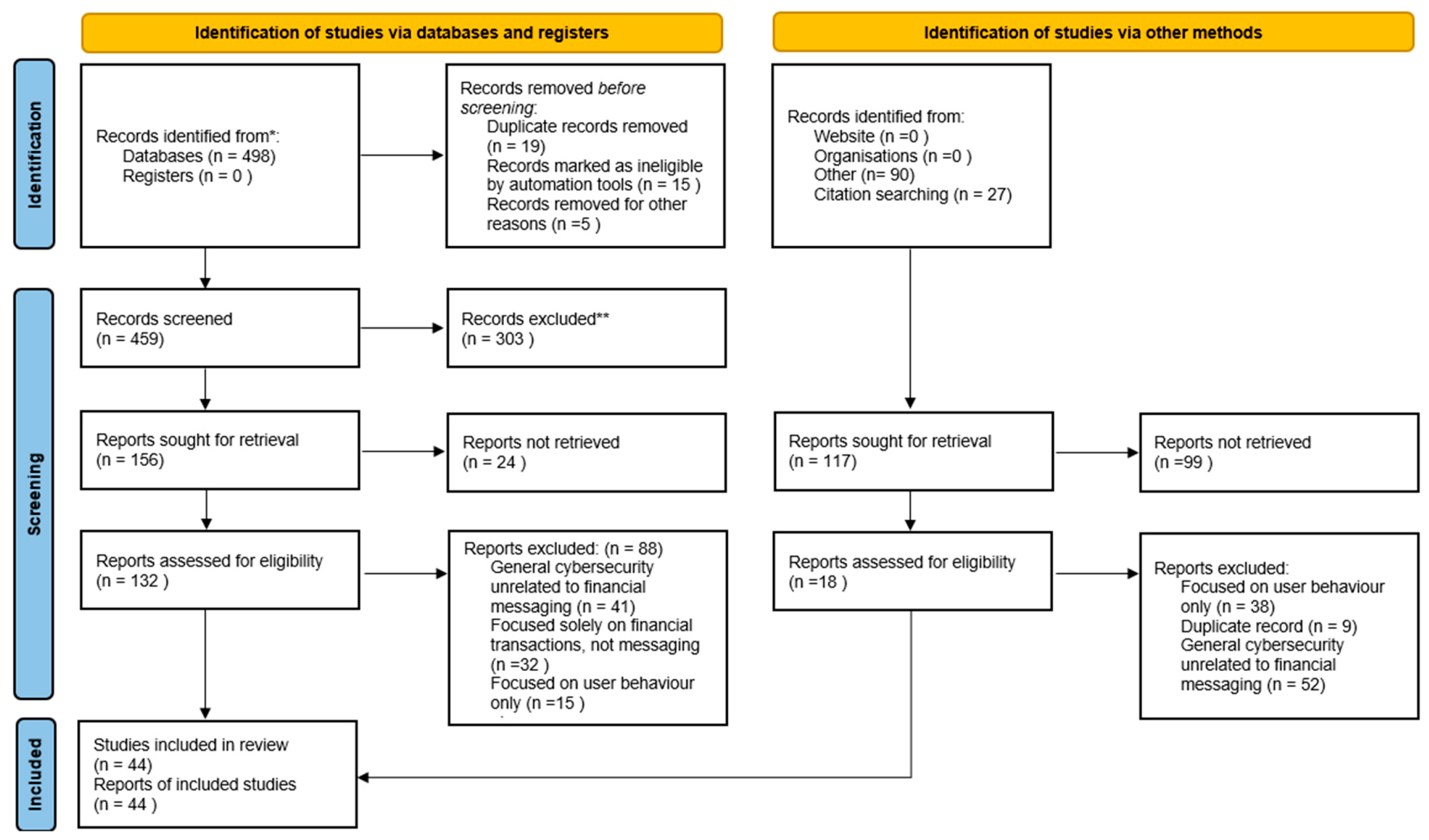
4.1. The PRISMA-ScR
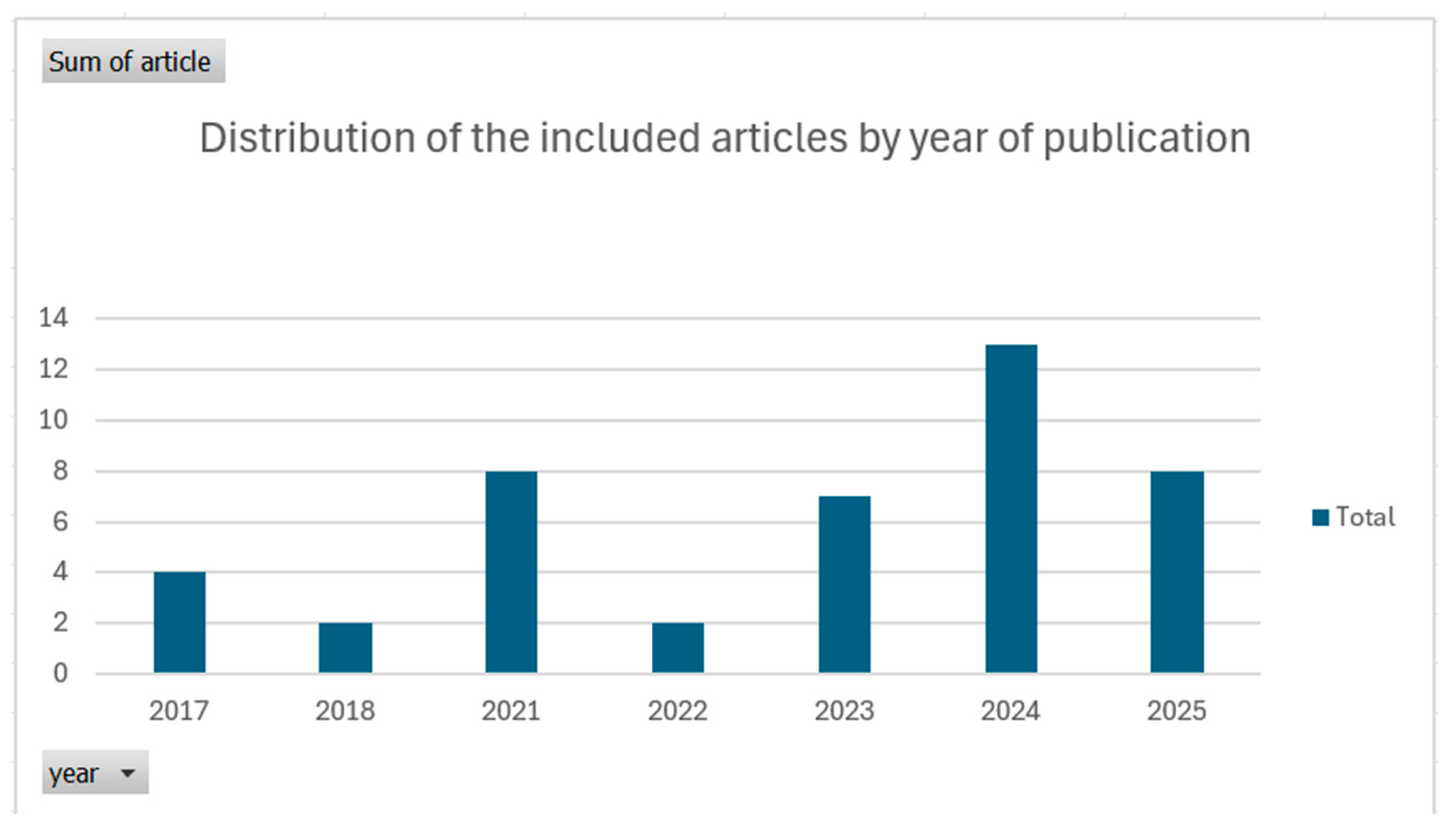
4.2. Overview of Selected Studies
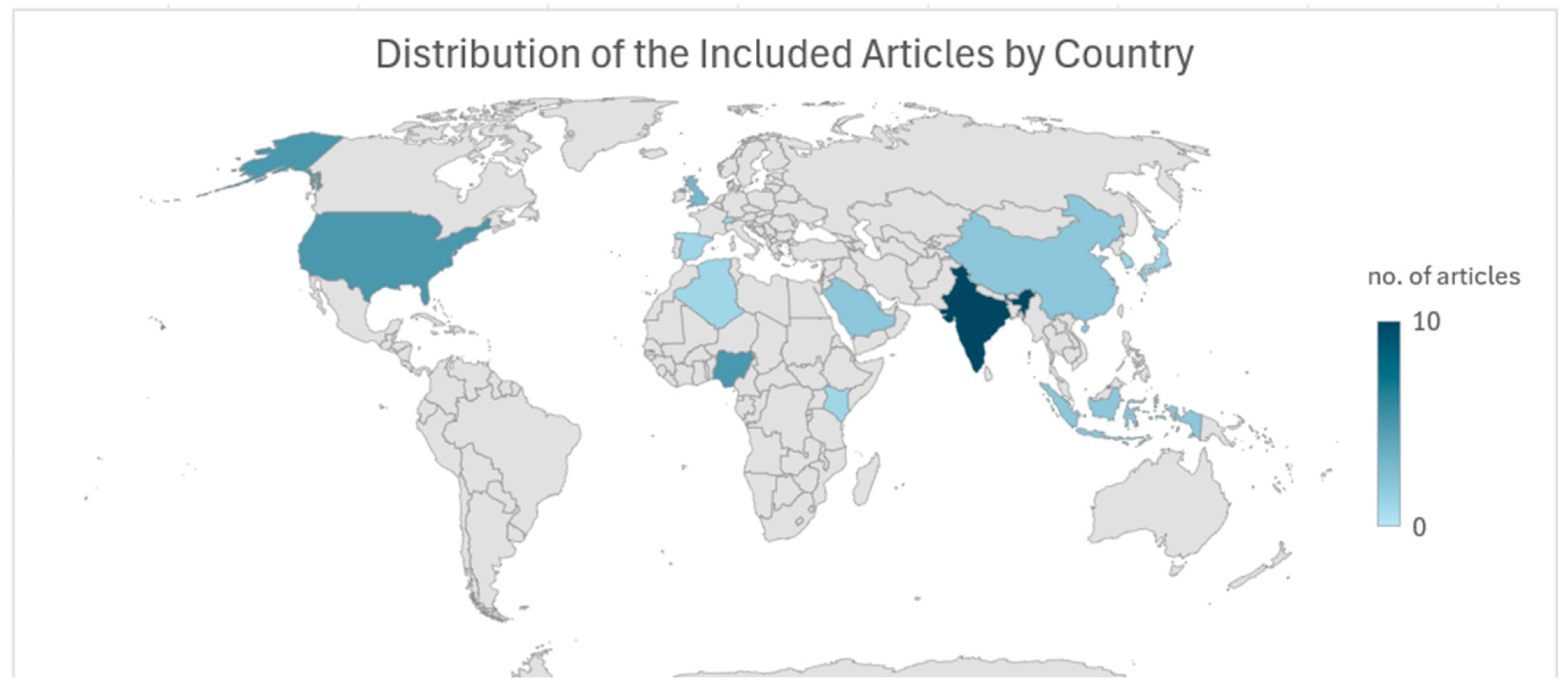
4.3. Geographical Origin of Researcher

| Country of the Author | Number of Articles |
|---|---|
| India | 10 |
| Singapore | 6 |
| USA | 5 |
| Nigeria | 5 |
| United Kingdom | 3 |
| Saudi Arabia | 2 |
| Indonesia | 2 |
| China | 2 |
| Qatar | 1 |
| United Arab Emirates | 1 |
| South Korea | 1 |
| Turkey | 1 |
| Spain | 1 |
| Algeria | 1 |
| Kenya | 1 |
| Japan | 1 |
| Switzerland | 1 |
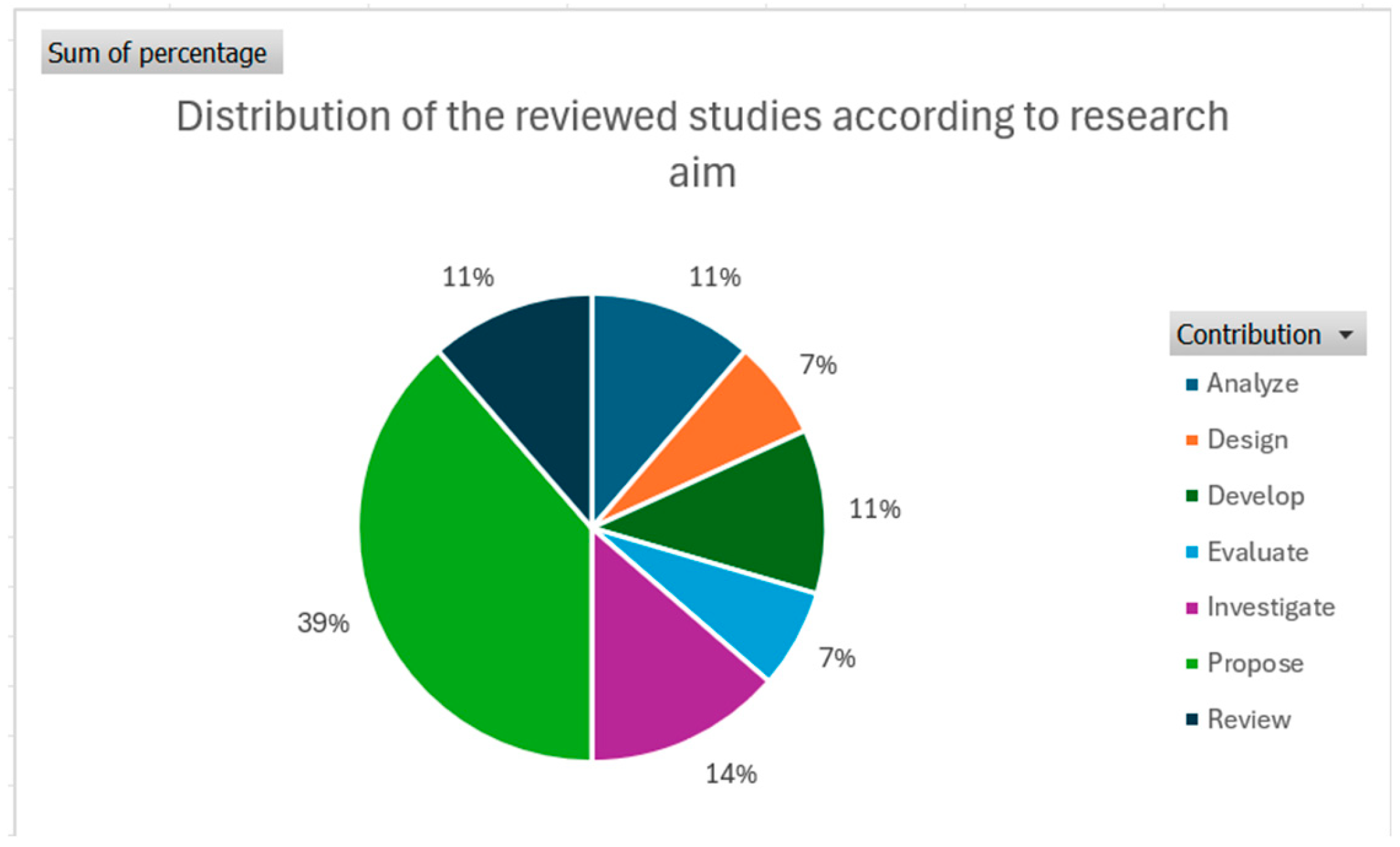
4.4. Distribution of the Included Articles by Aim

4.5. Distribution of Reviewed Studies According to User Categories
| User Vulnerability | Number of Articles |
|---|---|
| Channel-based attack | 30 |
| Unauthorized access | 14 |
| Social Engineering | 11 |
| Credential theft | 9 |
| Data Tempering & Forgery | 7 |
| Malware & Hijacking | 6 |
| Denial of Service | 4 |
| Insider Theft | 4 |
| Cryptographic attacks | 3 |
| Transaction manipulation | 2 |
| Identity Theft & KYC | 1 |
4.6. Technical Mitigation Strategies
| Mitigating Method | Number of Articles |
|---|---|
| Hybrid cryptographic model | 12 |
| Symmetric/Asymmetric encryption | 9 |
| Multi-factor Authentication | 7 |
| Hashing/Signature | 5 |
| AL/ML/Anomaly detection | 4 |
| Smart card/Hardware Security | 2 |
| Anti-Phishing | 1 |
| Quantum Cryptography | 1 |
| Other Protocol & Not specified | 1 |
5. Vulnerabilities in Financial Messaging Systems: Literature Insights
6. Role of Hybrid Cryptographic Models in Financial Message Systems
7. Challenges of Implementing Hybrid Cryptographic Models
- Model design and methodology, emphasizing integration strategies, trade-offs, and system architecture [54].
- Practical implementation, addressing infrastructure constraints, scalability, and heterogeneous data handling.
- Security, privacy, and compliance, including key management, authentication protocols, and regulatory adherence [55].
- Performance evaluation, encompassing efficiency, accuracy, and resource utilization assessments [56].
8. Conclusions
8.1. Observations
- There are unanswered questions and research gaps. Critical gaps remain regarding which strategies demonstrably improve security and resilience in financial messaging. The limitations of current models drive interest in hybrid cryptography, yet the components that underpin effective hybrid solutions require further investigation.
- Still, there are integration challenges. Hybrid models show promise against channel-based and cryptographic attacks, but systematic integration into operational financial systems is underexplored. Future research should focus on embedding these models into platforms to strengthen security and enhance user trust.
- There is a clear need for empirical validation. While many studies propose hybrid solutions, there is limited empirical evidence assessing their real-world resistance to sophisticated attacks. Understanding how these models improve confidentiality, authenticity, and operational security is essential for validating their practical effectiveness.
8.2. Contributions
- It emphasizes user-centric security, highlighting the need for hybrid models that protect not only data but also users from indirect threats such as eavesdropping and man-in-the-middle attacks.
- It provides a structured overview of current literature, serving as a resource for researchers and practitioners seeking to implement robust cryptographic solutions in financial messaging systems.
Supplementary Materials
Author Contributions
Funding
Institutional Review Board Statement
Informed Consent Statement
Data Availability Statement
Acknowledgments
Conflicts of Interest
Abbreviations
| AES | Advanced Encryption Standard |
| AI | Artificial Intelligence |
| APP | Authorized Push Payment |
| ECC | Elliptic Curve Cryptography |
| GDPR | General Data Protection Regulation |
| HSM | Hardware Security Module |
| ISO 20022 | International Organization for Standardization-Financial Messaging Standard |
| KYC | Know Your Customer |
| MAC | Message Authentication Code |
| ML | Machine Learning |
| PCC | Population-Concept-Context |
| PKI | Public Key Infrastructure |
| POPIA | Protection of Personal. Information Act |
| PRISMA-ScR | Preferred Reporting Items for Systematic Reviews and Meta-Analyses-Scoping Review Extension |
| RSA | Rivest-Shamir-Adleman |
| SHA | Secure Hash Algorithm |
| SWIFT | Society for Worldwide Interbank Financial Telecommunication |
| TLS | Transport Layer Security |
References
- Olaiya, O.; Adesoga, T.; Adebayo, A.; Sotomi, F.; Adigun, O.; Ezeliora, P. Encryption techniques for financial data security in fintech applications. Int. J. Sci. Res. Arch. 2024, 12, 2942–2949. [Google Scholar] [CrossRef]
- Hamilton, G.; Williams, M.; Khan, T. Securing Personally Identifiable Information (PII) in Personal Financial Statements. In Future of Information and Communication Conference; Springer Nature: Cham, Switzerland, 2023; pp. 709–728. [Google Scholar]
- Ankur, M. Confidentiality vs. Integrity vs. Availability vs. Authenticity vs. Non Repudiation. CIAAN in ICS/OT with Safety & Reliability Considerations. CybersecurityOT. Available online: https://cybersecurityot.com/confidentiality-vs-integrity-vs-availability-vs-authenticity-vs-non-repudiation-ciaan-ics-ot/ (accessed on 24 March 2026).
- Agu, E.E.; Obiki-Osafiele, A.N.; Chiekezie, N.R. Addressing advanced cybersecurity measures for protecting personal data in online financial transactions. World J. Eng. Technol. Res. 2024, 3, 029–037. [Google Scholar] [CrossRef]
- Ferreira, J.; Perry, M. From transactions to interactions: Social considerations for digital money. In Disrupting Finance; Springer International Publishing: Cham, Switzerland, 2019; pp. 121–133. [Google Scholar]
- Ahmed, W.; Rasool, A.; Nebhel, J.; Kumar, N.; Shahzad, F.; Javed, A.R.; Gadekallu, T.R.; Jalil, Z. Security in Next Generation Mobile Payment Systems: A Comprehensive Survey. IEEE Access 2021, 9, 115932–115950. [Google Scholar] [CrossRef]
- Zafar, U.; Li, E.Y. Financial inclusion and fintect ecosystems in the digital age: A systematice review and meta-analysis. In Proceedings of the International Conference on Electronic Business, Zhuhai, China, 24–28 October 2024; Volume 24, pp. 196–208. [Google Scholar]
- Avira, S.; Setyaningsih, E.; Utami, S.S. Digital transformation in financial management: Harnessing technology for business success. Influ. Int. J. Sci. Rev. 2023, 5, 336–345. [Google Scholar] [CrossRef]
- Kou, G.; Lu, Y. FinTech: A literature review of emerging financial technologies and applications. Financ. Innov. 2025, 11, 1. [Google Scholar] [CrossRef]
- Lu, H.-J.; Roben, A.J.; Mideth, B.A. Enhancing security in instant messaging systems with a hybrid SM2, SM3, and SM4 encryption framework. PLoS ONE 2025, 20, e0332665. [Google Scholar] [CrossRef] [PubMed]
- Singh, R.; Chauhan, A.; Tewari, H. Blockchain-enabled end-to-end encryption for instant messaging applications. In 2022 IEEE 23rd International Symposium on a World of Wireless, Mobile and Multimedia Network (WoWMoM); IEEE: New York City, NY, USA, 2022; pp. 501–506. [Google Scholar]
- Liu, X.M. A risk-based approach to cybersecurity: A case study of financial messaging networks data breaches. Coast. Bus. J. 2021, 18, 2. [Google Scholar]
- Zamil, M.H.; Faruq, M.O. Cybersecurity and Data Integrity in Financial Systems: A Review of Risk Mitigation and Compliance Models. Int. J. Sci. Interdiscip. Res. 2022, 1, 27–61. [Google Scholar] [CrossRef]
- Bhavsar, R.; Madhavi, D.; Pooja, S.; Hetal, A.; Joshiyara, C.P. Enhancing Data Security in Banking: The Power of Hybrid Algorithm-Based Solutions. J. Electr. Syst. 2024, 20, 1093–1102. [Google Scholar] [CrossRef]
- Yash, A.K. Security and Vulnerability in Digital Payment Systems. Int. J. Eng. Res. Technol. (IJERT) NCRTCA 2023, 11, NCRTCA-PID-435. [Google Scholar]
- Awotunde, J.B.; Brahma, B.; Adeniyi, A.E.; Lauretta, N.E.; Imoize, A.L.; Mejdoub, Y. An Enhanced Hybrid Cryptography Model for Online Banking Authentication and Security. In International Conference on Connected Objects and Artificial Intelligence; Springer Nature: Cham, Switzerland, 2024; pp. 287–293. [Google Scholar]
- Jnr, P.K.A.; Aggrey, G.; Asante, M.; Otoo, L. Optimizing Hybrid Cryptographic Frameworks for Secure Financial Data Transmission in Resource-Constrained Environments. In 2025 9th International Conference on Cryptography, Security, and Privacy (CSP); IEEE: New York City, NY, USA, 2025; pp. 41–45. [Google Scholar]
- Kuppuswamy, P.A.; Rajan, J.; Mohammad, H.; Ahmed, A.S.M. A hybrid encryption system for communication and financial transactions using RSA and a novel symmetric key algorithm. Bull. Electr. Eng. Inform. 2023, 12, 1148–1158. [Google Scholar] [CrossRef]
- Adejumo, A.O.C. Strengthening finance with cybersecurity: Ensuring safer digital transactions. World J. Adv. Res. Rev. 2025, 25, 527–1541. [Google Scholar] [CrossRef]
- Jimmy, F. Cybersecurity Threats and Vulnerabilities in Online Banking Systems. Int. J. Sci. Res. Manag. (IJSRM) 2024, 12, 1631–1646. [Google Scholar] [CrossRef]
- Nwatuzie, G.A.; Enyejo, L.A.; Umeaku, C. Enhancing Cloud Data Security Using a Hybrid Encryption Framework Integrating AES, DES, and RC6 with File Splitting and Steganographic Key Management. Int. J. Innov. Sci. Res. Technol. 2025, 10, 1555–1569. [Google Scholar]
- Multiplier. A Complete Guide on SWIFT Banking System | Multiplier 29 October 2025. Available online: https://www.usemultiplier.com/global-payroll/guide-to-swift-system#:~:text=The%20system%20enables%20financial%20institutions%20to%20securely,transactions%2C%20regardless%20of%20the%20financial%20institutions’%20location (accessed on 1 January 2026).
- Osazuwa, C.M. Confidentiality, integrity, and availability in network systems: A review of related literature. Int. J. Innov. Sci. Res. Technol. 2024, 8, 10. [Google Scholar]
- Balsa, E.; Nissenbaum, H.; Park, S. Cryptography, Trust and Privacy: It’s Complicated. In Proceedings of the 2022 Symposium on Computer Science and Law, Washington, DC, USA, 1–2 November 2022; pp. 167–179. [Google Scholar]
- Ahmad, U.; Khan, M. The Mathematical Foundations of Cryptography and Data Security. 2023, p. 7. Available online: https://www.researchgate.net/publication/370630937_The_Mathematical_Foundations_of_Cryptography_and_Data_Security (accessed on 1 January 2026).
- Tripathi, A. Evaluating the role of confidentiality, integrity, and availability in cyber defence. Int. J. Innov. Res. Multidiscip. Pap. (IJIRMPS) 2025, 13, IJIRMPS2504232662. [Google Scholar]
- Papanikolaou, N.; Paraskevi, B.; Nikolaos, E. Determinants of Fintech Adoption: A Systematic Review Integrating Trust, Security, and User Perceptions Within Technology Acceptance Frameworks. In Cryptocurrencies—Innovations, Challenges, and Future Prospects; IntechOpen: London, UK, 2025. [Google Scholar]
- Ouzzani, M.; Hammady, H.; Fedorowicz, Z.; Elmagamid, A. Rayyan—A web and mobila app for systematic reviews. Syst. Rev. 2016, 5, 210. [Google Scholar] [CrossRef] [PubMed]
- Tricco, A.C.; Lillie, E.; Zarin, W.; O’Brien, K.K.; Colquhoun, H.; Levac, D.; Moher, D.; Peters, M.D.; Horsley, T.; Weeks, L.; et al. PRISMA extension for scoping reviews (PRISMA-ScR): Checklist and explanation. Ann. Intern. Med. 2018, 169, 467–473. [Google Scholar] [CrossRef]
- Elsevier. Scopus Content Coverage Guide. Elsevier B.V, January 2020. Available online: https://www.readkong.com/page/content-coverage-guide-elsevier-9871653 (accessed on 7 April 2026).
- Library, W. PCC Framework: Significance and Symbolism Wisdom Library, 19 March 2026. Available online: https://www.wisdomlib.org/concept/pcc-framework (accessed on 25 March 2026).
- Pollock, D.; Peters, M.D.; Khalil, H.; McInerney, P.; Alexander, L.; Tricco, A.C.; Evans, C.; de Moraes, É.B.; Godfrey, C.M.; Pieper, D.; et al. Recommendations for the extraction, analysis, and presentation of results in scoping reviews. JBI Evid. Synth. 2023, 21, 520–532. [Google Scholar] [CrossRef]
- Page, M.J.; McKenzie, J.E.; Bossuyt, P.M.; Boutron, I.; Hoffmann, T.C.; Mulrow, C.D.; Shamseer, L.; Tetzlaff, J.M.; Akl, E.A.; Brennan, S.E.; et al. The PRISMA 2020 statement: An updated guideline for reporting systematic reviews. BMJ 2021, 372, n71. [Google Scholar] [CrossRef] [PubMed]
- Ebatamehi, S. Top 10 Countries with the Most Mature Financial Markets in Africa 2025. The African Exponent, 30 April 2025. Available online: https://www.africanexponent.com/top-10-countries-with-most-mature-financial-markets-in-africa-2025/ (accessed on 30 March 2026).
- Riasat, I.; Mahmood, S.; Sinan, M.G. Strengthening cybersecurity resilience: An investigation of customers’ adoption of emerging security tools in mobile banking apps. Computers 2025, 14, 129. [Google Scholar] [CrossRef]
- Terli, J. Middleware Integration for Financial Services and Banking: A Framework for Resilient Architecture. Int. J. Sci. Res. Comput. Sci. Eng. Inf. Technol. 2025, 11, 1855–1867. [Google Scholar] [CrossRef]
- George, A.S.; Baskar, T.; Srikaanth, P.B. Cyber threats to critical infrastructure: Assessing vulnerabilities across key sectors. Partn. Univers. Int. Innov. J. 2024, 2, 51–75. [Google Scholar]
- Onumadu, P.; Hossein, A. Near-field communication (NFC) cyber threats and mitigation solutions in payment transactions: A review. Sensors 2024, 24, 7423. [Google Scholar] [CrossRef]
- National Institute of Standards and Technology (NIST). Phishing Resistance—Protecting the Keys to Your Kingdom. NIST Cybersecurity Insights. 1 February 2023. Available online: https://www.nist.gov/blogs/cybersecurity-insights/phishing-resistance-protecting-keys-your-kingdom (accessed on 12 December 2025).
- Imubit. Cybersecurity in Industrial Control Systems. Imubit Articles. 2025. Available online: https://imubit.com/article/cybersecurity-in-industrial-control-systems/ (accessed on 14 December 2025).
- Orucho, D.O.; Fredrick, M.A.; Cyprian, R.; Collins, O. Security threats affecting user-data on transit in mobile banking applications: A review. Acad. J. 2023, 9, 0B513B771288. [Google Scholar]
- Jun, D.T.J.; Ahmad, S.R.; Saad, A.; Mehran, B. Human Factors in Information Security: A Quantitative Study with Technical Solutions to Prevent Social Engineering Attacks. Digit. Threats Res. Pract. 2025, 6, 1–35. [Google Scholar] [CrossRef]
- Khadka, K.; Ullah, A. Human factors in cybersecurity: An interdisciplinary review and framework proposal. Int. J. Inf. Secur. 2025, 24, 119. [Google Scholar] [CrossRef]
- Grigaliūnas, Š.; Schmidt, M.; Brūzgienė, R.; Smyrli, P.; Andreou, S.; Lopata, A. Holistic Security Frameworks for Compliance and Resilience. Appl. Sci. 2025, XV, 345–360. [Google Scholar]
- Schneider, J.; Smalley, L. What is Transaction Security? IBM Think. Available online: https://www.ibm.com/think/topics/transaction-security (accessed on 13 December 2025).
- Zhang, Q. An overview and analysis of hybrid encryption: The combination of symmetric encryption and asymmetric encryption. In 2021 2nd International Conference on Computing and Data Science (CDS); IEEE: New York City, NY, USA, 2021; pp. 616–622. [Google Scholar]
- Rakhimberdiev, K.B.; Tureniyazova, A.; Arziev, A.; Sarsenbaeva, H.; Bimuratov, D. Application of cryptographic algorithms in ensuring and improving the security of bank transactions in the digital economy. In Proceedings of the 7th International Conference on Future Networks and Distributed Systems, Dubai, United Arab Emirates, 21–22 December 2023; pp. 503–510. [Google Scholar]
- Harry, H. The adversary: The philosophy of cryptography. J. Cybersecur. 2025, 11, tyaf006. [Google Scholar] [CrossRef]
- ISO 20022; Survival Guide, Treasury and Trade Solutions, 2021. Available online: https://www.citibank.com/tts/sa/flippingbook/2021/ISO-20022-Survival-Guide/10/ (accessed on 1 April 2026).
- Qin, M.; Gabriela, M. Cyber-attacks on SWIFT Systems of financial institutions. In Proceedings of the 5th International Conference on Computer Science and Software Engineering, Guilin, China, 21–23 October 2022; pp. 596–599. [Google Scholar]
- Osundare, O.S.; Ige, A. Enhancing financial security in Fintech: Advanced network protocols for modern inter-bank infrastructure. Financ. Account. Res. J. 2024, 6, 1403–1415. [Google Scholar] [CrossRef]
- Shivaramakrishna, D.; Nagaratna, M. A novel hybrid cryptographic framework for secure data storage in cloud computing: Integrating AES-OTP and RSA with adaptive key management and Time-Limited access control. Alex. Eng. J. 2023, 84, 275–284. [Google Scholar] [CrossRef]
- Folorunso, A.; Wada, I.; Samuel, B.; Mohammed, V. Security compliance and its implication for cybersecurity. World J. Adv. Res. Rev. 2024, 24, 2105–2121. [Google Scholar] [CrossRef]
- Wen, S.; Shukla, A.; Katt, B. Artificial intelligence for system security assurance: A systematic literature review. Int. J. Inf. Secur. 2024, 24, 43. [Google Scholar] [CrossRef]
- Oun, A.; Wince, K.; Cheng, X. The role of artificial intelligence in boosting cybersecurity and embedded system performance: A Systematic Review on Current and Future Trends. IEEE Access 2025, 13, 55258–55276. [Google Scholar] [CrossRef]
- Zhang, J.; Li, Y.; Chen, K. A systematic review on hybrid AI models integrating machine learning and federated learning for cybersecurity. J. Cybersecur. Priv. 2025, 5, 41. [Google Scholar]


| Database | Search Term |
|---|---|
| MDPI | (“user vulnerability” OR “user risk” OR “user-centric threat” OR “social engineering”) AND (“financial messages” OR “financial transaction” OR “financial communication” OR “electronic funds transfer”) AND (“hybrid encryption” OR encryption OR “RSA-ElGamal” OR RSA OR ElGamal) |
| SpringerLink | (title:(“user vulnerability” OR “user risk” OR “user-centric threat” OR “social engineering”) OR abstract:(“user vulnerability” OR “user risk” OR “user-centric threat” OR “social engineering”)) AND (title:(“financial messages” OR “financial transaction” OR “financial communication” OR “electronic funds transfer”) OR abstract:(“financial messages” OR “financial transaction *” OR “financial communication” OR “electronic funds transfer”)) AND (title:(“hybrid encryption” OR encryption OR “RSA-ElGamal” OR RSA OR ElGamal”) OR abstract:(“hybrid encryption” OR encryption OR “RSA-ElGamal” OR RSA OR ElGamal”)) |
| ScienceDirect | TITLE-ABSTR-KEY (“user vulnerability” OR “user risk” OR “user-centric threat” OR “social engineering”) AND TITLE-ABSTR-KEY (“financial messages” OR “financial transaction” OR “financial communication” OR “electronic funds transfer”) AND TITLE-ABSTR-KEY (“hybrid encryption” OR encryption OR “RSA-ElGamal” OR RSA OR ElGamal) |
| DOAJ | “user vulnerability” OR “user risk” OR “user-centric threat” OR “social engineering” “financial messages” OR “financial transaction *” OR “financial communication” OR “electronic funds transfer” “hybrid encryption” OR encryption OR “RSA-ElGamal” OR RSA OR ElGamal |
| Scopus | TITLE-ABS-KEY (“user vulnerability” OR “user risk” OR “user-centric threat” OR “social engineering”) AND TITLE-ABS-KEY (“financial messages” OR “financial transaction *” OR “financial communication” OR “electronic funds transfer”) AND TITLE-ABS-KEY (“hybrid encryption” OR encryption OR “RSA-ElGamal” OR RSA OR ElGamal) |
| IEEE | (“All Metadata”: “user vulnerability” OR “All Metadata”: “user risk” OR “All Metadata”: “user-centric threat” OR “All Metadata”: “social engineering”) AND (“All Metadata”: “financial messages” OR “All Metadata”: “financial transaction” OR “All Metadata”: “financial communication” OR “All Metadata”: “electronic funds transfer”) AND (“All Metadata”: “hybrid encryption” OR “All Metadata”: encryption OR “All Metadata”: “RSA-ElGamal” OR “All Metadata”: RSA OR “All Metadata”: ElGamal) |
| Emerald | (“user vulnerability” OR “user risk” OR “user-centric threat” OR “social engineering”) AND (“financial messages” OR “financial transaction” OR “financial communication” OR “electronic funds transfer”) AND (“hybrid encryption” OR encryption OR “RSA-ElGamal” OR RSA OR ElGamal) |
| ACM | Abstract: (“user vulnerability” OR “user risk” OR “user-centric threat” OR “social engineering”) AND Abstract: (“financial messages” OR “financial transaction” OR “financial communication” OR “electronic funds transfer”) AND Abstract: (“hybrid encryption” OR encryption OR “RSA-ElGamal” OR RSA OR ElGamal) |
| Google Scholar | “user vulnerability” OR “user risk” OR “social engineering” OR “financial messages” OR “financial transaction” OR “electronic funds transfer” OR “hybrid encryption RSA ElGamal” |
| Semantic Scholar, Frontiers, Academic Journals, BEEI | (“user vulnerability” OR “user risk” OR “social engineering”) AND (“financial transaction” OR “financial communication”) AND (encryption OR “hybrid encryption” OR RSA OR ElGamal) |
| ResearchGate | Financial messaging, cybersecurity, hybrid cryptography, user vulnerabilities, secure communication |
| Criteria | Inclusion | Exclusion |
|---|---|---|
| Study focus | Studies examining vulnerabilities, threats, or security mechanisms in financial messaging systems. | Studies focusing solely on general fintech, mobile money, or financial transactions without addressing messaging-system vulnerabilities. |
| Technical scope | Articles addressing cryptographic methods, secure communication protocols, message integrity, and user-level risk. | Articles discuss business models, financial inclusion, or economic/market dynamics. |
| Study type | Peer-reviewed journal articles, conference papers, or credible technical reports. | Editorials, book chapters, non-peer-reviewed sources, or blogs. |
| Population-Concept-Context | financial messaging systems—user vulnerabilities and cryptographic mitigation strategies—secure data transmission, authentication, encryption, and decryption mechanisms. | unrelated ICT populations—not linked to financial messaging. |
| Language and accessibility | Text available in English and from an accessible repository. | Articles with inaccessible full text or non-English content without translation. |
| Timeframe | Publications within the defined review window (2015–2025). | Publication outside the review window. |
Disclaimer/Publisher’s Note: The statements, opinions and data contained in all publications are solely those of the individual author(s) and contributor(s) and not of MDPI and/or the editor(s). MDPI and/or the editor(s) disclaim responsibility for any injury to people or property resulting from any ideas, methods, instructions or products referred to in the content. |
© 2026 by the authors. Licensee MDPI, Basel, Switzerland. This article is an open access article distributed under the terms and conditions of the Creative Commons Attribution (CC BY) license.
Share and Cite
Madzivhandila, U.; Chibaya, C. A Scoping Analysis of Literature on the Enhancement in Security in Financial Messaging Systems. Information 2026, 17, 387. https://doi.org/10.3390/info17040387
Madzivhandila U, Chibaya C. A Scoping Analysis of Literature on the Enhancement in Security in Financial Messaging Systems. Information. 2026; 17(4):387. https://doi.org/10.3390/info17040387
Chicago/Turabian StyleMadzivhandila, Unarine, and Colin Chibaya. 2026. "A Scoping Analysis of Literature on the Enhancement in Security in Financial Messaging Systems" Information 17, no. 4: 387. https://doi.org/10.3390/info17040387
APA StyleMadzivhandila, U., & Chibaya, C. (2026). A Scoping Analysis of Literature on the Enhancement in Security in Financial Messaging Systems. Information, 17(4), 387. https://doi.org/10.3390/info17040387