


From Local Interfaces to Global Challenges: Auditing Digital Noise on University Websites in Poland


Abstract
1. Introduction
- •
- RQ1: What components of university website structure and content contribute to digital noise the most?
- •
- RQ2: Is digital noise on university websites systemic or incidental?
- •
- RQ3: Is it possible to objectively measure the intensity of digital noise on websites and present the result as a synthetic algorithmic indicator?
2. Background
2.1. From Spatial Disorder to Digital Disorder: Towards a Comparative Perspective
2.2. Digital Noise on University Websites: From Communication Infrastructure to Systemic Burden
2.3. From Technical Compliance to Cognitive Burden: Research Gaps in University Website Studies
3. Materials and Methods
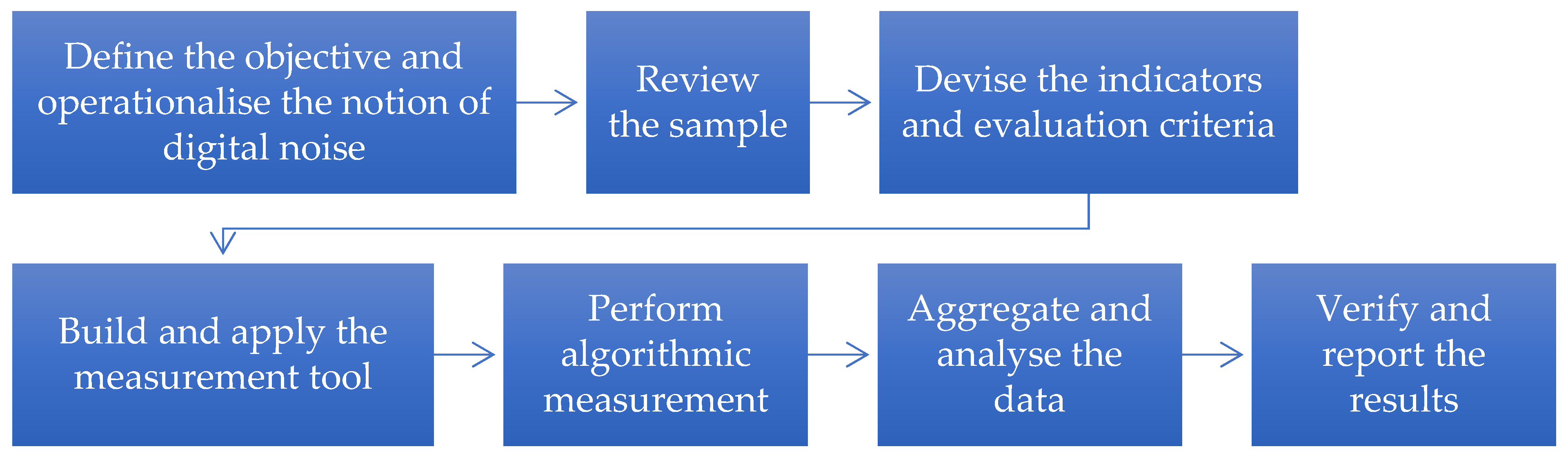
3.1. Tools and Procedure for Data Acquisition
3.2. Analytical Procedures and Verification of the Measurement Tool
4. Results
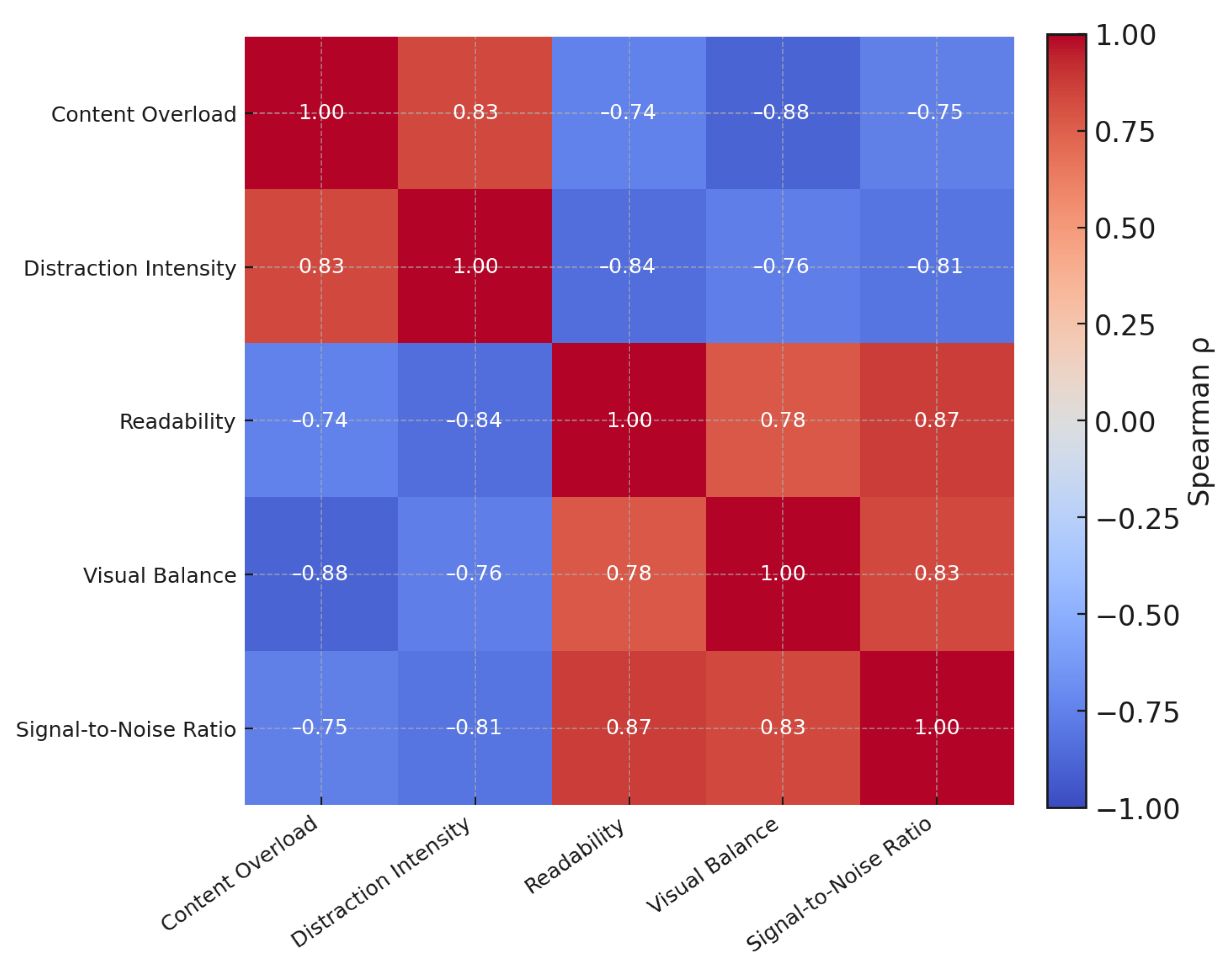
4.1. Correlations Among Digital Noise Dimensions
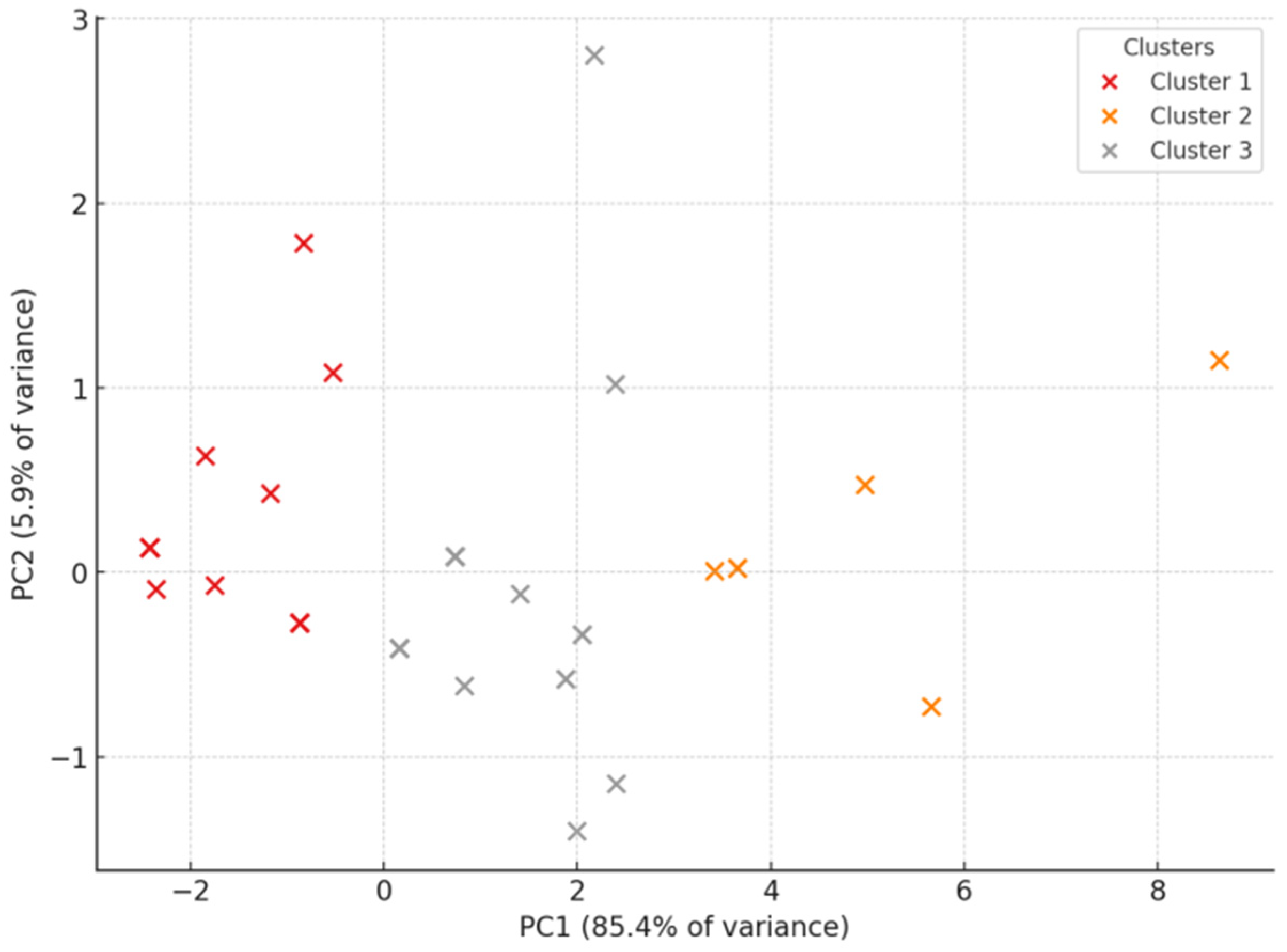
4.2. Results of Principal Component Analysis and Website Clustering
5. Discussion
5.1. Digital Noise on University Websites: Systemic Constraints
5.2. Causes of Digital Noise on University Websites
6. Conclusions
6.1. Practical Implications
- •
- Obligatory noise is caused by regulatory and legal obligations, including notifications from the consent management platform, technical alerts, and security messages. It should be as little intrusive as possible by design. It should not be superimposed on navigation components or key content, and should be minimised or otherwise hidden automatically after the user performs the action.
- •
- Compensated noise emerges from numerous roles and functions of the university. It originates from the multiplicity of channels, modules, and information sections. The problem can be reduced if the content is displayed in layers and revealed progressively according to the user’s type, role, or function (role-aware interface). Elements that are not important should be hidden by default.
- •
- Ornamental noise comes from redundant content, fancy widgets, and autoplay. It should be eliminated because it lacks information value and harms usability.
6.2. Limitations and Further Research
Funding
Institutional Review Board Statement
Informed Consent Statement
Data Availability Statement
Conflicts of Interest
Abbreviations
| ccTLD | country code Top-Level Domain |
| CMP | Consent Management Platform |
| CSS | Cascading Style Sheets |
| CTA | Call to Action |
| DNE | Digital Noise Evaluator |
| GDPR | General Data Protection Regulation |
| HTML | HyperText Markup Language |
| IQR | Interquartile Range |
| NLS | Noise Level Score |
| NN/g | Nielsen Norman Group |
| PCA | Principal Component Analysis |
| PRISMA | Preferred Reporting Items for Systematic Reviews and Meta-Analyses |
| SEO | Search Engine Optimisation |
| W3C | World Wide Web Consortium |
| WAVE | WAVE Web Accessibility Evaluation Tools |
| WCAG | Web Content Accessibility Guidelines |
Appendix A
References
- Arnold, M.; Goldschmitt, M.; Rigotti, T. Dealing with Information Overload: A Comprehensive Review. Front. Psychol. 2023, 14, 1122200. [Google Scholar] [CrossRef]
- Shahrzadi, L.; Mansouri, A.; Alavi, M.; Shabani, A. Causes, Consequences, and Strategies to Deal with Information Overload: A Scoping Review. Int. J. Inf. Manag. Data Insights 2024, 4, 100261. [Google Scholar] [CrossRef]
- Belabbes, M.A.; Ruthven, I.; Moshfeghi, Y.; Rasmussen Pennington, D. Information Overload: A Concept Analysis. J. Doc. 2023, 79, 144–159. [Google Scholar] [CrossRef]
- Giannakoulopoulos, A.; Konstantinou, N.; Koutsompolis, D.; Pergantis, M.; Varlamis, I. Academic Excellence, Website Quality, SEO Performance: Is There a Correlation? Future Internet 2019, 11, 242. [Google Scholar] [CrossRef]
- Akgül, Y. Accessibility, Usability, Quality Performance, and Readability Evaluation of University Websites of Turkey: A Comparative Study of State and Private Universities. Univers. Access Inf. Soc. 2021, 20, 157–170. [Google Scholar] [CrossRef]
- Ismail, A.; Kuppusamy, K.S. Web Accessibility Investigation and Identification of Major Issues of Higher Education Websites with Statistical Measures: A Case Study of College Websites. J. King Saud Univ.-Comput. Inf. Sci. 2022, 34, 901–911. [Google Scholar] [CrossRef]
- Król, K.; Sroka, W. Internet in the Middle of Nowhere: Performance of Geoportals in Rural Areas According to Core Web Vitals. ISPRS Int. J. Geo-Inf. 2023, 12, 484. [Google Scholar] [CrossRef]
- Campoverde-Molina, M.; Luján-Mora, S.; Valverde, L. Accessibility of University Websites Worldwide: A Systematic Literature Review. Univers. Access Inf. Soc. 2023, 22, 133–168. [Google Scholar] [CrossRef]
- Şahin, Y.; Kulakli, A. Evaluation of Open and Distance Education Websites: A Hybrid Multi-Criteria Decision-Making Approach. Systems 2023, 11, 58. [Google Scholar] [CrossRef]
- Gualtieri, L.; Fraboni, F.; Brendel, H.; Pietrantoni, L.; Vidoni, R.; Dallasega, P. Updating Design Guidelines for Cognitive Ergonomics in Human-Centred Collaborative Robotics Applications: An Expert Survey. Appl. Ergon. 2024, 117, 104246. [Google Scholar] [CrossRef]
- Goel, A.; Masurkar, S.; Pathade, G.R. An Overview of Digital Transformation and Environmental Sustainability: Threats, Opportunities, and Solutions. Sustainability 2024, 16, 11079. [Google Scholar] [CrossRef]
- Król, K. Sustainability Audit of University Websites in Poland: Analysing Carbon Footprint and Sustainable Design Conformity. Appl. Sci. 2025, 15, 8666. [Google Scholar] [CrossRef]
- Lewis, J.R.; Sauro, J. Measuring the Perceived Clutter of Websites. Int. J. Hum.–Comput. Interact. 2025, 41, 5260–5273. [Google Scholar] [CrossRef]
- Louraço, D.; Marques, C.G. CMS in Public Administration: A Comparative Analysis. J. Inf. Syst. Eng. Manag. 2022, 7, 11688. [Google Scholar] [CrossRef]
- Moacdieh, N.; Sarter, N. Display Clutter: A Review of Definitions and Measurement Techniques. Hum. Factors 2015, 57, 61–100. [Google Scholar] [CrossRef] [PubMed]
- Wagtendonk, A.J.; Vermaat, J.E. Visual Perception of Cluttering in Landscapes: Developing a Low Resolution GIS-Evaluation Method. Landsc. Urban Plan. 2014, 124, 85–92. [Google Scholar] [CrossRef]
- Ma, R.; Lassila, H.; Nurgalieva, L.; Lindqvist, J. When Browsing Gets Cluttered: Exploring and Modeling Interactions of Browsing Clutter, Browsing Habits, and Coping. In Proceedings of the 2023 CHI Conference on Human Factors in Computing Systems, Hamburg, Germany, 19 April 2023; ACM: New York, NY, USA, 2023; pp. 1–29. [Google Scholar]
- Zimmermann, R.; Auinger, A. Developing a Conversion Rate Optimization Framework for Digital Retailers—Case Study. J. Mark. Anal. 2023, 11, 233–243. [Google Scholar] [CrossRef]
- Pink, S.; Lanzeni, D.; Horst, H. Data Anxieties: Finding Trust in Everyday Digital Mess. Big Data Soc. 2018, 5, 2053951718756685. [Google Scholar] [CrossRef]
- Uğur, N.G.; Çalışkan, K. Time for De-Cluttering: Digital Clutter Scaling for Individuals and Enterprises. Comput. Secur. 2022, 119, 102751. [Google Scholar] [CrossRef]
- Tuch, A.N.; Presslaber, E.E.; Stöcklin, M.; Opwis, K.; Bargas-Avila, J.A. The Role of Visual Complexity and Prototypicality Regarding First Impression of Websites: Working towards Understanding Aesthetic Judgments. Int. J. Hum.-Comput. Stud. 2012, 70, 794–811. [Google Scholar] [CrossRef]
- Boeing, G. Urban Spatial Order: Street Network Orientation, Configuration, and Entropy. Appl. Netw. Sci. 2019, 4, 67. [Google Scholar] [CrossRef]
- Sordello, R.; Ratel, O.; Flamerie De Lachapelle, F.; Leger, C.; Dambry, A.; Vanpeene, S. Evidence of the Impact of Noise Pollution on Biodiversity: A Systematic Map. Environ. Evid. 2020, 9, 20. [Google Scholar] [CrossRef]
- Lallie, H.S.; Thompson, A.; Titis, E.; Stephens, P. Analysing Cyber Attacks and Cyber Security Vulnerabilities in the University Sector. Computers 2025, 14, 49. [Google Scholar] [CrossRef]
- ISO/IEC 40500:2012; Information Technology—W3C Web Content Accessibility Guidelines (WCAG) 2.0. International Organization for Standardization: Geneva, Switzerland, 2012. Available online: https://www.iso.org/standard/58625.html (accessed on 20 November 2025).
- Kuppusamy, K.S.; Balaji, V. Evaluating Web Accessibility of Educational Institutions Websites Using a Variable Magnitude Approach. Univers. Access Inf. Soc. 2023, 22, 241–250. [Google Scholar] [CrossRef] [PubMed]
- Fakrudeen, M.; Rajan, A.; Alameri, A.H.M.; Almheiri, A.M.L.O. Assessing Higher Education Websites in the Middle East: A Comparative Analysis of UAE, Saudi Arabia, and Qatar. In Proceedings of the 2023 9th International Conference on Information Technology Trends (ITT), Dubai, United Arab Emirates, 24–25 May 2023; IEEE: New York, NY, USA, 2023; pp. 226–231. [Google Scholar]
- Harper, K.A.; DeWaters, J. A Quest for Website Accessibility in Higher Education Institutions. Internet High. Educ. 2008, 11, 160–164. [Google Scholar] [CrossRef]
- Laamanen, M.; Ladonlahti, T.; Puupponen, H.; Kärkkäinen, T. Does the Law Matter? An Empirical Study on the Accessibility of Finnish Higher Education Institutions’ Web Pages. Univers. Access Inf. Soc. 2024, 23, 475–491. [Google Scholar] [CrossRef]
- Stasiak, W.; Dzieńkowski, M. Accessibility Assessment of Selected University Websites. J. Comput. Sci. Inst. 2021, 19, 81–88. [Google Scholar] [CrossRef]
- Król, K.; Zdonek, D. Local Government Website Accessibility—Evidence from Poland. Adm. Sci. 2020, 10, 22. [Google Scholar] [CrossRef]
- Vollenwyder, B.; Petralito, S.; Iten, G.H.; Brühlmann, F.; Opwis, K.; Mekler, E.D. How Compliance with Web Accessibility Standards Shapes the Experiences of Users with and without Disabilities. Int. J. Hum.-Comput. Stud. 2023, 170, 102956. [Google Scholar] [CrossRef]
- Chen, M. Improving Website Structure through Reducing Information Overload. Decis. Support Syst. 2018, 110, 84–94. [Google Scholar] [CrossRef]
- Whitenton, K. Minimize Cognitive Load to Maximize Usability. Nielsen Norman Group (NN/g). Available online: https://www.nngroup.com/articles/minimize-cognitive-load/ (accessed on 14 November 2025).
- Nielsen, J. Is Poor Usability Killing E-Commerce? Nielsen Norman Group (NN/g). Available online: https://www.nngroup.com/articles/did-poor-usability-kill-e-commerce/ (accessed on 14 November 2025).
- Nawir, F.; Hendrawan, S.A. The Impact of Website Usability and Mobile Optimization on Customer Satisfaction and Sales Conversion Rates in E-Commerce Businesses in Indonesia. Eastasouth J. Inf. Syst. Comput. Sci. 2024, 2, 15–30. [Google Scholar] [CrossRef]
- Drivas, I.; Kouis, D.; Kyriaki-Manessi, D.; Giannakopoulos, G. Content Management Systems Performance and Compliance Assessment Based on a Data-Driven Search Engine Optimization Methodology. Information 2021, 12, 259. [Google Scholar] [CrossRef]
- List of Public Universities Supervised by the Minister Responsible for Higher Education and Science—Public Academic Universities. Available online: https://www.gov.pl/web/nauka/wykaz-uczelni-publicznych-nadzorowanych-przez-ministra-wlasciwego-ds-szkolnictwa-wyzszego-i-nauki-publiczne-uczelnie-akademickie (accessed on 14 November 2025).
- Digital Noise Evaluator. ChatGPT OpenAI. Available online: https://chatgpt.com/g/g-68bd154a296c819185ea8f0bff029792-digital-noise-evaluator (accessed on 14 November 2025).
- Shaban, A.; Pearson, E.; Chang, V. Evaluation of User Experience, Cognitive Load, and Training Performance of a Gamified Cognitive Training Application for Children With Learning Disabilities. Front. Comput. Sci. 2021, 3, 617056. [Google Scholar] [CrossRef]
- Song, L.; Liu, D.; Kwan, M.-P.; Liu, Y.; Zhang, Y. Machine-Based Understanding of Noise Perception in Urban Environments Using Mobility-Based Sensing Data. Comput. Environ. Urban Syst. 2024, 114, 102204. [Google Scholar] [CrossRef]
- Mincer-Daszkiewicz, J. Success story—25 years of digitalization of higher education institutions in Poland. In Proceedings of the EUNIS 2024 Annual Congress in Athens, Athens, Greece, 5–7 June 2024; Volume 105, pp. 1–10. [Google Scholar] [CrossRef]
- Moran, K. Average UX Improvements Are Shrinking over Time. Nielsen Norman Group (NN/g). Available online: https://www.nngroup.com/articles/ux-gains-shrinking (accessed on 14 November 2025).
- Macías, J.A.; Borges, C.R. Monitoring and Forecasting Usability Indicators: A Business Intelligence Approach for Leveraging User-Centered Evaluation Data. Sci. Comput. Program. 2024, 234, 103077. [Google Scholar] [CrossRef]
- Garett, R.; Chiu, J.; Zhang, L.; Young, S.D. A Literature Review: Website Design and User Engagement. Online J. Commun. Media Technol. 2016, 6, 1–14. [Google Scholar] [CrossRef] [PubMed]
- Król, K.; Zdonek, D. Peculiarity of the Bit Rot and Link Rot Phenomena. Glob. Knowl. Mem. Commun. 2019, 69, 20–37. [Google Scholar] [CrossRef]

| Reference | Scope of Analysis | Methods | Conclusions |
|---|---|---|---|
| Arnold et al. [1] | Methods for controlling information overload at work | A systematic review according to PRISMA | Individual and organisational strategies have to be combined to control information overload effectively |
| Campoverde-Molina et al. [8] | Global accessibility of university websites | A systematic literature review according to the Kitchenham method (plan—implement—report) | University websites still often fail to ensure accessibility compliance |
| Chen [33] | Website structure and its impact on user information overload | Mathematical modelling to reduce the link population while retaining the website’s functionality | Content can be rearranged to reduce information overload by removing excess links, for example |
| Fakrudeen et al. [27] | University websites in the UAE, Saudi Arabia, and Qatar | An accessibility analysis according to the WCAG using automated tools and country-to-country comparisons | Most websites are not accessible, and their ranks do not reflect accessibility |
| Harper and DeWaters [28] | Accessibility of university websites in the US in practice | An analysis of university websites’ accessibility according to the WCAG using automated tools and expert judgement | Many university websites do not meet the minimum accessibility criteria, even though WCAG compliance often requires only simple optimisation |
| Kuppusamy and Balaji [26] | Accessibility of university websites in India | A variable magnitude approach; automated testing; opinions from students with disabilities | Variable magnitude facilitates a more precise evaluation of website accessibility to people with disabilities |
| Ma et al. [17] | Browsing clutter due to too many tabs and windows | A mixed approach, qualitative interviews and a quantitative survey | Multitasking and multiple tabs increase browsing clutter |
| Shahrzadi et al. [2] | Causes, effects, and strategies to manage information overload | A scoping review of databases to identify the causes, consequences, and coping strategies of information overload | Information overload disturbs productivity. It can be reduced by filtering, prioritisation, and information management tools |
| Whitenton [34] | The impact of user interface cognitive load on website usability | An expert study founded on usability principles to illustrate how user interface design can minimise cognitive load | Interface optimisation should involve the elimination of unnecessary components, following familiar navigation patterns and icons, and the reduction in cognitive load |
| Criterion for Comparison | E-Commerce | Higher Education |
|---|---|---|
| Conversion definition | Purchase, online transaction closure, and reservation | Enrolment, completion of an enrolment form, and course registration |
| Intermediary goals | Product added to cart, newsletter subscription, e-book downloaded, views | Brochure downloaded, registration in the enrolment system, webinar spot booked, views |
| Key performance indicators | Conversion rate, mean cart value, and shopping cart abandonment | No. of candidates, enrolment conversion rate, student retention |
| Barriers | Complicated navigation, long path to purchase, digital noise, and long page load | Distributed content structure, digital noise, obscure information, excessive pop-ups and forms |
| Implications | Lower sales, lower income, lost customers | Fewer candidates, PR loss, lower stakeholder engagement |
| Financial impact of digital noise | Lower sales income, higher customer acquisition cost, lost returning customers, lower advertising income, poorer performance of loyalty programmes, and higher opportunity cost | Lower tuition income, less income from commercial training and courses, and reduced university infrastructure rent income |
| Indicator | Average | Std Dev. | Min. | Max. | Interquartile Range, IQR, Q1–Q3 |
|---|---|---|---|---|---|
| Distraction Intensity | 49.1 | 5.1 | 30 | 55 | 45–55 |
| Content Overload | 56.4 | 4.1 | 40 | 60 | 55–60 |
| Readability | 69.7 | 4 | 65 | 80 | 65–70 |
| Visual Balance | 58.3 | 3.9 | 55 | 70 | 55–60 |
| Signal-to-Noise Ratio | 49.5 | 4.4 | 45 | 65 | 45–50 |
| NLS | 56.1 | 2.4 | 46 | 60 | 55–58 |
| Attribute/Indicators | Cluster 1 (High Noise, 31 Websites) | Cluster 2 (Low Noise, 6 Websites) | Cluster 3 (Medium Noise, 28 Websites) |
|---|---|---|---|
| Distraction Intensity | High values (52.9 on average), domination of distractors | Low values (39.2), limited number of stimuli, placid experience | Moderate values (47.0), partial overload |
| Content Overload | Highest values (59.7), very cumulated content, no prioritisation | Lowest values (47.5), well-balanced content, more clarity | Medium values (54.6), moderate content overload |
| Readability | Lower values (66.6), texts are less readable, harder to comprehend | Highest values (76.7), high readability and clarity of the message | Medium values (71.6), relatively good but not optimal readability |
| Visual Balance | Lowest values (55.0), inconsistent visuals, no balance | Highest values (66.7), coherent layout, visual order | Medium values (60.2), reasonable visual coherence |
| Signal-to-Noise Ratio | Low values (46.5), signal blurred by the profusion of elements | High values (58.3), clear information hierarchy | Medium values (51.1), moderate message clarity |
| Noise Level Score | High values (57.5), websites with the highest intensity of digital noise | Low values (50.8), the least noisy websites | Medium values (55.7), typical websites with a moderate noise level |
| Research Context | Dimension of Digital Noise | Examples of Design Components | Selected Consequences |
|---|---|---|---|
| Usability | Distraction Intensity, Readability | Pop-ups, autoplay, CTA, fancy widgets, and long paragraphs | Distraction and longer operations |
| Performance | Content Overload, Visual Balance | Profusion of high-resolution images, scripts affecting load time, and non-optimised assets | Longer loading, lower conversion rate, and increased bounce rate |
| Digital accessibility | Content Overload, Readability | Unstructured content, no headline hierarchy, and low contrast | Barriers to people with disabilities and affected communication clarity |
| SEO | Visual Balance, Signal-to-Noise Ratio | Too long meta tags, keyword stuffing, vague link architecture, link rot | Declined organic visibility, lower Core Web Vitals |
| Sustainability | Content Overload, Signal-to-Noise Ratio | Excess libraries, scripts, and multimedia | Increased server load, greater energy consumption and carbon footprint |
Disclaimer/Publisher’s Note: The statements, opinions and data contained in all publications are solely those of the individual author(s) and contributor(s) and not of MDPI and/or the editor(s). MDPI and/or the editor(s) disclaim responsibility for any injury to people or property resulting from any ideas, methods, instructions or products referred to in the content. |
© 2025 by the author. Licensee MDPI, Basel, Switzerland. This article is an open access article distributed under the terms and conditions of the Creative Commons Attribution (CC BY) license (https://creativecommons.org/licenses/by/4.0/).
Share and Cite
Król, K. From Local Interfaces to Global Challenges: Auditing Digital Noise on University Websites in Poland. Information 2025, 16, 1047. https://doi.org/10.3390/info16121047
Król K. From Local Interfaces to Global Challenges: Auditing Digital Noise on University Websites in Poland. Information. 2025; 16(12):1047. https://doi.org/10.3390/info16121047
Chicago/Turabian StyleKról, Karol. 2025. "From Local Interfaces to Global Challenges: Auditing Digital Noise on University Websites in Poland" Information 16, no. 12: 1047. https://doi.org/10.3390/info16121047
APA StyleKról, K. (2025). From Local Interfaces to Global Challenges: Auditing Digital Noise on University Websites in Poland. Information, 16(12), 1047. https://doi.org/10.3390/info16121047