1. Introduction
As the preeminent text among the Five Classics (wujing 五經), the I Ching has long occupied a central position in East–West cultural exchange and garnered enduring scholarly attention worldwide. What sets it apart from other classical works is its distinctive and systematic framework of trigrams and hexagrams. Studies of unearthed manuscripts indicate that these trigram and hexagram patterns originated as numerical trigrams in the Shang and Zhou dynasties, where they were widely used in divinatory rituals. From the time of Confucius onward, however, the hermeneutical orientation of the I Ching underwent a fundamental transformation. It gradually evolved from a divination manual into a philosophical classic centered on the ideal of “exhausting principle, fulfilling nature, and attaining destiny 窮理盡性以至於命”. In this shift, the “image” (xiang 象) of the trigrams and hexagrams emerged as a medium for articulating the governing patterns of the cosmos, human life, and society. Scholars broadly agree that exploring the universal significance of the “image” is indispensable to a comprehensive understanding of the trigrams, hexagrams, and the philosophical import of the I Ching as a whole. Put simply, one’s interpretation of the “image” shapes one’s entire foundational perspective on the text. Correspondingly, the conceptual vocabulary and discursive framework adopted to explain its core ideas directly determine the scope and depth of the I Ching’s intellectual transmission in the English-speaking world.
Historically speaking, Western scholars have developed three primary interpretive approaches to the notion of the “image” in the
I Ching (
J. Zhao 2011). The first is a religious-theological framework, which defines the earliest efforts of Jesuit missionaries such as Matteo Ricci and Joachim Bouvet to introduce the
I Ching to Europe. This standpoint holds that the “image” in the
I Ching embodies revelatory connotations and thus can be juxtaposed and mutually corroborated with Western religious traditions including Christianity and Catholicism. This interpretive standpoint is widely known as the Figurist School. The second approach is psychological interpretation, shaped profoundly by Jung’s analytical psychology. It understands the
I Ching’s “image” as concrete expressions of Jung’s principle of synchronicity and holds that these images carry psychological significance in articulating the personal unconscious (Jung 2010, pp. 34–39). The third strand consists of historical-philological interpretation, exemplified by scholars including Edward L. Shaughnessy. Methodologically, this approach is distinguished by its sharp distinction between the canonical core (
jing 經) of the
I Ching and its later exegetical commentaries (
zhuan 傳). Grounded in unearthed manuscript evidence, it integrates rigorous philological analysis of the canonical core and commentaries with the cultural and intellectual history of the Shang, Zhou, and pre-Qin periods, aiming to recover the work’s original conceptual and semantic meanings within its early historical context (
Shaughnessy 2013, pp. 13–20).
Beyond these three mainstream lines of inquiry, the
I Ching scholarship of French sinologist Cyrille Javary deserves special attention. Criticizing misinterpretations of the “Yin-Yang” concept by earlier Western sinologists, Javary offers a rigorous re-examination of its philosophical connotations. Taking “Yin-Yang” as his analytical starting point, he advances a fresh interpretation of the maxim “Generating and regenerating is the Yi” (
Shengsheng zhi wei Yi 生生之謂易) and constructs an expansive interdisciplinary framework spanning linguistics, philosophy, art, archaeology, architecture, medicine, and anthropology (
M. Zhao 2025). In his examinations of foundational concepts in Chinese philosophy, Javary consistently places them in sustained dialogue with Western philosophical traditions, while also investigating their underlying cultural and intellectual foundations. Javary’s nuanced exploration of the “Yin-Yang” concept reveals the rich diversity of theoretical anchors available to Yi-ology (the study of the
I Ching) in the context of cross-cultural engagement between Chinese and Western philosophy (
Javary 2018). His work treats the
I Ching unequivocally as a philosophical text—rather than a mere divination manual or historical document—thereby reinforcing its status as the preeminent classic.
Since the introduction of phenomenology to mainland China, however, a number of scholars have sought to interpret the theory of the “image” in the
I Ching within a phenomenological discursive framework, offering a wholly new lens for exploring the integration of Chinese and Western thought within Yi-ological philosophy. In reviewing the trajectory of mainland Chinese scholarship on the “image”, traditional interpretations have largely centered on cognitive thought, framing the “image” as a cognitive tool for perceiving, describing, and interpreting phenomena. For instance, Wang, Shuren (王樹人) summarizes the core mode of thinking in the
I Ching as “image thinking” (
xiangsiwei 象思維) (
Wang 2020, pp. 1–7). Building on this foundation, Zhang, Xianglong (張祥龍) draws on Husserl’s theory of the phenomenology of consciousness to systematically elaborate on the central significance of the “image” in the original constitution of consciousness. From the structural and originary dimensions of consciousness, he lays a solid theoretical groundwork for defining the essence of the “image” and clarifying its intrinsic connection to the Ci (hexagram explanations 辭) (
Zhang 2011, pp. 276–82). Such research has not only deepened scholarly understanding of the
I Ching’s “image” theory in the English-speaking world but also endowed this theory with rich modern academic implications.
But a close examination of the “image” theory in the Great Commentaries on the I Ching (Yizhuan 易傳) reveals that the “image” in the I Ching is not confined to the dimensions of epistemology and consciousness analysis alone. Its implied ontological significance is far more profound and remains incompletely explored.
2. How to Interpret the Underlying Meanings of the “Image” in the I Ching
As the Great Commentaries on the I Ching clearly declares: “Hence, the I Ching is nothing but images. 是故《易》者, 象也。” This statement lays bare the defining feature of the text: the I Ching conveys its philosophical meaning entirely by way of the “image”. A close textual analysis of the Great Commentaries on the I Ching reveals that its account of the “image” can be systematically unpacked into three interrelated dimensions: the “visible image” (xingxiang 形象), the “analogical image” (nixiang 擬象), and the “manifest image” (xianxiang 見象).
First, “visible image” denotes the external forms of all things in heaven and earth, as well as the patterns of their change. As the Great Commentaries on the I Ching articulates: “Images emerge in heaven, forms appear on earth, and changes become apparent. 在天成象, 在地成形, 變化見矣。” Ma, Rong (馬融) elaborates: “By ‘images’, we mean the sun, moon, and stars, as well as plants and animals. 象者, 日月星, 植物、動物也。” (Kong 2008, p. 1485). This clarifies that heaven manifests the images of the sun, moon, and stars, while earth embodies the forms of waters, soils, mountains, and rivers. A core dimension of the “image” here lies in the external manifestations of all things and their changes. The Great Commentaries on the I Ching further emphasizes: “No suspended images shine more brightly than the sun and the moon. 懸象著明, 莫大乎日月。” This observation underscores that among all phenomena in heaven and earth, no suspended image is more clearly revealed than the sun and the moon. This makes clear that the “visible image” encompasses the sense of a “suspended image” (xuanxiang 懸象): all things in heaven and earth openly and unreservedly display their images, forms, and modalities of change to human beings, without concealment, much as a flower reveals its colors, shapes, and scents to humans in their entirety.
Secondly, the “image” also carries the meaning of “analogical image”, which illuminates the generative logic underlying the trigram and hexagram symbols. As
the Great Commentaries on the I Ching observes: “Therefore it is by means of these images that the sages beheld the hidden complexities of the world, modeled their forms and appearances, and symbolized the proper nature of all things. For this reason they are called ‘images’. 是故夫象, 聖人有以見天下之賾, 而擬諸其形容, 象其物宜, 是故謂之象。 ” Jing, Fang (京房) comments: “The sages perceive the complexities of the world. ‘Complexities’ refer to the essential realities of things. 聖人有以見天下之賾; 賾,情也。” (
Chen 2017, p. 975). Lu, Ji (陸績) adds: “What exhausts the profound complexities of the world resides in the trigrams. This means that the trigram images exhaust the innermost realities of all things under heaven. 極天下之賾者存乎卦; 言卦象極盡天下之深情也。” (
Chen 2017, p. 975). These remarks make clear that the fundamental purpose behind the creation of trigrams and hexagrams was to model both the outward forms and inner dispositions of all beings. Precisely because the trigram and hexagram symbols are “analogical images” of all things and their patterns of change,
the Great Commentaries on the I Ching advances two core assertions: “those who make concrete things esteem the images 制器者尚象” and ”When the eight trigrams are arranged in order, the images reside within them 八卦成列, 象在其中矣”.
For example, “Twisting ropes to make nets and snares for hunting and fishing—this is presumably modeled after Li Hexagram 作結繩而為罔罟, 以佃以漁, 蓋取諸《離》”. In other words, the trigram structure of Li (離) contains the image of a net, while its mutual trigram (hutigua 互體卦) is Xun (巽), which bears the image of a rope. The Li Hexagram thus serves as an analogical symbol for the practical activity of twisting ropes into nets to hunt and fish. From this perspective, the essential significance of examining the trigrams lies in discerning the forms and states of all things as represented by the hexagram images, and further distinguishing good fortune, misfortune, regret and hardship. the Great Commentaries on the I Ching also states: “The sages set up the trigrams, observed the images, and attached explanations to them to clarify good fortune and misfortune. 聖人設卦觀象,系辭焉而明吉凶。”
It is therefore evident that both the “visible image” and the “analogical image” fall primarily within the cognitive dimensions. The “visible image” captures the outward phenomenal features of entities and pertains to perceptual cognition. The “analogical image” establishes a symbolic correspondence between phenomenal realities and trigram symbols, embodying the process of delineating all things through the trigrams. Accordingly, the “visible image” and “analogical image” reside entirely in the sphere of epistemology, not ontology.
Significantly, the Great Commentaries on the I Ching frames its interpretation of the “image” against the core theoretical backdrop of the Dao-Qi theory (道器論). The account of the “images” rooted in this Dao-Qi theory constitutes fundamentally an ontological system: it addresses the foundational question of why the “image” exists, while also delineating its proper value and function. Taking the Dao-Qi theory as its foundational framework, the Great Commentaries on the I Ching systematically unfolds the ontological significance of the ”Image” in a series of canonical statements: “When Qian and Kun are set in order, the Yi stands within them. If Qian and Kun were destroyed, there would be no way to see the Yi. If the Yi could not manifest, then Qian and Kun would perhaps nearly cease to be. 乾坤成列, 而易立乎其中矣;乾坤毁, 則無以見易。 易不可見,則乾坤或幾乎息矣。” “Therefore, what is above form is called the Dao; what is beneath form is called Qi. 是故形而上者謂之道, 形而下者謂之器。” ”Thus, closing the door is analogous to Kun; opening the door is analogous to Qian. One closing and one opening is called change; unceasing coming and going is called penetration. What manifests is called image; what takes shape is called Qi. Fashioning and using them is called the model; benefiting from their use in comings and goings, and all people using them, is called the divine. 是故闔戶謂之坤, 辟戶謂之乾。一闔一辟之謂變, 往來不窮之謂通, 見乃謂之象, 形乃謂之器,制而用之謂之法, 利用出入, 民咸用之謂之神。”
From the first passage, it is clear that the core intuition of the Dao-Qi theory arises from an analysis of the internal relationality between the Yi (易) and Qian and Kun. Here, the character “manifest” (xian 見) carries the sense of “appearing” or “revealing itself” (xian 現). The claim that “When Qian and Kun are set in order, the Yi stands within them” reveals that the essence of the Yi inheres in Qian and Kun. The Yi can only be actualized through Qian and Kun because, without Qian and Kun, the essence of the Yi could not be disclosed. Conversely, if the Yi could not manifest itself, the very existence of Qian and Kun would lose its ultimate meaning. To illustrate, in the phrase “one closing and one opening is called change”, “opening” (pi 辟) serves as an analogy for the generative virtue of Qian, while “closing” (he 闔) analogizes the receptive virtue of Kun. The transformative activity of the Yi manifests precisely in the ceaseless movement of opening and closing. Without this rhythmic movement of closing and opening, the activity of the Yi would be imperceptible. Conversely, if the activity of the Yi did not reveal itself through this dynamic interplay, the very opening and closing would be stripped of their existential significance.
It is clear from this that the proposition “What manifests is called image; what takes shape is called Qi” rests squarely on the fundamental premise that the Yi must reveals itself through Qian and Kun, which in turn are established as the manifest forms of the Yi. From the perspective of intertextual rhetoric, the “taking shape” in “what takes shape is called Qi” corresponds to “manifest”. In this rhetorical parallel, the phrase “taking shape” corresponds to the meaning of “manifestation” in the former. That is to say, Qian and Kun represent the imperceptible Yi in perceptible forms, and bring the imperceptible Yi into “manifestation” in sensible, embodied forms. Accordingly, Qian and Kun—as the concrete embodiments of “Qi” (器 things)
1—are precisely the “images” through which the Yi manifests itself.
The Great Commentaries on the I Ching also states: “Qian is the thing of Yang; Kun is the thing of Yin. 乾, 陽物也; 坤, 陰物也。” For Qian and Kun, to be the manifestations of the Yi, therefore, means that Yin and Yang jointly embody its self-disclosure.
From the maxim “One Yin and one Yang is called the Dao 一陰一陽之謂道”, we can see that the essence of the Yi is fundamentally one with the Dao (道), which inheres in Yin and Yang. As tangible forms of existence, Yin and Yang belong to the domain of embodied things; all concrete realities are the “images” through which the Yi comes into manifest appearance. The “image” at stake here expresses an internal relation between the Dao and Yin-Yang, rather than an external correspondence between things, or between hexagram images and phenomena. It is essentially an “image” of ontological dimension, sharply distinct from the “image” as conceived in epistemological and cognitive frameworks.
In turn, the core significance of the above-outlined theory of the “image” thus stems from the claim that “What manifests is called the image”, for which we designate the theory of the “manifest image”. Within this framework, the Dao-Qi theory articulated in the Great Commentaries on the I Ching can also be systematically expounded by means of the “manifest image”. On this basis, the term “form” (xing 形) in the maxim “What is above form is called the Dao; what is beneath form is called the concrete things 是故形而上者謂之道, 形而下者謂之器” ought to be understood as correlative with “taking shape”-that is, with the act of manifestation. In the fundamental activity of manifestation, the Yi, understood as the Dao, functions as the subject that actualizes itself in appearing, and therefore pertains to the realm of “that which is above form”; concrete entities, by contrast, are the determinate forms (“images”) brought forth through this process of manifestation, and thus belong to “that which is beneath form”. It is thus clear that the “manifest image” theory is inherently grounded in the Dao-Qi theory, establishing the latter as the foundational framework for interpreting the notion of the “image” in the Great Commentaries on the I Ching. Accordingly, interpreting the “manifest image” through an academic discourse adequate to its ontological import is essential for advancing the cross-cultural intellectual dissemination of the I Ching in Western academia, yet existing scholarship in this direction remains notably insufficient.
After systematically reviewing and assessing existing studies that approach the image theory of the I Ching from a phenomenological standpoint, this paper contends that a cross-cultural interpretation of the I Ching’s “manifest image” can be undertaken by drawing on Spinoza’s conception of Substance and Heinrich Rombach’s structural phenomenology. In so doing, we may facilitate the wider dissemination and scholarly understanding of the ontological dimension of the “image” theory within the English-speaking world.
3. The Absolute “Substance” and the “Image”: The I Ching and Spinoza’s Ontology
The choice to employ Spinoza’s ontology as a mediating framework for the I Ching’s “manifest image” theory stems from the analogous ontological structures shared by the “Dao-Image-Things” framework elaborated in the manifest image theory and the “Substance-Attributes-Modes” framework in Spinoza’s philosophical system—both are defined by the core notion of “manifestation”. This paper thus intends to begin with the affinities between the Yi and Substance, integrating Spinoza’s ontology with the I Ching’s “image” theory to lay preliminary groundwork for subsequent discussions of the “image” rooted directly in the concept of “structure”.
As noted earlier, in the manifest image theory, the Yi is synonymous with the Dao; similarly, it is likewise equated with the divine. The Great Commentaries on the I Ching cites Confucius as stating: “The Master said: ‘Whoever comprehends the Way of change and transformation does he not likewise understand the workings of the divine?’ 子曰: 知變化之道者, 其知神之所為乎?” This remark implies that one who comprehends the order of Yin-Yang changes may also grasp that this order fulfills the Dao precisely through the divine’s agency. It further indicates that the divine is the determinant and cause of Yin-Yang changes, as the divine is a characterization of the Yi itself. The Great Commentaries on the I Ching elaborates: “The Yi is devoid of deliberation and free from exertion. Motionless and quiescent in itself, it is stirred by sympathetic resonance and thereby penetrates inherent realities of all beneath heaven. Were it not the supreme divine force under heaven, who could attain such a state? 易無思也, 無為也, 寂然不動, 感而遂通天下之故; 非天下之至神, 其孰能與於此?” “It encompasses the transformations of heaven and earth without excess, and subtly consummates all things in their fullness without omission. Penetrating the order of day and night, it arrives at perfect understanding. Thus, the divine has no fixed abode, and the Yi has no determinate form. 範圍天地之化而不過, 曲成萬物而不遺,通乎晝夜之道而知, 故神無方而易無體。” These passages make clear that the divine encapsulates the Yi in its formless, all-encompassing state, which manifests the wondrous perfection of all things. Consequently, many of the definitions and axioms that Spinoza employs to expound “substance” can be fruitfully applied to illustrate the Yi’s wondrous, divine nature.
First and foremost, a basic premise must be established: we grasp the meaning of “Substance” through an etymological analysis, breaking the term down into its morphemic components: “Sub-st-ance”. Here, the prefix “sub-“ denotes “under” or “at the base of” (
Cornog 2010, p. 455); the root “stance” connotes “a way of standing” (
Mish 2004, p. 698); and the suffix “-ance” signifies “quality or state” (
Mish 2004, p. 26). Collectively, “sub-st-ance” conveys the core sense of “that which stands beneath all things and grounds their existence”. It is precisely from this etymological vantage that we derive a theoretical framework for comparing Spinoza’s concept of “Substance” with the notion of the Yi. Within this framework, “Substance” denotes the ontological ground underlying all beings—in other words, it encapsulates Spinoza’s inquiry into the ultimate principle that sustains the totality of existence. As this ontological ground, the Yi bears the same fundamental ontological characteristics as Spinoza’s “Substance”, both in its manifest operations and in the attributes through which those operations are actualized.
The Great Commentaries on the I Ching quotes Confucius as asking: “What is the Yi for? It is simply this: it unfolds all things and accomplishes all undertakings, encompassing all principles under heaven. 夫易何為者也, 夫開物成務, 冒天下之道, 如斯而已者也。” The phrase “unfolds all things and accomplishes all undertakings” signifies the bringing forth of beings and the actualization of all affairs. To characterize this as the proper function of the Yi makes clear that the existence of all things finds its ontological ground in the Yi itself. Spinoza employs the concept of “Substance” to argue that for an ultimate ontological ground to fulfill its grounding function, it must possess the absolute unity of being self-caused, infinite, and eternal. The Yi embodies this absolute unity through its diverse phenomenal modes of being. Spinoza defines self-causation as follows: “By that which is self-caused I mean that whose essence involves existence or that whose nature can be conceived only as existing.” (Spinoza 2002, p. 217). Self-causation means that a self-caused being contains the cause of its own existence within its essence; its nature is thus pure existential actuality (conceivable only as existing), making self-causation essentially synonymous with self-subsistence. At the same time, self-causation inherently entails freedom, as Spinoza notes: “That thing is said to be free which exists solely from the necessity of its own nature, and is determined to action by itself alone.” (Spinoza 2002, p. 217).
The Yi exhibits precisely these traits of a self-caused and free “sub-st-ance”. The Great Commentaries on the I Ching states: “If the Yi didn’t manifest, Qian and Kun would all but cease to be. 易不可見, 則乾坤或幾乎息。” “The way of changing is all the work of the divine. 變化之道, 皆神之所為。” “It embraces the changing of heaven and earth without excess, and perfectly consummates all things in their fullness without omission. 範圍天地之化而不過, 曲成萬物而不遺。” The mysterious and wondrous transformative dynamism of the Yi possess the power to “unfold all things and accomplish all undertakings”. All things in heaven and earth undergo their changes by virtue of the Yi, whose transformations determine all worldly changes. The cause of the transformations lies within the Yi itself; to comprehend these transformations, one must anchor understanding in the transformations themselves, rather than explaining them by recourse to external forces. Hence, the foundational ontological role of the Yi is rooted in its self-causation and freedom.
It is particularly important to emphasize that the foundational ground denoted by “Substance” is infinite precisely because it is free. Spinoza defines “Substance” as: “That which is in itself and is conceived through itself; that is, that the conception of which does not require the conception of another thing from which it has to be formed” (Spinoza 2002, p. 217). To be ”conceived through itself” means that an understanding of “Substance” must be attained through the “Substance” itself, a direct implication of its self-causation. It requires no other concepts for its intelligibility, thereby possessing unconstrained freedom. This aligns precisely with the Yi’s state of “without fixed abode and no determinate form 無方無體”: the Yi has no determinate form and is infinite, manifesting its absolutely identical being. In this sense, the Yi and “Substance” alike are defined by their identical existential characteristics. The Yi is therefore a substantial Yi, marked by its identical and absolute unity.
Since both the Yi and “Substance” are defined as absolutely identical beings in their own right, a question arises: how does such an identical being relate to finite, divisible things? This relation is mediated through “expression”. Scholarly interpretations of Spinoza’s concept of “expression” are diverse. For instance, Della Rocca argues that Spinoza’s “expression” is subordinated to “conceiving” (
Michael 2002, pp. 11–37); Deleuze contends that “expression” carries the two interrelated senses of “explication” and “involution” (
Deleuze and Joughin 1992. pp. 13–21); and Antonio S. Borge, drawing on the above arguments, posits that ”expression” bears the meaning of “signification” (
Borge 2022).
Yet a close reading of Spinoza’s texts shows that, in examining the ontological status of Substance, Attributes and Modes, the concept of “expression” is best interpreted as embracing both “explication” and “signification”. Ontologically, Substance is an infinite existence of identical essence, while Attributes are infinite, and Modes are finite—no existence subsists beyond Substance’s identical being. Since all finite existences inhere within the infinite reality of Substance, the infinite must necessarily unfold finite existences—much like a flower unfurling its petals. In this sense, “expression” carries the core meaning of “explication”: finite existences express the infinite Substance. Precisely because the sole essence of Substance is existence itself, the being of the infinite aligns intrinsically with the being of finite existences. Thus, the finite expressing the infinite also constitutes the “signification” of the infinite: Modes signify the being of Attributes, and Attributes signify the being of Substance. The connotation of “signification” is thus inseparable from that of “expression”, as Spinoza states that an Attribute “expresses the reality or being of Substance” (Spinoza 2002, p. 221).
As noted earlier, the Yi is the sole “Substance” that embraces heaven and earth. If we further examine the Yi through this lens of “expression”, we find that the “image” in the manifest image theory essentially embodies this very notion of “expression”. In other words, both the “image” and “Qi” (器) in the statement “What manifests is called the image; what takes shape is called Qi (器)” are expressive manifestations of the Yi. As an infinite, the Yi must unfold itself into the finite, concrete things of the world. In this sense, all finite, concrete things are the “images” that express the Yi, and their existence manifests the Yi’s intrinsic being. A concrete thing is both the “explication” and “signification” of the Yi—hence the assertion that “What manifests is called the image”. ”To take shape” refers to that which assumes a visible form; possessing a visible form entails determinacy, while lacking such a form signifies indeterminacy. Therefore, in contrast to the indeterminacy of the Yi, concrete things with determinacy are termed “Qi” (器)—this is the core implication of “What takes shape is called the Qi”. All things with a visible form can express the formless Yi, and thus such concrete things are called the “image”.
We arrive at the first ontological connotation of the “image”. Specifically, the Yi and the “image” are inherently bound up with the notion of transformation. While the Yi exists as an absolutely identical being, this ultimate reality is, at its core, an infinite and indefinite transformation. For example, in the phrase “One closing and one opening is called change”, both “closing” and “opening” denote definite changes, whereas the transformation of the Yi itself is indeterminate. The line “One Yin and one Yang is called the Dao; what succeeds it is goodness, and what fulfills it is nature 一陰一陽之謂道, 繼之者善, 成之者性” reveals that all determinate changes are continuations of the singular indeterminate transformation of the Yi—namely, the indefinite transformation unfolds itself into all manner of determinate changes, which is, in essence, the “expression” of the “image”. Thus, insofar as all determinate changes to be continuations of the Yi’s indeterminate, unitary transformation—and for the Yi to be the infinite, identical being—the transformation of the Yi is inherently involved in the “explication” of “expression”. As Hegel’s reading of Spinoza’s famous dictum “
Omnis determinatio est negatio ” (Every determination is negation) clarifies, all reality unfolds through the self-negation of the indeterminate (Substance) (
Melamed 2012). This ”expression” operates through immanent causation: in Spinoza’s account, immanent causation means Substance produces effects within itself, such that its manifestations are in no way external to Substance. When transposed to the ontology of the Yi, this yields a clear conclusion: the Yi manifests the “image” immanently, and the “image”, in turn expresses the Yi.
From this, we may infer that a host of crucial distinctions come to light when addressing the Yi through the framework of Attributes and Modes. The Great Commentaries on the I Ching does not express the Yi’s existence through “Extension” or “Thought” (though these can also be used for this purpose); rather, through transformation. From the perspective of transformation, “Thought” inheres in ever-flowing things, and “Extension” also inheres in ever-flowing things; Ideas (modes) are nothing but “Thought”, and Things (modes) are nothing but “Extension”. Along these lines, the fact that all Modes subsist within perpetual change implies that “Thought” and “Extension” likewise abide in constant changing, just as the Yi is infinite in its transformation. Therefore, the changes of Things and Ideas are the effects of both “Thought” and “Extension”, and in this sense, Modes, “Thought” and “Extension” are ontologically congruent. In this way, Modes, “Thought” and “Extension” should be considered as “images” of the Yi’s self-manifestation, and the intrinsic nature of the Yi consists purely in transforming.
In the foregoing regard, Spinoza’s distinction between “Natura Naturans” and “Natura Naturata” provides a far more illuminating interpretive lens for examining both the relationship between the Yi and the “image” and that between the Dao and “Qi” (器). As Spinoza states: “By ‘Natura naturans’ we must understand that which is in itself and is conceived through itself.” “By ‘Natura naturata’ I understand all that follows from the necessity of God’s nature, that is, from the necessity of each one of God’s attributes; or all the modes of God’s attributes insofar as they are considered as things which are in God and can neither be nor be conceived without God.” (Spinoza 2002, p. 234). The Yi and the “image”, together with the Dao and “Qi” (器), form an indivisible and identical unity. That is, the Yi and Dao, which manifest and engender “image” and “Qi” (器), belong to “Natura Naturans”; the “image” and “Qi” (器), which express the Yi and Dao and are generated by them, belong to “Natura Naturata”.
Accordingly, much like Spinoza equates “Substance” with God, the ontology of the “image” constitutes a theophany grounded in the unity of the divine: all concrete entities are manifestations of the divine and expressions of its inherent essence (
Douglas 2023). Yet the “divine” that is unified with the Yi is neither a personal deity nor the “God” in Spinoza’s system; it denotes nothing more than the generative potency of Natura Naturans. Thus, when the “image” resides in the grasp of this “explication” as unfolding and manifestation, its “expression” assumes a distinctive character with respect to how “explication” and “signification” unfold. Spinoza’s writings alone cannot fully illuminate this distinctive character. By contrast, Heinrich Rombach’s structural phenomenology
2—with its nuanced conceptual framework of “Substance” and ”Structure”—offers crucial theoretical resources for understanding how “expression” operates through the “image” within the Western philosophical tradition.
4. The “Image” and Rombach’s Structural Phenomenology
As a successor to Heidegger’s ontology, Heinrich Rombach periodizes Europe’s intellectual and spiritual history into three epochs—“Substance” “System” and “Structure”—based on the distinction between Being and beings (Heidegger’s ontological difference). The era spanning antiquity to the Middle Ages roughly corresponds to the “Substance” epoch; the modern era has been the “System” epoch; and phenomenology seeks to usher in the “Structure” epoch emerging out of the “System” epoch.
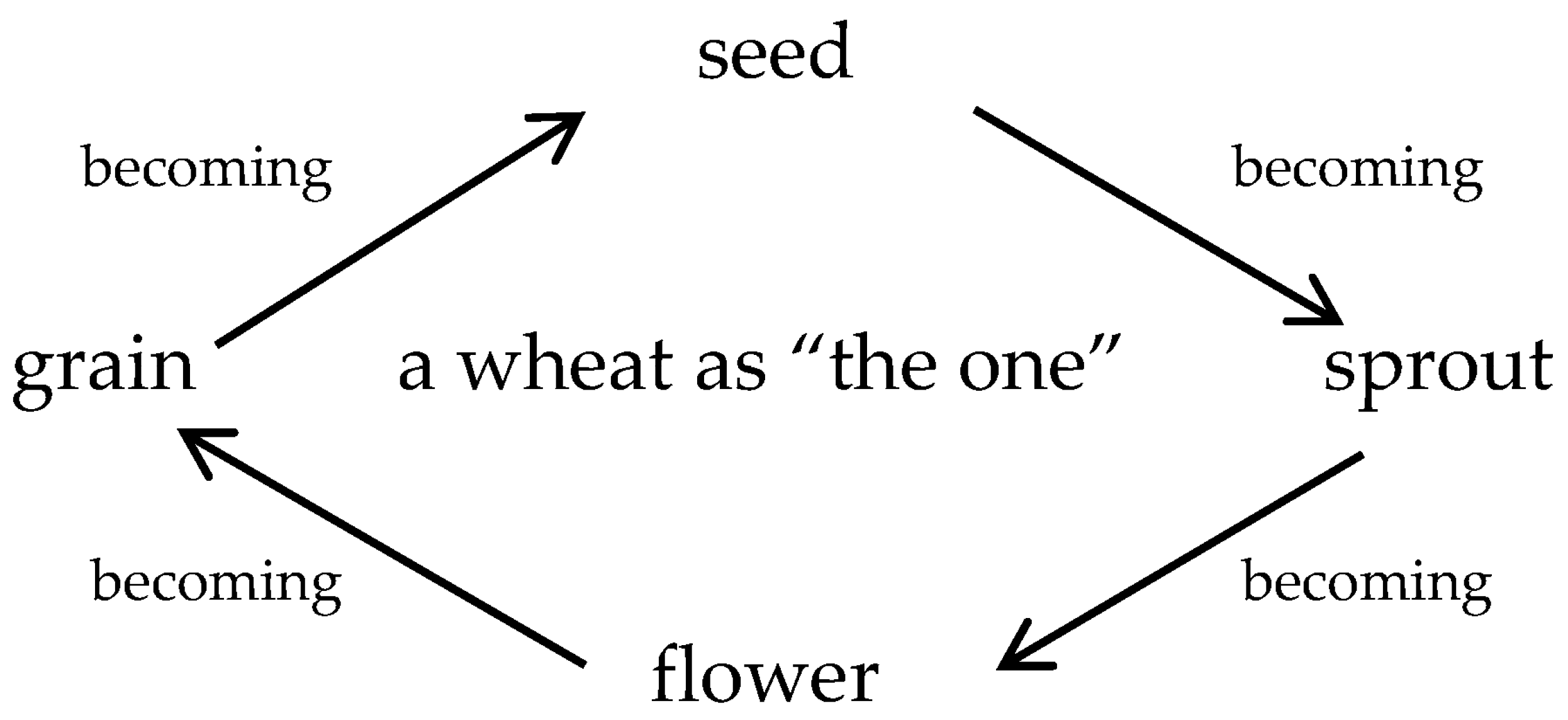
In Rombach’s view, the concept of “Substance” is analogous to that of a seed. In the process of growth, a seed germinates, blooms, bears fruit, and returns to seed form anew, exhibiting the character of a fundamental constancy (German:
Grundbestand) that remains unchanged. From this notion of fundamental constancy, the concept of essence can be further derived. Take wheat as an example: whether it exists as a seed, a plant, wheat grains, or flour, its unchanging essence—the abiding core that persists across all these forms—is the fundamental constancy immanent in each form (
Rombach and Wang 2009, p. 2). Like wheat, the Yi and “Substance” are fundamental constants that transcend all finite beings while remaining inherently unchanging. Both the Yi and Spinoza’s “Substance” embody this constancy, and it is through this shared ontological identity that the world takes shape as an ordered cosmos.
As for “System”, it takes the clock as its analogical image and emphasizes the unity of the world. “System” holds that “there is no isolated individual thing; prior to it, a holistic connection of numerous individual is always pre-given in a relationship of the strictest necessity.” “Knowledge is no longer situated in an essence hidden within the individual things, but in the all-encompassing, dominating system that draws everything into a strict connection via a network of functional interrelations.” (
Rombach and Wang 2009, pp. 4–5). Within the discourse of “System” epoch, the necessity of rational order is foregrounded, while the inquiry into essential existence recedes into the background. Modern European intellectual history shows that “System” paradigm, with science and technology as its cultural vehicles, has spread European culture far beyond its geographical boundaries.
Nevertheless, for all its far-reaching efficacy, Rombach argues that “System” achieves its effects only by concealing “Structure”. In Europe’s spiritual history, the idea of “Structure” was already at work in early Christianity, manifesting in the Christian fundamental experience of the act of ensoulment. Ontologically, the act of ensoulment reveals a relationship between the whole and the individual—the central concern of the “Structure” idea. Rombach contends that this relationship was precisely articulated by Nicholas Cusanus, who used the human body as an analogical image: within the bodily whole, “the body is a living unity only when the unity of the body that dwells in all its parts experiences itself as one and the same being” (
Rombach and Wang 2009, p. 6). The wholeness and unity of “Structure” signify homogeneous identity, whereas the wholeness and unity of “System” consist merely in the functional linkage of its parts. For Nicholas Cusanus, the wholeness and unity of “Structure” possesses its own vitality—a quality that connects “Structure” to the ancient concept of “Substance”.
Rombach points out that this ancient concept of “Substance” refers to that from which all things originate—something that has been given various names, such as Being, God, Light, Spirit, Matter, Nothingness, and so forth. He writes: “Everything that is fundamentally something in any way must exist as ‘being’ at its root. As a being, it precisely ‘is’ in its foundational way. This ‘beingness’ is that which holds all existents within Being. This ‘beingness’ grounds all existents, constitutes the ultimate foundational entity (Substance), and thereby also constitutes that which in itself precedes everything and presupposes everything (Subjection).” (
Rombach and Wang 2009, p. 285). As the foundational ground of all things, this “beingness” is that from which all things emerge; accordingly, “Substance” is thus naturally another name for it. To distinguish it from all prior appellations, Rombach calls that from which everything derives as “the One”. Since “the One” is the ultimate origin of all things, he also names it the Origin. Subsequent scholars of the
I Ching similarly regard the Yi as “the One” and the Origin (to be discussed below). Thus, the ontological analysis of the “image” can move beyond a “Substance” ontology toward a theory of “the One” as Origin, thereby enriching the meaning of “expression” through the original sense of “the One” and bringing the ontological significance of the “image” to the fore.
Ontologically, “the One” signifies not only an ultimate ontological ground but also identity and unity. The identity of “the One” means that “the One grounds everything, and everything is fundamentally this One” (
Rombach and Wang 2009, p. 121)—a claim congruent with Spinoza’s assertion that” Substance” grounds everything, and everything is fundamentally this “Substance”. The identity of “the One” also implies unity: since all things share this primordial identity, the whole and the individual are likewise identical. This reciprocal identity between the whole and the individual constitutes the unity of “the One”. It is precisely through this unity that “the One” attains its eminent metaphysical status and significance: “all thinking of the many is only possible through thinking of unity” (
Rombach and Wang 2009, p. 121). What Rombach calls “Structure” refers to this unity that manifests the relationship between the whole and the individual in “the One”. Within this unity of whole and individual, “Structure comes into being when the whole repeats itself in every individual” (
Rombach and Wang 2009, p. 26). ”A whole is completely determined in such a way that no part is understood from itself or from outside, but every position is understood only from the whole; only under this condition does structure arise.” (
Rombach and Wang 2015, p. 9). ”Structure” essentially serves to disclose the meaning place of parts within the whole, rather than merely accounting for functional interrelations among discrete parts.
From the perspective of the part–whole relation, “the One” as “Substance” designates the identical quality of all partial individuals. “The One” is thus immanent within all partial individuals, such that the activity of any partial individual is nothing more than a moment in the unfolding activity of “the One”. The regularity of partial activity expresses the orderliness of the unfolding activity of “Substance”. Rombach terms this unfolding as “Springing” (German: Springen). The activities of individual parts and the relations between them all express this “Springing”, while “Structure” manifests the order of the process in which all things emerge from “the One”.
To illustrate this identity, unity, “System”, “Structure”, and “Springing”, we may once again use wheat as an illustrative example. As shown in the
Figure 1 above, wheat manifests itself in the forms of seed, sprout, flower, and grain—all of which share the identity of wheat. Here, wheat is analogous to “the One”. This underlying identity implies that the changes of the seed, sprout, flower, and grain are identical to the self-unfolding of wheat itself. Consequently, the whole composed of the seed, sprout, flowers, and grains constitutes a unity: wheat is a unity, as “the One” is a unity. The necessary progression whereby a seed develops into a sprout, a sprout into blossom, and blossom into grain attests that the unity of wheat possesses a “Structure”. A sprout, as a system, composed of roots, stems, and leaves, but wheat as a whole is not a “System”—it bears only “Structure”. The “System” pertains to individuals and the relations between individuals, while “Structure” belongs to the whole, the unity, and “the One”. “The One” unfolds a dynamic transformative “Structure” in which individuals spring forth from “the One”, and this transformative “Structure” inheres in the process of individual emergence through springing forth from the One.
Likewise, the Yi, much like “the One”, manifests this identity, unity, “Structure” and “Springing”, with the “image” rooted in these qualities. The “springing” of the Yi is illustrated by the maxim “One closing and one opening is called change”. The Great Commentaries on the I Ching contains two classic passages: “The Yi gives rise to the Taiji, which generates the Two Modes; the Two Modes generate the Four Images; the Four Images generate the Eight Trigrams; the Eight Trigrams determine good fortune and misfortune; good fortune and misfortune bring forth great enterprise 易有太極, 是生兩儀, 兩儀生四象, 四象生八卦, 八卦定吉凶, 吉凶生大業” and “Generating and regenerating is called the Yi生生之謂易”. These passages follow the line “one closing and one opening is called change” and serve to elaborate on the paragraph in which “Generating and regenerating is called the Yi” appears.
Scholars of the
I Ching have advanced diverse interpretations of Taiji (太極). Zheng, Xuan (鄭玄)’s commentary on “The Yi gives rise to the Taiji” states: “It is the way of the ultimate mean, the Qi that is pure, harmonious, and undifferentiated. 極中之道, 淳和未分之氣也。” (
Lin 2015, p. 391). Yu, Fan (虞翻) glosses Taiji as the Ultimate One (
Taiyi 太一), and Li, Daoping (李道平) explains: “The ultimate is the mean. What is undifferentiated is called the One, hence it is named the Ultimate One. What is unactivated is the mean, hence it is named the Taiji. 是極者, 中也; 未分曰一, 故謂之太一; 未發為中, 故謂之太極。” (Li 2011, p. 454). From this, we may infer that the phrase ”The Yi gives rise to the Taiji” signifies that the Yi possesses “the way of the ultimate mean”. The Ultimate One refers to the One in its undivided state—thus, it denotes absolute identity, specifically the absolute identity of Qi (氣). The Yi has this ultimate mean, for it is the Qi (氣) “that is pure, harmonious, and undifferentiated”, abiding in a state of pure harmony (
chunhe 淳和). This Qi (氣) bears absolute self-causation, absolute identity, primordial originality, and absolute dynamic activity. Therefore, the Yi carries the connotation of the ”One/Substance” precisely insofar as it is the Qi (氣) of the Ultimate One. When the Yi is understood as Qi (氣), the Dao comes to designate the orderliness of Qi (氣)’s changes.
It is therefore evident that the passage “The Yi gives rise to the Taiji, which generates the Two Modes; the Two Modes generate the Four Images; the Four Images generate the Eight Trigrams; the Eight Trigrams determine good fortune and misfortune; good fortune and misfortune bring forth great enterprise” expresses the process whereby “the One” brings forth all things. Interpreting the Yi as the Qi (氣) of the Ultimate One fully embodies its substantial essence and the character of Rombach’s “the One”. The Two Modes (liangyi 兩儀), Four Images (sixiang 四象), and Eight Trigrams (bagua 八卦) are precisely the expressive medium through which the One-as-Substance gives rise to all things. The Two Modes as a whole constitute a unity, and the changes arising from their interaction embody a “Structure” of the Yi’s unfolding as “the One”. Similarly, the Four Images and Eight Trigrams, each as a whole, embody such a “Structure” of the Yi’s transformation. Since all things arise from the Yi’s Springing, all things coalesce into a whole. The Two Modes, Four Images, and Eight Trigrams are conceptual delineations of this whole: they reveal the position of the individual within the whole and its relational significance toward other individuals. Where a whole manifests its “Structure” through the Two Modes, it may be interpreted via the balance of Yin and Yang; where it manifests through the Eight Trigrams, it may be grasped through the interplay and movement of firmness and softness.
As noted earlier, the Two Modes, Four Images, and Eight Trigrams are “images” of the Yi. The “signification” of the “image” is therefore not only a manifestation of the being of the “Yi/Substance/One”, but also in pointing to the “Structure”. Meanwhile, the efficacy of “Substance” entails that every individual exists as an individual within the whole, with each individual fulfilling its respective role. Hence, the reference to “seeing the image” (guanxiang 觀象) in the Great Commentaries on the I Ching is also intended to embody the meaning of the individual within the whole. As the classic passage states: “That which is rooted in Heaven draws near to what is above; that which is rooted in Earth draws near to what is below. 本乎天者親上, 本乎地者親下。” Within the holistic “Structure” unfolded through the springing of “the One”, individuals occupying the same structural position resonate with one another ontologically. Accordingly, on the ontological level, the appearance of any individual within a determinate position of the overarching “Structure” implies the appearance of other individuals pertaining to that same position. For instance, the holistic “Structure” of Heaven and Earth unfolds its intrinsic Yin-Yang structure through the twenty-four solar terms (Ershisi Jieqi 二十四節氣). If one individual corresponding to a particular solar term appears, other individuals of that solar term must necessarily appear as well. This lays the very ontological foundation for the Guaqi (卦氣) Theory—a divinatory system formulated by Han-dynasty Confucian scholars on the basis of the twenty-four solar terms—a theme that will not be elaborated further here owing to limitations of space.
5. Concluding Remarks
In summary, the theory of “manifest image” in the Great Commentaries on the I Ching is not merely an interpretation of the “image”, but rather an account of the why and how of all things’ existence. This clarifies the distinctions among “visible image”, “analogical image” and “manifest image”: a “visible image” describes phenomena as they present themselves to human perception; an “analogical image” refers to the mutual analogy among such visible images; and the theory of “manifest image” anchors this identity in the Yi as “Substance” and the unity of all things. Interpreting the ontological foundation of the “image” through the philosophical frameworks of Spinoza and Rombach—while highlighting the substantiality of the Yi—not only effectively differentiates these three types of images but also provides a sound approach for the modern transformation of Yi-ology and facilitates the dissemination of I Ching thought in Europe and America.
Specifically, the foregoing discussion provides a highly appropriate foundational standpoint for advancing dialogue between traditional Chinese religions and Christianity. Within the Chinese religious tradition, both the religiously conceived Tian (天 Heaven) in Confucianism and the Dao in Daoist doctrine are constructed on the foundation of interpreting the Yi. The ontological character of the Yi has profoundly shaped the Confucian understanding of Tian as well as the Daoist understanding of the Dao. In brief, both the Tian–human relation in Confucianism and the Dao–human relation in Daoism bear the distinct ontological character of the Yi–image relation and the Dao–Qi relation. Moreover, the theophanic character of the Yi and its “image” explains why monotheistic religion never took shape in China throughout its history. For this reason, the theory of the “manifest image” carries profound significance for fostering mutual understanding between traditional Chinese religions and Christianity.
Notably, it should also be emphasized that Rombach’s discussion of the “springing” (generative emergence) of “the One” is grounded in the ontological difference between Being and existents (Heidegger). That is to say, “Substance” embodies the relational totality of determinate existents, and the “springing” he describes is ultimately rooted in the self-unfolding of Being qua itself. Since the “springing” of “the One” functions as the unifying ground that integrates individual beings and the whole, it allows individual beings to articulate structural meaning within the holistic order. Accordingly, drawing upon the theories of Spinoza and Rombach, the ontological analysis of the “image” as an unfolding of Being can be further advanced into the dimension of ontological difference. This topic merits sustained scholarly inquiry to systematically and deeply elaborate the ontological foundation of the “image”.