1. Introduction
The potential tension between exclusive worldviews and normative aspirations toward inclusive and cohesive social relations in religiously diverse societies has been discussed in the literature (
Ager and Strang 2008;
Rosca 2018). This tension has been identified as particularly salient in religious contexts, where deeply held convictions about truth and moral order may coexist uneasily with ideals of tolerance and mutual recognition (
Antonsich 2010;
Yuval-Davis 2011). Religion occupies an ambivalent position. On the one hand, religious worldviews can foster meaning, moral orientation, and solidarity, thereby contributing to social cohesion (
Cloete 2014). Social cohesion refers to the extent to which members of a society share norms and attitudes, experience trust and a sense of belonging, and are willing to participate in social life (
Chan et al. 2006). On the other hand, religion can reinforce symbolic boundaries and contribute to social closure (
Lamont and Molnár 2002). Previous research has shown that religion may simultaneously promote social integration and social exclusion, depending on how religious identities and worldviews are articulated (
Reitsma 2023). In particular, religious exclusivism, understood as the belief that one’s own religious tradition holds exclusive access to truth, has frequently been associated with stronger boundary-making and, in some contexts, with more negative evaluations of religious outgroups (
Hunsberger and Jackson 2005).
Alongside this focus on religious worldviews, social psychological and sociological research emphasises the role of social relations and embeddedness in shaping outgroup attitudes (
Antonsich 2010;
Putnam 2000). Intergroup contact theory highlights the importance of meaningful encounters for improving relations between groups (
Pettigrew and Tropp 2006). Social capital theory, in turn, draws attention to the structure of social networks within which outgroup attitudes develop (
Paxton 2002;
Putnam 2000). From this perspective, bonding social capital refers to dense, trust-based ties within the in-group, whereas bridging social capital captures connections that extend across group boundaries (
Putnam 2000,
2007). Classical formulations often assume a trade-off between these forms, suggesting that strong in-group bonding may come at the expense of openness toward outgroups (
Forrest and Kearns 2001;
Putnam 2007).
The present study addresses these assumptions by examining whether belonging and social capital constitute a mediating pathway between religious worldviews (exclusivism and pluralism) and religious outgroup attitudes. In doing so, it first maps the basic associations among religious worldviews, belonging, social capital, and religious outgroup attitudes, then evaluates whether these associations persist when considered simultaneously, and finally assesses whether the theorised sequence from religious worldviews via belonging and social capital to outgroup attitudes is supported when modelled as an indirect pathway. By empirically testing this conceptual model, the study seeks to clarify whether belonging and social capital operate as a coherent mediating process or whether distinct, and potentially countervailing, mechanisms are at work.
This article consists of six sections. The
Section 1 outlines the theoretical background, bringing together insights from research on religious worldviews, social capital, and intergroup relations. The
Section 2 presents the conceptual model and research question derived from this framework. The
Section 3 describes the quantitative research design, data collection, and measurement strategies. The
Section 4 reports the empirical results from correlation analyses, multivariate regression, and regression-based serial mediation (PROCESS) analyses. The
Section 5 discusses these findings in relation to existing theoretical perspectives and prior research. Finally, the
Section 6 summarises the main conclusions and reflects on the implications for understanding religious worldviews, social capital, and intergroup relations in religiously diverse societies.
3. Materials and Methods
3.1. Research Questions
The overarching research question guiding this study is: To what extent is the association between religious exclusivism and attitudes toward religious outgroups mediated by religious and national belonging and by bonding and bridging social capital?
Based on the theoretical framework, we developed a conceptual model that specifies the mechanisms linking religious exclusivism to outgroup attitudes (see
Figure 1). The model proposes connections between religious exclusivism and two forms of belonging, national belonging and religious belonging, which in turn are expected to relate most strongly to distinct forms of social capital: bridging ties across religious boundaries and bonding ties within the religious in-group. These network resources are expected to shape attitudes towards religious outgroups. The signs in the model indicate the theoretically expected direction of associations, while allowing for ambivalence when prior research suggests it. In line with belonging and social capital theories, the association between bonding social capital and outgroup attitudes is treated as potentially ambivalent, reflecting the possibility that bonding may either support outward engagement or reinforce social closure, and the association between religious exclusivism and national belonging is likewise treated as context-dependent, as exclusivist commitments may either coexist with or undermine national identification depending on how religious and national boundaries are negotiated.
To address the overarching research question, the analysis proceeds in three steps, each corresponding to a specific analytical focus. First, we examine the bivariate relationships between religious exclusivism, forms of belonging, social capital, and attitudes towards religious outgroups. Second, we assess which of these associations remain when these factors are considered simultaneously in multivariate regression models that seek to explain the outgroup attitude scores. Third, we formally test whether belonging and social capital constitute an explanatory pathway linking religious exclusivism to outgroup attitudes.
These steps are reflected in the following research questions:
RQ1. How are religious exclusivism, belonging, social capital, and outgroup attitudes interrelated at the bivariate level?
RQ2. To what extent do religious exclusivism, belonging, and social capital affect outgroup attitudes?
RQ3. Do religious belonging and bonding social capital sequentially mediate the association between religious exclusivism and outgroup attitudes?
3.2. Design
This study employed a cross-sectional survey design to examine theoretically derived associations between religious exclusivism, forms of belonging (religious and national), social capital (bonding and bridging), and evaluations of religious outgroups. A cross-sectional approach is well-suited to assessing structural relationships among social and religious factors within a diverse population at a single point in time (
Creswell 2014;
de Vaus 2014). Using an online survey among self-identified religious Christians and Muslims in the Netherlands, the design enabled the simultaneous assessment of bivariate associations, multivariate regression models, and regression-based process analyses to evaluate the plausibility of the proposed explanatory chain. At the same time, the cross-sectional nature of the data limits causal inference; accordingly, findings are interpreted as associations consistent with (or inconsistent with) the theorised pathways rather than as evidence of temporal ordering.
3.3. Participants
Data for this study were collected using the Longitudinal Internet Studies for the Social Sciences (LISS) panel, an established online research panel managed by Centerdata in the Netherlands. The LISS panel consists of approximately 5000 households and 7500 individuals recruited via a random probability sample drawn by Statistics Netherlands (CBS), ensuring demographic representativeness and minimising self-selection bias.
For the current study, a subsample was selected from panel members who had previously indicated that they considered themselves either definitely or somewhat religious. From this group, only respondents who identified as Muslim, Protestant Church in the Netherlands (PKN), or Roman Catholic were included in the analysis. These groups were selected because they represent major religious traditions in the Netherlands and, importantly, because they occupy structurally different majority–minority positions. This makes it possible to examine whether the associations between religious exclusivism, belonging, social capital, and outgroup evaluations vary across contexts of social recognition and boundary negotiation (
Ager and Strang 2008;
Yuval-Davis 2011). This sampling approach focused the study on religiously affiliated individuals most relevant to the research questions concerning interreligious encounters. In total, 433 respondents participated, of whom 432 completed the survey in full (see
Table 1).
3.4. Procedure
The survey was conducted online between 1 February and 28 February 2025, and distributed via the LISS panel system. Participants were provided with detailed information about the purpose of the study and gave their informed consent electronically before participation. The survey took approximately fifteen minutes to complete. Data collection adhered to ethical guidelines approved by the Institutional Review Board of the University of Humanistic Studies, ensuring anonymity and voluntary participation throughout the process.
To encourage participation and maintain high response rates, respondents received a financial incentive of €2.50 for completing the survey, which is standard practice within the LISS panel. The rigorous recruitment and sampling procedures of the LISS panel ensured a scientifically robust and demographically representative dataset for investigating factors associated with willingness to engage in interreligious encounters.
3.5. Measures
Religious exclusivism was operationalised via a dichotomous item asking participants to select the statement they most agreed with: “Only my religion contains the full truth” (exclusivism) versus “Many religions may contain truth” (pluralism).
Sense of belonging was measured, with two indicators reflecting identification with both the national community and religious groups: national belonging and religious belonging. National belonging was assessed by asking respondents how strongly they felt Dutch. Response options ranged from very strongly (1) to not at all (4), with higher recoded scores indicating a stronger sense of national belonging. Religious belonging was operationalised as religious identity centrality, reflecting the extent to which religion constitutes a salient and meaningful part of respondents’ self-concept and group identification. It was measured with four items adapted from prior research on social identity centrality (
Cameron 2004;
Grant and Hogg 2012;
Hais et al. 1997;
Hogg et al. 1998). Respondents were asked to indicate, on a 9-point slider scale ranging from 1 (not at all) to 9 (very much), (a) how strongly they identify with their religion, (b) how important their religion is to them, (c) how central their religion is to their sense of who they are, and (d) how strongly they are aware of being part of a religious community. Items were combined into a composite scale, with higher scores indicating a stronger sense of religious belonging. The scale demonstrated good internal consistency (Cronbach’s α = 0.937,
N = 432).
Social capital was assessed using two indicators reflecting the size and religious composition of participants’ close personal networks: bonding and bridging social capital. Respondents were first asked how many people they had good personal contact with, defined as individuals they feel comfortable with and can talk to about private matters or ask for help. Response categories ranged from no contacts (1) to more than ten contacts (5). A follow-up question asked how many of these close contacts shared the respondent’s religious affiliation, using identical response categories. Because both items used broad response ranges rather than exact counts, the categories were converted into estimated numeric midpoints (1–2 = 1.5; 3–5 = 4; 6–10 = 8; >10 = 12). Bonding social capital was operationalised as the estimated number of close contacts sharing the respondent’s religious affiliation. Bridging social capital was calculated by subtracting the estimated number of same-religion contacts from the estimated total number of close contacts, yielding a continuous indicator of cross-religious ties. Negative values, indicating logically inconsistent responses (more same-religion contacts than total contacts), were treated as missing (N = 65). Respondents selecting “don’t know” were likewise coded as missing. Higher values on the bonding measure indicate a larger number of close personal contacts sharing the respondent’s religious background, whereas higher values on the bridging measure indicate a larger number of cross-religious personal contacts.
Outgroup attitudes were measured using a feeling thermometer, assessing respondents’ affective evaluations of four groups: Christians, Muslims, Jews, and atheists. Respondents indicated how warm or cold they felt toward each group on a 0–100 scale, with higher scores reflecting warmer (more positive) evaluations and lower scores indicating colder (more negative) evaluations. To ensure that the measure captured outgroup evaluations rather than in-group affect, ratings of the respondent’s own religious group were excluded prior to analysis. Thus, for Christian respondents, evaluations of Christians were removed, and for Muslim respondents, evaluations of Muslims were removed. The outgroup attitude measure was then computed by aggregating respondents’ thermometer ratings of the remaining groups (those other than their own), yielding a composite score that reflects attitudes toward religious others rather than identification with one’s own religious community.
3.6. Analytic Strategy
The analytic strategy proceeded in three sequential steps, corresponding to the study’s research questions.
First, bivariate Pearson correlations were examined to explore the associations between religious exclusivism, forms of belonging (religious and national), social capital (bonding and bridging), and evaluations of religious outgroups. This step provided an initial descriptive overview of how the key variables were interrelated and allowed for the identification of potential patterns and unexpected associations.
Second, multivariate hierarchical multiple linear regression analyses were conducted to assess the unique associations of religious exclusivism, belonging, and social capital with outgroup attitudes while accounting for overlap among predictors. Given the continuous operationalisation of the outgroup attitude measure, linear regression was used. Predictors were entered in a stepwise fashion to examine the stability of associations across model specifications and to determine whether bivariate relationships persisted after accounting for other theoretically relevant variables.
Third, to formally examine whether belonging and social capital constituted an explanatory chain linking religious exclusivism to outgroup evaluations, regression-based process analysis was performed using the PROCESS macro for SPSS Statistics (version 28.0.1.0) (
Hayes 2012). Indirect effects were estimated using bias-corrected bootstrap confidence intervals with 5000 resamples, allowing for robust inference regarding indirect associations without assuming the normality of the sampling distribution.
Given the cross-sectional design, PROCESS was used to test whether the data are consistent with the theorised indirect pathways, associations compatible with mediation, rather than to establish temporal ordering or causal effects; accordingly, all results are interpreted as associational.
4. Results
4.1. Results of Bivariate Pearson Correlation Analyses
To address the first research question, Pearson’s two-tailed correlations were computed among the focal variables. Due to pairwise missing data, sample sizes varied across correlations (
N = 367–432). The results are reported in
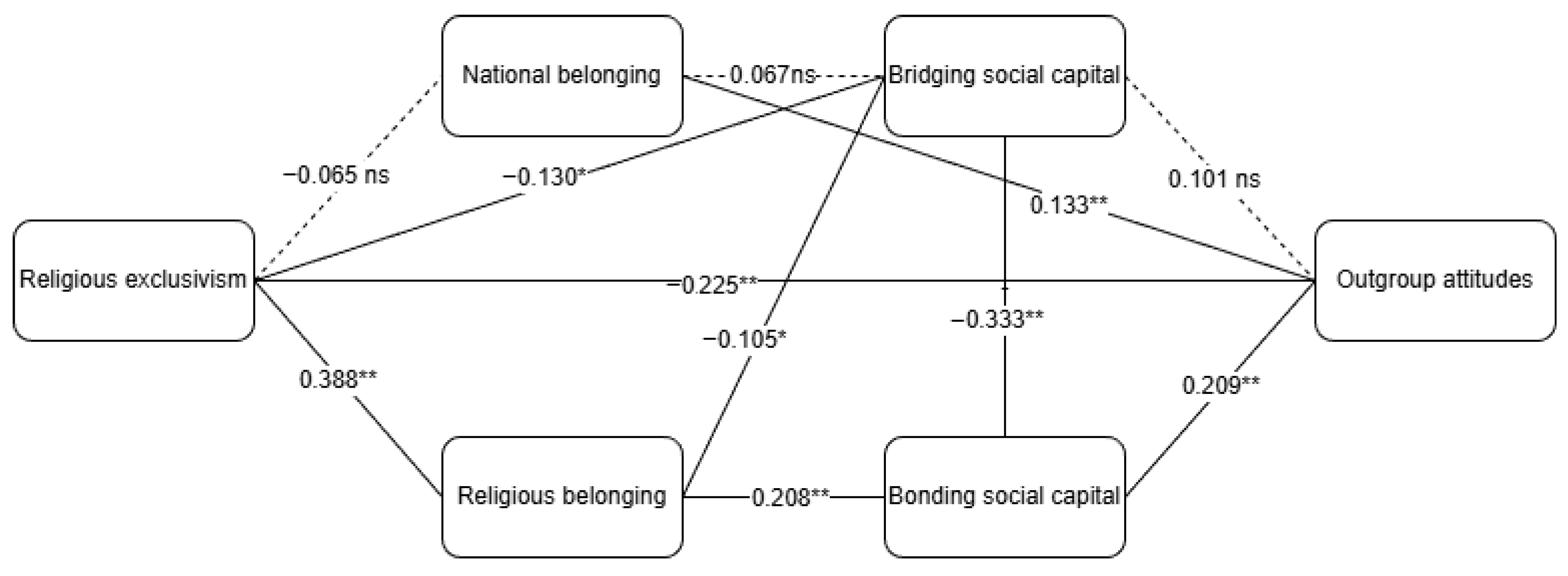
Table 2, and the corresponding correlation-based path model with standardised coefficients is presented in
Figure 2.
Exclusivism correlated negatively with outgroup attitudes and positively with religious belonging. Religious belonging, in turn, was positively correlated with bonding social capital, while bonding social capital was positively associated with outgroup attitudes. Bonding and bridging were negatively related. In contrast, exclusivism was not significantly associated with national belonging, and the national belonging–bridging pathway was not supported. Bridging showed no statistically significant association with outgroup attitudes.
Taken together, these correlations indicate that the theoretically assumed linear pathway is only partially supported. The strongest associations involve a negative link between religious exclusivism and outgroup attitudes, alongside a positive link between religious exclusivism and religious belonging and between bonding ties and outgroup attitudes. In contrast, the national-belonging-to-bridging pathway is not supported at the bivariate level, and bridging ties show no clear association with outgroup attitudes in this measurement. The pattern, therefore, points to a more differentiated set of relationships in which religious exclusivism, belonging, and network embeddedness do not align neatly in a single ‘closing’ sequence, suggesting the need to consider multiple, potentially competing mechanisms rather than a uniform pathway from exclusivism to social distance.
4.2. Results of Hierarchical Linear Regression Analyses
To address the second research question, hierarchical linear regression analyses were conducted with religious outgroup attitudes as the dependent variable. Predictors were entered in successive blocks to examine their incremental explanatory value. In Block 1, the control variable (Christians–Muslims) was entered. In Block 2, religious exclusivism was added. In Block 3, national belonging and religious belonging were included, followed in Block 4 by bonding and bridging social capital. All continuous predictors were standardised prior to analysis.
The results (listwise
N = 367) indicate that respondents’ religious background alone accounted for a small proportion of the variance in religious outgroup attitudes (
R2 = 0.026). Adding religious exclusivism substantially increased explained variance (Δ
R2 = 0.051; cumulative
R2 = 0.077). The inclusion of belonging variables contributed additional explanatory power (Δ
R2 = 0.038; cumulative
R2 = 0.115), and the addition of social capital further improved model fit (Δ
R2 = 0.045), resulting in a final model explaining 16.0% of the variance in religious outgroup attitudes (
R2 = 0.160; adjusted
R2 = 0.146). Model fit and changes in explained variance are reported in
Table 3.
In the full model of
Table 3 (Model 4), exclusivism remained a robust negative predictor of outgroup warmth (B = −12.53, β = −0.307,
p < 0.001). At the same time, religious identity centrality (religious bonding) was positively associated with Outgroup attitudes (B = 1.63, β = 0.147,
p = 0.007), whereas national belonging was not significant (B = 1.49, β = 0.053,
p = 0.286). Both bonding ties (B = 1.24, β = 0.221,
p < 0.001) and bridging ties (B = 1.06, β = 0.145,
p = 0.006) were positively associated with outgroup warmth, with bonding showing the stronger standardised association. After accounting for these mechanisms, religious background (Christian versus Muslim) no longer predicted outgroup attitudes (B = −0.45, β = −0.009,
p = 0.873).
While the bivariate correlations suggested multiple associations among exclusivism, belonging, social capital, and outgroup attitudes, the regression analyses show that these relationships do not map onto a single closure pathway when overlapping predictors are taken into account. Additional analyses including demographic and contextual controls (age, gender, education, urbanisation) did not substantially alter the pattern of results. Most notably, religious exclusivism remains a robust independent predictor of lower outgroup warmth across model specifications. At the same time, several indicators of social embeddedness, religious identity centrality, and both bonding and bridging forms of social capital are positively associated with outgroup warmth when modelled alongside exclusivism. By contrast, national belonging does not show an independent association with outgroup warmth when other predictors are included, suggesting that its bivariate relationship is largely accounted for by worldview and embeddedness-related factors.
Taken together, these findings indicate contrasting patterns: religious exclusivism is associated with less positive evaluations of religious outgroups, whereas religious belonging and bonding and bridging social capital are associated with warmer outgroup evaluations. In other words, rather than supporting the expectation that bonding primarily functions as a mechanism of social closure, the regression pattern points to two simultaneous regularities: (1) a strong negative association between exclusivism and outgroup warmth, and (2) positive associations between embeddedness variables (religious centrality, bonding, bridging) and outgroup warmth.
4.3. Results of Serial Mediation Analyses (PROCESS Model 6)
To answer the third research question, whether belonging and social capital constitute explanatory pathways linking religious exclusivism to religious outgroup attitudes, two serial mediation models were tested using PROCESS Model 6 with bias-corrected bootstrap confidence intervals (5000 resamples). Specifically, the indirect effects of religious exclusivism (X) on religious outgroup attitudes (Y) were examined via (a) religious belonging and bonding social capital and (b) national belonging and bridging social capital; unstandardised indirect effects (B) with bias-corrected 95% bootstrap confidence intervals are reported in
Table 4, while the unstandardised path coefficients for each mediation model are displayed in
Figure 3. Religious background (Christian versus Muslim) was included as a control variable in all models. Although Muslims reported higher levels of religious belonging, religious background did not significantly predict religious outgroup attitudes in the final models and did not alter the pattern of direct or indirect effects.
In the first model, religious belonging and bonding social capital were specified as sequential mediators. Results indicated the significant indirect effect of religious exclusivism on religious outgroup attitudes through religious belonging and bonding social capital (B = 0.60, 95% BC CI [0.21, 1.27]). Religious exclusivism was positively associated with religious belonging, which in turn was positively related to bonding social capital. Bonding social capital was associated with warmer evaluations of religious outgroups. The indirect effect via religious belonging alone was also significant, indicating that religious belonging constitutes a central mediating pathway linking religious exclusivism to outgroup attitudes. By contrast, the indirect effect via bonding social capital alone was not significant, suggesting that bonding social capital does not operate as an independent mediator but rather functions as part of the sequential pathway initiated by religious belonging.
In the second model, national belonging and bridging social capital were examined as sequential mediators. No indirect effects involving national belonging and bridging social capital reached statistical significance, and the sequential indirect effect was not supported (B = 0.00, 95% BC CI [−0.01, 0.07]). These findings indicate that the relationship between religious exclusivism and religious outgroup attitudes is not mediated through national belonging or bridging social capital.
Taken together, the results point to an asymmetric pattern in which a religious embeddedness-based pathway is supported, whereas a parallel national–bridging pathway is not.
5. Discussion
This study examined whether belonging and social capital constitute explanatory pathways linking religious exclusivism to evaluations of religious outgroups. By combining bivariate analyses, multivariate regression, and regression-based PROCESS analyses, the study disentangled descriptive associations, independent effects, and theorised mechanisms.
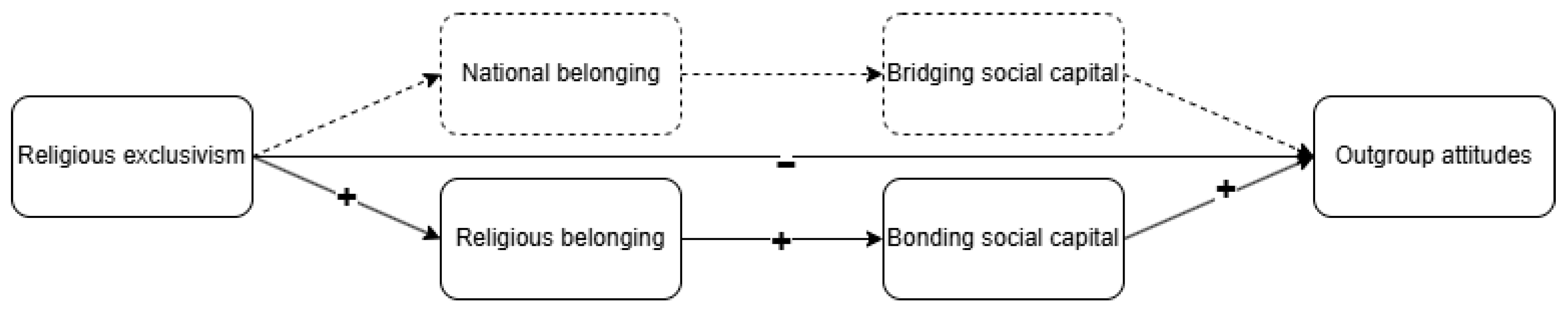
Figure 4 summarises the final model, illustrating a negative direct association between religious exclusivism and outgroup attitudes alongside a positive relational pathway operating through religious belonging and bonding social capital, whereas the national–bridging pathway was not supported.
RQ1 examined the bivariate relationships among religious exclusivism, belonging, social capital, and outgroup attitudes. The bivariate analyses showed that religious exclusivism, belonging, social capital, and outgroup attitudes are meaningfully related, but do not align in a single, linear closure pattern. Exclusivism was associated with stronger religious belonging and colder outgroup evaluations, consistent with accounts linking exclusive truth claims to boundary-making. At the same time, religious belonging was positively related to bonding social capital, and bonding social capital was positively associated with warmer evaluations of religious outgroups. Crucially, religious exclusivism was not significantly associated with national belonging, and the national-belonging-to-bridging pathway was not supported at the bivariate level. Bridging social capital showed no statistically significant bivariate association with outgroup attitudes. Taken together, these correlations indicate that the theoretically assumed linear pathway is only partially supported.
RQ2 examined which associations remain when overlap between predictors is taken into account. The regression analyses showed that religious exclusivism remains a robust independent predictor of colder outgroup evaluations. In contrast, religious belonging as well as both bonding and bridging social capital were positively associated with warmer outgroup evaluations in the full model, with bonding social capital showing the strongest standardised association. National belonging did not retain an independent association once exclusivism and social capital were included. After accounting for these mechanisms, differences between Christian and Muslim respondents no longer predicted outgroup attitudes, indicating that group differences operate through underlying orientations and forms of embeddedness rather than directly.
RQ3 assessed whether belonging and social capital constitute explanatory pathways linking exclusivism to outgroup attitudes. While a statistically significant sequential indirect effect of exclusivism via religious belonging and bonding social capital was observed, this pathway did not operate in the direction of social closure. Instead, stronger religious belonging and bonding were associated with warmer outgroup evaluations. Bonding social capital, therefore, did not function as a mediating mechanism translating exclusivism into outgroup hostility, even when embedded in a sequential pathway. At the same time, religious exclusivism showed a significant negative direct association with outgroup attitudes. No indirect effects involving national belonging and bridging social capital were supported.
The analyses show that religious exclusivism is directly associated with colder evaluations of religious outgroups, whereas religious belonging and bonding social capital are independently associated with warmer outgroup evaluations. More specifically, religious exclusivism retains a strong negative direct association with outgroup attitudes (B = −12.53), even when belonging and social capital are included in the model, while the sequential indirect pathway via religious belonging and bonding social capital is positive and statistically significant (B = 0.60). These results indicate that worldview orientation and relational embeddedness operate as distinct dimensions with different implications for intergroup attitudes.
Taken together, these findings challenge a simple bonding-as-closing logic often associated with social capital theory (
Forrest and Kearns 2001;
Putnam 2007). Rather than equating strong in-group ties with social closure, the results show that bonding social capital is associated with warmer evaluations of religious outgroups. Religious exclusivism functions as a normative boundary orientation linked to colder evaluations of religious others, whereas religious belonging and bonding represent forms of embeddedness positively associated with outgroup warmth. Importantly, the positive association of belonging and bonding persists alongside exclusivist orientations, rather than merely reflecting them. This builds on
Brewer’s (
1999) distinction between ingroup attachment and outgroup derogation by showing that, in a religious context, strong ingroup belonging can coexist with more positive intergroup evaluations. These findings speak directly to widespread concerns about religious exclusivism in religiously diverse societies. The strong direct association between exclusivist convictions and colder outgroup evaluations confirms that exclusive truth claims can have socially distancing implications, yet the positive indirect pathway suggests that such convictions do not operate solely through mechanisms of social closure. Consistent with arguments that distinguish theological truth claims from social practice (
Cloete 2014;
Reitsma 2023), the results suggest that the social consequences of exclusivist beliefs depend on how they are embedded in relational contexts and translated into everyday orientations toward religious others.
Across all models, national belonging and bridging social capital did not show significant independent or mediating effects. Broader societal identification therefore does not appear to play a central explanatory role in this study. These null findings should not be overinterpreted, but they caution against assuming that national identification or bridging automatically translate into more positive intergroup attitudes. While theories of social capital emphasise structural inequalities and minority positions as shaping opportunities for bridging (
Foley and Edwards 1999;
Lancee 2010;
Putnam 2007), the present analyses do not provide direct empirical evidence that such structural constraints account for the observed patterns.
Finally, the present study does not provide empirical evidence for dual identity processes. In contrast to national belonging, religious belonging was positively associated with warmer outgroup evaluations. This indicates that attachment to a religious subgroup does not necessarily translate into outgroup derogation; subgroup identification and intergroup attitudes may operate independently in this context. This interpretation aligns with social identity approaches that distinguish between ingroup attachment and outgroup hostility (
Brewer 1999). Although social identity research highlights the potential of dual or superordinate identities to improve intergroup relations (
Abrams and Vasiljevic 2014;
Brewer 1999;
Dovidio et al. 2009;
Gaertner and Dovidio 2000), the present findings do not demonstrate such a mechanism. Instead, the results point to an association between strong religious embeddedness and more positive outgroup evaluations. Future qualitative research could examine how individuals with strong or exclusive religious commitments interpret religious difference in everyday life, and whether epistemic boundaries coexist with socially inclusive orientations or are accompanied by moral distancing and negative outgroup evaluations (
Reitsma 2023). In addition, qualitative accounts could clarify how belonging and identity centrality are experienced, whether as a secure base facilitating openness or as a defensive posture under perceived threat (
Antonsich 2010;
Putnam and Campbell 2010;
Yuval-Davis 2011), thereby illuminating mechanisms that remain difficult to capture with survey indicators alone.
6. Conclusions
This study examined whether belonging and social capital constitute explanatory pathways linking religious exclusivism to evaluations of religious outgroups. The findings demonstrate that, although some factors are sequentially related, they do not operate as a single cumulative pathway translating religious worldviews into colder evaluations of religious outgroups. Religious exclusivism is independently associated with colder evaluations of religious outgroups, whereas religious belonging and both bonding and bridging social capital are associated with warmer outgroup evaluations.
By showing that religious belonging and bonding social capital are associated with warmer outgroup evaluations, this study builds on theoretical distinctions between normative boundary orientations and forms of ingroup attachment. The findings indicate that strong religious identification can coexist with, and even support, positive orientations toward religious others. Moreover, the results suggest that strong religious commitments, when embedded in supportive patterns of belonging and social relations, may be associated with greater openness toward religious others rather than with social exclusion. In this way, the findings qualify common concerns that exclusive religious truth claims are necessarily incompatible with social inclusivity, highlighting that their social implications depend on how such convictions are enacted within everyday patterns of belonging and social relations.