Article

Caught Between Religion and Politics: The Norwegian Missionary Society and Political Dynamics in Hunan Province, China (1902–1950)

School of Foreign Languages, Hunan University, Changsha 410082, China
Religions 2026, 17(5), 536; https://doi.org/10.3390/rel17050536
Submission received: 31 January 2026 / Revised: 8 April 2026 / Accepted: 23 April 2026 / Published: 29 April 2026
(This article belongs to the Special Issue Religion, Mobility, and Transnational History)

Abstract

Det Norske Misjonsselskap (Norwegian Missionary Society, NMS) was founded in Stavanger, Norway, in 1842. Having established its first mission field in Africa, it then made plans to work in Asia. In 1902, the first missionaries were sent out to Hunan, an inland, culturally isolated, and conservative Chinese province that experienced particularly strong anti-foreigner and anti-Christian waves. This article argues that the NMS developed a distinctive, pragmatic strategy of political accommodation—rooted in its Pietistic Lutheran social ethos and a Norwegian pioneering spirit—to ensure its institutional survival in Hunan. Examining the NMS’s responses to two major political turning points, the Anti-Christian Movement (1924–1927) and the New Life Movement (1934–1937), the article reveals three key findings: First, the NMS’s proclaimed “neutrality” was not merely a passive stance but an active survival tactic, evolving from a claim grounded in Norway’s geopolitical neutrality into a strategic rhetoric for navigating local political risks. Second, the missionaries’ “excessive expectations” of the Nationalist government, particularly during the New Life Movement, stemmed from a structural cognitive bias shaped by their deep institutional embedding in the KMT-governed local order. Third, their ultimate withdrawal was less a simple political misjudgement than the logical endpoint of a survival model that lacked a contingency plan for revolutionary change. By tracing this specific case, the article contributes to the historiography of Christianity in modern China by illuminating the diversity of missionary strategies beyond the dominant Anglo-American coastal narratives.

1. Introduction

Despite having been introduced to China from overseas as early as the mid-nineteenth century, at the beginning of the 20th century, Christianity was still labelled a “foreign religion” and regarded as an invader of Chinese culture. At that time, China was caught up in a series of wars, and Christianity’s inherent labelling as “the other” inevitably conflicted with the surge of Nationalist ideology. Under ancient dynasties, missionaries seeking to introduce Christianity into China had to gain the emperor’s approval, whereas in modern times, they also needed the approval of the Chinese government. Obtaining official permission was always the first step in enabling any Christian group to enter China. Modern China was so ravaged by wars, as the political situation was constantly in turmoil, which affected Christianity as a “foreign religion”. In this turbulent society, missionaries had to adapt strategically to the context of their specific time and place in order to survive and preach the gospel.
The Norwegian Missionary Society (NMS), founded in Stavanger in 1842, was a Lutheran agency that expanded from its early fields in Africa to establish a mission in Hunan province in 1902. It is this society that serves as the central subject of the present study. Regarding the complicated dynamic between the missionary side and the Chinese local government in the first half of the 20th century, Arne Søvik1 offers one of the earliest studies. He describes China as a “nationalism and secular state”, so the church and state relations were inevitably left with remaining ambiguities and tensions (Søvik 1952, p. 383). It should be noted that Søvik himself was born in Henan, China, as a son of a Norwegian missionary. Some scholars in this field have also suggested that the relationship between church and state is also a key concept in interpreting the social history of religion in China, and that the Chinese Nationalist Party (Kuomintang, KMT), for example, had carefully considered how to confront, discipline, and utilise Christianity (L. Zhang 2020, p. 88). However, the KMT had quite a struggle with policies related to religion, since Chinese people did not have a “national religion” that could help maintain the government. The KMT was “placed in a difficult position between total iconoclasm and cultural restorationism” (Nedostup 2009, p. 5). Though there are already some studies and findings regarding the church and state relations in China, there is still little research focusing on the NMS as a particular case. As a matter of fact, the NMS bears it Scandinavian roots and works in Hunan, which is the particular province with the tradition of joining the army and starting the Communist revolution. All of these characteristics bring uniqueness to this study.
This article focuses on the activities of the NMS in the social and historical context of Hunan province, which is also the original place of a series of revolutions and is regarded as the “red” province of China. Two important historical turning points, namely the “Anti-Christianity Movement” and the “New Life Movement”, are used as examples to explore the Norwegian missionaries’ responses to and handling of large-scale political changes in different periods. Examination of interactions between the missionaries and Chinese officials sheds light on mutual attitudes and power relations between the NMS and the Hunan local government. The missionaries ran schools and other institutions in Hunan, and interactions with the government might determine the outcomes of their efforts. The NMS’s work in Hunan, particularly at its central station in Taohualun, was conducted within a broader network of Scandinavian Lutheran missions. Finally, this article explores how the NMS facilitated its mission work by moderating its relationships with local government, and it provides historical and cultural explanations.
This article makes three primary contributions to the existing scholarship. First, it draws on previously underutilised archival sources: NMS annual reports, internal conference minutes, personal correspondence, and documents from the Hunan Provincial Archives. Their reliability is enhanced through cross-referencing between missionary records and Chinese official materials. Second, it moves beyond the dominant focus on Anglo-American missions in coastal China by examining a small Scandinavian Lutheran society operating in the inland, politically volatile province of Hunan. Third, it offers a nuanced analysis of how a specific theological and cultural tradition shaped a distinctive mode of pragmatic political adaptation, thereby enriching our understanding of the diversity of missionary strategies in modern China.
This article also argues that the NMS’s distinctive approach was shaped by a confluence of two factors: first, its Pietistic Lutheran theological foundation, which prioritised social and educational engagement as a form of witness, thereby making institutional preservation a central concern in its dealings with the state; second, a Norwegian “pioneering spirit”, resonant with a Viking-era cultural narrative, which aligned unexpectedly with the perceived fiery and independent character of Hunan locals, fostering a unique mode of pragmatic adaptation.
A critical reading of the NMS archives also requires attention to the genre and intended audience of each document. The official annual reports, aimed at the home board and supporters in Norway, often present a strategic narrative that may emphasise perseverance or success. Personal letters and internal conference minutes, however, can reveal more candid anxieties and complex negotiations. This article’s analysis also remains mindful of these potential gaps and, where possible, cross-references different types of sources to construct a more nuanced understanding.
This article also approaches the NMS as a transnational religious network, emphasising how the missionaries’ Norwegian background and transnational identity enabled them to engage in ongoing strategic negotiations with local authorities. Through a series of calculated choices and adaptations, they secured government assistance and protection, shaping a distinctive mode of church–state interaction that was inherently transnational in character. At the same time, the NMS’s presence in Hunan contributed to local social progress through its educational, medical, and charitable institutions—a universal, transnational contribution that transcended national and cultural boundaries.

2. Norwegian Missionaries’ Responses to Political Changes in China

The NMS was active in China for almost half a century. During these five decades, perhaps the most turbulent political changes in the country were witnessed, including the collapse of the Qing dynasty, the rise and fall of emperor Yuan Shikai, the Warlord Era, and the establishment of the Nationalist government. The NMS’s missionaries lived through these changes and adjusted their working strategies and priorities to the different cultural climates.
In this article, two crucial historical turning points are analysed: one positive and one negative for mission work in China. The first is the nationwide “Anti-Christian Movement” from 1924 to 1927. One of the strongest waves of this movement occurred in Hunan province, causing a huge blow to the work of the NMS; however, according to Fairbank (1998, p. 223), violent Hunanese resistance to Christianity can be traced back to the time of the Taiping Rebellion in the mid-nineteenth century. The second turning point analysed is the “New Life Movement”, launched in 1934 by the Chinese Nationalist Party, in which the NMS missionaries sensed the government’s promotion of cultural reform as a gesture of welcome to Christianity, igniting a fleeting glimmer of hope.

2.1. Anti-Christian Movement

This section covers the period from the rise of the Anti-Christian Movement in the early 1920s to the NMS’s temporary withdrawal from Hunan in 1927, with some retrospective references to earlier decisions, such as the 1917 annual meeting.
The Anti-Christian Movement arose in Shanghai in 1922. In the same year, the Shanghai Socialist Youth League, part of the Chinese Socialist Youth League that later became the Communist Youth League of China, organised an Anti-Christian Student League in open opposition to the 11th Congress of the World Student Christian Federation at Tsinghua University, Beijing. Hunan’s influential local newspaper, Ta Kung Pao (大公報, the Hunan-based newspaper of that name, distinct from the more famous Tianjin Ta Kung Pao), responded swiftly by publishing a series of articles in 1922 rejecting religious education, mission schools, and the Young Men’s Christian Association (YMCA; Li 2015, pp. 17–18).
This ideological turbulence was further intensified by a series of severe natural disasters that struck Hunan province in four consecutive years from 1924, including flooding, drought, and heavy rains that caused the Xiang River to burst its banks in June 1926. More than 100 people in Changsha died in the floods (Yang 2007, p. 92). Frequent natural disasters made survival and social stability more difficult and resulted in a stronger anti-foreigner attitude among local people.
During the initial stages of the Anti-Christian Movement in July 1924, the “Great League Against Imperialism” (反對帝國主義大同盟) was established in Hunan. In August, other anti-Christian alliances were established, with slogans clearly characterising mission schools as imperialist colonising tools. They demanded that education be taken back into Chinese people’s hands. As a result, a wave of student dropouts from the NMS Middle School in Yiyang (益陽) boosted mission schools in Hunan, with Yale College in Changsha being the most active responder. In fact, student-led social movements continued in Yale College throughout this anti-Christian period (Zhao 2006).
The growing wave of anti-Christianity also coincided with the breakdown of KMT-CPC cooperation following Sun Yat-sen’s death in 1925. In April 1927, Chiang Kai-shek launched a violent purge of CPC members in Shanghai, and by July, Wang Jingwei’s KMT faction had finalised its split with the CPC. In response, the CPC launched the Nanchang Uprising in August to counter the KMT. In the interim, the military forces of the two parties were ranged against each other. Johan Gotteberg (戈德白) wrote in the NMS annual report that the (KMT) government “oppressed and punished all the suspicious people, often in a cruel way” (Det NMS Årsberetning 1927, p. 32). Hunan and Jiangxi provinces, both located in China’s hinterland, quickly became red revolutionary bases for the CPC. With this unique geopolitical influence, the Anti-Christian Movement in Hunan became more intense, hampering the NMS’s work in Hunan. The widespread rise of communism also strengthened the Anti-Christian Movement.
Beyond its immediate impact on missionary operations, the Anti-Christian Movement must be understood as a profound assertion of Chinese sovereignty and a form of anti-imperial resistance. The demands to take back educational rights and to abolish mission schools were not merely administrative requests or expressions of xenophobia but political struggles to reclaim national autonomy from the extraterritorial privileges that had, for decades, placed foreign missionaries beyond the reach of ordinary Chinese law and regulation. Framing these events merely as “policy crises” risks obscuring their deeper character as a Nationalist rejection of the unequal treaty system.
This nationwide political and ideological turmoil presented an existential crisis for all Christian missions in China. At the national level, church leaders and organisations such as the National Christian Council (NCC) grappled with formulating a public response that could reconcile Christian faith with rising Chinese nationalism. In the wake of incidents like the May Thirtieth Movement in 1925, the NCC issued public statements asserting that “Christianity, patriotism, and good citizenship are not necessarily opposed”, and advocated for the church to “penetrate and transform the economic, social, and political life” of the nation (Wang 2013, pp. 182–83). This elite strategy focused on theological discourse, public declarations, and engaging with national politics to secure the church’s legitimacy.
However, for the NMS operating in the inland province of Hunan, the crisis manifested in a more immediate and localised form. Removed from the coastal centres of intellectual debate, the NMS faced direct threats to its physical institutions and personnel.
At this time, the NMS began to close churches and schools. The year 1927 was difficult for the missionaries, as Gotteberg wrote:
Dark clouds had begun to rise, and everyone felt that hard times were coming. The higher schools were closed, the hospital at Taohwalun was closed, the missionaries of other countries had begun to leave the province, and the work our missionaries were able to carry on started to meet with almost insurmountable difficulties from the Communist and anti-Christian forces.
(Det NMS Årsberetning 1927, p. 23)2
Following the general trend, the NMS missionaries working in Hunan also started a large-scale evacuation in 1927. As Gotteberg mentioned, by early 1927, several Communist organisations had emerged in Hunan, and many Chinese people, including many local co-workers in the NMS church, joined the CPC and largely gave up their church work. Under external pressure, the Chinese co-workers raised “unreasonable demands” for salary increases and other conditions and staged their first strike. This was prompted by their particular circumstances, rather than organised action. During this period when foreigners were being expelled, the Chinese co-workers’ sense of self-confidence and independence flourished, while the Norwegian missionaries of the NMS, like other foreign missionaries, were confined to their rooms without help or food (Det NMS Årsberetning 1927, p. 23). The Norwegian missionaries had previously been in a dominant position in the work of the church, but at this turning point, they began to rely on their Chinese co-workers.
Their earliest evacuation was at the end of January 1927, leaving only 14 people in Hunan, including six women and three of missionary Arthur Johan Hertzberg’s children. On 6 February 1927, the Lutheran missions held a four-day joint meeting in Changsha to discuss whether all missionaries should leave Hunan. The synod’s leading Chinese co-workers also attended this meeting and drafted an initial working plan for the period following the withdrawal of the Norwegian missionaries. This was the first time since their initial strike that the Chinese co-workers were able to fully take over the Norwegian missionaries’ work in Hunan. They took on not only church work but also work in hospitals, clinics, and schools for blind individuals. Supervisor Gotteberg hired a special accountant to manage the funds given by the Norwegian mission to the church in Hunan but still retained full decision-making powers over the mission’s finances. He required the accountant to live in Changsha, assisted and supervised by the committee. The accounts had to be reviewed by the finance committee in Changsha and accountants in each region. A committee meeting resolved that Taohualun Hospital could be reopened under the management of Dr Liang, which would begin Chinese-led management of the hospital. However, since the government demanded that the school should not continue to operate, the foreign missionaries made concessions and kept the school closed (Det NMS Årsberetning 1927, p. 24).
In late March 1927, the Nanjing Incident occurred when the National Revolutionary Army captured the city, killing and injuring several foreigners. British and American warships bombarded Nanjing in response, causing heavy civilian casualties. Long-standing anti-imperialist sentiment among the general public was ignited by this violent conflict, fuelled by various reports. For example, Shanghai-based newspaper Shen Bao reported the following:
Although the KMT government shifted responsibility for the accident to the CPC, it ultimately shouldered responsibility for compensating the foreign nationals in foreign territories. However, the civilians in Nanjing made no demand for compensation for the bombardment of civilians in Nanjing, and the foreign powers simply expressed sympathy.
The Nanjing Incident strengthened the Chinese people’s anti-foreign sentiment and pushed the Anti-Christian Movement to a climax.
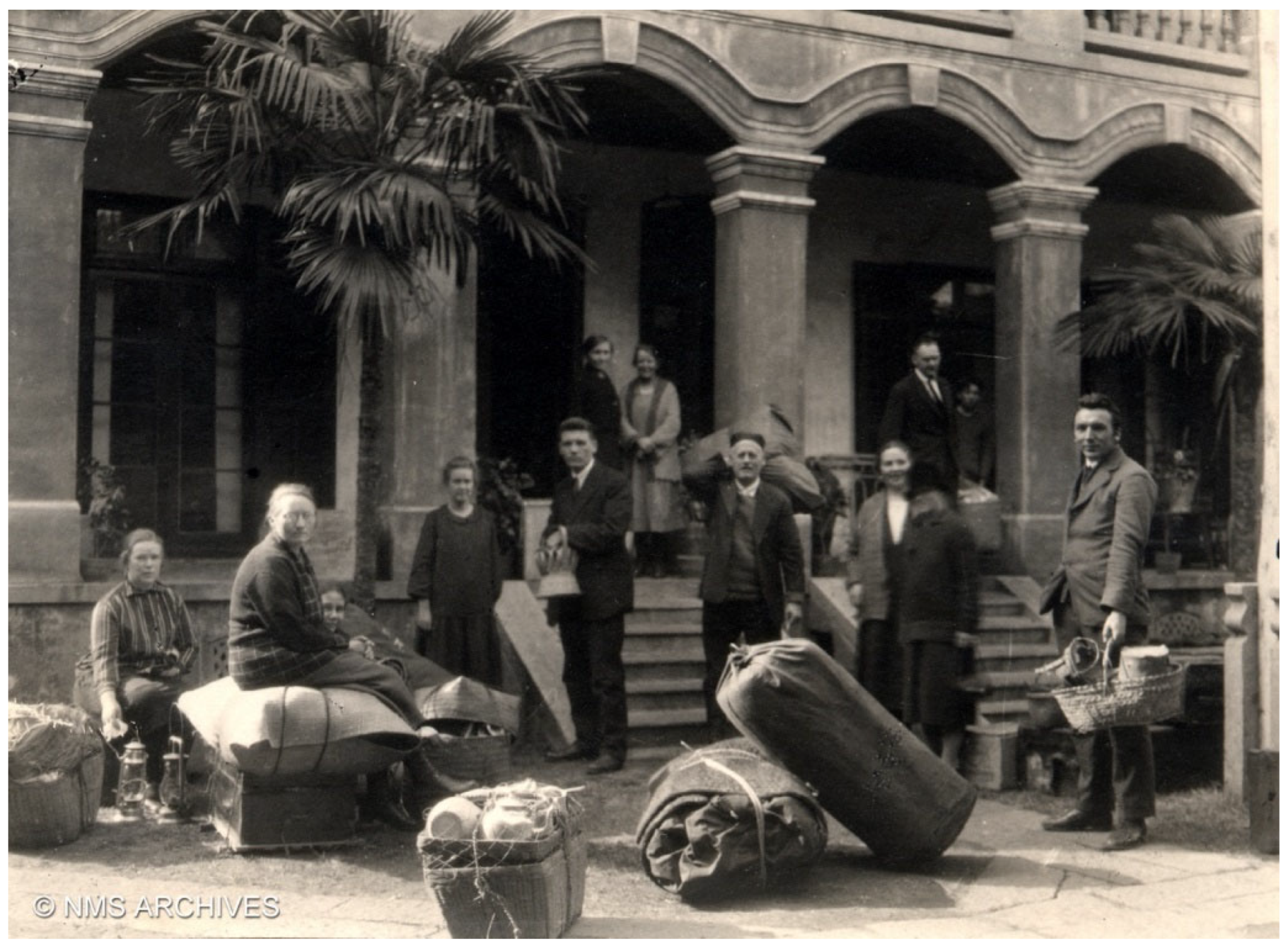
The NMS missionaries clearly saw the impact of the Nanjing Incident and also recognised the Chinese people’s hostile attitudes to foreigners. It was reported that “The exaggerated and wrong reports about this incident have intensified the hatred against foreigners in the inland areas of China” (Det NMS Årsberetning 1927, p. 26). Therefore, they quickly decided to close the Lutheran Theological Seminary in Shekow, Wuhan, and arranged for school representatives and teachers to leave Shekow for Shanghai. A month later, on 5 April 1927, the whole mission began a large-scale evacuation:
Their hearts were filled with sadness as they had to say farewell to their dear Christians and fellow workers … Those who set out from Yiyang were in particularly grave danger and had to give up all the material possessions they had. A few faithful Chinese co-workers endangered their own lives to help them get the bare necessities of clothes and some other things.
(Det NMS Årsberetning 1927, pp. 25–26)
Erling Gilje and three other missionaries left Changsha, and Racin Kolnes and six others left Yiyang. Everyone planned to meet in Hankou and head to Shanghai together (see Figure 1).
This large-scale evacuation during the Beiyang government was a huge blow to the NMS’s work in Hunan. The missionaries felt that the current situation in China was hopeless and that “it would become more and more difficult to stay in Shanghai for long” (Norwegian text: det længere ophold i Shanghai vilde by på store vanskeligheder), so most decided to return to Norway (Det NMS Årsberetning 1927, p. 27). Almost all the earliest missionaries to arrive in Shanghai returned home, “In the spring of 1927, many people booked cabins as soon as they arrived in Shanghai, and went home immediately after buying the tickets” (Det NMS Årsberetning 1927, p. 26). Birger Sinding and his wife decided to resign for good, and the couple left China together from Shanghai in April 1927. Supervisor Gotteberg also advised those who had planned to leave the following year to do so immediately in 1927.
The venue for the 1927 annual meeting, held from 19 April to 2 May, was changed from Taohualun to Shanghai, and the actual meeting time was later than planned. At the meeting, those who had worked in China for five years or more were advised to leave immediately. Under this resolution, missionaries Lise Marie Flata and Ole Larsen Gjønnes also returned home, leaving only 22 missionaries working in China (Det NMS Årsberetning 1927, p. 27).
The NMS’s regular annual meeting was naturally affected by the circumstances of the year. Its most important decision was the establishment of a seven-member organising committee, who would be responsible for maintaining the church work until the situation returned to normal. The meeting also focused on how to maintain contact with the local church in Hunan. At that time, the Norwegian missionaries communicated with Hunan Christians mainly by letter, and during a period of letter censorship, only Chinese Christians were allowed to travel to Shanghai to meet with the missionaries:
Fortunately, we have always had enough funds to be regularly sent through Chinese banks and shops. Letters from Hunan are always on time. There was a short period of time when our letters were censored. Some of the leading Christians came to Shanghai, and later to Hankow and Kuling to consult with the missionaries. The connection was thus maintained throughout.
(Det NMS Årsberetning 1927, p. 27)
Following the departure of the NMS missionaries, life was difficult for the Chinese Christians in Hunan, although their lives might have been much worse if the NMS had not carried out the evacuations. The founding of the CPC boosted national self-confidence, and the missionaries felt that the Chinese people “were no longer afraid of foreigners”. Many foreign properties were occupied, and some Chinese Christians’ private properties were also affected (Det NMS Årsberetning 1927, pp. 28–29). In Hunan province, many private properties were destroyed, and the rich suffered the greatest losses, regardless of whether they were Christian or not. Church property was confiscated or closed in various places, and many church buildings and church land were “borrowed”. More than half of parishes were occupied by the army. The situation was worst in Yiyang and Taohualun, while Dongping and Xinhua in the west fared slightly better. Many church buildings were invaded, furniture and other artefacts were stolen, and the private property and belongings that many missionaries had been unable to take away with them were destroyed. All aspects of the church’s property suffered huge losses.
Nevertheless, the NMS missionaries remained optimistic, believing that those who had left the church at this point were “lukewarm Christians” and those who remained had the extraordinary patience and loyalty necessary to deal with their sufferings. Local Christians were still holding on together, and most regular gatherings and services of worship could still be held. The missionaries were grateful for this outcome, because they could see that “the [local] Christians understand more than ever that they must trust in God” (Det NMS Årsberetning 1927, p. 29). During this unusual period, church work in many regions of Hunan was paused entirely, but the NMS missionaries’ expectation was that in places where the situation was less gloomy, church work “could at least remain as before” (Det NMS Årsberetning 1927, p. 30).
In 1927, the activities of the Anti-Christian Movement in Hunan gradually subsided as the Nanjing National Government led by Chiang Kai-shek began to make peace with the Western powers. Regulations were subsequently issued to protect church work in China. In 1928, the situation eased greatly, and the NMS annual report for that year described the development of its mission work as “a cloudless sky with sunshine and good working conditions” (Det NMS Årsberetning 1927, p. 70). Supervisor Gotteberg cited annual reports from Changsha, Yiyang, Taohualun, and Dongping districts, which all expressed optimism. The head of Changsha district reported that “Here in the district we are facing new progress for Christ’s kingdom”. The head of Tungping district also observed that the Chinese co-workers were full of vigour: “Our Chinese employees are beginning to gain new courage. We all realise that Christianity must have taken deeper roots in Chinese folk life than we often realise.” From Yiyang came the encouraging report that “Christianity has already become one of the greatest spiritual forces in China” (Det NMS Årsberetning 1928, p. 83). However, this expectation appears to have been blind optimism. The NMS missionaries overlooked the huge losses they had suffered over the years and ignored the seeds planted by the anti-Christian wave. For example, Chinese Christians were beginning to experience deeper anxiety about their identity, and some Chinese co-workers working in churches began to appeal for self-governance and support.
During the war in 1929, the NMS remained positive about the Nanjing government:
From the perspective of the government, it is undeniable that they have made great efforts to improve the lives of the people. Especially in terms of improving transportation, they have built new roads in many provinces, although the civil war has had a serious negative impact on the railway in 1929.
(Det NMS Årsberetning 1929, p. 68)4
However, the Nanking government’s policy was erratic. The railway was also easily destroyed during the subsequent Japanese war of resistance, as supervisor Johan Lauritz Torset wrote in his 1939–40 report: “Because the Chinese government wants to block the enemy’s attack, the army at all levels has dug up all roads, railways and pedestrian roads, which has brought great inconvenience to the traffic. Our work has also suffered negative influence” (MHS-MA-A-1065-DL-L0001-09).
By 1930, the NMS missionaries had begun to realise that “many people thought that the Nationalist government’s days were numbered, and all available forces were possibly embedded and all funds utilised to combat the rebels” (Det NMS Årsberetning 1930, p. 68). However, the NMS missionaries’ judgement of the Nationalist government remained ambiguous. They still expected that “the Nanjing government can be stronger after this series of events” and appreciated that “the Nationalist government still had the strength to insist on improving domestic transportation and education while fighting the war” (Det NMS Årsberetning 1931, pp. 70–71).

2.2. New Life Movement

This section examines the NMS’s responses to the New Life Movement, which was launched by the Nationalist government in 1934, and the increasingly complex local conditions the missionaries faced up to the eve of the full-scale Sino-Japanese War in 1937.
In 1934, the national government launched the “New Life Movement” (新生活運動). Although its purpose was to build a new lifestyle guided by ritual (禮), righteousness (義), cleanliness (廉), and shame (恥), the movement was also regarded as a mixture of Confucianism and Christianity (Yue et al. 1994, p. 6). Under the cloak of traditional Confucian culture, the core essence of this movement actually followed Christian teachings. Chiang Kai-shek, a recent convert to Christianity, saw the movement as a way to apply Christian values to social reform: “I think Christians today should not only believe in the doctrine of Christian fraternity, but more importantly also carry forward the fearless revolutionary spirit of Jesus Christ. Our entire country needs the faith of Christian revolution, the lofty moral standards and the spirit of sacrifice of Christ” (Y. Liu 1986, p. 55). Chiang Kai-shek, observing that Christian organisations had played an indispensable role in maintaining social order in Britain and the United States, recommended the Chinese YMCA as the backbone of the New Life Movement (Powell 1980, p. 82). Thus, this movement was an essential step in Chiang Kai-shek’s application of his Christian beliefs to China’s social reforms. Under the influence of this movement, NMS supervisor Racin Kolnes wrote that “Great expectations are placed on Christianity, but it is usually in the social area that one expects the most” (Det NMS Årsberetning 1935, p. 79).
The NMS missionaries responded actively to the New Life Movement in their working stations in Hunan. On 30 June 1937, Hunan Christian Tan Xinchun wrote to ask Pastor Lars Ivarson Bjørsvik to purchase a new book about the movement:
Pastor Bjørsvik, I suppose that the Hunan Popular Education News commissioned earlier was already ordered. And please purchase three new books: (1) The Essence of New Life, (2) Ms Soong Mei-ling’s My Religious Significance, (3) Chairman Chiang Kai-shek’s Testimony on the Day of Suffering. Please purchase 100 copies of each and send them to the parish of Mabi City by express mail.
(MHS-MA-A-1065-DI-L0001-09)5
This illustrates that the NMS both praised the New Life Movement and distributed propaganda books to local Christians in Hunan. The missionaries responded to the Nationalist government’s new policies with practical actions. To some extent, their positive attitude related to the Christian identity of Chiang Kai-shek and his wife.
NMS supervisor Kolnes made the following assessment of the movement in his report:
It’s already a cliché that “China is waking up”, but I want to reiterate it. This is not just a movement of intellectuals, but of the people at large. A series of unfortunate events across the country show that there is a new shift coming here. The reason why people are restless in spirit is largely due to the influence of Western knowledge; natural science knowledge has greatly weakened the influence of superstition and paganism on people. People are also more and more aware of the better social conditions in the West, and they have begun to be dissatisfied with the old social environment in both aspects: material life and ideology.
(Det NMS Årsberetning 1934, p. 40)
In his evaluation of the New Life Movement, Kolnes expressed his expectation of Chiang Kai-shek’s rule and emphasised that both Chiang Kai-shek and Soong Mei-ling were Christians. This was obviously a factor contributing to the NMS missionaries’ blind optimism about the KMT. The supervisor also pointed out that the New Life Movement was not just a Christian movement, since other religions, especially Buddhism, were also looking for fulfilment through it. The Christian Church was experiencing a strong spiritual revival at this time. Reports from NMS groups reveal that revivals were occurring in many congregations in Hunan. From the NMS’s perspective, these Chinese Christians could help their compatriots to spiritually influence the whole of Chinese society. This also shows that the Norwegian missionaries had begun to adopt a new strategy of allowing Chinese Christians to run the church, since they would be able to lead other Chinese people less conspicuously.
Supervisor Kolnes continued to comment positively on the New Life Movement, arguing that it “has helped the Chinese people to progress and improve in many different ways”. However, he was over-optimistic. The New Life Movement did not achieve nationwide success. After its initial success in Jiangxi province, it failed in major urban areas. Some scholars have observed that even the success in Jiangxi province was due to the particular social environment in which the main social reforms were promoted by missionaries (Powell 1980, pp. 87–88).
Thus, a contradictory narrative appeared in the NMS missionaries’ reports in the 1930s. During the period of the Nationalist government, anti-missionary riots were frequent throughout the country, and foreign missionaries were often withdrawn. Although the area where the NMS was stationed in central Hunan was relatively calm, the Finnish Missionary Society in the adjacent southern Hunan area was completely destroyed.6 However, with the launch of the New Life Movement in 1934, the NMS still had full confidence in its missionary work and in the Nationalist government. Supervisor Kolnes even wrote that “Everything is very good this year, and it is a golden time without hindrance” (Det NMS Årsberetning 1934, p. 39). The NMS’s expectations of the national government in Nanjing were constantly unrealistic during this period, resulting in some questionable decisions later.

3. Power Dynamics and Interactions Between the NMS and the Chinese Government

The Norwegian missionaries were well aware of the fact that both the Chinese government’s and the Chinese people’s attitudes towards Christianity were of great significance to their mission work. In order to survive in the turbulent times, the NMS had no choice but to delve into the power dynamics and set up feasible solutions to improve the modes of interactions with both sides. Crucially, the mission’s approach to these negotiations was not merely pragmatic but deeply informed by its theological identity. To understand the NMS’s posture, it is essential to consider its missiological orientation. Rooted in the Lutheran doctrine of vocation and a Pietistic emphasis on earthly service, the NMS regarded its schools and hospitals not as mere accessories to evangelism but as constitutive of its missionary calling. This “social diaconate ethos” fundamentally shaped its strategy: preserving these institutions was tantamount to preserving its mission, making pragmatic cooperation with authorities a theological imperative rather than a simple political tactic.

3.1. The Position of the NMS: Neutrality Always

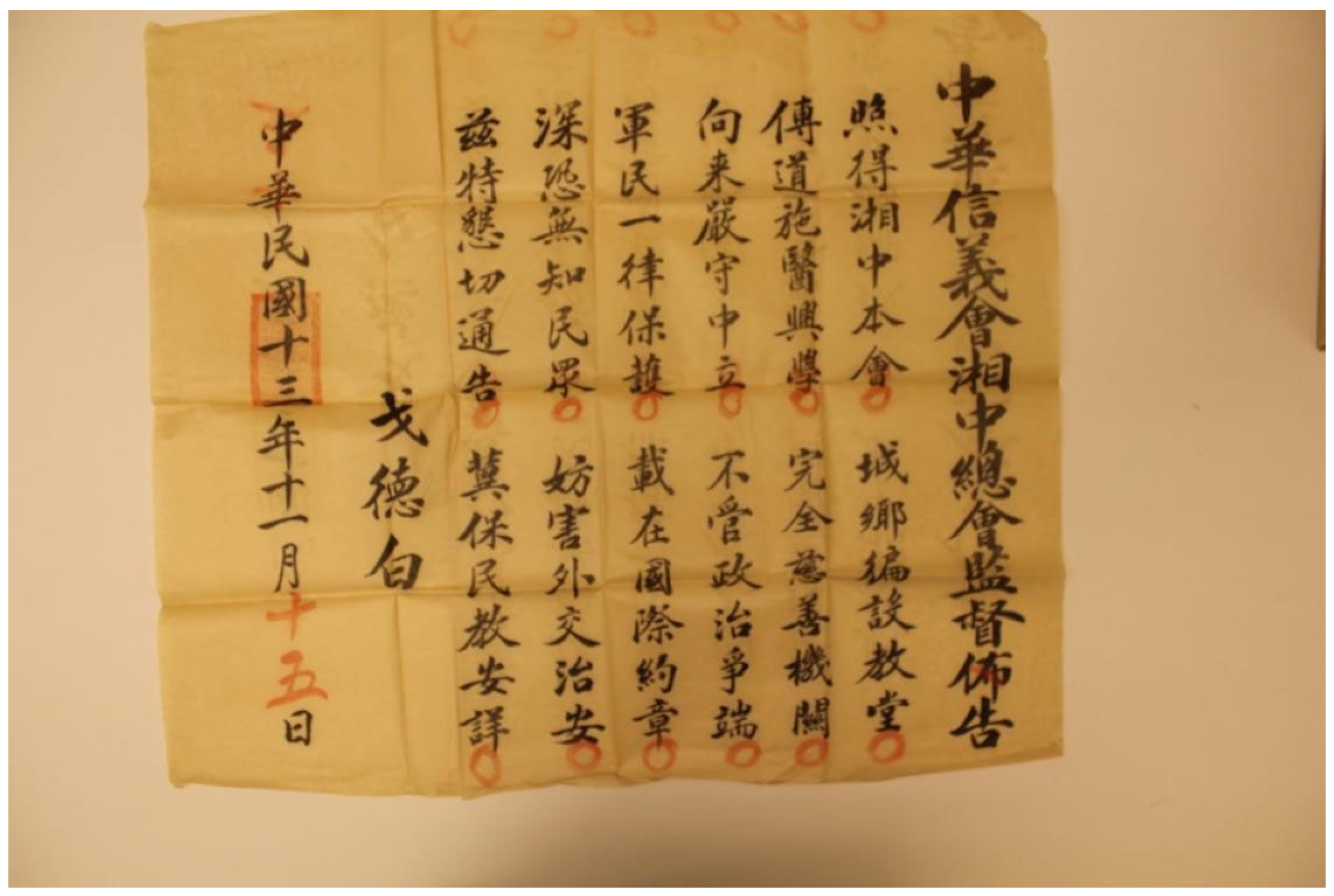
As early as 1924, when the Anti-Christian Movement was on the rise, Pastor Johan Gotteberg, the church supervisor at that time, expressed his attitude to Chinese politics in an announcement posted outside the church building:
We established Xiangzhong Synod,
and churches were built in urban and rural areas;
Evangelism, medicine and education,
all institutions were purely charitable;
We have always been strictly neutral,
stay out of political disputes;
We protect both military and civilian people,
as recorded in international treaties;
We are deeply afraid of ignorant people,
who hinder diplomacy and security;
So we earnestly make this announcement,
and hope to protect the safety of the people and our religion.
Johan Gotteberg
November 15th, thirteenth year of the Republic of China7
This announcement was written in Chinese parallel structure (see Figure 2), with some sentences even rhyming. Gotteberg had presumably engaged local Christians to write the text.
This was an on-street notice to be read by ordinary Chinese Christians and civilians. In Chinese, the wording and tone of this announcement are humble and polite. In light of the historical background of the rise of the Anti-Christian Movement at that time, Pastor Gotteberg appears to have been seeking to dispel the Chinese people’s hostility to the church. In using phrases such as “purely charitable”, he sought to articulate that all church-related institutions were non-aggressive and non-political. This political neutrality was a constant throughout the NMS’s history in China. Faced with turbulent political changes in China’s modern history, the NMS missionaries always required church members to remain strictly neutral and not get involved in any political movement. In this way, the church managed to maintain friendly relationships with the local government and people. The missionaries feared that they would provoke enmity if they took sides.
The stance of “We have always been strictly neutral” proclaimed in this announcement must be understood within a dual context. First and most directly, it represented a survival strategy for the NMS amid Chinese domestic political strife, particularly the KMT-CCP rivalry, aiming to draw a clear boundary with any political faction for self-preservation. Second, this claim indirectly benefited from Norway’s contemporary international image as a European “neutral nation”. This state-level neutrality may have provided an initial, external layer of legitimacy for the NMS’s assertion of its “non-political” character in China. However, as history unfolded—most notably with Norway’s occupation during the Second World War and its post-war alignment with the Western Bloc—the country’s geopolitical neutrality ceased to exist. Consequently, the NMS’s continued emphasis on “neutrality” in China increasingly evolved into a highly contextualised, specific rhetoric serving its foothold in local Chinese society. Its meaning gradually shifted from a potential safeguard grounded in international law to a purely strategic declaration aimed at navigating indigenous political risks in China.
However, it is also crucial to recognise that this proclaimed “neutrality” was not merely a theological or strategic posture but operated within a framework of profound structural inequality. The NMS’s ability to claim non-involvement in Chinese politics was itself predicated on the very treaty privileges that Chinese Nationalists vehemently opposed, including extraterritoriality and consular protection. While the missionaries may have genuinely sought to distance themselves from colonial power, their institutional security and personal safety ultimately rested on the unequal geopolitical conditions that made their presence in Hunan possible in the first place. Thus, from the perspective of Chinese sovereignty, the NMS’s “neutrality” was inherently compromised.
The Norwegian missionaries themselves embodied a form of religious mobility: they carried Lutheran theology from a Nordic state church into a radically different Chinese context, constantly negotiating between their home society’s expectations and the shifting political realities of Hunan. Before the rise of the Anti-Christian Movement, at the annual conference held in Changsha in 1917, the NMS missionaries explicitly discussed the church’s attitude to the various political parties in China. Yuan Shikai announced his abdication in May 1916, and following his death from illness a month later, his government was defeated. In May 1916, Tang Xiangming (湯薌銘), who ruled Hunan, issued a Declaration of Independence of Hunan Province. Against this historical backdrop, a more extreme incident occurred in Yiyang Lutheran Middle School, which triggered the first formal discussion of the relationship between the church and the government at the NMS annual conference.
Li Tang studied in Yiyang Lutheran Middle School in 1907 and then in Japan. He joined the Chinese Revolutionary Party, which later became the KMT, in Tokyo, and then returned to Hunan to participate in the movement against Yuan Shikai and Tang Xiangming. He served as administrator of the Lutheran Middle School at that time, as a cover for joining the anti-Yuan and Tang movement (Wang and Wang 2013, p. 495). In spring 1916, Li was tasked with assassinating Tang Xiangming, but the mission failed and he was cruelly executed, sparking discussion at the subsequent annual conference.
In the report of the NMS conference, Li’s name is spelt “Li Dan”, following its pronunciation in the Hunanese dialect. Hertzberg, the Norwegian missionary in charge of the Lutheran Middle School at that time, spoke highly of Li and saw his immediate return from Japan to the school as evidence of his “noble ideals” and “sacrificing spirit”. According to Hertzberg, he spoke face-to-face with Li, reminding him that “we [the Church] are in a tricky position” and making it very clear that “if you can’t withdraw from the movement, you can no longer serve in Church schools”. Li then promised to “draw a clear line” and left the school, all of which led to his final execution following the mission’s failure.
Hertzberg expressed his ambivalence at the meeting. He praised Li Tang’s actions: “He showed our young people a willingness to sacrifice, because he set a good example.” However, he also stressed that the Middle School had nothing to do with Li: “He had already left the school, so he was not our employee when he was executed” (MHS-MA-A-1065-DB-L0004-01, p. 51). The NMS seems to have feared being involved in political confrontation and required all church personnel to remain strictly neutral and show no political leanings. The underlying concern was expressed by missionary Peder Olaus Holthe at the meeting: “Until the situation in this country becomes clearer, we cannot encourage Christians to join any political party” (MHS-MA-A-1065-DB-L0004-01, p. 51).
Another cautiously neutral missionary was Gotteberg, who was superintendent at the time. It was rumoured in Christian circles in China that President Li Yuanhong was a Christian, but Gotteberg corrected this at the meeting, saying that “actually Li Yuanhong is not even a catechumen, although he supports the development of Christianity and has made friends with many Christians”. Gotteberg expressed pessimism about the turmoil in China and insisted that the church should maintain political neutrality, advocating that no one who had a place in the church should hold a leadership position in any political party. He urged all Christians to “keep in the background when a storm is brewing, or it may bring us into great difficulties” (MHS-MA-A-1065-DB-L0004-01, p. 51).

3.2. The Government’s Attitude to the Church: Selecting Social Functions

In the nineteenth and early twentieth centuries, the number of missionary schools run by Protestant and Catholic missions in China tended to increase during periods when the government was attempting to modernise the traditional education system. These missionary schools were often in conflict-prone zones where Chinese and Western ideologies collided. The government’s policy changes on missionary schools reflected not only diplomatic relations between China and the countries to which the various missions belonged but also the Chinese government’s complex and changeable attitudes to missionary schools. On the one hand, it supported and welcomed missionary schools, but on the other it regarded them as a challenge and opponent of Chinese nationalism. During periods when the development of Christianity was frustrated, the Chinese government also had to revise the rules and regulations relating to church schools to conform with the ideological tide of the Chinese people.
The NMS in Hunan opened not only chapels but also social institutions. All educational and medical institutions fell under the supervision of the government in Chinese society. Xinyi Middle School, opened by the NMS in Taohualun, Yiyang City, is used here as a case to analyse the government’s attitude to this educational institution, and hence shed light on the contradictory and complicated power relationship between church and government. The NMS’s church schools had been struggling to survive, trying to satisfy the government and serve the local people simultaneously. This section focuses mainly on the NMS’s history of running schools, analyses the mutual attitudes of the government and the church, and explores power dynamics between the NMS and local government in this particular context.
The NMS’s original intention in establishing and running schools in Hunan was to spread the gospel to local people. However, internal disagreements emerged within the NMS. Doubts about the wisdom of running schools arose from some missionaries’ insistence of maintaining the gospel mission. They worried that establishing an educational enterprise would encroach on human and financial resources that should be allocated to mission work, because the school would have to pay teachers’ salaries and purchase teaching materials and school equipment. If it continued to develop at speed, it would soon exceed the budget. Nils Arnetvedt expressed his primary concern about schools: “we may have to cut funding for evangelism, which is the most important work” (MHS-MA-A-1065-DB-L0002-04, p. 7). However, the NMS’s ensuing school operations were remarkably successful. The schools propagated religious knowledge to local people, and opportunities for education, as a form of church welfare, also attracted people to listen to the gospel. The NMS missionaries’ strategy of promoting preaching through education achieved initial success.
The NMS established strong religious overtones in its educational institutions, which was a constant and difficult contradiction in the process of running schools. During the period when China was invaded, nationalism was most prevalent. Church schools were often regarded as tools for cultural colonisation and cultural aggression and were suspected of violating China’s educational sovereignty. In 1924, a protest was staged in Yiyang Xinyi Middle School, and the school leaders were accused of insulting Chinese students. More than a hundred students dropped out of school in a collective action. In December the same year, more than 300 students from Changsha Yali Middle School also dropped out. They made many demands, such as that the school should be registered with and report to the government, and that religious courses should be optional rather than compulsory (Tan 2013, p. 324). The anti-Christian fervour that emerged from this political situation was challenging to both the church and the government. The former wanted to run schools, and the latter was responsible for managing educational regulations and mediating people’s hatred.
In 1925, these contradictions continued to grow. Arthur Johan Hertzberg, principal of Yiyang Xinyi Middle School, spoke at the NMS’s annual meeting about how to deal with the rising nationalism in mission schools. From the perspective of the Christian theology of grace, he first explained that everyone is a brother and sister, and despite distinctions between Norwegian and Chinese nationalities, they are all one in the Kingdom of God. However, in stark contrast to the words of hatred posted in Chinese newspapers at the time, he made no mention of suppressing the rising Nationalist ideology in the mission schools, concluding: “For China’s nationalist sentiments and patriotic movements, we should give space and empathy. We should try to help children in schools develop a more accurate understanding of patriotism” (MHS-MA-A-1065-DB-L0005-03, pp. 71–76). The reason for the huge difference in attitudes was Hertzberg’s Christian universal worldview. He saw all political ups and downs from a Christian perspective: the “Kingdom of God” should be revered as the highest, whereas national distinctions were only an issue in the “Kingdom of Man”. The “empathy” and “more accurate understanding of patriotism” he proposed were actually a response to nationalism based on the Christian gospel. He did not respond with political words to the Anti-Christian Movement, which was essentially a movement making political power demands. A gap in understanding thus arose from the fact that he responded to the political discourse with a religious interpretation.
In response to the boycotting of religious schools by anti-Christian students, the foreign and educational policies of the Chinese authorities were erratic and capricious, indicating ambivalent government attitudes to church schools. This became a major difficulty for the NMS in running schools. Foreigners who wished to run schools in China had to follow the government’s policies on foreign educational institutions. During the wars in China, these policies were changeable and complicated. The NMS had to manage schools while constantly adjusting its regulations to the new policies. This placed considerable constraints on the schools’ operations and made it impossible to maintain the mission association’s philosophy on running schools. In the NMS’s 1929 annual report, the missionaries expressed deep concern about the policy changes. According to Einar Emanuel Smebye (石城基), “The government has a new policy for the opening of private schools. It seems impossible for us to operate Christian schools” (Det NMS Årsberetning 1929, p. 78). The government’s policies were evidently a constant worry. For example, although the government’s attitude to missionary work remained unchanged in 1930, restrictions on missionary school activities were as strict as ever. Introducing religion as a subject and exerting any religious influence within the school were absolutely prohibited from the upper grades of secondary schools, and the NMS decided not to operate the school as a purely religious one in order to avoid the government’s restrictions (Det NMS Årsberetning 1930, pp. 72, 74).
This adverse situation continued for several years. In 1936, the NMS stated that its work of running schools was still being greatly affected by policy: “The government has very strict regulations on Christian education in schools, but in fact these regulations are not implemented in many cases. In some schools, education is still given during normal school hours, in addition to other subjects” (Det NMS Årsberetning 1936, p. 84). The Norwegian missionaries also realised that, especially in relation to church work, Chinese nationalism was encouraging Chinese people to continue to oppose foreigners and Christianity. Sembye stated the following: “Public schools run by the government and teaching staff are at the core of this xenophobia, and the knowledge system that their students have formed in public schools has made them hate outsiders even more” (Det NMS Årsberetning 1929, p. 79).
In 1928, although the supervisor expressed optimism that “our schools for the blind and the handicapped can still operate as usual”, he also clearly saw the real conditions under which the NMS had to operate to continue its education work:
If we want to continue to operate the school in the future, it will mainly depend on the following two factors: one is the Chinese government’s stance and attitude towards Christian schools, and the other is the financial donations from [Norwegian] congregations to the school. For the future of Christianity in China, the Christian schools play a pivotal role. Our biggest wish now is to establish the kingdom of God in the field of education in the coming year.
(Det NMS Årsberetning 1928, p. 79)
In 1940, during World War II, Germany invaded Norway, cutting off economic support from the NMS’s motherland to China and resulting in a shortage of financial support in Hunan. The unpredictable changes during the war and the government’s changeable education policy were the most important factors affecting the NMS’s school management.
The archival materials cited above reveal a mismatch in interactions between the Chinese government and the NMS. On the one hand, the Chinese government did not mean for the Chinese to monopolise education across the country. The government’s basic attitude was to allow or even encourage foreigners to run schools. After all, education undoubtedly brought long-term benefits to the poor and weak Chinese society at that time. For example, Yiyang Xinyi Middle School consistently developed and maintained very good relationships with government authorities. The local government’s encouragement naturally promoted the school’s expansion:
Compared with before, there are more students in Taohualun than ever. There are 700 students in total. The number of boys’ secondary schools has risen to 359, of which 59 have been baptised. In this year, four students were baptised, some of whom participated in education after baptism, and 22 students had their confirmation ceremonies. In this year, the school celebrated its 30th anniversary and received a gift from the government (about 50,000 crowns). People also paid much praise to the school at that time.
(Det NMS Årsberetning 1937, p. 88)
However, the Chinese government actually wanted mission schools to function only as an educational tool in society and was unwilling to let the schools play a religious role in China. Compared with non-Christian schools, mission schools adopted more modern, global educational concepts and more integrated educational functions and were more adaptable to social trends. The advantages were undeniable. The merits of mission schools were especially evident following the abolition of the imperial examination system (科舉制度). In addition to the purely educational function, the educational institutions set up by the NMS also maintained social order and stability. For example, schools for the blind enabled blind people to participate in social labour, and girls’ schools and normal schools cultivated future teaching talent for China. Both could bring long-term benefits to Chinese society.
The local government’s attitude to Xinyi Middle School illustrates that the Chinese government hoped that the mission schools would continue to operate. However, it did not want to accept all their functions and wished to curtail their role in spreading religion and gospel. It sought to trim mission schools’ curricula and operations and maintain the few functions required for Chinese society at that time. In addition to educational institutions, the local government adopted the same attitude to other social institutions set up by the NMS, which was to cut their religious functions while promoting the modernisation of Chinese society. In 1951, Yu Yun (喻筠), the Chinese supervisor of the NMS’s Xiangzhong Lutheran Church, wrote to Norwegian Pastor Lars Ivarson Bjørsvik, who was back in Norway at the time, to tell him that the Chinese government was very likely to take over the blind school (MHS-MA-A-1065-DL-L0001-04). In fact, after all the foreign missionaries left China around 1950, almost all of the NMS’s educational, medical, and charitable institutions were taken over by the government, and most still operate with government support to this day, continuing to play significant social roles in Hunan province.
This process of selective adoption and ideological pruning is concretely captured in directives from the Hunan Provincial Archives. An inspection report for the Xinyi Middle School in Anhua County (at that time, the school relocated to Anhua for a short time) mandated that the school use commemorative events to “inspire national consciousness and patriotic thought” and organise “anti-enemy lectures”8, explicitly enrolling its social education function into the state’s Nationalist mobilisation (Hunan Provincial Archives, M059-002-00232-00018). Simultaneously, the state vigilantly policed the boundary between acceptable social service and forbidden religious influence. In 1932, the Ministry of Education, reviewing the school’s statutes, questioned a canteen rule requiring students to “wait for three minutes before raising chopsticks,” suspecting it “might contain religious ritual”9 and ordering its deletion (Hunan Provincial Archives, M059-007-01951-00002). The school board’s response was a categorical denial of any religious ceremonies, appealing to official inspections as proof (Hunan Provincial Archives, M059-007-01951-00002). This exchange epitomises the dynamic: the government actively shaped the school’s secular, patriotic functions while demanding the erasure of any perceived religious practice, and the school complied through strategic disavowal to secure its operational permit.
The religious function that the government most wanted to remove was evangelism, to which the NMS attached the greatest importance. This created the biggest gap between the government and the NMS. The NMS missionaries were concerned that if opening schools would affect the gospel work by using up funds and human resources, then such plans should be deferred. They undoubtedly valued their evangelical work much more highly.
After the initial struggles, the NMS continued to run Yiyang Lutheran Middle School with enthusiasm, partly because it recognised that the school played a vital role in evangelism. Education attracted more Chinese people who respected teachers and increased the number of catechumens. Furthermore, the missionaries in the school had opportunities to make contact with the younger generation in China to prepare future Christians for the church. They also offered religious courses in the school to deepen the spiritual revival of baptised Chinese Christians. These were the functions of the school that the NMS most wanted to keep and were precisely what the Chinese government most wanted to eliminate. The government oscillated between these two extremes, resulting in its ambivalent attitude to mission schools. On the one hand, the government supported the opening of mission schools and even sent congratulatory gifts to maintain harmonious relationships. On the other hand, it exerted strict controls and interfered in the mission schools’ curricula and management. The fundamental reason for this tense, contradictory situation was that the government and the NMS wanted to choose and utilise different school functions, and they were torn apart by the two extremes.

3.3. The Church’s Attitude to the Government: Humbly Seeking a Shield

In the early days of the Republic of China, the national government and Chinese society did not strongly oppose the words and actions of mission schools. Although document No. 11 of the Ministry of Education in 1920 required foreigners to follow regulations for running schools, it still had positive attitudes to schools run by foreigners. Any foreign missions entering Hunan to develop missionary work had to obtain the local government’s permission and also had to avoid conflicts with the government in order to ensure the smooth operations of the church itself and its affiliated institutions in Hunan province. Therefore, missionaries from all missions generally acted cautiously in their educational work. The NMS abstained from any conflicts with the local government and tried to avoid dealing directly with the government. It clearly stipulated that no contact with the government should be made unless absolutely necessary. When conflicts occurred between church members and non-Christians, the NMS also advocated that church members should be tolerant:
For the relationship with the government:
(A) 
Pastors are not allowed to seek protection from the government without special reasons. For Christians, they should be very clear about all the rights and obligations of the state, so as not to cause difficulties for themselves or in their work due to ignorant actions. When it is necessary to contact the government as a last resort, it is also advisable to report the reasons to the president of the congregation as soon as possible.
(B) 
If there are disputes among Church members, or between Christians and outsiders of the Church, the pastor should advise them and mediate peacefully, as Christians would rather endure rudeness than harm God’s work.
(MHS-MA-A-1065-DL-L0005-02)
Violence against foreign missionaries occurred frequently in Hunan, and sometimes it even ended in bloodshed. For example, in the infamous Chenzhou mission case (辰州教案), two British missionaries belonging to the China Inland Mission were killed. When missionaries clashed with the people in Hunan, many mission societies demanded that the indigenous people responsible for the incident be punished, and many sought to negotiate with the government in Beijing. The NMS differed from other missions in making concessions to the local government: “For the negotiation incident, we will be open and honest with the local government. In the spirit of concession, we seek coordination in the negotiation. We do not want to shed one drop of blood, and do not want to take a single person’s life” (Xin and Xie 1928, p. 23). One reason for these decisions may have been that the NMS had been protected by the government since its earliest days in China. As early as 1903, when Nils Arnetvedt and Jørgen Edvin Nilssen took a boat along the Zi River to Dongping, they were protected by a gunboat and 12 government soldiers (Myklebust 1949, pp. 203–4).
As the NMS gradually took root in Hunan, the pastors and Chinese co-workers in the church first had to obtain the permission of the Nationalist government, not only for the development of its missionary work but also for the charitable undertakings of its affiliated institutions. For example, in the 1928 annual report, Gotteberg clearly observed that the school’s continued operations would depend on two factors: financial donations from church members and, more importantly, “the Chinese government’s attitude and stance towards mission schools” (Det NMS Årsberetning 1928, p. 79). The Lutheran College’s 1929 report gives a detailed description of the NMS’s contact with the local government’s education bureau, revealing that whether religious morning prayer should be retained was up to the students’ free choice:
As for the relationship with the government, we have already made informal contact with the Education Bureau of Yiyang County and informed it of the character of our temporary preparatory school. After that, we have made no further contact. In order to comply with the authorities, we had to ask students for their consent and ask them whether they are willing to choose religious courses and participate in morning prayers. As a result, all the students said that they are willing to do both. Every Monday morning, there is a weekly Prime Minister’s Memorial, because this is a necessary gesture towards the patriotic movement. In fact, when we started the semester, the weekly memorial ceremony was led by Mr Chen Kaiyuan, and he continued with a prayer for the country and then the usual morning prayer. But now we have put the weekly memorial ceremony after the morning prayer.
(handwritten Report of the Lutheran College 1929, MHS-MA-A-1065-DL-L0005-01)
The Lutheran College changed its ritual and put the prayer for the country before the routine morning prayer. This illustrates the NMS’s respectful and humble attitude to the local government.
The context for these adaptations was a clear and forceful national policy. On July 30, 1928, the Nanjing Nationalist Government promulgated regulations requiring all schools to incorporate Kuomintang’s party doctrine into their curricula, mandating specific courses on Sun Yat-sen’s works and party manifestos. Faced with this direct state intervention, missionary institutions were compelled to respond, and their strategies diverged sharply. A particularly contentious issue was the mandatory weekly memorial ceremony before Sun Yat-sen’s portrait, which many Christians viewed as akin to idolatry. In Suzhou, for example, the American Southern Baptist-run Yancheng Middle School and Huiling Girls’ School faced legal prosecution, public scandal, and fines in 1929 for omitting the portrait during a graduation ceremony, ultimately forcing their board to capitulate and fully comply with the ritual (Y. Zhang 2015, pp. 162–63).
The pattern of pragmatic adaptation seen at the NMS’s Lutheran College was not universal. A comparative perspective reveals the distinctiveness of the NMS’s approach and the tangible costs of non-cooperation. For instance, in the same year that the Lutheran College in Yiyang carefully repositioned its morning prayer (1928–1929), the prestigious St. John’s University in Shanghai faced severe repercussions for its refusal to modify its operations to meet government registration requirements. As historian Jessie Lutz documents, St. John’s attempt to reopen without compliance led to organised opposition from student unions and other schools, forcing it to resume classes quietly with a drastically reduced and carefully vetted student body (Lutz 1971, p. 263). The contrast is instructive: while the much smaller and inland NMS chose strategic conformity to preserve its access to the community and continuity of its work, the coastal St. John’s opted for resistance, which resulted in isolation and operational crippling. Therefore, the NMS’s actions in Hunan—seeking student consent and integrating the state-mandated memorial—represent a deliberate and calculated choice, not a passive submission. This choice was a key factor in its ability to navigate the intense state pressures of the period and maintain its institutional foothold.
The Norwegian missionaries also had to coordinate their work with strict controls by the national government. Despite potentially being disaffected under such pressure, they never showed this clearly. On the contrary, the Central Hunan Lutheran Church always maintained a humble attitude in its dealings with the government. This pattern of humble accommodation, however, was not static. As Silje Dragsund Aase’s study of the early period (1907–1914) reveals, the NMS initially navigated an awkward position: instructing converts to be loyal to Chinese authorities while itself relying on treaty rights and Norwegian consular protection—a stance caught between distancing itself from colonialism and practically invoking it (Aase 2024, pp. 5, 9–10). This article further demonstrates a critical evolution in this strategy by the Nationalist period, particularly during the New Life Movement. Facing a more penetrating modern nation-state, the NMS’s proclaimed “neutrality” transformed into a proactive, administrative bargaining strategy, with the paramount goal of preserving its institutions, such as schools and hospitals. This shift marks a move away from passive oscillation between empire and colonial powers toward active, pragmatic negotiation with local Chinese governance.
Although many complaints about the Nationalist government were made in letters written by pastors and Chinese co-workers, they ultimately handled these various issues by making compromises with the government.
A typical example of conformity with the government occurred around 1935. When Chinese co-worker Hu Zhihua (胡治華) assisted Pastor Nils Kolberg in filing a notarised tax report for the house with the Anhua County Government, he failed to complete the documents owing to the repetitive procedures. Hu Zhihua initially described the complexity of the procedures to Kolberg:
The tax department of the county government will report the deed to tax. For example, he will check the tax deed and regulations and declare tax in the church in July. Several procedures are necessary. One must be done by the seller or country gentlemen of the region. They submit a report to prove that there is no cheating, and then they must make another copy of the original deed, attach an official letter and hand it over to the county government. The county government will transfer it to the finance department of the provincial government for approval. The tax procedures can be finished and printed after this approval.
Because no official letter had been obtained, Hu Zhihua then went back with a refusal and wrote to Pastor Nils Kolberg again:
There is no official letter to prove it. I am afraid it will not work, because it is an official procedure. It is not because the county government suspects that the foundation of the house purchased by the Church has other functions, so it has to be rewritten. Please ask the pastor to go to Xiaoyan when he comes down the mountain and negotiate with District Chief Li, and ask her to write an official letter to prove that the Church building is only for preaching and there is no entanglement. After the official letter is completed, I will negotiate with the county government.10
In this letter, Hu Zhihua also tried his best to explain that the government did not suspect that Pastor Kolberg intended to use the house for other purposes but was just following official procedures. He worked as a mediator between the missionaries and the government. Chinese Christians like Hu Zhihua were not passive recipients but active agents within this transnational network, moving between the mission, the local church, and government authorities, and thereby translating religious, administrative, and political logics across different social worlds. For example, even though they both agreed that the government’s tax declaration procedures were too complicated, in his letter to Kolberg, Hu Zhihua still spoke for the government. He pointed out that “the reason was that the procedures are complicated” and explained that “the government was not deliberately embarrassing the church”. The county government continued to pile on the pressure, saying that if the procedure was not done properly, the tax would be doubled and the interest rate would be increased. Hu Zhihua hastily followed up this issue with Pastor Kolberg:
I talked to county chief Li yesterday, and he said that he only needs a certificate from the district office. No other procedures are needed. I write to tell Mr pastor to please complete everything immediately, which has two important aspects. First, the tax must be paid within this month, otherwise the tax amount will be doubled. And there will be more interest and fines required! It would be so not worth it. Second, roughly on the tenth day of the seventh lunar month, I will take about two weeks to go all the way to Changsha, and it will take seven days to go home. These are the two issues, so I ask the pastor to complete the formalities as soon as possible.11
This tax declaration required Hu Zhihua to go back and forth between the government and the church for nearly two months until he finally completed it, but he made no complaints against the government during the whole process. He repeatedly explained that the government was not deliberately delaying and embarrassing the church, revealing his concern that this matter might cause discord and resentment between the two sides. The incident also illustrates that the Chinese Christians responsible for the organisation and management of the Lutheran Church had become a communication bridge and lubricant between the Norwegian missionaries and the local government, gradually gaining some initiative and autonomy. During this process, the Chinese Christians came to feel that they played an indispensable role in church affairs, precisely because of their dual identity as “Chinese” and “Christians”. They faced both the Chinese government and the Norwegian missionaries with humble attitudes, while also trying to bring harmony to their relationships.
In 1936, an army passed through Dongping, causing huge losses to the church’s finances and property. Many missionaries’ personal belongings were ransacked, and army battalion commanders even stayed in the church’s house to recover from illness and refused to leave for a long time. The Chinese co-workers not only reported the losses to the Norwegian missionaries but also prayed for help from the government:
[The army] only stayed for half a day. The purpose was to catch the Westerners and seize the regimental guns. The shops did not suffer any damages, while our Church lost a great deal of properties … Now there is still a battalion commander living in your house recuperating, and there are a few soldiers recruited to help him. I wonder if you can negotiate with the government and ask it to provide protection and stop the garrison.12
Expulsion of the army stationed there was a serious matter. Given the chaotic situation at that time, the church was like duckweed and had no one on whom to rely. Apart from the huge issue of the expulsion, the church also needed to ask the local government for help with trivial matters. For example, around 1938 when the Second Sino-Japanese War broke out, at Anhua Tianmaoshan church, the people were in dire straits and food was in short supply. The Chinese Christians sought to prohibit outsiders from digging for yams, but it was not easy to guard the mountain. They wanted to ask the Norwegian priests how digging could be prohibited, and they implored the Norwegians to step forward: “Maybe you can ask the government to forbid them.”13 (handwritten letter 1938, MHS-MA-A-1065-DI-L0002-01).
The church’s dependence on the government continued until the 1940s. In July 1943, the Jiangnan District Committee’s house was forcibly occupied by a health centre without the evangelists’ permission. Various Chinese-national leaders and Norwegian pastors of the church repeatedly went to negotiate, asking the head of the health centre to move out with his people. These negotiations were fruitless, resulting in the unavailability of the pastor’s dormitory during the spiritual retreat. In March 1944, after five consecutive failures in six months, all Christians at the Jiangnan District Conference jointly signed a letter to the three chief pastors, namely Pastor Lars Iversen Bjørsvik (貝世偉) from Norway and Pastors Chen Meishi and Ding Guobing from China. The three pastors asked for help from the local government:
Allowing him to occupy the Church house will make our Jiangnan district weak, and the general Church will be affected and be weaker. I pray to the three pastors for advice, or to negotiate with the county government. If the move is not ordered, it will be a great hindrance to the Church. Or ask the government to protect anyone from forcefully occupying the church. We all pray and ask God and the Holy Spirit of Jesus Christ to drive out this demon, so that the Church will be safe.
(Handwritten letters, MHS-MA-A-1065-DI-L0002-02)
After liberation in 1949, during the “Three-Self” and “Three-Anti” events in 1950, the Chinese Lutheran Society was gradually taken over entirely by the government. Yu Yun (喻筠), the Chinese leader who took over management of the church, expressed his attitude to Pastor Bei Shiwei in a letter, indicating that he was ready to show complete obedience to the government’s requirements. On 13 December 1950, he wrote to Supervisor Bjørsvik:
I arrived in Han [汉, referring to Wuhan 武漢] yesterday morning, and today a preparatory meeting has been held for the meeting of the General Affairs Department. This meeting has been approved by the government. In addition to the members of the various ministries, the staff and common lay believers of the churches [of this association] in the north and the south are also invited to advance and participate in their thinking [a total of more than 30 people]. At the closing, the head of the government will be invited to give a speech. This meeting is a major revolutionary meeting. The general theme of the meeting is the current situation and the task of cooperating with the Church. The so-called current situation is a political issue. In New China, Christians cannot be disassociated from politics. The “Three-Anti”14 is necessary, and the “Three-Self” is also necessary. The church has no other way to go.
(Yu 1950, Handwritten letters, MHS-MA-A-1065-DL-L0001-04)
A month later, he wrote again to Supervisor Bjørsvik, saying that he did not know how to maintain the work of the blind house, and expressing his intention to hand it over to the government for subsidy. Two months later, he informed Pastor Bjørsvik that the budget of the Central Hunan Lutheran Church must also be reported to the government.
In 1951, Yu Yun told Pastor Bjørsvik that after this year’s meeting, “the Chinese Lutheran Church was completely reorganised and resolutely implemented the Three-Self Policy”, “the church’s hospitals, schools and blind schools all must be registered to clarify the situation”, and all private material inventories must also be reported to the government. After 1951, financial responsibility for the Lutheran Church was taken over entirely by the government, and Chinese Christians were absolutely barred from accepting any subsidies and financial assistance from the Norwegian mission. Therefore, Yu Yun asked Pastor Bjørsvik to send all the money before the end of February, because thereafter all remittances must be sent to the government.
Since very early on, the NMS’s basic attitude had always been to stay out of trouble, remain neutral at all times, and run social institutions such as schools and hospitals to aid relationships. Those functioning as agents were able to ease tensions between the Chinese government and the people. As previously discussed, the local government, seeking to benefit from the church’s social functions, was willing to offer a degree of support and protection. In turn, the NMS consistently adopted a posture of accommodation. It humbly accepted supervision, kept a low profile to seek shelter, and routinely turned to the government to mediate even minor disputes. This pattern of pragmatic adjustment—exemplified by acts such as revising school rituals to ensure survival—was not merely tactical; it reflected the deeper Lutheran tradition of practical engagement with worldly authority. Consequently, the dynamic that emerged was one of selective utilisation by the government and a relationship of calculated dependence and obedience from the church.

4. Reasons for and Impacts of the Complex State–Church Relations

The relations between politics and religion have been both an ancient and modern topic throughout the research of church history around the world. In China‘s thousands of years of history, there has not been a unified state religion. The Chinese were deeply influenced by Confucianism, which may be regarded as one of the dominant schools of thought in Chinese history. However, the key strength of Confucianism is its ability to function as a moral guide and social framework without relying on the structure or beliefs of a traditional religion, meaning it can influence Chinese people’s behaviour and provide ethical grounding even for those who do not adhere to a specific religious faith. During the time of the NMS’s activities in China, the religious status in Chinese society at that time was quite complex.
The National Government’s religious policy was also quite complex. After the establishment of the National Government in Nanjing, the Government, headed by Chiang Kai-shek, continued the religious policy of the late Northern Expedition, repeatedly stating that it would protect religious freedom and church industry (L. Zhang 2020, p. 89). Such a policy should have also been influenced by Chiang’s personal religious beliefs. However, the policy did not always conform to the voices of the people everywhere, and this was especially true in a red province like Hunan. What are the underlying reasons for these complex situations? The complex state–church relations in Hunan faced by the NMS could be a typical case for analysis.

4.1. The Regional Anti-Religious Tradition in Hunan Province

As discussed in previous sections, missionaries of various nationalities met setbacks when they entered Hunan during the late Qing dynasty. Among these, Griffith John (楊格非) and B.H. Alexander (雅學詩), from the London Missionary Society and the Christian and Missionary Alliance, respectively, were even forced out of Hunan by the local people (Ni 1942, p. 158; Tang 1987, p. 252).
The Anti-Christian Movement in the 1920s can be regarded as a resurgence of Hunan’s anti-religious and xenophobic tradition. During this period, although the Norwegian missionaries retreated from Hunan to Shanghai, they were not physically limited to Shanghai. They still tried all means to keep in touch with the Hunan Church. During the time that the NMS missionaries were away from Hunan, three missionaries, Einar Emanuel Smebye, Jon Fitje (魏約翰), and Martin Havstad, travelled from Shanghai to Hankou hoping to make better connections with the Hunan Church and investigate the possibility of returning to Hunan. However, they concluded that it was impossible, so they had to go to the summer resort of Guling, Jiangxi, to escape from the heat rather than returning to visit Hunan. In addition, female missionaries Emilie Capersen (哈恩白) and Anna Indrebø (殷德白) travelled to Hankou to do medical work for wounded soldiers in the summer without visiting Hunan. Hunan seems to have been one of the most closed-off provinces in inland China at that time. The local people in Hunan were more fiercely against missionaries than those in adjacent Jiangxi province to the east and Hubei province to the north. The Norwegian missionaries were still able to enter Jiangxi and Hubei, both of which allowed in foreigners at that time, whereas Hunan province was too dangerous for foreigners to enter.
The intensity of Hunan’s resistance requires understanding beyond immediate xenophobia. As Silje Dragsund Aase argues, this anti-Christian sentiment was deeply rooted in a potent local narrative: “the story of how the Hunan Army defeated the Taipings and restored the Confucian order” (Aase 2024, p. 8). This historical memory, wherein Hunan saw itself as the defender of orthodoxy against a Christian-inspired rebellion (the Taiping), provided a foundational antagonism towards later missionary endeavours. This study reveals that in the 1920s, this deep-seated historical antagonism was catalysed by the era’s ideological contests and Nationalist movements, transforming into a more politically targeted “reckoning” against specific institutions like the NMS.
The wave of the Anti-Christian Movement had retreated nationwide by May 1927, but Hunan seems to have been an exception. Until the first half of 1929, hostility was still exhibited towards foreigners in Hunan, and there were frequent riots. Urban areas in Hunan province were particularly hostile to foreigners, and missionaries could only go out freely in rural areas. Urban hostility was worst in big cities like Changsha, where Norwegian missionaries were always met with threatening shouts and insults (Det NMS Årsberetning 1929, p. 69). In rural areas, the NMS missionaries seemed to be living in a different world, as a Norwegian missionary noted in his 1929 annual report:
Whether it is the Chinese co-workers or the Norwegian missionaries, they have encountered a lot of resistance in their work for the Church. They can’t even move around freely, and foreigners—especially in Changsha—are always scared because there are always people yelling at them with hatred. We would not be recognised until we go to the countryside, so when I went to various Church stations in October and November, I even asked myself from time to time: am I really in this turbulent and xenophobic China?
Such xenophobic sentiments can be seen as a continuation of the anti-religious tradition of Hunan, and especially Changsha. Following the Anti-Christian Movement, such xenophobic and religious sentiments continued towards Chinese people with close ties to the church. Even Chinese compatriots encountered rejection and malice after taking up Christianity. During this period, not only did the Norwegian missionaries face hatred in Hunan province, but Chinese Christians in Hunan and Chinese co-workers working for the church also faced a dilemma. They lived in the cracks between Chinese compatriots and foreign missionaries. In the Taohualun area, some Chinese Christians encountered difficulties. Their fellow villagers asked them to donate money to the local temple, and they were threatened with violence when they refused (Det NMS Årsberetning 1929, p. 72). In Dongping, “their working environment is not easy, because they have just escaped from paganism, so they always have to endure the opposition of other people in their hometown” (Det NMS Årsberetning 1929, p. 73).
In addition to the anti-Christian tradition among the people in Hunan, the relationship between church and state faced by the NMS in Hunan province was also deeply affected by geopolitics. Hunan province is located in central China, bordering Jiangxi province, the base of the red revolution, in the east and Guangdong province, where the Nationalist government was located, in the south. These two provinces had the greatest political impact on Hunan province. First, in the early days of the Anti-Christian Movement, Guangdong was the centre of anti-Christianity in the south, and its fervent revolutionary wave infected Hunan province to the north. Liao Zhongkai, governor of Guangdong province at the time, also strongly supported this movement. Together with Tan Pingshan, head of the Organisation Department of the Kuomintang Central Committee, Liao went to meet the striking students, and “personally arranged the accommodation and living of the dropout students, and helped them transfer to other schools”. Second, after the non-Christian movement had reached its climax in 1927, the Nanchang Uprising broke out. Hunan and Jiangxi provinces are adjacent to each other, and both quickly became red revolutionary bases for communism. The widespread rise of communism also affected the work of the NMS. These unique geopolitical factors contributed to the ferocity of the Anti-Christian Movement in Hunan. The formation of the red revolutionary base had a particularly obvious impact on the church after 1930, when the war intensified and the Red Army entered Changsha. The NMS missionaries had to be evacuated from their posts three times in 1930, and very few foreigners were protected by foreign authorities.
Beyond immediate geopolitics, the ferocity and persistence of anti-foreign sentiment in Hunan must be understood through the lens of what historian Stephen R. Platt terms “Hunanese localism”, which refers to a potent, populist form of regional identity rooted in the province’s 19th-century legacy. According to Platt, the profound sense of local patriotism has long been present in Hunan province, a tradition that traces its origins back to at least the thinker Wang Fuzhi (Platt 2007, p. 3). This article argues that Platt’s concept explains not only individual agency (as seen in mission schools, as mentioned in Aase’s (2024) article) but the very formation of a hostile macro-political environment that systematically pressured foreign institutions like the NMS. The stark urban–rural divide observed in Hunanese attitudes underscores the complexity of this localism: in cities, it was fused with modern nationalism and party politics, producing organised, ideological anti-Christian movements; in the countryside, it often manifested in more traditional, community-based resistance. Furthermore, the intensity of xenophobia in Hunan, compared to neighbouring Jiangxi, can be directly attributed to the depth and salience of this self-perception as China’s cultural fortress. Thus, the NMS did not merely operate in a turbulent province; it was embedded in a “social battlefield” uniquely shaped by Hunan’s potent localist political culture, which fundamentally constrained its strategies for survival.
According to the NMS’s annual reports and minutes of meetings during this period, the missionaries focused on emphasising the spread of the gospel and the expansion of evangelistic work: “From the reports written by various districts, their working environment is not bad. People are willing to gather together to listen to the gospel, and we do not feel strong resistance” (Det NMS Årsberetning 1930, p. 72). However, their uneasiness and despair about the future are evident between the lines. As Governor Smebye stated in 1930, “we carry suitcases, we have our bags packed, and we are always ready to flee” (Det NMS Årsberetning 1930, p. 81). After summarising the year’s results for 1931, he wrote the following: “Although the working conditions were good in 1931, we don’t know whether the door will be closed again in 1932. We can only choose to seize the opportunity when the door is open” (Det NMS Årsberetning 1931, p. 89).
In summary, the anti-Christian history of Hunan province from the end of the nineteenth century and the unique geopolitics of the revolutionary period made missionary work in Hunan province extremely difficult. The obstacles and dangers encountered by the NMS were far greater than in coastal provinces. The high probability of conflicts with local people in Hunan explains why the NMS maintained humility and sought protection from the government, as a low-key profile could facilitate its local church work.

4.2. NMS Missionaries’ Excessive Expectations of the National Government

Sun Yat-sen graduated from a church school and was baptised as a Christian. After the 1911 Revolution, he carried the hope of the Chinese gospel in the eyes of missionaries from all over the world. The missionaries all hoped that he would lead millions of Chinese people to convert to Christianity and praised him as an embodiment of the core virtues of Christianity. When Sun Yat-sen became president, some missionaries even boldly predicted that China would become not only a republic, but even a Christian republic (Crane 1974, p. 101).
Sun Yat-sen’s religious attitude caused so much controversy within the KMT that his Christian funeral was kept low-key. This little-known event has been analysed by Song Shijuan (宋時娟), a scholar from the Shanghai Administrative Committee on the Historic Relics of Sun Yat-sen and Soong Ching-ling (上海市孫中山宋慶齡文物管理委員會). After Sun Yat-sen passed away, the KMT Executive Committee determined that his Christian funeral was just a “family prayer” (家禱) held by Sun Yat-sen’s family and had nothing to do with the KMT. This aimed to downplay the party leader’s Christian image, and his funeral was not to be talked about within the KMT, deliberately obscuring this historical event (Song 2016). The KMT’s handling of Sun Yat-sen’s funeral also offers a glimpse of differing attitudes towards Christianity within the party, as well as how the leader’s personal belief influenced the party’s internal discourse.
Sun Yat-sen maintained good relationships with various Christian churches and was welcomed to joint meetings with various churches when he returned to Guangdong. However, the attitudes of other high-ranking KMT leaders to Christianity undoubtedly became a fraught concern for Sun Yat-sen: “Mr Sun is a Christian, and his faith is very sincere … and before his death, he personally asked Mrs Liao Zhongkai (廖仲愷) not to speak against Christians” (Anon 1926, p. 16). After Sun Yat-sen’s death in March 1925, these concerns became a reality. Other opinion leaders in the KMT began to throw themselves unhesitatingly into the Anti-Christian Movement. In April 1925, The Chinese Recorder reported that, although Dr Sun’s son, Sun Fo (孫科), “made a strong statement recently defending Christianity”, many KMT leaders were actively expressing strong anti-Christian attitudes and “they all have strong influence among the students” (Lee 1925).
Nevertheless, the NMS continued to have high expectations of the KMT government, without realising the changing dynamics. As early as the annual meeting in Changsha in 1917, some Norwegian missionaries had discussed whether Christians might be allowed to join political parties. They reached three conclusions: first, under the current situation, Christians should be permitted to exercise their civil rights, contribute to important social changes of the moment, and thus join “one of the recognised honourable parties” (in Norwegian: et eller andet av de anerkjendte hæderlige partier); second, the mission would spare no efforts to warn Christians of the possible threats and encourage them to be “light and salt” in society; and third, Christians should be warned to the greatest extent not to join secret political parties, nor to establish any political relationships that might put themselves and the church in trouble and conflict (MHS-MA-A-1065-DB-L0004-01, p. 52). The NMS missionaries distinguished the Chinese political parties at that time into two categories: reputable and underground. Christians were allowed to join the former and were warned to stay away from the latter. However, owing to their mistaken classification, the implication was that the missionaries encouraged church members to join the KMT. Although the NMS always claimed to adhere to its principle of political neutrality, its positive evaluation of the KMT indicates that the mission’s attitudes had begun to tilt unconsciously to favour the KMT government. However, this tendency resulted in excessive trust in and optimism about the KMT.
Until the 1930s, the NMS’s attitude remained unchanged, and it praised the national government’s policies on ideology, economy, and transportation. During the New Life Movement, the NMS evidently had unrealistic expectations of the national government. In reports sent back to the mother church in Norway, it continued to emphasise the power of the gospel. It regarded its work in Hunan as “searching for the missed land for God” (Det NMS Årsberetning 1936, p. 78). A series of policies issued by the national government in 1936 directly or indirectly made the “missed land” of Hunan more “open” and further promoted the development of the NMS’s missionary work:
The [national] government at the end of 1935 proposed a new monetary system, which improved the economic situation and succeeded in keeping the currency stable … [The government] is also building roads and railways, the road network is further expanded, and it is beginning to go further into the interior areas. Roads between many provinces are being opened … the railway is still under construction … The railway under construction is of great significance to the missionary field of the NMS. The railway will be opened from Hankou to Guangxi, and will expand westward to Guizhou province. The railway to Shanghai is expected to be completed soon.
(Det NMS Årsberetning 1936, p. 78)
Even before the New Life Movement, Norwegian missionaries had expressed a clear preference for the KMT for many years. As early as the annual meeting in 1918, they agreed that the KMT was the dominant force: “There is no doubt that the KMT is the present revolutionary pioneer and it is in a favourable position. It is also known as the Revolutionary Party.” The New Life Movement, to some extent, deepened their favour with the KMT government, and in the subsequent war against Japan, their attitude remained the same. The Norwegian missionaries believed that KMT government authorities and the army had always been polite and helpful during the war against Japan. Moreover, before and after the outbreak of the war, the NMS had always received support and asylum from the national government. In 1934, Anhua county in Hunan province experienced a long drought with no rain. People gathered to perform the Taoist sacrifice rituals known as “jiao dian” (醮典)15, threatened church members into paying fees, and caused disputes. The NMS asked the Hunan provincial government for help, and supervisor Smebye read the government’s reply letter at the annual meeting of the Central Hunan Lutheran Church in 1934, stating that “the magistrate of this county, Liu Qie (劉切), declared to the public that such actions should not be taken in the future” (MHS-MA-A-1065-DL-L0005-04, p. 17). Christians in Hunan were often asked by their compatriots to donate to other religious ceremonies. For example, similar incidents had occurred with the Taohualun workers’ union in 1937. The local people forced Christians to donate money to worship idols in a village, and the discord was ultimately ended through government intervention (Det NMS Årsberetning 1937, p. 93). The NMS missionaries naturally interpreted the national government’s help for the church as opposition to the worship of other idols in folk religions and a manifestation of its support for the spread of Christianity.
The NMS’s deepening reliance on the Nationalist government must also be understood within the concurrent internal pressures facing the Chinese church itself. The 1930s were a “pivotal period” for the church’s progress toward self-reliance, yet it remained in a state of financial dependency on the mission (Zhou 2023, p. 16). Facing external political volatility alongside the internal, protracted project of church indigenisation, the NMS’s pragmatic alignment with the KMT state may be reinterpreted as a strategic effort to secure an external patron. Such a patron could offer both stability and political legitimacy, enabling the mission to navigate the tense transition toward greater Chinese leadership while preserving its institutional presence and oversight. Consequently, what superficially appears as “excessive expectation” can be understood, at least in part, as a calculated response to a complex constellation of pressures—one in which political accommodation was viewed as a necessary safeguard for the missionary enterprise during the uncertain trajectory toward church self-reliance.
The NMS missionaries also took the New Life Movement as a friendly gesture by the KMT toward Christianity. In fact, an important aspect of this movement was abandonment of the “old life” and a call for the people to learn a new “civilised life”. Chiang Kai-shek, who had just become a Christian at that time, declared the following at a conference promoting the New Life Movement: “Could our compatriots stop spitting, like the foreigners? … We can’t even adopt those small good behaviours, while the foreigners can do so, so our compatriots are despised, and even the whole nation will be bullied!”. Historian W. Liu (2017) observes that although the slogans of the New Life Movement contained traditional Chinese virtues, in fact Chiang Kai-shek was taking “foreign countries” as models for the Chinese people to imitate and believed that he was standing with foreigners, looking down on these barbaric people in China. According to Liu, this was an unavoidable internal defect of the movement, and the government’s condescending attitude actually widened the distance between the leadership and the people. The close ties between the NMS and the Nationalist government at this stage actually increased the psychological distance between Christianity and the Chinese people. Although the NMS’s expectations of and preference for the national government were temporarily recognised and supported by the government, this political attitude did not necessarily have a positive impact on the spread of Christianity.
It was not until the “Xi’an Incident” in 1936 that NMS missionaries saw the shortcomings of the national government:
This imprisonment also showed us a huge shortcoming of the current government system: true opinions are impossible. It was heard that the censorship system was strict, the media agencies were distorted, people could not find a parliament, and anyone who had a different meaning from the government would be labeled as a traitor.
(Det NMS Årsberetning 1936, p. 79)
Although the economic and transportation conditions in Hunan province had improved and the Norwegian missionaries were grateful for the government’s policy of building roads and other infrastructure, they still had a premonition of changes in China’s political situation from the “Xi’an Incident” in 1936, and described 1936 as “dark clouds over China’s political situation”. However, this realisation came somewhat too late. The NMS had long been overly optimistic about the national government, and this misjudgement had already cast a shadow over its prospects in China.

4.3. Norwegian Missionaries’ Misjudgement of the Result of the Revolution

Another major misjudgement of the Norwegian missionaries about the situation in China was that they always regarded the CPC as an opponent and did not recognise the rapid development of communism. Both Sun and Chiang were Christians, so the NMS missionaries showed an emotional tendency to side with the KMT. This also greatly affected their judgement of the situation in China, which in turn affected the mission’s work in China, and ultimately led to its failure.
Twenty missionaries were interned during the war in 1930, and some even lost their lives. These incidents caused the Norwegian missionaries to panic. In their 1931 annual report, they wrote that in Hubei province alone, 160,000 people had died in the war in the past two years. Their prospects for missionary work were also bleak. Therefore, missionary Henrik Vika’s summary of the domestic situation in 1931 was that “Nobody has any hope for the next few years” (Det NMS Årsberetning 1931, p. 80). In 1935, many natural disasters occurred in China. The embankments of both the Yangtze and the Yellow River burst. The former had a significantly negative impact on the Yuanjiang area of the Central Hunan Lutheran Church. Also in 1935, troops originally stationed in the northwest of Hunan province entered Anhua and Xinhua counties, and the two main stations and even some branch stations were occupied (Det NMS Årsberetning 1935, p. 78). At that time, “the turn of the year from 1935 to 1936 was very dark, and most of the missionaries in the entire Hunan region had to flee to Changsha” (Det NMS Årsberetning 1936, p. 80). In 1936, although the army withdrew and the church gained a brief period of peace, the number of missionaries shrank because many missionaries had emerging health problems (Det NMS Årsberetning 1936, p. 81). By the end of 1936, a total of 43 Norwegian missionaries were working in Hunan, and 14 missionaries were on vacation in Norway, including missionary spouses. In this year, robbers frequently appeared on the boundaries of the province, some of whom were former local gangsters.
During the war against Japan, the NMS missionaries continued to misjudge the power of communism. They did not predict that the CPC would lead the Chinese people to victory in the war. In 1937, they even believed that communism had failed, completely unaware that the development of the CPC in China at that time had penetrated the masses of the people everywhere and won the support of the majority of the people (Det NMS Årsberetning 1937, p. 87). The Norwegian missionaries’ judgement of the situation of China remained superficial, and they consistently failed to understand which party was gaining popularity among the people. As a result, they became somewhat distant from the people, which led to a loss of church members and raised the possibility of evacuation in the future.
This persistent underestimation must be understood as more than a political preference for the KMT. It was largely a structural cognitive bias inherent to the NMS’s operational model in Hunan. Their strategy for survival profoundly shaped their information horizon and lived experience. Unlike some contemporary missionaries (e.g., Harold Martinson) whose perspectives were radically altered by direct encounters with Communist forces, the NMS missionaries’ daily reality was defined by interactions with the very state apparatus the Communists sought to overthrow. Their reports and letters, therefore, reflect not merely a pro-KMT sentiment but a vision constrained by the parameters of their own chosen form of engagement. Therefore, the NMS missionaries’ “misjudgement” was less a failure of insight and more an almost inevitable consequence of their deeply embedded, yet necessarily partial, position within the complex revolutionary landscape of Hunan.

5. Conclusions

Looking back at the NMS’s responses to each major historical turning point, the missionaries failed to handle the issues with finesse. During the Anti-Christian Movement, the NMS sought to give a Christian theological response, but because it was divorced from the actual situation of Chinese society and remained too much at the level of doctrine and theory, it did not respond effectively to the xenophobia of the Chinese masses. Thus, the violent contradictions in the Anti-Christian Movement were unmoderated. In the later stages of the movement, the NMS missionaries had no choice but to withdraw from Hunan. During the New Life Movement, the NMS had unrealistic expectations of the national government, and the missionaries’ excessive praise and pandering lost the support of the masses. When the CPC was about to win the revolution, the Norwegian missionaries saw the direction of the historical trend too late and were unable to reverse and remedy their mission work in China.
Many missionaries in China from different Western countries made negative comments about the CPC, which was one of their biggest misjudgements in modern Chinese history. The NMS made the same misjudgement and also showed a certain tendency to conform. After the KMT and the CPC parted ways in 1927, several missions chose to side with the KMT. The NMS also followed this erroneous path, which greatly affected the later development of its own mission work in China. In 1932, an editorial in The Chinese Recorder characterised the three biggest problems threatening the survival of China and Christianity at that time as “the economic disaster”, “struggle with communism”, and “looming militarism” (Chinese Recorder 1932). This encapsulates most missions’ misjudgement of trends in China. Fear of communism further deepened the missionaries’ close ties with and unrealistic expectations of the national government, leading them, intentionally or unintentionally, to ignore its weakness and retreat in the war at that time, and to fail to criticise its chaotic and erratic policies. Moreover, most missionaries only saw hope for Christianity in China in the KMT’s two Christian leaders but were blinded by their halos and failed to recognise the strong opposition to religion in the party at that time. The NMS relied too much on the unstable national government and had blind expectations, which rendered its eventual retreat a historical inevitability.
Such an outcome, however, demands analysis that moves beyond the simplistic verdict of a political “misjudgement”. To categorise the NMS’s experience merely as “backing the loser” in the civil war is to apply a hindsight that ignores the profound structural dilemma confronting all foreign missions. Open alignment with the CCP during the 1930s and 1940s would have invited immediate suppression by the ruling KMT, while the CCP’s ultimate victory precipitated policies that left little space for any Western missionary enterprise. In this broad sense, the mission’s closure was overdetermined. The true analytical value of the NMS case, therefore, lies not in its common fate but in how its unique constitution shaped its particular path toward that end. Its ultimate limitation was not merely its choice of the KMT but the deep path dependency this alliance fostered. The NMS’s core strategy—predicated on institutional entrenchment and pragmatic accommodation with state authority—forged an ever-tighter bond with the Nationalist regime. This bond ensured its operational survival for two decades but ultimately rendered it intellectually captive and strategically paralysed when that regime disintegrated. Thus, its withdrawal represents the logical terminus of a survival model exquisitely adapted to one political order yet devoid of a contingency plan for revolutionary upheaval.
However, to view the NMS solely through the lens of its ultimate failure would be to overlook the distinctive nature of its engagement. The NMS’s experience in Hunan reveals a unique path forged by its specific theological heritage and cultural identity. Its Pietistic Lutheran background mandated a deep commitment to social institutions, turning schools and hospitals into non-negotiable pillars of its mission and making their preservation through pragmatic negotiation a central concern. Concurrently, a Norwegian pioneering spirit allowed it to frame Hunan’s immense challenges not as an insurmountable obstacle but as a defining frontier to be met with persistent, pragmatic adaptation. This combination of theological pragmatism and cultural resilience distinguished the NMS. It operated differently from both the more confrontational fundamentalist missions and the more politically accommodationist liberal establishments. Its story, therefore, offers a nuanced case study in how European confessional and national cultures actively mediated the encounter between Christianity and the modern Chinese state, shaping a particular mode of survival that, while not ultimately successful, was uniquely its own. In this way, the NMS emerges not merely as a missionary society but as a transnational religious network whose mobility of personnel, strategies, and institutional practices was intrinsically linked to its ongoing political adaptations in Hunan.
A brief comparison with other missionary societies active in Hunan during the same period would help to foreground the distinctiveness of the NMS’s approach. The Finnish Lutheran Mission, for example, shared a similar Scandinavian Lutheran background and also relied on schools and other social institutions as vehicles for evangelism (see Huang, Archival Materials on the Missionary Activities of the Finnish Lutheran Mission in China). However, its strategies in engaging with local authorities may have differed from those of the NMS, making a systematic comparison particularly valuable for understanding how shared theological traditions could produce divergent modes of political adaptation. While a full comparative analysis lies beyond the scope of this article due to limitations of access to relevant archival materials, this study points toward a promising direction for future research.

Funding

This research was funded by the Ministry of Education of the People’s Republic of China (grant number: 20YJC730009).

Institutional Review Board Statement

Not applicable.

Informed Consent Statement

Not applicable.

Data Availability Statement

The original archival sources referenced in this study, including materials from the Norwegian Missionary Society (NMS) archives and the Hunan Provincial Archives, are cited within the article. Detailed information about these sources is provided in the reference list and in the relevant sections of the text. Further inquiries regarding the data can be directed to the corresponding author.

Conflicts of Interest

The author declares no conflicts of interest.

Notes

1
Arne Benjamin Søvik was born in Kikungshan (now Jigongshan), China, to Norwegian-born American missionaries. Arne graduated from St. Olaf College in 1939 and was then ordained and called to the China mission in Henan province. He left China in 1947 and received a Ph. D. from Yale University in 1952 with a study on church and state relations in modern China.
2
The original Norwegian text is as follows: “Mørke skyer var begyndt at trække op, og alle følte en gik tunge tider imøte. De høiere skoler var lukket, hospitalet på Taohwalun var stængt, andre landes missionærer var begyndt at forlate provinsen, og det arbejde vore missionærer magtet at holde igang, møtte næsten uovervindelige vanskeligheter fra de kommunistiske og antikristelige kræfters side.” All the quoted texts in this article are translated from either Norwegian or Chinese archival materials.
3
This sentence is originally from Shenbao, and the “foreign power” here is translated from the Chinese expression “列強”.
4
The original Norwegian text is “Det kan ikke nektes at det fra regjeringens side har været nedlagt et stort arbeide for å forbedre folkets kår. Særlig har man arbeidet på å forbedre kommunikasjonene ved å arbeidet på å forbedre kommunikasjonene ved å anlegge nye veier i forskjellige provinser. Men jernbanene har lidd svært under borgerkrigen også i 1929.”
5
The original Chinese text is “貝牧師,前托辦之湖南通俗教育報,諒已訂好了。並請代購新書三種:(1) 新生活精義 (2)宋美玲女士的我的宗教意義 (3) 蔣委員長的受苦日見証文。 煩各辦一百本交快郵轉馬轡市區會查收.” The author found out that the reference in the handwritten letter is inaccurate; according to the author’s examination, it should be Meiling Song’s (1934) “宗教对于我的意义” [“The Meaning of Religion for Me”] (同工 [Tonggong], No. 131, p. 34).
6
The Finnish Lutheran Society first sent H. Sjoblom and his wife to China in 1901. They arrived in Changde, Hunan, in 1902 and chose Xiangxi as the site for their missionary work. This association, also known as the Xiangbei Lutheran Church, later participated in the founding of a Lutheran theological seminary in Shikou, Wuhan, in 1913 (Lutheran Theological Seminary 1963, pp. 45–47).
7
This announcement is handwritten. Presumably, the Norwegian missionaries asked for help from their Chinese co-workers to translate their thoughts into Chinese and write in beautiful handwriting. The original Chinese text shown in the picture reads like this “照得湘中本會,城鄉編設教堂;傳道施醫與學,完全慈善機關;向來嚴守中立,不管政治爭端;軍民一律保護,載在國際約章;深恐無知民衆,妨害外交治安;茲特懇切通告,冀保民教安詳。” The announcement was written like a poem and it rhymed quite well. This would have been easy for Chinese people to read aloud.
8
The original Chinese text is 訓導方法:個別訓練由教員指喚,有違犯規則之學生糾正,其錯誤團體訓練於上課時予以數分鐘之訓話,又於各種紀唸日召集全體學生舉行儀式講述紀念日之曆史意義,激髮其民族意識與愛國思想。社會教育工作辦理內容:壁報畫作、化裝宣傳、抗敵講座。範圍及內容:九一八紀唸,公共衛生宣傳,兵役法規、抗戰消息等。
9
The original Chinese text is 各項規程俱應改稱規則。食堂規則第二:“就食時須待三分鐘然後舉箸”,是否含有宗教儀式?應刪去。
10
The original Chinese text is 沒有公函証明,恐怕不行,因爲是公事的手續於此,不是縣政府疑惑教會的所買房屋地基有別的作用,所以要再請牧師一下山必到小淹,與李區長交涉,請她冩一個公函証明,教會的房屋,隻作傳道的用處,又無糾葛,公函辦妥,我再往縣政府處交涉.
11
The original Chinese text is “昨天與李縣長言及,他説隻要區公所的証明就是不要別的手續,今特告訴牧師,請即辦好,有兩個緊要的意義。第一要在本月以內稅妥,如過了本月以外,要加稅價一倍。並且要生息,還要罰款哩。這樣很打算盤不通了。第二我在古七月初十邊幹,要往長沙去一路,約需兩禮拜之久,還要回家去一轉,也有七天久,基上兩個意思,所以要請牧師趕快辦妥手續.”
12
The original Chinese text is “[軍隊] 停留不過半日,目的在捉西人與奪團槍,商家未損毫末,我教會的什物多半損失 … 現在還有一個營長住在你的房子裡養病,並有幾個招扶他的兵,不知你們能不能向政府交涉,請其出示保護,製止駐兵.”
13
The original Chinese text is “或者請求政府出示禁止.”
14
In the original Chinese text, “Three-Anti” is “三反”, which refers to the Three-anti Campaign (三反運動). It was launched in Northeast China at the end of 1951. With the initial motivation for boosting national economy, the “Three-Anti” consists of anti-corruption, anti-waste and anti-bureaucratism.
15
The “jiao dian” (醮典) is a Taoist sacrificial ceremony. It can be built to pray for the souls of those who have died by fire or water, to celebrate the completion of a temple or related building, to worship the god of health, etc. After the Ming Dynasty, folk “jiao” ceremonies were no longer necessarily related to Taoism. According to the archival text found by the author, it is hard to distinguish whether this case of “jiao dian” is of Taoism or of some kind of folk religion.

References

  1. Primary Sources

    Articles of Association of the Board of Directors of Hunan Xinyi Private Junior High School. M059-007-01951-00002. Hunan Provincial Archives.
    NMS (Det Norske Misjonsselskap). 1927. Det NMS Årsberetning 1927. Stavanger: Det Norske Missionsselskab.
    NMS (Det Norske Misjonsselskap). 1928. Det NMS Årsberetning 1928. Stavanger: Det Norske Missionsselskab.
    NMS (Det Norske Misjonsselskap). 1929. Det NMS Årsberetning 1929. Stavanger: Det Norske Missionsselskab.
    NMS (Det Norske Misjonsselskap). 1930. Det NMS Årsberetning 1930. Stavanger: Det Norske Missionsselskab.
    NMS (Det Norske Misjonsselskap). 1931. Det NMS Årsberetning 1931. Stavanger: Det Norske Missionsselskab.
    NMS (Det Norske Misjonsselskap). 1934. Det NMS Årsberetning 1934. Stavanger: Det Norske Missionsselskab.
    NMS (Det Norske Misjonsselskap). 1935. Det NMS Årsberetning 1935. Stavanger: Det Norske Missionsselskab.
    NMS (Det Norske Misjonsselskap). 1936. Det NMS Årsberetning 1936. Stavanger: Det Norske Missionsselskab.
    NMS (Det Norske Misjonsselskap). 1937. Det NMS Årsberetning 1937. Stavanger: Det Norske Missionsselskab.
    NMS (Det Norske Misjonsselskap). 1908. Referat fra NMS Konferens 1908. MHS-MA-A-1065-DB-L0002-04. NMS Archives. VID Specialized University, Misjonsveien 34,N-4024 Stavanger, 667 Norway.
    NMS (Det Norske Misjonsselskap). 1917. Referat fra NMS Konferens 1917. MHS-MA-A-1065-DB-L0004-01. NMS Archives.
    NMS (Det Norske Misjonsselskap). 1925. Referat fra NMS Konferens 1925. MHS-MA-A-1065-DB-L0005-03. NMS Archives.
    NMS (Det Norske Misjonsselskap). Handwritten Letters. MHS-MA-A-1065-DI-L0001-08. NMS Archives.
    NMS (Det Norske Misjonsselskap). Handwritten Letters. MHS-MA-A-1065-DI-L0001-09. NMS Archives.
    NMS (Det Norske Misjonsselskap). Handwritten Letters. MHS-MA-A-1065-DI-L0002-01. NMS Archives.
    NMS (Det Norske Misjonsselskap). Handwritten Letters. MHS-MA-A-1065-DI-L0002-02. NMS Archives.
    NMS (Det Norske Misjonsselskap). Handwritten Letters. MHS-MA-A-1065-DL-L0001-04. NMS Archives.
    NMS (Det Norske Misjonsselskap). Handwritten Report of the Lutheran College, MHS-MA-A-1065-DL-L0005-01.
    NMS (Det Norske Misjonsselskap). Inspection Report of Social Education Programs Operated by Hunan Province Xinyi Private Middle School. M059-002-00232-00018. Hunan Provincial Archives.
    NMS (Det Norske Misjonsselskap). Supervisor Johan Lauritz Torset’s report, handwritten material. MHS-MA-A-1065-DL-L0001-09. NMS Archives.
    NMS (Det Norske Misjonsselskap). Report from Lutheran College. MHS-MA-A-1065-DL-L0005-01. NMS Archives.
    NMS (Det Norske Misjonsselskap). Minutes of the Annual Conference of the Lutheran Church of China, 1922. MHS-MA-A-1065-DL-L0005-02. NMS Archives.
    NMS (Det Norske Misjonsselskap). 1934. Minutes of the 11th Meeting of the General Affairs Office of the Xiangzhong General Association of the Chinese Lutheran Church. MHS-MA-A-1065-DL-L0005-04. NMS Archives.
    NMS (Det Norske Misjonsselskap). Notice written by Gotteberg, handwritten material. MHS-MA-A-1065-DL-L0005-08. NMS Archives.
  2. Secondary Sources

  3. Aase, Silje Dragsund. 2024. Competing Loyalties in a Contested Space: The Lutheran Middle School in Hunan Province, 1907–1914. Religions 15: 589. [Google Scholar] [CrossRef]
  4. Anon. 1926. Liangyou 良友 [Good Friends]. In The Young Companion: Dr. Sun Yat-sen Commemorative Special. Shanghai: Liangyou Book Company. [Google Scholar]
  5. Chinese Recorder. 1932. Editorial: Economic disaster. The Chinese Recorder, January 3.
  6. Crane, Daniel Matthew. 1974. The United States and the Chinese Republic: Profit, Power, and the Politics of Benevolence. Ph.D. thesis, University of Virginia, Charlottesville, VA, USA. [Google Scholar]
  7. Fairbank, John K. 1998. China: A New History. Cambridge: Harvard University Press. [Google Scholar]
  8. Lee, Y. L. 1925. The Anti-Christian Movement in Canton. The Chinese Recorder, April 22.
  9. Li, Mi. 2015. Hunan fei jidujiao yundong yanjiu 湖南非基督教運動研究 (1922–1927) [Study of the Anti-Christian Movement in Hunan (1922–1927)]. Master’s thesis, Hunan Normal University, Changsha, China. [Google Scholar]
  10. Liu, Wennan. 2017. Yi “Waiguo” weijian: Xinshenghuo yundong zhong jiangjieshi de waiguo xiangxiang 以“外國”爲鑒:新生活運動中蔣介石的外國想象 [Foreign Countries as a Mirror: Chian Kai-shek’s Imagination of Foreign Countries and its Use in the New Life Movement]. Journal of Tsinghua University (Philosophy and Social Sciences) 3: 51–59. [Google Scholar]
  11. Liu, Yaozhong, ed. 1986. Guofu zongtong jianggong ji furen zongjiao yanlun jiyao 國父、總統蔣公暨夫人宗教言論輯要 [A Summary of the Religious Speeches of Founding Father and President Chiang Kai-shek and His Wife]. Taipei: Central Heritage Supply House. [Google Scholar]
  12. Lutheran Theological Seminary. 1963. Golden Jubilee Issue, 1913–1963. Hong Kong: Lutheran Theological Seminary. [Google Scholar]
  13. Lutz, Jessie Gregory. 1971. China and the Christian Colleges, 1850–1950. Ithaca: Cornell University Press. [Google Scholar]
  14. Myklebust, Olav Guttorm. 1949. Det Norske Misjonsselskaps Historie i Hundre År [The Norwegian Missionary Society’s Hundred Year History]. Stavanger: Det Norske Misjonsselskap. [Google Scholar]
  15. Nedostup, Rebecca. 2009. Superstitious Regimes: Religion and the Politics of Chinese Modernity. Cambridge: Harvard University Asia Center. [Google Scholar]
  16. Ni, Weishun. 1942. Xiang yili jiezhong: Nuowei chaihui bainianshi 像一粒芥種: 挪威差會百年史 [Like a Mustard Seed: A Hundred Years History of the Norwegian Mission]. Translated by Xieyao Wang. Anhua: Anhua County Minsheng Factory. [Google Scholar]
  17. Platt, Stephen R. 2007. Provincial Patriots: The Hunanese and Modern China. Cambridge: Harvard University Press. [Google Scholar]
  18. Powell, John Douglas. 1980. Chiang Kai-Shek and Christianity. Master’s thesis, Texas Tech University, Lubbock, TX, USA. [Google Scholar]
  19. Song, Shijuan. 2016. Sunzhongshan de jidujiao zangli weihe xianweirenzhi 孫中山的基督教葬禮爲何鮮爲人知 [Why Sun Yat-sen’s Christian burial is little known]. The Century 6: 4–10. [Google Scholar]
  20. Søvik, Arne. 1952. Church and State in Republican China: A Survey History of the Relations Between the Christian Churches and the Chinese Government, 1911–1945. Ph.D. thesis, Yale University, New Haven, CT, USA. [Google Scholar]
  21. Tan, Zhongchi. 2013. Changsha tongshi xiandaijuan 長沙通識·現代卷 [Changsha General Knowledge—Modern Volume]. Changsha: Hunan Education Press. [Google Scholar]
  22. Tang, Qing. 1987. Zhongguo jidujiao bainianshi 中國基督教百年史 [A Hundred Year History of Chinese Christianity]. Hong Kong: Daosheng Publishing House. [Google Scholar]
  23. Wang, Marina Xiaojing. 2013. Church Unity Movement in Early Twentieth-Century China: Cheng Jingyi and the Church of Christ in China. Ph.D. thesis, Edinburgh University, Edinburgh, UK. [Google Scholar]
  24. Wang, Xiaotian, and Guoyu Wang, eds. 2013. Dictionary of Ancient and Modern Figures in Hunan. Changsha: Hunan People’s Publishing House. [Google Scholar]
  25. Xin, Ding, and Shouling Xie. 1928. Xiangzhong ershiwu nian 湘中二十五年 [Twenty-Five Years in Hunan]. Hankou: Chinese Lutheran Book and Newspaper Department. [Google Scholar]
  26. Yang, Pengcheng. 2007. Hunan zaihuangshi 湖南災荒史 (1912–1949) [History of the Hunan Disaster (1912–1949)]. Beijing: China Literature and History Press. [Google Scholar]
  27. Yue, Qianhou, and Weiping Li. 2012. Shenbao guanyu 1927 nian Nanjing Shijian baodao zhi fenxi《申報》關於1927年南京事件報道之分析 [Analysis of the Report on the 1927 Nanjing Incident in Shenbao]. Historical Research in Anhui 1: 46–53. [Google Scholar]
  28. Yue, Weiren, Dong Hui Ziang, and Xiaoqing Donghua, eds. 1994. Waiguoren yanzhong de jiangjieshi he songmeiling 外國人眼中的蔣介石和宋美齡 [Chiang Kai-Shek and Soong Mei-Ling in the Eyes of Foreigners]. Xi’an: Sanqin Press. [Google Scholar]
  29. Zhang, Le. 2020. Zhengdang zongjiao yu shehui kongzhi: Nanjing guomin zhengfu chuqi guomindang dui jidujiao qingnianhui de guojia zhili 政黨、宗教與社會控製: 南京國民政府初期國民黨對基督教青年會的國家治理 [Party, Religion and Social Control: The National Governance of the Kuomintang to the YMCA, 1927–1931]. Historical Research in Anhui 3: 88–97. [Google Scholar]
  30. Zhang, Yongguang. 2015. Danghua yu jiduhua–guomin zhengfu chuqi jidujiao xuexiao de tiaozhan yu tiaoshi 黨化與基督化——國民政府初期基督教學校的挑戰與調適 [Party Education and Christian Education: Challenge and Adjustment of Christian Schools in the Early Days of Nationalist Government]. Academic Monthly Journal 3: 162–69. [Google Scholar]
  31. Zhao, Houxie. 2006. Yalihui zaihua jiaoyu shiye yanjiu 雅禮會在華教育事業研究 (1906–1951) [Research on Yale–China Education in China (1906–1951)]. Wuhan: Huazhong Normal University. [Google Scholar]
  32. Zhou, Wuna. 2023. Central Hunan Lutheran Church’s Progress toward Self-Reliance (1902–1951): A Study Based on the Archives of the Norwegian Missionary Society. Religions 14: 1135. [Google Scholar] [CrossRef]
Figure 1. NMS missionaries packed and ready to leave Hunan, 1928. Source: VID-MA/Kinabilder-til-Hunan-219, Mission and Diakonia Archives, VID Specialized University.
Religions 17 00536 g001
Figure 2. Notice written by Gotteberg; photo taken by the author (MHS-MA-A-1065-DL-L0005-08).
Religions 17 00536 g002
Disclaimer/Publisher’s Note: The statements, opinions and data contained in all publications are solely those of the individual author(s) and contributor(s) and not of MDPI and/or the editor(s). MDPI and/or the editor(s) disclaim responsibility for any injury to people or property resulting from any ideas, methods, instructions or products referred to in the content.