1. Introduction
The Apostle Paul is one of the most extensively studied biblical characters. The existing biblical studies examine Paul’s theology and writings to offer a comprehensive understanding of the theological underpinnings of his thoughts and ministry (
Crouse 2023;
Fee 2023;
McKnight and Oropeza 2020;
Gallagher and Hertig 2004;
Still and Longenecker 2014;
Dunn 2006;
Sanders 2015;
Wright 2008). Missiologists have also examined Paul’s mission praxis (
Allen 2017;
Schnabel 2010;
Plummer and Terry 2012). Yet, with the advance of modern behavioral sciences, there are new conceptual tools available for analyzing his ministry. What would we learn if we examined Paul’s ministry through the lens of behavioral and organizational research? In this study, we contribute to biblical scholarship by examining Paul’s life and missional work through the lens of modern entrepreneurial scholarship.
Paul was a theologian by accident. He did not see himself as a theologian or scholar. Instead, he saw himself more as God’s servant and practitioner carrying out the pastoral and missionary work of the emerging movement of Jesus followers (
Still and Longenecker 2014). We believe Paul was intentional in both his words and actions. Suppose we focus on the practical side of his work. In that case, we see a unique figure who was highly proactive and entrepreneurial. Paul was a church planter, a leadership coach, a tent craftsman, and a prolific writer. He planted over a dozen churches, coached numerous church leaders, and wrote almost half of the New Testament books while facing enormous challenges (2 Cor 11:23–28).
Paul’s life is an apt example of what modern organizational scholars describe as an entrepreneur. Entrepreneurs can find and relentlessly pursue opportunities in an unpredictable and challenging environment (
McGrath and MacMillan 2000). They are willing to take the risk to create something that exploits the opportunity to add value to society. They are disciplined and focused on pursuing new opportunities without fear of failure (
Anderson et al. 2015). When they face setbacks, they adapt and innovate. Entrepreneurial innovators are also community builders (
Feld 2012). They understand that working in collaboration with others can offer greater opportunities for innovation and success than working alone. Paul’s ministry possessed all the marks of an entrepreneur.
This interdisciplinary approach to examining Paul’s life and work offers fresh insights into his core identity. While his ministry exemplifies entrepreneurial practice and mindset, a closer examination reveals that there is also something extraordinary about his entrepreneurial endeavor. He never saw himself as an autonomous and enterprising entrepreneur. In all of his letters, he describes his primary identity as that of a servant or steward.
1 He was not using the term lightly or as a false humility. On the contrary, unlike a typical entrepreneur, Paul made decisions and acted as a person under the authority of his master. When making key decisions in his life and ministry, we see him repeatedly prioritizing the interests of his master. His submission to Christ has radically defined his identity and practice. To describe his unique identity and missional practice that blends entrepreneurial mindset and stewardship identity, this study introduces a new term, entrepreneurial steward.
In the following section, this paper introduces the concept of entrepreneurial mindset and discusses how it applies to Paul’s modus operandi before and after his Damascus Road experience. Then, it proposes “entrepreneurial stewardship” as Paul’s core identity and analyzes how this identity shaped his practices through the lens of McGrath and MacMillan’s five characteristics of entrepreneurial mindset.
2. Research on Entrepreneurial Mindset
Entrepreneurs are people who create and build new enterprises. They have the ability to see the unmet needs in the market and develop enterprises to supply products or services that satisfy the needs. As such, entrepreneurs are defined by their cognitive and behavioral characteristics. Modern research in entrepreneurship defines entrepreneurs as people who innovate by (1) recognizing opportunities, (2) taking risks, (3) mobilizing resources, and (4) creating added value (
Filion 2021).
For example, in the late 1990s, two graduate students at Stanford University saw the opportunity to better organize the vast amount of information on the internet. They took the risk by forgoing lucrative jobs and launching a new business from a friend’s garage to undertake the mission to “organize the world’s information and make it universally accessible and useful.” To build the business, they raised capital, recruited engineers, and relentlessly pursued product innovation that adds value to the billions of customers who use the product daily. Today, we know the company as Alphabet, whose main product is the search engine Google.
One of the key questions in entrepreneurship research has to do with identifying the distinguishing characteristics of entrepreneurs. Earlier entrepreneurship research focused on entrepreneurs’ personality or psychological traits as the distinguishing marks. For example, some pioneering studies theorized that entrepreneurs have a strong need for achievement, a risk-taking propensity, a penchant for autonomy, an internal locus of control, and a tolerance for ambiguity (
Begley and Boyd 1987;
Sexton and Bowman 1985). Subsequent empirical research, however, found limited evidence for such personality differences between entrepreneurs and non-entrepreneurs (
Busenitz and Barney 1997;
Low and MacMillan 1988). They found that entrepreneurs do not necessarily conform to a particular psychological profile but, instead, represent a diverse group of people with wide-ranging personality types.
More recently, entrepreneurial research has turned toward a cognitive and behavioral approach to understanding entrepreneurs (
Baron 2007;
Krueger 2003;
Pidduck et al. 2023). Entrepreneurial mindset literature is distinguished from earlier personality studies of entrepreneurs in that it believes entrepreneurs are not born with predisposed certain psychological traits. Instead, entrepreneurs learn and develop distinct cognitive and behavioral tendencies that make them more prone to innovate and create something new.
The entrepreneurial mindset perspective posits that entrepreneurs think and act differently from non-entrepreneurs. They call the constellation of unique thought processes and behavioral tendencies the entrepreneurial mindset (
Davis et al. 2016). We can also think of it as a way of thinking and the associated behavioral patterns that lead to the creation of new enterprises. In their influential book,
McGrath and MacMillan (
2000) define five key characteristics of entrepreneurial mindset as (1) opportunity-seeking, (2) disciplined, (3) focused, (4) adaptive, and (5) collaborative. In this study, we use the lens of an entrepreneurial mindset to examine the life and work of Apostle Paul. Our study found that while Paul had all the markings of an entrepreneurial mindset, he also combined it with a seemingly incompatible vocational identity as a steward or servant.
Entrepreneurial Mindset vs. Stewardship Identity
Entrepreneurship research identifies autonomy as one of the central motivations for entrepreneurs to start new enterprises (
Van Gelderen and Jansen 2006). Modern entrepreneurial scholarship suggests that entrepreneurs place a significant value on autonomy and independence (
Lumpkin et al. 2009;
Sexton and Bowman 1985). Many entrepreneurs start their own businesses in order to avoid dependence on others and to be in control of their environment (
Van Gelderen and Jansen 2006). They seek to be free to make their own choices on what to pursue and what kind of risk they want to take. Instead of following the direction of others, they want to be in charge of their own destiny.
Entrepreneurial autonomy seemed to have been a prominent feature of Paul’s mindset before the Damascus Road encounter with Christ. For example, though he was trained under Gamaliel, a highly respected Pharisaic rabbi, he does not follow the compassionate teachings of his teacher. Instead, Paul took the task of crushing the growing sect of Jesus followers upon himself. In his speech to King Agrippa, Paul declares:
I myself was convinced that I ought to do many things in opposing the name of Jesus of Nazareth. And I did so in Jerusalem. I not only locked up many of the saints in prison after receiving authority from the chief priests, but when they were put to death I cast my vote against them. And I punished them often in all the synagogues and tried to make them blaspheme, and in raging fury against them I persecuted them even to foreign cities.
(Acts 26:9–11)
In addition, although he was a Pharisee, Paul made an independent choice to act as an agent of the Sadducees, who controlled the Sanhedrin, in his pursuit of persecuting Christians. In this early stage of his life, it is evident that Paul was intensely self-driven. He pursued his own ideas and convictions without submitting to anyone—not even his revered teacher.
Everything changes for Paul on the road to Damascus. The encounter with the risen Lord shook Paul to the core. When he met Jesus of Nazareth, one of his first responses was, “Lord, what shall I do?” (Acts 22:10). Up to this point, Paul had been an independent decision-maker, proactively seeking opportunities to achieve his personal goals. However, as he goes through the radical transformation, he learns to ask for guidance and seek to be led. He takes on a new identity as a steward serving the interests of his newly encountered master.
Interestingly, Jesus does not immediately instruct Paul on what to do. Instead, he tells him to go to the city, and he will be told what to do by someone else (Acts 9:6–18). In Damascus, Paul not only learns to submit to Christ’s guidance but also learns to submit himself to the very people he came to arrest and persecute. Paul’s healing from blindness begins with his submission to Ananias’ laying hands on him. In his act of submission, Paul receives sight and is filled with the Holy Spirit. He starts to unlearn independence and to relate to Christians as brothers and fellow disciples (Acts 9:17,19). It is true that his leadership skills are evident even in this early stage because ‘the disciples’ are called ‘his disciples’ many days later. But his operating principle was shifting to being a steward. Jesus had told Paul that his intention was to appoint Paul “as a servant and witness” sent especially to the Gentiles (Acts 26:16). These words became the cornerstone of his new identity and mindset.
While Paul’s understanding of his own identity has been radically transformed through his conversion, we also see continuity in other aspects of his life (
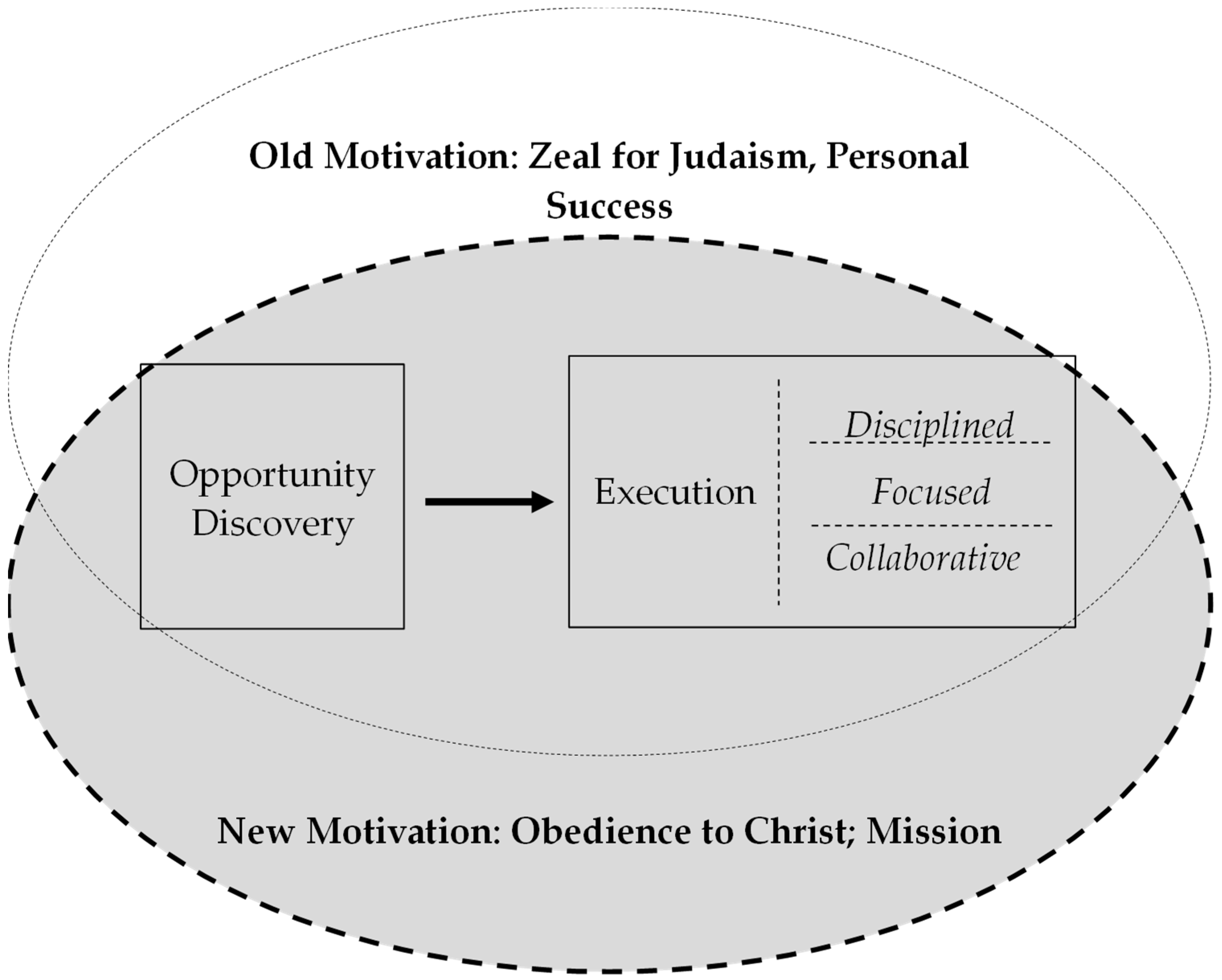
Lavender 2025). His entrepreneurial gift of spotting opportunities and pursuing them with a disciplined, focused, adaptive, and collaborative spirit did not vanish. Instead, they were redeemed and repurposed by new motivation (See
Figure 1). He is no longer driven by his zeal for Judaism and personal success. Instead, he redirects his entrepreneurial mindset and energy to his missionary work following Christ’s command. Instead of seeking autonomy, he submitted himself entirely to the leading of his master as God’s steward.
3. Entrepreneurial Steward
We envision the entrepreneurial steward as someone who has an identity deeply rooted in the conviction of being someone else’s agent while possessing an entrepreneurial mindset. His identity as a steward or servant and the radical obedience to the guidance of the Holy Spirit are well-illustrated by an account recorded in Acts 16:6–10.
And they went through the region of Phrygia and Galatia, having been forbidden by the Holy Spirit to speak the word in Asia. And when they had come up to Mysia, they attempted to go into Bithynia, but the Spirit of Jesus did not allow them. So, passing by Mysia, they went down to Troas. And a vision appeared to Paul in the night: a man of Macedonia was standing there, urging him and saying, “Come over to Macedonia and help us.” And when Paul had seen the vision, immediately we sought to go on into Macedonia, concluding that God had called us to preach the Gospel to them.
In this situation, Paul is not making decisions primarily based on the opportunities he sees, as a typical entrepreneur would. Instead, he is attentive to the guidance of the Holy Spirit and follows the instructions without question. He does not see himself as an autonomous entrepreneur but understands his role as an executor of the master’s intention. In the following sections, we show how his stewardship identity has reframed every aspect of his entrepreneurial mindset.
3.1. Opportunity-Seeking
McGrath and MacMillan propose opportunity-seeking as the first characteristic of an entrepreneurial mindset. Like good chess players, entrepreneurs are not just focused on what is happening on the board. Instead, their mind is racing ahead to predict the moves ahead. Entrepreneurs stay alert and constantly scan the environment to look for new opportunities. They can “piece together previously unconnected information that helps them to identify and invent new products or services, and to assemble the necessary resources to start and grow businesses (
Kuratko et al. 2021, p. 1683).
The ability to spot opportunities seems to have been Paul’s trait even before his conversion. Paul is first mentioned by his Jewish family name, Saul. He was a Hellenistic Jew from Tarsus in the province of Cilicia. Yet, Paul became a student of Gamaliel, a leading figure among the Pharisees in Jerusalem (
Lookadoo 2023). He was passionate about his tradition (Gal 1:14) and actively sought opportunities to advance his career. His passion and ambition drove him to move to Jerusalem to study under a respected teacher and rub his shoulders with the members of the Sanhedrin.
As the Sandedrin’s opinion turned against the emerging movement of Jesus’ followers, Paul put himself at the forefront of the persecution efforts. On the one hand, he is driven by his passion for upholding Jewish traditions (Gal 1:14). On the other hand, however, he appears to be motivated by his personal ambition to establish his reputation among Jewish leaders (Gal 1:14). As a Hellenistic Jew, his position among the Jewish leaders remained marginal. As such, this was an opportunity to make his mark and gain the respect of the Sanhedrin. So, he goes against the teaching of his mentor and master Gamaliel (Acts 5:34–39) and partners with the Sadducees to persecute Christians, building his own brand as the guardian of Jewish tradition (Gal 1:13).
His proactive pursuit of new opportunities continues after conversion. After regaining sight and changing his heart, he immediately started proclaiming Jesus as the Christ in Damascus. Some time later, Paul returned to Jerusalem and debated with the Hellenists as Stephen had done (Acts 9:28–29). Paul may even have tried to convert the people who stoned Stephen. However, his zeal and opportunistic behavior did not work in his favor. The Hellenistic Jews attempted to kill him, so the disciples had to evacuate him to his hometown. Interestingly, Luke notes that, after Paul’s evacuation, “the church throughout all Judea and Galilee and Samaria had peace and was being built up” (Acts 9:31). Luke is then silent about Paul’s effectiveness until Barnabas finds him some years later to build the work in the burgeoning church in Antioch after which Paul was sent on what is known as his first missionary journey (Acts 13:1–5). While the Galatians (1:13–24) chronology does not easily mesh with Acts, it is clear in both accounts that Paul is reorienting his mission along the lines of Christ-direction rather than self-direction.
In contrast to seeking opportunities through his own initiative, Paul learned to actively seek the guidance of the Holy Spirit. By opening himself up to this divine leading, he discovered unexpected opportunities in seemingly improbable circumstances. Notably, even within the confines of prisons and courtrooms where he faced interrogation, Paul found avenues to exercise his stewardship of the Gospel. For instance, during his time in the Philippi prison, Paul shared the Gospel with the jailer’s family. His commitment to spreading the Gospel extended to encounters with powerful rulers. When engaging with King Agrippa, Paul’s passionate proclamation left a lasting impression. Agrippa, taken aback, remarked, “In a short time, would you persuade me to be a Christian?” (Acts 26:28). Paul’s reliance on divine guidance allowed him to discover new and unexpected opportunities everywhere he went.
Another important evidence of his renewed opportunity-seeking mindset is his occupational identity as a tentmaker. Throughout his missionary work, Paul worked as a tentmaker. Working as a tentmaker gave him the autonomy to travel to many cities without burdening anyone (1 Thess 2:9; 1 Cor 9:18). Moreover, Paul used his profession to meet people such as Aquila and Priscilla (Acts 18:3). A tentmaker’s leather workshop was a quiet place and provided a conducive environment for philosophical and theological conversations. The manual labor of cutting and stitching leather afforded Paul extended opportunities for conversation and relationship building.
Ascough (
2000) advances that Paul’s church in Thessalonica, which became renowned throughout Macedonia, consisted primarily of tentmakers who “turned to God from idols to serve the living and true God” (1 Thessalonians 1:9).
3.2. Discipline and Focus
The second and third characteristics of the entrepreneurial mindset are discipline and focus. We discuss them together here because they are intricately connected, like the two sides of the same coin. Once entrepreneurs spot opportunities, they pursue them with enormous discipline and focus. The discipline emphasizes a bias toward action, while focus emphasizes the ability to prioritize the best opportunity. Entrepreneurs typically focus on the most attractive arena or industry to compete in, and then they zoom in on the best opportunities within the chosen arena (
Baron and Ensley 2006). Focusing on a specific opportunity often entails trade-offs, which means giving up other opportunities to pursue the best possible opportunity. Effective entrepreneurs have the discipline to pursue the chosen opportunity without being distracted.
Paul’s mindset before his conversion is marked by unwavering resolve and zeal. When he sets his mind on a goal, he exhibits remarkable discipline, pushing forward relentlessly until he attains his objectives (Phil 3:4–8). As Acts 9:1 describes, he “breathed threats and murder against the disciples of the Lord,” traveling to the non-Israelite city of Damascus to persecute Christians. His willingness to use violence fueled by his religious conviction and political ambition—imprisoning and physically assaulting believers—underscored the intensity of his focus and commitment to his goal (Acts 22:19).
These entrepreneurial characteristics of discipline and focus would later positively contribute to his remarkable missionary work. The same discipline and focus that once earned him a reputation for doing “evil” among Christians in Damascus were later redeployed to the work of spreading the Gospel across the Roman Empire.
Being acutely aware of his calling to be a witness to Christ among the Gentiles, Paul embraces missionary work with unwavering zeal and tenacity. His missionary journeys spanned vast geographical areas within the Roman Empire. When opportunities presented themselves, Paul did not hesitate, even in the face of danger. His commitment to spreading the Gospel was unyielding. Sometimes, others had to urge him to move to keep him safe (Acts 17:14).
Moreover, he seems to have expected similar discipline and intensity from others. For example, he compares his work to that of athletes running a race or a soldier on a mission (1 Cor 9:27; 2 Tim 2:5). He writes that he disciplines his body and exercises self-control like an athlete and encourages Timothy to remain focused and not get entangled in civilian affairs. When John Mark fell short of these expectations, he refused to take him on the next journey, even if that meant separating from a trusted ministry partner, Barnabas (Acts 15:36–41).
3.3. Adaptive
The adaptive aspect of the entrepreneurial mindset refers to an entrepreneur’s ability to adjust behaviors and methods in response to changing environmental conditions. While entrepreneurs focus on their objectives, they can remain flexible and dynamic in their approach to achieving them (
Haynie et al. 2012). They do not mindlessly follow their predetermined plans. Instead, they constantly pay attention to the changing external context and adapt.
One example is Reed Hastings, the founder and CEO of Netflix. Netflix began in 1997 as a DVD-by-mail rental company, competing with Blockbuster. As internet speeds improved and consumer preferences shifted, Hastings recognized the decline of physical media and, in 2007, pivoted the company toward streaming video on demand. This adaptation to a changing market—away from DVDs and toward online streaming—transformed Netflix from a niche rental service into a global leader in digital entertainment. Today, it is one of the most cited cases of an entrepreneur anticipating and adapting to market change.
Adaptability was evident in Paul’s work and life before his transformation. When Paul is first mentioned in the Book of Acts, we see him passively participating in the stoning of Stephen (Acts 7). Without picking up a stone, he approves of Stephen’s executioners. However, as the church grows through persecution, he adjusts his tactics and becomes more aggressive and involved. He not only directly participates in violence but also takes a leading role in imprisoning and beating Christ-followers (Acts 22:19).
Paul maintained this adaptive posture after the conversion. In his first letter to the Corinthians, Paul writes that he is willing to adapt to the audience’s culture to win them for Christ. To the Jews, he was willing to become as a Jew, and to the Gentiles, he was willing to become as one outside the law of God. He writes that he has “become all things to all people” so that he might save some. (1 Cor 9:19–22). We can see how he practices this in some of the recorded messages in Acts (
Oropeza 2021). The Book of Acts records seven public messages or sermons by Paul (see
Table 1). We did not include private messages shared with select groups, such as his message to the Ephesian elders (Acts 20:17–35) and Jewish leaders in Rome (Acts 28:17–20). In each of these messages, he creatively adapts his message.
Paul changes how he refers to God and the source of authority for his arguments depending on the audience. For example, when he was speaking to Jews and Gentile God-fearers in the synagogue at Pisidian Antioch, he referred to God as the “God of this people Israel.” Moreover, he draws authority/legitimacy mainly from the Old Testament in his arguments.
On the contrary, when he was speaking to the Gentile audience in Lystra, he refers to God as “a living God, who made the heaven and the earth and the sea and all that is in them” (Acts 14:15). He tries to find common ground by appealing to their experience of obtaining benefits from nature. Similarly, in Athens, he addresses God as one who made the world and everything in it. As he builds his argument, he even quotes Greek poets as a rhetorical strategy (Acts 17:28).
3.4. Collaborative
The last crucial element of an entrepreneurial mindset is a collaborative tendency. Entrepreneurs are not lone rangers. They often engage the energy of many people in their entrepreneurial efforts. Effective entrepreneurs build and sustain communities of like-minded people (
Feld 2012). They are intentional about making “the most of the intellectual and other resources people have to offer and helping those people to achieve their goals as well” (
McGrath and MacMillan 2000, p. 3).
One well-known example of making the most of what people have to offer is Howard Schultz, former CEO of Starbucks. Schultz is often noted for his collaborative approach to leadership and entrepreneurship, emphasizing partnerships with employees (“partners” in Starbucks’ terminology) and co-creating culture with customers. For example, in the 1990s, Schultz introduced employee stock options and health benefits even for part-time workers. This move fostered loyalty and positioned Starbucks as a company built on collaboration rather than top-down control. This collaborative ethos extended to store design, product development (e.g., the pumpkin spice latte was born out of team brainstorming), and community engagement, making Starbucks a case study in entrepreneurial collaboration.
Paul consistently engaged in collaborative efforts. Whether in local communities or during his extensive missionary journeys, he actively partnered with fellow believers. Each of his letters includes personal greetings to people with whom he has collaborated. During his return journey from Macedonia to Syria, we see him traveling with a diverse group of co-workers (Acts 20:4) and meeting other former ministry partners along the way (Acts 20:17–38).
We also see Paul’s deliberate investment in developing the next generation of leaders. In Acts 16:2–4, Paul meets Timothy, a well-regarded young believer from Lystra and Iconium. Paul recognized Timothy’s potential and purposefully mentored him, intending to raise him as a key leader for the growing movement of Christ’s followers among the Gentiles. The two letters addressed to Timothy serve as evidence of Paul’s dedication to Timothy’s growth and equipping.
In addition to Timothy, Paul invested in the leadership development of Aquila and Priscilla in Corinth, as well as Titus, who stayed behind in Crete after Paul left the island. In his letter to Titus, Paul instructs him on how to identify the right leaders and build a leadership team for the church in Crete (Titus 1:5–9), just as he had done with Timothy (1 Tim 3:2–4). Priscilla and Aquila worked as tentmakers in Corinth with Paul. It is evident that they were nurtured in biblical understanding and leadership as they worked with Paul. After Paul left them in Ephesus, they demonstrated courage and leadership by privately correcting Apollos, an erudite biblical scholar and preacher, to ensure the integrity of the gospel message.
Paul demonstrated his commitment to collaboration and the intentional development of others throughout his missionary work. His commitment to working alongside others and nurturing emerging leaders had a lasting impact on the emerging community of believers throughout the Roman Empire.
4. Conclusions
This study uses the framework of contemporary entrepreneurship theory to shed new light on the work of Apostle Paul. The analysis reveals both continuity and discontinuity in his identity and modus operandi. Paul possessed an entrepreneurial mindset during his earlier identity as Saul. He operated as an independent and highly motivated entrepreneur who maintained clear awareness of both his elevated position within the political hierarchy of Judaism (Gal 1:14) and his prestigious heritage as a Hebrew of Hebrews (Phil 3:5). He describes himself as someone extremely zealous for the traditions beyond any of the young men of his generation (Gal 1:4). He used his opportunistic, focused, disciplined, adaptive, and collaborative mindset to gain a position of influence in Jerusalem and play a leading role in the persecution of the early Christian community.
The Damascus road experience, however, became a pivotal moment in Paul’s life. His encounter with the risen Christ transformed his entrepreneurial orientation from an autonomous, self-driven entrepreneur to a Spirit-led entrepreneurial steward. Given that one of the core characteristics of entrepreneurs is autonomy, fusing stewardship with entrepreneurship is a contradiction in terms. Yet, in Paul’s life, the two seemingly irreconcilable concepts work beautifully together, such as the interconnected yin and yang symbol. This dual identity enabled him to pioneer the mission to the Gentiles with both entrepreneurial zeal and a servant’s heart.
This study provides a broad overview of Paul’s ministry based on an interdisciplinary approach. As such, we did not incorporate any specific entrepreneurship theory to examine an aspect of Paul’s missionary practice closely. In future studies, we hope to conduct a more focused and rigorous analysis by applying a well-defined theory, such as effectuation theory, to the Apostle Paul’s work.
The concept of entrepreneurial stewardship also uniquely addresses a longstanding tension in Pauline theology between freedom and submission. Paul maintains some element of autonomous tendencies when he defends his choice to work with his hands (1 Cor 9). A classical writer, Musonius Rufus, had said a teacher or philosopher had four options: stay with a patron, beg for a living, charge fees to sell his teaching, or work with your hands. Paul chose the independent path not so that he could do as he pleased, but to become all things to all people, so that he might win them to Christ. His position as a simple craftsman gave him a unique opportunity to enter the world of the rich, the poor, the Jew, and the Greek, as leather goods were essential necessities for all.
Despite his financial autonomy, his primary identity was that of a steward called to preach the Gospel (1 Cor 9:17). As a steward, he was committed to both the message and the people, prioritizing the master’s interests. In his correspondence to the Philippians, he candidly confesses, “Whatever gain I had, I counted as loss for the sake of Christ. Indeed, I consider everything a loss because of the surpassing worth of knowing Christ Jesus my Lord” (Philippians 3:7–8). In this new paradigm, it is the indwelling Holy Spirit that empowers effective service to God. He still possessed his entrepreneurial mindset and talents, which God had no intention of wasting. Instead, God has radically repurposed Paul’s entrepreneurial gifts and dispositions toward the work of bearing witness to Christ among Gentiles. God’s grace extends to utilizing human instruments in their diverse forms, regardless of past pursuits or mistakes. No longer driven by his own agenda, he sought to bear Jesus’ name to the Gentiles and to the ends of the earth with an entrepreneurial mindset (Acts 9).