Article

Collaborative Detection Capability Evaluation and Resilience Enhancement for Maritime Cross-Domain Unmanned System-of-Systems

1
School of Reliability and Systems Engineering, Beihang University, Beijing 100191, China
2
School of Aeronautic Science and Engineering, Beihang University, Beijing 100191, China
*
Authors to whom correspondence should be addressed.
J. Mar. Sci. Eng. 2026, 14(9), 855; https://doi.org/10.3390/jmse14090855
Submission received: 9 April 2026 / Revised: 28 April 2026 / Accepted: 29 April 2026 / Published: 2 May 2026
(This article belongs to the Section Ocean Engineering)

Abstract

Maritime cross-domain unmanned system-of-systems (MCUSoS), featuring multi-domain collaboration, wide-area coverage, and flexible deployment, plays a vital role in missions such as maritime search and rescue, marine environmental monitoring, and terrain reconnaissance. MCUSoS enables collaborative detection by coordinating heterogeneous unmanned clusters across the aerial, surface, and underwater domains. However, this capability is vulnerable to degradation under cross-domain heterogeneity, communication constraints, and external disturbances such as node failures, link disruptions and malicious interference. To address these challenges, this paper proposes an integrated framework for collaborative detection capability evaluation and resilience enhancement of MCUSoS in multi-disturbance environments. Firstly, a system-of-systems architecture is established by incorporating formation detection modes and multi-level collaborative relationships to characterize its collaborative detection capabilities. Second, a capability evaluation model is developed from the capabilities of collaboration and detection. Based on this, a multi-stage resilience evaluation mechanism is proposed to quantify MCUSoS resilience under three disturbance modes. Additionally, a resilience enhancement strategy combining internal reconfiguration with the external deployment of supplementary detection nodes is designed to recover MCUSoS performance in multi-disturbance environments. Finally, a case study involving 12 clusters of MCUSoS is conducted to validate the effectiveness of the proposed methods. The results demonstrate that the proposed resilience enhancement strategy achieves a recovery rate of up to 74% in the disintegration circle attack scenario and consistently improves the resilience of the MCUSoS under targeted attacks, with the resilience value under low-frequency attacks being 148% higher than that under high-frequency attacks. These findings provide a quantitative basis for resilience evaluation and enhancement in dynamic scenarios.

1. Introduction

With the rapid advancement of unmanned system technologies, the maritime cross-domain unmanned system-of-systems (MCUSoS), which is composed of heterogeneous platforms such as unmanned surface vehicles (USVs) and unmanned aerial vehicles (UAVs), has emerged as a significant operational paradigm for future maritime missions [1]. In collaborative detection tasks, the MCUSoS enables joint detection, persistent monitoring, and information fusion against both surface and underwater targets by coordinating multiple unmanned clusters across three domains, namely the airspace, the sea surface, and the underwater environment, thereby providing fundamental support for situational awareness and decision-making [2,3]. Collaborative detection capability is therefore one of the core indicators for measuring the overall performance of the MCUSoS, and its level directly determines whether the system can achieve full-domain perception and rapid response.
However, the maritime operating environment exhibits notable complexity and confrontational characteristics. On the one hand, UAVs and USVs differ fundamentally in sensor types, detection mechanisms, and maneuverability. Cross-domain coordination faces multiple difficulties due to constraints such as limited communication range, satellite relay latency, and intermittent link connectivity caused by sea state fluctuations and platform mobility [4,5,6,7,8]. On the other hand, the harsh maritime environment poses various failure threats to the system in practical operations [9]. Salt fog corrosion, high humidity, and persistent wave-induced vibrations accelerate the degradation of onboard electronic components and mechanical structures, leading to random equipment faults [10]. USVs serving as communication relay nodes are vulnerable to deliberate targeted attacks such as anti-ship strikes and electronic warfare jamming, which can trigger cascading disconnection of dependent UAV clusters. Regional threats including wide-area electromagnetic interference further degrade or even completely eliminate the collaborative detection capability of the system [11,12,13,14]. How to accurately evaluate the collaborative detection capability of the MCUSoS and effectively enhance system resilience to achieve capability recovery under external failure disturbances has become a critical issue that urgently needs to be addressed in current unmanned system research.
Extensive research has been conducted on unmanned system modeling and collaborative detection. At the system architecture level, multi-level organizational structures and cluster-based grouping modes have been widely adopted for unmanned system modeling. Giles et al. [15] proposed a hierarchical mission-decomposition architecture framework for swarm unmanned systems by integrating mission engineering with model-based systems engineering, which supports modular design and mission reuse across unmanned platforms. Liu et al. [16] developed a distributed adaptive fixed-time formation control method for UAV-USV heterogeneous multi-agent systems, which effectively addressed the dynamic uncertainties caused by external disturbances in leader-follower structures. In terms of collaborative detection coverage modeling, Luna et al. [17] presented a coverage path planning method for multi-UAV systems that employed a sensor-footprint-based area decomposition strategy to achieve cooperative coverage search, with the capability of in-flight dynamic re-planning. Bai et al. [18] established a detection coverage and resilience evaluation model for UAV swarms under communication-constrained scenarios using a complex network approach. Regarding communication constraint modeling, Lim et al. [19] derived closed-form approximations of communication reliability for UAV swarms based on a comprehensive signal-to-interference-and-noise ratio (SINR) model that incorporated shadowing, multipath fading, and line-of-sight probability, and provided a quantitative method for evaluating and maintaining intra-swarm link quality during deployment. Yan et al. [20] formulated the multi-hop relay selection problem in underwater acoustic sensor networks as a combinatorial multi-armed bandit learning model and developed an online cooperative reasoning mechanism to adapt relay strategies to dynamic network topologies. However, most existing modeling efforts have focused on a single operational domain or a single cluster type. A unified system modeling framework aimed at cross-domain cooperative scenarios spanning air, sea surface, and underwater remains largely lacking, making it difficult to comprehensively characterize the architectural features, formation-based detection modes, and multi-level communication coordination relationships of MCUSoS in maritime collaborative detection missions.
In terms of capability evaluation for unmanned systems, existing research can be broadly classified into two categories. The first category comprises the evaluation methods based on performance analysis, such as the classic ADC model [21], the fuzzy mathematics [22] and the system dynamics model [23]. These methods are capable of characterizing system-of-systems effectiveness at a macroscopic level, yet they struggle to reveal the internal cooperative organizational mechanisms of the system. The second category comprises the capability evaluation methods based on complex network theory. Wang et al. [24] established a multi-layer network model for UAV swarm mission reliability oriented toward systematic and networked missions, and adopted vulnerability and connectivity as two indicators to evaluate mission reliability under both random and deliberate attacks. Li et al. [25] proposed a capability-oriented equipment contribution analysis method in temporal combat networks, which quantified the functional contribution of individual nodes to the overall combat capability. Chen et al. [26] developed a mission reliability evaluation method based on the effective operation loop, which associated the capability of reconfigurable unmanned weapon system-of-systems with the dynamic reconfiguration process of actual combat workflows. Feng et al. [27] established a phased mission reliability evaluation model and a UAV number optimization model for swarms on the basis of importance measure theory. In addition, regarding the modeling of physical detection performance, Yan et al. [28] constructed a formation control and collision avoidance model for multi-USV systems using virtual structure and artificial potential field methods, which provided a foundation for characterizing the formation coverage and detection performance of unmanned platforms. However, most of the aforementioned methods address the problem from a single perspective. They either focus on cooperative relationships at the network topology level or on coverage performance in the physical space, while a comprehensive evaluation indicator system that integrates cooperative organizational capability with dynamic detection coverage capability in a unified manner has not yet been established.
System-of-systems resilience has received increasing attention in recent years. Resilience is generally defined as the comprehensive ability of a system to absorb shocks, adapt to changes, and restore functionality after a disruption [29]. In the domain of unmanned systems, Kong et al. [30] proposed a resilience evaluation framework for UAV swarms based on performance curve analysis that incorporated external resource supplementation, and quantified the entire process from performance degradation to recovery following an attack. Zhang and Liu [31] constructed a dual-layer coupled network model for UAV swarms that accounted for both the communication layer and the structural layer, and investigated a resilience assessment method considering cascading failure with dynamic evolution. Regarding multi-stage resilience modeling, Tran et al. [32] introduced a quantitative assessment framework that characterized the temporal evolution of system performance and decomposed resilience into multiple stages, including resistance, adaptation, and recovery. This framework provided a new perspective for resilience analysis of unmanned systems. In terms of resilience enhancement strategies, Zhong et al. [33] proposed a kill chain optimization method to improve the resilience of unmanned combat system-of-systems, which enhanced robustness and recovery capability in adversarial environments through optimizing the operation loop structure. Sun et al. [34] investigated a cooperative topology reconfiguration method for unmanned weapon system-of-systems based on multi-swarm collaboration, which restored system functionality through dynamic reorganization of formation relationships. Li et al. [35] developed a soft resource optimization method for unmanned swarms driven by resilience and based on autonomous coordination, which achieved capability recovery through redundant node supplementation and task reassignment strategies. Nevertheless, existing resilience research still has several limitations. First, most studies adopt generic network connectivity or overall performance as the object of resilience evaluation, while resilience indicators specifically designed for the collaborative detection capability scenario remain scarce. In addition, the modeling of failure modes is relatively simplistic and lacks a unified description that covers multiple typical threats. Additionally, resilience evaluation and recovery strategies are typically studied within separate frameworks, and a complete closed loop methodology that spans capability evaluation, resilience assessment, and strategy enhancement has not yet been developed. In particular, how to incorporate internal dynamic reconfiguration and external resource supplementation jointly into a unified resilience enhancement framework under maritime cross-domain multi-cluster scenarios has not been adequately explored.
To address the aforementioned challenges, this study focuses on the collaborative detection mission of MCUSoS and systematically investigates the methods for collaborative detection capability evaluation and resilience enhancement. The main contributions are as follows:
(i)
A system-of-systems architecture of the MCUSoS is established, encompassing formation detection models, and multi-level cooperative communication network models, which provides a unified structural foundation for capability evaluation and resilience analysis of heterogeneous cross-domain unmanned system-of-systems.
(ii)
A capability evaluation model is developed from the capabilities of collaboration and detection. Collaborative capability indices from intra-cluster and inter-cluster dimensions are integrated with dynamic sea-surface and underwater detection coverage metrics to form the composite evaluation function, which enables the integrated quantification of cooperative organizational relationships and detection coverage performance under both steady state and disturbed conditions.
(iii)
Three representative failure models are established to analyze the degradation mechanisms of collaborative detection capability under multiple failure modes. A multi-phase resilience evaluation model incorporating elastic, plastic, and fracture stages is proposed, with a comprehensive resilience metric constructed from the dimensions of performance margin, internal reconfiguration efficiency, and external resource support rate, offering a quantitative basis for comparing resilience across different failure scenarios.
(iv)
An integrated resilience enhancement strategy combining dynamic reconfiguration with external resource supplementation is designed. The proposed methods are validated through case studies under various failure scenarios. This strategy offers a practical approach to restoring system performance under diverse operational threats, bridging the gap between resilience evaluation and performance recovery of the MCUSoS.
The remainder of this paper is organized as follows. Section 2 establishes the mathematical framework of the MCUSoS for collaborative detection missions. Section 3 constructs the collaborative detection capability evaluation index system and formulates multiple failure models. Section 4 presents the multi-stage resilience evaluation model and resilience enhancement strategies. Section 5 validates the effectiveness of the proposed methods through simulation case studies. Section 6 concludes this paper.

2. MCUSoS Modeling for Collaborative Detection Missions

The MCUSoS investigated in this study consists of multiple heterogeneous unmanned clusters that cooperatively operate across three domains, namely airspace, sea surface, and underwater, to execute collaborative detection missions. To accurately characterize the collaborative detection capability of the system and lay the foundation for subsequent capability evaluation and resilience analysis, this section establishes a systematic mathematical framework from three aspects: system-of-systems architecture and mission area partitioning, formation mode and detection capability characterization, and cooperative relationship and communication constraint modeling.

2.1. System-of-Systems Architecture and Mission Area Modeling

This subsection first defines the hierarchical architecture of the MCUSoS, then establishes the mathematical description of the three-dimensional mission space, and proposes a grid-based mission area allocation method to provide the spatial foundation for quantitative analysis of collaborative detection capability.

2.1.1. Hierarchical Architecture of MCUSoS

The MCUSoS adopts a three-layer architecture consisting of command-and-control centers, unmanned clusters, and platform nodes. Let the system be S = { S 1 , S 2 , , S M } , where M denotes the total number of clusters. Each cluster S k ( k = 1 , 2 , , M ) comprises one USV serving as the leader node and N k unmanned aerial vehicles UAV serving as follower nodes:
S k = { u k 0 , u k 1 , u k 2 , , u k N k }
where u k 0 is the USV leader node of cluster k , responsible for underwater detection and serving as the communication relay hub within the cluster, and u k i ( i = 1 , 2 , , N k ) is the i -th UAV follower node, tasked with sea-surface target detection and surveillance.
Since UAVs have limited communication payloads and cannot establish long range communication links directly with the command-and-control center or other clusters, the USV plays an indispensable central role within each cluster. The total number of platforms in the system is N total = k = 1 M ( N k + 1 ) .

2.1.2. Three-Dimensional Mission Space Partitioning

The mission space Ω is vertically partitioned into three interrelated operational layers to accommodate the operational requirements of different platform types, considering the characteristics of maritime cooperative search missions:
Ω = Ω a Ω s Ω u
where the airspace layer Ω a = { ( x , y , z ) ( x , y ) A , h s < z h a } represents the flight and operational space of UAV, with h a denoting the maximum allowable flight altitude and h s the standard cruising altitude; the sea-surface layer Ω s = { ( x , y , z ) ( x , y ) A , z = 0 } represents the navigation area of USV and serves as the primary target region for UAV sensor detection; and the underwater layer Ω u = { ( x , y , z ) ( x , y ) A , d z < 0 } represents the detection space of USV sonar sensors, where d is the maximum detection depth required by the mission. This three-layer partitioning conforms to the physical characteristics of the maritime operational environment and facilitates the subsequent development of detection coverage models for each platform type.

2.1.3. Grid-Based Mission Allocation

To enable effective management and allocation of multi-cluster cooperative search missions, the horizontal projection area of the mission is discretized into a grid structure. Let the mission area A be a rectangular region of size L x × L y , which is divided into uniform grid cells:
A = n x i = 1 n y j = 1 G i j
where the grid cell is defined as G i j = { ( x , y ) ( i 1 ) Δ x x < i Δ x , ( j 1 ) Δ y y < j Δ y } , and the grid resolution is Δ x = L x / n x , Δ y = L y / n y . The grid size should be selected by jointly considering the detection accuracy requirements and computational complexity, and is typically set to a scale commensurate with the detection range of the platforms.
The mission area allocation can be formalized as a set mapping problem based on the grid partitioning. An allocation function f is defined to assign grid cells from the grid set G to specific clusters for detection tasks. Here, S k G denotes the subset of grid cells assigned to cluster k . The allocation is subject to completeness and mutual exclusivity constraints, as shown in Equation (4):
S k = { G i j   |   f G i j = k } , M k = 1 S k = G , S k S l = k l
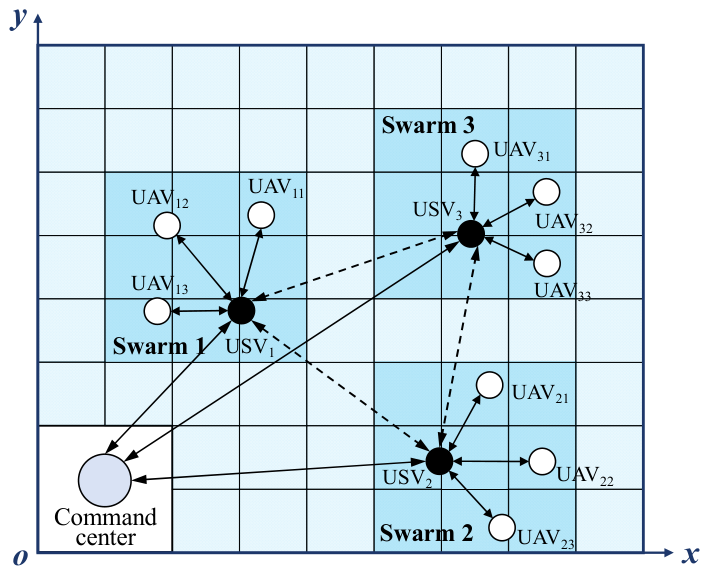
As illustrated in Figure 1, the system comprises three unmanned clusters, each responsible for the detection tasks within a designated grid area. The inter-cluster cooperative communication links are established between the USV leader nodes of different clusters, thereby forming a collaborative network that covers the entire mission area while maintaining communication with the command-and-control center.

2.2. Formation Mode and Detection Capability

This subsection further establishes the intra-cluster formation model and constructs the detection coverage mathematical models for UAV and USV according to their respective detection characteristics, providing a theoretical basis for quantitative evaluation of the system-level collaborative detection capability.

2.2.1. Leader-Follower Formation Structure

A leader-follower formation mode is adopted to organize the coordinated movement of all platforms, within cluster S k . The USV serves as the leader node with dual responsibilities: executing underwater detection tasks using sonar sensors, and functioning as the communication relay hub within the cluster to aggregate detection information collected by UAVs and exchange data with external networks. The UAV serves as follower nodes, performing sea-surface detection tasks while maintaining the formation relationship with the USV.
Let the USV position be p k 0 = ( x k 0 , y k 0 , 0 ) and the position of the i -th UAV follower node be p k i = ( x k i , y k i , h s ) , where h s is the standard flight altitude of UAV. To ensure communication connectivity and cooperative consistency within the cluster, the distance between each UAV and the USV must satisfy the formation constraint, as defined in Equation (5):
  p k i p k 0 2 D s , i = 1 , 2 , , N k
where D s is the maximum allowable formation radius, whose value is determined by the communication range constraint. This constraint ensures that the cluster maintains internal communication connectivity during mobile operations.

2.2.2. Effective Detection Area Configuration

  • UAV Sea-surface Detection Area
UAVs are equipped with electro-optical or infrared sensors for sea-surface target detection and identification. For the i -th UAV operating at altitude h s , the sensor is assumed to have a conical field of view, and the detection coverage projected onto the sea surface forms a circular region centered at the UAV horizontal position. Let the detection radius be R a ; the effective detection area can be expressed as:
Ω k i = x , y , 0 x x k i 2 + y y k i 2 R a
where the detection radius R a is determined by the sensor field-of-view angle θ fov and the flight altitude according to the geometric relation R a = h s t a n   ( θ fov / 2 ) . The effective detection area of a single UAV is A U A V = π R a 2 . When multiple UAVs operate cooperatively, the detection areas of adjacent UAVs may overlap; therefore, the cluster-level joint detection area requires a union operation over the individual regions.
  • USV Underwater Detection Area
USVs are equipped with active sonar sensors for underwater detection tasks. Unlike the optical detection of UAVs, sonar signals propagate spherically in water, and the detection coverage of a USV is modeled as a hemispherical region centered at the USV position with the sonar operating range R s as the radius. However, since operational missions typically focus on targets within a specific depth range (e.g., submarines or mines), the maximum detection depth d ( d < R s ) required by the mission is specified, and the effective detection area is a spherical segment:
Ω k U S V = x , y , z x x k 0 2 + y y k 0 2 + z 2 R s , z [ d , 0 )
At depth d , the effective horizontal detection radius is r eff ( d ) = R s 2 d 2 , and the corresponding horizontal projection area is A U S V p r o j = π R s 2 d 2 . Therefore, A U S V p r o j is not a fixed circular area; rather, it depends on both the sonar operating range R s and the mission-required detection depth d as determined by the hemispherical sonar detection geometry.
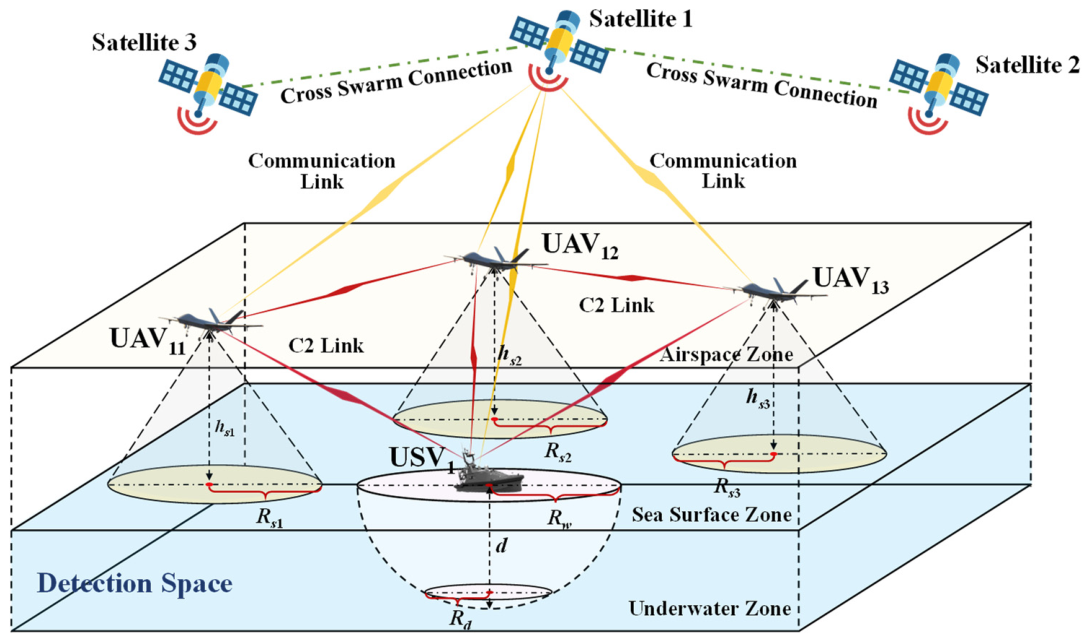
As illustrated in Figure 2, UAVs within a cluster cover sea-surface targets with circular detection regions in the airspace layer, while the USV detects underwater targets with a hemispherical detection region in the underwater layer. Communication connectivity between UAVs and the USV is maintained through command and control links, and cross-domain cooperation among clusters is achieved via satellite relay. By integrating the detection capabilities of both UAVs and USVs, the overall system detection coverage ratio is defined as the ratio of the effective detection area to the total mission area:
η s y s = k = 1 M Ω k s u r f a c e + A U S V p r o j L x L y
where Ω k s u r f a c e = i = 1 N k Ω k i denotes the union area of detection regions of all UAVs within cluster k . In addition, the USV detects underwater targets using active sonar with operating range R s , and its effective horizontal projection area at the mission-required depth d is denoted by A U S V p r o j , which is computed based on the hemispherical sonar detection model defined in Equation (7). Therefore, η s y s comprehensively reflects the coverage extent of the system over the mission area.

2.3. Collaborative Relationship and Communication Constraint Modeling

The realization of collaborative detection capability is highly dependent on reliable communication connections among platforms. This subsection first establishes the communication range constraint based on the signal-to-interference-plus-noise ratio (SINR) model, then constructs the multi-level communication topology encompassing intra-cluster, inter-cluster, and command-and-control layers, and finally adopts graph-theoretic methods to provide a unified model of the system cooperative relationships.

2.3.1. SINR-Based Communication Range Constraint

The reliability of wireless communication links between platforms is affected by multiple factors, including transmission distance, transmit power, and channel fading. The SINR model is adopted in this research to characterize the communication link quality. For the communication link between transmitting node i and receiving node j , the received SINR is defined as:
γ i j = P t G t G r h i j N 0 B
where P t is the transmit power, G t and G r are the transmit and receive antenna gains, respectively, N 0 is the noise power spectral density, and B is the channel bandwidth. In this study, communication disturbances such as electromagnetic interference are captured through an increase in the effective noise level represented by N 0 . When such interference occurs, the received SINR decreases accordingly, and the feasible communication range D c becomes more restrictive.
The channel gain follows the free-space path loss model h i j = λ 4 π d i j α , where λ is the carrier wavelength, d i j is the distance between the nodes, and α is the path loss exponent. The free-space path loss model is adopted here as a simplified assumption for analytical tractability, since the primary objective is to establish a general framework for collaborative detection capability evaluation rather than to precisely characterize the maritime radio propagation channel. In maritime environments, multi-path reflection effects, especially those caused by the water surface, may significantly influence communication performance. More realistic propagation models, such as the two-ray ground-reflection model, can therefore be incorporated in future work.
A reliable communication link requires that the received SINR is no less than the demodulation threshold γ th , i.e., γ i j γ th . The maximum communication range constraint D c is thereby obtained as:
D c = λ 4 π P t G t G r γ t h N 0 B 1 / α
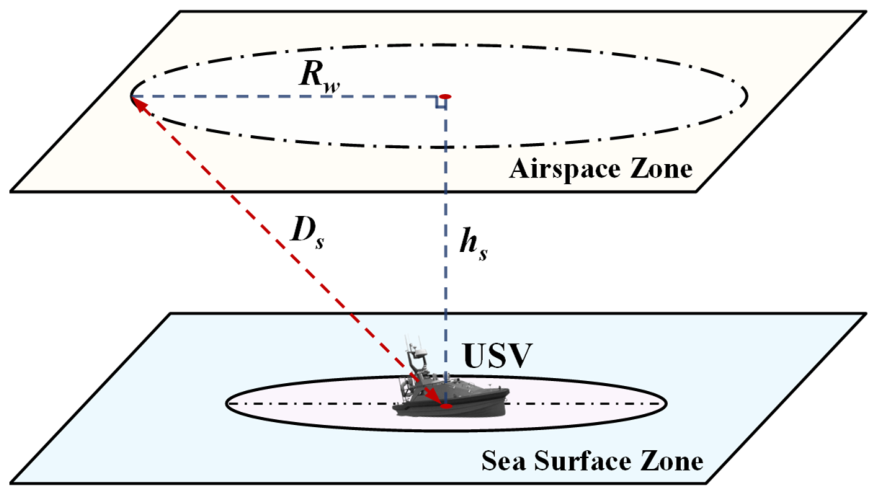
As illustrated in Figure 3, the communication constraint between a UAV and a USV is governed by the slant range D s in three-dimensional space, which must satisfy D s D c . The maximum horizontal offset distance of a UAV relative to the USV is D s 2 h s 2 for a given UAV flight altitude h s , and this constraint directly influences the formation configuration design of the cluster.

2.3.2. Multi-Level Communication Topology

The communication network of the MCUSoS exhibits pronounced hierarchical characteristics and can be classified into three levels according to communication range and functional role.
  • Intra-cluster Communication Layer
The intra-cluster communication topology consists of UAV-USV vertical command links and UAV-UAV horizontal cooperative links. The vertical command links are used by the USV leader node to issue control commands to UAV follower nodes and to receive detection data relayed back from UAVs. The horizontal cooperative links support situational information sharing and cooperative task execution between adjacent UAVs.
The existence of a communication link between any two platforms u k i and u k j within cluster S k is determined by the Euclidean distance between their position vectors p k i and p k j in three-dimensional space, where p k i = ( x k i , y k i , z k i ) denotes the spatial position of platform u k i . The communication link existence condition is:
e k , i j = 1 , if   p k i p k j 2   D c 0 , otherwise
The internal communication topology of cluster k is represented as an undirected graph G k i n t r a = V k , E k i n t r a , where the node set V k = { u k 0 , u k 1 , , u k N k } contains all platforms within the cluster, and the edge set E k intra = { ( u k i , u k j ) e k , i j = 1 , i < j } includes all links satisfying the communication constraint.
  • Inter-cluster Communication Layer
The USV leader nodes of different clusters are typically separated by distances far exceeding the direct communication range D c , as the clusters are distributed across a large mission area. Inter-cluster information exchange therefore relies on satellite relay. Let the set of available relay satellites be R = { r 1 , r 2 , , r q } , each equipped with an onboard transponder supporting the dual-hop communication mode of USV-satellite-USV.
A relay communication connection between the USV leader node u k 0 of cluster k and the USV leader node u l 0 of cluster l ( k l ) can be established if there exists a satellite r q that simultaneously satisfies the SINR requirements for both uplink and downlink:
e k l i n t e r = 1 , if   r q R : γ k q γ t h s a t   and   γ q l γ t h s a t 0 , otherwise
where γ th sat is the SINR threshold for satellite communication links, which is typically set higher than the threshold for direct inter-platform communication to ensure the reliability of relay transmission.
  • Command-and-control Communication Layer
The command-and-control center, serving as the decision-making core of the system, must maintain real-time information exchange with all clusters to achieve global situational awareness and mission coordination. The communication between the command-and-control center and the USV of each cluster is similarly realized through satellite relay:
e k C c m d = 1 , if   r q R :   γ k q γ t h s a t   and   γ q C γ t h s a t 0 , otherwise
where C denotes the command-and-control center node. The connectivity of command links is directly related to the ability of the system to perform centralized mission planning and emergency response.

2.3.3. System Cooperative Network Model

A graph-theoretic network model is constructed to provide a unified representation of the aforementioned multi-level communication relationships and to support subsequent capability evaluation and resilience analysis. The MCUSoS is modeled as a hierarchical network G s o s = V s o s , E s o s , which is defined as follows.
  • Node Set
The node set of the MCUSoS network contains all entities involved in cooperation:
V s o s = { C } R M k = 1 V k
where C is the command-and-control center node, R is the set of relay satellite nodes, and V k is the set of platform nodes in cluster k . The total number of nodes is V s o s = 1 + Q + N t o t a l .
  • Edge Set
The edge set of the MCUSoS network comprises three types of communication links:
E s o s = E i n t r a E i n t e r E c m d
where E intra = k = 1 M E k intra is the union of all intra-cluster communication links, E inter = { ( u k 0 , u l 0 ) e k l inter = 1 , k < l } is the set of inter-cluster relay links, and E cmd = { ( C , u k 0 ) e k C cmd = 1 , k = 1 , , M } is the set of communication links between the command-and-control center and each cluster.
The adjacency matrix A R V sos × V sos of the MCUSoS is defined based on the above network model:
A i j = 1 , if   v i , v j E s o s 0 , otherwise
The degree matrix D is further defined as a diagonal matrix with diagonal elements D i i = j A i j representing the degree of node v i . The Laplacian matrix of the system graph is defined as L = D A , whose spectral properties effectively capture the topological structure and connectivity of the network. The second smallest eigenvalue λ 2 ( L ) of the Laplacian matrix, known as the algebraic connectivity, is a critical indicator of network robustness: λ 2 ( L ) > 0 if and only if the graph G s y s is connected, and a larger value of λ 2 ( L ) indicates stronger connectivity and greater survivability against node or link failures.
In summary, the cooperative operation of the MCUSoS requires the following constraints to be satisfied: each UAV remains within the communication range of its USV leader node (   p k i p k 0 2 D s ), the internal communication graph of each cluster remains connected ( λ 2 ( L k ) > 0 ), any two USV leader nodes are reachable via satellite relay, and effective communication paths exist between the command-and-control center and all cluster USVs. These constraints collectively safeguard the collaborative detection capability of the system and provide explicit criteria for the subsequent analysis of capability degradation and resilience evaluation under failure scenarios.

3. MCUSoS Collaborative Detection Capability Evaluation Under Failure Scenarios

The quantitative evaluation framework for collaborative detection capability is constructed in this section based on the system modeling framework established in Section 2. Capability indices are first developed from two dimensions, namely intra-cluster cooperation and inter-cluster cooperation. A time-integral-based dynamic detection coverage index is then formulated, and a unified collaborative detection capability metric is obtained through weighted aggregation. Three representative failure models, including random failure, targeted attack, and disintegration circle attack, are subsequently established to analyze the impact mechanisms of different disruption modes on collaborative detection capability, thereby providing a theoretical basis for subsequent resilience evaluation and recovery strategy design.

3.1. Construction of Collaborative Capability Index System

The realization of collaborative detection capability relies on effective collaboration among platforms within clusters and across clusters. This subsection establishes collaborative capability indices from the perspectives of network topology and information interaction for both intra-cluster and inter-cluster levels, and formulates a system-of-systems level collaborative capability evaluation function through weighted aggregation.

3.1.1. Intra-Cluster Collaborative Capability Indices

Intra-cluster collaborative capability reflects the degree of collaborative tightness and information exchange efficiency between the USV leader node and UAV follower nodes. Three intra-cluster collaborative capability indices are defined from the aspects of connectivity, compactness, and balance, based on the intra-cluster communication topology G k intra = ( V k , E k intra ) established in Section 2.
Cluster connectivity measures the ability of the intra-cluster communication network to withstand node failures, quantified by the normalized algebraic connectivity of the Laplacian matrix:
ξ k c o n n = λ 2 L k λ 2 m a x
where L k is the Laplacian matrix of the intra-cluster communication graph of cluster k , and λ 2 m a x is the algebraic connectivity of the corresponding complete graph. ξ k conn [ 0 , 1 ] , and a larger value indicates stronger internal connectivity.
Formation compactness characterizes the spatial distribution tightness of UAV follower nodes around the USV leader node, which directly affects the communication quality and cooperative response speed within the cluster:
ξ k c o m p = 1 1 N k i = 1 N k p k i p k 0 2 D s
where D s is the maximum formation radius. ξ k comp [ 0 , 1 ] , and a larger value indicates a more compact formation.
Communication load balance measures the uniformity of communication link quality between each UAV and the USV:
ξ k b a l = 1 σ { γ 0 i k } i = 1 N k γ k
where γ 0 i k is the SINR between the USV and the i -th UAV, γ k is the mean value, and σ ( ) denotes the standard deviation.
The three indices are combined through weighted aggregation to obtain the intra-cluster collaborative capability index of cluster k :
Φ k i n t r a = ω 1 ξ k c o n n + ω 2 ξ k c o m p + ω 3 ξ k b a l
where the weight coefficients satisfy ω 1 + ω 2 + ω 3 = 1 and can be determined using the analytic hierarchy process or expert assignment methods.

3.1.2. Inter-Cluster Collaborative Capability Indices

Inter-cluster collaborative capability reflects the efficiency of information sharing and mission coordination among multiple unmanned clusters. Four indices are constructed from the aspects of global connectivity, information transmission efficiency, command-and-control reachability, and cooperative coverage complementarity, based on the satellite relay communication model established in Section 2.
The inter-cluster connectivity graph is defined as G inter = ( V inter , E inter ) , where V inter = { u 1 0 , u 2 0 , , u M 0 } is the set of USV leader nodes. Global network connectivity is quantified by the normalized algebraic connectivity of this graph:
Ψ c o n n = λ 2 L i n t e r λ 2 m a x , i n t e r
Average path efficiency measures the mean efficiency of information transmission among clusters, adopting the global efficiency metric from graph theory:
Ψ e f f = 1 M M 1 k l 1 d k l
where d k l is the shortest path hop count between the USVs of cluster k and cluster l , and 1 / d k l = 0 if no path exists.
Command-and-control reachability reflects the control coverage of the command-and-control center over all clusters:
Ψ c m d = 1 M k = 1 M e k C c m d
where e k C cmd { 0 , 1 } indicates the connectivity status between cluster k and the command-and-control center.
Cooperative coverage complementarity measures the detection coverage continuity at the boundaries of adjacent cluster mission areas:
Ψ o v l p = k < l G k G l c o v e r e d k < l G k G l
where G k denotes the boundary of the mission area of cluster k , and covered represents the length of the boundary that is effectively covered.
The above indices are combined through weighted aggregation to obtain the inter-cluster collaborative capability index:
Φ i n t e r = β 1 Ψ c o n n + β 2 Ψ e f f + β 3 Ψ c m d + β 4 Ψ o v l p
where i = 1 4 β i = 1 .

3.1.3. System-Level Collaborative Capability Evaluation

The intra-cluster and inter-cluster cooperative capabilities are integrated to construct a system-level collaborative capability evaluation function. The intra-cluster cooperative capabilities of all clusters are first aggregated as Φ i n t r a = 1 M k = 1 M Φ k i n t r a , and the system collaborative capability index is then obtained as:
Φ c o o p = α Φ i n t r a + 1 α Φ i n t e r
where α ( 0 , 1 ) is a balance coefficient reflecting the relative importance of intra-cluster and inter-cluster cooperation for the mission.

3.2. Construction of Detection Coverage Capability Indices

Detection coverage capability is a core metric for evaluating the quality of collaborative detection mission execution. Given that unmanned platforms move continuously during mission execution and the detection coverage areas change dynamically over time, this subsection constructs dynamic detection coverage capability indices for both sea-surface and underwater dimensions based on time-integral methods.

3.2.1. Sea-Surface Dynamic Detection Coverage Capability

Sea-surface detection tasks are performed by UAVs within each cluster. Let the mission time interval be [ 0 , T ] , and the position of the i -th UAV at time t be p k i ( t ) = ( x k i ( t ) , y k i ( t ) , h s ) . Its instantaneous detection coverage area is:
Ω k i t = x , y x x k i t 2 + y y k i t 2 R a 2
The cumulative sea-surface detection coverage area of cluster k over the mission time interval is defined as the temporal union of the instantaneous detection areas of all UAVs:
Ω k s u r f a c e T = t 0 , T N k i = 1 Ω k i t
This set represents the sea-surface region that has been detected at least once by the UAV swarm of cluster k during the entire mission period. The system-level cumulative sea-surface detection coverage area is the union of the detection areas of all clusters:
Ω s o s s u r f a c e T = M k = 1 Ω k s u r f a c e T
The cumulative sea-surface detection coverage ratio represents the proportion of the mission area that has been effectively detected:
η s u r f a c e T = Ω s o s s u r f a c e T A = Ω s o s s u r f a c e T L x L y

3.2.2. Underwater Dynamic Detection Coverage Capability

Underwater detection tasks are performed by the USV of each cluster. Let the position of the USV of cluster k at time t be p k 0 ( t ) = ( x k 0 ( t ) , y k 0 ( t ) , 0 ) . Its instantaneous underwater detection coverage area is the spherical segment constrained by depth d :
Ω k U S V t = x , y , z x x k 0 t 2 + y y k 0 t 2 + z 2 R s 2 , z [ d , 0 )
The cumulative underwater detection coverage area of the USV of cluster k over the mission time interval is:
Ω k u n d e r T = t 0 , T Ω k U S V t
The system-level cumulative underwater detection coverage area is:
Ω s o s u n d e r T = M k = 1 Ω k u n d e r T
The cumulative underwater detection coverage ratio is defined as the ratio of the effectively detected volume to the total volume of the underwater mission space:
η u n d e r T = Ω s o s u n d e r T A d = Ω s o s u n d e r T L x L y d
The underwater detection projection coverage ratio is defined from the horizontal projection perspective as the ratio of the cumulative projected area of USV detection regions on the seabed plane to the mission area:
η p r o j T = Proj z = d Ω s o s u n d e r T L x L y
where Proj z = d denotes the projection operation onto the z = d plane.

3.2.3. Composite Detection Capability Evaluation

The detection coverage capabilities of sea-surface and underwater dimensions are synthesized. A weighted detection coverage ratio is defined according to the mission emphasis on sea-surface and underwater targets:
η d e t T = μ 1 η s u r f a c e T + μ 2 η u n d e r T + μ 3 η p r o j T
where μ 1 + μ 2 + μ 3 = 1 , and the weights can be specified according to specific mission requirements.
The system-level collaborative capability index Φ c o o p defined in Equation (26) and the detection coverage capability index η d e t T defined in Equation (36) are fused to obtain the composite evaluation function for collaborative detection capability:
F T = θ Φ c o o p + 1 θ η d e t T
where θ ( 0 , 1 ) is the cooperation-detection balance coefficient. F ( T ) [ 0 , 1 ] , and this metric comprehensively reflects the mission execution capability of the system in both collaborative organization and detection coverage dimensions. It serves as the baseline performance metric for subsequent resilience evaluation.

3.3. External Disruption Modeling and Impact Analysis

The MCUSoS faces multiple failure risks during actual operations. This subsection establishes three representative failure models, namely random failure, targeted attack, and disintegration circle attack, and analyzes the impact mechanisms of each failure type on collaborative detection capability.

3.3.1. Random Failure Model

Random failure describes non-targeted faults caused by natural factors such as adverse weather, equipment aging, and communication interference, characterized by the stochastic nature of failure occurrence. A node state variable s v ( t ) { 0 , 1 } is defined, where s v ( t ) = 1 indicates normal operation and s v ( t ) = 0 indicates failure. Each node fails independently with probability p n under the random failure mode. The failure probabilities p n U S V and p n U A V can be set separately to account for the difference in platform reliability between USVs and UAVs.
Random failure of communication links is primarily caused by channel fading and electromagnetic interference. A link state variable s e ( t ) { 0 , 1 } is defined, and the link failure probability is related to the link length:
p e = 1 e x p d e d 1 p e n v
where d e is the link length, d is the characteristic attenuation distance, and p e n v is the baseline environmental interference probability.
Random failure exerts a gradual impact on collaborative detection capability. The independent coverage area of a failed UAV becomes a detection blind zone, and the cumulative sea-surface detection coverage ratio decreases accordingly. The intra-cluster connectivity index is updated to ξ k c o n n t = λ 2 L k t / λ 2 m a x , and the cluster may split internally if the failed node serves as a bridge in the communication network. Random link failure does not directly affect detection functions but degrades the information fusion efficiency, which can be quantified by the information fusion effectiveness ratio ρ f u s i o n = V c o n n e c t e d / V s y s t , where V c o n n e c t e d is the set of nodes that maintain connectivity with the command-and-control center.

3.3.2. Targeted Attack Model

Targeted attack describes the targeted destruction of certain key nodes in the MCUSoS. The USV leader node occupies a central position within each cluster, and a targeted attack strategy against USV can most effectively disrupt the system capability. Let the attack intensity be I a t t ; the probability of USV u k 0 being destroyed is:
P a t t u k 0 = 1 e x p I a t t / I 0
where I 0 is the survivability coefficient of the USV.
USV leader node failure has severe consequences for the system. Within the cluster, all UAVs lose communication with the leader node, causing the intra-cluster collaborative capability index Φ k i n t r a to drop to zero and the underwater detection capability to be completely lost. At the inter-cluster level, the satellite relay connections of the affected cluster with other clusters are severed, i.e., e k l i n t e r = 0 , l k , and the communication with the command-and-control center is also interrupted.
A cascading effect is triggered by USV failure under the leader-follower formation mode. The entire cluster loses operational capability when s u k 0 ( t ) = 0 , since all UAVs depend entirely on the USV for coordination and information relay, i.e., s u k i ( t ) = 0 , i = 1 , , N k . This cascading failure mechanism renders targeted attacks against USVs extremely cost-effective and constitutes the primary threat to the system.

3.3.3. Disintegration Circle Attack Model

Disintegration circle attack describes spatially correlated destruction caused by area-effect disruptions, such as electromagnetic pulse weapons and regional blockades. Let the attack occur at time t a t t with center position c a t t = x a t t , y a t t and attack radius R a t t . The disintegration circle region is defined as:
D a t t = x , y x x a t t 2 + y y a t t 2 R a t t 2
Nodes located within the disintegration circle fail: if ( x v , y v ) D att , then s v ( t ) = 0 . A link fails if either of its endpoints is located within the disintegration circle or if the link traverses the region.
The impact scope of a disintegration circle attack depends on the attack location and radius. The set of affected clusters is S affected = { S k v V k : ( x v , y v ) D att } . The entire cluster loses operational capability through the cascading failure mechanism when the disintegration circle covers the USV leader node of a cluster. If only a subset of UAVs is covered, the cluster capability degrades partially, and the detection coverage ratio decreases by Δ η s u r f a c e = i I f a i l Ω k i j I f a i l Ω k j / A , where I f a i l is the index set of failed UAVs.
The above analysis reveals the vulnerabilities of the system. The USV leader node constitutes a single point of vulnerability due to its high importance. Random failure has a relatively mild but cumulative effect on the system, whereas targeted attack and disintegration circle attack can cause cluster-level functional loss. These findings provide the basis for resilience evaluation metric design and recovery strategy optimization in Section 4.

4. Resilience Evaluation and Enhancement for the MCUSoS

The resilience evaluation and enhancement methods for the system under external failure disruptions are further investigated in this section, building upon the collaborative detection capability evaluation framework established in Section 3. An index transformation addressing the cumulative nature of detection coverage capability is first performed to establish a resilience evaluation model incorporating multi-stage response mechanisms. Resilience enhancement strategies considering dynamic reconfiguration and external supplementation are then proposed to achieve capability recovery after failure disruptions. A resilience enhancement simulation workflow and effectiveness evaluation method are finally constructed to provide an implementation framework for subsequent case verification.

4.1. Multi-Stage Resilience Evaluation Model

The performance response of the MCUSoS under external failure disruptions exhibits pronounced stage-wise characteristics. This subsection first constructs instantaneous performance indices suitable for resilience evaluation, then establishes a multi-stage resilience response model inspired by the stress–strain behavior in material mechanics, and finally develops a resilience metric system from three dimensions: performance margin, internal reconfiguration efficiency, and external resource support rate.

4.1.1. Performance Index for Resilience Evaluation

The detection coverage capability index η det ( T ) defined in Section 3 is a time-integral-based cumulative quantity that increases monotonically with mission time and cannot directly reflect the instantaneous performance state of the system at a given moment. Resilience evaluation requires characterizing the complete process from normal performance to degradation and then to recovery, demanding a performance index that remains stable under undisturbed conditions, responds promptly when disruptions occur, and gradually recovers during the restoration phase. The cumulative detection coverage capability is therefore converted into an instantaneous detection efficiency index to meet this requirement.
The instantaneous sea-surface detection efficiency is defined as the effective detection coverage increment of the system over the mission area per unit time. Under steady-state operation, each platform executes detection tasks along predetermined trajectories, and the newly scanned area per unit time remains relatively constant. The number of effective detection platforms decreases when node or link failures occur, and the incremental coverage area per unit time declines accordingly. The instantaneous sea-surface detection efficiency is defined as
η ˙ s u r f a c e t = d Ω s y s s u r f a c e t d t 1 A
The discrete form adopted for practical computation with discrete time step Δ t is:
η ˙ s u r f a c e t = Ω s y s s u r f a c e t + Δ t \ Ω s y s s u r f a c e t A Δ t
where the set difference in the numerator denotes the newly added sea-surface detection area during the time interval t , t + Δ t . The instantaneous underwater detection efficiency is similarly defined as
η ˙ u n d e r t = Ω s y s u n d e r t + Δ t \ Ω s y s u n d e r t A d Δ t
The instantaneous detection efficiencies are normalized by their steady-state values at the initial mission time t 0 to eliminate the differences in absolute detection efficiency across different mission scenarios: η ~ s u r f a c e t = η ˙ s u r f a c e t η ˙ s u r f a c e t 0 , η ~ u n d e r t = η ˙ u n d e r t η ˙ u n d e r t 0 .
The normalized indices remain near 1 during normal operation, decrease below 1 after failure occurrence, and gradually recover during the restoration phase, thereby providing an intuitive representation of the dynamic performance evolution. The composite performance function of the system is constructed by combining the collaborative capability index Φ c o o p t defined in Section 3 with the normalized instantaneous detection efficiency:
P t = w 1 Φ c o o p t + w 2 η ~ d e t t
where η ~ d e t t = μ 1 η ~ s u r f a c e t + μ 2 η ~ u n d e r t + μ 3 η ~ p r o j T is the weighted normalized instantaneous detection efficiency, and the weights w 1 ,   w 2 are selected according to the mission scenario, based on expert judgment and historical mission data. Under undisturbed steady-state operation, P ( t ) P 0 . After a failure disruption, P ( t ) evolves dynamically, providing a quantifiable performance trajectory for resilience evaluation.

4.1.2. Resilience Response Phase Classification and Evolution Modeling

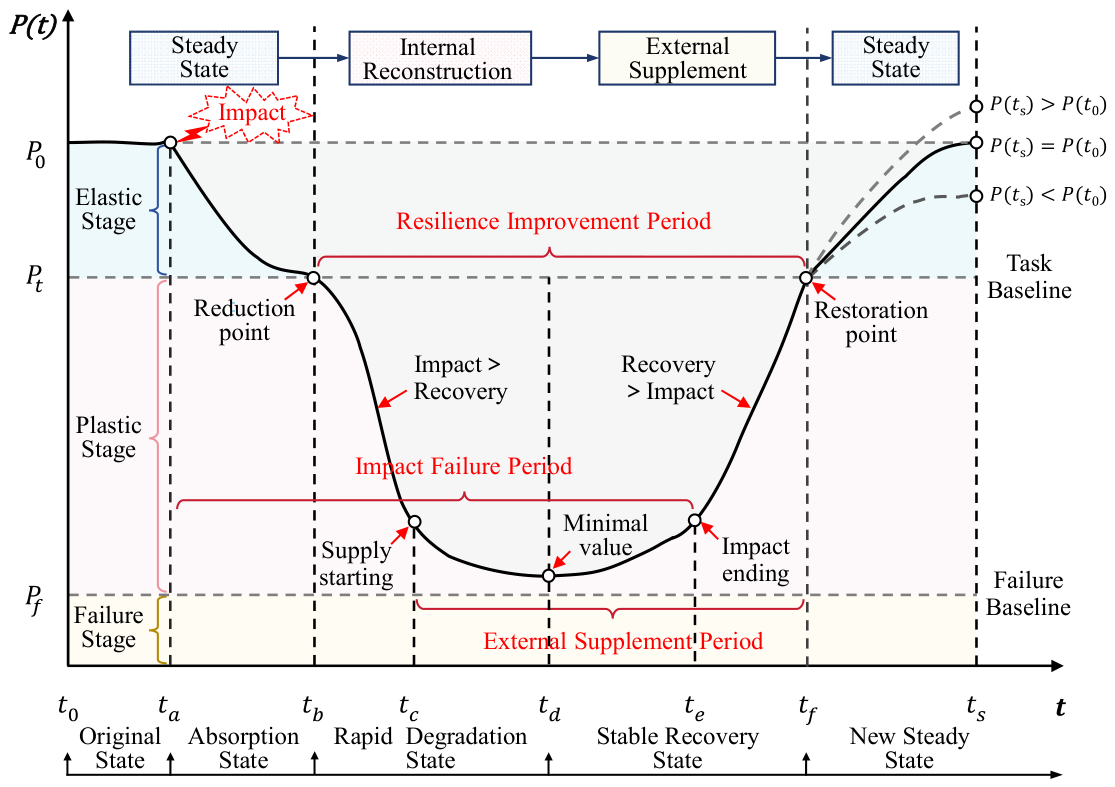
A multi-stage resilience response model for the MCUSoS is established by drawing an analogy to the stage-wise behavior of elastic deformation, plastic deformation, and fracture failure in material mechanics, as illustrated in Figure 4. Two critical performance thresholds are defined: the task baseline P t and the failure baseline P f ( P f < P ( t ) < P t ). The task baseline represents the minimum performance required to accomplish basic detection tasks, and the failure baseline represents the critical point at which system functionality is completely lost.
The resilience response of the system is classified into three phases based on these thresholds. The elastic phase corresponds to P ( t ) P t , where performance loss can be automatically recovered through internal redundancy without external support. The plastic phase corresponds to P f P ( t ) < P t , where performance loss is irreversible and recovery requires external resources or active reconfiguration; this is the primary interval where resilience enhancement strategies take effect. The failure phase corresponds to P ( t ) < P f , where core functionality is lost and the system is regarded as unrecoverable. At this stage, essential command-and-control connectivity and the minimum cooperative relationships required for mission execution are assumed to have collapsed, so that conventional internal reconfiguration and limited external supplementation can no longer restore effective system performance.
As illustrated in Figure 4, the performance evolution of the system comprises four typical stages when an external disruption occurs at time t a and persists until t e . The performance decreases from the initial level P 0 to the task baseline P t during the disruption absorption stage t a , t b , where performance redundancy absorbs the impact of the disruption. The system performance rapidly declines from P t to the minimum value P m i n during the rapid degradation stage t b , t d , and internal reconfiguration combined with external supplementation strategies must be employed to achieve resilience recovery. The system performance gradually recovers to the original mission level during the stable recovery stage t d , t f and subsequently approaches a new steady-state value P s . External resource supplementation commences at time t c and continues until the performance recovers to the task baseline, accounting for the spatiotemporal delay inherent in external resource supply.

4.1.3. Resilience Metric System

Resilience metrics are constructed from three dimensions, namely performance margin, internal reconfiguration efficiency, and external resource support rate, and a composite resilience value is formed through weighted aggregation.
Performance margin measures the ability of the system to maintain core functionality during the plastic phase, reflecting the safety margin relative to the failure baseline during the performance degradation period. It is defined as the ratio of the actual performance integral to the ideal performance integral during the plastic phase:
Δ Q p = t b t f P t P f d t t b t f P t P f d t
where Δ Q p [ 0 , 1 ] , and a larger value indicates a greater distance from the failure baseline during the degradation period and stronger survivability.
Internal reconfiguration efficiency measures the ability of the system to achieve performance recovery through self-resource adjustment, reflecting the level of self-organization and self-adaptation. It is defined as the ratio of the performance recovery contributed by dynamic reconfiguration strategies to the total performance loss:
δ r e c o n = Δ P r e c o n P 0 P m i n
where Δ P recon is the performance recovery achieved through dynamic reconfiguration strategies. A larger δ r e c o n indicates stronger self-recovery capability and less dependence on external support.
External resource support rate measures the contribution of externally supplemented resources to system recovery, defined as the ratio of the performance recovery brought by supplementary nodes to the total performance loss:
δ r e p = Δ P s u p P 0 P m i n = N r t Δ P u n i t P 0 P m i n
where Δ P sup is the performance recovery brought by supplementary nodes, N r ( t ) is the number of supplementary nodes, and Δ P unit is the average performance contribution per node.
The composite resilience value integrates the above three dimensions to provide an overall resilience evaluation:
R e = λ 1 Δ Q p + λ 2 δ r e c o n + λ 3 δ r e p
where λ 1 ,   λ 2 , and λ 3 are weight coefficients reflecting the relative importance of survivability, self-recovery capability, and external support efficiency, respectively. They are determined for the present case study through the AHP-based procedure described in Appendix A.1. λ 1 + λ 2 + λ 3 = 1 , and a larger value indicates stronger composite resilience of the system.

4.2. Resilience Enhancement Strategies with Dynamic Reconfiguration and External Supplementation

Active recovery measures are required when the system enters the plastic phase after a failure disruption. Recovery measures are categorized into two types: dynamic reconfiguration strategies that achieve structural adjustment using existing resources, and resource supplementation strategies that introduce external supplementary nodes. The mathematical models and optimization methods for these two types of strategies are established in this subsection.

4.2.1. Dynamic Reconfiguration Strategies

Dynamic reconfiguration strategies maximize the utilization efficiency of remaining resources by adjusting the resource organization and spatial configuration without changing the total resource quantity, offering the advantages of rapid response and no external dependency. Three representative strategies are proposed.
  • Strategy 1: Disconnected Platform Reassignment
The UAV of cluster k become disconnected platforms when the USV of that cluster fails, and the set of disconnected UAVs is defined as U o r p h a n . The candidate reassignment clusters for a disconnected UAV u k i are those whose USVs remain operational and lie within communication range:
S c a n d i = { S l | l k , s u l 0 t = 1 , p k i p l 0 2 D c }
The optimal reassignment cluster is selected using a collaborative capability gain criterion:
l = a r g m a x l S c a n d i α Δ Φ l i n t r a + 1 α Δ η ~ d e t l
where α [ 0 , 1 ] balances cooperation and discernibility. In the simulation, α is set to 0.5 by default.
The disconnected UAV must first maneuver to the communication coverage area of the nearest operational cluster if the candidate set is empty.
  • Strategy 2: Intra-cluster Communication Topology Reconstruction
Partial link failures within a cluster may cause network fragmentation, and the set of link-failure clusters is defined as S l i n k - f a i l . Communication links can be reestablished by adjusting UAV positions, and the position adjustment optimization problem is formulated as
m i n { Δ p k i } i = 1 N k Δ p k i 2 s . t .   λ 2 L k n e w > 0 , p k i + Δ p k i p k 0 2   D s , i
The first constraint ensures that the adjusted communication graph is connected, and the second constraint ensures that each UAV remains within the formation radius.
  • Strategy 3: Mission Area Reallocation
The mission area G k of cluster k is reallocated to neighboring operational clusters when that cluster fails entirely. The failed cluster is defined as S U S V - f a i l . The set of neighboring clusters is defined as S n e i g h b o r = { S l | s u l 0 t = 1 , G l G k } , and the optimization problem is:
m i n { A l } l S n e i g h b o r C l A l , s . t . l A l = G k , A l A l =
The cost function C l ( A l ) = γ 1 d ( A l , p l 0 ) + γ 2 A l / G l + γ 3 ( 1 Δ Q p ) jointly considers the maneuver distance, load increase, and capability margin, where Δ Q p is the performance margin indicator defined in Equation (45).

4.2.2. Supplementary Node Optimization and Allocation

External supplementary nodes are introduced when dynamic reconfiguration alone is insufficient for adequate recovery. Let the supplementary node set be N sup and the allocation decision variable be x j k { 0 , 1 } . The optimization objective is to maximize the recovered performance:
m a x x j k   R r e c o v e r e d = w 1 Φ c o o p n e w + w 2 η ~ d e t n e w s . t . k x j k = 1 , j ; x j k = 0 , k : s u k 0 t = 0 ; N k + j x j k N m a x
A greedy algorithm is adopted for solving: the node-cluster pair ( j , k ) = a r g   m a x   Δ R k j with the largest marginal contribution is iteratively selected for allocation. USV supplementation should be prioritized when failed clusters exist and spare USVs are available, as it can simultaneously restore collaborative capability and underwater detection capability, yielding significantly higher recovery benefits than UAV supplementation.

4.3. Resilience Enhancement Simulation Workflow and Effectiveness Evaluation

A complete simulation framework comprising three phases of shock simulation, strategy execution, and effectiveness evaluation is constructed by integrating the preceding content to verify the effectiveness of the proposed resilience evaluation model and enhancement strategies.
The first phase is shock simulation. The system operates at the initial steady state with performance at the R 0 level at the beginning of the simulation. The failed node set V f a i l and link set E f a i l are determined according to the selected failure mode and its parameters at the disruption time t a . The system topology G s y s t is updated after failure identification, the post-disruption performance is calculated, and failure types are identified, including USV-failed clusters, link-failed clusters, and the set of disconnected UAVs.
The second phase is strategy execution. Strategy selection and execution order are based on a joint consideration of recovery efficiency and resource dependency: dynamic reconfiguration strategies utilize existing resources with rapid response and should be executed first; external resource supplementation is activated when dynamic reconfiguration is insufficient. Disconnected platform reassignment has the most relaxed execution conditions and should be attempted first. Intra-cluster communication topology reconstruction addresses link failure situations through minor position adjustments to restore connectivity. Mission area reallocation of failed clusters involves multi-cluster coordination and is employed when the preceding two strategies cannot achieve sufficient recovery. Regarding external resource supplementation, USV supplementation yields significantly higher recovery benefits than UAV supplementation and should be prioritized when resources are limited.
The third phase is effectiveness evaluation. The key time instants of performance evolution ( t d , t e , t f , t s ) and performance values ( P 0 , P m i n , P s ) are recorded after strategy execution. The resilience metrics ( Δ Q p , δ recon , δ rep , R e ) and recovery effectiveness indices are calculated. The recovery rate ρ recov = ( P s P m i n ) / ( P 0 P m i n ) measures the degree of performance recovery, the recovery timeliness τ recov = t s t f measures the recovery time. The complete simulation workflow of the above three phases is summarized in Algorithm 1.
Algorithm 1. Resilience improvement simulation and evaluation algorithm.
Input: Initial topology G s y s ( t 0 ) ; failure mode m o d e   ( R a n d o m / D e l i b e r a t e / D i s r u p t i o n ) and parameters; disturbance schedule ( t s t a r t , t e n d , Δ t a t t ) ; supplement pool N s u p ; performance baseline; simulation horizon T ; time step Δ t
Output: Resilience metrics ( R e , Δ Q p , δ r e c o n , δ r e p ) ; recovery metrics ( ρ r e c o v , τ r e c o v ) ; performance trajectory P ( t )
1: Compute P 0 = w 1 Φ c o o p ( t 0 ) + w 2 η ~ d e t ( t 0 ) ; set t 0 , P m i n P 0
2: while  t < T  do
3:    t t + Δ t
4:   if disturbance is triggered at t  then
5:     Generate V f a i l ( t ) , E f a i l ( t ) according to m o d e
6:     Remove V f a i l ( t ) , E f a i l ( t ) from G s y s
7:   end if
8:   Update topology G s y s ( t ) ; identify S U S V - f a i l , S l i n k - f a i l , U o r p h a n
9:   Compute P ( t ) ; update P m i n and record t d if P ( t ) < P m i n
10:   if  P f P ( t ) < P t  then
11:     Reassign each u U o r p h a n to optimal cluster via cooperative gain criterion
12:     for each  S k S l i n k - f a i l : solve position optimization to restore λ 2 ( L k n e w ) > 0
13:     Redistribute task areas of fully failed clusters to S n e i g h b o r
14:     while  P ( t ) < P t  and  N s u p : deploy supplement nodes via greedy optimization
15:   end if
16:   Recompute P ( t ) on updated G s y s ( t ) ; append t , P ( t ) to trajectory L
17: end while
18: Extract t a , t b , t d , t f , t s from L ; compute Δ Q p , δ r e c o n , δ r e p
19: Compute R e = λ 1 Δ Q p + λ 2 δ r e c o n + λ 3 δ r e p , ρ r e c o v , τ r e c o v
20: Return  ( R e , Δ Q p , δ r e c o n , δ r e p ) , ( ρ r e c o v , τ r e c o v ) , P ( t )
The resilience performance of the MCUSoS under various failure disruptions can be systematically evaluated through the above simulation workflow, the effectiveness of the proposed strategies can be validated, and quantitative evidence can be provided for system resilience optimization design.

5. Case Study

A collaborative detection mission case of the MCUSoS is designed in this section to verify the effectiveness of the proposed resilience evaluation model and enhancement strategies. The case settings are first presented, followed by a comparative analysis of performance degradation under three failure disruption modes with different attack intervals, and finally a verification of the recovery effectiveness of the resilience enhancement strategies.

5.1. Case Settings

The mission scenario involves a collaborative detection task over a rectangular maritime area of 60 km × 45 km. The mission duration is set to 100 steps, where each simulation step corresponds to 10 s. The system comprises 12 unmanned clusters deployed across the operational area according to mission requirements, each identically configured with one USV leader node and 5 UAV follower nodes, yielding a total of 72 platforms. The UAV flight altitude is set to 500 m, equipped with electro-optical detection payloads, with a sea-surface detection radius of 300 m and a cruise speed of 20 m/s. Each USV is equipped with hull-mounted sonar, with an underwater detection radius of 1500 m, an effective detection depth of 1000 m, and a cruise speed of 8 m/s. The mission scenario and platform parameter settings are listed in Table 1.
The cooperation capability weight in the composite performance function is set to 0.4 and the detection efficiency weight to 0.6. In addition, the resilience weights are set to λ 1 = 0.3 , λ 2 = 0.4 , and λ 3 = 0.3 . These values were determined for the present case study through an AHP-based expert evaluation, and the detailed weight-determination procedure is provided in Appendix A.1, and the corresponding sensitivity analysis is provided in Appendix A.2. In addition, the balance parameter α is set to 0.5 in the simulation, reflecting the trade-off between cooperation gain and discernibility in disconnected platform reassignment. The resilience evaluation parameters are listed in Table 2.
The disturbance and recovery scenario settings are as follows. Disturbances commence at time step 10 and last for time step 55, ending at step 65. Three disturbance intervals are designed: high frequency (interval of 2 steps), medium frequency (interval of 3 steps), and low frequency (interval of 4 steps). The three disturbance modes have distinct characteristics. The random failure mode simulates equipment malfunctions or environmentally induced interference according to node and link failure probabilities, causing random failure of USV and UAV nodes. The targeted attack mode destroys USV leader nodes and selected critical UAV nodes in order of node degree at each attack step, simulating directed strikes against high-value targets and the resulting cascading effects. The disintegration circle attack mode randomly selects an attack center within the mission area, with platforms within a 9 km radius subject to failure, representing the coverage effect of area-effect weapons.
Regarding resilience enhancement strategies, the external supplementation delay is set to 10 steps to account for the scheduling and spatiotemporal transfer time of external supplementary resources, meaning that external supplementation is activated only from step 20 onward. The recovery strategy trigger condition is: current performance below the task baseline and at or above the failure baseline. The supplementation interval during the attack phase is 4 steps, and the interval is shortened to 2 steps after the attack ends to enter an active recovery phase. The reserve pool consists of 12 spare USVs and 40 spare UAVs based on historical mission execution records and basic platform reliability parameters. The disturbance and recovery parameter settings are listed in Table 3.
The supplementation interval during the attack phase is 4 steps, and the interval is shortened to 2 steps after the attack ends to enter an active recovery phase. At each supply event, only one supplementary node is deployed from the reserve pool, and its type and target cluster are determined by the greedy allocation strategy according to the largest marginal contribution to performance recovery. Thus, the reserve USVs and UAVs are introduced sequentially rather than simultaneously.

5.2. Performance Degradation Analysis Under Failure Disruptions

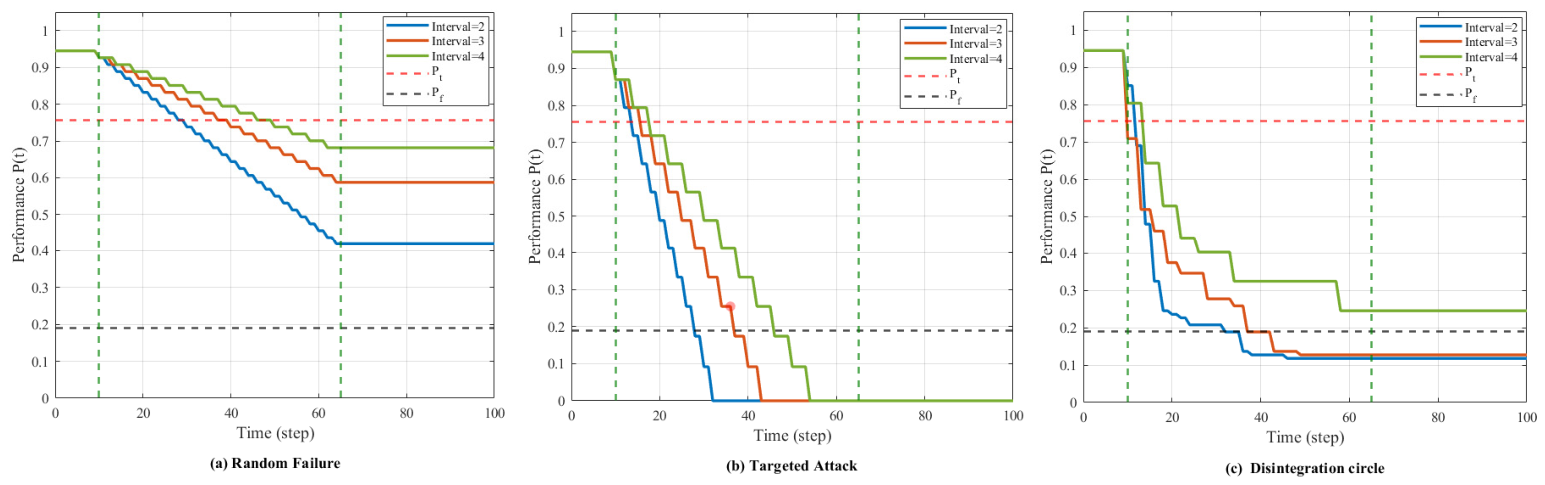
The performance degradation caused by three failure disruption modes at different disturbance intensity is comparatively analyzed in this subsection. All clusters operate normally in the initial state, with the system composite performance P 0 = 0.951 , task baseline P t = 0.761 , and failure baseline P f = 0.190 .
  • Random Failure Scenario
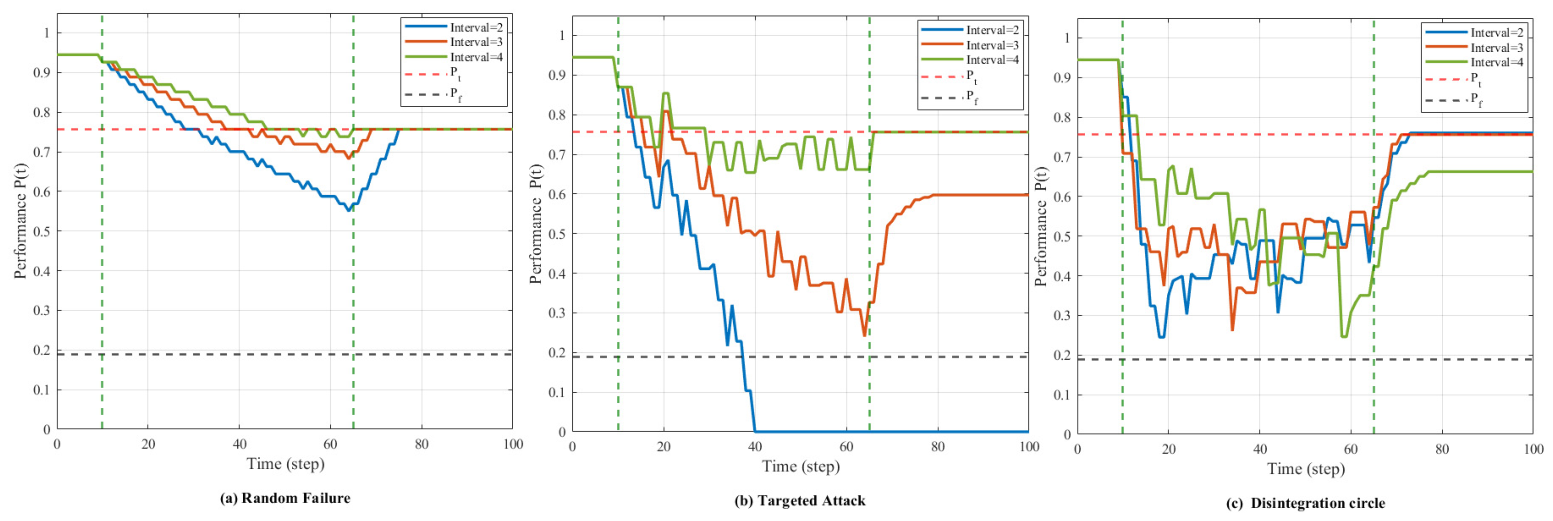
Figure 5a presents the performance degradation curves under the random failure mode. The performance exhibits a gradual and moderate decline because the failed targets are dispersed across clusters. A total of 28 disturbance events occur within the disturbance window under high-frequency disturbance, with performance gradually declining to approximately 0.42. Under medium-frequency disturbance, 19 disturbance events occur and performance decreases to approximately 0.60. Under low-frequency disturbance, 14 disturbance events occur and performance decreases to approximately 0.69. Random failure is characterized by dispersed losses and gradual degradation, with the system remaining well above the failure baseline throughout.
  • Targeted Attack Scenario
Figure 5b presents the performance degradation curves under the targeted attack mode. Each attack precisely destroys one USV leader node and triggers cascading failure of the UAVs within that cluster, resulting in a step-wise sharp performance decline. According to Equations (11)–(13), once the USV leader node fails, the affected UAVs lose the leader-dependent communication and coordination links. Therefore, although the UAVs may remain physically intact, their contribution to the collaborative detection performance in Equation (37) becomes zero until they are reassigned according to Equation (49). Each disturbance causes an approximately 0.08 decrease in system performance under high-frequency disturbance. All USVs may be destroyed before the disturbance window closes under high-frequency disturbance, since the system contains only 12 USVs, driving performance below the failure baseline. Targeted attack is characterized by high specificity and large per-attack loss, capable of rapidly dismantling the core functionality of the system, and has the highest destruction efficiency among the three attack modes.
  • Disintegration Circle Attack Scenario
Figure 5c presents the performance degradation curves under the disintegration circle attack mode. Each attack randomly selects a center point within the mission area, and platforms within a 9 km radius are subject to failure. The actual effect fluctuates considerably due to the randomness of attack positions: substantial losses occur when the attack hits a cluster-dense region, while virtually no loss results when the attack falls on a sparsely populated area. Disintegration circle attack is characterized by strong randomness and uncertain outcomes, with an overall destruction efficiency lower than targeted attack but higher than random failure.
A comparison of the three attack modes in Figure 5 reveals the following findings. Targeted attack achieves the highest destruction efficiency by precisely striking critical USV nodes to trigger cascading failures. Disintegration circle attack produces unstable effects due to random positioning, but its average destruction efficiency ranks second. Random failure leads to dispersed losses that do not trigger cascading effects, resulting in the lowest destruction efficiency. A greater disturbance intensity accelerates performance decline and causes the system to enter the plastic or even collapse phase earlier.

5.3. Verification of Resilience Enhancement Strategy Effectiveness

The effectiveness of the proposed resilience enhancement strategy is further validated based on the disturbance scenarios described above. The recovery strategy is activated once system performance drops below the mission baseline and encompasses both internal dynamic reconfiguration and external resource supplementation. The system is considered to have entirely failed when performance falls below the failure baseline, at which point the recovery strategy is terminated. The performance curves under the three disturbance modes with the recovery strategy enabled are presented in Figure 6a–c. Table 5 summarizes the resilience evaluation metrics under different disturbance modes and intensities.
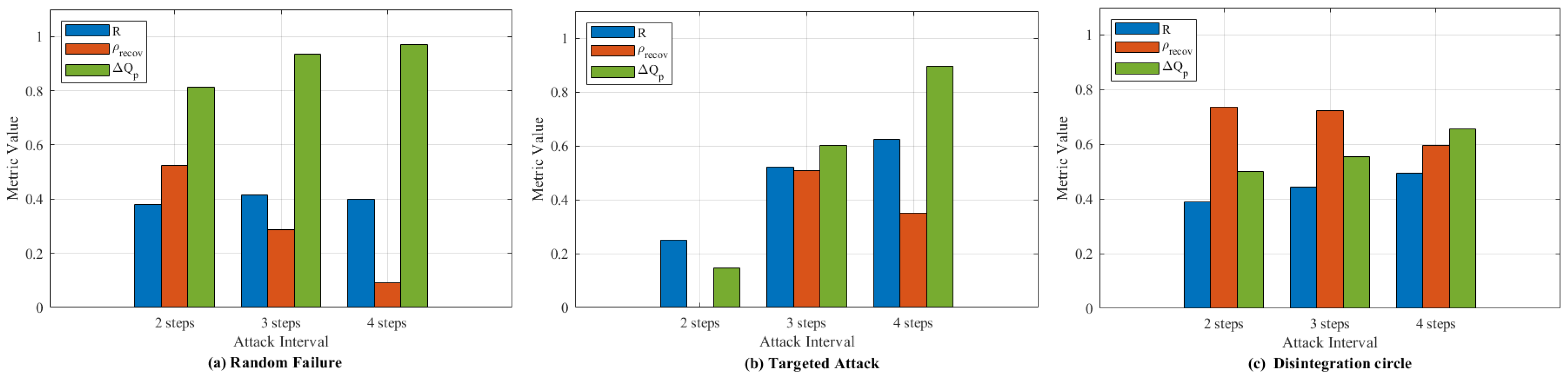
The results for the random failure scenario in Figure 6a indicate that the recovery strategy is not triggered when system performance remains above the mission baseline, and the performance curve is identical to that in Figure 5a. The strategy begins operating once performance drops below the mission baseline and enters the plastic region of resilience, effectively decelerating the degradation rate. The medium frequency disturbance is taken as an example: performance declines slowly during the disturbance period with the assistance of the recovery strategy, and gradually recovers from approximately 0.68 to 0.76 after the disturbance ceases at step 65. The corresponding recovery rate in Table 4 is ρ recov = 0.29 . The internal reconfiguration efficiency δ recon remains close to zero because random failure does not involve cluster-level structural destruction, and recovery relies primarily on external resource supplementation, with the external support rate δ rep ranging from 0.36 to 0.45.
Figure 6b presents the results for the targeted attack scenario. System performance collapses rapidly to near 0 under high frequency attacks, and the recovery strategy is terminated immediately once performance falls below the failure baseline. The corresponding values in Table 5 are P m i n = 0 and ρ r e c o v = 0 . This protection mechanism avoids ineffective resource expenditure on irrecoverable states, which is consistent with the limited resource constraints in actual operations. The situation improves significantly when the attack intensity decreases. P m i n = 0.24 after the medium-frequency disturbance ceases, as shown in Table 5, and system performance recovers and stabilizes at 0.6. δ r e c o n rises to 0.51, reflecting the cluster level reassignment process in which large numbers of disconnected UAVs are reattributed following USV failures, while δ r e p = 0.45 indicates the contribution of external resource supplementation. Performance recovers to the mission baseline level after the low frequency disturbance ceases, with P s = 0.76 and δ r e c o n reaching 0.55. These results demonstrate that attack intensity is the critical factor determining whether the system can survive and recover under targeted attack scenarios.
The recovery curve for the disintegration circle attack scenario in Figure 6c exhibits distinct oscillatory recovery behavior. The performance curve during the attack period does not decline monotonically but is accompanied by significant fluctuations, as the impact point of each strike is random. This forms a sharp contrast with the smooth decline in Figure 6a and the stepwise abrupt drops in Figure 6b. Strikes hitting cluster-dense regions cause abrupt performance drops, whereas strikes landing in sparse regions allow the recovery strategy to repair prior damage, producing localized recoveries. To further address the stochastic nature of the disintegration circle attack scenario and to avoid conclusions based on a single simulation realization, 10 independent simulation runs were conducted for each disturbance interval. The detailed results and the corresponding mean ± standard deviation values are summarized in Table 5.
As shown in Table 5, the statistical results over 10 independent runs confirm that the disintegration circle attack scenario exhibits evident stochastic variability, especially under the high-frequency disturbance interval of 2 steps. In this case, the final recovered performance P s , resilience value R e , and recovery rate ρ r e c o v are 0.49 ± 0.30, 0.37 ± 0.16, and 0.40 ± 0.29, respectively, indicating strong sensitivity to the randomly affected region. By contrast, the results under the 3-step and 4-step intervals are much more stable. For example, P s increasing to 0.72 ± 0.06 and 0.80 ± 0.03, and R e increasing to 0.50 ± 0.03 and 0.58 ± 0.03, respectively. The corresponding recovery rate ρ r e c o v also rises from 0.40 ± 0.29 to 0.61 ± 0.06 and 0.64 ± 0.08. Therefore, although the disintegration circle attack scenario is stochastic, the multi-run statistical results still support the overall conclusion that lower disturbance intensity leads to better recovery performance and higher resilience.
Figure 7 presents a bar chart that visually compares the resilience metrics across the three disturbance modes. The comprehensive resilience value R e increases marginally from 0.38 to 0.40 as attack intensity decreases under the random failure scenario, as shown in Figure 7a, with limited variation. The performance margin Δ Q p consistently remains at a high level between 0.81 and 0.97. The degradation process in random failure is inherently moderate, and the system does not approach the failure baseline under any disturbance intensity.
Figure 7b shows that all metrics exhibit the strongest sensitivity to attack intensity in the targeted attack scenario. The system collapses entirely under high frequency attacks, with ρ r e c o v = 0 and R e of only 0.25. R e rises sharply to 0.52 under medium frequency attacks and further increases to 0.62 under low frequency attacks, representing a 148% improvement over the high frequency case. Δ Q p also exhibits a consistent stepwise increase as attack intensity decreases, demonstrating the effectiveness of the resilience enhancement strategy under medium and low frequency targeted attack scenarios.
The disintegration circle attack scenario reveals distinctive resilience characteristics, as shown in Figure 7c. The recovery rate ρ r e c o v in the bar chart of disintegration circle attack scenario is the highest among the three disturbance modes, reaching 0.74, 0.72, and 0.6, respectively. The spatial randomness of disintegration circle attacks accounts for this result: the intervals between strikes provide effective operational windows for the recovery strategy, enabling internal reconfiguration and external supplementation to work synergistically. The comprehensive resilience value R e increases steadily from 0.39 under high frequency attacks to 0.49 under low frequency attacks.
A comprehensive analysis of Figure 7 reveals that lower disturbance intensity leads to higher resilience values across all failure modes. The system has more sufficient response time under low intensity disturbances, allowing internal reconfiguration and external supplementation to function more effectively. The recovery rate ρ r e c o v reflects the degree of recovery from the minimum performance to the final performance. The recovery rate reaches 0.74 under the high frequency disintegration circle scenario, indicating that 74% of the lost performance is restored. The recovery rate is 0.38 under the high frequency random failure scenario. The recovery rate reaches 0.52 even under the medium frequency targeted attack scenario, validating the effectiveness of the resilience enhancement strategy across all disturbance scenarios.

6. Conclusions

The MCUSoS faces multiple challenges during collaborative detection missions, including the organizational complexity of coordinating heterogeneous platforms across domains, stringent communication constraints, and dynamic capability degradation caused by various failure disturbances. An integrated framework for collaborative detection capability evaluation and resilience enhancement is proposed in this paper to address these challenges. A system-of-systems architecture of the MCUSoS is established by incorporating formation detection modes and multi-level cooperative communication network models. Collaborative capability indices are then constructed from two dimensions of intra-cluster and inter-cluster collaborative capability, and combined with sea-surface and underwater dynamic detection coverage capability indices to form a composite collaborative detection capability evaluation model. Furthermore, three representative disturbance models are established and a multi-stage resilience evaluation mechanism is proposed to quantify MCUSoS resilience under three disturbance modes. A resilience enhancement strategy integrating dynamic reconfiguration with external resource supplementation is designed to recover MCUSoS performance in multi-disturbance environments. A simulation case study is conducted to validate the effectiveness of the proposed methods. The results demonstrate that the proposed collaborative detection capability evaluation model can accurately characterize the MCUSoS performance variations under disturbance scenarios. Among the three disturbance modes, the targeted attack mode produces the strongest degradation of system performance, followed by disintegration circle attacks, with random failure being the least severe. The resilience enhancement strategy achieves effective performance recovery under all three disturbance scenarios. Across different failure modes, lower disturbance consistently corresponds to higher resilience values, as the system has more sufficient response time under low intensity disturbances, enabling the resilience enhancement strategy to function more effectively. In practical maritime applications, the proposed framework can help designers of maritime unmanned systems quantitatively balance the cost of auxiliary node deployment and the resulting resilience improvement, thereby supporting resilient system design and resource allocation in engineering practice.
Future work will extend in the following directions: introducing dynamic adversarial game mechanisms to investigate adaptive resilience enhancement strategies under alternating attack-defense conditions; incorporating the effects of time-varying communication channel characteristics and energy constraints in the marine environment on collaborative detection capability; and extending the proposed methods to larger-scale cross-domain systems that include intelligent systems such as unmanned underwater vehicles, further verifying the scalability of the framework.


Author Contributions

Conceptualization, Y.Y., J.J. and K.W.; methodology, Y.Y., T.Z. and K.W.; validation, Y.Y., Z.H. and Z.W.; formal analysis, Y.Y., T.Z. and Z.W.; writing—original draft preparation, Y.Y., K.W. and Z.H.; writing—review and editing, Y.Y., T.Z., K.W. and J.J.; visualization, Y.Y., K.W. and Z.H.; supervision, T.Z. and J.J. All authors have read and agreed to the published version of the manuscript.

Funding

This research received no external funding.

Data Availability Statement

All data generated or analyzed during this study are included in the article. Further inquiries can be directed to the corresponding author.

Conflicts of Interest

The authors declare no conflicts of interest.

Appendix A

Appendix A.1. Weight Determination

For the present maritime collaborative detection case, two groups of weights are required: (i) the performance-function weights ( w 1 , w 2 ) and (ii) the resilience weights ( λ 1 ,   λ 2 , λ 3 ). These values were determined by an AHP-based expert evaluation. Table A1 summarizes the expert judgments for ( w 1 , w 2 ), and Table A2 summarizes the expert judgments for ( λ 1 ,   λ 2 , λ 3 ).
Five experts (E1–E5) participated in the evaluation. Their backgrounds cover USoS architecture design, USoS resilience control, system safety and reliability, mission scheduling, and System resilience evaluation. For each weight group, the experts provided pairwise comparison judgments. The individual judgments were aggregated by the geometric mean, and the normalized priority vector was then used as the final case-study weight vector.
For the performance-function weights ( w 1 , w 2 ), the expert judgments are listed in Table A1.
Table A1. Expert pairwise judgments for the performance-function weights.
ExpertBackground w 1 / w 2 Interpretation
E1System safety and reliability1/2Detection efficiency slightly more important
E2USoS architecture design1/2Detection efficiency slightly more important
E3System resilience evaluation1Equal importance
E4Mission scheduling1Equal importance
E5USoS resilience control1/2Detection efficiency slightly more important
The aggregated AHP result gives [ w 1 , w 2 ] = [0.3975, 0.6025], which is rounded to [0.4, 0.6] in the main text.
For the resilience weights ( λ 1 , λ 2 , λ 3 ), the corresponding expert judgments are listed in Table A2.
Table A2. Expert pairwise judgments for the resilience weights.
ExpertBackground λ 1 / λ 2 λ 1 / λ 3 λ 2 / λ 3
E1System safety and reliability1/212
E2USoS architecture design1/212
E3System resilience evaluation111
E4Mission scheduling111
E5USoS resilience control111
The aggregated AHP weights are [ λ 1 , λ 2 , λ 3 ] = [0.3012, 0.3975, 0.3012], which is rounded to [0.3, 0.4, 0.3].
These results indicate that, for the present detection-oriented case, detection efficiency is weighted slightly more heavily than cooperation capability in the composite performance function, while reconstruction efficiency is weighted slightly more heavily than performance margin and external support in the resilience metric.

Appendix A.2. Sensitivity Analysis

To examine the robustness of the conclusions with respect to the selected case-study weights, a sensitivity analysis was conducted for both the performance-function weights ( w 1 , w 2 ) and the resilience weights ( λ 1 , λ 2 , λ 3 ). For ( w 1 , w 2 ), all nine case-study scenarios are re-evaluated under three representative settings, and the resulting final recovered performance P s is summarized in Table A3. For ( λ 1 , λ 2 , λ 3 ), the resilience value R e is recalculated under three representative settings using the same Δ Q p ,   δ r e c o n , and δ r e p , and the results are summarized in Table A4.
Table A3. Sensitivity analysis of the performance-function weights ( w 1 , w 2 ).
Setting w 1 w 2 Random Failure (2/3/4 Steps) P s Deliberate Attack (2/3/4 Steps) P s Disruption Circle (2/3/4 Steps) P s Main Observation
Baseline0.40.60.761 ± 0.0080.000 ± 0.0000.645 ± 0.198Baseline case
0.759 ± 0.0040.583 ± 0.0140.736 ± 0.065
0.757 ± 0.0000.771 ± 0.0190.785 ± 0.035
Balanced0.50.50.749 ± 0.0060.000 ± 0.0000.611 ± 0.218Main conclusions unchanged
0.751 ± 0.0080.551 ± 0.0090.745 ± 0.039
0.746 ± 0.0000.785 ± 0.0000.771 ± 0.027
Cooperation-oriented0.60.40.739 ± 0.0080.000 ± 0.0000.559 ± 0.205Main conclusions unchanged
0.738 ± 0.0040.520 ± 0.0060.646 ± 0.185
0.735 ± 0.0000.762 ± 0.0000.765 ± 0.045
Table A4. Sensitivity analysis of the resilience weights ( λ 1 , λ 2 , λ 3 ).
Setting λ 1 λ 2 λ 3 Random Failure (2/3/4 Steps) R e Deliberate Attack (2/3/4 Steps) R e Disruption Circle (2/3/4 Steps) R e Main Observation
Baseline0.30.40.30.380 ± 0.0010.240 ± 0.0110.371 ± 0.156Baseline case
0.415 ± 0.0000.513 ± 0.0120.497 ± 0.033
0.400 ± 0.0000.629 ± 0.0040.577 ± 0.031
Margin-oriented0.40.30.30.462 ± 0.0020.232 ± 0.0110.388 ± 0.167Relative trends unchanged
0.509 ± 0.0000.521 ± 0.0100.528 ± 0.036
0.497 ± 0.0000.665 ± 0.0050.606 ± 0.032
Reconstruction-oriented0.20.50.30.298 ± 0.0010.248 ± 0.0120.353 ± 0.146Relative trends unchanged
0.322 ± 0.0000.505 ± 0.0140.466 ± 0.031
0.303 ± 0.0000.592 ± 0.0020.547 ± 0.031
Table A3 and Table A4 show that moderate weight variations change the absolute values of the indicators to some extent, but do not alter the main qualitative conclusions of the study. In particular, deliberate attack remains the most destructive failure mode, while lower disturbance intensity still corresponds to better recovery performance in the deliberate attack and disruption circle scenarios.

References

  1. Li, J.; Zhang, G.; Zhang, X.; Zhang, W. Integrating Dynamic Event-Triggered and Sensor-Tolerant Control: Application to USV-UAVs Cooperative Formation System for Maritime Parallel Search. IEEE Trans. Intell. Transp. Syst. 2024, 25, 3986–3998. [Google Scholar] [CrossRef]
  2. Wang, Y.; Liu, W.; Liu, J.; Sun, C. Cooperative USV–UAV Marine Search and Rescue with Visual Navigation and Reinforcement Learning-Based Control. ISA Trans. 2023, 137, 222–235. [Google Scholar] [CrossRef]
  3. Bae, I.; Hong, J. Survey on the Developments of Unmanned Marine Vehicles: Intelligence and Cooperation. Sensors 2023, 23, 4643. [Google Scholar] [CrossRef] [PubMed]
  4. Li, J.; Zhang, G.; Zhang, W.; Zhang, X. Robust Control for Cooperative Path Following of Marine Surface-Air Vehicles with a Constrained Inter-Vehicles Communication. Ocean Eng. 2024, 308, 118240. [Google Scholar] [CrossRef]
  5. Wang, Y.; Feng, W.; Wang, J.; Quek, T.Q.S. Hybrid Satellite-UAV-Terrestrial Networks for 6G Ubiquitous Coverage: A Maritime Communications Perspective. IEEE J. Sel. Areas Commun. 2021, 39, 3475–3490. [Google Scholar] [CrossRef]
  6. Li, J.; Zhang, G.; Li, B. Robust Adaptive Neural Cooperative Control for the USV-UAV Based on the LVS-LVA Guidance Principle. J. Mar. Sci. Eng. 2022, 10, 51. [Google Scholar] [CrossRef]
  7. Chen, S.-S.; Niu, D.-H.; Chen, W.-B.; Song, J.-Y.; Zhang, Y.-F.; Li, X.-Y.; Zio, E. Reliability Modeling of Single-Sided Aluminized Polyimide Films During Storage Considering Stress-Induced Degradation Mechanism Transition. IEEE Trans. Reliab. 2026, 75, 596–611. [Google Scholar] [CrossRef]
  8. Chen, S.-S.; Li, X.-Y.; Xie, W.-R. Reliability Modeling and Statistical Analysis of Accelerated Degradation Process with Memory Effects and Unit-to-Unit Variability. Appl. Math. Model. 2025, 138, 115788. [Google Scholar] [CrossRef]
  9. Wang, K.; Zhao, T.; Yuan, Y.; Hao, Z.; Chen, Z.; Dui, H. A New Multi-Layer Performance Analysis of Unmanned System-of-Systems within IoT. Reliab. Eng. Syst. Saf. 2025, 259, 110953. [Google Scholar] [CrossRef]
  10. Jing, Y.; Jiao, J.; Yuan, Y.; Luo, X.; Lu, C.; Dui, H. Dynamic Risk Assessment and Critical Equipment Identification for Multi-State USV Based on Multi-Agent Model and Importance Measure. Ocean. Eng. 2026, 343, 123601. [Google Scholar] [CrossRef]
  11. Sun, Q.; Li, H.; Zhong, Y.; Ren, K.; Zhang, Y. Deep Reinforcement Learning-Based Resilience Enhancement Strategy of Unmanned Weapon System-of-Systems under Inevitable Interferences. Reliab. Eng. Syst. Saf. 2024, 242, 109749. [Google Scholar] [CrossRef]
  12. Chen, Z. Resilience Evaluation and Optimal Design for Weapon System of Systems with Dynamic Reconfiguration. Reliab. Eng. Syst. Saf. 2023, 237, 109409. [Google Scholar] [CrossRef]
  13. Wang, J.; Zhao, Y.; Ma, X.; Xiao, H.; Ma, Y.; Peng, R.; Yang, L. A State-Age-Dependent Maintenance-Spare Control Strategy Under Inspection Error Compensation. IEEE Trans. Reliab. 2025, 74, 5805–5819. [Google Scholar] [CrossRef]
  14. Wang, J.; Ma, X.; Yang, L. Hybrid Maintenance Optimization for Multi-State Competing Failure Systems under Inspection Uncertainties and Spare Dynamics. Reliab. Eng. Syst. Saf. 2026, 272, 112524. [Google Scholar] [CrossRef]
  15. Giles, K.; Giammarco, K. A Mission-based Architecture for Swarm Unmanned Systems. Syst. Eng. 2019, 22, 271–281. [Google Scholar] [CrossRef]
  16. Liu, H.; Weng, P.; Tian, X.; Mai, Q. Distributed Adaptive Fixed-Time Formation Control for UAV-USV Heterogeneous Multi-Agent Systems. Ocean Eng. 2023, 267, 113240. [Google Scholar] [CrossRef]
  17. Luna, M.A.; Molina, M.; Da-Silva-Gomez, R.; Melero-Deza, J.; Arias-Perez, P.; Campoy, P. A Multi-UAV System for Coverage Path Planning Applications with in-Flight Re-Planning Capabilities. J. Field Robot. 2024, 41, 1480–1497. [Google Scholar] [CrossRef]
  18. Bai, G.; Li, Y.; Fang, Y.; Zhang, Y.-A.; Tao, J. Network Approach for Resilience Evaluation of a UAV Swarm by Considering Communication Limits. Reliab. Eng. Syst. Saf. 2020, 193, 106602. [Google Scholar] [CrossRef]
  19. Lim, R.Y.H.; Lim, J.M.-Y.; Lan, B.L.; Ho, P.W.C.; Ho, N.S.; Ooi, T.W.M. UAV Swarm Communication Reliability Based on a Comprehensive SINR Model. Veh. Commun. 2024, 47, 100781. [Google Scholar] [CrossRef]
  20. Dai, J.; Li, X.; Han, S.; Liu, Z.; Zhao, H.; Yan, L. Multi-Hop Relay Selection for Underwater Acoustic Sensor Networks: A Dynamic Combinatorial Multi-Armed Bandit Learning Approach. Comput. Netw. 2024, 242, 110242. [Google Scholar] [CrossRef]
  21. Wang, S.; Du, Y.; Zhao, S.; Hao, J.; Gan, L. Research on the Construction of Weaponry Indicator System and Intelligent Evaluation Methods. Sci. Rep. 2023, 13, 19370. [Google Scholar] [CrossRef]
  22. Han, Q.; Pang, B.; Li, S.; Li, N.; Guo, P.; Fan, C.; Li, W. Evaluation Method and Optimization Strategies of Resilience for Air & Space Defense System of Systems Based on Kill Network Theory and Improved Self-Information Quantity. Def. Technol. 2023, 21, 219–239. [Google Scholar] [CrossRef]
  23. Jia, N.; Yang, Z.; Yang, K. Operational Effectiveness Evaluation of the Swarming UAVs Combat System Based on a System Dynamics Model. IEEE Access 2019, 7, 25209–25224. [Google Scholar] [CrossRef]
  24. Wang, L.; Zhao, X.; Zhang, Y.; Wang, X.; Ma, T.; Gao, X. Unmanned Aerial Vehicle Swarm Mission Reliability Modeling and Evaluation Method Oriented to Systematic and Networked Mission. Chin. J. Aeronaut. 2021, 34, 466–478. [Google Scholar] [CrossRef]
  25. Li, J.; Zhao, D.; Jiang, J.; Yang, K.; Chen, Y. Capability Oriented Equipment Contribution Analysis in Temporal Combat Networks. IEEE Trans. Syst. Man Cybern. Syst. 2021, 51, 696–704. [Google Scholar] [CrossRef]
  26. Chen, Z.; Zhou, Z.; Zhang, L.; Cui, C.; Zhong, J. Mission Reliability Modeling and Evaluation for Reconfigurable Unmanned Weapon System-of-Systems Based on Effective Operation Loop. J. Syst. Eng. Electron. 2023, 34, 588–597. [Google Scholar] [CrossRef]
  27. Feng, Q. Importance Measure-Based Phased Mission Reliability and UAV Number Optimization for Swarm. Reliab. Eng. Syst. Saf. 2022, 223, 108478. [Google Scholar] [CrossRef]
  28. Yan, X.; Jiang, D.; Miao, R.; Li, Y. Formation Control and Obstacle Avoidance Algorithm of a Multi-USV System Based on Virtual Structure and Artificial Potential Field. J. Mar. Sci. Eng. 2021, 9, 161. [Google Scholar] [CrossRef]
  29. Hosseini, S.; Barker, K.; Ramirez-Marquez, J.E. A Review of Definitions and Measures of System Resilience. Reliab. Eng. Syst. Saf. 2016, 145, 47–61. [Google Scholar] [CrossRef]
  30. Kong, L.; Wang, L.; Cao, Z.; Wang, X. Resilience Evaluation of UAV Swarm Considering Resource Supplementation. Reliab. Eng. Syst. Saf. 2024, 241, 109673. [Google Scholar] [CrossRef]
  31. Zhang, X.; Liu, J. Research on UAV Swarm Network Modeling and Resilience Assessment Methods. Sensors 2024, 24, 11. [Google Scholar] [CrossRef]
  32. Tran, H.T.; Balchanos, M.; Domerçant, J.C.; Mavris, D.N. A Framework for the Quantitative Assessment of Performance-Based System Resilience. Reliab. Eng. Syst. Saf. 2017, 158, 73–84. [Google Scholar] [CrossRef]
  33. Zhong, Y.; Li, H.; Sun, Q.; Huang, Z.; Zhang, Y. A Kill Chain Optimization Method for Improving the Resilience of Unmanned Combat System-of-Systems. Chaos Solitons Fractals 2024, 181, 114685. [Google Scholar] [CrossRef]
  34. Sun, Q.; Li, H.; Wang, Y.; Zhang, Y. Multi-Swarm-Based Cooperative Reconfiguration Model for Resilient Unmanned Weapon System-of-Systems. Reliab. Eng. Syst. Saf. 2022, 222, 108426. [Google Scholar] [CrossRef]
  35. Li, H.; Zhong, Y.; Zhuang, X. A Soft Resource Optimization Method Based on Autonomous Coordination of Unmanned Swarms System Driven by Resilience. Reliab. Eng. Syst. Saf. 2024, 249, 110227. [Google Scholar] [CrossRef]
  36. Wang, K.; Zhao, T.; Yuan, Y.; Chu, J.; Chen, Z.; Dui, H. Resilience Evaluation and Resource Allocation in UAV-Enabled IoT via Multiswarm Logistics Support. IEEE Internet Things J. 2025, 12, 40793–40808. [Google Scholar] [CrossRef]
Figure 1. Architecture and mission area partition of MCUSoS.
Jmse 14 00855 g001
Figure 2. Formation mode and collaborative detection area modeling of MCUSoS.
Jmse 14 00855 g002
Figure 3. Scheme of communication distance constraints between UAV and USV.
Jmse 14 00855 g003
Figure 4. Multi-phase resilience response model of the MCUSoS [36].
Jmse 14 00855 g004
Figure 5. Performance degradation curves under different failure modes.
Jmse 14 00855 g005
Figure 6. Performance curves under resilience enhancement strategies.
Jmse 14 00855 g006
Figure 7. Comparison of resilience metrics under different failure modes.
Jmse 14 00855 g007
Table 1. Mission scenario and platform parameter setting.
ParameterValueParameterValue
Task area size ( L X × L Y )60 km × 45 kmCommunication max range ( D c )2.5 km
Mission duration ( T )100 stepsUAV cruise speed ( V U A V )20 m/s
Number of swarms ( M )12USV detection radius ( R s )1500 m
UAVs per swarm ( N k )5USV detection depth ( d )1000 m
Total platforms72USV cruise speed ( V U S V )8 m/s
UAV flight altitude ( h s )500 mUAV detection radius ( R a )300 m
Table 2. Resilience evaluation parameter setting.
ParameterValue
Cooperation capability weight ( w 1 )0.4
Detection efficiency weight ( w 2 )0.6
Task baseline ratio0.8
Failure baseline ratio0.2
Performance margin weight ( λ 1 )0.3
Reconstruction efficiency weight ( λ 2 )0.4
External support weight ( λ 3 )0.3
Balance parameter between cooperation and discernibility ( α )0.5
Table 3. Disturbance and recovery parameter settings.
ParameterValueParameterValue
Disturbance start time10 stepsReserve USVs12
Disturbance end time65 stepsReserve UAVs40
Disturbance duration55 stepsDisruption circle radius9 km
High frequency
disturbance interval
2 stepsExternal supply delay10 steps
Medium frequency
disturbance interval
3 stepsSupply interval (during attack)4 steps
Low frequency
disturbance interval
4 stepsSupply interval (recovery phase)2 steps
Table 4. Resilience evaluation results under different failure modes.
ModeInterval P m i n P s Δ Q p δ r e c o n δ r e p R e ρ r e c o v
Random failure2 steps0.550.760.8100.450.380.52
3 steps0.680.760.9300.450.420.29
4 steps0.740.760.97 00.360.40.09
Targeted attack2 steps000.150.230.370.250
3 steps0.240.60.60.510.450.520.51
4 steps0.650.760.90.550.450.620.35
Disintegration circle attack2 steps0.240.760.50.260.450.390.74
3 steps0.260.760.560.350.450.440.72
4 steps0.250.660.660.410.450.490.6
Table 5. Statistical results of 10 independent runs for the disintegration circle attack scenario under different disturbance intervals.
IntervalMetric10 Independent RunsMean ± SD
12345678910
2 steps P m i n 0.10 0.35 0.39 0.00 0.40 0.21 0.22 0.28 0.22 0.10 0.23 ± 0.13
P s 0.10 0.72 0.71 0.00 0.71 0.56 0.55 0.66 0.77 0.10 0.49 ± 0.30
R e 0.31 0.46 0.52 0.01 0.48 0.40 0.45 0.48 0.39 0.20 0.37 ± 0.16
ρ r e c o v 0.00 0.63 0.58 0.00 0.58 0.47 0.45 0.56 0.76 0.00 0.40 ± 0.29
3 steps P m i n 0.26 0.38 0.26 0.44 0.52 0.43 0.31 0.37 0.38 0.44 0.38 ± 0.08
P s 0.60 0.70 0.64 0.78 0.77 0.74 0.76 0.73 0.73 0.78 0.72 ± 0.06
R e 0.46 0.48 0.49 0.51 0.55 0.54 0.45 0.52 0.48 0.50 0.50 ± 0.03
ρ r e c o v 0.50 0.57 0.55 0.67 0.60 0.61 0.71 0.63 0.63 0.67 0.61 ± 0.06
4 steps P m i n 0.46 0.58 0.47 0.48 0.59 0.53 0.53 0.51 0.56 0.52 0.52 ± 0.05
P s 0.76 0.76 0.77 0.84 0.84 0.81 0.77 0.77 0.80 0.83 0.80 ± 0.03
R e 0.56 0.61 0.54 0.55 0.63 0.60 0.60 0.54 0.57 0.57 0.58 ± 0.03
ρ r e c o v 0.62 0.49 0.63 0.77 0.69 0.67 0.58 0.61 0.64 0.73 0.64 ± 0.08
Disclaimer/Publisher’s Note: The statements, opinions and data contained in all publications are solely those of the individual author(s) and contributor(s) and not of MDPI and/or the editor(s). MDPI and/or the editor(s) disclaim responsibility for any injury to people or property resulting from any ideas, methods, instructions or products referred to in the content.