1. Introduction
Structural damage to ships resulting from accidents such as collisions, grounding, or reef strikes can severely compromise their global strength [
1]. During subsequent rescue or towing operations, insufficient residual hull strength may lead to further structural failure, potentially causing catastrophic vessel loss or marine environmental pollution [
2]. Therefore, the rapid and accurate assessment of the residual ultimate strength of a damaged ship is crucial for ensuring the safety of personnel and assets, as well as for facilitating effective salvage decision-making [
3].
The ultimate strength of a ship hull is typically defined as its maximum load-bearing capacity against collapse under global bending moments, commonly characterized by the ultimate bending moment [
4]. As external loads increase, the hull structure progressively undergoes yielding, local buckling, and failure until overall collapse occurs. Accurately evaluating this ultimate value, especially the residual ultimate strength after damage, is essential for determining whether a ship can safely navigate or withstand towing loads in a damaged condition [
5].
The assessment of ship hull ultimate strength has long been a core research topic in naval architecture and ocean engineering. The International Association of Classification Societies’ Common Structural Rules (CSR) and major classification society regulations include detailed guidelines for ultimate strength assessment [
6]. Currently, the main calculation methods include the Smith method, based on the idealized progressive collapse process of structural elements, and high-fidelity nonlinear finite element methods (NFEM). The Smith method is widely adopted in regulations and preliminary design due to its conceptual clarity and relatively high computational efficiency [
7]. However, for complex and variable random damage scenarios—such as the high uncertainty in the location, size, and combination of breaches in battle damage—the Smith method has limitations in accurately simulating complex damage modes and their interactions [
8]. On the other hand, while NFEM can simulate material nonlinearity, geometric large deformations, and complex damage details with high precision, its computational cost is extremely high, making it difficult to meet the urgent need for rapid assessment of numerous potential damage scenarios in battle damage or emergency response situations [
9].
This trade-off between efficiency and accuracy significantly hinders the application of residual strength assessment in real-time decision-making support for damaged ships [
10]. In recent years, machine learning methods, particularly artificial neural networks, have shown great potential in structural response prediction due to their powerful nonlinear mapping capabilities and efficient inference characteristics [
11]. For instance, in ship stability prediction, machine learning models integrating multiple regression trees can effectively predict the probability of ship instability [
12]. In the prediction of fatigue life for defective materials, physics-informed neural networks (PINNs) combined with linear elastic fracture mechanics (LEFM) can more accurately predict the finite fatigue life of materials by integrating experimental data and physical constraints [
13]. Furthermore, neural networks have been applied to assess the ultimate strength of hull grillages under multiple crack damages, investigating the influence of factors such as crack angle, length, and location through the combination of NFEM and artificial neural networks (ANN) [
14]. In damage identification, a novel method combining the boundary element method (BEM) and cascade neural networks can predict the presence, location, classification, and extent of damage in plates with high precision and efficiency [
15].
Among these, backpropagation (BP) neural networks have been attempted for predicting the ultimate strength of hull girders [
14]. However, a systematic comparison of existing ML-based residual strength surrogates reveals several gaps. First, most existing ML applications focus on component-level structures (e.g., plates with cracks [
14]) rather than full hull girder behavior under random damage. Second, when ML is applied to damaged hulls, the training data are often generated using simplified analytical methods (e.g., the Smith method [
8]), which may inherit their limitations in handling complex random damage patterns. Third, existing studies generally lack systematic optimization of key neural network hyperparameters—such as network depth and training algorithms—leading to concerns about overfitting, insufficient generalization, and unreliable prediction accuracy and robustness [
16]. Fourth, most prior work does not claim or demonstrate real-time feasibility, as quantitative inference time comparisons with conventional methods are rarely provided [
13,
15]. These gaps motivate the need for a surrogate model that: (1) leverages high-fidelity NFEM (rather than simplified methods) to generate a physically credible benchmark dataset covering random damage scenarios; (2) systematically optimizes the BPNN architecture (specifically the number of hidden layers and the training algorithm) to achieve optimal generalization; (3) provides quantitative computational time comparisons to support real-time applicability.
A side-by-side comparison of the proposed framework with existing ML-based studies is presented in
Table 1. As shown, the key differentiators include the structure scale (full hull girder vs. component-level), the handling of random damage (NFEM-based vs. Smith-based idealization), systematic hyperparameter optimization, and quantitative real-time verification.
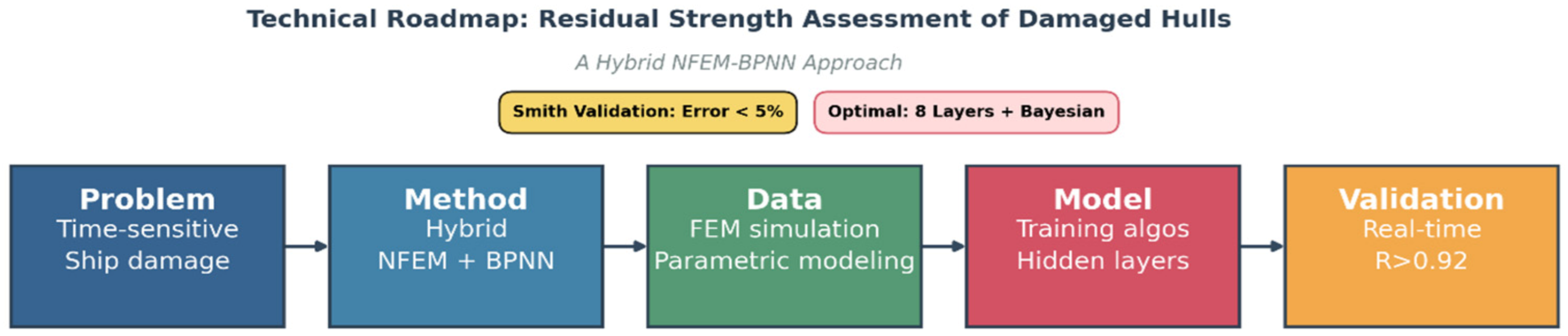
To address these challenges, this paper proposes and investigates a hybrid intelligent prediction framework that integrates high-fidelity nonlinear finite element simulation (NFEM) and a Bayesian-regularized backpropagation neural network (BPNN). The core research objective is to achieve efficient and high-precision prediction of the residual load-bearing capacity of damaged hulls. The technical roadmap of this study is illustrated in
Figure 1.
First, a validated NFEM is used to simulate and generate a large, high-reliability dataset covering random damage scenarios. Second, a BPNN prediction model is constructed, and the influence of key parameters—such as the number of hidden layers and training algorithms—on its prediction performance (accuracy, generalization, efficiency) is systematically studied to identify the optimal configuration. Finally, a data-driven, efficient assessment solution for engineering practice has been developed. This study not only provides a new method for damaged hull safety assessment but also offers a systematic neural network parameter optimization strategy as an important reference for designing intelligent damage assessment models for similar engineering structures.
This study develops a data-driven surrogate model rather than a Physics-Informed Neural Network (PINN). The goal is to approximate the non-linear mapping from damage parameters to residual strength, i.e., MUD = f(x;θ), where x represents input damage parameters, and θ are the trainable weights of the BPNN. Unlike PINN, which incorporates PDE residuals into the loss function, our BPNN learns solely from the high-fidelity NFEM dataset without imposing explicit physical equations.
2. Research on Calculation Methods for Ultimate Strength of Damaged Ship Hulls
The ultimate strength of a ship hull refers to its maximum load-bearing capacity against collapse under global bending moments, typically characterized by the ultimate bending moment. Accurately assessing the residual ultimate strength of a damaged hull is crucial for ensuring the navigation safety of the impaired vessel and formulating rescue and towing plans. Currently, the main calculation methods for ship hull ultimate strength include direct calculation methods (analytical methods), simplified progressive collapse methods (Smith method), idealized structural unit methods (ISUM), and nonlinear finite element methods (NFEM). This section reviews and analyzes the core principles, characteristics, and applicability of these methods.
2.1. Direct Calculation Method
Direct calculation methods primarily rely on empirical formulas and theoretical derivations for the rapid estimation of ship hull ultimate strength [
17]. Their significant advantage lies in high computational efficiency and minimal required input parameters, making them suitable for preliminary engineering design and rapid assessment scenarios.
However, this method has inherent limitations: its simplified models struggle to accurately simulate the complex progressive collapse process of hull structures under global bending moments (such as material yielding, local buckling, and their interactions), failing to reflect the true mechanisms of structural failure. Therefore, results from analytical methods are generally used as preliminary references, with accuracy often insufficient for high-fidelity assessment needs, particularly when dealing with complex damage scenarios.
2.2. Simplified Progressive Collapse Method (Smith Method)
The simplified progressive collapse method, proposed by Smith in 1977, is based on the concept that hull girder collapse is a process of sequential component failure [
18]. This method discretizes the hull cross-section into several basic units (such as hard-corner units, stiffened panel units, and plate units) [
19]. Under incrementally applied curvature loads, the following steps are performed:
Calculate the strain of each unit based on the assumption of a plane cross-section and the instantaneous position of the neutral axis.
Determine the stress using each unit’s average stress–strain relationship (considering failure modes such as tensile yielding and compressive buckling).
Calculate the total axial force of the cross-section and iteratively adjust the neutral axis position until the total axial force is zero.
Calculate the bending moment of the cross-section for the current curvature by summing the moments of each unit’s stress about the instantaneous neutral axis.
Plot the moment-curvature curve; the peak moment corresponds to the ultimate moment.
For damaged hulls, the Smith method effectively handles asymmetric cross-sections and hull inclination caused by compartment flooding by dynamically adjusting the instantaneous neutral axis (translation and rotation) to reflect the mechanical behavior of the remaining effective cross-section.
The advantages of the Smith method include: clear physical significance and a good representation of the progressive collapse process of the hull. Its computational efficiency is significantly higher than that of high-fidelity simulations, making it one of the standard methods adopted by the International Association of Classification Societies (IACS) Common Structural Rules for tankers and bulk carriers (CSR/H-CSR) and major classification society regulations for ultimate strength assessment [
20].
Its practical limitations stem primarily from the accuracy of the input load-shortening curves and the assumed boundary conditions for each unit. Specifically:
The method relies on idealized unit stress–strain relationships; errors in these curves propagate directly into the ultimate moment prediction.
Accurately simulating highly complex or random damage modes (such as multiple irregular breach locations and their interactions in battle damage) is challenging, as the pre-defined load-shortening curves may not cover such scenarios.
The method depends on fundamental assumptions (e.g., the plane cross-section assumption), which may be violated in severely damaged or highly asymmetric cross-sections.
It is important to note, however, that these are practical limitations related to the available constitutive models and assumptions, rather than inherent theoretical flaws of the progressive collapse methodology itself. The Smith method remains a robust framework when appropriate unit curves are available.
2.3. Idealized Structural Unit Method (ISUM)
The Idealized Structural Unit Method (ISUM) is a semi-analytical approach situated between analytical methods and finite element methods [
21]. Its core concept involves dividing complex structures into a series of idealized units (such as stiffened panel units) with predefined simplified failure behavior modes under load (such as column buckling, torsional buckling, and web local buckling).
The main advantage of ISUM is that, with reasonable unit partitioning, its computational accuracy can approach that of NFEM while maintaining much higher computational efficiency.
However, a key challenge of ISUM lies in the significant impact of unit idealization on computational accuracy. For actual complex hull structures, particularly those with damage, accurately and reasonably selecting and defining these idealized units is difficult [
22]. This high dependence on modeling expertise limits the widespread application of ISUM in engineering practice.
2.4. Nonlinear Finite Element Method (NFEM)
The Nonlinear Finite Element Method (NFEM) is based on variational principles, discretizing the hull structure into a finite number of elements and solving highly nonlinear governing equations through numerical iteration. It can simulate the entire process of hull collapse from initial loading to overall failure with high precision [
23]. Therefore, NFEM is widely recognized as the most accurate method for calculating ship hull ultimate strength, especially the residual strength in the presence of complex damage.
The main disadvantage of NFEM is its extremely high computational cost. Simulating a hull compartment model with complex nonlinear behavior and damage until collapse typically requires several hours or even days of computation. This high computational expense makes it difficult to directly apply NFEM to scenarios requiring rapid assessment of numerous random damage scenarios, such as battle damage assessment or emergency response.
In summary, the four main methods for calculating ship hull ultimate strength each have their applicable scope, advantages, and disadvantages, as summarized in
Table 2.
The research objective of this paper is to construct a high-precision, physically credible dataset of residual strength for damaged hulls to train neural network models, requiring extremely high accuracy and reliability of the data itself. While the Smith method is relatively efficient and widely recognized, it is insufficient for accurately simulating random, complex damage modes and the resulting strongly nonlinear behavior. Although NFEM faces computational efficiency challenges, its capabilities in simulation accuracy and capturing complex physical mechanisms are irreplaceable [
24]. Therefore, this paper selects the Nonlinear Finite Element Method (NFEM) as the core tool for generating the benchmark dataset.
To verify the reliability of NFEM simulation results,
Section 4 of this paper will systematically compare NFEM calculation results with those of the widely used Smith method. After confirming that NFEM accuracy meets requirements, it will be used to efficiently generate a large amount of high-quality data covering different random damage scenarios, laying a solid foundation for the subsequent intelligent prediction model based on the BP neural network.
Section 3 will elaborate in detail on the modeling and simulation process of damaged hull structures based on NFEM.
3. Modeling and Simulation of Damaged Hull Structures
The NFEM model in this study accounts for three primary sources of nonlinearity:
Material Nonlinearity: The elastic-plastic behavior of steel is modeled using the true stress–strain relationship defined in
Table 3. An isotropic hardening von Mises yield criterion is employed.
Geometric Nonlinearity: Large deformation effects are considered by using the NLGEOM option in ABAQUS, which accounts for changes in stiffness due to the structure’s deformed configuration. The formulation utilizes an updated Lagrangian approach, where the reference configuration is updated at each incremental step.
Boundary Nonlinearity: Although not modeling contact between separate bodies, the progressive collapse and local buckling of damaged plates and stiffeners are captured via the combined effects of material and geometric nonlinearities, leading to a complex, nonlinear load–displacement path. Follower loads are not considered, as the dominant load is the bending moment applied through a prescribed rotation at the reference points.
When calculating the ultimate strength of a ship hull girder using nonlinear finite element analysis, both the software’s computational capabilities and time costs must be considered. To compute the ultimate load-bearing capacity, a specific compartment model with appropriate boundary conditions must be selected to satisfy the calculation requirements. Common compartment length selection methods include four patterns, as shown in
Table 3:
Table 3.
Common Hull Segment Selection Methods.
Table 3.
Common Hull Segment Selection Methods.
| Segment Mode | Selection Method |
|---|
| Two Trans. Frames | Select the segment length between two transverse frames for modeling. |
| Two Trans. Bulkheads | Select the segment length between two transverse bulkheads for modeling. |
| 1/2+1+1/2 | Select one full central segment, extending half a segment length forward and aft. |
| 1+1+1 | Select one full central segment, extending one full segment length forward and aft. |
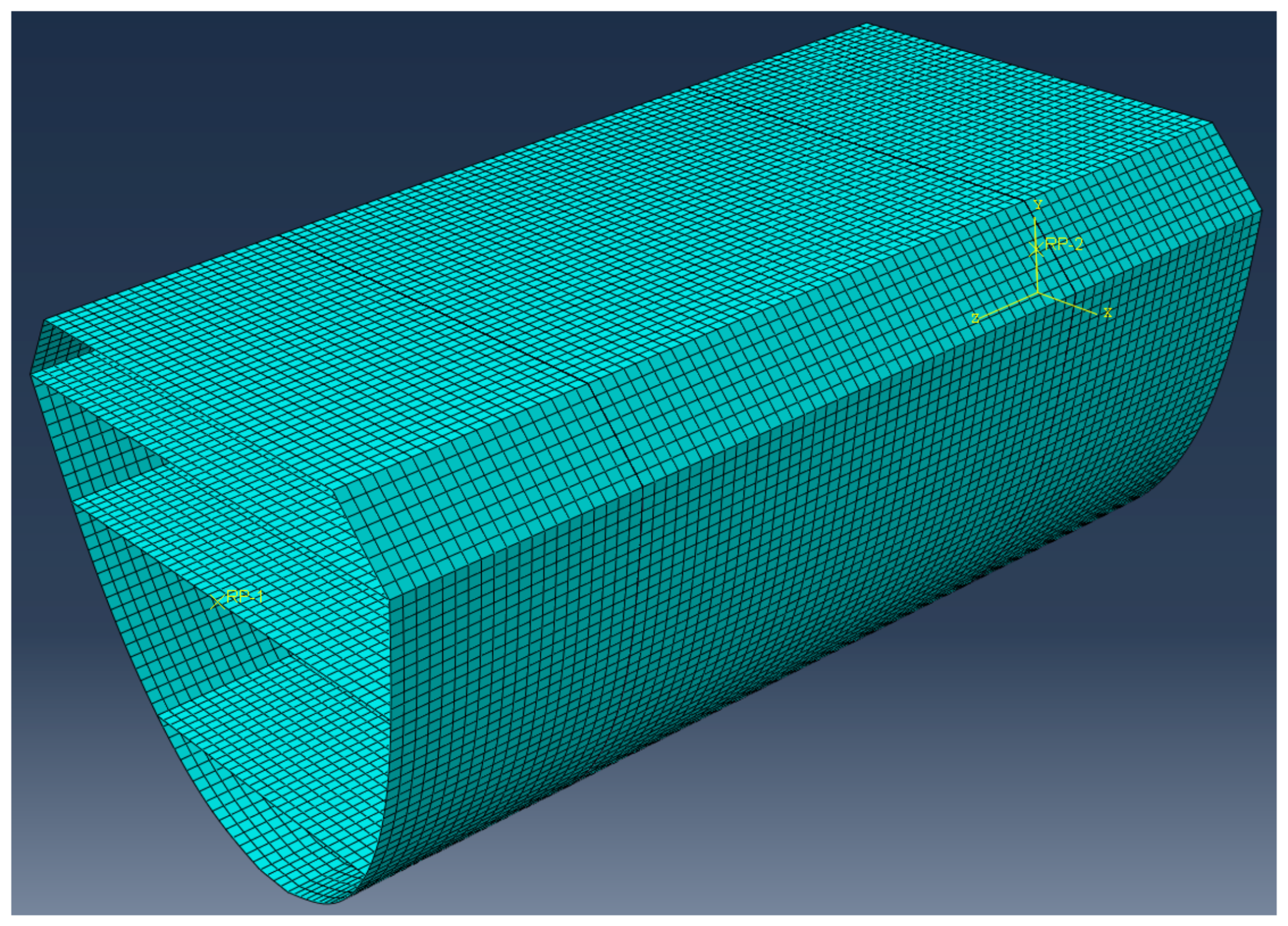
Among these four selection methods, the first (two transverse frames) is insufficient for capturing the overall instability of the full compartment deck. Among the remaining three, the latter two methods (1/2+1+1/2 and 1+1+1) include extended sections at both ends. This extended configuration helps eliminate boundary condition effects by ensuring that the region of interest (the central compartment with damage) is sufficiently far from the constrained ends. According to Saint-Venant‘s principle, localized disturbances caused by boundary constraints decay rapidly with distance from the boundary. Therefore, the stress and deformation fields in the central compartment are not artificially influenced by the fixed boundary conditions applied at the ends. This paper adopts the 1/2+1+1/2 compartment pattern and establishes a hull structure compartment model, as shown in
Figure 2. The FE model is based on a law enforcement patrol ship. The three-compartment model has a total length of 20 m (10 m central compartment + 2 × 5 m end compartments), with a cross-sectional breadth of 8 m and depth of 16 m. The side shell and bottom plates are modeled with a thickness of 12 mm, representing the critical strength members susceptible to damage, while the main deck has a thickness of 12 mm, and the inner bottom and longitudinal bulkheads have a thickness of 8 mm. Typical stiffeners are modeled as L-sections with web dimensions of 150 mm × 8 mm.
The model employs three-dimensional shell elements, primarily using reduced-integration quadrilateral elements (S4R) [
25]. Material properties are defined as follows: Poisson’s ratio ν = 0.3, Young’s modulus E = 2.06 × 10
5 MPa, steel density ρ = 7.85 × 10
−9 t/mm
3. Material plasticity is defined according to
Table 4. To ensure the NFEM results are independent of mesh discretization, a mesh convergence study was performed. Four mesh densities were tested for the intact hull model:
Coarse: 50 mm element size (~120,000 elements)
Medium: 35 mm element size (~240,000 elements)
Fine: 25 mm element size (~450,000 elements)
Very fine: 18 mm element size (~700,000 elements)
The ultimate bending moment predicted by the coarse mesh differed by 8.2% from the very fine mesh, while the medium and fine meshes differed by 3.1% and 1.2%, respectively. Based on this convergence study, the fine mesh (25 mm element size, ~450,000 elements) was selected for all simulations to balance accuracy and computational cost.
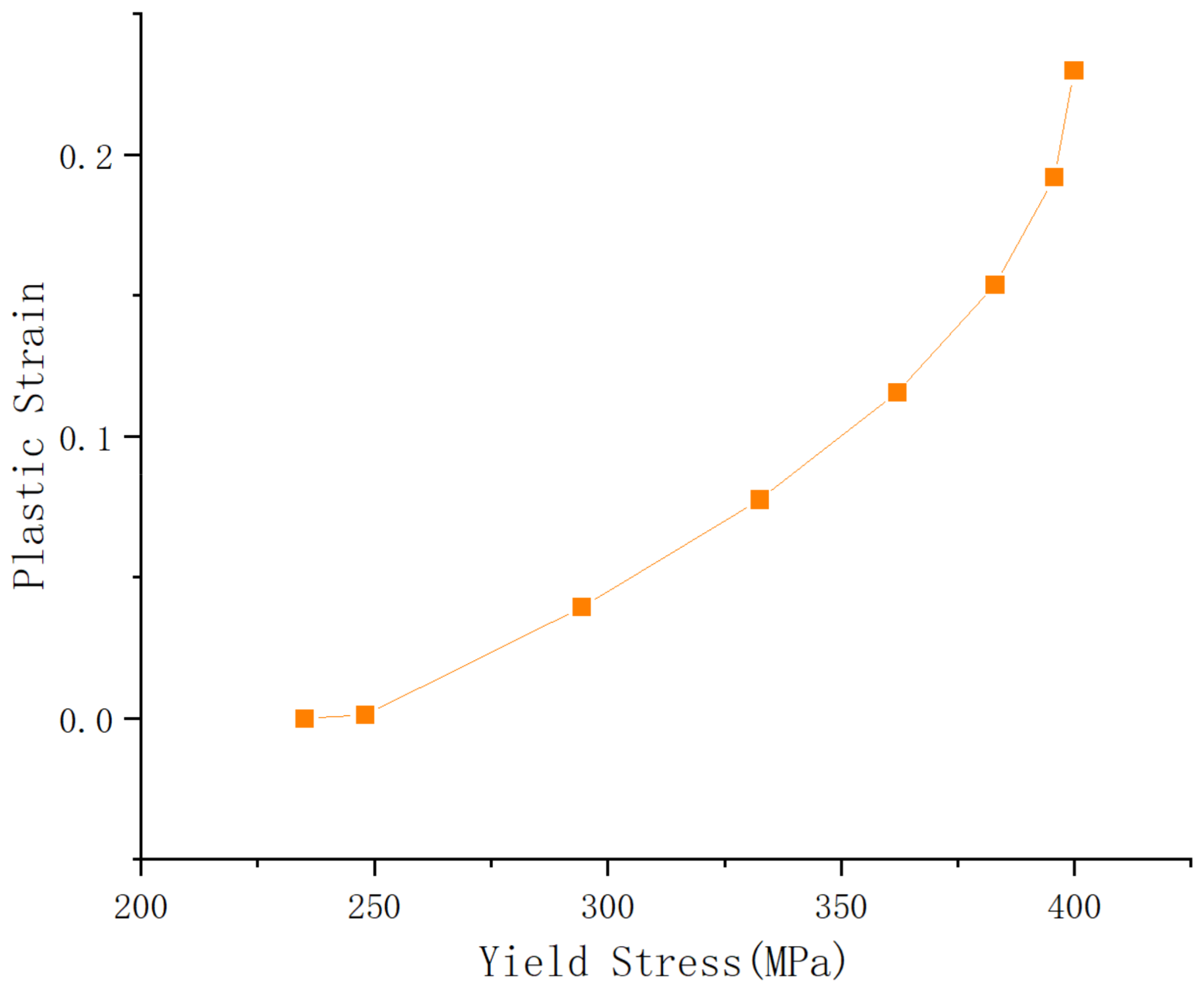
Figure 3 shows the stress–strain curve corresponding to the plastic parameters in
Table 4. The curve exhibits elastic behavior up to the yield stress of 235 MPa, followed by strain hardening up to the ultimate stress of approximately 400 MPa at a plastic strain of 0.23.
The positive x-axis direction is along the ship length toward the bow; the z-axis is vertical with upward as positive; the positive y-axis direction is along the ship width toward the starboard side. ABAQUS has multi-point constraint (MPC) functionality, allowing the creation of a rigid region by connecting all nodes on the planes at both ends of the compartment model to reference points. To simulate the hull failure process under vertical loads, two reference points, RP-1 and RP-2, are created at the centroids of the planes at the model’s forward and aft ends, respectively. These reference points are rigidly connected to all nodes within their respective end planes. Due to the rigid connection, the boundary conditions of the model end planes will be consistent with those of the reference points.
After establishing the hull structure compartment model, the damage is modeled as a circular breach with a diameter equal to the specified breach size. The breach center is located at the mid-length of the compartment (longitudinally) and at mid-depth of the side shell (vertically). The breach location is further parameterized by the breach frame number (longitudinal position along the hull) and the distance from the waterline (vertical position), which serve as input features for the BPNN. ABAQUS Boolean operations are used to subtract the breach model from the compartment model, simulating various damage scenarios. Reference point RP-2 is fully fixed, while a rotation about the x-axis is applied to reference point RP-1. This rotation generates a pure vertical bending moment on the hull girder. The direction of rotation is prescribed such that the bottom of the hull is in compression and the deck is in tension, corresponding to the sagging condition. A prescribed rotation of 0.03 rad about the x-axis is applied to RP-1. This rotation magnitude is sufficient to capture the peak ultimate moment and the initial post-collapse descending branch. Collapse is considered to occur when the moment drops below 90% of the peak value on the descending branch, or when the Riks solver fails to converge (indicating loss of load-carrying capacity).
It is important to note a key modeling assumption in the current approach: the use of kinematic coupling constraints (reference points RP-1 and RP-2 rigidly connected to all nodes on the end planes) forces the entire end plane to displace as a rigid body. This enforces the Euler-Bernoulli beam hypothesis (i.e., plane sections remain plane and perpendicular to the neutral axis) and prevents local warping at the boundaries.
This assumption is standard practice in hull girder ultimate strength analysis using a 1/2+1+1/2 compartment model. According to Saint-Venant’s principle, the influence of these boundary constraints on the stress and deformation fields in the central damaged region is negligible, provided the extended sections are sufficiently long. The close agreement between the NFEM results and the Smith method (error < 5%, as shown in
Table 4) validates that the influence of this assumption on the ultimate moment prediction is acceptable for the current scope. However, future work could explore the use of multi-point constraints that allow cross-sectional warping (e.g., using distribution coupling rather than kinematic coupling) for even higher fidelity.
4. Error Comparison Between the Smith Method and NFEM
The Smith method calculations in this study were implemented using a custom MATLAB (2018a) code. The code discretizes the hull cross-section into stiffened panels, plates, and hard-corner units based on the ship’s structural drawings. The load-shortening curves for each unit type follow the IACS Common Structural Rules recommendations. The iterative neutral axis search and moment-curvature calculations are performed as described in the steps below.
Selection of Cross-Section: Choose a typical cross-section from the hazardous area of the hull. The distribution of longitudinal bending moments along the ship length typically peaks at the midship section and decreases toward the bow and stern. For intact ships, the hazardous section is generally selected from the midship compartment. For battle-damaged ships, the section with the breach is typically selected.
Discretization of Structural Units: Discretize the longitudinal structural members of the selected cross-section into hard-corner units, stiffened panel units, and plate units.
Hard-corner units: Mainly refer to plates at intersections or corner regions, assumed not to buckle within the yield limit and failing in an elastic–perfectly plastic mode.
Stiffened panel units: Consist of stiffeners and their associated plating. Under tension, they fail in an elastic–perfectly plastic mode; under compression, they exhibit failure modes such as column buckling, torsional buckling, and web local buckling.
Plate units: Plates between stiffeners, between a stiffener and a hard-corner unit, or larger plates between two hard-corner units. Under compression, plate units are considered to fail by local buckling, with the ultimate strength determined by the plate slenderness ratio. Under tension, they fail by yielding.
- 3.
Determination of Stress–Strain Relationships: For each unit type, the following failure modes are considered:
Tension: Elastic-perfectly plastic behavior with yield stress 235 MPa.
Compression: Buckling behavior is modeled using IACS CSR load-shortening curves, which account for column buckling, torsional buckling, and web local buckling for stiffened panels, and local buckling for plate units. The post-buckling strength is included.
Hard-corner units: Assumed not to buckle; elastic-perfectly plastic within yield limit.
- 4.
Calculation of Maximum Curvature in Incremental Iteration: Apply a small curvature increment in each step. Calculate the neutral axis position for the initial curvature increment.
- 5.
Strain and Stress Calculation: Calculate the strain of each unit under the current curvature. Determine the corresponding stress and axial force of each unit using its stress–strain relationship.
- 6.
Neutral Axis Adjustment: Sum the axial forces of all units in the cross-section to obtain the total axial force. Adjust the neutral axis position iteratively until the total axial force is zero, determining the true neutral axis position for that curvature.
- 7.
Bending Moment Calculation: Sum the contributions of each unit’s axial force to the sectional bending moment about the neutral axis, obtaining the moment for the initial curvature increment.
- 8.
Iterative Process: Increase the curvature, using the current neutral axis height as the initial value for the next curvature step. Repeat steps 5–7 iteratively to obtain the sectional moment for each curvature. Finally, plot the moment-curvature curve for the cross-section. The moment corresponding to the zero slope of this curve is the ultimate bending moment.
Under battle damage conditions, accurately calculating the environmental loads and compartment flooding states the ship experiences can be difficult and time-consuming for rapid assessment. Therefore, the residual load-bearing capacity at the damaged section can be assessed using the ratio
of the ultimate bending moment in the damaged condition
to that in the intact condition
:
This paper applies the Smith method to calculate the residual load-bearing capacity for the same damage scenarios as those in
Section 3 (NFEM) and compares the results with the method, as shown in
Table 5. The error is calculated relative to the Smith results as the benchmark:
While the Smith method provides acceptable accuracy for many damage scenarios, it relies on pre-defined load-shortening curves that may not cover highly irregular or combined random damage patterns (e.g., multiple breaches at arbitrary locations). NFEM offers greater fidelity and generalizability without requiring case-specific curve calibration. The computational cost trade-off is as follows:
NFEM: 6–8 h per scenario, suitable for offline benchmark dataset generation.
Smith method: ~15 min per scenario, efficient but still too slow for real-time assessment of hundreds of random scenarios.
Trained BPNN: 0.023 s per scenario, enabling real-time prediction.
Thus, NFEM is used for one-time offline dataset generation to train the BPNN, which then provides real-time predictions without repeating expensive simulations.
Analysis of the NFEM results shows that the calculated damaged ultimate bending moment and intact bending moment data differ from the Smith method results by no more than 5%. Moreover, the final calculated residual load-bearing capacities are very similar. The comparison results indicate that the NFEM provides reliable accuracy for assessing the residual load-bearing capacity of damaged hulls, meeting the requirements for generating a high-quality dataset. This method can thus be used to simulate numerous scenarios, enriching the dataset for neural network learning and training, thereby enhancing the stability and reliability of the constructed prediction model.
The authors acknowledge that direct experimental validation of ultimate strength for a full-scale damaged hull is not available in the open literature due to the prohibitive cost and complexity of such tests. However, the NFEM modeling approach employed in this study has been validated against experimental data for similar intact and damaged hull girders in previous studies. Specifically:
Paik et al. [
21] validated NFEM predictions against small-scale box girder tests under bending, achieving errors within 5–8%.
Tabri et al. [
5] compared NFEM results with experimental data for damaged hull sections, reporting errors within 10%.
Parunov et al. [
24] demonstrated that NFEM reproduces Smith method results with high fidelity while capturing additional nonlinear effects.
In this study, we compare our NFEM results with the Smith method as an intermediate validation step, given the Smith method’s wide acceptance in classification society rules (IACS CSR) as a benchmark for ultimate strength assessment. The consistent <5% error between the two methods (
Table 5) demonstrates that the NFEM implementation is consistent with established practice. Future work should include validation against experimental data when such data becomes available.
5. Training and Parameter Optimization of the BP Neural Network
5.1. Data Preprocessing
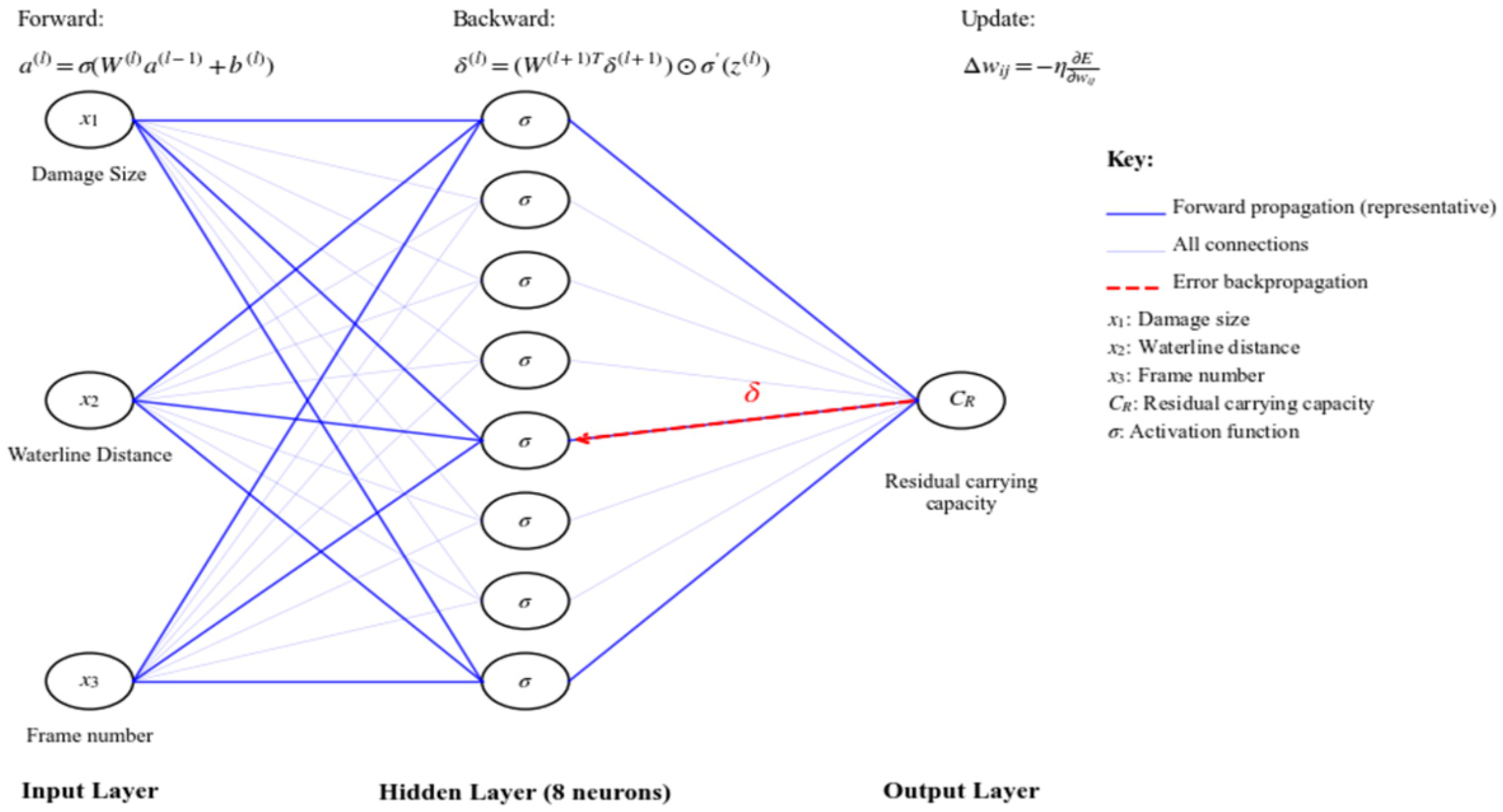
The structural composition of a BP neural network is illustrated in
Figure 4. Its training process generally consists of two main parts: forward propagation of working signals and backward propagation of error signals. (1) Feature parameters enter the neural network, are processed by the hidden layers, and reach the output layer, where they are transformed into output signals and compared with the expected output values. (2) The difference between the output signals and the expected outputs constitutes the error, which is converted into an error signal and propagated backward from the output layer. This training process is repeated until the neural network’s training accuracy requirements are met, ultimately aligning the network’s output signals with the expected values.
To comprehensively and effectively reflect breach information, this paper employs the Min-Max normalization method to scale breach location and size data to the range [0, 1]. The basic formula for Min-Max normalization is:
where
is the normalized data, obtained by dividing the difference between the sample data and the sample minimum by the range (sample maximum minus sample minimum). Thus,
is a value within 0–1. Given
, denormalization can revert the data to its actual range. Processed data not only unify dimensions but also lead to higher training accuracy and better recognition performance when used as feature parameters in neural networks.
5.2. BP Neural Network Training
This paper normalizes the data obtained from the Smith method and NFEM to form a dataset. The breach frame number, distance of the breach from the waterline, and breach size are used as input data, while the residual load-bearing capacity serves as the target data for neural network learning and training. Specifically, 60% of the data is used as the training set, with 20% each allocated to the validation and test sets.
The number of hidden layers in the neural network is set to 10, and training begins using the Levenberg–Marquardt algorithm. As shown in
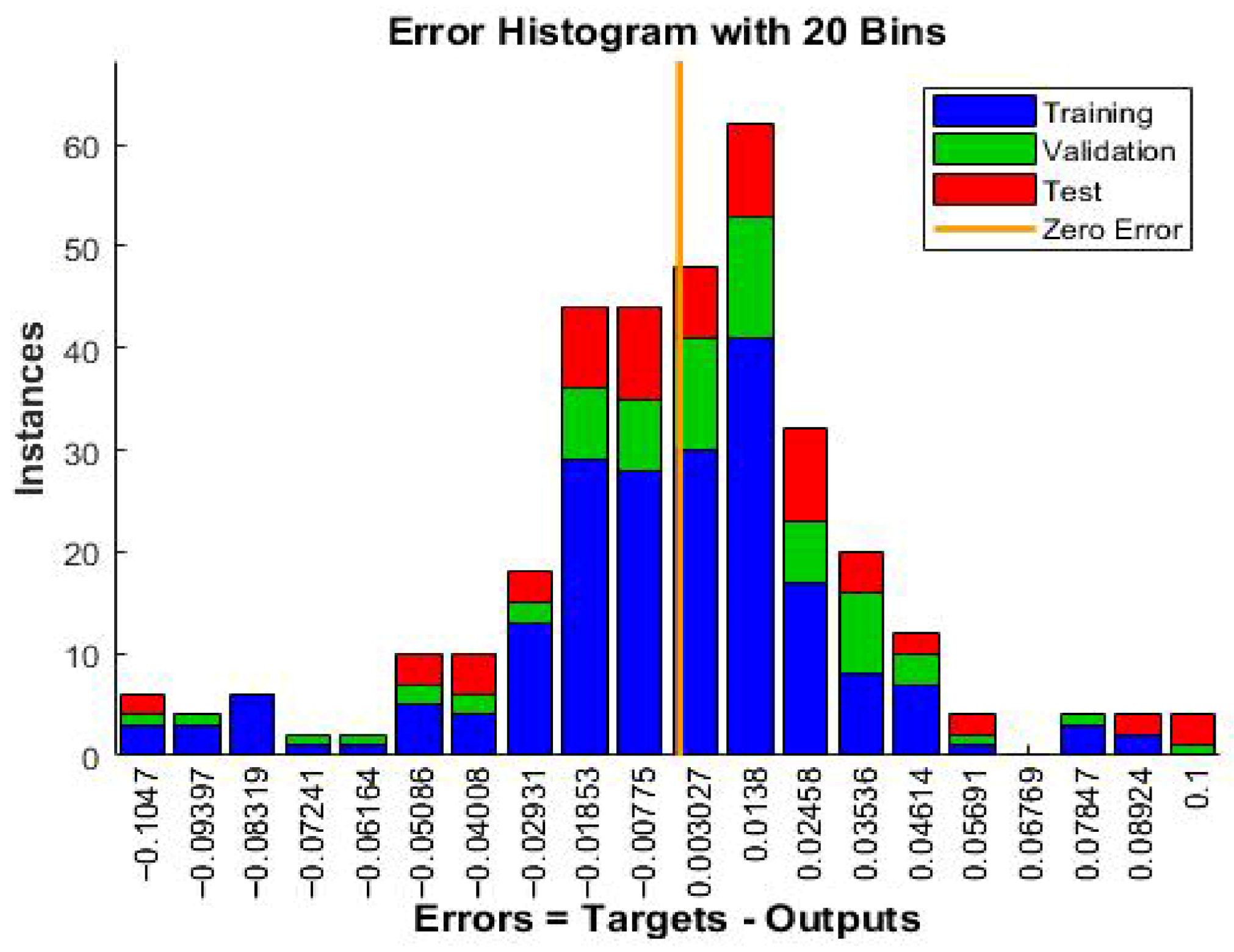
Figure 5, the error histogram visually displays the errors between predicted outputs and target outputs. The horizontal axis represents the magnitude of the error (positive or negative), while the vertical axis indicates the count of samples with corresponding error magnitudes. Blue bars represent training data, green bars represent validation data, and red bars represent test data. It can be observed that the majority of data errors are within 0.1, with most errors within 0.03, indicating relatively small errors.
As shown in
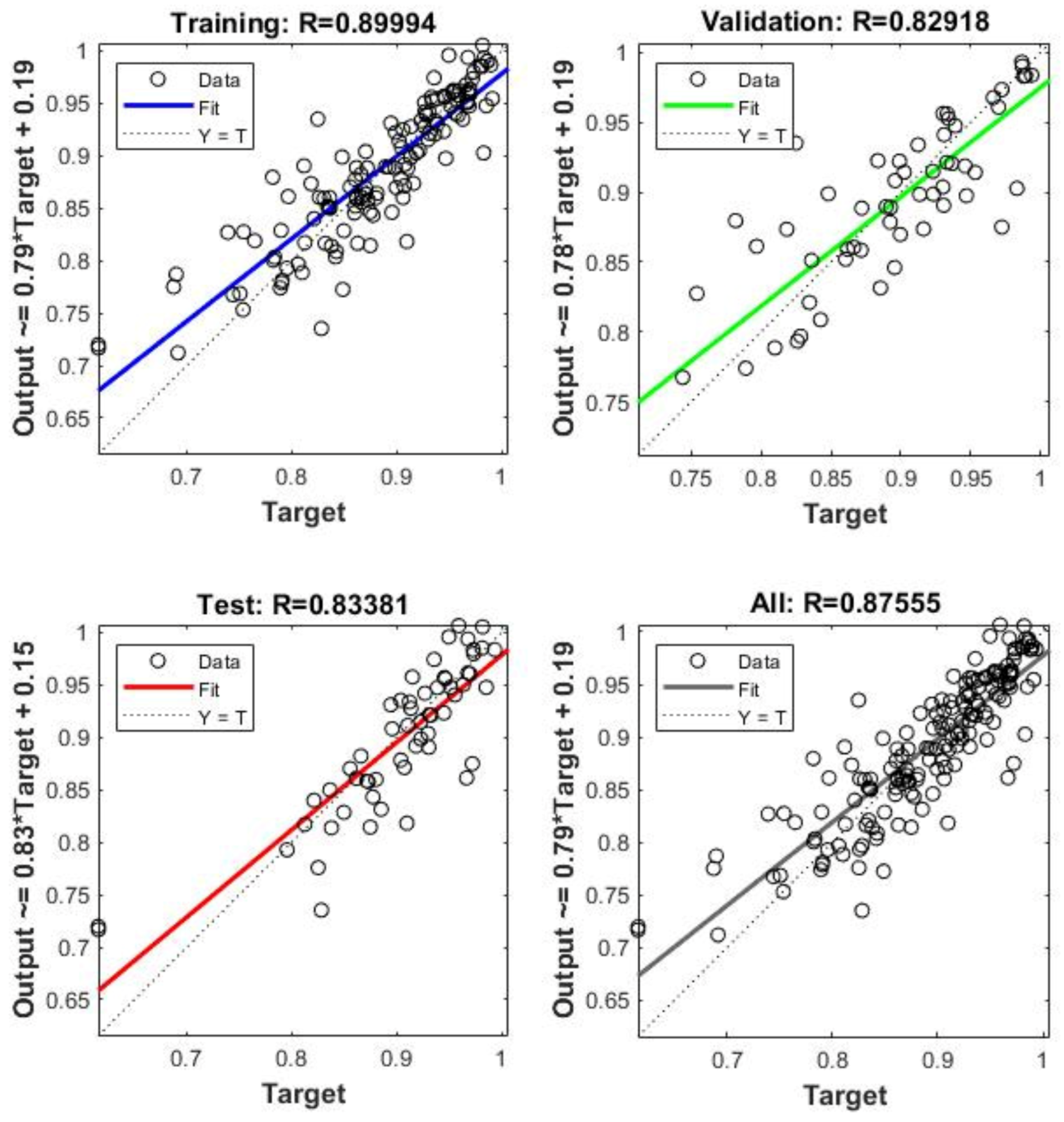
Figure 6, the regression plot displays the network outputs against the targets for the training, validation, and test sets. The regression value R represents the correlation between predicted outputs and target outputs. An R value closer to 1 indicates a stronger relationship between predicted and output data, while an R value closer to 0 suggests greater randomness in the relationship. For a perfect fit, data points should fall along a 45-degree line where network outputs equal targets. The plot includes data correlation relationships for the training, validation, test, and overall sets after training. The horizontal axis represents target outputs, and the vertical axis represents the fitted function between predicted outputs and target outputs. The results show an overall regression R value above 0.85, indicating good performance.
As shown in
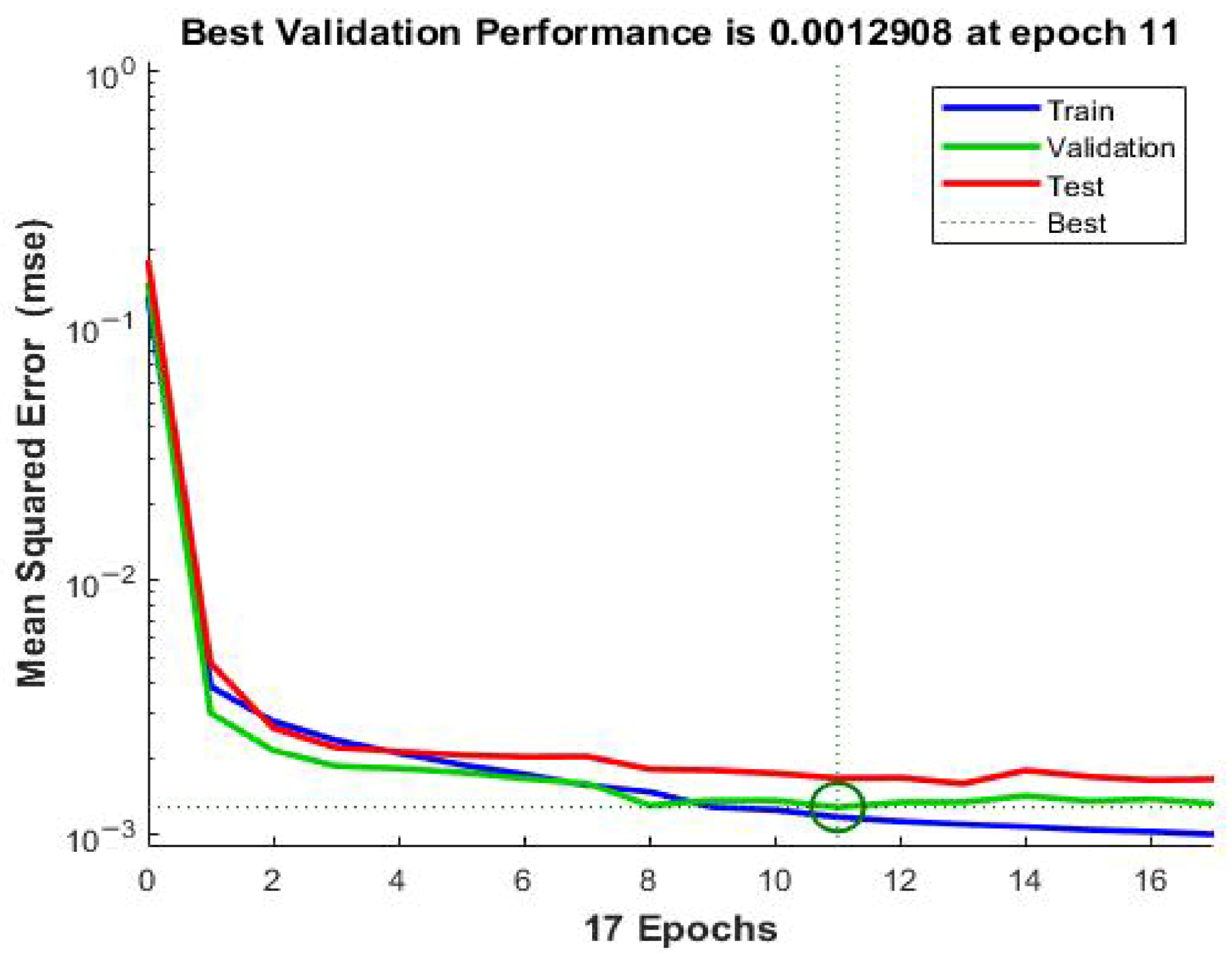
Figure 7, the mean squared error (MSE) represents the average squared difference between predicted outputs and target outputs. Lower values are better, with 0 indicating no error. The horizontal axis represents the number of training iterations, and the vertical axis denotes the MSE value. The green circle in the plot indicates the iteration number and MSE value when the validation set achieves the best MSE, which is 0.0012908 at 11 iterations.
For other configurations (different numbers of hidden layers and training algorithms), the iteration counts varied. Specifically:
For shallow networks (2–4 layers), convergence typically occurred within 5–8 iterations.
For medium-depth networks (6–8 layers), convergence typically occurred within 8–12 iterations.
For deep networks (10 layers with Bayesian regularization), the algorithm used an automatic stopping criterion, typically requiring 20–30 iterations. The Bayesian regularization algorithm requires more iterations because it continuously adjusts the regularization parameter to find an optimal balance between bias and variance.
5.3. Optimization Study of Training Parameters
During neural network training, different algorithms—including Levenberg–Marquardt (L-M), Bayesian regularization (Bayesian), and Scaled conjugate gradient (Scaled)—can be selected, and the number of hidden layers in the neural network can be varied. This paper selects different algorithms and varying numbers of hidden layers to train the neural network, resulting in 15 configurations combining five hidden layer counts and three training algorithms. Each configuration undergoes five training runs to eliminate the influence of random initialization, with the average performance reported. As shown in
Table 6, the regression value
R is selected as the evaluation metric for neural network training effectiveness, and the training outcomes are compared.
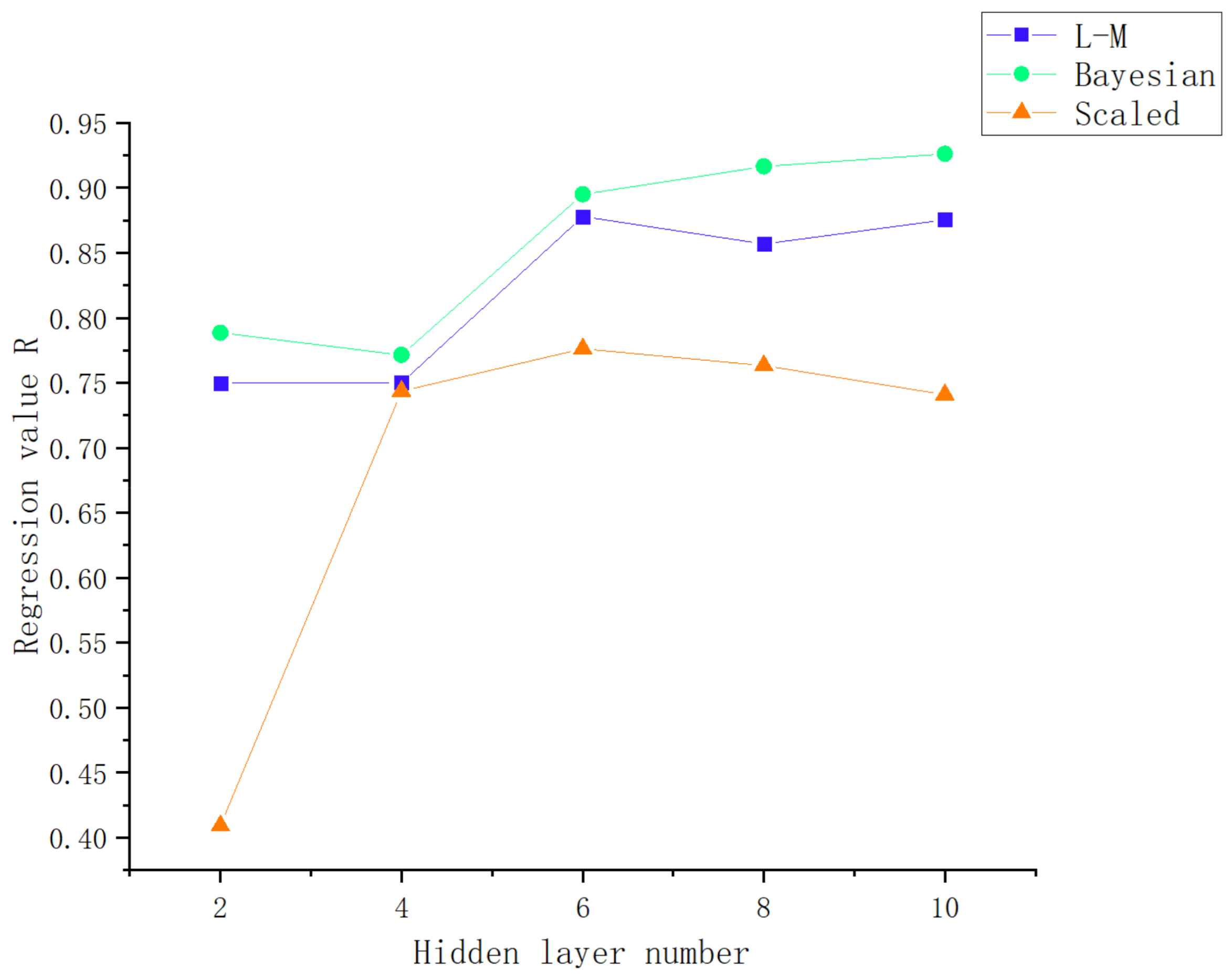
As shown in
Figure 8, neural network training effectiveness exhibits significant dependence on both the method and structure:
Training Function Sensitivity Analysis: The Scaled algorithm performs weakest in shallow networks (e.g., 2 hidden layers), with R = 0.40905, indicating insufficient capability to capture features of ship damage data. In contrast, the Bayesian algorithm demonstrates the best fitting performance, followed by the L-M algorithm.
Nonlinear Effect of Hidden Layer Depth: When the number of hidden layers increases to 6, the L-M and Scaled algorithms reach peak performance, with regression R values of 0.87798 and 0.77623, respectively. Further increasing the layer count leads to a decline in training effectiveness. The Bayesian algorithm’s performance saturates at 8 hidden layers, with R = 0.91662 for 8 layers and R = 0.92622 for 10 layers, showing less than a 1% improvement. This indicates that model complexity must match problem complexity, and blindly increasing the number of hidden layers may lead to overfitting.
Overfitting Phenomenon Diagnosis: Overfitting occurs when there is a large gap between training error and test error. In other words, the model complexity exceeds the actual problem complexity, leading to excellent performance on the training set but poor performance on the test set. The model essentially “memorizes” the training set without understanding the underlying data patterns, resulting in poor generalization. In deep networks (more than 6 hidden layers), a phenomenon occurs where training set error continues to decrease, while validation and test set errors increase significantly. This aligns with typical overfitting characteristics, as seen with the Scaled function in
Figure 8, where validation error spikes at 10 layers, degrading generalization. The underlying cause is that model capacity exceeds the complexity of the true data distribution. This phenomenon can be automatically constrained by Bayesian optimization of network depth.
For the problem of residual load-bearing capacity prediction of damaged hulls, the following parameter optimization scheme is proposed:
Bayesian algorithm: Strong resistance to overfitting, best stability in deep networks, R > 0.91 for 8–10 layers.
L-M algorithm: Suitable for medium-depth networks, peaks at 6 layers with R = 0.878, fast convergence.
Scaled algorithm: Only viable at 6 layers, R = 0.776, significantly degraded performance at other depths.
- 2.
Layer Optimization Principles:
Lightweight Architecture: Prioritize 8 layers + Bayesian, R = 0.91662, balancing accuracy and efficiency.
Avoid Excessive Depth: For layers > 8, Bayesian shows marginal improvement (<1%) but drastically increases computational resource consumption and may induce overfitting.
Avoid Shallow Networks: For layers < 6, all algorithms yield R < 0.79, indicating insufficient feature capture.
In summary, for the dataset in this study, an optimal range of 6–8 hidden layers exists, with performance improving from 6 to 8 layers and degrading beyond 8 layers. The optimal configuration is 8 hidden layers + Bayesian regularization, achieving a test R-value of 0.91662. The suboptimal but computationally faster alternative is 6 hidden layers + L-M algorithm (R = 0.87798). Configurations with ≤4 hidden layers (underfitting) or ≥10 hidden layers (overfitting) are not recommended for this application.
5.4. Computational Time for Real-Time Inference
The term “real-time” in this study refers to a prediction latency on the order of milliseconds to seconds, suitable for time-critical decision support during emergency response. After the BPNN model is trained offline, for the optimal model (8 hidden layers with Bayesian regularization), the average CPU time to predict the residual strength for one new damage case is 0.023 s (measured on an Intel i7-10700 CPU @ 2.90GHz).
In contrast, a single NFEM simulation requires approximately 6 to 8 h, and the Smith method requires about 15 min for the same complex, asymmetric damage scenario. This ~6-order-of-magnitude speedup compared to NFEM, and ~4-order-of-magnitude compared to the Smith method, justifies the “real-time” capability for rapid damage assessment.
6. Conclusions
To address the need for rapid and precise assessment of residual bearing capacity following ship battle damage, this study proposed and validated a hybrid intelligent prediction framework integrating high-fidelity nonlinear finite element simulation (NFEM) and a Bayesian-regularized backpropagation neural network (BPNN). Through systematic research, the following main conclusions were drawn:
Reliability Verification of High-Fidelity NFEM Dataset: Using Abaqus (6.14-4) software, hull structural responses under various damage scenarios (different breach sizes and locations) were accurately simulated, successfully calculating ultimate bending moments and residual load-bearing capacities. Comparative validation with the widely recognized Smith method confirmed that discrepancies between the two methods for damaged ultimate bending moments, intact ultimate bending moments, and residual load-bearing capacity ratios were all less than 5%. This fully demonstrates the high reliability of the NFEM simulation results, laying a solid foundation for constructing a high-quality, physically credible benchmark dataset that meets the requirements for data accuracy and diversity in subsequent neural network training.
Successful Construction and Core Value of BPNN Prediction Model: A BPNN model was successfully trained using the high-quality dataset generated by NFEM, achieving efficient prediction of residual load-bearing capacity for damaged hulls. The core advantage of this model lies in its significant improvement in computational efficiency, enabling near real-time predictions. This overcomes the bottleneck of traditional NFEM’s lengthy computation times (6–8 h per scenario) and even significantly outperforms the Smith method (~15 min per scenario), achieving millisecond-level predictions (0.023 s per case).
Systematic Findings and Key Strategies for Neural Network Parameter Optimization: This study deeply revealed the high dependence and non-monotonic variation in BPNN prediction performance on network structure (number of hidden layers) and training algorithm, successfully identifying the optimal parameter combination:
Effect of Hidden Layer Depth: Prediction accuracy does not increase monotonically with the number of hidden layers; an optimal range of 6–8 layers was identified. Networks that are too shallow (<6 layers) suffer from underfitting (R < 0.79), while networks that are too deep (>8 layers) are prone to overfitting, degrading generalization. The optimal configuration is 8 hidden layers with Bayesian regularization (R = 0.91662), striking the best balance between accuracy, generalization, and computational efficiency.
Training Algorithm Preference: The Bayesian regularization algorithm performs best in terms of overfitting resistance and model stability, particularly excelling in deep networks. The L-M algorithm offers fast convergence and suboptimal performance in medium-depth networks (6 layers). The Scaled algorithm generally underperforms and exhibits less stability.
Confirmation of Optimal Combination: For the dataset in this study, 8 hidden layers paired with the Bayesian regularization training algorithm are identified as the optimal parameter combination, achieving a high prediction regression value R of 0.91662, striking the best balance between prediction accuracy, generalization capability, and computational resource consumption. Six hidden layers paired with the L-M algorithm (R = 0.87798) serve as a suboptimal choice balancing speed and accuracy.
The hybrid framework of “NFEM-generated data + BPNN intelligent prediction + systematic parameter optimization” proposed in this study successfully achieves high-precision and efficient assessment of residual load-bearing capacity for damaged hulls. More importantly, the systematic neural network parameter optimization strategy employed—specifically, the identification of optimal network depth and the selection of anti-overfitting algorithms—holds significant methodological value. It provides a reusable reference paradigm for designing intelligent rapid assessment models for complex structures under random damage conditions in naval architecture and other engineering fields.