Research on Complexity Quantification Method for Multibeam Point Clouds Based on Feature Joint Entropy

Abstract
1. Introduction
2. Methods
2.1. Shannon Entropy
2.2. MDL-Based Construction of Two-Dimensional Adaptive Histogram
- (1)
- Precision Setting and Candidate Cut Point Generation
- (2)
- Dynamic Programming for Optimal Binning
- (3)
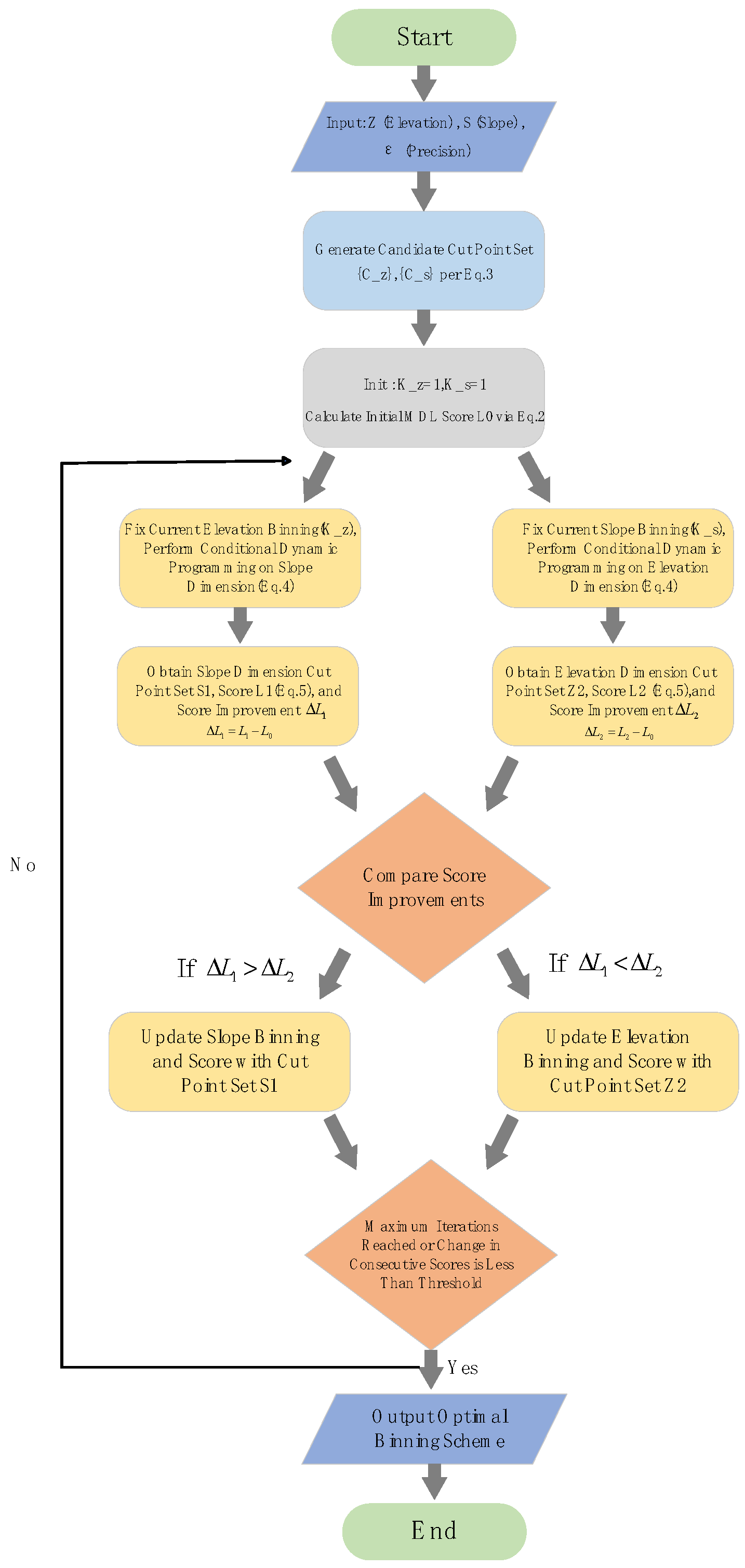
- Greedy Iterative Optimization
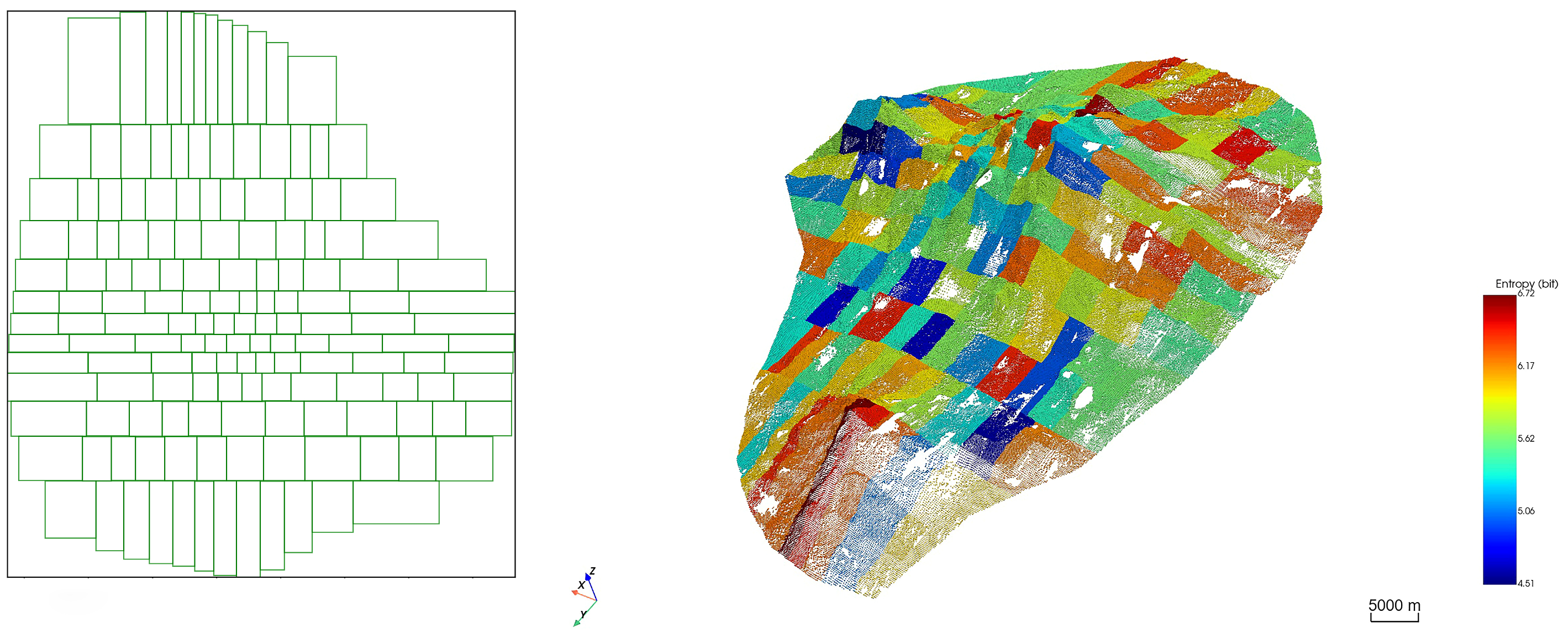
2.3. Method Implementation and Point Cloud Partitioning Strategy
3. Materials and Experiments
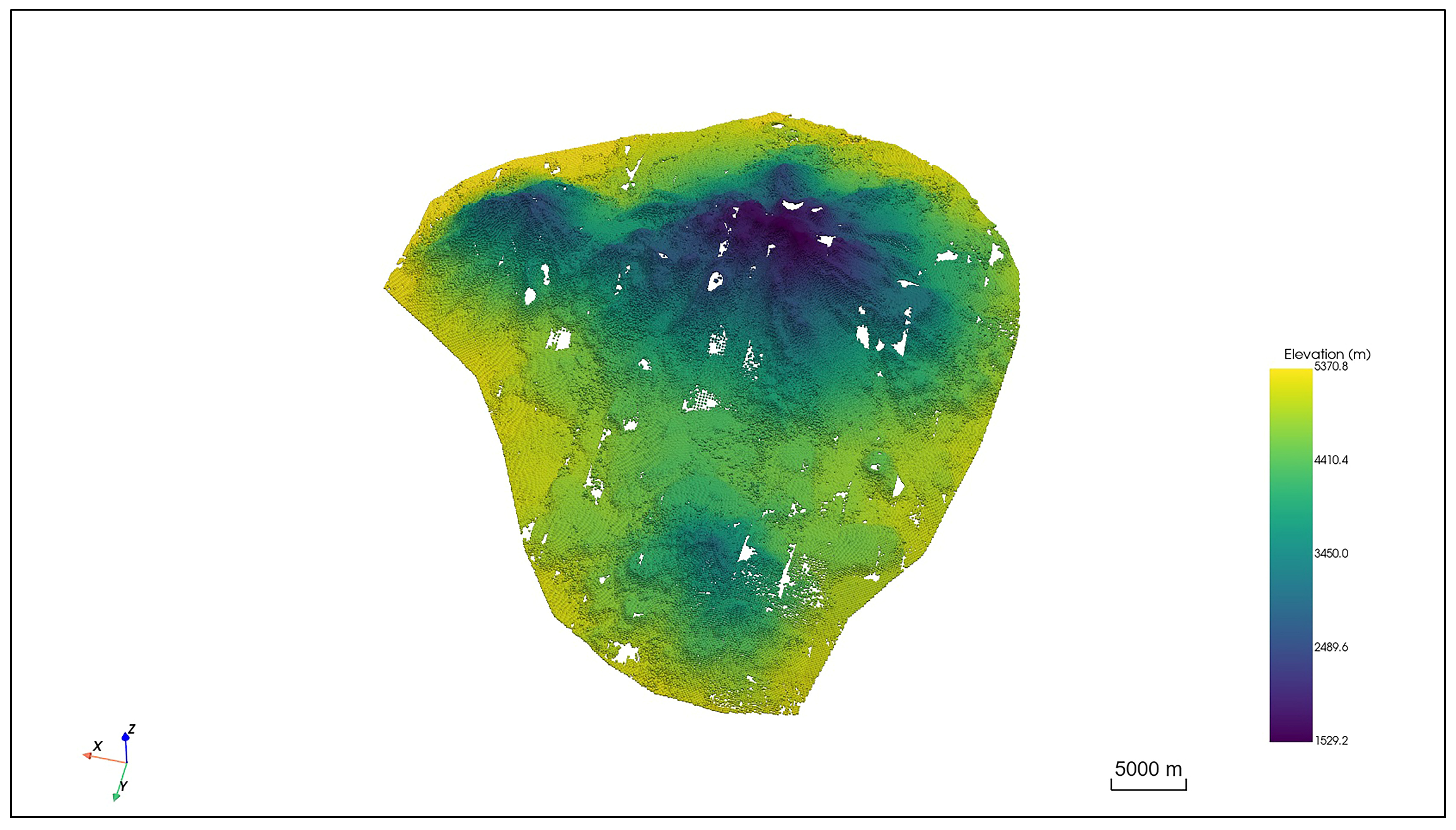
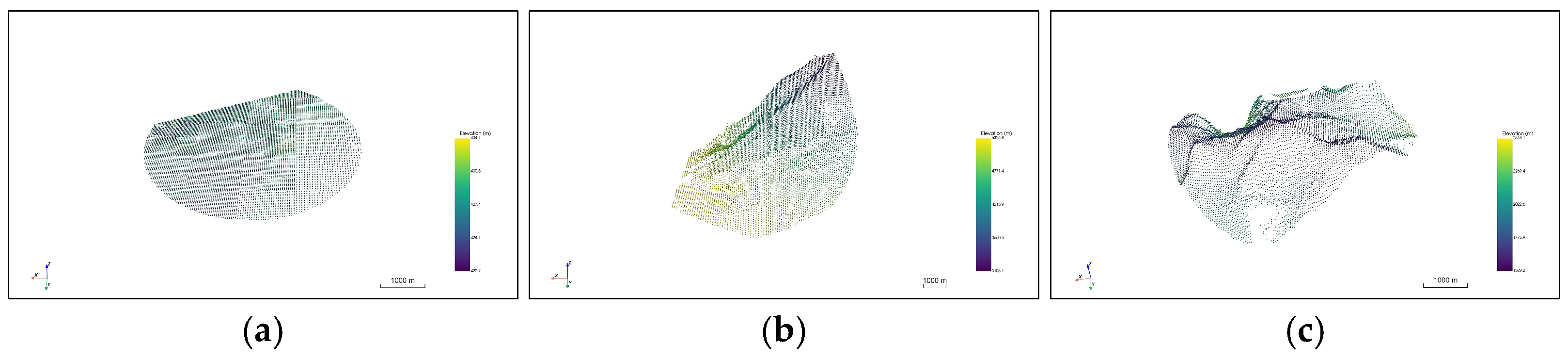
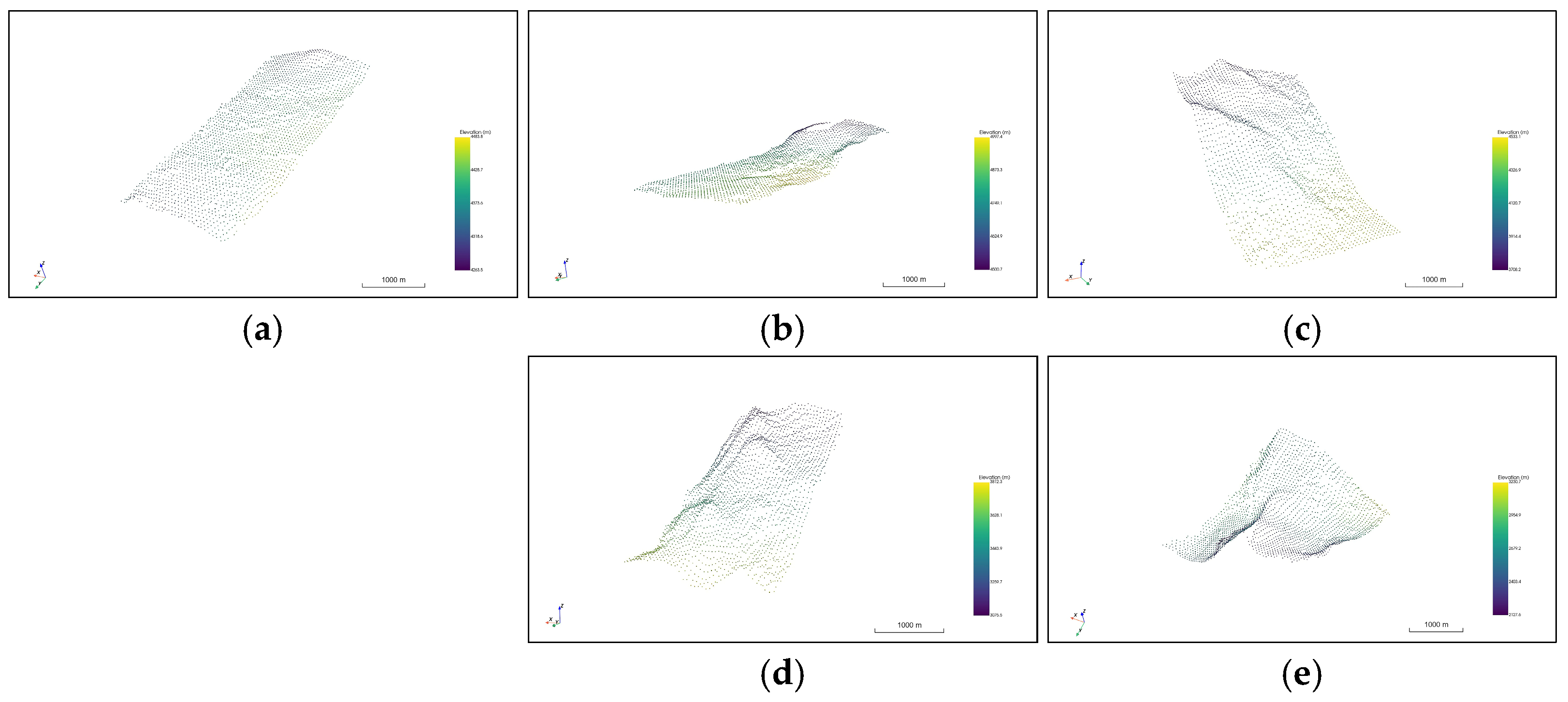
3.1. Experimental Data and Setup
- (1)
- Maximum number of bins: . According to the research by Kontkanen et al., the asymptotic complexity of the optimal number of bins for a one-dimensional MDL histogram is . The accuracy of entropy estimation can be guaranteed only when the growth rate of the number of bins is much lower than the sample size n. This study adopts the upper-bound parameter proposed by Marx et al. to constrain the binning scale, striking a balance between estimation accuracy and computational efficiency.
- (2)
- Maximum number of iterations and convergence threshold. These settings are determined based on the statistical results of preliminary experiments. Preliminary tests were conducted on multiple nodes with 2500 points in the experimental area, and the MDL score converged within 5–8 iterations. Accordingly, the maximum number of iterations is set to 10, which fully satisfies the convergence requirement of the algorithm. The convergence threshold is set to 1 × 10⁻⁴, which matches the calculation precision of the entropy value. The algorithm terminates early when the relative change in the MDL score between two consecutive iterations is less than this threshold, balancing computational stability and operational efficiency.
3.2. Experimental Design
3.2.1. Experimental Design for Determination of Sample Size Threshold
3.2.2. Experimental Design for Discrimination Ability of Topographic Complexity
3.2.3. Experimental Design for Response to Continuous Variation in Topographic Complexity
4. Results and Discussion
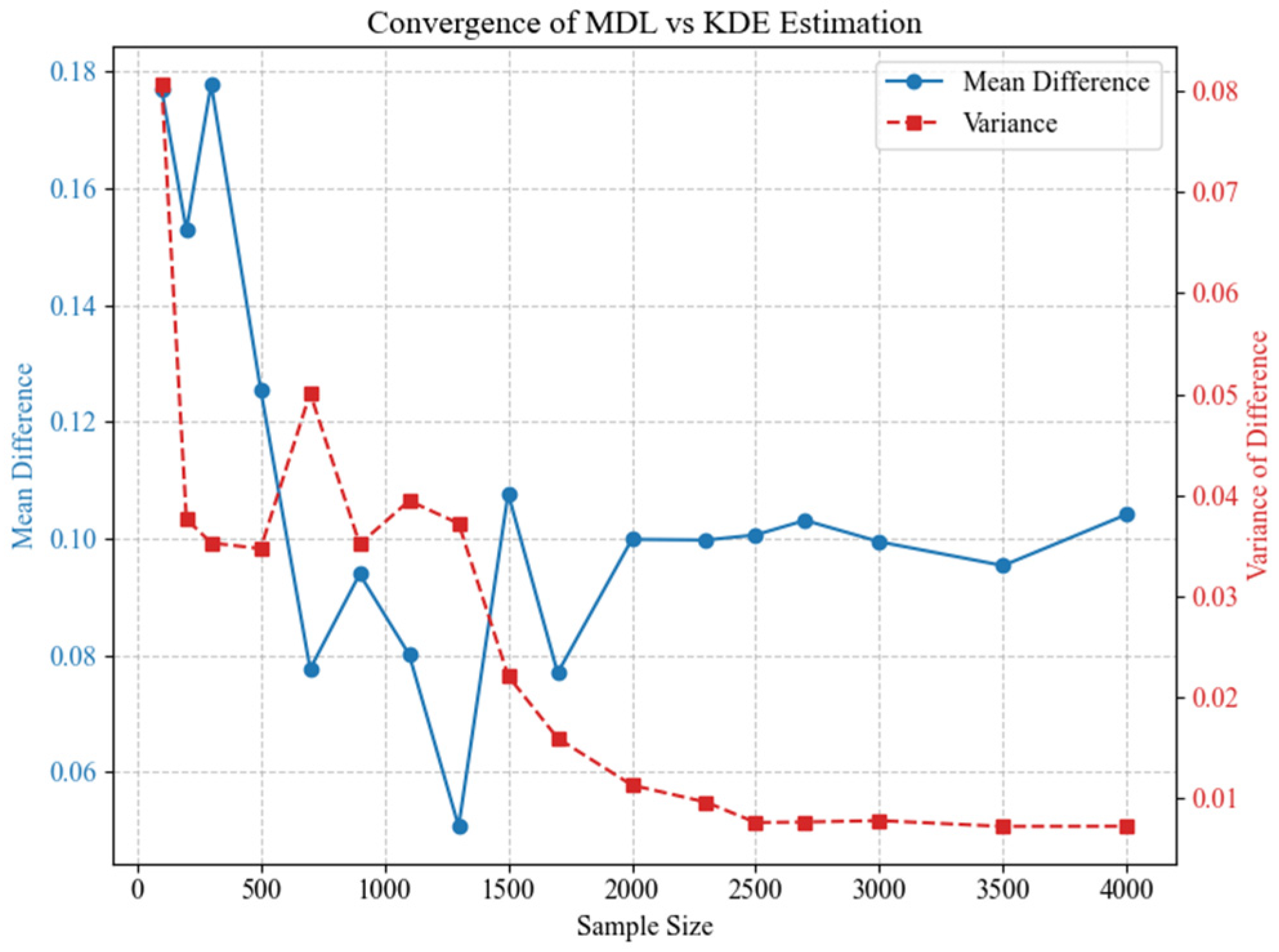
4.1. Experimental Results and Analysis for the Determination of Sample Size Threshold
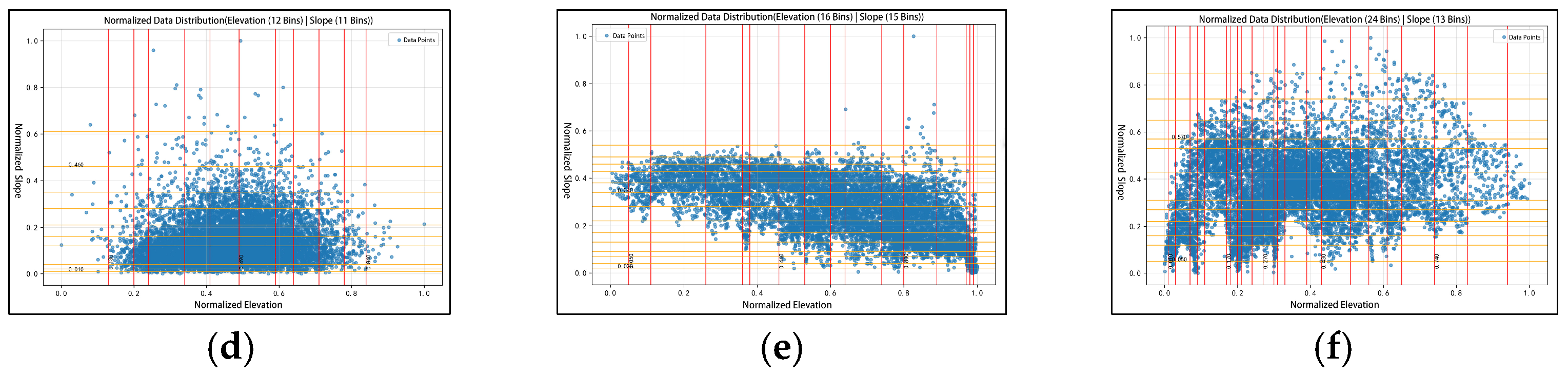
4.2. Experimental Results and Analysis for the Discrimination Ability of Topographic Complexity
4.3. Experimental Results and Analysis for Response to Continuous Variation in Topographic Complexity
5. Conclusions
Author Contributions
Funding
Data Availability Statement
Conflicts of Interest
References
- Zhao, J.H.; Ouyang, Y.Z.; Wang, A.X. Status and Development Tendency for Seafloor Terrain Measurement Technology. Acta Geod. Cartogr. Sin. 2017, 46, 1786–1794. [Google Scholar]
- Cao, H.B.; Zhang, L.H.; Zhu, M.H.; Zhao, W. Comparison and Analysis of Thinning Methods for Mass Data Acquired by Multibeam Sounders. Hydrogr. Surv. Chart. 2010, 30, 81–83. [Google Scholar]
- Tang, G.A.; Liu, X.J.; Lv, G.N. Digital Elevation Model and Geo-Science Analysis: Principles and Methods; Science Press: Beijing, China, 2005. [Google Scholar]
- Zhou, Q.M.; Liu, X.J. Digital Terrain Analysis, 1st ed.; Science Press: Beijing, China, 2006. [Google Scholar]
- Zhang, L. Spatial Pattern of Loess Landform Morphology Based on Core Topographic Factor Analysis. Master’s Thesis, Nanjing Normal University, Nanjing, China, May 2013. [Google Scholar]
- Zhou, T.; Long, Y.; Tang, G.A.; Yang, X. A Fractal Method to Describe the Terrain Complexity Reflected by the Raster DEM. Geogr. Geo-Inf. Sci. 2006, 22, 26–30. [Google Scholar]
- Zhang, C.; Chen, B.X.; Wu, L. Geographic Information System; Higher Education Press: Beijing, China, 1999. [Google Scholar]
- Zhang, Q.N. A New Simplification Method Based on Terrain Complexity for LiDAR Point Cloud. Master’s Thesis, Southwest Jiaotong University, Chengdu, China, May 2016. [Google Scholar]
- Lu, H.X.; Liu, X.J.; Tang, G.A. Terrain Complexity Assessment Based on Multivariate Analysis. J. Mt. Sci. 2012, 30, 616–621. [Google Scholar]
- Tang, Y.H. A Thin-Method Based on Local Terrain Complexity Index for LiDAR Bare Earth Surface Point Cloud. Master’s Thesis, Southwest Jiaotong University, Chengdu, China, May 2019. [Google Scholar]
- Li, J.Y.; Zhang, J.X.; Wang, B.; Du, M.D.; Zhang, Y.H.; Yang, F.L.; Luan, Z.D. Quantitative Analysis on the Seabed Terrain Complexity of Submarine Canyons of the South China Sea Continental Slope. Mar. Geol. Front. 2024, 40, 84–92. [Google Scholar]
- Chen, J.Y.; Bu, X.H.; Chen, D.C. A Thinning Algorithm of Multibeam Point Cloud Considering Weight of Terrain Complexity Factor. J. Shandong Univ. Sci. Technol. Nat. Sci. 2022, 41, 21–29. [Google Scholar]
- Li, S.X.; Ge, W.; Cheng, Y.; Zhang, J.L. Quantitative Study of a Generic Model of Complexity Taking into Account Topographic Features. Hydrogr. Surv. Chart. 2024, 44, 72–77. [Google Scholar]
- Nie, X. A LiDAR-Based DEM Thinning Algorithm Under Precision Constraints. Master’s Thesis, Southwest Jiaotong University, Chengdu, China, May 2014. [Google Scholar]
- Hu, C. Thinning Algorithm of LiDAR Bare Earth Surface Point Cloud Under the Restriction of Precision. Master’s Thesis, Southwest Jiaotong University, Chengdu, China, May 2015. [Google Scholar]
- Mahdaoui, A.; Sbai, E.H. 3D Point Cloud Simplification Based on k-Nearest Neighbor and Clustering. Adv. Multimed. 2020, 2020, 8825205. [Google Scholar] [CrossRef]
- Mahdaoui, A.; Bouazi, A.; Marhraoui Hsaini, A.; Sbai, E.H. Comparison of K-Means and Fuzzy C-Means Algorithms on Simplification of 3D Point Cloud Based on Entropy Estimation. Adv. Sci. Technol. Eng. Syst. J. 2017, 2, 38–44. [Google Scholar] [CrossRef][Green Version]
- Zhai, J.S.; Zhang, C.; Li, Z.X.; Zhang, L. Representation and Calculation of Submarine Landform Complexity. Period. Ocean Univ. China 2019, 49, 143–147. [Google Scholar]
- Li, M.F.; Li, L.Y.; Zhao, X.Y.; Lu, H.F. Application of Slope Entropy of Points in Terrain Simplification. Bull. Surv. Mapp. 2019, 11, 109–113. [Google Scholar]
- Ma, J.J. Research on Quantifying Terrain Complexity. Master’s Thesis, Nanjing Normal University, Nanjing, China, May 2012. [Google Scholar]
- Shannon, C.E. A Mathematical Theory of Communication. Bell Syst. Tech. J. 1948, 27, 379–656. [Google Scholar] [CrossRef]
- Rissanen, J. Modeling By Shortest Data Description. Automatica 1978, 14, 465–471. [Google Scholar] [CrossRef]
- Kontkanen, P.; Myllymäki, P. MDL histogram density estimation. In Proceedings of the Eleventh International Conference on Artificial Intelligence and Statistics, San Juan, PR, USA, 21–24 March 2007. [Google Scholar]
- Marx, A.; Yang, L.; van Leeuwen, M. Estimating Conditional Mutual Information for Discrete-Continuous Mixtures using Multi-Dimensional Adaptive Histograms. arXiv 2021, arXiv:2101.05009v1. [Google Scholar]
- S-44 Edition 6.1.0; IHO Standards for Hydrographic Surveys. IHO: Monaco, Monaco, 2022.



| Sample Size | Mean of the Differences | Variance of the Differences |
|---|---|---|
| 100 | 0.17696 | 0.080728 |
| 200 | 0.15281 | 0.037621 |
| 300 | 0.1779 | 0.035259 |
| 500 | 0.12552 | 0.034692 |
| 700 | 0.07762 | 0.050108 |
| 900 | 0.09389 | 0.035141 |
| 1100 | 0.08009 | 0.03943 |
| 1300 | 0.05063 | 0.03718 |
| 1500 | 0.10771 | 0.022066 |
| 1700 | 0.07694 | 0.015899 |
| 2000 | 0.09984 | 0.011255 |
| 2300 | 0.09972 | 0.009567 |
| 2500 | 0.1006 | 0.007556 |
| 2700 | 0.1031 | 0.007602 |
| 3000 | 0.09942 | 0.007745 |
| 3500 | 0.09534 | 0.007165 |
| 4000 | 0.10413 | 0.007179 |
| Experimental Block | Number of Iterations | Binning Scheme | Two-Dimensional Entropy Value |
|---|---|---|---|
| Sample A | 5 | 12 × 11 | 5.3238 |
| Sample B | 8 | 16 × 15 | 6.4467 |
| Sample C | 7 | 24 × 13 | 6.9559 |
| Retention Ratio | Sample A | Sample B | Sample C | |||
|---|---|---|---|---|---|---|
| RMSE | Relative Change Rate | RMSE | Relative Change Rate | RMSE | Relative Change Rate | |
| 100% | 0.857865 | —— | 17.377362 | —— | 7.638752 | —— |
| 60% | 0.86819 | 1.2035% | 18.012107 | 3.6527% | 7.976996 | 4.4280% |
| 40% | 0.913218 | 6.4524% | 18.589163 | 6.9734% | 8.327113 | 9.0114% |
| 20% | 1.012221 | 17.993% | 20.93588 | 20.4778% | 10.519674 | 37.7145% |
| Node ID | Entropy Interval | Entropy Value (bit) | Number of Elevation Bins | Number of Slope Bins | Total Number of Bins | Topographic Description |
|---|---|---|---|---|---|---|
| a | Low | 4.6723 | 9 | 9 | 81 | Homogeneous and simple |
| b | Low-Medium | 5.3930 | 12 | 10 | 120 | Locally undulating, globally regular |
| c | Medium | 5.8001 | 13 | 10 | 130 | Relatively regular undulations, monotonous morphological variation |
| d | Medium-High | 6.2682 | 13 | 12 | 156 | Interlaced undulations in multiple regions, diverse morphologies |
| e | High | 6.6374 | 15 | 13 | 195 | Rich and diverse morphologies |
| Retention Ratio | a | b | b | d | e | |||||
|---|---|---|---|---|---|---|---|---|---|---|
| RMSE | Relative Change Rate | RMSE | Relative Change Rate | RMSE | Relative Change Rate | RMSE | Relative Change Rate | RMSE | Relative Change Rate | |
| 100% | 8.971422 | —— | 11.014302 | —— | 16.174115 | —— | 6.788884 | —— | 13.937556 | —— |
| 60% | 9.06994 | 1.0981% | 11.447358 | 3.9317% | 17.617475 | 8.9238% | 7.429014 | 9.4290% | 15.566122 | 11.6847% |
| 40% | 9.408851 | 4.8758% | 11.572046 | 5.0638% | 18.101392 | 11.9158% | 7.806162 | 14.9844% | 17.094787 | 22.6526% |
| 20% | 10.453663 | 16.5218% | 13.340235 | 21.1173% | 21.130446 | 30.6435% | 9.266855 | 36.5004% | 19.116594 | 37.1588% |
Disclaimer/Publisher’s Note: The statements, opinions and data contained in all publications are solely those of the individual author(s) and contributor(s) and not of MDPI and/or the editor(s). MDPI and/or the editor(s) disclaim responsibility for any injury to people or property resulting from any ideas, methods, instructions or products referred to in the content. |
© 2026 by the authors. Licensee MDPI, Basel, Switzerland. This article is an open access article distributed under the terms and conditions of the Creative Commons Attribution (CC BY) license.
Share and Cite
Liang, D.; Cui, Y.; Jin, S.; Wei, Y.; Tan, J. Research on Complexity Quantification Method for Multibeam Point Clouds Based on Feature Joint Entropy. J. Mar. Sci. Eng. 2026, 14, 824. https://doi.org/10.3390/jmse14090824
Liang D, Cui Y, Jin S, Wei Y, Tan J. Research on Complexity Quantification Method for Multibeam Point Clouds Based on Feature Joint Entropy. Journal of Marine Science and Engineering. 2026; 14(9):824. https://doi.org/10.3390/jmse14090824
Chicago/Turabian StyleLiang, Dekun, Yang Cui, Shaohua Jin, Yuan Wei, and Jichuan Tan. 2026. "Research on Complexity Quantification Method for Multibeam Point Clouds Based on Feature Joint Entropy" Journal of Marine Science and Engineering 14, no. 9: 824. https://doi.org/10.3390/jmse14090824
APA StyleLiang, D., Cui, Y., Jin, S., Wei, Y., & Tan, J. (2026). Research on Complexity Quantification Method for Multibeam Point Clouds Based on Feature Joint Entropy. Journal of Marine Science and Engineering, 14(9), 824. https://doi.org/10.3390/jmse14090824