Article

An Optimized Four-Float Semi-Submersible Offshore Wind Turbine Platform: Hydrodynamic and Motion Response Evaluation

1
Research Center of Fluid Machinery Engineering and Technology, Jiangsu University, Zhenjiang 212013, China
2
R&D Center of Marine Engineering and New Energy, Nantong COSCO Shipping Engineering Co., Ltd., Nantong 226006, China
3
Faculty of Civil Engineering and Mechanics, Jiangsu University, Zhenjiang 212013, China
*
Author to whom correspondence should be addressed.
J. Mar. Sci. Eng. 2026, 14(9), 807; https://doi.org/10.3390/jmse14090807
Submission received: 26 March 2026 / Revised: 19 April 2026 / Accepted: 23 April 2026 / Published: 28 April 2026
(This article belongs to the Special Issue Advances of Multiphase Flow in Hydraulic and Marine Engineering)

Abstract

As floating offshore wind turbines (FOWTs) scale towards 10 MW+ capacities, suppressing wave-induced rotational resonance becomes critical for system survivability. This study introduces an optimized, highly symmetrical four-float semi-submersible platform, explicitly tailored to support the DTU 10 MW wind turbine and paired with an orthogonal four-point mooring system. Using three-dimensional linear potential flow theory via ANSYS AQWA, comprehensive frequency- and time-domain hydrodynamic evaluations were conducted. To address the inherent limitations of inviscid potential flow assumptions, an empirical added-damping method was implemented. Quantitative results demonstrate a drastic reduction in motion responses: the peak Response Amplitude Operator (RAO) for heave decreased by 68.6% (from 1.945 m/m to 0.610 m/m). Most notably, the peak RAOs for the critical rotational degrees of freedom—pitch and roll—were reduced by over 92% (from 2.080 °/m and 2.216 °/m to ~0.168 °/m, respectively). Ultimately, compared to traditional asymmetric three-float concepts, this novel symmetric omnidirectional layout provides a more uniform restoring stiffness. The resulting suppression of pitch and roll resonance results in a profound reduction in tower-base bending moments and gyroscopic loads, thereby significantly enhancing the dynamic stability, safety margins, and fatigue life of the 10 MW FOWT under extreme survival sea states.

1. Introduction

With the depletion of fossil fuels and the rising demand for clean energy, the significance of renewable power generation continues to increase [1]. Compared to onshore wind energy, offshore wind power is attracting more attention due to its benefits, such as being located away from densely populated areas and accessing stronger, more consistent wind resources [2]. In shallow and intermediate waters, offshore wind farms are typically supported by fixed-bottom foundations. However, in deeper waters, floating wind turbines are becoming a central focus of research and development because they can be installed farther from shore, harness stronger wind resources, and offer notable economic and technical advantages [3]. Consequently, advancing floating wind turbine technology presents substantial long-term benefits for the sustainable growth of the offshore wind industry.
The development of floating offshore wind turbines (FOWTs) has been shaped by key international efforts in code verification (ensuring simulations meet design standards) and validation (ensuring simulations predict real behavior). The Offshore Code Comparison Collaboration (OC3, OC4, OC5) projects have established benchmark platforms (widely accepted test systems) and reference models (standardized study representations) reflecting global research. These efforts shifted from evaluating the Hywind spar concept (a buoyant cylindrical support structure) in OC3 to the DeepCwind semi-submersible platform (supported by multiple columns) in OC4 [4]. By providing open-source, standardized geometries (public digital shapes and dimensions) and robust experimental data, these projects helped researchers validate numerical tools (computer models of physical behavior) and understand complex aero-hydro-servo-elastic dynamics (interplay of wind, waves, controls, and flexibility). The introduction of standard reference turbines, such as the DTU 10 MW reference, has maintained scientific continuity. This enables evaluation of alternative platform designs under consistent aerodynamic loads (wind forces on the turbine). Building on this global research, this study explores novel FOWT platform performance using validated methods to deepen understanding of their dynamic responses. Liu [5] summarized three types of semi-submersible designs: OC4, WindFloat, and the damping pool type, systematically comparing their hydrodynamic performance. On this basis, Karimi [6] proposed a parametric modeling method for floating platforms and mooring systems, using a fully coupled frequency-domain dynamic model for analysis.
In terms of platform motion response, Zhang [7] compared the OC4-WindFloat and OC4 platforms, finding that although the wind turbine positions and foundation structures differ, the inherent heave, pitch, and roll are not significantly affected under the same mooring system. Zhang et al. [8] noted that the effective wind area during power generation has a significant impact on the semi-submersible platform system. The semi-submersible wind turbine designed by Luan [9] maintains good stability even in the harsh sea conditions of the North Sea. Research by Cao et al. [10] indicates that the full quadratic transfer function (QTF) method can accurately estimate the second-order motion response of floating wind turbine platforms. Zhang et al. [11] further noted that while the Froude-Krylov force accounts for only a small proportion of the total force, it significantly affects the pitch and roll responses. Zhang [12] found that there is a time difference of about 55 s between the extreme operational gust (EOG) and the peak mooring tension, providing a window for emergency operations.
In terms of platform optimization and hydrodynamic performance improvement, Loukogeorgaki et al. [13] found that increasing the mooring stiffness can effectively reduce roll, pitch, and heave responses, thereby improving wave protection. Ishihara et al. [14] proposed considering the impact of irregular waves on hydrodynamic coefficients by modifying mass and damping coefficients. Jiang et al. [15] considered the platform’s safety when optimizing the mooring system of floating wind turbines using a combination of BP neural networks and genetic algorithms to minimize costs. Zhang et al. [16] developed a testing platform, analyzed the wind field through experiments, and achieved stable and reliable operation of the platform.
Regarding the impact of different platform configurations and structural characteristics on response, Junianto [17] used the three-dimensional potential flow theory to compare the four-column and catamaran platforms under random wave conditions. The study found that the four-column platform had 5%, 44%, and 38% lower motion responses in yaw, roll, and pitch, respectively, compared to the catamaran platform. Takata [18] used three models with different foundation types to explain the impact of heave plates on wind turbine motion responses. The study found that heave plates significantly affect added mass and damping levels, and that heave plate inclusions are an effective method to alter the hydrodynamic coefficients of floating offshore wind turbines (FOWT). Zhu et al. [19] suggested that four-point mooring, rather than fewer or centralized mooring points, provides better control over platform drift, sway, and yaw. Regarding environmental conditions and multi-factor coupled responses, Li [20] used the three-dimensional potential flow theory to compare the response amplitude operator (RAO) and time-domain motions of semi-submersible, TLP, and Spar platforms under typical South China Sea conditions. The study concluded that all three models performed well in motion control under the target sea conditions, with TLP showing particular advantages in heave and pitch directions. Hall et al. [21], using coupled time-domain simulations, compared the effects of different mooring line models and parameters on the six degrees of freedom of platform motion and mooring tension, revealing the necessity of conducting parametric optimization. Lee et al. [22], considering a framework coupling aerodynamic and platform motions, quantified the interaction between platform motion and aerodynamic loads, emphasizing the need to assess platform motion under reload conditions and to develop control strategies. Wang [23] noted that, under different operational conditions, wind loads primarily determine the mean positions of drift, sway, and pitch at each degree of freedom. In contrast, wave loads primarily affect the amplitude of each degree of freedom.
In the study of frequency-domain hydrodynamics and second-order wave forces, Gueydon et al. [24], used frequency-domain coupling simulation tools to compare the predicted differences in drift motion of semi-submersible platforms across different software, concluding that semi-submersible platforms, due to their larger natural periods, are sensitive to second-order difference frequency forces. Fonseca et al. [25] proposed a semi-empirical model to correct the low-frequency prediction errors of traditional frequency-domain potential flow methods for the horizontal drift force of semi-submersible platforms, emphasizing the need to consider second-order effects and flow influences under low-frequency drift motion and flow-wave coupling conditions. Zhang et al. [26] proposed and modeled a hybrid semi-submersible structure of “wind turbine + steel aquaculture cage,” conducting coupled dynamic analysis and motion response evaluation. Zhai [27] also studied the integrated platform of “wind turbine + aquaculture cage” under South China Sea environmental conditions, comparing the motion responses of coupled and non-coupled schemes and discussing the influence of flow effects on drift, pitch, and other degrees of freedom. Newman et al. [28] introduced the famous Newman approximation (approximating the irregular sea state QTF diagonal terms using regular wave drift forces), significantly simplifying the engineering calculation of low-frequency second-order forces. Bayati [29] found that using the Newman approximation underestimates the responses of surge and pitch, with the full QTF model being more accurate, especially when the natural frequency is large, where the difference becomes more significant. Reig et al. [30], using accelerated computational methods, discovered that compared to traditional radiation-diffraction methods, the second-order wave force in the heave direction had almost zero error, while the errors in the surge and pitch directions were approximately 22% and 10%, respectively. Hu et al. [31] conducted research on the control system of the wind turbine platform, exploring the performance of the control system under different operating conditions. Specifically, regarding multi-floater wave interactions, Amouzadrad et al. [32] established robust analytical and numerical models for moored circular offshore platform arrays, highlighting the importance of structural flexibility and spatial configurations in capturing complex wave diffraction and radiation. Furthermore, regarding multi-environmental load coupling, Mohapatra et al. [33] evaluated large interconnected floating structures under combined current and wind loads, emphasizing the critical role of mechanical connectors in maintaining the overall stability of multi-module systems. Additionally, in the field of hybrid renewable energy systems, Amouzadrad et al. [34] analyzed the hydroelasticity of moored articulated platforms integrated with flap-type wave energy converters, providing deep insights into the coupled dynamics between articulated joints, floating bodies, and wave energy extraction mechanisms. Ultimately, the advanced methodological frameworks and coupled analysis techniques demonstrated in these highly complex multi-body studies serve as excellent references for expanding the hydrodynamic evaluation boundaries of modern FOWTs. The theoretical principles governing multi-float wave interactions and mooring constraints identified in these foundational works are highly relevant to the optimization of multi-column geometries, such as the four-float configuration investigated in this study.
It is important to note that the fundamental design principles of multi-column semi-submersibles have been thoroughly established through decades of research in the offshore oil and gas industry and subsequent FOWT benchmark projects. Building upon these proven classic designs, this work does not aim to propose a fundamentally new class of structures or discover new physical effects. Instead, it introduces a specific geometric variation and engineering adaptation—an optimized four-float semi-submersible layout tailored for the massive DTU 10 MW wind turbine. The fundamental novelty of this study lies in breaking the geometric asymmetry inherent in traditional FOWT designs. While conventional three-float semi-submersibles (such as the OC4 benchmark) exhibit varying restoring stiffness with wave incidence angle, the proposed four-float configuration achieves highly symmetrical, uniform omnidirectional restoring stiffness. This geometrical innovation introduces a completely new structural strategy explicitly tailored to mitigate the severe multidirectional overturning moments and gyroscopic loads generated by the 10 MW-class wind turbine. To explicitly address the severe dynamic challenges associated with 10 MW+ class FOWTs, the main contributions of this study are clearly summarized as follows:
(1)
Geometric Innovation: A highly symmetrical four-float semi-submersible layout is proposed and optimized specifically for the massive DTU 10 MW wind turbine. Unlike traditional asymmetric three-float designs, this configuration aims to provide more uniform omnidirectional restoring stiffness.
(2)
Mooring System Adaptation: A geometrically matched orthogonal four-point mooring system is designed and evaluated, offering superior structural control over highly coupled yaw and sway motions under severe environmental loading.
(3)
Comprehensive Dynamic Screening: A rigorous dual-domain (frequency and time) hydrodynamic assessment is conducted. By implementing an empirically corrected potential flow framework, the study quantifies the platform’s safety margins under survival sea states, explicitly prioritizing the suppression of critical rotational resonance (pitch and roll).

2. Methodology

Before detailing the mathematical formulations, it is necessary to clarify the rationale for utilizing ANSYS AQWA (version 2023 R1, Ansys, Inc., Canonsburg, PA, USA) in this study. While modern specialized tools such as OpenFAST (version v3.0.0, National Renewable Energy Laboratory, Golden, CO, USA) are the widely accepted industry standards for implementing a full aero-hydro-servo-elastic coupled analysis of floating wind turbines, they require pre-calculated hydrodynamic coefficients (such as added mass, radiation damping, and wave excitation forces) as foundational inputs. ANSYS AQWA, based on three-dimensional linear potential flow theory, is well-suited to generate these essential hydrodynamic matrices. Therefore, this study adopts AQWA not to replace fully coupled aero-elastic tools, but to conduct a preliminary, highly focused “Phase 1” hydrodynamic screening of the proposed four-float geometric configuration. The hydrodynamic database and initial stability assessments generated in this study serve as an indispensable prerequisite for future fully coupled evaluations.

2.1. Theoretical Framework

To provide a comprehensive overview of the numerical setup and to clearly delineate the methodological scope of this study, it is essential to elaborate on the theoretical foundations of the employed solver. The hydrodynamic evaluations herein are conducted using the 3D linear potential flow theory, which is subsequently solved using the Boundary Element Method (BEM). It is worth noting that this approach is fundamentally distinct from conventional Computational Fluid Dynamics (CFD) strategies based on the Finite Volume Method (FVM). While FVM typically requires discretizing the entire background fluid domain and employs explicit multiphase tracking techniques (such as the Volume of Fluid method), the BEM framework is specifically optimized for large-scale offshore structures. By assuming the fluid to be inviscid, incompressible, and irrotational, this method efficiently requires discretizing only the platform’s wetted surface. Within this theoretical paradigm, the fluid domain is mathematically formulated to extend to infinity in the horizontal directions. Consequently, rather than simulating the air–water interface via physical phase volume fractions, the free surface is elegantly governed by linearized kinematic and dynamic boundary conditions applied strictly at the undisturbed mean water level (Z = 0). Furthermore, the propagation and dissipation of waves in the far-field are analytically resolved by satisfying the Sommerfeld radiation condition at infinity. This mathematical treatment inherently bypasses the need to define physical computational domain boundaries, such as specific domain inlets or outlets, making it a highly efficient and widely accepted industry standard for the rigorous hydrodynamic screening of floating wind turbines.

2.1.1. Frequency-Domain Analysis Theory

1. Response amplitude operator
Furthermore, to fully align with the multiphase nature of the marine environment (air and water phases), it is vital to mathematically detail how the air–water interface and the computational domain are modeled in this BEM framework. Instead of employing discrete multiphase volume tracking (e.g., VOF), the macroscopic interaction between the two phases is strictly governed by a complete Boundary Value Problem (BVP).
In the fluid domain, the water phase is assumed to be irrotational, incompressible, and inviscid. Thus, the velocity potential Φ satisfies the Laplace equation:
(1) Governing Equation [35,36]:
2 Φ = 0
where: 2 is the Laplace operator, and Φ is the total velocity potential in the fluid domain.
The crucial multiphase interaction at the air–water interface is modeled by two fundamental boundary constraints at the undisturbed mean water level (Z = 0):
(2) Kinematic Free-Surface Condition [35]: This ensures that fluid particles at the interface remain on the surface without crossing into the air phase, tracking the elevation of the two-phase boundary (ζ):
𝜕 ζ 𝜕 t = 𝜕 Φ 𝜕 Z
where: ζ is the instantaneous free-surface elevation; t is time; and Z is the vertical spatial coordinate.
(3) Dynamic Free-Surface Condition [35]: This incorporates the effect of the air phase by dictating that the hydrodynamic pressure at the two-phase interface must constantly equal the atmospheric pressure (Patm):
𝜕 Φ 𝜕 t + g ζ + P a t m ρ = 0
where: g is the acceleration due to gravity; Patm is the standard atmospheric pressure; and ρ is the density of the seawater.
By combining these two constraints and linearizing them for the frequency domain (assuming harmonic motions and zero atmospheric gauge pressure), the coupled multiphase boundary condition for the air–water interface is elegantly expressed as:
(4) Combined Free-Surface Boundary Condition [36]:
ω 2 ϕ + g 𝜕 ϕ 𝜕 Z = 0 , Z = 0
where: ω is the angular frequency of the incident waves; Φ is the spatial, time-independent complex velocity potential; and Z = 0 represents the undisturbed mean water level (MWL).
Additionally, the computational space is completely enclosed by the following structural and environmental boundaries:
(5) Seabed Boundary Condition [35] (impermeable ocean floor at depth d):
𝜕 ϕ 𝜕 Z = 0 , Z = d
where: d is the theoretical water depth; and Z = −d represents the impermeable physical boundary of the seabed.
(6) Wetted Body Surface Condition [36] (platform-fluid interaction):
𝜕 ϕ 𝜕 n = V n
where: n is the unit normal vector pointing outward from the wetted surface; Vn is the instantaneous velocity of the floating structure in the normal direction; and Sw is the instantaneous wetted surface area of the platform.
This complete set of mathematical boundary conditions elegantly captures the macroscopic multiphase interactions and wave–structure energy transfers essential for evaluating large-scale FOWTs, completely bypassing the computational overhead of solving explicit two-phase Navier–Stokes equations.
Based on classic floating body dynamics [36], the response amplitude operator (RAO) refers to the ratio of the amplitude of motion of a floating body in a specific degree of freedom to the amplitude of the incident wave. This ratio indicates the motion response characteristics of the floating body under linear wave action and also represents the platform’s ability to resist external forces. The RAO function expression is given by:
R A O = θ ξ a = D A F ω 2 g 57.3 sin β
where: θ is the amplitude of the motion of the four-float wind turbine platform; ξa is the amplitude of the incident wave; DAF is the dynamic amplification factor, which accounts for the increase in the response due to the platform’s dynamic characteristics; ω is the angular frequency of the incident wave; β is the angle of incidence of the wave relative to the platform.
2. Wave frequency motion response under irregular waves
Following the stochastic process theory for marine structures [37], the spectral expression of the wave-frequency motion response SR(ω) for the four-float wind turbine platform at zero forward speed is:
S R ( ω ) = R A O 2 S ( ω )
The matrix expression of the n-th order spectral moment is:
m n R = 0 ω n S R ( ω ) d ω
where: mnR is the n-th order motion variance (spectral moment); SR(ω) is the wave-frequency motion response spectrum.
In offshore engineering, it is assumed that short-term sea conditions follow a narrowband Rayleigh distribution, and the wave-frequency motion of the four-float wind turbine platform is also approximately considered to follow a Rayleigh distribution. Therefore, the significant value of the motion of the four-float wind turbine platform is:
R 1 / 3 = 2 m 0 R
3. Random wave theory
For irregular sea waves, the wave spectrum method is widely used in engineering to represent them [37]. Mathematically, the frequency range of the wave spectrum extends from zero to infinite frequency. However, spectral analysis shows that the wave energy is mainly concentrated within a specific frequency range. Therefore, in practical engineering applications, the start and end frequencies of the spectral range are chosen to include at least 99% of the total wave energy. Assume that the waves in the m-th sub-direction have a wave spectrum Sm(ω); then, the wave amplitude ajm is calculated as:
a j m = 2 S m ( ω j ) Δ ω j
The following are the main parameters of the wave spectrum:
Significant wave height:
H s = 4 m 0
Mean wave period:
T 1 = 2 π m 0 m 1
Mean zero-crossing period
T 2 = 2 π m 0 m 2
Peak wave period
T 0 = 2 π ω p
where: ωp represents the spectral peak frequency when the wave energy is maximized.
The wave spectrum can simulate irregular waves from the perspective of energy distribution, and it is widely used in engineering. A commonly used wave spectrum is the JONSWAP (Joint North Sea Wave Project) spectrum [38]. The spectral coordinate expression of the JONSWAP spectrum is defined as:
S ( ω ) = α g 2 γ a ω 5 exp ( 5 ω p 4 4 ω 4 )
α = ( H s 4 ) 2 / 0 g 2 γ a ω 5 exp ( 5 ω p 4 4 ω 4 ) d ω ,   a = exp [ ( ω ω p ) 2 2 σ 2 ω p 2 ]   σ = { 0.09 , ω > ω p 0.07 , ω ω p
where: ωp is the spectral peak frequency; g is the acceleration due to gravity; γ is the spectral peak factor, with an average value of 3.3. The larger the spectral peak factor, the sharper the spectral shape, and the more energy is concentrated at Tp; α is an empirical parameter; Hs is the significant wave height.

2.1.2. Time-Domain Analysis Theory

To accurately evaluate the transient dynamic behavior of the optimized four-float platform under complex environmental conditions, a rigorous mathematical transition from the frequency domain to the time domain is required. In ANSYS AQWA, the time-domain motion of the coupled FOWT system is governed by the classic Cummins integro-differential equation, which accounts for the fluid memory effects. The governing equation for the 6-DOF coupled motion is expressed as follows:
  • Cummins Equation [39]:
M + m X ¨ t + 0 t K t τ τ d τ + C X t = F e x c t + F m o o r t + F e x t ( t )
where: M denotes the structural mass matrix; m represents the added mass matrix at infinite frequency; C is the total hydrostatic restoring stiffness matrix; X(t), (t), and (t) are the displacement, velocity, and acceleration vectors, respectively.
The second term on the left side of the equation is the convolution integral representing the radiation damping force. The transition of the radiation forces from the frequency domain to the time domain is mathematically bridged by the Kramers–Kronig relations. Specifically, the retardation function matrix K(t) and the infinite-frequency added mass m are transformed from the frequency-dependent radiation damping B(ω) and added mass A(ω) (obtained in Section 4.1) via the following integral transforms:
Retardation Function [40] (Cosine Transform):
K ( t ) = 2 π 0   B ( ω ) c o s   ( ω t ) d ω
m = A ( ω ) + 1 ω 0   K ( t ) s i n   ( ω t ) d t
These integral relations ensure that the history of the platform’s motion and the fluid memory effects are fundamentally conserved in the transient force balance.
Furthermore, on the right side of the governing equation, Fexc(t) represents the wave excitation force. For irregular sea states, this time-domain force is synthesized by superimposing numerous linear regular wave components derived from the target wave energy spectrum (e.g., JONSWAP). The synthesis formulation is expressed as:
Irregular Wave Force Synthesis [41]:
F e x c ( t ) = j = 1 N   2 S ( ω j ) Δ ω | f e x ( ω j ) | c o s   ( ω j t + k j x + ϕ j + ε j )
where S(ωj) is the wave spectral density at the j-th frequency component ωj; fex(ωj) is the complex wave excitation force RAO; kj is the wave number; ϕj is the phase angle of the force; and εj represents a randomly generated phase angle uniformly distributed between 0 and 2π. Finally, Fmoor(t) denotes the non-linear restoring forces provided by the mooring system, and Fext(t) accounts for the combined aerodynamic thrust and viscous current loads. By solving this complete set of coupled integro-differential equations using a high-order numerical integration scheme, both the high-frequency wave-frequency responses and the low-frequency slow-drift motions of the 10 MW FOWT can be accurately captured.

3. Geometric Model

3.1. Geometric Parameters

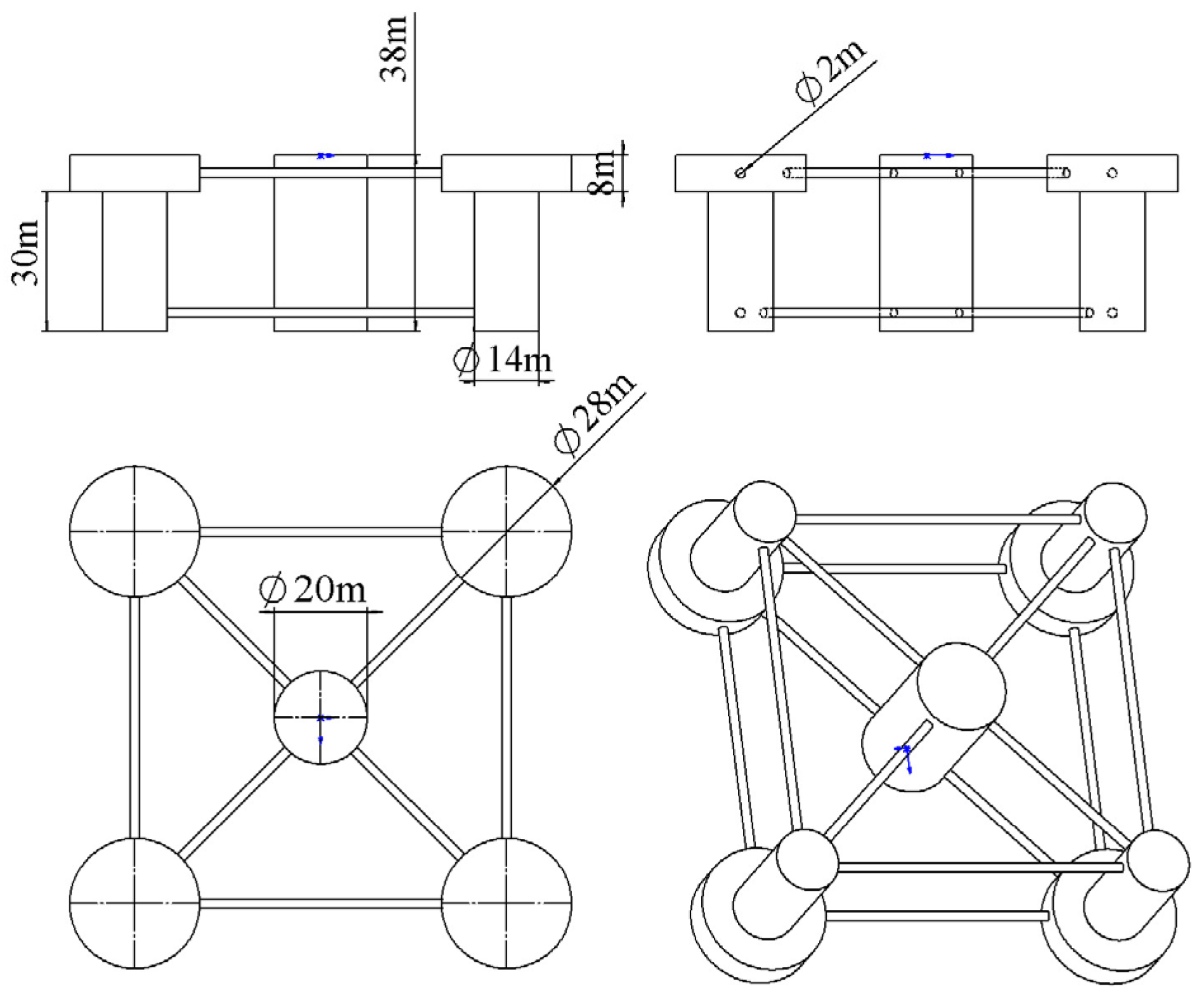
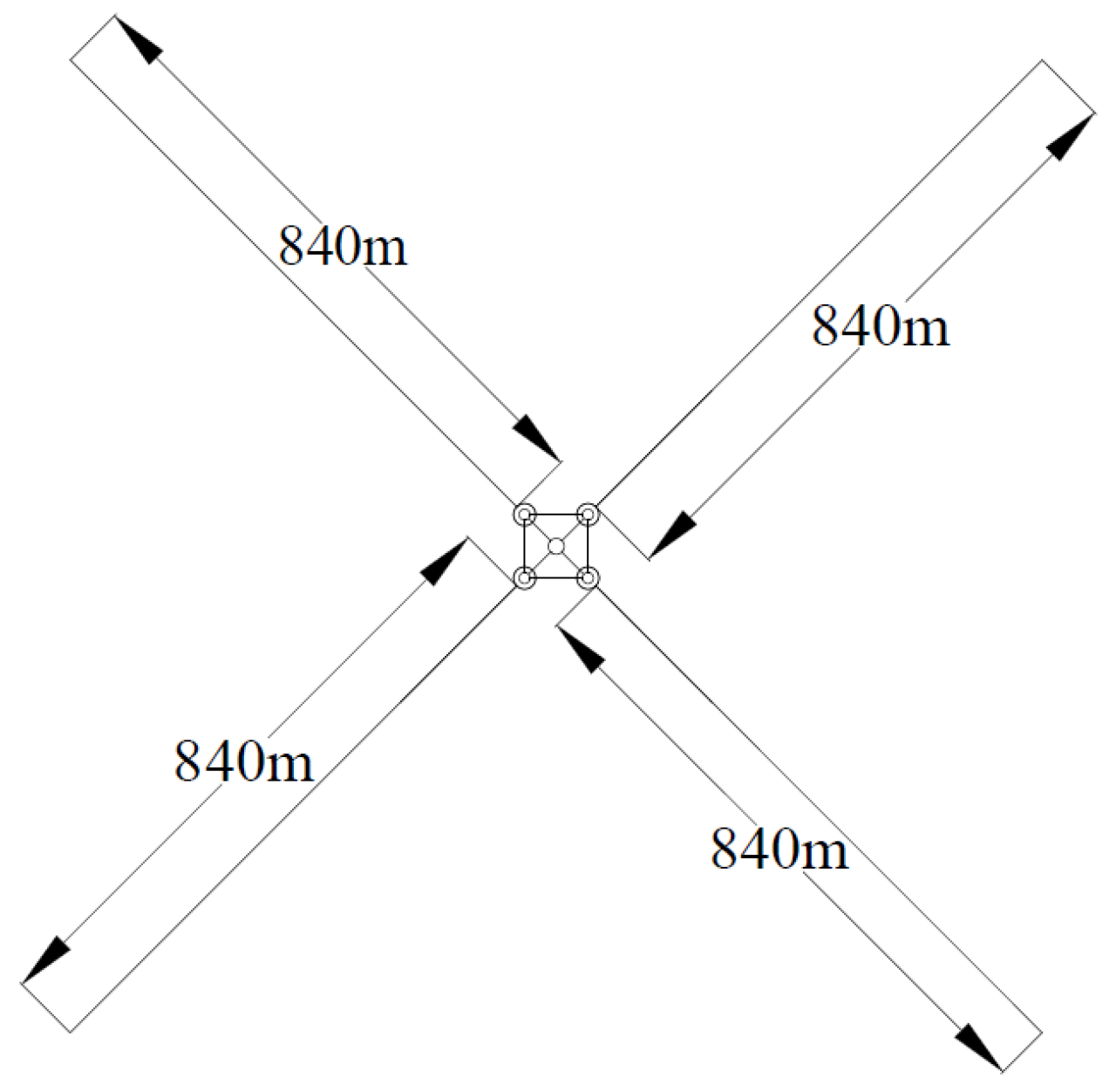
The DeepCwind platform, developed by the U.S. National Renewable Energy Laboratory for the OC4 project, serves as the reference semi-submersible structure for this study. Building upon the OC4 design, the platform proposed in this paper replaces the original three-float configuration with an improved four-float arrangement, in which four peripheral floats are connected to a central column. Compared to traditional three-float designs such as the OC4 DeepCwind and WindFloat platforms, this novel four-float configuration offers specific structural and hydrodynamic advantages. While three-float platforms are widely used, their asymmetric geometry under certain wave headings can lead to uneven mooring line tensions and complex coupled motions. The highly symmetrical square layout of our four-float design provides a more uniform restoring stiffness and a more homogeneous wave diffraction effect across all incident wave angles. Furthermore, the four-column geometry naturally accommodates an orthogonal four-point mooring system, which provides superior control over the platform’s yaw and sway motions. The resulting system consists of one central float supporting the DTU 10 MW wind turbine at an installation height of 119 m, surrounded by four outer floats arranged in a square layout. These peripheral floats are linked to the central column by a circular truss structure, and each is equipped with a circular ballast tank at its base. The adoption of a circular ballast tank helps reduce overall construction costs, lowers the platform’s center of gravity, and enhances global stability. The key design specifications of the proposed four-float platform are summarized in Table 1. The geometric configuration and detailed three-view diagrams are presented in Figure 1. Furthermore, the operational parameters of the DTU 10 MW wind turbine and the corresponding mooring system design are detailed in Table 2 and Table 3, respectively. Figure 2 illustrates the layout and design parameters of the orthogonal mooring system.
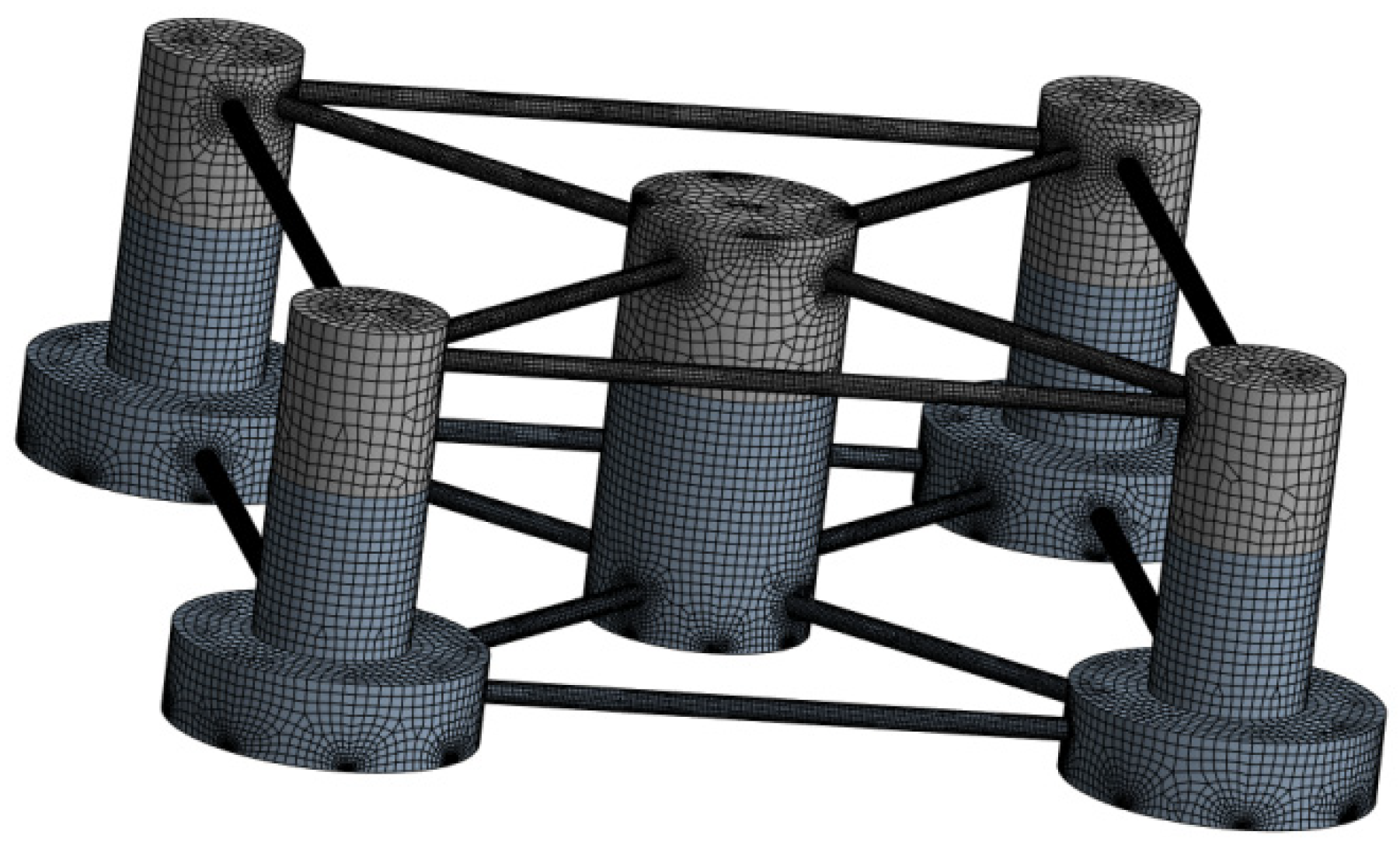
In this study, the geometric model of the proposed floating wind turbine platform is constructed using Rhino (version 8, Robert McNeel & Associates, Seattle, WA, USA) and SolidWorks (version 2023, Dassault Systèmes, Vélizy-Villacoublay, France). The model is subsequently imported into ANSYS Workbench, where the hydrodynamic model is established and analyzed using AQWA. Numerical simulations of the platform’s hydrodynamic behavior are then performed in the AQWA environment. Figure 3 shows the detailed mesh models of the four floating wind turbine platforms established for these simulations.
To ensure numerical reproducibility, the specific solver configurations and environmental settings within the ANSYS AQWA framework are detailed herein. It is important to note that, as a BEM-based potential flow solver, AQWA does not utilize conventional FVM advection discretization schemes or monitor continuity equation residuals. Instead, the fundamental solution algorithm relies on evaluating the boundary integral equations employing the 3D free-surface Green’s function method. The platform’s wetted surface is discretized into constant-parameter quadrilateral and triangular boundary panels. The resulting dense complex linear algebraic system matrices are iteratively resolved using the Generalized Minimal Residual (GMRES) method embedded in the solver.
Regarding the environmental parameters, the hydrodynamic calculations were executed with a seawater density of 1025 kg/m3 and a gravitational acceleration of 9.806 m/s2. For the frequency-domain evaluations, the incident wave periods were discretized from 3 s to 60 s, corresponding to an angular frequency range of approximately 0.105 rad/s to 2.094 rad/s, which ensures the inclusion of both high-frequency wind waves and low-frequency swell components. Furthermore, by leveraging the structural symmetry of the four-float platform, the wave heading angles were defined from 0° to 90° with a 15° increment. This angular range is sufficient to rigorously characterize the motion responses and wave loads for all critical directions.
To ensure the accuracy and reliability of AQWA’s numerical results, a rigorous mesh-convergence study was conducted prior to the full hydrodynamic analysis. Three different mesh densities (Coarse, Medium, and Fine) were generated by adjusting the maximum element size to 1.40 m, 0.87 m, and 0.50 m, respectively. The peak added mass in the heave direction was selected as the reference parameter for convergence evaluation. As presented in Table 4, the relative difference in the peak added mass between the Medium and Fine mesh schemes is merely 0.01%. Considering both the computational accuracy and hardware efficiency, the Medium mesh strategy (with a maximum element size of 0.87 m and 20,194 elements) was adopted for all subsequent hydrodynamic and time-domain simulations in this study.
Based on three-dimensional potential flow theory, a series of hydrodynamic analyses of the four-float wind turbine platform is conducted using ANSYS AQWA. After meshing the model, multi-directional and multi-period wave conditions are applied to evaluate its hydrodynamic performance. The incident wave periods range from 3 s to 60 s, totaling 58 discrete periods. Wave directions are defined from −180° to 180°, with regular-wave simulations performed at 15° intervals. AQWA adopts its own convention for defining wave angles. A wave propagating in the positive X-direction corresponds to a wave direction of 0°, while propagation along the positive Y-direction corresponds to 90°. As the wave direction rotates counterclockwise from the positive X-axis toward the positive Y-axis, the wave angle increases accordingly, starting from 0°.

3.2. Time Step Independence Test

To ensure numerical stability and accuracy in the transient time-domain simulations, a temporal convergence check was conducted immediately after the spatial mesh independence verification. For floating offshore structures, an appropriate time step is essential to capture high-frequency wave excitations while maintaining computational efficiency for long-duration simulations.
Three different time steps, Δt = 0.2 s, 0.1 s and 0.05 s, were evaluated under the extreme survival sea state. Each simulation was run for 10,800 s (3 h) to ensure statistical significance. Notably, to eliminate the start-up transient effects often associated with the platform’s initial acceleration, the first 800 s of the time series were treated as the ramp-up period and excluded. A representative stable window from 800 s to 8000 s was then selected for the convergence analysis.
As shown in Table 5, the 0.2 s time step exhibited minor numerical dissipation in capturing peak responses. However, when the step was reduced to 0.1 s, the results became highly consistent with those obtained with the 0.05 s step. The relative error in the maximum pitch response between Δt = 0.1 s and Δt = 0.05 s was found to be strictly less than 0.5%. Therefore, to achieve an optimal balance between numerical fidelity and computational cost for the extensive transient study, Δt = 0.1 s was rigorously selected as the standard time step for all subsequent analyses.

3.3. Marine Conditions

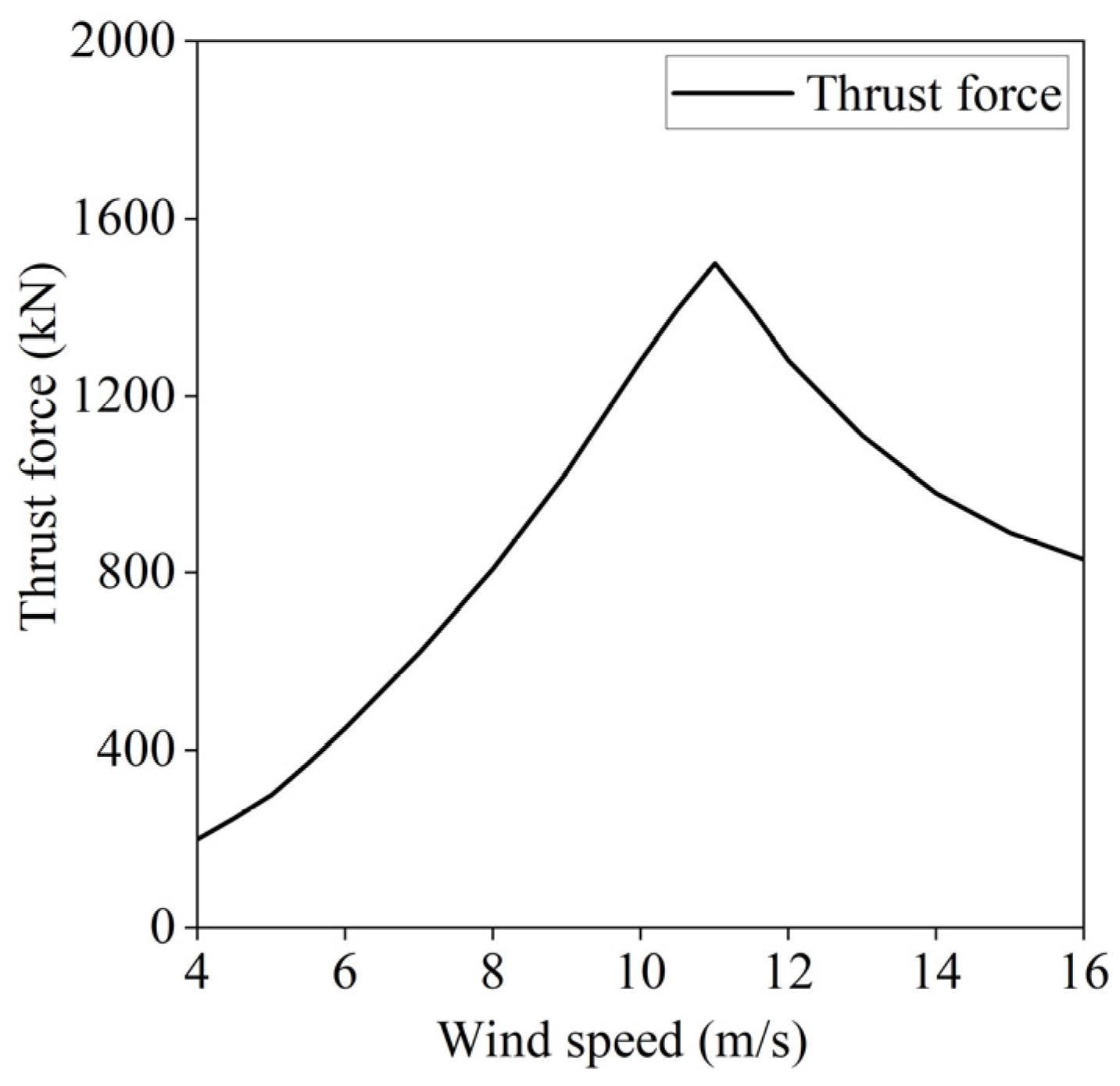
In this study, the JONSWAP spectrum is chosen as the wave spectrum. Two marine conditions, operational sea state and survival sea state, are designed to comprehensively consider the motion response and mooring line tension of the four-float wind turbine platform under the combined effects of wind, waves, and currents. The specific parameters for the operational and survival sea conditions are shown in Table 6, and Figure 4 presents the thrust diagram of the DTU 10 MW wind turbine. The incident angle of each load direction is 90°, and the duration of the applied load is 10,800 s. To avoid transient responses, dynamic response results are taken from the time period between 800 s and 8000 s. According to Figure 4, the wind turbine thrust in the operational sea state is 1500 kN, while in the survival sea state, the wind turbine thrust is 2080 kN [44].

4. Discussion

4.1. Frequency-Domain Analysis

4.1.1. Added Mass

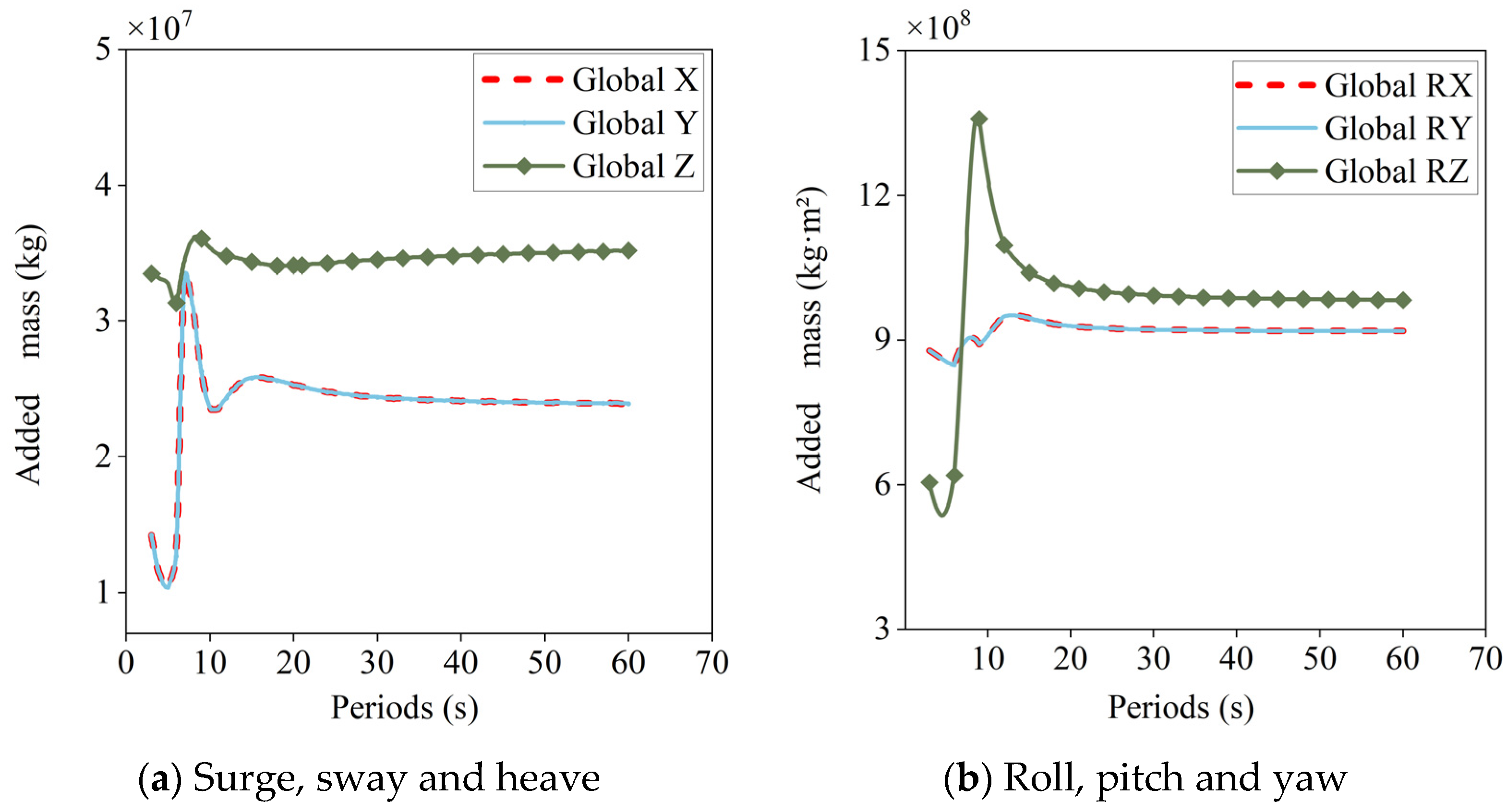
When an object accelerates or decelerates in a fluid (such as air or water), the equivalent mass increment, which is required to simultaneously increase the kinetic energy of both the object and the fluid due to the applied force, is referred to as added mass. The added mass depends on the fluid’s density, the wet surface shape of the four-float wind turbine platform, and the wave frequency. Generally, the added mass is on the same order of magnitude as the mass of the floating body. The results for the six degrees of freedom of the four-float wind turbine platform—heave, pitch, roll, sway, surge, and yaw—are listed below. Figure 5 shows the added mass for the six degrees of freedom.
From the analysis of the figure, it is evident that the high geometric symmetry of the four-float platform results in similar trends for the surge and sway motions, as well as for the roll and pitch motions; their added mass responses are generally of the same order of magnitude. Overall, the added mass curves for all six degrees of freedom exhibit a smooth transition from fluctuating behavior to a stable state.
For surge and sway, the maximum added mass is approximately 3.3 × 10⁷ kg at a wave period of 7 s, while the minimum reaches about 1.03 × 10⁷ kg at 5 s. The curve first decreases to a minimum, then rises to a peak, followed by a slight drop before increasing again and eventually stabilizing at around 2.39 × 10⁷ kg. In the heave direction, the maximum added mass is about 3.6 × 10⁷ kg at 9 s, and the minimum is 3.13 × 10⁷ kg at 6 s. The trend similarly shows an initial decrease, a subsequent increase to the peak, and a final stabilization near 3.5 × 10⁷ kg.
The pitch and roll added mass responses exhibit more pronounced fluctuations. Their minimum value is 8.7 × 10⁸ kg·m2 at 5 s, and the maximum reaches 9.52 × 10⁸ kg·m2 at 13 s. The curve initially decreases and then increases, followed by additional oscillations around 8 s. After reaching the maximum, it decreases and ultimately stabilizes near 9.2 × 10⁸ kg·m2. The yaw added mass curve shows a similar pattern to that of pitch, with a maximum of 1.359 × 10⁹ kg·m2 at 13 s and a minimum of 8.38 × 10⁸ kg·m2 at 5 s, stabilizing around 9.83 × 10⁸ kg·m2.

4.1.2. Radiation Damping

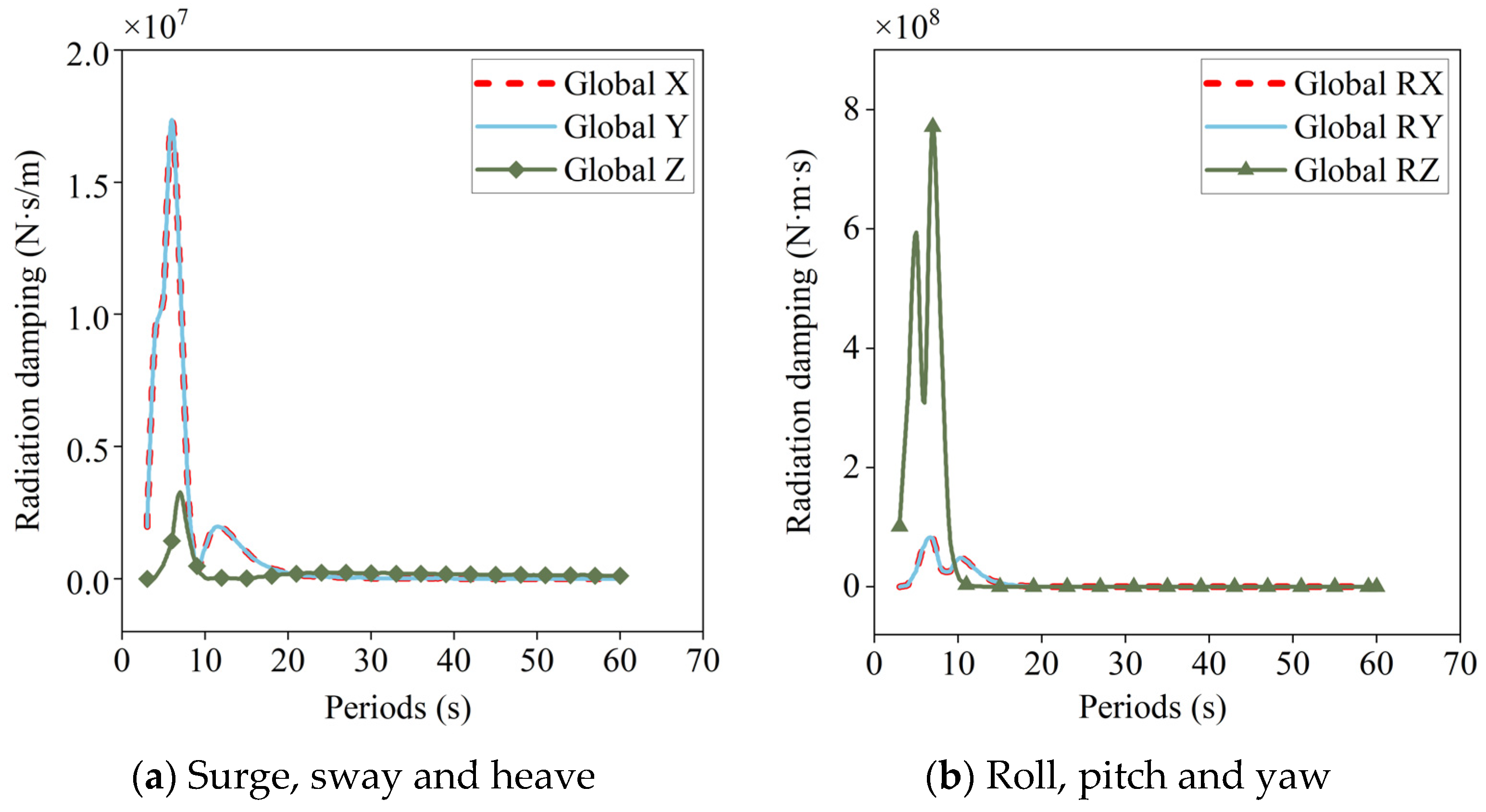
Radiation damping describes the phenomenon of energy loss due to wave radiation when a floating body moves in a fluid, reflecting the energy dissipation effect of fluid oscillations on the floating body’s motion. The value of radiation damping is proportional to the velocity of the four-float wind turbine platform. Figure 6 shows the radiation damping for the six degrees of freedom.
From the figure, the radiation damping curves for surge and sway show nearly identical behavior. Both increase sharply at the beginning, reaching a peak value of 1.7 × 10⁷ N·s/m at a wave period of 6 s, followed by a steep decline to a minimum of 4.8 × 10⁵ N·s/m at 9 s. The curves then exhibit a slight rise, followed by a gradual decrease and stabilization at approximately 1.47 × 10⁵ N·s/m.
In the heave direction, the radiation damping also rises rapidly from a small initial value, reaching a maximum of 3.3 × 10⁶ N·s/m at 7 s. It then drops sharply to 3.5 × 10⁴ N·s/m at 10 s, followed by minor fluctuations, and ultimately converges to a steady value of around 1.23 × 10⁵ N·s/m.
For pitch and roll, the radiation damping curves exhibit more pronounced oscillatory behavior. Moreover, the damping first increases sharply, reaching a maximum of 8.1 × 10⁷ N·m·s at 7 s, before decreasing to a local minimum at 9 s. It then rises again to another peak at 11 s, after which it steadily declines and stabilizes at approximately 6.5 × 10⁸ N·m·s.
In the yaw direction, the radiation damping increases rapidly to a peak of 5.9 × 10⁸ N·m·s at 5 s and then decreases to a minimum of 3.09 × 10⁸ N·m·s at 6 s. This is followed by another sharp rise to 7.7 × 10⁸ N·m·s at 7 s. Finally, the damping decreases continuously and stabilizes near 6.5 × 10⁸ N·m·s.

4.1.3. Response Amplitude Operator (Without Damping Correction)

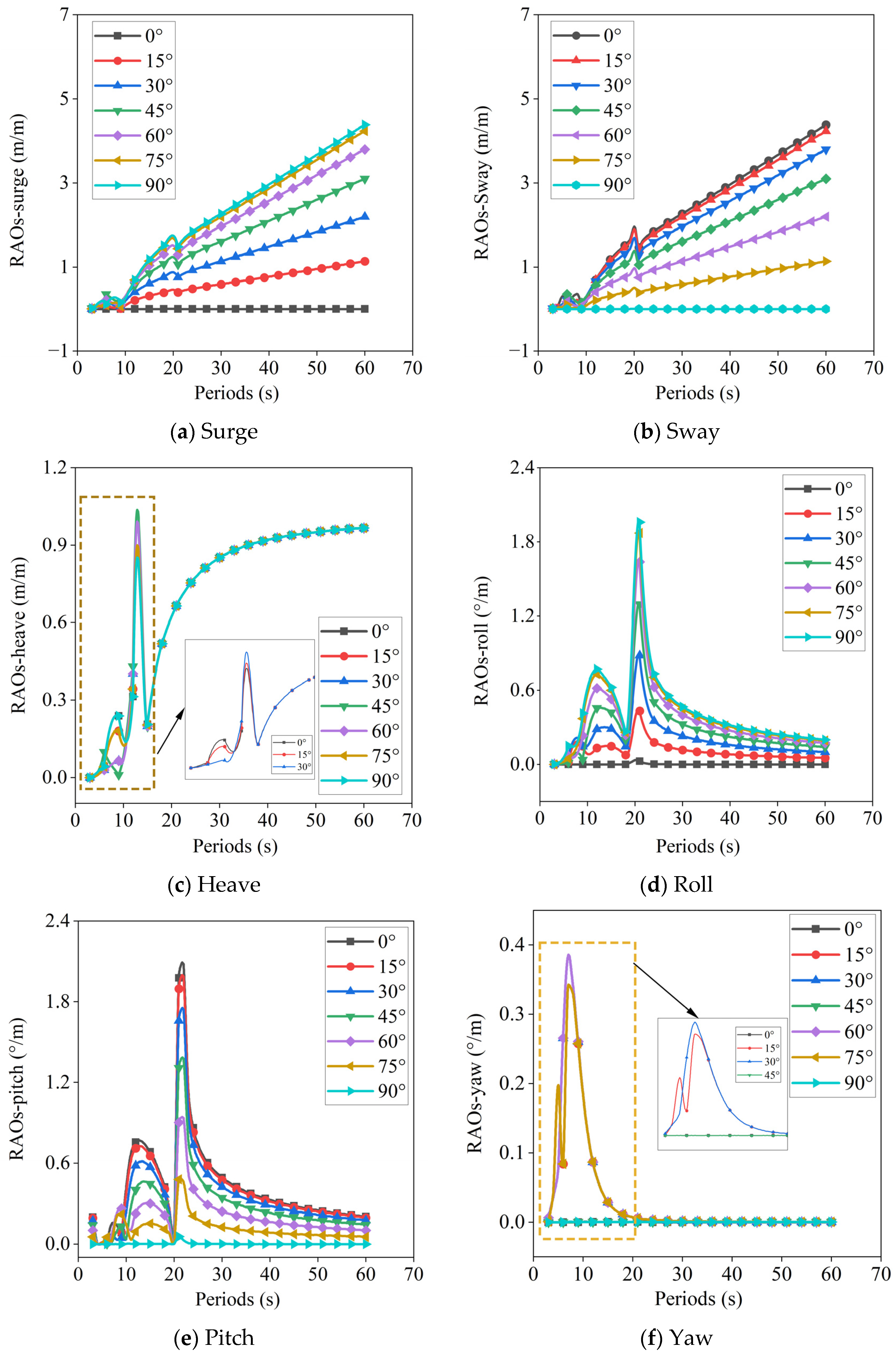
The response amplitude operator is a parameter used to describe the vibration response characteristics of a floating platform under wave excitation. RAO is a complex function that represents the amplitude and phase of the platform’s vibration response as a function of wave frequency. The calculation of RAO is based on the dynamic model of the floating platform and wave theory, obtained through numerical simulation methods (such as finite element analysis and CFD) or experimental tests (such as wind tunnel and water tank tests). RAO is an important parameter for evaluating the vibration response characteristics of a floating platform under wave action. It can be used in ship design, offshore engineering, and the structural safety assessment of floating platform systems. The RAO of a floating platform represents its ability to resist external forces and, to some extent, reflects the stability of the floating wind turbine platform. Due to the high geometric symmetry of the new floating wind turbine platform, this section selects the amplitude response operator (RAO) curves for 7 incident angles in the range of 0° to 90° to explore the variation in the RAO curves under different wave directions. Figure 7 shows the RAO for the six degrees of freedom.
As illustrated in Figure 7, the RAO results exhibit significant sensitivity to wave incidence angles, with specific directions serving as “critical angles” that govern the maximum responses. For this highly symmetrical four-float configuration, the critical angles are intrinsically linked to the spatial phase differences in the waves acting on the separated columns. For example, a 0° incident wave creates the maximum phase difference between the front and rear floats, generating the largest overturning moment. Consequently, the data show that 0° acts as the critical angle for pitch and surge motions, exciting the highest RAO peaks in these directions. Similarly, a 90° wave incidence creates the maximum phase difference between the left and right floats, serving as the critical angle that maximizes the roll and sway RAOs. At a 45° incidence, the wave loads are distributed diagonally across the platform, leading to highly coupled but generally sub-maximal responses. Therefore, identifying these critical angles and evaluating their corresponding peak RAOs is essential, as they represent the most severe wave loading scenarios for the platform’s stability.
AQWA uses potential flow theory for calculations, which does not account for fluid viscosity. This leads to larger data results for the platform’s motion response, which does not align with actual conditions. From the analysis of the above figure, it is clear that the RAO peak values are too high. Therefore, damping correction is necessary. Using 5% [5] of the critical damping as the viscous damping correction for heave, roll, and pitch, the artificial damping matrix is obtained as shown in the following table. A known inherent limitation of the three-dimensional potential flow theory is the assumption of an inviscid fluid, which fundamentally neglects viscous damping forces and fluid separation effects. Consequently, numerical solvers like AQWA typically over-predict motion responses near the platform’s natural resonance frequencies. To bridge the gap between idealized numerical assumptions and real-world physical conditions, it is an internationally established industry practice to introduce an empirical viscous damping matrix. In the absence of specific physical free-decay test data for this newly optimized geometry, an empirical critical damping value of 5% was used. This approach is strongly supported by standard FOWT benchmark methodologies, such as the NREL DeepCwind and OC4 collaboration projects, where equivalent viscous damping ratios for semi-submersibles typically range between 4% and 8% to realistically approximate the viscous effects of pontoons and columns. Therefore, the implementation of this empirical damping provides a reliable engineering approximation to evaluate the baseline hydrodynamic feasibility prior to conducting future scaled wave basin tests. The artificial damping matrix is then imported for solving to obtain the corrected RAO.
To account for the viscous effects neglected by potential flow theory, an empirical artificial damping matrix is introduced. Based on the principles of structural dynamics and standard practices for floating offshore wind turbines [46], the added viscous damping for a specific translational degree of freedom is calculated as follows:
D c r i t i c a l = 2 M K
where: M is the total structural mass corresponding to the specific translational degree of freedom; K represents the hydrostatic restoring stiffness corresponding to that degree of freedom.
For rotational degrees of freedom (such as roll and pitch), where the rotational inertia governs the dynamic response, the critical damping formulation is transformed as follows [47]:
D c r i t i c a l = 2 ( I + Δ I ) K
where: I is the structural mass moment of inertia for the corresponding rotational degree of freedom; ΔI denotes the added mass moment of inertia for that specific degree of freedom; K represents the restoring stiffness in the rotational degree of freedom.
Using the aforementioned formulations and adopting a 5% critical damping ratio, the artificial viscous damping matrix presented in Table 7 is calculated.

4.1.4. Response Amplitude Operator (With Damping Correction)

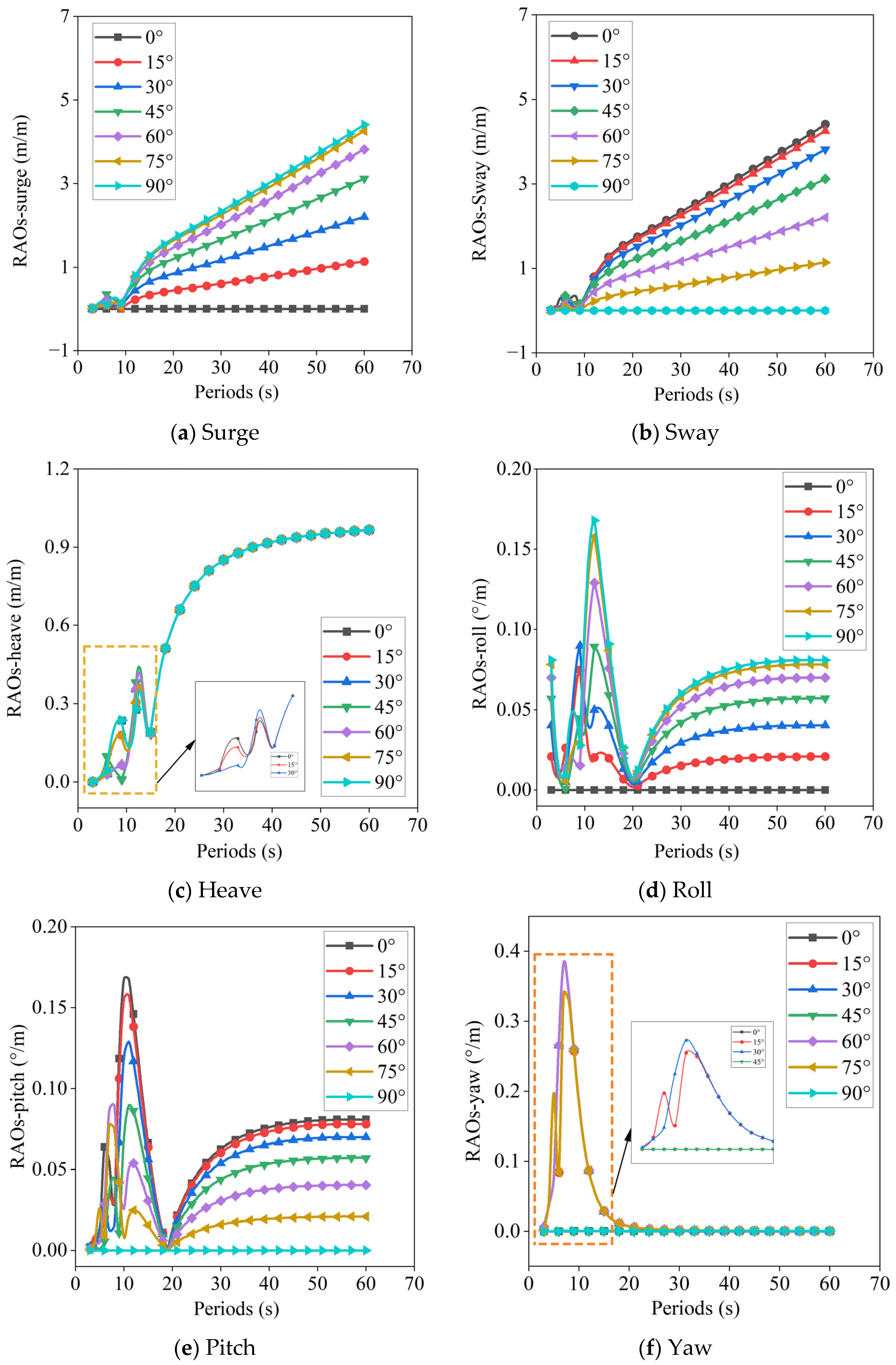
After applying damping corrections, the RAO curves for all six degrees of freedom—surge, sway, heave, roll, pitch, and yaw—are presented in Figure 8. As shown, the surge and sway responses follow similar trends: when the wave period is below 9 s, the RAOs increase and then decrease; for periods greater than 9 s, both rise again. Their distinction lies in the wave direction at which the peak occurs: the surge RAO reaches its maximum at 0°, while the sway RAO peaks at 90°, with both maxima equal to 4.4 m/m. The heave RAO exhibits relatively small variations across different wave directions. Its overall trend features initial oscillations, followed by a rise and subsequent decline, and finally stabilizes at approximately 1 m/m. The roll and pitch RAO curves display comparable characteristics: the roll RAO at 0° and the pitch RAO at 90° remain nearly flat, whereas other wave directions show a pattern of increasing, then decreasing, and rising again before approaching a stable level. The roll motion attains its maximum RAO at 90°, while the pitch motion peaks at 0°. The yaw RAO curve shows a more complex behavior, with a general pattern of rising, then falling, and ultimately stabilizing. Its maximum value occurs at a wave direction of 60°, with a value of 0.3835°/m.
From an engineering perspective, suppressing these rotational responses (pitch and roll) is of utmost importance to the structural integrity of the system. For a massive 10 MW turbine with a 119 m hub height and a high center of gravity, mitigating rotational resonance directly and drastically reduces the severe tower-base bending moments and gyroscopic effects. The highly symmetrical four-float geometry provides uniform omnidirectional restoring stiffness, making it exceptionally effective in achieving this primary design objective.
As can be observed by comparing Figure 7 and Figure 8, there is little visible difference in the RAO profiles for the translational degrees of freedom, namely surge, sway, and heave (subplots a, b, and c). The physical rationale for this similarity is that the natural resonance periods of the platform in surge and sway typically exceed 100 s, which lies far beyond the primary wave energy spectrum (0–60 s) evaluated herein. Consequently, within this wave-frequency range, the platform’s translational responses are predominantly governed by system inertia and wave excitation forces rather than damping. The introduction of the artificial viscous damping matrix, therefore, yields a negligible impact on these specific translational curves.
However, the indispensable necessity of the damping modification becomes unmistakably apparent in the rotational degrees of freedom, specifically roll and pitch (subplots d and e). Because 3D linear potential flow theory assumes an inviscid fluid, it inherently fails to capture viscous flow separation and eddy-making damping around the columns and pontoons. This theoretical limitation causes the solver to drastically over-predict the motion amplitudes near the rotational natural frequencies. For instance, without the damping correction (Figure 7), the peak pitch RAO reaches an unrealistic value of 2.08 °/m. Upon introducing the 5% critical viscous damping correction (Figure 8), this unrealistic resonance peak is successfully suppressed by over 92% to approximately 0.168 °/m. Given that excessive pitch and roll motions would induce catastrophic gyroscopic loads and bending moments at the tower base of a massive 10 MW wind turbine, implementing this empirical damping modification is not merely an option, but an absolute prerequisite for yielding physically meaningful and safe design evaluations.
As illustrated in Figure 8, the peak responses in pitch and roll occur at low frequencies, which is a characteristic behavior for semi-submersible FOWTs. This trend is in good agreement with the benchmarking results of the OC4-Semi platform [4], indicating that the optimized four-float configuration maintains standard hydrodynamic performance for large-scale wind turbines.

4.1.5. First-Order Wave Forces

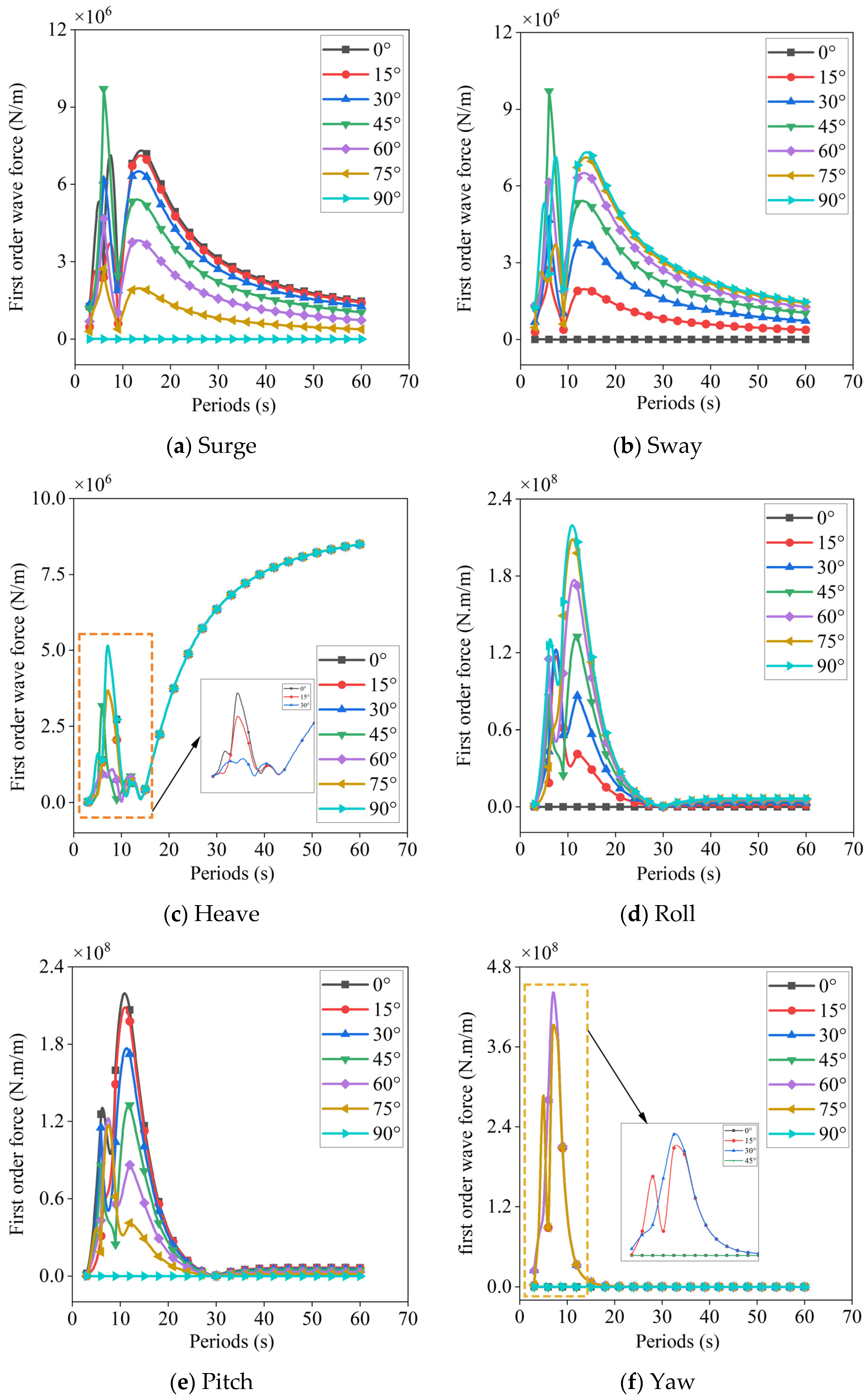
The first-order wave forces are the primary hydrodynamic loads acting on the four-float wind turbine platform under wave action. The amplitude of this force varies significantly and maintains the same frequency as the waves acting on the platform. In potential flow theory, the first-order wave forces are referred to as wave-exciting forces, including the F-K force and the diffraction force. The first-order wave force is proportional to the wave amplitude, and this proportional relationship is defined as the wave force transfer function. This paper presents the results of calculations of the floating platform’s first-order wave forces for the six degrees of freedom—sway, surge, heave, roll, pitch, and yaw. Due to the high symmetry of the geometric structure, only the first-order forces for seven wave directions in the 0° to 90° range are calculated, as shown in Figure 9.
Analysis of the first-order wave force curves for the six degrees of freedom reveals that surge and sway exhibit similar behaviors, as do roll and pitch. For surge and sway, the maximum force reaches 9.7 × 10⁶ N/m at a wave period of 6 s, with the largest response occurring at a wave direction of 45°. The first-order wave force in sway approaches zero when the wave direction is 90°, whereas in surge it approaches zero at 0°. For roll and pitch, the maximum first-order wave forces occur at a period of 11 s. The roll moment peaks at 1.35 × 10⁸ N·m/m at a wave direction of 90°, whereas the pitch moment reaches a maximum of 2.29 × 10⁸ N·m/m at 0°. In the heave direction, the first-order wave force increases up to a peak of 5.04 × 10⁶ N/m at 7 s (at a wave direction of 90°), after which it drops sharply, reaching a minimum around 14 s, with noticeable fluctuations around 12 s. Beyond 14 s, the curve shows a logarithmic upward trend, eventually attaining a maximum of 8.5 × 10⁶ N/m at 60 s, also with the wave direction at 90°. For yaw, the first-order wave force curve is comparatively simple. It reaches its maximum value of 4.4 × 10⁸ N·m/m at 7 s, while the yaw force approaches zero at wave directions of 0°, 45°, and 90°.
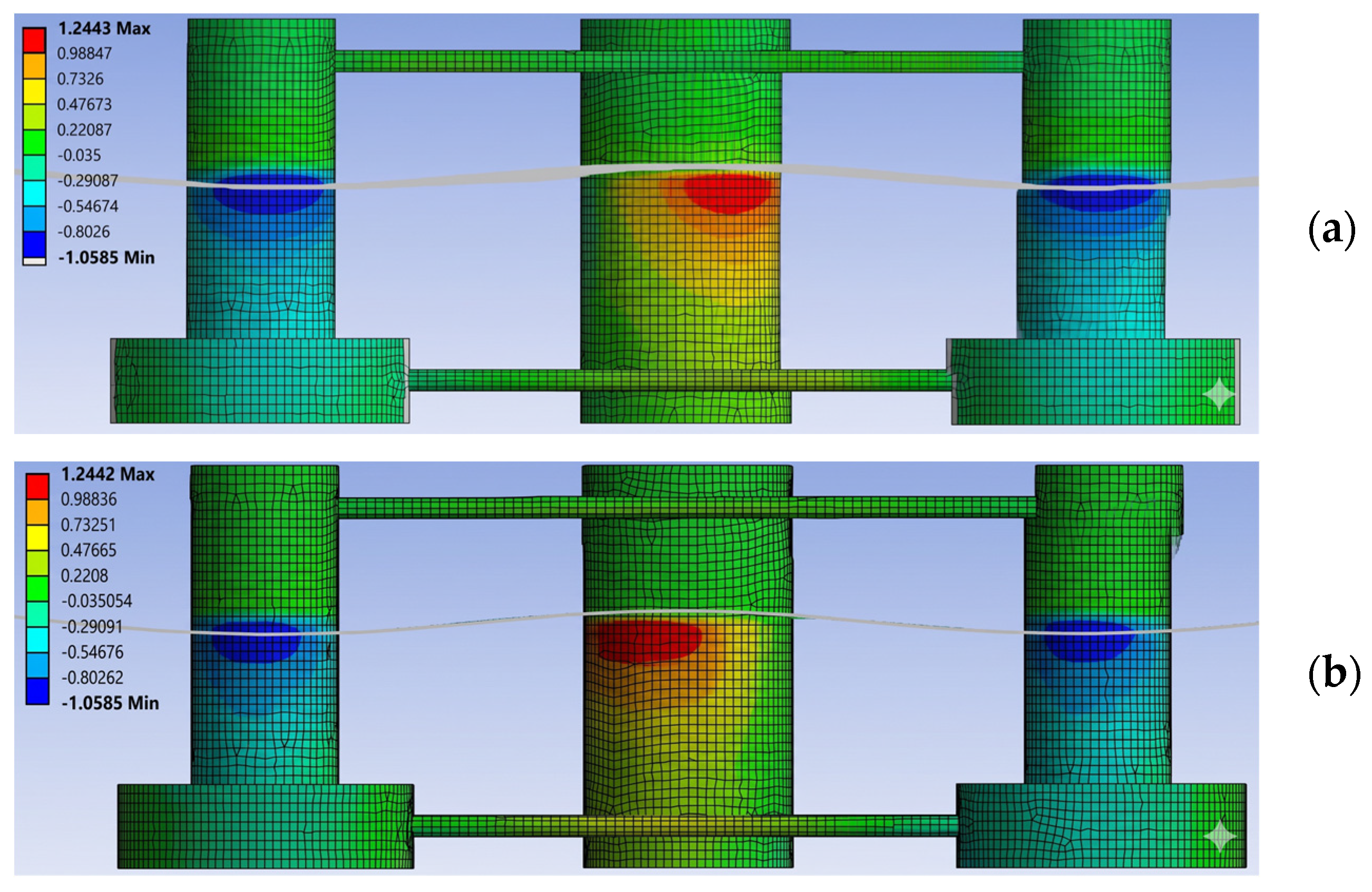
To intuitively and quantitatively illustrate the hydrodynamic load distribution on the four-float platform, Figure 10 shows dynamic pressure contour plots, expressed in equivalent water head (m), for two critical wave incidence angles. Figure 10a displays the pressure distribution viewed from the Y-axis when the wave propagates along the 0° direction (X-axis). It is clear that the dynamic pressure is highly concentrated on the windward faces of the upstream outer columns and the central column, causing a maximum pressure head of 1.2443 m and a minimum of −1.0585 m. This concentration directly contributes to the maximum surge force and pitching moment. Similarly, Figure 10b presents the pressure contour from the X-axis for a 90° wave incidence (propagating along the Y-axis). The high-pressure region shifts along the Y-axis with the windward columns, with a maximum pressure head of 1.2442 m and a minimum of −1.0585 m, mainly affecting the sway force and the rolling moment. These visualizations, both quantitatively and qualitatively, match the peak values seen in the first-order wave force transfer functions (Figure 9), further confirming the wave–structure interaction mechanisms.

4.1.6. Second-Order Wave Forces

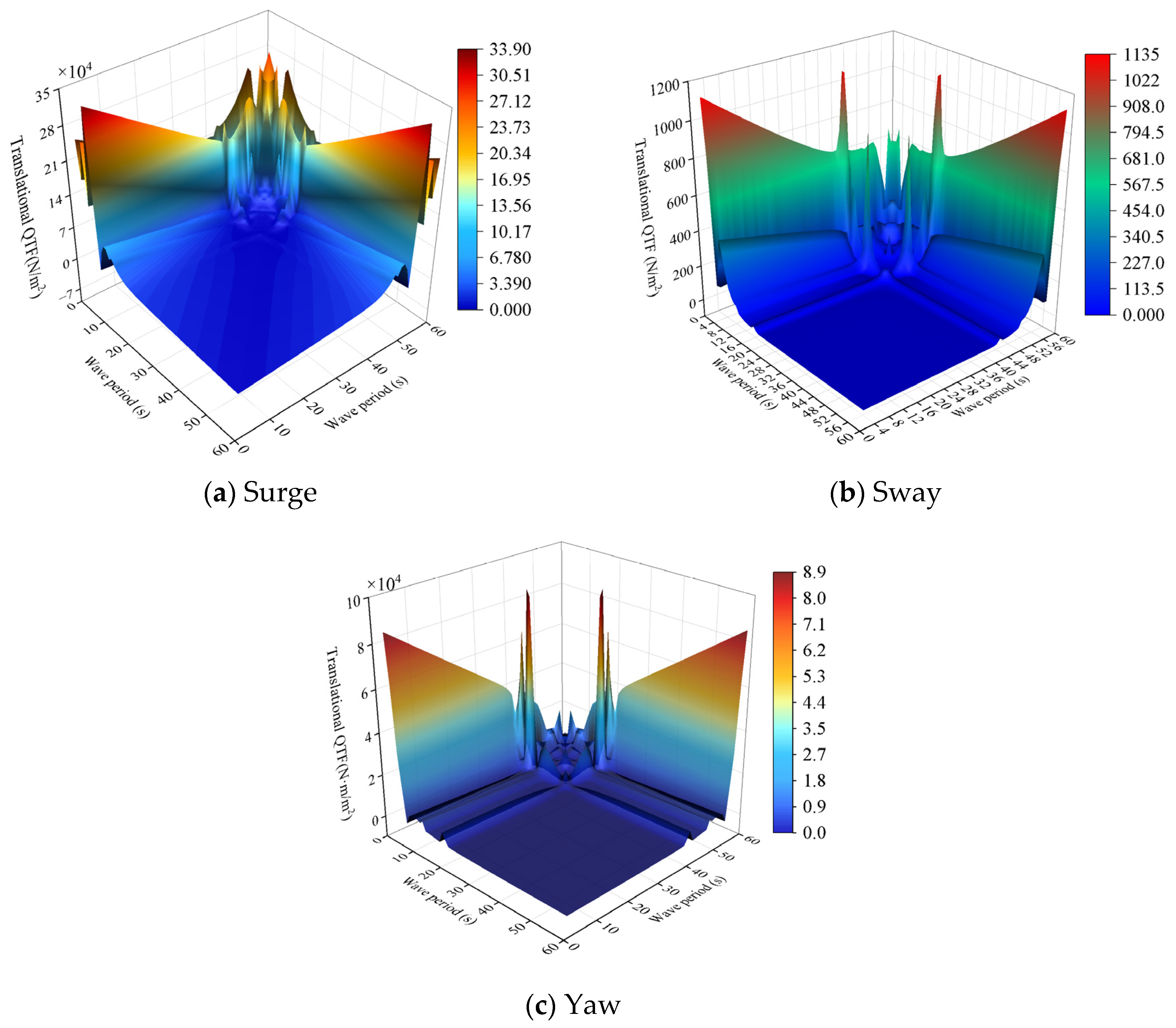
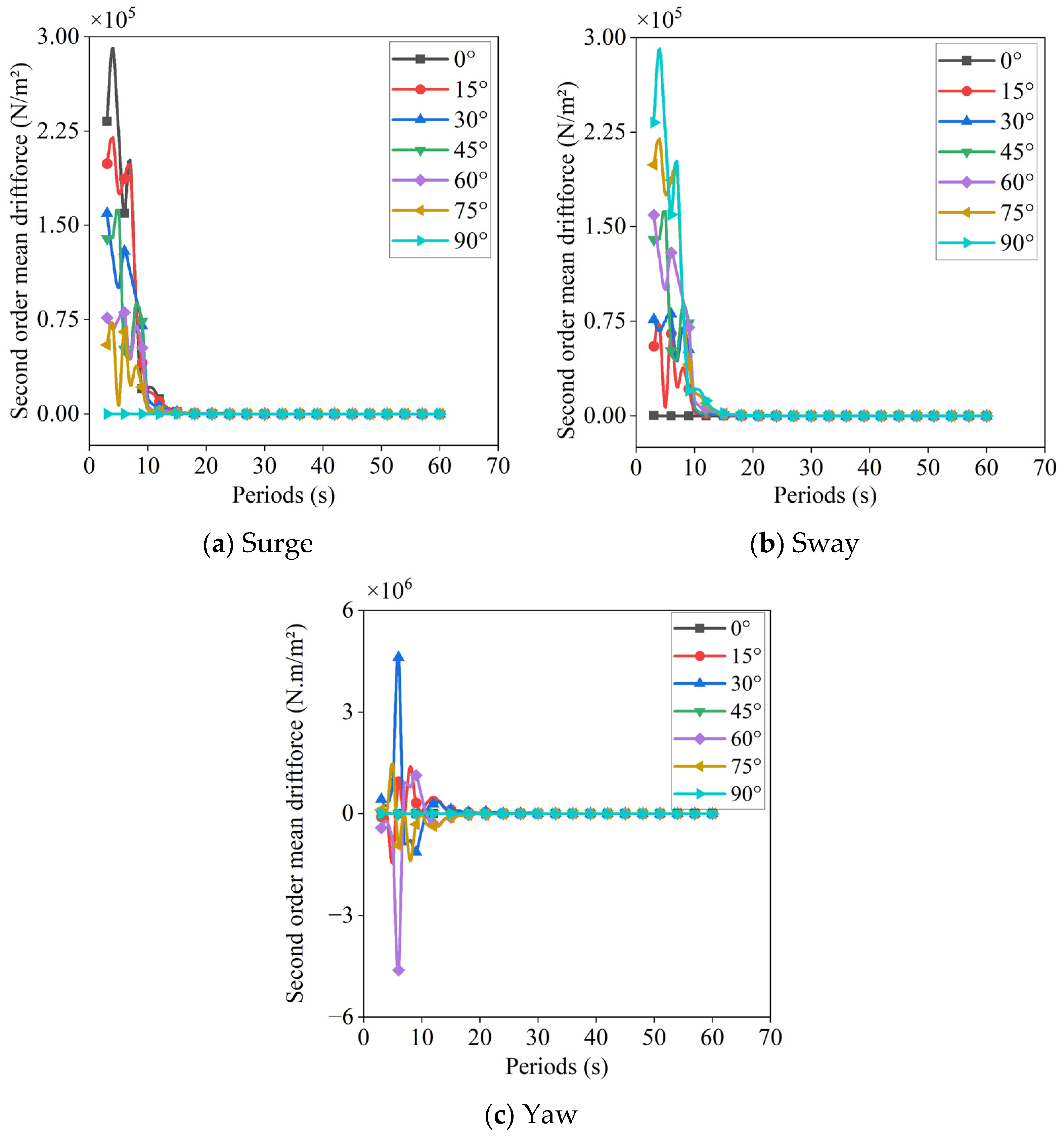
Second-order wave forces are caused by the movement of water particles in the direction of wave propagation. These forces mainly include steady mean wave forces, low-frequency difference-frequency wave forces, and high-frequency sum-frequency wave forces. Since the frequency of sum-frequency wave forces is much higher than the natural frequency of the floating platform, they can be neglected. This section only considers the second-order mean drift force and difference-frequency wave forces. The magnitude of second-order wave forces is small and follows a linear relationship with the square of the wave height. The ratio of these forces is known as the second-order wave force transfer function. In this paper, the far-field method is used to calculate the second-order mean drift force transfer function for sway, surge, and yaw over seven wave directions in the 0–90° range, as shown in Figure 11. By calculating the QTF matrix, the second-order difference-frequency force transfer functions for sway, surge, and yaw at 0° wave direction are obtained, as shown in Figure 12.
From the analysis of the image, it can be seen that the second-order mean drift forces for sway and surge are an order of magnitude smaller than the first-order wave forces, and for yaw, they are two orders of magnitude smaller. Before a wave period of 10 s, the second-order mean drift forces fluctuate significantly. However, the overall trend shows a rapid decrease. After 10 s, the forces stabilize at approximately 0 N·m/m2 across all wave directions. Results show negligible variation among different incident angles in this region. This is mainly due to two parameters: the highly symmetrical square layout of the four-float configuration and the wave period. The structural symmetry distributes wave loads evenly across different headings. At periods longer than 10 s, the wavelength greatly exceeds the platform’s characteristic dimensions. This reduces wave reflection and diffraction effects. As a result, second-order mean drift forces approach zero regardless of wave incident angle. The second-order drift forces for all wave directions are positive, with an overall decreasing trend, stabilizing around 0 N·m/m2 after 10 s. In the surge direction, the values for all wave directions are positive, with an overall decreasing trend approaching 0 N·m/m2. The second-order mean drift force in the yaw direction fluctuates significantly, with both positive and negative values, while the second-order mean drift force for wave directions of 0°, 45°, and 90° remains stable around 0 N·m/m2. The second-order mean drift forces calculated via the far-field method show a quadratic increase with wave frequency before tapering off, a phenomenon that has been extensively documented in the hydrodynamic analysis of multi-column floating structures [36].
From the analysis of Figure 12, it can be seen that the second-order difference-frequency forces are an order of magnitude lower than the first-order wave forces in the sway direction. In the surge direction, the second-order difference-frequency forces are two orders of magnitude lower than the first-order wave forces, and in the yaw direction, the second-order difference-frequency forces are four orders of magnitude lower than the first-order wave forces.

4.2. Time-Domain Calculation

Before proceeding with the detailed time-domain analysis, it is essential to evaluate the computational constraints imposed by running the current numerical model. The primary constraint stems from ANSYS AQWA’s theoretical foundation. While the 3D potential flow theory offers significant computational efficiency compared to high-fidelity Computational Fluid Dynamics (CFD) solvers—making long-duration simulations feasible—it inherently neglects fluid viscosity and complex non-linear flow separation. To mitigate this theoretical constraint, an empirical added damping method (as discussed in Section 4.1.3) had to be introduced. Furthermore, computational hardware limitations impose strict constraints on time-domain configurations. To accurately capture the platform’s low-frequency, slow-drift responses, an extensive simulation duration of 10,800 s was required. This necessitated a careful selection of the integration time step: it must be sufficiently small to accurately resolve the first-order wave frequency responses, yet large enough to maintain the total computational time and data storage within manageable limits for standard engineering workstations. Balancing these computational constraints ensures that the simulation remains both numerically stable and practically efficient.
Based on the series of hydrodynamic coefficients obtained from the frequency-domain analysis of the new floating platform, time-domain analysis is conducted by coupling wind, wave, current loads, and the mooring system. This approach provides a more realistic reflection of the platform’s motion response in actual marine conditions. Time-domain trajectory analysis under specific design sea conditions allows for the acquisition of time-domain motion responses for the six degrees of freedom, as well as mooring line tension and other data. By comprehensively analyzing these data, a more intuitive understanding of the hydrodynamic performance of the new floating platform under marine conditions can be obtained.

4.2.1. Time-Domain Response Curves and Mooring Tension Analysis Under Operational Sea State

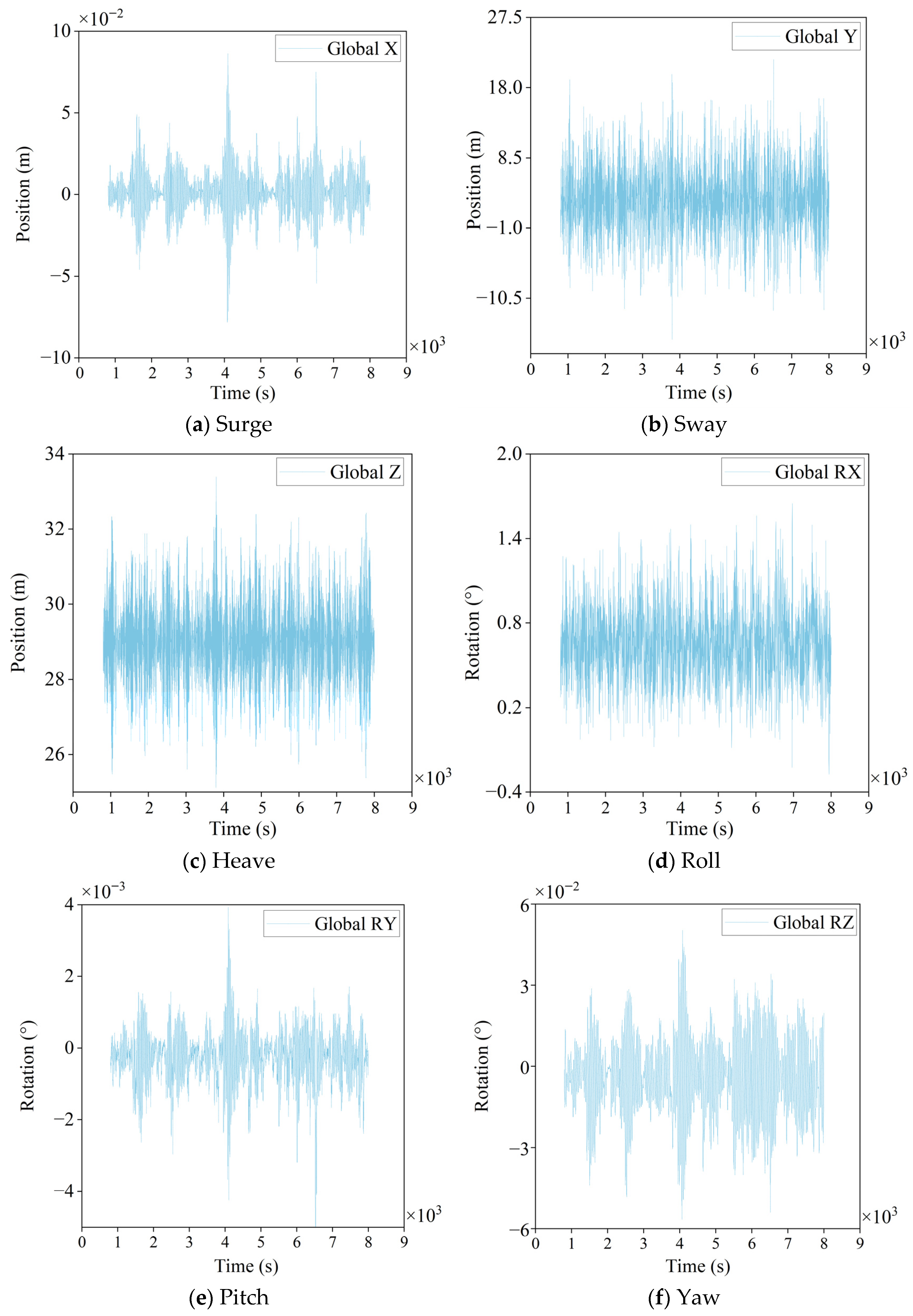
Waves exert continuously changing and persistent forces on the four-float wind turbine platform, which could lead to instability of the entire structure. Therefore, by analyzing the time-domain response curves of the structure, it is possible to determine whether the platform’s motion amplitude exceeds the safety threshold under wave loads, helping to prevent the new floating platform from capsizing or failing. Figure 13 and Table 7 show the time-domain motion response curves for the six degrees of freedom under operational sea conditions, with wind, wave, and current loads at a 90° angle, for the time period from 800 s to 8000 s.
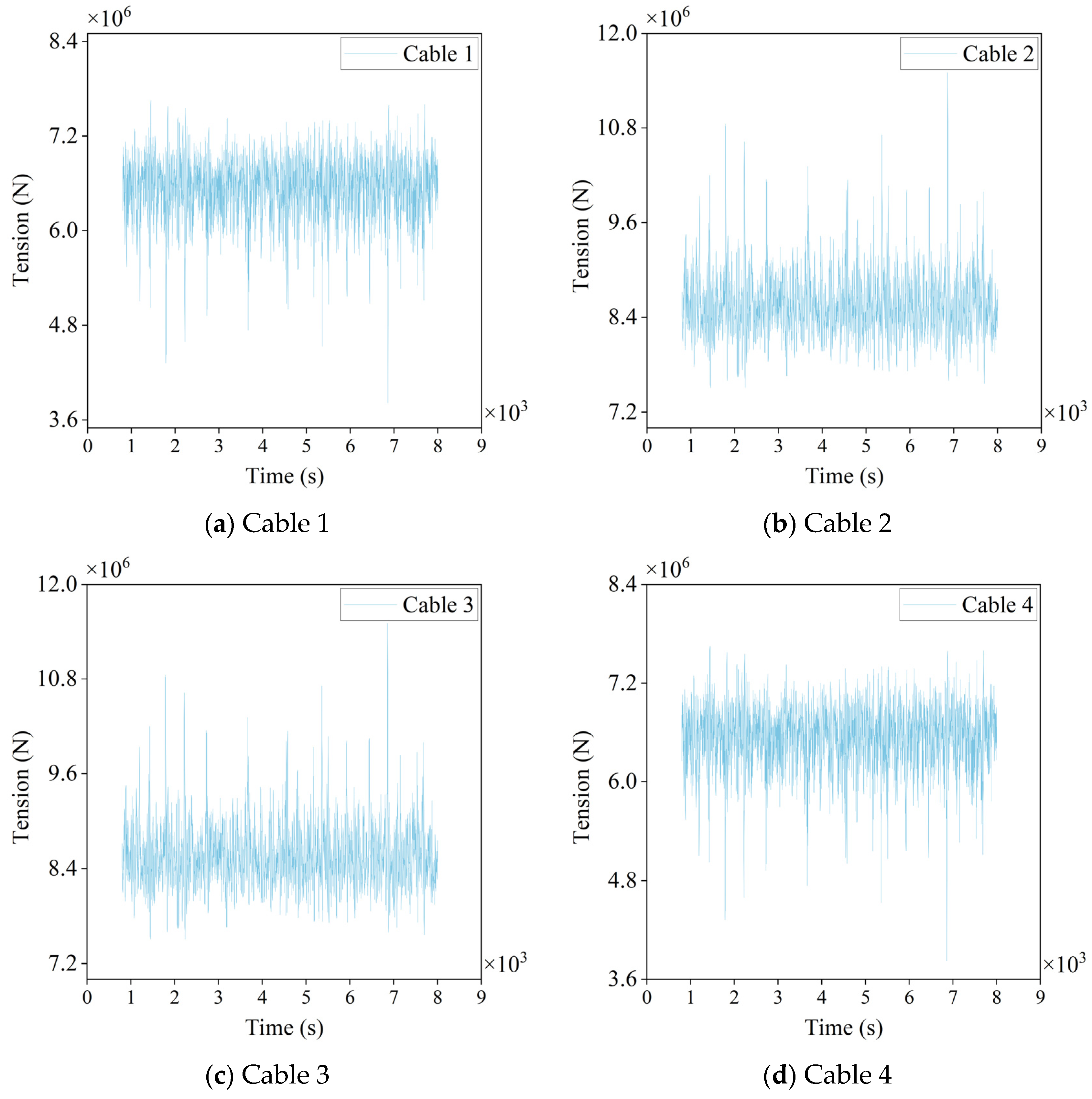
From the analysis of Figure 13 and Table 8, it can be concluded that under operational sea conditions, with wind, wave, and current loads at an incident angle of 90°, within the analysis period from 800 s to 8000 s, the overall motion amplitude of the four-float wind turbine platform is significantly small. Surge and heave are the primary response directions, but their amplitudes are limited, indicating that the wave excitation is weak, and the platform’s motion tends to stabilize. The sway, roll, and yaw responses are extremely small, indicating that the platform has good lateral stability and the ability to maintain its yaw direction. The force distribution on the structure is balanced, with no significant asymmetric motion observed. Both the maximum values and the standard deviations are low, and the platform does not exhibit drift or accumulated displacement in the time domain. The time series of the platform motions under operational conditions demonstrates stable oscillation amplitudes. The dynamic characteristics of the 119 m-tall tower and the massive 10 MW rotor are consistent with the design specifications of the DTU 10 MW reference wind turbine [42], further validating the integrated aero-hydro-servo-elastic coupling effects captured in our simulations. The mooring system provides sufficient restoring force and constraints, ensuring the platform’s steady-state response and safety under moderate sea conditions. Mooring tension is a core mechanical element that ensures the safe positioning and stable operation of the four-float wind turbine platform. It plays a key role in resisting environmental loads and maintaining precise positioning. The tension in each mooring line is shown in Figure 14.
From the analysis of Figure 14 and Table 9, it can be concluded that due to the structural symmetry of the four-float wind turbine platform, the tension curves in the diagram show periodic fluctuations, with densely distributed peaks and troughs, indicating that the mooring lines are significantly affected by the coupling of wave motion and platform motion. The tension variations in Cable 1 and Cable 4 are relatively stable, with smaller fluctuations, suggesting that these two mooring lines experience lighter loads and have a more balanced tension distribution. In contrast, the tension in Cable 2 and Cable 3 fluctuates more significantly, with peak values reaching approximately 1.15 × 10⁷ N, indicating that these lines are in the primary loading directions and are more strongly affected by wave excitation and the platform’s longitudinal motion. Based on the data in the table, the range of tension for each mooring line is between 3.8 × 10⁶ N and 4.0 × 10⁶ N, with moderate overall variation. Regarding the safety factor, Cable 1 and Cable 4 both have a safety factor of around 2.9, while Cable 2 and Cable 3 are slightly lower, still above 1.9. This indicates that none of the mooring lines are in danger of reaching the breaking load threshold, and the mooring system remains in a safe state.
Overall, the force distribution on the platform is reasonable, with the primary load-bearing mooring lines providing the main restoring force, while the other lines cooperate to constrain the platform, ensuring steady-state positioning and dynamic response control.

4.2.2. Time-Domain Response Curves and Mooring Tension Analysis Under Survival Sea State

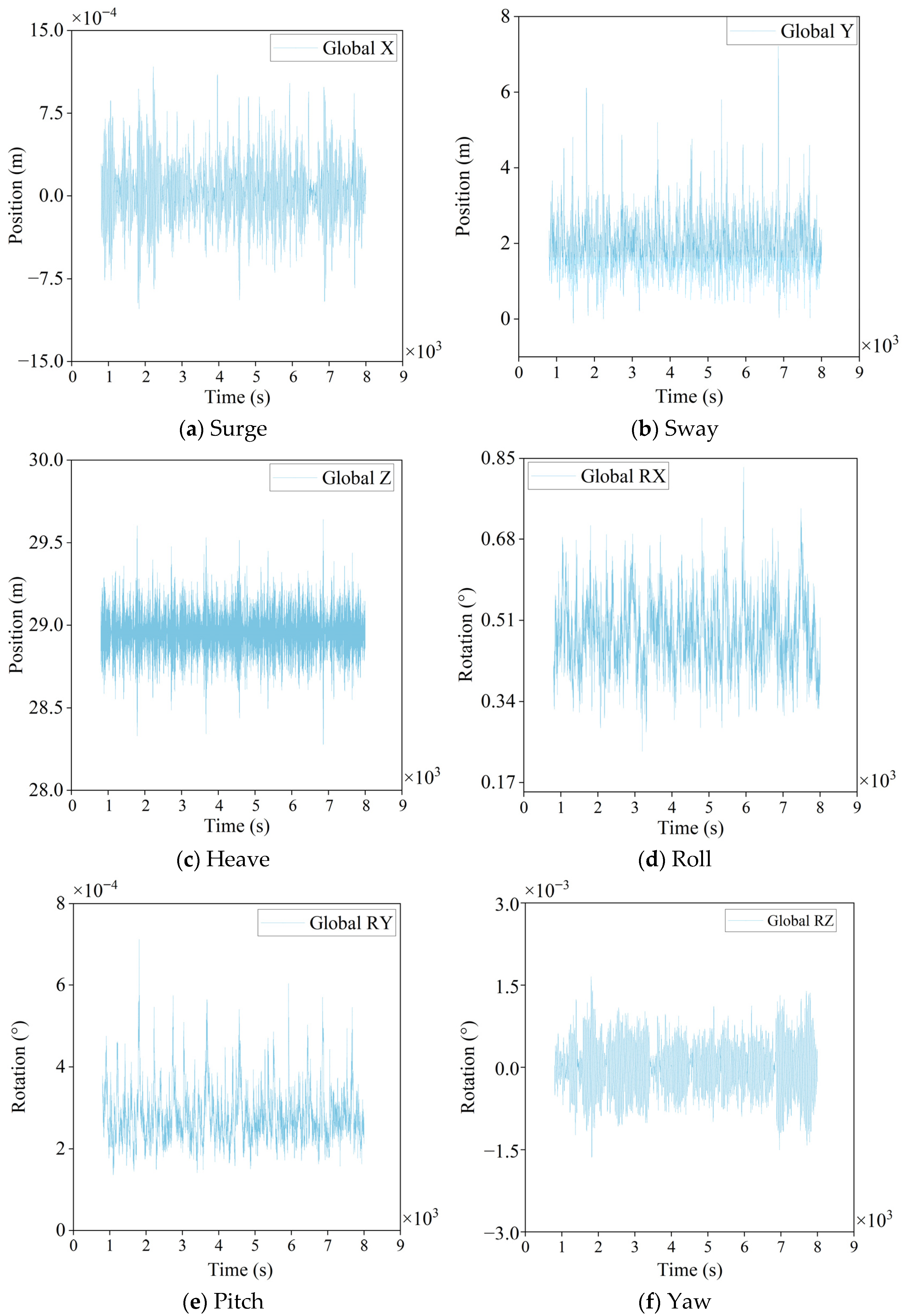
Figure 15 and Table 10 show the time-domain motion response curves for the six degrees of freedom under survival sea conditions, with wind, wave, and current loads acting simultaneously, over the time period from 800 s to 8000 s.
From the analysis of Figure 15 and Table 10, it can be concluded that under wind, wave, and current loads with an incident angle of 90°, the four-float wind turbine platform undergoes oscillatory motion in the six degrees of freedom during the analysis period from 800 s to 8000 s. The longitudinal and roll responses of the entire structure are relatively large, with the maximum single amplitude approaching 5 m. The fluctuation in the longitudinal and roll directions is also the most significant, with the maximum range reaching 6.6 m. Under the coupling effects of wind, wave, and current, the overall motion of the four-float wind turbine platform is stable. The longitudinal and heave directions are the primary response degrees of freedom, with significant wave excitation effects. The sway, roll, and yaw response amplitudes are lower, indicating good lateral and yaw stability.
The heave response exhibits periodic variations, reflecting the characteristics of wave frequency. Overall, there is no significant drift in the motion, indicating that the mooring system provides sufficient restoring force to limit platform drift and maintain steady-state balance effectively. In summary, the platform’s dynamic response under this survival sea state is reasonable, with good resistance to wind and wave forces and motion control characteristics, demonstrating the rationality of the design conditions and the four-float wind turbine platform design.
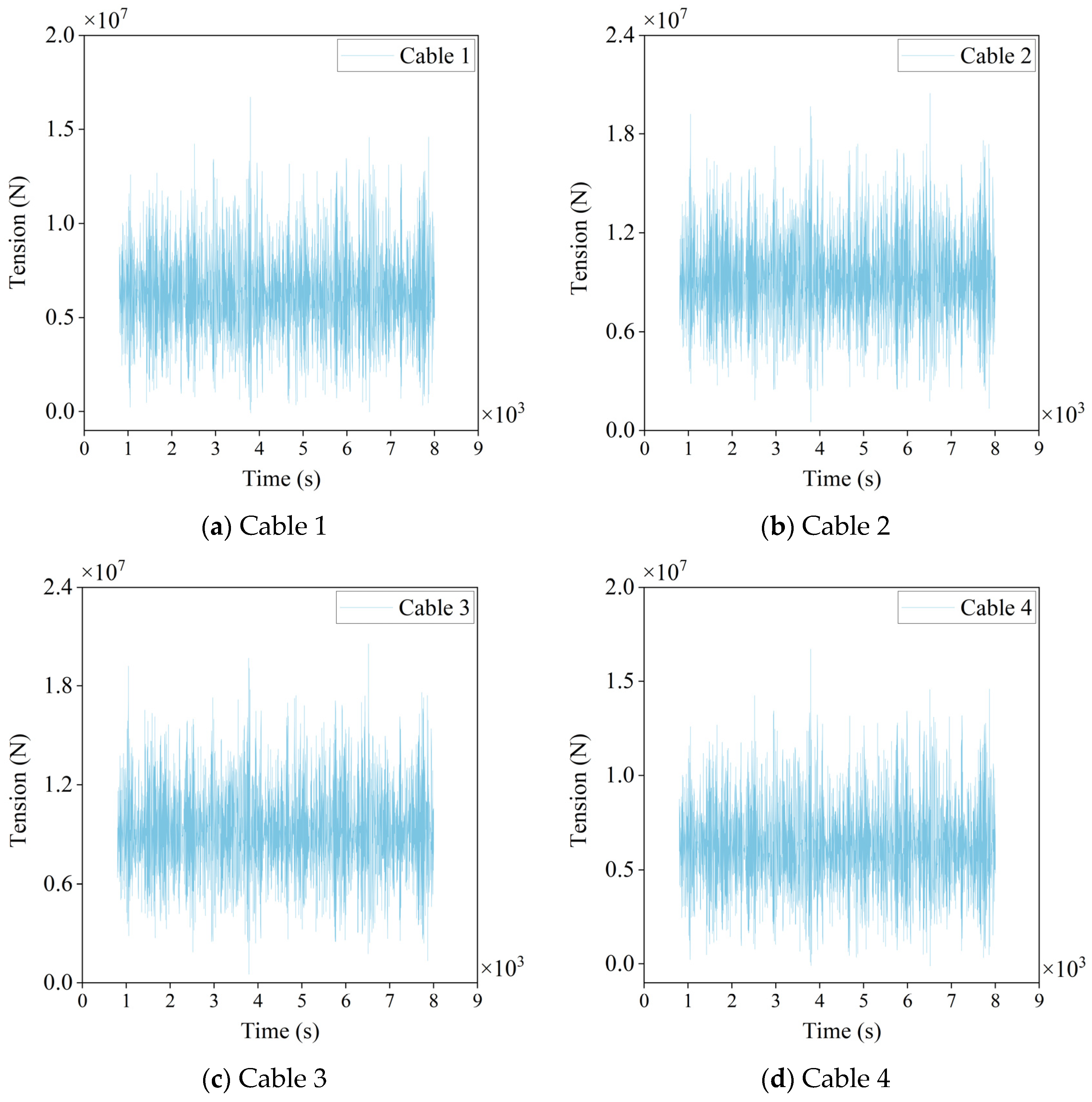
From Figure 16 and Table 11, it can be concluded that overall, the tension in each mooring line exhibits significantly high-frequency fluctuations, with peak values much higher than those under normal conditions. This indicates that, under the combined effects of strong wind, waves, and currents, the force environment on the four-float wind turbine platform deteriorates significantly. The maximum tension for Cable 2 and Cable 3 reaches approximately 2.0 × 10⁷ N, which is notably higher than the other two lines, indicating that these two mooring lines are in the primary load-bearing directions and play a key role in constraining the platform’s stability. Cable 1 and Cable 4 exhibit relatively lower tensions with smaller fluctuations, indicating that these lines are in a cooperative loading state, helping to balance the platform’s lateral displacement and attitude changes. According to the table data, the range of tension for each mooring line generally exceeds 1.6 × 10⁷ N, suggesting significant tension variation and prominent dynamic load components. Regarding the safety factor, all four mooring lines fall between 1.09 and 1.33, which is close to the critical design requirements, indicating that the mooring system is operating under high load conditions in extreme sea states but has not yet exceeded the breaking limit.
Overall, the platform remains stable under extreme environmental conditions, and the mooring system provides the necessary restoring force to resist strong wave excitation. However, the safety margin is limited, and future designs should further optimize the mooring line layout and tension distribution to improve the system’s performance.

5. Conclusions

Based on the hydrodynamic analysis of the four-float wind turbine platform using ANSYS AQWA, the following conclusions are drawn:
(1)
Sensitivity to Critical Wave Angles: The platform’s highly symmetrical four-float configuration demonstrates excellent overall hydrodynamic stability. However, the motion responses are highly sensitive to specific “critical wave incidence angles.” Due to the spatial phase differences in the waves acting on the separated columns, a 0° incidence corresponds to the critical angle, maximizing pitch and surge motions, while a 90° incidence maximizes roll and sway motions. Identifying these critical angles is an essential insight for evaluating the worst-case scenarios in the platform’s structural design.
(2)
Effectiveness of Damping and Geometric Design: The implementation of the added damping method effectively suppresses the unrealistic RAO peaks inherent in potential flow predictions. The corrected, low-magnitude RAOs confirm that the square layout of the peripheral floats, combined with the central column and circular ballast tanks, provides a highly optimal restoring stiffness and effectively mitigates the risk of dangerous resonance under wave excitation. Prioritizing the suppression of these pitch and roll resonances yields profound practical significance, as it directly translates into a massive reduction in tower-base bending moments, thereby significantly enhancing the structural safety margins and fatigue life of the 10 MW FOWT under extreme survival sea states.
(3)
Dynamic Shift Under Survival Conditions: Comparisons between operational and survival sea states reveal a distinct shift in the platform’s dynamic behavior. While the platform maintains a smooth, steady-state response under operational conditions, survival conditions induce pronounced high-frequency oscillations and substantially wider fluctuation ranges in the surge and pitch degrees of freedom. This insight demonstrates that wave-induced extreme loads dominate the system’s kinetic energy during survival states, necessitating robust structural integrity.
(4)
Asymmetrical Mooring Tension Distribution: Under extreme survival sea states, the environmental loads do not distribute evenly across the four-point mooring system. Instead, the tension is concentrated heavily on the upstream lines (Cables 2 and 3), driven by the strong coupling between severe wave excitation and the platform’s longitudinal drift. This asymmetrical loading pushes these specific lines near their capacity limits (with a safety factor dropping to ~1.09). This insight underscores that future mooring optimization for four-float designs should focus specifically on reinforcing the upstream lines or implementing directional mooring stiffness to enhance survivability.
(5)
Despite the comprehensive hydrodynamic and motion response evaluation presented in this study, certain methodological limitations should be acknowledged. First, the numerical simulations were primarily based on three-dimensional potential flow theory using ANSYS AQWA, which inherently neglects fluid viscosity and complex non-linear flow separation effects (e.g., vortex shedding) around the multi-float structure. Although an empirically added damping method was employed to rationally correct the RAO peaks, this approach remains a simplified approximation of actual viscous damping. More importantly, a major limitation is the absence of a full aero-hydro-servo-elastic coupled analysis using modern specialized tools such as OpenFAST. In the present time-domain model, the aerodynamic behavior of the DTU 10 MW wind turbine is essentially reduced to a simplified external thrust curve, neglecting the complex dynamic coupling between the rotor, servo-control system, and the platform. To address these limitations, future research will transition to “Phase 2” evaluations by importing the hydrodynamic coefficients obtained herein into OpenFAST for fully coupled aero-hydro-servo-elastic simulations. Additionally, high-fidelity Computational Fluid Dynamics (CFD) simulations will be conducted to accurately capture the viscous flow field and strong non-linear wave–structure interactions. Finally, physical-scale model tests in a wave basin are planned to systematically validate these numerical predictions, particularly regarding low-frequency drift motions and the coupled dynamic responses of the mooring system under extreme survival sea states. Finally, it should be acknowledged that this study primarily serves as a Phase 1 numerical feasibility assessment based on potential flow theory. While the applied numerical framework strictly adheres to validated offshore benchmark practices, the complex non-linear wave–structure interactions and viscous effects require further experimental validation. As a crucial next step for Phase 2 research, a physical scaled-model wave basin test of this specific four-float configuration is planned. This future experimental work will be cross-analyzed with the present numerical results to explicitly verify the platform’s survivability under extreme coupled environmental conditions.

Author Contributions

Conceptualization, S.Y. and L.Z.; methodology, Y.L. and Z.W.; software, S.Y.; validation, S.Y., Z.Z. and J.W.; formal analysis, Z.Z.; investigation, S.Y.; resources, J.W. and Z.W.; data curation, Z.Z.; writing—original draft preparation, S.Y.; writing—review and editing, L.Z.; visualization, Y.L. and Z.W.; supervision, L.Z.; project administration, J.W.; funding acquisition, J.W. and L.Z. All authors have read and agreed to the published version of the manuscript.

Funding

This work was supported by the Jiangsu Provincial Frontier Technology Development Plan (Grant No. BF2024048), and Natural Science Foundation of Jiangsu Province (Grant No. BK20230011).

Data Availability Statement

The data presented in this article are available upon request from the corresponding author.

Conflicts of Interest

Zhengang Wang was employed by Nantong COSCO Shipping Engineering Co., Ltd. The remaining authors declare that the research was conducted in the absence of any commercial or financial relationships that could be construed as a potential conflict of interest.

References

  1. Perveen, R.; Kishor, N.; Mohanty, S. Off-shore wind farm development: Present status and challenges. Renew. Sustain. Energy Rev. 2014, 29, 780–792. [Google Scholar] [CrossRef]
  2. Bilgili, M.; Yasar, A.; Simsek, E. Offshore wind power development in Europe and its comparison with onshore counterpart. Renew. Sustain. Energy Rev. 2011, 15, 905–915. [Google Scholar] [CrossRef]
  3. Diaz, H.; Guedes Soares, C. Review of the current status, technology and future trends of offshore wind farms. Ocean Eng. 2020, 209, 107381. [Google Scholar] [CrossRef]
  4. Robertson, A.; Jonkman, J.; Masciola, M.; Song, H.; Goupee, A.; Coulling, A.; Luan, C. Definition of the Semisubmersible Floating System for Phase II of OC4; Technical Report NREL/TP-5000-60601; National Renewable Energy Lab (NREL): Golden, CO, USA, 2014.
  5. Liu, Z. Comparative Hydrodynamic Performance Analysis of Three Typical Kinds of Semi-Submersible Floating Foundation of Offshore Wind Turbine. Master’s Thesis, South China University of Technology, Guangzhou, China, 2020. [Google Scholar] [CrossRef]
  6. Karimi, M. Frequency Domain Modeling and Multidisciplinary Design Optimization of Floating Offshore Wind Turbines. Doctoral Dissertation, University of Victoria, Victoria, BC, Canada, 2018. [Google Scholar]
  7. Zhang, P. Dynamic response analysis of semi-submersible floating wind turbines. Shipbuild. Technol. 2022, 50, 42–48. [Google Scholar]
  8. Zhang, R.; Tang, Y.; Hu, J.; Ruan, S.; Chen, C. Dynamic response in frequency and time domains of a floating foundation for offshore wind turbines. Ocean Eng. 2013, 60, 115–123. [Google Scholar] [CrossRef]
  9. Luan, C.; Gao, Z.; Moan, T. Design and Analysis of a Braceless Steel 5-MW Semi-Submersible Wind Turbine. Ocean Space Util. Ocean Renew. Energy 2016, 6, V006T09A052. [Google Scholar]
  10. Cao, Q.; Xiao, L.; Guo, X.; Liu, M. Second-order responses of a conceptual semi-submersible 10 MW wind turbine using full quadratic transfer functions. Renew. Energy 2020, 153, 653–668. [Google Scholar] [CrossRef]
  11. Zhang, S.; Ishihara, T. Hydrodynamic response of a semi-submersible floating offshore wind turbine: Numerical modelling and validation. In Proceedings of the 15th World Wind Energy Conference, Tokyo, Japan, 31 October–2 November 2016. [Google Scholar]
  12. Zhang, X.; He, L.; Ma, G.; Ma, Q. Mechanism of mooring line breakage and shutdown opportunity analysis of a semi-submersible offshore wind turbine in extreme operating gust. Ocean Eng. 2023, 268, 113399. [Google Scholar] [CrossRef]
  13. Loukogeorgaki, E.; Angelides, D.C. Stiffness of mooring lines and performance of floating breakwater in three dimensions. Appl. Ocean Res. 2005, 27, 187–208. [Google Scholar] [CrossRef]
  14. Ishihara, T.; Zhang, S. Prediction of dynamic response of semi-submersible floating offshore wind turbine using augmented Morison’s equation with frequency dependent hydrodynamic coefficients. Renew. Energy 2019, 131, 1186–1207. [Google Scholar] [CrossRef]
  15. Jiang, Y.; Duan, Y.; Li, J.; Chen, M.; Zhang, X. Optimization of mooring systems for a 10MW semisubmersible offshore wind turbines based on neural network. Ocean Eng. 2024, 296, 117020. [Google Scholar] [CrossRef]
  16. Zhang, S.; Gu, W.; Qiu, B.; Xue, X.; Zhou, L. Design and experiment of a hydraulic lifting wind field test platform for crop protection UAS. Int. J. Agric. Biol. Eng. 2021, 14, 166–174. [Google Scholar] [CrossRef]
  17. Junianto, S.; Mukhtasor Prastianto, R.W.; Wardhana, W. Motion Responses Analysis for Tidal Current Energy Platform: Quad-Spar and Catamaran Types. China Ocean Eng. 2020, 34, 677–687. [Google Scholar] [CrossRef]
  18. Takata, T.; Takaoka, M.; Houtani, H.; Hara, K.; Oh, S.; Malta, E.B.; Iijima, K.; Suzuki, H.; Gonçalves, R.T. Effect of Heave Plates on the Wave Motion of a Flexible Multicolumn FOWT. Energies 2022, 15, 7605. [Google Scholar] [CrossRef]
  19. Zhu, X.; Wang, Y.; Yoo, W.-S.; Nicoll, R.; Ren, H. Stability analysis of spar platform with four mooring cables in consideration of cable dynamics. Ocean Eng. 2021, 236, 109522. [Google Scholar] [CrossRef]
  20. Li, B.; Liu, K.; Yan, G.; Ou, J. Hydrodynamic comparison of a semi-submersible, TLP, and Spar: Numerical study in the South China Sea environment. J. Mar. Sci. Appl. 2011, 10, 306–314. [Google Scholar] [CrossRef]
  21. Hall, M.; Buckham, B.; Crawford, C. Evaluating the importance of mooring line model fidelity in floating offshore wind turbine simulations. Wind Energy 2014, 17, 1835–1853. [Google Scholar] [CrossRef]
  22. Lee, H.; Lee, D.-J. Effects of platform motions on aerodynamic performance and unsteady wake evolution of a floating offshore wind turbine. Renew. Energy 2019, 143, 9–23. [Google Scholar] [CrossRef]
  23. Wang, B.; Li, Y.; Gao, S.; Shen, K.; Hu, Z.; Zheng, X. Motion characteristics and aero-elastic responses of floating offshore wind turbine under coupling action of waves and winds. Front. Environ. Sci. 2022, 10, 965334. [Google Scholar] [CrossRef]
  24. Gueydon, S.; Duarte, T.; Jonkman, J. Comparison of Second-Order Loads on a Semisubmersible Floating Wind Turbine. In Proceedings of the 33rd ASME International Conference on Ocean, Offshore and Arctic Engineering, San Francisco, CA, USA, 8–13 June 2014. [Google Scholar]
  25. Fonseca, N.; Dadmarzi, F.H. A Wave Drift Force Model for Semi-Submersible Types of Floating Wind Turbines in Large Waves and Current. J. Mar. Sci. Eng. 2024, 12, 1389. [Google Scholar] [CrossRef]
  26. Zhang, C.; Wang, S.; Cui, M.; Liu, H.; Liu, A.; Xu, J.; Xie, S. Modeling and dynamic response analysis of a submersible floating offshore wind turbine integrated with an aquaculture cage. Ocean Eng. 2022, 263, 112338. [Google Scholar] [CrossRef]
  27. Zhai, Y.; Zhao, H.; Li, X.; Shi, W. Hydrodynamic Responses of a Barge-Type Floating Offshore Wind Turbine Integrated with an Aquaculture Cage. J. Mar. Sci. Eng. 2022, 10, 854. [Google Scholar] [CrossRef]
  28. Newman, J.N. Second-order, slowly-varying forces on vessels in irregular waves. Mooring 1974, 19, 182–186. [Google Scholar]
  29. Bayati, I.; Jonkman, J.; Robertson, A.; Platt, A. The effects of second-order hydrodynamics on a semisubmersible floating offshore wind turbine. J. Phys. Conf. Ser. 2014, 524, 012094. [Google Scholar] [CrossRef]
  30. Reig, M.A.; Pegalajar-Jurado, A.; Mendikoa, I.; Petuya, V.; Bredmose, H. Accelerated second-order hydrodynamic load calculation on semi-submersible floaters. Mar. Struct. 2023, 90, 103430. [Google Scholar] [CrossRef]
  31. Hu, Y.; Liu, P.; Asante, E.; Wu, W.; Li, P. Control system of a performance test-bed for frost protection wind machines. Int. J. Agric. Biol. Eng. 2016, 9, 36–43. [Google Scholar]
  32. Amouzadrad, P.; Mohapatra, S.C.; Guedes Soares, C. Analytical and numerical model on the hydroelastic response of an array of moored circular offshore floating platform. Ocean Eng. 2026, 343, 123316. [Google Scholar] [CrossRef]
  33. Mohapatra, S.C.; Amouzadrad, P.; Bispo IBd, S.; Guedes Soares, C. Hydrodynamic Response to Current and Wind on a Large Floating Interconnected Structure. J. Mar. Sci. Eng. 2025, 13, 63. [Google Scholar] [CrossRef]
  34. Amouzadrad, P.; Mohapatra, S.C.; Guedes Soares, C. Numerical model for the hydroelastic response of a moored articulated floating platform with a flap-type wave energy converter. J. Ocean Eng. Mar. Energy 2025, 12, 697–715. [Google Scholar] [CrossRef]
  35. Newman, J.N. Marine Hydrodynamics; MIT Press: Cambridge, UK, 2018. [Google Scholar]
  36. Faltinsen, O. Sea Loads on Ships and Offshore Structures; Cambridge University Press: Cambridge, UK, 1993; Volume 1. [Google Scholar]
  37. Denis, M., St.; Pierson, W.J., Jr. On the motions of ships in confused seas. Trans. SNAME 1953, 61, 280–357. [Google Scholar]
  38. Hasselmann, K.; Barnett, T.P.; Bouws, E.; Carlson, H.; Cartwright, D.E.; Enke, K.; Ewing, J.A.; Gienapp, A.; Hasselmann, D.E.; Kruseman, P.; et al. Measurements of wind-wave growth and swell decay during the Joint North Sea Wave Project (JONSWAP). Dtsch. Hydrogr. Z. Reihe A 1973, 12, 1–95. [Google Scholar]
  39. Cummins, W. The impulse response function and ship motions. Schiffstechnik 1962, 9, 101–109. [Google Scholar]
  40. Jonkman, J. Dynamics Modeling and Loads Analysis of an Offshore Floating Wind Turbine; University of Colorado at Boulder: Boulder, CO, USA, 2007. [Google Scholar]
  41. Yoshimi, G. Random Seas and Design of Maritime Structures, 3rd ed.; World Scientific: Singapore, 2010. [Google Scholar]
  42. Bak, C.; Zahle, F.; Bitsche, R.; Kim, T.; Yde, A.; Henriksen, L.C.; Hansen, M.H.; Blasques, J.P.A.A.; Gaunaa, M.; Natarajan, A. Description of the DTU 10 MW Reference Wind Turbine; DTU Wind Energy Report-I-0092; DTU Wind Energy: Roskilde, Denmark, 2013. [Google Scholar]
  43. Hu, D.; Zheng, Z.; Lin, Z.; Zhao, Z.; Chen, N. Optimization of mooring stability for large semi-submersible offshore wind turbine platforms. Energy Eng. 2024, 44, 59–68. [Google Scholar]
  44. Park, S.; Choung, J. Structural Design of the Substructure of a 10 MW Floating Offshore Wind Turbine System Using Dominant Load Parameters. J. Mar. Sci. Eng. 2023, 11, 1048. [Google Scholar] [CrossRef]
  45. Liu, Y.; Huang, X.; Li, Z.; Liu, Y. Simulation analysis of the two-fork mooring system for the DTU 10 MW floating wind turbine. J. Sol. Energy 2024, 45, 423–430. [Google Scholar]
  46. Jonkman, J. Definition of the Floating System for Phase IV of OC3; Technical Report NREL/TP-500-47535; National Renewable Energy Laboratory (NREL): Golden, CO, USA, 2010.
  47. Chopra, A. Dynamics of Structures: Theory and Applications to Earthquake Engineering; Pearson Education: London, UK, 2011. [Google Scholar]
Figure 1. Geometric model and three-view diagram of the four-float wind turbine platform.
Jmse 14 00807 g001
Figure 2. Mooring design parameters of the four-float wind turbine platform.
Jmse 14 00807 g002
Figure 3. Four-float wind turbine platform mesh model diagram.
Jmse 14 00807 g003
Figure 4. DTU 10 MW wind turbine thrust diagram.
Jmse 14 00807 g004
Figure 5. Added mass for the six degrees of freedom.
Jmse 14 00807 g005
Figure 6. Radiation damping for the six degrees of freedom.
Jmse 14 00807 g006
Figure 7. RAO for the six degrees of freedom.
Jmse 14 00807 g007
Figure 8. RAO for the six degrees of freedom after damping correction.
Jmse 14 00807 g008
Figure 9. First-order wave forces for the six degrees of freedom.
Jmse 14 00807 g009
Figure 10. Dynamic pressure distribution contour plots (expressed in water head, m). (a) Wave incidence at 0° (viewed from the Y-axis); (b) Wave incidence at 90° (viewed from the X-axis).
Jmse 14 00807 g010
Figure 11. Second-order mean drift force for sway, surge, and yaw directions.
Jmse 14 00807 g011
Figure 12. Second-order difference-frequency force.
Jmse 14 00807 g012
Figure 13. Time-series of the six-DOF motion responses under operational sea states.
Jmse 14 00807 g013
Figure 14. Mooring line tension diagram under operational sea state.
Jmse 14 00807 g014
Figure 15. Time-series of the six-DOF motion responses under a survival sea state.
Jmse 14 00807 g015
Figure 16. Mooring line tension diagram under survival sea state.
Jmse 14 00807 g016
Table 1. Basic parameters of the four-float wind turbine platform [4].
Basic ParametersFour-Float Wind Turbine PlatformUnit
Water depth200m
Platform height38m
Platform draft19m
Side bottom float diameter28m
Side bottom float height8m
Side upper float diameter14m
Side upper float height30m
Central float diameter20m
Central float height38m
Diagonal support diameter1m
Side float center distance80m
Platform roll moment of inertia 9.46 × 10⁹kg⋅m2
Platform pitch moment of inertia 9.7 × 10⁹kg⋅m2
Platform yaw moment of inertia 1.7 × 10¹⁰kg⋅m2
Platform mass (excluding ballast water) 2.401 × 10⁶kg
Displacement6.27 × 106kg
Table 2. DTU 10 MW wind turbine information [42].
ParametersValuesUnit
Rated power10 MWMW
Control systemVariable speed and pitch
Rotor diameter178.3m
Hub diameter5.6m
Hub height119m
Blade mass110t
Nacelle mass446t
Cut-in, rated, cut-out wind speed4, 11.4, 25m/s
Rotor mass228t
Rotor thrust1500kN
Table 3. Mooring line design parameters of the four-float wind turbine platform [43].
Design ProjectDesign ParametersUnit
Mooring line length840m
Weight in air511.22kg/m
Number of mooring lines4
Axial stiffness2.3 × 109N
Breaking strength22,285kN
Mooring line diameter0.173m
Weight in water445.92kg/m
Table 4. Mesh convergence study of the four-float platform.
Mesh StrategyMaximum Element Size (m)Number of ElementsPeak Heave Added Mass (×107 kg)Relative Error
Coarse1.413,6753.6087
Medium (Adopted)0.8720,1943.60480.11
Fine0.523,9983.60530.01
Table 5. Time-step independence test under the survival sea state (evaluated from 800 s to 8000 s).
Time Step Δt (s)Max Pitch Response (deg)Relative Difference (%)Max Surge Response (m)Relative Difference (%)
0.206.683.97%18.652.41%
0.106.450.39%18.260.27%
0.056.42Reference18.21Reference
Table 6. Marine conditions [45].
ParametersOperational Sea StateSurvival Sea StateUnit
Wave SpectrumJONSWAPJONSWAP
Significant Wave Height4.513.6m
Spectral Peak Period7.015.1s
Spectral Peak Factor γ3.33.3
Wind Speed11.450m/s
Current Speed0.82.05m/s
Table 7. Artificial Damping Matrix Table.
Degree of FreedomMass
(×106)
Added Mass
(×107)
Stiffness
(×106)
Critical Damping
(×107)
Additional Damping
(×106)
Additional Damping Coefficient
Heave6.2703.6109.2483.9581.9795%
Roll9600546057803852.4181926.2095%
Pitch9600546057803852.4181926.2095%
Table 8. Time-domain motion response curves for the six degrees of freedom under operational sea state.
Six Degrees of Freedom MotionAverage ValueMaximum Value Minimum Value RangeStandard Deviation
Sway (m)0.0000420.001170−0.0010200.0021900.000291
Surge (m)1.9420007.211227−0.1065907.3178210.709717
Heave (m)28.95600029.63992028.2782501.3616710.141077
Roll (°)0.4810000.8312550.2360680.5951870.073854
Pitch (°)0.0002820.0007120.0001370.0005750.000066
Yaw (°)−0.0000090.001650−0.0016400.0032900.000496
Table 9. Mooring line tension under operational sea state.
Mooring Line TensionMaximum ValueMinimum ValueRange (kN)Safety Factor
Mooring Line 17653.163819.593833.572.91
Mooring Line 211,502.947508.203994.741.94
Mooring Line 311,504.167507.533996.631.94
Mooring Line 47652.503820.493832.012.91
Table 10. Time-domain motion response curves for the six degrees of freedom under a survival sea state.
Six Degrees of Freedom MotionAverage ValueMaximum Value Minimum Value RangeStandard Deviation
Sway (m)0.00150.0863−0.07810.16440.0137
Surge (m)2.854621.7876−16.041837.82954.7787
Heave (m)29.000333.388225.12598.26231.1115
Roll (°)0.65291.6490−0.27251.92150.2514
Pitch (°)−0.00030.0039−0.00630.01020.0008
Yaw (°)−0.00410.0503−0.05650.10680.0142
Table 11. Mooring line tension under survival sea state.
Mooring Line TensionMaximum Value (kN)Minimum Value (kN)Range (kN)Safety Factor
Mooring Line 116,729.74−80.5116,810.251.33
Mooring Line 220,476.97520.8819,956.091.09
Mooring Line 320,565.54519.9920,045.551.08
Mooring Line 416,727.24−102.5816,829.821.33
Disclaimer/Publisher’s Note: The statements, opinions and data contained in all publications are solely those of the individual author(s) and contributor(s) and not of MDPI and/or the editor(s). MDPI and/or the editor(s) disclaim responsibility for any injury to people or property resulting from any ideas, methods, instructions or products referred to in the content.