Traveling Seaweeds—Seasonal and Latitudinal Diversity of Epiphytic Seaweeds on Stranded Rafts of the Floating Seaweed Durvillaea incurvata Along the Chilean Coast

 , , , , , , ,
  and
and
Abstract
1. Introduction
2. Materials and Methods
2.1. Study Area
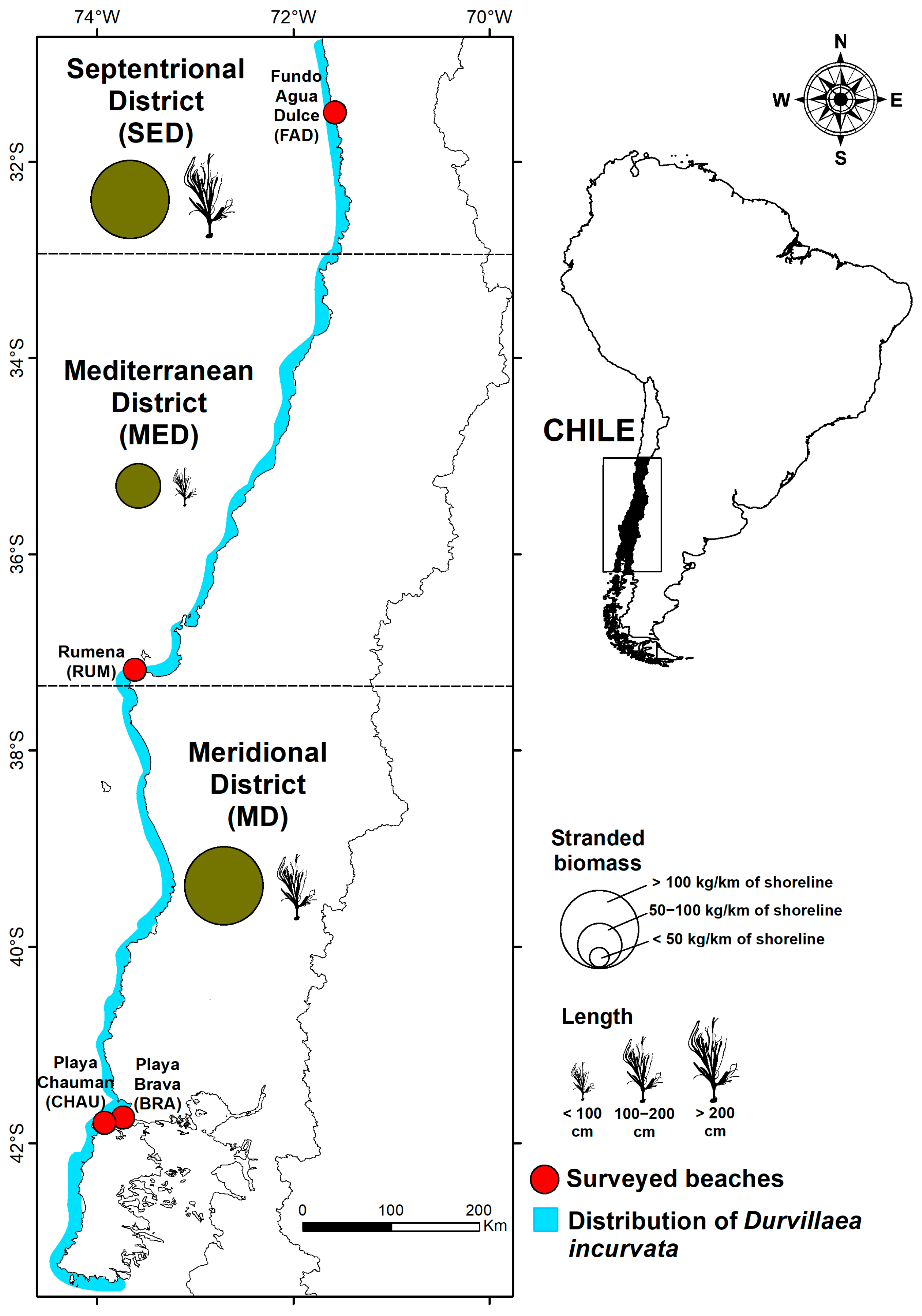
2.2. Sampling of Stranded Durvillaea incurvata and Its Non-Buoyant Seaweed Community
2.2.1. Measurements on Durvillaea incurvata Specimens
- (a)
- Total length: the measurement in centimeters was taken as the straight-line distance from the base of the holdfast to the tip of the longest frond.
- (b)
- Biomass: the individual wet weights of the fronds, stipes, and holdfast of an entire plant were measured separately using a portable electronic hanging digital scale (1 g accuracy). The overall biomass of the plant was determined by adding the weights of the fronds, stipes, and holdfast.
- (c)
- Holdfast diameter: the diameter was determined by measuring the straight-line distance in centimeters along the concave side across the maximum axis of the holdfast.
- (d)
- Number of stipes: the total number of stipes on each plant was counted.
- (e)
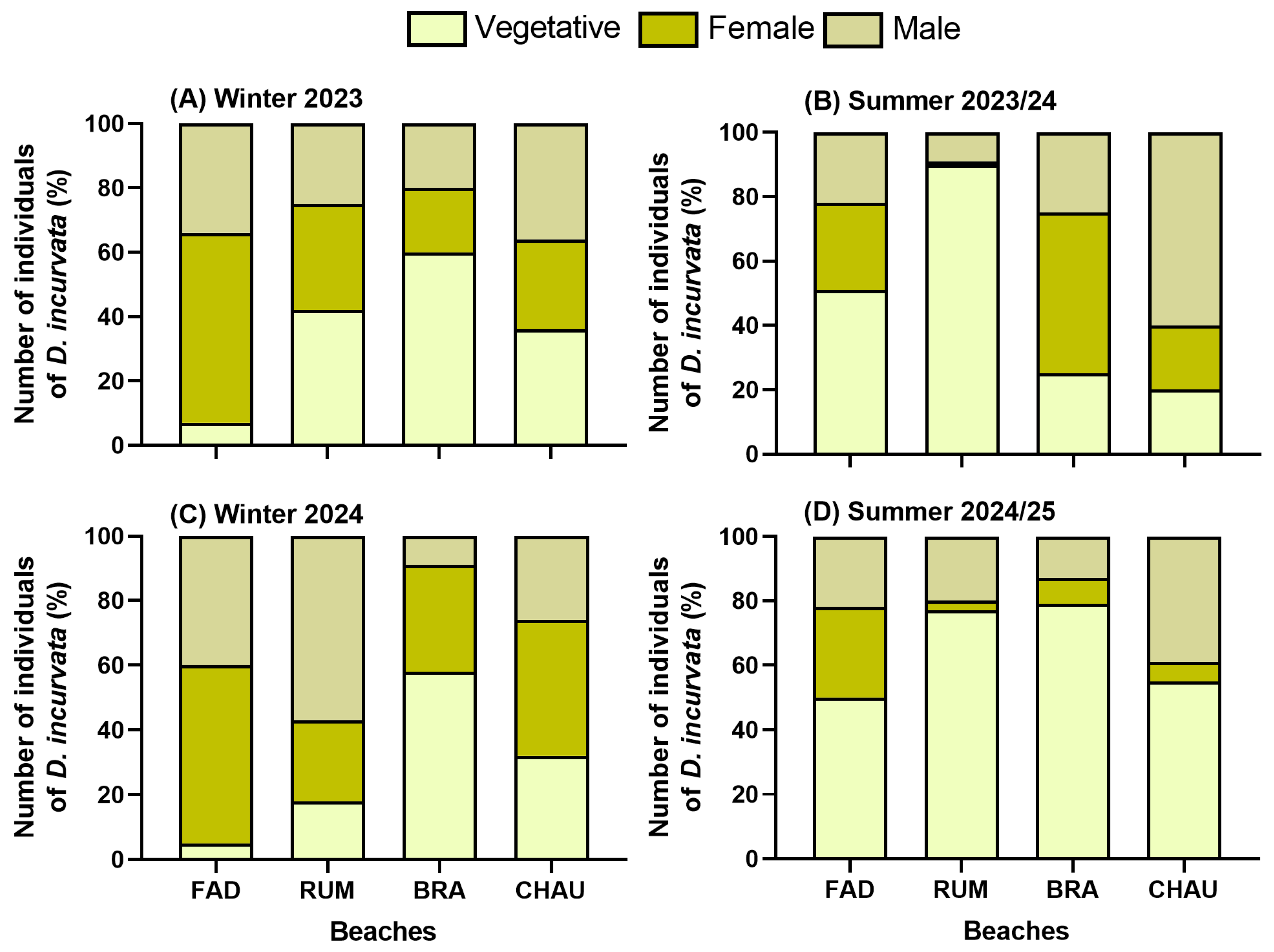
- Reproductive stage: tissue samples were collected from the longer fronds of each plant to assess the reproductive stage. Two samples were collected, one from the middle part and one from the apical part of the frond. These samples were then placed in Ziploc bags and frozen at 18 °C to maintain the integrity of the reproductive tissues [38]. The samples were subsequently analyzed in the laboratory after 2–4 weeks. No decalcification or staining methods were used for this purpose.
- (f)
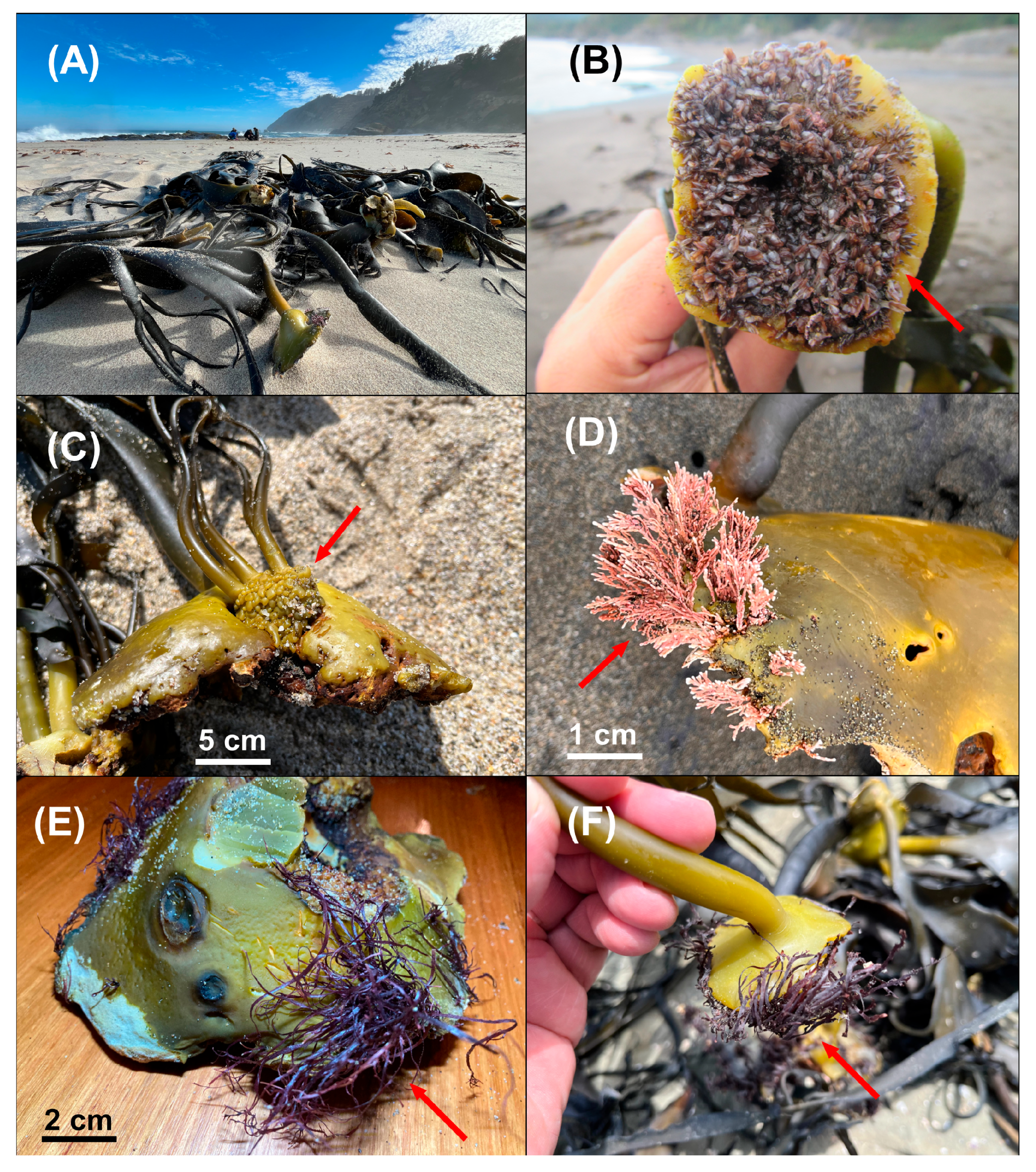
- Floating time: we assessed each plant to determine if it had been colonized by stalked barnacles (Lepas spp.) The majority of plants were colonized by L. australis Darwin, 1851, which is prevalent in southern Chile (38° S–42° S), and L. anatifera Linnaeus, 1758, which is more common in the northern section of the study area (31° S–32° S) [65] (Figure 2B). Given that these two species exhibit similar sizes and growth rates [65], we refer to them as Lepas spp. If the plants were found to have only cyprids (newly settled larvae) of Lepas, this was noted on site, but no samples were collected from these plants. However, if the plants contained Lepas individuals that had already metamorphosed, we collected samples of the 10–20 largest individuals to measure their sizes, which is indicative of floating time [38,65]. Each Lepas specimen was measured using scaled images with Image Pro Plus v6 software (Media Cybernetics Inc., Silver Spring, MD, USA). For each survey, the percentage of D. incurvata individuals with Lepas spp. was determined, as well as the size of the attached specimens [37,38]. As reported by Goehlich et al. [65], the growth rates for L. anatifera and L. australis vary between 0.21 and 0.47 mm per day at a temperature of 14 °C. Consequently, D. incurvata individuals with Lepas measuring over 5 mm correspond to more than 10 days of floating time [38]. This threshold value of Lepas size (5 mm) has been used in several studies in the same area [10,37,38]. This difference in the floating time of seaweed rafts allows us to infer possible long-distance dispersal events from others at shorter distances.
Analysis of Reproductive Stage
2.2.2. Measurements of Epiphytic Seaweeds
2.2.3. Co-Ocurrences of Epiphytic Seaweed Species
2.3. Statistical Analyses
3. Results
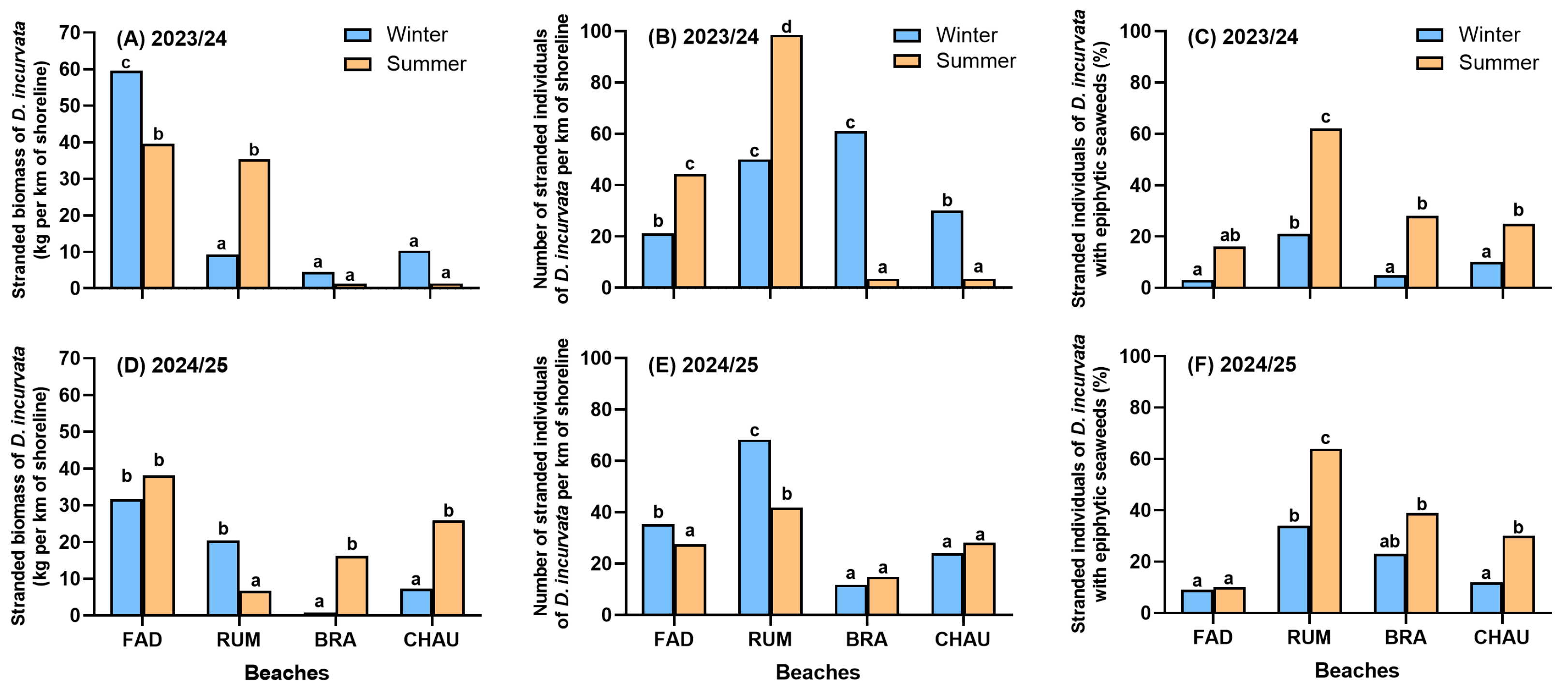
3.1. Stranded Biomasses and Morphometric Characteristics of D. incurvata
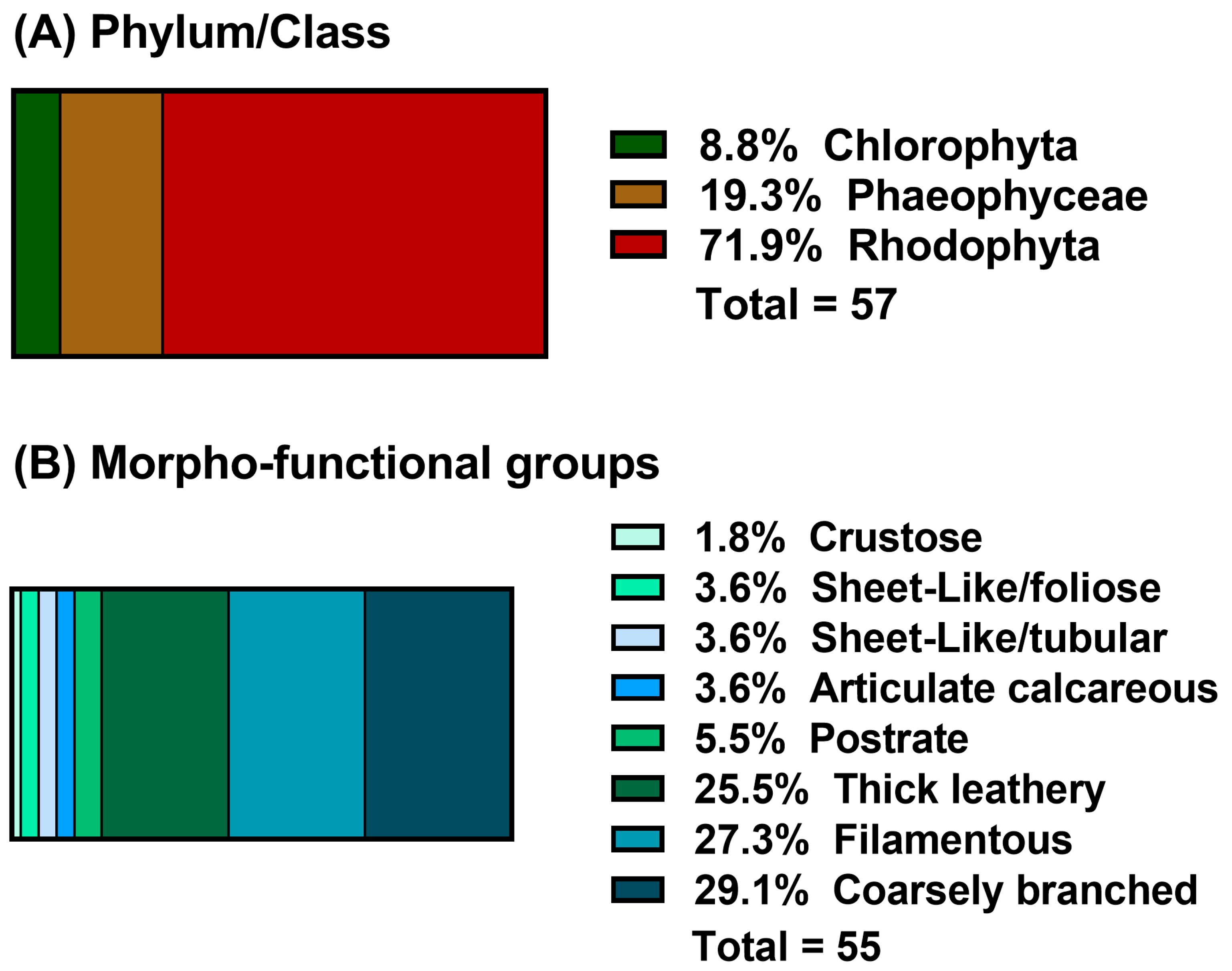
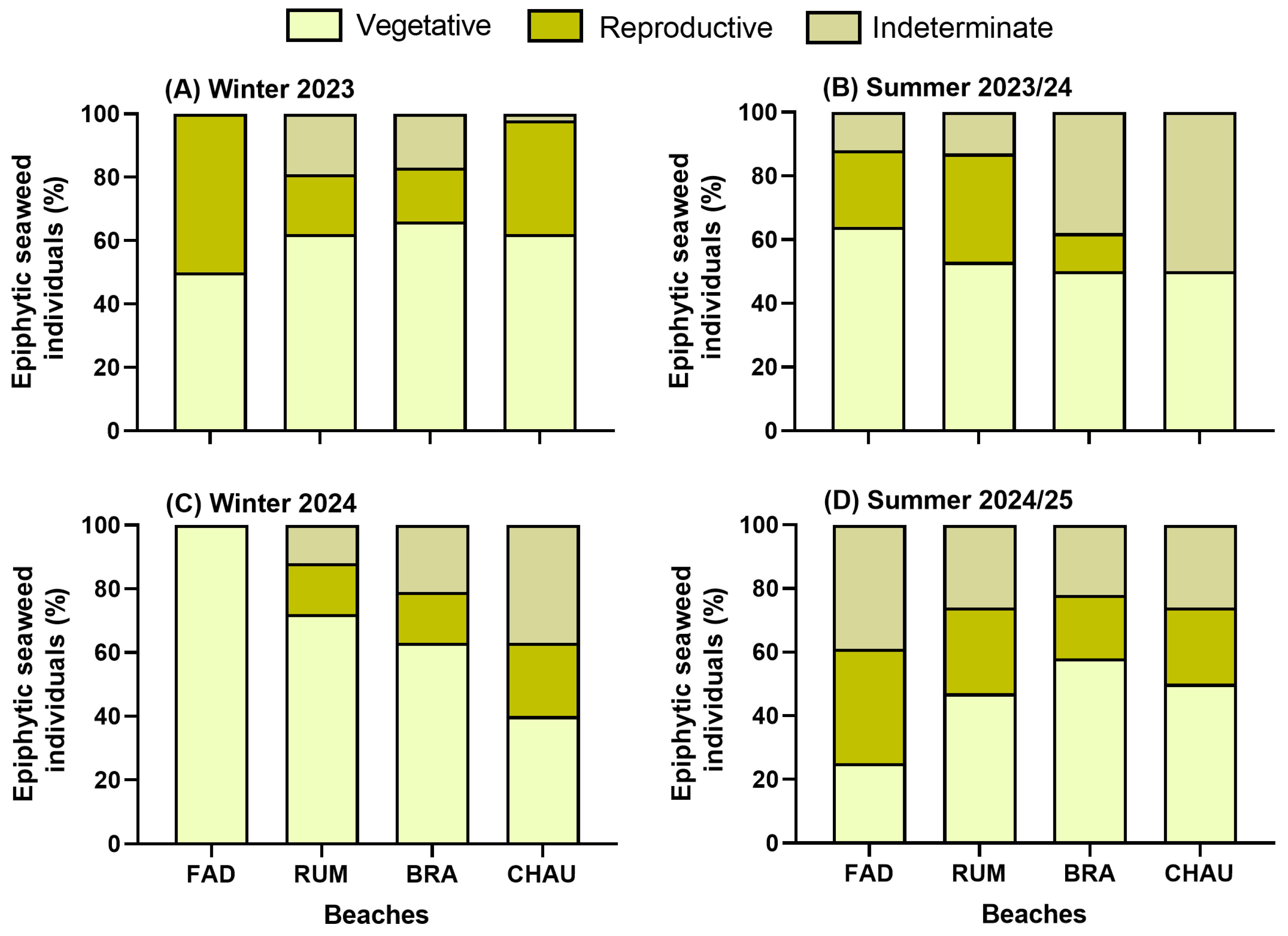
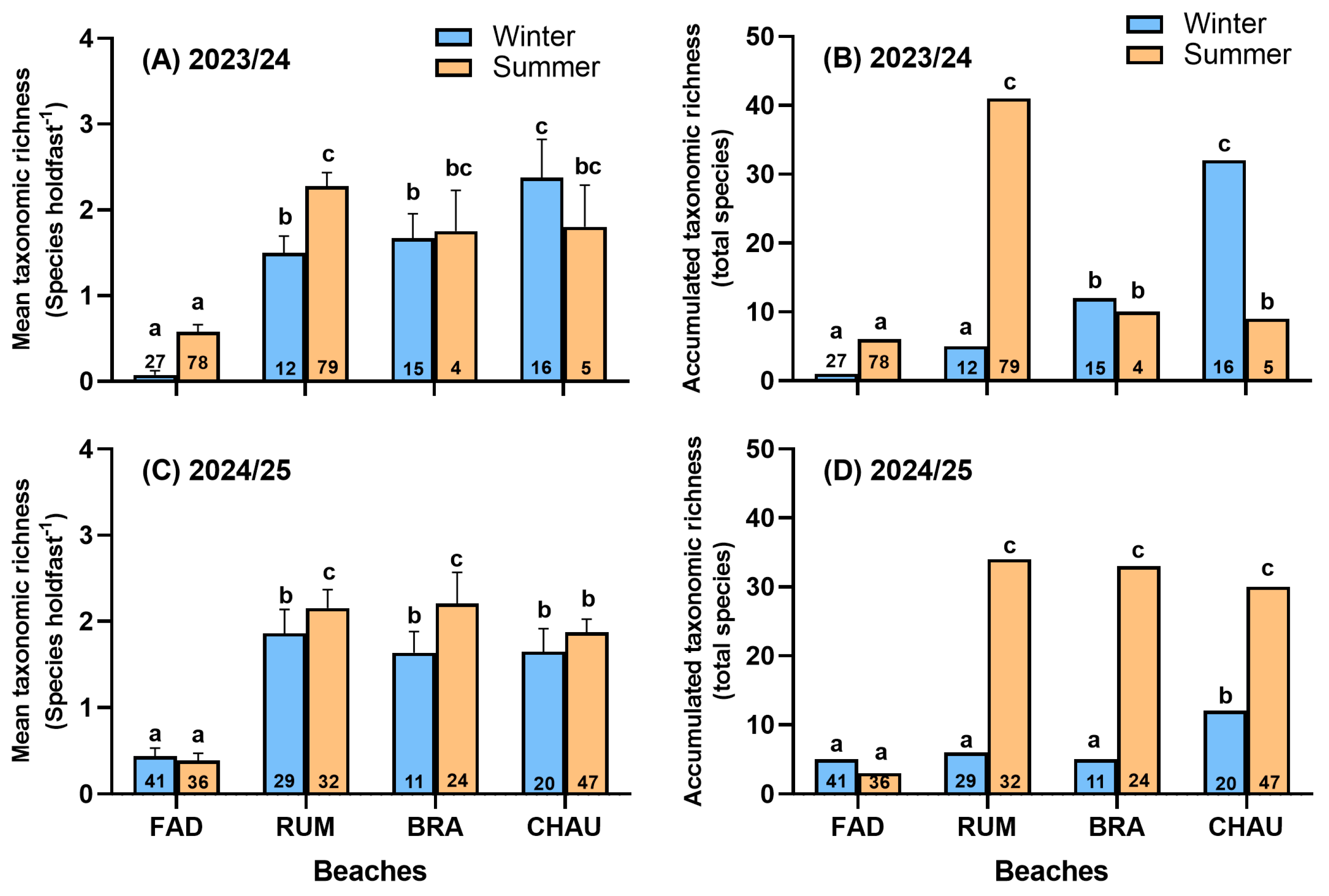
3.2. Taxonomic Richness and Reproductive Status of Epiphytic Seaweeds
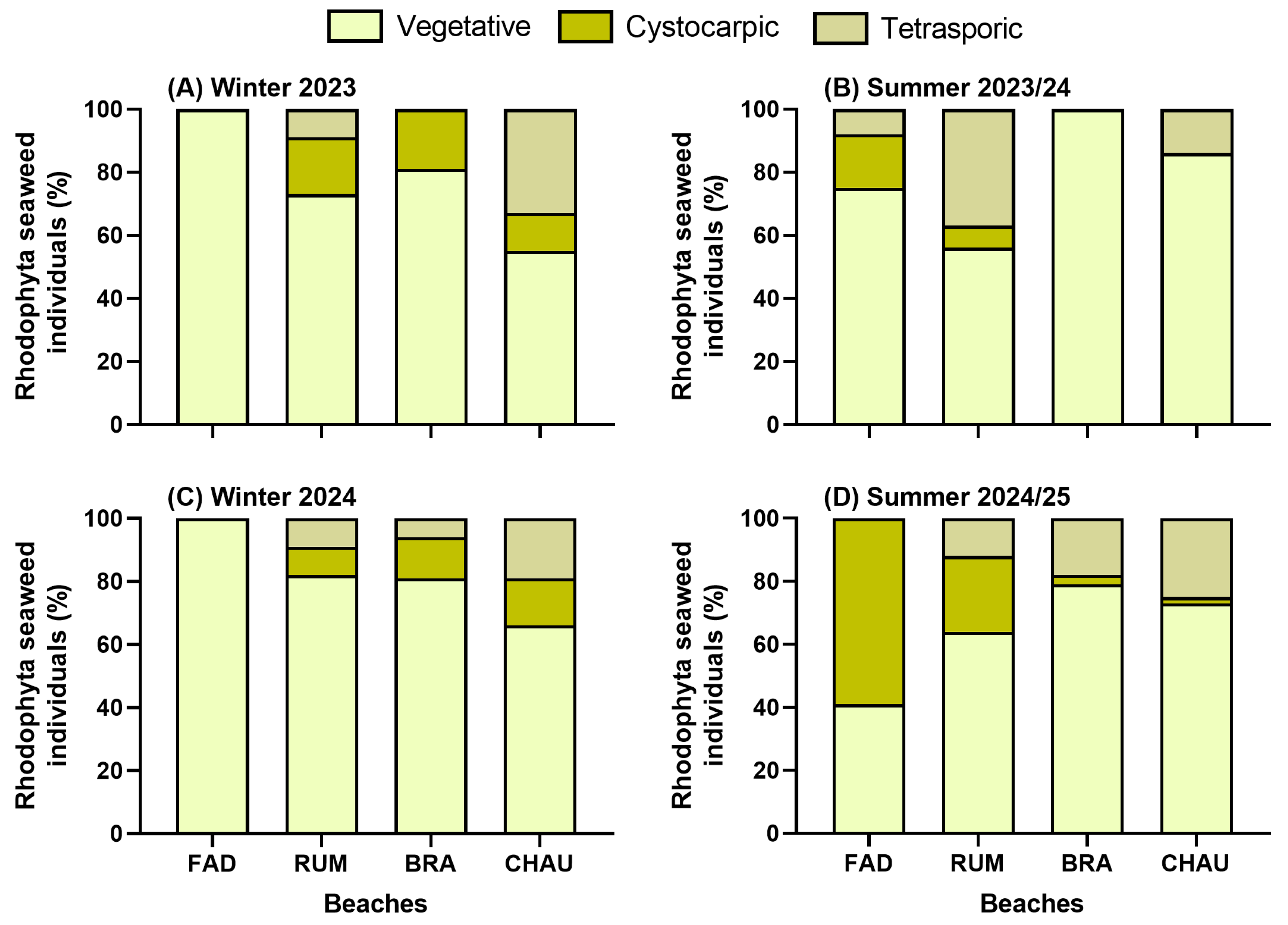
3.3. Morphometric Characteristics and Reproductive Status of Frequent Epiphytic Seaweeds
3.4. Co-Occurrence of Epiphytic Seaweeds
4. Discussion
4.1. Seasonal and Spatial Variability of D. incurvata Strandings
4.2. Non-Buoyant Seaweeds on Stranded D. incurvata Specimens
4.3. Co-Occurrences of Non-Buoyant Seaweeds
5. Conclusions
Supplementary Materials
Author Contributions
Funding
Data Availability Statement
Acknowledgments
Conflicts of Interest
References
- Fraser, C.I.; Nikula, R.; Spencer, H.G.; Waters, J.M. Kelp genes reveal effects of subantarctic sea ice during the Last Glacial Maximum. Proc. Natl. Acad. Sci. USA 2009, 106, 3249–3253. [Google Scholar] [CrossRef]
- Fraser, C.I.; Nikula, R.; Waters, J.M. Oceanic rafting by a coastal community. Proc. R. Soc. B Biol. Sci. 2011, 278, 649–655. [Google Scholar] [CrossRef]
- Coyer, J.A.; Hoarau, G.; Van Schaik, J.; Luijckx, P.; Olsen, J.L. Trans-Pacific and trans-Arctic pathways of the intertidal macroalga Fucus distichus L. reveal multiple glacial refugia and colonizations from the North Pacific to the North Atlantic. J. Biogeogr. 2011, 38, 756–771. [Google Scholar] [CrossRef]
- Saunders, G.W. Long distance kelp rafting impacts seaweed biogeography in the Northeast Pacific: The kelp conveyor hypothesis. J. Phycol. 2014, 50, 968–974. [Google Scholar] [CrossRef] [PubMed]
- Coyer, J.A.; Hoarau, G.; Costa, J.F.; Hogerdijk, B.; Serrão, E.A.; Billard, E.; Valero, M.; Pearson, G.A.; Olsen, J.L. Evolution and diversification within the intertidal brown macroalgae Fucus spiralis/F. vesiculosus species complex in the North Atlantic. Mol. Phylogenet. Evol. 2011, 58, 283–296. [Google Scholar] [CrossRef]
- Olsen, J.L.; Zechman, F.W.; Hoarau, G.; Coyer, J.A.; Stam, W.T.; Valero, M.; Aberg, P. The phylogeographic architecture of the fucoid seaweed Ascophyllum nodosum: An intertidal ‘marine tree’ and survivor of more than one glacial-interglacial cycle. J. Biogeogr. 2010, 37, 842–856. [Google Scholar] [CrossRef]
- Bussolini, L.T.; Waters, J.M. Genetic analyses of rafted macroalgae reveal regional oceanographic connectivity patterns. J. Biogeogr. 2015, 42, 1319–1326. [Google Scholar] [CrossRef]
- Nikula, R.; Fraser, C.I.; Spencer, H.G.; Waters, J.M. Circumpolar dispersal by rafting in two subantarctic kelp-dwelling crustaceans. Mar. Ecol. Prog. Ser. 2010, 405, 221–230. [Google Scholar] [CrossRef]
- Macaya, E.C.; López, B.; Tala, F.; Tellier, F.; Thiel, M. Float and raft: Role of buoyant seaweeds in the phylogeography and genetic structure of non-buoyant associated flora. In Seaweed Phylogeography; Hu, Z.M., Fraser, C.I., Eds.; Springer: Dordrecht, The Netherlands, 2016; pp. 97–130. [Google Scholar]
- López, B.A.; Macaya, E.C.; Rivadeneira, M.M.; Tala, F.; Tellier, F.; Thiel, M. Epibiont communities on stranded kelp rafts of Durvillaea antarctica (Fucales, Phaeophyceae)-Do positive interactions facilitate range extensions? J. Biogeogr. 2018, 45, 1833–1845. [Google Scholar] [CrossRef]
- Waters, J.M.; King, T.M.; Fraser, C.I.; Garden, C. Rafting dispersal in a brooding southern sea star (Asteroidea: Anasterias). Invertebr. Syst. 2018, 32, 253–258. [Google Scholar] [CrossRef]
- Spencer, H.G.; Fraser, C.I.; Poulin, E.; González-Wevar, C.A. Towards a more nuanced understanding of long-distance rafting: Case studies from the Southern Ocean. Glob. Ecol. Biogeogr. 2025, 34, e70007. [Google Scholar] [CrossRef]
- Nikula, R.; Spencer, H.G.; Waters, J.M. Passive rafting is a powerful driver of transoceanic gene flow. Biol. Lett. 2013, 9, 20120821. [Google Scholar] [CrossRef]
- Cumming, R.A.; Nikula, R.; Spencer, H.G.; Waters, J.M. Transoceanic genetic similarities of kelp-associated sea slug populations: Long-distance dispersal via rafting? J. Biogeogr. 2014, 41, 2357–2370. [Google Scholar] [CrossRef]
- Nikula, R.; Spencer, H.G.; Waters, J.M. Comparison of population-genetic structuring in congeneric kelp- versus rock-associated snails: A test of a dispersal-by-rafting hypothesis. Ecol. Evol. 2011, 1, 169–180. [Google Scholar] [CrossRef] [PubMed]
- Donald, K.M.; Keeney, D.B.; Spencer, H.G. Contrasting population makeup of two intertidal gastropod species that differ in dispersal opportunities. J. Exp. Mar. Biol. Ecol. 2011, 396, 224–232. [Google Scholar] [CrossRef]
- Donald, K.M.; Kennedy, M.; Spencer, H.G. Cladogenesis as the result of long-distance rafting events in South Pacific topshells (Gastropoda, Trochidae). Evolution 2005, 59, 1701–1711. [Google Scholar] [CrossRef]
- Fraser, C.I.; Velasquez, M.; Nelson, W.A.; Macaya, E.C.; Hay, C.H. The biogeographic importance of buoyancy in macroalgae: A case study of the southern Bull-kelp Genus Durvillaea (Phaeophyceae), including descriptions of two new species. J. Phycol. 2020, 56, 23–36. [Google Scholar] [CrossRef]
- Rothäusler, E.; Gutow, L.; Thiel, M. Floating seaweed and their communities. In Seaweed Biology; Wiencke, C., Bischof, K., Eds.; Ecological Studies; Springer: Berlin/Heidelberg, Germany, 2012; pp. 109–134. [Google Scholar]
- Li, J.J.; Hu, Z.M.; Gao, X.; Sun, Z.M.; Choi, H.G.; Duan, D.L.; Endo, H. Oceanic currents drove population genetic connectivity of the brown alga Sargassum thunbergii in the north-west Pacific. J. Biogeogr. 2016, 44, 230–242. [Google Scholar] [CrossRef]
- Li, J.J.; Hu, Z.M.; Sun, Z.M.; Yao, J.T.; Liu, F.L.; Fresia, P.; Duan, D.L. Historical isolation and contemporary gene flow drive population diversity of the brown alga Sargassum thunbergii along the coast of China. BMC Evol. Biol. 2017, 17, 246. [Google Scholar] [CrossRef]
- Brooks, C.M.; Saunders, G.W. Evidence in Support of the Kelp Conveyor Hypothesis. Diversity 2025, 17, 629. [Google Scholar] [CrossRef]
- Parvizi, E.; Dutoit, L.; Fraser, C.I.; Craw, D.; Waters, J.M. Concordant phylogeographic responses to large-scale coastal disturbance in intertidal macroalgae and their epibiota. Mol. Ecol. 2022, 31, 646–657. [Google Scholar] [CrossRef] [PubMed]
- Gutow, L.; Giménez, L.; Boos, K.; Saborowski, R. Rapid changes in the epifaunal community after detachment of buoyant benthic macroalgae. J. Mar. Biol. Assoc. UK 2009, 89, 323–328. [Google Scholar] [CrossRef]
- Kim, H.M.; Jo, J.; Park, C.; Choi, B.J.; Lee, H.G.; Kim, K.Y. Epibionts associated with floating Sargassum horneri in the Korea Strait. Algae 2019, 34, 303–313. [Google Scholar] [CrossRef]
- Boo, G.H.; Mansilla, A.; Nelson, W.; Bellgrove, A.; Boo, S.M. Genetic connectivity between trans-oceanic populations of Capreolia implexa (Gelidiales, Rhodophyta) in cool temperate waters of Australasia and Chile. Aquat. Bot. 2014, 119, 73–79. [Google Scholar] [CrossRef]
- Guillemin, M.L.; Valero, M.; Faugeron, S.; Nelson, W.; Destombe, C. Tracing the trans-pacific evolutionary history of a domesticated seaweed (Gracilaria chilensis) with archaeological and genetic data. PLoS ONE 2014, 9, e114039. [Google Scholar] [CrossRef] [PubMed]
- Kinlan, B.P.; Gaines, S.D. Propagule dispersal in marine and terrestrial environments: A community perspective. Ecology 2003, 84, 2007–2020. [Google Scholar] [CrossRef]
- Vega, J.M.A. Fauna asociada a discos de adhesión del complejo Lessonia nigrescens: Es un indicador de integridad ecológica en praderas explotadas de huiro negro, en el norte de Chile? Lat. Am. J. Aquat. Res. 2016, 44, 623–637. [Google Scholar]
- Tala, F.; Velásquez, M.; Mansilla, A.; Macaya, E.C.; Thiel, M. Latitudinal and seasonal effects on short-term acclimation of floating kelp species from the South-East Pacific. J. Exp. Mar. Biol. Ecol. 2016, 483, 31–41. [Google Scholar] [CrossRef]
- Tala, F.; López, B.A.; Velásquez, M.; Jeldres, R.; Macaya, E.C.; Mansilla, A.; Ojeda, J.; Thiel, M. Long-term persistence of the floating bull kelp Durvillaea antarctica from the South-East Pacific: Potential contribution to local and transoceanic connectivity. Mar. Environ. Res. 2019, 149, 67–79. [Google Scholar] [CrossRef]
- Li, J.; Pang, Y.; Qin, S.; Liu, Z.; Zhong, Z.; Song, W.; Zhuang, L. Comparison of the photo-acclimation potential of floating and benthic thalli of Sargassum horneri (Phaeophyta) during autumn and winter. J. Oceanol. Limnol. 2022, 40, 195–205. [Google Scholar] [CrossRef]
- Zhang, Q.; Zhuang, M.; Yan, F.; Zang, S.; Wu, H.; Xu, Z.; Bao, M. Ecotype-specific light intensity responses in Sargassum horneri: Bloom-forming vs. benthic forms. Mar. Environ. Res. 2025, 212, 107571. [Google Scholar] [CrossRef] [PubMed]
- Rothäusler, E.; Hinojosa, I.A.; Moraga, J.; Pizarro-Koch, M.; Ramos, M.; Thiel, M. At the mercy of the winds: The seasonal dynamics of floating and stranded seaweeds at mid-latitudes. Limnol. Oceanogr. 2021, 66, 4391–4402. [Google Scholar] [CrossRef]
- Koehl, M.A.R.; Daniel, T.L. Hydrodynamic interactions between macroalgae and their epibionts. Front. Mar. Sci. 2022, 9, 872960. [Google Scholar] [CrossRef]
- Kirkman, H.; Kendrick, G.A. Ecological significance and commercial harvesting of drifting and beach-cast macro-algae and seagrasses in Australia: A review. J. Appl. Phycol. 1997, 9, 311–326. [Google Scholar] [CrossRef]
- López, B.A.; Macaya, E.C.; Jeldres, R.; Valdivia, N.; Bonta, C.C.; Tala, F.; Thiel, M. Spatio-temporal variability of strandings of the southern bull kelp Durvillaea antarctica (Fucales, Phaeophyceae) on beaches along the coast of Chile—Linked to local storms. J. Appl. Phycol. 2019, 31, 2159–2173. [Google Scholar] [CrossRef]
- López, B.A.; Macaya, E.C.; Tala, F.; Tellier, F.; Thiel, M. The variable routes of rafting: Stranding dynamics of floating bull kelp Durvillaea antarctica (Fucales, Phaeophyceae) on beaches in the SE Pacific. J. Phycol. 2017, 53, 70–84. [Google Scholar] [CrossRef] [PubMed]
- Lemesle, S.; Rusig, A.-M.; Mussio, I. Local scale high frequency monitoring of seaweed strandings along an intertidal shore of the English Channel (Luc-sur-Mer, Normandy France)—Effect of biotic and abiotic factors. Aquat. Bot. 2023, 186, 103616. [Google Scholar] [CrossRef]
- Vázquez-Delfín, E.; Robledo, D.; Freile-Pelegrín, Y. Temporal Characterization of Sargassum (Sargassaceae, Phaeophyceae) Strandings in a Sandy Beach of Quintana Roo, Mexico: Ecological Implications for Coastal Ecosystems and Management. Thalass. Int. J. Mar. Sci. 2024, 40, 1053–1067. [Google Scholar] [CrossRef]
- Duarte, C.; Acuna, K.; Navarro, J.M.; Gomez, I.; Jaramillo, E.; Quijon, P. Variable feeding behavior in Orchestoidea tuberculata (Nicolet 1849): Exploring the relative importance of macroalgal traits. J. Sea Res. 2014, 87, 1–7. [Google Scholar] [CrossRef]
- McLachlan, A.; Defeo, O. The Ecology of Sandy Shores, 3rd ed.; Academic Press, Elsevier: London, UK, 2018. [Google Scholar]
- Lastra, M.; Rodil, I.F.; Sánchez-Mata, A.; García-Gallego, M.; Mora, J. Fate and processing of macroalgal wrack subsidies in beaches of Deception Island, Antarctic Peninsula. J. Sea Res. 2014, 88, 1–10. [Google Scholar] [CrossRef]
- Chubarenko, B.; Woelfel, J.; Hofmann, J.; Aldag, S.; Beldowski, J.; Burlakovs, J.; Garrels, T.; Gorbunova, J.; Guizani, S.; Kupczyk, A.; et al. Converting beach wrack into a resource as a challenge for the Baltic Sea (an overview). Ocean Coast. Manag. 2021, 200, 105413. [Google Scholar] [CrossRef]
- Hyndes, G.A.; Berdan, E.L.; Duarte, C.; Dugan, J.E.; Emery, K.A.; Hamback, P.A.; Henderson, C.J.; Hubbard, D.M.; Lastra, M.; Mateo, M.A.; et al. The role of inputs of marine wrack and carrion in sandy-beach ecosystems: A global review. Biol. Rev. Camb. Philos. Soc. 2022, 97, 2127–2161. [Google Scholar] [CrossRef] [PubMed]
- Littler, M.M.; Littler, D.S. Relationships between macroalgal functional form groups and substrata stability in a subtropical rocky-intertidal system. J. Exp. Mar. Biol. Ecol. 1984, 74, 13–34. [Google Scholar] [CrossRef]
- Gómez, I.; Huovinen, P. Morpho-functional patterns and zonation of South Chilean seaweeds: The importance of photosynthetic and bio-optical traits. Mar. Ecol. Prog. Ser. 2011, 422, 77–91. [Google Scholar] [CrossRef]
- Steneck, R.S.; Dethier, M.N. A functional-group approach to the structure of algal-dominated communities. Oikos 1994, 69, 476–498. [Google Scholar] [CrossRef]
- Macreadie, P.I.; Bishop, M.J.; Booth, D.J. Implications of climate change for macrophytic rafts and their hitchhikers. Mar. Ecol. Prog. Ser. 2011, 443, 285–292. [Google Scholar] [CrossRef]
- Thompson-Saud, G.; Grech, A.; Choukroun, S.; Vásquez, S.I.; Salas, C.; Ospina-Alvarez, A. The biophysical dynamics of giant kelp, Macrocystis pyrifera: Seasonal patterns and dispersal mechanisms in the southeast Pacific. J. Biogeogr. 2024, 51, 2198–2210. [Google Scholar] [CrossRef]
- Velásquez, M.; Fraser, C.I.; Nelson, W.A.; Tala, F.; Macaya, E.C. Concise review of the genus Durvillaea Bory de Saint-Vincent, 1825. J. Appl. Phycol. 2019, 32, 3–21. [Google Scholar] [CrossRef]
- Smith, S.D.A. Kelp rafts in the Southern Ocean. Glob. Ecol. Biogeogr. 2002, 11, 67–69. [Google Scholar] [CrossRef]
- Moon, K.L.; Chown, S.L.; Fraser, C.I. Reconsidering connectivity in the sub-Antarctic. Biol. Rev. Camb. Philos. Soc. 2017, 92, 2164–2181. [Google Scholar] [CrossRef]
- Santelices, B.; Castilla, J.C.; Cancino, J.; Schmiede, P. Comparative ecology of Lessonia nigrescens and Durvillaea antarctica (Phaeophyta) in central Chile. Mar. Biol. 1980, 59, 119–132. [Google Scholar] [CrossRef]
- Westermeier, R.; Muller, D.G.; Gómez, I.; Rivera, P.; Wenzel, H. Population biology of Durvillaea antarctica and Lessonia nigrescens (Phaeophyta) on the rocky shores of southern Chile. Mar. Ecol. Prog. Ser. 1994, 110, 187–194. [Google Scholar] [CrossRef]
- Ramírez, M.E.; Santelices, B. Catálogo de las algas marinas bentónicas de la costa temperada del Pacífico de Sudamérica. Monogr. Biol. 1991, 5, 1–437. [Google Scholar]
- Schreiber, L.; López, B.A.; Rivadeneira, M.M.; Thiel, M. Connections between benthic populations and local strandings of the southern bull kelp Durvillaea antarctica along the continental coast of Chile. J. Phycol. 2020, 56, 185–197. [Google Scholar] [CrossRef]
- López, B.A.; Tellier, F.; Retamal-Alarcón, J.C.; Pérez-Araneda, K.; Fierro, A.O.; Macaya, E.C.; Tala, F.; Thiel, M. Phylogeography of two intertidal seaweeds, Gelidium lingulatum and G. rex (Rhodophyta: Gelidiales), along the South East Pacific: Patterns explained by rafting dispersal? Mar. Biol. 2017, 164, 188. [Google Scholar] [CrossRef]
- Murúa, P.; Goecke, F.; Westermeier, R.; van West, P.; Kupper, F.C.; Neuhauser, S. Maullinia braseltonii sp. nov. (Rhizaria, Phytomyxea, Phagomyxida): A Cyst-forming Parasite of the Bull Kelp Durvillaea spp. (Stramenopila, Phaeophyceae, Fucales). Protist 2017, 168, 468–480. [Google Scholar] [CrossRef]
- Fraser, C.I.; Waters, J.M. Algal parasite Herpodiscus durvillaeae (Phaeophyceae: Sphacelariales) inferred to have traversed the Pacific Ocean with its buoyant host. J. Phycol. 2013, 49, 202–206. [Google Scholar] [CrossRef]
- Aguilera, M.A.; Aburto, J.A.; Bravo, L.; Broitman, B.R.; García, R.A.; Gaymer, C.F.; Gelcich, S.; López, B.A.; Montecino, V.; Pauchard, A. Chile: Environmental Status and Future Perspectives. In World Seas: An Environmental Evaluation. Volume I: Europe, the Americas and West Africa; Sheppard, C., Ed.; Elsevier: Amsterdam, The Netherlands, 2019; pp. 673–702. [Google Scholar]
- Camus, P.A. Biogeografía marina de Chile continental. Rev. Chil. Hist. Nat. 2001, 74, 587–617. [Google Scholar] [CrossRef]
- López, B.A.; Ramírez, R.O.; Guzmán, E.A. Does the harvest of the natural populations of the floating seaweed Durvillaea incurvata (Surh) Macaya affect its dispersal potential? Algal Res. 2024, 80, 103516. [Google Scholar] [CrossRef]
- González, A.V.; Beltrán, J.; Flores, V.; Santelices, B. Morphological convergence in the inter-holdfast coalescence process among kelp and kelp-like seaweeds (Lessonia, Macrocystis, Durvillaea). Phycologia 2015, 54, 283–291. [Google Scholar] [CrossRef]
- Goehlich, H.; Luna-Jorquera, G.; Drapeau Picard, A.-P.; Pantoja, J.; Tala, F.; Thiel, M. Seasonal growth rates of gooseneck barnacles (Lepas spp.): Proxies for floating time of rafts in marine ecosystems. Mar. Biol. 2024, 171, 36. [Google Scholar] [CrossRef]
- Collantes, G.; Merino, A.; Lagos, V. Fenología de la gametogénesis, madurez de conceptáculos, fertilidad y embriogénesis en Durvillaea antarctica (Chamisso) Hariot (Phaeophyta, Durvillaeales). Rev. Biol. Mar. Oceanogr. 2002, 37, 83–112. [Google Scholar] [CrossRef]
- Clarke, K.R.; Gorley, R.N.; Somerfield, P.J.; Warwick, R.M. Change in Marine Communities: An Approach to Statistical Analysis and Interpretation, 3rd ed.; PRIMER-E: Plymouth, UK, 2014; p. 260. [Google Scholar]
- Chao, A.; Lee, S.-M. Estimating the number of classes via sample coverage. J. Am. Stat. Assoc. 1992, 87, 210–217. [Google Scholar] [CrossRef]
- Oksanen, J.; Blanchet, F.G.; Kindt, R.; Legendre, P.; Minchin, P.R.; O’hara, R.; Simpson, G.L.; Solymos, P.; Stevens, M.H.H.; Wagner, H. Community ecology package. R Package Version 2013, 2, 321–326. [Google Scholar]
- R-Development-Core-Team. R: A Language and Environment for Statistical Computing; R Foundation for Statistical Computing: Vienna, Austria, 2024. [Google Scholar]
- Bellorín Romero, A.; Bulboa Contador, C.; Contreras-Porcia, L. Algas. Una Introducción a la Ficología; RIL Editores: Santiago de Chile, Chile, 2022; p. 696. [Google Scholar]
- Graham, L.E.; Graham, J.M.; Wilcox, L.W.; Cook, M.E. Algae, 4th ed.; LJLM Press: Madison, WI, USA, 2022. [Google Scholar]
- Veech, J.A. The pairwise approach to analysing species co-occurrence. J. Biogeogr. 2014, 41, 1029–1035. [Google Scholar] [CrossRef]
- Griffith, D.M.; Veech, J.A.; Marsh, C.J. Cooccur: Probabilistic Species Co-Occurrence Analysis in R. J. Stat. Softw. 2016, 69, 1–17. [Google Scholar] [CrossRef]
- Zuur, A.; Ieno, E.; Walker, N.; Saveliev, A.; Smith, G. Mixed Effects Models and Extensions in Ecology with R; Springer: New York, NY, USA, 2009. [Google Scholar]
- Delignette-Muller, M.L.; Dutang, C. fitdistrplus: An R package for fitting distributions. J. Stat. Softw. 2015, 64, 1–34. [Google Scholar] [CrossRef]
- Underwood, A.J. Experiments in Ecology: Their Logical Design and Interpretation Using Analysis of Variance; Cambridge University Press: Cambridge, UK, 1997; p. 524. [Google Scholar]
- Nakagawa, S.; Schielzeth, H. A general and simple method for obtaining R2 from generalized linear mixed-effects models. Methods Ecol. Evol. 2013, 4, 133–142. [Google Scholar] [CrossRef]
- Zar, J.H. Biostatistical Analysis, 5th ed.; Prentice-Hall, Inc.: Upper Saddle River, NJ, USA, 2010; p. 960. [Google Scholar]
- SERNAPESCA. Anuario Estadístico de Pesca; Servicio Nacional de Pesca y Acuicultura, Ministerio de Economía, Fomento y Turismo; Gobierno de Chile: Santiago de Chile, Chile, 2024. [Google Scholar]
- Berrios, F.; Ortiz, M. Exploring sustainable scenarios for the brown algae fishery in the intertidal zone along the central Chilean coast (Maule region). J. Environ. Manag. 2025, 381, 125222. [Google Scholar] [CrossRef]
- Berrios, F.; Ortiz, M.; González, J.E. Revelation of critical gaps in fisheries management of bull kelp Durvillaea antarctica (Chamisso) in the central coast of the Maule Region of Chile through the application of the DPSIR conceptual framework. Ocean Coast. Manag. 2024, 254, 12. [Google Scholar] [CrossRef]
- Collins, C.J.; Fraser, C.I.; Ashcroft, A.; Waters, J.M. Asymmetric dispersal of southern bull-kelp (Durvillaea antarctica) adults in coastal New Zealand: Testing an oceanographic hypothesis. Mol. Ecol. 2010, 19, 4572–4580. [Google Scholar] [CrossRef]
- Garden, C.J.; Currie, K.; Fraser, C.I.; Waters, J.M. Rafting dispersal constrained by an oceanographic boundary. Mar. Ecol. Prog. Ser. 2014, 501, 297–302. [Google Scholar] [CrossRef]
- Rothäusler, E.; Corell, H.; Jormalainen, V. Abundance and dispersal trajectories of floating Fucus vesiculosus in the Northern Baltic Sea. Limnol. Oceanogr. 2015, 60, 2173–2184. [Google Scholar] [CrossRef]
- Waters, J.M.; Craw, D. Cyclone-driven marine rafting: Storms drive rapid dispersal of buoyant kelp rafts. Mar. Ecol. Prog. Ser. 2018, 602, 77–85. [Google Scholar] [CrossRef]
- Waters, J.M.; King, T.M.; Fraser, C.I.; Craw, D. Crossing the front: Contrasting storm-forced dispersal dynamics revealed by biological, geological and genetic analysis of beach-cast kelp. J. R. Soc. Interface 2018, 15, 20180046. [Google Scholar] [CrossRef] [PubMed]
- Muhlin, J.F.; Engel, C.R.; Stessel, R.; Weatherbee, R.A.; Brawley, S.H. The influence of coastal topography, circulation patterns, and rafting in structuring populations of an intertidal alga. Mol. Ecol. 2008, 17, 1198–1210. [Google Scholar] [CrossRef]
- Vargas, C.A.; Narváez, D.A.; Piñones, A.; Navarrete, S.A.; Lagos, N.A. River plume dynamic influences transport of barnacle larvae in the inner shelf off central Chile. J. Mar. Biol. Assoc. UK 2006, 86, 1057–1065. [Google Scholar] [CrossRef]
- Rech, S.; Macaya-Caquilpán, V.; Pantoja, J.F.; Rivadeneira, M.M.; Jofre Madariaga, D.; Thiel, M. Rivers as a source of marine litter—A study from the SE Pacific. Mar. Pollut. Bull. 2014, 82, 66–75. [Google Scholar] [CrossRef]
- Collantes, G.; Riveros, R.; Acevedo, M. Fenología reproductiva de Durvillaea antarctica (Phaeophyta, Durvillaeales) del intermareal de caleta Montemar, Chile central. Rev. Biol. Mar. Oceanogr. 1997, 32, 111–116. [Google Scholar]
- Qiu, T.Y.; Sun, Y.; Qu, T.F.; Chen, J.; Zang, Y.; Liu, Q.; Tang, X.X. Study on gender differences between male and female Sargassum thunbergii based on metabolomic analysis and physiological functions. Algal Res. 2023, 75, 103267. [Google Scholar] [CrossRef]
- Cai, W.J.; McPhaden, M.J.; Grimm, A.M.; Rodrigues, R.R.; Taschetto, A.S.; Garreaud, R.D.; Dewitte, B.; Poveda, G.; Ham, Y.G.; Santoso, A.; et al. Climate impacts of the El Nino-Southern Oscillation on South America. Nat. Rev. Earth Environ. 2020, 1, 215–231. [Google Scholar] [CrossRef]
- Thompson-Saud, G.; Grech, A.; Choukroun, S.; Vásquez, S.I.; Ospina-Alvarez, A. Incorporating giant kelp connectivity into management strategies in the southeast Pacific. Ocean Coast. Manag. 2025, 266, 13. [Google Scholar] [CrossRef]
- Gómez, I.; Huovinen, P. Morpho-functionality of carbon metabolism in seaweeds. In Seaweed Biology; Wiencke, C., Bischof, K., Eds.; Springer: Berlin/Heidelberg, Germany, 2012; pp. 25–46. [Google Scholar]
- Flores-Molina, M.R.; Thomas, D.; Lovazzano, C.; Núñez, A.; Zapata, J.; Kumar, M.; Correa, J.A.; Contreras-Porcia, L. Desiccation stress in intertidal seaweeds: Effects on morphology, antioxidant responses and photosynthetic performance. Aquat. Bot. 2014, 113, 90–99. [Google Scholar] [CrossRef]
- Hoffmann, A.; Santelices, B. Flora Marina de Chile Central; Ediciones Universidad Católica de Chile: Santiago de Chile, Chile, 1997; p. 434. [Google Scholar]
- Santelices, B.; Marquet, P.A. Seaweeds, latitudinal diversity patterns, and Rapoport’s rule. Divers. Distrib. 1998, 4, 71–75. [Google Scholar] [CrossRef]
- Santelices, B.; Abbott, I.A. Gelidium rex sp. nov. (Gelidiales. Rhodophyta) from central Chile. In Taxonomy of Economic Seaweeds with Reference to Some Pacific and Caribbean Species; Abbott, I.A., Norris, J., Eds.; California Sea Grant College Program: La Jolla, CA, USA, 1985; pp. 33–36. [Google Scholar]
- Santelices, B. New and old problems in the taxonomy of the Gelidiales (Rhodophyta). Hydrobiologia 1990, 204, 125–135. [Google Scholar] [CrossRef]
- Villaseñor-Parada, C.; Pauchard, A.; Ramírez, M.E.; Macaya, E.C. Macroalgas exóticas en la costa de Chile: Patrones espaciales y temporales en el proceso de invasión. Lat. Am. J. Aquat. Res. 2018, 46, 147–165. [Google Scholar] [CrossRef]
- Santelices, B. Patterns of reproduction, dispersal and recruitment in seaweeds. Oceanogr. Mar. Biol. Annu. Rev. 1990, 28, 177–276. [Google Scholar]
- Coelho, S.M.; Rijstenbil, J.W.; Brown, M.T. Impacts of anthropogenic stresses on the early development stages of seaweeds. J. Aquat. Ecosyst. Stress Recovery 2000, 7, 317–333. [Google Scholar] [CrossRef]
- Suzuki, Y.; Takabayashi, T.; Kawaguchi, T.; Matsunaga, K. Isolation of an allelopathic substance from the crustose coralline algae, Lithophyllum spp., and its effect on the brown alga, Laminaria religiosa Miyabe (Phaeophyta). J. Exp. Mar. Biol. Ecol. 1998, 225, 69–77. [Google Scholar] [CrossRef]
- Kim, M.-J.; Choi, J.-S.; Kang, S.-E.; Cho, J.-Y.; Jin, H.-J.; Chun, B.-S.; Hong, Y.-K. Multiple allelopathic activity of the crustose coralline alga Lithophyllum yessoense against settlement and germination of seaweed spores. J. Appl. Phycol. 2004, 16, 175–179. [Google Scholar] [CrossRef]
- Martins, G.M.; Hipólito, C.; Parreira, F.; Prestes, A.C.L.; Dionísio, M.A.; Azevedo, J.M.N.; Neto, A.I. Differences in the structure and functioning of two communities: Frondose and turf-forming macroalgal dominated habitats. Mar. Environ. Res. 2016, 116, 71–77. [Google Scholar] [CrossRef] [PubMed]
- Umanzor, S.; Ladah, L.; Zertuche-González, J.A. Intertidal seaweeds modulate a contrasting response in understory seaweed and microphytobenthic early recruitment. Front. Mar. Sci. 2018, 5, 296. [Google Scholar] [CrossRef]
- Pessarrodona, A.; Filbee-Dexter, K.; Wernberg, T. Recovery of algal turfs following removal. Mar. Environ. Res. 2023, 192, 106185. [Google Scholar] [CrossRef] [PubMed]
- Layton, C.; Cameron, M.J.; Shelamoff, V.; Fernández, P.A.; Britton, D.; Hurd, C.L.; Wright, J.T.; Johnson, C.R. Chemical microenvironments within macroalgal assemblages: Implications for the inhibition of kelp recruitment by turf algae. Limnol. Oceanogr. 2019, 64, 1600–1613. [Google Scholar] [CrossRef]
- Birrell, C.L.; McCook, L.J.; Willis, B.L. Effects of algal turfs and sediment on coral settlement. Mar. Pollut. Bull. 2005, 51, 408–414. [Google Scholar] [CrossRef] [PubMed]
- Parada, G.M.; Martínez, E.A.; Aguilera, M.A.; Oróstica, M.H.; Broitman, B.R. Interactions between kelp spores and encrusting and articulated corallines: Recruitment challenges for Lessonia spicata. Bot. Mar. 2017, 60, 619–625. [Google Scholar] [CrossRef]
- Burns, R.; Twist, B.A.; Martone, P.T. Recruitment of intertidal kelps Hedophyllum sessile and Alaria marginata (Laminariales) to articulated and crustose coralline algal species. J. Phycol. 2025, 61, 699–707. [Google Scholar] [CrossRef]
- Machado, J.P.G.; Oliveira, V.P. The distribution of seaweed forms and foundational assumptions in seaweed biology. Sci. Rep. 2024, 14, 22407. [Google Scholar] [CrossRef]
- Mauffrey, A.R.; Cappelatti, L.; Griffin, J.N. Seaweed functional diversity revisited: Confronting traditional groups with quantitative traits. J. Ecol. 2020, 108, 2390–2405. [Google Scholar] [CrossRef]





| Stranded Biomass | Number of Stranded Entire Individuals | Percentage of Stranded Individuals with Epiphytic Seaweeds | |||||||
|---|---|---|---|---|---|---|---|---|---|
| Source of Variation | df | F | p-Value | df | F | p-Value | df | F | p-Value |
| Beach, (B) | 3;16 | 7.41 | <0.01 | 3;16 | 3.74 | <0.05 | 3;16 | 6.38 | <0.01 |
| Year, (Y) | 1;16 | 1.09 | 0.311 | 1;16 | 0.58 | 0.457 | 1;16 | 2.06 | 0.170 |
| Season, (S) | 1;16 | 1.19 | 0.291 | 1;16 | 0.22 | 0.645 | 1;16 | 4.78 | <0.05 |
| B × Y | 3;16 | 1.97 | 0.159 | 3;16 | 1.17 | 0.352 | 3;16 | 2.37 | 0.108 |
| B × S | 3;16 | 6.68 | <0.01 | 3;16 | 7.13 | <0.01 | 3;16 | 1.04 | 0.401 |
| Y × S | 1;16 | 1.58 | 0.226 | 1;16 | 1.89 | 0.188 | 1;16 | 1.82 | 0.196 |
| B × Y × S | 3;16 | 5.12 | <0.05 | 3;16 | 5.84 | <0.01 | 3;16 | 1.39 | 0.281 |
| Length | Wet Weight | Number of Stipes | |||||||
|---|---|---|---|---|---|---|---|---|---|
| Source of Variation | df | F | p-Value | df | F | p-Value | df | F | p-Value |
| Beach, (B) | 3;460 | 10.34 | <0.001 | 3;460 | 5.89 | <0.001 | 3;460 | 1.34 | 0.260 |
| Year, (Y) | 1;460 | 4.11 | <0.05 | 1; 460 | 4.96 | <0.05 | 1; 460 | 1.21 | 0.271 |
| Season, (S) | 1;460 | 4.23 | <0.05 | 1; 460 | 4.21 | <0.05 | 1; 460 | 0.94 | 0.332 |
| B × Y | 3;460 | 2.27 | 0.081 | 3; 460 | 1.67 | 0.172 | 3; 460 | 1.97 | 0.117 |
| B × S | 3;460 | 1.88 | 0.132 | 3;460 | 1.38 | 0.248 | 3;460 | 0.68 | 0.564 |
| Y × S | 1;460 | 5.11 | <0.05 | 3;460 | 6.19 | <0.01 | 1;460 | 2.19 | 0.088 |
| B × Y × S | 3;460 | 1.17 | 0.320 | 3;460 | 0.73 | 0.534 | 3;460 | 1.75 | 0.155 |
| Presence | ||||
|---|---|---|---|---|
| Species | Morpho-Functional Group | Total Number of Stranded Individuals | Percentage | Number of Stranded Individual per Beach (FAD/RUM/BRA/CHAU) |
| Chlorophyta | ||||
| Cladophora sp. | Filamentous | 2 | <0.5 | (0/0/2/0) |
| Codium bernabei | Postrate | 2 | <0.5 | (1/0/0/1) |
| Codium dimorphum | Postrate | 1 | <0.5 | (1/0/0/0) |
| Ulva intestinalis (*) | Sheet-like/tubular | 8 | 1.6 | (0/2/0/6) |
| Ulva sp. (*) | Sheet-like/foliose | 12 | 2.5 | (0/8/3/1) |
| Phaeophyceae | ||||
| Desmarestia sp. | Thick leathery | 1 | <0.5 | (0/0/0/1) |
| Dictyota kunthii | Coarsely branched | 1 | <0.5 | (0/1/0/0) |
| Ectocarpaceae unidentified | Filamentous | 1 | <0.5 | (0/1/0/0) |
| Ectocarpus sp. (*) | Filamentous | 29 | 6.1 | (0/7/9/13) |
| Hincksia sp. | Filamentous | 1 | <0.5 | (0/0/0/1) |
| Lessonia spicata (*) | Thick leathery | 71 | 14.9 | (22/42/5/2) |
| Macrocystis pyrifera | Thick leathery | 2 | <0.5 | (0/0/0/1) |
| Petalonia fascia | Thick leathery | 2 | <0.5 | (0/1/1/0) |
| Planosiphon gracilis (*) | Sheet-like/tubular | 4 | 0.8 | (0/1/1/2) |
| Pylaiella littoralis (*) | Filamentous | 16 | 3.4 | (0/7/4/5) |
| Unidentified species | 1 | <0.5 | (0/0/0/1) | |
| Rhodophyta | ||||
| Acrochaetium sp. | Filamentous | 1 | <0.5 | (0/0/1/0) |
| Anisocladella pacifica | Thick leathery | 1 | <0.5 | (0/1/0/0) |
| Antithamnion densum | Filamentous | 3 | 0.6 | (0/1/1/1) |
| Antithamnionella ternifolia (*) | Filamentous | 46 | 9.6 | (0/33/5/8) |
| Asterfilopsis disciplinalis (*) | Coarsely branched | 4 | 0.8 | (0/4/0/0) |
| Ballia callitricha (*) | Filamentous | 7 | 1.5 | (0/7/0/0) |
| Bossiella sp. | Articulate calcareous | 2 | <0.5 | (0/2/0/0) |
| Branchioglossum bipinnatifidum | Thick leathery | 1 | <0.5 | (0/1/0/0) |
| Camontagnea oxyclada (*) | Filamentous | 4 | 0.8 | (0/0/1/3) |
| Capreolia implexa | Coarsely branched | 2 | <0.5 | (0/2/0/0) |
| Catenella fusiformis | Coarsely branched | 1 | <0.5 | (0/0/0/1) |
| Ceramium sp. (*) | Filamentous | 4 | 0.8 | (0/2/1/1) |
| Chondria secundata (*) | Coarsely branched | 21 | 4.4 | (8/6/1/6) |
| Corallina chilensis (*) | Articulate calcareous | 151 | 31.7 | (11/77/27/36) |
| Corallina crustose (*) | Crustose | 97 | 20.3 | (0/42/19/36) |
| Delessereaceae unidentified | Thick leathery | 1 | <0.5 | (0/1/0/0) |
| Gelidiales unidentified | Coarsely branched | 2 | <0.5 | (0/1/0/1) |
| Gelidium chilense (*) | Coarsely branched | 31 | 6.5 | (0/14/3/14) |
| Gelidium lingulatum (*) | Coarsely branched | 25 | 5.8 | (0/7/6/12) |
| Gelidium rex (*) | Coarsely branched | 28 | 5.9 | (28/0/0/0) |
| Gigartinales unidentified | 6 | 1.3 | (0/3/2/1) | |
| Griffithsia chilensis (*) | Filamentous | 4 | 0.8 | (0/0/0/4) |
| Gymnogongrus durvillei (*) | Coarsely branched | 4 | 0.8 | (0/4/0/0) |
| Mazzaella laminarioides | Thick leathery | 1 | <0.5 | (0/0/0/1) |
| Mazzaella membranacea | Thick leathery | 1 | <0.5 | (0/1/0/0) |
| Non-calcareous crustose unidentified | Postrate | 1 | <0.5 | (0/0/0/1) |
| Paraglossum crassinervium | Thick leathery | 2 | <0.5 | (0/2/0/0) |
| Phyllophoraceae unidentified | Coarsely branched | 1 | <0.5 | (0/0/0/1) |
| Plocamium cartilagineum (*) | Thick leathery | 4 | 0.8 | (0/2/0/2) |
| Polysiphonia mollis | Filamentous | 1 | <0.5 | (0/0/1/0) |
| Polysiphonia sp. (*) | Filamentous | 29 | 6.1 | (0/20/5/4) |
| Pyropia sp. (*) | Sheet-like/foliose | 4 | 0.8 | (0/1/1/1) |
| Rhodymenaceae 1 | Coarsely branched | 1 | <0.5 | (0/1/0/0) |
| Rhodymenaceae 2 | Coarsely branched | 1 | <0.5 | (0/1/0/0) |
| Rhodymenia skottsbergii (*) | Coarsely branched | 4 | 0.8 | (0/1/1/1) |
| Rhodymeniales unidentified | Coarsely branched | 2 | <0.5 | (0/1/0/1) |
| Sarcothalia crispata (*) | Thick leathery | 11 | 2.3 | (0/5/4/2) |
| Schimmelmannia plumosa | Thick leathery | 2 | <0.5 | (0/1/0/1) |
| Schottera nicaeensis (*) | Coarsely branched | 15 | 3.1 | (8/6/0/1) |
| Symphyocladia dendroidea | Filamentous | 1 | < 0.5 | (0/0/0/1) |
| Unidentified species | 9 | 1.8 | (4/3/1/1) | |
| Taxonomic Richness | Accumulated Taxonomic Richness | |||||
|---|---|---|---|---|---|---|
| Source of Variation | df | F | p-Value | df | F | p-Value |
| Beach, (B) | 3;390 | 8.39 | <0.001 | 3;390 | 4.74 | <0.01 |
| Year, (Y) | 1;390 | 1.42 | 0.234 | 1;390 | 3.88 | <0.05 |
| Season, (S) | 1;390 | 7.35 | <0.01 | 1;390 | 4.22 | <0.05 |
| Holdfast Diameter, (HD) | 1;390 | 61.4 | <0.001 | 1;390 | 55.9 | <0.001 |
| B × Y | 3;390 | 2.03 | 0.109 | 3;390 | 1.17 | 0.320 |
| B × S | 3;390 | 1.48 | 0.219 | 3;390 | 1.53 | 0.206 |
| Y × S | 1;390 | 1.28 | 0.258 | 1;390 | 3.89 | <0.05 |
| B × HD | 3;390 | 2.04 | 0.107 | 3;390 | 1.41 | 0.239 |
| Y × HD | 1;390 | 1.58 | 0.209 | 1;390 | 1.11 | 0.293 |
| S × HD | 1;390 | 1.22 | 0.370 | 1;390 | 0.19 | 0.663 |
| B × Y × S | 3;390 | 1.19 | 0.312 | 3;390 | 0.22 | 0.882 |
| B × Y × HD | 3;390 | 0.87 | 0.456 | 3;390 | 1.65 | 0.177 |
| B × S × HD | 1;390 | 0.93 | 0.335 | 1;390 | 1.78 | 0.182 |
| Y × S × HD | 1;390 | 1.09 | 0.297 | 1;390 | 2.18 | 0.141 |
| B × Y × S × HD | 3;390 | 1.67 | 0.173 | 3;390 | 1.84 | 0.139 |
Disclaimer/Publisher’s Note: The statements, opinions and data contained in all publications are solely those of the individual author(s) and contributor(s) and not of MDPI and/or the editor(s). MDPI and/or the editor(s) disclaim responsibility for any injury to people or property resulting from any ideas, methods, instructions or products referred to in the content. |
© 2026 by the authors. Licensee MDPI, Basel, Switzerland. This article is an open access article distributed under the terms and conditions of the Creative Commons Attribution (CC BY) license.
Share and Cite
López, B.A.; Jeldres, R.; Bravo, M.; Jofré-Madariaga, D.; Latapiat, C.; Salazar, J.; Quinchagual, F.A.; Thiel, M.; Tala, F.; Macaya, E.C. Traveling Seaweeds—Seasonal and Latitudinal Diversity of Epiphytic Seaweeds on Stranded Rafts of the Floating Seaweed Durvillaea incurvata Along the Chilean Coast. J. Mar. Sci. Eng. 2026, 14, 781. https://doi.org/10.3390/jmse14090781
López BA, Jeldres R, Bravo M, Jofré-Madariaga D, Latapiat C, Salazar J, Quinchagual FA, Thiel M, Tala F, Macaya EC. Traveling Seaweeds—Seasonal and Latitudinal Diversity of Epiphytic Seaweeds on Stranded Rafts of the Floating Seaweed Durvillaea incurvata Along the Chilean Coast. Journal of Marine Science and Engineering. 2026; 14(9):781. https://doi.org/10.3390/jmse14090781
Chicago/Turabian StyleLópez, Boris A., Ricardo Jeldres, Macarena Bravo, David Jofré-Madariaga, Camila Latapiat, Javiera Salazar, Felipe A. Quinchagual, Martin Thiel, Fadia Tala, and Erasmo C. Macaya. 2026. "Traveling Seaweeds—Seasonal and Latitudinal Diversity of Epiphytic Seaweeds on Stranded Rafts of the Floating Seaweed Durvillaea incurvata Along the Chilean Coast" Journal of Marine Science and Engineering 14, no. 9: 781. https://doi.org/10.3390/jmse14090781
APA StyleLópez, B. A., Jeldres, R., Bravo, M., Jofré-Madariaga, D., Latapiat, C., Salazar, J., Quinchagual, F. A., Thiel, M., Tala, F., & Macaya, E. C. (2026). Traveling Seaweeds—Seasonal and Latitudinal Diversity of Epiphytic Seaweeds on Stranded Rafts of the Floating Seaweed Durvillaea incurvata Along the Chilean Coast. Journal of Marine Science and Engineering, 14(9), 781. https://doi.org/10.3390/jmse14090781