Benthic Hydroid Assemblages in the South Adriatic: Spatiotemporal Patterns and Life-Cycle Plasticity in Stylactis inermis


Abstract
1. Introduction
2. Materials and Methods
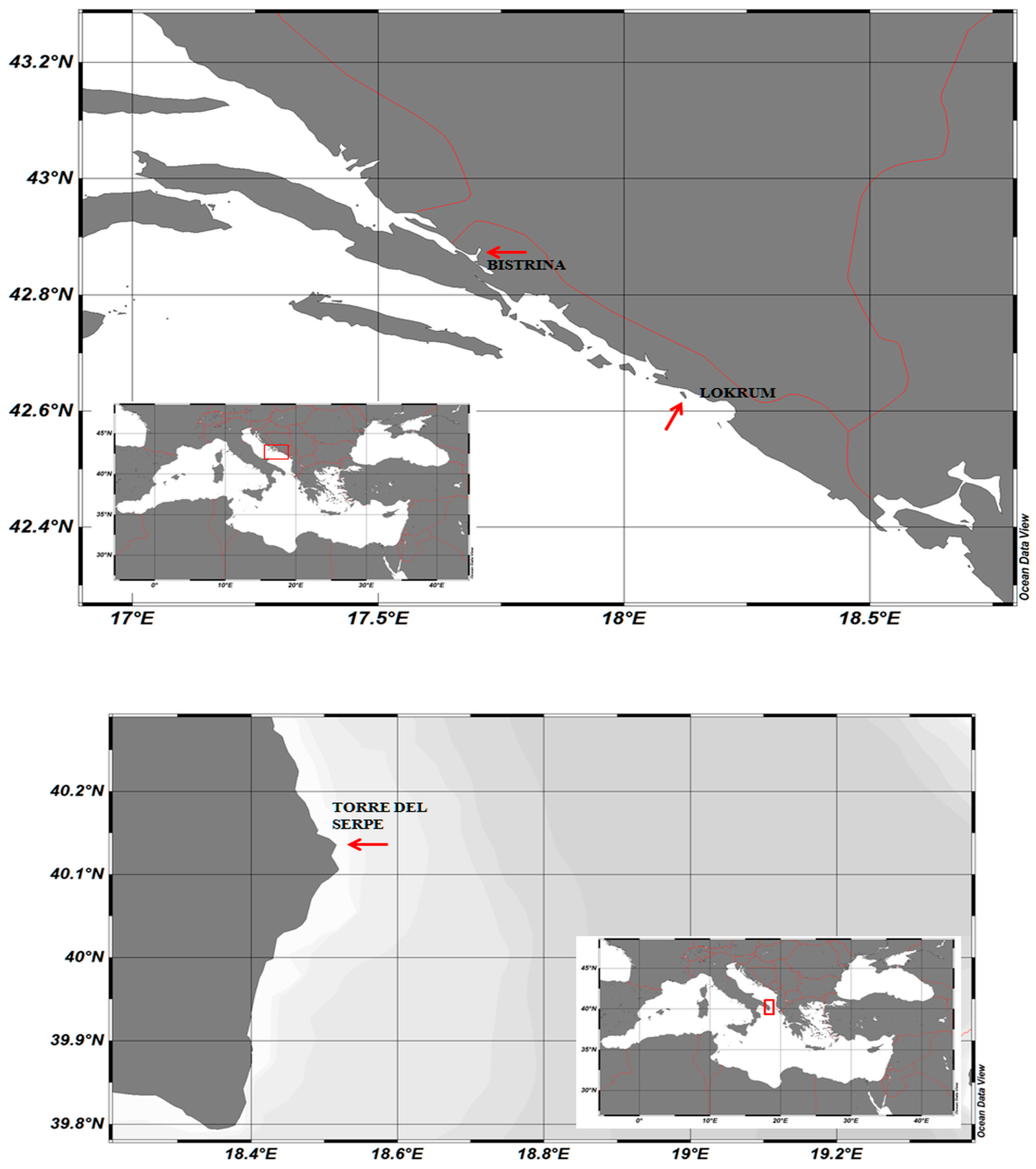
2.1. Study Sites and Sampling Design
2.1.1. Lokrum (42°38′03″ N, 18°07′01″ E)
2.1.2. Bistrina (42°52′04″ N, 17°41′43″ E)
2.1.3. Torre del Serpe, Otranto (40°08′ N, 18°31′ E)
2.2. Laboratory Identification and Data Processing
2.3. Laboratory Culture and Life-Cycle Observations of Stylactis inermis Allman, 1872
3. Results
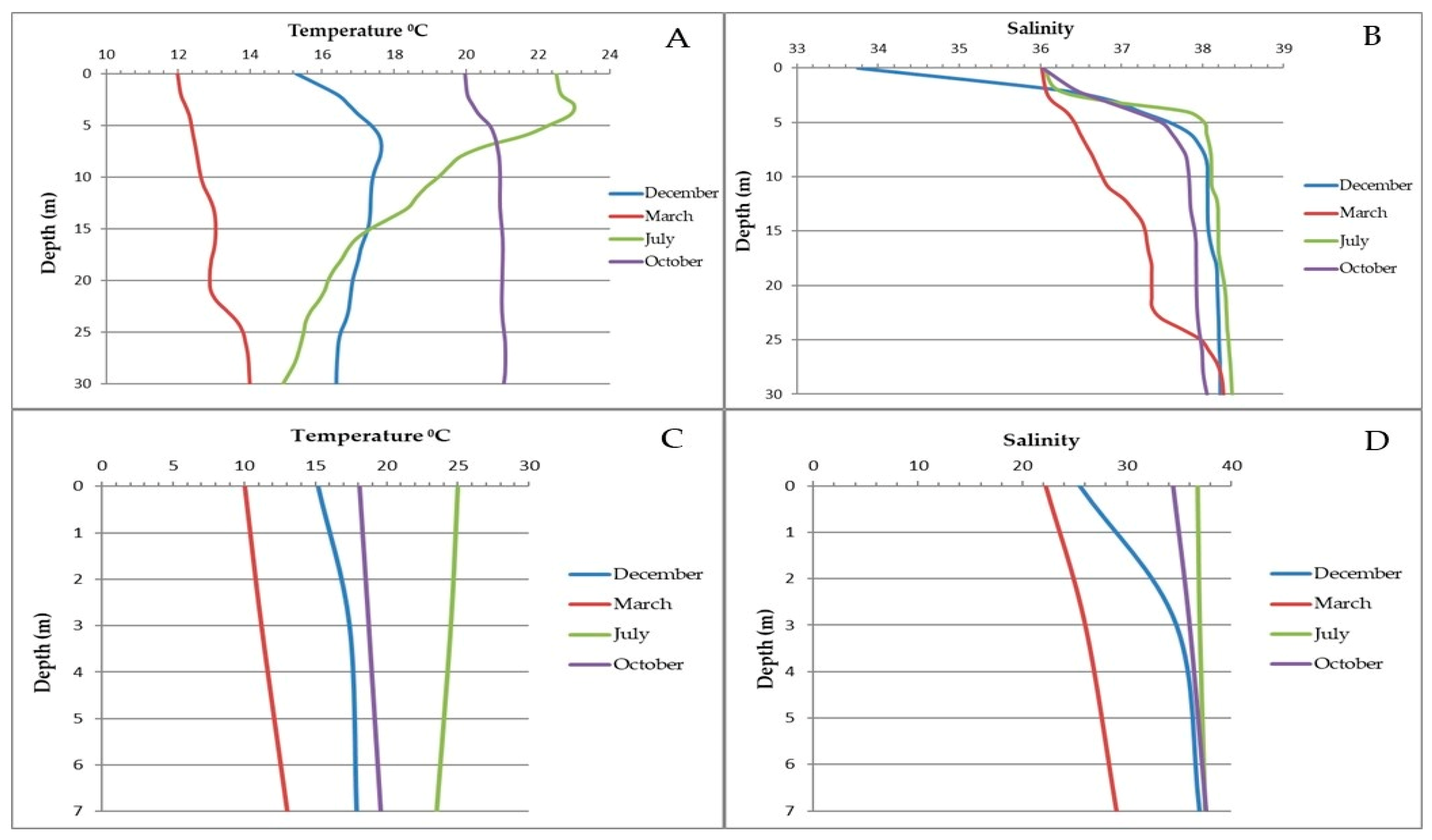
3.1. Hydrographic Conditions
3.2. Overall Biodiversity
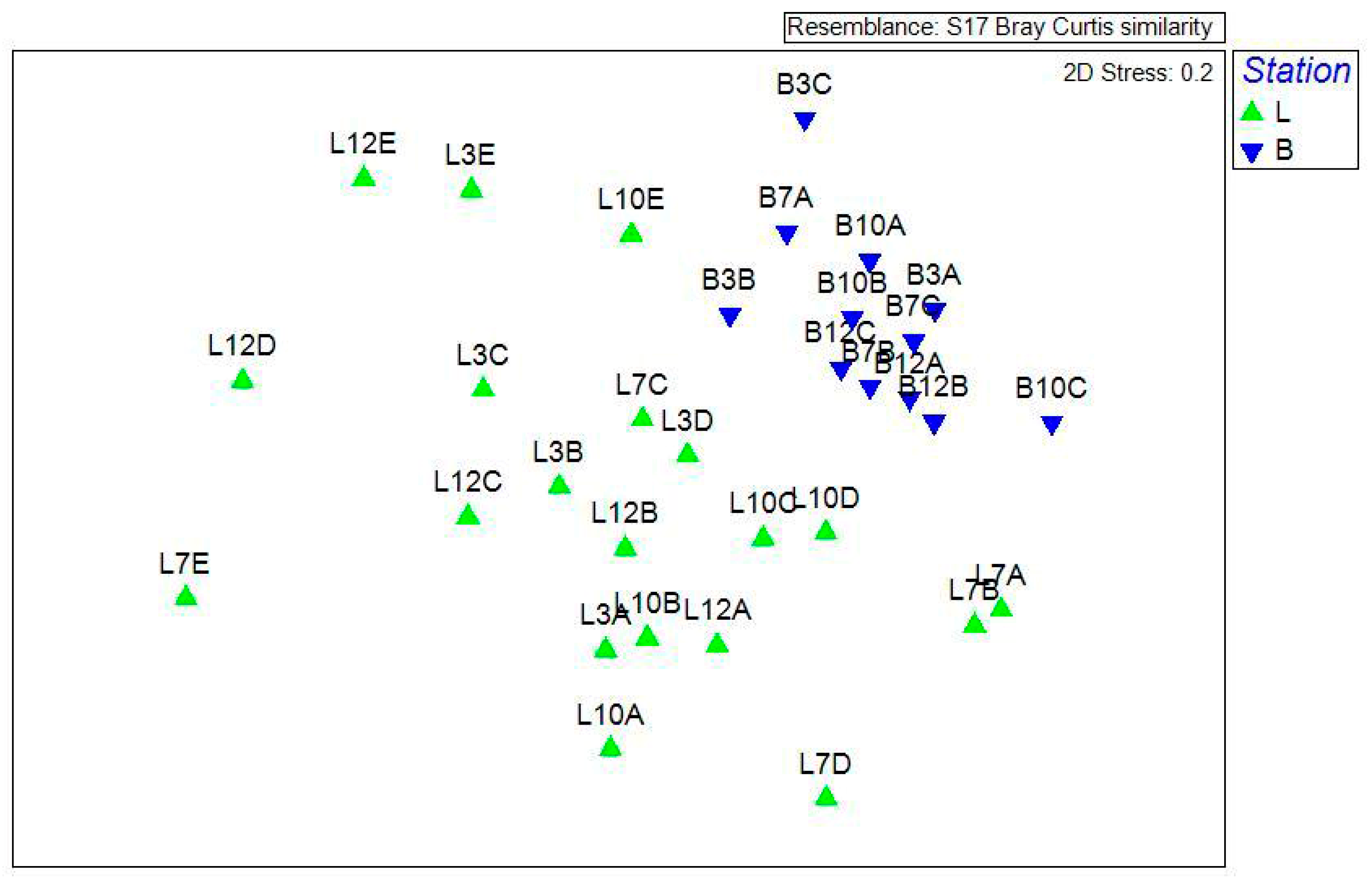
3.3. Between-Site Comparison
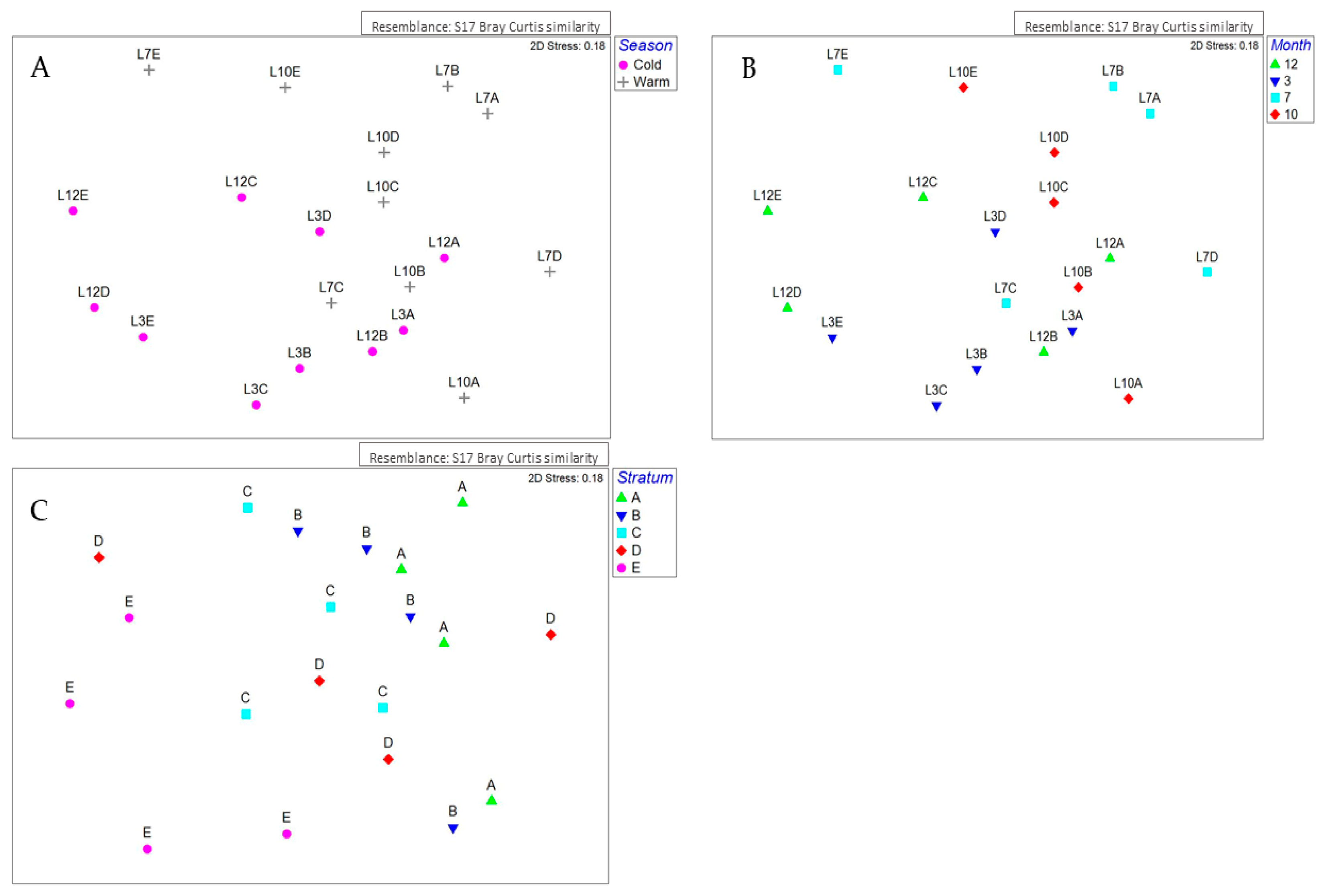
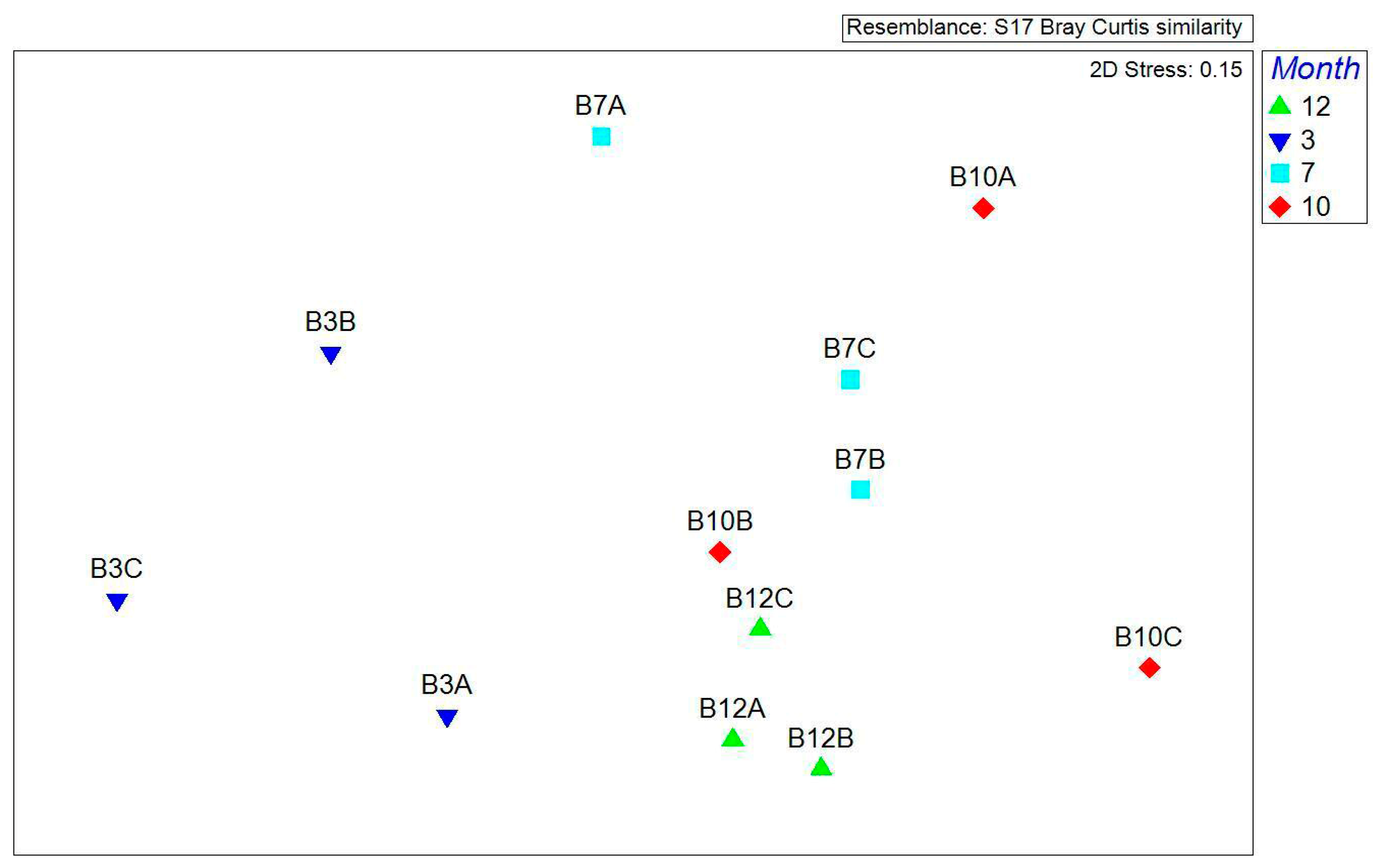
3.4. Seasonal and Depth Patterns at Lokrum
3.5. Seasonal and Depth Patterns at Bistrina
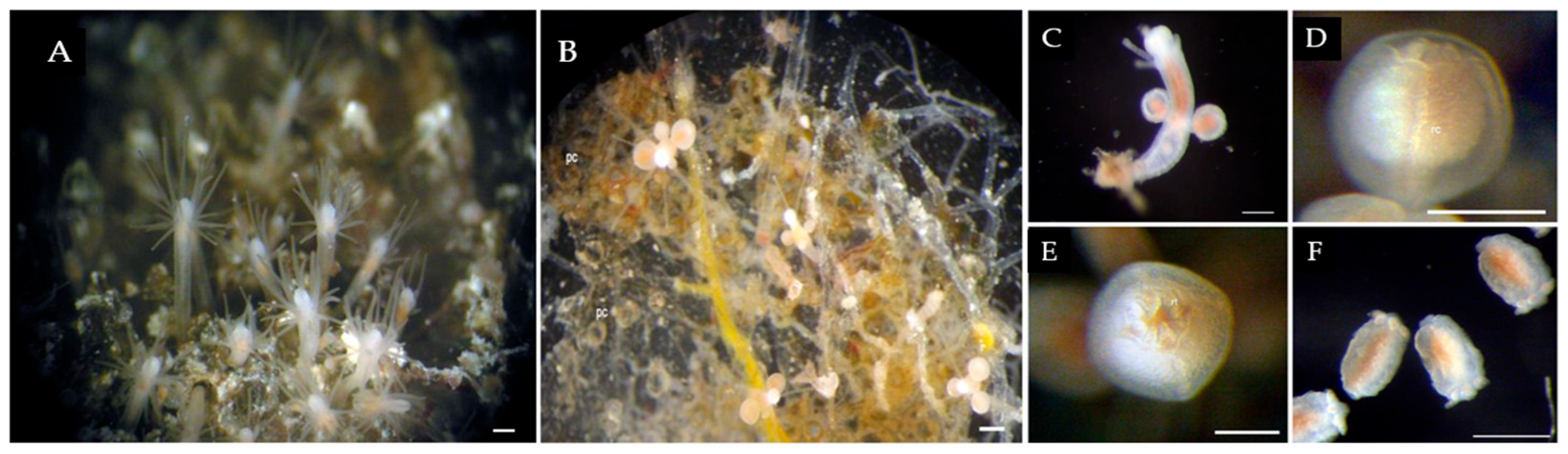
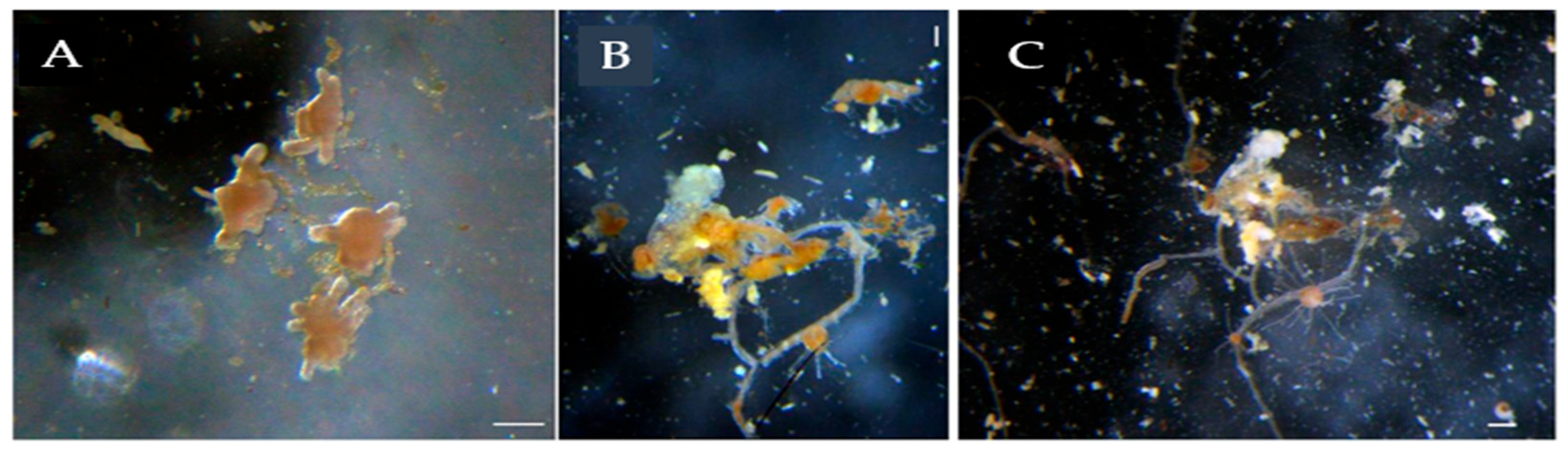
3.6. Life-Cycle Observations of Stylactis inermis
4. Discussion
4.1. Biodiversity in a Regional Context
4.2. Environmental Drivers of Between-Site Differences
4.3. Seasonal Dynamics and Temporal Niche Partitioning
4.4. Vertical Zonation at Lokrum
4.5. Allochthonous Species
4.6. Reverse Development in Stylactis inermis
4.7. Baseline Value and Monitoring Implications
5. Conclusions
Author Contributions
Funding
Data Availability Statement
Acknowledgments
Conflicts of Interest
Abbreviations
| CTD | Conductivity, Temperature, and Depth |
| DISTEBA | Department of Biological and Environmental Science and Technology |
| nMDS | non-metric Multidimensional Scaling |
| PERMANOVA | Permutational Multivariate Analysis of Variance |
| PERMDISP | Permutational Analysis of Multivariate Dispersions |
| PRIMER | Plymouth Routines in Multivariate Ecological Research |
| R2 | coefficient of determination |
| SCUBA | Self-Contained Underwater Breathing Apparatus |
| SIMPER | Similarity Percentage analysis |
| WoRMS | World Register of Marine Species |
Appendix A

| Taxa | Av.Abund | Av.Sim | Sim/SD | Contrib% | Cum.% |
|---|---|---|---|---|---|
| December (avg. similarity: 17.11%) | |||||
| Eudendrium glomeratum | 1.00 | 4.45 | 1.03 | 25.98 | 25.98 |
| Stylactis inermis | 1.20 | 3.73 | 0.58 | 21.79 | 47.78 |
| Eudendrium racemosum | 1.00 | 2.34 | 0.56 | 13.70 | 61.47 |
| Antennella secundaria | 1.00 | 1.48 | 0.32 | 8.66 | 70.13 |
| Campanularia hincksii | 0.60 | 1.25 | 0.32 | 7.30 | 77.43 |
| Obelia dichotoma | 1.20 | 0.93 | 0.32 | 5.44 | 82.87 |
| March (avg. similarity: 24.95%) | |||||
| Obelia dichotoma | 2.20 | 6.91 | 1.09 | 27.72 | 27.72 |
| Antenella siliquosa | 1.40 | 4.08 | 0.61 | 16.35 | 44.07 |
| Clytia hemisphaerica | 1.20 | 3.83 | 1.03 | 15.33 | 59.40 |
| Kirchenpaueria halecioides | 1.40 | 2.63 | 0.62 | 10.53 | 69.93 |
| Stylactis inermis | 1.00 | 1.87 | 0.54 | 7.50 | 77.43 |
| Eudendrium glomeratum | 0.80 | 1.59 | 0.61 | 6.36 | 83.78 |
| July (avg. similarity: 17.50%) | |||||
| Eudendrium racemosum | 1.60 | 10.75 | 1.01 | 61.43 | 61.43 |
| Aglaophenia kirchenpaueri | 0.60 | 1.54 | 0.32 | 8.79 | 70.23 |
| Clytia linearis | 0.40 | 1.43 | 0.32 | 8.16 | 78.39 |
| Kirchenpaueria halecioides | 0.60 | 1.43 | 0.32 | 8.16 | 86.55 |
| October (avg. similarity: 29.51%) | |||||
| Eudendrium racemosum | 2.80 | 8.80 | 1.62 | 29.83 | 29.83 |
| Plumularia setacea | 2.20 | 5.01 | 0.97 | 16.99 | 46.82 |
| Clytia hemisphaerica | 1.80 | 5.01 | 2.21 | 16.98 | 63.80 |
| Eudendrium glomeratum | 0.80 | 1.36 | 0.62 | 4.61 | 68.41 |
| Eudendrium simplex | 0.80 | 1.36 | 0.62 | 4.61 | 73.01 |
| Kirchenpaueria halecioides | 1.00 | 1.16 | 0.62 | 3.92 | 76.93 |
| Aglaophenia octodonta | 1.40 | 1.09 | 0.32 | 3.70 | 80.63 |
| Taxa | Av.Abund | Av.Sim | Sim/SD | Contrib% | Cum.% |
|---|---|---|---|---|---|
| A (0–5 m) (avg. similarity: 33.68%) | |||||
| Dynamena disticha | 2.00 | 5.67 | 3.99 | 16.84 | 16.84 |
| Eudendrium racemosum | 1.75 | 3.98 | 0.73 | 11.81 | 28.65 |
| Sertularella mediterranea | 1.75 | 3.85 | 0.91 | 11.44 | 40.09 |
| Aglaophenia kirchenpaueri | 1.25 | 3.44 | 0.90 | 10.21 | 50.29 |
| Sertularella polyzonias | 2.00 | 3.14 | 0.73 | 9.32 | 59.61 |
| Anthohebella parasitica | 1.25 | 2.59 | 0.80 | 7.70 | 67.31 |
| Kirchenpaueria halecioides | 1.50 | 2.53 | 0.84 | 7.52 | 74.83 |
| Clytia noliformis | 1.50 | 1.96 | 0.41 | 5.82 | 80.66 |
| B (5–10 m) (avg. similarity: 28.27%) | |||||
| Aglaophenia octodonta | 1.75 | 4.31 | 0.91 | 15.24 | 15.24 |
| Eudendrium racemosum | 1.25 | 3.83 | 0.80 | 13.56 | 28.80 |
| Obelia dichotoma | 2.00 | 3.17 | 0.41 | 11.23 | 40.03 |
| Clytia linearis | 1.25 | 2.85 | 0.83 | 10.08 | 50.11 |
| Dynamena disticha | 1.50 | 2.85 | 0.83 | 10.08 | 60.18 |
| Clytia hemisphaerica | 1.50 | 2.82 | 0.84 | 9.98 | 70.16 |
| Eudendrium glomeratum | 1.00 | 2.15 | 0.91 | 7.62 | 77.78 |
| Kirchenpaueria halecioides | 1.00 | 2.15 | 0.91 | 7.62 | 85.40 |
| C (10–15 m) (avg. similarity: 23.27%) | |||||
| Eudendrium racemosum | 1.50 | 4.70 | 0.85 | 20.19 | 20.19 |
| Kirchenpaueria halecioides | 1.50 | 4.10 | 0.75 | 17.63 | 37.82 |
| Obelia dichotoma | 1.25 | 2.95 | 0.89 | 12.69 | 50.51 |
| Antennella secundaria | 1.00 | 2.30 | 0.41 | 9.88 | 60.39 |
| Orthopyxis crenata | 1.25 | 1.59 | 0.41 | 6.82 | 67.22 |
| Bougainvillia muscus | 0.75 | 1.15 | 0.41 | 4.94 | 72.16 |
| Campanularia hincksii | 0.75 | 1.15 | 0.41 | 4.94 | 77.10 |
| Clytia linearis | 0.75 | 1.15 | 0.41 | 4.94 | 82.04 |
| D (15–20 m) (avg. similarity: 14.97%) | |||||
| Eudendrium racemosum | 1.75 | 6.90 | 0.88 | 46.08 | 46.08 |
| Eudendrium glomeratum | 0.75 | 5.07 | 0.87 | 33.88 | 79.96 |
| Clytia noliformis | 0.75 | 1.67 | 0.41 | 11.13 | 91.09 |
| E (20–30 m) (avg. similarity: 26.98%) | |||||
| Tridentata perpusilla | 1.75 | 6.11 | 0.88 | 22.66 | 22.66 |
| Aglaophenia elongata | 2.00 | 5.14 | 0.90 | 19.04 | 41.69 |
| Monotheca obliqua | 1.50 | 4.34 | 0.72 | 16.08 | 57.77 |
| Aglaophenia harpago | 1.25 | 1.96 | 0.41 | 7.27 | 65.04 |
| Halecium mediterraneum | 1.00 | 1.96 | 0.41 | 7.27 | 72.31 |
| Stylactis inermis | 1.00 | 1.96 | 0.41 | 7.27 | 79.58 |
| Clytia hemisphaerica | 1.25 | 1.59 | 0.41 | 5.88 | 85.46 |
| Taxa | Av.Abund | Av.Sim | Sim/SD | Contrib% | Cum.% |
|---|---|---|---|---|---|
| December (avg. similarity: 70.65%) | |||||
| Obelia dichotoma | 4.00 | 13.66 | 17.73 | 19.34 | 19.34 |
| Eudendrium racemosum | 3.33 | 9.26 | 2.02 | 13.10 | 32.44 |
| Corydendrium parasiticum | 3.00 | 8.04 | 3.24 | 11.39 | 43.83 |
| Hydranthea margarica | 3.00 | 8.04 | 3.24 | 11.39 | 55.22 |
| Clytia noliformis | 3.00 | 7.94 | 4.37 | 11.24 | 66.46 |
| Aglaophenia lophocarpa | 2.33 | 6.83 | 17.73 | 9.67 | 76.13 |
| Hydrodendron mirabile | 2.33 | 6.83 | 17.73 | 9.67 | 85.81 |
| March (avg. similarity: 41.78%) | |||||
| Obelia dichotoma | 3.67 | 23.63 | 4.11 | 56.56 | 56.56 |
| Clytia paulensis | 1.67 | 5.13 | 0.58 | 12.28 | 68.84 |
| Mitrocomium medusiferum | 1.67 | 4.94 | 0.58 | 11.82 | 80.66 |
| July (avg. similarity: 48.28%) | |||||
| Corydendrium parasiticum | 2.67 | 13.43 | 3.16 | 27.82 | 27.82 |
| Obelia dichotoma | 2.33 | 11.41 | 9.32 | 23.64 | 51.46 |
| Turritopsis dohrnii | 1.33 | 5.71 | 9.32 | 11.82 | 63.28 |
| Eudendrium racemosum | 2.33 | 5.00 | 0.58 | 10.36 | 73.64 |
| Aglaophenia lophocarpa | 1.67 | 3.33 | 0.58 | 6.90 | 80.54 |
| October (avg. similarity: 42.86%) | |||||
| Eudendrium racemosum | 3.67 | 16.65 | 4.11 | 38.86 | 38.86 |
| Aglaophenia lophocarpa | 2.00 | 10.07 | 3.96 | 23.49 | 62.35 |
| Corydendrium parasiticum | 1.67 | 5.03 | 3.96 | 11.75 | 74.10 |
| Aglaophenia tubiformis | 1.67 | 3.10 | 0.58 | 7.24 | 81.33 |
References
- Bouillon, J.; Medel, M.D.; Pagès, F.; Gili, J.M.; Boero, F.; Gravili, C. Fauna of the Mediterranean Hydrozoa. Sci. Mar. 2004, 68, 5–438. [Google Scholar] [CrossRef]
- Gravili, C.; Vito, D.D.; Camillo, C.G.D.; Martell, L.; Piraino, S.; Boero, F. The Non-Siphonophoran Hydrozoa (Cnidaria) of Salento, Italy with Notes on Their Life-Cycles: An Illustrated Guide. Zootaxa 2015, 3908, 1–187. [Google Scholar] [CrossRef]
- Moglia, S.; Betti, F.; Boero, F.; Canessa, M.; Di Camillo, C.G.; Enrichetti, F.; Puce, S.; Bavestrello, G. Climate-Driven Shifts in a Mediterranean Hydrozoan Assemblage over 44 Years. ICES J. Mar. Sci. 2025, 82, fsaf113. [Google Scholar] [CrossRef]
- Boero, F.; Fresi, E. Zonation and Evolution of a Rocky Bottom Hydroid Community. Mar. Ecol. 1986, 7, 123–150. [Google Scholar] [CrossRef]
- Gravili, C.; Bevilacqua, S.; Terlizzi, A.; Boero, F. Missing species among Mediterranean non-siphonophoran Hydrozoa. Biodivers. Conserv. 2015, 24, 1329–1357. [Google Scholar] [CrossRef]
- Di Camillo, C.G.; Giordano, G.; Bo, M.; Betti, F.; Mori, M.; Puce, S.; Bavestrello, G. Seasonal Patterns in the Abundance of Ectopleura crocea (Cnidaria: Hydrozoa) on a Shipwreck in the Northern Adriatic. Mar. Ecol. 2013, 34, 25–32. [Google Scholar] [CrossRef]
- Puce, S.; Bavestrello, G.; Di Camillo, C.G.; Boero, F. Long-Term Changes in Hydroid (Cnidaria, Hydrozoa) Assemblages: Effect of Mediterranean Warming? Mar. Ecol. 2009, 30, 313–326. [Google Scholar] [CrossRef]
- Yilmaz, I.N.; Martell, L.; Topcu, N.E.; Isinibilir, M. Βenthic Hydrozoan Assemblages as Potential Indicators of Environmental Health in a Μediterranean Μarine Protected Area. Mediterr. Mar. Sci. 2020, 21, 36–46. [Google Scholar] [CrossRef]
- Topçu, N.E.; Martell, L.F.; Yilmaz, I.N.; Isinibilir, M. Benthic Hydrozoans as Potential Indicators of Water Masses and Anthropogenic Impact in the Sea of Marmara. Mediterr. Mar. Sci. 2018, 19, 273–283. [Google Scholar] [CrossRef]
- Megina, C.; González-Duarte, M.M.; López-González, P.J.; Piraino, S. Harbours as Marine Habitats: Hydroid Assemblages on Sea-Walls Compared with Natural Habitats. Mar. Biol. 2013, 160, 371–381. [Google Scholar] [CrossRef]
- Martell, L.; Bracale, R.; Carrion, S.A.; Giangrande, A.; Purcell, J.E.; Lezzi, M.; Gravili, C.; Piraino, S.; Boero, F. Successional dynamics of marine fouling hydroids (Cnidaria: Hydrozoa) at a finfish aquaculture facility in the Mediterranean Sea. PLoS ONE 2018, 13, e0195352. [Google Scholar] [CrossRef]
- Soto Ángel, J.J.; Peña Cantero, Á.L. Shallow-Water Benthic Hydroids from the Maltese Islands (Central Mediterranean). Mar. Ecol. 2013, 34, 177–196. [Google Scholar] [CrossRef]
- Yıldırım, S.Ö.K.; Küçük, F. New Addition to the Fauna of Shallow-Water Hydroid Polyps (Cnidaria: Hydrozoa) in the Gulf of Antalya, Türkiye. Oceanol. Hydrobiol. Stud. 2024, 53, 365–374. [Google Scholar] [CrossRef]
- Benović, A. Idromedusae Dell’ Adriatico Settentrionale Nell’ Anno 1965. Boll. Pesca Piscic. Idrobiol. 1973, 2128, 59–70. [Google Scholar]
- Schmidt, H.E.; Benović, A. Cruises of R/V “Vila Velebita” in the Kvarner Region of the Adriatic Sea, XII.-Hydromedusae (Cnidaria). Thalass. Jugosl. 1979, 15, 193–202. [Google Scholar]
- Onofri, I.; Lučić, D.; Malej, A.; Gangai Zovko, B. Review of Eastern Adriatic hydromedusae: Unravelling two centuries of records. J. Mar. Sci. Eng. 2026, 14, 288. [Google Scholar] [CrossRef]
- Pieper, F.W. Erganzungen Zu Heller’s Zoophyten, Etc. Des Adriatischen Meeres. Zool. Anz. 1884, 7, 1–221. [Google Scholar]
- Marktanner-Turneretscher, G. Die Hydroiden Des k.k. Naturhistorischen Hofmuseums. Ann. Naturhist. Hofmus. 1890, 5, 195–286. [Google Scholar]
- Broch, H. Hydroiduntersuchungen. III. Vergleichende Studien an Adriatischen Hydroiden. Det K. Nor. Vidensk. Selsk. Skr. 1912, 1911, 1–65. [Google Scholar]
- Babić, K. Građa Za Poznavanje Hrvatske Faune Hidroid Polipa. Rad Jugoslavenske Akademije Znanosti i Umjetnosti. Mat.-Prirodosl. Razred 1898, 25, 1–47. [Google Scholar]
- Babić, K. Prilog Fauni Jadranskog Mora. Rad Jazu Zagreb 1910, 48, 207–235. [Google Scholar]
- Babić, K. Aglaophenia adriatica n. sp., Eine Neue Hydroidenform Aus Der Adria. Zool. Anz. 1911, 37, 541–543. [Google Scholar]
- Babić, K. Bemerkungen Zu Den Zwei in Der Adria Vorkommenden Thecaphoren Hydroiden. Zool. Anz. 1913, 43, 284–288. [Google Scholar]
- Babić, K. Über Einige Haleciiden. Zool. Anz. 1913, 41, 468–474. [Google Scholar]
- Car, L.; Hadži, J. Izveštaji o Naučnom Istraživanju Jadranskog Mora God. 1913 i 1914. Prir. Istraž. Hrvat. Slav. 1914, 2, 1–34. [Google Scholar]
- Hadži, J. Rezultati Bioloških Istraživanja Jadranskoga Mora. Hidroidi II. Halocoryne epizoica g. n. sp. n.; Laföeina vilaevelebiti sp. n. Prirod; Prirodoslovna Istraživanja Hrvatske i Slavonije: Zagreb, Croatia, 1917. [Google Scholar]
- Broch, H. Zur Kenntnis Der Adriatischen Hydroidenfauna von Split. Arten Und Variationen. Skr. Norske Vidensk. Akad. Mat.-Nat. Kl. 1933, 4, 1–115. [Google Scholar]
- Svoboda, A.; Cornelius, P.F.S. The European and Mediterranean Species of Aglaophenia (Cnidaria: Hydrozoa). Zool. Verh. 1991, 274, 1–72. [Google Scholar]
- Marques, A.C.; Peña Cantero, A.L.; Vervoort, W. Mediterranean Species of Eudendrium Ehrenberg, 1834 (Hydrozoa, Anthomedusae, Eudendriidae) with the Description of a New Species. J. Zool. 2000, 252, 197–213. [Google Scholar] [CrossRef]
- Zavodnik, D.; Kovačić, M. Index of Marine Fauna in Rijeka Bay (Adriatic Sea, Croatia). Nat. Croat. 2000, 9, 297–379. [Google Scholar]
- Batistić, M.; Garić, R.; Molinero, J.C. Interannual Variations in Adriatic Sea Zooplankton Mirror Shifts in Circulation Regimes in the Ionian Sea. Clim. Res. 2014, 61, 231–240. [Google Scholar] [CrossRef]
- Batistić, M.; Jasprica, N.; Carić, M.; Lučić, D. Annual Cycle of the Gelatinous Invertebrate Zooplankton of the Eastern South Adriatic Coast (NE Mediterranean). J. Plankton Res. 2007, 29, 671–686. [Google Scholar] [CrossRef]
- Viličić, D.; Jasprica, N.; Carić, M.; Burić, Z. Taxonomic Composition and Seasonal Distribution of Microphytoplankton in Mali Ston Bay (Eastern Adriatic). Acta Bot. Croat. 1998, 57, 29–48. [Google Scholar]
- Čalić, M.; Carić, M.; Kršinić, F.; Jasprica, N.; Pećarević, M. Controlling Factors of Phytoplankton Seasonal Succession in Oligotrophic Mali Ston Bay (South-Eastern Adriatic). Environ. Monit. Assess. 2013, 185, 7543–7563. [Google Scholar] [CrossRef]
- Jasprica, N.; Carić, M. A Comparison of Phytoplankton Biomass Estimators and Their Environmental Correlates in the Mali Ston Bay (Southern Adriatic). Mar. Ecol. 1997, 18, 35–50. [Google Scholar] [CrossRef]
- De Vito, D. Analisi Spazio-Temporali Della Struttura Di Popolamenti a Idrozoi: Possibili Effetti Del Cambiamento Climatico. Ph.D. Thesis, Università Del Salento, Lecce, Italy, 2006. [Google Scholar]
- Millard, N.A.H. Monograph on the Hydroida of Southern Africa; Annals of the South African Musem: Cape Town, South Africa, 1975; Volume 68, pp. 1–513. [Google Scholar]
- Cornelius, P.F.S. North-West European Thecate Hydroids and Their Medusae (Cnidaria, Leptolida, Leptothecata), Parts 1–2; Synopses of the British Fauna (New Series), No. 50; Field Studies Council: Shrewsbury, UK, 1995. [Google Scholar]
- WoRMS—World Register of Marine Species. Available online: https://www.marinespecies.org/ (accessed on 8 January 2026).
- Camillo, C.G.D.; Bavestrello, G.; Valisano, L.; Puce, S. Spatial and Temporal Distribution in a Tropical Hydroid Assemblage. J. Mar. Biol. Assoc. UK 2008, 88, 1589–1599. [Google Scholar] [CrossRef]
- Clarke, K.R.; Warwick, R.M. Change in Marine Communities: An Approach to Statistical Analysis and Interpretation, 2nd ed.; PRIMER-E: Plymouth, UK, 2001. [Google Scholar]
- Anderson, M.J. A New Method for Non-Parametric Multivariate Analysis of Variance. Austral Ecol. 2001, 26, 32–46. [Google Scholar] [CrossRef]
- González-Duarte, M.M.; Megina, C.; De Vito, D.; Di Camillo, C.G.; Puce, S.; Piraino, S. A unified assessment of marine Mediterranean assemblages: A lesson from benthic hydroids. Mar. Ecol. 2016, 37, 155–163. [Google Scholar] [CrossRef]
- Anderson, M.J. Distance-Based Tests for Homogeneity of Multivariate Dispersions. Biometrics 2006, 62, 245–253. [Google Scholar] [CrossRef]
- Schuchert, P. Observations on Hydractinia aculeata (Hydrozoa, Cnidaria). Rev. Suisse Zool. 2014, 121, 441–451. [Google Scholar]
- Schönborn, C.; Arndt, E.A.; Gosselck, F. Bestimmungsschlüssel Der Benthischen Hydrozoen Der Ostsee. Mitt. Zool. Mus. Berl. 1993, 69, 201–253. [Google Scholar] [CrossRef]
- Boero, F. Systematics and Ecology of the Hydroid Population of Two Posidonia oceanica Meadows. Mar. Ecol. 1981, 2, 181–197. [Google Scholar] [CrossRef]
- Peña Cantero, A.; García Carrascosa, A.M. The Benthic Hydroid Fauna of the Chafarinas Islands (Alborán Sea, Western Mediterranean). Zool. Verh. 2002, 337, 1–180. [Google Scholar]
- Schuchert, P. Survey of the Family Corynidae (Cnidaria, Hydrozoa). Rev. Suisse Zool. 2001, 108, 739–878. [Google Scholar] [CrossRef]
- Morri, C.; Boero, F. Marine Fouling Hydroids. In Catalogue of the Main Marine Fouling Organisms; ODEMA: Brussels, Belgium, 1986; Volume 7. [Google Scholar]
- Di Camillo, C.G.; Bavestrello, G.; Cerrano, C.; Gravili, C.; Piraino, S.; Puce, S.; Boero, F. Hydroids (Cnidaria, Hydrozoa): A neglected component of animal forests. In Marine Animal Forests; Rossi, S., Bramanti, L., Gori, A., Orejas, C., Eds.; Springer: Cham, Switzerland, 2017; pp. 397–427. [Google Scholar] [CrossRef]
- Barange, M.; Gili, J.M. Feeding Cycles and Prey Capture in Eudendrium racemosum (Cavolini, 1785). J. Exp. Mar. Biol. Ecol. 1988, 115, 281–293. [Google Scholar] [CrossRef]
- Di Camillo, C.G.; Betti, F.; Bo, M.; Martinelli, M.; Puce, S.; Vasapollo, C.; Bavestrello, G. Population dynamics of Eudendrium racemosum (Cnidaria, Hydrozoa) from the North Adriatic Sea. Mar. Biol. 2012, 159, 1593–1609. [Google Scholar] [CrossRef]
- Standing, J.D. Fouling Community Structure: Effects of the Hydroid Obelia dichotoma on Larval Recruitment. In Coelenterate Ecology and Behavior; Mackie, G.O., Ed.; Plenum Press: New York, NY, USA, 1976; pp. 155–164. [Google Scholar]
- Schmidt, G.H. The Hydroid Tubularia larynx Causing “Bloom” of the Ascidians Ciona intestinalis and Ascidiella aspersa. Mar. Ecol. Prog. Ser. 1983, 12, 103–105. [Google Scholar] [CrossRef]
- Igić, L. The Biomass of Fouling Communities on Edible Shellfish: Oysters (Ostrea edulis L.) and Mussels (Mytilus galloprovincialis Lamk.) in the Northern Adriatic. Thalass. Jugosl. 1981, 17, 147–154. [Google Scholar]
- Bavestrello, G.; Sommer, C.; Sarà, M. Bi-Directional Conversion in Turritopsis nutricula (Hydrozoa). Sci. Mar. 1992, 56, 137–140. [Google Scholar]
- Boero, F. The Ecology of Marine Hydroids and Effects of Environmental Factors: A Review. Mar. Ecol. 1984, 5, 93–118. [Google Scholar] [CrossRef]
- Skliris, N.; Sofianos, S.; Gkanasos, A.; Mantziafou, A.; Vervatis, V.; Axaopoulos, P.; Lascaratos, A. Decadal scale variability of sea surface temperature in the Mediterranean Sea in relation to atmospheric variability. Ocean Dyn. 2012, 62, 13–30. [Google Scholar] [CrossRef]
- Vito, D.D.; Boero, F.; Camillo, C.G.D.; Megina, C.; Piraino, S. Redescription of the Zooxanthellate Eudendrium moulouyensis (Eudendriidae: Hydrozoa) from the Mediterranean Sea. J. Mar. Biol. Assoc. UK 2008, 88, 1655–1662. [Google Scholar] [CrossRef]
- Boero, F.; Chessa, L.; Chimenz, C.; Fresi, E. The Zonation of Epiphytic Hydroids on the Leaves of Some Posidonia oceanica (L.) DELILE Beds in the Central Mediterranean. Mar. Ecol. 1985, 6, 27–33. [Google Scholar] [CrossRef]
- Billard, A. Note Sur Une Espèce de Campanularidés (Clytia gravieri, Billard). Bull. Mus. Natl. Hist. Nat. Paris 1938, 210, 429–432. [Google Scholar]
- Boero, F.; Di Camillo, C.; Gravili, C. Phantom Aliens in Mediterranean Waters. MarBEF Newsl. 2005, 3, 21–22. [Google Scholar]
- Occhipinti-Ambrogi, A.; Marchini, A.; Cantone, G.; Castelli, A.; Chimenz, C.; Cormaci, M.; Froglia, C.; Furnari, G.; Gambi, M.C.; Giaccone, G.; et al. Alien species along the Italian coasts: An overview. Biol. Invasions 2011, 13, 215–237. [Google Scholar] [CrossRef]
- Piraino, S.; Boero, F.; Aeschbach, B.; Schmid, V. Reversing the Life Cycle: Medusae Transforming into Polyps and Cell Transdifferentiation in Turritopsis nutricula (Cnidaria, Hydrozoa). Biol. Bull. 1996, 190, 302–312. [Google Scholar] [CrossRef]
- De Vito, D.; Piraino, S.; Schmich, J.; Bouillon, J.; Boero, F. Evidence of reverse development in Leptomedusae (Cnidaria, Hydrozoa): The case of Laodicea undulata (Forbes and Goodsir 1851). Mar. Biol. 2006, 149, 339–346. [Google Scholar] [CrossRef]
- Schmich, J.; Kraus, Y.; De Vito, D.; Graziussi, D.; Boero, F.; Piraino, S. Induction of Reverse Development in Two Marine Hydrozoans. Int. J. Dev. Biol. 2006, 51, 45–56. [Google Scholar] [CrossRef] [PubMed]
- Soto-Ángel, J.J.; Burkhardt, P. Reverse Development in the Ctenophore Mnemiopsis leidyi. Proc. Natl. Acad. Sci. USA 2024, 121, e2411499121. [Google Scholar] [CrossRef]


| Taxon and Authority | Local Occurrence, Substrate and Reproductive Stage |
|---|---|
| Bougainvillia muscus (Allman, 1863) | Lokrum: 10–15 m, December and March; usually on the inner side of Peyssonnelia thalli; no reproductive stages recorded. |
| Coryne muscoides (Linnaeus, 1761) * | Lokrum: 0–10 m in the winter months; on Cystoseira and Lithophyllum; sterile colonies only. |
| Slabberia halterata Forbes, 1846 * | Lokrum: 20–30 m in December and March; sterile colonies, exclusively on the sponge Petrosia ficiformis. |
| Stauridiosarsia reesi (Vannucci, 1956) * | Bistrina: single polyp in October, on a polychaete tube attached to Ostrea edulis; no gonophores observed. |
| Eudendrium capillare Alder, 1856 * | Lokrum: 5–10 m, December and March; epibiont on ascidians and the sponge Petrosia ficiformis. |
| Eudendrium glomeratum Picard, 1952 | Lokrum: present in all sampling months; from the surface to 20 m in December and March, only 20–30 m in July, and 5–20 m in October. |
| Eudendrium merulum Watson, 1985 | Bistrina: July and October; on polychaetes overgrowing Mytilus galloprovincialis. Lokrum: 5–15 m in July and 20–30 m in October; on algal thalli and rock; more abundant in October. |
| Eudendrium moulouyensis Marques, Peña Cantero and Vervoort, 2000 * | Bistrina: December, July and October; throughout the water column, mainly on Mytilus galloprovincialis; gonophores noted in July; zooxanthellate. |
| Eudendrium racemosum (Cavolini, 1785) | Bistrina: very abundant through most of the water column; reproductive in December, July and October; on bivalves, polychaetes and Microcosmus vulgaris. Lokrum: year-round and across all depth layers; more abundant in the warm season, usually on hard substrata. |
| Eudendrium simplex Pieper, 1884 | Bistrina: frequent epibiont on Mytilus galloprovincialis and colonies of E. racemosum. Lokrum: 5–20 m; small colonies, most often on rock and Posidonia oceanica leaves. |
| Stylactis inermis Allman 1872 * | Lokrum: 0–30 m, recorded only in December and March; dense colonies on Halimeda and Peyssonnelia thalli and on the bryozoan Myriapora truncata; no reproductive stages noted. |
| Corydendrium parasiticum (Linnaeus, 1767) | Bistrina: present in all months except March, often near the bottom; on a wide range of substrates; gonophores present in July. |
| Turritopsis dohrnii Weissman 1883 * | Bistrina: July and October, through the water column; on bivalve shells and Eudendrium racemosum; no reproductive polyps seen, but release scars indicating medusa production were noted in October. Lokrum: only in October at 0–5 m, on calcareous red algae. |
| Amphinema rugosum (Mayer, 1900) * | Lokrum: 0–10 m in December, March and October; always scarce; most often on bryozoans and brown algae, occasionally on rock. |
| Ectopleura dumortierii (Van Beneden, 1844) * | Lokrum: single solitary polyp at 0.5 m in March, on a broken rock fragment; medusa buds present. |
| Ectopleura larynx (Ellis and Solander, 1786) * | Bistrina: December and March; small colonies on Microcosmus vulgaris and Mytilus galloprovincialis; no reproductive stages recorded. |
| Halocoryne epizoica Hadzi, 1917 | Lokrum: one polyp in October at 0–5 m, on the bryozoan Schizobrachiella sanguinea; medusa buds/gonophores present. |
| Zanclea sessilis (Gosse, 1853) * | Lokrum: 5–25 m, all sampling months except July; exclusively on the bryozoan Myriapora truncata; reproductive colonies in October. |
| Aglaophenia elongata Meneghini, 1845 | Lokrum: deepest layer only (20–30 m) in December, March and October; common; on Posidonia oceanica and bryozoans; corbulae present. |
| Aglaophenia harpago Schenck, 1965 | Lokrum: October only, 20–30 m; epiphyte on Posidonia oceanica leaves; corbulae present. |
| Aglaophenia kirchenpaueri (Heller, 1868) * | Lokrum: surface to 10 m in all sampling months; on Eudendrium racemosum and photophilic algal thalli; corbulae recorded in March. |
| Aglaophenia lophocarpa Allman, 1877 * | Bistrina: recorded in all months except March; usually on Mytilus galloprovincialis; absent only from the 0–2 m layer in July. |
| Aglaophenia octodonta Heller, 1868 | Lokrum: 0–10 m, especially common near the surface; on shallow rocks, Cystoseira, stones and Balanus shells; more numerous in October. |
| Aglaophenia tubiformis Marktanner-Turneretscher, 1890 | Bistrina: surface to 7 m in all sampling months; dense branched colonies, mostly on Mytilus galloprovincialis and also on polychaetes; corbulae in March; zooxanthellate. |
| Campanularia hincksii Alder, 1856 | Lokrum: 5–15 m in December and March; sterile colonies on algae, especially Halimeda tuna and Flabellia petiolata. |
| Clytia gracilis (Sars, 1850) | Bistrina: most abundant in December but present in all months; sterile; mainly on Spongia officinalis and Mytilus galloprovincialis. Lokrum: 5–20 m in July and October; common in October, with some gonothecae; on Halimeda tuna and Eudendrium racemosum. |
| Clytia hemisphaerica (Linnaeus, 1767) | Bistrina: present in all sampling months; on Eudendrium racemosum, Aglaophenia lophocarpa, polychaetes and algae. Lokrum: 0–30 m in all months; on algae (especially Flabellia petiolata), bryozoans, Eudendrium racemosum, Sertularella polyzonias, Cystoseira, Posidonia oceanica leaves and plastic; gonothecae only in October. |
| Clytia linearis (Thorneley, 1900) * | Lokrum: 5–20 m in all sampling months; on various substrates; gonothecae in July and October. |
| Clytia noliformis (McCrady, 1859) * | Bistrina: December only, throughout the water column and especially near the surface; mainly on Eudendrium racemosum and Microcosmus vulgaris. Lokrum: 0–20 m in all sampling months; reproductive colonies in October and March; very common near the surface in the colder months, on Padina pavonica, Halimeda tuna, bryozoans and eudendriid hydroids. |
| Clytia paulensis (Vanhöffen, 1910) * | Bistrina: March only; stolonal, unbranched colonies on the ascidian Microcosmus vulgaris; no gonothecae observed. |
| Laomedea calceolifera (Hincks, 1871) * | Bistrina: present in all sampling months, somewhat more abundant in March; all colonies on Mytilus galloprovincialis; gonothecae in March and July. |
| Obelia dichotoma (Linnaeus, 1758) | Bistrina: very abundant in all months and across all depth layers; on hydroids, bivalves, sponges and ascidians; gonothecae throughout. Lokrum: 0–20 m in all months except July; on various substrates, especially photophilic algae; plastics; as epibiont on E. racemosum; gonothecae in October. |
| Orthopyxis crenata (Hartlaub, 1901) * | Lokrum: 10–20 m in March and 5–15 m in October; on Halimeda tuna, Flabellia petiolata and Codium bursa; gonothecae in October. |
| Lafoeina tenuis G.O. Sars, 1874 * | Bistrina: epibiont on Eudendrium racemosum in shallowest stratum during October. |
| Halecium mediterraneum Weismann, 1883 | Lokrum: 20–30 m in December and March; on rock and Peyssonnelia; without gonothecae. |
| Halecium pusillum Sars, 1856 | Lokrum: October only, 20–30 m; on Eudendrium racemosum and Posidonia oceanica leaves. |
| Hydrodendron mirabile (Hincks, 1866) * | Bistrina: December only, in all three depth layers; exclusively on Eudendrium racemosum; sterile. Lokrum: 5–20 m in December, March and October; on photophilic algae in shallower samples and deeper (15–20 m) in October; gonothecae present in October. |
| Antennella secundaria (Gmelin, 1791) | Lokrum: December only, 10–15 m; on Posidonia oceanica and Sertularia perpusilla; no gonothecae observed. |
| Antennella siliquosa (Hincks, 1877) | Lokrum: March only, 15–30 m; sterile colonies on rock and stones. |
| Halopteris catharina (Johnston, 1833) | Bistrina: October only, 0–2 m; two sterile colonies on Mytilus galloprovincialis. |
| Anthohebella parasitica (Ciamician, 1880) * | Lokrum: 0–10 m in all months except July; no gonothecae; on Eudendrium racemosum in December and October, and on Aglaophenia octodonta in March. |
| Kirchenpaueria halecioides (Alder, 1859) * | Lokrum: 0–20 m in all sampling months, especially abundant in March; on a range of substrates, mainly shells, limpets and Petrosia ficiformis; sterile. |
| Kirchenpaueria pinnata (Linnaeus, 1758) | Bistrina: March and October; exclusively on Mytilus galloprovincialis; sterile. Lokrum: 5–20 m in December, March and July; on algae, bivalves and Posidonia oceanica leaves; sterile. |
| Eucheilota sp. 1. * | Bistrina: October only, in the surface layer; epibiont on Eudendrium racemosum. |
| Hydranthea margarica (Hincks, 1862) * | Bistrina: more numerous in December with gonophores, also present in October without reproductive stages; on Corydendrium parasiticum and Mytilus galloprovincialis. |
| Mitrocomium medusiferum (Torrey, 1902) * | Bistrina: December, March and October; on Mytilus galloprovincialis and Microcosmus vulgaris. Lokrum: 20–30 m in December and March; on sponges and Aglaophenia elongata; no reproductive stages recorded. |
| Monotheca obliqua (Johnston, 1847) | Lokrum: 0–30 m in all months except March; exclusively on Posidonia oceanica leaves; no reproductive structures observed. |
| Plumularia setacea (Linnaeus, 1758) | Lokrum: 10–20 m in all months except July; sterile; on algae, especially Codium bursa, and on other hydroids including Sertularella polyzonias. |
| Dynamena disticha (Bosc, 1802) | Lokrum: 0–10 m in all sampling months; on a wide range of substrates including rock, photophilic algae and other hydroids; gonothecae in July and October. |
| Sertularella ellisii (Deshayes and Milne Edwards, 1836) | Lokrum: 0–5 m in December and 0–10 m in October; on rocks and limpets; gonothecae in October. |
| Sertularella mediterranea Hartlaub, 1901 | Lokrum: 0–5 m in all months except July; on shallow rocks; gonothecae in March. |
| Sertularella polyzonias (Linnaeus, 1758) | Bistrina: July only, sterile colonies on the ascidian Microcosmus vulgaris. Lokrum: 0–30 m in all months except July; especially abundant in shallow water in March; often on bryozoans and plastic; gonothecae in October. |
| Sertularella sp.1 * | Lokrum: October only, 0–5 m; stolonal or erect colonies on algal thalli and Eudendrium racemosum; no reproductive stages observed. Open identification (Onofri et al. in preparation) |
| Tridentata perpusilla (Stechow, 1919) | Lokrum: 20–30 m in all months except March; exclusively on Posidonia oceanica leaves; gonothecae in October. |
| Factor | Scope | Pseudo-F | df | p | R2 | PERMDISP p |
|---|---|---|---|---|---|---|
| Site | All samples | 5.94 | 1, 30 | 0.0001 | 0.17 | 0.0004 |
| Season | All samples | 2.70 | 1, 30 | 0.002 | 0.08 | — |
| Month | All samples | 1.58 | 3, 28 | 0.016 | 0.15 | — |
| Depth | All samples | 1.45 | 4, 27 | 0.034 | 0.18 | — |
| Season | Lokrum | 2.45 | 1, 18 | 0.006 | 0.12 | — |
| Month | Lokrum | 1.49 | 3, 16 | 0.041 | 0.22 | — |
| Depth | Lokrum | 1.70 | 4, 15 | 0.007 | 0.31 | 0.813 |
| Season | Bistrina | 2.28 | 1, 10 | 0.020 | 0.19 | — |
| Month | Bistrina | 2.84 | 3, 8 | 0.0003 | 0.52 | 0.014 |
| Depth | Bistrina | 0.27 | 2, 9 | 0.997 | 0.06 | — |
Disclaimer/Publisher’s Note: The statements, opinions and data contained in all publications are solely those of the individual author(s) and contributor(s) and not of MDPI and/or the editor(s). MDPI and/or the editor(s) disclaim responsibility for any injury to people or property resulting from any ideas, methods, instructions or products referred to in the content. |
© 2026 by the authors. Licensee MDPI, Basel, Switzerland. This article is an open access article distributed under the terms and conditions of the Creative Commons Attribution (CC BY) license.
Share and Cite
Onofri, I.; Lučić, D.; Hure, M.; Gangai Zovko, B. Benthic Hydroid Assemblages in the South Adriatic: Spatiotemporal Patterns and Life-Cycle Plasticity in Stylactis inermis. J. Mar. Sci. Eng. 2026, 14, 742. https://doi.org/10.3390/jmse14080742
Onofri I, Lučić D, Hure M, Gangai Zovko B. Benthic Hydroid Assemblages in the South Adriatic: Spatiotemporal Patterns and Life-Cycle Plasticity in Stylactis inermis. Journal of Marine Science and Engineering. 2026; 14(8):742. https://doi.org/10.3390/jmse14080742
Chicago/Turabian StyleOnofri, Ivona, Davor Lučić, Marijana Hure, and Barbara Gangai Zovko. 2026. "Benthic Hydroid Assemblages in the South Adriatic: Spatiotemporal Patterns and Life-Cycle Plasticity in Stylactis inermis" Journal of Marine Science and Engineering 14, no. 8: 742. https://doi.org/10.3390/jmse14080742
APA StyleOnofri, I., Lučić, D., Hure, M., & Gangai Zovko, B. (2026). Benthic Hydroid Assemblages in the South Adriatic: Spatiotemporal Patterns and Life-Cycle Plasticity in Stylactis inermis. Journal of Marine Science and Engineering, 14(8), 742. https://doi.org/10.3390/jmse14080742