Article

Benthic Hydroid Assemblages in the South Adriatic: Spatiotemporal Patterns and Life-Cycle Plasticity in Stylactis inermis


Institute for Marine and Coastal Research, University of Dubrovnik, 20000 Dubrovnik, Croatia
*
Author to whom correspondence should be addressed.
J. Mar. Sci. Eng. 2026, 14(8), 742; https://doi.org/10.3390/jmse14080742
Submission received: 28 March 2026 / Revised: 15 April 2026 / Accepted: 16 April 2026 / Published: 17 April 2026
(This article belongs to the Section Marine Ecology)

Abstract

We investigated the biodiversity and spatiotemporal dynamics of benthic hydroids at two contrasting eastern South Adriatic sites: exposed, oligotrophic Lokrum Island and sheltered, nutrient-enriched Bistrina Bay. A total of 54 hydroid taxa were recorded, with substantially higher richness at Lokrum (42 taxa) than at Bistrina (24 taxa). Assemblage composition differed markedly between sites, confirming that local environmental conditions are a primary determinant of community structure, while shallow sublittoral assemblages showed the greatest temporal variability due to seasonally short-lived athecate species. The shared seasonal partitioning at both sites suggests that temperature-mediated life-cycle timing is a key structuring mechanism, and the sharp summer decline in richness underscores the need for multi-seasonal sampling. Laboratory observations of Stylactis inermis from Torre del Serpe near Otranto revealed notable life-cycle plasticity, with detached short-lived eumedusoids reverting to a sessile stolonal stage. This trait may promote persistence under fluctuating conditions while reducing field detectability. Together, these results provide the first seasonal, depth-stratified ecological baseline for monitoring eastern South Adriatic benthic communities under environmental and anthropogenic change.

1. Introduction

Mediterranean benthic hydrozoans have a long research tradition supported by regional syntheses and long-term local studies, including time series spanning over four decades that document assemblage change and provide well-resolved baselines for local faunas [1,2,3]. With often modular colonies and extensive clonal growth, hydroids can colonize new substrates and expand through asexual propagation rapidly, yet many taxa are strongly seasonal and short-lived, often regressing to dormant resting stages (hydrorhizae, stolonal fragments) during unfavorable periods. Consequently, detectability and apparent occurrence depend on life-cycle timing, and repeated surveys are essential for robust baselines [4,5]. Seasonal variation can separate species in time, while depth-related differences in light, water movement, sedimentation, and food supply create lasting differences among assemblages. Even within the Adriatic, however, quantitative hydroid ecology remains limited and is often site- or species-specific. For example, a northern Adriatic shipwreck study reported clear temperature-linked dynamics in Ectopleura crocea, illustrating how easily hydroid signals can be missed without seasonal sampling [6].
In recent Mediterranean hydrozoan research, regional species richness has been repeatedly revised through taxonomic reassessment and the accumulation of new records. Benthic hydrozoans have emerged as informative indicators of environmental change, with assemblage structure responding to sea surface warming [3,7], eutrophication and pollution gradients [8,9], and biofouling on coastal infrastructure, where hydroids affect bivalve larval survival, compete for settlement substrates, and alter fouling succession at aquaculture sites [10,11]. Even so, research efforts remain uneven across the Mediterranean basin. Recent surveys continue to expand the known hydroid fauna of poorly documented coastlines, as shown for the Maltese archipelago [12] and the Gulf of Antalya [13].
Hydrozoan knowledge is also strongly stage-biased, especially in the eastern Adriatic, where medusae have been recorded more consistently through zooplankton-focused programmes, while benthic polyps often remain undocumented, contributing to a persistent “benthic stage gap” [14,15,16]. Classical Adriatic studies provide a historical backbone [17,18,19,20,21,22,23,24,25,26,27], but subsequent decades produced relatively few dedicated surveys; moreover, hydroids were often under-recorded or identified only coarsely in benthic community studies, biasing against small athecate and briefly occurring seasonal taxa [28,29,30].
We hypothesized that the environmental setting (exposure and nutrient levels) is the primary determinant of assemblage composition between sites. Seasonal turnover was expected to reflect temperature-mediated timing of athecate species restricted to short seasonal windows, whereas depth zonation, particularly at the exposed site, was predicted to be structured by hydrodynamic gradients and substrate availability. Site differences, seasonal turnover, and depth zonation were examined at Lokrum and Bistrina. Because hydroid detectability depends strongly on life-cycle phase, laboratory observations of S. inermis were also used to assess whether developmental plasticity could help explain the intermittent field occurrence of seasonally restricted species. Although the field survey was conducted in 2009–2010, no comparable seasonal and depth-stratified dataset exist for the eastern South Adriatic, and these data remain the only quantitative baseline for evaluating future assemblage change in the region.

2. Materials and Methods

2.1. Study Sites and Sampling Design

2.1.1. Lokrum (42°38′03″ N, 18°07′01″ E)

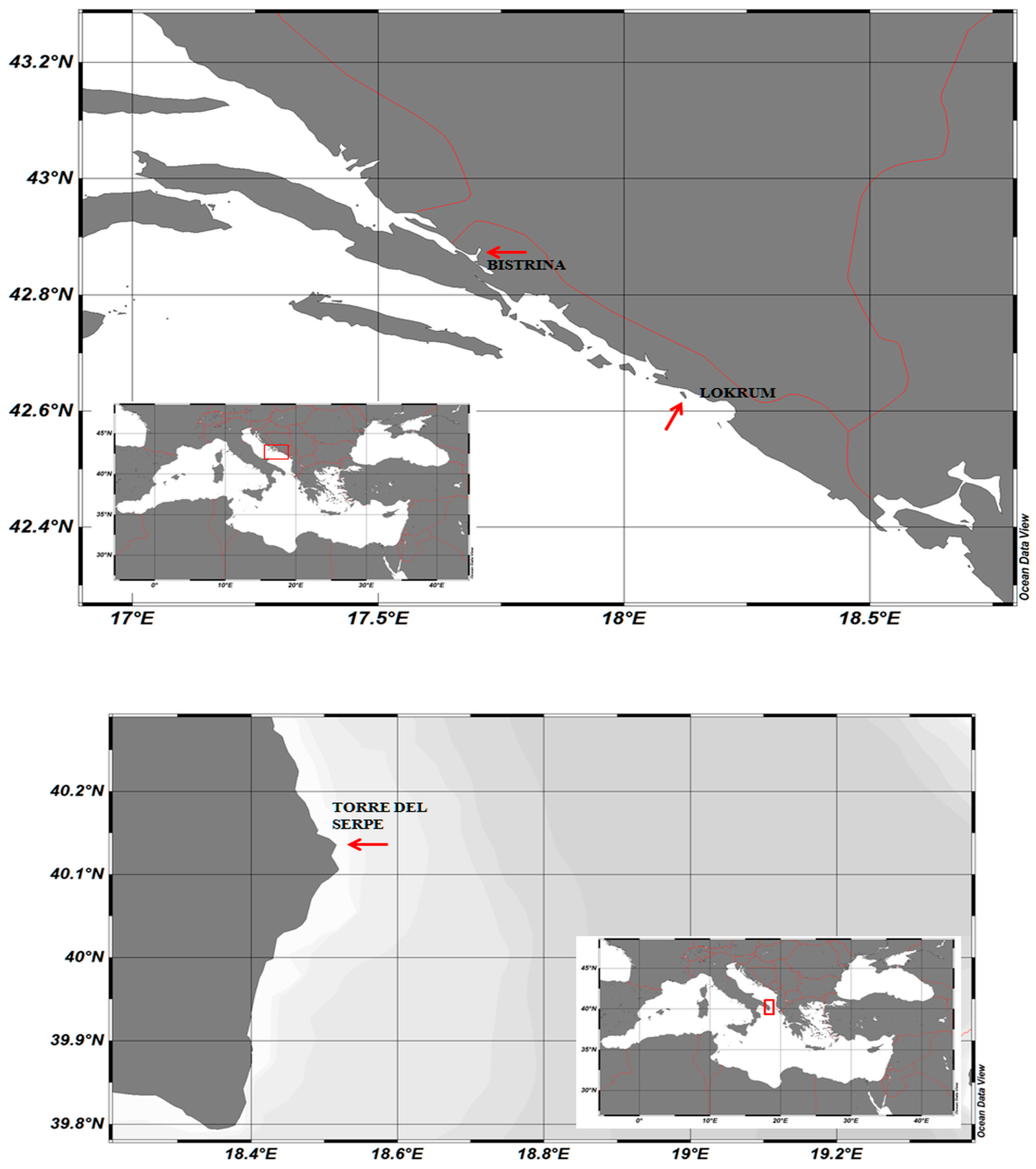
Hydroid assemblages were investigated on the southwestern shore of Lokrum Island, near Dubrovnik, southern Adriatic Sea (Figure 1). The coastal waters are influenced by the oligotrophic Ionian Surface Water and Levantine Intermediate Water flowing northwestward along the eastern coast [31], with an annual mean chlorophyll of ~0.087 mg m−3 [32]. The habitat is an exposed rocky reef slope with limestone rock, patchy macroalgae (Halimeda, Peyssonnelia), seagrass (Posidonia oceanica), and encrusting invertebrates such as sponges and bryozoans.
The site was sampled by SCUBA diving on four occasions, from winter to autumn 2009–2010. Specifically, surveys were conducted in December 2009 and March, July, and October 2010. During each survey, transects were sampled across depth strata of 0–5 m, 5–10 m, 10–15 m, 15–20 m, and 20–30 m. Within each stratum, hydroid colonies were collected exhaustively from available substrates and associated biota (e.g., algae, seagrass leaves, bryozoans) in three replicate dives. Environmental parameters (temperature and salinity) were measured in situ at multiple depths during each sampling using a SBE 25 Sealogger CTD (Sea-Bird Scientific, Bellevue, WA, USA).

2.1.2. Bistrina (42°52′04″ N, 17°41′43″ E)

The second site, Bistrina, is in a sheltered inner part of Mali Ston Bay (max. depth ~8 m) (Figure 1). The bay receives nutrient input from karstic submarine springs, the Neretva River, and precipitation, which reduce surface salinity [33,34] and sustain moderate eutrophication [35], contrasting with the oligotrophic waters at Lokrum. Mali Ston Bay is a traditional shellfish-farming area that was declared a Special Natural Reserve in 1983. Sampling, during the same time periods as at Lokrum, was conducted on the support pillars and remnants of a disused aquaculture cage located approximately 10 m offshore in the centre of the bay. The structure had been submerged for several years and supported a well-developed fouling community dominated by bivalves, bryozoans, polychaetes, sponges, and ascidians. Hydroid colonies were collected manually by SCUBA diving from these fouling substrates across three depth intervals (0–2, 2–4, and 4–7 m) following the same semi-quantitative approach used at Lokrum. Temperature and salinity were measured at the surface, ~3 m, and ~7 m using a WTW Multiline probe multiparameter probe (Xylem Analytics Germany Sales GmbH & Co., KG, Weilheim, Germany).

2.1.3. Torre del Serpe, Otranto (40°08′ N, 18°31′ E)

A supplementary collection site, Torre del Serpe, is located on an exposed rocky infralittoral coast near Otranto (western side of the southern Adriatic) (Figure 1), where, in the vicinity, De Vito [36] had previously documented a rich hydroid fauna comprising 99 species. This site was not included in the community-level comparison but served as the source of the initial S. inermis colonies used for life-cycle culture experiments (see Section 2.3). The substrate at this site consists of calcareous rock with macroalgal and invertebrate cover typical of the lower infralittoral in the Strait of Otranto [36]. Its role in the present study was limited to species-level interpretation of S. inermis biology and did not involve any community-level comparison with the Croatian sites.

2.2. Laboratory Identification and Data Processing

In the laboratory, all hydroid samples were initially examined under a stereomicroscope and identified to at least family level in a fresh condition, based on colony morphology and substrate specificity. For detailed taxonomic identification to species level, samples were fixed in 4% formaldehyde–seawater solution (or in 96% ethanol for some delicate specimens) and later examined with both stereomicroscope and compound microscope. Standard taxonomic keys and monographs were employed, including those of Millard [37], Cornelius [38], and Bouillon et al. [1]. Where necessary, nematocyst morphology was analyzed via squash preparations to distinguish among morphologically similar taxa (e.g., diagnostic cnidome differences in the families Haleciidae, Sertulariidae, Eudendridae, Hydractiniidae and to recognize potentially distinguishable features of Eucheilota sp.1., and Sertularella sp.1). All identified specimens were catalogued, and the occurrence of each species was recorded per site, depth stratum, and date. The final species list comprises all valid taxa according to World Register of Marine Species (WoRMS) [39]
Abundance was estimated using a semi-quantitative scale adapted from Boero and Fresi [4] and later hydroid assemblage studies [36,40]. (Each species was assigned to one of five categories: 0 (absent), 1 (very rare, single colony), 2 (rare), 3 (common), and 4 (very common and/or forming large colonies.) Three replicate collections were made per depth stratum at each sampling date and averaged into a single semi-quantitative score per species for each site × depth × date combination, following the approach of Boero and Fresi [4]. This resulted in 20 samples at Lokrum (5 depths × 4 dates) and 12 at Bistrina (3 depths × 4 dates) totaling 32 samples in the analytical matrix.
Multivariate analyses were performed using PRIMER v6 with the PERMANOVA+ add-on [41,42]. Resemblance among samples was calculated using the Bray–Curtis similarity index on the untransformed abundance matrix. No transformation was applied because the semi-quantitative abundance scale already homogenizes the influence of very abundant and rare taxa, making further transformation unnecessary [43]. Assemblage patterns were visualized by nMDS ordination. Significance of group differences was tested by PERMANOVA (9999 permutations) for site, depth strata within each site, and temporal factors (month and season). The month factor treated each of the four sampling occasions separately, while the season factor grouped December and March as the cold season and July and October as the warm season. The similarity percentage routine (SIMPER) identified species contributing most to within-group similarity and between-group dissimilarity; species contributing more than 10% individually to within-group similarity were considered determining species, following standard SIMPER practice [41]. Where PERMANOVA revealed significant effects, homogeneity of multivariate dispersions was tested using PERMDISP [44] to assess whether group differences reflected changes in composition or in variability. Where the overall PERMANOVA for depth was significant, pairwise comparisons between depth strata were conducted using the same settings (9999 permutations, unrestricted permutation of raw data). The unbalanced design (5 depth strata at Lokrum vs. 3 at Bistrina, with different substrate types) precluded a fully crossed multi-factor PERMANOVA; separate within-site analyses were therefore conducted for each factor. Constrained ordination (e.g., RDA) was not applied because continuous environmental variables were not measured as replicated variables at the individual sample level.

2.3. Laboratory Culture and Life-Cycle Observations of Stylactis inermis Allman, 1872

Life-cycle observations of S. inermis were carried out on colonies collected in spring 2009 and 2010 at Torre del Serpe, a rocky infralittoral site near Otranto in the southern Adriatic (40°08′ N, 18°31′ E). All laboratory culture work was conducted at the Department of Biological and Environmental Science and Technology (DISTEBA), University of Salento, Lecce. This material served as regional conspecific reference material for species-level laboratory observations, not as a substitute for the Lokrum population in the community analyses. Its use is justified by the shared South Adriatic setting of the two localities and by the similar exposed rocky infralittoral habitat in which the species occurred. The species was independently recorded in the field at the Lokrum station during winter and spring 2010, confirming its presence at a second South Adriatic locality, although that material was not cultured.
Polyps (approximately 50–70 gastrozooids) from a single colony were transferred to a glass vessel containing 1 L of filtered natural seawater (salinity ~37 ppt) maintained at a constant temperature of 14 °C in a cold chamber under a 12:12 light: dark period with artificial illumination. Specimens were allowed to settle and attach to glass microscope slides during an initial 48 h acclimation period. Colonies were subsequently fed twice weekly with freshly hatched Artemia salina nauplii over a period of 20 days, during which colony growth, gonophore maturation, medusoid release, and subsequent developmental transformations were monitored and photographed under a stereomicroscope. The same culture protocol was applied to colonies collected in spring 2009 and spring 2010. In 2009, eumedusoids were fixed after gamete release. In 2010, particular attention was given to the fate of detached eumedusoids after liberation from the gonozooids, including any reversion to a sessile stolonal or polyp stage. Morphological terminology and systematic placement follow Bouillon [1], Schuchert [45], and WoRMS [39] with Schuchert’s account of S. inermis incorporating observations made by the authors.

3. Results

3.1. Hydrographic Conditions

The hydrographic regimes at Lokrum and Bistrina represented two distinct ecological baselines: a stable, open-sea marine environment and a variable, estuarine-influenced system.
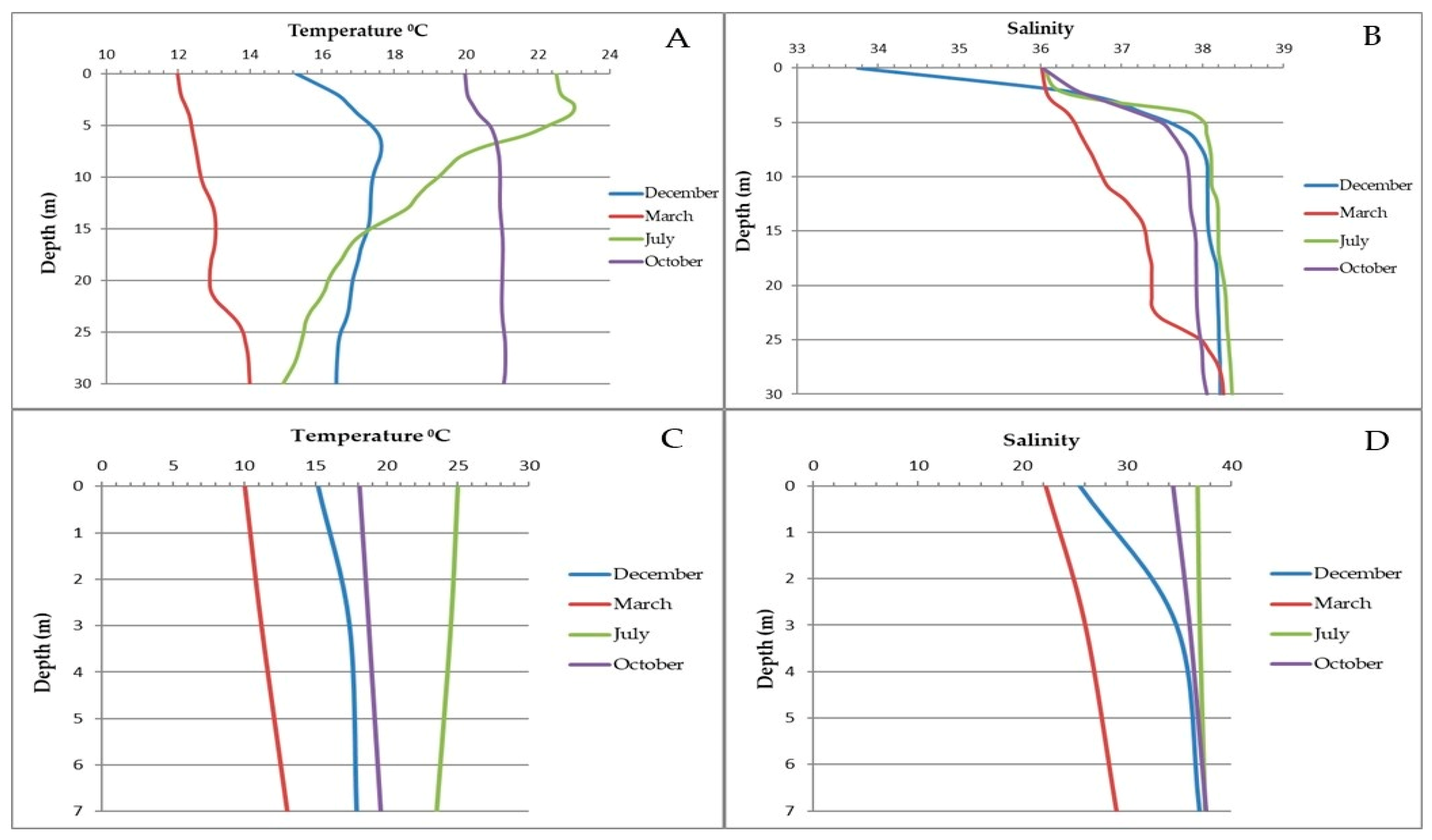
Temperature at Lokrum followed a typical seasonal cycle, ranging from a minimum of 11.9 °C (March, 0 m depth) to a maximum of 22.9 °C (July, 3 m depth). The site exhibited near-isothermal conditions in spring (12.0–14.0 °C) and autumn (20.0–21.0 °C), while a pronounced summer thermocline in July created a sharp thermal barrier between warm surface layers (>20 °C) and deeper, stable waters (14.9 °C at 30 m depth) (Figure 2A). Salinity remained high and relatively stable (33.7–38.4) and generally increased with depth, reflecting the oligotrophic influence of the open Adriatic (Figure 2B).
In contrast, Bistrina exhibited a wider thermal range (10.0–25.0 °C) and significantly higher environmental stress (Figure 2C). The site was characterized by frequent inverse stratification in December, March, and October. Salinity was lower and far more volatile than at Lokrum, particularly in the surface layer where freshwater pulses dropped values to 22.2 in March (Figure 2D). This semi-enclosed, nutrient-enriched environment presented a high-variability habitat that contrasted sharply with the fully marine conditions at Lokrum.

3.2. Overall Biodiversity

A total of 54 hydroid taxa were recorded across both sites (Table 1). Lokrum supported a more diverse assemblage (42 taxa, 17 families) than Bistrina (24 taxa, 12 families), with Campanulariidae the most species-rich family at both sites. Leptothecata accounted for 67% of taxa at both sites. Twelve species at Lokrum and nine at Bistrina had life cycles including a free-swimming medusa.
Twelve species were shared between sites: Eudendrium merulum, E. racemosum, E. simplex, Turritopsis dohrnii, Hydrodendron mirabile, Kirchenpaueria pinnata, Campalecium medusiferum, Sertularella polyzonias, Clytia gracilis, C. hemisphaerica, C. noliformis, and Obelia dichotoma. The remaining 30 taxa at Lokrum and 12 at Bistrina were exclusive to their respective sites, and several represent new records for the eastern coast of the South Adriatic.
Two allochthonous species were recorded at Lokrum (Eudendrium merulum and Clytia linearis), and one at Bistrina (E. merulum).

3.3. Between-Site Comparison

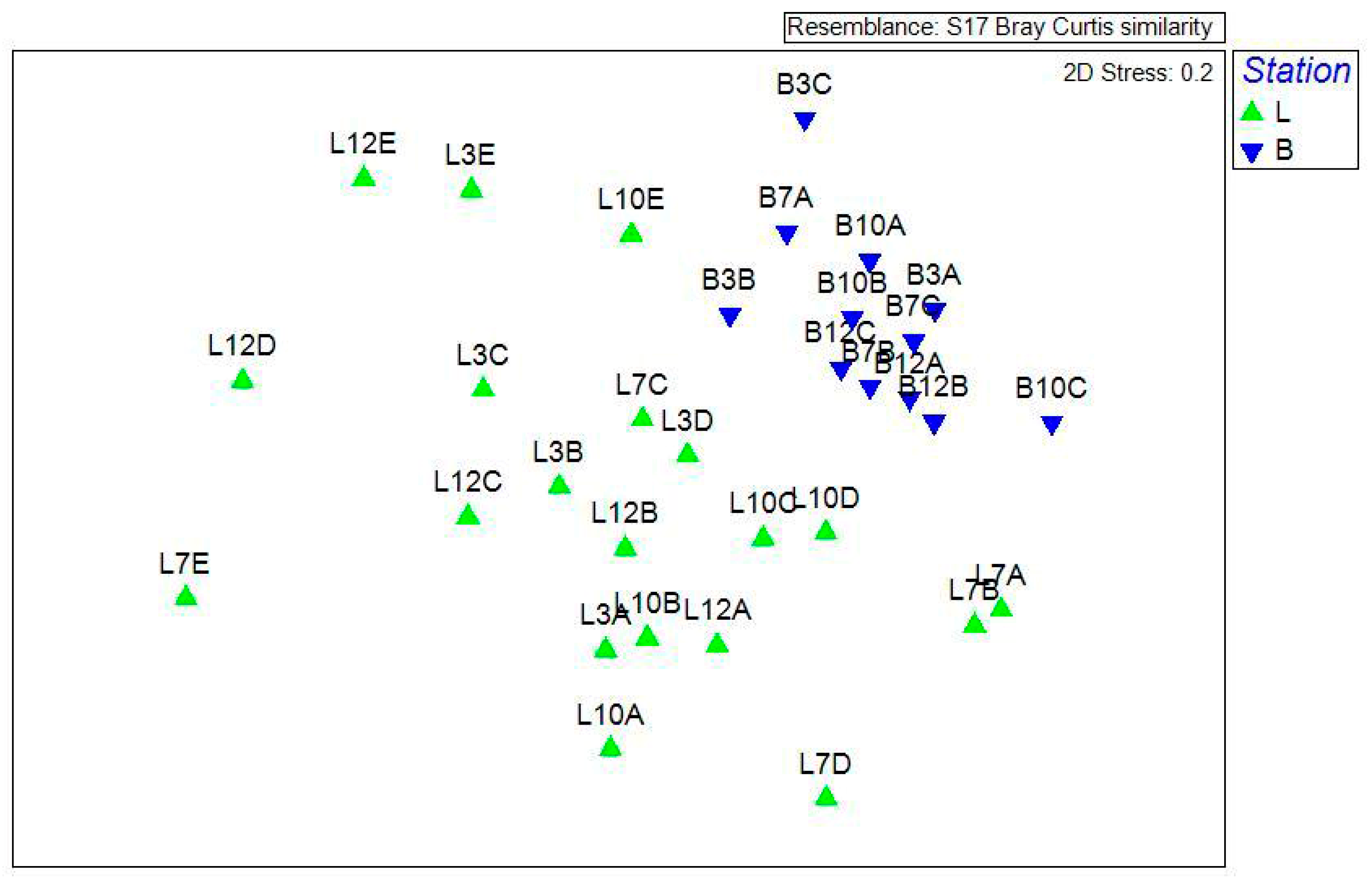
PERMANOVA confirmed a significant site effect (Table 2; pseudo-F = 5.94, p = 0.0001), although PERMDISP indicated unequal dispersions (p = 0.0004), with Lokrum showing greater variability than Bistrina, consistent with its wider depth range and more heterogeneous substrates. The nMDS ordination (Figure 3; stress = 0.20) should be interpreted with caution at this stress level [41], but the clear separation of site clusters is consistent with the significant PERMANOVA result.
The Bray–Curtis dissimilarity was driven by species associated with the contrasting environmental regimes: the exposed rocky reef at Lokrum supported a richer fauna with clear depth zonation and thecate species on hard substrata, whereas the sheltered fouling community at Bistrina was dominated by a smaller set of year-round colonizers such as Obelia dichotoma and Eudendrium racemosum.
Among the shared species, Eudendrium racemosum and Obelia dichotoma were present at both sites and contributed consistently to within-group similarity (Table A1, Table A2 and Table A3). However, their ecological roles differed: at Lokrum, both species occurred across multiple depth strata on natural rocky and algal substrates, while at Bistrina they formed large, persistent colonies on the dominant mussel Mytilus galloprovincialis and other fouling organisms (Table 1).
Key site-exclusive taxa further underscored the environmental contrast: the Lokrum assemblage included multiple sertulariid and aglaopheniid species with specific depth preferences, as well as obligate epibiont associations (e.g., Zanclea sessilis on Myriapora truncata, Halocoryne epizoica on Schizobrachiella sanguinea), while Bistrina hosted species tolerant of reduced salinity and estuarine conditions (e.g., Ectopleura larynx, tolerant of salinity down to 18 ppt [46]).
Despite these compositional differences, the two sites showed a parallel seasonal signal: at both, nMDS ordinations separated cold-season from warm-season samples, and the shallow sublittoral exhibited the highest temporal variability driven by seasonally transient athecate species (e.g., Stylactis inermis, Coryne muscoides, and Bougainvillia muscus at Lokrum, and Turritopsis dohrnii and Corydendrium parasiticum at Bistrina), suggesting that temperature-mediated life-cycle timing is a primary structuring mechanism for South Adriatic hydroid communities.

3.4. Seasonal and Depth Patterns at Lokrum

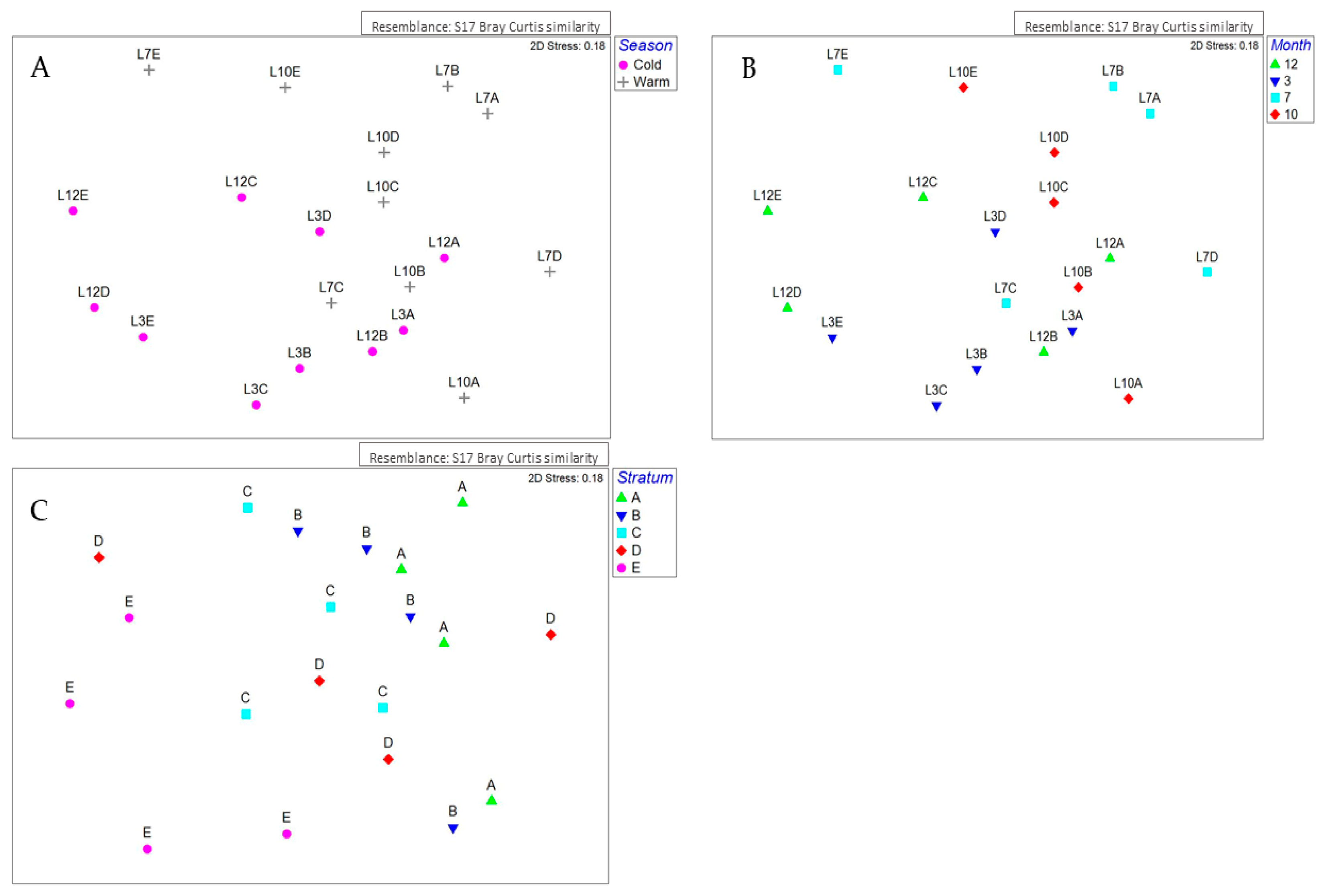
Species richness at Lokrum varied among seasons: 32 in December, 31 in March, 16 in July, and 32 in October (Table 1). The nMDS ordination separated cold-season from warm-season assemblages (Figure 4; stress = 0.18), confirmed by PERMANOVA (Table 2; season: p = 0.006; month: p = 0.041).
The cold-season assemblage was characterised by seasonally transient athecate species recorded only in December and March (Stylactis inermis, Coryne muscoides, Eudendrium capillare, Slabberia halterata, Bougainvillia muscus, Antenella siliquosa, Hydrodendron mirabile), with E. glomeratum (26.0%) and S. inermis (21.8%) as the main SIMPER contributors in December (Table A1). The warm-season assemblage was dominated by Eudendrium racemosum, which accounted for 61.4% of within-group similarity in July and was the only species to exceed the 10% threshold that month. E. racemosum was present throughout the year and was the most consistent contributor across all seasons except March. Warm-season exclusives were Turritopsis dohrnii, Halocoryne epizoica, and Aglaophenia harpago.
Depth-stratified analysis identified three assemblage zones (Figure 4; PERMANOVA: pseudo-F = 1.70, df = 4/15, p = 0.007, R2 = 0.31). The shallow zone (0–10 m) was defined by sertulariid and aglaopheniid thecates (Dynamena disticha, Aglaophenia octodonta, A. kirchenpaueri); the intermediate zone (10–20 m) was dominated by E. racemosum (up to 46.1% at 15–20 m) and Kirchenpaueria halecioides (17.6% at 10–15 m); and the deepest zone (20–30 m) was characterised by obligate Posidonia oceanica epiphytes (Tridentata perpusilla 22.7%, Aglaophenia elongata 19.0%, Monotheca obliqua 16.1%) (Table A2). Within-group similarity ranged from 15.0% (15–20 m) to 33.7% (0–5 m), with the shallowest strata exhibiting the highest seasonal turnover driven by seasonally transient athecates absent in summer (Table A2). Pairwise comparisons confirmed this zonation: adjacent strata within the same zone did not differ significantly (A vs. B, p = 0.57; C vs. D, p = 0.94), whereas the deepest stratum (E, 20–30 m) differed significantly from all upper zones (p = 0.029–0.031), consistent with the distinct Posidonia-associated assemblage. The limited number of unique permutations (35) per pair, reflecting the sample size per stratum (n = 4), means these p-values should be interpreted with caution.

3.5. Seasonal and Depth Patterns at Bistrina

Species richness at Bistrina showed a similar seasonal pattern to Lokrum but at lower levels: 15 species in December, 11 in March, 13 in July, and 19 in October (Table 1). The highest within-season similarity was in December (70.7%), reflecting the dominance of a few widespread species in the fouling community.
Eudendrium racemosum and Obelia dichotoma were the primary SIMPER contributors in most months, with O. dichotoma dominating in March (56.6%) and E. racemosum peaking in October (38.9%) (Table A3). Corydendrium parasiticum was characteristic in all months except March (highest in July, 27.8%). Aglaophenia lophocarpa was most prominent in October (23.5%).
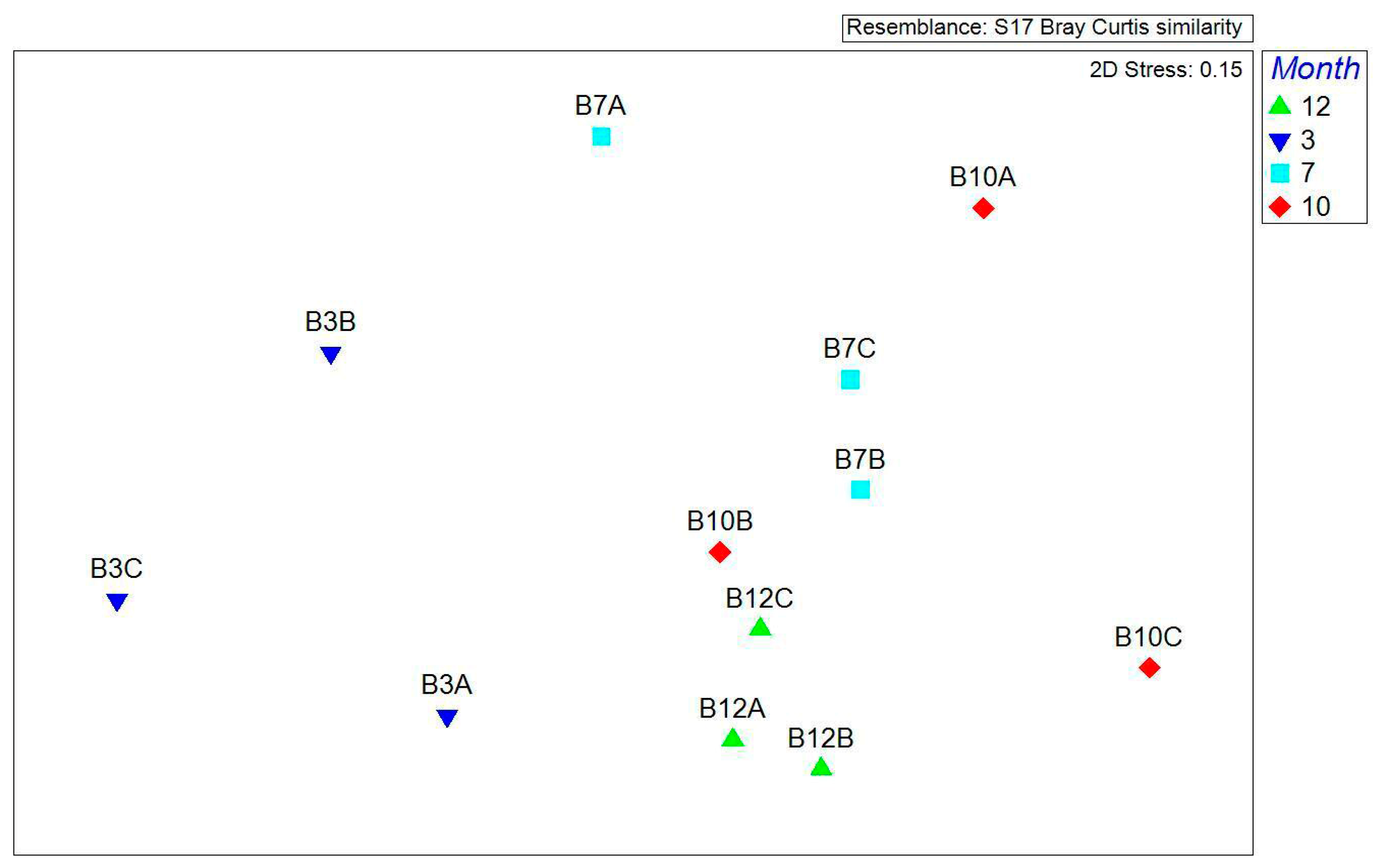
The nMDS ordination separated cold- from warm-season assemblages (Figure 5; stress = 0.15), with PERMANOVA showing significant monthly (p = 0.0003, R2 = 0.52; PERMDISP: p = 0.014) and seasonal differences (p = 0.020; Table 2). Depth had no significant effect (p = 0.997), reflecting the limited depth range (7 m), uniform fouling substrate, and dominance of persistent species at all depths. Clytia hemisphaerica was characteristic only of the surface layer (0–2 m), while A. lophocarpa was most prominent near the bottom (4–7 m).

3.6. Life-Cycle Observations of Stylactis inermis

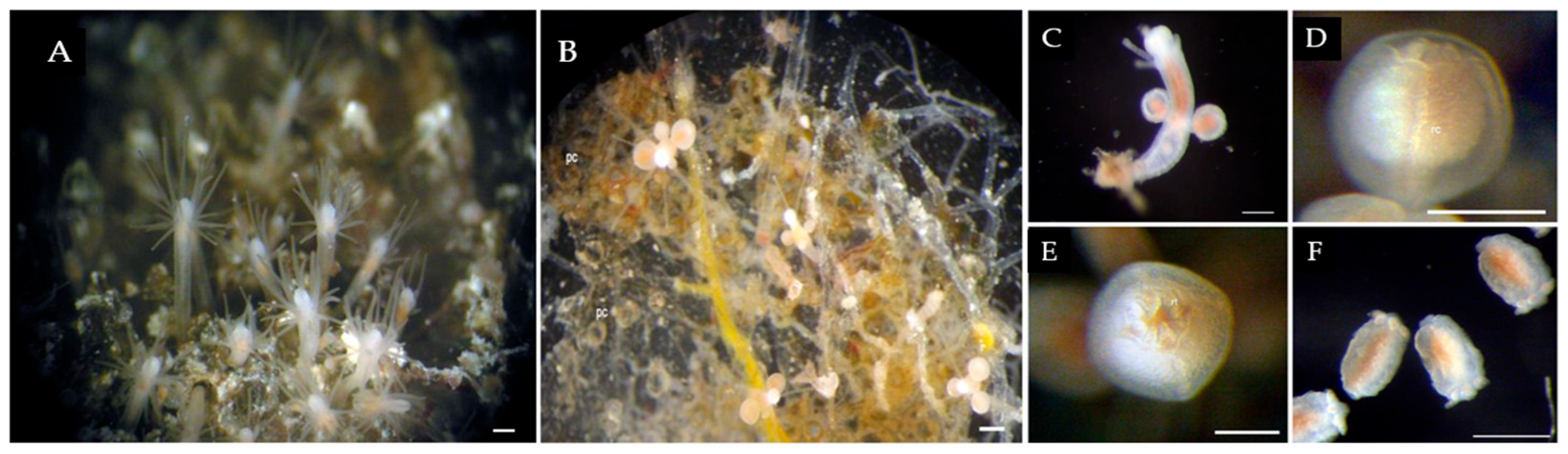
Colonies of Stylactis inermis collected at Torre del Serpe (Otranto) in April 2009 were found as epibionts on sponges, bryozoans, and algal thalli in the depth range of 5–15 m, forming dense temporary facies during winter and spring. Colonies consisted of a creeping stolonal hydrorhiza bearing gastrozooids of 2–3 mm with 10–16 filiform tentacles; neither dactylozooids nor spines were observed (Figure 6A,B).
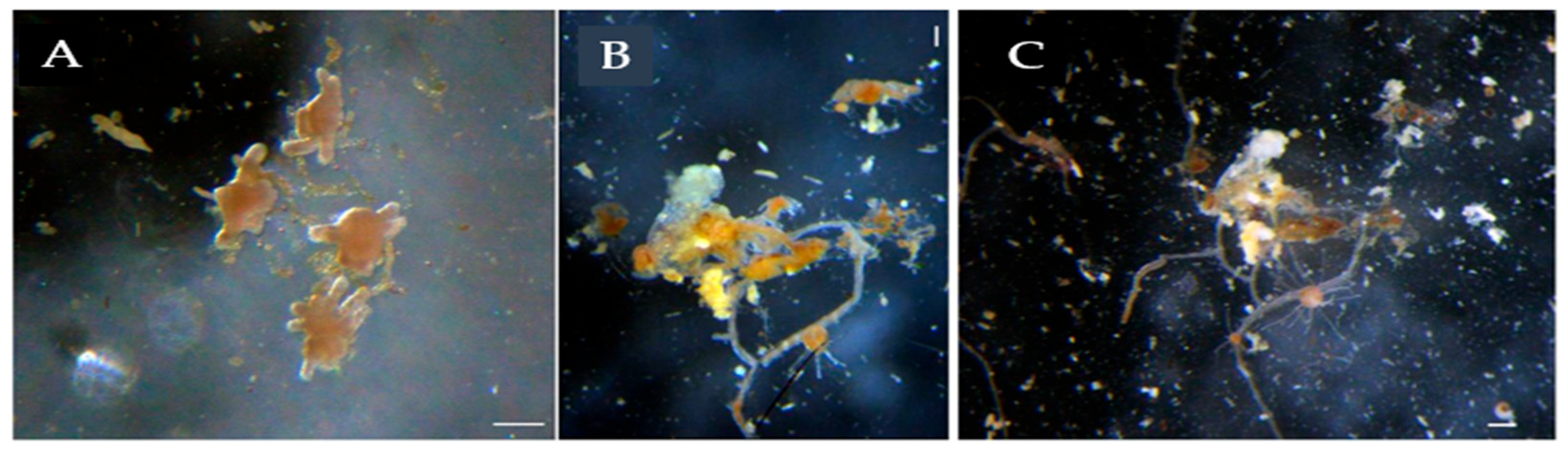
Approximately one month after the start of laboratory culture, gastrozooids began developing gonophores and transitioned into gonozooids while retaining their feeding capacity (Figure 6C). Shortly afterwards, the gonophores matured into short-lived eumedusoids (1.0–1.2 mm long, 0.75 mm wide) with well-developed radial canals and eight tentacle rudiments (Figure 6D,E). Despite suppressed medusa features, the eumedusoids detached from the gonozooids but had severely limited swimming capacity due to thickened mesoglea (Figure 6D–F). Gamete release, assisted by velar contractions, occurred within approximately one hour of liberation. During a second culture experiment in winter/spring 2010, the same developmental sequence was observed. Critically, following gamete release, the detached eumedusoids did not die but instead attached to the glass substrate (Figure 7A). Within several hours, stolon buds emerged from the exumbrella of the degenerating medusoids. These stolons continued growing along the glass surface, and within 24 h, the first primary polyp had formed, followed by growth of additional polyps (Figure 7A–C). A fully functional (able to feed) clonal colony was established through this asexual process of reverse development, despite the eumedusoids having already possessed mature gametes. This represents the first documented case of reverse development from a released eumedusoid with mature gonads back to a stolonal or polyp stage in this species.
At the Lokrum station, S. inermis was independently recorded in the field across the 0–30 m depth range exclusively during December and March. Colonies formed dense aggregations on multiple substrates, most frequently on thalli of Halimeda and Peyssonnelia and on the bryozoan Myriapora truncata. Unlike previous records [47], the species was not found on Posidonia oceanica leaves at this site. No reproductive stages were observed in the field material so the same laboratory experiment has not been conducted.

4. Discussion

4.1. Biodiversity in a Regional Context

The 54 hydroid taxa recorded at Lokrum and Bistrina represent approximately 12% of the roughly 460 Hydrozoa known from the Mediterranean Sea excluding Siphonophorae [2], and about 55% of the 99 taxa reported by De Vito [36] at two sites near Otranto on the opposite side of the South Adriatic. Given that the Otranto study covered 15 months and a comparable depth range (0–30 m), the present dataset can be considered broadly representative of the regional hydroid fauna at a local scale. Other comparable studies recorded 81 species at Cape Portofino in the Ligurian Sea (0–20 m [4], 86 species at the Chafarinas Islands in the Alboran Sea [48], and 40 species around the Maltese archipelago [12]. Our species count falls within the range expected for a seasonal survey of two contrasting coastal sites.
Since earlier studies did not focus on the benthic stages of hydrozoans, the number of new records for this area (Table 1) highlights how poorly documented benthic hydroids remain in this region. This is consistent with the “benthic stage gap” identified by Onofri et al. [16] for the eastern Adriatic, where zooplankton-based programmes have historically recorded medusae while their benthic counterparts were unsampled [14,15]. Species richness at Lokrum (42 taxa) was higher than at Bistrina (24 taxa), a difference attributable to the greater habitat heterogeneity, wider depth range, and more diverse substrate mosaic available at the exposed rocky reef. The record of Stauridiosarsia reesi at Bistrina, represented by a single polyp on an oyster-associated polychaete tube, further illustrates the taxonomic challenges in this group: the medusa of S. reesi is known only from laboratory rearing and has virtually never been documented in the field because it closely resembles the common S. ophiogaster [49] making field identification difficult.

4.2. Environmental Drivers of Between-Site Differences

The significant compositional difference between sites (Table 2) aligns with environmental setting, rather than geographic distance alone, as the primary driver of hydroid assemblage structure in the Mediterranean [4,9,43]. The greater habitat heterogeneity at Lokrum, including obligate epibiont associations absent from Bistrina, explains the higher species richness, while the sheltered, nutrient-enriched conditions at Bistrina favoured a smaller assemblage of substrate-generalist species, notably Eudendrium racemosum and Obelia dichotoma, whose large year-round colonies formed the structural backbone of the fouling community [50]. At both sites, the bushy, erect colonies of E. racemosum and other eudendriids served as important secondary substrates for smaller epibiontic hydroids; numerous species were recorded growing directly on Eudendrium colonies, including Anthohebella parasitica, Clytia hemisphaerica, Clytia noliformis, Hydrodendron mirabile, and Plumularia setacea. This facilitative role of large colonial hydroids as biogenic habitats for smaller species amplifies local diversity beyond what the primary substrate alone would support is consistent with the recognition of hydroids as underestimated habitat formers within marine animal forests [51].
The ecological role of hydroids at Bistrina deserves particular attention given the bay’s traditional importance for bivalve mariculture. Both E. racemosum and O. dichotoma have been shown to prey on bivalve pediveliger larvae at high rates in other Mediterranean settings [52,53], with E. racemosum alone potentially removing up to 100,000 prey items m−2 per day in shallow coastal habitats. Furthermore, O. dichotoma can inhibit barnacle settlement through chemical suppression [54], and the presence of Ectopleura larynx, a species tolerant of salinity as low as 18 ppt [46], has been shown to promote the settlement of solitary ascidians that may subsequently dominate fouling substrates [55]. Similar patterns of hydroid fouling succession, medusa production, and associated risks to cultured organisms have been documented at a finfish aquaculture facility in the Gulf of Taranto [11]. These literature-based observations suggest that similar interspecific processes may operate at Bistrina and should be considered alongside eutrophication and other environmental drivers when interpreting changes in Bistrina’s fouling communities [56].

4.3. Seasonal Dynamics and Temporal Niche Partitioning

At both sites, assemblage structure showed a clear seasonal pattern, with nMDS ordinations separating cold-season (December, March) from warm-season (July, October) samples (Figure 4 and Figure 5). This pattern is consistent with the well-established seasonal alternation of Mediterranean hydroid communities, in which species with boreal-Atlantic affinities reach peak abundance during winter–spring, while circumtropical and warm-affinity species dominate in summer–autumn [1,4,36]. At Lokrum, the cold-season assemblage was defined by species such as Eudendrium glomeratum, Stylactis inermis, Antennella siliquosa, and Obelia dichotoma, all previously identified as characteristic winter species in the South Adriatic [36]. The summer assemblage was dominated by E. racemosum (61.4% in July), which was present across all seasons, consistent with its year-round occurrence at Portofino [3,4,7]. E. glomeratum, a species known for its cold-season affinity [57], was present in all sampling months at Lokrum but retreated to the deepest stratum (20–30 m, below the thermocline) during July, consistent with the findings of De Vito [36]. At Portofino, E. glomeratum persisted with similar abundance until 2004 but was strongly reduced by 2024, part of a broader 43% decline in hydroid species richness over 44 years linked to rising sea surface temperatures [3].
The sharp decline in species richness in July (to 16 taxa, from 31–32 in other months) (Table 1) highlights the summer dormancy of many athecate species, mediated by regression to resting stages [1,58], and reinforces the argument that at minimum biannual sampling is essential for representative hydroid inventories [4,5]. Notably, October richness (32 at Lokrum, 19 at Bistrina) was nearly as high as in winter, echoing the pattern reported by Puce et al. (2009) [7], De Vito (2006) [36], and Moglia et al. [3], whereby warm-affinity species increasingly persist into cooler months, potentially reflecting long-term warming trends [59]. The presence of Eudendrium moulouyensis at Bistrina in all months except March is consistent with this pattern; this Mediterranean endemic, symbiotic with zooxanthellae, has undergone rapid geographic expansion linked to rising sea surface temperatures [60].

4.4. Vertical Zonation at Lokrum

The depth-stratified analysis at Lokrum revealed at least three distinct assemblage zones along the 0–30 m transect. The shallow zone (0–10 m), characterised by high hydrodynamic exposure and light availability, was defined by thecate species of the families Sertulariidae (Dynamena disticha, Sertularella mediterranea, S. polyzonias) and Aglaopheniidae (Aglaophenia kirchenpaueri, A. octodonta). Most of these species were also characteristic of the equivalent depth zone at Otranto [36]. Notably, A. octodonta extended deeper (5–10 m) at Lokrum than previously reported (0–5 m; [4,7], and D. disticha similarly occurred at 5–10 m rather than being confined to the shallowest layer.
The intermediate zone (10–20 m) was dominated by Eudendrium racemosum (contributing up to 46.1% of within-group similarity at 15–20 m) and Kirchenpaueria halecioides (17.6% at 10–15 m), both eurybathic species occurring across multiple depth strata, in agreement with earlier findings [4,36].
The deepest zone (20–30 m) was distinctly characterised by three species that are obligate epiphytes of Posidonia oceanica: Tridentata perpusilla, Aglaophenia elongata, and Monotheca obliqua. This depth restriction at Lokrum results directly from the local geomorphology, where the rocky cliff ends and the seagrass meadow begins at approximately 20 m. At sites where P. oceanica extends from the surface to 30 m depth, these species exhibit much wider vertical distributions [47,61]. This observation highlights that hydroid depth zonation is not solely determined by physiological tolerances but is strongly modulated by the vertical distribution of suitable substrates.
The four aglaopheniid species at Lokrum occupied different depth zones despite similar morphology, a depth-partitioning pattern previously observed in Mediterranean aglaopheniids [4,28], likely reflecting niche differentiation along environmental gradients.

4.5. Allochthonous Species

Two allochthonous species were recorded at Lokrum (Eudendrium merulum and Clytia linearis) and one at Bistrina (E. merulum). Clytia linearis, first reported from the Suez Canal as Clytia gravieri [62], is among the most successfully established Lessepsian migrants in the Mediterranean and has spread to the Atlantic coast of the Strait of Gibraltar [5,63]. In Bistrina, the mariculture setting is of particular interest because artificial structures and vessel traffic may facilitate the establishment of non-indigenous hydroids along the eastern Adriatic coast, making such habitats useful for early detection of new introductions [5,64].

4.6. Reverse Development in Stylactis inermis

The laboratory observations of Stylactis inermis from Torre del Serpe represent, to our knowledge, the first documentation of complete reverse development in this species, from a released eumedusoid with mature gonads back to a functional stolonal colony. Previously, reverse development in Hydrozoa had been described in Turritopsis dohrnii, where sexually mature medusae revert to the polyp stage [65], and in Laodicea undulata, where young medusae transform back into sessile colonies [66]. Experimentally induced reverse development has also been demonstrated in Podocoryna carnea (as Hydractinia carnea), a member of the same family (Hydractiniidae) as S. inermis but with a fully planktonic medusa stage [67]. The case of S. inermis is distinctive because the eumedusoid is already in an advanced stage of medusa reduction, is short-lived, incapable of feeding, and has limited swimming due to thickened mesoglea, yet retains the capacity to generate a new clonal colony from stolonal outgrowths after gamete release.
Ecologically, reverse development provides a plausible mechanism for population persistence during unfavourable periods. At Lokrum, S. inermis contributed 21.8% of within-group similarity in the December assemblage yet was entirely absent from July and October samples, consistent with its strictly winter–spring occurrence observed at Otranto. Colonies from both localities showed no evident morphological or ecological differences. Accordingly, the Otranto material is best interpreted as regional conspecific reference material for species-level biology rather than as a proxy for the Lokrum population, providing a mechanistic framework for understanding how life-cycle plasticity may contribute to seasonal occurrence and imperfect detectability in the field, although molecular confirmation of conspecific status would strengthen this interpretation. Without winter sampling, this species and its ecological role would have been missed entirely, highlighting that life-cycle plasticity directly affects field detectability and apparent species distributions [1,5].
Reverse development has been documented in species with different levels of medusa reduction, from the fully functional medusae of Turritopsis dohrnii to the highly reduced eumedusoids of Stylactis inermis. Its recent demonstration outside Cnidaria, in the ctenophore Mnemiopsis leidyi [68], suggests that ontogenetic reversal may be more widespread among early-diverging animals, but has remained largely undetected because few species have been maintained in sustained laboratory culture.

4.7. Baseline Value and Monitoring Implications

The data presented in our study represent the first comprehensive, depth-stratified seasonal dataset on benthic hydroid assemblages for the eastern coast of the South Adriatic, filling a gap left by classical studies that provided species records without the quantitative framework necessary to detect assemblage-level change [17,18,20,26,27]. Although the field data were collected in 2009–2010, no comparable seasonal or depth-stratified hydroid survey has since been conducted in the eastern South Adriatic, and these data therefore remain the only quantitative baseline available for the region.
The value of such baselines is illustrated by the Portofino time series: Puce et al. [7], re-surveying the transect of Boero and Fresi [4] after 24 years, found shifts in species composition and depth distributions despite stable overall richness. A third survey in 2024 revealed an accelerating trajectory, with species richness falling from 83 to 43 (−43%), loss of bathymetric zonation, and replacement of cold-affinity species by thermophilic taxa such as Corydendrium parasiticum and Pennaria disticha [3]. Our baseline, combining semi-quantitative abundance with ordination and SIMPER across four seasons and multiple depth strata, is designed to enable equivalent comparisons for the South Adriatic.
The parallel occurrence of seasonal partitioning at two environmentally distinct sites suggests that temperature-mediated life-cycle timing is a primary structuring mechanism that transcends local habitat differences. If warming trends continue in the Adriatic [59], (the most likely predicted changes would include a reduction in the winter–spring window for cold-affinity species, range expansion of thermophilic taxa such as Eudendrium moulouyensis and the allochthonous E. merulum, and potentially the local disappearance of boreal species that are already near their southern distributional limit. Repeated surveys at Lokrum and Bistrina, using the same transects and methods, would directly test these predictions.

5. Conclusions

This study provides the first seasonal, depth-stratified baseline for benthic hydroid assemblages in the eastern South Adriatic. The 54 taxa recorded at Lokrum Island and Bistrina Bay include several species previously unrecorded on the eastern South Adriatic coast. Assemblage composition differed between the exposed, oligotrophic site (Lokrum: 42 taxa, broad depth related zonation) and the sheltered, nutrient-enriched fouling community (Bistrina: 24 taxa, dominated by Eudendrium racemosum and Obelia dichotoma), confirming that site-specific environmental conditions are a primary determinant of hydroid community structure.
Both sites showed clear seasonal partitioning, with the shallowest sublittoral zones exhibiting the greatest temporal variability, driven by the appearance and disappearance of seasonally transient athecate species. This shared dynamic across contrasting environments points to temperature-mediated life-cycle timing as a key structuring mechanism. The sharp summer decline in species richness underscores the necessity of multi-season sampling for reliable hydroid biodiversity assessments.
Laboratory culture of Stylactis inermis from Torre del Serpe revealed complete reverse development from released eumedusoids with mature gametes back to functional stolonal colonies. This life-cycle plasticity offers a mechanism for population persistence during unfavourable periods and highlights that developmental dynamics may significantly affect the field detectability and apparent distribution of seasonal hydroid taxa.
Together, these findings establish a quantitative framework for long-term monitoring of coastal benthic communities under environmental change and anthropogenic pressure in the South Adriatic. Repeated surveys using the same transects and methods will be necessary to determine whether the assemblage patterns documented here are shifting in response to ongoing Mediterranean changes.

Author Contributions

Conceptualization, I.O. and D.L.; methodology, I.O. and D.L.; software, B.G.Z.; validation, D.L. and M.H.; formal analysis, B.G.Z.; investigation, I.O.; resources, I.O.; data curation, B.G.Z.; writing—original draft preparation, I.O.; writing I.O., B.G.Z., D.L. and M.H.; visualization, I.O.; supervision, D.L.; project administration, B.G.Z.; funding, I.O. All authors have read and agreed to the published version of the manuscript.

Funding

This research received no external funding.

Data Availability Statement

The data presented in this study are openly available in repository name ZENODO at https://doi.org/10.5281/zenodo.19328360.

Acknowledgments

We thank the staff and colleagues at DISTEBA, University of Salento, Lecce, for hosting the laboratory culture work on Stylactis inermis, as well as everyone who assisted with fieldwork at Torre del Serpe, Lokrum, and Bistrina.

Conflicts of Interest

The authors declare no conflicts of interest.

Abbreviations

The following abbreviations are used in this manuscript:
CTDConductivity, Temperature, and Depth
DISTEBADepartment of Biological and Environmental Science and Technology
nMDSnon-metric Multidimensional Scaling
PERMANOVAPermutational Multivariate Analysis of Variance
PERMDISPPermutational Analysis of Multivariate Dispersions
PRIMERPlymouth Routines in Multivariate Ecological Research
R2coefficient of determination
SCUBASelf-Contained Underwater Breathing Apparatus
SIMPERSimilarity Percentage analysis
WoRMSWorld Register of Marine Species

Appendix A

Table A1. SIMPER results for Lokrum by month: within-group similarity and determining taxa (cut-off: 80% cumulative contribution).
TaxaAv.AbundAv.SimSim/SDContrib%Cum.%
December (avg. similarity: 17.11%)
Eudendrium glomeratum1.004.451.0325.9825.98
Stylactis inermis1.203.730.5821.7947.78
Eudendrium racemosum1.002.340.5613.7061.47
Antennella secundaria1.001.480.328.6670.13
Campanularia hincksii0.601.250.327.3077.43
Obelia dichotoma1.200.930.325.4482.87
March (avg. similarity: 24.95%)
Obelia dichotoma2.206.911.0927.7227.72
Antenella siliquosa1.404.080.6116.3544.07
Clytia hemisphaerica1.203.831.0315.3359.40
Kirchenpaueria halecioides1.402.630.6210.5369.93
Stylactis inermis1.001.870.547.5077.43
Eudendrium glomeratum0.801.590.616.3683.78
July (avg. similarity: 17.50%)
Eudendrium racemosum1.6010.751.0161.4361.43
Aglaophenia kirchenpaueri0.601.540.328.7970.23
Clytia linearis0.401.430.328.1678.39
Kirchenpaueria halecioides0.601.430.328.1686.55
October (avg. similarity: 29.51%)
Eudendrium racemosum2.808.801.6229.8329.83
Plumularia setacea2.205.010.9716.9946.82
Clytia hemisphaerica1.805.012.2116.9863.80
Eudendrium glomeratum0.801.360.624.6168.41
Eudendrium simplex0.801.360.624.6173.01
Kirchenpaueria halecioides1.001.160.623.9276.93
Aglaophenia octodonta1.401.090.323.7080.63
Table A2. SIMPER results for Lokrum by depth stratum: within-group similarity and determining taxa (cut-off: 80% cumulative contribution).
TaxaAv.AbundAv.SimSim/SDContrib%Cum.%
A (0–5 m) (avg. similarity: 33.68%)
Dynamena disticha2.005.673.9916.8416.84
Eudendrium racemosum1.753.980.7311.8128.65
Sertularella mediterranea1.753.850.9111.4440.09
Aglaophenia kirchenpaueri1.253.440.9010.2150.29
Sertularella polyzonias2.003.140.739.3259.61
Anthohebella parasitica1.252.590.807.7067.31
Kirchenpaueria halecioides1.502.530.847.5274.83
Clytia noliformis1.501.960.415.8280.66
B (5–10 m) (avg. similarity: 28.27%)
Aglaophenia octodonta1.754.310.9115.2415.24
Eudendrium racemosum1.253.830.8013.5628.80
Obelia dichotoma2.003.170.4111.2340.03
Clytia linearis1.252.850.8310.0850.11
Dynamena disticha1.502.850.8310.0860.18
Clytia hemisphaerica1.502.820.849.9870.16
Eudendrium glomeratum1.002.150.917.6277.78
Kirchenpaueria halecioides1.002.150.917.6285.40
C (10–15 m) (avg. similarity: 23.27%)
Eudendrium racemosum1.504.700.8520.1920.19
Kirchenpaueria halecioides1.504.100.7517.6337.82
Obelia dichotoma1.252.950.8912.6950.51
Antennella secundaria1.002.300.419.8860.39
Orthopyxis crenata1.251.590.416.8267.22
Bougainvillia muscus0.751.150.414.9472.16
Campanularia hincksii0.751.150.414.9477.10
Clytia linearis0.751.150.414.9482.04
D (15–20 m) (avg. similarity: 14.97%)
Eudendrium racemosum1.756.900.8846.0846.08
Eudendrium glomeratum0.755.070.8733.8879.96
Clytia noliformis0.751.670.4111.1391.09
E (20–30 m) (avg. similarity: 26.98%)
Tridentata perpusilla1.756.110.8822.6622.66
Aglaophenia elongata2.005.140.9019.0441.69
Monotheca obliqua1.504.340.7216.0857.77
Aglaophenia harpago1.251.960.417.2765.04
Halecium mediterraneum1.001.960.417.2772.31
Stylactis inermis1.001.960.417.2779.58
Clytia hemisphaerica1.251.590.415.8885.46
Table A3. SIMPER results for Bistrina by month: within-group similarity and determining species (cut-off: 80% cumulative contribution).
TaxaAv.AbundAv.SimSim/SDContrib%Cum.%
December (avg. similarity: 70.65%)
Obelia dichotoma4.0013.6617.7319.3419.34
Eudendrium racemosum3.339.262.0213.1032.44
Corydendrium parasiticum3.008.043.2411.3943.83
Hydranthea margarica3.008.043.2411.3955.22
Clytia noliformis3.007.944.3711.2466.46
Aglaophenia lophocarpa2.336.8317.739.6776.13
Hydrodendron mirabile2.336.8317.739.6785.81
March (avg. similarity: 41.78%)
Obelia dichotoma3.6723.634.1156.5656.56
Clytia paulensis1.675.130.5812.2868.84
Mitrocomium medusiferum1.674.940.5811.8280.66
July (avg. similarity: 48.28%)
Corydendrium parasiticum2.6713.433.1627.8227.82
Obelia dichotoma2.3311.419.3223.6451.46
Turritopsis dohrnii1.335.719.3211.8263.28
Eudendrium racemosum2.335.000.5810.3673.64
Aglaophenia lophocarpa1.673.330.586.9080.54
October (avg. similarity: 42.86%)
Eudendrium racemosum3.6716.654.1138.8638.86
Aglaophenia lophocarpa2.0010.073.9623.4962.35
Corydendrium parasiticum1.675.033.9611.7574.10
Aglaophenia tubiformis1.673.100.587.2481.33

References

  1. Bouillon, J.; Medel, M.D.; Pagès, F.; Gili, J.M.; Boero, F.; Gravili, C. Fauna of the Mediterranean Hydrozoa. Sci. Mar. 2004, 68, 5–438. [Google Scholar] [CrossRef]
  2. Gravili, C.; Vito, D.D.; Camillo, C.G.D.; Martell, L.; Piraino, S.; Boero, F. The Non-Siphonophoran Hydrozoa (Cnidaria) of Salento, Italy with Notes on Their Life-Cycles: An Illustrated Guide. Zootaxa 2015, 3908, 1–187. [Google Scholar] [CrossRef]
  3. Moglia, S.; Betti, F.; Boero, F.; Canessa, M.; Di Camillo, C.G.; Enrichetti, F.; Puce, S.; Bavestrello, G. Climate-Driven Shifts in a Mediterranean Hydrozoan Assemblage over 44 Years. ICES J. Mar. Sci. 2025, 82, fsaf113. [Google Scholar] [CrossRef]
  4. Boero, F.; Fresi, E. Zonation and Evolution of a Rocky Bottom Hydroid Community. Mar. Ecol. 1986, 7, 123–150. [Google Scholar] [CrossRef]
  5. Gravili, C.; Bevilacqua, S.; Terlizzi, A.; Boero, F. Missing species among Mediterranean non-siphonophoran Hydrozoa. Biodivers. Conserv. 2015, 24, 1329–1357. [Google Scholar] [CrossRef]
  6. Di Camillo, C.G.; Giordano, G.; Bo, M.; Betti, F.; Mori, M.; Puce, S.; Bavestrello, G. Seasonal Patterns in the Abundance of Ectopleura crocea (Cnidaria: Hydrozoa) on a Shipwreck in the Northern Adriatic. Mar. Ecol. 2013, 34, 25–32. [Google Scholar] [CrossRef]
  7. Puce, S.; Bavestrello, G.; Di Camillo, C.G.; Boero, F. Long-Term Changes in Hydroid (Cnidaria, Hydrozoa) Assemblages: Effect of Mediterranean Warming? Mar. Ecol. 2009, 30, 313–326. [Google Scholar] [CrossRef]
  8. Yilmaz, I.N.; Martell, L.; Topcu, N.E.; Isinibilir, M. Βenthic Hydrozoan Assemblages as Potential Indicators of Environmental Health in a Μediterranean Μarine Protected Area. Mediterr. Mar. Sci. 2020, 21, 36–46. [Google Scholar] [CrossRef]
  9. Topçu, N.E.; Martell, L.F.; Yilmaz, I.N.; Isinibilir, M. Benthic Hydrozoans as Potential Indicators of Water Masses and Anthropogenic Impact in the Sea of Marmara. Mediterr. Mar. Sci. 2018, 19, 273–283. [Google Scholar] [CrossRef]
  10. Megina, C.; González-Duarte, M.M.; López-González, P.J.; Piraino, S. Harbours as Marine Habitats: Hydroid Assemblages on Sea-Walls Compared with Natural Habitats. Mar. Biol. 2013, 160, 371–381. [Google Scholar] [CrossRef]
  11. Martell, L.; Bracale, R.; Carrion, S.A.; Giangrande, A.; Purcell, J.E.; Lezzi, M.; Gravili, C.; Piraino, S.; Boero, F. Successional dynamics of marine fouling hydroids (Cnidaria: Hydrozoa) at a finfish aquaculture facility in the Mediterranean Sea. PLoS ONE 2018, 13, e0195352. [Google Scholar] [CrossRef]
  12. Soto Ángel, J.J.; Peña Cantero, Á.L. Shallow-Water Benthic Hydroids from the Maltese Islands (Central Mediterranean). Mar. Ecol. 2013, 34, 177–196. [Google Scholar] [CrossRef]
  13. Yıldırım, S.Ö.K.; Küçük, F. New Addition to the Fauna of Shallow-Water Hydroid Polyps (Cnidaria: Hydrozoa) in the Gulf of Antalya, Türkiye. Oceanol. Hydrobiol. Stud. 2024, 53, 365–374. [Google Scholar] [CrossRef]
  14. Benović, A. Idromedusae Dell’ Adriatico Settentrionale Nell’ Anno 1965. Boll. Pesca Piscic. Idrobiol. 1973, 2128, 59–70. [Google Scholar]
  15. Schmidt, H.E.; Benović, A. Cruises of R/V “Vila Velebita” in the Kvarner Region of the Adriatic Sea, XII.-Hydromedusae (Cnidaria). Thalass. Jugosl. 1979, 15, 193–202. [Google Scholar]
  16. Onofri, I.; Lučić, D.; Malej, A.; Gangai Zovko, B. Review of Eastern Adriatic hydromedusae: Unravelling two centuries of records. J. Mar. Sci. Eng. 2026, 14, 288. [Google Scholar] [CrossRef]
  17. Pieper, F.W. Erganzungen Zu Heller’s Zoophyten, Etc. Des Adriatischen Meeres. Zool. Anz. 1884, 7, 1–221. [Google Scholar]
  18. Marktanner-Turneretscher, G. Die Hydroiden Des k.k. Naturhistorischen Hofmuseums. Ann. Naturhist. Hofmus. 1890, 5, 195–286. [Google Scholar]
  19. Broch, H. Hydroiduntersuchungen. III. Vergleichende Studien an Adriatischen Hydroiden. Det K. Nor. Vidensk. Selsk. Skr. 1912, 1911, 1–65. [Google Scholar]
  20. Babić, K. Građa Za Poznavanje Hrvatske Faune Hidroid Polipa. Rad Jugoslavenske Akademije Znanosti i Umjetnosti. Mat.-Prirodosl. Razred 1898, 25, 1–47. [Google Scholar]
  21. Babić, K. Prilog Fauni Jadranskog Mora. Rad Jazu Zagreb 1910, 48, 207–235. [Google Scholar]
  22. Babić, K. Aglaophenia adriatica n. sp., Eine Neue Hydroidenform Aus Der Adria. Zool. Anz. 1911, 37, 541–543. [Google Scholar]
  23. Babić, K. Bemerkungen Zu Den Zwei in Der Adria Vorkommenden Thecaphoren Hydroiden. Zool. Anz. 1913, 43, 284–288. [Google Scholar]
  24. Babić, K. Über Einige Haleciiden. Zool. Anz. 1913, 41, 468–474. [Google Scholar]
  25. Car, L.; Hadži, J. Izveštaji o Naučnom Istraživanju Jadranskog Mora God. 1913 i 1914. Prir. Istraž. Hrvat. Slav. 1914, 2, 1–34. [Google Scholar]
  26. Hadži, J. Rezultati Bioloških Istraživanja Jadranskoga Mora. Hidroidi II. Halocoryne epizoica g. n. sp. n.; Laföeina vilaevelebiti sp. n. Prirod; Prirodoslovna Istraživanja Hrvatske i Slavonije: Zagreb, Croatia, 1917. [Google Scholar]
  27. Broch, H. Zur Kenntnis Der Adriatischen Hydroidenfauna von Split. Arten Und Variationen. Skr. Norske Vidensk. Akad. Mat.-Nat. Kl. 1933, 4, 1–115. [Google Scholar]
  28. Svoboda, A.; Cornelius, P.F.S. The European and Mediterranean Species of Aglaophenia (Cnidaria: Hydrozoa). Zool. Verh. 1991, 274, 1–72. [Google Scholar]
  29. Marques, A.C.; Peña Cantero, A.L.; Vervoort, W. Mediterranean Species of Eudendrium Ehrenberg, 1834 (Hydrozoa, Anthomedusae, Eudendriidae) with the Description of a New Species. J. Zool. 2000, 252, 197–213. [Google Scholar] [CrossRef]
  30. Zavodnik, D.; Kovačić, M. Index of Marine Fauna in Rijeka Bay (Adriatic Sea, Croatia). Nat. Croat. 2000, 9, 297–379. [Google Scholar]
  31. Batistić, M.; Garić, R.; Molinero, J.C. Interannual Variations in Adriatic Sea Zooplankton Mirror Shifts in Circulation Regimes in the Ionian Sea. Clim. Res. 2014, 61, 231–240. [Google Scholar] [CrossRef]
  32. Batistić, M.; Jasprica, N.; Carić, M.; Lučić, D. Annual Cycle of the Gelatinous Invertebrate Zooplankton of the Eastern South Adriatic Coast (NE Mediterranean). J. Plankton Res. 2007, 29, 671–686. [Google Scholar] [CrossRef]
  33. Viličić, D.; Jasprica, N.; Carić, M.; Burić, Z. Taxonomic Composition and Seasonal Distribution of Microphytoplankton in Mali Ston Bay (Eastern Adriatic). Acta Bot. Croat. 1998, 57, 29–48. [Google Scholar]
  34. Čalić, M.; Carić, M.; Kršinić, F.; Jasprica, N.; Pećarević, M. Controlling Factors of Phytoplankton Seasonal Succession in Oligotrophic Mali Ston Bay (South-Eastern Adriatic). Environ. Monit. Assess. 2013, 185, 7543–7563. [Google Scholar] [CrossRef]
  35. Jasprica, N.; Carić, M. A Comparison of Phytoplankton Biomass Estimators and Their Environmental Correlates in the Mali Ston Bay (Southern Adriatic). Mar. Ecol. 1997, 18, 35–50. [Google Scholar] [CrossRef]
  36. De Vito, D. Analisi Spazio-Temporali Della Struttura Di Popolamenti a Idrozoi: Possibili Effetti Del Cambiamento Climatico. Ph.D. Thesis, Università Del Salento, Lecce, Italy, 2006. [Google Scholar]
  37. Millard, N.A.H. Monograph on the Hydroida of Southern Africa; Annals of the South African Musem: Cape Town, South Africa, 1975; Volume 68, pp. 1–513. [Google Scholar]
  38. Cornelius, P.F.S. North-West European Thecate Hydroids and Their Medusae (Cnidaria, Leptolida, Leptothecata), Parts 1–2; Synopses of the British Fauna (New Series), No. 50; Field Studies Council: Shrewsbury, UK, 1995. [Google Scholar]
  39. WoRMS—World Register of Marine Species. Available online: https://www.marinespecies.org/ (accessed on 8 January 2026).
  40. Camillo, C.G.D.; Bavestrello, G.; Valisano, L.; Puce, S. Spatial and Temporal Distribution in a Tropical Hydroid Assemblage. J. Mar. Biol. Assoc. UK 2008, 88, 1589–1599. [Google Scholar] [CrossRef]
  41. Clarke, K.R.; Warwick, R.M. Change in Marine Communities: An Approach to Statistical Analysis and Interpretation, 2nd ed.; PRIMER-E: Plymouth, UK, 2001. [Google Scholar]
  42. Anderson, M.J. A New Method for Non-Parametric Multivariate Analysis of Variance. Austral Ecol. 2001, 26, 32–46. [Google Scholar] [CrossRef]
  43. González-Duarte, M.M.; Megina, C.; De Vito, D.; Di Camillo, C.G.; Puce, S.; Piraino, S. A unified assessment of marine Mediterranean assemblages: A lesson from benthic hydroids. Mar. Ecol. 2016, 37, 155–163. [Google Scholar] [CrossRef]
  44. Anderson, M.J. Distance-Based Tests for Homogeneity of Multivariate Dispersions. Biometrics 2006, 62, 245–253. [Google Scholar] [CrossRef]
  45. Schuchert, P. Observations on Hydractinia aculeata (Hydrozoa, Cnidaria). Rev. Suisse Zool. 2014, 121, 441–451. [Google Scholar]
  46. Schönborn, C.; Arndt, E.A.; Gosselck, F. Bestimmungsschlüssel Der Benthischen Hydrozoen Der Ostsee. Mitt. Zool. Mus. Berl. 1993, 69, 201–253. [Google Scholar] [CrossRef]
  47. Boero, F. Systematics and Ecology of the Hydroid Population of Two Posidonia oceanica Meadows. Mar. Ecol. 1981, 2, 181–197. [Google Scholar] [CrossRef]
  48. Peña Cantero, A.; García Carrascosa, A.M. The Benthic Hydroid Fauna of the Chafarinas Islands (Alborán Sea, Western Mediterranean). Zool. Verh. 2002, 337, 1–180. [Google Scholar]
  49. Schuchert, P. Survey of the Family Corynidae (Cnidaria, Hydrozoa). Rev. Suisse Zool. 2001, 108, 739–878. [Google Scholar] [CrossRef]
  50. Morri, C.; Boero, F. Marine Fouling Hydroids. In Catalogue of the Main Marine Fouling Organisms; ODEMA: Brussels, Belgium, 1986; Volume 7. [Google Scholar]
  51. Di Camillo, C.G.; Bavestrello, G.; Cerrano, C.; Gravili, C.; Piraino, S.; Puce, S.; Boero, F. Hydroids (Cnidaria, Hydrozoa): A neglected component of animal forests. In Marine Animal Forests; Rossi, S., Bramanti, L., Gori, A., Orejas, C., Eds.; Springer: Cham, Switzerland, 2017; pp. 397–427. [Google Scholar] [CrossRef]
  52. Barange, M.; Gili, J.M. Feeding Cycles and Prey Capture in Eudendrium racemosum (Cavolini, 1785). J. Exp. Mar. Biol. Ecol. 1988, 115, 281–293. [Google Scholar] [CrossRef]
  53. Di Camillo, C.G.; Betti, F.; Bo, M.; Martinelli, M.; Puce, S.; Vasapollo, C.; Bavestrello, G. Population dynamics of Eudendrium racemosum (Cnidaria, Hydrozoa) from the North Adriatic Sea. Mar. Biol. 2012, 159, 1593–1609. [Google Scholar] [CrossRef]
  54. Standing, J.D. Fouling Community Structure: Effects of the Hydroid Obelia dichotoma on Larval Recruitment. In Coelenterate Ecology and Behavior; Mackie, G.O., Ed.; Plenum Press: New York, NY, USA, 1976; pp. 155–164. [Google Scholar]
  55. Schmidt, G.H. The Hydroid Tubularia larynx Causing “Bloom” of the Ascidians Ciona intestinalis and Ascidiella aspersa. Mar. Ecol. Prog. Ser. 1983, 12, 103–105. [Google Scholar] [CrossRef]
  56. Igić, L. The Biomass of Fouling Communities on Edible Shellfish: Oysters (Ostrea edulis L.) and Mussels (Mytilus galloprovincialis Lamk.) in the Northern Adriatic. Thalass. Jugosl. 1981, 17, 147–154. [Google Scholar]
  57. Bavestrello, G.; Sommer, C.; Sarà, M. Bi-Directional Conversion in Turritopsis nutricula (Hydrozoa). Sci. Mar. 1992, 56, 137–140. [Google Scholar]
  58. Boero, F. The Ecology of Marine Hydroids and Effects of Environmental Factors: A Review. Mar. Ecol. 1984, 5, 93–118. [Google Scholar] [CrossRef]
  59. Skliris, N.; Sofianos, S.; Gkanasos, A.; Mantziafou, A.; Vervatis, V.; Axaopoulos, P.; Lascaratos, A. Decadal scale variability of sea surface temperature in the Mediterranean Sea in relation to atmospheric variability. Ocean Dyn. 2012, 62, 13–30. [Google Scholar] [CrossRef]
  60. Vito, D.D.; Boero, F.; Camillo, C.G.D.; Megina, C.; Piraino, S. Redescription of the Zooxanthellate Eudendrium moulouyensis (Eudendriidae: Hydrozoa) from the Mediterranean Sea. J. Mar. Biol. Assoc. UK 2008, 88, 1655–1662. [Google Scholar] [CrossRef]
  61. Boero, F.; Chessa, L.; Chimenz, C.; Fresi, E. The Zonation of Epiphytic Hydroids on the Leaves of Some Posidonia oceanica (L.) DELILE Beds in the Central Mediterranean. Mar. Ecol. 1985, 6, 27–33. [Google Scholar] [CrossRef]
  62. Billard, A. Note Sur Une Espèce de Campanularidés (Clytia gravieri, Billard). Bull. Mus. Natl. Hist. Nat. Paris 1938, 210, 429–432. [Google Scholar]
  63. Boero, F.; Di Camillo, C.; Gravili, C. Phantom Aliens in Mediterranean Waters. MarBEF Newsl. 2005, 3, 21–22. [Google Scholar]
  64. Occhipinti-Ambrogi, A.; Marchini, A.; Cantone, G.; Castelli, A.; Chimenz, C.; Cormaci, M.; Froglia, C.; Furnari, G.; Gambi, M.C.; Giaccone, G.; et al. Alien species along the Italian coasts: An overview. Biol. Invasions 2011, 13, 215–237. [Google Scholar] [CrossRef]
  65. Piraino, S.; Boero, F.; Aeschbach, B.; Schmid, V. Reversing the Life Cycle: Medusae Transforming into Polyps and Cell Transdifferentiation in Turritopsis nutricula (Cnidaria, Hydrozoa). Biol. Bull. 1996, 190, 302–312. [Google Scholar] [CrossRef]
  66. De Vito, D.; Piraino, S.; Schmich, J.; Bouillon, J.; Boero, F. Evidence of reverse development in Leptomedusae (Cnidaria, Hydrozoa): The case of Laodicea undulata (Forbes and Goodsir 1851). Mar. Biol. 2006, 149, 339–346. [Google Scholar] [CrossRef]
  67. Schmich, J.; Kraus, Y.; De Vito, D.; Graziussi, D.; Boero, F.; Piraino, S. Induction of Reverse Development in Two Marine Hydrozoans. Int. J. Dev. Biol. 2006, 51, 45–56. [Google Scholar] [CrossRef] [PubMed]
  68. Soto-Ángel, J.J.; Burkhardt, P. Reverse Development in the Ctenophore Mnemiopsis leidyi. Proc. Natl. Acad. Sci. USA 2024, 121, e2411499121. [Google Scholar] [CrossRef]
Figure 1. Study area map showing the locations of the three sampling sites in the South Adriatic Sea: Lokrum Island, Bistrina Bay in Mali Ston Bay, and Torre del Serpe near Otranto. Inset shows position within the Mediterranean Sea.
Jmse 14 00742 g001
Figure 2. Temperature (°C) and salinity profiles at Lokrum (A,B) and Bistrina (C,D) across the four sampling periods (December 2009; March, July, and October 2010).
Jmse 14 00742 g002
Figure 3. Non-metric multidimensional scaling (nMDS) ordination of hydroid assemblages at Lokrum (L) and Bistrina (B) based on Bray–Curtis similarity of untransformed abundance data. Station codes: site letter followed by sampling month (12 = December, 3 = March, 7 = July, 10 = October) and depth stratum (A = 0–5 m through E = 20–30 m at Lokrum; A = 0–2 m; B = 2–4; C = 4–7 m at Bistrina). Stress = 0.20.
Jmse 14 00742 g003
Figure 4. nMDS ordinations of Lokrum assemblages by (A) season, (B) month (both stress = 0.18), and (C) depth stratum (stress = 0.18). Station codes: site letter followed by sampling month (12 = December, 3 = March, 7 = July, 10 = October) and depth stratum (A = 0–5 m through E = 20–30 m).
Jmse 14 00742 g004
Figure 5. nMDS ordination of Bistrina assemblages by month. Stress = 0.15. Station codes: site letter followed by sampling month (12 = December, 3 = March, 7 = July, 10 = October) and depth stratum (A = 0–2 m; B = 2–4; C = 4–7 m).
Jmse 14 00742 g005
Figure 6. Stylactis inermis from laboratory culture (Torre del Serpe material). (A) Dense colony of gastrozooids on natural substrate; scale bar: 1 mm. (B) Cultured colony on glass slide showing stolonal network with gonozooids and perisarc cups at sites of regressed polyps (pc); scale bar: 1 mm. (C) Gonozooid with gonophores in early developmental stage; scale bar: 1 mm. (D) Eumedusoid in lateral view showing radial canals (rc); scale bar: 1 mm. (E) Eumedusoid in aboral view showing four radial canals; scale bar: 0.75 mm. (F) Liberated eumedusoids after gamete release; scale bar: 1 mm.
Jmse 14 00742 g006
Figure 7. Reverse development in Stylactis inermis. (A) Degenerating eumedusoids attached to glass substrate with emerging stolon buds; scale bar: 1 mm. (B) Stolons elongating from degenerating eumedusoids with early polyp buds; scale bar: 1 mm. (C) Newly established stolonal colony formed through reverse development; scale bar: 1 mm.
Jmse 14 00742 g007
Table 1. List of hydroid taxa recorded at Lokrum Island and Bistrina Bay, with occurrence by site, depth stratum, substrate and reproductive stage. Species marked with asterisk were not previously recorded in eastern part of South Adriatic.
Taxon and AuthorityLocal Occurrence, Substrate and Reproductive Stage
Bougainvillia muscus (Allman, 1863)Lokrum: 10–15 m, December and March; usually on the inner side of Peyssonnelia thalli; no reproductive stages recorded.
Coryne muscoides (Linnaeus, 1761) *Lokrum: 0–10 m in the winter months; on Cystoseira and Lithophyllum; sterile colonies only.
Slabberia halterata Forbes, 1846 *Lokrum: 20–30 m in December and March; sterile colonies, exclusively on the sponge Petrosia ficiformis.
Stauridiosarsia reesi (Vannucci, 1956) *Bistrina: single polyp in October, on a polychaete tube attached to Ostrea edulis; no gonophores observed.
Eudendrium capillare Alder, 1856 *Lokrum: 5–10 m, December and March; epibiont on ascidians and the sponge Petrosia ficiformis.
Eudendrium glomeratum Picard, 1952Lokrum: present in all sampling months; from the surface to 20 m in December and March, only 20–30 m in July, and 5–20 m in October.
Eudendrium merulum Watson, 1985Bistrina: July and October; on polychaetes overgrowing Mytilus galloprovincialis.
Lokrum: 5–15 m in July and 20–30 m in October; on algal thalli and rock; more abundant in October.
Eudendrium moulouyensis Marques, Peña Cantero and Vervoort, 2000 *Bistrina: December, July and October; throughout the water column, mainly on Mytilus galloprovincialis; gonophores noted in July; zooxanthellate.
Eudendrium racemosum (Cavolini, 1785)Bistrina: very abundant through most of the water column; reproductive in December, July and October; on bivalves, polychaetes and Microcosmus vulgaris.
Lokrum: year-round and across all depth layers; more abundant in the warm season, usually on hard substrata.
Eudendrium simplex Pieper, 1884Bistrina: frequent epibiont on Mytilus galloprovincialis and colonies of E. racemosum.
Lokrum: 5–20 m; small colonies, most often on rock and Posidonia oceanica leaves.
Stylactis inermis Allman 1872 *Lokrum: 0–30 m, recorded only in December and March; dense colonies on Halimeda and Peyssonnelia thalli and on the bryozoan Myriapora truncata; no reproductive stages noted.
Corydendrium parasiticum (Linnaeus, 1767)Bistrina: present in all months except March, often near the bottom; on a wide range of substrates; gonophores present in July.
Turritopsis dohrnii Weissman 1883 *Bistrina: July and October, through the water column; on bivalve shells and Eudendrium racemosum; no reproductive polyps seen, but release scars indicating medusa production were noted in October.
Lokrum: only in October at 0–5 m, on calcareous red algae.
Amphinema rugosum (Mayer, 1900) *Lokrum: 0–10 m in December, March and October; always scarce; most often on bryozoans and brown algae, occasionally on rock.
Ectopleura dumortierii (Van Beneden, 1844) *Lokrum: single solitary polyp at 0.5 m in March, on a broken rock fragment; medusa buds present.
Ectopleura larynx (Ellis and Solander, 1786) *Bistrina: December and March; small colonies on Microcosmus vulgaris and Mytilus galloprovincialis; no reproductive stages recorded.
Halocoryne epizoica Hadzi, 1917Lokrum: one polyp in October at 0–5 m, on the bryozoan Schizobrachiella sanguinea; medusa buds/gonophores present.
Zanclea sessilis (Gosse, 1853) *Lokrum: 5–25 m, all sampling months except July; exclusively on the bryozoan Myriapora truncata; reproductive colonies in October.
Aglaophenia elongata Meneghini, 1845Lokrum: deepest layer only (20–30 m) in December, March and October; common; on Posidonia oceanica and bryozoans; corbulae present.
Aglaophenia harpago Schenck, 1965Lokrum: October only, 20–30 m; epiphyte on Posidonia oceanica leaves; corbulae present.
Aglaophenia kirchenpaueri (Heller, 1868) *Lokrum: surface to 10 m in all sampling months; on Eudendrium racemosum and photophilic algal thalli; corbulae recorded in March.
Aglaophenia lophocarpa Allman, 1877 *Bistrina: recorded in all months except March; usually on Mytilus galloprovincialis; absent only from the 0–2 m layer in July.
Aglaophenia octodonta Heller, 1868Lokrum: 0–10 m, especially common near the surface; on shallow rocks, Cystoseira, stones and Balanus shells; more numerous in October.
Aglaophenia tubiformis Marktanner-Turneretscher, 1890Bistrina: surface to 7 m in all sampling months; dense branched colonies, mostly on Mytilus galloprovincialis and also on polychaetes; corbulae in March; zooxanthellate.
Campanularia hincksii Alder, 1856Lokrum: 5–15 m in December and March; sterile colonies on algae, especially Halimeda tuna and Flabellia petiolata.
Clytia gracilis (Sars, 1850)Bistrina: most abundant in December but present in all months; sterile; mainly on Spongia officinalis and Mytilus galloprovincialis.
Lokrum: 5–20 m in July and October; common in October, with some gonothecae; on Halimeda tuna and Eudendrium racemosum.
Clytia hemisphaerica (Linnaeus, 1767)Bistrina: present in all sampling months; on Eudendrium racemosum, Aglaophenia lophocarpa, polychaetes and algae.
Lokrum: 0–30 m in all months; on algae (especially Flabellia petiolata), bryozoans, Eudendrium racemosum, Sertularella polyzonias, Cystoseira, Posidonia oceanica leaves and plastic; gonothecae only in October.
Clytia linearis (Thorneley, 1900) *Lokrum: 5–20 m in all sampling months; on various substrates; gonothecae in July and October.
Clytia noliformis (McCrady, 1859) *Bistrina: December only, throughout the water column and especially near the surface; mainly on Eudendrium racemosum and Microcosmus vulgaris.
Lokrum: 0–20 m in all sampling months; reproductive colonies in October and March; very common near the surface in the colder months, on Padina pavonica, Halimeda tuna, bryozoans and eudendriid hydroids.
Clytia paulensis (Vanhöffen, 1910) *Bistrina: March only; stolonal, unbranched colonies on the ascidian Microcosmus vulgaris; no gonothecae observed.
Laomedea calceolifera (Hincks, 1871) *Bistrina: present in all sampling months, somewhat more abundant in March; all colonies on Mytilus galloprovincialis; gonothecae in March and July.
Obelia dichotoma (Linnaeus, 1758)Bistrina: very abundant in all months and across all depth layers; on hydroids, bivalves, sponges and ascidians; gonothecae throughout.
Lokrum: 0–20 m in all months except July; on various substrates, especially photophilic algae; plastics; as epibiont on E. racemosum; gonothecae in October.
Orthopyxis crenata (Hartlaub, 1901) *Lokrum: 10–20 m in March and 5–15 m in October; on Halimeda tuna, Flabellia petiolata and Codium bursa; gonothecae in October.
Lafoeina tenuis G.O. Sars, 1874 *Bistrina: epibiont on Eudendrium racemosum in shallowest stratum during October.
Halecium mediterraneum Weismann, 1883Lokrum: 20–30 m in December and March; on rock and Peyssonnelia; without gonothecae.
Halecium pusillum Sars, 1856Lokrum: October only, 20–30 m; on Eudendrium racemosum and Posidonia oceanica leaves.
Hydrodendron mirabile (Hincks, 1866) *Bistrina: December only, in all three depth layers; exclusively on Eudendrium racemosum; sterile. Lokrum: 5–20 m in December, March and October; on photophilic algae in shallower samples and deeper (15–20 m) in October; gonothecae present in October.
Antennella secundaria (Gmelin, 1791)Lokrum: December only, 10–15 m; on Posidonia oceanica and Sertularia perpusilla; no gonothecae observed.
Antennella siliquosa (Hincks, 1877)Lokrum: March only, 15–30 m; sterile colonies on rock and stones.
Halopteris catharina (Johnston, 1833)Bistrina: October only, 0–2 m; two sterile colonies on Mytilus galloprovincialis.
Anthohebella parasitica (Ciamician, 1880) *Lokrum: 0–10 m in all months except July; no gonothecae; on Eudendrium racemosum in December and October, and on Aglaophenia octodonta in March.
Kirchenpaueria halecioides (Alder, 1859) *Lokrum: 0–20 m in all sampling months, especially abundant in March; on a range of substrates, mainly shells, limpets and Petrosia ficiformis; sterile.
Kirchenpaueria pinnata (Linnaeus, 1758)Bistrina: March and October; exclusively on Mytilus galloprovincialis; sterile.
Lokrum: 5–20 m in December, March and July; on algae, bivalves and Posidonia oceanica leaves; sterile.
Eucheilota sp. 1. *Bistrina: October only, in the surface layer; epibiont on Eudendrium racemosum.
Hydranthea margarica (Hincks, 1862) *Bistrina: more numerous in December with gonophores, also present in October without reproductive stages; on Corydendrium parasiticum and Mytilus galloprovincialis.
Mitrocomium medusiferum (Torrey, 1902) *Bistrina: December, March and October; on Mytilus galloprovincialis and Microcosmus vulgaris.
Lokrum: 20–30 m in December and March; on sponges and Aglaophenia elongata; no reproductive stages recorded.
Monotheca obliqua (Johnston, 1847)Lokrum: 0–30 m in all months except March; exclusively on Posidonia oceanica leaves; no reproductive structures observed.
Plumularia setacea (Linnaeus, 1758)Lokrum: 10–20 m in all months except July; sterile; on algae, especially Codium bursa, and on other hydroids including Sertularella polyzonias.
Dynamena disticha (Bosc, 1802)Lokrum: 0–10 m in all sampling months; on a wide range of substrates including rock, photophilic algae and other hydroids; gonothecae in July and October.
Sertularella ellisii (Deshayes and Milne Edwards, 1836)Lokrum: 0–5 m in December and 0–10 m in October; on rocks and limpets; gonothecae in October.
Sertularella mediterranea Hartlaub, 1901Lokrum: 0–5 m in all months except July; on shallow rocks; gonothecae in March.
Sertularella polyzonias (Linnaeus, 1758)Bistrina: July only, sterile colonies on the ascidian Microcosmus vulgaris.
Lokrum: 0–30 m in all months except July; especially abundant in shallow water in March; often on bryozoans and plastic; gonothecae in October.
Sertularella sp.1 *Lokrum: October only, 0–5 m; stolonal or erect colonies on algal thalli and Eudendrium racemosum; no reproductive stages observed. Open identification (Onofri et al. in preparation)
Tridentata perpusilla (Stechow, 1919)Lokrum: 20–30 m in all months except March; exclusively on Posidonia oceanica leaves; gonothecae in October.
Table 2. Summary of one-way PERMANOVA results (Bray–Curtis similarity, 9999 permutations, unrestricted permutation of raw data). PERMDISP = distance-based test for homogeneity of multivariate dispersions.
FactorScopePseudo-FdfpR2PERMDISP p
SiteAll samples5.941, 300.00010.170.0004
SeasonAll samples2.701, 300.0020.08
MonthAll samples1.583, 280.0160.15
DepthAll samples1.454, 270.0340.18
SeasonLokrum2.451, 180.0060.12
MonthLokrum1.493, 160.0410.22
DepthLokrum1.704, 150.0070.310.813
SeasonBistrina2.281, 100.0200.19
MonthBistrina2.843, 80.00030.520.014
DepthBistrina0.272, 90.9970.06
Disclaimer/Publisher’s Note: The statements, opinions and data contained in all publications are solely those of the individual author(s) and contributor(s) and not of MDPI and/or the editor(s). MDPI and/or the editor(s) disclaim responsibility for any injury to people or property resulting from any ideas, methods, instructions or products referred to in the content.