Prediction of Sound Speed Profiles Under Disturbance of Strong Internal Solitary Waves Using Bidirectional Long Short-Term Memory Network


Abstract
1. Introduction
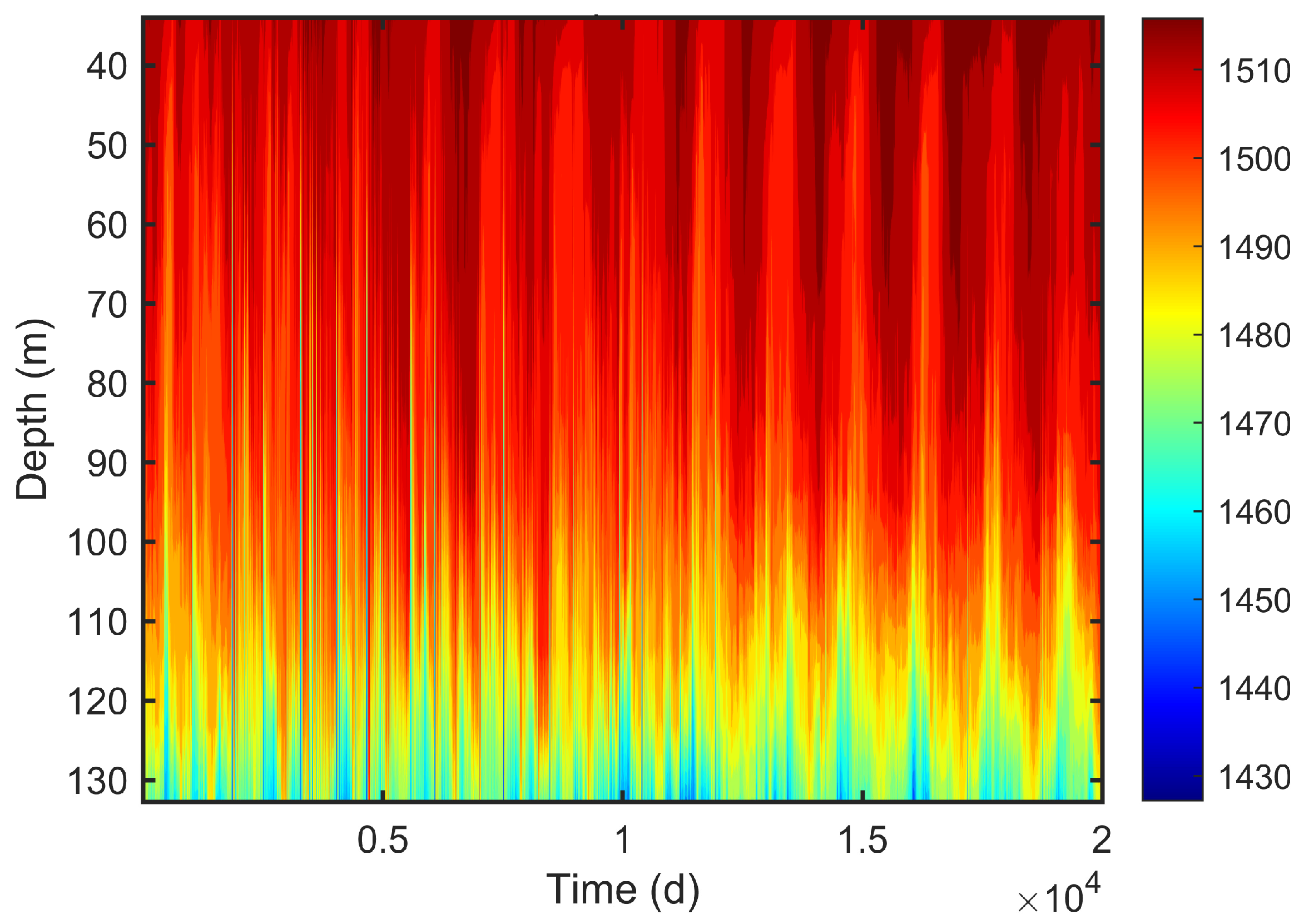
- Most existing SSP prediction models are designed for stable marine environments and fail to address the severe interference from strong internal solitary waves (ISWs). In ISW-frequent areas like the continental slope of the South China Sea, ISWs cause sound speed anomalies up to 82 m/s, which act as strong outliers and drastically degrade the accuracy and generalization of traditional models. Accurate SSP prediction under ISW disturbance remains a critical engineering challenge.
- State-of-the-art high-precision models (e.g., attention-based spatiotemporal models) suffer from high complexity, large parameter size and heavy computational cost. They are prone to overfitting with limited ISW observation samples and cannot be easily deployed on low-computing underwater platforms such as buoys and UUVs, limiting their practical application.
2. Materials and Methods
2.1. Data Source and Preprocessing
2.2. EOF Decomposition
2.3. LSTM Neural Network
2.4. Bi-LSTM Neural Network
2.5. Profile Reconstruction
3. Results and Discussion
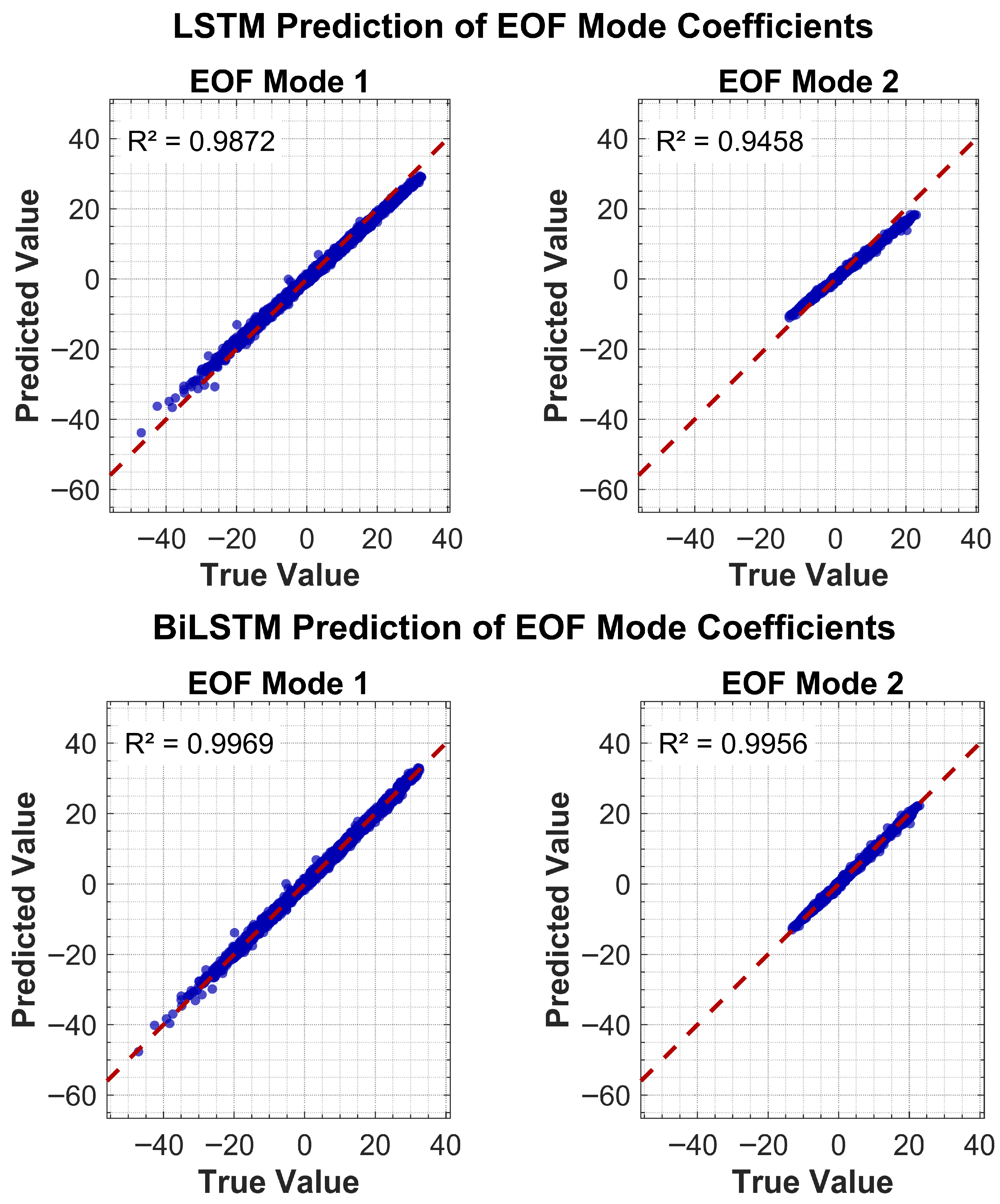
3.1. Bi-LSTM Model Training
3.2. Parameter Sensitivity Analysis
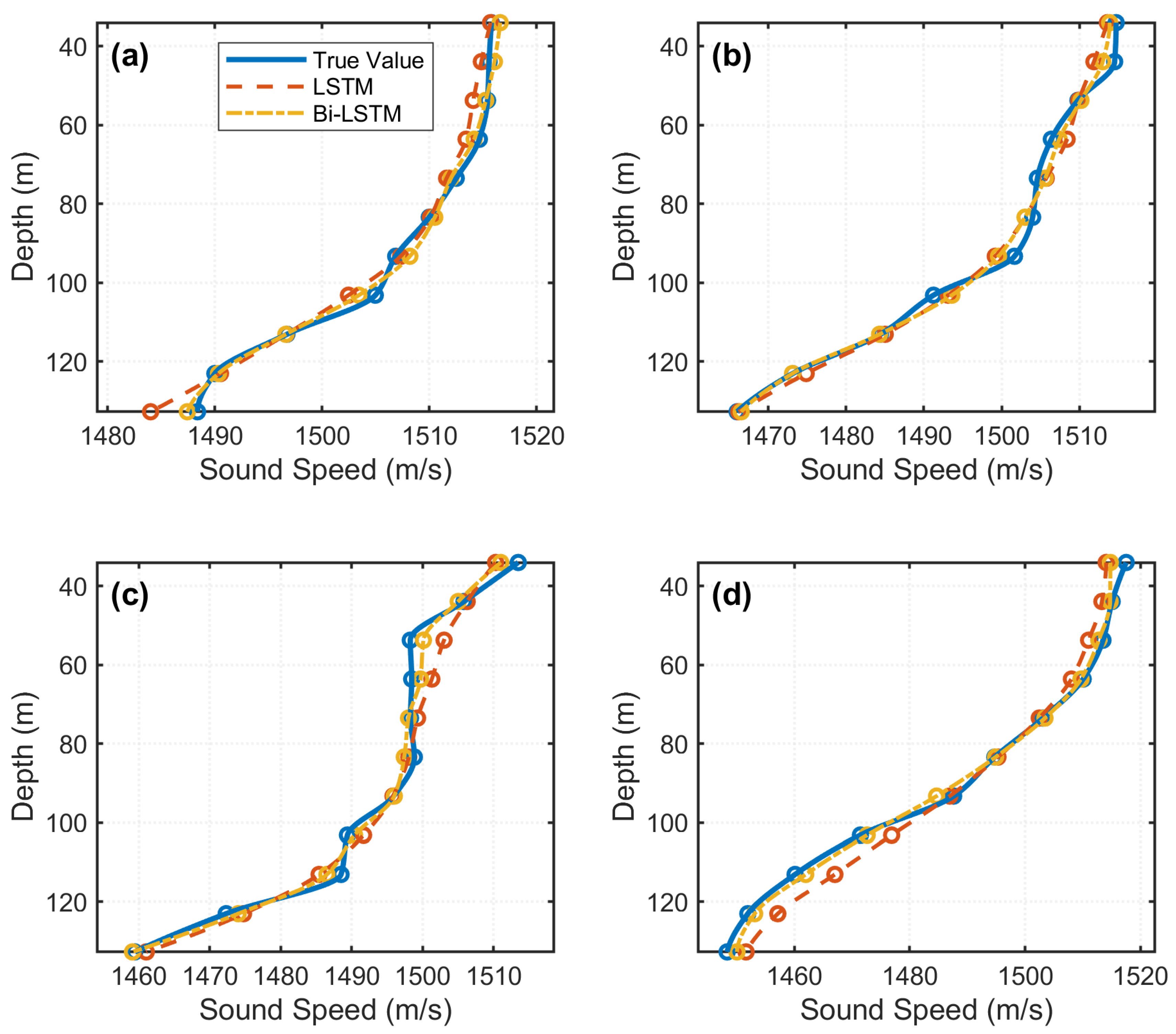
3.2.1. Performance Under Varied Marine Conditions
- (1)
- Performance Under Different ISW Disturbance Intensities
- (2)
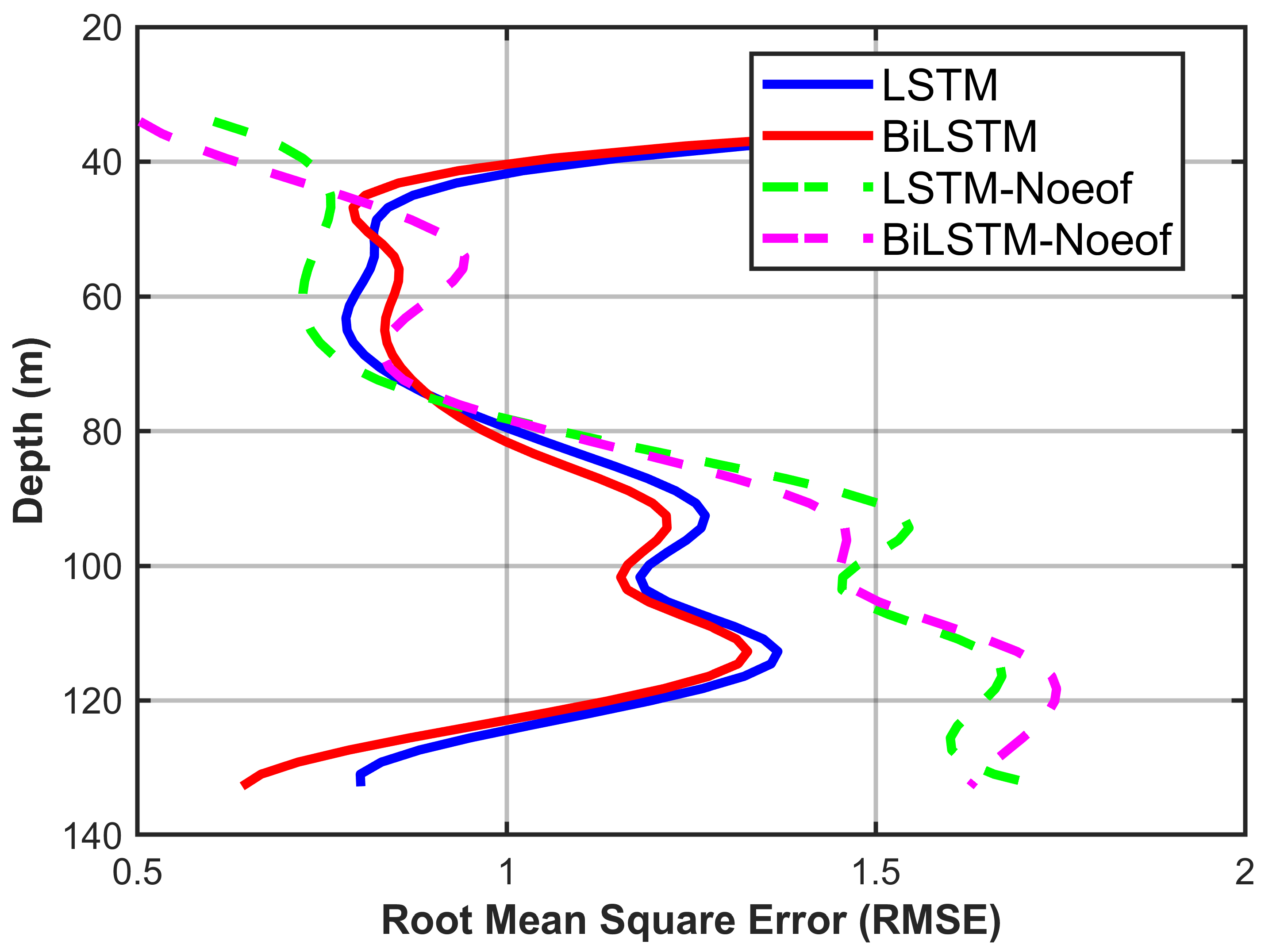
- Performance at Different Depth Layers
3.2.2. Single-Factor Parameter Sensitivity Analysis
- (1)
- Number of EOF Modes
- (2)
- Number of Bi-LSTM Hidden Layer Neurons
- (3)
- Input Time Step
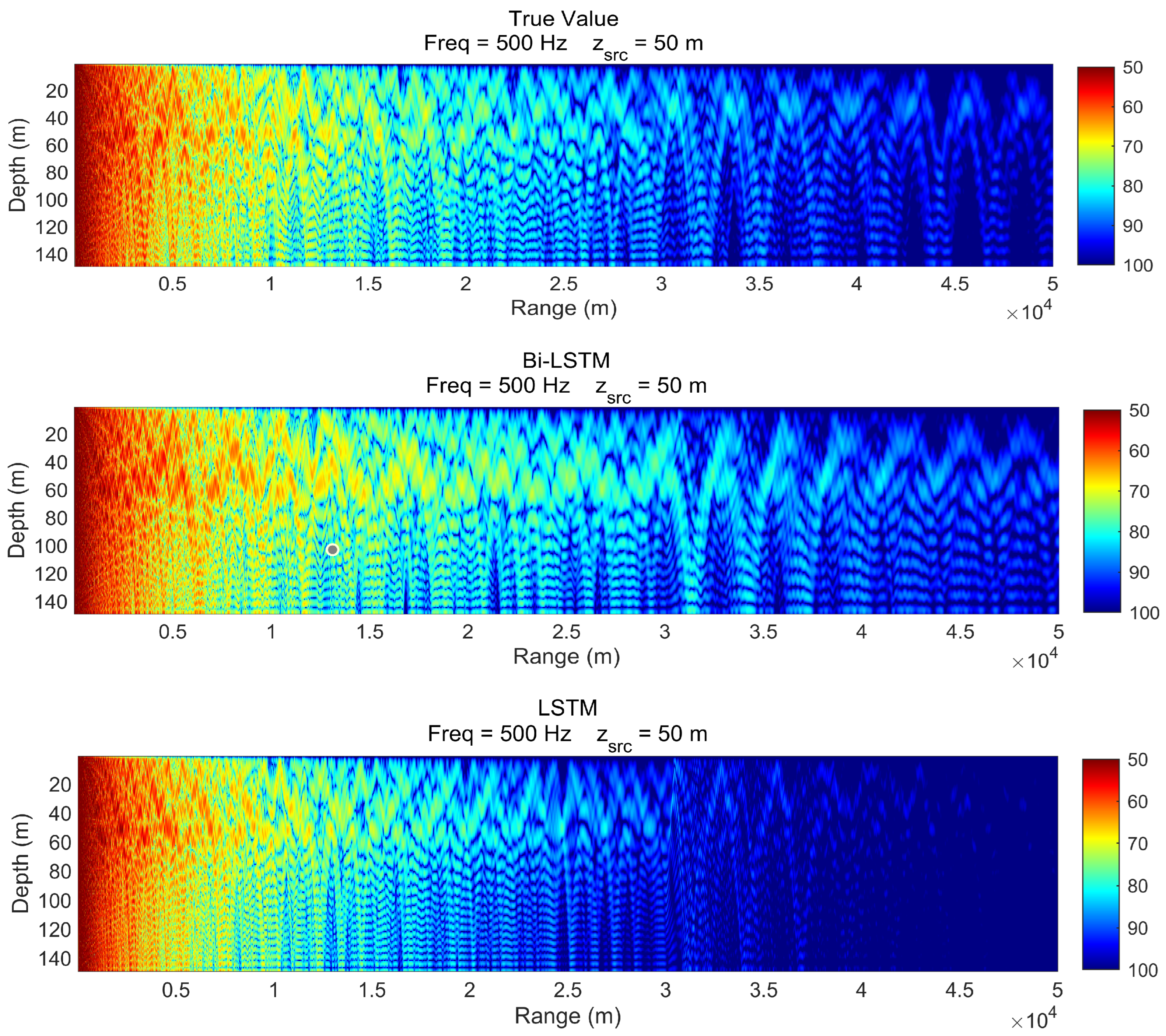
3.3. Underwater Acoustic Field Verification Based on Predicted Sound Speed Profiles
4. Conclusions
Author Contributions
Funding
Data Availability Statement
Conflicts of Interest
References
- Heidemann, J.; Stojanovic, M.; Zorzi, M. Underwater sensor networks: Applications, advances and challenges. Philos. Trans. R. Soc. A Math. Phys. Eng. Sci. 2012, 370, 158–175. [Google Scholar] [CrossRef]
- Ahmed, A.; Younis, M. Distributed Real-Time Sound Speed Profiling in Underwater Environments. In Proceedings of the 2017 IEEE International Conference on Communications (ICC), Paris, France, 21–25 May 2017; IEEE: Piscataway, NJ, USA, 2017; pp. 1–7. [Google Scholar] [CrossRef]
- Zhang, S.; Xu, X.; Xu, D.; Long, K.; Shen, C.; Tian, C. The Design and Calibration of a Low-Cost Underwater Sound Velocity Profiler. Front. Mar. Sci. 2022, 9, 996299. [Google Scholar] [CrossRef]
- North, G.R.; Bell, T.L.; Cahalan, R.F.; Moeng, F.J. Sampling Errors in the Estimation of Empirical Orthogonal Functions. Mon. Weather Rev. 1982, 110, 699–706. [Google Scholar] [CrossRef]
- Martinson, D.G. Empirical Orthogonal Function (EOF) Analysis. In Quantitative Methods of Data Analysis for the Physical Sciences and Engineering; Cambridge University Press: Cambridge, UK, 2018; pp. 495–534. [Google Scholar] [CrossRef]
- Niu, X.J.; Li, T.; Chen, Z.; Wang, J.J. Study on the Influence of Calibration Point Quantity Distribution on CTD (Temperature) Calibration Results. Acta Metrol. Sin. 2025, 46, 542–547. [Google Scholar]
- Zhang, L.H.; Liu, Y.; Liu, Y.X.; Zhang, X.S. Modeling of Time-Varying Characteristics of Deep-Sea Sound Speed Profile Based on Layered EOF. Coast. Eng. 2022, 41, 209–222. [Google Scholar]
- Björnsson, H.; Venegas, S.A. A Manual for EOF and SVD Analyses of Climatic Data. CCGCR Rep. 1997, 97, 112–134. [Google Scholar]
- Kawamura, R. A Rotated EOF Analysis of Global Sea Surface Temperature Variability with Interannual and Interdecadal Scales. J. Phys. Oceanogr. 1994, 24, 707–715. [Google Scholar] [CrossRef]
- Zhong, W.Q.; Qu, K.; Liang, Y. Profile Reconstruction Based on Empirical Orthogonal Function and Analysis of Its Physical Significance. J. Ocean. Technol. 2022, 41, 57–64. [Google Scholar]
- Aharon, M.; Elad, M.; Bruckstein, A. K-SVD: An Algorithm for Designing Overcomplete Dictionaries for Sparse Representation. IEEE Trans. Signal Process. 2006, 54, 4311–4322. [Google Scholar] [CrossRef]
- Kolda, T.G.; Bader, B.W. Tensor Decompositions and Applications. SIAM Rev. 2009, 51, 455–500. [Google Scholar] [CrossRef]
- Hawe, S.; Lucey, S.; Wilcox, L.C. Tensor Dictionary Learning. In Proceedings of the 30th International Conference on Machine Learning (ICML 2013), Atlanta, GA, USA, 16–21 June 2013; pp. 1276–1284. [Google Scholar]
- Sun, D.; Yu, M.; Cai, K. Inversion of ocean sound speed profiles from travel time measurements using a ray-gradient-enhanced surrogate model. Remote Sens. Lett. 2022, 13, 888–897. [Google Scholar] [CrossRef]
- Huang, J.; Luo, Y.; Shi, J.; Ma, X.; Li, Q.Q.; Li, Y.Y. Rapid modeling of the sound speed field in the South China Sea based on a comprehensive optimal LM-BP artificial neural network. J. Mar. Sci. Eng. 2021, 9, 488. [Google Scholar] [CrossRef]
- Zhou, P.X.; Hu, T.; Wang, Z.; Yang, F.J. Deep-Sea Sound-Speed Profile Estimation and Prediction of Sound Propagation Based on Sparse Depth Sensing Using Towed Temperature-Depth Sensors. Acta Acust. 2025, 50, 622–633. [Google Scholar] [CrossRef]
- Sun, W.; Bao, J.; Jin, S.; Xiao, F.; Cui, Y. Inversion of Sound Velocity Profiles by Correcting the Terrain Distortion. Geomat. Inf. Sci. Wuhan Univ. 2016, 41, 349–355. [Google Scholar] [CrossRef]
- Yu, Y.; Li, Z.; He, L. Matched-Field Inversion of Sound Speed Profile in Shallow Water Using a Parallel Genetic Algorithm. Chin. J. Oceanol. Limnol. 2010, 28, 1080–1085. [Google Scholar] [CrossRef]
- Zhang, W.; Jin, S.; Bian, G.; Peng, C.; Xia, H. A Method for Full-Depth Sound Speed Profile Reconstruction Based on Average Sound Speed Extrapolation. J. Mar. Sci. Eng. 2024, 12, 930. [Google Scholar] [CrossRef]
- Li, Q.; Zhu, J.; Luo, Y.; Zhang, R.H. Reconstruction Performance Analysis for Basis Function of the Sound Speed Profile. Haiyang Xuebao 2023, 45, 34–44. [Google Scholar]
- Yan, X.; Li, Q.Q.; Yang, F.L.; Peng, D.D.; Juan, Z.H.; Li, Q. A Depth-Wise Transfer Learning Method for Time-Series Sound Speed Profile Prediction in Shallow Water with Internal Waves. Acta Acust. 2025, 50, 23–31. [Google Scholar] [CrossRef]
- Wei, Z.; Shaohua, J.; Gang, B.; Yang, C.; Chengyang, P.; Haixing, X. A Method for Sound Speed Profile Prediction Based on CNN-BiLSTM-Attention Network. J. Mar. Sci. Eng. 2024, 12, 414. [Google Scholar] [CrossRef]
- Wang, S.; Wu, Z.; Jia, S.; Zhao, D.; Shang, J.; Wang, M.; Zhou, J.; Qin, X. A Multi-Spatial-Scale Ocean Sound Speed Profile Prediction Model Based on a Spatio-Temporal Attention Mechanism. J. Mar. Sci. Eng. 2025, 13, 722. [Google Scholar] [CrossRef]
- Piao, S.; Yan, X.; Li, Q.; Li, Z.; Wang, Z.; Zhu, J. Time Series Prediction of Shallow Water Sound Speed Profile in the Presence of Internal Solitary Wave Trains. Ocean Eng. 2023, 285, 115058. [Google Scholar] [CrossRef]
- Yue, B.; Fu, J.; Liang, J. Residual Recurrent Neural Networks for Learning Sequential Representations. Information 2018, 9, 56. [Google Scholar] [CrossRef]
- Wang, H.; Li, Z.; Zhang, Q.; Wang, B. Shallow water sound speed profile inversion based on recurrent neural network. IEEE Access 2020, 8, 11409–11417. [Google Scholar]
- Yuan, H.X.; Liu, Y.; Tang, Q.H.; Li, J.; Chen, G.X.; Cai, W.X. ST-LSTM-SA: A New Ocean Sound Velocity Field Prediction Model Based on Deep Learning. Adv. Atmos. Sci. 2024, 41, 1364–1378. [Google Scholar] [CrossRef]
- Lu, J.; Zhang, H.; Wu, P.; Li, S.; Huang, W. Predictive Modeling of Future Full-Ocean Depth SSPs Utilizing Hierarchical Long Short-Term Memory Neural Networks. J. Mar. Sci. Eng. 2024, 12, 943. [Google Scholar] [CrossRef]
- Lu, J.; Zhang, H.; Li, S.; Wu, P.; Huang, W. Enhancing Few-Shot Prediction of Ocean Sound Speed Profiles through Hierarchical Long Short-Term Memory Transfer Learning. J. Mar. Sci. Eng. 2024, 12, 1041. [Google Scholar] [CrossRef]
- Wang, Z.; Ren, H. Global Lunar Christiansen Feature from LRO Diviner Radiometer Observation Data. IEEE Trans. Geosci. Remote Sens. 2024, 62, 5001511. [Google Scholar] [CrossRef]
- Shen, Y.; Ma, Y.; Tu, Q. On expression of ocean sound profile by layered empirical orthogonal function. J. Northwest. Polytech. Univ. 2000, 18, 90–93. [Google Scholar] [CrossRef]
- Siami-Namini, S.; Tavakoli, N.; Namin, A.S. The Performance of LSTM and Bi-LSTM in Forecasting Time Series. In Proceedings of the 2019 IEEE International Conference on Big Data (Big Data), Los Angeles, CA, USA, 9–12 December 2019; IEEE: Piscataway, NJ, USA, 2019; pp. 3285–3292. [Google Scholar] [CrossRef]
- He, Z.; Hu, W.; Li, L.; Pähtz, T.; Li, J. Thermohaline Dynamics in the Northern Continental Slope of the South China Sea: A Case Study in the Qiongdongnan Slope. J. Mar. Sci. Eng. 2022, 10, 1221. [Google Scholar] [CrossRef]
- Shen, H.; Li, L.; Li, J.; He, Z.; Xia, Y. The Seasonal Variation of the Anomalously High Salinity at Subsurface Salinity Maximum in Northern South China Sea from Argo Data. J. Mar. Sci. Eng. 2021, 9, 227. [Google Scholar] [CrossRef]
- Liu, Y.; Li, M.; Li, H.; Wang, P.; Liu, K. A Novel Reconstruction Model for the Underwater Sound Speed Field Utilizing Ocean Remote Sensing Observations and Argo Profiles. Water 2025, 17, 539. [Google Scholar] [CrossRef]
- Chen, C.-T.; Millero, F.J. Nine-Term Equation for Sound Speed in the Oceans. J. Acoust. Soc. Am. 1981, 70, 807–812. [Google Scholar] [CrossRef]
- Del Grosso, V.A. New equation for the speed of sound in natural waters (with comparisons to other equations). J. Acoust. Soc. Am. 1974, 56, 1084–1091. [Google Scholar] [CrossRef]



| EOF Spatial Mode | Variance Contribution Rate | Cumulative Variance Contribution Rate |
|---|---|---|
| 1st mode | 66.1 | 66.1 |
| 2nd mode | 18.1 | 84.2 |
| 3rd mode | 8.0 | 92.2 |
| 4th mode | 3.5 | 95.7 |
| 5th mode | 1.8 | 97.5 |
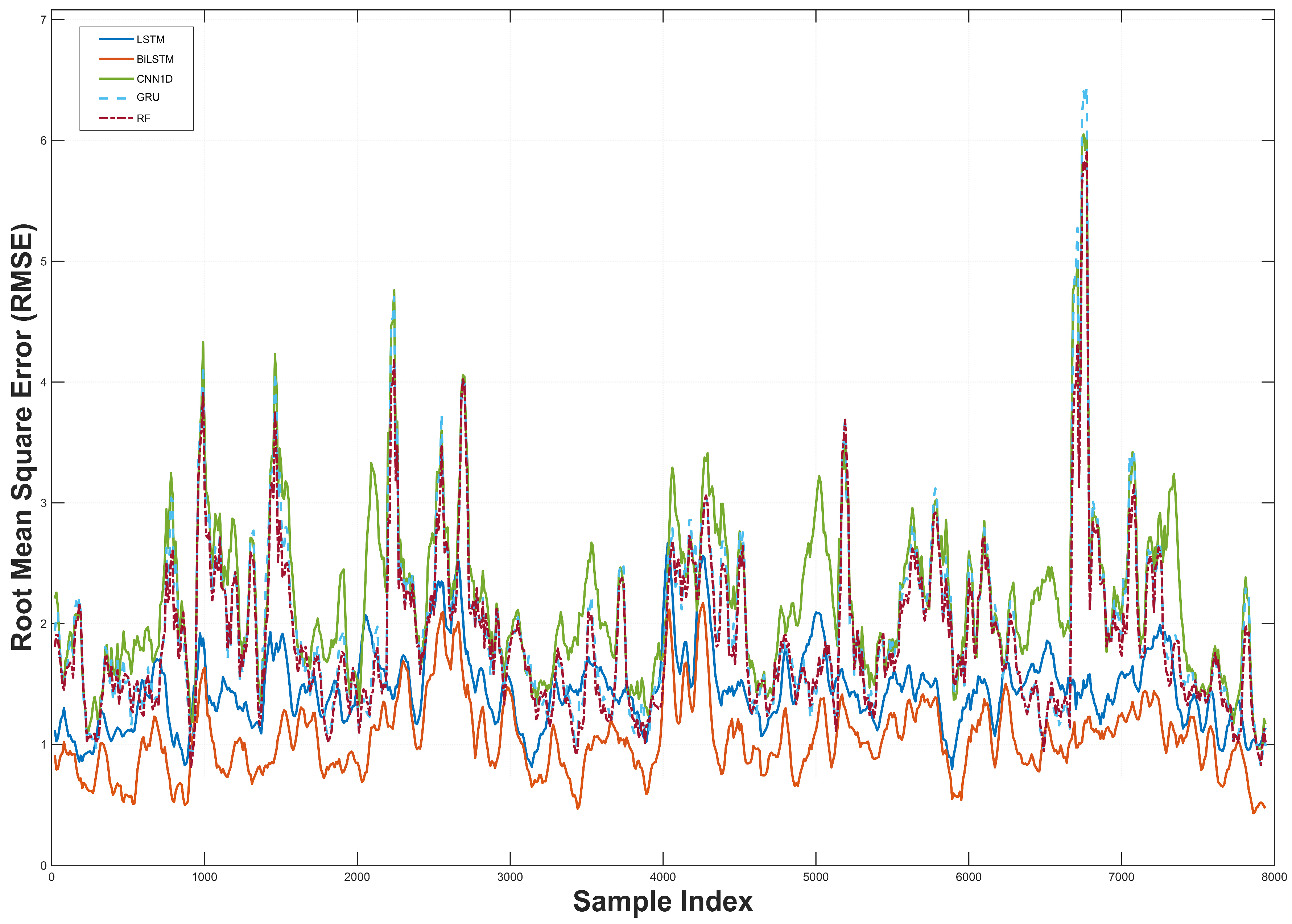
| Spatial Mode | Bi-LSTM | LSTM | 1D-CNN | GRU | Random Forest |
|---|---|---|---|---|---|
| 1st mode | 0.7243 | 0.9143 | 2.4614 | 1.0186 | 1.4868 |
| 2nd mode | 0.3447 | 0.5296 | 1.6201 | 0.4868 | 0.8495 |
| 3rd mode | 0.3599 | 0.6106 | 1.9664 | 0.5574 | 0.6976 |
| 4th mode | 0.2607 | 0.3907 | 1.3769 | 0.4336 | 0.4751 |
| 5th mode | 0.2458 | 0.4064 | 1.3045 | 0.4163 | 0.4052 |
Disclaimer/Publisher’s Note: The statements, opinions and data contained in all publications are solely those of the individual author(s) and contributor(s) and not of MDPI and/or the editor(s). MDPI and/or the editor(s) disclaim responsibility for any injury to people or property resulting from any ideas, methods, instructions or products referred to in the content. |
© 2026 by the authors. Licensee MDPI, Basel, Switzerland. This article is an open access article distributed under the terms and conditions of the Creative Commons Attribution (CC BY) license.
Share and Cite
Yin, H.; Qu, K.; Wang, H.; Li, G. Prediction of Sound Speed Profiles Under Disturbance of Strong Internal Solitary Waves Using Bidirectional Long Short-Term Memory Network. J. Mar. Sci. Eng. 2026, 14, 735. https://doi.org/10.3390/jmse14080735
Yin H, Qu K, Wang H, Li G. Prediction of Sound Speed Profiles Under Disturbance of Strong Internal Solitary Waves Using Bidirectional Long Short-Term Memory Network. Journal of Marine Science and Engineering. 2026; 14(8):735. https://doi.org/10.3390/jmse14080735
Chicago/Turabian StyleYin, Hong, Ke Qu, Han Wang, and Guangming Li. 2026. "Prediction of Sound Speed Profiles Under Disturbance of Strong Internal Solitary Waves Using Bidirectional Long Short-Term Memory Network" Journal of Marine Science and Engineering 14, no. 8: 735. https://doi.org/10.3390/jmse14080735
APA StyleYin, H., Qu, K., Wang, H., & Li, G. (2026). Prediction of Sound Speed Profiles Under Disturbance of Strong Internal Solitary Waves Using Bidirectional Long Short-Term Memory Network. Journal of Marine Science and Engineering, 14(8), 735. https://doi.org/10.3390/jmse14080735