Submesoscale Eddy Spatiotemporal Variability Comparison Between Kuroshio Current and Open-Ocean Regions of the Western Pacific


Abstract
1. Introduction
2. Materials and Methods
2.1. Model Setup
2.2. Scale Separation and SME Identification
3. Results and Discussion
3.1. CSME Surface Features
3.1.1. Currents
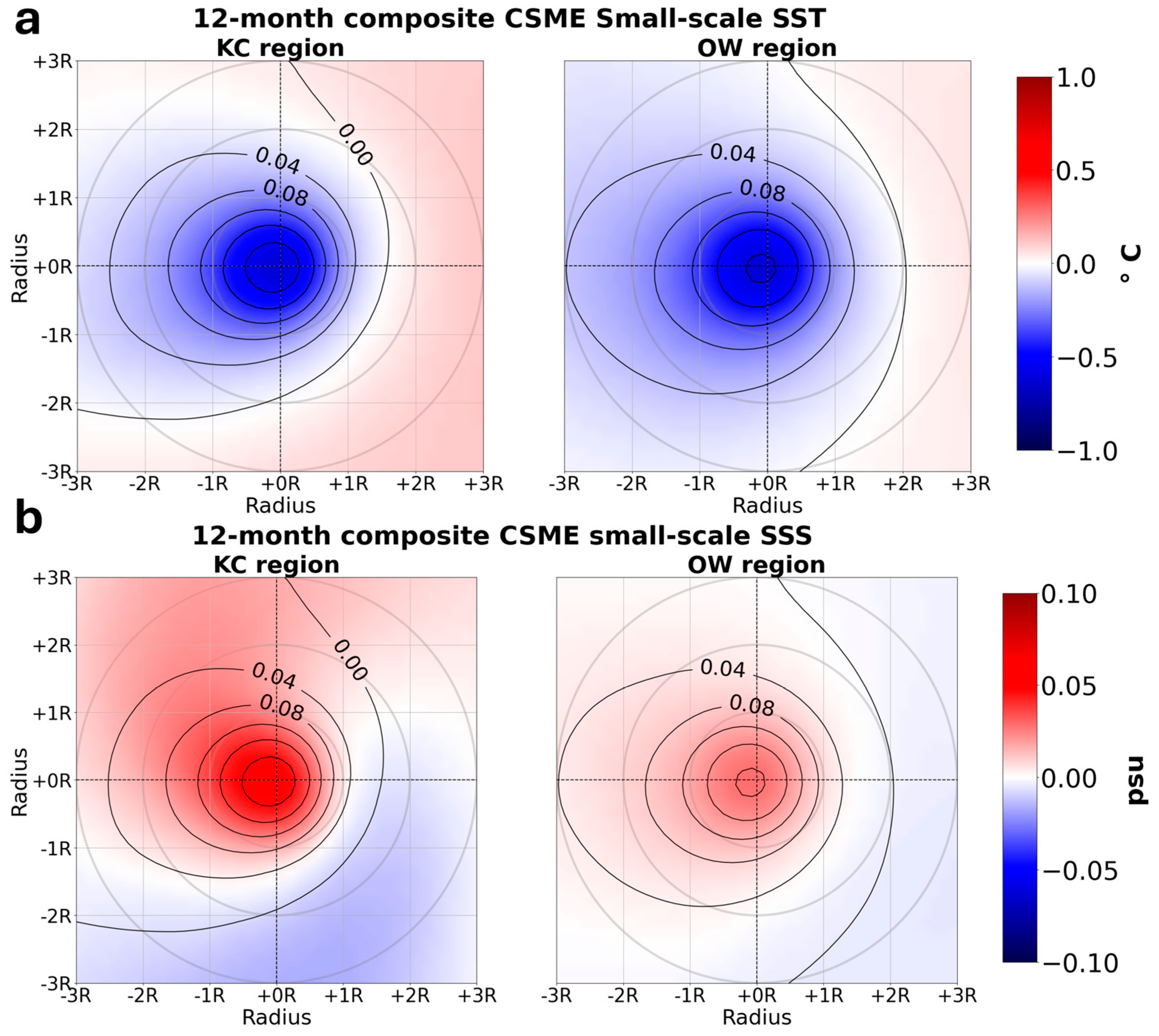
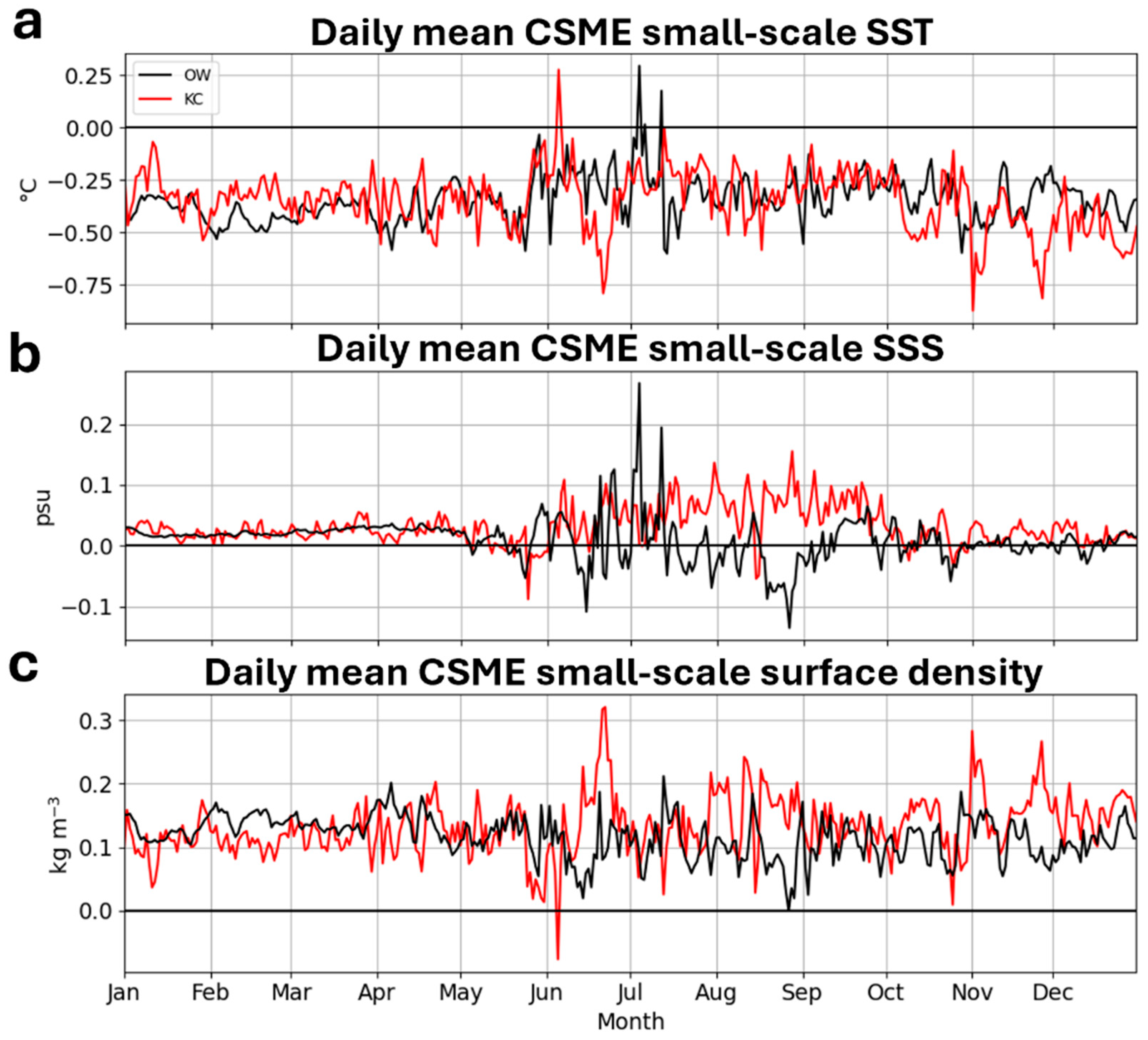
3.1.2. Temperature, Salinity, and Density
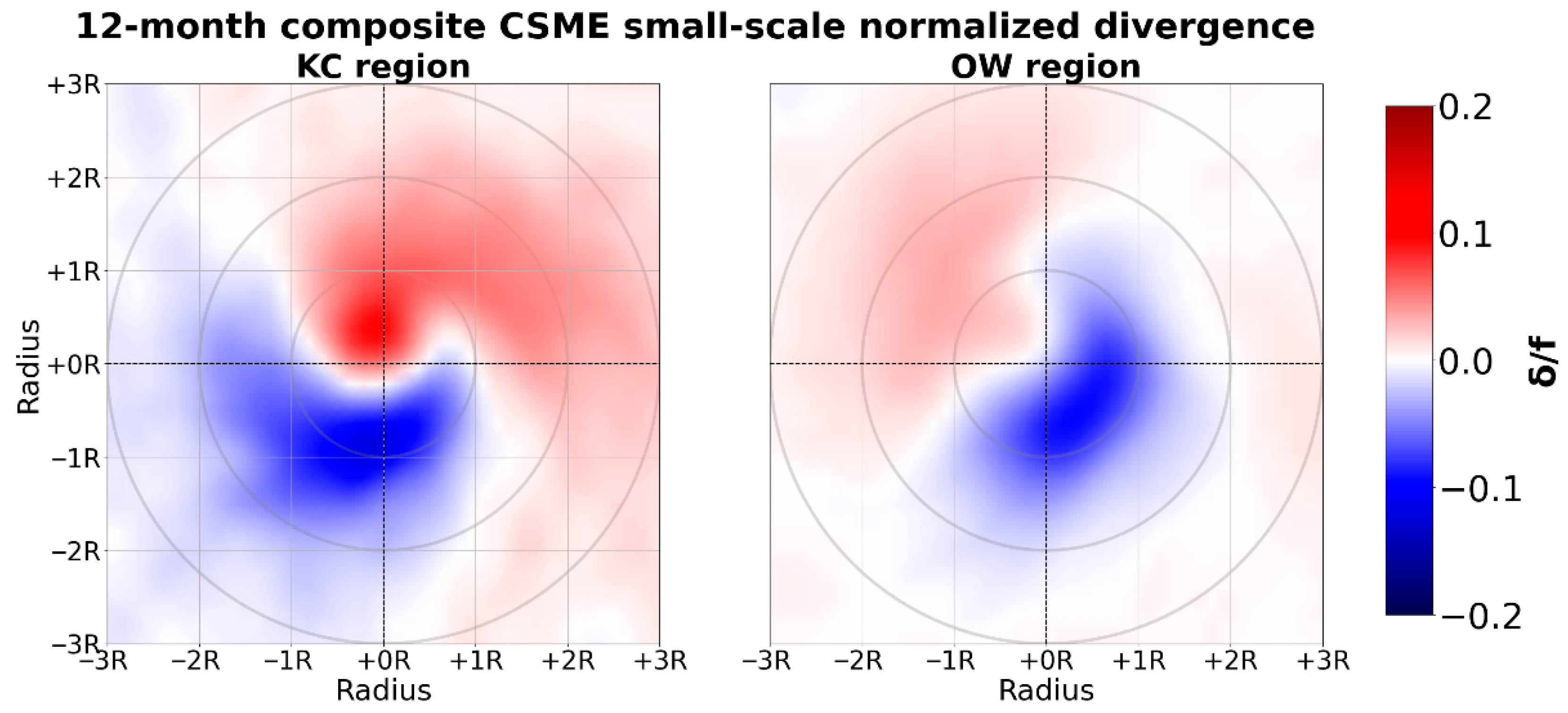
3.1.3. Small-Scale Surface Divergence
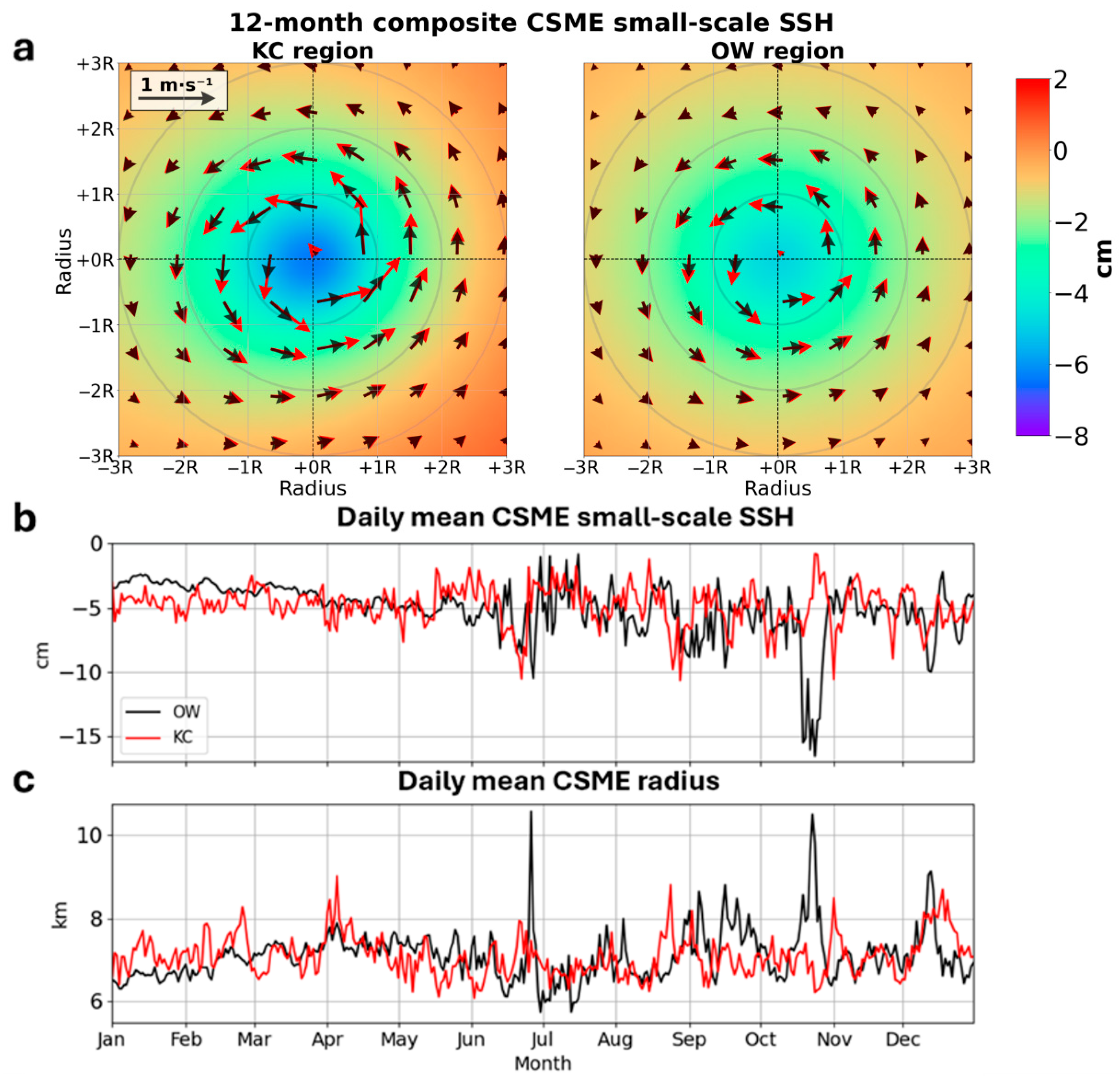
3.1.4. Small-Scale SSH and Ageostrophic Influence
3.2. Subsurface CSME Structure and Properties
3.2.1. MLD, Horizontal Current and Bottom Depth
3.2.2. Temperature and Salinity
3.2.3. Divergence and Vertical Motion
4. Summary and Conclusions
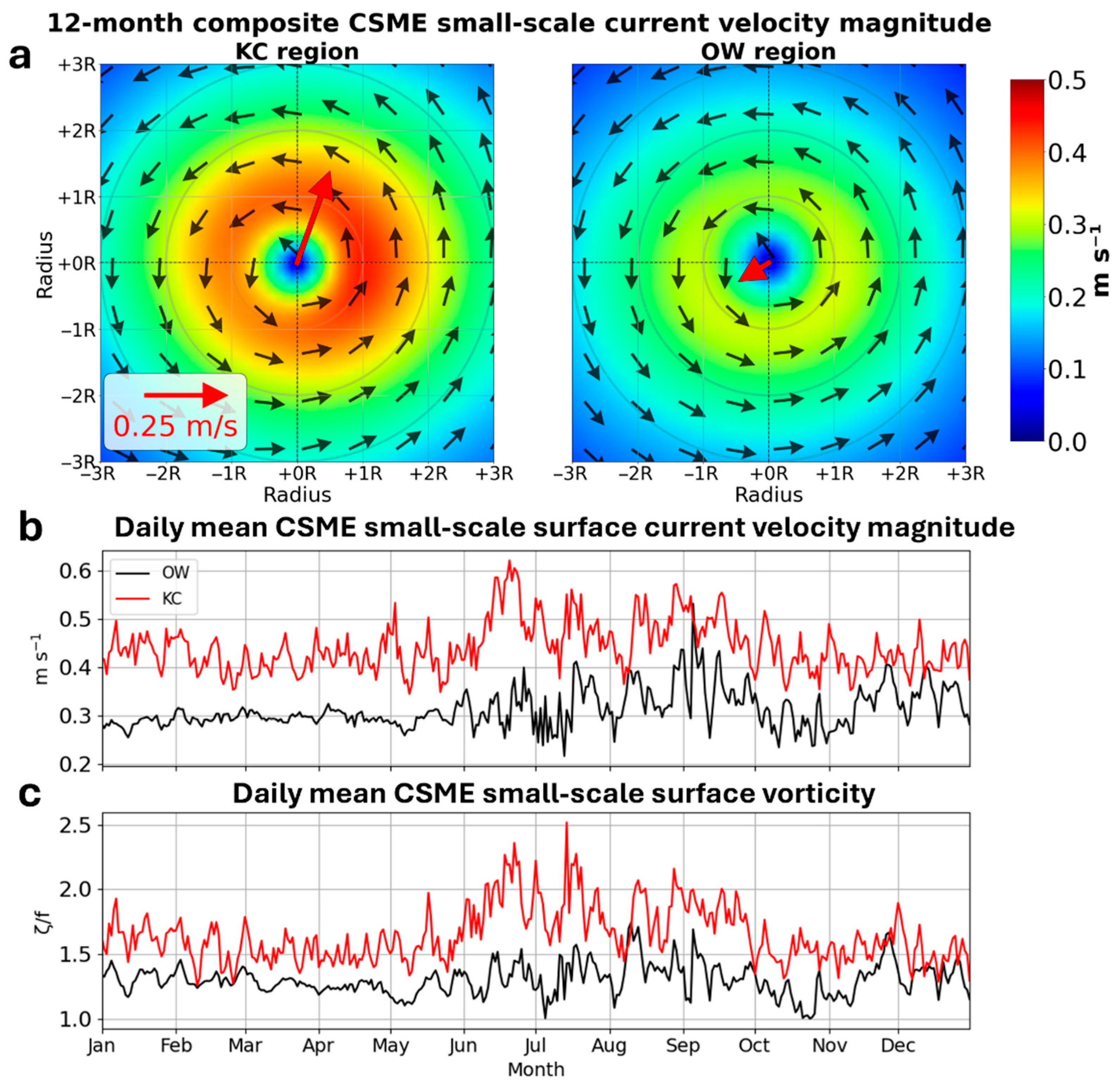
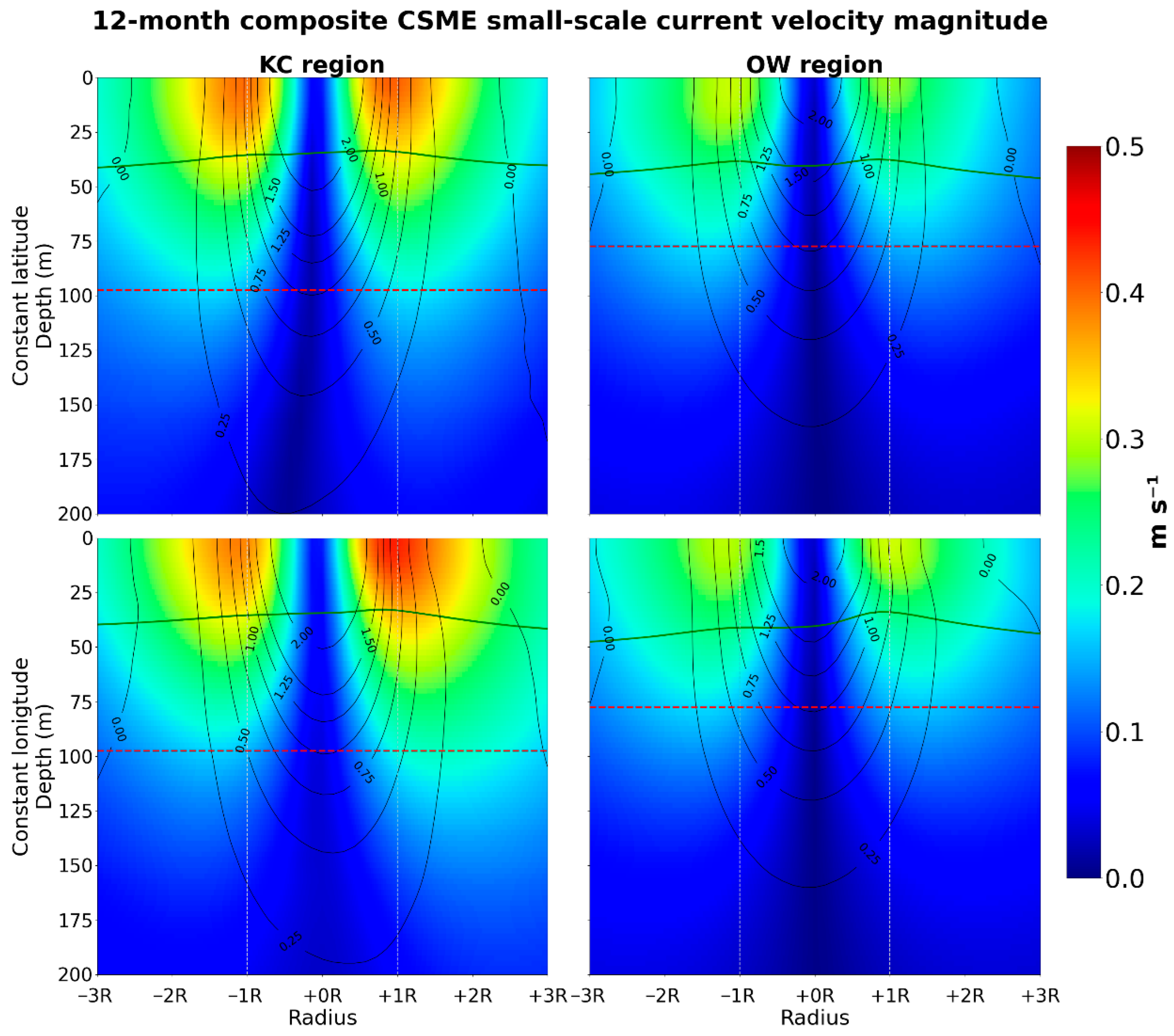
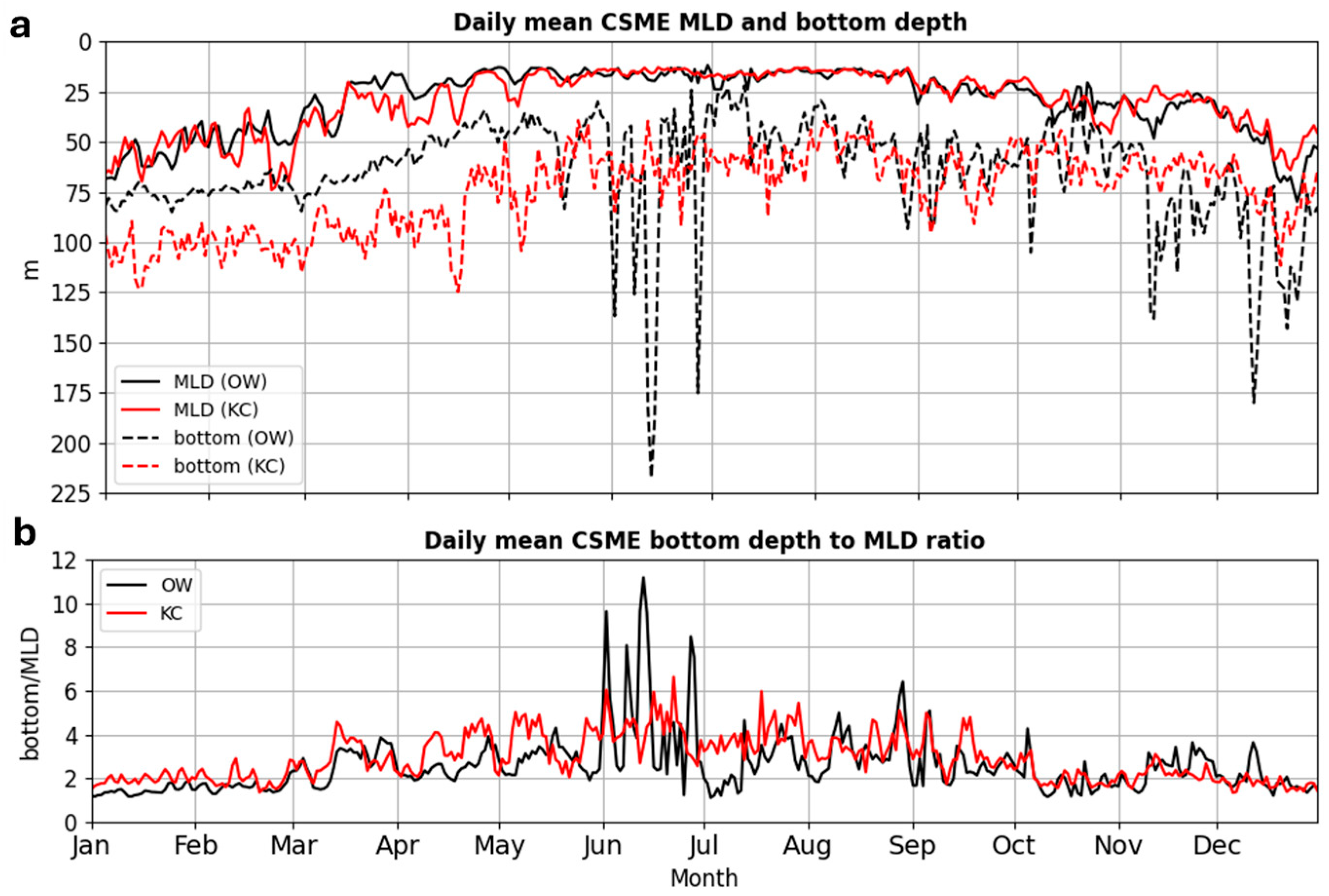
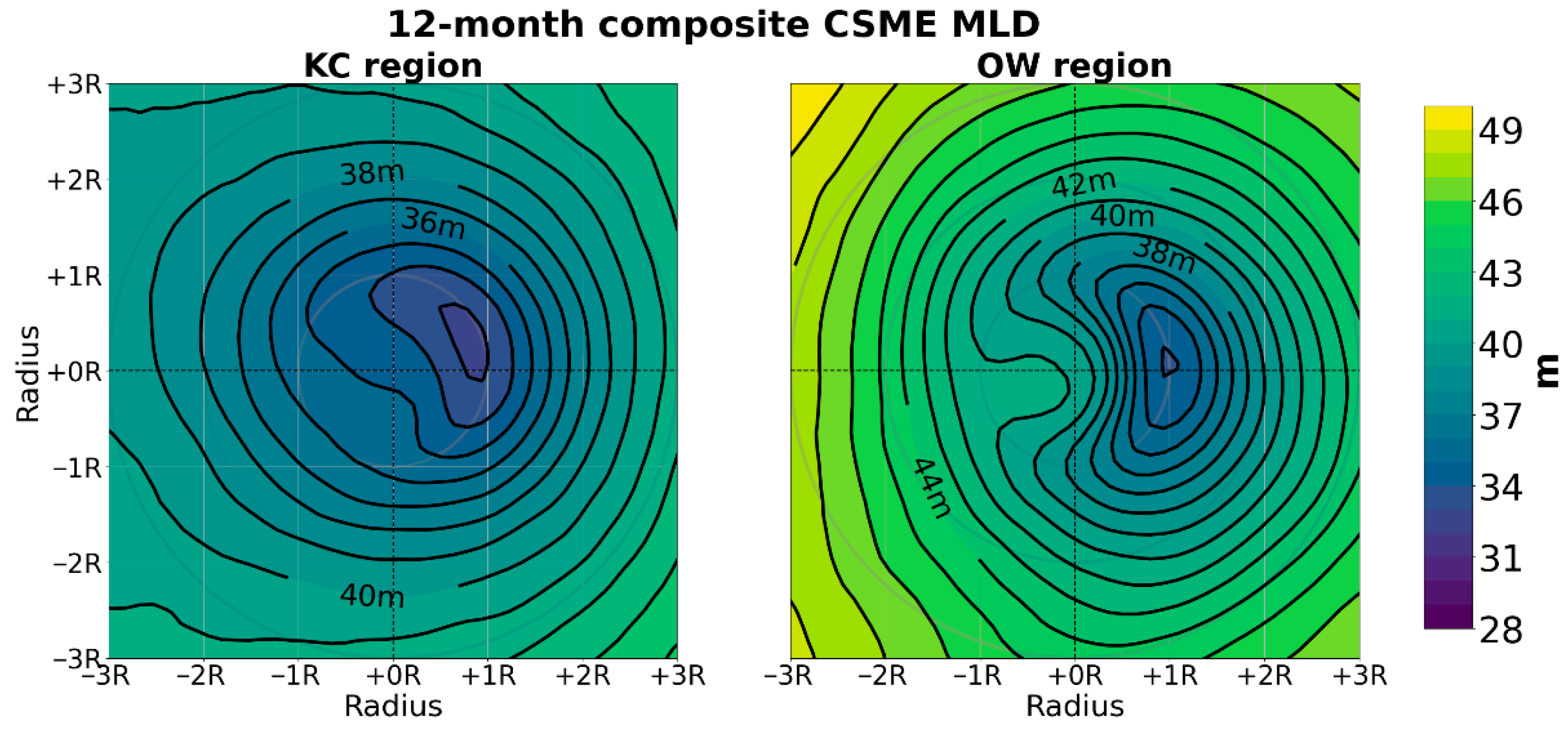
- The counterclockwise flow and positive vorticity of CSMEs in the KC region are faster and stronger compared to those in the OW region. These current trends also lead to the vertical extent of the CSMEs, based on a vorticity threshold of 1 s−1, to be deeper in the KC region despite the shallower MLD. Composite CSME bottom depths are found at 2.8 times the mean core composite MLDs in the KC region and at 2.0 times the mean core composite MLDs in the OW region. Seasonally, the eddy bottom depths follow the MLD trends, with shoaling in the summer and deepening in the winter.
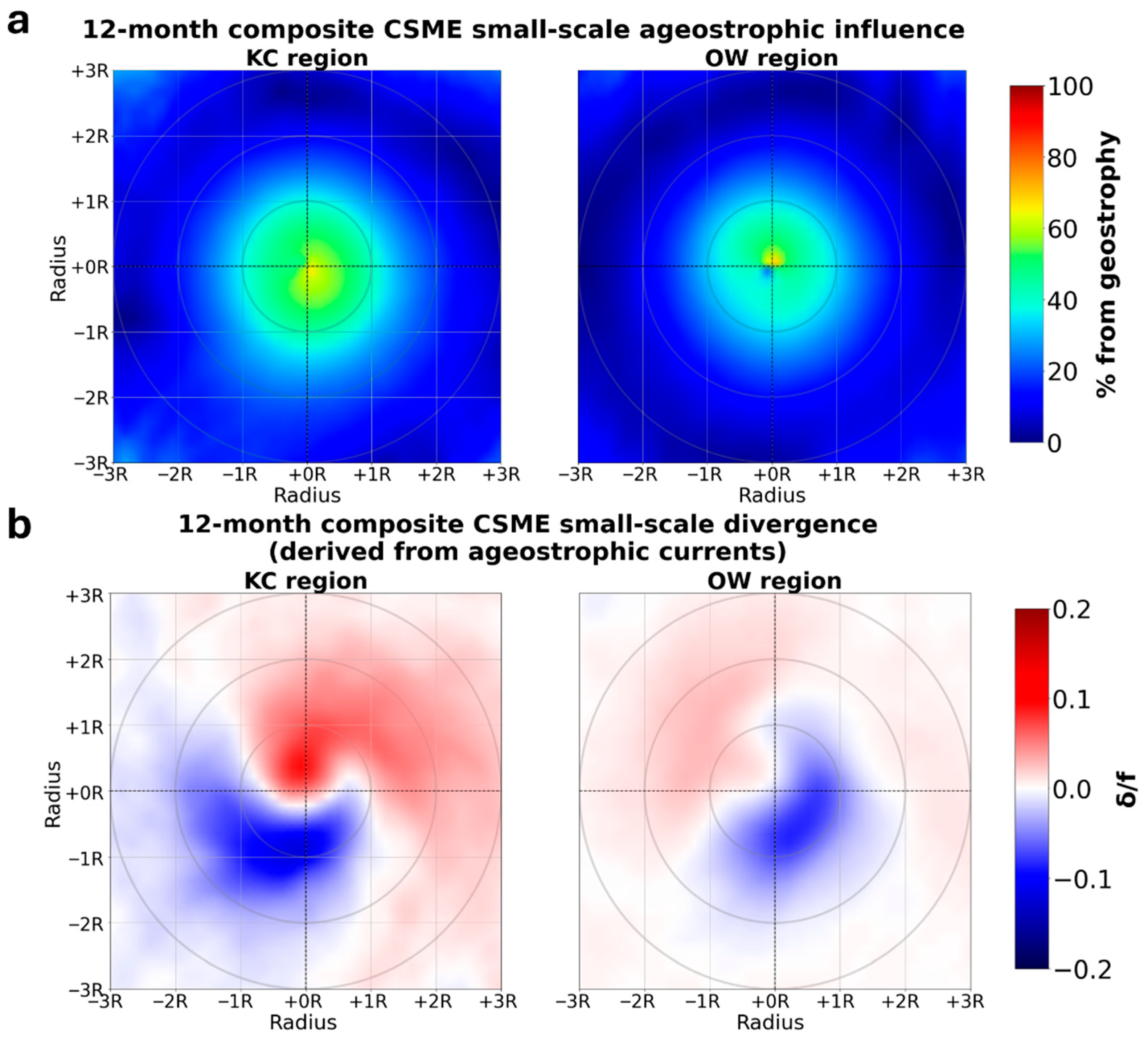
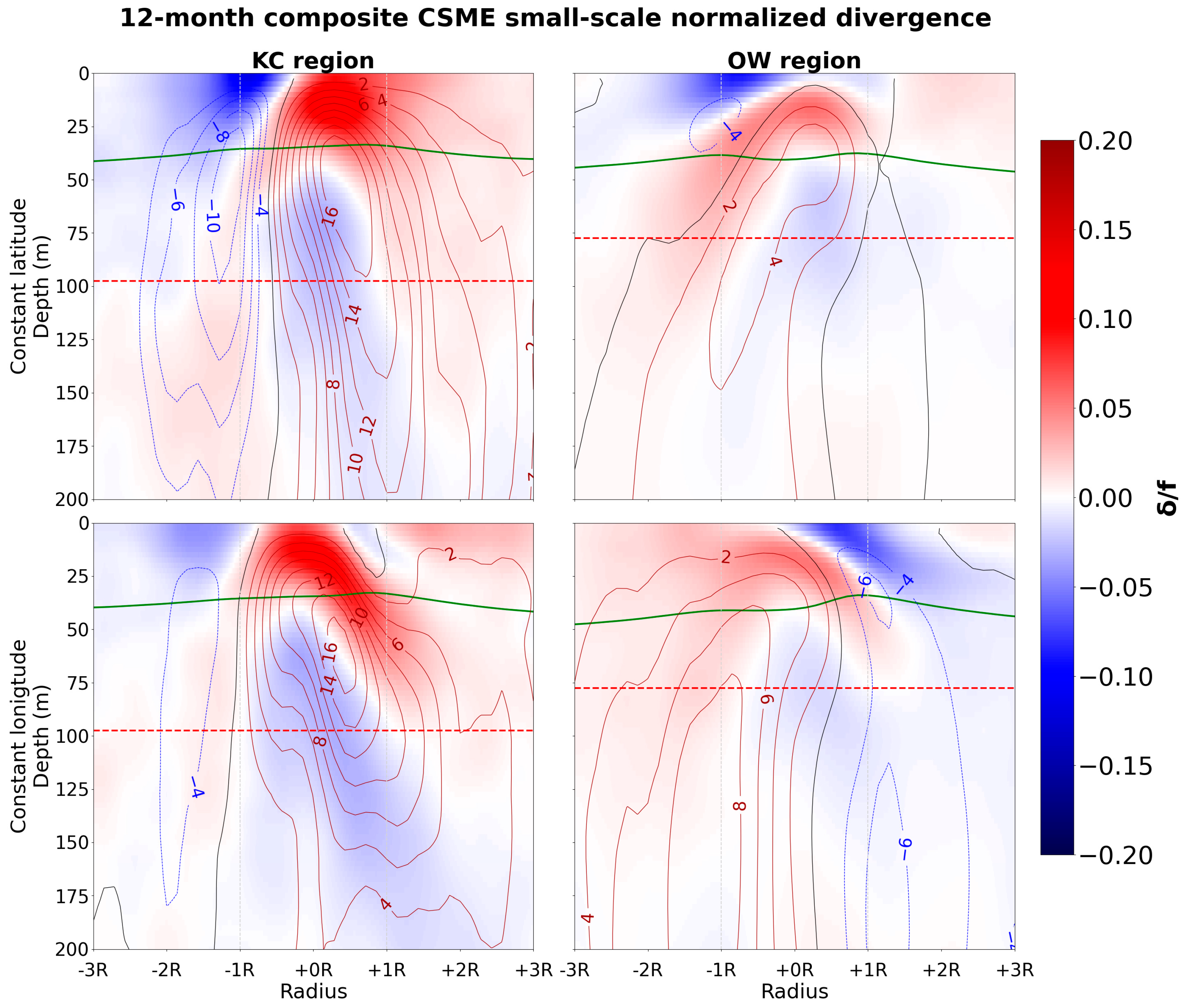
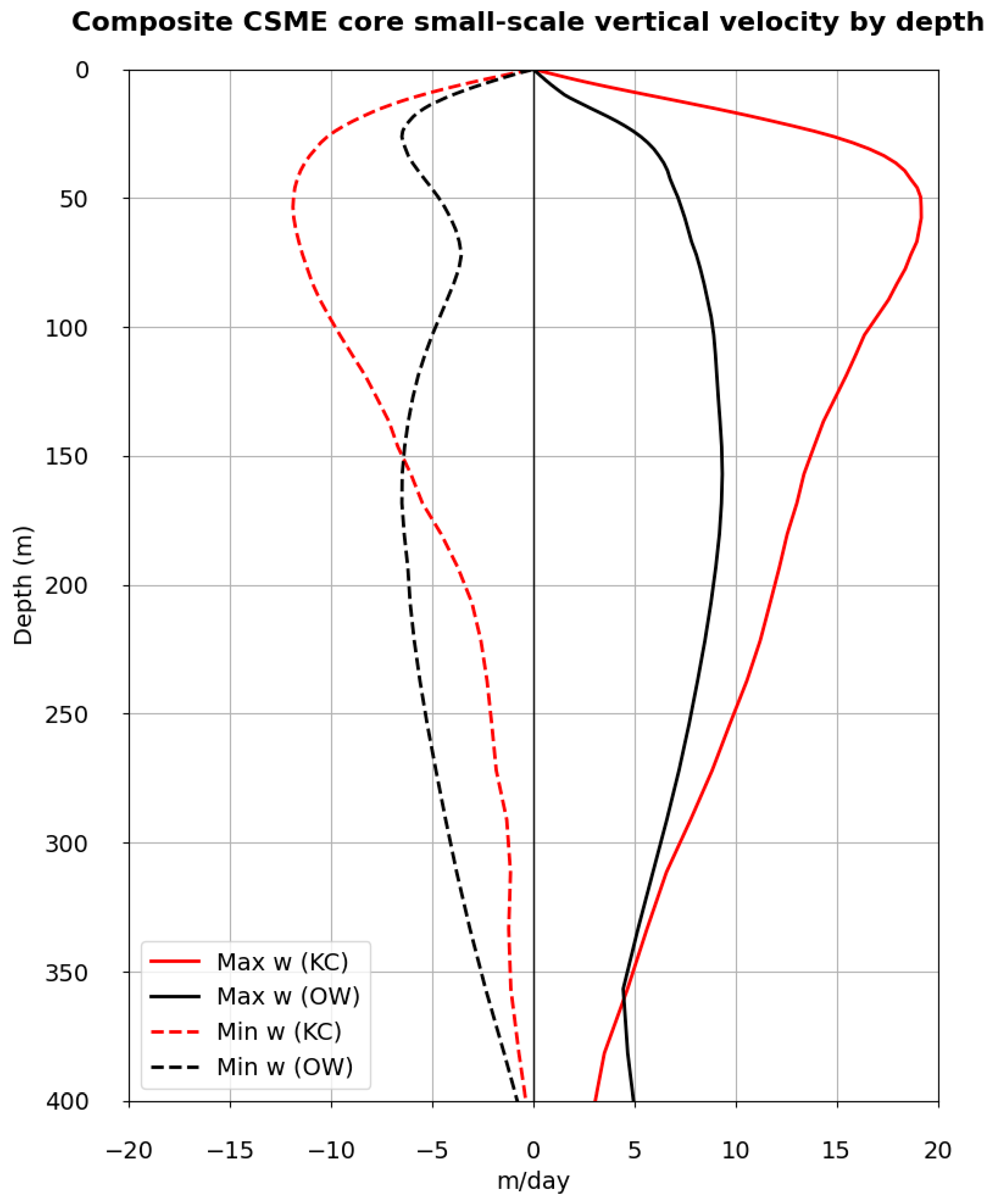
- Surface ageostrophic currents, found to be flowing in the opposite direction of the geostrophic currents, within the CSMEs lead to a dipole divergence pattern, with divergence in the KC region having stronger magnitudes compared to the OW region. Ageostrophy dominates more in the KC region, where the composite CSME core deviates 48% from geostrophic balance, while the OW region composite CSME core shows a 40% deviation from geostrophic balance. Divergence dominates the eddy core throughout the mixed layer, with a switch to convergence below the MLD. The divergence pattern leads to upward vertical motion within the eddy core throughout the upper ocean. Maximum vertical velocities of 19.2 m day−1 and 9.3 m day−1 were found at 57.7 m and 157.1 m depth for the KC and OW regions, respectively.
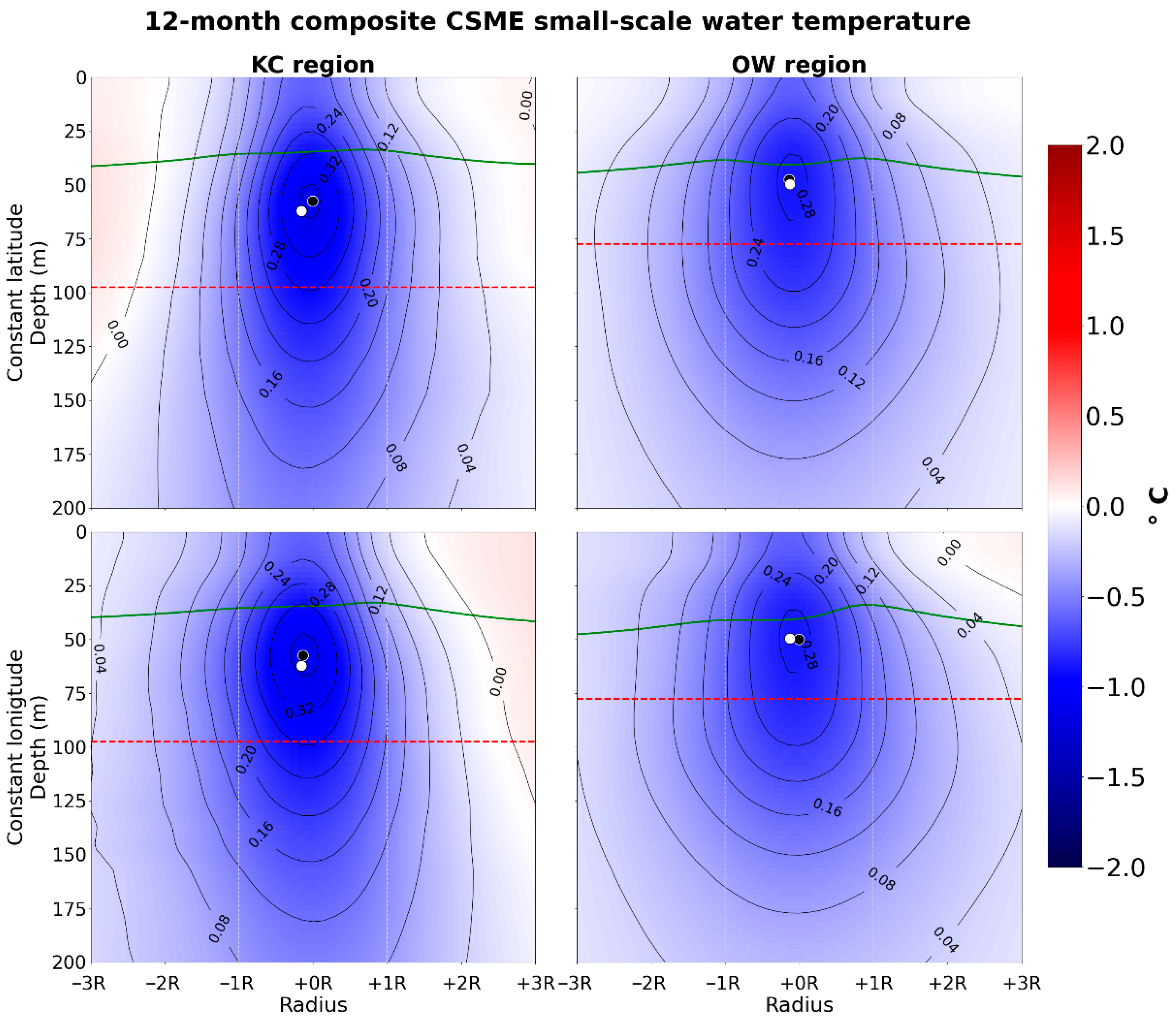
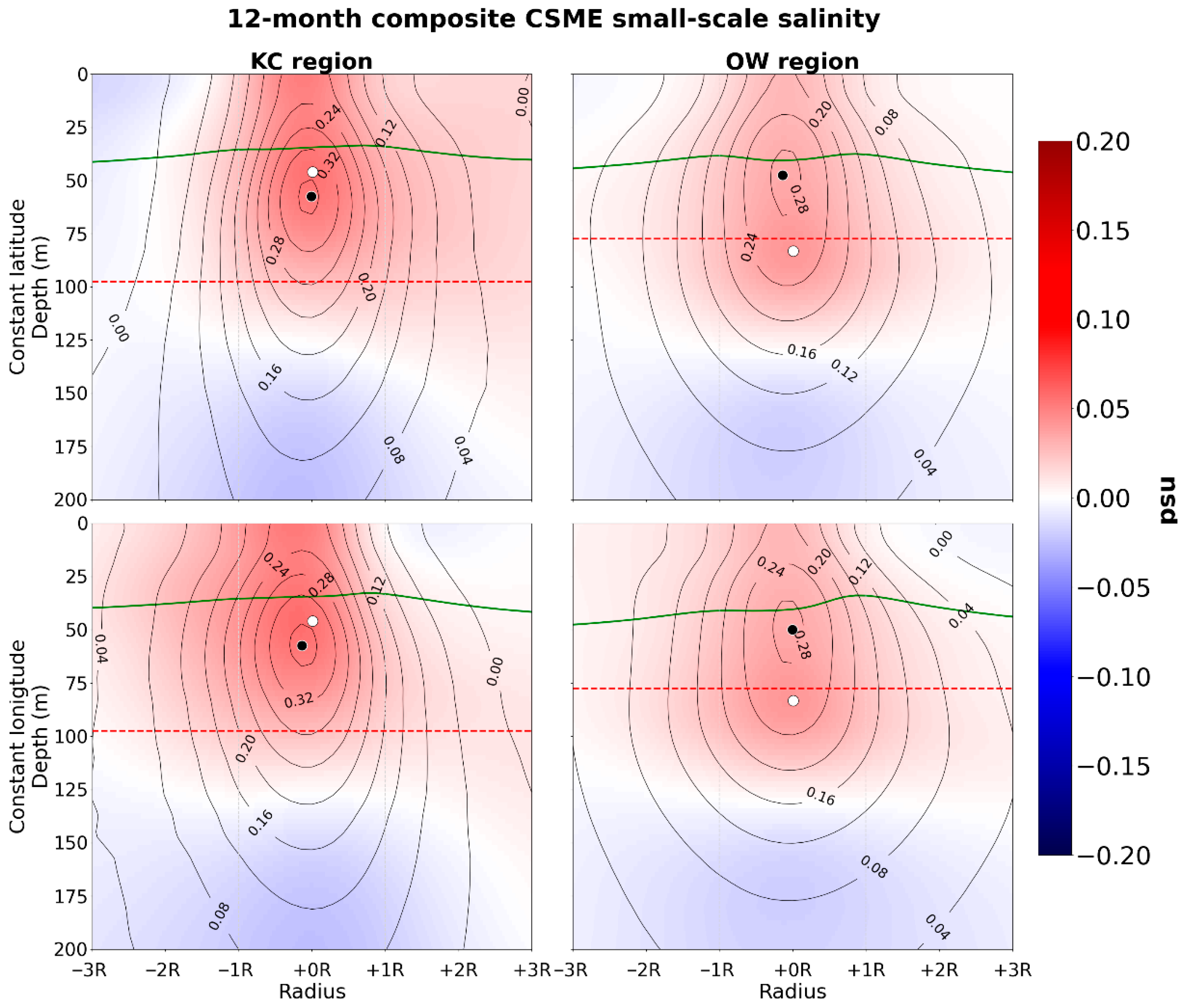
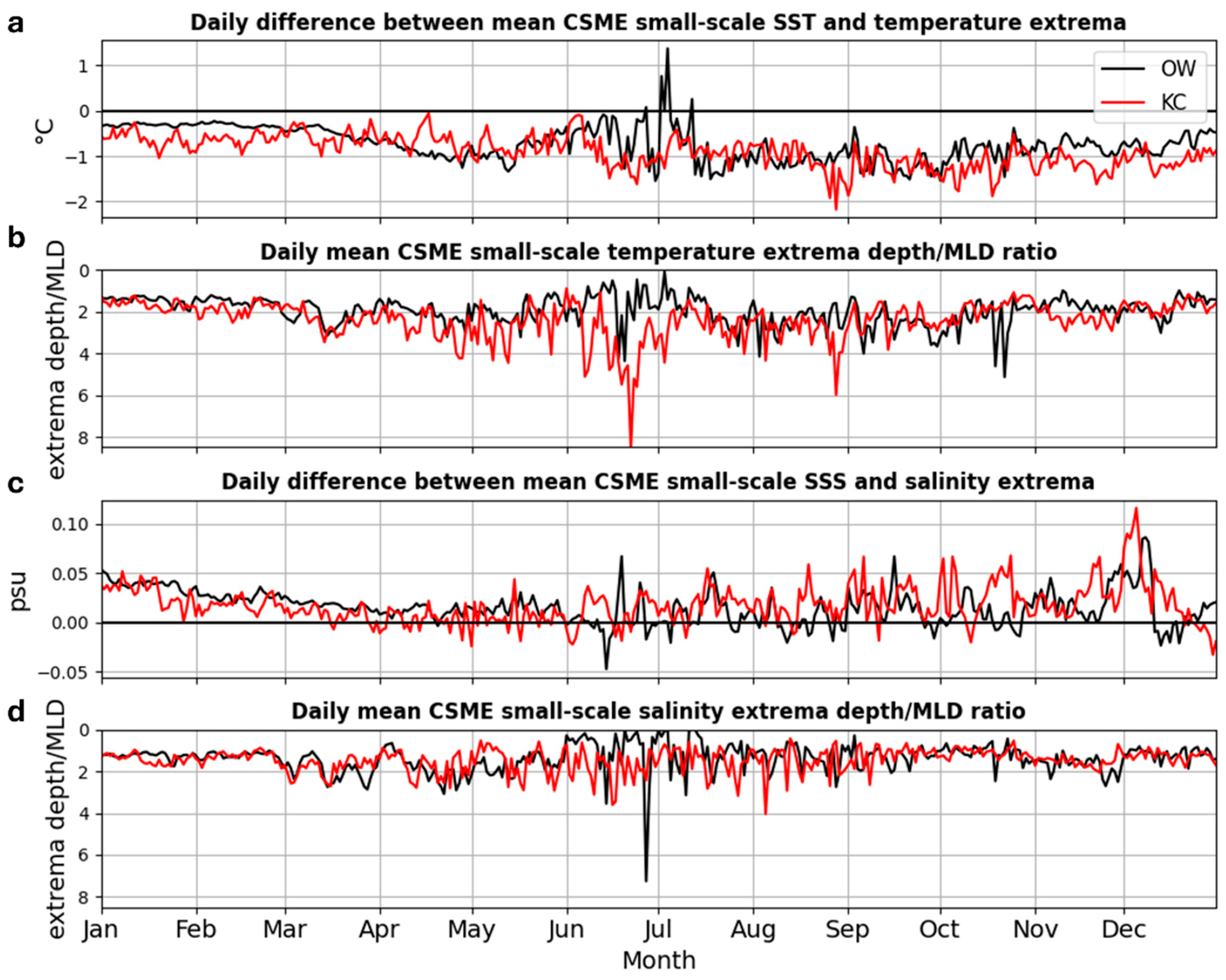
- Following from the upward vertical motion within the CSME, the CSMEs have cold cores with increased salinity and density. The small-scale temperature, salinity, and density mean extrema values are found below the MLD at 62.2 m, 46.0 m, and 57.5 m for the KC region and 50.0 m, 57.5 m, 49.7 m for the OW region. The density patterns closely follow the temperature patterns, indicating strong baroclinic behavior within the CSMEs that extends well past both the MLD and the defined eddy bottom depths.
Author Contributions
Funding
Data Availability Statement
Acknowledgments
Conflicts of Interest
Abbreviations
| SME | Submesoscale eddy |
| CSME | Cyclonic submesoscale eddy |
| ASME | Anticyclonic submesoscale eddy |
| KC | Kuroshio Current |
| OW | Open water |
| ECCO | Estimating the Circulation and Climate of the Ocean |
| NASA | National Aeronautics and Space Administration |
| NCOM | Navy Coastal Ocean Model |
| DBDB2 | Digital Bathymetric Data Base |
| HYCOM | Hybrid Coordinate Ocean Model |
| COAMPS | Coupled Ocean/Atmosphere Mesoscale Prediction System |
| FES99 | Finite Element Solutions |
| NAVGEM | Navy Global Environmental Model |
| NRL | Naval Research Laboratory |
| NAVDAS | NRL Atmospheric Variational Data Assimilation System |
| UTC | Coordinated universal time |
| SST | Sea surface temperature |
| SSS | Sea surface salinity |
| SSH | Sea surface height |
| MLD | Mixed layer depth |
| PC | Percent change |
References
- Capet, X.; McWilliams, J.C.; Molemaker, M.J.; Shchepetkin, A.F. Mesoscale to Submesoscale Transition in the California Current System. Part I: Flow Structure, Eddy Flux, and Observational Tests. J. Phys. Oceanogr. 2008, 38, 29–43. [Google Scholar] [CrossRef]
- McWilliams, J.C. Submesoscale currents in the ocean. Proc. R. Soc. A 2016, 472, 20160117. [Google Scholar] [CrossRef]
- Taylor, J.R.; Thompson, A.F. Submesoscale Dynamics in the Upper Ocean. Annu. Rev. Fluid Mech. 2023, 55, 103–127. [Google Scholar] [CrossRef]
- Zhang, Z. Submesoscale Dynamic Processes in the South China Sea. Ocean-Land-Atmos. Res. 2024, 3, 0045. [Google Scholar] [CrossRef]
- Zhang, Z.; Zhang, Y.; Qiu, B.; Sasaki, H.; Sun, Z.; Zhang, X.; Zhao, W.; Tian, J. Spatiotemporal Characteristics and Generation Mechanisms of Submesoscale Currents in the Northeastern South China Sea Revealed by Numerical Simulations. JGR Ocean. 2020, 125, e2019JC015404. [Google Scholar] [CrossRef]
- Shcherbina, A.Y.; D’Asaro, E.A.; Lee, C.M.; Klymak, J.M.; Molemaker, M.J.; McWilliams, J.C. Statistics of vertical vorticity, divergence, and strain in a developed submesoscale turbulence field. Geophys. Res. Lett. 2013, 40, 4706–4711. [Google Scholar] [CrossRef]
- Buckingham, C.E.; Naveira Garabato, A.C.; Thompson, A.F.; Brannigan, L.; Lazar, A.; Marshall, D.P.; George Nurser, A.J.; Damerell, G.; Heywood, K.J.; Belcher, S.E. Seasonality of submesoscale flows in the ocean surface boundary layer. Geophys. Res. Lett. 2016, 43, 2118–2126. [Google Scholar] [CrossRef]
- Su, Z.; Wang, J.; Klein, P.; Thompson, A.F.; Menemenlis, D. Ocean submesoscales as a key component of the global heat budget. Nat. Commun. 2018, 9, 775. [Google Scholar] [CrossRef]
- McWilliams, J.C. A survey of submesoscale currents. Geosci. Lett. 2019, 6, 3. [Google Scholar] [CrossRef]
- Su, Z.; Torres, H.; Klein, P.; Thompson, A.F.; Siegelman, L.; Wang, J.; Menemenlis, D.; Hill, C. High-Frequency Submesoscale Motions Enhance the Upward Vertical Heat Transport in the Global Ocean. JGR Ocean. 2020, 125, e2020JC016544. [Google Scholar] [CrossRef]
- Dong, J.; Fox-Kemper, B.; Zhang, H.; Dong, C. The Scale and Activity of Symmetric Instability Estimated from a Global Submesoscale-Permitting Ocean Model. J. Phys. Oceanogr. 2021, 51, 1655–1670. [Google Scholar] [CrossRef]
- Payandeh, A.R.; Washburn, L.; Emery, B.; Ohlmann, J.C. The Occurrence, Variability, and Potential Drivers of Submesoscale Eddies in the Southern California Bight Based on a Decade of High-Frequency Radar Observations. JGR Ocean. 2023, 128, e2023JC019914. [Google Scholar] [CrossRef]
- Ernst, P.A.; Subrahmanyam, B.; Trott, C.B.; Chaigneau, A. Characteristics of submesoscale eddy structures within mesoscale eddies in the Gulf of Mexico from 1/48° ECCO estimates. Front. Mar. Sci. 2023, 10, 1181676. [Google Scholar] [CrossRef]
- D’Addezio, J.M.; Jacobs, G.A.; Yaremchuk, M.; Souopgui, I. Submesoscale Eddy Vertical Covariances and Dynamical Constraints from High-Resolution Numerical Simulations. J. Phys. Oceanogr. 2020, 50, 1087–1115. [Google Scholar] [CrossRef]
- Zhang, X.; Jing, Z.; Yang, P. Seasonality of Upper-Ocean Vertical Eddy Buoyancy Flux in the Kuroshio Extension. J. Phys. Oceanogr. 2023, 53, 1577–1590. [Google Scholar] [CrossRef]
- Sandery, P.A.; Sakov, P. Ocean forecasting of mesoscale features can deteriorate by increasing model resolution towards the submesoscale. Nat. Commun. 2017, 8, 1566. [Google Scholar] [CrossRef]
- Serra, M.; Sathe, P.; Rypina, I.; Kirincich, A.; Ross, S.D.; Lermusiaux, P.; Allen, A.; Peacock, T.; Haller, G. Search and rescue at sea aided by hidden flow structures. Nat. Commun. 2020, 11, 2525. [Google Scholar] [CrossRef]
- Wang, S.; Jing, Z.; Wu, L.; Cai, W.; Chang, P.; Wang, H.; Geng, T.; Danabasoglu, G.; Chen, Z.; Ma, X.; et al. El Niño/Southern Oscillation inhibited by submesoscale ocean eddies. Nat. Geosci. 2022, 15, 112–117. [Google Scholar] [CrossRef]
- Ollivier, E.; Touret, R.X.; McKinley, M.; Jin, J.; Bracco, A.; Sabra, K.G. Performance study of ray-based ocean acoustic tomography methods for estimating submesoscale variability in the upper ocean. J. Acoust. Soc. Am. 2024, 155, 1315–1335. [Google Scholar] [CrossRef] [PubMed]
- Dong, J.; Fox-Kemper, B.; Wenegrat, J.O.; Bodner, A.S.; Yu, X.; Belcher, S.; Dong, C. Submesoscales are a significant turbulence source in global ocean surface boundary layer. Nat. Commun. 2024, 15, 9566. [Google Scholar] [CrossRef]
- Chen, J.; Zhu, X.-H.; Zheng, H.; Wang, M. Submesoscale dynamics accompanying the Kuroshio in the East China Sea. Front. Mar. Sci. 2023, 9, 1124457. [Google Scholar] [CrossRef]
- Masunaga, E.; Uchiyama, Y.; Zhang, X.; Kimura, W.; Kosako, T. Modulation of submesoscale motions due to tides and a shallow ridge along the Kuroshio. Deep Sea Res. Part I Oceanogr. Res. Pap. 2022, 186, 103828. [Google Scholar] [CrossRef]
- Barron, C.N.; Kara, A.B.; Martin, P.J.; Rhodes, R.C.; Smedstad, L.F. Formulation, implementation and examination of vertical coordinate choices in the Global Navy Coastal Ocean Model (NCOM). Ocean Model. 2006, 11, 347–375. [Google Scholar] [CrossRef]
- Martin, P.J. Description of the Navy Coastal Ocean Model, Version 1.0; Defense Technical Information Center: Fort Belvoir, VA, USA, 2000. [Google Scholar] [CrossRef]
- Ngodock, H.; Carrier, M. A Weak Constraint 4D-Var Assimilation System for the Navy Coastal Ocean Model Using the Representer Method. In Data Assimilation for Atmospheric, Oceanic and Hydrologic Applications (Vol. II); Park, S.K., Xu, L., Eds.; Springer: Berlin/Heidelberg, Germany, 2013; pp. 367–390. [Google Scholar] [CrossRef]
- Carrier, M.J.; Ngodock, H.; Smith, S.; Jacobs, G.; Muscarella, P.; Ozgokmen, T.; Haus, B.; Lipphardt, B. Impact of Assimilating Ocean Velocity Observations Inferred from Lagrangian Drifter Data Using the NCOM-4DVAR. Mon. Weather Rev. 2014, 142, 1509–1524. [Google Scholar] [CrossRef]
- Ngodock, H.; Carrier, M.; Smith, S.; Souopgui, I. Weak and Strong Constraints Variational Data Assimilation with the NCOM-4DVAR in the Agulhas Region Using the Representer Method. Mon. Weather Rev. 2017, 145, 1755–1764. [Google Scholar] [CrossRef]
- Jensen, T.G.; Shulman, I.; Wijesekera, H.W.; Anderson, S.; Ladner, S. Submesoscale features and their interaction with fronts and internal tides in a high-resolution coupled atmosphere-ocean-wave model of the Bay of Bengal. Ocean Dyn. 2018, 68, 391–410. [Google Scholar] [CrossRef]
- May, J.; Bourassa, M.A. Upper Ocean Thermodynamic Response to Coupling Currents to Wind Stress over the Gulf Stream. J. Mar. Sci. Eng. 2024, 12, 1994. [Google Scholar] [CrossRef]
- Yu, J.; Flagg, D.D.; Jensen, T.G.; Campbell, T.J.; Wang, Q.; Alappattu, D.P. Skin sea surface temperature diagnostics in a regional ocean model. Ocean Model. 2026, 200, 102681. [Google Scholar] [CrossRef]
- Marks, K.M.; Smith, W.H.F. An Evaluation of Publicly Available Global Bathymetry Grids. Mar. Geophys. Res. 2006, 27, 19–34. [Google Scholar] [CrossRef]
- Bleck, R. An oceanic general circulation model framed in hybrid isopycnic-Cartesian coordinates. Ocean Model. 2002, 4, 55–88. [Google Scholar] [CrossRef]
- Mellor, G.L.; Yamada, T. Development of a turbulence closure model for geophysical fluid problems. Rev. Geophys. 1982, 20, 851–875. [Google Scholar] [CrossRef]
- Holland, W.R.; Chow, J.C.; Bryan, F.O. Application of a Third-Order Upwind Scheme in the NCAR Ocean Model. J. Clim. 1998, 11, 1487–1493. [Google Scholar] [CrossRef]
- Lefèvre, F.; Lyard, F.H.; Le Provost, C.; Schrama, E.J.O. FES99: A Global Tide Finite Element Solution Assimilating Tide Gauge and Altimetric Information. J. Atmos. Ocean. Technol. 2002, 19, 1345–1356. [Google Scholar] [CrossRef]
- Hodur, R.M. The Naval Research Laboratory’s Coupled Ocean/Atmosphere Mesoscale Prediction System (COAMPS). Mon. Weather Rev. 1997, 125, 1414–1430. [Google Scholar] [CrossRef]
- Hogan, T.; Liu, M.; Ridout, J.A.; Peng, M.S.; Whitcomb, T.R.; Ruston, B.C.; Reynolds, C.A.; Eckermann, S.D.; Moskaitis, J.R.; Baker, N.L.; et al. The Navy Global Environmental Model. Oceanography 2014, 27, 116–125. [Google Scholar] [CrossRef]
- Daley, R.; Barker, E. NAVDAS: Formulation and Diagnostics. Mon. Weather Rev. 2001, 129, 869–883. [Google Scholar] [CrossRef]
- Daley, R.; Barker, E. NAVDAS Source Book; Naval Research Laboratory: Washington, DC, USA, 2001. [Google Scholar]
- Kamidaira, Y.; Uchiyama, Y.; Mitarai, S. Eddy-induced transport of the Kuroshio warm water around the Ryukyu Islands in the East China Sea. Cont. Shelf Res. 2017, 143, 206–218. [Google Scholar] [CrossRef]
- Liu, C.; Chang, M. Numerical Studies of Submesoscale Island Wakes in the Kuroshio. JGR Ocean. 2018, 123, 5669–5687. [Google Scholar] [CrossRef]
- Duran Gomez, G.S.; Nagai, T. Submesoscale Eddy induced nitrate upwelling and effect on biological production in the upstream Kuroshio Current. Sci. Rep. 2025, 15, 22618. [Google Scholar] [CrossRef] [PubMed]
- Chelton, D.B.; deSzoeke, R.A.; Schlax, M.G.; El Naggar, K.; Siwertz, N. Geographical Variability of the First Baroclinic Rossby Radius of Deformation. J. Phys. Oceanogr. 1998, 28, 433–460. [Google Scholar] [CrossRef]
- Okubo, A. Horizontal dispersion of floatable particles in the vicinity of velocity singularities such as convergences. Deep Sea Res. Oceanogr. Abstr. 1970, 17, 445–454. [Google Scholar] [CrossRef]
- Weiss, J. The dynamics of enstrophy transfer in two-dimensional hydrodynamics. Phys. D Nonlinear Phenom. 1991, 48, 273–294. [Google Scholar] [CrossRef]
- Williams, S.; Hecht, M.; Petersen, M.; Strelitz, R.; Maltrud, M.; Ahrens, J.; Hlawitschka, M.; Hamann, B. Visualization and Analysis of Eddies in a Global Ocean Simulation. Comput. Graph. Forum 2011, 30, 991–1000. [Google Scholar] [CrossRef]
- Isern-Fontanet, J.; García-Ladona, E.; Font, J. Vortices of the Mediterranean Sea: An Altimetric Perspective. J. Phys. Oceanogr. 2006, 36, 87–103. [Google Scholar] [CrossRef]
- Henson, S.A.; Thomas, A.C. A census of oceanic anticyclonic eddies in the Gulf of Alaska. Deep Sea Res. Part I Oceanogr. Res. Pap. 2008, 55, 163–176. [Google Scholar] [CrossRef]
- Kurian, J.; Colas, F.; Capet, X.; McWilliams, J.C.; Chelton, D.B. Eddy properties in the California Current System. J. Geophys. Res. 2011, 116, C08027. [Google Scholar] [CrossRef]
- Zhang, Z.; Liu, Y.; Qiu, B.; Luo, Y.; Cai, W.; Yuan, Q.; Liu, Y.; Zhang, H.; Liu, H.; Miao, M.; et al. Submesoscale inverse energy cascade enhances Southern Ocean eddy heat transport. Nat. Commun. 2023, 14, 1335. [Google Scholar] [CrossRef]
- Archer, M.; Wang, J.; Klein, P.; Dibarboure, G.; Fu, L.-L. Wide-swath satellite altimetry unveils global submesoscale ocean dynamics. Nature 2025, 640, 691–696. [Google Scholar] [CrossRef] [PubMed]
- Hou, H.; Xu, T.; Wang, Y.; Zhu, Y.; Wei, Z.; Liu, S.; Sui, X. Spatiotemporal Distribution of Submesoscale Eddies with Updated Interferometric Imaging Radar Altimeter Data. J. Remote Sens. 2025, 5, 0475. [Google Scholar] [CrossRef]
- Thomas, L.N.; Taylor, J.R.; Ferrari, R.; Joyce, T.M. Symmetric instability in the Gulf Stream. Deep Sea Res. Part II Top. Stud. Oceanogr. 2013, 91, 96–110. [Google Scholar] [CrossRef]
- Brannigan, L.; Marshall, D.P.; Naveira-Garabato, A.; George Nurser, A.J. The seasonal cycle of submesoscale flows. Ocean Model. 2015, 92, 69–84. [Google Scholar] [CrossRef]
- Shi, W.; Lin, H.; Deng, Q.; Hu, J. Asymmetry of Submesoscale Instabilities in Anticyclonic and Cyclonic Eddies. Geophys. Res. Lett. 2024, 51, e2023GL106853. [Google Scholar] [CrossRef]
- Dong, J.; Fox-Kemper, B.; Zhang, H.; Dong, C. The Scale of Submesoscale Baroclinic Instability Globally. J. Phys. Oceanogr. 2020, 50, 2649–2667. [Google Scholar] [CrossRef]
- Fan, Y.; Rydbeck, A.; Thoppil, P.; Yu, Z. Numerical simulation of upper ocean responses to the passage of a submesoscale eddy. Ocean Model. 2023, 184, 102209. [Google Scholar] [CrossRef]
- Zhu, R.; Yang, H.; Li, M.; Chen, Z.; Ma, X.; Cai, J.; Wu, L. Observations reveal vertical transport induced by submesoscale front. Sci. Rep. 2024, 14, 4407. [Google Scholar] [CrossRef]
- Torres, H.S.; Rodriguez, E.; Wineteer, A.; Klein, P.; Thompson, A.F.; Callies, J.; D’Asaro, E.; Perkovic-Martin, D.; Farrar, J.T.; Polverari, F.; et al. Airborne observations of fast-evolving ocean submesoscale turbulence. Commun. Earth Environ. 2024, 5, 771. [Google Scholar] [CrossRef]
- Kara, A.B.; Rochford, P.A.; Hurlburt, H.E. An optimal definition for ocean mixed layer depth. J. Geophys. Res. 2000, 105, 16803–16821. [Google Scholar] [CrossRef]
- Helber, R.W.; Kara, A.B.; Richman, J.G.; Carnes, M.R.; Barron, C.N.; Hurlburt, H.E.; Boyer, T. Temperature versus salinity gradients below the ocean mixed layer. J. Geophys. Res. 2012, 117, 2011JC007382. [Google Scholar] [CrossRef]
- Hausmann, U.; McGillicuddy, D.J.; Marshall, J. Observed mesoscale eddy signatures in Southern Ocean surface mixed-layer depth. JGR Ocean. 2017, 122, 617–635. [Google Scholar] [CrossRef]
- Gaube, P.; McGillicuddy, D.J.; Moulin, A.J. Mesoscale Eddies Modulate Mixed Layer Depth Globally. Geophys. Res. Lett. 2019, 46, 1505–1512. [Google Scholar] [CrossRef]
- Ushijima, Y.; Yoshikawa, Y. Mixed layer deepening due to wind-induced shear-driven turbulence and scaling of the deepening rate in the stratified ocean. Ocean Dyn. 2020, 70, 505–512. [Google Scholar] [CrossRef]
- Smith, T.G.; Nicholson, S.-A.; Engelbrecht, F.A.; Chang, N.; Mongwe, N.P.; Monteiro, P.M.S. The Heat and Carbon Characteristics of Modeled Mesoscale Eddies in the South–East Atlantic Ocean. JGR Ocean. 2023, 128, e2023JC020337. [Google Scholar] [CrossRef]






Disclaimer/Publisher’s Note: The statements, opinions and data contained in all publications are solely those of the individual author(s) and contributor(s) and not of MDPI and/or the editor(s). MDPI and/or the editor(s) disclaim responsibility for any injury to people or property resulting from any ideas, methods, instructions or products referred to in the content. |
© 2026 by the authors. Licensee MDPI, Basel, Switzerland. This article is an open access article distributed under the terms and conditions of the Creative Commons Attribution (CC BY) license.
Share and Cite
Krause, B.; May, J.; Smith, T.A.; D’Addezio, J.M.; Hebert, D. Submesoscale Eddy Spatiotemporal Variability Comparison Between Kuroshio Current and Open-Ocean Regions of the Western Pacific. J. Mar. Sci. Eng. 2026, 14, 728. https://doi.org/10.3390/jmse14080728
Krause B, May J, Smith TA, D’Addezio JM, Hebert D. Submesoscale Eddy Spatiotemporal Variability Comparison Between Kuroshio Current and Open-Ocean Regions of the Western Pacific. Journal of Marine Science and Engineering. 2026; 14(8):728. https://doi.org/10.3390/jmse14080728
Chicago/Turabian StyleKrause, Bryson, Jackie May, Travis A. Smith, Joseph M. D’Addezio, and David Hebert. 2026. "Submesoscale Eddy Spatiotemporal Variability Comparison Between Kuroshio Current and Open-Ocean Regions of the Western Pacific" Journal of Marine Science and Engineering 14, no. 8: 728. https://doi.org/10.3390/jmse14080728
APA StyleKrause, B., May, J., Smith, T. A., D’Addezio, J. M., & Hebert, D. (2026). Submesoscale Eddy Spatiotemporal Variability Comparison Between Kuroshio Current and Open-Ocean Regions of the Western Pacific. Journal of Marine Science and Engineering, 14(8), 728. https://doi.org/10.3390/jmse14080728