Article

Occurrence of a New Apicomplexan Intracellular Parasite in the Digestive Gland of Bulla striata (Gastropoda: Cephalaspidea) from the South Coast of Portugal


by
Sónia Rocha
1,2,* and
Alexandre Lobo-da-Cunha
1,3,*
1
Departamento de Microscopia, Instituto de Ciências Biomédicas Abel Salazar (ICBAS), Universidade do Porto, 4050-313 Porto, Portugal
2
Instituto de Investigação e Inovação em Saúde (i3S), Universidade do Porto, 4200-135 Porto, Portugal
3
Centro Interdisciplinar de Investigação Marinha e Ambiental (CIIMAR), Universidade do Porto, 4450-208 Matosinhos, Portugal
*
Authors to whom correspondence should be addressed.
J. Mar. Sci. Eng. 2026, 14(8), 707; https://doi.org/10.3390/jmse14080707
Submission received: 12 March 2026 / Revised: 7 April 2026 / Accepted: 8 April 2026 / Published: 10 April 2026
(This article belongs to the Special Issue Parasitology of Marine Animals)

Abstract

A new intracellular parasite of the phylum Apicomplexa is described infecting the digestive gland of the gastropod Bulla striata from the south coast of Portugal. Only merogonial stages enclosed within parasitophorous vacuoles were observed by light and electron microscopy. The meront cytoplasm contained lipid droplets, rough endoplasmic reticulum cisternae, and several round or oval electron-dense microbodies closely associated with amylopectin granules, suggesting that these microbodies may represent glycosomes. Mitochondria or related organelles were not identified. A reticulum of branched tubules extending from the parasitophorous vacuole membrane was observed, likely increasing the surface available for metabolite exchange between parasite and host cell. Merozoites resulting from meront division were present within the parasitophorous vacuoles. They were elongated and slightly curved, measuring 7–8 µm in length and about 2 µm in width, and possessed an apical complex comprising numerous rod-shaped micronemes, rhoptries, and a conoid. Phylogenetic analyses based on a partial 18S rDNA sequence placed this parasite within the coccidian lineage, at the base of the ichthyocolid clade, a recently recognized group of apicomplexans previously known from fish blood cells. This finding expands the host range of ichthyocolids to gastropods and provides the first ultrastructural observations of this lineage, although only of merogonic stages.

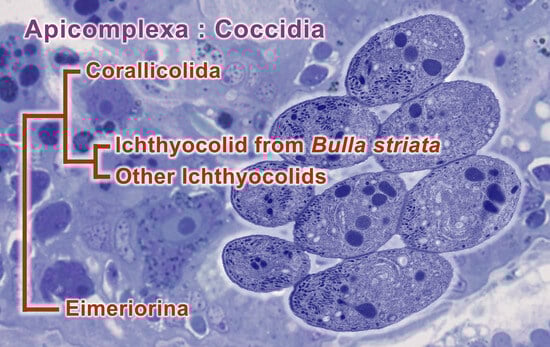
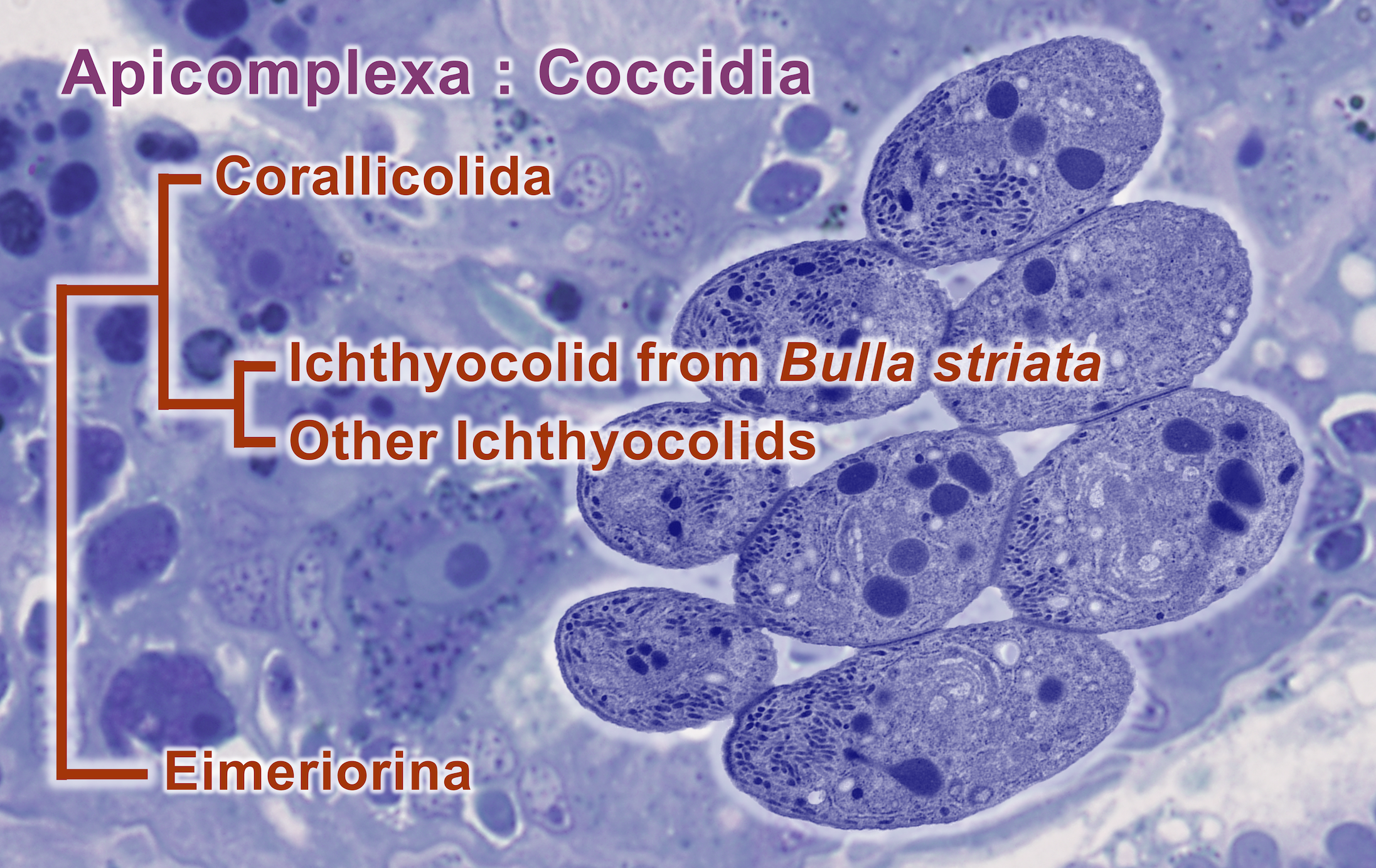
Graphical Abstract

1. Introduction

The phylum Apicomplexa comprises more than 6000 described species of unicellular parasites and symbionts in both vertebrate and invertebrate hosts [1,2]. Some species are extracellular parasites, such as most gregarines, which attach to host cells using specialized structures called the mucron or epimerite [3]. Others, including coccidians and some gregarines, are intracellular parasites that develop within a parasitophorous vacuole. Apicomplexans possess complex and diverse life cycles comprising both asexual and sexual stages, typically organized into three successive schizogonies: merogony, gamogony, and sporogony. However, merogony is absent in most gregarines, being present in species of the order Neogregarinorida. Some apicomplexans are monoxenous, completing their entire life cycle within a single host, whereas others are heteroxenous, requiring an intermediate host, where asexual merogonial stages occur, and a definitive host, in which gamogonial and sporogonial stages take place to complete the life cycle. Proliferation within hosts and transmission between hosts are mediated by specialized infectious forms [4,5].
To attach and penetrate host cells, both the merozoites generated by asexual multiplication and the sporozoites released from oocysts resulting from sexual reproduction possess a specialized set of structures at the cell apex, collectively known as the apical complex. This complex—comprising micronemes, rhoptries, the conoid, and the polar ring—is a defining feature of Apicomplexa [6]. Micronemes are rod-shaped organelles that release proteins required for attachment of the parasite to the membrane of the host cell [7]. Rhoptries are elongated organelles characterized by a long narrow neck and a bulbous posterior region that discharge proteins at the onset of host cell invasion. In intracellular apicomplexans, rhoptry proteins are essential for the formation of the moving junction, a ring-shaped interface between the parasite membrane and the host cell membrane. This junction moves along the membrane surface, creating an invagination of the host membrane that envelops the invading parasite, ending in the formation of the parasitophorous vacuole [8]. The conoid is a small cone-shaped extrusive structure formed by tightly coiled tubulin fibres, and the apical polar ring serves as a microtubule-organizing centre [9]. In intracellular apicomplexans, the egress of infective stages from the host cell requires proteins secreted by micronemes and microneme-like organelles that compromise the integrity of the parasitophorous vacuole and host cell membrane [10].
Apicomplexan species that cause severe diseases in humans and other terrestrial vertebrates, such as Plasmodium spp., Toxoplasma gondii, Cryptosporidium spp., Eimeria spp., among others [4], have been studied far more extensively than those infecting aquatic animals. Nevertheless, apicomplexans are also important parasites of fish, molluscs, annelids, crustaceans, and other marine animals. While more than one hundred species of coccidians have been described from marine fishes, primarily teleosts [11], gregarines are particularly common and represent the most frequently reported apicomplexans in marine invertebrates [12,13]. In addition to their role as parasites, the phylum Apicomplexa also includes species that appear to be non-pathogenic or even beneficial to their marine hosts. For example, Nephromyces spp., which inhabit the renal sac of tunicates, function as symbionts that use uric acid as their primary nitrogen source [14,15]. More recently, the order Corallicolida was erected to encompass an emerging lineage of intracellular apicomplexan symbionts of corals, commonly referred to as corallicolids [16,17]. Among molluscs, apicomplexan parasites have been detected in bivalves, cephalopods, gastropods, and even in a chiton [18]. In bivalves, these parasites have been found in the kidney, heart, adductor muscle, gill, and other tissues, where heavy infections potentially lead to significant organ damage [19,20,21]. Such infections can contribute to mass mortality events, particularly when associated with other environmental stressors [22,23,24]. Octopus and cuttlefish are definitive hosts of Aggregata spp. (Marosporida), which have crustaceans as intermediate hosts for asexual merogonial development [25,26].
To date, relatively few apicomplexan parasites have been reported from marine gastropods. Gregarines have been found in the intestines of Littorina spp. [27] and in various tissues of Nerita spp. [28,29]. Coccidians have been identified in the kidneys of Haliotis spp. [30], in the digestive glands of some species of the family Strombidae from the Caribbean Sea [31,32], and in the digestive gland and intestine of the limpet Patella vulgata [18]. In addition, the common whelk, Buccinum undatum, is the definitive host of Merocystis kathae, a species currently classified within the recently established apicomplexan class Marosporida [33], which uses a bivalve as its intermediate host [22]. Apicomplexa-like parasites have also been found in other marine gastropods [34], and additional species occur in terrestrial and freshwater gastropods [35,36,37]. Although the impact of these parasites on their hosts remains poorly understood, some species have been acknowledged as potential threats. For instance, an Eimeriidae-like parasite infecting the digestive gland of the queen conch Aliger gigas (formerly Strombus gigas) has been associated with reproductive decline in this gastropod [38].
Gastropoda is the mollusc class with greater number of species, including the subclass Heterobranchia, which comprises numerous marine species [39]. This highly diverse subclass includes the order Cephalaspidea, which comprises bubble-shell snails of the genus Bulla. Most Bulla species inhabit tropical seas, but Bulla striata spans across both temperate and tropical latitudes. This herbivorous marine snail is found in sheltered, shallow-water habitats with soft substrate along the Mediterranean and eastern Atlantic shores, from southern Portugal to Angola, and on several Atlantic islands [40,41]. Despite possessing a protective shell and chemical defences [42], B. striata is known to be preyed upon by Philinopsis depicta, a cephalaspidean of the family Aglajidae [43,44]. In gastropods and other molluscs, the digestive gland is the largest organ of the digestive system, mainly composed of digestive cells and basophilic cells. Digestive cells, rich in lysosomes, are responsible for the intracellular digestion of nutrient particles captured by endocytosis following extracellular digestion. Basophilic cells, abundant in endoplasmic reticulum and other organelles, are responsible for secreting enzymes required for extracellular digestion [45,46]. In this paper, we report the ultrastructural aspects and molecular data of an intracellular apicomplexan parasite found in the digestive gland of B. striata specimens collected from the Southern coast of Portugal.

2. Materials and Methods

2.1. Specimen Collection

Specimens of Bulla striata Bruguière, 1792 (Gastropoda: Cephalaspidea), about 2–3 cm in shell length, were collected manually during low tide from Ria de Alvor (37°8′ N, 8°37′ W), an estuarine system located on the southern coast of Portugal. The animals were transported live to the laboratory in aerated water from the sampling site and arrived in perfect conditions. Upon arrival, the digestive gland of five animals was removed and processed for microscopy and molecular analyses. The specimens analysed in this study were collected in April 2005 (2 animals), June 2007 (1 animal) and September 2013 (2 animals).

2.2. Microscopy Procedures

Pieces of the digestive glands were fixed for about 2–3 h at 4 °C in 2.5% glutaraldehyde and 4% formaldehyde (obtained from hydrolysis of paraformaldehyde), buffered with 0.4 M sodium cacodylate pH 7.4 (final buffer concentration 0.28 M). After washing in buffer, samples were postfixed for 2–3 h at room temperature in 2% osmium tetroxide buffered with sodium cacodylate, dehydrated in an ascending ethanol series, embedded in epoxy resin, and polymerized at 60 °C for 2–3 days. Semithin sections (2 µm) for light microscopy were stained with methylene blue and azure. The PAS reaction for polysaccharide detection and the tetrazonium coupling reaction for proteins were also applied to semithin sections with the epoxy resin. For PAS reaction, after oxidation with 1% periodic acid for 10 min, semithin sections were washed with water and stained in Schiff reagent for about 15 min [47]. For the tetrazonium coupling reaction, the osmium tetroxide fixative was removed from the tissue by treatment of the semithin sections with a 0.6% solution of H2O2 for 10 min to improve staining. After washing in water, sections were treated for 10 min with a freshly prepared 0.2% solution of fast blue salt B in veronal-acetate buffer pH 9.2, washed in water and treated for 15 min with a saturated solution of ß-naphthol in veronal-acetate buffer pH 9.2 [48,49]. Ultrathin sections (about 90 nm thick) were double stained with uranyl acetate and lead citrate, observed, and photographed using a JEOL 100CXII transmission electron microscope (JEOL Ltd., Tokyo, Japan), operated at 60 kV, equipped with a Gatan Orius SC200 digital camera (Gatan Inc., Pleasanton, CA, USA).

2.3. Molecular Procedures

Genomic DNA was extracted from fresh fragments of three infected digestive glands using the GenEluteTM Mammalian Genomic DNA Miniprep Kit (Sigma-Aldrich, St Louis, MO, USA), following the manufacturer’s instructions for tissue samples. The extracted DNA was eluted in 150 μL of TE buffer and stored at −20 °C until further use.
Amplification and sequencing of the parasite 18S rDNA sequence were performed using the primer pair EF (5′-GAAACTGCGAATGGCTCATT-3′)/ER (5′-CTTGCGCCTACTAGGCATTC-3′) [50]. PCR reactions were prepared using 10 pmol of each primer, 10 nmol of each dNTP, 2 mM MgCl2, 5 μL 10× Taq polymerase buffer, 2.5 U of Taq DNA polymerase (NZYtech, Lisbon, Portugal), and approximately 50–100 ng of genomic DNA, in a final reaction volume of 50 µL. PCRs were performed on a Hybaid PxE Thermocycler (Thermo Electron Corporation, Milford, MA, USA) with an initial denaturation step at 95 °C for 3 min, followed by 35 cycles of denaturation at 94 °C for 45 s, annealing at 53 °C for 45 s, and extension at 72 °C for 90 s, with a final elongation step at 72 °C for 7 min.
PCR products (5 μL) were electrophoresed on a 1% agarose gel prepared in 1× Tris-acetate-EDTA (TAE) buffer and stained with GreenSafe Premium (NZYtech, Lisbon, Portugal). Positive amplicons were purified and sequenced by STAB VIDA (Caparica, Portugal).

2.4. Phylogenetic Analyses

The parasite 18S rDNA sequence was obtained by aligning and trimming the forward and reverse sequences using ClustalW implemented in MEGA 11 [51,52]. Closely related sequences were identified using the Basic Local Alignment Search Tool (BLASTn) (BLAST+ 2.17.0), and an initial dataset was compiled including all 18S rDNA sequences sharing more than 93.4% similarity with the parasite sequence obtained in this study. This preliminary dataset was aligned using MAFFT version 7 [53] available online, and genetic distances were estimated in MEGA 11 using the p-distance model with the pairwise deletion option.
For phylogenetic inference, the preliminary dataset used for distance estimation was expanded to include representative sequences of the Eimeriorina and Adeleorina, as well as the piroplasmids Babesia microti (AB190459), Theileria parva (HQ895985) and Theileria annulata (JQ743630), which were used as outgroup, even if these were not retrieved in the BLASTn search. This approach was employed to ensure that all major lineages were adequately represented while avoiding an excessively large dataset. Multiple sequence alignments of the final dataset were performed using the E-INS-i refinement strategy in MAFFT version 7, followed by manual editing in MEGA 11. Phylogenetic relationships were inferred using maximum likelihood (ML) and Bayesian inference (BI) analyses. ML analyses were conducted in MEGA 11 using the general time-reversible substitution model with estimates of invariant sites and gamma-distributed rate variation among sites (GTR + I + G), with nodal support assessed by 1000 bootstrap replicates. BI analyses were performed in MrBayes v.3.2.6 [54], also using the GTR + I + G model. Posterior probabilities were estimated using the Markov chain Monte Carlo approach with four chains run simultaneously for 2 million generations, sampling every 500 generations, and discarding the first 25% of trees as burn-in.

3. Results

3.1. Light and Electron Microscopy Observations

Light microscopic examination of semithin sections of the digestive gland of Bulla striata disclosed a parasitic infection of the digestive gland in all five specimens analysed. The parasites, which exhibited apicomplexan features, were located within parasitophorous vacuoles, occupying a substantial portion of several digestive gland cells. Only merogonial stages were recognized, including developing and mature meronts, and merozoites. Infected cells contained either meronts or merozoites, but not both stages, and one or two meronts could be seen in each infected cell (Figure 1A). The meronts contained numerous granules strongly stained by the PAS reaction for polysaccharide detection (Figure 1B). Microbodies strongly stained by the tetrazonium coupling reaction for protein detection were also present in meronts, mostly at the periphery of these cells (Figure 1C).
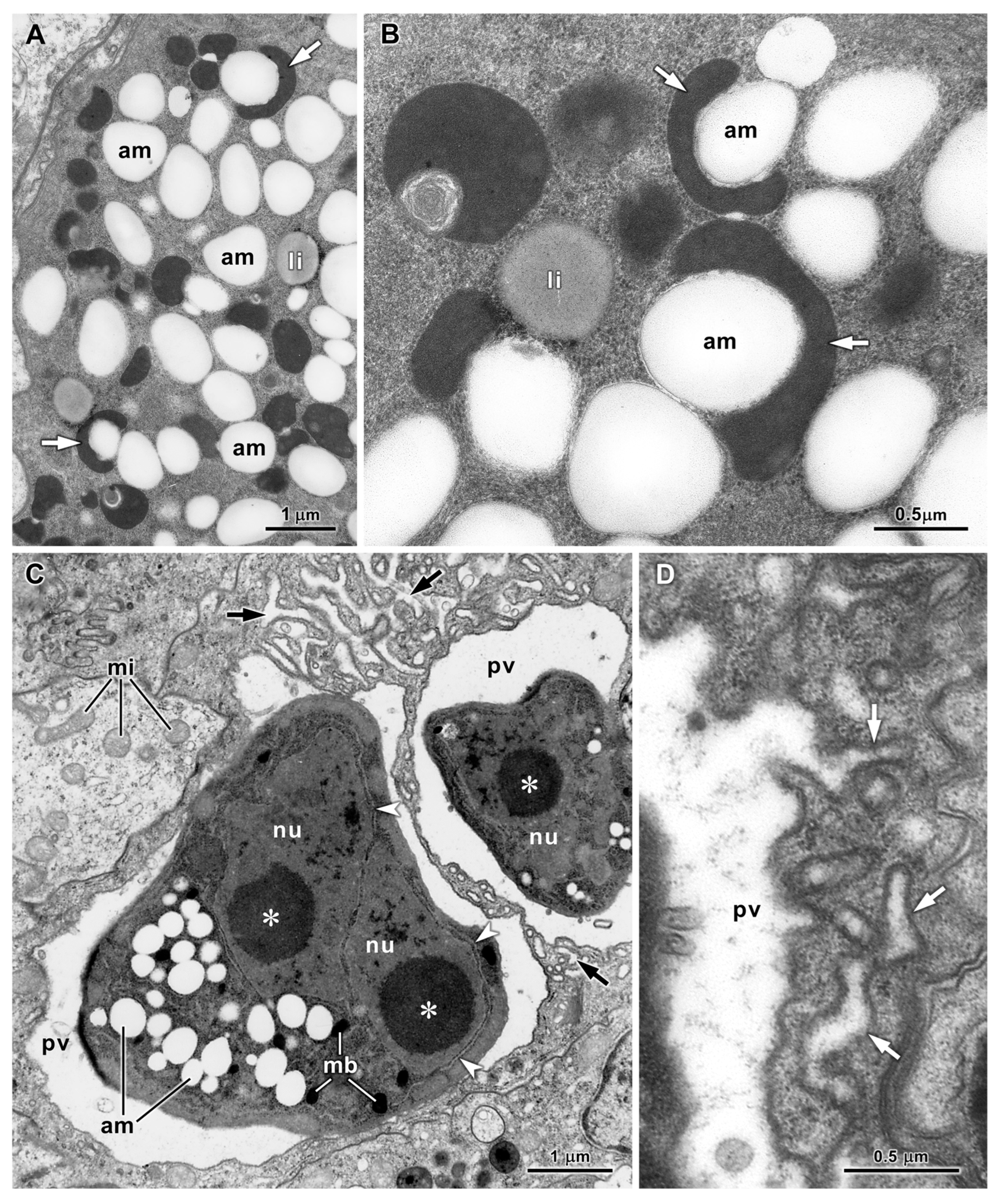
The earliest merogonic stages recognized by transmission electron microscopy (TEM) corresponded to young meronts, enclosed by the membrane of the parasitophorous vacuole (Figure 1D). At this stage, a single nucleus was observed, presenting a prominent spherical nucleolus and low amounts of heterochromatin scattered in the electron-dense nucleus. The meront cytoplasm was packed with numerous round and oval electron-lucent amylopectin granules, some lipid droplets, several round or oval electron-dense microbodies—mostly located peripherally—and rough endoplasmic reticulum cisternae (Figure 1D). In ultrathin sections, most electron-dense microbodies had a diameter around 0.4–0.7 µm and were closely associated with the amylopectin granules that were highly diverse in size, mostly with sections ranging in diameter from about 1.0 to 0.2 µm. In some ultrathin sections, certain amylopectin granules were partially encircled by a microbody with a C-shaped section (Figure 2A,B), and several of these granules were surrounded by a rough endoplasmic reticulum cisterna (Figure 1D inset). Mitochondria or mitochondria-related organelles were not identified in the merogonial stages of the parasite.
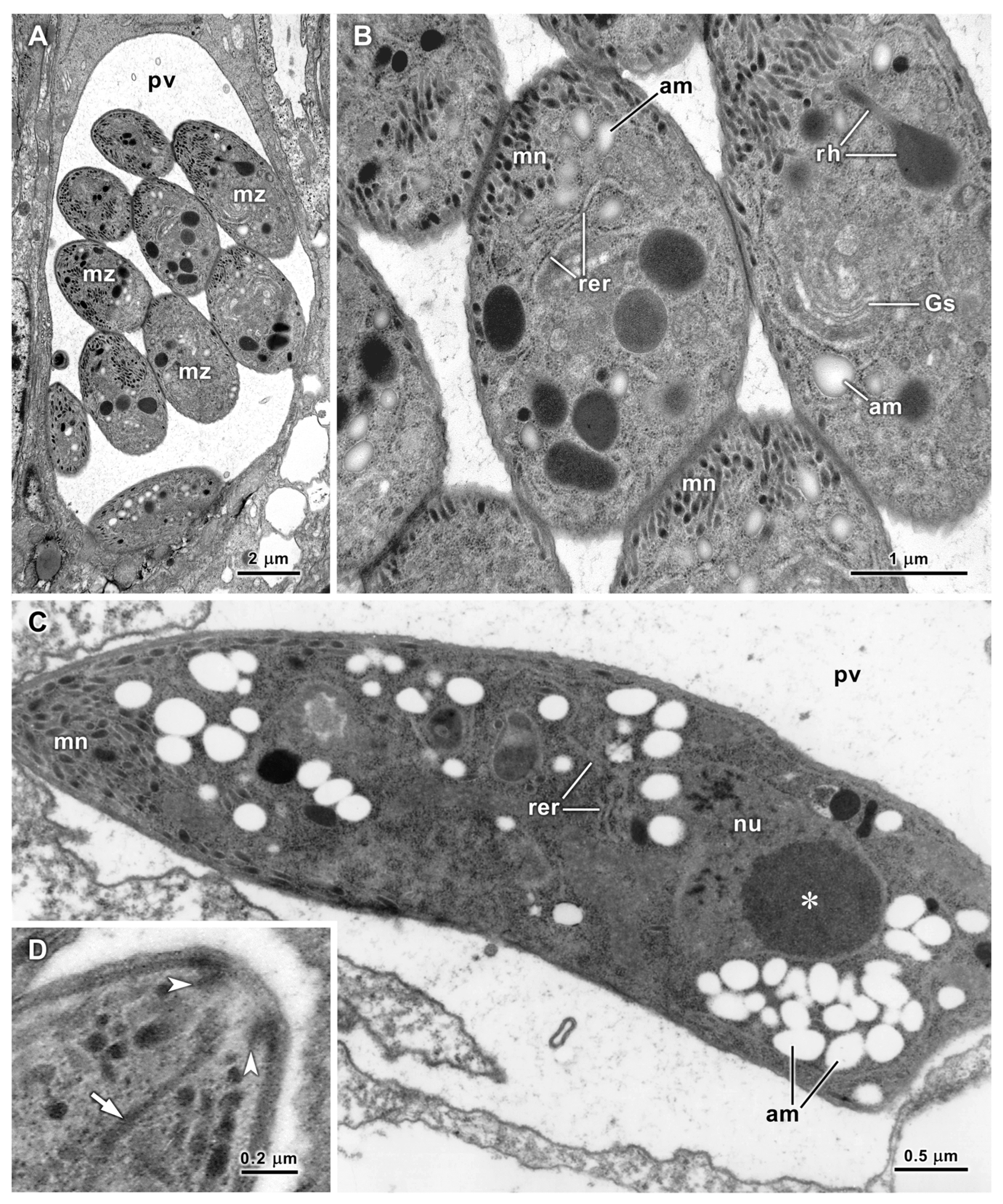
More advanced meronts contained more than one nucleus, each closely surrounded by rough endoplasmic reticulum cisternae. Amylopectin granules, lipid droplets, and electron-dense microbodies were also present in the parasite cytoplasm at this stage (Figure 2C). A reticulum of branched tubules with a smooth membrane was observed at the periphery of the parasitophorous vacuoles (Figure 2C). The membrane of these tubules closely resembled the parasitophorous vacuole membrane, and in some ultrathin sections it was possible to see the connections of this reticulum with the parasitophorous vacuole (Figure 2D). Merozoites resulting from meront division were observed within the parasitophorous vacuoles (Figure 3A). The elongated and slightly curved merozoites had a length of 7–8 µm and were about 2 µm wide. At this stage the parasite was uninucleate, and contained rough endoplasmic reticulum cisternae, a Golgi stack, and amylopectin granules in the cytoplasm. The apical complex comprised numerous rod-shaped micronemes, rhoptries and conoid (Figure 3B–D).

3.2. Molecular and Phylogenetic Analyses

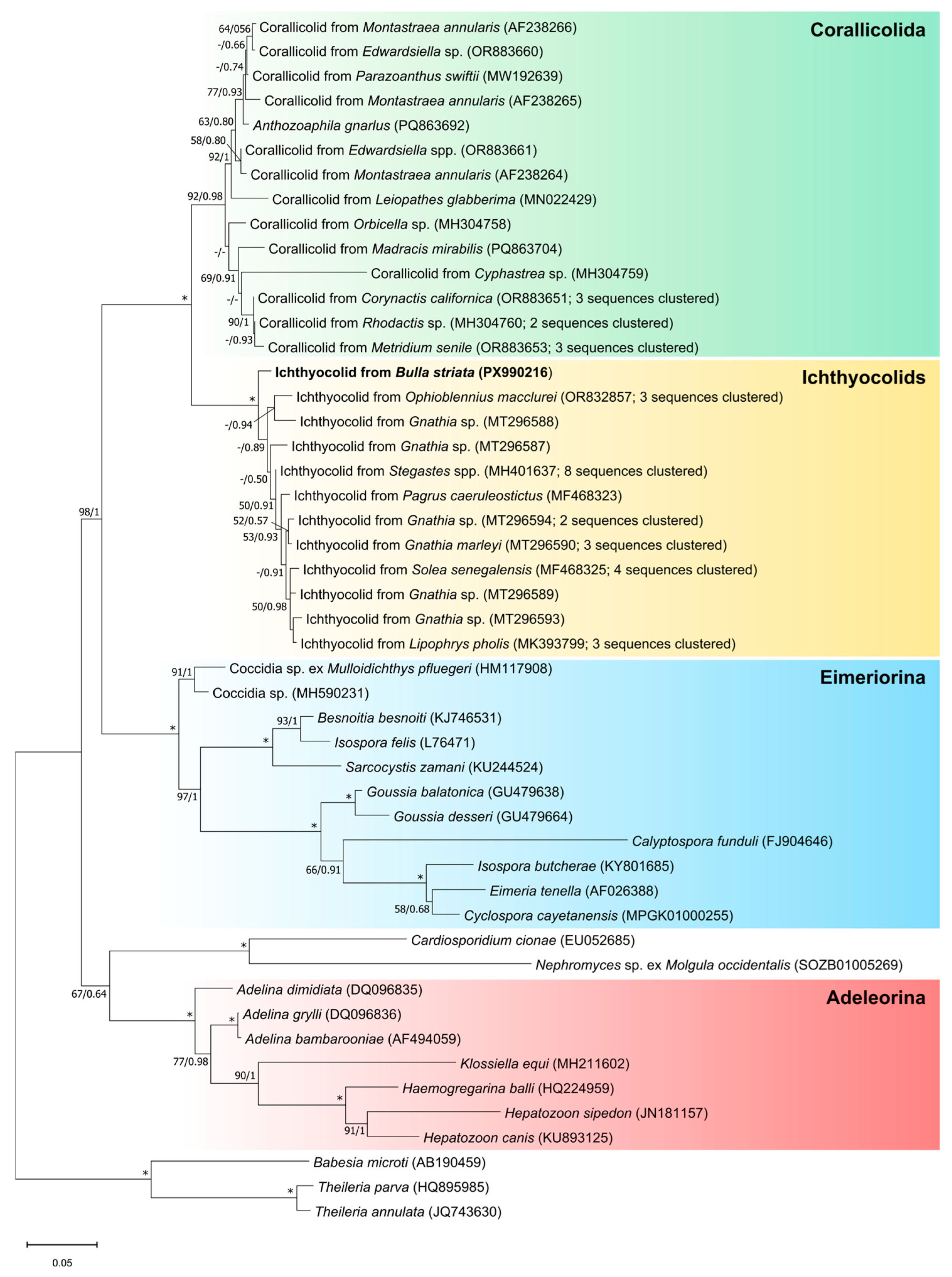
A partial 18S rDNA sequence of 1453 bp was assembled and deposited in GenBank under accession number PX990216. BLASTn searches revealed that the parasite sequence showed highest similarity to ichthyocolids (94.7–98.3%) and corallicolids (93.4–97.2%). Distance estimation analysis based on the preliminary dataset indicated the highest sequence identity with ichthyocolids (96.9–98.5%), particularly with sequences obtained from the apicomplexan parasite infecting Stegastes spp. (MH401637-42, KT806397-98), which shared 98.4–98.5% identity, and from the apicomplexan infecting Ophioblennius macclurei (OR832857, KY940307, KT806396), which shared 97.8–97.9% identity.
ML and BI analyses yielded largely congruent tree topologies, recovering consistent branching patterns among the main coccidian lineages. Sequences of the suborder Adeleorina formed a clade sister to a small clade comprising Nephromyces sp. ex Molgula occidentalis (SOZB01005269) and Cardiosporidium cionae (EU052685), although this sister-group relationship was not strongly supported. Together, these two clades occupied a basal position relative to the remaining coccidian lineages. Sequences of the suborder Eimeriorina formed a clade sister to the assemblage comprising ichthyocolids and corallicolids, which themselves resolved as two distinct sister clades. The 18S rDNA of the parasite in study clustered at the base of the ichthyocolid clade, which includes all ichthyocolid sequences currently available (Figure 4). Although the ichthyocolid clade was well supported in both analyses, its internal relationships were poorly resolved.

4. Discussion

4.1. Microscopic Identification and Ultrastructural Features

Electron microscopy has played a significant role in advancing our understanding of apicomplexans [55]. In this case, a parasite species was incidentally discovered during an ultrastructural study of the digestive gland of B. striata and other cephalaspideans [46]. The parasite, which specifically infected the digestive cells, displayed ultrastructural features typical of the phylum Apicomplexa, namely the presence of an apical complex at the infective life cycle stages, which in this case were limited to merozoites.
Amylopectin reserve granules found in apicomplexan parasites are considered a legacy from their microalgae ancestors. These granules are composed of a branched glucose polymer that serves as an energy reserve, supplying glucose for ATP production [56]. In Toxoplasma gondii, amylopectin granules are present in encysted bradyzoites, responsible for transmission from the intermediate host to the feline definitive host, and in sporozoites within sporulated oocysts, which mediate transmission from the definitive to an intermediate host. Conversely, these granules are absent in merozoites involved in asexual proliferation within feline intestinal cells, and in tachyzoites responsible for rapid asexual replication in intermediate hosts. This pattern suggests that, in T. gondii, the amylopectin granules serve as critical energy reserves for encysted forms that may endure nutrient deprivation. Bradyzoites, although encysted, retain metabolic activity and can divide, playing an important role in chronic infection within intermediate hosts. They can also remain viable for days or even a few weeks in the tissues of dead hosts, which may subsequently be consumed by a feline. Similarly, sporozoites must survive in sporulated oocysts in the environment until ingested by an intermediate host [57,58]. In contrast, in the apicomplexan parasite infecting B. striata digestive gland, non-encysted merozoites were found to contain a substantial amount of amylopectin granules. This observation suggests a potentially different biological strategy or a specific metabolism of this parasite species. Encysted stages of the parasite were not observed in the digestive gland of B. striata. However, amylopectin reserves might also be important for survival of hypothetical encysted stages that could be released to the environment as part of the life cycle.
Based on their size and distribution in the cytoplasm, the electron-dense microbodies observed by TEM in the apicomplexan parasite infecting the digestive gland of B. striata likely correspond to the structures that stained intensely in semithin sections using the tetrazonium coupling reaction for protein detection under light microscopy. Their close spatial association with amylopectin granules—particularly the presence of microbodies with a C-shaped section partially encircling these granules—strongly suggests a metabolic relationship. Thus, it is conceivable that these microbodies may contain glycolytic enzymes. If this is the case, they could be glycosomes: organelles that contain enzymes of the glycolytic pathway, typically observed in TEM as round or oval-shaped microbodies with a protein-dense matrix, surrounded by a single membrane [59,60]. Despite the ultrastructural similarities between glycosomes and the microbodies observed in the parasite of B. striata, this hypothesis requires confirmation through enzymatic or molecular characterization. Glycosomes are well known in kinetoplastids and diplonemids [61,62], but have never been reported in Apicomplexa.
In the kinetoplastid parasite, Trypanosoma brucei, mitochondrial volume and metabolic activity have been reported to increase under low-glucose conditions and decrease when glucose is abundant. In periods of high glucose availability, the relative volume occupied by glycosomes increases in this parasite, favouring glycolysis in detriment of mitochondrial aerobic respiration [63,64]. A similar inverse relationship between mitochondrial and glycosomal volume in response to glucose availability has been reported in another kinetoplastid. When glucose was the main energy source for Herpetomonas roitmani promastigotes, mitochondria occupied a smaller proportion of the cell volume, while glycosomes were very numerous [65,66]. Considering this, it can be that the apicomplexan parasite infecting the digestive gland of B. striata has a metabolic strategy similar to H. roitmani, with glycolysis likely being its major pathway for energy production. This is plausible given that the parasite resides within digestive cells actively involved in nutrient absorption and intracellular digestion, where glucose availability is expected to be high [45]. The abundance of amylopectin granules accumulated in the meronts further support the idea that a good supply of glucose is available to the parasite in the digestive cells of B. striata.
Mitochondria with typical ultrastructural morphology are present in Plasmodium spp. [67] and Toxoplasma gondii [68], whereas Cryptosporidium spp. possess a highly reduced mitochondrial-related organelle (mitosome), which has lost the mitochondrial genome and several metabolic pathways typical of mitochondria [69]. In general, loss of mitochondrial functions is strongly associated with structural reduction, often making these modified organelles difficult to recognize in TEM observations. Interestingly, although gregarines possess mitochondria with standard ultrastructure [70], most appear to lack mitochondrial ATP production [71]. Mitochondria or related organelles were not recognised in the parasite of the digestive gland of B. striata, which, like several other apicomplexans, may rely primarily on glycolysis for ATP production.
The smooth membrane reticulum, functioning as a tubular extension of the parasitophorous vacuole, substantially increases the membrane surface area available for metabolite exchanges between the host cell and the parasite located within the parasitophorous vacuole [72]. This reticulum that extends through the cytoplasm of the infected digestive cells of B. striata resembles the tubovesicular network described in Plasmodium-infected cells [73,74]. In the parasitophorous vacuoles containing Toxoplasma a nanotubular network is present but, in this case, located inside the parasitophorous vacuole [75].

4.2. Phylogenetic Placement

Molecular analyses revealed that the parasite infecting the digestive gland of B. striata shows highest similarity to ichthyocolid apicomplexans. Congruently, ML and BI phylogenetic inferences positioned the parasite within the broader coccidian assemblage, specifically at the base of the ichthyocolid clade. Under current phylogenetic frameworks, Coccidia encompasses not only the more classically recognized coccidian lineages, but also more recently resolved groups such as corallicolids and ichthyocolids [16,17,76].
Ichthyocolids were initially classified as Haemogregarina-like and Haemohormidium-like parasites of tropical fishes, based on morphological observations of life cycle stages in erythrocytes [77,78]. However, phylogenetic analyses have consistently recovered them within a distinct lineage of Coccidia [79,80,81], closely related to corallicolids [76,82]. Recently, Bonacolta et al. [76] termed these fish blood parasites ichthyocolids and characterized the group using analyses of the entire rRNA operon and complete mitochondrion and apicoplast genomes of the parasite infecting Ophioblennius macclurei erythrocytes, confirming that they are distinct from true Haemogregarina (suborder Adeleorina) and Haemohormidium (order Piroplasmida). Our phylogenetic analyses agree with these previous findings, consistently recovering a sister-group relationship between ichthyocolids and corallicolids, together forming an assemblage sister to the Eimeriorina.
Based on a comprehensive screening of publicly available fish microbiome datasets using the apicoplast 16S rRNA gene, Bonacolta et al. [76] suggested that ichthyocolids are geographically and taxonomically widespread among marine teleosts, with potential implications for commercial fisheries and oceanic food webs. Low-abundance amplicon sequence variants (ASVs) with 95% similarity to the ichthyocolid infecting O. macclurei were also recovered from environmental samples, mollusks, flatworms, and even echinoderms, and were hypothesized to originate from sparse ichthyocolid cysts that, similarly to other apicomplexans, likely persist in the environment [1,13]. Our finding of an ichthyocolid infecting B. striata on the Portuguese South coast not only corroborates the widespread geographic distribution of these parasites, which has so far been mostly documented in coral-reef environments, but also highlights gastropods as potential invertebrate hosts for ichthyocolids. Notably, the B. striata ichthyocolid occupies a sister position to all previously characterized ichthyocolids, representing a basal branch within the clade and expanding our understanding of host range and evolutionary relationships within this group. In addition, this study reveals for the first time the ultrastructure of an ichthyocolid.

4.3. Life-Cycle Considerations

Most blood-borne apicomplexans require two hosts to complete development. Asexual proliferation, leading to gamont formation in peripheral blood, occurs in a vertebrate intermediate host, whereas sexual development occurs in a haematophagous invertebrate definitive host. Transmission of infective sporozoites from invertebrate hosts occurs either via inoculation, as in haemosporidia (Plasmodium spp.), piroplasms (Babesia spp.), and some haemogregarines (Haemogregarina spp.), or via ingestion of the infected invertebrate, as in most haemogregarines (Hepatozoon spp.). Haemococcidia such as Lankesterella and Schellackia complete their development entirely within vertebrates, with invertebrates acting only as paratenic or mechanical hosts [83].
To date, no direct data exist regarding ichthyocolid transmission, although gnathiid isopod larvae have been suggested as potential vectors based on the recovery of parasite 18S rDNA from blood-fed larvae [84]. In the present study, the absence of gamogonial and sporogonial stages in the digestive gland of B. striata supports the hypothesis of a heteroxenous life cycle, as the presence of multiple life-cycle stages in a single host is generally associated with monoxenous parasites [30,32].
In many Apicomplexa, the definitive and intermediate hosts have a trophic relationship [4]. However, B. striata is an herbivorous species that primarily feeds on green algae, seagrass (Zostera), cyanobacteria and diatoms [41], and do not have known natural fish or crustacean predators mainly due to chemical deterrence. In addition to their strong chemical defences, these gastropods also rely on the protection provided by a strong shell and nocturnal habits [42,85]. Moreover, apicomplexan stages were not observed in previous studies of the digestive system of P. depicta, a well-documented predator of B. striata [44,46]. Therefore, although B. striata may constitute a viable reservoir host for a potential fish-infecting apicomplexan, a conceivable transmission route remains unclear, warranting future studies. Such studies should screen B. striata for additional developmental stages and examine fish for parasite development.
Apicomplexa can act as pathogenic agents to their intermediate hosts, as merogonic stages alone may cause significant pathology. For example, in Plasmodium spp. infections, humans—the intermediate host—can suffer severe pathology from the merogonic stages, whereas the definitive host, Anopheles mosquitoes, remains largely unaffected [86]. Similarly, Merocystis kathae, an apicomplexan that infects the renal tissues of its definitive host—the common whelk B. undatum—without apparent pathology, has been implicated in the collapse of populations of its intermediate host, the Iceland scallop Chlamys islandica [22]. In this study, although infection intensity was not quantitatively assessed, even the specimens with a higher parasite load did not show signs of significant tissue damage or organ impairment. However, the absence of observed pathology in this study does not exclude the possibility of gamogonial and sporogonial stages exhibiting pathogenic potential to B. striata, if the life cycle of the parasite is actually monoxenous. If the life cycle is heteroxenous, the possibility of gamogonial and sporogonial stages exhibiting pathogenic potential to a definitive host cannot be excluded. Therefore, additional research is needed to understand the life cycle of this newly discovered ichthyocolid parasite and its interaction with the host.

Author Contributions

Conceptualization, A.L.-d.-C.; microscopy studies, A.L.-d.-C.; molecular phylogeny studies, S.R.; writing, review and editing, A.L.-d.-C. and S.R. All authors have read and agreed to the published version of the manuscript.

Funding

This research was funded by the Instituto de Ciências Biomédicas Abel Salazar (ICBAS), Universidade do Porto.

Data Availability Statement

The original contributions presented in this study are included in the article. Further inquiries can be directed to the authors.

Acknowledgments

The authors express their gratitude to Ângela Alves for processing the samples for microscopy observations, and to Gonçalo Calado for collecting the specimens.

Conflicts of Interest

The authors declare no conflicts of interest.

References

  1. Del Campo, J.; Heger, T.J.; Rodríguez-Martínez, R.; Worden, A.Z.; Richards, T.A.; Massana, R.; Keeling, P.J. Assessing the diversity and distribution of apicomplexans in host and free-living environments using high-throughput amplicon data and a phylogenetically informed reference framework. Front. Microbiol. 2019, 10, 2373. [Google Scholar] [CrossRef]
  2. Na, I.; Campos, C.; Lax, G.; Kwong, W.K.; Keeling, P.J. Phylogenomics reveals Adeleorina are an ancient and distinct subgroup of Apicomplexa. Mol. Phylogenet. Evol. 2024, 195, 108060. [Google Scholar] [CrossRef]
  3. Simdyanov, T.G.; Guillou, L.; Diakin, A.Y.; Mikhailov, K.V.; Schrevel, J.; Aleoshin, V.V. A new view on the morphology and phylogeny of eugregarines suggested by the evidence from the gregarine Ancora sagittata (Leuckart, 1860) Labbe, 1899 (Apicomplexa: Eugregarinida). PeerJ 2017, 5, e3354. [Google Scholar] [CrossRef]
  4. Votýpka, J.; Modrý, D.; Oborník, M.; Šlapeta, J.; Lukeš, J. Apicomplexa. In Handbook of the Protists, 2nd ed.; Archibald, J.M., Simpson, A.G.B., Slamovits, C.H., Eds.; Springer International Publishing: Cham, Switzerland, 2017; Volume 1, pp. 567–624. [Google Scholar]
  5. Cruz-Bustos, T.; Feix, A.S.; Ruttkowski, B.; Joachim, A. Sexual development in non-human parasitic Apicomplexa: Just biology or targets for control? Animals 2021, 11, 2891. [Google Scholar] [CrossRef]
  6. Burrell, A.; Marugan-Hernandez, V.; Wheeler, R.; Moreira-Leite, F.; Ferguson, D.J.P.; Tomley, F.M.; Vaughan, S. Cellular electron tomography of the apical complex in the apicomplexan parasite Eimeria tenella shows a highly organised gateway for regulated secretion. PLoS Pathog. 2022, 18, e1010666. [Google Scholar] [CrossRef] [PubMed]
  7. Heintzelman, M.B. Gliding motility in apicomplexan parasites. Semin. Cell Dev. Biol. 2015, 46, 135–142. [Google Scholar] [CrossRef] [PubMed]
  8. Ben Chaabene, R.; Lentini, G.; Soldati-Favre, D. Biogenesis and discharge of the rhoptries: Key organelles for entry and hijack of host cells by the Apicomplexa. Mol. Microbiol. 2021, 115, 453–465. [Google Scholar] [CrossRef] [PubMed]
  9. Dos Santos Pacheco, N.; Tosetti, N.; Koreny, L.; Waller, R.F.; Soldati-Favre, D. Evolution, composition, assembly, and function of the conoid in Apicomplexa. Trends Parasitol. 2020, 36, 688–704. [Google Scholar] [CrossRef]
  10. Dubois, D.J.; Soldati-Favre, D. Biogenesis and secretion of micronemes in Toxoplasma gondii. Cell. Microbiol. 2019, 21, e13018. [Google Scholar] [CrossRef]
  11. Saraiva, A.; Eiras, J.C.; Cruz, C.; Xavier, R. Synopsis of the species of coccidians reported in marine fish. Animals 2023, 13, 2119. [Google Scholar] [CrossRef]
  12. Leander, B.S. Marine gregarines: Evolutionary prelude to the apicomplexan radiation? Trends Parasitol. 2008, 24, 60–67. [Google Scholar] [CrossRef] [PubMed]
  13. Rueckert, S.; Simdyanov, T.G.; Aleoshin, V.V.; Leander, B.S. Identification of a divergent environmental DNA sequence clade using the phylogeny of gregarine parasites (Apicomplexa) from crustacean hosts. PLoS ONE 2011, 6, e18163. [Google Scholar] [CrossRef] [PubMed]
  14. Saffo, M.B.; McCoy, A.M.; Rieken, C.; Slamovits, C.H. Nephromyces, a beneficial apicomplexan symbiont in marine animals. Proc. Natl. Acad. Sci. USA 2010, 107, 16190–16195. [Google Scholar] [CrossRef] [PubMed]
  15. Paight, C.; Slamovits, C.H.; Saffo, M.B.; Lane, C.E. Nephromyces encodes a urate metabolism pathway and predicted peroxisomes, demonstrating that these are not ancient losses of apicomplexans. Genome Biol. Evol. 2019, 11, 41–53. [Google Scholar] [CrossRef]
  16. Kwong, W.K.; Del Campo, J.; Mathur, V.; Vermeij, M.J.A.; Keeling, P.J. A widespread coral-infecting apicomplexan with chlorophyll biosynthesis genes. Nature 2019, 568, 103–107. [Google Scholar] [CrossRef]
  17. Kwong, W.K.; Irwin, N.A.T.; Mathur, V.; Na, I.; Okamoto, N.; Vermeij, M.J.A.; Keeling, P.J. Taxonomy of the apicomplexan symbionts of coral, including Corallicolida ord. nov., reassignment of the genus Gemmocystis, and description of new species Corallicola aquarius gen. nov. sp. nov. and Anthozoaphila gnarlus gen. nov. sp. nov. J. Eukaryot. Microbiol. 2021, 25, e12852. [Google Scholar] [CrossRef]
  18. Debaisieux, P. Note sur deux coccidies des mollusques: Pseudoklossia (?) patellae et P. chitonis. Cellule 1922, 32, 233–246. [Google Scholar]
  19. Azevedo, C.; Cachola, R. Fine structure of the apicomplexa oocyst of Nematopsis sp. of two marine bivalve molluscs. Dis. Aquat. Org. 1992, 14, 69–73. [Google Scholar] [CrossRef]
  20. Desser, S.S.; Bower, S.M. The distribution, prevalence, and morphological features of the cystic stage of an apicomplexan parasite of native littleneck clams (Protothaca staminea) in British Columbia. J. Parasitol. 1997, 83, 642–646. [Google Scholar] [CrossRef]
  21. Scro, A.K. Coccidia and other apicomplexans in bivalve molluscs. In Diseases of Bivalves: Historical and Current Perspectives; Smolowitz, R., Ed.; Academic Press: Cambridge, MA, USA, 2025; pp. 227–250. [Google Scholar] [CrossRef]
  22. Kristmundsson, Á.; Freeman, M.A. Harmless sea snail parasite causes mass mortalities in numerous commercial scallop populations in the northern hemisphere. Sci. Rep. 2018, 8, 7865. [Google Scholar] [CrossRef]
  23. Pales Espinosa, E.; Bouallegui, Y.; Grouzdev, D.; Brianik, C.; Czaja, R.; Geraci-Yee, S.; Kristmundsson, A.; Muehl, M.; Schwaner, C.; Tettelbach, S.T.; et al. An apicomplexan parasite drives the collapse of the bay scallop population in New York. Sci. Rep. 2023, 13, 6655. [Google Scholar] [CrossRef] [PubMed]
  24. Alfjorden, A.; Onut-Brännström, I.; Wengström, N.; Kristmundsson, A.; Jamy, M.; Persson, B.D.; Burki, F. Identification of a new gregarine parasite associated with mass mortality events of freshwater pearl mussels (Margaritifera margaritifera) in Sweden. J. Eukaryot. Microbiol. 2024, 71, e13021. [Google Scholar] [CrossRef] [PubMed]
  25. Gestal, C.; Guerra, A.; Pascual, S.; Azevedo, C. On the life cycle of Aggregata eberthi and observations on Aggregata octopiana (Apicomplexa, Aggregatidae) from Galicia (NE Atlantic). Eur. J. Protistol. 2002, 37, 427–435. [Google Scholar] [CrossRef]
  26. Colunga-Ramírez, G.E.; Martínez-Aquino, A.; Flores-López, C.A.; Gestal, C.; Azevedo, C.; Castellanos-Martínez, S. Aggregata polibraxiona n. sp. (Apicomplexa: Aggregatidae) from Octopus bimaculatus Verrill, 1883 (Mollusca: Cephalopoda) from the Gulf of California, Mexico. Eur. J. Protistol. 2021, 81, 125825. [Google Scholar] [CrossRef]
  27. Dyson, J.; Grahame, J.; Evennett, P.J. The mucron of the gregarine Digyalum oweni (Protozoa: Apicomplexa), parasitic in Littorina species (Mollusca: Gastropoda). J. Nat. Hist. 1993, 27, 557–564. [Google Scholar] [CrossRef]
  28. Azevedo, C.; Padovan, I. Nematopsis gigas n. sp. (Apicomplexa), a parasite of Nerita ascencionis (Gastropoda, Neritidae) from Brazil. J. Eukaryot. Microbiol. 2004, 51, 214–219. [Google Scholar] [CrossRef]
  29. Herbert, N.A.M.; Kristmundsson, Á.; Vazquez, N.; Hoag, K.; Freeman, M.A. Nematopsis Schneider, 1892 in Nerite gastropods from Saint Kitts, with a phylogenetic study of the genus, and placement within the phylum Apicomplexa Levine, 1970. J. Eukaryot. Microbiol. 2025, 72, e70023. [Google Scholar] [CrossRef]
  30. Friedman, C.S.; Gardner, G.R.; Hedrick, R.P.; Stephenson, M.; Cawthorn, R.J.; Upton, S.J. Pseudoklossia haliotis sp. n. (Apicomplexa) from the kidney of California abalone, Haliotis spp. (Mollusca). J. Invertebr. Pathol. 1995, 66, 33–38. [Google Scholar] [CrossRef]
  31. Gros, O.; Frenkiel, L.; Aldana Aranda, D. Structural analysis of the digestive gland of the queen conch Strombus gigas Linnaeus, 1758 and its intracellular parasites. J. Molluscan Stud. 2009, 75, 59–68. [Google Scholar] [CrossRef][Green Version]
  32. Volland, J.M.; Frenkiel, L.; Aldana Aranda, D.; Gros, O. Occurrence of Sporozoa-like microorganisms in the digestive gland of various species of Strombidae. J. Molluscan Stud. 2010, 76, 196–198. [Google Scholar] [CrossRef][Green Version]
  33. Mathur, V.; Kwong, W.K.; Husnik, F.; Irwin, N.A.T.; Kristmundsson, Á.; Gestal, C.; Freeman, M.; Keeling, P.J. Phylogenomics identifies a new major subgroup of apicomplexans, Marosporida class nov., with extreme apicoplast genome reduction. Genome Biol. Evol. 2021, 13, evaa244. [Google Scholar] [CrossRef] [PubMed]
  34. Azmi, N.F.; Ghaffar, M.A.; Daud, H.H.M.; Cob, Z.C. Ultrastructural analysis of Apicomplexa-like parasites in two conch species Laevistrombus canarium and Canarium urceus from Johor Straits, Malaysia. J. Invertebr. Pathol. 2018, 152, 17–24. [Google Scholar] [CrossRef] [PubMed]
  35. Moltmann, U.G. Light and electron microscopic studies on the merogony of Klossia helicina (Coccidia; Adeleidea) in snail kidney tissue cultures. Z. Parasitenkd. 1980, 62, 165–178. [Google Scholar] [CrossRef]
  36. Moltmann, U.G. Light and electron microscopic studies on Klossia helicina (Coccidia): Development of gamonts in snail kidney tissue cultures and sporogony in the natural host. Protistologica 1981, 17, 185–197. [Google Scholar]
  37. Bollinger, M.R.; Fiedor, T.M.; Gustafson, K.D. The coccidia species Pfeifferinella ellipsoids exhibits spatial and species-specific variation in prevalence among freshwater snails. J. Parasitol. 2024, 110, 150–154. [Google Scholar] [CrossRef]
  38. Baqueiro-Cárdenas, E.; Montero, J.; Frenkiel, L.; Aldana-Aranda, D. Attenuated reproduction of Strombus gigas by an Apicomplexa: Eimeriidae-like parasite in the digestive gland. J. Invertebr. Pathol. 2012, 110, 398–400. [Google Scholar] [CrossRef]
  39. Ponder, W.F.; Lindberg, D.R.; Ponder, J.M. Biology and Evolution of the Mollusca; CRC Press: Boca Raton, FL, USA, 2020; Volume 2. [Google Scholar]
  40. Malaquias, M.A.E.; Reid, D.G. Systematic revision of the living species of Bullidae (Mollusca: Gastropoda: Cephalaspidea), with molecular phylogenetic analysis. Zool. J. Linn. Soc. 2008, 153, 453–543. [Google Scholar] [CrossRef]
  41. Malaquias, M.A.E.; Berecibar, E.; Reid, D.G. Reassessment of the trophic position of Bullidae (Gastropoda: Cephalaspidea) and the importance of diet in the evolution of cephalaspidean gastropods. J. Zool. 2009, 277, 88–97. [Google Scholar] [CrossRef]
  42. Marín, A.; Alvarez, L.A.; Cimino, G.; Spinella, A. Chemical defence in cephalaspidean gastropods: Origin, anatomical location and ecological roles. J. Molluscan Stud. 1999, 65, 121–131. [Google Scholar] [CrossRef]
  43. Cimino, G.; Sodano, G.; Spinella, A. New propionate-derived metabolites from Aglaja depicta and from its prey Bulla striata (Opisthobranch Mollusks). J. Org. Chem. 1987, 52, 5326–5331. [Google Scholar] [CrossRef]
  44. Lobo-da-Cunha, A.; Santos, T.; Oliveira, E.; Alves, Â.; Coelho, R.; Calado, G. Microscopical study of the crop and oesophagus of the carnivorous opisthobranch Philinopsis depicta (Cephalaspidea: Aglajidae). J. Molluscan Stud. 2011, 77, 322–331. [Google Scholar] [CrossRef]
  45. Lobo-da-Cunha, A. Structure and function of the digestive system in molluscs. Cell Tissue Res. 2019, 377, 475–503. [Google Scholar] [CrossRef] [PubMed]
  46. Lobo-da-Cunha, A.; Oliveira, E.; Alves, Â.; Calado, G. Giant peroxisomes revealed by a comparative microscopy study of digestive gland cells of cephalaspidean sea slugs (Gastropoda, Euopisthobranchia). J. Mar. Biol. Assoc. UK 2019, 99, 197–202. [Google Scholar] [CrossRef]
  47. Ganter, P.; Jollès, G. Histochimie Normal et Pathologique; Gauthier-Villars: Paris, France, 1970. [Google Scholar]
  48. Nöhammer, G. Die cytospektrometrische proteinbestimmung mit der tetrazonium-kupplungsreaktion. I. Optimierung der färbemethode. Acta Histochem. 1978, 61, 317–329. [Google Scholar] [CrossRef]
  49. Nöhammer, G.; Desoye, G. The cytospectrophotometrical determination of proteins by the tetrazonium coupling reaction. II. Calibration of the staining method. Acta Histochem. 1981, 68, 103−110. [Google Scholar] [CrossRef]
  50. Kvičerová, J.; Pakandl, M.; Hypša, V. Phylogenetic relationships among Eimeria spp. (Apicomplexa, Eimeriidae) infecting rabbits: Evolutionary significance of biological and morphological features. Parasitology 2008, 135, 443–452. [Google Scholar] [CrossRef]
  51. Nei, M.; Kumar, S. Molecular Evolution and Phylogenetics; Oxford University Press: New York, NY, USA, 2000. [Google Scholar]
  52. Tamura, K.; Stecher, G.; Kumar, S. MEGA 11: Molecular Evolutionary Genetics Analysis Version 11. Mol. Biol. Evol. 2021, 38, 3022–3027. [Google Scholar] [CrossRef]
  53. Katoh, K.; Rozewicki, J.; Yamada, K.D. MAFFT online service: Multiple sequence alignment, interactive sequence choice and visualization. Brief. Bioinform. 2019, 20, 1160–1166. [Google Scholar] [CrossRef]
  54. Ronquist, F.; Huelsenbeck, J.P. MrBayes 3: Bayesian phylogenetic inference under mixed models. Bioinformatics 2003, 19, 1572–1574. [Google Scholar] [CrossRef]
  55. Dubremetz, J.F.; Ferguson, D.J. The role played by electron microscopy in advancing our understanding of Toxoplasma gondii and other apicomplexans. Int. J. Parasitol. 2009, 39, 883–893. [Google Scholar] [CrossRef]
  56. Ralton, J.E.; Sernee, M.F.; McConville, M.J. Evolution and function of carbohydrate reserve biosynthesis in parasitic protists. Trends Parasitol. 2021, 37, 988–1001. [Google Scholar] [CrossRef] [PubMed]
  57. Coppin, A.; Dzierszinski, F.; Legrand, S.; Mortuaire, M.; Ferguson, D.; Tomavo, S. Developmentally regulated biosynthesis of carbohydrate and storage polysaccharide during differentiation and tissue cyst formation in Toxoplasma gondii. Biochimie 2003, 85, 353–361. [Google Scholar] [CrossRef] [PubMed]
  58. Tripathi, A.; Donkin, R.W.; Miracle, J.S.; Murphy, R.D.; Gentry, M.S.; Patwardhan, A.; Sinai, A.P. Dynamics of amylopectin granule accumulation during the course of chronic Toxoplasma infection is linked to intra-cyst bradyzoite replication. mSphere 2025, 10, e0020525. [Google Scholar] [CrossRef] [PubMed]
  59. Hannaert, V.; Michels, P.A. Structure, function, and biogenesis of glycosomes in kinetoplastida. J. Bioenerg. Biomembr. 1994, 26, 205–212. [Google Scholar] [CrossRef]
  60. Parsons, M. Glycosomes: Parasites and the divergence of peroxisomal purpose. Mol. Microbiol. 2004, 53, 717–724. [Google Scholar] [CrossRef]
  61. Haanstra, J.R.; González-Marcano, E.B.; Gualdrón-López, M.; Michels, P.A. Biogenesis, maintenance and dynamics of glycosomes in trypanosomatid parasites. Biochim. Biophys. Acta 2016, 1863, 1038–1048. [Google Scholar] [CrossRef]
  62. Quiñones, W.; Acosta, H.; Gonçalves, C.S.; Motta, M.C.M.; Gualdrón-López, M.; Michels, P.A.M. Structure, properties, and function of glycosomes in Trypanosoma cruzi. Front. Cell. Infect. Microbiol. 2020, 10, 25. [Google Scholar] [CrossRef]
  63. Böhringer, S.; Hecker, H. Quantitative ultrastructural investigations of the life cycle of Trypanosoma brucei: A morphometric analysis. J. Protozool. 1975, 22, 463–467. [Google Scholar] [CrossRef]
  64. Böhringer, S.; Hecker, H. Quantitative ultrastructural differences between strains of the Trypanosoma brucei subgroup during transformation in blood. J. Protozool. 1974, 21, 694–698. [Google Scholar] [CrossRef]
  65. Faria-e-Silva, P.M.; Attias, M.; de Souza, W. Biochemical and ultrastructural changes in Herpetomonas roitmani related to the energy metabolism. Biol. Cell 2000, 92, 39–47. [Google Scholar] [CrossRef]
  66. de Souza, W.; Attias, M.; Rodrigues, J.C. Particularities of mitochondrial structure in parasitic protists (Apicomplexa and Kinetoplastida). Int. J. Biochem. Cell Biol. 2009, 41, 2069–2080. [Google Scholar] [CrossRef]
  67. Evers, F.; Roverts, R.; Boshoven, C.; Kea-Te Lindert, M.; Verhoef, J.M.J.; Sommerdijk, N.; Sinden, R.E.; Akiva, A.; Kooij, T.W.A. Comparative 3D ultrastructure of Plasmodium falciparum gametocytes. Nat. Commun. 2025, 16, 69. [Google Scholar] [CrossRef] [PubMed]
  68. Melo, E.J.; Attias, M.; de Souza, W. The single mitochondrion of tachyzoites of Toxoplasma gondii. J. Struct. Biol. 2000, 130, 27–33. [Google Scholar] [CrossRef] [PubMed]
  69. Mogi, T.; Kita, K. Diversity in mitochondrial metabolic pathways in parasitic protists Plasmodium and Cryptosporidium. Parasitol. Int. 2010, 59, 305–312. [Google Scholar] [CrossRef] [PubMed]
  70. Leander, B.S. Ultrastructure of the archigregarine Selenidium vivax (Apicomplexa)—A dynamic parasite of sipunculid worms (host: Phascolosoma agassizii). Mar. Biol. Res. 2006, 2, 178–190. [Google Scholar] [CrossRef]
  71. Mathur, V.; Wakeman, K.C.; Keeling, P.J. Parallel functional reduction in the mitochondria of apicomplexan parasites. Curr. Biol. 2021, 31, 2920–2928. [Google Scholar] [CrossRef]
  72. Piro, F.; Focaia, R.; Dou, Z.; Masci, S.; Smith, D.; Di Cristina, M. An uninvited seat at the dinner table: How apicomplexan parasites scavenge nutrients from the host. Microorganisms 2021, 9, 2592. [Google Scholar] [CrossRef]
  73. Haldar, K.; Samuel, B.U.; Mohandas, N.; Harrison, T.; Hiller, N.L. Transport mechanisms in Plasmodium-infected erythrocytes: Lipid rafts and a tubovesicular network. Int. J. Parasitol. 2001, 31, 1393–1401. [Google Scholar] [CrossRef]
  74. Grützke, J.; Rindte, K.; Goosmann, C.; Silvie, O.; Rauch, C.; Heuer, D.; Lehmann, M.J.; Mueller, A.K.; Brinkmann, V.; Matuschewski, K.; et al. The spatiotemporal dynamics and membranous features of the Plasmodium liver stage tubovesicular network. Traffic 2014, 15, 362–382. [Google Scholar] [CrossRef]
  75. Mercier, C.; Dubremetz, J.F.; Rauscher, B.; Lecordier, L.; Sibley, L.D.; Cesbron-Delauw, M.F. Biogenesis of nanotubular network in Toxoplasma parasitophorous vacuole induced by parasite proteins. Mol. Biol. Cell 2002, 13, 2397–2409. [Google Scholar] [CrossRef]
  76. Bonacolta, A.M.; Krause-Massaguer, J.; Smit, N.J.; Sikkel, P.C.; del Campo, J. A new and widespread group of fish apicomplexan parasites. Curr. Biol. 2024, 34, 2748–2755. [Google Scholar] [CrossRef] [PubMed]
  77. Smit, N.J.; Grutter, A.S.; Adlard, R.D.; Davies, A.J. Hematozoa of teleosts from Lizard Island, Australia, with some comments on their possible mode of transmission and the description of a new hemogregarine species. J. Parasitol. 2006, 92, 778–788. [Google Scholar] [CrossRef] [PubMed]
  78. Cook, C.A.; Sikkel, P.C.; Renoux, L.P.; Smit, N.J. Blood parasite biodiversity of reef-associated fishes of the eastern Caribbean. Mar. Ecol. Prog. Ser. 2015, 533, 1–13. [Google Scholar] [CrossRef]
  79. Renoux, L.P.; Dolan, M.C.; Cook, C.A.; Smit, N.J.; Sikkel, P.C. Developing an Apicomplexan DNA Barcoding System to Detect Blood Parasites of Small Coral Reef Fishes. J. Parasitol. 2017, 103, 366–376. [Google Scholar] [CrossRef]
  80. Sikkel, P.C.; Cook, C.A.; Renoux, L.P.; Bennett, C.L.; Tuttle, L.J.; Smit, N.J. The distribution and host-association of a haemoparasite of damselfishes (Pomacentridae) from the eastern Caribbean based on a combination of morphology and 18S rDNA sequences. Int. J. Parasitol. Parasites Wildl. 2018, 7, 213–220. [Google Scholar] [CrossRef]
  81. Hayes, P.M.; Smit, N.J. Molecular insights into the identification and phylogenetics of the cosmopolitan marine fish blood parasite, Haemogregarina bigemina (Adeleorina: Haemogregarinidae). Int. J. Parasitol. Parasites Wildl. 2019, 8, 216–220. [Google Scholar] [CrossRef]
  82. Jacko-Reynolds, V.K.L.; Kwong, W.K.; Livingston, S.J.; Trznadel, M.; Bonacolta, A.M.; Lax, G.; Shivak, J.; Irwin, N.A.T.; Vermeij, M.J.A.; del Campo, J.; et al. Phylogenomics of coral-infecting corallicolids reveal multiple independent losses of chlorophyll biosynthesis in apicomplexan parasites. Curr. Biol. 2025, 35, 1156–1163. [Google Scholar] [CrossRef]
  83. O’Donoghue, P. Haemoprotozoa: Making biological sense of molecular phylogenies. Int. J. Parasitol. Parasites Wildl. 2017, 6, 241–256. [Google Scholar] [CrossRef]
  84. Sikkel, P.C.; Pagan, J.A.; Santos, J.L.; Hendrick, G.C.; Nicholson, M.D.; Xavier, R. Molecular detection of apicomplexan blood parasites of coral reef fishes from free-living stages of ectoparasitic gnathiid isopods. Parasitol. Res. 2020, 119, 1975–1980. [Google Scholar] [CrossRef]
  85. Neves, R.; Gaspar, H.; Calado, G. Does a shell matter for defence? Chemical deterrence in two cephalaspidean gastropods with calcified shells. J. Molluscan Stud. 2009, 75, 127–131. [Google Scholar] [CrossRef]
  86. Nureye, D.; Assefa, S. Old and recent advances in life cycle, pathogenesis, diagnosis, prevention, and treatment of malaria including perspectives in Ethiopia. Sci. World J. 2020, 2020, 1295381. [Google Scholar] [CrossRef]
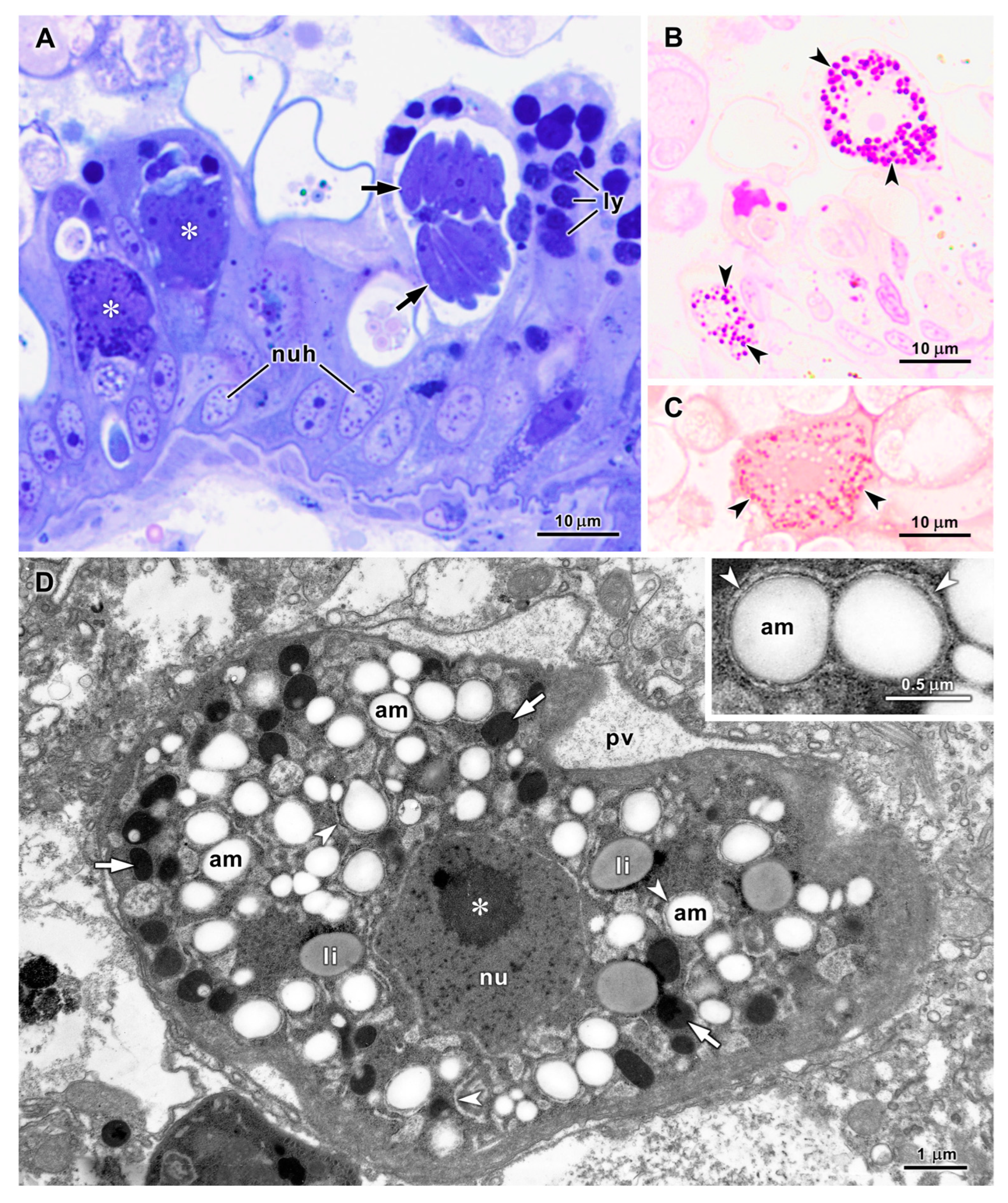
Figure 1. Merogonial stages of the parasite in light microscopy (AC) and TEM (D). (A) Meronts (asterisks) and elongated merozoites (arrows) in parasitophorous vacuoles within the digestive cells. Semithin section stained by methylene blue and azure. (B) PAS reaction in a semithin section staining the polysaccharide granules of two meronts (arrowheads). (C) Meront with numerous microbodies (arrowheads) stained by the tetrazonium coupling reaction for proteins in a semithin section. (D) General ultrastructural view of a meront within a parasitophorous vacuole (pv). The nucleus (nu) of the parasite has a prominent nucleolus (asterisk), and the cytoplasm contains numerous electron-lucent amylopectin granules (am), electron-dense microbodies (arrows), and rough endoplasmic reticulum cisternae (arrowheads). (Inset) Detail showing a rough endoplasmic reticulum cisterna (arrowheads) surrounding two amylopectin granules (am). li—lipid droplets; ly—lysosomes of host cells; nuh—nuclei of host cells.
Jmse 14 00707 g001
Figure 2. Ultrastructure of meronts. (A,B) Numerous electron-dense microbodies are closely associated with electron-lucent amylopectin granules (am), some of which are partially encircled by a microbody with a C-shaped section (arrows). (C) Ultrathin of two meronts within parasitophorous vacuoles (pv), one of them showing two nuclei (nu) with compact nucleolus (asterisks). Rough endoplasmic reticulum cisternae (arrowheads) surround the nuclei. Several amylopectin granules (am) and electron-dense microbodies (mb) can be seen in the cytoplasm of the parasite. A tubular reticulum with a smooth membrane (arrows) is close to the parasitophorous vacuoles (pv). (D) The smooth tubular reticulum (arrows) is connected to the parasitophorous vacuole (pv). li—lipid droplets; mi—host cell mitochondria.
Jmse 14 00707 g002
Figure 3. Ultrastructure of merozoites. (A,B) Immature merozoites (mz) within the parasitophorous vacuole (pv). (C) Merozoite with numerous electron-dense micronemes (mn) and several amylopectin granules (am) in the cytoplasm. The nucleus (nu) contains a compact nucleolus (asterisk). (D) Apex of a merozoite showing the conoid (arrowheads) and the neck of a rhoptry (arrow). Gs—Golgi stack; mn—micronemes; rer—rough endoplasmic reticulum; rh—rhoptry.
Jmse 14 00707 g003
Figure 4. Maximum likelihood (ML) phylogenetic tree inferred from 18S rDNA sequences of coccidians, showing the position of the apicomplexan parasite infecting Bulla striata (highlighted in bold) at the base of the ichthyocolids clade. Nodal support values correspond to ML bootstrap percentages and Bayesian inference posterior probabilities. Asterisks indicate full support under both analytical methods, whereas dashes denote poorly resolved nodes. The scale bar represents the number of nucleotide substitutions per site.
Jmse 14 00707 g004
Disclaimer/Publisher’s Note: The statements, opinions and data contained in all publications are solely those of the individual author(s) and contributor(s) and not of MDPI and/or the editor(s). MDPI and/or the editor(s) disclaim responsibility for any injury to people or property resulting from any ideas, methods, instructions or products referred to in the content.