Article

Mechanism–Data Fusion Modeling and Cross-Condition Fault Diagnosis of Typical Faults in Marine Solid Oxide Fuel Cell Power Systems

1
Marine Engineering College, Dalian Maritime University, Dalian 116026, China
2
Key Laboratory of Image Processing and Intelligent Control (Huazhong University of Science and Technology), Ministry of Education, Wuhan 430074, China
3
Department of Public Order, Liaoning Police College, Dalian 116036, China
4
School of Electrical and Electronic Engineering, Nanyang Technological University, Singapore 639798, Singapore
5
School of Information Engineering, Nanchang University, Nanchang 330031, China
*
Authors to whom correspondence should be addressed.
J. Mar. Sci. Eng. 2026, 14(8), 705; https://doi.org/10.3390/jmse14080705
Submission received: 13 March 2026 / Revised: 6 April 2026 / Accepted: 7 April 2026 / Published: 10 April 2026
(This article belongs to the Special Issue Marine Fuel Cell Technology: Latest Advances and Prospects)

Abstract

Solid oxide fuel cell (SOFC) systems in shipboard power plants exhibit strong thermal–electrochemical coupling and are highly sensitive to both balance-of-plant and stack-related faults under changing operating conditions. In this study, a mechanism–data fusion dynamic model of a standalone SOFC system is developed in MATLAB/Simulink by integrating electrochemical equations with mass, species, and energy conservation and key balance-of-plant components. The model is validated against experimental data, with errors of 0.4–2.8%. Based on the validated model, fuel leakage and electrode delamination are introduced to investigate compound and sequential cross-condition faults. The present results show that fuel leakage causes the most severe degradation in current, power, and temperature, whereas electrode delamination mainly reduces current and power by decreasing the effective reaction area. Compound and sequential faults exhibit non-superimposable dynamic evolution, indicating significant fault interaction effects. A partially monotone decision tree combined with point-biserial correlation is then applied for fault diagnosis. The overall diagnostic accuracy for compound faults reaches 88.5%, while the proposed segmented cross-condition strategy improves the peak accuracy for sequential faults to 87.5%. These results provide an effective framework for SOFC fault modeling and diagnosis under variable operating conditions.

1. Introduction

Hydrogen-based energy conversion technologies are receiving increasing attention because of their potential to reduce carbon emissions and improve energy efficiency in distributed and clean power generation [1]. This trend is particularly relevant to the maritime sector, where increasingly stringent decarbonization requirements are accelerating the development of low-emission shipboard power systems [2]. Among different fuel cell technologies, solid oxide fuel cells (SOFCs) are especially attractive for marine applications because they can directly convert chemical energy into electricity with high efficiency and can operate with a variety of hydrogen-rich fuels [3,4]. These advantages make SOFCs promising candidates for next-generation shipboard power generation and integrated marine energy systems [5]. However, their high operating temperature and the strong coupling among thermal, electrochemical, and flow processes also make SOFC systems vulnerable to performance degradation and faults during long-term operation [6].
In practical marine applications, an SOFC power generation unit is not merely a stack, but an integrated shipboard energy system that includes balance-of-plant (BOP) components such as fuel and air supply devices, combustors, heat exchangers, and supervisory control modules [7]. Consequently, faults may originate from both the stack and the BOP. Typical examples include fuel leakage in the gas supply line and electrode delamination inside the stack [8]. These faults can alter gas concentration, temperature, current density, effective reaction area, and output power, thereby threatening system efficiency, durability, and operational safety [9]. More importantly, ship operating conditions are inherently variable because of load fluctuations, navigation conditions, and changes in power demand. As a result, fault patterns may evolve sequentially rather than remain fixed, creating a cross-condition diagnosis problem that is more challenging than conventional single-condition diagnosis.
Existing SOFC studies have mainly focused on three aspects: dynamic modeling, fault simulation, and data-driven diagnosis. Developing SOFC models not only helps reveal the intrinsic electrochemical reaction mechanisms of the system, but also provides an essential foundation for designing fault diagnosis strategies under different operating conditions. Current SOFC modeling approaches can be broadly divided into semi-empirical models and mechanism-based models [10]. Semi-empirical models describe system behavior by combining a limited number of physical relationships with experimentally fitted parameters, and their main advantages are structural simplicity and fast computation. For example, Ref. [11] developed a semi-empirical planar SOFC model to simulate the overall heat transfer and electrochemical reaction processes. However, such models often have difficulty capturing the strongly coupled dynamic processes inside SOFC systems. In contrast, mechanism-based models can effectively describe mass transfer, temperature variation, and electrochemical conversion, but they usually involve complex parameters and relatively slow convergence [12]. Moreover, many existing models still focus only on the stack or local subsystems, while neglecting the thermo-electro-gas coupling between the balance of plant (BOP) and the stack. In addition, existing fault simulation studies have shown that typical SOFC faults can be reproduced by introducing physically meaningful parameter variations or degradation factors into the model, such as correction coefficients associated with ohmic, activation, and diffusion losses [13], airflow attenuation factors, and structural descriptors representing electrode delamination or cracks [14]. These approaches can effectively reproduce the impacts of different faults on system performance, temperature distribution, and polarization characteristics, and thus provide an effective means for investigating the mechanisms and dynamic consequences of typical faults, including fuel leakage, reformer malfunction, blower degradation, and electrode damage.
Meanwhile, data-driven diagnosis has demonstrated strong capability in identifying both single and simultaneous faults in SOFC systems [15]. Model-based diagnosis, signal-based analysis, and machine-learning-based classification have all been applied to SOFC health monitoring [16]. Some recent studies have further considered diagnosis under off-design or varying operating conditions, indicating that condition shifts can significantly reduce the performance of models trained under fixed operating states [17,18,19]. However, most existing studies still focus on isolated faults, fixed-condition datasets, or general off-design deviations, rather than on the coupled evolution of multiple faults under sequentially changing operating conditions. In particular, limited attention has been paid to the case in which one fault develops on top of another and the fault trajectory itself changes with operating condition, even though such situations are more representative of practical marine power systems. Therefore, the key unresolved issue is not only the existence of a general gap between physics-based and data-driven methods, but also the lack of a unified framework that can simultaneously describe fault evolution mechanisms, generate representative cross-condition fault data, and perform diagnosis for compound and sequential fault processes in integrated SOFC systems. This limitation is closely related to the strong nonlinearity, multiphysics coupling, and time-varying characteristics of SOFC systems. As a result, two seemingly different but increasingly complementary research directions have emerged: one emphasizes the development of high-fidelity physics-based models to improve interpretability and extrapolation capability, while the other prioritizes data-driven classifiers to enhance computational efficiency and online implementation [8,20].
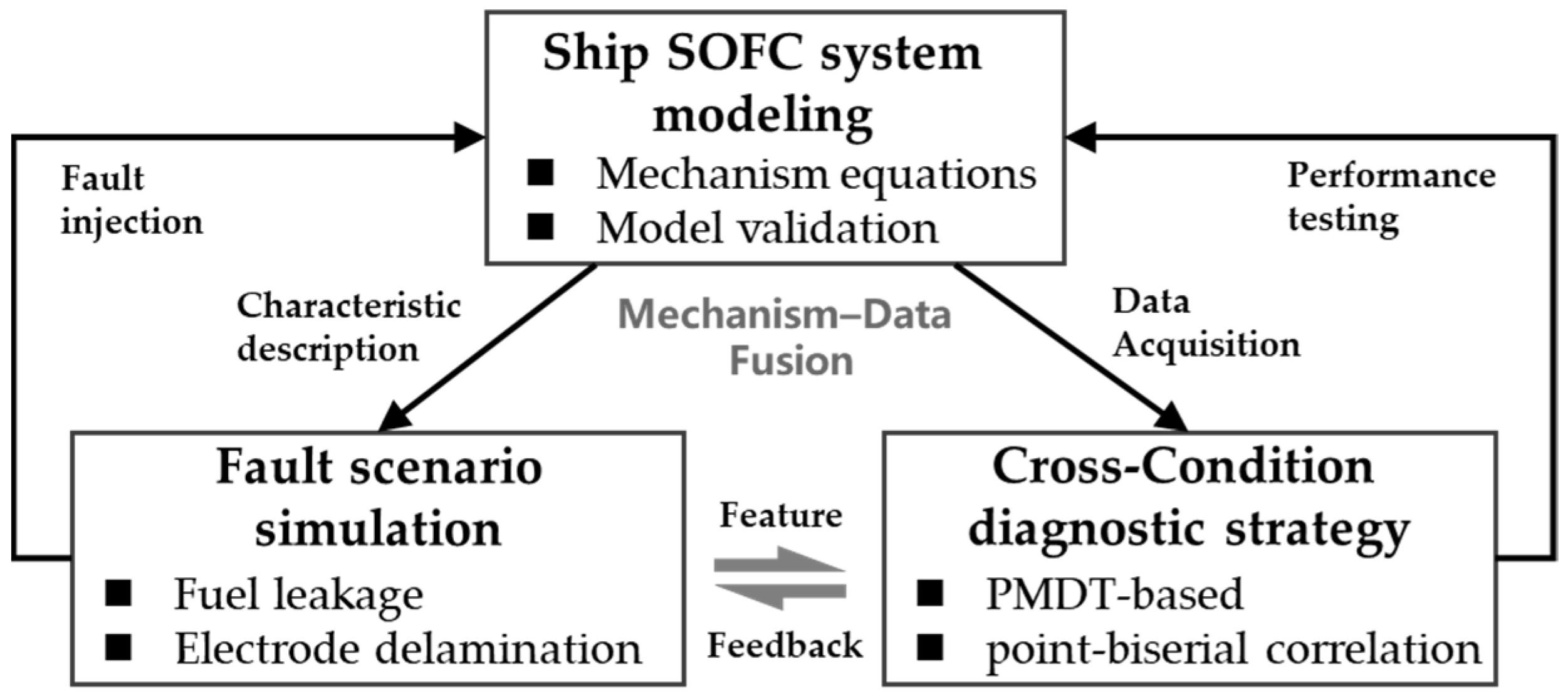
Motivated by this research need, this study develops a mechanism–data fusion framework for a standalone SOFC system in a marine power context; the overall workflow of the proposed framework is illustrated in Figure 1. A dynamic SOFC plant with integrated BOP is established in MATLAB/Simulink and validated experimentally, after which fuel leakage and electrode delamination are introduced through explicit fault factors to analyze both compound-fault and sequential cross-condition scenarios. Compared with previous studies that mainly addressed single-fault diagnosis, fixed-condition classification, or general off-design recognition, the present work makes three specific contributions: (1) it couples dynamic mechanism-based fault simulation with data-driven diagnosis in an integrated SOFC–BOP system rather than focusing only on the stack or a simplified subsystem; (2) it explicitly investigates both simultaneous compound faults and sequential cross-condition fault evolution, instead of treating varying-condition diagnosis as a simple extension of single-fault classification; and (3) it proposes a segmented partially monotone decision-tree-based diagnostic strategy, combined with point-biserial correlation analysis, to improve fault identification robustness under evolving operating conditions. The results show that fuel leakage causes the most severe degradation, that compound and sequential faults exhibit non-superimposable evolution characteristics, and that the proposed segmented diagnostic strategy improves diagnostic robustness under changing operating conditions.

2. Methods

2.1. Description and Modeling of Ship SOFC System

Due to the high cost, fault-related risks, and long experimental cycle of standalone SOFC power generation systems, this study investigates a shipboard standalone SOFC power generation system by means of dynamic modeling. Based on the available experimental data and literature, a system-level dynamic model is established in the MATLAB (Version R2022b)/Simulink environment according to the Nernst equation, energy conservation, and species conservation, and is then validated using experimental data to provide a basis for subsequent fault simulation and diagnosis [21].
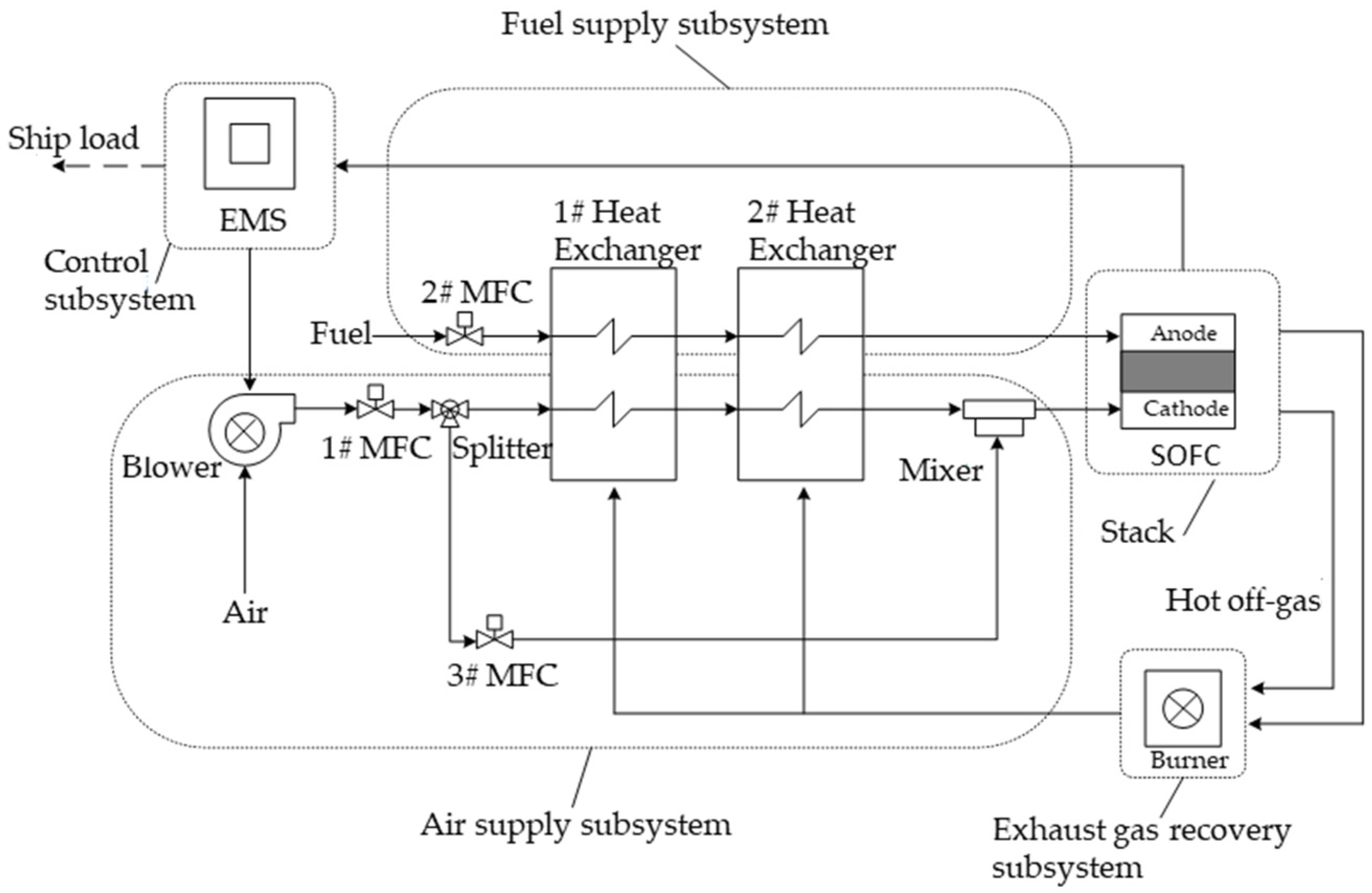
The SOFC system consists of the stack and the balance-of-plant (BOP). The BOP mainly includes heat exchangers, a combustor, a blower, and mass flow controllers (MFCs) [22]. Among these components, the SOFC stack is the core part of the whole system. In this study, the stack model is divided into five small stack modules (nodes) using a finite-volume-like discretization idea. Each node can operate independently, and the five nodes are connected in series to form the complete stack model of the SOFC system. Each node is further divided into a solid control unit, a fluid control unit, and an electrochemical performance module. The solid control unit includes the metal interconnect and the PEN structure, while the fluid control unit includes the fuel channel and the air channel. The state variables of each control unit are calculated based on conservation laws, and the output of one node serves as the input of the next node. The overall process configuration of the standalone SOFC power generation system is shown in Figure 2.
i.
Electrochemical performance model
The electrochemical model is used to describe the stack output voltage and its polarization loss characteristics [23]. The stack voltage V s t a c k is expressed as the product of the single-cell voltage V c e l l and the number of cells, as given by
V s t a c k = n V c e l l ,
V c e l l = E N e r n s t V a c t V o h m V c o n c   ,
where n is the number of cells. The single-cell voltage is defined as the open-circuit voltage minus the various polarization losses [24]:
E N e r n s t = E 0 + R T P E N 2 F l n p H 2 p O 2 0.5 p H 2 O   ,
where E 0 denotes the Gibbs free energy at temperature T P E N , and p i i H 2 , O 2 , H 2 O denotes the partial pressure of each gas species. The terms V a c t , V o h m , and V c o n c represent the activation loss, ohmic loss, and concentration loss, respectively. The activation loss mainly results from the kinetic limitation of the electrochemical reactions at the electrode surface and is usually related to current density and exchange current density [25]. The ohmic loss is mainly caused by the electrolyte, interconnect, and contact resistance, and is usually related to material conductivity and operating temperature [26]. The concentration loss reflects the mass-transfer limitation caused by the concentration difference between the electrode surface and the main gas channel [27]. The overall stack output voltage is obtained by iterating the single-cell voltage of each node, thereby characterizing the voltage distribution and performance variation in the stack along the flow direction.
ii.
Energy conservation equation
The energy conservation equation is used to describe the temperature dynamics of the solid and fluid units in each node. For the solid control unit, the temperature variation is determined by electrochemical reaction heat, Joule heat, convective heat transfer with the fluid, and heat conduction between adjacent nodes [28]. For the fluid control unit, the temperature variation is governed by the enthalpy difference in the gas flow, heat exchange with the solid unit, and the thermal effect induced by gas-phase reactions. The general form of the energy conservation equation is written as follows [29]:
N ˙ C v d T d t = E ˙ i n E ˙ o u t + Q ˙ g e n   ,
where N ˙ is the flow rate of the control volume, C v is the constant-volume heat capacity, T is the temperature of the control volume, E ˙ i n and E ˙ o u t represent the inlet and outlet enthalpy flow rates, respectively, and Q ˙ g e n is the internal heat source term. By establishing coupled energy balances between the solid and fluid control units, the spatiotemporal temperature evolution inside the SOFC stack can be dynamically captured.
iii.
Species conservation equation
The species conservation equation is used to describe dynamic variations in the molar amounts and mole fractions of each component in the fuel and air channels. Since gas inflow, gas outflow, and electrochemical consumption or generation simultaneously occur on both the fuel side and the air side of the SOFC system, a separate conservation equation is established for each gas component. Its general form is shown as follows [30]:
d n i d t = n ˙ i , i n n ˙ i , o u t + n ˙ i , g e n   ,
where n i is the molar amount of species i in the control volume, n ˙ i , i n and n ˙ i , o u t are the inlet and outlet molar flow rates of species i , respectively, and n ˙ i , g e n is the generation or consumption term caused by electrochemical reactions or reforming reactions. Based on the molar amounts of each component, the gas mole fractions, partial pressures, and total pressure can be further calculated and coupled with the Nernst voltage, reaction rate, and heat generation, thereby enabling the modeling of gas distribution and dynamic response inside the SOFC [31].
iv.
BOP modeling equations
In addition to the stack, the SOFC system also includes BOP components such as heat exchangers, a combustor, a blower, and a mixer. To improve the model’s ability to represent the actual operating process, dynamic or quasi-steady-state models are established for each BOP component. Their mechanisms are described through flow, pressure, and temperature equations, while still following species conservation or energy conservation laws. The heat exchanger model is established based on the energy exchange relationship between hot and cold fluids and is used to describe the variation in gas temperature at the inlet and outlet. The combustor model is established according to the combustion reaction of the unreacted fuel components and the corresponding energy conservation relationship, and is used to calculate the heat release and outlet temperature of the exhaust gas combustion. The heat exchanger and combustor models both follow the energy conservation law. The gas mixing process in the mixer is also modeled through thermal interaction among gas streams, and its principle is similar to that of the heat exchanger. The blower power model is developed based on the isentropic efficiency model. The MFC model is realized using a first-order inertial link together with a time-delay element. All BOP components are coupled with the stack model through variables such as flow rate, temperature, species concentration, and pressure, thereby forming the complete dynamic model of the SOFC system.
In Table 1, Q ˙ b u r n and Q ˙ c o n v represent the fuel heat and convective heat transfer, respectively. In the blower power model, N ˙ a i r denotes the air flow rate, C P , a i r denotes the constant-pressure specific heat of air, η b l denotes the blower efficiency, P b l , i n and P b l , o u t denote the inlet and outlet air pressures of the blower, respectively, and τ denotes the specific heat ratio of air. In the MFC mechanism equation, T denotes the inertial time constant, and δ denotes the time delay.

2.2. Fault Simulation Mechanisms and Equations

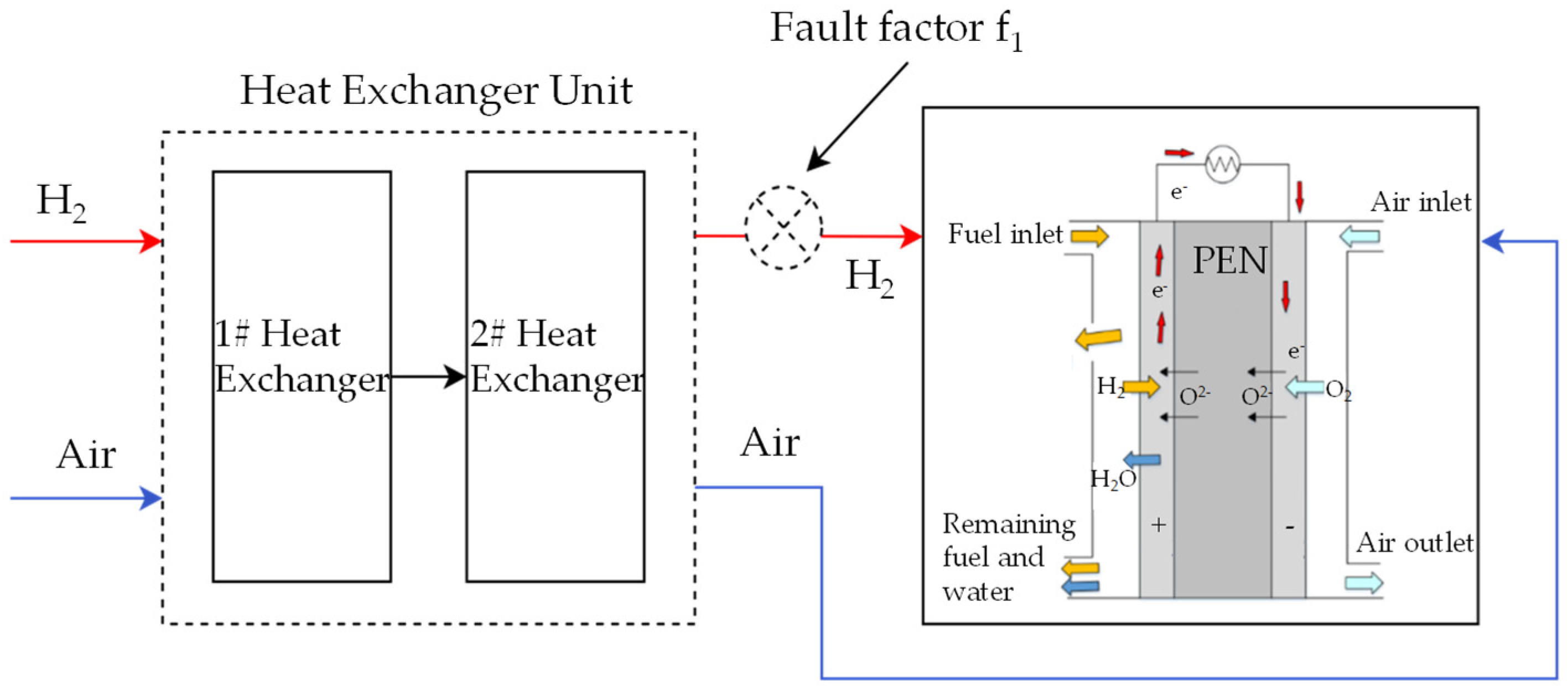
Fuel leakage is one of the most influential typical faults in SOFC systems. It mainly changes the concentration, pressure, and molar flow rate of the fuel gas at the stack inlet, thereby weakening the electrochemical reaction intensity and reducing the output performance of the system. Since hydrogen leakage in practical systems usually occurs in the connecting pipelines between different modules, the fuel leakage fault is introduced between the second heat exchanger and the stack in this study so as to better represent realistic operating conditions. To characterize the process of crack initiation, propagation, and eventual stabilization, a fuel leakage fault factor f 1 is introduced into the model. This factor varies from 0 to 1, and its evolution trend is used to simulate the process in which a small pipeline crack gradually expands and then tends to stabilize under the dynamic balance between leakage and pressure. In this way, the effect of fuel leakage on the performance evolution of the SOFC system can be represented. The mechanism equation for fuel leakage can be expressed as follows:
N ˙ f u e l , i n   f a u l t ( t ) = f 1 ( t )   N ˙ f u e l , i n   n o r m a l ( t )   ,
where N ˙ f u e l , i n n o r m a l is the fuel molar flow rate entering the stack under normal operating conditions, and N ˙ f u e l , i n   f a u l t is the actual fuel molar flow rate under the fuel leakage condition. The schematic diagram of the fuel leakage fault is shown in Figure 3.
Electrode delamination is one of the main causes of increased ohmic resistance and performance degradation in SOFC stacks. This fault is usually caused by non-uniform material distribution or material degradation in the electrode, which leads to delamination or cracks inside the electrode. As a result, the transport resistance of gas, ions, and electrons increases, and local temperature non-uniformity occurs, which further aggravates thermal stress and thermal imbalance. The essential effect of this fault is the destruction of the effective reaction region of the electrode, which reduces the effective contact area between the anode and cathode and consequently weakens the electrochemical reaction capability. Since the actual formation of electrode delamination is relatively slow, whereas the simulation time is short, this study assumes that the fault can be formed within a short period. An electrode delamination fault factor f 2 is therefore introduced into the SOFC model, and the fault is simulated by reducing the effective reaction area of a single stack, so as to represent its influence on system performance degradation. The expression and evolution trend of f 2 are given as follows:
g x = e x p ( x 4000 ) 2 2 12000 d e x x 2 2 ,   d e x x 2 = 10
k 2 = 0 10 i g x d x
f 2 = 1 0.2 k 2 k 2 , e n d
where g ( x ) , in Equation (13), is the Gaussian-type evolution function used to describe the development trend of electrode delamination, x is the fault-evolution variable, and d e x x 2 is the parameter used to determine the standard deviation of the Gaussian function. In this study, d e x x 2 is set to 10. In Equation (14), k 2 represents the accumulated delamination effect, obtained by integrating the evolution function over the interval 0 ,   10 i , where i denotes the evolution step. Based on the normalized accumulated effect, the fault factor f 2 is constructed in Equation (15), where k 2 , e n d is the terminal value of k 2 . In this way, f 2 is used to characterize the gradual reduction in the effective reaction area caused by electrode delamination, thereby representing its progressive influence on SOFC system performance degradation.
Through the above formulation, the gradual evolution of electrode delamination can be described in the model, and its impact on SOFC system performance can be analyzed.

2.3. Fault Diagnosis Strategy

To achieve fault identification for SOFC systems under multiple operating conditions, a partially monotone decision tree (PMDT) is adopted in this study to construct the fault diagnosis model. SOFC fault data exhibit clear complexity: some features show monotonic trends with changes in fault severity, whereas other features exhibit non-monotonic behavior due to the strong thermo-electro-gas coupling of the system. Traditional classification methods usually fail to make full use of such latent ordered information, and therefore their diagnostic performance and generalization ability are limited under complex operating conditions. PMDT can simultaneously handle mixed ordered classification problems composed of monotonic and non-monotonic features, and is therefore suitable for multi-condition SOFC fault diagnosis.
Let the ordered classification sample set be denoted as H O D T = { A , X , D } , where A is the sample set, X is the feature set, and D is the decision label set with ordinal relationships. The feature set is further divided into a monotonic feature subset X m and a non-monotonic feature subset X n m . If the following conditions are satisfied as
X m X n m = X , X m X n m =   ,
then the dataset can be regarded as a mixed ordered decision set. For mixed ordered features, the mixed dominance set with respect to feature Z is defined as
[ a i ] Z = { a j A a i = z n m a j ,   a i z m a j }   ,
[ a i ] Z = { a j A a i = z n m a j ,   a i z m a j }   .
On this basis, the number of consistent samples of feature x j with respect to feature Z is defined as
C O N a i = { [ a i ] Z a i A }   ,
and the total number of consistent samples with respect to feature Z is further obtained as
C O N Z = i = 1 N C O N x i   ,
Equations (17)–(21) are used to measure the consistency relationship between features and decision labels, and are then employed for feature evaluation and screening. By removing irrelevant or weakly correlated features, the model complexity can be reduced and the robustness and generalization ability of the subsequent classifier can be improved.
In the decision tree construction stage, PMDT takes the ordered classification sample H O D T = { A , X , D } and the stopping criterion ε as inputs. First, the monotonicity of the features is determined based on the screened feature set. If all samples at the current node belong to the same class, the split is terminated. If the impurity reduction condition is satisfied, the optimal split C is generated according to Equation (22):
C = a r g   m a x   M I ( x j , b ) = a r g   m a x 1 A n a A n l o g [ a n ] x j × [ a n ] b A n × [ a n ] x j [ a n ] b   .
Otherwise, the optimal split G is generated according to Equation (23):
G = a r g   m a x   M I ( x e , b ) = a r g   m a x 1 A n a A n l o g [ a n ] x j × [ a n ] b A n × [ a n ] x j [ a n ] b   .
When G < ε , the splitting process is terminated; otherwise, new child nodes are recursively generated until all samples have been classified. In this way, the resulting PMDT model can simultaneously exploit monotonic and non-monotonic feature information and extract diagnostic rules suitable for mixed ordered classification problems. Compared with conventional decision tree methods, PMDT is more suitable for handling the nonlinearity, strong coupling, and multi-condition characteristics widely present in SOFC fault data. Therefore, it is adopted in this study as the fault classification model, and point-biserial correlation is further combined to analyze feature importance, so as to improve the accuracy and robustness of single-fault, compound-fault, and cross-condition fault diagnosis. The diagnostic dataset was generated from the validated SOFC model under different fault scenarios. In the present study, the total dataset size was set to 20,000 samples. The dataset was randomly divided into a training set and a test set at a ratio of 70%/30%, where the training set was used for model construction and the test set was used for performance evaluation.
The PMDT-based fault diagnosis procedure used in this study is summarized in Table 2. To improve the robustness of the classifier and reduce the dependence on a specific data partition, K-fold cross-validation (with K = 10) was adopted during the training stage. Specifically, the training dataset was randomly divided into 10 non-overlapping subsets, and the final validation performance was obtained by averaging the results over all folds. By using this procedure, the overall performance of the model on the available dataset could be evaluated more reliably, while avoiding overdependence on a particular validation subset.
To further justify the selection of PMDT, additional comparisons with several representative baseline classifiers were conducted for two single-fault diagnosis tasks, namely fuel leakage and electrode delamination. The considered baseline methods include KNN, SVM, Logistic Regression, and Naive Bayes. The comparison results are summarized in Table 3 and Table 4.
As shown in Table 3 and Table 4, PMDT achieves the highest diagnostic accuracy among all the considered classifiers for both single-fault cases. For fuel leakage diagnosis, PMDT yields a training accuracy of 98.7% and a test accuracy of 95.4%, which are significantly higher than those of KNN, SVM, Logistic Regression, and Naive Bayes. A similar trend is observed for electrode delamination diagnosis, where PMDT also outperforms the other baseline methods, reaching a training accuracy of 89.3% and a test accuracy of 84.2%. These results indicate that PMDT is more suitable for the SOFC fault data considered in this study, because it can better exploit the mixed monotonic and non-monotonic feature relationships embedded in the diagnostic features.
To further quantify the correlation between each fault level and the feature variables, point-biserial correlation (PBC) is introduced for feature analysis. PBC is suitable for measuring the linear correlation between a binary categorical variable and a continuous variable, and can essentially be regarded as a special case of the Pearson correlation coefficient in a binary-classification scenario. In this study, whether a certain fault level occurs is represented as a binary variable, while the measured state parameters or performance indicators of the system are taken as continuous variables, and the correlation between them is then calculated. The expression is given as
r p b = i = 1 n ( x i x ¯ ) ( y i y ¯ ) i = 1 n ( x i x ¯ ) 2 i = 1 n ( y i y ¯ ) 2 ,
where x i denotes the binary fault label corresponding to the i -th sample and takes a value of 0 or 1; y i denotes the continuous feature variable corresponding to the i -th sample; and x ¯ and y ¯ are the mean values of the binary variable and the continuous variable, respectively. The larger the absolute value of r p b , the stronger the correlation between the feature and the corresponding fault level, while its sign reflects the direction of the correlation. Based on Equation (24), the point-biserial correlation coefficient between different fault levels and each feature variable is calculated to evaluate the sensitivity and discriminative ability of each feature for fault identification, thereby providing a basis for subsequent feature selection and interpretation of the diagnostic results.


3. Model Validation

The developed SOFC model was first validated against experimental data to ensure its suitability for subsequent fault simulation and diagnosis. The stack adopted the typical Ni–YSZ/YSZ/LSM configuration. The basic modeling parameters of the SOFC system are listed in Table 5, while the key parameters of the heat exchanger and blower in the BOP subsystem are summarized in Table 6, and additional parameters not included in the tables can be found in Refs. [30,34]. Under the available validation conditions, both dynamic electrochemical performance and steady-state V-I characteristics were used to assess the model accuracy. Owing to the strong thermo–electro–gas coupling inherent in SOFC systems, the modeling framework explicitly considers heat transfer, species transport, and electrochemical processes, as well as their mutual interactions. Therefore, electrochemical response curves that agree well with experimental observations under near-practical operating conditions can indirectly provide strong support for the validity of the proposed model.
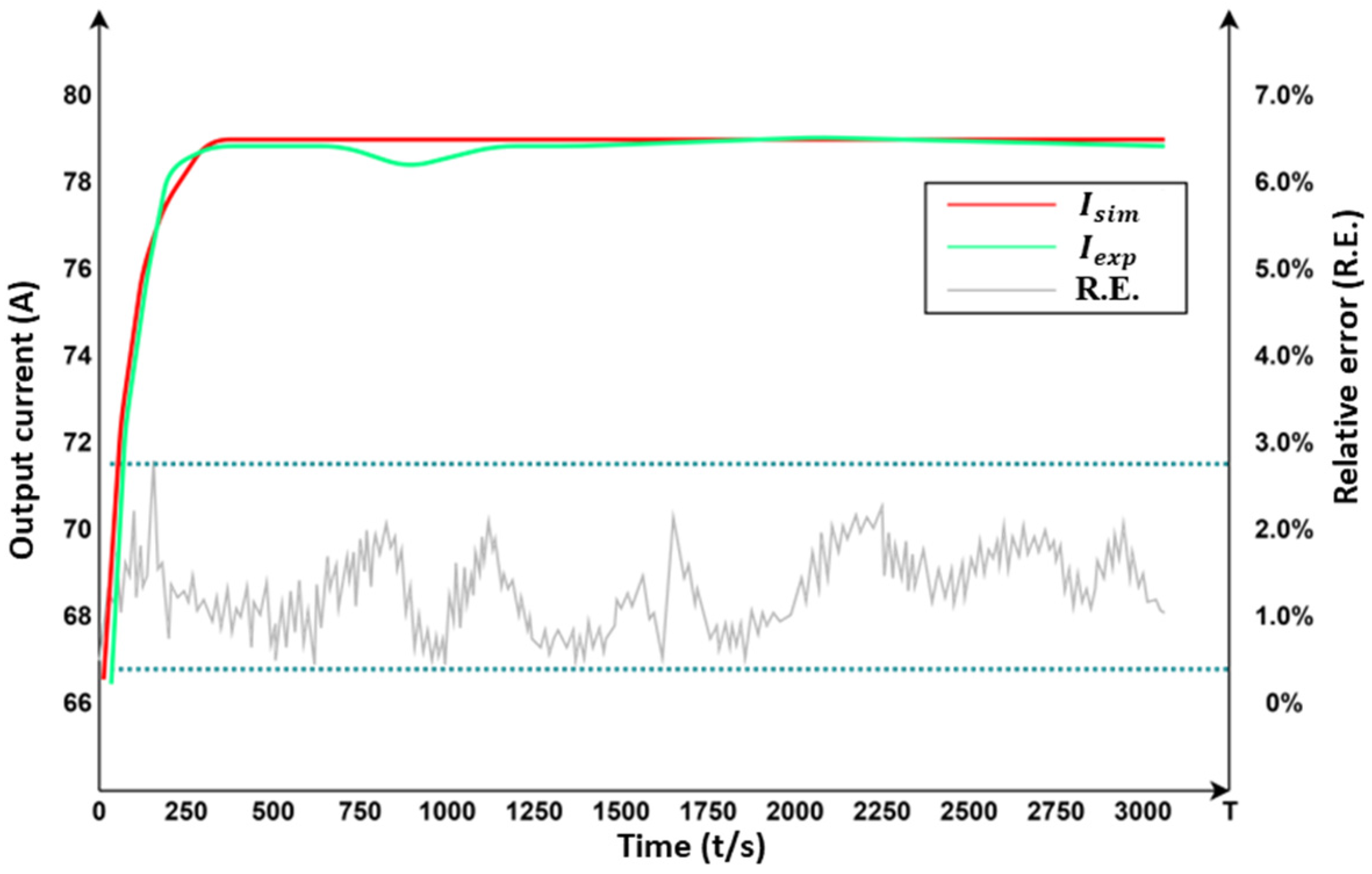
For the dynamic electrochemical validation, the initial voltage of a single cell was set to 0.65 V, and the simulation time was set to 3000 s. After parameter tuning, the simulated stack current was compared with the experimental measurements. As shown in Figure 4, the simulated current profile agrees well with the experimental trend over the entire operating period. The deviation remains within 0.4–2.8%, indicating acceptable model accuracy. This error range is also supported by previous SOFC validation studies, where experimentally validated electrochemical responses were considered sufficient for subsequent performance, degradation, and modeling analyses [12,35].
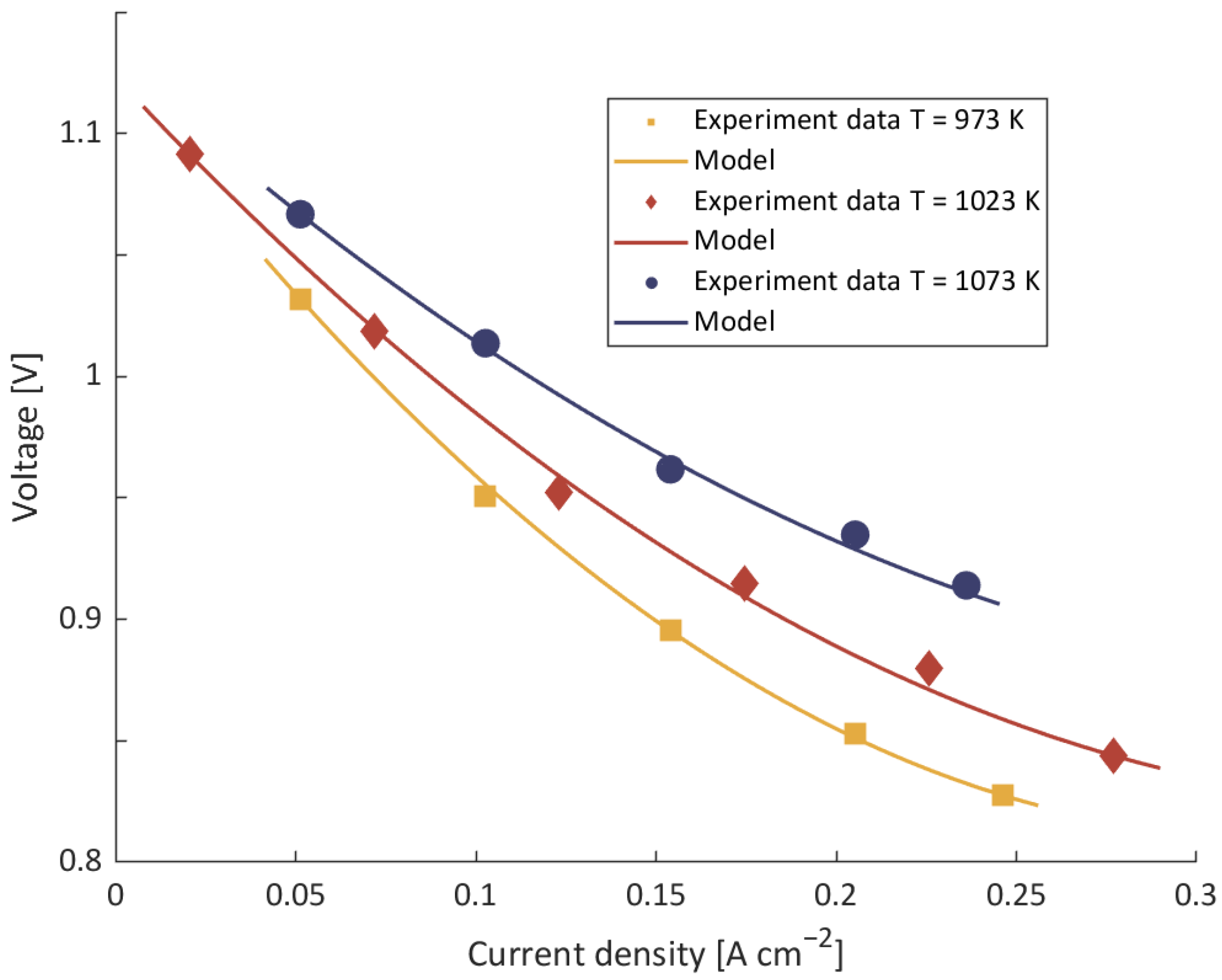
In addition to the dynamic current-response validation under a fixed voltage condition, the model was further validated using steady-state V-I characteristics. The operating conditions for the stack tests used in the steady-state validation are summarized in Table 7. Figure 5 compares the simulated and experimental voltage–current density curves at three operating temperatures, namely 973 K, 1023 K, and 1073 K. Under stable operating conditions, the measured current and voltage data were converted into current density and single-cell voltage for model calibration and validation. As shown in Figure 5, the model predictions agree well with the experimental data over the considered current-density range. In particular, under the conditions of 1023 K and 1073 K, the maximum deviations between the simulated and experimental results are 1.01% at 0.22 A cm−2 and 0.7% at 0.20 A cm−2, respectively. These results indicate that the developed model can accurately capture the steady-state electrochemical behavior of the SOFC system and thus provides a reliable basis for subsequent fault simulation and diagnostic analysis.
In summary, the validated model can serve as a reliable platform for generating representative fault data under normal, single-fault, compound-fault, and cross-condition scenarios. At the same time, it should be noted that the present validation scope is still relatively limited, and broader validation involving more variables and operating conditions will be an important direction for future work.

4. Results

4.1. Independent Fault Simulation and Analysis of SOFC System

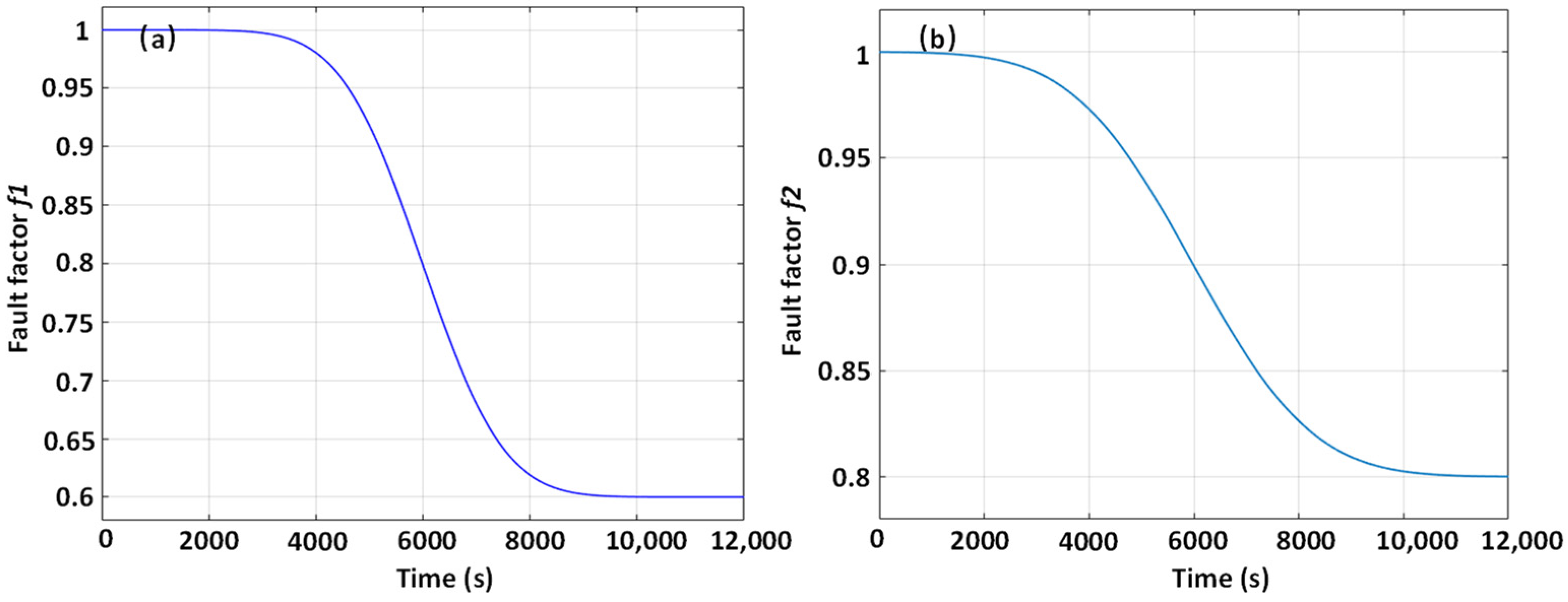
To investigate the independent effects of typical faults on SOFC system performance, separate simulations were carried out for fuel leakage and electrode delamination. Figure 6 shows the time-varying evolution of the corresponding fault factors f 1 and f 2 .
As shown in Figure 6a, the fuel leakage fault factor f 1 remains nearly constant in the initial stage and then begins to decrease at about 2500 s. After approximately 4000 s, the decreasing trend becomes more rapid, indicating the progressive expansion of the pipeline crack under gas pressure. When the operating time reaches about 8000 s, the decrease gradually slows down and finally stabilizes at 0.6. For simplicity, f 1 is used to represent the overall degradation trend of a realistic leakage process, while transient fluctuations are neglected. Figure 6b shows the evolution of the electrode delamination fault factor f 2 . The delamination fault is introduced at about 1800 s, after which f 2 decreases gradually and finally stabilizes at 0.8 when the system reaches 12,000 s. Compared with fuel leakage, the variation of f 2 is smoother and more gradual, reflecting the progressive reduction in the effective reaction area caused by electrode delamination. In this way, the two fault factors provide simplified but physically interpretable descriptions of the fault-development process for subsequent simulation and diagnosis.
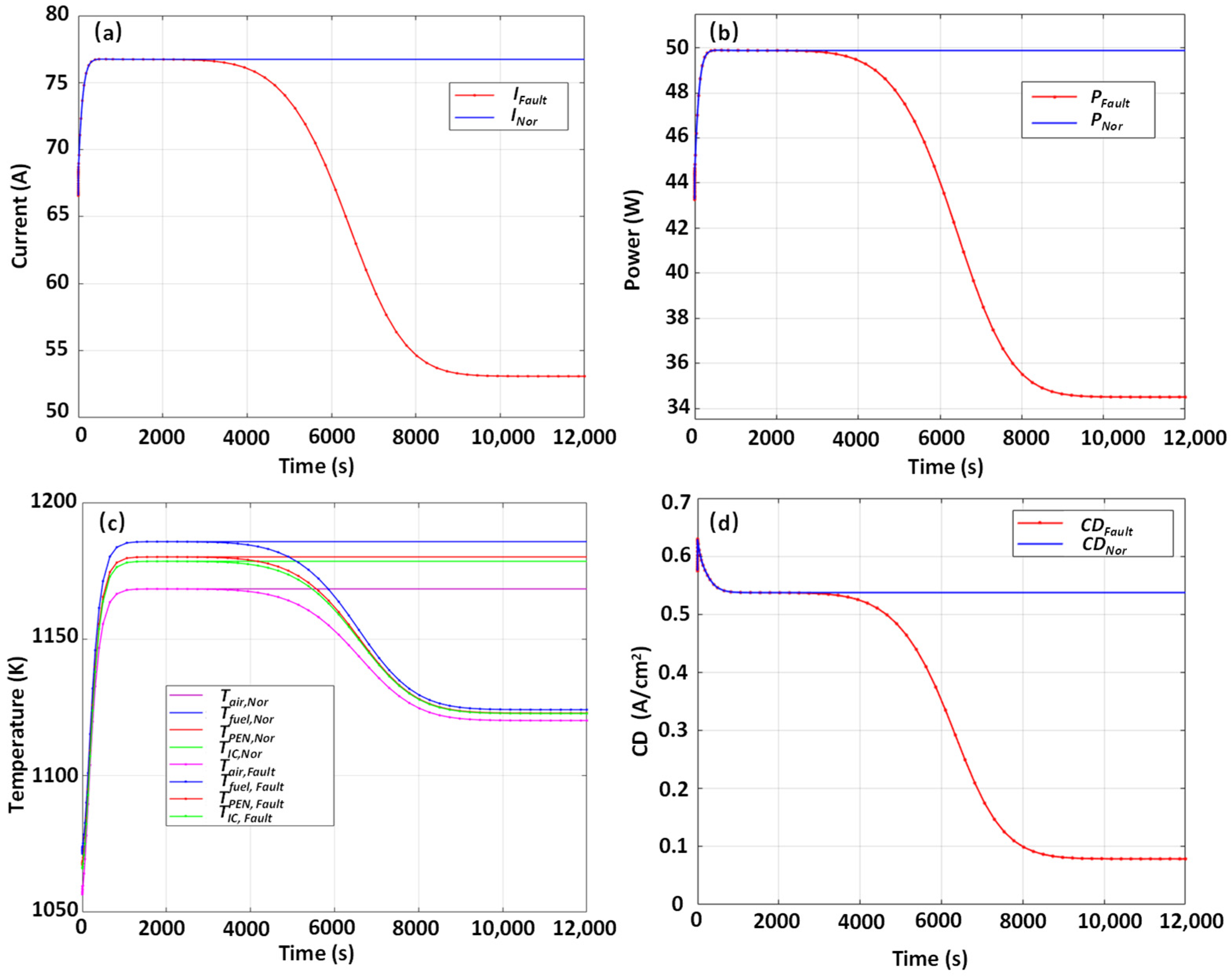
To further illustrate the effect of fuel leakage on SOFC performance, the dynamic responses of key stack variables under the f 1 fault are analyzed in Figure 7. As shown in Figure 7a–d, fuel leakage directly weakens the fuel-gas concentration and thus suppresses the electrochemical reaction process. As a result, the electrical characteristics of the single stack are significantly degraded: the current decreases from about 77 A to 53 A, the output power drops from 50 W to 34.5 W, and the current density (CD) decreases from 0.54 A cm−2 to 0.098 A cm−2. In addition, the temperature characteristics are also affected. The monitored air, fuel, PEN, and interconnect (IC) temperatures all exhibit a noticeable decrease after the occurrence of fuel leakage, with an average reduction of about 40–60 K. These results indicate that fuel leakage can be identified not only by the significant decrease in current and power, but also by the concurrent thermal degradation of the stack, which provides a multi-variable basis for subsequent diagnosis.
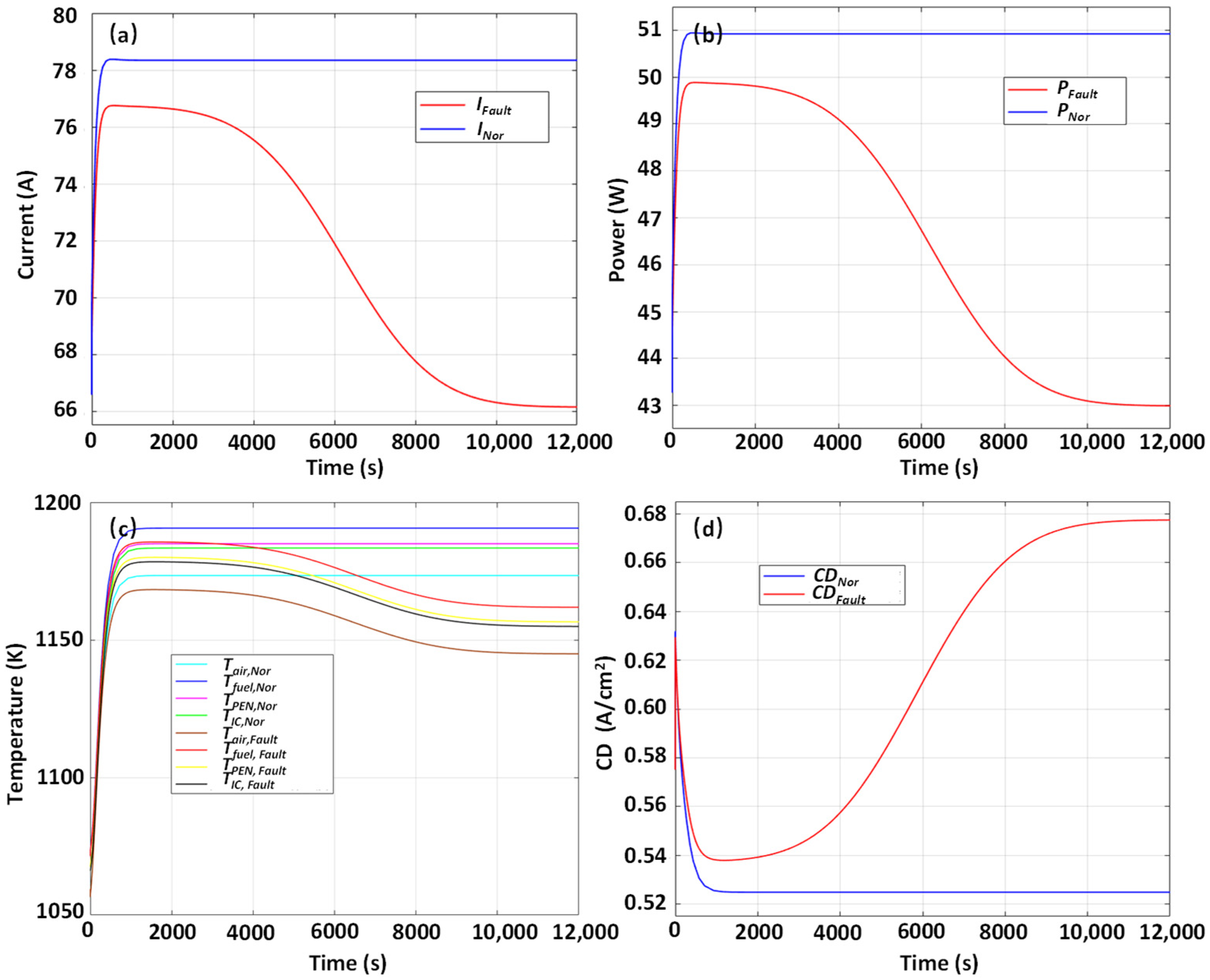
To further illustrate the effect of electrode delamination on SOFC performance, the dynamic responses of key stack variables under the f 2 fault are analyzed in Figure 8. As shown in Figure 8a–d, the electrode delamination fault is introduced by gradually reducing the effective reaction area between the anode and cathode to 80% of its original value. This fault causes a clear degradation in the electrical characteristics of the single stack: the current decreases from 78.2 A to 66.1 A, while the output power drops from about 51 W to 43 W. In contrast, CD increases significantly from the normal value of 0.525 A cm−2 to 0.678 A cm−2, reflecting the increase in local electrochemical loading as the effective reaction area is reduced. Compared with the electrical variables, the temperature response is less sensitive to the f 2 fault. The monitored temperatures of air, fuel, PEN, and IC show only moderate decreases, with an average reduction of about 27 K. These results indicate that the f 2 fault mainly influences the electrical behavior of the stack, while its effect on temperature is relatively limited. By contrast, the weaker thermal response but stronger current-density increase under f 2 indicates that electrode delamination presents a different feature pattern from fuel leakage, which is important for discriminating the two faults in the diagnosis stage.

4.2. Fault Diagnosis Results

In this study, two representative faults were considered, namely fuel leakage ( f a ) and electrode delamination ( f b ). On this basis, two more complex scenarios were further investigated: simultaneous compound faults (FAB), in which fuel leakage and electrode delamination occur together, and sequential cross-condition faults, including f a b (fuel leakage followed by electrode delamination) and f b a (electrode delamination followed by fuel leakage). The baseline comparisons were conducted only for single-fault scenarios, as the primary objective of this study is to develop a mechanism–data fusion framework for cross-condition diagnosis in marine SOFC systems. The diagnosis dataset was generated from the validated SOFC model and included methane supply, combustion methane supply, reforming air flow, bypass air flow, deionized water, current, reformer temperature, air heat exchange value, burner outlet temperature, and voltage, denoted as X 1 X 9 and V , respectively.

4.2.1. Simultaneous Compound Faults

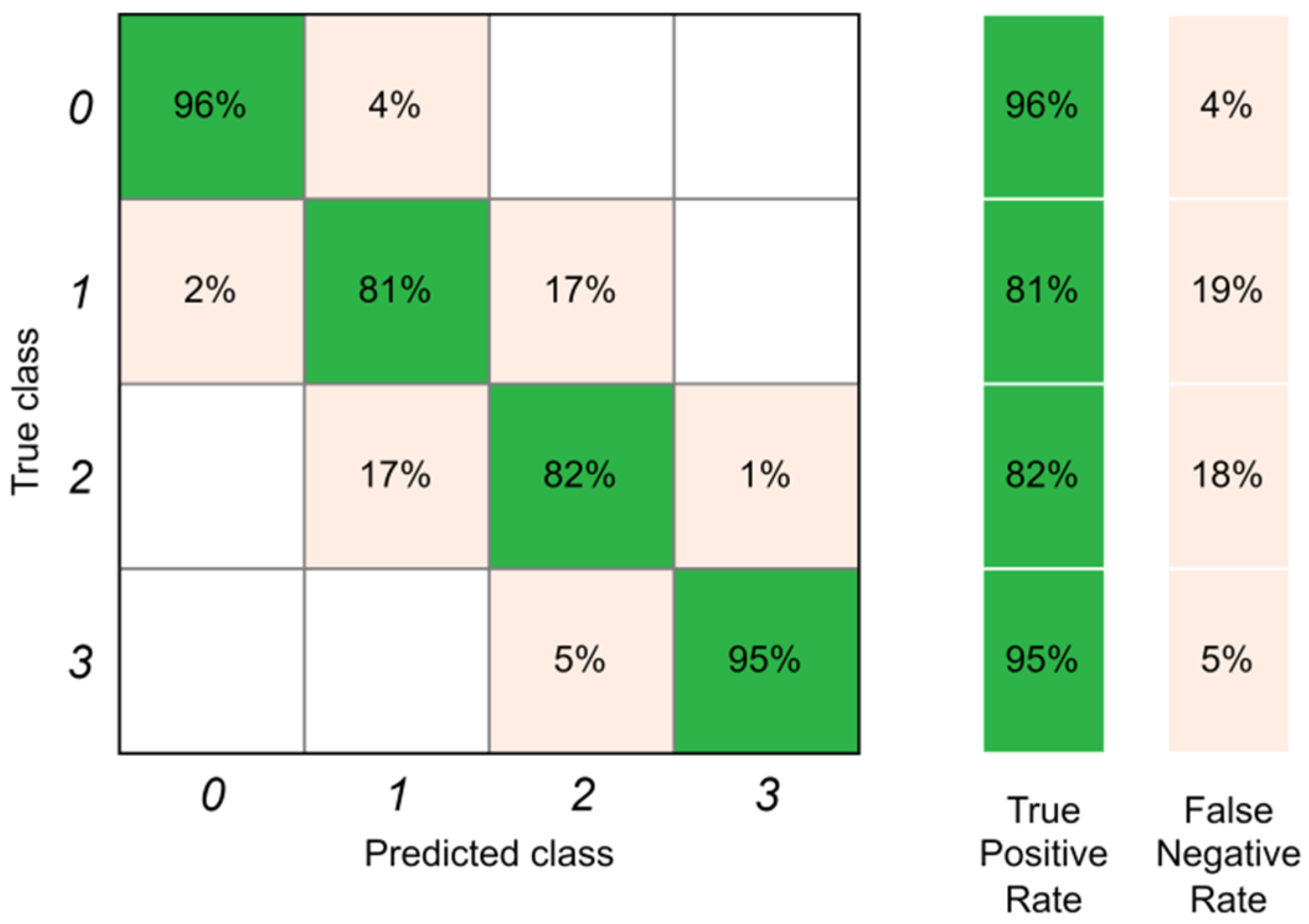
For the simultaneous compound-fault case, the PMDT algorithm was used to classify four fault severity levels, i.e., normal, slight, severe, and very severe, denoted by 0, 1, 2, and 3, respectively. The confusion matrix in Figure 9 shows that the overall diagnostic accuracy reaches 88.5%, confirming that PMDT remains effective even when multiple fault mechanisms act simultaneously. Compared with the independent-fault cases, the compound-fault responses cannot be interpreted as a simple superposition of the two single-fault behaviors, because the dominant variables and their relative sensitivities change with the fault severity level.
A more detailed examination indicates that the model performs particularly well for extreme states. The diagnostic accuracies for Levels 0 and 3 are 96% and 95%, respectively, whereas those for the intermediate Levels 1 and 2 are 81% and 82%. This result suggests that the boundaries between weak and moderate compound-fault states are less distinct than those between healthy and severely degraded states. In other words, when the compound fault is either absent or fully developed, the corresponding feature patterns are relatively stable and easier to classify. By contrast, the intermediate stages reflect a transition region in which the effects of fuel shortage, effective reaction area reduction, and thermal redistribution coexist, leading to partially overlapping feature distributions.
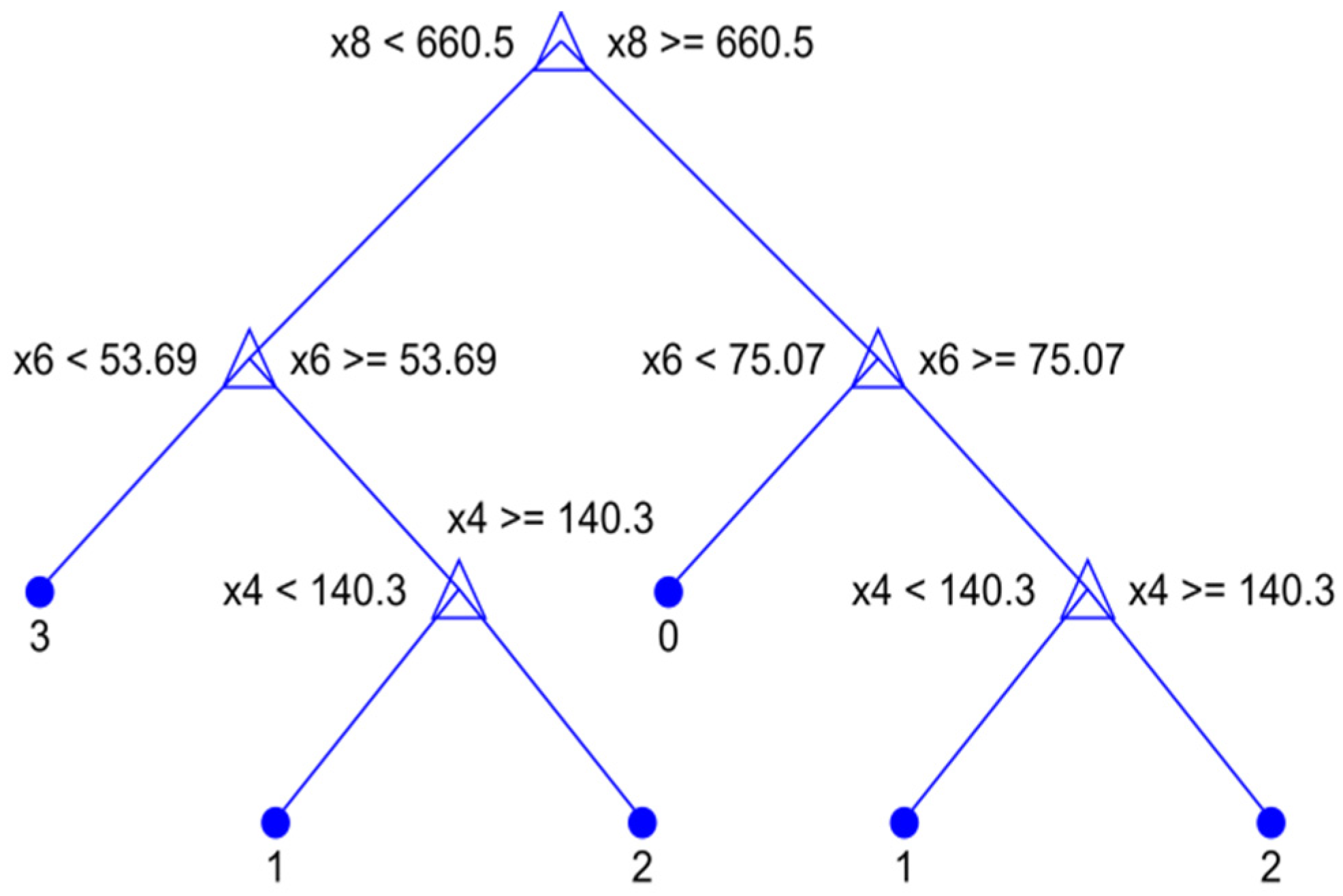
The decision tree in Figure 10 further reveals that compound-fault diagnosis is controlled by a more complicated feature hierarchy than that of a single fault. For example, when X 8 < 660.5 and X 6 < 53.65 , the sample is mainly classified as Level 3, whereas when X 8 660.5 and X 6 < 75.07 , it is mainly classified as Level 0. These results indicate that X 8 and X 6 play dominant roles in distinguishing the extreme compound-fault states. In contrast, the discrimination between Levels 1 and 2 is more strongly influenced by X 4 , implying that the intermediate evolution of the compound fault depends more on auxiliary flow redistribution than on a single dominant electrochemical indicator.
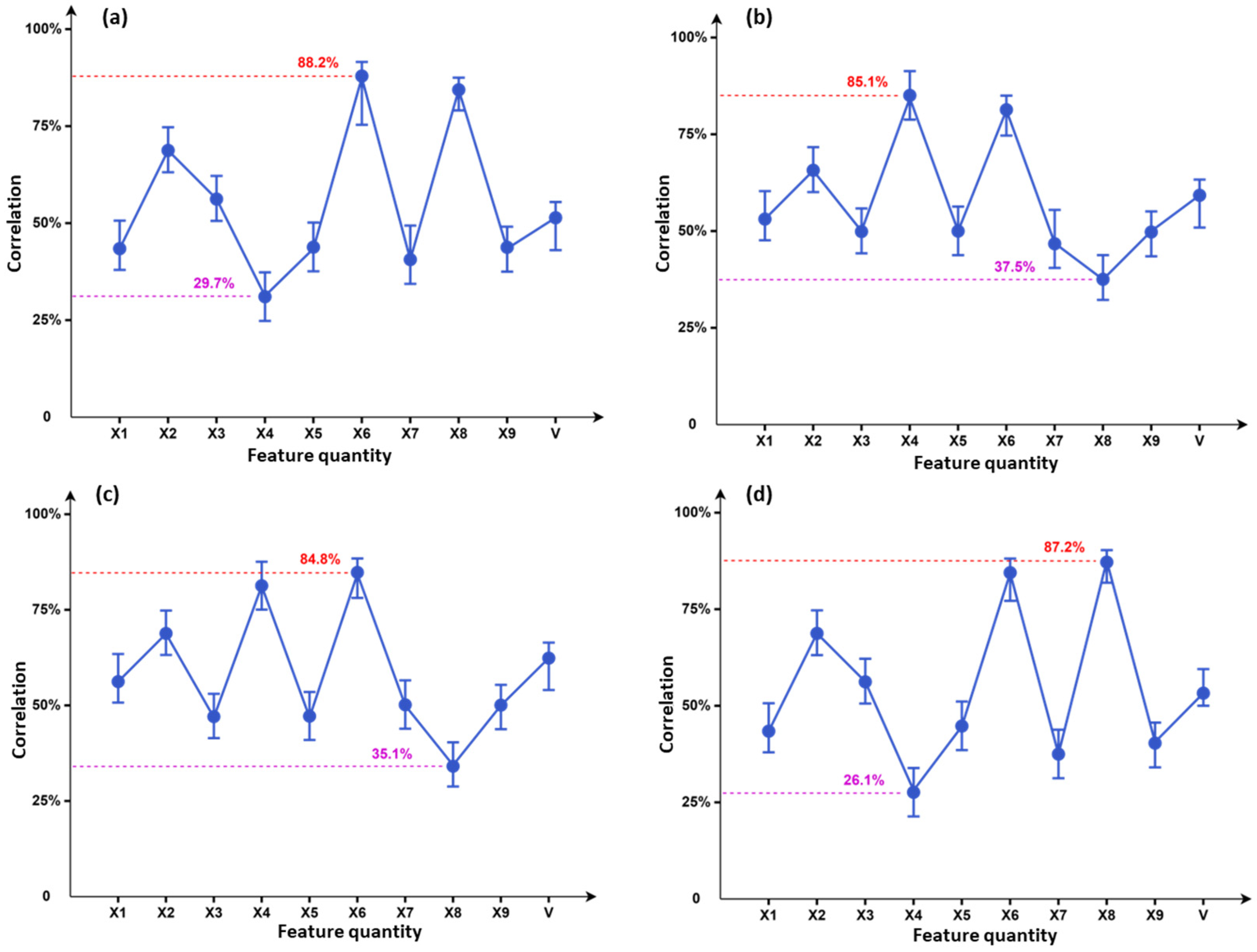
The point-biserial correlation results shown in Figure 11 support this interpretation. The most relevant features for Levels 0, 1, 2, and 3 are X 6 , X 4 , X 6 , and X 8 , with corresponding correlations of 88.2%, 85.1%, 84.8%, and 87.2%, respectively. Meanwhile, the weakest correlations for the four levels are only 29.7%, 37.5%, 35.1%, and 26.1%. This confirms that compound-fault diagnosis is strongly level-dependent and cannot be explained by a fixed set of globally dominant variables. Instead, different severity stages are characterized by different controlling features, which also explains why the tree structure becomes more complex than in single-fault diagnosis.

4.2.2. Sequential Cross-Condition Faults

To improve diagnostic robustness under changing operating conditions, a segmented model-integration strategy was proposed for sequential fault diagnosis. Unlike a conventional PMDT classifier that uses a single model for the entire test set, the proposed approach divides the preprocessed training samples into N segments and evaluates the performance of different single-fault models in each segment. The model with the highest accuracy in a given segment is then selected as the local classifier for that fault-evolution stage, and all local classifiers are combined to form a cross-condition diagnostic model. The same segmentation rule is then applied to the test set.
The value of N was not predetermined by a fixed theoretical rule, but was selected by comparing the diagnostic performance under different candidate segmentation numbers during the model development stage. Specifically, several candidate values of N were evaluated, and the one yielding the best or near-best overall diagnostic performance was adopted. This selection was completed before the final evaluation on the test set. In this way, the choice of N reflects a practical compromise between capturing stage-wise fault-evolution characteristics and avoiding unnecessary segmentation complexity.
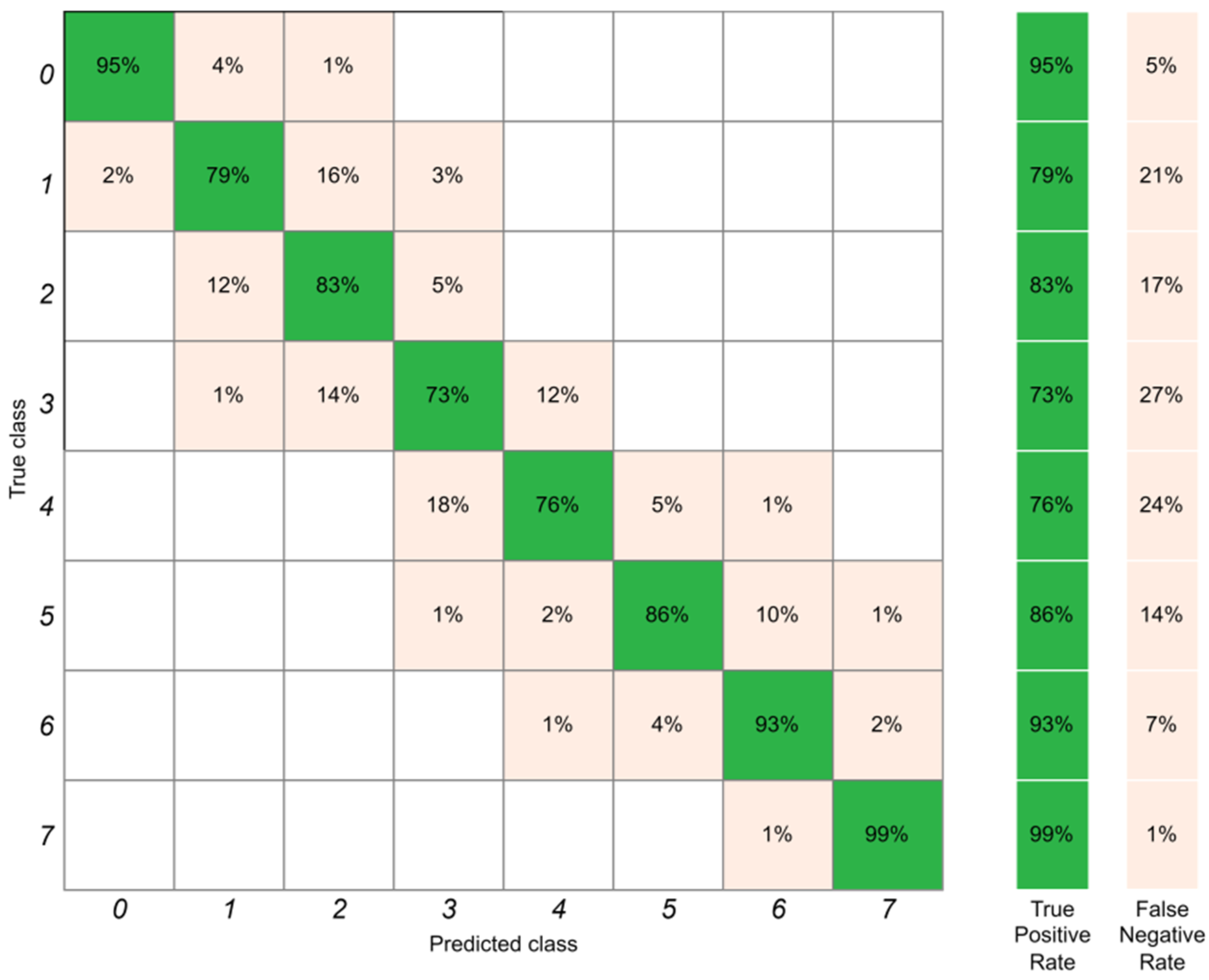
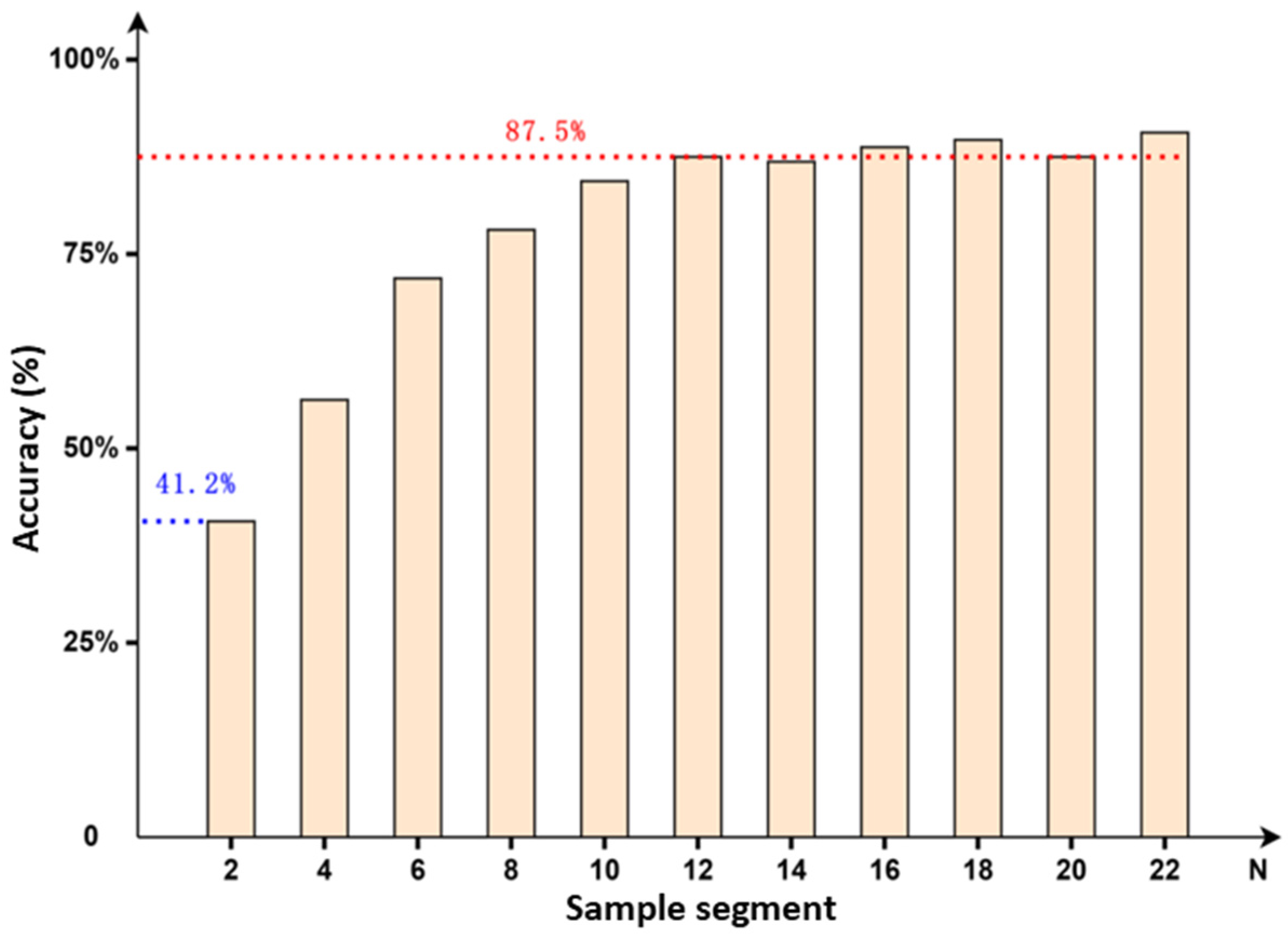
For the f a b case, i.e., fuel leakage followed by electrode delamination, the first four labels (0–3) correspond to the early fuel leakage stage, while Labels 4–7 represent the later sequential-fault stage after electrode delamination is introduced. The confusion matrix in Figure 12 shows that the diagnostic accuracies for Labels 0–3 are 95%, 79%, 83%, and 73%, respectively, corresponding to an average accuracy of 82.5% in the early single-fault stage. For Labels 4–7, the accuracies further reach 76%, 86%, 93%, and 99%, indicating that the later-stage features become increasingly distinguishable as the sequential fault deepens. The overall accuracy is 85.5% when the sample set is divided into 10 segments. Figure 13 further shows that the accuracy increases with the number of segments and reaches a stable peak of 87.5% at N = 12 . This result demonstrates that finer segmentation helps align the diagnostic model with the evolving fault pattern, but the benefit saturates once the fault progression has been sufficiently resolved.
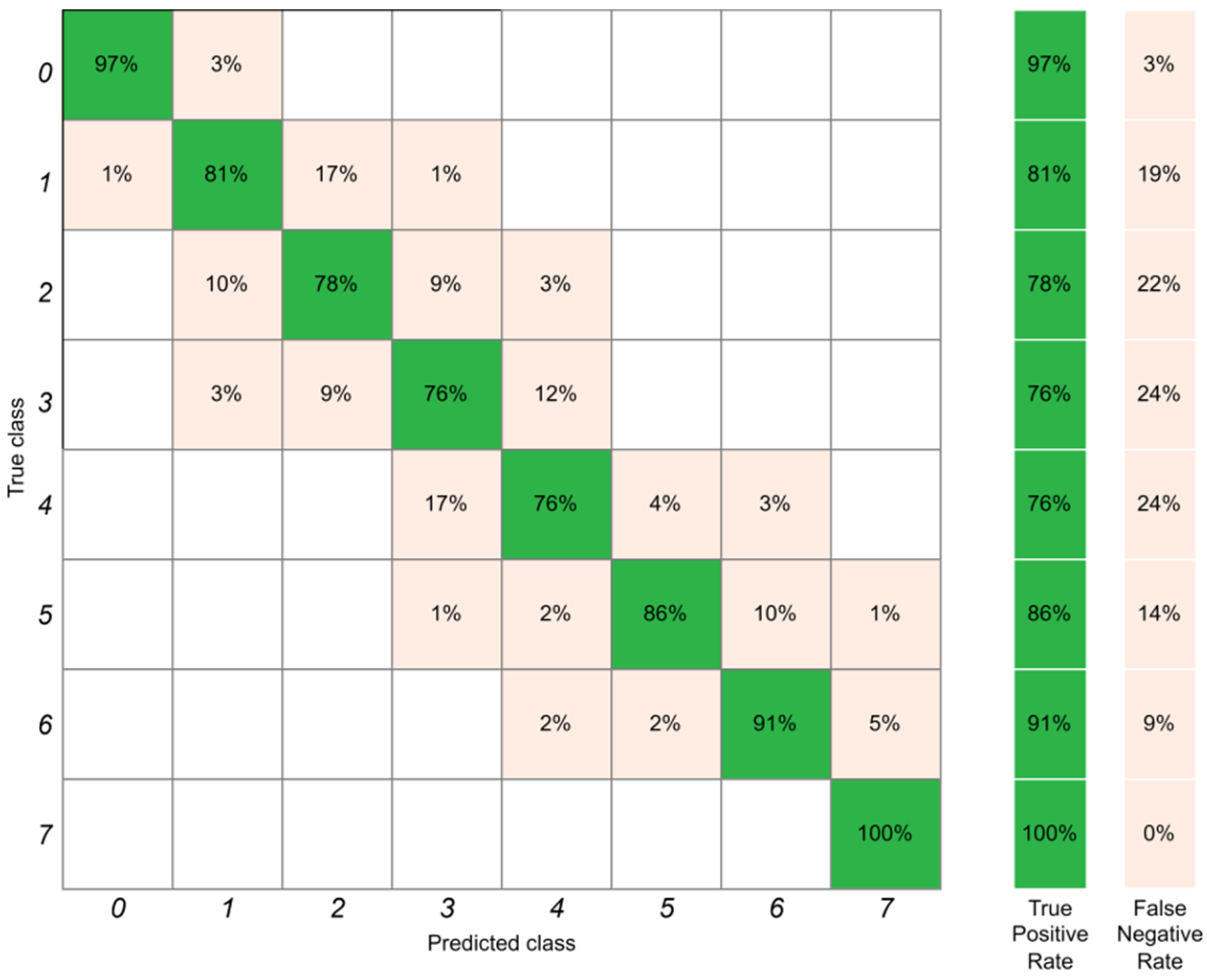
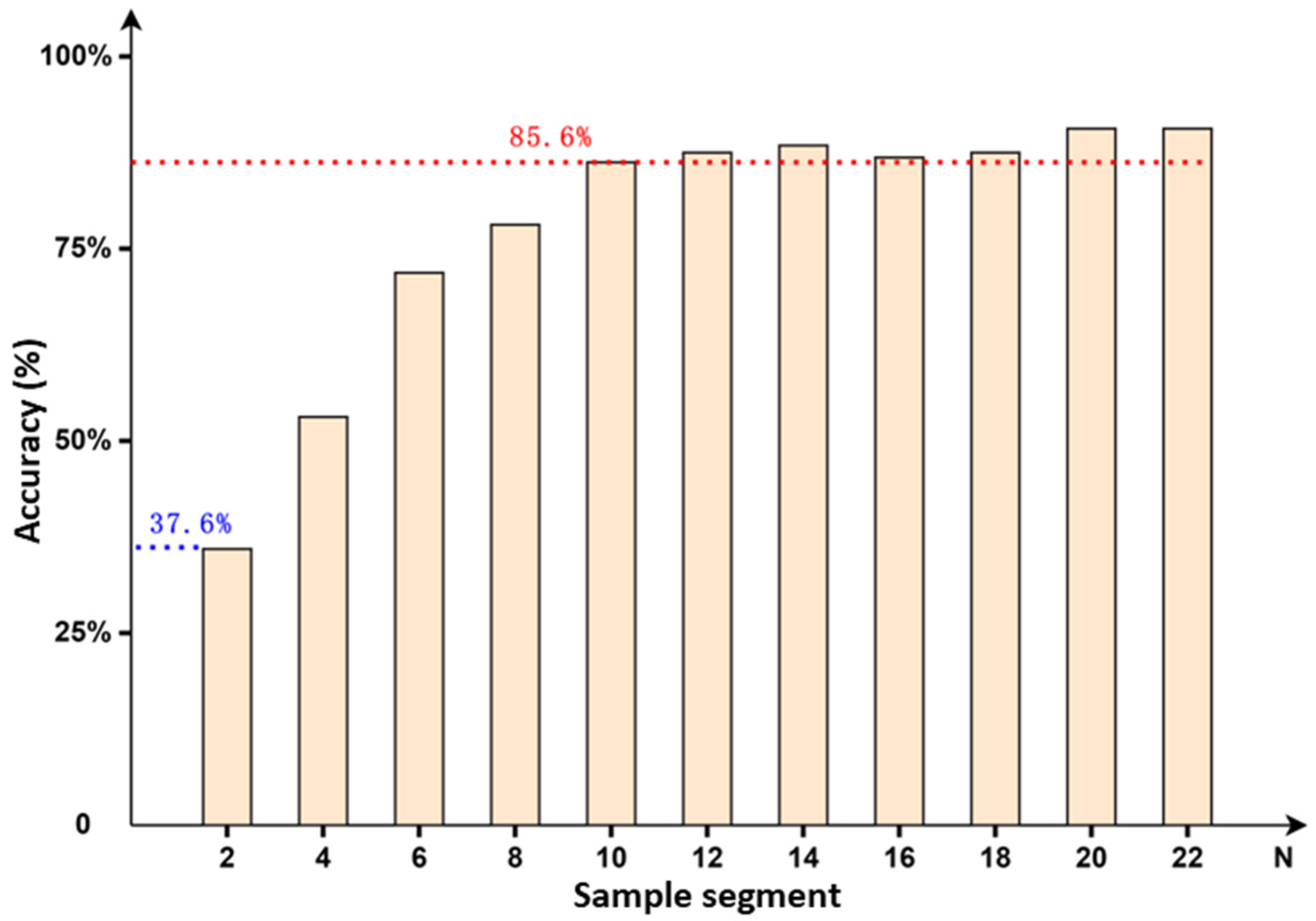
A similar trend is observed in the f b a case, i.e., electrode delamination followed by fuel leakage. As shown in Figure 14, the diagnostic accuracies for Labels 0–3 are 97%, 81%, 78%, and 76%, giving an average of 83% in the early delamination stage. For Labels 4–7, the corresponding accuracies are 76%, 86%, 91%, and 100%, again showing improved separability in the later sequential-fault stage. The overall accuracy reaches 85.6% when N = 10 , and Figure 15 indicates that this value is already close to the peak level. Further increasing the number of segments provides little additional benefit, suggesting that the characteristic transition of the f b a process can already be captured at a relatively moderate segmentation resolution.
Taken together, the results for f a b and f b a confirm that the proposed segmented strategy is effective for cross-condition diagnosis. More importantly, the optimal segmentation number is not identical for different fault sequences, which implies that sequential faults with different physical initiation orders exhibit different evolution rhythms in feature space. Although f a b and f b a involve the same two fault mechanisms, the stage-wise accuracies and optimal segmentation numbers are different, indicating that the diagnosis problem is path-dependent rather than determined only by the final fault set. This again indicates that cross-condition fault diagnosis should not be treated as a direct extension of single-condition classification.

5. Discussion

The present results demonstrate that combining mechanism-based simulation with data-driven diagnosis is an effective strategy for SOFC fault analysis under variable shipboard operating conditions. The validated dynamic model provides a physically consistent basis for generating fault data across different fault types and evolution stages, while PMDT offers a flexible classifier capable of handling the mixed monotonic and non-monotonic feature relationships commonly observed in coupled SOFC systems. This combination addresses a key limitation of purely data-driven approaches, namely their dependence on sufficiently representative labeled datasets under all possible operating conditions. In addition, comparisons with several representative baseline classifiers in two single-fault cases further support the use of PMDT in this work.
From a fault-mechanism perspective, fuel leakage causes the most severe overall performance deterioration because it directly reduces the effective fuel supply to the stack. Once the fuel molar flow, local hydrogen concentration, and inlet pressure are reduced, the electrochemical reaction intensity is weakened immediately, and the resulting degradation propagates simultaneously to current, voltage, power, and temperature fields. By contrast, electrode delamination mainly acts by reducing the effective reaction area and increasing internal transport resistance. Its influence is therefore more structural than supply-driven: the electrical output decreases significantly, but its effect on system-wide variables may develop more gradually. This distinction is important because it explains why fuel leakage tends to dominate severe-performance-loss states, whereas electrode delamination becomes especially critical in long-term degradation and in transitional fault evolution.
The compound-fault results further show that simultaneous fuel leakage and electrode delamination cannot be interpreted as a simple superposition of two single-fault signatures. In the compound-fault condition, the dominant diagnostic variables shift with severity level, and the decision tree becomes noticeably more complex than in single-fault diagnosis. This means that fault interaction not only changes the magnitude of system degradation, but also restructures the relative importance of features. In practical terms, this finding suggests that a classifier trained only on isolated faults may fail to accurately interpret feature combinations generated by concurrent faults, even when the single-fault mechanisms are individually well understood. The available baseline comparisons were conducted only for single-fault scenarios, rather than for compound faults or sequential cross-condition faults. This suggests that conventional classifiers may require specific modification or adaptation for such cases. Since the primary objective of this study is to develop a mechanism–data fusion framework for compound-fault and cross-condition diagnosis in marine SOFC systems, rather than to establish a comprehensive benchmark of classifiers across all fault scenarios, the comparison was not further extended to compound-fault cases in the present work.
The sequential-fault results provide an additional insight: the order in which faults occur matters. Accordingly, while the present study demonstrates the feasibility and effectiveness of the proposed framework, the current results should still be interpreted within the scope of simulation-based diagnosis using validated but limited experimental support. As a result, the same final fault set may lead to different trajectories in feature space depending on the initiation order. This is also why the segmented diagnostic strategy performs better than a single global classifier. By matching local models to local fault-evolution stages, the method avoids forcing one classifier to represent the entire nonlinear transition process with a single global decision boundary.
The segmented strategy also has a practical engineering implication. The increasing accuracy with larger segment number N indicates that finer stage division improves the ability to capture evolving fault characteristics. However, the eventual saturation of accuracy shows that excessive segmentation does not necessarily provide further gains. Therefore, N should be selected as a compromise between diagnostic accuracy and implementation complexity. In the present study, the best performance is achieved at N = 12 for f a b and around N = 10 for f b a , suggesting that different sequential-fault scenarios may require different temporal resolutions for optimal diagnosis.
Despite these encouraging results, several limitations remain. First, the current study is based on simulated fault datasets generated from a validated dynamic model, and although the model error is small, the realism of certain fault trajectories still depends on the assumptions embedded in the fault factors. Second, only two representative faults and their combinations were considered. Real shipboard SOFC systems may involve additional disturbances, such as reformer faults, air-path degradation, sensor drift, or control-loop abnormalities. Third, the proposed segmentation scheme is predefined rather than adaptively optimized online. Future work should therefore focus on three directions: extending the mechanism-based fault library, introducing adaptive segmentation or online model-switching strategies, and further validating the proposed framework using larger experimental datasets and multi-condition operating data under real marine load transitions, since its direct generalization to real-world shipboard applications still requires broader experimental validation.

6. Conclusions

This study developed a mechanism–data fusion framework for fault simulation and diagnosis of marine SOFC power systems under changing operating conditions. A dynamic SOFC model with integrated BOP components was established in MATLAB/Simulink based on electrochemical equations and mass/energy conservation, and the model was validated against experimental data with an error range of 0.4–2.8%.
On this basis, fuel leakage and electrode delamination were introduced as two representative faults to investigate single, compound, and sequential cross-condition scenarios. The results show that fuel leakage causes the most severe degradation in current, power, and temperature because it directly weakens the effective fuel supply and electrochemical reaction intensity. Electrode delamination mainly reduces current and power by decreasing the effective reaction area and increasing internal resistance. When these faults occur simultaneously or sequentially, their effects are not simply additive, but instead exhibit more complex interaction and evolution characteristics.
For fault diagnosis, PMDT combined with point-biserial correlation achieved good performance in both compound-fault and cross-condition tasks. The overall accuracy for simultaneous compound faults reached 88.5%. For sequential faults, the proposed segmented model-integration strategy improved the overall diagnostic accuracy to 85.5% for f a b and 85.6% for f b a , with a peak accuracy of 87.5% obtained when the sample set was properly segmented. These findings confirm that the combination of mechanism-based fault generation and segmented data-driven classification is effective for SOFC fault diagnosis under variable operating conditions.
Overall, this work provides a feasible framework for integrating physical interpretability and diagnostic adaptability in shipboard SOFC systems. However, further experimental validation and multi-condition real-world operating data are still needed before direct application to practical marine systems can be established.

Author Contributions

Writing—original draft preparation, G.L.; writing—review and editing, G.L. and X.C.; conceptualization, Z.L. and X.W.; methodology, Z.L.; software, Z.L.; validation, X.W.; formal analysis, X.C.; visualization, Z.L.; supervision, X.C.; project administration, G.L. and J.P.; funding acquisition, G.L., X.C., J.P. and X.W. All authors have read and agreed to the published version of the manuscript.

Funding

This research was funded by the earmarked fund for National Natural Science Foundation of China (No. 52501432), and the Amphibious Emergency Bridge and Ferry Equipment Project (No. 0747-2560SCCZA202).

Data Availability Statement

The datasets used in this study are available from the corresponding author upon reasonable request. They are not publicly released in order to prevent potential misuse.

Conflicts of Interest

The authors declare no conflicts of interest.

Nomenclature

The following abbreviations are used in this manuscript:
Acronyms
BOPBalance-of-plant
CDCurrent density, A cm−2
ICInterconnect
KNNk-Nearest Neighbors
LSMLanthanum strontium manganite
MFCMass flow controller
Ni–YSZNi-yttria-stabilized zirconia
PBCpoint-biserial correlation
PENPositive-Electrolyte-Negative
PMDTPartially monotone decision tree
SOFCSolid oxide fuel cell
SVMSupport Vector Machine
YSZYttria-stabilized zirconia
Symbol
A Sample set
a j Decision label
C P , a i r Constant-pressure specific heat of air, J kg−1K−1
C v Constant-volume heat capacity, J kg−1K−1
d e x x 2 Determine the standard deviation of the Gaussian function
D Decision label set with ordinal relationships
E 0 Gibbs free energy
E ˙ i n Inlet enthalpy flow rates, J s−1
E ˙ o u t Outlet enthalpy flow rates, J s−1
FABSimultaneous compound faults
f 1 Fuel leakage fault factor
f 2 Electrode delamination fault factor
f a Fuel leakage
f b Electrode delamination
f a b Fuel leakage followed by electrode delamination
f b a Electrode delamination followed by fuel leakage
k 2 Accumulated delamination effect
N Data node
N ˙ Flow rate of the control volume, mol s−1
N ˙ a i r Air flow rate, mol s−1
n ˙ i Molar flow rates of species i , mol s−1
n Number of cells
P b l , i n Inlet air pressures of the blower, Pa
P b l , o u t Outlet air pressures of the blower, Pa
p i Partial pressure of each gas species, Pa
Q ˙ b u r n Fuel heat transfer
Q ˙ c o n v Convective heat transfer
Q ˙ g e n Internal heat source term
T Temperature, K
V a c t Activation loss
V c e l l Single-cell voltage, V
V c o n c Concentration loss
V o h m Ohmic loss
V s t a c k Stack voltage, V
X Feature set
x j Feature
Greek symbols
η b l Blower efficiency
τ Specific heat ratio of air

References

  1. Israr, A.; Saadat, M.; Israr, A.; Rehman, A.; Junaid, M. Green Hydrogen Energy, Current Trends, Challenges and Future Developments. Sustain. Energy Technol. Assess. 2026, 86, 104886. [Google Scholar] [CrossRef]
  2. IRENA. Green Hydrogen Cost Reduction: Scaling Up Electrolysers to Meet the 1.5 °C Climate Goal; IRENA: Abu Dhabi, United Arab Emirates, 2020. [Google Scholar]
  3. Evrin, R.A.; Dincer, I. Thermodynamic Analysis and Assessment of an Integrated Hydrogen Fuel Cell System for Ships. Int. J. Hydrogen Energy 2019, 44, 6919–6928. [Google Scholar] [CrossRef]
  4. Wang, L.; Yu, H.; Wei, X.; Liu, H. Applications—Transportation Applications | Ships—Fuel Cells and Batteries. In Encyclopedia of Electrochemical Power Sources; Elsevier: Amsterdam, The Netherlands, 2025; pp. 280–300. [Google Scholar]
  5. Lv, X.; Hong, P.; Wen, J.; Ma, Y.; Spataru, C.; Weng, Y. Highly Efficient Operation of an Innovative SOFC Powered All-Electric Ship System Using Quick Approach for Ammonia to Hydrogen. Front. Energy 2025, 19, 365–381. [Google Scholar] [CrossRef]
  6. Mi, X.; Wen, J.; Yang, J.; Spataru, C.; Weng, Y.; Lv, X. Safety and Fast-Tracking Assessment of an Innovative SOFC/GT All-Electric Ship Propulsion System under Pulsed Load. Appl. Therm. Eng. 2025, 270, 126246. [Google Scholar] [CrossRef]
  7. Oh, D.; Cho, D.-S.; Kim, T.-W. Design and Evaluation of Hybrid Propulsion Ship Powered by Fuel Cell and Bottoming Cycle. Int. J. Hydrogen Energy 2023, 48, 8273–8285. [Google Scholar] [CrossRef]
  8. Peng, J.; Huang, J.; Wu, X.; Xu, Y.; Chen, H.; Li, X. Solid Oxide Fuel Cell (SOFC) Performance Evaluation, Fault Diagnosis and Health Control: A Review. J. Power Sources 2021, 505, 230058. [Google Scholar] [CrossRef]
  9. Xiong, X.; Yang, L.; Wu, Y.; Zheng, B.; Wang, P.; Wu, X. External Temperature Field Test and Leakage Fault Diagnosis for SOFC Stacks. Int. J. Hydrogen Energy 2023, 48, 2788–2800. [Google Scholar] [CrossRef]
  10. Liu, G.; Zhao, W.; Li, Z.; Xia, Z.; Jiang, C.; Kupecki, J.; Pang, S.; Deng, Z.; Li, X. Modeling and Control-Oriented Thermal Safety Analysis for Mode Switching Process of Reversible Solid oxide Cell System. Energy Convers. Manag. 2022, 255, 115318. [Google Scholar] [CrossRef]
  11. Cheng, J.; Lavery, R.; McCallum, C.S.; Morgan, K.; Doran, J.; Wu, C.; Sun, K.; Rooney, D.W. Crossflow Flat Solid Oxide Fuel Cell (SOFC) Semi-Empirical Modeling and the Multi-Fuel Property Based on a Commercial 700 W Stack. Fuel 2024, 358, 130172. [Google Scholar] [CrossRef]
  12. Fu, Q.; Li, Z.; Wei, W.; Liu, F.; Xu, X.; Liu, Z. Performance Degradation Prediction of Direct Internal Reforming Solid Oxide Fuel Cell Due to Ni-Particle Coarsening in Composite Anode. Energy Convers. Manag. 2021, 233, 113902. [Google Scholar] [CrossRef]
  13. Greco, A.; Sorce, A.; Littwin, R.; Costamagna, P.; Magistri, L. Reformer Faults in SOFC Systems: Experimental and Modeling Analysis, and Simulated Fault Maps. Int. J. Hydrogen Energy 2014, 39, 21700–21713. [Google Scholar] [CrossRef]
  14. Lu, Y.; Zhang, B.-X.; Chen, Z.-L.; Zhang, C.-L.; Yan, H.-Z.; Zhu, K.-Q.; Yang, Y.-R.; Wang, X.-D. Fault Diagnosis of Solid Oxide Fuel Cells Operating on Coal-Derived Syngas under Varying Operating Conditions. J. Power Sources 2026, 661, 238650. [Google Scholar] [CrossRef]
  15. Costamagna, P.; De Giorgi, A.; Magistri, L.; Moser, G.; Pellaco, L.; Trucco, A. A Classification Approach for Model-Based Fault Diagnosis in Power Generation Systems Based on Solid Oxide Fuel Cells. IEEE Trans. Energy Convers. 2016, 31, 676–687. [Google Scholar] [CrossRef]
  16. Yan, H.-Z.; Zhang, B.-X.; Chen, Z.-L.; Zhang, C.-L.; Lu, Y.; Zhu, K.-Q.; Wan, Z.-M.; Yang, Y.-R.; Wang, X.-D. Hierarchical Deep Learning-Based Fault Diagnosis of Solid Oxide Fuel Cells under High Carbon Monoxide Concentrations. J. Power Sources 2026, 676, 239730. [Google Scholar] [CrossRef]
  17. Xu, Y.; Wu, X.; Zhong, X.; Zhao, D.; Sorrentino, M.; Jiang, J.; Jiang, C.; Fu, X.; Li, X. Mechanism Model-Based and Data-Driven Approach for the Diagnosis of Solid Oxide Fuel Cell Stack Leakage. Appl. Energy 2021, 286, 116508. [Google Scholar] [CrossRef]
  18. Costamagna, P.; De Giorgi, A.; Moser, G.; Serpico, S.B.; Trucco, A. Data-Driven Techniques for Fault Diagnosis in Power Generation Plants Based on Solid Oxide Fuel Cells. Energy Convers. Manag. 2019, 180, 281–291. [Google Scholar] [CrossRef]
  19. Costamagna, P.; De Giorgi, A.; Moser, G.; Pellaco, L.; Trucco, A. Data-Driven Fault Diagnosis in SOFC-Based Power Plants under off-Design Operating Conditions. Int. J. Hydrogen Energy 2019, 44, 29002–29006. [Google Scholar] [CrossRef]
  20. Andrade, P.; Laadjal, K.; Alcaso, A.N.; Cardoso, A.J.M. A Comprehensive Review on Condition Monitoring and Fault Diagnosis in Fuel Cell Systems: Challenges and Issues. Energies 2024, 17, 657. [Google Scholar] [CrossRef]
  21. Cheng, T.; Jiang, J.; Wu, X.; Li, X.; Xu, M.; Deng, Z.; Li, J. Application Oriented Multiple-Objective Optimization, Analysis and Comparison of Solid Oxide Fuel Cell Systems with Different Configurations. Appl. Energy 2019, 235, 914–929. [Google Scholar] [CrossRef]
  22. Peters, R.; Frank, M.; Tiedemann, W.; Hoven, I.; Deja, R.; Kruse, N.; Fang, Q.; Blum, L.; Peters, R. Long-Term Experience with a 5/15kW-Class Reversible Solid Oxide Cell System. J. Electrochem. Soc. 2021, 168, 014508. [Google Scholar] [CrossRef]
  23. Lei, Z.; Wang, X.; Wang, F.; Huo, H.; Wang, B. Surrogate Modeling of a SOFC/GT Hybrid System Based on Extended State Observer Feature Extraction. Energies 2026, 19, 587. [Google Scholar] [CrossRef]
  24. Kazempoor, P.; Braun, R.J. Model Validation and Performance Analysis of Regenerative Solid Oxide Cells: Electrolytic Operation. Int. J. Hydrogen Energy 2014, 39, 2669–2684. [Google Scholar] [CrossRef]
  25. Sun, Y.; Qian, T.; Zhu, J.; Zheng, N.; Han, Y.; Xiao, G.; Ni, M.; Xu, H. Dynamic Simulation of a Reversible Solid Oxide Cell System for Efficient H2 Production and Power Generation. Energy 2023, 263, 125725. [Google Scholar] [CrossRef]
  26. Xing, X.; Lin, J.; Song, Y.; Hu, Q.; Zhou, Y.; Mu, S. Optimization of Hydrogen Yield of a High-Temperature Electrolysis System with Coordinated Temperature and Feed Factors at Various Loading Conditions: A Model-Based Study. Appl. Energy 2018, 232, 368–385. [Google Scholar] [CrossRef]
  27. Wang, C.; Chen, M.; Liu, M.; Yan, J. Dynamic Modeling and Parameter Analysis Study on Reversible Solid Oxide Cells during Mode Switching Transient Processes. Appl. Energy 2020, 263, 114601. [Google Scholar] [CrossRef]
  28. Gu, Y.; Ashar, A.; Lei, F.; Zhu, H.; Braun, R.J.; Jackson, G.S. CFD Modeling of Stack-Integrated Autothermal Reformer and Solid Oxide Fuel Cell for High-Power-Density Applications. J. Electrochem. Soc. 2026, 173, 054505. [Google Scholar] [CrossRef]
  29. Cao, H.; Li, X.; Deng, Z.; Li, J.; Qin, Y. Thermal Management Oriented Steady State Analysis and Optimization of a kW Scale Solid Oxide Fuel Cell Stand-Alone System for Maximum System Efficiency. Int. J. Hydrogen Energy 2013, 38, 12404–12417. [Google Scholar] [CrossRef]
  30. Cao, H.; Li, X.; Deng, Z.; Jiang, J.; Yang, J.; Li, J.; Qin, Y. Dynamic Modeling and Experimental Validation for the Electrical Coupling in a 5-Cell Solid Oxide Fuel Cell Stack in the Perspective of Thermal Coupling. Int. J. Hydrogen Energy 2011, 36, 4409–4418. [Google Scholar] [CrossRef]
  31. Xia, L.; Khosravi, A.; Han, M.; Sun, L. Modelica Based Hybrid-Dimensional Dynamic Modeling, Multi-Objective Optimization and Thermodynamic Analysis of Cross-Flow SOFC System. Renew. Energy 2025, 241, 122372. [Google Scholar] [CrossRef]
  32. Zhang, L.; Li, X.; Jiang, J.; Li, S.; Yang, J.; Li, J. Dynamic Modeling and Analysis of a 5-kW Solid Oxide Fuel Cell System from the Perspectives of Cooperative Control of Thermal Safety and High Efficiency. Int. J. Hydrogen Energy 2015, 40, 456–476. [Google Scholar] [CrossRef]
  33. Zhang, L.; Jiang, J.; Cheng, H.; Deng, Z.; Li, X. Control Strategy for Power Management, Efficiency-Optimization and Operating-Safety of a 5-kW Solid Oxide Fuel Cell System. Electrochim. Acta 2015, 177, 237–249. [Google Scholar] [CrossRef]
  34. Cao, H.; Deng, Z.; Li, X.; Yang, J.; Qin, Y. Dynamic Modeling of Electrical Characteristics of Solid Oxide Fuel Cells Using Fractional Derivatives. Int. J. Hydrogen Energy 2010, 35, 1749–1758. [Google Scholar] [CrossRef]
  35. Costamagna, P.; Grosso, S.; Travis, R.; Magistri, L. Integrated Planar Solid Oxide Fuel Cell: Steady-State Model of a Bundle and Validation through Single Tube Experimental Data. Energies 2015, 8, 13231–13254. [Google Scholar] [CrossRef]
Figure 1. Overall framework of the proposed mechanism-data fusion method for marine SOFC fault modeling and cross-condition diagnosis.
Jmse 14 00705 g001
Figure 2. Process flow diagram of the ship SOFC power generation system.
Jmse 14 00705 g002
Figure 3. Schematic diagram of fuel leak fault.
Jmse 14 00705 g003
Figure 4. Validation of the dynamic current response of the SOFC model, the dashed line is used as an error reference.
Jmse 14 00705 g004
Figure 5. Steady-state V-I curve validation of the SOFC model at different operating temperatures.
Jmse 14 00705 g005
Figure 6. Evolution of the fault factors f 1 and f 2 .
Jmse 14 00705 g006
Figure 7. Comparison of normal (Nor) and fault (Fault) responses of key stack variables under the fuel leakage fault.
Jmse 14 00705 g007
Figure 8. Comparison of normal (Nor) and fault (Fault) responses of key stack variables under the electrode delamination fault.
Jmse 14 00705 g008
Figure 9. Confusion matrix results under combined faults.
Jmse 14 00705 g009
Figure 10. Decision tree for diagnostic strategies under complex fault conditions.
Jmse 14 00705 g010
Figure 11. Correlation analysis of different composite fault levels. (a) 0# fault severity level; (b) 1# fault severity level; (c) 2# fault severity level; (d) 3# fault severity level.
Jmse 14 00705 g011
Figure 12. Confusion matrix results of fault f a b .
Jmse 14 00705 g012
Figure 13. Relationship between the sample segment N of fault f a b and diagnostic accuracy.
Jmse 14 00705 g013
Figure 14. Confusion matrix results of fault f b a .
Jmse 14 00705 g014
Figure 15. Relationship between the sample segment N of fault f b a and diagnostic accuracy.
Jmse 14 00705 g015
Table 1. BOP Modeling Mechanism Equation [32,33].
ComponentsGoverning Equations
Burner N ˙ C V d T d t = E ˙ i n E ˙ o u t + Q ˙ b u r n ( 6 )
n ˙ i n n ˙ o u t = n ˙ b u r n ( 7 )
Heat exchanger N ˙ C V d T d t = E ˙ i n E ˙ o u t + Q ˙ c o n v ( 8 )
Mixer N ˙ C V d T d t = E ˙ i n E ˙ o u t ( 9 )
Blower P b l = N ˙ a i r C P , a i r T a i r , i n η b l P b l , o u t P b l , i n τ 1 τ 1 ( 10 )
MFC G s = 1 T s + 1 e δ s ( 11 )
Table 2. PMDT-based fault diagnosis process.
ItemDescription
InputTraining dataset S = { X , Y } ; test dataset T = X t , Y t
OutputFault diagnosis model M and diagnosis result R for the test samples
Step 1Perform normalization and monotonicity preprocessing on the training dataset S ;
Step 2Generate the data node N using the preprocessed training dataset;
Step 3Determine the optimal split point of the current node;
Step 4If the samples at the current node belong to the same class, terminate node growth and mark it as a leaf node;
Step 5Otherwise, split the samples according to the optimal split point and generate child nodes;
Step 6Repeat Step 3–Step 5 until all nodes satisfy the stopping condition;
Step 7Perform cross-validation to obtain the final diagnosis model M ;
Step 8Normalize and monotonicize the test dataset T ;
Step 9Input T into model M to obtain the diagnosis result R ;
Step 10Save and output the diagnosis result.
Table 3. Accuracy comparison of algorithms under the fuel leak scenario.
MethodsAlgorithm AccuracyTest-Set Accuracy
PMDT98.7%95.4%
KNN87.2%79.1%
SVM72.7%71.6%
Logistic Regression82.3%81.6%
Naive Bayes63.2%54.9%
Table 4. Accuracy comparison of algorithms under the electrode delamination scenario.
MethodsAlgorithm AccuracyTest-Set Accuracy
PMDT89.3%84.2%
KNN76.5%69.5%
SVM54.2%49.6%
Logistic Regression72.6%69.4%
Naive Bayes66.5%64.1%
Table 5. Basic parameters of the SOFC.
ParametersValues
Number of cells130
Width of cell active area0.1 m
Length of cell active area0.1 m
Thickness of fuel electrode channel0.001 m
Thickness of air electrode channel0.001 m
Thickness of fuel electrode0.0003125 m
Fuel electrode materialsNi-YSZ
Thickness of air electrode0.0000175 m
Air electrode materialsYSZ
Thickness of electrolyte0.0000125 m
Electrolyte materialsLSM-YSZ
Thickness of interconnect0.001 m
Interconnect materialsCrofer22APU
Density of interconnect9000 kg m−3
Fuel electrodes electrical conductivity80,000 Ω 1 m 1
Electrolyte electrical conductivity33,400 Ω 1 m 1
Air electrodes electrical conductivity8400 Ω 1 m 1
Table 6. Critical parameters of the heat exchanger and the blower.
ParametersValues
Heat exchanger
Convection coefficient between shell and gas0.5 kW m−2 K−1
Convection coefficient between air tube and adjacent gases1 kW m−2 K−1
Tube density9000 kg m−3
Shell density9000 kg m−3
Tube specific heat capacity0.62 J kg−1 K−1
Shell specific heat capacity0.62 J kg−1 K−1
Blower
Specific heat capacity1004 J kg−1 K−1
Radio of the specific heats of the air1.4
Blower efficiency49%
Table 7. Operating conditions of the stack tests for steady-state V-I validation.
TemperatureH2/H2OH2 Flow RateAir Flow RateAir Flow RateCD Limit
973 K1/015 SLPM45 SLPM\0.25 A cm−2
1023 K3/515 SLPM45 SLPM25 SLPM0.25 A cm−2
1073 K1/015 SLPM45 SLPM\0.25 A cm−2
Disclaimer/Publisher’s Note: The statements, opinions and data contained in all publications are solely those of the individual author(s) and contributor(s) and not of MDPI and/or the editor(s). MDPI and/or the editor(s) disclaim responsibility for any injury to people or property resulting from any ideas, methods, instructions or products referred to in the content.