Article

Coproparasitological Survey of Stranded Cetaceans on Portugal’s Mainland Coastline

by
André Lobão
1,2,3,*,
Mariana Louro
1,2,4,
João Lozano
1,2,
Isabel Pereira da Fonseca
1,2,
Jacinto Gomes
1,2,5,6,
Catarina Eira
7,
Marisa Ferreira
8 and
Luís Madeira de Carvalho
1,2,*
1
CIISA—Centre for Interdisciplinary Research in Animal Health, Faculty of Veterinary Medicine, University of Lisbon, Avenida da Universidade Técnica, 1300-477 Lisbon, Portugal
2
Associate Laboratory for Animal and Veterinary Sciences (AL4AnimalS), 1300-477 Lisbon, Portugal
3
Veterinary Histology and Pathology, Atlantic Center for Cetacean Research (CAIC), University Institute of Animal Health and Food Safety (IUSA), Veterinary School, University of Las Palmas de Gran Canaria (ULPGC), Trasmontaña S/N, 35413 Arucas, Canary Islands, Spain
4
Laboratório de Parasitologia, Instituto Nacional de Investigação Agrária e Veterinária (INIAV), 2780-157 Oeiras, Portugal
5
VALORIZA—Research Centre for Endogenous Resources Valorization, Polytechnic Institute of Portalegre, 7300-555 Portalegre, Portugal
6
Elvas School of Biosciences, Polytechnic Institute of Portalegre, 7350-092 Portalegre, Portugal
7
Department of Biology & CESAM & ECOMARE, Aveiro University, 3810-193 Aveiro, Portugal
8
Marine Animal Tissue Bank (MATB), Portuguese Wildlife Society (SPVS), Estação de Campo de Quiaios, 3081-101 Figueira da Foz, Portugal
*
Authors to whom correspondence should be addressed.
J. Mar. Sci. Eng. 2026, 14(6), 562; https://doi.org/10.3390/jmse14060562
Submission received: 13 February 2026 / Revised: 14 March 2026 / Accepted: 16 March 2026 / Published: 18 March 2026
(This article belongs to the Special Issue Parasitology of Marine Animals)

Abstract

Parasitism affects nearly half of all animal species and strongly influences ecosystem dynamics. Despite their sentinel value, parasitic infections in cetaceans remain understudied. This study assessed the diversity, prevalence, and burden of gastrointestinal and pulmonary parasites in seventy-five stranded cetaceans from six species along the central and northern Portuguese coastline. Coprological methods included Mini-FLOTAC®, Willis-flotation, natural sedimentation, modified Ziehl–Neelsen staining, direct immunofluorescence, and adapted spontaneous sedimentation. Overall, 61.3% of samples tested positive for at least one parasitic taxon, with 22.7% showing coinfections. Anisakidae and Ascaridida were the most prevalent (36%), followed by Pseudaliidae larvae (5.3%), unidentified trematode eggs (8.0%), Odhneriella spp. (5.3%), Nasitrema spp. (2.7%), Zalophotrema spp. (2.7%), and Synthesium spp. (1.3%). Nematode eggs exhibited the highest mean burden, with anisakids reaching 4862 eggs per gram of feces (EPG), whereas trematodes showed a markedly lower burden, exemplified by Zalophotrema spp. with 90 EPG. All samples assessed were negative for Cryptosporidium spp. and Giardia spp. Unidentified ovoid structures were present in 76% of samples. Macroscopic sedimentation revealed anisakid larvae, one cestode, over fifty Ogmogaster antarctica specimens, and six marine arthropods. These findings provide baseline data for cetacean parasitology and support future integrative research for conservation and ecosystem health.

1. Introduction

Parasitism is one of the most successful forms of biological interaction in nature. The vast majority of metazoans engage in parasitic relationships with other organisms, and it is estimated that approximately one-third to one-half of all existing species on Earth are parasites [1,2]. For these reasons, they are a crucial part of the biosphere, infecting various species and influencing host health, food web dynamics, population structures, and ultimately the overall health of ecosystems [3]. At present, information regarding parasitism in cetaceans remains limited, most likely due to the challenges associated with sample collection, as most of these individuals inhabit exclusively free-ranging marine environments. However, in recent years, the accumulation of knowledge and the rapid development of technology have enabled the study of the ecology, pathology, and parasitology of these species. Through underwater expeditions, it has been possible to deepen our understanding of cetacean behavior, as well as to collect fecal and vomit samples, which, through coprological and molecular methods, have enriched knowledge of the gastroenteric and pulmonary helminth fauna of these species [4]. The processing of stranded carcasses along coastal areas also provides a multidisciplinary approach to studying the biology of these animals [5,6,7]. The first reports of helminth research in cetaceans date back to the period when whaling was a legal and socially accepted practice in most parts of the world [8]. More recently, the study of helminths in cetaceans has become possible through post-mortem examinations of stranded [9] and captured animals [10]. Over the last decade, the development of new techniques has enabled the identification of helminths through the collection of fecal samples from wild cetaceans [4,11]. Currently, it is known that cetaceans harbor a rich diversity of helminths, comprising 174 different species, mostly belonging to the phylum Nematoda (n = 62 species; families Pseudaliidae, Anisakidae, Tetrameridae, and Crassicaudidae), followed by digenean trematodes (n = 54 species; families Brauninidae, Brachycladiidae, Notocotylidae, and Heterophyidae), cestodes (n = 38 species; order Tetrabothriidea, and families Diphyllobothriidae and Phyllobothriidae), and acanthocephalans (n = 20 species; mostly of the genera Corynosoma and Bolbosoma) [12]. Cryptosporidium spp. and Giardia spp. are enteric protozoan parasites commonly associated with significant diarrheal disease in a broad range of mammalian hosts. Although their biology and epidemiology are well characterized in terrestrial systems, their occurrence, transmission routes and ecological dynamics in marine environments remain insufficiently explored [13]. Most available information for marine mammals, concerns pinnipeds, and data for cetaceans is still limited. To date, based on molecular genotyping and epifluorescence microscopy, Giardia spp. have been reported in ten cetacean species (Balaena mysticetus, Eubalaena glacialis, Kogia breviceps, Balaenoptera acutorostrata, Stenella coeruleoalba, Phocoena phocoena, Grampus griseus, Delphinus delphis, Lagenorhynchus acutus and Sotalia guianensis), whereas Cryptosporidium spp. have been documented in seven species (Balaena mysticetus, Eubalaena glacialis, Kogia breviceps, Tursiops truncatus, Stenella coeruleoalba, Phocoena phocoena and Delphinus delphis) [13].
The role of parasitic diseases in cetacean stranding events remains a controversial subject; however, parasites can and should be regarded as potential agents responsible for debilitation and mortality [14]. Free-ranging cetaceans, including whales and dolphins, are regarded as sentinels of the marine ecosystem due to their longevity, migratory behavior, trophic position, and ability to transport anthroponotic agents, making them valuable indicators of marine pollution, ecological change, and anthropogenic stress [15]. The increasing interest in these species has led to the development of new sampling methodologies. Intensive monitoring allows the collection of fecal samples during diving, with consistency varying by species, season, and diet; semi-solid feces can be retrieved with fine-mesh nets, while liquid samples may be collected by trained divers [4]. Non-invasive approaches include the collection of regurgitated material, which complements fecal sampling [4], and blow samples, which contain bacteria, fungi, viruses, and helminth stages. These can be obtained with extendable poles [16] or, more recently, unmanned aerial vehicles (UAVs) equipped with sterile Petri dishes [17]. Although in recent years there has been significant progress in methodologies for sample collection and the study of cetaceans, most of the scientific knowledge published in protozoology and helminthology of these species is still derived from the study of stranded carcasses, animals killed by humans through whaling or incidental capture/bycatch, and captive individuals.
The present study combined qualitative and quantitative coprological diagnosis techniques to assess gastrointestinal (GI) and pulmonary parasitic diversities, prevalence, and burdens in seventy-five cetacean carcasses from six different species stranded along the central and northern coasts of Portugal.

2. Materials and Methods

2.1. Sampling Procedures

During the first semester of 2023, a total of 65 fecal samples were collected from 65 stranded cetacean carcasses along the central and northern Portuguese coast. The collections were carried out by authorized technicians belonging to the regional North stranding network (coordinated nationally by the “Instituto da Conservação da Natureza e das Florestas”, (ICNF). All samples were subsequently stored at −20 °C in the Marine Animal Tissue Bank (MATB) (license 13PT1023/S). The MATB is a joint project between the “Sociedade Portuguesa de Vida Selvagem” (SPVS) and the University of Aveiro. Additionally, 10 samples collected and stored by the same entities in 2016, 2017, 2019, and 2022, preserved under the same storage conditions, were also included in the project, thus totalizing 75 fecal samples from 75 cetacean carcasses.
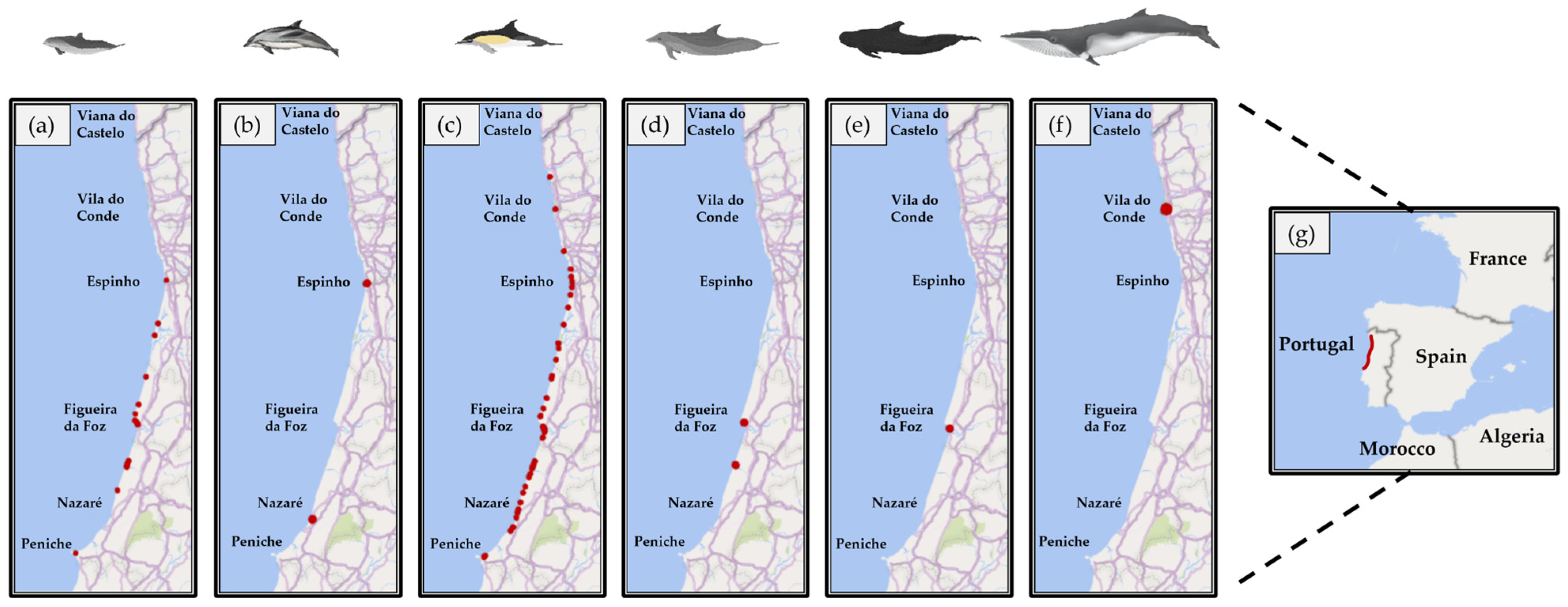
Stranding occurred along the northern and central Portuguese coast, between Viana do Castelo (41°38.4′ N; 8°49.2′ W) and Peniche (39°21.7′ N; 9°22.1′ W) (Figure 1). Samples were subsequently transported to the Laboratory of Parasitology and Parasitic Diseases of the Faculty of Veterinary Medicine of the University of Lisbon (LPDP-FMV-ULisbon), where they were processed and analyzed. The study encompassed a variety of species, including: common dolphin, Delphinus delphis (n = 50 specimens); striped dolphin, harbor porpoise, Phocoena phocoena (n = 18); Stenella coeruleoalba (n = 3); bottlenose dolphin, Tursiops truncatus (n = 2); long-finned pilot whale, Globicephala melas (n = 1); and a single mysticete species, the minke whale, Balaenoptera acutorostrata (n = 1).

2.2. Coprological Diagnosis Techniques

2.2.1. “3-in-1” Coprological Technique

All samples were analyzed using a comprehensive “3-in-1” protocol that incorporated three distinct techniques carried out sequentially, including Mini-FLOTAC® (University of Naples Federico II, Naples, Italy) (MF), Willis -flotation (WF) and Natural Sedimentation (NS), from the same fecal suspension [18,19].
Each fecal sample was firstly processed using the MF protocol for exotic animals [20] briefly, two grams of feces were homogenized with 38 mL of sucrose solution (relative density 1.2) using the Fill-FLOTAC® (University of Naples Federico II, Naples, Italy) device, and then transferred to a Mini-FLOTAC® counting chamber, which was used to identify parasitic forms and count their shedding, with a multiplication factor of 10 eggs per gram of feces (EPG).
The remaining fecal suspension in the Fill-FLOTAC® device was transferred to a 10 mL test tube to simultaneously perform the WF and NS techniques, with the first technique consisting of placing a coverslip on a convex meniscus for 15 min to allow less dense parasitic forms to float and adhere to it, while the second technique involved the use of the sediment to search for heavier parasitic forms, by mixing it with methylene blue to increase contrast [20,21,22]. Slides from the WF and NS techniques were visualized under an optical microscope, at 100× and 400× total magnifications. The identification of Nematoda and trematode eggs in the analyzed samples was carried out using reference morphological descriptions documented in scientific literature, worldwide [4,8,16,23,24,25,26,27], to ensure accurate differentiation and identification of each parasite group, maintaining consistency with recognized standards in parasitological diagnostics.

2.2.2. Modified Ziehl-Neelsen Stain (MZN)

This method was used to identify Cryptosporidium spp. oocysts in all fecal samples. After homogenizing each sample, a swab was used to prepare a smear on a glass slide, which dried for at least 24 h before MZN staining [28]: the smear was treated with methanol for one minute, then stained with three to four drops of fuchsin for ten minutes and finally washed in tap water; decolorization was done with 1% hydrochloric alcohol for 1–2 s, rinsed, and counterstained with 0.4% malachite green for 3 min, and finally rinsed in tap water. Slides were air-dried and examined under an optical microscope at 1000× magnification, using immersion oil, to search for Cryptosporidium spp. oocysts, with a nearly round shape (2–6 μm in diameter) and stained with fuchsin [28,29].

2.2.3. MERIFLUOR® Cryptosporidium/Giardia—Direct Immunofluorescence (DIF)

The MERIFLUOR® Cryptosporidium/Giardia kit (Meridian Bioscience, Inc., Cincinnati, OH, USA) utilizes DIF to detect Cryptosporidium spp. oocysts and Giardia spp. cysts in fecal samples. This procedure followed the protocols from Meridian Bioscience® (2019) and previous research from Louro et al. [29,30]: briefly, filtered fecal material was applied to a DIF slide with a Pasteur pipette, ensuring no scratches occurred; this process was repeated for controls and other samples; after air-drying, detection reagent and counterstain were added, mixed, and incubated for 30 min in a humid chamber; the slide was then rinsed, excess buffer blotted, and mounting medium applied with a coverslip placed on top; finally, the slide was examined under an optical microscope, OLYMPUS BX50 (Olympus Corporation, Tokyo, Japan), with FITC filters at 100× and 200× total magnifications [29].

2.2.4. Adapted Spontaneous Sedimentation (ASSed)

After performing the remaining parasitological methods, the container holding each sample was washed with tap water, and the suspension was transferred to a conical beaker. Following suspension’s natural sedimentation, the supernatant was discarded and the water volume in the container was replenished. The suspension was allowed to sediment again. This procedure was repeated until the supernatant was clear and translucent. Finally, the clear supernatant was discarded, and the sediment was placed in a Petri dish for observation under a stereomicroscope, Olympus SZ30-ST (Olympus Corporation, Tokyo, Japan), at 9–40× magnifications [31].
Nematode larvae identification was based on established morphological descriptions available in the scientific literature [32]. Similarly, adult trematode specimens were identified using published morphological characteristics detailed in previous studies [27,33,34].

2.2.5. Data Analysis

All data were stored and processed using Microsoft® Excel® for Microsoft 365 (Microsoft Corporation, Redmond, WA, USA, 2024). The software was employed to calculate the prevalence of different taxa and to estimate parasite burden in terms of eggs or larvae per gram of feces (EPG or LPG, respectively), including mean, minimum, and maximum values. This software was also used to calculate morphometric parameters of parasitic eggs and to generate a parasite prevalence graph, and the stranding distribution map by plotting geographical coordinates of each stranded event.

3. Results

3.1. Overall Parasite Prevalence Across Cetacean Species

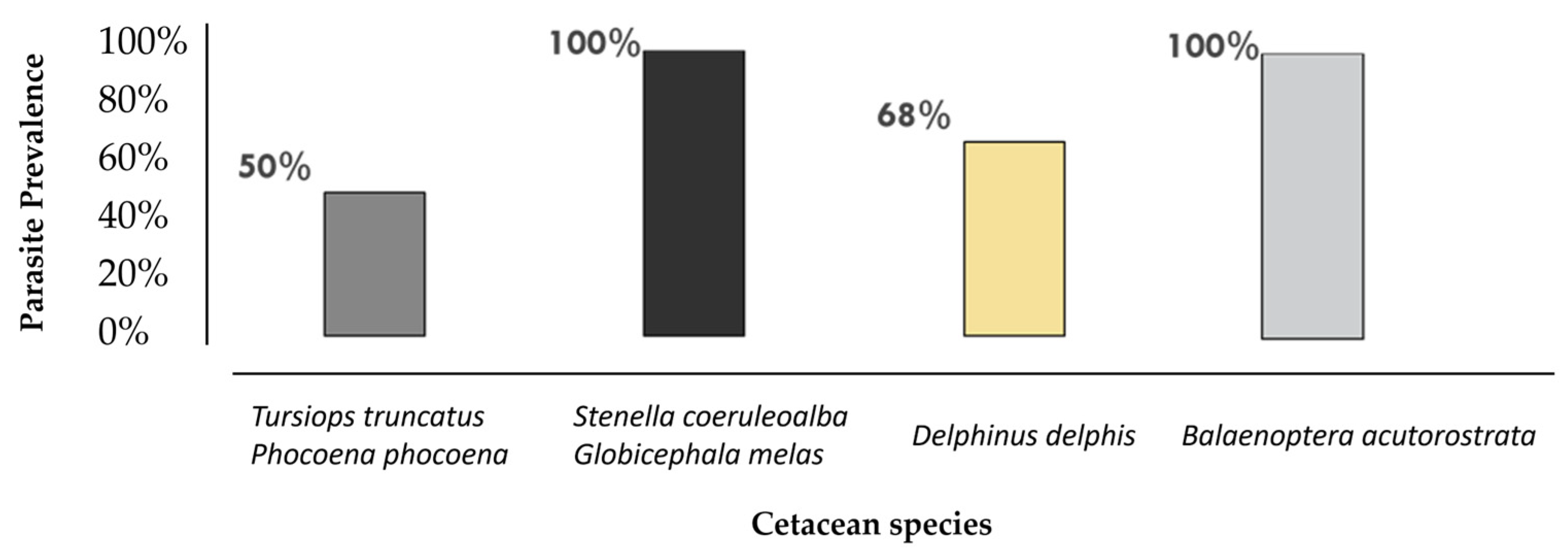
Odontocetes showed a positivity rate of 60.8% (45/74) for at least one parasite taxon, with Stenella coeruleoalba (3/3) and Globicephala melas (1/1) representing the highest frequency of positive cases (100%), followed by Delphinus delphis individuals (68.0%, 34/50), and Tursiops truncatus (1/2) and Phocoena phocoena (9/18) showed 50% positivity. Mysticetes were represented by a single individual, the minke whale Balaenoptera acutorostrata, which showed a positivity rate of 100% (1/1) (Figure 2).
In our analysis, we found that 61.3% (46 out of 75) of the processed samples tested positive for at least one of the parasitological methods used. Among the positive samples, 37.0% (17 out of 46) exhibited coinfection with at least two different taxa, which corresponds to 22.7% (17 out of 75) of the total samples. In contrast, 63.0% (29 out of 46) of the positive samples presented single infections, representing 38.7% (29 out of 75) of the total samples.

3.2. Prevalence and Diversity of Different Taxa

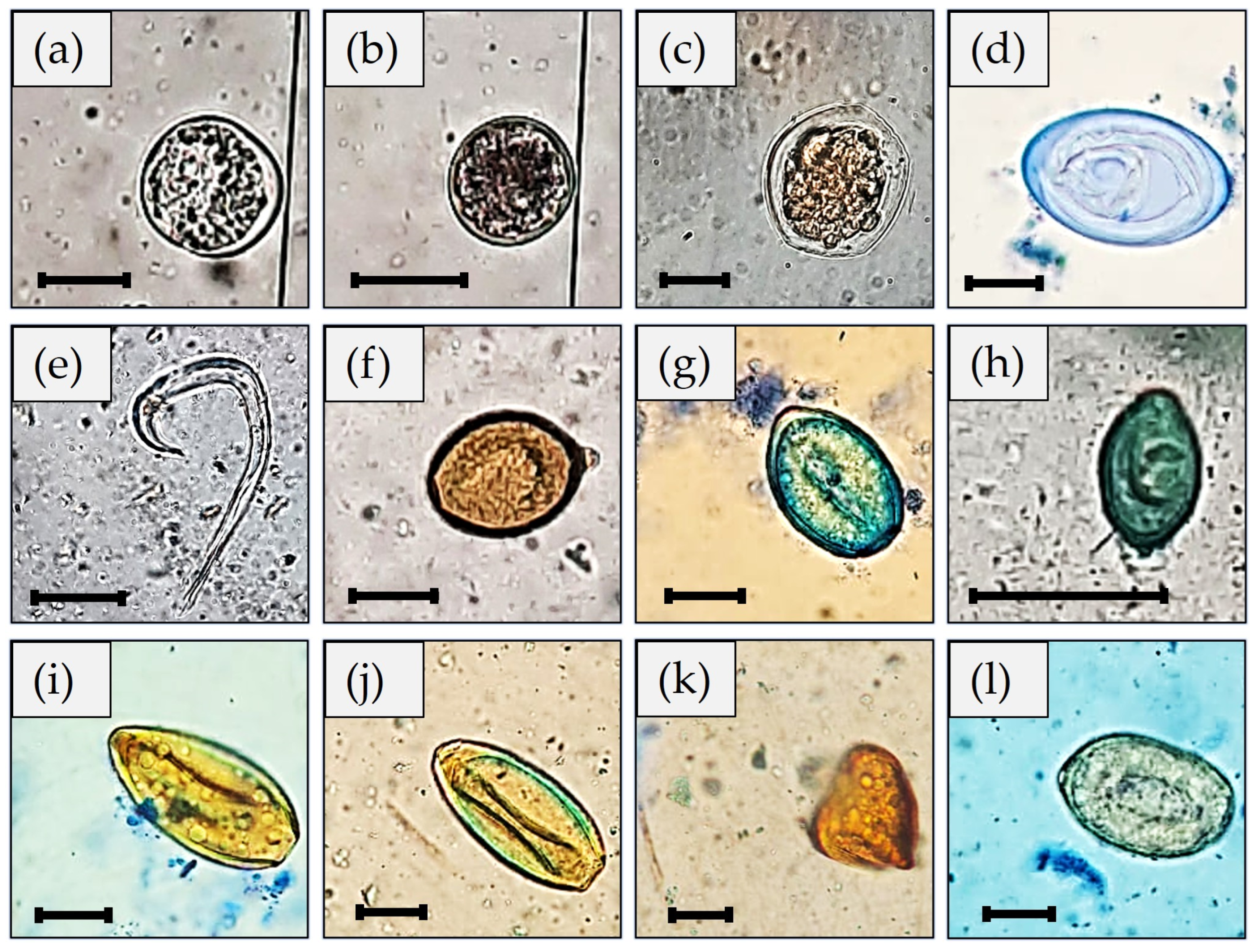
Helminth eggs belonging to the family Anisakidae and the order Ascaridida showed the highest prevalence, both with 36.0% (27/75), followed by larval forms belonging to the family Pseudaliidae, superfamily Metastrongyloidea, with 5.3% (4/75). This family represents the sole respiratory parasite lineage identified in this study. Nematode eggs containing larvae whose genus could not be identified were also found in 1.3% (1/75) of the samples. The class Trematoda was represented mostly by the presence of unidentified trematode eggs (8.0%, 6/75), followed by Odhneriella spp. (5.3%, 4/75), Nasitrema spp. (2.7%, 2/75), Zalophotrema spp. (2.7%, 2/75), and Synthesium spp. (1.3%, 1/75) (Figure 3).
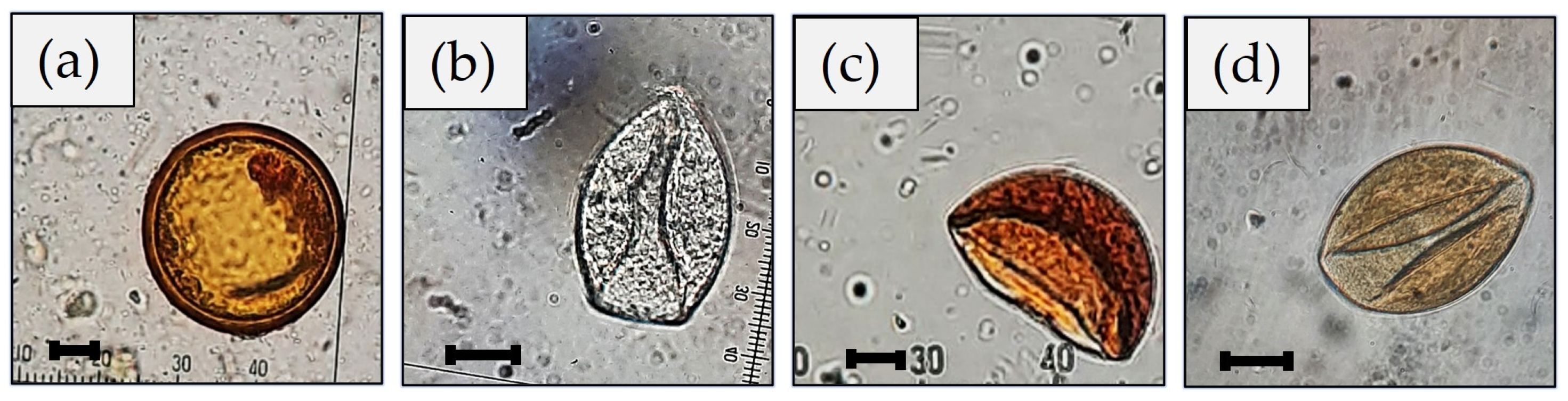
Unidentified ovoid structures were observed in 76.0% of the processed samples. These structures were classified into four distinct groups based on their distinct morphological characteristics. Indeterminate ovoid structures of groups 1, 2, 3, and 4 were present in 4.0%, 26.7%, 14.7%, and 2.7% of the samples, respectively (Figure 4).
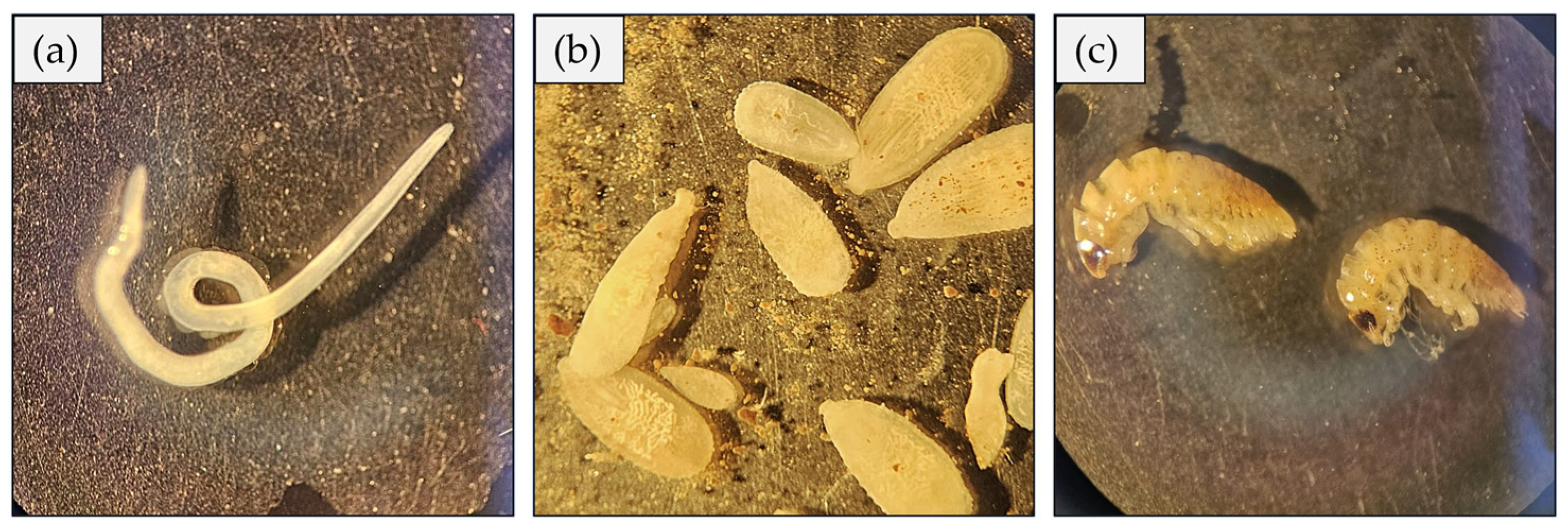
Moreover, it was possible to macroscopically isolate 28 anisakids, Anisakidae and Raphidascarididae individuals, with a prevalence of 14.7% (11/75), one indeterminate cestode (1.3%, 1/75), and more than 50 trematodes of the species Ogmogaster antarctica in a single sample at 1.3% (1/75). In addition, six marine arthropods belonging to the phylum Isopoda, superfamily Cymothoidea, were isolated in 5.3% (4/75) of the samples (Figure 5).
Finally, all samples tested negative for Cryptosporidium spp. oocysts and Giardia spp. cysts using both the MZN staining and the DIF methods.

3.3. Helminth Egg Morphological Characterization

Helminth eggs belonging to the Anisakidae family had a spherical shape, with variable coloration ranging from light to dark, embryonated, and with a thin shell.
Eggs belonging to the Order Ascaridida, were morphologically very similar to those of the Anisakidae family, though slightly more elongated, embryonated, and with a thin shell.
The eggs of Odhneriella spp. were oval and truncated at the operculated end, and exhibited a triangular profile when viewed in cross-section.
The eggs of Nasitrema spp. were oval and operculated, like other trematode eggs, and appeared golden against a blue background when stained with methylene blue.
The eggs of Synthesium spp. had an elongated ovoid shape and were truncated at the operculated end, had a thick shell and, like the eggs of Odhneriella spp., showed a triangular profile in cross-section.
The eggs of Zalophotrema spp. were ovoid, with one truncated end, one operculated end, and a brownish coloration.
Finally, the eggs of the digenean trematode Ph. gastrophilus were operculated, and had a bluish coloration due to methylene blue staining; these eggs were considerably smaller than those of the other trematodes described. A summarized overview of helminth egg morphological measurements is provided in Table 1.

3.4. Estimation of GI Helminth Load

Anisakid eggs were found in all six cetacean species studied, with an average of 4862 EPG, representing the taxonomic group with the highest mean values. The minimum and maximum egg shedding range also showed the greatest variation, with an amplitude of 10–23,970 EPG. Eggs belonging to the order Ascaridida were found in three of the six cetacean species, D. delphis, Ph. phocoena, and B. acutorostrata. In the case of specimens from the family Pseudaliidae, unlike the other taxa, only larval forms were identified. This taxon was identified in two cetacean species, D. delphis and Ph. phocoena, with a mean value of 1982 LPG, and a range between 10 and 5030 LPG.
Moreover, trematode egg shedding was much lower than that of nematodes. Among the seven genera of digenetic trematodes identified, Zalophotrema spp. showed the highest mean, with 90 EPG (amplitude: 40–140 EPG). The mean shedding for Odhneriella spp. and the unidentified trematode eggs was 80 EPG, with ranges between 30 and 120 EPG, and no variation, respectively. Nasitrema spp. showed the lowest mean, with 40 EPG. In the case of Synthesium sp., Ph. gastrophilus, and O. antarctica, no eggs of these taxa were detected using the Mini-FLOTAC® method. Unidentified ovoid structures were observed in four of the six cetacean species, namely D. delphis, Ph. phocoena, S. coeruleoalba, and B. acutorostrata. As previously mentioned, these parasitic forms were divided into four different groups (1–4), which averaged 23, 221, 120, and 555 EPG, respectively, with an amplitude of 10–1860 EPG (Table 2).

4. Discussion

The current research represented a comprehensive coprological analysis of GI and pulmonary parasites in stranded cetaceans in Portugal, with 10 different helminth taxa and 1 isopod taxon identified in 75 fecal samples from six cetacean species, thus reflecting considerable parasite diversity. The overall prevalence in odontocetes was 60.8%, with the highest values recorded in S. coeruleoalba, G. melas, and in the mysticete B. acutorostrata, all showing 100% parasite prevalence. These values should, however, be interpreted with caution, as they derived from very small sample sizes (1/1 for G. melas and B. acutorostrata, or 3/3 for S. coeruleoalba), limiting their biological interpretability and serving primarily descriptive purposes rather than robust comparative inference. The high rate of coinfections, 22.7%, further suggests a complex parasite—host interaction, likely reflecting cumulative exposure to multiple infectious agents in the marine environment and highlighting the ecological pressures acting on these cetacean populations.
Several eggs and larvae belonging to the phylum Nematoda were identified and isolated, including eggs from the Anisakidae family, larvae from the Anisakidae and Raphidascarididae families, eggs from the Order Ascaridida, and L1 pulmonary larvae from the Pseudaliidae family, which showed the highest prevalence among all identified taxa. The Anisakidae family showed a mean egg shedding of 4865 EPG, with a remarkable maximum of 23,970 EPG, while the Order Ascaridida presented a mean of 253 EPG and a maximum of 1750 EPG. The Anisakidae and Raphidascarididae families, both belonging to the Order Ascaridida and included in the Superfamily Ascaridoidea, are known for their high egg production [35]. This characteristic may significantly increase the likelihood of egg detection through conventional coprology, which, in turn, may explain the marked contrast in prevalence and parasite burden estimates when compared to other taxa. Moreover, adult Hysterothylacium incurvum (Raphidascarididae) have been documented in the same region, infecting different host species, which further supports the parasite’s local presence and ecological relevance [36].
All samples were analyzed using a comprehensive “3-in-1” protocol that incorporated three distinct techniques carried out sequentially, including Mini-FLOTAC® (MF), Willis flotation (WF), and Natural Sedimentation (NS), using the same fecal suspensions. This sequential structure was designed to target parasitic forms with different physical properties and flotation capacities, thereby reducing the likelihood of false negatives inherent to any single coprological method. Within this framework, the combined and sequential application of MF and WF played a particularly important role in maximizing diagnostic sensitivity. MF provides both qualitative and quantitative information within a controlled analytical volume, while the WF offers an additional qualitative assessment. Using both methods, therefore increases the likelihood of detecting parasitic structures with lower densities, ultimately improving the robustness and reliability of the coprological evaluation.
The presence of Pseudaliidae L1 larvae in cetacean feces can be explained by the life cycle of these parasites, since L1 larvae move up from the lower respiratory tract into the bronchi, trachea, and pharynx, and then are swallowed in the GI tract and ultimately passed out in the host’s feces. Its presence provides additional confirmation of the life cycle typical of specimens belonging to this family [37].
Although eggs of Synthesium spp., Ph. gastrophilus, and O. antarctica were detected using the WF and NS methods with sucrose solution, they were not identified by the MF technique, and thus it was not possible to estimate their egg shedding, which can be explained by the typical high density of trematode eggs, exceeding that of the sucrose solution used in the method (relative density 1.2). Accordingly, discrepancies in trematode EPG counts obtained through the MF procedure were already expected. Moreover, the low prevalence and low egg counts observed for trematodes may reflect a high number of false negatives resulting from prepatent infections, infections by single-sex helminths in dioecious species, intermittent egg shedding, species with low egg production (<10 EPG for MF), or cases of low parasite burden [15]. In the case of Ph. gastrophilus, the host’s immune response reacts to adult parasites by forming fibrotic nodules in the gastric wall, as an attempt to isolate them. These nodules are typically connected to the gastric lumen by narrow ducts through which eggs are expelled [12]. In some cases, large quantities of eggs are found grouped in voluminous masses within the fibrotic gastric nodules, even in the absence of adult parasites [38]. These conditions may impair the excretion of eggs in feces, as the fibrotic gastric nodules create a physical barrier that hinders their passage. Consequently, our results likely represent a conservative estimate of prevalence, underscoring that in cetacean medicine a negative coprological examination does not definitively exclude gastric trematodosis.
Regarding cestode identification, only a single specimen belonging to this class, also part of the phylum Platyhelminthes, was identified. The specimen was isolated using spontaneous sedimentation and was in poor preservation condition, thus compromising its genus-level identification. Cestodes are relevant to the helminth burden in cetaceans, being represented by three families—Tetrabothriidae, Diphyllobothriidae, and Phyllobothriidae—and a total of 38 species [12]. However, no eggs or mature proglottids were detected in the fecal samples. The irregular distribution of gravid proglottids in the intestine and feces, a characteristic of Platyhelminthes from the order Cyclophyllidea, may hinder the detection of these elements in a single fecal sample [15].
All samples tested negative for the detection of Cryptosporidium spp. and Giardia spp., both by MZN staining and DIF methods. The immunofluorescence kit MERIFLUOR® Cryptosporidium/Giardia has a noteworthy performance concerning several analytical parameters, namely a sensitivity of 100% and specificity of 99% for Cryptosporidium spp., and sensitivity and specificity of 100% for Giardia spp., allowing a complementary confirmation or refutation of the results obtained using the MZN staining. In the case of the immunofluorescence method, a negative result makes the presence of infection highly unlikely, minimizing the possibility of false negatives and suggesting that the animal is indeed not infected with these parasites. The high reliability of the test (specificities of 99–100%) indicates that the probability of false positives is very low for Cryptosporidium spp. and null for Giardia spp., further supporting the trustworthiness of the negative results. Given the high performance of the method, a negative result might mislead the reader into assuming that the test virtually confirms the absence of Cryptosporidium spp. and Giardia spp. in the analyzed host. For that matter, it is important to consider other factors. The absence of detection of certain parasites does not necessarily indicate their absence in the host or even in a broader host cetacean population, but may instead reflect a statistical limitation inherent to the small sample size. Factors such as sample quality, timing of collection, and biological variability among individuals can significantly influence the likelihood of detecting infections, particularly those with low prevalence or intermittent shedding [39]. There is consistent evidence that molecular genotyping detects a higher number of positive samples for Giardia spp. and Cryptosporidium spp. compared with immunofluorescence microscopy [40].
While our DIF results suggest a current absence of Cryptosporidium spp. and Giardia spp., this finding should be interpreted within the framework of the spill-over hypothesis, as the lack of detection along the Portuguese coast may reflect limited terrestrial-to-marine fecal contamination in the stranding areas sampled during the study period. At the same time, this pattern may also be explained by methodological and biological factors, as the low number of oocysts/cysts in many samples and the intermittent shedding characteristic of these parasites can reduce the likelihood of detection [13].
To the best of current knowledge, Giardia spp. have been identified in ten cetacean species, four of which are represented in this study (B. acutorostrata, S. coeruleoalba, Ph. phocoena, and D. delphis). Cryptosporidium spp. have been documented in seven species, likewise, including four examined species (T. truncatus, S. coeruleoalba, Ph. phocoena, and D. delphis) [13]. Consequently, negative microscopic results should be interpreted with caution, as non-detection does not preclude the presence of these protozoan parasites in the species analyzed. Future studies incorporating larger and more diverse sample sets, together with molecular approaches, are essential to achieve a more accurate assessment of the occurrence of these protozoan pathogens.
During the use of microcoprological methods, various structures may be mistakenly identified as helminth eggs due to morphological similarities. These structures, also referred to as pseudoparasites or artifacts, often correspond to plant cells, pollen grains, starch granules, air bubbles, or fungal spores [22]. In this study, unidentified ovoid structures were observed in 76% of the analyzed samples, which may or may not correspond to helminth eggs. Due to the uncertainty in identifying these structures and to avoid significant interpretative errors, they were not classified as helminth eggs. Thus, accurate identification of these structures requires further investigation, namely using molecular methods.
Although specimens from the superfamily Cymothoidea were identified, their presence was interpreted as an incidental finding rather than true parasitism. These dorsoventrally flattened isopods can be found in the gills, mouth, external surface, or within the muscle tissue of various marine fish species [41]. Thus, their presence in cetacean feces likely reflects trophic transfer, arising from the consumption of fish hosts parasitized by these isopods.
It is important to consider an implicit sampling bias, as the samples were obtained from stranded and deceased individuals. This bias arises from the fact that the sample set is composed of potentially diseased animals, which may distort the observed parasitic distribution. Consequently, the data obtained may not accurately reflect the prevalence and parasite burden in healthy cetacean populations. In addition, the samples were stored at −20 °C for prolonged periods, in some cases up to seven years, which may have altered the structural integrity of certain parasite eggs and consequently modified their original density. Such changes could reduce their flotation efficiency and overall detectability, thereby affecting both prevalence estimates and EPG values. To the best of author knowledge, no published studies have specifically characterized the morphological effects of freezing at −20 °C on helminth eggs. However, this interpretation is supported by our microscopic observations. During the examination of tube-sedimentation smears, some eggs appeared internally stained with methylene blue and others showed morphological deformation, suggesting compromised eggshell permeability associated with long-term freezing. This work provides detailed helminth egg morphometric parameters, establishing a robust diagnostic framework that serves as a reference standard for future comparative parasitological analyses in marine systems.

5. Conclusions

To the authors best knowledge, this was the first study in Portugal to target a comprehensive coprological analysis of GI and pulmonary parasites in stranded cetaceans. The application of a multi-technique protocol enabled the identification of 10 helminth taxa and 1 isopod taxon, with nematodes—particularly Anisakidae and Pseudaliidae—showing the highest prevalence and parasitic burden. Although trematodes exhibited greater taxonomic diversity, their estimated burden was limited by methodological constraints and biological factors. The absence of Cryptosporidium spp. and Giardia spp. across all samples, confirmed by both MZN and immunofluorescence techniques, suggests a low prevalence or absence of these protozoa in the studied population. The frequent observation of unidentified ovoid structures reflects the interpretative challenges of coprological diagnostics in cetaceans and warrants further investigation to clarify their nature and epidemiological relevance. Importantly, the reliance on stranded individuals introduces a sampling bias that may overrepresent parasitic burden compared to healthy populations.
Future research should integrate molecular diagnostics and histopathological approaches to enhance taxonomic resolution and clarify the ecological and pathological roles of helminths in cetacean health and stranding events. As sentinels of the sea, the parasitic profiles of stranded cetaceans serve as biological indicators of the health of the Iberian Atlantic ecosystem. The baseline data generated within this study support monitoring shifts in marine food webs and anthropogenic pressures, providing a vital tool for conservation efforts within the North Atlantic Marine Mammal framework.

Author Contributions

Conceptualization, A.L., M.L., J.L., C.E. and L.M.d.C.; methodology, A.L., M.L. and J.L.; software, A.L.; validation, M.L., J.L., I.P.d.F., J.G. and L.M.d.C.; formal analysis, A.L.; investigation, A.L.; resources, M.L., J.L., I.P.d.F., J.G., C.E., M.F. and L.M.d.C.; data curation, A.L.; writing—original draft preparation, A.L.; writing—review and editing, M.L., J.L. and L.M.d.C.; visualization, A.L., M.L. and J.L.; supervision, L.M.d.C.; project administration, L.M.d.C.; funding acquisition, M.L., J.L., I.P.d.F., J.G., C.E., M.F. and L.M.d.C. All authors have read and agreed to the published version of the manuscript.

Funding

This research was funded by national funds through FCT—Foundation for Science and Technology, I.P., within the scope of the projects CIISA—UIDB/00276/2020 and UID/276/2025, and AL4AnimalS—LA/P/0059/2020, as well as by the PhD research fellowships 2020.09037.BD (doi:10.54499/2020.09037.BD) and UI/BD/152818/2022 (doi:10.54499/UI/BD/152818/2022), previously owned by João Lozano and Mariana Louro, respectively. The stranding network was partially supported by the Fundo Ambiental program of the Portuguese Ministry of the Environment and Energy. CESAM was funded by national funds through FCT—Foundation for Science and Technology, I.P., project CESAM—Centro de Estudos do Ambiente e do Mar, UID/50017/2025 (doi.org/10.54499/UID/50017/2025) and LA/P/0094/2020 (doi.org/10.54499/LA/P/0094/2020).

Institutional Review Board Statement

Ethical review and approval were waived for this study because the presented work involves research with stranded dead animals. All stranding network technicians involved in sampling have a license to capture, handle, transport, mark and collect samples of wild fauna specimens in mainland Portugal under the terms of decree-laws 140/99, 49/2005 156-a/2013 and decree-law 316/89. These licenses are issued by the national Instituto da Conservação da Natureza e Florestas, ICNF.

Data Availability Statement

The original contributions presented in this study are included in the article. Further inquiries can be directed to the corresponding author.

Acknowledgments

The authors would like to acknowledge ICNF, MATB, SPVS, CESAM/UA and CBMA/UM, and their staff, as well as the staff of LPPD-FMV-ULisbon, for all the support provided during this research.

Conflicts of Interest

The authors declare no conflicts of interest.

Abbreviations

The following abbreviations are used in this manuscript:
µmmicrometer
ASSedAdapted Spontaneous Sedimentation Method
DIFDirect immunofluorescence
EPGeggs per gram of feces
FITCFluorescein isothiocyanate filter set
GIgastrointestinal
LPDP-FMV-ULisbonLaboratory of Parasitology and Parasitic Diseases of the Faculty of Veterinary Medicine of the University of Lisbon
LPGlarvae per gram of feces
MATBMarine Animal Tissue Bank
MFMini-FLOTAC®
MZNModified Ziehl-Nelsen stain
NSNatural Sedimentation
SPVSSociedade Portuguesa de Vida Selvagem
WFWillis-Flotation

References

  1. Loreau, M.; Roy, J.; Tilman, D. Parasitism & Ecosystems. In Parasitism & Ecosystems; Fréderic, T., Renaud, F., Guégan, J.-F., Eds.; Oxford University Press: New York, NY, USA, 2005; pp. 13–21. [Google Scholar]
  2. Loker, E.; Hofkin, B. Parasitology A Conceptual Approach; Owen, E., Divakaran, D., Lucas, G., Eds.; Garland Science, Taylor & Francis Group, LLC: New York, NY, USA; London, UK, 2015; Volume II. [Google Scholar]
  3. Hudson, P.J.; Dobson, A.P.; Lafferty, K.D. Is a Healthy Ecosystem One That Is Rich in Parasites? Trends Ecol. Evol. 2006, 21, 381–385. [Google Scholar] [CrossRef] [PubMed]
  4. Kleinertz, S.; Hermosilla, C.; Ziltener, A.; Kreicker, S.; Hirzmann, J.; Abdel-Ghaffar, F.; Taubert, A. Gastrointestinal Parasites of Free-Living Indo-Pacific Bottlenose Dolphins (Tursiops aduncus) in the Northern Red Sea, Egypt. Parasitol. Res. 2014, 113, 1405–1415. [Google Scholar] [CrossRef]
  5. Morimitsu, T.; Nagai, T.; Ide, M.; Kawano, H.; Naichuu, A.; Koono, M.; Ishii, A. Mass Stranding of Odontoceti Caused by Parasitogenic Eighth Cranial Neuropathy. J. Wildl. Dis. 1987, 23, 586–590. [Google Scholar] [CrossRef]
  6. Leonardi, M.S.; Grandi, M.F.; García, N.A.; Svendsen, G.; Romero, M.A.; González, R.; Crespo, E.A. A Stranding of Balaenoptera borealis (Lesson 1828) from Patagonia, Argentina, with Notes on Parasite Infestation and Diet. Afr. J. Mar. Sci. 2011, 33, 177–179. [Google Scholar] [CrossRef]
  7. Oliveira, J.B.; Morales, J.A.; González-Barrientos, R.C.; Hernández-Gamboa, J.; Hernández-Mora, G. Parasites of Cetaceans Stranded on the Pacific Coast of Costa Rica. Vet. Parasitol. 2011, 182, 319–328. [Google Scholar] [CrossRef]
  8. Muniz-Pereira, L.C.; Vicente, J.J.; Noronha, D. Helminths Parasites of Whales in Brazil. Rev. Bras. Zool. 1999, 2, 249–252. [Google Scholar] [CrossRef]
  9. Pinto, R.M.; Muniz-Pereira, L.C.; Alves, V.C.; Siciliano, S. First Report of a Helminth Infection for Bryde’s Whale Balaenoptera edeni Anderson, 1878 (Cetacea, Balaenopteridae). Lat. Am. J. Aquat. Mamm. 2004, 3, 167–170. [Google Scholar] [CrossRef]
  10. Raga, J.A.; Aznar, F.J.; Balbuena, J.A. Hadwenius pontoporiae Sp.n. (Digenea: Campulidae) from the Intestine of Franciscana (Cetaceae: Pontoporiidae) in Argentinian Waters. J. Helminthol. Soc. Wash. 1994, 61, 45–49. [Google Scholar]
  11. Hermosilla, C.; Silva, L.M.R.; Kleinertz, S.; Prieto, R.; Silva, M.A.; Taubert, A. Endoparasite Survey of Free-Swimming Baleen Whales (Balaenoptera musculus, B. physalus, B. borealis) and Sperm Whales (Physeter macrocephalus) Using Non/Minimally Invasive Methods. Parasitol. Res. 2016, 115, 889–896. [Google Scholar] [CrossRef]
  12. Fraija, N. Digeneans of Cetaceans: Diversity, Evolutionary History and Host Specificity. Ph.D. Thesis, Facultad de Ciencias Biológicas de la Universidad de Valencia, Valencia, Spain, 2016. [Google Scholar]
  13. Reboredo-Fernández, A.; Ares-Mazás, E.; Martínez-Cedeira, J.A.; Romero-Suances, R.; Cacciò, S.M.; Gómez-Couso, H. Giardia and Cryptosporidium in Cetaceans on the European Atlantic Coast. Parasitol. Res. 2015, 114, 693–698. [Google Scholar] [CrossRef]
  14. Dailey, M.; Stroud, R. Parasites and associated pathology observed in cetaceans stranded along the Oregon coast. J. Wildl. Dis. 1978, 14, 503–511. [Google Scholar] [CrossRef] [PubMed]
  15. Marcer, F.; Cassini, R.; Parisotto, N.; Tessarin, C.; Marchiori, E. A Comparative Study of Mini-FLOTAC With Traditional Coprological Techniques in the Analysis of Cetacean Fecal Samples. Front. Vet. Sci. 2022, 9, 908486. [Google Scholar] [CrossRef]
  16. Hermosilla, C.; Silva, L.M.R.; Prieto, R.; Kleinertz, S.; Taubert, A.; Silva, M.A. Endo- and Ectoparasites of Large Whales (Cetartiodactyla: Balaenopteridae, Physeteridae): Overcoming Difficulties in Obtaining Appropriate Samples by Non- and Minimally-Invasive Methods. Int. J. Parasitol. Parasites Wildl. 2015, 4, 414–420. [Google Scholar] [CrossRef] [PubMed]
  17. Costa, H.; Rogan, A.; Zadra, C.; Larsen, O.; Rikardsen, A.H.; Waugh, C. Blowing in the Wind: Using a Consumer Drone for the Collection of Humpback Whale (Megaptera novaeangliae) Blow Samples during the Arctic Polar Nights. Drones 2023, 7, 15. [Google Scholar] [CrossRef]
  18. Lozano, J.; Almeida, C.; Victório, A.C.; Melo, P.; Rodrigues, J.P.; Rinaldi, L.; Cringoli, G.; Gomes, L.; Oliveira, M.; Paz-Silva, A.; et al. Implementation of Mini-Flotac in Routine Diagnosis of Coccidia and Helminth Infections in Domestic and Exotic Birds. Vet. Sci. 2021, 8, 160. [Google Scholar] [CrossRef]
  19. Vale, C.; Lozano, J.; Reisinho, A.; Louro, M.; Oliveira, M.; Cunha, E.; Lopes, P.; Gomes, L.; Madeira de Carvalho, L. Gastrointestinal Parasites, Ectoparasites, and Fungi in Rabbits Attending Clinical Consultations and from Private Owners and Breeders in Portugal. Microorganisms 2025, 13, 2146. [Google Scholar] [CrossRef]
  20. Cringoli, G.; Maurelli, M.P.; Levecke, B.; Bosco, A.; Vercruysse, J.; Utzinger, J.; Rinaldi, L. The Mini-FLOTAC Technique for the Diagnosis of Helminth and Protozoan Infections in Humans and Animals. Nat. Protoc. 2017, 12, 1723–1732. [Google Scholar] [CrossRef]
  21. Lozano, J.; Pombo, C.; Salmo, R.; Cazapal-Monteiro, C.; Arias, M.S.; Carvalho, D.; Lordelo, M.; Batista, A.; Bernardino, R.; Rinaldi, L.; et al. Testing Mini-FLOTAC for the Monitorization of Gastrointestinal Parasitic Infections in Birds Kept at Four Iberian Zoological Institutions. J. Zool. Bot. Gard. 2024, 5, 294–304. [Google Scholar] [CrossRef]
  22. Thienpont, D.; Rochette, F.; Vanparijs, O.F.J. Diagnosing Helminthiasis by Coprological Examination, 3rd ed.; Janssen Animal Health: Beerse, Belgium, 2003. [Google Scholar]
  23. Field, C.L. Parasitic Diseases of Marine Mammals. Exotic and Laboratory Animals—MSD Veterinary Manual. Available online: https://www.msdvetmanual.com/exotic-and-laboratory-animals/marine-mammals/parasitic-diseases-of-marine-mammals (accessed on 26 August 2023).
  24. Balbuena, J.A.; Raga, J.A.; Abril, E. Redescription of Odhneriella subtila (Skrjabin, 1959) (Digenea: Campulidae) from the Intestine of GIobicephala melaena (Tram, 1809) (Cetacea: Delpltinidae) off the Faroe Islands (North-East Atlantic). Syst. Parasitol. 1989, 14, 31–36. [Google Scholar] [CrossRef]
  25. Dailey, M. Diagnostic Key to the Parasites of Some Marine Mammals; Naval Ocean Systems Center: San Diego, CA, USA, 1980; Available online: https://www.researchgate.net/publication/235071755_Diagnostic_Key_to_the_Parasites_of_Some_Marine_Mammals (accessed on 23 April 2024).
  26. Ebert, M.B.; Mülller, M.I.; Marigo, J.; Valente, A.L.S.; Cremer, M.J.; da Silva, R.J. A New Synthesium Species (Digenea: Brachycladiidae) from the Bottlenose Dolphin Tursiops truncatus (Cetacea: Delphinidae) in Southwestern Atlantic Waters. Parasitol. Res. 2017, 116, 1443–1452. [Google Scholar] [CrossRef] [PubMed]
  27. Rolbiecki, L.; Izdebska, J.N.; Pawliczka, I. Digenetic Trematode Ogmogaster antarcticus (Notocotylidae) in a Fin Whale Balaenoptera physalus (Balaenopteridae) Stranded in the Baltic Sea. Dis. Aquat. Org. 2019, 132, 143–149. [Google Scholar] [CrossRef] [PubMed]
  28. Casemore, D.P.; Armstrong, M.; Sandst, R.L. Laboratory Diagnosis of Cryptosporidiosis. J. Clin. Pathol. 1985, 38, 1337–1341. [Google Scholar] [CrossRef] [PubMed]
  29. Louro, M.; Bexiga, R.; da Fonseca, I.P.; Gomes, J. Detection and Molecular Characterization of Cryptosporidium spp. in Dairy Calves in Lisbon and Tagus Valley, Portugal. Vet. Parasitol. Reg. Stud. Rep. 2023, 47, 100964. [Google Scholar] [CrossRef]
  30. Meridian Bioscience. Merifluor® Cryptosporidium/Giardia Test Procedure; Manufacturer’s protocol; Meridian Bioscience: Cincinnati, OH, USA, 2019. [Google Scholar]
  31. Borges, J.C.G.; Lima, V.F.S.; da SILVA, E.M.; Lima, D.D.S.; Marmontel, M.; Carvalho, V.L.; Faustino, M.A.D.G.; Cringolli, G.; Rinaldi, L.; Alves, L.C. Use of the FLOTAC Technique as a New Coproparasitological Diagnostic Method in Aquatic Mammals and Comparison with Traditional Methods. An. Acad. Bras. Cienc. 2022, 94, e20201184. [Google Scholar] [CrossRef]
  32. Grabda, J. Studies On The Life Cycle and Morphogenesis of Anisakis simplex (Rudolph, 1809) (Nematoda: Anisakidae) Cultured In Vitro. Acta Ichthyol. Piscat. 1976, 6, 119–141. [Google Scholar] [CrossRef]
  33. Ebert, M.B.; Marigo, J.; Guilherme, N.G.; Cremer, M.J.; José Da Silva, R. Ogmogaster antarctica (Digenea: Notocotylidae) Infecting a Dwarf Minke Whale Balaenoptera acutorostrata (Cetartiodactyla: Balaenopteridae) from the Southwestern Atlantic Ocean. Biologia 2020, 75, 1983–1990. [Google Scholar] [CrossRef]
  34. Malatesta, T.; Frati, R.; Cerioni, S.; Agrimi, U.; di Guardo, G. Ogmogaster antarcticus Johnston, 1931 (Digenea: Notocotylidae) in Balaenoptera physalus (L.): First Record in the Mediterranean Sea. Syst. Parasitol. 1998, 40, 63–66. [Google Scholar] [CrossRef]
  35. Flores-Cascante, L.; Gómez-Gutiérrez, J.; Gómez del Prado-Rosas, M.d.C.; Gendron, D. Helminth Load in Feces of Free-Ranging Blue and Fin Whales from the Gulf of California. Acta Parasitol. 2019, 64, 625–637. [Google Scholar] [CrossRef]
  36. de Benedetto, G.; Corti, I.; Malandra, R.; Riolo, K.; Giannetto, A.; Gaglio, G. Unusual Localization of Hysterothylacium incurvum in Xiphias gladius (Linnaeus 1758) Caught in the Atlantic Ocean. Pathogens 2022, 11, 1315. [Google Scholar] [CrossRef]
  37. Measures, L.N. Lungworms Of Marine Mammals. In Parasitic Diseases of Wild Mammals; Samuel, W., Pybus, M., Kocan, A., Eds.; Wiley: Hoboken, NJ, USA, 2001; pp. 279–300. [Google Scholar] [CrossRef]
  38. Hrabar, J.; Bocina, I.; Kurilj, A.G.; Duras, M.; Mladineo, I. Gastric Lesions in Dolphins Stranded along the Eastern Adriatic Coast. Dis. Aquat. Org. 2017, 125, 125–139. [Google Scholar] [CrossRef] [PubMed]
  39. Ferreira-Sá, L.C.E.; Machado, E.R.; Gurgel-Gonçalves, R.; Abad-Franch, F. Disentangling the Effects of Intermittent Faecal Shedding and Imperfect Test Sensitivity on the Microscopy-Based Detection of Gut Parasites in Stool Samples. PLOS Negl. Trop. Dis. 2024, 18, e0012719. [Google Scholar] [CrossRef] [PubMed]
  40. de Araújo, R.S.; Aguiar, B.; Dropa, M.; Razzolini, M.T.P.; Sato, M.I.Z.; de Souza Lauretto, M.; Galvani, A.T.; Padula, J.A.; Matté, G.R.; Matté, M.H. Detection and Molecular Characterization of Cryptosporidium Species and Giardia Assemblages in Two Watersheds in the Metropolitan Region of São Paulo, Brazil. Environ. Sci. Pollut. Res. 2018, 25, 15191–15203. [Google Scholar] [CrossRef] [PubMed]
  41. Smit, N.J.; Bruce, N.L.; Hadfield, K.A. Global Diversity of Fish Parasitic Isopod Crustaceans of the Family Cymothoidae. Int. J. Parasitol. Parasites Wildl. 2014, 3, 188–197. [Google Scholar] [CrossRef] [PubMed]
Figure 1. Distribution map of cetacean stranding locations along the northern-central coastline of mainland Portugal; (a) Phocoena phocoena; (b) Stenella coeruleoalba; (c) Delphinus delphis; (d) Tursiops truncatus; (e) Globicephala melas; (f) Balaenoptera acutorostrata; (g) Georeferenced depiction of the stranding zone, delineated in red. Maps are generated by Microsoft Excel® software; cetacean’s avatars are downloaded from Google images.
Jmse 14 00562 g001
Figure 2. Parasite prevalence detected in each cetacean species included in this study (S. coeruleoalba, n = 3; G. melas, n = 1; D. delphis, n = 50; T. truncatus, n = 2; Ph. phocoena, n = 18 and B. acutorostrata, n = 1).
Jmse 14 00562 g002
Figure 3. Morphological traits of helminth eggs and L1 larvae. (a,b) Anisakidae family; (c) Ascaridida Order; (d) Pseudaliidae egg with larvae; (e) Pseudaliidae L1 larvae; (f) Zalophotrema spp.; (g) Nasitrema spp.; (h) Pholeter gastrophilus; (i) Synthesium spp.; (j,k) Odhneriella spp. eggs in lateral and transverse views, respectively; (l) unidentified Trematode; scale bars 30 µm (original photos).
Jmse 14 00562 g003
Figure 4. Undetermined ovoid structures: (a) Undet.1; (b) Undet.2; (c) Undet.3 (d) Indet.4; scale bars 30 µm; all structures were identified through WF technique (original photos).
Jmse 14 00562 g004
Figure 5. Stereomicroscopical view of nematodes, trematodes and isopods. (a) Anisakidae specimen; (b) multiple Ogmogaster antarctica specimens; (c) two isopods’ specimens (original photos).
Jmse 14 00562 g005
Table 1. Summarized Helminth Egg Morphological Measurements (µm).
Helminth Taxa
AnisakidaeAscarididaOdhneriella spp.Nasitrema spp.Synthesium spp.Zalophotrema spp.Pholeter
gastrophilus
Mean L49.163.193.757.486.662.124.7
SV L5.02.82.24.33.42.40.9
Min L40.060.090.052.082.060.023.0
Max L55.067.596.063.792.065.026.0
Mean W46.955.144.741.246.242.214.8
SV W4.04.82.31.81.02.51.0
Min W40.048.041.038.045.039.013.0
Max W55.060.049.043.048.045.016.4
Ratio L:W1.01.22.11.41.91.51.7
SV L:W0.10.10.10.10.10.10.1
Min L:W1.01.01.941.31.81.31.6
Max L:W1.21.32.21.52.01.61.8
L—egg length; Max—maximum value; Min—minimum value; SV—standard deviation; W—egg width.
Table 2. Helminths’ quantitative data recorded for the cetaceans included in this study, using the Mini-FLOTAC® method.
GroupHelminth
Taxa
Mini-FLOTAC®
(EPG)
MeanAmplitude
NematodaAnisakidae4865(10–23,970)
Ascaridida253(10–1750)
Pseudaliidae larvae1982 1(10–5030) 1
TrematodaNasitrema spp.40(40–40)
Odhneriella spp.80(40–120)
Trematode (Indet.)80(80–80)
Synthesium spp.0-
Pholeter gastrophilus0-
Zalophotrema spp.90(40–140)
Ogmogaster antarctica0-
UnidentifiedIndet.123(10–50)
ovoidIndet.2221(10–1860)
structuresIndet.3120(10–690)
Indet.4555(40–1070)
Amplitude—values (minimum–maximum); EPG—eggs per gram of feces; 1—larvae per gram of feces (LPG).
Disclaimer/Publisher’s Note: The statements, opinions and data contained in all publications are solely those of the individual author(s) and contributor(s) and not of MDPI and/or the editor(s). MDPI and/or the editor(s) disclaim responsibility for any injury to people or property resulting from any ideas, methods, instructions or products referred to in the content.