Article

Coastline Changes and Driving Forces Based on Remotely Sensed Data in Bohai Bay over the Past 20 Years


1
School of Architecture, Tianjin University, Tianjin 300072, China
2
School of Marine Science and Technology, Tianjin University, Tianjin 300072, China
3
Sanya Oceanographic Laboratory, Sanya 572025, China
*
Author to whom correspondence should be addressed.
J. Mar. Sci. Eng. 2026, 14(11), 962; https://doi.org/10.3390/jmse14110962 (registering DOI)
Submission received: 26 March 2026 / Revised: 14 May 2026 / Accepted: 17 May 2026 / Published: 22 May 2026
(This article belongs to the Section Coastal Engineering)

Abstract

As one of the three major bays in the Chinese Bohai Sea, Bohai Bay is located in a semi-encircled area consisting of three important provinces and cities with rich energy and fishery resources. The bay is not only a maritime gateway and transportation hub but also an important industrial base, energy production base, and port. In this study, we combined Landsat remote sensing and Geographic Information System technologies to extract the coastline of Bohai Bay from 2001 to 2021 and obtained the variation in coastline length by refinement vector processing. Sediment as the natural driver was quantitatively analyzed based on sand transport in the Yellow River and Hai River. Moreover, port construction was qualitatively analyzed as the anthropogenic driver. The results demonstrated that the coastline of Bohai Bay showed an overall growth trend in this period, with a total increase of 881.05 km in shoreline length; the main increase was in the artificial shoreline. The two natural driving factors, sediment and hydrodynamic conditions, were weak, and the anthropogenic driving factor, i.e., various human activities, played a dominant role in the variation in the Bohai Bay shoreline in the past 20 years. The extracted shoreline information is important not only for the rational and effective development and utilization of the various natural resources in the coastal zone of Bohai Bay but also for the plan to develop this important region in the future.

1. Introduction

The coastline is one of the most important linear features on the Earth’s surface, with natural dynamics [1,2,3,4]. The variation in coastline will change beach resources and intertidal zone environments, which will eventually deteriorate the ecological environment and then affect human production and life [5,6,7]. Therefore, it is of great significance to study how to extract the shoreline and identify shoreline types quickly, accurately, and in real-time, for use and management of ecological resources in coastal areas [8,9].
There are three main traditional approaches for coastline extraction: threshold segmentation [10], edge detection [11,12], and the object-oriented method [13]. Based on the large difference between the pixel gray levels of ocean and land, threshold segmentation was proposed with a certain threshold value, with the most commonly used methods being the Otsu method [14], density segmentation [15,16], maximum entropy [17], cross-entropy [18], and minimum error [19]. Edge detection aims to detect the image edge, with the gray value of the pixel at the junction of seawater and land representing a step change. The coastline is extracted by detecting the discontinuity between the gray level of each pixel and the adjacent pixel. Differential operators are often used in edge detection, including first-order differential operators such as Roberts, Sobel, and Prewitt and second-order differential operators such as Laplacian, Laplacian LoG (Laplacian of Gaussian), and Canny [20]. The object is the processing unit of coastline extraction in the object-oriented method, and this object is composed of pixels of different sizes after image segmentation. The spectral and spatial features among the objects are used to extract the coastline. With the rise of artificial intelligence, increasingly more deep learning methods have been developed to apply to studies on coastline extraction. To sum up, there are many methods for automatic coastline extraction, but the extraction effects of different types of coastline and different remote sensing images still differ. Due to the poor contrast between water and silt in the images, the boundary of the silky coastline is relatively complex [21]. The methods of edge detection, threshold segmentation, and wavelet transform often adopt a single threshold value to extract the coastline at a single level, which has low extraction accuracy. In addition, the inland river shoreline needs to be removed at a later stage, and the processing is complicated. However, the object-oriented method uses object features to extract the coastline, which is widely used in high-resolution images, but whether it has unique advantages for medium-resolution remote sensing images remains to be studied.
When using multi-band remote sensing images to extract the coastline, water information in the image can be highlighted through band operation, that is, the Normalized Difference Water Index (NDWI) can be used to distinguish water and non-water [22]. It has been found that the characteristics of soil, buildings, and water bodies in the green light and near-infrared bands are basically the same, but they differ greatly in the mid-infrared band. Accordingly, based on this index, the Modified Normalized Difference Water Index (MNDWI) was obtained by substituting the near-infrared band with the mid-infrared band [23], and with this index, the bedrock shoreline and artificial shoreline were extracted with an error of approximately 0.02% [24]. The coastline of the HJ-1 satellite remote sensing image was extracted by combining NDWI and MNDWI, being better than using either alone [25]. Through time series analysis of sand bars in the island coastal zone based on Landsat remote sensing images, it was found that although NDWI and MNDWI can successfully satisfy the requirements of coastline extraction, MNDWI performs better in extraction than NDWI [26]. The combination of DEM and MNDWI has been successfully applied to the study of water level variations in the Hoover Reservoir, with an optimal error of 0.85 ± 0.63 m for those variations [27]. Sobel operator edge detection, visual interpretation, and MNDWI were used to extract the coastline of Fujian Province. It was shown that they perform almost identically in extracting the bedrock shoreline and sandy shoreline, but visual interpretation performs poorly in artificial shoreline extraction, and the three methods are not good enough for muddy shoreline extraction [28,29,30]. Using Landsat TM5 imagery as the data source for coastline extraction, the Modified Normalized Difference Water Index method has demonstrated distinct advantages in extracting artificial shorelines. These are mainly reflected in superior land–sea contrast, reduced noise interference, and regional universality under complex environmental conditions [31].
Bohai Bay is a semi-enclosed bay in the western part of the Bohai Sea. The growing scale of land reclamation, breakwater construction, waterway dredging, and other engineering projects has exerted a significant influence on the tidal wave system. On the western coast of Bohai Bay, especially in nearshore areas, the tidal range has increased, and tidal wave movement has advanced, leading to higher high tide and lower low tide levels. Moreover, the impact on high tide levels is greater than that on low tide levels [32]. In 2014, Zhang L et al. analyzed the variation characteristics of the western and southern coastlines of Bohai Bay, the evolution of tidal flats, and their influencing factors based on multi-year remote sensing image data. They pointed out that as marine development and utilization activities have intensified, the influence of human activities has become increasingly prominent and significant in the environmental evolution of the coastal zone in the study area [33]. In the same year, Sun X et al. quantitatively retrieved the spatiotemporal changes in the coastline using shoreline length and land area growth as quantitative indicators. The results showed that the increased shoreline length and land area from 2000 to 2010 were almost entirely contributed by artificial coastlines, while natural coastlines experienced only slight changes [34].
Overall, the coastline changes in Bohai Bay over the past two decades have been dominated by the transformation of artificial coastlines. The water index method is a mature and convenient approach. According to previous relevant studies, the extraction performance of MNDWI is significantly superior to that of NDWI, achieving high accuracy in extracting artificial coastlines. Therefore, we adopt the MNDWI method in this study to extract coastlines, revealing the changing trends of the Bohai Bay coastline and their causes over the past 20 years.

2. Methodology

2.1. Pre-Processing of Remote Sensing Images

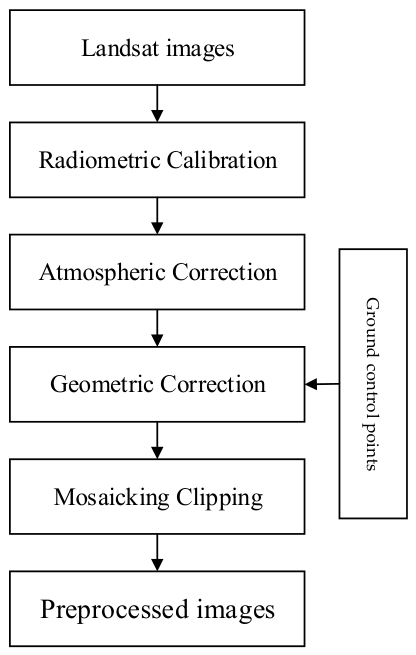
In this study, the pre-processing of remote sensing images mainly included radiometric calibration, atmospheric correction, geometric correction, image mosaicking, and clipping. ENVI 5.3 software was used for this pre-processing, and cross-calibration was performed during radiometric calibration to eliminate reflectance differences among the sensors of Landsat 5 to 9 [35]. The FLAASH model was used for atmospheric correction to reduce the interference of atmospheric absorption and diffuse reflection on image radiation information. A total of 20 ground control points collected by high-precision GPS were applied to image geometric correction. The second-order polynomial equation was used, and the nearest neighbor method was chosen for pixel value sampling with an accuracy of 1 pixel [36]. In addition, the flowchart of remote sensing data pre-processing is shown in Figure 1.

2.2. Water Body Index for Coastline Extraction

Because the water body has strong reflectivity to electromagnetic waves in the blue and green light bands, while it has almost no reflectivity to electromagnetic waves in the near- and mid-infrared bands, the difference between the strongest and weakest reflection bands of the water body can be expanded through the water body index. Then, water body information can be highlighted through normalization, where water and non-water bodies show clear differences in the image, and finally, the image can be segmented by setting a threshold to extract the coastline.
In this study, the Modified Normalized Difference Water Index (MNDWI) is used, and its formula is as follows:
M N D W I = p G r e e n p M I R p G r e e n + p M I R
where p is the reflectivity. Green represents the green light band, NIR is the near-infrared band, and MIR denotes the mid-infrared band.

2.3. Overall Uncertainty Assessment

(1)
Sensor cross-calibration. Cross-calibration of Landsat sensors to Landsat 8 OLI achieves an overall reflectance uncertainty of <±3% [37]. Using the water-land reflectance contrast (~0.15 in NIR), this translates into a positional uncertainty of ±6–15 m.
(2)
Atmospheric correction. Based on global AERONET-OC validation, Landsat 8 OLI shows ~30% uncertainty in green/red bands over coastal waters, while Landsat 5/7 exhibits >50% uncertainty due to lower SNR [38]. Propagated to a shoreline position, this yields ±4–10 m for OLI and ±8–15 m for TM/ETM+.
(3)
Sub-pixel mixing. For medium-resolution sensors, shoreline pixels inherently contain mixed water-land signals. Without sub-pixel processing, positioning errors up to ±1 pixel (±30 m) can occur [39]; however, typical uncertainty is ±0.2–0.5 pixel (±6–15 m) under standard extraction methods.
Overall, assuming independence, the root-sum-square positional uncertainty is ±23 m for Landsat 8 OLI and ±26 m for Landsat 5/7. We recommend applying a ±25 m uncertainty envelope to all extracted shorelines unless site-specific calibration is performed.

3. Study Area and Data

3.1. Study Area

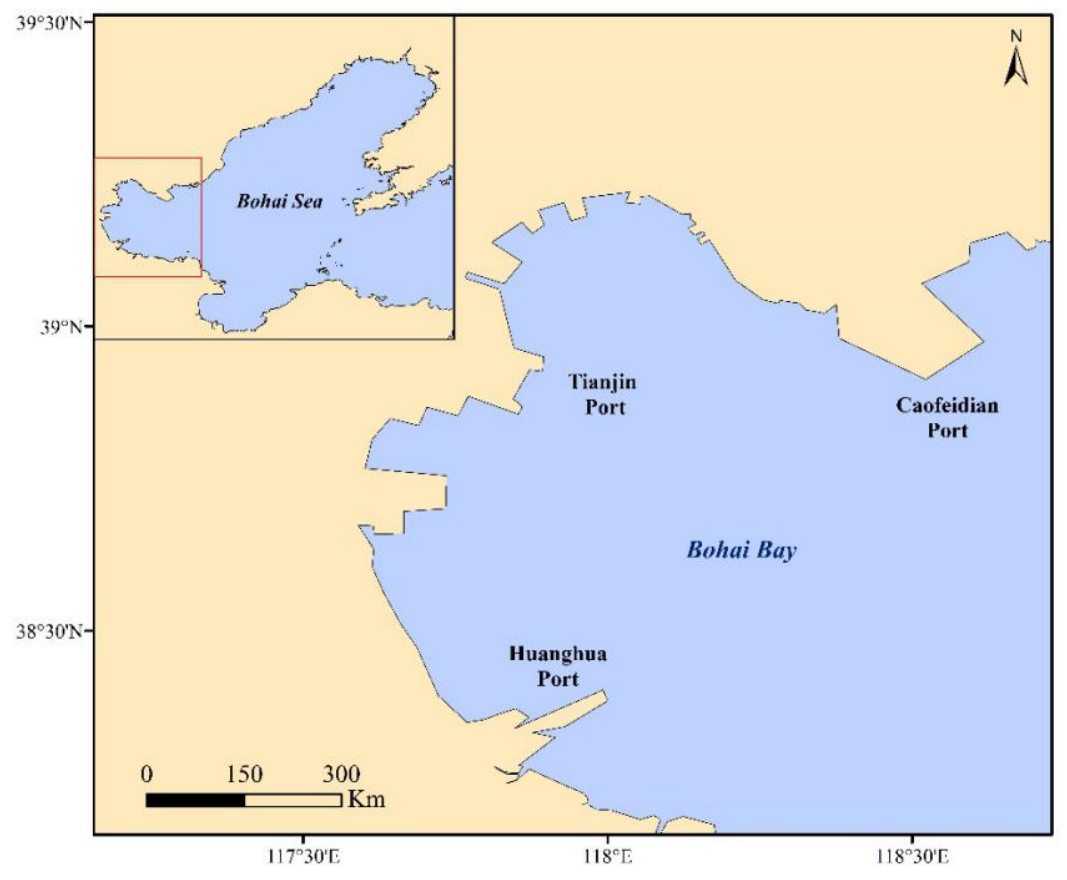
Bohai Bay is one of the three bays of the Bohai Sea in China. It is located between 37°49′10″ N and 39°09′28″ N and between 117°38′41″ E and 119°24′46″ E with the Daqing estuary in Laoting County, Hebei Province as the north boundary, and the Yellow River Estuary in Shandong Province as the south boundary (as shown in Figure 2). Surrounded by land on three sides, it is adjacent to three important provinces and cities, namely Tianjin, Shandong, and Hebei. It is an important transportation hub and industrial as well as commercial base in this region.
As Bohai Bay is surrounded by land on three sides and located in the middle-latitude monsoon region, it shows a very significant continental monsoon climate. There are significant differences among the four seasons: hot summer, cold winter, and ice, and precipitation is mainly concentrated in July and August.
The spatial distribution of temperature and salinity in Bohai Bay is uniform, but the temporal variation is significant. In winter, the water temperature is higher than the coastal water temperature, and vice versa in summer. In the bay, water temperature ranges from 0 °C to 28 °C throughout the whole year. The salinity of the bay is higher than that of the coast, between 29 and 31 psu, compared to between 23 and 29 psu, respectively, but that of some coastal areas will reach 33 psu due to the existence of salt fields.

3.2. Data

In this study, Landsat remote sensing images are used as the data source. Some of the benefits of these images are that they are free and easy to obtain, and they contain a lot of data. The satellite has also been taking images for a long time. Accordingly, these images meet the requirements of extracting the coastline of Bohai Bay in the past 20 years. Therefore, we determined that the number of orbits of the Landsat satellite that can cover the coastline of Bohai Bay is 122–133. The remote sensing images with small cloud cover (less than 10%) were selected and downloaded from 2001 to 2021 on the Geospatial Data Cloud Website (https://www.gscloud.cn/search, accessed on 15 January 2026). However, due to the retirement and failure of some satellites, in order to ensure the temporal continuity of remote sensing images and the accuracy of data, we downloaded a total of 11 Landsat 5, 1 Landsat 7, and 9 Landsat 8 remote sensing images, with their specific information shown in Table 1.

4. Results and Discussion

4.1. Coastline Extraction and Length Calculation

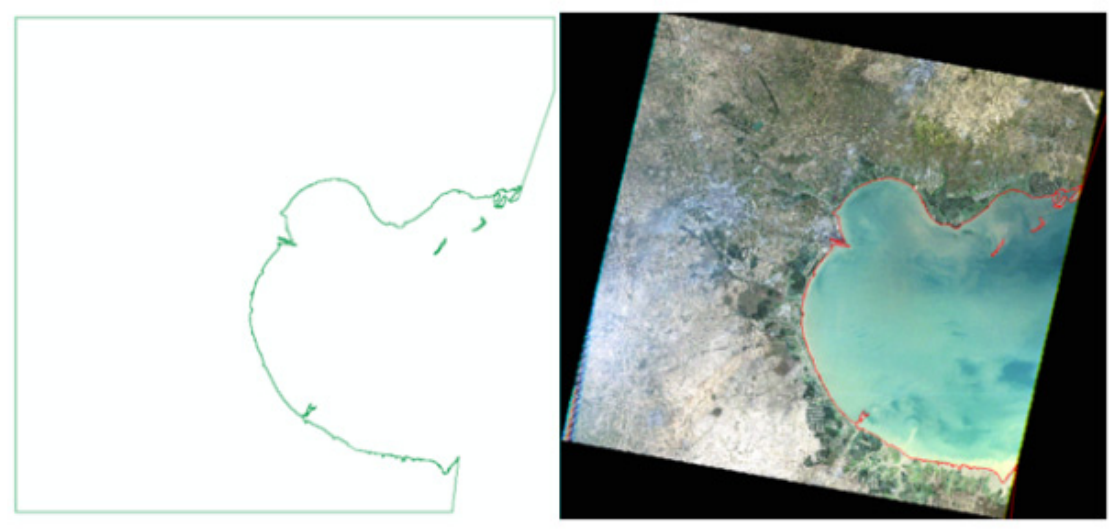
By using the feature line transfer tool in ENVI, a surface feature can be converted into a line feature, which can then be cut accordingly to obtain the coastline of the study area. As shown in Figure 3, the effect of extracting the coastline by MNDWI is credible, which is basically consistent with the original remote sensing image—its consistency error is within 1 pixel (30 m).
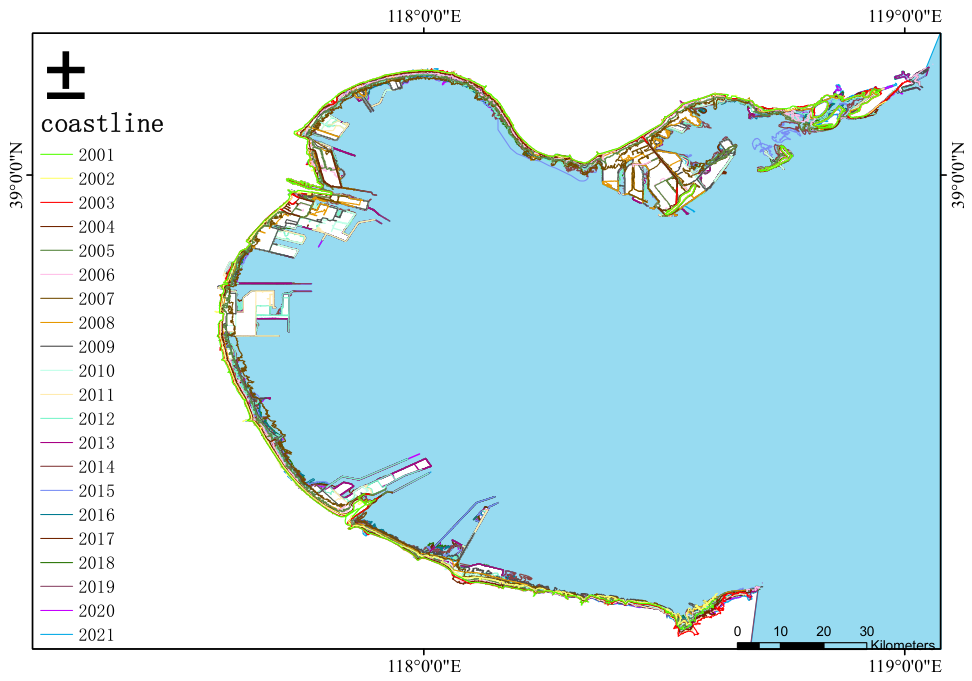
First, use the split and merge tool to integrate the coastlines from multiple line features into one line feature, and then obtain the length of the coastline by adding the length of the double precision field to the computational geometry tool in the attribute table. Repeat the above steps, finally obtaining the coastline and the length of Bohai Bay from 2001 to 2021, as shown in Figure 4.

4.2. Analysis of Coastline Length Variation

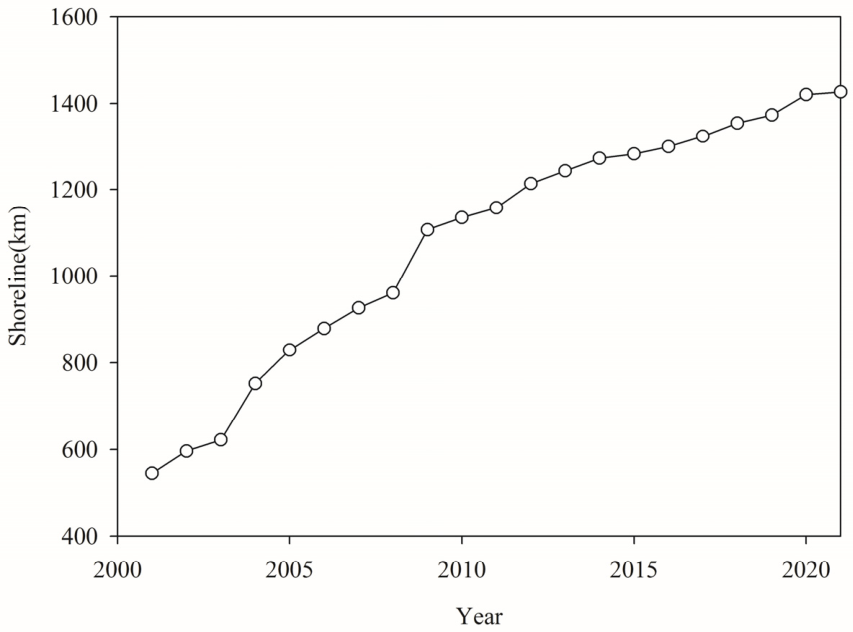
The specific changes in total coastline length in Bohai Bay from 2001 to 2021 are shown in Figure 5.
The figure shows that the coastline of Bohai Bay kept increasing from 2001 to 2021, rising from 545.21 km in 2001 to 1426.26 km in 2021, an increase of 161.60%. Over the past 20 years, this coastline length has increased by 881.05 km, with an overall average annual change of 44.05 km. Specifically, the length increased by 76.76 km from 2001 to 2003, with an average annual change of 38.38 km, which is 0.87 times the overall average annual change rate; by 512.92 km from 2003 to 2010, with an average annual change of 73.27 km, equivalent to 1.66 times the overall average; by 108.56 km from 2010 to 2013, with an average annual change of 36.19 km, 0.82 times the overall average; by 39.76 km from 2013 to 2015, with an average annual change of 19.88 km, only 0.45 times the overall average; and by 143.05 km from 2015 to 2021, with an average annual change of 23.84 km, 0.54 times the overall average annual change rate.
As we aimed to reveal the driving forces of the Bohai Bay coastline in the past 20 years, and the time scale of 20 years is small, some natural driving forces that need a long time scale to be reflected, such as crustal movement and sea level fluctuation, hardly have any impact on the changes in the Bohai Bay coastline in this study. Therefore, we mainly analyze the natural driving force changing the Bohai Bay coastline in the recent 20 years from the two short time scales of hydrodynamics and sediment.

4.2.1. Silt

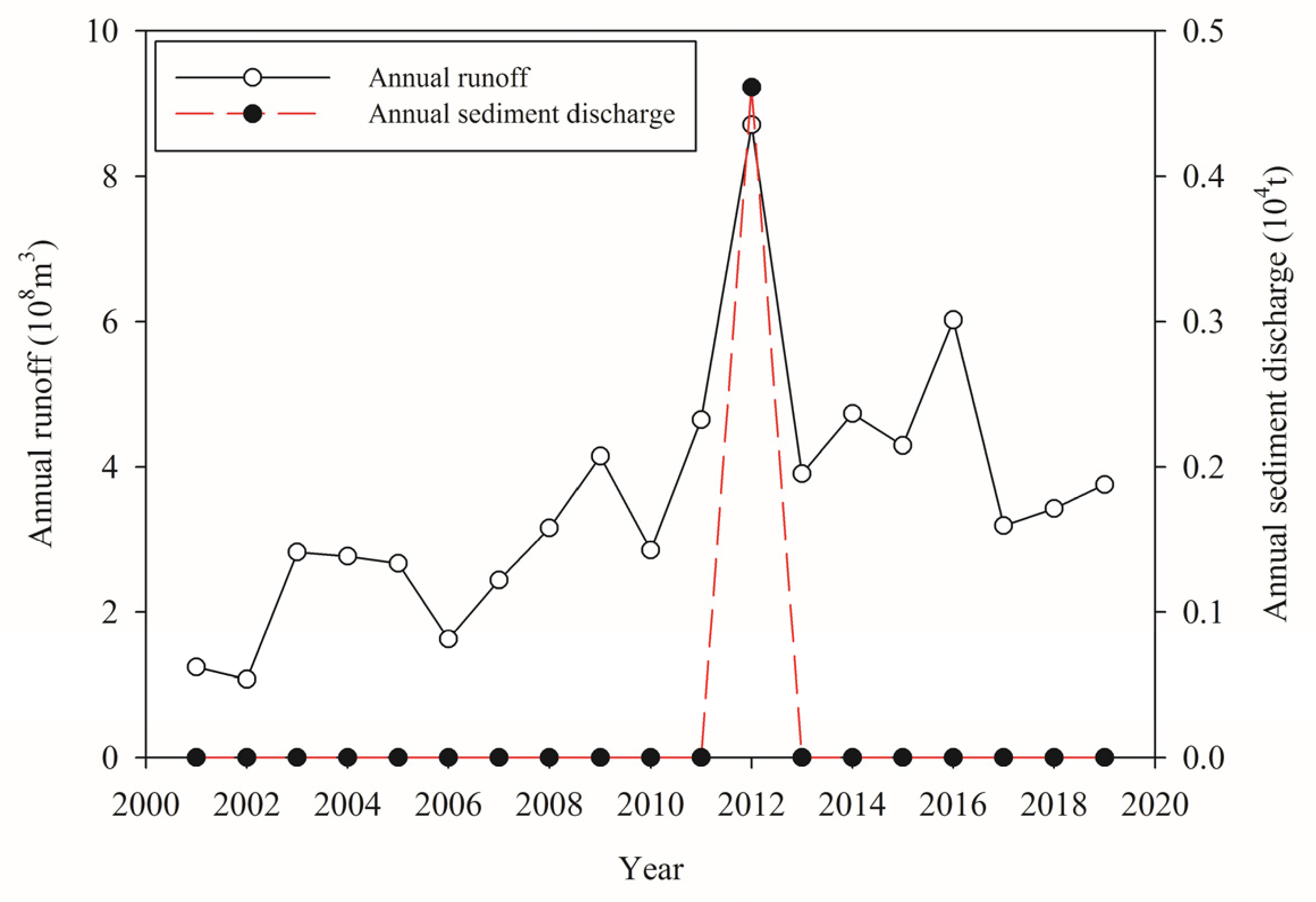
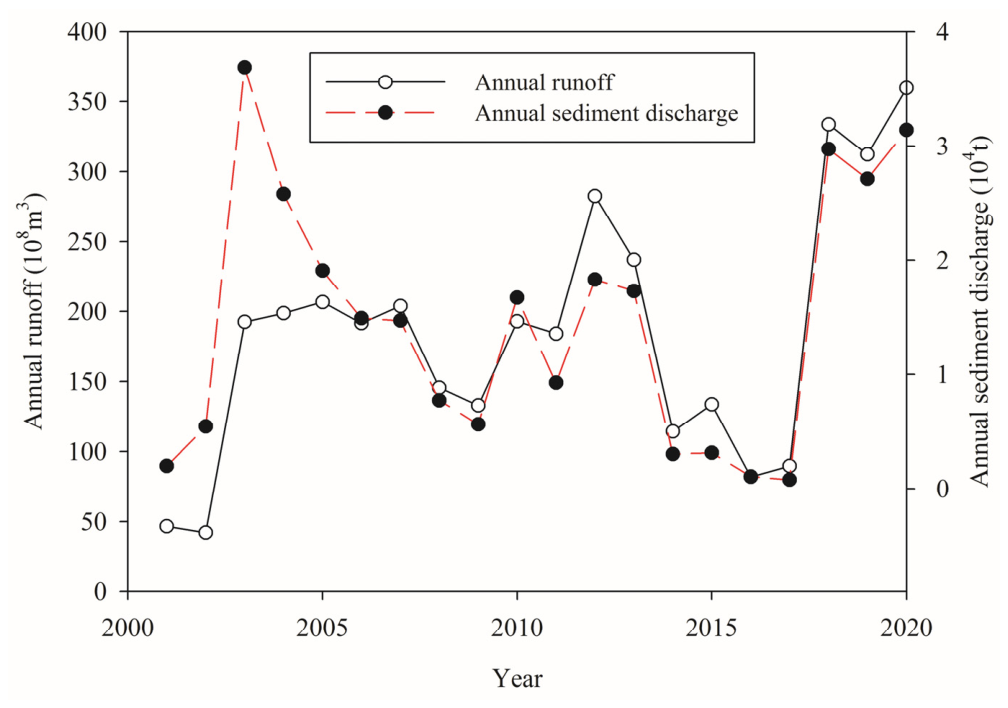
When a large amount of sediment carried by the many rivers of Bohai Bay reaches the estuary, part of the sediment will be deposited, resulting in the growth of the natural coastline. The rivers that affect the coastline of Bohai Bay mainly include the Yellow River, Haihe River, Luanhe River, and Ji Canal. However, compared with the Yellow River and Haihe River, Luanhe River and Ji Canal are not only short in length but also small in flow. Therefore, based on the annual sediment discharge and runoff of the Yellow River and Haihe River obtained from the China river sediment bulletin, we mainly analyzed sediment—a natural driving force that plays an important role in the change in the coastline of Bohai Bay.
As shown in Figure 6, the annual average runoff and sediment discharge of the Haihe sluice hydrological station from 2001 to 2020 were 469,300,000 m3 and 460 t, respectively. The Haihe River was once one of the important sediment sources in Bohai Bay. From 1917 to 1958, before the completion of various water conservancy projects, the annual average runoff and sediment transport of the Haihe River were 9.54 billion cubic meters and 8.13 million tons, respectively. Since the completion of various water conservancy projects, the runoff and sediment transport of the Haihe River have been greatly reduced. From 1960 to 2000, the annual average runoff and sediment discharge of the Haihe sluice hydrological station were 970.9 × 10⁶ m3 and 95,500 t [40], respectively. It can be seen that since the construction of various water conservancy projects and the radical cure of the Haihe River, runoff and sediment transport have greatly decreased, with sediment transport even being zero all year. However, the runoff of the Haihe River rebounded significantly in 2012, which led to sediment transport by the water diverted from the Yellow River. In addition, an extremely heavy rainstorm occurred in the northern part of the Haihe Basin on 21 July 2012, which eventually resulted in the peak of sediment discharge [40]. Therefore, the Haihe River is no longer one of the main sources of sediment in Bohai Bay, and its impact on the natural shoreline of Bohai Bay is also minimal.
As shown in Figure 7, the annual average runoff and sediment discharge of Lijin hydrological station at the Yellow River Estuary from 2001 to 2020 were 18.411.95 × 109 m3 and 144.93 × 10⁶ t, respectively, accompanied by a fluctuating trend. Although the Yellow River is still the most important sediment source in Bohai Bay, its sediment transport has been greatly reduced. Before 2000, the annual average sediment transport of Lijin hydrological station at the Yellow River Estuary was 839.2 × 10⁶ t, which is 5.79 times the annual average sediment transport from 2001 to 2020. Therefore, the impact of the Yellow River on the change in the coastline of Bohai Bay has also been greatly weakened.
After 2000, the Haihe River, an important sediment source in Bohai Bay, was almost cut off, and the Yellow River, the most important sediment source in the same area, was weakened. The weight of sediment imported into Bohai Bay greatly reduced each year, and the growth of natural shoreline length also greatly slowed down, so the impact of sediment, an important natural driving force, on the change in the shoreline of Bohai Bay was weak. At the same time, this is one of the important reasons why the natural coastline of Bohai Bay has hardly increased from 2001 to 2021.

4.2.2. Hydrodynamics

Hydrodynamic conditions have an important impact on the specific form of the coastline, such as topographic and geomorphic characteristics. The natural driving forces that affect the changes in the Bohai Bay coastline are mainly various marine hydrodynamic conditions, such as waves, tidal currents, storm surges, and circulation, and their impact is mainly reflected in coastline erosion. The most significant area affected by hydrodynamic conditions in Bohai Bay is the abandoned Yellow River Delta at Diaokou river.
The fluctuation and strong force of tidal currents cause the repeated washing and accumulation of all kinds of sediments. Moreover, the tidal current near the shore often has a high velocity and lasts a long time. Therefore, the sediment near the shore moves towards the offshore direction, resulting in coastline erosion, which changes seasonally and is caused by the action of waves, and its specific erosion is realized by sediment transportation. The strong erosion at the abandoned Yellow River Delta is caused by the combined action of tidal current and waves; that is, the sediment at the bottom is set in motion by waves and is then transported offshore under the action of tidal currents, to realize coastline erosion.
Storm surges have a strong erosion effect on the coastline. With the rise in sea level and various meteorological changes in Bohai Bay in recent years, the temperate storm surges in the bay not only have a high frequency but also cause serious damage. For example, the storm surge with the highest tide level of 5.2 m caused by typhoon “mesa” in 2005 and the storm surge with the highest tide level of 5.74 m caused by typhoon “lichima” in 2019 caused serious erosion to the natural coastline in the southwest of Bohai Bay [41].
The influence of circulation on the coastline of Bohai Bay is divided into two parts. The coastline to the north of the Yongdingxin River is affected by the counter-clockwise circulation caused by the land contour’s influence on the remaining vein of the warm current of the Yellow River in the north, resulting in coastline erosion. However, the area to the south of the Yongdingxin River is affected by the clockwise circulation generated by the warm current of the northward Yellow Sea along the north side of the Yellow River Delta, resulting in sediment deposition from the north side of the Yellow River Delta in the coastal zone.
Hydrodynamic conditions such as tidal current, waves, storm surge, and circulation are some of the natural driving forces changing the coastline of Bohai Bay. However, with the construction of various coastal protection projects, such as various tidal embankments and the north–south breakwater built in Tianjin Xingang, sediment deposition has decreased from 1 ton of sediment for every 1 ton of transported goods to every 100 tons. The erosion effect of hydrodynamic conditions on the coastline has also weakened significantly, which has led to the corresponding weakening of the natural driving force, changing the Bohai Bay coastline over the recent 20 years.

4.2.3. Artificial Driving Force

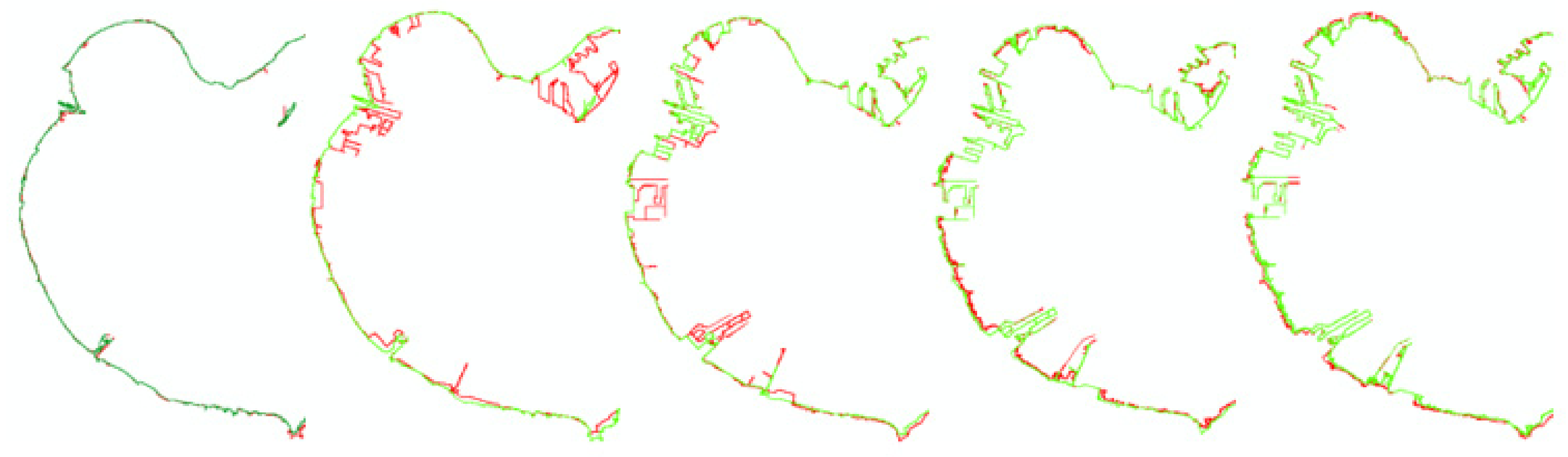
In the past 20 years, various ports, industrial zones, salt pans, aquaculture farms, and reclamation projects in Bohai Bay have been successively constructed, and the length of the artificial shoreline has also been increasing. Therefore, the human driving force changing the shoreline in Bohai Bay is very strong. Figure 8 shows a temporal analysis of the human driving force changing the shoreline of Bohai Bay from 2001 to 2021 according to the shoreline comparison chart of relevant years.
As shown in Figure 8, it can be seen that the change in the Bohai Bay coastline from 2001 to 2021 is mainly due to the rapid increase in artificial coastline length, during which several major ports and industrial zones were constructed. Therefore, the change in the Bohai Bay coastline in the past 20 years is dominated by human-driven forces. The time series of the artificial driving force is divided into five periods according to Figure 8.
2001–2003: During this period, the length of the artificial shoreline remained basically unchanged. This shoreline was mainly composed of the preliminary construction of Tianjin port and Huanghua port. During this period, the coastline length of Bohai Bay increased by 76.76 km, with an average rate of change of 25.59 km per year.
2003–2010: Various port construction and reclamation projects were rapidly carried out and completed. The Caofeidian Industrial Zone in the north was basically completed, the main body of Tianjin port in the middle was basically completed, and Huanghua port and Binzhou port in the south were also expanded. During this period, the coastline length of Bohai Bay increased by 512.92 km, with an average rate of change of 64.115 km per year.
2010–2013: Tianjin port in the middle was greatly expanded, Tianjin South Port Industrial Zone was constructed, the basic construction of Huanghua port in the south was completed, and Binzhou port was also expanded. During this period, the coastline length of Bohai Bay increased by 108.56 km, with an average rate of change of 27.14 km per year.
2013–2015: Binzhou port in the south was constructed, and other port areas and industrial areas remained basically unchanged. During this period, the coastline length of Bohai Bay increased by 39.76 km, with an average annual change rate of 13.25 km per year.
2015–2021: The Caofeidian and Nangang industrial zone of Tianjin port and Tianjin, Huanghua, and Binzhou ports were expanded. During this period, the coastline length of Bohai Bay increased by 143.05 km, with an average annual change rate of 20.44 km per year.
The changes in the artificial shoreline in Bohai Bay are mainly affected by the construction of ports and industrial zones as well as reclamation projects, but a small part of the changes is caused by the construction of salt fields and aquaculture farms. Therefore, the human-driven forces changing the Bohai Bay coastline in the past 20 years include human activities, such as ports, industrial zones, salt fields, farm construction, and reclamation projects.

4.3. Discussion

(1)
Due to the lack of official and accurate annual variation data of various human activities, we conducted relatively few quantitative analyses on the impact of human driving forces on the changes in the Bohai Bay coastline. More precise annual variation data of various human activities will be obtained through remote sensing interpretation in future research.
(2)
Due to the construction of ports and industrial zones, the coastline length of Bohai Bay has undergone an extremely high rate of change over the past two decades. Therefore, a comparative analysis with coastline changes will be conducted in other similar regions around the world in subsequent research.

5. Conclusions

Remote sensing and GIS technologies are used to extract the coastline in this study. Based on the TM, ETM+, and OLI of Landsat series satellites, the MNDWI method was used in Bohai Bay from 2001 to 2021 to analyze the coastline changes and driving forces in Bohai Bay in the recent 20 years. The following three conclusions are drawn:
(1)
In the past 20 years, the total coastline length of Bohai Bay has increased by 881.05 km, with an average rate of change of 41.95 km per year, showing an upward trend overall. From 2003 to 2009, the rate of change of coastline length of Bohai Bay was the fastest, with an average rate of change of 69.24 km per year. The period from 2003 to 2009 was when Tianjin port and Caofeidian Industrial Zone were constructed, which has the largest reclamation area in Bohai Bay. Therefore, the change in the Bohai Bay coastline in the past 20 years is mainly caused by artificial coastline growth. The change in natural coastline is small and has little impact on the change in the overall coastline.
(2)
In the past 20 years, the natural driving force changing the coastline of Bohai Bay has mainly been composed of sediment and hydrodynamic forces. However, with the construction of various hydraulic projects and breakwaters, on the one hand, sediment transport of various rivers has decreased significantly or even become zero. On the other hand, erosion from waves, tidal currents, and storm surges to circulation on the coastline has weakened, leading to a weak natural driving force, changing the coastline of Bohai Bay.
(3)
The human-driven force changing the coastline of Bohai Bay in the recent 20 years is mainly composed of various ports, industrial zones, salt fields, aquaculture construction, and reclamation projects. Through time series analysis, we analyzed the main human driving forces that have changed the coastline of Bohai Bay in the recent 20 years. It was found that the main human driving forces are the Caofeidian Industrial Zone in the north, Tianjin port and Nangang Industrial Zone in the middle, Huanghua port and Binzhou port in the south, and other related engineering construction projects.

Author Contributions

Conceptualization, D.W. and D.Z.; methodology, D.W. and D.Z.; validation, D.W. and D.Z.; writing—original draft preparation, D.W., D.Z. and J.L.; writing—review and editing, D.Z. and L.C. All authors have read and agreed to the published version of the manuscript.

Funding

This research was funded by the Hainan Province Science and Technology Special Fund (No. SOLZSKY2025007), Key Research and Development Program sponsored by the Ministry of Science and Technology (MOST) 2023YFC3107701, 2023YFC3107901, and the National Natural Science Foundation of China (No. 42375143).

Data Availability Statement

All the data used in this paper are publicly available.

Conflicts of Interest

The authors declare no conflicts of interest.

References

  1. Zuzek, P.; Nairn, R.; Thieme, S. Spatial and temporal considerations for calculating shoreline change rates in the Great Lakes Basin. J. Coastal. Res. 2003, 38, 125–146. Available online: https://www.jstor.org/stable/25736603 (accessed on 10 May 2025).
  2. Ciardini, V.; Contessa, G.; Falsaperla, R. Global and mediterranean climate change: A short summary. Ann. Ist. Super. Sanita 2016, 52, 325–337. [Google Scholar]
  3. Watson, P. A new perspective on global mean sea level (GMSL) accelerations in surface mass transport. Geophys. Res. Lett. 2016, 43, 6478–6484. [Google Scholar] [CrossRef]
  4. Lavidas, G.; Venugopal, V. Application of numerical wave models at European coastlines: A review. Renew. Sust. Energ. Rev. 2018, 92, 489–500. [Google Scholar] [CrossRef]
  5. Primavera, J. Overcoming the impacts of aquaculture on the coastal zone. Ocean Coast. Manag. 2006, 49, 531–545. [Google Scholar] [CrossRef]
  6. Mcgranahan, G.; Balk, D.; Anderson, B. The rising tide: Assessing the risks of climate change and human settlements in low elevation coastal zones. Environ. Urban. 2007, 19, 17–37. [Google Scholar] [CrossRef]
  7. Anilkumar, P.; Varghese, K.; Ganesh, L. Formulating a coastal zone health metric for landuse impact management in urban coastal zones. J. Environ. Manag. 2010, 91, 2172–2185. [Google Scholar] [CrossRef]
  8. Liu, H.; Jezek, K. Automated extraction of coastline from satellite imagery by integrating canny edge detection and locally adaptive thresholding methods. Int. J. Remote Sens. 2004, 25, 937–958. [Google Scholar] [CrossRef]
  9. Wang, F.; Zhu, D. Sustainable development and management of coastal tourism resources under the background of global change. J. Nat. Resour. 2012, 27, 1–16. [Google Scholar]
  10. Sheng, J.; Zhai, J.; Guo, H. Study on Coastline Extraction Technology. Hydrogr. Surv. Charting 2009, 29, 74–77. [Google Scholar]
  11. Liu, J.; Liu, M.; Tian, H. Spatial and temporal patterns of China’s cropland during 1990–2000: An analysis based on Landsat TM data. Remote Sens. Environ. 2005, 98, 442–456. [Google Scholar] [CrossRef]
  12. Vander, W. Mapping shoreline indicators on a sandy beach with supervised edge detection of soil moisture differences. Int. J. Appl. Earth Obs. 2019, 74, 231–238. [Google Scholar] [CrossRef]
  13. Zhang, T.; Yang, X.; Hu, S. Extraction of coastline in aquaculture coast from multispectral remote sensing images: Object-based region growing integrating edge detection. Remote Sens. 2013, 5, 4470–4487. [Google Scholar] [CrossRef]
  14. Moussaid, J.; Fora, A.; Zourarah, B. Using automatic computation to analyze the rate of shoreline change on the Kenitra Coast, Morocco. Ocean Eng. 2015, 102, 71–77. [Google Scholar] [CrossRef]
  15. Chen, L.; Rau, J. Detection of shoreline changes for tideland areas using multi-temporal satellite images. Int. J. Remote Sens. 1998, 19, 3383–3397. [Google Scholar] [CrossRef]
  16. Shin, B.; Kim, K. Estimation of shoreline change using high resolution images. Procedia Eng. 2015, 116, 994–1001. [Google Scholar] [CrossRef][Green Version]
  17. Gens, R. Remote sensing of coastlines: Detection, extraction and monitoring. Int. J. Remote Sens. 2010, 31, 819–1836. [Google Scholar] [CrossRef]
  18. Kermani, S.; Boutiba, M.; Guendouz, M. Detection and analysis of shoreline changes using geospatial tools and automatic computation: Case of Jijelian Sandy Coast (east Algeria). Ocean Coast. Manag. 2016, 132, 46–58. [Google Scholar] [CrossRef]
  19. Li, W.; Gong, P. Continuous monitoring of coastline dynamics in Western Florida with a 30-year time series of Landsat Imagery. Remote Sens. Environ. 2016, 179, 196–209. [Google Scholar] [CrossRef]
  20. Canny, J. A Computational Approach to Edge Detection. IEEE Trans. Pattern Anal. Mach. Intell. 1986, 8, 679–698. [Google Scholar] [CrossRef]
  21. Nguyen, H. The relation of coastal mangrove changes and adjacent landuse: A review in Southeast Asia and Kien Giang, Vietnam. Ocean Coast. Manag. 2014, 90, 1–10. [Google Scholar] [CrossRef]
  22. Mcfeeters, S. The use of the Normalized Difference Water Index (NDWI) in the delineation of open water features. Int. J. Remote Sens. 1996, 17, 1425–1432. [Google Scholar] [CrossRef]
  23. Pardo-Pascual, J.; Almonacid-Caballer, J.; Ruiz, L. Automatic extraction of shorelines from Landsat TM and ETM+ multi-temporal images with subpixel precision. Remote Sens. Environ. 2012, 123, 3198. [Google Scholar] [CrossRef]
  24. Yin, J.; He, F. Researching the method of coastline extracted by remote sensing image. J. Remote Sens. 2019, 23, 582–602. [Google Scholar] [CrossRef]
  25. Lu, S.; Wu, B.; Yan, N. Water body mapping method with HJ-1A/B satellite imagery. Int. J. Appl. Earth Obs. Geoinform. 2011, 13, 428–434. [Google Scholar] [CrossRef]
  26. Lin, H.; Xu, J.; Jiang, D.; Gao, Y.; Wei, L.; Liu, J. Sand dam dynamic monitoring in coastal areas based on time-series remote sensing images. In Proceedings of the 2016 IEEE International Geoscience and Remote Sensing Symposium (IGARSS), Beijing, China, 10–15 July 2016. [Google Scholar] [CrossRef]
  27. Tseng, K.; Shum, C.; Kim, J. Integrating Landsat Imageries and Digital Elevation Models to Infer Water Level Change in Hoover Dam. IEEE J. Sel. Top. Appl. Earth Obs. Remote Sens. 2016, 9, 1696–1709. [Google Scholar] [CrossRef]
  28. Wang, L.; Li, Q.; Bi, H. Human impacts and changes in the coastal waters of south China. Sci. Total Environ. 2016, 562, 108–114. [Google Scholar] [CrossRef]
  29. Sekovski, I.; Stecchi, F.; Mancini, F. Image classification methods applied to shoreline extraction on very high-resolution multispectral imagery. Int. J. Remote Sens. 2014, 35, 3556–3578. [Google Scholar] [CrossRef]
  30. Alesheikh, A.; Ghorbanali, A.; Nouri, N. Coastline Change detection using remote sensing. Int. J. Environ. Sci. Technol. 2007, 4, 61–66. [Google Scholar] [CrossRef]
  31. Bi, J.; Zhang, L.; Wang, P.; Sui, Y.; Mu, X. Mathematical Morphology Improvement of Image Segmentation and Extraction Algorithm for Coastal Waterline and Its Regional Adaptability Analysis. Geogr. Geo-Inf. Sci. 2019, 35, 20–29. [Google Scholar] [CrossRef]
  32. Sun, B.; Zuo, S.; Xie, H.; Li, H.; Yang, Z. Shoreline change and impact analysis in Bohai Bay over the past 40 years. J. East China Norm. Univ. 2017, 4, 10. [Google Scholar] [CrossRef]
  33. Zhang, L.; Wu, J.; Li, W.; Hu, R.; Chou, J. Evolution and influencing factors of shoreline and tidal flat in the western and southern Bohai Bay. Mar. Geol. Quat. Geol. 2014, 34, 139–148. [Google Scholar]
  34. Sun, X.; Lv, T.; Gao, Y.; Fu, M. Analysis of shoreline changes and driving forces in Bohai Bay from 2000 to 2010. Resour. Sci. 2014, 36, 7. [Google Scholar]
  35. Zhang, Z.; Zhang, H.; Chang, Y.; Chen, Z. Review of radiometric calibration methods of Landsat series optical remote sensors. Natl. Remote Sens. Bull. 2015, 19, 719–732. [Google Scholar] [CrossRef]
  36. Zhang, D.; Guo, Q.; Cao, L.; Zhou, G.; Zhang, G.; Zhan, J. A Multiband Model with Successive Projections Algorithm for Bathymetry Estimation Based on Remotely Sensed Hyperspectral Data in Qinghai Lake. IEEE J. Sel. Top. Appl. Earth Obs. Remote Sens. 2021, 14, 6871–6881. [Google Scholar] [CrossRef]
  37. Chittimalli, S. Reflectance-Based Calibration and Validation of the Landsat Satellite Archive. Master’s Thesis, South Dakota State University, Brookings, SD, USA, 2016. [Google Scholar]
  38. Xu, Y.; Feng, L.; Zhao, D.; Lu, J. Assessment of Landsat Atmospheric Correction Methods for Water Color Applications Using Global AERONET-OC Data. Int. J. Appl. Earth Obs. Geoinf. 2020, 93, 102192. [Google Scholar] [CrossRef]
  39. Abileah, R.; Vignudelli, S.; Scozzari, A. Mapping Shorelines to Subpixel Accuracy Using Landsat Imagery. In Proceedings of the EGU General Assembly Conference Abstracts, Vienna, Austria, 7–12 April 2013. [Google Scholar]
  40. Ministry of Water Resources of the People’s Republic of China. China River Sediment Bulletin; Water & Power Press: Beijing, China, 2025. [Google Scholar]
  41. Wang, H.; Shang, Z.W.; Pei, Y.D.; Wang, F.; Fan, C.F.; Liu, Z.G.; Tian, L.Z.; Che, J.Y. Enlightenments of the Hurricanes: Analysis for the Current Status and a Possible Trend on the West Coast of Bohai Bay. Geol. Rev. 2007, 53, 83–91. [Google Scholar]
Figure 1. Flowchart of remote sensing data pre-processing.
Jmse 14 00962 g001
Figure 2. Overview of Bohai Bay.
Jmse 14 00962 g002
Figure 3. Coastline Extraction results of the study area in 2001.
Jmse 14 00962 g003
Figure 4. Coastline change map of the study area from 2001 to 2021.
Jmse 14 00962 g004
Figure 5. Ocean Broken line chart of Coastline Length Change in Bohai Bay from 2001 to 2021.
Jmse 14 00962 g005
Figure 6. Annual runoff and sediment discharge of Haihe sluice hydrological station from 2001 to 2020.
Jmse 14 00962 g006
Figure 7. Annual runoff and sediment discharge of Lijin hydrological station at the Yellow River Estuary from 2001 to 2020.
Jmse 14 00962 g007
Figure 8. Comparison chart of the coastline of Bohai Bay in 2001, 2003, 2010, 2013, 2015, and 2021. The green line shows the previous year and the red line represents the following year.
Jmse 14 00962 g008
Table 1. List of all the remote sensing images used in this study.
No.SatelliteSensorsTrack No.Spatial Resolution/mAcquisition Time
1Landsat 5TM122-33302001-10-11
2Landsat 5TM122-33302002-11-15
3Landsat 5TM122-33302003-10-17
4Landsat 5TM122-33302004-10-03
5Landsat 5TM122-33302005-10-22
6Landsat 5TM122-33302006-05-02
7Landsat 5TM122-33302007-04-03
8Landsat 5TM122-33302008-03-04
9Landsat 5TM122-33302009-04-08
10Landsat 5TM122-33302010-03-26
11Landsat 5TM122-33302011-09-21
12Landsat 7ETM+122-33302012-04-08
13Landsat 8OLI, TIRS122-33302013-09-26
14Landsat 8OLI, TIRS122-33302014-03-21
15Landsat 8OLI, TIRS122-33302015-10-02
16Landsat 8OLI, TIRS122-33302016-03-10
17Landsat 8OLI, TIRS122-33302017-04-14
18Landsat 8OLI, TIRS122-33302018-03-16
19Landsat 8OLI, TIRS122-33302019-10-29
20Landsat 8OLI, TIRS122-33302020-04-22
21Landsat 8OLI, TIRS122-33302021-12-21
Disclaimer/Publisher’s Note: The statements, opinions and data contained in all publications are solely those of the individual author(s) and contributor(s) and not of MDPI and/or the editor(s). MDPI and/or the editor(s) disclaim responsibility for any injury to people or property resulting from any ideas, methods, instructions or products referred to in the content.