Article

A Novel V-Shaped Semi-Submersible Floater for Collocation of Wind Turbine and Wave Energy Converters


Engineering Cluster, Singapore Institute of Technology, 1 Punggol Coast Road, Singapore 828608, Singapore
*
Author to whom correspondence should be addressed.
J. Mar. Sci. Eng. 2026, 14(10), 931; https://doi.org/10.3390/jmse14100931 (registering DOI)
Submission received: 23 April 2026 / Revised: 13 May 2026 / Accepted: 14 May 2026 / Published: 18 May 2026
(This article belongs to the Section Ocean Engineering)

Abstract

Offshore wind and wave energy have emerged as promising alternatives due to their abundant availability and substantial energy potential. This research explores a V-shaped semi-submersible platform designed to support both wind turbines and wave energy converters (WECs). The V-shaped configuration is selected for its ability to enhance hydrodynamic performance by reducing wave-induced loads and improving motion characteristics, while also providing increased structural stability through a wider effective footprint. In addition, the geometry creates a favourable layout for integrating WECs between the pontoons, enabling efficient wave energy capture without significantly interfering with the aerodynamic performance of the wind turbine. The study assesses the performance of different V-shaped platform configurations, ensuring their motion responses meet the operational limits required for wind turbines. It also examines whether interactions between the platform and coexisting WECs can lead to an improvement in wave energy absorption efficiency. Numerical hydrodynamic diffraction was conducted using the boundary element method in ANSYS AQWA, based on 3D potential flow theory and considering viscous damping effects, to calculate platform motion and the wave power output of WECs with a linear power take-off system. Preliminary analyses revealed that optimising the placement of WECs on a V-shaped semi-submersible can significantly improve energy generation while maintaining acceptable platform motion. This research demonstrates the additional potential of integrated wind-wave energy systems in delivering efficient and sustainable offshore energy solutions. The study also highlights the advantages of a turret mooring system for passive alignment with environmental forces, prolonging platform structure longevity and enhancing energy efficiency.

1. Introduction

The global energy landscape is undergoing a significant transformation, driven by the urgent need to transition from fossil fuels to renewable energy sources. This shift is prompted by growing concerns about climate change and the imperative to achieve sustainable development goals [1,2]. Among the various renewable energy sources, offshore wind and wave energy have emerged as promising alternatives due to their abundant availability and high energy potential.
Advancing technologies to harness these resources efficiently and cost-effectively remains a critical area of research and development. Ongoing research efforts are focused on harnessing wind and wave energy more efficiently. Efforts are underway to improve the efficiency of wind and wave energy harnessing. For instance, the U.S. Department of Energy’s Wind Energy Technologies Office (WETO) funds research across the country to support the development and deployment of offshore wind technologies. Similarly, progress is being made in the development of wave energy converters (WECs) to enhance their efficiency [3]. These efforts are essential to overcoming key barriers to offshore energy development, including the relatively high cost of energy, the mitigation of environmental impacts, and technical challenges.
The levelized cost of energy (LCOE) is a critical metric for assessing the economic viability of renewable energy projects. Research and development in offshore energy have focused on reducing LCOE through advancements in technology, system design, and operational efficiency. As a hybrid platform combining wind and wave energy, overall energy output can be optimised, potentially lowering the LCOE of the system. Recent trends show a significant reduction in the LCOE of offshore wind energy, primarily driven by the upsizing of turbines and increased park sizes [4]. Moreover, installation, operation, and maintenance costs—which account for approximately 30% of the LCOE of offshore wind platforms—are being optimised to further reduce costs [5].

2. Integrated Floating Offshore Wind Turbine and Wave Energy Converter System

The integration of wind turbines and WECs as hybrid systems has been extensively researched, reflecting their potential for enhanced energy capture and improved stability in offshore conditions. Dong et al. [6] emphasised the importance of hybrid wind-wave energy systems by reviewing their integrated concepts, assessing synergies for increased efficiency and cost reduction, and addressing key challenges to provide actionable recommendations for future development. The review paper proposed guidelines for advancing multi-source renewable energy solutions, offering a sustainable pathway to optimise infrastructure and improve energy output. The significance of integrating wind and wave energy systems was also highlighted in the review paper by Wan et al. [7], who noted that multi-WEC configurations showed promise in enhancing hydrodynamic stability and power output, though further optimisation—particularly in design, control strategies, and survivability—is still required. The paper also underscores the maturity gap between offshore wind (which is rapidly advancing) and wave energy (which remains nascent). While current hybrid systems faced economic challenges, the authors stressed that hybrid systems hold significant untapped potential for cost reduction through synergistic development. Tay [8,9,10,11,12,13,14] and Tay and Wei [15] conducted comprehensive study on an integrated multi-raft wave energy converter–floating structure system that simultaneously harvests wave energy and attenuates wave forces, with numerical results showing performance dependence on geometry, mooring stiffness, wave conditions, and capture width. Following these studies, Amouzadrad et al. [16] presented a moored multi-module floating platform integrated with flap-type wave energy converters and a submerged breakwater, demonstrating the influence of environmental loads and structural parameters on motion characteristics and wave energy performance.
Tay et al. [17] examined the collocation of WEC arrays with various floating foundations for FOWTs and compared capture width and interaction factors. They demonstrated that the semi-submersible platform with cylindrical WECs emerges as the most promising configuration, combining high power absorption, directional adaptability, and synergistic stability. The benefit of collocating WECs with FOWTs is further reinforced by Ramos et al. [18] in a case study conducted on the commercial WindFloat Atlantic wind farm. They found that the LCOE of the collocated wave farm could be drastically reduced compared to a stand-alone wave farm.
Deploying WECs in arrays significantly enhances energy generation from wave farms. Folley et al. [19] reviewed numerical models for WEC arrays and highlighted that optimising hydrodynamic interactions between devices is crucial for maximising wave farm efficiency and enabling large-scale deployment. Further improvements in energy production and operational performance can be achieved through strategic layout optimisation, which balances hydrodynamic effects with economic feasibility [20]. Venugopal et al. [21] expanded on this by evaluating hydrodynamic interaction modelling methods, highlighting their role in predicting energy output, optimising array configurations, refining control strategies, and assessing environmental impacts—all essential for the sustainable growth of wave energy technology.
Numerous studies have been conducted on the hydrodynamic and dynamic performance analysis of hybrid FOWTs with WEC arrays. For instance, Zhu et al. [22] carried out hydrodynamic analysis using a developed theoretical model that accurately computes hydrodynamic coefficients and predicts motion responses. The new model offers insights into how the analysed variables relate to the hybrid system’s performance, with significant effects from WEC integration on energy capture, dynamic performance, and stability of semi-submersible FOWTs. Zhu et al. [23] presented an analytical study involving a mathematical model to evaluate the dynamic performance of a hybrid system under real sea states. Their work focused on developing a precise and efficient model to accurately calculate hydrodynamic coefficients and motion responses.
Similarly, He et al. [24] investigated the dynamic responses and power absorption characteristics of a hybrid system incorporating a semi-submersible FOWT and a Salter’s duck WEC array, finding improved power generation efficiency and stability. The integration of Salter’s duck WECs enhances the damping of platform motions, contributing to overall system stability. Building on this, Kim and Koo [25] investigated the dynamic response of a wind-wave combined energy platform under WEC motion constraints, utilising both numerical and experimental methods. Their findings highlight that motion constraints have a substantial effect on the dynamic behaviour of the entire system, thereby emphasising the necessity of incorporating these constraints into the design process to optimise stability and efficiency. Alufa [26], on the other hand, focused on the design of mooring systems with sufficient yaw stiffness, concluding that optimising the mooring system can significantly improve the stability and performance of integrated platforms, underscoring the critical role of mooring system dynamics.
In addition, optimisation techniques—particularly those involving control of the power take-off (PTO) system—have been pivotal in improving the performance and survivability of hybrid platforms. Chen et al. [27] explored the impact of PTO control on the dynamic performance of floating wind-wave combined systems, revealing that optimised PTO control not only enhances energy production but also reduces motion amplitudes and loads, as demonstrated through both experimental and numerical analyses. Similarly, Lee et al. [28] presented dynamic simulations of a combined system with a torus-type WEC, showing significant improvements in hydrodynamic performance and reduced motion responses.
To enhance the robustness and applicability of hybrid systems, recent studies have focused on large-scale integrations and comparative evaluations of different configurations. Zhu et al. [29] conducted a comparative analysis of multiple wind-wave hybrid systems using an efficient analytical model, which emphasised the need for a balanced approach when integrating multiple WECs. This balance is crucial for maximising energy capture while ensuring system stability. Wang et al. [30] introduced a fully coupled numerical framework between OpenFAST and WEC-Sim, applied to the IEA-15-MW-UMaine FOWT. The results, tested under various environmental conditions, validate this new coupling approach, effectively capturing dynamic interactions between the wind turbine and WEC, and providing valuable insights for optimising hybrid system designs.
Furthermore, Finotto et al. [31] assessed the performance of floating offshore wind farms, specifically focusing on the adaptation of WEC technology. Their study underscores the potential for large-scale deployment of combined wind-wave systems. Complementing this, Wu et al. [32] explored the impact of WEC shape on hybrid system performance, examining factors such as platform motion, mooring tension, and WEC power capture. They found that hybrid systems with circular truncated conical WECs outperformed others in terms of energy capture, highlighting the importance of shape and size optimisation for enhanced performance.

3. Turret Mooring

More efficient offshore platforms, particularly those equipped with turret mooring, can accommodate larger wind turbines and even multiple units, thereby reducing stress and fatigue while extending design life for longevity and resilience. In this paper, the V-shaped semi-submersible (VSS) is conceptually evaluated as suitable for accommodating a turret mooring system via its central large column.
The turret mooring system is a specialised mooring approach widely used in the offshore energy sector, particularly for floating production storage and offloading (FPSO) vessels in the oil and gas industry (see Figure 1). This system allows a floating structure to weathervane—or rotate freely—around a fixed point in response to prevailing wind, wave, and current conditions. Such passive rotational capability enables the structure to naturally align with environmental forces, enhancing energy capture and operational efficiency. When applied to FOWTs, this ability to self-align with the wind can eliminate the need for an active yaw mechanism at the top of the tower and potentially reduce reliance on active ballasting systems within the hull. This not only simplifies the design but also contributes to improved overall system reliability [33].
In addition to efficiency gains, the turret mooring system offers structural benefits. Continuous rotation with the prevailing wind and wave directions reduces bending moments, torsional loads, and fatigue stresses on the platform. In contrast, spread mooring systems—where the structure is held in a fixed orientation—are more susceptible to fluctuating loads due to changing environmental conditions. By minimising structural stresses, the turret system may help extend the operational lifespan of the wind turbine. Furthermore, improved alignment contributes to platform stability, reducing excessive pitching and rolling motions, which facilitates smoother turbine operation and easier maintenance.
From an operational perspective, the turret mooring system can also streamline installation and maintenance processes. Its centralised mooring configuration, with a single connection point, simplifies deployment and retrieval activities, thereby reducing the complexity and cost of marine operations. Compared to spread mooring systems that require multiple fairleads and anchors, the turret system offers a more efficient and potentially economically viable solution for offshore wind turbine mooring. The stability and flexibility provided by the turret mooring system may enable the use of larger or multiple wind turbines spaced more closely in offshore environments [34]. The turret system also offers the additional benefit of quick evacuation in the event of severe weather conditions [35]. Some of the FOWTs with turret mooring are Poseidon P80 Floating Power Plant [36], WindSea [37], and Nezzy Floater (www.aerodyn-engineering.com, accessed on 17 May 2020). Nihel et al. [38] developed and tested a new type of floating wind turbine featuring a single-point mooring system.
Due to their relatively new application in offshore wind energy, they may pose challenges in terms of design optimisation research and best practices. It has a higher initial cost compared to conventional mooring systems due to its complexity and specialised design. This complex design may require a significant number of design cycles [39]. Nonetheless, it could offer long-term cost savings due to improved performance, reduced structural stress, and potentially more efficient maintenance.

4. Novel V-Shaped Semi-Submersible FOWT

4.1. Concept and Problem Definition

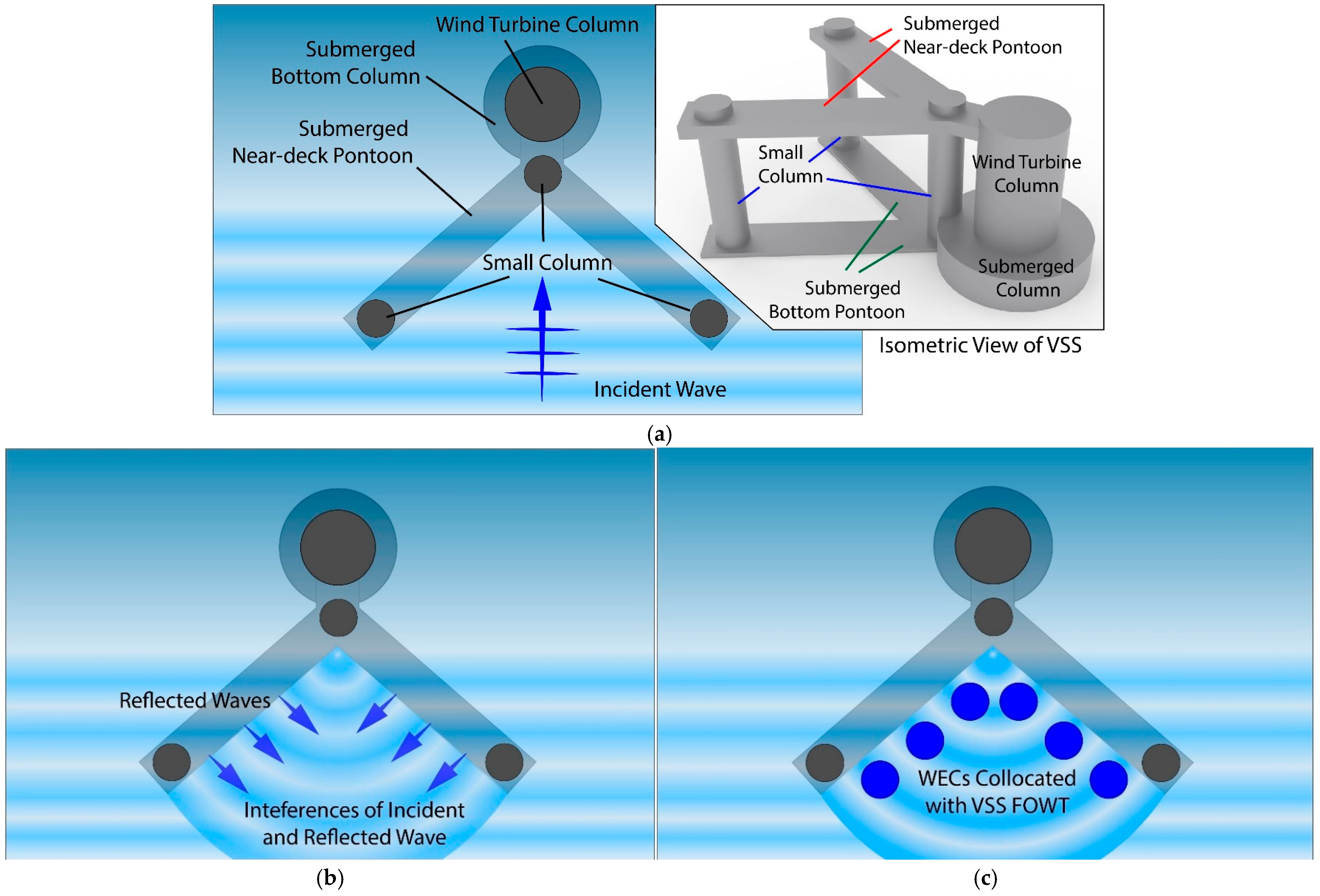
This paper explores the redesign of a floating semi-submersible platform that supports both wind turbine and WEC technologies, with the aim of enhancing energy generation. The study proposes a novel semi-submersible platform featuring a V-shaped design in its plan view (see Figure 2), oriented towards the wavefront to capture waves using its V-shaped pontoons. This configuration creates a localised area of waves with enhanced energy due to the interaction of incident and reflected waves [40,41] caused by the pontoons, while maintaining the wind turbine’s operational stability and the platform’s motion limits.
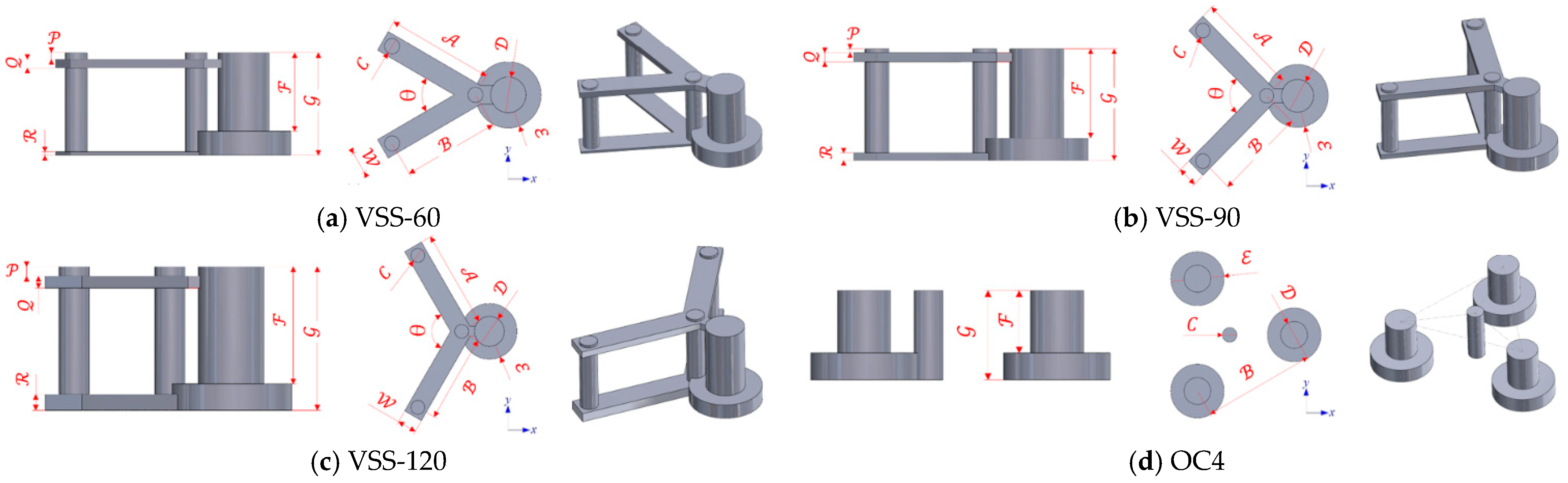
As described in Figure 2 and Figure 3, the VSS features three smaller columns and one larger column (wind turbine column) to provide buoyancy. Additional buoyancy is provided by the submerged bottom pontoons and column, which also serve as components for structural stability. The pontoon and column size dimensions are determined by ensuring that the entire platform is axisymmetric around the centre of the wind turbine column. The centre of the wind turbine column aligns with the centre of gravity (CoG) and the centre of buoyancy (CoB) to ensure stability at the initial equilibrium condition. The displacement of the VSS is comparable to that of the OC4 semi-submersible [42], allowing the platform to support the NREL 5MW wind turbine tower. The large column of the VSS platform also incorporates a turret mooring system. This enables the platform to orient itself with the dominant wave direction to optimise the energy extraction from the WECs.
Figure 4 illustrates the mechanism by which the VSS configuration enhances wave energy resources near the floating structure. As incident waves approach the VSS (Figure 4a), the near-deck submerged pontoons guide the incoming waves toward the floating offshore wind turbine (FOWT). These waves are partially reflected by the submerged pontoons, leading to constructive interference with the incoming waves and resulting in a localised amplification of wave energy (Figure 4b). Based on this phenomenon, it is proposed that a WEC array be deployed in the region of enhanced wave energy, as indicated in Figure 4c.
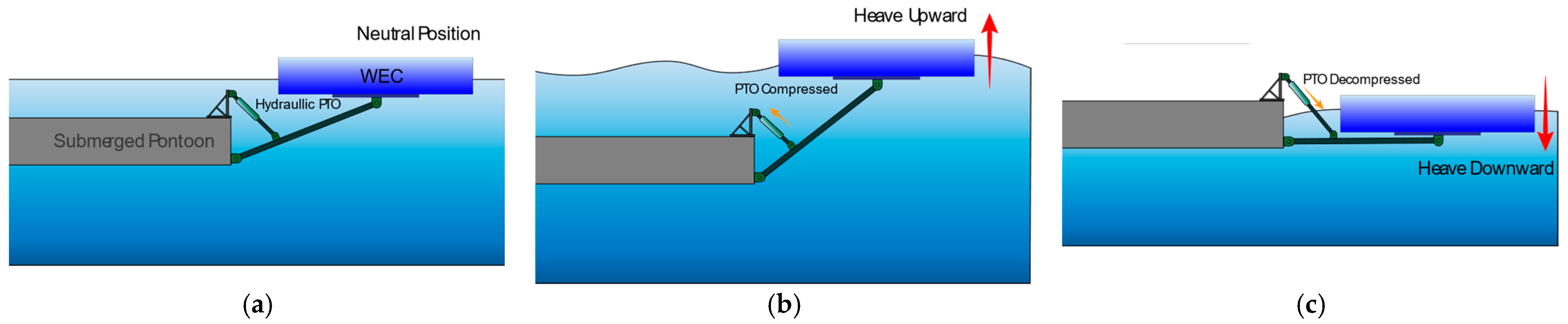
The point absorber WEC that captures wave energy via its vertical (heaving) motion is considered as shown in Figure 4. Steel framing and PTO systems are used to connect the WEC to the submerged pontoon. Under wave action, the heaving motion of the WEC causes compression (Figure 4b) and expansion (Figure 4c) of the hydraulic PTO system, which converts the mechanical motion into fluid pressure and ultimately into usable energy. The PTO system is connected to a frame mounted on the submerged pontoon, thereby providing a stable reaction point for efficient energy conversion, as shown in Figure 4.
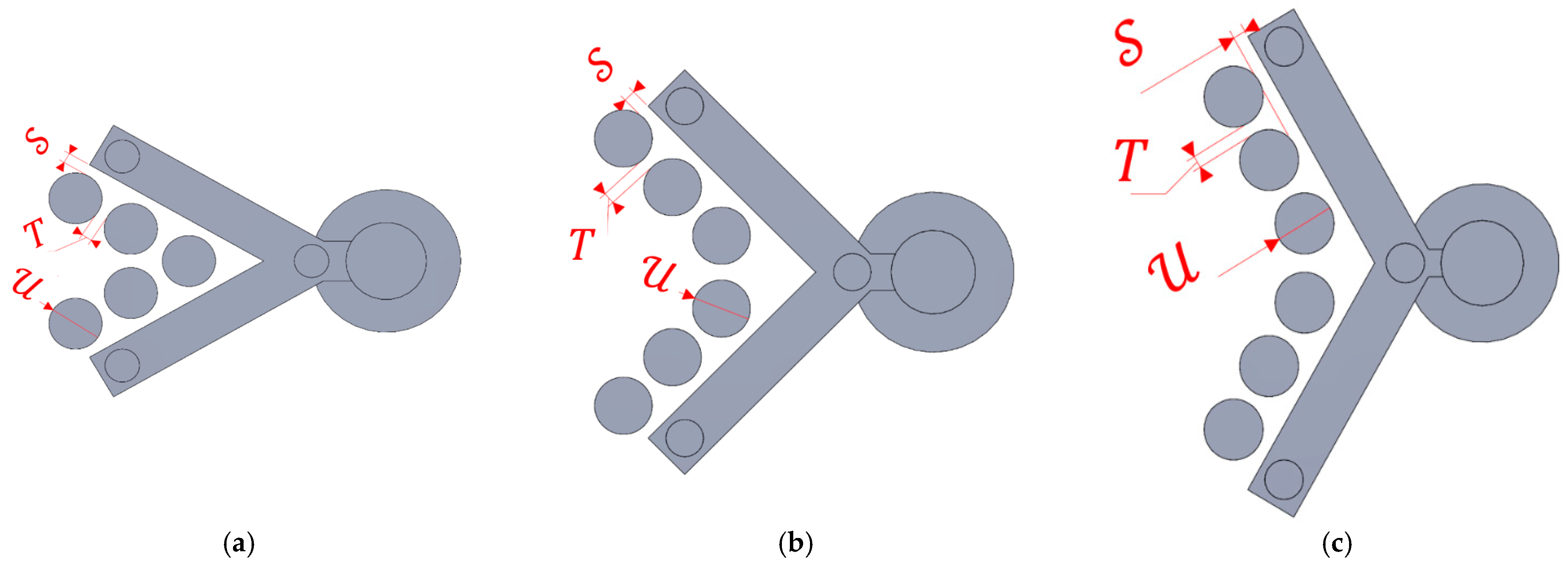
The geometry and properties of the submerged bodies of these platforms are described in Table 1 and Table 2, with reference to Figure 2. For the examination of wave power performance and hydrodynamic interaction, each configuration of the WEC arrays co-existing with three VSS platforms is analysed and shown in Figure 5. The abbreviations VSS-60-WEC, VSS-90-WEC, and VSS-120-WEC represent the configurations of the collocation of the WEC array with VSS for pontoon opening angles of 60°, 90°, and 120°, respectively.

4.2. Novelty

This research paper investigates the novel VSS platform designed to support both wind turbines and WECs, representing a significant step forward in integrated offshore renewable energy systems. Unlike traditional platforms, the proposed VSS design orients toward the incoming wavefront and utilises near-deck submerged pontoons to amplify local wave energy through constructive hydrodynamic interaction, thereby enhancing the efficiency of co-located WECs. This research was among the first to systematically evaluate three VSS configurations with varying pontoon opening angles (60°, 90°, and 120°), assessing their effects on platform motion and wave power capture. It also highlights the dual functionality of the VSS system, combining motion stability for wind turbine operation with significant gains in wave energy extraction, as presented in this paper. Moreover, the study proposes an innovative layout strategy for WEC spacing and sizing to maximise energy output and supports its numerical approach with validation against results from the established NREL floating wind turbine semi-submersible OC4 platform. The incorporation of a turret mooring system for passive wave alignment further underscores the system’s potential for longevity and operational efficiency. Collectively, this research lays the foundation for the next generation of compact, multifunctional, and high-efficiency offshore renewable energy platforms.

4.3. Objectives and Research Contribution

This study advances the development of integrated FOWT and WEC systems through the creation and evaluation of a novel VSS platform. The research focuses on three key objectives:
  • To evaluate the platform’s motion responses and verify that the proposed VSS configurations comply with the operational limits required for wind turbine stability, ensuring suitability for offshore deployment.
  • To investigate hydrodynamic interactions between the VSS platform and co-located WECs—quantified using the q -factor—to assess the potential for enhanced wave energy capture during specific wave periods. This approach introduces a novel mechanism for optimising energy extraction through constructive wave interference.
  • To examine local wave diffraction phenomena through wave elevation contour analysis, demonstrating the ability of the V-shaped geometry and near-deck submerged pontoons to amplify wave energy resources near the platform.
By addressing these objectives, this study advances the development of hybrid offshore energy platforms that integrate wind and wave energy in a more synergistic and efficient manner. The novel VSS platform concept offers new design strategies to enhance energy yield, system stability, and structural resilience, which are key priorities in the transition to low-carbon, sustainable energy systems. The findings contribute to the growing body of knowledge focused on the optimisation and integration of marine renewables, supporting ongoing global efforts to diversify and decarbonise offshore energy production.

5. Mathematical Formulation

In this study, linear potential flow theory is adopted as the primary hydrodynamic modelling approach. Its use is justified by the need for a comprehensive yet computationally efficient evaluation of WEC performance across a wide range of VSS floater designs, wave conditions, and array configurations. By employing potential flow theory, a broad design space can be explored without incurring the high computational cost typically associated with high-fidelity modelling, such as the computational fluid dynamics (CFD) method. This approach allows the fundamental hydrodynamic behaviour and wave-structure interactions to be effectively captured, enabling the relative performance of different configurations to be compared during early-stage design assessments.

5.1. Governing Equation

Hydrodynamic diffraction is computed using ANSYS AQWA 2023, employing the numerical technique of the boundary element method (BEM) within the framework of 3D potential flow theory. The platform’s surface geometry is discretised into small panels, on which potential flow theory is applied. The boundary condition assumes irrotational and incompressible flow, with the fluid velocity approaching that of the incident wave as the distance from the platform increases.
The governing equation underpinning potential flow theory is given by the Laplace equation for the velocity potential Φ x , y , z , t ,
2 Φ = 0
where Φ is the velocity potential.
The diffraction and radiation potentials are solved, accounting for the wave interaction with the structure, using the BEM. This involves solving the boundary integral equation for the potential on the surface of the body,
ϕ x = S G x , x · ϕ x n · d S S G x , x n · ϕ ( x ) · d S
where ϕ x represents a scalar field function of the variable field vector x and G x , x evaluates the influence of the Green’s function distributed at the source vectors x on the field vector x .   S   represents the wetted surface of the body, ϕ n   represents the partial derivative of ϕ with respect to the outward normal n on S , and G n   represents the partial derivative of Green’s function with respect to the outward normal n on S .
The added mass A ( ω ) and radiation damping coefficients B ( ω ) are frequency-dependent and are derived from the potential flow solution. They are computed in frequency domains, which represent the hydrodynamic inertia and energy dissipation, respectively.
The hydrodynamic model of the system in the frequency domain can be expressed by the equation of motion,
ω 2 A ω + M + i ω B ω + B v + B P T O + C x ^ = F ^ e
where A ω is the frequency-dependent added mass, M the body mass inertia, B ω the frequency-dependent radiation damping, B v the viscous damping, B P T O the linear PTO damping control for the case with WEC, C the hydrostatic stiffness, x ^ the displacement, and F ^ e the wave excitation force.
By only considering the heaving motion of the combined system, the hydrodynamic model becomes,
ω 2 A i i ω + M i i A i j ω A j i ω A j j ω + M j j + i ω B i i ω + B v + B P T O B i j ω B P T O B j i ω B P T O B j j ω + B v + B P T O + C i i 0 0 C j j x ^ i x ^ j = F ^ i , e F ^ j , e
The subscripts i and j refer to the degree of freedom of the floating platform. In this study, these subscripts account for heave, pitch, and roll modes, which are specifically analysed.
The response amplitude operators ( R A O s) are then determined, describing the platform’s response to wave excitation in terms of motion amplitudes and wave frequencies. The R A O s are calculated for each degree of freedom (DOF), i.e.,
R A O ω = Φ ( ω ) A ( ω )
where R A O ω represents the response amplitude operator as a function of the wave frequency ω , Φ ω   denotes the motion potential as a function of the wave frequency ω , and A ω represents the unit wave amplitude in this study.

5.2. Viscous Damping

To account for the viscous damping effects that are not represented by potential flow, an additional damping matrix is introduced. As the wave periods (i.e., wave frequencies) considered in the study fall within a narrow frequency range, i.e., T = 4 to 9 s, the variation in the viscous damping is assumed to be small and can be applied uniformly across all frequencies. It is widely acknowledged that the viscous damping of semi-submersible platforms in heave and pitch ranges from 3% to 10% of critical damping, with pitch damping typically around 5% [43,44]. Given this viscous correction, potential theory provides more accurate predictions. In this study, 3% of critical damping is assumed for heave, while 5% is assumed for pitch.
The corresponding critical damping coefficient ( B c ) from the inertia ( M ) and stiffness term ( C ) of the equation of motion (6), is given by
B c = 2 C . M
where the natural frequency of the system can be obtained from ω n = C / M   .

5.3. Wave Elevation

The wave elevation η on the water surface can be obtained from the diffracted potential as,
η = 1 g ϕ t
where g is the gravitational acceleration and ϕ the velocity potential distributed on the water surface. The formulation for the wave elevation is based on the linear wave theory. The wave elevation, η x , t , at a spatial point x and time t , is represented as:
η x , t = A c o s ( k x ω t + ψ )
where A represents the wave amplitude, k is the wave number, defined as 2 π divided by the wavelength λ , and ψ is the phase angle.

5.4. Linear Power Take-Off Damping of WEC

Based on linear theory [45], the optimum B P T O is expressed as,
B P T O o p t = K 33 ω 2 M + A 33 ω ω 2 + B 33 ω 2
where K 33 the heaving hydrostatic stiffness, A 33 the added mass, and B 33 the radiation damping in heave. Using this equation, the optimum PTO damping value can be determined at each frequency, and a single constant minimum value is used for the diffraction analysis as an assumption to reduce computational time. It is important to note that the power output of the WEC arrays can be maximised by tuning B P T O to vary with the wave frequency ω . This optimisation requires an advanced PTO control system. In practice, a dynamic control system could further enhance energy output or influence the overall system stability. However, developing and implementing such a control strategy is beyond the scope of this study; therefore, a constant B P T O value is assumed throughout.

5.5. Power Generation of WEC—Regular Wave

The mean power absorbed by a WEC corresponds to the mean power dissipated by the PTO’s linear damper over a wave period. The average absorbed power during a regular wave period is given in [40,45,46],
P a = 1 2 B P T O · ω 2 · x ^ 2
where x ^ =   x ^ 3 x ^ 9 is the relative heave response between WEC and the platform, and P a the mean absorbed power of a WEC in a regular wave.
The total absorbed power is given by [47],
P a T = n = 1 N w e c T P a n
where P a n is the absorbed power of the n t h WEC and N w e c T is the total number of WECs. The average absorbed power P a ¯ generated by the total number of WECs N w e c T is then given as [46,47],
P a ¯ = ( P a ) T N w e c T = n = 1 N w e c T P a n N w e c T
To capture the performance of the interaction between the array of WECs and the platform, the q -factor is expressed as [46],
q = P a ¯ P ¯ 0
where P ¯ 0 represents the average power of the total number of WECs deployed in the open sea, i.e., without the presence of the foundation platform. It should be noted that a q value greater than 1.0 indicates constructive interaction, while a value less than 1.0 indicates destructive interaction.

5.6. Irregular Wave Spectrum

The wave spectrum is used to model the energy distribution across different wave frequencies under irregular sea conditions. Given that the FOWT will be deployed in deep water with a fully developed sea state dominated by wind waves, the Bretschneider (ISSC) wave spectrum—a two-parameter Pierson–Moskowitz spectrum described by Goda [48]—is adopted.
S ω ω = 5 π 4 H s 2 T p 4 1 ω 5 e x p 20 π 4 T p 4 1 ω 4
where H s is the significant wave height, T p the peak wave period, and ω the wave frequency.
The absorbed power ( P i r r ) by a WEC in an irregular wave and the power response spectrum S R ω are computed using (16) [49]
S R ω = P a 2 . S ω ω
P i r r = 2 S R ω · d ω
where S ω ω is the irregular wave spectrum at frequency ω . The integral will give an estimation of the variance of the power response in irregular waves.

6. Validation of the Numerical Model

6.1. Hydrodynamic Coefficients

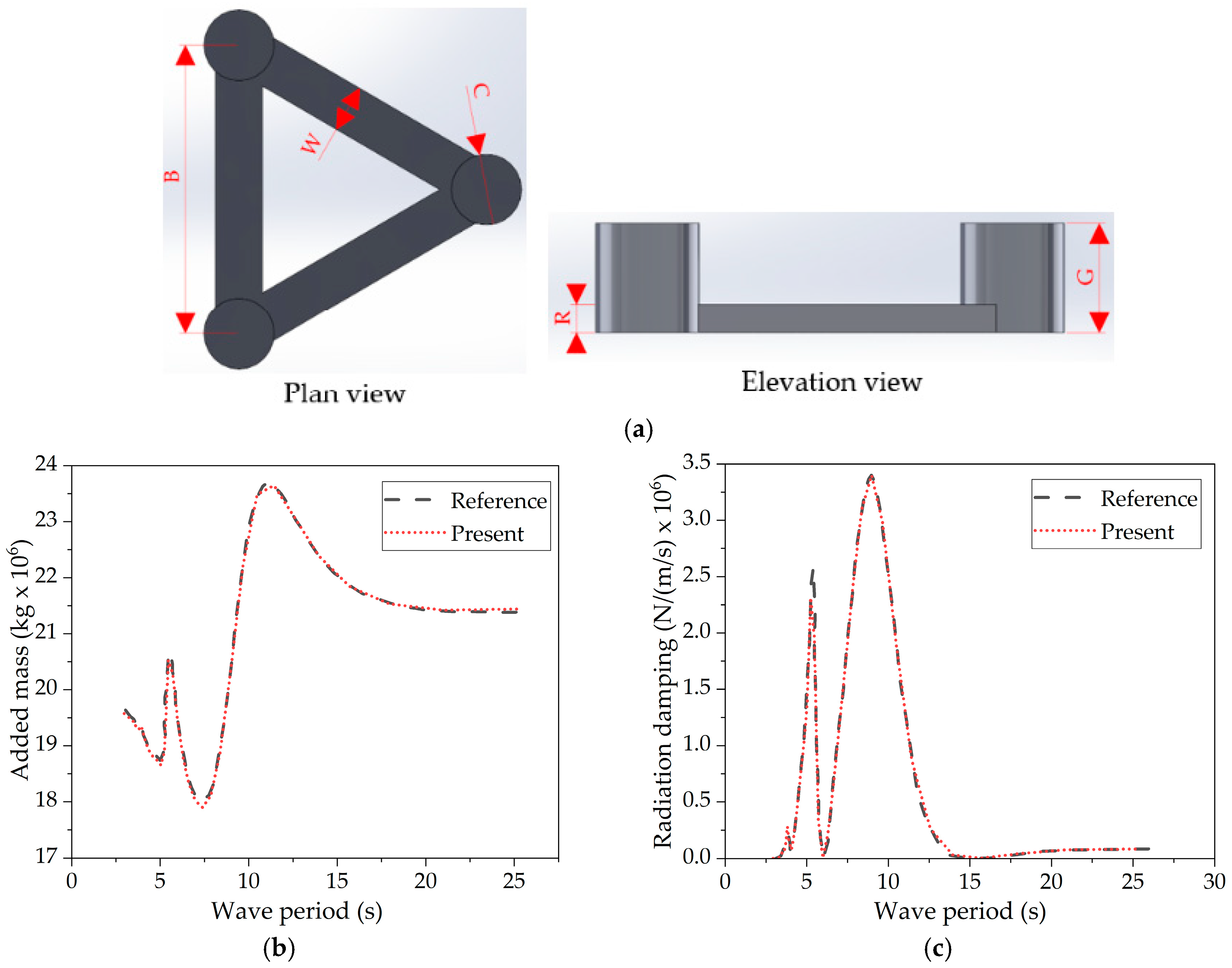
The numerical model used for the floating platform in this study was validated through an examination of the hydrodynamic coefficients by comparing them with simulations conducted by Silver de Souza et al. [50] of SINTEF, a European research organisation. Silver de Souza et al.’s [50] research reported on the design of the INO WINMOOR FOWT and provided calculations of hydrodynamic coefficients using WAMIT. The INO WINMOOR platform is characterised by a semi-submersible configuration with three columns arranged in an equilateral triangle layout, with its submerged body and dimensions shown in Figure 6a. Based on these specifications, the diffraction analysis for the floating platform was conducted using ANSYS AQWA.
The added mass and radiation damping coefficients of the platform in heave were calculated and compared with the corresponding values from the reference study, as depicted in Figure 6b,c. The close alignment between both sets of results demonstrated the validity of the numerical model employed in this study for the diffraction analysis of the platform.

6.2. Mass Inertia of the Floating Platform

To ascertain the mass moment of inertia of the new platforms examined in this paper, it was necessary to approximate the appropriate values for the rotational stiffness parameters I x x , I y y , and I z z , which significantly affect the platforms’ motion response. Typically, these parameters are derived from the detailed weight and ballast specifications obtained through structural design. However, for the current phase of our study, the objective is to provide a quick estimation of the restoring mass moment of inertia. To achieve this, the submerged body of the floating platform is modelled using SolidWorks 2023, and the mass inertia values were computed relative to the CoB of the submerged body.
The accuracy of this mass inertia estimation, derived from the submerged body, was verified by modelling the semi-submersible FOWT OC4 [42]. The values were then compared with the reported OC4 mass inertia in the reference. In the reference, the values for I x x and I y y were recorded as 6.83 ×   10 9 kg · m2, while the modelling yielded 6.51 ×   10 9 kg · m2, a difference of 4.7%. Similarly, the reference indicated I z z as 1.23 ×   10 10 kg · m2, whereas the model indicated 1.20 ×   10 10 kg · m2, an error of 2.4%. These findings showed close agreement between the results, with only a minor variance.
This slight discrepancy was attributed to the simplified assumption made in the modelling, wherein the CoB was considered equivalent to the CoG during the initial stable equilibrium state. The actual reference may have incorporated ballast adjustments and detailed structural weights, which could have resulted in a lower vertical CoG. Despite this, the estimation was considered appropriate for the purposes of this study.

6.3. Validation of Absorbed Power and Hydrodynamic Interactions

The numerical model used in this study was validated in [17], which employs the same modelling framework in ANSYS AQWA. Readers interested are referred to [17] for a detailed description of the two validation cases conducted. The first validation involved comparing the mean absorbed power, P a , of a point absorber WEC integrated with a semi-submersible FOWT, to the results published in [51]. The WEC, with cylindrical geometry (4 m radius, 3 m draft), is located centrally on the OC4 semi-submersible platform, and a linear PTO damping control is applied. Hydrodynamic analyses were performed in the frequency domain. The second validation further assessed the accuracy of the model in predicting system dynamics and power performance under varying wave conditions. Together, these validations demonstrated the reliability of the numerical model in capturing the coupled hydrodynamic behaviour of the WEC-FOWT system.

7. Result and Discussion

7.1. Regular Wave

7.1.1. RAO of the Platforms

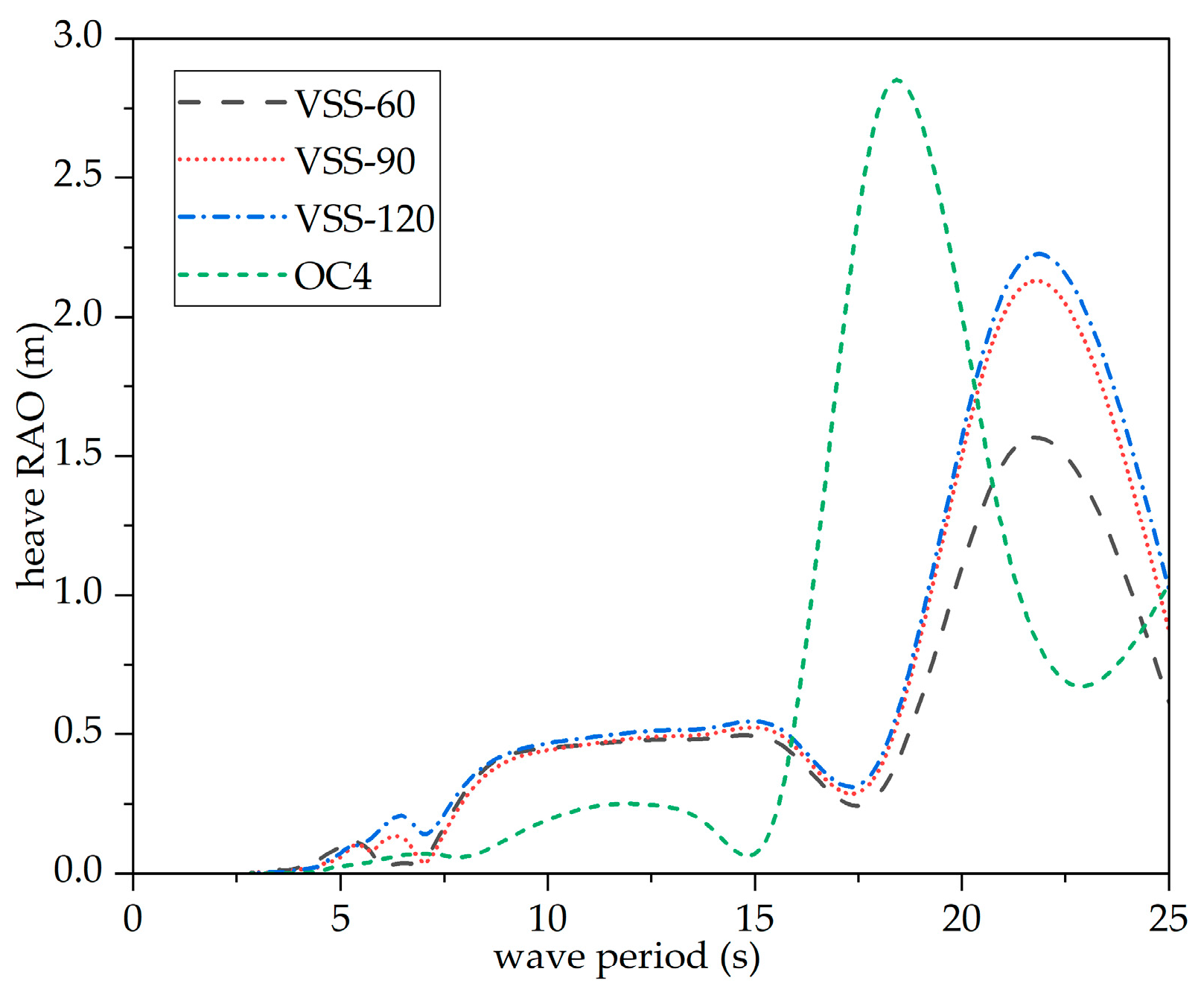
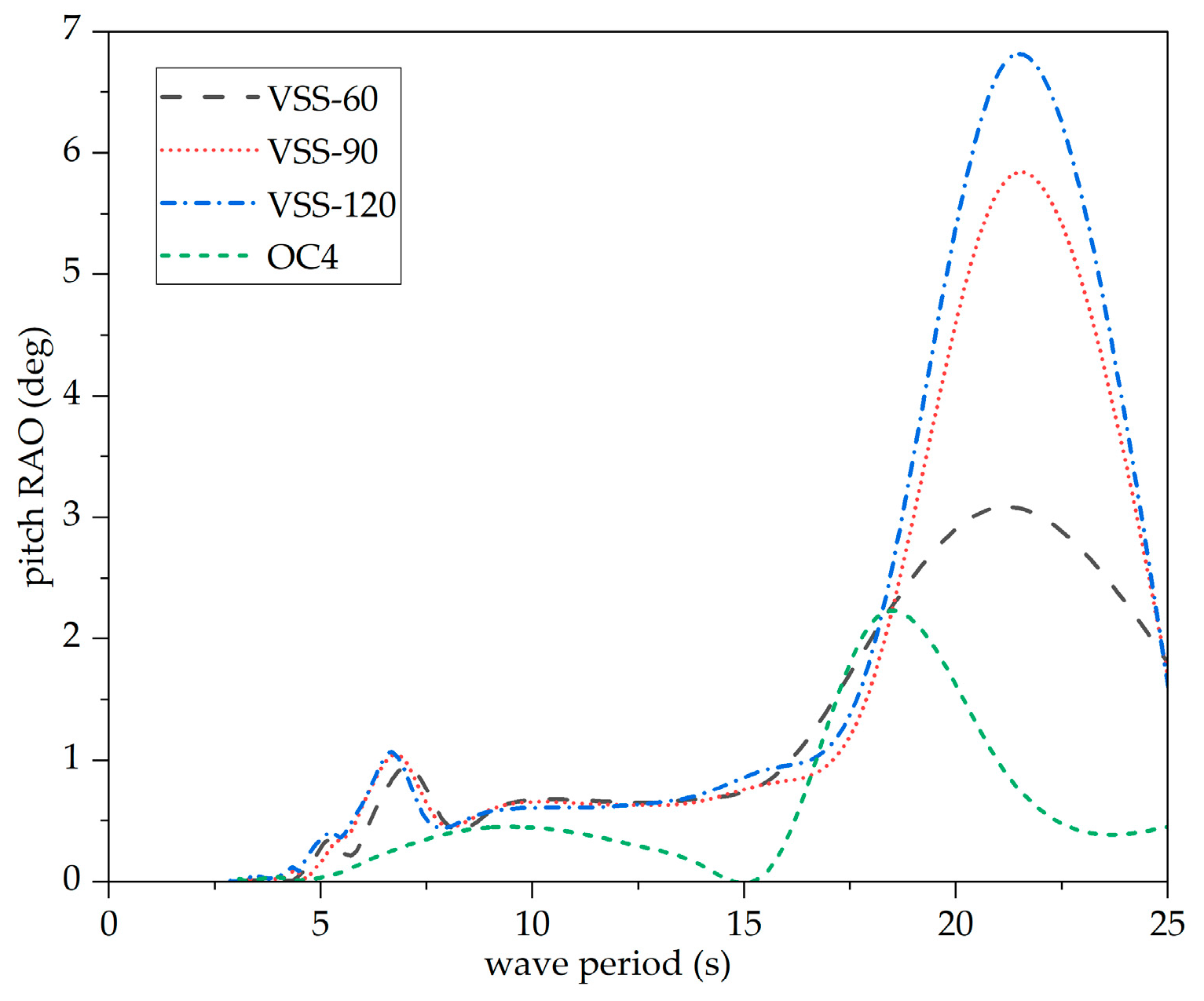
In this analysis, the hydrodynamic diffractions of the VSS-60, VSS-90, VSS-120, and OC4 semi-submersibles were examined over a range of wave frequencies from 0.05 to 2.20 rad/s. The motion R A O s of these platforms were evaluated. It is noted that although the V-shaped semi-submersible (VSS) included a turret mooring system for passive weathervaning, this study did not model turret dynamics and assumes a fixed head-sea condition (0° wave incidence). The effects of weathervaning on WEC orientation and resulting wave interaction were therefore not considered and were beyond the scope of this work. Considering a turret-moored FOWT with a single wave direction of 0 degrees, the heaving and pitching motion R A O s were computed, as shown in Figure 7 and Figure 8, while rolling motion was minimal due to the alignment of its rotation axis with the wave direction. Figure 7 and Figure 8 showed, respectively, that the heave and pitch R A O s of the VSS increase with the increase in the opening angle of the pontoon, i.e., VSS-120, has larger R A O s compared to VSS-90 and VSS-60. This may be due to the higher exciting forces and moments acting on the VSS with a larger pontoon opening. The same argument applies when comparing the R A O s of VSS and OC4, as VSS exhibited higher R A O s due to the larger excitation forces and moments caused by the bigger surface areas of the additional near-deck submerged pontoons.
A review report on floating offshore wind, conducted by James et al. [37], included data on various analysed floating wind platform concepts. The report indicated that nacelle accelerations remain below 4 m/s2 during standard wind turbine operations. To achieve this level of nacelle acceleration, the motion of the floating wind platforms is controlled, keeping maximum heave between 1 m and 5 m and maximum pitch between 4.5° and 7.5° during operational conditions. Additionally, the offshore standard DNVGL-OS-C301 [52] specifies that the inclination angle for the intact stability of deep-draught floaters for general application is limited to 6° under normal operating conditions and 12° in survival conditions. Furthermore, design modifications and control systems, including ballast shifting, dynamic positioning, and advanced turbine control strategies, can be used to further restrict platform motion within acceptable parameters.
The heave and pitch R A O s of the new VSS platforms were found to be close to those of the established FOWT OC4 semi-submersible. In heave, excluding the resonance region, the maximum amplitude reached 0.25 m in the OC4 semi-submersible and 0.5 m in the VSS platforms over wave periods ranging from 8 s to 15 s. For pitch, the OC4 experienced a maximum amplitude of 0.5°, while the VSS platform showed a maximum of 1° around a wave period of 6 s. The natural periods for heave and pitch in the VSS platforms were approximately 21 s, which was longer than the 18 s observed in the OC4 semi-submersible. This indicates that the proposed VSS performed better in motion response, as its natural periods are further from the dominant sea state during operation.
In this study, to estimate whether the resulting motion responses fall within acceptable limits, the permissible motion levels are assumed to be 5 m for heave and 6° for pitch, based on an incident wave height of 5 m (i.e., wave amplitude of 2.5 m). Since R A O s were based on unit wave amplitude, the assumed allowable heave and pitch R A O s are adjusted to 2 m and 2.4°, respectively. The analysis demonstrated that the motion R A O s of the platforms remained below the permissible levels under the wave condition examined, suggesting their viability for accommodating wind turbines in a renewable energy-sharing platform with WECs. The performance of these WECs was evaluated in the subsequent section.

7.1.2. WEC Absorbed Power and Interaction q-Factor

To investigate the performance of the WECs in power extraction as well as the efficiency of the collocation configuration with FOWT, the absorbed wave power and hydrodynamic interaction performance ( q -factor) were compared. As depicted in Figure 5, the study places an array of WECs with a diameter U = Ø 10 m, draft d W E C   = 1 m, and spacings S = T   =   2 m at the wavefront of the VSS platforms.
Since the study considers three VSS platforms having variable angles of pontoon opening to capture different hydrodynamic interactions, the total power of the WECs collocated with the VSS was calculated and compared to that of a standalone WEC array, i.e., WECs without the presence of the VSS platforms. Using (10), the total absorbed power was calculated based on the WECs’ heaving R A O s and a constant minimum damping of a linear PTO in the frequency domain across wave periods T ranging from 4 s to 9 s. While individual WECs had the same diameter, draft, and spacing in all configurations, interaction q -factors based on the average absorbed power of WECs in each configuration were computed using (13) and compared.
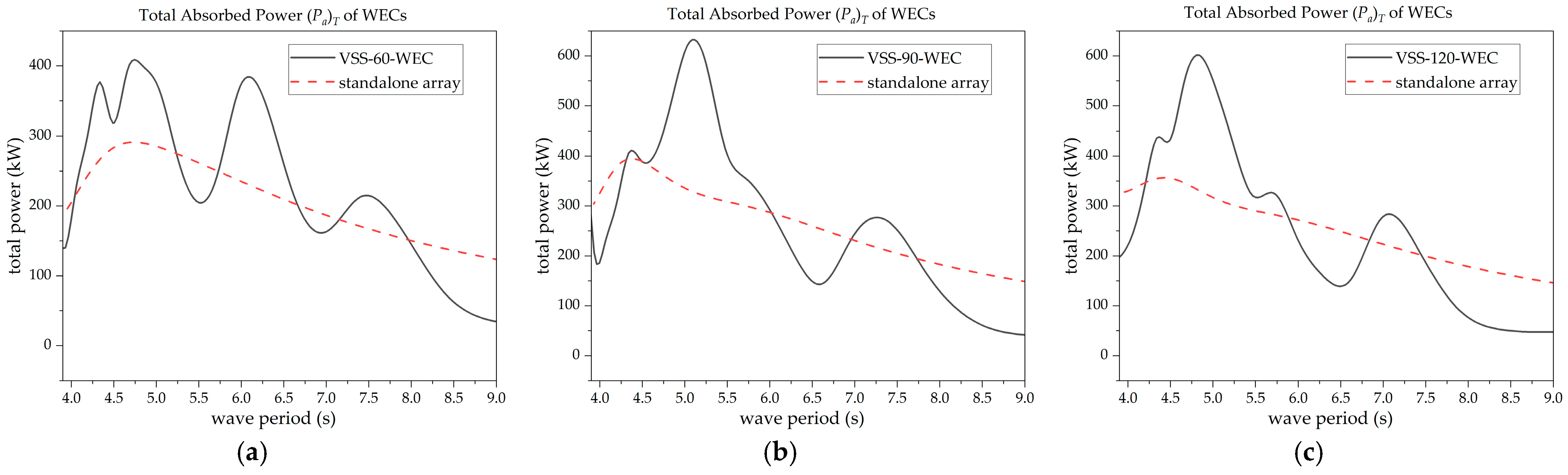
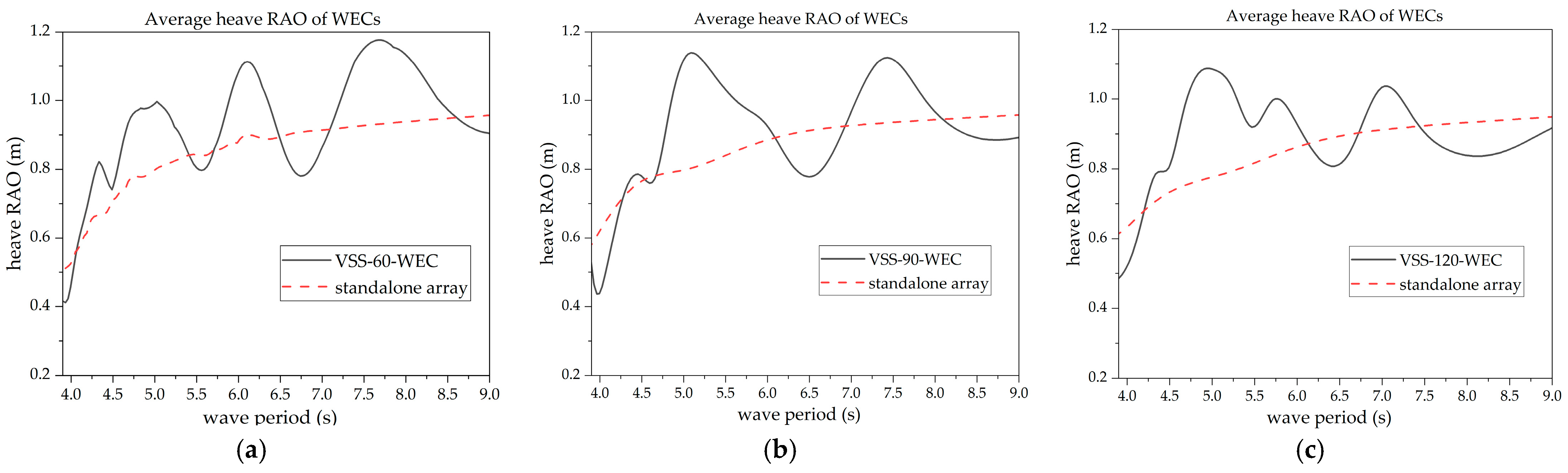
Figure 9 shows the comparison of the total power absorbed by the WECs collocated with the VSS and their counterparts in a standalone WEC array. It can be seen that the power generation in standalone WEC arrays followed the shape of a smooth curve. In contrast, power generation in WECs collocated with VSS platforms showed fluctuations across wave periods due to the interaction of diffracted and radiated waves with the platform. A similar response of these collocated platforms and standalone WEC arrays was also reflected in the WECs’ average heave R A O s, as shown in Figure 10. The average heave R A O of the WECs was determined to evaluate the behaviour of individual WEC performance for comparison.
It is observed that the WEC array in VSS-60 produced three peak zones (i.e., between 4.0 s and 5.2 s, 5.7 s and 6.6 s, and 7.1 s and 8 s) of higher wave power compared to the standalone counterpart, with the average difference of approximately 100 kW. In VSS-90 and VSS-120, the array exhibited two peaks of higher power than the standalone array, i.e., when T ranged from 4.2 s to 6.0 s and from 7.0 s to 7.5 s.
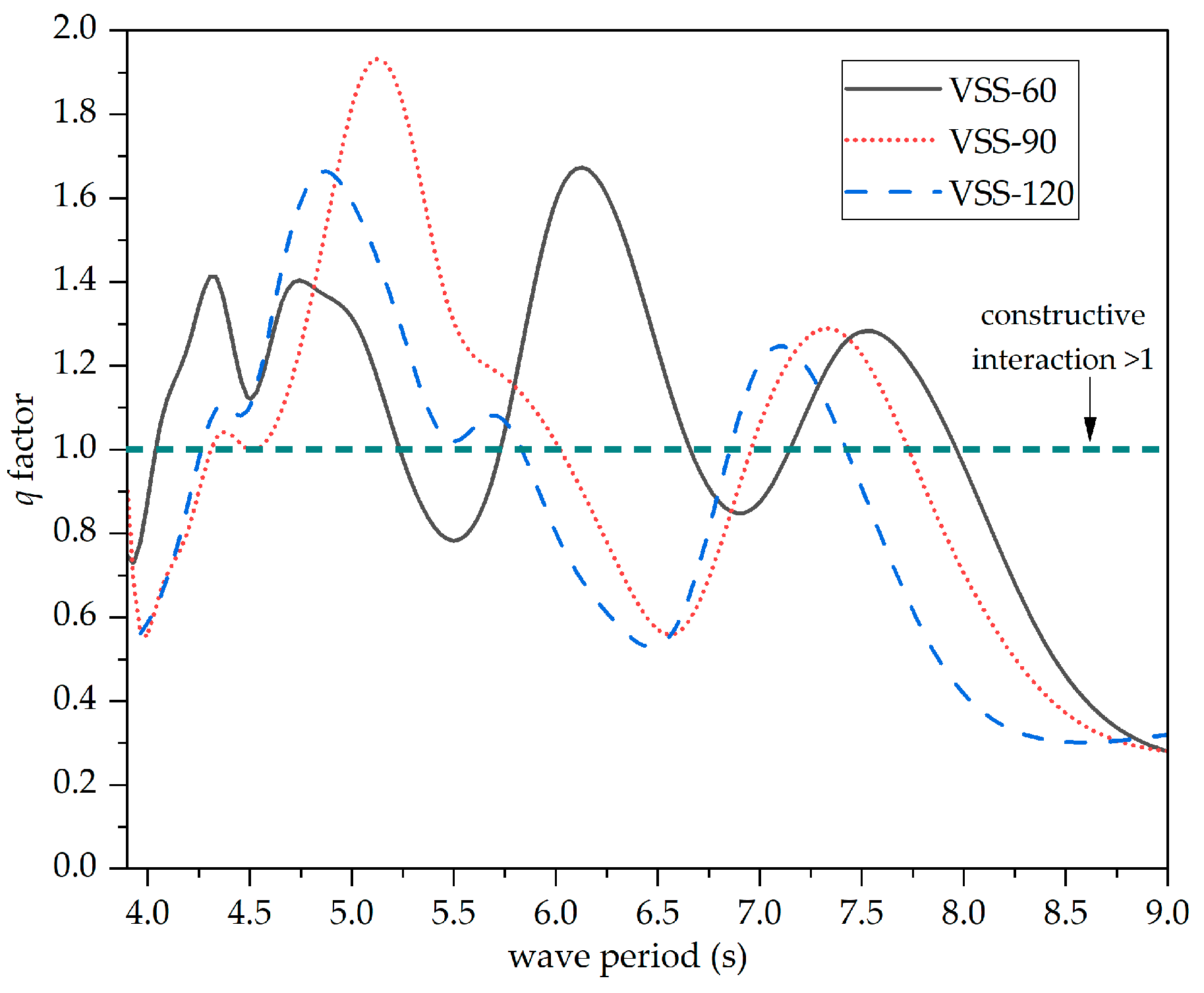
Figure 11 highlights the constructive interaction q -factor, indicating higher power generation when WECs are collocated with the platforms in specified wave periods. VSS-60 demonstrated a power improvement of up to 40% compared to the standalone array within the wave period T ranging from 4.0 s to 5.2 s, 60% improvement for T between 5.7 s and 6.6 s, and 30% improvement for T   between 7.1 s and 8 s. The VSS-90 exhibited the highest constructive q -factor of 1.9, particularly in wave periods T between 4.5 s and 6.0 s, and again the constructive q -factor of 1.2 for T between 7.0 s and 7.5 s. Similarly, VSS-120 produced higher q -factor in wave periods T between 4.5 s and 5.7 s as well as 7.0 s and 7.5 s, with the maximum q-factor being 1.6 and 1.2, respectively.

7.1.3. Effect of Diameter and Spacing

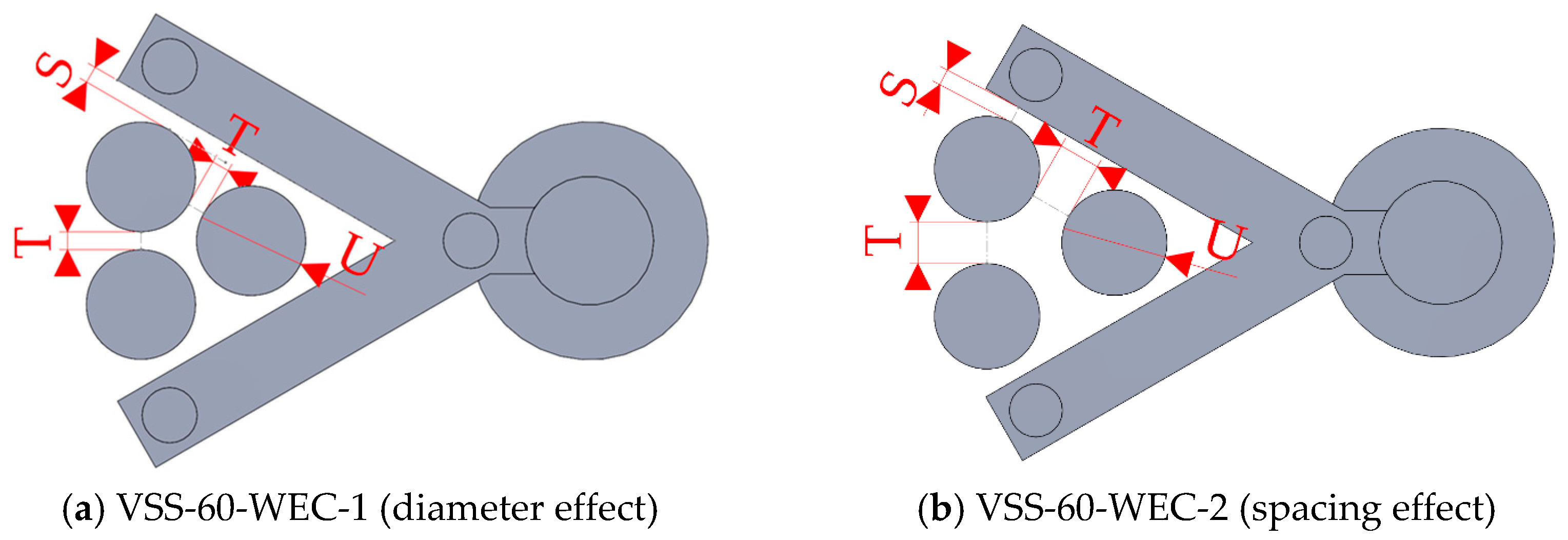
Figure 9 and Figure 10 demonstrate that the VSS-60-WEC delivers superior power production performance compared to its counterparts. In this section, the effect of varying the WEC diameter was therefore evaluated based on the VSS-60-WEC array, while maintaining the same total WEC water plane area (WPA) to ensure consistent heaving hydrostatic stiffness. The original VSS-60-WEC array consisted of five WECs, each with a diameter of 10 m, thereby totalling a WPA of 393 m2. To maintain a similar WPA, three WECs, each with a diameter of 13 m, were considered in Figure 12a, and were abbreviated as VSS-60-WEC-1. In addition, the effect of spacing between the WECs was also considered in Figure 12b, where the spacing T = 5 m was applied. The configuration was abbreviated as VSS-60-WEC-2.
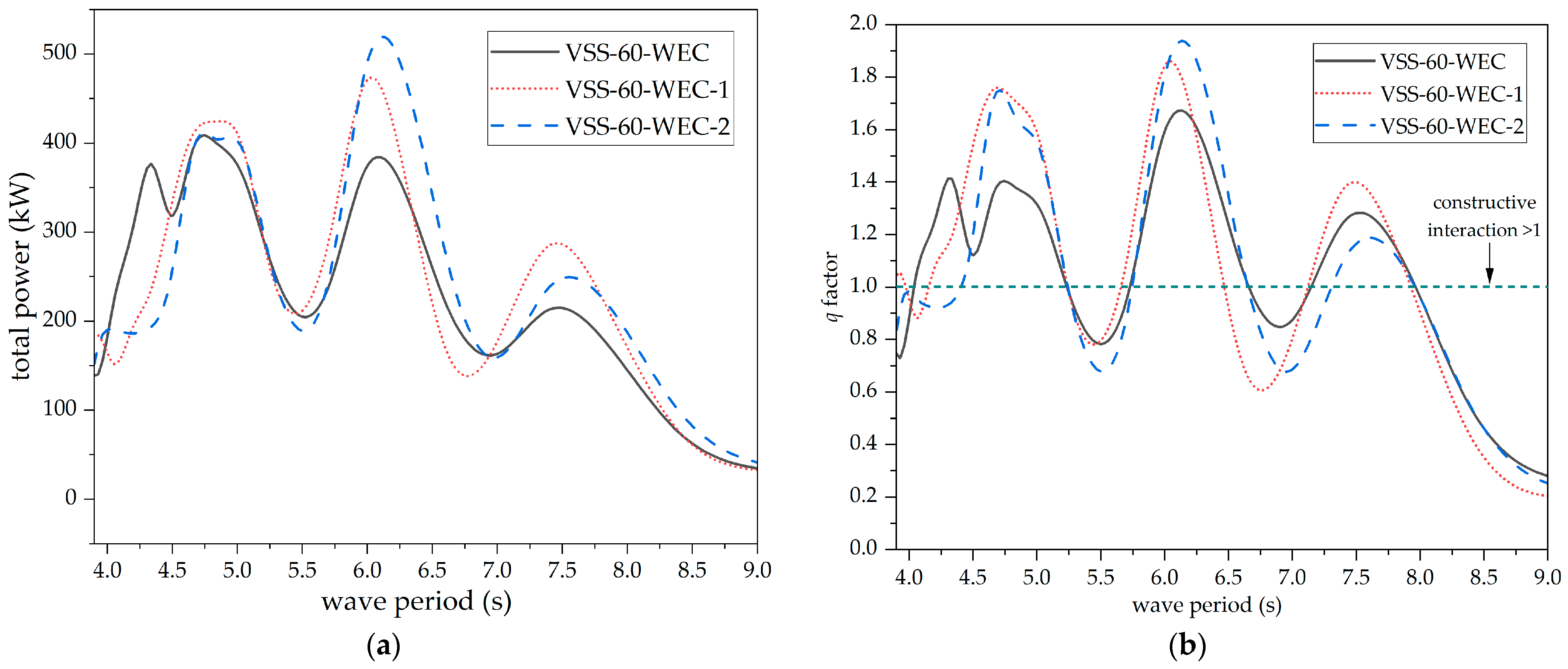
The total absorber power and q -factor were presented in Figure 13a and Figure 13b, respectively. The analysis showed that increasing the diameter leads to a notable increase in total power output of approximately 100 kW. Additionally, the q -factor increased by an average of 20%, while the wave periods for constructive interaction remained relatively similar. This may be attributed to the changes in the natural period of WECs due to the changes in the diameter, which coincided with the sea state wave period.
By increasing the spacing between WECs from 2 m, as shown in Figure 12a, to 5 m, as shown in Figure 12b, it was found that the total power output for the array with wider spacing (VSS-60-WEC-2) was approximately 50 kW higher than that of the array with narrower spacing (VSS-60-WEC-1) when the wave periods were around 6.0 s, as presented in Figure 13a. However, for a wave period of around 7.5 s, the wider-spacing array underperformed by approximately 40 kW. Similarly, the q -factor improved by 10% and declined by 20% compared to the narrower-spacing array for wave periods of around 6.0 s and 7.5 s, respectively. This can be explained by constructive interference at wave periods below 6 s and destructive interference between 6.0 s and 7.5 s, resulting in a transition from high to low energy extraction. It is to be noted that both VSS-60-WEC-1 and VSS-60-WEC-2 exhibited similar trends across the remaining wave periods.

7.1.4. Wave Elevation Contour

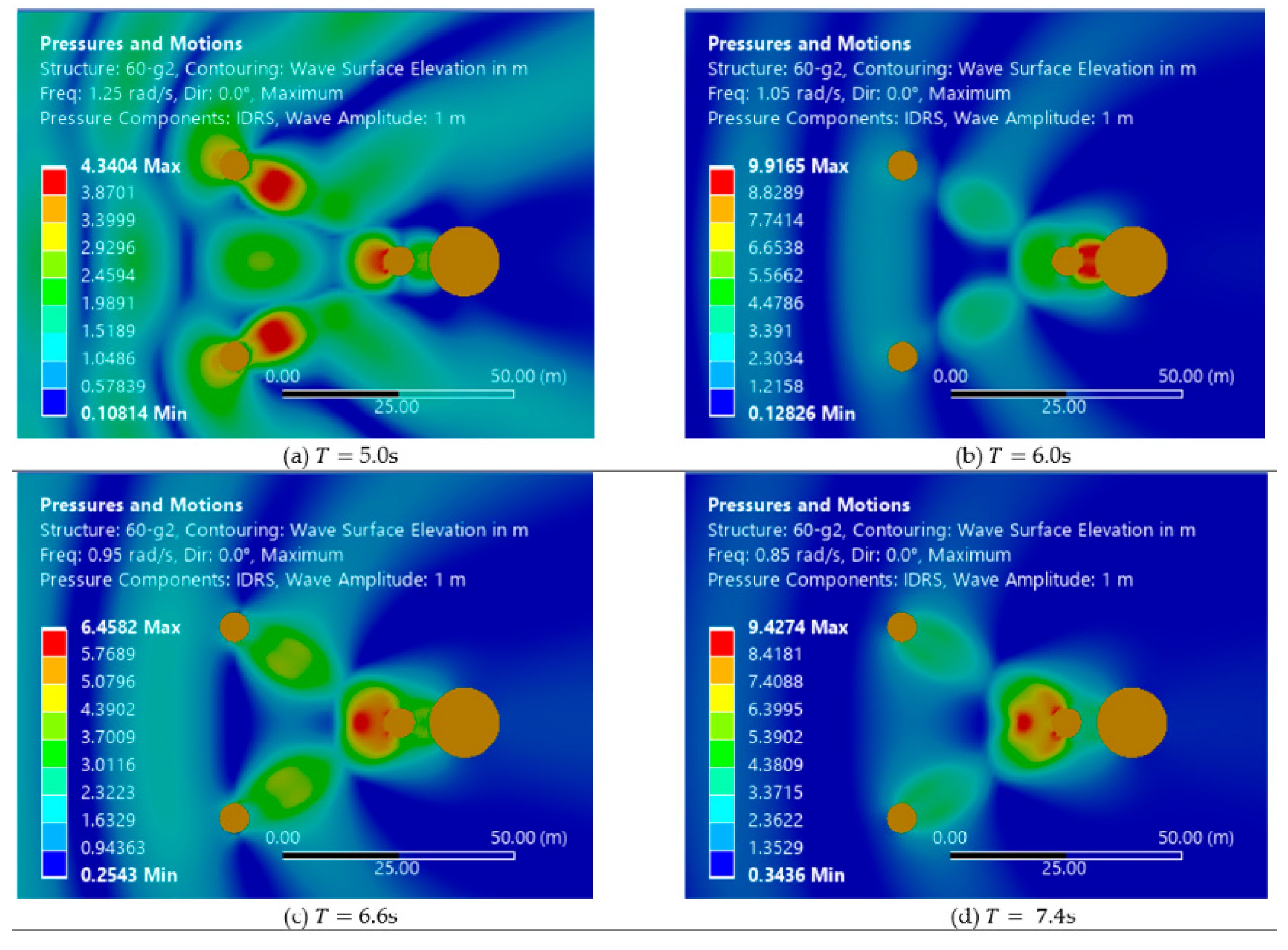
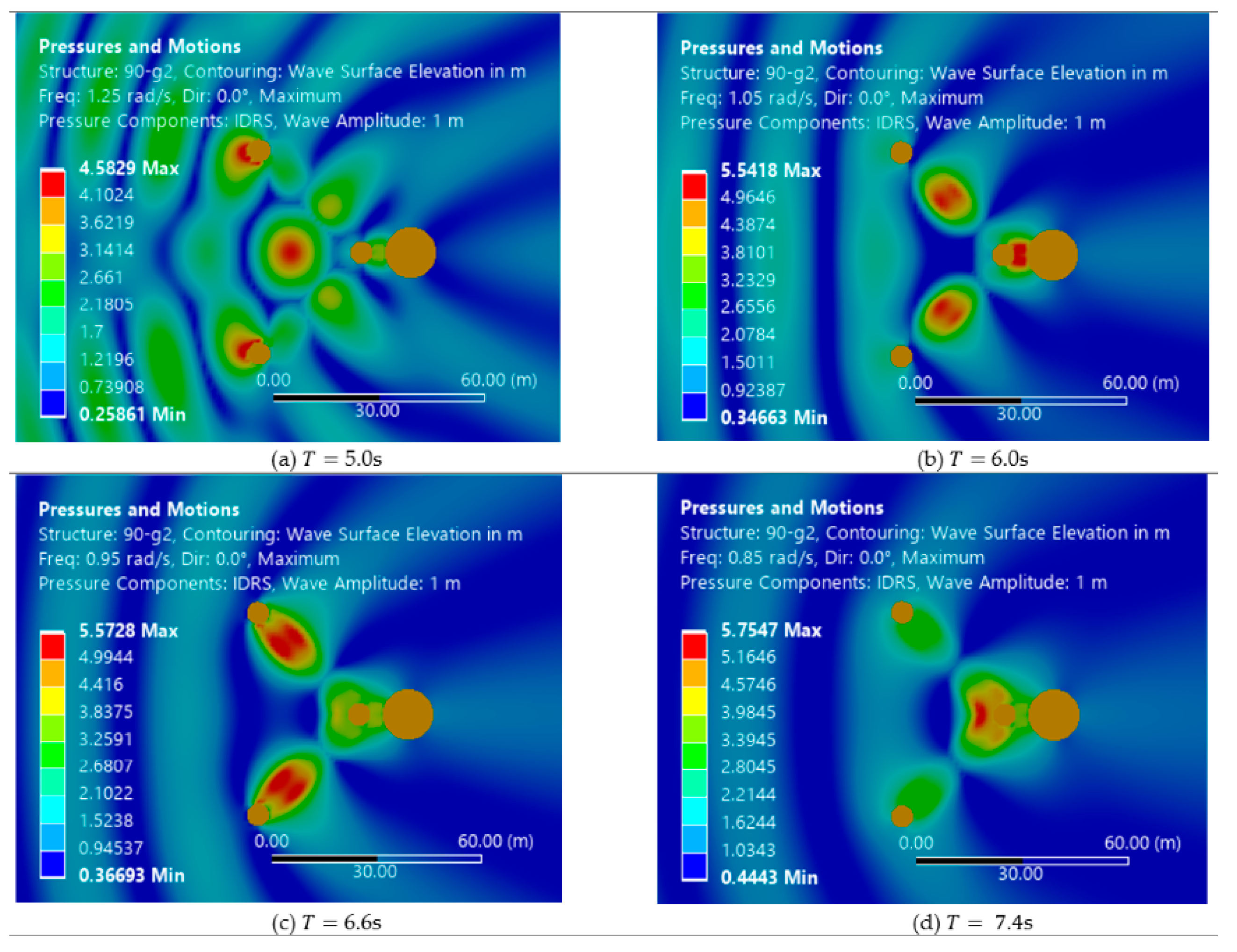
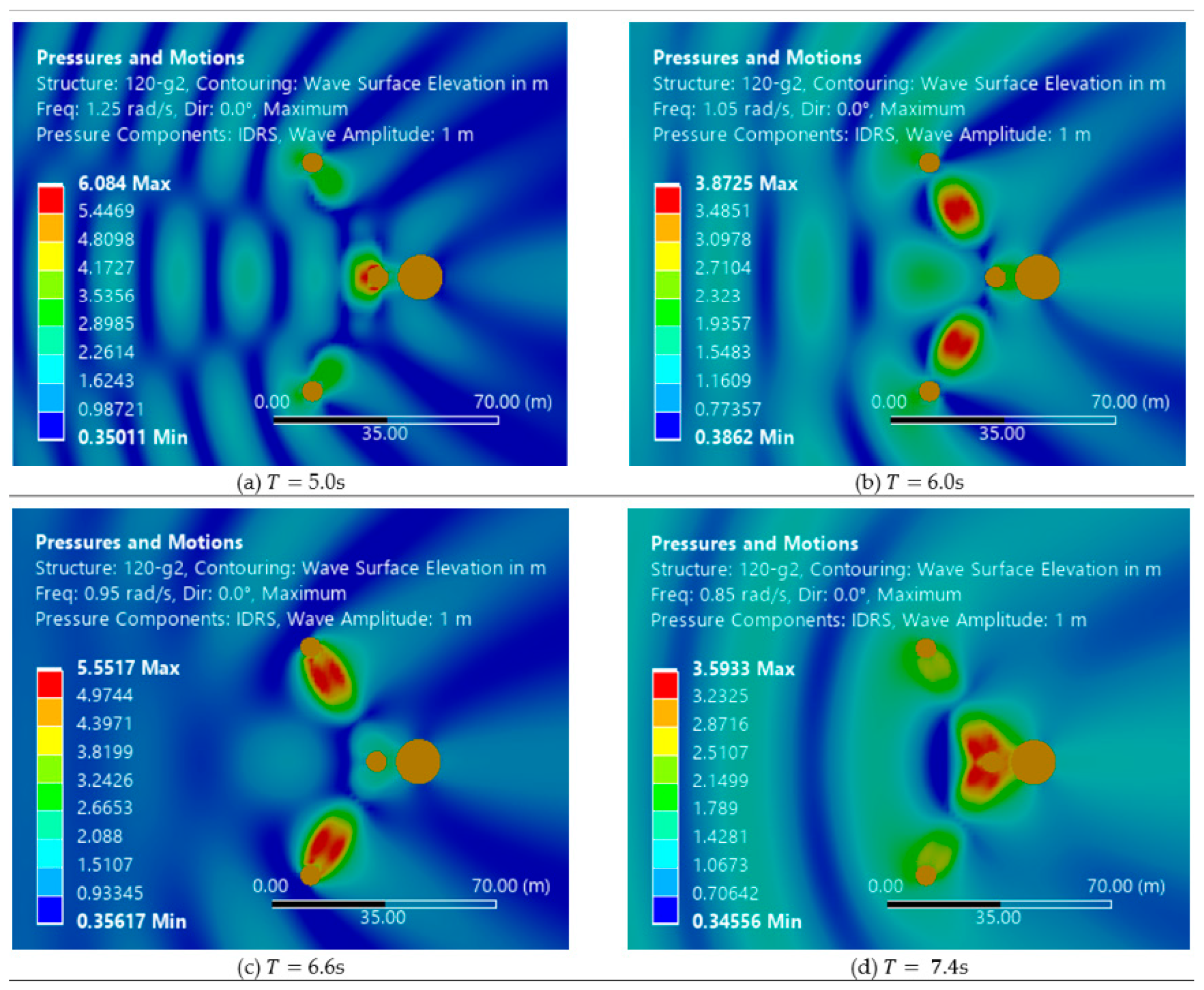
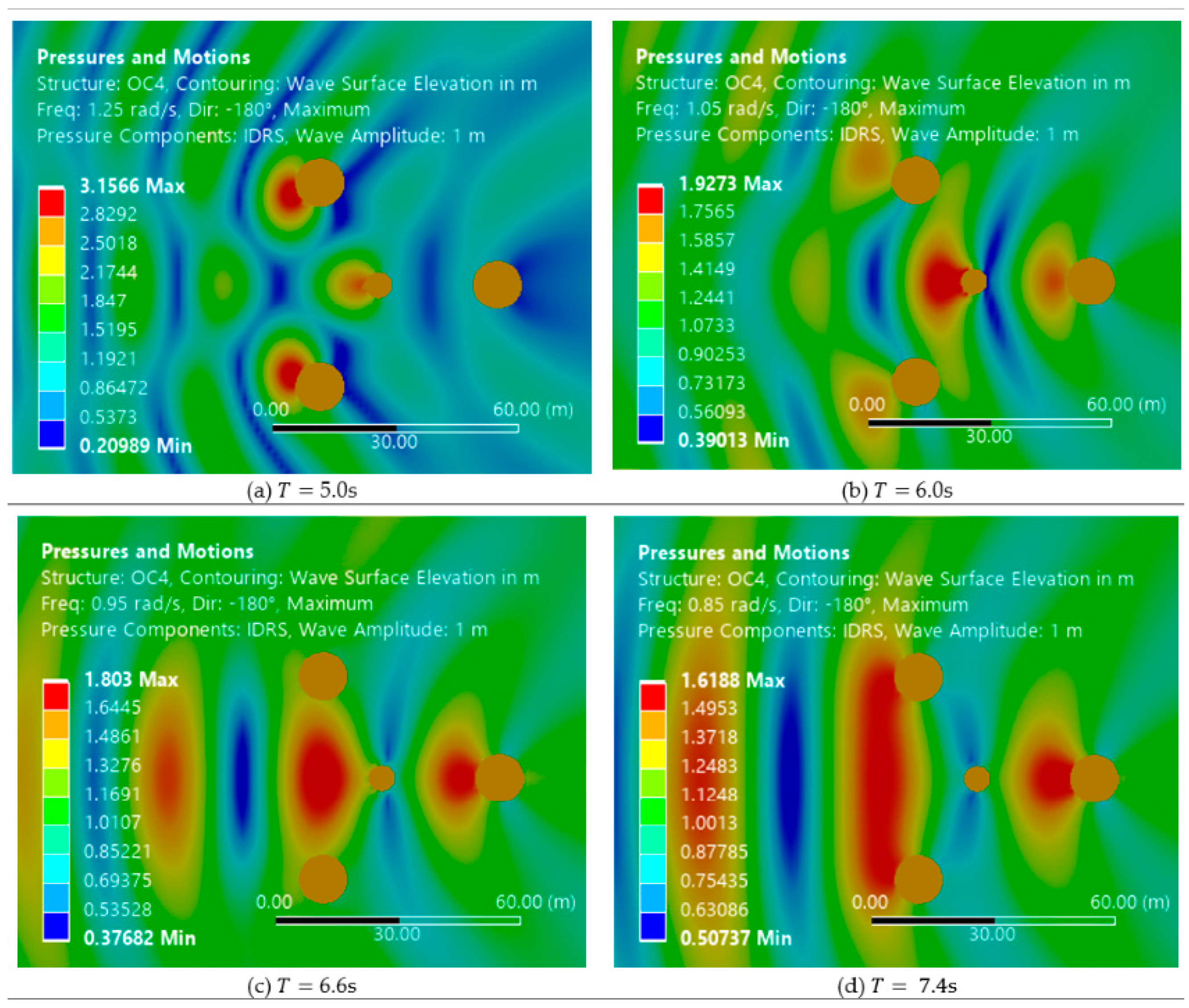
Next, the wave elevations observed around the floating platforms VSS-60, VSS-90, VSS-120, and OC4 under a head sea wave direction of 0° were illustrated in Figure 14, Figure 15, Figure 16 and Figure 17. The objective was to study the enhancement of wave elevation for the different VSS configurations and compare them with the conventional OC4 semi-submersible FOWT. Four wave periods—specifically 5.0 s, 6.0 s, 6.6 s, and 7.4 s—as highlighted in the WECs’ constructive interaction section (see Section 7.1.2), were selected to observe their impact on the water surface level for each platform. The contour plots represent the maximum wave elevation at every grid point, considering all phase angles of the wave.
For all VSS platforms, it should be noted that average wave elevations ranging from 4.0 m to 5.0 m occurred near the submerged pontoons located just below the deck. These elevated wave heights appeared to be the result of a wave push-up effect caused by the submerged pontoon, which is located 2 m below the water surface. This effect was expected to create a localised zone of wave energy within the boundaries of the V-shaped pontoon, where the WECs are installed.
The platform with the smallest angle, VSS-60, showed the highest wave elevations at the wavefront of the platform. This is likely due to the longer effective pontoon length in the direction of wave propagation, as well as the narrower opening angle of the pontoon, which produced more concentrated wave patterns due to wave reflection off the pontoon. This high-energy wave zone in VSS-60 aligns with the WEC absorbed power results presented in Section 7.1.2, indicating that power generation is most favourable in VSS-60 compared to VSS-90 and VSS-120.
To validate the wave energy enhancement due to the VSS configuration, Figure 17 illustrates wave elevations observed in the OC4 semi-submersible for comparison. At wave periods of 5.0 s, 6.0 s, 6.6 s, and 7.4 s, the wave elevations at the OC4 column’s wavefront were approximately 3.0 m, 1.9 m, 1.8 m, and 1.6 m, respectively. In contrast, the VSS generated average wave elevations of 4.0 m to 5.0 m in its platform vicinity, as shown in Figure 14, Figure 15 and Figure 16.

7.2. Irregular Wave—Total Absorbed Power

7.2.1. Power Matrix

Next, the total absorbed power of the three WECs co-located with VSS-60, VSS-90, and VSS-120 under irregular wave conditions was evaluated. The total absorbed power in irregular waves, P i r r , was calculated using (14) to (16). The irregular waves are modelled using the Bretschneider wave spectrum. The analysis integrates an irregular wave spectrum, considering a range of significant wave heights ( H s ) from 1.0 m to 5.0 m and peak wave periods ( T p ) ranging from 4 s to 9 s. The resulting power matrices for each array were presented in Table 3, Table 4 and Table 5. Subsequently, data analysis was conducted based on the performance of each WEC array by comparing the total absorbed power across the range.
Table 3 showed that the P i r r of the WEC array in VSS-60-WEC reached a peak power of 897 kW at T p   = 6.0 s and H s   =   5.0 m, but dropped significantly once T p   exceeds 6.5 s. On the other hand, the P i r r of the WEC array in VSS-90-WEC achieved a maximum power of 1451 kW at T p   =   5.0 s and H s   =   5.0 m, as summarised in Table 4. Similarly, Table 5 showed that the VSS-120-WEC array peaked at 1258 kW under the same H s and T p conditions as the VSS-90-WEC, and exhibited more consistent performance across different T p values compared to the others.
Across all three WEC arrays, the absorbed power increased with the significant wave height for a given T p , which is expected, as larger waves carry more energy. The finding shows that the optimal VSS configuration is dependent on site-specific wave conditions. The peak period T p of 5.0 s consistently yielded the highest absorbed power for the VSS-90-WEC and VSS-120-WEC across various H s values. However, the maximum power for the VSS-60-WEC was observed at T p   =   6.0 s, which is higher than that of the VSS-90-WEC and VSS-120-WEC at the same period. These findings suggest that these WEC arrays were most efficient in energy extraction at wave periods around T p   =   5.0 s and 6.0 s. It is to be noted that the performance of the WEC array in energy generation drops with higher T p values. Notably, the performance of the WEC arrays declines at higher T p values.
In summary, among the three configurations, the VSS-60-WEC was the most efficient in capturing energy from longer waves, suggesting greater adaptability and potential for more versatile applications in varying sea conditions. On the other hand, the VSS-90-WEC was capable of generating the highest energy at T p   =   5.0 s. The VSS-120-WEC configuration exhibited more stable performance across a broader range of significant wave heights H s , but with a decrease in power output as T p increases. Lastly, the analysis showed that optimising WEC arrays for specific wave periods could significantly enhance performance, and the choice of WEC parameters should consider the prevalent wave conditions at the deployment site.

7.2.2. Annual Energy Production

Wave Energy Production
A case study was conducted to estimate the annual energy production ( A E P ) of the WEC array for VSS-60-WEC, VSS-90-WEC, and VSS-120-WEC, with the parameters provided in Table 1 and Table 2. The case study focuses on two representative sites: the first in the North Atlantic Ocean (NAO), situated off the western coast of Europe, and the second in the South China Sea (SCS), both of which present strong and consistent wind resources that prevail throughout the year. The selected NAO and SCS regions are characterised by high wind speeds, significant wave heights, and deep-water depths, making both sites well-suited for the deployment of VSS FOWTs. Specifically, the NAO site is located between 45°N and 55°N latitude and 10°W to 20°W longitude—an area frequently targeted for offshore renewable energy projects due to its favourable wind conditions and proximity to European grid infrastructure. In contrast, the SCS site lies between 0.5°N and 23°N latitude and 105°E to 125°E longitude, a region characterised by substantial wave energy resources, making it a promising location for the deployment of WECs.
The NAO wave climate features a mean Hs ranging from 2 to 3 m and peak spectral periods between 7 and 9 s. In contrast, the SCS region exhibits persistent wave energy resources with wave heights between 1 and 3 m and dominant peak wave periods ranging from 5.0 to 6.5 s. The wave scatter diagram representing the percentage occurrence (or probability p ) for the NAO wave climate is obtained from [53] and presented in Table 6, while the corresponding data for the SCS wave climate is sourced from [54] and shown in Table 7.
With the power matrix presented in Table 3, Table 4 and Table 5 for VSS-60-WEC, VSS-90-WEC, and VSS-120-WEC, respectively, the AEP for the WEC array can be obtained as,
A E P k W h = i j P i r r i j × p i j
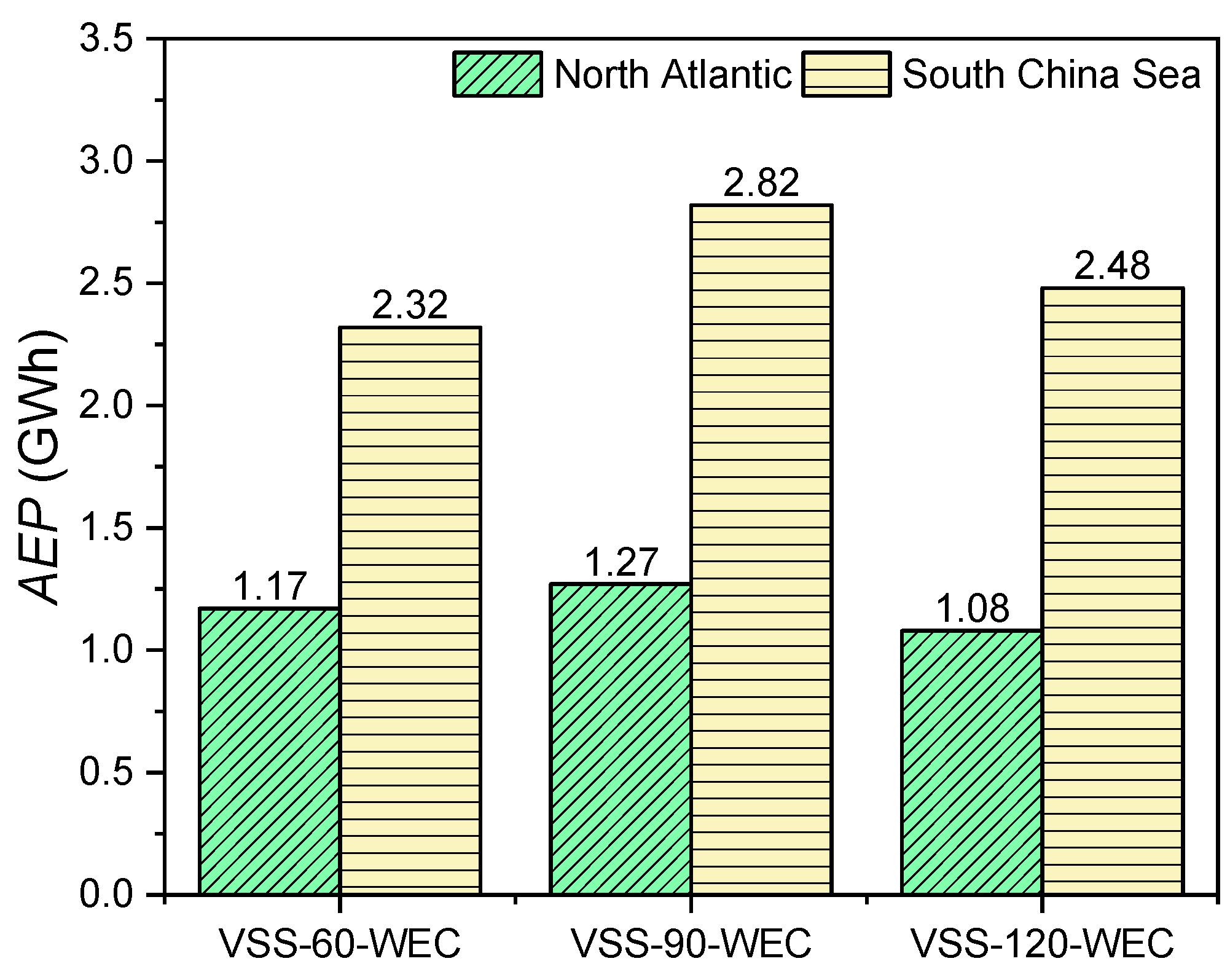
where the subscript i j in (17) represents the variables corresponding to the i t h   significant wave height and the j t h peak wave period. Based on (17), the AEP for the WEC array at the NAO and SCS is shown in Figure 18.
Figure 18 showed that energy generation from the WEC array, when deployed under the SCS wave climate, was approximately twice that of its counterpart at NAO. This is because the VSS is specifically designed to perform optimally in wave conditions where T p is approximately 5.5 s and H s ranges from 1 to 3 m—conditions that closely match those observed at SCS. For both wave climates, the VSS-90-WEC configuration achieved the highest annual energy generation, due to its superior absorbed power performance (see Figure 18). This was followed by the VSS-60-WEC at NAO. The higher energy output of the VSS-60-WEC at NAO was due to its ability to harness more energy at longer wavelengths, corresponding to higher peak wave periods. Although the VSS-120-WEC demonstrated high energy capture capability at large H s , it recorded a slightly lower A E P for the NAO wave climate. This was because most of the wave occurrences were associated with small H s , during which the energy generation of the device declined as T p increases. The opposite trend was observed for the SCS case, where the VSS-120-WEC recorded a higher A E P than the VSS-60-WEC. This was attributed to the higher P i r r and p at low to moderate wave periods in the SCS wave climate, i.e., T p   < 6.5 s.
This case study demonstrates that the VSS design must account for the operating sea state to optimise WEC energy extraction. It implies that the effectiveness of WECs and FOWTs is site-dependent; therefore, each structure must be tailored to the specific wave climate and environmental conditions of its deployment location.
Wind Energy Production
This section presents the estimation of the AEP for the wind turbine assumed in this study, which is identical to the 5-MW reference turbine used in the OC4 FOWT project. The assessment focused on two offshore regions of interest: the NOA and the SCS, representing high and moderate wind energy potential sites, respectively.
The wind resource characteristics for each location were derived from the literature. The average wind speed in the NAO was taken as 10.0 m/s [55], while the SCS had an average wind speed of 7.5 m/s [56]. Using these values and empirical correlations for offshore wind turbines, the capacity factor (CF) was approximated using the expression [57]:
C F 0.087 × V a v g 0.322
where V a v g is the average wind speed in m/s. Applying this, the estimated capacity factor was approximately 54.8% in the NAO and 33.1% in the SCS.
The AEP is calculated using the following relationship:
A E P = P r a t e d × C F × 8760
where P r a t e d is the rated power of the turbine (5 MW) and 8760 is the number of hours in a year. The resulting AEP was 24.00 MWh/year for the NAO and 14.50 MWh/year for the SCS. These results were summarised in Table 8.
Comparison of the AEP for wind and wave energy production showed that, on average, the WEC array collocated with the VSS at NAO accounted for 4.89% of the wind energy AEP, whereas the counterpart at SCS was approximately 17.5% of the wind energy AEP—a substantial amount due to the relatively lower wind resource at SCS, which amplified the relative contribution of wave energy in the hybrid system. This shows that collocation of WEC with FOWT is particularly beneficial in moderate wind regions, as it enhances overall energy yield, improves resource utilisation, and increases the reliability of renewable energy supply.

8. Conclusions

The study investigated the novel VSS floater designed to support both wind turbines and WECs. The proposed VSS platform features a unique design, oriented toward the wavefront and capturing the wave zone through its boundary and near-deck submerged pontoons. This design enabled the harnessing of high-energy waves for the WECs in the area due to its amplified hydrodynamic interaction. The research examined three different VSS platform configurations, each with a distinct pontoon opening angle of 60°, 90°, and 120°. The well-known OC4 semi-submersible platform from NREL was also evaluated to provide a comparative analysis of the platforms’ motion. It further investigated the power absorption and interaction factors of the WEC array and compared the results with those of the standalone array. The validation of hydrodynamic coefficients against SINTEF’s INO WINMOOR platform further supported the reliability of the study’s computational approach.
The analysis indicated that all VSS platforms maintain acceptable motion responses below permissible levels, ensuring the stability required for wind turbine operation. The heave and pitch RAOs of the VSS platforms were within acceptable limits, making them viable for accommodating wind turbines. Significant improvements in wave power generation were observed when the WEC array was integrated with the VSS platform. Notably, the WECs on the VSS-60 platform showed the best performance, particularly during wave periods from 4.0 s to 5.2 s, 5.7 s to 6.6 s, and 7.1 s to 8.0 s. The WEC arrays integrated with the VSS platforms outperformed standalone WEC arrays across various wave periods, showing up to around 14% increase in overall energy production. Furthermore, the wave elevation contour plots revealed that the VSS platforms, particularly VSS-60, generate higher wave elevations around the platform, creating a localised wave energetic zone conducive to WECs. This resulted in enhanced constructive wave interaction.
The study also evaluated the impact of WEC diameter and spacing on energy capture. Increasing the WEC diameter while reducing the number of units led to a notable increase in total power output of around 100 kW. The larger spacing array (VSS-60-WEC-2) produced about 50 kW more power than the smaller spacing array (VSS-60-WEC-1) during wave periods of around 6.0 s. However, at around 7.5 s, the performance of the larger spacing array dropped, producing around 40 kW less power. Irregular wave analysis was also carried out, in which the power matrix for the WEC arrays was studied, and the annual energy production for the various VSS configurations deployed in the North Atlantic Ocean and South China Sea wave climates was considered. Results highlighted the importance of designing the VSS based on local sea conditions to maximise energy extraction.
The present study is limited to a preliminary frequency-domain analysis and does not include time-domain simulations or explicit modelling of the mooring system. Nonlinear effects, together with the full impact of the turret anchoring system, would necessitate time-domain analysis to confirm the structural survivability under extreme environmental conditions. Key parameters, such as the pontoon-top gap relative to the water level, are not varied and may influence wave amplification through changes in local wave elevation within the V-shaped configuration. In addition, nonlinear effects and the full impact of the turret mooring system are not captured and would require time-domain analysis to assess structural survivability under extreme conditions. Furthermore, the analysis considers only the hydrodynamic response of the floating platform and excludes aerodynamic loading and the structural dynamics of the wind turbine. The results, therefore, represent uncoupled, wave-induced platform motions. While this enables a clear assessment of geometry-driven hydrodynamic behaviour, it does not account for aero-hydrodynamic coupling, which may affect both system response and turbine performance. Accordingly, the findings should be interpreted as a first-order hydrodynamic assessment, and fully coupled aero-hydro-servo-elastic simulations are required for comprehensive design validation. Future research should include a fully coupled approach, incorporating the impact of turret mooring on the platform’s dynamic responses under wind turbine and wave loads. In addition, CFD could be incorporated for in-depth analysis of selected optimal designs from the case studies presented in this paper.
As for the strengths of this study, the VSS concept presents a promising approach for integrating wind and wave energy technologies, offering potential improvements in energy capture while maintaining platform stability. The simplified approach used in this study provides a foundational understanding of the VSS platform’s capabilities. This research lays the groundwork for further development to optimise hybrid platform designs, ultimately contributing to the advancement of renewable energy systems.

Author Contributions

Conceptualization, Z.Y.T.; methodology, Z.Y.T.; software, Z.Y.T.; validation, N.L.H.; formal analysis, N.L.H.; investigation, N.L.H.; resources, Z.Y.T.; data curation, N.L.H.; writing—original draft preparation, N.L.H.; writing—review and editing, Z.Y.T.; visualisation, N.L.H.; supervision, Z.Y.T.; project administration, Z.Y.T.; funding acquisition, Z.Y.T. All authors have read and agreed to the published version of the manuscript.

Funding

The authors are grateful for the resource provided by the MOE-SIT Strategic Initiative Grant (F-MOE-A204-G005)

Data Availability Statement

Data plotted in this paper can be found in https://data.mendeley.com/drafts/wvnk7jcjbf.

Conflicts of Interest

The authors declare no conflicts of interest.

References

  1. DOE. Offshore Wind Research and Development; U.S. Department of Energy (DOE): Washington, DC, USA, 2023; Volume 2025.
  2. Veers, P.; Dykes, K.; Basu, S.; Bianchini, A.; Clifton, A.; Green, P.; Holttinen, H.; Kitzing, L.; Kosovic, B.; Lundquist, J.K. Grand Challenges: Wind energy research needs for a global energy transition. Wind Energy Sci. Discuss. 2022, 7, 2491–2496. [Google Scholar] [CrossRef]
  3. Gonzalez, N.; Serna-Torre, P.; Sánchez-Pérez, P.A.; Davidson, R.; Murray, B.; Staadecker, M.; Szinai, J.; Wei, R.; Kammen, D.M.; Sunter, D.A. Offshore wind and wave energy can reduce total installed capacity required in zero-emissions grids. Nat. Commun. 2024, 15, 6826. [Google Scholar] [CrossRef]
  4. Jensen, M.K. LCOE: Update of Recent Trends (Offshore); AEGIR: Copenhagen, Denmark, 2022. [Google Scholar]
  5. Maples, B.; Saur, G.; Hand, M.; Van De Pietermen, R.; Obdam, T. Installation, Operation, and Maintenance Strategies to Reduce the Cost of Offshore Wind Energy; National Renewable Energy Laboratory (NREL): Golden, CO, USA, 2013.
  6. Dong, X.; Li, Y.; Li, D.; Cao, F.; Jiang, X.; Shi, H. A state-of-the-art review of the hybrid wind-wave energy converter. Prog. Energy 2022, 4, 042004. [Google Scholar] [CrossRef]
  7. Wan, L.; Moan, T.; Gao, Z.; Shi, W. A review on the technical development of combined wind and wave energy conversion systems. Energy 2024, 294, 130885. [Google Scholar] [CrossRef]
  8. Tay, Z.Y. Performance and wave impact of an integrated multi-raft wave energy converter with floating breakwater for tropical climate. Ocean Eng. 2020, 218, 108136. [Google Scholar] [CrossRef]
  9. Tay, Z.Y. Wave Energy Convertors in Tropical Seas: Large Floating Structures and Power Enhancement; CRC Press: Boca Raton, FL, USA, 2025. [Google Scholar]
  10. Tay, Z.Y. Raft-type modular articulated plate for offshore floating photovoltaic farms: Antimotion performance and wave energy conversion. Ships Offshore Struct. 2025, 1–28. [Google Scholar] [CrossRef]
  11. Tay, Z.Y. Performance of integrated FB and WEC for offshore floating solar photovoltaic farm considering the effect of hydroelasticity. Ocean Eng. 2024, 312, 119165. [Google Scholar] [CrossRef]
  12. Tay, Z.Y.; Lee, L. Performance of integrated vertical raft-type WEC and floating breakwater. Ocean. Syst. Eng. 2022, 12, 39–61. [Google Scholar]
  13. Tay, Z.Y. Energy extraction from an articulated plate anti-motion device of a very large floating structure under irregular waves. Renew. Energy 2019, 130, 206–222. [Google Scholar] [CrossRef]
  14. Tay, Z.Y. Energy generation from anti-motion device of very large floating structure. In Proceedings of the Twelfth European Wave and Tidal Energy Conference, Cork, UK, 27 August–1 September 2017. [Google Scholar]
  15. Tay, Z.Y.; Wei, Y. Power enhancement of pontoon-type wave energy convertor via hydroelastic response and variable power take-off system. J. Ocean Eng. Sci. 2020, 5, 1–18. [Google Scholar] [CrossRef]
  16. Amouzadrad, P.; Mohapatra, S.; Guedes Soares, C. Numerical model for the hydroelastic response of a moored articulated floating platform with a flap-type wave energy converter. J. Ocean Eng. Mar. Energy 2026, 12, 697–715. [Google Scholar] [CrossRef]
  17. Tay, Z.Y.; Htoo, N.L.; Konovessis, D. A comparison of capture width and interaction factors of WEC arrays co-located with semi-submersible-, spar-and barge-supported floating offshore wind turbine. J. Mar. Sci. Eng. 2024, 12, 2019. [Google Scholar] [CrossRef]
  18. Ramos, V.; Giannini, G.; Calheiros-Cabral, T.; López, M.; Rosa-Santos, P.; Taveira-Pinto, F. Assessing the effectiveness of a novel WEC concept as a co-located solution for offshore wind farms. J. Mar. Sci. Eng. 2022, 10, 267. [Google Scholar] [CrossRef]
  19. Folley, M.; Babarit, A.; Child, B.; Forehand, D.; O’Boyle, L.; Silverthorne, K.; Spinneken, J.; Stratigaki, V.; Troch, P. A review of numerical modelling of wave energy converter arrays. In Proceedings of the International Conference on Offshore Mechanics and Arctic Engineering; American Society of Mechanical Engineers: New York, NY, USA, 2012. [Google Scholar]
  20. Yang, B.; Wu, S.; Zhang, H.; Liu, B.; Shu, H.; Shan, J.; Ren, Y.; Yao, W. Wave energy converter array layout optimization: A critical and comprehensive overview. Renew. Sustain. Energy Rev. 2022, 167, 112668. [Google Scholar] [CrossRef]
  21. Venugopal, V.; Tay, Z.Y.; Nemalidinne, T.R. Numerical Modelling Techniques for Wave Energy Converters in Arrays. In Ocean Wave Energy Systems: Hydrodynamics, Power Takeoff and Control Systems; Springer: Berlin/Heidelberg, Germany, 2021; pp. 281–322. [Google Scholar]
  22. Zhu, K.; Shi, H.; Zheng, S.; Michele, S.; Cao, F. Hydrodynamic analysis of hybrid system with wind turbine and wave energy converter. Appl. Energy 2023, 350, 121745. [Google Scholar] [CrossRef]
  23. Zhu, K.; Cao, F.; Wang, T.; Tao, J.; Wei, Z.; Shi, H. A comparative investigation into the dynamic performance of multiple wind-wave hybrid systems utilizing a full-process analytical model. Appl. Energy 2024, 360, 122761. [Google Scholar] [CrossRef]
  24. He, G.; Zhao, C.; Liu, C.; He, R.; Luan, Z. Power absorption and dynamic response analysis of a hybrid system with a semi-submersible wind turbine and a Salter’s duck wave energy converter array. Energy 2024, 305, 132210. [Google Scholar] [CrossRef]
  25. Kim, H.; Koo, W. Numerical and experimental study of the dynamic response of a wind-wave combined energy platform under WEC motion constraints. Int. J. Nav. Archit. Ocean Eng. 2024, 16, 100627. [Google Scholar] [CrossRef]
  26. Alufa, S.O. Design of a Mooring System for FOWT with Sufficient Yaw Stiffness. Master’s Thesis, Université de Liège, Liège, Belgium, Universidad Politécnica de Madrid, Madrid, Spain, 2023. [Google Scholar]
  27. Chen, Z.; Sun, J.; Yang, J.; Sun, Y.; Chen, Q.; Zhao, H.; Qian, P.; Si, Y.; Zhang, D. Experimental and numerical analysis of power take-off control effects on the dynamic performance of a floating wind-wave combined system. Renew. Energy 2024, 226, 120353. [Google Scholar] [CrossRef]
  28. Lee, C.F.; Tavares, V.D.S.; Ong, M.C. Two-body dynamic simulations of a combined semi-submersible floating offshore wind turbine and torus wave energy converter. IOP Conf. Ser. Mater. Sci. Eng. 2023, 1294, 012007. [Google Scholar] [CrossRef]
  29. Zhu, K.; Shi, H.; Michele, S.; Han, M.; Cao, F. Analytical study on dynamic performance of a hybrid system in real sea states. Energy 2024, 290, 130259. [Google Scholar] [CrossRef]
  30. Wang, T.; Zhu, K.; Cao, F.; Li, D.; Gong, H.; Li, Y.; Shi, H. A coupling framework between OpenFAST and WEC-Sim. Part I: Validation and dynamic response analysis of IEA-15-MW-UMaine FOWT. Renew. Energy 2024, 225, 120249. [Google Scholar] [CrossRef]
  31. Finotto, C.; Turolla, A.; Bravi, L.; Vanzan, D.; Zampato, M.; Bontumasi, S.; Ambrosini, S.; Basile, D.; Francesconi, M. Technology performance level assessment for floating offshore wind farms. In Proceedings of the Offshore Mediterranean Conference and Exhibition, OMC, Ravenna, Italy, 23–25 May 2023. [Google Scholar]
  32. Wu, H.; Zhu, F.; Yuan, Z. Effects of the WEC shape on the performance of a novel hybrid WEC-FOWT system. Energy 2024, 288, 129907. [Google Scholar] [CrossRef]
  33. Liu, A.Y.; Su, Z.; Chen, J.; Yu, H.; Duggal, A.; Kolb, J.A. Evaluation of a 15 MW turret moored floating offshore wind turbine. In Proceedings of the Offshore Technology Conference 2023, OTC, Houstan, TX, USA, 1–4 May 2023. [Google Scholar]
  34. Lamei, A.; Hayatdavoodi, M.; Riggs, H.R. Motion and elastic response of wind-tracing floating offshore wind turbines. J. Ocean Eng. Mar. Energy 2023, 9, 43–67. [Google Scholar] [CrossRef]
  35. Liu, H.; Chen, M.; Han, Z.; Zhou, H.; Li, L. Feasibility study of a novel open ocean aquaculture ship integrating with a wind turbine and an internal turret mooring system. J. Mar. Sci. Eng. 2022, 10, 1729. [Google Scholar] [CrossRef]
  36. Kramer, M.B.; Andersen, J.; Ebsen, N.F.; Thomas, S. Plans for Wave Basin Tests of the Floating Power Plant P80 Device Under the OESA Project and the EUDP O&G Project; Aalborg University, Department of the Built Environment: Aalborg, Danmark, 2020. [Google Scholar]
  37. James, R.; Ros, M.C. Floating Offshore Wind: Market and Technology Review; The Carbon Trust: London, UK, 2015. [Google Scholar]
  38. Nihei, Y.; Matsuda, Y.; Kitamura, S.; Takaiwa, K.; Kanda, N. Research and development about the mechanisms of a single point mooring system for offshore wind turbines. Ocean Eng. 2018, 147, 431–446. [Google Scholar] [CrossRef]
  39. Park, H.; Jung, S. Design and automated optimization of an internal turret mooring system in the frequency and time domain. J. Mar. Sci. Eng. 2021, 9, 581. [Google Scholar] [CrossRef]
  40. Tay, Z.Y. Energy generation enhancement of arrays of point absorber wave energy converters via Moonpool’s resonance effect. Renew. Energy 2022, 188, 830–848. [Google Scholar] [CrossRef]
  41. Tay, Z.Y. Effect of resonance and wave reflection in semi-enclosed moonpool on performance enhancement of point absorber arrays. Ocean Eng. 2022, 243, 110182. [Google Scholar] [CrossRef]
  42. Robertson, A.; Jonkman, J.; Masciola, M.; Song, H.; Goupee, A.; Coulling, A.; Luan, C. Definition of the Semisubmersible Floating System for Phase II of OC4; National Renewable Energy Lab (NREL): Golden, CO, USA, 2014.
  43. Simos, A.N.; Ruggeri, F.; Watai, R.A.; Souto-Iglesias, A.; Lopez-Pavon, C. Slow-drift of a floating wind turbine: An assessment of frequency-domain methods based on model tests. Renew. Energy 2018, 116, 133–154. [Google Scholar] [CrossRef]
  44. Pedersen, E.A. Motion Analysis of Semi-Submersible; Department of Marine Technology, Norwegian University of Science and Technology: Trondheim, Norway, 2012. [Google Scholar]
  45. Falnes, J.; Kurniawan, A. Ocean Waves and Oscillating Systems: Linear Interactions Including Wavee-Energy Extraction; Cambridge University Press: Cambridge, UK, 2020; Volume 8. [Google Scholar]
  46. Tay, Z.Y.; Venugopal, V. Hydrodynamic interactions of oscillating wave surge converters in an array under random sea state. Ocean Eng. 2017, 145, 382–394. [Google Scholar] [CrossRef]
  47. Tay, Z.Y.; Venugopal, V. The impact of energy extraction of wave energy converter arrays on wave climate under multi-directional seas. J. Ocean Eng. Mar. Energy 2019, 5, 51–72. [Google Scholar] [CrossRef]
  48. Goda, Y. Random Seas and Design of Maritime Structures; World Scientific Publishing Company: Singapore, 2010; Volume 33. [Google Scholar]
  49. Chakrabarti, S.K. Offshore Structure Modeling; World Scientific: Singapore, 1994; Volume 9. [Google Scholar]
  50. Souza, C.; Berthelsen, P.A.; Eliassen, L.; Bachynski, E.; Engebretsen, E.; Haslum, H. SINTEF Ocean Report OC2020 A-044 v1: Definition of the INO WINDMOOR 12 MW Base Case Floating Wind Turbine; SINTEF Ocean: Trondheim, Norway, 2021; Volume 2. [Google Scholar]
  51. Zhang, X.; Li, B.; Hu, Z.; Deng, J.; Xiao, P.; Chen, M. Research on size optimization of wave energy converters based on a floating wind-wave combined power generation platform. Energies 2022, 15, 8681. [Google Scholar] [CrossRef]
  52. DNV. Stability and Watertight Integrity; Det Norske Veritas (DNV): Oslo, Norway, 2001. [Google Scholar]
  53. DNV GL. Recommended Practice DNVGL-RP-C205 Environmental Conditions and Environmental Loads; DNV GL: Høvik, Norway, 2017. [Google Scholar]
  54. Li, D.; Wilson, P.A.; Zhao, X. Establishment of effective metamodels for seakeeping performance in multidisciplinary ship design optimization. J. Mar. Sci. Technol. 2016, 24, 17. [Google Scholar]
  55. DECC. Offshore Energy Strategic Environmental Assessment 3 (OESEA3)—Appendix 1F: Climate & Meteorology; UK Government: London, UK, 2016.
  56. Zhang, S.; Yang, X.; Weng, H.; Zhang, T.; Tang, R.; Wang, H.; Su, J. Spatial distribution and trends of wind energy at various time scales over the south china sea. Atmosphere 2023, 14, 362. [Google Scholar] [CrossRef]
  57. Manwell, J.F.; McGowan, J.G.; Rogers, A.L. Wind Energy Explained: Theory, Design and Application; John Wiley & Sons: Hoboken, NJ, USA, 2010. [Google Scholar]
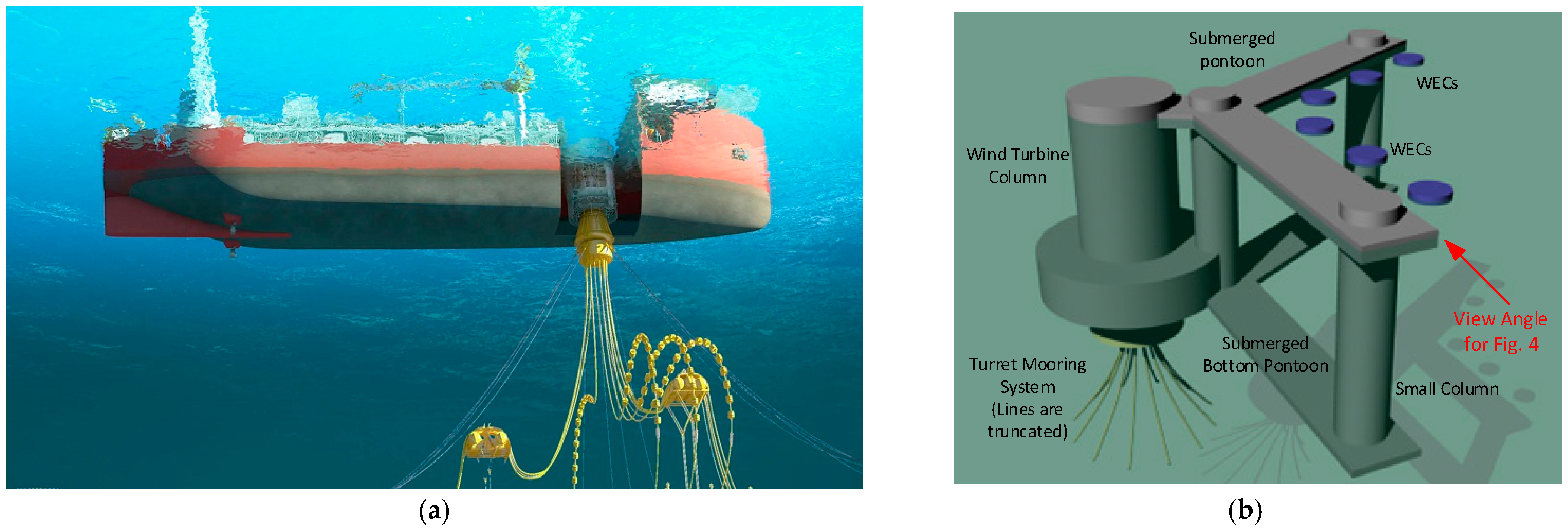
Figure 1. The turret mooring system in (a) an FPSO (b) proposed FOWT.
Jmse 14 00931 g001
Figure 2. Geometry of the submerged body of floating platforms, 0° wave direction in positive x-axis, for (a) VSS-60, (b) VSS-90, (c) VSS-120, and (d) OC4.
Jmse 14 00931 g002
Figure 3. Wave energy enhancement by the VSS: (a) Incident waves approaching the VSS; (b) incident waves reflected by the submerged pontoon, amplifying the wave energy resource due to the effect of constructive interference; (c) WECs collocated with the VSS, where energy generation is enhanced due to increased wave energy resources.
Jmse 14 00931 g003
Figure 4. A point absorber WEC as viewed from the angle shown in Figure 1b connected to a PTO system mounted on a submerged pontoon: (a) WEC in calm sea (neutral position), (b) WEC at maximum upward heave (PTO system in compression mode), (c) WEC at maximum downward heave (PTO system in expansion mode).
Jmse 14 00931 g004
Figure 5. Plan view of Cylindrical WEC array collocated with ((a) VSS-60-WEC, (b) VSS-90-WEC, (c) VSS-120-WEC. d W E C   = 1 m, U = Ø 10 m, S = T = 2 m).
Jmse 14 00931 g005
Figure 6. Comparison of (a) added mass coefficient and (b) radiation damping coefficient of (c) the INO WINDMOOR platform.
Jmse 14 00931 g006
Figure 7. Heave R A O of VSS.
Jmse 14 00931 g007
Figure 8. Pitch R A O of VSS.
Jmse 14 00931 g008
Figure 9. Comparison of total absorbed power of WECs between standalone array and (a) VSS-60-WEC, (b) VSS-90-WEC, (c) VSS-120-WEC.
Jmse 14 00931 g009
Figure 10. Comparison of average heave R A O of WECs between standalone array and (a) VSS-60-WEC, (b) VSS-90-WEC, (c) VSS-120-WEC.
Jmse 14 00931 g010
Figure 11. Interaction q -factor of WEC array collocated with VSS-60, VSS-90, VSS-120.
Jmse 14 00931 g011
Figure 12. Figure depicting (a) VSS-60-WEC-1 with U = Ø 13 m and T = 2 m and (b) VSS-WEC-2 with U = 10   m and T   =   5   m. Other dimensions are retained with the same total WECs’ WPA as VSS-60-WEC.
Jmse 14 00931 g012
Figure 13. Comparison of (a) total absorbed power and (b) interaction q -factor between VSS-60-WEC, VSS-60-WEC-1, and VSS-60-WEC-2.
Jmse 14 00931 g013
Figure 14. Wave elevations contour plan showing wave disturbance surrounding VSS-60-WEC for wave periods (a) 5.0 s, (b) 6.0 s, (c) 6.6 s, and (d) 7.4 s.
Jmse 14 00931 g014
Figure 15. Wave elevations contour plan showing wave disturbance surrounding VSS-90-WEC for wave periods (a) 5.0 s, (b) 6.0 s, (c) 6.6 s, and (d) 7.4 s.
Jmse 14 00931 g015
Figure 16. Wave elevations contour plan showing wave disturbance surrounding VSS-120-WEC for wave periods (a) 5.0 s, (b) 6.0 s, (c) 6.6 s, and (d) 7.4 s.
Jmse 14 00931 g016
Figure 17. Wave elevations contour plan showing wave disturbance surrounding OC4 for wave periods (a) 5.0 s, (b) 6.0 s, (c) 6.6 s, and (d) 7.4 s.
Jmse 14 00931 g017
Figure 18. A E P for WECs in VSS-60-WEC, VSS-90-WEC, and VSS-120-WEC in the North Atlantic and South China Sea.
Jmse 14 00931 g018
Table 1. Properties of floating platforms.
PropertyUnitVSS-60VSS-90VSS-120OC4
Mass mkg1.42 ×   10 7 1.42 ×   10 7 1.41 ×   10 7 1.35 ×   10 7
Mass moment of area in x -axis I x x kg.m22.99 ×   10 9 4.51 ×   10 9 6.32 ×   10 9 6.83 ×   10 9
Mass moment of area in y -axis I y y kg.m27.20 ×   10 9 6.06 ×   10 9 4.41 ×   10 9 6.83 ×   10 9
Mass moment of area in z -axis I z z kg.m27.34 ×   10 9 7.59 ×   10 9 7.73 ×   10 9 1.23 ×   10 10
Vertical centre of gravity  V C G m−16.62−17.11−17.51−13.46
Water depth  Dm30.0030.0030.0020.00
Restoring stiffness for heave K h e a v e N/m2,771,0122,649,6632,514,8913,704,330
Restoring stiffness for pitch K p i t c h N.m/°20,973,44815,709,0849,668,61225,805,186
Critical damping for heave B c h e a v e N/(m/s)12,534,38412,260,21711,907,24614,129,181
Critical damping for pitch B c p i t c h N.m/(°/s)34,484,08629,852,33323,347,14637,291,998
Viscous damping for heave
B v h e a v e = 3 %   B c
N/(m/s)376,032367,807357,217423,875
Viscous damping for pitch
B v p i t c h = 5 %   B c
N.m/(°/s)1,724,2041,492,6171,167,3571,864,600
P T O damping B P T O (WEC heave)N/(m/s)110,000110,000110,000-
Table 2. Geometry of the submerged body of floating platforms and WEC.
LabelUnitVSS-60VSS-90VSS-120OC4WINDMOOR (Validation)
A m45.545.545.5--
B m4141415061
C m Ø 6.5 Ø 6.5 Ø 6.5 Ø 6.5 Ø 15
D m Ø 15.1 Ø 14.6 Ø 14 Ø 12-
E m Ø 28 Ø 28 Ø 26 Ø 24-
θ°6090120--
W m999-10
F m232424.514-
G m3030302015.5
P m222--
Q m2.52.52.5--
R m123.4-4
S m222--
T m222--
U m Ø 10 Ø 10 Ø 10--
d W E C m111--
Table 3. Total absorbed power matrix of VSS-60-WEC array in an irregular wave spectrum.
VSS-60-WEC
Total Absorbed Power P i r r (kW)
H s m 12345
T p s
4.059119178238297
4.5144288432575719
5.0172344516689861
5.599198298397496
6.0179359538717897
6.5106211317422528
7.080160239319399
7.5105210315420525
8.085171256342427
8.53877115154192
9.01835537088
Table 4. Total absorbed power matrix of VSS-90-WEC array in an irregular wave spectrum.
VSS-90-WEC
Total Absorbed Power P i r r (kW)
H s m 12345
T p s
4.091182273364455
4.5176353529706882
5.029058187111611451
5.52014026038041005
6.0144288431575719
6.570141211281352
7.0118236354472590
7.5133266399532665
8.080160241321401
8.53671107143178
9.021426384105
Table 5. Total absorbed power matrix of VSS-120-WEC array in an irregular wave spectrum.
VSS-120-WEC
Total Absorbed Power P i r r (kW)
H s m 12345
T p s
4.086172258344430
4.5195389584778973
5.025250375510061258
5.5153307460614767
6.0114229343458572
6.574148223297371
7.0136272408543679
7.5108216324431539
8.04997146194243
8.5265278104130
9.024477195118
Table 6. Percentage of occurrence of wave scatter diagram for considered NAO.
H s m 12345
T p s
4.00.04%0.01%0.00%0.00%0.00%
4.50.07%0.01%0.00%0.00%0.00%
5.00.44%0.27%0.05%0.01%0.00%
5.50.82%0.52%0.10%0.02%0.00%
6.01.77%1.83%0.68%0.21%0.05%
6.52.72%3.14%1.26%0.39%0.09%
7.03.20%4.65%2.71%1.21%0.45%
7.53.69%6.16%4.17%2.02%0.82%
8.03.11%5.95%4.98%2.98%1.49%
8.52.54%5.74%5.78%3.95%2.16%
9.01.80%4.46%5.09%3.95%2.45%
Table 7. Percentage of occurrence of wave scatter diagram for considered SCS.
H s m 12345
T p s
4.02.05%1.12%0.75%0.21%0.05%
4.53.41%2.19%0.75%0.21%0.05%
5.03.73%4.24%2.08%0.80%0.27%
5.54.05%6.29%3.41%1.39%0.48%
6.02.99%6.03%3.97%1.89%0.75%
6.51.92%5.76%4.53%2.40%1.01%
7.01.20%4.13%3.65%2.11%0.96%
7.50.48%2.51%2.77%1.81%0.91%
8.00.29%1.57%1.89%1.31%0.69%
8.50.11%0.64%1.01%0.80%0.48%
9.00.05%0.37%0.64%0.51%0.32%
Table 8. AEP of wind energy production from wind turbines.
RegionAverage Wind Speed
(m/s)
Capacity Factor
(%)
AEP (MWh/Year)
NAO10.054.824.00
SCS7.533.114.50
Disclaimer/Publisher’s Note: The statements, opinions and data contained in all publications are solely those of the individual author(s) and contributor(s) and not of MDPI and/or the editor(s). MDPI and/or the editor(s) disclaim responsibility for any injury to people or property resulting from any ideas, methods, instructions or products referred to in the content.