Feasibility of Using Oil from Spent Coffee Grounds in Small-Scale Marine Boilers



Abstract
1. Introduction
2. Materials and Methods
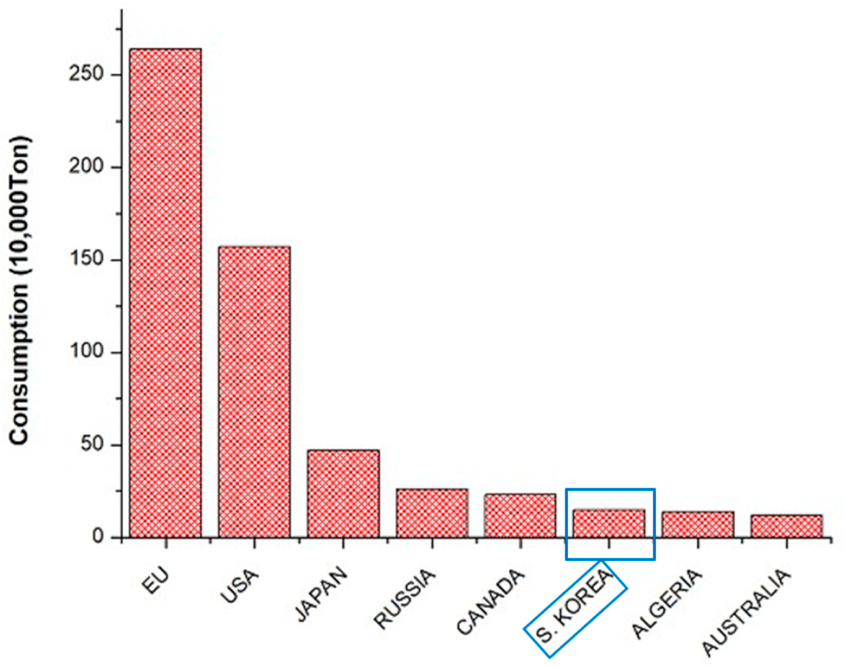
2.1. Industrial Demand for Spent Coffee Grounds and Cases of Fuel Conversion
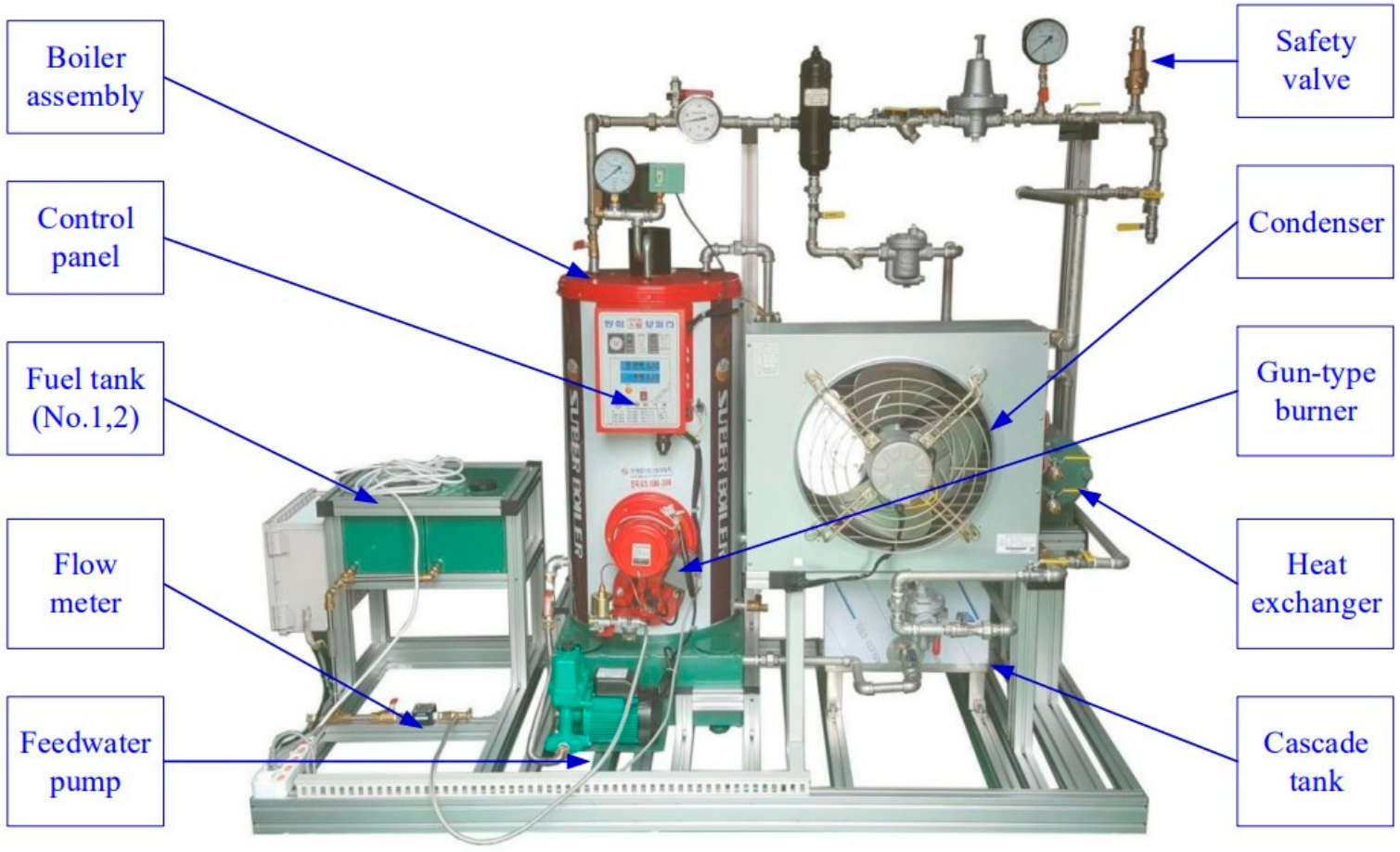
2.2. Design and Fabrication of a 30 L-Class Small-Scale Marine Boiler System
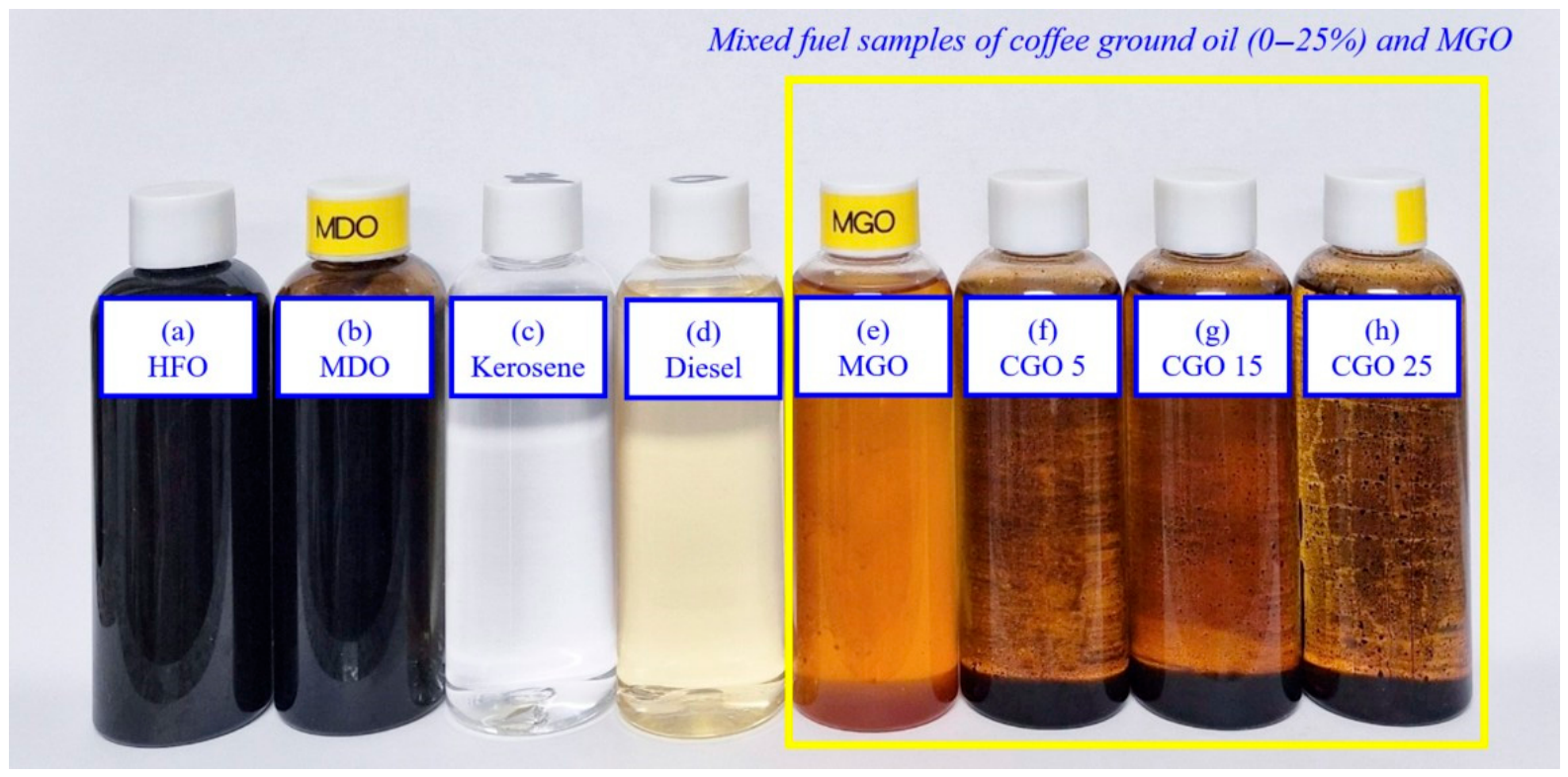
2.3. Preparation of SCG–MGO Blended Fuel Samples with Various Contents

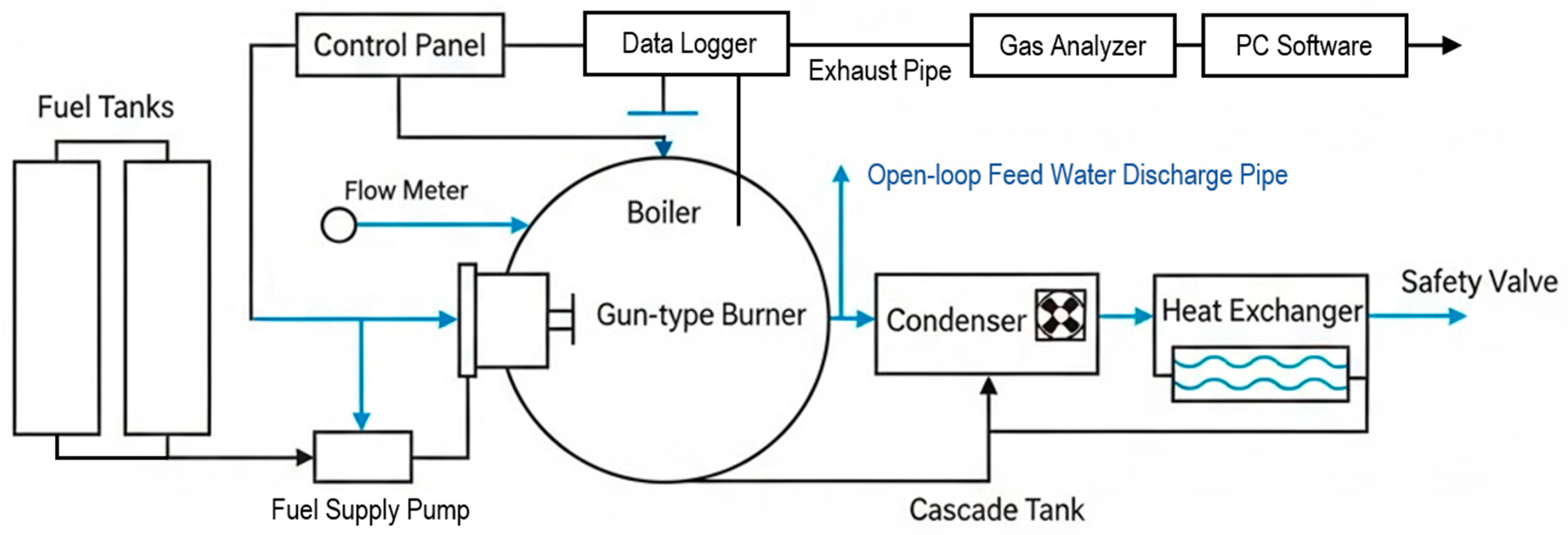
2.4. Experimental Apparatus and Methods
3. Results
3.1. Exhaust Gas Emission Characteristics
3.2. Exhaust Gas Temperature Characteristics
3.3. Combustion Efficiency
4. Conclusions
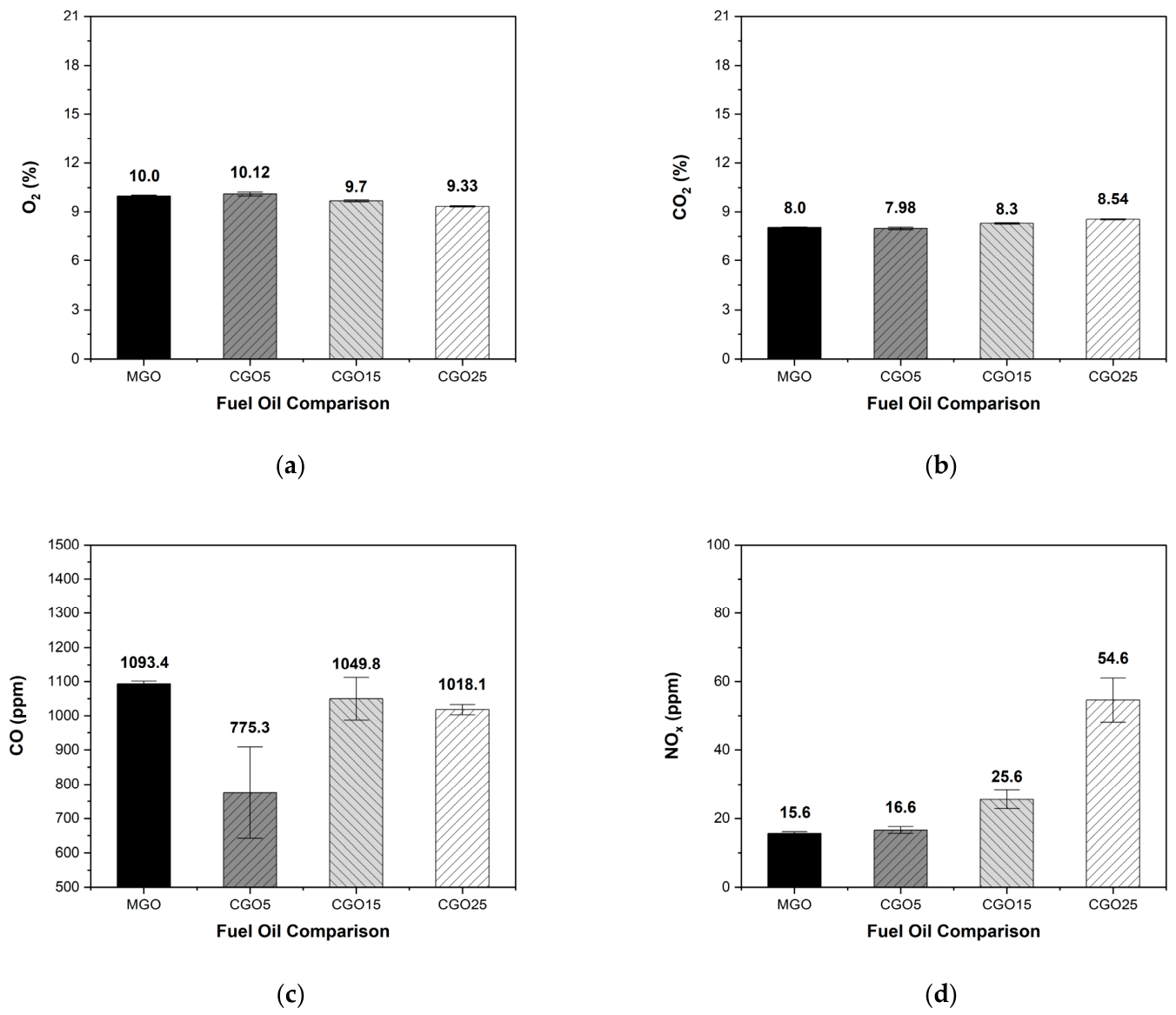
- Exhaust emission characteristics: As the SCG blending ratio increased, the CO2 emissions exhibited a slight upward trend, increasing by approximately 0.54% from 8.0% for MGO to 8.54% for CGO25. In contrast, the O2 concentration decreased from 10% to 9.33%. Additionally, the raw measured CO emissions decreased slightly from 1093.4 ppm to 1018.1 ppm. Although the direct CO2 concentration in the flue gas increased slightly owing to the fuel properties, CGO remains fundamentally a carbon-neutral fuel derived from biomass. From a life-cycle perspective, the CO2 emitted during combustion is offset by the carbon sequestered during the growth of coffee plants. Therefore, based on life cycle assumptions where the biomass component is considered carbon-neutral, incorporating a 25% blend of CGO is assessed to potentially contribute to a reduction in net lifecycle CO2 emissions by offsetting fossil carbon, even though a marginal increase in tailpipe emissions was observed under the present experimental conditions.
- NOx emission characteristics: The raw measured NOx emissions increased 3.5-fold from 15.6 ppm for MGO to 54.6 ppm for CGO25, which is consistent with the findings of previous studies. This increase is primarily attributed to the fuel-bound nitrogen inherent in CGO, which acts as a direct precursor for fuel NOx formation. Furthermore, a strong correlation was observed between the fuel-bound oxygen content and elevated NOx levels; the increased oxygen concentration accelerates and intensifies combustion, leading to higher local flame temperatures that facilitate the formation of thermal NOx. However, it is important to note that if these NOx levels exceed the stringent international maritime regulations (e.g., IMO Tier III), the adoption of SCG-derived fuels may face practical challenges similar to those encountered in hydrogen blending. Therefore, to ensure the commercial viability of high-ratio CGO blends, further integration with post-treatment technologies such as Selective Catalytic Reduction (SCR) or the optimization of Exhaust Gas Recirculation (EGR) systems will be essential to mitigate these emissions effectively.
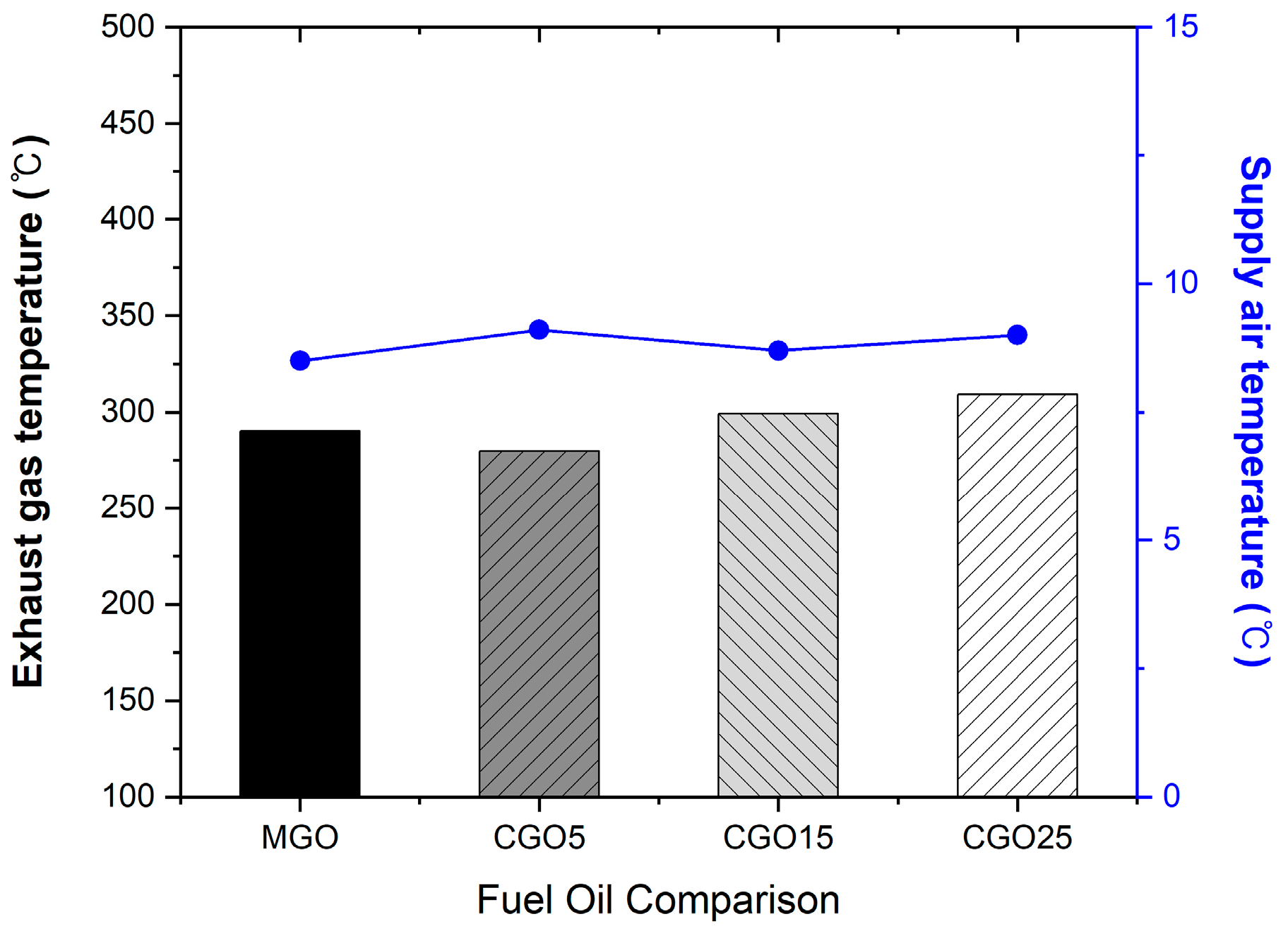
- Exhaust gas temperature: The exhaust gas temperature increased by approximately 6.5%, from 290.2 °C for MGO to 309.2 °C for CGO25. Although the blended fuel has a lower heating value than pure MGO, this temperature increase is attributed to the ‘after-burning’ phenomenon. Owing to the complex molecular structure of the biofuel, combustion is not fully completed within the main chamber but extends toward the funnel. This delayed combustion process reduces the residence time for effective heat exchange within the boiler, causing the flue gases to be discharged at a higher temperature before their thermal energy is fully absorbed.
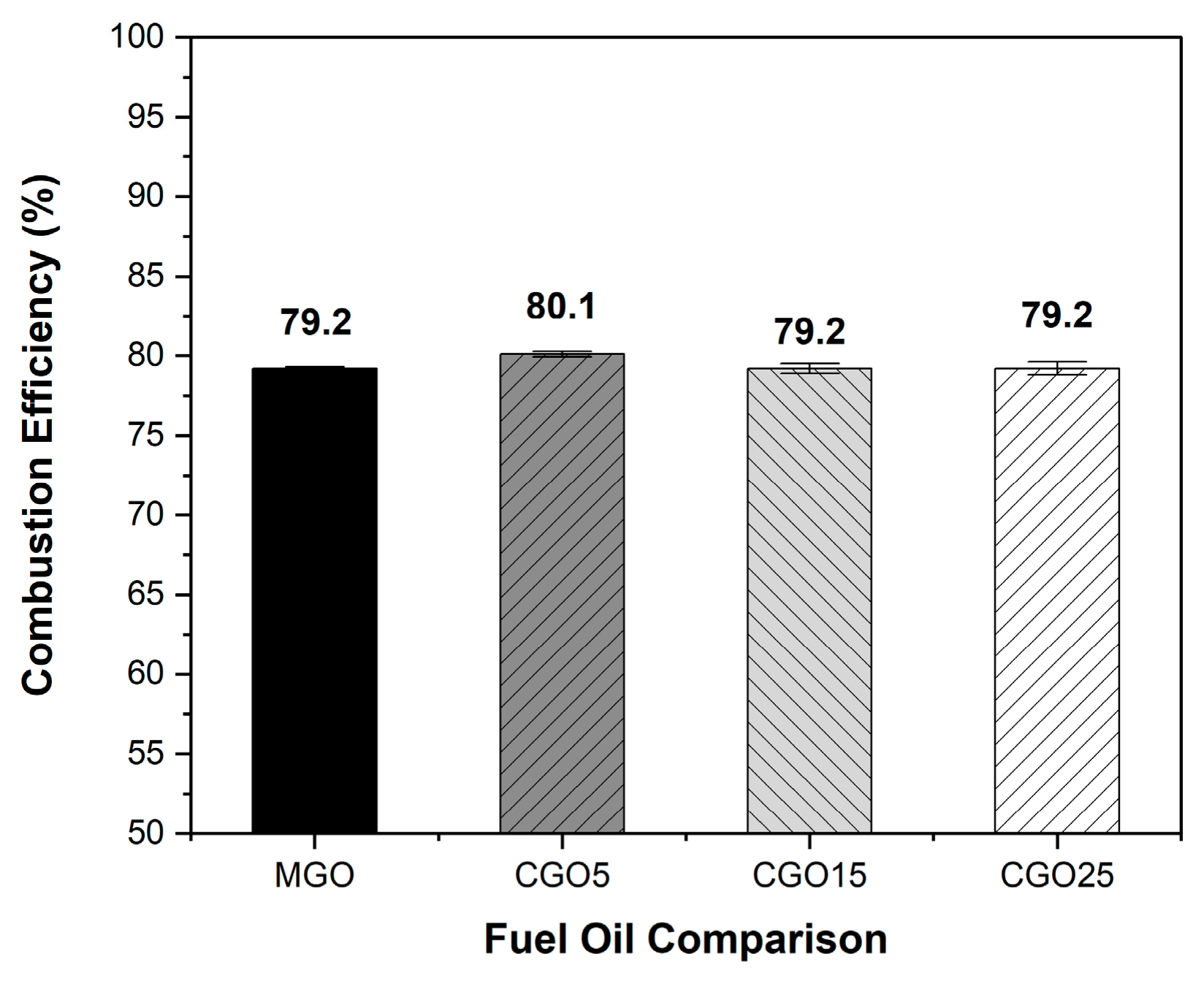
- Combustion efficiency: The combustion efficiency of MGO was approximately 79.2%, with only minor changes (within the decimal places) observed when increasing the SCG blending ratios. This stability suggests that the oxygen-rich nature of CGO facilitates efficient combustion, compensating for variations in fuel composition and heating value. Under the present experimental conditions, SCG blending did not significantly affect the overall combustion efficiency.
- Fuel Stability and Separation: As observed in the fuel property analysis, the SCG–MGO blends exhibited rapid phase separation due to differences in density and polarity between the two components. While this instability poses a challenge for long-term storage, the experimental tests were successfully conducted by utilizing the continuous circulation and mechanical mixing modules of the 30 L-class boiler system to ensure a uniform fuel supply during combustion. Nevertheless, as noted previously in Section 2.3, the introduction of chemical stabilization techniques such as specialized emulsifiers or surfactants will be indispensable for the commercial and practical implementation of these fuels. This study provides the essential baseline data required to evaluate the effectiveness of such additives in subsequent research.
Author Contributions
Funding
Data Availability Statement
Conflicts of Interest
References
- Gritsenko, D. Regulating GHG emissions from shipping: Local, global or polycentric approach? Mar. Policy 2017, 84, 130–133. [Google Scholar] [CrossRef]
- Jesus, M.C. Biofuel technologies and global decarbonization by 2050: The role of technological learning, spillovers effects and feedstock constraints. Energy Strategy Rev. 2025, 62, 101932. [Google Scholar]
- Li, Q.; Lam, J.S.L. Biofuel consumption and emission prediction for harbour craft using Machine learning methods. Transp. Res. Part D Transp. Environ. 2025, 149, 105005. [Google Scholar] [CrossRef]
- Rimkus, A. Effect of hydrogen addition on the energy and environmental performance of a compression ignition dual-biofuel engine. Int. J. Hydrogen Energy 2026, 217, 153709. [Google Scholar] [CrossRef]
- Yeassin, R.; Adnan, M.M.R.; Chowdhury, M.M.A.; Mia, A.; Enan, M.A.J.C.; Fuad, M.H. A comprehensive review of biomass and biofuels and their progress using digital technologies. Energy Convers. Manag. X 2025, 28, 101254. [Google Scholar] [CrossRef]
- Kapusta, K.; Sliwinska, A.; Krawczyk, P.; Wodolazski, A.; Strzoda, E.; Xu, D.; Duan, P.; Hao, B.; Wang, Y.; Leng, L.; et al. Techno-economic and life cycle assessment of liquid biofuels obtained from municipal sewage sludge by hydrothermal liquefaction (HTL). Energy 2026, 342, 139543. [Google Scholar] [CrossRef]
- Leite, A.C.P.; Pimentel, L.M.; Monteiro, L.A. Biofuel adoption in the transport sector: The impact of renewable energy policies. Sustain. Energy Technol. Assess. 2025, 81, 104419. [Google Scholar]
- Tan, F.; Lu, W.; Cao, B.; Wang, S.; Mu, M.; Zheng, A. Environmental impact and water footprint of biofuel production from macro-algae biomass based on life cycle assessment. Renew. Energy 2025, 254, 123612. [Google Scholar] [CrossRef]
- Ahmed, S.; Li, T.; Zhou, X.; Yi, P.; Chen, R. Quantifying the environmental footprints of biofuels for sustainable passenger ship operations. Renew. Sustain. Energy Rev. 2025, 207, 114919. [Google Scholar] [CrossRef]
- Sagin, S.; Sagin, S.; Fomin, O.; Gaichenia, O.; Zablotskyi, Y.; Pistek, V.; Kucera, P. Use of biofuels in marine diesel engines for sustainable and safe maritime transport. Renew. Energy 2024, 224, 120221. [Google Scholar] [CrossRef]
- Lee, T.; Kim, J.; Ryu, Y. Exhaust Emission Characteristics of MGO-Biodiesel Mixed Oil. J. Korea Soc. Mech. Technol. 2024, 26, 660–667. [Google Scholar]
- Kim, J.W.; Lee, T.H. A Comparative Study of Combustion Characteristics for the Evaluation of the Feasibility of Crude Bioethanol as a Substitute for Marine Fuel Oil. J. Mar. Sci. Eng. 2023, 11, 433. [Google Scholar] [CrossRef]
- Yeassin, R.; Chowdhury, P.; Das, P.; Agyekum, E.B.; Farrok, O.; Kumar, P. Navigating towards efuel: A scientometric insight into the application of membrane reactors. Energy Convers. Manag. X 2026, 30, 101545. [Google Scholar] [CrossRef]
- Kumar, A.; Tiwary, A.K.; Cearnaigh, D.U. Comparative analysis of Benchmark and Aeon Blue Technologies for sustainable eFuel production: Integrating Direct Air Capture and Green Hydrogen approaches. Energy Convers. Manag. 2024, 308, 118384. [Google Scholar] [CrossRef]
- Kumar, A.; Tiwari, A.; Uacearnaigh, D.; Milani, D. A comparative economic assessment of freshwater versus chloralkali electrolysis for eMethanol production. Int. J. Hydrogen Energy 2025, 171, 151241. [Google Scholar] [CrossRef]
- Mehrara, M.; Mesfun, S.; Ahlstrom, J.; Toffolo, A.; Wetterlund, E. Electrification-enabled production of Fischer-Tropsch liquids–A process and economic perspective. Appl. Energy 2025, 393, 126083. [Google Scholar] [CrossRef]
- Beckmann, J.; Klockner, K.; Letmathe, P. The role of power-to-X and domestic eFuel production for energy transition and energy independence in Europe. J. Clean. Prod. 2025, 492, 144807. [Google Scholar]
- Mohammadpour, J.; Salehi, F. A review of alternative liquid fuels in marine engines. Appl. Energy Combust. Sci. 2025, 24, 100394. [Google Scholar] [CrossRef]
- Ryu, Y.; Dan, T. Investigation on the Effects of Dimethyl Ether Blending to Bunker Oil for Marine Diesel Engine Use. In Proceedings of the SAE/KSAE 2013 International Powertrains, Fuels & Lubricants Meeting, Seoul, Republic of Korea, 21–23 October 2013. [Google Scholar]
- Jeong, B.; Jang, H.; Zhou, P.; Lee, J.U. Investigation on marine LNG propulsion systems for LNG carriers through an enhanced hybrid decision making model. J. Clean. Prod. 2019, 230, 98–115. [Google Scholar] [CrossRef]
- Yeo, S.; Jeong, B.; Lee, W.J. Improved formal safety assessment methodology using fuzzy TOPSIS for LPG-fueled marine engine system. Ocean Eng. 2023, 269, 113536. [Google Scholar] [CrossRef]
- Bulut, M. Control theory-based fuzzy Fine-Kinney risk assessment for boiler automation system from the maritime autonomous surface ships (MASS) perspective. Ocean. Eng. 2023, 286, 115599. [Google Scholar]
- Uyanık, T.; Arslanoğlu, Y. Operational risk assessment of marine boiler plant for on-board systems safety. J. Clean. Prod. 2021, 312, 127743. [Google Scholar]
- Çelik, A.L.; Akyuz, E.; Arslanoğlu, Y. Improved Z-number and fault tree analysis to predict the risk of air pollution due to ship boiler operation. Environ. Sci. Pollut. Res. 2022, 29, 51834–51846. [Google Scholar]
- International Coffee Organization (ICO). Available online: https://ico.org/ (accessed on 3 March 2026).
- Kim, S.B.; Ha, J.W. A Study on the Characteristics of Coffee Ground(CG)-RDF by Using Different Drying Method. J. Korea Acad. Ind. Coop. Soc. 2019, 20, 451–457. [Google Scholar]
- Hyundai Research Institute (HRI). Five Major Trends and Outlook of the Coffee Industry; VIP Report 19-24; Hyundai Research Institute: Seoul, Republic of Korea, 2019. [Google Scholar]
- Kim, Y.I. A Study on the Design of Pelletizer for Utilizing Coffee Waste. J. Korea Soc. Mech. Technol. 2020, 22, 708–785. [Google Scholar]
- Al-Hamamre, Z.; Foerster, S.; Hartmann, F.; Kröger, M.; Kaltschmitt, M. Oil Extracted from Spent Coffee Grounds as a Renewable Source for Fatty Acid Methyl Ester Manufacturing. Fuel 2012, 96, 70–76. [Google Scholar] [CrossRef]
- National Institute of Environmental Research (NIER). Report of Study on Integrated Management of Organic Waste; NIER-RP 2012-264; NIER: Incheon, Republic of Korea, 2012.
- Park, J.H.; Lee, S.H.; Kang, K.Y.; Lee, J.W. A Study on Combustion and Emission Characteristics of Diesel Generator Fuelled with Coffee Ground Pyrolysis Oil. Trans. Korean Hydrog. New Energy Soc. 2019, 30, 567–577. [Google Scholar]
- Kondamudi, N.; Mohapatra, S.K.; Misra, M. Spent Coffee Grounds as a Versatile Source of Green Energy. J. Agric. Food Chem. 2008, 56, 11757–11760. [Google Scholar] [CrossRef]
- Duman, G.; Okutucu, C.; Ucar, S.; Stahl, R.; Yanik, J. The slow and fast pyrolysis of spent coffee grounds. J. Anal. Appl. Pyrol. 2011, 91, 215–224. [Google Scholar]
- Yim, J.B.; Yoon, C.S.; Lee, S.H.; Kim, G.I. A Feasibility Study of Using Coffee Ground Oil-Butanol Blended Fuel in a Diesel Tractor. Trans. Korean Soc. Automot. Eng. 2019, 27, 77–84. [Google Scholar] [CrossRef]
- Park, J.H.; Lee, S.H.; Lee, J.I. Study on Application of Compression Ignition Engine Fuelled with Coffee Ground Pyrolysis Oil as Alternative Diesel Fuel. Trans. Korean Soc. Automot. Eng. 2020, 28, 291–299. [Google Scholar] [CrossRef]
- Lee, T.H.; Ryu, Y.H. A Study on Mixing Properties of Coffee Ground-Fuel for Improvement of Air Pollution from Ships. J. Korean Soc. Mech. Technol. 2021, 23, 181–186. [Google Scholar]
- Lee, T.H.; Ryu, Y.H. Viscosity Characteristic Analysis of Coffee Ground Oil for Marine Fuel Applications. J. Korean Soc. Mech. Technol. 2021, 23, 892–897. [Google Scholar]
- Lee, T.H.; Kang, I.S. Small Combustion Chamber for Marine Fuel Oil and Analysis of Exhaust Gas Characteristics of Marine Gas Oil. J. Mar. Sci. Eng. 2023, 11, 609. [Google Scholar] [CrossRef]
- Lee, T.H.; Kang, I.S. Development of 30 Liter Small Boiler for Testing Marine Fuel Oil. J. Korean Soc. Mech. Aviat. Technol. 2023, 25, 223–228. [Google Scholar]
- Kim, J.W.; Park, J.U.; Kang, I.S.; Lee, T.H. Characteristics of Exhaust Emissions from MGO–Bioethanol Fuel Blend Using a Combustion Chamber. Adv. Mech. Eng. 2024, 16, 1–14. [Google Scholar] [CrossRef]
- Pyeong-Hwa Machinery Co., Ltd. Products of Pyeonghwa Super Steam Boiler; Pyeong-Hwa Machinery Co., Ltd.: Seoul, Republic of Korea, 2019; pp. 1–11. [Google Scholar]
- Yim, J.B.; Lee, S.H.; Kim, G.B.; Yoon, C.S. A Study on the Driving and Emission Characteristics of Diesel Tractor Operated with Coffee Ground Oil-Butanol Blended Fuel. In Proceedings of the KSAE Spring Conference, Jeju, Republic of Korea, 7–9 June 2018; p. 219. [Google Scholar]
- Choi, Y.S.; Choi, S.K.; Kim, S.J.; Jeong, Y.W.; Soysa, R.; Rahman, T. Fast Pyrolysis of Coffee Ground in a Tilted-Slide Reactor and Characteristics of Biocrude Oil. Environ. Prog. Sustain. Energy 2017, 36, 655–661. [Google Scholar] [CrossRef]
- Kim, J.W. The Effects of MGO-Bioethanol Blended Oil Using Standard Combustion Chamber on Exhaust Emissions Characteristics. Ph.D. Thesis, Pukyong National University, Busan, Republic of Korea, 2024. [Google Scholar]
- TESTO. Flue Gas Analyzer Instruction Manual on Testo-340; Testo Co., Ltd.: West Chester, PA, USA, 2016. [Google Scholar]
- National Institute of Environmental Research (NIER). Air Pollution Process Test Standard No. 2017-51; NIER: Incheon, Republic of Korea, 2018.



| Division | Specification | Unit |
|---|---|---|
| Water volume | 30.8 | L |
| Evaporative capacity | 50 | kg/h |
| Fuel consumption | 3.2 | kg/h |
| Heat value | 133,768 | kcal/h |
| Heating area | 1.7 | m3 |
| Max. pressure | 3.5 | kg/cm3 |
| Thermal efficiency | 86 | % |
| Pipe diameter | Steam: 15 Water: 15 Funnel: 100 Fuel inlet: 8 | mm |
| Dry weight | 150 | kg |
| List | Marine Gas Oil (MGO) | Coffee Ground Oil (CGO) | Unit |
|---|---|---|---|
| LHV | 43.0 | 33.9 | MJ/kg |
| Water | 0.0 | 23.0 | wt% |
| Carbon | 84.81 | 54.6 | wt% |
| Hydrogen | 14.3 | 9.6 | wt% |
| Oxygen | 0.1 | 34.5 | wt% |
| Others | 0.79 | 1.6 | wt% |
| Density | 840.8 | 1005.0 | kg/m3 |
| Viscosity | 3.0 | 9.2 | mm2/s |
| Parameter | Range | Resolution | Standard Method |
|---|---|---|---|
| O2 | 0–25% | 0.01% | ES 01314.1b |
| CO | 0–10,000 ppm | 1.00 ppm | ES 01304.2c |
| CO2 | 0~CO2max % | 0.01% | Same O2 |
| NOx | 0–4000 ppm | 1.00 ppm | ES 01308.1b |
| Temperature | −40–1200 °C | 0.10 °C | - |
Disclaimer/Publisher’s Note: The statements, opinions and data contained in all publications are solely those of the individual author(s) and contributor(s) and not of MDPI and/or the editor(s). MDPI and/or the editor(s) disclaim responsibility for any injury to people or property resulting from any ideas, methods, instructions or products referred to in the content. |
© 2026 by the authors. Licensee MDPI, Basel, Switzerland. This article is an open access article distributed under the terms and conditions of the Creative Commons Attribution (CC BY) license.
Share and Cite
Lee, T.-h.; Ryu, Y.-h.; Cho, J.-h.; Jin, C. Feasibility of Using Oil from Spent Coffee Grounds in Small-Scale Marine Boilers. J. Mar. Sci. Eng. 2026, 14, 879. https://doi.org/10.3390/jmse14100879
Lee T-h, Ryu Y-h, Cho J-h, Jin C. Feasibility of Using Oil from Spent Coffee Grounds in Small-Scale Marine Boilers. Journal of Marine Science and Engineering. 2026; 14(10):879. https://doi.org/10.3390/jmse14100879
Chicago/Turabian StyleLee, Tae-ho, Young-hyun Ryu, Jin-ho Cho, and Chunguang Jin. 2026. "Feasibility of Using Oil from Spent Coffee Grounds in Small-Scale Marine Boilers" Journal of Marine Science and Engineering 14, no. 10: 879. https://doi.org/10.3390/jmse14100879
APA StyleLee, T.-h., Ryu, Y.-h., Cho, J.-h., & Jin, C. (2026). Feasibility of Using Oil from Spent Coffee Grounds in Small-Scale Marine Boilers. Journal of Marine Science and Engineering, 14(10), 879. https://doi.org/10.3390/jmse14100879