1. Introduction
A UUV cluster system is a cooperative underwater multi-agent system in which multiple unmanned underwater vehicles perform missions through distributed perception, local interaction, information exchange, and coordinated motion. Compared with a single UUV, swarm-based systems can provide wider spatial coverage, stronger fault tolerance, and higher operational efficiency in complex marine environments [
1,
2]. Typical multi-AUV/UUV missions include cooperative search, regional sampling, multi-point inspection, formation control, task allocation, path planning, and obstacle avoidance [
2,
3,
4]. In such systems, the desired collective behavior is usually expected to emerge from local interactions under limited sensing and communication, rather than from centralized global control [
5,
6].
With the increasing demand for marine exploration, environmental monitoring, and maritime security, UUV swarms are often required to move toward multiple task-related regions while maintaining coordinated motion and avoiding obstacles [
4]. These tasks are further complicated by the physical characteristics of underwater environments. Acoustic communication usually suffers from low bandwidth, long propagation delay, and packet loss, which makes real-time centralized coordination difficult [
7]. Sensing and localization may also be affected by noise, limited perception range, and partial observability. In addition, ocean-current disturbances can cause deviations between the desired heading and the actual vehicle trajectory, thereby influencing both convergence behavior and obstacle-avoidance decisions [
8]. These practical constraints motivate the development of distributed swarm-control methods that rely mainly on local information and simple update rules.
Swarm motion control provides a useful framework for modeling and coordinating decentralized multi-agent systems. Representative collective-motion models include the Vicsek model [
9], Boids model [
10], Couzin model [
11], and leader–follower frameworks [
12,
13,
14]. Among them, the Vicsek model has attracted considerable attention because it uses a simple local heading-alignment rule to generate global consensus behavior from decentralized individual updates [
9]. Existing studies have analyzed the convergence properties of Vicsek-type models under different interaction topologies, boundary conditions, communication delays, variable speeds, noise levels, and limited fields of view [
15,
16,
17,
18,
19,
20,
21]. These studies show that Vicsek-type dynamics are suitable for describing distributed heading consensus in swarm systems. Nevertheless, the original Vicsek model mainly focuses on consensus formation and does not explicitly consider task-oriented subcluster guidance toward multiple predefined mission regions. As a result, its convergence efficiency and task adaptability may be limited when UUV swarms are required to gather around different task-attraction locations.
Obstacle avoidance is another essential requirement for UUV swarm operation. Existing multi-agent obstacle-avoidance methods include deep reinforcement learning [
22,
23,
24], grid-based planning [
25], velocity-obstacle methods [
26], and artificial-potential-field methods [
27,
28]. Among them, the Olfati-Saber framework [
29,
30] extends potential-field-based coordination to multi-agent systems and has become a representative approach. These methods have achieved useful results in different scenarios, but they also have limitations. Learning-based methods usually require sufficient training data, careful reward design, and considerable computational resources. Grid-based and velocity-obstacle methods may become computationally expensive in dense or dynamic environments. Artificial-potential-field-based methods are intuitive and effective for local obstacle avoidance, but they may suffer from local minima, oscillations, or excessive avoidance maneuvers when all nearby obstacles are treated as repulsive sources. Therefore, for UUV swarm motion control, it is still necessary to develop a distributed and interpretable mechanism that can improve task-oriented convergence while reducing unnecessary avoidance actions.
To address the above issues, this study develops a Vicsek-based UUV swarm motion-control framework with static summoning points and threat-selective obstacle avoidance. The proposed method, referred to as VSSPAO, is not intended to serve as a globally optimal path-planning algorithm. Instead, it aims to provide an interpretable and computationally simple distributed coordination mechanism for UUV swarm segmentation, task-oriented convergence, and obstacle avoidance. Within the framework of multi-agent coordination, the main contribution of this study is to extend consensus-oriented Vicsek-type swarm dynamics toward task-oriented UUV swarm motion by introducing static summoning-point guidance and obstacle-threat judgment.
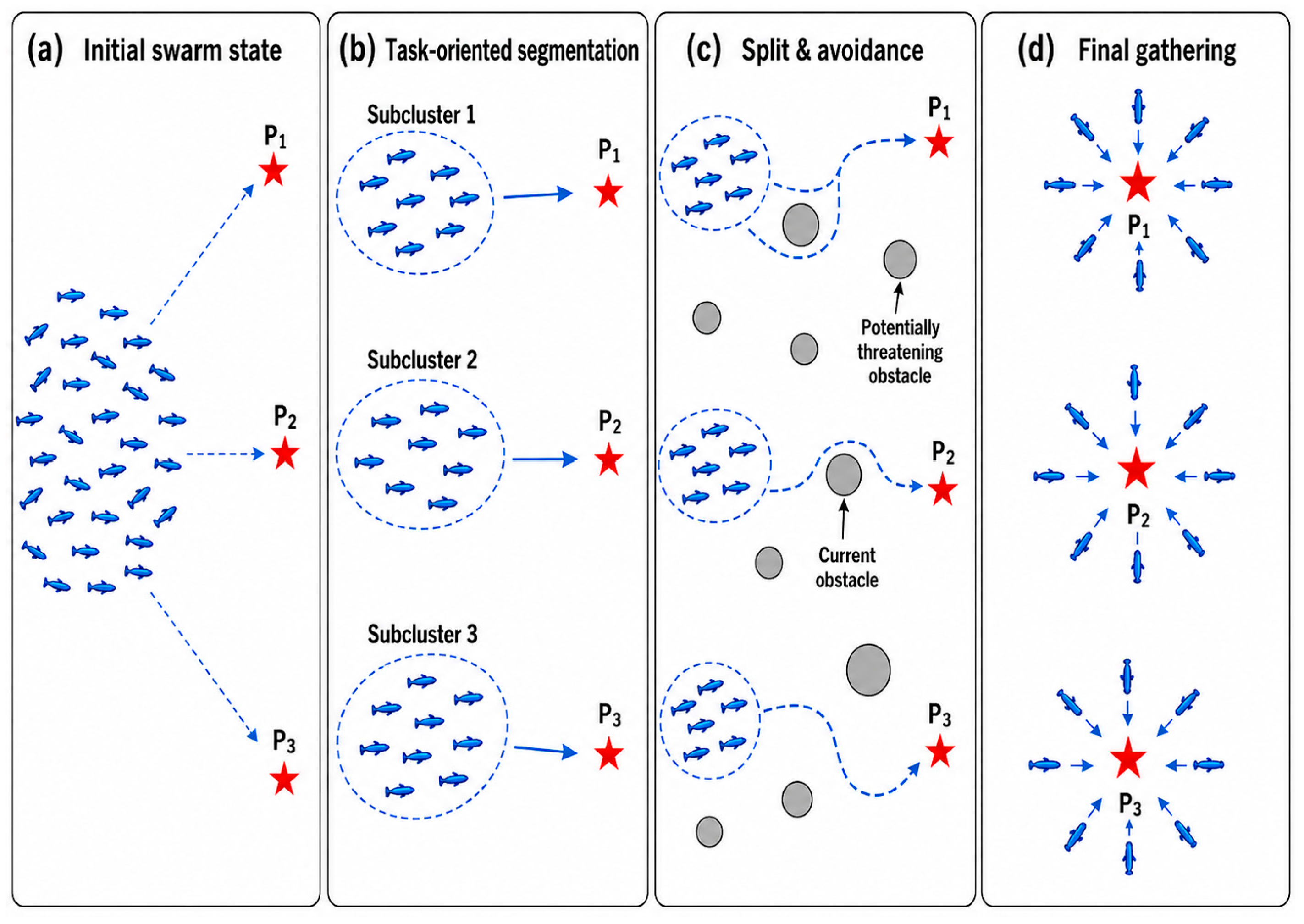
Figure 1 illustrates the overall mechanism of the proposed framework. The initially mixed UUV swarm is first divided into several task-oriented subclusters according to the assigned static summoning points. During the motion process, each subcluster updates its heading by combining local neighbor alignment and summoning-point guidance. When obstacles are detected, the proposed obstacle-threat judgment distinguishes current obstacles from potentially threatening obstacles according to the relative position of the obstacle and the velocity direction of the individual. Avoidance is triggered only when a current obstacle lies within the prescribed safety distance. After passing the obstacle, the subcluster resumes coordinated motion and finally gathers toward its assigned summoning point. Thus, the framework describes a coupled process of task-oriented segmentation, selective obstacle avoidance, and multi-region aggregation.
The main contributions of this study are summarized as follows:
A task-oriented subcluster guidance mechanism is developed by incorporating static summoning points into the Vicsek model. A movement-cost-based assignment rule is used to divide the initially mixed swarm into subclusters, enabling multi-region aggregation under distributed motion control.
A threat-selective obstacle-avoidance strategy is proposed, which distinguishes current obstacles from potentially threatening obstacles based on relative position and velocity direction, thereby reducing unnecessary avoidance maneuvers.
The convergence behavior of the proposed heading-update rule is analyzed using uniformly paracontractive matrices. The effectiveness of the VSSPAO framework is further evaluated through simulation.
The proposed framework differs from several established multi-agent coordination paradigms in terms of control objective, information requirement, and decision mechanism. Boids-type models reproduce flocking behavior through heuristic separation, alignment, and cohesion rules, but they do not explicitly assign subclusters to different task-related regions [
10]. Artificial-potential-field methods guide agents using attractive and repulsive virtual forces, but they may suffer from local minima, oscillations, or excessive avoidance in cluttered environments [
27]. Reinforcement learning-based methods can learn flexible policies from interaction data, but their performance often depends on training conditions, reward design, and computational resources [
22]. In contrast, the proposed VSSPAO framework preserves the local-interaction structure and interpretability of Vicsek-type models, while introducing static summoning points for task-oriented subcluster guidance and current-obstacle judgment for reducing redundant avoidance actions.
Table 1 summarizes these differences.
This paper is divided into seven sections.
Section 1 introduces research background of the article, summarizes the research progress of predecessors, puts forward the problems existing in the research, and summarizes the research ideas of this paper.
Section 2 details the improved Vicsek model with static summoning points, which is called VSSP for short.
Section 3 describes in detail the design process of the improved Vicsek model of obstacle-avoidance strategy on the basis of
Section 2, which forms the VSSPAO algorithm.
Section 4 defines four indicators for algorithm performance evaluation.
Section 5 is the simulation and experimental verification.
Section 6 summarizes work of this paper and puts forward the shortcomings in the research which provides guidance for the follow-up research.
2. An Improved Vicsek Model with Static Summoning Points—VSSP
The classical Vicsek model describes collective motion through local heading alignment among neighboring individuals [
9]. Although this rule can generate global directional consensus under suitable interaction conditions, it does not explicitly include task-attraction information. Therefore, when a UUV swarm is required to move toward several predefined mission regions, the original Vicsek model may exhibit limited task-oriented convergence efficiency.
To address this limitation, this section introduces static summoning points into the Vicsek framework. A static summoning point represents a predefined mission-related location, such as a target region, sampling site, rendezvous area, or underwater observation point. The proposed VSSP model first assigns each individual to a summoning point according to a movement-cost criterion. Then, the heading of each individual is updated by combining two types of information: the average heading of visible neighbors and the directional guidance from the assigned summoning point. In this way, the model preserves the decentralized alignment mechanism of the Vicsek model while improving motion efficiency toward predefined task locations. The main symbols used in the proposed framework are summarized in
Table 2.
2.1. Definition and Selection of Static Summoning Points
The selection of static summoning points depends on the mission environment and task requirements. In the proposed framework, a static summoning point is defined as a fixed spatial location that attracts a subset of UUVs for accomplishing a specific mission. Typical examples include target regions, sampling sites, rendezvous areas, underwater observation points, and key mission waypoints [
31,
32].
Unlike a moving leader or a dynamically updated target, a static summoning point remains fixed during the simulation and provides directional guidance for the assigned subcluster. Therefore, it can be regarded as a task-attraction location rather than a physical agent participating in local interaction. In this study, the positions of the static summoning points are assumed to be known in advance, and the corresponding subclusters are determined by the initial movement-cost assignment described in the next subsection.
2.2. Initial Subcluster Assignment Based on Movement Cost [33]
When several static summoning points are specified in the mission area, the UUV swarm should first be organized into different task-oriented subclusters. This assignment step determines which summoning point each individual should follow before the subsequent heading-update process starts. In this study, the assignment is performed only at the initial stage according to the geometric and directional relationship between each individual and each candidate summoning point. The obtained subcluster membership is then used in the following VSSP and VSSPAO motion updates.
Suppose that static summoning points are deployed in the environment. For each individual, two aspects are considered when selecting its associated summoning point. The first is the spatial proximity between the individual and the summoning point, which reflects the translational effort required to approach the target region. The second is the heading compatibility between the current motion direction of the individual and the direction pointing toward the summoning point, which reflects the angular adjustment required before the individual can move efficiently toward that point.
Since distance and angular deviation have different physical meanings and numerical scales, they are normalized before being combined. The resulting movement-cost index is therefore dimensionless and can be used to compare different candidate summoning points for the same individual. Following the cost-based assignment idea in [
33], the individual is assigned to the summoning point that produces the minimum total movement cost.
2.2.1. Movement-Cost Function
The movement-cost model is constructed from the geometric relationship between each individual and each static summoning point. It follows the normalized cost formulation used in the paper [
33]. Specifically, the assignment of an individual to a summoning point is determined by two physically meaningful factors: the spatial distance to the summoning point and the heading deviation required to move toward that point. The distance cost evaluates the translational effort, while the summoning diversion angle cost evaluates the directional adjustment effort. Since these two terms have different physical dimensions, they are normalized before being combined. The total movement cost is then defined as a weighted sum of the normalized distance cost and the normalized angular cost, which provides a dimensionless criterion for subcluster assignment.
- 1.
Distance cost
The movement-cost function is used to evaluate the suitability of each candidate summoning point for a given individual. For individual
and summoning point
, the distance-related cost is calculated from the Euclidean distance between them. To compare different candidate summoning points for the same individual, the distance is normalized with respect to the minimum and maximum distances from that individual to all summoning points:
- 2.
Summoning diversion angle cost
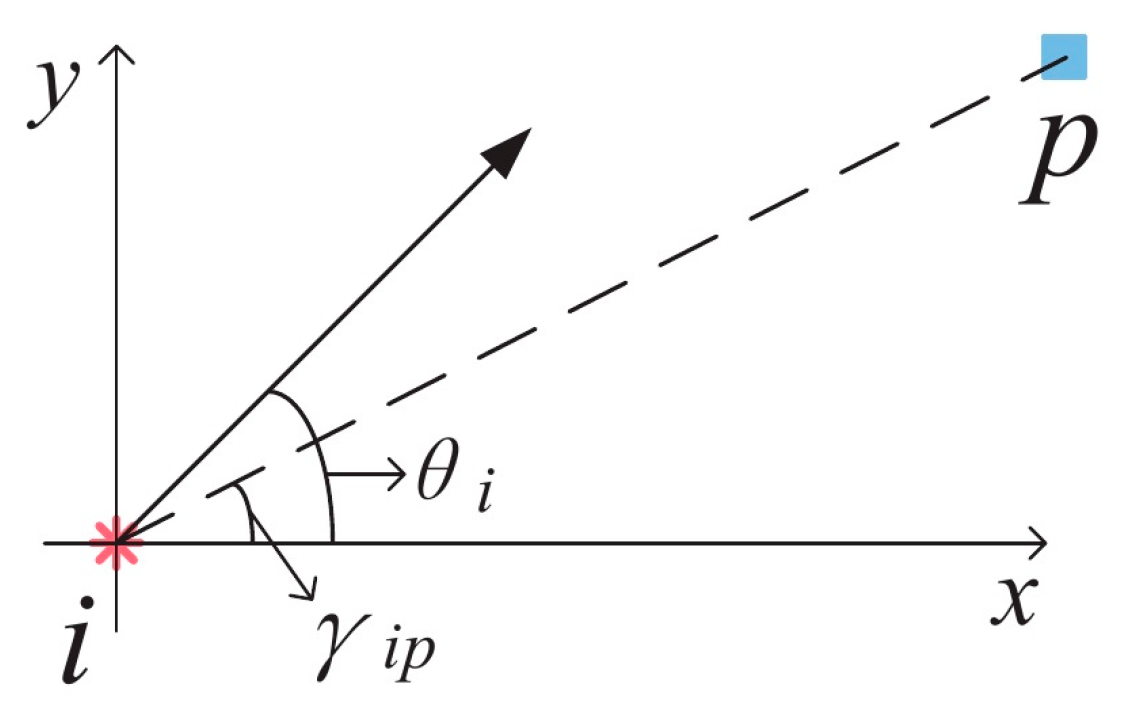
A smaller normalized distance cost indicates that the corresponding summoning point is spatially closer to the individual than the other candidates. In addition to distance, the initial heading direction also affects the assignment result. If an individual is already moving approximately toward a candidate summoning point, less heading adjustment is required in the following motion-control process. Therefore, the direction angle from individual
to summoning point
and the corresponding heading deviation are defined as:
To make the heading-deviation term comparable with the distance term, the angular deviation is also normalized among all candidate summoning points (
Figure 2):
- 3.
Total movement cost
The total movement cost is then defined as the weighted sum of the normalized distance cost and the normalized heading-deviation cost:
where the two weighting coefficients satisfy
. The coefficient
determines the relative importance of spatial proximity, whereas
determines the relative importance of heading compatibility. Thus, the movement-cost function provides a normalized criterion for assigning each individual to the most suitable static summoning point. Equations (1)–(5) are definition-based cost functions constructed from geometric relationships and normalized scalarization, rather than empirical fitting formulas.
2.2.2. Minimum-Cost Subcluster Assignment Rule
After calculating the total movement cost for all individual–summoning point pairs, a cost matrix is obtained. Each element of this matrix represents the cost of assigning one individual to one candidate summoning point. For each individual, the summoning point corresponding to the smallest element in its row is selected as its guidance point.
Let
denote the assignment vector, whose
-th element records the selected summoning-point index for individual
:
The subcluster guided by summoning point
is then defined as the set of all individuals assigned to that point:
Through this rule, the initially mixed swarm is transformed into several task-oriented subclusters. These subclusters provide the basis for the subsequent heading-update and obstacle-avoidance processes.
2.3. Heading-Update Rule with Limited View and Summoning Guidance
In the classical Vicsek model, each individual updates its heading according to the average direction of its neighboring individuals. This local alignment rule provides a decentralized mechanism for generating directional consensus. However, in practical UUV swarm motion, the effective neighbor set is usually constrained by sensing range and field of view.
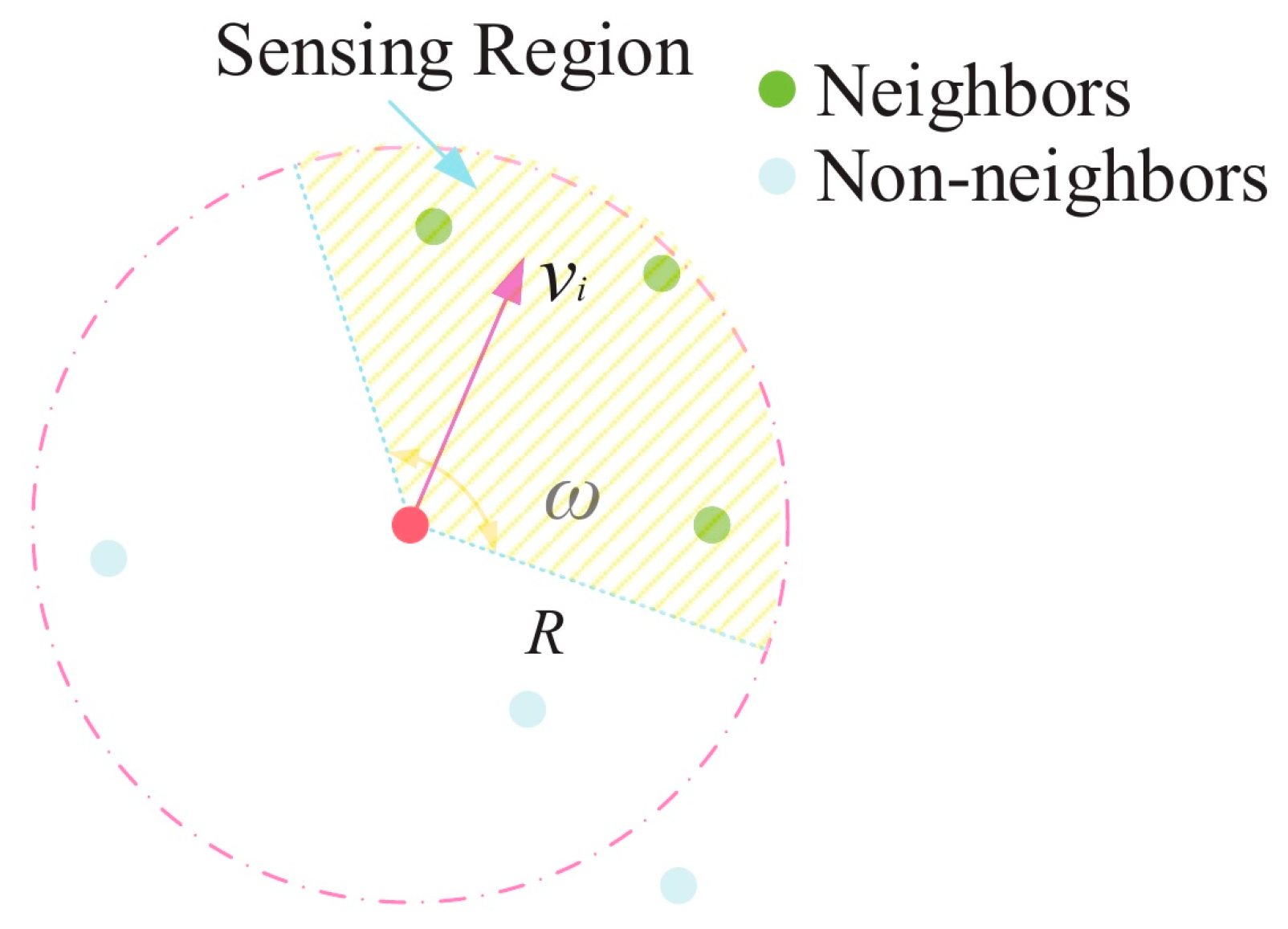
In the proposed VSSP model, the sensing distance
first determines the candidate perception region around individual
, while the visual angle
further restricts this region to a sector aligned with the current heading direction. Therefore, the effective neighbor set
contains only the individuals satisfying both the distance condition and the angular-visibility condition. As illustrated in
Figure 3, an individual inside the sensing circle but outside the visual sector is excluded from local heading alignment; similarly, an individual located within the visual direction but beyond the sensing distance is also excluded.
Based on this limited-view neighbor set, the local alignment direction is calculated from the average velocity direction of visible neighbors. This term inherits the decentralized consensus mechanism of the Vicsek model. Nevertheless, local alignment alone cannot explicitly guide a subcluster toward its assigned static summoning point. Therefore, a task-oriented angular-correction term is introduced. This correction is determined by the heading deviation between the local motion direction of individual
i and the direction toward its assigned summoning point
p, and its influence is controlled by the summoning factor ζ. The modified heading-update rule is expressed as:
where
. The first term in Equation (8) represents limited-view neighbor alignment, while the second term represents summoning-point guidance. When
, the rule reduces to the limited-view Vicsek update. As
increases, the assigned summoning point exerts a stronger influence on the heading update. Therefore, Equation (8) can be regarded as a proportional angular-correction mechanism that balances local consensus and task-oriented motion guidance. It should be noted that the summoning term does not introduce centralized control among agents; it only uses the fixed position of the assigned summoning point to provide directional correction for each individual.
2.4. Convergence Analysis of the VSSP Heading-Update Rule
In this paper, the convergence of the VSSP model is proved by using the theory of infinite product of uniformly paracontractive matrices proposed in [
34]. Before the proof, the related symbolic conventions, definitions and theorems are briefly introduced.
Symbolic conventions: For vector , its Euclidean norm is denoted by ; for -th order square matrix , represents the zero subspace of matrix , that is, the norm of is defined as .
Definition 1 [34]. For a set composed of n-order matrices, if , thenthe set S is called a uniformly paracontractive set, or simply uniformly paracontractive. Theorem 1 [34]. If the set of n-order matrices is uniformly paracontractive, and is an arbitrary mapping from the set of natural numbers to Λ, then the infinite product matrixis convergent. The VSSP model proposed in this paper is a discrete-time system composed of multiple planar moving individuals. Referring to the theoretical research method of typical Vicsek model in the literature [
34], the connection relationship of particles is abstracted into an undirected graph. Consider the general weighted undirected graph. A weighted undirected graph
is composed of node set
, edge set
and weight matrix
, where
, each number represents a node.
is a set of disordered pairs composed of different nodes.
is the weighted adjacency matrix. If
, then
; if
, then
. Neighbors
of node
in graph
are defined as all the nodes connected with
when restricted by a limited view angle, that is,
.
The graph sequence
is used to represent the connection of all individuals at time
. It is assumed that the non-zero elements of the adjacency matrix
satisfy
, where
and
are given positive numbers. All individuals in the VSSP algorithm proposed in this paper update their course angle according to the following principles:
Introduce
,
and the Laplacian matrix
of graph
, where
, then
is a matrix determined only by the static summoning points position and the initial positions of all individuals. In general, the initial positions of all individuals are randomly distributed, so
is also randomly distributed.
can be recorded as the random error of
, denoted as
. Therefore,
The initial value of course angle for all individuals is recorded as
, then
By definition,
is a diagonally dominant symmetric matrix. Using the disk theorem,
is a positive semi-definite matrix, and the maximum eigenvalue is less than or equal to
. Take
, then the eigenvalue of
is non-negative and less than 1, so
is positive semi-definite, then
The following proves that is uniformly paracontractive.
If
, then there is
such that
. The components of such
must not all be equal, otherwise there will be
according to the definition of
. Let
, then
. Because
is a positive semidefinite, we can get
from
. Using
, we know that there must be
such that
and
are not equal to 0 at the same time, so
Back to Formula (15), there is
, then
which means that the set is uniformly paracontractive.
It can be known from Theorem 1 that when , converges to a certain point in , where is a sufficiently large positive integer. Therefore, the course angle of the VSSP algorithm is convergent, and all individuals must be able to synchronize their movement directions. The proof is complete.
The assumptions used in the above convergence analysis are reflected in the simulation setup in
Section 5. Specifically, the time-varying interaction graph is generated by the limited-view neighbor-selection rule, in which each UUV selects effective neighbors according to the prescribed sensing distance and visual angle. The corresponding adjacency weights are nonnegative and bounded, satisfying the bounded-weight condition required in the convergence analysis. In addition, the heading-update rule implemented in the simulations follows the same local-alignment and summoning-guidance structure as the analytical model. Therefore, the maneuver consistency and steady-state statistical consistency indicators used in
Section 5 provide numerical evidence for the heading-synchronization behavior predicted by the convergence analysis.
3. Improved Vicsek Model with an Obstacle-Avoidance Strategy—VSSPAO
Obstacle avoidance in a multi-agent cluster system is a challenging research topic. In such a scenario, each agent needs to avoid obstacles safely and move towards the target point. When an agent perceives obstacles, it does not take the obstacle-avoidance measures immediately but takes its velocity direction and target point position into consideration and then conducts specific obstacle-avoidance measures.
3.1. Obstacle-Threat Judgment
In the process of movement, multi-agents can use their own sensor device to detect obstacles in the surroundings, which may threaten the movement safety of the agents. Therefore, it is necessary to design an obstacle-threat judgment criteria to determine whether an obstacle is the “current obstacle” or the “potentially threatening obstacle”. In general, in order to facilitate the judgment of the obstacle threat, it is necessary to assume an agent as a particle and simplify the shape of an obstacle into a circle. At the same time, an obstacle needs to be “expanded obstacle region” according to the relative size between the agent and the obstacle. The position of obstacle is expressed as , and the radius of the circle after the obstacle being expanding treatment is presented as .
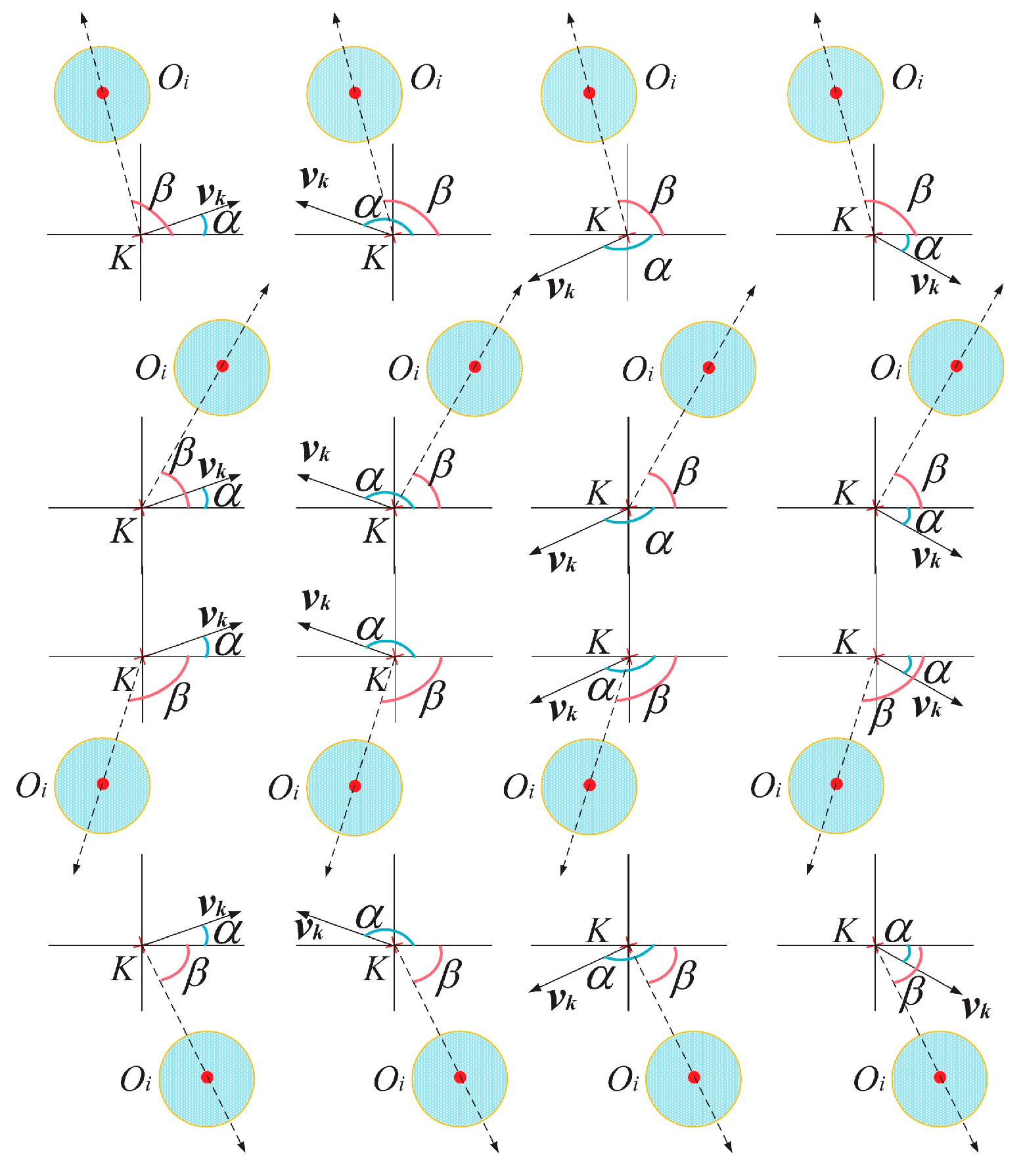
Figure 4 illustrates the geometric basis of the obstacle-threat judgment in the local coordinate system of an agent. In practical UUV swarm motion, the threat level of an obstacle depends not only on the distance to the agent, but also on its relative bearing with respect to the current velocity direction. An obstacle located close to the agent but behind or outside the forward motion direction may not require immediate avoidance, whereas an obstacle located in front of the agent and inside the obstacle cone may become a potential collision threat. Therefore, the relative position between the agent and the obstacle is divided into different cases to ensure that the bearing angle can be calculated correctly in all quadrants. This geometric representation allows the proposed strategy to distinguish relevant collision-risk obstacles from non-immediate obstacles, thereby reducing excessive obstacle avoidance and improving route efficiency in cluttered underwater environments.
The Cartesian coordinate system
is established with agent
as the coordinate origin, due east direction as the
x axis and due north direction as the
y axis. There are 16 possibilities for the position relationship between the obstacle
and the agent
, as shown in
Figure 4.
is the angle between the course vector of agent
and the positive vector of
x axis,
is the angle between the direction vector of agent
pointing to the obstacle
and the positive vector of
x axis, and
is the angle between the course vector of agent
and the direction vector of agent
pointing to the obstacle
.
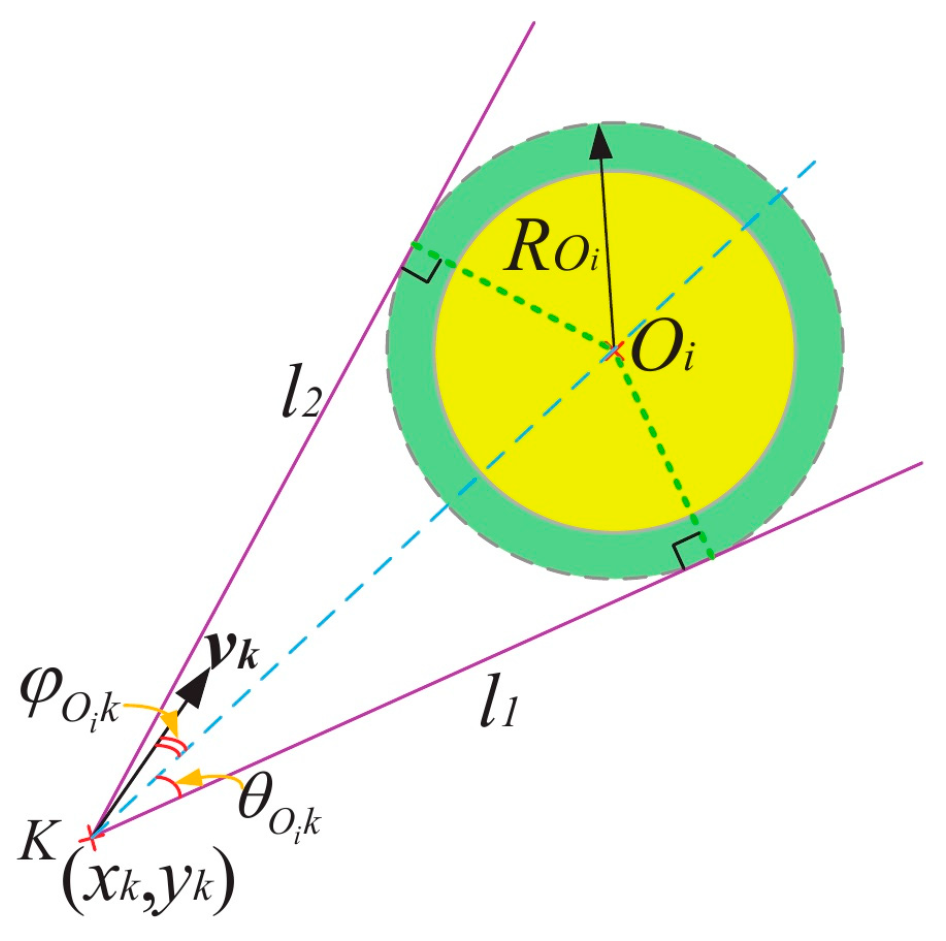
The obstacle cone formed by agent
and obstacle
is shown in
Figure 5. The rays
and
pass through the centroid of agent
and are tangent to the obstacle circle
. The angle between velocity vector
of agent
and its position vector
is
, and the half vertex angle of obstacle cone is
. The obstacle threat is judged by comparing the relationship of
and
.
Conclusion 1. When the obstacle has no threats to the movement of agent K along the current trajectory. When the obstacle will pose a potential threat to the movement of agent K, which needs to be further judged whether to take obstacle-avoidance behavior.
The values of
and
are calculated by Equations (18) and (19) respectively.
where,
is the Euclidean distance between obstacle
and agent
,
,
.
It can be seen from the analysis of various possible situations in
Figure 4 that:
According to Conclusion 1, we can determine whether the obstacles pose a potential threat to the movement of the agent. If the obstacle-avoidance measures are blindly taken as long as an agent is found moving toward the obstacle while ignoring the movement direction of the agent, it will lead to the phenomenon of “excessive obstacle avoidance”, which is not conducive to the cluster convergence. In order to further judge whether the potential threat obstacle is a “current obstacle”, it is also necessary to estimate the distance between an agent and the obstacle.
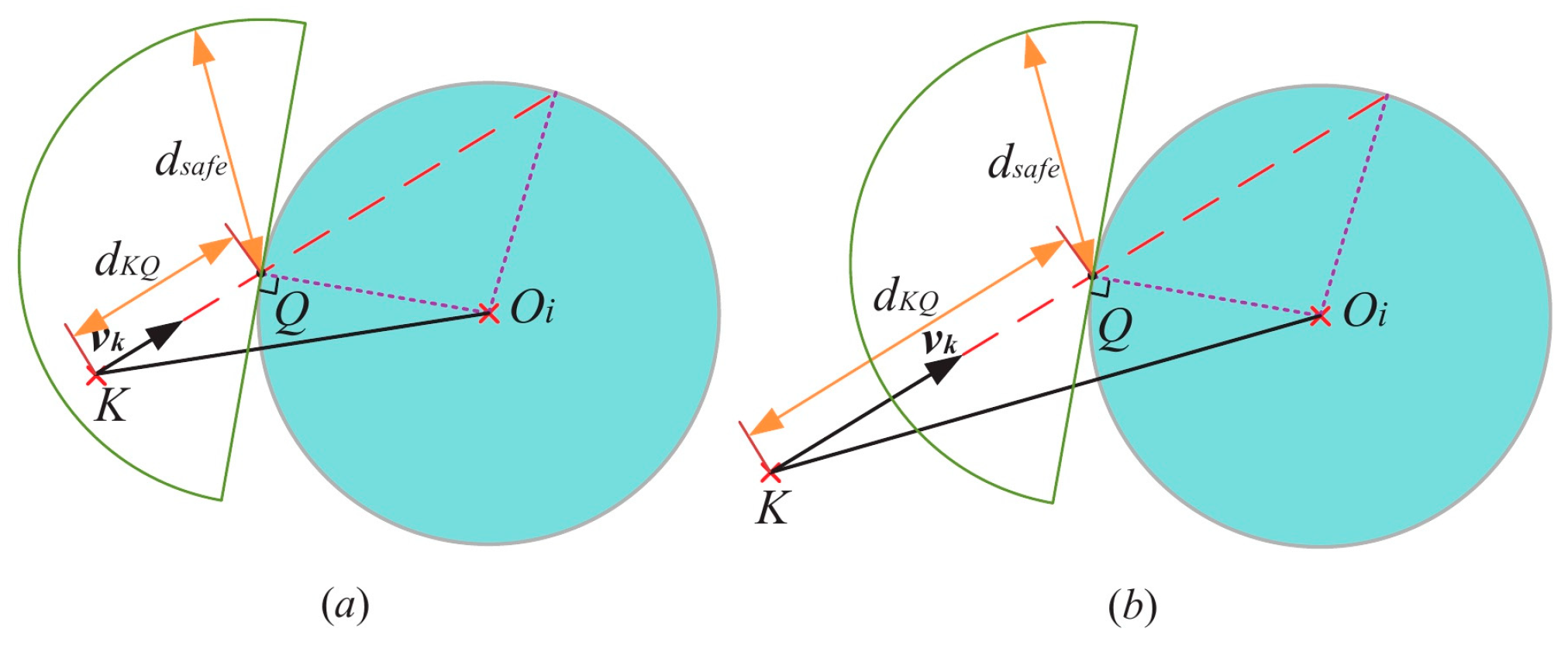
Conclusion 2. When the obstacle is a “potentially threatening obstacle”, and the Euclidean distance between the projection point of the agent velocity vector on the “expansion treatment” obstacle and the agent K satisfies ( is the minimum safe distance to take obstacle-avoidance measures), the obstacle is a “current obstacle”, and obstacle-avoidance measures should be taken (as shown in Figure 6a). Otherwise, when , the obstacle is a “potentially threatening obstacle”. Under these circumstances, no obstacle-avoidance measures need to be taken, and the agent continues to move according to the original trajectory (as shown in Figure 6b). and
are calculated by Equations (21) and (22) respectively. In the triangle
, according to the cosine theorem of triangles, we can know that:
In the formula, is the safety-distance coefficient of obstacle avoidance, and its general value is . However, should not be too large, so as to avoid the “excessive obstacle avoidance” behavior of agents. The general value of gs is .
During the movement of agents, if it is judged that there is a “current obstacle”, the intelligent mobile agent needs to take timely measures to avoid collision. In order to ensure the safety of the replanning trajectory for collision avoidance of intelligent mobile agent, it is necessary to determine a reasonable obstacle-avoidance angle.
In this study, obstacles are modeled as circular regions to facilitate the construction of the obstacle-cone judgment and safety-distance criterion. This simplification is commonly adopted in swarm motion-control studies for algorithm validation. However, the proposed obstacle-threat judgment mechanism is not restricted to circular obstacles and can be extended to more general geometric representations in practical applications. For irregular or non-spherical obstacles, the threat judgment can be performed based on the minimum distance between the UUV and the obstacle boundary, which can be obtained using bounding circles, convex hulls, or distance-field representations. In the case of complex-shaped obstacles, the environment can be decomposed into multiple simpler regions, and the threat evaluation can be applied to each component. Furthermore, for moving obstacles, the current judgment rule can be extended by incorporating relative velocity, predicted collision time, or dynamic safety margins. Therefore, the proposed framework maintains its applicability under more realistic and complex underwater environments.
It should be noted that the proposed threat-assessment mechanism relies on local geometric relationships and relative motion information rather than specific obstacle shapes, which makes it inherently adaptable to different obstacle representations.
3.2. Calculation of the Obstacle-Avoidance Angle
In an unknown dynamic environment, there are various situations in relative position and relative velocity between the agent and the detected obstacle . In order to obtain the obstacle-avoidance rotation angle of the agent when the “current obstacle” is detected, the positive and negative characteristics of the obstacle cone rotation angle are defined here, and the reasonable turning direction of obstacle-avoidance rotation angle is analyzed.
The Cartesian coordinate system is established with the agent as the coordinate origin, due east direction as the axis and due north direction as the axis. In the coordinate system , the definition of the positive and negative characteristics of the obstacle cone rotation angle is given.
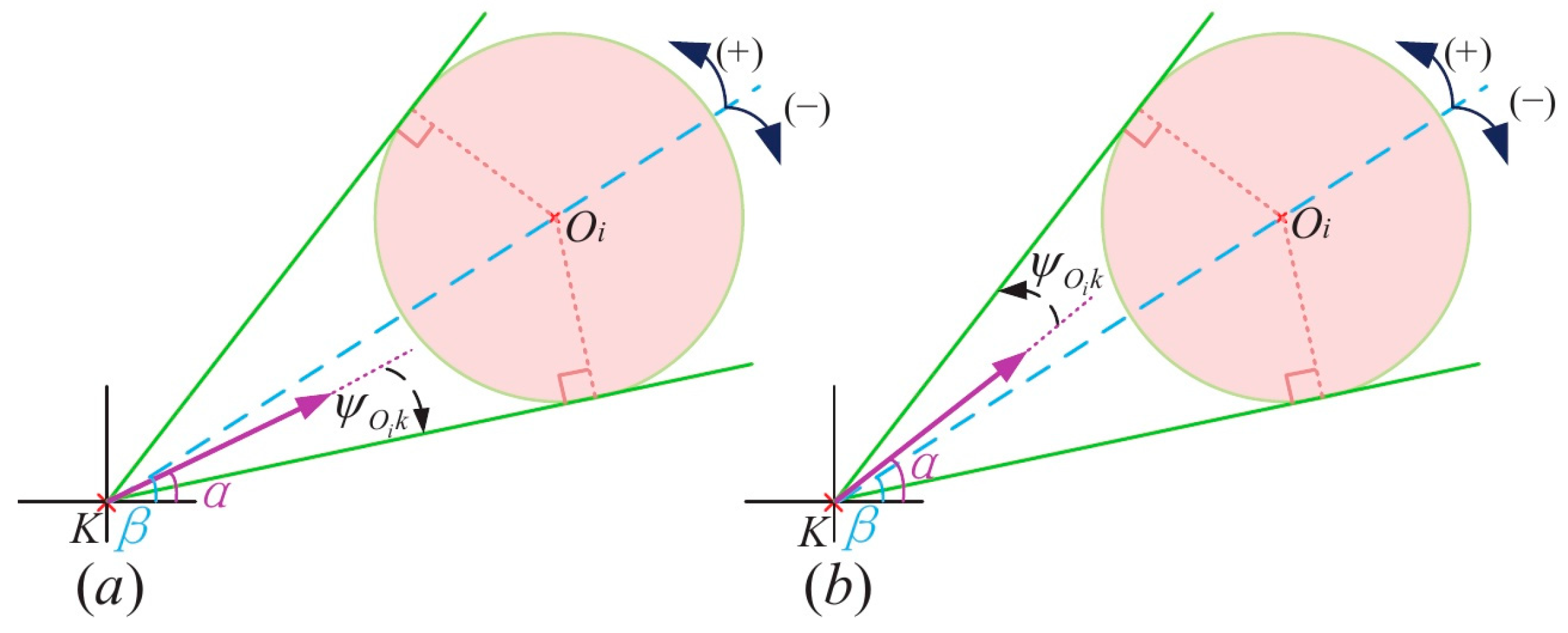
Definition 2. Positive and negative characteristics of the obstacle cone rotation angle. Taking the ray of agent K pointing to center Oi of the “current obstacle” as the dividing line, area of the dividing line in the counterclockwise direction is the positive obstacle cone rotation angle area, and area of the dividing line in the clockwise direction is the negative obstacle cone rotation angle area, as shown in Figure 7. When the agent detects the “current obstacle” , it needs to take obstacle-avoidance measures immediately. At this time, the simplest obstacle-avoidance method is to turn the course of agent to the tangent direction of the “current obstacle” under the premise of satisfying motion constraint of the agent . However, there are two such tangents. What needs to be selected here is the tangent that minimizes the course angle change in the agent .
In order to determine the rotation direction of agent
, it is necessary to compare the angle
and
. When
, the course of agent
turns to the tangent line of the positive obstacle cone rotation angle area. When
, the course of agent
turns to the tangent line of the negative obstacle cone rotation angle area. In order to express the directionality of the obstacle-avoidance rotation angle, the direction coefficient
of the obstacle-avoidance rotation angle is introduced, and its mathematical expression is:
The obstacle-avoidance rotation angle is marked as
. When the detected obstacle is a “current obstacle”, it can be seen from the Conclusion 1 that
, the value of the obstacle-avoidance rotation angle
at this time is
. Considering the directionality of
, it can be expressed as:
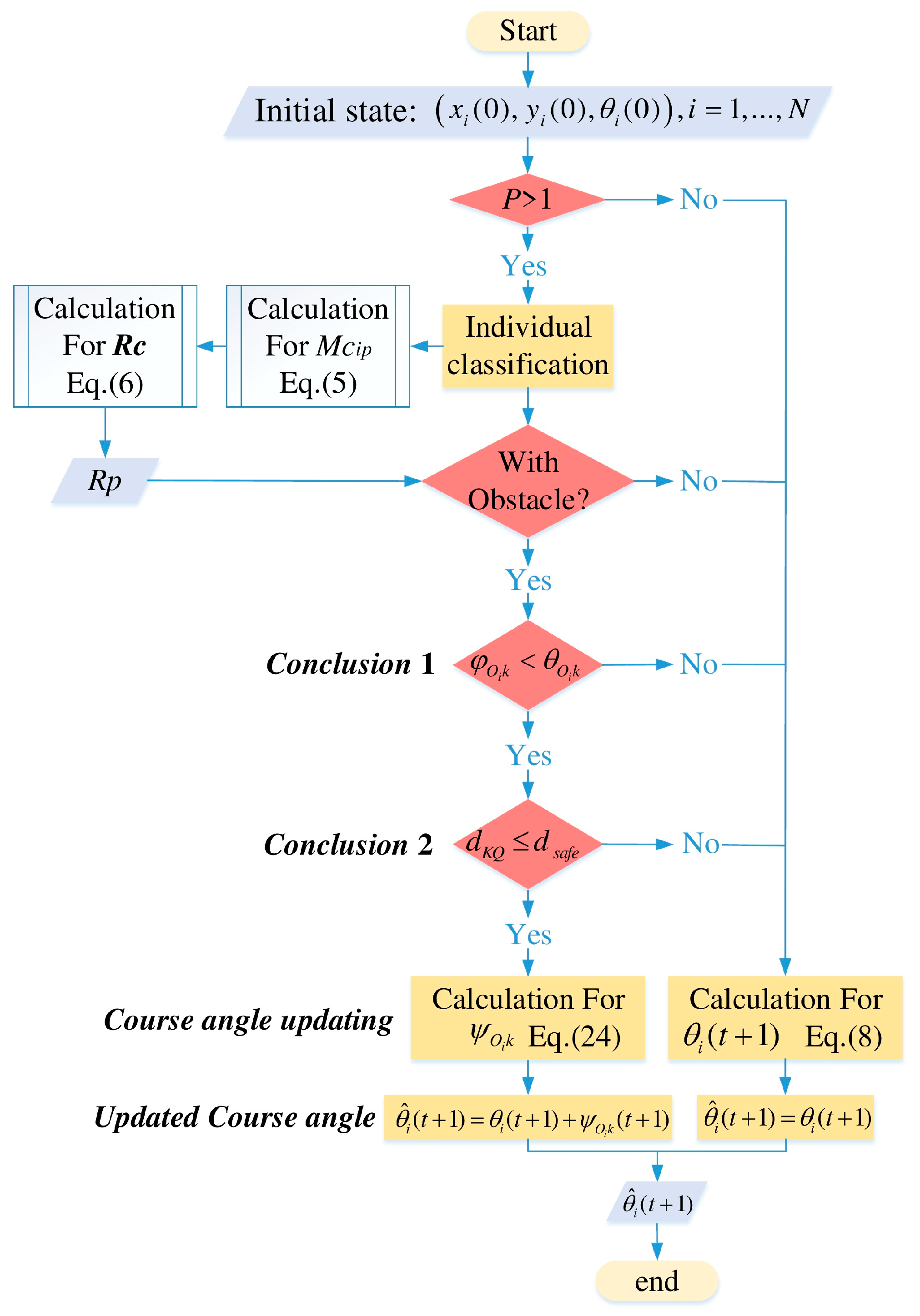
According to the theory of
Section 2 and
Section 3, the algorithm flow chart of obstacle-avoidance movement for the cluster system is shown in
Figure 8.
4. Parameters Definition of the Algorithm Performance Evaluation
In order to quantitatively evaluate the convergence consistency, convergence speed, cluster motion cost, the maneuver consistency parameter, the steady-state statistical maneuver consistency parameter, the convergence time and the cluster itinerary are defined respectively in this paper.
Definition 3. The maneuver consistency parameter [35]. It is an index that represents the synchronization degree of all individuals movement directions in a cluster system which is called the maneuver consistency parameter of a cluster system. It is calculated as follows: The larger the maneuver consistency parameter of a cluster system, the higher the synchronization level of the cluster movement directions, which means the movement directions of all individuals are more organized.
Definition 4. The steady-state statistical maneuver consistency parameter. After the cluster system evolves for an interval ts, the mean value of the maneuver consistency parameter of the cluster system over a certain period of time ns is called as the steady-state statistical maneuver consistency parameter of the cluster system. It represents the maneuver.
Consistency of the cluster system in a certain period of time reflects the cluster maneuver consistency of the steady-state characteristics. It is calculated as follows:
In the formula, , , it can generally be taken as , and is taken as the smallest integer not less than itself.
Definition 5. The convergence time [35]. Suppose that the cluster system consists of N individuals. If there is a time such that when , there is , then the time is called as the convergence time of the cluster system. In the simulation of discrete system, the shortest simulation step used when the maneuver consistency parameter of the cluster system reaches 0.99 is generally regarded as the system convergence time. That is:where the convergence timerepresents that the efficiency of cluster movement has reached direction synchronization. Definition 6. The cluster itinerary. In the cluster system composed of N individuals, the total itinerary that all individuals passed from the initial time to the end of simulation during the time period of the T simulation step is called the cluster itinerary, which represents the advantages and disadvantages of the cluster planning route. In the same simulation environment, the shorter the cluster itinerary, the superior the algorithm, and the shorter the redundant route when completing the same task. In the simulation environment with obstacles, the cluster itinerary can represent the performance of obstacle avoidance. The shorter the cluster itinerary, the better the performance of obstacle avoidance. The cluster itinerary SN is calculated as follows:
5. Simulation Verification and Analysis
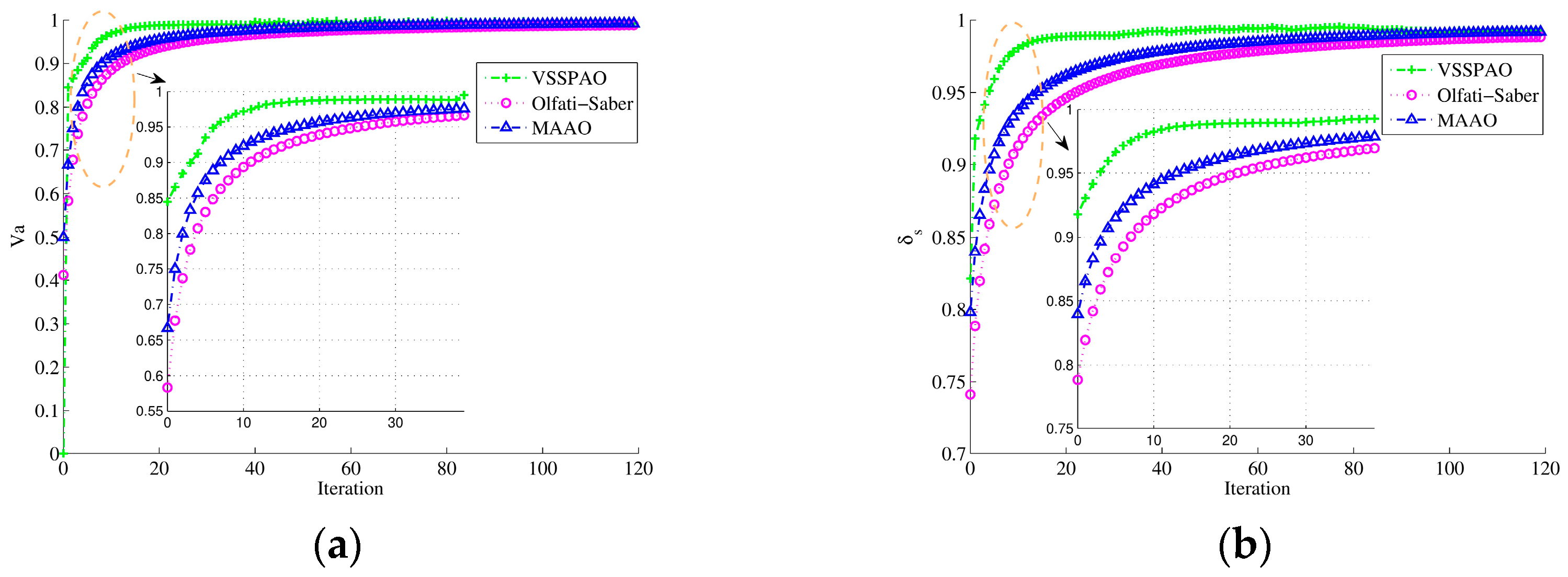
To evaluate the performance of the proposed VSSP/VSSPAO framework, a series of numerical simulations were conducted under free-space and obstacle-constrained environments. The simulations were designed to examine three aspects: the influence of the summoning factor on convergence behavior, the obstacle-avoidance capability of a single subcluster, and the performance of multi-subcluster motion with multiple obstacles. In addition, comparative experiments were carried out against the classical Olfati-Saber method and the MAAO obstacle-avoidance algorithm.
The simulation settings are consistent with the assumptions used in the convergence analysis in
Section 2. Specifically, the limited-view neighbor-selection rule generates a time-varying interaction topology, while the heading-update rule satisfies the bounded-weight and local-combination conditions required in the theoretical analysis. The maneuver consistency and steady-state statistical maneuver consistency defined in
Section 4 are used to evaluate the heading-synchronization behavior predicted by the convergence analysis.
5.1. Influence of the Summoning Factor on Convergence Behavior
The summoning factor determines the relative contribution of task-oriented guidance in the VSSP heading-update rule. To examine its influence on convergence behavior, five simulation groups were designed with different values of . The same initial distribution, summoning-point configuration, movement speed, and cost coefficients were used in all groups, so that the observed differences could be mainly attributed to the change in the summoning factor.
The main simulation parameters were set as follows: , , , , , and . The three summoning points were located at , , and . The initial positions of the agents followed a Gaussian spatial distribution within the square region . The total simulation length was 120 iterations with a unit time step. Five values of the summoning factor were tested: and .
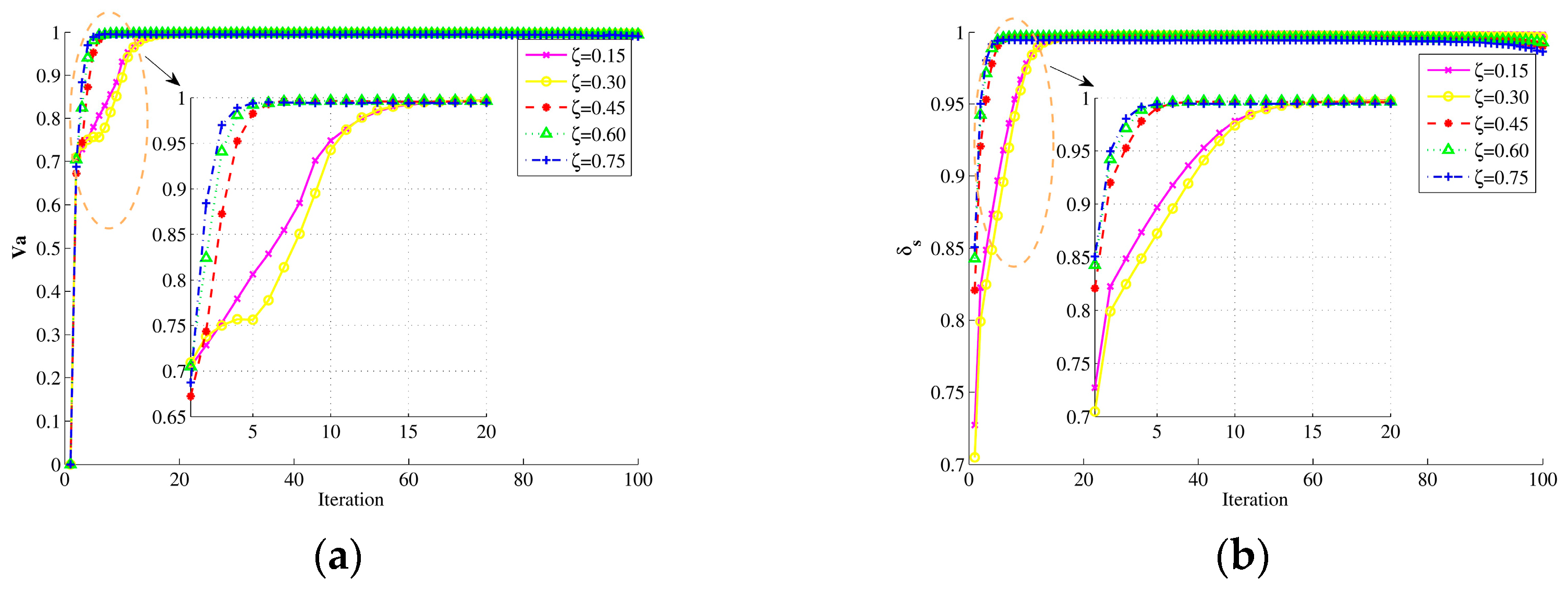
Figure 9 presents the convergence-consistency results under different values of
.
Figure 9a shows the instantaneous maneuver consistency parameter, which reflects the transient heading-consistency level at each iteration.
Figure 9b shows the steady-state statistical maneuver consistency parameter, which is obtained by averaging the maneuver consistency over a prescribed statistical window and is therefore used to evaluate the smoothed consistency level.
Table 3 reports the corresponding convergence time and cluster itinerary for the five groups.
As shown in
Figure 9a, the maneuver consistency increases more rapidly when
is relatively large, indicating that stronger summoning guidance can accelerate transient heading alignment. The smoothed curves in
Figure 9b show the same trend from a steady-state statistical perspective.
Table 3 further confirms this result: the convergence time decreases from 13 iterations at
and
to 6 iterations at
, and further to 4 iterations at
and
. Meanwhile, the cluster itinerary also decreases as
increases within the tested range, from 986.17 at
to 942.84 at
.
These results indicate that the summoning factor can improve convergence efficiency by strengthening the directional correction toward the assigned summoning point. However, should not be interpreted as a parameter that can be increased without limit. An excessively large summoning factor may dominate the local alignment term, weaken neighbor-to-neighbor information exchange, and reduce the self-organized characteristics of the swarm. Therefore, should be selected as a balance between task-oriented guidance and local consensus.
When the movement space where the cluster is located is no longer a free space, but there are obstacles distributed, it is necessary to add an obstacle-avoidance strategy based on the improved Vicsek model. In the space with obstacles, the segmentation experiment of a single group with multi-obstacle avoidance was carried out in
Section 5.2, and the segmentation experiment of a multi group with multi-obstacle avoidance was carried out in
Section 5.3.
5.2. Single-Subcluster Obstacle-Avoidance Verification
To verify the obstacle-avoidance capability of VSSPAO in an obstacle-constrained environment, a single-subcluster simulation with multiple static obstacles was conducted. This experiment focuses on whether the subcluster can maintain coordinated motion while avoiding obstacles and moving toward the assigned summoning point.
The main simulation parameters were set as follows: = 60, = 0.2, = 0.02, = 0.3, = 0.4, = 0.6, = 0.25, = , = 0.04, coordinates of the summoning point are (6, 3). At the initial stage, all agents were randomly distributed within the rectangular region , following a Gaussian distribution. Four static obstacles are placed in the motion space, and the obstacle position coordinate set is . The obstacle radius set is . The simulation was executed with a unit time step, and the total number of iterations was set to 260.
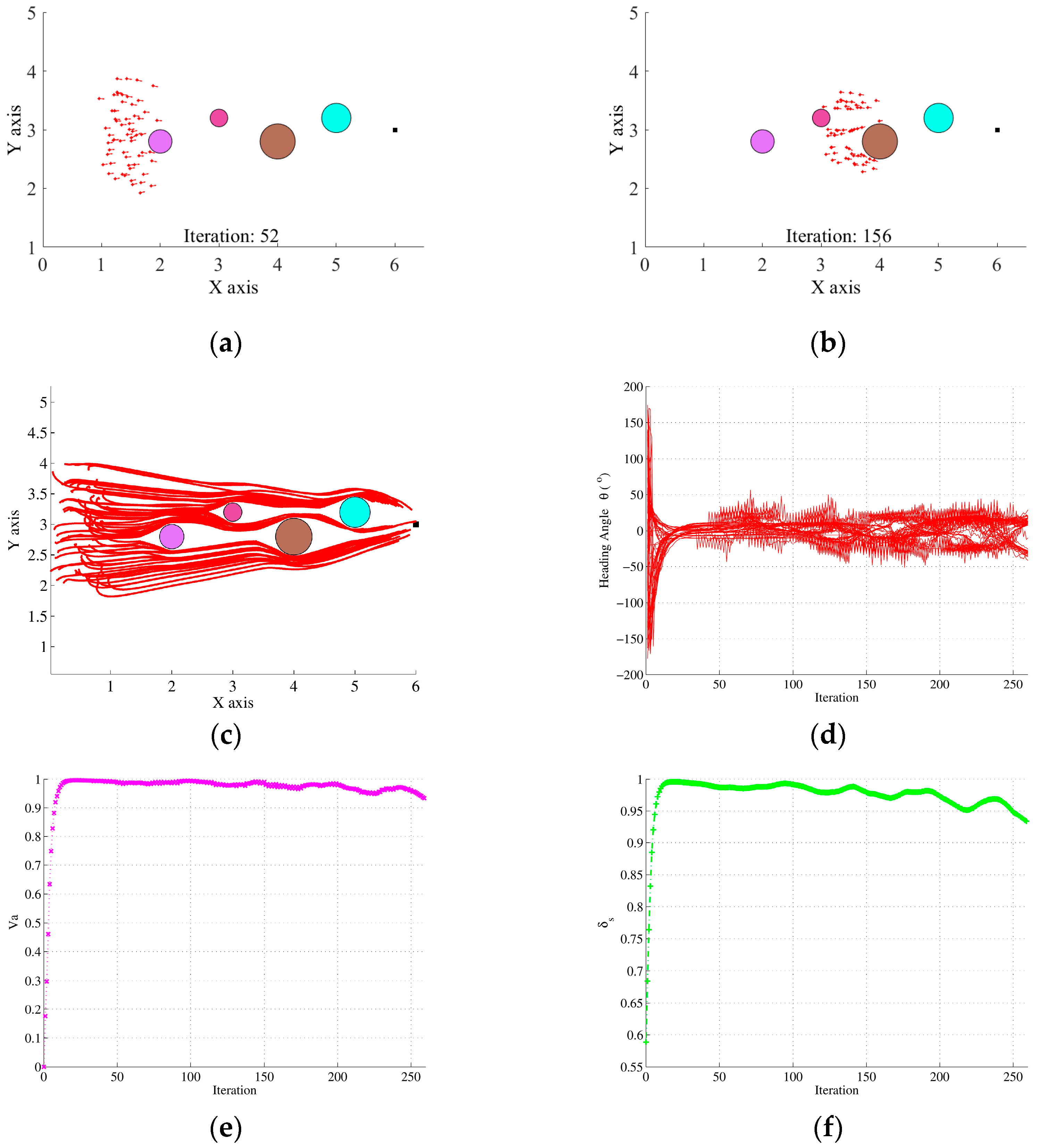
Figure 10 shows the snapshot of the UUV swarm state, the obstacle-avoidance trajectory of all individuals in a single group, the course angle-time history curve, the maneuver consistency parameter-time history curve and the steady-state statistical maneuver consistency parameter-time history curve of the cluster system.
The following conclusions can be drawn from
Figure 10:
As can be seen from
Figure 10a–c, in a space environment containing static obstacles, individuals in a single group can effectively detect and identify obstacles in the environment under the premise of moving toward the summoning point and adopt a reliable obstacle-avoidance strategy. In the vicinity of obstacles, the cluster can complete a series of actions of “segmenting”, “bypassing obstacles”, and “merging”, showing good adaptability of obstacle avoidance.
As illustrated in
Figure 10d, the heading angles of all agents rapidly converge toward a common direction, reaching a near-consistent state within approximately 25 iterations. The minor fluctuations observed afterward are mainly attributed to the avoidance maneuvers triggered when agents detect obstacles that satisfy the effective-threat condition.
It can be seen from
Figure 10e,f that the cluster system shows stable maneuvering consistency after about 25 iterations, and the cluster system shows maneuver consistency fluctuation after about 50 iterations due to obstacle avoidance.
5.3. Multi-Subcluster Segmentation and Obstacle-Avoidance Verification
This experiment was designed to evaluate whether the proposed VSSPAO framework can simultaneously support subgroup segmentation, task-oriented aggregation, and obstacle avoidance in a multi-obstacle environment. Unlike the single-subcluster case in
Section 5.2, this scenario considers multiple static summoning points and therefore examines the ability of the initially mixed swarm to form several coordinated subclusters while avoiding obstacles during motion.
The main simulation parameters were set as follows: = 300, = 0.2, = 0.02, , , , , , , Four static summoning points were placed at . Four circular obstacles were introduced at , and , with radii , respectively. The initial positions of all individuals were generated from a Gaussian distribution within the square region . The simulation used a unit time step and lasted for 150 iterations.
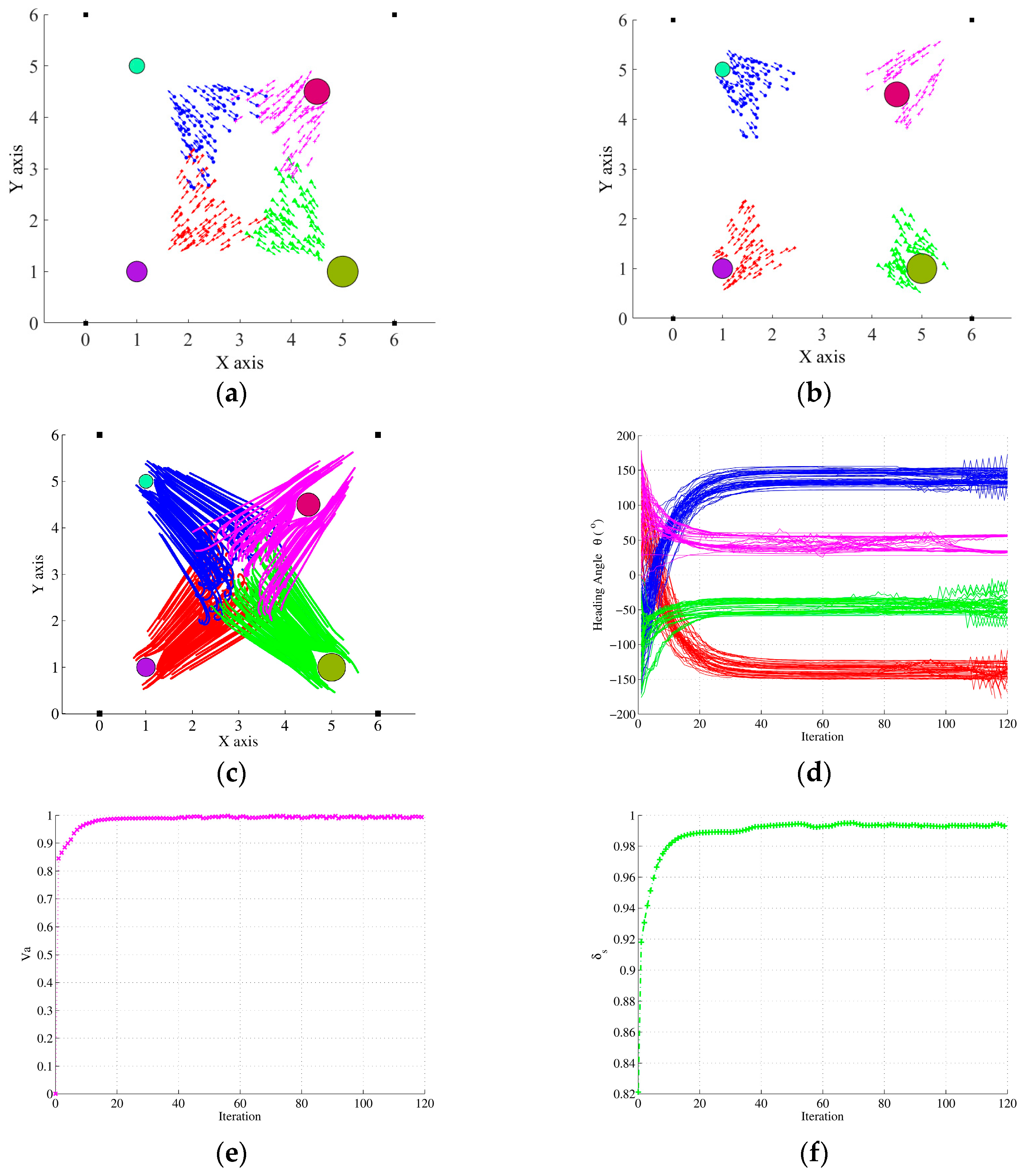
Figure 11 presents the multi-subcluster motion process in the obstacle-constrained environment. The snapshots in
Figure 11a,b show the spatial evolution of the swarm at representative iterations, while
Figure 11c records the trajectories generated during the obstacle-avoidance process.
Figure 11d gives the heading-angle evolution of all individuals, and
Figure 11e,f report the instantaneous and steady-state statistical maneuver consistency, respectively.
The following conclusions can be drawn from
Figure 11:
The spatial results in
Figure 11a–c indicate that the initially mixed swarm is successfully divided into several subclusters under the guidance of different static summoning points. During the motion process, individuals approaching obstacles activate the proposed threat-selective avoidance rule and adjust their headings locally. After passing the obstacles, they continue moving toward their assigned summoning points. This behavior shows that obstacle avoidance does not prevent the formation of task-oriented subclusters but is integrated into the segmentation and aggregation process.
The heading-angle results in
Figure 11d further show that the individuals assigned to the same summoning point gradually develop a common motion direction. After approximately 35 iterations, the heading angles within each subcluster become relatively consistent, and the steady-state directions of the four subclusters approach 45°, 135°, −45°, and −135°, respectively. This result confirms that the movement-cost assignment and summoning-point guidance can generate distinct task-oriented motion directions for different subclusters.
The consistency curves in
Figure 11e,f provide additional evidence for the stability of the multi-subcluster motion. The maneuver consistency increases rapidly during the early stage and reaches a stable level after about 35 iterations. A small fluctuation appears around 90 iterations, which corresponds to the local heading adjustment caused by obstacle avoidance. However, the fluctuation amplitude remains limited, and the consistency level quickly recovers afterward. This indicates that the proposed obstacle-avoidance rule only introduces local and temporary disturbances, without destroying the overall coordinated motion of the swarm.
In
Section 5.1,
Section 5.2 and
Section 5.3, we have carried out the verification work of the algorithm performance and have verified the effectiveness of the proposed algorithm from different perspectives. In order to further explore the superiority of the algorithm proposed in this paper, we would like to carry the simulation experiment of the performance verification and comparison of the VSSPAO algorithm, the classic Olfati-Saber algorithm and the MAAO obstacle-avoidance algorithm in
Section 5.4.
5.4. Verification and Comparison of Algorithm Performance
Comparative simulations were conducted to evaluate the relative performance of the proposed VSSPAO framework against the classical Olfati-Saber method and the MAAO obstacle-avoidance algorithm. Two representative scenarios were considered: a free-space environment and an obstacle-constrained environment. The free-space scenario followed the simulation setting in
Section 5.1, whereas the obstacle-constrained scenario followed the multi-subcluster obstacle-avoidance setting in
Section 5.3.
For VSSPAO, the summoning factor was set to in the free-space environment and in the obstacle-constrained environment. The three algorithms were tested under the same initial conditions, summoning-point configuration, obstacle layout, movement speed, and simulation duration whenever applicable, so that the comparison mainly reflects the effect of the different motion-control and obstacle-avoidance mechanisms.
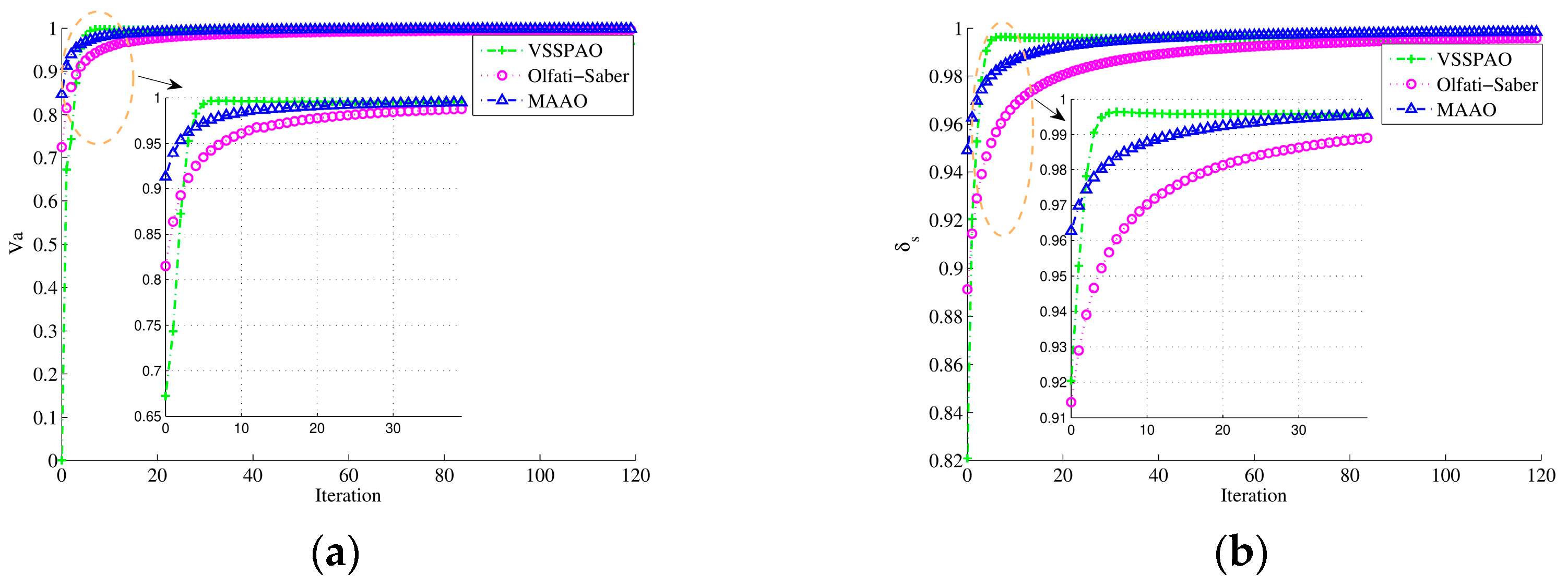
Figure 12 and
Figure 13 compare the convergence-consistency results of the three algorithms in the free-space and obstacle-constrained environments, respectively.
Table 4 summarizes the corresponding convergence time and cluster itinerary.
The comparative results show that VSSPAO achieves the shortest convergence time and the lowest cluster itinerary in both tested scenarios. In the free-space environment, VSSPAO reaches convergence within 6 iterations, whereas MAAO and Olfati-Saber require 21 and 35 iterations, respectively. The corresponding cluster itinerary is 952.21 for VSSPAO, 1049.35 for MAAO, and 1187.46 for Olfati-Saber. These results indicate that the static summoning-point guidance improves task-oriented convergence even when no obstacles are present.
In the obstacle-constrained environment, the performance gap becomes more pronounced. VSSPAO reaches convergence within 15 iterations, while MAAO and Olfati-Saber require 32 and 52 iterations, respectively. The cluster itinerary of VSSPAO is 1432.74, which is lower than that of MAAO and Olfati-Saber, whose values are 1858.19 and 2137.16, respectively. This reduction suggests that the proposed threat-selective obstacle-avoidance mechanism can decrease redundant detours while maintaining coordinated subcluster motion.
The difference between the two scenarios further clarifies the roles of the two main components of VSSPAO. In free space, the advantage mainly comes from static summoning-point guidance, which accelerates task-oriented heading convergence. In the obstacle-constrained environment, the additional benefit comes from obstacle-threat judgment, which prevents individuals from reacting to obstacles that are not relevant to their current forward collision risk. Therefore, VSSPAO improves both convergence efficiency and route economy without relying on global path optimization.
5.5. Discussion on Physical Meaning and Practical Implications
The simulation results demonstrate that the proposed VSSP/VSSPAO framework improves UUV swarm motion through two coupled mechanisms: task-oriented directional guidance and threat-selective obstacle avoidance. The former acts at the subcluster level by guiding different groups toward predefined mission-related regions, while the latter acts at the individual level by modifying the heading only when an obstacle is relevant to the current collision risk. Together, these two mechanisms allow the swarm to maintain distributed coordination while improving convergence efficiency and reducing unnecessary obstacle-avoidance maneuvers.
The physical role of the static summoning point is different from that of a moving leader or a centralized controller. In the classical Vicsek model, individuals adjust their headings according to local neighbor alignment, and the collective motion emerges from decentralized interactions. By introducing static summoning points, the proposed VSSP model adds task-related directional information to this local alignment process. As a result, the swarm is not only driven toward heading consensus but also guided toward different task-attraction regions. This mechanism provides a simple way to transform consensus-oriented Vicsek-type dynamics into task-oriented subcluster motion while preserving the distributed nature of the original model.
The summoning factor
determines the relative strength of the task-guidance term in the heading-update rule. When
increases within an appropriate range, individuals receive stronger directional correction toward their assigned summoning points, which explains the faster convergence and shorter cluster itinerary observed in
Section 5.1. However, the summoning factor should not be regarded as a parameter that can be increased without limitation. If the task-guidance term becomes too dominant, the influence of local neighbor alignment may be weakened, and the self-organized coordination among individuals may be reduced. Therefore,
represents a balance between external task attraction and internal swarm consensus.
The obstacle-avoidance mechanism of VSSPAO is also based on a simple physical observation: a detected obstacle does not necessarily require immediate avoidance. In practical motion, collision risk depends not only on the distance between an individual and an obstacle, but also on the obstacle’s relative bearing with respect to the individual’s velocity direction. An obstacle located outside the forward motion region may have little influence on the current trajectory, even if it is detected within the sensing range. For this reason, VSSPAO first distinguishes current obstacles from potentially threatening obstacles and triggers avoidance only when the obstacle is relevant to the forward collision risk and lies within the prescribed safety distance. This selective response helps reduce redundant turning and limits the disturbance caused by obstacle avoidance to the overall subcluster motion.
From the perspective of multi-agent coordination, the proposed framework should be regarded as an interpretable distributed swarm-coordination method rather than a globally optimal path-planning algorithm. Its main contribution is to extend Vicsek-type local interaction dynamics toward task-oriented UUV swarm coordination. In contrast to Boids-type models, which mainly reproduce flocking behavior through heuristic separation, alignment, and cohesion rules, VSSPAO introduces explicit task-attraction locations and a subcluster assignment mechanism. In contrast to artificial-potential-field methods, it does not treat all nearby obstacles as repulsive sources but evaluates whether an obstacle is relevant to the current collision risk before avoidance is activated. Compared with reinforcement learning-based methods, the proposed framework does not require training data, reward-function design, or policy generalization across different environments. Therefore, its advantage lies in its explicit rule structure, low computational complexity, and clear physical interpretation.
The above characteristics also determine the advantages and limitations of the proposed method. Since VSSPAO relies mainly on local neighbor interactions, limited-view perception, and distributed heading updates, it reduces the need for centralized global planning and all-to-all communication. This feature is useful for UUV swarms operating under underwater communication constraints. Nevertheless, when the swarm scale becomes very large or the obstacle field becomes highly dense, repeated neighbor selection and obstacle-threat judgment may increase computational cost. In addition, the proposed method does not guarantee the globally shortest paths or globally optimal trajectories. Its objective is to improve task-oriented convergence and reduce redundant avoidance maneuvers through simple local rules. Therefore, it is more suitable for distributed coordination tasks that require interpretability and robustness than for missions requiring strict global optimality.
Although the simulations verify the effectiveness of the proposed framework under controlled conditions, several practical factors remain to be considered before real-world deployment. Sensing noise and localization errors may affect neighbor selection, summoning-direction estimation, and obstacle-threat judgment. Acoustic communication delays and packet loss may lead to asynchronous state information and transient heading fluctuations. Ocean-current disturbances may cause deviations between the desired heading and the actual trajectory, especially for low-speed UUVs. Furthermore, the present model assumes static summoning points and simplified circular obstacles, whereas practical underwater missions may involve moving targets, irregular obstacles, and dynamic environmental constraints. Future work will therefore focus on incorporating noisy sensing, delayed communication, current compensation, dynamic obstacle prediction, and hardware-in-the-loop or field experiments into the proposed framework.