Article

Design and Research of Soil Disinfection Pesticide Application Control System Based on PSO-PID Algorithm


1
Intelligent Equipment Research Center, Beijing Academy of Agriculture and Forestry Sciences, Beijing 100097, China
2
College of Intelligent Science and Engineering, Beijing University of Agriculture, Beijing 102206, China
3
College of Agricultural Engineering, Jiangsu University, Zhenjiang 212013, China
*
Author to whom correspondence should be addressed.
Agriculture 2026, 16(4), 481; https://doi.org/10.3390/agriculture16040481
Submission received: 15 January 2026 / Revised: 9 February 2026 / Accepted: 19 February 2026 / Published: 21 February 2026
(This article belongs to the Special Issue Integrated Management of Soil-Borne Diseases—Second Edition)

Abstract

Soil-borne diseases and continuous cropping obstacles have become critical factors constraining sustainable agricultural development. Traditional pesticide application methods commonly suffer from uneven dosage distribution, significant chemical waste, and environmental pollution. To enhance the precision and system stability of soil disinfection, this paper designs a precision pesticide application system for soil disinfection based on the Particle Swarm Optimization Proportional-Integral-Derivative algorithm (PSO-PID). Centered on a C37 controller, the system integrates the application pipeline, pumps, electric ball valves, multiple sensors, and a control terminal. The PSO-PID algorithm was deployed on the Codesys V2.3 platform, achieving precise flow control by adjusting electric ball valve openings in conjunction with velocity feedback. Simulink simulations showed that the PSO-PID algorithm outperforms conventional PID control in terms of settling time, overshoot, and steady-state error. Bench tests further validated the effectiveness of the proposed algorithm. Compared to conventional PID, the PSO-PID algorithm demonstrates superior control accuracy, faster response time, and enhanced application stability, with relative errors of 2.33%, 1.25%, and 1.20% respectively, while those of the conventional PID algorithm reach 3.67%, 3.35% and 4.88% respectively, representing a reduction of approximately 50% compared with the conventional PID algorithm. The results of the system application uniformity test indicated that the PSO-PID algorithm reduces relative error by approximately 40% compared to conventional PID, with the coefficients of variation being 2.02%, 1.73% and 1.81% respectively, which represented a significant improvement over those of the conventional PID algorithm (3.36%, 3.13% and 3.81%). Both application uniformity and stability outperform conventional PID algorithms, effectively minimizing application deviation. It outperforms conventional PID in both application uniformity and stability, effectively minimizing application deviation. The findings demonstrate that the proposed PSO-PID application control method achieves high control accuracy and application stability, providing reliable technical support for precision soil disinfection application.

1. Introduction

Soil-borne diseases and continuous cropping obstacles are critical issues constraining sustainable agricultural development, and soil disinfection serves as an effective means to control soil-borne diseases. However, conventional soil disinfection application relies heavily on operator experience and often results in nonuniform dosing, chemical waste, and environmental pollution. These issues not only compromise disinfection efficacy but also increase agricultural production costs and ecological risks [1,2]. Precision application technology, a vital direction in agricultural development, enables quantitative and uniform pesticide application based on real-time information such as soil texture and pest/disease distribution. This approach significantly reduces pesticide waste and environmental pollution while enhancing the specificity and effectiveness of soil disinfection, playing a crucial role in ensuring the quality and safety of agricultural products [3].
During soil disinfection application, the regulation of application rates is susceptible to factors such as soil moisture fluctuations and operational speed variations. The system exhibits time-varying, time-delay, and nonlinear characteristics, making it challenging for the application flow rate to rapidly and accurately track target values [4]. In recent years, scholars worldwide have conducted extensive research on precision application technologies, achieving significant progress. For instance, by integrating sensor technologies, novel precision soil disinfection techniques such as variable-rate application have been realized. Karan Kumar Shaw et al. [5] developed an octocopter drone application system capable of adjusting pump flow rates for diverse scenarios. Fang Wensheng et al. [6] designed an integrated soil disinfection machine that enables precise pesticide application and effectively addresses the problems such as uneven pesticide application in traditional manual operation. The machine increases the pesticide application depth to 30–40 cm, improves the pesticide application uniformity in the 0–40 cm soil layer, and enhances the control effect of soil-borne diseases in the deep soil. This system enables precise variable-rate spraying alongside multi-information monitoring, display, and traceability management. Wu Chaoyang et al. [7] proposed a secondary variable control scheme based on soybean canopy conditions. By constructing three-dimensional models of leaves with varying inclination angles and utilizing Computational Fluid Dynamics (CFD) technology to simulate a time-variable pressure application system, field trials demonstrated over 30% reduction in pesticide waste compared to traditional methods. Udompetaikul, V. et al. [8] designed a GPS-based fixed-point pesticide application system mounted on a tractor, which planned tree positions and pesticide application areas via GPS grid software to achieve accurate fixed-point pesticide application and reduce the pesticide dosage by 71–74% compared with strip application. Peng Wenjiao et al. [9] addressed continuous application waste during corn seedling stages by designing an intermittent variable-rate application control system. Programmable Logic Controllers (PLCs) and Proportional-Integral-Derivative (PID) algorithms enhanced application precision. Zhang Chunfeng et al. [10] investigated pressure fluctuations in the variable-rate pesticide application system and proposed suppression methods such as reflux pressure stabilization.
Despite the breakthroughs achieved in the intellectualization and integration of monitoring functions of current pesticide application equipment [11], the PID algorithm remains the mainstream solution for control systems in the scenario of soil disinfection and pesticide application. Li Si [12] developed a precise pesticide application system for protected asparagus soil disinfection, which realized hole-punching pesticide application via a wheel-type pesticide injection mechanism combined with the PID control algorithm, and the relative error of pesticide application was controlled within 3%. However, problems such as difficult parameter tuning and insufficient dynamic performance still exist when responding to system time-varying characteristics and nonlinear disturbances. Guo Na et al. [13] designed a throttling variable-rate pesticide application system based on Smith-fuzzy PID control, with the overshoot controlled within 13.1% and the steady-state error within 3.52%, which can effectively reduce the nonlinear influence of the system. Nevertheless, the fuzzy control rules are highly dependent on the design of expert experience, and the system is compatible with a limited range of component models, leading to poor portability. Cen Zhenzhao et al. [14] designed a UAV adaptive variable-rate pesticide application system based on BP neural network PID (BP-PID), which regulates the pesticide application flow by combining wind pressure transmitters and flow sensors with PWM technology. The coefficient of variation in the system’s droplet deposition uniformity was reduced by 26.25%, yet the BP-PID algorithm requires a large number of sample training and has high computing power demands. The Particle Swarm Optimization (PSO) algorithm demonstrates strong disturbance robustness, rapid convergence, and excellent adaptability to nonlinear systems, showcasing significant application potential in smart agricultural control [15,16,17,18]. The Particle Swarm Optimization PID algorithm (PSO-PID) addresses the problems of difficult parameter tuning in the traditional PID algorithm and slow convergence with high computational complexity in the BP-PID algorithm, while also possessing the anti-interference capability of the fuzzy PID algorithm. Aiming at the core requirements and regulation challenges of precision soil disinfection and pesticide application, this study designs a precision soil disinfection and pesticide application system based on the PSO-PID algorithm. By using the PSO algorithm to simulate the cooperative optimization behavior of particle swarms, the optimal PID parameter combination that can rapidly adapt to the time-varying characteristics of the system is obtained [19]. In addition, the system integrates a vehicle speed feedback algorithm to adjust the target pesticide application flow rate in real time. The system effectively enhances application control precision, improves process stability and uniformity, and reduces response time. By integrating PSO-PID control with multi-sensor monitoring fusion, this research aims to boost soil disinfection efficacy and pesticide utilization efficiency, advancing precision application in agricultural soil disinfection.

2. Materials and Methods

2.1. Design and Working Principle of Application System

2.1.1. Overall Structure of Application System

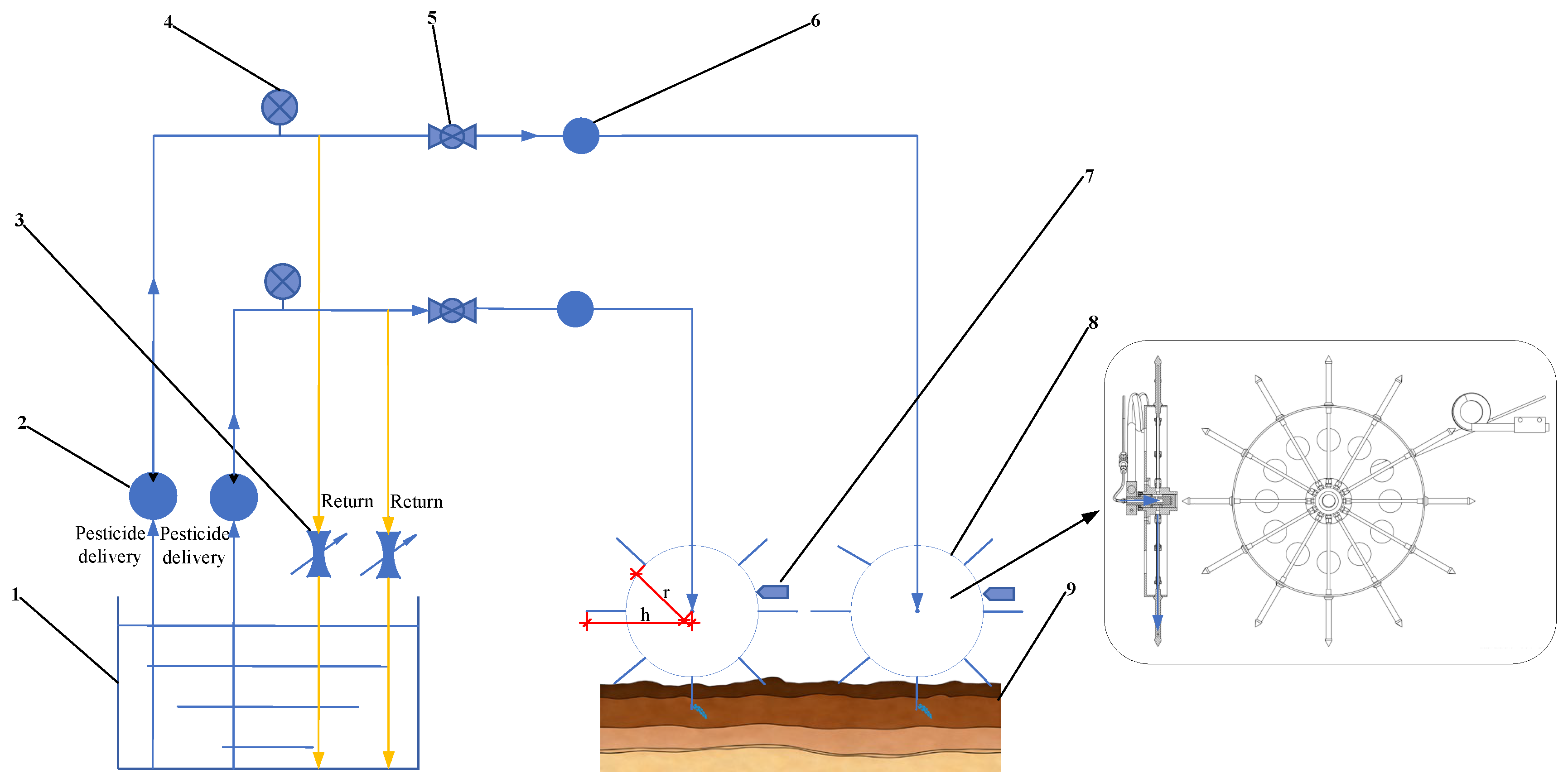
The soil disinfection and pesticide application system, as shown in Figure 1, consists of a pesticide solution tank (manufactured by Sanjing Xingdachang Plastic Operations Department, Huizhou, China), a KDLP1200-B12 diaphragm water pump (manufactured by Ka Chuan Er Fluid Technology Co., Ltd., Shanghai, China), a PCM300 pressure sensor (with a measurement accuracy of Grade 0.5 and manufactured by Mangkes Instrument Co., Ltd., Shanghai, China), a DN8 regulating electric ball valve (with a control accuracy of ±1% and an opening range of 0–100% and manufactured by Songhu Valve Technology Co., Ltd., Yangzhou, China), a YF-S401 flow sensor (with a theoretical measurement accuracy of ±2% and manufactured by Zhongjiang Energy-Saving Electronics Co., Ltd., Foshan, China), a V2A102-03 solenoid valve (manufactured by Sanye Valve Technology Co., Ltd., Ningbo, China), and a BC1812NZ vehicle speed sensor (manufactured by Jingjia Precision Technology Co., Ltd., Zhuhai, China), as well as pipe fittings and other accessories.
The system adopts a pesticide application design scheme with dual independent control circuits. Two water pumps draw the pesticide solution from the pesticide solution tank respectively, and after the pesticide solution flows through the pressure sensor for real-time pressure monitoring, the pipeline is split and expanded into two independent circuits. One is the return pipeline, which relies on the on/off control of the solenoid valve to return the pesticide solution to the pesticide solution tank along the direction indicated by the yellow line in Figure 1. The other is the main pesticide application pipeline, where the pesticide solution flows through the electric ball valve and flow sensor in sequence along the direction indicated by the blue line to achieve precise regulation and real-time monitoring of the pesticide application flow rate, and then is delivered to the pesticide application actuator. The pesticide solution flows out from the side holes at the end of the pesticide application needle of the pesticide application mechanism along the direction indicated by the blue arrows, realizing fixed-point pesticide injection at the target pesticide application points. Meanwhile, a vehicle speed sensor is arranged at the pesticide application mechanism to collect and feed back the operation speed information in real time.

2.1.2. Working Principle

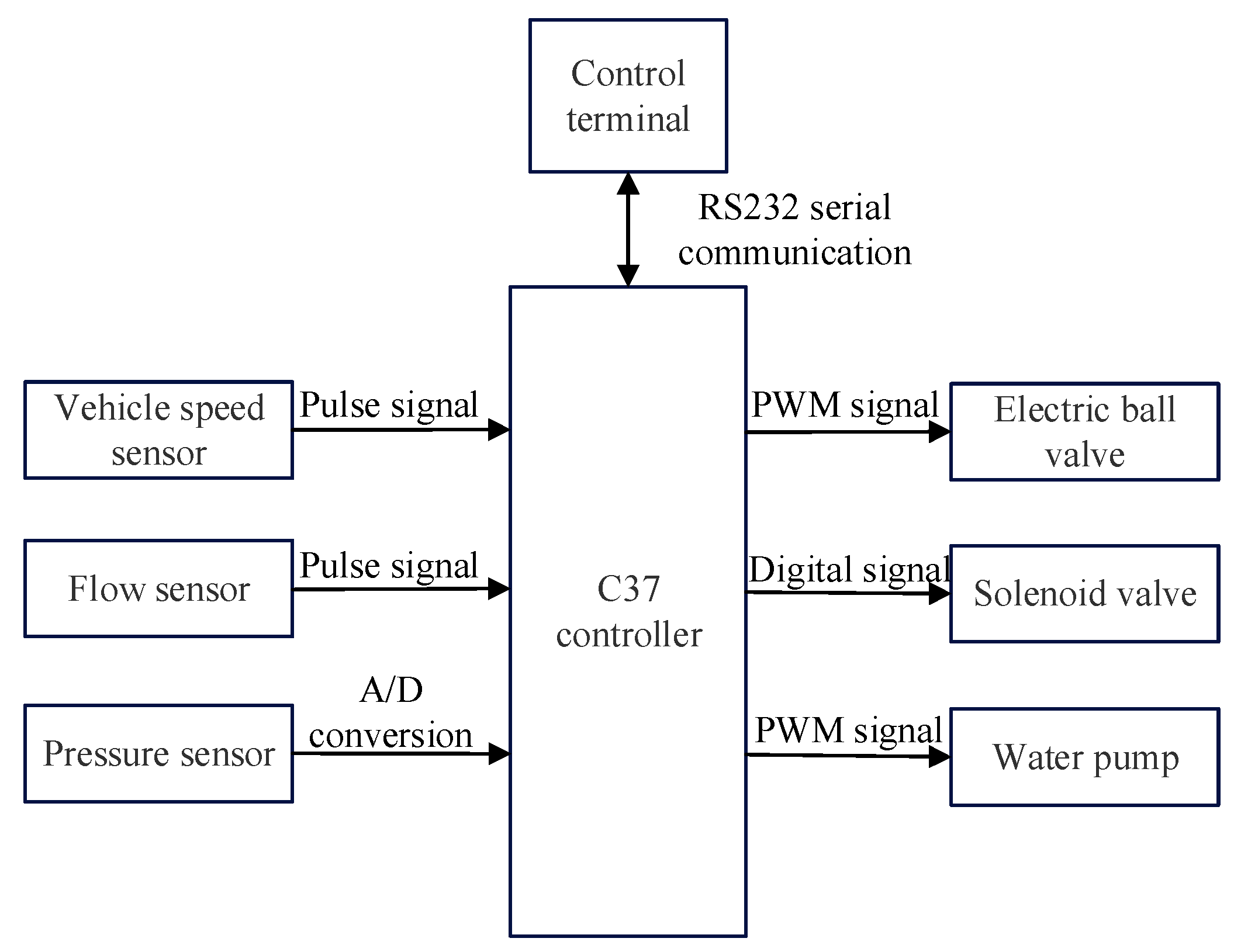
The control system is developed using the Codesys2.3 software environment, and deploys the PSO-PID algorithm on the C37 controller. This controller enables centralized closed-loop control of the water pump, solenoid valve, and electric ball valve. The controller controls the opening and closing states of solenoid valves via digital output signals. For electric ball valves and water pumps, the controller outputs pulse width modulation (PWM) signals. By adjusting the PWM duty cycle, the controller regulates the valve opening and pump speed, respectively. Analog signals from the pressure sensor undergo A/D conversion within the controller to become digital signals, and are transmitted in real time to the control terminal via RS232 serial communication. Pulse signals from the flow sensor and vehicle speed sensor are processed by the controller through pulse frequency acquisition and periodic zero-calibration. These data are ultimately uploaded via RS232 serial communication, providing essential support for real-time monitoring and closed-loop regulation of the system. The control system model is illustrated in Figure 2.
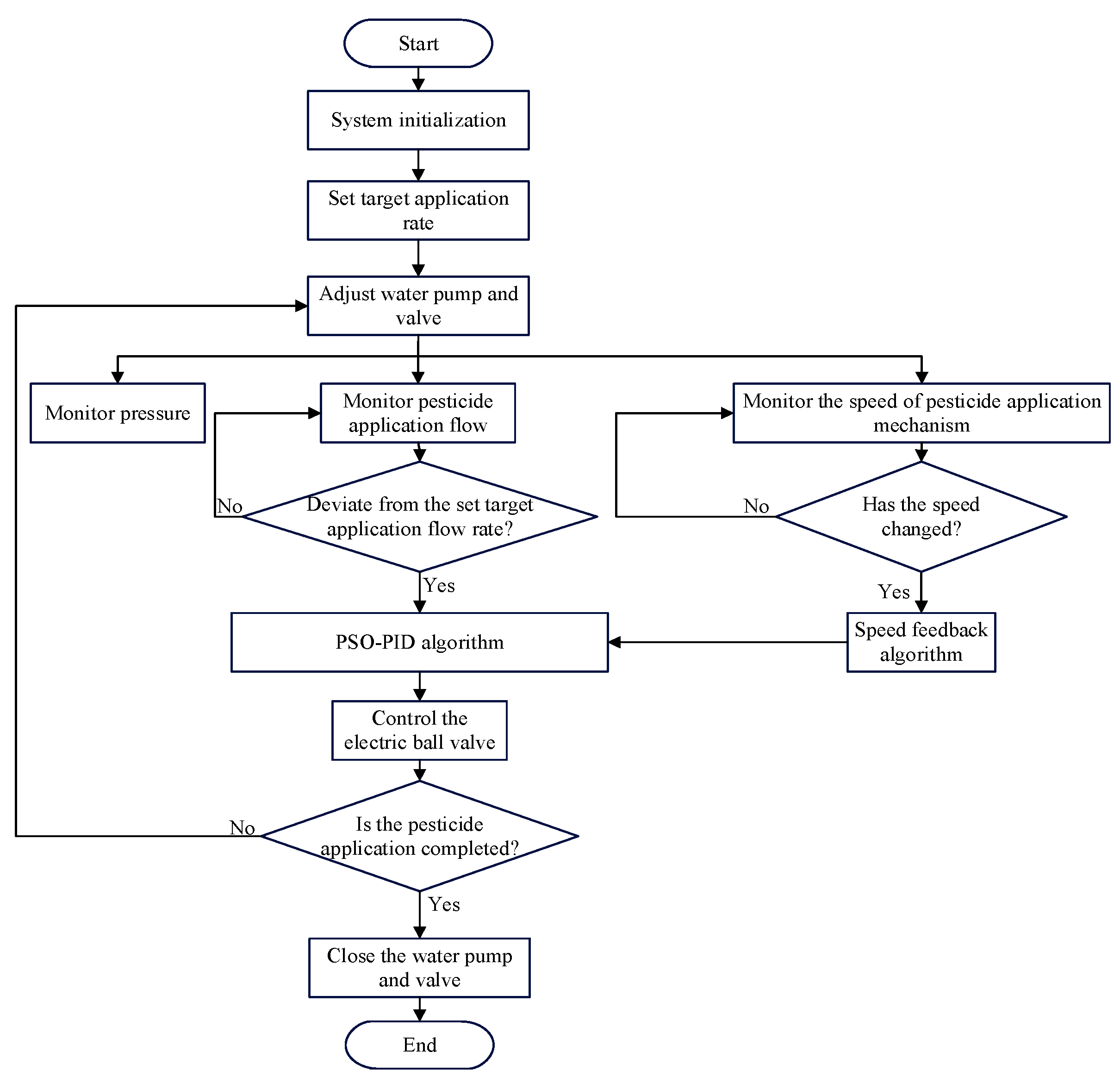
During system operation, the target application flow rate is set via the control terminal, which then activates the water pump and electric ball valve. Pressure sensors continuously monitor pipeline pressure. If excessive pressure is detected, the solenoid valve opens to divert the solution to the return line, thereby relieving pressure. Flow sensors continuously provide feedback on the actual application flow rate within the pipeline. The system uses this data to determine whether the current flow rate matches the target value. When a deviation is detected, the control system dynamically adjusts the opening of the electric ball valve using control parameters optimized by the PSO-PID algorithm. This ensures that the actual application flow rate gradually converges toward and stably tracks the target value.
Considering that application rates may vary unevenly during operation due to changes in vehicle speed, this paper designs a speed-feedback-based adaptive application rate algorithm to mitigate the impact of speed fluctuations on application uniformity. The algorithm dynamically adjusts the target application flow rate in real time based on the operating speed, ensuring stable application under variable speed conditions. The system dynamically modifies the target application flow rate according to Equation (1), as follows:
Q 1 = K v 1
Q1 represents the real-time target application flow rate, and v1 denotes the real-time speed. K is calculated using the following two formulas:
K = V h θ
θ = 2 arccos r h
where V is the target pesticide application volume per hole; r is the disc radius of the pesticide application mechanism, and h is the length from the disc center to the pesticide application needle, both of which are marked on the pesticide application mechanism as shown in Figure 1.
The control system flowchart is shown in Figure 3.

2.2. Algorithm Design

2.2.1. PID Algorithm Design

PID is a widely applied control algorithm extensively used across various fields such as industrial and agricultural automation, process control, and electromechanical systems [20,21,22]. The PID algorithm consists of proportional, integral, and derivative components. Through the coordinated action of these three elements, it enhances system response speed and steady-state accuracy while effectively suppressing overshoot [23].
As shown in Equation (4), the general form of the PID algorithm is [24,25]:
u t = K p e t + 1 K i 0 t e t d t + K d d e t d t
t represents the time variable, i.e., the duration from the start to the end of the system response. u(t) is the output signal of the PID controller, e(t) is the control error, and Kp, Ki, Kd denote the proportional gain, integral time constant, and derivative time constant, respectively.
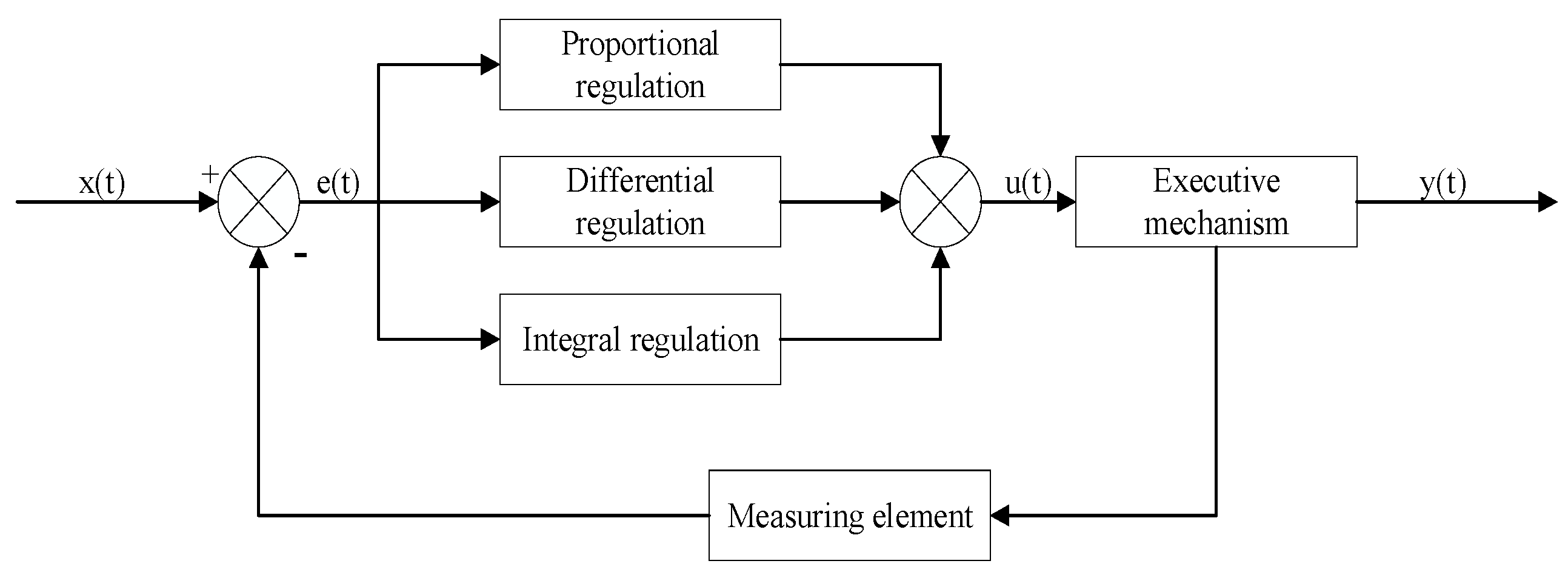
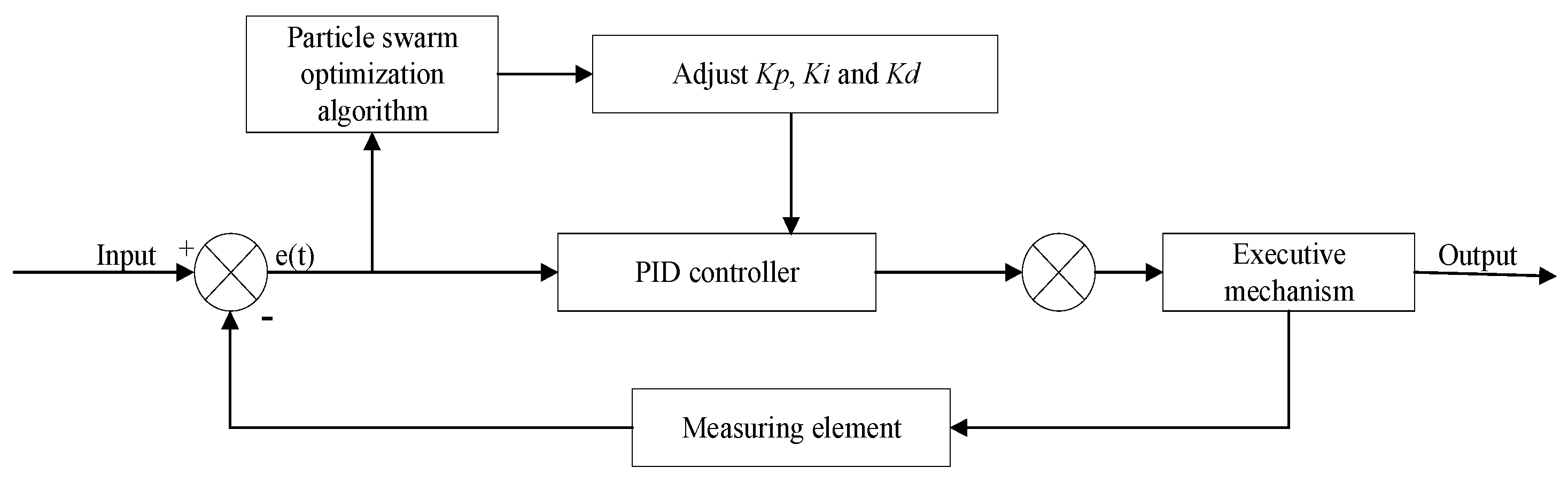
Through optimization of the PID controller, a suitable set of Kp, Ki, and Kd parameters was determined to be 200, 50, and 10, respectively, achieving optimal control performance. The fundamental control principle is illustrated in Figure 4.
The control error is obtained by subtracting the actual output value from the setpoint, as shown in Equation (5):
e t = x t y t
where y(t) represents the current actual application flow rate and x(t) denotes the system’s target application flow rate. The controller calculates the PID control signal u(t) based on the magnitude of e(t), thereby adjusting the controlled object to gradually bring the actual value y(t) closer to the setpoint x(t), thus achieving precise regulation.
This paper employs an incremental PID control algorithm, which is optimized based on conventional PID control theory. After discretization and other processing of the PID control equation shown in Equation (4), the control expression for the incremental PID is ultimately obtained [26,27], as shown in Equation (6):
Δ u k = K p e k e k 1 + K i e k + K d e k 2 e k 1 + e k 2 u k = Δ u k + u k 1
u(k) is the required adjustment to the application flow rate at the kth sampling instant, ek is the error signal at the kth sampling time, ek1 is the error signal at the (k − 1)th sampling time, ek2 is the error signal at the (k − 2)th sampling time, u(k) is the actual application flow rate at the kth sampling time, and u(k − 1) is the actual application flow rate at the (k − 1)th sampling time.

2.2.2. Design of PID Control Algorithm Optimized Using PSO

PSO is inspired by the cooperative foraging behavior of bird flocks. Its core principle involves achieving the optimization process for global optimal solutions through information sharing and collaborative search among particles. The PSO algorithm simplifies the search for optimal solutions by adjusting particle positions and velocities, offering high convergence efficiency, making it suitable for parameter tuning in the application flow rate control system. Utilizing this algorithm to optimize PID parameters involves iterative refinement of the initial Kp, Ki, and Kd values to achieve the optimal target control state. The specific optimization process is as follows.
In a D-dimensional target search space, a particle swarm consists of N particles, each represented as a D-dimensional vector as shown in Equation (7) [28]. The spatial position of each particle can be expressed as:
x i = x i 1 , x i 2 , , x i D , i = 1 , 2 , , N
The flight velocity of the i-th particle can be expressed as:
v i = v i 1 , v i 2 , , v i D , i = 1 , 2 , , N
The position and velocity of each particle are randomly generated within specified ranges.
During the optimization process, constructing the fitness function is one of the core steps. The spatial position of a particle represents a solution in the objective optimization. Substituting this position into the fitness function calculates the fitness value, which measures the particle’s quality based on its magnitude. The fitness function designed in this paper integrates four key metrics: Integral of Absolute Error (IAE), overshoot, steady-state error, and settling time. This comprehensive approach aims to evaluate both the dynamic response performance and steady-state performance of the control system.
The IAE reflects the deviation of the system from the desired value throughout the entire response process. A smaller IAE value corresponds to a higher control accuracy of the system [29], as shown in Equation (9):
I A E = 0 T | e t | d t
Overshoot is a key indicator for evaluating the smoothness of a system’s dynamic response. The overshoot calculation formula is:
O v e r s h o o t 0 ,       | e p e a k | e r r o r B a n d | e p e a k | e r r o r B a n d P s e t × 100 % ,   | e p e a k | > e r r o r B a n d
The epeak represents the peak error during system adjustment, the errorBand denotes the error band used to distinguish normal error fluctuations from overshoot, the Pset denotes the system’s target application flow rate.
When the absolute value of the error peak does not exceed the error threshold, the overshoot is considered zero and deemed an acceptable fluctuation. If it exceeds the error band, the percentage of the excess portion relative to the setpoint is calculated as the system overshoot.
Steady-state error (ESS) is a key metric for evaluating the accuracy of tracking the setpoint after the system reaches steady state. It is defined as the final value of the stable system error response:
E S S = lim t e t
The settling time is the duration from the onset of a step disturbance until the system reaches steady state. Its magnitude reflects the system’s responsiveness. If the response reaches steady state within the test window, the settling time is recorded; otherwise, it is set to the test duration.
In summary, the overall fitness function formula is:
F i t n e s s = W 1 I T E + W 2 O v e r s h o o t + W 3 E S S + W 4 T S
W1, W2, W3, and W4 represent the weighting coefficients for the IAE, overshoot, steady-state error, and settling time, respectively, and are tuned according to the performance priorities of the control system; TS denotes the system settling time.
In summary, the fitness function in this study comprehensively evaluates particle quality by quantifying four key indicators, namely the IAE, overshoot, steady-state error, and adjustment time. Among them, the IAE is calculated by integrating the absolute values of the deviations between the target and actual pesticide application flow rates over the entire response cycle; the overshoot is determined by setting a ±2% error band to distinguish between effective fluctuations and excessive overshoot; the steady-state error is defined as the average error after the deviation meets the threshold for 5 consecutive seconds; and the adjustment time is standardized as the duration from system start-up to the first entry into a steady state. The fitness value of each particle is obtained by the weighted summation of these four indicators with corresponding weight coefficients. Potential errors of the function may arise from sensor data noise, the subjectivity in weight tuning, and other factors.
The individual historical optimum position is the position that yields the best fitness value experienced by the i-th particle, calculated as follows:
P b e s t i = P b e s t i 1 , P b e s t i 2 , P b e s t i D , i = 1 , 2 , , N
The optimal position experienced by the particle swarm is referred to as the global historical optimum, defined by the following formula:
G b e s t i = G b e s t i 1 , G b e s t i 2 , G b e s t i D , i = 1 , 2 , , N
In the particle swarm algorithm, velocity and position are updated according to the following two equations:
v i d t + 1 = ω t v i d t + c 1 r 1 P i d t x i d t + c 2 r 2 G d t x i d t
x i d t + 1 = x i d t + v i d t + 1
Equation (15) is the velocity update formula, and Equation (16) is the position update formula [30].
In the equation, d = 1, 2, …, D; i = 1, 2, …, n; t denotes the current iteration count; x represents the particle’s position; v denotes the particle’s velocity; c1 and c2 are learning factors; r1 and r2 are random numbers in the interval [0, 1]; P is the optimal solution found by the particle thus far, i.e., the individual optimum; G denotes the global optimum value found by the entire particle swarm to date; and ω is the inertia factor [31], defined by Equation (17) below.
ω = ω max ω max ω min a a max
ωmin and ωmax represent the minimum and maximum values of the inertia factor, typically in the range [0.4, 0.9]. a denotes the current iteration count, while amax indicates the maximum iteration limit.
The overall optimization process of PSO is as follows:
(1)
Initialize the swarm parameters c1 and c2, set the position and velocity boundary ranges, initialize the particle swarm, randomly generate a certain number of particles, assign a set of PID parameters to each particle’s position, and initialize the particle velocities.
(2)
Define the fitness function and calculate the fitness values based on the defined function.
(3)
For each particle, compare its current position’s fitness value with the individual optimal value P. If superior, update P. For each particle, compare its current position’s fitness value with the fitness value of the best position experienced by the population. If superior, update the global optimal value G.
(4)
Adjust particle velocity and position according to the PSO update formula, ensuring the position (i.e., the PID parameters) remains within a reasonable range.
(5)
Repeat steps 3 and 4 until the maximum iteration count is reached or convergence criteria are satisfied, then output the optimal PID parameters.
The PID control principle based on PSO is illustrated in Figure 5.

2.3. Control System Simulation

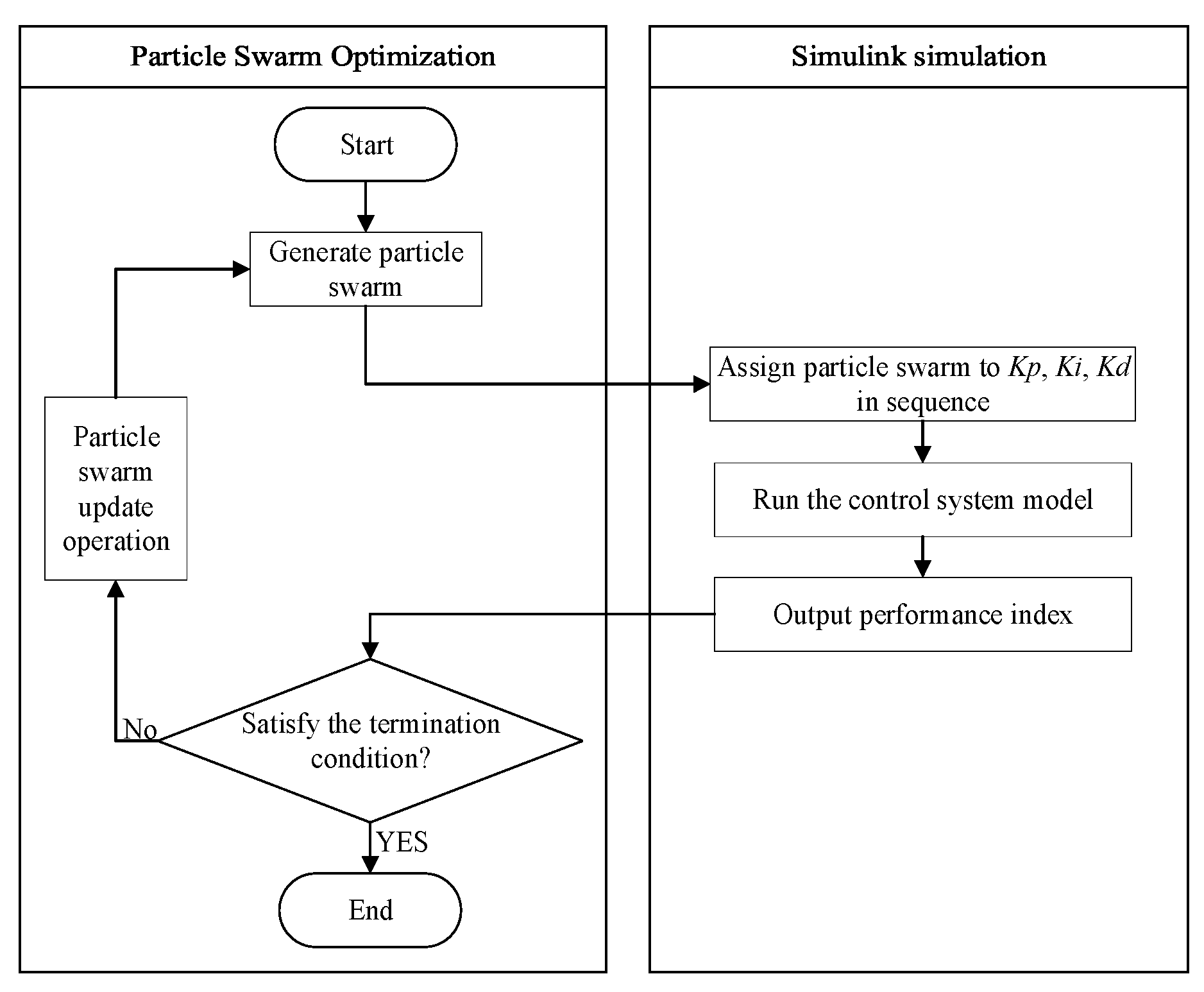
The effectiveness of the PSO-PID algorithm was validated through simulation testing using MATLAB R2024b software. The optimization process is illustrated in Figure 6.
The bridge connecting the particle swarm algorithm with the Simulink model consists of particles and their corresponding fitness values, where particles represent PID controller parameters and their fitness values correspond to the performance metrics of the control system.
The optimization process proceeds as follows: PSO generates a particle swarm. Particles within this swarm are sequentially assigned to the PID controller parameters Kp, Ki, and Kd. The Simulink model of the controller system is then run to obtain the performance metrics corresponding to these parameters. These metrics are passed back to PSO as the particles’ fitness values. Finally, the algorithm determines whether to exit and whether an optimal solution has been reached.
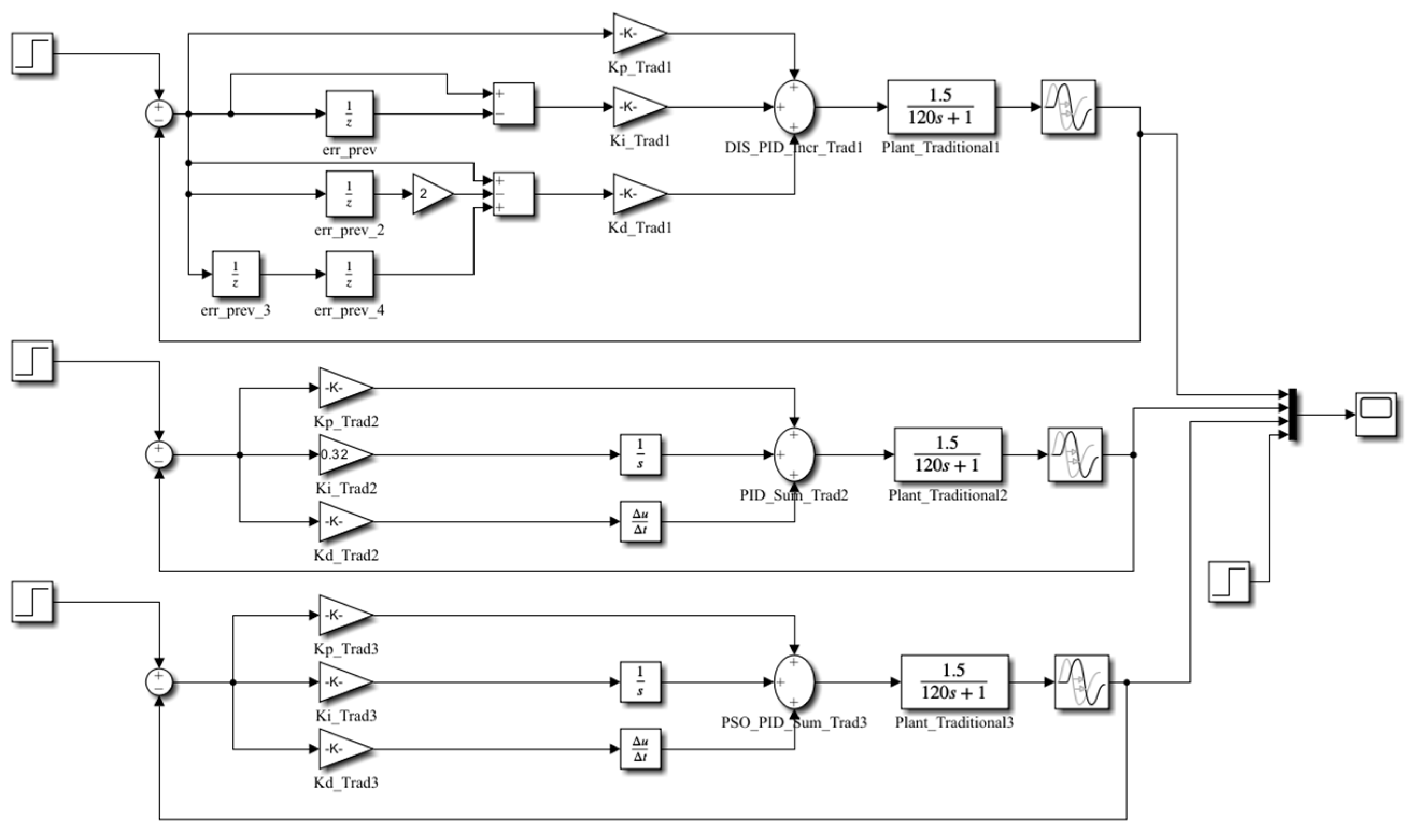
A system simulation model for pesticide application flow control is constructed within MATLAB’s built-in Simulink. This simulation model incorporates two control strategies: PID control and PID optimization via the particle swarm algorithm. The simulation model is illustrated in Figure 7.
After multiple simulation adjustments and algorithm iterations, the parameters for PSO-PID control were determined based on simulation conditions. Without altering control parameters, the target application flow rates for the control system were set to 0.6, 0.8, and 1.0 L/min, with a swarm size of 30, 20 iterations, a simulation duration of 120 s, and a fitness convergence threshold of 0.01, an initial inertia weight ω of 0.9, and a linear decay strategy to balance global and local search. Learning factors c1 and c2 were set to 1.2 to coordinate updates between individual and swarm optimality.

2.4. System Application Flow Rate Control Accuracy Test

2.4.1. Testing Device

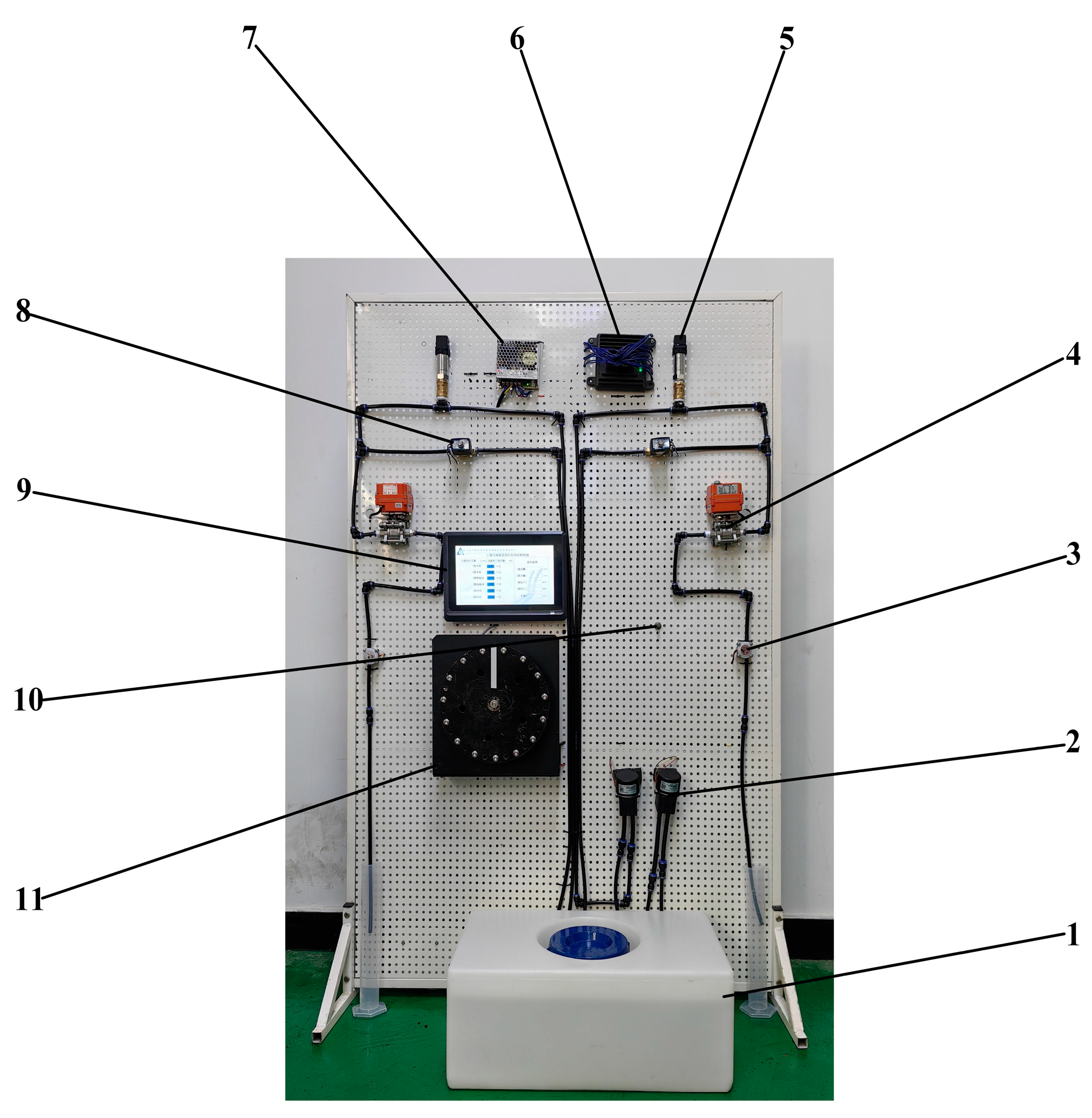
To verify the actual performance of the PSO-PID algorithm, a system test bench was built, as shown in Figure 8. A vehicle speed test bench and a speed control knob for it were installed on the test bench; the rotational speed of the vehicle speed test bench can be adjusted by turning the speed control knob, so as to simulate the traveling speed of the pesticide application mechanism. The control terminal can preset the target pesticide application flow rate and the target pesticide application volume per hole, and monitor the pipeline flow rate, pressure and operating speed of the pesticide application mechanism in real time.

2.4.2. Test Methods

To simplify the experimental operations and reduce the impact of pesticides on the environment and equipment, this study used water instead of pesticides to conduct the experiments. During testing, the liquid level in the pesticide tank was maintained above 50% of its capacity. Conventional PID and PSO-PID control algorithms were adopted in the experiment. For the PSO-PID algorithm, the initial population size of particles was set to 30, the initial number of iterations was 20, the initial value of the fitness convergence threshold was defined as 0.01, the initial value of the inertia weight ω was set to 0.9, and the learning factors c1 and c2 were both assigned a value of 1.2. After system start-up and parameter calibration, the target flow rates were set to 0.6, 0.8, and 1.0 L/min. Each run lasted 1 min, during which the discharged liquid was collected and measured using a graduated cylinder. For each target flow rate, the test was repeated five times. The mean, relative error, and coefficient of variation [32] of the actual application flow rate were calculated using Equations (18)–(20). The results were rounded to three decimal places. This verifies the control accuracy differences between conventional PID and PSO-PID algorithms for different target application flow rates.
x ¯ = 1 n i = 1 n x i
δ = | x ¯ x 0 | x 0 100 %
C V = δ x ¯ 100 %
where x ¯ is the average actual application flow rate, xi is the actual application flow rate measured in the ith measurement, n is the total number of measurements, and x0 is the target application flow rate.

2.5. System Application Rate Uniformity Test

2.5.1. Testing Device

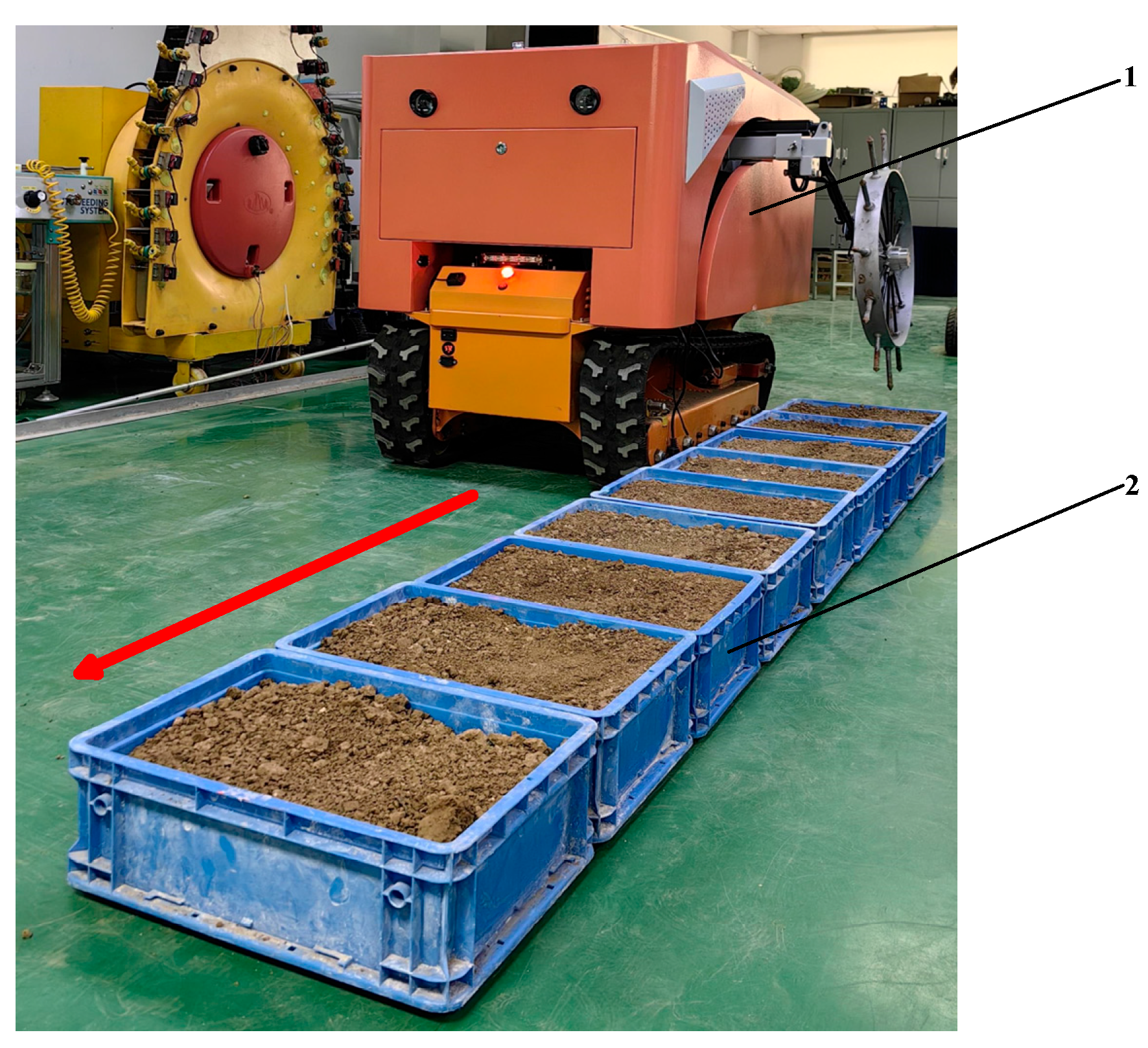
The system was integrated into the 3DXY-180 injection-type soil disinfector to conduct uniformity tests on application rates. To simulate field conditions, soil-filled troughs (410 mm × 300 mm × 150 mm) were placed along a straight line at preset application points. The soil-filled troughs with leveled soil surfaces were firmly fixed to eliminate the difficulty of measuring the actual application rate in field operations, enabling more precise data collection. The test setup is shown in Figure 9.
To ensure consistency between test conditions and field operations, the soil compaction of each trough was measured using an HM-JSD2 Soil Compaction Tester (manufactured by Hengmei Electronic Technology Co., Ltd., Weifang, China). This ensured the measured compaction values closely matched the actual compaction levels observed in outdoor field soils.

2.5.2. Test Methods

In this study, the research object was soil disinfection in asparagus fields. With reference to the technical specification for pesticide application in the prevention and control of asparagus root rot [33], combined with the field application standards of 30% metalaxyl-hymexazol aqueous solution and the technical requirements for soil disinfection in asparagus fields, the pesticide application rate per hole was determined to be approximately 100 mL through calculation. For this purpose, three target per-hole pesticide application rates (50 mL, 100 mL, and 150 mL), were selected in the experiment, aiming to verify the pesticide application uniformity under different pesticide application rate conditions.
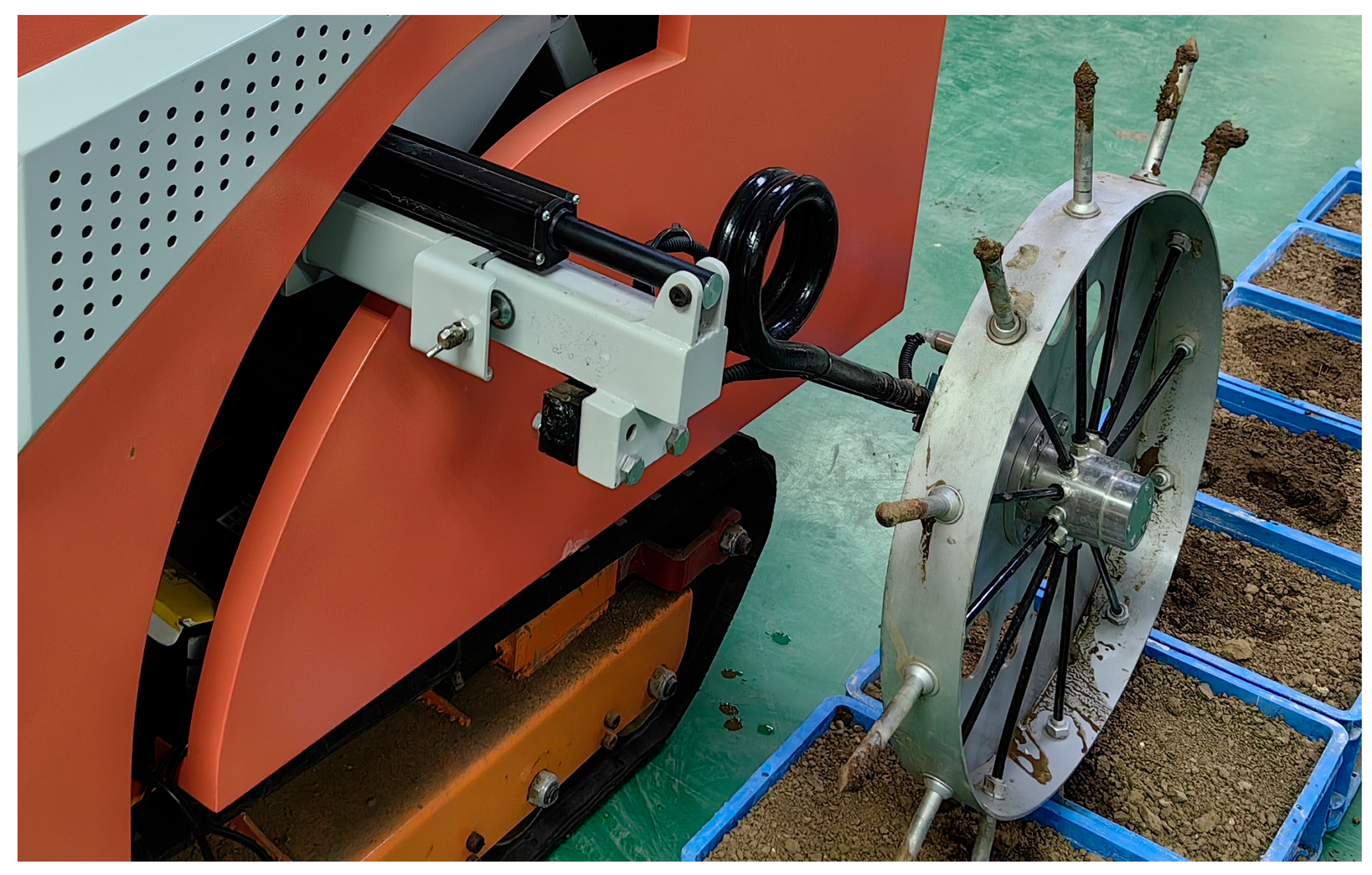
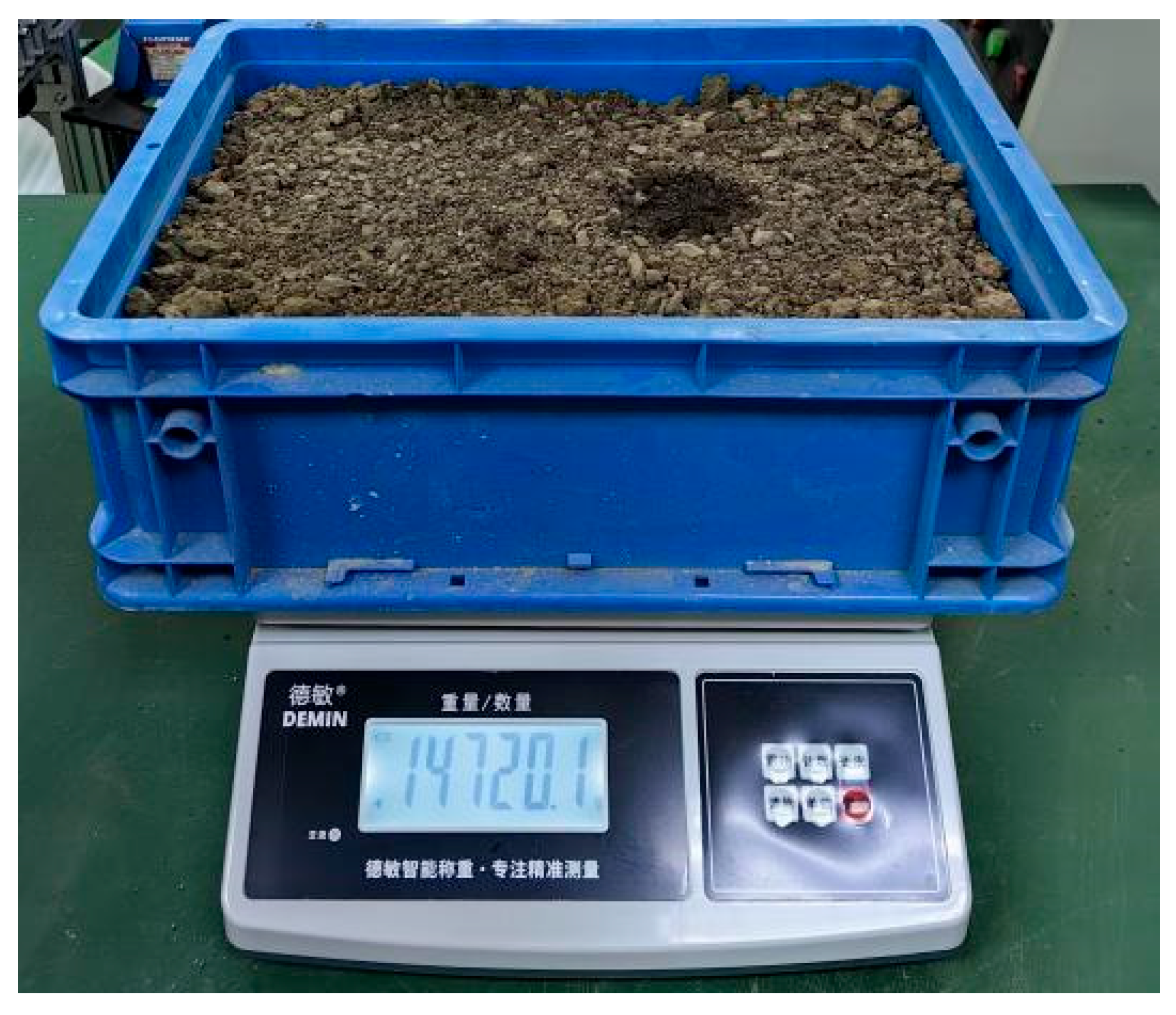
The test site was selected as a level, smooth and firm area with a width no less than the single-pass working width of the equipment. The weight of each soil trough was measured using a precision electronic scale (with a measuring range of 0–15 kg and an accuracy of 0.1 g) and recorded as m0. After trench setup, the target application rates per hole were set to 50 mL, 100 mL, and 150 mL for different control strategies. The applicator was manually controlled to traverse the test area at a speed of 0 to 0.5 m/s, applying the solution in a straight line along the direction indicated by the red arrow in Figure 9. During application, the injection needle was precisely inserted into each soil trough, ensuring a single application per trench. The application scenario is illustrated in Figure 10. After the pesticide application for all arranged soil troughs was completed, five soil troughs in the middle section with a relatively stable pesticide application process were selected. Each treated trough was individually weighed using a precision electronic scale each treated channel individually, recording the corresponding weight as m1. The weighing of treated soil channels is illustrated in Figure 11.
Calculate the application weight ma of the soil trough using Equation (21), and determine the actual per hole application rate Va based on Equation (22).
m a = m 1 m 0
V a = m a ρ
After repeating the aforementioned experimental steps, the average actual application rate per hole, relative error, and coefficient of variation for each target application rate under different control strategies was calculated based on Equations (18)–(20). This verifies the uniformity of application rates per cell under both conventional PID and PSO-PID control strategies.

3. Results and Analysis

3.1. Analysis of Control System Simulation Results

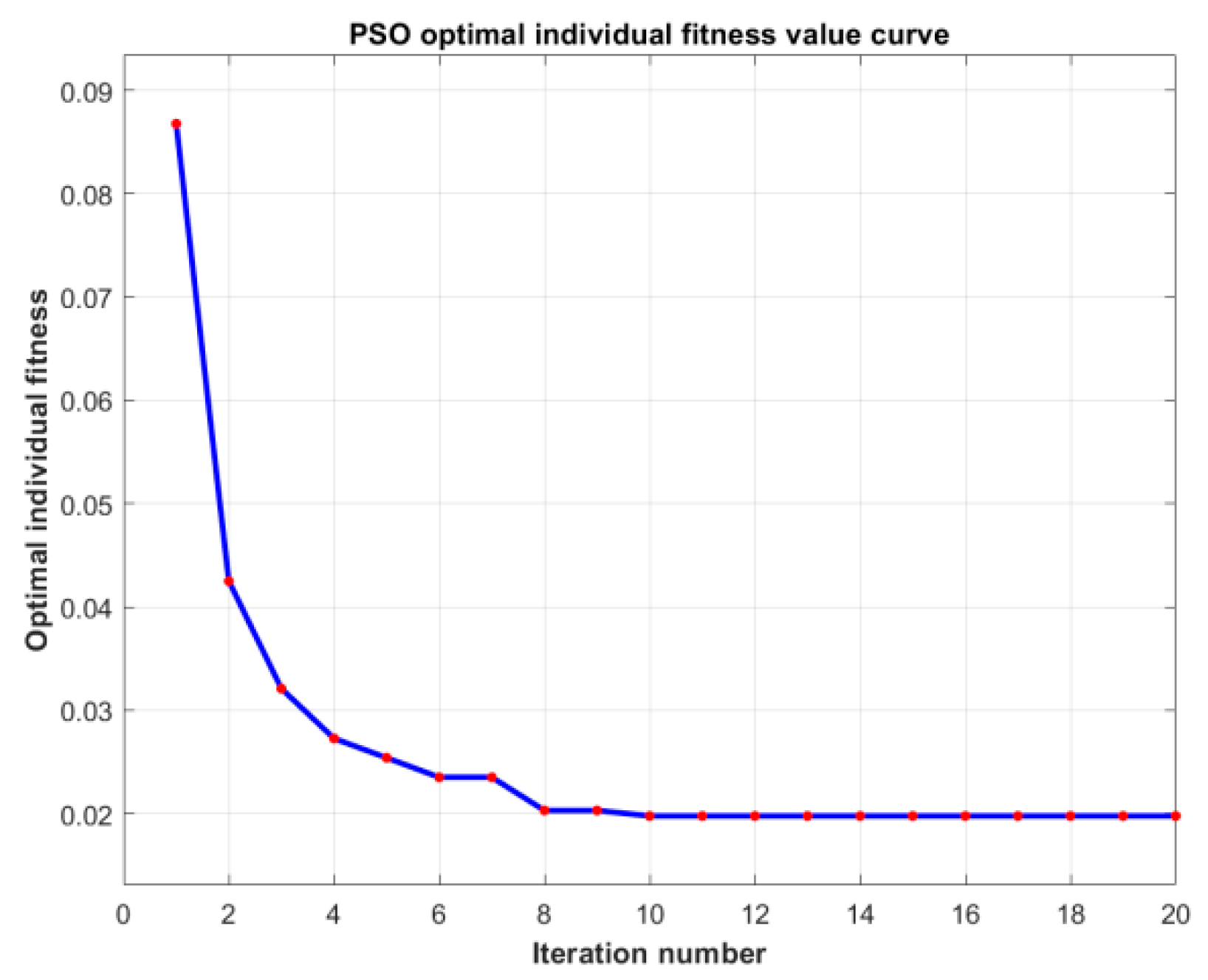
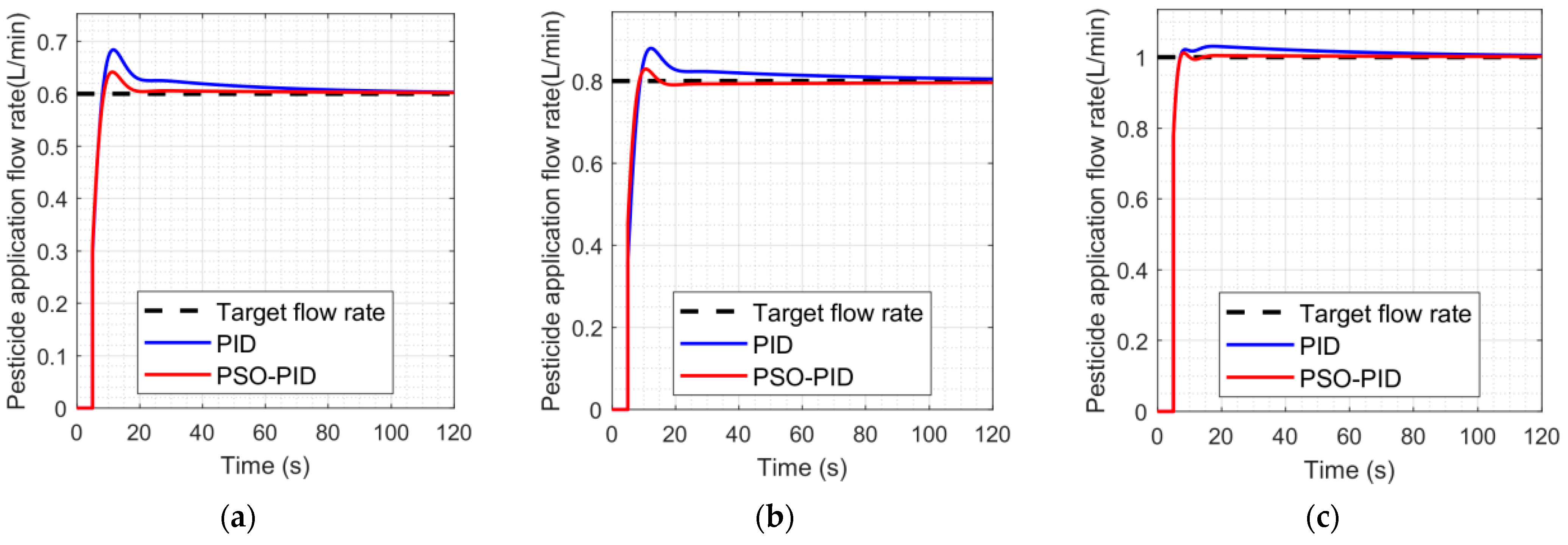
The simulation results are as follows: As shown in Figure 12, the iteration process of the PSO algorithm under step response ultimately yields the optimal individual fitness values, demonstrating the algorithm’s convergence characteristics in optimizing PID parameters Kp, Ki, and Kd. The Figure 13 plots respectively demonstrate the flow control performance of conventional PID control and PSO-PID control at target application flow rates of 0.6 L/min, 0.8 L/min, and 1 L/min. Table 1 presents the control algorithm performance under both algorithms for the three target flow rates.
Simulation results demonstrate that the PSO algorithm exhibits rapid convergence, efficiently obtaining optimal PID parameter combinations while achieving target flow rates faster and more stably. When the target application flow rate is 0.6 L/min, conventional PID control requires 50.1 s for regulation, with overshoot reaching 13.4% and steady-state error at 0.0031. In contrast, PSO-PID control reduced the settling time to 16.5 s, decreased overshoot to 6.9%, and minimized steady-state error to 0.0021, achieving significant optimization across all control metrics. When the target application flow rate increased to 0.8 L/min, the conventional PID control exhibited a settling time of 35.4 s, overshoot of 9.3%, and steady-state error of 0.0050. In contrast, PSO-PID control achieved 12.9 s, 3.6%, and 0.0041, respectively, continuing to demonstrate superior control performance. When the target application flow rate was set to 1.0 L/min, the conventional PID control exhibited a settling time of 30.3 s, overshoot of 2.6%, and steady-state error of 0.0052. In contrast, the PSO-PID control further reduced the settling time to 6.7 s, overshoot to just 1.2%, and steady-state error to a remarkably low 0.0018, demonstrating a more significant improvement in control performance.

3.2. Analysis of System Application Flow Rate Control Accuracy Test Results

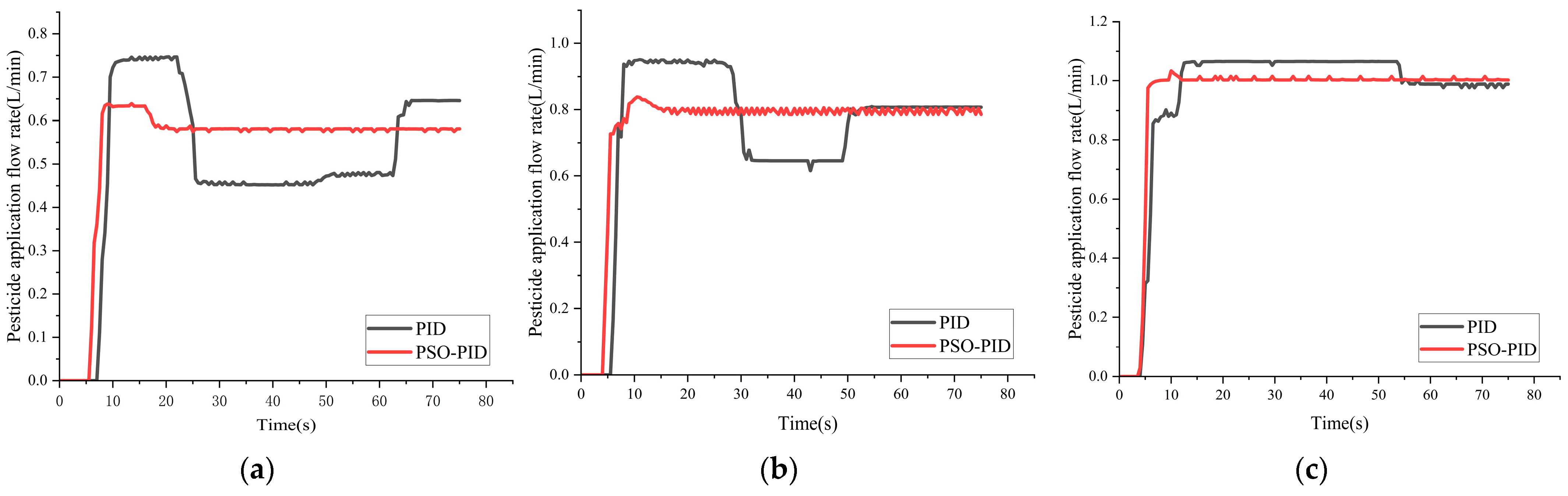
First, the control performance of the three target application flow rates under two control strategies was tested. After setting the target application flow rates, the real-time application flow rates under different control strategies were recorded. The test results are shown in Figure 14. The performance metrics of the two control strategies are presented in Table 2.
The application flow rate response curve indicates that under target values of 0.6, 0.8, and 1.0 L/min, the actual application flow rate under PSO-PID control achieves steady state more rapidly with significantly reduced fluctuation amplitude. In contrast, conventional PID control exhibits prolonged adjustment processes and substantial fluctuations. As shown in Table 3, at the 0.6 L/min target flow rate, the PSO-PID control reduces the settling time to 17.5 s and the overshoot to 6.47%, and the steady-state error to 1.9%. Under 0.8 L/min and 1.0 L/min target conditions, PSO-PID similarly demonstrated superior dynamic response characteristics, with settling times of 14.5 s and 12.0 s respectively, overshoot controlled within 4.82% and 3.42%, and steady-state error further reduced. These results demonstrate that the particle swarm-optimized PID controller achieves rapid and stable tracking of different target application flow rates, effectively suppressed system fluctuations and significantly improved the control accuracy and stability of the pesticide application process. A comparison of the test results of simulation and actual control performance shows that the PSO-PID algorithm outperforms the traditional PID algorithm in both simulation and actual performance tests, and the variation trends of their performance are essentially consistent. The improvement range of the PSO-PID control performance in the simulation scenario is slightly higher than that in the practical application scenario, such as under the target pesticide application flow rate of 1 L/min. This may be attributed to the deviations in control indicators caused by hardware response characteristics, environmental interference, and other factors under actual working conditions. On the whole, however, the PSO-PID algorithm can still effectively improve the control accuracy and stability of the pesticide application process in practical scenarios, which verifies the effectiveness of the PSO-PID control algorithm.
Actual application flow rate data recorded according to the experimental procedure are shown in Table 3.
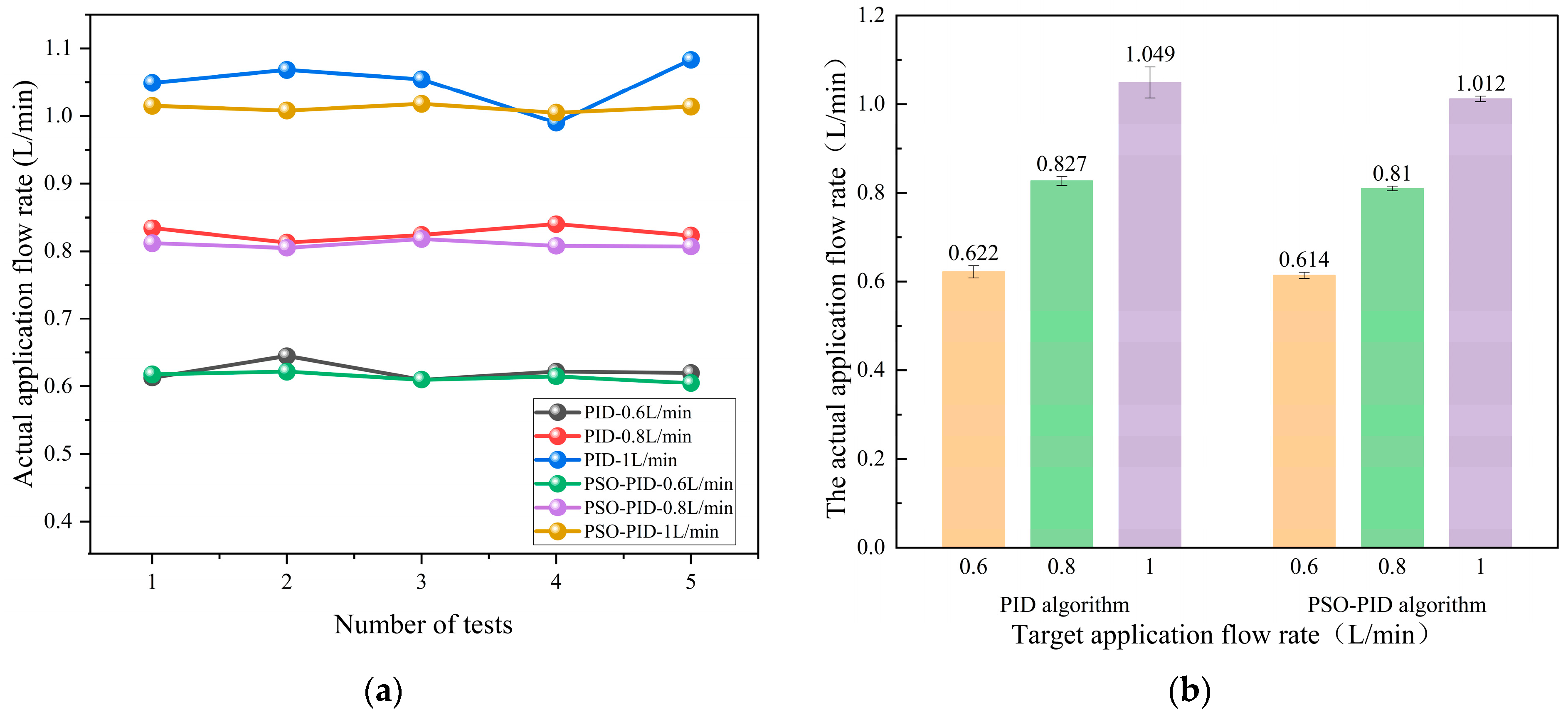
Figure 15 presents a bar chart illustrating the five measured application flow rates corresponding to each setpoint, alongside the application flow rate errors, under the two control strategies.
Results indicate that under three target application flow rates of 0.6 L/min, 0.8 L/min, and 1.0 L/min, the relative errors of the PSO-PID algorithm were as low as 2.33%, 1.25%, and 1.20%, respectively. Compared to the conventional PID algorithm’s errors of 3.67%, 3.35%, and 4.88%, this demonstrates a significant improvement in control accuracy. Both the scatter plot and error bar chart consistently demonstrate that under PSO-PID control, the application flow rate exhibits smaller fluctuations and a closer average value to the target, with both control accuracy and stability outperforming conventional PID control.

3.3. Analysis of System Application Rate Uniformity Test Results

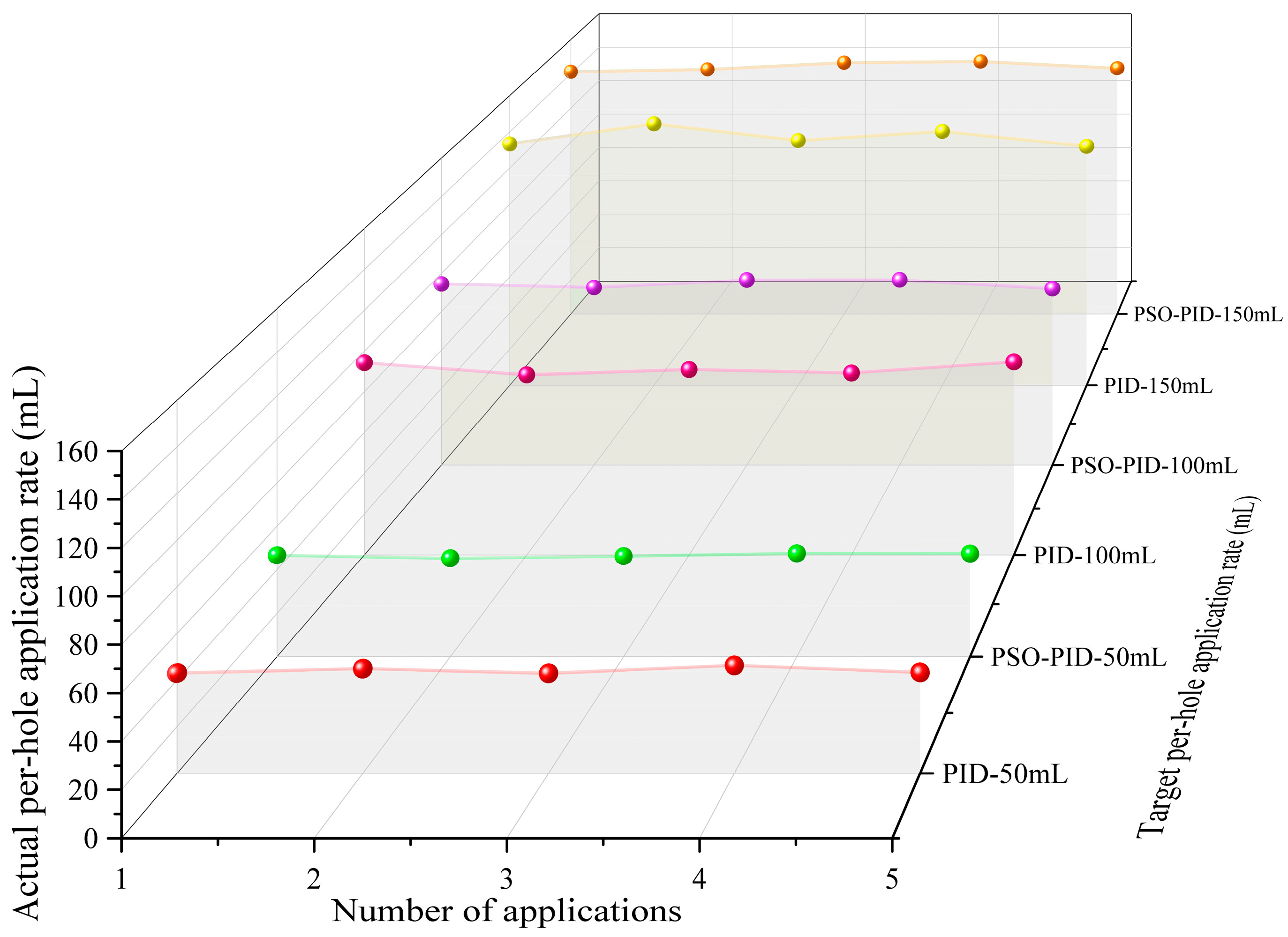
The experimental results are presented in Table 4, and the waterfall plot of the measured actual per-hole pesticide application rate is illustrated in Figure 16.
It can be seen from Table 4 that the relative errors of the PSO-PID algorithm are 6.64%, 4.96% and 3.85%, respectively, which are lower than the conventional PID algorithm’s 11.84%, 8.56%, and 8.63%. The results indicate that the PSO-PID algorithm can track the target pesticide application rate more accurately and effectively reduce the application rate deviation. In addition, the coefficients of variation in the PSO-PID algorithm are 2.02%, 1.73% and 1.81%, respectively, all smaller than the conventional PID algorithm’s 3.36%, 3.13%, and 3.81%. This verifies that the PSO-PID algorithm has higher control accuracy and better pesticide application uniformity under different target per-hole pesticide application rates. The waterfall plot further corroborates the above conclusions, visually demonstrating that the PSO-PID algorithm exhibits superior pesticide application uniformity and control accuracy across varying target per-hole pesticide application rates.

4. Discussion

This study meets the requirements for flow rate precision and operational consistency in soil disinfection by establishing a PSO-PID closed-loop control system for the application flow rate. It incorporates an adaptive target flow regulation mechanism based on velocity feedback to mitigate the impact of operational speed fluctuations on application uniformity. Previous studies confirms the superiority of PSO-PID controllers in terms of control accuracy and stability. For instance, Zihao Meng et al. [34] designed a PSO-BP-PID precision fertilization system based on PSO and neural networks, while Chang Wan et al. [35] developed a PSO-BP-PID fertilization control system tailored for orchard scenarios, both validating the optimization efficacy of the PSO algorithm. Compared to previous studies, this system is specifically designed for pesticide application scenarios. Unlike fertilization systems, soil disinfection requires handling dynamic disturbances such as vehicle speed fluctuations and soil resistance, whereas fertilization systems focus on static flow matching and rarely consider the impact of operating speed on output. The PSO-PID controller in this system integrates a speed feedback adaptive algorithm to dynamically correct target flow rates in real time, effectively alleviating the problem of uneven pesticide application during variable-speed operation. This approach aligns closely with the dynamic requirements of pesticide application scenarios. Compared to Liu Yao’s [36] precision application system, which adopts Particle Swarm Optimization-Adaptive Disturbance Rejection Control (PSO-ADRC) for addressing application disturbances, the proposed system (PSO-PID controller) exhibits distinct advantages. Specifically, Liu Yao’s system employs second-order nonlinear ADRC and decoupling controllers, which require multi-parameter tuning and complex observer modeling, leading to a cumbersome tuning process. In contrast, the proposed PSO-PID controller achieves a balance between dynamic response and steady-state accuracy through a multi-objective fitness function while maintaining a simpler structure. System application rate uniformity test verifies that the coefficient of variation is maintained at approximately 2%, and its disturbance rejection performance meets the requirements of agricultural environments. It was found from the test results that the performance of the system was significantly improved at a high flow rate of 1 L/min, which is speculated to be related to the accuracy of the electric ball valve and sensors. The core logic of pesticide application flow control is that the smaller the flow rate, the higher the requirement for hardware accuracy. For the DN8 regulating electric ball valve used in this study, flow regulation needs to be achieved through a small opening under low flow conditions. However, limited by the valve’s own control accuracy, the impact of small fluctuations in valve opening within the small opening range on the flow rate is magnified, resulting in restricted flow control accuracy of the system. For the flow sensor, under low flow conditions, the measurement error of the flow sensor easily leads to more obvious fluctuations in the feedback signal and a more significant disturbance to the control closed loop, while the fluctuations are relatively lower under high flow conditions, and the stability of the sensor feedback data is improved. In terms of the fitness function, the test results of this system have verified its ability to select high-quality particles and obtain the global optimal solution for PID parameter optimization. In the future, however, the weight configuration of the four core indicators, namely the integral of absolute error, overshoot, steady-state error and adjustment time, can be further refined, with their proportions dynamically adjusted according to various complex field working conditions. Meanwhile, the accuracy and stability of the electric ball valve and sensors should be improved to reduce the noise interference during the data acquisition process. This will help the algorithm adapt to more complex and variable operation scenarios and further enhance the control accuracy and robustness of the PSO-PID algorithm.
There is still room for improvement in other aspects of this research. First, its compensation capability for unstructured disturbances such as sudden changes in soil moisture content and pipeline wear is insufficient. ADRC employs an extended state observer to estimate disturbances in real time, offering superior disturbance rejection robustness. Second, PSO-PID parameters are optimized offline, lacking the online self-adjustment capability of neural networks. When the viscosity or temperature of the pesticide solution changes, re-tuning is required. Future work can advance in two directions: First, integrating online sensing of key soil and environmental parameters to develop a multi-factor coupled control and compensation model, enabling adaptive correction of target application flow rates. Second, refining the PSO parameter update strategy or incorporating hybrid optimization mechanisms like Genetic algorithms (GAs) to enhance global optimization capability and robustness for engineering applications.

5. Conclusions

This paper designs and implements a PSO-PID-based precision application control system for soil disinfection. To address application deviations caused by speed fluctuations during forward operation, an adaptive target application flow rate method with speed feedback was established, achieving consistent application rate control under variable-speed operating conditions. Building upon this foundation, PSO was employed to optimize and tune the PID parameters, resulting in the development of a PSO-PID controller. The system performance was validated through simulation comparisons, flow control accuracy tests on a test bench, and uniformity tests of the system’s pesticide application rate.
Simulation results demonstrate that PSO-PID outperforms conventional PID in metrics such as settling time, overshoot, and steady-state error, exhibiting faster dynamic response and higher control stability. Bench test results further confirmed that at target flow rates of 0.6, 0.8, and 1.0 L/min, the PSO-PID exhibited smaller flow fluctuations and smoother regulation processes. Relative errors were 2.33%, 1.25%, and 1.20%, respectively—approximately 50% lower than conventional PID—with reduced variability and improved repeatability. The uniformity of application rate test also validated the system: under target application rates of 50, 100, and 150 mL per hole, the PSO-PID achieved a relative error approximately 40% lower than conventional PID, with the coefficient of variation controlled at approximately 2%. This control scheme enables more uniform and stable application. In summary, the proposed PSO-PID precision application control scheme effectively enhances the accuracy and uniformity of soil disinfection operations, providing a reference for the intelligent and precise control of soil disinfection application systems. In summary, the pesticide application control system based on the PSO-PID algorithm proposed in this study can effectively improve the pesticide application accuracy and uniformity of soil disinfection operations. The system can reduce pesticide consumption and environmental impacts while enhancing the effectiveness of soil disinfection and pesticide application. Compared with conventional PID control, the PSO-PID algorithm can improve the pesticide utilization efficiency by approximately 40%, thus reducing pesticide waste caused by over-application. Meanwhile, more uniform pesticide application effectively avoids the risks of soil residues and environmental pollution induced by excessively high local application rates, which is in line with the development requirements of green agriculture and provides a reference for the intellectualization and precision of soil disinfection and pesticide application control systems.

Author Contributions

Conceptualization, M.X., Z.W. (Zhichong Wang) and S.L.; methodology, M.X., Z.W. (Zhichong Wang), C.Z. and S.L.; software, M.X.; validation, M.X., Z.W. (Zhichong Wang), X.N. and S.L.; formal analysis, M.X., X.N., Z.W. (Zhen Wang) and W.Z.; investigation, M.X., Z.W. (Zhen Wang), W.Z. and S.L.; resources, Z.W. (Zhichong Wang), X.N., C.Z. and S.L.; data curation, M.X. and Z.W. (Zhen Wang); writing—original draft preparation, M.X. and S.L.; writing—review and editing, Z.W. (Zhichong Wang) and C.Z.; visualization, M.X., Z.W. (Zhen Wang) and S.L.; supervision, Z.W. (Zhichong Wang), S.L. and C.Z.; project administration, C.Z. and S.L.; funding acquisition, C.Z. and S.L. All authors have read and agreed to the published version of the manuscript.

Funding

Support was provided by (1) the Reform and Development Project of Beijing Academy of Agricultural and Forestry Sciences (Funding number: GGFZ20240117); (2) the Natural Science Foundation of China General Program (Funding number: 32572886); (3) the National Key Research and Development Program of China (Funding number: 2024YFD2001100).

Data Availability Statement

The raw data supporting the conclusions of this article will be made available by the authors on request.

Conflicts of Interest

The authors declare no conflicts of interest.

References

  1. Tan, G.; Liu, Y.; Peng, S.; Yin, H.; Meng, D.; Tao, J.; Gu, Y.; Li, J.; Yang, S.; Xiao, N.; et al. Soil potentials to resist continuous cropping obstacle: Three field cases. Environ. Res. 2021, 200, 111319. [Google Scholar] [CrossRef]
  2. Chen, M.L.; Zhou, Z.Y.; Lu, J.; Yi, M.; Luo, J.; Wang, D.; Zhang, L.L.; Li, S.L.; Yan, M. Functional role of soil conditioners in the prevention and control of crop soil-borne diseases. Plant Health Med. 2025, 4, 67–73. [Google Scholar] [CrossRef]
  3. Wang, L.; Gao, J.; Qureshi, W.A. Evolution and Application of Precision Fertilizer: A Review. Agronomy 2025, 15, 1939. [Google Scholar] [CrossRef]
  4. Bock, C.H.; Hotchkiss, M.W. Effect of Tractor Speed and Spray Application Volume on Spray Coverage at Different Heights in the Canopy of Tall Pecan Trees. Plant Dis. 2021, 105, 2509–2520. [Google Scholar] [CrossRef]
  5. Shaw, K.K.; Vimalkumar, R. Design and Development of a Drone for Spraying Pesticides, Fertilizers, and Disinfectants. Int. J. Eng. Res. Technol. 2020, 9, 1181–1185. [Google Scholar] [CrossRef]
  6. Fang, W.S.; Cao, A.C.; Wang, Q.X.; Yan, D.D.; Li, Y.; Jin, Q.; Zhao, Q.L.; Qiu, Y.K.; Zhao, H.M. A New Integrated Soil Disinfection Machine Improves the Uniformity of Dazomet in Soil. Sci. Agric. Sin. 2021, 54, 2570–2580. [Google Scholar] [CrossRef]
  7. Wu, C.Y.; Jie, F.W.; Chen, S.F.; Sun, Q.X.; Sun, C.D. Design and Experimental Study on Variable Spray System Based on Soybean Canopy State Change. J. Shenyang Agric. Univ. 2023, 54, 90–97. [Google Scholar] [CrossRef]
  8. Udompetaikul, V.; Coates, R.W.; Upadhyaya, S.K.; Browne, G.T.; Shafii, M.; Gillis, M. Tractor-mounted, GPS-based spot fumigation system manages Prunus replant disease. Calif. Agric. 2013, 67, 222–227. [Google Scholar] [CrossRef][Green Version]
  9. Peng, W.J.; Ji, C.; Gong, L.J.; Chen, J.C.; Fu, W. Design and Experiment of Batch Application Control System for Maize Seedling. J. Agric. Mech. Res. 2021, 43, 115–122. [Google Scholar] [CrossRef]
  10. Zhang, C.F.; Zhai, C.Y.; Zhao, X.G.; Zou, W.; Zhang, M.; Zhao, C.J. Experimental study on the pressure fluctuation characteristics of target spray system. Trans. Chin. Soc. Agric. Eng. 2022, 38, 31–39. [Google Scholar] [CrossRef]
  11. Zhong, W.; Yang, W.; Wang, Y.; Dong, X.; Wang, X.; Jia, W.; Ou, M. Intelligent pesticide application system for intercropping: Development, challenges, and solutions based on monoculture machinery. Cogent Food Agric. 2025, 11, 1–25. [Google Scholar] [CrossRef]
  12. Li, S. Design and Implementation of Soil Disinfection Pesticide Application System for Facility Asparagus. Master’s Thesis, Beijing University of Agriculture, Beijing, China, 2023. [Google Scholar] [CrossRef]
  13. Guo, N.; Hu, J.T. Design and experiment of variable rate spaying system on Smith-Fuzzy PID control. Trans. Chin. Soc. Agric. Eng. 2014, 30, 56–64. [Google Scholar] [CrossRef]
  14. Cen, Z.Z.; Yue, X.J.; Wang, L.H.; Ling, K.J.; Cheng, Z.Y.; Lu, Y. Design and test of self-adaptive variable spray system of UAV based on neural network PID. J. South China Agric. Univ. 2019, 40, 100–108. [Google Scholar] [CrossRef]
  15. Yang, J.; Li, X.; Zheng, Q.; Liu, L. Particle Swarm Optimization-Enhanced Fuzzy Control for Electrical Conductivity Regulation in Integrated Water–Fertilizer Irrigation Systems. Automation 2025, 6, 76. [Google Scholar] [CrossRef]
  16. Li, F.; Bai, X.; Su, Z.; Tang, S.; Wang, Z.; Li, F.; Yu, H. Development of a Control System for Double-Pendulum Active Spray Boom Suspension Based on PSO and Fuzzy PID. Agriculture 2023, 13, 1660. [Google Scholar] [CrossRef]
  17. Chen, Y.L.; Hou, Y.; Li, S.P.; Jin, Y.G.; OuYang, C.Q. Design and experiments of the fertilization monitoring system based on the PSO-BP for sugarcane. Trans. Chin. Soc. Agric. Eng. 2022, 38, 23–31. [Google Scholar] [CrossRef]
  18. Zhu, F.L.; Zhang, L.X.; Zhang, X.Y.; Zheng, Y.; Huang, C.; Meng, Z.H.; Zhou, R.M. Research on Water and Fertilizer Monitoring and Dispatching System Based on GA-PSO Algorithm. J. Agric. Mech. Res. 2024, 46, 206–210. [Google Scholar] [CrossRef]
  19. El-Gendy, E.M.; Saafan, M.M.; Elksas, M.S.; Saraya, S.F.; Areed, F.F.G. Applying hybrid genetic—PSO technique for tuning an adaptive PID controller used in a chemical process. Soft Comput. 2020, 24, 3455–3474. [Google Scholar] [CrossRef]
  20. Wang, H.L.; Zeng, Y.S. Adaptive Tension Control System for a Winding Machine Based on LKRBF Neural Network-PID. Autom. Instrum. 2025, 40, 59–63+69. [Google Scholar] [CrossRef]
  21. Zhou, T.; Zhu, Q.; Zhang, K.K.; Zhou, T.; Wang, C.S.; Bo, C.M. Research on IMC-PID Heating Furnace Temperature ControlBased on PSO Algorithm. Mach. Build. Autom. 2025, 54, 38–42. [Google Scholar] [CrossRef]
  22. Hussain, M.; Wang, Z.; Huang, G.; Mo, Y.; Guo, Y.; Kaousar, R.; Duan, L.S.; Tan, W.M. Evaluation of droplet deposition and efficiency of 28-homobrassinolide sprayed with unmanned aerial spraying system and electric air-pressure knapsack sprayer over wheat field. Comput. Electron. Agric. 2022, 202, 107353. [Google Scholar] [CrossRef]
  23. Joseph, S.B.; Dada, E.G.; Abidemi, A.; Oyewola, D.O.; Khammas, B.M. Metaheuristic algorithms for PID controller parameters tuning: Review, approaches and open problems. Heliyon 2022, 8, e09399. [Google Scholar] [CrossRef]
  24. Wang, Y.C. Comparison and research on tuning of incremental PID and positional PID algorithms. Ind. Control Comput. 2018, 31, 123–124. [Google Scholar]
  25. Jiang, H.T.; Wang, C. PID Control System Based on PLC. Comput. Syst. Appl. 2012, 21, 144–147. [Google Scholar]
  26. Zhang, J.C.; Yan, S.C.; Ji, W.Y.; Zhu, B.G.; Zheng, P. Precision Fertilization Control System Research for Solid Fertilizers Based on Incremental PID Control Algorithm. Trans. Chin. Soc. Agric. Mach. 2021, 52, 99–106. [Google Scholar] [CrossRef]
  27. Pan, C.Z.; You, Y.; Ma, P.B.; Wang, Z.Y. Variable Rate Fertilization Control System for Liquid Fertilizer Based on PSO Optimized RBF-PID Control. Trans. Chin. Soc. Agric. Mach. 2024, 55, 53–61. [Google Scholar] [CrossRef]
  28. Li, Z.P.; Liang, C.Y.; Zou, L.W. Research on spraying control strategy for quadcopter UAV based on particle swarm optimization. China South Agric. Mach. 2024, 55, 42–45. [Google Scholar] [CrossRef]
  29. Tang, Y.X. Design of PID controller for high-order systems based on the minimum criterion of time-weighted absolute error integral. Electron. World 2017, 8, 110–111. [Google Scholar] [CrossRef]
  30. Zhang, W.; Lu, M.; Wei, L.; Yang, S.; Wang, L.; Ma, P.; Lin, X.; Hu, A.; Liu, S.; Fu, S. Design and Research of High-Speed Synchronous Membrane-Covering Device for Rice Membrane-Covering Transplanter Based on PSO-Fuzzy PID. Agronomy 2025, 15, 1962. [Google Scholar] [CrossRef]
  31. Ren, C.; An, N.; Wang, J.; Li, L.; Hu, B.; Shang, D. Optimal parameters selection for BP neural network based on particle swarm optimization: A case study of wind speed forecasting. Knowl. Based Syst. 2014, 56, 226–239. [Google Scholar] [CrossRef]
  32. T/NJ 1202-2020/T/CAAMM 70-2020; Agricultural Equipment-Soil Disinfector. Chinese Society for Agricultural Machinery/China Association of Agricultural Machinery Manufacturers: Beijing, China, 2020.
  33. DB3208/T 186-2022; Technical Regulation of Control for Asparagus Diseases, Pests and Weeds. Huai’an Administration for Market Regulation: Huai’an, China, 2022.
  34. Meng, Z.; Zhang, L.; Wang, H.; Ma, X.; Li, H.; Zhu, F. Research and Design of Precision Fertilizer Application Control System Based on PSO-BP-PID Algorithm. Agriculture 2022, 12, 1395. [Google Scholar] [CrossRef]
  35. Wan, C.; Yang, J.; Zhou, L.; Wang, S.; Peng, J.; Tan, Y. Fertilization Control System Research in Orchard Based on the PSO-BP-PID Control Algorithm. Machines 2022, 10, 982. [Google Scholar] [CrossRef]
  36. Liu, Y. Active Disturbance Rejection Control of Precise Spraying Process Based on Particle Swarm Optimization Algorithm. Master’s Thesis, Chongqing University of Science and Technology, Chongqing, China, 2021. [Google Scholar]
Figure 1. Pipeline Design Diagram for Precision Soil Disinfection Application System: 1. Chemical tank; 2. Water pump; 3. Solenoid valve; 4. Pressure sensor; 5. Regulable electric ball valve; 6. Flow sensor; 7. Vehicle speed sensor; 8. Application mechanism; 9. Soil to be treated with pesticide.
Agriculture 16 00481 g001
Figure 2. Control System Model.
Agriculture 16 00481 g002
Figure 3. Control System Flowchart.
Agriculture 16 00481 g003
Figure 4. Basic Control Principle Diagram of Proportional-Integral-Derivative (PID) Algorithm.
Agriculture 16 00481 g004
Figure 5. Schematic Diagram of Particle Swarm Optimization PID algorithm (PSO-PID) Algorithm Control.
Agriculture 16 00481 g005
Figure 6. Simulation Flowchart of PSO-PID Algorithm.
Agriculture 16 00481 g006
Figure 7. System Simulation Model.
Agriculture 16 00481 g007
Figure 8. Test Bench for Precision Soil Disinfection Application System: 1. Chemical Tank; 2. Water Pump; 3. Flow Sensor; 4. Electric Ball Valve; 5. Pressure Sensor; 6. C37 Controller; 7. Power Supply; 8. Solenoid Valve; 9. Control Terminal; 10. Speed Test Bench Speed Control Knob; 11. Speed Test Bench.
Agriculture 16 00481 g008
Figure 9. System Application Rate Uniformity Test Apparatus: 1. DXY-180 Injection-Type Soil Disinfection Machine; 2. Application Rate Uniformity Test Soil Trough.
Agriculture 16 00481 g009
Figure 10. Field Test of Systemic Pesticide Application Uniformity.
Agriculture 16 00481 g010
Figure 11. Schematic Diagram of Weighing Soil Troughs After Application.
Agriculture 16 00481 g011
Figure 12. Fitness Convergence Curve of Best Particle under a step response.
Agriculture 16 00481 g012
Figure 13. (a) Target Application Flow Rate Control Comparison at 0.6 L/min; (b) Target Application Flow Rate Control Comparison at 0.8 L/min; (c) Target Application Flow Rate of 1.0 L/min Control Comparison.
Agriculture 16 00481 g013
Figure 14. (a) Target Application Flow Rate Control Performance Comparison Curve at 0.6 L/min; (b) Target Application Flow Rate Control Performance Comparison Curve at 0.8 L/min; (c) Target Application Flow Rate Control Performance Comparison Curve at 1.0 L/min.
Agriculture 16 00481 g014
Figure 15. (a) Actual Application Flow Rate Point-Line Chart; (b) Bar Chart of Application Flow Rate Error.
Agriculture 16 00481 g015
Figure 16. Waterfall Plot of Actual Per-hole Pesticide Application Rate.
Agriculture 16 00481 g016
Table 1. Comparison of Simulation Performance of Control Algorithms at Different Target Application Rates.
Target Application Flow Rate (L/min)Control StrategySettling Time (s)Overshoot (%)Steady-State Error (%)
0.6PID50.113.40.31
PSO-PID16.56.90.21
0.8PID35.49.30.50
PSO-PID12.93.60.41
1.0PID30.32.60.52
PSO-PID6.701.20.18
Table 2. Comparison of Actual Performance of Control Algorithms at Different Target Application Flow Rates.
Target Application Flow Rate (L/min)Control StrategyAdjustment Time (s)Overshoot (%)Steady-State Error (%)
0.6PID64.024.454.00
PSO-PID17.56.471.90
0.8PID57.518.870.74
PSO-PID14.54.820.45
1.0PID55.56.581.20
PSO-PID12.03.420.30
Table 3. Comparison of Application Rate Accuracy Under Different Control Strategies.
Control StrategyTarget Application Flow Rate (L/min)Average Value (L/min)Relative Error (%)Coefficient of (%)
PID0.60.6223.672.21
0.80.8273.351.27
1.01.0494.883.38
PSO-PID0.60.6142.331.09
0.80.8101.250.64
1.01.0121.200.53
Table 4. Comparison of Application Uniformity under Different Control Strategies in Field.
Control
Strategy
Target Application Rate per Hole (mL)Average Actual Application Rate per Hole (mL)Relative Error (%)Coefficient of Variation (%)
PID5044.0811.843.36
10091.448.563.13
150137.068.633.81
PSO-PID5046.686.642.02
10095.044.961.73
150144.223.851.81
Disclaimer/Publisher’s Note: The statements, opinions and data contained in all publications are solely those of the individual author(s) and contributor(s) and not of MDPI and/or the editor(s). MDPI and/or the editor(s) disclaim responsibility for any injury to people or property resulting from any ideas, methods, instructions or products referred to in the content.