Article

A Precision Weeding System for Cabbage Seedling Stage

1
College of Engineering and Technology, Southwest University, Chongqing 400715, China
2
College of Plant Protection, Southwest University, Chongqing 400715, China
3
Key Laboratory of Intelligent Agricultural Equipment in Hilly and Mountainous Areas, Southwest University, Chongqing 400715, China
*
Author to whom correspondence should be addressed.
Agriculture 2026, 16(3), 384; https://doi.org/10.3390/agriculture16030384
Submission received: 4 January 2026 / Revised: 2 February 2026 / Accepted: 3 February 2026 / Published: 5 February 2026

Abstract

This study developed an integrated vision–actuation system for precision weeding in indoor soil bin environments, with cabbage as a case example. The system integrates lightweight object detection, 3D co-ordinate mapping, path planning, and a three-axis synchronized conveyor-type actuator to enable precise weed identification and automated removal. By integrating ECA and CBAM attention mechanisms into YOLO11, we developed the YOLO11-WeedNet model. This integration significantly enhanced the detection performance for small-scale weeds under complex lighting and cluttered backgrounds. Based on the optimal model performance achieved during experimental evaluation, the model achieved 96.25% precision, 86.49% recall, 91.10% F1-score, and a mean Average Precision (mAP@0.5) of 91.50% calculated across two categories (crop and weed). An RGB-D fusion localization method combined with a protected-area constraint enabled accurate mapping of weed spatial positions. Furthermore, an enhanced Artificial Hummingbird Algorithm (AHA+) was proposed to optimize the execution path and reduce the operating trajectory while maintaining real-time performance. Indoor soil bin tests showed positioning errors of less than 8 mm on the X/Y axes, depth control within ±1 mm on the Z-axis, and an average weeding rate of 88.14%. The system achieved zero contact with cabbage seedlings, with a processing time of 6.88 s per weed. These results demonstrate the feasibility of the proposed system for precise and automated weeding at the cabbage seedling stage.

1. Introduction

In unstructured agricultural environments such as trial fields, weed control remains a significant challenge, particularly during the early growth stages of crops when they are vulnerable to competition from weeds [1,2]. Weeds compete with crops for light, water, and nutrients, and can also serve as hosts for pests and diseases, reducing crop yield and quality [3]. In such environments, traditional weed control methods often struggle to maintain efficiency and precision due to irregular planting patterns, uneven crop distribution, and variable soil conditions. Cabbage, a highly adaptable and nutritious vegetable, provides an ideal case study for testing novel precision weeding approaches. Existing mechanical weeding technologies have demonstrated high operational accuracy in complex field environments [4,5]. However, to accommodate the narrow and sensitive working space during the seedling stage, further improvements are needed in the reliability of weed identification and the precision of actuator control.
In modern weed control, chemical herbicides are widely used because of their high efficiency and low cost [6]. However, long-term and excessive use has caused soil and water pollution, increased pesticide residues, and the emergence of herbicide-resistant weeds. Globally, 513 biotypes from 267 weed species have developed resistance to 21 classes of herbicides. Conversely, this situation has resulted in declining control efficacy and increasing herbicide application rates [7]. Although manual weeding provides high precision, it involves high labor intensity and low efficiency and faces sustainability challenges due to rural labor shortages [8].
With the rapid development of precision agriculture, intelligent weed control technologies, such as targeted spraying and selective mechanical weeding, have become major research topics. For example, Guo et al. [9] applied knowledge distillation to develop a lightweight YOLOv8 model for UAV-based weeding, reducing herbicide usage by approximately 15.26%. Similarly, Jin et al. [10] integrated a path planning algorithm with weed distribution maps to guide nozzle trajectories and reduce travel distance and herbicide usage.
In intelligent weeding systems, accurate discrimination between weeds and crops is a core challenge. In complex field environments, weeds that closely resemble crops are difficult to identify, especially under overlapping and occlusion conditions. Traditional methods often fail to maintain stable recognition accuracy under these conditions. In recent years, deep learning has substantially improved accuracy and generalization in object detection tasks. For example, Dyrmann et al. [11] applied deep learning to identify 22 plant species, achieving a detection accuracy of 86.2%. Weed identification is particularly challenging in broadcast-sown vegetable fields. However, by integrating image processing with deep learning, the CentreNet model achieved a recognition accuracy of 95.6% [12], demonstrating the effectiveness of deep learning for crop–weed discrimination. Moreover, during the cabbage seedling stage, plants are typically under 15 cm in height and have not yet fully expanded their leaves, making them prone to feature overlap with soil and small weeds. Field conditions such as variable illumination, shadows, glare, and humidity changes introduce high image noise and weak textures, reducing model robustness. Due to the similar appearance of weeds and young cabbage plants, their random distribution, and their proximity to crop roots, detection models must maintain high precision while minimizing false detections. These factors render weed detection during the seedling stage substantially more complex than conventional field object recognition.
Beyond visual identification, effective weed removal requires highly precise actuator operation within confined spaces. As a green and sustainable approach, mechanical weeding has attracted increasing attention. For example, a robotic mechanical weeding system based on fluorescence signal recognition was developed. By pre-treating crops with Rhodamine B (Rh-B) and using machine vision algorithms, the system achieved precise crop stem localization and accurate control of weeding blades in dense weed environments. This approach enhanced the operational accuracy of mechanical weeding [13]. Another example is an inter-row mechanical-laser synergistic weeding device. The device uses a slider-crank mechanism to drive weeding blades and integrates laser weeding to achieve efficient and precise weed removal while protecting crops [14].
Detecting weeds during the cabbage seedling stage is challenging due to the high similarity between crops and weeds, as well as complex environmental conditions, which make existing detection methods unstable. To address these issues, this study developed a specialized dataset and the YOLO11-WeedNet model, which integrates ECA and CBAM attention mechanisms to enhance identification precision. Furthermore, an enhanced Artificial Hummingbird Algorithm (AHA+) was implemented to ensure rapid convergence and smooth trajectory generation, providing a robust solution for efficient robot operations in dynamic agricultural environments.
The major contributions of this work are as follows: (1) Proposing the improvement in small-target detection accuracy in complex field environments with the developed YOLO11-WeedNet, integrating ECA and CBAM modules; (2) Establishing a method to map image coordinates to physical coordinates by integrating a depth camera, along with a protected-area constraint to prevent accidental contact with cabbage seedlings; (3) Designing an enhanced Artificial Hummingbird Algorithm (AHA+) to improve path smoothness and convergence efficiency; (4) Constructing a three-axis synchronous belt-driven actuation system for high-precision end-effector positioning and stable soil-breaking operations during the seedling stage in cabbage trial fields.

2. Materials and Methods

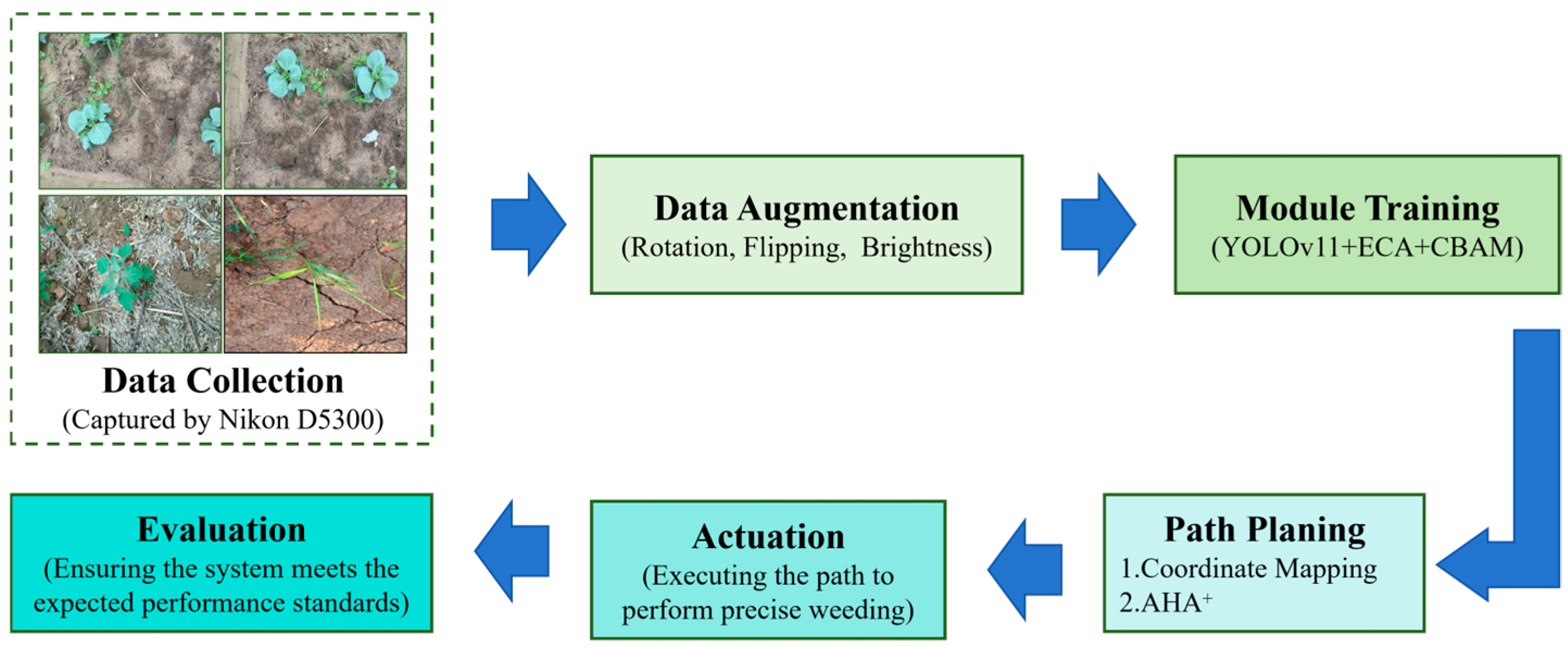
To provide a clear overview of the research methodology, this paper presents a flowchart outlining the key stages of the research process, as shown in Figure 1.
Data Collection: Images were captured from the test field using a Nikon D5300 camera (Provider: Nikon Corporation, Tokyo, Japan), featuring cabbage seedlings and weeds.
Data Augmentation: The dataset was augmented with techniques like rotation, flipping, and brightness adjustment to enhance model robustness.
Model Training: YOLO11 was used as the base model, with attention mechanisms (ECA and CBAM) integrated to improve weed feature detection accuracy. Post-training validation was performed using metrics such as precision, recall, and F1 score.
Path Planning: Path planning was optimized with the Artificial Hummingbird Algorithm (AHA) for efficient routing during weeding tasks, and further refined using AHA+ to enhance system performance.
Indoor Test Validation: The system was evaluated in an indoor soil-trough environment, with performance assessed using metrics including removal rate, miss rate, false hit rate and processing time to validate its efficacy and efficiency.

2.1. SWU_CW Dataset

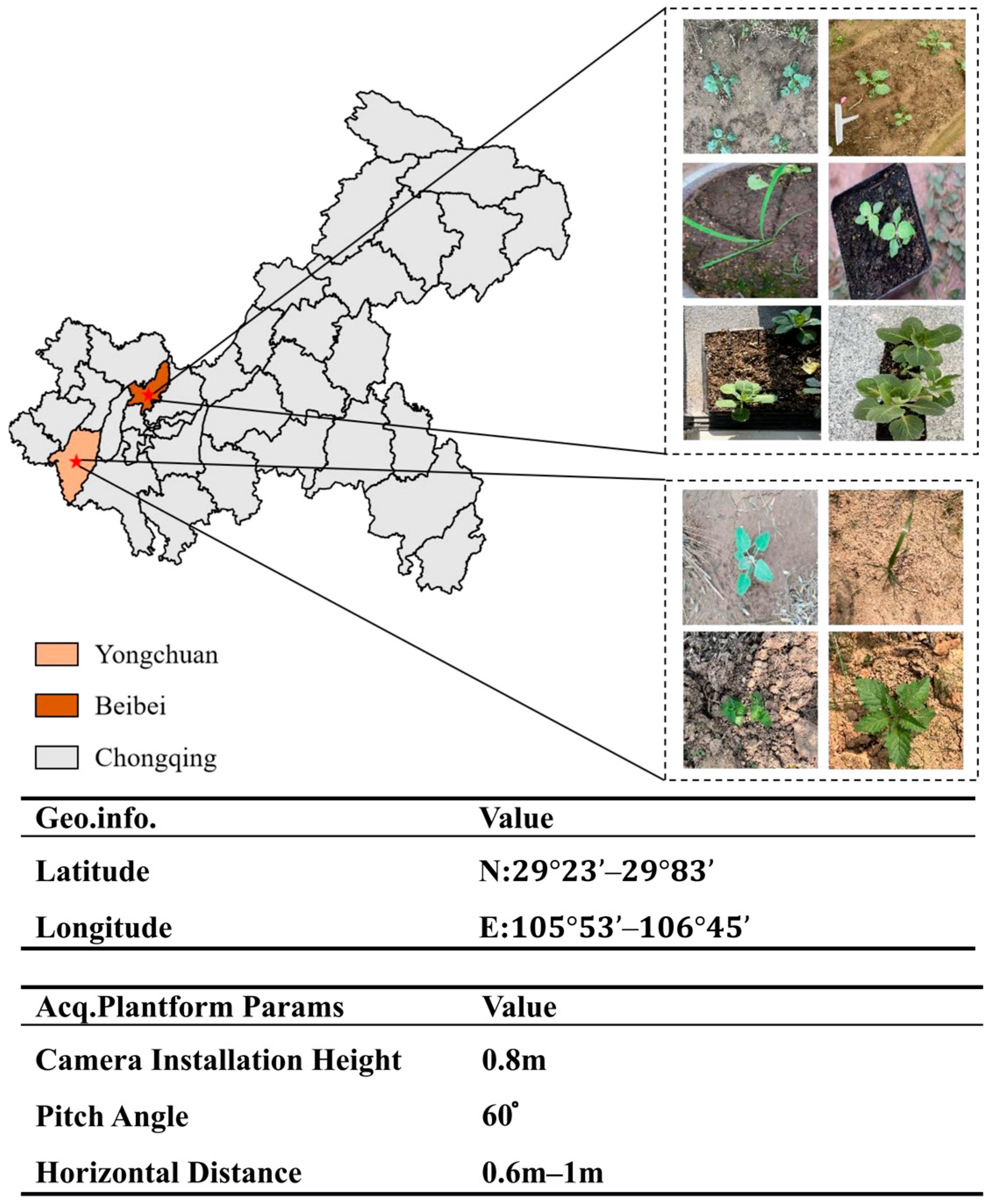
To facilitate precision weed control during the cabbage seedling stage, a specialized dataset, designated as SWU_CW, was constructed. Image acquisition was primarily conducted in farmlands in Yongchuan, Chongqing, and at a dedicated test field at Southwest University (Figure 2). To ensure diversity across weed growth stages, supplementary samples were cultivated and imaged under controlled laboratory conditions. All images were captured using a Nikon D5300 camera (6000 × 4000 pixels) positioned at a height of 60–100 cm and an angle of 60–90°. The final dataset comprises 956 images.
For annotation, bounding boxes were manually drawn around all cabbage and weed targets, with respective class labels assigned. To evaluate model performance, the dataset was partitioned into training, validation, and test sets in a 7:1:2 ratio.
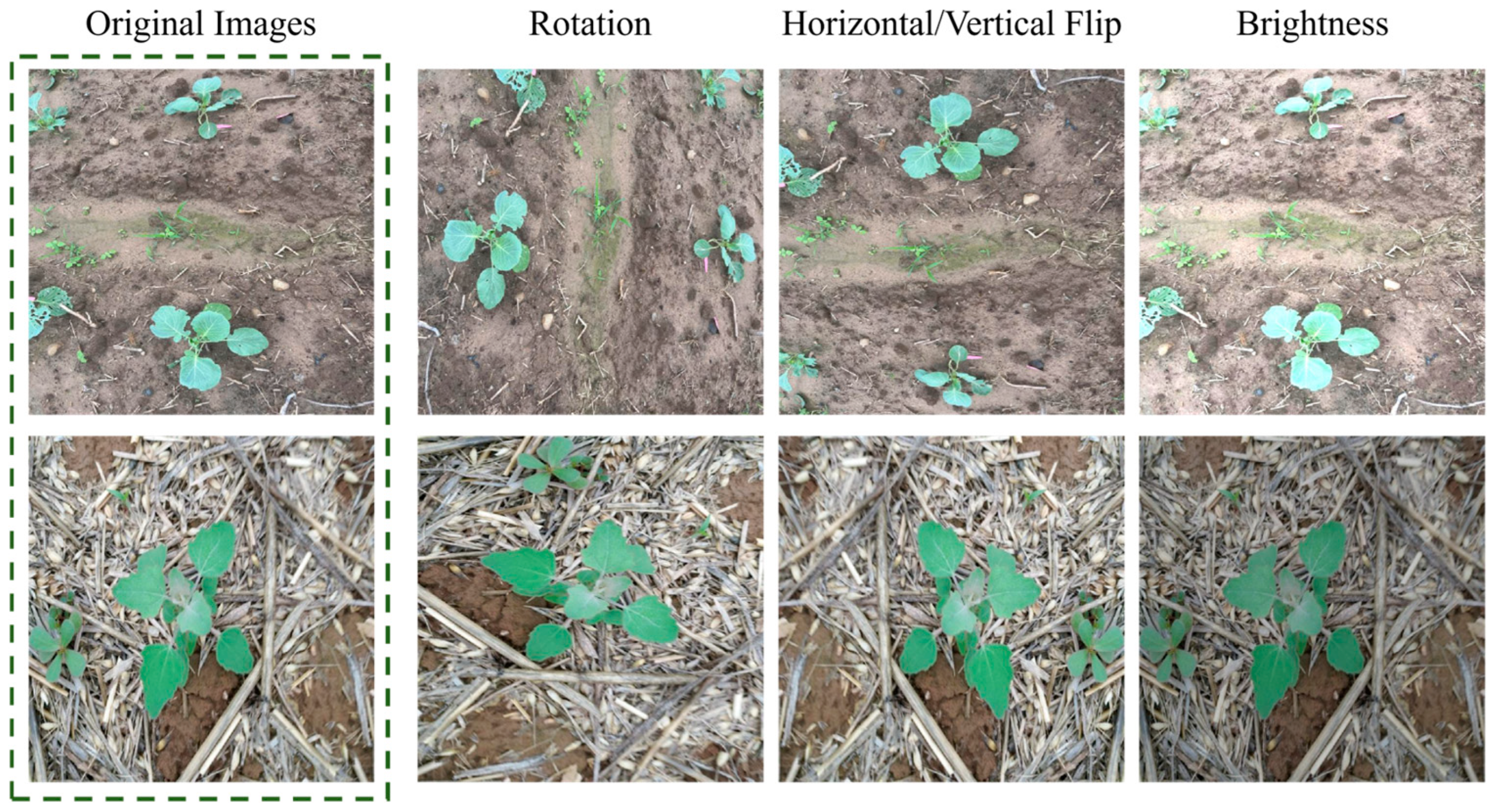
To improve dataset diversity and model robustness, this study applies several data augmentation techniques, including image rotation, horizontal and vertical flipping, and brightness adjustment, as illustrated in Figure 3. After augmentation, the dataset contained a total of 2423 images.
As shown in Table 1, the dataset distribution accounts for images containing multiple instances of both weeds and cabbage. This breakdown highlights the class balance within each subset, ensuring that the model is trained on a diverse and representative sample to achieve effective generalization across complex environments.
Model performance was evaluated using a cross-validation approach. To prevent data leakage, the images used for calculating precision and mAP were strictly excluded from the training process, ensuring that the model encountered these scenarios only during the assessment phase.

2.2. Precision Weeding System

2.2.1. Architecture

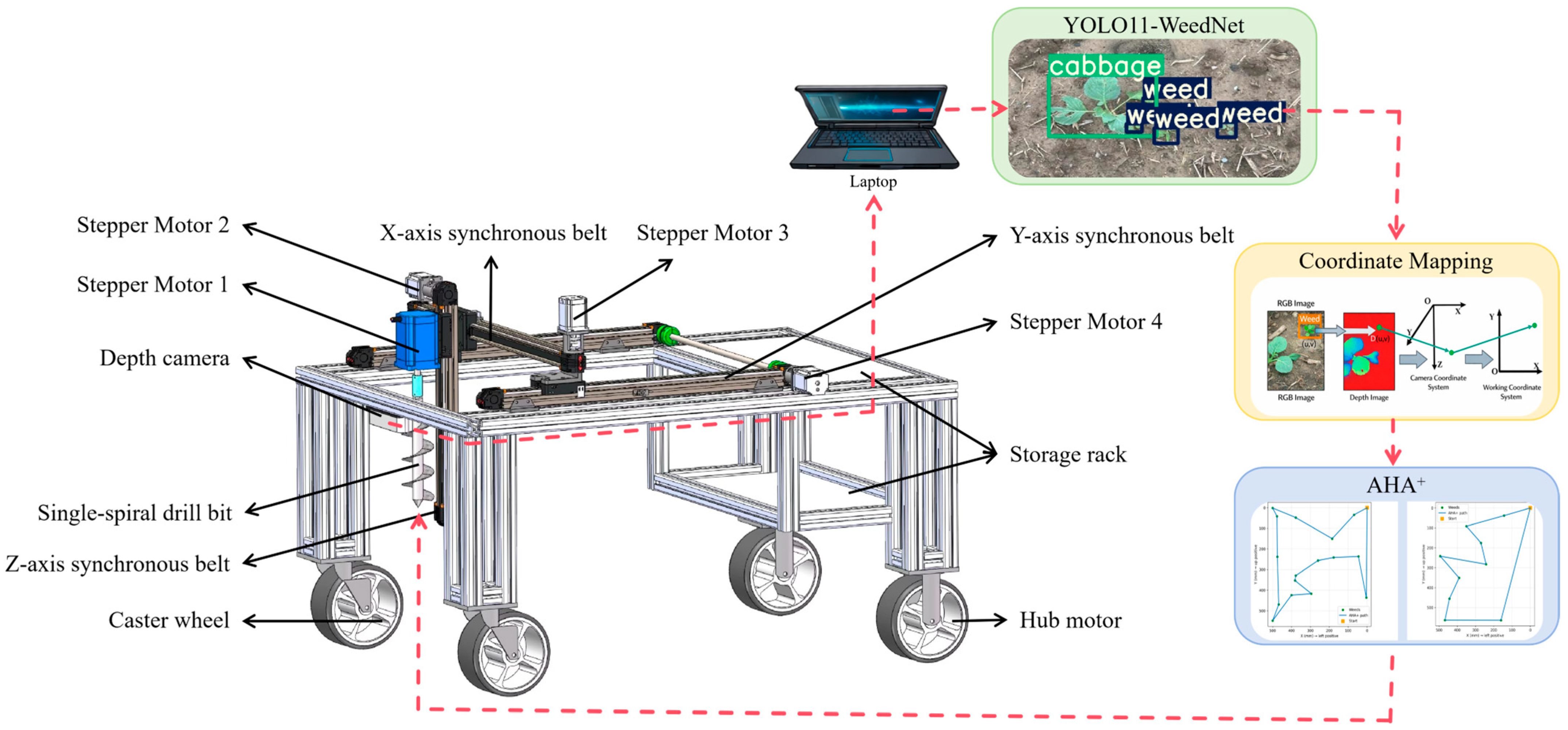
The selective weeding system consisted of three main components: a mobile platform, a visual detection system, and a control and execution system (Figure 4). The mobile platform was constructed using 30-series aluminum profiles. Caster wheels were installed at the front to enable flexible steering, while the rear wheels were driven by hub motors to provide propulsion. An RGB-D camera (Orbbec Astra Tri-Camera, Model LeTMC-520, Beijing, China) was mounted above the weeding mechanism to acquire RGB images and depth information simultaneously, supporting real-time weed detection and spatial localization. The mechanical subsystem adopted a three-axis synchronous belt-driven structure, allowing precise bidirectional movement of the end-effector within the working plane.

2.2.2. Software

YOLO11-WeedNet
To achieve robust and efficient weed detection in complex field environments, the YOLO series (nano variants) was evaluated as the baseline framework. The target classes were defined as ‘weeds’ and ‘cabbage’, enabling precise differentiation to support subsequent weeding operations. A comparative performance analysis of commonly used YOLO versions was conducted, and the results are summarized in Table 2 (epochs = 300, batch size = 16, optimizer = SGD, seeds = 42, lr0 = 0.01) [15,16,17,18,19]. Precision mechanical weeding requires not only high detection accuracy but also reliable real-time performance. Based on the comparative results, YOLO11 was selected as the base model because it provides a favorable balance between detection accuracy, inference speed, and parameter size, making it suitable for real-time deployment on agricultural platforms.
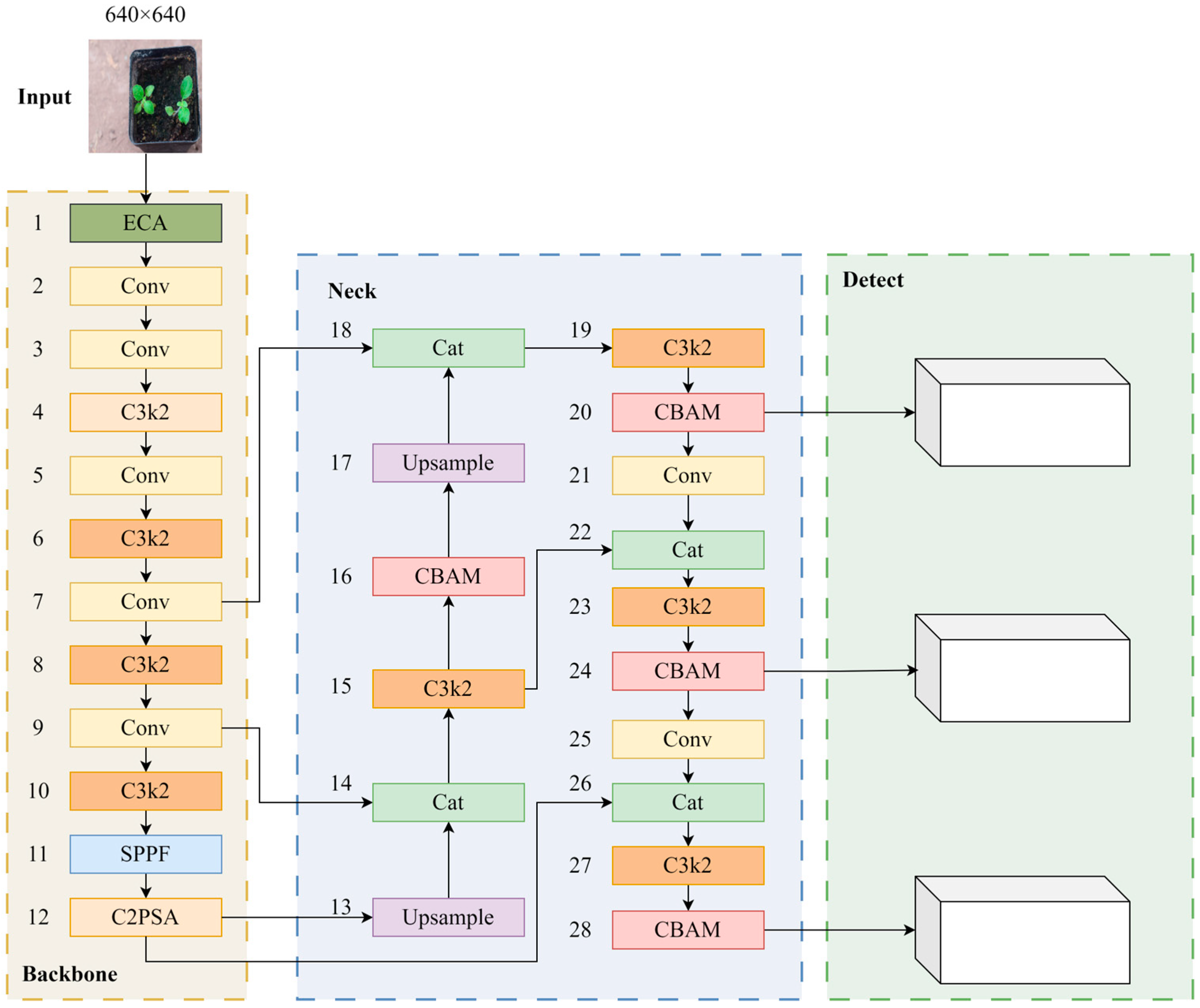
To improve feature representation and detection robustness in complex field environments, targeted optimizations were applied to both the backbone and detection head of the YOLO11 network. In the backbone, an Efficient Channel Attention (ECA) module was introduced to enhance channel-wise feature interactions in shallow layers. This design allowed the model to better capture weed targets with soil-like colors and weak texture characteristics [20]. In the detection head, a Convolutional Block Attention Module (CBAM) was embedded after each feature fusion layer. The CBAM module adaptively refined spatial and channel feature distributions, suppressed background interference, and emphasized discriminative weed features [21].
In this study, an Efficient Channel Attention (ECA) module was embedded into the initial layer of the Backbone to enhance adaptive channel weighting. By facilitating local cross-channel interactions, the ECA module optimizes feature perception, effectively highlighting target characteristics in low-contrast areas and complex backgrounds. Furthermore, in the Neck architecture, a Convolutional Block Attention Module (CBAM) was appended to each C3k2 block. By unifying spatial and channel attention mechanisms, the CBAM adaptively prioritizes target regions while effectively attenuating background noise. The synergistic integration of these modules significantly bolsters the model’s ability to discern fine-grained weed features, thereby improving detection robustness and stability in unstructured field environments. The enhanced architecture, designated as YOLO11-WeedNet, is illustrated in Figure 5.
To further evaluate the effect of structural improvements on feature representation, a heatmap visualization method was used to compare attention regions during weed detection between YOLO11-WeedNet and the original YOLO11. This method visualizes intermediate feature responses of the network and highlights the spatial regions emphasized during inference. It provides an intuitive basis for interpreting model behavior in subsequent result analyses.
In the generated heatmaps, different colors represent the response intensity of the model, with transitions from cool to warm colors indicating increasing confidence levels. Target centers and primary coverage areas are typically highlighted by warm colors, whereas non-target regions are mainly represented by cool colors. This visualization enables a direct comparison of model attention in terms of target location, spatial distribution, and scale, thereby revealing differences in feature extraction and attention allocation between the two models.
Coordinate Mapping
During selective weeding, accurate conversion of weed image coordinates obtained by visual detection into operational coordinates is required to ensure precise positioning of the end-effector. The intrinsic parameters of the RGB camera were calibrated using the OpenCV checkerboard-based method. The resulting camera intrinsic matrix is expressed as:
K   = 602.16 0 324.29 0 604.09 233.94 0 0 1 ,
where the radial and tangential distortion coefficients are given by d i s t = 0.243845 , 0.177523 , 0.953428 , 0.030196 , 0.9812375 .
In this study, a depth camera was mounted above the weeding mechanism, and its positional layout is shown in Figure 1. For extrinsic parameter calibration, we performed a camera-to-world coordinate transformation to align the camera coordinate system with the working coordinate system. Additionally, RGB-depth alignment error analysis was conducted by calculating the reprojection error between the RGB and depth images. The center coordinates ( u , v ) of the detection box output by YOLO11-WeedNet were used to index the corresponding pixel in the depth map and extract the depth value D ( u , v ) . As the camera captured RGB images and depth information simultaneously, the image coordinates ( u , v ) were directly mapped to spatial coordinates ( X ,   Y ,   Z ) , enabling three-dimensional weed localization.
The spatial coordinate-depth projection model was expressed as:
X   =   u c x Z f x
Y = v c y Z f y
where f x , f y and c x , c y are the camera intrinsic parameters, Z is the depth value, and (u, v) are the center coordinates of the detection box.
With the camera oriented vertically downward and its optical axis essentially aligned with the Z-axis, the operational coordinates can be expressed as:
X work   =   X   +   X
Y work = Y + Y
where ( X ,   Y ) is the offset between the camera’s optical center and the origin O of the operational coordinate system.
The depth image was aligned with the RGB image using both intrinsic and extrinsic parameters, and the alignment accuracy was evaluated through the reprojection error. The results show that the alignment error had minimal impact on system performance, with an average error of 0.2154 mm.
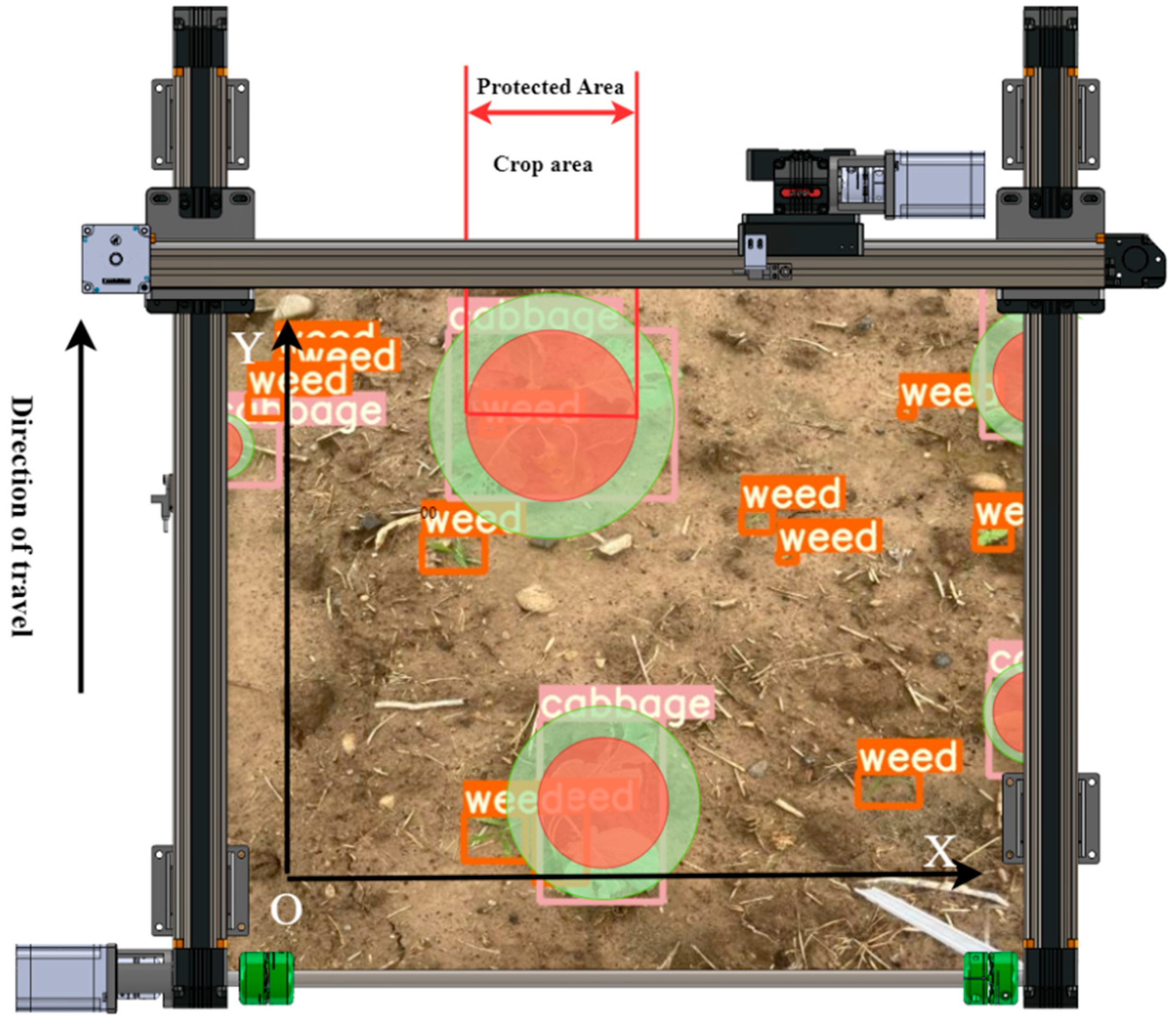
In this study, an operational coordinate system (O-XY) was established for the end-effector. The origin O was located at the lower-left corner of the mechanism. The X-axis pointed left along the transverse synchronous belt, and the Y-axis pointed forward (downward) along the longitudinal synchronous belt. To prevent damage to crop roots during weeding operations, a protected area was defined within the working region. The radius of the protected area was carefully selected based on the average size of cabbage seedlings and the safe working distance to avoid contact with the root system. The radius was set to 10 cm and calibrated to ensure it did not overlap with the cabbage root system during weeding. As shown in Figure 6, the red circular area represents the protected zone. When a weed detection point falls within this area, its coordinates are excluded from subsequent path planning and weeding operations. This radius was verified through multiple trials to ensure it effectively protects the seedlings while controlling weeds.
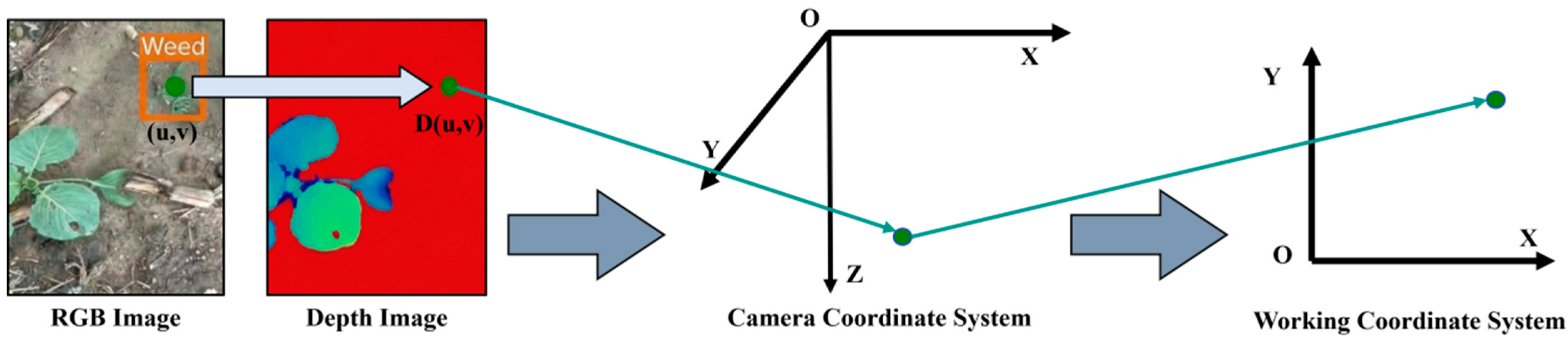
The acquired depth values did not directly represent three-dimensional spatial coordinates. Therefore, the pinhole camera model was applied to project pixel coordinates and depth information into the camera coordinate system, generating a three-dimensional point representation in camera space. This intermediate 3D representation provided the geometric basis for mapping visual coordinates onto the planar operational coordinate system of the execution platform. After applying the crop protection constraint, the retained 3D weed coordinates were used as inputs for the path planning module. Through this process, a consistent geometric correspondence was established between visual detection results and the actuator motion space, enabling reliable weeding path planning. The entire coordinate conversion process was illustrated in Figure 7.
AHA+
In each frame, the YOLO11-WeedNet model identified n weed targets and output the corresponding physical coordinate:
S   =   { X 1 , Y 1 , X 2 , Y 2 , , X n , Y n }
The objective of path planning was to minimize the total travel distance of the end-effector while covering all weed points and avoiding repetitive motion.
The total path length was expressed as:
L   = i = 1 n 1 ( X i + 1 X i ) 2 +   ( Y i + 1 Y i ) 2
As the number of weeds in a single frame was limited, the problem was simplified to a Traveling Salesman Problem (TSP).
To balance computational efficiency and real-time performance and to evaluate the applicability of different path planning algorithms in field scenarios, benchmark tests were conducted on representative methods. The tested algorithms included Nearest Neighbor (NN) [22], Artificial Hummingbird Algorithm (AHA) [23], Ant Colony Optimization (ACO) [24], Genetic Algorithm (GA) [25], Particle Swarm Optimization (PSO) [26].
The evaluation metrics included total path length L , reflecting actuator motion efficiency; runtime T , representing computational cost in a single-threaded Python3.9 environment; and the mean and maximum segment-to-segment jumps, used to measure path smoothness (Target Points = 15, Iterations = 350, Start/End Point = (0, 0), Seed = 42). The test data consisted of the weed physical coordinate set ( X i , Y i ) obtained in Section 2.3. The comparative results of each algorithm are presented in Table 3.
The comparative results reveal clear differences among the algorithms in terms of total path length, computation time, and path smoothness. As shown in Table 2, all algorithms generated feasible paths within the 500 × 600 mm working area; however, their performance differences have a substantial impact on practical mechanical execution. In a three-axis synchronous belt mechanism, insufficient path smoothness can cause frequent sharp turns, increased vibration, and repetitive end-effector motions, which reduce operational efficiency. Therefore, both path smoothness and real-time performance are critical criteria for selecting a path planning algorithm.
The Nearest Neighbor (NN) algorithm provides the highest computational efficiency but produces longer paths with limited smoothness. Ant Colony Optimization (ACO) and the Artificial Hummingbird Algorithm (AHA) generate shorter and smoother paths, although ACO requires longer computation time. Genetic Algorithm (GA) and Particle Swarm Optimization (PSO) exhibit intermediate performance in both planning efficiency and path smoothness. Overall, AHA achieves a favorable balance between computational efficiency and path optimization, producing shorter paths with smoother transitions. Considering both real-time requirements and planning accuracy, AHA was selected as the core algorithm for subsequent actuator path control, supporting efficient and precise selective weeding during the cabbage seedling stage.
Although the original Artificial Hummingbird Algorithm (AHA) provides a reasonable balance between exploration and exploitation, it exhibits slow convergence when handling dense weed clusters or closely distributed target points. In addition, fixed control parameters and limited neighborhood perturbation restrict its adaptability to complex and dynamic field environments. To address these limitations, an enhanced AHA algorithm was developed. The proposed method introduces adaptive parameter adjustment and a multi-phase local search strategy, improving convergence stability and enhancing path smoothness.
(1)
Adaptive Parameter Adjustment Strategy
To balance global exploration and local exploitation, an adaptive parameter adjustment mechanism was introduced. This mechanism enables dynamic optimization by fine-tuning the step size coefficient during the search process. Specifically, the step size coefficient α and the perturbation coefficient β are dynamically updated according to the iteration index t using cosine annealing and exponential decay functions, respectively:
α t   =   α 0   ×   1   +   cos ( π t T max ) 2
β t = β 0   ×   ( 1 t T max )
where α 0 and β 0 are the initial coefficients, and T max is the maximum number of iterations. This dynamic control mechanism enables the algorithm to conduct extensive global exploration in the early stages and shift towards refined local search in later phases, effectively enhancing convergence accuracy while preventing premature stagnation.
(2)
Neighborhood Perturbation and Periodic Local Optimization
A neighborhood perturbation operator was introduced during the foraging phase. This operator executes a random segment reversal operation (2-opt) every 10 iterations to locally optimize the best path sequence and eliminate redundant intersections.
The acceptance probability for inferior solutions follows the Metropolis criterion:
P accept   =   1 , Δ f < 0 e Δ f / T , Δ f 0
where f represents the change in path length, and T is the annealing temperature that decays exponentially with the number of iterations. This probabilistic acceptance mechanism ensures the algorithm can escape local optima and maintain population diversity during the optimization process.
The enhanced Artificial Hummingbird Algorithm (AHA+) incorporates three key improvements over the standard AHA. First, a greedy strategy is employed to generate high-quality initial paths, reducing ineffective traversal during the early search stages. Second, adaptive parameter tuning is introduced to dynamically balance guided, territorial, and migratory foraging behaviors across iterations, thereby improving global exploration capability. Third, a periodic lightweight 2-opt local search is embedded to enhance path refinement and convergence stability in the later stages of optimization.

2.2.3. Hardware

To ensure that the three-axis synchronous belt mechanism met the speed, precision, and load capacity requirements of selective weeding operations, appropriate motor selection and parameter matching were conducted for the drive system. To prevent fatigue or damage to the synchronous belts caused by repeated acceleration and deceleration, the system was configured with a maximum operating speed of v max = 0.3   m / s and a maximum acceleration of a max   =   0.5   m / s 2 .
During operation, each axis was required to bear the combined loads from the slider assembly, the end-effector, and soil contact forces. The axial equivalent force can be expressed as:
F X   =   m y   +   m z   +   m x   +   m tool   g + f 0 F Y   =   m y   +   m z   +   m tool g + f 0 F Z   =   m z   +   m tool g   +   F soil
T = F   ×   D 2
where m x ,   m y and m z are the masses of the X, Y, and Z-axis sliders and their carriages, respectively; m tool is the mass of the end-effector weeding mechanism; g is the gravitational acceleration; f 0 is the initial frictional force; F soil is the soil resistance encountered when the auger enters the soil (Here, the theoretical maximum soil resistance is referenced based on compacted clay conditions, where P soil   =   3   MPa [27], However, the actual operating environment for cabbage seedlings consists of loose topsoil, and the rotary cutting action of the auger significantly reduces axial resistance compared to static penetration. Therefore, based on the specific soil texture and the rotary operational mode, the effective axial resistance F soil   =   100   N ) and D is the pitch diameter of the synchronous pulley.
Motor selection was required to simultaneously satisfy the torque, speed, and positioning accuracy demands of the system. In summary, the selected motor was required to meet the following comprehensive criteria:
T rated     k s   ×   T n max     60 v max pz
where k s is the safety factor (set to 2 in this study), p is the belt tooth pitch, and z is the number of belt teeth.
The end-effector was subjected to direct operational loads during weeding, including cutting, soil breaking, and impact forces, and its performance directly influenced weeding depth, removal efficiency, and overall operational stability. In this study, a single-auger end-effector was adopted. It was driven by a Z-axis linear module to perform a cyclic sequence of downward pressing, rotation, and lifting. To satisfy the power requirements and ensure stable soil-breaking and weed-removal performance under varying soil conditions, the load characteristics of the end-effector were analyzed, and an appropriate drive motor was selected accordingly.
The total load and total torque on the end-effector in the Z-axis direction are as follows:
F end   =   m tool ( g   +   a Z )   +   F soil
T end =   T soil + T f +   T i
where a Z is the acceleration in the Z-axis direction, T soil is the soil-cutting resistance torque, T f is the frictional resistance torque of the auger and drive shaft, and T i is the inertial torque required to accelerate the auger’s own inertia.
In summary, based on the load and acceleration requirements of the three-axis synchronous belt mechanism and the transmission parameters of the synchronous pulleys, the driving force and torque demands calculated using Equations (11)–(13) were all below 1 N·m. Considering uncertainties such as dust accumulation, belt tension variations, and impact loads during operation, a safety factor of k s = 2 was applied. For the X- and Y-axes, closed-loop stepper motors (model 57-112) with a rated torque of 3.2 N·m were selected to ensure stable high-speed reciprocating positioning.
The Z-axis was responsible for lifting, pressing, and vertical driving of the end-effector, resulting in more complex loading conditions. Therefore, a stepper motor (model 86BYG250B) with a rated torque of 4.5 N·m was selected to ensure sufficient soil-breaking and weed-removal capability under varying soil conditions. The force and torque requirements of the end-effector were determined using Equations (14) and (15). Considering the measured range of soil resistance and the applied safety factor, a stepper motor with a rated torque of no less than 2 N·m was ultimately selected for the end-effector to ensure reliable performance during soil-breaking, cutting, and weed-removal operations.
The onboard controller used a laptop as the computational core of the system. An Acer Predator Helios Neo equipped with an Intel i9-14900HX processor, 16 GB RAM, a 1 TB solid-state drive, and an RTX 4060 GPU was employed to provide sufficient computational capacity for real-time data processing. The host computer communicated with the lower-level controller through a serial interface, forming a master–slave control architecture. In this framework, coordinate points, control commands, and execution parameters were transmitted in packet format to the lower-level controller, enabling real-time interaction between path planning outputs and actuator motion control.
The lower-level controller adopted an Arduino Mega 2560 as the core control unit for the three-axis synchronous belt system. It received real-time motion commands from the upper-level computer and converted them into pulse and direction signals to drive the coordinated motion of the X-, Y-, and Z-axis belt-driven mechanisms. Owing to its abundant I/O resources and stable timing performance, the Arduino Mega 2560 was well-suited for synchronized multi-axis motion control tasks requiring deterministic execution.
Following the hardware configuration and motor selection of the three-axis mechanism, a unified three-axis motion control strategy was designed to ensure accurate execution of the path planning results by the synchronous belt system. After weed coordinate extraction and path planning were completed by the host computer, the target points ( X i , Y i ) were sequentially transmitted to the lower-level controller in packet format. The lower-level controller converted the commanded displacements into pulse counts based on the synchronous belt transmission parameters and applied synchronous linear interpolation for the X- and Y-axes to achieve planar motion. During interpolation, a trapezoidal velocity profile (acceleration–constant speed–deceleration) was adopted to reduce belt shock caused by frequent high-speed starts and stops.
The Z-axis actuator employed a dual-stage descent strategy: a rapid approach to a pre-defined safe altitude, followed by a low-speed penetration to minimize impact on crop roots. Upon reaching the target depth, constant rotation was maintained for soil breaking and weeding. The cycle concluded with a vertical retraction to the safe height for the subsequent operation.
The actuation system utilizes a three-axis synchronous belt drive to ensure precise positioning and stable movement of the end-effector. To safeguard the crop, the control system dynamically adjusts the trajectory based on identified weed locations, incorporating a protected-area constraint to prevent accidental contact with cabbage seedlings. To enhance reliability, the lower-level controller continuously monitors limit switches and motor status, immediately halting pulse output and initiating a safe shutdown upon detecting over-travel, overload, or communication anomalies.
A control loop rate of 500 Hz is implemented for rapid response, complemented by 16-microstep control to ensure smooth motion and minimize mechanical jumps. Real-time feedback integrated with PID control further refines the target position, maintaining a system response time within 100 ms to ensure immediate and stable operation.
During the weeding process, the walking mechanism remains stationary until all targets in the current area are processed. As weed positions are static during operation, path planning is treated as a Traveling Salesman Problem (TSP) to minimize travel distance and maximize efficiency. Path recalculation is triggered only upon detecting new targets or completing the current task, ensuring efficient weeding under stable conditions.


2.3. Test Settings

2.3.1. Test Environment

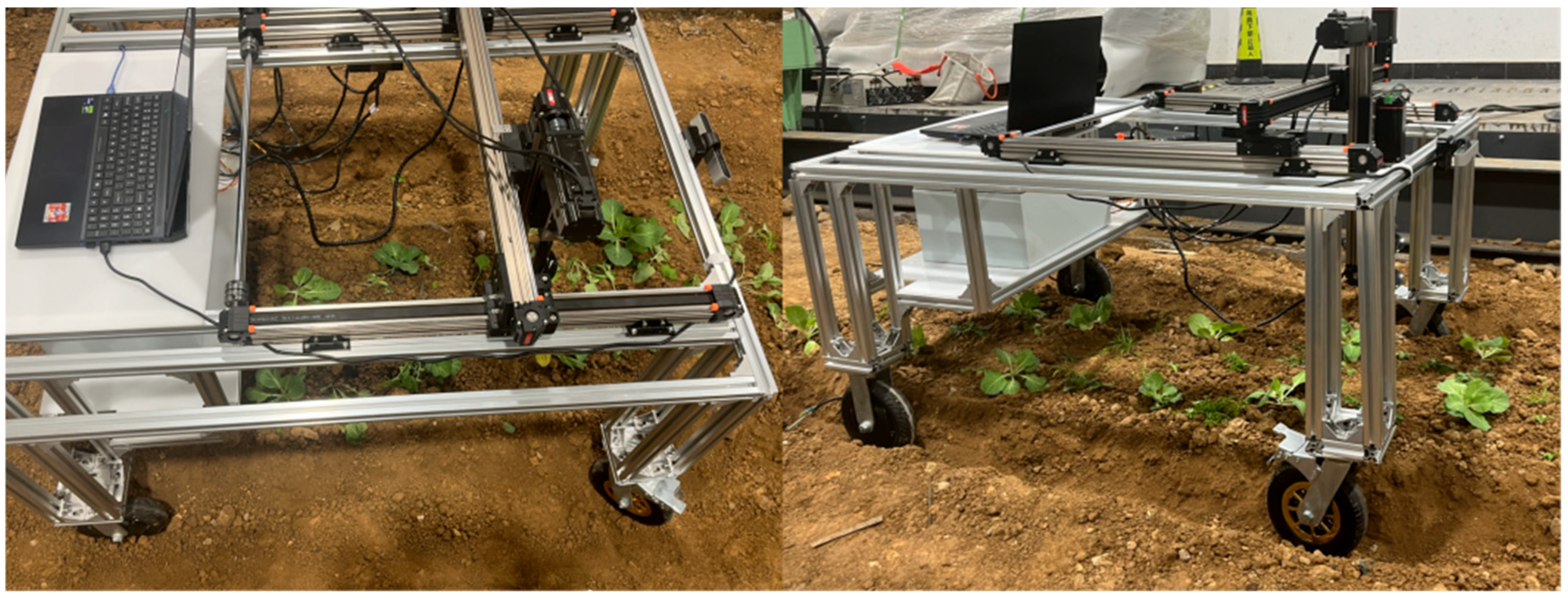
To evaluate recognition accuracy, coordinate mapping precision, path planning performance, and the motion capability of the three-axis actuator under controlled conditions, all experiments were conducted in a standardized indoor soil bin environment. A soil bed measuring 1000 mm × 3000 mm was selected within the test bin and filled with topsoil of uniform moisture content and density. This setup was designed to simulate the typical soil structure and operating conditions encountered in cabbage seedling fields. The test layout is shown in Figure 8. To ensure the system’s adaptability to realistic agricultural environments, representative weed species from Chongqing farmlands were selected alongside live cabbage seedlings, accounting for the ecological diversity of the experimental sites.
Within the soil bin, simulated plants were arranged according to conventional cabbage seedling transplanting spacing, and multiple common seedling-stage weeds were manually placed at different positions to construct a representative weed distribution scenario. The visual module (YOLO11-WeedNet model and depth camera), the path planning module (AHA and AHA+), and the three-axis synchronous belt actuator were consistent with the system architecture described earlier. During the experiments, the host computer performed weed detection and path planning, while the lower-level controller executed the corresponding motion control commands. This indoor test platform enabled quantitative evaluation of detection performance, coordinate mapping accuracy, path planning quality, and actuator motion stability under controlled conditions that excluded external environmental disturbances.

2.3.2. Performance Metrics

To quantify the operational performance of the system in soil bin experiments, the following evaluation metrics were defined.
(1)
Weeding Success Rate
The weeding success rate evaluates the effective processing capability of the system and is defined as the proportion of weeds that were successfully subjected to soil-breaking and removal operations relative to the total number of target weeds:
R re   =   N re N ta   ×   100 %
where N re is the number of successfully processed weeds, and N ta is the total number of actual target weeds present.
(2)
Missed Weeding Rate
The missed weeding rate represents the proportion of target weeds that were either not detected or not successfully removed by the system:
R miss   =     N miss N ta   ×   100 %
where N miss is the number of weeds that were either undetected by the system or for which removal operations failed.
(3)
Mistouch Rate
The mistouch rate reflects the proportion of cabbage seedlings or protected areas that were inadvertently contacted during operation and serves as a key indicator of operational safety:
R fa   =   N f a N ca   ×   100 %
where N fa is the number of times cabbage seedlings or locations within the protected area were mistakenly contacted, and N ca is the total number of cabbage seedlings.
(4)
Processing Time per Weed
The processing time per weed measures the point-to-point operational efficiency of the actuator and is defined as the average time required to complete one full “move → press down → soil break → lift” cycle:
T avg   =   T total N re
where T total is the total time consumed for processing all weeds, and N re is the number of successfully processed weeds.

3. Results

3.1. Visual Detection Performance

3.1.1. Ablation Study

To evaluate the contribution of each component in the YOLO11-WeedNet model, ablation experiments were conducted. These experiments examined the impact of integrating modules such as Efficient Channel Attention (ECA) and Convolutional Block Attention Modules (CBAM) on weed detection performance. By progressively removing or replacing individual modules, we analyzed their influence on key metrics, including detection accuracy and recall, to better understand their role in optimizing model performance.
As shown in Table 4, while single-module variants (YOLO11-CBAM/ECA) improved global mAP, they exhibited inconsistent performance in F1-score and Recall relative to the baseline. This phenomenon is attributed to the inherent trade-offs of isolated attention mechanisms: the aggressive spatial filtering of the standalone CBAM boosted Precision but inadvertently suppressed inconspicuous targets, thereby compromising Recall; conversely, the ECA module enhanced channel-wise feature representation but lacked sufficient spatial focus. YOLO11-WeedNet effectively resolves these limitations through a synergistic design, where the backbone-integrated ECA enriches feature semantics to facilitate precise localization by the Neck-integrated CBAM, ultimately achieving an optimal equilibrium between Precision and Recall.

3.1.2. Comparison Experiments

The training performance metrics of YOLO11-WeedNet during model training are presented in Table 5. To evaluate YOLO11-WeedNet’s performance in weed detection, this study compared it with YOLOv10, YOLO11, and RT-DETR. By comparing key metrics such as accuracy, recall, and mAP, the advantages of YOLO11-WeedNet were demonstrated, validating its potential for use in complex agricultural environments.

3.1.3. Visualization

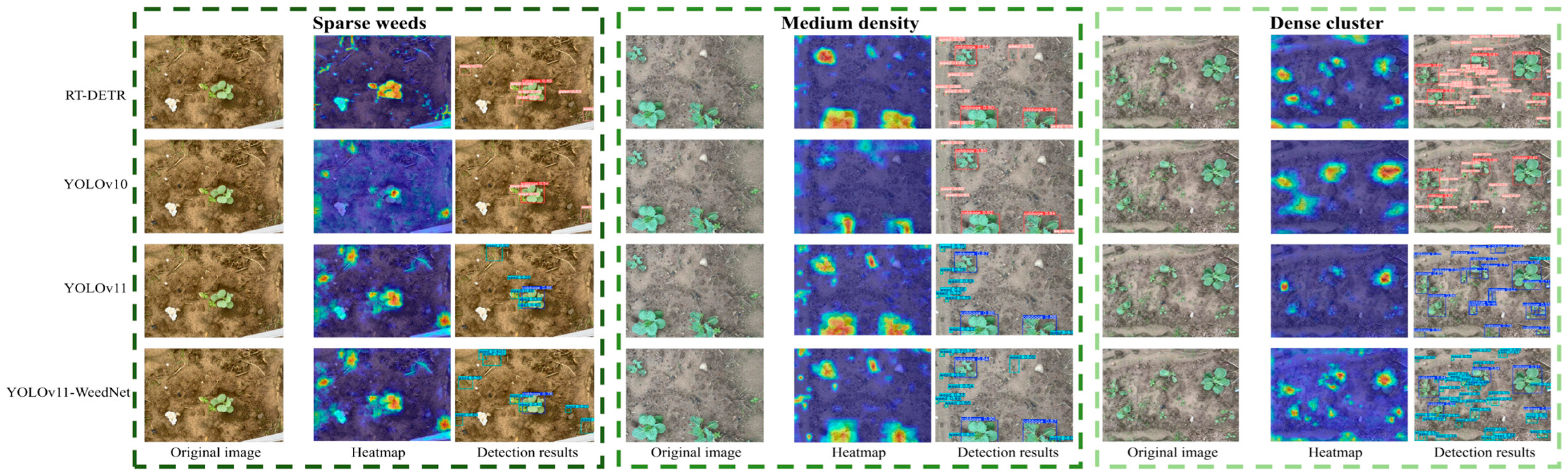
To visually assess the detection performance of different models, we conducted a comparison of RT-DETR, YOLOv10, YOLO11, and YOLO11-WeedNet using heatmaps, as shown in Figure 9. This figure illustrates the models’ responses under varying weed densities: sparse, medium, and dense clusters. YOLO11-WeedNet consistently produced stronger and more concentrated heatmap responses in the weed target areas across all three scenarios. This indicates that YOLO11-WeedNet excels at detecting weeds in complex environments, demonstrating its ability to isolate weed features effectively, even under challenging conditions.
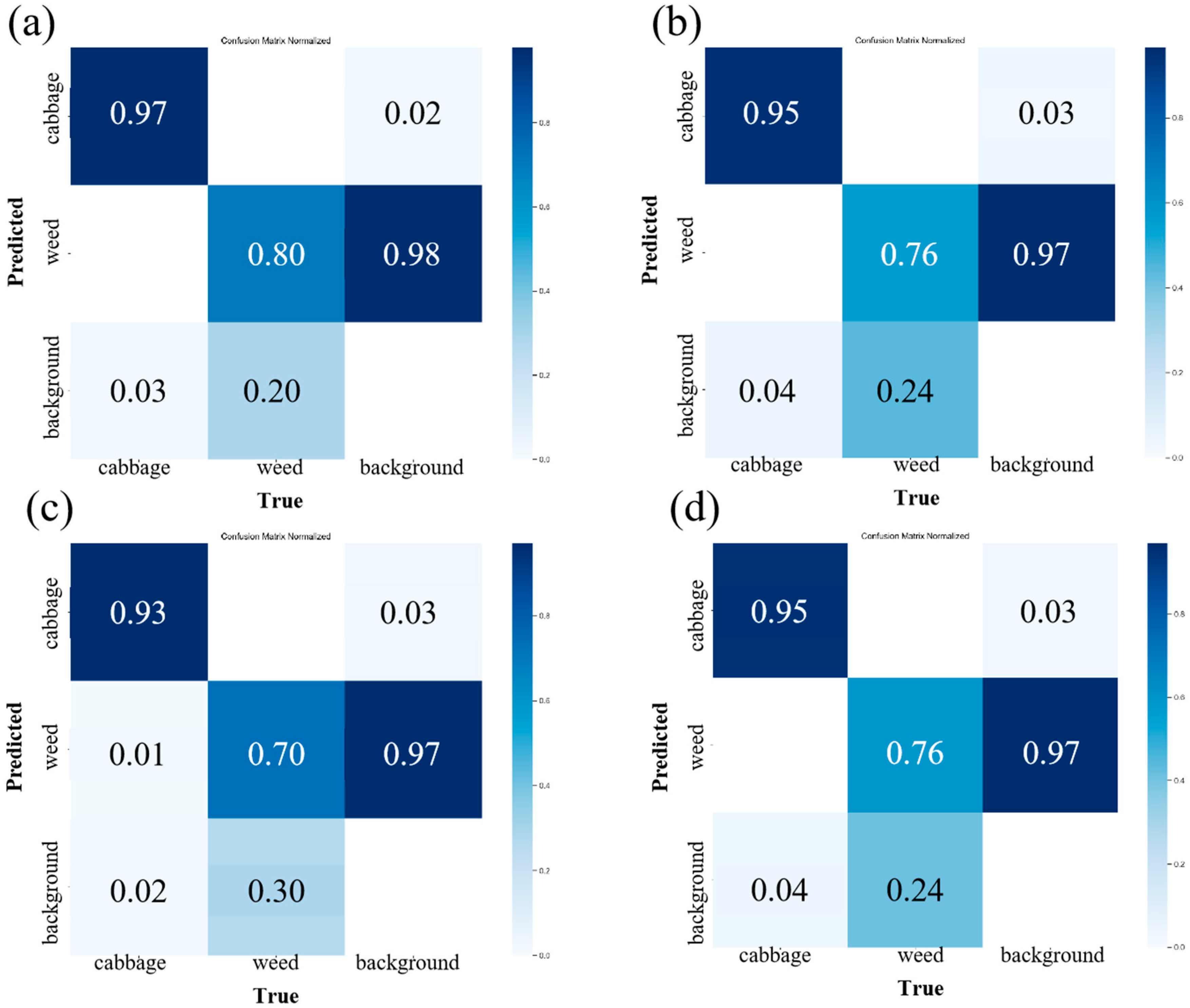
To provide a detailed analysis of each model’s classification performance, Figure 10 presents the confusion matrices. These matrices offer insights into each model’s ability to distinguish weeds from non-weeds in complex agricultural environments.
YOLO11-WeedNet consistently generates the most concentrated and accurate responses in weed target areas, demonstrating superior performance in distinguishing weeds from cabbage and background elements. In contrast, YOLO11 and YOLOv10 show higher false positive and false negative rates, with more frequent classification errors, especially in complex field environments. While RT-DETR performs robustly under certain conditions, it still suffers from elevated false positive and false negative rates in more challenging environments, highlighting its limitations for weed detection tasks.

3.2. Coordinate Mapping Accuracy

To evaluate the positioning accuracy of the three-axis synchronous belt actuator within the working plane, A1 coordinate paper was used as the benchmark measurement tool. The origin of the coordinate paper was aligned and fixed with the mechanical origin of the platform to ensure parallelism with the three-axis system, thereby establishing a unified planar coordinate system. Ten test points were randomly selected on the coordinate paper, and their true physical coordinates X i , Y i were recorded as target command points.
During the experiment, the host computer sequentially transmitted target coordinates to the lower-level controller, and the actuator executed point-to-point motion, stopping at each target position. After the end-effector descended to the plane of the coordinate paper, the actual arrival coordinates ( X i , Y i ) were recorded. The positioning errors in the X and Y directions were then calculated using the following equations:
e i   = ( X i     X i ) 2   +   ( Y i     Y i ) 2
Subsequently, the mean error e - and the maximum error e max were calculated to evaluate overall positioning performance. The results for each test group are summarized in Table 6.
The test results indicate that under operating conditions of v max = 0.3   m / s , and a max = 0.5   m / s 2 , the average positioning error in the X–Y plane was e - = 4.26   mm , with a maximum error of e max = 8   mm . These results demonstrate that the designed three-axis synchronous belt drive and control strategy achieved millimeter-level planar positioning accuracy, which satisfies the end-effector positioning precision requirements for selective weeding during the cabbage seedling stage.
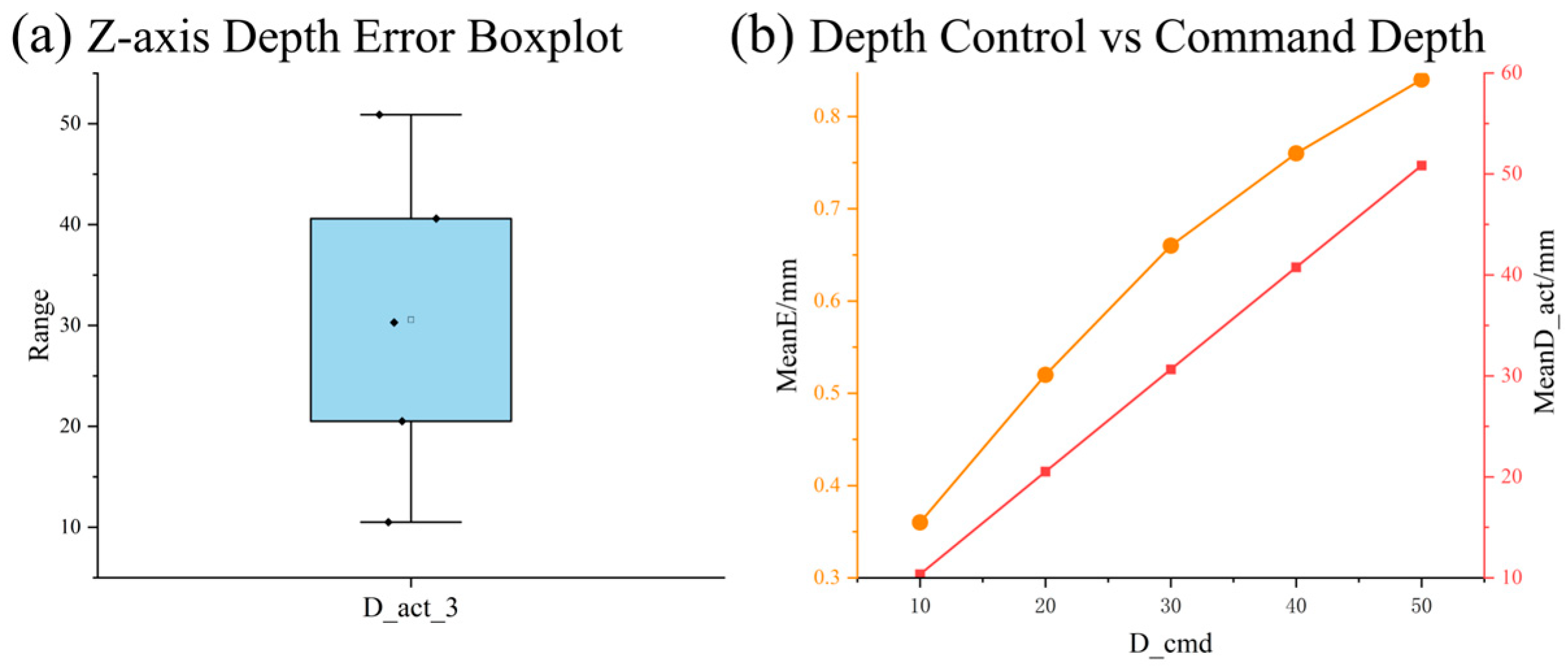
To verify the vertical positioning accuracy of the end-effector during soil-breaking operations, Z-axis penetration depth tests were conducted under indoor soil bin conditions. A single auger bit identical to that used in actual weeding operations was employed. The target soil-breaking depths D cmd were set to 10, 20, 30, 40, and 50 mm, respectively, and the Z-axis was controlled by the host computer to perform the pressing-down motion. After the auger reached the target depth, the motion was halted, and a vernier caliper was used to measure the actual penetration depth D act relative to the soil surface.
The Z-axis depth error is calculated using the following formula:
E   =   D cmd     D act
Each target depth was measured five times, and the average value was calculated. The test results (Figure 11) show that the mean Z-axis depth error was within ±0.8 mm, with a maximum error not exceeding 1 mm. These results indicate that the system maintains high depth control accuracy under varying soil hardness and resistance conditions, satisfying the safety requirements for selective weeding in the shallow-root environment of the cabbage seedling stage.

3.3. Path Planning Performance

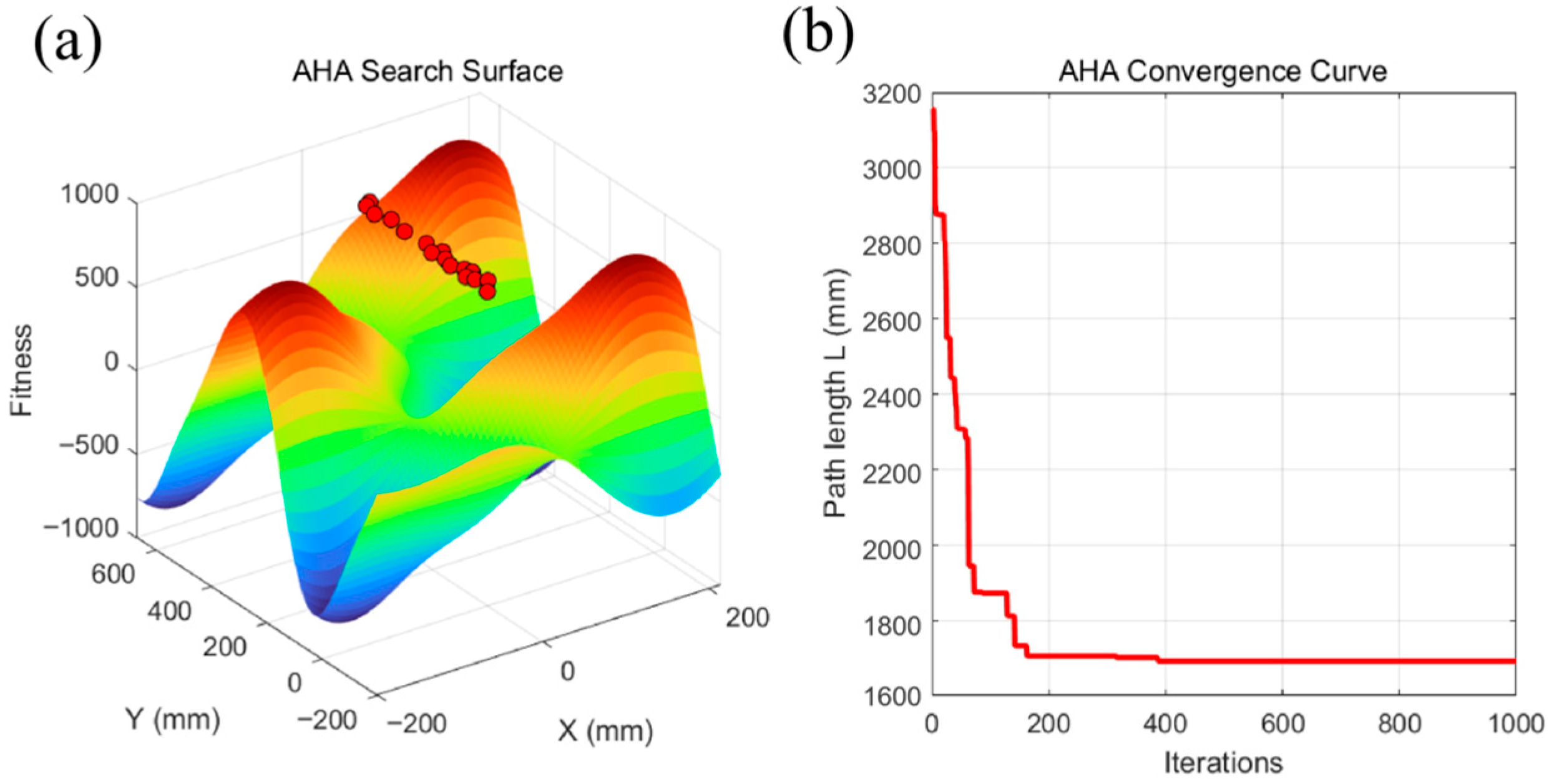
To illustrate the optimization behavior of AHA+, a conceptual three-dimensional search surface was constructed, and the candidate solutions sampled during the iterative process were projected onto this surface (Target Points = 15, Test Number =5, Iterations = 200, Start/End Point = (0, 0), Seed = 3, Population Size = 5). As shown in Figure 12a, during the initial stage, the algorithm exhibited pronounced global exploration behavior, with sampling points widely distributed across multiple peaks and valleys. As the iterations progressed, the sampling points gradually converged toward low-cost regions, indicating a clear tendency toward high-quality solutions.
Figure 12b presents the convergence curve of AHA+. The path length decreased rapidly within the first 100–150 iterations, reflecting strong global search capability. After approximately 200 iterations, the curve entered a plateau phase with mild oscillations, indicating stable convergence and sustained local exploitation. Overall, AHA+ was able to generate shorter and smoother weeding paths within a limited number of iterations while maintaining stable convergence behavior, demonstrating its suitability for real-time path planning in selective weeding operations during the cabbage seedling stage.
Compared to the original AHA algorithm, as well as the SGA and MOSFOA algorithms, the improved version exhibited faster convergence, smoother trajectories, and reduced mean and maximum jump distances while maintaining the computational efficiency required for real-time selective weeding tasks [28,29]. The comparative results are presented in Table 7.

3.4. Integrated Weeding Performance

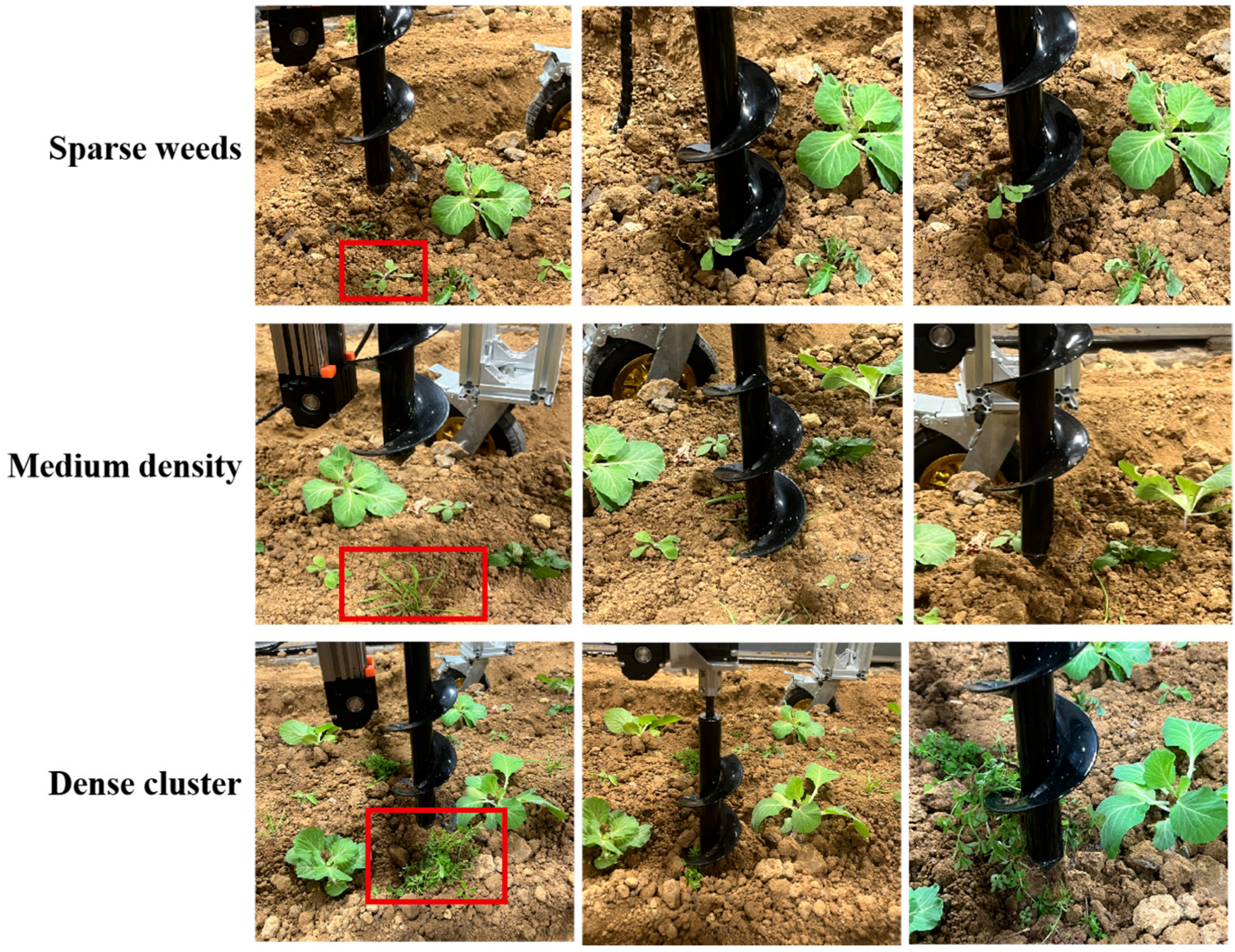
The system performed weed detection, coordinate transformation, path planning, and execution under varying weed densities and distribution conditions. The weeding results are shown in Figure 13. Test outcomes were statistically analyzed using the previously defined evaluation metrics, with each test group containing 6, 14, and 26 weeds, respectively. The corresponding results are summarized in Table 8.
The weeding success rate reached 88.14%, with a missed weeding rate of 11.86%. No cabbage seedlings were inadvertently contacted, resulting in a mistouch rate of 0%. During execution, the three-axis synchronous belt mechanism maintained stable motion, with an average processing time of approximately 6.88 s per weed. These results demonstrate the overall operational capability and procedural consistency of the proposed system for selective weeding at the cabbage seedling stage.

4. Discussion

This study investigates the challenges and solutions for precision weeding in complex agricultural environments, using cabbage as a case example. The system integrates visual detection, 3D coordinate estimation, path planning, and three-axis actuator control for automated, precise weed removal. As shown in Figure 9, the original model struggles to respond to weed targets in complex cabbage seedling environments, particularly under strong lighting variations and cluttered backgrounds, causing perception degradation. To overcome these limitations, ECA and CBAM attention mechanisms were integrated into the YOLO11, enhancing feature focus and improving detection robustness in challenging field conditions.
Previous studies on corn–weed detection have shown that embedding the CBAM module into the backbone network effectively reduces lighting interference, improving detection performance [30]. Liu et al. [31] integrated the ECA module into a MobileViT-based architecture, enhancing the representation of subtle features between weeds and crops and improving recognition accuracy.
As shown in Table 5, YOLO11-WeedNet outperformed all other models in key evaluation metrics, with precision (96.25%), recall (86.49%), F1 score (91.10%) and mAP@0.5 (91.50%). Figure 9 illustrates the model’s performance across varying weed densities. Across sparse, medium, and dense conditions, YOLO11-WeedNet consistently generates the most concentrated responses within weed target areas, demonstrating optimal detection capability. Compared to YOLOv10 and YOLO11, YOLO11-WeedNet produced significantly sharper and more precise heatmaps, characterized by reduced false positive and false negative rates. These improvements are attributable to the integration of advanced attention mechanisms (ECA and CBAM), which enable the model to selectively prioritize relevant weed features while effectively suppressing background noise. While RT-DETR demonstrates superior performance compared to YOLOv10 and YOLO11, it remains prone to higher false positive and negative rates in medium and dense environments, falling short of the accuracy achieved by YOLO11-WeedNet.
In terms of path planning, the enhanced Artificial Hummingbird Algorithm (AHA+) achieved stable convergence with fewer iterations, yielding smoother continuous trajectories and reduced path lengths. These findings corroborate the high convergence efficiency and optimization capabilities of the standard AHA reported by Zhao et al. [23]. Moreover, AHA+ demonstrated a more favorable trade-off between path quality and computational efficiency than traditional baselines such as GA, PSO, SGA, and MOSFOA. [32]. Additionally, potential errors in the vision-to-actuation pipeline, such as calibration issues, lighting variations, and actuator precision, may cause discrepancies in path planning and execution, especially under complex conditions.
In system-level tests, as shown in Table 8, the proposed selective weeding system successfully completed the full operational workflow, from detection and localization to execution, under varying weed density conditions. The overall weeding success rate reached 88.14% with zero observed damage to cabbage seedlings across all tests, indicating a robust balance between operational efficacy and crop safety. However, weeding performance exhibited a gradual decline as weed density increased. In densely distributed weed conditions, occlusion among weeds and between weeds and cabbage leaves became more pronounced, increasing the difficulty of both visual detection and mechanical execution [10,13]. Concurrently, reduced spatial distances between execution points imposed higher demands on path planning and motion control performance [23].
Regarding operational efficiency, the system recorded an average processing time of 6.88 s per weed, with a marginal increase observed as weed density rose. This trend was primarily attributed to increased path complexity and additional time overhead from frequent actuator directional adjustments. Despite this, the system operated stably throughout the tests, with no significant positioning drift or motion instability, demonstrating the reliability of the three-axis synchronous belt structure and control strategy.
It is important to note that this test was conducted primarily in a controlled laboratory soil bin, without fully accounting for factors such as undulating terrain, spatial variations in soil hardness, or abrupt changes in natural light. These limitations may impact the system’s performance in real outdoor environments. Future research will focus on field validation, incorporating advanced environmental sensing technologies and developing adaptive control strategies to enhance the system’s performance in actual farmland conditions. Additionally, future studies will explore whether the system is limited to cabbage or can be adapted to other crops, such as lettuce and kale. Testing across different crops and growth stages will be crucial in assessing its broader applicability.
5. Conclusions

This study presented an integrated vision-actuation system for precision weeding in cabbage trial fields. The proposed system addressed key challenges, such as unstable weed recognition, coordinate mapping errors, and inefficient execution paths, which are common in complex field conditions. Firstly, a detection model tailored to the cabbage seedling stage, named YOLO11-WeedNet, was developed. By incorporating ECA and CBAM attention mechanisms, the model improved its ability to identify small targets in complex field backgrounds. Secondly, a depth-camera-based mapping relationship between image and physical coordinates was established, and a protected-area constraint was introduced to prevent accidental contact with cabbage seedlings and their root systems. To address the multi-point visitation requirement caused by the discrete spatial distribution of weeds, an enhanced Artificial Hummingbird Algorithm (AHA+) was proposed to improve path smoothness and convergence efficiency. Finally, a custom-built three-axis synchronous belt actuator enabled high-precision end-effector positioning and stable soil-breaking and weed-removal operations. The coordinated operation of all modules provided a complete workflow, from visual detection and three-dimensional localization to weeding execution, offering a feasible and efficient technical solution for automated and precise weeding during the cabbage seedling stage in trial fields. However, the tests were primarily conducted in a controlled indoor environment, and further validation is needed in real-field conditions to assess the system’s broader applicability.

Author Contributions

Conceptualization, P.W. and Y.Y.; methodology, P.W. and W.C.; software, W.C.; validation, H.L., Y.Y. and C.L.; formal analysis, P.W.; investigation, W.C.; resources, P.W.; data curation, W.C.; writing—original draft preparation, W.C.; writing—review and editing, W.C. and Q.N.; visualization, P.W.; supervision, H.L.; project administration, P.W.; funding acquisition, H.L. All authors have read and agreed to the published version of the manuscript.

Funding

This work was supported by the National Natural Science Foundation of China (32201651) and the Fundamental Research Funds for Central Universities (SWU-KT22024, SWU-KF25017). The Natural Science Foundation of Chongqing, China, grant numbers cstc2020jcyj-msxmX0459 and cstc2020jcyj-msxmX0414.

Institutional Review Board Statement

Not applicable.

Data Availability Statement

The original contributions presented in the study are included in the article; further inquiries can be directed to the corresponding author.

Acknowledgments

This research was funded by the National Natural Science Foundation of China, grant number 32201651 and 32001425; the Fundamental Research Funds for the Central Universities, grant number SWU-KT22024 and SWU-KF25017, the Natural Science Foundation of Chongqing, China, grant numbers cstc2020jcyj-msxmX0459 and cstc2020jcyj-msxmX0414. The authors would like to appreciate Pengxin Wu, Yuyu Huang, and Jiajia Tan for technical support.

Conflicts of Interest

The authors declare no potential conflicts of interest with respect to the research, authorship, and publication of this article. No financial or personal relationships with other people or organizations have influenced the work reported in this manuscript. All funding sources for this study are disclosed in the acknowledgments, and none of the authors have affiliations or involvement with any entity with a financial or non-financial interest in the subject matter discussed.

References

  1. Yu, J.; Boyd, N.S.; Dittmar, P.J. Evaluation of Herbicide Programs in Florida Cabbage Production. HortScience 2018, 53, 646–650. [Google Scholar] [CrossRef]
  2. Roberts, H.A.; Bond, W.; Hewson, R.T. Weed competition in drilled summer cabbage. Ann. Appl. Biol. 1976, 84, 91–95. [Google Scholar] [CrossRef]
  3. Schellhorn, N.A.; Sork, V.L. The impact of weed diversity on insect population dynamics and crop yield in collards, Brassica oleraceae (Brassicaceae). Oecologia 1997, 111, 233–240. [Google Scholar] [CrossRef] [PubMed]
  4. Uškevičienė, D.; Radzevičius, A.; Karklelienė, R. Effect of Biostimulants on the Productivity and Nutritional Value of White Cabbage (Brassica oleracea L. var. capitata). Horticulturae 2025, 11, 1020. [Google Scholar] [CrossRef]
  5. Haghighi, M.; Barzegar, A.; Mozafarian, M. Impact of cultivar and seasonal growing conditions on growth and health-promoting compounds in Brassica oleracea cultivars: Smooth German kale, Scarlet kale, Dwarf Blue Curled kale, and Collard. J. Agric. Food Res. 2025, 19, 101575. [Google Scholar] [CrossRef]
  6. Tudi, M.; Ruan, H.D.; Wang, L.; Lyu, J.; Sadler, R.; Connell, D.; Phung, D.T. Agriculture development, pesticide application and its impact on the environment. Int. J. Environ. Res. Public Health 2021, 18, 1112. [Google Scholar] [CrossRef] [PubMed]
  7. Heap, I. Global perspective of herbicide-resistant weeds. Pest Manag. Sci. 2014, 70, 1306–1315. [Google Scholar] [CrossRef] [PubMed]
  8. Muminov, M.A. Effects of Different Weed Management Practices on Ecological and Economic Benefits of Warm Temperate Farmland. Doctoral Dissertation, University of Chinese Academy of Sciences, Beijing, China, 2018. [Google Scholar]
  9. Guo, Z.; Cai, D.; Bai, J.; Xu, T.; Yu, F. Intelligent Rice Field Weed Control in Precision Agriculture: From Weed Recognition to Variable Rate Spraying. Agronomy 2024, 14, 1702. [Google Scholar] [CrossRef]
  10. Jin, X.; Zhao, H.; Kong, X.; Han, K.; Lei, J.; Zu, Q.; Chen, Y.; Yu, J. Deep learning-based weed detection for precision herbicide application in turf. Pest Manag. Sci. 2025, 81, 3597–3609. [Google Scholar] [CrossRef] [PubMed]
  11. Dyrmann, M.; Karstoft, H.; Midtiby, H.S. Plant species classification using deep convolutional neural network. Biosyst. Eng. 2016, 151, 72–80. [Google Scholar] [CrossRef]
  12. Bhalke, R.S.; Dandvate, A.A. Weed detection using machine learning. Int. Res. J. Eng. Technol. 2024, 11, 1195–1199. [Google Scholar]
  13. Raja, R.; Su, W.-H.; Slaughter, D.C.; Fennimore, S.A. Real-time precision crop identification in high weed-density environments for robotic weed control using spectral fluorescence imaging in celery. Comput. Electron. Agric. 2025, 231, 110022. [Google Scholar] [CrossRef]
  14. Hu, R.; Niu, L.-T.; Su, W.-H. A novel mechanical-laser collaborative intra-row weeding prototype: Structural design and optimization, weeding knife simulation and laser weeding experiment. Front. Plant Sci. 2024, 15, 1469098. [Google Scholar] [CrossRef] [PubMed]
  15. Redmon, J.; Divvala, S.; Girshick, R.; Farhadi, A. You only look once: Unified, real-time object detection. In Proceedings of the IEEE Conference on Computer Vision and Pattern Recognition (CVPR); IEEE: New York, NY, USA, 2016; pp. 779–788. [Google Scholar] [CrossRef]
  16. Ultralytics. Ultralytics YOLOv5 (v6.2) PyTorch Implementation. GitHub. 2020. Available online: https://github.com/ultralytics/yolov5 (accessed on 12 October 2025).
  17. Wang, C.-Y.; Bochkovskiy, A.; Liao, H.-Y.M. YOLOv7: Trainable bag-of-freebies sets new state-of-the-art for real-time object detectors. In Proceedings of the IEEE/CVF Conference on Computer Vision and Pattern Recognition (CVPR 2023); IEEE: New York, NY, USA, 2023; pp. 7464–7475. [Google Scholar] [CrossRef]
  18. Ultralytics. Ultralytics YOLOv8 (v8.0) PyTorch Implementation. GitHub. 2023. Available online: https://github.com/ultralytics/yolov8 (accessed on 12 October 2025).
  19. Khanam, R.; Hussain, M. YOLO11: An overview of the key architectural enhancements. arXiv 2024, arXiv:2410.17725. [Google Scholar] [CrossRef]
  20. Wang, Q.; Wu, B.; Zhu, P.; Li, P.; Zuo, W.; Hu, Q. ECA-Net: Efficient channel attention for deep convolutional neural networks. In Proceedings of the IEEE/CVF Conference on Computer Vision and Pattern Recognition; IEEE: New York, NY, USA, 2020; pp. 11534–11542. [Google Scholar]
  21. Woo, S.; Park, J.; Lee, J.Y.; Kweon, I.S. Cbam: Convolutional block attention module. In Proceedings of the European Conference on Computer Vision (ECCV); Springer: Berlin/Heidelberg, Germany, 2018; pp. 3–19. [Google Scholar] [CrossRef]
  22. Rosenkrantz, D.J.; Stearns, R.E.; Lewis, P.M. An analysis of several heuristics for the traveling salesman problem. In Fundamental Problems in Computing: Essays in Honor of Professor Daniel J. Rosenkrantz; Ravi, S.S., Shukla, S.K., Eds.; Springer: Dordrecht, The Netherlands, 2009; pp. 45–69. [Google Scholar] [CrossRef]
  23. Zhao, W.; Wang, L.; Mirjalili, S. Artificial hummingbird algorithm: A new bio-inspired optimizer with its engineering applications. Comput. Methods Appl. Mech. Eng. 2022, 388, 114194. [Google Scholar] [CrossRef]
  24. Dorigo, M.; Gambardella, L.M. Ant colony system: A cooperative learning approach to the traveling salesman problem. IEEE Trans. Evol. Comput. 1997, 1, 53–66. [Google Scholar] [CrossRef]
  25. Golberg, D.E. Genetic Algorithms in Search, Optimization, and Machine Learning; Addion Wesley: Carrollton, TX, USA, 1989; p. 36. [Google Scholar]
  26. Kennedy, J.; Eberhart, R. Particle swarm optimization. In Proceedings of ICNN’95-International Conference on Neural Networks; IEEE: New York, NY, USA, 1995; Volume 4, pp. 1942–1948. [Google Scholar]
  27. Sinnett, D. Soil penetration resistance and tree root development. Soil Use Manag. 2008, 24, 273–280. [Google Scholar] [CrossRef]
  28. Dasgupta, D.; McGregor, D.R. SGA: A Structured Genetic Algorithm; Department of Computer Science, University of Strathclyde: Glasgow, UK, 1993. [Google Scholar]
  29. Keser, M.; Joardar, K.; Motorola, M. Genetic algorithm based MOSFET model parameter extraction. In Technical Proceedings of the International Conference on Modeling and Simulation of Microsystems, San Diego, CA, USA, 27–29 March 2000; TechConnect: Austin, TX, USA, 2000; pp. 341–344. [Google Scholar]
  30. Zhao, J.; An, M.; Zhao, X.; Wang, Y.; Ma, Z.; Li, Y.; Wang, B.; Hao, J. A corn weed detection method based on WEED-YOLOv10 and design of targeted spraying system. Trans. Chin. Soc. Agric. Eng. 2025, 43, 1–11. [Google Scholar]
  31. Liu, X.; Sui, Q.; Chen, Z. Real time weed identification with enhanced mobilevit model for mobile devices. Sci. Rep. 2025, 15, 27323. [Google Scholar] [CrossRef] [PubMed]
  32. Du, J.; Zhang, J.; Li, S.; Yang, Z. Enhanced artificial hummingbird algorithm with chaotic traversal flight. Sci. Rep. 2024, 14, 25892. [Google Scholar] [CrossRef] [PubMed]
Figure 1. Research Methodology Overview.
Agriculture 16 00384 g001
Figure 2. Weed image samples in the dataset.
Agriculture 16 00384 g002
Figure 3. Data Augmentation Illustration.
Agriculture 16 00384 g003
Figure 4. Weed Control System Schematic Diagram.
Agriculture 16 00384 g004
Figure 5. Network Architecture Diagram of YOLO11-WeedNet.
Agriculture 16 00384 g005
Figure 6. Visualization of the weeding workspace and coordinate mapping between the detection image and operation plane.
Agriculture 16 00384 g006
Figure 7. Coordinate Transformation Diagram.
Agriculture 16 00384 g007
Figure 8. Soil Trench Test Platform Environment.
Agriculture 16 00384 g008
Figure 9. Visual Comparison of Different Models.
Agriculture 16 00384 g009
Figure 10. Confusion matrices: (a) for YOLO11-WeedNet, (b) for YOLO11, (c) for RT-DETR, (d) for YOLOv10.
Agriculture 16 00384 g010
Figure 11. Z-Axis Depth Error Histogram.
Agriculture 16 00384 g011
Figure 12. Visualization of the AHA+ search behavior and convergence process. (a) Three-dimensional search surface depicting the distribution of candidate solutions explored during the optimization process. The red spheres represent the location of the weeds. Different colors represent the cost function values, with a color gradient from blue to red indicating a transition from lower to higher cost function values. (b) Convergence curve of the path length, showing a rapid decrease in the early iterations, which stabilizes after approximately 200 iterations.
Agriculture 16 00384 g012
Figure 13. Weed control results diagram.
Agriculture 16 00384 g013
Table 1. Dataset Summary Table.
DatasetDataset TypeNo. ImagesNo. WeedsNo. Cabbages
SWU_CW DatasetTrain669619394
Val191151113
Test968656
Total956856563
After AugmentationTrain21361615808
Val191151113
Test968656
Total24231852977
Table 2. Results of Performance Comparison of Different Models (IoU (Intersection over Union) is the ratio of the overlapping area between the predicted and actual bounding boxes to their combined area, used to measure the accuracy of the detection box. @0.5 indicates that the IoU range is 0.5 or higher).
ModelsPrecisionRecallF1 ScoremAP@0.5mAP@0.5:0.95Parameters/106
YOLOv581.0%77.0%79.0%79.2%48.945.90
YOLOv782.48%79.20%80.83%80.57%49.1819.19
YOLOv889.90%79.31%84.27%84.70%73.352.69
YOLO1191.79%83.35%87.36%86.64%73.712.59
Table 3. Comparison of Different Algorithms.
AlgorithmsL (mm)T (ms)Mean Jump (mm)Max Jump (mm)
NN2253.010.60160.93262.99
AHA1834.2493.95123.09155.31
ACO1893.491505.58135.25173.58
GA1905.37152.56137174.31
PSO2033.06149.56145.22196.00
Table 4. YOLO11-WeedNet ablation experiments.
ModelsCBAMECAPrecisionRecallF1 ScoremAP@0.5mAP@0.5:0.95Parameters/106
YOLO11 91.79%83.35%87.36%86.64%73.71%2.59
YOLO11-CBAM 92.99%81.83%85.72%89.83%76.46%2.97
YOLO11-ECA 90.19%81.87%85.28%88.07%72.24%2.62
YOLO11-WeedNet96.25%86.49%91.10%91.50%76.38%2.70
Table 5. Performance Comparison.
ModelsPrecisionRecallF1 ScoremAP@0.5mAP@0.5:0.95Parameters/M
YOLOv1091.78%84.10%87.65%86.75%40.152.71
YOLO1191.79%83.35%87.36%86.64%73.712.59
RT-DETR90.61%79.34%84.83%80.90%50.9332.81
YOLO11-WeedNet96.25%86.49%91.10%91.50%76.382.70
Table 6. Positioning accuracy of the X/Y plane based on coordinate-paper measurements (All actual arrival coordinates ( X i , Y i ) were recorded only after the actuator reached the target command point and the motion had fully stabilized).
Point IDCommanded Position (mm)Measured Position (mm)X Error (mm)Y Error (mm)Euclidean Error (mm)
P1(400, 200)(400.00, 195.97)04.034.03
P2(120, 250)(117.02, 257.07)2.987.077.67
P3(260, 500)(255.96, 502.97)4.042.975.01
P4(50, 350)(47.20, 356.02)2.806.026.64
P5(300, 300)(299.95, 308.00)0.058.008.00
P6(200, 400)(200.00, 398.98)01.021.02
P7(250, 250)(249.02, 252.03)0.982.032.25
P8(20, 450)(20.02, 448.06)0.021.941.94
P9(100, 70)(100.00, 71.03)01.031.03
P10(400, 550)(399.95, 552.98)0.052.982.98
Mean--1.103.714.26
Max--4.048.008
Table 7. Comparison of Different Algorithms.
AlgorithmsL (mm)T (ms)Mean Jump (mm)Max Jump (mm)
SGA2439.904.28174.28364.97
MOSFOA1852.0873.77143.77173.53
AHA1834.2493.95123.09155.31
AHA+1746.3523.49116.42141.42
Table 8. Summary of performance metrics under different weed distribution conditions.
Test GroupRemoval Rate (%)Miss Rate (%)False Hit Rate (%)Processing Time (s/Weed)
Sparse weeds100006.12
Medium density87.5012.5006.98
Dense cluster76.9223.0807.53
Average88.1411.8606.88
Disclaimer/Publisher’s Note: The statements, opinions and data contained in all publications are solely those of the individual author(s) and contributor(s) and not of MDPI and/or the editor(s). MDPI and/or the editor(s) disclaim responsibility for any injury to people or property resulting from any ideas, methods, instructions or products referred to in the content.