


Abstract
Soil salinization and alkalization are major forms of land degradation, and soil amendments are commonly used to improve the quality of saline–alkali soils. This study aimed to quantify the effects of different amendments on soil physicochemical properties in saline–alkali soils in China, compare single and mixed applications, and identify environmental and management factors associated with variations in their effects. A systematic literature search and screening process identified 223 eligible datasets from studies conducted in China. Data from amended treatments and corresponding unamended controls were synthesized using meta-analysis. The amendments included organic and inorganic materials, such as humic acid, phosphogypsum, and desulfurization gypsum, applied individually or in mixtures. Compared with unamended controls, amendment application significantly decreased soil pH, salt content (SC), exchangeable sodium percentage (ESP), sodium adsorption ratio (SAR), and bulk density (BD) by 2.8%, 12.4%, 27.2%, 44.4%, and 6.6%, respectively; soil nutrient levels increased significantly: available nitrogen (AN), available phosphorus (AP), available potassium (AK), and soil organic carbon (SOC) increased by 33.9%, 42.3%, 20.7%, and 20.5%, respectively. Mixed applications showed greater improvements in six of the nine evaluated soil properties, whereas single applications produced greater increases in available nitrogen and greater reductions in salt content and SAR. Among amendments applied individually, organic amendments generally showed larger increases in soil nutrient availability and organic carbon, whereas inorganic amendments generally showed larger reductions in ESP and SAR. Additionally, random forest analysis identified precipitation as the most important predictor of salt-content responses under single applications and application amount under mixed applications. Application amount was also the most important predictor of soil organic carbon responses under both application strategies. Overall, farmyard manure is a promising option for increasing nutrient availability and SOC and reducing BD, whereas inorganic–organic treatments merit consideration where excessive exchangeable sodium coincides with poor soil fertility. Amendment selection should therefore be based on specific soil conditions and local environmental characteristics.
1. Introduction
Soil salinization is a widespread form of land degradation, occurring predominantly in arid, semi-arid, and coastal regions [1]. Previous estimates indicate that saline–alkali land covers more than 1 × 10⁹ ha globally and expands at approximately 2 × 10⁶ ha annually [2,3]. China is among the countries severely affected by soil salinization, with an estimated 3.69 × 10⁷ ha of salinized land, mainly concentrated in the northwest, northeast, and coastal regions [4].
Soil salinization arises from both natural processes and human activities. Natural salt sources include the weathering of parent rocks and salts inherited from marine sediments, while water movement and evaporation influence their redistribution and accumulation [5,6]. Land-use changes and inappropriate water management can further exacerbate salinization. For example, severe soil salinity and sodicity have been documented in coastal areas converted from rice cultivation to shrimp farming, while inadequate drainage and excessive irrigation can promote secondary salinization [7]. In coastal agricultural areas, saltwater intrusion provides an additional salt source and can alter soil chemical properties and nutrient dynamics. The resulting salt accumulation can impair plant water and nutrient uptake, inhibit crop growth, and reduce yields [8]. These diverse pathways of salt accumulation highlight the need for reclamation strategies suited to local soil and environmental conditions. Improving salt-affected agricultural land and appropriately reclaiming suitable saline–alkali lands are therefore important for sustaining agricultural productivity and alleviating pressure on arable land resources [9,10,11].
Numerous practical strategies have been developed for the amelioration of salt-affected soils, including engineering and water-management measures, chemical amelioration, physical amelioration, and biological amelioration [12]. Among these measures, chemical amelioration plays an important role because of its well-established application techniques and the substantial body of relevant research [13]. Soil amendments vary widely and can be classified according to different criteria. Based on their composition, they are generally divided into inorganic and organic amendments. Inorganic amendments should be selected according to the dominant soil constraint. Calcium-based amendments, such as gypsum and phosphogypsum, supply Ca2+ that can replace exchangeable Na+ in sodic and saline–sodic soils. The displaced Na+ must subsequently be removed from the root zone through adequate leaching and drainage [14,15,16]. In saline soils without excessive exchangeable Na+, reclamation primarily depends on soluble salt removal, and calcium addition is not necessarily required. Gypsum therefore serves primarily as a calcium source for alleviating sodicity rather than as a general acidifying agent. Acidifying amendments, such as aluminum sulfate, may help alleviate excessive alkalinity, but their suitability depends on soil carbonate content, buffering capacity, and application amount [17]. Organic amendments, including organic fertilizers, biochar, and humic acid, can improve soil physicochemical properties by increasing soil organic matter content, promoting aggregation, and enhancing nutrient retention [18]. Humic matter and some biochars contain oxygen-containing functional groups, such as carboxyl and phenolic hydroxyl groups, attached to their carbon frameworks. Upon deprotonation, these groups provide negatively charged sites that can participate in cation adsorption and exchange, thereby influencing nutrient retention and availability [19,20]. Organic amendments can also improve soil permeability and aeration and, depending on their composition, supply nutrients and substrates that support microbial activity and nutrient cycling [21,22]. Combining inorganic and organic amendments may provide complementary benefits by addressing sodicity or excessive alkalinity while improving soil structure and organic matter status. Appropriately selected amendments may also offer practical benefits, including the beneficial reuse of organic or industrial by-products [23]. However, their effectiveness, costs, and potential environmental risks depend on material properties, application amounts, and site conditions.
The different functions of soil amendments suggest that their effectiveness may vary among soil properties. An amendment that reduces sodicity may not produce comparable improvements in nutrient availability or soil organic carbon, while a material that improves soil fertility may not necessarily reduce salt content [24]. Although mixed applications may combine complementary functions, whether they provide greater benefits than single applications across different soil properties requires quantitative evaluation. Moreover, treatment responses may vary with climatic conditions, initial soil properties, application amount, and application duration. These uncertainties highlight the need for a comparative synthesis of field evidence to evaluate amendment types and application strategies across multiple soil indicators and identify the environmental and management factors associated with variation in their effects.
Meta-analysis provides a quantitative framework for synthesizing treatment effects and assessing variation among studies [25]. Previous meta-analyses have quantified the effects of specific amendments on the physicochemical properties of saline–alkali soils. For example, Zhang et al. [26] evaluated the effects of biochar on soil health and crop yield under different climatic and management conditions, whereas Wang et al. [27] quantified the effects of flue gas desulfurization gypsum on multiple functions of saline–sodic soils across China. Previous meta-analyses have mainly focused on individual amendment types. Comparative assessments of different organic and inorganic amendment categories and their mixtures across multiple soil properties remain limited, particularly in terms of differences between single and mixed applications. To provide a more comprehensive assessment, we synthesized evidence from field trials in China to compare the effects of different amendments on soil physicochemical properties and identify the key environmental and management predictors of soil responses under single and mixed applications.
Accordingly, we used meta-analysis to (1) quantify the effects of different soil amendments on soil physicochemical properties; (2) evaluate differences in these effects across amendment categories and between single and mixed applications; and (3) identify the key environmental and management predictors of soil pH, SC, SOC, and BD responses under each application strategy.
2. Materials and Methods
The procedures of this systematic review were conducted in accordance with the Preferred Reporting Items for Systematic Reviews and Meta-Analyses (PRISMA 2020) guidelines, including the recommended methodological procedures and checklist. The completed PRISMA checklist is provided in the Supplementary Materials (PRISMA Checklist). A review protocol was developed prior to the literature search; however, given the agricultural focus of this meta-analysis, the protocol was not prospectively registered, and therefore no corresponding registration information is available.
2.1. Data Collection
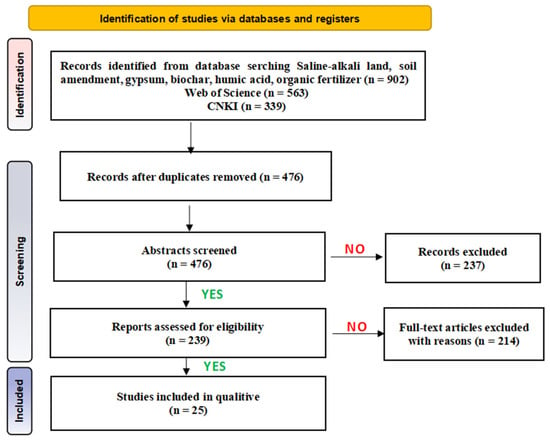
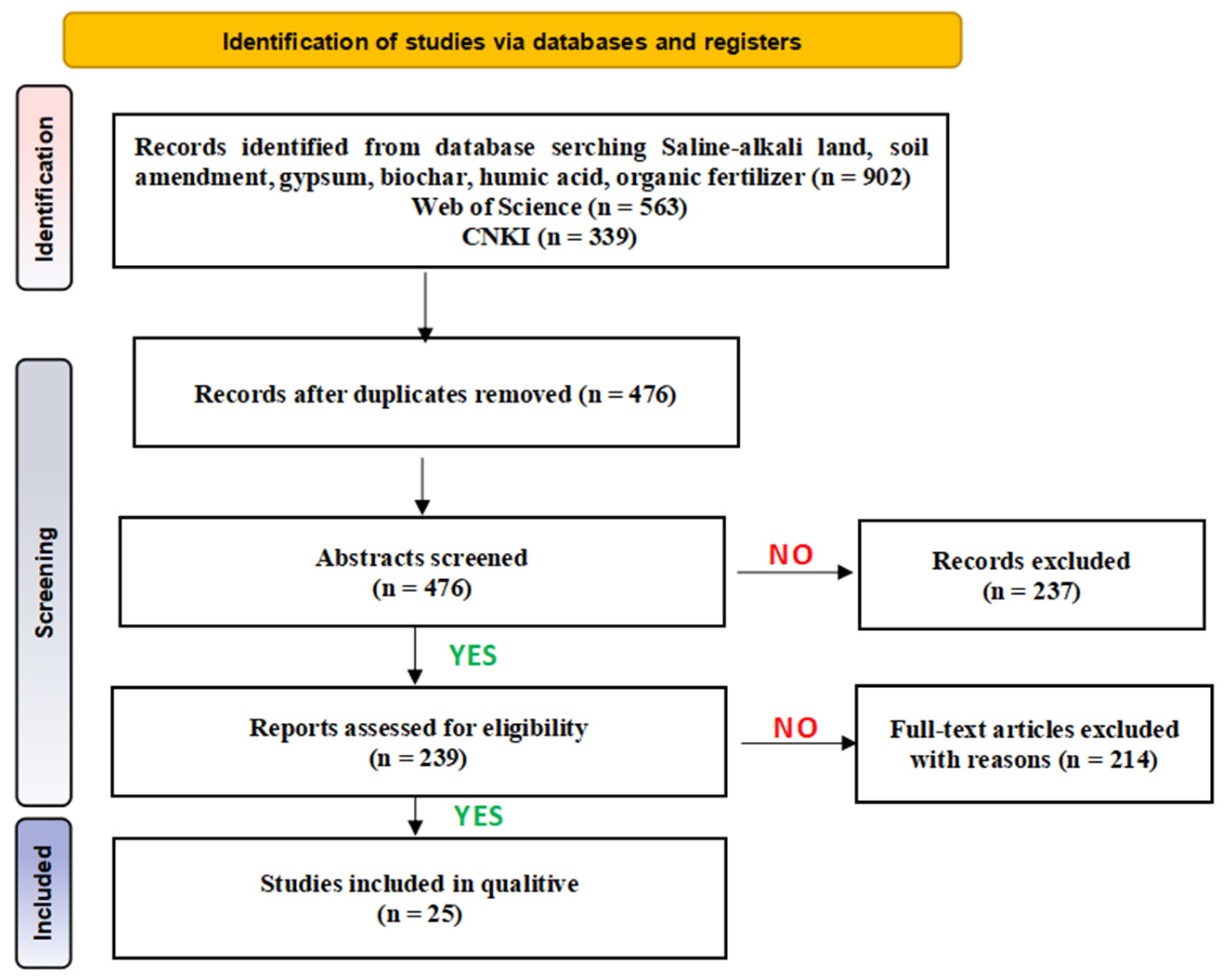
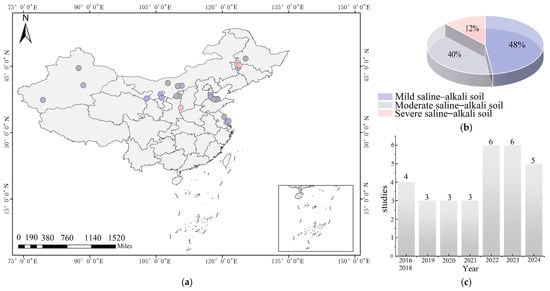
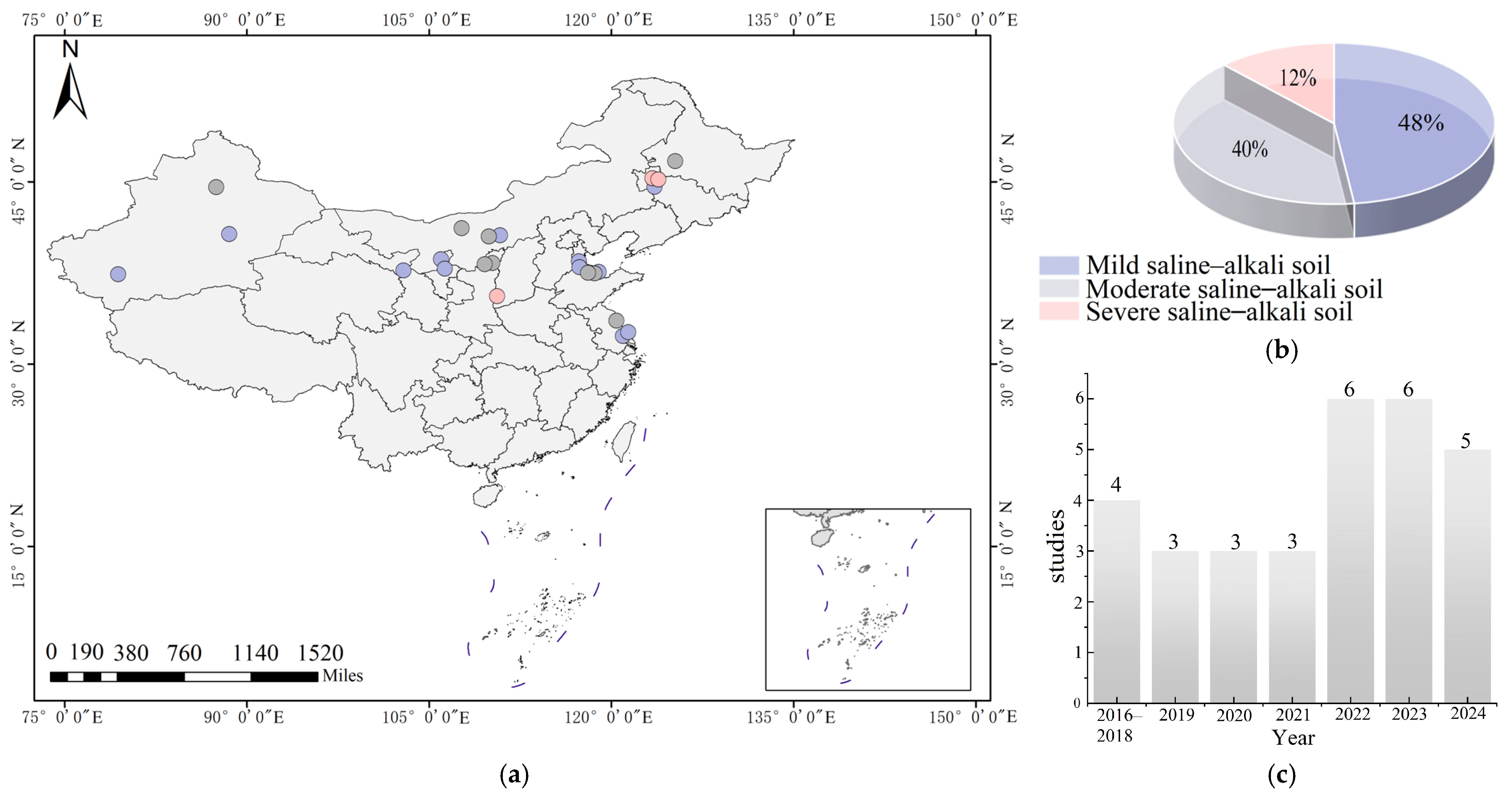
We searched databases from China National Knowledge Infrastructure (CNKI, https://www.cnki.net/ (accessed on 10 September 2025) and the Web of Science (WOS, https://www.webofscience.com/ (accessed on 10 September 2025)). Search terms included “saline–alkali land,” “amendment,” “gypsum,” “biochar,” “humic acid,” “fly ash,” “organic fertilizer,” and “aluminum sulfate” (e.g., Ti = saline–alkali land AND AB = (“amendment” OR ‘gypsum’ OR “aluminum sulfate” OR “ferrous sulfate” OR “Calcium sulfite” OR “biochar” OR “Humic acid” OR “fly ash” OR “Organic fertilizer” OR “Aluminum sulfate”), yielding a preliminary total of 902 relevant publications. The geographical scope was restricted to China to inform amendment selection and application in Chinese agricultural systems through a focused synthesis of field evidence within this context. To avoid bias, the following criteria were applied to further select the papers: (1) The experimental sites must be located within China. (2) Crops must have been grown in natural saline–alkali soil and subjected to at least one year of field trials; pot experiments and salt stress experiments were excluded. (3) Saline–alkali land without any amendment applied served as the blank control; the treatment and control groups were located at the same experimental site and received identical management practices. (4) The number of replicates was clearly specified. (5) Data on soil salinity and alkalinity levels, as well as various physicochemical properties, both before and after amendment, were included in the experimental measurements. (6) From the selected studies, the mean values, sample sizes, and standard deviations (SDs) or standard errors (SEs) for both the treatment and control groups can be extracted. Based on the above criteria, a total of 25 valid articles ultimately met the standards; at least three authors independently conducted the literature search, study screening, data extraction, and quality assessment. A complete flowchart of the screening process is shown in Figure 1. The study locations, initial soil salinization levels, and years of implementation are shown in Figure 2a–c.
Figure 1.
PRISMA (Preferred Reporting Items for Systematic and Meta-Analyses) flow diagram for this meta-analysis.
Figure 2.
Study locations (a), initial soil salinization levels (b), and years of implementation of the studies (c) included in the meta-analysis.
2.2. Data Processing and Analysis
The raw data were sourced from figures, tables, text, and appendices in 25 publications; the figure data were extracted using GetData Graph Digitizer (version 2.26) (http://www.getdata-graph-digitizer.com/, accessed on 31 October 2026). The background data extracted for this study include the longitude and latitude of experimental sites in the study area, the multi-year mean annual temperature (MAT), multi-year mean annual precipitation (MAP), multi-year mean annual evaporation (MAE), initial soil pH, and soil amendment properties (composition and type), as well as application amount, application duration, and crop types. The degree of soil salinization was classified into three levels: mild, moderate, and severe [26]: mild saline–alkali soil (salinity ≤ 2 g·kg−1, soil pH ≤ 8.5), moderate saline–alkali soil (salinity 2–3 g·kg−1, soil pH 8.5–9.0), and severe saline–alkali soils (salinity ≥ 3 g·kg−1, soil pH ≥ 9.0).
Based on the original literature data, soil amendments are classified by composition into organic amendments, inorganic amendments, and mixed amendments. Mixed amendments refer to the mixed application of two or more types of amendments. Among these, mixed amendments are further categorized into organic–organic application, organic–inorganic application, and inorganic–inorganic application; inorganic amendments include calcium-based amendments, aluminum-based amendments, and mineral waste residues; organic amendments include farmyard manure, humic acids, organic industrial byproducts, crop residues, biochar, and biofertilizers. The detailed classification is presented in Table 1.
Table 1.
Specific categories of amendments included in the meta-analysis.
In addition, other soil physicochemical properties were extracted from the literature for analysis, such as pH, salt content (SC), exchangeable sodium percentage (ESP), bulk density, available phosphorus, available potassium, available nitrogen, soil organic carbon, and soil organic matter. If the data in the literature were reported as soil organic carbon, they were converted to soil organic matter content using the formula: organic matter (g/kg) = soil organic carbon (g/kg) × 1.724 (van Bemmelen coefficient) [28].
The summary statistics extracted for the analysis of amendment effects included treatment and control means, sample sizes, and standard deviations (SDs) or standard errors (SEs). When SEs were reported, they were converted to SDs using Equation (1):
where n is the number of independent experimental replicates.
The log response ratio (lnRR) was calculated using the escalc function in the metafor package 4.8.0 in R 4.5.2:
The sampling variance was calculated as
where Xt,i and Xc are the treatment and control means for comparison i, respectively; and are the corresponding standard deviations; and nt,i and nc,i are the numbers of independent experimental replicates. Equation (3) assumes independent treatment and control group means within each comparison.
An lnRR of zero indicates equal treatment and control means. Positive and negative values indicate higher and lower values in amended treatments, respectively. Whether these changes represent soil improvement depends on the indicator and initial soil conditions. The unit of analysis was a treatment–control comparison for a specified soil indicator. Different amendment amounts or treatments from the same experiment were retained as separate comparisons but were not regarded as independent studies. Multilevel random-effects models were fitted using the rma.mv function in the metafor package 4.8.0, with restricted maximum likelihood (REML) estimation in R 4.5.2. Random intercepts were included at the publication and effect-size levels to represent clustering within publications and variation among effect sizes.
Pooled lnRR estimates were converted to percentage changes using the following:
where is the pooled lnRR estimate. The lower and upper limits of its 95% confidence interval were transformed using the same equation. Heterogeneity was evaluated using the estimated variance components and the test of residual heterogeneity from the multilevel models [29]. Differences among amendment categories were examined by including amendment category as a categorical moderator. Category-specific effects and their 95% confidence intervals were estimated, and differences among categories were evaluated using moderator tests or model contrasts. Application strategy was additionally included as a categorical moderator to test differences between single and mixed applications. The “orchaRd” package 2.0 in R 4.5.2 (Orchard Plot Visualization for Meta-Analysis) is a commonly used visualization method in meta-analysis that can comprehensively display effect sizes, confidence intervals, prediction intervals, and raw data points in the form of an orchard plot [30]. In this study, the orchaRd package 2.0 was used to plot orchard plots to evaluate the effects of different soil conditioners on soil quality under both single-application and mixed-application conditions.
Random forest regression was used to explore environmental and management variables associated with variation in soil responses to amendment application [31]. Eight models were fitted for soil pH, salt content, soil organic carbon, and bulk density under single and mixed applications. The lnRR of each soil indicator was used as the response variable. Seven predictors were included: mean annual evaporation, mean annual temperature, mean annual precipitation, application duration, initial soil pH, application amount, and crop type. Crop type was treated as a categorical variable, and all seven predictors were retained without additional variable selection. Observations with missing values in the response or predictors were excluded from the corresponding model.
2.3. Publication Bias Assessment
Potential small-study effects were assessed separately for the nine soil quality indicators using contour-enhanced funnel plots and Egger-type multilevel regression [32,33]. Funnel plots displayed log response ratios (lnRR) against their sampling standard errors, with significance contours relative to the null effect (lnRR = 0). Egger-type tests examined the association between effect sizes and standard errors, accounting for within-publication dependence through multilevel models and publication-level cluster-robust inference (Supplementary File (funnel plots and Egger test)). All analyses included all valid effect sizes. The tests yielded p-values greater than 0.05 for all nine indicators, indicating that no statistically significant associations between lnRR and sampling standard error were detected and providing no clear evidence of small-study effects.
3. Results
3.1. Effects of Soil Amendments on Saline–Alkali Lands Under Different Application Methods
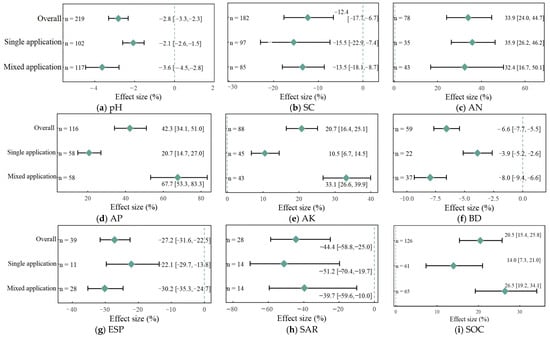
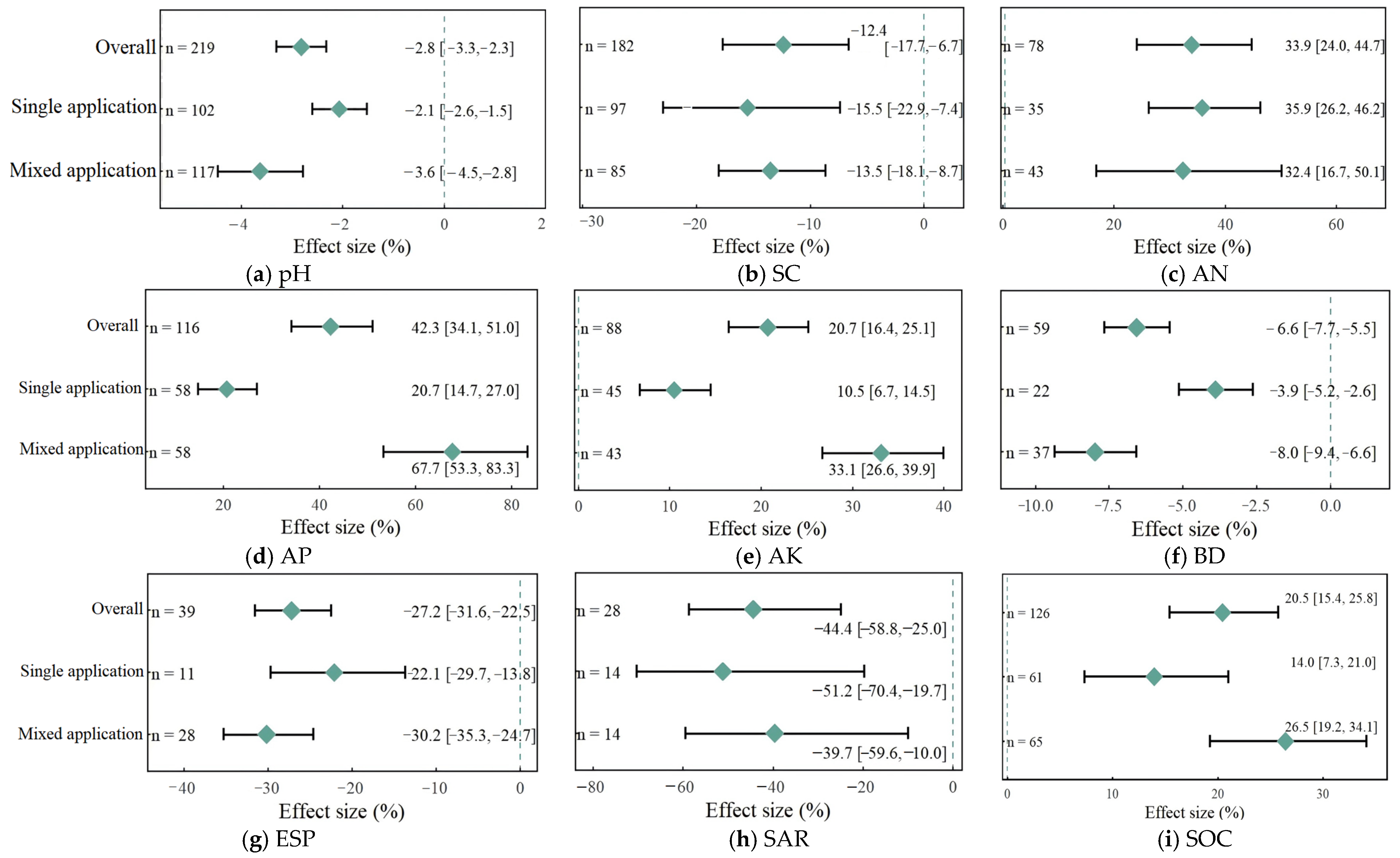
Figure 3a–i present the effects of applying one amendment material individually or two or more amendment materials together, relative to the corresponding unamended controls. Single applications included organic or inorganic amendments, whereas mixed applications included organic–organic, inorganic–organic, and inorganic–inorganic treatments, as detailed in Table 1. Compared with unamended controls, single applications increased AN, AP, AK, and SOC by 35.9%, 20.7%, 10.5%, and 14.0%, respectively, whereas the corresponding increases under mixed applications were 32.4%, 67.7%, 33.1%, and 26.5%. Single applications decreased pH, SC, BD, ESP, and SAR by 2.1%, 15.5%, 3.9%, 22.1%, and 51.2%, respectively; the corresponding decreases under mixed applications were 3.6%, 13.5%, 8.0%, 30.2%, and 39.7%. Based on the pooled point estimates, mixed applications showed larger changes in the desired direction for six of the nine indicators. Single applications showed a larger increase in AN and larger reductions in SC and SAR, with differences of 3.5, 2.0, and 11.5 percentage points, respectively.
Figure 3.
Effects of single and mixed amendment applications on soil physicochemical properties (a–i). n represents the sample number, and error bars indicate 95% confidence intervals. SC, soil salt content; AN, available nitrogen; AP, available phosphorus; AK, available potassium; BD, soil bulk density; ESP, exchangeable sodium percentage; SAR, sodium adsorption ratio; SOC, soil organic carbon.
3.2. Effects of Different Types of Soil Amendments on Soil Quality Indicators
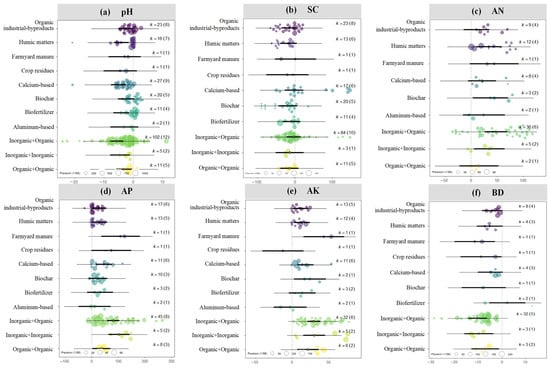
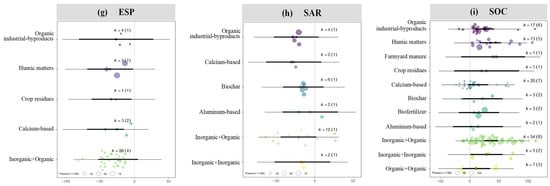
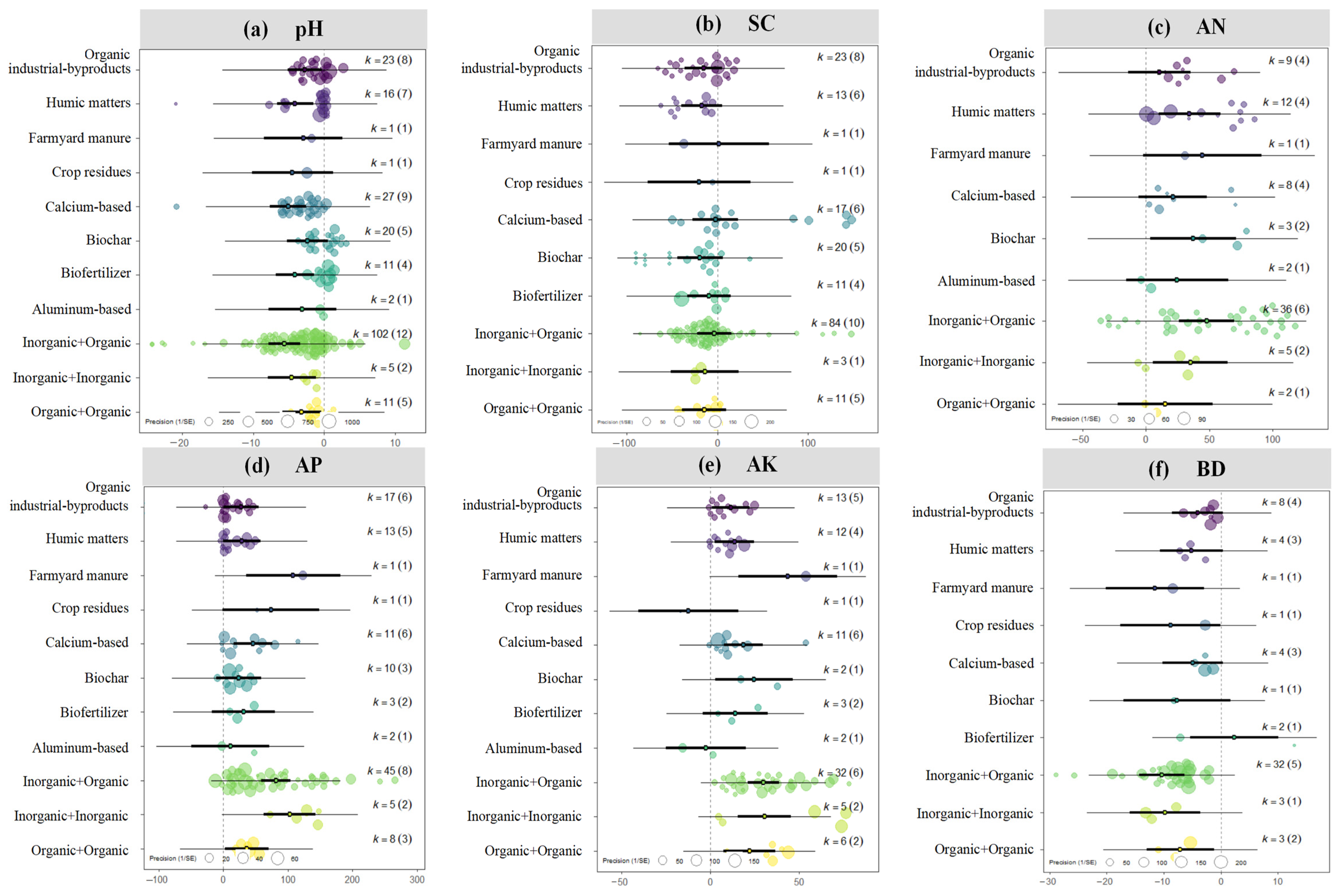
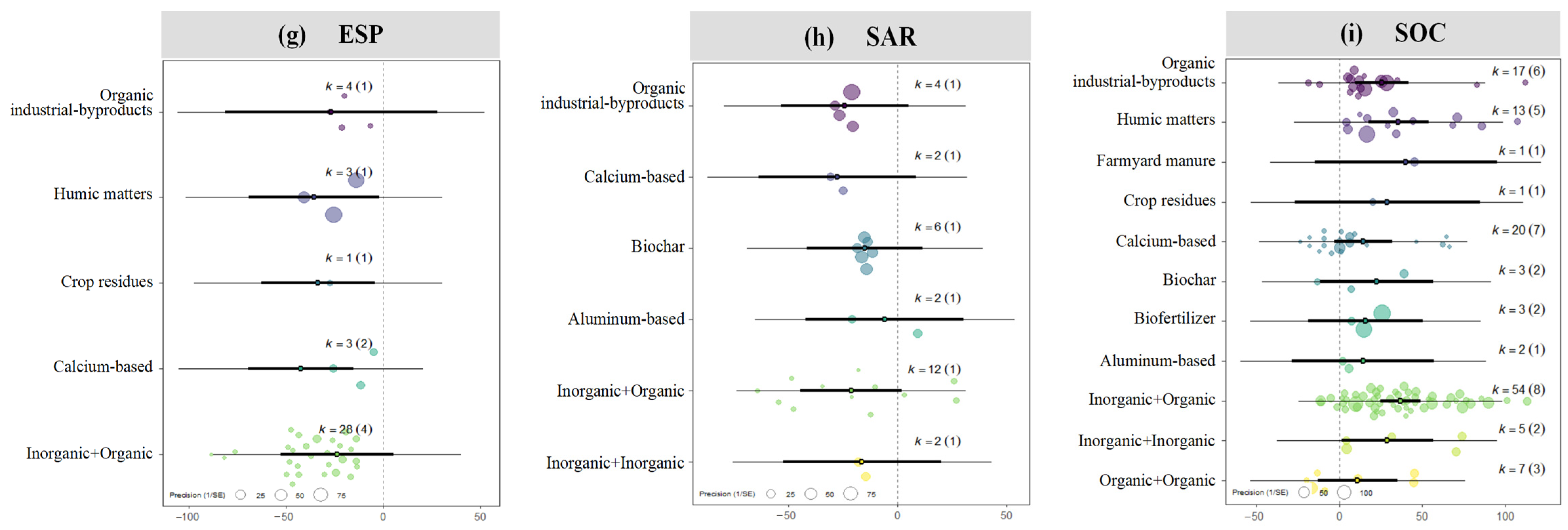
Figure 4a–i present the effects of different amendment categories on soil properties under single and mixed applications. Mixed applications comprised several material treatments within each category. Organic–organic treatment included organic fertilizer with biochar or biofertilizers, and biochar with humic matter. Inorganic–organic treatment included gypsum-based amendments with organic fertilizers, furfural residue, humic matter, or crop residues, as well as iron tailings with humic acid. Inorganic–inorganic treatment included phosphogypsum with calcium superphosphate and calcium-based materials with aluminum-based amendments. The complete list of treatments is provided in Table 1. The effects reported below represent pooled estimates for these categories rather than effects of individual formulations.
Figure 4.
Effects of different amendments on soil physicochemical properties (a–i). n represents the sample number, and error bars indicate 95% confidence intervals. SC, soil salt content; AN, available nitrogen; AP, available phosphorus; AK, available potassium; BD, soil bulk density; ESP, exchangeable sodium percentage; SAR, sodium adsorption ratio; SOC, soil organic carbon.
Across all treatments, the values of soil salinity indicators decreased, whereas soil nutrient levels generally increased. All amendment types also reduced soil pH. Among the mixed applications, the organic–inorganic treatment produced the largest reduction in soil pH (5.60%). The inorganic–inorganic and organic–organic treatments reduced soil pH by 4.55% and 3.15%, respectively. Under the single application, the reductions in soil pH followed this order: calcium-based amendments (5.08%), crop residues (4.44%), biofertilizers (4.13%), biochar (4.13%), humic matter (4.10%), aluminum-based amendments (3.07%), farmyard manure (2.95%), and organic industrial by-products (2.75%). Under a single application, crop residues and biochar produced the largest reductions in soil salt content, by 20.35% and 19.17%, respectively. Their effects were similar. Humic matter and organic industrial by-products reduced soil salt content by 17.38% and 15.46%, respectively. By contrast, mixed applications were generally less effective. Soil salt content decreased by 14.59% under the organic–organic treatment, 13.84% under the inorganic–inorganic treatment, and 3.34% under the organic–inorganic treatment. However, the organic–inorganic treatment produced the largest reduction in ESP, at 42.48%. Calcium-based amendments produced the largest reduction in SAR, at 27.48%. Soil nutrient status was evaluated using four indicators: AN, AP, AK, and SOC. Among the mixed applications, the organic–organic treatment increased AN, AP, and AK by 15.39%, 36.11%, and 21.94%, respectively. The corresponding increases under the inorganic–inorganic treatment were 35.23%, 102.90%, and 30.40%. Under the organic–inorganic treatment, AN, AP, and AK increased by 47.95%, 81.40%, and 29.83%, respectively. Thus, the organic–inorganic treatment produced the largest increase in AN (47.95%), whereas the inorganic–inorganic treatment produced the largest increase in AP (102.90%). Under a single application, aluminum-based amendments increased AN and AP by 24.81% and 10.96%, respectively, but reduced AK by 2.69%. Biofertilizers increased AN, AP, and AK by 37.19%, 31.24%, and 14.04%, respectively. Calcium-based amendments increased these indicators by 21.47%, 45.89%, and 18.60%, respectively. The corresponding increases were 44.64%, 108.30%, and 43.43% for farmyard manure; 34.54%, 28.89%, and 13.48% for humic matter; and 10.70%, 27.82%, and 11.48% for organic industrial by-products. Biochar increased AP and AK by 24.08% and 24.60%, respectively. Crop residues increased AN by 73.98% but reduced AK by 12.43%. Farmyard manure produced the largest increases in AP and AK, at 108.30% and 43.43%, respectively. Among all treatments, only aluminum-based amendments and crop residues reduced AK; all other treatments increased it. Farmyard manure produced the largest increase in SOC (40.22%). The remaining treatments ranked as follows: organic–inorganic treatment (36.88%), humic matter (35.73%), crop residues (28.96%), inorganic–inorganic treatment (28.92%), organic industrial by-products (25.83%), biochar (22.52%), biofertilizers (15.83%), aluminum-based amendments (14.41%), calcium-based amendments (14.37%), and organic–organic treatment (11.05%). BD was used to assess soil physical properties. Farmyard manure produced the largest reduction in BD (11.54%), followed by the organic–inorganic treatment (10.36%).
3.3. Importance of Environmental Factors Influencing Key Soil Quality Indicators Under Different Application Methods
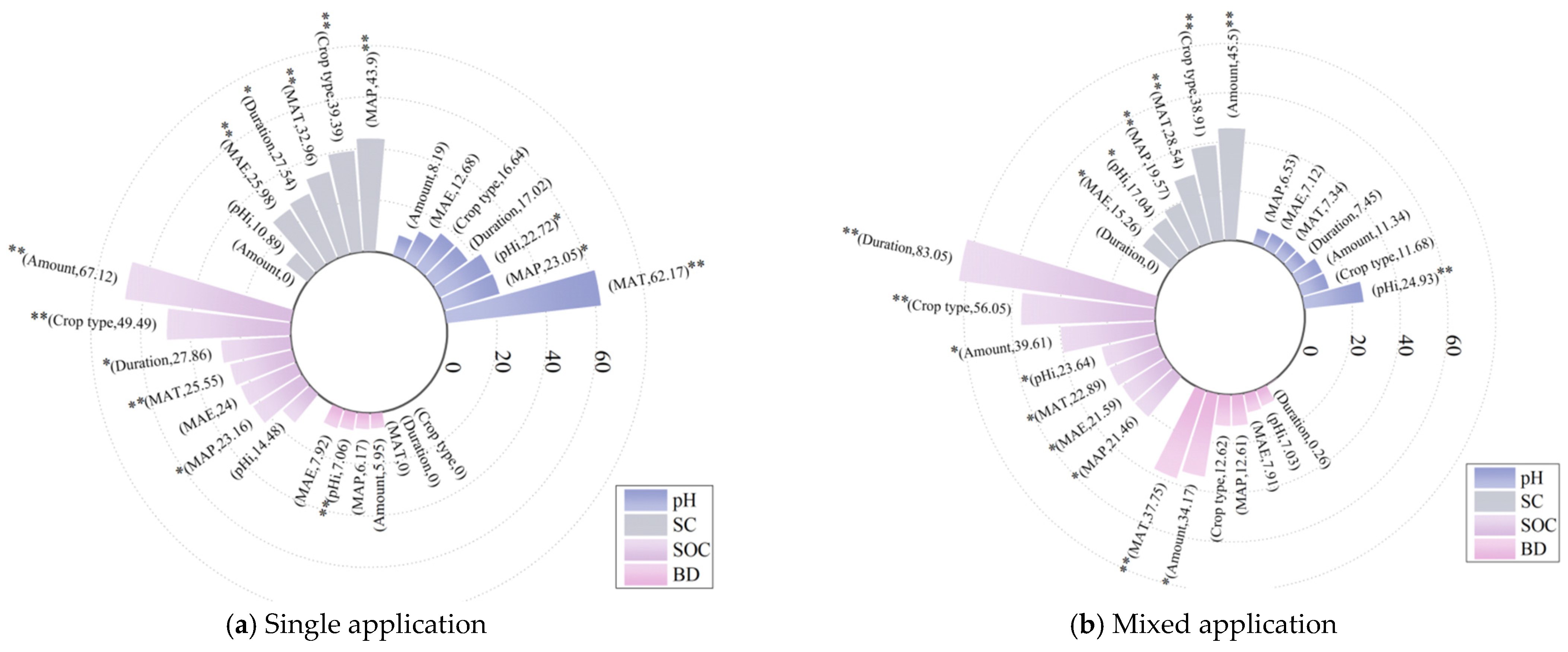
Random forest analysis was used to assess the importance of environmental and management factors in predicting soil quality indicators under single and mixed application treatments (Figure 5a,b). The importance of these factors in predicting soil pH, SC, SOC, and BD differed markedly between the two application methods. Under single application treatments, MAT, MAP, and initial soil pH were significant predictors of soil pH (p < 0.05). Their variable importance values were 62.17%, 23.05%, and 22.72%, respectively. For SC, all factors except initial soil pH and amendment application amount were significant predictors. MAP had the highest variable importance value (43.90%). Amendment application amount, crop type, application duration, MAT, and MAP were significant predictors of SOC, with variable importance values of 67.12%, 49.49%, 27.86%, 25.55%, and 23.15%, respectively. For BD, initial soil pH was the only significant predictor, with a variable importance value of 7.06%. Under mixed application treatments, initial soil pH was the only significant predictor of soil pH, with a variable importance value of 24.93%. All evaluated factors were significant predictors of SC, and amendment application amount had the highest variable importance value (45.50%). All factors were also significant predictors of SOC. The variable importance values for amendment application amount, crop type, application duration, MAT, MAP, and initial soil pH were 83.05%, 56.05%, 39.61%, 23.64%, 22.89%, and 21.46%, respectively. For BD, only MAT and amendment application amount were significant predictors, with variable importance values of 37.75% and 34.17%, respectively.
Figure 5.
Relative importance of environmental and management factors influencing soil pH, SC, SOC, and BD under single (a) and mixed amendment applications (b). Symbols * and ** indicate correlations significant at the 0.05 and 0.01 levels, respectively. Amount, amendment application amount; MAE, multi-year mean annual evaporation; MAP, multi-year mean annual precipitation; MAT, multi-year mean annual temperature; pHi, initial soil pH.
4. Discussion
4.1. Effects of Soil Amendments on Soil Alkalinity and Salinity
This study provides field-based evidence that soil amendments can simultaneously alleviate salt-related constraints and improve the physical and nutritional conditions of saline–alkali soils in China. Both single and mixed applications reduced pH, SC, ESP, SAR, and BD relative to unamended controls. These responses demonstrate the value of amendment application for addressing several dimensions of soil degradation rather than modifying an isolated soil property.
A finding is that salinity and sodicity responded differently to amendment application. Single applications showed larger pooled reductions in SC and SAR, whereas mixed applications showed larger reductions in ESP and pH. At the category level, crop residues and biochar showed relatively large SC reductions, while inorganic–organic treatment showed the largest estimated ESP reduction. These differences suggest that the most suitable amendment strategy depends on whether the principal objective is soluble salt removal, exchangeable sodium reduction, or pH adjustment. This indicator-specific comparison provides a more useful basis for amendment selection than an overall ranking of single and mixed applications.
The reductions in ESP and SAR are consistent with the role of calcium-bearing amendments in replacing exchangeable Na+ [34]. Calcium supplied by gypsum-based materials enters exchange reactions, allowing displaced Na+ to move into the soil solution and subsequently be removed through leaching and drainage [35,36]. Organic materials can complement this process by improving the pore system through which water and dissolved salts move [22]. The combination of chemical sodium displacement and improved water transport therefore offers a plausible explanation for the substantial ESP response of inorganic–organic treatments.
Soil pH decreased under both application strategies, with a larger pooled reduction under mixed applications than under single applications. Among the mixed applications, inorganic–organic treatment showed the largest estimated reduction, suggesting their potential for addressing elevated pH alongside other soil constraints. This response may reflect complementary functions of the constituent materials. Organic inputs can contribute acidity through the dissociation of acidic functional groups and the production of organic acids during decomposition [37], whereas calcium-bearing materials can alleviate sodicity through Ca2+–Na+ exchange followed by leaching [38]. These processes provide a plausible explanation for the pH response of inorganic–organic treatments. The relatively large reduction under calcium-based single applications also emphasizes that gypsum should be understood primarily as a calcium source for sodicity amelioration, rather than as a general acidifying agent.
Together, the results show that pH adjustment, soluble salt removal, and sodicity alleviation represent related but distinct reclamation objectives. Mixed applications showed larger pooled reductions in pH and ESP, whereas single applications showed larger reductions in SC and SAR. The value of this comparison lies in identifying the strengths of different strategies across soil constraints. Inorganic–organic treatments merit consideration where elevated pH and exchangeable sodium are concurrent concerns [39], while the larger SC reductions observed for crop residues and biochar support their further evaluation where soluble salt accumulation is a principal constraint [40,41]. Amendment selection should therefore begin with a diagnosis of the dominant soil problem and combine appropriate material functions with effective water management.
4.2. Effects of Soil Amendments on Soil Nutrient Status
Soil organic carbon, available nitrogen, available phosphorus, and available potassium are key indicators of soil fertility and are essential for crop growth [42]. Amendment application improved soil fertility as well as reducing salt-related constraints. Both application strategies increased AN, AP, AK, and SOC, with mixed applications showing larger pooled increases in AP, AK, and SOC. These findings are consistent with the broad nutrient benefits of organic amendment inputs reported by Li et al. [43].
Farmyard manure showed the largest estimated increases in AP, AK, and SOC. This pattern is consistent with its combined contribution of organic carbon and nutrients. Decomposition releases nutrients from the added material, while retained organic matter can contribute to nutrient retention and aggregate development [44]. Crop residues showed a particularly large AN response, but their negative pooled AK estimate demonstrates that nutrient responses are not interchangeable. The category differences suggest that amendment selection should account for nutrient composition and the nutrient deficiency being addressed, rather than treating all organic materials as equivalent fertility inputs [45,46].
Mixed applications showed a larger pooled AP response than single applications, indicating potential benefits from combining materials with different functions. Organic inputs can supply carbon and nutrients, while suitable inorganic materials can modify the chemical conditions associated with nutrient availability. Chen et al. [47] linked combined organic inputs and mineral fertilizer application in saline–alkaline soil with improved aggregate stability and P availability, providing experimental support for connections between structural improvement and nutrient responses [48]. In this study, inorganic–inorganic treatments in the present dataset included calcium superphosphate, so direct P supply may have contributed to their large AP response. Thus, the nutrient benefit of a formulation can arise from both direct nutrient addition and improved soil conditions; recognizing both pathways strengthens the interpretation of the pooled results.
The SOC results emphasize the contribution of organic inputs to rebuilding soil organic matter. Farmyard manure showed the largest estimated SOC increase, followed by inorganic–organic treatments and humic matter. Organic inputs provide carbon directly and may also favor its retention through aggregate formation and association with mineral surfaces [49].
4.3. Factors Influencing the Effectiveness of Soil Amendments in Ameliorating Saline–Alkali Soils
The effectiveness of soil amendments in improving saline–alkali soils depends on several factors, including application strategy, application amount, application duration, initial soil conditions, and climate [50]. In this study, random forest models identified different leading predictors among soil indicators and application strategies. MAT and MAP ranked highest for pH and SC responses, respectively, under single applications, whereas initial soil pH and application amount ranked highest for these responses under mixed applications. Application amount was the leading predictor of SOC responses under both strategies. These patterns provide a basis for interpreting amendment performance through the interaction between material inputs, environmental conditions, and the soil property targeted for improvement.
The importance of MAP for SC responses under single applications is consistent with the role of water movement in salt redistribution and removal. Calcium-bearing amendments can displace exchangeable Na+ into the soil solution, but subsequent leaching and drainage are required to remove the displaced ions from the root zone. Rainfall can support this process where infiltration and drainage are adequate, whereas evaporation and shallow groundwater can promote upward salt movement and reaccumulation [51,52]. Consequently, comparable amendment inputs may produce different SC responses depending on whether local water conditions favor salt export or redistribution within the soil profile. Wang et al. [27] reported relatively weak climatic associations for several gypsum responses and discussed irrigation as a possible explanation. Together, these findings indicate that precipitation should be interpreted alongside irrigation and drainage and that material inputs alone are insufficient to explain field desalination performance.
Application amount was particularly important for SC responses under mixed applications and SOC responses under both strategies. This finding emphasizes the value of managing the functional inputs supplied by amendments, rather than considering material selection alone. For calcium-bearing materials, application amount influences the quantity available to address exchangeable sodium [53]; for organic materials, it influences potential carbon and nutrient supply [54]. However, equal material masses do not necessarily provide equivalent inputs because composition differs among amendments. Constituent-specific inputs therefore provide a useful link between formulation design and soil requirements, while the importance ranking itself does not establish an optimal amount or imply that larger inputs always produce greater benefits.
For SOC, the relevance of application amount extends from carbon supply to the transformation and protection of added carbon. Organic inputs provide particulate material and substrates for microbial activity. Decomposition products and microbial binding agents can promote particle association and aggregate formation, allowing some organic matter to become enclosed within aggregates [55]. This physical protection can reduce microbial access to substrates, while association with mineral surfaces provides another pathway for carbon retention. Sonsri et al. [56] found that long-term organic amendments differed in their contributions to aggregate-occluded and mineral-associated carbon. These findings offer a mechanistic explanation for why application amount and material quality should be considered together: the amount of carbon supplied and its allocation among soil fractions jointly influence SOC accumulation. The present SOC models identify the relevance of input management, while aggregate-associated carbon measurements would be needed to determine the contribution of these protection pathways.
Under single applications, initial soil pH was the only predictor with significant permutation importance for BD. This result highlights the relevance of initial chemical conditions to subsequent structural responses. Where elevated pH coincides with excessive exchangeable Na+, clay dispersion and aggregate breakdown can disrupt pore networks and contribute to crusting and dense soil layers. Calcium-mediated flocculation and organic-matter-supported aggregation provide different routes for improving these conditions. Their effectiveness may therefore vary according to whether the initial structural constraint is primarily associated with sodicity, low organic matter, or mechanical compaction [57,58]. High pH does not necessarily indicate excessive exchangeable sodium, so its predictive importance is best interpreted alongside ESP, SC, texture, and initial BD. This combined assessment would help identify the material functions most relevant to structural recovery.
This study provides a basis for selecting amendments according to their observed benefits across multiple soil properties. Farmyard manure showed substantial benefits for nutrient availability and SOC, while calcium-bearing amendments can facilitate the displacement of exchangeable Na+ by supplying Ca2+. Mixed applications showed larger pooled improvements in several nutrient, chemical, and physical indicators, whereas single applications showed larger pooled reductions in SC and SAR. These contrasting responses support selecting amendments and combinations according to the dominant soil constraints rather than assuming that mixed applications are consistently preferable. Differences in amendment characteristics, measurement methods, and study coverage limit the formulation of broadly applicable recommendations. Further validation under contrasting soil, climatic, and management conditions is therefore needed to determine whether the observed benefits persist across regions and over time. Integrating these considerations with the comparative evidence presented here can support amendment strategies suited to local soil improvement objectives and practical constraints.
5. Conclusions
Soil amendments improved saline–alkali soil properties, with benefits varying by amendment category, application strategy, and soil constraint. Farmyard manure increased nutrient availability and SOC and reduced BD, while inorganic–organic treatments showed the largest estimated ESP reduction. Leading predictors differed among soil responses and application strategies: climatic variables were particularly relevant to pH and SC under single applications, whereas initial soil pH and application amount were their respective leading predictors under mixed applications. Application amount was the leading predictor of SOC under both strategies. These findings support considering farmyard manure for nutrient deficiency and low SOC, and inorganic–organic treatments where excessive exchangeable sodium coincides with poor fertility. However, the limited number of publications and their restriction to China constrain the representativeness and geographical applicability of these findings. Future research should expand geographical coverage and conduct long-term field trials across diverse soil and climatic conditions to validate these patterns and develop locally appropriate amendment strategies.
Supplementary Materials
The following supporting information can be downloaded at: https://www.mdpi.com/article/10.3390/agriculture16212415/s1, References [59,60,61,62,63,64,65,66,67,68,69,70,71,72,73,74,75,76,77,78,79,80,81,82,83] report the studies included in this meta-analysis. Figure S1: Contour-enhanced funnel plots and results of Egger-type multilevel regression tests for assessing nine soil quality indicators (a–i). PRISMA Checklist.
Author Contributions
Conceptualization, M.H., H.H. and A.A.; methodology, M.H., H.H. and A.A.; software, M.H., H.H. and A.A.; validation, H.H. and A.A.; formal analysis, M.H., H.H. and A.A.; investigation, H.H., A.A. and Y.J.; resources, M.H., and A.A.; data curation, H.H., and A.A.; writing—original draft preparation, M.H. and H.H.; writing—review and editing, M.H., and H.H.; visualization, H.H., Y.J.; and F.D.; supervision, M.H., and A.A.; project administration, M.H., and A.A.; funding acquisition, M.H. and A.A. All authors have read and agreed to the published version of the manuscript.
Funding
This research was funded by Key Research and Development Projects of the Xinjiang Uygur Autonomous Region, Science and Technology Department of Xinjiang Uygur Autonomous Region, China (2022B02011-1), and the Xinjiang Leading Talent Program: Talent Recruitment Project for Key Innovation Platforms (Bases) in Science and Technology (XJRC-2025-KJ-YJ-CXPT-047).
Institutional Review Board Statement
Not applicable.
Data Availability Statement
The datasets generated and analyzed in the current study are available from the corresponding author upon reasonable request.
Conflicts of Interest
The authors declare no conflicts of interest.
Abbreviations
The following abbreviations are used in this manuscript:
| MAT | Multi-year mean annual temperature |
| MAP | Multi-year mean annual precipitation |
| MAE | Multi-year mean annual evaporation |
| SC | Salt content |
| AN | Available nitrogen |
| AP | Available phosphorus |
| AK | Available potassium |
| BD | Bulk density |
| ESP | Exchangeable sodium percentage |
| SAR | Sodium adsorption ratio |
| SOC | Soil organic carbon |
| SOM | Soil organic matter |
References
- Sahab, S.; Suhani, I.; Srivastava, V.; Chauhan, P.S.; Singh, R.P.; Prasad, V. Potential risk assessment of soil salinity to agroecosystem sustainability: Current status and management strategies. Sci. Total Environ. 2021, 764, 144164. [Google Scholar] [CrossRef] [Scilit]
- Shrivastava, P.; Kumar, R. Soil salinity: A serious environmental issue and plant growth promoting bacteria as one of the tools for its alleviation. Saudi J. Biol. Sci. 2015, 22, 123–131. [Google Scholar] [CrossRef] [Scilit]
- Li, S.; Zhao, L.; Wang, C.; Huang, H.; Zhuang, M. Synergistic improvement of carbon sequestration and crop yield by organic material addition in saline soil: A global meta-analysis. Sci. Total Environ. 2023, 891, 164530. [Google Scholar] [CrossRef] [Scilit]
- Zhu, W.; Gu, S.; Jiang, R.; Zhang, X.; Hatano, R. Saline–alkali soil reclamation contributes to soil health improvement in China. Agriculture 2024, 14, 1210. [Google Scholar] [CrossRef] [Scilit]
- Phankamolsil, N.; Sonsri, K.; Kheoruenromne, I.; Gilkes, R.J.; Phankamolsil, Y. Spatial distribution characteristics and types of salt-affected soils spots developed on alluvial fan complex over old marine sediment, Thailand. Agric. Nat. Resour. 2021, 55, 229–236. [Google Scholar] [CrossRef] [Scilit]
- Lei, S.; Jia, X.; Zhao, C.; Shao, M. A review of saline–alkali soil improvements in China: Efforts and their impacts on soil properties. Agric. Water Manag. 2025, 317, 109617. [Google Scholar] [CrossRef] [Scilit]
- Tho, N.; Vromant, N.; Hung, N.T.; Hens, L. Soil salinity and sodicity in a shrimp farming coastal area of the Mekong Delta, Vietnam. Environ. Geol. 2008, 54, 1739–1746. [Google Scholar] [CrossRef] [Scilit]
- Tully, K.L.; Weissman, D.; Wyner, W.J.; Miller, J.; Jordan, T. Soils in transition: Saltwater intrusion alters soil chemistry in agricultural fields. Biogeochemistry 2019, 142, 339–356. [Google Scholar] [CrossRef] [Scilit]
- Zheng, C.; Liu, C.; Liu, L.; Tan, Y.; Sheng, X.; Yu, D. Effect of salinity stress on rice yield and grain quality: A meta-analysis. Eur. J. Agron. 2023, 144, 126765. [Google Scholar] [CrossRef] [Scilit]
- Yang, J.; Yao, R.; Wang, X.; Xie, W.; Zhang, X.; Zhu, W.; Zhang, L.; Sun, R. Research on salt-affected soils in China: History, status quo and prospect. Acta Pedol. Sin. 2022, 59, 10–27. (In Chinese) [Google Scholar] [CrossRef]
- Litalien, A.; Zeeb, B. Curing the earth: A review of anthropogenic soil salinization and plant-based strategies for sustainable mitigation. Sci. Total Environ. 2020, 698, 134235. [Google Scholar] [CrossRef] [Scilit] [PubMed]
- Zhang, S.; Li, K.; Wang, C.; Yang, S.; Liu, X.; Pan, K. Advances in biological and physical salt-reduction technologies for reclaiming saline–alkali land: A comprehensive review with an emphasis on China. Agronomy 2026, 16, 1645. [Google Scholar] [CrossRef] [Scilit]
- Wan, P.; Li, X.; Xu, L.; Cheng, W.; Wang, X.; Mo, W. Global research hotspots and trends on flue gas desulfurization gypsum: A bibliometric analysis. Silicon 2026, 18, 2749–2771. [Google Scholar] [CrossRef] [Scilit]
- Yang, J.; Dong, S.; Ma, Q.; Zheng, D.; Huang, B. Review on high-value utilization of phosphogypsum: Utilization of calcium and oxygen resources present in phosphogypsum. Sep. Purif. Technol. 2024, 344, 127246. [Google Scholar] [CrossRef] [Scilit]
- Li, Y.; Xu, J.; Fu, L.; Fan, J.; Zhang, J.; Zhang, J.; Meng, Q. Contrasting effects of desulfurization gypsum and aluminum sulfate application in rice cultivation on soil salinity and sodicity on the Songnen plain of Northeast China. Agronomy 2026, 16, 406. [Google Scholar] [CrossRef] [Scilit]
- Cui, X.; Geng, Y.; Li, T.; Zhao, R.; Li, R.; Cui, Z. Field application and effect evaluation of different iron tailings soil utilization technologies. Resour. Conserv. Recycl. 2021, 173, 105746. [Google Scholar] [CrossRef] [Scilit]
- Zhao, Y.; Wang, S.; Li, Y.; Liu, J.; Zhuo, Y.; Zhang, W. Long-term performance of flue gas desulfurization gypsum in a large-scale application in a saline–alkali wasteland in Northwest China. Agric. Ecosyst. Environ. 2018, 261, 115–124. [Google Scholar] [CrossRef] [Scilit]
- Liang, J.; Li, Y.; Si, B.; Wang, Y.; Chen, X.; Wang, X.; Chen, H. Optimizing biochar application to improve soil physical and hydraulic properties in saline–alkali soils. Sci. Total Environ. 2021, 771, 144802. [Google Scholar] [CrossRef] [Scilit] [PubMed]
- Chen, J.; Zhou, J.; Zheng, W.; Leng, S.; Ai, Z.; Zhang, W.; Yang, Z.; Yang, J.; Xu, Z.; Cao, J.; et al. A complete review on the oxygen-containing functional groups of biochar: Formation mechanisms, detection methods, engineering, and applications. Sci. Total Environ. 2024, 946, 174081. [Google Scholar] [CrossRef] [Scilit] [PubMed]
- Tadesse, A.W.; Huang, M.; Zhou, T. Biochar for wastewater treatment: Preparation, modification, characterization, and its applications. Molecules 2025, 30, 4288. [Google Scholar] [CrossRef] [Scilit]
- Xiao, Y.; Pu, Z.; Zhang, R.; Wang, C.; Hou, Z.; Wang, X. Research progress on the effects of different organic materials on salinized soil improvement. Soil Fert. Sci. China 2024, 3, 229–239. (In Chinese) [Google Scholar]
- Liu, M.; Wang, C.; Liu, X.; Lu, Y.; Wang, Y. Saline–alkali soil applied with vermicompost and humic acid fertilizer improved macroaggregate microstructure to enhance salt leaching and inhibit nitrogen losses. Appl. Soil Ecol. 2020, 156, 103705. [Google Scholar] [CrossRef] [Scilit]
- Elmeknassi, M.; Elghali, A.; de Carvalho, H.W.P.; Laamrani, A.; Benzaazoua, M. A review of organic and inorganic amendments to treat saline–sodic soils: Emphasis on waste valorization for a circular economy approach. Sci. Total Environ. 2024, 921, 171087. [Google Scholar] [CrossRef] [Scilit]
- Huang, G.; Liu, B.; Jiang, X.; Liang, Y.; Cai, J.; Huang, L. The application of amendments improves properties of salt-affected soils across China. Soil Tillage Res. 2025, 248, 106431. [Google Scholar] [CrossRef] [Scilit]
- Hedges, L.V.; Gurevitch, J.; Curtis, P.S. The meta-analysis of response ratios in experimental ecology. Ecology 1999, 80, 1150–1156. [Google Scholar] [CrossRef]
- Zhang, L.; Bate, B.; Cui, J.; Feng, Y.; Yu, J.; Cui, Z.; Wang, H.; Li, Q. Biochar input to saline–alkali farmland can improve soil health and crop yield: A meta-analysis. Agriculture 2025, 15, 561. [Google Scholar] [CrossRef] [Scilit]
- Wang, Y.; Wang, Z.; Liang, F.; Jing, X.; Feng, W. Application of flue gas desulfurization gypsum improves multiple functions of saline–sodic soils across China. Chemosphere 2021, 277, 130345. [Google Scholar] [CrossRef] [Scilit] [PubMed]
- Pribyl, D.W. A critical review of the conventional SOC to SOM conversion factor. Geoderma 2010, 156, 75–83. [Google Scholar] [CrossRef] [Scilit]
- Viechtbauer, W. Conducting meta-analyses in R with the metafor package. J. Stat. Softw. 2010, 36, 1–48. [Google Scholar] [CrossRef] [Scilit]
- Nakagawa, S.; Lagisz, M.; O’Dea, R.E.; Pottier, P.; Rutkowska, J.; Senior, A.M.; Yang, Y.; Noble, D.W.A. OrchaRd 2.0: An R package for visualising meta-analyses with orchard plots. Methods Ecol. Evol. 2023, 14, 2003–2010. [Google Scholar] [CrossRef] [Scilit]
- Saifullah; Dahlaui, S.; Naeem, A.; Rengel, Z.; Naidu, R. Biochar application for the remediation of salt-affected soils: Challenges and opportunities. Sci. Total Environ. 2018, 625, 320–335. [Google Scholar] [CrossRef] [Scilit] [PubMed]
- Peters, J.L.; Sutton, A.J.; Jones, D.R.; Abrams, K.R.; Rushton, L. Contour-enhanced meta-analysis funnel plots help distinguish publication bias from other causes of asymmetry. J. Clin. Epidemiol. 2008, 61, 991–996. [Google Scholar] [CrossRef] [Scilit] [PubMed]
- Rodgers, M.A.; Pustejovsky, J.E. Evaluating meta-analytic methods to detect selective reporting in the presence of dependent effect sizes. Psychol. Methods 2021, 26, 141–160. [Google Scholar] [CrossRef] [Scilit] [PubMed]
- Munns, R.; Tester, M. Mechanisms of salinity tolerance. Annu. Rev. Plant Biol. 2008, 59, 651–681. [Google Scholar] [CrossRef] [Scilit] [PubMed]
- Xiao, M.; Liu, G.; Jiang, S.; Guan, X.; Chen, J.; Yao, R.; Wang, X. Bio-organic fertilizer combined with different amendments improves nutrient enhancement and salt leaching in saline soil: A soil column experiment. Water 2022, 14, 4084. [Google Scholar] [CrossRef] [Scilit]
- Zhao, J.; Wang, W.; Wang, H.; Ma, G.; Gao, M.; Wang, R.; Wang, Y. Effects of suitable amendment combined with fertilizers on soil salinity and maize yield in saline alkali land. Trans. CSAE 2025, 41, 80–88. (In Chinese) [Google Scholar] [CrossRef]
- Qian, S.; Zhou, X.; Fu, Y.; Song, B.; Yan, H.; Chen, Z.; Sun, Q.; Ye, H.; Qin, L.; Lai, C. Biochar-compost as a new option for soil improvement: Application in various problem soils. Sci. Total Environ. 2023, 870, 162024. [Google Scholar] [CrossRef] [Scilit] [PubMed]
- Liu, S.; Liu, W.; Jiao, F.; Qin, W.; Yang, C. Production and resource utilization of flue gas desulfurized gypsum in China—A review. Environ. Pollut. 2021, 288, 117799. [Google Scholar] [CrossRef] [Scilit] [PubMed]
- Li, S.; Yang, Y.; Li, Y.; Gao, B.; Tang, Y.; Xie, J.; Zhao, H. Remediation of saline–sodic soil using organic and inorganic amendments: Physical, chemical, and enzyme activity properties. J. Soils Sediments 2020, 20, 1454–1467. [Google Scholar] [CrossRef] [Scilit]
- Liang, B.; Wei, J.; Gao, Y.; Ma, Z.; Xue, X. A review of classification, causes, and amelioration of global salt-affected soil based on the meta-analysis. Land Degrad. Dev. 2025, 36, 5485–5504. [Google Scholar] [CrossRef] [Scilit]
- Zhao, W.; Zhou, Q.; Tian, Z.; Cui, Y.; Liang, Y.; Wang, H. Apply biochar to ameliorate soda saline–alkali land, improve soil function and increase corn nutrient availability in the Songnen Plain. Sci. Total Environ. 2020, 722, 137428. [Google Scholar] [CrossRef] [Scilit] [PubMed]
- Balík, J.; Suran, P.; Sedlář, O.; Černý, J.; Kulhánek, M.; Procházková, S.; Asrade, D.A.; Smatanová, M. The effect of long-term farmyard manure and mineral fertilizer application on the increase in soil organic matter quality of Cambisols. Agronomy 2023, 13, 2960. [Google Scholar] [CrossRef] [Scilit]
- Li, T.; Wang, S.; Liu, S.; Zhang, X.; Dong, H.; Dai, S.; Chai, L.; Li, H.; Lv, Y.; Li, T.; et al. Trade-offs of organic amendment input on soil quality and crop productivity in saline–alkali land globally: A meta-analysis. Eur. J. Agron. 2025, 164, 127471. [Google Scholar] [CrossRef] [Scilit]
- Cheng, Z.; Guo, J.; Jin, W.; Liu, Z.; Wang, Q.; Zha, L.; Zhou, Z.; Meng, Y. Responses of SOC, labile SOC fractions, and amino sugars to different organic amendments in a coastal saline–alkali soil. Soil Tillage Res. 2024, 239, 106051. [Google Scholar] [CrossRef] [Scilit]
- Liu, L.; Li, H.; Zhu, S.; Gao, Y.; Zheng, X.; Xu, Y. The response of agronomic characters and rice yield to organic fertilization in subtropical China: A three-level meta-analysis. Field Crops Res. 2021, 263, 108049. [Google Scholar] [CrossRef] [Scilit]
- Luo, G.; Li, L.; Friman, V.-P.; Guo, J.; Guo, S.; Shen, Q.; Ling, N. Organic amendments increase crop yields by improving microbe-mediated soil functioning of agroecosystems: A meta-analysis. Soil Biol. Biochem. 2018, 124, 105–115. [Google Scholar] [CrossRef] [Scilit]
- Chen, M.; Zhang, S.; Liu, L.; Wu, L.; Ding, X. Combined organic amendments and mineral fertilizer application increase rice yield by improving soil structure, P availability and root growth in saline–alkaline soil. Soil Tillage Res. 2021, 212, 105060. [Google Scholar] [CrossRef] [Scilit]
- Islam, M.U.; Jiang, F.; Islam, M.M.; Ibrahim, M.M.; Halder, M.; Liu, Y.; Hou, E. Organic amendment quality as a driver of soil phosphorus enrichment and crop yield: A global synthesis. Soil Tillage Res. 2026, 256, 106836. [Google Scholar] [CrossRef] [Scilit]
- Liu, Y.; Li, C.; Cai, G.; Sauheitl, L.; Xiao, M.; Shibistova, O.; Ge, T.; Guggenberger, G. Meta-analysis on the effects of types and levels of N, P, and K fertilization on organic carbon in cropland soils. Geoderma 2023, 437, 116580. [Google Scholar] [CrossRef] [Scilit]
- Huang, J.; Shang, Y.; Chen, Y.; Xu, L.; Yang, Y.; Zhao, X. Analysis of research trends and comprehensive utilization solutions for saline–alkali land. Sustainability 2025, 17, 5202. [Google Scholar] [CrossRef] [Scilit]
- Das, B.T.; Menzies, N.W.; Dalzell, S.A.; McKenna, B.A.; Kopittke, P.M. Avoiding the point of no return: Maintaining infiltration to remediate saline–sodic Vertosols in high rainfall environments. Agric. Water Manag. 2022, 270, 107725. [Google Scholar] [CrossRef] [Scilit]
- Li, S.; Luo, W.; Jia, Z.; Tang, S.; Chen, C. The effect of natural rainfall on salt leaching under watertable management. Land Degrad. Dev. 2018, 29, 1953–1961. [Google Scholar] [CrossRef] [Scilit]
- Tao, J.; Liu, X.; Spielvogel, S. Amelioration of coastal saline soils of Chinese river deltas via soil amendments: A meta-analysis. Pedosphere 2026, 36, 387–401. [Google Scholar] [CrossRef] [Scilit]
- Chi, C.M.; Zhao, C.W.; Sun, X.J.; Wang, Z.C. Reclamation of saline–sodic soil properties and improvement of rice (Oriza sativa L.) growth and yield using desulfurized gypsum in the west of Songnen Plain, northeast China. Geoderma 2012, 187–188, 24–30. [Google Scholar] [CrossRef] [Scilit]
- McClelland, S.C.; Cotrufo, M.F.; Haddix, M.L.; Paustian, K.; Schipanski, M.E. Infrequent compost applications increased plant productivity and soil organic carbon in irrigated pasture but not degraded rangeland. Agric. Ecosyst. Environ. 2022, 333, 107969. [Google Scholar] [CrossRef] [Scilit]
- Sonsri, K.; Naruse, H.; Watanabe, A. Mechanisms controlling the stabilization of soil organic matter in agricultural soils as amended with contrasting organic amendments: Insights based on physical fractionation coupled with 13C NMR spectroscopy. Sci. Total Environ. 2022, 825, 153853. [Google Scholar] [CrossRef] [Scilit] [PubMed]
- Gupta, R.K.; Bhumbla, D.K.; Abrol, I.P. Effect of sodicity, pH, organic matter, and calcium carbonate on the dispersion behavior of soils. Soil Sci. 1984, 137, 245–251. [Google Scholar] [CrossRef] [Scilit]
- Niaz, S.; Wehr, J.B.; Dalal, R.C.; Kopittke, P.M.; Menzies, N.W. Organic amendments and gypsum reduce dispersion and increase aggregation of two sodic Vertisols. Geoderma 2022, 425, 116047. [Google Scholar] [CrossRef] [Scilit]
- Zhou, Y.; Liu, H.; Wang, C.; Liu, X.; Jin, M. Effects of phosphogypsum addition on soil fertility and enzyme activity of the cultivated layer in saline-sodic paddy fields. Soils 2025, 57, 325–332. (In Chinese) [Google Scholar] [CrossRef]
- Bai, X.; Wang, B.; Liu, Y.; Wang, T.; Zhang, B.; Liu, P.; Tian, F.; Zhao, H. Combined application of amendment materials enhances aggregate stability and organic carbon content of saline-alkali soil, and maize yield in Hetao Irrigation District. J. Plant Nutr. Fertil. 2024, 30, 2082–2092. (In Chinese) [Google Scholar] [CrossRef]
- Sun, J.J.; Ma, B.; Li, F.J.; Han, F.; Yao, G.D.; Wang, Y.G. Effects of applying flue gas desulfurized gypsum on improvement and carbon sequestration in saline-sodic soils. China Powder Sci. Technol. 2024, 30, 1–11. (In Chinese) [Google Scholar] [CrossRef]
- Lyu, K.; Chen, Z.; Li, Y.; Hu, M.; Xiong, Y.; Huang, G. Impacts of combined application of lignite bioorganic fertilizer and flue gas desulfurization gypsum on saline-sodic soil amendment and sunflower yield. Trans. Chin. Soc. Agric. Eng. 2023, 39, 77–86. (In Chinese) [Google Scholar] [CrossRef]
- Zhang, J.; Tian, R.; Wang, S.; Li, Y.; Wang, W.; Liu, J.; Chen, Y.; Zhao, Y. The influence of calcium-based soil conditioners on the improvement of saline-alkali soil and the yield of sunflowers. Soil Fert. Sci. China 2022, 11, 68–76. (In Chinese) [Google Scholar] [CrossRef]
- Tang, X.; Shang, H.; Liu, G.; Yao, Y.; Zhang, F.; Yang, J.; Zhou, L.; Chu, R. Effects of combined amendment on improvement of salinized soil and plant growth. Soils 2021, 53, 1033–1039. (In Chinese) [Google Scholar] [CrossRef]
- Zhao, L.; Song, Y.; Guo, D.; Guan, S.; Dou, S. Effect of organic fertilizer combined with desulfurization gypsum on salt reduction and soil quality improvement in soda saline-alkali soil. J. Jilin Agric. Univ. 2025. advance online publication (In Chinese) [Google Scholar] [CrossRef]
- Li, M.; Tian, R.; Li, R.; Wang, S.; Wang, W.; Wang, J.; Liu, J.; Liu, J.; Li, Y.; Xu, L.; et al. Effects of calcium/aluminum-based amendments on saline-alkali soil quality and sunflower yield in the Hetao Irrigation District. Sci. Agric. Sin. 2025, 58, 4231–4245. (In Chinese) [Google Scholar] [CrossRef]
- Xia, X.; Wang, C.; Yu, P.; Huang, Y.; Zhang, Q. Amelioration effect of a new type amendment based on iron tailings on saline-alkali soil in Songnen Plain. Soils Crops 2025, 14, 360–371. (In Chinese) [Google Scholar] [CrossRef]
- Zhang, B.; Xie, X.; Zhang, Z.; Wu, J.; Wang, B.; Xu, X. Effect of organic-inorganic amendments on the quality of saline-alkaline soil and yield of Echinochloa frumentacea. Acta Pratacult. Sin. 2025, 34, 15–29. (In Chinese) [Google Scholar] [CrossRef]
- Cao, Y.; Dai, X.; Wang, Y.; Tong, Z.; Liu, Z.; Liu, Z.; Chai, X.; He, F. The impacts of different fertilizer combinations on the physicochemical properties of mildly saline-alkali soil and the yield of alfalfa. Acta Agrestia Sin. 2025, 33, 1694–1701. (In Chinese) [Google Scholar] [CrossRef]
- Liang, Y.; Wang, Z.; Li, H.; Li, W.; Ma, Z.; Zhang, J.; Zheng, J. Effect of different improvement measures on soil characteristics and the growth of maize and oil sunflower in the saline soil area of southern Xinjiang, China. J. Agric. Resour. Environ. 2024, 41, 1332–1341. (In Chinese) [Google Scholar] [CrossRef]
- Wu, H.; Chen, X.; Ma, W.; Wang, X.; Cheng, C.; Ding, J.; Li, Y.; Liu, Z.; Duan, Y.; Di, M.; et al. Effects of phosphogypsum on coastal saline-sodic soil and the growth of winter wheat. Acta Pedol. Sin. 2024, 61, 1077–1087. (In Chinese) [Google Scholar] [CrossRef]
- Pang, Z.; Wang, Q.; Li, J. Effects of different soil amendments on soil physical and chemical properties, rice yield and economic benefits in low-lying saline alkali land in northern Shaanxi. J. Agric. Sci. Technol. 2023, 25, 174–180. (In Chinese) [Google Scholar] [CrossRef]
- Yang, L.; Xie, Z.; Zhu, X.; Sa, X. Effects of biochar and soil conditioner on coastal barren saline-alkali soil. Environ. Sci. 2023, 44, 5641–5648. (In Chinese) [Google Scholar] [CrossRef] [Scilit] [PubMed]
- Zhao, H.; Yu, J.; Liu, T.; Wang, L.; Zhao, Y. Application of desulphurized gypsum with straw to improve physicochemical properties of saline-alkali land in Yellow River Delta. Environ. Sci. 2023, 44, 4119–4129. (In Chinese) [Google Scholar] [CrossRef] [Scilit] [PubMed]
- Gu, X.; Ren, C.; Wang, L.; Yang, L.; Zhang, H.; Liu, B.; Sun, X.; Xu, H.; Zhao, J. The effect of applying humic acid in improving the soda-salt alkaline soil in Daqing. Soil Fert. Sci. China 2021, 77–82. (In Chinese) [Google Scholar] [CrossRef]
- Zhang, H.; Jia, A.; Gao, Q.; Han, Z.; Nan, S.; Duan, B.; Wu, X. The effects of biochar combined with fulvic acid on the physical and chemical properties, enzyme activities and multifunctionality of soil in coastal saline-alkali land. Sci. Agric. Sin. 2025, 58, 4178–4188. (In Chinese) [Google Scholar] [CrossRef]
- Zhang, J.; Niu, C.; Gan, R.; Yu, H.; Hou, Z. Effects of soil amendments on soil quality and pepper growth in saline-alkali soil. China Cucurbits Veg. 2025, 38, 156–162. (In Chinese) [Google Scholar] [CrossRef]
- Zhou, Y.; Pan, X.; Zhang, J.; Cui, M.; Yang, L. The influence of material application on the physical and chemical properties of saline-alkali soil in the Yellow River irrigation area of Ningxia and the yield of corn. Soil Fert. Sci. China 2026, 118–127. (In Chinese) [Google Scholar] [CrossRef]
- Tian, Y.; Jiang, W.; Chen, G.; Wang, X.; Li, T. Gypsum and organic materials improved soil quality and crop production in saline-alkali on the loess plateau of China. Front. Environ. Sci. 2024, 12, 1434147. [Google Scholar] [CrossRef] [Scilit]
- Du, X.; Yan, Y. Application of desulfurized gypsum combined with pig manure to improve soil quality and promote crop growth in saline-alkali soils. Arid Land Res. Manag. 2026, 40, 132–149. [Google Scholar] [CrossRef] [Scilit]
- Cui, L.; Liu, Y.; Yan, J.; Hina, K.; Hussain, Q.; Qiu, T.; Zhu, J. Revitalizing coastal saline-alkali soil with biochar application for improved crop growth. Ecol. Eng. 2022, 179, 106594. [Google Scholar] [CrossRef] [Scilit]
- Wang, S.; Gao, P.; Zhang, Q.; Shi, Y.; Guo, X.; Lv, Q.; Wu, W.; Zhang, X.; Li, M.; Meng, Q. Application of biochar and organic fertilizer to saline-alkali soil in the Yellow River Delta: Effects on soil water, salinity, nutrients, and maize yield. Soil Use Manag. 2022, 38, 1679–1692. [Google Scholar] [CrossRef] [Scilit]
- Wang, X.; Ding, J.; Wang, J.; Han, L.; Tan, J.; Liu, J.; Ge, X. Humic acid enhances the soil amelioration effect of biochar on saline–alkali soils in cotton fields. Agronomy 2025, 15, 2412. [Google Scholar] [CrossRef] [Scilit]

Disclaimer/Publisher’s Note: The statements, opinions and data contained in all publications are solely those of the individual author(s) and contributor(s) and not of MDPI and/or the editor(s). MDPI and/or the editor(s) disclaim responsibility for any injury to people or property resulting from any ideas, methods, instructions or products referred to in the content. |
© 2026 by the authors. Licensee MDPI, Basel, Switzerland. This article is an open access article distributed under the terms and conditions of the Creative Commons Attribution (CC BY) license.