1. Introduction
In recent years, supply chain resilience has received increasing attention as a critical foundation for economic stability and sustainable development. A range of global disrup-tions, including the COVID-19 pandemic, geopolitical tensions, and climate-related events, have exposed the fragility of production and distribution networks [
1,
2]. These challenges are further intensified in the agricultural sector, where systems must simultaneously respond to rising food demand driven by continued population growth. With the global population expected to approach 9.6 billion by 2050, pressure on food supply systems is projected to increase substantially [
3]. At the same time, nearly 28.9% of the global population still faces moderate-to-severe food insecurity [
4], highlighting the persistent difficulty of achieving the Sustainable Development Goal of zero hunger. Against this backdrop, strengthening the resilience of agricultural supply chains has become increasingly important. In this context, firms, particularly listed agricultural enterprises, play a central role in production, processing, and distribution activities, and their capacity to withstand and recover from disruptions is critical for both food security and broader economic stability. This importance is especially evident in China, where the development of agricultural sectors and rural economies has long been regarded as an important driver of economic growth and rural revitalization [
5].
Compared with manufacturing industries, agricultural supply chains are generally more vulnerable to external disturbances. This vulnerability largely stems from the sector’s high exposure to natural disasters and environmental uncertainty [
6]. Such sensitivity is further reinforced by the intrinsic characteristics of agricultural production, which relies heavily on natural conditions and is shaped by biological cycles and seasonal patterns. Moreover, green and sustainable agriculture has increasingly been recognized as a central goal of agricultural modernization [
7], further highlighting the importance of maintaining stable and resilient agricultural production and distribution systems. From the perspective of complex system vulnerability theory, supply chains can be understood as dynamic and interconnected network systems characterized by strong interdependencies among nodes and linkages [
8]. In such systems, disruptions to critical nodes or connections caused by external shocks, such as climate-related physical risks, can propagate throughout the network, thereby weakening overall stability and system functionality. Against this backdrop, improving the resilience of agricultural supply chains has become an increasingly important issue in both academic research and policy discussions. This need is particularly pronounced in developing countries, where the structural characteristics of agricultural supply chains differ substantially from those in developed economies, calling for a re-examination of resilience frameworks to better reflect local conditions [
9].
The concept of resilience originated in ecology and was later introduced into eco-nomics and management research. It generally refers to the capability of a system to maintain stable operations in the face of external disturbances, while adapting to disruptions and restoring its functional performance after shocks [
9,
10,
11]. In the context of supply chains, this concept is further understood as the capacity to absorb shocks and sustain or restore operations to a stable state. This capacity can be characterized along two key dimensions. The first is resistance capacity, which reflects the ability to mitigate and absorb external shocks. The second is recovery capacity, which captures how quickly and effectively the system can return to normal operation after disruptions. While a substantial body of research has examined supply chain resilience in manufacturing sectors, relatively limited attention has been paid to agricultural systems, despite their higher exposure to uncertainty and external disturbances.
At the same time, advances in digital technologies have created new possibilities for improving supply chain resilience [
12,
13,
14]. Among these technologies, artificial intelligence has attracted growing attention in supply chain management due to its strong capabilities in data processing, intelligent decision-making, and predictive analysis. By analyzing large volumes of market and operational data, AI applications can help firms better identify demand patterns, optimize inventory and logistics management, expand supply chain networks, and improve the efficiency and flexibility of supply chain operations [
15]. In addition, existing studies have shown that digital transformation can improve supply chain performance by enhancing transparency and coordination across inter-firm activities, while the development of digital strategies and capabilities enables firms to strengthen communication, obtain timely access to resources, and promote the collaborative optimization of key business processes such as production and marketing through digital technologies [
16,
17]. Despite these findings, most existing evidence is still concentrated in manufacturing contexts, while the role of strategic AI investment in agricultural supply chains remains less clearly understood.
Several limitations can be identified in the existing literature. First, most empirical studies focus on manufacturing contexts, where production processes are relatively standardized. Agricultural supply chains, by contrast, possess distinctive characteristics such as seasonality, supply fluctuations, and perishability, which make their operational and risk management processes more complex than those of conventional manufacturing supply chains [
18]. Second, digital technologies are often treated as a broad and homogeneous concept, which makes it difficult to identify the specific contribution of strategic AI investment. In agricultural supply chains, AI applications based on big data and machine learning algorithms are increasingly used for automated forecasting and intelligent decision-making, such as predicting agricultural product prices, harvest timing, and market demand. By processing large volumes of agricultural and market information, these technologies can help firms and producers improve operational planning and respond more effectively to changing market conditions [
19]. Third, there is a lack of firm-level empirical evidence that examines how strategic AI investment influences supply chain resilience. This is particularly true for the agricultural sector, where micro-level data remain underutilized.
This study addresses these gaps by examining whether and how strategic AI investment affect agricultural supply chain resilience using data on publicly listed agricultural firms. The focus on listed agricultural firms is motivated by their strategic importance within agricultural supply chains, as these firms typically serve as key nodes in supply chain coordination, technology adoption, and digital innovation [
20]. Their behavior provides a useful setting for understanding how strategic AI investment influences supply chain performance. By focusing on firm-level data, the analysis is able to shed light on the mechanisms through which strategic AI investment contributes to resilience.
The analysis is grounded in the resource-based view, which emphasizes the role of firm-specific capabilities in shaping performance outcomes. Artificial intelligence is treated as a strategic resource that enhances information processing, improves resource allocation, and strengthens firms’ ability to cope with external shocks. The empirical analysis focuses on two aspects of supply chain resilience, namely resistance capacity and recovery capacity.
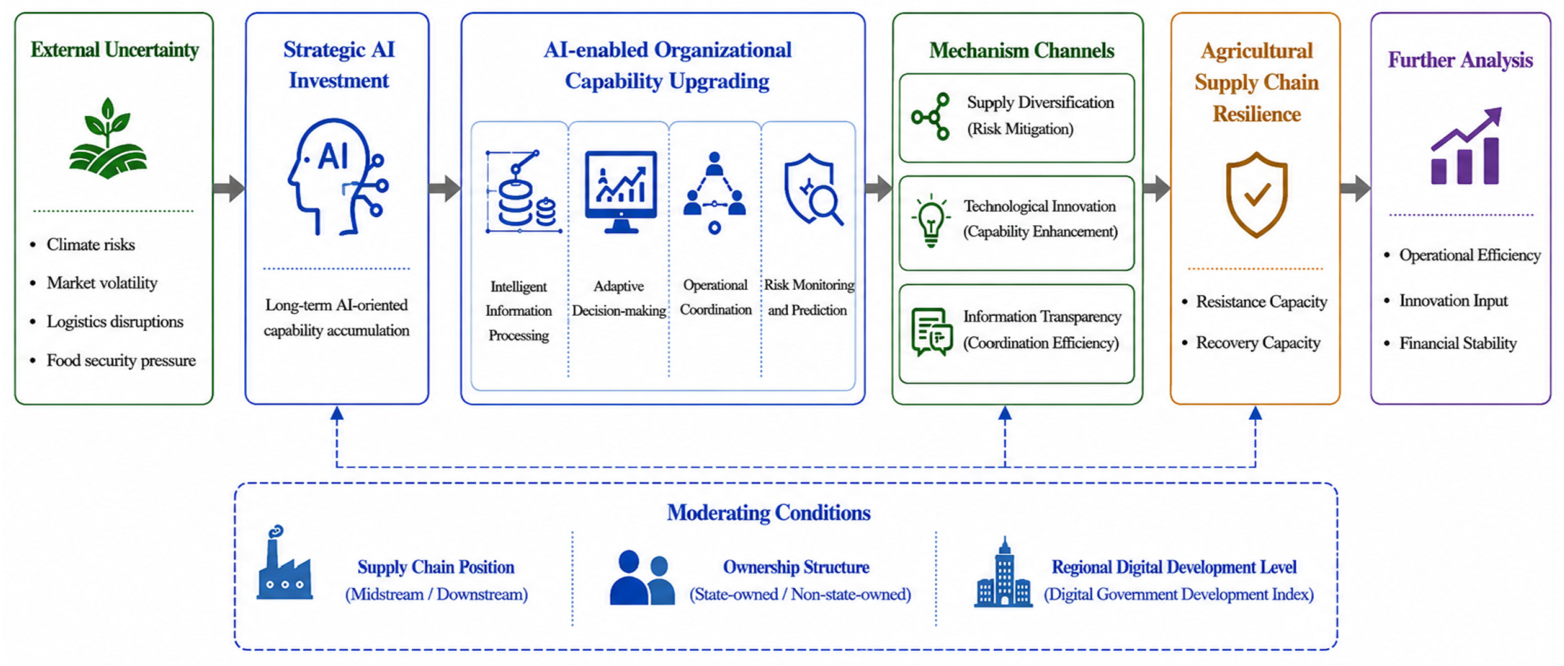
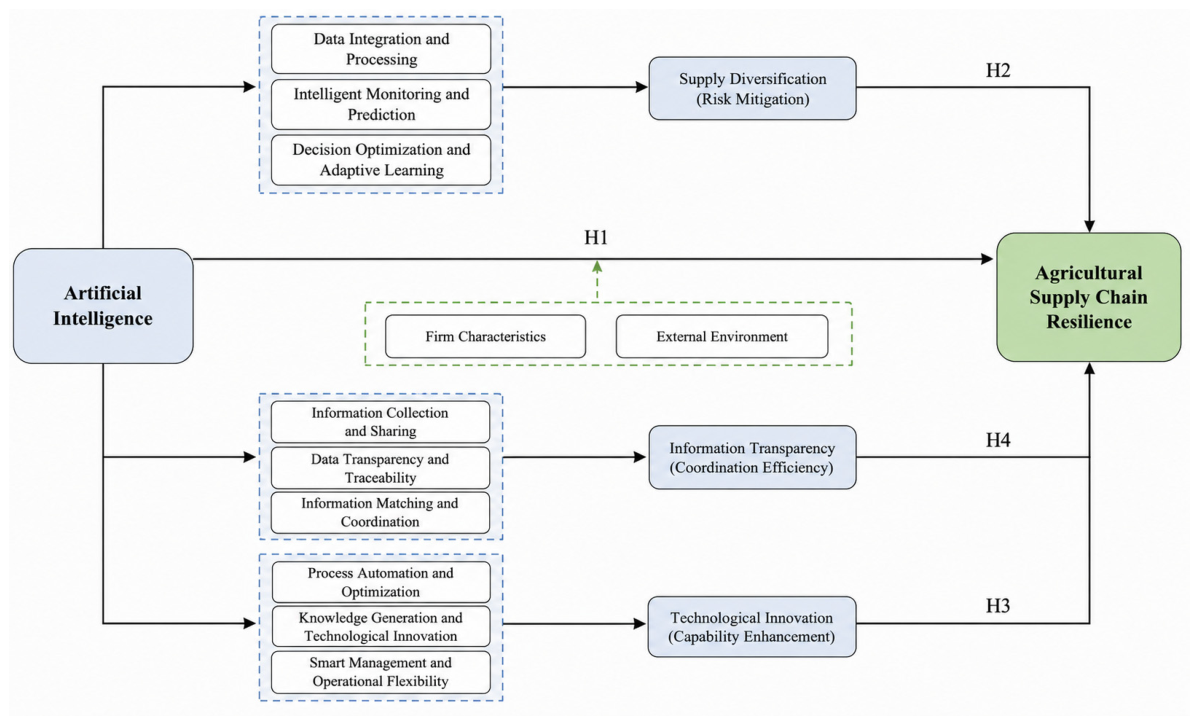
Figure 1 presents the conceptual framework underlying the relationship between strategic AI investment and agricultural supply chain resilience. Specifically, the framework illustrates how strategic AI investment contributes to resilience enhancement through organizational capability upgrading and three key mechanism channels, namely supply diversification, technological innovation, and information transparency. In addition, the framework also highlights the moderating roles of firm characteristics and external environmental conditions in shaping the effectiveness of AI-driven resilience enhancement.
This study makes three main contributions. First, the study distinguishes strategic AI investment from broad digital transformation and general AI adoption by conceptualizing it as a long-term organizational capability accumulation process. In doing so, the study provides a more refined understanding of how sustained AI-oriented investment strengthens firms’ adaptive operational capability and agricultural supply chain resilience under external uncertainty. Second, by using firm-level data of agricultural-related listed companies, this study provides micro-level empirical evidence regarding how strategic AI investment influences firms’ resistance capacity and recovery capacity. Compared with existing studies focusing mainly on macro-level digital transformation or general operational optimization, this study offers a more detailed organizational resilience perspective within agricultural supply chains. Third, the study further identifies several organizational capability-upgrading channels, including supply diversification, technological innovation, and information transparency, through which strategic AI investment enhances agricultural supply chain resilience.
3. Empirical Strategy
3.1. Data Sources and Sample Selection
This study constructs an firm-level panel dataset of Chinese agricultural-related listed firms over the period 2010–2024. The sample is primarily obtained from the China Stock Market and Accounting Research (CSMAR) database, which provides comprehensive financial and corporate governance information for A-share listed firms. Drawing on prior studies, agricultural-related firms are identified based on the 2012 CSRC industry classification, covering upstream sectors (agriculture, forestry, animal husbandry, and fishery), midstream sectors (agricultural product processing and manufacturing), and downstream sectors (wholesale and retail of agricultural products) within agricultural supply chains. Detailed classification criteria and industry coverage of agricultural listed firms are reported in
Appendix A.
To ensure the reliability of the empirical analysis, this study first excludes firms with missing key financial or corporate governance data. In addition, firm fixed effects and year fixed effects are included in regression models to control for unobserved heterogeneity and macroeconomic shocks. Standard errors are clustered at the firm level to address potential heteroskedasticity and serial correlation.
3.2. Model Specification
To examine the impact of strategic AI investment on the supply chain resilience of agricultural-related listed firms, this study adopts the following baseline fixed-effects model.
where
denotes the supply chain resilience of agricultural-related listed firm
in year
, which is measured along two dimensions: resistance capacity and recovery capacity, following the existing literature [
10,
37].
represents strategic AI investment, reflecting the extent to which firms strategically allocate resources to artificial intelligence technologies and AI-related transformation activities.
is a vector of firm-level control variables, including leverage ratio (
Lev), firm age (
Age), asset growth rate (
Assgrow), firm size (
SIZE), firm value measured by Tobin’s Q (
TOBINQ), profitability measured by return on equity (
Roe), board size (
BoardSize), institutional investor shareholding ratio (
InsInvest), managerial shareholding ratio (
Manahold), and intangible asset ratio (
Intang).
Firm fixed effects () are included to control for time-invariant firm characteristics such as managerial ability and corporate culture, while year fixed effects () capture macroeconomic conditions and policy changes affecting all firms. is the error term.
The coefficient of interest, , reflects the effect of strategic AI investment on supply chain resilience. Since the dependent variable is constructed as a negative indicator, a significantly negative estimate of would indicate that higher levels of strategic AI investment help improve the supply chain resilience of agricultural-related listed firms. In other words, strategic AI investment can enhance firms’ ability to resist external shocks and strengthen their recovery capability under supply chain disruptions.
3.3. Variable Definitions
3.3.1. Dependent Variables
Following the existing literature on supply chain resilience [
10,
37], this study conceptualizes the supply chain resilience of agricultural-related listed firms as a multidimensional construct comprising resistance capacity and recovery capacity. These two dimensions respectively capture firms’ ability to maintain stable operations under external shocks and their ability to restore normal operations after disruptions.
First, resistance capacity (
) reflects the stability of supply chain relationships and firms’ ability to maintain smooth operational circulation when facing external disturbances. The stability of supply chain relationships largely depends on the extent to which downstream customers occupy upstream suppliers’ capital. When suppliers face excessive accounts receivable pressure, cooperative relationships between suppliers and customers become more fragile and are more likely to deteriorate under external shocks. Following Guo and Li (2025) [
8], Zheng et al. (2025) [
38], Qi et al. (2024) [
10], and Cull et al. (2009) [
39], this study measures resistance capacity using the natural logarithm of the ratio of accounts receivable to operating revenue:
This indicator is constructed as a negative measure. A lower value indicates that customers occupy less capital from suppliers, implying more stable supply chain relationships and stronger resistance capacity. In essence, lower dependence on accounts receivable reflects stronger transaction stability, more continuous supply–demand coordination, and greater resilience in inter-firm cooperative relationships.
Second, recovery capacity (
) reflects the ability of firms to restore normal supply chain operations after deviations caused by external shocks. Following Qi et al. (2024) [
10] and Chen and Yu (2024) [
37], this study uses the deviation between production fluctuations and demand fluctuations as a proxy for recovery capability. Specifically, production is calculated as:
where selling expenses capture market demand and circulation activities, while inventory changes reflect production adjustments and inventory accumulation.
Based on this, the mismatch between demand and production is measured as:
This indicator is also a negative measure. When the value is larger than 1, it indicates greater supply–demand mismatch and stronger production fluctuations relative to market demand, implying weaker recovery capability. By contrast, a lower value suggests that production and demand are more closely aligned, indicating that firms are better able to restore supply–demand balance and resume normal operations after disruptions. Therefore, smaller deviations between production and demand reflect stronger recovery capacity and higher supply chain resilience.
3.3.2. Key Independent Variable
The key explanatory variable in this study is strategic AI investment (
), which is used to measure the extent to which firms allocate resources to artificial intelligence technologies and AI-related transformation activities. Following Ji et al. (2026) [
40] and Zhang et al. (2025) [
41], AI investment is measured as the ratio of total artificial intelligence investment to total assets:
The data are obtained from the China Stock Market and Accounting Research (CSMAR) database. A higher value of indicates that firms devote more resources to AI-related technologies, reflecting stronger strategic commitment to intelligent transformation and digital upgrading.
Compared with traditional innovation indicators, AI investment directly reflects firms’ actual strategic resource allocation toward artificial intelligence technologies. Therefore, this indicator not only captures firms’ technological upgrading intentions, but also reflects their practical capability to integrate AI technologies into production, operation, management, and supply chain activities.
3.3.3. Mediating Variables
To examine the underlying mechanisms through which strategic AI investment affects the supply chain resilience of agricultural-related listed firms, this study focuses on three key channels: supply diversification, technological innovation, and information transparency. These mechanisms respectively reflect firms’ capability to optimize supply chain structures, strengthen endogenous innovation, and improve information coordination under uncertain environments.
First, supply diversification reflects firms’ ability to reduce dependence on specific suppliers or customers and thereby mitigate supply chain concentration risks. Following Ni et al. (2023) [
42], Zou and Zhang (2022) [
43], Jin et al. (2025) [
44], Guo et al. (2024) [
45], and Shen et al. (2025) [
46], this study adopts three proxy variables to measure supply diversification. The first indicator (
Chaindiv1) measures overall supply chain concentration and is calculated as the average of the procurement ratio from the top five suppliers and the sales ratio to the top five customers. The second indicator (
Chaindiv2) measures supplier concentration using the proportion of procurement from the top five suppliers relative to total annual procurement. The third indicator (
Chaindiv3) adopts the Herfindahl index of supplier concentration, which captures the degree of dependence on major suppliers. Higher values of these indicators imply stronger dependence on major suppliers or customers and lower diversification of supply chain relationships. Excessive concentration may increase firms’ operational vulnerability under external shocks, whereas a more diversified supply structure helps disperse supply-side risks and improve supply chain resilience.
Second, technological innovation reflects firms’ endogenous innovation capability and technological upgrading capacity. Following Dogah et al. (2025) [
47], Ma et al. (2022) [
48], and Bendig et al. (2020) [
49], this study adopts two proxy variables to measure technological innovation. The first indicator (
Techinno1) measures the total number of patents obtained by firms, including invention patents, utility model patents, and design patents. The second indicator (
Techinno2) measures the total number of authorized patents, including invention patents, utility model patents, and design patents. Higher patent output generally reflects stronger technological accumulation and innovation capability, which can help firms improve production efficiency, optimize supply chain management, and enhance resilience under uncertain environments.
Third, information transparency reflects the degree of external information disclosure and market attention received by firms. Following Feng and Johansson (2018) [
50] and Dang et al. (2017) [
51], this study adopts two proxy variables to measure information transparency. The first indicator (
AnaAtt) measures analyst attention, defined as the number of analyst teams tracking and analyzing a firm within a given year. The second indicator (
ReportAtt) measures research report attention, defined as the number of research reports covering the firm within a year. Higher analyst and research report attention generally indicate greater market transparency and lower information asymmetry, which facilitate communication and coordination among supply chain participants and improve firms’ ability to respond to external disruptions.
3.3.4. Moderating Variables
To further examine whether the impact of strategic AI investment on the supply chain resilience of agricultural-related listed firms varies across different firm characteristics and external environments, this study introduces three moderating variables, including supply chain position, ownership structure, and regional digital development level.
First, this study considers firms’ positions within agricultural supply chains. Based on the 2012 CSRC industry classification, firms classified under “Agriculture, Forestry, Animal Husbandry, and Fishery” are categorized as upstream production firms, firms classified under “Manufacturing” are categorized as midstream processing firms, and firms classified under “Wholesale and Retail” are categorized as downstream circulation and sales firms. Different positions within supply chains may lead to substantial differences in production organization, market exposure, resource dependence, and risk transmission mechanisms. Therefore, the impact of strategic AI investment on supply chain resilience may vary across upstream, midstream, and downstream firms.
Second, following Zhao (2025) [
52], Qi et al. (2024) [
10], and Zheng et al. (2025) [
38], this study further examines ownership heterogeneity by distinguishing between state-owned enterprises (SOEs) and non-state-owned enterprises (non-SOEs). Compared with non-state-owned firms, SOEs generally possess stronger financing capacity, government support, and policy resources, which may affect firms’ strategic AI investment decisions and resilience-building capability. Therefore, the effect of strategic AI investment on supply chain resilience may differ between SOEs and non-SOEs.
Third, this study considers regional digital development level as an important moderating factor. Specifically, the level of regional digital development is measured using the city-level digital government construction index. Following the approaches of Loughran and McDonald (2014) [
53] and Kelly et al. (2021) [
54], this index is constructed based on machine learning methods and textual big data extracted from Chinese local government work reports. Cities with higher levels of digital government development generally possess more advanced digital infrastructure, stronger information governance capability, and more mature digital ecosystems, which may facilitate firms’ AI adoption and digital transformation. Therefore, the impact of strategic AI investment on supply chain resilience may also vary across regions with different levels of digital development.
3.3.5. Control Variables
To examine the impact of strategic AI investment on the supply chain resilience of agricultural-related listed firms and to mitigate potential omitted variable bias, this study selects a series of firm-level control variables based on the existing literature on supply chain resilience, digital transformation, and corporate governance.
Following Chen and Yu (2024) [
37], Zhao (2025) [
52], Qi et al. (2024) [
10], Lin and Li (2025) [
55], and Zheng et al. (2025) [
38], this study includes leverage ratio (
) as a control variable, measured as total liabilities divided by total assets. Firms with higher leverage may face greater financial pressure and repayment risk, which may affect their ability to maintain stable supply chain operations and resist external shocks.
Following Chen and Yu (2024) [
37], Zhao (2025) [
52], and Lin and Li (2025) [
55], this study controls for firm age (
), measured as the natural logarithm of the number of years since the firm’s IPO. Specifically, listing age is calculated as the difference between the observation year and the IPO year. Older firms generally possess more accumulated managerial experience, market resources, and stable supply chain relationships, which may contribute to stronger supply chain resilience.
Following Zheng et al. (2025) [
38], this study includes firm expansion speed (
) as a control variable, measured by the growth rate of total assets. The variable captures firms’ growth capability and asset expansion dynamics, which may affect resource allocation efficiency and supply chain adjustment capacity.
Following Zhao (2025) [
52], Qi et al. (2024) [
10], Chen and Yu (2024) [
37], Lin and Li (2025) [
55], and Zheng et al. (2025) [
38], this study controls for firm size (
), measured as the natural logarithm of total assets. Larger firms generally possess stronger resource integration capability, financing capacity, and supply chain coordination ability, which may improve their capability to cope with supply chain disruptions.
Following Guo and Li (2025) [
8], this study includes firm value (
) as a control variable, measured by Tobin’s Q, calculated as market value divided by total assets. Tobin’s Q reflects firms’ market valuation and growth expectations, which may influence strategic investment decisions and supply chain resilience construction.
Following Chen and Yu (2024) [
37], this study controls for profitability (
), measured by return on equity, calculated as net profit divided by the average balance of shareholders’ equity. Firms with stronger profitability generally possess stronger internal financing capability and shock absorption capacity, thereby improving their ability to respond to supply chain disruptions.
Following Qi et al. (2024) [
10] and Lin and Li (2025) [
55], this study includes board size (
) as a control variable, measured as the natural logarithm of the number of board members. Board structure may influence corporate governance efficiency, resource coordination capability, and risk management, thereby affecting supply chain resilience.
Following Qi et al. (2024) [
10] and Zheng et al. (2025) [
38], this study controls for institutional investor shareholding (
), measured as the proportion of shares held by institutional investors relative to total shares outstanding (%). Institutional investors may improve external monitoring and corporate governance quality, thereby affecting firms’ strategic decisions and resilience-building activities.
Following Zheng et al. (2025) [
38], this study includes managerial shareholding (
) as a control variable, measured as the proportion of shares held by directors, supervisors, and senior executives relative to total shares outstanding. Higher managerial ownership may strengthen incentive alignment between managers and shareholders, thereby influencing firms’ risk-taking behavior and supply chain management decisions.
Finally, following Guo and Li (2025) [
8], this study controls for intangible asset ratio (
), measured as net intangible assets divided by total assets. This variable reflects firms’ accumulation of intangible resources such as technology, patents, and brands, which may contribute to technological adoption, resource integration, and supply chain coordination capability. The definitions and literature references for the above variables are detailed in
Appendix B.
3.4. Descriptive Statistics and Analysis
Table 1 presents the descriptive statistics of the main variables used in this study. Overall, the sample contains 9988 firm–year observations, and the distributions of the variables are generally consistent with firm-level empirical studies. The descriptive results indicate that agricultural-related listed firms differ substantially in financial conditions, governance characteristics, and asset structures, providing a suitable empirical basis for the subsequent regression analysis.
Regarding firm-level control variables, the mean value of leverage ratio (Lev) is 0.396, indicating that the sample firms maintain a moderate level of financial leverage on average. The mean value of firm age (Age) is 2.030, with a median of 2.197, suggesting that most firms in the sample have been listed for a certain period and have accumulated market experience. The mean value of asset growth rate (Assgrow) is 0.213, but the large standard deviation of 1.196 and the maximum value of 74.374 indicate considerable heterogeneity in firms’ expansion speed. The mean value of firm size (SIZE) is 22.012, with a relatively concentrated distribution, suggesting that the sample mainly consists of listed firms with relatively stable asset scales.
In terms of market value and profitability, TOBINQ has a mean value of 2.095 and a median of 1.613, indicating differences in market valuation across firms. The mean value of Roe is 0.051, while the minimum value is −46.230 and the maximum value is 8.670, suggesting substantial variation in profitability and the existence of extreme performance differences among firms. Regarding governance and ownership structure, the mean value of BoardSize is 2.113, indicating that board size is relatively stable across firms. The average institutional investor shareholding ratio (InsInvest) is 43.504%, suggesting that institutional investors hold a relatively important ownership position in the sample firms. In contrast, the median value of managerial shareholding (Manahold) is only 0.963%, while the mean is 14.273%, indicating a right-skewed distribution and large differences in managerial ownership across firms. Finally, the mean value of intangible asset ratio (Intang) is 0.046, suggesting that intangible assets account for a relatively small proportion of total assets on average, although some firms have accumulated relatively high levels of intangible resources.
Overall, the descriptive statistics show that agricultural-related listed firms exhibit substantial heterogeneity in growth dynamics, profitability, ownership structure, and intangible asset endowment. These statistical patterns support the validity of further examining how strategic AI investment affects the supply chain resilience of agricultural-related listed firms.
4. Empirical Results
4.1. Baseline Regression Results and Analysis
Table 2 reports the baseline estimation results for the effect of strategic AI investment on agricultural supply chain resilience. Columns (1) and (2) examine the impact on resistance capacity, while columns (3) and (4) focus on recovery capacity. Columns (1) and (3) include only firm and year fixed effects, whereas columns (2) and (4) further incorporate a set of firm-level control variables.
Across all specifications, the coefficient on AIInvest is negative and statistically significant at least at the 5% level. It should be noted that both dependent variables are constructed as reverse indicators of supply chain resilience. Specifically, a lower value of Resistance indicates stronger resistance capacity, while a lower value of MATCH reflects stronger recovery capacity. Therefore, the negative coefficients imply that higher levels of strategic AI investment significantly enhance agricultural supply chain resilience.
In columns (1) and (2), the estimated coefficients indicate that firms with higher levels of strategic AI investment exhibit stronger resistance capacity. The Resistance indicator is constructed as the natural logarithm of the ratio of accounts receivable to operating revenue. A lower value suggests that firms rely less on credit sales, maintain more stable cash flow conditions, and face lower working capital pressure arising from downstream trading relationships, thereby improving the stability and shock resistance of supply chain operations. The significantly negative coefficient of AIInvest therefore indicates that strategic AI investment helps firms strengthen operational coordination, improve information processing efficiency, and reduce supply chain vulnerability under external shocks.
Columns (3) and (4) present the results for recovery capacity. The dependent variable MATCH captures the deviation between production fluctuations and demand fluctuations and reflects the ability of the supply chain to restore operational coordination after external shocks. A lower value of MATCH indicates a stronger recovery capacity. The coefficient of AIInvest remains significantly negative after controlling for firm characteristics, suggesting that strategic AI investment effectively improves firms’ post-shock adaptive adjustment and recovery capability. Firms with higher levels of strategic AI investment are more capable of reallocating resources, optimizing inventory management, coordinating supply–demand relationships, and responding flexibly to market fluctuations, thereby accelerating the restoration of supply chain coordination after disruptions.
Overall, the results provide robust evidence that strategic AI investment significantly strengthens both the shock resistance and post-disruption recovery capabilities of agricultural supply chains, thereby supporting the main hypothesis of this study.
4.2. Robustness Tests
Although the baseline regression results indicate that strategic AI investment significantly enhances agricultural supply chain resilience, the estimated relationship may still be affected by potential endogeneity concerns, including reverse causality, sample selection bias, and unobservable time-varying factors. To further verify the reliability and robustness of the baseline findings, this study conducts a series of robustness and endogeneity tests, including one-period lagged independent variable estimation, Heckman two-stage estimation, propensity score matching (PSM), exclusion of municipality samples, and additional fixed-effect specifications. The results consistently support the conclusion that strategic AI investment significantly improves agricultural supply chain resilience.
4.2.1. One-Period Lagged Independent Variable
First, to alleviate concerns regarding reverse causality, this study replaces the contemporaneous strategic AI investment variable with its one-period lagged value. The logic is that current agricultural supply chain resilience may affect firms’ current strategic AI investment decisions, but it is less likely to influence their past investment levels. Therefore, if lagged strategic AI investment still has a significant effect on supply chain resilience, the baseline results are further supported.
As shown in
Table 3, the coefficients of lagged strategic AI investment remain negative and statistically significant across all specifications. Consistent with the baseline results, the negative coefficients indicate that higher levels of prior strategic AI investment continue to strengthen agricultural supply chain resilience.
Columns (1) and (2) show that lagged strategic AI investment significantly improves resistance capacity, indicating that firms with higher prior AI investment levels are better able to maintain stable supply chain operations under external shocks. Columns (3) and (4) further show that lagged strategic AI investment also significantly improves recovery capacity, suggesting that firms with higher prior AI investment levels are more capable of restoring supply chain coordination after disruptions.
Importantly, after introducing control variables in columns (2) and (4), the coefficients remain statistically significant and change only slightly in magnitude. This pattern suggests that the effect of strategic AI investment is relatively stable and not driven by contemporaneous firm characteristics. Overall, the results based on lagged explanatory variables alleviate concerns regarding reverse causality and further support the robustness of the baseline findings.
4.2.2. Heckman Two-Stage Estimation
Second, this study employs the Heckman two-stage model to address potential sample selection bias. Since firms with higher levels of strategic AI investment may systematically differ from other firms in observable and unobservable characteristics, conventional estimations may suffer from selection bias.
In the first stage, this study uses a Probit model to estimate the likelihood that firms engage in high levels of strategic AI investment. Specifically, a dummy variable is constructed based on whether a firm’s strategic AI investment level is above the sample median. Lagged firm characteristics are included in the selection equation, including leverage ratio, firm age, asset growth, firm size, Tobin’s Q, profitability, board size, institutional ownership, managerial ownership, and intangible assets. These variables capture firms’ prior operational and governance characteristics that may affect the likelihood of engaging in strategic AI investment.
In the second stage, the inverse Mills ratio (lambda) obtained from the first-stage Probit model is incorporated into the baseline regressions for resistance capacity and recovery capacity. If sample selection bias exists, the coefficient of lambda is expected to be statistically significant.
Table 4 reports the Heckman two-stage estimation results. The coefficients of
lambda are statistically insignificant across all specifications, suggesting that sample selection bias is not a serious concern in this study. Overall, the Heckman two-stage results further support the robustness of the baseline findings.
4.2.3. Propensity Score Matching (PSM)
Although the baseline regressions control for a series of firm-level characteristics and fixed effects, firms with different levels of strategic AI investment may still exhibit systematic differences in observable characteristics, such as financial conditions, operational capabilities, and growth potential. These differences may lead to selection bias and affect the identification of the net effect of strategic AI investment on agricultural supply chain resilience. To further alleviate this concern, this study employs the propensity score matching (PSM) method for robustness testing. Specifically, firms with strategic AI investment levels above the sample median are classified as the treatment group, while the remaining firms are assigned to the control group. Based on firm-level characteristics, propensity scores are estimated to match treated and control firms with similar observable characteristics. To ensure the robustness of the matching results, this study adopts three matching approaches, including one-to-one nearest neighbor matching, nearest neighbor matching with two neighbors (k = 2), and caliper matching.
Before implementing the propensity score matching procedure, this study first conducts balance tests to examine whether the treatment group and the control group satisfy the balancing condition required for matching. The results show that the standardized biases of all matching variables are substantially reduced after matching and remain below 10%, indicating that the observable differences between the two groups are effectively eliminated. Therefore, the matched samples satisfy the balance requirement and provide a reliable basis for subsequent analysis.
Table 5 reports the PSM estimation results. Across all matching methods, both the Average Treatment Effect (ATE) and the Average Treatment Effect on the Treated (ATT) are significantly negative for
Resista and
MATCH. Consistent with the baseline regressions, the negative coefficients indicate that firms with higher levels of strategic AI investment exhibit stronger resistance capacity and recovery capacity. This suggests that after controlling for observable firm characteristics, strategic AI investment continues to significantly enhance agricultural supply chain resilience.
To further ensure the validity of the matching procedure, this study removes observations that do not satisfy the common support assumption and re-estimates the baseline regressions using the matched samples.
Table 6 reports the corresponding results. Across all matching methods, the coefficients of
AIInvest remain negative and statistically significant. Specifically, columns (1)–(3) show that strategic AI investment significantly improves firms’ resistance capacity, while columns (4)–(6) further indicate that strategic AI investment significantly enhances firms’ recovery capacity.
Importantly, the magnitude and significance of the coefficients remain highly consistent across different matching methods. This suggests that the positive effect of strategic AI investment on agricultural supply chain resilience is unlikely to be driven by observable selection bias. Overall, the PSM results further support the robustness of the baseline findings.
4.2.4. Excluding Municipalities Samples
To further ensure that the baseline results are not driven by regional heterogeneity associated with China’s municipalities directly under the central government, this study excludes firms located in Beijing, Shanghai, Tianjin, and Chongqing and re-estimates the baseline regressions. Compared with other regions, municipalities generally possess stronger digital infrastructure, higher levels of economic development, and greater policy support for artificial intelligence and digital transformation. These characteristics may amplify the effect of strategic AI investment on agricultural supply chain resilience. Therefore, excluding municipality samples helps verify whether the baseline findings remain robust in more representative regional settings.
Table 7 reports the regression results after excluding municipality samples. The coefficients of
AIInvest remain negative and statistically significant across all specifications. Consistent with the baseline regressions, the negative coefficients indicate that higher levels of strategic AI investment continue to strengthen both resistance capacity and recovery capacity of agricultural supply chains.
Specifically, columns (1) and (2) show that strategic AI investment significantly improves firms’ resistance capacity after excluding municipality samples, suggesting that firms with higher AI investment levels are still better able to maintain stable supply chain operations under external shocks. Columns (3) and (4) further indicate that strategic AI investment also significantly improves recovery capacity, implying that firms with stronger AI investment are more capable of restoring supply chain coordination and operational stability after disruptions occur.
Compared with the baseline results, the magnitude and significance of the coefficients remain largely stable after excluding municipality samples. This suggests that the resilience-enhancing effect of strategic AI investment is not solely driven by firms located in economically developed municipalities. Overall, the results further support the robustness and generalizability of the baseline findings.
4.2.5. Additional Fixed Effects
To further address the potential influence of unobservable industry-level and regional-level shocks that vary over time, this study additionally controls for industry–year, province–year, and city–year fixed effects. Specifically, industry–year fixed effects help absorb time-varying industry characteristics, such as industry digital transformation trends, technological progress, and market fluctuations. Province–year and city–year fixed effects further control for regional agricultural policies, digital infrastructure development, and changes in local macroeconomic conditions.
Table 8 reports the estimation results after incorporating these additional fixed effects. Columns (1) and (4) control for industry–year fixed effects, columns (2) and (5) control for province–year fixed effects, and columns (3) and (6) further include city–year fixed effects. Across all specifications, the coefficients of
AIInvest remain negative and statistically significant. Consistent with the baseline results, the negative coefficients indicate that higher levels of strategic AI investment continue to strengthen both the resistance capacity and recovery capacity of agricultural supply chains.
Specifically, the results in columns (1)–(3) show that strategic AI investment significantly improves firms’ resistance capacity after controlling for different dimensions of time-varying fixed effects. Similarly, columns (4)–(6) indicate that strategic AI investment also significantly enhances firms’ recovery capacity. These findings suggest that firms with higher strategic AI investment levels are better able to maintain stable operations under external shocks and restore supply chain coordination after disruptions occur.
Importantly, after controlling for increasingly stringent fixed effects, including city–year fixed effects, the estimated coefficients of AIInvest remain relatively stable in both magnitude and statistical significance. This indicates that the baseline findings are unlikely to be driven by unobservable industry-level or region-level time-varying factors. Overall, the results further support the robustness of the main conclusions.
5. Mechanism Analysis
To further investigate how strategic AI investment affects agricultural supply chain resilience, this study examines the potential mechanism channels through which strategic AI investment influences firms’ resistance capacity and recovery capacity. Since agricultural supply chain resilience is measured from two dimensions, namely resistance capacity and recovery capacity, the mechanism tests are conducted separately for both dependent variables.
Following the two-step mechanism testing approach commonly adopted in the literature, this study first examines the direct effect of strategic AI investment on agricultural supply chain resilience in the baseline regressions. Based on the baseline findings, this section further investigates whether strategic AI investment significantly affects the proposed mechanism variables. The empirical model is specified as follows:
where
denotes the mechanism variables, including supply diversification, technological innovation, and information transparency.
represents the level of strategic AI investment.
denotes firm-level control variables.
and
denote firm and year fixed effects.
The identification logic of the mechanism analysis is as follows. First, the baseline regressions confirm that strategic AI investment significantly enhances agricultural supply chain resilience. Second, this study examines whether strategic AI investment significantly affects the proposed mechanism variables. If AIInvest significantly influences the corresponding mechanism variable, this suggests that strategic AI investment can induce changes in firms’ supply structure, technological innovation capability, or information transparency. Finally, based on the existing literature and theoretical analysis, this study further explains how these mechanism variables influence firms’ resistance capacity and recovery capacity, thereby identifying the potential transmission channels through which strategic AI investment enhances agricultural supply chain resilience.
5.1. Supply Diversification
Supply chain diversification is an important structural channel through which strategic AI investment may enhance agricultural supply chain resilience. Agricultural supply chains are highly exposed to climate shocks, biological risks, logistics disruptions, and market fluctuations. When firms rely excessively on a limited number of suppliers or customers, external disruptions may quickly propagate across procurement, production, and sales activities, thereby increasing operational vulnerability. Strategic AI investment may help firms improve supply chain diversification by strengthening data processing capability, supplier identification efficiency, and supply–demand coordination. Firms with higher levels of strategic AI investment are more capable of identifying alternative suppliers and customers, optimizing procurement and sales structures, and reducing dependence on specific trading partners.
Table 9 reports the mechanism test results for supply chain diversification. To improve robustness, this study adopts three alternative measures of supply chain concentration. Specifically,
Chaindiv1 measures overall supply chain concentration based on the average ratio of purchases from the top five suppliers and sales to the top five customers.
Chaindiv2 measures supplier concentration using the share of purchases from the top five suppliers in total annual procurement, while
Chaindiv3 further captures supplier concentration using the Herfindahl index of supplier procurement shares. Higher values of these indicators indicate higher supply chain concentration and lower diversification levels.
Across all specifications, the coefficients of AIInvest are significantly negative. Specifically, columns (1)–(2) show that strategic AI investment significantly reduces overall supply chain concentration measured by Chaindiv1. Columns (3)–(4) further indicate that strategic AI investment significantly lowers supplier concentration measured by Chaindiv2, while columns (5)–(6) show a similarly negative effect on the supplier concentration Herfindahl index measured by Chaindiv3. These findings consistently suggest that strategic AI investment helps firms reduce dependence on a limited number of suppliers and customers and promotes greater supply chain diversification.
Combined with the baseline findings, the results provide evidence that supply chain diversification represents an important mechanism through which strategic AI investment enhances agricultural supply chain resilience. Existing studies suggest that firms with more diversified supply chain structures are less vulnerable to disruptions originating from individual suppliers or customers, thereby reducing the transmission and amplification of external shocks across the supply chain network. Strategic AI investment strengthens firms’ capability to process large volumes of supply chain data, evaluate supplier reliability, monitor market dynamics, and identify alternative trading partners in a timely manner. Through AI-enabled data analytics and intelligent decision-making systems, firms can optimize procurement structures, dynamically adjust supplier portfolios, and reduce excessive dependence on specific supply chain participants.
This mechanism is particularly important in agricultural supply chains, where production activities are highly sensitive to climate variability, biological risks, seasonal fluctuations, and logistics disruptions. Once key suppliers or customers are affected by external shocks, firms with highly concentrated supply chain relationships may experience severe interruptions in procurement, production, and distribution. By contrast, firms with stronger supply chain diversification can switch suppliers more flexibly, redistribute procurement orders more efficiently, and maintain operational continuity under uncertainty. Therefore, strategic AI investment indirectly enhances both resistance capacity and recovery capacity by promoting a more diversified and flexible supply chain structure.
5.2. Technological Innovation
Technological innovation represents an important capability-upgrading channel through which strategic AI investment enhances agricultural supply chain resilience. Unlike conventional digital investments, strategic AI investment reflects firms’ long-term commitment to intelligent transformation and advanced technological deployment. By investing in AI-related technologies, firms can strengthen their capability to integrate heterogeneous knowledge, process complex information, and generate data-driven innovation. Strategic AI investment also facilitates the recombination of existing technological resources with emerging intelligent technologies, thereby lowering technological integration costs and improving innovation efficiency. As firms accumulate AI-related technological capabilities, they become more capable of developing intelligent production systems, digital inventory management technologies, automated logistics coordination systems, and data-driven operational solutions. These innovation activities not only improve firms’ operational efficiency, but also enhance their adaptive capability under uncertain supply chain environments.
Table 10 reports the mechanism test results for technological innovation. To improve robustness, this study adopts two alternative measures of technological innovation. Specifically,
Techinno1 measures the total number of patents obtained by firms, including invention patents, utility model patents, and design patents.
Techinno2 further measures the total number of authorized patents obtained by firms. Higher values of these indicators indicate stronger technological innovation capability.
The results show that the coefficients of AIInvest are significantly positive across all specifications. Specifically, columns (1)–(2) indicate that strategic AI investment significantly increases Techinno1, suggesting that firms with higher levels of strategic AI investment tend to generate more patent outputs. Columns (3)–(4) further show that strategic AI investment also significantly improves Techinno2, indicating that AI investment promotes firms’ authorized patent output as well. These findings consistently suggest that strategic AI investment significantly enhances firms’ technological innovation capability.
Combined with the baseline findings, the results provide evidence that technological innovation represents an important mechanism through which strategic AI investment enhances agricultural supply chain resilience. Existing studies suggest that technological innovation can improve firms’ production efficiency, intelligent management capability, inventory coordination efficiency, and operational flexibility, thereby enhancing firms’ ability to cope with external shocks. Strategic AI investment promotes the accumulation and application of digital technologies, enabling firms to optimize production processes, strengthen intelligent monitoring systems, improve logistics coordination, and enhance information processing efficiency.
This mechanism is particularly important in agricultural supply chains, where production activities are highly sensitive to weather fluctuations, biological risks, transportation disruptions, and market demand uncertainty. Firms with stronger technological innovation capability are generally more capable of identifying operational risks, adjusting production strategies, reallocating resources, and maintaining supply chain continuity under uncertain environments. Moreover, technological innovation can improve firms’ adaptive adjustment capability after external shocks occur, thereby accelerating the recovery of supply chain operations. Therefore, strategic AI investment indirectly enhances both resistance capacity and recovery capacity by promoting technological innovation and strengthening firms’ adaptive operational capability.
5.3. Information Transparency
Information transparency represents an important information-coordination channel through which strategic AI investment enhances agricultural supply chain resilience. Strategic AI investment not only improves firms’ intelligent decision-making capability, but also strengthens their information integration, disclosure, and communication capability. Compared with traditional operational systems, AI-driven digital systems can process large volumes of heterogeneous information more efficiently, improve the timeliness and accuracy of information transmission, and enhance firms’ external visibility to investors, analysts, suppliers, and downstream partners. As firms continuously increase strategic AI investment, they are more likely to establish data-driven management systems, intelligent monitoring platforms, and digital information-sharing mechanisms, thereby improving the transparency and traceability of supply chain operations.
Table 11 reports the mechanism test results for information transparency. This study adopts analyst attention and research report attention as proxy variables for firms’ information transparency and external information visibility. Specifically,
AnaAtt measures analyst attention, defined as the number of analyst teams that track and analyze the firm within a given year, while
ReportAtt measures research report attention, defined as the number of research reports issued for the firm within a given year. These two indicators can reflect firms’ information transparency because analyst tracking and research report generation both require continuous access to firms’ operational information, financial disclosures, strategic decisions, and market performance. Firms with lower information transparency generally provide insufficient, unstable, or less accessible information, making it difficult for analysts and research institutions to conduct continuous tracking and valuation analysis. By contrast, firms with higher levels of information transparency provide richer and more accessible information environments, which support more frequent analyst following and research report coverage. Therefore, higher analyst attention and research report attention can effectively capture firms’ information transparency and external information visibility.
The results show that the coefficients of AIInvest are significantly positive across all specifications. Specifically, columns (1)–(2) indicate that strategic AI investment significantly increases analyst attention measured by AnaAtt. Columns (3)–(4) further show that strategic AI investment also significantly improves research report attention measured by ReportAtt. These findings suggest that firms with higher levels of strategic AI investment tend to attract greater external information attention and exhibit higher levels of information transparency.
Combined with the baseline findings, the results provide evidence that information transparency represents an important mechanism through which strategic AI investment enhances agricultural supply chain resilience. Existing studies suggest that higher information transparency can reduce information asymmetry, improve supply chain coordination efficiency, and strengthen firms’ ability to identify and respond to operational risks. Strategic AI investment enhances firms’ capability to collect, process, and disclose operational information, thereby improving communication efficiency among supply chain participants and reducing uncertainty in procurement, production, logistics, and market demand forecasting.
This mechanism is particularly important in agricultural supply chains, where supply chain operations are highly dependent on timely information exchange and accurate coordination across multiple production and circulation stages. Firms with higher information transparency are generally better able to monitor supply chain conditions, identify potential disruptions in advance, and coordinate responses more efficiently after external shocks occur. Moreover, higher information transparency helps strengthen trust and long-term cooperation among suppliers, customers, and other supply chain participants, thereby improving overall supply chain stability. Therefore, strategic AI investment indirectly enhances both resistance capacity and recovery capacity by improving information transparency and strengthening supply chain coordination capability.
6. Heterogeneity Analysis
To further explore whether the impact of strategic AI investment on agricultural supply chain resilience varies across different firm characteristics and external environments, this section conducts heterogeneity analysis from three perspectives: supply chain position, ownership structure, and regional digital development level.
6.1. Supply Chain Position
The effect of strategic AI investment on agricultural supply chain resilience may vary across different supply chain segments. Firms located at different positions in the agricultural supply chain differ substantially in terms of production activities, operational objectives, market exposure, and supply chain management requirements. Therefore, the resilience-enhancing effect of strategic AI investment may exhibit significant heterogeneity across supply chain positions.
Based on the 2012 CSRC industry classification, this study conducts heterogeneity analysis by dividing the sample into midstream processing segment firms and downstream sales segment firms. Although upstream agricultural production firms also constitute an important component of the agricultural supply chain, the number of upstream listed firms in the sample is relatively small. Therefore, this study does not conduct heterogeneity analysis for the upstream subgroup. The midstream processing segment mainly includes agricultural product processing and manufacturing industries, such as agricultural and sideline food processing, food manufacturing, textile manufacturing, furniture manufacturing, pharmaceutical manufacturing, and chemical fiber manufacturing. These firms are more closely related to production efficiency, processing coordination, inventory management, and operational stability. By contrast, the downstream sales segment mainly includes wholesale and retail industries, which are more directly exposed to market demand fluctuations, customer preference changes, and distribution uncertainties.
Table 12 reports the heterogeneity results across different supply chain segments. For the midstream processing segment sample, the coefficients of
AIInvest in columns (3) and (4) are significantly negative, indicating that strategic AI investment significantly improves recovery capacity. Since
MATCH is constructed as a reverse indicator, the negative coefficients imply that firms with higher levels of strategic AI investment exhibit stronger post-shock recovery capability. However, the coefficients in columns (1) and (2) are not statistically significant, suggesting that the effect on resistance capacity is relatively limited in the midstream processing segment.
For the downstream sales segment sample, the coefficients of AIInvest in columns (5) and (6) are significantly negative, indicating that strategic AI investment significantly improves resistance capacity. Since Resista is also constructed as a reverse indicator, the negative coefficients suggest that downstream firms with higher levels of strategic AI investment are better able to maintain stable supply chain operations under external shocks. However, the coefficients in columns (7) and (8) are not statistically significant, suggesting that the effect on recovery capacity is relatively weaker for downstream firms.
These findings reveal important differences in the resilience-enhancing role of strategic AI investment across supply chain positions. Midstream processing firms rely more heavily on production coordination, intelligent manufacturing systems, inventory adjustment, and operational optimization. Strategic AI investment can therefore play a greater role in facilitating post-shock operational recovery and production adjustment. By contrast, downstream sales firms are more directly exposed to market demand fluctuations and customer-side uncertainty. Strategic AI investment can help downstream firms improve demand forecasting, market information processing, and sales coordination efficiency, thereby strengthening their ability to resist external operational shocks.
Overall, the results suggest that the resilience-enhancing effect of strategic AI investment is closely related to firms’ positions within the agricultural supply chain. Different supply chain segments face different operational constraints and risk structures, which leads strategic AI investment to exert heterogeneous effects on resistance capacity and recovery capacity.
6.2. Ownership Structure
The resilience-enhancing effect of strategic AI investment may also vary across firms with different ownership structures. In China, state-owned enterprises (SOEs) and non-state-owned enterprises differ substantially in terms of resource endowment, financing capacity, policy support, organizational structure, and strategic objectives. These differences may influence firms’ capability to implement AI-related investments and transform technological investment into supply chain resilience.
This study divides the sample into state-owned enterprises and non-state-owned enterprises according to the nature of ultimate ownership. Firms whose ultimate controllers are state-owned enterprises, administrative institutions, public institutions, central government agencies, or local government agencies are classified as state-owned enterprises, while all other firms are classified as non-state-owned enterprises.
Table 13 reports the heterogeneity results by ownership structure. For non-state-owned enterprises, the coefficients of
AIInvest in columns (1) and (3) are negative, while the coefficient in column (3) is statistically significant at the 1% level. Since
MATCH is constructed as a reverse indicator, the significantly negative coefficient indicates that strategic AI investment significantly improves the recovery capacity of non-state-owned enterprises. However, the coefficient in column (1) is not statistically significant, suggesting that the effect on resistance capacity is relatively limited for non-state-owned enterprises.
For state-owned enterprises, the coefficients of AIInvest in columns (2) and (4) are both significantly negative. Since both Resista and MATCH are reverse indicators, the negative coefficients indicate that strategic AI investment significantly improves both resistance capacity and recovery capacity for state-owned enterprises. Moreover, the magnitude of the coefficients for state-owned enterprises is noticeably larger than that for non-state-owned enterprises, suggesting a stronger resilience-enhancing effect of strategic AI investment among state-owned enterprises.
These findings suggest that ownership structure plays an important role in shaping the effectiveness of strategic AI investment. Compared with non-state-owned enterprises, state-owned enterprises generally possess stronger financing capability, better access to policy support, and more abundant strategic resources, which may facilitate the implementation of AI-related investment and intelligent transformation. In addition, state-owned enterprises are often more deeply embedded in key agricultural supply chain networks and bear greater responsibilities for maintaining supply chain stability under external shocks. As a result, strategic AI investment may generate stronger resilience-enhancing effects within state-owned enterprises.
By contrast, although non-state-owned enterprises may exhibit stronger market-oriented incentives and operational flexibility, they are often more constrained by financing pressure, technological investment costs, and resource limitations. These constraints may weaken the ability of non-state-owned enterprises to fully transform strategic AI investment into supply chain resilience improvements. Therefore, the impact of strategic AI investment on agricultural supply chain resilience exhibits significant heterogeneity across ownership structures.
6.3. Regional Digital Development Level
The resilience-enhancing effect of strategic AI investment may also depend on the external digital environment in which firms operate. The implementation and effectiveness of AI-related investment rely not only on firms’ internal capabilities, but also on the surrounding digital infrastructure, digital governance capacity, data availability, and regional digital ecosystem development. Therefore, the impact of strategic AI investment on agricultural supply chain resilience may exhibit significant heterogeneity across regions with different levels of digital development.
To measure regional digital development, this study constructs a regional digital development index based on local government digitalization. Specifically, this study collects Chinese local government work reports from 2010 to 2024 and extracts digital government-related keywords from unstructured textual data using text analysis techniques. A TF-IDF method incorporating time dimensions is further adopted to calculate the frequency-adjusted digitalization intensity of local government reports, and the index is subsequently weighted by the ratio of local fiscal expenditure to national fiscal expenditure. Firms are then divided into low and high regional digital development groups according to the median value of the regional digital development index.
Table 14 reports the heterogeneity results across regions with different levels of digital development. For firms located in regions with low levels of digital development, the coefficient of
AIInvest in column (2) is significantly negative, indicating that strategic AI investment significantly improves recovery capacity. Since
MATCH is constructed as a reverse indicator, the negative coefficient implies that firms with higher levels of strategic AI investment are better able to restore normal supply chain operations after external disruptions. However, the coefficient in column (1) is not statistically significant, suggesting that the effect on resistance capacity is relatively limited in low-digital-development regions.
For firms located in regions with high levels of digital development, the coefficient of AIInvest in column (3) is significantly negative at the 1% level, indicating that strategic AI investment significantly enhances resistance capacity. Since Resista is constructed as a reverse indicator, the negative coefficient implies that firms with higher levels of strategic AI investment are more capable of maintaining stable supply chain operations under external shocks. However, the coefficient in column (4) is not statistically significant, suggesting that the effect on recovery capacity is relatively weaker in highly digitalized regions.
These findings suggest that the external digital environment plays an important moderating role in shaping the effectiveness of strategic AI investment. In regions with higher levels of digital development, local governments generally possess stronger digital governance capabilities, better digital infrastructure, and richer data resource support. Such environments facilitate firms’ access to digital technologies, information networks, and intelligent coordination systems, thereby enabling strategic AI investment to more effectively strengthen firms’ resistance capacity.
By contrast, in regions with lower levels of digital development, firms may face greater operational uncertainty, weaker digital infrastructure, and lower levels of information coordination. Under such circumstances, strategic AI investment may play a more important role in helping firms recover from disruptions and restore operational stability after external shocks occur. Therefore, the resilience-enhancing effect of strategic AI investment exhibits significant heterogeneity across different regional digital development environments.
7. Further Analysis
The previous sections show that Strategic AI investment significantly enhances agricultural supply chain resilience and that this effect varies across firms and regions. This section further extends the analysis from two perspectives. First, it examines whether the resilience-enhancing effect of Strategic AI investment is persistent over time. Second, it investigates whether AI-driven supply chain resilience is compatible with other firm-level outcomes, including operational efficiency, innovation input, and financial stability.
7.1. Dynamic Effects: How Long Does the Resilience-Enhancing Effect Last?
Strategic AI investment may not only improve firms’ current supply chain resilience, but may also generate persistent effects through technological accumulation, organizational learning, and operational optimization. Once firms continuously invest in AI-related strategic resources, they may gradually enhance their capability in information processing, risk identification, operational coordination, and production adjustment. Therefore, the resilience-enhancing effect of strategic AI investment may extend beyond the current period.
To examine the dynamic effects of strategic AI investment, this study introduces one-period and two-period lagged terms of AIInvest and estimates the following model:
where
denotes agricultural supply chain resilience, measured by
Resista and
MATCH, respectively.
,
, and
represent the current, one-period lagged, and two-period lagged strategic AI investment levels.
denotes firm-level control variables.
and
represent firm and year fixed effects.
If the coefficients of lagged AIInvest remain significant, this suggests that strategic AI investment has a persistent effect on agricultural supply chain resilience. If the coefficients gradually decline over time, this indicates that the resilience-enhancing effect weakens as the time horizon increases, implying that firms may require continuous AI investment and technological upgrading to sustain long-term resilience advantages.
Table 15 reports the dynamic effect results of strategic AI investment. Columns (1) and (2) use
Resista as the dependent variable, while columns (3) and (4) use
MATCH as the dependent variable. It should be noted that both
Resista and
MATCH are constructed as reverse indicators, and thus negative coefficients indicate stronger supply chain resilience. The results show that the coefficients of current
AIInvest remain significantly negative in both the
Resista and
MATCH regressions, indicating that strategic AI investment significantly enhances both resistance capacity and recovery capacity in the current period. The coefficients of one-period lagged
AIInvest are also significantly negative in the
Resista regressions, suggesting that strategic AI investment has a persistent positive effect on firms’ resistance capacity. However, the coefficients of the lagged variables gradually decline in magnitude and become statistically insignificant in the two-period lag regressions.
For the recovery capacity regressions, although the coefficients of lagged AIInvest remain negative, they are not statistically significant. This suggests that the effect of strategic AI investment on post-shock recovery capacity is relatively more short-term and may weaken more quickly over time compared with resistance capacity.
Overall, the findings indicate that strategic AI investment generates both immediate and persistent resilience-enhancing effects, particularly for firms’ resistance capacity. Through continuous technological accumulation and operational optimization, strategic AI investment can improve firms’ ability to maintain stable supply chain operations under external shocks. However, the gradually weakening coefficients also suggest that the resilience-enhancing effect of strategic AI investment is not permanent. As technological environments and external risks continue to evolve, firms need continuous AI-related investment and capability upgrading to maintain long-term agricultural supply chain resilience.
7.2. Compatibility Analysis: Can AI-Driven Resilience Be Compatible with Other Firm Outcomes?
An important question is whether the improvement in agricultural supply chain resilience generated by strategic AI investment comes at the expense of other firm objectives. In practice, firms may strengthen resilience by maintaining redundant inventories, increasing operational redundancy, or adopting conservative management strategies, which may improve risk resistance but simultaneously reduce operational efficiency, innovation incentives, or financial performance. Therefore, it is necessary to examine whether the resilience-enhancing effect of strategic AI investment is compatible with firms’ broader development outcomes.
This study further investigates the compatibility between strategic AI investment and other firm-level outcomes using the following model:
where
represents firm-level outcomes, including operational efficiency (
OpeEff), innovation input (
RD), and financial stability (
ZScore).
OpeEff captures firms’ operational efficiency, RD reflects firms’ R&D investment intensity, and ZScore measures firms’ financial stability and risk resistance capacity. If strategic AI investment improves operational efficiency, promotes innovation investment, and enhances financial stability, this suggests that AI-driven resilience is compatible with firms’ long-term development rather than being achieved through excessive operational costs or inefficient resource allocation.
Table 16 reports the compatibility analysis results. Column (1) shows that AIInvest has a significantly positive effect on
OpeEff, indicating that strategic AI investment improves firms’ operational efficiency. This suggests that the resilience-enhancing effect of strategic AI investment is not achieved by sacrificing operational performance. Instead, strategic AI investment may improve resource allocation efficiency, optimize production coordination, and strengthen firms’ ability to maintain stable operations under external shocks.
Column (2) further shows that AIInvest significantly promotes firms’ R&D investment. This finding indicates that strategic AI investment not only improves current supply chain resilience but also stimulates firms’ long-term innovation incentives and technological upgrading. Firms with higher levels of strategic AI investment may possess stronger digital capabilities and technological foundations, which further support continuous innovation activities and technological accumulation.
Column (3) shows that AIInvest has a significantly positive effect on ZScore, indicating that strategic AI investment improves firms’ financial stability and reduces financial risk exposure. Through enhanced information processing, operational coordination, and risk identification capabilities, strategic AI investment helps firms reduce operational uncertainty and strengthen their ability to cope with external shocks, thereby improving overall financial resilience.
Overall, the results suggest that the resilience-enhancing effect of strategic AI investment is compatible with firms’ broader development objectives. Strategic AI investment not only strengthens agricultural supply chain resilience but also improves operational efficiency, promotes innovation investment, and enhances financial stability. Therefore, the resilience generated by strategic AI investment is not merely a defensive capability aimed at resisting external shocks. Rather, it reflects a comprehensive organizational capability that integrates operational optimization, technological upgrading, risk management, and long-term value creation.
8. Conclusions and Policy Implications
8.1. Main Conclusions
This study examines whether and how strategic AI investment enhances the supply chain resilience of agricultural-related listed firms using firm-level panel data from China over the period 2010–2024. This study develops a two-dimensional resilience framework covering resistance capacity and recovery capacity, and provides systematic empirical evidence on the resilience-enhancing role of strategic AI investment under increasing external uncertainty.
The empirical findings show that strategic AI investment significantly strengthens both resistance capacity and recovery capacity. Specifically, firms with higher levels of strategic AI investment exhibit stronger operational stability under external shocks and greater capability to restore operational continuity after disruptions occur. These findings suggest that strategic AI investment does not merely represent technological expenditure, but rather functions as an important organizational capability that improves firms’ adaptive coordination, intelligent decision-making, and operational flexibility within agricultural supply chains.
Mechanism analyses further reveal that strategic AI investment enhances supply chain resilience mainly through three organizational capability-upgrading channels: supply diversification, technological innovation, and information transparency. Specifically, strategic AI investment helps firms reduce excessive dependence on concentrated supply relationships, strengthen innovation capability, and improve operational information transparency, thereby enhancing firms’ resource coordination capability and risk-response efficiency under uncertain environments.
The heterogeneity analyses indicate that the resilience-enhancing effects of strategic AI investment vary substantially across supply chain positions, ownership structures, and regional digital development environments. The results show that strategic AI investment exerts stronger effects on recovery capacity among midstream processing firms and stronger effects on resistance capacity among downstream sales firms. In addition, the positive effects are more pronounced among state-owned enterprises. Regional heterogeneity analyses further reveal that firms located in regions with higher levels of digital development exhibit stronger resistance-capacity improvements, while firms located in regions with relatively lower levels of digital development exhibit more significant improvements in recovery capacity. These findings suggest that both firms’ organizational characteristics and external digital infrastructures jointly shape the effectiveness of strategic AI investment.
Further analyses provide additional evidence regarding the dynamic and compatibility effects of strategic AI investment. The dynamic analyses show that the resilience-enhancing effect of strategic AI investment exhibits a certain degree of persistence over time, particularly in firms’ resistance capacity. The compatibility analyses indicate that strategic AI investment not only strengthens supply chain resilience but also improves operational efficiency, increases R&D investment intensity, and enhances financial stability. These findings suggest that AI-driven resilience enhancement is not necessarily achieved at the expense of efficiency or long-term development capability. Instead, strategic AI investment may support both resilience building and broader firm development outcomes.Overall, this study highlights strategic AI investment as an important pathway through which agricultural-related firms can simultaneously strengthen resilience, operational adaptability, and sustainable development capability under increasing external uncertainty.
8.2. Policy Implications
Based on the empirical findings, several policy implications can be drawn. First, policymakers should encourage agricultural enterprises to strengthen long-term strategic AI investment and gradually improve intelligent operational capability within agricultural supply chains. The empirical results show that strategic AI investment significantly enhances firms’ resistance capacity and recovery capacity under uncertain environments. Therefore, governments should not only support the adoption of digital technologies, but also promote long-term intelligent capability accumulation, digital infrastructure construction, and adaptive operational upgrading within agricultural enterprises. Second, policymakers should further improve the organizational and operational foundations of agricultural supply chains. The mechanism analysis suggests that supply diversification, technological innovation, and information transparency are important channels through which strategic AI investment enhances agricultural supply chain resilience. Therefore, governments should encourage agricultural enterprises to optimize supply chain structures, strengthen technological upgrading, improve operational transparency, and enhance coordination efficiency among supply chain participants, thereby reducing operational vulnerability under external shocks. Third, policymakers should adopt more differentiated support strategies according to firm characteristics and regional digital environments. The heterogeneity analysis shows that the resilience-enhancing effect of strategic AI investment varies across firms and regions. Therefore, in regions with relatively low levels of digital development, governments should strengthen digital infrastructure support and improve firms’ access to intelligent operational systems. At the same time, firms with relatively limited organizational resources may require additional support in technological upgrading, digital capability training, and intelligent operational transformation, so as to promote more balanced and sustainable development of agricultural supply chains.